WO2012121311A1 - ポリウレタン化合物、それを含む組成物、水性ポリウレタン分散体組成物及びこれらの硬化物 - Google Patents
ポリウレタン化合物、それを含む組成物、水性ポリウレタン分散体組成物及びこれらの硬化物 Download PDFInfo
- Publication number
- WO2012121311A1 WO2012121311A1 PCT/JP2012/055896 JP2012055896W WO2012121311A1 WO 2012121311 A1 WO2012121311 A1 WO 2012121311A1 JP 2012055896 W JP2012055896 W JP 2012055896W WO 2012121311 A1 WO2012121311 A1 WO 2012121311A1
- Authority
- WO
- WIPO (PCT)
- Prior art keywords
- polyurethane
- compound
- group
- meth
- acrylate
- Prior art date
- Legal status (The legal status is an assumption and is not a legal conclusion. Google has not performed a legal analysis and makes no representation as to the accuracy of the status listed.)
- Ceased
Links
Classifications
-
- C—CHEMISTRY; METALLURGY
- C08—ORGANIC MACROMOLECULAR COMPOUNDS; THEIR PREPARATION OR CHEMICAL WORKING-UP; COMPOSITIONS BASED THEREON
- C08G—MACROMOLECULAR COMPOUNDS OBTAINED OTHERWISE THAN BY REACTIONS ONLY INVOLVING UNSATURATED CARBON-TO-CARBON BONDS
- C08G18/00—Polymeric products of isocyanates or isothiocyanates
- C08G18/06—Polymeric products of isocyanates or isothiocyanates with compounds having active hydrogen
- C08G18/70—Polymeric products of isocyanates or isothiocyanates with compounds having active hydrogen characterised by the isocyanates or isothiocyanates used
- C08G18/72—Polyisocyanates or polyisothiocyanates
- C08G18/74—Polyisocyanates or polyisothiocyanates cyclic
- C08G18/75—Polyisocyanates or polyisothiocyanates cyclic cycloaliphatic
- C08G18/751—Polyisocyanates or polyisothiocyanates cyclic cycloaliphatic containing only one cycloaliphatic ring
- C08G18/752—Polyisocyanates or polyisothiocyanates cyclic cycloaliphatic containing only one cycloaliphatic ring containing at least one isocyanate or isothiocyanate group linked to the cycloaliphatic ring by means of an aliphatic group
- C08G18/753—Polyisocyanates or polyisothiocyanates cyclic cycloaliphatic containing only one cycloaliphatic ring containing at least one isocyanate or isothiocyanate group linked to the cycloaliphatic ring by means of an aliphatic group containing one isocyanate or isothiocyanate group linked to the cycloaliphatic ring by means of an aliphatic group having a primary carbon atom next to the isocyanate or isothiocyanate group
- C08G18/755—Polyisocyanates or polyisothiocyanates cyclic cycloaliphatic containing only one cycloaliphatic ring containing at least one isocyanate or isothiocyanate group linked to the cycloaliphatic ring by means of an aliphatic group containing one isocyanate or isothiocyanate group linked to the cycloaliphatic ring by means of an aliphatic group having a primary carbon atom next to the isocyanate or isothiocyanate group and at least one isocyanate or isothiocyanate group linked to a secondary carbon atom of the cycloaliphatic ring, e.g. isophorone diisocyanate
-
- C—CHEMISTRY; METALLURGY
- C08—ORGANIC MACROMOLECULAR COMPOUNDS; THEIR PREPARATION OR CHEMICAL WORKING-UP; COMPOSITIONS BASED THEREON
- C08F—MACROMOLECULAR COMPOUNDS OBTAINED BY REACTIONS ONLY INVOLVING CARBON-TO-CARBON UNSATURATED BONDS
- C08F290/00—Macromolecular compounds obtained by polymerising monomers on to polymers modified by introduction of aliphatic unsaturated end or side groups
- C08F290/02—Macromolecular compounds obtained by polymerising monomers on to polymers modified by introduction of aliphatic unsaturated end or side groups on to polymers modified by introduction of unsaturated end groups
- C08F290/06—Polymers provided for in subclass C08G
- C08F290/067—Polyurethanes; Polyureas
-
- C—CHEMISTRY; METALLURGY
- C08—ORGANIC MACROMOLECULAR COMPOUNDS; THEIR PREPARATION OR CHEMICAL WORKING-UP; COMPOSITIONS BASED THEREON
- C08F—MACROMOLECULAR COMPOUNDS OBTAINED BY REACTIONS ONLY INVOLVING CARBON-TO-CARBON UNSATURATED BONDS
- C08F299/00—Macromolecular compounds obtained by interreacting polymers involving only carbon-to-carbon unsaturated bond reactions, in the absence of non-macromolecular monomers
- C08F299/02—Macromolecular compounds obtained by interreacting polymers involving only carbon-to-carbon unsaturated bond reactions, in the absence of non-macromolecular monomers from unsaturated polycondensates
- C08F299/06—Macromolecular compounds obtained by interreacting polymers involving only carbon-to-carbon unsaturated bond reactions, in the absence of non-macromolecular monomers from unsaturated polycondensates from polyurethanes
-
- C—CHEMISTRY; METALLURGY
- C08—ORGANIC MACROMOLECULAR COMPOUNDS; THEIR PREPARATION OR CHEMICAL WORKING-UP; COMPOSITIONS BASED THEREON
- C08G—MACROMOLECULAR COMPOUNDS OBTAINED OTHERWISE THAN BY REACTIONS ONLY INVOLVING UNSATURATED CARBON-TO-CARBON BONDS
- C08G18/00—Polymeric products of isocyanates or isothiocyanates
- C08G18/06—Polymeric products of isocyanates or isothiocyanates with compounds having active hydrogen
- C08G18/08—Processes
- C08G18/0804—Manufacture of polymers containing ionic or ionogenic groups
- C08G18/0819—Manufacture of polymers containing ionic or ionogenic groups containing anionic or anionogenic groups
- C08G18/0823—Manufacture of polymers containing ionic or ionogenic groups containing anionic or anionogenic groups containing carboxylate salt groups or groups forming them
-
- C—CHEMISTRY; METALLURGY
- C08—ORGANIC MACROMOLECULAR COMPOUNDS; THEIR PREPARATION OR CHEMICAL WORKING-UP; COMPOSITIONS BASED THEREON
- C08G—MACROMOLECULAR COMPOUNDS OBTAINED OTHERWISE THAN BY REACTIONS ONLY INVOLVING UNSATURATED CARBON-TO-CARBON BONDS
- C08G18/00—Polymeric products of isocyanates or isothiocyanates
- C08G18/06—Polymeric products of isocyanates or isothiocyanates with compounds having active hydrogen
- C08G18/28—Polymeric products of isocyanates or isothiocyanates with compounds having active hydrogen characterised by the compounds used containing active hydrogen
- C08G18/30—Low-molecular-weight compounds
- C08G18/34—Carboxylic acids; Esters thereof with monohydroxyl compounds
- C08G18/348—Hydroxycarboxylic acids
-
- C—CHEMISTRY; METALLURGY
- C08—ORGANIC MACROMOLECULAR COMPOUNDS; THEIR PREPARATION OR CHEMICAL WORKING-UP; COMPOSITIONS BASED THEREON
- C08G—MACROMOLECULAR COMPOUNDS OBTAINED OTHERWISE THAN BY REACTIONS ONLY INVOLVING UNSATURATED CARBON-TO-CARBON BONDS
- C08G18/00—Polymeric products of isocyanates or isothiocyanates
- C08G18/06—Polymeric products of isocyanates or isothiocyanates with compounds having active hydrogen
- C08G18/28—Polymeric products of isocyanates or isothiocyanates with compounds having active hydrogen characterised by the compounds used containing active hydrogen
- C08G18/40—High-molecular-weight compounds
- C08G18/42—Polycondensates having carboxylic or carbonic ester groups in the main chain
- C08G18/44—Polycarbonates
-
- C—CHEMISTRY; METALLURGY
- C08—ORGANIC MACROMOLECULAR COMPOUNDS; THEIR PREPARATION OR CHEMICAL WORKING-UP; COMPOSITIONS BASED THEREON
- C08G—MACROMOLECULAR COMPOUNDS OBTAINED OTHERWISE THAN BY REACTIONS ONLY INVOLVING UNSATURATED CARBON-TO-CARBON BONDS
- C08G18/00—Polymeric products of isocyanates or isothiocyanates
- C08G18/06—Polymeric products of isocyanates or isothiocyanates with compounds having active hydrogen
- C08G18/28—Polymeric products of isocyanates or isothiocyanates with compounds having active hydrogen characterised by the compounds used containing active hydrogen
- C08G18/65—Low-molecular-weight compounds having active hydrogen with high-molecular-weight compounds having active hydrogen
- C08G18/66—Compounds of groups C08G18/42, C08G18/48, or C08G18/52
- C08G18/6633—Compounds of group C08G18/42
- C08G18/6659—Compounds of group C08G18/42 with compounds of group C08G18/34
-
- C—CHEMISTRY; METALLURGY
- C08—ORGANIC MACROMOLECULAR COMPOUNDS; THEIR PREPARATION OR CHEMICAL WORKING-UP; COMPOSITIONS BASED THEREON
- C08G—MACROMOLECULAR COMPOUNDS OBTAINED OTHERWISE THAN BY REACTIONS ONLY INVOLVING UNSATURATED CARBON-TO-CARBON BONDS
- C08G18/00—Polymeric products of isocyanates or isothiocyanates
- C08G18/06—Polymeric products of isocyanates or isothiocyanates with compounds having active hydrogen
- C08G18/28—Polymeric products of isocyanates or isothiocyanates with compounds having active hydrogen characterised by the compounds used containing active hydrogen
- C08G18/67—Unsaturated compounds having active hydrogen
- C08G18/671—Unsaturated compounds having only one group containing active hydrogen
- C08G18/672—Esters of acrylic or alkyl acrylic acid having only one group containing active hydrogen
-
- C—CHEMISTRY; METALLURGY
- C09—DYES; PAINTS; POLISHES; NATURAL RESINS; ADHESIVES; COMPOSITIONS NOT OTHERWISE PROVIDED FOR; APPLICATIONS OF MATERIALS NOT OTHERWISE PROVIDED FOR
- C09D—COATING COMPOSITIONS, e.g. PAINTS, VARNISHES OR LACQUERS; FILLING PASTES; CHEMICAL PAINT OR INK REMOVERS; INKS; CORRECTING FLUIDS; WOODSTAINS; PASTES OR SOLIDS FOR COLOURING OR PRINTING; USE OF MATERIALS THEREFOR
- C09D175/00—Coating compositions based on polyureas or polyurethanes; Coating compositions based on derivatives of such polymers
- C09D175/04—Polyurethanes
- C09D175/14—Polyurethanes having carbon-to-carbon unsaturated bonds
- C09D175/16—Polyurethanes having carbon-to-carbon unsaturated bonds having terminal carbon-to-carbon unsaturated bonds
Definitions
- the present invention relates to a polyurethane compound, a composition containing the polyurethane compound, a dispersion of the polyurethane compound, and a cured product thereof.
- Polyurethane compounds are widely used, for example, for interior and exterior materials for aircraft and automobiles, exterior wall and floor materials for homes, parts for home appliances and electronic materials, or as raw materials for paints, coating agents, or adhesives.
- the above-mentioned coating films such as paints and coating agents not only produce a beautiful appearance, but also serve to protect the base material, so that hardness, strength, durability and the like are required.
- polyurethane compounds that give a harder coating are strongly desired.
- an active energy ray-curable resin is used from the viewpoint of workability and the like.
- acrylic-modified urethane resins are cured immediately upon irradiation with active energy rays, resulting in high processing speed and low total cost. Therefore, they can be used in various fields such as various coating agents such as hard coating agents, paints, and adhesives. It's being used.
- Hard coating agents are required to have various functions such as weather resistance, abrasion resistance, heat resistance, and hydrolysis resistance, and are polycarbonate-based acrylic modified that is superior in functionality to polyester-based and polyether-based acrylic-modified urethane resins. Urethane resins are being considered. For example, since a polyester system has an ester bond, a hard coat agent produced using this has a disadvantage that it is inferior in hydrolysis resistance. A polyether system has an ether bond, so a hard coat agent produced using this has a weather resistance. There is a disadvantage that it is inferior in heat resistance and heat resistance. Patent Document 1 proposes a 1,6-hexanediol-type polycarbonate diol resin composition from the viewpoint of excellent wear resistance, adhesion, and weather resistance. However, there is a problem that the hardness which is one of the important functions of the hard coat agent is not yet sufficient.
- An object of the present invention is to provide a novel polyurethane compound, a composition containing the same, an aqueous polyurethane dispersion composition, and a cured product thereof, which give a cured product having a high elastic modulus and high hardness.
- the present invention has been made to solve the above problems, and specifically has the following configuration.
- Z 1 and Z 2 each independently represent a linear or branched alkanediyl group having 1 to 10 carbon atoms.
- the polycarbonate diol (A) has a repeating unit represented by the formula (1) and a repeating unit represented by the formula (2) and has one hydroxyl group at both ends of the molecular chain.
- Z 3 represents an optionally substituted linear or branched alkanediyl group having 2 to 10 carbon atoms, or an optionally substituted cycloalkanediyl group having 3 to 10 carbon atoms.
- An aqueous polyurethane dispersion composition dispersed in an aqueous medium [10] A cured product obtained by applying the aqueous polyurethane dispersion composition according to [9], drying and curing. [11] After reacting the polycarbonate diol (A) with the polyisocyanate compound (B) to obtain a polyurethane prepolymer having an isocyanato group at the end, the polyurethane prepolymer and the molecule have one or more hydroxyl groups.
- the polyurethane compound of the present invention a composition containing the same and a cured product thereof are excellent in elastic modulus and hardness, and are optimal in various fields requiring high hardness, such as metal, wood, paper, plastic, electric / electronic. -Suitable for use in many fields, such as coating agents in the automotive field, automobile interior and exterior, furniture, paints for floors and walls of building materials, various adhesives, inks, decorative films (especially hard coat layers for decorative films) be able to.
- Polycarbonate diol (A) The polycarbonate diol (A) according to the present invention has a repeating unit represented by the following formula (1).
- Z 1 and Z 2 each independently represent a linear or branched alkanediyl group having 1 to 10 carbon atoms.
- alkanediyl group represented by Z 1 and Z 2 include a methylene group, an ethylene group, a trimethylene group, a propane-1,2-diyl group, a tetramethylene group, a butane-1,3-diyl group, a pentamethylene group, and a hexamethylene group.
- Examples include a methylene group, a heptamethylene group, an octamethylene group, and a decamethylene group.
- the alkanediyl group represented by Z 1 and Z 2 is a straight chain having 1 to 4 carbon atoms or the alkanediyl group represented by Z 1 and Z 2 from the viewpoint that the cured product obtained by curing the polymerizable composition containing the resulting polyurethane compound has a higher elastic modulus.
- Branched alkanediyl groups are more preferred.
- Examples of the linear or branched alkanediyl group having 1 to 4 carbon atoms include a methylene group, an ethylene group, a trimethylene group, a propane-1,2-diyl group, a tetramethylene group, and a butane-1,3-diyl group. Groups.
- the bond of Z 1 and Z 2 to the benzene ring is preferably a 1,4-bond (para form) or a 1,3-bond (meta form), and more preferably a 1,4-bond (para form).
- the polycarbonate diol (A) according to the present invention has one hydroxyl group at both ends of the molecular chain. Therefore, the polycarbonate diol (A) according to the present invention is composed of only the repeating unit represented by the formula (1) and two hydroxyl groups at both ends of the molecular chain, for example, the following formula (3):
- n is an integer representing the number of repeating units.
- a polycarbonate diol composed of a repeating unit represented by the formula (1), one or more other repeating units, and two hydroxyl groups at both ends of the molecular chain.
- a copolymer may also be used.
- the ratio of the repeating unit represented by the formula (1) to other repeating units is preferably 1:99 to 99: 1, more preferably 30:70 to 99: 1, and 50:50 to 99: 1. Is more preferable, and 55:45 to 99: 1 is particularly preferable.
- a polycarbonate diol particularly suitable as a polycarbonate diol represented by only the repeating unit represented by the formula (1) and two hydroxyl groups is represented by the following formula (3a).
- n is an integer representing the number of repeating units.
- the number, content, number average molecular weight and the like of the repeating unit represented by the formula (1) of the polycarbonate diol (A) according to the present invention are from the viewpoint of mechanical performance, hydrolysis resistance, heat resistance, weather resistance, From the viewpoint of applicability in various fields, it is as follows.
- the number of repeating units represented by the formula (1) is preferably 1 to 18, more preferably 2 to 13.
- the number average molecular weight of the polycarbonate diol (A) according to the present invention is preferably 200 to 3,000, more preferably 300 to 2,000, and still more preferably 400 to 1,000. If the number average molecular weight is too high, the melting point becomes high and handling may be difficult. On the other hand, if the number average molecular weight is too low, the number of carbonate bonds decreases, and it may be difficult to express the properties as a polycarbonate diol.
- the polycarbonate diol (A) according to the present invention can be produced by reacting an aromatic diol compound with carbonate ester, phosgene or the like by a known method such as a carbonate method or a phosgene method. Of these, the carbonate method is preferred.
- a carbonate method the following manufacturing method A is mentioned preferably, for example.
- an aromatic dihydroxyl compound (4) and a carbonate ester (5) are subjected to a transesterification reaction in the presence or absence of a catalyst to give polycarbonate diol (3 ).
- R 1 and R 2 represent a hydrocarbon group having 1 to 6 carbon atoms which may have a substituent, or together, alkanediyl having 2 to 4 carbon atoms Indicates a group.
- n represents the number of repeating units, and is preferably 1 to 18, more preferably 2 to 13.
- alcohols (R 1 OH, R 2 OH, etc.) derived from the carbonate ester (5) are by-produced during the transesterification reaction, and therefore it is preferable to proceed the reaction while extracting it by distillation or the like. .
- carbonate carbonates such as ethylene carbonate
- glycols derived from alkylene carbonate since glycols derived from alkylene carbonate are by-produced, it is preferable to advance reaction, extracting this by distillation etc. .
- the details of the aromatic dihydroxyl compound (4), the carbonate ester (5), and the transesterification will be described later in [Production Method B].
- the polycarbonate diol (A) according to the present invention is a polycarbonate diol composed of a repeating unit represented by the formula (1), one or more other repeating units, and two hydroxyl groups at both ends of the molecular chain.
- the other repeating unit is not particularly limited as long as it has a carbonate structure.
- the melting point and glass transition temperature of the obtained polyurethane compound can be lowered, the following formula (2 ) Is preferred.
- Z 3 is a linear or branched alkanediyl group having 2 to 10 carbon atoms which may have a substituent, a cycloalkanediyl group having 3 to 10 carbon atoms which may have a substituent, Or an alkanediyl group having 5 to 10 carbon atoms having an alicyclic structure in the main chain which may have a substituent.
- the “substituent” may be any group that does not participate in the subsequent urethanization reaction.
- Examples of the linear or branched alkanediyl group having 2 to 10 carbon atoms represented by Z 3 include an ethylene group, a trimethylene group, a propane-1,2-diyl group, a tetramethylene group, and a butane-1,3-diyl group. , Pentamethylene group, hexamethylene group, heptamethylene group, octamethylene group, decamethylene group and the like.
- Examples of the cycloalkanediyl group having 3 to 10 carbon atoms represented by Z 3 include cyclopropane-1,2-diyl group, cyclobutane-1,3-diyl group, cyclopentane-1,2-diyl group, cyclohexane-1 , 2-diyl group, cyclohexane-1,3-diyl group, cyclohexane-1,4-diyl group, cycloheptane-1,4-diyl group, cyclooctane-1,5-diyl group, cyclononane-1,5- A diyl group, a cyclodecane-1,6-diyl group, an adamantane-1,3-diyl group and the like can be mentioned.
- Examples of the alkanediyl group having 5 to 10 carbon atoms having an alicyclic structure in the main chain represented by Z 3 include a cyclopropane-1,2-dimethylene group, a cyclobutane-1,3-dimethylene group, a cyclopentane-1, 2-dimethylene group, cyclopentane-1,3-dimethylene group, cyclohexane-1,2-dimethylene group, cyclohexane-1,3-dimethylene group, cyclohexane-1,4-dimethylene group, cyclohexane-1,2-diethylene group And cyclohexane-1,3-diethylene group, cyclohexane-1,4-diethylene group, cycloheptane-1,4-dimethylene group, cyclooctane-1,5-dimethylene group and the like.
- Z 3 is preferably a linear alkanediyl group having 3 to 6 carbon atoms or an alkanediyl group having 6 to 8 carbon atoms having an alicyclic structure in the main chain.
- Said Z 3 is in particular trimethylene group, butane-1,4-diyl group, pentane-1,5-diyl group, hexane-1,6-diyl group, cyclohexane-1,3-dimethylene group, cyclohexane-1, It is preferably one or more selected from the group consisting of 4-dimethylene groups.
- the polycarbonate diol (A) according to the present invention is composed of a repeating unit represented by the formula (1), a repeating unit represented by the formula (2), and two hydroxyl groups at both ends of the molecular chain.
- n is an integer representing the number of repeating units.
- the polycarbonate diol copolymer of the random copolymer represented by these may be sufficient.
- the molar ratio of [(repeating unit represented by formula (1)) / (repeating unit represented by formula (2))] is preferably 1/9 to 9/1, 5 to 5/1 is more preferable, and 1/3 to 3/1 is still more preferable.
- the number of repeating units represented by the formulas (1) and (2) of the polycarbonate diol copolymer, the content, the number average molecular weight, etc. are from the viewpoint of mechanical performance, hydrolysis resistance, heat resistance, weather resistance, From the viewpoint of applicability in various fields, it is as follows.
- the repeating unit represented by the formula (1) and the repeating unit represented by the formula (2) may be block copolymerized or randomly copolymerized.
- the number of repeating units represented by the formula (1) is preferably 1 to 20, more preferably 2 to 15, and the content of the repeating units is preferably 10 to 20 in the polycarbonate diol copolymer. 90 mol%, more preferably 25 to 75 mol%.
- the number of the repeating unit represented by the formula (2) is preferably 1 to 30, more preferably 2 to 20, and the content of the repeating unit is preferably 10 to 10 in the polycarbonate diol copolymer. 90 mol%, more preferably 25 to 75 mol%.
- the number average molecular weight of the polycarbonate diol copolymer according to the present invention is preferably 200 to 3,000, more preferably 300 to 2,000, and still more preferably 900 to 1,500.
- the Hazen unit color number (APHA) defined in JIS K 1557 is preferably 200 or less, more preferably 100 or less, still more preferably 70 or less, and particularly preferably 1 to 60.
- the hydroxyl value is preferably 35 to 600 mgKOH / g, more preferably 50 to 400 mgKOH / g, still more preferably 100 to 150 mgKOH / g, and particularly preferably 110 to 130 mgKOH / g.
- the acid value is preferably 1 mgKOH / g or less, more preferably 0.1 mgKOH / g or less, and still more preferably 0.01 to 0.05 mgKOH / g.
- the melting point is preferably ⁇ 100 to + 250 ° C., more preferably ⁇ 80 to + 200 ° C., still more preferably ⁇ 20 to + 170 ° C., and particularly preferably 0 to 160 ° C.
- the glass transition point is preferably ⁇ 80 to + 50 ° C., more preferably ⁇ 60 to + 20 ° C., and further preferably ⁇ 55 to ⁇ 20 ° C.
- the viscosity is preferably 10 to 10,000 cp (75 ° C.), more preferably 50 to 5,000 cp (75 ° C.), and still more preferably 100 to 1,500 cp (75 ° C.).
- Examples of the method for producing the polycarbonate diol copolymer include a method of reacting an aromatic diol compound, an aliphatic dihydroxyl compound, carbonate ester, phosgene, and the like by a known method such as a carbonate ester method or a phosgene method. Of these, the carbonate method is preferred. As a carbonate method, the following manufacturing method B is mentioned preferably, for example.
- the terminal is not limited to a structural unit derived from the aliphatic dihydroxyl compound (6).
- R 1 , R 2 , Z 3 and n are the same as described above.
- alcohols (R 1 OH, R 2 OH, etc.) derived from the carbonic ester (5) are by-produced during the transesterification reaction. Therefore, it is preferable to proceed the reaction while extracting this by distillation or the like.
- carbonate carbonate such as ethylene carbonate
- glycols derived from alkylene carbonate are by-produced, reaction can be advanced while extracting this by distillation etc. preferable.
- the aromatic dihydroxyl compound used in the polycarbonate diol according to the present invention is represented by the following formula (4).
- Z 1 and Z 2 are the same as described above, and each independently represents a linear or branched alkanediyl group having 1 to 10 carbon atoms. Specific examples and preferred examples of the alkanediyl group are as described above, and a linear or branched alkanediyl group having 1 to 4 carbon atoms is preferable.
- Z 1 and Z 2 are preferably 1,4-bond (para-form) or 1,3-bond (meta-form), and more preferably 1,4-bond (para-form).
- Particularly preferred aromatic dihydroxyl compounds (a) include 1,4-benzenedimethanol, 1,4-benzenediethanol, 1,4-benzenedipropanol, 1,4-benzenedibutanol, and 1,3-benzene.
- Examples thereof include compounds having a linear or branched alkanediyl group having 1 to 4 carbon atoms such as propanol.
- the carbonate ester (5) that can be used in the polycarbonate diol according to the present invention is not particularly limited, but it is desirable to appropriately select one that can efficiently extract by-product alcohols derived from the carbonate ester.
- Examples thereof include dialkyl carbonate, diaryl carbonate, and alkylene carbonate.
- the dialkyl carbonate is preferably a dialkyl carbonate having an alkyl group having 1 to 6 carbon atoms, preferably 1 to 4 carbon atoms. Specific examples include dimethyl carbonate and diethyl carbonate.
- Examples of the diaryl carbonate include diphenyl carbonate.
- the alkylene carbonate is preferably an alkylene carbonate having an alkanediyl group having 2 to 4 carbon atoms, and specific examples thereof include ethylene carbonate, propylene carbonate, butylene carbonate and the like. Among these, from the viewpoint of easy extraction of by-product alcohols, dialkyl carbonate having an alkyl group having 1 to 4 carbon atoms is preferable, and dimethyl carbonate is particularly preferable.
- the aliphatic dihydroxyl compound that can be used in the polycarbonate diol according to the present invention is represented by the following formula (6).
- Z 3 is the same as described above, and may have a linear or branched alkanediyl group having 2 to 10 carbon atoms, which may have a substituent, or may have 3 to 10 carbon atoms which may have a substituent. It represents either a cycloalkanediyl group or an alkanediyl group having 5 to 10 carbon atoms having an alicyclic structure in the main chain which may have a substituent.
- alkanediols in which Z 3 is an alkanediyl group having 2 to 10 carbon atoms include ethylene glycol, 1,3-propanediol, 1,4-butanediol, 1,5-pentanediol, and 1,6-hexanediol. 1,7-heptanediol, 1,8-octanediol, 1,9-nonanediol, 1,10-decanediol and the like.
- Examples of the branched carbon chain of the alkanediyl group include 1,3-butanediol, 3-methylpentane-1,5-diol, 2-ethylhexane-1,6-diol, neopentyl glycol, 2 -Methyl-1,8-octanediol and the like.
- Examples of the cycloalkanediol in which Z 3 is a cycloalkanediyl group having 3 to 10 carbon atoms include cyclopropane-1,2-diol, cyclobutane-1,3-diol, cyclopentane-1,2-diol, cyclohexane- 1,2-diol, cyclohexane-1,3-diol, cyclohexane-1,4-diol, cycloheptane-1,4-diol, cyclooctane-1,5-diol, cyclononane-1,5-diol, cyclodecane- Examples include 1,6-diol and adamantane-1,3-diol.
- Examples of cycloalkanediol in which Z 3 is an alkanediyl group having 5 to 10 carbon atoms having an alicyclic structure in the main chain include cyclopropane-1,2-dimethanol, cyclobutane-1,3-dimethanol, cyclo Examples include pentane-1,3-dimethanol and 1,4-cyclohexanedimethanol.
- alkanes having 4 to 8 carbon atoms, particularly 4 to 6 carbon atoms, such as 1,4-butanediol, 1,5-pentanediol, 1,6-hexanediol and the like are easy to handle and easy to obtain.
- Aliphatic diols having an alicyclic structure having 5 to 8 carbon atoms such as diol and 1,4-cyclohexanedimethanol are more preferred.
- Examples of the catalyst used for the production of the polycarbonate diol according to the present invention include a catalyst (transesterification catalyst) used in a normal transesterification reaction.
- a catalyst transesterification catalyst
- alkali metal compounds include alkali metal hydroxides (lithium hydroxide, sodium hydroxide, potassium hydroxide, etc.), alkali metal carbonates (lithium carbonate, sodium carbonate, potassium carbonate, etc.), and alkali metal carboxylates.
- Alkaline earth metal hydroxides include alkaline earth metal hydroxides. Products (magnesium hydroxide, etc.), alkaline earth metal alkoxides (magnesium methoxide, etc.) and the like.
- Examples of the aluminum compound include aluminum compounds such as aluminum alkoxide (aluminum ethoxide, aluminum isopropoxide, aluminum sec-butoxide, etc.) and aluminum acetylacetonate.
- Examples of the zinc compound include zinc carboxylates (such as zinc acetate) and zinc acetylacetonate.
- Examples of the manganese compounds include manganese carboxylates (such as manganese acetate) and manganese acetylacetonate.
- Examples of nickel compounds include nickel carboxylates (such as nickel acetate) and nickel acetylacetonate.
- antimony compound examples include antimony carboxylates (such as antimony acetate) and antimony alkoxide
- zirconium compound examples include zirconium alkoxide (zirconium propoxide, zirconium butoxide, etc.) and zirconium acetylacetonate.
- titanium compound examples include titanium alkoxide (titanium tetraethoxide, titanium tetrapropoxide, titanium tetrabutoxide, tetracyclohexyl titanate, tetrabenzyl titanate, etc.), titanium acylate (tributoxy titanium stearate, isopropoxy titanium stearate, etc.) , Titanium chelates (diisopropoxy titanium bisacetylacetonate, dihydroxy bis lactato titanium, etc.) and the like.
- organotin compound examples include dibutyltin oxide, dibutyltin diacetate, and dibutyltin dilaurate.
- the carboxylic acid in each carboxylate is preferably a carboxylic acid having 2 to 30 carbon atoms, and more preferably a carboxylic acid having 2 to 18 carbon atoms.
- Each alkoxide is preferably an alkoxy group having 1 to 30 carbon atoms, and more preferably an alkoxy group having 2 to 18 carbon atoms.
- a titanium compound and an organotin compound are preferable, a titanium compound is more preferable, and a titanium alkoxide is still more preferable.
- titanium alkoxides titanium tetraethoxide, titanium tetrapropoxide, and titanium tetrabutoxide are more preferable, and titanium tetrabutoxide is particularly preferable.
- said aromatic dihydroxyl compound (4), carbonate ester (5), aliphatic dihydroxyl compound (6), and a catalyst can be used individually by 1 type or in combination of 2 or more types.
- the transesterification reaction in the method for producing a polycarbonate diol according to the present invention can be performed in the presence or absence of a catalyst, but it is preferably performed in the presence of a catalyst from the viewpoint of reaction efficiency.
- the reaction temperature and reaction pressure in the transesterification reaction vary depending on the types of the carbonic acid ester (5) and the aliphatic dihydroxyl compound (6) to be used.
- aromatic dihydroxyl such as 1,4-benzenedimethanol
- compound (4) and production method B it is preferable that the aromatic dihydroxyl compound (4) and the aliphatic dihydroxyl compound (6) are not substantially distilled off.
- the reaction temperature is preferably 90 to 230 ° C.
- the reaction pressure is preferably reduced from normal pressure to 30 to 500 mmHg.
- the reaction can be performed in an atmosphere of air, carbon dioxide gas, or inert gas (nitrogen, argon, helium, etc.) or in an air stream, but is preferably performed in an inert gas atmosphere or in an air stream.
- the amount used in the case of using a catalyst is the production method with respect to the total charged amount of aromatic dihydroxyl compound (4) and carbonate ester (5) at the start of the reaction.
- a polycarbonate diol copolymer can also be obtained by transesterification in the presence or absence of.
- a polycarbonate diol copolymer can also be obtained by transesterification in the presence or absence of.
- the average molecular weight of the polycarbonate diol (A) according to the present invention is prepared by changing the reaction molar ratio of the aromatic dihydroxyl compound (4), the carbonate ester (5), and the aliphatic dihydroxyl compound (6) to be used. be able to.
- the average molecular weight of the produced polycarbonate diol or polycarbonate diol copolymer is smaller than the target average molecular weight, the aromatic dihydroxyl compound (4) and / or the aliphatic dihydroxyl compound (6) are further reduced under reduced pressure.
- the aromatic dihydroxyl compound (4) and / or the aliphatic dihydroxyl compound (6) is added to cause further ester exchange reaction.
- a polycarbonate diol or a polycarbonate diol copolymer having a target average molecular weight can be obtained.
- the constituent molar ratio of the repeating unit of the polycarbonate diol copolymer according to the present invention can be prepared by changing the molar ratio of the aromatic dihydroxyl compound (4) and the aliphatic dihydroxyl compound (6). .
- the polyisocyanate compound (B) that can be used in the present invention is not particularly limited. Specifically, 1,3-phenylene diisocyanate, 1,4-phenylene diisocyanate, 2,4-tolylene diisocyanate (TDI), 2, 6-tolylene diisocyanate, 4,4'-diphenylenemethane diisocyanate (MDI), 2,4-diphenylmethane diisocyanate, 4,4'-diisocyanatobiphenyl, 3,3'-dimethyl-4,4'-diisocyanate Natobiphenyl, 3,3′-dimethyl-4,4′-diisocyanatodiphenylmethane, 1,5-naphthylene diisocyanate, 4,4 ′, 4 ′′ -triphenylmethane triisocyanate, m-isocyanatophenylsulfonyl isocyanate P-isocyana
- the number of isocyanate groups per molecule of the polyisocyanate compound is usually two, but polyisocyanates having three or more isocyanato groups such as triphenylmethane triisocyanate can be used as long as the polyurethane compound in the present invention does not gel. Can be used.
- MDI 4,4'-diphenylenemethane diisocyanate
- IPDI isophorone diisocyanate
- hydrogenation 4,4'-dicyclohexylmethane diisocyanate
- ((Meth) acrylate compound having hydroxyl group (C)) Although it does not restrict
- numerator which can be used by this invention For example, ethylene glycol mono (Meth) acrylate, propylene glycol mono (meth) acrylate, butanediol mono (meth) acrylate, pentanediol mono (meth) acrylate, hexanediol mono (meth) acrylate, diethylene glycol mono (meth) acrylate, dipropylene glycol mono (meta ) Acrylate, triethylene glycol mono (meth) acrylate, tripropylene glycol mono (meth) acrylate, tetraethylene glycol mono (meth) acrylate, polyethylene glycol mono (meth) acrylate Monohydric alcohol mono (me
- (Meth) acrylate trimethylolpropane mono (meth) acrylate, ethoxylated trimethylolpropane mono (meth) acrylate, propoxylated trimethylolpropane mono (meth) acrylate, tris (2-hydroxyethyl) isocyanurate mono (meth) acrylate, Glycerin mono (meth) acrylate, trimethylolpropane di (meth) acrylate, ethoxylated trimethylolpropane di (meth) acrylate, propoxylation Mono (meth) acrylates and di (meth) acrylates of trivalent alcohols such as limethylolpropane di (meth) acrylate, tris (2-hydroxyethyl) isocyanurate di (meth) acrylate, glycerin di (meth) acrylate, Mono and di (meth) acrylates in which some of the hydroxyl groups of these alcohols are modified with alkyl groups or
- dihydric alcohols such as ethylene glycol mono (meth) acrylate, propylene glycol mono (meth) acrylate and butanediol mono (meth) acrylate from the viewpoint of low viscosity and low cost.
- the mono (meth) acrylate is preferably ethylene glycol mono (meth) acrylate.
- the polyurethane compound of the present invention is obtained by reacting a polycarbonate diol (A), a polyisocyanate compound (B), and a (meth) acrylate compound (C) having one or more hydroxyl groups in the molecule. Details of the reaction are as described later, but may be carried out according to a known method for producing a polyurethane compound. Also, for example, after reacting the polycarbonate diol (A) and the polyisocyanate compound (B) to obtain a polyurethane prepolymer having an isocyanato group at the terminal, one or more hydroxyl groups in the molecule are added to the polyurethane prepolymer.
- the polyurethane compound of the present invention may be produced by reacting the (meth) acrylate compound (C).
- the polyurethane compound of the present invention includes an acidic group-containing polyol (D ) May be obtained.
- the acidic group-containing polyol (D) is not particularly limited as long as it is a compound containing two or more hydroxyl groups and one or more acidic groups in one molecule. Examples of the acidic group include a carboxy group, a sulfonyl group, a phosphoric acid group, and a phenolic hydroxyl group.
- a compound having two or more hydroxyl groups and one or more carboxy groups in one molecule is preferable, and a compound having two hydroxyl groups and one carboxy group in one molecule. Is more preferable.
- the acidic group-containing polyol (D) include, for example, dimethylol alkanoic acid such as 2,2-dimethylolpropionic acid and 2,2-dimethylolbutanoic acid, N, N-bishydroxyethylglycine, N , N-bishydroxyethylalanine, 3,4-dihydroxybutanesulfonic acid, 3,6-dihydroxy-2-toluenesulfonic acid, acidic group-containing polyether polyol, acidic group-containing polyester polyol, and the like.
- dimethylol alkanoic acid such as 2,2-dimethylolpropionic acid and 2,2-dimethylolbutanoic acid
- N N-bishydroxyethylglycine
- N N-bishydroxyethylalanine
- 3,4-dihydroxybutanesulfonic acid 3,6-dihydroxy-2-toluenesulfonic acid
- acidic group-containing polyether polyol acidic group-containing polyester
- dimethylolalkanoic acid is preferable from the viewpoint of availability, and in this case, the alkanoic acid preferably has 4 or less carbon atoms, and more preferably 2,2-dimethylolpropionic acid.
- the said acidic group containing polyol (D) only 1 type may be used independently and 2 or more types may be used together.
- the polyurethane compound of the present invention also includes a polycarbonate diol (A), a polyisocyanate compound (B), a (meth) acrylate compound (C) having one or more hydroxyl groups in the molecule, and an acidic group-containing polyol (D). Obtained by reacting with. Details of the reaction are as described later, but may be carried out according to a known method for producing a polyurethane compound.
- polyurethane prepolymer having an isocyanate group at the terminal
- the polyurethane compound of the present invention may be produced by reacting (meth) acrylate compound (C) having one or more hydroxyl groups therein.
- the polyurethane compound of the present invention comprises a polycarbonate diol (A), a polyisocyanate compound (B), a (meth) acrylate compound (C) having one or more hydroxyl groups in the molecule, and an acidic group-containing polyol as an optional component. It may be obtained by reacting (D) with a chain extender (E). Examples of the chain extender (E) include compounds having reactivity with isocyanato groups.
- diol compounds such as ethylene glycol, propylene glycol, 1,4-butanediol, 1,6-hexanediol, polyalkylene glycols typified by polyethylene glycol, water, etc., among which primary diamine compounds are preferred. And the like. These may be used alone or in combination of two or more.
- the method for adding the chain extender (E) may be a one-shot method in which each raw material is reacted at once, or a prepolymer method in which it is reacted with a polyurethane prepolymer having an isocyanato group at the molecular end.
- the polyurethane prepolymer is obtained by reacting a polycarbonate diol (A), a polyisocyanate compound (B), and an optional acidic group-containing polyol (D).
- the polyurethane prepolymer comprises a polycarbonate diol (A), a polyisocyanate compound (B), an optional acidic group-containing polyol (D), and a (meth) acrylate having one or more hydroxyl groups in the molecule.
- What reacted with the compound (C) may be used.
- the (meth) acrylate compound (C) having one or more hydroxyl groups in the molecule has only one hydroxyl group in the molecule, it has one or more hydroxyl groups in the molecule (meta )
- the isocyanate group of the polyurethane prepolymer is almost sealed with (meth) acrylate compound (C) having one or more hydroxyl groups in the molecule.
- E) may not be allowed to react.
- the amount of the chain extender (E) can be appropriately selected.
- the number of moles of the group having reactivity with the isocyanate group in the chain extender other than water is not more than twice the number of moles of the isocyanate group in the polyurethane prepolymer.
- a chain extender can be added as follows. More preferably, the molar ratio of the polyurethane prepolymer to the chain extender is mixed at 1: 1 to 0.8: 1.
- the polyurethane compound of the present invention can be produced by reacting a polycarbonate diol (A), a polyisocyanate compound (B), and a (meth) acrylate compound (C) containing at least one hydroxyl group.
- the reaction temperature is 0 to 150 ° C, preferably 20 to 100 ° C.
- this reaction may be performed in an inert gas atmosphere, in an air atmosphere, or in a mixed atmosphere of an inert gas and air, but when air is used, it is dried. It is preferred to use air.
- the ratio (OH / NCO) is preferably a ratio of 100/100 to 110/100.
- the catalyst that can be used in the above reaction examples include a catalyst (urethanization catalyst) used in a normal urethanization reaction.
- a catalyst urethanization catalyst
- organotin compounds such as dibutyltin diacetate and dibutyltin dilaurate
- organotitanium compounds such as titanium tetraacetylacetonate and titanium diisopropoxybis (ethylacetoacetate)
- zirconium tetraacetylacetonate and zirconium di Specific examples include organic zirconium compounds such as butoxybis (ethylacetoacetate); tertiary amine compounds such as triethylamine.
- These urethanization catalysts may be used individually by 1 type, and may use multiple types together.
- organotin compounds and organozirconium compounds are preferred, with dibutyltin dilaurate and zirconium tetraacetylacetonate being more preferred.
- the addition amount of the urethanization catalyst is 0.00005% by weight to 0% based on the total weight of the polycarbonate diol (A), the polyisocyanate compound (B) and the (meth) acrylate compound (C) having a hydroxyl group to be used. 0.01% by weight is preferable, 0.0001% by weight to 0.005% by weight is more preferable, and 0.0003% by weight to 0.003% by weight is particularly preferable.
- a polymerization inhibitor and antioxidant can be used.
- Specific examples include hydroquinone, p-methoxyphenol, 2,4-dimethyl-6-t-butylphenol, p-benzoquinone, and 2,5-dihydroxy-p-benzoquinone.
- These polymerization inhibitors and antioxidants may be used alone or in combination of two or more.
- the addition amount of the polymerization inhibitor and the antioxidant is 0.00005 weight with respect to the total weight of the polycarbonate diol (A), the polyisocyanate compound (B), and the (meth) acrylate compound (C) having a hydroxyl group.
- % To 0.01% by weight, more preferably 0.0001% to 0.005% by weight, particularly preferably 0.0003% to 0.003% by weight.
- the organic solvent is not particularly limited, but for example, ketone solvents such as acetone, methyl ethyl ketone, methyl isobutyl ketone, cyclohexanone, ethyl acetate, butyl acetate, propylene glycol monomethyl ether acetate, propylene glycol monoethyl ether acetate, dipropylene glycol monomethyl Ester solvents such as ether acetate, ether solvents such as ethylene glycol dimethyl ether, ethylene glycol diethyl ether, dipropylene glycol dimethyl ether, dipropylene glycol diethyl ether, triethylene glycol dimethyl ether, triethylene glycol diethyl ether, benzene, toluene, Specific examples include aromatic
- organic solvents may be used individually by 1 type, and may use multiple types together.
- the amount of the organic solvent used is such that the ratio of the total weight of the polycarbonate diol (A), the polyisocyanate compound (B) and the (meth) acrylate compound (C) to be used is 1/9 to 9 / A ratio of 1 is preferable, a ratio of 2/8 to 8/2 is more preferable, and a ratio of 3/7 to 7/3 is particularly preferable.
- the isolated polyurethane compound can be dissolved or dispersed in an organic solvent to form a liquid or pasty polyurethane solution.
- the solid content concentration of the polyurethane compound is preferably 3 to 95% by weight.
- a liquid or pasty polyurethane solution can be used as an adhesive, a coating agent, or a paint.
- the organic solvent to be used is not particularly limited, but is the same as those listed as usable for the above-mentioned reaction.
- the polyurethane composition (curable resin composition) of the present invention is a compound (F) having a polymerizable unsaturated bond other than the polyurethane compound of the present invention, if necessary, the polyurethane compound of the present invention, a polymerization initiator (G). It is characterized by containing.
- Examples of the polymerization initiator (G) used in the polyurethane composition of the present invention include commonly used photopolymerization initiators.
- the photopolymerization initiator is not particularly limited.
- Preferred examples include 1-hydroxycyclohexyl phenyl ketone and bis (2,4,6-trimethylbenzoyl) phenylphosphine oxide. These photoinitiators may be used individually by 1 type, and may use multiple types together.
- the addition amount of the photopolymerization initiator is preferably 0.3% by weight to 10% by weight and more preferably 0.5% by weight to 5% by weight with respect to the weight of the polyurethane compound.
- the compound (F) having a polymerizable unsaturated bond used in the polyurethane composition of the present invention is not particularly limited.
- polymerizable compounds may be used individually by 1 type, and may use multiple types together.
- the addition amount of the compound (F) having a polymerizable unsaturated bond is preferably 100 parts by weight or less with respect to 100 parts by weight of the polyurethane compound.
- the polyurethane composition of the present invention includes a coloring pigment, an extender pigment, a bright pigment, a thickening agent, a curing catalyst, an ultraviolet absorber, a light stabilizer, an antifoaming agent, depending on the use and if necessary.
- Usual paint additives such as plasticizers, surface conditioners and anti-settling agents can be used. These paint additives may be used alone or in combination of two or more. Moreover, if these additives are well-known, they can be used without any limitation as long as the properties of the polyurethane composition and the cured product thereof are not impaired.
- the cured product of the present invention is prepared by adjusting the polyurethane composition to an appropriate viscosity with an organic solvent or the like, if necessary, and then ultraviolet rays, visible light, laser light, electron beams, X rays, ⁇ rays, plasma, microwaves. It can be produced by polymerization and curing by irradiating energy rays such as. Alternatively, it can be produced by polymerization and curing by heat.
- the solvent that can be used as the organic solvent is not particularly limited.
- ketone solvents such as acetone, methyl ethyl ketone, methyl isobutyl ketone, cyclohexanone, ethyl acetate, butyl acetate, propylene glycol monomethyl ether acetate, propylene glycol monoethyl ether acetate , Ester solvents such as dipropylene glycol monomethyl ether acetate; ether solvents such as ethylene glycol dimethyl ether, ethylene glycol diethyl ether, dipropylene glycol dimethyl ether, dipropylene glycol diethyl ether, triethylene glycol dimethyl ether, triethylene glycol diethyl ether; benzene Fragrance such as toluene, xylene, tetramethylbenzene Such as system solvent is exemplified specifically.
- These organic solvents may be used individually by 1 type, and may use multiple types together
- Examples of the material to be coated or the material to be coated when the cured product of the present invention is obtained as a coating or coating include metals, plastics, inorganic materials, wood, and resins such as ABS resin and polycarbonate resin.
- the polyurethane compound of the present invention can also be dispersed in an aqueous medium to form an aqueous polyurethane dispersion.
- the polycarbonate diol (A), the polyisocyanate compound (B), the (meth) acrylate compound (C), and the aqueous medium are essential components, but acidic groups
- the contained polyol (D) and the chain extender (E) are optional components.
- a polyurethane compound obtained by reacting a polycarbonate diol (A), a polyisocyanate compound (B), and a (meth) acrylate compound (C) is dispersed in an aqueous medium.
- An aqueous polyurethane dispersion; a polyurethane compound obtained by reacting a polycarbonate diol (A), a polyisocyanate compound (B), a (meth) acrylate compound (C), and an acidic group-containing polyol (D) is an aqueous medium.
- the polyurethane compound obtained by reacting the todiol (A), the polyisocyanate compound (B), the (meth) acrylate compound (C), the acidic group-containing polyol (D), and the chain extender (E) is an aqueous medium.
- An aqueous polyurethane dispersion dispersed therein can be mentioned.
- the polyurethane compound of the present invention is obtained by reacting a polycarbonate diol (A), a polyisocyanate compound (B), a (meth) acrylate compound (C), and an acidic group-containing polyol (D), At least the polycarbonate diol (A), the polyisocyanate compound (B), the (meth) acrylate compound (C), and the acidic group-containing polyol (D) are reacted, and then the acidic group is neutralized with a base.
- an aqueous polyurethane dispersion can be obtained.
- the (meth) acrylate compound (C) may be reacted with the polyurethane prepolymer before the polyurethane prepolymer is dispersed in the aqueous medium, or the polyurethane together with the aqueous medium. You may make it react with a prepolymer, and after making it disperse
- polyurethane compound of the present invention is reacted with polycarbonate diol (A), polyisocyanate compound (B), (meth) acrylate compound (C), acidic group-containing polyol (D), and chain extender (E).
- the acidic group derived from the contained polyol is neutralized, dispersed in an aqueous medium, reacted with a chain extender (E), and then a (meth) acrylate compound (C) having one or more hydroxyl groups in the molecule. ).
- the (meth) acrylate compound (C) and the chain extender (E) may be reacted with the polyurethane prepolymer before the polyurethane prepolymer is dispersed in the aqueous medium. It may be reacted with the polyurethane prepolymer together with the aqueous medium, or may be reacted with the polyurethane prepolymer after being dispersed in the aqueous medium.
- Examples of the base for neutralizing the acidic group include trimethylamine, triethylamine, triisopropylamine, tributylamine, triethanolamine, N-methyldiethanolamine, N-phenyldiethanolamine, dimethylethanolamine, diethylethanolamine, N-methylmorpholine.
- organic amines such as pyridine; inorganic alkalis such as sodium hydroxide and potassium hydroxide; ammonia and the like. Among these, organic amines are preferable, tertiary amines are more preferable, and triethylamine is most preferable. These may be used alone or in combination of two or more.
- aqueous medium examples include water and a mixed medium of water and a hydrophilic organic solvent.
- the aqueous medium is preferably used in such an amount that the proportion of the polyurethane resin in the aqueous polyurethane resin dispersion is 5 to 60% by weight, more preferably 20 to 50% by weight.
- Examples of the water include clean water, ion-exchanged water, distilled water, and ultrapure water, but preferably ion-exchanged in consideration of availability and particle instability due to the influence of salt.
- Water is mentioned.
- Examples of the hydrophilic organic solvent include ketones such as acetone and ethyl methyl ketone, esters, ethers such as tetrahydrofuran and N-methylmorpholine, and amides such as dimethylformamide, N-methylpyrrolidone and N-ethylpyrrolidone. And alcohols. These may be used alone or in combination of two or more.
- the aqueous polyurethane dispersion composition can be prepared by adding the compound (F) having the polymerizable unsaturated bond and the polymerization initiator (G) to the aqueous polyurethane dispersion of the present invention.
- the compound (F) having the polymerizable unsaturated bond and the polymerization initiator (G) can be used for the above composition.
- pigments, dyes, thickeners, curing catalysts, UV absorbers, light stabilizers, antifoaming agents, plasticizers, surface conditioners, anti-settling agents and the like are used for ordinary paints as necessary. Additives can be contained alone or in combination of two or more.
- aqueous polyurethane dispersion composition of the present invention can be applied to a substrate or a release material by a method such as bell coating, spray coating, roll coating, shower coating, or dip coating. By heating this at a temperature of 50 to 250 ° C. or leaving it at room temperature for a long time, it can be dried to obtain a cured product.
- the hydroxyl value of the polycarbonate diol was measured by a method based on JIS K 1577.
- the acid value was measured according to JIS K 1557 method B.
- the moisture was measured by a coulometric titration method using a Karl Fischer moisture meter.
- APHA measured the Hazen unit color number (APHA) as follows based on JIS K 1557 based on JIS K 1557. (Standard solution adjustment) A solution in which 1.245 g of potassium chloroplatinate, 1.000 g of cobalt chloride hexahydrate, 500 ml of water and 100 ml of hydrochloric acid were placed in a 1 liter measuring flask and completely dissolved, and then water was added up to the marked line was standardized. . This solution is APHA standard solution no. No. 500 and various standard solutions are No. Dilute 500 standard solution with water and adjust. For example, APHA standard solution No. 100 is No. 100. Dilute 20.0 ml of 500 standard solution with 80.0 ml of water.
- Measurement method It is a colorless, transparent, flat-bottomed glass tube with the same diameter and the same diameter with the same wall thickness of 23 mm, and a colorimetric tube with a marked line at the same height from the bottom so that the liquid volume is 100 ml. Insert the sample up to the marked line, taking care to avoid bubbles. Next, a suitable APHA standard solution was placed on a white plate and compared from above, and a standard solution having a concentration closest to the sample was obtained. The number of the standard solution was designated as APHA.
- the conversion rate of the isocyanate group at the time of synthesizing the polyurethane compound was calculated from the isocyanate group content measured by a method according to JIS K 1603.
- the solid content concentration of the polyurethane compound solution was calculated from the weight loss before and after drying after the polyurethane compound solution was dried at 140 ° C. for 3 hours.
- the viscosity was measured with an E-type viscometer.
- An ultraviolet curing device manufactured by Sen Special Light Source, HM15001C-4, lamp: SE-1500M was used for curing the polyurethane compound.
- the hardness of the cured product was measured by measuring the amplitude decay time with a pen drum type hardness tester (manufactured by BYK-Gardner GmbH, a pen drum hardness tester) by placing a coating film sample made of a glass plate on a sample stage. The longer the amplitude decay time, the greater the hardness.
- the elastic modulus, tensile strength, and elongation at break of the cured product were measured by a method in accordance with JIS K 7311 by forming a film sample from a polystyrene resin plate into a film.
- the measurement conditions were a measurement temperature of 23 ° C., a humidity of 50%, and a tensile speed of 100 mm / min.
- the abrasion of the cured product was determined by setting a coating film sample made of a polycarbonate resin plate on a sample stage, and using a taper abrasion tester (manufactured by TOYOSEIKI, HS), rotating speed: 60 rpm, load: 500 g, worn wheel: H- 18 was used to measure the weight loss of the coating. The smaller the weight loss, the better the wear resistance.
- Example 1 (1) Synthesis of Polycarbonate Diol Into a 500 ml glass round bottom flask equipped with a rectifying tower, a stirrer, a thermometer, and a nitrogen introduction tube, 199.3 g (2.21 mol) of dimethyl carbonate and 1,4-benzenedimethanol 65 .2 g (0.47 mol), 1,6-hexanediol 167.2 g (1.41 mol), and titanium tetrabutoxide 0.03 g were charged while distilling off a mixture of methanol and dimethyl carbonate under normal pressure and stirring. The transesterification reaction was carried out for 6 hours. During this time, the reaction temperature was gradually raised from 95 ° C. to 200 ° C., and the composition of the distillate was adjusted to be the azeotropic composition of methanol and dimethyl carbonate or in the vicinity thereof.
- the pressure was gradually reduced to 100 mmHg, and the ester exchange reaction was further carried out at 195 ° C. for 4 hours while distilling off the mixture of methanol and dimethyl carbonate with stirring.
- the reaction solution was cooled to room temperature to obtain 280 g of a polycarbonate diol copolymer.
- the transesterification reaction was performed in a nitrogen stream.
- the obtained polycarbonate diol copolymer had a number average molecular weight of 996, APHA of 60, hydroxyl value of 112.6 mgKOH / g, acid value of 0.01 mgKOH / g, and water content of 120 ppm.
- Example 2 A mixture of 1 part by weight of bis (2,4,6-trimethylbenzoyl) phenylphosphine oxide and 19 parts by weight of 2-hydroxyethyl methacrylate, and a butyl acetate solution 80 of the polyurethane compound obtained in Example 1 (2) Part by weight was mixed well to prepare a polyurethane composition (cured resin composition).
- the polyurethane composition was applied to a glass plate using a 50 ⁇ m applicator, dried at 80 ° C. for 30 minutes, and then irradiated with 1000 mJ / cm 2 of ultraviolet rays using an ultraviolet curing device to obtain a cured product.
- the hardness of the obtained cured product was 162 seconds in terms of amplitude decay time, the elastic modulus was 210 MPa, the tensile strength was 27 MPa, the elongation at break was 89%, and the wear resistance was a weight loss of 32.9 mg at 400 revolutions. .
- Comparative Example 2 A mixture of 1 part by weight of bis (2,4,6-trimethylbenzoyl) phenylphosphine oxide and 19 parts by weight of 2-hydroxyethyl methacrylate and a butyl acetate solution of the polyurethane compound obtained in Comparative Example 1 (1)
- a polyurethane composition (curable resin composition) was prepared by thoroughly mixing 80 parts by weight. Each of the polyurethane compositions was applied to a glass plate using a 50 ⁇ m applicator, dried at 80 ° C. for 30 minutes, and then irradiated with 1000 mJ / cm 2 of ultraviolet rays using an ultraviolet curing device to obtain a cured product.
- the hardness of the obtained cured product was 55 seconds in terms of amplitude decay time, elastic modulus was 46 MPa, tensile strength was 27 MPa, elongation at break was 113%, and abrasion was a weight loss of 55.8 mg at 400 revolutions. .
- the polyurethane compound, aqueous polyurethane dispersion, and polyurethane solution of the present invention can be used as materials such as energy ray curable paints and energy ray curable coating agents.
- the polyurethane composition of the present invention can also be used as a raw material for the energy ray-curable coating material and the energy ray-curable coating agent or as such.
- the cured product of the present invention can be used as a film in various fields such as a decorative film and a cutting film.
Landscapes
- Chemical & Material Sciences (AREA)
- Organic Chemistry (AREA)
- Polymers & Plastics (AREA)
- Health & Medical Sciences (AREA)
- Chemical Kinetics & Catalysis (AREA)
- Medicinal Chemistry (AREA)
- Engineering & Computer Science (AREA)
- Manufacturing & Machinery (AREA)
- Life Sciences & Earth Sciences (AREA)
- Materials Engineering (AREA)
- Wood Science & Technology (AREA)
- Polyurethanes Or Polyureas (AREA)
- Macromonomer-Based Addition Polymer (AREA)
- Compositions Of Macromolecular Compounds (AREA)
Abstract
本発明は、弾性率が高く、高い硬度を有する硬化物を与える、新規ポリウレタン化合物、それを含む組成物、水性ポリウレタン分散体組成物及びこれらの硬化物を提供することを課題とする。 本発明は、少なくとも、下記式(1)で表される繰り返し単位を有しかつ分子鎖の両末端に水酸基を1個ずつ有するポリカーボネートジオール(A)と、ポリイソシアネート化合物(B)と、分子内に1個以上の水酸基を有する(メタ)アクリレート化合物(C)とを反応させて得られるポリウレタン化合物に関する。
Description
本発明は、ポリウレタン化合物、前記ポリウレタン化合物を含有する組成物、前記ポリウレタン化合物の分散体、及びそれらの硬化物に関する。
ポリウレタン化合物は、例えば、航空機・自動車等の内外装用材、住宅の外壁面及び床材、家電・電子電材の部品などに、あるいは塗料、コーティング剤、または接着剤の原料として広く利用されている。上述の塗料やコーティング剤などの塗膜は、外観の美しさを演出するのみならず、基材を保護する役割も兼ねることから、硬度、強度、耐久性などが必要とされる。この目的のために、より硬い塗膜を与えるポリウレタン化合物が強く望まれている。
このような塗料、コーティング剤、または接着剤の原料としてのポリウレタン化合物は、作業性などの観点から、活性エネルギー線硬化タイプの樹脂が利用されるようになっている。なかでもアクリル変性ウレタン樹脂は、活性エネルギー線の照射によりすぐに硬化し、加工処理速度が速く、トータルコストとして安価となるため、ハードコート剤などの各種コーティング剤、塗料、接着剤など幅広い分野で利用されている。
ハードコート剤には、耐候性、耐摩耗性、耐熱性、耐加水分解性など様々な機能が求められ、ポリエステル系やポリエーテル系のアクリル変性ウレタン樹脂よりも機能面で優れるポリカーボネート系のアクリル変性ウレタン樹脂が検討されている。例えばポリエステル系はエステル結合を有するためこれを用いて製造したハードコート剤は耐加水分解性に劣るという欠点があり、ポリエーテル系はエーテル結合を有するためこれを用いて製造したハードコート剤は耐候性、耐熱性に劣るという欠点がある。特許文献1では、耐摩耗性、付着性、耐候性に優れるという観点から、1,6-ヘキサンジオール型ポリカーボネートジオール系樹脂組成物が提案されている。しかしながら、ハードコート剤の重要な機能の1つである硬度はまだ十分ではないという課題がある。
本発明は、弾性率が高く、高い硬度を有する硬化物を与える、新規ポリウレタン化合物、それを含む組成物、水性ポリウレタン分散体組成物及びこれらの硬化物を提供することを課題する。
本発明は、上記課題を解決するためになされたものであり、具体的には、下記の構成を有する。
[1]少なくとも、下記式(1)で表される繰り返し単位を有しかつ分子鎖の両末端に水酸基を1個ずつ有するポリカーボネートジオール(A)と、ポリイソシアネート化合物(B)と、分子内に1個以上の水酸基を有する(メタ)アクリレート化合物(C)とを反応させて得られるポリウレタン化合物。

(式中、Z1及びZ2は、それぞれ独立に、炭素数1~10の直鎖又は分岐鎖のアルカンジイル基を示す。)
[2]ポリカーボネートジオール(A)が、式(1)で表される繰り返し単位と、式(2)で表される繰り返し単位とを有しかつ分子鎖の両末端に水酸基を1個ずつ有するものである前記[1]に記載のポリウレタン化合物。

(式中、Z3は、置換基を有してもよい炭素数2~10の直鎖若しくは分岐鎖のアルカンジイル基、置換基を有してもよい炭素数3~10のシクロアルカンジイル基、又は置換基を有してもよい主鎖中に脂環構造を有する炭素数5~10のアルカンジイル基のいずれかを示す。)
[3]さらに酸性基含有ポリオール(D)を反応させて得られる前記[1]又は[2]に記載のポリウレタン化合物。
[4]さらに鎖延長剤(E)を反応させて得られる前記[1]~[3]のいずれか一つに記載のポリウレタン化合物。
[5]少なくとも、前記[1]~[4]のいずれか一つに記載のポリウレタン化合物が水系媒体中に分散されている水性ポリウレタン分散体。
[6]少なくとも、前記[1]~[4]のいずれか一つに記載のポリウレタン化合物が有機溶媒中に分散又は溶解されているポリウレタン溶液。
[7]前記[1]~[4]のいずれか一つに記載のポリウレタン化合物と、重合開始剤(G)と、必要に応じて重合性不飽和結合を有する化合物(F)とを含有するポリウレタン組成物。
[8]前記[7]に記載のポリウレタン組成物を硬化させた硬化物。
[9]少なくとも、前記[1]~[4]のいずれか一つに記載のポリウレタン化合物と、重合開始剤(G)と、必要に応じて重合性不飽和結合を有する化合物(F)とが水系媒体中に分散されている水性ポリウレタン分散体組成物。
[10]前記[9]に記載の水性ポリウレタン分散体組成物を塗布して乾燥させ、硬化させた硬化物。
[11]ポリカーボネートジオール(A)とポリイソシアネート化合物(B)とを反応させて、末端にイソシアナト基を有するポリウレタンプレポリマーを得た後、前記ポリウレタンプレポリマーと分子内に1個以上の水酸基を有する(メタ)アクリレート化合物(C)とを反応させる前記[1]又は[2]に記載のポリウレタン化合物の製造方法。
[12]ポリカーボネートジオール(A)とポリイソシアネート化合物(B)と酸性基含有ポリオール(D)とを反応させて、末端にイソシアナト基を有するポリウレタンプレポリマーを得た後、前記ポリウレタンプレポリマーと分子内に1個以上の水酸基を有する(メタ)アクリレート化合物(C)とを反応させる前記[3]に記載のポリウレタン化合物の製造方法。
[13]ポリカーボネートジオール(A)とポリイソシアネート化合物(B)と必要に応じて酸性基含有ポリオール(D)とを反応させて、末端にイソシアナト基を有するポリウレタンプレポリマーを得た後、鎖延長剤(E)を反応させ、その後、分子内に1個以上の水酸基を有する(メタ)アクリレート化合物(C)と反応させる前記[4]に記載のポリウレタン化合物の製造方法。
[14]ポリカーボネートジオール(A)とポリイソシアネート化合物(B)と酸性基含有ポリオール(D)とを反応させて、末端にイソシアナト基を有するポリウレタンプレポリマーを得た後、前記酸性基含有ポリオールに由来する酸性基を中和し、水系媒体中に分散させた後、必要に応じて鎖延長剤(E)と反応させ、その後、分子内に1個以上の水酸基を有する(メタ)アクリレート化合物(C)と反応させる前記[5]に記載の水性ポリウレタン分散体の製造方法。
[15]ポリカーボネートジオール(A)とポリイソシアネート化合物(B)と必要に応じて酸性基含有ポリオール(D)とを有機溶媒中で反応させて、末端にイソシアナト基を有するポリウレタンプレポリマーを得た後、必要に応じて鎖延長剤(E)と反応させ、分子内に1個以上の水酸基を有する(メタ)アクリレート化合物(C)と反応させる前記[6]に記載のポリウレタン溶液の製造方法。
[1]少なくとも、下記式(1)で表される繰り返し単位を有しかつ分子鎖の両末端に水酸基を1個ずつ有するポリカーボネートジオール(A)と、ポリイソシアネート化合物(B)と、分子内に1個以上の水酸基を有する(メタ)アクリレート化合物(C)とを反応させて得られるポリウレタン化合物。
[2]ポリカーボネートジオール(A)が、式(1)で表される繰り返し単位と、式(2)で表される繰り返し単位とを有しかつ分子鎖の両末端に水酸基を1個ずつ有するものである前記[1]に記載のポリウレタン化合物。
[3]さらに酸性基含有ポリオール(D)を反応させて得られる前記[1]又は[2]に記載のポリウレタン化合物。
[4]さらに鎖延長剤(E)を反応させて得られる前記[1]~[3]のいずれか一つに記載のポリウレタン化合物。
[5]少なくとも、前記[1]~[4]のいずれか一つに記載のポリウレタン化合物が水系媒体中に分散されている水性ポリウレタン分散体。
[6]少なくとも、前記[1]~[4]のいずれか一つに記載のポリウレタン化合物が有機溶媒中に分散又は溶解されているポリウレタン溶液。
[7]前記[1]~[4]のいずれか一つに記載のポリウレタン化合物と、重合開始剤(G)と、必要に応じて重合性不飽和結合を有する化合物(F)とを含有するポリウレタン組成物。
[8]前記[7]に記載のポリウレタン組成物を硬化させた硬化物。
[9]少なくとも、前記[1]~[4]のいずれか一つに記載のポリウレタン化合物と、重合開始剤(G)と、必要に応じて重合性不飽和結合を有する化合物(F)とが水系媒体中に分散されている水性ポリウレタン分散体組成物。
[10]前記[9]に記載の水性ポリウレタン分散体組成物を塗布して乾燥させ、硬化させた硬化物。
[11]ポリカーボネートジオール(A)とポリイソシアネート化合物(B)とを反応させて、末端にイソシアナト基を有するポリウレタンプレポリマーを得た後、前記ポリウレタンプレポリマーと分子内に1個以上の水酸基を有する(メタ)アクリレート化合物(C)とを反応させる前記[1]又は[2]に記載のポリウレタン化合物の製造方法。
[12]ポリカーボネートジオール(A)とポリイソシアネート化合物(B)と酸性基含有ポリオール(D)とを反応させて、末端にイソシアナト基を有するポリウレタンプレポリマーを得た後、前記ポリウレタンプレポリマーと分子内に1個以上の水酸基を有する(メタ)アクリレート化合物(C)とを反応させる前記[3]に記載のポリウレタン化合物の製造方法。
[13]ポリカーボネートジオール(A)とポリイソシアネート化合物(B)と必要に応じて酸性基含有ポリオール(D)とを反応させて、末端にイソシアナト基を有するポリウレタンプレポリマーを得た後、鎖延長剤(E)を反応させ、その後、分子内に1個以上の水酸基を有する(メタ)アクリレート化合物(C)と反応させる前記[4]に記載のポリウレタン化合物の製造方法。
[14]ポリカーボネートジオール(A)とポリイソシアネート化合物(B)と酸性基含有ポリオール(D)とを反応させて、末端にイソシアナト基を有するポリウレタンプレポリマーを得た後、前記酸性基含有ポリオールに由来する酸性基を中和し、水系媒体中に分散させた後、必要に応じて鎖延長剤(E)と反応させ、その後、分子内に1個以上の水酸基を有する(メタ)アクリレート化合物(C)と反応させる前記[5]に記載の水性ポリウレタン分散体の製造方法。
[15]ポリカーボネートジオール(A)とポリイソシアネート化合物(B)と必要に応じて酸性基含有ポリオール(D)とを有機溶媒中で反応させて、末端にイソシアナト基を有するポリウレタンプレポリマーを得た後、必要に応じて鎖延長剤(E)と反応させ、分子内に1個以上の水酸基を有する(メタ)アクリレート化合物(C)と反応させる前記[6]に記載のポリウレタン溶液の製造方法。
本発明のポリウレタン化合物、それを含む組成物及びその硬化物は、弾性率、硬度に優れており、高硬度を必要とする様々な分野で最適で、金属、木材、紙、プラスチック、電気・電子・自動車分野などのコーティング剤、自動車内外装、家具、建材の床や壁などの塗料、各種接着剤、インキ、加飾フィルム(特に加飾フィルムのハードコート層)など、多くの分野で好適に用いることができる。
以下、本発明のポリウレタン化合物、それを含む組成物及びその硬化物に関して詳しく説明する。
(ポリカーボネートジオール(A))
本発明に係るポリカーボネートジオール(A)は、下記式(1)で表される繰り返し単位を有することを特徴とする。
本発明に係るポリカーボネートジオール(A)は、下記式(1)で表される繰り返し単位を有することを特徴とする。

式(1)中、Z1及びZ2は、それぞれ独立に、炭素数1~10の直鎖又は分岐鎖のアルカンジイル基を示す。前記Z1及びZ2が表すアルカンジイル基としては、メチレン基、エチレン基、トリメチレン基、プロパン-1,2-ジイル基、テトラメチレン基、ブタン-1,3-ジイル基、ペンタメチレン基、ヘキサメチレン基、ヘプタメチレン基、オクタメチレン基、デカメチレン基等が挙げられる。
得られるポリウレタン化合物を含有する重合性組成物を硬化させた硬化物の弾性率がより高くなる点から、前記Z1及びZ2が表すアルカンジイル基としては、炭素数1~4の直鎖又は分岐鎖のアルカンジイル基がより好ましい。前記炭素数1~4の直鎖又は分岐鎖のアルカンジイル基としては、例えば、メチレン基、エチレン基、トリメチレン基、プロパン-1,2-ジイル基、テトラメチレン基、ブタン-1,3-ジイル基が挙げられる。
また、Z1及びZ2のベンゼン環への結合は、1,4-結合(パラ体)又は1,3-結合(メタ体)が好ましく、1,4-結合(パラ体)がより好ましい。
本発明に係るポリカーボネートジオール(A)は、分子鎖の両末端に水酸基を1個ずつ有する。したがって、本発明に係るポリカーボネートジオール(A)は、式(1)で表される繰り返し単位と、分子鎖の両末端の2個の水酸基のみで構成される、例えば下記式(3):

で表わされるポリカーボネートジオールであってもよいし、式(1)で表される繰り返し単位と、1種以上の他の繰り返し単位と、分子鎖の両末端の2個の水酸基で構成されるポリカーボネートジオール共重合体であってもよい。
前記式(1)で表される繰り返し単位と、他の繰り返し単位との割合は、1:99~99:1が好ましく、30:70~99:1がより好ましく、50:50~99:1が更に好ましく、55:45~99:1が特に好ましい。
前記式(1)で表される繰り返し単位と、2個の水酸基のみで表されるポリカーボネートジオールとして特に好適なポリカーボネートジオールは、下記式(3a)で表されるものである。

本発明に係るポリカーボネートジオール(A)の式(1)で表される繰り返し単位の数、含有量、数平均分子量等は、力学的性能、耐加水分解性、耐熱性、耐候性の観点と、各種分野における適用性の観点から、以下のとおりである。
式(1)で表される繰り返し単位の数は、好ましくは1~18であり、より好ましくは2~13である。
また、本発明に係るポリカーボネートジオール(A)の数平均分子量は、好ましくは200~3,000、より好ましくは300~2,000、更に好ましくは400~1,000である。該数平均分子量が高すぎると、融点が高くなり、取り扱いが困難となる場合がある。また、数平均分子量が低すぎるとカーボネート結合の数が減り、ポリカーボネートジオールとしての性質を発現しにくい場合がある。
式(1)で表される繰り返し単位の数は、好ましくは1~18であり、より好ましくは2~13である。
また、本発明に係るポリカーボネートジオール(A)の数平均分子量は、好ましくは200~3,000、より好ましくは300~2,000、更に好ましくは400~1,000である。該数平均分子量が高すぎると、融点が高くなり、取り扱いが困難となる場合がある。また、数平均分子量が低すぎるとカーボネート結合の数が減り、ポリカーボネートジオールとしての性質を発現しにくい場合がある。
本発明に係るポリカーボネートジオール(A)は、炭酸エステル法やホスゲン法等の公知の方法により、芳香族ジオール化合物と炭酸エステルやホスゲン等とを反応させることにより製造することができる。これらの中では、炭酸エステル法が好ましい。
炭酸エステル法としては、例えば、次の製法Aが好ましく挙げられる。
製法Aは、下記の反応式で示されるように、芳香族ジヒドロキシル化合物(4)と炭酸エステル(5)とを、触媒の存在下又は不存在下でエステル交換反応させて、ポリカーボネートジオール(3)を得る方法である。
炭酸エステル法としては、例えば、次の製法Aが好ましく挙げられる。
製法Aは、下記の反応式で示されるように、芳香族ジヒドロキシル化合物(4)と炭酸エステル(5)とを、触媒の存在下又は不存在下でエステル交換反応させて、ポリカーボネートジオール(3)を得る方法である。
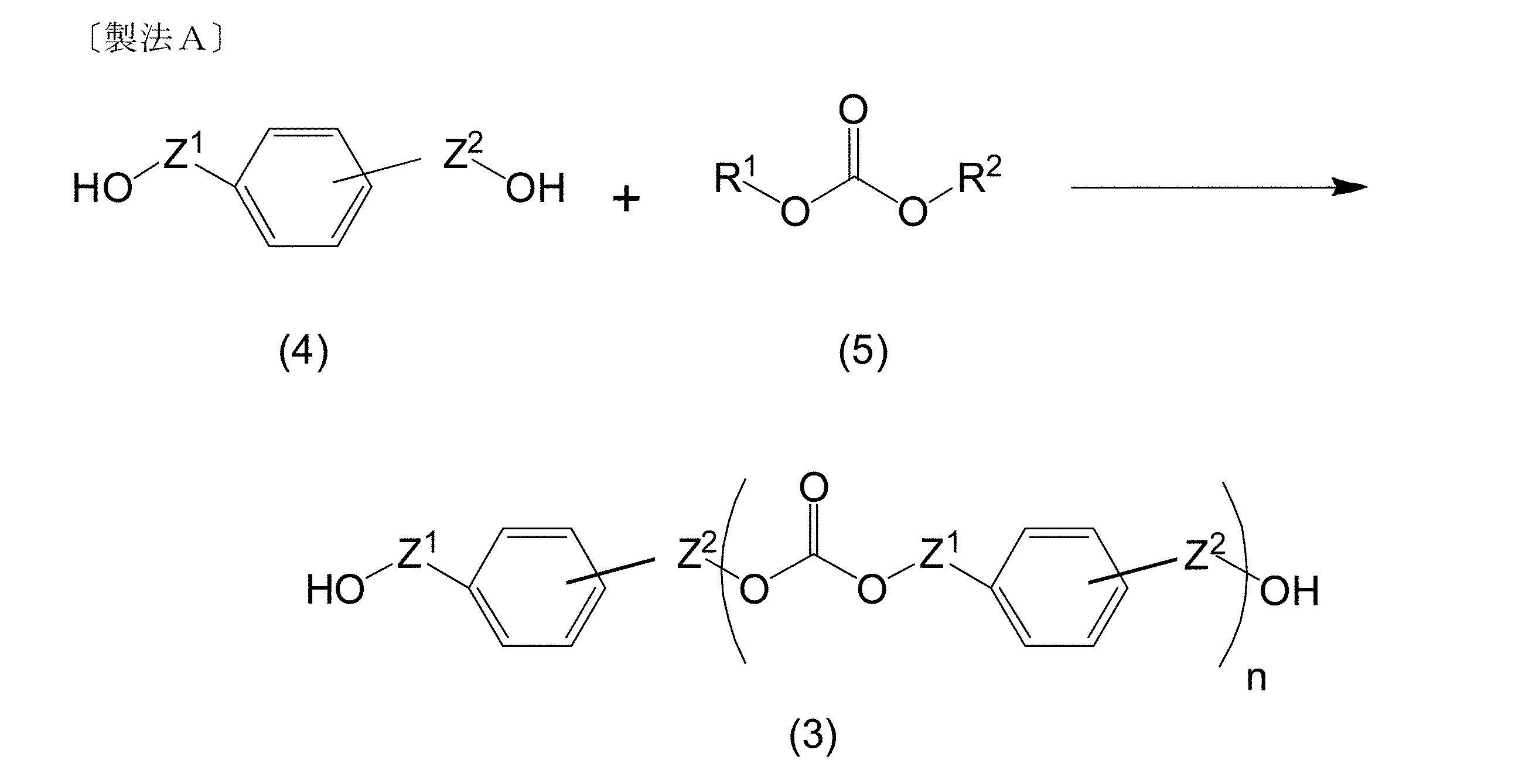
製法Aに係る上記式中、R1及びR2は、置換基を有していてもよい炭素数1~6の炭化水素基を示すか、又は一緒になって炭素数2~4のアルカンジイル基を示す。nは繰り返し単位の数を示し、好ましくは1~18、より好ましくは2~13である。
上記製法Aにおいては、エステル交換反応時に、炭酸エステル(5)に由来するアルコール類(R1OH、R2OH等)が副生するので、これを蒸留等により抜き出しながら反応を進めることが好ましい。また、上記製法Aにおいて、炭酸エステル(5)として炭酸エチレン等の炭酸アルキレンを用いる場合は、炭酸アルキレンに由来するグリコール類が副生するので、これを蒸留等により抜き出しながら反応を進めることが好ましい。
なお、芳香族ジヒドロキシル化合物(4)、炭酸エステル(5)、及びエステル交換反応の詳細については〔製法B〕に後述する。
なお、芳香族ジヒドロキシル化合物(4)、炭酸エステル(5)、及びエステル交換反応の詳細については〔製法B〕に後述する。
本発明に係るポリカーボネートジオール(A)が、式(1)で表される繰り返し単位と、1種以上の他の繰り返し単位と、分子鎖の両末端の2個の水酸基で構成されるポリカーボネートジオール共重合体である場合、前記他の繰り返し単位としては、カーボネート構造を有するものであれば特に制限されないが、得られるポリウレタン化合物の融点やガラス転移温度を低くすることができる点から、下記式(2)で表される繰り返し単位が好ましい。

式中、Z3は、置換基を有してもよい炭素数2~10の直鎖若しくは分岐鎖のアルカンジイル基、置換基を有してもよい炭素数3~10のシクロアルカンジイル基、又は置換基を有してもよい主鎖中に脂環構造を有する炭素数5~10のアルカンジイル基のいずれかを示す。ここで、「置換基」は、続くウレタン化反応に関与しない基であればよい。
前記Z3が表す炭素数2~10の直鎖又は分岐鎖のアルカンジイル基としては、エチレン基、トリメチレン基、プロパン-1,2-ジイル基、テトラメチレン基、ブタン-1,3-ジイル基、ペンタメチレン基、ヘキサメチレン基、ヘプタメチレン基、オクタメチレン基、デカメチレン基等が挙げられる。
前記Z3が表す炭素数3~10のシクロアルカンジイル基としては、シクロプロパン-1,2-ジイル基、シクロブタン-1,3-ジイル基、シクロペンタン-1,2-ジイル基、シクロヘキサン-1,2-ジイル基、シクロヘキサン-1,3-ジイル基、シクロヘキサン-1,4-ジイル基、シクロヘプタン-1,4-ジイル基、シクロオクタン-1,5-ジイル基、シクロノナン-1,5-ジイル基、シクロデカン-1,6-ジイル基、アダマンタン-1,3-ジイル基等が挙げられる。
前記Z3が表す主鎖中に脂環構造を有する炭素数5~10のアルカンジイル基としては、シクロプロパン-1,2-ジメチレン基、シクロブタン-1,3-ジメチレン基、シクロペンタン-1,2-ジメチレン基、シクロペンタン-1,3-ジメチレン基、シクロヘキサン-1,2-ジメチレン基、シクロヘキサン-1,3-ジメチレン基、シクロヘキサン-1,4-ジメチレン基、シクロヘキサン-1,2-ジエチレン基、シクロヘキサン-1,3-ジエチレン基、シクロヘキサン-1,4-ジエチレン基、シクロヘプタン-1,4-ジメチレン基、シクロオクタン-1,5-ジメチレン基等が挙げられる。
前記Z3は、上記の中でも、炭素数3~6の直鎖のアルカンジイル基又は主鎖中に脂環構造を有する炭素数6~8のアルカンジイル基が好ましい。前記Z3は、特に、トリメチレン基、ブタン-1,4-ジイル基、ペンタン-1,5-ジイル基、ヘキサン-1,6-ジイル基、シクロヘキサン-1,3-ジメチレン基、シクロヘキサン-1,4-ジメチレン基からなる群から選ばれる一種以上であることが好ましい。
すなわち、本発明に係るポリカーボネートジオール(A)は、式(1)で表される繰り返し単位と、式(2)で表される繰り返し単位と、分子鎖の両末端の2個の水酸基で構成される、例えば下記式(3′):

で表わされるランダム共重合のポリカーボネートジオール共重合体であってもよい。
ポリカーボネートジオール共重合体において、[(式(1)で表される繰り返し単位)/(式(2)で表される繰り返し単位)]のモル比は1/9~9/1が好ましく、1/5~5/1がより好ましく、1/3~3/1が更に好ましい。
ポリカーボネートジオール共重合体の式(1)及び(2)で表される繰り返し単位の数、含有量、数平均分子量等は、力学的性能、耐加水分解性、耐熱性、耐候性の観点と、各種分野における適用性の観点から、以下のとおりである。
式(1)で表される繰り返し単位と、式(2)で表される繰り返し単位とは、ブロック共重合されていてもよいし、ランダム共重合されていてもよい。
式(1)で表される繰り返し単位の数は、好ましくは1~20であり、より好ましくは2~15であり、該繰り返し単位の含有量は、ポリカーボネートジオール共重合体中、好ましくは10~90モル%、より好ましくは25~75モル%である。
式(2)で表される繰り返し単位の数は、好ましくは1~30であり、より好ましくは2~20であり、該繰り返し単位の含有量は、ポリカーボネートジオール共重合体中、好ましくは10~90モル%、より好ましくは25~75モル%である。
本発明に係るポリカーボネートジオール共重合体の数平均分子量は、好ましくは200~3,000、より好ましくは300~2,000、更に好ましくは900~1,500である。
式(1)で表される繰り返し単位と、式(2)で表される繰り返し単位とは、ブロック共重合されていてもよいし、ランダム共重合されていてもよい。
式(1)で表される繰り返し単位の数は、好ましくは1~20であり、より好ましくは2~15であり、該繰り返し単位の含有量は、ポリカーボネートジオール共重合体中、好ましくは10~90モル%、より好ましくは25~75モル%である。
式(2)で表される繰り返し単位の数は、好ましくは1~30であり、より好ましくは2~20であり、該繰り返し単位の含有量は、ポリカーボネートジオール共重合体中、好ましくは10~90モル%、より好ましくは25~75モル%である。
本発明に係るポリカーボネートジオール共重合体の数平均分子量は、好ましくは200~3,000、より好ましくは300~2,000、更に好ましくは900~1,500である。
本発明に係るポリカーボネートジオール(A)のその他の好ましい物性は、以下のとおりである。
JIS K 1557に規定されるハーゼン単位色数(APHA)は、好ましくは200以下、より好ましくは100以下、更に好ましくは70以下、特に好ましくは1~60である。
水酸基価は、好ましくは35~600mgKOH/g、より好ましくは50~400mgKOH/g、更に好ましくは100~150mgKOH/g、特に好ましくは110~130mgKOH/gである。
酸価は、好ましくは1mgKOH/g以下、より好ましくは0.1mgKOH/g以下、更に好ましくは0.01~0.05mgKOH/gである。
融点は、好ましくは-100~+250℃、より好ましくは-80~+200℃、更に好ましくは-20~+170℃、特に好ましくは0~160℃である。
ガラス転移点は、好ましくは-80~+50℃、より好ましくは-60~+20℃であり、更に好ましくは-55~-20℃である。
粘度は、好ましくは10~10,000cp(75℃)、より好ましくは50~5,000cp(75℃)、更に好ましくは100~1,500cp(75℃)である。
JIS K 1557に規定されるハーゼン単位色数(APHA)は、好ましくは200以下、より好ましくは100以下、更に好ましくは70以下、特に好ましくは1~60である。
水酸基価は、好ましくは35~600mgKOH/g、より好ましくは50~400mgKOH/g、更に好ましくは100~150mgKOH/g、特に好ましくは110~130mgKOH/gである。
酸価は、好ましくは1mgKOH/g以下、より好ましくは0.1mgKOH/g以下、更に好ましくは0.01~0.05mgKOH/gである。
融点は、好ましくは-100~+250℃、より好ましくは-80~+200℃、更に好ましくは-20~+170℃、特に好ましくは0~160℃である。
ガラス転移点は、好ましくは-80~+50℃、より好ましくは-60~+20℃であり、更に好ましくは-55~-20℃である。
粘度は、好ましくは10~10,000cp(75℃)、より好ましくは50~5,000cp(75℃)、更に好ましくは100~1,500cp(75℃)である。
ポリカーボネートジオール共重合体の製造法としては、炭酸エステル法やホスゲン法等の公知の方法により、芳香族ジオール化合物と脂肪族ジヒドロキシル化合物と炭酸エステルやホスゲン等とを反応させる方法等が挙げられる。これらの中では、炭酸エステル法が好ましい。
炭酸エステル法としては、例えば、次の製法Bが好ましく挙げられる。
製法Bは、下記の反応式で示されるように、芳香族ジヒドロキシル化合物(4)と炭酸エステル(5)と脂肪族ジヒドロキシル化合物(6)とを、触媒の存在下又は不存在下で、エステル交換反応させてポリカーボネートジオール共重合体(3′)を得る方法である。
炭酸エステル法としては、例えば、次の製法Bが好ましく挙げられる。
製法Bは、下記の反応式で示されるように、芳香族ジヒドロキシル化合物(4)と炭酸エステル(5)と脂肪族ジヒドロキシル化合物(6)とを、触媒の存在下又は不存在下で、エステル交換反応させてポリカーボネートジオール共重合体(3′)を得る方法である。
また、下記製法Bの反応式において、反応式を簡便に表記するため、ポリカーボネートジオール共重合体(3′)として、左側末端に脂肪族ジヒドロキシル化合物(6)由来の構成単位が存在する場合のみを記載している。しかし、該末端は脂肪族ジヒドロキシル化合物(6)由来の構成単位に限定されない。
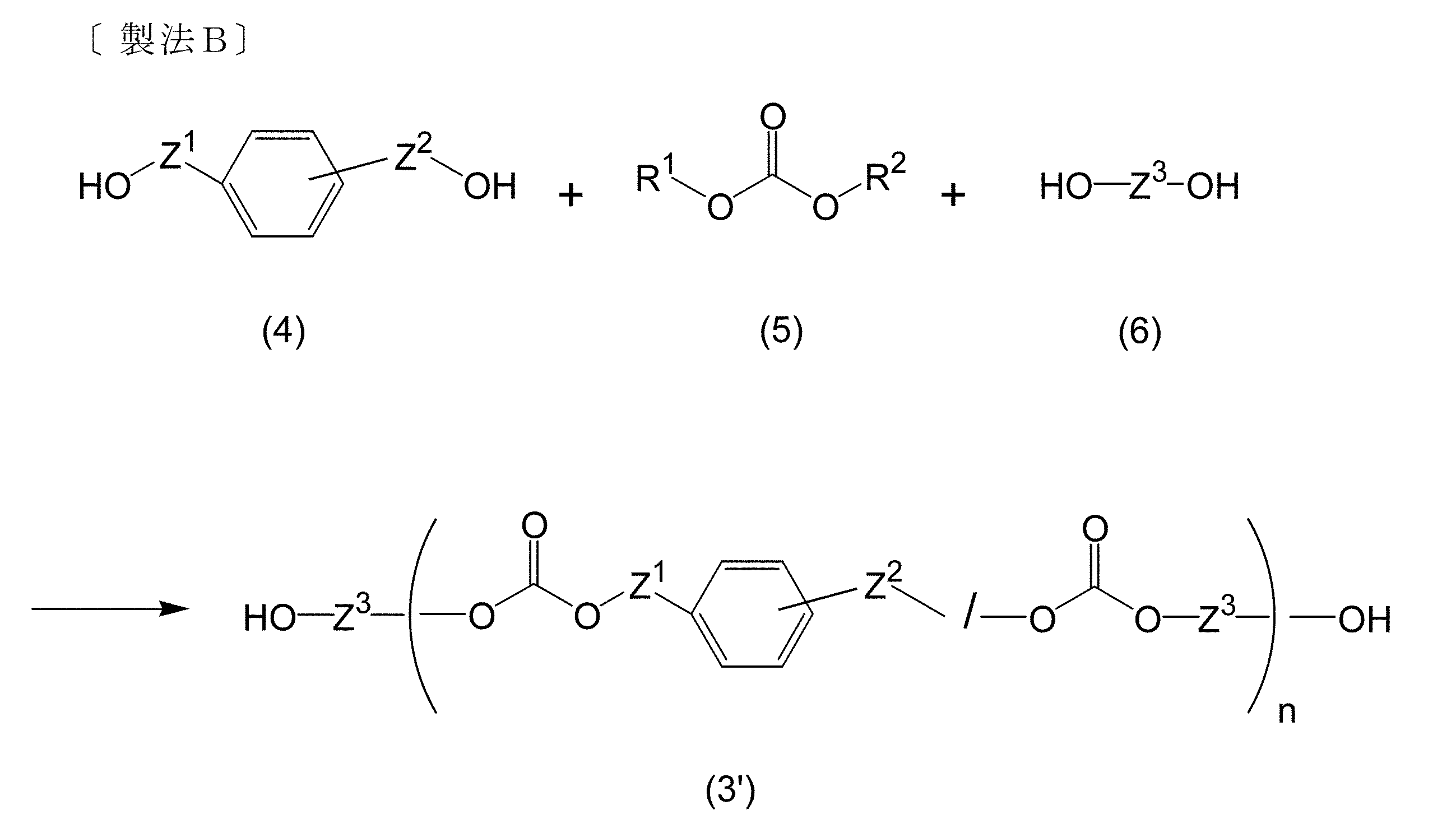
製法Bに係る上記式中、R1、R2、Z3及びnは、前記と同じである。
上記製法Bにおいては、エステル交換反応時に、炭酸エステル(5)に由来するアルコール類(R1OH、R2OH等)が副生するので、これを蒸留等により抜き出しながら反応を進めることが好ましい。また、上記製法Bにおいて、炭酸エステル(5)として、炭酸エチレン等の炭酸アルキレンを用いる場合は、炭酸アルキレンに由来するグリコール類が副生するので、これを蒸留等により抜き出しながら反応を進めることが好ましい。
上記製法Bにおいては、エステル交換反応時に、炭酸エステル(5)に由来するアルコール類(R1OH、R2OH等)が副生するので、これを蒸留等により抜き出しながら反応を進めることが好ましい。また、上記製法Bにおいて、炭酸エステル(5)として、炭酸エチレン等の炭酸アルキレンを用いる場合は、炭酸アルキレンに由来するグリコール類が副生するので、これを蒸留等により抜き出しながら反応を進めることが好ましい。
本発明に係るポリカーボネートジオールで使用される芳香族ジヒドロキシル化合物は、下記式(4)で表される。

式中、Z1及びZ2は前記と同じであり、それぞれ独立に、炭素数1~10の直鎖又は分岐鎖のアルカンジイル基を示す。アルカンジイル基の具体例、好適例は前記のとおりであり、炭素数1~4の直鎖又は分岐鎖のアルカンジイル基が好ましい。
また、Z1及びZ2は、1,4-結合(パラ体)又は1,3-結合(メタ体)が好ましく、1,4-結合(パラ体)がより好ましい。
特に好適な芳香族ジヒドロキシル化合物(a)としては、1,4-ベンゼンジメタノール、1,4-ベンゼンジエタノール、1,4-ベンゼンジプロパノール、1,4-ベンゼンジブタノール、1,3-ベンゼンジメタノール、1,3-ベンゼンジエタノール、1,3-ベンゼンジプロパノール、1,3-ベンゼンジブタノール、4-(4-ヒドロキシメチルフェニル)ブタノール、3-[4-(2-ヒドロキシエチル)フェニル]プロパノール等の炭素数1~4の直鎖又は分岐鎖のアルカンジイル基を有する化合物が挙げられる。
また、Z1及びZ2は、1,4-結合(パラ体)又は1,3-結合(メタ体)が好ましく、1,4-結合(パラ体)がより好ましい。
特に好適な芳香族ジヒドロキシル化合物(a)としては、1,4-ベンゼンジメタノール、1,4-ベンゼンジエタノール、1,4-ベンゼンジプロパノール、1,4-ベンゼンジブタノール、1,3-ベンゼンジメタノール、1,3-ベンゼンジエタノール、1,3-ベンゼンジプロパノール、1,3-ベンゼンジブタノール、4-(4-ヒドロキシメチルフェニル)ブタノール、3-[4-(2-ヒドロキシエチル)フェニル]プロパノール等の炭素数1~4の直鎖又は分岐鎖のアルカンジイル基を有する化合物が挙げられる。
本発明に係るポリカーボネートジオールに使用できる炭酸エステル(5)は特に制限されないが、炭酸エステルに由来する副生アルコール類を効率よく抜き出すことができるものを適宜選択することが望ましい。例えば、炭酸ジアルキル、炭酸ジアリール、炭酸アルキレン等が挙げられる。
炭酸ジアルキルとしては、炭素数1~6、好ましくは炭素数1~4のアルキル基を有する炭酸ジアルキルが好ましく、具体的には、炭酸ジメチル、炭酸ジエチル等が挙げられる。
炭酸ジアリールとしては、炭酸ジフェニル等が挙げられる。
炭酸アルキレンとしては、炭素数2~4のアルカンジイル基を有する炭酸アルキレンが好ましく、具体的には、炭酸エチレン、炭酸プロピレン、炭酸ブチレン等が挙げられる。これらの中では、副生アルコール類の抜き出しやすさの観点から、炭素数1~4のアルキル基を有する炭酸ジアルキルが好ましく、炭酸ジメチルが特に好ましい。
炭酸ジアルキルとしては、炭素数1~6、好ましくは炭素数1~4のアルキル基を有する炭酸ジアルキルが好ましく、具体的には、炭酸ジメチル、炭酸ジエチル等が挙げられる。
炭酸ジアリールとしては、炭酸ジフェニル等が挙げられる。
炭酸アルキレンとしては、炭素数2~4のアルカンジイル基を有する炭酸アルキレンが好ましく、具体的には、炭酸エチレン、炭酸プロピレン、炭酸ブチレン等が挙げられる。これらの中では、副生アルコール類の抜き出しやすさの観点から、炭素数1~4のアルキル基を有する炭酸ジアルキルが好ましく、炭酸ジメチルが特に好ましい。
本発明に係るポリカーボネートジオールで使用できる脂肪族ジヒドロキシル化合物は、下記式(6)で表される。

式中、Z3は前記と同じであり、置換基を有してもよい炭素数2~10の直鎖若しくは分岐鎖のアルカンジイル基、置換基を有してもよい炭素数3~10のシクロアルカンジイル基、又は置換基を有してもよい主鎖中に脂環構造を有する炭素数5~10のアルカンジイル基のいずれかを示す。
Z3が炭素数2~10のアルカンジイル基である、アルカンジオールとしては、エチレングリコール、1,3-プロパンジオール、1,4-ブタンジオール、1,5-ペンタンジオール、1,6-ヘキサンジオール、1,7-ヘプタンジオール、1,8-オクタンジオール、1,9-ノナンジオール、1,10-デカンジオール等が挙げられる。
アルカンジイル基部分の炭素鎖が分岐しているものとしては、1,3-ブタンジオール、3-メチルペンタン-1,5-ジオール、2-エチルヘキサン-1,6-ジオール、ネオペンチルグリコール、2-メチル-1,8-オクタンジオール等が挙げられる。
アルカンジイル基部分の炭素鎖が分岐しているものとしては、1,3-ブタンジオール、3-メチルペンタン-1,5-ジオール、2-エチルヘキサン-1,6-ジオール、ネオペンチルグリコール、2-メチル-1,8-オクタンジオール等が挙げられる。
Z3が炭素数3~10のシクロアルカンジイル基である、シクロアルカンジオールとしては、シクロプロパン-1,2-ジオール、シクロブタン-1,3-ジオール、シクロペンタン-1,2-ジオール、シクロヘキサン-1,2-ジオール、シクロヘキサン-1,3-ジオール、シクロヘキサン-1,4-ジオール、シクロヘプタン-1,4-ジオール、シクロオクタン-1,5-ジオール、シクロノナン-1,5-ジオール、シクロデカン-1,6-ジオール、アダマンタン-1,3-ジオール等が挙げられる。
Z3が主鎖中に脂環構造を有する炭素数5~10のアルカンジイル基である、シクロアルカンジオールとしては、シクロプロパン-1,2-ジメタノール、シクロブタン-1,3-ジメタノール、シクロペンタン-1,3-ジメタノール、1,4-シクロヘキサンジメタノール等が挙げられる。
上記の中でも、取扱い性及び入手のしやすさから、1,4-ブタンジオール、1,5-ペンタンジオール、1,6-ヘキサンジオール等の炭素数4~8、特に炭素数4~6のアルカンジオール、1,4-シクロヘキサンジメタノール等の炭素数5~8の脂環式構造を含む脂肪族ジオールがより好ましい。
本発明に係るポリカーボネートジオールの製造に用いる触媒としては、通常のエステル交換反応で使用される触媒(エステル交換触媒)が挙げられる。例えば、アルカリ金属化合物、アルカリ土類金属化合物、アルミニウム化合物、亜鉛化合物、マンガン化合物、ニッケル化合物、アンチモン化合物、ジルコニウム化合物、チタン化合物、有機スズ化合物が好ましく挙げられる。
アルカリ金属化合物としては、アルカリ金属の水酸化物(水酸化リチウム、水酸化ナトリウム、水酸化カリウム等)、アルカリ金属の炭酸塩(炭酸リチウム、炭酸ナトリウム、炭酸カリウム等)、アルカリ金属のカルボン酸塩(酢酸リチウム、酢酸ナトリウム、酢酸カリウム等)、アルカリ金属アルコキシド(リチウムメトキシド、ナトリウムメトキシド、カリウムt-ブトキシド等)等が挙げられ、アルカリ土類金属化合物としては、アルカリ土類金属の水酸化物(水酸化マグネシウム等)、アルカリ土類金属アルコキシド(マグネシウムメトキシド等)等が挙げられる。
アルカリ金属化合物としては、アルカリ金属の水酸化物(水酸化リチウム、水酸化ナトリウム、水酸化カリウム等)、アルカリ金属の炭酸塩(炭酸リチウム、炭酸ナトリウム、炭酸カリウム等)、アルカリ金属のカルボン酸塩(酢酸リチウム、酢酸ナトリウム、酢酸カリウム等)、アルカリ金属アルコキシド(リチウムメトキシド、ナトリウムメトキシド、カリウムt-ブトキシド等)等が挙げられ、アルカリ土類金属化合物としては、アルカリ土類金属の水酸化物(水酸化マグネシウム等)、アルカリ土類金属アルコキシド(マグネシウムメトキシド等)等が挙げられる。
前記アルミニウム化合物としては、アルミニウムアルコキシド(アルミニウムエトキシド、アルミニウムイソプロポキシド、アルミニウムsec-ブトキシド等)、アルミニウムアセチルアセトナート等のアルミニウム化合物等が挙げられる。
前記亜鉛化合物としては、亜鉛のカルボン酸塩(酢酸亜鉛等)、亜鉛アセチルアセトナート等が挙げられ、マンガン化合物としては、マンガンのカルボン酸塩(酢酸マンガン等)、マンガンアセチルアセトナート等が挙げられ、ニッケル化合物としては、ニッケルのカルボン酸塩(酢酸ニッケル等)、ニッケルアセチルアセトナート等が挙げられる。
前記アンチモン化合物としては、アンチモンのカルボン酸塩(酢酸アンチモン等)、アンチモンアルコキシド等が挙げられ、ジルコニウム化合物としては、ジルコニウムアルコキシド(ジルコニウムプロポキシド、ジルコニウムブトキシド等)、ジルコニウムアセチルアセトナート等が挙げられる。
前記亜鉛化合物としては、亜鉛のカルボン酸塩(酢酸亜鉛等)、亜鉛アセチルアセトナート等が挙げられ、マンガン化合物としては、マンガンのカルボン酸塩(酢酸マンガン等)、マンガンアセチルアセトナート等が挙げられ、ニッケル化合物としては、ニッケルのカルボン酸塩(酢酸ニッケル等)、ニッケルアセチルアセトナート等が挙げられる。
前記アンチモン化合物としては、アンチモンのカルボン酸塩(酢酸アンチモン等)、アンチモンアルコキシド等が挙げられ、ジルコニウム化合物としては、ジルコニウムアルコキシド(ジルコニウムプロポキシド、ジルコニウムブトキシド等)、ジルコニウムアセチルアセトナート等が挙げられる。
前記チタン化合物としては、チタンアルコキシド(チタンテトラエトキシド、チタンテトラプロポキシド、チタンテトラブトキシド、テトラシクロヘキシルチタネート、テトラベンジルチタネート等)、チタンアシレート(トリブトキシチタンステアレート、イソプロポキシチタンステアレート等)、チタンキレート(ジイソプロポキシチタンビスアセチルアセトネート、ジヒドロキシ・ビスラクタトチタン等)等が挙げられる。
前記有機スズ化合物としては、ジブチルチンオキシド、ジブチルチンジアセテート、ジブチルチンジラウレート等が挙げられる。
なお、各カルボン酸塩におけるカルボン酸としては、炭素数2~30のカルボン酸が好ましく、炭素数2~18のカルボン酸がより好ましい。各アルコキシドは、炭素数が1~30のアルコキシ基が好ましく、炭素数が2~18のアルコキシ基がより好ましい。
上記の触媒の中では、チタン化合物、有機スズ化合物が好ましく、チタン化合物がより好ましく、チタンアルコキシドが更に好ましい。チタンアルコキシドの中では、チタンテトラエトキシド、チタンテトラプロポキシド、チタンテトラブトキシドがより好ましく、チタンテトラブトキシドが特に好ましい。
なお、上記の芳香族ジヒドロキシル化合物(4)、炭酸エステル(5)、脂肪族ジヒドロキシル化合物(6)、及び触媒は、1種単独で又は2種以上を組み合わせて用いることができる。
前記有機スズ化合物としては、ジブチルチンオキシド、ジブチルチンジアセテート、ジブチルチンジラウレート等が挙げられる。
なお、各カルボン酸塩におけるカルボン酸としては、炭素数2~30のカルボン酸が好ましく、炭素数2~18のカルボン酸がより好ましい。各アルコキシドは、炭素数が1~30のアルコキシ基が好ましく、炭素数が2~18のアルコキシ基がより好ましい。
上記の触媒の中では、チタン化合物、有機スズ化合物が好ましく、チタン化合物がより好ましく、チタンアルコキシドが更に好ましい。チタンアルコキシドの中では、チタンテトラエトキシド、チタンテトラプロポキシド、チタンテトラブトキシドがより好ましく、チタンテトラブトキシドが特に好ましい。
なお、上記の芳香族ジヒドロキシル化合物(4)、炭酸エステル(5)、脂肪族ジヒドロキシル化合物(6)、及び触媒は、1種単独で又は2種以上を組み合わせて用いることができる。
本発明に係るポリカーボネートジオールの製造方法におけるエステル交換反応は、触媒の存在下又は不存在下で行うことができるが、反応効率の観点から、触媒の存在下で行うことが好ましい。
エステル交換反応における反応温度及び反応圧力は、用いる炭酸エステル(5)と脂肪族ジヒドロキシル化合物(6)の種類によって異なるが、製法Aの場合は1,4-ベンゼンジメタノール等の芳香族ジヒドロキシル化合物(4)、製法Bの場合は芳香族ジヒドロキシル化合物(4)及び脂肪族ジヒドロキシル化合物(6)が実質的に留出しない条件とすることが好ましい。反応温度は90~230℃であることが好ましく、反応圧力は常圧から30~500mmHgの減圧とすることが好ましい。なお反応は、空気、炭酸ガス、又は不活性ガス(窒素、アルゴン、ヘリウム等)の雰囲気下又は気流中で行なうことができるが、不活性ガス雰囲気下又は気流中で行なうことが好ましい。
さらに触媒を用いる場合の使用量は、反応性の観点から、製法Aの場合は、反応開始時における芳香族ジヒドロキシル化合物(4)と炭酸エステル(5)との合計仕込み量に対して、製法Bの場合は、反応開始時における芳香族ジヒドロキシル化合物(4)、炭酸エステル(5)及び脂肪族ジヒドロキシル化合物(6)の合計仕込み量に対して、触媒の重量基準で1~20,000ppmが好ましく、10~5,000ppmがより好ましく、100~4,000ppmが更に好ましい。
エステル交換反応における反応温度及び反応圧力は、用いる炭酸エステル(5)と脂肪族ジヒドロキシル化合物(6)の種類によって異なるが、製法Aの場合は1,4-ベンゼンジメタノール等の芳香族ジヒドロキシル化合物(4)、製法Bの場合は芳香族ジヒドロキシル化合物(4)及び脂肪族ジヒドロキシル化合物(6)が実質的に留出しない条件とすることが好ましい。反応温度は90~230℃であることが好ましく、反応圧力は常圧から30~500mmHgの減圧とすることが好ましい。なお反応は、空気、炭酸ガス、又は不活性ガス(窒素、アルゴン、ヘリウム等)の雰囲気下又は気流中で行なうことができるが、不活性ガス雰囲気下又は気流中で行なうことが好ましい。
さらに触媒を用いる場合の使用量は、反応性の観点から、製法Aの場合は、反応開始時における芳香族ジヒドロキシル化合物(4)と炭酸エステル(5)との合計仕込み量に対して、製法Bの場合は、反応開始時における芳香族ジヒドロキシル化合物(4)、炭酸エステル(5)及び脂肪族ジヒドロキシル化合物(6)の合計仕込み量に対して、触媒の重量基準で1~20,000ppmが好ましく、10~5,000ppmがより好ましく、100~4,000ppmが更に好ましい。
また、脂肪族ジヒドロキシル化合物(6)と炭酸エステル(5)とを反応させて得られる高分子量のポリカーボネートジオールと、1,4-ベンゼンジメタノール等の芳香族ジヒドロキシル化合物(4)とを触媒の存在下又は不存在下でエステル交換反応させて、ポリカーボネートジオール共重合体を得ることもできる。
さらに、1,4-ベンゼンジメタノール等の芳香族ジヒドロキシル化合物(4)と炭酸エステル(5)とを反応させて得られる高分子量のポリカーボネートジオールと、脂肪族ジヒドロキシル化合物(6)とを触媒の存在下又は不存在下でエステル交換反応させて、ポリカーボネートジオール共重合体を得ることもできる。
さらに、1,4-ベンゼンジメタノール等の芳香族ジヒドロキシル化合物(4)と炭酸エステル(5)とを反応させて得られる高分子量のポリカーボネートジオールと、脂肪族ジヒドロキシル化合物(6)とを触媒の存在下又は不存在下でエステル交換反応させて、ポリカーボネートジオール共重合体を得ることもできる。
本発明に係るポリカーボネートジオール(A)の平均分子量は、使用する芳香族ジヒドロキシル化合物(4)、炭酸エステル(5)、及び脂肪族ジヒドロキシル化合物(6)の反応モル比の変更等によって調製することができる。
なお、生成したポリカーボネートジオール又はポリカーボネートジオール共重合体の平均分子量が目的とする平均分子量よりも小さい場合は、更に減圧下で芳香族ジヒドロキシル化合物(4)及び/又は脂肪族ジヒドロキシル化合物(6)を留出させ、逆に平均分子量が目的とする平均分子量よりも大きい場合は、芳香族ジヒドロキシル化合物(4)及び/又は脂肪族ジヒドロキシル化合物(6)を添加して更にエステル交換反応させて、目的とする平均分子量のポリカーボネートジオール又はポリカーボネートジオール共重合体を得ることができる。
また、本発明に係るポリカーボネートジオール共重合体の繰り返し単位の構成モル比率は、芳香族ジヒドロキシル化合物(4)と脂肪族ジヒドロキシル化合物(6)とのモル比の変更等によって調製することができる。
なお、生成したポリカーボネートジオール又はポリカーボネートジオール共重合体の平均分子量が目的とする平均分子量よりも小さい場合は、更に減圧下で芳香族ジヒドロキシル化合物(4)及び/又は脂肪族ジヒドロキシル化合物(6)を留出させ、逆に平均分子量が目的とする平均分子量よりも大きい場合は、芳香族ジヒドロキシル化合物(4)及び/又は脂肪族ジヒドロキシル化合物(6)を添加して更にエステル交換反応させて、目的とする平均分子量のポリカーボネートジオール又はポリカーボネートジオール共重合体を得ることができる。
また、本発明に係るポリカーボネートジオール共重合体の繰り返し単位の構成モル比率は、芳香族ジヒドロキシル化合物(4)と脂肪族ジヒドロキシル化合物(6)とのモル比の変更等によって調製することができる。
(ポリイソシアネート化合物(B))
本発明で使用できるポリイソシアネート化合物(B)としては、特に制限されないが、具体的には1,3-フェニレンジイソシアネート、1,4-フェニレンジイソシアネート、2,4-トリレンジイソシアネート(TDI)、2,6-トリレンジイソシアネート、4,4’-ジフェニレンメタンジイソシアネート(MDI)、2,4-ジフェニルメタンジイソシアネート、4,4’-ジイソシアナトビフェニル、3,3’-ジメチル-4,4’-ジイソシアナトビフェニル、3,3’-ジメチル-4,4’-ジイソシアナトジフェニルメタン、1,5-ナフチレンジイソシアネート、4,4’,4’’-トリフェニルメタントリイソシアネート、m-イソシアナトフェニルスルホニルイソシアネート、p-イソシアナトフェニルスルホニルイソシアネート等の芳香族ポリイソシアネート化合物;エチレンジイソシアネート、テトラメチレンジイソシアネート、ヘキサメチレンジイソシアネート(HDI)、ドデカメチレンジイソシアネート、1,6,11-ウンデカントリイソシアネート、2,2,4-トリメチルヘキサメチレンジイソシアネート、リジンジイソシアネート、2,6-ジイソシアナトカプロン酸メチル、ビス(2-イソシアナトエチル)フマレート、ビス(2-イソシアナトエチル)カーボネート、2,6-ジイソシアナトカプロン酸2-イソシアナトエチル等の脂肪族ポリイソシアネート化合物;イソホロンジイソシアネート(IPDI)、4,4’-ジシクロヘキシルメタンジイソシアネート(水素添加MDI)、シクロヘキシレンジイソシアネート、メチルシクロヘキシレンジイソシアネート(水素添加TDI)、ビス(2-イソシアナトエチル)-4-シクロヘキセン-1,2-ジカルボキシレート、2,5-ノルボルナンジイソシアネート、2,6-ノルボルナンジイソシアネート等の脂環式ポリイソシアネート化合物などが挙げられる。これらのポリイソシアネート化合物は、1種を単独で用いてもよいし、複数種を併用してもよい。
本発明で使用できるポリイソシアネート化合物(B)としては、特に制限されないが、具体的には1,3-フェニレンジイソシアネート、1,4-フェニレンジイソシアネート、2,4-トリレンジイソシアネート(TDI)、2,6-トリレンジイソシアネート、4,4’-ジフェニレンメタンジイソシアネート(MDI)、2,4-ジフェニルメタンジイソシアネート、4,4’-ジイソシアナトビフェニル、3,3’-ジメチル-4,4’-ジイソシアナトビフェニル、3,3’-ジメチル-4,4’-ジイソシアナトジフェニルメタン、1,5-ナフチレンジイソシアネート、4,4’,4’’-トリフェニルメタントリイソシアネート、m-イソシアナトフェニルスルホニルイソシアネート、p-イソシアナトフェニルスルホニルイソシアネート等の芳香族ポリイソシアネート化合物;エチレンジイソシアネート、テトラメチレンジイソシアネート、ヘキサメチレンジイソシアネート(HDI)、ドデカメチレンジイソシアネート、1,6,11-ウンデカントリイソシアネート、2,2,4-トリメチルヘキサメチレンジイソシアネート、リジンジイソシアネート、2,6-ジイソシアナトカプロン酸メチル、ビス(2-イソシアナトエチル)フマレート、ビス(2-イソシアナトエチル)カーボネート、2,6-ジイソシアナトカプロン酸2-イソシアナトエチル等の脂肪族ポリイソシアネート化合物;イソホロンジイソシアネート(IPDI)、4,4’-ジシクロヘキシルメタンジイソシアネート(水素添加MDI)、シクロヘキシレンジイソシアネート、メチルシクロヘキシレンジイソシアネート(水素添加TDI)、ビス(2-イソシアナトエチル)-4-シクロヘキセン-1,2-ジカルボキシレート、2,5-ノルボルナンジイソシアネート、2,6-ノルボルナンジイソシアネート等の脂環式ポリイソシアネート化合物などが挙げられる。これらのポリイソシアネート化合物は、1種を単独で用いてもよいし、複数種を併用してもよい。
前記ポリイソシアネート化合物の1分子当たりのイソシアナト基は通常2個であるが、本発明におけるポリウレタン化合物がゲル化をしない範囲で、トリフェニルメタントリイソシアネートのようなイソシアナト基を3個以上有するポリイソシアネートも使用することができる。
上記のポリイソシアネート化合物の中でも、反応性の制御と強度付与等の観点から、4,4’-ジフェニレンメタンジイソシアネート(MDI)、イソホロンジイソシアネート(IPDI)、4,4’-ジシクロヘキシルメタンジイソシアネート(水素添加MDI)が好ましい。
(水酸基を有する(メタ)アクリレート化合物(C))
本発明で使用できる、分子内に1個以上の水酸基を有する(メタ)アクリレート化合物(以下、「(メタ)アクリレート化合物(C)」ともいう)としては、特に制限されないが、例えば、エチレングリコールモノ(メタ)アクリレート、プロピレングリコールモノ(メタ)アクリレート、ブタンジオールモノ(メタ)アクリレート、ペンタンジオールモノ(メタ)アクリレート、ヘキサンジオールモノ(メタ)アクリレート、ジエチレングリコールモノ(メタ)アクリレート、ジプロピレングリコールモノ(メタ)アクリレート、トリエチレングリコールモノ(メタ)アクリレート、トリプロピレングリコールモノ(メタ)アクリレート、テトラエチレングリコールモノ(メタ)アクリレート、ポリエチレングリコールモノ(メタ)アクリレート、ポリプロピレングリコールモノ(メタ)アクリレート、ネオペンチルグリコールモノ(メタ)アクリレート、エトキシ化ネオペンチルグリコールモノ(メタ)アクリレート、ヒドロキシピバリン酸ネオペンチルグリコールモノ(メタ)アクリレートなどの2価アルコールのモノ(メタ)アクリレート;トリメチロールプロパンモノ(メタ)アクリレート、エトキシ化トリメチロールプロパンモノ(メタ)アクリレート、プロポキシ化トリメチロールプロパンモノ(メタ)アクリレート、トリス(2-ヒドロキシエチル)イソシアヌレートモノ(メタ)アクリレート、グリセリンモノ(メタ)アクリレート、トリメチロールプロパンジ(メタ)アクリレート、エトキシ化トリメチロールプロパンジ(メタ)アクリレート、プロポキシ化トリメチロールプロパンジ(メタ)アクリレート、トリス(2-ヒドロキシエチル)イソシアヌレートジ(メタ)アクリレート、グリセリンジ(メタ)アクリレート等の3価のアルコールのモノ(メタ)アクリレート及びジ(メタ)アクリレートや、これらアルコールの水酸基の一部をアルキル基やε-カプロラクトンで変性したモノ及びジ(メタ)アクリレート;ペンタエリスリトールモノ(メタ)アクリレート、ジペンタエリスリトールモノ(メタ)アクリレート、ジトリメチロールプロパンモノ(メタ)アクリレート、ペンタエリスリトールジ(メタ)アクリレート、ジペンタエリスリトールジ(メタ)アクリレート、ジトリメチロールプロパンジ(メタ)アクリレート、ペンタエリスリトールトリ(メタ)アクリレート、ジペンタエリスリトールトリ(メタ)アクリレート、ジトリメチロールプロパントリ(メタ)アクリレート、ジペンタエリスリトールテトラ(メタ)アクリレート等の、4価以上のアルコールの多官能(メタ)アクリレートでヒドロキシル基を有するものや、これらアルコールの水酸基の一部をアルキル基やε-カプロラクトンで変性したヒドロキシル基を有する多官能(メタ)アクリレートなどが具体的に挙げられる。これらの(メタ)アクリレート化合物(C)は、1種を単独で用いてもよいし、複数種を併用してもよい。
本発明で使用できる、分子内に1個以上の水酸基を有する(メタ)アクリレート化合物(以下、「(メタ)アクリレート化合物(C)」ともいう)としては、特に制限されないが、例えば、エチレングリコールモノ(メタ)アクリレート、プロピレングリコールモノ(メタ)アクリレート、ブタンジオールモノ(メタ)アクリレート、ペンタンジオールモノ(メタ)アクリレート、ヘキサンジオールモノ(メタ)アクリレート、ジエチレングリコールモノ(メタ)アクリレート、ジプロピレングリコールモノ(メタ)アクリレート、トリエチレングリコールモノ(メタ)アクリレート、トリプロピレングリコールモノ(メタ)アクリレート、テトラエチレングリコールモノ(メタ)アクリレート、ポリエチレングリコールモノ(メタ)アクリレート、ポリプロピレングリコールモノ(メタ)アクリレート、ネオペンチルグリコールモノ(メタ)アクリレート、エトキシ化ネオペンチルグリコールモノ(メタ)アクリレート、ヒドロキシピバリン酸ネオペンチルグリコールモノ(メタ)アクリレートなどの2価アルコールのモノ(メタ)アクリレート;トリメチロールプロパンモノ(メタ)アクリレート、エトキシ化トリメチロールプロパンモノ(メタ)アクリレート、プロポキシ化トリメチロールプロパンモノ(メタ)アクリレート、トリス(2-ヒドロキシエチル)イソシアヌレートモノ(メタ)アクリレート、グリセリンモノ(メタ)アクリレート、トリメチロールプロパンジ(メタ)アクリレート、エトキシ化トリメチロールプロパンジ(メタ)アクリレート、プロポキシ化トリメチロールプロパンジ(メタ)アクリレート、トリス(2-ヒドロキシエチル)イソシアヌレートジ(メタ)アクリレート、グリセリンジ(メタ)アクリレート等の3価のアルコールのモノ(メタ)アクリレート及びジ(メタ)アクリレートや、これらアルコールの水酸基の一部をアルキル基やε-カプロラクトンで変性したモノ及びジ(メタ)アクリレート;ペンタエリスリトールモノ(メタ)アクリレート、ジペンタエリスリトールモノ(メタ)アクリレート、ジトリメチロールプロパンモノ(メタ)アクリレート、ペンタエリスリトールジ(メタ)アクリレート、ジペンタエリスリトールジ(メタ)アクリレート、ジトリメチロールプロパンジ(メタ)アクリレート、ペンタエリスリトールトリ(メタ)アクリレート、ジペンタエリスリトールトリ(メタ)アクリレート、ジトリメチロールプロパントリ(メタ)アクリレート、ジペンタエリスリトールテトラ(メタ)アクリレート等の、4価以上のアルコールの多官能(メタ)アクリレートでヒドロキシル基を有するものや、これらアルコールの水酸基の一部をアルキル基やε-カプロラクトンで変性したヒドロキシル基を有する多官能(メタ)アクリレートなどが具体的に挙げられる。これらの(メタ)アクリレート化合物(C)は、1種を単独で用いてもよいし、複数種を併用してもよい。
上記の(メタ)アクリレート化合物(C)の中でも、低粘度かつ安価などの観点から、エチレングリコールモノ(メタ)アクリレート、プロピレングリコールモノ(メタ)アクリレート、ブタンジオールモノ(メタ)アクリレートなどの2価アルコールのモノ(メタ)アクリレートが好ましく、エチレングリコールモノ(メタ)アクリレートが特に好ましい。
本発明のポリウレタン化合物は、ポリカーボネートジオール(A)と、ポリイソシアネート化合物(B)と、分子内に1個以上の水酸基を有する(メタ)アクリレート化合物(C)とを反応させて得られる。反応の詳細については、後述のとおりであるが、公知のポリウレタン化合物の製造方法に従って実施してもよい。また、例えば、ポリカーボネートジオール(A)とポリイソシアネート化合物(B)とを反応させて、末端にイソシアナト基を有するポリウレタンプレポリマーを得た後、前記ポリウレタンプレポリマーと分子内に1個以上の水酸基を有する(メタ)アクリレート化合物(C)とを反応させて、本発明のポリウレタン化合物を製造してもよい。
(酸性基含有ポリオール(D))
本発明のポリウレタン化合物は、ポリカーボネートジオール(A)と、ポリイソシアネート化合物(B)と、分子内に1個以上の水酸基を有する(メタ)アクリレート化合物(C)の他に、酸性基含有ポリオール(D)を反応させて得られるものでもよい。
前記酸性基含有ポリオール(D)としては、1分子中に2個以上の水酸基と1個以上の酸性基を含有する化合物であれば、特に制限されない。前記酸性基としては、カルボキシ基、スルホニル基、リン酸基、フェノール性水酸基が挙げられる。
前記酸性基含有ポリオール(D)の中でも、1分子中に2個以上の水酸基と1個以上のカルボキシ基を有する化合物が好ましく、1分子中に2個の水酸基と1個のカルボキシ基を有する化合物がより好ましい。
本発明のポリウレタン化合物は、ポリカーボネートジオール(A)と、ポリイソシアネート化合物(B)と、分子内に1個以上の水酸基を有する(メタ)アクリレート化合物(C)の他に、酸性基含有ポリオール(D)を反応させて得られるものでもよい。
前記酸性基含有ポリオール(D)としては、1分子中に2個以上の水酸基と1個以上の酸性基を含有する化合物であれば、特に制限されない。前記酸性基としては、カルボキシ基、スルホニル基、リン酸基、フェノール性水酸基が挙げられる。
前記酸性基含有ポリオール(D)の中でも、1分子中に2個以上の水酸基と1個以上のカルボキシ基を有する化合物が好ましく、1分子中に2個の水酸基と1個のカルボキシ基を有する化合物がより好ましい。
前記酸性基含有ポリオール(D)の具体例としては、例えば、2,2-ジメチロールプロピオン酸、2,2-ジメチロールブタン酸等のジメチロールアルカン酸、N,N-ビスヒドロキシエチルグリシン、N,N-ビスヒドロキシエチルアラニン、3,4-ジヒドロキシブタンスルホン酸、3,6-ジヒドロキシ-2-トルエンスルホン酸、酸性基含有ポリエーテルポリオール、酸性基含有ポリエステルポリオール等が挙げられる。この中でも入手の容易さの観点から、ジメチロールアルカン酸が好ましく、この場合、アルカン酸は、炭素原子数が4個以下であることが好ましく、2,2-ジメチロールプロピオン酸がさらに好ましい。
前記酸性基含有ポリオール(D)は、1種のみを単独で用いてもよいし、2種以上を併用してもよい。
前記酸性基含有ポリオール(D)は、1種のみを単独で用いてもよいし、2種以上を併用してもよい。
本発明のポリウレタン化合物はまた、ポリカーボネートジオール(A)と、ポリイソシアネート化合物(B)と、分子内に1個以上の水酸基を有する(メタ)アクリレート化合物(C)と、酸性基含有ポリオール(D)とを反応させて得られる。反応の詳細については、後述のとおりであるが、公知のポリウレタン化合物の製造方法に従って実施してもよい。また、例えば、ポリカーボネートジオール(A)とポリイソシアネート化合物(B)と酸性基含有ポリオール(D)とを反応させて、末端にイソシアナト基を有するポリウレタンプレポリマーを得た後、前記ポリウレタンプレポリマーと分子内に1個以上の水酸基を有する(メタ)アクリレート化合物(C)とを反応させて、本発明のポリウレタン化合物を製造してもよい。
(鎖延長剤(E))
本発明のポリウレタン化合物は、ポリカーボネートジオール(A)と、ポリイソシアネート化合物(B)と、分子内に1個以上の水酸基を有する(メタ)アクリレート化合物(C)と、任意成分である酸性基含有ポリオール(D)と、鎖延長剤(E)とを反応させて得られるものでもよい。
前記鎖延長剤(E)としては、イソシアナト基と反応性を有する化合物が挙げられる。例えば、エチレンジアミン、1,4-テトラメチレンジアミン、2-メチル-1,5-ペンタンジアミン、1,4-ブタンジアミン、1,6-ヘキサメチレンジアミン、1,4-ヘキサメチレンジアミン、3-アミノメチル-3,5,5-トリメチルシクロヘキシルアミン、1,3-ビス(アミノメチル)シクロヘキサン、キシリレンジアミン、ピペラジン、アジポイルヒドラジド、ヒドラジン、2,5-ジメチルピペラジン、ジエチレントリアミン、トリエチレンテトラミン等のアミン化合物、エチレングリコール、プロピレングリコール、1,4-ブタンジオール、1,6-ヘキサンジオール等のジオール化合物、ポリエチレングリコールに代表されるポリアルキレングリコール類、水等が挙げられ、中でも好ましくは1級ジアミン化合物が挙げられる。これらは単独で用いてもよく、2種以上を併用してもよい。
本発明のポリウレタン化合物は、ポリカーボネートジオール(A)と、ポリイソシアネート化合物(B)と、分子内に1個以上の水酸基を有する(メタ)アクリレート化合物(C)と、任意成分である酸性基含有ポリオール(D)と、鎖延長剤(E)とを反応させて得られるものでもよい。
前記鎖延長剤(E)としては、イソシアナト基と反応性を有する化合物が挙げられる。例えば、エチレンジアミン、1,4-テトラメチレンジアミン、2-メチル-1,5-ペンタンジアミン、1,4-ブタンジアミン、1,6-ヘキサメチレンジアミン、1,4-ヘキサメチレンジアミン、3-アミノメチル-3,5,5-トリメチルシクロヘキシルアミン、1,3-ビス(アミノメチル)シクロヘキサン、キシリレンジアミン、ピペラジン、アジポイルヒドラジド、ヒドラジン、2,5-ジメチルピペラジン、ジエチレントリアミン、トリエチレンテトラミン等のアミン化合物、エチレングリコール、プロピレングリコール、1,4-ブタンジオール、1,6-ヘキサンジオール等のジオール化合物、ポリエチレングリコールに代表されるポリアルキレングリコール類、水等が挙げられ、中でも好ましくは1級ジアミン化合物が挙げられる。これらは単独で用いてもよく、2種以上を併用してもよい。
前記鎖延長剤(E)の添加方法は、各原料と一緒に一度に反応させるワンショット法でもよく、また分子末端にイソシアナト基を有するポリウレタンプレポリマーと反応させるプレポリマー法でもよい。
前記ポリウレタンプレポリマーは、ポリカーボネートジオール(A)と、ポリイソシアネート化合物(B)と、任意成分である酸性基含有ポリオール(D)を反応させて得られる。
また、前記ポリウレタンプレポリマーは、ポリカーボネートジオール(A)と、ポリイソシアネート化合物(B)と、任意成分である酸性基含有ポリオール(D)と、分子内に1個以上の水酸基を有する(メタ)アクリレート化合物(C)とを反応させたものであってもよい。この場合、分子内に1個以上の水酸基を有する(メタ)アクリレート化合物(C)が、分子内に1個しか水酸基を有さない場合は、前記分子内に1個以上の水酸基を有する(メタ)アクリレート化合物(C)を多量に添加すると、ポリウレタンプレポリマーのイソシアナト基がほとんど分子内に1個以上の水酸基を有する(メタ)アクリレート化合物(C)で封止されてしまうため、鎖延長剤(E)を反応させることはできない場合がある。
前記ポリウレタンプレポリマーは、ポリカーボネートジオール(A)と、ポリイソシアネート化合物(B)と、任意成分である酸性基含有ポリオール(D)を反応させて得られる。
また、前記ポリウレタンプレポリマーは、ポリカーボネートジオール(A)と、ポリイソシアネート化合物(B)と、任意成分である酸性基含有ポリオール(D)と、分子内に1個以上の水酸基を有する(メタ)アクリレート化合物(C)とを反応させたものであってもよい。この場合、分子内に1個以上の水酸基を有する(メタ)アクリレート化合物(C)が、分子内に1個しか水酸基を有さない場合は、前記分子内に1個以上の水酸基を有する(メタ)アクリレート化合物(C)を多量に添加すると、ポリウレタンプレポリマーのイソシアナト基がほとんど分子内に1個以上の水酸基を有する(メタ)アクリレート化合物(C)で封止されてしまうため、鎖延長剤(E)を反応させることはできない場合がある。
前記鎖延長剤(E)の量は、適宜、選択することができる。プレポリマー法により、水性ポリウレタン分散体を製造する場合、水以外の鎖延長剤中のイソシアナト基と反応性を有する基のモル数が、ポリウレタンプレポリマー中のイソシアナト基のモル数の2倍以下となるように鎖延長剤を添加する事ができる。ポリウレタンプレポリマーと鎖延長剤とのモル比は、1:1~0.8:1で混合することがより好ましい。
本発明のポリウレタン化合物は、ポリカーボネートジオール(A)とポリイソシアネート化合物(B)と少なくとも1個の水酸基を含有する(メタ)アクリレート化合物(C)とを反応させることにより製造することができる。反応温度は、0~150℃、好ましくは20~100℃である。またこの反応は、不活性ガス雰囲気下で行ってもよいし、空気雰囲気下で行ってもよいし、不活性ガス及び空気の混合雰囲気下で行なってもよいが、空気を使用する場合は乾燥空気を使用することが好ましい。
上記3成分の割合としては、ポリカーボネートジオール(A)と水酸基を含有する(メタ)アクリレート化合物(C)に含まれる水酸基の合計モル数と、ポリイソシアネート化合物(B)に含まれるイソシアナト基のモル数の比率(OH/NCO)が、100/100~110/100となる割合であることが好ましい。イソシアナト基のモル数よりも水酸基の合計モル数を多くすることにより、残存する未反応イソシアナト基を低減することができる。
上記反応で使用できる触媒としては、通常のウレタン化反応で使用される触媒(ウレタン化触媒)が挙げられる。特に制限はされないが、例えば、ジブチルスズジアセテート、ジブチルスズジラウレートなどの有機スズ化合物;チタンテトラアセチルアセトネート、チタンジイソプロポキシビス(エチルアセトアセテート)などの有機チタン化合物;ジルコニウムテトラアセチルアセトネート、ジルコニウムジブトキシビス(エチルアセトアセテート)などの有機ジルコニウム化合物;トリエチルアミンなどの3級アミン化合物などが具体的に挙げられる。これらのウレタン化触媒は、1種を単独で用いてもよいし、複数種を併用してもよい。
これらの触媒の中では、有機スズ化合物、有機ジルコニウム化合物が好ましいが、中でもジブチルスズジラウレート、ジルコニウムテトラアセチルアセトネートがさらに好ましい。
前記ウレタン化触媒の添加量は、使用するポリカーボネートジオール(A)とポリイソシアネート化合物(B)と水酸基を有する(メタ)アクリレート化合物(C)の合計の重量に対して、0.00005重量%から0.01重量%が好ましく、0.0001重量%から0.005重量%がさらに好ましく、0.0003重量%から0.003重量%が特に好ましい。
これらの触媒の中では、有機スズ化合物、有機ジルコニウム化合物が好ましいが、中でもジブチルスズジラウレート、ジルコニウムテトラアセチルアセトネートがさらに好ましい。
前記ウレタン化触媒の添加量は、使用するポリカーボネートジオール(A)とポリイソシアネート化合物(B)と水酸基を有する(メタ)アクリレート化合物(C)の合計の重量に対して、0.00005重量%から0.01重量%が好ましく、0.0001重量%から0.005重量%がさらに好ましく、0.0003重量%から0.003重量%が特に好ましい。
また上記反応において、反応中に(メタ)アクリレート基の重合反応を抑制するために、重合禁止剤や酸化防止剤を使用することができる。特に制限はされないが、ハイドロキノン、p-メトキシフェノール、2,4-ジメチル-6-t-ブチルフェノール、p-ベンゾキノン、2,5-ジヒドロキシ-p-ベンゾキノンなどが具体的に挙げられる。これらの重合禁止剤や酸化防止剤は、1種を単独で用いてもよいし、複数種を併用してもよい。
重合禁止剤や酸化防止剤の添加量は、使用するポリカーボネートジオール(A)とポリイソシアネート化合物(B)と水酸基を有する(メタ)アクリレート化合物(C)の合計の重量に対して、0.00005重量%から0.01重量%が好ましく、0.0001重量%から0.005重量%がさらに好ましく、0.0003重量%から0.003重量%が特に好ましい。
重合禁止剤や酸化防止剤の添加量は、使用するポリカーボネートジオール(A)とポリイソシアネート化合物(B)と水酸基を有する(メタ)アクリレート化合物(C)の合計の重量に対して、0.00005重量%から0.01重量%が好ましく、0.0001重量%から0.005重量%がさらに好ましく、0.0003重量%から0.003重量%が特に好ましい。
さらに上記反応を、イソシアナト基と反応する活性水素基を有しない有機溶剤中で行うことにより、得られた反応溶液をそのまま、本発明のポリウレタン溶液とすることができる。有機溶剤に、特に制限されないが、例えば、アセトン、メチルエチルケトン、メチルイソブチルケトン、シクロヘキサノンなどのケトン系溶剤や、酢酸エチル、酢酸ブチル、プロピレングリコールモノメチルエーテルアセテート、プロピレングリコールモノエチルエーテルアセテート、ジプロピレングリコールモノメチルエーテルアセテートなどのエステル系溶剤や、エチレングリコールジメチルエーテル、エチレングリコールジエチルエーテル、ジプロピレングリコールジメチルエーテル、ジプロピレングリコールジエチルエーテル、トリエチレングリコールジメチルエーテル、トリエチレングリコールジエチルエーテルなどのエーテル系溶剤や、ベンゼン、トルエン、キシレン、テトラメチルベンゼンなどの芳香族系溶剤などが具体的に挙げられる。これらの有機溶剤は、1種を単独で用いてもよいし、複数種を併用してもよい。
有機溶剤の使用量は、使用するポリカーボネートジオール(A)とポリイソシアネート化合物(B)と(メタ)アクリレート化合物(C)の合計の重量と、有機溶剤の重量の比率が、1/9~9/1となる割合が好ましく、2/8~8/2となる割合がさらに好ましく、3/7~7/3の割合が特に好ましい。
有機溶剤の使用量は、使用するポリカーボネートジオール(A)とポリイソシアネート化合物(B)と(メタ)アクリレート化合物(C)の合計の重量と、有機溶剤の重量の比率が、1/9~9/1となる割合が好ましく、2/8~8/2となる割合がさらに好ましく、3/7~7/3の割合が特に好ましい。
また単離したポリウレタン化合物を、有機溶剤に溶解又は分散させて、液状又はペースト状のポリウレタン溶液とすることもできる。この場合、ポリウレタン化合物の固形分濃度は、3~95重量%であることが好ましい。液状又はペースト状のポリウレタン溶液は、接着剤やコーティング剤、塗料として利用できる。使用する有機溶剤に、特に制限はないが、前述の反応に使用しうるものとして挙げられたものと同じである。
(ポリウレタン組成物)
本発明のポリウレタン組成物(硬化性樹脂組成物)は、本発明のポリウレタン化合物と重合開始剤(G)と必要に応じて本発明のポリウレタン化合物以外の重合性不飽和結合を有する化合物(F)を含有することを特徴とする。
本発明のポリウレタン組成物(硬化性樹脂組成物)は、本発明のポリウレタン化合物と重合開始剤(G)と必要に応じて本発明のポリウレタン化合物以外の重合性不飽和結合を有する化合物(F)を含有することを特徴とする。
本発明のポリウレタン組成物に使用される重合開始剤(G)は、通常使用される光重合開始剤が挙げられる。
前記光重合開始剤としては、特に制限されないが、例えば、アセトフェノン、2,2-ジエトキシアセトフェノン、p-ジメチルアミノアセトフェノン、ベンゾフェノン、2-クロロベンゾフェノン、p,p’-ビスジエチルアミノベンゾフェノン、ベンゾインエチルエーテル、ベンゾインn-プロピルエーテル、ベンゾインイソプロピルエーテル、ベンゾインイソブチルエーテル、ベンゾインn-ブチルエーテル、ベンゾインジメチルケタール、チオキサントン、p-イソプロピル-α-ヒドロキシイソブチルフェノン、2,2-ジメトキシ-2-フェニルアセトフェノン、1-ヒドロキシシクロへキシルフェニルケトン、2-メチル-1[4-(メチルチオ)フェニル]-2-モルホリノプロパン-1-オン、2-ヒドロキシ-2-メチル-1-フェニルプロパン-1-オン、2,4,6,-トリメチルベンゾフェノン、4-メチルベンゾフェノン、ビス(2,4,6-トリメチルベンゾイル)-フェニルホスフィンオキシド、2,2-ジメトキシ-1,2-ジフェニルエタノンなどが挙げられる。好ましくは、1-ヒドロキシシクロヘキシルフェニルケトン、ビス(2,4,6-トリメチルベンゾイル)フェニルホスフィンオキシドなどが挙げられる。これらの光重合開始剤は、1種を単独で用いてもよいし、複数種を併用してもよい。
前記光重合開始剤の添加量としては、ポリウレタン化合物の重量に対して、0.3重量%から10重量%が好ましく、0.5重量%から5重量%がより好ましい。
前記光重合開始剤としては、特に制限されないが、例えば、アセトフェノン、2,2-ジエトキシアセトフェノン、p-ジメチルアミノアセトフェノン、ベンゾフェノン、2-クロロベンゾフェノン、p,p’-ビスジエチルアミノベンゾフェノン、ベンゾインエチルエーテル、ベンゾインn-プロピルエーテル、ベンゾインイソプロピルエーテル、ベンゾインイソブチルエーテル、ベンゾインn-ブチルエーテル、ベンゾインジメチルケタール、チオキサントン、p-イソプロピル-α-ヒドロキシイソブチルフェノン、2,2-ジメトキシ-2-フェニルアセトフェノン、1-ヒドロキシシクロへキシルフェニルケトン、2-メチル-1[4-(メチルチオ)フェニル]-2-モルホリノプロパン-1-オン、2-ヒドロキシ-2-メチル-1-フェニルプロパン-1-オン、2,4,6,-トリメチルベンゾフェノン、4-メチルベンゾフェノン、ビス(2,4,6-トリメチルベンゾイル)-フェニルホスフィンオキシド、2,2-ジメトキシ-1,2-ジフェニルエタノンなどが挙げられる。好ましくは、1-ヒドロキシシクロヘキシルフェニルケトン、ビス(2,4,6-トリメチルベンゾイル)フェニルホスフィンオキシドなどが挙げられる。これらの光重合開始剤は、1種を単独で用いてもよいし、複数種を併用してもよい。
前記光重合開始剤の添加量としては、ポリウレタン化合物の重量に対して、0.3重量%から10重量%が好ましく、0.5重量%から5重量%がより好ましい。
本発明のポリウレタン組成物に使用される重合性不飽和結合を有する化合物(F)としては、特に制限はないが、例えば、メチル(メタ)アクリレート、エチル(メタ)アクリレート、イソプロピル(メタ)アクリレート、n-ブチル(メタ)アクリレート、t-ブチル(メタ)アクリレート、イソブチル(メタ)アクリレートなどの(メタ)アクリル酸アルキルエステルや、2-ヒドロキシエチル(メタ)アクリレート、2-ヒドロキシプロピル(メタ)アクリレート、3-ヒドロキシプロピル(メタ)アクリレート、4-ヒドロキシブチル(メタ)アクリレートなどの(メタ)アクリル酸と炭素数2~8の2価アルコールとのモノエステル化物や、ブタンジオールジ(メタ)アクリレート、ヘキサンジオールジ(メタ)アクリレート、エトキシ化ヘキサンジオールジ(メタ)アクリレート、プロポキシ化ヘキサンジオールジ(メタ)アクリレート、ジエチレングリコールジ(メタ)アクリレート、ポリエチレングリコールジ(メタ)アクリレート、ポリプロピレングリコールジ(メタ)アクリレート、ネオペンチルグリコールジ(メタ)アクリレート、エトキシ化ネオペンチルグリコールジ(メタ)アクリレートなどのジ(メタ)アクリレートや、トリメチロールプロパントリ(メタ)アクリレート、エトキシ化トリメチロールプロパントリ(メタ)アクリレート、プロポキシ化トリメチロールプロパントリ(メタ)アクリレート、トリス(2-ヒドロキシエチル)イソシアヌレートトリ(メタ)アクリレート、グリセリントリ(メタ)アクリレート等のトリ(メタ)アクリレートや、ペンタエリスリトールトリ(メタ)アクリレート、ジペンタエリスリトールトリ(メタ)アクリレート、ジトリメチロールプロパントリ(メタ)アクリレート、ペンタエリスリトールテトラ(メタ)アクリレート、ジトリメチロールプロパンテトラ(メタ)アクリレート、ジペンタエリスリトールテトラ(メタ)アクリレート、ジペンタエリスリトールペンタ(メタ)アクリレート、ジトリメチロールプロパンペンタ(メタ)アクリレート、ジペンタエリスリトールヘキサ(メタ)アクリレート、ジトリメチロールプロパンヘキサ(メタ)アクリレートなどの多官能(メタ)アクリレートや、これら(メタ)アクリレートの一部をアルキル基やε-カプロラクトンで置換した多官能(メタ)アクリレートなどの1分子中に(メタ)アクリロイル基を3~6個有する(メタ)アクリレート化合物などが具体的に挙げられる。これらの重合性化合物は、1種を単独で用いてもよいし、複数種を併用してもよい。
重合性不飽和結合を有する化合物(F)の添加量は、ポリウレタン化合物の100重量部に対して、100重量部以下であることが好ましい。
重合性不飽和結合を有する化合物(F)の添加量は、ポリウレタン化合物の100重量部に対して、100重量部以下であることが好ましい。
さらに本発明のポリウレタン組成物には、用途に応じて、また必要に応じて、着色顔料、体質顔料、光輝性顔料、増粘剤、硬化触媒、紫外線吸収剤、光安定剤、消泡剤、可塑剤、表面調整剤、沈降防止剤等の通常の塗料用添加剤を使用することができる。これらの塗料用添加剤は、1種を単独で用いてもよいし、複数種を併用してもよい。またこれらの添加剤は、公知のものであれば、ポリウレタン組成物及びその硬化物の特性を損なわない範囲内で特に制限なく使用することができる。
(硬化物)
本発明の硬化物は、上記ポリウレタン組成物に、必要に応じて有機溶剤などで適当な粘度に調整した後、紫外線、可視光、レーザー光、電子線、X線、γ線、プラズマ、マイクロウェーブ等のエネルギー線を照射することにより、重合・硬化させて製造することができる。或いは熱によっても重合・硬化させて製造することができる。
本発明の硬化物は、上記ポリウレタン組成物に、必要に応じて有機溶剤などで適当な粘度に調整した後、紫外線、可視光、レーザー光、電子線、X線、γ線、プラズマ、マイクロウェーブ等のエネルギー線を照射することにより、重合・硬化させて製造することができる。或いは熱によっても重合・硬化させて製造することができる。
上記有機溶剤として使用できる溶剤は、特に制限されないが、例えば、アセトン、メチルエチルケトン、メチルイソブチルケトン、シクロヘキサノンなどのケトン系溶剤や、酢酸エチル、酢酸ブチル、プロピレングリコールモノメチルエーテルアセテート、プロピレングリコールモノエチルエーテルアセテート、ジプロピレングリコールモノメチルエーテルアセテートなどのエステル系溶剤;エチレングリコールジメチルエーテル、エチレングリコールジエチルエーテル、ジプロピレングリコールジメチルエーテル、ジプロピレングリコールジエチルエーテル、トリエチレングリコールジメチルエーテル、トリエチレングリコールジエチルエーテルなどのエーテル系溶剤;ベンゼン、トルエン、キシレン、テトラメチルベンゼンなどの芳香族系溶剤などが具体的に挙げられる。これらの有機溶剤は、1種を単独で用いてもよいし、複数種を併用してもよい。
本発明の硬化物を塗装又はコーティングとして得る場合の被塗装材質又は被コーティング材質としては、金属、プラスチック、無機物、木材、ABS樹脂・ポリカーボネート樹脂などの樹脂類などが挙げられる。
(水性ポリウレタン分散体)
本発明のポリウレタン化合物を水系媒体中に分散させて、水性ポリウレタン分散体とすることもできる。なお、本発明の水性ポリウレタン分散体を得るにおいて、ポリカーボネートジオール(A)と、ポリイソシアネート化合物(B)と、(メタ)アクリレート化合物(C)と、水系媒体とは必須成分であるが、酸性基含有ポリオール(D)と、鎖延長剤(E)とは、任意成分である。
本発明のポリウレタン化合物を水系媒体中に分散させて、水性ポリウレタン分散体とすることもできる。なお、本発明の水性ポリウレタン分散体を得るにおいて、ポリカーボネートジオール(A)と、ポリイソシアネート化合物(B)と、(メタ)アクリレート化合物(C)と、水系媒体とは必須成分であるが、酸性基含有ポリオール(D)と、鎖延長剤(E)とは、任意成分である。
すなわち、本発明の水性ポリウレタン分散体には、ポリカーボネートジオール(A)と、ポリイソシアネート化合物(B)と、(メタ)アクリレート化合物(C)とを反応させたポリウレタン化合物が、水系媒体中に分散されている水性ポリウレタン分散体;ポリカーボネートジオール(A)と、ポリイソシアネート化合物(B)と、(メタ)アクリレート化合物(C)と、酸性基含有ポリオール(D)とを反応させたポリウレタン化合物が、水系媒体中に分散されている水性ポリウレタン分散体;ポリカーボネートジオール(A)と、ポリイソシアネート化合物(B)と、(メタ)アクリレート化合物(C)と、鎖延長剤(E)とを反応させたポリウレタン化合物が、水系媒体中に分散されている水性ポリウレタン分散体;ポリカーボネートジオール(A)と、ポリイソシアネート化合物(B)と、(メタ)アクリレート化合物(C)と、酸性基含有ポリオール(D)と、鎖延長剤(E)とを反応させたポリウレタン化合物が、水系媒体中に分散されている水性ポリウレタン分散体が挙げられる。
例えば、本発明のポリウレタン化合物をポリカーボネートジオール(A)と、ポリイソシアネート化合物(B)と、(メタ)アクリレート化合物(C)と、酸性基含有ポリオール(D)とを反応させて得る場合には、少なくとも、ポリカーボネートジオール(A)と、ポリイソシアネート化合物(B)と、(メタ)アクリレート化合物(C)と、酸性基含有ポリオール(D)とを反応させた後、前記酸性基を塩基で中和し、水系媒体に分散させることによって、水性ポリウレタン分散体を得ることができる。
上記の水性ポリウレタン分散体の製造方法において、(メタ)アクリレート化合物(C)は、ポリウレタンプレポリマーを水系媒体中に分散させる前にポリウレタンプレポリマーと反応させてもよいし、水系媒体と一緒にポリウレタンプレポリマーと反応させてもよいし、水系媒体中に分散させた後にポリウレタンプレポリマーと反応させてもよい。
上記の水性ポリウレタン分散体の製造方法において、(メタ)アクリレート化合物(C)は、ポリウレタンプレポリマーを水系媒体中に分散させる前にポリウレタンプレポリマーと反応させてもよいし、水系媒体と一緒にポリウレタンプレポリマーと反応させてもよいし、水系媒体中に分散させた後にポリウレタンプレポリマーと反応させてもよい。
例えば、本発明のポリウレタン化合物をポリカーボネートジオール(A)と、ポリイソシアネート化合物(B)と、(メタ)アクリレート化合物(C)と、酸性基含有ポリオール(D)と、鎖延長剤(E)を反応させて得る場合には、ポリカーボネートジオール(A)とポリイソシアネート化合物(B)と酸性基含有ポリオール(D)とを反応させて、末端にイソシアナト基を有するポリウレタンプレポリマーを得た後、前記酸性基含有ポリオールに由来する酸性基を中和し、水系媒体中に分散させた後、鎖延長剤(E)と反応させ、その後、分子内に1個以上の水酸基を有する(メタ)アクリレート化合物(C)と反応させることができる。
上記の水性ポリウレタン分散体の製造方法において、(メタ)アクリレート化合物(C)及び鎖延長剤(E)は、ポリウレタンプレポリマーを水系媒体中に分散させる前にポリウレタンプレポリマーと反応させてもよいし、水系媒体と一緒にポリウレタンプレポリマーと反応させてもよいし、水系媒体中に分散させた後にポリウレタンプレポリマーと反応させてもよい。
上記の水性ポリウレタン分散体の製造方法において、(メタ)アクリレート化合物(C)及び鎖延長剤(E)は、ポリウレタンプレポリマーを水系媒体中に分散させる前にポリウレタンプレポリマーと反応させてもよいし、水系媒体と一緒にポリウレタンプレポリマーと反応させてもよいし、水系媒体中に分散させた後にポリウレタンプレポリマーと反応させてもよい。
前記酸性基を中和するための塩基としては、トリメチルアミン、トリエチルアミン、トリイソプロピルアミン、トリブチルアミン、トリエタノールアミン、N-メチルジエタノールアミン、N-フェニルジエタノールアミン、ジメチルエタノールアミン、ジエチルエタノールアミン、N-メチルモルホリン、ピリジン等の有機アミン類;水酸化ナトリウム、水酸化カリウム等の無機アルカリ類、アンモニア等が挙げられる。上記の中でも好ましくは有機アミン類であり、より好ましくは3級アミンであり、最も好ましくはトリエチルアミンである。これらは、単独で用いてもよく、2種以上を併用してもよい。
前記水系媒体としては、水や水と親水性有機溶媒との混合媒体等が挙げられる。水系媒体は、水性ポリウレタン樹脂分散体中のポリウレタン樹脂の割合が、5~60重量%となる量で使用することが好ましく、より好ましくは20~50重量%となる量である。
前記水としては、例えば、上水、イオン交換水、蒸留水、超純水等が挙げられるが、入手の容易さや塩の影響で粒子が不安定になることを考慮して、好ましくはイオン交換水が挙げられる。
前記親水性有機溶媒としては、例えば、アセトン、エチルメチルケトン等のケトン類、エステル類、テトラヒドロフラン、N-メチルモルホリン等のエーテル類、ジメチルホルムアミド、N-メチルピロリドン、N―エチルピロリドン等のアミド類、アルコール類が挙げられる。これらは単独で用いてもよく、2種以上を併用してもよい。
前記親水性有機溶媒としては、例えば、アセトン、エチルメチルケトン等のケトン類、エステル類、テトラヒドロフラン、N-メチルモルホリン等のエーテル類、ジメチルホルムアミド、N-メチルピロリドン、N―エチルピロリドン等のアミド類、アルコール類が挙げられる。これらは単独で用いてもよく、2種以上を併用してもよい。
(水性ポリウレタン分散体組成物)
本発明の水性ポリウレタン分散体に、前記重合性不飽和結合を有する化合物(F)及び前記重合開始剤(G)を加えて、水性ポリウレタン分散体組成物を調製することができる。前記組成物には、必要に応じて、顔料、染料、増粘剤、硬化触媒、紫外線吸収剤、光安定剤、消泡剤、可塑剤、表面調整剤、沈降防止剤等の通常の塗料用添加剤を単独でもしくは2種以上組み合わせて含有することができる。
本発明の水性ポリウレタン分散体に、前記重合性不飽和結合を有する化合物(F)及び前記重合開始剤(G)を加えて、水性ポリウレタン分散体組成物を調製することができる。前記組成物には、必要に応じて、顔料、染料、増粘剤、硬化触媒、紫外線吸収剤、光安定剤、消泡剤、可塑剤、表面調整剤、沈降防止剤等の通常の塗料用添加剤を単独でもしくは2種以上組み合わせて含有することができる。
また、本発明の水性ポリウレタン分散体組成物は、基材や離型材に、ベル塗装、スプレー塗装、ロール塗装、シャワー塗装、浸漬塗装等の方法で塗布することができる。これを50~250℃の温度で加熱したり、室温で長時間放置したりすることにより、乾燥させ、硬化物を得ることができる。
次に、実施例及び比較例を挙げて本発明を具体的に説明する。
ポリカーボネートジオールの水酸基価はJIS K 1577に準拠した方法で測定を行なった。
酸価は、JIS K 1557のB法に準拠して測定した。水分は、カールフィッシャー水分計を使用した電量滴定法で測定した。
酸価は、JIS K 1557のB法に準拠して測定した。水分は、カールフィッシャー水分計を使用した電量滴定法で測定した。
APHAは、JIS K 1557に基づき、JIS K 0071-1に準拠して下記のようにハーゼン単位色数(APHA)を測定した。
(標準液の調整)
塩化白金酸カリウム1.245g、塩化コバルト・6水和物1.000g、水500ml及び塩酸100mlを1リットルのメスフラスコに入れ、完全に溶解した後、水を標線まで加えた溶液を標準した。この溶液はAPHA標準液No.500に相当し、各種標準液はこのNo.500標準液を水で希釈して調整する。例えばAPHA標準液No.100は、No.500標準液20.0mlを水80.0mlで希釈して調整する。
(測定方法)
無色透明で底の肉厚が等しく内径23mmの同質同径の共栓付平底ガラス管で、液量が100mlになるように底部から同じ高さのところに標線を刻んだ比色管に、泡が入らないように注意して標線までサンプルを入れる。ついで白色板上に適当なAPHA標準液と並べて上方から見て比較し、サンプルに最も近似した濃度の標準液を求め、その標準液のナンバーをAPHAとした。
(標準液の調整)
塩化白金酸カリウム1.245g、塩化コバルト・6水和物1.000g、水500ml及び塩酸100mlを1リットルのメスフラスコに入れ、完全に溶解した後、水を標線まで加えた溶液を標準した。この溶液はAPHA標準液No.500に相当し、各種標準液はこのNo.500標準液を水で希釈して調整する。例えばAPHA標準液No.100は、No.500標準液20.0mlを水80.0mlで希釈して調整する。
(測定方法)
無色透明で底の肉厚が等しく内径23mmの同質同径の共栓付平底ガラス管で、液量が100mlになるように底部から同じ高さのところに標線を刻んだ比色管に、泡が入らないように注意して標線までサンプルを入れる。ついで白色板上に適当なAPHA標準液と並べて上方から見て比較し、サンプルに最も近似した濃度の標準液を求め、その標準液のナンバーをAPHAとした。
ポリウレタン化合物合成時のイソシアナト基の転化率は、JIS K 1603に準じた方法で測定したイソシアナト基含有率から算出した。
ポリウレタン化合物溶液の固形分濃度は、ポリウレタン化合物溶液を140℃で3時間乾燥した後、乾燥前後の重量減少から算出した。粘度はE型粘度計で測定を行なった。
ポリウレタン化合物の硬化には、紫外線硬化装置(セン特殊光源社製、HM15001C-4、ランプ:SE-1500M)を使用した。
硬化物の硬度は、サンプル台にガラス板で作製した塗膜サンプルを置き、ペンドラム式硬度計(BYK-Gardner GmbH社製、ペンドラム ハードネス試験機)で振幅減衰時間を測定した。振幅減衰時間が長いほど、硬度が大きいということを意味する。
硬化物の硬度は、サンプル台にガラス板で作製した塗膜サンプルを置き、ペンドラム式硬度計(BYK-Gardner GmbH社製、ペンドラム ハードネス試験機)で振幅減衰時間を測定した。振幅減衰時間が長いほど、硬度が大きいということを意味する。
硬化物の弾性率、引張強度、破断点伸度は、ポリスチレン樹脂板で作製した塗膜サンプルをフィルム状にし、JIS K 7311に準拠する方法で測定した。なお、測定条件は、測定温度23℃、湿度50%、引張速度100mm/分で行った。
硬化物の摩耗性は、サンプル台にポリカーボネート樹脂板で作製した塗膜サンプルをセットし、テーパー摩耗試験機(TOYOSEIKI社製、HS)で、回転速度:60rpm、荷重:500g、摩耗輪:H-18を使用して、塗膜の重量減少を測定した。重量減少が少ないほど耐摩耗性がよいことを意味する。
[実施例1]
(1)ポリカーボネートジオールの合成
精留塔、攪拌機、温度計、窒素導入管を備えた500mlのガラス製丸底フラスコに、ジメチルカーボネート199.3g(2.21mol)、1,4-ベンゼンジメタノール65.2g(0.47mol)、1,6-ヘキサンジオール167.2g(1.41mol)、チタンテトラブトキサイド0.03gを仕込み、常圧、攪拌下、メタノールとジメチルカーボネートの混合物を留去しながら、エステル交換反応を6時間行なった。この間、反応温度は95℃から200℃まで徐々に昇温させ、留出物の組成はメタノールとジメチルカーボネートの共沸組成ないしはその近傍となるように調節した。
(1)ポリカーボネートジオールの合成
精留塔、攪拌機、温度計、窒素導入管を備えた500mlのガラス製丸底フラスコに、ジメチルカーボネート199.3g(2.21mol)、1,4-ベンゼンジメタノール65.2g(0.47mol)、1,6-ヘキサンジオール167.2g(1.41mol)、チタンテトラブトキサイド0.03gを仕込み、常圧、攪拌下、メタノールとジメチルカーボネートの混合物を留去しながら、エステル交換反応を6時間行なった。この間、反応温度は95℃から200℃まで徐々に昇温させ、留出物の組成はメタノールとジメチルカーボネートの共沸組成ないしはその近傍となるように調節した。
この後徐々に100mmHgまで減圧し、攪拌下、メタノールとジメチルカーボネートの混合物を留去しながら、195℃でエステル交換反応をさらに4時間行なった。反応終了後(メタノールとジメチルカーボネートの留去終了後)、反応液を室温まで冷却し、ポリカーボネートジオール共重合体280gを得た。なおエステル交換反応は窒素気流中で行なった。得られたポリカーボネートジオール共重合体は、数平均分子量が996、APHAが60、水酸基価が112.6mgKOH/g、酸価が0.01mgKOH/g、水分が120ppmであった。
(2)ポリウレタン化合物の合成
攪拌機、温度計、冷却管を備えた1000mlのガラス製セパラブルフラスコに、上記(1)で得られたポリカーボネートジオール共重合体199.2g(0.20mol)、酢酸ブチル224.1gを仕込み、反応温度を70℃にした後、ジルコニウムテトラアセチルアセトネート0.10g、イソホロンジイソシアネート89.3g(0.40mol)を添加し、反応温度80℃から90℃でイソシアナト基の転化率が50%となるまで反応を行なった。その後、p-メトキシフェノール0.34g、ジルコニウムテトラアセチルアセトネート0.13g、エチレングリコールモノアクリレート48.9g(0.42mol)を添加し、反応温度80℃から90℃でイソシアナト基の転化率が99%以上となるまで反応を行なった。得られたポリウレタン化合物の酢酸ブチル溶液の固形分は61%、粘度は211cp/40℃であった。
攪拌機、温度計、冷却管を備えた1000mlのガラス製セパラブルフラスコに、上記(1)で得られたポリカーボネートジオール共重合体199.2g(0.20mol)、酢酸ブチル224.1gを仕込み、反応温度を70℃にした後、ジルコニウムテトラアセチルアセトネート0.10g、イソホロンジイソシアネート89.3g(0.40mol)を添加し、反応温度80℃から90℃でイソシアナト基の転化率が50%となるまで反応を行なった。その後、p-メトキシフェノール0.34g、ジルコニウムテトラアセチルアセトネート0.13g、エチレングリコールモノアクリレート48.9g(0.42mol)を添加し、反応温度80℃から90℃でイソシアナト基の転化率が99%以上となるまで反応を行なった。得られたポリウレタン化合物の酢酸ブチル溶液の固形分は61%、粘度は211cp/40℃であった。
(3)ポリウレタン組成物及び硬化物の製造
ビス(2,4,6-トリメチルベンゾイル)フェニルホスフィンオキシド1重量部と酢酸エチル19重量部をよく混合したものと、上記(2)で得られたポリウレタン化合物の酢酸ブチル溶液80重量部をよく混合して、ポリウレタン組成物(硬化性樹脂組成物)を調製した。50μmアプリケーターを使用してガラス板にこの硬化樹脂組成物を塗布し、80℃で30分乾燥した後、紫外線硬化装置で1000mJ/cm2の紫外線を照射して硬化物を得た。得られた硬化物の硬度は、振幅減衰時間で111秒であった。
ビス(2,4,6-トリメチルベンゾイル)フェニルホスフィンオキシド1重量部と酢酸エチル19重量部をよく混合したものと、上記(2)で得られたポリウレタン化合物の酢酸ブチル溶液80重量部をよく混合して、ポリウレタン組成物(硬化性樹脂組成物)を調製した。50μmアプリケーターを使用してガラス板にこの硬化樹脂組成物を塗布し、80℃で30分乾燥した後、紫外線硬化装置で1000mJ/cm2の紫外線を照射して硬化物を得た。得られた硬化物の硬度は、振幅減衰時間で111秒であった。
(4)水性ポリウレタン分散体の合成
攪拌機及び加熱器を備えた反応装置に、上記(1)で得られたポリカーボネートジオール共重合体27.9g(0.028mol)と、2,2-ジメチロールプロピオン酸(DMPA、11.1グラム)と、イソホロンジイソシアネート(IPDI、57.5グラム)とを、N-エチルピロリドン(43.9グラム)中、ジルコニウムテトラアセチルアセトネート0.13g存在下、窒素雰囲気下で、80-90℃で2.5時間加熱した。2,6-ジ-tert-ブチル-4-メチルフェノール(0.2グラム)と、4-メトキシフェノール(0.2グラム)とを加え、雰囲気を空気とした。さらに、エチレングリコールモノアクリレート48.9g(0.42mol)、ジペンタエリスリトールヘキサアクリレート(DPHA、79.9グラム)と、トリエチルアミン(8.9グラム)とを添加・混合した。反応混合物(226グラム)を、強攪拌下のもと水(386グラム)の中に加えて水性ポリウレタン樹脂分散体を得た。
攪拌機及び加熱器を備えた反応装置に、上記(1)で得られたポリカーボネートジオール共重合体27.9g(0.028mol)と、2,2-ジメチロールプロピオン酸(DMPA、11.1グラム)と、イソホロンジイソシアネート(IPDI、57.5グラム)とを、N-エチルピロリドン(43.9グラム)中、ジルコニウムテトラアセチルアセトネート0.13g存在下、窒素雰囲気下で、80-90℃で2.5時間加熱した。2,6-ジ-tert-ブチル-4-メチルフェノール(0.2グラム)と、4-メトキシフェノール(0.2グラム)とを加え、雰囲気を空気とした。さらに、エチレングリコールモノアクリレート48.9g(0.42mol)、ジペンタエリスリトールヘキサアクリレート(DPHA、79.9グラム)と、トリエチルアミン(8.9グラム)とを添加・混合した。反応混合物(226グラム)を、強攪拌下のもと水(386グラム)の中に加えて水性ポリウレタン樹脂分散体を得た。
[実施例2]
ビス(2,4,6-トリメチルベンゾイル)フェニルホスフィンオキシド1重量部と2-ヒドロキシエチルメタクリレート19重量部をよく混合したものと、実施例1(2)で得られたポリウレタン化合物の酢酸ブチル溶液80重量部をよく混合して、ポリウレタン組成物(硬化樹脂組成物)を調製した。50μmアプリケーターを使用してガラス板にこのポリウレタン組成物を塗布し、80℃で30分乾燥した後、紫外線硬化装置で1000mJ/cm2の紫外線を照射して硬化物を得た。得られた硬化物の硬度は振幅減衰時間で162秒、弾性率は210MPa、引張強度は27MPa、破断点伸度は89%、摩耗性は回転数400回で32.9mgの重量減少であった。
ビス(2,4,6-トリメチルベンゾイル)フェニルホスフィンオキシド1重量部と2-ヒドロキシエチルメタクリレート19重量部をよく混合したものと、実施例1(2)で得られたポリウレタン化合物の酢酸ブチル溶液80重量部をよく混合して、ポリウレタン組成物(硬化樹脂組成物)を調製した。50μmアプリケーターを使用してガラス板にこのポリウレタン組成物を塗布し、80℃で30分乾燥した後、紫外線硬化装置で1000mJ/cm2の紫外線を照射して硬化物を得た。得られた硬化物の硬度は振幅減衰時間で162秒、弾性率は210MPa、引張強度は27MPa、破断点伸度は89%、摩耗性は回転数400回で32.9mgの重量減少であった。
[比較例1]
(1)ポリウレタン化合物の合成
攪拌機、温度計、冷却管を備えた1000mlのガラス製セパラブルフラスコに、ポリカーボネートジオール(宇部興産株式会社製、商品名:ETERNACOLL UH-100、1,6-ヘキサンジオールと炭酸ジメチルとを反応させて得たポリカーボネートジオール、数平均分子量1004、APHA10、水酸基価111.7mgKOH/g、酸価0.02mgKOH/g、水分400ppm)200.8g(0.20mol)、酢酸ブチル224.1gを仕込み、反応温度を70℃にした後、ジルコニウムテトラアセチルアセトネート0.10g、イソホロンジイソシアネート90.0g(0.40mol)を添加し、反応温度80℃から90℃でイソシアナト基の転化率が50%となるまで反応を行なった。その後、p-メトキシフェノール0.34g、ジルコニウムテトラアセチルアセトネート0.10g、エチレングリコールモノアクリレート50.0g(0.43mol)を添加し、反応温度80℃から90℃でイソシアナト基の転化率が99%以上となるまで反応を行なった。得られたポリウレタン化合物の酢酸ブチル溶液の固形分は62%、粘度は192cp/40℃であった。
(1)ポリウレタン化合物の合成
攪拌機、温度計、冷却管を備えた1000mlのガラス製セパラブルフラスコに、ポリカーボネートジオール(宇部興産株式会社製、商品名:ETERNACOLL UH-100、1,6-ヘキサンジオールと炭酸ジメチルとを反応させて得たポリカーボネートジオール、数平均分子量1004、APHA10、水酸基価111.7mgKOH/g、酸価0.02mgKOH/g、水分400ppm)200.8g(0.20mol)、酢酸ブチル224.1gを仕込み、反応温度を70℃にした後、ジルコニウムテトラアセチルアセトネート0.10g、イソホロンジイソシアネート90.0g(0.40mol)を添加し、反応温度80℃から90℃でイソシアナト基の転化率が50%となるまで反応を行なった。その後、p-メトキシフェノール0.34g、ジルコニウムテトラアセチルアセトネート0.10g、エチレングリコールモノアクリレート50.0g(0.43mol)を添加し、反応温度80℃から90℃でイソシアナト基の転化率が99%以上となるまで反応を行なった。得られたポリウレタン化合物の酢酸ブチル溶液の固形分は62%、粘度は192cp/40℃であった。
(2)ポリウレタン組成物及び硬化物の製造
ビス(2,4,6-トリメチルベンゾイル)フェニルホスフィンオキシド1重量部と酢酸エチル19重量部をよく混合したものと、上記(1)で得られたポリウレタン化合物の酢酸ブチル溶液80重量部をよく混合して、ポリウレタン組成物(硬化性樹脂組成物)を調製した。50μmアプリケーターを使用してガラス板にこのポリウレタン組成物を塗布し、80℃で30分乾燥した後、紫外線硬化装置で1000mJ/cm2の紫外線を照射して硬化物を得た。得られた硬化物の硬度は、振幅減衰時間で52秒であった。
ビス(2,4,6-トリメチルベンゾイル)フェニルホスフィンオキシド1重量部と酢酸エチル19重量部をよく混合したものと、上記(1)で得られたポリウレタン化合物の酢酸ブチル溶液80重量部をよく混合して、ポリウレタン組成物(硬化性樹脂組成物)を調製した。50μmアプリケーターを使用してガラス板にこのポリウレタン組成物を塗布し、80℃で30分乾燥した後、紫外線硬化装置で1000mJ/cm2の紫外線を照射して硬化物を得た。得られた硬化物の硬度は、振幅減衰時間で52秒であった。
[比較例2]
ビス(2,4,6-トリメチルベンゾイル)フェニルフォスフィンオキサイド1重量部と2-ヒドロキシエチルメタクリレート19重量部をよく混合したものと、比較例1(1)で得られたポリウレタン化合物の酢酸ブチル溶液80重量部をよく混合して、ポリウレタン組成物(硬化性樹脂組成物)を調製した。50μmアプリケーターを使用してガラス板にこのポリウレタン組成物をそれぞれ塗布し、80℃で30分乾燥した後、紫外線硬化装置で1000mJ/cm2の紫外線を照射して硬化物を得た。得られた硬化物の硬度は振幅減衰時間で55秒、弾性率は46MPa、引張強度は27MPa、破断点伸度は113%、摩耗性は回転数400回で55.8mgの重量減少であった。
ビス(2,4,6-トリメチルベンゾイル)フェニルフォスフィンオキサイド1重量部と2-ヒドロキシエチルメタクリレート19重量部をよく混合したものと、比較例1(1)で得られたポリウレタン化合物の酢酸ブチル溶液80重量部をよく混合して、ポリウレタン組成物(硬化性樹脂組成物)を調製した。50μmアプリケーターを使用してガラス板にこのポリウレタン組成物をそれぞれ塗布し、80℃で30分乾燥した後、紫外線硬化装置で1000mJ/cm2の紫外線を照射して硬化物を得た。得られた硬化物の硬度は振幅減衰時間で55秒、弾性率は46MPa、引張強度は27MPa、破断点伸度は113%、摩耗性は回転数400回で55.8mgの重量減少であった。
本発明のポリウレタン化合物、水性ポリウレタン分散体、ポリウレタン溶液は、エネルギー線硬化性塗料やエネルギー線硬化性コーティング剤等の材料として利用することができる。本発明のポリウレタン組成物も、エネルギー線硬化性塗料やエネルギー線硬化性コーティング剤の原料又はそのものとして利用することができる。本発明の硬化物は、加飾フィルムやカッティングフィルム等さまざまな分野におけるフィルムとして利用することができる。
Claims (15)
- 少なくとも、下記式(1)で表される繰り返し単位を有しかつ分子末鎖の両端に水酸基を1個ずつ有するポリカーボネートジオール(A)と、ポリイソシアネート化合物(B)と、分子内に1個以上の水酸基を有する(メタ)アクリレート化合物(C)とを反応させて得られるポリウレタン化合物。

- ポリカーボネートジオール(A)が、式(1)で表される繰り返し単位と、式(2)で表される繰り返し単位とを有しかつ分子鎖の両末端に水酸基を1個ずつ有するものである請求項1に記載のポリウレタン化合物。

- さらに酸性基含有ポリオール(D)を反応させて得られる請求項1又は2に記載のポリウレタン化合物。
- さらに鎖延長剤(E)を反応させて得られる請求項1~3のいずれか一項に記載のポリウレタン化合物。
- 少なくとも、請求項1~4のいずれか一項に記載のポリウレタン化合物が水系媒体中に分散されている水性ポリウレタン分散体。
- 少なくとも、請求項1~4のいずれか一項に記載のポリウレタン化合物が有機溶媒中に分散又は溶解されているポリウレタン溶液。
- 請求項1~4のいずれか一項に記載のポリウレタン化合物と、重合開始剤(G)と、必要に応じて重合性不飽和結合を有する化合物(F)とを含有するポリウレタン組成物。
- 請求項7に記載のポリウレタン組成物を硬化させた硬化物。
- 少なくとも、請求項1~4のいずれか一項に記載のポリウレタン化合物と、重合開始剤(G)と、必要に応じて重合性不飽和結合を有する化合物(F)とが水系媒体中に分散されている水性ポリウレタン分散体組成物。
- 請求項9に記載の水性ポリウレタン分散体組成物を塗布して乾燥させ、硬化させた硬化物。
- ポリカーボネートジオール(A)とポリイソシアネート化合物(B)とを反応させて、末端にイソシアナト基を有するポリウレタンプレポリマーを得た後、前記ポリウレタンプレポリマーと分子内に1個以上の水酸基を有する(メタ)アクリレート化合物(C)とを反応させる請求項1又は2に記載のポリウレタン化合物の製造方法。
- ポリカーボネートジオール(A)とポリイソシアネート化合物(B)と酸性基含有ポリオール(D)とを反応させて、末端にイソシアナト基を有するポリウレタンプレポリマーを得た後、前記ポリウレタンプレポリマーと分子内に1個以上の水酸基を有する(メタ)アクリレート化合物(C)とを反応させる請求項3に記載のポリウレタン化合物の製造方法。
- ポリカーボネートジオール(A)とポリイソシアネート化合物(B)と必要に応じて酸性基含有ポリオール(D)とを反応させて、末端にイソシアナト基を有するポリウレタンプレポリマーを得た後、鎖延長剤(E)を反応させ、その後、分子内に1個以上の水酸基を有する(メタ)アクリレート化合物(C)と反応させる請求項4に記載のポリウレタン化合物の製造方法。
- ポリカーボネートジオール(A)とポリイソシアネート化合物(B)と酸性基含有ポリオール(D)とを反応させて、末端にイソシアナト基を有するポリウレタンプレポリマーを得た後、前記酸性基含有ポリオールに由来する酸性基を中和し、水系媒体中に分散させた後、必要に応じて鎖延長剤(E)と反応させ、その後、分子内に1個以上の水酸基を有する(メタ)アクリレート化合物(C)と反応させる請求項5に記載の水性ポリウレタン分散体の製造方法。
- ポリカーボネートジオール(A)とポリイソシアネート化合物(B)と必要に応じて酸性基含有ポリオール(D)とを有機溶媒中で反応させて、末端にイソシアナト基を有するポリウレタンプレポリマーを得た後、必要に応じて鎖延長剤(E)と反応させ、分子内に1個以上の水酸基を有する(メタ)アクリレート化合物(C)と反応させる請求項6に記載のポリウレタン溶液の製造方法。
Priority Applications (1)
| Application Number | Priority Date | Filing Date | Title |
|---|---|---|---|
| JP2013503588A JPWO2012121311A1 (ja) | 2011-03-08 | 2012-03-08 | ポリウレタン化合物、それを含む組成物、水性ポリウレタン分散体組成物及びこれらの硬化物 |
Applications Claiming Priority (2)
| Application Number | Priority Date | Filing Date | Title |
|---|---|---|---|
| JP2011050147 | 2011-03-08 | ||
| JP2011-050147 | 2011-03-08 |
Publications (1)
| Publication Number | Publication Date |
|---|---|
| WO2012121311A1 true WO2012121311A1 (ja) | 2012-09-13 |
Family
ID=46798266
Family Applications (1)
| Application Number | Title | Priority Date | Filing Date |
|---|---|---|---|
| PCT/JP2012/055896 Ceased WO2012121311A1 (ja) | 2011-03-08 | 2012-03-08 | ポリウレタン化合物、それを含む組成物、水性ポリウレタン分散体組成物及びこれらの硬化物 |
Country Status (3)
| Country | Link |
|---|---|
| JP (1) | JPWO2012121311A1 (ja) |
| TW (1) | TW201242984A (ja) |
| WO (1) | WO2012121311A1 (ja) |
Cited By (8)
| Publication number | Priority date | Publication date | Assignee | Title |
|---|---|---|---|---|
| JP2011157487A (ja) * | 2010-02-01 | 2011-08-18 | Ube Industries Ltd | ポリウレタン樹脂、及びポリウレタン樹脂組成物 |
| WO2014106939A1 (ja) * | 2013-01-07 | 2014-07-10 | 宇部興産株式会社 | 水性樹脂分散体及びその使用 |
| JP2016199617A (ja) * | 2015-04-07 | 2016-12-01 | 日本合成化学工業株式会社 | 光硬化性組成物 |
| JPWO2017122759A1 (ja) * | 2016-01-15 | 2018-11-29 | 株式会社Gsユアサ | 蓄電素子 |
| JP2019067608A (ja) * | 2017-09-29 | 2019-04-25 | 三洋化成工業株式会社 | リチウムイオン電池 |
| JP2019070108A (ja) * | 2017-08-02 | 2019-05-09 | 宇部興産株式会社 | 水性ポリウレタン樹脂分散体及びその製造方法 |
| JP2019109997A (ja) * | 2017-12-18 | 2019-07-04 | 三菱ケミカル株式会社 | 非水系電解液、及びそれを用いた非水系電解液二次電池 |
| JP2020164586A (ja) * | 2019-03-28 | 2020-10-08 | 宇部興産株式会社 | 土木建築用ウレタン(メタ)アクリレート |
Citations (7)
| Publication number | Priority date | Publication date | Assignee | Title |
|---|---|---|---|---|
| JP2004035600A (ja) * | 2002-06-28 | 2004-02-05 | Natoko Kk | (メタ)アクリレートオリゴマー及びそれを含有する活性エネルギ−線硬化性組成物並びにそれらの用途 |
| JP2009001596A (ja) * | 2005-10-21 | 2009-01-08 | Nippon Kayaku Co Ltd | ポリウレタン化合物、それを含む感光性樹脂組成物及びその硬化物とそれを有するフィルム |
| JP2009227915A (ja) * | 2008-03-25 | 2009-10-08 | Dai Ichi Kogyo Seiyaku Co Ltd | エネルギー線硬化型樹脂組成物およびそれを用いた塗料 |
| WO2010090186A1 (ja) * | 2009-02-06 | 2010-08-12 | 宇部興産株式会社 | ポリウレタン樹脂水系分散体及びその製造方法 |
| JP2010254773A (ja) * | 2009-04-23 | 2010-11-11 | Dainichiseika Color & Chem Mfg Co Ltd | 電子線硬化型または紫外線硬化型インキ用バインダー |
| WO2010140566A1 (ja) * | 2009-06-02 | 2010-12-09 | 宇部興産株式会社 | ポリウレタンポリマー溶液及びその製造方法 |
| WO2011010719A1 (ja) * | 2009-07-23 | 2011-01-27 | 宇部興産株式会社 | 水性ポリウレタン樹脂分散体及びその製造方法 |
-
2012
- 2012-03-08 WO PCT/JP2012/055896 patent/WO2012121311A1/ja not_active Ceased
- 2012-03-08 JP JP2013503588A patent/JPWO2012121311A1/ja active Pending
- 2012-03-08 TW TW101107861A patent/TW201242984A/zh unknown
Patent Citations (7)
| Publication number | Priority date | Publication date | Assignee | Title |
|---|---|---|---|---|
| JP2004035600A (ja) * | 2002-06-28 | 2004-02-05 | Natoko Kk | (メタ)アクリレートオリゴマー及びそれを含有する活性エネルギ−線硬化性組成物並びにそれらの用途 |
| JP2009001596A (ja) * | 2005-10-21 | 2009-01-08 | Nippon Kayaku Co Ltd | ポリウレタン化合物、それを含む感光性樹脂組成物及びその硬化物とそれを有するフィルム |
| JP2009227915A (ja) * | 2008-03-25 | 2009-10-08 | Dai Ichi Kogyo Seiyaku Co Ltd | エネルギー線硬化型樹脂組成物およびそれを用いた塗料 |
| WO2010090186A1 (ja) * | 2009-02-06 | 2010-08-12 | 宇部興産株式会社 | ポリウレタン樹脂水系分散体及びその製造方法 |
| JP2010254773A (ja) * | 2009-04-23 | 2010-11-11 | Dainichiseika Color & Chem Mfg Co Ltd | 電子線硬化型または紫外線硬化型インキ用バインダー |
| WO2010140566A1 (ja) * | 2009-06-02 | 2010-12-09 | 宇部興産株式会社 | ポリウレタンポリマー溶液及びその製造方法 |
| WO2011010719A1 (ja) * | 2009-07-23 | 2011-01-27 | 宇部興産株式会社 | 水性ポリウレタン樹脂分散体及びその製造方法 |
Cited By (10)
| Publication number | Priority date | Publication date | Assignee | Title |
|---|---|---|---|---|
| JP2011157487A (ja) * | 2010-02-01 | 2011-08-18 | Ube Industries Ltd | ポリウレタン樹脂、及びポリウレタン樹脂組成物 |
| WO2014106939A1 (ja) * | 2013-01-07 | 2014-07-10 | 宇部興産株式会社 | 水性樹脂分散体及びその使用 |
| JP2016199617A (ja) * | 2015-04-07 | 2016-12-01 | 日本合成化学工業株式会社 | 光硬化性組成物 |
| JPWO2017122759A1 (ja) * | 2016-01-15 | 2018-11-29 | 株式会社Gsユアサ | 蓄電素子 |
| JP7003664B2 (ja) | 2016-01-15 | 2022-01-20 | 株式会社Gsユアサ | 蓄電素子 |
| JP2019070108A (ja) * | 2017-08-02 | 2019-05-09 | 宇部興産株式会社 | 水性ポリウレタン樹脂分散体及びその製造方法 |
| JP7268297B2 (ja) | 2017-08-02 | 2023-05-08 | Ube株式会社 | 水性ポリウレタン樹脂分散体及びその製造方法 |
| JP2019067608A (ja) * | 2017-09-29 | 2019-04-25 | 三洋化成工業株式会社 | リチウムイオン電池 |
| JP2019109997A (ja) * | 2017-12-18 | 2019-07-04 | 三菱ケミカル株式会社 | 非水系電解液、及びそれを用いた非水系電解液二次電池 |
| JP2020164586A (ja) * | 2019-03-28 | 2020-10-08 | 宇部興産株式会社 | 土木建築用ウレタン(メタ)アクリレート |
Also Published As
| Publication number | Publication date |
|---|---|
| TW201242984A (en) | 2012-11-01 |
| JPWO2012121311A1 (ja) | 2014-07-17 |
Similar Documents
| Publication | Publication Date | Title |
|---|---|---|
| WO2012121311A1 (ja) | ポリウレタン化合物、それを含む組成物、水性ポリウレタン分散体組成物及びこれらの硬化物 | |
| JP6011684B2 (ja) | ポリカーボネートジオールの製造方法及びポリカーボネートジオール並びにそれを用いたポリウレタン | |
| JP6270229B2 (ja) | 水分散性ウレタン(メタ)アクリレートおよび塗料組成物 | |
| JP5553020B2 (ja) | 水性ポリウレタン樹脂分散体及びその製造方法 | |
| AU2011351530B2 (en) | Radiation curable coating compositions for metal | |
| WO2019221126A1 (ja) | 光硬化性樹脂組成物及びそれを用いた粘接着剤 | |
| WO2012026475A1 (ja) | 水性ポリウレタン樹脂分散体及びその製造方法、並びにその使用 | |
| WO2013012031A1 (ja) | 水性ポリウレタン樹脂分散体及びその使用 | |
| TW201141947A (en) | Photo-cured aqueous polyurethane resin dispersand and producing method for the same | |
| WO2015190544A1 (ja) | 硬化型組成物 | |
| CN107207901A (zh) | 涂料用氨基甲酸酯树脂组合物和使用该组合物的触感涂料 | |
| JP2012184385A (ja) | ポリウレタン化合物、それを含む組成物、及びこれらの硬化物 | |
| WO2010090186A1 (ja) | ポリウレタン樹脂水系分散体及びその製造方法 | |
| JP2012184383A (ja) | ポリウレタン化合物、それを含む組成物、及びこれらの硬化物 | |
| JP2012184380A (ja) | ポリウレタン化合物、それを含む組成物、及びこれらの硬化物 | |
| JP7268297B2 (ja) | 水性ポリウレタン樹脂分散体及びその製造方法 | |
| JP6907574B2 (ja) | ポリウレタン(メタ)アクリレート、及びその組成物、硬化物 | |
| JP7003408B2 (ja) | ポリウレタン(メタ)アクリレート、組成物、硬化物 | |
| TW201627342A (zh) | 胺基甲酸酯(甲基)丙烯酸酯、以及活性能量線硬化型胺基甲酸酯(甲基)丙烯酸酯組成物及其硬化物 | |
| JP6932900B2 (ja) | ポリウレタン(メタ)アクリレート、及びその組成物、硬化物 | |
| JP2021127381A (ja) | ウレタン(メタ)アクリレート、その製造方法、組成物及び硬化物 | |
| JP2011126945A (ja) | 水性ポリウレタン樹脂組成物並びにそれを用いた水性塗料組成物 | |
| JP7003561B2 (ja) | ポリウレタン(メタ)アクリレート、その組成物及び硬化物 | |
| JP2014047225A (ja) | 水性樹脂分散体組成物及びその使用 | |
| JP2019112497A (ja) | ポリウレタン(メタ)アクリレート、及びその組成物、硬化物 |
Legal Events
| Date | Code | Title | Description |
|---|---|---|---|
| 121 | Ep: the epo has been informed by wipo that ep was designated in this application |
Ref document number: 12755586 Country of ref document: EP Kind code of ref document: A1 |
|
| ENP | Entry into the national phase |
Ref document number: 2013503588 Country of ref document: JP Kind code of ref document: A |
|
| NENP | Non-entry into the national phase |
Ref country code: DE |
|
| 122 | Ep: pct application non-entry in european phase |
Ref document number: 12755586 Country of ref document: EP Kind code of ref document: A1 |