WO2012114591A1 - ポリマーアロイ及びゴム製品並びにそれらの製造方法 - Google Patents
ポリマーアロイ及びゴム製品並びにそれらの製造方法 Download PDFInfo
- Publication number
- WO2012114591A1 WO2012114591A1 PCT/JP2011/076793 JP2011076793W WO2012114591A1 WO 2012114591 A1 WO2012114591 A1 WO 2012114591A1 JP 2011076793 W JP2011076793 W JP 2011076793W WO 2012114591 A1 WO2012114591 A1 WO 2012114591A1
- Authority
- WO
- WIPO (PCT)
- Prior art keywords
- rubber
- oxide
- polymer alloy
- modified
- epdm
- Prior art date
- Legal status (The legal status is an assumption and is not a legal conclusion. Google has not performed a legal analysis and makes no representation as to the accuracy of the status listed.)
- Ceased
Links
Images
Classifications
-
- C—CHEMISTRY; METALLURGY
- C08—ORGANIC MACROMOLECULAR COMPOUNDS; THEIR PREPARATION OR CHEMICAL WORKING-UP; COMPOSITIONS BASED THEREON
- C08L—COMPOSITIONS OF MACROMOLECULAR COMPOUNDS
- C08L19/00—Compositions of rubbers not provided for in groups C08L7/00 - C08L17/00
- C08L19/006—Rubber characterised by functional groups, e.g. telechelic diene polymers
-
- C—CHEMISTRY; METALLURGY
- C08—ORGANIC MACROMOLECULAR COMPOUNDS; THEIR PREPARATION OR CHEMICAL WORKING-UP; COMPOSITIONS BASED THEREON
- C08C—TREATMENT OR CHEMICAL MODIFICATION OF RUBBERS
- C08C19/00—Chemical modification of rubber
- C08C19/22—Incorporating nitrogen atoms into the molecule
-
- C—CHEMISTRY; METALLURGY
- C08—ORGANIC MACROMOLECULAR COMPOUNDS; THEIR PREPARATION OR CHEMICAL WORKING-UP; COMPOSITIONS BASED THEREON
- C08L—COMPOSITIONS OF MACROMOLECULAR COMPOUNDS
- C08L15/00—Compositions of rubber derivatives
-
- C—CHEMISTRY; METALLURGY
- C08—ORGANIC MACROMOLECULAR COMPOUNDS; THEIR PREPARATION OR CHEMICAL WORKING-UP; COMPOSITIONS BASED THEREON
- C08L—COMPOSITIONS OF MACROMOLECULAR COMPOUNDS
- C08L23/00—Compositions of homopolymers or copolymers of unsaturated aliphatic hydrocarbons having only one carbon-to-carbon double bond; Compositions of derivatives of such polymers
- C08L23/02—Compositions of homopolymers or copolymers of unsaturated aliphatic hydrocarbons having only one carbon-to-carbon double bond; Compositions of derivatives of such polymers not modified by chemical after-treatment
- C08L23/16—Ethylene-propylene or ethylene-propylene-diene copolymers
-
- C—CHEMISTRY; METALLURGY
- C08—ORGANIC MACROMOLECULAR COMPOUNDS; THEIR PREPARATION OR CHEMICAL WORKING-UP; COMPOSITIONS BASED THEREON
- C08L—COMPOSITIONS OF MACROMOLECULAR COMPOUNDS
- C08L9/00—Compositions of homopolymers or copolymers of conjugated diene hydrocarbons
- C08L9/02—Copolymers with acrylonitrile
Definitions
- the present invention relates to a polymer alloy containing a modified rubber obtained by modifying a nonpolar rubber having a non-conjugated double bond, a rubber product comprising the polymer alloy, and a method for producing them.
- rubbers with excellent oil resistance but poor ozone resistance such as NBR (acrylonitrile-butadiene rubber) and those with excellent ozone resistance such as EPDM (ethylene-propylene-diene copolymer rubber).
- NBR acrylonitrile-butadiene rubber
- EPDM ethylene-propylene-diene copolymer rubber
- Patent Document 1 describes a polymer alloy of NBR and EPDM obtained by adding a graft copolymer obtained by graft copolymerization of acrylonitrile and styrene to EPDM
- Patent Document 2 describes NBR and hydroxyl group modification
- Patent Document 3 discloses a polymer alloy of a copolymer of acrylonitrile, butadiene and glycidyl acrylate, etc., and EPDM and a modified EPDM modified with maleic anhydride or the like. Is described.
- the polymer alloy of Patent Document 1 is required to produce an EPDM graft polymer, and sufficient performance cannot be expressed unless two types of NBR having different molecular weights are used. It has become. Further, the polymer alloys of Patent Documents 2 and 3 may cause damage to the EPDM because the EPDM is modified at a high temperature (about 180 ° C. or more) (see Comparative Example 4 in Table 1).
- the present invention provides a polymer alloy and a rubber product composed of a nonpolar rubber and a polar rubber, which can improve ozone resistance (weather resistance) and have high mechanical strength (particularly tensile strength) while having oil resistance. It aims at providing those manufacturing methods.
- the compatibility with a polar rubber is improved by modifying a nonpolar rubber having a nonconjugated double bond with a specific nitrile oxide.
- ozone resistance weather resistance
- the nonpolar rubber is modified by reacting a specific nitrile oxide with a nonpolar rubber having a non-conjugated double bond at a mild temperature of 0 to 180 ° C. without causing damage to the nonpolar rubber. Modified rubber can be made, and mechanical strength (particularly tensile strength) is increased.
- the polymer alloy of the present invention has a non-conjugated double bond formed by the nitrile oxide of the aromatic nitrile oxide derivative having a substituent at the ortho position of the nitrile oxide group of the aromatic nitrile oxide having a nitrile oxide group bonded to the aromatic ring. It consists of a modified rubber obtained by modifying a nonpolar rubber having a polar rubber.
- the rubber product of the present invention is formed by crosslinking the above polymer alloy.
- the method for producing a polymer alloy of the present invention includes a non-conjugated nitrile oxide of an aromatic nitrile oxide derivative having a substituent at the ortho position of the nitrile oxide group of an aromatic nitrile oxide having a nitrile oxide group bonded to an aromatic ring. It includes a modification step of reacting a nonpolar rubber having a double bond at 0 to 180 ° C. to modify the nonpolar rubber into a modified rubber, and a kneading step of kneading the modified rubber and the polar rubber.
- the method for producing a rubber product according to the present invention includes a non-conjugated aromatic nitrile oxide derivative nitrile oxide having a substituent at the ortho position of the nitrile oxide group of an aromatic nitrile oxide having a nitrile oxide group bonded to an aromatic ring.
- a modification step in which a nonpolar rubber having a double bond is reacted at 0 to 180 ° C. to modify the nonpolar rubber into a modified rubber, and a kneading step in which the modified rubber and the polar rubber are kneaded into a polymer alloy.
- a crosslinking step of crosslinking the polymer alloy is a non-conjugated aromatic nitrile oxide derivative nitrile oxide having a substituent at the ortho position of the nitrile oxide group of an aromatic nitrile oxide having a nitrile oxide group bonded to an aromatic ring.
- Modified rubber In modified rubber, isoxazoline is introduced by addition reaction of nitrile oxide to nonpolar rubber (see Chemical formula 4), and the nonpolar rubber is modified. As a result, the compatibility with the polar rubber is improved, and as shown in FIG. 1, one of the phase of the modified rubber and the phase of the polar rubber is finely dispersed in the other phase and becomes uniform.
- the blending amount of the modified rubber is not particularly limited, but it is 20 to 80 parts by mass when the total rubber component is 100 parts by mass.
- Nonpolar rubber is rubber that does not contain heteroatoms such as nitrogen, oxygen, chlorine, and fluorine, that is, rubber composed of only carbon and hydrogen.
- the nonpolar rubber is not particularly limited, but EPDM (ethylene-propylene-diene copolymer rubber), NR (natural rubber), IR (isoprene rubber), BR (butadiene rubber), SBR (styrene-butadiene rubber), Examples include IIR (isobutylene-isoprene rubber).
- Nitrile oxide A nitrile oxide of an aromatic nitrile oxide derivative having a substituent at the ortho position of the nitrile oxide group of an aromatic nitrile oxide having a nitrile oxide group bonded to the aromatic ring is relatively stable and easy to handle, and the temperature Can react with non-conjugated double bonds of non-polar rubber without using a catalyst even at 0 to 180 ° C. to modify the non-polar rubber (introduction of isoxazoline).
- the aromatic nitrile oxide is not particularly limited, and examples thereof include benzonitrile oxide and naphthonitrile oxide.
- the substituent is not particularly limited, fluoro group (F), hydroxy group (OH), amino group (NH 2), is preferably a substituent other than hydro group (H), more preferably an alkyl Group or alkoxy group.
- the alkyl group is not particularly limited, but is preferably a linear or branched group having 1 to 20 carbon atoms, and more preferably a linear or branched group having 1 to 4 carbon atoms. Methyl group, ethyl group, n-propyl group, iso-propyl group, n-butyl group, sec-butyl group, iso-butyl group, and tert-butyl group.
- the alkoxy group is not particularly limited, but is preferably a linear or branched group having 1 to 4 carbon atoms, and more preferably a linear or branched group having 1 to 3 carbon atoms.
- the aromatic nitrile oxide derivative is not particularly limited, and examples thereof include 2,6-dimethoxybenzonitrile oxide, 2,6-diethoxybenzonitrile oxide, 2-methoxy-1-naphthonitrile oxide and the like.
- Polar rubber Polar rubber is a rubber comprising heteroatoms, that is, rubber comprising carbon and hydrogen and heteroatoms such as nitrogen, oxygen, chlorine and fluorine.
- the polar rubber is not particularly limited, but nitrile rubber such as NBR (acrylonitrile-butadiene rubber) and HNBR (hydrogenated nitrile rubber), ACM (acrylic acid ester-2-chloroethyl vinyl ether copolymer rubber) and ANM (acrylic). Examples thereof include acrylic rubber such as acid ester-acrylonitrile copolymer rubber), CR (chloroprene rubber), U (urethane rubber), CO (epichlorohydrin rubber) and the like.
- the blending amount of the polar rubber is not particularly limited, but it is 20 to 80 parts by mass when the total rubber component is 100 parts by mass.
- the polymer alloy may or may not contain a rubber other than the modified rubber and the polar rubber (for example, a nonpolar rubber or the like).
- the modified rubber contained may be one type or two or more types.
- the polar rubber contained may be one type or two or more types.
- the polymer alloy may or may not contain additives such as fillers, plasticizers and anti-aging agents.
- Crosslinking agent Although it does not specifically limit as a crosslinking agent used for bridge
- Rubber products are not particularly limited, and examples include air cleaner hoses, fuel hoses, vacuum brake hoses, oil hoses, gaskets, and CVJ boots.
- Modification Step By reacting nitrile oxide and nonpolar rubber at 0 to 180 ° C., modification can be performed without damaging the nonpolar rubber (thus reducing the mechanical strength).
- a preferred temperature is 20 to 150 ° C., and a more preferred temperature is 50 to 90 ° C.
- the modification reaction may be performed in a solution using a solvent such as an organic solvent, or may be performed by kneading a nonpolar rubber and a nitrile oxide with a kneading apparatus or the like without using a solvent.
- the kneading may be a batch process or a continuous process.
- the kneading apparatus is not particularly limited, but a twin-screw kneader, a closed kneader, a Banbury mixer, an intermix etc., a twin-screw extruder, a single-screw extruder, a multi-screw extruder, etc. An extruder etc. can be illustrated.
- Kneading step The kneading apparatus used for kneading is not particularly limited, and examples thereof include those exemplified in the above-described modification step.
- Crosslinking step The method of crosslinking is not particularly limited, but a general method used for rubber crosslinking can be used.
- the polymer alloy and rubber which consist of nonpolar rubber and polar rubber which can improve ozone resistance (weather resistance), and can be high mechanical strength (especially tensile strength), while having oil resistance. Products can be manufactured and provided.
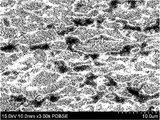
- Example 4 is a micrograph of a part of the surface of a rubber body of Example 3.
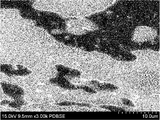
- 2 is a micrograph of a part of the surface of a rubber body of Comparative Example 1.
- Nitrile oxide used for modification denaturation is demonstrated.
- Step 1 Synthesis of 2-methoxy-1-naphthaldehyde (Chemical Formula 2-2) First, 80.0 g (0.46 mol) of commercially available 2-hydroxy-1-naphthaldehyde (1) was dissolved in 500 mL of acetone. It was. After adding 76.5 g (0.56 mol) of K 2 CO 3 to this, 61.7 g (0.49 mol) of (CH 3 O) 2 SO 2 was slowly added at 0 ° C. and stirred as it was for 30 minutes. , Refluxed overnight.
- Step 2 Synthesis of 2-methoxy-1-naphthaldehyde oxime (Chemical Formula 3-3)
- 2-methoxy-1-naphthaldehyde (2) 85.2 g (0.46 mol) was added ethanol 260 mL, water 260 mL, NaOH 49. After adding 0 g (1.23 mol), 37.5 g (0.54 mol) of NH 2 OH-HCl was slowly added. After stirring at room temperature for 1 hour, 90.5 g (yield 92%) of 2-methoxy-1-naphthaldehyde oxime (3) of yellow powder (yellow powder) was obtained by filtration.
- Step 3 Synthesis of 2-methoxy-1-naphthonitrile oxide (Chemical Formula 4-4) To 2.00 g (9.94 mmol) of 2-methoxy-1-naphthaldehyde oxime (3), 20 mL of water and 1.19 g of NaOH (29 0.8 mmol) After adding 20 mL of chloroform, 2.38 g (14.9 mmol) of Br 2 was slowly added dropwise at 0 ° C. Then, after stirring at room temperature for 30 minutes, the reaction solution was extracted with chloroform-water. The extracted organic phase was dehydrated with MgSO 4 and concentrated under reduced pressure to obtain 903 mg (yield 46%) of brown solid (brown solid) 2-methoxy-1-naphthonitrile oxide (4).
- modified rubber used in the examples will be described.
- Four types of modified rubbers are produced by modifying EPDM (ethylene-propylene-diene copolymer rubber) or NR (natural rubber) with 2,6-dimethoxybenzonitrile oxide or 2-methoxy-1-naphthonitrile oxide. Used.
- EPDM an ENB (5-ethylidene-2-norbornene) type having an ethylene component content of 53.0% by mass, a diene component content of 9.4% by mass, and a Mooney viscosity (ML1 + 4 125 ° C.) of 79.5 is used. It was. For SNR, Malaysian SMR was used.
- the 1 equivalent naphthyl-modified EPDM of Example was used as it was (without containing 2-reacted 2-methoxy-1-naphthonitrile oxide) without purification. .
- the 1-naphthyl-modified EPDM is produced by changing the temperature in the tank of the twin-screw kneader to 100 ° C or 150 ° C (reacting at 100 ° C or 150 ° C without changing other conditions). did.
- Modification rate The ratio of 2-methoxy-1-naphthonitrile oxide actually added to the non-conjugated double bond (carbon-carbon double bond) in the nonpolar rubber (EPDM or NR) is the modification rate ( (Modification rate).
- modification rate 100%
- 2-methoxy-1-naphthonitrile oxide is added to all non-conjugated double bonds in the nonpolar rubber, and when it is 50%, This means that 2-methoxy-1-naphthonitrile oxide was added to half of the non-conjugated double bonds.
- a specific method for obtaining the modification rate is to dissolve 1 equivalent of naphthyl-modified EPDM produced as described above in toluene, and then add methanol to this solution to reprecipitate the rubber component (1 equivalent of naphthyl-modified EPDM) (The unreacted nitrile oxide (2-methoxy-1-naphthonitrile oxide) and the rubber component were separated by precipitation, and this operation was repeated twice to remove the unreacted nitrile oxide. The rubber-like precipitate (rubber component) was vacuum-dried to obtain 1 equivalent of naphthyl-modified EPDM.
- 0.2 equivalent 2-methoxy-1-naphthonitrile oxide modified EPDM 0.2 equivalent 2-methoxy-1-naphthonitrile oxide-modified EPDM (hereinafter sometimes referred to as “0.2 equivalent naphthyl-modified EPDM”) is the amount of 2-methoxy-1-naphthonitrile oxide added is 0.2. Except for the point changed to the equivalent, it was produced in the same manner as 1 equivalent naphthyl-modified EPDM (the temperature in the tank of the biaxial kneader was 70 ° C.). The modification rate was 9%. Note that the 0.2 equivalent naphthyl-modified EPDM of Example was prepared as described above without performing purification operation (in a state containing unreacted 2-methoxy-1-naphthonitrile oxide and the like). used.
- 1 equivalent 2,6-dimethoxybenzonitrile oxide modified EPDM 1 equivalent 2,6-dimethoxybenzonitrile oxide-modified EPDM (hereinafter sometimes referred to as “1 equivalent phenyl-modified EPDM”) is converted to 1 equivalent of 2,6-dimethoxybenzoate instead of 2-methoxy-1-naphthonitrile oxide. Except for using nitrile oxide, it was produced in the same manner as 1 equivalent naphthyl-modified EPDM (the temperature in the tank of the biaxial kneader is 70 ° C.). In addition, the 1 equivalent phenyl-modified EPDM of the example was used as it was (without containing unreacted 2,6-dimethoxybenzonitrile oxide) without purification.
- 0.2 equivalent 2-methoxy-1-naphthonitrile oxide modified NR 0.2 equivalent 2-methoxy-1-naphthonitrile oxide-modified NR (hereinafter sometimes referred to as “0.2 equivalent naphthyl-modified NR”) uses NR instead of EPDM, and 2-methoxy-1-naphthonitrile It was manufactured in the same manner as 1 equivalent naphthyl-modified EPDM except that the amount of oxide added was changed to 0.2 equivalent (the temperature in the tank of the biaxial kneader was 70 ° C.). The modification rate was 10%. Note that the 0.2 equivalent naphthyl-modified NR of the Examples was prepared as described above without performing the purification operation (in a state containing unreacted 2-methoxy-1-naphthonitrile oxide and the like). used.
- gum was used for the Example or the comparative example.
- EPDM and NR were the same as those used for the modified rubber.
- NBR acrylonitrile-butadiene rubber
- ACM acrylic acid ester-2-chloroethyl vinyl ether copolymer rubber
- EA acrylic acid ester
- CHP-modified EPDM is obtained by modifying the above-mentioned EPDM by a known method (see paragraph 0075 of Patent Document 2) with CHP (cumene hydroperoxide: product name “Park Mill H-80” having a purity of 80% by NOF Corporation). Using.
- Example 3 is a rubber of 40 parts by mass (19 g) of 1 equivalent naphthyl-modified EPDM (density: 0.87 g / cm 3 ) and 60 parts by mass (28 g) of NBR (density: 1.00 g / cm 3 ).
- Example 1 produced a sheet-like crosslinked rubber body in the same manner as in Example 3 except that the rubber component was changed to 80 parts by mass of 1 equivalent naphthyl-modified EPDM and 20 parts by mass of NBR.
- Example 2 produced a sheet-like crosslinked rubber body in the same manner as in Example 3 except that the rubber component was changed to 60 parts by mass of 1 equivalent naphthyl-modified EPDM and 40 parts by mass of NBR. .
- Example 4 produced a sheet-like crosslinked rubber body in the same manner as in Example 3 except that the rubber component was changed to 20 parts by mass of 1 equivalent naphthyl-modified EPDM and 80 parts by mass of NBR. .
- the rubber component was changed to 20 parts by mass of EPDM, 20 parts by mass of 1 equivalent naphthyl-modified EPDM, and 60 parts by mass of NBR. A rubber body was produced.
- Example 6 is a sheet-like cross-linked rubber body as in Example 3 except that the rubber component was changed to 60 parts by mass of 0.2 equivalent naphthyl-modified EPDM and 40 parts by mass of NBR.
- Example 7 is a sheet-like crosslinked rubber body as in Example 3, except that the rubber component was changed to 40 parts by mass of 0.2 equivalent naphthyl-modified EPDM and 60 parts by mass of NBR.
- Example 8 is a sheet-like crosslinked rubber body as in Example 3, except that the rubber component was changed to 20 parts by mass of 0.2 equivalent naphthyl-modified EPDM and 80 parts by mass of NBR. Manufactured.
- Example 9 produced a sheet-like crosslinked rubber body in the same manner as in Example 3 except that the rubber component was changed to 40 parts by mass of 1 equivalent phenyl-modified EPDM and 60 parts by mass of NBR.
- Example 10 is a sheet-like crosslinked rubber body as in Example 3 except that the rubber component was changed to 40 parts by mass of 0.2 equivalent naphthyl-modified NR and 60 parts by mass of NBR.
- Example 11 produced a sheet-like crosslinked rubber body in the same manner as in Example 3 except that the rubber component was changed to 40 parts by mass of 1 equivalent naphthyl-modified EPDM and 60 parts by mass of ACM. .
- Comparative Example 1 produced a sheet-like crosslinked rubber body in the same manner as in Example 3 except that the rubber component was changed to 40 parts by mass of EPDM and 60 parts by mass of NBR.
- Comparative Example 2 produced a sheet-like crosslinked rubber body in the same manner as in Example 3 except that the rubber component was changed to 40 parts by mass of NR and 60 parts by mass of NBR.
- Comparative Example 3 produced a sheet-like crosslinked rubber body in the same manner as in Example 3 except that the rubber component was changed to 40 parts by mass of EPDM and 60 parts by mass of ACM.
- Comparative Example 4 a sheet-like crosslinked rubber body was produced in the same manner as in Example 3 except that the rubber component was changed to 40 parts by mass of CHP-modified EPDM and 60 parts by mass of NBR.
- Ozone resistance test The ozone resistance test is in accordance with JIS K 6259 “Vulcanized rubber and thermoplastic rubber-How to determine ozone resistance”, test temperature 40 ° C., ozone concentration 50 pphm, elongation rate 10%, The test was performed under the conditions of test time 24 h (hours), 72 h, and 161 h. And the state of the crack was observed. However, NC is in a state without a crack.
- the tensile test is a dumbbell-shaped No. 7 test piece of 200 ⁇ 20 mm / min at room temperature in accordance with JIS K 6251 “Vulcanized rubber and thermoplastic rubber-Determination of tensile properties”. The test was conducted at a tensile speed. And tensile strength, elongation (elongation at the time of cutting), and M100 (tensile stress at the time of 100% elongation) were calculated
- Oil resistance test was performed in accordance with JIS K 6258 “Vulcanized rubber and thermoplastic rubber-Determination of liquid resistance” at 100 ° C. for 72 hours (hours). The test was conducted by immersing in 3 oils (IRM903). And volume swelling degree (DELTA) V (%) was calculated
- a region including a relatively dark (black) portion is a modified EPDM (1 equivalent naphthyl-modified EPDM) phase, and a region including a relatively light (grey) portion is an NBR phase.
- the modified EPDM is dispersed in NBR.
- a region including a relatively dark (black) region is an EPDM phase
- a region including a relatively light (gray) region is an NBR phase
- EPDM is in NBR.
- the dispersion state of the modified EPDM in NBR is finer than that of EPDM in NBR.
- a polymer alloy comprising 80 to 20 parts by mass of a modified EPDM obtained by modifying EPDM with 2-methoxy-1-naphthonitrile oxide (hereinafter sometimes referred to as “naphthyl-modified EPDM”) and 20 to 80 parts by mass of NBR ( Examples 1 to 8), a polymer alloy comprising 40 parts by mass of modified EPDM obtained by modifying EPDM with 2,6-dimethoxybenzonitrile oxide (hereinafter sometimes referred to as “phenyl-modified EPDM”) and 60 parts by mass of NBR
- the polymer alloy (Example 11) composed of 40 parts by mass of naphthyl-modified EPDM and 60 parts by mass of ACM did not cause cracks for 24 hours or more in the ozone resistance test.
- a polymer alloy composed of 80 to 20 parts by mass of 1 equivalent naphthyl-modified EPDM and 20 to 80 parts by mass of NBR (Examples 1 to 5)
- a polymer alloy composed of 40 parts by mass of phenyl-modified EPDM and 60 parts by mass of NBR (Example 9)
- naphthyl-modified EPDM 40 parts by mass and ACM 60 parts by mass the polymer alloy (Example 11) was not cracked for 72 hours or more in the ozone resistance test.
- the polymer alloy (Comparative Examples 1 and 3) composed of 40 parts by mass of EPDM and 60 parts by mass of NBR or ACM cracks occurred in 24 hours in the ozone resistance test.
- the naphthyl-modified EPDM has improved oil resistance compared to EPDM due to the modification, and has good compatibility with NBR (see FIGS. 1 and 2).
- the polymer alloy composed of naphthyl-modified EPDM or phenyl-modified EPDM blended in place of EP and NBR has mechanical strength (particularly tensile strength).
- the polymer alloy composed of NBR and CHP-modified EPDM in which EPDM is modified with CHP blended in place of EPDM has decreased mechanical strength (particularly, tensile strength).
- Example 10 From a comparison between Example 10 and Comparative Example 2, a polymer alloy comprising NBR and a modified NR modified with NR with 2-methoxy-1-naphthonitrile oxide, which is blended instead of NR, is ozone resistant, mechanical The mechanical strength (particularly tensile strength) and oil resistance were all improved.
- Example 11 From the comparison between Example 11 and Comparative Example 3, the polymer alloy comprising ACM and naphthyl-modified EPDM blended in place of EPDM has all improved ozone resistance, mechanical strength (particularly tensile strength) and oil resistance. did.
- this invention is not limited to the said Example, It can also be changed and embodied suitably in the range which does not deviate from the meaning of invention.
Landscapes
- Chemical & Material Sciences (AREA)
- Health & Medical Sciences (AREA)
- Chemical Kinetics & Catalysis (AREA)
- Medicinal Chemistry (AREA)
- Polymers & Plastics (AREA)
- Organic Chemistry (AREA)
- General Chemical & Material Sciences (AREA)
- Compositions Of Macromolecular Compounds (AREA)
- Addition Polymer Or Copolymer, Post-Treatments, Or Chemical Modifications (AREA)
Abstract
【課題】耐油性を備えながら、耐オゾン性(耐候性)を向上させ、且つ高い機械的強度(特に、引張強度)となりうる、無極性ゴムと極性ゴムとからなるポリマーアロイ及びゴム製品並びにこれらの製造方法を提供する。 【解決手段】2-メトキシ-1-ナフトニトリルオキシド、2,6-ジメトキシベンゾニトリルオキシド等の芳香族ニトリルオキシド誘導体のニトリルオキシドで、EPDM、NR等の非共役二重結合を有する無極性ゴムが変性された変性ゴムと、ニトリルゴム、アクリルゴム等の極性ゴムとからなるポリマーアロイを有機過酸化物等の架橋剤を用いて架橋したゴム製品。
Description
本発明は、非共役二重結合を有する無極性ゴムを変性させた変性ゴムを含むポリマーアロイ及びそのポリマーアロイからなるゴム製品並びにそれらの製造方法に関するものである。
性質の異なるポリマー(例えば、無極性ゴムと極性ゴム)を混合することで、それぞれのポリマーの優れた性質を兼ね備えたポリマーアロイの開発が行われている。
その一つとして、NBR(アクリロニトリル-ブタジエンゴム)等のように耐油性に優れるが耐オゾン性に劣るゴムと、EPDM(エチレン-プロピレン-ジエン共重合ゴム)等のように耐オゾン性に優れるが耐油性に劣るゴムとを混合することで、耐油性及び耐オゾン性を有するポリマーアロイが検討されている。
例えば、特許文献1には、EPDMにアクリロニトリルとスチレンとをグラフト共重合させたグラフト共重合体を添加したNBRとEPDMとのポリマーアロイが記載されており、特許文献2には、NBRと水酸基変性の変性EPDMとのポリマーアロイが記載されており、特許文献3には、アクリロニトリルとブタジエンとグリシジルアクリレート等との共重合体と、EPDMと、無水マレイン酸等で変性された変性EPDMとのポリマーアロイが記載されている。
ところが、特許文献1のポリマーアロイは、EPDMのグラフト重合体を製造することが必要であり、且つ分子量が異なる二種類のNBRを用いなければ十分な性能が発現しないことから、コストが高いものとなっている。また、特許文献2、3のポリマーアロイは、EPDMの変性を高温(約180℃以上)で行うこと等から、EPDMにダメージが生じるおそれがあった(表1の比較例4参照)。
本発明は、耐油性を備えながら、耐オゾン性(耐候性)を向上させ、且つ高い機械的強度(特に、引張強度)となりうる、無極性ゴムと極性ゴムとからなるポリマーアロイ及びゴム製品並びにそれらの製造方法を提供することを目的とする。
本発明は、非共役二重結合を有する無極性ゴムを特定のニトリルオキシドで変性することで、極性ゴムとの相溶性がよくなる。これによって、耐油性を備えながら、変性していない無極性ゴムと極性ゴムとのポリマーアロイより、耐オゾン性(耐候性)が向上する。
また、特定のニトリルオキシドと非共役二重結合を有する無極性ゴムとを0~180℃の温和な温度で反応させて無極性ゴムの変性を行うことで、無極性ゴムにダメージを与えることなく変性ゴムを作ることができ、機械的強度(特に、引張強度)が高くなる。
また、特定のニトリルオキシドと非共役二重結合を有する無極性ゴムとを0~180℃の温和な温度で反応させて無極性ゴムの変性を行うことで、無極性ゴムにダメージを与えることなく変性ゴムを作ることができ、機械的強度(特に、引張強度)が高くなる。
そこで、本発明のポリマーアロイは、芳香環にニトリルオキシド基が結合した芳香族ニトリルオキシドの前記ニトリルオキシド基のオルト位に置換基を有する芳香族ニトリルオキシド誘導体のニトリルオキシドで非共役二重結合を有する無極性ゴムが変性された変性ゴムと、極性ゴムとからなる。
また、本発明のゴム製品は、上記ポリマーアロイを架橋してなる。
また、本発明のポリマーアロイの製造方法は、芳香環にニトリルオキシド基が結合した芳香族ニトリルオキシドの前記ニトリルオキシド基のオルト位に置換基を有する芳香族ニトリルオキシド誘導体のニトリルオキシドと、非共役二重結合を有する無極性ゴムとを0~180℃で反応させて前記無極性ゴムを変性ゴムに変性する変性ステップと、前記変性ゴムと極性ゴムとを混練する混練ステップとを備えている。
また、本発明のゴム製品の製造方法は、芳香環にニトリルオキシド基が結合した芳香族ニトリルオキシドの前記ニトリルオキシド基のオルト位に置換基を有する芳香族ニトリルオキシド誘導体のニトリルオキシドと、非共役二重結合を有する無極性ゴムとを0~180℃で反応させて前記無極性ゴムを変性ゴムに変性する変性ステップと、前記変性ゴムと極性ゴムとを混練してポリマーアロイにする混練ステップと、前記ポリマーアロイを架橋する架橋ステップとを備えている。
本発明のポリマーアロイ及びゴム製品並びにポリマーアロイの製造方法及びゴム製品の製造方法における各要素の態様を以下に例示する。
1.変性ゴム
変性ゴムは、無極性ゴムにニトリルオキシドが付加反応することでイソオキサゾリンが導入され(化4参照)、無極性ゴムが変性される。これにより、極性ゴムとの相溶性がよくなり、図1に示すように、変性ゴムの相と極性ゴムの相とのどちらか一方の相が他方の相に細かく分散して均一となる。
変性ゴムの配合量は、特に限定はされないが、敢えて言うならば、ゴム成分全体を100質量部にした場合に、20~80質量部である。
変性ゴムは、無極性ゴムにニトリルオキシドが付加反応することでイソオキサゾリンが導入され(化4参照)、無極性ゴムが変性される。これにより、極性ゴムとの相溶性がよくなり、図1に示すように、変性ゴムの相と極性ゴムの相とのどちらか一方の相が他方の相に細かく分散して均一となる。
変性ゴムの配合量は、特に限定はされないが、敢えて言うならば、ゴム成分全体を100質量部にした場合に、20~80質量部である。
2.無極性ゴム
無極性ゴムは、窒素、酸素、塩素、フッ素等のヘテロ原子を含まないゴム、即ち、炭素及び水素のみからなるゴムである。
無極性ゴムとしては、特に限定はされないが、EPDM(エチレン-プロピレン-ジエン共重合ゴム)、NR(天然ゴム)、IR(イソプレンゴム)、BR(ブタジエンゴム)、SBR(スチレン-ブタジエンゴム)、IIR(イソブチレン-イソプレンゴム)等が例示できる。
無極性ゴムは、窒素、酸素、塩素、フッ素等のヘテロ原子を含まないゴム、即ち、炭素及び水素のみからなるゴムである。
無極性ゴムとしては、特に限定はされないが、EPDM(エチレン-プロピレン-ジエン共重合ゴム)、NR(天然ゴム)、IR(イソプレンゴム)、BR(ブタジエンゴム)、SBR(スチレン-ブタジエンゴム)、IIR(イソブチレン-イソプレンゴム)等が例示できる。
3.ニトリルオキシド
芳香環にニトリルオキシド基が結合した芳香族ニトリルオキシドのニトリルオキシド基のオルト位に置換基を有する芳香族ニトリルオキシド誘導体のニトリルオキシドは、比較的安定性が高いので取扱いし易く、且つ温度が0~180℃でも無極性ゴムの非共役二重結合と触媒を用いないで反応し、無極性ゴムの変性(イソオキサゾリンの導入)を行うことができる。
芳香族ニトリルオキシドとしては、特に限定はされないが、ベンゾニトリルオキシド、ナフトニトリルオキシド等が例示できる。
置換基としては、特に限定はされないが、フルオロ基(F)、ヒドロキシ基(OH)、アミノ基(NH2)、ヒドロ基(H)以外の置換基であることが好ましく、より好ましくは、アルキル基又はアルコキシ基である。
アルキル基としては、特に限定はされないが、炭素数が1~20の直鎖状又は分岐状のものが好ましく、より好ましくは、炭素数が1~4の直鎖状又は分岐状のものである、メチル基、エチル基、n-プロピル基、iso-プロピル基、n-ブチル基、sec-ブチル基、iso-ブチル基、tert-ブチル基である。
アルコキシ基としては、特に限定はされないが、炭素数が1~4の直鎖状又は分岐状のものが好ましく、より好ましくは、炭素数が1~3の直鎖状又は分岐状のものである、メトキシ基、エトキシ基、n-プロポキシ基、iso-プロポキシ基である。
芳香族ニトリルオキシド誘導体としては、特に限定はされないが、2,6-ジメトキシベンゾニトリルオキシド、2,6-ジエトキシベンゾニトリルオキシド、2-メトキシ-1-ナフトニトリルオキシド等が例示できる。
芳香環にニトリルオキシド基が結合した芳香族ニトリルオキシドのニトリルオキシド基のオルト位に置換基を有する芳香族ニトリルオキシド誘導体のニトリルオキシドは、比較的安定性が高いので取扱いし易く、且つ温度が0~180℃でも無極性ゴムの非共役二重結合と触媒を用いないで反応し、無極性ゴムの変性(イソオキサゾリンの導入)を行うことができる。
芳香族ニトリルオキシドとしては、特に限定はされないが、ベンゾニトリルオキシド、ナフトニトリルオキシド等が例示できる。
置換基としては、特に限定はされないが、フルオロ基(F)、ヒドロキシ基(OH)、アミノ基(NH2)、ヒドロ基(H)以外の置換基であることが好ましく、より好ましくは、アルキル基又はアルコキシ基である。
アルキル基としては、特に限定はされないが、炭素数が1~20の直鎖状又は分岐状のものが好ましく、より好ましくは、炭素数が1~4の直鎖状又は分岐状のものである、メチル基、エチル基、n-プロピル基、iso-プロピル基、n-ブチル基、sec-ブチル基、iso-ブチル基、tert-ブチル基である。
アルコキシ基としては、特に限定はされないが、炭素数が1~4の直鎖状又は分岐状のものが好ましく、より好ましくは、炭素数が1~3の直鎖状又は分岐状のものである、メトキシ基、エトキシ基、n-プロポキシ基、iso-プロポキシ基である。
芳香族ニトリルオキシド誘導体としては、特に限定はされないが、2,6-ジメトキシベンゾニトリルオキシド、2,6-ジエトキシベンゾニトリルオキシド、2-メトキシ-1-ナフトニトリルオキシド等が例示できる。
4.極性ゴム
極性ゴムは、ヘテロ原子を含むゴム、即ち、炭素及び水素と、窒素、酸素、塩素、フッ素等のヘテロ原子とからなるゴムである。
極性ゴムとしては、特に限定はされないが、NBR(アクリロニトリル-ブタジエンゴム)やHNBR(水素化ニトリルゴム)等のニトリルゴム、ACM(アクリル酸エステル-2-クロロエチルビニルエーテル共重合ゴム)やANM(アクリル酸エステル-アクリロニトリル共重合ゴム)等のアクリルゴム、CR(クロロプレンゴム)、U(ウレタンゴム)、CO(エピクロロヒドリンゴム)等が例示できる。
極性ゴムの配合量は、特に限定はされないが、敢えて言うならば、ゴム成分全体を100質量部にした場合に、20~80質量部である。
極性ゴムは、ヘテロ原子を含むゴム、即ち、炭素及び水素と、窒素、酸素、塩素、フッ素等のヘテロ原子とからなるゴムである。
極性ゴムとしては、特に限定はされないが、NBR(アクリロニトリル-ブタジエンゴム)やHNBR(水素化ニトリルゴム)等のニトリルゴム、ACM(アクリル酸エステル-2-クロロエチルビニルエーテル共重合ゴム)やANM(アクリル酸エステル-アクリロニトリル共重合ゴム)等のアクリルゴム、CR(クロロプレンゴム)、U(ウレタンゴム)、CO(エピクロロヒドリンゴム)等が例示できる。
極性ゴムの配合量は、特に限定はされないが、敢えて言うならば、ゴム成分全体を100質量部にした場合に、20~80質量部である。
5.ポリマーアロイ
ポリマーアロイは、変性ゴム及び極性ゴム以外の他のゴム(例えば、無極性ゴム等)を含んでいてもよいし、含んでいなくてもよい。含まれる変性ゴムは、一種類でもよいし、二種類以上でもよい。含まれる極性ゴムは、一種類でもよいし、二種類以上でもよい。
また、ポリマーアロイは、充填材、可塑剤、老化防止剤等の添加剤を含んでいてもよいし、含んでいなくてもよい。
ポリマーアロイは、変性ゴム及び極性ゴム以外の他のゴム(例えば、無極性ゴム等)を含んでいてもよいし、含んでいなくてもよい。含まれる変性ゴムは、一種類でもよいし、二種類以上でもよい。含まれる極性ゴムは、一種類でもよいし、二種類以上でもよい。
また、ポリマーアロイは、充填材、可塑剤、老化防止剤等の添加剤を含んでいてもよいし、含んでいなくてもよい。
6.架橋剤
ポリマーアロイの架橋に用いる架橋剤としては、特に限定はされないが、硫黄、過酸化物等が例示できる。
ポリマーアロイの架橋に用いる架橋剤としては、特に限定はされないが、硫黄、過酸化物等が例示できる。
7.ゴム製品
ゴム製品としては、特に限定はされないが、エアクリーナホース、フューエルホース、バキュームブレーキホース、オイルホース、ガスケット、CVJブーツ等が例示できる。
ゴム製品としては、特に限定はされないが、エアクリーナホース、フューエルホース、バキュームブレーキホース、オイルホース、ガスケット、CVJブーツ等が例示できる。
8.変性ステップ
ニトリルオキシドと無極性ゴムとを0~180℃で反応させることにより、無極性ゴムにダメージを与える(そのため、機械的強度が低下する)ことなく変性を行うことができる。好ましい温度は、20~150℃であり、より好ましい温度は、50~90℃である。
変性の反応は、有機溶剤等の溶媒を用いて溶液中で行ってもよいし、溶媒を用いず、無極性ゴムとニトリルオキシドとを混練装置等で混練することで行ってもよい。
混練は、バッチ処理でもよいし、連続処理でもよい。
また、混練装置としては、特に限定はされないが、二軸混練機、密閉式混練機、バンバリーミキサー、インターミックス等の混練機や、二軸押出機、単軸押出機、多軸押出機等の押出機等が例示できる。
ニトリルオキシドと無極性ゴムとを0~180℃で反応させることにより、無極性ゴムにダメージを与える(そのため、機械的強度が低下する)ことなく変性を行うことができる。好ましい温度は、20~150℃であり、より好ましい温度は、50~90℃である。
変性の反応は、有機溶剤等の溶媒を用いて溶液中で行ってもよいし、溶媒を用いず、無極性ゴムとニトリルオキシドとを混練装置等で混練することで行ってもよい。
混練は、バッチ処理でもよいし、連続処理でもよい。
また、混練装置としては、特に限定はされないが、二軸混練機、密閉式混練機、バンバリーミキサー、インターミックス等の混練機や、二軸押出機、単軸押出機、多軸押出機等の押出機等が例示できる。
9.混練ステップ
混練に用いる混練装置としては、特に限定はされないが、上記変性ステップで例示したものが例示できる。
混練に用いる混練装置としては、特に限定はされないが、上記変性ステップで例示したものが例示できる。
10.架橋ステップ
架橋の方法は、特に限定はされないが、ゴムの架橋に用いられる一般的な方法を用いることができる。
架橋の方法は、特に限定はされないが、ゴムの架橋に用いられる一般的な方法を用いることができる。
本発明によれば、耐油性を備えながら、耐オゾン性(耐候性)を向上させ、且つ高い機械的強度(特に、引張強度)となりうる、無極性ゴムと極性ゴムとからなるポリマーアロイ及びゴム製品を製造し、提供することができる。
本発明に用いた変性ゴムについて説明する。
<1>ニトリルオキシド
先ずは、変性に用いたニトリルオキシドについて説明する。変性には、2,6-ジメトキシベンゾニトリルオキシドと2-メトキシ-1-ナフトニトリルオキシドとの二種類のニトリルオキシドを使用した。
先ずは、変性に用いたニトリルオキシドについて説明する。変性には、2,6-ジメトキシベンゾニトリルオキシドと2-メトキシ-1-ナフトニトリルオキシドとの二種類のニトリルオキシドを使用した。
〈1〉2,6-ジメトキシベンゾニトリルオキシド
2,6-ジメトキシベンゾニトリルオキシドの構造式を次(化1)に示す。

2,6-ジメトキシベンゾニトリルオキシドの構造式を次(化1)に示す。
〈2〉2-メトキシ-1-ナフトニトリルオキシド
2-メトキシ-1-ナフトニトリルオキシドの構造式を次(化2)に示すとともに、その合成方法も説明する。

2-メトキシ-1-ナフトニトリルオキシドの構造式を次(化2)に示すとともに、その合成方法も説明する。
2-メトキシ-1-ナフトニトリルオキシドは、次(化3)のようなステップで合成した。
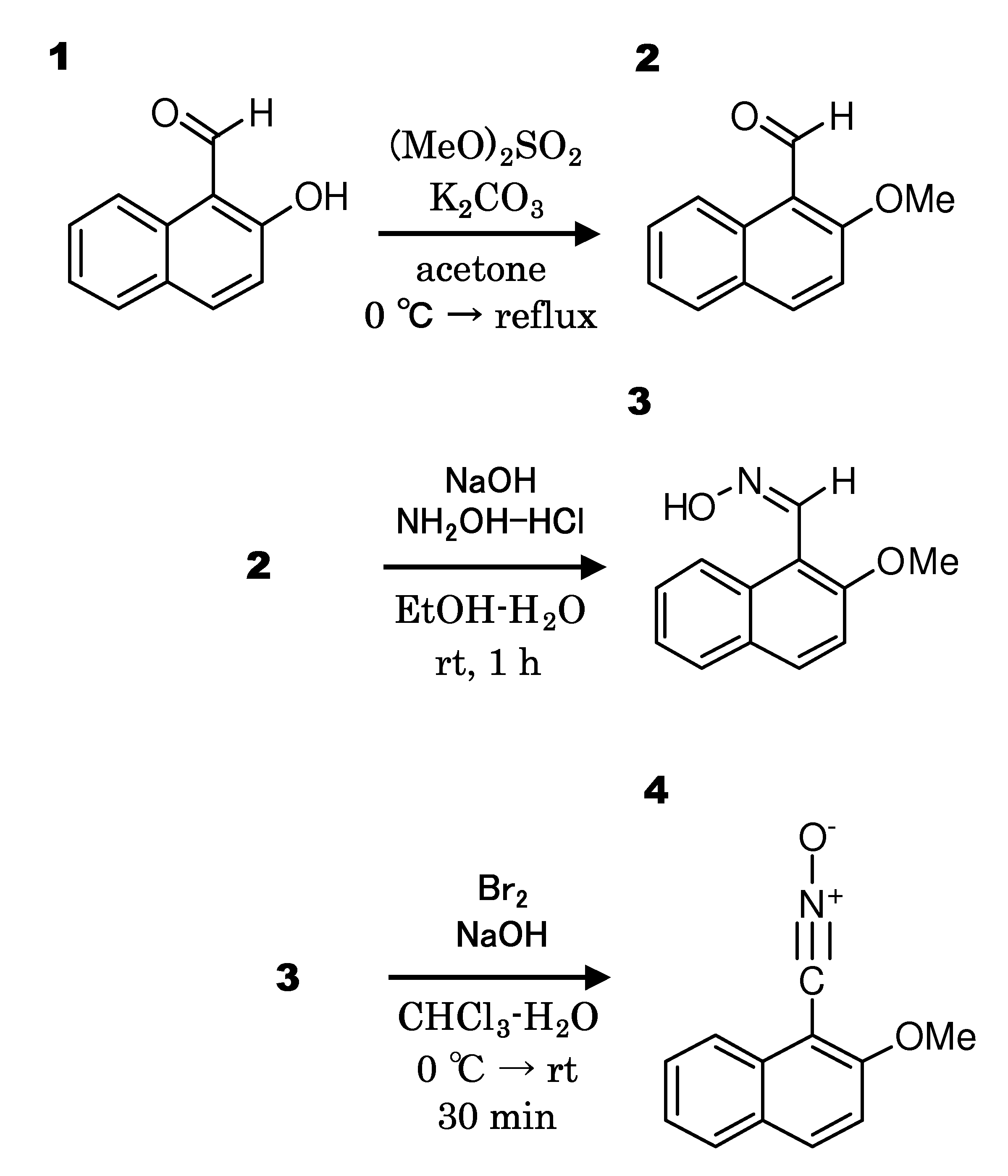
《ステップ1》2-メトキシ-1-ナフトアルデヒド(化3の2)の合成
先ず、市販の2-ヒドロキシ-1-ナフトアルデヒド(1)80.0g(0.46 mol)をアセトン500mLに溶解させた。これに、K2CO376.5g(0.56mol)を加えた後、0℃で(CH3O)2SO261.7g(0.49mol)をゆっくりと加え、そのまま30分攪拌した後、一晩還流した。しかし、反応が未完了であったため、K2CO376.5g(0.56mol)、(CH3O)2SO261.7g(0.49mol)を追加して4時間還流した。そして、室温まで放冷した後、ろ過により塩を除去し、ろ液を回収した。このろ液を減圧濃縮によりアセトンを除去した後、クロロホルム-NaHCO3水溶液で抽出した。抽出した有機相をMgSO4で水分除去した後、減圧濃縮することによりgreen solid(緑色固体)の2-メトキシ-1-ナフトアルデヒド(2)を85.2g(収率99%)得た。
先ず、市販の2-ヒドロキシ-1-ナフトアルデヒド(1)80.0g(0.46 mol)をアセトン500mLに溶解させた。これに、K2CO376.5g(0.56mol)を加えた後、0℃で(CH3O)2SO261.7g(0.49mol)をゆっくりと加え、そのまま30分攪拌した後、一晩還流した。しかし、反応が未完了であったため、K2CO376.5g(0.56mol)、(CH3O)2SO261.7g(0.49mol)を追加して4時間還流した。そして、室温まで放冷した後、ろ過により塩を除去し、ろ液を回収した。このろ液を減圧濃縮によりアセトンを除去した後、クロロホルム-NaHCO3水溶液で抽出した。抽出した有機相をMgSO4で水分除去した後、減圧濃縮することによりgreen solid(緑色固体)の2-メトキシ-1-ナフトアルデヒド(2)を85.2g(収率99%)得た。
《ステップ2》2-メトキシ-1-ナフトアルデヒドオキシム(化3の3)の合成
2-メトキシ-1-ナフトアルデヒド(2)85.2g(0.46 mol)にエタノール260mL、水260mL、NaOH49.0g(1.23mol)を加えた後、NH2OH-HCl37.5g(0.54mol)をゆっくりと加えた。そして、室温で1時間攪拌した後、ろ過によりyellow powder(黄色粉末)の2-メトキシ-1-ナフトアルデヒドオキシム(3)を90.5g(収率92%)得た。
2-メトキシ-1-ナフトアルデヒド(2)85.2g(0.46 mol)にエタノール260mL、水260mL、NaOH49.0g(1.23mol)を加えた後、NH2OH-HCl37.5g(0.54mol)をゆっくりと加えた。そして、室温で1時間攪拌した後、ろ過によりyellow powder(黄色粉末)の2-メトキシ-1-ナフトアルデヒドオキシム(3)を90.5g(収率92%)得た。
《ステップ3》2-メトキシ-1-ナフトニトリルオキシド(化3の4)の合成
2-メトキシ-1-ナフトアルデヒドオキシム(3)2.00g(9.94mmol)に水20mL、NaOH1.19g(29.8mmol)クロロホルム20mLを加えた後、0℃でBr22.38g(14.9mmol)をゆっくり滴下した。そして、室温で30分攪拌した後、この反応溶液をクロロホルム-水で抽出した。抽出した有機相をMgSO4で水分除去した後、減圧濃縮することによりbrown solid(茶色固体)の2-メトキシ-1-ナフトニトリルオキシド(4)を903mg(収率46%)得た。
2-メトキシ-1-ナフトアルデヒドオキシム(3)2.00g(9.94mmol)に水20mL、NaOH1.19g(29.8mmol)クロロホルム20mLを加えた後、0℃でBr22.38g(14.9mmol)をゆっくり滴下した。そして、室温で30分攪拌した後、この反応溶液をクロロホルム-水で抽出した。抽出した有機相をMgSO4で水分除去した後、減圧濃縮することによりbrown solid(茶色固体)の2-メトキシ-1-ナフトニトリルオキシド(4)を903mg(収率46%)得た。
<2>変性ゴム
次に、実施例に用いた変性ゴムについて説明する。変性ゴムは、EPDM(エチレン-プロピレン-ジエン共重合ゴム)又はNR(天然ゴム)を2,6-ジメトキシベンゾニトリルオキシド又は2-メトキシ-1-ナフトニトリルオキシドで変性した4種類のものを製造して使用した。
次に、実施例に用いた変性ゴムについて説明する。変性ゴムは、EPDM(エチレン-プロピレン-ジエン共重合ゴム)又はNR(天然ゴム)を2,6-ジメトキシベンゾニトリルオキシド又は2-メトキシ-1-ナフトニトリルオキシドで変性した4種類のものを製造して使用した。
EPDMには、エチレン成分の含量53.0質量%、ジエン成分の含量9.4質量%、ムーニー粘度(ML1+4 125℃)79.5のENB(5-エチリデン-2-ノルボルネン)タイプのものを用いた。
NRには、マレーシア産のSMRを用いた。
NRには、マレーシア産のSMRを用いた。
〈1〉1当量2-メトキシ-1-ナフトニトリルオキシド変性EPDM
1当量2-メトキシ-1-ナフトニトリルオキシド変性EPDM(以下「1当量ナフチル変性EPDM」と言う場合がある)は、槽内温度を70℃にした200cm3二軸混練機に、EPDM(120g)を投入して混練しながら、2-メトキシ-1-ナフトニトリルオキシドを1当量(18.3g)添加し、30rpmの回転数で60分間、70℃にて、次(化4)に示す化学反応により、EPDMの変性を行って、製造した。なお、実施例の1当量ナフチル変性EPDMは、このようにして製造したものを精製操作を行わず、そのまま(未反応の2-メトキシ-1-ナフトニトリルオキシド等を含んでいる状態)で使用した。
また、これとは別に、二軸混練機の槽内温度を100℃又は150℃に変更して(他の条件は変更しないで100℃又は150℃で反応させて)1当量ナフチル変性EPDMを製造した。
1当量2-メトキシ-1-ナフトニトリルオキシド変性EPDM(以下「1当量ナフチル変性EPDM」と言う場合がある)は、槽内温度を70℃にした200cm3二軸混練機に、EPDM(120g)を投入して混練しながら、2-メトキシ-1-ナフトニトリルオキシドを1当量(18.3g)添加し、30rpmの回転数で60分間、70℃にて、次(化4)に示す化学反応により、EPDMの変性を行って、製造した。なお、実施例の1当量ナフチル変性EPDMは、このようにして製造したものを精製操作を行わず、そのまま(未反応の2-メトキシ-1-ナフトニトリルオキシド等を含んでいる状態)で使用した。
また、これとは別に、二軸混練機の槽内温度を100℃又は150℃に変更して(他の条件は変更しないで100℃又は150℃で反応させて)1当量ナフチル変性EPDMを製造した。

・変性率
また、無極性ゴム(EPDM又はNR)中の非共役二重結合(炭素-炭素二重結合)に対し、実際に2-メトキシ-1-ナフトニトリルオキシドが付加した割合を変性率(修飾率)として求めた。ここで、変性率が100%であると無極性ゴム中の全ての非共役二重結合に2-メトキシ-1-ナフトニトリルオキシドが付加したことになり、50%であると無極性ゴム中の半数の非共役二重結合に2-メトキシ-1-ナフトニトリルオキシドが付加したことになる。
また、無極性ゴム(EPDM又はNR)中の非共役二重結合(炭素-炭素二重結合)に対し、実際に2-メトキシ-1-ナフトニトリルオキシドが付加した割合を変性率(修飾率)として求めた。ここで、変性率が100%であると無極性ゴム中の全ての非共役二重結合に2-メトキシ-1-ナフトニトリルオキシドが付加したことになり、50%であると無極性ゴム中の半数の非共役二重結合に2-メトキシ-1-ナフトニトリルオキシドが付加したことになる。
変性率の具体的な求め方は、上記のようにして製造した1当量ナフチル変性EPDMをトルエンに溶解させた後、この溶液にメタノールを加えてゴム成分(1当量ナフチル変性EPDM)を再沈殿(析出・沈殿)させることで、未反応ニトリルオキシド(2-メトキシ-1-ナフトニトリルオキシド)とゴム成分とを分離し、この操作を二回繰り返して、未反応ニトリルオキシドを除去し、得られたゴム状沈殿物(ゴム成分)を真空乾燥することで精製された1当量ナフチル変性EPDMを得た。
そして、この精製された1当量ナフチル変性EPDMのIR測定、1H NMR(溶媒:重クロロホルム)測定及び13C NMR測定より算出した。算出された変性率は、槽内温度を70℃にして製造したものは33%であり、槽内温度を100℃にして製造したものは33%であり、槽内温度を150℃にして製造したものは32%であった。
また、同様にして、後述する変性ゴム(0.2当量2-メトキシ-1-ナフトニトリルオキシド変性EPDM及び0.2当量2-メトキシ-1-ナフトニトリルオキシド変性NR)の変性率も算出した。
そして、この精製された1当量ナフチル変性EPDMのIR測定、1H NMR(溶媒:重クロロホルム)測定及び13C NMR測定より算出した。算出された変性率は、槽内温度を70℃にして製造したものは33%であり、槽内温度を100℃にして製造したものは33%であり、槽内温度を150℃にして製造したものは32%であった。
また、同様にして、後述する変性ゴム(0.2当量2-メトキシ-1-ナフトニトリルオキシド変性EPDM及び0.2当量2-メトキシ-1-ナフトニトリルオキシド変性NR)の変性率も算出した。
〈2〉0.2当量2-メトキシ-1-ナフトニトリルオキシド変性EPDM
0.2当量2-メトキシ-1-ナフトニトリルオキシド変性EPDM(以下「0.2当量ナフチル変性EPDM」と言う場合がある)は、2-メトキシ-1-ナフトニトリルオキシドの添加量を0.2当量に変更した点以外は、1当量ナフチル変性EPDMと同様に製造した(二軸混練機の槽内温度は70℃である)。また、変性率は9%であった。なお、実施例の0.2当量ナフチル変性EPDMは、このようにして製造したものを精製操作を行わず、そのまま(未反応の2-メトキシ-1-ナフトニトリルオキシド等を含んでいる状態)で使用した。
0.2当量2-メトキシ-1-ナフトニトリルオキシド変性EPDM(以下「0.2当量ナフチル変性EPDM」と言う場合がある)は、2-メトキシ-1-ナフトニトリルオキシドの添加量を0.2当量に変更した点以外は、1当量ナフチル変性EPDMと同様に製造した(二軸混練機の槽内温度は70℃である)。また、変性率は9%であった。なお、実施例の0.2当量ナフチル変性EPDMは、このようにして製造したものを精製操作を行わず、そのまま(未反応の2-メトキシ-1-ナフトニトリルオキシド等を含んでいる状態)で使用した。
〈3〉1当量2,6-ジメトキシベンゾニトリルオキシド変性EPDM
1当量2,6-ジメトキシベンゾニトリルオキシド変性EPDM(以下「1当量フェニル変性EPDM」と言う場合がある)は、2-メトキシ-1-ナフトニトリルオキシドの替わりに1当量の2,6-ジメトキシベンゾニトリルオキシドを用いた点以外は、1当量ナフチル変性EPDMと同様に製造した(二軸混練機の槽内温度は70℃である)。なお、実施例の1当量フェニル変性EPDMは、このようにして製造したものを精製操作を行わず、そのまま(未反応の2,6-ジメトキシベンゾニトリルオキシド等を含んでいる状態)で使用した。
1当量2,6-ジメトキシベンゾニトリルオキシド変性EPDM(以下「1当量フェニル変性EPDM」と言う場合がある)は、2-メトキシ-1-ナフトニトリルオキシドの替わりに1当量の2,6-ジメトキシベンゾニトリルオキシドを用いた点以外は、1当量ナフチル変性EPDMと同様に製造した(二軸混練機の槽内温度は70℃である)。なお、実施例の1当量フェニル変性EPDMは、このようにして製造したものを精製操作を行わず、そのまま(未反応の2,6-ジメトキシベンゾニトリルオキシド等を含んでいる状態)で使用した。
〈4〉0.2当量2-メトキシ-1-ナフトニトリルオキシド変性NR
0.2当量2-メトキシ-1-ナフトニトリルオキシド変性NR(以下「0.2当量ナフチル変性NR」と言う場合がある)は、EPDMの替わりにNRを用い、2-メトキシ-1-ナフトニトリルオキシドの添加量を0.2当量に変更した点以外は、1当量ナフチル変性EPDMと同様に製造した(二軸混練機の槽内温度は70℃である)。また、変性率は10%であった。なお、実施例の0.2当量ナフチル変性NRは、このようにして製造したものを精製操作を行わず、そのまま(未反応の2-メトキシ-1-ナフトニトリルオキシド等を含んでいる状態)で使用した。
0.2当量2-メトキシ-1-ナフトニトリルオキシド変性NR(以下「0.2当量ナフチル変性NR」と言う場合がある)は、EPDMの替わりにNRを用い、2-メトキシ-1-ナフトニトリルオキシドの添加量を0.2当量に変更した点以外は、1当量ナフチル変性EPDMと同様に製造した(二軸混練機の槽内温度は70℃である)。また、変性率は10%であった。なお、実施例の0.2当量ナフチル変性NRは、このようにして製造したものを精製操作を行わず、そのまま(未反応の2-メトキシ-1-ナフトニトリルオキシド等を含んでいる状態)で使用した。
上記4種類の変性ゴムを用いて、本発明の実施例として11種類の架橋されたゴム体を製造した。また、比較例として4種類の架橋されたゴム体を製造した。そして、全てのものの耐オゾン性及び機械的強度を測定し、一部のもの(実施例3、比較例1、4)の耐油性を測定し、その測定結果を表1に示すとともに、それぞれのゴム成分の組成(単位は質量部)も表1に示す。また、実施例3及び比較例1の表面の一部の顕微鏡写真を図1(実施例3)、図2(比較例1)に示す。

実施例又は比較例には、次のゴムを用いた。
EPDM及びNRは、上記変性ゴムに用いたものと同じものを用いた。
NBR(アクリロニトリル-ブタジエンゴム)は、結合AN(アクリロニトリル)量42.5質量%、ムーニー粘度(ML1+4 150℃)77.5のものを用いた。
ACM(アクリル酸エステル-2-クロロエチルビニルエーテル共重合ゴム)は、EA(アクリル酸エステル)組成に1質量%のカルボン酸系架橋基を有する、ムーニー粘度(ML1+4 100℃)33.0のものを用いた。
CHP変性EPDMは、上記EPDMを公知の方法(特許文献2の段落0075参照)によりCHP(クメンヒドロペルオキシド:日油社の商品名「パークミルH-80」純度80%のもの)で変性したものを用いた。
EPDM及びNRは、上記変性ゴムに用いたものと同じものを用いた。
NBR(アクリロニトリル-ブタジエンゴム)は、結合AN(アクリロニトリル)量42.5質量%、ムーニー粘度(ML1+4 150℃)77.5のものを用いた。
ACM(アクリル酸エステル-2-クロロエチルビニルエーテル共重合ゴム)は、EA(アクリル酸エステル)組成に1質量%のカルボン酸系架橋基を有する、ムーニー粘度(ML1+4 100℃)33.0のものを用いた。
CHP変性EPDMは、上記EPDMを公知の方法(特許文献2の段落0075参照)によりCHP(クメンヒドロペルオキシド:日油社の商品名「パークミルH-80」純度80%のもの)で変性したものを用いた。
次に、それぞれの実施例について説明する。
実施例3は、40質量部(19g)の1当量ナフチル変性EPDM(密度:0.87g/cm3)と、60質量部(28g)のNBR(密度:1.00g/cm3)とのゴム成分に、架橋剤として3.8gの日油社の商品名「パークミルD」(ジクミルペルオキシド:純度40%のもの)を添加し、70℃に予熱された70cm3のラボプラスミル(東洋精機社)を用いて、50rmpの回転数で10分間混練した。その後、加熱プレス機を用いて、180℃、10MPaの条件で15分間保持することで架橋を行い、シート状の架橋されたゴム体を製造した。
実施例1は、ゴム成分を、80質量部の1当量ナフチル変性EPDMと、20質量部のNBRとに変更した点以外は、実施例3と同様にシート状の架橋されたゴム体を製造した。
実施例2は、ゴム成分を、60質量部の1当量ナフチル変性EPDMと、40質量部のNBRとに変更した点以外は、実施例3と同様にシート状の架橋されたゴム体を製造した。
実施例4は、ゴム成分を、20質量部の1当量ナフチル変性EPDMと、80質量部のNBRとに変更した点以外は、実施例3と同様にシート状の架橋されたゴム体を製造した。
実施例5は、ゴム成分を、20質量部のEPDMと、20質量部の1当量ナフチル変性EPDMと、60質量部のNBRとに変更した点以外は、実施例3と同様にシート状の架橋されたゴム体を製造した。
実施例1は、ゴム成分を、80質量部の1当量ナフチル変性EPDMと、20質量部のNBRとに変更した点以外は、実施例3と同様にシート状の架橋されたゴム体を製造した。
実施例2は、ゴム成分を、60質量部の1当量ナフチル変性EPDMと、40質量部のNBRとに変更した点以外は、実施例3と同様にシート状の架橋されたゴム体を製造した。
実施例4は、ゴム成分を、20質量部の1当量ナフチル変性EPDMと、80質量部のNBRとに変更した点以外は、実施例3と同様にシート状の架橋されたゴム体を製造した。
実施例5は、ゴム成分を、20質量部のEPDMと、20質量部の1当量ナフチル変性EPDMと、60質量部のNBRとに変更した点以外は、実施例3と同様にシート状の架橋されたゴム体を製造した。
実施例6は、ゴム成分を、60質量部の0.2当量ナフチル変性EPDMと、40質量部のNBRとに変更した点以外は、実施例3と同様にシート状の架橋されたゴム体を製造した。
実施例7は、ゴム成分を、40質量部の0.2当量ナフチル変性EPDMと、60質量部のNBRとに変更した点以外は、実施例3と同様にシート状の架橋されたゴム体を製造した。
実施例8は、ゴム成分を、20質量部の0.2当量ナフチル変性EPDMと、80質量部のNBRとに変更した点以外は、実施例3と同様にシート状の架橋されたゴム体を製造した。
実施例7は、ゴム成分を、40質量部の0.2当量ナフチル変性EPDMと、60質量部のNBRとに変更した点以外は、実施例3と同様にシート状の架橋されたゴム体を製造した。
実施例8は、ゴム成分を、20質量部の0.2当量ナフチル変性EPDMと、80質量部のNBRとに変更した点以外は、実施例3と同様にシート状の架橋されたゴム体を製造した。
実施例9は、ゴム成分を、40質量部の1当量フェニル変性EPDMと、60質量部のNBRとに変更した点以外は、実施例3と同様にシート状の架橋されたゴム体を製造した。
実施例10は、ゴム成分を、40質量部の0.2当量ナフチル変性NRと、60質量部のNBRとに変更した点以外は、実施例3と同様にシート状の架橋されたゴム体を製造した。
実施例11は、ゴム成分を、40質量部の1当量ナフチル変性EPDMと、60質量部のACMとに変更した点以外は、実施例3と同様にシート状の架橋されたゴム体を製造した。
実施例10は、ゴム成分を、40質量部の0.2当量ナフチル変性NRと、60質量部のNBRとに変更した点以外は、実施例3と同様にシート状の架橋されたゴム体を製造した。
実施例11は、ゴム成分を、40質量部の1当量ナフチル変性EPDMと、60質量部のACMとに変更した点以外は、実施例3と同様にシート状の架橋されたゴム体を製造した。
次に、それぞれの比較例について説明する。
比較例1は、ゴム成分を、40質量部のEPDMと、60質量部のNBRとに変更した点以外は、実施例3と同様にシート状の架橋されたゴム体を製造した。
比較例2は、ゴム成分を、40質量部のNRと、60質量部のNBRとに変更した点以外は、実施例3と同様にシート状の架橋されたゴム体を製造した。
比較例3は、ゴム成分を、40質量部のEPDMと、60質量部のACMとに変更した点以外は、実施例3と同様にシート状の架橋されたゴム体を製造した。
比較例4は、ゴム成分を、40質量部のCHP変性EPDMと、60質量部のNBRとに変更した点以外は、実施例3と同様にシート状の架橋されたゴム体を製造した。
比較例2は、ゴム成分を、40質量部のNRと、60質量部のNBRとに変更した点以外は、実施例3と同様にシート状の架橋されたゴム体を製造した。
比較例3は、ゴム成分を、40質量部のEPDMと、60質量部のACMとに変更した点以外は、実施例3と同様にシート状の架橋されたゴム体を製造した。
比較例4は、ゴム成分を、40質量部のCHP変性EPDMと、60質量部のNBRとに変更した点以外は、実施例3と同様にシート状の架橋されたゴム体を製造した。
次に、それぞれの試験方法について説明する。
(1)耐オゾン性試験
耐オゾン性試験は、JIS K 6259「加硫ゴム及び熱可塑性ゴム-耐オゾン性の求め方」に準拠し、試験温度40℃、オゾン濃度50pphm、伸長率10%、試験時間24h(時間)、72h、161hの条件で試験を行った。そして、き裂の状態を観察した。ただし、NCはき裂がない状態である。
耐オゾン性試験は、JIS K 6259「加硫ゴム及び熱可塑性ゴム-耐オゾン性の求め方」に準拠し、試験温度40℃、オゾン濃度50pphm、伸長率10%、試験時間24h(時間)、72h、161hの条件で試験を行った。そして、き裂の状態を観察した。ただし、NCはき裂がない状態である。
(2)引張試験
引張試験は、JIS K 6251「加硫ゴム及び熱可塑性ゴム-引張特性の求め方」に準拠し、ダンベル状7号形の試験片で、室温において、200±20mm/minの引張速度で試験を行った。そして、引張強度、伸び(切断時伸び)及びM100(100%伸び時における引張応力)を求めた。
引張試験は、JIS K 6251「加硫ゴム及び熱可塑性ゴム-引張特性の求め方」に準拠し、ダンベル状7号形の試験片で、室温において、200±20mm/minの引張速度で試験を行った。そして、引張強度、伸び(切断時伸び)及びM100(100%伸び時における引張応力)を求めた。
(3)耐油性試験
耐油性試験は、JIS K 6258「加硫ゴム及び熱可塑性ゴム-耐液性の求め方」に準拠し、100℃で72h(時間)、No.3油(IRM903)に浸漬して試験を行った。そして、体積膨潤度ΔV(%)を求めた。
耐油性試験は、JIS K 6258「加硫ゴム及び熱可塑性ゴム-耐液性の求め方」に準拠し、100℃で72h(時間)、No.3油(IRM903)に浸漬して試験を行った。そして、体積膨潤度ΔV(%)を求めた。
次に、図1、2の顕微鏡写真について説明する。
図1において、相対的に色が濃い(黒色)部位を含む領域が変性EPDM(1当量ナフチル変性EPDM)の相であり、相対的に色が淡い(灰色)部位を含む領域がNBRの相であり、変性EPDMはNBR中に分散している。
一方、図2において、相対的に色が濃い(黒色)部位を含む領域がEPDMの相であり、相対的に色が淡い(灰色)部位を含む領域がNBRの相であり、EPDMはNBR中に分散している。
図1と図2との対比より、NBR中における変性EPDMの分散状態は、NBR中におけるEPDMより細かい。
図1において、相対的に色が濃い(黒色)部位を含む領域が変性EPDM(1当量ナフチル変性EPDM)の相であり、相対的に色が淡い(灰色)部位を含む領域がNBRの相であり、変性EPDMはNBR中に分散している。
一方、図2において、相対的に色が濃い(黒色)部位を含む領域がEPDMの相であり、相対的に色が淡い(灰色)部位を含む領域がNBRの相であり、EPDMはNBR中に分散している。
図1と図2との対比より、NBR中における変性EPDMの分散状態は、NBR中におけるEPDMより細かい。
以上より、2-メトキシ-1-ナフトニトリルオキシドでEPDMを変性した変性EPDM(以下「ナフチル変性EPDM」と言う場合がある)80~20質量部と、NBR20~80質量部とからなるポリマーアロイ(実施例1~8)、2,6-ジメトキシベンゾニトリルオキシドでEPDMを変性した変性EPDM(以下「フェニル変性EPDM」と言う場合がある)40質量部と、NBR60質量部とからなるポリマーアロイ(実施例9)、及びナフチル変性EPDM40質量部と、ACM60質量部とからなるポリマーアロイ(実施例11)は、耐オゾン性試験において、24時間以上き裂が生じなかった。
特に、1当量ナフチル変性EPDM80~20質量部と、NBR20~80質量部とからなるポリマーアロイ(実施例1~5)、フェニル変性EPDM40質量部と、NBR60質量部とからなるポリマーアロイ(実施例9)及びナフチル変性EPDM40質量部と、ACM60質量部とからなるポリマーアロイ(実施例11)は、耐オゾン性試験において、72時間以上き裂が生じなかった。
一方、EPDM40質量部と、NBR又はACM60質量部とからなるポリマーアロイ(比較例1、3)は、耐オゾン性試験において、24時間までにき裂が生じた。
特に、1当量ナフチル変性EPDM80~20質量部と、NBR20~80質量部とからなるポリマーアロイ(実施例1~5)、フェニル変性EPDM40質量部と、NBR60質量部とからなるポリマーアロイ(実施例9)及びナフチル変性EPDM40質量部と、ACM60質量部とからなるポリマーアロイ(実施例11)は、耐オゾン性試験において、72時間以上き裂が生じなかった。
一方、EPDM40質量部と、NBR又はACM60質量部とからなるポリマーアロイ(比較例1、3)は、耐オゾン性試験において、24時間までにき裂が生じた。
実施例3、5、7、9と比較例1との対比より、NBRと、EPDMの替わりに配合した、ナフチル変性EPDM又はフェニル変性EPDMとからなるポリマーアロイは、耐オゾン性及び機械的強度(特に、引張強度)が向上した。これは、ナフチル変性EPDM及びフェニル変性EPDMは、NBRとの相溶性が良好であることによる(図1、2参照)。
実施例3と比較例1との対比より、NBRと、EPDMの替わりに配合したナフチル変性EPDMとからなるポリマーアロイは、耐油性が向上した。これは、ナフチル変性EPDMは、変性されたことでEPDMより耐油性が向上していることと、NBRとの相溶性が良好であることによる(図1、2参照)。
実施例3、7、9と比較例4との対比より、NBRと、EPDMの替わりに配合した、ナフチル変性EPDM又はフェニル変性EPDMとからなるポリマーアロイは、機械的強度(特に、引張強度)が向上したのに対し、NBRと、EPDMの替わりに配合した、CHPでEPDMを変性したCHP変性EPDMとからなるポリマーアロイは、機械的強度(特に、引張強度)が低下した。これは、ナフチル変性EPDM及びフェニル変性EPDMは、70℃の温度でEPDMの変性を行ったことにより、EPDMにダメージを与える(機械的強度が低下する)ことなく変性を行うことができたことによる。なお、CHP変性EPDMを含むポリマーアロイは耐オゾン性及び耐油性がともに向上した。
実施例3と比較例1との対比より、NBRと、EPDMの替わりに配合したナフチル変性EPDMとからなるポリマーアロイは、耐油性が向上した。これは、ナフチル変性EPDMは、変性されたことでEPDMより耐油性が向上していることと、NBRとの相溶性が良好であることによる(図1、2参照)。
実施例3、7、9と比較例4との対比より、NBRと、EPDMの替わりに配合した、ナフチル変性EPDM又はフェニル変性EPDMとからなるポリマーアロイは、機械的強度(特に、引張強度)が向上したのに対し、NBRと、EPDMの替わりに配合した、CHPでEPDMを変性したCHP変性EPDMとからなるポリマーアロイは、機械的強度(特に、引張強度)が低下した。これは、ナフチル変性EPDM及びフェニル変性EPDMは、70℃の温度でEPDMの変性を行ったことにより、EPDMにダメージを与える(機械的強度が低下する)ことなく変性を行うことができたことによる。なお、CHP変性EPDMを含むポリマーアロイは耐オゾン性及び耐油性がともに向上した。
実施例10と比較例2との対比より、NBRと、NRの替わりに配合した、2-メトキシ-1-ナフトニトリルオキシドでNRを変性した変性NRとからなるポリマーアロイは、耐オゾン性、機械的強度(特に、引張強度)及び耐油性が全て向上した。
実施例11と比較例3との対比より、ACMと、EPDMの替わりに配合したナフチル変性EPDMとからなるポリマーアロイは、耐オゾン性、機械的強度(特に、引張強度)及び耐油性が全て向上した。
なお、本発明は前記実施例に限定されるものではなく、発明の趣旨から逸脱しない範囲で適宜変更して具体化することもできる。
Claims (16)
- 芳香環にニトリルオキシド基が結合した芳香族ニトリルオキシドの前記ニトリルオキシド基のオルト位に置換基を有する芳香族ニトリルオキシド誘導体のニトリルオキシドで非共役二重結合を有する無極性ゴムが変性された変性ゴムと、極性ゴムとからなるポリマーアロイ。
- 前記芳香族ニトリルオキシドは、ベンゾニトリルオキシド又はナフトニトリルオキシドである請求項1記載のポリマーアロイ。
- 前記置換基は、アルキル基又はアルコキシ基である請求項1又は2記載のポリマーアロイ。
- 前記無極性ゴムは、EPDM又はNRである請求項1~3のいずれか一項に記載のポリマーアロイ。
- 前記極性ゴムは、ニトリルゴム又はアクリルゴムである請求項1~4のいずれか一項に記載のポリマーアロイ。
- 請求項1~5のいずれか一項に記載のポリマーアロイを架橋してなるゴム製品。
- 芳香環にニトリルオキシド基が結合した芳香族ニトリルオキシドの前記ニトリルオキシド基のオルト位に置換基を有する芳香族ニトリルオキシド誘導体のニトリルオキシドと、非共役二重結合を有する無極性ゴムとを0~180℃で反応させて前記無極性ゴムを変性ゴムに変性する変性ステップと、
前記変性ゴムと極性ゴムとを混練する混練ステップとを備えたポリマーアロイの製造方法。 - 前記芳香族ニトリルオキシドは、ベンゾニトリルオキシド又はナフトニトリルオキシドである請求項7記載のポリマーアロイの製造方法。
- 前記置換基は、アルキル基又はアルコキシ基である請求項7又は8記載のポリマーアロイの製造方法。
- 前記無極性ゴムは、EPDM又はNRである請求項7~9のいずれか一項に記載のポリマーアロイの製造方法。
- 前記極性ゴムは、ニトリルゴム又はアクリルゴムである請求項7~10のいずれか一項に記載のポリマーアロイの製造方法。
- 芳香環にニトリルオキシド基が結合した芳香族ニトリルオキシドの前記ニトリルオキシド基のオルト位に置換基を有する芳香族ニトリルオキシド誘導体のニトリルオキシドと、非共役二重結合を有する無極性ゴムとを0~180℃で反応させて前記無極性ゴムを変性ゴムに変性する変性ステップと、
前記変性ゴムと極性ゴムとを混練してポリマーアロイにする混練ステップと、
前記ポリマーアロイを架橋する架橋ステップとを備えたゴム製品の製造方法。 - 前記芳香族ニトリルオキシドは、ベンゾニトリルオキシド又はナフトニトリルオキシドである請求項12記載のゴム製品の製造方法。
- 前記置換基は、アルキル基又はアルコキシ基である請求項12又は13記載のゴム製品の製造方法。
- 前記無極性ゴムは、EPDM又はNRである請求項12~14のいずれか一項に記載のゴム製品の製造方法。
- 前記極性ゴムは、ニトリルゴム又はアクリルゴムである請求項12~15のいずれか一項に記載のゴム製品の製造方法。
Priority Applications (1)
| Application Number | Priority Date | Filing Date | Title |
|---|---|---|---|
| US13/984,563 US8969480B2 (en) | 2011-02-25 | 2011-11-21 | Polymer alloy and rubber product, and production method thereof |
Applications Claiming Priority (2)
| Application Number | Priority Date | Filing Date | Title |
|---|---|---|---|
| JP2011-040807 | 2011-02-25 | ||
| JP2011040807A JP5527253B2 (ja) | 2011-02-25 | 2011-02-25 | ポリマーアロイ及びゴム製品並びにそれらの製造方法 |
Publications (1)
| Publication Number | Publication Date |
|---|---|
| WO2012114591A1 true WO2012114591A1 (ja) | 2012-08-30 |
Family
ID=46720394
Family Applications (1)
| Application Number | Title | Priority Date | Filing Date |
|---|---|---|---|
| PCT/JP2011/076793 Ceased WO2012114591A1 (ja) | 2011-02-25 | 2011-11-21 | ポリマーアロイ及びゴム製品並びにそれらの製造方法 |
Country Status (3)
| Country | Link |
|---|---|
| US (1) | US8969480B2 (ja) |
| JP (1) | JP5527253B2 (ja) |
| WO (1) | WO2012114591A1 (ja) |
Cited By (1)
| Publication number | Priority date | Publication date | Assignee | Title |
|---|---|---|---|---|
| CN108822348A (zh) * | 2018-05-14 | 2018-11-16 | 诸城市福日机械有限公司 | 一种抗臭氧橡胶管配置原料 |
Families Citing this family (4)
| Publication number | Priority date | Publication date | Assignee | Title |
|---|---|---|---|---|
| CN103980574B (zh) * | 2014-06-05 | 2016-01-20 | 常州市五洲化工有限公司 | 一种改性丁腈橡胶及其制备方法 |
| CN104672551B (zh) * | 2015-03-20 | 2016-08-24 | 沈阳科亚科技开发有限公司 | 丁腈橡胶/尼龙66合金 |
| US9841304B2 (en) | 2015-04-17 | 2017-12-12 | Rosemount Aerospace Inc. | Air data system |
| FR3046603B1 (fr) * | 2016-01-11 | 2017-12-29 | Michelin & Cie | Procede de modification d'un caoutchouc naturel et caoutchouc naturel modifie |
Citations (2)
| Publication number | Priority date | Publication date | Assignee | Title |
|---|---|---|---|---|
| JPH11180943A (ja) * | 1997-09-17 | 1999-07-06 | Goodyear Tire & Rubber Co:The | 安定なニトリルオキシド化合物の合成 |
| JP2008163232A (ja) * | 2006-12-28 | 2008-07-17 | Bridgestone Corp | 混合処理ゴム、それを用いたゴム組成物及びタイヤ |
Family Cites Families (4)
| Publication number | Priority date | Publication date | Assignee | Title |
|---|---|---|---|---|
| US5428099A (en) * | 1993-05-19 | 1995-06-27 | Exxon Chemical Patents Inc. | Method to control carbon black distribution in elastomer blends |
| JP4281130B2 (ja) | 1998-11-10 | 2009-06-17 | Jsr株式会社 | ゴム組成物 |
| JP2004323629A (ja) | 2003-04-23 | 2004-11-18 | Nippon Zeon Co Ltd | ゴム組成物、加硫物およびエアーインテークホース |
| JP2006022237A (ja) | 2004-07-09 | 2006-01-26 | Nof Corp | ゴム組成物および架橋物 |
-
2011
- 2011-02-25 JP JP2011040807A patent/JP5527253B2/ja not_active Expired - Fee Related
- 2011-11-21 US US13/984,563 patent/US8969480B2/en not_active Expired - Fee Related
- 2011-11-21 WO PCT/JP2011/076793 patent/WO2012114591A1/ja not_active Ceased
Patent Citations (2)
| Publication number | Priority date | Publication date | Assignee | Title |
|---|---|---|---|---|
| JPH11180943A (ja) * | 1997-09-17 | 1999-07-06 | Goodyear Tire & Rubber Co:The | 安定なニトリルオキシド化合物の合成 |
| JP2008163232A (ja) * | 2006-12-28 | 2008-07-17 | Bridgestone Corp | 混合処理ゴム、それを用いたゴム組成物及びタイヤ |
Cited By (1)
| Publication number | Priority date | Publication date | Assignee | Title |
|---|---|---|---|---|
| CN108822348A (zh) * | 2018-05-14 | 2018-11-16 | 诸城市福日机械有限公司 | 一种抗臭氧橡胶管配置原料 |
Also Published As
| Publication number | Publication date |
|---|---|
| US20140018503A1 (en) | 2014-01-16 |
| JP2012177039A (ja) | 2012-09-13 |
| US8969480B2 (en) | 2015-03-03 |
| JP5527253B2 (ja) | 2014-06-18 |
Similar Documents
| Publication | Publication Date | Title |
|---|---|---|
| CN102481561A (zh) | 在过渡金属催化剂存在下的丁腈橡胶复分解 | |
| CN102481562A (zh) | 包含低分子量的任选氢化的丁腈橡胶的可固化的聚合物组合物 | |
| EP0366377B1 (en) | Hydrogenated copolymer rubber, rubber composition comprising said rubber, and rubber product obtained from the rubber | |
| JP5527253B2 (ja) | ポリマーアロイ及びゴム製品並びにそれらの製造方法 | |
| JPWO1998036901A1 (ja) | ゴム積層体及びその用途 | |
| CN1322041C (zh) | 具有改进可加工性的氢化丁腈橡胶复合材料 | |
| JP4101242B2 (ja) | ポリマーの変性方法 | |
| WO2021256296A1 (ja) | シランカップリング剤組成物およびそれを含むゴム組成物 | |
| JPH08509261A (ja) | p−アルキルスチレンとイソオレフィンのグラフトポリマーを含む相溶化ブレンド | |
| EP3981826B1 (en) | Silane coupling agent composition comprising silane compound and protein modifying agent, and rubber composition comprising the same | |
| WO2021256292A1 (ja) | シランカップリング剤組成物およびそれを含むゴム組成物 | |
| JPH08511810A (ja) | 官能化エチレン/プロピレン共重合体又はエチレン/プロピレン/ジエン三元共重合体を用いた極性及び非極性エラストマーブレンドの相溶化 | |
| WO2021256295A1 (ja) | シランカップリング剤組成物およびそれを含むゴム組成物 | |
| CN1890267A (zh) | 橡胶状制品或含橡胶状物质的制品 | |
| JP4001497B2 (ja) | ラジカル変性ポリマー及びそれを含むポリマー組成物 | |
| JP2008163232A (ja) | 混合処理ゴム、それを用いたゴム組成物及びタイヤ | |
| JP4554836B2 (ja) | ゴム組成物 | |
| CN1668650A (zh) | 用于制备氢化聚合物的方法 | |
| JP2000143732A (ja) | フリーラジカルを有するイソブチレン重合体及びそれを含むゴム組成物 | |
| JP6852985B2 (ja) | ゴム組成物 | |
| WO2005056612A1 (ja) | ゴム状製品又はゴム状物質含有製品 | |
| JP6017968B2 (ja) | 変性ジエン系ポリマー及びその製造方法 | |
| JP4659303B2 (ja) | ジエン系ゴム組成物 | |
| CN120944207A (zh) | 一种适用于燃气管道的橡胶密封材料及其制备方法 | |
| JP2026514685A (ja) | ゴム組成物 |
Legal Events
| Date | Code | Title | Description |
|---|---|---|---|
| 121 | Ep: the epo has been informed by wipo that ep was designated in this application |
Ref document number: 11859095 Country of ref document: EP Kind code of ref document: A1 |
|
| NENP | Non-entry into the national phase |
Ref country code: DE |
|
| WWE | Wipo information: entry into national phase |
Ref document number: 13984563 Country of ref document: US |
|
| 122 | Ep: pct application non-entry in european phase |
Ref document number: 11859095 Country of ref document: EP Kind code of ref document: A1 |