WO2012111779A1 - エチレン系重合用触媒及びエチレン系重合体の製造方法 - Google Patents
エチレン系重合用触媒及びエチレン系重合体の製造方法 Download PDFInfo
- Publication number
- WO2012111779A1 WO2012111779A1 PCT/JP2012/053730 JP2012053730W WO2012111779A1 WO 2012111779 A1 WO2012111779 A1 WO 2012111779A1 JP 2012053730 W JP2012053730 W JP 2012053730W WO 2012111779 A1 WO2012111779 A1 WO 2012111779A1
- Authority
- WO
- WIPO (PCT)
- Prior art keywords
- group
- carbon atoms
- tert
- ring
- butyl
- Prior art date
- Legal status (The legal status is an assumption and is not a legal conclusion. Google has not performed a legal analysis and makes no representation as to the accuracy of the status listed.)
- Ceased
Links
- 0 C*SC(*)(c1c(*)c(*)c(*)c(*I)c1OC)I Chemical compound C*SC(*)(c1c(*)c(*)c(*)c(*I)c1OC)I 0.000 description 5
Classifications
-
- C—CHEMISTRY; METALLURGY
- C08—ORGANIC MACROMOLECULAR COMPOUNDS; THEIR PREPARATION OR CHEMICAL WORKING-UP; COMPOSITIONS BASED THEREON
- C08F—MACROMOLECULAR COMPOUNDS OBTAINED BY REACTIONS ONLY INVOLVING CARBON-TO-CARBON UNSATURATED BONDS
- C08F110/00—Homopolymers of unsaturated aliphatic hydrocarbons having only one carbon-to-carbon double bond
- C08F110/02—Ethene
Definitions
- the present invention relates to a catalyst for copolymerizing ethylene alone or ethylene and ⁇ -olefin using a zirconium complex, and a method for producing an ethylene polymer.
- Non-Patent Document 1 shows that an ethylene- ⁇ -olefin copolymer containing a long chain branch can be obtained by combining a geometrically constrained single site complex and an organoaluminum oxy compound. It has been shown that melting properties can be improved to some extent by simply introducing long-chain branches.
- An object of the present invention is to provide a polymerization catalyst containing a post metallocene complex capable of producing an ethylene polymer containing a sufficient amount of long chain branches, and a method for producing an ethylene polymer using this catalyst.
- the inventor of the present invention has found that the present invention can solve the above-mentioned problems through intensive studies.
- the present invention relates to an ethylene homopolymerization catalyst or a copolymerization catalyst of ethylene and ⁇ -olefin, which is obtained by bringing a complex represented by the following formula (1) into contact with an activating cocatalyst component. .
- R 1 and R 5 are each independently Hydrogen atom, A halogen atom, An alkyl group having 1 to 20 carbon atoms, A cycloalkyl group having 3 to 10 carbon atoms constituting the ring, An alkenyl group having 2 to 20 carbon atoms, An alkynyl group having 2 to 20 carbon atoms, An aralkyl group having 7 to 30 carbon atoms, An alkoxy group having 1 to 20 carbon atoms, An aralkyloxy group having 7 to 30 carbon atoms, An aryloxy group having 6 to 30 carbon atoms, Or a substituted silyl group is represented.
- R 2 to R 4 and R 6 to R 12 are each independently a hydrogen atom, a halogen atom, An alkyl group having 1 to 20 carbon atoms, A cycloalkyl group having 3 to 10 carbon atoms constituting the ring, An alkenyl group having 2 to 20 carbon atoms, An alkynyl group having 2 to 20 carbon atoms, An aralkyl group having 7 to 30 carbon atoms, An aryl group having 6 to 30 carbon atoms, An alkoxy group having 1 to 20 carbon atoms, An aralkyloxy group having 7 to 30 carbon atoms, An aryloxy group having 6 to 30 carbon atoms, Substituted silyl groups, Alternatively, it represents a heterocyclic compound residue having 3 to 20 carbon atoms constituting the ring.
- the residue may have a substituent.
- R 1 and R 2 , R 2 and R 3 , R 3 and R 4 , R 5 and R 6 , R 6 and R 7 , R 7 and R 8 , R 9 And R 10 , and R 11 and R 12 may be independently connected to each other to form a ring, and these rings may have a substituent.
- Each X independently represents a hydrogen atom, a halogen atom, An alkyl group having 1 to 20 carbon atoms, A cycloalkyl group having 3 to 10 carbon atoms constituting the ring, An alkenyl group having 2 to 20 carbon atoms, An aralkyl group having 7 to 30 carbon atoms, An aryl group having 6 to 30 carbon atoms, An alkoxy group having 1 to 20 carbon atoms, An aralkyloxy group having 7 to 30 carbon atoms, An aryloxy group having 6 to 30 carbon atoms, Substituted silyl groups, A substituted amino group, It represents a substituted thiolate group or a carboxylate group having 1 to 20 carbon atoms.
- the alkyl group, the cycloalkyl group, the alkenyl group, the aralkyl group, the aryl group, the alkoxy group, the aralkyloxy group, the aryloxy group, and the carboxylate group in X may have a substituent. Good. Adjacent Xs may be connected to each other to form a ring. L represents a neutral Lewis base. When there are a plurality of L, the plurality of L may be the same or different. l is 0, 1, or 2. )
- the present invention also relates to a method for producing an ethylene polymer or an ethylene- ⁇ -olefin copolymer using the polymerization catalyst.
- the present invention relates to a complex represented by the following formula (1 ′).
- R 1 ′ and R 5 ′ are each independently Hydrogen atom, A halogen atom, An alkyl group having 1 to 20 carbon atoms, A cycloalkyl group having 3 to 10 carbon atoms constituting the ring, An alkenyl group having 2 to 20 carbon atoms, An alkynyl group having 2 to 20 carbon atoms, An aralkyl group having 7 to 30 carbon atoms, An alkoxy group having 1 to 20 carbon atoms, An aralkyloxy group having 7 to 30 carbon atoms, An aryloxy group having 6 to 30 carbon atoms, Or a substituted silyl group is represented.
- R 1 ′ and R 5 ′ are not simultaneously a tert-butyl group.
- R 2 ′ to R 4 ′ and R 6 ′ to R 12 ′ are each independently Hydrogen atom, A halogen atom, An alkyl group having 1 to 20 carbon atoms, A cycloalkyl group having 3 to 10 carbon atoms constituting the ring, An alkenyl group having 2 to 20 carbon atoms, An alkynyl group having 2 to 20 carbon atoms, An aralkyl group having 7 to 30 carbon atoms, An aryl group having 6 to 30 carbon atoms, An alkoxy group having 1 to 20 carbon atoms, An aralkyloxy group having 7 to 30 carbon atoms, An aryloxy group having 6 to 30 carbon atoms, Substituted silyl groups, Alternatively, it represents a heterocyclic compound residue having 3 to 20 carbon atoms constituting the ring.
- R 1 ′ to R 12 ′ The alkyl group, the cycloalkyl group, the alkenyl group, the alkynyl group, the aralkyl group, the aryl group, the alkoxy group, the aralkyloxy group, the aryloxy group, and the heterocyclic ring
- the formula compound residue may have a substituent.
- R 1 ' ⁇ R 12', R 1 ' and R 2', R 2 'and R 3', R 3 'and R 4', 'a R 6' R 5, and R 6 ' R 7 ′, R 7 ′ and R 8 ′, R 9 ′ and R 10 ′, and R 11 ′ and R 12 ′ may be independently connected to each other to form a ring. May have a substituent.
- X ′ each independently represents a hydrogen atom, a halogen atom, An alkyl group having 1 to 20 carbon atoms, A cycloalkyl group having 3 to 10 carbon atoms constituting the ring, An alkenyl group having 2 to 20 carbon atoms, An aralkyl group having 7 to 30 carbon atoms, An aryl group having 6 to 30 carbon atoms, An alkoxy group having 1 to 20 carbon atoms, An aralkyloxy group having 7 to 30 carbon atoms, An aryloxy group having 6 to 30 carbon atoms, Substituted silyl groups, A substituted amino group, It represents a substituted thiolate group or a carboxylate group having 1 to 20 carbon atoms.
- the alkyl group, the cycloalkyl group, the alkenyl group, the aralkyl group, the aryl group, the alkoxy group, the aralkyloxy group, the aryloxy group, and the carboxylate group in X ′ have a substituent. Also good. Adjacent X ′ may be connected to each other to form a ring. L ′ represents a neutral Lewis base. When there are a plurality of L ′, the plurality of L ′ may be the same or different. l ′ is 0, 1, or 2. )
- a long-chain branched-containing ethylene polymer can be produced.
- N is 1 or 2, preferably 2.
- R 1 and R 5 are preferably each independently a hydrogen atom, A halogen atom, An alkyl group having 1 to 20 carbon atoms, A cycloalkyl group having 3 to 10 carbon atoms constituting the ring, An aralkyl group having 7 to 30 carbon atoms, An alkoxy group having 1 to 20 carbon atoms, An aralkyloxy group having 7 to 30 carbon atoms, An aryloxy group having 6 to 30 carbon atoms, or A substituted silyl group, More preferably, each independently a halogen atom, An alkyl group having 1 to 20 carbon atoms, A cycloalkyl group having 3 to 10 carbon atoms constituting the ring, An aralkyl group having 7 to 30 carbon atoms, A substituted silyl group, More preferably, each independently an alkyl group having 4 to 20 carbon atoms, A cycloalkyl group having 3 to 10 carbon atoms constituting the ring, An aralkyl group having
- R 1 and R 5 are the same, An alkyl group having 5 to 20 carbon atoms, A cycloalkyl group having 3 to 10 carbon atoms constituting the ring, An aralkyl group having 7 to 30 carbon atoms, Or it is a substituted silyl group.
- R 2 to R 4 and R 6 to R 8 are preferably each independently a hydrogen atom, A halogen atom, An alkyl group having 1 to 20 carbon atoms, A cycloalkyl group having 3 to 10 carbon atoms constituting the ring, An aralkyl group having 7 to 30 carbon atoms, An aryl group having 6 to 30 carbon atoms, An alkoxy group having 1 to 20 carbon atoms, An aryloxy group having 6 to 30 carbon atoms, A substituted silyl group, More preferably, each independently a hydrogen atom, An alkyl group having 1 to 20 carbon atoms, A cycloalkyl group having 3 to 10 carbon atoms constituting the ring, An aralkyl group having 7 to 30 carbon atoms, An aryl group having 6 to 30 carbon atoms, Or it is a substituted silyl group.
- R 2 , R 4 , R 6 and R 8 are more preferably a hydrogen atom. More preferably as R 3 and R 7 , A cycloalkyl group having 3 to 10 carbon atoms constituting an alkyl group ring having 1 to 20 carbon atoms, An aralkyl group having 7 to 30 carbon atoms, An aryl group having 6 to 30 carbon atoms, Or it is a substituted silyl group.
- R 3 and R 7 are the same, A cycloalkyl group having 3 to 10 carbon atoms constituting an alkyl group ring having 1 to 20 carbon atoms, An aralkyl group having 7 to 30 carbon atoms, An aryl group having 6 to 30 carbon atoms, Or a substituted silyl group, Most preferably, An alkyl group having 1 to 20 carbon atoms.
- R 9 to R 12 are preferably each independently a hydrogen atom, An alkyl group having 1 to 20 carbon atoms, A cycloalkyl group having 3 to 10 carbon atoms constituting the ring, An aralkyl group having 7 to 30 carbon atoms, An aryl group having 6 to 30 carbon atoms, An alkoxy group having 1 to 20 carbon atoms, An aryloxy group having 6 to 30 carbon atoms, A substituted silyl group, More preferably, each independently a hydrogen atom, An alkyl group having 1 to 20 carbon atoms, A cycloalkyl group having 3 to 10 carbon atoms constituting the ring, An aralkyl group having 7 to 30 carbon atoms, An aryl group having 6 to 30 carbon atoms, Or a substituted silyl group, More preferably, each independently a hydrogen atom, An alkyl group having 1 to 20 carbon atoms, A cycloalkyl group having 3 to 10 carbon atoms constituting the ring
- alkyl group, cycloalkyl group, aralkyl group, aryl group, alkoxy group, and aryloxy group may have a substituent.
- Examples of the substituted or unsubstituted alkyl group having 1 to 20 carbon atoms in R 1 to R 12 include a perfluoromethyl group, a perfluoroethyl group, a perfluoro-n-propyl group, a perfluoroisopropyl group, and a perfluoro group.
- a tertiary amine having 4 to 8 carbon atoms such as a tert-butyl group, a tert-pentyl group or a texyl group.
- a kill group Most preferably, it is a tertiary alkyl group having 5 to 8 carbon atoms such as a tert-pentyl group or a texyl group.
- the substituted or unsubstituted alkyl group having 1 to 20 carbon atoms in R 2 to R 4 and R 6 to R 12 is preferably a perfluoromethyl group, a methyl group, an ethyl group, an n-propyl group, an isopropyl group, n -Butyl group, sec-butyl group, isobutyl group, tert-butyl group, n-pentyl group, isopentyl group, tert-pentyl group, neopentyl group, n-hexyl group, texyl group, neohexyl group, n-heptyl group, n
- An alkyl group having 4 to 10 carbon atoms such as an octyl group and an n-decyl group, more preferably a perfluoromethyl group, a methyl group, an isopropyl group, an isobutyl group, a ter
- Examples of the substituted or unsubstituted cycloalkyl group having 3 to 10 carbon atoms constituting the ring in R 1 to R 12 include a cyclopropyl group, a cyclobutyl group, a cyclopentyl group, a cyclohexyl group, a cycloheptyl group, and a cyclooctyl group.
- Examples of the substituted or unsubstituted alkenyl group having 2 to 20 carbon atoms in R 1 to R 12 include vinyl group, allyl group, propenyl group, 2-methyl-2-propenyl group, homoallyl group, pentenyl group, hexenyl group, A heptenyl group, an octenyl group, a nonenyl group, a decenyl group and the like can be mentioned.
- An alkenyl group having 3 to 6 carbon atoms is preferable, and an allyl group and a homoallyl group are more preferable.
- Examples of the substituted or unsubstituted alkynyl group having 2 to 20 carbon atoms in R 1 to R 8 include ethynyl group, 1-propynyl group, 2-propynyl group, 1-butynyl group, and 3-methyl-1-butynyl group.
- Examples of the substituted or unsubstituted aralkyl group having 7 to 30 carbon atoms in R 1 to R 12 include benzyl group, (2-methylphenyl) methyl group, (3-methylphenyl) methyl group, (4-methyl Phenyl) methyl group, (2,3-dimethylphenyl) methyl group, (2,4-dimethylphenyl) methyl group, (2,5-dimethylphenyl) methyl group, (2,6-dimethylphenyl) methyl group, ( 3,4-dimethylphenyl) methyl group, (3,5-dimethylphenyl) methyl group, (2,3,4-trimethylphenyl) methyl group, (2,3,5-trimethylphenyl) methyl group, (2, 3,6-trimethylphenyl) methyl group, (3,4,5-trimethylphenyl) methyl group, (2,4,6-trimethylphenyl) methyl group, (2,3,4,5-te Lamethylphenyl) methyl group,
- Examples of the substituted or unsubstituted aryl group having 6 to 30 carbon atoms in R 2 to R 4 and R 6 to R 12 include a phenyl group, a 2-tolyl group, a 3-tolyl group, a 4-tolyl group, 2 , 3-xylyl group, 2,4-xylyl group, 2,5-xylyl group, 2,6-xylyl group, 3,4-xylyl group, 3,5-xylyl group, 2,3,4-trimethylphenyl group 2,3,5-trimethylphenyl group, 2,3,6-trimethylphenyl group, 2,4,6-trimethylphenyl group, 3,4,5-trimethylphenyl group, 2,3,4,5-tetra Methylphenyl group, 2,3,4,6-tetramethylphenyl group, 2,3,5,6-tetramethylphenyl group, pentamethylphenyl group, ethylphenyl group, n-propylphenyl group, isopropy
- Examples of the substituted silyl group in R 1 to R 12 include trimethylsilyl group, triethylsilyl group, tri-n-propylsilyl group, triisopropylsilyl group, tri-n-butylsilyl group, triisobutylsilyl group, tert-butyldimethyl group.
- Examples include silyl group, methyldiphenylsilyl group, dimethyl (phenyl) silyl group, tert-butyldiphenylsilyl group, triphenylsilyl group, methylbis (trimethylsilyl) silyl group, dimethyl (trimethylsilyl) silyl group, and tris (trimethylsilyl) silyl group.
- a trialkylsilyl group having 3 to 20 carbon atoms such as trimethylsilyl group, triethylsilyl group, tri-n-propylsilyl group, triisopropylsilyl group, tert-butyldimethylsilyl group; Methylsilyl) silyl group, dimethyl (trimethylsilyl) silyl group, and a silyl group having as a substituent a hydrocarbyl silyl group having 3 to 20 carbon atoms, such as tris (trimethylsilyl) silyl group.
- Examples of the substituted or unsubstituted alkoxy group having 1 to 20 carbon atoms in R 1 to R 12 include a perfluoromethoxy group, a perfluoroethoxy group, a perfluoro-n-propoxy group, a perfluoroisopropoxy group, a perfluoro group, Fluoro-n-butoxy group, perfluoro-sec-butoxy group, perfluoroisobutoxy group, perfluoro-n-pentyloxy group, perfluoronepentyloxy group, perfluoro-n-hexyloxy group, perfluoro-n -Heptyloxy group, perfluoro-n-octyloxy group, perfluoro-n-decyloxy group, perfluoro-n-dodecyloxy group, perfluoro-n-pentadecyloxy group, perfluoro-n-eicosyloxy group Methoxy group, ethoxy group,
- Examples of the substituted or unsubstituted aryloxy group having 6 to 30 carbon atoms in R 1 to R 12 include, for example, phenoxy group, 2,3,4-trimethylphenoxy group, 2,3,5-trimethylphenoxy group, 2, 3,6-trimethylphenoxy group, 2,4,6-trimethylphenoxy group, 3,4,5-trimethylphenoxy group, 2,3,4,5-tetramethylphenoxy group, 2,3,4,6-tetra Methylphenoxy group, 2,3,5,6-tetramethylphenoxy group, pentamethylphenoxy group, 2,6-diisopropylphenoxy group, 2-fluorophenoxy group, 3-fluorophenoxy group, 4-fluorophenoxy group, pentafluoro Phenoxy group, 2-trifluoromethylphenoxy group, 3-trifluoromethylphenoxy group, 4-trifluoro Methylphenoxy group, 2,3-difluorophenoxy group, 2,4-fluorophenoxy group, 2,5-difluorophenoxy group
- Examples of the substituted or unsubstituted aralkyloxy group having 7 to 30 carbon atoms in R 1 to R 12 include, for example, benzyloxy group, (2-methylphenyl) methoxy group, (3-methylphenyl) methoxy group, (4 -Methylphenyl) methoxy group, (2,3-dimethylphenyl) methoxy group, (2,4-dimethylphenyl) methoxy group, (2,5-dimethylphenyl) methoxy group, (2,6-dimethylphenyl) methoxy group (3,4-dimethylphenyl) methoxy group, (3,5-dimethylphenyl) methoxy group, (2,3,4-trimethylphenyl) methoxy group, (2,3,5-trimethylphenyl) methoxy group, 2,3,6-trimethylphenyl) methoxy group, (2,4,5-trimethylphenyl) methoxy group, (2,4,6-trimethylphenyl) Ny
- Examples of the substituted or unsubstituted heterocyclic compound residue having 3 to 20 carbon atoms constituting the ring in R 2 to R 4 and R 6 to R 12 include a thienyl group, a furyl group, and a 1-pyrrolyl group.
- 1-imidazolyl group 1-pyrazolyl group, pyridyl group, pyrazinyl group, pyrimidinyl group, pyridazinyl group, 2-isoindolyl group, 1-indolyl group, quinolyl group, dibenzo-1H-pyrrol-1-yl group, Preferred are thienyl group, furyl group, 1-pyrrolyl group, pyridyl group, pyrimidinyl group, 2-isoindolyl group, 1-indolyl group, quinolyl group, and dibenzo-1H-pyrrol-1-yl group.
- R 1 and R 2 , R 2 and R 3 , R 3 and R 4 , R 5 and R 6 , R 6 and R 7 , and R 7 and R 8 are Each independently may be linked to each other to form a ring, and the ring may have a substituent, and is preferably a 4- to 10-membered hydrocyclic hydrocarbon containing two carbon atoms on the benzene ring. It is a carbyl ring or a heterocyclic ring, and this ring may have a substituent.
- the ring include cyclobutene ring, cyclopentene ring, cyclopentadiene ring, cyclohexene ring, cycloheptene ring, cyclooctene ring, benzene ring or naphthalene ring, furan ring, 2,5-dimethylfuran ring, thiophene ring, 2, 5-dimethylthiophene ring, pyridine ring and the like can be mentioned, and preferred are cyclobutene ring, cyclopentene ring, cyclopentadiene ring, cyclohexene ring, benzene ring or naphthalene ring, and more preferred are R 1 and R 2 and / or R A cyclopentene ring, a cyclopentadiene ring, a cyclohexene ring, a benzene ring, and a naphthalene ring in which 5 and
- R 9 and R 10 , and R 11 and R 12 may be independently connected to each other to form a ring, and the ring has a substituent. You may do it.
- An aryl group having 6 to 30 carbon atoms, an alkoxy group having 1 to 20 carbon atoms, an aralkyloxy group having 7 to 30 carbon atoms, an aryloxy group having 6 to 30 carbon atoms, and a substituted silyl group are represented by R 2 to R 4. And the same groups as those described above for R 6 to R 8 .
- Examples of the substituted amino group in X include 2 to 14 carbon atoms such as dimethylamino group, diethylamino group, di-n-butylamino group, di-n-propylamino group, diisopropylamino group, dibenzylamino group, or diphenylamino group. And a dimethylamino group, a diethylamino group, a di-n-propylamino group, a diisopropylamino group, or a dibenzylamino group.
- Examples of the substituted thiolate group in X include a thiophenoxy group, 2,3,4-trimethylthiophenoxy group, 2,3,5-trimethylthiophenoxy group, 2,3,6-trimethylthiophenoxy group, 2,4 , 6-trimethylthiophenoxy group, 3,4,5-trimethylthiophenoxy group, 2,3,4,5-tetramethylthiophenoxy group, 2,3,4,6-tetramethylthiophenoxy group, 2,3,5 , 6-tetramethylphenoxy group, pentamethylphenoxy group, 2-fluorothiophenoxy group, 3-fluorothiophenoxy group, 4-fluorophenoxy group, pentafluorothiophenoxy group, 2-trifluoromethylthiophenoxy group, 3-tri Fluoromethylthiophenoxy group, 4-trifluoromethylthiophenoxy group, 2, -Difluorothiophenoxy group, 2,4-fluorothiophenoxy group, 2,5-difluorothiophenoxy group, 2-chloro
- Examples of the substituted or unsubstituted carboxylate group having 1 to 20 carbon atoms in X include an acetate group, propionate group, butyrate group, pentanate group, hexanoate group, 2-ethylhexanoate group or trifluoroacetate group.
- Preferred are hydrocarbyl carboxylate groups having 2 to 10 carbon atoms, and more preferred are acetate groups, propionate groups, 2-ethylhexanoate groups or trifluoroacetate groups.
- X is preferably a fluorine atom, a chlorine atom, a bromine atom, an alkyl group having 1 to 20 carbon atoms, an aralkyl group having 7 to 30 carbon atoms, an alkoxy group having 1 to 20 carbon atoms, or 6 to 6 carbon atoms.
- An amino group particularly preferably a chlorine atom, a methyl group, a benzyl group, an isopropoxy group, a phenoxy group, a dimethylamino group, and most preferably, a chlorine atom, a benzyl group.
- R 1 to R 12 and X may each independently have a substituent containing a halogen atom, an oxygen atom, a silicon atom, a nitrogen atom, a phosphorus atom, or a sulfur atom.
- L represents a neutral Lewis base. When there are a plurality of L, the plurality of L may be the same or different. l is 0, 1, or 2.
- L examples include ethers, amines or thioethers, and specific examples include tetrahydrofuran, diethyl ether, 1,4-dioxane, and pyridine. L is preferably tetrahydrofuran.
- L is preferably 1 or 0, more preferably 0.
- the compound which changed the group corresponding to R ⁇ 3 > and R ⁇ 7 > in each said compound into the hydrogen atom, the fluorine atom, the chlorine atom, the bromine atom, the iodine atom, or the methyl group can also be mentioned.
- Examples thereof also include compounds in which the groups corresponding to R 9 to R 12 in each of the above compounds are substituted with a methyl group or an ethyl group.
- Preferred examples of the complex (1) include the following compounds.
- More preferable examples of the complex (1) include the following compounds.
- the following compounds are particularly preferable.
- n ′ is 1 or 2, preferably 2.
- R 1 ′ and R 5 ′ are preferably each independently a hydrogen atom, A halogen atom, An alkyl group having 1 to 20 carbon atoms, A cycloalkyl group having 3 to 10 carbon atoms constituting the ring, An aralkyl group having 7 to 30 carbon atoms, An alkoxy group having 1 to 20 carbon atoms, An aralkyloxy group having 7 to 30 carbon atoms, An aryloxy group having 6 to 30 carbon atoms, or A substituted silyl group wherein R 1 ′ and R 5 ′ are not simultaneously tert-butyl groups, More preferably, each independently a halogen atom, An alkyl group having 5 to 20 carbon atoms, A cycloalkyl group having 3 to 10 carbon atoms constituting the ring, An aralkyl group having 7 to 30 carbon atoms, A substituted silyl group, More preferably, each independently an alkyl group having 5 to 20 carbon atoms, A cyclo
- R 1 and R 5 are the same, An alkyl group having 5 to 20 carbon atoms, A cycloalkyl group having 3 to 10 carbon atoms constituting the ring, An aralkyl group having 7 to 30 carbon atoms, Or it is a substituted silyl group.
- R 2 ′ to R 4 ′ and R 6 ′ to R 8 ′ are preferably each independently a hydrogen atom, A halogen atom, An alkyl group having 1 to 20 carbon atoms, A cycloalkyl group having 3 to 10 carbon atoms constituting the ring, An aralkyl group having 7 to 30 carbon atoms, An aryl group having 6 to 30 carbon atoms, An alkoxy group having 1 to 20 carbon atoms, An aryloxy group having 6 to 30 carbon atoms, A substituted silyl group, More preferably, each independently a hydrogen atom, An alkyl group having 1 to 20 carbon atoms, A cycloalkyl group having 3 to 10 carbon atoms constituting the ring, An aralkyl group having 7 to 30 carbon atoms, An aryl group having 6 to 30 carbon atoms, Or a substituted silyl group, R 2 ′, R 4 ′, R 6 ′ and R 8 ′ are more preferably a hydrogen
- R 3 ′ and R 7 ′ are each independently a cycloalkyl group having 3 to 10 carbon atoms constituting an alkyl group ring having 1 to 20 carbon atoms, An aralkyl group having 7 to 30 carbon atoms, An aryl group having 6 to 30 carbon atoms, Or it is a substituted silyl group.
- R 3 'and R 7' are the same, A cycloalkyl group having 3 to 10 carbon atoms constituting an alkyl group ring having 1 to 20 carbon atoms, An aralkyl group having 7 to 30 carbon atoms, An aryl group having 6 to 30 carbon atoms, Or a substituted silyl group, Most preferably, An alkyl group having 1 to 20 carbon atoms.
- R 9 ′ to R 12 ′ are preferably each independently a hydrogen atom, An alkyl group having 1 to 20 carbon atoms, A cycloalkyl group having 3 to 10 carbon atoms constituting the ring, An aralkyl group having 7 to 30 carbon atoms, An aryl group having 6 to 30 carbon atoms, An alkoxy group having 1 to 20 carbon atoms, An aryloxy group having 6 to 30 carbon atoms, A substituted silyl group, More preferably, each independently a hydrogen atom, An alkyl group having 1 to 20 carbon atoms, A cycloalkyl group having 3 to 10 carbon atoms constituting the ring, An aralkyl group having 7 to 30 carbon atoms, An aryl group having 6 to 30 carbon atoms, Or a substituted silyl group, More preferably, each independently a hydrogen atom, An alkyl group having 1 to 20 carbon atoms, A cycloalkyl group having 3 to 10 carbon atoms constitu
- alkyl group, cycloalkyl group, aralkyl group, aryl group, alkoxy group, and aryloxy group may have a substituent.
- the groups are the same as the groups described above for R 1 to R 12 in the general formula (1).
- the aryl group having 6 to 30 carbon atoms in R 2 ′ to R 4 ′ and R 6 ′ to R 12 ′ and the heterocyclic compound residue having 3 to 20 carbon atoms constituting the ring are represented by the general formula (1 And the same groups as those described above for R 2 to R 4 and R 6 to R 8 .
- R 1 ′ to R 8 ′ may be independently connected to each other to form a ring, which ring may have a substituent, preferably on the benzene ring
- the ring include cyclobutene ring, cyclopentene ring, cyclopentadiene ring, cyclohexene ring, cycloheptene ring, cyclooctene ring, benzene ring or naphthalene ring, furan ring, 2,5-dimethylfuran ring, thiophene ring, 2, 5-dimethylthiophene ring, pyridine ring and the like are mentioned, and preferred are cyclobutene ring, cyclopentene ring, cyclopentadiene ring, cyclohexene ring, benzene ring or naphthalene ring, and more preferred are R 1 ′ and R 2 ′, and A cyclopentene ring, a cyclopentadiene ring, a cyclohexene ring, a benzene ring, and a naphthalene ring in which at least
- R 9 ′ to R 12 ′, R 9 ′ and R 10 ′, and R 11 ′ and R 12 ′ may be independently connected to each other to form a ring,
- the ring may have a substituent.
- the thiolate group and the carboxylate group having 1 to 20 carbon atoms are the same as those described above for X in the general formula (1).
- X ′ is preferably a fluorine atom, a chlorine atom, a bromine atom, an alkyl group having 1 to 20 carbon atoms, an aralkyl group having 7 to 30 carbon atoms, an alkoxy group having 1 to 20 carbon atoms, or 6 to 6 carbon atoms.
- An arylamino group particularly preferably a chlorine atom, a methyl group, a benzyl group, an isopropoxy group, a phenoxy group, a dimethylamino group, and most preferably, a chlorine atom, a benzyl group.
- R 1 ′ to R 12 ′ and X ′ may each independently have a substituent containing a halogen atom, an oxygen atom, a silicon atom, a nitrogen atom, a phosphorus atom or a sulfur atom.
- L ′ and l ′ are the same as L and l in the general formula (1).
- Examples also include compounds in which the groups corresponding to R 9 ′ to R 12 ′ in each of the above compounds are substituted with a methyl group or an ethyl group.
- Preferred examples of the complex (1 ′) include the following compounds.
- More preferable examples of the complex (1 ′) include the following compounds.
- a compound obtained by changing the group corresponding to R 3 ′ and R 7 ′ of each of the above compounds to a methyl group can also be mentioned.
- the complex represented by the general formula (1) and the complex represented by the general formula (1 ′) are synthesized according to the method described in, for example, Journal of American Chemical Society, 2009, Volume131,13566-13567 Can do.
- the complex (1) it can be produced by the following scheme 1 using the compounds represented by the general formulas (2) and (3) as starting materials, but should not be limited to this method.
- ZrX 4 examples include Zr (CH 2 Ph) 4 , ZrCl 2 (CH 2 Ph) 2 , Zr (CH 2 SiMe 3 ) 4 , ZrF 4 , ZrCl 4 , ZrBr 4 , ZrI 4 , Zr (OMe) 4 , Zr (OEt) 4 , Zr (Oi-Pr) 4 , ZrCl 2 (Oi-Pr) 2 , Zr (On-Bu) 4 , Zr (Oi-Bu) 4 , Zr ( Ot-Bu) 4 , Zr (OPh) 4 , Zr (NMe 2 ) 4 , ZrCl 2 (NMe 2 ) 2 , Zr (NEt 2 ) 4 .
- the compound (2) and the compound (3) may be reacted as they are, or the compound (3) may be reacted after reacting the compound (2) with a base as necessary.
- the base to be used include an organic lithium reagent, a Grignard reagent, and a metal hydride.
- methyllithium, n-butyllithium, sec-butyllithium, tert-butyllithium, lithium diisopropylamide, lithium hexamethyl examples thereof include disilazane, potassium hexamethyldisilazane, sodium hydride and potassium hydride, and preferably n-butyllithium, lithium diisopropylamide, potassium hexamethyldisilazane, sodium hydride or potassium hydride.
- the reaction can be carried out under dehydration and deoxygenation. preferable. Specifically, it is under dry nitrogen and dry argon.
- the amount of the compound (2) used may be 1 molar equivalent or more with respect to the compound (3), and preferably 1.0 to 1.5 molar equivalents. Moreover, when the compound (2) remains in the course of the reaction, the compound (3) may be added during the reaction.
- the temperature at which compound (2) and compound (3) are reacted is in the temperature range of ⁇ 100 ° C. to 150 ° C., preferably in the temperature range of ⁇ 80 ° C. to 50 ° C. However, it is not intended to be limited to this range.
- the reaction of the compound (2) and the compound (3) may be carried out until the time when the yield of the product becomes the highest, preferably 5 minutes to 48 hours, more preferably 10 minutes to 24 hours.
- the temperature at which the compound (2) reacts with the base is in the temperature range of ⁇ 100 ° C. to 150 ° C., preferably in the temperature range of ⁇ 80 ° C. to 50 ° C. However, it is not intended to be limited to this range.
- the reaction time of the compound (2) and the base may be carried out until the product yield becomes the highest, and is 5 minutes to 24 hours, preferably 10 minutes to 12 hours, more preferably 30 minutes to 3 hours.
- the reaction time of the compound produced by reacting the compound (2) with the base and the compound (3) may be the time until the yield of the product becomes the highest, and is 5 minutes to 48 hours. Preferably, it is 10 minutes to 24 hours.
- the solvent to be used is not particularly limited as long as it is a solvent generally used in similar reactions, and examples thereof include a hydrocarbon solvent or an ether solvent.
- Preferred is toluene, benzene, o-xylene, m-xylene, p-xylene, hexane, pentane, heptane, cyclohexane, diethyl ether or tetrahydrofuran, and more preferred is diethyl ether, toluene, tetrahydrofuran, hexane, pentane, heptane. Or cyclohexane.
- Compound (2) can be synthesized, for example, according to the method described in Journal of American Chemical Society, 2009, Volume 131, 13566-13567. Specifically, although it can manufacture by the following scheme 2, it should not be limited to this method. Hereinafter, each process will be described in detail.
- R 1 to R 12 and n in the compounds (4) to (7) are the same as in the complex (1).
- Z represents an anionic leaving group, for example, a halogen atom, acetate group, trifluoroacetate group, benzoate group, CF 3 SO 3 group, CH 3 SO 3 group, 4-MeC 6 H 4 SO 3 group or PhSO 3 group Preferred are chlorine atom, bromine atom, iodine atom, CF 3 SO 3 group, CH 3 SO 3 group, 4-MeC 6 H 4 SO 3 group or PhSO 3 group.
- Trans-cyclooctane-1,2-dithiol (4) is reacted with 1.0 to 4.0 equivalents, preferably 1.0 to 1.5 equivalents of compound (5) in the presence of a base to give compound (6) Can be synthesized.
- the base is not particularly limited, and examples thereof include inorganic bases such as potassium carbonate, calcium carbonate, sodium carbonate, sodium hydrogen carbonate, potassium hydrogen carbonate and calcium carbonate, and amine bases such as triethylamine and triisobutylamine. Preferably, it is an amine base.
- This reaction can be performed in an atmosphere of air, helium, argon, or nitrogen.
- it is under a helium, argon or nitrogen atmosphere, more preferably under a nitrogen or argon atmosphere.
- the compound (6) may be purified as necessary.
- a purification method for example, an ammonium chloride aqueous solution, a hydrochloric acid aqueous solution or a sodium chloride aqueous solution is added to the reaction solution, followed by addition of ethyl acetate or diethyl ether, and an extraction operation is performed to remove excess base or salt.
- the purity can be increased by a purification operation such as distillation, recrystallization or silica gel chromatography.
- Compound (2) can be synthesized by reacting compound (6) with 1.0 to 4.0 equivalents, preferably 1.0 to 1.5 equivalents of compound (7) in the presence of a base.
- the base examples include inorganic bases such as potassium carbonate, calcium carbonate, sodium carbonate, sodium hydrogen carbonate, potassium hydrogen carbonate and calcium carbonate, and amine bases such as triethylamine and triisobutylamine, with amine bases being preferred.
- inorganic bases such as potassium carbonate, calcium carbonate, sodium carbonate, sodium hydrogen carbonate, potassium hydrogen carbonate and calcium carbonate
- amine bases such as triethylamine and triisobutylamine, with amine bases being preferred.
- This reaction can be performed in an atmosphere of air, helium, argon, or nitrogen.
- it is under a helium, argon or nitrogen atmosphere, more preferably under a nitrogen or argon atmosphere.
- the compound (2) may be purified as necessary.
- a purification method for example, an ammonium chloride aqueous solution, a hydrochloric acid aqueous solution or a sodium chloride aqueous solution is added to the reaction solution, followed by addition of ethyl acetate or diethyl ether, and an extraction operation is performed to remove excess base or salt.
- the purity can be increased by a purification operation such as distillation, recrystallization or silica gel chromatography.
- the compound (2) can also be obtained by reacting the compound (6) and the compound (7) produced in the reactor by controlling the reaction conditions of [step 1].
- R 1 is the same as R 5
- R 2 is the same as R 6
- R 3 is the same as R 7
- R 4 is the same as R 8
- the combination of R 9 and R 10 is R
- the compound (5) and the compound (7) are combined in an amount of 2.0 to 8.0 equivalents with respect to trans-cyclooctane-1,2-dithiol (4).
- the compound (2) can also be synthesized by reacting preferably 2.0 to 4.0 equivalents in the presence of a base.
- Specific examples of the compound (2) include the following compounds.
- Examples thereof also include compounds in which groups corresponding to R 3 and R 7 of these compounds are substituted with a hydrogen atom, a fluorine atom, a chlorine atom, a bromine atom, an iodine atom, or a methyl group.
- Examples thereof also include compounds in which the groups corresponding to R 9 to R 12 in each of the above compounds are substituted with a methyl group or an ethyl group.
- Examples thereof also include compounds in which a group corresponding to R 3 or R 7 of these compounds is substituted with a hydrogen atom, a fluorine atom, a chlorine atom, a bromine atom, an iodine atom, or a methyl group.
- Examples thereof also include compounds in which the groups corresponding to R 9 to R 12 in each of the above compounds are substituted with a methyl group or an ethyl group.
- the complex represented by the general formula (1) of the present invention described above is preferably used as a polymerization catalyst component for producing an ethylene polymer by homopolymerization of ethylene or copolymerization of ethylene and ⁇ -olefin. Is a catalyst component for homopolymerization.
- the polymerization catalyst a polymerization catalyst obtained by bringing the complex represented by the general formula (1) of the present invention and the promoter component (A) into contact with each other is used.
- the promoter component (A) include an activation promoter component containing a group 13 element in the periodic table, for example, (A-1) Organoaluminum compound (A-2) There may be mentioned at least one compound selected from the group consisting of boron compounds. [Organic aluminum compound (A-1)]
- the organoaluminum compound (A-1) used in the present invention a known organoaluminum compound can be used.
- (A-1-1) an organoaluminum compound represented by the general formula E 1 a AlY 1 3-a , (A-1-2) a general formula ⁇ —Al (E 2 ) —O— ⁇ b
- Y 1 represents a hydrogen atom or a halogen atom, and all Y 1 may be the same or different, a is an integer of 0 ⁇ a ⁇ 3, b is an integer of 2 or more, and c is 1 or more. Any one of them, or a mixture of 2 to 3 thereof.
- organoaluminum compound (A-1-1) represented by the general formula E 1 a AlY 1 3-a include trimethylaluminum, triethylaluminum, tripropylaluminum, triisobutylaluminum, trihexylaluminum and the like.
- Dialkylaluminum chlorides such as alkylaluminum; dimethylaluminum chloride, diethylaluminum chloride, dipropylaluminum chloride, diisobutylaluminum chloride, dihexylaluminum chloride; methylaluminum dichloride, ethylaluminum dichloride, propylaluminum dichloride, isobutylaluminum dichloride, hexylaluminum dichloride, etc.
- Alkyl aluminum dichloride dimethyl aluminum Um hydride, diethylaluminum hydride, dipropyl aluminum hydride, diisobutylaluminum hydride, there can be mentioned dialkyl aluminum hydride such as dihexyl aluminum hydride.
- Trialkylaluminum is preferable, and triethylaluminum and triisobutylaluminum are more preferable.
- E 2 and E 3 in the linear aluminoxane (A-1-3) having the structure represented by 2 are methyl group, ethyl group, n-propyl group, isopropyl group, normal butyl group, Examples thereof include alkyl groups such as isobutyl group, n-pentyl group and neopentyl group.
- b is an integer of 2 or more
- c is an integer of 1 or more.
- E 2 and E 3 are a methyl group and an isobutyl group, b is 2 to 40, and c is 1 to 40.
- aluminoxane can be made by various methods. There is no restriction
- an aluminoxane is prepared by bringing a solution obtained by dissolving a trialkylaluminum (for example, trimethylaluminum) in an appropriate organic solvent (benzene, toluene, aliphatic hydrocarbon, etc.) into contact with water.
- a trialkylaluminum for example, trimethylaluminum
- an appropriate organic solvent benzene, toluene, aliphatic hydrocarbon, etc.
- the method of making aluminoxane by making trialkylaluminum (for example, trimethylaluminum etc.) contact the metal salt (for example, copper sulfate hydrate etc.) containing crystal water can be illustrated.
- (A-1-2) the general formula ⁇ -Al (E 2 ) -O— ⁇ b obtained by the above method and a cyclic aluminoxane having a structure represented by the formula (A-1-3)
- the linear aluminoxane having a structure represented by E 3 ⁇ —Al (E 3 ) —O— ⁇ c AlE 3 2 may be used after distilling off the volatile components if necessary.
- the compound obtained by distilling off the volatile components and drying may be washed with an appropriate organic solvent (benzene, toluene, aliphatic hydrocarbon, etc.), and dried again for use.
- the boron compound (A-2) includes (A-2-1) a boron compound represented by the general formula BR 13 R 14 R 15 , (A-2-2) a general formula W + (BR 13 R 14 R 15 R 16 ) — or a boron compound represented by (A-2-3) general formula (VH) + (BR 13 R 14 R 15 R 16 ) — Use.
- B is a trivalent boron atom
- R 13 to R 15 are halogen atoms, 1 to 20 Hydrocarbyl group containing 1 to 20 carbon atoms, halogenated hydrocarbyl group containing 1 to 20 carbon atoms, substituted silyl group containing 1 to 20 carbon atoms, alkoxy group containing 1 to 20 carbon atoms Or a disubstituted amino group containing 2 to 20 carbon atoms, which may be the same or different.
- Preferred R 13 to R 15 are a halogen atom, a hydrocarbyl group containing 1 to 20 carbon atoms, and a halogenated hydrocarbyl group containing 1 to 20 carbon atoms.
- boron compound (A-2-1) examples include triphenylborane, tris (pentafluorophenyl) borane, tris (2,3,5,6-tetrafluorophenyl) borane, tris (2,3,4). , 5-tetrafluorophenyl) borane, tris (3,4,5-trifluorophenyl) borane, tris (2,3,4-trifluorophenyl) borane, phenylbis (pentafluorophenyl) borane, and the like. Most preferred are triphenylborane and tris (pentafluorophenyl) borane.
- W + is an inorganic or organic cation
- B is a trivalent valence state.
- R 13 to R 16 are the same as R 13 to R 15 in the boron compound (A-2-1). That is, R 13 to R 16 include a halogen atom, a hydrocarbyl group containing 1 to 20 carbon atoms, a halogenated hydrocarbyl group containing 1 to 20 carbon atoms, and 1 to 20 carbon atoms.
- a substituted silyl group, an alkoxy group containing 1 to 20 carbon atoms or a disubstituted amino group containing 2 to 20 carbon atoms which may be the same or different.
- Preferred R 13 to R 16 are a halogen atom, a hydrocarbyl group containing 1 to 20 carbon atoms, and a halogenated hydrocarbyl group containing 1 to 20 carbon atoms.
- W + that is an inorganic cation examples include a ferrocenium cation, an alkyl-substituted ferrocenium cation, and a silver cation.
- W + that is an organic cation examples include a triphenylcarbenium cation. (BR 13 R 14 R 15 R 16 ) — includes tetrakis (pentafluorophenyl) borate, tetrakis (2,3,5,6-tetrafluorophenyl) borate, tetrakis (2,3,4,5-tetrafluoro).
- Phenyl) borate tetrakis (3,4,5-trifluorophenyl) borate, tetrakis (2,2,4-trifluorophenyl) borate, phenylbis (pentafluorophenyl) borate, tetrakis (3,5-bistri) Fluoromethylphenyl) borate and the like.
- Specific examples of the compound represented by the general formula W + (BR 13 R 14 R 15 R 16 ) — include ferrocenium tetrakis (pentafluorophenyl) borate and 1,1′-dimethylferrocenium tetrakis (pentafluoro).
- Phenyl) borate silver tetrakis (pentafluorophenyl) borate, triphenylcarbenium tetrakis (pentafluorophenyl) borate, triphenylcarbenium tetrakis (3,5-bistrifluoromethylphenyl) borate, etc.
- Triphenylcarbenium tetrakis (pentafluorophenyl) borate is preferable.
- R 13 to R 16 are the same as R 13 to R 15 in the boron compound (A-2-3). is there. That is, R 13 to R 16 include a halogen atom, a hydrocarbyl group containing 1 to 20 carbon atoms, a halogenated hydrocarbyl group containing 1 to 20 carbon atoms, and 1 to 20 carbon atoms.
- a substituted silyl group, an alkoxy group containing 1 to 20 carbon atoms or a disubstituted amino group containing 2 to 20 carbon atoms which may be the same or different.
- Preferred R 13 to R 16 are a halogen atom, a hydrocarbyl group containing 1 to 20 carbon atoms, and a halogenated hydrocarbyl group containing 1 to 20 carbon atoms.
- Examples of (VH) + that is a Bronsted acid include trialkyl-substituted ammonium, N, N-dialkylanilinium, dialkylammonium, triarylphosphonium, and the like (BR 13 R 14 R 15 R 16 ) ⁇ Is the same as described above.
- the contact between the complex (1) and the cocatalyst component is as follows.
- any means may be used.
- the complex (1) and the co-catalyst component (A) may be mixed in advance with dilution with or without dilution.
- a method of contacting them, or a method of separately supplying the complex (1) and the promoter component (A) to the polymerization tank and bringing them into contact in the polymerization tank can be taken.
- the co-catalyst component (A) may be used in combination of a plurality of types, but some of them may be mixed in advance or used separately by supplying them to the polymerization tank. May be.
- the complex (1) an isolated one may be used, or a compound obtained by contacting the compound (2) and the compound (3) may be used as it is.
- each component used is usually such that the molar ratio of the organoaluminum compound (A-1) to the complex represented by the general formula (1) is in the range of 0.01 to 10,000, preferably in the range of 1 to 5000.
- each component is adjusted so that the molar ratio of the boron compound (A-2) to the complex represented by the general formula (1) is in the range of 0.01 to 100, preferably 1.0 to 50. It is desirable to use it.
- the concentration when each component is supplied in a solution state or suspended or slurried in a solvent is determined depending on the performance of the apparatus for supplying each component to the polymerization reactor, etc.
- the complex represented by the general formula (1) is usually 0.0001 to 10000 mmol / L, more preferably 0.001 to 1000 mmol / L, and still more preferably, 0.01 to 100 mmol / L
- the organoaluminum compound (A-1) is usually 0.01 to 10000 mmol / L, more preferably 0.05 to 5000 mmol / L, still more preferably 0, in terms of Al atom.
- the boron compound (A-2) is usually from 0.001 to 500 mmol / L, more preferably from 0.01 to 2000 mmol / L. 50 mmol / L, more preferably, it is desirable to use each component to be in the range of 0.05 ⁇ 100mmol / L.
- the olefin polymerization catalyst is an olefin polymerization obtained by contacting the complex represented by the general formula (1) with the organoaluminum compound (A-1) and / or the boron compound (A-2).
- the organoaluminum compound (A-1) is used as an organoaluminum compound (A-1) Is preferably the above-mentioned cyclic aluminoxane (A-1-2) and / or linear aluminoxane (A-1-3).
- the olefin polymerization catalyst is an olefin polymerization catalyst obtained by contacting the complex represented by the general formula (1), the organoaluminum compound (A-1) and the boron compound (A-2).
- the organoaluminum compound (A-1) can be easily used as the organoaluminum compound (A-1)
- the boron compound (A-2) can be a boron compound (A-). 2-1) or a boron compound (A-2-2) is preferred.
- the method for producing an ethylene polymer of the present invention is a method comprising polymerizing ethylene alone in the presence of the catalyst or copolymerizing ethylene and an ⁇ -olefin.
- ethylene is polymerized alone, a long chain branched polyethylene is obtained.
- ethylene and ⁇ -olefin are copolymerized, a copolymer of ethylene and ⁇ -olefin containing a long chain branch is obtained.
- the content of ⁇ -olefin in the copolymer of ethylene and ⁇ -olefin is less than 50 mol%, preferably 35 mol% or less, more preferably 15 mol% or less, and further preferably 10 mol% or less.
- One or more ⁇ -olefins may be used.
- ethylene and a single ⁇ -olefin are polymerized, a copolymer of ethylene and a single ⁇ -olefin is obtained.
- ethylene and a plurality of ⁇ -olefins are polymerized, ethylene and a plurality of ⁇ -olefins are obtained. The copolymer is obtained.
- the ⁇ -olefin can be a monoolefin or a diolefin.
- monoolefins examples include carbons such as propylene, 1-butene, 1-pentene, 1-hexene, 1-heptene, 1-octene, 1-nonene, 1-decene, 4-methyl-1-pentene, vinylcyclohexane, etc.
- 1-alkene having 3 to 10 atoms (which may be branched), cyclopentene, cyclohexene, 5-methylnorbornene, 5-ethylnorbornene, 5-butylnorbornene, 5-phenylnorbornene, 5-benzylnorbornene, tetra Cyclododecene, tricyclodecene, tricycloundecene, pentacyclopentadecene, pentacyclohexadecene, 8-methyltetracyclododecene, 8-ethyltetracyclododecene, 5-acetylnorbornene, 5-acetyloxynorbornene, 5 -Methoxycarboni Norbornene, 5-ethoxycarbonylnorbornene, 5-methyl-5-methoxycarbonylnorbornene, 5-cyanonorbornene, 8-methoxycarbonyltetra
- diolefin examples include 1,5-hexadiene, 1,4-hexadiene, 1,6-heptadiene, 1,4-pentadiene, 1,7-octadiene, 1,8-nonadiene, 1,9-decadiene, 4 -Methyl-1,4-hexadiene, 5-methyl-1,4-hexadiene, 7-methyl-1,6-octadiene, 5-ethylidene-2-norbornene, dicyclopentadiene, 5-vinyl-2-norbornene, 5 -Methyl-2-norbornene, norbornadiene, 5-methylene-2-norbornene, 1,5-cyclooctadiene, 5,8-endomethylenehexahydronaphthalene, 1,3-hexadiene, 1,3-octadiene, 1,3 -Cyclooctadiene, 1,3-cyclohexadiene, butad
- Preferred monoolefins are propylene, 1-butene, 1-pentene, 1-hexene, 1-heptene, 1-octene, 1-nonene, 1-decene, 4-methyl-1-pentene, vinylcyclohexane and styrene.
- propylene, 1-butene, 1-pentene, 1-hexene, 1-octene, 1-decene, 4-methyl-1-pentene, vinylcyclohexane, and styrene and more preferably propylene, 1-pentene, Preferred are butene, 1-pentene, 1-hexene, 4-methyl-1-pentene and vinylcyclohexane, and most preferred are propylene, 1-butene, 1-hexene, 4-methyl-1-pentene and vinylcyclohexane.
- the monomer constituting the copolymer examples include ethylene and propylene, ethylene and 1-butene, ethylene and 1-pentene, ethylene and 1-hexene, ethylene and 1-octene, ethylene and 1-decene, and ethylene and 4 -Methyl-1-pentene, ethylene and vinylcyclohexane, ethylene and styrene, ethylene and 4-methyl-1-pentene, ethylene and butadiene, ethylene and 1,5-hexadiene, and the like.
- ethylene and propylene ethylene and 1-butene, ethylene and 1-pentene, ethylene and 1-hexene, ethylene and 1-octene, ethylene and vinylcyclohexane, ethylene and styrene, ethylene and 4-methyl-1-pentene More preferably ethylene and propylene, ethylene and 1-butene, ethylene and 1-hexene, ethylene and 1-octene, ethylene and vinylcyclohexane, ethylene and styrene, and still more preferably ethylene and propylene, ethylene and 1 -Butene, ethylene and 1-hexene, ethylene and vinylcyclohexane.
- the polymerization method is not particularly limited.
- aliphatic hydrocarbons such as butane, pentane, hexane, heptane, and octane
- aromatic hydrocarbons such as benzene and toluene
- halogenated hydrocarbons such as methylene dichloride.
- Solvent polymerization using carbon as a solvent, slurry polymerization, or the like is possible, and either continuous polymerization or batch polymerization is possible.
- the temperature and time of the polymerization reaction can be determined in consideration of the desired polymerization average molecular weight, and the activity and usage of the catalyst.
- the polymerization temperature can usually be in the range of ⁇ 50 ° C. to 200 ° C., but the range of ⁇ 20 ° C. to 100 ° C. is particularly preferable.
- the polymerization pressure is usually preferably from normal pressure to 50 MPa.
- the polymerization time is appropriately determined depending on the kind of the target polymer and the reaction apparatus, but can usually be in the range of 1 minute to 20 hours, preferably in the range of 5 minutes to 18 hours. However, it is not intended to be limited to these ranges.
- a chain transfer agent such as hydrogen may be added to adjust the molecular weight of the copolymer.
- the concentration of each compound in the solvent is not particularly limited.
- the concentration of the zirconium complex in the solvent can be selected, for example, in the range of 1 ⁇ 10 ⁇ 8 mmol / L to 10 mol / L, and the concentration of the promoter component is, for example, 1 ⁇ 10 ⁇ 8 mmol / L to 10 mol / L.
- a range can be selected.
- the volume ratio of olefin: solvent can be selected from 100: 0 to 1: 1000.
- these ranges are examples and are not intended to be limited to them. Even when no solvent is used, the concentration can be appropriately set with reference to the above range.
- the ethylene polymer obtained by the present invention contains a sufficient amount of long-chain branches, has improved melt characteristics, and is excellent in workability.
- the extrusion torque at the time of melt processing of the blend can be reduced and the fluidity can be increased.
- a known molding method such as an inflation film molding method, a T-die film molding method, an extrusion molding method such as a lamination film molding method, an injection molding method, etc.
- a compression molding method or the like is used for the molding of the ethylene polymer obtained by the present invention.
- the ethylene polymer obtained by the present invention is used after being molded into various forms.
- the form of a molded article is not specifically limited, it is used for a film, a sheet, a container (tray, bottle, etc.), etc.
- the molded article is also suitably used for applications such as food packaging materials; pharmaceutical packaging materials; electronic component packaging materials used for packaging semiconductor products and the like; surface protection materials.
- a calibration curve was prepared using standard polystyrene. 41.3 was used as the Q factor of polystyrene.
- Measurement conditions 1 (Examples 1 to 5, Examples 15 to 20, Comparative Example 1) Equipment: TSK HLC-8121GPC / HT (manufactured by Tosoh Corporation) Column: TSKgel GMHHR-H (20) 2 Measurement temperature: 152 ° C Solvent: o-dichlorobenzene (0.05% BHT added) Solvent flow rate: 1 ml / min Sample concentration: 0.05% Sample for column / equipment calibration: TSK standard polystyrene F-2000 to A-1000 (manufactured by Tosoh) Measurement conditions 2 (Examples 6 to 14) Equipment: Waters 150C (Waters) Solvent: o-dichlorobenzene (0.05% BHT added) Column: 3 TSKgel GMH6-HT (made by Tosoh) Measurement temperature: 140 ° C Solvent flow rate: 1 ml
- the Q factor was calculated from the following formula, assuming 17.7.
- Molecular weight (Mw, Mn) molecular chain length (Aw, An) ⁇ Q factor (3) long chain branching (LCB) number calculation method Peak top at 5-50 ppm in 13 C-NMR spectrum measured under the following conditions The area of the peak derived from methine carbon to which a branch having 7 or more carbon atoms is bonded when the sum of the areas of all the peaks is 1000 is the number of long chain branches per 1000 carbons (a branch having 7 or more carbon atoms) Number). Under the present measurement conditions, the number of long chain branches (the number of branches having 7 or more carbon atoms) was determined from the peak area having a peak top in the vicinity of 38.22 to 38.27 ppm.
- the peak area was in the range from the chemical shift of the valley with the peak adjacent on the high magnetic field side to the chemical shift of the valley with the peak adjacent on the low magnetic field side.
- Triethylamine 1.1 mL (7.9 mmol) was added here, and it stirred at 0 degreeC for 1 hour, and also at room temperature for 2 hours. After the volatile components were distilled off from the reaction solution under reduced pressure, ethyl acetate and an aqueous ammonium chloride solution were added. The organic layer was washed with water and then saturated brine, and then dried over anhydrous magnesium sulfate.
- Triethylamine 0.17 mL (1.2 mmol) was added here, and it stirred at room temperature for 2 hours. After evaporating volatile components under reduced pressure, ethyl acetate and an aqueous ammonium chloride solution were added. The organic layer was washed with water and then saturated brine, and then dried over anhydrous magnesium sulfate.
- Triethylamine 24 mL (172 mmol) was added here, and it heated and refluxed for 2.5 hours.
- the reaction solution was allowed to cool to room temperature, and the insoluble material was filtered off. After distilling off volatile components from the filtrate under reduced pressure, ethyl acetate was added to the residue, followed by washing with 1M HCl and saturated brine in this order. The organic layer was dried over anhydrous magnesium sulfate, and the solvent was distilled off under reduced pressure to obtain 19.2 g of a mixture containing 3- (1-adamantyl) -5-methylsalicylaldehyde.
- reaction solution was filtered, and volatile components were distilled off from the filtrate under reduced pressure.
- Ethyl acetate and an aqueous ammonium chloride solution were added to the obtained residue, and the organic layer was further washed with an aqueous ammonium chloride solution and saturated brine in this order.
- the organic layer was dried over anhydrous magnesium sulfate, and then the solvent was distilled off under reduced pressure.
- Triethylamine 0.70 mL (5.1 mmol) was added here, and it stirred at 0 degreeC for 1 hour, and room temperature for 1 hour. Furthermore, 90 mg (0.50 mmol) of trans-cyclooctane-1,2-dithiol was added and stirred at room temperature for 1 hour. Volatile components were distilled off under reduced pressure, and ethyl acetate and an aqueous ammonium chloride solution were added to the resulting residue. The organic layer was further washed with an aqueous ammonium chloride solution and saturated brine in that order, and then dried over anhydrous magnesium sulfate.
- Triethylamine 0.70 mL (5.1 mmol) was added here, and it stirred at 0 degreeC for 1 hour, and 2 hours at room temperature. Volatile components were distilled off under reduced pressure, and ethyl acetate and an aqueous ammonium chloride solution were added to the resulting residue. The organic layer was further washed with an aqueous ammonium chloride solution and saturated brine in that order, and then dried over anhydrous magnesium sulfate.
- Triethylamine 0.90 mL (6.5 mmol) was added here, and it stirred at room temperature for 22.5 hours.
- the reaction solution was filtered, and volatile components were distilled off from the filtrate under reduced pressure.
- Ethyl acetate and aqueous ammonium chloride solution were added to the obtained residue.
- the organic layer was further washed with an aqueous ammonium chloride solution and saturated brine in that order, and then dried over anhydrous magnesium sulfate.
- Triethylamine 1.0 mL (7.2 mmol) was added here, and it stirred at room temperature for 22 hours.
- the reaction solution was filtered, and volatile components were distilled off from the filtrate under reduced pressure.
- Ethyl acetate and aqueous ammonium chloride solution were added to the resulting residue.
- the organic layer was further washed with an aqueous ammonium chloride solution and saturated brine in that order, and then dried over anhydrous magnesium sulfate.
- reaction solution was filtered, and volatile components were distilled off from the filtrate under reduced pressure. Ethyl acetate and aqueous ammonium chloride solution were added to the resulting residue. The organic layer was further washed with an aqueous ammonium chloride solution and saturated brine in that order, and then dried over anhydrous magnesium sulfate.
- the reaction solution was poured into an aqueous sodium bicarbonate solution. After the organic layer was dried over anhydrous magnesium sulfate, the volatile component was distilled off under reduced pressure.
- Example 1 The autoclave with a stirrer with an internal volume of 400 mL was vacuum-dried and replaced with argon, and then 200 mL of toluene was charged as a solvent, and the temperature of the reactor was raised to 40 ° C.
- Example 2 Synthesis in Reference Example 3 instead of [cycloheptanediyl-trans-1,2-bis (2-oxoyl-3,5-di-tert-butylbenzylsulfanyl)] dibenzylzirconium with an input amount of d-MAO of 102 mg [Cycloheptanediyl-trans-1,2-bis (2-oxoyl-3,5-di-tert-butylbenzylsulfanyl)] dichlorozirconium (0.45 mmol / L, toluene solution) 0.22 mL (0.1 ⁇ mol) ) was carried out in the same manner as in Example 1 except that. The results are shown in Table 1.
- Example 3 The autoclave with a stirrer with an internal volume of 400 mL was vacuum-dried and replaced with argon, and then 200 mL of toluene was charged as a solvent, and the temperature of the reactor was raised to 40 ° C. After raising the temperature, the ethylene pressure was fed while adjusting the pressure to 0.6 MPa, 0.5 mL (0.5 mmol) of triisobutylaluminum (1.0 mol / L, toluene solution) was added, and then synthesized in Reference Example 5.
- Example 4 The input amount of d-MAO was 129 mg, and instead of [cycloheptanediyl-trans-1,2-bis (2-oxoyl-3,5-di-tert-butylbenzylsulfanyl)] dibenzylzirconium in Reference Example 8
- Example 1 was used except that the synthesized [cyclooctanediyl-trans-1,2-bis (5-tert-butyl-3-cumyl-2-oxoylbenzylsulfanyl)] dibenzylzirconium was used. Carried out. The results are shown in Table 1.
- Example 5 The input amount of d-MAO was 121 mg, and instead of [cycloheptanediyl-trans-1,2-bis (2-oxoyl-3,5-di-tert-butylbenzylsulfanyl)] dibenzylzirconium in Reference Example 10 Except for using the synthesized ⁇ cyclooctanediyl-trans-1,2-bis [5-tert-butyl-3- (1,1-diphenylethyl) -2-oxoylbenzylsulfanyl] ⁇ dibenzylzirconium, The same operation as in Example 1 was performed. The results are shown in Table 1.
- Example 6 The input amount of d-MAO was 122 mg, and instead of [cycloheptanediyl-trans-1,2-bis (2-oxoyl-3,5-di-tert-butylbenzylsulfanyl)] dibenzylzirconium in Reference Example 12
- Example 1 was used except that the synthesized ⁇ cyclooctanediyl-trans-1,2-bis [5-tert-butyl-2-oxoyl-3- (triphenylmethyl) benzylsulfanyl] ⁇ dibenzylzirconium was used. It carried out similarly. The results are shown in Table 1.
- Example 7 The input amount of d-MAO was 149 mg, and instead of [cycloheptanediyl-trans-1,2-bis (2-oxoyl-3,5-di-tert-butylbenzylsulfanyl)] dibenzylzirconium in Reference Example 14
- Example 1 except that the synthesized ⁇ cyclooctanediyl-trans-1,2-bis [3- (1-adamantyl) -5-methyl-2-oxoylbenzylsulfanyl] ⁇ dibenzylzirconium was used. Was carried out. The results are shown in Table 1.
- Example 8 The polymerization temperature was 0 ° C., the amount of d-MAO charged was 119 mg, and [cycloheptanediyl-trans-1,2-bis (2-oxoyl-3,5-di-tert-butylbenzylsulfanyl)] dibenzylzirconium (Cyclooctanediyl-trans-1,2-bis [3- (1-adamantyl) -5-) synthesized in Reference Example 14 instead of 0.10 mL (0.050 ⁇ mol) (0.5 mmol / L, toluene solution) Methyl-2-oxoylbenzylsulfanyl] ⁇ dibenzylzirconium (1.0 mmol / L, toluene solution) was used in the same manner as in Example 1 except that 1.0 mL (1.0 ⁇ mol) was used. The results are shown in Table 1.
- Example 9 The amount of d-MAO was 125 mg, and instead of [cycloheptanediyl-trans-1,2-bis (2-oxoyl-3,5-di-tert-butylbenzylsulfanyl)] dibenzylzirconium in Reference Example 16 The procedure was carried out in the same manner as in Example 1 except that the synthesized [cyclooctanediyl-trans-1,2-bis (2-oxoyl-3-trimethylsilyl-5-methylbenzylsulfanyl)] dichlorozirconium was used. The results are shown in Table 1.
- Example 10 Synthesis in Reference Example 18 instead of [cycloheptanediyl-trans-1,2-bis (2-oxoyl-3,5-di-tert-butylbenzylsulfanyl)] dibenzylzirconium with a d-MAO input of 122 mg Except that ⁇ cyclooctanediyl-trans-1,2-bis [5-tert-butyl-3- (3,5-dimethyl-1-adamantyl) -2-hydroxybenzylsulfanyl] ⁇ dichlorozirconium was used, The same operation as in Example 1 was performed. The results are shown in Table 1.
- Example 12 The polymerization temperature was set to 70 ° C., and [cyclooctanediyl-trans-1,2-bis (2-oxoyl-3,5-di-tert-butylbenzylsulfanyl)] dibenzylzirconium (0.50 ⁇ mol / mL, toluene solution) ⁇ Cyclooctanediyl-trans-1,2-bis [5-tert-butyl-3- (3,5-dimethyl-1-adamantyl) ⁇ synthesized in Reference Example 18 instead of 0.10 mL (0.05 ⁇ mol) ⁇ 2-Hydroxybenzylsulfanyl] ⁇ dichlorozirconium (0.50 ⁇ mol / mL, toluene solution), except that 0.20 mL (0.10 ⁇ mol) was used. The results are shown in Table 1.
- Example 13 Feeding while adjusting the polymerization temperature to 70 ° C. and adjusting the ethylene pressure to 1.2, [cyclooctanediyl-trans-1,2-bis (2-oxoyl-3,5-di-tert-butylbenzylsulfanyl) [Cyclooctanediyl-trans-1,2-bis [5-tert-butyl-] synthesized in Reference Example 18 instead of 0.10 mL (0.05 ⁇ mol) of dibenzylzirconium (0.50 ⁇ mol / mL, toluene solution)
- Example 3 except that 0.10 mL (0.01 ⁇ mol) of 3- (3,5-dimethyl-1-adamantyl) -2-hydroxybenzylsulfanyl] ⁇ dichlorozirconium (0.10 ⁇ mol / mL, toluene solution) was used. It implemented like. The results are shown in Table 1.
- Example 14 Feeding while adjusting the polymerization temperature to 70 ° C. and adjusting the ethylene pressure to 1.8, [cyclooctanediyl-trans-1,2-bis (2-oxoyl-3,5-di-tert-butylbenzylsulfanyl) [Cyclooctanediyl-trans-1,2-bis [5-tert-butyl-] synthesized in Reference Example 18 instead of 0.10 mL (0.05 ⁇ mol) of dibenzylzirconium (0.50 ⁇ mol / mL, toluene solution)
- Example 3 except that 0.10 mL (0.01 ⁇ mol) of 3- (3,5-dimethyl-1-adamantyl) -2-hydroxybenzylsulfanyl] ⁇ dichlorozirconium (0.10 ⁇ mol / mL, toluene solution) was used. It implemented like. The results are shown in Table 1.
- Example 15 The polymerization temperature was set to 70 ° C., and 200 mL of hexane was used instead of 200 mL of toluene as a solvent, [cyclooctanediyl-trans-1,2-bis (2-oxoyl-3,5-di-tert-butylbenzylsulfanyl) [Cyclooctanediyl-trans-1,2-bis [5-tert-butyl-] synthesized in Reference Example 18 instead of 0.10 mL (0.05 ⁇ mol) of dibenzylzirconium (0.50 ⁇ mol / mL, toluene solution)
- Example 3 except that 0.20 mL (0.10 ⁇ mol) of 3- (3,5-dimethyl-1-adamantyl) -2-hydroxybenzylsulfanyl] ⁇ dichlorozirconium (0.50 ⁇ mol / mL, toluene solution) was used. It implemented like.
- Example 16 The polymerization time was 15 minutes, the d-MAO charge was 117 mg, and [cycloheptanediyl-trans-1,2-bis (2-oxoyl-3,5-di-tert-butylbenzylsulfanyl)] dibenzylzirconium ( 0.50 ⁇ mol / mL, toluene solution) [cyclooctanediyl-trans-1,2-bis (5-tert-butyl-3- (2- Phenyl-2-butyl) -2-hydroxybenzylsulfanyl)] dichlorozirconium (0.05 mmol / L, toluene solution) 0.2 mL (0.01 ⁇ mol) was used, and the same procedure as in Example 1 was performed. did. The results are shown in Table 1.
- Example 17 The amount of d-MAO was 123 mg, and synthesized in Reference Example 22 instead of [cycloheptanediyl-trans-1,2-bis (2-oxoyl-3,5-di-tert-butylbenzylsulfanyl)] dibenzylzirconium Except for using ⁇ cyclooctanediyl-trans-1,2-bis [5-tert-butyl-2-hydroxy-3- (1-methyl-1-naphthylethyl) benzylsulfanyl] ⁇ dichlorozirconium Performed as in Example 1. The results are shown in Table 1.
- Example 18 [Cyclooctanediyl-trans-1,2-bis (2-oxoyl-3,5-di-tert-butylbenzylsulfanyl)] dibenzylzirconium (0.50 ⁇ mol / mL, toluene solution) 0.10 mL (0.05 ⁇ mol) ) ⁇ Cyclooctanediyl-trans-1,2-bis [5-tert-butyl-2-hydroxy-3- (1-methyl-1-naphthylethyl) benzylsulfanyl] ⁇ dichloro synthesized in Reference Example 22 instead of The same operation as in Example 3 was carried out except that 0.10 mL (0.01 ⁇ mol) of zirconium (0.10 ⁇ mol / mL, toluene solution) was used. The results are shown in Table 1.
- Example 19 The d-MAO input was 142 mg, and [cycloheptanediyl-trans-1,2-bis (2-oxoyl-3,5-di-tert-butylbenzylsulfanyl)] dibenzylzirconium (0.50 ⁇ mol / mL, toluene Solution) ⁇ cyclooctanediyl-trans-1,2-bis [5-tert-butyl-2-hydroxy-3- (1-methylcyclohexyl) synthesized in Reference Example 24 instead of 0.10 mL (0.05 ⁇ mol) Benzylsulfanyl] ⁇ dichlorozirconium (0.05 mmol / L, toluene solution) was used in the same manner as in Example 1 except that 0.2 mL (0.01 ⁇ mol) was used. The results are shown in Table 1.
- Example 20 The amount of d-MAO charged was 130 mg, and [cycloheptanediyl-trans-1,2-bis (2-oxoyl-3,5-di-tert-butylbenzylsulfanyl)] dibenzylzirconium (0.50 ⁇ mol / mL, toluene Solution) ⁇ cyclooctanediyl-trans-1,2-bis [5-tert-butyl-3- (2,3-dimethyl-2-butyl) synthesized in Reference Example 26 instead of 0.10 mL (0.05 ⁇ mol) ) -2-Hydroxybenzylsulfanyl] ⁇ dichlorozirconium (0.05 mmol / L, toluene solution) 0.2 mL (0.01 ⁇ mol) was used, and the same procedure as in Example 1 was performed. The results are shown in Table 1.
- Example 21 The amount of d-MAO charged was 134 mg, and [cycloheptanediyl-trans-1,2-bis (2-oxoyl-3,5-di-tert-butylbenzylsulfanyl)] dibenzylzirconium (0.50 ⁇ mol / mL, toluene Solution) ⁇ cyclooctanediyl-trans-1,2-bis [5-bromo-3- (1-adamantyl) -2-hydroxybenzylsulfanyl] synthesized in Reference Example 28 instead of 0.10 mL (0.05 ⁇ mol) ⁇ It carried out like Example 1 except having used 0.2 mL (0.01 micromol) of dichloro zirconium (0.05 mmol / L, toluene solution). The results are shown in Table 1.
- Example 22 The amount of d-MAO charged was 114 mg, and [cycloheptanediyl-trans-1,2-bis (2-oxoyl-3,5-di-tert-butylbenzylsulfanyl)] dibenzylzirconium (0.50 ⁇ mol / mL, toluene Solution) [cyclooctanediyl-trans-1,2-bis (3-tert-amyl-5-tert-butyl-2-hydroxybenzylsulfanyl) synthesized in Reference Example 30 instead of 0.10 mL (0.05 ⁇ mol) It carried out like Example 1 except having used 0.2 mL (0.01 micromol) of dichloro zirconium (0.05 mmol / L, toluene solution). The results are shown in Table 1.
- Example 23 The amount of d-MAO charged was 136 mg, and [cycloheptanediyl-trans-1,2-bis (2-oxoyl-3,5-di-tert-butylbenzylsulfanyl)] dibenzylzirconium (0.50 ⁇ mol / mL, toluene Solution) ⁇ cyclooctanediyl-trans-1,2-bis [5-tert-butyl-3-triisopropylsilyl-2-hydroxybenzylsulfanyl] synthesized in Reference Example 32 instead of 0.10 mL (0.05 ⁇ mol) ⁇ Implemented in the same manner as in Example 1 except that 0.20 mL (0.10 ⁇ mol) of dibenzylzirconium (0.50 mmol / L, toluene solution) was used. The results are shown in Table 1.
- Table 1 shows the polymerization results obtained in Examples 1 to 23 and Comparative Example 1.
- Example 24 An autoclave with a stirrer having an internal volume of 400 mL was vacuum dried and replaced with argon, and then 185 mL of toluene as a solvent and 15 mL of 1-hexene as a comonomer were charged, and the temperature of the reactor was raised to 40 ° C.
- Example 25 The input amount of d-MAO was 113 mg, and instead of [cycloheptanediyl-trans-1,2-bis (2-oxoyl-3,5-di-tert-butylbenzylsulfanyl)] dibenzylzirconium in Reference Example 3 Synthesized [cycloheptanediyl-trans-1,2-bis (2-oxoyl-3,5-di-tert-butylbenzylsulfanyl)] dichlorozirconium (0.45 mmol / L, toluene solution) 0.22 mL (0. The same procedure as in Example 24 was performed except that 1 ⁇ mol) was used. The results are shown in Table 2.
- Example 26 An autoclave with a stirrer having an internal volume of 400 mL was vacuum-dried and replaced with argon. Then, 198 mL of hexane was charged as a solvent, 2 mL of 1-hexene was charged as a comonomer, and the reactor was heated to 40 ° C.
- Example 27 The input amount of d-MAO was 120 mg, and instead of [cycloheptanediyl-trans-1,2-bis (2-oxoyl-3,5-di-tert-butylbenzylsulfanyl)] dibenzylzirconium in Reference Example 5 Synthesized [cyclooctanediyl-trans-1,2-bis (2-oxoyl-3,5-di-tert-butylbenzylsulfanyl)] dibenzylzirconium (1.0 mmol / L, toluene solution) 0.050 mL (0 .050 ⁇ mol) was carried out in the same manner as in Example 24. The results are shown in Table 2.
- Example 28 The same procedure as in Example 27 was performed except that the amount of toluene was 198 mL, the amount of 1-hexene was 2 mL, and the amount of d-MAO input was 110 mg. The results are shown in Table 2.
- Example 29 The same operation as in Example 27 was performed except that vinylcyclohexane was used instead of 1-hexene and the amount of d-MAO input was 118 mg. The results are shown in Table 2.
- Example 30 An autoclave with a stirrer having an internal volume of 400 mL was vacuum dried and replaced with argon, and then 190 mL of toluene was charged as a solvent, 10 mL of 1-hexene was charged as a comonomer, and the reactor was heated to 40 ° C. After raising the temperature, the ethylene pressure was fed while adjusting to 0.6 MPa, 0.25 mL (0.25 mmol) of triisobutylaluminum (1.0 mol / L, toluene solution) was added, and then synthesized in Reference Example 18.
- Example 31 The same operation as in Example 30 was carried out except that the amount of toluene was 195 mL and the amount of 1-hexene was 5 mL. The results are shown in Table 2.
- Example 32 The polymerization temperature was 70 ° C., the amount of toluene was 160 mL, the amount of 1-hexene was 40 mL, and synthesized in Reference Example 18 ⁇ cyclooctanediyl-trans-1,2-bis [5-tert-butyl-3- (3, Example 5 except that the amount of 5-dimethyl-1-adamantyl) -2-hydroxybenzylsulfanyl] ⁇ dichlorozirconium was 0.50 ⁇ mol / mL (toluene solution) 0.20 mL (0.10 ⁇ mol) Implemented. The results are shown in Table 2.
- Example 33 The polymerization temperature was 70 ° C., the amount of toluene was 185 mL, the amount of 1-hexene was 15 mL, and synthesized in Reference Example 18 ⁇ cyclooctanediyl-trans-1,2-bis [5-tert-butyl-3- (3, Example 5 except that the amount of 5-dimethyl-1-adamantyl) -2-hydroxybenzylsulfanyl] ⁇ dichlorozirconium was 0.50 ⁇ mol / mL (toluene solution) 0.20 mL (0.10 ⁇ mol) Implemented. The results are shown in Table 2.
- Example 34 The polymerization temperature was 70 ° C., the amount of toluene was 195 mL, the amount of 1-hexene was 5 mL, and synthesized in Reference Example 18 ⁇ cyclooctanediyl-trans-1,2-bis [5-tert-butyl-3- (3, Example 5 except that the amount of 5-dimethyl-1-adamantyl) -2-hydroxybenzylsulfanyl] ⁇ dichlorozirconium was 0.50 ⁇ mol / mL (toluene solution) 0.20 mL (0.10 ⁇ mol) Implemented. The results are shown in Table 2.
- Example 35 The polymerization temperature was 70 ° C., the amount of toluene was 198 mL, the amount of 1-hexene was 2 mL, and synthesized in Reference Example 18 ⁇ cyclooctanediyl-trans-1,2-bis [5-tert-butyl-3- (3, Example 5 except that the amount of 5-dimethyl-1-adamantyl) -2-hydroxybenzylsulfanyl] ⁇ dichlorozirconium was changed to 0.20 mL (0.020 ⁇ mol) (0.10 ⁇ mol / mL, toluene solution) Implemented. The results are shown in Table 2.
- Example 36 The same procedure as in Example 30 was performed except that 5 g of 1-butene was used as a comonomer instead of 10 mL of 1-hexene. The results are shown in Table 2.
- Example 37 The same procedure as in Example 30 was performed except that 195 mL of toluene was used and 2.6 g of 1-butene was used instead of 10 mL of 1-hexene as a comonomer. The results are shown in Table 2.
- Example 38 The polymerization temperature was 70 ° C., the amount of toluene was 160 mL, and the amount of vinylcyclohexane was 40 mL instead of 10 mL of 1-hexene as a comonomer, which was synthesized in Reference Example 18 ⁇ cyclooctanediyl-trans-1,2-bis [ The amount of 5-tert-butyl-3- (3,5-dimethyl-1-adamantyl) -2-hydroxybenzylsulfanyl] ⁇ dichlorozirconium (0.50 ⁇ mol / mL, toluene solution) was 0.20 mL (0.10 ⁇ mol). The procedure was the same as in Example 30 except that. The results are shown in Table 2.
- Example 39 The polymerization temperature was 70 ° C., the amount of toluene was 185 mL, the amount of vinylcyclohexane was 15 mL instead of 10 mL of 1-hexene as a comonomer, and synthesized in Reference Example 18 ⁇ cyclooctanediyl-trans-1,2-bis [ The amount of 5-tert-butyl-3- (3,5-dimethyl-1-adamantyl) -2-hydroxybenzylsulfanyl] ⁇ dichlorozirconium (0.10 ⁇ mol / mL, toluene solution) was 0.20 mL (0.020 ⁇ mol). The procedure was the same as in Example 30 except that. The results are shown in Table 2.
- Example 40 The polymerization temperature was 70 ° C., the amount of toluene was 195 mL, the amount of vinylcyclohexane was 5 mL instead of 1 mL of 1-hexene as a comonomer, and synthesized in Reference Example 18 ⁇ cyclooctanediyl-trans-1,2-bis [ The amount of 5-tert-butyl-3- (3,5-dimethyl-1-adamantyl) -2-hydroxybenzylsulfanyl] ⁇ dichlorozirconium (0.10 ⁇ mol / mL, toluene solution) was 0.20 mL (0.020 ⁇ mol). The procedure was the same as in Example 30 except that. The results are shown in Table 2.
- Example 41 To a 200 mL four-necked flask, 60 mL of toluene and 30 mL of a butadiene solution (manufactured by Aldrich, toluene solution, 20 w%) were added, and the temperature was raised to 40 ° C.
- a butadiene solution manufactured by Aldrich, toluene solution, 20 w%
- Polymerization was carried out for 60 minutes while maintaining the temperature at 40 ° C. As a result of the polymerization, 1.4 g of ethylene / butadiene copolymer was obtained. About the obtained polymer, melting
- the present invention is useful in the field relating to the production of polyolefins.
Landscapes
- Chemical & Material Sciences (AREA)
- Health & Medical Sciences (AREA)
- Chemical Kinetics & Catalysis (AREA)
- Medicinal Chemistry (AREA)
- Polymers & Plastics (AREA)
- Organic Chemistry (AREA)
- Transition And Organic Metals Composition Catalysts For Addition Polymerization (AREA)
Abstract
十分な量の長鎖分岐を有するエチレン系重合体を、高活性で製造し得るポストメタロセン錯体を含む重合触媒およびこの触媒を用いるエチレン系重合体の製造方法を提供するため、本発明は、下記式(1)で示される錯体を含む、エチレン単独重合用触媒またはエチレン/α-オレフィン共重合用触媒、および該触媒の存在下にエチレンと単独で重合させるか、またはエチレンとα-オレフィンとを共重合させる、エチレン系重合体の製造方法である。
Description
本発明は、ジルコニウム錯体を用いたエチレン単独またはエチレンとα-オレフィンとの共重合用触媒及びエチレン系重合体の製造方法に関する。
エチレン系重合体の重合分野においては、メタロセン触媒を用いることで組成分布が狭いエチレン系重合体を得ることができ、機械物性を飛躍的に高めることができる。また、錯体の構造を制御することで、分子鎖中に長鎖分岐の導入の有無を制御することが可能である。長鎖分岐を分子鎖中に導入することにより、溶融張力、せん断時の非ニュートン性に代表される溶融特性を制御することができ、エチレン系重合体の加工特性を高めることが可能である。
例えば、非特許文献1では、幾何拘束型シングルサイト錯体と有機アルミニウムオキシ化合物とを組み合わせることにより、長鎖分岐を含有するエチレン-α-オレフィン共重合体が得られることが示されており、少量の長鎖分岐を導入するだけでも、溶融特性をある程度向上させられることが示されている。
しかし、従来のメタロセン型重合触媒は、十分な量の長鎖分岐を有するエチレン系重合体を得る、という観点ではいまだ十分なものではない。
Macromolecules, 2000, 33, 7489-7499
本発明の目的は、十分な量の長鎖分岐を含有するエチレン系重合体を製造し得るポストメタロセン錯体を含む重合触媒およびこの触媒を用いるエチレン系重合体の製造方法を提供することにある。
本発明者は、鋭意検討することにより本発明により上記課題を解決できることを見出した。
本発明は、下記式(1)で表される錯体と活性化用助触媒成分とを接触させてなる、エチレン単独重合用触媒またはエチレンとα-オレフィンとの共重合用触媒にかかるものである。

(式中、nは1または2であり、
R1およびR5は、それぞれ独立して、
水素原子、
ハロゲン原子、
炭素原子数1~20のアルキル基、
環を構成する炭素原子数が3~10のシクロアルキル基、
炭素原子数2~20のアルケニル基、
炭素原子数2~20のアルキニル基、
炭素原子数7~30のアラルキル基、
炭素原子数1~20のアルコキシ基、
炭素原子数7~30のアラルキルオキシ基、
炭素原子数6~30のアリールオキシ基、
または、置換シリル基を表す。
R2~R4およびR6~R12は、それぞれ独立して、水素原子、ハロゲン原子、
炭素原子数1~20のアルキル基、
環を構成する炭素原子数が3~10のシクロアルキル基、
炭素原子数2~20のアルケニル基、
炭素原子数2~20のアルキニル基、
炭素原子数7~30のアラルキル基、
炭素原子数6~30のアリール基、
炭素原子数1~20のアルコキシ基、
炭素原子数7~30のアラルキルオキシ基、
炭素原子数6~30のアリールオキシ基、
置換シリル基、
または環を構成する炭素原子数が3~20のヘテロ環式化合物残基を表す。
R1~R8における上記アルキル基、上記シクロアルキル基、上記アルケニル基、上記アルキニル基、上記アラルキル基、上記アリール基、上記アルコキシ基、上記アラルキルオキシ基、上記アリールオキシ基および上記ヘテロ環式化合物残基は置換基を有していてもよい。
上記R1~R12の定義に関わらず、R1とR2、R2とR3、R3とR4、R5とR6、R6とR7、R7とR8、R9とR10、およびR11とR12とは、それぞれ独立に、互いに連結して環を形成してもよく、これらの環は置換基を有していてもよい。
Xは、それぞれ独立して、水素原子、ハロゲン原子、
炭素原子数1~20のアルキル基、
環を構成する炭素原子数が3~10のシクロアルキル基、
炭素原子数2~20のアルケニル基、
炭素原子数7~30のアラルキル基、
炭素原子数6~30のアリール基、
炭素原子数1~20のアルコキシ基、
炭素原子数7~30のアラルキルオキシ基、
炭素原子数6~30のアリールオキシ基、
置換シリル基、
置換アミノ基、
置換チオラート基、または
炭素原子数1~20のカルボキシラート基を表す。
Xにおける上記アルキル基、上記シクロアルキル基、上記アルケニル基、上記アラルキル基、上記アリール基、上記アルコキシ基、上記アラルキルオキシ基、上記アリールオキシ基および上記カルボキシラート基は置換基を有していてもよい。
隣接するX同士は、相互に連結して環を形成してもよい。
Lは中性のルイス塩基を表す。Lが複数ある場合は、複数のLは同一でも異なっていてもよい。lは、0、1、または2である。)
また、本発明は上記重合用触媒を用いたエチレン重合体またはエチレン-α-オレフィン共重合体の製造方法に関する。
R1およびR5は、それぞれ独立して、
水素原子、
ハロゲン原子、
炭素原子数1~20のアルキル基、
環を構成する炭素原子数が3~10のシクロアルキル基、
炭素原子数2~20のアルケニル基、
炭素原子数2~20のアルキニル基、
炭素原子数7~30のアラルキル基、
炭素原子数1~20のアルコキシ基、
炭素原子数7~30のアラルキルオキシ基、
炭素原子数6~30のアリールオキシ基、
または、置換シリル基を表す。
R2~R4およびR6~R12は、それぞれ独立して、水素原子、ハロゲン原子、
炭素原子数1~20のアルキル基、
環を構成する炭素原子数が3~10のシクロアルキル基、
炭素原子数2~20のアルケニル基、
炭素原子数2~20のアルキニル基、
炭素原子数7~30のアラルキル基、
炭素原子数6~30のアリール基、
炭素原子数1~20のアルコキシ基、
炭素原子数7~30のアラルキルオキシ基、
炭素原子数6~30のアリールオキシ基、
置換シリル基、
または環を構成する炭素原子数が3~20のヘテロ環式化合物残基を表す。
R1~R8における上記アルキル基、上記シクロアルキル基、上記アルケニル基、上記アルキニル基、上記アラルキル基、上記アリール基、上記アルコキシ基、上記アラルキルオキシ基、上記アリールオキシ基および上記ヘテロ環式化合物残基は置換基を有していてもよい。
上記R1~R12の定義に関わらず、R1とR2、R2とR3、R3とR4、R5とR6、R6とR7、R7とR8、R9とR10、およびR11とR12とは、それぞれ独立に、互いに連結して環を形成してもよく、これらの環は置換基を有していてもよい。
Xは、それぞれ独立して、水素原子、ハロゲン原子、
炭素原子数1~20のアルキル基、
環を構成する炭素原子数が3~10のシクロアルキル基、
炭素原子数2~20のアルケニル基、
炭素原子数7~30のアラルキル基、
炭素原子数6~30のアリール基、
炭素原子数1~20のアルコキシ基、
炭素原子数7~30のアラルキルオキシ基、
炭素原子数6~30のアリールオキシ基、
置換シリル基、
置換アミノ基、
置換チオラート基、または
炭素原子数1~20のカルボキシラート基を表す。
Xにおける上記アルキル基、上記シクロアルキル基、上記アルケニル基、上記アラルキル基、上記アリール基、上記アルコキシ基、上記アラルキルオキシ基、上記アリールオキシ基および上記カルボキシラート基は置換基を有していてもよい。
隣接するX同士は、相互に連結して環を形成してもよい。
Lは中性のルイス塩基を表す。Lが複数ある場合は、複数のLは同一でも異なっていてもよい。lは、0、1、または2である。)
また、本発明は上記重合用触媒を用いたエチレン重合体またはエチレン-α-オレフィン共重合体の製造方法に関する。
さらに、本発明は、下記式(1’)で表される錯体に関する。
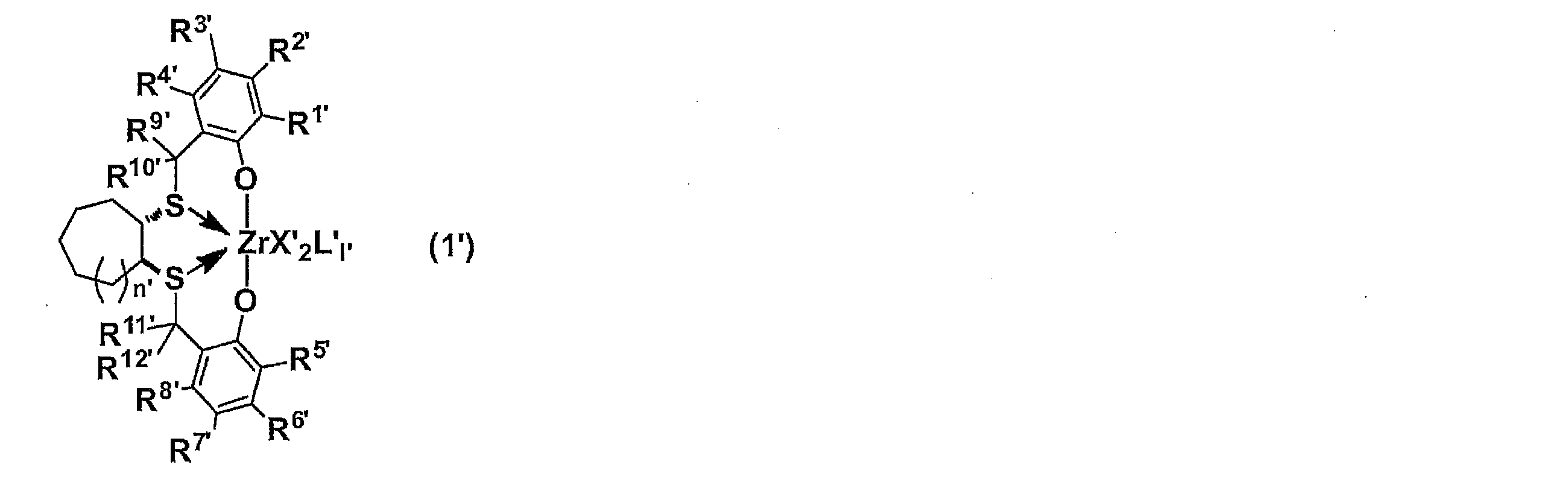
(式中、n’は1または2であり、
R1’およびR5’は、それぞれ独立して、
水素原子、
ハロゲン原子、
炭素原子数1~20のアルキル基、
環を構成する炭素原子数が3~10のシクロアルキル基、
炭素原子数2~20のアルケニル基、
炭素原子数2~20のアルキニル基、
炭素原子数7~30のアラルキル基、
炭素原子数1~20のアルコキシ基、
炭素原子数7~30のアラルキルオキシ基、
炭素原子数6~30のアリールオキシ基、
または、置換シリル基を表す。ただし、R1’とR5’は同時にtert-ブチル基ではない。
R2’~R4’およびR6’~R12’は、それぞれ独立して、
水素原子、
ハロゲン原子、
炭素原子数1~20のアルキル基、
環を構成する炭素原子数が3~10のシクロアルキル基、
炭素原子数2~20のアルケニル基、
炭素原子数2~20のアルキニル基、
炭素原子数7~30のアラルキル基、
炭素原子数6~30のアリール基、
炭素原子数1~20のアルコキシ基、
炭素原子数7~30のアラルキルオキシ基、
炭素原子数6~30のアリールオキシ基、
置換シリル基、
または環を構成する炭素原子数が3~20のヘテロ環式化合物残基を表す。
R1’~R12’における上記アルキル基、上記シクロアルキル基、上記アルケニル基、上記アルキニル基、上記アラルキル基、上記アリール基、上記アルコキシ基、上記アラルキルオキシ基、上記アリールオキシ基および上記ヘテロ環式化合物残基は置換基を有していてもよい。
上記R1’~R12’の定義に関わらず、R1’とR2’、R2’とR3’、R3’とR4’、R5’とR6’、R6’とR7’、R7’とR8’、R9’とR10’、およびR11’とR12’とは、それぞれ独立に、互いに連結して環を形成してもよく、これらの環は置換基を有していてもよい。
X’は、それぞれ独立して、水素原子、ハロゲン原子、
炭素原子数1~20のアルキル基、
環を構成する炭素原子数が3~10のシクロアルキル基、
炭素原子数2~20のアルケニル基、
炭素原子数7~30のアラルキル基、
炭素原子数6~30のアリール基、
炭素原子数1~20のアルコキシ基、
炭素原子数7~30のアラルキルオキシ基、
炭素原子数6~30のアリールオキシ基、
置換シリル基、
置換アミノ基、
置換チオラート基、または
炭素原子数1~20のカルボキシラート基を表す。X’における上記アルキル基、上記シクロアルキル基、上記アルケニル基、上記アラルキル基、上記アリール基、上記アルコキシ基、上記アラルキルオキシ基、上記アリールオキシ基および上記カルボキシラート基は置換基を有していてもよい。
隣接するX’同士は、相互に連結して環を形成してもよい。
L’は中性のルイス塩基を表す。L’が複数ある場合は、複数のL’は同一でも異なっていてもよい。l’は、0、1、または2である。)
R1’およびR5’は、それぞれ独立して、
水素原子、
ハロゲン原子、
炭素原子数1~20のアルキル基、
環を構成する炭素原子数が3~10のシクロアルキル基、
炭素原子数2~20のアルケニル基、
炭素原子数2~20のアルキニル基、
炭素原子数7~30のアラルキル基、
炭素原子数1~20のアルコキシ基、
炭素原子数7~30のアラルキルオキシ基、
炭素原子数6~30のアリールオキシ基、
または、置換シリル基を表す。ただし、R1’とR5’は同時にtert-ブチル基ではない。
R2’~R4’およびR6’~R12’は、それぞれ独立して、
水素原子、
ハロゲン原子、
炭素原子数1~20のアルキル基、
環を構成する炭素原子数が3~10のシクロアルキル基、
炭素原子数2~20のアルケニル基、
炭素原子数2~20のアルキニル基、
炭素原子数7~30のアラルキル基、
炭素原子数6~30のアリール基、
炭素原子数1~20のアルコキシ基、
炭素原子数7~30のアラルキルオキシ基、
炭素原子数6~30のアリールオキシ基、
置換シリル基、
または環を構成する炭素原子数が3~20のヘテロ環式化合物残基を表す。
R1’~R12’における上記アルキル基、上記シクロアルキル基、上記アルケニル基、上記アルキニル基、上記アラルキル基、上記アリール基、上記アルコキシ基、上記アラルキルオキシ基、上記アリールオキシ基および上記ヘテロ環式化合物残基は置換基を有していてもよい。
上記R1’~R12’の定義に関わらず、R1’とR2’、R2’とR3’、R3’とR4’、R5’とR6’、R6’とR7’、R7’とR8’、R9’とR10’、およびR11’とR12’とは、それぞれ独立に、互いに連結して環を形成してもよく、これらの環は置換基を有していてもよい。
X’は、それぞれ独立して、水素原子、ハロゲン原子、
炭素原子数1~20のアルキル基、
環を構成する炭素原子数が3~10のシクロアルキル基、
炭素原子数2~20のアルケニル基、
炭素原子数7~30のアラルキル基、
炭素原子数6~30のアリール基、
炭素原子数1~20のアルコキシ基、
炭素原子数7~30のアラルキルオキシ基、
炭素原子数6~30のアリールオキシ基、
置換シリル基、
置換アミノ基、
置換チオラート基、または
炭素原子数1~20のカルボキシラート基を表す。X’における上記アルキル基、上記シクロアルキル基、上記アルケニル基、上記アラルキル基、上記アリール基、上記アルコキシ基、上記アラルキルオキシ基、上記アリールオキシ基および上記カルボキシラート基は置換基を有していてもよい。
隣接するX’同士は、相互に連結して環を形成してもよい。
L’は中性のルイス塩基を表す。L’が複数ある場合は、複数のL’は同一でも異なっていてもよい。l’は、0、1、または2である。)
本発明によれば、長鎖分岐含有エチレン系重合体を製造することができる。
式(1)で表される錯体について説明する。

nは1または2であり、好ましくは2である。
R1およびR5として好ましくは、それぞれ独立して
水素原子、
ハロゲン原子、
炭素原子数1~20のアルキル基、
環を構成する炭素原子数が3~10のシクロアルキル基、
炭素原子数7~30のアラルキル基、
炭素原子数1~20のアルコキシ基、
炭素原子数7~30のアラルキルオキシ基、
炭素原子数6~30のアリールオキシ基または、
置換シリル基であり、
より好ましくは、それぞれ独立して
ハロゲン原子、
炭素原子数1~20のアルキル基、
環を構成する炭素原子数が3~10のシクロアルキル基、
炭素原子数7~30のアラルキル基、
置換シリル基であり、
さらに好ましくは、それぞれ独立して
炭素原子数4~20のアルキル基、
環を構成する炭素原子数が3~10のシクロアルキル基、
炭素原子数7~30のアラルキル基、
または置換シリル基である。
R1とR5の最も好ましい形態は、R1とR5が同一であって、
炭素原子数5~20のアルキル基、
環を構成する炭素原子数が3~10のシクロアルキル基、
炭素原子数7~30のアラルキル基、
または置換シリル基である。
R2~R4およびR6~R8として好ましくは、それぞれ独立して
水素原子、
ハロゲン原子、
炭素原子数1~20のアルキル基、
環を構成する炭素原子数が3~10のシクロアルキル基、
炭素原子数7~30のアラルキル基、
炭素原子数6~30のアリール基、
炭素原子数1~20のアルコキシ基、
炭素原子数6~30のアリールオキシ基、
置換シリル基であり、
より好ましくは、それぞれ独立して
水素原子、
炭素原子数1~20のアルキル基、
環を構成する炭素原子数が3~10のシクロアルキル基、
炭素原子数7~30のアラルキル基、
炭素原子数6~30のアリール基、
または置換シリル基である。
R2、R4、R6およびR8として、さらに好ましくは、水素原子である。
R3およびR7としてさらに好ましくは、
炭素原子数1~20のアルキル基
環を構成する炭素原子数が3~10のシクロアルキル基、
炭素原子数7~30のアラルキル基、
炭素原子数6~30のアリール基、
または置換シリル基である。
R3およびR7として特に好ましい形態は、R3とR7が同一であって、
炭素原子数1~20のアルキル基
環を構成する炭素原子数が3~10のシクロアルキル基、
炭素原子数7~30のアラルキル基、
炭素原子数6~30のアリール基、
または置換シリル基であり、
最も好ましくは、
炭素原子数1~20のアルキル基である。
R9~R12として好ましくは、それぞれ独立して
水素原子、
炭素原子数1~20のアルキル基、
環を構成する炭素原子数が3~10のシクロアルキル基、
炭素原子数7~30のアラルキル基、
炭素原子数6~30のアリール基、
炭素原子数1~20のアルコキシ基、
炭素原子数6~30のアリールオキシ基、
置換シリル基であり、
より好ましくは、それぞれ独立して
水素原子、
炭素原子数1~20のアルキル基、
環を構成する炭素原子数が3~10のシクロアルキル基、
炭素原子数7~30のアラルキル基、
炭素原子数6~30のアリール基、
または置換シリル基であり、
さらに好ましくは、それぞれ独立して
水素原子、
炭素原子数1~20のアルキル基、
環を構成する炭素原子数が3~10のシクロアルキル基であり、
最も好ましくは、
水素原子である。
水素原子、
ハロゲン原子、
炭素原子数1~20のアルキル基、
環を構成する炭素原子数が3~10のシクロアルキル基、
炭素原子数7~30のアラルキル基、
炭素原子数1~20のアルコキシ基、
炭素原子数7~30のアラルキルオキシ基、
炭素原子数6~30のアリールオキシ基または、
置換シリル基であり、
より好ましくは、それぞれ独立して
ハロゲン原子、
炭素原子数1~20のアルキル基、
環を構成する炭素原子数が3~10のシクロアルキル基、
炭素原子数7~30のアラルキル基、
置換シリル基であり、
さらに好ましくは、それぞれ独立して
炭素原子数4~20のアルキル基、
環を構成する炭素原子数が3~10のシクロアルキル基、
炭素原子数7~30のアラルキル基、
または置換シリル基である。
R1とR5の最も好ましい形態は、R1とR5が同一であって、
炭素原子数5~20のアルキル基、
環を構成する炭素原子数が3~10のシクロアルキル基、
炭素原子数7~30のアラルキル基、
または置換シリル基である。
R2~R4およびR6~R8として好ましくは、それぞれ独立して
水素原子、
ハロゲン原子、
炭素原子数1~20のアルキル基、
環を構成する炭素原子数が3~10のシクロアルキル基、
炭素原子数7~30のアラルキル基、
炭素原子数6~30のアリール基、
炭素原子数1~20のアルコキシ基、
炭素原子数6~30のアリールオキシ基、
置換シリル基であり、
より好ましくは、それぞれ独立して
水素原子、
炭素原子数1~20のアルキル基、
環を構成する炭素原子数が3~10のシクロアルキル基、
炭素原子数7~30のアラルキル基、
炭素原子数6~30のアリール基、
または置換シリル基である。
R2、R4、R6およびR8として、さらに好ましくは、水素原子である。
R3およびR7としてさらに好ましくは、
炭素原子数1~20のアルキル基
環を構成する炭素原子数が3~10のシクロアルキル基、
炭素原子数7~30のアラルキル基、
炭素原子数6~30のアリール基、
または置換シリル基である。
R3およびR7として特に好ましい形態は、R3とR7が同一であって、
炭素原子数1~20のアルキル基
環を構成する炭素原子数が3~10のシクロアルキル基、
炭素原子数7~30のアラルキル基、
炭素原子数6~30のアリール基、
または置換シリル基であり、
最も好ましくは、
炭素原子数1~20のアルキル基である。
R9~R12として好ましくは、それぞれ独立して
水素原子、
炭素原子数1~20のアルキル基、
環を構成する炭素原子数が3~10のシクロアルキル基、
炭素原子数7~30のアラルキル基、
炭素原子数6~30のアリール基、
炭素原子数1~20のアルコキシ基、
炭素原子数6~30のアリールオキシ基、
置換シリル基であり、
より好ましくは、それぞれ独立して
水素原子、
炭素原子数1~20のアルキル基、
環を構成する炭素原子数が3~10のシクロアルキル基、
炭素原子数7~30のアラルキル基、
炭素原子数6~30のアリール基、
または置換シリル基であり、
さらに好ましくは、それぞれ独立して
水素原子、
炭素原子数1~20のアルキル基、
環を構成する炭素原子数が3~10のシクロアルキル基であり、
最も好ましくは、
水素原子である。
上記した、アルキル基、シクロアルキル基、アラルキル基、アリール基、アルコキシ基、およびアリールオキシ基は置換基を有していてもよい。
R1~R12における炭素原子数1~20の置換または無置換のアルキル基としては、例えば、パーフルオロメチル基、パーフルオロエチル基、パーフルオロ-n-プロピル基、パーフルオロイソプロピル基、パーフルオロ-n-ブチル基、パーフルオロ-sec-ブチル基、パーフルオロイソブチル基、パーフルオロ-tert-ブチル基、パーフルオロ-n-ペンチル基、パーフルオロイソペンチル基、パーフルオロ-tert-ペンチル基、パーフルオロネオペンチル基、パーフルオロ-n-ヘキシル基、パーフルオロ-n-ヘプチル基、パーフルオロ-n-オクチル基、パーフルオロ-n-デシル基、パーフルオロ-n-ドデシル基、パーフルオロ-n-ペンタデシル基、パーフルオロ-n-エイコシル基、メチル基、エチル基、n-プロピル基、イソプロピル基、n-ブチル基、sec-ブチル基、イソブチル基、tert-ブチル基、n-ペンチル基、イソペンチル基、tert-ペンチル基、ネオペンチル基、n-ヘキシル基、テキシル基、ネオヘキシル基、n-ヘプチル基、n-オクチル基、n-デシル基、n-ドデシル基、n-ペンタデシル基、n-エイコシル基が挙げられる。
R1およびR5における炭素原子数1~20の置換または無置換のアルキル基として好ましくは、n-ブチル基、sec-ブチル基、イソブチル基、tert-ブチル基、n-ペンチル基、イソペンチル基、tert-ペンチル基、ネオペンチル基、n-ヘキシル基、テキシル基、ネオヘキシル基、n-ヘプチル基、n-オクチル基、n-デシル基などの炭素原子数4~10のアルキル基であり、より好ましくは、n-ブチル基、sec-ブチル基、イソブチル基、tert-ブチル基、n-ペンチル基、イソペンチル基、tert-ペンチル基、ネオペンチル基、テキシル基、などの炭素原子数4~8のアルキル基であり、さらに好ましくは、tert-ブチル基、tert-ペンチル基、テキシル基などの炭素原子数4~8の第3級アルキル基である。最も好ましくは、tert-ペンチル基、テキシル基などの炭素原子数5~8の第3級アルキル基である。
R2~R4およびR6~R12における炭素原子数1~20の置換または無置換のアルキル基として好ましくは、パーフルオロメチル基、メチル基、エチル基、n-プロピル基、イソプロピル基、n-ブチル基、sec-ブチル基、イソブチル基、tert-ブチル基、n-ペンチル基、イソペンチル基、tert-ペンチル基、ネオペンチル基、n-ヘキシル基、テキシル基、ネオヘキシル基、n-ヘプチル基、n-オクチル基、n-デシル基などの炭素原子数4~10のアルキル基であり、より好ましくは、パーフルオロメチル基、メチル基、イソプロピル基、イソブチル基、tert-ブチル基、イソペンチル基、tert-ペンチル基、ネオペンチル基、テキシル基などの炭素原子数1~8のアルキル基であり、さらに好ましくは、パーフルオロメチル基、メチル基、イソプロピル基、イソブチル基、tert-ブチル基といった炭素原子数1~4のアルキル基である。
R1~R12における環を構成する炭素原子数が3~10の置換または無置換のシクロアルキル基としては、例えば、シクロプロピル基、シクロブチル基、シクロペンチル基、シクロヘキシル基、シクロヘプチル基、シクロオクチル基、1-メチルシクロペンチル基、1-メチルシクロヘキシル基、1-フェニルシクロヘキシル基、1-インダニル基、2-インダニル基、ノルボルニル基、ボルニル基、メンチル基、1-アダマンチル基、2-アダマンチル基、3,5-ジメチルアダマンチル基、3,5,7-トリメチルアダマンチル基、3,5-ジエチルアダマンチル基、3,5,7-トリエチルアダマンチル基、3,5-ジイソプロピルアダマンチル基、3,5,7-トリイソプロピルアダマンチル基、3,5-ジイソブチルアダマンチル基、3,5,7-トリイソブチルアダマンチル基、3,5-ジフェニルアダマンチル基、3,5,7-トリフェニルアダマンチル基、3,5-ジ(p-トルイル)アダマンチル基、3,5,7-トリ(p-トルイル)アダマンチル基、3,5-ジ(3,5-キシリル)アダマンチル基、3,5,7-トリ(3,5-キシリル)アダマンチル基が挙げられ、好ましくはシクロペンチル基、シクロヘキシル基、シクロヘプチル基、シクロオクチル基、1-メチルシクロペンチル基、1-メチルシクロヘキシル基、1-インダニル基、2-インダニル基、ノルボルニル基、ボルニル基、メンチル基、1-アダマンチル基、2-アダマンチル基、3,5-ジメチルアダマンチル基、3,5-ジエチルアダマンチル基、3,5-ジフェニルアダマンチル基、3,5-ジ(p-トルイル)アダマンチル基、3,5-ジ(3,5-キシリル)アダマンチル基などの炭素原子数(環を構成する炭素原子以外の炭素原子も含めた数)5~26のシクロアルキル基であり、より好ましくは、シクロヘキシル基、1-メチルシクロヘキシル基、ノルボルニル基、ボルニル基、1-アダマンチル基、2-アダマンチル基、3,5-ジメチルアダマンチル基、3,5-ジエチルアダマンチル基などの炭素原子数(環を構成する炭素原子以外の炭素原子も含めた数)6~14のシクロアルキル基である。
R1~R12における炭素原子数2~20の置換または無置換のアルケニル基としては、ビニル基、アリル基、プロペニル基、2-メチル-2-プロペニル基、ホモアリル基、ペンテニル基、ヘキセニル基、ヘプテニル基、オクテニル基、ノネニル基、デセニル基などが挙げられ、好ましくは炭素原子数3~6のアルケニル基であり、より好ましくはアリル基、ホモアリル基である。
R1~R8における炭素原子数2~20の置換または無置換のアルキニル基としては、例えばエチニル基、1-プロピニル基、2-プロピニル基、1-ブチニル基、3-メチル-1-ブチニル基、3,3-ジメチル-1-ブチニル基、2-ブチニル基、3-ブチニル基、1-ペンチニル基、4-メチル-1-ペンチニル基、2-ペンチニル基、3-ペンチニル基、4-ペンチニル基、4-メチルー1-ペンテニル基、1-ヘキシニル基、1-オクチニル基、フェニルエチニル基が挙げられ、好ましくは炭素原子数3~8のアルキニル基であり、より好ましくは3-メチル-1-ブチニル基、3,3-ジメチル-1-ブチニル基、4-メチル-1-ペンテニル基またはフェニルエチニル基である。
R1~R12における炭素原子数7~30の置換または無置換のアラルキル基としては、例えば、ベンジル基、(2-メチルフェニル)メチル基、(3-メチルフェニル)メチル基、(4-メチルフェニル)メチル基、(2,3-ジメチルフェニル)メチル基、(2,4-ジメチルフェニル)メチル基、(2,5-ジメチルフェニル)メチル基、(2,6-ジメチルフェニル)メチル基、(3,4-ジメチルフェニル)メチル基、(3,5-ジメチルフェニル)メチル基、(2,3,4-トリメチルフェニル)メチル基、(2,3,5-トリメチルフェニル)メチル基、(2,3,6-トリメチルフェニル)メチル基、(3,4,5-トリメチルフェニル)メチル基、(2,4,6-トリメチルフェニル)メチル基、(2,3,4,5-テトラメチルフェニル)メチル基、(2,3,4,6-テトラメチルフェニル)メチル基、(2,3,5,6-テトラメチルフェニル)メチル基、(ペンタメチルフェニル)メチル基、(エチルフェニル)メチル基、(n-プロピルフェニル)メチル基、(イソプロピルフェニル)メチル基、(n-ブチルフェニル)メチル基、(sec-ブチルフェニル)メチル基、(tert-ブチルフェニル)メチル基、(イソブチルフェニル)メチル基、(n-ペンチルフェニル)メチル基、(ネオペンチルフェニル)メチル基、(n-ヘキシルフェニル)メチル基、(n-オクチルフェニル)メチル基、(n-デシルフェニル)メチル基、ナフチルメチル基、アントラセニルメチル基、ジメチル(フェニル)メチル基、ジメチル(4-メチルフェニル)メチル基、ジメチル(1-ナフチル)メチル基、ジメチル(2-ナフチル)メチル基、メチル(エチル)(フェニル)メチル基、メチル(ジフェニル)メチル基、メチルビス(4-メチルフェニル)メチル基、トリフェニルメチル基が挙げられ、好ましくはベンジル基、ナフチルメチル基、アントラセニルメチル基、ジメチル(フェニル)メチル基、ジメチル(4-メチルフェニル)メチル基、ジメチル(1-ナフチル)メチル基、ジメチル(2-ナフチル)メチル基、メチル(ジフェニル)メチル基、メチルビス(4-メチルフェニル)メチル基、トリフェニルメチル基であり、より好ましくは、ジメチル(フェニル)メチル基、ジメチル(4-メチルフェニル)メチル基、ジメチル(1-ナフチル)メチル基、ジメチル(2-ナフチル)メチル基、メチル(ジフェニル)メチル基、メチルビス(4-メチルフェニル)メチル基、トリフェニルメチル基などの炭素原子数9~20の第3級アラルキル基である。
R2~R4およびR6~R12における炭素原子数6~30の置換または無置換のアリール基としては、例えば、フェニル基、2-トリル基、3-トリル基、4-トリル基、2,3-キシリル基、2,4-キシリル基、2,5-キシリル基、2,6-キシリル基、3,4-キシリル基、3,5-キシリル基、2,3,4-トリメチルフェニル基、2,3,5-トリメチルフェニル基、2,3,6-トリメチルフェニル基、2,4,6-トリメチルフェニル基、3,4,5-トリメチルフェニル基、2,3,4,5-テトラメチルフェニル基、2,3,4,6-テトラメチルフェニル基、2,3,5,6-テトラメチルフェニル基、ペンタメチルフェニル基、エチルフェニル基、n-プロピルフェニル基、イソプロピルフェニル基、n-ブチルフェニル基、sec-ブチルフェニル基、tert-ブチルフェニル基、イソブチルフェニル基、n-ペンチルフェニル基、ネオペンチルフェニル基、n-ヘキシルフェニル基、n-オクチルフェニル基、n-デシルフェニル基、n-ドデシルフェニル基、n-テトラデシルフェニル基、ナフチル基、アントラセニル基、3,5-ジイソプロピルフェニル基、2,6-ジイソプロピルフェニル基、3,5-ジtert-ブチルフェニル基、2-フルオロフェニル基、3-フルオロフェニル基、4-フルオロフェニル基、ペンタフルオロフェニル基、2-トリフルオロメチルフェニル基、3-トリフルオロメチルフェニル基、4-トリフルオロメチルフェニル基、2,3-ジフルオロフェニル基、2,4-ジフルオロフェニル基、2,5-ジフルオロフェニル基、2,6-ジフルオロフェニル基、2-クロロフェニル基、2,3-ジクロロフェニル基、2,4-ジクロロフェニル基、2,5-ジクロロフェニル基、2-ブロモフェニル基、3-ブロモフェニル基、4-ブロモフェニル基、2,3-ジブロモフェニル基、2,4-ジブロモフェニル基、あるいは2,5-ジブロモフェニル基が挙げられ、好ましくは、フェニル基、2-トリル基、3-トリル基、4-トリル基、2,3-キシリル基、2,4-キシリル基、2,5-キシリル基、2,6-キシリル基、3,4-キシリル基、3,5-キシリル基、2,3,4-トリメチルフェニル基、2,3,5-トリメチルフェニル基、2,3,6-トリメチルフェニル基、2,4,6-トリメチルフェニル基、3,4,5-トリメチルフェニル基、エチルフェニル基、n-プロピルフェニル基、イソプロピルフェニル基、3,5-ジイソプロピルフェニル基、2,6-ジイソプロピルフェニル基、3,5-ジtert-ブチルフェニル基などの炭素原子数6~20のフェニル基;2-フルオロフェニル基、3-フルオロフェニル基、4-フルオロフェニル基、ペンタフルオロフェニル基、2,3-ジフルオロフェニル基、2,4-ジフルオロフェニル基、2,5-ジフルオロフェニル基、2,6-ジフルオロフェニル基などのフッ素化フェニル基;2-トリフルオロメチルフェニル基、3-トリフルオロメチルフェニル基、4-トリフルオロメチルフェニル基などのフッ素化アルキルフェニル基であり、より好ましくは、フェニル基、2-トリル基、3-トリル基、4-トリル基、2,6-キシリル基、3,5-キシリル基、2,4,6-トリメチルフェニル基、3,5-ジイソプロピルフェニル基、2,6-ジイソプロピルフェニル基、3,5-ジtert-ブチルフェニル基、2-フルオロフェニル基、ペンタフルオロフェニル基、2,3-ジフルオロフェニル基、2,4-ジフルオロフェニル基、2,5-ジフルオロフェニル基、2,6-ジフルオロフェニル基、2,4,6-トリフルオロフェニル基である。
R1~R12における置換シリル基としては、例えば、トリメチルシリル基、トリエチルシリル基、トリ-n-プロピルシリル基、トリイソプロピルシリル基、トリ-n-ブチルシリル基、トリイソブチルシリル基、tert-ブチルジメチルシリル基、メチルジフェニルシリル基、ジメチル(フェニル)シリル基、tert-ブチルジフェニルシリル基、トリフェニルシリル基、メチルビス(トリメチルシリル)シリル基、ジメチル(トリメチルシリル)シリル基、トリス(トリメチルシリル)シリル基が挙げられ、好ましくはトリメチルシリル基、トリエチルシリル基、トリ-n-プロピルシリル基、トリイソプロピルシリル基、tert-ブチルジメチルシリル基などの炭素原子数3~20のトリアルキルシリル基;メチルビス(トリメチルシリル)シリル基、ジメチル(トリメチルシリル)シリル基、トリス(トリメチルシリル)シリル基などの炭素原子数3~20のハイドロカルビルシリル基を置換基として有するシリル基が挙げられる。
R1~R12における炭素原子数1~20の置換または無置換のアルコキシ基としては、例えば、パーフルオロメトキシ基、パーフルオロエトキシ基、パーフルオロ-n-プロポキシ基、パーフルオロイソプロポキシ基、パーフルオロ-n-ブトキシ基、パーフルオロ-sec-ブトキシ基、パーフルオロイソブトキシ基、パーフルオロ-n-ペンチルオキシ基、パーフルオロネオペンチルオキシ基、パーフルオロ-n-ヘキシルオキシ基、パーフルオロ-n-ヘプチルオキシ基、パーフルオロ-n-オクチルオキシ基、パーフルオロ-n-デシルオキシ基、パーフルオロ-n-ドデシルオキシ基、パーフルオロ-n-ペンタデシルオキシ基、パーフルオロ-n-エイコシルオキシ基、メトキシ基、エトキシ基、n-プロポキシ基、イソプロポキシ基、n-ブトキシ基、sec-ブトキシ基、イソブトキシ基、n-ペンチルオキシ基、ネオペンチルオキシ基、n-ヘキシルオキシ基、n-ヘプチルオキシ基、n-オクチルオキシ基、n-デシルオキシ基、n-ドデシルオキシ基、n-ペンタデシルオキシ基、n-エイコシルオキシ基が挙げられ、好ましくは炭素原子数1~4のアルコキシ基であり、より好ましくはメトキシ基、エトキシ基、n-プロポキシ基、イソプロポキシ基、n-ブトキシ基である。
R1~R12における炭素原子数6~30の置換または無置換のアリールオキシ基としては、例えばフェノキシ基、2,3,4-トリメチルフェノキシ基、2,3,5-トリメチルフェノキシ基、2,3,6-トリメチルフェノキシ基、2,4,6-トリメチルフェノキシ基、3,4,5-トリメチルフェノキシ基、2,3,4,5-テトラメチルフェノキシ基、2,3,4,6-テトラメチルフェノキシ基、2,3,5,6-テトラメチルフェノキシ基、ペンタメチルフェノキシ基、2,6-ジイソプロピルフェノキシ基、2-フルオロフェノキシ基、3-フルオロフェノキシ基、4-フルオロフェノキシ基、ペンタフルオロフェノキシ基、2-トリフルオロメチルフェノキシ基、3-トリフルオロメチルフェノキシ基、4-トリフルオロメチルフェノキシ基、2,3-ジフルオロフェノキシ基、2,4-フルオロフェノキシ基、2,5-ジフルオロフェノキシ基、2-クロロフェノキシ基、2,3-ジクロロフェノキシ基、2,4-ジクロロフェノキシ基、2,5-ジクロロフェノキシ基、2-ブロモフェノキシ基、3-ブロモフェノキシ基、4-ブロモフェノキシ基、2,3-ジブロモフェノキシ基、2,4-ジブロモフェノキシ基、あるいは2,5-ジブロモフェノキシ基が挙げられ、好ましくは炭素原子数6~14のアリールオキシ基であり、より好ましくは2,4,6-トリメチルフェノキシ基、3,4,5-トリメチルフェノキシ基、2,6-ジイソプロピルフェノキシ基、ペンタフルオロフェノキシ基である。
R1~R12における炭素原子数7~30の置換または無置換のアラルキルオキシ基としては、例えば、ベンジルオキシ基、(2-メチルフェニル)メトキシ基、(3-メチルフェニル)メトキシ基、(4-メチルフェニル)メトキシ基、(2,3-ジメチルフェニル)メトキシ基、(2,4-ジメチルフェニル)メトキシ基、(2,5-ジメチルフェニル)メトキシ基、(2,6-ジメチルフェニル)メトキシ基、(3,4-ジメチルフェニル)メトキシ基、(3,5-ジメチルフェニル)メトキシ基、(2,3,4-トリメチルフェニル)メトキシ基、(2,3,5-トリメチルフェニル)メトキシ基、(2,3,6-トリメチルフェニル)メトキシ基、(2,4,5-トリメチルフェニル)メトキシ基、(2,4,6-トリメチルフェニル)メトキシ基、(3,4,5-トリメチルフェニル)メトキシ基、(2,3,4,5-テトラメチルフェニル)メトキシ基、(2,3,4,6-テトラメチルフェニル)メトキシ基、(2,3,5,6-テトラメチルフェニル)メトキシ基、(ペンタメチルフェニル)メトキシ基、(エチルフェニル)メトキシ基、(n-プロピルフェニル)メトキシ基、(イソプロピルフェニル)メトキシ基、(n-ブチルフェニル)メトキシ基、(sec-ブチルフェニル)メトキシ基、(tert-ブチルフェニル)メトキシ基、(n-ヘキシルフェニル)メトキシ基、(n-オクチルフェニル)メトキシ基、(n-デシルフェニル)メトキシ基、(n-テトラデシルフェニル)メトキシ基、ナフチルメトキシ基、アントラセニルメトキシ基が挙げられ、好ましくは炭素原子数7~12のアラルキルオキシ基であり、より好ましくはベンジルオキシ基である。
R2~R4およびR6~R12における環を構成する炭素原子数が3~20の置換または無置換のヘテロ環式化合物残基としては、例えば、チエニル基、フリル基、1-ピロリル基、1-イミダゾリル基、1-ピラゾリル基、ピリジル基、ピラジニル基、ピリミジニル基、ピリダジニル基、2-イソインドリル基、1-インドリル基、キノリル基、ジベンゾ-1H-ピロール-1-イル基が挙げられ、好ましくはチエニル基、フリル基、1-ピロリル基、ピリジル基、ピリミジニル基、2-イソインドリル基、1-インドリル基、キノリル基、ジベンゾ-1H-ピロール-1-イル基である。
上記R1~R8の定義に関わらず、R1とR2、R2とR3、R3とR4、R5とR6、R6とR7、およびR7とR8とは、それぞれ独立に、互いに連結して環を形成してもよく、該環は置換基を有していてもよく、好ましくは、ベンゼン環上の2つの炭素原子を含む4~10員環のハイドロカルビル環または複素環であり、該環は置換基を有していてもよい。
該環として具体的には、シクロブテン環、シクロペンテン環、シクロペンタジエン環、シクロヘキセン環、シクロヘプテン環、シクロオクテン環、ベンゼン環またはナフタレン環、フラン環、2,5-ジメチルフラン環、チオフェン環、2,5-ジメチルチオフェン環、ピリジン環などが挙げられ、好ましくは、シクロブテン環、シクロペンテン環、シクロペンタジエン環、シクロヘキセン環、ベンゼン環またはナフタレン環であり、より好ましくは、R1とR2および/またはR5とR6が連結したシクロペンテン環、シクロペンタジエン環、シクロヘキセン環、ベンゼン環、ナフタレン環である。
上記R9~R12の定義に関わらず、R9とR10、およびR11とR12とは、それぞれ独立に、互いに連結して環を形成してもよく、該環は置換基を有していてもよい。
Xにおける炭素原子数1~20のアルキル基、環を構成する炭素原子数が3~10のシクロアルキル基、炭素原子数2~20のアルケニル基、炭素原子数7~30のアラルキル基、炭素原子数6~30のアリール基、炭素原子数1~20のアルコキシ基、炭素原子数7~30のアラルキルオキシ基、炭素原子数6~30のアリールオキシ基、置換シリル基は、R2~R4およびR6~R8における前記の基と同様である。
Xにおける置換アミノ基としては、例えば、ジメチルアミノ基、ジエチルアミノ基、ジn-ブチルアミノ基、ジn-プロピルアミノ基、ジイソプロピルアミノ基、ジベンジルアミノ基またはジフェニルアミノ基といった炭素原子数2~14のハイドロカルビルアミノ基が挙げられ、好ましくは、ジメチルアミノ基、ジエチルアミノ基、ジn-プロピルアミノ基、ジイソプロピルアミノ基またはジベンジルアミノ基である。
Xにおける置換チオラート基としては、例えば、チオフェノキシ基、2,3,4-トリメチルチオフェノキシ基、2,3,5-トリメチルチオフェノキシ基、2,3,6-トリメチルチオフェノキシ基、2,4,6-トリメチルチオフェノキシ基、3,4,5-トリメチルチオフェノキシ基、2,3,4,5-テトラメチルチオフェノキシ基、2,3,4,6-テトラメチルチオフェノキシ基、2,3,5,6-テトラメチルフェノキシ基、ペンタメチルフェノキシ基、2-フルオロチオフェノキシ基、3-フルオロチオフェノキシ基、4-フルオロフェノキシ基、ペンタフルオロチオフェノキシ基、2-トリフルオロメチルチオフェノキシ基、3-トリフルオロメチルチオフェノキシ基、4-トリフルオロメチルチオフェノキシ基、2,3-ジフルオロチオフェノキシ基、2,4-フルオロチオフェノキシ基、2,5-ジフルオロチオフェノキシ基、2-クロロチオフェノキシ基、2,3-ジクロロチオフェノキシ基、2,4-ジクロロチオフェノキシ基、2,5-ジクロロチオフェノキシ基、2-ブロモチオフェノキシ基、3-ブロモチオフェノキシ基、4-ブロモチオフェノキシ基、2,3-ジブロモチオフェノキシ基、2,4-ジブロモチオフェノキシ基、あるいは2,5-ジブロモチオフェノキシ基といった炭素原子数6~12のハイドロカルビルチオラート基が挙げられ、好ましくはチオフェノキシ基、2,4,6-トリメチルチオフェノキシ基、3,4,5-トリメチルチオフェノキシ基、2,3,4,5-テトラメチルチオフェノキシ基、2,3,4,6-テトラメチルチオフェノキシ基、2,3,5,6-テトラメチルチオフェノキシ基、ペンタメチルチオフェノキシ基、ペンタフルオロチオフェノキシ基である。
Xにおける炭素原子数1~20の置換または無置換のカルボキシラート基としては、例えば、アセテート基、プロピオネート基、ブチレート基、ペンタネート基、ヘキサノエート基、2-エチルヘキサノエート基またはトリフルオロアセテート基が挙げられ、好ましくは炭素原子数2~10ハイドロカルビルカルボキシラート基であり、より好ましくは、アセテート基、プロピオネート基、2-エチルヘキサノエート基またはトリフルオロアセテート基である。
Xは、好ましくは、フッ素原子、塩素原子、臭素原子、炭素原子数1~20のアルキル基、炭素原子数7~30のアラルキル基、炭素原子数1~20のアルコキシ基、炭素原子数6~30のアリールオキシ基、または炭素原子数1~20のハイドロカルビルアミノ基であり、より好ましくは、塩素原子、臭素原子、炭素原子数1~6のアルキル基、炭素原子数7~10のアラルキル基、炭素原子数1~6のアルコキシ基、炭素原子数6~10のアリールオキシ基、炭素原子数2~10のハイドロカルビルアミノ基であり、さらに好ましくは、塩素原子、メチル基、エチル基、n-ブチル基、tert-ブチル基、ベンジル基、メトキシ基、エトキシ基、イソプロポキシ基、tert-ブトキシ基、フェノキシ基ジメチルアミノ基、ジエチルアミノ基であり、特に好ましくは、塩素原子、メチル基、ベンジル基、イソプロポキシ基、フェノキシ基、ジメチルアミノ基であり、最も好ましくは、塩素原子、ベンジル基である。
R1~R12およびXは、それぞれ独立して、ハロゲン原子、酸素原子、ケイ素原子、窒素原子、リン原子、硫黄原子を含む置換基を有していてもよい。
Lは中性のルイス塩基を表す。Lが複数ある場合は、複数のLは同一でも異なっていてもよい。lは、0、1、または2である。
Lとしては、エーテル類、アミン類またはチオエーテル類などが挙げられ具体的には、テトラヒドロフラン、ジエチルエーテル、1,4-ジオキサンまたはピリジンが挙げられる。Lとして好ましくは、テトラヒドロフランである。
lは好ましくは1または0であり、さらに好ましくは、0である。
式(1)で表される錯体の具体例としては、例えば下記の化合物が挙げられる。

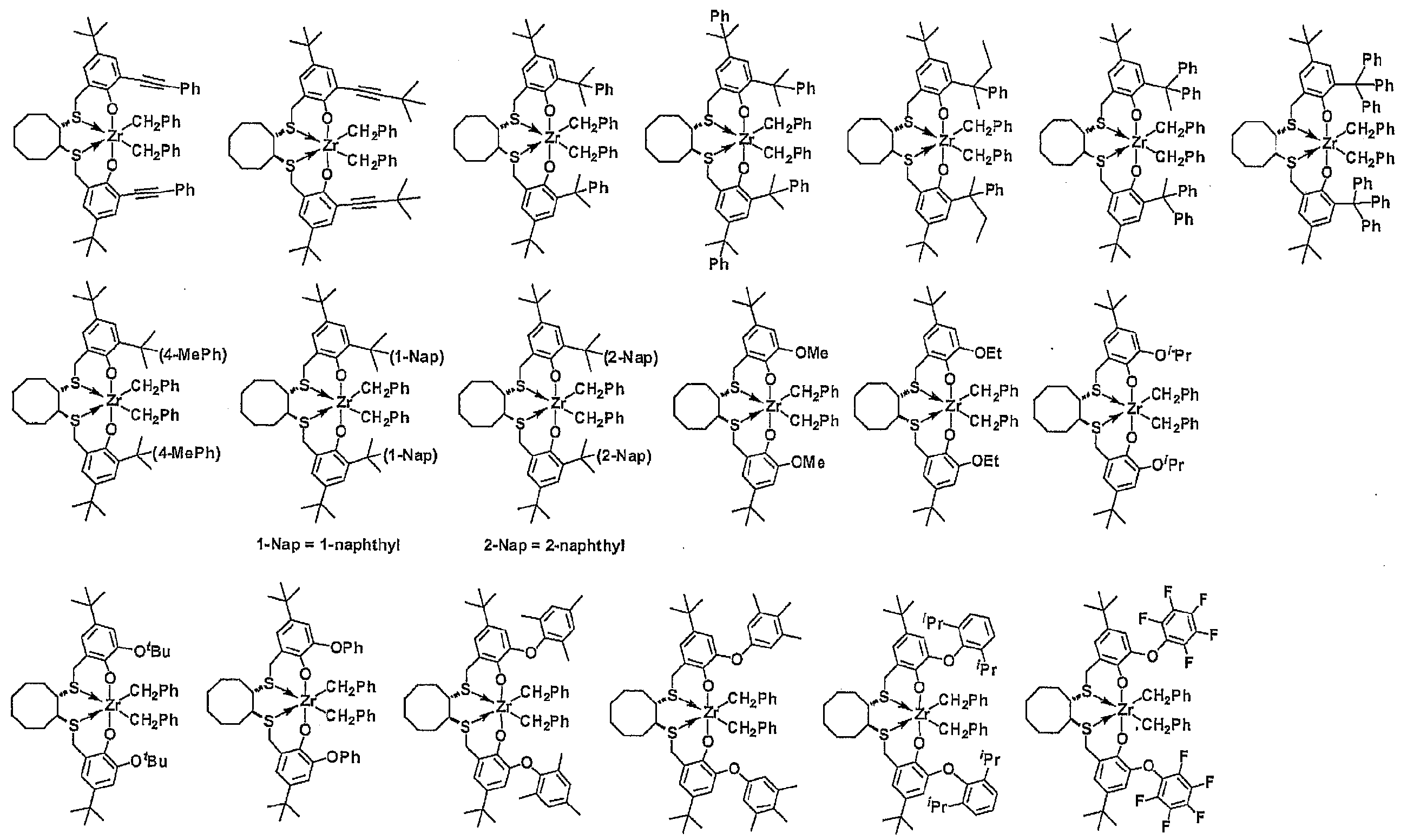
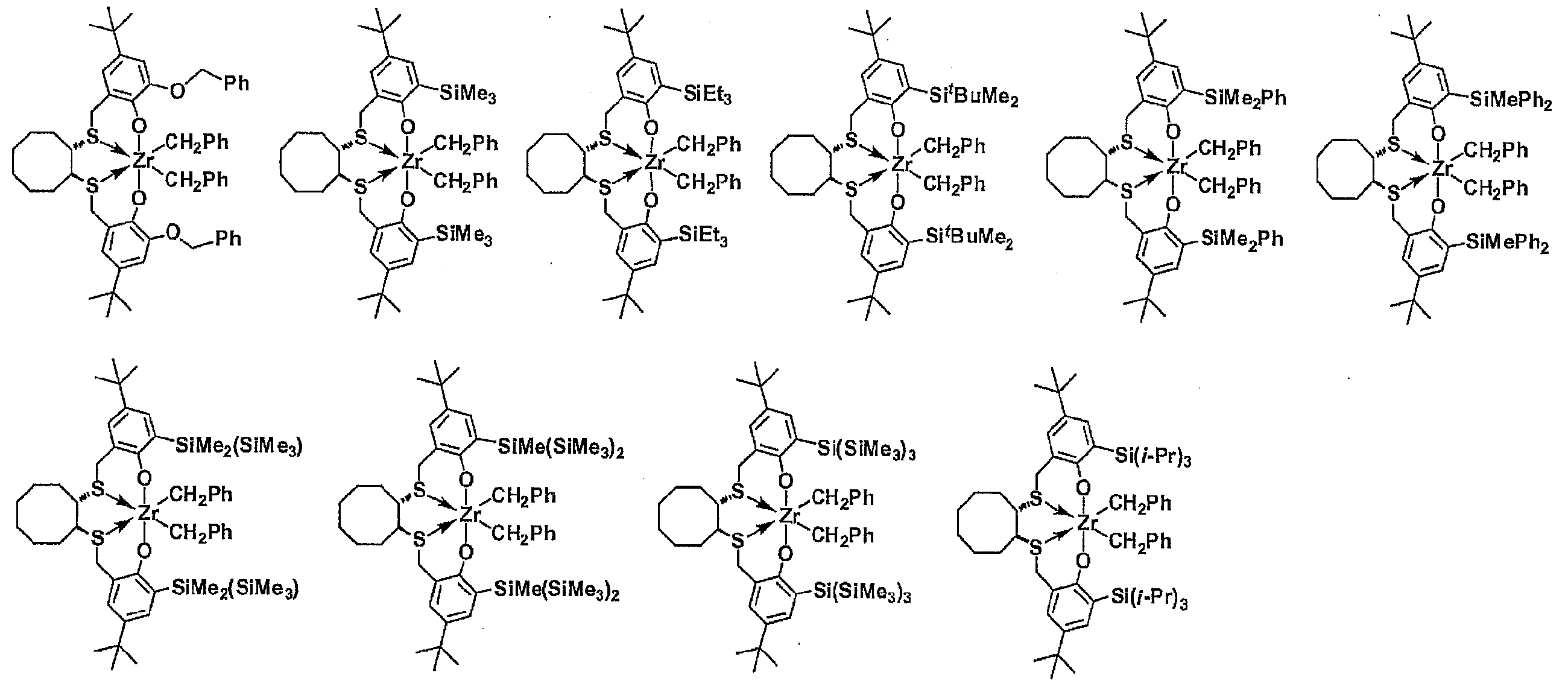
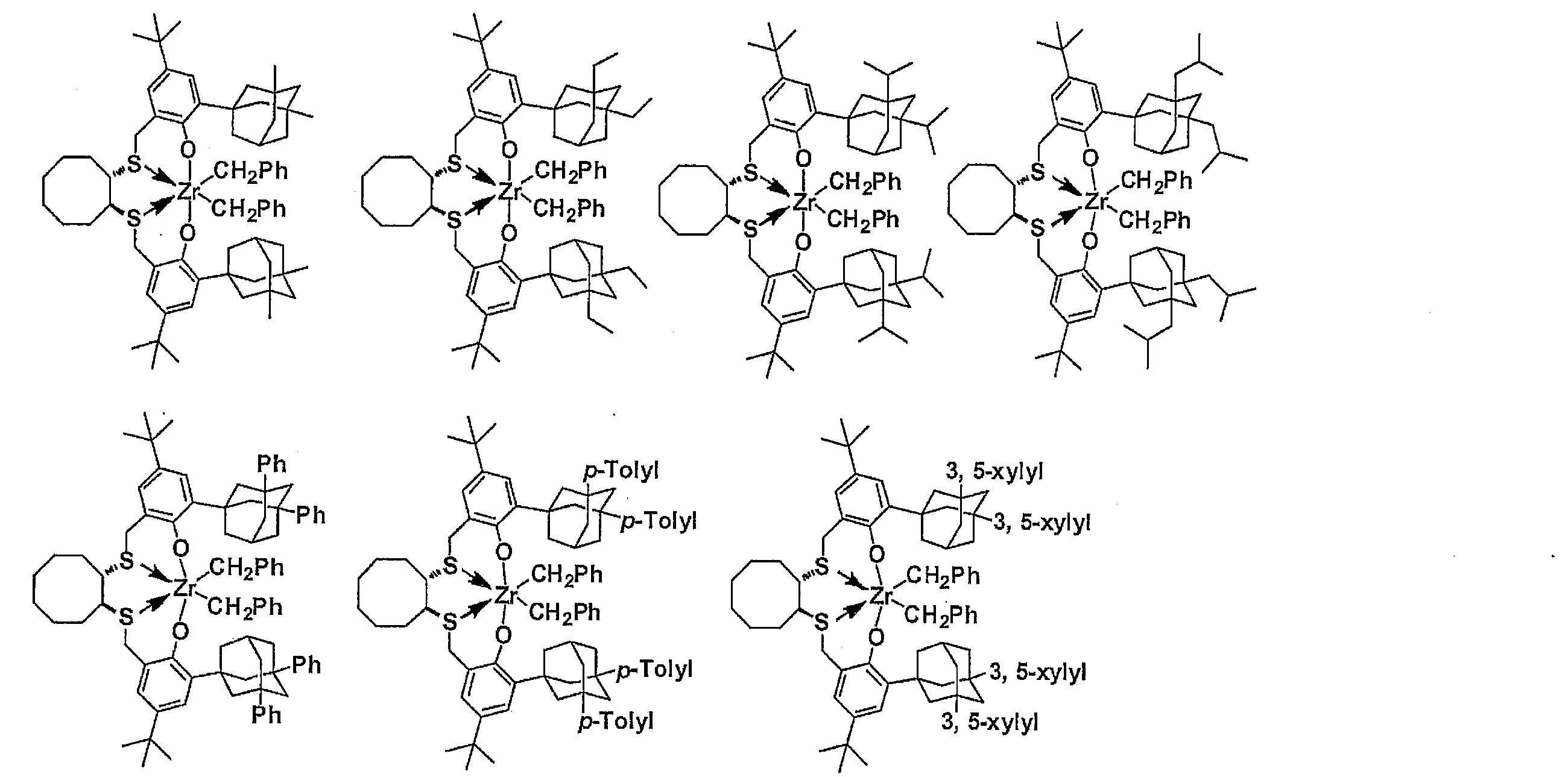
また、これらの化合物のジルコニウム原子に直接結合しているベンジル基を、塩素原子、メチル基、ジメチルアミノ基、イソプロポキシ基、tert-ブトキシ基、またはフェノキシ基に変更した化合物も挙げられる。
上記それぞれの化合物におけるR3およびR7に相当する基を水素原子、フッ素原子、塩素原子、臭素原子、ヨウ素原子、またはメチル基に変更した化合物も挙げることができる。
上記それぞれの化合物の硫黄原子を架橋するシクロオクタン環をシクロへプタン環で置換した化合物も挙げることができる。
上記それぞれの化合物におけるR9~R12に相当する基をメチル基、またはエチル基で置換した化合物も挙げることができる。
錯体(1)として好ましくは下記の化合物が挙げられる。


また、これらの化合物のジルコニウム原子に直接結合しているベンジル基を、塩素原子、またはメチル基に変更した化合物も挙げられる。
上記それぞれの化合物のR3およびR7に相当する基を水素原子、フッ素原子、塩素原子、臭素原子、ヨウ素原子、またはメチル基に変更した化合物も挙げることができる。
上記それぞれの化合物の硫黄原子を架橋するシクロオクタン環をシクロへプタン環で置換した化合物も挙げることができる。
錯体(1)としてさらに好ましくは下記の化合物が挙げられる。
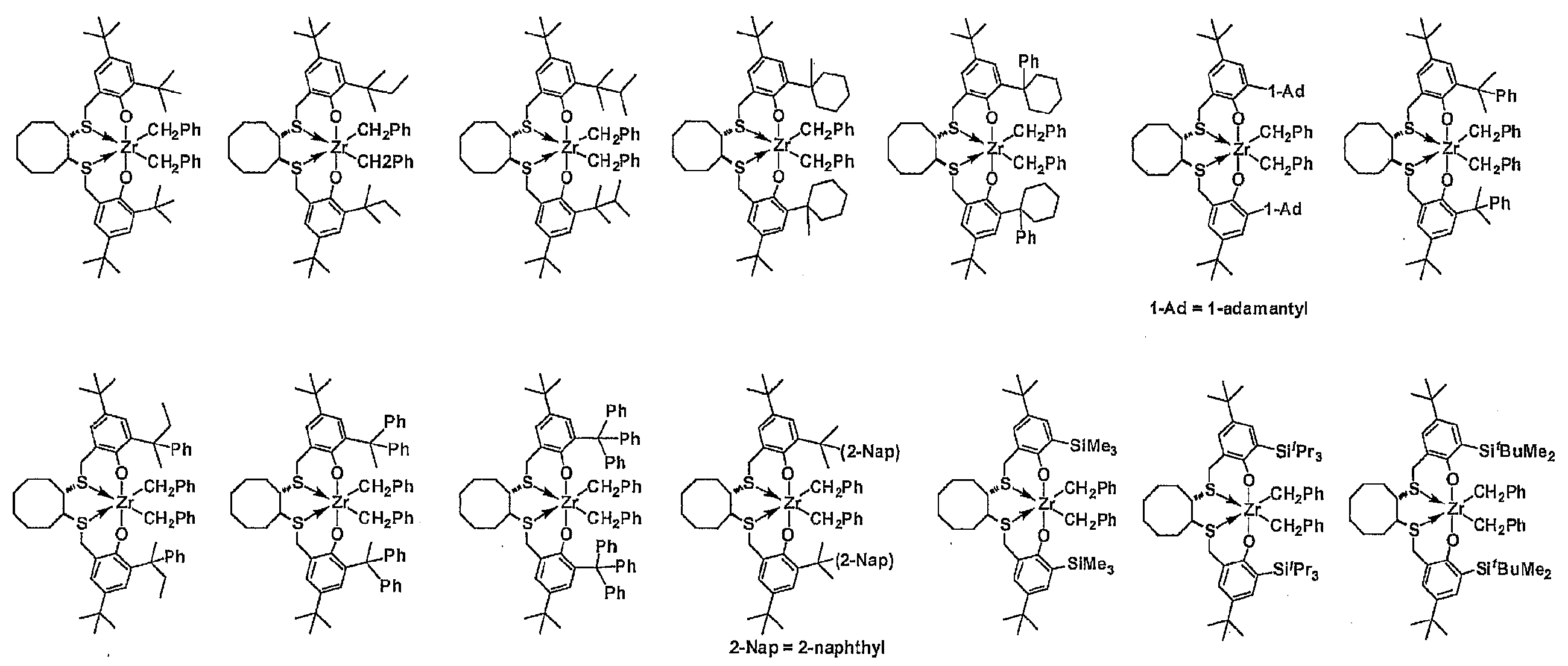

また、これらの化合物のジルコニウム原子に直接結合しているベンジル基を、塩素原子に変更した化合物も挙げられる。
上記それぞれの化合物のR3およびR7に相当する基をメチル基に変更した化合物も挙げることができる。
上記それぞれの化合物の硫黄原子を架橋するシクロオクタン環をシクロへプタン環で置換した化合物も挙げることができる。
錯体(1)として特に好ましくは下記の化合物が挙げられる。
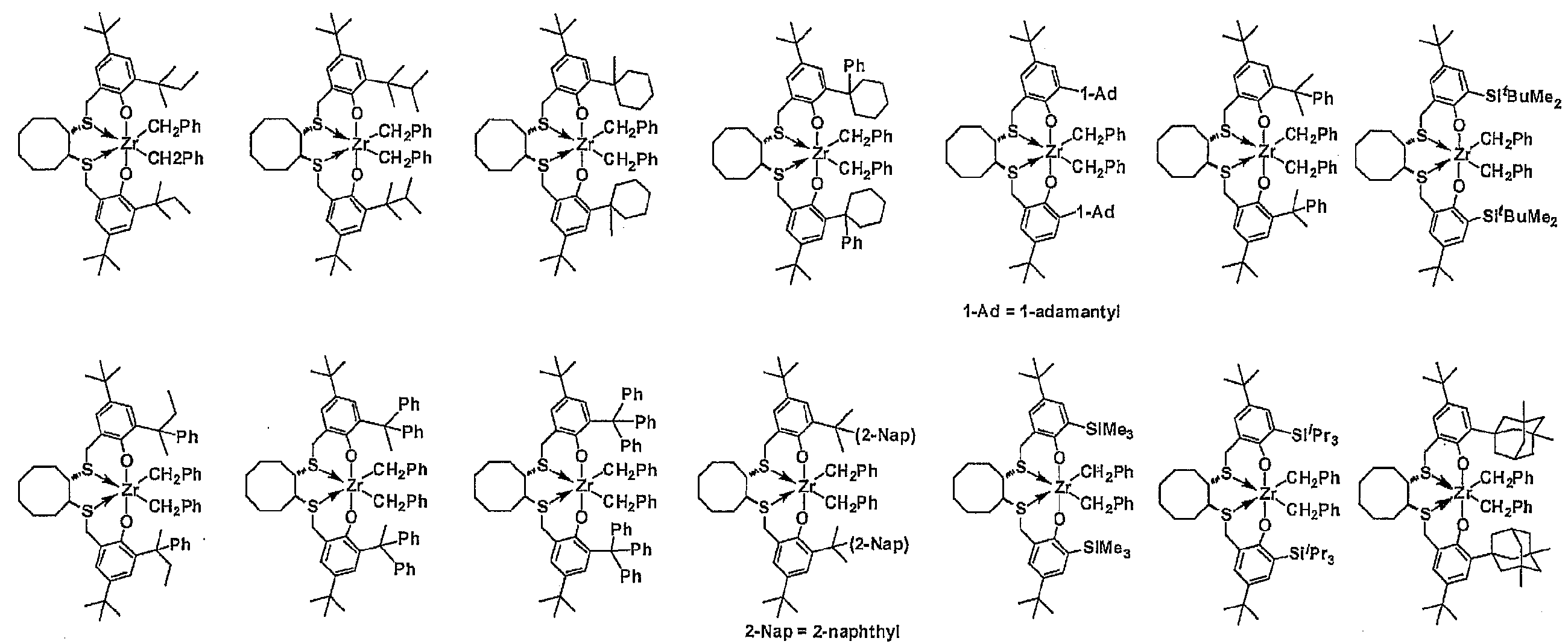
また、これらの化合物のジルコニウム原子に直接結合しているベンジル基を、塩素原子に変更した化合物も挙げられる。
上記それぞれの化合物のR3およびR7に相当する基をメチル基に変更した化合物も挙げることができる。
式(1’)で表される錯体について説明する。
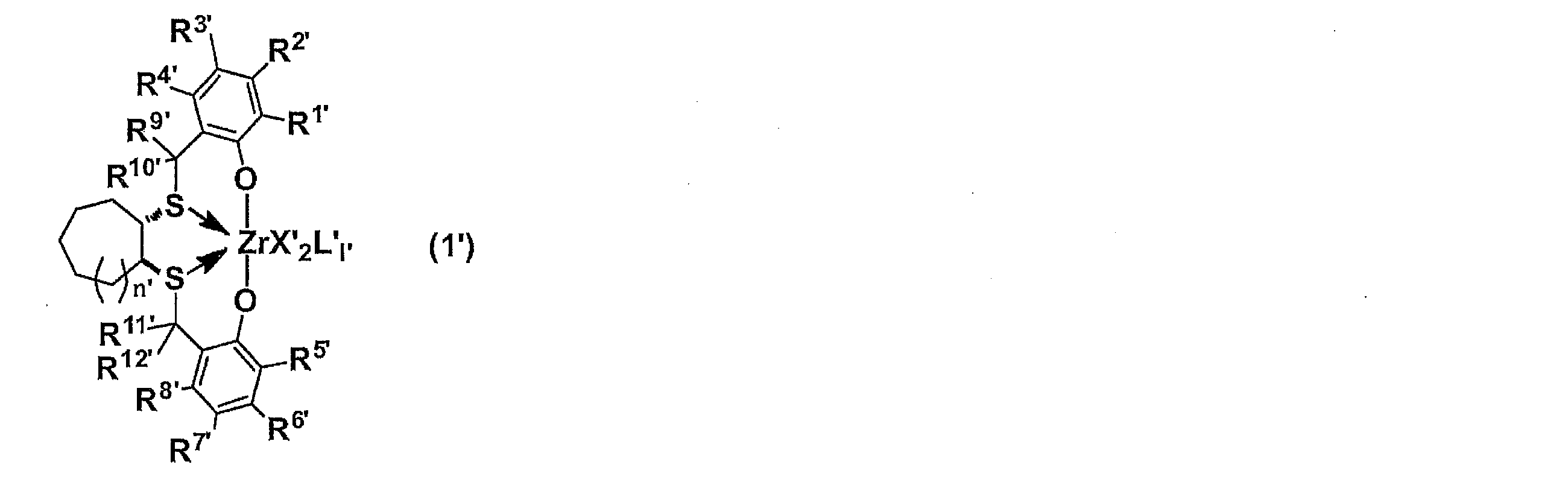
n’は1または2であり、好ましくは2である。
R1’およびR5’として好ましくは、それぞれ独立して
水素原子、
ハロゲン原子、
炭素原子数1~20のアルキル基、
環を構成する炭素原子数が3~10のシクロアルキル基、
炭素原子数7~30のアラルキル基、
炭素原子数1~20のアルコキシ基、
炭素原子数7~30のアラルキルオキシ基、
炭素原子数6~30のアリールオキシ基または、
置換シリル基であって、R1’とR5’は同時にtert-ブチル基ではなく、
より好ましくは、それぞれ独立して
ハロゲン原子、
炭素原子数5~20のアルキル基、
環を構成する炭素原子数が3~10のシクロアルキル基、
炭素原子数7~30のアラルキル基、
置換シリル基であり、
さらに好ましくは、それぞれ独立して
炭素原子数5~20のアルキル基、
環を構成する炭素原子数が3~10のシクロアルキル基、
炭素原子数7~30のアラルキル基、
または置換シリル基である。
R1とR5の特に好ましい形態は、R1とR5が同一であって、
炭素原子数5~20のアルキル基、
環を構成する炭素原子数が3~10のシクロアルキル基、
炭素原子数7~30のアラルキル基、
または置換シリル基である。
R2’~R4’およびR6’~R8’として好ましくは、それぞれ独立して
水素原子、
ハロゲン原子、
炭素原子数1~20のアルキル基、
環を構成する炭素原子数が3~10のシクロアルキル基、
炭素原子数7~30のアラルキル基、
炭素原子数6~30のアリール基、
炭素原子数1~20のアルコキシ基、
炭素原子数6~30のアリールオキシ基、
置換シリル基であり、
より好ましくは、それぞれ独立して
水素原子、
炭素原子数1~20のアルキル基、
環を構成する炭素原子数が3~10のシクロアルキル基、
炭素原子数7~30のアラルキル基、
炭素原子数6~30のアリール基、
または置換シリル基であり、
R2’、R4’、R6’およびR8’として、さらに好ましくは、水素原子である。
R3’およびR7’としてさらに好ましくは、それぞれ独立して
炭素原子数1~20のアルキル基
環を構成する炭素原子数が3~10のシクロアルキル基、
炭素原子数7~30のアラルキル基、
炭素原子数6~30のアリール基、
または置換シリル基である。
R3’およびR7’として特に好ましい形態は、R3’とR7’が同一であって、
炭素原子数1~20のアルキル基
環を構成する炭素原子数が3~10のシクロアルキル基、
炭素原子数7~30のアラルキル基、
炭素原子数6~30のアリール基、
または置換シリル基であり、
最も好ましくは、
炭素原子数1~20のアルキル基である。
R9’~R12’として好ましくは、それぞれ独立して
水素原子、
炭素原子数1~20のアルキル基、
環を構成する炭素原子数が3~10のシクロアルキル基、
炭素原子数7~30のアラルキル基、
炭素原子数6~30のアリール基、
炭素原子数1~20のアルコキシ基、
炭素原子数6~30のアリールオキシ基、
置換シリル基であり、
より好ましくは、それぞれ独立して
水素原子、
炭素原子数1~20のアルキル基、
環を構成する炭素原子数が3~10のシクロアルキル基、
炭素原子数7~30のアラルキル基、
炭素原子数6~30のアリール基、
または置換シリル基であり、
さらに好ましくは、それぞれ独立して
水素原子、
炭素原子数1~20のアルキル基、
環を構成する炭素原子数が3~10のシクロアルキル基であり、
最も好ましくは、
水素原子である。
水素原子、
ハロゲン原子、
炭素原子数1~20のアルキル基、
環を構成する炭素原子数が3~10のシクロアルキル基、
炭素原子数7~30のアラルキル基、
炭素原子数1~20のアルコキシ基、
炭素原子数7~30のアラルキルオキシ基、
炭素原子数6~30のアリールオキシ基または、
置換シリル基であって、R1’とR5’は同時にtert-ブチル基ではなく、
より好ましくは、それぞれ独立して
ハロゲン原子、
炭素原子数5~20のアルキル基、
環を構成する炭素原子数が3~10のシクロアルキル基、
炭素原子数7~30のアラルキル基、
置換シリル基であり、
さらに好ましくは、それぞれ独立して
炭素原子数5~20のアルキル基、
環を構成する炭素原子数が3~10のシクロアルキル基、
炭素原子数7~30のアラルキル基、
または置換シリル基である。
R1とR5の特に好ましい形態は、R1とR5が同一であって、
炭素原子数5~20のアルキル基、
環を構成する炭素原子数が3~10のシクロアルキル基、
炭素原子数7~30のアラルキル基、
または置換シリル基である。
R2’~R4’およびR6’~R8’として好ましくは、それぞれ独立して
水素原子、
ハロゲン原子、
炭素原子数1~20のアルキル基、
環を構成する炭素原子数が3~10のシクロアルキル基、
炭素原子数7~30のアラルキル基、
炭素原子数6~30のアリール基、
炭素原子数1~20のアルコキシ基、
炭素原子数6~30のアリールオキシ基、
置換シリル基であり、
より好ましくは、それぞれ独立して
水素原子、
炭素原子数1~20のアルキル基、
環を構成する炭素原子数が3~10のシクロアルキル基、
炭素原子数7~30のアラルキル基、
炭素原子数6~30のアリール基、
または置換シリル基であり、
R2’、R4’、R6’およびR8’として、さらに好ましくは、水素原子である。
R3’およびR7’としてさらに好ましくは、それぞれ独立して
炭素原子数1~20のアルキル基
環を構成する炭素原子数が3~10のシクロアルキル基、
炭素原子数7~30のアラルキル基、
炭素原子数6~30のアリール基、
または置換シリル基である。
R3’およびR7’として特に好ましい形態は、R3’とR7’が同一であって、
炭素原子数1~20のアルキル基
環を構成する炭素原子数が3~10のシクロアルキル基、
炭素原子数7~30のアラルキル基、
炭素原子数6~30のアリール基、
または置換シリル基であり、
最も好ましくは、
炭素原子数1~20のアルキル基である。
R9’~R12’として好ましくは、それぞれ独立して
水素原子、
炭素原子数1~20のアルキル基、
環を構成する炭素原子数が3~10のシクロアルキル基、
炭素原子数7~30のアラルキル基、
炭素原子数6~30のアリール基、
炭素原子数1~20のアルコキシ基、
炭素原子数6~30のアリールオキシ基、
置換シリル基であり、
より好ましくは、それぞれ独立して
水素原子、
炭素原子数1~20のアルキル基、
環を構成する炭素原子数が3~10のシクロアルキル基、
炭素原子数7~30のアラルキル基、
炭素原子数6~30のアリール基、
または置換シリル基であり、
さらに好ましくは、それぞれ独立して
水素原子、
炭素原子数1~20のアルキル基、
環を構成する炭素原子数が3~10のシクロアルキル基であり、
最も好ましくは、
水素原子である。
上記した、アルキル基、シクロアルキル基、アラルキル基、アリール基、アルコキシ基、およびアリールオキシ基は置換基を有していてもよい。
R1’~R12’における炭素原子数1~20のアルキル基、環を構成する炭素原子数が3~10のシクロアルキル基、炭素原子数2~20のアルケニル基、炭素原子数2~20のアルキニル基、炭素原子数7~30のアラルキル基、炭素原子数1~20のアルコキシ基、炭素原子数7~30のアラルキルオキシ基、炭素原子数6~30のアリールオキシ基、または、置換シリル基は、一般式(1)中のR1~R12における前記の基と同様である。
R2’~R4’およびR6’~R12’における炭素原子数6~30のアリール基および環を構成する炭素原子数が3~20のヘテロ環式化合物残基は、一般式(1)中のR2~R4およびR6~R8における前記の基と同様である。
上記R1’~R8’の定義に関わらず、R1’とR2’、R2’とR3’、R3’とR4’、R5’とR6’、R6’とR7’、およびR7’とR8’とは、それぞれ独立に、互いに連結して環を形成してもよく、該環は置換基を有していてもよく、好ましくは、ベンゼン環上の2つの炭素原子を含む4~10員環のハイドロカルビル環または複素環であり、該環は置換基を有していてもよい。
該環として具体的には、シクロブテン環、シクロペンテン環、シクロペンタジエン環、シクロヘキセン環、シクロヘプテン環、シクロオクテン環、ベンゼン環またはナフタレン環、フラン環、2,5-ジメチルフラン環、チオフェン環、2,5-ジメチルチオフェン環、ピリジン環などが挙げられ、好ましくは、シクロブテン環、シクロペンテン環、シクロペンタジエン環、シクロヘキセン環、ベンゼン環またはナフタレン環であり、より好ましくは、R1’とR2’、およびR5’とR6’との少なくとも一方の組が連結したシクロペンテン環、シクロペンタジエン環、シクロヘキセン環、ベンゼン環、ナフタレン環である。
上記R9’~R12’の定義に関わらず、R9’とR10’、およびR11’とR12’とは、それぞれ独立に、互いに連結して環を形成してもよく、該環は置換基を有していてもよい。
X’における炭素原子数1~20のアルキル基、環を構成する炭素原子数が3~10のシクロアルキル基、炭素原子数2~20のアルケニル基、炭素原子数7~30のアラルキル基、炭素原子数6~30のアリール基、炭素原子数1~20のアルコキシ基、炭素原子数7~30のアラルキルオキシ基、炭素原子数6~30のアリールオキシ基、置換シリル基、置換アミノ基、置換チオラート基および炭素原子数1~20のカルボキシラート基は、一般式(1)中のXにおける前記の基と同様である。
X’として好ましくは、フッ素原子、塩素原子、臭素原子、炭素原子数1~20のアルキル基、炭素原子数7~30のアラルキル基、炭素原子数1~20のアルコキシ基、炭素原子数6~30のアリールオキシ基、または炭素原子数1~20のハイドロカルビルアミノ基であり、より好ましくは、塩素原子、臭素原子、炭素原子数1~6のアルキル基、炭素原子数7~10のアラルキル基、炭素原子数1~6のアルコキシ基、炭素原子数6~10のアリールオキシ基、炭素原子数2~10のハイドロカルビルアミノ基であり、さらに好ましくは、塩素原子、メチル基、エチル基、n-ブチル基、tert-ブチル基、ベンジル基、メトキシ基、エトキシ基、イソプロポキシ基、tert-ブトキシ基、フェノキシ基ジメチルアミノ基、ジエチルアミノ基であり、特に好ましくは、塩素原子、メチル基、ベンジル基、イソプロポキシ基、フェノキシ基、ジメチルアミノ基であり、最も好ましくは、塩素原子、ベンジル基である。
R1’~R12’およびX’は、それぞれ独立して、ハロゲン原子、酸素原子、ケイ素原子、窒素原子、リン原子、硫黄原子を含む置換基を有していてもよい。
L’およびl’は一般式(1)中のLおよびlと同様である。
式(1’)で表される錯体の具体例としては、例えば下記の化合物が挙げられる。
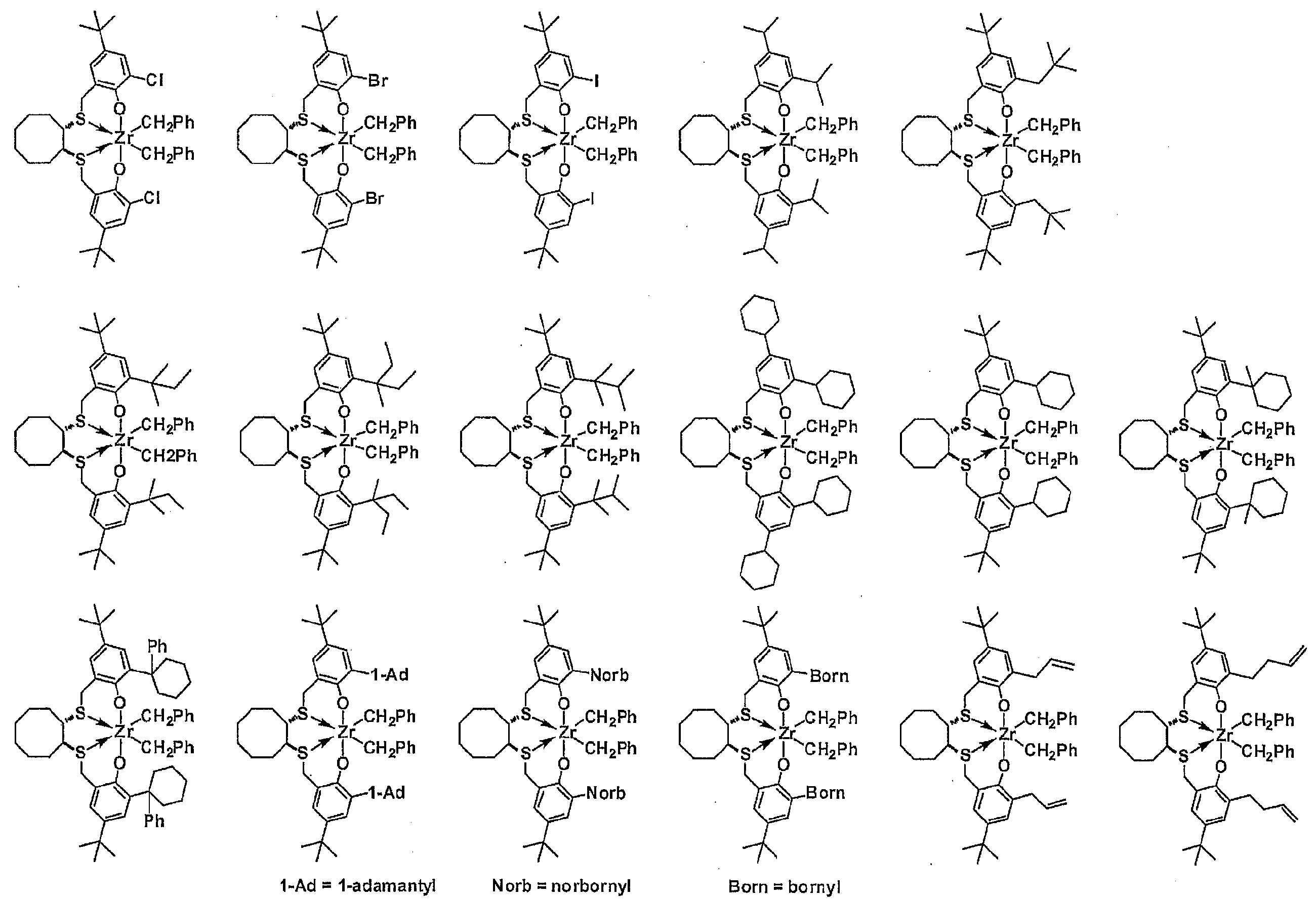
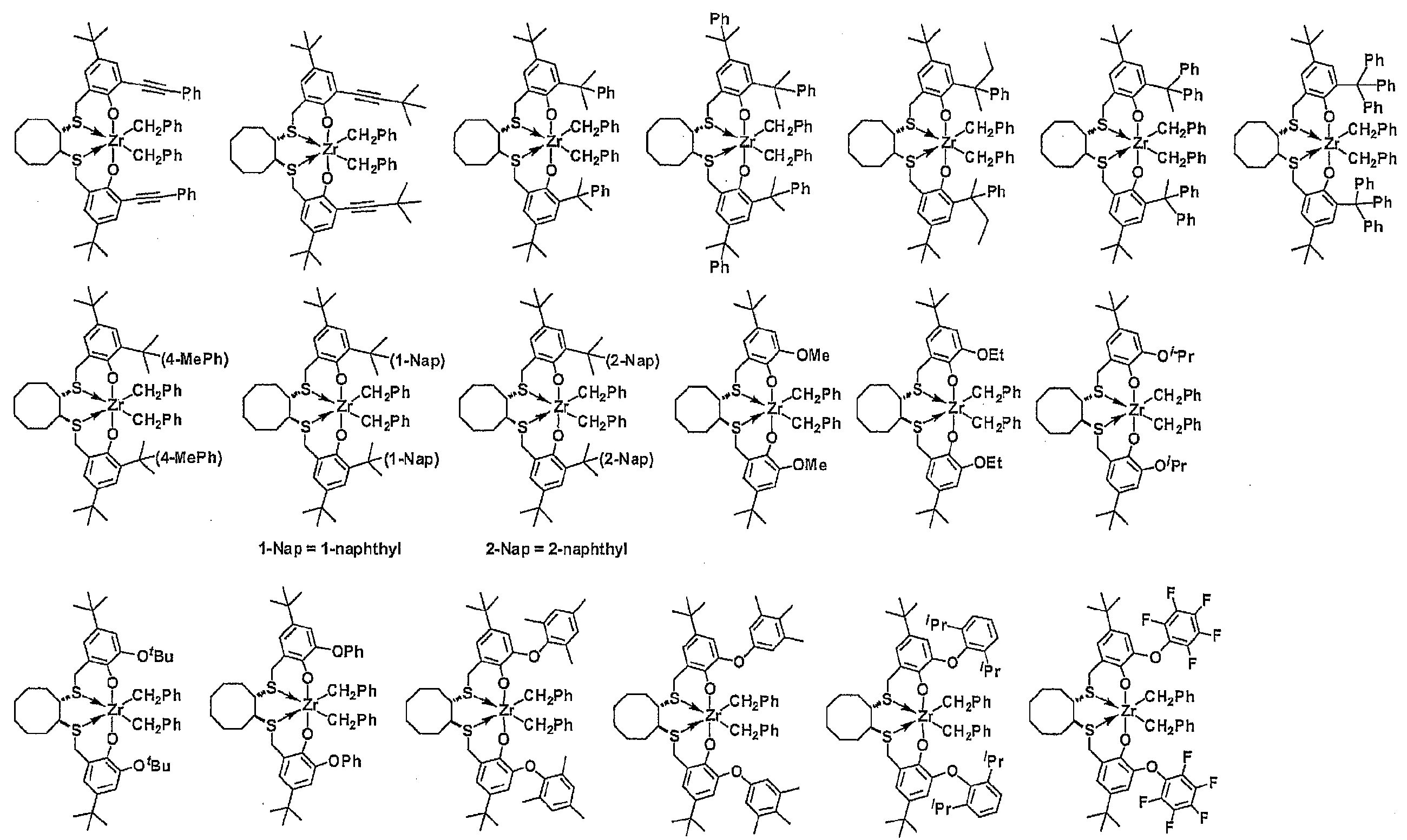
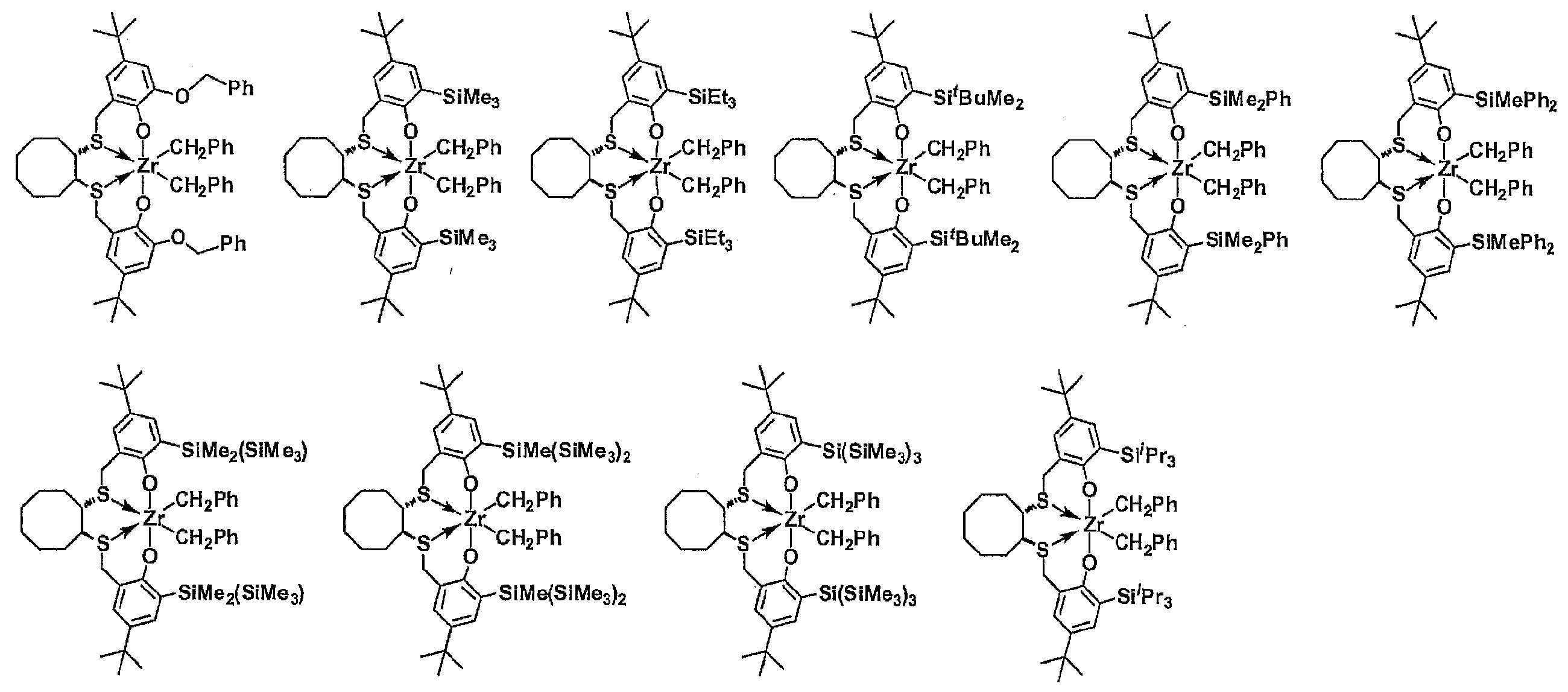
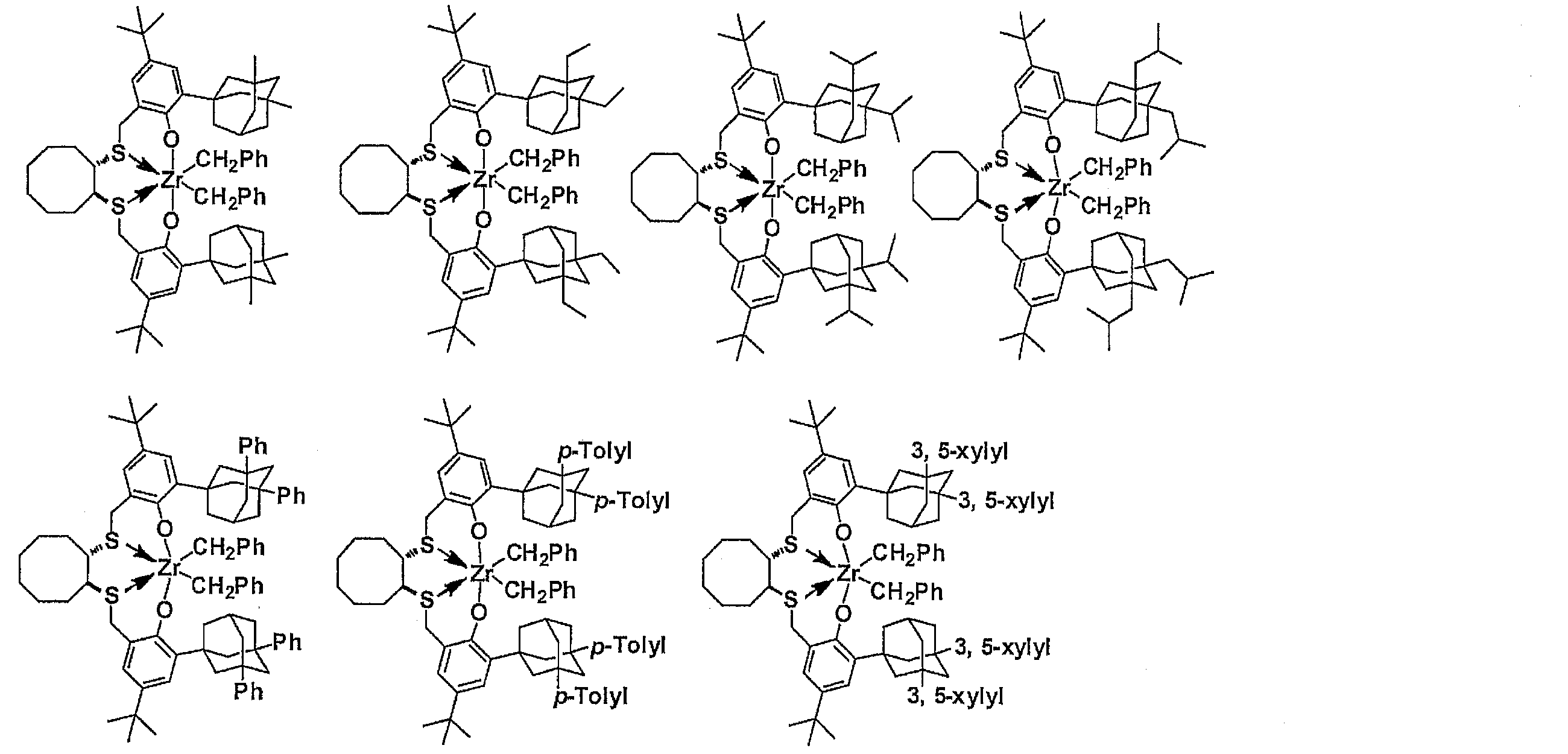
また、これらの化合物のジルコニウム原子に直接結合しているベンジル基を、塩素原子、メチル基、ジメチルアミノ基、イソプロポキシ基、tert-ブトキシ基、またはフェノキシ基に変更した化合物も挙げられる。
上記それぞれの化合物におけるR3’およびR7’に相当する基を水素原子、またはメチル基に変更した化合物も挙げることができる。
上記それぞれの化合物の硫黄原子を架橋するシクロオクタン環をシクロへプタン環で置換した化合物も挙げることができる。
上記それぞれの化合物におけるR9’~R12’に相当する基をメチル基、エチル基で置換した化合物も挙げることができる。
錯体(1’)として好ましくは下記の化合物が挙げられる。
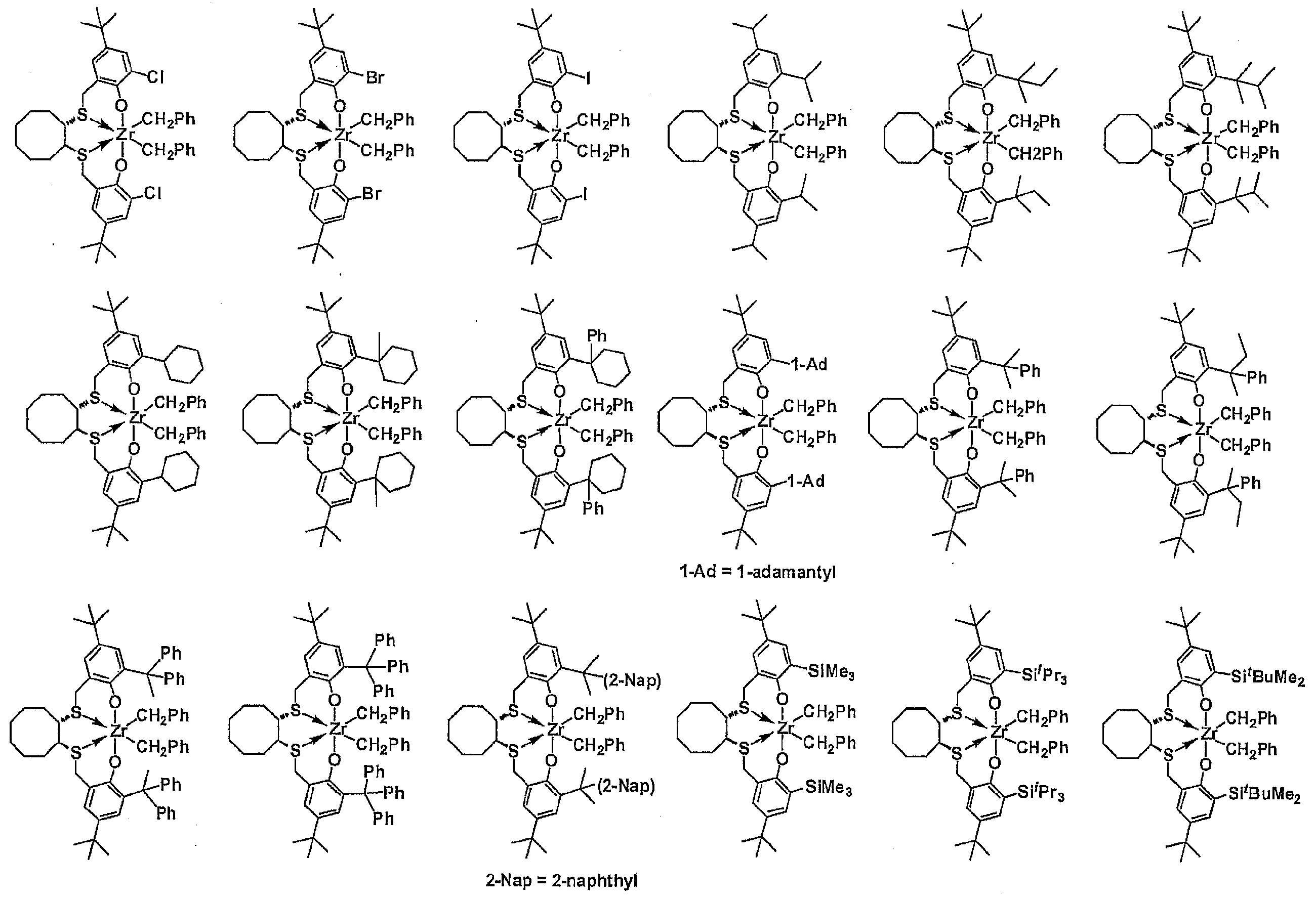

また、これらの化合物のジルコニウム原子に直接結合しているベンジル基を、塩素原子、またはメチル基に変更した化合物も挙げられる。
上記それぞれの化合物のR3’およびR7’に相当する基を水素原子、フッ素原子、塩素原子、臭素原子、ヨウ素原子、またはメチル基に変更した化合物も挙げることができる。
上記それぞれの化合物の硫黄原子を架橋するシクロオクタン環をシクロへプタン環で置換した化合物も挙げることができる。
錯体(1’)としてさらに好ましくは下記の化合物が挙げられる。
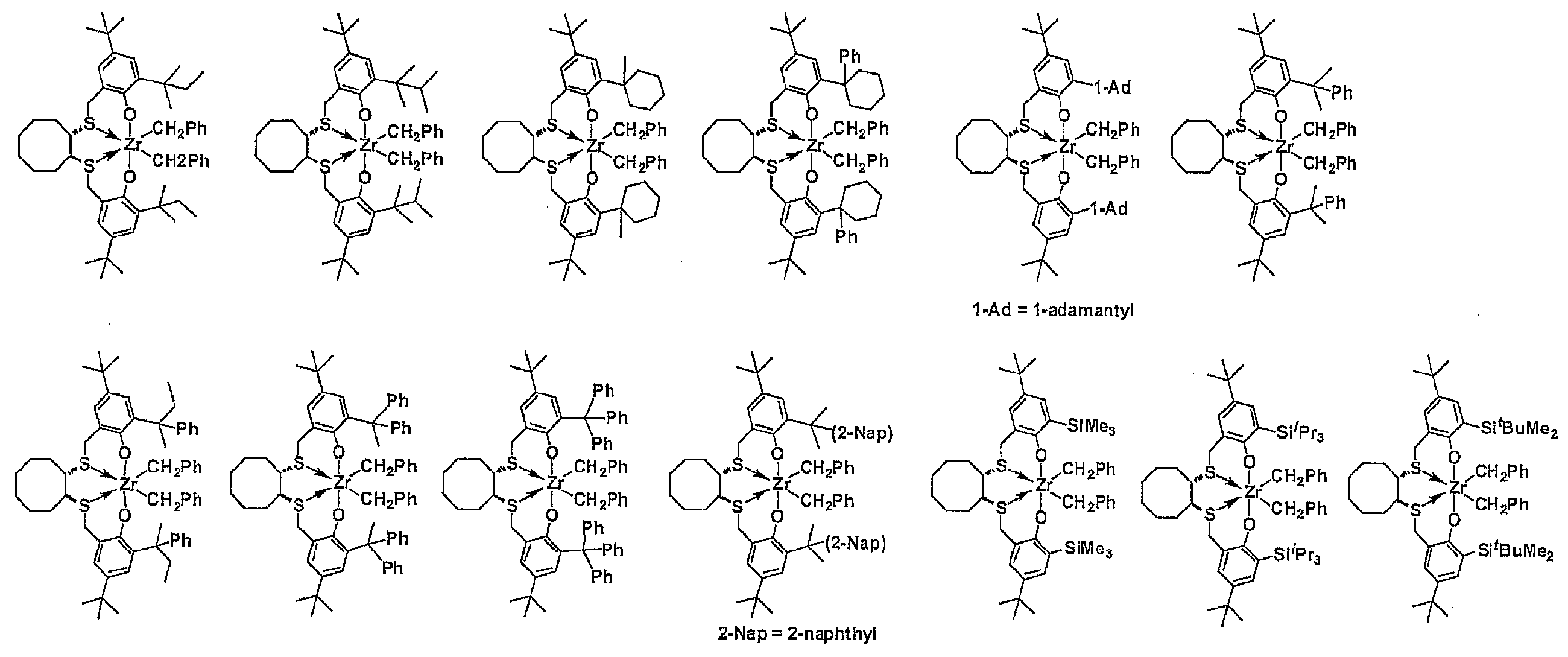
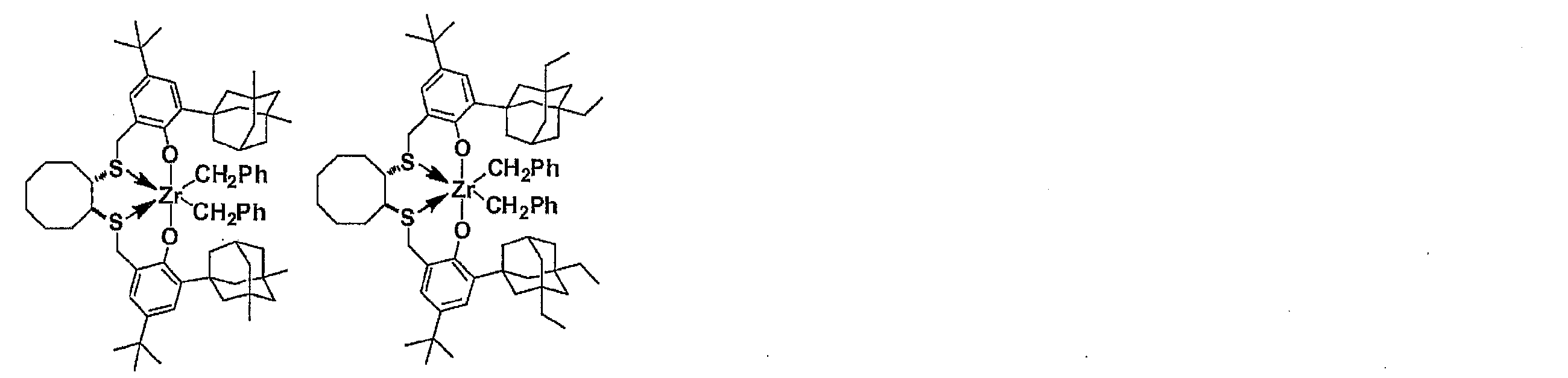
また、これらの化合物のジルコニウム原子に直接結合しているベンジル基を、塩素原子に変更した化合物も挙げられる。
上記それぞれの化合物のR3’およびR7’に相当する基をメチル基に変更した化合物も挙げることができる。
一般式(1)で表される錯体および一般式(1’)で表される錯体は、例えば、Journal of American Chemical Society, 2009, Volume 131,13566-13567に記載の方法に準じて合成することができる。例えば錯体(1)の場合、一般式(2)および(3)で表される化合物を出発原料として下記scheme1により製造することができるが、本方法に限定されるべきものではない。

化合物(3)中のXは、一般式(1)と同様である。ZrX4としては、例えば、Zr(CH2Ph)4,ZrCl2(CH2Ph)2,Zr(CH2SiMe3)4,ZrF4,ZrCl4,ZrBr4,ZrI4,Zr(OMe)4,Zr(OEt)4,Zr(O-i-Pr)4,ZrCl2(O-i-Pr)2,Zr(O-n-Bu)4,Zr(O-i-Bu)4,Zr(O-t-Bu)4,Zr(OPh)4,Zr(NMe2)4,ZrCl2(NMe2)2,Zr(NEt2)4が挙げられる。好ましくは、Zr(CH2Ph)4,ZrCl2(CH2Ph)2,Zr(CH2SiMe3)4,ZrCl4,ZrBr4,Zr(OMe)4,Zr(OEt)4,Zr(O-i-Pr)4,Zr(O-i-Bu)4,Zr(O-t-Bu)4,Zr(OPh)4,Zr(NMe2)4,ZrCl2(NMe2)2,Zr(NEt2)4である。
錯体(1)は、化合物(2)と化合物(3)とをそのまま反応させてもよく、必要に応じて化合物(2)を塩基と反応させた後に化合物(3)を反応させてもよい。用いる塩基としては、例えば有機リチウム試薬、Grignard試薬、金属水素化物が挙げられ、具体的には、メチルリチウム、n-ブチルリチウム、sec-ブチルリチウム、tert-ブチルリチウム、リチウムジイソプロピルアミド、リチウムヘキサメチルジシラザン、カリウムヘキサメチルジシラザン、水素化ナトリウムまたは水素化カリウムを挙げることができ、好ましくは、n-ブチルリチウム、リチウムジイソプロピルアミド、カリウムヘキサメチルジシラザン、水素化ナトリウムまたは水素化カリウムである。
錯体(1)および化合物(3)、ならびに化合物(2)と塩基とを反応させて得られる化合物は、通常空気および湿気に対して不安定であるため、反応は脱水脱酸素下で行うことが好ましい。具体的には、乾燥窒素、乾燥アルゴン下である。
化合物(2)の使用量は、化合物(3)に対して1モル当量以上であればよく、好ましくは、1.0~1.5モル当量の範囲で用いればよい。また、反応の過程で化合物(2)が残存する場合は、反応の途中で化合物(3)を追加してもよい。
化合物(2)と化合物(3)とを反応させる温度は、-100℃~150℃の温度範囲であり、好ましくは-80℃~50℃の温度範囲である。ただし、この範囲に限定される意図ではない。
化合物(2)と化合物(3)との反応は、生成物の収率が最も高くなる時間まで行えばよく、好ましくは5分間~48時間であり、より好ましくは10分間~24時間である。
化合物(2)と塩基とを反応させる温度は-100℃~150℃の温度範囲であり、好ましくは-80℃~50℃の温度範囲である。ただし、この範囲に限定される意図ではない。
化合物(2)と塩基とを反応させる時間は、生成物の収率が最も高くなる時間まで行えばよく、5分間~24時間であり、好ましくは10分間~12時間、より好ましくは30分間~3時間である。
化合物(2)と塩基とを反応させて生じた化合物と、化合物(3)とを反応させる温度は、-100℃~150℃の温度範囲であり、好ましくは-80℃~50℃の温度範囲ある。ただし、この範囲に限定される意図ではない。
化合物(2)と塩基とを反応させて生じた化合物と、化合物(3)とを反応させる時間は、生成物の収率が最も高くなる時間まで行えばよく、5分間~48時間であり、好ましくは10分間~24時間である。
用いる溶媒は、類似の反応で一般的に用いられる溶媒であれば特に制限されるものではなく、ハイドロカーボン溶媒またはエーテル系溶媒が挙げられる。好ましくは、トルエン、ベンゼン、o-キシレン、m-キシレン、p-キシレン、ヘキサン、ペンタン、ヘプタン、シクロヘキサン、ジエチルエーテルまたはテトラヒドロフランであり、より好ましくは、ジエチルエーテル、トルエン、テトラヒドロフラン、ヘキサン、ペンタン、ヘプタン、またはシクロヘキサンである。
化合物(2)は、例えば、Journal of American Chemical Society, 2009, Volume 131,13566-13567に記載の方法に準じて合成することができる。具体的には下記scheme2により製造することができるが、本方法に限定されるべきものではない。以下各工程について詳しく説明する。
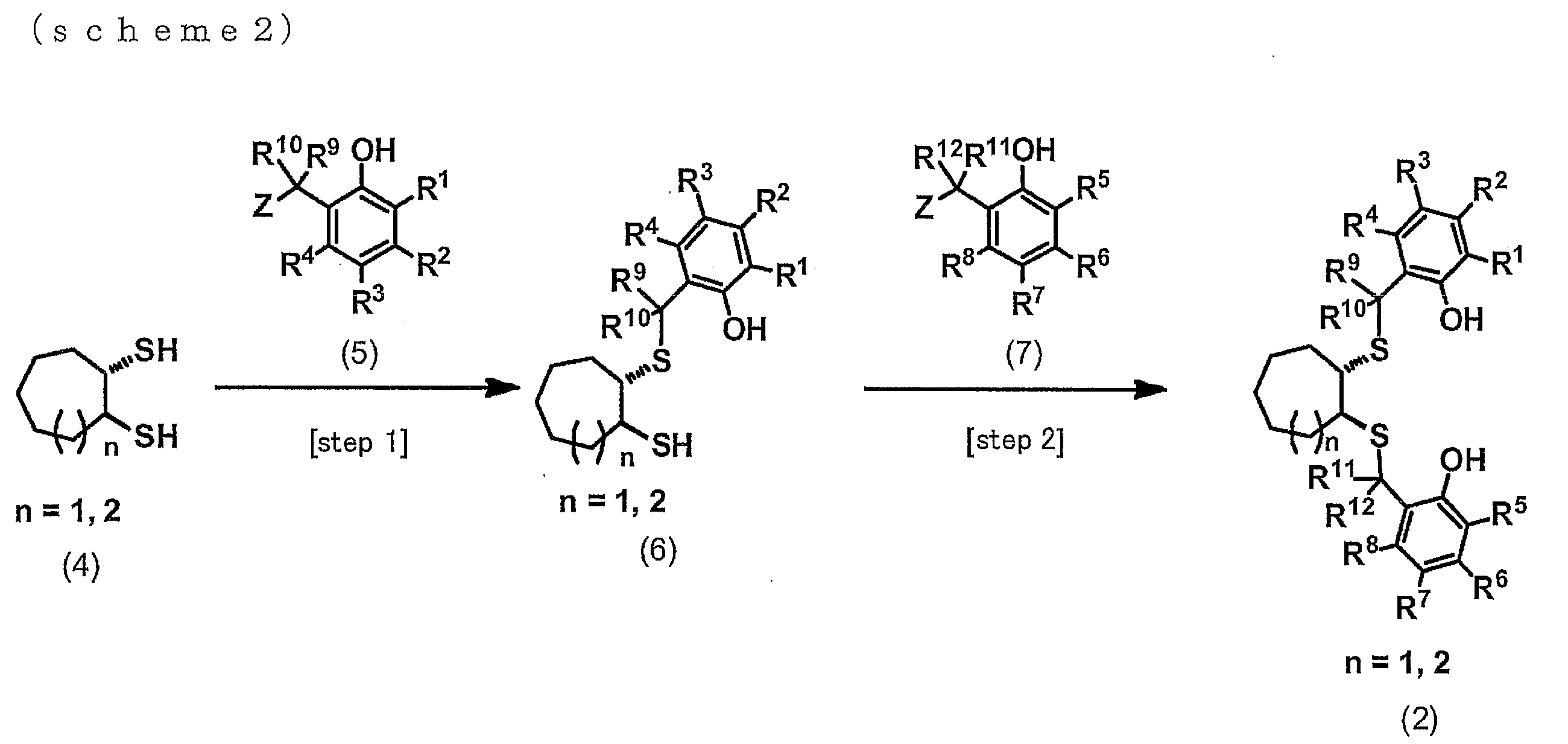
化合物(4)~(7)中のR1~R12およびnは、錯体(1)と同様である。
Zはアニオン性脱離基を表し、例えばハロゲン原子、アセテート基、トリフルオロアセテート基、ベンゾエート基、CF3SO3基、CH3SO3基、4-MeC6H4SO3基またはPhSO3基などであり、好ましくは塩素原子、臭素原子、ヨウ素原子、CF3SO3基、CH3SO3基、4-MeC6H4SO3基またはPhSO3基である。
[step1]
trans-シクロオクタン-1,2-ジチオール(4)に1.0~4.0当量、好ましくは1.0~1.5当量の化合物(5)を塩基存在下で反応させ、化合物(6)を合成することができる。
[step1]
trans-シクロオクタン-1,2-ジチオール(4)に1.0~4.0当量、好ましくは1.0~1.5当量の化合物(5)を塩基存在下で反応させ、化合物(6)を合成することができる。
塩基としては、特に限定されるべきものではないが、炭酸カリウム、炭酸カルシウム、炭酸ナトリウム、炭酸水素ナトリウム、炭酸水素カリウム、炭酸カルシウム等の無機塩基やトリエチルアミン、トリイソブチルアミン等のアミン塩基が挙げられ、好ましくはアミン塩基である。
本反応は、空気、ヘリウム、アルゴンまたは窒素雰囲気下で行うことができる。好ましくは、ヘリウム、アルゴンまたは窒素雰囲気下、より好ましくは、窒素またはアルゴン雰囲気下である。
反応終了後、必要に応じて化合物(6)を精製してもよい。精製方法としては、例えば、反応溶液に対して塩化アンモニウム水溶液、塩酸水溶液または塩化ナトリウム水溶液を加え、次に酢酸エチルまたはジエチルエーテルを加え、抽出操作を行い、過剰の塩基または塩を除去する方法が挙げられる。さらに蒸留、再結晶またはシリカゲルクロマトグラフィー等の精製操作により、純度を高めることができる。
[step2]
化合物(6)に1.0~4.0当量、好ましくは1.0~1.5当量の化合物(7)を塩基存在下で反応させ、化合物(2)を合成することができる。
[step2]
化合物(6)に1.0~4.0当量、好ましくは1.0~1.5当量の化合物(7)を塩基存在下で反応させ、化合物(2)を合成することができる。
塩基としては、炭酸カリウム、炭酸カルシウム、炭酸ナトリウム、炭酸水素ナトリウム、炭酸水素カリウム、炭酸カルシウム等の無機塩基やトリエチルアミン、トリイソブチルアミン等のアミン塩基が挙げられ、好ましくはアミン塩基である。
本反応は、空気、ヘリウム、アルゴンまたは窒素雰囲気下で行うことができる。好ましくは、ヘリウム、アルゴンまたは窒素雰囲気下、より好ましくは、窒素またはアルゴン雰囲気下である。
反応終了後、必要に応じて化合物(2)を精製してもよい。精製方法としては、例えば、反応溶液に対して塩化アンモニウム水溶液、塩酸水溶液または塩化ナトリウム水溶液を加え、次に酢酸エチルまたはジエチルエーテルを加え、抽出操作を行い、過剰の塩基または塩を除去する方法が挙げられる。さらに蒸留、再結晶またはシリカゲルクロマトグラフィー等の精製操作により、純度を高めることができる。
[step1]の反応条件を制御することで、反応器内で生成した化合物(6)と化合物(7)とを反応させ、化合物(2)を得ることもできる。
R1がR5と同じであり、R2がR6と同じであり、R3がR7と同じであり、R4がR8と同じであり、かつR9とR10の組み合わせがR11とR12の組み合わせと同じである場合、化合物(5)と化合物(7)とを合わせて、trans-シクロオクタン-1,2-ジチオール(4)に対して2.0~8.0当量、好ましくは2.0~4.0当量を塩基存在下で反応させることで、化合物(2)を合成することもできる。
化合物(2)の具体例としては、例えば下記の化合物が挙げられる。

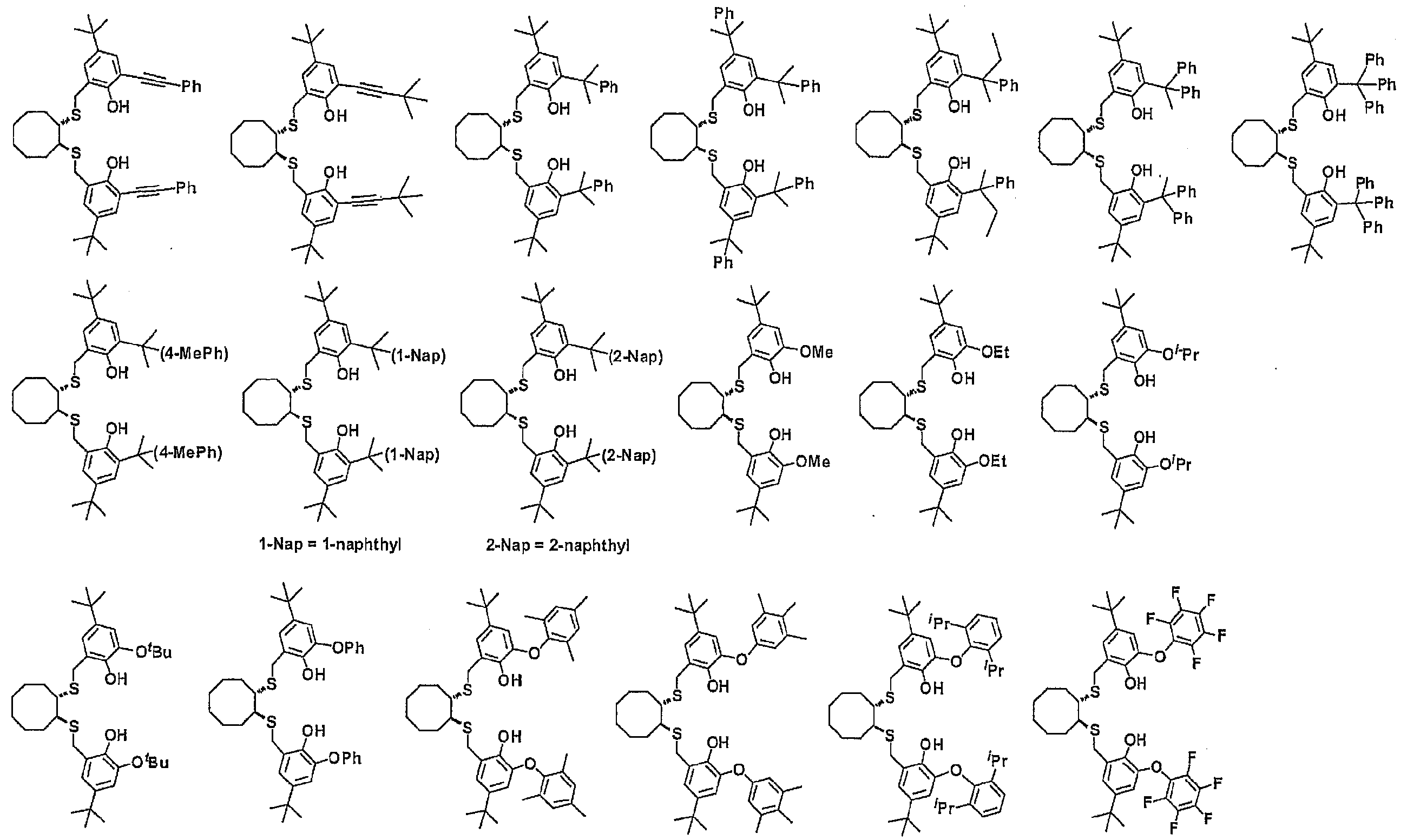

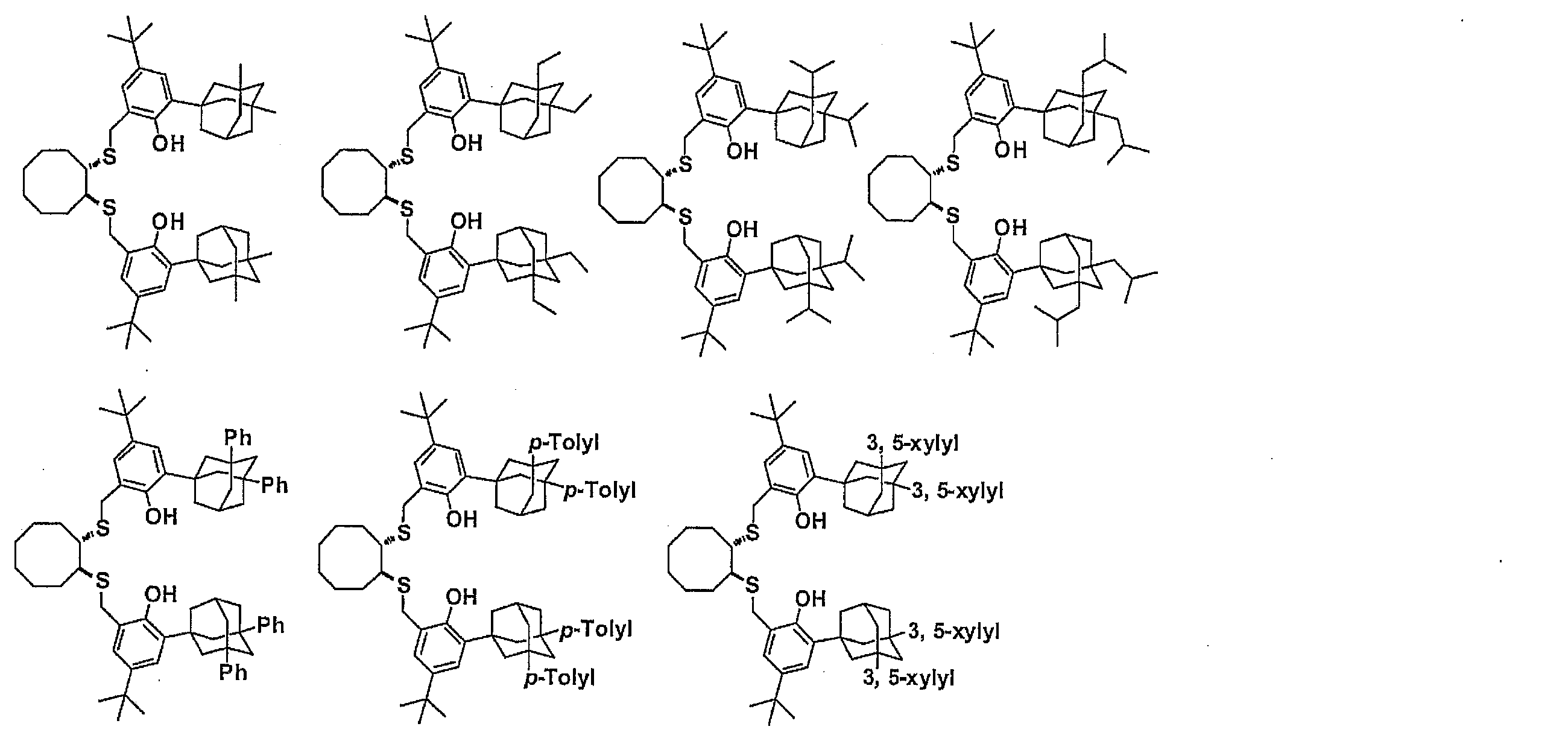
これらの化合物のR3およびR7に相当する基を水素原子、フッ素原子、塩素原子、臭素原子、ヨウ素原子、またはメチル基で置換した化合物も挙げることができる。
上記それぞれの化合物の硫黄原子を架橋するシクロオクタン環をシクロへプタン環で置換した化合物も挙げることができる。
上記それぞれの化合物におけるR9~R12に相当する基をメチル基、またはエチル基で置換した化合物も挙げることができる。
化合物(5)および化合物(7)の具体例としては、例えば下記の化合物が挙げられる。


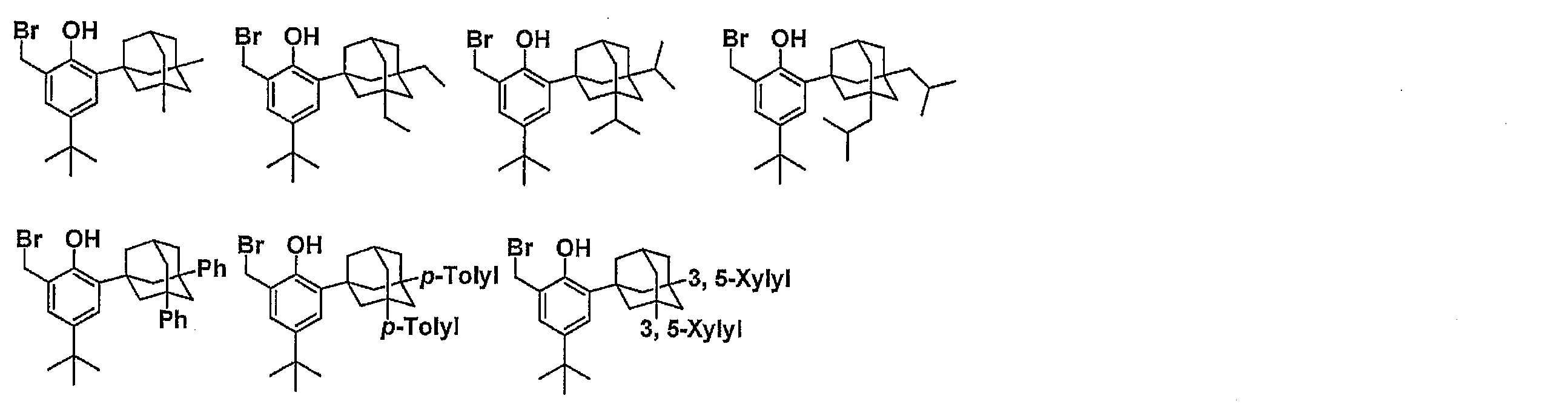
これらの化合物のR3またはR7に相当する基を水素原子、フッ素原子、塩素原子、臭素原子、ヨウ素原子、またはメチル基で置換した化合物も挙げることができる。
上記それぞれの化合物におけるR9~R12に相当する基をメチル基、またはエチル基で置換した化合物も挙げることができる。
上記で説明した本発明の一般式(1)で表される錯体は、エチレンの単独重合またはエチレンとα-オレフィンとの共重合によりエチレン系重合体を製造する重合用触媒成分として使用され、好ましくは、単独重合用触媒成分である。
重合用触媒としては、上記の本発明の一般式(1)で表される錯体および助触媒成分(A)を接触させて得られる重合用触媒が用いられる。かかる助触媒成分(A)としては、周期律表第13族元素を含む活性化助触媒成分が挙げられ、例えば、
(A-1)有機アルミニウム化合物
(A-2)ホウ素化合物
よりなる群から選ばれる少なくとも1種の化合物を挙げることができる。
〔有機アルミニウム化合物(A-1)〕
本発明において用いる有機アルミニウム化合物(A-1)としては、公知の有機アルミニウム化合物が使用できる。好ましくは、(A-1-1)一般式E1a AlY1 3-a で表される有機アルミニウム化合物、(A-1-2)一般式 {-Al(E2 )-O-}b で表される構造を有する環状のアルミノキサン、および(A-1-3)一般式 E3 {-Al(E3)-O-}c AlE3 2 で表される構造を有する線状のアルミノキサン(但し、E1 、E2 、E3 は、炭素数1~8のハイドロカルビル基であり、全てのE1、全てのE2 及び全てのE3は同じであっても異なっていてもよい。Y1は水素原子又はハロゲン原子を表し、全てのY1は同じであっても異なっていてもよい。aは0<a≦3の整数で、bは2以上の整数を、cは1以上の整数を表す。)のうちのいずれか、あるいはそれらの2~3種の混合物を例示することができる。
(A-1)有機アルミニウム化合物
(A-2)ホウ素化合物
よりなる群から選ばれる少なくとも1種の化合物を挙げることができる。
〔有機アルミニウム化合物(A-1)〕
本発明において用いる有機アルミニウム化合物(A-1)としては、公知の有機アルミニウム化合物が使用できる。好ましくは、(A-1-1)一般式E1a AlY1 3-a で表される有機アルミニウム化合物、(A-1-2)一般式 {-Al(E2 )-O-}b で表される構造を有する環状のアルミノキサン、および(A-1-3)一般式 E3 {-Al(E3)-O-}c AlE3 2 で表される構造を有する線状のアルミノキサン(但し、E1 、E2 、E3 は、炭素数1~8のハイドロカルビル基であり、全てのE1、全てのE2 及び全てのE3は同じであっても異なっていてもよい。Y1は水素原子又はハロゲン原子を表し、全てのY1は同じであっても異なっていてもよい。aは0<a≦3の整数で、bは2以上の整数を、cは1以上の整数を表す。)のうちのいずれか、あるいはそれらの2~3種の混合物を例示することができる。
一般式 E1
a AlY1
3-a で表される有機アルミニウム化合物(A-1-1)の具体例としては、トリメチルアルミニウム、トリエチルアルミニウム、トリプロピルアルミニウム、トリイソブチルアルミニウム、トリヘキシルアルミニウム等のトリアルキルアルミニウム;ジメチルアルミニウムクロライド、ジエチルアルミニウムクロライド、ジプロピルアルミニウムクロライド、ジイソブチルアルミニウムハクロライド、ジヘキシルアルミニウムクロライド等のジアルキルアルミニウムクロライド;メチルアルミニウムジクロライド、エチルアルミニウムジクロライド、プロピルアルミニウムジクロライド、イソブチルアルミニウムジクロライド、ヘキシルアルミニウムジクロライド等のアルキルアルミニウムジクロライド;ジメチルアルミニウムハイドライド、ジエチルアルミニウムハイドライド、ジプロピルアルミニウムハイドライド、ジイソブチルアルミニウムハイドライド、ジヘキシルアルミニウムハイドライド等のジアルキルアルミニウムハイドライド等を例示することができる。好ましくは、トリアルキルアルミニウムであり、より好ましくは、トリエチルアルミニウム、トリイソブチルアルミニウムである。
一般式 {-Al(E2 )-O-}b で表される構造を有する環状のアルミノキサン(A-1-2)、一般式 E3 {-Al(E3 )-O-}c AlE3
2 で表される構造を有する線状のアルミノキサン(A-1-3)における、E2 、E3 の具体例としては、メチル基、エチル基、n-プロピル基、イソプロピル基、ノルマルブチル基、イソブチル基、n-ペンチル基、ネオペンチル基等のアルキル基を例示することができる。bは2以上の整数であり、cは1以上の整数である。好ましくは、E2 及びE3 はメチル基、イソブチル基であり、bは2~40、cは1~40である。
上記のアルミノキサンは各種の方法で作られる。その方法については特に制限はなく、公知の方法に準じて作ればよい。例えば、トリアルキルアルミニウム(例えば、トリメチルアルミニウムなど)を適当な有機溶剤(ベンゼン、トルエン、脂肪族ハイドロカーボンなど)に溶かした溶液を水と接触させてアルミノキサンを作る。また、トリアルキルアルミニウム(例えば、トリメチルアルミニウムなど)を結晶水を含んでいる金属塩(例えば、硫酸銅水和物など)に接触させてアルミノキサンを作る方法が例示できる。
また、上記の方法で得られる(A-1-2)一般式 {-Al(E2 )-O-}b で表される構造を有する環状のアルミノキサン、及び(A-1-3)一般式 E3 {-Al(E3)-O-}c AlE3
2 で表される構造を有する線状のアルミノキサンは、必要に応じて、揮発成分を留去して乾燥して用いてもよい。さらに、揮発成分を留去して乾燥して得られた化合物を適当な有機溶剤(ベンゼン、トルエン、脂肪族ハイドロカーボンなど)で洗浄して、再度乾燥し用いてもよい。
〔ホウ素化合物(A-2)〕
本発明においてホウ素化合物(A-2)としては、(A-2-1)一般式BR13 R14 R15で表されるホウ素化合物、(A-2-2)一般式W+ (BR13 R14 R15 R16)- で表されるホウ素化合物、(A-2-3)一般式(V-H)+ (BR13 R14 R15 R16)-で表されるホウ素化合物のいずれかを用いる。
〔ホウ素化合物(A-2)〕
本発明においてホウ素化合物(A-2)としては、(A-2-1)一般式BR13 R14 R15で表されるホウ素化合物、(A-2-2)一般式W+ (BR13 R14 R15 R16)- で表されるホウ素化合物、(A-2-3)一般式(V-H)+ (BR13 R14 R15 R16)-で表されるホウ素化合物のいずれかを用いる。
一般式 BR13R14 R15で表されるホウ素化合物(A-2-1)において、Bは3価の原子価状態のホウ素原子であり、R13~R15はハロゲン原子、1~20個の炭素原子を含むハイドロカルビル基、1~20個の炭素原子を含むハロゲン化ハイドロカルビル基、1~20個の炭素原子を含む置換シリル基、1~20個の炭素原子を含むアルコキシ基または2~20個の炭素原子を含む2置換アミノ基であり、それらは同じであっても異なっていてもよい。好ましいR13~R15はハロゲン原子、1~20個の炭素原子を含むハイドロカルビル基、1~20個の炭素原子を含むハロゲン化ハイドロカルビル基である。
ホウ素化合物(A-2-1)の具体例としては、トリフェニルボラン、トリス(ペンタフルオロフェニル)ボラン、トリス(2,3,5,6-テトラフルオロフェニル)ボラン、トリス(2,3,4,5-テトラフルオロフェニル)ボラン、トリス(3,4,5-トリフルオロフェニル)ボラン、トリス(2,3,4-トリフルオロフェニル)ボラン、フェニルビス(ペンタフルオロフェニル)ボラン等が挙げられるが、最も好ましくは、トリフェニルボラン、トリス(ペンタフルオロフェニル)ボランである。
一般式W+ (BR13 R14 R15 R16)-で表されるホウ素化合物(A-2-2)において、W+ は無機または有機のカチオンであり、Bは3価の原子価状態のホウ素原子であり、R13~R16は上記のホウ素化合物(A-2-1)におけるR13~R15と同様である。即ち、R13~R16はハロゲン原子、1~20個の炭素原子を含むハイドロカルビル基、1~20個の炭素原子を含むハロゲン化ハイドロカルビル基、1~20個の炭素原子を含む置換シリル基、1~20個の炭素原子を含むアルコキシ基または2~20個の炭素原子を含む2置換アミノ基であり、それらは同じであっても異なっていてもよい。好ましいR13~R16はハロゲン原子、1~20個の炭素原子を含むハイドロカルビル基、1~20個の炭素原子を含むハロゲン化ハイドロカルビル基である。
無機のカチオンであるW+ としては、フェロセニウムカチオン、アルキル置換フェロセニウムカチオン、銀陽イオンなどが挙げられる。有機のカチオンであるW+ としては、トリフェニルカルベニウムカチオンなどが挙げられる。(BR13 R14 R15 R16)-には、テトラキス(ペンタフルオロフェニル)ボレート、テトラキス(2,3,5,6-テトラフルオロフェニル)ボレート、テトラキス(2,3,4,5-テトラフルオロフェニル)ボレート、テトラキス(3,4,5-トリフルオロフェニル)ボレート、テトラキス(2,2,4ートリフルオロフェニル)ボレート、フェニルビス(ペンタフルオロフェニル)ボレ-ト、テトラキス(3,5-ビストリフルオロメチルフェニル)ボレートなどが挙げられる。
一般式W+ (BR13 R14 R15 R16)-で表される化合物の具体例としては、フェロセニウムテトラキス(ペンタフルオロフェニル)ボレート、1,1’-ジメチルフェロセニウムテトラキス(ペンタフルオロフェニル)ボレート、銀テトラキス(ペンタフルオロフェニル)ボレート、トリフェニルカルベニウムテトラキス(ペンタフルオロフェニル)ボレート、トリフェニルカルベニウムテトラキス(3,5-ビストリフルオロメチルフェニル)ボレートなどを挙げることができるが、最も好ましくは、トリフェニルカルベニウムテトラキス(ペンタフルオロフェニル)ボレートである。
また、一般式(V-H)+ (BR13 R14 R15 R16)-で表されるホウ素化合物(A-2-3)おいては、Vは中性ルイス塩基であり、(V-H)+ はブレンステッド酸であり、Bは3価の原子価状態のホウ素原子であり、R13~R16は上記のホウ素化合物(A-2-3)におけるR13~R15と同様である。即ち、R13~R16はハロゲン原子、1~20個の炭素原子を含むハイドロカルビル基、1~20個の炭素原子を含むハロゲン化ハイドロカルビル基、1~20個の炭素原子を含む置換シリル基、1~20個の炭素原子を含むアルコキシ基または2~20個の炭素原子を含む2置換アミノ基であり、それらは同じであっても異なっていてもよい。好ましいR13~R16はハロゲン原子、1~20個の炭素原子を含むハイドロカルビル基、1~20個の炭素原子を含むハロゲン化ハイドロカルビル基である。
ブレンステッド酸である(V-H)+としては、トリアルキル置換アンモニウム、N,N-ジアルキルアニリニウム、ジアルキルアンモニウム、トリアリールホスホニウムなどが挙げられ、(BR13 R14 R15 R16)-としては、前述と同様のものが挙げられる。
一般式(V-H)+ (BR13 R14 R15 R16)-で表される化合物の具体例としては、トリエチルアンモニウムテトラキス(ペンタフルオロフェニル)ボレート、トリプロピルアンモニウムテトラキス(ペンタフルオロフェニル)ボレート、トリ(n-ブチル)アンモニウムテトラキス(ペンタフルオロフェニル)ボレート、トリ(n-ブチル)アンモニウムテトラキス(3,5-ビストリフルオロメチルフェニル)ボレート、N,N-ジメチルアニリニウムテトラキス(ペンタフルオロフェニル)ボレート、N,N-ジエチルアニリニウムテトラキス(ペンタフルオロフェニル)ボレート、N,N-2,4,6-ペンタメチルアニリニウムテトラキス(ペンタフルオロフェニル)ボレート、N,N-ジメチルアニリニウムテトラキス(3,5-ビストリフルオロメチルフェニル)ボレート、ジイソプロピルアンモニウムテトラキス(ペンタフルオロフェニル)ボレート、ジシクロヘキシルアンモニウムテトラキス(ペンタフルオロフェニル)ボレート、トリフェニルホスホニウムテトラキス(ペンタフルオロフェニル)ボレート、トリ(メチルフェニル)ホスホニウムテトラキス(ペンタフルオロフェニル)ボレート、トリ(ジメチルフェニル)ホスホニウムテトラキス(ペンタフルオロフェニル)ボレート、トリフェニルカルベニウムテトラキス(ペンタフルオロフェニル)ボレートなどを挙げることができるが、最も好ましくは、トリフェニルカルベニウムテトラキス(ペンタフルオロフェニル)ボレート、トリ(ノルマルブチル)アンモニウムテトラキス(ペンタフルオロフェニル)ボレート、もしくは、N,N-ジメチルアニリニウムテトラキス(ペンタフルオロフェニル)ボレートである。
本発明の、上記の一般式(1)で表される錯体と助触媒成分(A)とを接触させて得られるオレフィン重合用触媒を製造する際の接触は、錯体(1)と助触媒成分(A)とが接触し、触媒が形成されるならどのような手段によってもよく、あらかじめ溶媒で希釈して、もしくは希釈せずに錯体(1)と助触媒成分(A)とを混合して接触させる方法や、錯体(1)と助触媒成分(A)とを別々に重合槽に供給して重合槽の中でこれらを接触させる方法を取ることができる。ここで、助触媒成分(A)としては複数種類を組み合わせて使用する場合があるが、それらのうちの一部をあらかじめ混合して使用してもよいし、別々に重合槽に供給して使用してもよい。
錯体(1)は単離したものを用いてもよく、また、化合物(2)と化合物(3)とを接触させたものをそのまま用いてもよい。
各成分の使用量は通常、一般式(1)で表される錯体に対する有機アルミニウム化合物(A-1)のモル比が0.01~10000の範囲、好ましくは1~5000の範囲となるように、また、一般式(1)で表される錯体に対するホウ素化合物(A-2)のモル比が0.01~100の範囲、好ましくは1.0~50の範囲となるように、各成分を用いることが望ましい。
重合反応器において重合反応前に触媒を製造する場合、各成分を溶液状態または溶媒に懸濁もしくはスラリー化した状態で供給する場合の濃度は、重合反応器に各成分を供給する装置の性能などの条件により、適宜選択されるが、一般に、一般式(1)で表される錯体が、通常0.0001~10000mmol/Lで、より好ましくは、0.001~1000mmol/L、さらに好ましくは、0.01~100mmol/L、有機アルミニウム化合物(A-1)が、Al原子換算で、通常0.01~10000mmol/Lで、より好ましくは、0.05~5000mmol/L、さらに好ましくは、0.1~2000mmol/L、ホウ素化合物(A-2)は、通常0.001~500mmol/Lで、より好ましくは、0.01~250mmol/L、さらに好ましくは、0.05~100mmol/Lの範囲となるように各成分を用いることが望ましい。
前記オレフィン重合用触媒は、上記の一般式(1)で表される錯体と、上記有機アルミニウム化合物(A-1)および/または上記ホウ素化合物(A-2)とを接触させて得られるオレフィン重合用触媒であるが、一般式(1)で表される錯体と有機アルミニウム化合物(A-1)とを接触させて得られるオレフィン重合用触媒を用いる際は、有機アルミニウム化合物(A-1)としては、前記の環状のアルミノキサン(A-1-2)および/または線状のアルミノキサン(A-1-3)が好ましい。また他に好ましいオレフィン重合用触媒の態様としては、一般式(1)で表される錯体、有機アルミニウム化合物(A-1)およびホウ素化合物(A-2)を接触させて得られるオレフィン重合用触媒が挙げられ、その際の該有機アルミニウム化合物(A-1)としては前記の有機アルミニウム化合物(A-1-1)が使用しやすく、ホウ素化合物(A-2)としては、ホウ素化合物(A-2-1)またはホウ素化合物(A-2-2)が好ましい。
〔エチレン系重合体の製造方法〕
本発明のエチレン系重合体の製造方法は、上記触媒の存在下にエチレンを単独で重合させるか、またはエチレンとα-オレフィンとを共重合させることを含む方法である。エチレンを単独で重合させる場合には、長鎖分岐含有ポリエチレンが得られる。エチレンとα-オレフィンとを共重合させる場合には、長鎖分岐を含有するエチレンとα-オレフィンとの共重合体が得られる。エチレンとα-オレフィンとの共重合体におけるα-オレフィンの含有量は、50mol%未満であり、好ましくは35mol%以下、より好ましくは15mol%以下、さらに好ましくは10mol%以下である。α-オレフィンは単独でも複数でもよい。エチレンと単独のα-オレフィンとを重合すれば、エチレンと単独のα-オレフィンとの共重合体が得られ、エチレンと複数のα-オレフィンとを重合すれば、エチレンと複数のα-オレフィンとの共重合体が得られる。
〔エチレン系重合体の製造方法〕
本発明のエチレン系重合体の製造方法は、上記触媒の存在下にエチレンを単独で重合させるか、またはエチレンとα-オレフィンとを共重合させることを含む方法である。エチレンを単独で重合させる場合には、長鎖分岐含有ポリエチレンが得られる。エチレンとα-オレフィンとを共重合させる場合には、長鎖分岐を含有するエチレンとα-オレフィンとの共重合体が得られる。エチレンとα-オレフィンとの共重合体におけるα-オレフィンの含有量は、50mol%未満であり、好ましくは35mol%以下、より好ましくは15mol%以下、さらに好ましくは10mol%以下である。α-オレフィンは単独でも複数でもよい。エチレンと単独のα-オレフィンとを重合すれば、エチレンと単独のα-オレフィンとの共重合体が得られ、エチレンと複数のα-オレフィンとを重合すれば、エチレンと複数のα-オレフィンとの共重合体が得られる。
α-オレフィンは、モノオレフィンまたはジオレフィンであることができる。
モノオレフィンの例としては、プロピレン、1-ブテン、1-ペンテン、1-ヘキセン、1-ヘプテン、1-オクテン、1-ノネン、1-デセン、4-メチル-1-ペンテン、ビニルシクロヘキサンなどの炭素原子数3~10の1-アルケン(枝分かれしていてもよい)、または、シクロペンテン、シクロヘキセン、5-メチルノルボルネン、5-エチルノルボルネン、5-ブチルノルボルネン、5-フェニルノルボルネン、5-ベンジルノルボルネン、テトラシクロドデセン、トリシクロデセン、トリシクロウンデセン、ペンタシクロペンタデセン、ペンタシクロヘキサデセン、8-メチルテトラシクロドデセン、8-エチルテトラシクロドデセン、5-アセチルノルボルネン、5-アセチルオキシノルボルネン、5-メトキシカルボニルノルボルネン、5-エトキシカルボニルノルボルネン、5-メチル-5-メトキシカルボニルノルボルネン、5-シアノノルボルネン、8-メトキシカルボニルテトラシクロドデセン、8-メチル-8-テトラシクロドデセン、8-シアノテトラシクロドデセンなどの環状アルケン等を挙げることができる。また、本明細書におけるモノオレフィンには、モノオレフィン(例えば、エチレン)の一部の水素原子が芳香族基で置換されているスチレン等も含まれる。
ジオレフィンとしては、例えば、1,5-ヘキサジエン、1,4-ヘキサジエン、1,6-ヘプタジエン、1,4-ペンタジエン、1,7-オクタジエン、1,8-ノナジエン、1,9-デカジエン、4-メチル-1,4-ヘキサジエン、5-メチル-1,4-ヘキサジエン、7-メチル-1,6-オクタジエン、5-エチリデン-2-ノルボルネン、ジシクロペンタジエン、5-ビニル-2-ノルボルネン、5-メチル-2-ノルボルネン、ノルボルナジエン、5-メチレン-2-ノルボルネン、1,5-シクロオクタジエン、5,8-エンドメチレンヘキサヒドロナフタレン、1,3-ヘキサジエン、1,3-オクタジエン、1,3-シクロオクタジエン、1,3-シクロヘキサジエン、ブタジエン、イソプレン等を挙げることができる。
モノオレフィンとして好ましくは、プロピレン、1-ブテン、1-ペンテン、1-ヘキセン、1-ヘプテン、1-オクテン、1-ノネン、1-デセン、4-メチル-1-ペンテン、ビニルシクロヘキサン、スチレンであり、より好ましくは、プロピレン、1-ブテン、1-ペンテン、1-ヘキセン、1-オクテン、1-デセン、4-メチル-1-ペンテン、ビニルシクロヘキサン、スチレンであり、さらに好ましくは、プロピレン、1-ブテン、1-ペンテン、1-ヘキセン、4-メチル-1-ペンテン、ビニルシクロヘキサンであり、最も好ましくは、プロピレン、1-ブテン、1-ヘキセン、4-メチル-1-ペンテン、ビニルシクロヘキサンである。
ジオレフィンとして好ましくは、1,5-ヘキサジエン、1,6-ヘプタジエン、5-エチリデン-2-ノルボルネン、ジシクロペンタジエン、5-ビニル-2-ノルボルネン、5-メチル-2-ノルボルネン、ノルボルナジエン、5-メチレン-2-ノルボルネン、1,5-シクロオクタジエン、1,3-シクロオクタジエン、1,3-シクロヘキサジエン、ブタジエン、イソプレンであり、より好ましくは、1,5-ヘキサジエン、1,6-ヘプタジエン、1,3-シクロヘキサジエン、ブタジエン、イソプレンである。
共重合体を構成するモノマーの具体例としては、エチレンとプロピレン、エチレンと1-ブテン、エチレンと1-ペンテン、エチレンと1-ヘキセン、エチレンと1-オクテン、エチレンと1-デセン、エチレンと4-メチル-1-ペンテン、エチレンとビニルシクロヘキサン、エチレンとスチレン、エチレンと4-メチル-1-ペンテン、エチレンとブタジエン、エチレンと1,5-ヘキサジエン等を挙げることができる。好ましくは、エチレンとプロピレン、エチレンと1-ブテン、エチレンと1-ペンテン、エチレンと1-ヘキセン、エチレンと1-オクテン、エチレンとビニルシクロヘキサン、エチレンとスチレン、エチレンと4-メチル-1-ペンテンであり、より好ましくは、エチレンとプロピレン、エチレンと1-ブテン、エチレンと1-ヘキセン、エチレンと1-オクテン、エチレンとビニルシクロヘキサン、エチレンとスチレンであり、さらに好ましくは、エチレンとプロピレン、エチレンと1-ブテン、エチレンと1-ヘキセン、エチレンとビニルシクロヘキサンである。
重合方法も、特に限定されるべきものではないが、例えば、ブタン、ペンタン、ヘキサン、ヘプタン、オクタン等の脂肪族ハイドロカーボン、ベンゼン、トルエン等の芳香族ハイドロカーボン、またはメチレンジクロライド等のハロゲン化ハイドロカーボンを溶媒として用いる溶媒重合、またはスラリー重合等が可能であり、また、連続重合、回分式重合のどちらでも可能である。
重合反応の温度および時間は、所望の重合平均分子量、ならびに触媒の活性度および使用量を考慮して決定することができる。重合温度は通常、-50℃~200℃の範囲を取り得るが、特に、-20℃~100℃の範囲が好ましい。重合圧力は通常、常圧~50MPaが好ましい。重合時間は、一般的に、目的とするポリマーの種類、反応装置により適宜決定されるが通常、1分間~20時間の範囲、好ましくは5分間~18時間の範囲を取ることができる。但し、これらの範囲に制限される意図ではない。また、本発明は共重合体の分子量を調節するために水素等の連鎖移動剤を添加することもできる。
重合反応に溶媒を使用する場合、溶媒中の各化合物の濃度は、特に制限はない。溶媒中のジルコニウム錯体の濃度は、例えば、1×10⁻⁸mmol/L~10mol/Lの範囲を選択でき、助触媒成分の濃度は、例えば、1×10-8mmol/L ~10mol/Lの範囲を選択することができる。
また、オレフィン:溶媒は体積比で100:0~1:1000の範囲を選択することができる。但し、これらの範囲は例示であって、それらに限定される意図ではない。また、溶媒を使用しない場合も、上記の範囲を参考に適宜濃度の設定をすることができる。
また、オレフィン:溶媒は体積比で100:0~1:1000の範囲を選択することができる。但し、これらの範囲は例示であって、それらに限定される意図ではない。また、溶媒を使用しない場合も、上記の範囲を参考に適宜濃度の設定をすることができる。
本発明によって得られたエチレン系重合体は、十分な量の長鎖分岐を含有し、溶融特性が高められ、加工性に優れる。例えば、本発明によって得られたエチレン系重合体を、オレフィン系樹脂などにブレンドすることで、ブレンド物の溶融加工時における押し出しトルクを低下させ、流動性を高めることができる。
本発明によって得られたエチレン系重合体の成形には、公知の成形加工方法、例えば、インフレーションフィルム成形加工法、Tダイフィルム成形加工法、ラミネーションフィルム成形加工法などの押出成形法、射出成形法、圧縮成形法などが用いられる。
本発明によって得られたエチレン系重合体は、種々の形態に成形して用いられる。成形品の形態は特に限定されないが、フィルム、シート、容器(トレイ、ボトルなど)などに用いられる。該成形品は、食品包装材;医薬品包装材;半導体製品などの包装に用いる電子部品包装材;表面保護材などの用途にも好適に用いられる。
以下、実施例および比較例によって本発明をさらに詳細に説明する。
(1)融点
熱分析装置 示差走査熱量計(Diamond DSC Perkin Elmer社製)を用いて下記の方法で測定した。
1)サンプル約10mgを窒素雰囲気下、150℃ 5分間保持
2)冷却 150℃~20℃(5℃/分)2分間保持
3)測定 20℃~150℃(5℃/分)
(2)分子量および分子量分布
各重合体のポリスチレン換算重量平均分子鎖長(Aw)およびポリスチレン換算数平均分子鎖長(An)は、ゲルパーミエーションクロマトグラフィー(GPC)により下記条件で算出した。検量線は、標準ポリスチレンを用いて作成した。ポリスチレンのQファクターとして41.3を用いた。
測定条件・1(実施例1~5、実施例15~20、比較例1)
装置:TSK HLC-8121GPC/HT (東ソー社製)
カラム:TSKgel GMHHR‐H(20) 2本
測定温度:152℃
溶媒:o-ジクロロベンゼン(0.05% BHT添加)
溶媒流量:1ml/min
試料濃度:0.05%
カラム・装置校正用試料:TSK標準ポリスチレンF-2000~A-1000(東ソー製)
測定条件・2(実施例6~14)
装置:ウォーターズ 150C (ウォーターズ製)
溶媒:o-ジクロロベンゼン(0.05%BHT添加)
カラム:TSKgel GMH6-HT 3本 (東ソー製)
測定温度:140℃
溶媒流量:1ml/min
試料濃度:0.1%
カラム・装置校正用試料:TSK標準ポリスチレン F-700~A-500(東ソー製)
ポリエチレンの重量平均分子量(Mw)および数平均分子量(Mn)は、上記条件により測定したポリスチレン換算重量平均分子鎖長(Aw)、およびポリスチレン換算数平均分子鎖長(An)をもとに、ポリエチレンのQファクターを17.7として下式より算出した。
分子量(Mw, Mn)=分子鎖長(Aw, An)×Qファクター
(3)長鎖分岐(LCB)数の算出方法
下記条件により測定した13C-NMRスペクトルにおいて、5~50ppmにピークトップを有するすべてのピークの面積の総和を1000としたときの、炭素原子数7以上の分岐が結合したメチン炭素に由来するピークの面積を1000炭素あたりの長鎖分岐数(炭素原子数7以上の分岐数)とした。本測定条件においては、38.22~38.27ppm付近にピークトップを有するピーク面積から長鎖分岐の数(炭素原子数7以上の分岐の数)を求めた。当該ピーク面積は、高磁場側で隣接するピークとの谷のケミカルシフトから、低磁場側で隣接するピークとの谷のケミカルシフトまでの範囲とした。
<測定条件>
装置 :Bruker社製 AVANCE600 10mmクライオプローブ
測定溶媒:1,2-ジクロロベンゼン/1,2-ジクロロベンゼン-d4=75/25(容積比)の混合液
測定温度:130℃
測定方法:プロトンデカップリング法
パルス幅:45度
パルス繰り返し時間:4秒
化学シフト値基準:テトラメチルシラン
(4)エチル分岐数の算出方法
上記条件により測定した13C-NMRスペクトルにおいて、5~50ppmにピークトップを有するすべてのピークのピーク面積の総和を1000としたときの、39.60~39.85ppmのピーク面積を1000炭素あたりのエチル分岐数とした。
(5)コモノマー含量の算出方法
エチレン/1-ヘキセン共重合体
上記条件により測定した13C-NMRスペクトルから、Analytical Chemistry,2004,76,5734-5747に記載の方法に従い算出した。
エチレン/ビニルシクロヘキサン共重合体
上記条件により測定した13C-NMRスペクトルにおいて、5~50ppmにピークトップを有するすべてのピークのピーク面積の総和を1000としたときの、41.40~44.20ppmのピーク面積をVとし、以下の式に従い算出した。
ビニルシクロヘキサン含量(mol%)=100V/(1000-2V)
(6)末端ビニル基数の算出方法
下記条件により測定したポリエチレンの1H-NMRスペクトルにおいて、0.5~2.5ppmの範囲の面積を1000としたときの、4.92~5.20ppmのピーク面積を1000炭素あたりの末端ビニル基数とした。
1H-NMR測定
装置:日本電子製 EX-270
測定溶媒:1,1,2,2-テトラクロロエタン-d2
測定温度:135℃
パルス幅:30度
パルス繰り返し時間:4秒
化学シフト値基準:1,1,2,2-テトラクロロエタンのピークを6.0ppmとした。
(8)固有粘度([η])(単位:dl/g)
ウベローデ型粘度計を用い、測定温度135℃にて溶媒にテトラリンを用いて測定した。
(1)融点
熱分析装置 示差走査熱量計(Diamond DSC Perkin Elmer社製)を用いて下記の方法で測定した。
1)サンプル約10mgを窒素雰囲気下、150℃ 5分間保持
2)冷却 150℃~20℃(5℃/分)2分間保持
3)測定 20℃~150℃(5℃/分)
(2)分子量および分子量分布
各重合体のポリスチレン換算重量平均分子鎖長(Aw)およびポリスチレン換算数平均分子鎖長(An)は、ゲルパーミエーションクロマトグラフィー(GPC)により下記条件で算出した。検量線は、標準ポリスチレンを用いて作成した。ポリスチレンのQファクターとして41.3を用いた。
測定条件・1(実施例1~5、実施例15~20、比較例1)
装置:TSK HLC-8121GPC/HT (東ソー社製)
カラム:TSKgel GMHHR‐H(20) 2本
測定温度:152℃
溶媒:o-ジクロロベンゼン(0.05% BHT添加)
溶媒流量:1ml/min
試料濃度:0.05%
カラム・装置校正用試料:TSK標準ポリスチレンF-2000~A-1000(東ソー製)
測定条件・2(実施例6~14)
装置:ウォーターズ 150C (ウォーターズ製)
溶媒:o-ジクロロベンゼン(0.05%BHT添加)
カラム:TSKgel GMH6-HT 3本 (東ソー製)
測定温度:140℃
溶媒流量:1ml/min
試料濃度:0.1%
カラム・装置校正用試料:TSK標準ポリスチレン F-700~A-500(東ソー製)
ポリエチレンの重量平均分子量(Mw)および数平均分子量(Mn)は、上記条件により測定したポリスチレン換算重量平均分子鎖長(Aw)、およびポリスチレン換算数平均分子鎖長(An)をもとに、ポリエチレンのQファクターを17.7として下式より算出した。
分子量(Mw, Mn)=分子鎖長(Aw, An)×Qファクター
(3)長鎖分岐(LCB)数の算出方法
下記条件により測定した13C-NMRスペクトルにおいて、5~50ppmにピークトップを有するすべてのピークの面積の総和を1000としたときの、炭素原子数7以上の分岐が結合したメチン炭素に由来するピークの面積を1000炭素あたりの長鎖分岐数(炭素原子数7以上の分岐数)とした。本測定条件においては、38.22~38.27ppm付近にピークトップを有するピーク面積から長鎖分岐の数(炭素原子数7以上の分岐の数)を求めた。当該ピーク面積は、高磁場側で隣接するピークとの谷のケミカルシフトから、低磁場側で隣接するピークとの谷のケミカルシフトまでの範囲とした。
<測定条件>
装置 :Bruker社製 AVANCE600 10mmクライオプローブ
測定溶媒:1,2-ジクロロベンゼン/1,2-ジクロロベンゼン-d4=75/25(容積比)の混合液
測定温度:130℃
測定方法:プロトンデカップリング法
パルス幅:45度
パルス繰り返し時間:4秒
化学シフト値基準:テトラメチルシラン
(4)エチル分岐数の算出方法
上記条件により測定した13C-NMRスペクトルにおいて、5~50ppmにピークトップを有するすべてのピークのピーク面積の総和を1000としたときの、39.60~39.85ppmのピーク面積を1000炭素あたりのエチル分岐数とした。
(5)コモノマー含量の算出方法
エチレン/1-ヘキセン共重合体
上記条件により測定した13C-NMRスペクトルから、Analytical Chemistry,2004,76,5734-5747に記載の方法に従い算出した。
エチレン/ビニルシクロヘキサン共重合体
上記条件により測定した13C-NMRスペクトルにおいて、5~50ppmにピークトップを有するすべてのピークのピーク面積の総和を1000としたときの、41.40~44.20ppmのピーク面積をVとし、以下の式に従い算出した。
ビニルシクロヘキサン含量(mol%)=100V/(1000-2V)
(6)末端ビニル基数の算出方法
下記条件により測定したポリエチレンの1H-NMRスペクトルにおいて、0.5~2.5ppmの範囲の面積を1000としたときの、4.92~5.20ppmのピーク面積を1000炭素あたりの末端ビニル基数とした。
1H-NMR測定
装置:日本電子製 EX-270
測定溶媒:1,1,2,2-テトラクロロエタン-d2
測定温度:135℃
パルス幅:30度
パルス繰り返し時間:4秒
化学シフト値基準:1,1,2,2-テトラクロロエタンのピークを6.0ppmとした。
(8)固有粘度([η])(単位:dl/g)
ウベローデ型粘度計を用い、測定温度135℃にて溶媒にテトラリンを用いて測定した。
(参考例1)
trans-1,2-ビス(2-ヒドロキシ-3,5-ジ-tert-ブチルベンジルスルファニル)シクロヘプタンの合成
アルゴン雰囲気下、trans-シクロヘプタン-1,2-ジチオール(文献既知)1.64 g(10.1 mmol)と臭化3,5-ジ-tert-ブチル-2-ヒドロキシベンジル6.04 g(20.2 mmol)とをテトラヒドロフラン110 mLに溶解し、0℃に冷却した。そこに、トリエチルアミン2.8 mL(20.2 mmol)を加え、0℃で12時間攪拌した。生成した沈殿物を濾過で除き、濾液を減圧下濃縮した。得られた残渣にエーテルおよび希塩酸を加え、エーテル層を水洗し、無水硫酸ナトリウムで乾燥した後、減圧下溶媒を留去した。得られた残渣をシリカゲルカラムクロマトグラフィー(展開溶媒 ヘキサン-ジクロロメタン 1:1)で精製し、無色結晶として標記化合物3.79 g(収率63%)を得た。
融点:109-110 ℃分解
1H NMR (500 MHz, δ, CDCl3)
1.14-1.93 (m, 46H,), 2.68-2.69 (m, 2H), 3.71-3.79 (m, 4H), 6.80 (s,2H), 6.89 (d, J = 3 Hz, 2H), 7.25 (d, J = 3 Hz, 2H).
13C NMR (100.7 MHz, δ, CDCl3)
25.0, 28.7, 29.7, 31.6, 31.9, 34.2, 34.6, 35.0, 50.3, 121.4, 123.7, 125.1, 137.3, 142.1, 152.1.
元素分析:計算値(C37H56O2S2)C, 74.19%; H, 9.42% 実測値: C, 74.08%; H,9.84%
trans-1,2-ビス(2-ヒドロキシ-3,5-ジ-tert-ブチルベンジルスルファニル)シクロヘプタンの合成
アルゴン雰囲気下、trans-シクロヘプタン-1,2-ジチオール(文献既知)1.64 g(10.1 mmol)と臭化3,5-ジ-tert-ブチル-2-ヒドロキシベンジル6.04 g(20.2 mmol)とをテトラヒドロフラン110 mLに溶解し、0℃に冷却した。そこに、トリエチルアミン2.8 mL(20.2 mmol)を加え、0℃で12時間攪拌した。生成した沈殿物を濾過で除き、濾液を減圧下濃縮した。得られた残渣にエーテルおよび希塩酸を加え、エーテル層を水洗し、無水硫酸ナトリウムで乾燥した後、減圧下溶媒を留去した。得られた残渣をシリカゲルカラムクロマトグラフィー(展開溶媒 ヘキサン-ジクロロメタン 1:1)で精製し、無色結晶として標記化合物3.79 g(収率63%)を得た。
融点:109-110 ℃分解
1H NMR (500 MHz, δ, CDCl3)
1.14-1.93 (m, 46H,), 2.68-2.69 (m, 2H), 3.71-3.79 (m, 4H), 6.80 (s,2H), 6.89 (d, J = 3 Hz, 2H), 7.25 (d, J = 3 Hz, 2H).
13C NMR (100.7 MHz, δ, CDCl3)
25.0, 28.7, 29.7, 31.6, 31.9, 34.2, 34.6, 35.0, 50.3, 121.4, 123.7, 125.1, 137.3, 142.1, 152.1.
元素分析:計算値(C37H56O2S2)C, 74.19%; H, 9.42% 実測値: C, 74.08%; H,9.84%
(参考例2)
[シクロヘプタンジイル-trans-1,2-ビス(2-オキソイル-3,5-ジ-tert-ブチルベンジルスルファニル)]ジベンジルジルコニウムの合成
以下の実験はアルゴン雰囲気下で行った。50 mLのシュレンク管中、[シクロヘプタンジイル-trans-1,2-ビス(2-オキソイル-3,5-ジ-tert-ブチルベンジルスルファニル)]ジクロロジルコニウム 205 mg(0.270 mmol)をジエチルエーテル15 mLに溶解し、この溶液に-78℃でベンジルグリニャール600 μL(1.0 mol/L, 0.60 mmol)を滴下し、さらに終夜攪拌した。生成した沈殿物を濾過して除き、濾液を減圧下濃縮した。残渣をヘキサン6 mLで洗浄した後、乾燥し、黄色結晶として標記化合物198 mg(収率84%)を得た。
1H-NMR (500 MHz, δ, ppm, C6D6)
0.78-2.05 (m, 46H), 2.23-2.27 (m, 4H), 2.83 (d, J = 11 Hz, 2H), 3.17 (d, J= 15 Hz, 2H), 3.52 (d, J = 15 Hz, 2H), 6.61 (d, J = 2 Hz, 2H), 6.88 (t, J = 8 Hz, 2H), 7.08 (t, J = 8 Hz, 4H), 7.26 (d, J = 8 Hz, 4H), 7.53 (d, J = 2 Hz, 2H).
13C NMR (100.7 MHz, δ, ppm, C6D6)
25.7, 29.8, 30.6, 30.9, 31.8, 34.2, 34.7, 35.7, 49.0, 64.9, 122.1, 123.1, 123.4, 124.3, 129.3, 129.6, 137.8, 141.1, 146.0, 158.0
[シクロヘプタンジイル-trans-1,2-ビス(2-オキソイル-3,5-ジ-tert-ブチルベンジルスルファニル)]ジベンジルジルコニウムの合成
以下の実験はアルゴン雰囲気下で行った。50 mLのシュレンク管中、[シクロヘプタンジイル-trans-1,2-ビス(2-オキソイル-3,5-ジ-tert-ブチルベンジルスルファニル)]ジクロロジルコニウム 205 mg(0.270 mmol)をジエチルエーテル15 mLに溶解し、この溶液に-78℃でベンジルグリニャール600 μL(1.0 mol/L, 0.60 mmol)を滴下し、さらに終夜攪拌した。生成した沈殿物を濾過して除き、濾液を減圧下濃縮した。残渣をヘキサン6 mLで洗浄した後、乾燥し、黄色結晶として標記化合物198 mg(収率84%)を得た。
1H-NMR (500 MHz, δ, ppm, C6D6)
0.78-2.05 (m, 46H), 2.23-2.27 (m, 4H), 2.83 (d, J = 11 Hz, 2H), 3.17 (d, J= 15 Hz, 2H), 3.52 (d, J = 15 Hz, 2H), 6.61 (d, J = 2 Hz, 2H), 6.88 (t, J = 8 Hz, 2H), 7.08 (t, J = 8 Hz, 4H), 7.26 (d, J = 8 Hz, 4H), 7.53 (d, J = 2 Hz, 2H).
13C NMR (100.7 MHz, δ, ppm, C6D6)
25.7, 29.8, 30.6, 30.9, 31.8, 34.2, 34.7, 35.7, 49.0, 64.9, 122.1, 123.1, 123.4, 124.3, 129.3, 129.6, 137.8, 141.1, 146.0, 158.0
(参考例3)
[シクロヘプタンジイル-trans-1,2-ビス(2-オキソイル-3,5-ジ-tert-ブチルベンジルスルファニル)]ジクロロジルコニウムの合成
以下の実験はアルゴン雰囲気下で行った。100 mLのシュレンク管中、trans-1,2-ビス(2-ヒドロキシ-3,5-ジ-tert-ブチルベンジルスルファニル)シクロヘプタン 1.00 g(1.67 mmol)をジエチルエーテル15 mLに溶解し、この溶液にノルマルブチルリチウム 2.2 mL(1.67 mol/L, 3.67 mmolを加え、0℃で1時間攪拌した。この溶液を-78℃でテトラクロロジルコニウム400 mg(1.72 mmol)のジエチルエーテル溶液20 mLへと滴下し、さらに終夜攪拌した。生成した沈殿物を濾過して除き、濾液を減圧下濃縮した。残渣をヘキサン8 mLで洗浄した後、乾燥し、無色結晶として標記化合物803 mg(収率63%)を得た。
1H NMR (500 MHz, δ, ppm, C6D6)
0.67-1.95 (m, 46H), 2.37 (s, 2H), 3.17 (d, J = 14 Hz, 2H), 4.34 (d, J = 14 Hz, 2H), 6.55 (s, 2H), 7.53 (d, J = 1 Hz, 2H).
13C NMR (100.7 MHz, δ, ppm, C6D6)
25.8, 29.6, 30.5, 31.0, 31.8, 34.4 35.6, 36.0, 49.7, 120.8, 124.8, 125.8, 138.6, 142.7, 157.2.
[シクロヘプタンジイル-trans-1,2-ビス(2-オキソイル-3,5-ジ-tert-ブチルベンジルスルファニル)]ジクロロジルコニウムの合成
以下の実験はアルゴン雰囲気下で行った。100 mLのシュレンク管中、trans-1,2-ビス(2-ヒドロキシ-3,5-ジ-tert-ブチルベンジルスルファニル)シクロヘプタン 1.00 g(1.67 mmol)をジエチルエーテル15 mLに溶解し、この溶液にノルマルブチルリチウム 2.2 mL(1.67 mol/L, 3.67 mmolを加え、0℃で1時間攪拌した。この溶液を-78℃でテトラクロロジルコニウム400 mg(1.72 mmol)のジエチルエーテル溶液20 mLへと滴下し、さらに終夜攪拌した。生成した沈殿物を濾過して除き、濾液を減圧下濃縮した。残渣をヘキサン8 mLで洗浄した後、乾燥し、無色結晶として標記化合物803 mg(収率63%)を得た。
1H NMR (500 MHz, δ, ppm, C6D6)
0.67-1.95 (m, 46H), 2.37 (s, 2H), 3.17 (d, J = 14 Hz, 2H), 4.34 (d, J = 14 Hz, 2H), 6.55 (s, 2H), 7.53 (d, J = 1 Hz, 2H).
13C NMR (100.7 MHz, δ, ppm, C6D6)
25.8, 29.6, 30.5, 31.0, 31.8, 34.4 35.6, 36.0, 49.7, 120.8, 124.8, 125.8, 138.6, 142.7, 157.2.
(参考例4)
trans-1,2-ビス(2-ヒドロキシ-3,5-ジ-tert-ブチルベンジルスルファニル)シクロオクタンの合成
アルゴン雰囲気下、trans-シクロオクタン-1,2-ジチオール2.18g(12.4mmol)と臭化3,5-ジ-t-ブチル-2-ヒドロキシベンジル7.52g(25.1mmol)とをテトラヒドロフラン80mLに溶解し、0℃に冷却した。そこに、トリエチルアミン3.5mL(24.9mmol)を加え、0℃で1時間、さらに室温で終夜攪拌した。生成した沈殿物を濾過して除き、濾液を減圧下濃縮した。得られた残渣にエーテルおよび飽和塩化アンモニウム水溶液を加え、エーテル層を水洗し、無水硫酸マグネシウムで乾燥した後、減圧下溶媒を留去した。得られた残渣をシリカゲルカラムクロマトグラフィー(展開溶媒 ヘキサン-ジクロロメタン 1:1)で精製し、無色結晶として標記化合物6.74g(収率89%)を得た。
融点:122-123℃ (ヘキサンより再結晶)
1H-NMR (400 MHz,δ,ppm, CDCl3)
1.12-1.94 (m, 48 H), 2.63-2.65 (m, 2 H), 3.81 (d, J = 13 Hz, 2 H), 3.90 (d, J = 13 Hz, 2 H), 6.92 (d, J = 2 Hz, 2 H), 6.95 (s, 2 H), 7.26 (d, J = 2 Hz, 2 H).
13C-NMR (100.7 MHz,δ, CDCl3)
25.7, 25.8, 29.8, 31.2, 31.6, 34.2, 35.0, 35.4, 49.6, 121.6, 123.7, 125.4, 137.4, 142.0, 152.2.
元素分析:計算値(C38H60O2S2)C, 74.45%; H, 9.87%.
実測値: C, 74.39%; H, 10.09%.
文献:A. Ishii, A. Ono, N. Nakata, J. Sulf. Chem. 2009, 30, 236-244.
trans-1,2-ビス(2-ヒドロキシ-3,5-ジ-tert-ブチルベンジルスルファニル)シクロオクタンの合成
アルゴン雰囲気下、trans-シクロオクタン-1,2-ジチオール2.18g(12.4mmol)と臭化3,5-ジ-t-ブチル-2-ヒドロキシベンジル7.52g(25.1mmol)とをテトラヒドロフラン80mLに溶解し、0℃に冷却した。そこに、トリエチルアミン3.5mL(24.9mmol)を加え、0℃で1時間、さらに室温で終夜攪拌した。生成した沈殿物を濾過して除き、濾液を減圧下濃縮した。得られた残渣にエーテルおよび飽和塩化アンモニウム水溶液を加え、エーテル層を水洗し、無水硫酸マグネシウムで乾燥した後、減圧下溶媒を留去した。得られた残渣をシリカゲルカラムクロマトグラフィー(展開溶媒 ヘキサン-ジクロロメタン 1:1)で精製し、無色結晶として標記化合物6.74g(収率89%)を得た。
融点:122-123℃ (ヘキサンより再結晶)
1H-NMR (400 MHz,δ,ppm, CDCl3)
1.12-1.94 (m, 48 H), 2.63-2.65 (m, 2 H), 3.81 (d, J = 13 Hz, 2 H), 3.90 (d, J = 13 Hz, 2 H), 6.92 (d, J = 2 Hz, 2 H), 6.95 (s, 2 H), 7.26 (d, J = 2 Hz, 2 H).
13C-NMR (100.7 MHz,δ, CDCl3)
25.7, 25.8, 29.8, 31.2, 31.6, 34.2, 35.0, 35.4, 49.6, 121.6, 123.7, 125.4, 137.4, 142.0, 152.2.
元素分析:計算値(C38H60O2S2)C, 74.45%; H, 9.87%.
実測値: C, 74.39%; H, 10.09%.
文献:A. Ishii, A. Ono, N. Nakata, J. Sulf. Chem. 2009, 30, 236-244.
(参考例5)
[シクロオクタンジイル-trans-1,2-ビス(2-オキソイル-3,5-ジ-tert-ブチルベンジルスルファニル)]ジベンジルジルコニウムの合成
以下の実験はアルゴン雰囲気のグローブボックス中で行った。50mLのシュレンク管中、trans-1,2-ビス(2-ヒドロキシ-3,5-ジ-tert-ブチルベンジルスルファニル)シクロオクタン 207mg(0.336mmol)をトルエン10mLに溶かし、この溶液に室温でテトラベンジルジルコニウム153mg(0.336mmol)のトルエン溶液10mLを滴下し、さらに1時間攪拌した。トルエンを減圧下留去し、残渣をヘキサン2mLで洗浄した後、乾燥し、無色結晶として標記化合物216mg(収率76%)を得た。
融点:181-183℃ 分解
1H-NMR (400 MHz,δ, ppm, C6D6)
1.16-1.80 (m, 48 H), 2.16 (d, J = 10Hz, 2 H), 2.42 (m, 2 H), 2.78 (d, J = 10Hz, 2 H), 3.16 (d, J = 14Hz, 2 H), 3.50 (d, J = 14Hz, 2 H), 6.61 (d, J = 2Hz, 2 H), 6.90 (t, J = 8Hz, 2 H), 7.09 (t, J = 8Hz, 4 H), 7.25 (t, J = 8Hz, 4 H), 7.52 (d, J = 2Hz, 2 H).
13C-NMR (100.4 MHz, δ, ppm, C6D6)
25.2, 26.1, 28.6, 30.6, 31.7, 34.2, 34.8, 35.7, 48.7, 64.0, 122.0, 123.1, 124.3, 126.2, 128.5, 128.7, 129.6, 140.9, 145.8, 158.0.
元素分析:計算値(C52H72O2S2Zr)C, 70.61%; H, 8.21%.
実測値:C, 70.54%; H, 8.31%.
[シクロオクタンジイル-trans-1,2-ビス(2-オキソイル-3,5-ジ-tert-ブチルベンジルスルファニル)]ジベンジルジルコニウムの合成
以下の実験はアルゴン雰囲気のグローブボックス中で行った。50mLのシュレンク管中、trans-1,2-ビス(2-ヒドロキシ-3,5-ジ-tert-ブチルベンジルスルファニル)シクロオクタン 207mg(0.336mmol)をトルエン10mLに溶かし、この溶液に室温でテトラベンジルジルコニウム153mg(0.336mmol)のトルエン溶液10mLを滴下し、さらに1時間攪拌した。トルエンを減圧下留去し、残渣をヘキサン2mLで洗浄した後、乾燥し、無色結晶として標記化合物216mg(収率76%)を得た。
融点:181-183℃ 分解
1H-NMR (400 MHz,δ, ppm, C6D6)
1.16-1.80 (m, 48 H), 2.16 (d, J = 10Hz, 2 H), 2.42 (m, 2 H), 2.78 (d, J = 10Hz, 2 H), 3.16 (d, J = 14Hz, 2 H), 3.50 (d, J = 14Hz, 2 H), 6.61 (d, J = 2Hz, 2 H), 6.90 (t, J = 8Hz, 2 H), 7.09 (t, J = 8Hz, 4 H), 7.25 (t, J = 8Hz, 4 H), 7.52 (d, J = 2Hz, 2 H).
13C-NMR (100.4 MHz, δ, ppm, C6D6)
25.2, 26.1, 28.6, 30.6, 31.7, 34.2, 34.8, 35.7, 48.7, 64.0, 122.0, 123.1, 124.3, 126.2, 128.5, 128.7, 129.6, 140.9, 145.8, 158.0.
元素分析:計算値(C52H72O2S2Zr)C, 70.61%; H, 8.21%.
実測値:C, 70.54%; H, 8.31%.
(参考例6)
[シクロオクタンジイル-trans-1,2-ビス(2-オキソイル-3,5-ジ-tert-ブチルベンジルスルファニル)]ジクロロチタンの合成
以下の実験はアルゴン雰囲気下で行った。100 mlのシュレンク管中、trans-1,2-ビス(2-ヒドロキシ-3,5-ジ-tert-ブチルベンジルスルファニル)シクロオクタン 525 mg(0.856 mmol)をトルエン20 mlに溶解し、この溶液に室温でテトラクロロチタンTHF錯体286 mg(0.856 mmol)のトルエン溶液30 mLを滴下し、さらに4時間攪拌した。トルエンを減圧下留去し、残渣をヘキサン2 mLで洗浄した後、乾燥し、赤色結晶として標記化合物をcis-α体とcis-β体との2 : 1混合物として578 mg(収率93%)を得た。
1H NMR (400 MHz,δ, ppm, C6D6)
0.58-1.92 (m, major + minor), 2.62 (br s, major), 2.66-2.70 (m, minor), 3.07 (d, J = 14 Hz, minor), 3.16 (d, J = 15 Hz, major), 3.57 (d, J = 12 Hz, minor), 3.63-3.67 (m, minor), 4.35 (d, J = 14 Hz, minor), 4.57 (d, J = 15 Hz, major), 4.88 (
d, J = 12 Hz, minor), 6.59 (d, J = 2 Hz, major), 6.63 (d, J = 2 Hz, minor), 6.94 (d, J = 2 Hz, minor), 7.36 (d, J = 2 Hz, minor), 7.51 (d, J = 2 Hz, minor), 7.54 (d, J = 2 Hz, major). 元素分析:計算値(C38H58Cl2O2S2Ti)C, 62.54%; H, 8.01%.
実測値: C, 62.38%; H, 8.21%.
[シクロオクタンジイル-trans-1,2-ビス(2-オキソイル-3,5-ジ-tert-ブチルベンジルスルファニル)]ジクロロチタンの合成
以下の実験はアルゴン雰囲気下で行った。100 mlのシュレンク管中、trans-1,2-ビス(2-ヒドロキシ-3,5-ジ-tert-ブチルベンジルスルファニル)シクロオクタン 525 mg(0.856 mmol)をトルエン20 mlに溶解し、この溶液に室温でテトラクロロチタンTHF錯体286 mg(0.856 mmol)のトルエン溶液30 mLを滴下し、さらに4時間攪拌した。トルエンを減圧下留去し、残渣をヘキサン2 mLで洗浄した後、乾燥し、赤色結晶として標記化合物をcis-α体とcis-β体との2 : 1混合物として578 mg(収率93%)を得た。
1H NMR (400 MHz,δ, ppm, C6D6)
0.58-1.92 (m, major + minor), 2.62 (br s, major), 2.66-2.70 (m, minor), 3.07 (d, J = 14 Hz, minor), 3.16 (d, J = 15 Hz, major), 3.57 (d, J = 12 Hz, minor), 3.63-3.67 (m, minor), 4.35 (d, J = 14 Hz, minor), 4.57 (d, J = 15 Hz, major), 4.88 (
d, J = 12 Hz, minor), 6.59 (d, J = 2 Hz, major), 6.63 (d, J = 2 Hz, minor), 6.94 (d, J = 2 Hz, minor), 7.36 (d, J = 2 Hz, minor), 7.51 (d, J = 2 Hz, minor), 7.54 (d, J = 2 Hz, major). 元素分析:計算値(C38H58Cl2O2S2Ti)C, 62.54%; H, 8.01%.
実測値: C, 62.38%; H, 8.21%.
(参考例7)
trans-1,2-ビス(5-tert-ブチル-3-クミル-2-ヒドロキシベンジルスルファニル)シクロオクタンの合成
(1)4-tert-ブチル-2-クミルフェノールの合成
窒素置換した200 mL二口フラスコに、4-tert-ブチルフェノール12.7 g(84.6 mmol)、α-メチルスチレン 5.5 mL(42 mmol)およびシクロヘキサン100 mLを加え、50℃まで昇温した。ここにp-トルエンスルホン酸 73 mg(0.42 mmol)を加え、4時間撹拌した。
反応溶液を室温まで冷却した後、水およびジクロロメタンを加えた。有機層を無水硫酸マグネシウムで乾燥した後、減圧下揮発成分を留去した。得られた無色オイルをシリカゲルカラムクロマトグラフィー(展開溶媒 ジクロロメタン:ヘプタン=1:3)で精製することで4-tert-ブチル-2-クミルフェノール 8.06 g(収率 71%)を無色オイルとして得た。
1H-NMR (400 MHz,δ, ppm, CDCl3)
1.35 (s, 9H), 1.69 (s, 6H), 4.17(s, 1H), 6.68 (d, J = 8 Hz, 1H), 7.19 (dd, J = 2 Hz, 8 Hz, 1H), 7.2~7.3 (5H), 7.48 (d, J = 2 Hz, 1H).
13C{1H}-NMR (100.4 MHz,δ, ppm, CDCl3)
29.6, 31.6, 34.3, 41.8, 117.1, 123.1, 124.7, 126.0, 126.9, 129.1, 134.5, 143.1, 148.5, 151.4
(2)4-tert-ブチル-6-クミル-2-(ヒドロキシメチル)フェノールの合成
窒素置換した200mL二口フラスコに、4-tert-ブチル-2-クミルフェノール7.25 g(23.3 mmol,純度86.3%)、 塩化マグネシウム4.44 g(46.6 mmol)、パラホルムアルデヒド3.50 g(117 mmol)およびテトラヒドロフラン145 mLを加えた。ここにトリエチルアミン6.5 mL(47 mmol)を加え、3時間加熱還流した。反応溶液を室温まで放冷した後、不溶物を濾過した。濾液から減圧下揮発成分を留去した後、残渣に酢酸エチルと水を加えた。有機層を1 M HCl、飽和炭酸水素ナトリウム水溶液、飽和食塩水の順に洗浄し、無水硫酸マグネシウムにより乾燥した。減圧下溶媒を留去することで、5-tert-ブチル-3-クミルサリチルアルデヒド(純度79.9%, 収率93%)を含む混合物8.05 gを得た。
1H-NMR (400 MHz,δ, ppm, CDCl3)
1.42 (s, 9H), 1.74(s, 6H), 7.1~7.4(5H), 7.39 (d, J = 2 Hz, 1H), 7.74 (d, J = 2 Hz, 1H), 9.81 (s, 1H), 11.2 (s, 1H)
次いで、窒素置換した100 mLフラスコに、上記混合物 8.05 gとテトラヒドロフラン40 mLおよびメタノール40 mLとを加え、氷冷した。ここに水素化ホウ素ナトリウム 340 mg(8.97 mmol)をゆっくり加え、室温まで昇温した後、7時間撹拌した。反応溶液から減圧下揮発成分を留去した後、水および酢酸エチルを加えた。有機層を1 M HCl、飽和炭酸水素ナトリウム水溶液、飽和食塩水の順に洗浄し、無水硫酸マグネシウムにより乾燥した。得られた無色オイルをシリカゲルカラムクロマトグラフィー(展開溶媒 酢酸エチル:へキサン=1:15~1:5)で精製することで4-tert-ブチル-6-クミル-2-(ヒドロキシメチル)フェノール4.88 g(収率 75%)を無色オイルとして得た。
1H-NMR (400 MHz,δ, ppm, CDCl3)
1.34 (s, 9H), 1.70 (s, 6H), 2.16 (t, J = 6 Hz, 1H), 4.65 (d, J = 6 Hz, 2H), 5.56 (s,1H),7.09 (d, J = 2 Hz, 1H), 7.2~7.4(5H), 7.45 (d, J = 2 Hz, 1H).
(3)臭化 5-tert-ブチル-3-クミル-2-ヒドロキシベンジルの合成
窒素置換した50 mLシュレンクに、4-tert-ブチル-6-クミル-2-(ヒドロキシメチル)フェノール4.88 g(16.4 mmol)とジクロロメタン24 mLとを加えた。ここに、三臭化リン8.2 mL(1.0 M ジクロロメタン溶液, 8.2 mmol)を加え、室温で1.5時間撹拌した。反応溶液に水を加え、有機層をさらに水で2回洗浄した後、飽和食塩水で洗浄した。有機層を無水硫酸マグネシウムで乾燥した後、減圧下揮発成分を留去することで、臭化 5-tert-ブチル-3-クミル-2-ヒドロキシベンジル5.76 g(収率 98%)を無色オイルとして得た。
1H-NMR (400 MHz,δ, ppm, CDCl3)
1.35 (s, 9H), 1.69 (s, 6H), 4.47 (s, 2H), 7.24 (d, J = 2 Hz, 1H), 7.2~7.4(5H), 7.48 (d, J = 2 Hz, 1H).
(4)trans-1,2-ビス(5-tert-ブチル-3-クミル-2-ヒドロキシベンジルスルファニル)シクロオクタンの合成
窒素置換した100 mL二口フラスコに、臭化 5-tert-ブチル-3-クミル-2-ヒドロキシベンジル2.85 g(7.89 mmol)とtrans-シクロオクタン-1,2-ジチオール 7.6 mL(0.5 M テトラヒドロフラン溶液, 3.8 mmol)とテトラヒドロフラン 21 mLとを加え、氷冷した。ここに、トリエチルアミン1.1 mL(7.9 mmol)を加え、0℃で1時間、さらに室温で2時間撹拌した。反応溶液から減圧下揮発成分を留去した後、酢酸エチルおよび塩化アンモニウム水溶液を加えた。有機層を水、飽和食塩水の順で洗浄後、無水硫酸マグネシウムで乾燥した。減圧下溶媒を留去した後、シリカゲルカラムクロマトグラフィー(展開溶媒 ジクロロメタン:へキサン=1:1)で精製することで、trans-1,2-ビス(5-tert-ブチル-3-クミル-2-ヒドロキシベンジルスルファニル)シクロオクタンとtrans-1-(5-tert-ブチル-3-クミル-2-ヒドロキシベンジルスルファニル)-2-スルファニルシクロオクタンとの2:1混合物2.26 gを得た。この混合物をテトラヒドロフラン4 mLに溶解し、臭化5-tert-ブチル-3-クミル-2-ヒドロキシベンジル0.42 g(1.2 mmol)およびトリエチルアミン0.2 mL(1.4 mmol)を室温で加えた。2時間撹拌した後、減圧下揮発成分を留去した。得られた反応混合物に酢酸エチルおよび塩化アンモニウム水溶液を加え、有機層をさらに水、飽和食塩水の順で洗浄した。有機層を無水硫酸マグネシウムで乾燥した後、減圧下溶媒を留去した。得られたオイルをシリカゲルカラムクロマトグラフィー(展開溶媒 ジクロロメタン:へキサン=1:1)で精製することで、trans-1,2-ビス(5-tert-ブチル-3-クミル-2-ヒドロキシベンジルスルファニル)シクロオクタン2.30 g(収率 89%)を白色固体として得た。
1H-NMR (400 MHz,δ, ppm, CDCl3)
1.35 (s, 18H), 1.68(s, 6H), 1.69 (s, 6H), 1.13~1.79 (m, 12H), 2.55 (m, 2H), 3.64 (d, J = 14 Hz, 2H), 3.68 (d, J = 14 Hz, 2H), 5.77 (s, 2H), 7.03 (d, J = 2 Hz, 2H), 7.13~7.26 (10H), 7.39 (d, J = 2 Hz, 2H).
13C{1H}-NMR (100.4 MHz,δ, ppm, CDCl3)
25.8, 25.9, 29.4, 30.0, 31.0, 31.6, 34.0, 34.3, 42.1, 49.9, 123.1, 123.4, 125.67, 125.74, 126.0, 128.2, 136.1, 142.1, 150.2, 150.8.
trans-1,2-ビス(5-tert-ブチル-3-クミル-2-ヒドロキシベンジルスルファニル)シクロオクタンの合成
(1)4-tert-ブチル-2-クミルフェノールの合成
窒素置換した200 mL二口フラスコに、4-tert-ブチルフェノール12.7 g(84.6 mmol)、α-メチルスチレン 5.5 mL(42 mmol)およびシクロヘキサン100 mLを加え、50℃まで昇温した。ここにp-トルエンスルホン酸 73 mg(0.42 mmol)を加え、4時間撹拌した。
反応溶液を室温まで冷却した後、水およびジクロロメタンを加えた。有機層を無水硫酸マグネシウムで乾燥した後、減圧下揮発成分を留去した。得られた無色オイルをシリカゲルカラムクロマトグラフィー(展開溶媒 ジクロロメタン:ヘプタン=1:3)で精製することで4-tert-ブチル-2-クミルフェノール 8.06 g(収率 71%)を無色オイルとして得た。
1H-NMR (400 MHz,δ, ppm, CDCl3)
1.35 (s, 9H), 1.69 (s, 6H), 4.17(s, 1H), 6.68 (d, J = 8 Hz, 1H), 7.19 (dd, J = 2 Hz, 8 Hz, 1H), 7.2~7.3 (5H), 7.48 (d, J = 2 Hz, 1H).
13C{1H}-NMR (100.4 MHz,δ, ppm, CDCl3)
29.6, 31.6, 34.3, 41.8, 117.1, 123.1, 124.7, 126.0, 126.9, 129.1, 134.5, 143.1, 148.5, 151.4
(2)4-tert-ブチル-6-クミル-2-(ヒドロキシメチル)フェノールの合成
窒素置換した200mL二口フラスコに、4-tert-ブチル-2-クミルフェノール7.25 g(23.3 mmol,純度86.3%)、 塩化マグネシウム4.44 g(46.6 mmol)、パラホルムアルデヒド3.50 g(117 mmol)およびテトラヒドロフラン145 mLを加えた。ここにトリエチルアミン6.5 mL(47 mmol)を加え、3時間加熱還流した。反応溶液を室温まで放冷した後、不溶物を濾過した。濾液から減圧下揮発成分を留去した後、残渣に酢酸エチルと水を加えた。有機層を1 M HCl、飽和炭酸水素ナトリウム水溶液、飽和食塩水の順に洗浄し、無水硫酸マグネシウムにより乾燥した。減圧下溶媒を留去することで、5-tert-ブチル-3-クミルサリチルアルデヒド(純度79.9%, 収率93%)を含む混合物8.05 gを得た。
1H-NMR (400 MHz,δ, ppm, CDCl3)
1.42 (s, 9H), 1.74(s, 6H), 7.1~7.4(5H), 7.39 (d, J = 2 Hz, 1H), 7.74 (d, J = 2 Hz, 1H), 9.81 (s, 1H), 11.2 (s, 1H)
次いで、窒素置換した100 mLフラスコに、上記混合物 8.05 gとテトラヒドロフラン40 mLおよびメタノール40 mLとを加え、氷冷した。ここに水素化ホウ素ナトリウム 340 mg(8.97 mmol)をゆっくり加え、室温まで昇温した後、7時間撹拌した。反応溶液から減圧下揮発成分を留去した後、水および酢酸エチルを加えた。有機層を1 M HCl、飽和炭酸水素ナトリウム水溶液、飽和食塩水の順に洗浄し、無水硫酸マグネシウムにより乾燥した。得られた無色オイルをシリカゲルカラムクロマトグラフィー(展開溶媒 酢酸エチル:へキサン=1:15~1:5)で精製することで4-tert-ブチル-6-クミル-2-(ヒドロキシメチル)フェノール4.88 g(収率 75%)を無色オイルとして得た。
1H-NMR (400 MHz,δ, ppm, CDCl3)
1.34 (s, 9H), 1.70 (s, 6H), 2.16 (t, J = 6 Hz, 1H), 4.65 (d, J = 6 Hz, 2H), 5.56 (s,1H),7.09 (d, J = 2 Hz, 1H), 7.2~7.4(5H), 7.45 (d, J = 2 Hz, 1H).
(3)臭化 5-tert-ブチル-3-クミル-2-ヒドロキシベンジルの合成
窒素置換した50 mLシュレンクに、4-tert-ブチル-6-クミル-2-(ヒドロキシメチル)フェノール4.88 g(16.4 mmol)とジクロロメタン24 mLとを加えた。ここに、三臭化リン8.2 mL(1.0 M ジクロロメタン溶液, 8.2 mmol)を加え、室温で1.5時間撹拌した。反応溶液に水を加え、有機層をさらに水で2回洗浄した後、飽和食塩水で洗浄した。有機層を無水硫酸マグネシウムで乾燥した後、減圧下揮発成分を留去することで、臭化 5-tert-ブチル-3-クミル-2-ヒドロキシベンジル5.76 g(収率 98%)を無色オイルとして得た。
1H-NMR (400 MHz,δ, ppm, CDCl3)
1.35 (s, 9H), 1.69 (s, 6H), 4.47 (s, 2H), 7.24 (d, J = 2 Hz, 1H), 7.2~7.4(5H), 7.48 (d, J = 2 Hz, 1H).
(4)trans-1,2-ビス(5-tert-ブチル-3-クミル-2-ヒドロキシベンジルスルファニル)シクロオクタンの合成
窒素置換した100 mL二口フラスコに、臭化 5-tert-ブチル-3-クミル-2-ヒドロキシベンジル2.85 g(7.89 mmol)とtrans-シクロオクタン-1,2-ジチオール 7.6 mL(0.5 M テトラヒドロフラン溶液, 3.8 mmol)とテトラヒドロフラン 21 mLとを加え、氷冷した。ここに、トリエチルアミン1.1 mL(7.9 mmol)を加え、0℃で1時間、さらに室温で2時間撹拌した。反応溶液から減圧下揮発成分を留去した後、酢酸エチルおよび塩化アンモニウム水溶液を加えた。有機層を水、飽和食塩水の順で洗浄後、無水硫酸マグネシウムで乾燥した。減圧下溶媒を留去した後、シリカゲルカラムクロマトグラフィー(展開溶媒 ジクロロメタン:へキサン=1:1)で精製することで、trans-1,2-ビス(5-tert-ブチル-3-クミル-2-ヒドロキシベンジルスルファニル)シクロオクタンとtrans-1-(5-tert-ブチル-3-クミル-2-ヒドロキシベンジルスルファニル)-2-スルファニルシクロオクタンとの2:1混合物2.26 gを得た。この混合物をテトラヒドロフラン4 mLに溶解し、臭化5-tert-ブチル-3-クミル-2-ヒドロキシベンジル0.42 g(1.2 mmol)およびトリエチルアミン0.2 mL(1.4 mmol)を室温で加えた。2時間撹拌した後、減圧下揮発成分を留去した。得られた反応混合物に酢酸エチルおよび塩化アンモニウム水溶液を加え、有機層をさらに水、飽和食塩水の順で洗浄した。有機層を無水硫酸マグネシウムで乾燥した後、減圧下溶媒を留去した。得られたオイルをシリカゲルカラムクロマトグラフィー(展開溶媒 ジクロロメタン:へキサン=1:1)で精製することで、trans-1,2-ビス(5-tert-ブチル-3-クミル-2-ヒドロキシベンジルスルファニル)シクロオクタン2.30 g(収率 89%)を白色固体として得た。
1H-NMR (400 MHz,δ, ppm, CDCl3)
1.35 (s, 18H), 1.68(s, 6H), 1.69 (s, 6H), 1.13~1.79 (m, 12H), 2.55 (m, 2H), 3.64 (d, J = 14 Hz, 2H), 3.68 (d, J = 14 Hz, 2H), 5.77 (s, 2H), 7.03 (d, J = 2 Hz, 2H), 7.13~7.26 (10H), 7.39 (d, J = 2 Hz, 2H).
13C{1H}-NMR (100.4 MHz,δ, ppm, CDCl3)
25.8, 25.9, 29.4, 30.0, 31.0, 31.6, 34.0, 34.3, 42.1, 49.9, 123.1, 123.4, 125.67, 125.74, 126.0, 128.2, 136.1, 142.1, 150.2, 150.8.
(参考例8)
[シクロオクタンジイル-trans-1,2-ビス(5-tert-ブチル-3-クミル-2-オキソイルベンジルスルファニル)]ジベンジルジルコニウムの合成
窒素雰囲気下のグローブボックス中、50 mLシュレンク管でtrans-1,2-ビス(5-tert-ブチル-3-クミル-2-ヒドロキシベンジルスルファニル)シクロオクタン 200 mg(0.27 mmol)のトルエン(5 mL)溶液に、テトラベンジルジルコニウム124 mg(0.27 mmol)のトルエン(5 mL)溶液を室温で滴下した。1時間後、反応溶液を濾過し、濾液から減圧下揮発成分を留去した。得られた残渣をペンタンで洗浄し、減圧下乾燥することで、[シクロオクタンジイル-trans-1,2-ビス(5-tert-ブチル-3-クミル-2-オキソイルベンジルスルファニル)]ジベンジルジルコニウム 121 mg (収率 44%)を黄色粉末として得た。
1H-NMR (400 MHz,δ, ppm, トルエン-d8)
0.79~1.8 (m, 12H), 1.23 (s, 18H), 1.84 (s, 6H), 1.99 (s, 6H), 2.03 (d, J = 10 HZ), 2.29 (m, 2H), 3.11 (d, J = 14 Hz, 2H), 3.41 (d, J = 14 Hz, 2H), 6.49 (d, J = 8 Hz, 4H), 6.63 (d, J = 2 Hz, 2H), 6.85 (t, J = 8 Hz, 2H), 7.0-7.1 (4H), 7.16 (t, J = 8 Hz, 2H), 7.25 (t, J = 8 Hz, 4H), 7.34 (d, J = 8 Hz, 4H), 7.44 (d, J = 2 Hz, 2H).
[シクロオクタンジイル-trans-1,2-ビス(5-tert-ブチル-3-クミル-2-オキソイルベンジルスルファニル)]ジベンジルジルコニウムの合成
窒素雰囲気下のグローブボックス中、50 mLシュレンク管でtrans-1,2-ビス(5-tert-ブチル-3-クミル-2-ヒドロキシベンジルスルファニル)シクロオクタン 200 mg(0.27 mmol)のトルエン(5 mL)溶液に、テトラベンジルジルコニウム124 mg(0.27 mmol)のトルエン(5 mL)溶液を室温で滴下した。1時間後、反応溶液を濾過し、濾液から減圧下揮発成分を留去した。得られた残渣をペンタンで洗浄し、減圧下乾燥することで、[シクロオクタンジイル-trans-1,2-ビス(5-tert-ブチル-3-クミル-2-オキソイルベンジルスルファニル)]ジベンジルジルコニウム 121 mg (収率 44%)を黄色粉末として得た。
1H-NMR (400 MHz,δ, ppm, トルエン-d8)
0.79~1.8 (m, 12H), 1.23 (s, 18H), 1.84 (s, 6H), 1.99 (s, 6H), 2.03 (d, J = 10 HZ), 2.29 (m, 2H), 3.11 (d, J = 14 Hz, 2H), 3.41 (d, J = 14 Hz, 2H), 6.49 (d, J = 8 Hz, 4H), 6.63 (d, J = 2 Hz, 2H), 6.85 (t, J = 8 Hz, 2H), 7.0-7.1 (4H), 7.16 (t, J = 8 Hz, 2H), 7.25 (t, J = 8 Hz, 4H), 7.34 (d, J = 8 Hz, 4H), 7.44 (d, J = 2 Hz, 2H).
(参考例9)
trans-1,2-ビス[5-tert-ブチル-3-(1,1-ジフェニルエチル)-2-ヒドロキシベンジルスルファニル]シクロオクタンの合成
(1)4-tert-ブチル-2-(1,1-ジフェニルエチル)フェノールの合成
窒素置換した200 mL二口フラスコに、4-tert-ブチルフェノール6.25 g(41.6 mmol)、 1,1-ジフェニルエチレン4.9 mL(28 mmol)およびシクロヘキサン100 mLを加え、50℃まで昇温した。ここに、FeCl30.45 g(2.8 mmol)を加え、7時間撹拌した。反応溶液を室温まで冷却した後、水およびジクロロメタンを加えた。有機層を無水硫酸マグネシウムで乾燥した後、減圧下揮発成分を留去した。得られた褐色オイルをシリカゲルカラムクロマトグラフィー(展開溶媒 酢酸エチル:ヘプタン=30:1)で精製することで4-tert-ブチル-2-(1,1-ジフェニルエチル)フェノール4.71 g(収率 51%)を白色固体として得た。
1H-NMR (400 MHz,δ, ppm, CDCl3)
1.17 (s, 9H), 2.22 (s, 3H), 4.35(s, 1H), 6.73 (d, J = 8 Hz, 1H), 6.88 (d, J = 2 Hz, 1H), 7.1~7.3 (11H).
13C{1H}-NMR (100.4 MHz,δ, ppm, CDCl3)
28.8, 31.4, 34.1, 51.3, 117.1, 124.9, 126.5, 126.7, 128.3, 128.5, 133.7, 143.0, 146.6, 151.6.
(2)4-tert-ブチル-6-(1,1-ジフェニルエチル)-2-(ヒドロキシメチル)フェノールの合成
窒素置換した200mL二口フラスコに、4-tert-ブチル-2-(1,1-ジフェニルエチル)フェノール4.60 g(13.9 mmol)、塩化マグネシウム 3.98 g(41.8 mmol)、パラホルムアルデヒド2.09 g(69.6 mmol)およびテトラヒドロフラン 92 mLを加えた。ここにトリエチルアミン 3.9 mL(28 mmol)を加え、2時間加熱還流した。反応溶液を室温まで放冷した後、不溶物を濾過した。濾液から減圧下揮発成分を留去した後、残渣に酢酸エチルおよび水を加えた。有機層を1 M HCl、飽和炭酸水素ナトリウム水溶液、飽和食塩水の順に洗浄し、無水硫酸マグネシウムにより乾燥した。減圧下溶媒を留去することで、5-tert-ブチル-3-(1,1-ジフェニルエチル)サリチルアルデヒドを含む混合物5.1 gを得た。
1H-NMR (400 MHz,δ, ppm, CDCl3)
1.14(s, 9H), 1.55 (s, 3H), 6.6~7.4 (12H), 9.88 (s, 1H), 11.45 (s, 1H).
次いで、窒素置換した50 mLフラスコに、上記混合物 5.1 gとテトラヒドロフラン 26 mLおよびメタノール 26 mLとを加え、氷冷した。ここに水素化ホウ素ナトリウム 0.27 g(7.1 mmol)をゆっくり加え、室温まで昇温した後、終夜撹拌した。減圧下揮発成分を留去した後、水および酢酸エチルを加えた。有機層を1 M HCl、飽和炭酸水素ナトリウム水溶液、飽和食塩水の順に洗浄し、無水硫酸マグネシウムにより乾燥した。減圧下溶媒を留去した後、得られた無色オイルをシリカゲルカラムクロマトグラフィー(展開溶媒 酢酸エチル:へキサン=1:15~1:5)で精製することで4-tert-ブチル-6-(1,1-ジフェニルエチル)-2-(ヒドロキシメチル)フェノール4.35 g(収率 85%)を白色固体として得た。
1H-NMR (400 MHz,δ, ppm, CDCl3)
1.14 (s, 9H), 2.18 (t, J = 6 Hz, 1H), 2.26 (s, 3H), 4.73 (d, J = 6 Hz, 2H), 5.99 (s,1H),6.76 (d, J = 2 Hz, 1H), 7.07 (d, J = 2 Hz, 1H), 7.1~7.3 (10H).
(3)臭化 5-tert-ブチル-3-(1,1-ジフェニルエチル)-2-ヒドロキシベンジルの合成
窒素置換した50 mLシュレンクに、4-tert-ブチル-6-(1,1-ジフェニルエチル)-2-(ヒドロキシメチル)フェノール4.35 g(12.1 mmol)とジクロロメタン 22 mLとを加えた。ここに、三臭化リン 12.1 mL(1.0 M ジクロロメタン溶液, 12.1 mmol)を加え室温で、1.5時間撹拌した。反応溶液に水を加え、有機層をさらに水で2回洗浄した後、飽和食塩水で洗浄した。有機層を無水硫酸マグネシウムで乾燥した後、減圧下揮発成分を留去することで、臭化 5-tert-ブチル-3-(1,1-ジフェニルエチル)-2-ヒドロキシベンジル4.51 g(収率 88%)を白色固体として得た。
1H-NMR (400 MHz,δ, ppm, CDCl3)
1.17 (s, 9H), 2.21 (s, 3H), 4.54 (s, 2H), 6.87 (d, J = 2 Hz, 1H), 7.2~7.3(m, 11H).
(4)trans-1,2-ビス[5-tert-ブチル-3-(1,1-ジフェニルエチル)-2-ヒドロキシベンジルスルファニル]シクロオクタンの合成
窒素置換した100 mL二口フラスコに、臭化 5-tert-ブチル-3-(1,1-ジフェニルエチル)-2-ヒドロキシベンジル0.55 g(1.3 mmol)と、trans-シクロオクタン-1,2-ジチオール 1.2 mL(0.5 M テトラヒドロフラン溶液, 0.6 mmol)と、テトラヒドロフラン21 mLとを加えた。ここに、トリエチルアミン 0.17 mL(1.2 mmol)を加え、室温で2時間撹拌した。減圧下揮発成分を留去した後、酢酸エチルおよび塩化アンモニウム水溶液を加えた。有機層を水、飽和食塩水の順で洗浄後、無水硫酸マグネシウムで乾燥した。減圧下溶媒を留去した後、シリカゲルカラムクロマトグラフィー(展開溶媒 ジクロロメタン:へキサン=1:1)で精製することで、trans-1,2-ビス[5-tert-ブチル-3-(1,1-ジフェニルエチル)-2-ヒドロキシベンジルスルファニル]シクロオクタン 0.50 g (純度 83%, 収率78%)を白色固体として得た。
1H-NMR (400 MHz,δ, ppm, CDCl3)
1.10 (s, 18H), 2.26 (s, 6H), 1.2~1.9 (m, 12H), 2.68 (m, 2H), 3.74 (d, J = 14 Hz, 2H), 3.79 (d, J = 14 Hz, 2H), 6.07 (s, 2H), 6.64 (d, J = 2 Hz, 2H), 7.02 (d, J = 2 Hz, 2H),7.16~7.31 (20H).
trans-1,2-ビス[5-tert-ブチル-3-(1,1-ジフェニルエチル)-2-ヒドロキシベンジルスルファニル]シクロオクタンの合成
(1)4-tert-ブチル-2-(1,1-ジフェニルエチル)フェノールの合成
窒素置換した200 mL二口フラスコに、4-tert-ブチルフェノール6.25 g(41.6 mmol)、 1,1-ジフェニルエチレン4.9 mL(28 mmol)およびシクロヘキサン100 mLを加え、50℃まで昇温した。ここに、FeCl30.45 g(2.8 mmol)を加え、7時間撹拌した。反応溶液を室温まで冷却した後、水およびジクロロメタンを加えた。有機層を無水硫酸マグネシウムで乾燥した後、減圧下揮発成分を留去した。得られた褐色オイルをシリカゲルカラムクロマトグラフィー(展開溶媒 酢酸エチル:ヘプタン=30:1)で精製することで4-tert-ブチル-2-(1,1-ジフェニルエチル)フェノール4.71 g(収率 51%)を白色固体として得た。
1H-NMR (400 MHz,δ, ppm, CDCl3)
1.17 (s, 9H), 2.22 (s, 3H), 4.35(s, 1H), 6.73 (d, J = 8 Hz, 1H), 6.88 (d, J = 2 Hz, 1H), 7.1~7.3 (11H).
13C{1H}-NMR (100.4 MHz,δ, ppm, CDCl3)
28.8, 31.4, 34.1, 51.3, 117.1, 124.9, 126.5, 126.7, 128.3, 128.5, 133.7, 143.0, 146.6, 151.6.
(2)4-tert-ブチル-6-(1,1-ジフェニルエチル)-2-(ヒドロキシメチル)フェノールの合成
窒素置換した200mL二口フラスコに、4-tert-ブチル-2-(1,1-ジフェニルエチル)フェノール4.60 g(13.9 mmol)、塩化マグネシウム 3.98 g(41.8 mmol)、パラホルムアルデヒド2.09 g(69.6 mmol)およびテトラヒドロフラン 92 mLを加えた。ここにトリエチルアミン 3.9 mL(28 mmol)を加え、2時間加熱還流した。反応溶液を室温まで放冷した後、不溶物を濾過した。濾液から減圧下揮発成分を留去した後、残渣に酢酸エチルおよび水を加えた。有機層を1 M HCl、飽和炭酸水素ナトリウム水溶液、飽和食塩水の順に洗浄し、無水硫酸マグネシウムにより乾燥した。減圧下溶媒を留去することで、5-tert-ブチル-3-(1,1-ジフェニルエチル)サリチルアルデヒドを含む混合物5.1 gを得た。
1H-NMR (400 MHz,δ, ppm, CDCl3)
1.14(s, 9H), 1.55 (s, 3H), 6.6~7.4 (12H), 9.88 (s, 1H), 11.45 (s, 1H).
次いで、窒素置換した50 mLフラスコに、上記混合物 5.1 gとテトラヒドロフラン 26 mLおよびメタノール 26 mLとを加え、氷冷した。ここに水素化ホウ素ナトリウム 0.27 g(7.1 mmol)をゆっくり加え、室温まで昇温した後、終夜撹拌した。減圧下揮発成分を留去した後、水および酢酸エチルを加えた。有機層を1 M HCl、飽和炭酸水素ナトリウム水溶液、飽和食塩水の順に洗浄し、無水硫酸マグネシウムにより乾燥した。減圧下溶媒を留去した後、得られた無色オイルをシリカゲルカラムクロマトグラフィー(展開溶媒 酢酸エチル:へキサン=1:15~1:5)で精製することで4-tert-ブチル-6-(1,1-ジフェニルエチル)-2-(ヒドロキシメチル)フェノール4.35 g(収率 85%)を白色固体として得た。
1H-NMR (400 MHz,δ, ppm, CDCl3)
1.14 (s, 9H), 2.18 (t, J = 6 Hz, 1H), 2.26 (s, 3H), 4.73 (d, J = 6 Hz, 2H), 5.99 (s,1H),6.76 (d, J = 2 Hz, 1H), 7.07 (d, J = 2 Hz, 1H), 7.1~7.3 (10H).
(3)臭化 5-tert-ブチル-3-(1,1-ジフェニルエチル)-2-ヒドロキシベンジルの合成
窒素置換した50 mLシュレンクに、4-tert-ブチル-6-(1,1-ジフェニルエチル)-2-(ヒドロキシメチル)フェノール4.35 g(12.1 mmol)とジクロロメタン 22 mLとを加えた。ここに、三臭化リン 12.1 mL(1.0 M ジクロロメタン溶液, 12.1 mmol)を加え室温で、1.5時間撹拌した。反応溶液に水を加え、有機層をさらに水で2回洗浄した後、飽和食塩水で洗浄した。有機層を無水硫酸マグネシウムで乾燥した後、減圧下揮発成分を留去することで、臭化 5-tert-ブチル-3-(1,1-ジフェニルエチル)-2-ヒドロキシベンジル4.51 g(収率 88%)を白色固体として得た。
1H-NMR (400 MHz,δ, ppm, CDCl3)
1.17 (s, 9H), 2.21 (s, 3H), 4.54 (s, 2H), 6.87 (d, J = 2 Hz, 1H), 7.2~7.3(m, 11H).
(4)trans-1,2-ビス[5-tert-ブチル-3-(1,1-ジフェニルエチル)-2-ヒドロキシベンジルスルファニル]シクロオクタンの合成
窒素置換した100 mL二口フラスコに、臭化 5-tert-ブチル-3-(1,1-ジフェニルエチル)-2-ヒドロキシベンジル0.55 g(1.3 mmol)と、trans-シクロオクタン-1,2-ジチオール 1.2 mL(0.5 M テトラヒドロフラン溶液, 0.6 mmol)と、テトラヒドロフラン21 mLとを加えた。ここに、トリエチルアミン 0.17 mL(1.2 mmol)を加え、室温で2時間撹拌した。減圧下揮発成分を留去した後、酢酸エチルおよび塩化アンモニウム水溶液を加えた。有機層を水、飽和食塩水の順で洗浄後、無水硫酸マグネシウムで乾燥した。減圧下溶媒を留去した後、シリカゲルカラムクロマトグラフィー(展開溶媒 ジクロロメタン:へキサン=1:1)で精製することで、trans-1,2-ビス[5-tert-ブチル-3-(1,1-ジフェニルエチル)-2-ヒドロキシベンジルスルファニル]シクロオクタン 0.50 g (純度 83%, 収率78%)を白色固体として得た。
1H-NMR (400 MHz,δ, ppm, CDCl3)
1.10 (s, 18H), 2.26 (s, 6H), 1.2~1.9 (m, 12H), 2.68 (m, 2H), 3.74 (d, J = 14 Hz, 2H), 3.79 (d, J = 14 Hz, 2H), 6.07 (s, 2H), 6.64 (d, J = 2 Hz, 2H), 7.02 (d, J = 2 Hz, 2H),7.16~7.31 (20H).
(参考例10)
{シクロオクタンジイル-trans-1,2-ビス[5-tert-ブチル-3-(1,1-ジフェニルエチル)-2-オキソイルベンジルスルファニル]}ジベンジルジルコニウムの合成
窒素雰囲気下のグローブボックス中、50 mLシュレンク管でtrans-1,2-ビス[5-tert-ブチル-3-(1,1-ジフェニルエチル)-2-ヒドロキシベンジルスルファニル]シクロオクタン 123 mg(純度 83%, 0.14 mmol)のトルエン(3 mL)溶液に、テトラベンジルジルコニウム64 mg(0.14 mmol)のトルエン(3 mL)溶液を室温で滴下した。1時間後、反応溶液を濾過し、濾液から減圧下揮発成分を留去した。得られた残渣をペンタンで洗浄し、減圧下乾燥することで、{シクロオクタンジイル-trans-1,2-ビス[5-tert-ブチル-3-(1,1-ジフェニルエチル)-2-オキソイルベンジルスルファニル]}ジベンジルジルコニウム 63 mg (収率 40%)を黄色粉末として得た。
1H-NMR (400 MHz,δ, ppm, トルエン-d8)
0.8~1.6 (m, 12H), 1.04 (s, 18H), 1.24 (d, J = 10 HZ, 2H), 1.80 (d, J = 10 Hz, 2H), 2.44 (m, 2H), 2.63 (s, 6H), 3.16 (d, J = 14 Hz, 2H), 3.50 (d, J = 14 Hz, 2H), 6.43 (d, J = 8 Hz, 4H), 6.87 (t, J = 8Hz, 2H), 6.9~7.3 (18H).
{シクロオクタンジイル-trans-1,2-ビス[5-tert-ブチル-3-(1,1-ジフェニルエチル)-2-オキソイルベンジルスルファニル]}ジベンジルジルコニウムの合成
窒素雰囲気下のグローブボックス中、50 mLシュレンク管でtrans-1,2-ビス[5-tert-ブチル-3-(1,1-ジフェニルエチル)-2-ヒドロキシベンジルスルファニル]シクロオクタン 123 mg(純度 83%, 0.14 mmol)のトルエン(3 mL)溶液に、テトラベンジルジルコニウム64 mg(0.14 mmol)のトルエン(3 mL)溶液を室温で滴下した。1時間後、反応溶液を濾過し、濾液から減圧下揮発成分を留去した。得られた残渣をペンタンで洗浄し、減圧下乾燥することで、{シクロオクタンジイル-trans-1,2-ビス[5-tert-ブチル-3-(1,1-ジフェニルエチル)-2-オキソイルベンジルスルファニル]}ジベンジルジルコニウム 63 mg (収率 40%)を黄色粉末として得た。
1H-NMR (400 MHz,δ, ppm, トルエン-d8)
0.8~1.6 (m, 12H), 1.04 (s, 18H), 1.24 (d, J = 10 HZ, 2H), 1.80 (d, J = 10 Hz, 2H), 2.44 (m, 2H), 2.63 (s, 6H), 3.16 (d, J = 14 Hz, 2H), 3.50 (d, J = 14 Hz, 2H), 6.43 (d, J = 8 Hz, 4H), 6.87 (t, J = 8Hz, 2H), 6.9~7.3 (18H).
(参考例11)
trans-1,2-ビス[5-tert-ブチル-2-ヒドロキシ-3-(トリフェニルメチル)ベンジルスルファニル]シクロオクタンの合成
(1)4-tert-ブチル-2-(トリフェニルメチル)フェノールの合成
窒素置換した100 mLシュレンク管に、4-tert-ブチルフェノール 3.23 g(21.5 mmol)、トリフェニルメチルクロリド 2.00 g(7.17 mmol)を加え、200℃まで昇温した。1.5時間後、反応混合物を室温まで冷却した後、得られた固体をシリカゲルカラムクロマトグラフィー(展開溶媒 酢酸エチル:ヘキサン=1:20)で精製することで4-tert-ブチル-2-(トリフェニルメチル)フェノール 1.28 g(収率 45%)を白色固体として得た。
1H-NMR (400 MHz,δ, ppm, CDCl3)
1.13 (s, 9H), 4.32 (s, 1H), 6.76 (d, J = 8 Hz, 1H), 7.07 (d, J = 2 Hz, 1H), 7.2~7.3 (16H).
(2)4-tert-ブチル-2-(ヒドロキシメチル)-6-(トリフェニルメチル)フェノールの合成
窒素置換した100 mL二口フラスコに、4-tert-ブチル-2-(トリフェニルメチル)フェノール 1.20 g(3.06 mmol)、塩化マグネシウム 0.58 g(6.1 mmol)、パラホルムアルデヒド 0.46 g(15 mmol)およびテトラヒドロフラン 24 mLを加えた。ここにトリエチルアミン 0.85 mL(6.1 mmol)を加え、8時間加熱還流した。反応溶液を室温まで放冷した後、不溶物を濾過した。濾液から減圧下で揮発成分を留去した後、残渣に酢酸エチルおよび水を加えた。有機層を1 M HCl、飽和炭酸水素ナトリウム水溶液、飽和食塩水の順に洗浄し、無水硫酸マグネシウムにより乾燥した。減圧下で溶媒を留去することで、5-tert-ブチル-3-(トリフェニルメチル)サリチルアルデヒド(純度85.1%, 収率 90%)を含む混合物1.36 gを得た。
1H-NMR (400 MHz,δ, ppm, CDCl3)
1.19(s, 9H), 7.1~7.4 (15H), 7.44 (d, J = 2 Hz, 1H), 7.60 (d, J = 2 Hz, 1H), 9.84 (s, 1H), 11.18 (s, 1H).
次いで、窒素置換した50 mLフラスコに、上記混合物 1.36 gとテトラヒドロフラン 7 mLおよびメタノール 7 mLとを加え、氷冷した。ここに水素化ホウ素ナトリウム 0.14 g(3.8 mmol)をゆっくり加え、室温まで昇温した後、2.5時間撹拌した。減圧下で揮発成分を留去した後、水および酢酸エチルを加えた。有機層を1 M HCl、飽和炭酸水素ナトリウム水溶液、飽和食塩水の順に洗浄し、無水硫酸マグネシウムにより乾燥した。減圧下で溶媒を留去することで4-tert-ブチル-2-(ヒドロキシメチル)-6-(トリフェニルメチル)フェノール 1.36 g(収率 99%)を白色固体として得た。
1H-NMR (400 MHz,δ, ppm, CDCl3)
1.15 (s, 9H), 2.04 (s, 1H), 4.65 (s, 2H), 5.18 (s,1H), 7.07 (d, J = 2 Hz, 1H), 7.1~7.3 (15H).
(3)臭化 5-tert-ブチル-2-ヒドロキシ-3-(トリフェニルメチル)ベンジルの合成
窒素置換した50 mLシュレンクに、4-tert-ブチル-2-(ヒドロキシメチル)-6-(トリフェニルメチル)フェノール 1.35 g(3.19 mmol)とジクロロメタン 7 mLとを加えた。ここに、三臭化リン 1.6 mL(1.0 M ジクロロメタン溶液, 1.6 mmol)を加え、室温で1.5時間撹拌した。反応溶液に水を加え、有機層をさらに水で2回洗浄した後、飽和食塩水で洗浄した。有機層を無水硫酸マグネシウムで乾燥した後、減圧下で揮発成分を留去することで、臭化 5-tert-ブチル-2-ヒドロキシ-3-(トリフェニルメチル)ベンジル 1.43 g(収率 92%)を白色固体として得た。
1H-NMR (400 MHz,δ, ppm, CDCl3)
1.15 (s, 9H), 4.50 (s, 2H), 7.1~7.3(m, 17H).
(4)trans-1,2-ビス(5-tert-ブチル-2-ヒドロキシ-3-(トリフェニルメチル)ベンジルスルファニル)シクロオクタンの合成
窒素置換した100 mL二口フラスコに、臭化 5-tert-ブチル-2-ヒドロキシ-3-(トリフェニルメチル)ベンジル 1.43 g(2.94 mmol)と、trans-シクロオクタン-1,2-ジチオール 2.8 mL(0.5 M テトラヒドロフラン溶液, 1.4 mmol)と、テトラヒドロフラン 11 mLとを加えた。ここに、トリエチルアミン 0.39 mL(2.8 mmol)を加え、室温で2時間撹拌した。反応溶液から減圧下揮発成分を留去した後、酢酸エチルおよび塩化アンモニウム水溶液を加えた。有機層を水、飽和食塩水の順で洗浄後、無水硫酸マグネシウムで乾燥した。減圧下で溶媒を留去した後、シリカゲルカラムクロマトグラフィー(展開溶媒 ジクロロメタン:へキサン=1:1)で精製することで、trans-1,2-ビス[5-tert-ブチル-2-ヒドロキシ-3-(トリフェニルメチル)ベンジルスルファニル]シクロオクタンとtrans-1-[5-tert-ブチル-2-ヒドロキシ-3-(トリフェニルメチル)ベンジルスルファニル]-2-スルファニルシクロオクタンとの1:1混合物1.12 gを得た。この混合物をテトラヒドロフラン8 mLに溶解し、臭化5-tert-ブチル-2-ヒドロキシ-3-(トリフェニルメチル)ベンジル0.42 g(0.87 mmol)およびトリエチルアミン0.18 mL(1.3 mmol)を室温で加えた。2時間撹拌した後、減圧下で揮発成分を留去した。得られた反応混合物に酢酸エチルおよび塩化アンモニウム水溶液を加え、有機層をさらに水、飽和食塩水の順で洗浄した。有機層を無水硫酸マグネシウムで乾燥した後、減圧下で溶媒を留去した。得られたオイルをシリカゲルカラムクロマトグラフィー(展開溶媒 ジクロロメタン:へキサン=1:1)で精製することで、trans-1,2-ビス[5-tert-ブチル-2-ヒドロキシ-3-(トリフェニルメチル)ベンジルスルファニル]シクロオクタン 1.36 g(収率 98%)を白色固体として得た。
1H-NMR (400 MHz,δ, ppm, CDCl3)
1.12 (s, 18H), 1.1~1.8 (m, 12H), 2.63 (m, 2H), 3.69 (s, 4H), 5.44 (s, 2H), 7.05 (d, J = 2 Hz, 2H), 7.1~7.3 (m, 32H).
trans-1,2-ビス[5-tert-ブチル-2-ヒドロキシ-3-(トリフェニルメチル)ベンジルスルファニル]シクロオクタンの合成
(1)4-tert-ブチル-2-(トリフェニルメチル)フェノールの合成
窒素置換した100 mLシュレンク管に、4-tert-ブチルフェノール 3.23 g(21.5 mmol)、トリフェニルメチルクロリド 2.00 g(7.17 mmol)を加え、200℃まで昇温した。1.5時間後、反応混合物を室温まで冷却した後、得られた固体をシリカゲルカラムクロマトグラフィー(展開溶媒 酢酸エチル:ヘキサン=1:20)で精製することで4-tert-ブチル-2-(トリフェニルメチル)フェノール 1.28 g(収率 45%)を白色固体として得た。
1H-NMR (400 MHz,δ, ppm, CDCl3)
1.13 (s, 9H), 4.32 (s, 1H), 6.76 (d, J = 8 Hz, 1H), 7.07 (d, J = 2 Hz, 1H), 7.2~7.3 (16H).
(2)4-tert-ブチル-2-(ヒドロキシメチル)-6-(トリフェニルメチル)フェノールの合成
窒素置換した100 mL二口フラスコに、4-tert-ブチル-2-(トリフェニルメチル)フェノール 1.20 g(3.06 mmol)、塩化マグネシウム 0.58 g(6.1 mmol)、パラホルムアルデヒド 0.46 g(15 mmol)およびテトラヒドロフラン 24 mLを加えた。ここにトリエチルアミン 0.85 mL(6.1 mmol)を加え、8時間加熱還流した。反応溶液を室温まで放冷した後、不溶物を濾過した。濾液から減圧下で揮発成分を留去した後、残渣に酢酸エチルおよび水を加えた。有機層を1 M HCl、飽和炭酸水素ナトリウム水溶液、飽和食塩水の順に洗浄し、無水硫酸マグネシウムにより乾燥した。減圧下で溶媒を留去することで、5-tert-ブチル-3-(トリフェニルメチル)サリチルアルデヒド(純度85.1%, 収率 90%)を含む混合物1.36 gを得た。
1H-NMR (400 MHz,δ, ppm, CDCl3)
1.19(s, 9H), 7.1~7.4 (15H), 7.44 (d, J = 2 Hz, 1H), 7.60 (d, J = 2 Hz, 1H), 9.84 (s, 1H), 11.18 (s, 1H).
次いで、窒素置換した50 mLフラスコに、上記混合物 1.36 gとテトラヒドロフラン 7 mLおよびメタノール 7 mLとを加え、氷冷した。ここに水素化ホウ素ナトリウム 0.14 g(3.8 mmol)をゆっくり加え、室温まで昇温した後、2.5時間撹拌した。減圧下で揮発成分を留去した後、水および酢酸エチルを加えた。有機層を1 M HCl、飽和炭酸水素ナトリウム水溶液、飽和食塩水の順に洗浄し、無水硫酸マグネシウムにより乾燥した。減圧下で溶媒を留去することで4-tert-ブチル-2-(ヒドロキシメチル)-6-(トリフェニルメチル)フェノール 1.36 g(収率 99%)を白色固体として得た。
1H-NMR (400 MHz,δ, ppm, CDCl3)
1.15 (s, 9H), 2.04 (s, 1H), 4.65 (s, 2H), 5.18 (s,1H), 7.07 (d, J = 2 Hz, 1H), 7.1~7.3 (15H).
(3)臭化 5-tert-ブチル-2-ヒドロキシ-3-(トリフェニルメチル)ベンジルの合成
窒素置換した50 mLシュレンクに、4-tert-ブチル-2-(ヒドロキシメチル)-6-(トリフェニルメチル)フェノール 1.35 g(3.19 mmol)とジクロロメタン 7 mLとを加えた。ここに、三臭化リン 1.6 mL(1.0 M ジクロロメタン溶液, 1.6 mmol)を加え、室温で1.5時間撹拌した。反応溶液に水を加え、有機層をさらに水で2回洗浄した後、飽和食塩水で洗浄した。有機層を無水硫酸マグネシウムで乾燥した後、減圧下で揮発成分を留去することで、臭化 5-tert-ブチル-2-ヒドロキシ-3-(トリフェニルメチル)ベンジル 1.43 g(収率 92%)を白色固体として得た。
1H-NMR (400 MHz,δ, ppm, CDCl3)
1.15 (s, 9H), 4.50 (s, 2H), 7.1~7.3(m, 17H).
(4)trans-1,2-ビス(5-tert-ブチル-2-ヒドロキシ-3-(トリフェニルメチル)ベンジルスルファニル)シクロオクタンの合成
窒素置換した100 mL二口フラスコに、臭化 5-tert-ブチル-2-ヒドロキシ-3-(トリフェニルメチル)ベンジル 1.43 g(2.94 mmol)と、trans-シクロオクタン-1,2-ジチオール 2.8 mL(0.5 M テトラヒドロフラン溶液, 1.4 mmol)と、テトラヒドロフラン 11 mLとを加えた。ここに、トリエチルアミン 0.39 mL(2.8 mmol)を加え、室温で2時間撹拌した。反応溶液から減圧下揮発成分を留去した後、酢酸エチルおよび塩化アンモニウム水溶液を加えた。有機層を水、飽和食塩水の順で洗浄後、無水硫酸マグネシウムで乾燥した。減圧下で溶媒を留去した後、シリカゲルカラムクロマトグラフィー(展開溶媒 ジクロロメタン:へキサン=1:1)で精製することで、trans-1,2-ビス[5-tert-ブチル-2-ヒドロキシ-3-(トリフェニルメチル)ベンジルスルファニル]シクロオクタンとtrans-1-[5-tert-ブチル-2-ヒドロキシ-3-(トリフェニルメチル)ベンジルスルファニル]-2-スルファニルシクロオクタンとの1:1混合物1.12 gを得た。この混合物をテトラヒドロフラン8 mLに溶解し、臭化5-tert-ブチル-2-ヒドロキシ-3-(トリフェニルメチル)ベンジル0.42 g(0.87 mmol)およびトリエチルアミン0.18 mL(1.3 mmol)を室温で加えた。2時間撹拌した後、減圧下で揮発成分を留去した。得られた反応混合物に酢酸エチルおよび塩化アンモニウム水溶液を加え、有機層をさらに水、飽和食塩水の順で洗浄した。有機層を無水硫酸マグネシウムで乾燥した後、減圧下で溶媒を留去した。得られたオイルをシリカゲルカラムクロマトグラフィー(展開溶媒 ジクロロメタン:へキサン=1:1)で精製することで、trans-1,2-ビス[5-tert-ブチル-2-ヒドロキシ-3-(トリフェニルメチル)ベンジルスルファニル]シクロオクタン 1.36 g(収率 98%)を白色固体として得た。
1H-NMR (400 MHz,δ, ppm, CDCl3)
1.12 (s, 18H), 1.1~1.8 (m, 12H), 2.63 (m, 2H), 3.69 (s, 4H), 5.44 (s, 2H), 7.05 (d, J = 2 Hz, 2H), 7.1~7.3 (m, 32H).
(参考例12)
{シクロオクタンジイル-trans-1,2-ビス[5-tert-ブチル-2-オキソイル-3-(トリフェニルメチル)ベンジルスルファニル]}ジベンジルジルコニウムの合成
窒素雰囲気下のグローブボックス中、50 mLシュレンク管でtrans-1,2-ビス[5-tert-ブチル-2-ヒドロキシ-3-(トリフェニルメチル)ベンジルスルファニル]シクロオクタン 200 mg(0.20 mmol)のトルエン(4 mL)溶液に、テトラベンジルジルコニウム64 mg(0.14 mmol)のトルエン(3 mL)溶液を室温で滴下した。1時間後、反応溶液を濾過し、濾液から減圧下で揮発成分を留去した。得られた残渣をペンタンで洗浄し、減圧下で乾燥することで、{シクロオクタンジイル-trans-1,2-ビス[5-tert-ブチル-2-オキソイル-3-(トリフェニルメチル)ベンジルスルファニル]}ジベンジルジルコニウム 186 mg (収率 73%)を黄色粉末として得た。
1H-NMR (400 MHz,δ, ppm, トルエン-d8)
0.66~1.8 (m, 12H), 1.14 (s, 18H), 1.75 (d, J = 11 HZ), 1.83 (d, J = 11 HZ), 2.06 (m, 2H), 3.04 (d, J = 14 Hz, 2H), 3.26 (d, J = 14 Hz, 2H), 6.68 (d, J = 8Hz, 4H), 6.76 (d, J = 2Hz, 2H), 6.83 (t, J = 8 Hz, 2H), 7.0~7.8 (26H).
{シクロオクタンジイル-trans-1,2-ビス[5-tert-ブチル-2-オキソイル-3-(トリフェニルメチル)ベンジルスルファニル]}ジベンジルジルコニウムの合成
窒素雰囲気下のグローブボックス中、50 mLシュレンク管でtrans-1,2-ビス[5-tert-ブチル-2-ヒドロキシ-3-(トリフェニルメチル)ベンジルスルファニル]シクロオクタン 200 mg(0.20 mmol)のトルエン(4 mL)溶液に、テトラベンジルジルコニウム64 mg(0.14 mmol)のトルエン(3 mL)溶液を室温で滴下した。1時間後、反応溶液を濾過し、濾液から減圧下で揮発成分を留去した。得られた残渣をペンタンで洗浄し、減圧下で乾燥することで、{シクロオクタンジイル-trans-1,2-ビス[5-tert-ブチル-2-オキソイル-3-(トリフェニルメチル)ベンジルスルファニル]}ジベンジルジルコニウム 186 mg (収率 73%)を黄色粉末として得た。
1H-NMR (400 MHz,δ, ppm, トルエン-d8)
0.66~1.8 (m, 12H), 1.14 (s, 18H), 1.75 (d, J = 11 HZ), 1.83 (d, J = 11 HZ), 2.06 (m, 2H), 3.04 (d, J = 14 Hz, 2H), 3.26 (d, J = 14 Hz, 2H), 6.68 (d, J = 8Hz, 4H), 6.76 (d, J = 2Hz, 2H), 6.83 (t, J = 8 Hz, 2H), 7.0~7.8 (26H).
(参考例13)
trans-1,2-ビス[3-(1-アダマンチル)-5-メチル-2-ヒドロキシベンジルスルファニル]シクロオクタンの合成
(1)6-(1-アダマンチル)-2-(ヒドロキシメチル)-p-クレゾールの合成
窒素置換した1 L四口フラスコに、2-(1-アダマンチル)-p-クレゾール 20.9 g(86.1 mmol)、塩化マグネシウム16.4 g(172 mmol)、パラホルムアルデヒド 13.0 g(433 mmol)およびテトラヒドロフラン 400 mLを加えた。ここにトリエチルアミン 24 mL(172 mmol)を加え、2.5時間加熱還流した。反応溶液を室温まで放冷した後、不溶物を濾過した。濾液から減圧下で揮発成分を留去した後、残渣に酢酸エチルを加え、1M HCl、飽和食塩水の順で洗浄した。有機層を無水硫酸マグネシウムにより乾燥した後、減圧下で溶媒を留去することで、3-(1-アダマンチル)-5-メチルサリチルアルデヒドを含む混合物19.2 gを得た。
1H-NMR (400 MHz,δ, ppm, CDCl3)
1.78 ~ 2.25 (15H), 2.32(s, 3H), 6.98 (d, J = 2 Hz, 1H), 7.27 (d, J = 2 Hz, 1H), 9.82 (s, 1H), 11.64 (s, 1H).
次いで、窒素置換した500 mL四口フラスコに、上記混合物 19.2 gとテトラヒドロフラン 135 mLおよびメタノール 80 mLとを加え、氷冷した。ここに水素化ホウ素ナトリウム 1.60 g(42.5 mmol)をゆっくり加え、室温まで昇温した後、14.5時間撹拌した。減圧下揮発成分を留去した後、酢酸エチルを加え、1 M HCl、飽和食塩水の順で洗浄した。有機層を無水硫酸マグネシウムにより乾燥した後、減圧下で溶媒を留去した。得られた残渣をシリカゲルカラムクロマトグラフィー(展開溶媒 クロロホルム:へキサン=1:3~1:0)で精製することで、6-(1-アダマンチル)-2-(ヒドロキシメチル)-p-クレゾール 8.80 g(収率 38%)を白色固体として得た。
1H-NMR (400 MHz,δ, ppm, CDCl3)
1.78 (m, 6H), 2.01 (br, 1H), 2.07 (m, 3H), 2.15 (m, 6H), 2.25 (s, 3H), 4.81 (d, J = 4 Hz, 2H), 6.70 (d, J = 2 Hz, 1H), 6.99 (d, J = 2 Hz, 1H), 7.50 (s, 1H).
(2)臭化 3-(1-アダマンチル)-5-メチル-2-ヒドロキシベンジルの合成
窒素置換した200 mL四口フラスコに、6-(1-アダマンチル)-2-(ヒドロキシメチル)-p-クレゾール8.80 g(32.3 mmol)とジクロロメタン 132 mLを加えた。ここに、三臭化リン 15 mL(1.23 M ジクロロメタン溶液, 18.5 mmol)を加え、室温で3.5時間撹拌した。反応溶液を氷水に加え、有機層を水、飽和食塩水で洗浄した。有機層を無水硫酸マグネシウムで乾燥した後、減圧下で揮発成分を留去することで、臭化 3-(1-アダマンチル)-5-メチル-2-ヒドロキシベンジル 11.1 g(粗収率 103%)を淡黄色固体として得た。
1H-NMR (400 MHz,δ, ppm, CDCl3)
1.78 (m, 6H), 2.09 (m, 3H), 2.12 (m, 6H), 2.26 (s, 3H), 4.54 (s, 2H), 6.92 (d, J = 2 Hz, 1H), 7.04 (d, J = 2 Hz, 1H).
(3)trans-1,2-ビス[3-(1-アダマンチル)-5-メチル-2-ヒドロキシベンジルスルファニル]シクロオクタンの合成
窒素置換した200 mL四口フラスコに、臭化 3-(1-アダマンチル)-5-メチル-2-ヒドロキシベンジル 7.04 g(21.0 mmol)と、trans-シクロオクタン-1,2-ジチオール 1.83 g(10.4 mmol)と、テトラヒドロフラン 100 mLとを加えた。ここに、トリエチルアミン 4.3 mL(31 mmol)を加え、室温で21.5時間撹拌した。反応溶液を濾過し、濾液から減圧下で揮発成分を留去した。得られた残渣に酢酸エチルおよび塩化アンモニウム水溶液を加えた。有機層をさらに塩化アンモニウム水溶液、飽和食塩水の順で洗浄した後、無水硫酸マグネシウムで乾燥した。減圧下で溶媒を留去した後、シリカゲルカラムクロマトグラフィー(展開溶媒 酢酸エチル:へキサン=20:1)で精製することで、trans-1,2-ビス(3-(1-アダマンチル)-5-メチル-2-ヒドロキシベンジルスルファニル)シクロオクタンとtrans-1-(3-(1-アダマンチル)-5-メチル-2-ヒドロキシベンジルスルファニル)-2-スルファニルシクロオクタンとの6:1混合物6.61 gを得た。この混合物および臭化 3-(1-アダマンチル)-5-メチル-2-ヒドロキシベンジル1.36 g(3.98 mmol)をテトラヒドロフラン100 mLに溶解し、氷冷した。ここに、トリエチルアミン0.74 mL(5.31 mmol)を加え、15.5時間撹拌した。反応溶液を濾過し、濾液から減圧下で揮発成分を留去した。得られた残渣に酢酸エチルおよび塩化アンモニウム水溶液を加え、有機層をさらに塩化アンモニウム水溶液、飽和食塩水の順で洗浄した。有機層を無水硫酸マグネシウムで乾燥した後、減圧下で溶媒を留去した。得られた残渣をシリカゲルカラムクロマトグラフィー(展開溶媒 酢酸エチル:へキサン=20:1)で精製し、得られた固体をさらにヘキサンにて室温でリパルプ洗浄することで、trans-1,2-ビス[3-(1-アダマンチル)-5-メチル-2-ヒドロキシベンジルスルファニル]シクロオクタン 6.08 g(収率 85%)を白色固体として得た。
1H-NMR (400 MHz,δ, ppm, CDCl3)
1.2~2.0 (m, 12H), 1.77 (m, 12H), 2.05 (m, 6H), 2.13 (12H), 2.24 (s, 6H), 2.67 (m, 2H), 3.73 (d, J = 13 Hz, 2H), 3.82 (d, J = 13 Hz, 2H), 6.71 (d, J = 2Hz, 2H), 6.83 (s, 2H), 6.97 (d, J = 2 Hz, 2H).
trans-1,2-ビス[3-(1-アダマンチル)-5-メチル-2-ヒドロキシベンジルスルファニル]シクロオクタンの合成
(1)6-(1-アダマンチル)-2-(ヒドロキシメチル)-p-クレゾールの合成
窒素置換した1 L四口フラスコに、2-(1-アダマンチル)-p-クレゾール 20.9 g(86.1 mmol)、塩化マグネシウム16.4 g(172 mmol)、パラホルムアルデヒド 13.0 g(433 mmol)およびテトラヒドロフラン 400 mLを加えた。ここにトリエチルアミン 24 mL(172 mmol)を加え、2.5時間加熱還流した。反応溶液を室温まで放冷した後、不溶物を濾過した。濾液から減圧下で揮発成分を留去した後、残渣に酢酸エチルを加え、1M HCl、飽和食塩水の順で洗浄した。有機層を無水硫酸マグネシウムにより乾燥した後、減圧下で溶媒を留去することで、3-(1-アダマンチル)-5-メチルサリチルアルデヒドを含む混合物19.2 gを得た。
1H-NMR (400 MHz,δ, ppm, CDCl3)
1.78 ~ 2.25 (15H), 2.32(s, 3H), 6.98 (d, J = 2 Hz, 1H), 7.27 (d, J = 2 Hz, 1H), 9.82 (s, 1H), 11.64 (s, 1H).
次いで、窒素置換した500 mL四口フラスコに、上記混合物 19.2 gとテトラヒドロフラン 135 mLおよびメタノール 80 mLとを加え、氷冷した。ここに水素化ホウ素ナトリウム 1.60 g(42.5 mmol)をゆっくり加え、室温まで昇温した後、14.5時間撹拌した。減圧下揮発成分を留去した後、酢酸エチルを加え、1 M HCl、飽和食塩水の順で洗浄した。有機層を無水硫酸マグネシウムにより乾燥した後、減圧下で溶媒を留去した。得られた残渣をシリカゲルカラムクロマトグラフィー(展開溶媒 クロロホルム:へキサン=1:3~1:0)で精製することで、6-(1-アダマンチル)-2-(ヒドロキシメチル)-p-クレゾール 8.80 g(収率 38%)を白色固体として得た。
1H-NMR (400 MHz,δ, ppm, CDCl3)
1.78 (m, 6H), 2.01 (br, 1H), 2.07 (m, 3H), 2.15 (m, 6H), 2.25 (s, 3H), 4.81 (d, J = 4 Hz, 2H), 6.70 (d, J = 2 Hz, 1H), 6.99 (d, J = 2 Hz, 1H), 7.50 (s, 1H).
(2)臭化 3-(1-アダマンチル)-5-メチル-2-ヒドロキシベンジルの合成
窒素置換した200 mL四口フラスコに、6-(1-アダマンチル)-2-(ヒドロキシメチル)-p-クレゾール8.80 g(32.3 mmol)とジクロロメタン 132 mLを加えた。ここに、三臭化リン 15 mL(1.23 M ジクロロメタン溶液, 18.5 mmol)を加え、室温で3.5時間撹拌した。反応溶液を氷水に加え、有機層を水、飽和食塩水で洗浄した。有機層を無水硫酸マグネシウムで乾燥した後、減圧下で揮発成分を留去することで、臭化 3-(1-アダマンチル)-5-メチル-2-ヒドロキシベンジル 11.1 g(粗収率 103%)を淡黄色固体として得た。
1H-NMR (400 MHz,δ, ppm, CDCl3)
1.78 (m, 6H), 2.09 (m, 3H), 2.12 (m, 6H), 2.26 (s, 3H), 4.54 (s, 2H), 6.92 (d, J = 2 Hz, 1H), 7.04 (d, J = 2 Hz, 1H).
(3)trans-1,2-ビス[3-(1-アダマンチル)-5-メチル-2-ヒドロキシベンジルスルファニル]シクロオクタンの合成
窒素置換した200 mL四口フラスコに、臭化 3-(1-アダマンチル)-5-メチル-2-ヒドロキシベンジル 7.04 g(21.0 mmol)と、trans-シクロオクタン-1,2-ジチオール 1.83 g(10.4 mmol)と、テトラヒドロフラン 100 mLとを加えた。ここに、トリエチルアミン 4.3 mL(31 mmol)を加え、室温で21.5時間撹拌した。反応溶液を濾過し、濾液から減圧下で揮発成分を留去した。得られた残渣に酢酸エチルおよび塩化アンモニウム水溶液を加えた。有機層をさらに塩化アンモニウム水溶液、飽和食塩水の順で洗浄した後、無水硫酸マグネシウムで乾燥した。減圧下で溶媒を留去した後、シリカゲルカラムクロマトグラフィー(展開溶媒 酢酸エチル:へキサン=20:1)で精製することで、trans-1,2-ビス(3-(1-アダマンチル)-5-メチル-2-ヒドロキシベンジルスルファニル)シクロオクタンとtrans-1-(3-(1-アダマンチル)-5-メチル-2-ヒドロキシベンジルスルファニル)-2-スルファニルシクロオクタンとの6:1混合物6.61 gを得た。この混合物および臭化 3-(1-アダマンチル)-5-メチル-2-ヒドロキシベンジル1.36 g(3.98 mmol)をテトラヒドロフラン100 mLに溶解し、氷冷した。ここに、トリエチルアミン0.74 mL(5.31 mmol)を加え、15.5時間撹拌した。反応溶液を濾過し、濾液から減圧下で揮発成分を留去した。得られた残渣に酢酸エチルおよび塩化アンモニウム水溶液を加え、有機層をさらに塩化アンモニウム水溶液、飽和食塩水の順で洗浄した。有機層を無水硫酸マグネシウムで乾燥した後、減圧下で溶媒を留去した。得られた残渣をシリカゲルカラムクロマトグラフィー(展開溶媒 酢酸エチル:へキサン=20:1)で精製し、得られた固体をさらにヘキサンにて室温でリパルプ洗浄することで、trans-1,2-ビス[3-(1-アダマンチル)-5-メチル-2-ヒドロキシベンジルスルファニル]シクロオクタン 6.08 g(収率 85%)を白色固体として得た。
1H-NMR (400 MHz,δ, ppm, CDCl3)
1.2~2.0 (m, 12H), 1.77 (m, 12H), 2.05 (m, 6H), 2.13 (12H), 2.24 (s, 6H), 2.67 (m, 2H), 3.73 (d, J = 13 Hz, 2H), 3.82 (d, J = 13 Hz, 2H), 6.71 (d, J = 2Hz, 2H), 6.83 (s, 2H), 6.97 (d, J = 2 Hz, 2H).
(参考例14)
{シクロオクタンジイル-trans-1,2-ビス[3-(1-アダマンチル)-5-メチル-2-オキソイルベンジルスルファニル]}ジベンジルジルコニウムの合成
窒素雰囲気下のグローブボックス中、50 mLシュレンク管でtrans-1,2-ビス[3-(1-アダマンチル)-5-メチル-2-ヒドロキシベンジルスルファニル]シクロオクタン 200 mg(0.29 mmol)のトルエン(6 mL)溶液に、テトラベンジルジルコニウム133 mg(0.29 mmol)のトルエン(6 mL)溶液を室温で滴下した。1.5時間後、反応溶液を濾過し、濾液から減圧下で揮発成分を留去した。得られた残渣をペンタンで洗浄し、減圧下乾燥することで、{シクロオクタンジイル-trans-1,2-ビス[3-(1-アダマンチル)-5-メチル-2-オキソイルベンジルスルファニル]}ジベンジルジルコニウム 238 mg (収率 85%)を黄色粉末として得た。
1H-NMR (400 MHz,δ, ppm, トルエン-d8)
0.7~1.4 (m, 12H), 1.85 (m, 6 H), 2.1~2.2 (16H), 2.17 (s, 6H), 2.42 (m, 12H), 2.75 (d, J = 10 Hz, 2H), 3.12 (d, J = 14 Hz, 2H), 3.65 (d, J = 14 Hz, 2H), 6.27 (d, J = 2Hz, 2H), 6.87 (t, J = 6 Hz, 2H), 7.1~7.2 (10H).
{シクロオクタンジイル-trans-1,2-ビス[3-(1-アダマンチル)-5-メチル-2-オキソイルベンジルスルファニル]}ジベンジルジルコニウムの合成
窒素雰囲気下のグローブボックス中、50 mLシュレンク管でtrans-1,2-ビス[3-(1-アダマンチル)-5-メチル-2-ヒドロキシベンジルスルファニル]シクロオクタン 200 mg(0.29 mmol)のトルエン(6 mL)溶液に、テトラベンジルジルコニウム133 mg(0.29 mmol)のトルエン(6 mL)溶液を室温で滴下した。1.5時間後、反応溶液を濾過し、濾液から減圧下で揮発成分を留去した。得られた残渣をペンタンで洗浄し、減圧下乾燥することで、{シクロオクタンジイル-trans-1,2-ビス[3-(1-アダマンチル)-5-メチル-2-オキソイルベンジルスルファニル]}ジベンジルジルコニウム 238 mg (収率 85%)を黄色粉末として得た。
1H-NMR (400 MHz,δ, ppm, トルエン-d8)
0.7~1.4 (m, 12H), 1.85 (m, 6 H), 2.1~2.2 (16H), 2.17 (s, 6H), 2.42 (m, 12H), 2.75 (d, J = 10 Hz, 2H), 3.12 (d, J = 14 Hz, 2H), 3.65 (d, J = 14 Hz, 2H), 6.27 (d, J = 2Hz, 2H), 6.87 (t, J = 6 Hz, 2H), 7.1~7.2 (10H).
(参考例15)
trans-1,2-ビス(2-ヒドロキシ-3-トリメチルシリル-5-メチルベンジルスルファニル)シクロオクタンの合成
(1)3-トリメチルシリル-5-メチル-2-ヒドロキシベンジルアルコールの合成
2-ヒドロキソ-5-メチル-3- (トリメチルシリル)ベンズアルデヒド9.57 g(45.9 mmol)をジエチルエーテル70 mLに溶解し、0℃に冷却した。そこに、水素化アルミニウムリチウム2.27 g(59.8 mmol)を加えた後、0℃で2時間攪拌した。希塩酸およびジエチルエーテルを加え、エーテル層を水洗し、無水硫酸ナトリウムで乾燥した後、減圧下溶媒を留去し、無色結晶として3-トリメチルシリル-5-メチル-2-ヒドロキシベンジルアルコール9.57 g(収率98%)を得た。
1H NMR (500 MHz, δ, ppm, CDCl3)
0.30 (s, 9H), 2.03 (br s, 1H), 2.25 (s, 3H), 4.83 (br s, 1H), 6.84 (d, J = 2 Hz, 1H), 7.11 (d, J = 2 Hz, 1H), 7.39 (s, 1H).
(2)trans-1,2-ビス(2-ヒドロキシ-3-トリメチルシリル-5-メチルベンジルスルファニル)シクロオクタンの合成
アルゴン雰囲気下、3-トリメチルシリル-5-メチル-2-ヒドロキシベンジルアルコール1.03 g(4.87 mmol)をジエチルエーテル30 mLに溶解し、0℃に冷却した。そこに、1,8-ジアザビシクロ[5.4.0]ウンデカ-7-エン6.2 mL(44.5 mmol)を加えた後、三臭化リン0.35 mL(3.69 mmol)を加え、25℃で2時間攪拌した。そこに、アルゴン雰囲気下、trans-シクロオクタン-1,2-ジチオール(文献既知)289.2 mg(1.64 mmol)をジエチルエーテル20 mLに溶解した溶液をチューブトランスファーし、加熱還流下で13時間攪拌した。希塩化アンモニウム水溶液およびジエチルエーテルを加え、エーテル層を水洗し、無水硫酸ナトリウムで乾燥した後、減圧下溶媒を留去した。得られた残渣をシリカゲルカラムクロマトグラフィー(展開溶媒 ジクロロメタン)で精製し、無色オイルとしてtrans-1,2-ビス(2-ヒドロキシ-3-トリメチルシリル-5-メチルベンジルスルファニル)シクロオクタン672.9 mg(収率73%)を得た。
1H NMR (500 MHz, δ, ppm, CDCl3)
0.29 (s, 18H), 1.15-1.96 (m, 12H), 2.25 (s, 6H), 2.65 (br s, 2H), 3.73-3.85 (m, 4H), 6.85 (d, J = 2 Hz, 2H), 6.90 (s, 2H), 7.10 (d, J = 2 Hz, 2H).
13C NMR (125.7 MHz, δ, ppm, CDCl3)
-0.88, 20.5, 25.7, 26.0, 30.9, 34.5, 49.9, 120.8, 127.7, 129.1, 132.4, 135.2, 158.4.
trans-1,2-ビス(2-ヒドロキシ-3-トリメチルシリル-5-メチルベンジルスルファニル)シクロオクタンの合成
(1)3-トリメチルシリル-5-メチル-2-ヒドロキシベンジルアルコールの合成
2-ヒドロキソ-5-メチル-3- (トリメチルシリル)ベンズアルデヒド9.57 g(45.9 mmol)をジエチルエーテル70 mLに溶解し、0℃に冷却した。そこに、水素化アルミニウムリチウム2.27 g(59.8 mmol)を加えた後、0℃で2時間攪拌した。希塩酸およびジエチルエーテルを加え、エーテル層を水洗し、無水硫酸ナトリウムで乾燥した後、減圧下溶媒を留去し、無色結晶として3-トリメチルシリル-5-メチル-2-ヒドロキシベンジルアルコール9.57 g(収率98%)を得た。
1H NMR (500 MHz, δ, ppm, CDCl3)
0.30 (s, 9H), 2.03 (br s, 1H), 2.25 (s, 3H), 4.83 (br s, 1H), 6.84 (d, J = 2 Hz, 1H), 7.11 (d, J = 2 Hz, 1H), 7.39 (s, 1H).
(2)trans-1,2-ビス(2-ヒドロキシ-3-トリメチルシリル-5-メチルベンジルスルファニル)シクロオクタンの合成
アルゴン雰囲気下、3-トリメチルシリル-5-メチル-2-ヒドロキシベンジルアルコール1.03 g(4.87 mmol)をジエチルエーテル30 mLに溶解し、0℃に冷却した。そこに、1,8-ジアザビシクロ[5.4.0]ウンデカ-7-エン6.2 mL(44.5 mmol)を加えた後、三臭化リン0.35 mL(3.69 mmol)を加え、25℃で2時間攪拌した。そこに、アルゴン雰囲気下、trans-シクロオクタン-1,2-ジチオール(文献既知)289.2 mg(1.64 mmol)をジエチルエーテル20 mLに溶解した溶液をチューブトランスファーし、加熱還流下で13時間攪拌した。希塩化アンモニウム水溶液およびジエチルエーテルを加え、エーテル層を水洗し、無水硫酸ナトリウムで乾燥した後、減圧下溶媒を留去した。得られた残渣をシリカゲルカラムクロマトグラフィー(展開溶媒 ジクロロメタン)で精製し、無色オイルとしてtrans-1,2-ビス(2-ヒドロキシ-3-トリメチルシリル-5-メチルベンジルスルファニル)シクロオクタン672.9 mg(収率73%)を得た。
1H NMR (500 MHz, δ, ppm, CDCl3)
0.29 (s, 18H), 1.15-1.96 (m, 12H), 2.25 (s, 6H), 2.65 (br s, 2H), 3.73-3.85 (m, 4H), 6.85 (d, J = 2 Hz, 2H), 6.90 (s, 2H), 7.10 (d, J = 2 Hz, 2H).
13C NMR (125.7 MHz, δ, ppm, CDCl3)
-0.88, 20.5, 25.7, 26.0, 30.9, 34.5, 49.9, 120.8, 127.7, 129.1, 132.4, 135.2, 158.4.
(参考例16)
[シクロオクタンジイル-trans-1,2-ビス(2-オキソイル-3-トリメチルシリル-5-メチルベンジルスルファニル)]ジクロロジルコニウムの合成
以下の実験はアルゴン雰囲気下で行った。50 mLのシュレンク管中、trans-1,2-ビス(2-ヒドロキシ-3-トリメチルシリル-5-メチルベンジルスルファニル)シクロオクタン501.5 mg(0.894 mmol)をジエチルエーテル20 mLに溶解し、この溶液にノルマルブチルリチウム1.3 mL(1.65 mol/L, 2.15 mmol)を加え、0℃で3時間攪拌した。この溶液を-78℃でテトラクロロジルコニウム280 mg(1.20 mmol)のジエチルエーテル溶液10 mLへと滴下し、さらに終夜攪拌した。生成した沈殿物を濾過して除き、濾液を減圧下濃縮した。残渣をヘキサンで洗浄後乾燥し、無色結晶として[シクロオクタンジイル-trans-1,2-ビス(2-オキソイル-3-トリメチルシリル-5-メチルベンジルスルファニル)]ジクロロジルコニウム427 mg(収率66%)を得た。
1H NMR (500 MHz, δ, ppm, C6D6)
0.53-1.31 (m, 12H), 0.72 (s, 18H), 2.13 (s, 6H), 2.50 (br s, 2H), 3.14 (d, J = 14 Hz, 2H), 4.30 (d, J = 14 Hz, 2H), 6.36 (s, 2H), 7.34 (s, 2H).
13C NMR (125.7 MHz, δ, ppm, C6D6)
-2.30, 18.5, 23.0, 24.0, 26.5, 33.2, 47.3, 117.7, 127.4, 127.5, 130.7, 135.0, 161.2.
[シクロオクタンジイル-trans-1,2-ビス(2-オキソイル-3-トリメチルシリル-5-メチルベンジルスルファニル)]ジクロロジルコニウムの合成
以下の実験はアルゴン雰囲気下で行った。50 mLのシュレンク管中、trans-1,2-ビス(2-ヒドロキシ-3-トリメチルシリル-5-メチルベンジルスルファニル)シクロオクタン501.5 mg(0.894 mmol)をジエチルエーテル20 mLに溶解し、この溶液にノルマルブチルリチウム1.3 mL(1.65 mol/L, 2.15 mmol)を加え、0℃で3時間攪拌した。この溶液を-78℃でテトラクロロジルコニウム280 mg(1.20 mmol)のジエチルエーテル溶液10 mLへと滴下し、さらに終夜攪拌した。生成した沈殿物を濾過して除き、濾液を減圧下濃縮した。残渣をヘキサンで洗浄後乾燥し、無色結晶として[シクロオクタンジイル-trans-1,2-ビス(2-オキソイル-3-トリメチルシリル-5-メチルベンジルスルファニル)]ジクロロジルコニウム427 mg(収率66%)を得た。
1H NMR (500 MHz, δ, ppm, C6D6)
0.53-1.31 (m, 12H), 0.72 (s, 18H), 2.13 (s, 6H), 2.50 (br s, 2H), 3.14 (d, J = 14 Hz, 2H), 4.30 (d, J = 14 Hz, 2H), 6.36 (s, 2H), 7.34 (s, 2H).
13C NMR (125.7 MHz, δ, ppm, C6D6)
-2.30, 18.5, 23.0, 24.0, 26.5, 33.2, 47.3, 117.7, 127.4, 127.5, 130.7, 135.0, 161.2.
(参考例17)
trans-1,2-ビス[5-tert-ブチル-3-(3, 5-ジメチル-1-アダマンチル)-2-ヒドロキシベンジルスルファニル]シクロオクタンの合成
(1)4-tert-ブチル-2-(3, 5-ジメチル-1-アダマンチル)フェノールの合成
窒素置換した50 mLシュレンクに、4-tert-ブチルフェノール3.3 g(22 mmol)、3, 5-ジメチル-1-アダマンタノール 4.0 g(22 mmol)およびジクロロメタン20 mLを加え、氷浴で0℃まで冷却した。ここに硫酸 1.2 mL(22 mmol)を加え、室温で1時間撹拌した。反応溶液を炭酸水素ナトリウム水溶液に注いだ。有機層を無水硫酸マグネシウムで乾燥後、減圧下揮発成分を留去した。得られた白色固体をシリカゲルカラムクロマトグラフィー(展開溶媒 酢酸エチル:ヘキサン=1:10)で精製することで4-tert-ブチル-2-(3, 5-ジメチル-1-アダマンチル)フェノール 4.0 g(収率 59%)を白色固体として得た。
1H-NMR (400 MHz,δ, ppm, CDCl3)
0.874 (s, 6H), 1.20 (s, 2H), 1.29 (s, 9H), 1.35~1.45 (m, 4H), 1.70~1.78 (m, 4H), 1.95 (m,2H), 2.17 (m, 1H), 4.56 (s, 1H), 6.56 (d, J = 8 Hz, 1H), 7.06 (dd, J = 2 Hz, 8 Hz, 1H), 7.24 (d, J = 2 Hz, 1H).
(2)4-tert-ブチル-6-(3, 5-ジメチル-1-アダマンチル)-2-ヒドロキシメチルフェノールの合成
窒素置換した100mL二口フラスコに、4-tert-ブチル-2-(3, 5-ジメチル-1-アダマンチル)フェノール4.0 g(13 mmol)、塩化マグネシウム4.8 g(50 mmol)、パラホルムアルデヒド2.1 g(70 mmol)およびテトラヒドロフラン50 mLを加えた。ここにトリエチルアミン6.7 mL(48 mmol)を加え、3時間加熱還流した。反応溶液を室温まで放冷した後、不溶物を濾過した。濾液から減圧下揮発成分を留去した後、残渣に酢酸エチルと水を加えた。有機層を1 M HCl、飽和炭酸水素ナトリウム水溶液、飽和食塩水の順に洗浄し、無水硫酸マグネシウムにより乾燥した。減圧下溶媒を留去することで、5-tert-ブチル-3-(3, 5-ジメチル-1-アダマンチル)サリチルアルデヒド(収率96%)を含む混合物4.2 gを得た。
1H-NMR (400 MHz,δ, ppm, CDCl3)
0.874 (s, 6H), 1.2~2.2 (m, 22H), 7.32 (d, J = 2 Hz, 1H), 7.53 (d, J = 2 Hz, 1H), 9.85 (s, 1H), 11.7 (s, 1H).
窒素置換した100 mLフラスコに、上記混合物 4.2 gとテトラヒドロフラン20 mLおよびメタノール20 mLとを加え、氷冷した。ここに水素化ホウ素ナトリウム 490 mg(13 mmol)をゆっくり加え、室温まで昇温後、1時間撹拌した。反応溶液から減圧下で揮発成分を留去した後、水および酢酸エチルを加えた。有機層を1 M HCl、飽和炭酸水素ナトリウム水溶液、飽和食塩水の順に洗浄し、無水硫酸マグネシウムにより乾燥した。減圧下、溶媒を留去した後、得られた無色オイルをシリカゲルカラムクロマトグラフィー(展開溶媒 酢酸エチル:へキサン=1:10~1:5)で精製することで4-tert-ブチル-6-(3, 5-ジメチル-1-アダマンチル)-2-ヒドロキシメチルフェノール3.4 g(収率 81%)を白色固体として得た。
1H-NMR (400 MHz,δ, ppm, CDCl3)
0.875 (s, 6H), 1.2~2.2 (m, 23H), 4.85 (d, J = 5 Hz, 2H), 6.88 (d, J = 2 Hz, 1H), 7.22 (d, J = 2 Hz, 1H), 7.55 (s, 1H).
(3)臭化 5-tert-ブチル-3-(3, 5-ジメチル-1-アダマンチル)-2-ヒドロキシベンジルの合成
窒素置換した200 mLフラスコに、4-tert-ブチル-6-(3, 5-ジメチル-1-アダマンチル)-2-ヒドロキシメチルフェノール3.4 g(9.9 mmol)およびジクロロメタン20 mLを加えた。ここに、三臭化リン6.6 mL(1.0 M ジクロロメタン溶液, 6.6 mmol)を加え、室温で1時間撹拌した。反応溶液に水を加え、有機層をさらに水で2回洗浄した後、飽和食塩水で洗浄した。有機層を無水硫酸マグネシウムで乾燥した後、減圧下で揮発成分を留去することで、臭化 5-tert-ブチル-3-(3, 5-ジメチル-1-アダマンチル)-2-ヒドロキシベンジル3.95 g(収率 98%)を白色固体として得た。
1H-NMR (400 MHz,δ, ppm, CDCl3)
0.882 (s, 6H), 1.22 (s, 2H), 1.28 (s, 9H), 1.35~1.45 (m, 4H), 1.70~1.78 (m, 4H), 1.96 (m,2H), 2.19 (m, 1H), 4.57 (s, 1H), 7.08 (d, J = 2 Hz, 1H), 7.27 (d, J = 2 Hz, 1H).
(4)trans-1,2-ビス[5-tert-ブチル-3-(3, 5-ジメチル-1-アダマンチル)-2-ヒドロキシベンジルスルファニル]シクロオクタンの合成
窒素置換した50 mLシュレンクに、臭化 5-tert-ブチル-3-(3, 5-ジメチル-1-アダマンチル)-2-ヒドロキシベンジル1.0 g(2.5 mmol)とtrans-シクロオクタン-1,2-ジチオール 0.18 g(1.0 mmol)とテトラヒドロフラン 7 mLとを加え、氷冷した。ここに、トリエチルアミン 0.7 mL(5.0 mmol)を加え、0℃で1時間、室温で2時間撹拌した。さらに臭化 5-tert-ブチル-2-ヒドロキシ-3-(3, 5-ジメチル-1-アダマンチル)ベンジル0.05 g(0.013 mmol)を加え、室温で1時間攪拌した。反応溶液から減圧下で揮発成分を留去した後、酢酸エチルおよび塩化アンモニウム水溶液を加えた。有機層を水、飽和食塩水の順で洗浄した後、無水硫酸マグネシウムで乾燥した。減圧下で溶媒を留去した後、シリカゲルカラムクロマトグラフィー(展開溶媒 酢酸エチル:へキサン=1:10)で精製することで、trans-1,2-ビス[5-tert-ブチル-3-(3, 5-ジメチル-1-アダマンチル)-2-ヒドロキシベンジルスルファニル]シクロオクタン1.0 g(収率 >99%)を白色固体として得た。
1H-NMR (400 MHz,δ, ppm, CDCl3)
0.88 (s, 12H), 1.2~2.2 (m, 56H), 2.59 (m, 2H), 3.77 (d, J = 14 Hz, 2H), 3.87 (d, J = 14 Hz, 2H), 6.89 (d, J = 2 Hz, 2H), 7.19 (d, J = 2 Hz, 2H).
trans-1,2-ビス[5-tert-ブチル-3-(3, 5-ジメチル-1-アダマンチル)-2-ヒドロキシベンジルスルファニル]シクロオクタンの合成
(1)4-tert-ブチル-2-(3, 5-ジメチル-1-アダマンチル)フェノールの合成
窒素置換した50 mLシュレンクに、4-tert-ブチルフェノール3.3 g(22 mmol)、3, 5-ジメチル-1-アダマンタノール 4.0 g(22 mmol)およびジクロロメタン20 mLを加え、氷浴で0℃まで冷却した。ここに硫酸 1.2 mL(22 mmol)を加え、室温で1時間撹拌した。反応溶液を炭酸水素ナトリウム水溶液に注いだ。有機層を無水硫酸マグネシウムで乾燥後、減圧下揮発成分を留去した。得られた白色固体をシリカゲルカラムクロマトグラフィー(展開溶媒 酢酸エチル:ヘキサン=1:10)で精製することで4-tert-ブチル-2-(3, 5-ジメチル-1-アダマンチル)フェノール 4.0 g(収率 59%)を白色固体として得た。
1H-NMR (400 MHz,δ, ppm, CDCl3)
0.874 (s, 6H), 1.20 (s, 2H), 1.29 (s, 9H), 1.35~1.45 (m, 4H), 1.70~1.78 (m, 4H), 1.95 (m,2H), 2.17 (m, 1H), 4.56 (s, 1H), 6.56 (d, J = 8 Hz, 1H), 7.06 (dd, J = 2 Hz, 8 Hz, 1H), 7.24 (d, J = 2 Hz, 1H).
(2)4-tert-ブチル-6-(3, 5-ジメチル-1-アダマンチル)-2-ヒドロキシメチルフェノールの合成
窒素置換した100mL二口フラスコに、4-tert-ブチル-2-(3, 5-ジメチル-1-アダマンチル)フェノール4.0 g(13 mmol)、塩化マグネシウム4.8 g(50 mmol)、パラホルムアルデヒド2.1 g(70 mmol)およびテトラヒドロフラン50 mLを加えた。ここにトリエチルアミン6.7 mL(48 mmol)を加え、3時間加熱還流した。反応溶液を室温まで放冷した後、不溶物を濾過した。濾液から減圧下揮発成分を留去した後、残渣に酢酸エチルと水を加えた。有機層を1 M HCl、飽和炭酸水素ナトリウム水溶液、飽和食塩水の順に洗浄し、無水硫酸マグネシウムにより乾燥した。減圧下溶媒を留去することで、5-tert-ブチル-3-(3, 5-ジメチル-1-アダマンチル)サリチルアルデヒド(収率96%)を含む混合物4.2 gを得た。
1H-NMR (400 MHz,δ, ppm, CDCl3)
0.874 (s, 6H), 1.2~2.2 (m, 22H), 7.32 (d, J = 2 Hz, 1H), 7.53 (d, J = 2 Hz, 1H), 9.85 (s, 1H), 11.7 (s, 1H).
窒素置換した100 mLフラスコに、上記混合物 4.2 gとテトラヒドロフラン20 mLおよびメタノール20 mLとを加え、氷冷した。ここに水素化ホウ素ナトリウム 490 mg(13 mmol)をゆっくり加え、室温まで昇温後、1時間撹拌した。反応溶液から減圧下で揮発成分を留去した後、水および酢酸エチルを加えた。有機層を1 M HCl、飽和炭酸水素ナトリウム水溶液、飽和食塩水の順に洗浄し、無水硫酸マグネシウムにより乾燥した。減圧下、溶媒を留去した後、得られた無色オイルをシリカゲルカラムクロマトグラフィー(展開溶媒 酢酸エチル:へキサン=1:10~1:5)で精製することで4-tert-ブチル-6-(3, 5-ジメチル-1-アダマンチル)-2-ヒドロキシメチルフェノール3.4 g(収率 81%)を白色固体として得た。
1H-NMR (400 MHz,δ, ppm, CDCl3)
0.875 (s, 6H), 1.2~2.2 (m, 23H), 4.85 (d, J = 5 Hz, 2H), 6.88 (d, J = 2 Hz, 1H), 7.22 (d, J = 2 Hz, 1H), 7.55 (s, 1H).
(3)臭化 5-tert-ブチル-3-(3, 5-ジメチル-1-アダマンチル)-2-ヒドロキシベンジルの合成
窒素置換した200 mLフラスコに、4-tert-ブチル-6-(3, 5-ジメチル-1-アダマンチル)-2-ヒドロキシメチルフェノール3.4 g(9.9 mmol)およびジクロロメタン20 mLを加えた。ここに、三臭化リン6.6 mL(1.0 M ジクロロメタン溶液, 6.6 mmol)を加え、室温で1時間撹拌した。反応溶液に水を加え、有機層をさらに水で2回洗浄した後、飽和食塩水で洗浄した。有機層を無水硫酸マグネシウムで乾燥した後、減圧下で揮発成分を留去することで、臭化 5-tert-ブチル-3-(3, 5-ジメチル-1-アダマンチル)-2-ヒドロキシベンジル3.95 g(収率 98%)を白色固体として得た。
1H-NMR (400 MHz,δ, ppm, CDCl3)
0.882 (s, 6H), 1.22 (s, 2H), 1.28 (s, 9H), 1.35~1.45 (m, 4H), 1.70~1.78 (m, 4H), 1.96 (m,2H), 2.19 (m, 1H), 4.57 (s, 1H), 7.08 (d, J = 2 Hz, 1H), 7.27 (d, J = 2 Hz, 1H).
(4)trans-1,2-ビス[5-tert-ブチル-3-(3, 5-ジメチル-1-アダマンチル)-2-ヒドロキシベンジルスルファニル]シクロオクタンの合成
窒素置換した50 mLシュレンクに、臭化 5-tert-ブチル-3-(3, 5-ジメチル-1-アダマンチル)-2-ヒドロキシベンジル1.0 g(2.5 mmol)とtrans-シクロオクタン-1,2-ジチオール 0.18 g(1.0 mmol)とテトラヒドロフラン 7 mLとを加え、氷冷した。ここに、トリエチルアミン 0.7 mL(5.0 mmol)を加え、0℃で1時間、室温で2時間撹拌した。さらに臭化 5-tert-ブチル-2-ヒドロキシ-3-(3, 5-ジメチル-1-アダマンチル)ベンジル0.05 g(0.013 mmol)を加え、室温で1時間攪拌した。反応溶液から減圧下で揮発成分を留去した後、酢酸エチルおよび塩化アンモニウム水溶液を加えた。有機層を水、飽和食塩水の順で洗浄した後、無水硫酸マグネシウムで乾燥した。減圧下で溶媒を留去した後、シリカゲルカラムクロマトグラフィー(展開溶媒 酢酸エチル:へキサン=1:10)で精製することで、trans-1,2-ビス[5-tert-ブチル-3-(3, 5-ジメチル-1-アダマンチル)-2-ヒドロキシベンジルスルファニル]シクロオクタン1.0 g(収率 >99%)を白色固体として得た。
1H-NMR (400 MHz,δ, ppm, CDCl3)
0.88 (s, 12H), 1.2~2.2 (m, 56H), 2.59 (m, 2H), 3.77 (d, J = 14 Hz, 2H), 3.87 (d, J = 14 Hz, 2H), 6.89 (d, J = 2 Hz, 2H), 7.19 (d, J = 2 Hz, 2H).
(参考例18)
{シクロオクタンジイル-trans-1,2-ビス[5-tert-ブチル-3- (3, 5-ジメチル-1-アダマンチル) -2-ヒドロキシベンジルスルファニル]}ジクロロジルコニウムの合成
窒素雰囲気下のグローブボックス中、50 mLシュレンク管でtrans-1,2-ビス[5-tert-ブチル-3-(3, 5-ジメチル-1-アダマンチル)-2-ヒドロキシベンジルスルファニル]シクロオクタン 83 mg(0.10 mmol)のトルエン(1 mL)溶液に、テトラクロロジルコニウム23 mg(0.10 mmol)のトルエン(1 mL)溶液を室温で滴下した。1.5時間後、減圧下で揮発成分を留去した。得られた残渣をペンタンで洗浄し、減圧下で乾燥することで、{シクロオクタンジイル-trans-1,2-ビス[5-tert-ブチル-3- (3, 5-ジメチル-1-アダマンチル) -2-ヒドロキシベンジルスルファニル]}ジクロロジルコニウム 51 mg (収率 52%)を白色粉末として得た。
1H-NMR (400 MHz,δ, ppm, CDCl3)
0.903 (s, 12H), 1.0~2.4 (m, 56H), 2.55 (brs, 2H), 3.84 (d, J = 14 Hz, 2H), 4.52 (d, J = 14 Hz, 2H), 6.85 (d, J = 2 Hz, 2H), 7.34 (d, J = 2 Hz, 2H).
{シクロオクタンジイル-trans-1,2-ビス[5-tert-ブチル-3- (3, 5-ジメチル-1-アダマンチル) -2-ヒドロキシベンジルスルファニル]}ジクロロジルコニウムの合成
窒素雰囲気下のグローブボックス中、50 mLシュレンク管でtrans-1,2-ビス[5-tert-ブチル-3-(3, 5-ジメチル-1-アダマンチル)-2-ヒドロキシベンジルスルファニル]シクロオクタン 83 mg(0.10 mmol)のトルエン(1 mL)溶液に、テトラクロロジルコニウム23 mg(0.10 mmol)のトルエン(1 mL)溶液を室温で滴下した。1.5時間後、減圧下で揮発成分を留去した。得られた残渣をペンタンで洗浄し、減圧下で乾燥することで、{シクロオクタンジイル-trans-1,2-ビス[5-tert-ブチル-3- (3, 5-ジメチル-1-アダマンチル) -2-ヒドロキシベンジルスルファニル]}ジクロロジルコニウム 51 mg (収率 52%)を白色粉末として得た。
1H-NMR (400 MHz,δ, ppm, CDCl3)
0.903 (s, 12H), 1.0~2.4 (m, 56H), 2.55 (brs, 2H), 3.84 (d, J = 14 Hz, 2H), 4.52 (d, J = 14 Hz, 2H), 6.85 (d, J = 2 Hz, 2H), 7.34 (d, J = 2 Hz, 2H).
(参考例19)
trans-1,2-ビス[5-tert-ブチル-3-(2-フェニル-2-ブチル)-2-ヒドロキシベンジルスルファニル]シクロオクタンの合成
(1)4-tert-ブチル-2-(2-フェニル-2-ブチル)フェノールの合成
窒素置換した50 mLシュレンクに、4-tert-ブチルフェノール6.6 g(44 mmol)、2-フェニル-2-ブタノール 3.4 mL(22 mmol)およびヘプタン20 mLを加え、80℃まで加熱した。ここにp-トルエンスルホン酸一水和物73mg(0.38 mmol)を加え、100℃で11.5時間撹拌した。反応溶液に水、酢酸エチルを加えた。有機層を無水硫酸マグネシウムで乾燥後、減圧下揮発成分を留去した。得られた白色固体をシリカゲルカラムクロマトグラフィー(展開溶媒 酢酸エチル:ヘキサン=1:10)で精製することで4-tert-ブチル-2-(2-フェニル-2-ブチル)フェノール 4.4 g(収率 71%)を白色固体として得た。
1H-NMR (400 MHz,δ, ppm, CDCl3)
0.683 (t, J = 7Hz, 3H), 1.35 (s, 9H), 1.61 (s, 3H), 2.02-2.26 (m, 2H), 4.18 (s, 1H), 6.66 (d, J = 8 Hz, 1H), 7.15~7.38 (m, 6H), 7.44 (d, J = 2 Hz, 1H).
(2)4-tert-ブチル-6-(2-フェニル-2-ブチル)-2-ヒドロキシメチルフェノールの合成
窒素置換した500mLフラスコに、4-tert-ブチル-2-(2-フェニル-2-ブチル)フェノール3.0 g(11 mmol)、塩化マグネシウム4.0 g(41 mmol)、パラホルムアルデヒド1.8 g(60 mmol)およびテトラヒドロフラン45 mLを加えた。ここにトリエチルアミン5.6 mL(41 mmol)を加え、3時間加熱還流した。反応溶液を室温まで放冷した後、不溶物を濾過した。濾液から減圧下揮発成分を留去した後、残渣に酢酸エチルと水を加えた。有機層を1 M HCl、飽和炭酸水素ナトリウム水溶液、飽和食塩水の順に洗浄し、無水硫酸マグネシウムにより乾燥した。減圧下で溶媒を留去することで、5-tert-ブチル-3-(2-フェニル-2-ブチル)サリチルアルデヒド(収率77%)を含む混合物2.7 gを得た。
1H-NMR (400 MHz,δ, ppm, CDCl3)
0.882 (t, J = 7 Hz, 3H), 1.34~1.55(m, 11H), 1.83 (s, 6H), 7.2~7.9 (m, 7H), 9.82 (s, 1H), 11.2 (s, 1H).
窒素置換した200mLフラスコに、上記混合物 2.7 gとテトラヒドロフラン15 mLおよびメタノール15 mLとを加えた。ここに水素化ホウ素ナトリウム 340 mg(8.9 mmol)をゆっくり加え、室温まで昇温後、1時間撹拌した。反応溶液から減圧下揮発成分を留去した後、水と酢酸エチルとを加えた。有機層を1 M HCl、飽和炭酸水素ナトリウム水溶液、飽和食塩水の順に洗浄し、無水硫酸マグネシウムにより乾燥した。減圧下、溶媒を留去した後、得られた無色オイルをシリカゲルカラムクロマトグラフィー(展開溶媒 酢酸エチル:へキサン=1:10~1:3)で精製することで4-tert-ブチル-6-(2-フェニル-2-ブチル)-2-ヒドロキシメチルフェノール2.1 g(収率 79%)を白色固体として得た。
1H-NMR (400 MHz,δ, ppm, CDCl3)
0.685 (t, J = 8 Hz, 3H), 1.34 (s, 9H), 1.62 (s, 6H), 2.0~2.4 (m, 3H), 4.62 (d, J = 6 Hz, 2H), 5.38 (s, 1H), 7.0~7.5 (m, 7H).
(3)臭化 5-tert-ブチル-3-(2-フェニル-2-ブチル)-2-ヒドロキシベンジルの合成
窒素置換した500mLフラスコに、4-tert-ブチル-6-(2-フェニル-2-ブチル)-2-ヒドロキシメチルフェノール2.1 g(6.7 mmol)とジクロロメタン15 mLを加えた。ここに、三臭化リン4.5 mL(1.0 M ジクロロメタン溶液, 4.5 mmol)を加え室温で、1時間撹拌した。反応溶液に水を加え、有機層をさらに水で2回洗浄した後、飽和食塩水で洗浄した。有機層を無水硫酸マグネシウムで乾燥した後、減圧下で揮発成分を留去することで、臭化 5-tert-ブチル-3-(2-フェニル-2-ブチル)-2-ヒドロキシベンジル2.5 g(収率 >99%)を白色固体として得た。
1H-NMR (400 MHz,δ, ppm, CDCl3)
0.669(t, J = 8 Hz, 3H), 1.35 (s, 9H), 1.61 (s, 6H), 2.0~2.3 (m, 2H), 4.46 (m, 2H), 7.2~7.5 (m, 7H).
(4)trans-1,2-ビス[5-tert-ブチル-3-(2-フェニル-2-ブチル)-2-ヒドロキシベンジルスルファニル]シクロオクタンの合成
窒素置換した50 mLフラスコに、臭化 5-tert-ブチル-3-(2-フェニル-2-ブチル)-2-ヒドロキシベンジル0.94 g(2.5 mmol)とtrans-シクロオクタン-1,2-ジチオール 90 mg(0.50 mmol)とテトラヒドロフラン 7 mLとを加え、氷冷した。ここに、トリエチルアミン 0.70 mL(5.1 mmol)を加え、0℃で1時間、室温で1時間撹拌した。更にtrans-シクロオクタン-1,2-ジチオール 90 mg(0.50 mmol)を加え、室温で1時間攪拌した。減圧下揮発成分を留去し、得られた残渣に酢酸エチルと塩化アンモニウム水溶液を加えた。有機層をさらに塩化アンモニウム水溶液、飽和食塩水の順で洗浄後、無水硫酸マグネシウムで乾燥した。減圧下溶媒を留去した後、シリカゲルカラムクロマトグラフィー(展開溶媒 酢酸エチル:へキサン=1:10)で精製することで、trans-1,2-ビス[5-tert-ブチル-3-(2-フェニル-2-ブチル)-2-ヒドロキシベンジルスルファニル]シクロオクタン 0.8 g(収率 >99%)を淡黄色固体として得た。
1H-NMR (400 MHz,δ, ppm, CDCl3)
0.663 (t, J = 8 Hz, 3H), 1.1~2.6 (m, 48H), 3.65 (m, 4H), 5.60~5.71 (m, 2H), 7.0~7.4 (m, 14H).
trans-1,2-ビス[5-tert-ブチル-3-(2-フェニル-2-ブチル)-2-ヒドロキシベンジルスルファニル]シクロオクタンの合成
(1)4-tert-ブチル-2-(2-フェニル-2-ブチル)フェノールの合成
窒素置換した50 mLシュレンクに、4-tert-ブチルフェノール6.6 g(44 mmol)、2-フェニル-2-ブタノール 3.4 mL(22 mmol)およびヘプタン20 mLを加え、80℃まで加熱した。ここにp-トルエンスルホン酸一水和物73mg(0.38 mmol)を加え、100℃で11.5時間撹拌した。反応溶液に水、酢酸エチルを加えた。有機層を無水硫酸マグネシウムで乾燥後、減圧下揮発成分を留去した。得られた白色固体をシリカゲルカラムクロマトグラフィー(展開溶媒 酢酸エチル:ヘキサン=1:10)で精製することで4-tert-ブチル-2-(2-フェニル-2-ブチル)フェノール 4.4 g(収率 71%)を白色固体として得た。
1H-NMR (400 MHz,δ, ppm, CDCl3)
0.683 (t, J = 7Hz, 3H), 1.35 (s, 9H), 1.61 (s, 3H), 2.02-2.26 (m, 2H), 4.18 (s, 1H), 6.66 (d, J = 8 Hz, 1H), 7.15~7.38 (m, 6H), 7.44 (d, J = 2 Hz, 1H).
(2)4-tert-ブチル-6-(2-フェニル-2-ブチル)-2-ヒドロキシメチルフェノールの合成
窒素置換した500mLフラスコに、4-tert-ブチル-2-(2-フェニル-2-ブチル)フェノール3.0 g(11 mmol)、塩化マグネシウム4.0 g(41 mmol)、パラホルムアルデヒド1.8 g(60 mmol)およびテトラヒドロフラン45 mLを加えた。ここにトリエチルアミン5.6 mL(41 mmol)を加え、3時間加熱還流した。反応溶液を室温まで放冷した後、不溶物を濾過した。濾液から減圧下揮発成分を留去した後、残渣に酢酸エチルと水を加えた。有機層を1 M HCl、飽和炭酸水素ナトリウム水溶液、飽和食塩水の順に洗浄し、無水硫酸マグネシウムにより乾燥した。減圧下で溶媒を留去することで、5-tert-ブチル-3-(2-フェニル-2-ブチル)サリチルアルデヒド(収率77%)を含む混合物2.7 gを得た。
1H-NMR (400 MHz,δ, ppm, CDCl3)
0.882 (t, J = 7 Hz, 3H), 1.34~1.55(m, 11H), 1.83 (s, 6H), 7.2~7.9 (m, 7H), 9.82 (s, 1H), 11.2 (s, 1H).
窒素置換した200mLフラスコに、上記混合物 2.7 gとテトラヒドロフラン15 mLおよびメタノール15 mLとを加えた。ここに水素化ホウ素ナトリウム 340 mg(8.9 mmol)をゆっくり加え、室温まで昇温後、1時間撹拌した。反応溶液から減圧下揮発成分を留去した後、水と酢酸エチルとを加えた。有機層を1 M HCl、飽和炭酸水素ナトリウム水溶液、飽和食塩水の順に洗浄し、無水硫酸マグネシウムにより乾燥した。減圧下、溶媒を留去した後、得られた無色オイルをシリカゲルカラムクロマトグラフィー(展開溶媒 酢酸エチル:へキサン=1:10~1:3)で精製することで4-tert-ブチル-6-(2-フェニル-2-ブチル)-2-ヒドロキシメチルフェノール2.1 g(収率 79%)を白色固体として得た。
1H-NMR (400 MHz,δ, ppm, CDCl3)
0.685 (t, J = 8 Hz, 3H), 1.34 (s, 9H), 1.62 (s, 6H), 2.0~2.4 (m, 3H), 4.62 (d, J = 6 Hz, 2H), 5.38 (s, 1H), 7.0~7.5 (m, 7H).
(3)臭化 5-tert-ブチル-3-(2-フェニル-2-ブチル)-2-ヒドロキシベンジルの合成
窒素置換した500mLフラスコに、4-tert-ブチル-6-(2-フェニル-2-ブチル)-2-ヒドロキシメチルフェノール2.1 g(6.7 mmol)とジクロロメタン15 mLを加えた。ここに、三臭化リン4.5 mL(1.0 M ジクロロメタン溶液, 4.5 mmol)を加え室温で、1時間撹拌した。反応溶液に水を加え、有機層をさらに水で2回洗浄した後、飽和食塩水で洗浄した。有機層を無水硫酸マグネシウムで乾燥した後、減圧下で揮発成分を留去することで、臭化 5-tert-ブチル-3-(2-フェニル-2-ブチル)-2-ヒドロキシベンジル2.5 g(収率 >99%)を白色固体として得た。
1H-NMR (400 MHz,δ, ppm, CDCl3)
0.669(t, J = 8 Hz, 3H), 1.35 (s, 9H), 1.61 (s, 6H), 2.0~2.3 (m, 2H), 4.46 (m, 2H), 7.2~7.5 (m, 7H).
(4)trans-1,2-ビス[5-tert-ブチル-3-(2-フェニル-2-ブチル)-2-ヒドロキシベンジルスルファニル]シクロオクタンの合成
窒素置換した50 mLフラスコに、臭化 5-tert-ブチル-3-(2-フェニル-2-ブチル)-2-ヒドロキシベンジル0.94 g(2.5 mmol)とtrans-シクロオクタン-1,2-ジチオール 90 mg(0.50 mmol)とテトラヒドロフラン 7 mLとを加え、氷冷した。ここに、トリエチルアミン 0.70 mL(5.1 mmol)を加え、0℃で1時間、室温で1時間撹拌した。更にtrans-シクロオクタン-1,2-ジチオール 90 mg(0.50 mmol)を加え、室温で1時間攪拌した。減圧下揮発成分を留去し、得られた残渣に酢酸エチルと塩化アンモニウム水溶液を加えた。有機層をさらに塩化アンモニウム水溶液、飽和食塩水の順で洗浄後、無水硫酸マグネシウムで乾燥した。減圧下溶媒を留去した後、シリカゲルカラムクロマトグラフィー(展開溶媒 酢酸エチル:へキサン=1:10)で精製することで、trans-1,2-ビス[5-tert-ブチル-3-(2-フェニル-2-ブチル)-2-ヒドロキシベンジルスルファニル]シクロオクタン 0.8 g(収率 >99%)を淡黄色固体として得た。
1H-NMR (400 MHz,δ, ppm, CDCl3)
0.663 (t, J = 8 Hz, 3H), 1.1~2.6 (m, 48H), 3.65 (m, 4H), 5.60~5.71 (m, 2H), 7.0~7.4 (m, 14H).
(参考例20)
{シクロオクタンジイル-trans-1,2-ビス[5-tert-ブチル-3-(2-フェニル-2-ブチル)-2-ヒドロキシベンジルスルファニル]}ジクロロジルコニウムの合成
窒素雰囲気下のグローブボックス中、50 mLシュレンク管でtrans-1,2-ビス[5-tert-ブチル-3-(2-フェニル-2-ブチル)-2-ヒドロキシベンジルスルファニル]シクロオクタン 150 mg(0.20 mmol)のトルエン(1 mL)溶液に、テトラクロロジルコニウム46 mg(0.20 mmol)のトルエン(1 mL)溶液を室温で滴下した。1.5時間後、減圧下で揮発成分を留去した。得られた残渣をペンタンで洗浄し、減圧下で乾燥することで、{シクロオクタンジイル-trans-1,2-ビス[5-tert-ブチル-3-(2-フェニル-2-ブチル)-2-ヒドロキシベンジルスルファニル]}ジクロロジルコニウム 107 mg (収率 58%)を白色粉末として得た。
1H-NMR (400 MHz,δ, ppm, CDCl3)
0.8~2.2 (m, 46H), 2.52 (m, 1H), 3.16 (m, 1H), 3.52 (m, 2H), 4.06 (m, 2H), 6.83 (s, 2H), 7.0~7.5 (m, 10H).
{シクロオクタンジイル-trans-1,2-ビス[5-tert-ブチル-3-(2-フェニル-2-ブチル)-2-ヒドロキシベンジルスルファニル]}ジクロロジルコニウムの合成
窒素雰囲気下のグローブボックス中、50 mLシュレンク管でtrans-1,2-ビス[5-tert-ブチル-3-(2-フェニル-2-ブチル)-2-ヒドロキシベンジルスルファニル]シクロオクタン 150 mg(0.20 mmol)のトルエン(1 mL)溶液に、テトラクロロジルコニウム46 mg(0.20 mmol)のトルエン(1 mL)溶液を室温で滴下した。1.5時間後、減圧下で揮発成分を留去した。得られた残渣をペンタンで洗浄し、減圧下で乾燥することで、{シクロオクタンジイル-trans-1,2-ビス[5-tert-ブチル-3-(2-フェニル-2-ブチル)-2-ヒドロキシベンジルスルファニル]}ジクロロジルコニウム 107 mg (収率 58%)を白色粉末として得た。
1H-NMR (400 MHz,δ, ppm, CDCl3)
0.8~2.2 (m, 46H), 2.52 (m, 1H), 3.16 (m, 1H), 3.52 (m, 2H), 4.06 (m, 2H), 6.83 (s, 2H), 7.0~7.5 (m, 10H).
(参考例21)
trans-1,2-ビス[5-tert-ブチル-2-ヒドロキシ-3-(1-メチル-1-ナフチルエチル)ベンジルスルファニル]シクロオクタンの合成
(1)4-tert-ブチル-2-(1-メチル-1-ナフチルエチル)フェノールの合成
窒素置換した50 mLシュレンクに、4-tert-ブチルフェノール6.6 g(44 mmol)、p-トルエンスルホン酸一水和物73mg(0.38 mmol)およびヘプタン20 mLを加え、100℃まで加熱した。ここにイソプロペニルナフタレン 3.7 g(22 mmol)をヘプタン5 mLに溶解した溶液を滴下し、室温で1時間撹拌した。反応溶液を炭酸水素ナトリウム水溶液に注いだ。有機層を無水硫酸マグネシウムで乾燥した後、減圧下で揮発成分を留去した。得られた白色固体をシリカゲルカラムクロマトグラフィー(展開溶媒 酢酸エチル:ヘキサン=1:10)で精製することで4-tert-ブチル-2-(1-メチル-1-ナフチルエチル)フェノール 3.0 g(収率 43%)を白色固体として得た。
1H-NMR (400 MHz,δ, ppm, CDCl3)
1.38 (s, 9H), 1.79 (s, 6H), 4.34 (s, 1H), 6.66 (d, J = 8 Hz, 1H), 7.19~7.30 (m, 2H), 7.44~7.54 (m, 3H), 7.75~7.92 (m, 4H).
(2)4-tert-ブチル-2-ヒドロキシメチル-6-(1-メチル-1-ナフチルエチル)フェノールの合成
窒素置換した500 mLフラスコに、4-tert-ブチル-2-(1-メチル-1-ナフチルエチル)フェノール1.7 g(5.4 mmol,)、塩化マグネシウム2.0 g(20 mmol)、パラホルムアルデヒド0.9 g(30 mmol)およびテトラヒドロフラン20 mLを加えた。ここにトリエチルアミン2.8 mL(20 mmol)を加え、3時間加熱還流した。反応溶液を室温まで放冷した後、不溶物を濾過した。濾液から減圧下で揮発成分を留去した後、残渣に酢酸エチルおよび水を加えた。有機層を1 M HCl、飽和炭酸水素ナトリウム水溶液、飽和食塩水の順に洗浄し、無水硫酸マグネシウムにより乾燥した。減圧下で溶媒を留去することで、5-tert-ブチル-3-(1-メチル-1-ナフチルエチル)サリチルアルデヒド(収率73%)を含む混合物4.0 gを得た。
1H-NMR (400 MHz,δ, ppm, CDCl3)
1.37 (s, 9H), 1.83 (s, 6H), 4.34 (s, 1H), 7.2~7.9 (m, 9H), 9.82 (s, 1H), 11.2 (s, 1H).
窒素置換した200 mLフラスコに、上記混合物 1.4 gとテトラヒドロフラン10 mLおよびメタノール10 mLとを加えた。ここに水素化ホウ素ナトリウム 160 mg(4.2 mmol)をゆっくり加え、室温まで昇温後、1時間撹拌した。反応溶液から減圧下で揮発成分を留去した後、水および酢酸エチルを加えた。有機層を1 M HCl、飽和炭酸水素ナトリウム水溶液、飽和食塩水の順に洗浄し、無水硫酸マグネシウムにより乾燥した。減圧下、溶媒を留去した後、得られた無色オイルをシリカゲルカラムクロマトグラフィー(展開溶媒 酢酸エチル:へキサン=1:10~1:3)で精製することで4-tert-ブチル-2-ヒドロキシメチル-6-(1-メチル-1-ナフチルエチル)フェノール1.3 g(収率 91%)を白色固体として得た。
1H-NMR (400 MHz,δ, ppm, CDCl3)
1.37 (s, 9H), 1.80 (s, 6H), 2.08 (t, J = 6 Hz, 1H), 4.62 (d, J = 6 Hz, 2H), 5.60 (s, 1H), 7.1~7.9 (m, 9H).
(3)臭化 5-tert-ブチル-2-ヒドロキシ-3-(1-メチル-1-ナフチルエチル)ベンジルの合成
窒素置換した500 mLフラスコに、4-tert-ブチル-2-ヒドロキシメチル-6-(1-メチル-1-ナフチルエチル)フェノール1.3 g(3.6 mmol)とジクロロメタン10 mLを加えた。ここに、三臭化リン2.7 mL(1.0 M ジクロロメタン溶液, 2.7 mmol)を加え、室温で2時間撹拌した。反応溶液に水を加え、有機層をさらに水で2回洗浄した後、飽和食塩水で洗浄した。有機層を無水硫酸マグネシウムで乾燥した後、減圧下で揮発成分を留去することで、臭化 5-tert-ブチル-2-ヒドロキシ-3-(1-メチル-1-ナフチルエチル)ベンジル1.5 g(収率 >99%)を淡黄色オイルとして得た。
1H-NMR (400 MHz,δ, ppm, CDCl3)
1.30 (s, 9H), 1.79 (s, 6H), 4.43 (s, 2H), 7.2~8.0 (m, 9H).
(4)trans-1,2-ビス[5-tert-ブチル-2-ヒドロキシ-3-(1-メチル-1-ナフチルエチル)ベンジルスルファニル]シクロオクタンの合成
窒素置換した50 mLフラスコに、臭化 5-tert-ブチル-2-ヒドロキシ-3-(1-メチル-1-ナフチルエチル)ベンジル1.1 g(2.5 mmol)、trans-シクロオクタン-1,2-ジチオール 0.18 g(1.0 mmol)およびテトラヒドロフラン 7 mLを加え、氷冷した。ここに、トリエチルアミン 0.70 mL(5.1 mmol)を加え、0℃で1時間、室温で2時間撹拌した。減圧下で揮発成分を留去し、得られた残渣に酢酸エチルと塩化アンモニウム水溶液を加えた。有機層をさらに塩化アンモニウム水溶液、飽和食塩水の順で洗浄した後、無水硫酸マグネシウムで乾燥した。減圧下で溶媒を留去した後、シリカゲルカラムクロマトグラフィー(展開溶媒 酢酸エチル:へキサン=1:10)で精製することで、trans-1,2-ビス(5-tert-ブチル-2-ヒドロキシ-3-(1-メチル-1-ナフチルエチル)ベンジルスルファニル)シクロオクタン 0.9 g(収率 >99%)を淡黄色固体として得た。
1H-NMR (400 MHz,δ, ppm, CDCl3)
0.8~1.8 (m, 42H), 2.46 (m, 2H), 2.51 (m, 4H), 3.51 (m, 4H), 5.72 (s, 2H), 6.99 (d, J = 2 Hz, 2H), 7.20~7.23 (m, 2H), 7.35~7.44 (m, 6H), 7.60~7.89 (m, 8H).
trans-1,2-ビス[5-tert-ブチル-2-ヒドロキシ-3-(1-メチル-1-ナフチルエチル)ベンジルスルファニル]シクロオクタンの合成
(1)4-tert-ブチル-2-(1-メチル-1-ナフチルエチル)フェノールの合成
窒素置換した50 mLシュレンクに、4-tert-ブチルフェノール6.6 g(44 mmol)、p-トルエンスルホン酸一水和物73mg(0.38 mmol)およびヘプタン20 mLを加え、100℃まで加熱した。ここにイソプロペニルナフタレン 3.7 g(22 mmol)をヘプタン5 mLに溶解した溶液を滴下し、室温で1時間撹拌した。反応溶液を炭酸水素ナトリウム水溶液に注いだ。有機層を無水硫酸マグネシウムで乾燥した後、減圧下で揮発成分を留去した。得られた白色固体をシリカゲルカラムクロマトグラフィー(展開溶媒 酢酸エチル:ヘキサン=1:10)で精製することで4-tert-ブチル-2-(1-メチル-1-ナフチルエチル)フェノール 3.0 g(収率 43%)を白色固体として得た。
1H-NMR (400 MHz,δ, ppm, CDCl3)
1.38 (s, 9H), 1.79 (s, 6H), 4.34 (s, 1H), 6.66 (d, J = 8 Hz, 1H), 7.19~7.30 (m, 2H), 7.44~7.54 (m, 3H), 7.75~7.92 (m, 4H).
(2)4-tert-ブチル-2-ヒドロキシメチル-6-(1-メチル-1-ナフチルエチル)フェノールの合成
窒素置換した500 mLフラスコに、4-tert-ブチル-2-(1-メチル-1-ナフチルエチル)フェノール1.7 g(5.4 mmol,)、塩化マグネシウム2.0 g(20 mmol)、パラホルムアルデヒド0.9 g(30 mmol)およびテトラヒドロフラン20 mLを加えた。ここにトリエチルアミン2.8 mL(20 mmol)を加え、3時間加熱還流した。反応溶液を室温まで放冷した後、不溶物を濾過した。濾液から減圧下で揮発成分を留去した後、残渣に酢酸エチルおよび水を加えた。有機層を1 M HCl、飽和炭酸水素ナトリウム水溶液、飽和食塩水の順に洗浄し、無水硫酸マグネシウムにより乾燥した。減圧下で溶媒を留去することで、5-tert-ブチル-3-(1-メチル-1-ナフチルエチル)サリチルアルデヒド(収率73%)を含む混合物4.0 gを得た。
1H-NMR (400 MHz,δ, ppm, CDCl3)
1.37 (s, 9H), 1.83 (s, 6H), 4.34 (s, 1H), 7.2~7.9 (m, 9H), 9.82 (s, 1H), 11.2 (s, 1H).
窒素置換した200 mLフラスコに、上記混合物 1.4 gとテトラヒドロフラン10 mLおよびメタノール10 mLとを加えた。ここに水素化ホウ素ナトリウム 160 mg(4.2 mmol)をゆっくり加え、室温まで昇温後、1時間撹拌した。反応溶液から減圧下で揮発成分を留去した後、水および酢酸エチルを加えた。有機層を1 M HCl、飽和炭酸水素ナトリウム水溶液、飽和食塩水の順に洗浄し、無水硫酸マグネシウムにより乾燥した。減圧下、溶媒を留去した後、得られた無色オイルをシリカゲルカラムクロマトグラフィー(展開溶媒 酢酸エチル:へキサン=1:10~1:3)で精製することで4-tert-ブチル-2-ヒドロキシメチル-6-(1-メチル-1-ナフチルエチル)フェノール1.3 g(収率 91%)を白色固体として得た。
1H-NMR (400 MHz,δ, ppm, CDCl3)
1.37 (s, 9H), 1.80 (s, 6H), 2.08 (t, J = 6 Hz, 1H), 4.62 (d, J = 6 Hz, 2H), 5.60 (s, 1H), 7.1~7.9 (m, 9H).
(3)臭化 5-tert-ブチル-2-ヒドロキシ-3-(1-メチル-1-ナフチルエチル)ベンジルの合成
窒素置換した500 mLフラスコに、4-tert-ブチル-2-ヒドロキシメチル-6-(1-メチル-1-ナフチルエチル)フェノール1.3 g(3.6 mmol)とジクロロメタン10 mLを加えた。ここに、三臭化リン2.7 mL(1.0 M ジクロロメタン溶液, 2.7 mmol)を加え、室温で2時間撹拌した。反応溶液に水を加え、有機層をさらに水で2回洗浄した後、飽和食塩水で洗浄した。有機層を無水硫酸マグネシウムで乾燥した後、減圧下で揮発成分を留去することで、臭化 5-tert-ブチル-2-ヒドロキシ-3-(1-メチル-1-ナフチルエチル)ベンジル1.5 g(収率 >99%)を淡黄色オイルとして得た。
1H-NMR (400 MHz,δ, ppm, CDCl3)
1.30 (s, 9H), 1.79 (s, 6H), 4.43 (s, 2H), 7.2~8.0 (m, 9H).
(4)trans-1,2-ビス[5-tert-ブチル-2-ヒドロキシ-3-(1-メチル-1-ナフチルエチル)ベンジルスルファニル]シクロオクタンの合成
窒素置換した50 mLフラスコに、臭化 5-tert-ブチル-2-ヒドロキシ-3-(1-メチル-1-ナフチルエチル)ベンジル1.1 g(2.5 mmol)、trans-シクロオクタン-1,2-ジチオール 0.18 g(1.0 mmol)およびテトラヒドロフラン 7 mLを加え、氷冷した。ここに、トリエチルアミン 0.70 mL(5.1 mmol)を加え、0℃で1時間、室温で2時間撹拌した。減圧下で揮発成分を留去し、得られた残渣に酢酸エチルと塩化アンモニウム水溶液を加えた。有機層をさらに塩化アンモニウム水溶液、飽和食塩水の順で洗浄した後、無水硫酸マグネシウムで乾燥した。減圧下で溶媒を留去した後、シリカゲルカラムクロマトグラフィー(展開溶媒 酢酸エチル:へキサン=1:10)で精製することで、trans-1,2-ビス(5-tert-ブチル-2-ヒドロキシ-3-(1-メチル-1-ナフチルエチル)ベンジルスルファニル)シクロオクタン 0.9 g(収率 >99%)を淡黄色固体として得た。
1H-NMR (400 MHz,δ, ppm, CDCl3)
0.8~1.8 (m, 42H), 2.46 (m, 2H), 2.51 (m, 4H), 3.51 (m, 4H), 5.72 (s, 2H), 6.99 (d, J = 2 Hz, 2H), 7.20~7.23 (m, 2H), 7.35~7.44 (m, 6H), 7.60~7.89 (m, 8H).
(参考例22)
{シクロオクタンジイル-trans-1,2-ビス[5-tert-ブチル-2-ヒドロキシ-3- (1-メチル-1-ナフチルエチル)ベンジルスルファニル]}ジクロロジルコニウムの合成
窒素雰囲気下のグローブボックス中、50 mLシュレンク管でtrans-1,2-ビス[5-tert-ブチル-2-ヒドロキシ-3-(1-メチル-1-ナフチルエチル)ベンジルスルファニル]シクロオクタン 170 mg(0.20 mmol)のトルエン(1 mL)溶液に、テトラクロロジルコニウム46 mg(0.20 mmol)のトルエン(1 mL)溶液を室温で滴下した。1.5時間後、減圧下揮発成分を留去した。得られた残渣をペンタンで洗浄し、減圧下乾燥することで、{シクロオクタンジイル-trans-1,2-ビス[5-tert-ブチル-2-ヒドロキシ-3- (1-メチル-1-ナフチルエチル)ベンジルスルファニル]}ジクロロジルコニウム 81 mg (収率 41%)を白色粉末として得た。
1H-NMR (400 MHz,δ, ppm, CDCl3)
0.8~2.2 (m, 44H), 2.49 (d, J = 15 Hz, 2H), 3.27 (d, J = 15 Hz, 2H), 6.59 (d, J = 2 Hz, 2H), 6.98 (dd, J = 2 Hz, 7 Hz, 2H), 7.3~8.2 (m, 14H).
{シクロオクタンジイル-trans-1,2-ビス[5-tert-ブチル-2-ヒドロキシ-3- (1-メチル-1-ナフチルエチル)ベンジルスルファニル]}ジクロロジルコニウムの合成
窒素雰囲気下のグローブボックス中、50 mLシュレンク管でtrans-1,2-ビス[5-tert-ブチル-2-ヒドロキシ-3-(1-メチル-1-ナフチルエチル)ベンジルスルファニル]シクロオクタン 170 mg(0.20 mmol)のトルエン(1 mL)溶液に、テトラクロロジルコニウム46 mg(0.20 mmol)のトルエン(1 mL)溶液を室温で滴下した。1.5時間後、減圧下揮発成分を留去した。得られた残渣をペンタンで洗浄し、減圧下乾燥することで、{シクロオクタンジイル-trans-1,2-ビス[5-tert-ブチル-2-ヒドロキシ-3- (1-メチル-1-ナフチルエチル)ベンジルスルファニル]}ジクロロジルコニウム 81 mg (収率 41%)を白色粉末として得た。
1H-NMR (400 MHz,δ, ppm, CDCl3)
0.8~2.2 (m, 44H), 2.49 (d, J = 15 Hz, 2H), 3.27 (d, J = 15 Hz, 2H), 6.59 (d, J = 2 Hz, 2H), 6.98 (dd, J = 2 Hz, 7 Hz, 2H), 7.3~8.2 (m, 14H).
(参考例23)
trans-1,2-ビス[5-tert-ブチル-2-ヒドロキシ-3-(1-メチルシクロヘキシル)ベンジルスルファニル]シクロオクタンの合成
(1)4-tert-ブチル-2-(1-メチルシクロヘキシル)フェノールの合成
窒素置換した50 mLシュレンクに、4-tert-ブチルフェノール3.3 g(22 mmol)、1-メチルシクロヘキサノール2.7 mL(22 mmol)およびジクロロメタン20 mLを加え、氷浴で0℃まで冷却した。ここに硫酸 1.2 mL(22 mmol)を加え、室温で20分間撹拌した。反応溶液を炭酸水素ナトリウム水溶液に注いだ。有機層を無水硫酸マグネシウムで乾燥後、減圧下揮発成分を留去した。得られた白色固体をシリカゲルカラムクロマトグラフィー(展開溶媒 酢酸エチル:ヘキサン=1:10)で精製することで4-tert-ブチル-2-(1-メチルシクロヘキシル)フェノール 3.8 g(収率 70%)を無色オイルとして得た。
1H-NMR (400 MHz,δ, ppm, CDCl3)
1.2~1.8 (m, 20H), 2.19 (m, 2H), 4.60 (s, 1H), 6.58 (d, J = 8 Hz, 1H), 7.06 (dd, J = 2 Hz, 8 Hz, 1H), 7.31 (d, J = 2 Hz, 1H).
(2)4-tert-ブチル-2-ヒドロキシメチル-6-(1-メチルシクロヘキシル)フェノールの合成
窒素置換した200mL四口フラスコに、4-tert-ブチル-2-(1-メチルシクロヘキシル)フェノール3.8 g(16 mmol)、塩化マグネシウム3.0 g(31 mmol)、パラホルムアルデヒド2.3 g(78 mmol)およびテトラヒドロフラン70 mLを加えた。ここにトリエチルアミン4.3 mL(31 mmol)を加え、3時間加熱還流した。反応溶液を室温まで放冷した後、不溶物を濾過した。濾液から減圧下揮発成分を留去した後、残渣に酢酸エチルと水を加えた。有機層を1 M HCl、飽和炭酸水素ナトリウム水溶液、飽和食塩水の順に洗浄し、無水硫酸マグネシウムにより乾燥した。減圧下溶媒を留去することで、5-tert-ブチル-3-(1-メチルシクロヘキシル)サリチルアルデヒド(収率91%)を含む混合物4.0 gを得た。
1H-NMR (400 MHz,δ, ppm, CDCl3)
1.2~1.8 (m, 20H), 2.20 (m, 2H), 7.33 (d, J = 2 Hz, 1H), 7.61 (d, J = 2 Hz, 1H), 9.86 (s, 1H), 11.7 (s, 1H).
窒素置換した200mL四口フラスコに、上記混合物 4.0 gとテトラヒドロフラン40 mLおよびメタノール20 mLとを加え、氷冷した。ここに水素化ホウ素ナトリウム 330 mg(8.7 mmol)をゆっくり加え、室温まで昇温後、15時間撹拌した。反応溶液から減圧下揮発成分を留去した後、水と酢酸エチルとを加えた。有機層を1 M HCl、飽和炭酸水素ナトリウム水溶液、飽和食塩水の順に洗浄し、無水硫酸マグネシウムにより乾燥した。減圧下、溶媒を留去した後、得られた無色オイルをシリカゲルカラムクロマトグラフィー(展開溶媒 酢酸エチル:へキサン=1:9)で精製することで4-tert-ブチル-2-ヒドロキシメチル-6-(1-メチルシクロヘキシル)フェノール2.4 g(収率 61%)を白色固体として得た。
1H-NMR (400 MHz,δ, ppm, CDCl3)
1.2~1.8 (m, 20H), 2.16 (brs, 1H), 2.19 (m, 2H), 4.84 (s, 2H), 6.88 (d, J = 2 Hz, 1H), 7.30 (d, J = 2 Hz, 1H), 7.52 (s, 1H).
(3)臭化 5-tert-ブチル-2-ヒドロキシ-3-(1-メチルシクロヘキシル)ベンジルの合成
窒素置換した200mL四口フラスコに、4-tert-ブチル-2-ヒドロキシメチル-6-(1-メチルシクロヘキシル)フェノール2.4 g(8.8 mmol)およびジクロロメタン40 mLを加えた。ここに、三臭化リン5.3 mL(1.0 M ジクロロメタン溶液, 5.3 mmol)を加え、室温で3.5時間撹拌した。反応溶液に水を加え、有機層をさらに水で2回洗浄した後、飽和食塩水で洗浄した。有機層を無水硫酸マグネシウムで乾燥した後、減圧下で揮発成分を留去することで、臭化 5-tert-ブチル-2-ヒドロキシ-3-(1-メチルシクロヘキシル)ベンジル3.8 g(収率 >99%)を淡黄色オイルとして得た。
1H-NMR (400 MHz,δ, ppm, CDCl3)
1.2~1.8 (m, 20H), 2.18 (m, 2H), 4.58 (s, 2H), 7.08 (d, J = 2 Hz, 1H), 7.35 (d, J = 2 Hz, 1H).
(4)trans-1,2-ビス[5-tert-ブチル-2-ヒドロキシ-3-(1-メチルシクロヘキシル)ベンジルスルファニル]シクロオクタンの合成
窒素置換した50 mL四口フラスコに、臭化 5-tert-ブチル-2-ヒドロキシ-3-(1-メチルシクロヘキシル)ベンジル 1.5 g(4.3 mmol)とtrans-シクロオクタン-1,2-ジチオール 0.38 g(2.1 mmol)とテトラヒドロフラン 22 mLとを加え、氷冷した。ここに、トリエチルアミン 0.90 mL(6.5 mmol)を加え、室温で22.5時間撹拌した。反応溶液を濾過し、濾液から減圧下で揮発成分を留去した。得られた残渣に酢酸エチルと塩化アンモニウム水溶液とを加えた。有機層をさらに塩化アンモニウム水溶液、飽和食塩水の順で洗浄後、無水硫酸マグネシウムで乾燥した。減圧下で溶媒を留去した後、シリカゲルカラムクロマトグラフィー(展開溶媒 酢酸エチル:へキサン=1:20)で精製することで、trans-1,2-ビス[5-tert-ブチル-2-ヒドロキシ-3-(1-メチルシクロヘキシル)ベンジルスルファニル]シクロオクタンとtrans-1-[5-tert-ブチル-2-ヒドロキシ-3-(1-メチルシクロヘキシル)ベンジルスルファニル]-2-スルファニルシクロオクタンとの7:1混合物1.6 gを得た。この混合物および臭化 5-tert-ブチル-2-ヒドロキシ-3-(1-メチルシクロヘキシル)ベンジル0.18 g(0.53 mmol)をテトラヒドロフラン20 mLに溶解し、氷冷した。ここに、トリエチルアミン0.10 mL(0.72 mmol)を加え、22時間撹拌した。反応溶液を濾過し、濾液から減圧下で揮発成分を留去した。得られた残渣に酢酸エチルと塩化アンモニウム水溶液とを加え、有機層をさらに塩化アンモニウム水溶液、飽和食塩水の順で洗浄した。有機層を無水硫酸マグネシウムで乾燥した後、減圧下で溶媒を留去した。得られた残渣をシリカゲルカラムクロマトグラフィー(展開溶媒 酢酸エチル:へキサン=1:20)で精製することで、trans-1,2-ビス[5-tert-ブチル-2-ヒドロキシ-3-(1-メチルシクロヘキシル)ベンジルスルファニル]シクロオクタン 1.6 g(収率 >99%)を黄色オイルとして得た。
1H-NMR (400 MHz,δ, ppm, CDCl3)
1.1~1.8 (m, 50H), 1.90 (m, 2H), 2.20 (m, 4H), 2.64 (m, 2H), 3.80 (d, J = 13 Hz, 2H), 3.89 (d, J = 13 Hz, 2H), 6.90 (d, J = 2 Hz, 2H), 7.27 (d, J = 2 Hz, 2H).
trans-1,2-ビス[5-tert-ブチル-2-ヒドロキシ-3-(1-メチルシクロヘキシル)ベンジルスルファニル]シクロオクタンの合成
(1)4-tert-ブチル-2-(1-メチルシクロヘキシル)フェノールの合成
窒素置換した50 mLシュレンクに、4-tert-ブチルフェノール3.3 g(22 mmol)、1-メチルシクロヘキサノール2.7 mL(22 mmol)およびジクロロメタン20 mLを加え、氷浴で0℃まで冷却した。ここに硫酸 1.2 mL(22 mmol)を加え、室温で20分間撹拌した。反応溶液を炭酸水素ナトリウム水溶液に注いだ。有機層を無水硫酸マグネシウムで乾燥後、減圧下揮発成分を留去した。得られた白色固体をシリカゲルカラムクロマトグラフィー(展開溶媒 酢酸エチル:ヘキサン=1:10)で精製することで4-tert-ブチル-2-(1-メチルシクロヘキシル)フェノール 3.8 g(収率 70%)を無色オイルとして得た。
1H-NMR (400 MHz,δ, ppm, CDCl3)
1.2~1.8 (m, 20H), 2.19 (m, 2H), 4.60 (s, 1H), 6.58 (d, J = 8 Hz, 1H), 7.06 (dd, J = 2 Hz, 8 Hz, 1H), 7.31 (d, J = 2 Hz, 1H).
(2)4-tert-ブチル-2-ヒドロキシメチル-6-(1-メチルシクロヘキシル)フェノールの合成
窒素置換した200mL四口フラスコに、4-tert-ブチル-2-(1-メチルシクロヘキシル)フェノール3.8 g(16 mmol)、塩化マグネシウム3.0 g(31 mmol)、パラホルムアルデヒド2.3 g(78 mmol)およびテトラヒドロフラン70 mLを加えた。ここにトリエチルアミン4.3 mL(31 mmol)を加え、3時間加熱還流した。反応溶液を室温まで放冷した後、不溶物を濾過した。濾液から減圧下揮発成分を留去した後、残渣に酢酸エチルと水を加えた。有機層を1 M HCl、飽和炭酸水素ナトリウム水溶液、飽和食塩水の順に洗浄し、無水硫酸マグネシウムにより乾燥した。減圧下溶媒を留去することで、5-tert-ブチル-3-(1-メチルシクロヘキシル)サリチルアルデヒド(収率91%)を含む混合物4.0 gを得た。
1H-NMR (400 MHz,δ, ppm, CDCl3)
1.2~1.8 (m, 20H), 2.20 (m, 2H), 7.33 (d, J = 2 Hz, 1H), 7.61 (d, J = 2 Hz, 1H), 9.86 (s, 1H), 11.7 (s, 1H).
窒素置換した200mL四口フラスコに、上記混合物 4.0 gとテトラヒドロフラン40 mLおよびメタノール20 mLとを加え、氷冷した。ここに水素化ホウ素ナトリウム 330 mg(8.7 mmol)をゆっくり加え、室温まで昇温後、15時間撹拌した。反応溶液から減圧下揮発成分を留去した後、水と酢酸エチルとを加えた。有機層を1 M HCl、飽和炭酸水素ナトリウム水溶液、飽和食塩水の順に洗浄し、無水硫酸マグネシウムにより乾燥した。減圧下、溶媒を留去した後、得られた無色オイルをシリカゲルカラムクロマトグラフィー(展開溶媒 酢酸エチル:へキサン=1:9)で精製することで4-tert-ブチル-2-ヒドロキシメチル-6-(1-メチルシクロヘキシル)フェノール2.4 g(収率 61%)を白色固体として得た。
1H-NMR (400 MHz,δ, ppm, CDCl3)
1.2~1.8 (m, 20H), 2.16 (brs, 1H), 2.19 (m, 2H), 4.84 (s, 2H), 6.88 (d, J = 2 Hz, 1H), 7.30 (d, J = 2 Hz, 1H), 7.52 (s, 1H).
(3)臭化 5-tert-ブチル-2-ヒドロキシ-3-(1-メチルシクロヘキシル)ベンジルの合成
窒素置換した200mL四口フラスコに、4-tert-ブチル-2-ヒドロキシメチル-6-(1-メチルシクロヘキシル)フェノール2.4 g(8.8 mmol)およびジクロロメタン40 mLを加えた。ここに、三臭化リン5.3 mL(1.0 M ジクロロメタン溶液, 5.3 mmol)を加え、室温で3.5時間撹拌した。反応溶液に水を加え、有機層をさらに水で2回洗浄した後、飽和食塩水で洗浄した。有機層を無水硫酸マグネシウムで乾燥した後、減圧下で揮発成分を留去することで、臭化 5-tert-ブチル-2-ヒドロキシ-3-(1-メチルシクロヘキシル)ベンジル3.8 g(収率 >99%)を淡黄色オイルとして得た。
1H-NMR (400 MHz,δ, ppm, CDCl3)
1.2~1.8 (m, 20H), 2.18 (m, 2H), 4.58 (s, 2H), 7.08 (d, J = 2 Hz, 1H), 7.35 (d, J = 2 Hz, 1H).
(4)trans-1,2-ビス[5-tert-ブチル-2-ヒドロキシ-3-(1-メチルシクロヘキシル)ベンジルスルファニル]シクロオクタンの合成
窒素置換した50 mL四口フラスコに、臭化 5-tert-ブチル-2-ヒドロキシ-3-(1-メチルシクロヘキシル)ベンジル 1.5 g(4.3 mmol)とtrans-シクロオクタン-1,2-ジチオール 0.38 g(2.1 mmol)とテトラヒドロフラン 22 mLとを加え、氷冷した。ここに、トリエチルアミン 0.90 mL(6.5 mmol)を加え、室温で22.5時間撹拌した。反応溶液を濾過し、濾液から減圧下で揮発成分を留去した。得られた残渣に酢酸エチルと塩化アンモニウム水溶液とを加えた。有機層をさらに塩化アンモニウム水溶液、飽和食塩水の順で洗浄後、無水硫酸マグネシウムで乾燥した。減圧下で溶媒を留去した後、シリカゲルカラムクロマトグラフィー(展開溶媒 酢酸エチル:へキサン=1:20)で精製することで、trans-1,2-ビス[5-tert-ブチル-2-ヒドロキシ-3-(1-メチルシクロヘキシル)ベンジルスルファニル]シクロオクタンとtrans-1-[5-tert-ブチル-2-ヒドロキシ-3-(1-メチルシクロヘキシル)ベンジルスルファニル]-2-スルファニルシクロオクタンとの7:1混合物1.6 gを得た。この混合物および臭化 5-tert-ブチル-2-ヒドロキシ-3-(1-メチルシクロヘキシル)ベンジル0.18 g(0.53 mmol)をテトラヒドロフラン20 mLに溶解し、氷冷した。ここに、トリエチルアミン0.10 mL(0.72 mmol)を加え、22時間撹拌した。反応溶液を濾過し、濾液から減圧下で揮発成分を留去した。得られた残渣に酢酸エチルと塩化アンモニウム水溶液とを加え、有機層をさらに塩化アンモニウム水溶液、飽和食塩水の順で洗浄した。有機層を無水硫酸マグネシウムで乾燥した後、減圧下で溶媒を留去した。得られた残渣をシリカゲルカラムクロマトグラフィー(展開溶媒 酢酸エチル:へキサン=1:20)で精製することで、trans-1,2-ビス[5-tert-ブチル-2-ヒドロキシ-3-(1-メチルシクロヘキシル)ベンジルスルファニル]シクロオクタン 1.6 g(収率 >99%)を黄色オイルとして得た。
1H-NMR (400 MHz,δ, ppm, CDCl3)
1.1~1.8 (m, 50H), 1.90 (m, 2H), 2.20 (m, 4H), 2.64 (m, 2H), 3.80 (d, J = 13 Hz, 2H), 3.89 (d, J = 13 Hz, 2H), 6.90 (d, J = 2 Hz, 2H), 7.27 (d, J = 2 Hz, 2H).
(参考例24)
{シクロオクタンジイル-trans-1,2-ビス[5-tert-ブチル-2-ヒドロキシ-3- (1-メチルシクロヘキシル)ベンジルスルファニル]}ジクロロジルコニウムの合成
窒素雰囲気下のグローブボックス中、50 mLシュレンク管でtrans-1,2-ビス[5-tert-ブチル-2-ヒドロキシ-3-(1-メチルシクロヘキシル)ベンジルスルファニル]シクロオクタン 140 mg(0.20 mmol)のトルエン(1 mL)溶液に、テトラクロロジルコニウム46 mg(0.20 mmol)のトルエン(1 mL)溶液を室温で滴下した。1.5時間後、減圧下で揮発成分を留去した。得られた残渣をペンタンで洗浄し、減圧下で乾燥することで、{シクロオクタンジイル-trans-1,2-ビス[5-tert-ブチル-2-ヒドロキシ-3- (1-メチルシクロヘキシル)ベンジルスルファニル]}ジクロロジルコニウム 80 mg (収率 47%)を白色粉末として得た。
1H-NMR (400 MHz,δ, ppm, CDCl3)
0.8~2.4 (m, 56H), 2.71 (brs, 2H), 3.83 (d, J = 14 Hz, 2H), 4.53 (d, J = 14 Hz, 2H), 6.86 (s 2H), 7.38 (s, 2H).
{シクロオクタンジイル-trans-1,2-ビス[5-tert-ブチル-2-ヒドロキシ-3- (1-メチルシクロヘキシル)ベンジルスルファニル]}ジクロロジルコニウムの合成
窒素雰囲気下のグローブボックス中、50 mLシュレンク管でtrans-1,2-ビス[5-tert-ブチル-2-ヒドロキシ-3-(1-メチルシクロヘキシル)ベンジルスルファニル]シクロオクタン 140 mg(0.20 mmol)のトルエン(1 mL)溶液に、テトラクロロジルコニウム46 mg(0.20 mmol)のトルエン(1 mL)溶液を室温で滴下した。1.5時間後、減圧下で揮発成分を留去した。得られた残渣をペンタンで洗浄し、減圧下で乾燥することで、{シクロオクタンジイル-trans-1,2-ビス[5-tert-ブチル-2-ヒドロキシ-3- (1-メチルシクロヘキシル)ベンジルスルファニル]}ジクロロジルコニウム 80 mg (収率 47%)を白色粉末として得た。
1H-NMR (400 MHz,δ, ppm, CDCl3)
0.8~2.4 (m, 56H), 2.71 (brs, 2H), 3.83 (d, J = 14 Hz, 2H), 4.53 (d, J = 14 Hz, 2H), 6.86 (s 2H), 7.38 (s, 2H).
(参考例25)
trans-1,2-ビス[5-tert-ブチル-3-(2, 3-ジメチル-2-ブチル)-2-ヒドロキシベンジルスルファニル]シクロオクタンの合成
(1)4-tert-ブチル-2-(2, 3-ジメチル-2-ブチル)フェノールの合成
窒素置換した50 mLシュレンクに、4-tert-ブチルフェノール3.3 g(22 mmol)、2, 3-ジメチル-2-ブタノール 2.7 mL(22 mmol)およびジクロロメタン20 mLを加え、氷浴で0℃まで冷却した。ここに硫酸1.2 mL(22 mmol)を加え、室温で20分間撹拌した。反応溶液を炭酸水素ナトリウム水溶液に注いだ。有機層を無水硫酸マグネシウムで乾燥した後、減圧下で揮発成分を留去した。得られた白色固体をシリカゲルカラムクロマトグラフィー(展開溶媒 酢酸エチル:ヘキサン=1:10)で精製することで4-tert-ブチル-2-(2, 3-ジメチル-2-ブチル)フェノール 4.4 g(収率 86%)を無色オイルとして得た。
1H-NMR (400 MHz,δ, ppm, CDCl3)
0.746 (d, J = 7 Hz, 6H), 1.27 (s, 9H), 1.32 (s, 6H), 2.72 (m, J = 8 Hz, 1H), 4.61 (s, 1H), 6.56 (d, J = 8 Hz, 1H), 7.05 (dd, J = 2 Hz, 8 Hz, 1H), 7.23 (d, J = 2 Hz, 1H).
(2)4-tert-ブチル-6-(2, 3-ジメチル-2-ブチル)-2-ヒドロキシメチルフェノールの合成
窒素置換した300 mL四口フラスコに、4-tert-ブチル-2-(2, 3-ジメチル-2-ブチル)フェノール4.4 g(19 mmol)、塩化マグネシウム3.6 g(38 mmol)、パラホルムアルデヒド2.9 g(95 mmol)およびテトラヒドロフラン85 mLを加えた。ここにトリエチルアミン5.3 mL(38 mmol)を加え、2時間加熱還流した。反応溶液を室温まで放冷した後、不溶物を濾過した。濾液から減圧下で揮発成分を留去した後、残渣に酢酸エチルおよび水を加えた。有機層を1 M HCl、飽和炭酸水素ナトリウム水溶液、飽和食塩水の順に洗浄し、無水硫酸マグネシウムにより乾燥した。減圧下で溶媒を留去することで、5-tert-ブチル-3-(2, 3-ジメチル-2-ブチル)サリチルアルデヒド(収率96%)を含む混合物4.8 gを得た。
1H-NMR (400 MHz,δ, ppm, CDCl3)
0.748 (d, J = 7 Hz, 6H), 1.28 (s, 9H), 1.33 (s, 6H), 2.72 (m, J = 7 Hz, 2H), 7.33 (d, J = 2 Hz, 1H), 7.54 (d, J = 2 Hz, 1H), 9.86 (s, 1H), 11.7 (s, 1H).
窒素置換した200 mL四口フラスコに、上記混合物 4.8 gとテトラヒドロフラン50 mLおよびメタノール25 mLとを加え、氷冷した。ここに水素化ホウ素ナトリウム 420 mg(11 mmol)をゆっくり加え、室温まで昇温後、15時間撹拌した。反応溶液から減圧下で揮発成分を留去した後、水と酢酸エチルとを加えた。有機層を1 M HCl、飽和炭酸水素ナトリウム水溶液、飽和食塩水の順に洗浄し、無水硫酸マグネシウムにより乾燥した。減圧下、溶媒を留去した後、得られた無色オイルをシリカゲルカラムクロマトグラフィー(展開溶媒 酢酸エチル:へキサン=1:20~1:9)で精製することで4-tert-ブチル-6-(2, 3-ジメチル-2-ブチル)-2-ヒドロキシメチルフェノール2.9 g(収率 60%)を白色固体として得た。
1H-NMR (400 MHz,δ, ppm, CDCl3)
0.755 (d, J = 7 Hz, 3H), 1.28 (s, 9H), 1.33 (s, 6H), 2.06 (s, 1H), 2.68 (m, J = 7 Hz, 1H), 4.83 (s, 2H), 6.87 (d, J = 2 Hz, 1H), 7.22 (d, J = 2 Hz, 1H), 7.48 (s, 1H).
(3)臭化 5-tert-ブチル-3-(2, 3-ジメチル-2-ブチル)-2-ヒドロキシベンジルの合成
窒素置換した200 mL四口フラスコに、4-tert-ブチル-6-(2, 3-ジメチル-2-ブチル)-2-ヒドロキシメチルフェノール2.9 g(11 mmol)とジクロロメタン50 mLとを加えた。ここに、三臭化リン6.6 mL(1.0 M ジクロロメタン溶液, 6.6 mmol)を加え、室温で3.5時間撹拌した。反応溶液に水を加え、有機層をさらに水で2回洗浄した後、飽和食塩水で洗浄した。有機層を無水硫酸マグネシウムで乾燥した後、減圧下で揮発成分を留去することで、臭化 5-tert-ブチル-3-(2, 3-ジメチル-2-ブチル)-2-ヒドロキシベンジル3.7 g(収率 >99%)を淡黄色オイルとして得た。
1H-NMR (400 MHz,δ, ppm, CDCl3)
0.759 (d, J = 7 Hz, 3H), 1.28 (s, 9H), 1.34 (s, 6H), 2.56 (m, J = 7 Hz, 1H), 4.58 (s, 2H), 7.08 (d, J = 2 Hz, 1H), 7.27 (d, J = 2 Hz, 1H).
(4)trans-1,2-ビス[5-tert-ブチル-3-(2, 3-ジメチル-2-ブチル)-2-ヒドロキシベンジルスルファニル]シクロオクタンの合成
窒素置換した50 mL四口フラスコに、臭化 5-tert-ブチル-3-(2, 3-ジメチル-2-ブチル)-2-ヒドロキシベンジル 1.5 g(4.6 mmol)、trans-シクロオクタン-1,2-ジチオール 0.40 g(2.2 mmol)およびテトラヒドロフラン 24 mLを加え、氷冷した。ここに、トリエチルアミン 1.0 mL(7.2 mmol)を加え、室温で22時間撹拌した。反応溶液を濾過し、濾液から減圧下で揮発成分を留去した。得られた残渣に酢酸エチルおよび塩化アンモニウム水溶液を加えた。有機層をさらに塩化アンモニウム水溶液、飽和食塩水の順で洗浄した後、無水硫酸マグネシウムで乾燥した。減圧下で溶媒を留去した後、シリカゲルカラムクロマトグラフィー(展開溶媒 酢酸エチル:へキサン=1:40~1:20)で精製することで、trans-1,2-ビス[5-tert-ブチル-3-(2, 3-ジメチル-2-ブチル)-2-ヒドロキシベンジルスルファニル]シクロオクタン1.7 g(収率 >99%)を黄色オイルとして得た。
1H-NMR (400 MHz,δ, ppm, CDCl3)
0.734 (d, J = 7 Hz, 12H), 1.1~1.7 (m, 40H), 1.89 (m, 2H), 2.62(m, 2H), 2.72 (m, J = 7 Hz, 2H), 3.61 (d, J = 13 Hz, 2H), 3.89 (d, J = 13 Hz, 2H), 6.89 (d, J = 2 Hz, 2H), 7.20 (d, J = 2 Hz, 2H).
trans-1,2-ビス[5-tert-ブチル-3-(2, 3-ジメチル-2-ブチル)-2-ヒドロキシベンジルスルファニル]シクロオクタンの合成
(1)4-tert-ブチル-2-(2, 3-ジメチル-2-ブチル)フェノールの合成
窒素置換した50 mLシュレンクに、4-tert-ブチルフェノール3.3 g(22 mmol)、2, 3-ジメチル-2-ブタノール 2.7 mL(22 mmol)およびジクロロメタン20 mLを加え、氷浴で0℃まで冷却した。ここに硫酸1.2 mL(22 mmol)を加え、室温で20分間撹拌した。反応溶液を炭酸水素ナトリウム水溶液に注いだ。有機層を無水硫酸マグネシウムで乾燥した後、減圧下で揮発成分を留去した。得られた白色固体をシリカゲルカラムクロマトグラフィー(展開溶媒 酢酸エチル:ヘキサン=1:10)で精製することで4-tert-ブチル-2-(2, 3-ジメチル-2-ブチル)フェノール 4.4 g(収率 86%)を無色オイルとして得た。
1H-NMR (400 MHz,δ, ppm, CDCl3)
0.746 (d, J = 7 Hz, 6H), 1.27 (s, 9H), 1.32 (s, 6H), 2.72 (m, J = 8 Hz, 1H), 4.61 (s, 1H), 6.56 (d, J = 8 Hz, 1H), 7.05 (dd, J = 2 Hz, 8 Hz, 1H), 7.23 (d, J = 2 Hz, 1H).
(2)4-tert-ブチル-6-(2, 3-ジメチル-2-ブチル)-2-ヒドロキシメチルフェノールの合成
窒素置換した300 mL四口フラスコに、4-tert-ブチル-2-(2, 3-ジメチル-2-ブチル)フェノール4.4 g(19 mmol)、塩化マグネシウム3.6 g(38 mmol)、パラホルムアルデヒド2.9 g(95 mmol)およびテトラヒドロフラン85 mLを加えた。ここにトリエチルアミン5.3 mL(38 mmol)を加え、2時間加熱還流した。反応溶液を室温まで放冷した後、不溶物を濾過した。濾液から減圧下で揮発成分を留去した後、残渣に酢酸エチルおよび水を加えた。有機層を1 M HCl、飽和炭酸水素ナトリウム水溶液、飽和食塩水の順に洗浄し、無水硫酸マグネシウムにより乾燥した。減圧下で溶媒を留去することで、5-tert-ブチル-3-(2, 3-ジメチル-2-ブチル)サリチルアルデヒド(収率96%)を含む混合物4.8 gを得た。
1H-NMR (400 MHz,δ, ppm, CDCl3)
0.748 (d, J = 7 Hz, 6H), 1.28 (s, 9H), 1.33 (s, 6H), 2.72 (m, J = 7 Hz, 2H), 7.33 (d, J = 2 Hz, 1H), 7.54 (d, J = 2 Hz, 1H), 9.86 (s, 1H), 11.7 (s, 1H).
窒素置換した200 mL四口フラスコに、上記混合物 4.8 gとテトラヒドロフラン50 mLおよびメタノール25 mLとを加え、氷冷した。ここに水素化ホウ素ナトリウム 420 mg(11 mmol)をゆっくり加え、室温まで昇温後、15時間撹拌した。反応溶液から減圧下で揮発成分を留去した後、水と酢酸エチルとを加えた。有機層を1 M HCl、飽和炭酸水素ナトリウム水溶液、飽和食塩水の順に洗浄し、無水硫酸マグネシウムにより乾燥した。減圧下、溶媒を留去した後、得られた無色オイルをシリカゲルカラムクロマトグラフィー(展開溶媒 酢酸エチル:へキサン=1:20~1:9)で精製することで4-tert-ブチル-6-(2, 3-ジメチル-2-ブチル)-2-ヒドロキシメチルフェノール2.9 g(収率 60%)を白色固体として得た。
1H-NMR (400 MHz,δ, ppm, CDCl3)
0.755 (d, J = 7 Hz, 3H), 1.28 (s, 9H), 1.33 (s, 6H), 2.06 (s, 1H), 2.68 (m, J = 7 Hz, 1H), 4.83 (s, 2H), 6.87 (d, J = 2 Hz, 1H), 7.22 (d, J = 2 Hz, 1H), 7.48 (s, 1H).
(3)臭化 5-tert-ブチル-3-(2, 3-ジメチル-2-ブチル)-2-ヒドロキシベンジルの合成
窒素置換した200 mL四口フラスコに、4-tert-ブチル-6-(2, 3-ジメチル-2-ブチル)-2-ヒドロキシメチルフェノール2.9 g(11 mmol)とジクロロメタン50 mLとを加えた。ここに、三臭化リン6.6 mL(1.0 M ジクロロメタン溶液, 6.6 mmol)を加え、室温で3.5時間撹拌した。反応溶液に水を加え、有機層をさらに水で2回洗浄した後、飽和食塩水で洗浄した。有機層を無水硫酸マグネシウムで乾燥した後、減圧下で揮発成分を留去することで、臭化 5-tert-ブチル-3-(2, 3-ジメチル-2-ブチル)-2-ヒドロキシベンジル3.7 g(収率 >99%)を淡黄色オイルとして得た。
1H-NMR (400 MHz,δ, ppm, CDCl3)
0.759 (d, J = 7 Hz, 3H), 1.28 (s, 9H), 1.34 (s, 6H), 2.56 (m, J = 7 Hz, 1H), 4.58 (s, 2H), 7.08 (d, J = 2 Hz, 1H), 7.27 (d, J = 2 Hz, 1H).
(4)trans-1,2-ビス[5-tert-ブチル-3-(2, 3-ジメチル-2-ブチル)-2-ヒドロキシベンジルスルファニル]シクロオクタンの合成
窒素置換した50 mL四口フラスコに、臭化 5-tert-ブチル-3-(2, 3-ジメチル-2-ブチル)-2-ヒドロキシベンジル 1.5 g(4.6 mmol)、trans-シクロオクタン-1,2-ジチオール 0.40 g(2.2 mmol)およびテトラヒドロフラン 24 mLを加え、氷冷した。ここに、トリエチルアミン 1.0 mL(7.2 mmol)を加え、室温で22時間撹拌した。反応溶液を濾過し、濾液から減圧下で揮発成分を留去した。得られた残渣に酢酸エチルおよび塩化アンモニウム水溶液を加えた。有機層をさらに塩化アンモニウム水溶液、飽和食塩水の順で洗浄した後、無水硫酸マグネシウムで乾燥した。減圧下で溶媒を留去した後、シリカゲルカラムクロマトグラフィー(展開溶媒 酢酸エチル:へキサン=1:40~1:20)で精製することで、trans-1,2-ビス[5-tert-ブチル-3-(2, 3-ジメチル-2-ブチル)-2-ヒドロキシベンジルスルファニル]シクロオクタン1.7 g(収率 >99%)を黄色オイルとして得た。
1H-NMR (400 MHz,δ, ppm, CDCl3)
0.734 (d, J = 7 Hz, 12H), 1.1~1.7 (m, 40H), 1.89 (m, 2H), 2.62(m, 2H), 2.72 (m, J = 7 Hz, 2H), 3.61 (d, J = 13 Hz, 2H), 3.89 (d, J = 13 Hz, 2H), 6.89 (d, J = 2 Hz, 2H), 7.20 (d, J = 2 Hz, 2H).
(参考例26)
{シクロオクタンジイル-trans-1,2-ビス[5-tert-ブチル3-(2, 3-ジメチル-2-ブチル)-2-ヒドロキシベンジルスルファニル]}ジクロロジルコニウムの合成
窒素雰囲気下のグローブボックス中、50 mLシュレンク管でtrans-1,2-ビス[5-tert-ブチル-3-(2, 3-ジメチル-2-ブチル)-2-ヒドロキシベンジルスルファニル]シクロオクタン 130 mg(0.20 mmol)のトルエン(1 mL)溶液に、テトラクロロジルコニウム46 mg(0.20 mmol)のトルエン(1 mL)溶液を室温で滴下した。1.5時間後、減圧下揮発成分を留去した。得られた残渣をペンタンで洗浄し、減圧下乾燥することで、{シクロオクタンジイル-trans-1,2-ビス[5-tert-ブチル3-(2, 3-ジメチル-2-ブチル)-2-ヒドロキシベンジルスルファニル]}ジクロロジルコニウム 25 mg (収率 15%)を白色粉末として得た。
1H-NMR (400 MHz,δ, ppm, CDCl3)
0.721 (d, J = 6 Hz, 6H), 0.80~1.9 (m, 48H), 2.54 (brs, 2H), 3.07 (m, J = 6 Hz, 2H), 3.84 (d, J = 14 Hz, 2H), 4.45 (d, J = 14 Hz, 2H), 6.85 (d, J = 2 Hz, 2H), 7.31 (d, J = 2 Hz, 2H).
{シクロオクタンジイル-trans-1,2-ビス[5-tert-ブチル3-(2, 3-ジメチル-2-ブチル)-2-ヒドロキシベンジルスルファニル]}ジクロロジルコニウムの合成
窒素雰囲気下のグローブボックス中、50 mLシュレンク管でtrans-1,2-ビス[5-tert-ブチル-3-(2, 3-ジメチル-2-ブチル)-2-ヒドロキシベンジルスルファニル]シクロオクタン 130 mg(0.20 mmol)のトルエン(1 mL)溶液に、テトラクロロジルコニウム46 mg(0.20 mmol)のトルエン(1 mL)溶液を室温で滴下した。1.5時間後、減圧下揮発成分を留去した。得られた残渣をペンタンで洗浄し、減圧下乾燥することで、{シクロオクタンジイル-trans-1,2-ビス[5-tert-ブチル3-(2, 3-ジメチル-2-ブチル)-2-ヒドロキシベンジルスルファニル]}ジクロロジルコニウム 25 mg (収率 15%)を白色粉末として得た。
1H-NMR (400 MHz,δ, ppm, CDCl3)
0.721 (d, J = 6 Hz, 6H), 0.80~1.9 (m, 48H), 2.54 (brs, 2H), 3.07 (m, J = 6 Hz, 2H), 3.84 (d, J = 14 Hz, 2H), 4.45 (d, J = 14 Hz, 2H), 6.85 (d, J = 2 Hz, 2H), 7.31 (d, J = 2 Hz, 2H).
(参考例27)
trans-1,2-ビス[5-ブロモ-3-(1-アダマンチル)-2-ヒドロキシベンジルスルファニル]シクロオクタンの合成
(1)4-ブロモ-2-(1-アダマンチル)フェノールの合成
窒素置換した1000 mL四口フラスコに、4-ブロモ-2-(1-アダマンチル)アニソール16 g(50 mmol)、ジクロロメタン300 mLを加え、-63℃まで冷却した。ここに三臭化リン100 mL(1.0 M ジクロロメタン溶液, 100 mmol)を加え、室温で10分間撹拌した。室温まで昇温した後、氷水400 gに注いだ。有機層を飽和炭酸水素ナトリウム水溶液、飽和食塩水の順に洗浄し、無水硫酸マグネシウムにより乾燥した。無水硫酸マグネシウムで乾燥した後、減圧下揮発成分を留去した。得られた白色固体をシリカゲルカラムクロマトグラフィー(展開溶媒 酢酸エチル:ヘキサン=1:40~1:3)で精製することで4-ブロモ-2-(1-アダマンチル)フェノール 13 g(収率 88%)を白色固体として得た。
1H-NMR (400 MHz,δ, ppm, CDCl3)
1.77 (s, 6H), 2.08 (s, 9H), 4.81 (s, 1H), 6.53 (d, J = 8 Hz, 1H), 7.15 (dd, J = 2 Hz, 8 Hz, 1H), 7.29 (d, J = 2 Hz, 1H).
(2)4-ブロモ-6-(1-アダマンチル)-2-ヒドロキシメチルフェノールの合成
窒素置換した500mL四口フラスコに、4-ブロモ-2-(1-アダマンチル)フェノール11 g(37 mmol,)、塩化マグネシウム7.1 g(74 mmol)、パラホルムアルデヒド5.5 g(180 mmol)およびテトラヒドロフラン230 mLを加えた。ここにトリエチルアミン11 mL(79 mmol)を加え、2時間加熱還流した。反応溶液を室温まで放冷した後、不溶物を濾過した。濾液から減圧で下揮発成分を留去した後、残渣に酢酸エチルおよび水を加えた。有機層を1 M HCl、飽和炭酸水素ナトリウム水溶液、飽和食塩水の順に洗浄し、無水硫酸マグネシウムにより乾燥した。減圧下で溶媒を留去することで、5-ブロモ-3-(1-アダマンチル)サリチルアルデヒド(収率99%)を含む混合物12 gを得た。
1H-NMR (400 MHz,δ, ppm, CDCl3)
1.78 (s, 6H), 2.08 (s, 3H), 2.10 (s, 6H), 4.81 (s, 1H), 6.53 (d, J = 8 Hz, 1H), 7.51 (m, 2H), 9.80 (s, 1H), 11.8 (s, 1H).
窒素置換した300 mL四口フラスコに、上記混合物 13 gとテトラヒドロフラン150 mLおよびメタノール55 mLとを加え、氷冷した。ここに水素化ホウ素ナトリウム 900 mg(24 mmol)をゆっくり加え、室温まで昇温後、20時間撹拌した。反応溶液から減圧下で揮発成分を留去した後、水および酢酸エチルを加えた。飽和食塩水で洗浄し、無水硫酸マグネシウムにより乾燥した。減圧下、溶媒を留去した後、得られた無色オイルをシリカゲルカラムクロマトグラフィー(展開溶媒 酢酸エチル:へキサン=1:20~1:2)で精製することで4-ブロモ-6-(1-アダマンチル)-2-ヒドロキシメチルフェノール9.8 g(収率 74%)を白色固体として得た。
1H-NMR (400 MHz,δ, ppm, DMSO-d6)
1.78 (s, 6H), 2.03 (s, 3H), 2.10 (s, 6H), 4.58 (s, 2H), 7.07 (d, J = 3 Hz, 1H), 7.22 (d, J = 3 Hz, 1H).
(3)臭化 5-ブロモ-3-(1-アダマンチル)-2-ヒドロキシベンジルの合成
窒素置換した300 mL四口フラスコに、4-ブロモ-6-(1-アダマンチル)-2-ヒドロキシメチルフェノール9.8 g(29 mmol)およびジクロロメタン180 mLを加えた。ここに、ジクロロメタン8 mLと三臭化リン1.8 mLとの混合溶液(17 mmol)を加え、室温で3.5時間撹拌した。反応溶液を氷水に加え、有機層を飽和食塩水で2回洗浄した。有機層を無水硫酸マグネシウムで乾燥した後、減圧下で揮発成分を留去することで、臭化 5-ブロモ-3-(1-アダマンチル)-2-ヒドロキシベンジル12 g(収率 >99%)を白色固体として得た。
1H-NMR (400 MHz,δ, ppm, CDCl3)
1.78 (s, 6H), 2.09 (s, 9H), 4.47 (s, 2H), 7.24 (d, J = 2 Hz, 1H), 7.32 (d, J = 2 Hz, 1H).
(4)trans-1,2-ビス[5-ブロモ-3-(1-アダマンチル)-2-ヒドロキシベンジルスルファニル]シクロオクタンの合成
窒素置換した100 mL四口フラスコに、臭化 5-ブロモ-3-(1-アダマンチル)-2-ヒドロキシベンジル 1.4 g(3.4 mmol)、trans-シクロオクタン-1,2-ジチオール 0.28 g(1.6 mmol)およびテトラヒドロフラン 22 mLを加え、氷冷した。ここに、トリエチルアミン 0.70 mL(5.0 mmol)を加え、室温で14.5時間撹拌した。反応溶液を濾過し、濾液から減圧下で揮発成分を留去した。得られた残渣に酢酸エチルおよび塩化アンモニウム水溶液を加えた。有機層をさらに塩化アンモニウム水溶液、飽和食塩水の順で洗浄した後、無水硫酸マグネシウムで乾燥した。減圧下で溶媒を留去した後、シリカゲルカラムクロマトグラフィー(展開溶媒 酢酸エチル:へキサン=1:40~1:20)で精製することで、trans-1,2-ビス[5-ブロモ-2-ヒドロキシ-3-(1-アダマンチル)ベンジルスルファニル]シクロオクタンとtrans-1-[5-ブロモ-2-ヒドロキシ-3-(1-アダマンチル)ベンジルスルファニル]-2-スルファニルシクロオクタンとの8:1混合物1.3 gを得た。この混合物および臭化5-ブロモ-2-ヒドロキシ-3-(1-アダマンチル)ベンジル0.14 g(0.53 mmol)をテトラヒドロフラン22 mLに溶解し、氷冷した。ここに、トリエチルアミン0.06 mL(0.43 mmol)を加え、22時間撹拌した。反応溶液を濾過し、濾液から減圧下で揮発成分を留去した。得られた残渣に酢酸エチルおよび塩化アンモニウム水溶液を加え、有機層をさらに塩化アンモニウム水溶液、飽和食塩水の順で洗浄した。有機層を無水硫酸マグネシウムで乾燥した後、減圧下で溶媒を留去した。得られた残渣をシリカゲルカラムクロマトグラフィー(展開溶媒 酢酸エチル:へキサン=1:20~1:5)で精製することで、trans-1,2-ビス[5-ブロモ-2-ヒドロキシ-3-(1-アダマンチル)ベンジルスルファニル]シクロオクタン 1.4 g(収率 >99%)を白色固体として得た。
1H-NMR (400 MHz,δ, ppm, CDCl3)
1.2~2.0 (m, 24H), 2.05(s, 6H), 2.10(s, 12H), 2.61 (m, 2H), 3.73 (d, J = 14 Hz, 2H), 3.82 (d, J = 14 Hz, 2H), 7.04 (d, J = 2 Hz, 2H), 7.07 (s, 2H), 7.27 (d, J = 2 Hz, 2H).
trans-1,2-ビス[5-ブロモ-3-(1-アダマンチル)-2-ヒドロキシベンジルスルファニル]シクロオクタンの合成
(1)4-ブロモ-2-(1-アダマンチル)フェノールの合成
窒素置換した1000 mL四口フラスコに、4-ブロモ-2-(1-アダマンチル)アニソール16 g(50 mmol)、ジクロロメタン300 mLを加え、-63℃まで冷却した。ここに三臭化リン100 mL(1.0 M ジクロロメタン溶液, 100 mmol)を加え、室温で10分間撹拌した。室温まで昇温した後、氷水400 gに注いだ。有機層を飽和炭酸水素ナトリウム水溶液、飽和食塩水の順に洗浄し、無水硫酸マグネシウムにより乾燥した。無水硫酸マグネシウムで乾燥した後、減圧下揮発成分を留去した。得られた白色固体をシリカゲルカラムクロマトグラフィー(展開溶媒 酢酸エチル:ヘキサン=1:40~1:3)で精製することで4-ブロモ-2-(1-アダマンチル)フェノール 13 g(収率 88%)を白色固体として得た。
1H-NMR (400 MHz,δ, ppm, CDCl3)
1.77 (s, 6H), 2.08 (s, 9H), 4.81 (s, 1H), 6.53 (d, J = 8 Hz, 1H), 7.15 (dd, J = 2 Hz, 8 Hz, 1H), 7.29 (d, J = 2 Hz, 1H).
(2)4-ブロモ-6-(1-アダマンチル)-2-ヒドロキシメチルフェノールの合成
窒素置換した500mL四口フラスコに、4-ブロモ-2-(1-アダマンチル)フェノール11 g(37 mmol,)、塩化マグネシウム7.1 g(74 mmol)、パラホルムアルデヒド5.5 g(180 mmol)およびテトラヒドロフラン230 mLを加えた。ここにトリエチルアミン11 mL(79 mmol)を加え、2時間加熱還流した。反応溶液を室温まで放冷した後、不溶物を濾過した。濾液から減圧で下揮発成分を留去した後、残渣に酢酸エチルおよび水を加えた。有機層を1 M HCl、飽和炭酸水素ナトリウム水溶液、飽和食塩水の順に洗浄し、無水硫酸マグネシウムにより乾燥した。減圧下で溶媒を留去することで、5-ブロモ-3-(1-アダマンチル)サリチルアルデヒド(収率99%)を含む混合物12 gを得た。
1H-NMR (400 MHz,δ, ppm, CDCl3)
1.78 (s, 6H), 2.08 (s, 3H), 2.10 (s, 6H), 4.81 (s, 1H), 6.53 (d, J = 8 Hz, 1H), 7.51 (m, 2H), 9.80 (s, 1H), 11.8 (s, 1H).
窒素置換した300 mL四口フラスコに、上記混合物 13 gとテトラヒドロフラン150 mLおよびメタノール55 mLとを加え、氷冷した。ここに水素化ホウ素ナトリウム 900 mg(24 mmol)をゆっくり加え、室温まで昇温後、20時間撹拌した。反応溶液から減圧下で揮発成分を留去した後、水および酢酸エチルを加えた。飽和食塩水で洗浄し、無水硫酸マグネシウムにより乾燥した。減圧下、溶媒を留去した後、得られた無色オイルをシリカゲルカラムクロマトグラフィー(展開溶媒 酢酸エチル:へキサン=1:20~1:2)で精製することで4-ブロモ-6-(1-アダマンチル)-2-ヒドロキシメチルフェノール9.8 g(収率 74%)を白色固体として得た。
1H-NMR (400 MHz,δ, ppm, DMSO-d6)
1.78 (s, 6H), 2.03 (s, 3H), 2.10 (s, 6H), 4.58 (s, 2H), 7.07 (d, J = 3 Hz, 1H), 7.22 (d, J = 3 Hz, 1H).
(3)臭化 5-ブロモ-3-(1-アダマンチル)-2-ヒドロキシベンジルの合成
窒素置換した300 mL四口フラスコに、4-ブロモ-6-(1-アダマンチル)-2-ヒドロキシメチルフェノール9.8 g(29 mmol)およびジクロロメタン180 mLを加えた。ここに、ジクロロメタン8 mLと三臭化リン1.8 mLとの混合溶液(17 mmol)を加え、室温で3.5時間撹拌した。反応溶液を氷水に加え、有機層を飽和食塩水で2回洗浄した。有機層を無水硫酸マグネシウムで乾燥した後、減圧下で揮発成分を留去することで、臭化 5-ブロモ-3-(1-アダマンチル)-2-ヒドロキシベンジル12 g(収率 >99%)を白色固体として得た。
1H-NMR (400 MHz,δ, ppm, CDCl3)
1.78 (s, 6H), 2.09 (s, 9H), 4.47 (s, 2H), 7.24 (d, J = 2 Hz, 1H), 7.32 (d, J = 2 Hz, 1H).
(4)trans-1,2-ビス[5-ブロモ-3-(1-アダマンチル)-2-ヒドロキシベンジルスルファニル]シクロオクタンの合成
窒素置換した100 mL四口フラスコに、臭化 5-ブロモ-3-(1-アダマンチル)-2-ヒドロキシベンジル 1.4 g(3.4 mmol)、trans-シクロオクタン-1,2-ジチオール 0.28 g(1.6 mmol)およびテトラヒドロフラン 22 mLを加え、氷冷した。ここに、トリエチルアミン 0.70 mL(5.0 mmol)を加え、室温で14.5時間撹拌した。反応溶液を濾過し、濾液から減圧下で揮発成分を留去した。得られた残渣に酢酸エチルおよび塩化アンモニウム水溶液を加えた。有機層をさらに塩化アンモニウム水溶液、飽和食塩水の順で洗浄した後、無水硫酸マグネシウムで乾燥した。減圧下で溶媒を留去した後、シリカゲルカラムクロマトグラフィー(展開溶媒 酢酸エチル:へキサン=1:40~1:20)で精製することで、trans-1,2-ビス[5-ブロモ-2-ヒドロキシ-3-(1-アダマンチル)ベンジルスルファニル]シクロオクタンとtrans-1-[5-ブロモ-2-ヒドロキシ-3-(1-アダマンチル)ベンジルスルファニル]-2-スルファニルシクロオクタンとの8:1混合物1.3 gを得た。この混合物および臭化5-ブロモ-2-ヒドロキシ-3-(1-アダマンチル)ベンジル0.14 g(0.53 mmol)をテトラヒドロフラン22 mLに溶解し、氷冷した。ここに、トリエチルアミン0.06 mL(0.43 mmol)を加え、22時間撹拌した。反応溶液を濾過し、濾液から減圧下で揮発成分を留去した。得られた残渣に酢酸エチルおよび塩化アンモニウム水溶液を加え、有機層をさらに塩化アンモニウム水溶液、飽和食塩水の順で洗浄した。有機層を無水硫酸マグネシウムで乾燥した後、減圧下で溶媒を留去した。得られた残渣をシリカゲルカラムクロマトグラフィー(展開溶媒 酢酸エチル:へキサン=1:20~1:5)で精製することで、trans-1,2-ビス[5-ブロモ-2-ヒドロキシ-3-(1-アダマンチル)ベンジルスルファニル]シクロオクタン 1.4 g(収率 >99%)を白色固体として得た。
1H-NMR (400 MHz,δ, ppm, CDCl3)
1.2~2.0 (m, 24H), 2.05(s, 6H), 2.10(s, 12H), 2.61 (m, 2H), 3.73 (d, J = 14 Hz, 2H), 3.82 (d, J = 14 Hz, 2H), 7.04 (d, J = 2 Hz, 2H), 7.07 (s, 2H), 7.27 (d, J = 2 Hz, 2H).
(参考例28)
{シクロオクタンジイル-trans-1,2-ビス[5-ブロモ-2-ヒドロキシ-3-(1-アダマンチル)ベンジルスルファニル]}ジクロロジルコニウムの合成
窒素雰囲気下のグローブボックス中、50 mLシュレンク管でtrans-1,2-ビス[5-ブロモ-2-ヒドロキシ-3-(1-アダマンチル)ベンジルスルファニル]シクロオクタン 160 mg(0.20 mmol)のトルエン(1 mL)溶液に、テトラクロロジルコニウム46 mg(0.20 mmol)のトルエン(1 mL)溶液を室温で滴下した。1.5時間後、減圧下で揮発成分を留去した。得られた残渣をペンタンで洗浄し、減圧下で乾燥することで、{シクロオクタンジイル-trans-1,2-ビス[5-ブロモ-2-ヒドロキシ-3-(1-アダマンチル)ベンジルスルファニル]}ジクロロジルコニウム 37 mg (収率 19%)を白色粉末として得た。
1H-NMR (400 MHz,δ, ppm, CDCl3)
0.863 (m, 2H), 1.15 (m, 2H), 1.4~2.4 (m, 38H), 2.58 (brs, 2H), 3.78 (d, J = 14 Hz, 2H), 4.46 (d, J = 14 Hz, 2H), 7.02 (d, J = 2 Hz, 2H), 7.42 (d, J = 2 Hz, 2H).
{シクロオクタンジイル-trans-1,2-ビス[5-ブロモ-2-ヒドロキシ-3-(1-アダマンチル)ベンジルスルファニル]}ジクロロジルコニウムの合成
窒素雰囲気下のグローブボックス中、50 mLシュレンク管でtrans-1,2-ビス[5-ブロモ-2-ヒドロキシ-3-(1-アダマンチル)ベンジルスルファニル]シクロオクタン 160 mg(0.20 mmol)のトルエン(1 mL)溶液に、テトラクロロジルコニウム46 mg(0.20 mmol)のトルエン(1 mL)溶液を室温で滴下した。1.5時間後、減圧下で揮発成分を留去した。得られた残渣をペンタンで洗浄し、減圧下で乾燥することで、{シクロオクタンジイル-trans-1,2-ビス[5-ブロモ-2-ヒドロキシ-3-(1-アダマンチル)ベンジルスルファニル]}ジクロロジルコニウム 37 mg (収率 19%)を白色粉末として得た。
1H-NMR (400 MHz,δ, ppm, CDCl3)
0.863 (m, 2H), 1.15 (m, 2H), 1.4~2.4 (m, 38H), 2.58 (brs, 2H), 3.78 (d, J = 14 Hz, 2H), 4.46 (d, J = 14 Hz, 2H), 7.02 (d, J = 2 Hz, 2H), 7.42 (d, J = 2 Hz, 2H).
(参考例29)
trans-1,2-ビス(3-tert-アミル-5-tert-ブチル-2-ヒドロキシベンジルスルファニル)シクロオクタンの合成
(1)2-tert-アミル-4-tert-ブチルフェノールの合成
窒素置換した50 mLシュレンクに、4-tert-ブチルフェノール3.3 g(22 mmol)、tert-アミルアルコール 2.4 mL(22 mmol)およびジクロロメタン20 mLを加え、氷浴で0℃まで冷却した。ここに硫酸 1.2 mL(22 mmol)を加え、室温で20分間撹拌した。反応溶液を炭酸水素ナトリウム水溶液に注いだ。有機層を無水硫酸マグネシウムで乾燥した後、減圧下で揮発成分を留去した。得られた白色固体をシリカゲルカラムクロマトグラフィー(展開溶媒 酢酸エチル:ヘキサン=1:10)で精製することで2-tert-アミル-4-tert-ブチルフェノール 3.7 g(収率 75%)を無色オイルとして得た。
1H-NMR (400 MHz,δ, ppm, CDCl3)
0.682 (t, J = 8 Hz, 3H), 1.29 (s, 9H), 1.37 (s, 6H), 1.84 (q, J = 8 Hz, 2H), 4.57 (s, 1H), 6.57 (d, J = 8 Hz, 1H), 7.06 (dd, J = 2 Hz, 8 Hz, 1H), 7.23 (d, J = 2 Hz, 1H).
(2)6-tert-アミル-4-tert-ブチル-2-ヒドロキシメチルフェノールの合成
窒素置換した200 mL四口フラスコに、2-tert-アミル-4-tert-ブチルフェノール3.7 g(17 mmol,)、塩化マグネシウム3.2 g(33 mmol)、パラホルムアルデヒド2.5 g(83 mmol)およびテトラヒドロフラン75 mLを加えた。ここにトリエチルアミン4.6 mL(33 mmol)を加え、1.5時間加熱還流した。反応溶液を室温まで放冷した後、不溶物を濾過した。濾液から減圧下で揮発成分を留去した後、残渣に酢酸エチルおよび水を加えた。有機層を1 M HCl、飽和炭酸水素ナトリウム水溶液、飽和食塩水の順に洗浄し、無水硫酸マグネシウムにより乾燥した。減圧下で溶媒を留去することで、3-tert-アミル-5-tert-ブチルサリチルアルデヒド(収率94%)を含む混合物3.9 gを得た。
1H-NMR (400 MHz,δ, ppm, CDCl3)
0.648 (t, J = 8 Hz, 3H), 1.28 (s, 9H), 1.37 (s, 6H), 1.90 (q, J = 8 Hz, 2H), 7.33 (d, J = 2 Hz, 1H), 7.54 (d, J = 2 Hz, 1H), 9.86 (s, 1H), 11.6 (s, 1H).
窒素置換した200 mL四口フラスコに、上記混合物3.9 gとテトラヒドロフラン40 mLおよびメタノール20 mLとを加え、氷冷した。ここに水素化ホウ素ナトリウム 360 mg(9.5 mmol)をゆっくり加え、室温まで昇温後、15時間撹拌した。反応溶液から減圧下で揮発成分を留去した後、水および酢酸エチルを加えた。有機層を1 M HCl、飽和炭酸水素ナトリウム水溶液、飽和食塩水の順に洗浄し、無水硫酸マグネシウムにより乾燥した。減圧下、溶媒を留去した後、得られた無色オイルをシリカゲルカラムクロマトグラフィー(展開溶媒 酢酸エチル:へキサン=1:20~1:9)で精製することで6-tert-アミル-4-tert-ブチル-2-ヒドロキシメチルフェノール2.4 g(収率 61%)を白色固体として得た。
1H-NMR (400 MHz,δ, ppm, CDCl3)
0.681 (t, J = 7 Hz, 3H), 1.28 (s, 9H), 1.38 (s, 6H), 1.90 (q, J = 7 Hz, 2H), 4.84 (s, 2H), 6.88 (d, J = 2 Hz, 1H), 7.21 (d, J = 2 Hz, 1H), 7.48 (s, 1H).
(3)臭化 3-tert-アミル-5-tert-ブチル-2-ヒドロキシベンジルの合成
窒素置換した200 mL四口フラスコに、6-tert-アミル-4-tert-ブチル-2-ヒドロキシメチルフェノール2.4 g(9.4 mmol)およびジクロロメタン40 mLを加えた。ここに、三臭化リン5.7 mL(1.0 M ジクロロメタン溶液, 5.7 mmol)を加え、室温で3.5時間撹拌した。反応溶液に水を加え、有機層をさらに水で2回洗浄した後、飽和食塩水で洗浄した。有機層を無水硫酸マグネシウムで乾燥した後、減圧下で揮発成分を留去することで、臭化 3-tert-アミル-5-tert-ブチル-2-ヒドロキシベンジル3.2 g(収率 >99%)を淡黄色オイルとして得た。
1H-NMR (400 MHz,δ, ppm, CDCl3)
0.676 (t, J = 8 Hz, 3H), 1.29 (s, 9H), 1.37 (s, 6H), 1.86 (q, J = 7 Hz, 2H), 4.58 (s, 2H), 7.09 (d, J = 2 Hz, 1H), 7.26 (d, J = 2 Hz, 1H).
(4)trans-1,2-ビス(3-tert-アミル-5-tert-ブチル-2-ヒドロキシベンジルスルファニル)シクロオクタンの合成
窒素置換した50 mL四口フラスコに、臭化3-tert-アミル-5-tert-ブチル-2-ヒドロキシベンジル 1.4 g(4.5 mmol)、trans-シクロオクタン-1,2-ジチオール 0.40 g(2.2 mmol)およびテトラヒドロフラン 22 mLを加え、氷冷した。ここに、トリエチルアミン 1.0 mL(7.2 mmol)を加え、室温で22.5時間撹拌した。反応溶液を濾過し、濾液から減圧下で揮発成分を留去した。得られた残渣に酢酸エチルおよび塩化アンモニウム水溶液を加えた。有機層をさらに塩化アンモニウム水溶液、飽和食塩水の順で洗浄後、無水硫酸マグネシウムで乾燥した。減圧下で溶媒を留去した後、シリカゲルカラムクロマトグラフィー(展開溶媒 酢酸エチル:へキサン=1:20)で精製することで、trans-1,2-ビス(3-tert-アミル-5-tert-ブチル-2-ヒドロキシベンジルスルファニル)シクロオクタンとtrans-1-(3-tert-アミル-5-tert-ブチル-2-ヒドロキシベンジルスルファニル)-2-スルファニルシクロオクタンとの6:1混合物1.5 gを得た。この混合物および臭化 3-tert-アミル-5-tert-ブチル-2-ヒドロキシベンジル0.20 g(0.64 mmol)をテトラヒドロフラン100 mLに溶解し、氷冷した。ここに、トリエチルアミン0.12 mL(0.86 mmol)を加え、22.5時間撹拌した。反応溶液を濾過し、濾液から減圧下で揮発成分を留去した。得られた残渣に酢酸エチルおよび塩化アンモニウム水溶液を加え、有機層をさらに塩化アンモニウム水溶液、飽和食塩水の順で洗浄した。有機層を無水硫酸マグネシウムで乾燥した後、減圧下で溶媒を留去した。得られた残渣をシリカゲルカラムクロマトグラフィー(展開溶媒 酢酸エチル:へキサン=1:40)で精製することで、trans-1,2-ビス(3-tert-アミル-5-tert-ブチル-2-ヒドロキシベンジルスルファニル)シクロオクタン1.5 g(収率 >99%)を黄色オイルとして得た。
1H-NMR (400 MHz,δ, ppm, CDCl3)
0.649 (t, J = 8 Hz, 6H), 1.1~2.0 (m, 46H), 2.64 (m, 2H), 3.81 (d, J = 13 Hz, 2H), 3.90 (d, J = 13 Hz, 2H), 6.90 (d, J = 2 Hz, 2H), 7.19 (d, J = 2 Hz, 2H).
trans-1,2-ビス(3-tert-アミル-5-tert-ブチル-2-ヒドロキシベンジルスルファニル)シクロオクタンの合成
(1)2-tert-アミル-4-tert-ブチルフェノールの合成
窒素置換した50 mLシュレンクに、4-tert-ブチルフェノール3.3 g(22 mmol)、tert-アミルアルコール 2.4 mL(22 mmol)およびジクロロメタン20 mLを加え、氷浴で0℃まで冷却した。ここに硫酸 1.2 mL(22 mmol)を加え、室温で20分間撹拌した。反応溶液を炭酸水素ナトリウム水溶液に注いだ。有機層を無水硫酸マグネシウムで乾燥した後、減圧下で揮発成分を留去した。得られた白色固体をシリカゲルカラムクロマトグラフィー(展開溶媒 酢酸エチル:ヘキサン=1:10)で精製することで2-tert-アミル-4-tert-ブチルフェノール 3.7 g(収率 75%)を無色オイルとして得た。
1H-NMR (400 MHz,δ, ppm, CDCl3)
0.682 (t, J = 8 Hz, 3H), 1.29 (s, 9H), 1.37 (s, 6H), 1.84 (q, J = 8 Hz, 2H), 4.57 (s, 1H), 6.57 (d, J = 8 Hz, 1H), 7.06 (dd, J = 2 Hz, 8 Hz, 1H), 7.23 (d, J = 2 Hz, 1H).
(2)6-tert-アミル-4-tert-ブチル-2-ヒドロキシメチルフェノールの合成
窒素置換した200 mL四口フラスコに、2-tert-アミル-4-tert-ブチルフェノール3.7 g(17 mmol,)、塩化マグネシウム3.2 g(33 mmol)、パラホルムアルデヒド2.5 g(83 mmol)およびテトラヒドロフラン75 mLを加えた。ここにトリエチルアミン4.6 mL(33 mmol)を加え、1.5時間加熱還流した。反応溶液を室温まで放冷した後、不溶物を濾過した。濾液から減圧下で揮発成分を留去した後、残渣に酢酸エチルおよび水を加えた。有機層を1 M HCl、飽和炭酸水素ナトリウム水溶液、飽和食塩水の順に洗浄し、無水硫酸マグネシウムにより乾燥した。減圧下で溶媒を留去することで、3-tert-アミル-5-tert-ブチルサリチルアルデヒド(収率94%)を含む混合物3.9 gを得た。
1H-NMR (400 MHz,δ, ppm, CDCl3)
0.648 (t, J = 8 Hz, 3H), 1.28 (s, 9H), 1.37 (s, 6H), 1.90 (q, J = 8 Hz, 2H), 7.33 (d, J = 2 Hz, 1H), 7.54 (d, J = 2 Hz, 1H), 9.86 (s, 1H), 11.6 (s, 1H).
窒素置換した200 mL四口フラスコに、上記混合物3.9 gとテトラヒドロフラン40 mLおよびメタノール20 mLとを加え、氷冷した。ここに水素化ホウ素ナトリウム 360 mg(9.5 mmol)をゆっくり加え、室温まで昇温後、15時間撹拌した。反応溶液から減圧下で揮発成分を留去した後、水および酢酸エチルを加えた。有機層を1 M HCl、飽和炭酸水素ナトリウム水溶液、飽和食塩水の順に洗浄し、無水硫酸マグネシウムにより乾燥した。減圧下、溶媒を留去した後、得られた無色オイルをシリカゲルカラムクロマトグラフィー(展開溶媒 酢酸エチル:へキサン=1:20~1:9)で精製することで6-tert-アミル-4-tert-ブチル-2-ヒドロキシメチルフェノール2.4 g(収率 61%)を白色固体として得た。
1H-NMR (400 MHz,δ, ppm, CDCl3)
0.681 (t, J = 7 Hz, 3H), 1.28 (s, 9H), 1.38 (s, 6H), 1.90 (q, J = 7 Hz, 2H), 4.84 (s, 2H), 6.88 (d, J = 2 Hz, 1H), 7.21 (d, J = 2 Hz, 1H), 7.48 (s, 1H).
(3)臭化 3-tert-アミル-5-tert-ブチル-2-ヒドロキシベンジルの合成
窒素置換した200 mL四口フラスコに、6-tert-アミル-4-tert-ブチル-2-ヒドロキシメチルフェノール2.4 g(9.4 mmol)およびジクロロメタン40 mLを加えた。ここに、三臭化リン5.7 mL(1.0 M ジクロロメタン溶液, 5.7 mmol)を加え、室温で3.5時間撹拌した。反応溶液に水を加え、有機層をさらに水で2回洗浄した後、飽和食塩水で洗浄した。有機層を無水硫酸マグネシウムで乾燥した後、減圧下で揮発成分を留去することで、臭化 3-tert-アミル-5-tert-ブチル-2-ヒドロキシベンジル3.2 g(収率 >99%)を淡黄色オイルとして得た。
1H-NMR (400 MHz,δ, ppm, CDCl3)
0.676 (t, J = 8 Hz, 3H), 1.29 (s, 9H), 1.37 (s, 6H), 1.86 (q, J = 7 Hz, 2H), 4.58 (s, 2H), 7.09 (d, J = 2 Hz, 1H), 7.26 (d, J = 2 Hz, 1H).
(4)trans-1,2-ビス(3-tert-アミル-5-tert-ブチル-2-ヒドロキシベンジルスルファニル)シクロオクタンの合成
窒素置換した50 mL四口フラスコに、臭化3-tert-アミル-5-tert-ブチル-2-ヒドロキシベンジル 1.4 g(4.5 mmol)、trans-シクロオクタン-1,2-ジチオール 0.40 g(2.2 mmol)およびテトラヒドロフラン 22 mLを加え、氷冷した。ここに、トリエチルアミン 1.0 mL(7.2 mmol)を加え、室温で22.5時間撹拌した。反応溶液を濾過し、濾液から減圧下で揮発成分を留去した。得られた残渣に酢酸エチルおよび塩化アンモニウム水溶液を加えた。有機層をさらに塩化アンモニウム水溶液、飽和食塩水の順で洗浄後、無水硫酸マグネシウムで乾燥した。減圧下で溶媒を留去した後、シリカゲルカラムクロマトグラフィー(展開溶媒 酢酸エチル:へキサン=1:20)で精製することで、trans-1,2-ビス(3-tert-アミル-5-tert-ブチル-2-ヒドロキシベンジルスルファニル)シクロオクタンとtrans-1-(3-tert-アミル-5-tert-ブチル-2-ヒドロキシベンジルスルファニル)-2-スルファニルシクロオクタンとの6:1混合物1.5 gを得た。この混合物および臭化 3-tert-アミル-5-tert-ブチル-2-ヒドロキシベンジル0.20 g(0.64 mmol)をテトラヒドロフラン100 mLに溶解し、氷冷した。ここに、トリエチルアミン0.12 mL(0.86 mmol)を加え、22.5時間撹拌した。反応溶液を濾過し、濾液から減圧下で揮発成分を留去した。得られた残渣に酢酸エチルおよび塩化アンモニウム水溶液を加え、有機層をさらに塩化アンモニウム水溶液、飽和食塩水の順で洗浄した。有機層を無水硫酸マグネシウムで乾燥した後、減圧下で溶媒を留去した。得られた残渣をシリカゲルカラムクロマトグラフィー(展開溶媒 酢酸エチル:へキサン=1:40)で精製することで、trans-1,2-ビス(3-tert-アミル-5-tert-ブチル-2-ヒドロキシベンジルスルファニル)シクロオクタン1.5 g(収率 >99%)を黄色オイルとして得た。
1H-NMR (400 MHz,δ, ppm, CDCl3)
0.649 (t, J = 8 Hz, 6H), 1.1~2.0 (m, 46H), 2.64 (m, 2H), 3.81 (d, J = 13 Hz, 2H), 3.90 (d, J = 13 Hz, 2H), 6.90 (d, J = 2 Hz, 2H), 7.19 (d, J = 2 Hz, 2H).
(参考例30)
[シクロオクタンジイル-trans-1,2-ビス(3-tert-アミル-5-tert-ブチル-2-ヒドロキシベンジルスルファニル)]ジクロロジルコニウムの合成
窒素雰囲気下のグローブボックス中、50 mLシュレンク管でtrans-1,2-ビス(3-tert-アミル-5-tert-ブチル-2-ヒドロキシベンジルスルファニル)シクロオクタン 130 mg(0.20 mmol)のトルエン(1 mL)溶液に、テトラクロロジルコニウム46 mg(0.20 mmol)のトルエン(1 mL)溶液を室温で滴下した。1.5時間後、減圧下で揮発成分を留去した。得られた残渣をペンタンで洗浄し、減圧下で乾燥することで、[シクロオクタンジイル-trans-1,2-ビス(3-tert-アミル-5-tert-ブチル-2-ヒドロキシベンジルスルファニル)]ジクロロジルコニウム 80 mg (収率 47%)を白色粉末として得た。
1H-NMR (400 MHz,δ, ppm, CDCl3)
0.707 (t, J = 7 Hz, 6H), 1.1~2.3 (m, 46H), 2.57 (brs, 2H), 3.84 (d, J = 14 Hz, 2H), 4.46 (d, J = 14 Hz, 2H), 6.86 (d, J = 2 Hz, 2H), 7.31 (d, J = 2 Hz, 1H).
[シクロオクタンジイル-trans-1,2-ビス(3-tert-アミル-5-tert-ブチル-2-ヒドロキシベンジルスルファニル)]ジクロロジルコニウムの合成
窒素雰囲気下のグローブボックス中、50 mLシュレンク管でtrans-1,2-ビス(3-tert-アミル-5-tert-ブチル-2-ヒドロキシベンジルスルファニル)シクロオクタン 130 mg(0.20 mmol)のトルエン(1 mL)溶液に、テトラクロロジルコニウム46 mg(0.20 mmol)のトルエン(1 mL)溶液を室温で滴下した。1.5時間後、減圧下で揮発成分を留去した。得られた残渣をペンタンで洗浄し、減圧下で乾燥することで、[シクロオクタンジイル-trans-1,2-ビス(3-tert-アミル-5-tert-ブチル-2-ヒドロキシベンジルスルファニル)]ジクロロジルコニウム 80 mg (収率 47%)を白色粉末として得た。
1H-NMR (400 MHz,δ, ppm, CDCl3)
0.707 (t, J = 7 Hz, 6H), 1.1~2.3 (m, 46H), 2.57 (brs, 2H), 3.84 (d, J = 14 Hz, 2H), 4.46 (d, J = 14 Hz, 2H), 6.86 (d, J = 2 Hz, 2H), 7.31 (d, J = 2 Hz, 1H).
(参考例31)
trans-1,2-ビス[2-ヒドロキシ-3-(トリイソプロピルシリル)-5-メチルベンジルスルファニル]シクロオクタンの合成
(1)3-(トリイソプロピルシリル)-5-メチル-2-ヒドロキシベンジルアルコールの合成
2-ヒドロキシ-5-メチル-3-(トリイソプロピルシリル)ベンズアルデヒド(文献既知)1.38 g(4.71 mmol)をジエチルエーテル20 mLに溶かし0℃に冷却した。そこに、水素化アルミニウムリチウム232.3 mg (6.12 mmol)を加えた後、0℃で21時間攪拌した。希塩酸およびジエチルエーテルを加え、エーテル層を水洗し、無水硫酸ナトリウムで乾燥した後、減圧下で溶媒を留去し、無色結晶として定量的に表題化合物(1.41 g、少量の溶媒を含む)を得た。
1H NMR (500 MHz, δ, ppm, CDCl3)
1.09 (d, J = 8 Hz, 18H), 1.50 (sept, J = 8 Hz, 3H), 2.02 (br s, 1H), 2.26 (s, 3H), 4.81 (d, J = 5 Hz, 1H), 6.84 (d, J = 2 Hz, 1H), 7.14 (d, J = 2 Hz, 1H), 7.34 (s, 1H).
13C NMR (125.7 MHz, δ, ppm, CDCl3)
11.9, 19.1, 20.8, 65.5, 122.3, 123.4, 128.2, 129.7, 137.6, 159.7.
(2)trans-1,2-ビス[2-ヒドロキシ-3-(トリイソプロピルシリル)-5-メチルベンジルスルファニル]シクロオクタンの合成
アルゴン雰囲気下、3-(トリイソプロピルシリル)-5-メチル-2-ヒドロキシベンジルアルコール1.01 g(3.42 mmol)をテトラヒドロフラン10 mLに溶かし0℃に冷却した。そこに、トリエチルアミン0.8 mL(5.74 mmol)を加えた後、塩化メタンスルホニル0.26 mL(3.35 mmol)を加え、25℃で21時間攪拌した。そこに、アルゴン雰囲気下、trans-シクロオクタン-1,2-ジチオール(文献既知)201.7 mg(1.14 mmol)をテトラヒドロフラン10 mLに溶かした溶液をチューブトランスファーし、加熱還流下で20時間攪拌した。飽和塩化アンモニウム水溶液およびジエチルエーテルを加え、エーテル層を水洗し、無水硫酸ナトリウムで乾燥した後、減圧下で溶媒を留去した。得られた残渣をシリカゲルカラムクロマトグラフィー(展開溶媒:ジクロロメタン)で精製し淡黄色オイルとして定量的に表題化合物(1.01 g、少量の溶媒を含む)を得た。
1H NMR (500 MHz, δ, ppm, CDCl3)
1.12 (d, J = 8 Hz, 36H), 1.16-2.00 (m, 12H), 1.51 (sept, J = Hz, 6H), 2.28 (s, 6H), 2.75 (br s, 2H), 3.77-3.88 (m, 4H), 6.79 (s, 2H), 6.89 (d, J = 2 Hz, 2H), 7.16 (d, J = 2 Hz, 2H).
13C NMR (125.7 MHz, δ, ppm, CDCl3)
11.9, 19.1, 19.2, 20.8, 25.9, 26.1, 31.3, 35.3, 50.3, 121.1, 123.2, 128.8, 132.3, 137.3, 158.8.
trans-1,2-ビス[2-ヒドロキシ-3-(トリイソプロピルシリル)-5-メチルベンジルスルファニル]シクロオクタンの合成
(1)3-(トリイソプロピルシリル)-5-メチル-2-ヒドロキシベンジルアルコールの合成
2-ヒドロキシ-5-メチル-3-(トリイソプロピルシリル)ベンズアルデヒド(文献既知)1.38 g(4.71 mmol)をジエチルエーテル20 mLに溶かし0℃に冷却した。そこに、水素化アルミニウムリチウム232.3 mg (6.12 mmol)を加えた後、0℃で21時間攪拌した。希塩酸およびジエチルエーテルを加え、エーテル層を水洗し、無水硫酸ナトリウムで乾燥した後、減圧下で溶媒を留去し、無色結晶として定量的に表題化合物(1.41 g、少量の溶媒を含む)を得た。
1H NMR (500 MHz, δ, ppm, CDCl3)
1.09 (d, J = 8 Hz, 18H), 1.50 (sept, J = 8 Hz, 3H), 2.02 (br s, 1H), 2.26 (s, 3H), 4.81 (d, J = 5 Hz, 1H), 6.84 (d, J = 2 Hz, 1H), 7.14 (d, J = 2 Hz, 1H), 7.34 (s, 1H).
13C NMR (125.7 MHz, δ, ppm, CDCl3)
11.9, 19.1, 20.8, 65.5, 122.3, 123.4, 128.2, 129.7, 137.6, 159.7.
(2)trans-1,2-ビス[2-ヒドロキシ-3-(トリイソプロピルシリル)-5-メチルベンジルスルファニル]シクロオクタンの合成
アルゴン雰囲気下、3-(トリイソプロピルシリル)-5-メチル-2-ヒドロキシベンジルアルコール1.01 g(3.42 mmol)をテトラヒドロフラン10 mLに溶かし0℃に冷却した。そこに、トリエチルアミン0.8 mL(5.74 mmol)を加えた後、塩化メタンスルホニル0.26 mL(3.35 mmol)を加え、25℃で21時間攪拌した。そこに、アルゴン雰囲気下、trans-シクロオクタン-1,2-ジチオール(文献既知)201.7 mg(1.14 mmol)をテトラヒドロフラン10 mLに溶かした溶液をチューブトランスファーし、加熱還流下で20時間攪拌した。飽和塩化アンモニウム水溶液およびジエチルエーテルを加え、エーテル層を水洗し、無水硫酸ナトリウムで乾燥した後、減圧下で溶媒を留去した。得られた残渣をシリカゲルカラムクロマトグラフィー(展開溶媒:ジクロロメタン)で精製し淡黄色オイルとして定量的に表題化合物(1.01 g、少量の溶媒を含む)を得た。
1H NMR (500 MHz, δ, ppm, CDCl3)
1.12 (d, J = 8 Hz, 36H), 1.16-2.00 (m, 12H), 1.51 (sept, J = Hz, 6H), 2.28 (s, 6H), 2.75 (br s, 2H), 3.77-3.88 (m, 4H), 6.79 (s, 2H), 6.89 (d, J = 2 Hz, 2H), 7.16 (d, J = 2 Hz, 2H).
13C NMR (125.7 MHz, δ, ppm, CDCl3)
11.9, 19.1, 19.2, 20.8, 25.9, 26.1, 31.3, 35.3, 50.3, 121.1, 123.2, 128.8, 132.3, 137.3, 158.8.
(参考例32)
{シクロオクタンジイル-trans-1,2-ビス[2-ヒドロキシ-3-(トリイソプロピルシリル)-5-メチルベンジルスルファニル]}ジベンジルジルコニウムの合成
窒素雰囲気下のグローブボックス中、50 mLシュレンク管でtrans-1,2-ビス[2-ヒドロキシ-3-(トリイソプロピルシリル)-5-メチルベンジルスルファニル]シクロオクタン 70 mg(0.10 mmol)のトルエン(1 mL)溶液に、テトラベンジルジルコニウム46 mg(0.10 mmol)のトルエン(1 mL)溶液を室温で滴下した。1時間後、濾液から減圧下で揮発成分を留去した。得られた残渣をペンタンで洗浄し、減圧下で乾燥することで、{シクロオクタンジイル-trans-1,2-ビス[2-ヒドロキシ-3-(トリイソプロピルシリル)-5-メチルベンジルスルファニル]}ジベンジルジルコニウム 25 mg (収率 25%)を黄色粉末として得た。
1H-NMR (400 MHz,δ, ppm, トルエン-d8)
0.711(m, 2H), 0.951(m, 2H), 1.1~1.6 (m, 44H), 2.0~2.2 (m, 12H), 2.31 (bs, 2H), 2.61 (d, J = 10 Hz, 2H), 3.04 (d, J = 14 Hz, 2H), 3.48 (d, J = 14 Hz, 2H), 6.36 (s, 2H), 6.87 (t, J = 7 Hz, 2H), 7.0~7.2 (m, 4H), 7.34 (s, 2H).
{シクロオクタンジイル-trans-1,2-ビス[2-ヒドロキシ-3-(トリイソプロピルシリル)-5-メチルベンジルスルファニル]}ジベンジルジルコニウムの合成
窒素雰囲気下のグローブボックス中、50 mLシュレンク管でtrans-1,2-ビス[2-ヒドロキシ-3-(トリイソプロピルシリル)-5-メチルベンジルスルファニル]シクロオクタン 70 mg(0.10 mmol)のトルエン(1 mL)溶液に、テトラベンジルジルコニウム46 mg(0.10 mmol)のトルエン(1 mL)溶液を室温で滴下した。1時間後、濾液から減圧下で揮発成分を留去した。得られた残渣をペンタンで洗浄し、減圧下で乾燥することで、{シクロオクタンジイル-trans-1,2-ビス[2-ヒドロキシ-3-(トリイソプロピルシリル)-5-メチルベンジルスルファニル]}ジベンジルジルコニウム 25 mg (収率 25%)を黄色粉末として得た。
1H-NMR (400 MHz,δ, ppm, トルエン-d8)
0.711(m, 2H), 0.951(m, 2H), 1.1~1.6 (m, 44H), 2.0~2.2 (m, 12H), 2.31 (bs, 2H), 2.61 (d, J = 10 Hz, 2H), 3.04 (d, J = 14 Hz, 2H), 3.48 (d, J = 14 Hz, 2H), 6.36 (s, 2H), 6.87 (t, J = 7 Hz, 2H), 7.0~7.2 (m, 4H), 7.34 (s, 2H).
(参考例33)
{シクロオクタンジイル-trans-1,2-ビス[3-(1-アダマンチル)-5-メチル-2-オキソイルベンジルスルファニル]}ジクロロジルコニウムの合成
窒素雰囲気下のグローブボックス中、50 mLシュレンク管でtrans-1,2-ビス[3-(1-アダマンチル)-5-メチル-2-ヒドロキシベンジルスルファニル]シクロオクタン 200 mg(0.29 mmol)のジエチルエーテル(6 mL)溶液に、テトラクロロジルコニウム68 mg(0.29 mmol)のジエチルエーテル(6 mL)溶液を室温で滴下した。1.5時間後、減圧下で揮発成分を留去した。ジクロロメタン6mLを加え、溶液を濾過し、濾液から減圧下で揮発成分を留去した。得られた残渣をペンタンで洗浄し、減圧下で乾燥することで、{シクロオクタンジイル-trans-1,2-ビス[3-(1-アダマンチル)-5-メチル-2-オキソイルベンジルスルファニル]}ジクロロジルコニウム 235 mg (収率 95%)を白色固体として得た。
1H-NMR (400 MHz,δ, ppm, CDCl3)
0.7~2.4 (m, 48H), 3.78 (d, J = 14 Hz, 2H), 4.48 (d, J = 14 Hz, 2H), 6.68 (d, J = 2Hz, 2H), 7.12 (d, J = 2Hz, 2H).
{シクロオクタンジイル-trans-1,2-ビス[3-(1-アダマンチル)-5-メチル-2-オキソイルベンジルスルファニル]}ジクロロジルコニウムの合成
窒素雰囲気下のグローブボックス中、50 mLシュレンク管でtrans-1,2-ビス[3-(1-アダマンチル)-5-メチル-2-ヒドロキシベンジルスルファニル]シクロオクタン 200 mg(0.29 mmol)のジエチルエーテル(6 mL)溶液に、テトラクロロジルコニウム68 mg(0.29 mmol)のジエチルエーテル(6 mL)溶液を室温で滴下した。1.5時間後、減圧下で揮発成分を留去した。ジクロロメタン6mLを加え、溶液を濾過し、濾液から減圧下で揮発成分を留去した。得られた残渣をペンタンで洗浄し、減圧下で乾燥することで、{シクロオクタンジイル-trans-1,2-ビス[3-(1-アダマンチル)-5-メチル-2-オキソイルベンジルスルファニル]}ジクロロジルコニウム 235 mg (収率 95%)を白色固体として得た。
1H-NMR (400 MHz,δ, ppm, CDCl3)
0.7~2.4 (m, 48H), 3.78 (d, J = 14 Hz, 2H), 4.48 (d, J = 14 Hz, 2H), 6.68 (d, J = 2Hz, 2H), 7.12 (d, J = 2Hz, 2H).
(参考例34)
(d-MAO(乾燥メチルアルミノキサン)の調製)
3方コックを取り付けた攪拌子入りの200mL2つ口フラスコを窒素置換し、東ソー・ファインケム社製PMAO-Sトルエン溶液(アルミニウム含量6.1wt%)を100mLシリンジで測り取り、フラスコに投入した。この溶液を減圧し揮発成分を除去した。得られた白色固体を脱水トルエン100mLに再溶解した後、揮発成分を減圧除去した。この操作を更に2回繰り返し、白色粉末14.1gを得た。
(d-MAO(乾燥メチルアルミノキサン)の調製)
3方コックを取り付けた攪拌子入りの200mL2つ口フラスコを窒素置換し、東ソー・ファインケム社製PMAO-Sトルエン溶液(アルミニウム含量6.1wt%)を100mLシリンジで測り取り、フラスコに投入した。この溶液を減圧し揮発成分を除去した。得られた白色固体を脱水トルエン100mLに再溶解した後、揮発成分を減圧除去した。この操作を更に2回繰り返し、白色粉末14.1gを得た。
(実施例1)
内容積400mLの撹拌機付きオートクレーブを真空乾燥してアルゴンで置換した後、溶媒としてトルエン200mLを仕込み、反応器を40℃まで昇温した。昇温後、エチレン圧を0.6MPaに調整しながらフィードし、d-MAO111 mgを投入し、続いて参考例2で合成した[シクロヘプタンジイル-trans-1,2-ビス(2-オキソイル-3,5-ジ-tert-ブチルベンジルスルファニル)]ジベンジルジルコニウム(0.5mmol/L、トルエン溶液)0.10mL(0.050μmol)を投入して重合を開始した。温度を40℃に保ちながら、60分間重合を行った。得られた重合体について、上述した測定条件に従い、融点、分子量および分子量分布、固有粘度、長鎖分岐数、エチル分岐数、末端ビニル基数を測定した。結果を表1に示す。
内容積400mLの撹拌機付きオートクレーブを真空乾燥してアルゴンで置換した後、溶媒としてトルエン200mLを仕込み、反応器を40℃まで昇温した。昇温後、エチレン圧を0.6MPaに調整しながらフィードし、d-MAO111 mgを投入し、続いて参考例2で合成した[シクロヘプタンジイル-trans-1,2-ビス(2-オキソイル-3,5-ジ-tert-ブチルベンジルスルファニル)]ジベンジルジルコニウム(0.5mmol/L、トルエン溶液)0.10mL(0.050μmol)を投入して重合を開始した。温度を40℃に保ちながら、60分間重合を行った。得られた重合体について、上述した測定条件に従い、融点、分子量および分子量分布、固有粘度、長鎖分岐数、エチル分岐数、末端ビニル基数を測定した。結果を表1に示す。
(実施例2)
d-MAO投入量を102mgとし、[シクロヘプタンジイル-trans-1,2-ビス(2-オキソイル-3,5-ジ-tert-ブチルベンジルスルファニル)]ジベンジルジルコニウムの代わりに参考例3で合成した[シクロヘプタンジイル-trans-1,2-ビス(2-オキソイル-3,5-ジ-tert-ブチルベンジルスルファニル)]ジクロロジルコニウム(0.45mmol/L、トルエン溶液)0.22mL(0.1μmol)を用いたこと以外は、実施例1と同様にして実施した。結果を表1に示す。
d-MAO投入量を102mgとし、[シクロヘプタンジイル-trans-1,2-ビス(2-オキソイル-3,5-ジ-tert-ブチルベンジルスルファニル)]ジベンジルジルコニウムの代わりに参考例3で合成した[シクロヘプタンジイル-trans-1,2-ビス(2-オキソイル-3,5-ジ-tert-ブチルベンジルスルファニル)]ジクロロジルコニウム(0.45mmol/L、トルエン溶液)0.22mL(0.1μmol)を用いたこと以外は、実施例1と同様にして実施した。結果を表1に示す。
(実施例3)
内容積400mLの撹拌機付きオートクレーブを真空乾燥してアルゴンで置換した後、溶媒としてトルエン200mLを仕込み、反応器を40℃まで昇温した。昇温後、エチレン圧を0.6MPaに調整しながらフィードし、トリイソブチルアルミニウム(1.0mol/L、トルエン溶液)0.5mL(0.5mmol)を投入し、続いて参考例5で合成した[シクロオクタンジイル-trans-1,2-ビス(2-オキソイル-3,5-ジ-tert-ブチルベンジルスルファニル)]ジベンジルジルコニウム(0.50μmol/mL、トルエン溶液)0.10mL(0.05μmol)、さらに続いてトリフェニルカルベニウムテトラキス(ペンタフルオロフェニル)ボレート(4.0μmol/mL、トルエン溶液)0.13mL(0.52μmol)を投入して重合を開始した。温度を40℃に保ちながら、60分間重合を行った。得られた重合体について、上述した測定条件に従い、融点、分子量および分子量分布、固有粘度、長鎖分岐数、エチル分岐数、末端ビニル基数を測定した。
結果を表1に示す。
内容積400mLの撹拌機付きオートクレーブを真空乾燥してアルゴンで置換した後、溶媒としてトルエン200mLを仕込み、反応器を40℃まで昇温した。昇温後、エチレン圧を0.6MPaに調整しながらフィードし、トリイソブチルアルミニウム(1.0mol/L、トルエン溶液)0.5mL(0.5mmol)を投入し、続いて参考例5で合成した[シクロオクタンジイル-trans-1,2-ビス(2-オキソイル-3,5-ジ-tert-ブチルベンジルスルファニル)]ジベンジルジルコニウム(0.50μmol/mL、トルエン溶液)0.10mL(0.05μmol)、さらに続いてトリフェニルカルベニウムテトラキス(ペンタフルオロフェニル)ボレート(4.0μmol/mL、トルエン溶液)0.13mL(0.52μmol)を投入して重合を開始した。温度を40℃に保ちながら、60分間重合を行った。得られた重合体について、上述した測定条件に従い、融点、分子量および分子量分布、固有粘度、長鎖分岐数、エチル分岐数、末端ビニル基数を測定した。
結果を表1に示す。
(比較例1)
d-MAOの投入量を119mgとし、[シクロヘプタンジイル-trans-1,2-ビス(2-オキソイル-3,5-ジ-tert-ブチルベンジルスルファニル)]ジベンジルジルコニウムの代わりに参考例6で合成した[シクロオクタンジイル-trans-1,2-ビス(2-オキソイル-3,5-ジ-tert-ブチルベンジルスルファニル)]ジクロロチタンを用いたこと以外は、実施例1と
同様にして実施した。結果を表1に示す。
d-MAOの投入量を119mgとし、[シクロヘプタンジイル-trans-1,2-ビス(2-オキソイル-3,5-ジ-tert-ブチルベンジルスルファニル)]ジベンジルジルコニウムの代わりに参考例6で合成した[シクロオクタンジイル-trans-1,2-ビス(2-オキソイル-3,5-ジ-tert-ブチルベンジルスルファニル)]ジクロロチタンを用いたこと以外は、実施例1と
同様にして実施した。結果を表1に示す。
(実施例4)
d-MAOの投入量を129mgとし、[シクロヘプタンジイル-trans-1,2-ビス(2-オキソイル-3,5-ジ-tert-ブチルベンジルスルファニル)]ジベンジルジルコニウムの代わりに参考例8で合成した[シクロオクタンジイル-trans-1,2-ビス(5-tert-ブチル-3-クミル-2-オキソイルベンジルスルファニル)]ジベンジルジルコニウムを用いたこと以外は、実施例1と同様にして実施した。結果を表1に示す。
d-MAOの投入量を129mgとし、[シクロヘプタンジイル-trans-1,2-ビス(2-オキソイル-3,5-ジ-tert-ブチルベンジルスルファニル)]ジベンジルジルコニウムの代わりに参考例8で合成した[シクロオクタンジイル-trans-1,2-ビス(5-tert-ブチル-3-クミル-2-オキソイルベンジルスルファニル)]ジベンジルジルコニウムを用いたこと以外は、実施例1と同様にして実施した。結果を表1に示す。
(実施例5)
d-MAOの投入量を121mgとし、[シクロヘプタンジイル-trans-1,2-ビス(2-オキソイル-3,5-ジ-tert-ブチルベンジルスルファニル)]ジベンジルジルコニウムの代わりに参考例10で合成した{シクロオクタンジイル-trans-1,2-ビス[5-tert-ブチル-3-(1,1-ジフェニルエチル)-2-オキソイルベンジルスルファニル]}ジベンジルジルコニウムを用いたこと以外は、実施例1と同様にして実施した。結果を表1に示す。
d-MAOの投入量を121mgとし、[シクロヘプタンジイル-trans-1,2-ビス(2-オキソイル-3,5-ジ-tert-ブチルベンジルスルファニル)]ジベンジルジルコニウムの代わりに参考例10で合成した{シクロオクタンジイル-trans-1,2-ビス[5-tert-ブチル-3-(1,1-ジフェニルエチル)-2-オキソイルベンジルスルファニル]}ジベンジルジルコニウムを用いたこと以外は、実施例1と同様にして実施した。結果を表1に示す。
(実施例6)
d-MAOの投入量を122mgとし、[シクロヘプタンジイル-trans-1,2-ビス(2-オキソイル-3,5-ジ-tert-ブチルベンジルスルファニル)]ジベンジルジルコニウムの代わりに参考例12で合成した{シクロオクタンジイル-trans-1,2-ビス[5-tert-ブチル-2-オキソイル-3-(トリフェニルメチル)ベンジルスルファニル]}ジベンジルジルコニウムを用いたこと以外は、実施例1と同様にして実施した。結果を表1に示す。
d-MAOの投入量を122mgとし、[シクロヘプタンジイル-trans-1,2-ビス(2-オキソイル-3,5-ジ-tert-ブチルベンジルスルファニル)]ジベンジルジルコニウムの代わりに参考例12で合成した{シクロオクタンジイル-trans-1,2-ビス[5-tert-ブチル-2-オキソイル-3-(トリフェニルメチル)ベンジルスルファニル]}ジベンジルジルコニウムを用いたこと以外は、実施例1と同様にして実施した。結果を表1に示す。
(実施例7)
d-MAOの投入量を149mgとし、[シクロヘプタンジイル-trans-1,2-ビス(2-オキソイル-3,5-ジ-tert-ブチルベンジルスルファニル)]ジベンジルジルコニウムの代わりに参考例14で合成した{シクロオクタンジイル-trans-1,2-ビス[3-(1-アダマンチル)-5-メチル-2-オキソイルベンジルスルファニル]}ジベンジルジルコニウムを用いたこと以外は、実施例1と同様にして実施した。結果を表1に示す。
d-MAOの投入量を149mgとし、[シクロヘプタンジイル-trans-1,2-ビス(2-オキソイル-3,5-ジ-tert-ブチルベンジルスルファニル)]ジベンジルジルコニウムの代わりに参考例14で合成した{シクロオクタンジイル-trans-1,2-ビス[3-(1-アダマンチル)-5-メチル-2-オキソイルベンジルスルファニル]}ジベンジルジルコニウムを用いたこと以外は、実施例1と同様にして実施した。結果を表1に示す。
(実施例8)
重合温度を0℃とし、d-MAOの投入量を119mgとし、[シクロヘプタンジイル-trans-1,2-ビス(2-オキソイル-3,5-ジ-tert-ブチルベンジルスルファニル)]ジベンジルジルコニウム(0.5mmol/L、トルエン溶液)0.10mL(0.050μmol)の代わりに参考例14で合成した{シクロオクタンジイル-trans-1,2-ビス[3-(1-アダマンチル)-5-メチル-2-オキソイルベンジルスルファニル]}ジベンジルジルコニウム(1.0mmol/L、トルエン溶液)1.0mL(1.0μmol)を用いたこと以外は、実施例1と同様にして実施した。結果を表1に示す。
重合温度を0℃とし、d-MAOの投入量を119mgとし、[シクロヘプタンジイル-trans-1,2-ビス(2-オキソイル-3,5-ジ-tert-ブチルベンジルスルファニル)]ジベンジルジルコニウム(0.5mmol/L、トルエン溶液)0.10mL(0.050μmol)の代わりに参考例14で合成した{シクロオクタンジイル-trans-1,2-ビス[3-(1-アダマンチル)-5-メチル-2-オキソイルベンジルスルファニル]}ジベンジルジルコニウム(1.0mmol/L、トルエン溶液)1.0mL(1.0μmol)を用いたこと以外は、実施例1と同様にして実施した。結果を表1に示す。
(実施例9)
d-MAOの投入量を125mgとし、[シクロヘプタンジイル-trans-1,2-ビス(2-オキソイル-3,5-ジ-tert-ブチルベンジルスルファニル)]ジベンジルジルコニウムの代わりに参考例16で合成した[シクロオクタンジイル-trans-1,2-ビス(2-オキソイル-3-トリメチルシリル-5-メチルベンジルスルファニル)]ジクロロジルコニウムを用いたこと以外は、実施例1と同様にして実施した。結果を表1に示す。
d-MAOの投入量を125mgとし、[シクロヘプタンジイル-trans-1,2-ビス(2-オキソイル-3,5-ジ-tert-ブチルベンジルスルファニル)]ジベンジルジルコニウムの代わりに参考例16で合成した[シクロオクタンジイル-trans-1,2-ビス(2-オキソイル-3-トリメチルシリル-5-メチルベンジルスルファニル)]ジクロロジルコニウムを用いたこと以外は、実施例1と同様にして実施した。結果を表1に示す。
(実施例10)
d-MAO投入量を122mgとし、[シクロヘプタンジイル-trans-1,2-ビス(2-オキソイル-3,5-ジ-tert-ブチルベンジルスルファニル)]ジベンジルジルコニウムの代わりに参考例18で合成した{シクロオクタンジイル-trans-1,2-ビス[5-tert-ブチル-3- (3, 5-ジメチル-1-アダマンチル) -2-ヒドロキシベンジルスルファニル]}ジクロロジルコニウムを用いたこと以外は、実施例1と同様にして実施した。結果を表1に示す。
d-MAO投入量を122mgとし、[シクロヘプタンジイル-trans-1,2-ビス(2-オキソイル-3,5-ジ-tert-ブチルベンジルスルファニル)]ジベンジルジルコニウムの代わりに参考例18で合成した{シクロオクタンジイル-trans-1,2-ビス[5-tert-ブチル-3- (3, 5-ジメチル-1-アダマンチル) -2-ヒドロキシベンジルスルファニル]}ジクロロジルコニウムを用いたこと以外は、実施例1と同様にして実施した。結果を表1に示す。
(実施例11)
[シクロオクタンジイル-trans-1,2-ビス(2-オキソイル-3,5-ジ-tert-ブチルベンジルスルファニル)]ジベンジルジルコニウムの代わりに参考例18で合成した{シクロオクタンジイル-trans-1,2-ビス[5-tert-ブチル-3- (3, 5-ジメチル-1-アダマンチル) -2-ヒドロキシベンジルスルファニル]}ジクロロジルコニウムを用いた以外は、実施例3と同様にして実施した。結果を表1に示す。
[シクロオクタンジイル-trans-1,2-ビス(2-オキソイル-3,5-ジ-tert-ブチルベンジルスルファニル)]ジベンジルジルコニウムの代わりに参考例18で合成した{シクロオクタンジイル-trans-1,2-ビス[5-tert-ブチル-3- (3, 5-ジメチル-1-アダマンチル) -2-ヒドロキシベンジルスルファニル]}ジクロロジルコニウムを用いた以外は、実施例3と同様にして実施した。結果を表1に示す。
(実施例12)
重合温度を70℃とし、[シクロオクタンジイル-trans-1,2-ビス(2-オキソイル-3,5-ジ-tert-ブチルベンジルスルファニル)]ジベンジルジルコニウム(0.50μmol/mL、トルエン溶液)0.10mL(0.05μmol)の代わりに参考例18で合成した{シクロオクタンジイル-trans-1,2-ビス[5-tert-ブチル-3- (3, 5-ジメチル-1-アダマンチル) -2-ヒドロキシベンジルスルファニル]}ジクロロジルコニウム(0.50μmol/mL、トルエン溶液)0.20mL(0.10μmol)を用いた以外は、実施例3と同様にして実施した。結果を表1に示す。
重合温度を70℃とし、[シクロオクタンジイル-trans-1,2-ビス(2-オキソイル-3,5-ジ-tert-ブチルベンジルスルファニル)]ジベンジルジルコニウム(0.50μmol/mL、トルエン溶液)0.10mL(0.05μmol)の代わりに参考例18で合成した{シクロオクタンジイル-trans-1,2-ビス[5-tert-ブチル-3- (3, 5-ジメチル-1-アダマンチル) -2-ヒドロキシベンジルスルファニル]}ジクロロジルコニウム(0.50μmol/mL、トルエン溶液)0.20mL(0.10μmol)を用いた以外は、実施例3と同様にして実施した。結果を表1に示す。
(実施例13)
重合温度を70℃とし、エチレン圧を1.2に調整しながらフィードしたこと、[シクロオクタンジイル-trans-1,2-ビス(2-オキソイル-3,5-ジ-tert-ブチルベンジルスルファニル)]ジベンジルジルコニウム(0.50μmol/mL、トルエン溶液)0.10mL(0.05μmol)の代わりに参考例18で合成した{シクロオクタンジイル-trans-1,2-ビス[5-tert-ブチル-3- (3, 5-ジメチル-1-アダマンチル) -2-ヒドロキシベンジルスルファニル]}ジクロロジルコニウム(0.10μmol/mL、トルエン溶液)0.10mL(0.01μmol)を用いた以外は、実施例3と同様にして実施した。結果を表1に示す。
重合温度を70℃とし、エチレン圧を1.2に調整しながらフィードしたこと、[シクロオクタンジイル-trans-1,2-ビス(2-オキソイル-3,5-ジ-tert-ブチルベンジルスルファニル)]ジベンジルジルコニウム(0.50μmol/mL、トルエン溶液)0.10mL(0.05μmol)の代わりに参考例18で合成した{シクロオクタンジイル-trans-1,2-ビス[5-tert-ブチル-3- (3, 5-ジメチル-1-アダマンチル) -2-ヒドロキシベンジルスルファニル]}ジクロロジルコニウム(0.10μmol/mL、トルエン溶液)0.10mL(0.01μmol)を用いた以外は、実施例3と同様にして実施した。結果を表1に示す。
(実施例14)
重合温度を70℃とし、エチレン圧を1.8に調整しながらフィードしたこと、[シクロオクタンジイル-trans-1,2-ビス(2-オキソイル-3,5-ジ-tert-ブチルベンジルスルファニル)]ジベンジルジルコニウム(0.50μmol/mL、トルエン溶液)0.10mL(0.05μmol)の代わりに参考例18で合成した{シクロオクタンジイル-trans-1,2-ビス[5-tert-ブチル-3- (3, 5-ジメチル-1-アダマンチル) -2-ヒドロキシベンジルスルファニル]}ジクロロジルコニウム(0.10μmol/mL、トルエン溶液)0.10mL(0.01μmol)を用いた以外は、実施例3と同様にして実施した。結果を表1に示す。
重合温度を70℃とし、エチレン圧を1.8に調整しながらフィードしたこと、[シクロオクタンジイル-trans-1,2-ビス(2-オキソイル-3,5-ジ-tert-ブチルベンジルスルファニル)]ジベンジルジルコニウム(0.50μmol/mL、トルエン溶液)0.10mL(0.05μmol)の代わりに参考例18で合成した{シクロオクタンジイル-trans-1,2-ビス[5-tert-ブチル-3- (3, 5-ジメチル-1-アダマンチル) -2-ヒドロキシベンジルスルファニル]}ジクロロジルコニウム(0.10μmol/mL、トルエン溶液)0.10mL(0.01μmol)を用いた以外は、実施例3と同様にして実施した。結果を表1に示す。
(実施例15)
重合温度を70℃とし、溶媒としてトルエン200mLの代わりにヘキサン200mLを用いたこと、[シクロオクタンジイル-trans-1,2-ビス(2-オキソイル-3,5-ジ-tert-ブチルベンジルスルファニル)]ジベンジルジルコニウム(0.50μmol/mL、トルエン溶液)0.10mL(0.05μmol)の代わりに参考例18で合成した{シクロオクタンジイル-trans-1,2-ビス[5-tert-ブチル-3- (3, 5-ジメチル-1-アダマンチル) -2-ヒドロキシベンジルスルファニル]}ジクロロジルコニウム(0.50μmol/mL、トルエン溶液)0.20mL(0.10μmol)を用いた以外は、実施例3と同様にして実施した。結果を表1に示す。
重合温度を70℃とし、溶媒としてトルエン200mLの代わりにヘキサン200mLを用いたこと、[シクロオクタンジイル-trans-1,2-ビス(2-オキソイル-3,5-ジ-tert-ブチルベンジルスルファニル)]ジベンジルジルコニウム(0.50μmol/mL、トルエン溶液)0.10mL(0.05μmol)の代わりに参考例18で合成した{シクロオクタンジイル-trans-1,2-ビス[5-tert-ブチル-3- (3, 5-ジメチル-1-アダマンチル) -2-ヒドロキシベンジルスルファニル]}ジクロロジルコニウム(0.50μmol/mL、トルエン溶液)0.20mL(0.10μmol)を用いた以外は、実施例3と同様にして実施した。結果を表1に示す。
(実施例16)
重合時間を15分に、d-MAO投入量を117mgとし、[シクロヘプタンジイル-trans-1,2-ビス(2-オキソイル-3,5-ジ-tert-ブチルベンジルスルファニル)]ジベンジルジルコニウム(0.50μmol/mL、トルエン溶液)0.10mL(0.05μmol)の代わりに参考例20で合成した[シクロオクタンジイル-trans-1,2-ビス(5-tert-ブチル-3-(2-フェニル-2-ブチル)-2-ヒドロキシベンジルスルファニル)]ジクロロジルコニウム(0.05 mmol/L、トルエン溶液)0.2mL(0.01μmol)を用いたこと以外は、実施例1と同様にして実施した。結果を表1に示す。
重合時間を15分に、d-MAO投入量を117mgとし、[シクロヘプタンジイル-trans-1,2-ビス(2-オキソイル-3,5-ジ-tert-ブチルベンジルスルファニル)]ジベンジルジルコニウム(0.50μmol/mL、トルエン溶液)0.10mL(0.05μmol)の代わりに参考例20で合成した[シクロオクタンジイル-trans-1,2-ビス(5-tert-ブチル-3-(2-フェニル-2-ブチル)-2-ヒドロキシベンジルスルファニル)]ジクロロジルコニウム(0.05 mmol/L、トルエン溶液)0.2mL(0.01μmol)を用いたこと以外は、実施例1と同様にして実施した。結果を表1に示す。
(実施例17)
d-MAO投入量を123mgとし、[シクロヘプタンジイル-trans-1,2-ビス(2-オキソイル-3,5-ジ-tert-ブチルベンジルスルファニル)]ジベンジルジルコニウムの代わりに参考例22で合成した{シクロオクタンジイル-trans-1,2-ビス[5-tert-ブチル-2-ヒドロキシ-3- (1-メチル-1-ナフチルエチル)ベンジルスルファニル]}ジクロロジルコニウムを用いたこと以外は、実施例1と同様にして実施した。結果を表1に示す。
d-MAO投入量を123mgとし、[シクロヘプタンジイル-trans-1,2-ビス(2-オキソイル-3,5-ジ-tert-ブチルベンジルスルファニル)]ジベンジルジルコニウムの代わりに参考例22で合成した{シクロオクタンジイル-trans-1,2-ビス[5-tert-ブチル-2-ヒドロキシ-3- (1-メチル-1-ナフチルエチル)ベンジルスルファニル]}ジクロロジルコニウムを用いたこと以外は、実施例1と同様にして実施した。結果を表1に示す。
(実施例18)
[シクロオクタンジイル-trans-1,2-ビス(2-オキソイル-3,5-ジ-tert-ブチルベンジルスルファニル)]ジベンジルジルコニウム(0.50μmol/mL、トルエン溶液)0.10mL(0.05μmol)の代わりに参考例22で合成した{シクロオクタンジイル-trans-1,2-ビス[5-tert-ブチル-2-ヒドロキシ-3- (1-メチル-1-ナフチルエチル)ベンジルスルファニル]}ジクロロジルコニウム(0.10μmol/mL、トルエン溶液)0.10mL(0.01μmol)を用いた以外は、実施例3と同様にして実施した。結果を表1に示す。
[シクロオクタンジイル-trans-1,2-ビス(2-オキソイル-3,5-ジ-tert-ブチルベンジルスルファニル)]ジベンジルジルコニウム(0.50μmol/mL、トルエン溶液)0.10mL(0.05μmol)の代わりに参考例22で合成した{シクロオクタンジイル-trans-1,2-ビス[5-tert-ブチル-2-ヒドロキシ-3- (1-メチル-1-ナフチルエチル)ベンジルスルファニル]}ジクロロジルコニウム(0.10μmol/mL、トルエン溶液)0.10mL(0.01μmol)を用いた以外は、実施例3と同様にして実施した。結果を表1に示す。
(実施例19)
d-MAO投入量を142mgとし、[シクロヘプタンジイル-trans-1,2-ビス(2-オキソイル-3,5-ジ-tert-ブチルベンジルスルファニル)]ジベンジルジルコニウム(0.50μmol/mL、トルエン溶液)0.10mL(0.05μmol)の代わりに参考例24で合成した{シクロオクタンジイル-trans-1,2-ビス[5-tert-ブチル-2-ヒドロキシ-3- (1-メチルシクロヘキシル)ベンジルスルファニル]}ジクロロジルコニウム(0.05 mmol/L、トルエン溶液)0.2mL(0.01μmol)を用いたこと以外は、実施例1と同様にして実施した。結果を表1に示す。
d-MAO投入量を142mgとし、[シクロヘプタンジイル-trans-1,2-ビス(2-オキソイル-3,5-ジ-tert-ブチルベンジルスルファニル)]ジベンジルジルコニウム(0.50μmol/mL、トルエン溶液)0.10mL(0.05μmol)の代わりに参考例24で合成した{シクロオクタンジイル-trans-1,2-ビス[5-tert-ブチル-2-ヒドロキシ-3- (1-メチルシクロヘキシル)ベンジルスルファニル]}ジクロロジルコニウム(0.05 mmol/L、トルエン溶液)0.2mL(0.01μmol)を用いたこと以外は、実施例1と同様にして実施した。結果を表1に示す。
(実施例20)
d-MAO投入量を130mgとし、[シクロヘプタンジイル-trans-1,2-ビス(2-オキソイル-3,5-ジ-tert-ブチルベンジルスルファニル)]ジベンジルジルコニウム(0.50μmol/mL、トルエン溶液)0.10mL(0.05μmol)の代わりに参考例26で合成した{シクロオクタンジイル-trans-1,2-ビス[5-tert-ブチル-3-(2, 3-ジメチル-2-ブチル)-2-ヒドロキシベンジルスルファニル]}ジクロロジルコニウム(0.05mmol/L、トルエン溶液)0.2mL(0.01μmol)を用いたこと以外は、実施例1と同様にして実施した。結果を表1に示す。
d-MAO投入量を130mgとし、[シクロヘプタンジイル-trans-1,2-ビス(2-オキソイル-3,5-ジ-tert-ブチルベンジルスルファニル)]ジベンジルジルコニウム(0.50μmol/mL、トルエン溶液)0.10mL(0.05μmol)の代わりに参考例26で合成した{シクロオクタンジイル-trans-1,2-ビス[5-tert-ブチル-3-(2, 3-ジメチル-2-ブチル)-2-ヒドロキシベンジルスルファニル]}ジクロロジルコニウム(0.05mmol/L、トルエン溶液)0.2mL(0.01μmol)を用いたこと以外は、実施例1と同様にして実施した。結果を表1に示す。
(実施例21)
d-MAO投入量を134mgとし、[シクロヘプタンジイル-trans-1,2-ビス(2-オキソイル-3,5-ジ-tert-ブチルベンジルスルファニル)]ジベンジルジルコニウム(0.50μmol/mL、トルエン溶液)0.10mL(0.05μmol)の代わりに参考例28で合成した{シクロオクタンジイル-trans-1,2-ビス[5-ブロモ-3-(1-アダマンチル)-2-ヒドロキシベンジルスルファニル]}ジクロロジルコニウム(0.05 mmol/L、トルエン溶液)0.2mL(0.01μmol)を用いたこと以外は、実施例1と同様にして実施した。結果を表1に示す。
d-MAO投入量を134mgとし、[シクロヘプタンジイル-trans-1,2-ビス(2-オキソイル-3,5-ジ-tert-ブチルベンジルスルファニル)]ジベンジルジルコニウム(0.50μmol/mL、トルエン溶液)0.10mL(0.05μmol)の代わりに参考例28で合成した{シクロオクタンジイル-trans-1,2-ビス[5-ブロモ-3-(1-アダマンチル)-2-ヒドロキシベンジルスルファニル]}ジクロロジルコニウム(0.05 mmol/L、トルエン溶液)0.2mL(0.01μmol)を用いたこと以外は、実施例1と同様にして実施した。結果を表1に示す。
(実施例22)
d-MAO投入量を114mgとし、[シクロヘプタンジイル-trans-1,2-ビス(2-オキソイル-3,5-ジ-tert-ブチルベンジルスルファニル)]ジベンジルジルコニウム(0.50μmol/mL、トルエン溶液)0.10mL(0.05μmol)の代わりに参考例30で合成した[シクロオクタンジイル-trans-1,2-ビス(3-tert-アミル-5-tert-ブチル-2-ヒドロキシベンジルスルファニル)]ジクロロジルコニウム(0.05 mmol/L、トルエン溶液)0.2mL(0.01μmol)を用いたこと以外は、実施例1と同様にして実施した。結果を表1に示す。
d-MAO投入量を114mgとし、[シクロヘプタンジイル-trans-1,2-ビス(2-オキソイル-3,5-ジ-tert-ブチルベンジルスルファニル)]ジベンジルジルコニウム(0.50μmol/mL、トルエン溶液)0.10mL(0.05μmol)の代わりに参考例30で合成した[シクロオクタンジイル-trans-1,2-ビス(3-tert-アミル-5-tert-ブチル-2-ヒドロキシベンジルスルファニル)]ジクロロジルコニウム(0.05 mmol/L、トルエン溶液)0.2mL(0.01μmol)を用いたこと以外は、実施例1と同様にして実施した。結果を表1に示す。
(実施例23)
d-MAO投入量を136mgとし、[シクロヘプタンジイル-trans-1,2-ビス(2-オキソイル-3,5-ジ-tert-ブチルベンジルスルファニル)]ジベンジルジルコニウム(0.50μmol/mL、トルエン溶液)0.10mL(0.05μmol)の代わりに参考例32で合成した{シクロオクタンジイル-trans-1,2-ビス[5-tert-ブチル-3-トリイソプロピルシリル-2-ヒドロキシベンジルスルファニル]}ジベンジルジルコニウム(0.50mmol/L、トルエン溶液)0.20mL(0.10μmol)を用いたこと以外は、実施例1と同様にして実施した。結果を表1に示す。
d-MAO投入量を136mgとし、[シクロヘプタンジイル-trans-1,2-ビス(2-オキソイル-3,5-ジ-tert-ブチルベンジルスルファニル)]ジベンジルジルコニウム(0.50μmol/mL、トルエン溶液)0.10mL(0.05μmol)の代わりに参考例32で合成した{シクロオクタンジイル-trans-1,2-ビス[5-tert-ブチル-3-トリイソプロピルシリル-2-ヒドロキシベンジルスルファニル]}ジベンジルジルコニウム(0.50mmol/L、トルエン溶液)0.20mL(0.10μmol)を用いたこと以外は、実施例1と同様にして実施した。結果を表1に示す。
実施例1~23、比較例1で得られた重合結果を表1に示す。
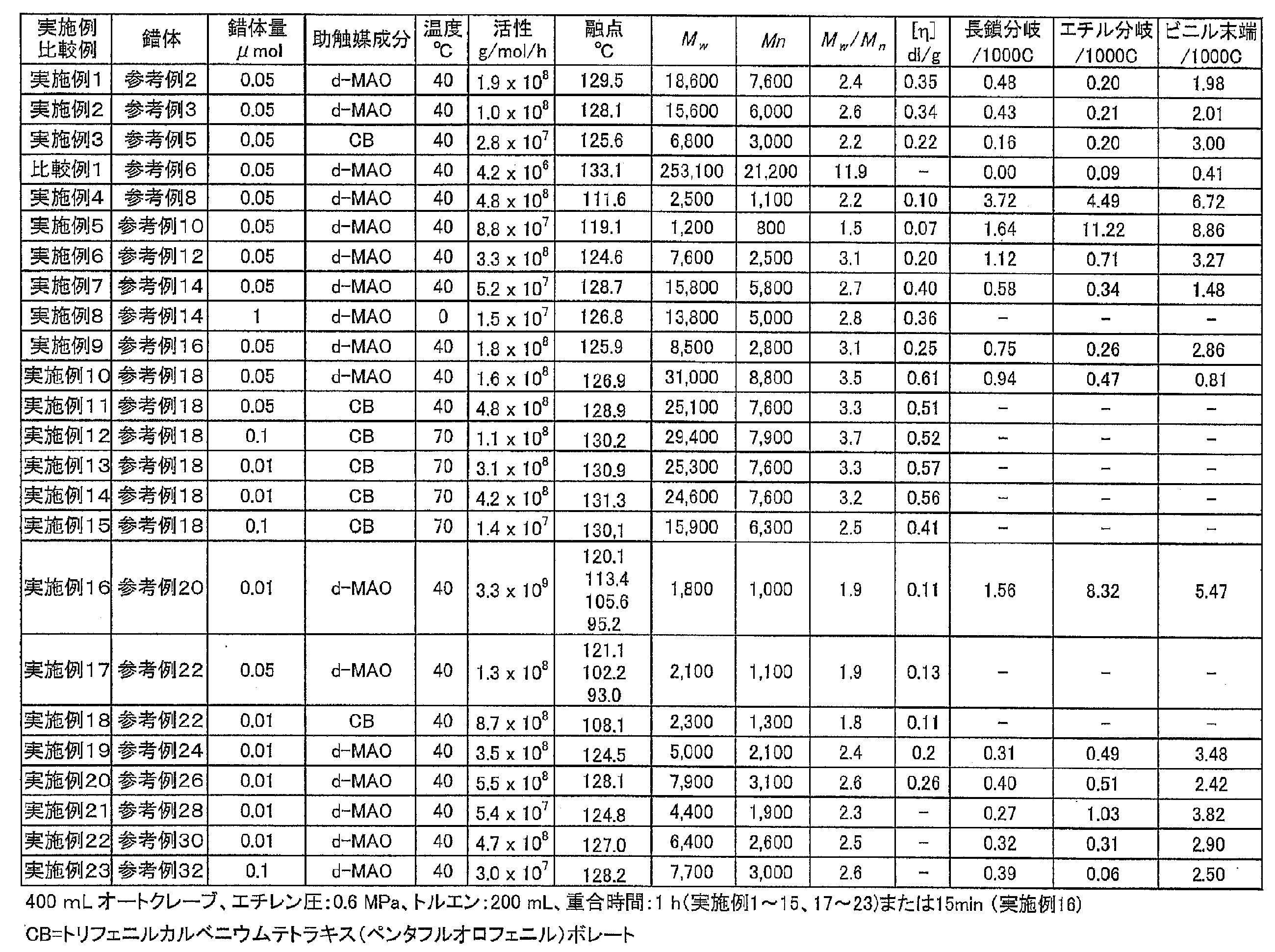
(実施例24)
内容積400mLの撹拌機付きオートクレーブを真空乾燥してアルゴンで置換した後、溶媒としてトルエン185mL、コモノマーとして1-ヘキセン15mLを仕込み、反応器を40℃まで昇温した。昇温後、エチレン圧を0.6MPaに調整しながらフィードし、d-MAO113mgを投入し、続いて参考例2で合成した[シクロヘプタンジイル-trans-1,2-ビス(2-オキソイル-3,5-ジ-tert-ブチルベンジルスルファニル)]ジベンジルジルコニウム(0.5mmol/L、トルエン溶液)0.10 mL(0.050μmol)を投入して重合を開始した。温度を40℃に保ちながら、60分間重合を行った。重合の結果20.0gのエチレン/1-ヘキセン共重合体が得られた。得られた重合体について、上述した測定条件に従い、融点、分子量および分子量分布、固有粘度、長鎖分岐数、およびコモノマー含量を測定した。結果を表2に示す。
内容積400mLの撹拌機付きオートクレーブを真空乾燥してアルゴンで置換した後、溶媒としてトルエン185mL、コモノマーとして1-ヘキセン15mLを仕込み、反応器を40℃まで昇温した。昇温後、エチレン圧を0.6MPaに調整しながらフィードし、d-MAO113mgを投入し、続いて参考例2で合成した[シクロヘプタンジイル-trans-1,2-ビス(2-オキソイル-3,5-ジ-tert-ブチルベンジルスルファニル)]ジベンジルジルコニウム(0.5mmol/L、トルエン溶液)0.10 mL(0.050μmol)を投入して重合を開始した。温度を40℃に保ちながら、60分間重合を行った。重合の結果20.0gのエチレン/1-ヘキセン共重合体が得られた。得られた重合体について、上述した測定条件に従い、融点、分子量および分子量分布、固有粘度、長鎖分岐数、およびコモノマー含量を測定した。結果を表2に示す。
(実施例25)
d-MAOの投入量を113mgとし、[シクロヘプタンジイル-trans-1,2-ビス(2-オキソイル-3,5-ジ-tert-ブチルベンジルスルファニル)]ジベンジルジルコニウムの代わりに参考例3で合成した[シクロヘプタンジイル-trans-1,2-ビス(2-オキソイル-3,5-ジ-tert-ブチルベンジルスルファニル)]ジクロロジルコニウム(0.45mmol/L、トルエン溶液)0.22mL(0.1μmol)を用いたこと以外は、実施例24と同様にして実施した。結果を表2に示す。
d-MAOの投入量を113mgとし、[シクロヘプタンジイル-trans-1,2-ビス(2-オキソイル-3,5-ジ-tert-ブチルベンジルスルファニル)]ジベンジルジルコニウムの代わりに参考例3で合成した[シクロヘプタンジイル-trans-1,2-ビス(2-オキソイル-3,5-ジ-tert-ブチルベンジルスルファニル)]ジクロロジルコニウム(0.45mmol/L、トルエン溶液)0.22mL(0.1μmol)を用いたこと以外は、実施例24と同様にして実施した。結果を表2に示す。
(実施例26)
内容積400mLの撹拌機付きオートクレーブを真空乾燥してアルゴンで置換した後、溶媒としてヘキサン198mLを仕込み、コモノマーとして1-ヘキセン2mLを仕込み、反応器を40℃まで昇温した。昇温後、エチレン圧を0.6MPaに調整しながらフィードし、d-MAO120mgを投入し、続いて参考例2で合成した[シクロヘプタンジイル-trans-1,2-ビス(2-オキソイル-3,5-ジ-tert-ブチルベンジルスルファニル)]ジベンジルジルコニウム(0.50μmol/mL、トルエン溶液)0.10mL(0.05μmol)を投入して重合を開始した。温度を40℃に保ちながら、60分間重合を行った。得られた重合体について、上述した測定条件に従い、融点、分子量および分子量分布、固有粘度、長鎖分岐数、およびコモノマー含量を測定した。結果を表2に示す。
内容積400mLの撹拌機付きオートクレーブを真空乾燥してアルゴンで置換した後、溶媒としてヘキサン198mLを仕込み、コモノマーとして1-ヘキセン2mLを仕込み、反応器を40℃まで昇温した。昇温後、エチレン圧を0.6MPaに調整しながらフィードし、d-MAO120mgを投入し、続いて参考例2で合成した[シクロヘプタンジイル-trans-1,2-ビス(2-オキソイル-3,5-ジ-tert-ブチルベンジルスルファニル)]ジベンジルジルコニウム(0.50μmol/mL、トルエン溶液)0.10mL(0.05μmol)を投入して重合を開始した。温度を40℃に保ちながら、60分間重合を行った。得られた重合体について、上述した測定条件に従い、融点、分子量および分子量分布、固有粘度、長鎖分岐数、およびコモノマー含量を測定した。結果を表2に示す。
(実施例27)
d-MAOの投入量を120mgとし、[シクロヘプタンジイル-trans-1,2-ビス(2-オキソイル-3,5-ジ-tert-ブチルベンジルスルファニル)]ジベンジルジルコニウムの代わりに参考例5で合成した[シクロオクタンジイル-trans-1,2-ビス(2-オキソイル-3,5-ジ-tert-ブチルベンジルスルファニル)]ジベンジルジルコニウム(1.0mmol/L、トルエン溶液)0.050mL(0.050μmol)を用いたこと以外は、実施例24と同様にして実施した。結果を表2に示す。
d-MAOの投入量を120mgとし、[シクロヘプタンジイル-trans-1,2-ビス(2-オキソイル-3,5-ジ-tert-ブチルベンジルスルファニル)]ジベンジルジルコニウムの代わりに参考例5で合成した[シクロオクタンジイル-trans-1,2-ビス(2-オキソイル-3,5-ジ-tert-ブチルベンジルスルファニル)]ジベンジルジルコニウム(1.0mmol/L、トルエン溶液)0.050mL(0.050μmol)を用いたこと以外は、実施例24と同様にして実施した。結果を表2に示す。
(実施例28)
トルエン量を198mL、1-ヘキセン量を2mL、d-MAO投入量を110mgとしたこと以外は実施例27と同様に実施した。結果を表2に示す。
トルエン量を198mL、1-ヘキセン量を2mL、d-MAO投入量を110mgとしたこと以外は実施例27と同様に実施した。結果を表2に示す。
(実施例29)
1-ヘキセンの代わりにビニルシクロヘキサンを用いたこと、d-MAO投入量を118mgとしたこと以外は実施例27と同様に実施した。結果を表2に示す。
1-ヘキセンの代わりにビニルシクロヘキサンを用いたこと、d-MAO投入量を118mgとしたこと以外は実施例27と同様に実施した。結果を表2に示す。
(実施例30)
内容積400mLの撹拌機付きオートクレーブを真空乾燥してアルゴンで置換した後、溶媒としてトルエン190mLを仕込み、コモノマーとして1-ヘキセン10mLを仕込み、反応器を40℃まで昇温した。昇温後、エチレン圧を0.6MPaに調整しながらフィードし、トリイソブチルアルミニウム(1.0mol/L、トルエン溶液)0.25mL(0.25mmol)を投入し、続いて参考例18で合成した{シクロオクタンジイル-trans-1,2-ビス[5-tert-ブチル-3- (3, 5-ジメチル-1-アダマンチル) -2-ヒドロキシベンジルスルファニル]}ジクロロジルコニウム(0.50μmol/mL、トルエン溶液)0.10mL(0.05μmol)、さらに続いてトリフェニルカルベニウムテトラキス(ペンタフルオロフェニル)ボレート(4.0μmol/mL、トルエン溶液)0.75mL(3.0μmol)を投入して重合を開始した。温度を40℃に保ちながら、60分間重合を行った。得られた重合体について、上述した測定条件に従い、融点、分子量および分子量分布、固有粘度を測定した。結果を表2に示す。
内容積400mLの撹拌機付きオートクレーブを真空乾燥してアルゴンで置換した後、溶媒としてトルエン190mLを仕込み、コモノマーとして1-ヘキセン10mLを仕込み、反応器を40℃まで昇温した。昇温後、エチレン圧を0.6MPaに調整しながらフィードし、トリイソブチルアルミニウム(1.0mol/L、トルエン溶液)0.25mL(0.25mmol)を投入し、続いて参考例18で合成した{シクロオクタンジイル-trans-1,2-ビス[5-tert-ブチル-3- (3, 5-ジメチル-1-アダマンチル) -2-ヒドロキシベンジルスルファニル]}ジクロロジルコニウム(0.50μmol/mL、トルエン溶液)0.10mL(0.05μmol)、さらに続いてトリフェニルカルベニウムテトラキス(ペンタフルオロフェニル)ボレート(4.0μmol/mL、トルエン溶液)0.75mL(3.0μmol)を投入して重合を開始した。温度を40℃に保ちながら、60分間重合を行った。得られた重合体について、上述した測定条件に従い、融点、分子量および分子量分布、固有粘度を測定した。結果を表2に示す。
(実施例31)
トルエン量を195mL、1-ヘキセン量を5mLとしたこと以外は実施例30と同様に実施した。結果を表2に示す。
トルエン量を195mL、1-ヘキセン量を5mLとしたこと以外は実施例30と同様に実施した。結果を表2に示す。
(実施例32)
重合温度を70℃とし、トルエン量を160mL、1-ヘキセン量を40mLとし、参考例18で合成した{シクロオクタンジイル-trans-1,2-ビス[5-tert-ブチル-3- (3, 5-ジメチル-1-アダマンチル) -2-ヒドロキシベンジルスルファニル]}ジクロロジルコニウムの投入量を(0.50μmol/mL、トルエン溶液)0.20mL(0.10μmol)としたこと以外は実施例30と同様に実施した。結果を表2に示す。
重合温度を70℃とし、トルエン量を160mL、1-ヘキセン量を40mLとし、参考例18で合成した{シクロオクタンジイル-trans-1,2-ビス[5-tert-ブチル-3- (3, 5-ジメチル-1-アダマンチル) -2-ヒドロキシベンジルスルファニル]}ジクロロジルコニウムの投入量を(0.50μmol/mL、トルエン溶液)0.20mL(0.10μmol)としたこと以外は実施例30と同様に実施した。結果を表2に示す。
(実施例33)
重合温度を70℃とし、トルエン量を185mL、1-ヘキセン量を15mLとし、参考例18で合成した{シクロオクタンジイル-trans-1,2-ビス[5-tert-ブチル-3- (3, 5-ジメチル-1-アダマンチル) -2-ヒドロキシベンジルスルファニル]}ジクロロジルコニウムの投入量を(0.50μmol/mL、トルエン溶液)0.20mL(0.10μmol)としたこと以外は実施例30と同様に実施した。結果を表2に示す。
重合温度を70℃とし、トルエン量を185mL、1-ヘキセン量を15mLとし、参考例18で合成した{シクロオクタンジイル-trans-1,2-ビス[5-tert-ブチル-3- (3, 5-ジメチル-1-アダマンチル) -2-ヒドロキシベンジルスルファニル]}ジクロロジルコニウムの投入量を(0.50μmol/mL、トルエン溶液)0.20mL(0.10μmol)としたこと以外は実施例30と同様に実施した。結果を表2に示す。
(実施例34)
重合温度を70℃とし、トルエン量を195mL、1-ヘキセン量を5mLとし、参考例18で合成した{シクロオクタンジイル-trans-1,2-ビス[5-tert-ブチル-3- (3, 5-ジメチル-1-アダマンチル) -2-ヒドロキシベンジルスルファニル]}ジクロロジルコニウムの投入量を(0.50μmol/mL、トルエン溶液)0.20mL(0.10μmol)としたこと以外は実施例30と同様に実施した。結果を表2に示す。
重合温度を70℃とし、トルエン量を195mL、1-ヘキセン量を5mLとし、参考例18で合成した{シクロオクタンジイル-trans-1,2-ビス[5-tert-ブチル-3- (3, 5-ジメチル-1-アダマンチル) -2-ヒドロキシベンジルスルファニル]}ジクロロジルコニウムの投入量を(0.50μmol/mL、トルエン溶液)0.20mL(0.10μmol)としたこと以外は実施例30と同様に実施した。結果を表2に示す。
(実施例35)
重合温度を70℃とし、トルエン量を198mL、1-ヘキセン量を2mLとし、参考例18で合成した{シクロオクタンジイル-trans-1,2-ビス[5-tert-ブチル-3- (3, 5-ジメチル-1-アダマンチル) -2-ヒドロキシベンジルスルファニル]}ジクロロジルコニウムの投入量を(0.10μmol/mL、トルエン溶液)0.20mL(0.020μmol)としたこと以外は実施例30と同様に実施した。結果を表2に示す。
重合温度を70℃とし、トルエン量を198mL、1-ヘキセン量を2mLとし、参考例18で合成した{シクロオクタンジイル-trans-1,2-ビス[5-tert-ブチル-3- (3, 5-ジメチル-1-アダマンチル) -2-ヒドロキシベンジルスルファニル]}ジクロロジルコニウムの投入量を(0.10μmol/mL、トルエン溶液)0.20mL(0.020μmol)としたこと以外は実施例30と同様に実施した。結果を表2に示す。
(実施例36)
コモノマーとして1-ヘキセン10mLの代わりに1-ブテンを5gを用いたこと以外は実施例30と同様に実施した。結果を表2に示す。
コモノマーとして1-ヘキセン10mLの代わりに1-ブテンを5gを用いたこと以外は実施例30と同様に実施した。結果を表2に示す。
(実施例37)
トルエン量を195mL、コモノマーとして1-ヘキセン10mLの代わりに1-ブテンを2.6gを用いたこと以外は実施例30と同様に実施した。結果を表2に示す。
トルエン量を195mL、コモノマーとして1-ヘキセン10mLの代わりに1-ブテンを2.6gを用いたこと以外は実施例30と同様に実施した。結果を表2に示す。
(実施例38)
重合温度を70℃とし、トルエン量を160mL、コモノマーとして1-ヘキセン10mLの代わりにビニルシクロヘキサン量を40mLを用いたこと、参考例18で合成した{シクロオクタンジイル-trans-1,2-ビス[5-tert-ブチル-3- (3, 5-ジメチル-1-アダマンチル) -2-ヒドロキシベンジルスルファニル]}ジクロロジルコニウムの投入量を(0.50μmol/mL、トルエン溶液)0.20mL(0.10μmol)としたこと以外は実施例30と同様に実施した。結果を表2に示す。
重合温度を70℃とし、トルエン量を160mL、コモノマーとして1-ヘキセン10mLの代わりにビニルシクロヘキサン量を40mLを用いたこと、参考例18で合成した{シクロオクタンジイル-trans-1,2-ビス[5-tert-ブチル-3- (3, 5-ジメチル-1-アダマンチル) -2-ヒドロキシベンジルスルファニル]}ジクロロジルコニウムの投入量を(0.50μmol/mL、トルエン溶液)0.20mL(0.10μmol)としたこと以外は実施例30と同様に実施した。結果を表2に示す。
(実施例39)
重合温度を70℃とし、トルエン量を185mL、コモノマーとして1-ヘキセン10mLの代わりにビニルシクロヘキサン量を15mLを用いたこと、参考例18で合成した{シクロオクタンジイル-trans-1,2-ビス[5-tert-ブチル-3- (3, 5-ジメチル-1-アダマンチル) -2-ヒドロキシベンジルスルファニル]}ジクロロジルコニウムの投入量を(0.10μmol/mL、トルエン溶液)0.20mL(0.020μmol)としたこと以外は実施例30と同様に実施した。結果を表2に示す。
重合温度を70℃とし、トルエン量を185mL、コモノマーとして1-ヘキセン10mLの代わりにビニルシクロヘキサン量を15mLを用いたこと、参考例18で合成した{シクロオクタンジイル-trans-1,2-ビス[5-tert-ブチル-3- (3, 5-ジメチル-1-アダマンチル) -2-ヒドロキシベンジルスルファニル]}ジクロロジルコニウムの投入量を(0.10μmol/mL、トルエン溶液)0.20mL(0.020μmol)としたこと以外は実施例30と同様に実施した。結果を表2に示す。
(実施例40)
重合温度を70℃とし、トルエン量を195mL、コモノマーとして1-ヘキセン10mLの代わりにビニルシクロヘキサン量を5mLを用いたこと、参考例18で合成した{シクロオクタンジイル-trans-1,2-ビス[5-tert-ブチル-3- (3, 5-ジメチル-1-アダマンチル) -2-ヒドロキシベンジルスルファニル]}ジクロロジルコニウムの投入量を(0.10μmol/mL、トルエン溶液)0.20mL(0.020μmol)としたこと以外は実施例30と同様に実施した。結果を表2に示す。
重合温度を70℃とし、トルエン量を195mL、コモノマーとして1-ヘキセン10mLの代わりにビニルシクロヘキサン量を5mLを用いたこと、参考例18で合成した{シクロオクタンジイル-trans-1,2-ビス[5-tert-ブチル-3- (3, 5-ジメチル-1-アダマンチル) -2-ヒドロキシベンジルスルファニル]}ジクロロジルコニウムの投入量を(0.10μmol/mL、トルエン溶液)0.20mL(0.020μmol)としたこと以外は実施例30と同様に実施した。結果を表2に示す。
実施例24~40で得られた重合結果を表2に示す。
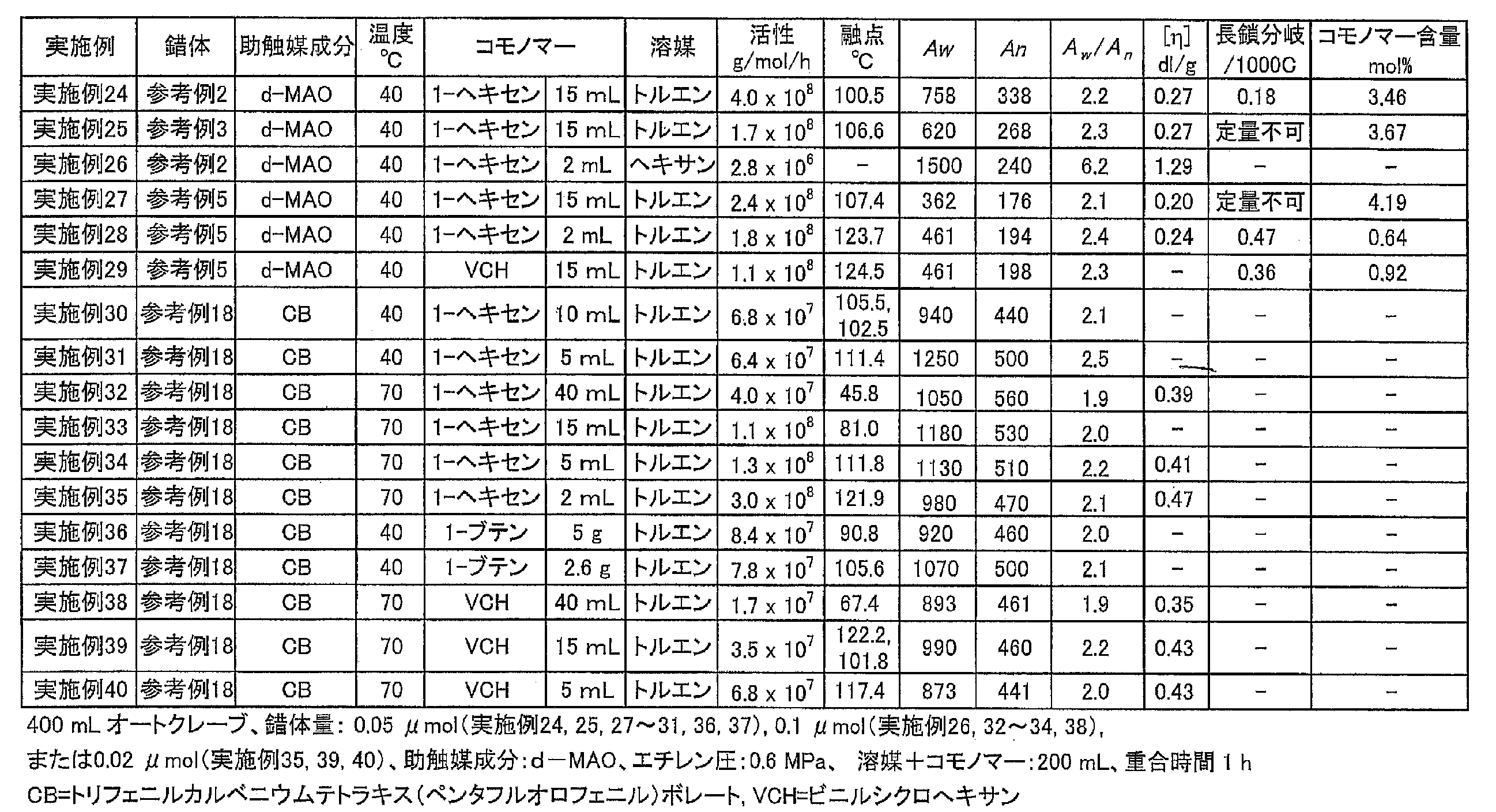
(実施例41)
200mL四口フラスコにトルエン60mL、ブタジエン溶液(アルドリッチ社製、トルエン溶液、20w%)30mLを加え、40℃まで昇温した。昇温後、エチレンを0.3L/minの流速でフィードし、トリイソブチルアルミニウム1.0mol/Lトルエン溶液)0.5mL(0.5mmol)を投入し、続いて参考例33で合成した{シクロオクタンジイル-trans-1,2-ビス[3-(1-アダマンチル)-5-メチル-2-オキソイルベンジルスルファニル]}ジクロロハフニウム(10μmol/mLトルエン溶液)1.0mL(10μmol)、さらに続いてトリフェニルカルベニウムテトラキス(ペンタフルオロフェニル)ボレート(4.0μmol/mLトルエン溶液)3.75mL(15μmol)を投入して重合を開始した。温度を40℃に保ちながら、60分間重合を行った。重合の結果1.4gのエチレン/ブタジエン共重合体が得られた。得られた重合体について、上述した測定条件に従い、融点、分子量および分子量分布を測定した。融点111.0℃、Aw10,500、Aw/An23.4であった。
200mL四口フラスコにトルエン60mL、ブタジエン溶液(アルドリッチ社製、トルエン溶液、20w%)30mLを加え、40℃まで昇温した。昇温後、エチレンを0.3L/minの流速でフィードし、トリイソブチルアルミニウム1.0mol/Lトルエン溶液)0.5mL(0.5mmol)を投入し、続いて参考例33で合成した{シクロオクタンジイル-trans-1,2-ビス[3-(1-アダマンチル)-5-メチル-2-オキソイルベンジルスルファニル]}ジクロロハフニウム(10μmol/mLトルエン溶液)1.0mL(10μmol)、さらに続いてトリフェニルカルベニウムテトラキス(ペンタフルオロフェニル)ボレート(4.0μmol/mLトルエン溶液)3.75mL(15μmol)を投入して重合を開始した。温度を40℃に保ちながら、60分間重合を行った。重合の結果1.4gのエチレン/ブタジエン共重合体が得られた。得られた重合体について、上述した測定条件に従い、融点、分子量および分子量分布を測定した。融点111.0℃、Aw10,500、Aw/An23.4であった。
本発明は、ポリオレフィンの製造に関する分野に有用である。
Claims (19)
- 下記式(1)で表される錯体と活性化用助触媒成分とを接触させてなる、エチレン単独重合用またはエチレンとα-オレフィン共重合用の触媒。

R1およびR5は、それぞれ独立して、
水素原子、
ハロゲン原子、
炭素原子数1~20のアルキル基、
環を構成する炭素原子数が3~10のシクロアルキル基、
炭素原子数2~20のアルケニル基、
炭素原子数2~20のアルキニル基、
炭素原子数7~30のアラルキル基、
炭素原子数1~20のアルコキシ基、
炭素原子数7~30のアラルキルオキシ基、
炭素原子数6~30のアリールオキシ基、
または、置換シリル基を表す。
R2~R4およびR6~R8は、それぞれ独立して、
水素原子、
ハロゲン原子、
炭素原子数1~20のアルキル基、
環を構成する炭素原子数が3~10のシクロアルキル基、
炭素原子数2~20のアルケニル基、
炭素原子数2~20のアルキニル基、
炭素原子数7~30のアラルキル基、
炭素原子数6~30のアリール基、
炭素原子数1~20のアルコキシ基、
炭素原子数7~30のアラルキルオキシ基、
炭素原子数6~30のアリールオキシ基、
置換シリル基、
または環を構成する炭素原子数が3~20のヘテロ環式化合物残基を表す。
R1~R12における上記アルキル基、上記シクロアルキル基、上記アルケニル基、上記アルキニル基、上記アラルキル基、上記アリール基、上記アルコキシ基、上記アラルキルオキシ基、上記アリールオキシ基および上記ヘテロ環式化合物残基は置換基を有していてもよい。
上記R1~R12の定義に関わらず、R1とR2、R2とR3、R3とR4、R5とR6、R6とR7、R7とR8、R9とR10、およびR11とR12とは、それぞれ独立に、互いに連結して環を形成してもよく、これらの環は置換基を有していてもよい。
Xは、それぞれ独立して、
水素原子、
ハロゲン原子、
炭素原子数1~20のアルキル基、
環を構成する炭素原子数が3~10のシクロアルキル基、
炭素原子数2~20のアルケニル基、
炭素原子数7~30のアラルキル基、
炭素原子数6~30のアリール基、
炭素原子数1~20のアルコキシ基、
炭素原子数7~30のアラルキルオキシ基、
炭素原子数6~30のアリールオキシ基、
置換シリル基、
置換アミノ基、
置換チオラート基、または
炭素原子数1~20のカルボキシラート基を表す。
Xにおける上記アルキル基、上記シクロアルキル基、上記アルケニル基、上記アラルキル基、上記アリール基、上記アルコキシ基、上記アラルキルオキシ基、上記アリールオキシ基および上記カルボキシラート基は置換基を有していてもよい。
隣接するX同士は、相互に連結して環を形成してもよい。
Lは中性のルイス塩基を表す。Lが複数ある場合は、複数のLは同一でも異なっていてもよい。lは、0、1、または2である。) - R9~R12が、
水素原子である、請求項1に記載の触媒。 - 上記活性化用助触媒成分がホウ素化合物および有機アルミニウム化合物の少なくとも何れか一方である請求項1または2に記載の触媒。
- R1およびR5が、それぞれ独立して、
ハロゲン原子、
炭素原子数1~20のアルキル基、
環を構成する炭素原子数が3~10のシクロアルキル基、
炭素原子数7~30のアラルキル基、
または置換シリル基
であり、該アルキル基、該シクロアルキル基および該アラルキル基は置換基を有していてもよい、請求項1~3のいずれか1項に記載の触媒。 - R1およびR5のアルキル基が、置換または無置換の炭素原子数5~20のアルキル基である請求項1~4のいずれか1項に記載の触媒。
- R2~R4およびR6~R8がそれぞれ独立して、
水素原子、
ハロゲン原子、
炭素原子数1~20のアルキル基、
環を構成する炭素原子数が3~10のシクロアルキル基、
炭素原子数7~30のアラルキル基、
炭素原子数6~30のアリール基、
または置換シリル基
であり、該アルキル基、該シクロアルキル基、該アラルキル基および該アリール基は置換基を有していてもよい、請求項1~5のいずれか1項に記載の触媒。 - R3およびR7がそれぞれ独立して、
ハロゲン原子、
炭素原子数1~20のアルキル基、
環を構成する炭素原子数が3~10のシクロアルキル基、
炭素原子数7~30のアラルキル基、
炭素原子数6~30のアリール基、
または置換シリル基、
であり、該アルキル基、該シクロアルキル基、該アラルキル基および該アリール基は置換基を有していてもよい、請求項1~6のいずれかに記載の触媒。 - R2、R4、R6およびR8が水素原子である請求項1~7のいずれか1項に記載の触媒。
- Xが、ハロゲン原子、
炭素原子数1~20のアルキル基、
炭素原子数7~30のアラルキル基、
炭素原子数1~20のアルコキシ基、
炭素原子数7~30のアラルキルオキシ基、
炭素原子数6~30のアリールオキシ基、
または置換アミノ基であり、該アルキル基、該アラルキル基、該アルコキシ基、該アラルキルオキシ基および該アリールオキシ基は置換基を有していてもよい、請求項1~8のいずれか1項に記載の触媒。 - 請求項1~9のいずれか1項に記載の触媒の存在下にエチレンを単独で重合させるか、またはエチレンとα-オレフィンとを共重合させる、エチレン系重合体の製造方法。
- α-オレフィンが、プロピレン、1-ブテン、1-ペンテン、1-ヘキセン、ビニルシクロヘキサン、1-オクテンおよび4-メチル-1-ペンテンからなる群から選ばれる少なくとも1種のオレフィンである請求項10に記載の製造方法。
- 請求項1~9のいずれか1項に記載の触媒の存在下にエチレンを単独で重合させるか、またはエチレンとα-オレフィンとを共重合させたエチレン系重合体。
- 下記式(1’)で表される錯体。
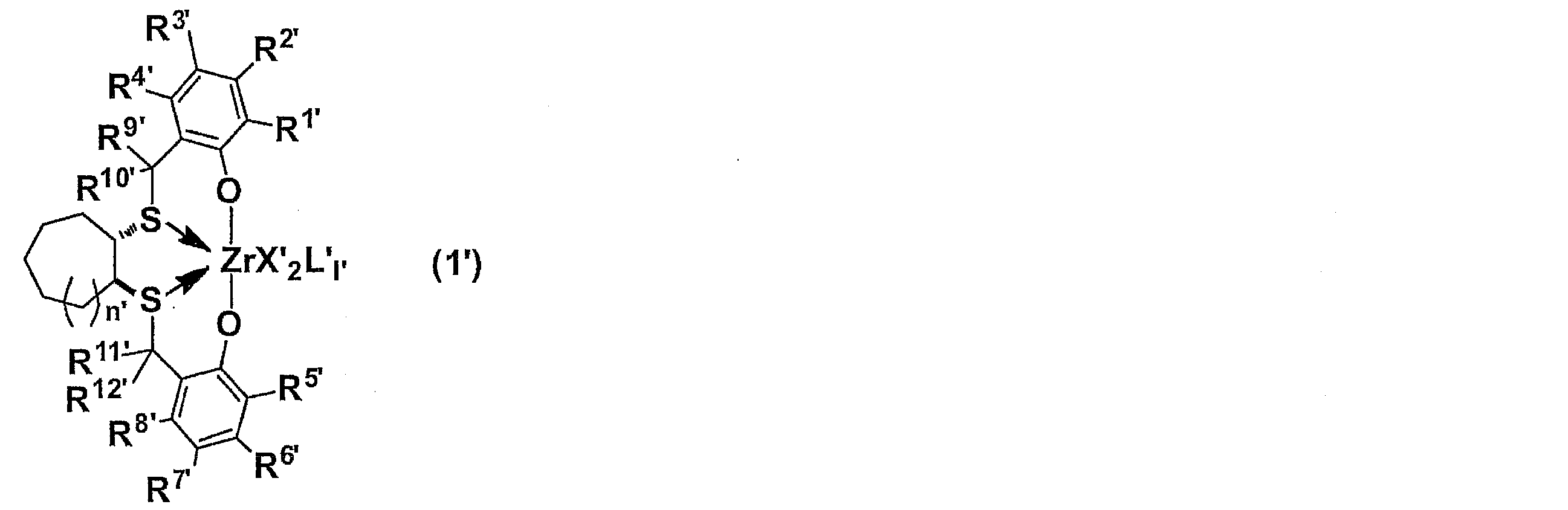
R1’およびR5’は、それぞれ独立して、
水素原子、
ハロゲン原子、
炭素原子数1~20のアルキル基、
環を構成する炭素原子数が3~10のシクロアルキル基、
炭素原子数2~20のアルケニル基、
炭素原子数2~20のアルキニル基、
炭素原子数7~30のアラルキル基、
炭素原子数1~20のアルコキシ基、
炭素原子数7~30のアラルキルオキシ基、
炭素原子数6~30のアリールオキシ基、
または、置換シリル基を表す。ただし、R1’とR5’とは同時にtert-ブチル基ではない。
R2’~R4’およびR6’~R12’は、それぞれ独立して、
水素原子、
ハロゲン原子、
炭素原子数1~20のアルキル基、
環を構成する炭素原子数が3~10のシクロアルキル基、
炭素原子数2~20のアルケニル基、
炭素原子数2~20のアルキニル基、
炭素原子数7~30のアラルキル基、
炭素原子数6~30のアリール基、
炭素原子数1~20のアルコキシ基、
炭素原子数7~30のアラルキルオキシ基、
炭素原子数6~30のアリールオキシ基、
置換シリル基、
または環を構成する炭素原子数が3~20のヘテロ環式化合物残基を表す。
R1’~R12’における上記アルキル基、上記シクロアルキル基、上記アルケニル基、上記アルキニル基、上記アラルキル基、上記アリール基、上記アルコキシ基、上記アラルキルオキシ基、上記アリールオキシ基および上記ヘテロ環式化合物残基は置換基を有していてもよい。
上記R1’~R12’の定義に関わらず、R1’とR2’、R2’とR3’、R3’とR4’、R5’とR6’、R6’とR7’、R7’とR8’、R9’とR10’、およびR11’とR12’とは、それぞれ独立に、互いに連結して環を形成してもよく、これらの環は置換基を有していてもよい。
X’は、それぞれ独立して、水素原子、ハロゲン原子、
炭素原子数1~20のアルキル基、
環を構成する炭素原子数が3~10のシクロアルキル基、
炭素原子数2~20のアルケニル基、
炭素原子数7~30のアラルキル基、
炭素原子数6~30のアリール基、
炭素原子数1~20のアルコキシ基、
炭素原子数7~30のアラルキルオキシ基、
炭素原子数6~30のアリールオキシ基、
置換シリル基、
置換アミノ基、
置換チオラート基、または
炭素原子数1~20のカルボキシラート基を表す。
X’における上記アルキル基、上記シクロアルキル基、上記アルケニル基、上記アラルキル基、上記アリール基、上記アルコキシ基、上記アラルキルオキシ基、上記アリールオキシ基および上記カルボキシラート基は置換基を有していてもよい。
隣接するX’同士は、相互に連結して環を形成してもよい。
L’は中性のルイス塩基を表す。L’が複数ある場合は、複数のL’は同一でも異なっていてもよい。l’は、0、1、または2である。) - R9’~R12’が、
水素原子である、請求項13に記載の錯体。 - R1’およびR5’が、それぞれ独立して、
ハロゲン原子、
炭素原子数5~20のアルキル基、
環を構成する炭素原子数が3~10のシクロアルキル基、
炭素原子数7~30のアラルキル基、
または、置換シリル基であり、該アルキル基、該シクロアルキル基および該アラルキル基は置換基を有していてもよい、請求項13または14に記載の錯体。 - R2’~R4’およびR6’~R8’がそれぞれ独立して、
水素原子、
炭素原子数1~20のアルキル基、
環を構成する炭素原子数が3~10のシクロアルキル基、
炭素原子数7~30のアラルキル基、
炭素原子数6~30のアリール基
または置換シリル基であり、該アルキル基、該シクロアルキル基、該アラルキル基および該アリール基は置換基を有していてもよい、13~15のいずれか1項に記載の錯体。 - R3’およびR7’がそれぞれ独立して、
ハロゲン原子、
炭素原子数1~20のアルキル基、
環を構成する炭素原子数が3~10のシクロアルキル基、
炭素原子数7~30のアラルキル基、
炭素原子数6~30のアリール基、
または置換シリル基、
であり、該アルキル基、該シクロアルキル基、該アラルキル基および該アリール基は置換基を有していてもよい、請求項13~16のいずれか1項に記載の触媒。 - R2’、R4’、R6’およびR8’が水素原子である請求項13~17のいずれか1項に記載の錯体。
- X’が、ハロゲン原子、
炭素原子数1~20のアルキル基、
炭素原子数7~30のアラルキル基、
炭素原子数1~20のアルコキシ基、
炭素原子数7~30のアラルキルオキシ基、
炭素原子数6~30のアリールオキシ基、
または置換アミノ基であり、該アルキル基、該アラルキル基、該アルコキシ基、該アラルキルオキシ基および該アリールオキシ基は置換基を有していてもよい、請求項13~18のいずれか1項に記載の錯体。
Applications Claiming Priority (4)
| Application Number | Priority Date | Filing Date | Title |
|---|---|---|---|
| JP2011-033821 | 2011-02-18 | ||
| JP2011033821 | 2011-02-18 | ||
| JP2011-176421 | 2011-08-11 | ||
| JP2011176421 | 2011-08-11 |
Publications (1)
| Publication Number | Publication Date |
|---|---|
| WO2012111779A1 true WO2012111779A1 (ja) | 2012-08-23 |
Family
ID=46672691
Family Applications (1)
| Application Number | Title | Priority Date | Filing Date |
|---|---|---|---|
| PCT/JP2012/053730 Ceased WO2012111779A1 (ja) | 2011-02-18 | 2012-02-16 | エチレン系重合用触媒及びエチレン系重合体の製造方法 |
Country Status (1)
| Country | Link |
|---|---|
| WO (1) | WO2012111779A1 (ja) |
Cited By (4)
| Publication number | Priority date | Publication date | Assignee | Title |
|---|---|---|---|---|
| WO2018022279A1 (en) * | 2016-07-29 | 2018-02-01 | Exxonmobil Chemical Patents Inc. | Phenolate transition metal complexes, production and use thereof |
| US10221260B2 (en) | 2016-07-29 | 2019-03-05 | Exxonmobil Chemical Patents Inc. | Phenolate transition metal complexes, production and use thereof |
| CN109476683A (zh) * | 2016-07-29 | 2019-03-15 | 埃克森美孚化学专利公司 | 酚基过渡金属络合物,其生产和用途 |
| US10358397B2 (en) | 2017-06-29 | 2019-07-23 | Exxonmobil Chemical Patents Inc. | Production of olefin dimers |
Citations (4)
| Publication number | Priority date | Publication date | Assignee | Title |
|---|---|---|---|---|
| JPH05170821A (ja) * | 1991-12-24 | 1993-07-09 | Mitsui Toatsu Chem Inc | オレフィンの重合方法 |
| JP2000072811A (ja) * | 1998-08-28 | 2000-03-07 | Mitsui Chemicals Inc | オレフィン重合用触媒およびオレフィンの重合方法 |
| JP2004027163A (ja) * | 2002-06-28 | 2004-01-29 | Mitsui Chemicals Inc | オレフィン重合用触媒及び該触媒を用いたオレフィンの重合方法 |
| WO2011099584A1 (ja) * | 2010-02-12 | 2011-08-18 | 国立大学法人埼玉大学 | エチレン系重合用触媒及びエチレン系重合体の製造方法 |
-
2012
- 2012-02-16 WO PCT/JP2012/053730 patent/WO2012111779A1/ja not_active Ceased
Patent Citations (4)
| Publication number | Priority date | Publication date | Assignee | Title |
|---|---|---|---|---|
| JPH05170821A (ja) * | 1991-12-24 | 1993-07-09 | Mitsui Toatsu Chem Inc | オレフィンの重合方法 |
| JP2000072811A (ja) * | 1998-08-28 | 2000-03-07 | Mitsui Chemicals Inc | オレフィン重合用触媒およびオレフィンの重合方法 |
| JP2004027163A (ja) * | 2002-06-28 | 2004-01-29 | Mitsui Chemicals Inc | オレフィン重合用触媒及び該触媒を用いたオレフィンの重合方法 |
| WO2011099584A1 (ja) * | 2010-02-12 | 2011-08-18 | 国立大学法人埼玉大学 | エチレン系重合用触媒及びエチレン系重合体の製造方法 |
Non-Patent Citations (2)
| Title |
|---|
| ANGEW.CHEM.INT.ED., vol. 49, 2010, pages 5784 - 5787 * |
| J.AM.CHEM.SOC., vol. 131, no. 38, 2009, pages 13566 - 13567 * |
Cited By (5)
| Publication number | Priority date | Publication date | Assignee | Title |
|---|---|---|---|---|
| WO2018022279A1 (en) * | 2016-07-29 | 2018-02-01 | Exxonmobil Chemical Patents Inc. | Phenolate transition metal complexes, production and use thereof |
| US10221260B2 (en) | 2016-07-29 | 2019-03-05 | Exxonmobil Chemical Patents Inc. | Phenolate transition metal complexes, production and use thereof |
| CN109476683A (zh) * | 2016-07-29 | 2019-03-15 | 埃克森美孚化学专利公司 | 酚基过渡金属络合物,其生产和用途 |
| CN109476683B (zh) * | 2016-07-29 | 2022-07-22 | 埃克森美孚化学专利公司 | 酚基过渡金属络合物,其生产和用途 |
| US10358397B2 (en) | 2017-06-29 | 2019-07-23 | Exxonmobil Chemical Patents Inc. | Production of olefin dimers |
Similar Documents
| Publication | Publication Date | Title |
|---|---|---|
| EP3601387B1 (en) | Germanium-bridged bis-biphenyl-phenoxy catalysts for olefin polymerization | |
| US8470947B2 (en) | Ethylenic polymer | |
| KR20020000120A (ko) | 전이금속 화합물, 부가중합용 촉매 및 부가중합체의제조방법 | |
| JPWO2011099584A1 (ja) | エチレン系重合用触媒及びエチレン系重合体の製造方法 | |
| JP2013053308A (ja) | オレフィン重合体の製造方法、エチレン系重合体および成形体 | |
| WO2012111779A1 (ja) | エチレン系重合用触媒及びエチレン系重合体の製造方法 | |
| JP2013166898A (ja) | オレフィン重合用触媒およびオレフィン重合体の製造方法 | |
| WO2012111780A1 (ja) | オレフィン重合用触媒及びオレフィン重合体の製造方法 | |
| JP2013166735A (ja) | 新規錯体、当該錯体を含む重合用触媒およびオリゴマー化用触媒、ならびにこれらの利用 | |
| JPH11315119A (ja) | エチレン―イソプレンランダム共重合体、エラストマ―組成物及び架橋エラストマ―組成物 | |
| WO2013022102A1 (ja) | エチレン系重合用触媒およびエチレン系重合体の製造方法 | |
| WO2013022108A1 (ja) | オレフィン重合用触媒及びオレフィン重合体の製造方法 | |
| WO2012111778A1 (ja) | オレフィン重合用触媒及びオレフィン重合体の製造方法 | |
| CN101107260B (zh) | 过渡金属络合物、制备所述过渡金属络合物的方法、被取代的芴化合物、制备所述被取代的芴化合物的方法、烯烃聚合用催化剂组分、烯烃聚合用催化剂以及制备烯烃聚合物的方法 | |
| WO2012169641A1 (ja) | 錯体、オレフィン重合用触媒及びオレフィン重合体の製造方法 | |
| JP4882391B2 (ja) | 遷移金属錯体、該遷移金属錯体の製造方法、置換フルオレン化合物、該置換フルオレン化合物の製造方法、オレフィン重合用触媒成分、オレフィン重合用触媒、および、オレフィン重合体の製造方法 | |
| WO2012111777A1 (ja) | オレフィン重合用触媒及びオレフィン重合体の製造方法 | |
| JP2013166897A (ja) | オレフィン重合用触媒およびオレフィン重合体の製造方法 | |
| JP4389889B2 (ja) | 遷移金属錯体、オレフィン重合用触媒及びオレフィン重合体の製造方法 | |
| JP3669069B2 (ja) | 遷移金属錯体、オレフィン重合用触媒及びオレフィン重合体の製造方法 | |
| JPH11158189A (ja) | 遷移金属化合物、オレフィン重合用触媒成分、オレフィン重合用触媒、オレフィン系重合体の製造方法、及びアミノフェノール化合物 | |
| US8288490B2 (en) | Process for producing catalyst component for addition polymerization | |
| JP4362881B2 (ja) | オレフィン系熱可塑性エラストマー組成物 | |
| JP2007191534A (ja) | オレフィン重合体の製造方法 | |
| JP2010037338A (ja) | 遷移金属錯体及びその製造方法、オレフィン重合触媒、ポリオレフィン樹脂の製造方法、並びに、置換フルオレン化合物及びその製造方法 |
Legal Events
| Date | Code | Title | Description |
|---|---|---|---|
| 121 | Ep: the epo has been informed by wipo that ep was designated in this application |
Ref document number: 12747194 Country of ref document: EP Kind code of ref document: A1 |
|
| NENP | Non-entry into the national phase |
Ref country code: DE |
|
| 122 | Ep: pct application non-entry in european phase |
Ref document number: 12747194 Country of ref document: EP Kind code of ref document: A1 |
|
| NENP | Non-entry into the national phase |
Ref country code: JP |