WO2012102247A1 - ルテニウム錯体を含む水素移動反応用触媒及び水素移動反応物の製造方法 - Google Patents
ルテニウム錯体を含む水素移動反応用触媒及び水素移動反応物の製造方法 Download PDFInfo
- Publication number
- WO2012102247A1 WO2012102247A1 PCT/JP2012/051373 JP2012051373W WO2012102247A1 WO 2012102247 A1 WO2012102247 A1 WO 2012102247A1 JP 2012051373 W JP2012051373 W JP 2012051373W WO 2012102247 A1 WO2012102247 A1 WO 2012102247A1
- Authority
- WO
- WIPO (PCT)
- Prior art keywords
- reaction
- hydrogen
- hydrocarbon group
- atom
- bonded
- Prior art date
- Legal status (The legal status is an assumption and is not a legal conclusion. Google has not performed a legal analysis and makes no representation as to the accuracy of the status listed.)
- Ceased
Links
- 0 C(CC1)CCC1*(CC1)Cc2*1cccc2 Chemical compound C(CC1)CCC1*(CC1)Cc2*1cccc2 0.000 description 5
- WVDDGKGOMKODPV-UHFFFAOYSA-N OCc1ccccc1 Chemical compound OCc1ccccc1 WVDDGKGOMKODPV-UHFFFAOYSA-N 0.000 description 2
- WGQKYBSKWIADBV-UHFFFAOYSA-N NCc1ccccc1 Chemical compound NCc1ccccc1 WGQKYBSKWIADBV-UHFFFAOYSA-N 0.000 description 1
- PAYRUJLWNCNPSJ-UHFFFAOYSA-N Nc1ccccc1 Chemical compound Nc1ccccc1 PAYRUJLWNCNPSJ-UHFFFAOYSA-N 0.000 description 1
- LKQUCICFTHBFAL-UHFFFAOYSA-N O=C(c1ccccc1)NCc1ccccc1 Chemical compound O=C(c1ccccc1)NCc1ccccc1 LKQUCICFTHBFAL-UHFFFAOYSA-N 0.000 description 1
- ZVSKZLHKADLHSD-UHFFFAOYSA-N O=C(c1ccccc1)Nc1ccccc1 Chemical compound O=C(c1ccccc1)Nc1ccccc1 ZVSKZLHKADLHSD-UHFFFAOYSA-N 0.000 description 1
Classifications
-
- C—CHEMISTRY; METALLURGY
- C07—ORGANIC CHEMISTRY
- C07F—ACYCLIC, CARBOCYCLIC OR HETEROCYCLIC COMPOUNDS CONTAINING ELEMENTS OTHER THAN CARBON, HYDROGEN, HALOGEN, OXYGEN, NITROGEN, SULFUR, SELENIUM OR TELLURIUM
- C07F15/00—Compounds containing elements of Groups 8, 9, 10 or 18 of the Periodic Table
- C07F15/0006—Compounds containing elements of Groups 8, 9, 10 or 18 of the Periodic Table compounds of the platinum group
- C07F15/0046—Ruthenium compounds
- C07F15/0053—Ruthenium compounds without a metal-carbon linkage
-
- B—PERFORMING OPERATIONS; TRANSPORTING
- B01—PHYSICAL OR CHEMICAL PROCESSES OR APPARATUS IN GENERAL
- B01J—CHEMICAL OR PHYSICAL PROCESSES, e.g. CATALYSIS OR COLLOID CHEMISTRY; THEIR RELEVANT APPARATUS
- B01J31/00—Catalysts comprising hydrides, coordination complexes or organic compounds
- B01J31/16—Catalysts comprising hydrides, coordination complexes or organic compounds containing coordination complexes
- B01J31/18—Catalysts comprising hydrides, coordination complexes or organic compounds containing coordination complexes containing nitrogen, phosphorus, arsenic or antimony as complexing atoms, e.g. in pyridine ligands, or in resonance therewith, e.g. in isocyanide ligands C=N-R or as complexed central atoms
- B01J31/189—Catalysts comprising hydrides, coordination complexes or organic compounds containing coordination complexes containing nitrogen, phosphorus, arsenic or antimony as complexing atoms, e.g. in pyridine ligands, or in resonance therewith, e.g. in isocyanide ligands C=N-R or as complexed central atoms containing both nitrogen and phosphorus as complexing atoms, including e.g. phosphino moieties, in one at least bidentate or bridging ligand
-
- C—CHEMISTRY; METALLURGY
- C07—ORGANIC CHEMISTRY
- C07C—ACYCLIC OR CARBOCYCLIC COMPOUNDS
- C07C209/00—Preparation of compounds containing amino groups bound to a carbon skeleton
- C07C209/30—Preparation of compounds containing amino groups bound to a carbon skeleton by reduction of nitrogen-to-oxygen or nitrogen-to-nitrogen bonds
- C07C209/32—Preparation of compounds containing amino groups bound to a carbon skeleton by reduction of nitrogen-to-oxygen or nitrogen-to-nitrogen bonds by reduction of nitro groups
- C07C209/36—Preparation of compounds containing amino groups bound to a carbon skeleton by reduction of nitrogen-to-oxygen or nitrogen-to-nitrogen bonds by reduction of nitro groups by reduction of nitro groups bound to carbon atoms of six-membered aromatic rings in presence of hydrogen-containing gases and a catalyst
-
- C—CHEMISTRY; METALLURGY
- C07—ORGANIC CHEMISTRY
- C07C—ACYCLIC OR CARBOCYCLIC COMPOUNDS
- C07C209/00—Preparation of compounds containing amino groups bound to a carbon skeleton
- C07C209/44—Preparation of compounds containing amino groups bound to a carbon skeleton by reduction of carboxylic acids or esters thereof in presence of ammonia or amines, or by reduction of nitriles, carboxylic acid amides, imines or imino-ethers
- C07C209/48—Preparation of compounds containing amino groups bound to a carbon skeleton by reduction of carboxylic acids or esters thereof in presence of ammonia or amines, or by reduction of nitriles, carboxylic acid amides, imines or imino-ethers by reduction of nitriles
-
- C—CHEMISTRY; METALLURGY
- C07—ORGANIC CHEMISTRY
- C07C—ACYCLIC OR CARBOCYCLIC COMPOUNDS
- C07C209/00—Preparation of compounds containing amino groups bound to a carbon skeleton
- C07C209/44—Preparation of compounds containing amino groups bound to a carbon skeleton by reduction of carboxylic acids or esters thereof in presence of ammonia or amines, or by reduction of nitriles, carboxylic acid amides, imines or imino-ethers
- C07C209/50—Preparation of compounds containing amino groups bound to a carbon skeleton by reduction of carboxylic acids or esters thereof in presence of ammonia or amines, or by reduction of nitriles, carboxylic acid amides, imines or imino-ethers by reduction of carboxylic acid amides
-
- C—CHEMISTRY; METALLURGY
- C07—ORGANIC CHEMISTRY
- C07C—ACYCLIC OR CARBOCYCLIC COMPOUNDS
- C07C209/00—Preparation of compounds containing amino groups bound to a carbon skeleton
- C07C209/44—Preparation of compounds containing amino groups bound to a carbon skeleton by reduction of carboxylic acids or esters thereof in presence of ammonia or amines, or by reduction of nitriles, carboxylic acid amides, imines or imino-ethers
- C07C209/52—Preparation of compounds containing amino groups bound to a carbon skeleton by reduction of carboxylic acids or esters thereof in presence of ammonia or amines, or by reduction of nitriles, carboxylic acid amides, imines or imino-ethers by reduction of imines or imino-ethers
-
- C—CHEMISTRY; METALLURGY
- C07—ORGANIC CHEMISTRY
- C07C—ACYCLIC OR CARBOCYCLIC COMPOUNDS
- C07C29/00—Preparation of compounds having hydroxy or O-metal groups bound to a carbon atom not belonging to a six-membered aromatic ring
- C07C29/132—Preparation of compounds having hydroxy or O-metal groups bound to a carbon atom not belonging to a six-membered aromatic ring by reduction of an oxygen containing functional group
- C07C29/136—Preparation of compounds having hydroxy or O-metal groups bound to a carbon atom not belonging to a six-membered aromatic ring by reduction of an oxygen containing functional group of >C=O containing groups, e.g. —COOH
- C07C29/147—Preparation of compounds having hydroxy or O-metal groups bound to a carbon atom not belonging to a six-membered aromatic ring by reduction of an oxygen containing functional group of >C=O containing groups, e.g. —COOH of carboxylic acids or derivatives thereof
-
- C—CHEMISTRY; METALLURGY
- C07—ORGANIC CHEMISTRY
- C07C—ACYCLIC OR CARBOCYCLIC COMPOUNDS
- C07C29/00—Preparation of compounds having hydroxy or O-metal groups bound to a carbon atom not belonging to a six-membered aromatic ring
- C07C29/17—Preparation of compounds having hydroxy or O-metal groups bound to a carbon atom not belonging to a six-membered aromatic ring by hydrogenation of carbon-to-carbon double or triple bonds
- C07C29/177—Preparation of compounds having hydroxy or O-metal groups bound to a carbon atom not belonging to a six-membered aromatic ring by hydrogenation of carbon-to-carbon double or triple bonds with simultaneous reduction of a carboxy group
-
- C—CHEMISTRY; METALLURGY
- C07—ORGANIC CHEMISTRY
- C07C—ACYCLIC OR CARBOCYCLIC COMPOUNDS
- C07C41/00—Preparation of ethers; Preparation of compounds having groups, groups or groups
- C07C41/01—Preparation of ethers
- C07C41/18—Preparation of ethers by reactions not forming ether-oxygen bonds
- C07C41/26—Preparation of ethers by reactions not forming ether-oxygen bonds by introduction of hydroxy or O-metal groups
-
- C—CHEMISTRY; METALLURGY
- C07—ORGANIC CHEMISTRY
- C07C—ACYCLIC OR CARBOCYCLIC COMPOUNDS
- C07C67/00—Preparation of carboxylic acid esters
- C07C67/30—Preparation of carboxylic acid esters by modifying the acid moiety of the ester, such modification not being an introduction of an ester group
- C07C67/31—Preparation of carboxylic acid esters by modifying the acid moiety of the ester, such modification not being an introduction of an ester group by introduction of functional groups containing oxygen only in singly bound form
-
- C—CHEMISTRY; METALLURGY
- C07—ORGANIC CHEMISTRY
- C07C—ACYCLIC OR CARBOCYCLIC COMPOUNDS
- C07C67/00—Preparation of carboxylic acid esters
- C07C67/30—Preparation of carboxylic acid esters by modifying the acid moiety of the ester, such modification not being an introduction of an ester group
- C07C67/317—Preparation of carboxylic acid esters by modifying the acid moiety of the ester, such modification not being an introduction of an ester group by splitting-off hydrogen or functional groups; by hydrogenolysis of functional groups
-
- B—PERFORMING OPERATIONS; TRANSPORTING
- B01—PHYSICAL OR CHEMICAL PROCESSES OR APPARATUS IN GENERAL
- B01J—CHEMICAL OR PHYSICAL PROCESSES, e.g. CATALYSIS OR COLLOID CHEMISTRY; THEIR RELEVANT APPARATUS
- B01J2231/00—Catalytic reactions performed with catalysts classified in B01J31/00
- B01J2231/60—Reduction reactions, e.g. hydrogenation
- B01J2231/64—Reductions in general of organic substrates, e.g. hydride reductions or hydrogenations
- B01J2231/641—Hydrogenation of organic substrates, i.e. H2 or H-transfer hydrogenations, e.g. Fischer-Tropsch processes
-
- B—PERFORMING OPERATIONS; TRANSPORTING
- B01—PHYSICAL OR CHEMICAL PROCESSES OR APPARATUS IN GENERAL
- B01J—CHEMICAL OR PHYSICAL PROCESSES, e.g. CATALYSIS OR COLLOID CHEMISTRY; THEIR RELEVANT APPARATUS
- B01J2531/00—Additional information regarding catalytic systems classified in B01J31/00
- B01J2531/80—Complexes comprising metals of Group VIII as the central metal
- B01J2531/82—Metals of the platinum group
- B01J2531/821—Ruthenium
-
- C—CHEMISTRY; METALLURGY
- C07—ORGANIC CHEMISTRY
- C07C—ACYCLIC OR CARBOCYCLIC COMPOUNDS
- C07C2601/00—Systems containing only non-condensed rings
- C07C2601/12—Systems containing only non-condensed rings with a six-membered ring
- C07C2601/14—The ring being saturated
Definitions
- the present invention relates to a hydrogen transfer reaction catalyst containing a ruthenium complex, and a method for producing a hydrogen transfer reaction product using the catalyst. Furthermore, this invention relates to the novel ruthenium complex useful as a catalyst for hydrogen transfer reactions.
- hydrogen transfer reactions such as dehydrogenation reaction and hydrogen reduction reaction (also referred to as “hydrogenation reaction” or “hydrogenation reaction”) are known.
- the hydrogen transfer reaction is widely used for the synthesis of high molecular organic compounds and low molecular organic compounds.
- the catalyst is usually selected according to the nature and type of the substrate.
- the reaction conditions are also selected depending on the type of catalyst.
- Patent Document 1 discloses, for example, a method of obtaining an alcohol or diol by hydrogen reduction of an ester or lactone in the presence of a ruthenium complex shown below.
- Patent Documents 2 and 3 describe a method of hydrogenating an ester or a lactone in the presence of a ruthenium complex in which a bidentate amino or iminophosphine ligand is coordinated to ruthenium.
- Patent Documents 4 to 7 and Non-Patent Documents 1 to 3 disclose amide hydrogenation reactions.
- Non-Patent Document 7 discloses a carboxylic acid hydrogenation reaction.
- Non-patent documents 4 to 7 disclose ester hydrogenation reactions.
- JP 2010-37329 A Special table 2008-538352 gazette JP 2011-37809 A U.S. Pat. No. 3,190,922 U.S. Pat. No. 4,937,384 International Publication No. 1998/03262 International Publication No. 2007/102568
- An object of the present invention is to provide a hydrogen transfer reaction catalyst having high substrate versatility. Another object of the present invention is to provide a method for obtaining a hydrogen transfer reaction product from various substrates by using the catalyst for hydrogen transfer reaction. Furthermore, it aims at providing the novel ruthenium complex useful as said catalyst for hydrogen transfer reactions.
- the hydrogen transfer reaction catalyst of the present invention contains a ruthenium complex represented by the following general formula (1).
- R 1 and R 2 are each independently a monovalent hydrocarbon group. Two R 1 may be bonded to each other to form a divalent hydrocarbon group. R 1 and R 2 may be bonded to each other to form a divalent hydrocarbon group, R 3 and R 4 are each independently a hydrogen atom or a monovalent hydrocarbon group, and R 3 and R 4 are May be bonded to each other to form a divalent hydrocarbon group, and R 5 and R 6 are each independently a monovalent chain aliphatic hydrocarbon group or alicyclic hydrocarbon group.
- a ligand is 1.
- a bond between a nitrogen atom and a carbon atom bonded to the nitrogen atom is a double bond or a single bond, and when the bond is a single bond, a Ru atom and ( One hydrogen atom may be bonded to the nitrogen atom between R 1. m is 0 to 2.)
- the method for producing a hydrogen transfer reaction product of the present invention includes a step of subjecting an organic compound to a hydrogen reduction reaction or a dehydrogenation reaction in the presence of the hydrogen transfer reaction catalyst of the present invention.
- the ruthenium complex of the present invention is represented by the following general formula (1).
- R 1 and R 2 are each independently a monovalent hydrocarbon group. Two R 1 may be bonded to each other to form a divalent hydrocarbon group. R 1 and R 2 may be bonded to each other to form a divalent hydrocarbon group, R 3 and R 4 are each independently a hydrogen atom or a monovalent hydrocarbon group, and R 3 and R 4 are May be bonded to each other to form a divalent hydrocarbon group, and R 5 and R 6 are each independently a monovalent chain aliphatic hydrocarbon group or alicyclic hydrocarbon group.
- a ligand is 1.
- a bond between a nitrogen atom and a carbon atom bonded to the nitrogen atom is a double bond or a single bond, and when the bond is a single bond, a Ru atom and ( One hydrogen atom may be bonded to the nitrogen atom between R 1. m is 0 to 2.)
- the hydrogen transfer reaction for various substrates can be performed efficiently. That is, the hydrogen transfer reaction catalyst of the present invention has high substrate versatility regardless of the type of organic compound (substrate). High activity as a catalyst can be exhibited without depending on the reaction mechanism. Therefore, it is not necessary to prepare individual catalysts suitable for each reaction in the target hydrogen reduction reaction or dehydrogenation reaction, and the hydrogen transfer reaction of a wide range of substrates can be performed using the hydrogen transfer reaction catalyst of the present invention. Can be used. For this reason, the reaction is efficient and economical, and the management of the catalyst can be simplified.
- the catalyst of the present invention can cope with various hydrogen reduction reactions and dehydrogenation reactions, it can be widely used for the production of pharmaceuticals, agricultural chemicals, synthetic intermediates of functional materials, and the like.
- the method for producing a hydrogen transfer reaction product of the present invention since the hydrogen transfer reaction catalyst of the present invention is used, various reactions as described above can be performed with high activity. For this reason, it is extremely efficient.
- the novel ruthenium complex of the present invention is useful as a hydrogen transfer reaction catalyst of the present invention. That is, when a catalyst containing the ruthenium complex of the present invention is used for a hydrogen transfer reaction, a high catalytic function can be exhibited.
- the hydrogen transfer reaction means a reaction in which a hydrogen atom moves from a substrate by desorption or addition. That is, the hydrogen transfer reaction includes a dehydrogenation reaction and a hydrogen reduction reaction. The dehydrogenation reaction also includes dehydration condensation. Furthermore, the “chain aliphatic hydrocarbon group” is a group formed by eliminating a hydrogen atom bonded to a carbon atom constituting the chain aliphatic hydrocarbon. Further, the “alicyclic hydrocarbon group” and the “aromatic hydrocarbon group” all include the following embodiments.
- a group in which a hydrogen atom on a carbon atom constituting a ring is eliminated for example, a cyclohexyl group, a decahydronaphthyl group, a phenyl group, or a naphthyl group.
- (B) A group in which a hydrogen atom on a carbon atom constituting the ring is eliminated, and a hydrogen atom on the same carbon atom or another carbon atom constituting the ring is another atom (for example, a halogen atom) Or a group (for example, 2-methylcyclohexyl group, 4-ethylphenyl group) substituted by another group (for example, chain aliphatic hydrocarbon group, carboxyl group, alkoxy group).
- (C) a group in which a hydrogen atom on a carbon atom constituting a chain aliphatic hydrocarbon group is substituted with the alicyclic hydrocarbon group or aromatic hydrocarbon group in (A) (for example, 2-phenylpropyl Group).
- R 1 and R 2 are each independently a monovalent hydrocarbon group.
- R 1 and R 2 may be the same group or different groups. Further, the two R 1 may be the same group or different groups. Further, two R 2 may be the same group or different groups. In particular, R 1 and R 2 are preferably the same group.
- the structure of the monovalent hydrocarbon group is not limited.
- the monovalent hydrocarbon group may have a chain structure or a cyclic structure. In the case of a chain structure, it may be linear or branched.
- the monovalent hydrocarbon group may be composed of only a saturated bond or may contain an unsaturated bond.
- the monovalent hydrocarbon group may have one or more other substituents in the structure.
- the monovalent hydrocarbon group may have a substituent containing an atom other than a carbon atom and a hydrogen atom in the structure.
- the monovalent hydrocarbon group may contain one or more atoms other than carbon atoms and hydrogen atoms in the structure. Examples of atoms other than the carbon atom and hydrogen atom include halogen atoms (fluorine atom, chlorine atom, bromine atom, iodine atom, etc.), sulfur atom, oxygen atom, and nitrogen atom.
- Examples of the monovalent hydrocarbon group represented by R 1 and R 2 include a chain aliphatic hydrocarbon group having 1 to 20 carbon atoms, an alicyclic hydrocarbon group having 3 to 20 carbon atoms, An aromatic hydrocarbon group having 6 to 22 carbon atoms can be mentioned.
- two R 1 's may be bonded to each other to form a divalent hydrocarbon group bonded to two nitrogen atoms.
- the number of carbon atoms of the divalent hydrocarbon group is preferably 1-20.
- R 1 and R 2 are preferably bonded to each other to form a divalent hydrocarbon group.
- “R 1 and R 2 are bonded to each other to form a divalent hydrocarbon group” means that they are bonded to R 1 , R 2 , a nitrogen atom, and a nitrogen atom in the general formula (1).
- the ring may be composed of all single bonds, part of which may have a double bond, or a conjugated system having alternating single and double bonds. Good.
- the number of carbon atoms of the divalent hydrocarbon group is preferably 1 to 8, particularly preferably 4.
- the two divalent hydrocarbon groups formed by bonding R 1 and R 2 to each other are preferably the same from the viewpoint of ease of synthesis because the complex structure is contrasted.
- Examples of the divalent hydrocarbon group include organic groups represented by the following general formulas (A) and (B).
- the organic group represented by the following general formula (A) is preferably used when the bond between the nitrogen atom and the carbon atom bonded to the nitrogen atom in the general formula (1) is a double bond
- the organic group represented by the following general formula (B) is preferably used when the bond between the nitrogen atom and the carbon atom bonded to the nitrogen atom is a single bond in the general formula (1).
- R a to R d are each independently a hydrogen atom or a monovalent hydrocarbon group.
- the description of the hydrocarbon group in R 1 and R 2 applies to the monovalent hydrocarbon group.
- all of R a to R d may be a hydrogen atom or the same hydrocarbon group. Further, all of R a to R d may be different. Furthermore, two or three of R a to R d may be the same.
- a ruthenium complex in which R 1 , R 2 , a nitrogen atom, and a carbon atom bonded to the nitrogen atom are bonded to each other to form a pyridine ring or a piperidine ring, It is preferable because of its high activity against various substrates.
- a ruthenium complex containing an organic group in which all R a to R d are hydrogen atoms is particularly preferable since it exhibits high activity.
- R 3 and R 4 are each independently a hydrogen atom or a monovalent hydrocarbon group.
- the explanation of R 1 and R 2 applies to monovalent hydrocarbon groups.
- R 3 and R 4 may be the same or different.
- two R 3 may be the same or different.
- the two R 4 may be the same or different.
- R 3 and R 4 may be bonded to each other to form a divalent hydrocarbon group bonded to a carbon atom bonded to a phosphorus atom.
- the number of carbon atoms of the divalent hydrocarbon group is preferably 2-20.
- R 3 and R 4 are preferably both hydrogen atoms.
- R 5 and R 6 are each independently a monovalent chain aliphatic hydrocarbon group or alicyclic hydrocarbon group.
- R 5 and R 6 may be the same or different.
- Two R 5 may be the same or different.
- the two R 6 may be the same or different.
- R 5 and R 6 are preferably a monovalent alicyclic hydrocarbon group.
- R 5 and R 6 are alicyclic hydrocarbon groups, they have high activity and extremely excellent substrate versatility not only in the hydrogen reduction reaction but also in the dehydrogenation reaction, among Ru complexes.
- the chain aliphatic hydrocarbon group may be linear or branched.
- the chain aliphatic hydrocarbon group and the alicyclic hydrocarbon group may be composed of only a saturated bond or may contain an unsaturated bond. Since the chain aliphatic hydrocarbon group and the alicyclic hydrocarbon group are particularly high in activity, the chain aliphatic saturated hydrocarbon group (alkyl group) and the alicyclic saturation composed of only saturated bonds. It is preferably a hydrocarbon group (cycloalkyl group).
- the chain aliphatic hydrocarbon group and the alicyclic hydrocarbon group may have one or more other substituents in the structure.
- the chain aliphatic hydrocarbon group and alicyclic hydrocarbon group may have a substituent containing an atom other than a carbon atom and a hydrogen atom in the structure.
- the chain aliphatic hydrocarbon group and alicyclic hydrocarbon group may contain one or more atoms other than carbon atoms and hydrogen atoms in the structure.
- the atoms other than the carbon atom and hydrogen atom include a halogen atom (fluorine atom, chlorine atom, bromine atom, iodine atom, etc.), sulfur atom, oxygen atom, and nitrogen atom.
- at least one of R 5 and R 6 is preferably a monovalent alicyclic hydrocarbon group.
- the number of carbon atoms of the chain aliphatic hydrocarbon group is preferably 1 to 20, more preferably 1 to 10, still more preferably 1 to 8, and particularly preferably 2 to 5.
- the chain aliphatic hydrocarbon group is preferably a branched aliphatic hydrocarbon group such as an isopropyl group and a tert-butyl group. Further, from the viewpoint of steric hindrance to control the catalyst activity, isopropyl group, isobutyl group, sec-butyl group, tert-butyl group and ethyl group which give high activity are preferable, and isopropyl group is particularly preferable.
- the number of carbon atoms of the alicyclic hydrocarbon group is preferably 3 to 20, more preferably 3 to 10, especially 6.
- the hydrocarbon group may be a bridged alicyclic hydrocarbon group.
- Examples of the alicyclic hydrocarbon group include a cyclopropyl group, a cyclobutyl group, a cyclopentyl group, a cyclohexyl group, a cycloheptyl group, a cyclooctyl group, a cyclononyl group, and a cyclodecyl group.
- a cyclohexyl group is preferable from the viewpoint of steric hindrance to control the catalytic activity, and high activity can be obtained.
- R 5 and R 6 are alicyclic hydrocarbon groups such as a cyclohexyl group
- the target can be efficiently obtained compared to the case of an aromatic hydrocarbon group or a chain aliphatic hydrocarbon group.
- a hydrogen transfer reactant can be obtained.
- X 1 is a ligand
- m is 0-2.
- the catalyst in the reaction system may be in a state where m in the general formula (1) is in the range of 0-2. That is, in the reaction system, the hydrogen transfer reaction can proceed in the form of a compound in which m is 0, and the hydrogen transfer reaction in the form of a compound in which m is 0.5, 1, 1.6, or 2, for example. You can also proceed. Therefore, the ruthenium complex used for the hydrogen transfer reaction may be a compound in which m is 0 or a compound in which m is 2. In the present invention, it is preferable to use a compound wherein m is 2 because it is chemically stable.
- X 1 is not particularly limited as long as it is used as a ligand.
- a hydrogen atom for example, a hydrogen atom, a halogen atom, -BH 4 , -OTf, -OTs, -BF 4 , -SbF 6 , -PF 6 , -B (C 6 F 5 ) 4 , -B (3,5-di-CF 3 -C 6 H 3 ) 4 and the like.
- the halogen atom include a chlorine atom, a bromine atom, and an iodine atom. Among these, a chlorine atom is preferable because it is easily available or easy to produce.
- ruthenium complex in the general formula (1), two R 1 are the same, two R 2 are the same, two R 3 are the same, two R 4 are the same, Ruthenium complexes in which two R 5 are the same and two R 6 are the same can be used.
- R 1 and R 2 are bonded to each other, and, for example, the above general formulas (A) and (B And a case where the two hydrocarbon groups are the same.
- An example of this embodiment is a ruthenium complex represented by the following general formula (2).
- the catalyst for hydrogen transfer reaction of the present invention is a bond between a nitrogen atom between a Ru atom and R 1 and a carbon atom bonded to the nitrogen atom in the ruthenium complex represented by the general formula (1). It is preferable that includes a double bond.
- the ruthenium complex represented by the general formula (1) is preferably represented by the following general formulas (2), (3) and (4). Note that iPr is an isopropyl group.
- the hydrogen atom on the carbon atom which comprises a cyclohexyl group may be substituted by the other atom or group.
- the substituent can be a monovalent hydrocarbon group represented by the above R 1 and R 2 .
- a more preferable embodiment of the ruthenium complex represented by the general formula (1) is a compound represented by the general formula (2), in which at least one (preferably both) of R 5 and R 6 is monovalent fat.
- a particularly preferred ruthenium complex is a compound represented by the general formula (2), in which R 5 and R 6 are all the same alicyclic hydrocarbon group.
- all of R a to R d are preferably hydrogen atoms. Specific examples thereof include dichlorobisdicyclohexylphosphinomethylpyridine-ruthenium (II) complex shown below.
- the complex is extremely excellent in substrate versatility among the catalysts of the present invention, and can exhibit high activity in various reactions.
- a hydrogen atom when the bond between the nitrogen atom between the Ru atom and R 1 and the carbon atom bonded to the nitrogen atom is a single bond, And a hydrogen atom may be bonded to the nitrogen atom between R 1 and R 1 . In this case, a hydrogen atom may be bonded to each of two nitrogen atoms, or a hydrogen atom may be bonded to only one nitrogen atom.
- a ruthenium complex represented by the above general formula (1) and having a single bond between the nitrogen atom between the Ru atom and R 1 and the carbon atom bonded to the nitrogen atom is also represented by R 5 and R 6.
- a compound in which at least one (preferably both) is a monovalent alicyclic hydrocarbon group is preferred, and specific examples thereof include dichlorobisdicyclohexylphosphinomethylpiperidine-ruthenium (II) complex shown below.
- This dichlorobisdicyclohexylphosphinomethylpiperidine-ruthenium (II) complex is also excellent in hydrogen transfer reaction among the catalysts of the present invention, and imparts high activity to various substrates.
- the ruthenium complex represented by the general formula (1) and m is 2, for example, a compound of the following general formula (11) (hereinafter referred to as “ruthenium compound (11)”) and a general formula (12) (Hereinafter referred to as “ligand compound (12)”).
- Ru (X 1 ) 2 L n (11) (In the formula, X 1 is a ligand to which the above explanation is applied, L is a ligand different from X 1, and n is an integer of 0 to 4.) (In the formula, the above description applies to R 1 to R 6. )
- L is preferably —P (R 15 ) 3 .
- R 15 is a phenyl group or a naphthyl group.
- the hydrogen atom on the carbon atom may be substituted with another atom or group.
- the substituent include chain aliphatic carbonization having 1 to 4 carbon atoms such as methyl group, ethyl group, n-propyl group, isopropyl group, n-butyl group, isobutyl group, sec-butyl group, and tert-butyl group.
- Examples of the ruthenium compound (11) represented by the general formula (11) include dichlorotris (triphenylphosphino) ruthenium (II) complex.
- 1 type when using the said ligand compound (12), 1 type may be individual and 2 types may be used. Usually, one kind of ligand compound (12) is used. Moreover, a complex may be sufficient as a ligand compound (12), for example, the boron complex of a ligand compound (12) can be used.
- the present inventors have made a ligand complex in which R 5 and R 6 bonded to the P atom are both alicyclic hydrocarbon groups by making the ligand compound a boron complex protected with boron. 12) successfully coordinated to Ru.
- the preparation method of a ligand compound (12) is not specifically limited. The ligand compound (12) can be obtained, for example, by the following reaction.
- R constituting the base is an arbitrary organic group such as an alkyl group, an alkenyl group, or an aryl group
- X is a halogen atom such as a chlorine atom, a bromine atom, or an iodine atom.
- the amount of the ligand compound (12) used is not particularly limited.
- the amount of the ligand compound (12) used is preferably 0.1 to 10 mol, more preferably 1 to 4 mol, relative to 1 mol of the ruthenium compound (11).
- the reaction of the ruthenium compound (11) and the ligand compound (12) is usually performed in a solvent.
- the reaction solvent include aromatic hydrocarbons such as toluene and xylene; aliphatic hydrocarbons such as pentane, hexane and heptane; tetrahydrofuran (THF), 1,4-dioxane, methyl tert-butyl ether and the like.
- the above reaction is usually performed in an inert gas atmosphere.
- the inert gas atmosphere include an argon gas atmosphere, a nitrogen gas atmosphere, and a hydrogen gas atmosphere.
- the reaction temperature of the above reaction is preferably 10 ° C. to 200 ° C., more preferably 25 ° C. to 100 ° C.
- the method for producing a ruthenium complex represented by the general formula (1) may comprise a purification step as necessary after reacting the ligand compound (12) and the ruthenium compound (11).
- the purification step include general post-treatment such as removal of the reaction solvent, washing of the product, and chromatographic separation.
- the composition of the hydrogen transfer reaction catalyst of the present invention is not particularly limited as long as it contains the ruthenium complex. That is, the hydrogen transfer reaction catalyst of the present invention may contain components other than the ruthenium complex.
- the ruthenium complex contained in the hydrogen transfer reaction catalyst of the present invention may be only one type or two or more types. Moreover, there is no limitation in particular in the form of the catalyst at the time of performing a hydrogen transfer reaction. For example, it may be usually only a solid ruthenium complex, or a mixed form in which a ruthenium complex is present in a solvent.
- the ruthenium complex in the reaction system is preferably in a state where m in the above general formula (1) is in the range of 0 to 2, particularly m is 2.
- the hydrogen transfer reaction catalyst of the present invention can be used for hydrogen transfer reactions of various substrates. Substrates cover a wide range of compounds ranging from general purpose organic compounds to naturally occurring organic compounds. The substrate can be subjected to a hydrogen transfer reaction regardless of its stability.
- the hydrogen transfer reaction catalyst of the present invention can be used for hydrogen reduction reaction and dehydrogenation reaction.
- the hydrogen transfer reaction catalyst of the present invention can be preferably used for a reduction reaction using hydrogen gas.
- the method for producing a hydrogen transfer reaction product of the present invention includes a step (hydrogen transfer reaction step) in which an organic compound (substrate) is subjected to a dehydrogenation reaction or a hydrogen reduction reaction in the presence of a hydrogen transfer reaction catalyst.
- a catalyst for hydrogen transfer reaction means that the ruthenium complex contained in the catalyst for hydrogen transfer reaction is present in at least a part of the reaction process, and in all stages of the reaction process. It doesn't have to be always present. That is, in the present invention, if the ruthenium complex represented by the general formula (1) is added to the reaction system, the requirement “in the presence of a catalyst for hydrogen transfer reaction” is satisfied.
- the amount of ruthenium complex used in the hydrogen transfer reaction catalyst is preferably 0.0001 to 0.5 mol, more preferably 0.001 to 0.1 mol, relative to 1 mol of the substrate. .
- the catalyst for hydrogen transfer reaction of the present invention is used by adjusting so that the amount of ruthenium complex used is in the above range.
- the hydrogen transfer reaction is usually performed in a solvent.
- the solvent is not particularly limited.
- the reaction solvent include hydrocarbons, ethers, alcohols, dimethylformamide (DMF), dimethyl sulfoxide (DMSO), 1,3-dimethyl-2-imidazolidinone (DMI) and the like. These compounds may be used alone or in combination of two or more.
- hydrocarbon examples include benzene, toluene, orthoxylene, metaxylene, paraxylene, mesitylene, 1,2,4-trimethylbenzene, hexane, pentane, cyclopentane, heptane, octane, nonane, decane, and petroleum ether. It is done.
- ether examples include tetrahydrofuran (THF), 1,4-dioxane, diethyl ether, methyl tert-butyl ether, and diisopropyl ether.
- Examples of the alcohol include tert-butanol, isopropanol, ethanol, methanol, trifluoromethanol, pentafluoroethanol, hexafluoroisopropanol, heptafluoroisopropanol, and nonafluoro tert-butanol.
- the hydrogen transfer reaction may be performed in the presence of an acid or base property or an additive having the action (hereinafter, simply referred to as “additive”) as necessary.
- the additive include an alkoxide (alcolate) represented by the general formula: MOR, a borohydride compound represented by the general formula: MBH 4 , a tetrafluoroborate represented by the general formula: MBF 4 , General formula: hexafluorophosphate represented by MPF 6 , general formula: hexafluoroantimonate represented by MSbF 6 and the like.
- M is a Li atom, Na atom, K atom or Cs atom
- R is a hydrocarbon group.
- the compound whose M is Na atom or K atom is preferable.
- the amount of the additive used is preferably 0.0001 to 0.5 mol, more preferably 0.001 to 0.5 mol, relative to 1 mol of the substrate.
- the reaction conditions in the hydrogen transfer reaction step are not particularly limited.
- the reaction conditions can be appropriately selected according to the type of substrate.
- the hydrogen transfer reaction is usually performed under heating and pressure conditions. In the present invention, the hydrogen transfer reaction can be carried out under mild reaction conditions.
- the reaction temperature is usually less than 200 ° C., preferably 25 ° C. to 180 ° C.
- the pressure is usually 10 MPa or less, preferably 0.1 to 8 MPa.
- the reaction time is usually 0.5 to 240 hours.
- the substrate concentration and the like can be traced during the reaction by gas chromatography, thin layer chromatography, liquid chromatography, nuclear magnetic resonance, or the like.
- the end point of the reaction is the time when the substrate is almost lost.
- the hydrogen transfer reaction product as a reaction product can be purified by distillation, recrystallization, column chromatography or the like. That is, the method for producing a hydrogen transfer reactant of the present invention can further include a purification step.
- the hydrogen transfer reaction catalyst used in the hydrogen transfer reaction step can be removed by column chromatography or the like.
- the dehydrogenation reaction is not particularly limited as long as it is a reaction in which hydrogen atoms are eliminated from the substrate.
- the structure of the hydrogen transfer reactant obtained by the dehydrogenation is not particularly limited as long as it is a compound in which a hydrogen atom is eliminated from a substrate.
- the substrate used for the dehydrogenation reaction (hereinafter referred to as “substrate (S1)”) is an alcohol such as amino alcohol, aliphatic primary alcohol, aliphatic secondary alcohol, aromatic primary alcohol, or aromatic secondary alcohol. It is kind.
- a carbonyl compound is usually obtained as a hydrogen transfer reaction product.
- the substrate (S1) is a primary alcohol
- an aldehyde is usually obtained as a hydrogen transfer reaction product
- a ketone is usually obtained as a hydrogen transfer reaction product. It is done.
- the hydrogen transfer reaction product obtained in the dehydrogenation reaction can be used for other reactions after being isolated. However, if the reaction system in the hydrogen transfer reaction step is continuously used, it is not always isolated. do not have to. In this case, after obtaining the hydrogen transfer reaction product, it can be further reacted with another compound to produce another reaction product.
- This series of methods is also included in the dehydrogenation reaction, and the other reaction products are also included in the hydrogen transfer reaction product.
- examples of the method of using the other compound include a method of adding during the hydrogen transfer reaction step and a method of adding from the beginning.
- a primary or secondary alcohol with a primary or secondary alcohol or a carbonyl compound (aldehyde or ketone) in the presence of the hydrogen transfer reaction catalyst of the present invention
- a hydroxycarbonyl compound, or , ⁇ , ⁇ -unsaturated carbonyl compounds or hydrogenated products thereof carbonyl compounds in which ⁇ , ⁇ -unsaturated sites are saturated
- a dehydrogenation reaction of alcohol proceeds by the action of a catalyst for hydrogen transfer reaction to obtain a carbonyl compound.
- the obtained carbonyl compound and the following carbonyl compound having R A and R B groups are obtained.
- RC (1) means the hydrogen transfer reaction catalyst of the present invention, and R, R A and R B are each independently a hydrogen atom or a monovalent hydrocarbon group.
- R 1 and R 2 applies to monovalent hydrocarbon groups.
- ⁇ -aminoalcohol is reacted with a primary or secondary alcohol or a carbonyl compound (aldehyde or ketone) in the presence of the hydrogen transfer reaction catalyst of the present invention.
- pyrrole can be synthesized (see the following scheme). In this method, it is considered that pyrrole is obtained by aldol condensation and imine formation (this explanation is the inventor's guess. Therefore, this explanation does not explain the meaning of the present invention at all).
- RC (1) means the hydrogen transfer reaction catalyst of the present invention, and R is independently a hydrogen atom or any organic group.
- R is independently a hydrogen atom or any organic group.
- the organic group is a monovalent hydrocarbon group
- the explanation of R 1 and R 2 is applied.
- the obtained pyrrole is preferably a trisubstituted pyrrole in which R at the 3-position is a hydrogen atom.
- the catalyst for hydrogen transfer reaction of the present invention is also active in a multistage reaction that combines a dehydrogenation reaction and a dehydration condensation. Therefore, the reaction that has conventionally been performed in multiple stages can be performed in one step, which is efficient.
- a drug for treating Alzheimer's disease is obtained by reacting 1-benzyl-4-piperidinemethanol with 5,6-dimethoxyindanone in the presence of the catalyst for hydrogen transfer reaction of the present invention.
- Donepezil can be synthesized (see Example 7-2).
- 1-benzyl-4-piperidinemethanol can be obtained by the hydrogen reduction reaction according to the present invention using N-benzyl-4-ethoxycarbonylpiperidine as a substrate in the presence of the catalyst for hydrogen transfer reaction of the present invention ( Therefore, the following reaction was carried out in the same reaction system without isolating 1-benzyl-4-piperidinemethanol, which is a hydrogen transfer reactant, from the reaction solution, and N-benzyl-4- Donepezil can be synthesized from ethoxycarbonylpiperidine. That is, donepezil can be synthesized by continuously performing the reaction of Example 3-18 and the reaction of Example 7-2 in the same reaction system.
- the hydrogen reduction reaction is not particularly limited as long as it is a reaction in which a hydrogen atom is added to a substrate.
- the reaction in which a hydrogen atom is added to a substrate means a reaction in which a hydrogen atom is added to a functional group or an unsaturated bond (excluding an unsaturated bond in an aromatic ring of an aromatic hydrocarbon) in the substrate.
- Examples of the hydrogen reduction reaction include a reduction reaction using a metal hydride (LiAlH 4 , NaBH 4 or the like) and a reduction reaction using hydrogen gas.
- the hydrogen reduction reaction is preferably a reduction reaction using hydrogen gas.
- the structure of the hydrogen transfer reactant obtained by the hydrogen reduction reaction is not particularly limited as long as it is a compound in which a hydrogen atom is added to a substrate.
- the substrate used in the hydrogen reduction reaction (hereinafter referred to as “substrate (S2)”) is a compound having a carbon-oxygen unsaturated bond, such as amide, ester, carboxylic acid, carbonate, ketone, aldehyde; A compound having a carbon-carbon unsaturated bond such as C ⁇ , —C ⁇ C—; a condensed heterocyclic compound; a compound having a carbon-nitrogen unsaturated bond such as a compound having a cyano group; or a compound having a nitro group Such as a compound having a nitrogen-oxygen unsaturated bond.
- the structure of the substrate (S2) is not particularly limited.
- the substrate (S2) may be a chain compound or a cyclic compound.
- these unsaturated bonds may be present at any site in the compound. According to the hydrogen transfer reaction catalyst of the present invention, it can be produced in a high yield even in the hydrogen reduction reaction of an ester.
- the resulting hydrogen transfer reactant is a carbon-carbon saturated bond, carbon-nitrogen.
- the substrate (S2) is a compound having> C ⁇ C ⁇ or —C ⁇ C—
- the resulting hydrogen transfer reactant is usually a compound in which these sites are partially or completely hydrogenated. . “Partially hydrogenated” means, for example, converting —C ⁇ C— to> C ⁇ C ⁇ .
- the substrate (S2) is a compound having> C ⁇ N— outside the ring, the resulting hydrogen transfer reaction product is usually an amine (> CH—NH—).
- the amide is a compound having a group represented by —CONR— (including —RNCONR— and —OCONR—) or —CONR 2 (R is a hydrogen atom or an organic group).
- the amide includes urea, urethane, imide and lactam.
- the compound having a nitro group and the compound having a cyano group are preferably compounds in which a hydrogen atom on a carbon atom constituting an aromatic ring is substituted with a nitro group or a cyano group. Examples thereof include nitrobenzene and benzonitrile and derivatives in which a hydrogen atom on a carbon atom constituting an aromatic ring of these compounds is substituted with another group.
- the resulting hydrogen transfer reactant is usually an alcohol and / or an amine.
- the resulting hydrogen transfer reaction product is usually an amine and / or formamide derivative.
- the substrate (S2) is lactam, the resulting hydrogen transfer reaction product is usually an amine (particularly a cyclic amine) and / or an amino alcohol.
- the substrate (S2) has a nitro group-containing compound or a cyano group, the resulting hydrogen transfer reaction product is usually a compound having an amino group (see the following scheme).
- the resulting hydrogen transfer reactant is usually an alcohol.
- the substrate (S2) is a condensed heterocyclic compound (for example, quinoline, isoquinoline, benzofuran, benzothiophene, and indole)
- a compound in which a heteroaromatic ring is saturated can be obtained as a hydrogen transfer reaction product (see the following scheme). ).
- R and R ′ are each independently a hydrogen atom or an arbitrary organic group.
- the organic group is a monovalent hydrocarbon group, the description of R 1 and R 2 applies.
- A is NH, O or S.
- the substrate (S2) includes —CONR— (including —RNCONR— and —OCONR—), —CONR 2 , —COOR,> CO, —CHO, —COOH, —O (CO) O—, —NO 2 and
- the resulting hydrogen transfer reaction product may be a compound in which all of the functional groups are hydrogenated, and some of the functional groups are hydrogenated. Further, a compound in which the balance is not hydrogenated may be used.
- the obtained hydrogen transfer reaction product may be a compound in which all of the functional groups are hydrogenated, and a part of the functional groups. May be a hydrogenated compound.
- hydrogenation may proceed with cyclization.
- a phthalate ester one of the ester groups is reduced to a hydroxyl group, and this hydroxyl group and the other ester group may react to form a cyclic ester (see Example 3-15). ).
- the product of such a reaction is also included in the hydrogen transfer reactant.
- the alcohol examples include aliphatic alcohols having 1 to 20 carbon atoms, alicyclic alcohols having 3 to 10 carbon atoms, and aromatic alcohols having 6 to 20 carbon atoms. Preferred are benzyl alcohol, methanol, ethanol and isopropanol, and benzyl alcohol and isopropanol are particularly preferred.
- the said alcohol may be used independently and may be used in combination of 2 or more type.
- the amount of the alcohol used is preferably 0.01 to 150 mol%, more preferably 1 to 50 mol% with respect to the substrate (S2).
- the effect of promoting the hydrogen reduction reaction by addition of alcohol is particularly excellent when the substrate (S2) is a compound (ester) containing —COOR—.
- amides, esters, ketones, carboxylic acids, and aldehydes are preferable, and amides, esters, ketones, and aldehydes are particularly preferable.
- the hydrogen transfer reaction catalyst of the present invention is suitable for various substrates, in the hydrogen transfer reaction using the hydrogen transfer reaction catalyst of the present invention, the hydrogen transfer obtained from the structure of the substrate.
- Reactants can be estimated.
- the structure of the reaction product can also be estimated when a compound having —C ⁇ C—, a compound having> C ⁇ N—, or the like is subjected to a hydrogen transfer reaction. Therefore, by using the hydrogen transfer reaction catalyst of the present invention, the target compound conventionally produced by a multi-stage reaction process can be easily produced by fewer processes.
- the ruthenium complex of the present invention is the complex described in the description of the hydrogen transfer reaction catalyst. That is, the ruthenium catalyst according to the present invention is characterized in that, in general formula (1), R 5 and R 6 bonded to the P atom are both chain aliphatic hydrocarbon groups or alicyclic hydrocarbon groups.
- a ruthenium complex that is an alicyclic hydrocarbon group in particular, is a novel compound that has not been known so far.
- the ligand compound containing a P atom to which an alicyclic hydrocarbon group is bonded as R 5 and R 6 is extremely reactive with oxygen. It is difficult to react with a compound to form a complex.
- a ruthenium complex having the structure of the present application was successfully synthesized for the first time by adopting a method in which a ligand compound containing a P atom is a boron complex (that is, protected with boron). This method is not described in any of Patent Documents 2 and 3.
- the raw material (A2) was gradually dropped into the two-necked flask containing the raw material (A1) for reaction.
- the temperature in the flask was kept at -78 ° C.
- the flask was taken out of the refrigerant, and returned to room temperature (25 ° C.) while continuing to stir the reaction solution.
- water was added to the reaction solution, and the whole solution was concentrated by an evaporator.
- the obtained concentrate was transferred to a 200 mL separatory funnel, and further 100 mL of distilled water, 50 mL of dichloromethane and a small amount of saturated saline were added to carry out a liquid separation / extraction operation.
- the organic layer (dichloromethane layer) was collected, and this extraction operation was performed three times in total.
- the obtained organic layer (dichloromethane solution containing the crude product) was dehydrated using sodium sulfate, and the filtrate obtained by filtration was concentrated with an evaporator.
- the obtained concentrate was subjected to column chromatography (developing solvent: ethyl acetate) in which silica gel was briefly loaded.
- the ethyl acetate solution containing the obtained purified product was concentrated under reduced pressure conditions (0.1 to 2 mmHg). Thereafter, it was left in a freezer at ⁇ 40 ° C. for 12 hours to obtain white crystals.
- the white crystals were washed several times with diethyl ether cooled to about 0 ° C., so that 1139.8 mg (3.8 mmol) of dicyclohexylphosphinomethylpyridine borane complex (P1) crystals were obtained in an isolated yield of 25%. Got in.
- the raw material (A2) was gradually dropped into the two-necked flask containing the raw material (A1) for reaction.
- the temperature in the flask was kept at -78 ° C.
- the flask was taken out of the refrigerant, and returned to room temperature (25 ° C.) while continuing to stir the reaction solution.
- water (10 mL) was added to the reaction vessel, and the entire solution was concentrated with an evaporator.
- the obtained concentrate was transferred to a 200 mL separatory funnel, and 50 mL of distilled water, 20 mL of dichloromethane and a small amount of saturated saline were further added to carry out a liquid separation / extraction operation.
- the organic layer (dichloromethane layer) was collected, and this extraction operation was performed three times in total.
- the obtained organic layer (dichloromethane solution containing the crude product) was dehydrated using sodium sulfate, and the filtrate obtained by filtration was concentrated with an evaporator.
- dichlorotris (triphenylphosphino) ruthenium (II) 996 mg, 1.04 mmol
- dehydrated toluene 30 mL
- the obtained crude product was subjected to column chromatography (developing solvent: ethyl acetate) loaded with about 3 cm of silica gel to remove highly polar compounds.
- column chromatography developing solvent: ethyl acetate
- the apparatus was equipped with a jacket for cooling the inside of the glass tube on the outer periphery of the glass tube filled with silica gel, and purification was performed while circulating a ⁇ 20 ° C. refrigerant inside the jacket.
- the effluent continued to be collected in a flask wrapped in aluminum foil until the color of the effluent liquid changed from yellow to colorless and transparent.
- the recovered solution in the eggplant flask was quickly concentrated with an evaporator to obtain 300 mg (0.40 mmol, 39%) of a substantially pure ruthenium complex (C1) as a yellow substance.
- Example 1-2 A dichlorobisdicyclohexylphosphinomethylpiperidine-ruthenium (II) complex (hereinafter also referred to as “ruthenium complex (C3)” or “Ru complex (C3)”) was obtained by the following method. The reaction scheme is shown below (Cy: cyclohexyl group).
- an argon-substituted 100 mL two-necked flask was separately prepared, and a stirrer, THF (30 mL) and dicyclohexylphosphine (219.3 ⁇ L, 10 mmol) were accommodated and sufficiently stirred.
- the flask was immersed in a refrigerant (methanol / dry ice) at ⁇ 78 ° C. for 15 minutes while stirring was continued, and the solution was sufficiently cooled.
- a hexane solution of n-butyllithium (7.9 mL, 1.39 M-hexane solution, 11.0 mmol) was gradually added dropwise.
- this raw material (A4) was immersed in a refrigerant (methanol / dry ice) at ⁇ 78 ° C. for 15 minutes and sufficiently cooled.
- the raw material (A4) was gradually dropped using a cannula into the raw material (A3) contained in a 300 mL three-necked flask cooled with a ⁇ 78 ° C. refrigerant and stirred.
- the temperature of the refrigerant was kept at ⁇ 78 ° C. during the dropping.
- the three-necked flask was taken out of the refrigerant and returned to room temperature (25 ° C.) while continuing to stir the reaction solution.
- This oily substance was a dicyclohexylphosphinomethylpiperidine-diborane complex shown below, and an isolated yield of 58% was obtained.
- dicyclohexylphosphinomethylpiperidine-diborane complex (127.8 mg, 0.40 mmol), 1,4-diazabicyclo [2.2.2] octane (0. 44 mg, 0.0040 mmol, hereinafter referred to as “DABCO”) and diethylamine (10 mL) were accommodated.
- DABCO 1,4-diazabicyclo [2.2.2] octane
- diethylamine in the reaction solution returned to room temperature (25 ° C.) was collected and removed using a liquid nitrogen trap under reduced pressure conditions (0.1 to 2 mmHg).
- hot air was continuously applied from the outside of the container with a hair dryer in order to prevent the Schlenk container from being cooled by heat of vaporization.
- dichloro (1,5-cyclooctadiene) ruthenium (II), polymer (55.19 mg, 0.20 mmol) and dehydrated toluene (10 mL) were introduced into the Schlenk container. And heated to 140 ° C. using an oil bath for reaction. After 12 hours, the heating was terminated to obtain 10 mL of a mixed solution containing a ruthenium complex (C3) having a concentration of 0.02M. Next, this liquid mixture was concentrated using a liquid nitrogen trap to obtain 4 mL of a liquid mixture containing a ruthenium complex (C3) having a concentration of 0.05M.
- Example 1-3 After the precursor diisopropylphosphinomethylpyridine borane complex was synthesized by the following method, a dichlorobisdiisopropylphosphinomethylpiperidine-ruthenium (II) complex (hereinafter referred to as “ruthenium complex (C4)” or “Ru complex (C4 ) "). The reaction scheme is shown below (iPr: isopropyl group).
- the raw material (A6) was gradually dropped into the two-necked flask containing the raw material (A5) for reaction.
- the temperature in the flask was kept at -78 ° C.
- the flask was taken out of the refrigerant, and returned to room temperature (25 ° C.) while continuing to stir the reaction solution.
- water was added to the reaction solution, and the whole solution was concentrated by an evaporator.
- the obtained concentrate was transferred to a 200-mL separatory funnel, and 50 mL of distilled water, 25 mL of dichloromethane and a small amount of saturated saline were added to carry out a liquid separation / extraction operation.
- the organic layer (dichloromethane layer) was collected, and this extraction operation was performed three times in total.
- the obtained organic layer (dichloromethane solution containing the crude product) was dehydrated using sodium sulfate, and the filtrate obtained by filtration was concentrated with an evaporator.
- the obtained concentrate was subjected to column chromatography (developing solvent: ethyl acetate) in which silica gel was briefly stacked.
- diisopropylphosphinomethylpyridine borane complex 111.5 mg, 0.5 mmol
- diethylamine 5.0 mL
- the Schlenk container was placed in an oil bath, and the components in the Schlenk container were stirred and heated to 60 ° C. for reaction. The progress of the reaction was confirmed by TLC, and heating was terminated after 96 hours.
- diethylamine in the reaction solution returned to room temperature (25 ° C.) was collected and removed using a liquid nitrogen trap under reduced pressure conditions (0.1 to 2 mmHg). At this time, while sufficiently stirring the reaction liquid, hot air was continuously applied from the outside of the container with a hair dryer in order to prevent the Schlenk container from being cooled by heat of vaporization.
- dichlorotris (triphenylphosphino) ruthenium (II) (191.77 mg, 0.2 mmol) and dehydrated toluene (5.0 mL) were added while introducing argon gas into the Schlenk container. Then, the reaction was carried out by heating to 110 ° C. using an oil bath. After 12 hours, heating was terminated and the reaction solution was returned to room temperature (25 ° C.).
- the obtained crude product was subjected to column chromatography (developing solvent: ethyl acetate) loaded with about 3 cm of silica gel to remove highly polar compounds.
- column chromatography developing solvent: ethyl acetate
- the apparatus was equipped with a jacket for cooling the inside of the glass tube on the outer periphery of the glass tube filled with silica gel, and purification was performed while circulating a ⁇ 20 ° C. refrigerant inside the jacket.
- the effluent continued to be collected in a flask wrapped in aluminum foil until the color of the effluent changed from yellow to colorless and transparent.
- the recovered solution in the eggplant flask was quickly concentrated with an evaporator to obtain 118.1 mg (0.2 mmol, 40%) of a substantially pure ruthenium complex (C4) as a yellow substance.
- Example 2-1 Under a argon gas atmosphere, in a dried fluororesin tube (30 mL), a stirrer, ruthenium complex (C1) (7.5 mg, 0.01 mmol), sodium borohydride (3.8 mg, 0.1 mmol), benzanilide (197 mg, 1.0 mmol) and THF (3.0 mL) were accommodated. The tube containing this mixture was then quickly inserted into the autoclave. Next, the autoclave was sealed in a grounded state, hydrogen gas was introduced into the autoclave from a hydrogen gas cylinder connected through a stainless steel tube, and the inside of the autoclave was replaced with hydrogen gas.
- C1 ruthenium complex
- sodium borohydride 3.8 mg, 0.1 mmol
- benzanilide 197 mg, 1.0 mmol
- THF 3.0 mL
- the autoclave was immersed in an ice bath and cooled to room temperature. Then, the leak valve of the autoclave was opened, and the hydrogen gas inside was released into the air. Next, the tube was taken out from the autoclave to obtain a reaction product (solution). An internal standard (1,1,2,2-tetrachloroethane) was added to this solution for 1 H NMR analysis. The yield of the reaction product was calculated based on the integrated value of the amount of hydrogen atoms of the internal standard substance.
- Example 2-2 Under a argon gas atmosphere, a dried fluororesin tube (30 mL) was charged with a stirring bar, ruthenium complex (C1) (7.5 mg, 0.01 mmol), sodium 2-methyl-2-adamantoxide (3.8 mg, 0.02 mmol), N-benzylbenzamide (105.6 mg, 0.5 mmol) and toluene (1.5 mL). The tube containing this mixture was then quickly inserted into the autoclave. Next, the autoclave was sealed in a grounded state, hydrogen gas was introduced into the autoclave from a hydrogen gas cylinder connected through a stainless steel tube, and the inside of the autoclave was replaced with hydrogen gas.
- C1 ruthenium complex
- sodium 2-methyl-2-adamantoxide 3.8 mg, 0.02 mmol
- N-benzylbenzamide 105.6 mg, 0.5 mmol
- toluene 1.5 mL
- the autoclave was immersed in an ice bath and cooled to room temperature. Then, the leak valve of the autoclave was opened, and the hydrogen gas inside was released into the air. Next, the tube was taken out from the autoclave to obtain a reaction product (solution). An internal standard (1,1,2,2-tetrachloroethane) was added to this solution for 1 H NMR analysis. The yield of the reaction product was calculated based on the integrated value of the amount of hydrogen atoms of the internal standard substance.
- Example 2-3 Under a argon gas atmosphere, a dried fluororesin tube (30 mL) was charged with a stirrer, ruthenium complex (C1) (15.0 mg, 0.02 mmol), 2-methyl-2-adamantanol (30.5 mg, .0. 2 mmol), sodium hydride (8.0 mg, 0.2 mmol), N-benzylbenzamide (211.3 mg, 1.0 mmol) and toluene (3 mL). The tube containing this mixture was then quickly inserted into the autoclave. Next, the autoclave was sealed in a grounded state, hydrogen gas was introduced into the autoclave from a hydrogen gas cylinder connected through a stainless steel tube, and the inside of the autoclave was replaced with hydrogen gas.
- C1 ruthenium complex
- 2-methyl-2-adamantanol 30.5 mg, .0. 2 mmol
- sodium hydride 8.0 mg, 0.2 mmol
- N-benzylbenzamide 211.3 mg, 1.0 mmol
- the autoclave was immersed in an ice bath and cooled to room temperature. Then, the leak valve of the autoclave was opened, and the hydrogen gas inside was released into the air. Next, the tube was taken out from the autoclave to obtain a reaction product (solution). An internal standard (1,1,2,2-tetrachloroethane) was added to this solution for 1 H NMR analysis. The yield of the reaction product was calculated based on the integrated value of the amount of hydrogen atoms of the internal standard substance.
- Examples 2-4 to 2-6 Instead of N-benzylbenzamide, acetanilide (Example 2-4; 135.2 mg, 1.0 mmol), N-methylacetanilide (Example 2-5; 149.2 mg, 1.0 mmol), or N-benzylacetamide A hydrogen reduction reaction was carried out in the same manner as in Example 2-3 except that (Example 2-6; 149.2 mg, 1.0 mmol) was used.
- Example 2-7 Dimethylbenzamide (149.2 mg, 1.0 mmol) was used instead of N-benzylbenzamide, and 2,4,6-tri-tert-butylphenol (262.4 mg, 0.2 mmol) was used instead of 2-methyl-2-adamantanol. 2 mmol), and the hydrogen reduction reaction was carried out in the same manner as in Example 2-3, except that the reaction time was changed from 24 hours to 48 hours.
- Example 2-8 Benzamide (121.1 mg, 1.0 mmol) was used instead of N-benzylbenzamide, and 2,4,6-tri-tert-butylphenol (262.4 mg, 0.2 mmol) was used instead of 2-methyl-2-adamantanol.
- the hydrogen reduction reaction was carried out in the same manner as in Example 2-3, except that the reaction time was changed from 24 hours to 9 days.
- Examples 2-9 to 2-14 1,3-dibenzylurea (Example 2-9; 240.3 mg, 1.0 mmol) instead of N-benzylbenzamide, N-benzyl-4- (trifluoromethyl) benzamide (Example 2-10; 279.
- Example 2-15 A hydrogen reduction reaction was carried out in the same manner as in Example 2-3 except that ⁇ -caprolactam (113.2 mg, 1.0 mmol) was used instead of N-benzylbenzamide.
- Example 2-16 instead of N-benzylbenzamide, 2-piperidone (99.1 mg, 1.0 mmol) was used, and instead of 2-methyl-2-adamantanol, 2,4,6-tri-tert-butylphenol (262.4 mg, 0.2 mmol), and the hydrogen reduction reaction was performed in the same manner as in Example 2-3 except that the reaction time was changed from 24 hours to 48 hours.
- Example 2-17 The hydrogen reduction reaction was carried out in the same manner as in Example 2-3, except that 2-pyrrolidone (85.1 mg, 1.0 mmol) was used instead of N-benzylbenzamide and the reaction time was changed from 24 hours to 9 days. went.
- Examples 2-18 and 2-19 N-octylnonanamide (Example 2-18; 269.5 mg, 1.0 mmol) or N-octylcyclohexanecarboxamide (Example 2-19; 239.4 mg, 1.0 mmol) instead of N-benzylbenzamide
- the hydrogen reduction reaction was carried out in the same manner as in Example 2-3 except that the reaction time was changed from 24 hours to 48 hours.
- Example 2-20 A hydrogen reduction reaction was performed in the same manner as in Example 2-2 except that benzamide was used instead of N-benzylbenzamide and the reaction time was changed from 24 hours to 7 days.
- Example 2-21 Under a argon gas atmosphere, a dried fluororesin tube (30 mL) was mixed with the mixed solution (0.05 M, 600 ⁇ L) containing the ruthenium complex (C3) prepared in Example 1-2, sodium 2-methyl-as the base. 2-Adamantoxide (11.29 mg, 0.06 mmol), N-benzylbenzamide (105.63 mg, 0.5 mmol), toluene (0.9 mL) and a stir bar were housed. The tube containing this mixture was then quickly inserted into the autoclave. Next, the autoclave was sealed in a grounded state, hydrogen gas was introduced into the autoclave from a hydrogen gas cylinder connected through a stainless steel tube, and the inside of the autoclave was replaced with hydrogen gas.
- Example 2-22 Hydrogenation of N-benzylbenzamide was carried out in the same manner as in Example 2-2 except that the amount of sodium 2-methyl-2-adamantoxide used was 18.8 mg (0.1 mmol) and the reaction time was 24 hours. A reduction reaction was performed. The yields of benzyl alcohol and benzylamine were 94% and 76%, respectively.
- Example 2-23 In an argon gas atmosphere, a dried fluororesin tube (30 mL) was placed in a stirrer, ruthenium complex (C1) (7.5 mg, 0.01 mmol), tetrakis [3,5-bis (tri Fluoromethyl) phenyl] sodium borate (88.6 mg, 0.1 mmol), benzanilide (197.2 mg, 1.0 mmol) and THF (3.0 mL) were accommodated. The tube containing this mixture was then quickly inserted into the autoclave. Next, the autoclave was sealed in a grounded state, hydrogen gas was introduced into the autoclave from a hydrogen gas cylinder connected through a stainless steel tube, and the inside of the autoclave was replaced with hydrogen gas.
- C1 ruthenium complex
- tetrakis [3,5-bis (tri Fluoromethyl) phenyl] sodium borate 88.6 mg, 0.1 mmol
- benzanilide (197.2 mg, 1.0 mmol) and T
- Example 2-24 Example 2 except that sodium tetraphenylborate (3.6 mg, 0.1 mmol) represented by the following formula was used in place of sodium tetrakis [3,5-bis (trifluoromethyl) phenyl] borate
- the hydrogen reduction reaction of benzanilide was performed in the same manner as -23.
- the yields of benzyl alcohol and aniline were 91% and 75%, respectively.
- Example 3-1 Under a argon gas atmosphere, in a dried fluororesin tube (30 mL), a stirrer, ruthenium complex (C1) (7.5 mg, 0.01 mmol), sodium borohydride (3.8 mg, 0.1 mmol), benzoic acid Acetic acid methyl (125 ⁇ L, 1.0 mmol) and THF (3.0 mL) were accommodated. The tube containing this mixture was then quickly inserted into the autoclave. Next, the autoclave was sealed in a grounded state, hydrogen gas was introduced into the autoclave from a hydrogen gas cylinder connected through a stainless steel tube, and the inside of the autoclave was replaced with hydrogen gas.
- C1 ruthenium complex
- sodium borohydride 3.8 mg, 0.1 mmol
- benzoic acid Acetic acid methyl 125 ⁇ L, 1.0 mmol
- THF 3.0 mL
- the autoclave was immersed in an ice bath and cooled to room temperature. Then, the leak valve of the autoclave was opened, and the hydrogen gas inside was released into the air. Next, the tube was taken out from the autoclave to obtain a reaction product (solution).
- the reaction product was purified by column chromatography, and an internal standard substance (1,1,2,2-tetrachloroethane) was added to this solution for 1 H NMR analysis. Based on the integrated value of the amount of hydrogen atoms of the internal standard, the analysis of the purified product and the yield were calculated. As a result, benzyl alcohol was obtained in a yield exceeding 99%. The obtained benzyl alcohol was commercially available and was consistent with existing compound data.
- Example 3-2 Under a argon gas atmosphere, a dried fluororesin tube (30 mL) was charged with a stirrer, ruthenium complex (C1) (7.5 mg, 0.01 mmol), sodium 2-methyl-2-adamantoxide (3.8 mg, 0.02 mmol), methyl benzoate (62.6 ⁇ L, 0.5 mmol) and toluene (1.5 mL). The tube containing this mixture was then quickly inserted into the autoclave. Next, the autoclave was sealed in a grounded state, hydrogen gas was introduced into the autoclave from a hydrogen gas cylinder connected through a stainless steel tube, and the inside of the autoclave was replaced with hydrogen gas.
- C1 ruthenium complex
- sodium 2-methyl-2-adamantoxide 3.8 mg, 0.02 mmol
- methyl benzoate 62.6 ⁇ L, 0.5 mmol
- toluene 1.5 mL
- the autoclave was immersed in an ice bath and cooled to room temperature. Then, the leak valve of the autoclave was opened, and the hydrogen gas inside was released into the air. Next, the tube was taken out from the autoclave to obtain a reaction product (solution).
- the reaction product was purified by column chromatography, and an internal standard substance (1,1,2,2-tetrachloroethane) was added to this solution for 1 H NMR analysis. Based on the integrated value of the amount of hydrogen atoms of the internal standard, the analysis of the purified product and the yield were calculated. As a result, the yield of benzyl alcohol was 70%.
- Examples 3-3 to 3-10 Instead of methyl benzoate, ethyl benzoate (Example 3-3), isopropyl benzoate (Example 3-4), tert-butyl benzoate (Example 3-5), phenyl benzoate (Example 3-6) ), Benzyl benzoate (Example 3-7), dibenzyl carbonate (Example 3-8), methyl phenylacetate (Example 3-9), or methyl pelargonate (Example 3-10).
- the hydrogen reduction reaction was carried out in the same manner as in Example 3-1.
- Examples 3-11 to 3-13 instead of methyl benzoate, methyl cyclohexanecarboxylate (Example 3-11), methyl hydroxyphenylacetate (Example 3-12) or methyl ⁇ -methoxybenzeneacetate (Example 3-13) was used.
- a hydrogen reduction reaction was performed in the same manner as in Example 3-1, except that the amount was 1 mL.
- Examples 3-14 to 3-17 instead of methyl benzoate, ethyl benzoyl acetate (Example 3-14), diethyl phthalate (Example 3-15), dimethyl adipate (Example 3-16), methyl 9-octadecenoate (methyl oleate, A hydrogen reduction reaction was carried out by the method of Example 3-1, except that Example 3-17) was used.
- Example 3-18 The same as Example 3-1 except that N-benzyl-4-ethoxycarbonylpiperidine (124 mg, 0.5 mmol) was used instead of methyl benzoate and the amount of THF used was changed from 3.0 mL to 0.5 mL.
- the hydrogen reduction reaction was performed by the method.
- Example 3-19 Under a argon gas atmosphere, in a dried fluororesin tube (30 mL), a stirrer, ruthenium complex (C1) (7.5 mg, 0.01 mmol), sodium borohydride (3.8 mg, 0.1 mmol), benzyl A solution of alcohol in THF (0.2 mL, 0.1 M THF solution, 0.02 mmol), methyl benzoate (125 ⁇ L, 1.0 mmol) and THF (0.8 mL) were accommodated. The tube containing this mixture was then quickly inserted into the autoclave.
- ruthenium complex (C1) 7.5 mg, 0.01 mmol
- sodium borohydride 3.8 mg, 0.1 mmol
- benzyl A solution of alcohol in THF 0.2 mL, 0.1 M THF solution, 0.02 mmol
- methyl benzoate 125 ⁇ L, 1.0 mmol
- THF 0.8 mL
- the autoclave was sealed in a grounded state, hydrogen gas was introduced into the autoclave from a hydrogen gas cylinder connected through a stainless steel tube, and the inside of the autoclave was replaced with hydrogen gas. That is, a hydrogen gas pressure of 7 MPa was applied to the autoclave, and then the hydrogen gas pressure was released from the leak valve. This operation was repeated three times (substitution-desubstitution). Finally, the hydrogen gas pressure in the autoclave was set to 6 MPa, and the reaction was performed at 160 ° C. for 4 hours using a thermostatic bath.
- the autoclave was immersed in an ice bath and cooled to room temperature. Then, the leak valve of the autoclave was released, and the hydrogen gas inside was released into the air. Next, the tube was taken out from the autoclave to obtain a reaction product (solution). After removing the solvent contained in the reaction product under reduced pressure conditions, an internal standard substance (1,1,2,2-tetrachloroethane) was added to the reaction product for 1 H NMR analysis. This reaction product was subjected to 1 H NMR measurement, and the analysis of the product and its yield were calculated based on the integrated value of the amount of hydrogen atoms of the internal standard substance. As a result, benzyl alcohol was obtained in a yield exceeding 99%. The amount of benzyl alcohol added before starting the reaction is not added to the yield.
- an internal standard substance (1,1,2,2-tetrachloroethane
- Example 3-20 A hydrogen reduction reaction was performed in the same manner as in Example 3-19, except that methyl 3-phenylpropionate was used in place of methyl benzoate.
- Examples 3-21 to 3-23 Instead of methyl benzoate, tert-butyl benzoate (Example 3-21), methyl phenylacetate (Example 3-22), or methyl cyclohexanecarboxylate (Example (3-23)) was used. A hydrogen reduction reaction was performed in the same manner as in Example 3-19 except that the time was used.
- Examples 3-24 to 3-25 The same method as in Example 3-19, except that dimethyl phthalate (Example 3-24) or dimethyl adipate (Example 3-25) was used instead of methyl benzoate and the reaction time was 96 hours. Then, hydrogen reduction reaction was performed.
- Example 3-26 Example 3-19 was used except that tristearin was used instead of methyl benzoate, the amount of THF used was 2.8 mL, the reaction temperature was set to 190 ° C., and the reaction time was 48 hours. Hydrogen reduction reaction was performed. After completion of the reaction, the autoclave was immersed in an ice bath and cooled to room temperature. Then, the leak valve of the autoclave was released, and the hydrogen gas inside was released into the air. Next, the tube was taken out from the autoclave to obtain a reaction product (solution). This reaction product was dissolved in dichloromethane and washed with pure water to remove water-soluble substances, and then dichloromethane was removed under reduced pressure.
- Example 3-27 Hydrogen reduction reaction in the same manner as in Example 3-19, except that a THF solution of benzyl alcohol (0.2 mL, 0.1 M-THF solution, 0.02 mmol) was used and the reaction time was changed from 4 hours to 2 hours. Went.
- Examples 3-28 to 3-31 Instead of THF solution of benzyl alcohol (0.1 M-THF solution), methanol (17 ⁇ L, 0.43 mmol) (Example 3-28), ethanol (50 ⁇ L, 0.86 mmol) (Example 3-29), isopropanol (66 ⁇ L, 0.86 mmol (Example 3-30) or tert-butanol (78 ⁇ L, 0.86 mmol) (Example 3-31), the amount of THF used was 1.0 mL, and the reaction time was 2 hours. A hydrogen reduction reaction was performed in the same manner as in Example 3-19 except that.
- Example 3-32 A hydrogen reduction reaction was performed in the same manner as in Example 3-19 except that the THF solution of benzyl alcohol was not used, the amount of THF used was 1.0 mL, and the reaction time was 2 hours.
- Example 4-1 A hydrogen reduction reaction was carried out in the same manner as in Example 2-1, except that acetophenone was used instead of N-benzylbenzamide, to give 1-phenylethyl alcohol (yield; more than 99%).
- Example 4-2 Under a argon gas atmosphere, a dried fluororesin tube (30 mL) was charged with a stirrer, ruthenium complex (C1) (3.8 mg, 0.005 mmol), sodium 2-methyl-2-adamantoxide (1.9 mg, 0.01 mmol), acetophenone (58.3 ⁇ L, 0.5 mmol) and toluene (1.5 mL). The tube containing this mixture was then quickly inserted into the autoclave. Next, the autoclave was sealed in a grounded state, hydrogen gas was introduced into the autoclave from a hydrogen gas cylinder connected through a stainless steel tube, and the inside of the autoclave was replaced with hydrogen gas.
- C1 ruthenium complex
- sodium 2-methyl-2-adamantoxide 1.9 mg, 0.01 mmol
- acetophenone 58.3 ⁇ L, 0.5 mmol
- toluene 1.5 mL
- Example 4-3 An acetophenone hydrogen reduction reaction was carried out in the same manner as in Example 4-2, except that 3.0 mg (0.005 mmol) of the ruthenium complex (C4) was used instead of the ruthenium complex (C1).
- the reaction product contained 1-phenylethanol and 1-cyclohexylethanol, and their yields were 46% and 42%, respectively.
- Example 4-4 A hydrogen reduction reaction was carried out in the same manner as in Example 2-1, except that benzaldehyde was used instead of N-benzylbenzamide, to obtain benzyl alcohol (yield; more than 99%).
- Example 4-5 Under a argon gas atmosphere, a dried fluororesin tube (30 mL) was charged with a stirrer, ruthenium complex (C1) (3.8 mg, 0.005 mmol), sodium 2-methyl-2-adamantoxide (1.9 mg, 0.01 mmol), benzaldehyde (51.0 ⁇ L, 0.5 mmol) and toluene (1.5 mL). The tube containing this mixture was then quickly inserted into the autoclave. Next, the autoclave was sealed in a grounded state, hydrogen gas was introduced into the autoclave from a hydrogen gas cylinder connected through a stainless steel tube, and the inside of the autoclave was replaced with hydrogen gas.
- C1 ruthenium complex
- sodium 2-methyl-2-adamantoxide 1.9 mg, 0.01 mmol
- benzaldehyde 51.0 ⁇ L, 0.5 mmol
- toluene 1.5 mL
- Example 4-6 A hydrogen reduction reaction of benzaldehyde was carried out in the same manner as in Example 4-5 except that the ruthenium complex (C4) (3.0 mg, 0.005 mmol) was used instead of the ruthenium complex (C1). The yield of benzyl alcohol was 96%.
- the tube containing this mixture was then quickly inserted into the autoclave.
- the autoclave was sealed in a grounded state, hydrogen gas was introduced into the autoclave from a hydrogen gas cylinder connected through a stainless steel tube, and the inside of the autoclave was replaced with hydrogen gas. That is, a hydrogen gas pressure of 9 MPa was applied in the autoclave, and then the hydrogen gas pressure was released from the leak valve. This operation (substitution-replacement) was repeated three times. Finally, the hydrogen gas pressure in the autoclave was set to 8 MPa, and the reaction was performed at 160 ° C. for 24 hours using a thermostatic bath.
- reaction product solution
- An internal standard (1,1,2,2-tetrachloroethane) was added to this solution for 1 H NMR analysis.
- the yield of the reaction product was calculated based on the integrated value of the amount of hydrogen atoms of the internal standard substance. As a result, the reaction product was 3-phenyl-1-propanol, and the yield was 10%.
- the conversion rate of 3-phenylpropionic acid was 28%.
- Example 5-2 A hydrogen reduction reaction was carried out in the same manner as in Example 2-2 except that benzoic acid was used in place of N-benzylbenzamide to obtain benzyl alcohol (yield: 2%).
- Example 5-3 Under a argon gas atmosphere, a dried fluororesin tube (30 mL) was charged with a stirrer, ruthenium complex (C4) (5.9 mg, 0.01 mmol), sodium 2-methyl-2-adamantoxide (3.8 mg, 0.02 mmol), benzoic acid (61.1 mg, 0.5 mmol) and toluene (1.5 mL). The tube containing this mixture was then quickly inserted into the autoclave. Next, the autoclave was sealed in a grounded state, hydrogen gas was introduced into the autoclave from a hydrogen gas cylinder connected through a stainless steel tube, and the inside of the autoclave was replaced with hydrogen gas.
- C4 ruthenium complex
- sodium 2-methyl-2-adamantoxide 3.8 mg, 0.02 mmol
- benzoic acid 61.1 mg, 0.5 mmol
- toluene 1.5 mL
- Example 6-1 A hydrogen reduction reaction was carried out in the same manner as in Example 3-1, except that benzonitrile was used instead of methyl benzoate and the reaction time was 12 hours.
- Example 6-2 A hydrogen reduction reaction was carried out in the same manner as in Example 3-1, except that methyl 4-nitrobenzoate was used instead of methyl benzoate, the amount of THF used was 1 mL, and the reaction time was 12 hours.
- Example 6-3 A hydrogen reduction reaction was performed in the same manner as in Example 3-1, except that nitrobenzene was used instead of methyl benzoate and the reaction time was 12 hours.
- Example 6-4 Under a argon atmosphere, dry a fluororesin tube (30 mL), stir bar, ruthenium complex (C1) (7.5 mg, 0.01 mmol), sodium 2-methyl-2-adamantoxide (3.76 mg). 0.02 mmol), the compound described in Table 6 (6-4) (97.63 mg, 0.5 mmol) and toluene (1.5 mL) were accommodated. Thereafter, the tube containing the compound was quickly inserted into the autoclave. Next, the autoclave was sealed in a grounded state, hydrogen gas was introduced into the autoclave from a hydrogen gas cylinder connected through a stainless steel tube, and the inside of the autoclave was replaced with hydrogen gas.
- Examples 6-5 and 6-6 A hydrogen reduction reaction was carried out in the same manner as in Example 6-4 except that the compounds described in Table 6 (6-5) or (6-6) were used in place of the compounds described in Table 6 (6-4). It was.
- Example 6-7 Under a argon atmosphere, dry a fluororesin tube (30 mL), stir bar, ruthenium complex (C1) (7.5 mg, 0.01 mmol), sodium 2-methyl-2-adamantoxide (3.76 mg). 0.02 mmol), quinoline (59.08? L, 0.5 mmol) and toluene (1.5 mL). Thereafter, the tube containing the compound was quickly inserted into the autoclave. Next, the autoclave was sealed in a grounded state, hydrogen gas was introduced into the autoclave from a hydrogen gas cylinder connected through a stainless steel tube, and the inside of the autoclave was replaced with hydrogen gas.
- Examples 6-8 to 6-11 A hydrogen reduction reaction was carried out in the same manner as in Example 6-7, except that indole, benzothiophene, benzofuran or isoquinoline was used in place of quinoline (however, in Example 6-9, sodium 2-methyl-2 -The amount of adamantoxide used was changed to 18.82 mg (0.10 mmol).
- Example 7-2 To a young Schlenk (10 mL) dried under reduced pressure under a nitrogen atmosphere, a stir bar, ruthenium complex (C1) (7.5 mg, 0.01 mmol), potassium tert-butoxide (11, 2 mg, 0.1 mmol), 1-benzyl- 4-piperidinemethanol (205 mg, 1.0 mmol), 5,6-dimethoxy-1-indanone (384 mg, 2.0 mmol) and toluene (1.0 mL) were accommodated. Subsequently, it was made to react at 160 degreeC for 24 hours using the thermostat.
- C1 ruthenium complex
- C1 7.5 mg, 0.01 mmol
- potassium tert-butoxide 11, 2 mg, 0.1 mmol
- 1-benzyl- 4-piperidinemethanol 205 mg, 1.0 mmol
- 5,6-dimethoxy-1-indanone 384 mg, 2.0 mmol
- toluene 1.0 mL
- Example 7-3 To a 10 mL Young Schlenk dried under reduced pressure and substituted with nitrogen, a stir bar, ruthenium complex (C1) (15 mg, 0.02 mmol), potassium tert-butoxide (44.9 mg, 0.4 mmol), benzyl 4-fluorophenylketone ( 429 mg, 2.0 mmol), toluene (1.0 mL) and L-valinol (0.11 mL, 1.0 mmol) were accommodated. Thereafter, the reaction was carried out in a thermostatic bath at 165 ° C. for 24 hours to obtain 2- (4-fluorophenyl) -5-isopropyl-3-phenyl-1H-pyrrole. As a result of performing 1 H NMR measurement with deuterated chloroform solvent using 1,1,2,2-tetrachloroethane as a standard substance, a yield of 34% was obtained.
- Example 7-4 A pyrrole was synthesized in the same manner as in Example 7-3 except that L-phenylalanol was used instead of L-valinol and acetophenone was used instead of benzyl 4-fluorophenyl ketone. -Phenyl-1H-pyrrole was obtained. The yield by 1 H NMR using 1,1,1,2-tetrachloroethane as a standard substance was 60%.
- Example 7-5 To a 10 mL Young Schlenk dried under reduced pressure and substituted with nitrogen, a stir bar, ruthenium complex (C1) (3.4 mg, 0.05 mmol), potassium tert-butoxide (22.4 mg, 0.2 mmol), toluene (2.0 mL) ), Propiophenone (537 mg, 4.0 mmol) and L-valinol (0.22 mL, 2.0 mmol). Thereafter, freeze deaeration was performed, and a reaction was performed in a constant temperature bath at 165 ° C. for 24 hours to obtain 2-isopropyl-4-methyl-5-phenyl-1H-pyrrole. As a result of performing 1 H NMR measurement with deuterated chloroform solvent using 1,1,1,2-tetrachloroethane as a standard substance, a yield of 52% was obtained.
- Example 7-6 Except that 1-phenylethanol was used in place of acetophenone, pyrrole was synthesized in the same manner as in Example 7-4 to obtain 2-benzyl-5-phenyl-1H-pyrrole. The yield by NMR was 51%.
- Example 7-7 Pyrol was synthesized in the same manner as in Example 7-6 except that L-valinol was used in place of L-phenylalanol and 1-phenyl-1-propanol was used in place of 1-phenylethanol. -Isopropyl-4-methyl-5-phenyl-1H-pyrrole was obtained. The yield by NMR was 20%.
- Example 7-8 A pyrrole was synthesized in the same manner as in Example 7-3 except that the ruthenium complex (C4) (12 mg, 0.02 mmol) was used instead of the ruthenium complex (C1), and 2- (4-fluorophenyl) was synthesized. ) -5-isopropyl-3-phenyl-1H-pyrrole was obtained. The yield by 1 H NMR using 1,1,2,2-tetrachloroethane as a standard substance was 24%.
- Comparative Example 2 (dehydrogenation reaction) 2- (4-Fluorophenyl) -5-isopropyl-3-phenyl-1H— was prepared in the same manner as in Example 7-1 except that the ruthenium complex (C2) was used instead of the ruthenium complex (C1). Pyrrole was synthesized. As a result, the yield of the pyrrole was 1% or less.
- the autoclave was sealed in a grounded state, hydrogen gas was introduced into the autoclave from a hydrogen gas cylinder connected through a stainless steel tube, and the inside of the autoclave was replaced with hydrogen gas. That is, a hydrogen gas pressure of 9 MPa was applied in the autoclave, and then the hydrogen gas pressure was released from the leak valve. This operation (substitution-replacement) was repeated three times. Finally, the hydrogen gas in the autoclave was set to 8 MPa, and the reaction was performed at 160 ° C. for 24 hours using a thermostatic bath.
- the autoclave was immersed in an ice bath and cooled to room temperature. Then, the leak valve of the autoclave was opened, and the hydrogen gas inside was released into the air. Next, the tube was taken out from the autoclave to obtain a reaction product (solution). An internal standard (1,1,2,2-tetrachloroethane) was added to the solution for 1 H NMR analysis of the reaction product. When the yield of the reaction product was calculated based on the integrated value of the hydrogen atom amount of the internal standard substance, benzyl alcohol and benzylamine were 45% and 15%, respectively. In addition, 41% of N-benzylpropan-2-amine was obtained.
- Example 8-1 the inventors presume the reaction mechanism in Example 8-1 as follows. That is, first, isopropanol is dehydrogenated by the action of the ruthenium complex (C1) to become acetone, while N-benzylbenzamide is hydrogenated to benzylamine. Acetone then reacts with benzylamine to form an imine, which is hydrogenated to produce N-benzylpropan-2-amine.
- C1 ruthenium complex
Landscapes
- Chemical & Material Sciences (AREA)
- Organic Chemistry (AREA)
- Chemical Kinetics & Catalysis (AREA)
- Organic Low-Molecular-Weight Compounds And Preparation Thereof (AREA)
- Engineering & Computer Science (AREA)
- Materials Engineering (AREA)
- Inorganic Chemistry (AREA)
- Catalysts (AREA)
- Low-Molecular Organic Synthesis Reactions Using Catalysts (AREA)
- Quinoline Compounds (AREA)
- Other In-Based Heterocyclic Compounds (AREA)
- Furan Compounds (AREA)
- Hydrogenated Pyridines (AREA)
- Indole Compounds (AREA)
Abstract
本発明の水素移動反応用触媒は、一般式(1)で表されるルテニウム錯体を含む。 (式中、R1及びR2は、互いに独立して1価の炭化水素基である。2つのR1は、互いに結合して2価の炭化水素基を形成してもよい。R1及びR2は、互いに結合して2価の炭化水素基を形成してもよい。R3及びR4は、互いに独立して水素原子又は1価の炭化水素基である。R3及びR4は、互いに結合して2価の炭化水素基を形成してもよい。R5及びR6は、互いに独立して1価の鎖状脂肪族炭化水素基又は脂環式炭化水素基である。X1は、配位子である。窒素原子と、窒素原子に結合する炭素原子との間の結合は、二重結合又は単結合であり、該結合が単結合である場合には、Ru原子及びR1の間の窒素原子には、水素原子が1つ結合していてもよい。mは0~2である。)
Description
本発明は、ルテニウム錯体を含む水素移動反応用触媒、及び該触媒を用いた水素移動反応物の製造方法に関する。更には、本発明は、水素移動反応用触媒として有用な新規ルテニウム錯体に関する。
従来、脱水素反応及び水素還元反応(「水素化反応」又は「水素添加反応」ともいう。)等の水素移動反応が知られている。水素移動反応は、高分子有機化合物及び低分子有機化合物の合成に広く利用されている。この反応では通常、基質の性質及び種類に応じて触媒が選択される。また、触媒の種類に応じて、反応条件も選択される。
特許文献1には、例えば、下記に示すルテニウム錯体の存在下、エステル又はラクトンを水素還元して、アルコール又はジオールを得る方法が開示されている。

また、特許文献2及び3には、2座のアミノ又はイミノホスフィン配位子がルテニウムに配位したルテニウム錯体の存在下に、エステル又はラクトンを水素化する方法が記載されている。
特許文献4~7及び非特許文献1~3には、アミドの水素化反応が開示されている。非特許文献7にはカルボン酸の水素化反応が開示されている。また、非特許文献4~7にはエステルの水素化反応が開示されている。
特許文献4~7及び非特許文献1~3には、アミドの水素化反応が開示されている。非特許文献7にはカルボン酸の水素化反応が開示されている。また、非特許文献4~7にはエステルの水素化反応が開示されている。
Chem.Commun. (2007) 3154
Tetrahedron.Lett. 37(1996) 6749
Tetrahedron.Lett. 36(1995) 1059
Chem.Commun. (1998) 1367
Angew.Chem.Int.Ed. 45(2006) 1113
Angew.Chem.Int.Ed. 46(2007) 7473
Applied.Catalysis A:General 364(2009) 108
上記のように、従来、水素移動反応では、特定の基質に対応した特定の触媒を用いることが一般的であり、複数の種類の基質に対応できる触媒が少ないのが現状である。このため、特定の基質に対して、特定の触媒をそれぞれ別々に用意する必要があった。即ち、個別の水素還元反応又は脱水素反応に、更には反応させる基質に応じて、複数の触媒を準備しなければならなかった。化学産業分野や医薬産業分野等においては、多様な反応により化合物合成が行われているのが現状であり、各反応に応じて多様な触媒を準備するのは煩雑であった。また、多種類の触媒を準備、ストックしておくのは、経済的見地及び薬品(触媒)管理の観点からも不利であり、種々の反応に対応し得る触媒が望まれていた。
本発明の目的は、基質汎用性が高い水素移動反応用触媒を提供することである。本発明の他の目的は、この水素移動反応用触媒を用いることにより、種々の基質から水素移動反応物を得る方法を提供することである。更には、上記水素移動反応用触媒として有用な新規ルテニウム錯体を提供することを目的とする。
本発明の水素移動反応用触媒は、下記一般式(1)で表されるルテニウム錯体を含む。

(式中、R1及びR2は、互いに独立して1価の炭化水素基である。2つのR1は、互いに結合して2価の炭化水素基を形成してもよい。R1及びR2は、互いに結合して2価の炭化水素基を形成してもよい。R3及びR4は、互いに独立して水素原子又は1価の炭化水素基である。R3及びR4は、互いに結合して2価の炭化水素基を形成してもよい。R5及びR6は、互いに独立して1価の鎖状脂肪族炭化水素基又は脂環式炭化水素基である。X1は、配位子である。窒素原子と、窒素原子に結合する炭素原子との間の結合は、二重結合又は単結合であり、該結合が単結合である場合には、Ru原子及びR1の間の窒素原子には、水素原子が1つ結合していてもよい。mは0~2である。)
本発明の水素移動反応物の製造方法は、上記本発明の水素移動反応用触媒の存在下で、有機化合物を水素還元反応又は脱水素反応に供する工程を備える。
本発明のルテニウム錯体は、下記一般式(1)で表される。
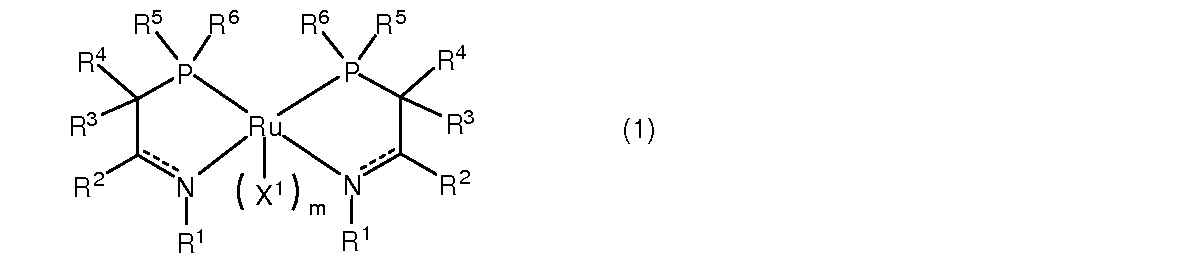
(式中、R1及びR2は、互いに独立して1価の炭化水素基である。2つのR1は、互いに結合して2価の炭化水素基を形成してもよい。R1及びR2は、互いに結合して2価の炭化水素基を形成してもよい。R3及びR4は、互いに独立して水素原子又は1価の炭化水素基である。R3及びR4は、互いに結合して2価の炭化水素基を形成してもよい。R5及びR6は、互いに独立して1価の鎖状脂肪族炭化水素基又は脂環式炭化水素基である。X1は、配位子である。窒素原子と、窒素原子に結合する炭素原子との間の結合は、二重結合又は単結合であり、該結合が単結合である場合には、Ru原子及びR1の間の窒素原子には、水素原子が1つ結合していてもよい。mは0~2である。)
本発明の水素移動反応用触媒によれば、種々の基質に対する水素移動反応を効率よく行うことができる。即ち、本発明の水素移動反応用触媒は、有機化合物(基質)の種類によらず、基質汎用性が高く、種々の水素還元反応及び脱水素反応において、多様な有機化合物(基質)に対して、その反応機構に依存することなく、触媒として高い活性を示すことができる。このため、目的とする水素還元反応又は脱水素反応において、各反応に適した個別の触媒を準備する必要がなく、本発明の水素移動反応用触媒を用いて、広い範囲の基質を水素移動反応に供することができる。このため、反応が効率的であるとともに、経済的であり、触媒の管理も簡易となり得る。本発明の触媒は、様々な水素還元反応及び脱水素反応に対応し得るため、医薬品、農薬、機能性材料の合成中間体等の製造に広く利用することができる。
次に、本発明の水素移動反応物の製造方法によれば、上記本発明の水素移動反応用触媒を用いるため、上記のような種々の反応を高い活性にて行うことができる。このため、極めて効率的である。
更に、本発明の新規なルテニウム錯体によれば、本発明の水素移動反応用触媒として有用である。即ち、本発明のルテニウム錯体を含む触媒を水素移動反応に用いると、高い触媒機能を発揮させることができる。
次に、本発明の水素移動反応物の製造方法によれば、上記本発明の水素移動反応用触媒を用いるため、上記のような種々の反応を高い活性にて行うことができる。このため、極めて効率的である。
更に、本発明の新規なルテニウム錯体によれば、本発明の水素移動反応用触媒として有用である。即ち、本発明のルテニウム錯体を含む触媒を水素移動反応に用いると、高い触媒機能を発揮させることができる。
本明細書において、水素移動反応とは、水素原子が基質から脱離又は付加により移動する反応を意味する。即ち、水素移動反応には、脱水素反応及び水素還元反応が含まれる。また、脱水素反応には、脱水縮合も含む。
更に、「鎖状脂肪族炭化水素基」は、鎖状脂肪族炭化水素を構成する炭素原子に結合していた水素原子が脱離してなる基である。また、「脂環式炭化水素基」及び「芳香族炭化水素基」は、いずれも、下記の態様を含む。
(A)環を構成する炭素原子上の水素原子が脱離した基(例えば、シクロヘキシル基、デカヒドロナフチル基、フェニル基、ナフチル基)。
(B)環を構成する炭素原子上の水素原子が脱離している基であって、同じ炭素原子上又は環を構成する他の炭素原子上の水素原子が他の原子(例えば、ハロゲン原子)又は他の基(例えば、鎖状脂肪族炭化水素基、カルボキシル基、アルコキシ基)に置換された基(例えば、2-メチルシクロヘキシル基、4-エチルフェニル基)。
(C)鎖状脂肪族炭化水素基を構成する炭素原子上の水素原子が、上記(A)の脂環式炭化水素基又は芳香族炭化水素基に置換された基(例えば、2-フェニルプロピル基)。
更に、「鎖状脂肪族炭化水素基」は、鎖状脂肪族炭化水素を構成する炭素原子に結合していた水素原子が脱離してなる基である。また、「脂環式炭化水素基」及び「芳香族炭化水素基」は、いずれも、下記の態様を含む。
(A)環を構成する炭素原子上の水素原子が脱離した基(例えば、シクロヘキシル基、デカヒドロナフチル基、フェニル基、ナフチル基)。
(B)環を構成する炭素原子上の水素原子が脱離している基であって、同じ炭素原子上又は環を構成する他の炭素原子上の水素原子が他の原子(例えば、ハロゲン原子)又は他の基(例えば、鎖状脂肪族炭化水素基、カルボキシル基、アルコキシ基)に置換された基(例えば、2-メチルシクロヘキシル基、4-エチルフェニル基)。
(C)鎖状脂肪族炭化水素基を構成する炭素原子上の水素原子が、上記(A)の脂環式炭化水素基又は芳香族炭化水素基に置換された基(例えば、2-フェニルプロピル基)。
上記一般式(1)において、R1及びR2は、互いに独立して、1価の炭化水素基である。R1及びR2は、同一の基でもよく、異なる基でもよい。また、2つのR1は同一の基でもよく、異なる基でもよい。更に、2つのR2は同一の基でもよく、異なる基でもよい。特に、R1及びR2は、同一の基であることが好ましい。
上記1価の炭化水素基の構造に限定はない。1価の炭化水素基は鎖状構造でもよく、環状構造でもよい。鎖状構造の場合、直鎖状でもよく、分枝状でもよい。上記1価の炭化水素基は、飽和結合のみで構成されていてもよく、不飽和結合を含んでいてもよい。上記1価の炭化水素基は、構造中に他の置換基を1種又は2種以上有していてもよい。例えば、上記1価の炭化水素基は、構造中に炭素原子及び水素原子以外の原子を含む置換基を有していてもよい。上記1価の炭化水素基は、構造中に炭素原子及び水素原子以外の原子を1個又は2個以上含んでいてもよい。上記炭素原子及び水素原子以外の原子としては、ハロゲン原子(フッ素原子、塩素原子、臭素原子及びヨウ素原子等)、硫黄原子、酸素原子及び窒素原子が挙げられる。
上記R1及びR2が表す1価の炭化水素基としては、例えば、炭素原子数が1~20の鎖状脂肪族炭化水素基、炭素原子数が3~20の脂環式炭化水素基、炭素原子数が6~22の芳香族炭化水素基が挙げられる。
上記一般式(1)において、2つのR1は、互いに結合して、2つの窒素原子に結合する2価の炭化水素基を形成してもよい。2価の炭化水素基の炭素原子数は、好ましくは1~20である。
上記一般式(1)において、R1及びR2は、互いに結合して2価の炭化水素基を形成していることが好ましい。ここで、「R1及びR2が互いに結合して2価の炭化水素基を形成している」とは、一般式(1)において、R1、R2、窒素原子、及び窒素原子に結合する炭素原子が互いに結合して環を形成していることを意味する。当該環は、全て単結合から構成されていることもでき、その一部に二重結合を有するものであってもよく、或いは単結合と二重結合とを交互に有する共役系であってもよい。2価の炭化水素基の炭素原子数は、好ましくは1~8、特に好ましくは4である。R1及びR2が互いに結合して形成された2つの2価の炭化水素基は、同一であることが、錯体の構造が対照的となり、合成の容易さの観点から好ましい。上記2価の炭化水素基としては、下記一般式(A)及び(B)で表される有機基が挙げられる。下記一般式(A)で表される有機基は、上記一般式(1)において、窒素原子と、窒素原子に結合する炭素原子との間の結合が二重結合である場合に好ましく用いられ、下記一般式(B)で表される有機基は、上記一般式(1)において、窒素原子と、窒素原子に結合する炭素原子との間の結合が単結合である場合に好ましく用いられる。

上記一般式(A)及び(B)において、Ra~Rdは、互いに独立して、水素原子又は1価の炭化水素基である。1価の炭化水素基について、R1及びR2における炭化水素基の説明が適用される。
上記一般式(A)及び(B)において、Ra~Rdの全てが水素原子又は同一の炭化水素基でもよい。また、Ra~Rdの全てが異なってもよい。更には、Ra~Rdの2つ又は3つが同じであってもよい。
本発明では、上記一般式(1)において、R1、R2、窒素原子、及び、この窒素原子に結合する炭素原子が互いに結合してピリジン環又はピペリジン環を形成しているルテニウム錯体が、種々の基質に対して活性が高いために好ましい。
上記一般式(A)の有機基としては、特に、下記式(A-1)で表される、全てのRa~Rdが水素原子である有機基を含むルテニウム錯体が、高い活性を示すことから好ましい。

また、一般式(B)の有機基としては、特に、全てのRa~Rdが水素原子である有機基を含むルテニウム錯体が、高い活性を示すことから好ましい。
上記一般式(A)及び(B)において、Ra~Rdの全てが水素原子又は同一の炭化水素基でもよい。また、Ra~Rdの全てが異なってもよい。更には、Ra~Rdの2つ又は3つが同じであってもよい。
本発明では、上記一般式(1)において、R1、R2、窒素原子、及び、この窒素原子に結合する炭素原子が互いに結合してピリジン環又はピペリジン環を形成しているルテニウム錯体が、種々の基質に対して活性が高いために好ましい。
上記一般式(A)の有機基としては、特に、下記式(A-1)で表される、全てのRa~Rdが水素原子である有機基を含むルテニウム錯体が、高い活性を示すことから好ましい。
上記一般式(1)において、R3及びR4は、互いに独立して、水素原子又は1価の炭化水素基である。1価の炭化水素基について、R1及びR2の説明が適用される。
上記一般式(1)において、R3及びR4は、同一でもよく、異なってもよい。また、2つのR3は同一でもよく、異なってもよい。更に、2つのR4は同一でもよく、異なってもよい。上記一般式(1)において、R3及びR4は、互いに結合して、リン原子に結合している炭素原子に結合する2価の炭化水素基を形成してもよい。2価の炭化水素基の炭素原子数は、好ましくは2~20である。
本発明において、R3及びR4は、いずれも水素原子であることが好ましい。
上記一般式(1)において、R3及びR4は、同一でもよく、異なってもよい。また、2つのR3は同一でもよく、異なってもよい。更に、2つのR4は同一でもよく、異なってもよい。上記一般式(1)において、R3及びR4は、互いに結合して、リン原子に結合している炭素原子に結合する2価の炭化水素基を形成してもよい。2価の炭化水素基の炭素原子数は、好ましくは2~20である。
本発明において、R3及びR4は、いずれも水素原子であることが好ましい。
上記一般式(1)において、R5及びR6は、互いに独立して、1価の鎖状脂肪族炭化水素基又は脂環式炭化水素基である。R5及びR6は、同一でもよく、異なってもよい。また、2つのR5は同一でもよく、異なってもよい。更に、2つのR6は同一でもよく、異なってもよい。本発明において、2つのR5及び2つのR6は、全て同一の基であることが好ましい。特に、R5及びR6は、1価の脂環式炭化水素基であることが好ましい。R5及びR6が脂環式炭化水素基である場合に、Ru錯体の中でも特に、水素還元反応のみならず、脱水素反応においても、活性が高く、基質汎用性に極めて優れている。
上記1価の鎖状脂肪族炭化水素基及び脂環式炭化水素基の構造に限定はない。上記鎖状脂肪族炭化水素基は、直鎖状でもよく、分枝状でもよい。上記鎖状脂肪族炭化水素基及び脂環式炭化水素基は、飽和結合のみで構成されていてもよく、不飽和結合を含んでいてもよい。特に高い活性を示すことから、上記鎖状脂肪族炭化水素基及び脂環式炭化水素基は、飽和結合のみで構成されている鎖状脂肪族飽和炭化水素基(アルキル基)及び脂環式飽和炭化水素基(シクロアルキル基)であることが好ましい。上記鎖状脂肪族炭化水素基及び脂環式炭化水素基は、構造中に他の置換基を1種又は2種以上有していてもよい。例えば、上記鎖状脂肪族炭化水素基及び脂環式族炭化水素基は、構造中に炭素原子及び水素原子以外の原子を含む置換基を有していてもよい。上記鎖状脂肪族炭化水素基及び脂環式炭化水素基は、構造中に炭素原子及び水素原子以外の原子を1個又は2個以上含んでいてもよい。上記炭素原子及び水素原子以外の原子としては、例えば、ハロゲン原子(フッ素原子、塩素原子、臭素原子及びヨウ素原子等)、硫黄原子、酸素原子及び窒素原子が挙げられる。上記一般式(1)において、R5及びR6の少なくとも一方は、1価の脂環式炭化水素基であることが好ましい。
上記鎖状脂肪族炭化水素基の炭素原子数は、好ましくは1~20、より好ましくは1~10、更に好ましくは1~8、特に好ましくは2~5である。上記鎖状脂肪族炭化水素基は、好ましくは、イソプロピル基及びtert-ブチル基等の分枝状の脂肪族炭化水素基である。また、触媒活性を制御する立体的障害の観点から、高い活性を与えるイソプロピル基、イソブチル基、sec-ブチル基、tert-ブチル基及びエチル基が好ましく、イソプロピル基が特に好ましい。
上記脂環式炭化水素基の炭素原子数は、好ましくは3~20、より好ましくは3~10、特に6である。この炭化水素基は、有橋式脂環式炭化水素基でもよい。上記脂環式炭化水素基としては、シクロプロピル基、シクロブチル基、シクロペンチル基、シクロヘキシル基、シクロへプチル基、シクロオクチル基、シクロノニル基、及びシクロデシル基が挙げられる。これらのうち、触媒活性を制御する立体的障害の観点から、シクロヘキシル基が好ましく、高い活性を得ることができる。上記一般式(1)において、R5及びR6がシクロヘキシル基等の脂環式炭化水素基であると、芳香族炭化水素基又は鎖状脂肪族炭化水素基である場合より、効率よく目的の水素移動反応物を得ることができる。
上記一般式(1)において、X1は配位子であり、mは0~2である。水素移動反応を行う場合、反応系における触媒が、上記一般式(1)におけるmが0~2の範囲の状態にあればよい。即ち、反応系において、mが0である化合物の形態で水素移動反応を進めることができ、mが、例えば、0.5、1、1.6、又は2である化合物の形態で水素移動反応を進めることもできる。
従って、水素移動反応に用いるルテニウム錯体は、mが0の化合物であってよいし、mが2の化合物であってもよい。本発明においては、化学的に安定であることから、mが2の化合物を用いることが好ましい。
上記X1は、配位子として使用されるものであれば、特に限定されない。例えば、水素原子、ハロゲン原子、-BH4、-OTf、-OTs、-BF4、-SbF6、-PF6、-B(C6F5)4、-B(3,5-di-CF3-C6H3)4等が挙げられる。上記一般式(1)において、mが2の化合物の場合、2つのX1は、互いに同一でもよく、異なってもよい。上記ハロゲン原子としては、塩素原子、臭素原子及びヨウ素原子が挙げられ、この中で、入手容易又は製造容易であるため、塩素原子が好ましい。
従って、水素移動反応に用いるルテニウム錯体は、mが0の化合物であってよいし、mが2の化合物であってもよい。本発明においては、化学的に安定であることから、mが2の化合物を用いることが好ましい。
上記X1は、配位子として使用されるものであれば、特に限定されない。例えば、水素原子、ハロゲン原子、-BH4、-OTf、-OTs、-BF4、-SbF6、-PF6、-B(C6F5)4、-B(3,5-di-CF3-C6H3)4等が挙げられる。上記一般式(1)において、mが2の化合物の場合、2つのX1は、互いに同一でもよく、異なってもよい。上記ハロゲン原子としては、塩素原子、臭素原子及びヨウ素原子が挙げられ、この中で、入手容易又は製造容易であるため、塩素原子が好ましい。
上記ルテニウム錯体としては、上記一般式(1)において、2つのR1が同一であり、2つのR2が同一であり、2つのR3が同一であり、2つのR4が同一であり、2つのR5が同一であり、2つのR6が同一であるルテニウム錯体を用いることができる。尚、「2つのR1が同一であり、2つのR2が同一である。」の記載には、R1及びR2が、互いに結合して、例えば、上記一般式(A)及び(B)で表される、2価の炭化水素基を形成しており、2つの炭化水素基が同一である場合を含む。この態様の一例は、下記一般式(2)のルテニウム錯体である。
本発明の水素移動反応用触媒は、上記一般式(1)で表されるルテニウム錯体のうち、Ru原子及びR1の間の窒素原子と、この窒素原子に結合する炭素原子との間の結合が二重結合であるものを含むことが好ましい。上記一般式(1)で表されるルテニウム錯体は、好ましくは、下記一般式(2)、(3)及び(4)で表される。尚、iPrはイソプロピル基である。

上記一般式(2)~(4)において、R1、R2、R5、R6、X1、及びRa~Rdについて、上記の説明が適用される。上記一般式(3)において、シクロヘキシル基を構成する炭素原子上の水素原子は、他の原子又は基で置換されていてもよい。置換基は、上記R1及びR2が表す1価の炭化水素基等とすることができる。
上記一般式(1)で表されるルテニウム錯体としてより好ましい態様は、一般式(2)で表される化合物であって、R5及びR6の少なくとも一方(好ましくは両方)が1価の脂環式炭化水素基であるルテニウム錯体、及び、一般式(2)で表される化合物であって、少なくとも一方のP原子に結合しているR5及びR6が同一の基であるルテニウム錯体が挙げられる。特に好ましいルテニウム錯体は、一般式(2)で表される化合物であって、R5及びR6が全て同一の脂環式炭化水素基であるルテニウム錯体である。そして、このルテニウム錯体では、Ra~Rdは全て水素原子であることが好ましく、具体例として、下記に示される、ジクロロビスジシクロヘキシルホスフィノメチルピリジン-ルテニウム(II)錯体が挙げられる。当該錯体は、本発明の触媒の中でも基質汎用性に極めて優れており、種々の反応に高い活性を示すことができる。

一方、上記一般式(1)で表されるルテニウム錯体において、Ru原子及びR1の間の窒素原子と、この窒素原子に結合する炭素原子との間の結合が単結合である場合、Ru原子及びR1の間の窒素原子には、水素原子が1つ結合していてもよい。この場合、2つの窒素原子に、それぞれ、水素原子が結合していてよいし、1つの窒素原子のみに、水素原子が結合していてもよい。
上記一般式(1)で表され、Ru原子及びR1の間の窒素原子と、この窒素原子に結合する炭素原子との間の結合が単結合であるルテニウム錯体もまた、R5及びR6の少なくとも一方(好ましくは両方)が1価の脂環式炭化水素基である化合物が好ましく、具体例として、下記に示される、ジクロロビスジシクロヘキシルホスフィノメチルピペリジン-ルテニウム(II)錯体が挙げられる。このジクロロビスジシクロヘキシルホスフィノメチルピペリジン-ルテニウム(II)錯体もまた、本発明の触媒の中でも水素移動反応に極めて優れており、種々の基質に対して高い活性を与える。
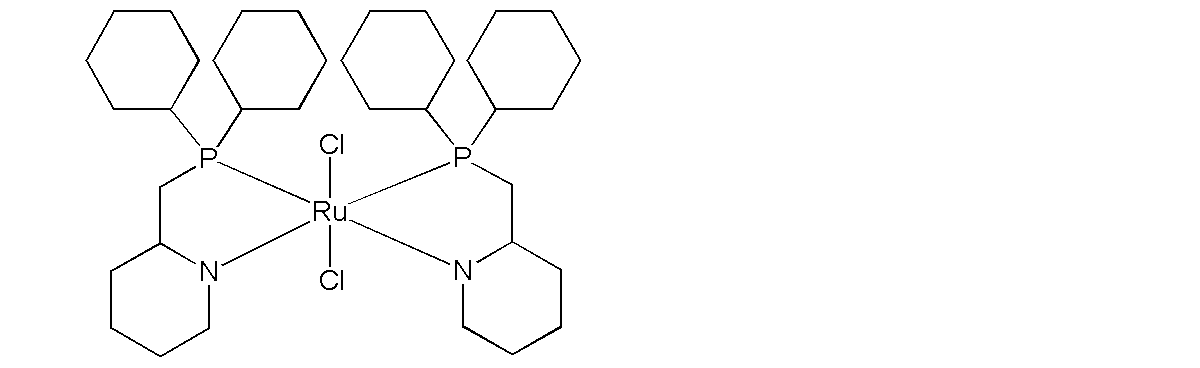
上記一般式(1)で表され、Ru原子及びR1の間の窒素原子と、この窒素原子に結合する炭素原子との間の結合が単結合であるルテニウム錯体もまた、R5及びR6の少なくとも一方(好ましくは両方)が1価の脂環式炭化水素基である化合物が好ましく、具体例として、下記に示される、ジクロロビスジシクロヘキシルホスフィノメチルピペリジン-ルテニウム(II)錯体が挙げられる。このジクロロビスジシクロヘキシルホスフィノメチルピペリジン-ルテニウム(II)錯体もまた、本発明の触媒の中でも水素移動反応に極めて優れており、種々の基質に対して高い活性を与える。
ルテニウム錯体の製造方法に特に限定はない。上記一般式(1)で表され、mが2であるルテニウム錯体は、例えば、下記一般式(11)の化合物(以下、「ルテニウム化合物(11)」という。)と、下記一般式(12)の化合物(以下、「配位子化合物(12)」という。)とを反応させる反応工程を備える製造方法により得ることができる。
Ru(X1)2Ln (11)
(式中、X1は、上記の説明が適用される配位子であり、Lは、X1と異なる配位子であり、nは、0~4の整数である。)
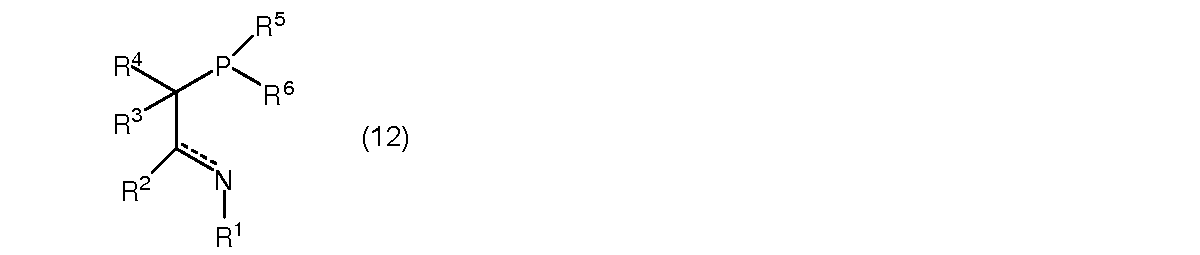
(式中、R1~R6について、上記の説明が適用される。)
Ru(X1)2Ln (11)
(式中、X1は、上記の説明が適用される配位子であり、Lは、X1と異なる配位子であり、nは、0~4の整数である。)
上記ルテニウム化合物(11)を表す一般式(11)において、Lは、好ましくは、-P(R15)3である。R15は、フェニル基又はナフチル基である。尚、フェニル基及びナフチル基において、炭素原子上の水素原子は、他の原子又は基に置換されていてもよい。置換基としては、メチル基、エチル基、n-プロピル基、イソプロピル基、n-ブチル基、イソブチル基、sec-ブチル基、tert-ブチル基等の炭素原子数1~4の鎖状脂肪族炭化水素基;メトキシ基、エトキシ基、n-プロポキシ基、イソプロポキシ基、n-ブトキシ基、tert-ブトキシ基等の炭素原子数1~4のアルコキシ基;フッ素原子、塩素原子、臭素原子、ヨウ素原子等のハロゲン原子等が挙げられる。
上記一般式(11)におけるLが-P(R15)3である場合、nは、通常、3である。
上記一般式(11)で表されるルテニウム化合物(11)としては、例えば、ジクロロトリス(トリフェニルホスフィノ)ルテニウム(II)錯体が挙げられる。
上記一般式(11)におけるLが-P(R15)3である場合、nは、通常、3である。
上記一般式(11)で表されるルテニウム化合物(11)としては、例えば、ジクロロトリス(トリフェニルホスフィノ)ルテニウム(II)錯体が挙げられる。
一方、上記配位子化合物(12)を用いる場合には、1種単独でもよく、2種用いてもよい。通常は、1種の配位子化合物(12)が用いられる。また、配位子化合物(12)は、錯体でもよく、例えば、配位子化合物(12)のホウ素錯体を用いることができる。本発明者らは、配位子化合物をホウ素で保護したホウ素錯体とすることにより、初めて、P原子に結合するR5及びR6がいずれも脂環式炭化水素基である配位子化合物(12)をRuに配位させることに成功した。尚、配位子化合物(12)の調製方法は、特に限定されない。配位子化合物(12)は、例えば、下記の反応により得ることができる。
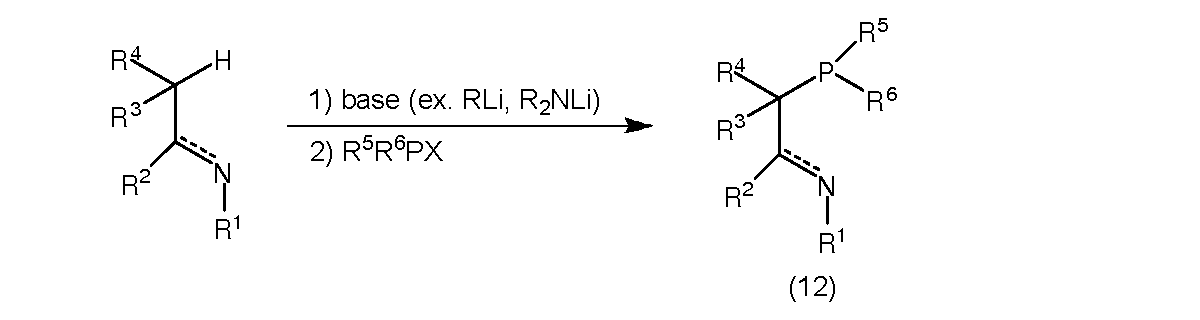
上記スキームにおいて、塩基(base)を構成するRは、アルキル基、アルケニル基、アリール基等の任意の有機基であり、Xは、塩素原子、臭素原子、ヨウ素原子等のハロゲン原子である。
上記一般式(1)で表されるルテニウム錯体の製造方法において、配位子化合物(12)の使用量には特に限定はない。配位子化合物(12)の使用量は、ルテニウム化合物(11)1molに対して、好ましくは0.1~10mol、より好ましくは1~4molである。
上記反応工程において、ルテニウム化合物(11)及び配位子化合物(12)の反応は、通常、溶媒中で行われる。反応溶媒としては、例えば、トルエン、キシレン等の芳香族炭化水素;ペンタン、ヘキサン、ヘプタン等の脂肪族炭化水素;テトラヒドロフラン(THF)、1,4-ジオキサン、メチルtert-ブチルエーテル等が挙げられる。また、上記反応は、通常、不活性ガス雰囲気で行われる。不活性ガス雰囲気としては、例えば、アルゴンガス雰囲気、窒素ガス雰囲気及び水素ガス雰囲気が挙げられる。更に、上記反応の反応温度は、好ましくは10℃~200℃、より好ましくは25℃~100℃である。
上記一般式(1)で表されるルテニウム錯体の製造方法は、配位子化合物(12)及びルテニウム化合物(11)を反応させた後、必要に応じて、精製工程を備えてもよい。精製工程としては、例えば、反応溶媒の除去、生成物の洗浄及びクロマト分離等の一般的な後処理が挙げられる。
本発明の水素移動反応用触媒は、上記ルテニウム錯体を含む限り、その組成には特に限定はない。即ち、本発明の水素移動反応用触媒は、上記ルテニウム錯体以外の他の成分を含んでもよい。本発明の水素移動反応用触媒に含まれるルテニウム錯体は、1種のみでもよく、2種以上でもよい。また、水素移動反応を行う際の触媒の形態には特に限定はない。例えば、通常、固体のルテニウム錯体のみであってよいし、ルテニウム錯体が溶媒中に存在する混合形態であってもよい。上記のように、水素移動反応を行う場合、反応系におけるルテニウム錯体は、上記一般式(1)におけるmが0~2の範囲、特にmが2の状態にあることが好ましい。
本発明の水素移動反応用触媒は、種々の基質の水素移動反応に用いることができる。基質は、汎用の有機化合物から、天然に存在する有機化合物に至る、広い範囲の化合物を網羅する。上記基質は、その安定性に関わらず、水素移動反応に供することができる。
本発明の水素移動反応用触媒は、水素還元反応及び脱水素反応に用いることができる。特に、本発明の水素移動反応用触媒は、好ましくは水素ガスを用いた還元反応に用いることができる。
本発明の水素移動反応物の製造方法は、水素移動反応用触媒の存在下、有機化合物(基質)を、脱水素反応又は水素還元反応に供する工程(水素移動反応工程)を備える。
ここで、「水素移動反応用触媒の存在下」とは、水素移動反応用触媒に含まれるルテニウム錯体が反応工程の少なくとも一部の段階で存在していればよく、反応工程の全ての段階で常に存在している必要はない。即ち、本発明では、上記一般式(1)で表されるルテニウム錯体を反応系に加えれば、「水素移動反応用触媒の存在下」の要件を満たす。従って、本発明では、上記ルテニウム錯体を反応系に加えた後、反応工程でルテニウム錯体に何らかの変化が生じたとしても、「水素移動反応用触媒の存在下」に含まれる。例えば、上記ルテニウム錯体を反応系に加えた後、系中で何らかの変化が生じ、この変性物が反応に寄与する場合も、「水素移動反応用触媒の存在下」に含まれる。
ここで、「水素移動反応用触媒の存在下」とは、水素移動反応用触媒に含まれるルテニウム錯体が反応工程の少なくとも一部の段階で存在していればよく、反応工程の全ての段階で常に存在している必要はない。即ち、本発明では、上記一般式(1)で表されるルテニウム錯体を反応系に加えれば、「水素移動反応用触媒の存在下」の要件を満たす。従って、本発明では、上記ルテニウム錯体を反応系に加えた後、反応工程でルテニウム錯体に何らかの変化が生じたとしても、「水素移動反応用触媒の存在下」に含まれる。例えば、上記ルテニウム錯体を反応系に加えた後、系中で何らかの変化が生じ、この変性物が反応に寄与する場合も、「水素移動反応用触媒の存在下」に含まれる。
上記水素移動反応工程において、水素移動反応用触媒に含まれるルテニウム錯体の使用量は、基質1molに対して、好ましくは0.0001~0.5mol、より好ましくは0.001~0.1molである。本発明の水素移動反応用触媒は、ルテニウム錯体の使用量が上記範囲となるように、調整して用いられる。
上記水素移動反応は、通常、溶媒中で行う。
上記溶媒には特に限定はない。反応溶媒としては、炭化水素、エーテル、アルコール、ジメチルホルムアミド(DMF)、ジメチルスルホキシド(DMSO)、1,3-ジメチル-2-イミダゾリジノン(DMI)等が挙げられる。これらの化合物は、単独で用いてよいし、2種以上を組み合わせて用いてもよい。
上記溶媒には特に限定はない。反応溶媒としては、炭化水素、エーテル、アルコール、ジメチルホルムアミド(DMF)、ジメチルスルホキシド(DMSO)、1,3-ジメチル-2-イミダゾリジノン(DMI)等が挙げられる。これらの化合物は、単独で用いてよいし、2種以上を組み合わせて用いてもよい。
上記炭化水素としては、ベンゼン、トルエン、オルトキシレン、メタキシレン、パラキシレン、メシチレン、1,2,4-トリメチルベンゼン、ヘキサン、ペンタン、シクロペンタン、ヘプタン、オクタン、ノナン、デカン、及び石油エーテルが挙げられる。上記エーテルとしては、テトラヒドロフラン(THF)、1,4-ジオキサン、ジエチルエーテル、メチルtert-ブチルエーテル、及びジイソプロピルエーテルが挙げられる。上記アルコールとしては、tert-ブタノール、イソプロパノール、エタノール、メタノール、トリフルオロメタノール、ペンタフルオロエタノール、ヘキサフルオロイソプロパノール、ヘプタフルオロイソプロパノール、及びノナフルオロtert-ブタノールが挙げられる。
上記水素移動反応は、必要に応じて、酸若しくは塩基の性質又はその作用を有する添加剤(以下、単に「添加剤」という。)の存在下で行ってもよい。上記添加剤としては、例えば、一般式:MORで表されるアルコキシド(アルコラート)、一般式:MBH4で表される水素化ホウ素化合物、一般式:MBF4で表されるテトラフルオロホウ酸塩、一般式:MPF6で表されるヘキサフルオロリン酸塩、一般式:MSbF6で表されるヘキサフルオロアンチモン酸塩等が挙げられる。これらの化合物は、単独で用いてよいし、2種以上を組み合わせて用いてもよい。
上記一般式において、MはLi原子、Na原子、K原子又はCs原子であり、Rは炭化水素基である。上記添加剤としては、MがNa原子又はK原子の化合物が好ましい。
上記一般式において、MはLi原子、Na原子、K原子又はCs原子であり、Rは炭化水素基である。上記添加剤としては、MがNa原子又はK原子の化合物が好ましい。
上記添加剤の使用量は、基質1molに対して、好ましくは0.0001~0.5mol、より好ましくは0.001~0.5molである。
上記水素移動反応工程における反応条件には特に限定はない。反応条件は、基質の種類等に応じて、適宜、選択することができる。水素移動反応は、通常、加熱及び加圧条件下で行われる。本発明では、水素移動反応は、穏やかな反応条件下でも行うことができる。反応温度は、通常、200℃未満、好ましくは25℃~180℃である。圧力は、通常、10MPa以下、好ましくは0.1~8MPaである。反応時間は、通常、0.5~240時間である。
上記水素移動反応工程では、反応の途中に、ガスクロマトグラフィー、薄層クロマトグラフィー、液体クロマトグラフィー、核磁気共鳴等により、基質の濃度等を追跡することができる。水素移動反応工程では、反応の終点を、基質が殆ど消失した時点とすることが好ましい。
上記水素移動反応工程の終了後、反応生成物である水素移動反応物は、蒸留、再結晶、カラムクロマトグラフィー等により精製することができる。即ち、本発明の水素移動反応物の製造方法は、更に、精製工程を備えることができる。水素移動反応工程で用いた水素移動反応用触媒は、カラムクロマトグラフィー等により取り除くことができる。
以下、脱水素反応及び水素還元反応について、順次、説明する。
以下、脱水素反応及び水素還元反応について、順次、説明する。
本発明において、脱水素反応は、基質から水素原子が脱離する反応である限り、反応内容に特に限定はない。上記脱水素反応により得られる水素移動反応物は、基質から水素原子が脱離した化合物である限り、その構造に特に限定はない。
上記脱水素反応に用いる基質(以下、「基質(S1)」という。)は、アミノアルコール、脂肪族1級アルコール、脂肪族2級アルコール、芳香族1級アルコール、芳香族2級アルコール等のアルコール類である。アルコール類を脱水素反応に供した際には、水素移動反応物として、通常、カルボニル化合物が得られる。例えば、基質(S1)が1級アルコールであれば、水素移動反応物として、通常、アルデヒドが得られ、基質(S1)が2級アルコールであれば、水素移動反応物として、通常、ケトンが得られる。
上記脱水素反応において得られた水素移動反応物は、単離された後、他の反応に用いることができるが、水素移動反応工程における反応系を継続して使用する場合には、必ずしも単離する必要はない。この場合、水素移動反応物を得た後、これと別の化合物とを更に反応させて、他の反応生成物を製造することができる。この一連の方法も脱水素反応に含まれ、上記他の反応生成物も水素移動反応物に含まれる。このような他の反応生成物を製造する場合、上記別の化合物の使用方法としては、水素移動反応工程の途中で加える方法、及び、その当初から加える方法がある。
例えば、本発明の水素移動反応用触媒の存在下、1級又は2級のアルコールと、1級若しくは2級のアルコール又はカルボニル化合物(アルデヒド又はケトン)とを反応させることにより、ヒドロキシカルボニル化合物、又は、α,β-不飽和カルボニル化合物若しくはその水素付加物(α,β-不飽和部位が飽和化されたカルボニル化合物)を得ることができる(下記スキーム参照。)。この方法では、水素移動反応用触媒の作用により、アルコールの脱水素反応が進行してカルボニル化合物が得られ、更に、この得られたカルボニル化合物と、RA及びRB基をもつ下記のカルボニル化合物(このカルボニル化合物は、RA及びRB基をもつアルコールが酸化されても得られる)がアルドール縮合することにより、ヒドロキシカルボニル化合物又はα,β-不飽和カルボニル化合物若しくはその水素付加物が得られると考えられる(本説明は発明者の推測である。従って、本説明は、何ら本発明を定義する趣旨の説明ではない。)。

上記スキームにおいて、RC(1)は本発明の水素移動反応用触媒を意味し、R、RA及びRBは、互いに独立して、水素原子又は1価の炭化水素基である。1価の炭化水素基について、R1及びR2の説明が適用される。
この脱水素反応の他の例として、例えば、本発明の水素移動反応用触媒の存在下、β-アミノアルコールと、1級若しくは2級のアルコール又はカルボニル化合物(アルデヒド又はケトン)とを反応させることにより、ピロールを合成することができる(下記スキーム参照)。この方法では、アルドール縮合とイミン形成により、ピロールが得られると考えられる(本説明は発明者の推測である。従って、本説明は、何ら本発明を定義する趣旨の説明ではない。)。

上記スキームにおいて、RC(1)は本発明の水素移動反応用触媒を意味し、Rは、互いに独立して、水素原子又は任意の有機基である。有機基が1価の炭化水素基である場合は、R1及びR2の説明が適用される。
得られたピロールは、好ましくは、3位のRが水素原子である3置換ピロールである。)
従って、本発明の水素移動反応用触媒は、脱水素反応及び脱水縮合等を組み合わせた多段階反応にも活性を示す。従って、従来は多段階にて行っていた反応を一工程にて行うこともでき、効率的である。
得られたピロールは、好ましくは、3位のRが水素原子である3置換ピロールである。)
従って、本発明の水素移動反応用触媒は、脱水素反応及び脱水縮合等を組み合わせた多段階反応にも活性を示す。従って、従来は多段階にて行っていた反応を一工程にて行うこともでき、効率的である。
上記水素移動反応用触媒を用いた脱水素反応によれば、バリノールと2-フェニル-1-(パラフルオロフェニル)エタン-1-オンとを反応させることにより、2-(4-フルオロフェニル)-5-イソプロピル-3-フェニル-1H-ピロールを得ることができる(実施例7-1参照)。この反応生成物は、脂質異常症治療薬アトルバスタチン・カルシウム塩(商品名「リピトール」)の核構造をなすピロール骨格を有する前駆体化合物として極めて重要である。この前駆体化合物を基質として、更に、下記の反応により、アトルバスタチン・カルシウム塩を得ることができる。

更に、本発明によれば、本発明の水素移動反応用触媒の存在下、1-ベンジル-4-ピペリジンメタノールと、5,6-ジメトキシインダノンとを反応させることにより、アルツハイマー病治療薬であるドネペジルを合成することができる(実施例7-2参照)。尚、1-ベンジル-4-ピペリジンメタノールは、本発明の水素移動反応用触媒の存在下、N-ベンジル-4-エトキシカルボニルピペリジンを基質として、本発明に係る水素還元反応により得ることができる(実施例3-18参照)ので、反応液から、水素移動反応物である1-ベンジル-4-ピペリジンメタノールを単離することなく、同じ反応系で次の反応を行い、N-ベンジル-4-エトキシカルボニルピペリジンからドネペジルを合成することができる。即ち、実施例3-18の反応と実施例7-2の反応を、同じ反応系で連続的に行い、ドネペジルを合成することができる。また、水素ガスによる水素還元反応を用いて1-ベンジル-4-ピペリジンメタノールを製造すれば、塩廃棄物の排出を抑制することができるので好ましい。尚、既存のドネペジルの合成法では、各反応段階で独立した反応容器が必要である上、多量の塩廃棄物を排出していた。従って、本発明の水素移動反応用触媒によれば、多段階反応を効率的に行うことができるとともに、環境負荷が軽減されている。
次に、本発明において、水素還元反応は、基質に水素原子が付加する反応である限り、反応内容に特に限定はない。基質に水素原子が付加する反応は、基質中の官能基又は不飽和結合(芳香族炭化水素の芳香環中の不飽和結合は除く。)に水素原子が付加する反応を意味する。上記水素還元反応としては、金属水素化物(LiAlH4、NaBH4等)を用いた還元反応及び水素ガスを用いた還元反応が挙げられる。上記水素還元反応は、好ましくは、水素ガスを用いた還元反応である。この反応では、Li及びAl等の金属水素化物由来の塩の廃棄処理が不要であることから、環境負荷を低減することができる。その結果、この反応は、大量生産を含む工業的な合成方法に好適である。
上記水素還元反応により得られる水素移動反応物は、基質に水素原子が付加した化合物である限り、その構造に特に限定はない。
上記水素還元反応により得られる水素移動反応物は、基質に水素原子が付加した化合物である限り、その構造に特に限定はない。
上記水素還元反応に用いる基質(以下、「基質(S2)」という。)は、アミド、エステル、カルボン酸、炭酸エステル、ケトン、アルデヒド等の、炭素-酸素不飽和結合を有する化合物;>C=C<、-C≡C-等の、炭素-炭素不飽和結合を有する化合物;縮合複素環化合物;シアノ基を有する化合物等の、炭素-窒素不飽和結合を有する化合物;又はニトロ基を有する化合物等の、窒素-酸素不飽和結合を有する化合物等である。尚、基質(S2)の構造には特に限定はない。基質(S2)は、鎖式化合物及び環式化合物のいずれでもよい。また、>C=C<、-C≡C-、又は、>C=N-を有する化合物において、これらの不飽和結合は、化合物中のいずれの部位にあってもよい。本発明の水素移動反応用触媒によれば、エステルの水素還元反応等においても、高い収率で製造することができる。
上記基質(S2)が炭素-炭素不飽和結合、炭素-窒素不飽和結合、又は炭素-酸素不飽和結合を有する化合物の場合、得られる水素移動反応物は、炭素-炭素飽和結合、炭素-窒素飽和結合、又は炭素-酸素飽和結合を有する化合物である。上記基質(S2)が>C=C<又は-C≡C-を有する化合物の場合、得られる水素移動反応物は、通常、これらの部位が部分的に又は完全に水素化された化合物である。「部分的に水素化」とは、例えば、-C≡C-を>C=C<に変換することを意味する。また、上記基質(S2)が>C=N-を環外に有する化合物の場合、得られる水素移動反応物は、通常、アミン(>CH-NH-)である。
上記アミドは、-CONR-(-RNCONR-及び-OCONR-を含む)又は-CONR2(Rは、水素原子又は有機基である。)で表される基を有する化合物である。上記アミドは、ウレア、ウレタン、イミド及びラクタムを含む。
上記ニトロ基を有する化合物及びシアノ基を有する化合物として好ましくは、芳香環を構成する炭素原子上の水素原子がニトロ基又はシアノ基に置換された化合物である。例えば、ニトロベンゼン及びベンゾニトリル並びにこれらの化合物の芳香環を構成する炭素原子上の水素原子が他の基に置換された誘導体が挙げられる。
上記ニトロ基を有する化合物及びシアノ基を有する化合物として好ましくは、芳香環を構成する炭素原子上の水素原子がニトロ基又はシアノ基に置換された化合物である。例えば、ニトロベンゼン及びベンゾニトリル並びにこれらの化合物の芳香環を構成する炭素原子上の水素原子が他の基に置換された誘導体が挙げられる。
上記基質(S2)がアミドの場合、得られる水素移動反応物は、通常、アルコール及び/又はアミンである。上記基質(S2)がウレアの場合、得られる水素移動反応物は、通常、アミン及び/又はホルムアミド誘導体である。上記基質(S2)がラクタムの場合、得られる水素移動反応物は、通常、アミン(特に環状アミン)及び/又はアミノアルコールである。また、上記基質(S2)がニトロ基を有する化合物又はシアノ基を有する場合、得られる水素移動反応物は、通常、アミノ基を有する化合物である(下記スキーム参照。)。
上記基質(S2)がカルボニル化合物(ケトン又はアルデヒド)、カルボン酸、エステル、又は炭酸エステルの場合、得られる水素移動反応物は、通常、アルコールである。上記基質(S2)が縮合複素環化合物(例えば、キノリン、イソキノリン、ベンゾフラン、ベンゾチオフェン及びインドール)の場合、水素移動反応物として、複素芳香環が飽和した化合物を得ることができる(下記スキーム参照。)。

上記基質(S2)が、-CONR-(-RNCONR-及び-OCONR-を含む)、-CONR2、-COOR、>CO、-CHO、-COOH、-O(CO)O-、-NO2及び-CNから選ばれた2つ以上の官能基を含む場合、得られる水素移動反応物は、上記官能基の全てが水素化された化合物でもよく、上記官能基のうちの一部が水素化され、残部が水素化されていない化合物でもよい。
また、上記基質(S2)が、同一の官能基を2つ以上含む場合、得られる水素移動反応物は、上記官能基の全てが水素化された化合物でもよく、上記官能基のうちの一部が水素化された化合物でもよい。このような基質(S2)を用いた場合、環化を伴って水素化が進む場合がある。例えば、フタル酸エステルの水素還元反応では、エステル基の一方が還元されて水酸基となり、この水酸基と他方のエステル基とが反応して、環状エステルを形成することがある(実施例3-15参照)。かかる反応の生成物も水素移動反応物に含まれる。
上記基質(S2)を水素還元方法に供する場合、反応系にアルコールを添加することが好ましい。このアルコール添加により、水素還元を促進することができ、反応時間を短縮することができる。
上記アルコールとしては、炭素原子数が1~20の脂肪族アルコール、炭素原子数が3~10の脂環族アルコール、炭素原子数が6~20の芳香族アルコールが挙げられる。好ましくは、ベンジルアルコール、メタノール、エタノール及びイソプロパノールであり、特にベンジルアルコール及びイソプロパノールが好ましい。上記アルコールは、単独で用いてよいし、2種以上を組み合わせて用いてもよい。
上記アルコールの使用量は、上記基質(S2)に対して、好ましくは0.01~150mol%、より好ましくは1~50mol%である。
尚、上記アルコールは、そのまま、反応系に添加してよいし、反応溶媒との混合物として添加してもよい。
アルコール添加による水素還元反応の促進効果は、特に基質(S2)が、-COOR-を含む化合物(エステル)である場合に特に優れている。
尚、上記アルコールは、そのまま、反応系に添加してよいし、反応溶媒との混合物として添加してもよい。
アルコール添加による水素還元反応の促進効果は、特に基質(S2)が、-COOR-を含む化合物(エステル)である場合に特に優れている。
本発明において、上記基質(S2)としては、アミド、エステル、ケトン、カルボン酸、及びアルデヒドが好ましく、アミド、エステル、ケトン及びアルデヒドが特に好ましい。
以上のように、本発明の水素移動反応用触媒は、種々の基質に対して好適であるので、本発明の水素移動反応用触媒を用いる水素移動反応では、基質の構造から、得られる水素移動反応物を推定することができる。例えば、天然に存在する有機化合物であって、アミド、エステル、ケトン、アルデヒド、カルボン酸等の、>C=Oを有する化合物、ニトロ基を有する化合物、シアノ基を有する化合物、>C=C<又は-C≡C-を有する化合物、>C=N-を有する化合物等を、水素移動反応に供した場合にも、反応生成物の構造を推定することができる。従って、本発明の水素移動反応用触媒を用いることにより、従来、多段階の反応工程により製造していた目的の化合物を、より少ない工程で容易に製造することができる。
本発明のルテニウム錯体は、上記水素移動反応用触媒の説明において記載した錯体である。即ち、本発明によるルテニウム触媒は、一般式(1)において、P原子に結合するR5及びR6がいずれも、鎖状脂肪族炭化水素基又は脂環式炭化水素基であることを特徴とするルテニウム錯体であって、特に脂環式炭化水素基である錯体は、従来、知られていない新規な化合物である。ルテニウム錯体をこのような新規な構成とすることによって、初めて種々の基質に対応し得る触媒として機能させることに成功した。また、本発明のルテニウム錯体は、いずれの文献に記載の製造方法によっても製造することはできない。即ち、配位子化合物(12)において、R5及びR6として脂環式炭化水素基が結合したP原子を含む配位子化合物は、極めて酸素との反応性が高いために、このままではRu化合物と反応させて錯体を形成させることが困難である。本発明によれば、P原子を含む配位子化合物をホウ素錯体とする(即ち、ホウ素で保護する)手法を採用することにより、本願構成のルテニウム錯体を初めて合成することに成功したのである。この方法は、特許文献2及び3のいずれにも記載されていない。
以下、本発明について、実施例を挙げて具体的に説明する。本発明は、これらの実施例に何ら制約されない。
1.ルテニウム錯体の製造
実施例1-1
以下のように、前駆体であるジシクロヘキシルホスフィノメチルピリジンボラン錯体(P1)を合成した後、このジシクロヘキシルホスフィノメチルピリジンボラン錯体(P1)を用いて、ジクロロビスジシクロヘキシルホスフィノメチルピリジン-ルテニウム(II)錯体(以下、「ルテニウム錯体(C1)」又は「Ru complex(C1)」ともいう。)を得た。反応スキームを以下に示す(Cy:シクロヘキシル基)。尚、以下に、ジシクロヘキシルホスフィノメチルピリジンボラン錯体(P1)の合成方法を2通り記載する。
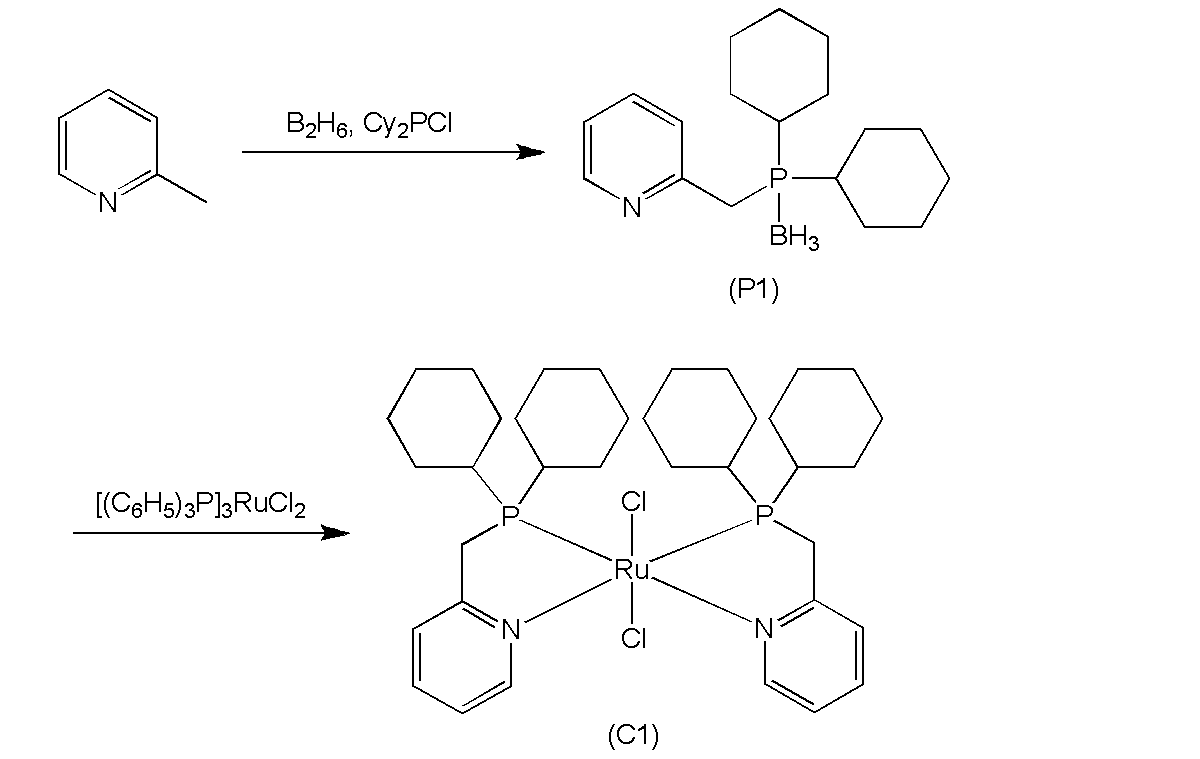
実施例1-1
以下のように、前駆体であるジシクロヘキシルホスフィノメチルピリジンボラン錯体(P1)を合成した後、このジシクロヘキシルホスフィノメチルピリジンボラン錯体(P1)を用いて、ジクロロビスジシクロヘキシルホスフィノメチルピリジン-ルテニウム(II)錯体(以下、「ルテニウム錯体(C1)」又は「Ru complex(C1)」ともいう。)を得た。反応スキームを以下に示す(Cy:シクロヘキシル基)。尚、以下に、ジシクロヘキシルホスフィノメチルピリジンボラン錯体(P1)の合成方法を2通り記載する。
(ジシクロヘキシルホスフィノメチルピリジンボラン錯体(P1)の合成1)
乾燥後、アルゴンガスで置換された200mLの二口フラスコに、撹拌子、2-ピコリン(1.5mL、15mmol)及びTHF(25mL)を収容し、十分に撹拌した。その後、撹拌しながらフラスコを-78℃の冷媒(メタノール/ドライアイス)に15分間浸し、十分に冷却した。この溶液に、n-ブチルリチウムのヘキサン溶液(10.3mL、1.5M-ヘキサン溶液、15.5mmol)を徐々に滴下しながら反応させたところ、反応溶液の色が無色透明から赤褐色に変化した。次いで、反応溶液の温度を-78℃に保ちながら、更に3時間撹拌を続け、原料(A1)を得た。
乾燥後、アルゴンガスで置換された200mLの二口フラスコに、撹拌子、2-ピコリン(1.5mL、15mmol)及びTHF(25mL)を収容し、十分に撹拌した。その後、撹拌しながらフラスコを-78℃の冷媒(メタノール/ドライアイス)に15分間浸し、十分に冷却した。この溶液に、n-ブチルリチウムのヘキサン溶液(10.3mL、1.5M-ヘキサン溶液、15.5mmol)を徐々に滴下しながら反応させたところ、反応溶液の色が無色透明から赤褐色に変化した。次いで、反応溶液の温度を-78℃に保ちながら、更に3時間撹拌を続け、原料(A1)を得た。
一方、乾燥後、アルゴンガスで置換された100mLの二口フラスコに、THF(15mL)及びボランのTHF溶液(15mL、1.0M-THF溶液、15mmol)を収容し、十分に撹拌した。その後、この溶液を撹拌しながら、クロロジシクロへキシルホスフィン(3.5mL、15.5mmol)を加え、添加後、更に30分間撹拌を続け、原料(A2)を得た。
次に、シリンジを用いて、原料(A2)を、原料(A1)を含む二口フラスコ内に徐々に滴下して反応させた。尚、原料(A2)の滴下中、フラスコ内の温度を-78℃に保持した。滴下終了後、フラスコを冷媒から出し、反応溶液の撹拌を続けながら、室温(25℃)に戻した。5時間後、反応溶液に水を加え、溶液全体をエバポレーターで濃縮した。得られた濃縮物を200mLの分液漏斗に移し、更に、100mLの蒸留水、50mLのジクロロメタン及び少量の飽和食塩水を加えて、分液・抽出操作を行った。有機層(ジクロロメタン層)を回収して、この抽出操作を合計3回行った。得られた有機層(粗生成物を含むジクロロメタン溶液)を、硫酸ナトリウムを用いて脱水処理し、濾過により得られた濾液をエバポレーターで濃縮した。
その後、得られた濃縮物を、シリカゲルを短く積んだカラムクロマトグラフィー(展開溶媒:酢酸エチル)に供した。次いで、得られた精製物を含む酢酸エチル溶液を、減圧条件(0.1~2mmHg)で濃縮した。その後、-40℃の冷凍庫内で12時間放置し、白色結晶を得た。この白色結晶を、約0℃に冷却したジエチルエーテルで数回洗浄することで、ジシクロヘキシルホスフィノメチルピリジンボラン錯体(P1)の結晶1139.8mg(3.8mmol)を、25%の単離収率で得た。
ジシクロヘキシルホスフィノメチルピリジンボラン錯体(P1)のスペクトルデータは以下の通りであった。
1H NMR (270MHz, CDCl3):δ8.49 (d, 1H, J=4.3, C5H4N), 7.62 (td, 1H, J=7.9, 1.6 Hz, C5H4N), 7.36 (d, 1H, J=8.2 Hz, C5H4N), 7.16 (t, 1H, J=6.3 Hz, C5H4N), 3.23 (d, 2H, J=11.5 Hz, PCH2), 0.30-1.84 (25H, C6H11, BH3). 13C NMR (200MHz, CDCl3):δ155.1, 149.1, 136.4, 125.3, 121.9, 32.0, 31.7, 27.1 (d, J=34.5 Hz), 26.8 (d, J=51.8 Hz), 26.1. 31P NMR (200MHz, CDCl3):δ28.5.
1H NMR (270MHz, CDCl3):δ8.49 (d, 1H, J=4.3, C5H4N), 7.62 (td, 1H, J=7.9, 1.6 Hz, C5H4N), 7.36 (d, 1H, J=8.2 Hz, C5H4N), 7.16 (t, 1H, J=6.3 Hz, C5H4N), 3.23 (d, 2H, J=11.5 Hz, PCH2), 0.30-1.84 (25H, C6H11, BH3). 13C NMR (200MHz, CDCl3):δ155.1, 149.1, 136.4, 125.3, 121.9, 32.0, 31.7, 27.1 (d, J=34.5 Hz), 26.8 (d, J=51.8 Hz), 26.1. 31P NMR (200MHz, CDCl3):δ28.5.
(ジシクロヘキシルホスフィノメチルピリジンボラン錯体(P1)の合成2)
乾燥後、アルゴンガスで置換された300mLの二口フラスコに、撹拌子、2-ピコリン(1.8mL、18mmol)及びTHF(45mL)を収容し、十分に撹拌した。その後、撹拌しながらフラスコを-78℃の冷媒(メタノール/ドライアイス)に15分間浸し、十分に冷却した。この溶液に、n-ブチルリチウムのヘキサン溶液(12mL、1.5M-ヘキサン溶液、18mmol)を徐々に滴下しながら反応させたところ、反応溶液の色が無色透明から赤褐色に変化した。次いで、反応溶液の温度を-78℃に保ちながら、更に3時間撹拌を続け、原料(A1)を得た。
乾燥後、アルゴンガスで置換された300mLの二口フラスコに、撹拌子、2-ピコリン(1.8mL、18mmol)及びTHF(45mL)を収容し、十分に撹拌した。その後、撹拌しながらフラスコを-78℃の冷媒(メタノール/ドライアイス)に15分間浸し、十分に冷却した。この溶液に、n-ブチルリチウムのヘキサン溶液(12mL、1.5M-ヘキサン溶液、18mmol)を徐々に滴下しながら反応させたところ、反応溶液の色が無色透明から赤褐色に変化した。次いで、反応溶液の温度を-78℃に保ちながら、更に3時間撹拌を続け、原料(A1)を得た。
一方、乾燥後、アルゴンガスで置換された100mLの二口フラスコに、THF(15mL)及びボランのTHF溶液(13.2mL、0.9M-THF溶液、12mmol)を収容し、室温(25℃)で十分に撹拌した。その後、この溶液を撹拌しながら、クロロジシクロヘキシルホスフィン(2.6mL、12mmol)を加え、添加後、更に60分間撹拌を続け、原料(A2)を得た。
次に、シリンジを用いて、原料(A2)を、原料(A1)を含む二口フラスコ内に徐々に滴下して反応させた。尚、原料(A2)の滴下中、フラスコ内の温度を-78℃に保持した。滴下終了後、フラスコを冷媒から出し、反応溶液の撹拌を続けながら、室温(25℃)に戻した。12時間後、反応容器に水(10mL)を加え、溶液全体をエバポレーターで濃縮した。得られた濃縮物を200mLの分液漏斗に移し、更に、50mLの蒸留水、20mLのジクロロメタン及び少量の飽和食塩水を加えて、分液・抽出操作を行った。有機層(ジクロロメタン層)を回収して、この抽出操作を合計3回行った。得られた有機層(粗生成物を含むジクロロメタン溶液)を、硫酸ナトリウムを用いて脱水処理し、ろ過により得られたろ液をエバポレーターで濃縮した。
その後、得られた濃縮物を、シリカゲルを積んだカラムクロマトグラフィー(展開溶媒:酢酸エチル/ヘキサン=1/5)に供した。次いで、生成物を含む分画を回収した。この溶液から減圧条件(0.1~2mmHg)で溶媒を取り除き、淡い黄色の結晶を得た。この結晶を、少量のジクロロメタンに溶かし、次いでヘキサンを過剰に加えた後、-40℃の冷蔵庫内で12時間放置し、白色結晶を得た。この白色結晶を、ヘキサンで数回洗浄することで、精製されたジシクロヘキシルホスフィノメチルピリジンボラン錯体(P1)の結晶2392mg(7.7mmol)を、65%の単離収率で得た。
(ルテニウム錯体(C1)の合成)
ジシクロヘキシルホスフィノメチルピリジンボラン錯体(P1)(630mg、2.07mmol)及びジエチルアミン(30mL)を、アルゴンガスで置換した100mLのシュレンク容器に収容した。その後、シュレンク容器を、オイルバス内に配置し、シュレンク容器内の成分を撹拌しながら、60℃に加熱し、反応させた。反応の進行を、TLCで確認し、96時間後に、加熱を終了した。次いで、室温(25℃)に戻した反応液中のジエチルアミンを、減圧条件(0.1~2mmHg)で、液体窒素トラップを用いて捕集のうえ除去した。このとき、反応液を十分に撹拌するとともに、気化熱によりシュレンク容器が冷えることを防ぐため、ヘアードライヤーで温風を容器の外側から当て続けた。
ジシクロヘキシルホスフィノメチルピリジンボラン錯体(P1)(630mg、2.07mmol)及びジエチルアミン(30mL)を、アルゴンガスで置換した100mLのシュレンク容器に収容した。その後、シュレンク容器を、オイルバス内に配置し、シュレンク容器内の成分を撹拌しながら、60℃に加熱し、反応させた。反応の進行を、TLCで確認し、96時間後に、加熱を終了した。次いで、室温(25℃)に戻した反応液中のジエチルアミンを、減圧条件(0.1~2mmHg)で、液体窒素トラップを用いて捕集のうえ除去した。このとき、反応液を十分に撹拌するとともに、気化熱によりシュレンク容器が冷えることを防ぐため、ヘアードライヤーで温風を容器の外側から当て続けた。
ジエチルアミンを十分に除去した後、アルゴンガスをシュレンク容器内に導入しながら、ジクロロトリス(トリフェニルホスフィノ)ルテニウム(II)(996mg、1.04mmol)及び脱水トルエン(30mL)を加え、オイルバスを用いて110℃に加熱し、反応させた。12時間後に、加熱を終了し、反応液を室温(25℃)に戻した。
その後、アルゴンガス雰囲気下、上記反応液に、脱水ヘキサン(60mL)を加えた。しばらくすると、ヘキサン及びトルエンの液-液界面あたりに、黄色物質が生成した。そこで、シュレンク容器内のヘキサン層及びトルエン層を含む全てを撹拌し、完全に混合させた。12時間静置した後、生成した黄色物質を脱水ヘキサンで洗浄しながら吸引濾過し、粗生成物473mgを得た。
次いで、得られた粗生成物を、シリカゲルを3cm程度積んだカラムクロマトグラフィー(展開溶媒:酢酸エチル)に供して極性の高い化合物を取り除いた。尚、このカラムクロマトグラフィーでは、シリカゲルを充填するガラス管の外周に、ガラス管内を冷却するためのジャケットを装着した装置とし、ジャケットの内部に、-20℃の冷媒を循環させながら精製した。更に、流出液は、流出する液体の色が、黄色から無色透明に変化するまでアルミホイルで包まれたフラスコで回収し続けた。この操作の後、ナスフラスコ内の回収溶液を迅速にエバポレーターで濃縮し、黄色物質であるほぼ純品のルテニウム錯体(C1)300mg(0.40mmol、39%)を得た。
ルテニウム錯体(C1)のスペクトルデータは以下の通りであった。
1H NMR(400MHz, CDCl3):δ8.48 (d, 2H, J=5.8 Hz, C5H4N), 7.62 (t, 2H, J=7.7 Hz, C5H4N), 7.44 (d, 2H, J=7.8 Hz, C5H4N), 7.11 (t, 2H, J=6.7 Hz, C5H4N), 3.90 (br, 4H, PCH2), 1.19-2.21 (44H, C6H11). 13C NMR (133MHz, CDCl3):δ165.3, 155.1, 135.9, 122.1, 121.6, 37.4, 29.6, 27.8, 27.6, 26.3. 31P NMR (200MHz, CDCl3):δ66.1. HRMS (FAB, M+) calcd for C36H56Cl2N2P2Ru+: 750.2334. Found m/z = 750.2314.
1H NMR(400MHz, CDCl3):δ8.48 (d, 2H, J=5.8 Hz, C5H4N), 7.62 (t, 2H, J=7.7 Hz, C5H4N), 7.44 (d, 2H, J=7.8 Hz, C5H4N), 7.11 (t, 2H, J=6.7 Hz, C5H4N), 3.90 (br, 4H, PCH2), 1.19-2.21 (44H, C6H11). 13C NMR (133MHz, CDCl3):δ165.3, 155.1, 135.9, 122.1, 121.6, 37.4, 29.6, 27.8, 27.6, 26.3. 31P NMR (200MHz, CDCl3):δ66.1. HRMS (FAB, M+) calcd for C36H56Cl2N2P2Ru+: 750.2334. Found m/z = 750.2314.
実施例1-2
以下の方法により、ジクロロビスジシクロヘキシルホスフィノメチルピペリジン-ルテニウム(II)錯体(以下、「ルテニウム錯体(C3)」又は「Ru complex(C3)」ともいう。)を得た。反応スキームを以下に示す(Cy:シクロヘキシル基)。

以下の方法により、ジクロロビスジシクロヘキシルホスフィノメチルピペリジン-ルテニウム(II)錯体(以下、「ルテニウム錯体(C3)」又は「Ru complex(C3)」ともいう。)を得た。反応スキームを以下に示す(Cy:シクロヘキシル基)。
乾燥後、アルゴン置換された100mLの二口フラスコに、2-ピペリジンメタノール(2303.6mL、20mmol)と、トルエン(8mL)と、DMF(4滴)と、撹拌子とを収容し、十分に撹拌した。次に、撹拌を続けながらフラスコを氷浴に浸し、混合溶液を冷却した。この混合溶液に、臭化チオニル(4.6mL、59.4mmol)を徐々に滴下した。滴下終了後、オイルバスを用いて50℃とし、撹拌を続けた。8時間の加熱後、反応溶液中の臭化チオニルを、減圧下(0.1~2mmHg)、液体窒素トラップを用いて捕収のうえ除去した。このとき反応溶液を十分に撹拌するとともに、気化熱により二口フラスコが冷えることを防ぐため、市販のドライヤーで温風を容器の外側から当て続けた。臭化チオニルを十分に除去した後、残渣をジエチルエーテルで3回洗浄することで、下記に示される2-ブロモメチルピペリジン臭酸塩からなる白色固体沈殿を得た。2-ブロモメチルピペリジン臭酸塩の収量は5076.0mg(19.6mmol)であり、単離収率は98%であった。

2-ブロモメチルピペリジン臭酸塩のスペクトルデータは以下の通りであった。
1H NMR (600MHz, CD3OD):δ3.71 (dd, 1H, J=11.7, J=4.1 Hz CH2), 3.59 (dd, 1H, J=11.7, 6.2 Hz, CH2), 3.40-3.50 (2H, C5H9NH), 3.08 (t, 1H, J=11.0 Hz, C5H9NH), 2.04 (d, 1H, J=12.42 Hz, C5H9NH), 1.87-1.96 (2H, C5H9NH), 1.56-1.74 (3H, C5H9NH). 13C NMR (150MHz, CD3OD):δ58.4, 46.5, 32.9, 28.8, 23.2, 22.8.
1H NMR (600MHz, CD3OD):δ3.71 (dd, 1H, J=11.7, J=4.1 Hz CH2), 3.59 (dd, 1H, J=11.7, 6.2 Hz, CH2), 3.40-3.50 (2H, C5H9NH), 3.08 (t, 1H, J=11.0 Hz, C5H9NH), 2.04 (d, 1H, J=12.42 Hz, C5H9NH), 1.87-1.96 (2H, C5H9NH), 1.56-1.74 (3H, C5H9NH). 13C NMR (150MHz, CD3OD):δ58.4, 46.5, 32.9, 28.8, 23.2, 22.8.
その後、乾燥後、アルゴン置換された300mLの三口フラスコに、2-ブロモメチルピペリジン臭酸塩(2569mg、10mmol)、THF(100mL)及び撹拌子を収容し、十分に撹拌した。次に、撹拌を続けながらフラスコを-78℃の冷媒(メタノール/ドライアイス)に15分間浸し、混合液を十分に冷却した。この混合液に、メチルリチウムのジエチルエーテル溶液(9.6mL、1.14M-ジエチルエーテル溶液、11.0mmol)を徐々に滴下した。この際、2-ブロモメチルピペリジン臭酸塩がTHFに溶解した。滴下終了後、冷媒の温度を-78℃に保ちながら、更に2時間撹拌を続け、原料(A3)を得た。
一方、乾燥後、アルゴン置換された100mLの二口フラスコを別途用意し、撹拌子、THF(30mL)及びジシクロヘキシルホスフィン(219.3μL、10mmol)を収容し、十分に撹拌した。次に、撹拌を続けながらフラスコを-78℃の冷媒(メタノール/ドライアイス)に15分間浸し、溶液を十分に冷却した。この溶液に、n-ブチルリチウムのヘキサン溶液(7.9mL、1.39M-ヘキサン溶液、11.0mmol)を徐々に滴下した。滴下終了後、冷媒を除去し、反応溶液の温度を室温(25℃)まで徐々に上昇させた。反応溶液の温度が室温(25℃)になったのを確認した後、2時間撹拌を続け、原料(A4)を得た。
次に、この原料(A4)を-78℃の冷媒(メタノール/ドライアイス)に15分間浸し、十分に冷却した。そして、キャニューラを用いてこの原料(A4)を、-78℃の冷媒により冷却された300mLの三口フラスコに収容されている原料(A3)に徐々に滴下し撹拌した。滴下中も冷媒の温度を-78℃に保った。滴下終了後、三口フラスコを冷媒から取り出し、反応液の撹拌を続けながら室温(25℃)に戻した。10時間後、反応溶液に、ボランのTHF溶液(40mL、1.0M-THF溶液、40mmol)を加え、常温(25℃)で2時間撹拌した。次いで、溶液全体をエバポレーターで濃縮した。濃縮物を200mLの分液漏斗に移し、100mLの蒸留水、50mLのジクロロメタン及び少量の飽和食塩水を加えて分液・抽出操作を行った。有機層(ジクロロメタン層)を回収して、この抽出操作を合計3回行った。得られた有機層を、硫酸ナトリウムを用いて脱水処理し、濾過により得られた濾液をエバポレーターで濃縮した。濃縮物を、シリカゲルを短く積んだカラムクロマトグラフィーにより精製し(展開溶媒:ヘキサン:酢酸エチル=10:1)、無色透明の油状物質1882.9mgを分取した。この油状物質は、下記に示されるジシクロへキシルホスフィノメチルピペリジン-ジボラン錯体であり、単離収率58%を得た。

ジシクロへキシルホスフィノメチルピペリジン-ジボラン錯体のスペクトルデータは以下の通りであった。
1H NMR (600MHz, CDCl3):δ3.16 (d, 1H, J=10.1, C5H9NH), 3.06 (t, 1H, J=9.2, C5H9NH), 2.81 (t, 1H, J=11.6 Hz, C5H9NH), 2.64 (m, 1H, C5H9NH), 2.24 (t, 1H, J=13.0 Hz, C5H9NH), 2.15 (d, 1H, J=12.4 Hz, C5H9NH), 0.07-1.91 (34H, C5H9NH, CH2, C6H11, BH3). 13C NMR (150MHz, CDCl3):δ57.4, 52.9, 32.9 (d, J=33.6 Hz), 32.0 (d, J=34.5 Hz), 27.3, 26.8, 26.5, 26.4, 25.8, 23.7, 21.0 (d, J=46.2 Hz), 18.9. 31P NMR (243MHz, CDCl3):δ21.3 (d, JP-B=72.4 Hz). 11B NMR (192MHz, CDCl3):δ-22.1, -44.8 (d, JB-P=53.6 Hz).
1H NMR (600MHz, CDCl3):δ3.16 (d, 1H, J=10.1, C5H9NH), 3.06 (t, 1H, J=9.2, C5H9NH), 2.81 (t, 1H, J=11.6 Hz, C5H9NH), 2.64 (m, 1H, C5H9NH), 2.24 (t, 1H, J=13.0 Hz, C5H9NH), 2.15 (d, 1H, J=12.4 Hz, C5H9NH), 0.07-1.91 (34H, C5H9NH, CH2, C6H11, BH3). 13C NMR (150MHz, CDCl3):δ57.4, 52.9, 32.9 (d, J=33.6 Hz), 32.0 (d, J=34.5 Hz), 27.3, 26.8, 26.5, 26.4, 25.8, 23.7, 21.0 (d, J=46.2 Hz), 18.9. 31P NMR (243MHz, CDCl3):δ21.3 (d, JP-B=72.4 Hz). 11B NMR (192MHz, CDCl3):δ-22.1, -44.8 (d, JB-P=53.6 Hz).
次に、アルゴンガスで置換した100mLヤングシュレンク容器に、ジシクロへキシルホスフィノメチルピペリジン-ジボラン錯体(127.8mg、0.40mmol)、1,4-ジアザビシクロ[2.2.2]オクタン(0.44mg、0.0040mmol、以下、「DABCO」という。)及びジエチルアミン(10mL)を収容した。その後、シュレンク容器を、オイルバス内に配置し、シュレンク容器内の成分を撹拌しながら、60℃に加熱し、反応させた。48時間後に、加熱を終了した。次いで、室温(25℃)に戻した反応液中のジエチルアミンを、減圧条件(0.1~2mmHg)で、液体窒素トラップを用いて捕集のうえ除去した。このとき、反応液を十分に撹拌するとともに、気化熱によりシュレンク容器が冷えることを防ぐため、ヘアードライヤーで温風を容器の外側から当て続けた。
ジエチルアミンを十分に除去した後、アルゴンガスをシュレンク容器内に導入しながら、ジクロロ(1,5-シクロオクタジエン)ルテニウム(II),ポリマー(55.19mg、0.20mmol)及び脱水トルエン(10mL)を加え、オイルバスを用いて140℃に加熱し、反応させた。12時間後、加熱を終了し、濃度0.02Mのルテニウム錯体(C3)を含む混合液10mLを得た。次に、この混合液を、液体窒素トラップを用いて濃縮し、濃度0.05Mのルテニウム錯体(C3)を含む混合液4mLとした。
実施例1-3
以下の方法により、前駆体であるジイソプロピルホスフィノメチルピリジンボラン錯体を合成した後、ジクロロビスジイソプロピルホスフィノメチルピペリジン-ルテニウム(II)錯体(以下、「ルテニウム錯体(C4)」又は「Ru complex(C4)」ともいう。)を得た。反応スキームを以下に示す(iPr:イソプロピル基)。
以下の方法により、前駆体であるジイソプロピルホスフィノメチルピリジンボラン錯体を合成した後、ジクロロビスジイソプロピルホスフィノメチルピペリジン-ルテニウム(II)錯体(以下、「ルテニウム錯体(C4)」又は「Ru complex(C4)」ともいう。)を得た。反応スキームを以下に示す(iPr:イソプロピル基)。
乾燥後、アルゴンガスで置換された100mLの二口フラスコに、撹拌子、2-ピコリン(1.06mL、10.7mmol)及びTHF(20mL)を収容し、十分に撹拌した。その後、撹拌しながらフラスコを-78℃の冷媒(メタノール/ドライアイス)に15分間浸し、混合液を十分に冷却した。この混合液に、n-ブチルリチウムのヘキサン溶液(7.1mL、1.65M-ヘキサン溶液、11.7mmol)を徐々に滴下しながら反応させたところ、反応溶液の色が無色透明から赤褐色に変化した。次いで、反応溶液の温度を-78℃に保ちながら、更に3時間撹拌を続け、原料(A5)を得た。
一方、乾燥後、アルゴンガスで置換された100mLの二口フラスコに、撹拌子、THF(10mL)及びボランのTHF溶液(10.7mL、1.0M-THF溶液、10.7mmol)を収容し、十分に撹拌した。その後、この溶液を撹拌しながら、クロロジシクロへキシルホスフィン(1.7mL、10.7mmol)を加え、添加後、更に30分間撹拌を続け、原料(A6)を得た。
次に、シリンジを用いて、原料(A6)を、原料(A5)を含む二口フラスコ内に徐々に滴下して反応させた。尚、原料(A6)の滴下中、フラスコ内の温度を-78℃に保持した。滴下終了後、フラスコを冷媒から出し、反応溶液の撹拌を続けながら、室温(25℃)に戻した。5時間後、反応溶液に水を加え、溶液全体をエバポレーターで濃縮した。得られた濃縮物を200mLの分液漏斗に移し、更に、50mLの蒸留水、25mLのジクロロメタン及び少量の飽和食塩水を加えて、分液・抽出操作を行った。有機層(ジクロロメタン層)を回収して、この抽出操作を合計3回った。得られた有機層(粗生成物を含むジクロロメタン溶液)を、硫酸ナトリウムを用いて脱水処理し、濾過により得られた濾液をエバポレーターで濃縮した。得られた濃縮物を、シリカゲルを短く積んだカラムクロマトグラフィー(展開溶媒:酢酸エチル)に供した。次いで、得られた精製物を含む酢酸エチル溶液を、減圧条件(0.1~2mmHg)で濃縮し、下記に示されるジイソプロピルホスフィノメチルピリジンボラン錯体の結晶1468mg(6.6mmol)を、61%の単離収率で得た。

ジイソプロピルホスフィノメチルピリジンボラン錯体のスペクトルデータは以下の通りであった。
1H NMR (500MHz, CDCl3):δ8.48 (d, 1H, J=5.2, C5H4N), 7.63 (t, 1H, J=7.5, C5H4N), 7.40 (d, 1H, J=8.1 Hz, C5H4N), 7.16 (t, 1H, J=6.7 Hz, C5H4N), 3.27 (d, 2H, J=10.9 Hz, PCH2), 2.05-2.19 (m, 2H, CH(CH3)2), 1.10-1.28 (m, 12H, CH(CH3)2), 0.07-0.82 (3H, BH3). 13C NMR (167 MHz, CDCl3):δ154.9, 149.2, 136.4, 125.2, 122.0, 30.7(d, J= 35.0 Hz), 22.0 (d, J= 41.4 Hz), 17.1. 31P NMR (200MHz, CDCl3):δ36.4.
1H NMR (500MHz, CDCl3):δ8.48 (d, 1H, J=5.2, C5H4N), 7.63 (t, 1H, J=7.5, C5H4N), 7.40 (d, 1H, J=8.1 Hz, C5H4N), 7.16 (t, 1H, J=6.7 Hz, C5H4N), 3.27 (d, 2H, J=10.9 Hz, PCH2), 2.05-2.19 (m, 2H, CH(CH3)2), 1.10-1.28 (m, 12H, CH(CH3)2), 0.07-0.82 (3H, BH3). 13C NMR (167 MHz, CDCl3):δ154.9, 149.2, 136.4, 125.2, 122.0, 30.7(d, J= 35.0 Hz), 22.0 (d, J= 41.4 Hz), 17.1. 31P NMR (200MHz, CDCl3):δ36.4.
次に、ジイソプロピルホスフィノメチルピリジンボラン錯体(111.5mg、0.5mmol)及びジエチルアミン(5.0mL)を、アルゴンガスで置換した100mLのシュレンク容器に収容した。その後、シュレンク容器を、オイルバス内に配置し、シュレンク容器内の成分を撹拌しながら、60℃に加熱し、反応させた。反応の進行を、TLCで確認し、96時間後に、加熱を終了した。次いで、室温(25℃)に戻した反応液中のジエチルアミンを、減圧条件(0.1~2mmHg)で、液体窒素トラップを用いて捕集のうえ除去した。このとき、反応液を十分に撹拌するとともに、気化熱によりシュレンク容器が冷えることを防ぐため、ヘアードライヤーで温風を容器の外側から当て続けた。
ジエチルアミンを十分に除去した後、アルゴンガスをシュレンク容器内に導入しながら、ジクロロトリス(トリフェニルホスフィノ)ルテニウム(II)(191.77mg、0.2mmol)及び脱水トルエン(5.0mL)を加え、オイルバスを用いて110℃に加熱し、反応させた。12時間後に、加熱を終了し、反応液を室温(25℃)に戻した。
その後、アルゴンガス雰囲気下、上記反応液に、脱水ヘキサン(10mL)を加えた。しばらくすると、ヘキサン及びトルエンの液-液界面あたりに、黄色物質が生成した。そこで、シュレンク容器内のヘキサン層及びトルエン層を含む全てを撹拌し、完全に混合させた。12時間静置した後、生成した黄色物質を脱水ヘキサンで洗浄しながら吸引濾過し、粗生成物123mgを得た。
次いで、得られた粗生成物を、シリカゲルを3cm程度積んだカラムクロマトグラフィー(展開溶媒:酢酸エチル)に供して極性の高い化合物を取り除いた。尚、このカラムクロマトグラフィーでは、シリカゲルを充填するガラス管の外周に、ガラス管内を冷却するためのジャケットを装着した装置とし、ジャケットの内部に、-20℃の冷媒を循環させながら精製した。更に、流出液は、流出する液体の色が、黄色から無色透明に変化するまでアルミホイルで包まれたフラスコで回収し続けた。この操作の後、ナスフラスコ内の回収溶液を迅速にエバポレーターで濃縮し、黄色物質であるほぼ純品のルテニウム錯体(C4)118.1mg(0.2mmol、40%)を得た。
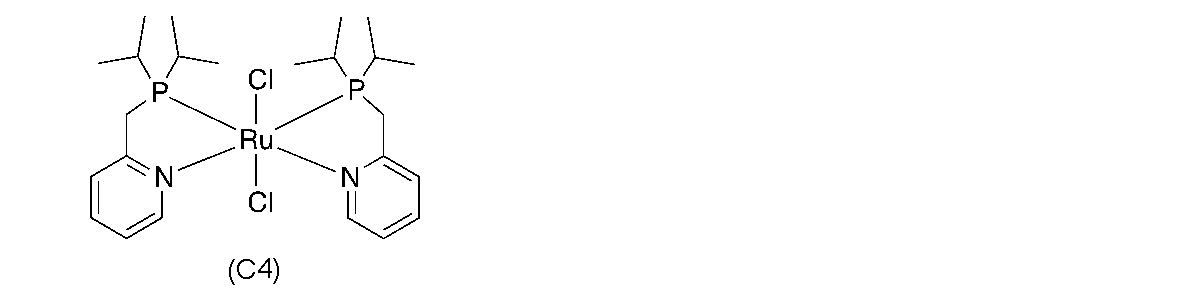
ルテニウム錯体(C4)のスペクトルデータは以下の通りであった。
1H NMR(500MHz, CDCl3):δ8.52 (d, 2H, J=5.8 Hz, C5H4N), 7.65 (t, 2H, J=7.45 Hz, C5H4N), 7.49 (d, 2H, J=7.5 Hz, C5H4N), 7.12 (t, 2H, J=6.3 Hz, C5H4N), 3.93 (br, 4H, PCH2), 2.48-2.69 (m, 4H, CH(CH3)2), 0.94-1.68 (m, 24H, CH(CH3)2). 13C NMR (167MHz, CDCl3):δ164.8, 155.1, 136.0, 122.1, 121.7, 26.7, 20.0, 19.4. 31P NMR (200MHz, CDCl3):δ72.8. HRMS (ESI, M+) calcd for C24H40Cl2N2P2Ru+: 590.1082. Found m/z = 590.1087.
1H NMR(500MHz, CDCl3):δ8.52 (d, 2H, J=5.8 Hz, C5H4N), 7.65 (t, 2H, J=7.45 Hz, C5H4N), 7.49 (d, 2H, J=7.5 Hz, C5H4N), 7.12 (t, 2H, J=6.3 Hz, C5H4N), 3.93 (br, 4H, PCH2), 2.48-2.69 (m, 4H, CH(CH3)2), 0.94-1.68 (m, 24H, CH(CH3)2). 13C NMR (167MHz, CDCl3):δ164.8, 155.1, 136.0, 122.1, 121.7, 26.7, 20.0, 19.4. 31P NMR (200MHz, CDCl3):δ72.8. HRMS (ESI, M+) calcd for C24H40Cl2N2P2Ru+: 590.1082. Found m/z = 590.1087.
2.水素移動反応(I)-水素還元反応(アミドの還元)
以下の方法により、アミドの水素還元反応を行った(実施例2-1~2-24)。基質並びに水素移動反応物及びその収率を表1~表3等に示す。
以下の方法により、アミドの水素還元反応を行った(実施例2-1~2-24)。基質並びに水素移動反応物及びその収率を表1~表3等に示す。
実施例2-1
アルゴンガス雰囲気下、乾燥したフッ素樹脂製のチューブ(30mL)に、撹拌子、ルテニウム錯体(C1)(7.5mg、0.01mmol)、水素化ホウ素ナトリウム(3.8mg、0.1mmol)、ベンズアニリド(197mg、1.0mmol)及びTHF(3.0mL)を収容した。その後、この混合物を含むチューブを、迅速にオートクレーブ内に挿入した。次いで、オートクレーブをアースした状態で密閉し、このオートクレーブに、ステンレス管を介して接続した水素ガスボンベから水素ガスを導入し、オートクレーブ内を水素ガスで置換した。すなわち、オートクレーブ内に7MPaの水素ガス圧をかけ、その後、リークバルブから水素ガス圧を抜いた。この操作(置換-脱置換)を3回繰り返した。最後に、オートクレーブ内の水素ガス圧を6MPaに設定し、恒温槽を用いて、160℃で24時間反応させた。
アルゴンガス雰囲気下、乾燥したフッ素樹脂製のチューブ(30mL)に、撹拌子、ルテニウム錯体(C1)(7.5mg、0.01mmol)、水素化ホウ素ナトリウム(3.8mg、0.1mmol)、ベンズアニリド(197mg、1.0mmol)及びTHF(3.0mL)を収容した。その後、この混合物を含むチューブを、迅速にオートクレーブ内に挿入した。次いで、オートクレーブをアースした状態で密閉し、このオートクレーブに、ステンレス管を介して接続した水素ガスボンベから水素ガスを導入し、オートクレーブ内を水素ガスで置換した。すなわち、オートクレーブ内に7MPaの水素ガス圧をかけ、その後、リークバルブから水素ガス圧を抜いた。この操作(置換-脱置換)を3回繰り返した。最後に、オートクレーブ内の水素ガス圧を6MPaに設定し、恒温槽を用いて、160℃で24時間反応させた。
反応終了後、オートクレーブを氷浴に浸して冷却し、ほぼ室温とした。そして、オートクレーブのリークバルブを開放し、内部にある水素ガスを空気中に放出した。次に、オートクレーブからチューブを取り出し、反応生成物(溶液)を得た。1H NMR解析のために、この溶液に、内部標準物質(1,1,2,2-テトラクロロエタン)を加えた。この内部標準物質の水素原子量の積分値を基準として、反応生成物の収率を算出した。
実施例2-2
アルゴンガス雰囲気下、乾燥したフッ素樹脂製のチューブ(30mL)に、撹拌子、ルテニウム錯体(C1)(7.5mg、0.01mmol)、ナトリウム2-メチル-2-アダマントキサイド(3.8mg、0.02mmol)、N-ベンジルベンズアミド(105.6mg、0.5mmol)及びトルエン(1.5mL)を収容した。その後、この混合物を含むチューブを、迅速にオートクレーブ内に挿入した。次いで、オートクレーブをアースした状態で密閉し、このオートクレーブに、ステンレス管を介して接続した水素ガスボンベから水素ガスを導入し、オートクレーブ内を水素ガスで置換した。すなわち、オートクレーブ内に9MPaの水素ガス圧をかけ、その後、リークバルブから水素ガス圧を抜いた。この操作(置換-脱置換)を3回繰り返した。最後に、オートクレーブ内の水素ガス圧を8MPaに設定し、恒温槽を用いて、160℃で36時間反応させた。
アルゴンガス雰囲気下、乾燥したフッ素樹脂製のチューブ(30mL)に、撹拌子、ルテニウム錯体(C1)(7.5mg、0.01mmol)、ナトリウム2-メチル-2-アダマントキサイド(3.8mg、0.02mmol)、N-ベンジルベンズアミド(105.6mg、0.5mmol)及びトルエン(1.5mL)を収容した。その後、この混合物を含むチューブを、迅速にオートクレーブ内に挿入した。次いで、オートクレーブをアースした状態で密閉し、このオートクレーブに、ステンレス管を介して接続した水素ガスボンベから水素ガスを導入し、オートクレーブ内を水素ガスで置換した。すなわち、オートクレーブ内に9MPaの水素ガス圧をかけ、その後、リークバルブから水素ガス圧を抜いた。この操作(置換-脱置換)を3回繰り返した。最後に、オートクレーブ内の水素ガス圧を8MPaに設定し、恒温槽を用いて、160℃で36時間反応させた。
反応終了後、オートクレーブを氷浴に浸して冷却し、ほぼ室温とした。そして、オートクレーブのリークバルブを開放し、内部にある水素ガスを空気中に放出した。次に、オートクレーブからチューブを取り出し、反応生成物(溶液)を得た。1H NMR解析のために、この溶液に、内部標準物質(1,1,2,2-テトラクロロエタン)を加えた。この内部標準物質の水素原子量の積分値を基準として、反応生成物の収率を算出した。
実施例2-3
アルゴンガス雰囲気下、乾燥したフッ素樹脂製のチューブ(30mL)に、撹拌子、ルテニウム錯体(C1)(15.0mg、0.02mmol)、2-メチル-2-アダマンタノール(30.5mg、0.2mmol)、水素化ナトリウム(8.0mg、0.2mmol)、N-ベンジルベンズアミド(211.3mg、1.0mmol)及びトルエン(3mL)を収容した。その後、この混合物を含むチューブを、迅速にオートクレーブ内に挿入した。次いで、オートクレーブをアースした状態で密閉し、このオートクレーブに、ステンレス管を介して接続した水素ガスボンベから水素ガスを導入し、オートクレーブ内を水素ガスで置換した。すなわち、オートクレーブ内に9MPaの水素ガス圧をかけ、その後、リークバルブから水素ガス圧を抜いた。この操作(置換-脱置換)を3回繰り返した。最後に、オートクレーブ内の水素ガス圧を8MPaに設定し、恒温槽を用いて、160℃で24時間反応させた。
アルゴンガス雰囲気下、乾燥したフッ素樹脂製のチューブ(30mL)に、撹拌子、ルテニウム錯体(C1)(15.0mg、0.02mmol)、2-メチル-2-アダマンタノール(30.5mg、0.2mmol)、水素化ナトリウム(8.0mg、0.2mmol)、N-ベンジルベンズアミド(211.3mg、1.0mmol)及びトルエン(3mL)を収容した。その後、この混合物を含むチューブを、迅速にオートクレーブ内に挿入した。次いで、オートクレーブをアースした状態で密閉し、このオートクレーブに、ステンレス管を介して接続した水素ガスボンベから水素ガスを導入し、オートクレーブ内を水素ガスで置換した。すなわち、オートクレーブ内に9MPaの水素ガス圧をかけ、その後、リークバルブから水素ガス圧を抜いた。この操作(置換-脱置換)を3回繰り返した。最後に、オートクレーブ内の水素ガス圧を8MPaに設定し、恒温槽を用いて、160℃で24時間反応させた。
反応終了後、オートクレーブを氷浴に浸して冷却し、ほぼ室温とした。そして、オートクレーブのリークバルブを開放し、内部にある水素ガスを空気中に放出した。次に、オートクレーブからチューブを取り出し、反応生成物(溶液)を得た。1H NMR解析のために、この溶液に、内部標準物質(1,1,2,2-テトラクロロエタン)を加えた。この内部標準物質の水素原子量の積分値を基準として、反応生成物の収率を算出した。
実施例2-4~2-6
N-ベンジルベンズアミドに代えて、アセトアニリド(実施例2-4;135.2mg、1.0mmol)、N-メチルアセトアニリド(実施例2-5;149.2mg、1.0mmol)、又はN-ベンジルアセトアミド(実施例2-6;149.2mg、1.0mmol)を用いた以外は、実施例2-3と同様の方法で水素還元反応を行った。
N-ベンジルベンズアミドに代えて、アセトアニリド(実施例2-4;135.2mg、1.0mmol)、N-メチルアセトアニリド(実施例2-5;149.2mg、1.0mmol)、又はN-ベンジルアセトアミド(実施例2-6;149.2mg、1.0mmol)を用いた以外は、実施例2-3と同様の方法で水素還元反応を行った。
実施例2-7
N-ベンジルベンズアミドに代えてジメチルベンズアミド(149.2mg、1.0mmol)を用い、2-メチル-2-アダマンタノールに代えて2,4,6-トリ-tert-ブチルフェノール(262.4mg、0.2mmol)を用い、反応時間を24時間から48時間に変更した以外は、実施例2-3と同様の方法で水素還元反応を行った。
N-ベンジルベンズアミドに代えてジメチルベンズアミド(149.2mg、1.0mmol)を用い、2-メチル-2-アダマンタノールに代えて2,4,6-トリ-tert-ブチルフェノール(262.4mg、0.2mmol)を用い、反応時間を24時間から48時間に変更した以外は、実施例2-3と同様の方法で水素還元反応を行った。
実施例2-8
N-ベンジルベンズアミドに代えてベンズアミド(121.1mg、1.0mmol)を用い、2-メチル-2-アダマンタノールに代えて2,4,6-トリ-tert-ブチルフェノール(262.4mg、0.2mmol)を用い、反応時間を24時間から9日間に変更した以外は、実施例2-3と同様の方法で水素還元反応を行った。
N-ベンジルベンズアミドに代えてベンズアミド(121.1mg、1.0mmol)を用い、2-メチル-2-アダマンタノールに代えて2,4,6-トリ-tert-ブチルフェノール(262.4mg、0.2mmol)を用い、反応時間を24時間から9日間に変更した以外は、実施例2-3と同様の方法で水素還元反応を行った。
実施例2-9~2-14
N-ベンジルベンズアミドに代えて1,3-ジベンジル尿素(実施例2-9;240.3mg、1.0mmol)、N-ベンジル-4-(トリフルオロメチル)ベンズアミド(実施例2-10;279.3mg、1.0mmol)、N-ベンジル-4-メチルベンズアミド(実施例2-11;225.2mg、1.0mmol)、N-ベンジル-4-メトキシベンズアミド(実施例2-12;241.3mg、1.0mmol)、N-ベンジルビフェニル-4-カルボアミド(実施例2-13;287.4mg、1.0mmol)、又はイソプロピル4-ベンズアミドベンゾエート(実施例2-14;283.3mg、1.0mmol)を用い、オートクレーブ内の水素ガス圧を8MPaから6MPaに代えた以外は、実施例2-3と同様の方法で水素還元反応を行った。
N-ベンジルベンズアミドに代えて1,3-ジベンジル尿素(実施例2-9;240.3mg、1.0mmol)、N-ベンジル-4-(トリフルオロメチル)ベンズアミド(実施例2-10;279.3mg、1.0mmol)、N-ベンジル-4-メチルベンズアミド(実施例2-11;225.2mg、1.0mmol)、N-ベンジル-4-メトキシベンズアミド(実施例2-12;241.3mg、1.0mmol)、N-ベンジルビフェニル-4-カルボアミド(実施例2-13;287.4mg、1.0mmol)、又はイソプロピル4-ベンズアミドベンゾエート(実施例2-14;283.3mg、1.0mmol)を用い、オートクレーブ内の水素ガス圧を8MPaから6MPaに代えた以外は、実施例2-3と同様の方法で水素還元反応を行った。
実施例2-15
N-ベンジルベンズアミドに代えてε-カプロラクタム(113.2mg、1.0mmol)を用いた以外は、実施例2-3と同様の方法で水素還元反応を行った。
N-ベンジルベンズアミドに代えてε-カプロラクタム(113.2mg、1.0mmol)を用いた以外は、実施例2-3と同様の方法で水素還元反応を行った。
実施例2-16
N-ベンジルベンズアミドに代えて2-ピペリドン(99.1mg、1.0mmol)を用い、2-メチル-2-アダマンタノールに代えて、2,4,6-トリ-tert-ブチルフェノール(262.4mg、0.2mmol)を用い、反応時間を24時間から48時間に変更した以外は、実施例2-3と同様の方法で水素還元反応を行った。
N-ベンジルベンズアミドに代えて2-ピペリドン(99.1mg、1.0mmol)を用い、2-メチル-2-アダマンタノールに代えて、2,4,6-トリ-tert-ブチルフェノール(262.4mg、0.2mmol)を用い、反応時間を24時間から48時間に変更した以外は、実施例2-3と同様の方法で水素還元反応を行った。
実施例2-17
N-ベンジルベンズアミドに代えて2-ピロリドン(85.1mg、1.0mmol)を用い、反応時間を24時間から9日間に変更した以外は、実施例2-3と同様の方法で水素還元反応を行った。
N-ベンジルベンズアミドに代えて2-ピロリドン(85.1mg、1.0mmol)を用い、反応時間を24時間から9日間に変更した以外は、実施例2-3と同様の方法で水素還元反応を行った。
実施例2-18及び2-19
N-ベンジルベンズアミドに代えてN-オクチルノナンアミド(実施例2-18;269.5mg、1.0mmol)又はN-オクチルシクロヘキサンカルボックスアミド(実施例2-19;239.4mg、1.0mmol)を用い、反応時間を24時間から48時間に変更した以外は、実施例2-3と同様の方法で水素還元反応を行った。
N-ベンジルベンズアミドに代えてN-オクチルノナンアミド(実施例2-18;269.5mg、1.0mmol)又はN-オクチルシクロヘキサンカルボックスアミド(実施例2-19;239.4mg、1.0mmol)を用い、反応時間を24時間から48時間に変更した以外は、実施例2-3と同様の方法で水素還元反応を行った。
実施例2-20
N-ベンジルベンズアミドに代えてベンズアミドを用い、反応時間を24時間から7日間に変更した以外は、実施例2-2と同様の方法で水素還元反応を行った。
N-ベンジルベンズアミドに代えてベンズアミドを用い、反応時間を24時間から7日間に変更した以外は、実施例2-2と同様の方法で水素還元反応を行った。
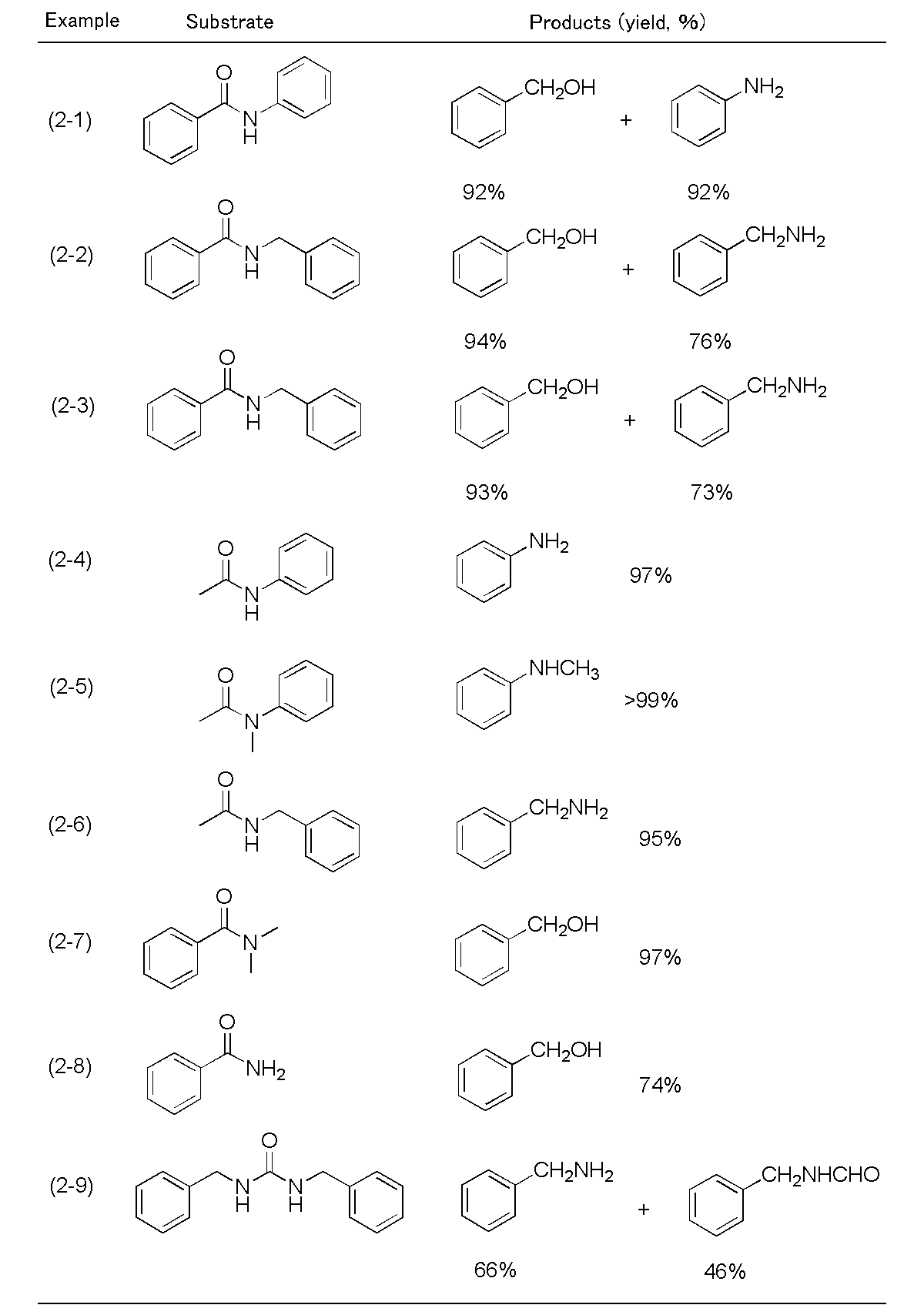

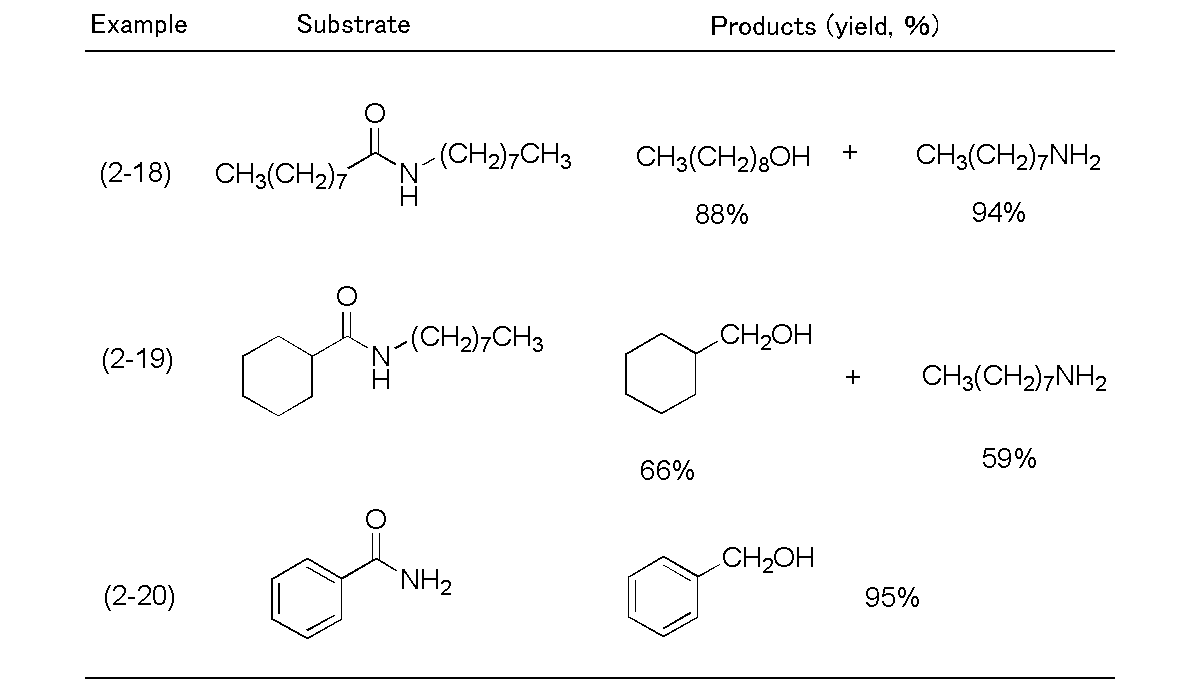
実施例2-21
アルゴンガス雰囲気下、乾燥したフッ素樹脂製のチューブ(30mL)に、実施例1-2で調製されたルテニウム錯体(C3)を含む混合液(0.05M、600μL)、塩基としてナトリウム2-メチル-2-アダマントキサイド(11.29mg、0.06mmol)、N-ベンジルベンズアミド(105.63mg、0.5mmol)、トルエン(0.9mL)及び攪拌子を収容した。その後、この混合物を含むチューブを、迅速にオートクレーブ内に挿入した。次いで、オートクレーブをアースした状態で密閉し、このオートクレーブに、ステンレス管を介して接続した水素ガスボンベから水素ガスを導入し、オートクレーブ内を水素ガスで置換した。すなわち、オートクレーブ内に、9MPaの水素ガス圧をかけ、その後、リークバルブから水素ガス圧を抜いた。この操作(置換-脱置換)を3回繰り返した。最後に、オートクレーブ内の水素ガス圧を8MPaに設定し、恒温槽を用いて、160℃で36時間反応させた。
次いで、オートクレーブからチューブを取り出し、反応生成物(溶液)を得た。1H NMR解析のために、この溶液に、内部標準物質(1,1,2,2-テトラクロロエタン)を加えた。この内部標準物質の水素原子量の積分値を基準として、反応生成物の収率を算出した。ベンジルアルコール及びベンジルアミンの収率は、それぞれ、55%及び48%であった。
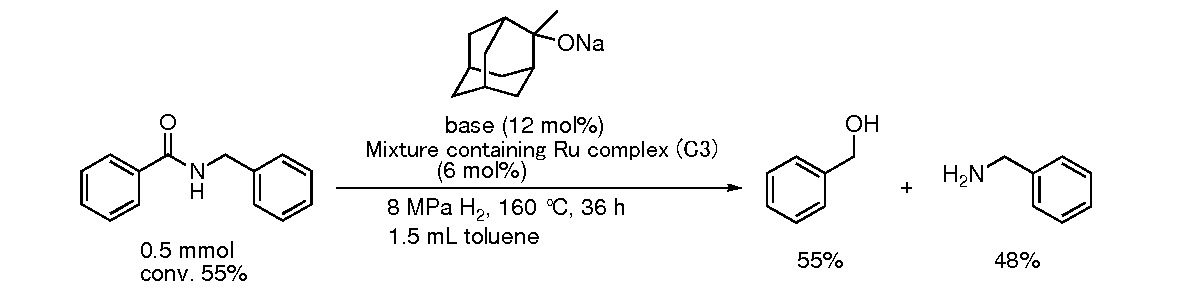
アルゴンガス雰囲気下、乾燥したフッ素樹脂製のチューブ(30mL)に、実施例1-2で調製されたルテニウム錯体(C3)を含む混合液(0.05M、600μL)、塩基としてナトリウム2-メチル-2-アダマントキサイド(11.29mg、0.06mmol)、N-ベンジルベンズアミド(105.63mg、0.5mmol)、トルエン(0.9mL)及び攪拌子を収容した。その後、この混合物を含むチューブを、迅速にオートクレーブ内に挿入した。次いで、オートクレーブをアースした状態で密閉し、このオートクレーブに、ステンレス管を介して接続した水素ガスボンベから水素ガスを導入し、オートクレーブ内を水素ガスで置換した。すなわち、オートクレーブ内に、9MPaの水素ガス圧をかけ、その後、リークバルブから水素ガス圧を抜いた。この操作(置換-脱置換)を3回繰り返した。最後に、オートクレーブ内の水素ガス圧を8MPaに設定し、恒温槽を用いて、160℃で36時間反応させた。
次いで、オートクレーブからチューブを取り出し、反応生成物(溶液)を得た。1H NMR解析のために、この溶液に、内部標準物質(1,1,2,2-テトラクロロエタン)を加えた。この内部標準物質の水素原子量の積分値を基準として、反応生成物の収率を算出した。ベンジルアルコール及びベンジルアミンの収率は、それぞれ、55%及び48%であった。
実施例2-22
ナトリウム2-メチル-2-アダマントキサイドの使用量を18.8mg(0.1mmol)とし、反応時間を24時間とした以外は、実施例2-2と同様にして、N-ベンジルベンズアミドの水素還元反応を行った。ベンジルアルコール及びベンジルアミンの収率は、それぞれ、94%及び76%であった。
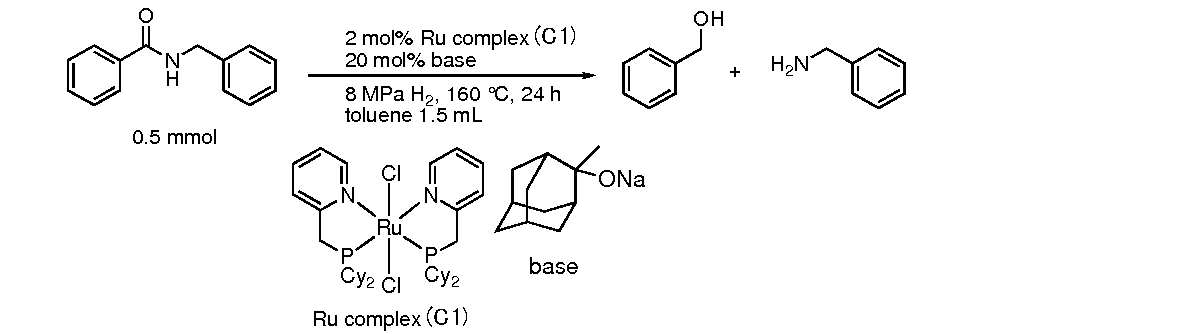
ナトリウム2-メチル-2-アダマントキサイドの使用量を18.8mg(0.1mmol)とし、反応時間を24時間とした以外は、実施例2-2と同様にして、N-ベンジルベンズアミドの水素還元反応を行った。ベンジルアルコール及びベンジルアミンの収率は、それぞれ、94%及び76%であった。
実施例2-23
アルゴンガス雰囲気下、乾燥したフッ素樹脂製のチューブ(30mL)に、攪拌子、ルテニウム錯体(C1)(7.5mg、0.01mmol)、下記式で表されるテトラキス[3,5-ビス(トリフルオロメチル)フェニル]ホウ酸ナトリウム(88.6mg、0.1mmol)、ベンズアニリド(197.2mg、1.0mmol)及びTHF(3.0mL)を収容した。その後、この混合物を含むチューブを、迅速にオートクレーブ内に挿入した。次いで、オートクレーブをアースした状態で密閉し、このオートクレーブに、ステンレス管を介して接続した水素ガスボンベから水素ガスを導入し、オートクレーブ内を水素ガスで置換した。すなわち、オートクレーブ内に7MPaの水素ガス圧をかけ、その後、リークバルブから水素ガス圧を抜いた。この操作(置換-脱置換)を3回繰り返した。最後に、オートクレーブ内の水素ガスを6MPaに設定し、恒温槽を用いて,160℃で24時間反応させた。
次いで、オートクレーブからチューブを取り出し、反応生成物(溶液)を得た。1H NMR解析のために、この溶液に、内部標準物質(1,1,2,2-テトラクロロエタン)を加えた。この内部標準物質の水素原子量の積分値を基準として、反応生成物の収率を算出した。ベンジルアルコール及びアニリンの収率は、それぞれ、92%及び92%であった。
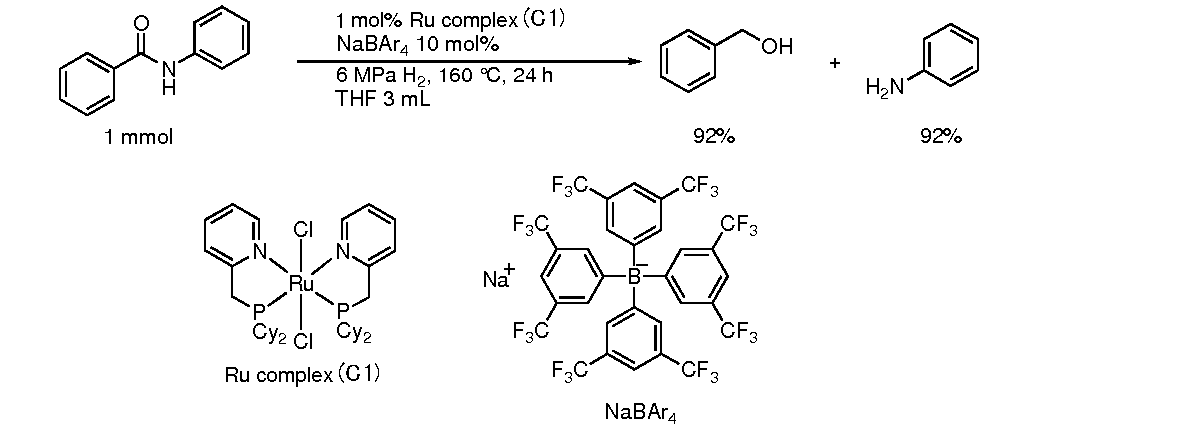
アルゴンガス雰囲気下、乾燥したフッ素樹脂製のチューブ(30mL)に、攪拌子、ルテニウム錯体(C1)(7.5mg、0.01mmol)、下記式で表されるテトラキス[3,5-ビス(トリフルオロメチル)フェニル]ホウ酸ナトリウム(88.6mg、0.1mmol)、ベンズアニリド(197.2mg、1.0mmol)及びTHF(3.0mL)を収容した。その後、この混合物を含むチューブを、迅速にオートクレーブ内に挿入した。次いで、オートクレーブをアースした状態で密閉し、このオートクレーブに、ステンレス管を介して接続した水素ガスボンベから水素ガスを導入し、オートクレーブ内を水素ガスで置換した。すなわち、オートクレーブ内に7MPaの水素ガス圧をかけ、その後、リークバルブから水素ガス圧を抜いた。この操作(置換-脱置換)を3回繰り返した。最後に、オートクレーブ内の水素ガスを6MPaに設定し、恒温槽を用いて,160℃で24時間反応させた。
次いで、オートクレーブからチューブを取り出し、反応生成物(溶液)を得た。1H NMR解析のために、この溶液に、内部標準物質(1,1,2,2-テトラクロロエタン)を加えた。この内部標準物質の水素原子量の積分値を基準として、反応生成物の収率を算出した。ベンジルアルコール及びアニリンの収率は、それぞれ、92%及び92%であった。
実施例2-24
テトラキス[3,5-ビス(トリフルオロメチル)フェニル]ホウ酸ナトリウムに代えて、下記式で表されるテトラフェニルホウ酸ナトリウム(3.6mg、0.1mmol)を用いた以外は、実施例2-23と同様にして、ベンズアニリドの水素還元反応を行った。ベンジルアルコール及びアニリンの収率は、それぞれ、91%及び75%であった。
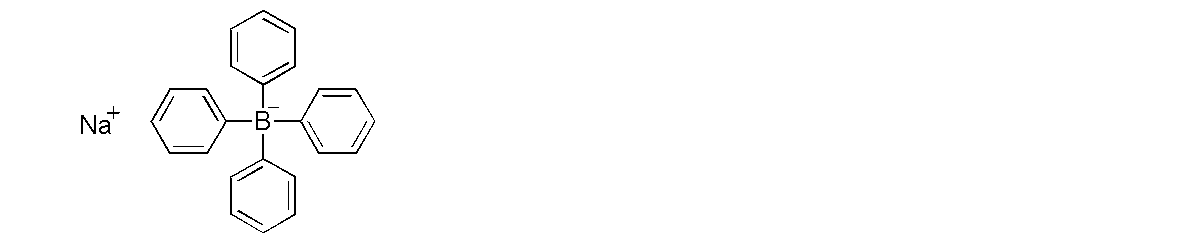
テトラキス[3,5-ビス(トリフルオロメチル)フェニル]ホウ酸ナトリウムに代えて、下記式で表されるテトラフェニルホウ酸ナトリウム(3.6mg、0.1mmol)を用いた以外は、実施例2-23と同様にして、ベンズアニリドの水素還元反応を行った。ベンジルアルコール及びアニリンの収率は、それぞれ、91%及び75%であった。
3.水素移動反応(II)-水素還元反応(エステルの還元)
以下の方法により、エステルの水素還元反応を行った(実施例3-1~3-32)。基質並びに水素移動反応物及びその収率を表4~表7に示す。
以下の方法により、エステルの水素還元反応を行った(実施例3-1~3-32)。基質並びに水素移動反応物及びその収率を表4~表7に示す。
実施例3-1
アルゴンガス雰囲気下、乾燥したフッ素樹脂製のチューブ(30mL)に、撹拌子、ルテニウム錯体(C1)(7.5mg、0.01mmol)、水素化ホウ素ナトリウム(3.8mg、0.1mmol)、安息香酸メチル(125μL、1.0mmol)及びTHF(3.0mL)を収容した。その後、この混合物を含むチューブを、迅速にオートクレーブ内に挿入した。次いで、オートクレーブをアースした状態で密閉し、このオートクレーブに、ステンレス管を介して接続した水素ガスボンベから水素ガスを導入し、オートクレーブ内を水素ガスで置換した。即ち、オートクレーブ内に7MPaの水素ガス圧をかけ、その後、リークバルブから水素ガス圧を抜いた。この操作(置換-脱置換)を3回繰り返した。最後に、オートクレーブ内の水素ガス圧を6MPaに設定し、恒温槽を用いて、160℃で24時間反応させた。
アルゴンガス雰囲気下、乾燥したフッ素樹脂製のチューブ(30mL)に、撹拌子、ルテニウム錯体(C1)(7.5mg、0.01mmol)、水素化ホウ素ナトリウム(3.8mg、0.1mmol)、安息香酸メチル(125μL、1.0mmol)及びTHF(3.0mL)を収容した。その後、この混合物を含むチューブを、迅速にオートクレーブ内に挿入した。次いで、オートクレーブをアースした状態で密閉し、このオートクレーブに、ステンレス管を介して接続した水素ガスボンベから水素ガスを導入し、オートクレーブ内を水素ガスで置換した。即ち、オートクレーブ内に7MPaの水素ガス圧をかけ、その後、リークバルブから水素ガス圧を抜いた。この操作(置換-脱置換)を3回繰り返した。最後に、オートクレーブ内の水素ガス圧を6MPaに設定し、恒温槽を用いて、160℃で24時間反応させた。
反応終了後、オートクレーブを氷浴に浸して冷却し、ほぼ室温とした。そして、オートクレーブのリークバルブを開放し、内部にある水素ガスを空気中に放出した。次に、オートクレーブからチューブを取り出し、反応生成物(溶液)を得た。この反応生成物を、カラムクロマトグラフィーに供して精製し、1H NMR解析のために、この溶液に、内部標準物質(1,1,2,2-テトラクロロエタン)を加えた。この内部標準物質の水素原子量の積分値を基準として、精製物の分析及びその収率を算出した。その結果、99%を超える収率でベンジルアルコールが得られた。得られたベンジルアルコールは市販されており、既存の化合物データと一致した。
実施例3-2
アルゴンガス雰囲気下、乾燥したフッ素樹脂製のチューブ(30mL)に、撹拌子、ルテニウム錯体(C1)(7.5mg、0.01mmol)、ナトリウム2-メチル-2-アダマントキサイド(3.8mg、0.02mmol)、安息香酸メチル(62.6μL、0.5mmol)及びトルエン(1.5mL)を収容した。その後、この混合物を含むチューブを、迅速にオートクレーブ内に挿入した。次いで、オートクレーブをアースした状態で密閉し、このオートクレーブに、ステンレス管を介して接続した水素ガスボンベから水素ガスを導入し、オートクレーブ内を水素ガスで置換した。すなわち、オートクレーブ内に9MPaの水素ガス圧をかけ、その後、リークバルブから水素ガス圧を抜いた。この操作(置換-脱置換)を3回繰り返した。最後に、オートクレーブ内の水素ガス圧を8MPaに設定し、恒温槽を用いて、160℃で36時間反応させた。
アルゴンガス雰囲気下、乾燥したフッ素樹脂製のチューブ(30mL)に、撹拌子、ルテニウム錯体(C1)(7.5mg、0.01mmol)、ナトリウム2-メチル-2-アダマントキサイド(3.8mg、0.02mmol)、安息香酸メチル(62.6μL、0.5mmol)及びトルエン(1.5mL)を収容した。その後、この混合物を含むチューブを、迅速にオートクレーブ内に挿入した。次いで、オートクレーブをアースした状態で密閉し、このオートクレーブに、ステンレス管を介して接続した水素ガスボンベから水素ガスを導入し、オートクレーブ内を水素ガスで置換した。すなわち、オートクレーブ内に9MPaの水素ガス圧をかけ、その後、リークバルブから水素ガス圧を抜いた。この操作(置換-脱置換)を3回繰り返した。最後に、オートクレーブ内の水素ガス圧を8MPaに設定し、恒温槽を用いて、160℃で36時間反応させた。
反応終了後、オートクレーブを氷浴に浸して冷却し、ほぼ室温とした。そして、オートクレーブのリークバルブを開放し、内部にある水素ガスを空気中に放出した。次に、オートクレーブからチューブを取り出し、反応生成物(溶液)を得た。この反応生成物を、カラムクロマトグラフィーに供して精製し、1H NMR解析のために、この溶液に、内部標準物質(1,1,2,2-テトラクロロエタン)を加えた。この内部標準物質の水素原子量の積分値を基準として、精製物の分析及びその収率を算出した。その結果、ベンジルアルコールの収率が70%であった。
実施例3-3~3-10
安息香酸メチルに代えて安息香酸エチル(実施例3-3)、安息香酸イソプロピル(実施例3-4)、安息香酸tert-ブチル(実施例3-5)、安息香酸フェニル(実施例3-6)、安息香酸ベンジル(実施例3-7)、炭酸ジベンジル(実施例3-8)、フェニル酢酸メチル(実施例3-9)、又はペラルゴン酸メチル(実施例3-10)を用いた以外は、実施例3-1と同様の方法で水素還元反応を行った。
安息香酸メチルに代えて安息香酸エチル(実施例3-3)、安息香酸イソプロピル(実施例3-4)、安息香酸tert-ブチル(実施例3-5)、安息香酸フェニル(実施例3-6)、安息香酸ベンジル(実施例3-7)、炭酸ジベンジル(実施例3-8)、フェニル酢酸メチル(実施例3-9)、又はペラルゴン酸メチル(実施例3-10)を用いた以外は、実施例3-1と同様の方法で水素還元反応を行った。
実施例3-11~3-13
安息香酸メチルに代えてシクロヘキサンカルボン酸メチル(実施例3-11)、ヒドロキシフェニル酢酸メチル(実施例3-12)、又はα-メトキシベンゼン酢酸メチル(実施例3-13)を用い、THFの使用量を1mLとした以外は、実施例3-1と同様の方法で水素還元反応を行った。
安息香酸メチルに代えてシクロヘキサンカルボン酸メチル(実施例3-11)、ヒドロキシフェニル酢酸メチル(実施例3-12)、又はα-メトキシベンゼン酢酸メチル(実施例3-13)を用い、THFの使用量を1mLとした以外は、実施例3-1と同様の方法で水素還元反応を行った。
実施例3-14~3-17
安息香酸メチルに代えてベンゾイル酢酸エチル(実施例3-14)、フタル酸ジエチル(実施例3-15)、アジピン酸ジメチル(実施例3-16)、9-オクタデセン酸メチル(オレイン酸メチル、実施例3-17)を用いた以外は、実施例3-1の方法で水素還元反応を行った。
安息香酸メチルに代えてベンゾイル酢酸エチル(実施例3-14)、フタル酸ジエチル(実施例3-15)、アジピン酸ジメチル(実施例3-16)、9-オクタデセン酸メチル(オレイン酸メチル、実施例3-17)を用いた以外は、実施例3-1の方法で水素還元反応を行った。
実施例3-18
安息香酸メチルに代えてN-ベンジル-4-エトキシカルボニルピペリジン(124mg、0.5mmol)を用い、THFの使用量を3.0mLから0.5mLとした以外は、実施例3-1と同様の方法で水素還元反応を行った。
安息香酸メチルに代えてN-ベンジル-4-エトキシカルボニルピペリジン(124mg、0.5mmol)を用い、THFの使用量を3.0mLから0.5mLとした以外は、実施例3-1と同様の方法で水素還元反応を行った。


実施例3-19
アルゴンガス雰囲気下、乾燥したフッ素樹脂製のチューブ(30mL)に、撹拌子、ルテニウム錯体(C1)(7.5mg、0.01mmol)、水素化ホウ素ナトリウム(3.8mg、0.1mmol)、ベンジルアルコールのTHF溶液(0.2mL、0.1M-THF溶液、0.02mmol)、安息香酸メチル(125μL、1.0mmol)及びTHF(0.8mL)を収容した。その後、この混合物を含むチューブを、迅速にオートクレーブ内に挿入した。次いで、オートクレーブをアースした状態で密閉し、このオートクレーブに、ステンレス管を介して接続した水素ガスボンベから水素ガスを導入し、オートクレーブ内を水素ガスで置換した。即ち、オートクレーブ内に7MPaの水素ガス圧をかけ、その後リークバルブから水素ガス圧を抜いた。この操作を(置換-脱置換)を3回繰り返した。最後に、オートクレーブ内の水素ガス圧を6MPaに設定し、恒温槽を用いて、160℃で4時間反応させた。
アルゴンガス雰囲気下、乾燥したフッ素樹脂製のチューブ(30mL)に、撹拌子、ルテニウム錯体(C1)(7.5mg、0.01mmol)、水素化ホウ素ナトリウム(3.8mg、0.1mmol)、ベンジルアルコールのTHF溶液(0.2mL、0.1M-THF溶液、0.02mmol)、安息香酸メチル(125μL、1.0mmol)及びTHF(0.8mL)を収容した。その後、この混合物を含むチューブを、迅速にオートクレーブ内に挿入した。次いで、オートクレーブをアースした状態で密閉し、このオートクレーブに、ステンレス管を介して接続した水素ガスボンベから水素ガスを導入し、オートクレーブ内を水素ガスで置換した。即ち、オートクレーブ内に7MPaの水素ガス圧をかけ、その後リークバルブから水素ガス圧を抜いた。この操作を(置換-脱置換)を3回繰り返した。最後に、オートクレーブ内の水素ガス圧を6MPaに設定し、恒温槽を用いて、160℃で4時間反応させた。
反応終了後、オートクレーブを氷浴に浸して冷却し、ほぼ室温とした。そして、オートクレーブのリークバルブを解放し、内部にある水素ガスを空気中へ放出した。次に、オートクレーブからチューブを取り出し、反応生成物(溶液)を得た。この反応生成物に含まれる溶媒を減圧条件で取り除いた後、1H NMR解析のために、この反応生成物へ内部標準物質(1,1,2,2-テトラクロロエタン)を加えた。この反応生成物を1H NMR測定し、内部標準物質の水素原子量の積分値を基準として、生成物の分析及びその収質を算出した。その結果、99%を超える収率でベンジルアルコールが得られた。なお、反応開始前に加えたベンジルアルコールの量は、収率には加えていない。
実施例3-20
安息香酸メチルに代えて3-フェニルプロピオン酸メチルを用いた以外は、実施例3-19と同様の方法で水素還元反応を行った。
安息香酸メチルに代えて3-フェニルプロピオン酸メチルを用いた以外は、実施例3-19と同様の方法で水素還元反応を行った。
実施例3-21~3-23
安息香酸メチルに代えて安息香酸tert-ブチル(実施例3-21)、フェニル酢酸メチル(実施例3-22)、又はシクロヘキサンカルボン酸メチル(実施例(3-23)を用い、反応時間を48時間とした以外は、実施例3-19と同様の方法で水素還元反応を行った。
安息香酸メチルに代えて安息香酸tert-ブチル(実施例3-21)、フェニル酢酸メチル(実施例3-22)、又はシクロヘキサンカルボン酸メチル(実施例(3-23)を用い、反応時間を48時間とした以外は、実施例3-19と同様の方法で水素還元反応を行った。
実施例3-24~3-25
安息香酸メチルに代えてフタル酸ジメチル(実施例3-24)、又はアジピン酸ジメチル(実施例3-25)を用い、反応時間を96時間とした以外は、実施例3-19と同様の方法で水素還元反応を行った。
安息香酸メチルに代えてフタル酸ジメチル(実施例3-24)、又はアジピン酸ジメチル(実施例3-25)を用い、反応時間を96時間とした以外は、実施例3-19と同様の方法で水素還元反応を行った。
実施例3-26
安息香酸メチルに代えてトリステアリンを用い、THFの使用量を2.8mLとし、反応温度を190℃に設定し、反応時間を48時間とした以外は、実施例3-19と同様の方法で水素還元反応を行った。反応終了後、オートクレーブを氷浴に浸して冷却し、ほぼ室温とした。そして、オートクレーブのリークバルブを解放し、内部にある水素ガスを空気中へ放出した。次に、オートクレーブからチューブを取り出し、反応生成物(溶液)を得た。この反応生成物をジクロロメタンに溶かし、純水で洗浄することにより水溶性の物質を取り除いた後、ジクロロメタンを減圧条件下で取り除いた。続いて、この反応物質をメタノールに溶かし、ヘキサンで洗浄した後、メタノールを減圧条件下で取り除いた。その後、1H NMR解析のために、この反応生成物へ内部標準物質(1,1,2,2-テトラクロロエタン)を加えた。この反応生成物を1H NMR測定し、内部標準物質の水素原子量の積分値を基準として、生成物の分析及びその収質を算出した。その結果、14%の収率で1-オクタデカノールが得られた。なお、反応基質のトリステアリン1分子あたり1-オクタデカノール3分子が生成するので、1-オクタデカノールが3mmol得られた場合に収率が100%となるように収率を計算した。
安息香酸メチルに代えてトリステアリンを用い、THFの使用量を2.8mLとし、反応温度を190℃に設定し、反応時間を48時間とした以外は、実施例3-19と同様の方法で水素還元反応を行った。反応終了後、オートクレーブを氷浴に浸して冷却し、ほぼ室温とした。そして、オートクレーブのリークバルブを解放し、内部にある水素ガスを空気中へ放出した。次に、オートクレーブからチューブを取り出し、反応生成物(溶液)を得た。この反応生成物をジクロロメタンに溶かし、純水で洗浄することにより水溶性の物質を取り除いた後、ジクロロメタンを減圧条件下で取り除いた。続いて、この反応物質をメタノールに溶かし、ヘキサンで洗浄した後、メタノールを減圧条件下で取り除いた。その後、1H NMR解析のために、この反応生成物へ内部標準物質(1,1,2,2-テトラクロロエタン)を加えた。この反応生成物を1H NMR測定し、内部標準物質の水素原子量の積分値を基準として、生成物の分析及びその収質を算出した。その結果、14%の収率で1-オクタデカノールが得られた。なお、反応基質のトリステアリン1分子あたり1-オクタデカノール3分子が生成するので、1-オクタデカノールが3mmol得られた場合に収率が100%となるように収率を計算した。
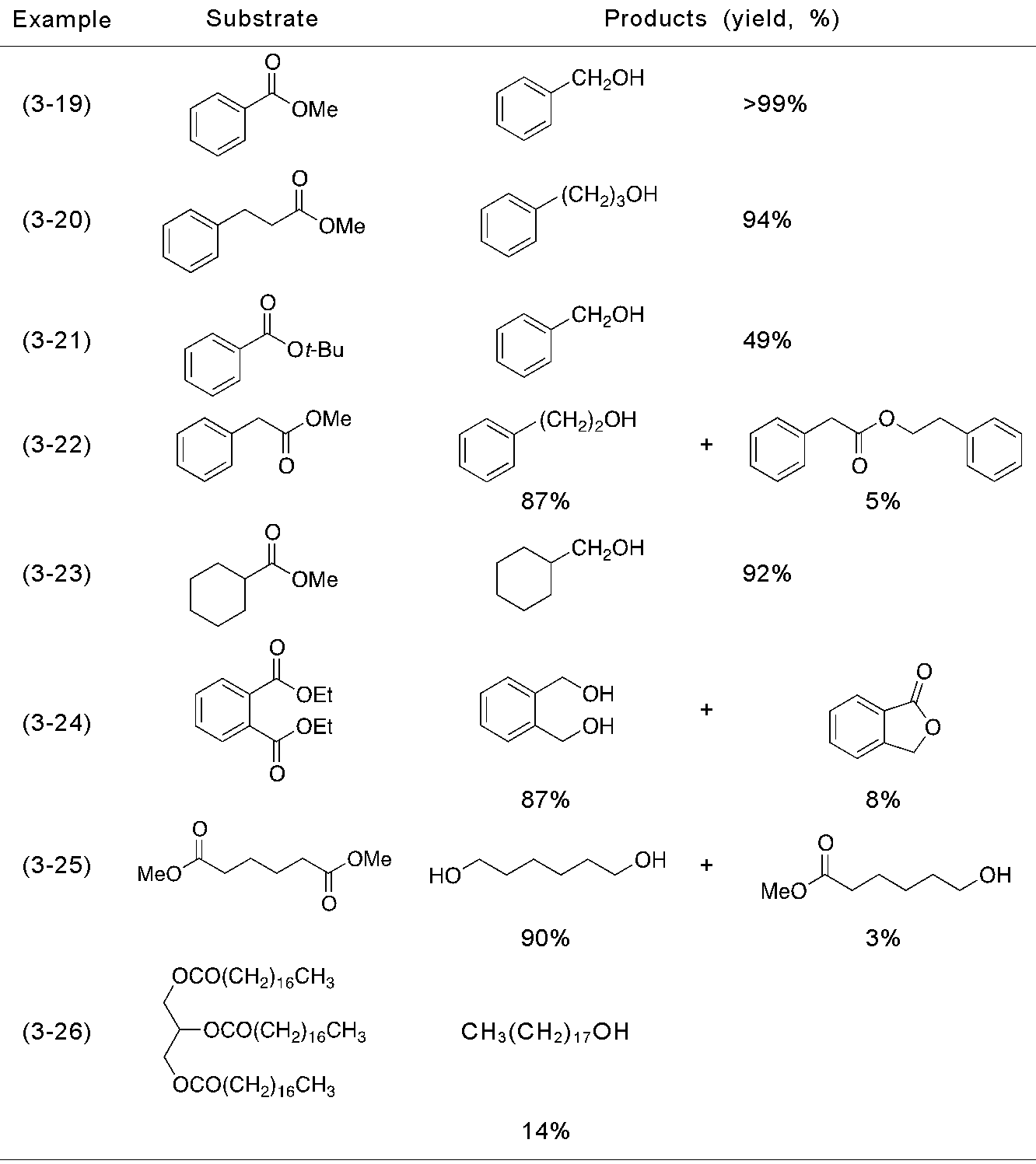
実施例3-27
ベンジルアルコールのTHF溶液(0.2mL、0.1M-THF溶液、0.02mmol)を用い、反応時間を4時間から2時間とした以外は、実施例3-19と同様の方法で水素還元反応を行った。
ベンジルアルコールのTHF溶液(0.2mL、0.1M-THF溶液、0.02mmol)を用い、反応時間を4時間から2時間とした以外は、実施例3-19と同様の方法で水素還元反応を行った。
実施例3-28~3-31
ベンジルアルコールのTHF溶液(0.1M-THF溶液)に代えて、メタノール(17μL、0.43mmol)(実施例3-28)、エタノール(50μL、0.86mmol)(実施例3-29)、イソプロパノール(66μL、0.86mmol(実施例3-30)又はtert-ブタノール(78μL、0.86mmol)(実施例3-31)を用い、THFの使用量を1.0mLとし、反応時間を2時間とした以外は、実施例3-19と同様の方法で水素還元反応を行った。
ベンジルアルコールのTHF溶液(0.1M-THF溶液)に代えて、メタノール(17μL、0.43mmol)(実施例3-28)、エタノール(50μL、0.86mmol)(実施例3-29)、イソプロパノール(66μL、0.86mmol(実施例3-30)又はtert-ブタノール(78μL、0.86mmol)(実施例3-31)を用い、THFの使用量を1.0mLとし、反応時間を2時間とした以外は、実施例3-19と同様の方法で水素還元反応を行った。
実施例3-32
ベンジルアルコールのTHF溶液を使用せず、THFの使用量を1.0mLとし、反応時間を2時間とした以外は、実施例3-19と同様の方法で水素還元反応を行った。
ベンジルアルコールのTHF溶液を使用せず、THFの使用量を1.0mLとし、反応時間を2時間とした以外は、実施例3-19と同様の方法で水素還元反応を行った。
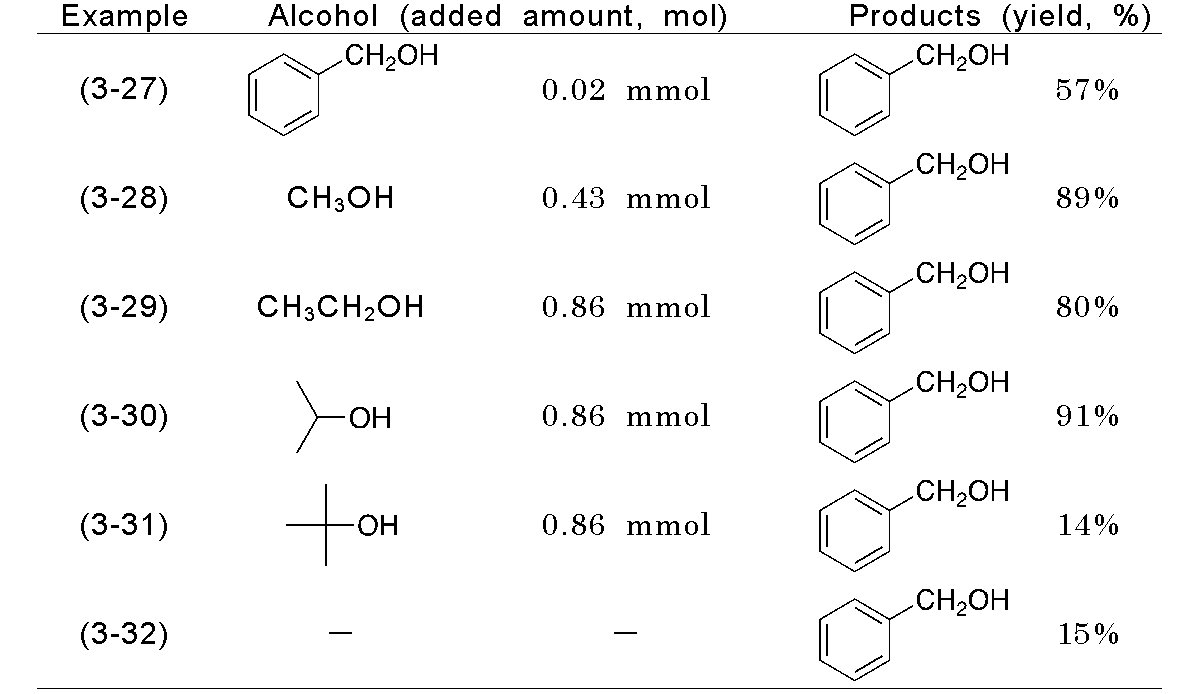
4.水素移動型反応(III)-水素還元反応(カルボニル化合物の還元)
実施例4-1
N-ベンジルベンズアミドに代えてアセトフェノンを用いた以外は、実施例2-1と同様の方法で水素還元反応を行い、1-フェニルエチルアルコールを得た(収率;99%超)。
実施例4-1
N-ベンジルベンズアミドに代えてアセトフェノンを用いた以外は、実施例2-1と同様の方法で水素還元反応を行い、1-フェニルエチルアルコールを得た(収率;99%超)。
実施例4-2
アルゴンガス雰囲気下、乾燥したフッ素樹脂製のチューブ(30mL)に、攪拌子、ルテニウム錯体(C1)(3.8mg、0.005mmol)、ナトリウム2-メチル-2-アダマントキサイド(1.9mg、0.01mmol)、アセトフェノン(58.3μL、0.5mmol)及びトルエン(1.5mL)を収容した。その後、この混合物を含むチューブを、迅速にオートクレーブ内に挿入した。次いで、オートクレーブをアースした状態で密閉し、このオートクレーブに、ステンレス管を介して接続した水素ガスボンベから水素ガスを導入し、オートクレーブ内を水素ガスで置換した。すなわち、オートクレーブ内に5MPaの水素ガス圧をかけ、その後、リークバルブから水素ガス圧を抜いた。この操作(置換-脱置換)を3回繰り返した。最後に、オートクレーブ内の水素ガスを1MPaに設定し、恒温槽を用いて100℃で12時間反応させた。
次いで、オートクレーブからチューブを取り出し、1-フェニルエタノールを含む反応生成物(溶液)を得た。1H NMR解析のために、この溶液に、内部標準物質(1,1,2,2-テトラクロロエタン)を加えた。この内部標準物質の水素原子量の積分値を基準として、反応生成物の収率を算出した。1-フェニルエタノールの収率は、99%を超えた。
アルゴンガス雰囲気下、乾燥したフッ素樹脂製のチューブ(30mL)に、攪拌子、ルテニウム錯体(C1)(3.8mg、0.005mmol)、ナトリウム2-メチル-2-アダマントキサイド(1.9mg、0.01mmol)、アセトフェノン(58.3μL、0.5mmol)及びトルエン(1.5mL)を収容した。その後、この混合物を含むチューブを、迅速にオートクレーブ内に挿入した。次いで、オートクレーブをアースした状態で密閉し、このオートクレーブに、ステンレス管を介して接続した水素ガスボンベから水素ガスを導入し、オートクレーブ内を水素ガスで置換した。すなわち、オートクレーブ内に5MPaの水素ガス圧をかけ、その後、リークバルブから水素ガス圧を抜いた。この操作(置換-脱置換)を3回繰り返した。最後に、オートクレーブ内の水素ガスを1MPaに設定し、恒温槽を用いて100℃で12時間反応させた。
次いで、オートクレーブからチューブを取り出し、1-フェニルエタノールを含む反応生成物(溶液)を得た。1H NMR解析のために、この溶液に、内部標準物質(1,1,2,2-テトラクロロエタン)を加えた。この内部標準物質の水素原子量の積分値を基準として、反応生成物の収率を算出した。1-フェニルエタノールの収率は、99%を超えた。
実施例4-3
ルテニウム錯体(C1)に代えて、ルテニウム錯体(C4)3.0mg(0.005mmol)を用いた以外は、実施例4-2と同様にして、アセトフェノンの水素還元反応を行った。反応生成物には1-フェニルエタノール及び1-シクロヘキシルエタノールが含まれており、これらの収率は、それぞれ、46%及び42%であった。
ルテニウム錯体(C1)に代えて、ルテニウム錯体(C4)3.0mg(0.005mmol)を用いた以外は、実施例4-2と同様にして、アセトフェノンの水素還元反応を行った。反応生成物には1-フェニルエタノール及び1-シクロヘキシルエタノールが含まれており、これらの収率は、それぞれ、46%及び42%であった。
実施例4-4
N-ベンジルベンズアミドに代えて、ベンズアルデヒドを用いた以外は、実施例2-1と同様の方法で水素還元反応を行い、ベンジルアルコールを得た(収率;99%超)。
N-ベンジルベンズアミドに代えて、ベンズアルデヒドを用いた以外は、実施例2-1と同様の方法で水素還元反応を行い、ベンジルアルコールを得た(収率;99%超)。
実施例4-5
アルゴンガス雰囲気下、乾燥したフッ素樹脂製のチューブ(30mL)に、攪拌子、ルテニウム錯体(C1)(3.8mg、0.005mmol)、ナトリウム2-メチル-2-アダマントキサイド(1.9mg、0.01mmol)、ベンズアルデヒド(51.0μL、0.5mmol)及びトルエン(1.5mL)を収容した。その後、この混合物を含むチューブを、迅速にオートクレーブ内に挿入した。次いで、オートクレーブをアースした状態で密閉し、このオートクレーブに、ステンレス管を介して接続した水素ガスボンベから水素ガスを導入し、オートクレーブ内を水素ガスで置換した。すなわち、オートクレーブ内に5MPaの水素ガス圧をかけ、その後、リークバルブから水素ガス圧を抜いた。この操作(置換-脱置換)を3回繰り返した。最後に、オートクレーブ内の水素ガスを1MPaに設定し、恒温槽を用いて100℃で12時間反応させた。
次いで、オートクレーブからチューブを取り出し、ベンジルアルコールを含む反応生成物(溶液)を得た。1H NMR解析のために、この溶液に、内部標準物質(1,1,2,2-テトラクロロエタン)を加えた。この内部標準物質の水素原子量の積分値を基準として、反応生成物の収率を算出した。ベンジルアルコールの収率は、45%であった。
アルゴンガス雰囲気下、乾燥したフッ素樹脂製のチューブ(30mL)に、攪拌子、ルテニウム錯体(C1)(3.8mg、0.005mmol)、ナトリウム2-メチル-2-アダマントキサイド(1.9mg、0.01mmol)、ベンズアルデヒド(51.0μL、0.5mmol)及びトルエン(1.5mL)を収容した。その後、この混合物を含むチューブを、迅速にオートクレーブ内に挿入した。次いで、オートクレーブをアースした状態で密閉し、このオートクレーブに、ステンレス管を介して接続した水素ガスボンベから水素ガスを導入し、オートクレーブ内を水素ガスで置換した。すなわち、オートクレーブ内に5MPaの水素ガス圧をかけ、その後、リークバルブから水素ガス圧を抜いた。この操作(置換-脱置換)を3回繰り返した。最後に、オートクレーブ内の水素ガスを1MPaに設定し、恒温槽を用いて100℃で12時間反応させた。
次いで、オートクレーブからチューブを取り出し、ベンジルアルコールを含む反応生成物(溶液)を得た。1H NMR解析のために、この溶液に、内部標準物質(1,1,2,2-テトラクロロエタン)を加えた。この内部標準物質の水素原子量の積分値を基準として、反応生成物の収率を算出した。ベンジルアルコールの収率は、45%であった。
実施例4-6
ルテニウム錯体(C1)に代えて、ルテニウム錯体(C4)(3.0mg、0.005mmol)を用いた以外は、実施例4-5と同様にして、ベンズアルデヒドの水素還元反応を行った。ベンジルアルコールの収率は、96%であった。
ルテニウム錯体(C1)に代えて、ルテニウム錯体(C4)(3.0mg、0.005mmol)を用いた以外は、実施例4-5と同様にして、ベンズアルデヒドの水素還元反応を行った。ベンジルアルコールの収率は、96%であった。
5.水素移動反応(IV)-水素還元反応(カルボン酸化合物の還元)
実施例5-1
乾燥したフッ素樹脂製のチューブ(30mL)に、撹拌子、濃度が60質量%となるように、ミネラルオイル中に懸濁させた水素化ナトリウム(純分:8.0mg、0.2mmol)、2-メチル-2-アダマンタノール(33.3mg、0.2mmol)及びトルエン(3mL)を収容した。その後、この混合物を、25℃で3時間撹拌しながら反応を行った。次いで、アルゴンガスをチューブに吹き付けながら、ルテニウム錯体(C1)(15.0mg、0.02mmol)及び3-フェニルプロピオン酸(150mg、1.0mmol)を添加した。その後、この混合物を含むチューブを、迅速にオートクレーブ内に挿入した。次いで、オートクレーブをアースした状態で密閉し、このオートクレーブに、ステンレス管を介して接続した水素ガスボンベから水素ガスを導入し、オートクレーブ内を水素ガスで置換した。即ち、オートクレーブ内に9MPaの水素ガス圧をかけ、その後、リークバルブから水素ガス圧を抜いた。この操作(置換-脱置換)を3回繰り返した。最後に、オートクレーブ内の水素ガス圧を8MPaに設定し、恒温槽を用いて、160℃で24時間反応させた。
実施例5-1
乾燥したフッ素樹脂製のチューブ(30mL)に、撹拌子、濃度が60質量%となるように、ミネラルオイル中に懸濁させた水素化ナトリウム(純分:8.0mg、0.2mmol)、2-メチル-2-アダマンタノール(33.3mg、0.2mmol)及びトルエン(3mL)を収容した。その後、この混合物を、25℃で3時間撹拌しながら反応を行った。次いで、アルゴンガスをチューブに吹き付けながら、ルテニウム錯体(C1)(15.0mg、0.02mmol)及び3-フェニルプロピオン酸(150mg、1.0mmol)を添加した。その後、この混合物を含むチューブを、迅速にオートクレーブ内に挿入した。次いで、オートクレーブをアースした状態で密閉し、このオートクレーブに、ステンレス管を介して接続した水素ガスボンベから水素ガスを導入し、オートクレーブ内を水素ガスで置換した。即ち、オートクレーブ内に9MPaの水素ガス圧をかけ、その後、リークバルブから水素ガス圧を抜いた。この操作(置換-脱置換)を3回繰り返した。最後に、オートクレーブ内の水素ガス圧を8MPaに設定し、恒温槽を用いて、160℃で24時間反応させた。
反応終了後、オートクレーブを氷浴に浸して冷却し、室温とした。そして、オートクレーブのリークバルブを開放し、内部にある水素ガスを空気中に放出した。次に、オートクレーブからチューブを取り出し、反応生成物(溶液)を得た。1H NMR解析のために、この溶液に、内部標準物質(1,1,2,2-テトラクロロエタン)を加えた。この内部標準物質の水素原子量の積分値を基準として、反応生成物の収率を算出した。その結果、反応生成物は3-フェニル-1-プロパノールであり、その収率が10%であった。尚、3-フェニルプロピオン酸の転化率は28%であった。
実施例5-2
N-ベンジルベンズアミドに代えて安息香酸を用いた以外は、実施例2-2と同様の方法で水素還元反応を行い、ベンジルアルコールを得た(収率;2%)。
N-ベンジルベンズアミドに代えて安息香酸を用いた以外は、実施例2-2と同様の方法で水素還元反応を行い、ベンジルアルコールを得た(収率;2%)。
実施例5-3
アルゴンガス雰囲気下、乾燥したフッ素樹脂製のチューブ(30mL)に、攪拌子、ルテニウム錯体(C4)(5.9mg、0.01mmol)、ナトリウム2-メチル-2-アダマントキサイド(3.8mg、0.02mmol)、安息香酸(61.1mg、0.5mmol)及びトルエン(1.5mL)を収容した。その後、この混合物を含むチューブを、迅速にオートクレーブ内に挿入した。次いで、オートクレーブをアースした状態で密閉し、このオートクレーブに、ステンレス管を介して接続した水素ガスボンベから水素ガスを導入し、オートクレーブ内を水素ガスで置換した。すなわち、オートクレーブ内に9MPaの水素ガス圧をかけ、その後、リークバルブから水素ガス圧を抜いた。この操作(置換-脱置換)を3回繰り返した。最後に、オートクレーブ内の水素ガスを8MPaに設定し、恒温槽を用いて160℃で24時間反応させた。
次いで、オートクレーブからチューブを取り出し、ベンジルアルコールを含む反応生成物(溶液)を得た。1H NMR解析のために、この溶液に、内部標準物質(1,1,2,2-テトラクロロエタン)を加えた。この内部標準物質の水素原子量の積分値を基準として、反応生成物の収率を算出した。ベンジルアルコールの収率は、8%であった。
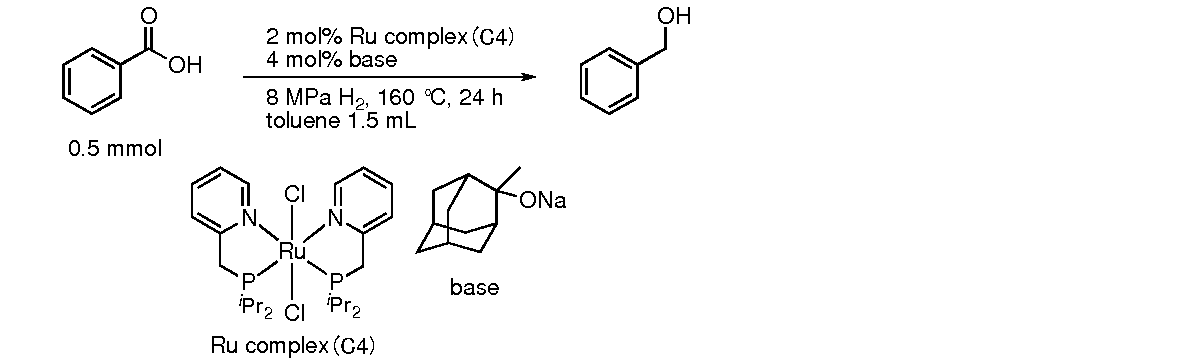
アルゴンガス雰囲気下、乾燥したフッ素樹脂製のチューブ(30mL)に、攪拌子、ルテニウム錯体(C4)(5.9mg、0.01mmol)、ナトリウム2-メチル-2-アダマントキサイド(3.8mg、0.02mmol)、安息香酸(61.1mg、0.5mmol)及びトルエン(1.5mL)を収容した。その後、この混合物を含むチューブを、迅速にオートクレーブ内に挿入した。次いで、オートクレーブをアースした状態で密閉し、このオートクレーブに、ステンレス管を介して接続した水素ガスボンベから水素ガスを導入し、オートクレーブ内を水素ガスで置換した。すなわち、オートクレーブ内に9MPaの水素ガス圧をかけ、その後、リークバルブから水素ガス圧を抜いた。この操作(置換-脱置換)を3回繰り返した。最後に、オートクレーブ内の水素ガスを8MPaに設定し、恒温槽を用いて160℃で24時間反応させた。
次いで、オートクレーブからチューブを取り出し、ベンジルアルコールを含む反応生成物(溶液)を得た。1H NMR解析のために、この溶液に、内部標準物質(1,1,2,2-テトラクロロエタン)を加えた。この内部標準物質の水素原子量の積分値を基準として、反応生成物の収率を算出した。ベンジルアルコールの収率は、8%であった。
6.水素移動反応(V)-水素還元反応(その他の化合物の還元)
以下の方法により、その他の化合物の水素還元反応を行った(実施例6-1~6-11)。基質並びに水素移動反応物及びその収率を表8に示す。
以下の方法により、その他の化合物の水素還元反応を行った(実施例6-1~6-11)。基質並びに水素移動反応物及びその収率を表8に示す。
実施例6-1
安息香酸メチルに代えてベンゾニトリルを用い、反応時間を12時間とした以外は、実施例3-1と同様の方法で水素還元反応を行った。
安息香酸メチルに代えてベンゾニトリルを用い、反応時間を12時間とした以外は、実施例3-1と同様の方法で水素還元反応を行った。
実施例6-2
安息香酸メチルに代えて4-ニトロ安息香酸メチルを用い、THFの使用量を1mLとし、反応時間を12時間とした以外は、実施例3-1と同様の方法で水素還元反応を行った。
安息香酸メチルに代えて4-ニトロ安息香酸メチルを用い、THFの使用量を1mLとし、反応時間を12時間とした以外は、実施例3-1と同様の方法で水素還元反応を行った。
実施例6-3
安息香酸メチルに代えてニトロベンゼンを用い、反応時間を12時間とした以外は、実施例3-1と同様の方法で水素還元反応を行った。
安息香酸メチルに代えてニトロベンゼンを用い、反応時間を12時間とした以外は、実施例3-1と同様の方法で水素還元反応を行った。
実施例6-4
アルゴンガス素雰囲気下、乾燥したフッ素樹脂製のチューブ(30mL)に、攪拌子、ルテニウム錯体(C1)(7.5mg、0.01mmol)、ナトリウム2-メチル-2-アダマントキサイド(3.76mg、0.02mmol)、表6(6-4)記載の化合物(97.63mg、0.5mmol)及びトルエン(1.5mL)を収容した。その後、この化合物を含むチューブを、迅速にオートクレーブ内に挿入した。次いで、オートクレーブをアースした状態で密閉し、このオートクレーブに、ステンレス管を介して接続した水素ガスボンベから水素ガスを導入し、オートクレーブ内を水素ガスで置換した。即ち、オートクレーブ内に9MPaの水素ガス圧をかけ、その後、リークバルブから水素ガス圧を抜いた。この操作(置換-脱置換)を3回繰り返した。最後に、オートクレーブ内の水素ガスを8MPaに設定し、恒温槽を用いて、160℃で36時間反応させた。
アルゴンガス素雰囲気下、乾燥したフッ素樹脂製のチューブ(30mL)に、攪拌子、ルテニウム錯体(C1)(7.5mg、0.01mmol)、ナトリウム2-メチル-2-アダマントキサイド(3.76mg、0.02mmol)、表6(6-4)記載の化合物(97.63mg、0.5mmol)及びトルエン(1.5mL)を収容した。その後、この化合物を含むチューブを、迅速にオートクレーブ内に挿入した。次いで、オートクレーブをアースした状態で密閉し、このオートクレーブに、ステンレス管を介して接続した水素ガスボンベから水素ガスを導入し、オートクレーブ内を水素ガスで置換した。即ち、オートクレーブ内に9MPaの水素ガス圧をかけ、その後、リークバルブから水素ガス圧を抜いた。この操作(置換-脱置換)を3回繰り返した。最後に、オートクレーブ内の水素ガスを8MPaに設定し、恒温槽を用いて、160℃で36時間反応させた。
実施例6-5及び6-6
表6(6-4)記載の化合物に代えて、表6(6-5)又は(6-6)記載の化合物を用いる以外は、実施例6-4と同様の方法で水素還元反応を行った。
表6(6-4)記載の化合物に代えて、表6(6-5)又は(6-6)記載の化合物を用いる以外は、実施例6-4と同様の方法で水素還元反応を行った。
実施例6-7
アルゴンガス素雰囲気下、乾燥したフッ素樹脂製のチューブ(30mL)に、攪拌子、ルテニウム錯体(C1)(7.5mg、0.01mmol)、ナトリウム2-メチル-2-アダマントキサイド(3.76mg、0.02mmol)、キノリン(59.08?L、0.5mmol)及びトルエン(1.5mL)を収容した。その後、この化合物を含むチューブを、迅速にオートクレーブ内に挿入した。次いで、オートクレーブをアースした状態で密閉し、このオートクレーブに、ステンレス管を介して接続した水素ガスボンベから水素ガスを導入し、オートクレーブ内を水素ガスで置換した。即ち、オートクレーブ内に9MPaの水素ガス圧をかけ、その後、リークバルブから水素ガス圧を抜いた。この操作(置換-脱置換)を3回繰り返した。最後に、オートクレーブ内の水素ガスを8MPaに設定した。このオートクレーブを1時間常温で撹拌した後、恒温槽を用いて、160℃で12時間反応させた。
アルゴンガス素雰囲気下、乾燥したフッ素樹脂製のチューブ(30mL)に、攪拌子、ルテニウム錯体(C1)(7.5mg、0.01mmol)、ナトリウム2-メチル-2-アダマントキサイド(3.76mg、0.02mmol)、キノリン(59.08?L、0.5mmol)及びトルエン(1.5mL)を収容した。その後、この化合物を含むチューブを、迅速にオートクレーブ内に挿入した。次いで、オートクレーブをアースした状態で密閉し、このオートクレーブに、ステンレス管を介して接続した水素ガスボンベから水素ガスを導入し、オートクレーブ内を水素ガスで置換した。即ち、オートクレーブ内に9MPaの水素ガス圧をかけ、その後、リークバルブから水素ガス圧を抜いた。この操作(置換-脱置換)を3回繰り返した。最後に、オートクレーブ内の水素ガスを8MPaに設定した。このオートクレーブを1時間常温で撹拌した後、恒温槽を用いて、160℃で12時間反応させた。
実施例6-8~6-11
キノリンに代えて、インドール、ベンゾチオフェン、ベンゾフラン又はイソキノリンを用いる以外は、実施例6-7と同様の方法で水素還元反応を行った(但し、実施例6-9では、ナトリウム2-メチル-2-アダマントキサイドの使用量を18.82mg(0.10mmol)に変更した。)。
キノリンに代えて、インドール、ベンゾチオフェン、ベンゾフラン又はイソキノリンを用いる以外は、実施例6-7と同様の方法で水素還元反応を行った(但し、実施例6-9では、ナトリウム2-メチル-2-アダマントキサイドの使用量を18.82mg(0.10mmol)に変更した。)。
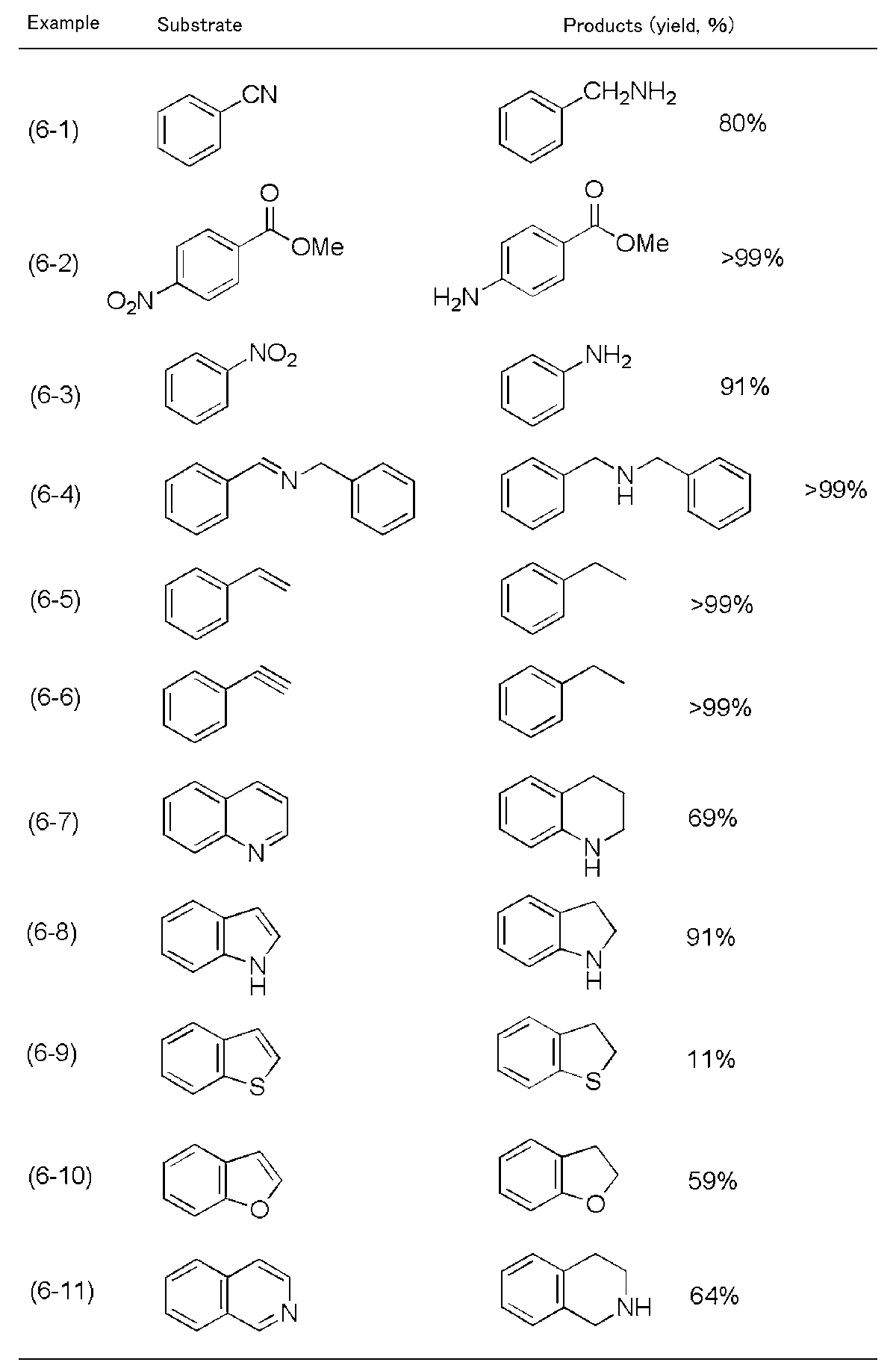
7.水素移動反応(VI)-脱水素反応
実施例7-1
窒素雰囲気下、減圧乾燥したヤングシュレンク(10mL)に、撹拌子、ルテニウム錯体(C1)(15mg、0.02mmol)、カリウムtert-ブトキシド(11.2mg、0.1mmol)、ベンジル4-フルオロフェニルケトン(429mg、2.0mmol)、トルエン(1.0mL)及びL-バリノール(0.11mL、1.0mmol)を収容した。次いで、凍結脱気を行い、その後、恒温槽を用いて、165℃で24時間反応させた。
実施例7-1
窒素雰囲気下、減圧乾燥したヤングシュレンク(10mL)に、撹拌子、ルテニウム錯体(C1)(15mg、0.02mmol)、カリウムtert-ブトキシド(11.2mg、0.1mmol)、ベンジル4-フルオロフェニルケトン(429mg、2.0mmol)、トルエン(1.0mL)及びL-バリノール(0.11mL、1.0mmol)を収容した。次いで、凍結脱気を行い、その後、恒温槽を用いて、165℃で24時間反応させた。
反応終了後、反応溶液に標準物質(1,1,2,2-テトラクロロエタン)を加え、重クロロホルム溶媒で1H NMR測定を行った。その結果、目的の生成物である2-(4-フルオロフェニル)-5-イソプロピル-3-フェニル-1H-ピロールが得られた(収率;24%)。
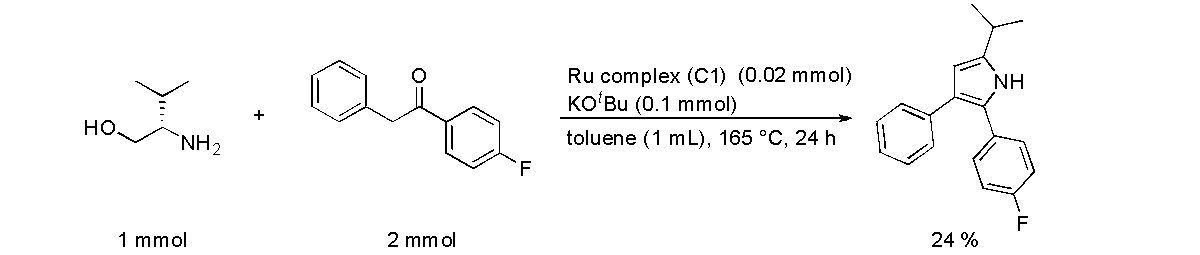
実施例7-2
窒素雰囲気下、減圧乾燥したヤングシュレンク(10mL)に、撹拌子、ルテニウム錯体(C1)(7.5mg、0.01mmol)、カリウムtert-ブトキシド(11,2mg、0.1mmol)、1-ベンジル-4-ピペリジンメタノール(205mg、1.0mmol)、5,6-ジメトキシ-1-インダノン(384mg、2.0mmol)及びトルエン(1.0mL)を収容した。次いで、恒温槽を用いて、160℃で24時間反応させた。反応終了後、得られた反応溶液を溶媒留去し、標準物質(1,1,2,2-テトラクロロエタン)を加え、重クロロホルム溶媒で1H NMR測定を行った。その結果、目的の生成物であるドネペジルが得られた(収率;92%)。

窒素雰囲気下、減圧乾燥したヤングシュレンク(10mL)に、撹拌子、ルテニウム錯体(C1)(7.5mg、0.01mmol)、カリウムtert-ブトキシド(11,2mg、0.1mmol)、1-ベンジル-4-ピペリジンメタノール(205mg、1.0mmol)、5,6-ジメトキシ-1-インダノン(384mg、2.0mmol)及びトルエン(1.0mL)を収容した。次いで、恒温槽を用いて、160℃で24時間反応させた。反応終了後、得られた反応溶液を溶媒留去し、標準物質(1,1,2,2-テトラクロロエタン)を加え、重クロロホルム溶媒で1H NMR測定を行った。その結果、目的の生成物であるドネペジルが得られた(収率;92%)。
実施例7-3
減圧乾燥させ、窒素で置換した10mLヤングシュレンクに、撹拌子、ルテニウム錯体(C1)(15mg、0.02mmol)、カリウムtert-ブトキシド(44.9mg、0.4mmol)、ベンジル4-フルオロフェニルケトン(429mg、2.0mmol)、トルエン(1.0mL)及びL-バリノール(0.11mL、1.0mmol)を収容した。その後、165℃の恒温槽で24時間反応させ、2-(4-フルオロフェニル)-5-イソプロピル-3-フェニル-1H-ピロールを得た。標準物質として1,1,2,2-テトラクロロエタンを用い、重クロロホルム溶媒で1H NMR測定を行った結果、収率34%を得た。

減圧乾燥させ、窒素で置換した10mLヤングシュレンクに、撹拌子、ルテニウム錯体(C1)(15mg、0.02mmol)、カリウムtert-ブトキシド(44.9mg、0.4mmol)、ベンジル4-フルオロフェニルケトン(429mg、2.0mmol)、トルエン(1.0mL)及びL-バリノール(0.11mL、1.0mmol)を収容した。その後、165℃の恒温槽で24時間反応させ、2-(4-フルオロフェニル)-5-イソプロピル-3-フェニル-1H-ピロールを得た。標準物質として1,1,2,2-テトラクロロエタンを用い、重クロロホルム溶媒で1H NMR測定を行った結果、収率34%を得た。
実施例7-4
L-バリノールに代えてL-フェニルアラノールを、ベンジル4-フルオロフェニルケトンに代えてアセトフェノンを用いた以外は、実施例7-3と同様の方法でピロールの合成を行い、2-ベンジル-5-フェニル-1H-ピロールを得た。標準物質として1,1,1,2-テトラクロロエタンを用いた1H NMRによる収率は60%であった。
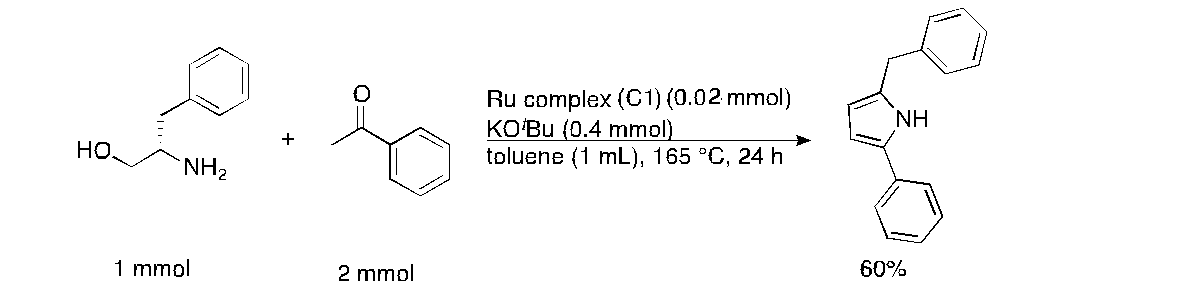
L-バリノールに代えてL-フェニルアラノールを、ベンジル4-フルオロフェニルケトンに代えてアセトフェノンを用いた以外は、実施例7-3と同様の方法でピロールの合成を行い、2-ベンジル-5-フェニル-1H-ピロールを得た。標準物質として1,1,1,2-テトラクロロエタンを用いた1H NMRによる収率は60%であった。
実施例7-5
減圧乾燥させ、窒素で置換した10mLヤングシュレンクに、撹拌子、ルテニウム錯体(C1)(3.4mg、0.05mmol)、カリウムtert-ブトキシド(22.4mg、0.2mmol)、トルエン(2.0mL)、プロピオフェノン(537mg、4.0mmol)及びL-バリノール(0.22mL、2.0mmol)を収容した。その後、凍結脱気を行い、165℃の恒温槽で24時間反応させ、2-イソプロピル-4-メチル-5-フェニル-1H-ピロールを得た。標準物質として1,1,1,2-テトラクロロエタンを用い、重クロロホルム溶媒で1H NMR測定を行った結果、収率52%を得た。
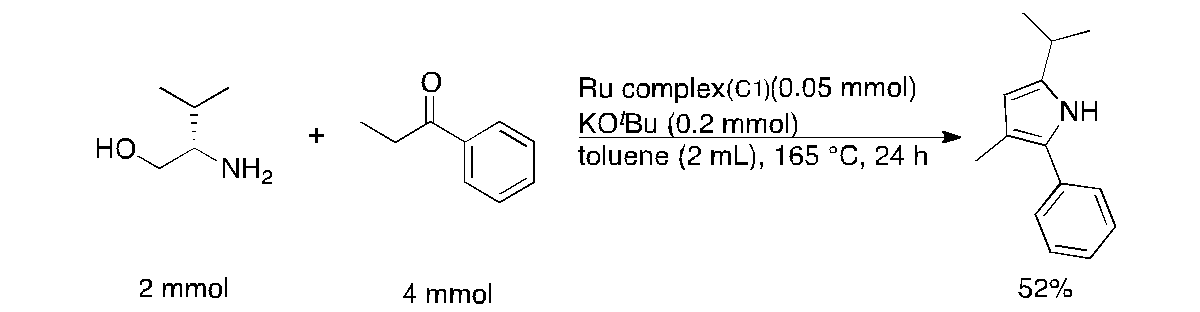
減圧乾燥させ、窒素で置換した10mLヤングシュレンクに、撹拌子、ルテニウム錯体(C1)(3.4mg、0.05mmol)、カリウムtert-ブトキシド(22.4mg、0.2mmol)、トルエン(2.0mL)、プロピオフェノン(537mg、4.0mmol)及びL-バリノール(0.22mL、2.0mmol)を収容した。その後、凍結脱気を行い、165℃の恒温槽で24時間反応させ、2-イソプロピル-4-メチル-5-フェニル-1H-ピロールを得た。標準物質として1,1,1,2-テトラクロロエタンを用い、重クロロホルム溶媒で1H NMR測定を行った結果、収率52%を得た。
実施例7-6
アセトフェノンに代えて1-フェニルエタノールを用いた以外は、実施例7-4と同様の方法でピロールの合成を行い、2-ベンジル-5-フェニル-1H-ピロールを得た。NMRによる収率は51%であった。

アセトフェノンに代えて1-フェニルエタノールを用いた以外は、実施例7-4と同様の方法でピロールの合成を行い、2-ベンジル-5-フェニル-1H-ピロールを得た。NMRによる収率は51%であった。
実施例7-7
L-フェニルアラノールに代えてL-バリノールを、1-フェニルエタノールに代えて1-フェニル-1-プロパノールを用いた以外は、実施例7-6と同様の方法でピロールの合成を行い、2-イソプロピル-4-メチル-5-フェニル-1H-ピロールを得た。NMRによる収率は20%であった。
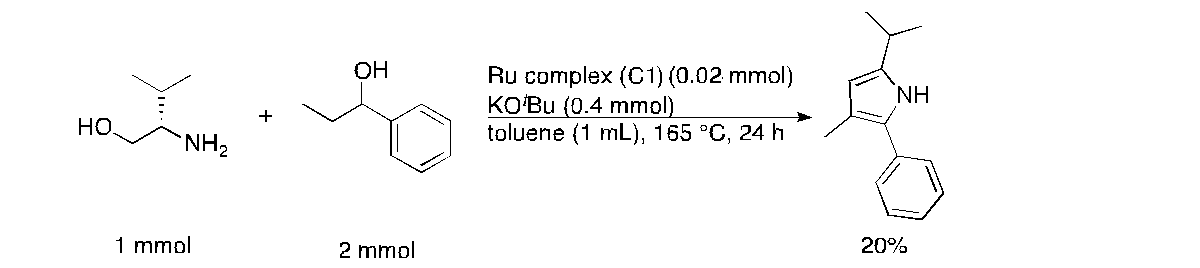
L-フェニルアラノールに代えてL-バリノールを、1-フェニルエタノールに代えて1-フェニル-1-プロパノールを用いた以外は、実施例7-6と同様の方法でピロールの合成を行い、2-イソプロピル-4-メチル-5-フェニル-1H-ピロールを得た。NMRによる収率は20%であった。
実施例7-8
ルテニウム錯体(C1)に代えて、ルテニウム錯体(C4)(12mg、0.02mmol)を用いた以外は、実施例7-3と同様にして、ピロールの合成を行い、2-(4-フルオロフェニル)-5-イソプロピル-3-フェニル-1H-ピロールを得た。標準物質として1,1,2,2-テトラクロロエタンを用いた1H NMRによる収率は24%であった。
ルテニウム錯体(C1)に代えて、ルテニウム錯体(C4)(12mg、0.02mmol)を用いた以外は、実施例7-3と同様にして、ピロールの合成を行い、2-(4-フルオロフェニル)-5-イソプロピル-3-フェニル-1H-ピロールを得た。標準物質として1,1,2,2-テトラクロロエタンを用いた1H NMRによる収率は24%であった。
8.比較例
比較例1(水素還元反応)
ルテニウム錯体(C1)に代えて、下記式(C2)で表されるジクロロビスジフェニルホスフィノメチルピリジン-ルテニウム(II)錯体(以下、「ルテニウム錯体(C2)」又は「Ru complex(C2)」という。)を用いた以外は、実施例2-3と同様の方法で、N-ベンジルベンズアミドの水素還元反応を行った。N-ベンジルベンズアミドの転化率は、ほぼ100%であった。しかし、アミド基の水素還元は進まず、水素移動反応物であるベンジルアルコール及びベンジルアミンの収率は、いずれも0%であった(下記式参照)。
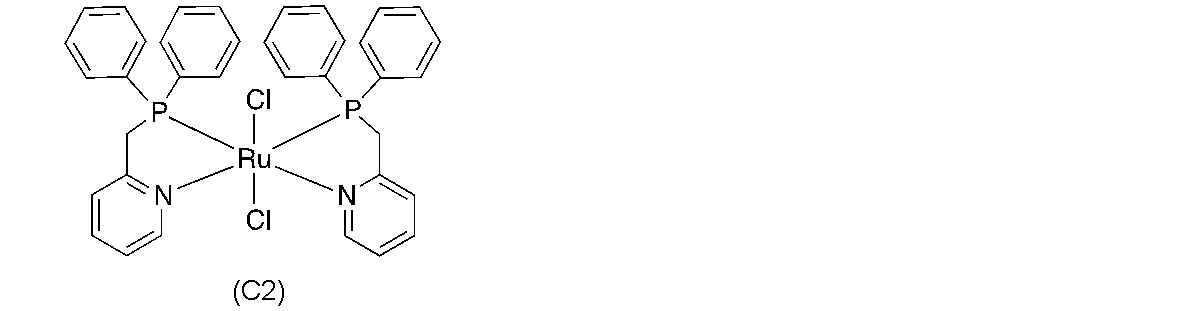

(式中、「additive」は、ナトリウム2-メチル-2-アダマンタントキサイドを表す。)
比較例1(水素還元反応)
ルテニウム錯体(C1)に代えて、下記式(C2)で表されるジクロロビスジフェニルホスフィノメチルピリジン-ルテニウム(II)錯体(以下、「ルテニウム錯体(C2)」又は「Ru complex(C2)」という。)を用いた以外は、実施例2-3と同様の方法で、N-ベンジルベンズアミドの水素還元反応を行った。N-ベンジルベンズアミドの転化率は、ほぼ100%であった。しかし、アミド基の水素還元は進まず、水素移動反応物であるベンジルアルコール及びベンジルアミンの収率は、いずれも0%であった(下記式参照)。
比較例2(脱水素反応)
ルテニウム錯体(C1)に代えて、ルテニウム錯体(C2)を用いた以外は、実施例7-1と同様の方法で、2-(4-フルオロフェニル)-5-イソプロピル-3-フェニル-1H-ピロールを合成した。その結果、該ピロールの収率は1%以下であった。
ルテニウム錯体(C1)に代えて、ルテニウム錯体(C2)を用いた以外は、実施例7-1と同様の方法で、2-(4-フルオロフェニル)-5-イソプロピル-3-フェニル-1H-ピロールを合成した。その結果、該ピロールの収率は1%以下であった。
比較例3(水素還元反応)
ルテニウム錯体(C1)に代えて、ルテニウム錯体(C2)を用いた以外は、実施例3-19と同様の方法を試みたが、極微量のベンジルアルコールしか得られなかった。
ルテニウム錯体(C1)に代えて、ルテニウム錯体(C2)を用いた以外は、実施例3-19と同様の方法を試みたが、極微量のベンジルアルコールしか得られなかった。
比較例4(水素還元反応)
ルテニウム錯体(C1)に代えて、ルテニウム錯体(C2)を用いた以外は、実施例4-2と同様にして、アセトフェノンの水素還元反応を行った。反応生成物には1-フェニルエタノールが含まれており、その収率は、9%であった。
ルテニウム錯体(C1)に代えて、ルテニウム錯体(C2)を用いた以外は、実施例4-2と同様にして、アセトフェノンの水素還元反応を行った。反応生成物には1-フェニルエタノールが含まれており、その収率は、9%であった。
9.水素移動反応(VII)-水素還元反応及び脱水素反応の併用
実施例8-1
アルゴンガス雰囲気下、乾燥したフッ素樹脂製のチューブ(30mL)に、攪拌子、ルテニウム錯体(C1)(15.0mg、0.02mmol)、塩基(base)としてナトリウム2-メチル-2-アダマントキサイド(37.6mg、0.2mmol)、N-ベンジルベンズアミド(211.3mg、1.0mmol)及びイソプロパノール(3.0mL)を収容した。その後、この混合物を含むチューブを、迅速にオートクレーブ内に挿入した。次いで、オートクレーブをアースした状態で密閉し、このオートクレーブに、ステンレス管を介して接続した水素ガスボンベから水素ガスを導入し、オートクレーブ内を水素ガスで置換した。すなわち、オートクレーブ内に9MPaの水素ガス圧をかけ、その後、リークバルブから水素ガス圧を抜いた。この操作(置換-脱置換)を3回繰り返した。最後に、オートクレーブ内の水素ガスを8MPaに設定し、恒温槽を用いて160℃で24時間反応させた。
実施例8-1
アルゴンガス雰囲気下、乾燥したフッ素樹脂製のチューブ(30mL)に、攪拌子、ルテニウム錯体(C1)(15.0mg、0.02mmol)、塩基(base)としてナトリウム2-メチル-2-アダマントキサイド(37.6mg、0.2mmol)、N-ベンジルベンズアミド(211.3mg、1.0mmol)及びイソプロパノール(3.0mL)を収容した。その後、この混合物を含むチューブを、迅速にオートクレーブ内に挿入した。次いで、オートクレーブをアースした状態で密閉し、このオートクレーブに、ステンレス管を介して接続した水素ガスボンベから水素ガスを導入し、オートクレーブ内を水素ガスで置換した。すなわち、オートクレーブ内に9MPaの水素ガス圧をかけ、その後、リークバルブから水素ガス圧を抜いた。この操作(置換-脱置換)を3回繰り返した。最後に、オートクレーブ内の水素ガスを8MPaに設定し、恒温槽を用いて160℃で24時間反応させた。
反応終了後、オートクレーブを氷浴に浸して冷却し、ほぼ室温とした。そして、オートクレーブのリークバルブを開放し、内部にある水素ガスを空気中に放出した。次に、オートクレーブからチューブを取り出し、反応生成物(溶液)を得た。この反応生成物の1H NMR解析のために、この溶液に、内部標準物質(1,1,2,2-テトラクロロエタン)を加えた。この内部標準物質の水素原子量の積分値を基準として、反応生成物の収率を算出したところ、ベンジルアルコール及びベンジルアミンが、それぞれ、45%及び15%であった。また、N-ベンジルプロパン-2-アミンが41%得られた。

N-ベンジルプロパン-2-アミンが得られたことについて、発明者らは、この実施例8-1における反応機構を、以下のように推定している。即ち、まず、イソプロパノールが、ルテニウム錯体(C1)の作用により脱水素化し、アセトンとなり、一方で、N-ベンジルベンズアミドが水素化されてベンジルアミンとなる。その後、アセトンが、ベンジルアミンと反応し、イミンを形成し、このイミンが水素化されて、N-ベンジルプロパン-2-アミンが生成する。
Claims (15)
- 下記一般式(1)で表されるルテニウム錯体を含む水素移動反応用触媒。

- 上記一般式(1)におけるR5及びR6が、互いに独立して1価の鎖状脂肪族飽和炭化水素基又は脂環式飽和炭化水素基である、請求項1に記載の水素移動反応用触媒。
- 上記一般式(1)におけるR5及びR6が、互いに独立して1価の脂環式炭化水素基である、請求項1又は2に記載の水素移動反応用触媒。
- 上記一般式(1)におけるX1が、水素原子、ハロゲン原子、-BH4、-OTf、-OTs、-BF4、-SbF6、-PF6、-B(C6F5)4、又は-B(3,5-di-CF3-C6H3)4である、請求項1乃至3のいずれか一項に記載の水素移動反応用触媒。
- 上記一般式(1)におけるR1及びR2が、互いに結合して2価の炭化水素基を形成している請求項1乃至4のいずれか一項に記載の水素移動反応用触媒。
- 上記一般式(1)において、R1、R2、窒素原子、及び該窒素原子に結合する炭素原子が互いに結合してピリジン環又はピペリジン環を形成している、請求項5に記載の水素移動反応用触媒。
- 上記ルテニウム錯体が、下記式で表される請求項1乃至6のいずれかに記載の水素移動反応用触媒。
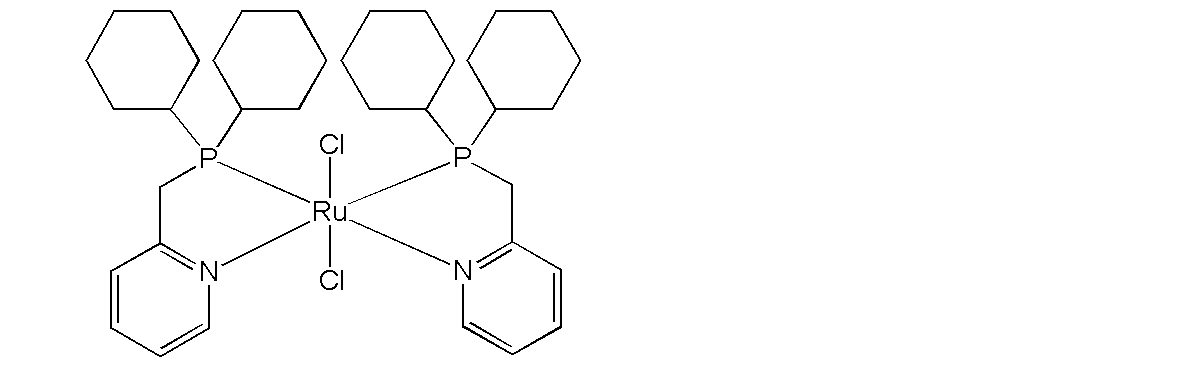
- 請求項1乃至7のいずれか一項に記載の水素移動反応用触媒の存在下で、有機化合物を水素還元反応又は脱水素反応に供する工程を備える、水素移動反応物の製造方法。
- 上記有機化合物が、アミド、エステル、カルボン酸、炭酸エステル、ケトン及びアルデヒドを含む炭素―酸素不飽和結合を有する化合物、アルケン及びアルキンを含む炭素-炭素不飽和結合を有する化合物、ニトロ化合物を含む窒素―酸素不飽和結合を有する化合物、又はシアノ化合物を含む炭素-窒素不飽和結合を有する化合物であって、上記有機化合物を水素還元反応に供する工程を備える、請求項8記載の水素移動反応物の製造方法。
- 上記有機化合物が、アミノアルコール、脂肪族1級アルコール、脂肪族2級アルコール、芳香族1級アルコール又は芳香族2級アルコールを含むアルコール類であって、上記有機化合物を脱水素反応に供する工程を備える、請求項8記載の水素移動反応物の製造方法。
- 下記一般式(1)で表されるルテニウム錯体。

- 上記一般式(1)におけるR5及びR6が、互いに独立して1価の脂環式飽和炭化水素基である、請求項11に記載のルテニウム錯体。
- 上記一般式(1)におけるR1及びR2が、互いに結合して2価の炭化水素基を形成している、請求項11又は12に記載のルテニウム錯体。
- 上記一般式(1)において、R1、R2、窒素原子、及び該窒素原子に結合する炭素原子が互いに結合してピリジン環又はピペリジン環を形成している、請求項13に記載のルテニウム錯体。
- 下記式で表される請求項11乃至14のいずれか一項に記載のルテニウム錯体。
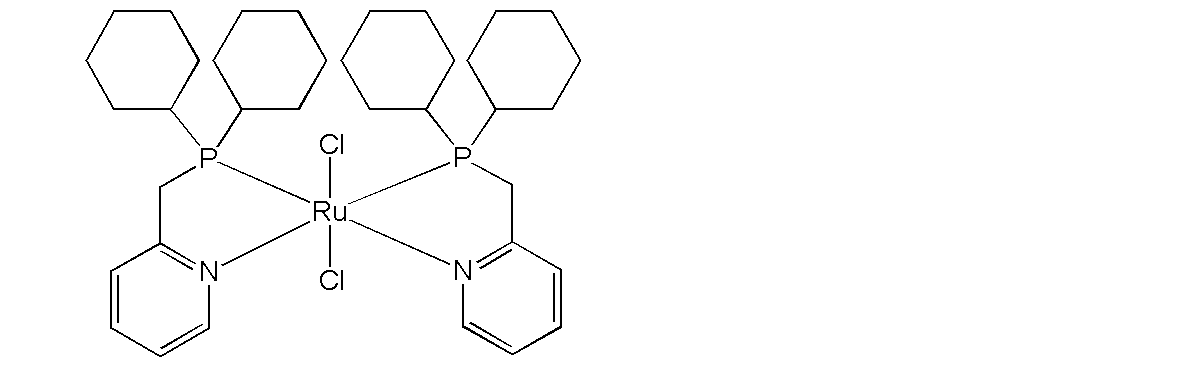
Priority Applications (1)
| Application Number | Priority Date | Filing Date | Title |
|---|---|---|---|
| JP2012554789A JP5674059B2 (ja) | 2011-01-24 | 2012-01-23 | ルテニウム錯体を含む水素移動反応用触媒及び水素移動反応物の製造方法 |
Applications Claiming Priority (2)
| Application Number | Priority Date | Filing Date | Title |
|---|---|---|---|
| JP2011012316 | 2011-01-24 | ||
| JP2011-012316 | 2011-01-24 |
Publications (1)
| Publication Number | Publication Date |
|---|---|
| WO2012102247A1 true WO2012102247A1 (ja) | 2012-08-02 |
Family
ID=46580814
Family Applications (1)
| Application Number | Title | Priority Date | Filing Date |
|---|---|---|---|
| PCT/JP2012/051373 Ceased WO2012102247A1 (ja) | 2011-01-24 | 2012-01-23 | ルテニウム錯体を含む水素移動反応用触媒及び水素移動反応物の製造方法 |
Country Status (2)
| Country | Link |
|---|---|
| JP (1) | JP5674059B2 (ja) |
| WO (1) | WO2012102247A1 (ja) |
Cited By (9)
| Publication number | Priority date | Publication date | Assignee | Title |
|---|---|---|---|---|
| CN102964195A (zh) * | 2012-11-28 | 2013-03-13 | 温州大学 | 一种制备二级和三级取代酰胺的方法 |
| CN103980317A (zh) * | 2014-05-28 | 2014-08-13 | 南开大学 | 联吡啶四齿配体钌络合物及其制备方法和应用 |
| WO2014136795A1 (ja) | 2013-03-04 | 2014-09-12 | 国立大学法人名古屋大学 | 配位子、その配位子を含む金属錯体、及びその金属錯体を用いた反応 |
| EP2734299A4 (en) * | 2011-07-18 | 2016-05-11 | Univ Alberta | CATALYSTS AND METHOD FOR THE HYDROGENATION OF AMIDES |
| JP2016199513A (ja) * | 2015-04-13 | 2016-12-01 | 国立大学法人名古屋大学 | カルボン酸化合物の水素化によるアルコールの製造方法、及び該製造方法に用いるルテニウム錯体 |
| CN107778217A (zh) * | 2016-08-29 | 2018-03-09 | 南京理工大学 | 一种合成多奈哌齐的方法 |
| CN107903204A (zh) * | 2017-12-05 | 2018-04-13 | 郑州大学 | 一种多奈哌齐的合成方法 |
| CN109678732A (zh) * | 2019-02-14 | 2019-04-26 | 中国科学院兰州化学物理研究所苏州研究院 | 一种连续生产5-氨基-1-戊醇的方法 |
| WO2023153494A1 (ja) * | 2022-02-14 | 2023-08-17 | 国立大学法人 東京大学 | 触媒、ホルムアミド類及び/又はアミン類の製造方法、ホルムアミド類及び/又はアルコール類の製造方法並びに錯体 |
Citations (6)
| Publication number | Priority date | Publication date | Assignee | Title |
|---|---|---|---|---|
| JP2004269522A (ja) * | 2003-02-20 | 2004-09-30 | Mitsubishi Chemicals Corp | 新規なルテニウム錯体、その製造方法、及びそれを用いたアミド化合物の製造方法 |
| JP2007536338A (ja) * | 2004-05-04 | 2007-12-13 | ユニヴァーシタ’デグリ ステュディ ディ ウーディネ | 2−(アミノメチル)ピリジン及びフォスフィンを有するルテニウムの複合体、その調製方法、並びに触媒としての使用 |
| JP2008273971A (ja) * | 2007-05-03 | 2008-11-13 | Evonik Degussa Gmbh | 硫黄含有のメタセシス触媒 |
| JP2009519947A (ja) * | 2005-12-16 | 2009-05-21 | マテリア, インコーポレイテッド | 有機金属ルテニウム錯体および関連する四置換および別の嵩高いオレフィンの製造方法 |
| JP2010527316A (ja) * | 2007-05-18 | 2010-08-12 | カナタ ケミカル テクノロジーズ インコーポレイティッド | アンモニアボランからの水素の製造方法 |
| JP2011037809A (ja) * | 2008-09-09 | 2011-02-24 | Takasago Internatl Corp | エステル又はラクトン類の水素還元によるアルコール類の製造方法 |
-
2012
- 2012-01-23 JP JP2012554789A patent/JP5674059B2/ja not_active Expired - Fee Related
- 2012-01-23 WO PCT/JP2012/051373 patent/WO2012102247A1/ja not_active Ceased
Patent Citations (6)
| Publication number | Priority date | Publication date | Assignee | Title |
|---|---|---|---|---|
| JP2004269522A (ja) * | 2003-02-20 | 2004-09-30 | Mitsubishi Chemicals Corp | 新規なルテニウム錯体、その製造方法、及びそれを用いたアミド化合物の製造方法 |
| JP2007536338A (ja) * | 2004-05-04 | 2007-12-13 | ユニヴァーシタ’デグリ ステュディ ディ ウーディネ | 2−(アミノメチル)ピリジン及びフォスフィンを有するルテニウムの複合体、その調製方法、並びに触媒としての使用 |
| JP2009519947A (ja) * | 2005-12-16 | 2009-05-21 | マテリア, インコーポレイテッド | 有機金属ルテニウム錯体および関連する四置換および別の嵩高いオレフィンの製造方法 |
| JP2008273971A (ja) * | 2007-05-03 | 2008-11-13 | Evonik Degussa Gmbh | 硫黄含有のメタセシス触媒 |
| JP2010527316A (ja) * | 2007-05-18 | 2010-08-12 | カナタ ケミカル テクノロジーズ インコーポレイティッド | アンモニアボランからの水素の製造方法 |
| JP2011037809A (ja) * | 2008-09-09 | 2011-02-24 | Takasago Internatl Corp | エステル又はラクトン類の水素還元によるアルコール類の製造方法 |
Cited By (14)
| Publication number | Priority date | Publication date | Assignee | Title |
|---|---|---|---|---|
| US9745332B2 (en) | 2011-07-18 | 2017-08-29 | The Governors Of The Univerity Of Alberta | Catalysts and processes for the hydrogenation of amides |
| EP2734299A4 (en) * | 2011-07-18 | 2016-05-11 | Univ Alberta | CATALYSTS AND METHOD FOR THE HYDROGENATION OF AMIDES |
| CN102964195A (zh) * | 2012-11-28 | 2013-03-13 | 温州大学 | 一种制备二级和三级取代酰胺的方法 |
| WO2014136795A1 (ja) | 2013-03-04 | 2014-09-12 | 国立大学法人名古屋大学 | 配位子、その配位子を含む金属錯体、及びその金属錯体を用いた反応 |
| US9463451B2 (en) | 2013-03-04 | 2016-10-11 | National University Corporation Nagoya University | Ligand, metal complex containing ligand, and reaction using metal complex containing ligand |
| JPWO2014136795A1 (ja) * | 2013-03-04 | 2017-02-16 | 国立大学法人名古屋大学 | 配位子、その配位子を含む金属錯体、及びその金属錯体を用いた反応 |
| CN103980317B (zh) * | 2014-05-28 | 2017-01-25 | 南开大学 | 联吡啶四齿配体钌络合物及其制备方法和应用 |
| CN103980317A (zh) * | 2014-05-28 | 2014-08-13 | 南开大学 | 联吡啶四齿配体钌络合物及其制备方法和应用 |
| JP2016199513A (ja) * | 2015-04-13 | 2016-12-01 | 国立大学法人名古屋大学 | カルボン酸化合物の水素化によるアルコールの製造方法、及び該製造方法に用いるルテニウム錯体 |
| CN107778217A (zh) * | 2016-08-29 | 2018-03-09 | 南京理工大学 | 一种合成多奈哌齐的方法 |
| CN107903204A (zh) * | 2017-12-05 | 2018-04-13 | 郑州大学 | 一种多奈哌齐的合成方法 |
| CN109678732A (zh) * | 2019-02-14 | 2019-04-26 | 中国科学院兰州化学物理研究所苏州研究院 | 一种连续生产5-氨基-1-戊醇的方法 |
| CN109678732B (zh) * | 2019-02-14 | 2022-04-08 | 中国科学院兰州化学物理研究所 | 一种连续生产5-氨基-1-戊醇的方法 |
| WO2023153494A1 (ja) * | 2022-02-14 | 2023-08-17 | 国立大学法人 東京大学 | 触媒、ホルムアミド類及び/又はアミン類の製造方法、ホルムアミド類及び/又はアルコール類の製造方法並びに錯体 |
Also Published As
| Publication number | Publication date |
|---|---|
| JPWO2012102247A1 (ja) | 2014-06-30 |
| JP5674059B2 (ja) | 2015-02-25 |
Similar Documents
| Publication | Publication Date | Title |
|---|---|---|
| JP5674059B2 (ja) | ルテニウム錯体を含む水素移動反応用触媒及び水素移動反応物の製造方法 | |
| WO2012065571A1 (zh) | 手性螺环吡啶胺基膦配体化合物与合成方法及其应用 | |
| Strand et al. | Asymmetric induction afforded by chiral azolylidene N-heterocyclic carbenes (NHC) catalysts | |
| Liu et al. | Asymmetric transfer hydrogenation of ketones with a polyethylene glycol bound Ru catalyst in water | |
| Erb et al. | Functionalization of 3-iodo-N, N-diisopropylferrocene-carboxamide, a pivotal substrate to open the chemical space to 1, 3-disubstituted ferrocenes | |
| Xu et al. | Asymmetric Cu-catalyzed Henry reaction promoted by chiral camphor-derived β-amino alcohols with a thiophene moiety | |
| Guo et al. | Rhodium-catalyzed enantioselective alkynylative cyclization of allenyl aldehydes with terminal alkynes | |
| CN101781222A (zh) | 一种制备烯胺酮类化合物的方法 | |
| Zou et al. | New bis (1-ferrocenylethyl) amine-derived monodentate phosphoramidite ligands for highly enantioselective copper-catalyzed 1, 4-conjugate addition | |
| CN110615811B (zh) | 一种手性亚磺酰胺单膦配体的大量制备方法 | |
| CN107721858A (zh) | 相转移催化β‑酮酸酯不对称α‑苯甲酰化的方法 | |
| Chen et al. | Highly efficient synthesis of β-amino esters via Mannich-type reaction under solvent-free conditions using ZnCl2 catalyst | |
| Jalba et al. | New chiral bis (oxazolinyl) bipyridine ligands and application in the iron catalyzed asymmetric hydrosilylation of ketones | |
| CN109575060A (zh) | 螺环双硼催化剂的合成及其在氢化反应中的应用 | |
| CN108191736B (zh) | 一种2,3-二取代吲哚类衍生物及其制备方法 | |
| JP4827531B2 (ja) | エナンチオ選択的なエナミドのイミンへの求核付加反応方法とα−アミノ−γ−ケト酸エステルの合成方法 | |
| JP2015172024A (ja) | 水素結合形成アミド基を持つキラル二環式ジエン配位子 | |
| CN116478052B (zh) | 一种铜催化合成1-萘胺衍生物的方法 | |
| JP4759722B2 (ja) | 置換基を有する芳香族カルボン酸エステルの製造方法 | |
| JP2021502885A (ja) | ホスフィン非含有コバルト系触媒ならびにその調製のための方法および使用 | |
| CN102464681A (zh) | 手性双齿亚磷酸酯配体及其制备方法与用途 | |
| JPWO2005085204A1 (ja) | 含窒素5員環化合物の製造方法 | |
| WO2008059960A1 (fr) | Procédé de production d'un dérivé 4-pyridinique et intermédiaire pour dérivé 4-pyridinique | |
| JP6281877B2 (ja) | 触媒前駆体および不斉鎖状化合物の合成方法 | |
| CN117209399A (zh) | 一种手性联烯腈化合物的合成方法及应用 |
Legal Events
| Date | Code | Title | Description |
|---|---|---|---|
| 121 | Ep: the epo has been informed by wipo that ep was designated in this application |
Ref document number: 12739094 Country of ref document: EP Kind code of ref document: A1 |
|
| ENP | Entry into the national phase |
Ref document number: 2012554789 Country of ref document: JP Kind code of ref document: A |
|
| NENP | Non-entry into the national phase |
Ref country code: DE |
|
| 122 | Ep: pct application non-entry in european phase |
Ref document number: 12739094 Country of ref document: EP Kind code of ref document: A1 |