WO2012086780A1 - 改良された分岐度分布を有するポリエチレン - Google Patents
改良された分岐度分布を有するポリエチレン Download PDFInfo
- Publication number
- WO2012086780A1 WO2012086780A1 PCT/JP2011/079872 JP2011079872W WO2012086780A1 WO 2012086780 A1 WO2012086780 A1 WO 2012086780A1 JP 2011079872 W JP2011079872 W JP 2011079872W WO 2012086780 A1 WO2012086780 A1 WO 2012086780A1
- Authority
- WO
- WIPO (PCT)
- Prior art keywords
- polyethylene
- chromium
- molecular weight
- catalyst
- compound
- Prior art date
- Legal status (The legal status is an assumption and is not a legal conclusion. Google has not performed a legal analysis and makes no representation as to the accuracy of the status listed.)
- Ceased
Links
Images
Classifications
-
- C—CHEMISTRY; METALLURGY
- C08—ORGANIC MACROMOLECULAR COMPOUNDS; THEIR PREPARATION OR CHEMICAL WORKING-UP; COMPOSITIONS BASED THEREON
- C08F—MACROMOLECULAR COMPOUNDS OBTAINED BY REACTIONS ONLY INVOLVING CARBON-TO-CARBON UNSATURATED BONDS
- C08F210/00—Copolymers of unsaturated aliphatic hydrocarbons having only one carbon-to-carbon double bond
- C08F210/16—Copolymers of ethene with alpha-alkenes, e.g. EP rubbers
-
- Y—GENERAL TAGGING OF NEW TECHNOLOGICAL DEVELOPMENTS; GENERAL TAGGING OF CROSS-SECTIONAL TECHNOLOGIES SPANNING OVER SEVERAL SECTIONS OF THE IPC; TECHNICAL SUBJECTS COVERED BY FORMER USPC CROSS-REFERENCE ART COLLECTIONS [XRACs] AND DIGESTS
- Y10—TECHNICAL SUBJECTS COVERED BY FORMER USPC
- Y10T—TECHNICAL SUBJECTS COVERED BY FORMER US CLASSIFICATION
- Y10T428/00—Stock material or miscellaneous articles
- Y10T428/13—Hollow or container type article [e.g., tube, vase, etc.]
- Y10T428/1352—Polymer or resin containing [i.e., natural or synthetic]
- Y10T428/1397—Single layer [continuous layer]
Definitions
- the present invention relates to a polyethylene having a new and improved branching degree distribution, and more specifically, it is produced using a chromium catalyst (particularly an organoaluminum compound-supported chromium catalyst), has excellent formability and impact resistance, and
- the present invention relates to polyethylene having an excellent balance between rigidity (density) and durability (FNCT).
- FNCT rigidity
- it is a polyethylene suitable for hollow plastic moldings, and relates to polyethylene having both high rigidity and durability (excellent balance of both properties).
- Hollow plastic molded products used for storage or transportation of liquid substances are widely used in daily life and industrial fields. Particularly in automobile parts, hollow plastic molded products used as fuel tanks are replacing conventional fuel tanks made of metal materials. Furthermore, at present, plastic is the most frequently used material for the manufacture of fuel containers such as flammable liquids and harmful substances, and transport containers such as plastic bottles. Plastic containers and tanks have features that they can be reduced in weight because they have a lower weight / volume ratio than those made of metal materials, are less susceptible to corrosion such as rust, and have good impact resistance. And it is gaining wider use.
- Hollow plastic molded products are often obtained by blow molding mainly from high density polyethylene (HDPE).
- HDPE high density polyethylene
- Plastic fuel tanks are classified as important safety parts for ensuring the safety of automobiles, and therefore, particularly high levels of mechanical strength, durability, and impact resistance are required. It is desirable to develop materials for improving the quality of materials.
- Patent Document 2 when an organoaluminum compound is added as a co-catalyst to a polymerization reactor and polyethylene is produced using a chromium catalyst (see Patent Document 2), or when a dialkylaluminum alkoxide compound-supported chromium catalyst is used as an ethylene polymerization catalyst, polymerization is performed.
- a method of adjusting the fluidity (melt index) of polyethylene by the amount of hydrogen added sometimes is disclosed.
- Patent Documents 2 and 3 do not disclose the short chain branching distribution of polyethylene, and do not disclose the impact resistance and durability of the obtained polyethylene.
- Patent Document 4 a method of producing polyethylene suitable for blow molded products, particularly large blow molded products, has been proposed by performing polymerization in the presence of hydrogen using a trialkylaluminum compound-supported chromium catalyst.
- Patent Document 4 also discloses a method for producing polyethylene using a dialkylaluminum alkoxide compound-supported chromium catalyst (Comparative Example 13).
- a chromium compound is supported on an inorganic oxide carrier, and activated by firing in a non-reducing atmosphere, whereby a chromium compound-supported inorganic oxide carrier in which at least some of the chromium atoms are hexavalent is added to an inert hydrocarbon solvent.
- a method for producing polyethylene see Patent Document 6 using a chromium catalyst supporting a specific organoaluminum compound (alkoxide, siloxide, phenoxide, etc.) has been proposed. It is also disclosed that the balance is excellent.
- a chromium compound is supported on an inorganic oxide carrier, and is fired and activated in a non-reducing atmosphere so that at least a portion of the chromium atom is hexavalent, and a specific organoaluminum compound (alkoxide, siloxide, etc.).
- a polyethylene production catalyst see Patent Document 7 characterized in that the obtained polyethylene is excellent in ESCR or creep resistance.
- a chromium catalyst in which at least some of the chromium atoms are hexavalent is supported by supporting the chromium compound on an inorganic oxide support and activated by calcination in a non-reducing atmosphere, and continuously by a plurality of polymerization reactors connected in series.
- a specific organoaluminum compound alkoxide, siloxide, etc.
- a polyethylene production method (see Patent Document 8) characterized by this is proposed, and it is also disclosed that the obtained polyethylene is excellent in ESCR and creep resistance.
- an ethylene polymerization catalyst is proposed in which a specific organoboron compound is supported on a fluorinated chromium compound in which at least some of the chromium atoms become hexavalent by being activated in a non-reducing atmosphere (see Patent Document 9).
- the document 9 also discloses a method for producing polyethylene using a chromium catalyst supporting at least one of a trialkylaluminum compound and a dialkylaluminum alkoxide compound (Comparative Examples 6 and 8).
- Patent Documents 4 to 9 do not disclose the short chain branching distribution of polyethylene, and further disclose that the polyethylene has a sufficient level of durability suitable for a hollow plastic molded article, particularly an automobile fuel tank. Is hard to say.
- a chromium catalyst carrying at least one of a trialkylaluminum compound and a dialkylaluminum alkoxide compound is used, and by performing polymerization in the presence of hydrogen, a high load melt flow rate is 1 to 10 g / 10 min.
- Density is 0.940-0.960 g / cm 3
- strain hardening parameter of elongational viscosity shows a specific value
- Charpy impact strength is 8 kJ / m 2 or more
- rupture time and density of all-around notch tensile creep test Discloses polyethylenes that satisfy the specific formula.
- this prior application does not disclose the short chain branching distribution of polyethylene.
- Patent Document 11 discloses that short chain branching distribution is improved by polymerization with a catalyst containing silylchromate as a catalyst component (Patent Document 11, FIG. 1).
- the polyethylene disclosed here has a low density and is not suitable for an automobile fuel tank.
- Patent Documents 12, 13, and 14 disclose polyethylene having a uniform short chain branching distribution produced by using aluminum phosphate as a support for a chromium catalyst. Uniform distribution of short chain branches leads to an improvement in physical property balance. However, the polyethylene disclosed here has a wide molecular weight distribution and is not suitable for an automobile fuel tank. Further, Non-Patent Documents 1 and 2 disclose polyethylene having a uniform short chain branching distribution obtained from a carrier chromium catalyst by using aluminum phosphate or titania instead of silica as a carrier. However, there is no suggestion or disclosure about whether the introduced polyethylene is suitable for automotive fuel tanks and not for automotive fuel tank applications.
- high-density polyethylene “HB111R” manufactured by Nippon Polyethylene Co., Ltd. and high-density polyethylene “4261AG” manufactured by Basell Co., Ltd. are known as commercially available polyethylene used for automobile fuel tanks. These are materials that have been evaluated in the market in response to the strict demands of automobile manufacturers, but further improvements in the balance between rigidity and durability, impact resistance, and moldability are desired.
- polyethylene and hollow plastic molded products that solve the problems of conventional polyethylene, have excellent moldability and impact resistance, have a good balance between rigidity and durability, and can achieve particularly high rigidity.
- polyethylene suitable for high-performance fuel tanks is desired.
- An object of the present invention is to provide a polyethylene that is excellent in moldability and impact resistance and has a good balance between rigidity and durability in view of the above-mentioned problems of the prior art.
- polyethylene having specific properties particularly polyethylene obtained by carrying out polymerization using a dialkylaluminum alkoxide compound-supported chromium catalyst, As a result, this polyethylene has excellent moldability and impact resistance, and has a good balance between rigidity and durability, and is especially suitable for hollow plastic molded products such as blow molding.
- the present invention has been found to be suitable, and the present invention has been made based on these findings.
- the weight average molecular weight (Mw) at the maximum value of the branching degree distribution curve polymerized by the chromium catalyst and showing the molecular weight dependency of the short chain branch having 4 or more carbon atoms is Polyethylene that is 30,000 or more is provided.
- the branching degree distribution curve has a relative ratio of the number of branches having 4 or more carbon atoms in the fraction having Mw of 8,000 to 15,000 as Xa,
- Xa the relative ratio of the number of branches having 4 or more carbon atoms in the fraction having Mw of 200,000 to 400,000
- polyethylene having these relative ratios satisfying the following formulas (A) and (B) is provided.
- polyethylene having a density of 0.940 to 0.960 g / cm 3 in the first or second aspect.
- a polyethylene wherein the number of short chain branches having 4 or more carbon atoms per 1000 main chain carbons is 3.0 or less. Provided.
- the chromium catalyst includes calcining an inorganic oxide support carrying a chromium compound at 400 to 900 ° C. in a non-reducing atmosphere. After activation, at least a part of the chromium atoms are made hexavalent, and then an organoaluminum compound is supported in an inert hydrocarbon solvent, and then the solvent is removed and dried to provide polyethylene.
- the chromium catalyst has a molar ratio of at least one of the trialkylaluminum compound and the dialkylaluminum alkoxide compound to the chromium atom of 0.5-10.
- a polyethylene that is zero is provided.
- polyethylene in which the organoaluminum compound is a dialkylaluminum alkoxide.
- polyethylene according to any one of the fifth to seventh aspects, wherein the inorganic oxide carrier is silica.
- an inorganic oxide carrier supporting a chromium compound is fired and activated at 400 to 900 ° C. in a non-reducing atmosphere, so that at least a part of chromium atoms is hexavalent. And then polymerizing with a chromium catalyst obtained by supporting an organoaluminum compound in an inert hydrocarbon solvent, then removing and drying the solvent, and having a molecular weight of short chain branches having 4 or more carbon atoms
- Mw weight average molecular weight
- the chromium catalyst has a molar ratio of at least one of the trialkylaluminum compound and the dialkylaluminum alkoxide compound to the chromium atom of 0.5-10.
- a process for the production of zero polyethylene is provided.
- the method for producing polyethylene according to the ninth aspect wherein the organoaluminum compound is a dialkylaluminum alkoxide.
- the method for producing polyethylene according to the ninth aspect wherein the inorganic oxide carrier is silica.
- a hollow plastic molded article comprising the polyethylene of any one of the first to eighth aspects.
- the hollow plastic molded article comprises a fuel tank, a kerosene can, a drum can, a chemical container, an agricultural container, a solvent container, and a plastic bottle.
- a hollow plastic molded article that is at least one member selected from the group is provided.
- the polyethylene of the present invention is excellent in moldability and impact resistance and has a good balance between rigidity and durability. Therefore, it is suitable for use in applications such as tanks such as fuel tanks, cans, containers, bottles, etc., particularly automobile fuel tanks.
- the present invention is a novel polyethylene having the following characteristics. Hereinafter, the present invention will be described in detail for each item.
- the polyethylene of the present invention is a polyethylene having a weight average molecular weight (Mw) of 30,000 or more at the maximum value of a branching degree distribution curve showing the molecular weight dependence of short chain branches having 4 or more carbon atoms.
- Mw weight average molecular weight
- the short chain branching of the branching degree distribution curve has 4 or more carbon atoms and usually 20 or less.
- Weight average molecular weight (Mw) at the maximum value of the branching degree distribution curve showing the molecular weight dependence of short chain branches having 4 or more carbon atoms The polyethylene of the present invention has a weight average molecular weight (Mw) of 30,000 or more, preferably 35,000 or more at the maximum value of the branching degree distribution curve showing the molecular weight dependence of short chain branches having 4 or more carbon atoms.
- the weight average molecular weight (Mw) is usually 10,000,000 or less.
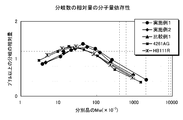
- the degree-of-branch distribution curve showing the molecular weight dependence of short chain branches having 4 or more carbon atoms is obtained by molecular weight fractionation of the polyethylene of the present invention, and by measuring the short chain branches by 13 C-NMR for each fractionated fraction, It is obtained by plotting the relative ratio of the number of short chain branches of each fraction to the number of chain branches against the weight average molecular weight of each fraction.
- Mw weight average molecular weight
- the separation column a column packed with a suitable filler that is usually used according to the components to be separated is used.
- the filler is not particularly limited as long as it is insoluble in the solvent and inert, but generally, a filler having a particle size of about 50 to 400 mesh such as sea sand, celite, glass beads and the like is preferably used.
- the shape and size of the separation column are not particularly limited. For example, a cylindrical stainless steel column having a diameter of about 10 to 100 mm and a length of about 100 to 1000 mm is preferably used.
- the good solvent is not particularly limited, but p-xylene (boiling point: 138 ° C.), tetralin (boiling point: 207 ° C.), orthodichlorobenzene (boiling point: 180 ° C.) in which polyethylene is dissolved below the boiling point of the solvent, Trichlorobenzene (boiling point: 218 ° C.) or the like is used.
- the poor solvent is not particularly limited, but has an ethylene glycol monoethyl ether (ethyl cellosolve) (boiling point: 162 ° C.), ethylene glycol monobutyl ether, which has a higher boiling point than that of the good solvent and can be arbitrarily dissolved in the good solvent. (Butyl cellosolve) (boiling point: 171 ° C.) or the like is used. One of each of these good and poor solvents is selected and used as a mixed solvent, but a combination of p-xylene and butyl cellosolve is usually used.
- the flow rate of the mixed solvent sent to the separation column is 1.0 ml / min to 30.0 ml / min, preferably 5.0 ml / min to 25.0 ml / min. If the flow rate is less than 1.0 ml / min, it takes time to separate and is not efficient, and recrystallization may occur in the piping during the separation, which may cause clogging and stop the subsequent separation. There is. On the other hand, when the flow rate exceeds 30.0 ml / min, the molecular weight distribution spreads and sufficient molecular weight fractionation is not performed. When the column temperature is lower than 115 ° C., fractionation due to composition (crystallinity) occurs or the molecular weight distribution is widened, which is not preferable.
- Xa and Xb satisfy the following formulas (C) and (D), respectively. 0.60 ⁇ Xa ⁇ 1.15 (C) 0.85 ⁇ Xb ⁇ 1.40 (D) More preferably, Xa and Xb satisfy the following expressions (E) and (F), respectively. 0.60 ⁇ Xa ⁇ 1.10 (E) 0.90 ⁇ Xb ⁇ 1.40 (F) For assignment of chemical shift values of carbon branches having 4 or more carbon atoms when 13 C-NMR is measured, Macromolecules, Volume. 32, no. 11, page 3817, 1999.
- the balance between rigidity and durability is improved by incorporating more short chain branches on the high molecular weight side in the molecular weight distribution.
- a short chain branch incorporated in a longer polyethylene chain tends to be an amorphous chain connecting crystalline lamellas, that is, a tie molecule.
- One improvement of the chromium catalyst is to make the composition distribution of short chain branches uniform.
- a polymer obtained from a chromium catalyst tends to contain many short chain branches in a polymer having a low molecular weight. If a large number of short chain branches can be introduced evenly on the high molecular weight side, the polymer performance is improved.
- the composition distribution of the short chain branches of the polymer obtained from the metallocene catalyst is uniform, leading to improved polymer performance.
- Xa being larger than 1.20 or Xb being smaller than 0.80 means that many short chain branches are incorporated on the low molecular weight side, and the above specific range
- Xa and Xb By setting Xa and Xb to the desired balance of physical properties.
- the above requirements can be achieved by selecting a polymerization catalyst and polymerization conditions.
- the polyethylene of the present invention can be produced by polymerization using a chromium catalyst carrying a dialkoxyaluminum alkoxide compound as a catalyst.
- the density of the polyethylene of the present invention is usually 0.940 to 0.960 g / cm 3 , preferably 0.943 to 0.957 g / cm 3 , more preferably 0.945 to 0.955 g / cm 3. It is in the range. If the density is less than 0.940 g / cm 3, the rigidity of the hollow plastic molded article is insufficient, the durability of the hollow plastic molded article exceeds 0.960 g / cm 3 tends to be insufficient.
- the density can be adjusted by a method such as control of the type and content of ⁇ -olefin.
- the density can be increased by using an ⁇ -olefin having a small carbon number. can do.
- the above density is in accordance with JIS K-7112. After the pellets are melted by a hot compression molding machine at a temperature of 160 ° C., the temperature is lowered at a rate of 25 ° C./minute to form a sheet having a thickness of 2 mmt. It was measured after being conditioned for 48 hours in a room at 23 ° C. and then placed in a density gradient tube.
- Number of short chain branches having 4 or more carbon atoms per 1000 main chain carbons The number of short chain branches having 4 or more carbon atoms per 1000 carbon chains of the polyethylene of the present invention is preferably 3.0 or less.
- the number of short chain branches having 4 or more carbon atoms per 1000 carbons of the main chain of polyethylene is usually 0.5 or more.
- the number of short chain branches having 4 or more carbon atoms per 1000 carbons of the main chain can be measured by 13 C-NMR. For assignment of chemical shift values of carbon branches having 4 or more carbon atoms, Macromolecules, Volume. 32, no. 11, page 3817, based on the description in 1999.
- the rigidity of the hollow plastic molded product tends to be insufficient.
- the number of short chain branches having 4 or more carbon atoms per 1000 main chain carbons is less than 0.5, the durability of the hollow plastic molded product tends to be insufficient.
- HLMFR High load melt flow rate
- the polyethylene of the present invention has an HLMFR of usually 1 to 10 g / 10 minutes, preferably 3 to 7 g / 10 minutes, more preferably 4 to 6 g / 10 minutes.
- the HLMFR is less than 1 g / 10 minutes, the amount of extrusion at the time of extrusion of the parison (in the blow molding, a pipe-shaped molten polymer extruded from the die of the molding machine; the state before being expanded by air pressure in the mold) It is not practical because it tends to be insufficiency and molding is unstable, and even if it exceeds 10 g / 10 min, the formation of parison tends to become unstable due to insufficient melt viscosity and melt tension.
- HLMFR can be adjusted by a method such as control of polymerization temperature or hydrogen concentration.
- HLMFR can be increased by increasing the polymerization temperature or increasing the hydrogen concentration.
- the above HLMFR is measured under the conditions of a temperature of 190 ° C. and a load of 21.60 kg in accordance with JIS K-7210.
- the polyethylene of the present invention has a ratio (Mw / Mn) of the weight average molecular weight (Mw) to the number average molecular weight (Mn) of usually 10 to 50, preferably 15 to 45, more preferably 20 to 40. is there.
- Mw / Mn is less than 10
- the durability of the hollow plastic molded product is insufficient
- it exceeds 50 the impact strength of the hollow plastic molded product tends to be insufficient.
- the above requirements can be achieved by selecting a polymerization catalyst and polymerization conditions.
- FNCT Insertion time by full notch tensile creep test
- the polyethylene of the present invention exhibits a large value for both density and FNCT (rupture time by an all-around notch tensile creep test).
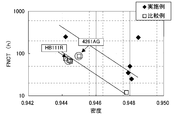
- the relationship between density and FNCT is shown in FIG.
- the polyethylene of the present invention is plotted in the upper right region of the figure as compared to commercially available products (for example, high density polyethylene “HB111R” manufactured by Nippon Polyethylene, high density polyethylene “4261AG” manufactured by Basell).
- HBA111R high density polyethylene
- 4261AG high density polyethylene
- Organoaluminum compound-supported chromium catalyst (preferably a dialkylaluminum alkoxide compound-supported chromium catalyst) is obtained by supporting a chromium compound on an inorganic oxide carrier and activating it by firing in a non-reducing atmosphere. It is prepared by making at least a part of chromium atoms hexavalent, further supporting an organoaluminum compound in an inert hydrocarbon solvent, and then removing and drying the solvent. At this time, the reason for removing and drying the solvent so that the contact time between the catalyst and the solvent is as short as possible is to prevent chromium atoms from being excessively reduced by the organoaluminum compound.
- a chromium catalyst in which at least a part of chromium atoms become hexavalent by supporting a chromium compound on an inorganic oxide support and activating by firing in a non-reducing atmosphere is generally known as a Philips catalyst.
- the outline of this catalyst is described in the following documents, for example.
- Ii M.M. P. McDaniel, Handbook of Heterogeneous Catalysis, 2400, 1997, VCH
- VCH VCH
- Iii M.M. B. Welch et al., Handbook of Polyolefins: Synthesis and Properties, p. 21, 1993, Marcel Dekker.
- a metal oxide of Group 2, 4, 13 or 14 of the periodic table is preferable.
- Specific examples include magnesia, titania, zirconia, alumina, silica, tria, silica-titania, silica-zirconia, silica-alumina, or a mixture thereof.
- silica, silica-titania, silica-zirconia, and silica-alumina are preferable, and silica is more preferable.
- silica-titania silica-zirconia, silica-alumina, titanium, zirconium or aluminum atoms as metal components other than silica are 0.2 to 10% by weight, preferably 0.5 to 7% by weight, more preferably 1 to Those containing 5% by weight are used.
- the production method, physical properties and characteristics of the support suitable for these chromium catalysts are described, for example, in the following documents. (I) C.I. E. Marsden, Preparation of Catalysts, Volume V, p. 215, 1991, Elsevier Science Publishers. (Ii) C.I. E. Marsden, Plastics, Rubber and Composites Processing and Applications, Volume 21, 193, 1994.
- the support is selected so that the specific surface area of the support of the chromium catalyst is usually 250 to 1100 m 2 / g, preferably 300 to 1050 m 2 / g, more preferably 400 to 1000 m 2 / g.
- the specific surface area is less than 250 m 2 / g, it is considered that the molecular weight distribution is narrow and long-chain branching increases, but both durability and impact resistance tend to decrease. Further, a carrier having a specific surface area exceeding 1100 m 2 / g tends to be difficult to produce.
- the pore volume of the carrier is usually 0.5 to 3.0 cm 3 / g, preferably 1.0 to 2.0 cm 3 / g, more preferably, as in the case of a carrier used for a general chromium catalyst. Is in the range of 1.2 to 1.8 cm 3 / g.
- the average particle size of the carrier is usually in the range of 10 to 200 ⁇ m, preferably 20 to 150 ⁇ m, more preferably 30 to 100 ⁇ m, like the carrier used for general chromium catalysts.
- a chromium compound is supported on the inorganic oxide support.
- the chromium compound may be a compound in which at least a part of chromium atoms becomes hexavalent by firing activation in a non-reducing atmosphere after loading, such as chromium oxide, chromium halide, oxyhalide, chromate. , Dichromates, nitrates, carboxylates, sulfates, chromium-1,3-diketo compounds, chromates and the like.
- the supporting of the chromium compound on the inorganic oxide support can be performed by a known method such as impregnation, solvent distillation, sublimation, etc., and an appropriate method may be used depending on the kind of the chromium compound to be used.
- the amount of the chromium compound to be supported is usually 0.2 to 2.0% by weight, preferably 0.3 to 1.7% by weight, more preferably 0.5 to 1.5% by weight based on the carrier as chromium atoms. It is.
- the calcination activation can be performed in a non-reducing atmosphere substantially free of moisture, such as oxygen or air. At this time, an inert gas may coexist. Preferably, it is performed in a fluidized state using sufficiently dried air through which molecular sieves or the like are circulated.
- the firing activation is usually 400 to 900 ° C., preferably 420 to 850 ° C., more preferably 450 to 800 ° C., usually 30 minutes to 48 hours, preferably 1 hour to 36 hours, more preferably 2 hours to 24 hours. Do.
- the chromium catalyst used in the present invention is obtained.
- titanium such as titanium tetraisopropoxide is used before supporting the chromium compound or before activating the firing after supporting the chromium compound.
- organometallic compounds and fluorine-containing salts such as ammonium silicofluoride together with known methods for adjusting ethylene polymerization activity, copolymerizability with ⁇ -olefin, molecular weight of the resulting polyethylene, and molecular weight distribution It may be.
- a specific method for producing the organoaluminum compound-supported chromium catalyst will be described with reference to an example of a dialkylaluminum alkoxide compound-supported chromium catalyst.
- a dialkylaluminum alkoxide compound is supported on a calcined activated chromium catalyst in an inert hydrocarbon solvent, and the solvent is removed and dried to be used as a dialkylaluminum alkoxide compound-supported chromium catalyst.
- the dialkylaluminum alkoxide is represented by the following general formula (2) R 1 R 2 Al (OR 3 ) (2) (Wherein R 1 , R 2 and R 3 are each an alkyl group having 1 to 18 carbon atoms and may be the same or different).
- Specific examples of the dialkylaluminum alkoxide include dimethylaluminum methoxide, dimethylaluminum ethoxide, dimethylaluminum n-propoxide, dimethylaluminum isopropoxide, dimethylaluminum n-butoxide, dimethylaluminum isobutoxide, dimethylaluminum amyloxide, dimethylaluminum.
- Dialkylaluminum siloxide in which the carbon atom adjacent to the oxygen atom in the alkoxide moiety is changed to a silicon atom may be used.
- the dialkylaluminum alkoxide can be easily synthesized by (i) a method of reacting a trialkylaluminum and an alcohol, (ii) a method of reacting a dialkylaluminum halide and a metal alkoxide, or the like. That is, in order to synthesize a dialkylaluminum alkoxide represented by the general formula (2), a method of reacting a trialkylaluminum and an alcohol at a molar ratio of 1: 1 as shown in the following formula (where R is R 4 , R 5 and R 6 may be the same as or different from each other and each represents an alkyl group having 1 to 18 carbon atoms).
- a dialkylaluminum halide and a metal alkoxide are reacted at a molar ratio of 1: 1 as shown in the following formula (where X in the dialkylaluminum halide R 4 R 5 AlX is fluorine, chlorine, bromine, iodine; In particular, chlorine is preferably used, and M in the metal alkoxide R 6 OM is an alkali metal, and lithium, sodium, and potassium are particularly preferable.
- the by-product RH is an inert alkane, and when the boiling point is low, it volatilizes out of the system in the course of the reaction, or when the boiling point is high, it remains in the solution, but even if it remains in the system Inactive for subsequent reactions.
- the by-product MX is an alkali metal halide and precipitates and can be easily removed by filtration or decantation. These reactions are preferably carried out in an inert hydrocarbon such as hexane, heptane, octane, decane, cyclohexane, benzene, toluene and xylene.
- the reaction temperature may be any temperature as long as the reaction proceeds, but is preferably 0 ° C or higher, more preferably 20 ° C or higher. Heating above the boiling point of the solvent used and carrying out the reaction under reflux of the solvent is a good method for completing the reaction.
- the reaction time may be arbitrary, but it is preferably 1 hour or longer, more preferably 2 hours or longer.
- the reaction solution may be cooled as it is and may be subjected to the reaction with the chromium catalyst as it is, or the reaction product may be isolated by removing the solvent.
- the supported amount of the organoaluminum compound is such that the molar ratio of the organoaluminum compound to the chromium atom is usually 0.1 to 20, preferably 0.3 to 15, and more preferably 0.5 to 10. If this molar ratio is less than 0.1, the amount of the organic aluminum is too small and the effect of the polyethylene described in the present application by supporting the organoaluminum compound cannot be expected. When this molar ratio exceeds 20.0, the ethylene polymerization activity is lower than when no organoaluminum compound is supported, and the molecular weight distribution is widened and the durability is improved, but the impact resistance tends to be reduced. The reason for this decrease in activity is unknown, but it is considered that an excess of the organoaluminum compound is bonded to the chromium active site to inhibit the ethylene polymerization reaction.
- the method for supporting the organoaluminum compound is not particularly limited as long as it is a method in which the chromium catalyst after calcination activation is brought into contact in a liquid phase in an inert hydrocarbon.
- the chromium catalyst after calcination activation is mixed with an inert hydrocarbon solvent such as propane, n-butane, isobutane, n-pentane, isopentane, hexane, heptane, octane, decane, cyclohexane, benzene, toluene, xylene, etc.
- a method of adding a dialkylaluminum alkoxide compound to a slurry state is preferable.
- the organoaluminum compound to be added may be diluted with the inert hydrocarbon solvent or may be added without dilution.
- the diluting solvent and the supporting solvent may be the same or different.
- the amount of the inert hydrocarbon solvent used is preferably an amount sufficient to allow stirring in a slurry state at the time of preparation of the catalyst. If the amount is such an amount, the amount of the solvent used is not particularly limited. For example, 2 to 20 g of the solvent can be used per 1 g of the chromium catalyst after calcination activation.
- the order of adding the organoaluminum compound and the chromium catalyst to the solvent when the chromium catalyst is treated with the organoaluminum compound in an inert hydrocarbon solvent is arbitrary. Specifically, a supported reaction operation in which a chromium catalyst is suspended in an inert hydrocarbon solvent, an organoaluminum compound is added, and this is stirred is preferable.
- the temperature of the support reaction is usually 0 to 150 ° C., preferably 10 to 100 ° C., more preferably 20 to 80 ° C., and the time of the support reaction is usually 5 minutes to 8 hours, preferably 30 minutes to 6 hours, more preferably 1 ⁇ 4 hours.
- the organoaluminum compound reacts with chromium atoms that are at least partly hexavalent after activation by firing, and reduces them to low-valent chromium atoms.
- This phenomenon can be confirmed from the fact that the chromium catalyst after the activation of the firing has an orange color peculiar to hexavalent chromium atoms, whereas the chromium catalyst supported by the organoaluminum compound is green or blue-green. That is, it is presumed that at least part of the hexavalent chromium atom is reduced to a trivalent or divalent chromium atom from the change in the color of the chromium catalyst.
- the solvent is removed by drying under reduced pressure. At this time, filtration can be used together. In this vacuum drying, drying is performed so that the organoaluminum compound-supported chromium catalyst is obtained as a free-flowing powder. If the catalyst is stored for a long time without being separated from the solvent, the catalyst deteriorates with time, and the ethylene polymerization activity decreases. In addition, since the molecular weight distribution is widened, the durability is improved, but the impact resistance is lowered, and the balance between the durability and the impact resistance is deteriorated.
- an organoaluminum species that will be generated by the reaction of a dialkylaluminum alkoxide compound and a hexavalent chromium atom (more precisely, chromium oxide chemically bonded to a silanol group on the silica surface) is coordinated to the polymerization active site and ethylene polymerization reaction
- the degree of overreduction can be determined by a decrease in polymerization activity, a decrease in physical properties of the resulting polymer, mainly a decrease in impact strength.
- the impact strength is specifically Charpy impact strength.
- the contact time with the solvent is too long, the polymerization activity is decreased, the physical properties of the polymer obtained, and mainly the impact strength is decreased. Therefore, in order not to substantially reduce the polymerization activity and the impact strength of the resulting polymer, even if it is lowered, the degree of reduction is minimized so that the time of contact with the solvent in the supporting reaction is added together. Try to keep the contact time as short as possible. That is, it is necessary to shorten the supporting reaction time, which is the contact time with the solvent, as much as possible, and to quickly separate the solvent after the supporting so that the overreduction reaction does not proceed.
- the time required for separating the solvent and drying is usually preferably within 3 times, more preferably within 2 times, particularly preferably within 1 time of the supporting reaction time.
- the total time from the start of loading to the completion of solvent removal / drying is usually 5 minutes to 24 hours, preferably 30 minutes to 18 hours, and more preferably 1 to 12 hours. If it exceeds 24 hours, the polymerization activity decreases.
- the organoaluminum compound-supported chromium catalyst after completion of drying is in a state free of free flowing viscosity and moisture.
- the chromium catalyst and the organoaluminum compound are fed directly or separately to the reactor in the presence or absence of a diluting solvent, and the chromium catalyst and the organoaluminum compound are combined.
- a method may be considered in which the mixed slurry is once premixed or contacted in a solvent and the mixed slurry is fed to a reactor.
- each method performs continuous production while separately supplying the chromium catalyst and the organoaluminum compound to the reactor, the amount and ratio of the continuously supplied chromium catalyst and the organoaluminum compound are accurately determined. If not adjusted, the polymerization activity and molecular weight of the resulting polyethylene will vary, making it difficult to continuously produce molded articles of the same standard.
- an organoaluminum compound is supported on a chromium catalyst in advance, and a catalyst in which the molar ratio of the organoaluminum compound to the chromium atom is always constant is supplied to the reactor. Can be continuously produced. Therefore, the method of the present invention is an excellent method suitable for continuously producing polyethylene of constant quality.
- organoaluminum-supported chromium catalyst used in the present invention can be obtained.
- organomagnesiums such as butylethylmagnesium and dibutylmagnesium, or You may use together the method of carrying
- the liquid phase polymerization method is usually performed in a hydrocarbon solvent.
- a hydrocarbon solvent an inert hydrocarbon such as propane, n-butane, isobutane, n-pentane, isopentane, hexane, heptane, octane, decane, cyclohexane, benzene, toluene, xylene or the like is used alone or as a mixture.
- a commonly known polymerization method such as a fluidized bed or a stirring bed can be employed in the presence of an inert gas, and a so-called condensing mode in which a medium for removing heat of polymerization coexists may be employed.
- the polymerization temperature in the liquid phase polymerization method is generally 0 to 300 ° C., practically 20 to 200 ° C., preferably 50 to 180 ° C., more preferably 70 to 150 ° C.
- the catalyst concentration and ethylene concentration in the reactor may be any concentration sufficient to allow the polymerization to proceed.
- the catalyst concentration can range from about 0.0001 to about 5% by weight based on the weight of the reactor contents in the case of liquid phase polymerization.
- the ethylene concentration can range from about 1% to about 10% by weight based on the weight of the reactor contents in the case of liquid phase polymerization.
- ⁇ -olefin As the ⁇ -olefin, propylene, 1-butene, 1-hexene, 4-methyl-1-pentene, 1-octene and the like are usually introduced alone or in a mixture of two or more kinds to carry out copolymerization.
- 1-butene, 1-hexene, more preferably 1-hexene is suitably used as a comonomer.
- the ⁇ -olefin content in the obtained polyethylene is usually 15 mol% or less, preferably 10 mol% or less.
- multistage polymerization is performed by connecting at least two reactors in order to improve the production amount or broaden the molecular weight distribution. You can also.
- multi-stage polymerization two-stage polymerization is preferred in which two reactors are connected and the reaction mixture obtained by polymerization in the first-stage reactor is continuously fed to the second-stage reactor.
- the transfer from the first stage reactor to the second stage reactor is effected by continuous or intermittent discharge of the polymerization reaction mixture through the connecting pipe.
- the transfer of the polymerization reaction mixture from the second stage reactor is also carried out by continuous discharge or intermittent discharge.
- the first stage reactor and the second stage reactor may be produced under the same polymerization conditions, or the first stage reactor and the second stage reactor may be produced with the same HLMFR and density polyethylene. However, when broadening the molecular weight distribution, it is preferable to make a difference in the molecular weight of polyethylene produced in both reactors. In any production method of producing a high molecular weight component in the first stage reactor, a low molecular weight component in the second stage reactor, or a low molecular weight component in the first stage reactor, and a high molecular weight component in the second stage reactor, respectively.
- ethylene alone or optionally copolymerization with ⁇ -olefin is carried out by adjusting the molecular weight by adjusting the molecular weight by the weight ratio of hydrogen concentration to ethylene concentration (Hc / ETc), polymerization temperature or both, and ⁇ - The polymerization reaction is carried out while adjusting the density by the weight ratio of the olefin concentration to the ethylene concentration.
- organometallic compounds such as catalysts and organoaluminum compounds
- the polymerization reaction continue in the second stage with the catalyst flowing in from the first stage, but also a new catalyst
- organometallic compounds such as organoaluminum compounds in the second stage. Compounds or both may be supplied.
- the ratio of the high molecular weight component to the low molecular weight component in the case of producing by two-stage polymerization is usually 10 to 90 parts by weight for the high molecular weight component, 90 to 10 parts by weight for the low molecular weight component, preferably 20 to 80 parts for the high molecular weight component.
- Part by weight, low molecular weight component is 80 to 20 parts by weight, more preferably high molecular weight component is 30 to 70 parts by weight, and low molecular weight component is 70 to 30 parts by weight.
- the HLMFR of the high molecular weight component is usually 0.01 to 100 g / 10 minutes, preferably 0.01 to 50 g / 10 minutes, and the HLMFR of the low molecular weight component is usually 10 to 1000 g / 10 minutes, preferably 10 to 500 g. / 10 minutes.
- the obtained polyethylene is then preferably kneaded. It is carried out using a single or twin screw extruder or a continuous kneader.
- the ratio of the weight average molecular weight (Mw) to the number average molecular weight (Mn) in comparison with the same HLMFR and the same density (Mw / Mn) as compared with the case where no dialkylaluminum alkoxide is supported It was found in the present invention that the creep resistance is greatly improved even when the same) is the same. The reason for this is considered that the distribution of short-chain branches derived from the comonomer is improved. That is, in general, a short chain branch is not introduced into a high molecular weight region in a chromium catalyst (“Polyethylene Technology Reader”, pp.
- the hollow plastic molded article of the present invention has a structure having at least one layer of the present polyethylene, preferably a multilayer structure, but may have a single layer structure made of polyethylene.
- the hollow plastic molded article has a multilayer structure, it is preferable to have a permeation reduction barrier layer, and a barrier layer is usually used as the permeation reduction barrier layer.
- the layered structure of the hollow plastic molded article of the present invention is two or more layers, it is preferable that the innermost layer and the outermost layer are made of the present polyethylene resin.
- the hollow plastic molded article of the present invention has a multilayer structure including a permeation reducing barrier layer in which at least one barrier layer is present to reduce the penetration of volatile materials and the barrier layer is composed of a polar barrier polymer.
- a permeation reducing barrier layer in which at least one barrier layer is present to reduce the penetration of volatile materials and the barrier layer is composed of a polar barrier polymer.
- a barrier layer in itself, moldability and mechanical strength are not sufficient
- the moldability of a material having two or more layers of the polyethylene resin is improved primarily due to the improved moldability of the polyethylene.
- the improved performance of the present polyethylene has a very important influence on the mechanical strength of the material, so that the strength of the hollow plastic molded product of the present invention can be significantly increased.
- the surface of the polyethylene layer may be coated with a treatment such as fluorination, surface coating or plasma polymerization.
- a particularly preferred embodiment of the hollow plastic molded article according to the present invention is a four-kind six-layer structure including the following layers from the inside to the outside. That is, the present polyethylene-based resin layer, adhesive layer, barrier layer, adhesive layer, recycled material layer, and present polyethylene-based resin layer. Below, the structure of each layer in the said aspect and a layer structure ratio are demonstrated in detail.
- the resin (A) constituting the outermost layer of the hollow plastic molded article of the present invention is the present polyethylene that satisfies the above-mentioned predetermined requirements.
- the resin (B) constituting the innermost layer of the hollow plastic molded product of the present invention is the present polyethylene that satisfies the above-mentioned predetermined requirements, and may be the same as or different from the above-mentioned resin (A). May be.
- the resin (C) that forms the barrier layer of the hollow plastic molded product of the present invention is selected from ethylene vinyl alcohol resin, polyamide resin, polyethylene terephthalate resin, polybutylene terephthalate resin, etc., and particularly ethylene vinyl alcohol. It is preferable to consist of resin. More preferably, the ethylene vinyl alcohol resin has a saponification degree of 93% or more, desirably 96% or more, and an ethylene content of 25 to 50 mol%.
- Adhesive layer The resin (D) forming the adhesive layer of the hollow plastic molded article of the present invention is selected from high-density polyethylene, low-density polyethylene, linear low-density polyethylene, etc., graft-modified with unsaturated carboxylic acid or its derivative.
- it is preferably made of high-density polyethylene graft-modified with an unsaturated carboxylic acid or a derivative thereof.
- the content of the unsaturated carboxylic acid or derivative thereof is usually 0.01 to 5% by weight, preferably 0.01 to 3% by weight, and more preferably 0.01 to 1% by weight.
- the graft modification amount content of unsaturated carboxylic acid or derivative thereof
- the graft modification amount is less than 0.01% by weight, sufficient adhesion performance is not exhibited, and when it exceeds 5% by weight, unsaturated carboxylic acid that does not contribute to adhesion is obtained. Adverse effects on adhesion.
- Recycled material layer Resin that forms the recycled material layer of the hollow plastic molded article of the present invention includes polyethylene (A) that forms the outermost layer, polyethylene (B) that forms the innermost layer, resin (C) that forms the barrier layer, and It is a composition containing resin (D) which forms an adhesive layer.
- the blending amount of each component is preferably 10-30% by weight of component (A), 30-50% by weight of component (B), 1-15% by weight of component (C), and 1-15% by weight of component (D). .
- New components (A) to (D) can be used, and unnecessary parts such as scraps and burrs of the multi-layer laminate including each layer consisting of components (A) to (D) can be recovered and reused.
- Such a recycled product can also be used as a component raw material for each component.
- a regrind resin obtained by pulverizing a hollow plastic molded product (such as an automobile fuel tank product) once molded, used, and used is used.
- all the components (A) to (D) can be supplied from the recycled product or mixed with a new product.
- the compatibility of various components may decrease, so further mixing the compatibilizer and the resin that constitutes the adhesive layer May be.
- Layer composition ratio of hollow plastic molded product The thickness composition of each layer of the hollow plastic molded product of the present invention is 10-30% for the outermost layer, 20-50% for the innermost layer, 1-15% for the barrier layer, and bonded. The layer is 1 to 15%, and the recycled material layer is 30 to 60% (however, the sum of all layer thickness components is 100%).
- the layer composition ratio of the outermost layer is usually 10 to 30%, preferably 10 to 25%, more preferably 10 to 20%. When the layer composition ratio of the outermost layer is less than 10%, the impact performance is insufficient, and when it exceeds 30%, the molding stability of the hollow plastic molded product is impaired.
- the layer composition ratio of the innermost layer is usually 20 to 50%, preferably 35 to 50%, more preferably 40 to 50%.
- the layer composition ratio of the barrier layer is usually 1 to 15%, preferably 1 to 10%, more preferably 1 to 5%.
- the layer composition ratio of the adhesive layer is usually 1 to 15%, preferably 1 to 10%, more preferably 1 to 5%.
- the layer composition ratio of the adhesive layer is usually 1 to 15%, preferably 1 to 10%, more preferably 1 to 5%.
- the composition ratio of the recycled material layer is usually 30 to 60%, preferably 35 to 50%, more preferably 35 to 45%. If the layer composition ratio of the recycled material layer is less than 30%, the molding stability of the hollow plastic molded product is impaired, and if it exceeds 60%, the impact performance is insufficient.
- the hollow plastic molded article of the present invention is preferably a four-type six-layer hollow plastic molded article that is laminated from the outside in the order of the outermost layer, the recycled material layer, the adhesive layer, the barrier layer, the adhesive layer, and the innermost layer.
- sandwiching the barrier layer with an adhesive layer By sandwiching the barrier layer with an adhesive layer, a high level of barrier properties is exhibited.
- the recycled material layer between the outermost layer and the adhesive layer By having the recycled material layer between the outermost layer and the adhesive layer, the effects of cost reduction by reducing raw material costs and maintaining the rigidity of the hollow plastic molded product are exhibited.
- the production method of the hollow plastic molded product of the present invention is not particularly limited, and is produced by an extrusion blow molding method using a conventionally known multilayer hollow molding machine. be able to. For example, after a constituent resin of each layer is heated and melted by a plurality of extruders, a molten parison is extruded by a multilayer die, then the parison is sandwiched between molds, and air is blown into the interior of the parison, thereby forming a multilayer hollow plastic A molded product is produced.
- the hollow plastic molded article of the present invention includes an antistatic agent, an antioxidant, a neutralizing agent, a lubricant, an antiblocking agent, an antifogging agent, an organic or inorganic pigment, as long as the purpose is not impaired as necessary.
- an antistatic agent such as fillers, inorganic fillers, UV inhibitors, dispersants, weathering agents, crosslinking agents, foaming agents, flame retardants, and the like can be added.
- the hollow plastic molded product of the present invention specifically includes products such as fuel tanks, kerosene cans, drums, chemical containers, agricultural chemical containers, solvent containers, various plastic bottles, In particular, it is used as a fuel tank for automobiles or uses of the hollow plastic molded product of the present invention include tanks such as fuel tanks, kerosene cans, drum cans, chemical containers, agricultural chemical containers, solvent containers, various plastic bottles, etc. And most preferably used as a fuel tank for automobiles.
- Molecular weight distribution (Mw / Mn) Gel permeation chromatograph (GPC) was performed on the produced polyethylene under the following conditions, and the number average molecular weight (Mn) and the weight average molecular weight (Mw) were determined to calculate the molecular weight distribution (Mw / Mn).
- GPC Gel permeation chromatograph measurement conditions
- Equipment Waters 150C model, Column: Shodex-HT806M, Solvent: 1,2,4-trichlorobenzene, Temperature: 135 ° C Universal rating using monodisperse polystyrene fraction.
- the fractions were sorted in descending order of molecular weight by flowing through the column in order while controlling the temperature. Acetone was added to the separated liquids to precipitate polymer samples, which were collected and dried. By measuring 13 C-NMR of the fractionated sample thus obtained, the number of short chains having a butyl group or more was measured. Moreover, molecular weight (Mw) was measured by measuring a fractionated sample by GPC.
- the abscissa represents the molecular weight (Mw) determined by GPC, and the ordinate represents the relative value of short chain branching of butyl groups or more.
- ⁇ Separation conditions> Fraction number Temperature Composition Flow rate Time F-1 Room temperature 0: 100 20 50 F-2 126 0: 100 20 75 F-3 126 20:80 16 100 F-4 126 30:70 16 100 F-5 126 40:60 16 100 F-6 126 45:55 16 100 F-7 126 50:50 16 100 F-8 126 100: 0 10 150
- the unit of temperature is (° C.)
- the composition is represented by the ratio of (xylene: butyl cellosolve)
- the unit of flow rate is (mL / min)
- the time is (min).
- Example 1 Polyethylene production and evaluation in an autoclave
- chromium catalyst Catalyst-1 having a chromium atom loading of 1.1% by weight, a specific surface area of 500 m 2 / g, and a pore volume of 1.5 cm 3 / g (supporting chromium acetate on silica) (Catalyst) is prepared in 15 g, put in a quartz glass tube with a perforated plate and a tube diameter of 5 cm, set in a cylindrical firing electric furnace, fluidized with air through molecular sieves, and a linear velocity of 6 cm / s. And calcination activation at 500 ° C. for 18 hours. An orange chrome catalyst was obtained indicating that it contained hexavalent chromium atoms.
- the polymerization activity per 1 hour of the catalyst was 1800 g-polymer / g-catalyst / h.
- Table 2 shows the measurement results of HLMFR, density, molecular weight (Mn, Mw), molecular weight distribution (Mw / Mn), FNCT breaking time, Charpy impact strength, etc. as physical properties.
- Table 2 shows the results of measuring physical properties of high density polyethylene “HB111R” manufactured by Nippon Polyethylene Co., Ltd.
- Table 2 shows the results of measuring physical properties of the high density polyethylene “4261AG” manufactured by Basell.
- the polymer of the example has more short chain branches than the polymers of Comparative Examples 1 to 3, and is introduced into the high molecular weight region. You can see that It is considered that the dialkylaluminum alkoxide was supported and introduced into the relatively high molecular weight region because the copolymerizability of the low molecular weight component was lowered. As a result, the example polymer is considered to have improved impact resistance compared to the comparative example polymer.
- Example 3 Preparation of chromium catalyst 15g of catalyst-1 is prepared, put in a quartz glass tube with a perforated plate, 5cm in diameter, set in an electric furnace for cylindrical firing, and fluidized with air through molecular sieves. And activated by firing at 700 ° C. for 18 hours at a linear velocity of 6 cm / s. An orange chrome catalyst was obtained indicating that it contained hexavalent chromium atoms.
- Example 4 A 2.0 L autoclave thoroughly purged with nitrogen was charged with 100 mg of the chromium catalyst obtained in Example 1 (1) and 0.8 L of isobutane, and the internal temperature was raised to 100 ° C. After introducing 0.1 MPa of hydrogen, 5.0 g of 1-hexene was introduced under pressure with ethylene, and while maintaining the ethylene partial pressure at 1.0 MPa, the catalyst productivity was 3000 g-polymer / g-catalyst. Polymerization was carried out as follows. Subsequently, the polymerization was terminated by releasing the content gas out of the system. The outline of the polymerization conditions is shown in Table 1. The polymerization activity was 1800 g-polymer / g-catalyst / h. The physical property measurement results and the like are shown in Table 2.
- FIG. 2 shows the density and FNCT results of the polymers listed in Table 2.
- the comparative examples “HB111R” and “4261AG” can be said to be polyethylene having a density-FNCT balance equivalent.
- the polyethylene of the example has a much higher density-FNCT balance level than the polyethylene of the comparative example. Since the molecular weight distribution (Mw / Mn) does not change greatly between the polyethylenes of these Examples and Comparative Examples, it is considered that the effect of improving the short chain branching distribution in polyethylene appeared. In Example 1, the effect is remarkable.
- the polyethylene of an Example is maintaining the level of a commercial item also regarding impact resistance.
- the weight ratio (Hc / ETc) to the hydrogen concentration in the liquid phase was 1.1 ⁇ 10 ⁇ 3 at 98 ° C.
- the weight ratio of the 1-hexene concentration to the ethylene concentration in the liquid phase was Ethylene, hydrogen, and 1-hexene were supplied so as to maintain 0.22, and polymerization was continuously performed in a liquid-filled state under conditions of a total pressure of 3.7 MPa and an average residence time of 0.9 h.
- the catalyst productivity was 3200 g-polymer / g-catalyst
- the average polymerization activity was 3600 g-polymer / g-catalyst / h.
- the measurement results of the physical properties are shown in Table 3.
- Adhesive resin Maleic anhydride-modified polyethylene manufactured by Nippon Polyethylene Co., Ltd. grafted with 0.1% by weight of maleic anhydride was used.
- the resin used for the recycled material layer at the start of the experiment is the same resin as the resin that forms the innermost layer, blow molded into an automotive fuel tank, and pulverized the automotive fuel tank
- the regrind resin was used as a recycled material.
- a recycled material obtained by molding and pulverizing an automobile fuel tank having the following layer structure was used for the recycled material layer.
- Outermost layer This polyethylene resin (layer composition ratio 11%)
- Innermost layer This polyethylene resin (layer composition ratio 40%)
- a fuel tank for 4 types and 6 layers multilayer automobile having a tank weight of 8 kg and a capacity of 60 L was molded under the conditions of a molding temperature of 210 ° C., a blow mold cooling temperature of 20 ° C. and a cooling time of 180 seconds.
- the tank shape was a saddle type.
- the layer ratio is 11% for the outermost layer, 40% for the second layer, 3% for the third layer, 3% for the fourth layer, while adjusting the screw speed of the extruder while observing the thickness ratio of the tank.
- the fifth layer was 3% and the innermost layer was 40%.
- the automotive fuel tank was molded as described above, and the automotive fuel tank was evaluated (moldability, drop impact property, gasoline barrier property). The results are shown in Table 3.
- the catalyst productivity was 2800 g-polymer / g-catalyst, and the average polymerization activity was 3100-polymer / g-catalyst / h.
- An automotive fuel tank was molded in the same manner as in Example 6, and the automotive fuel tank was evaluated (moldability, drop impact property, gasoline barrier property). Table 3 shows the physical properties and the evaluation results of the automobile fuel tank.
- Example 7 A fuel tank for automobiles was molded in the same manner as in Example 6 except that high-density polyethylene “HB111R” manufactured by Nippon Polyethylene Co. was used as the polyethylene resin, and evaluation of the fuel tank for automobiles (moldability, drop impact, gasoline Barrier properties). Table 3 shows the physical properties and the evaluation results of the automobile fuel tank.
- Comparative Example 8 A fuel tank for automobiles was molded in the same manner as in Example 6 except that the high-density polyethylene “4261AG” manufactured by Basell was used as the polyethylene resin, and the evaluation of the fuel tank for automobiles (moldability, drop impact, gasoline barrier) Sex). Table 3 shows the physical properties and the evaluation results of the automobile fuel tank.
- FIG. 8 A fuel tank for automobiles was molded in the same manner as in Example 6 except that the high-density polyethylene “4261AG” manufactured by Basell was used as the polyethylene resin, and the evaluation of the fuel tank for automobiles (moldability, drop impact, gasoline barrier) Sex). Table 3 shows the
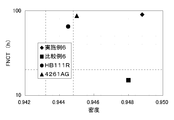
- Example 3 shows the relationship between the density of the polymers listed in Table 3 and FNCT.
- Example 6 it can be seen that the balance level of density-FNCT is much better than Comparative Examples 6-8. Moreover, it turns out that evaluation of the fuel tank for motor vehicles is favorable.
- the polyethylene of the present invention can be made into a hollow plastic molded product using the polyethylene, and can be excellent in moldability, durability and barrier properties, and in a balance between rigidity and durability. In particular, since it is suitably used for automobile fuel tanks and the like, it is highly industrially significant.
Landscapes
- Chemical & Material Sciences (AREA)
- Health & Medical Sciences (AREA)
- Chemical Kinetics & Catalysis (AREA)
- Medicinal Chemistry (AREA)
- Polymers & Plastics (AREA)
- Organic Chemistry (AREA)
- Transition And Organic Metals Composition Catalysts For Addition Polymerization (AREA)
- Addition Polymer Or Copolymer, Post-Treatments, Or Chemical Modifications (AREA)
Abstract
Description
フッ素処理をした無機酸化物担持クロム触媒を用いて製造された、ポリエチレンから得られる中空プラスチック製品が開示されている(特許文献1参照)。
しかしながら、本先願にはポリエチレンの短鎖分岐分布について開示されておらず、さらに中空プラスチック成形品、特に自動車用燃料タンクに適した、耐久性が十分なレベルのポリエチレンが開示されているとは言い難い。
しかしながら、特許文献2、3ではポリエチレンの短鎖分岐分布について開示されておらず、さらに得られるポリエチレンの耐衝撃性、耐久性について開示されていない。
また、クロム化合物を無機酸化物担体に担持し、非還元性雰囲気で焼成活性化することにより少なくとも一部のクロム原子を6価としたクロム触媒および特定の有機アルミニウム化合物(アルコキシド、シロキシド等)からなることを特徴とするポリエチレン製造触媒(特許文献7参照)が提案されており、その際、得られたポリエチレンが、ESCRまたは耐クリープ性に優れていることも開示されている。
さらにまた、非特許文献1、2にも、担体としてシリカではなく、リン酸アルミニウム、あるいはチタニアを用いることで、担体クロム触媒から得られる短鎖分岐分布が均一なポリエチレンが開示されている。しかし、紹介されているポリエチレンは、自動車用燃料タンク用途ではなく、また自動車用燃料タンクに適しているかどうかについて何も示唆も開示もされていない。
これらは、自動車メーカーの厳しい要求に応え、市場での評価を得た材料であるが、剛性と耐久性のバランス、耐衝撃性、成形性のレベルの更なる向上が望まれている。
0.60≦Xa≦1.20 ・・・(A)
0.80≦Xb≦1.40 ・・・(B)
本発明のポリエチレンは、炭素数4以上の短鎖分岐の分子量依存性を示す分岐度分布曲線の最大値における重量平均分子量(Mw)が、30,000以上であるポリエチレンである。分岐度分布曲線の短鎖分岐は、炭素数4以上であり、通常20以下である。
本発明のポリエチレンは、炭素数4以上の短鎖分岐の分子量依存性を示す分岐度分布曲線の最大値における重量平均分子量(Mw)が30,000以上、好ましくは35,000以上である。また、当該重量平均分子量(Mw)は通常10,000,000以下である。炭素数4以上の短鎖分岐の分子量依存性を示す分岐度分布曲線は、本発明のポリエチレンを分子量分別し、分別した各フラクションを13C-NMRによって短鎖分岐を測定し、ポリエチレン全体の短鎖分岐数に対する各フラクションの短鎖分岐数の相対比を、各フラクションの重量平均分子量に対してプロットすることにより得られる。
分岐度分布曲線の最大値における重量平均分子量(Mw)を30,000以上とすることにより、より多くの短鎖分岐が分子量分布中の高分子量側に組み込まれ、剛性と耐久性のバランスが著しく改善される。上記の要件は、重合触媒および重合条件を選択することにより達成することができる。
分子量分別法の一般的な方法について記述する。
分別カラムは、分別すべき成分に応じて通常使用される適当な充填剤を充填したものを用いる。ここで充填剤は溶媒に不溶で不活性のものであれば特に限定するものではないが、一般には海砂、セライト、ガラスビーズ等の粒径50~400メッシュ程度のものが好適に用いられる。
分別カラムの形状及び大きさについては特に限定するものではないが、例えば、直径10~100mm、長さ100~1000mm程度の円筒状のステンレスカラムが好適に用いられる。
良溶媒としては特に限定するものではないが、ポリエチレンが溶媒の沸点以下で溶解するp-キシレン(沸点;138℃)、テトラリン(沸点;207℃)、オルトジクロルベンゼン(沸点;180℃)、トリクロルベンゼン(沸点;218℃)等が用いられる。
また、貧溶媒としては特に限定するものではないが、良溶媒よりも沸点が高く、良溶媒と任意に溶解する、エチレングリコールモノエチルエーテル(エチルセロソルブ)(沸点;162℃)、エチレングリコールモノブチルエーテル(ブチルセロソルブ)(沸点;171℃)等が用いられる。
これらの良溶媒と貧溶媒から各々1種類選択し、混合溶媒として用いるが、p-キシレンとブチルセロソルブの組合せが通常用いられる。
分別カラムに送る混合溶媒の流量は、1.0ml/min~30.0ml/min、好ましくは5.0ml/min~25.0ml/minである。流量が1.0ml/min未満の場合には、分別に時間がかかり効率的でなく、また、分別中に配管内で再結晶化が起こり、詰まりの原因となりそれ以降の分別が停止する可能性がある。一方、流量が30.0ml/minを超えると分子量分布が広がり、充分な分子量分別が行われない。
カラム温度が115℃未満の温度では組成(結晶性)による分別が起こったり、分子量分布が広がり好ましくない。また、良溶媒の沸点付近又はそれ以上になると溶媒が沸騰して試料が充填剤から外れ、分子量による充分な溶離が行われず、分子量と溶媒組成との関係が逆転したり、分子量が急激に変化するなどして意図する分子量成分が分取できない。
分子量分別法の具体的な方法としては、セライト(60g)を担体としてポリマーサンプル(1.5g)、BHT(10mg)をキシレン(400ml)に135℃で溶解後、ブチルセルソルブ(200ml)を加え、このスラリーをカラムにつめ、その後、カラムの液を完全にブチルセルソルブで完全に置換し、125℃でブチルセルソルブ/キシレン=100/0、80/20、70/30、60/40、55/45、50/50、0/100の混合溶媒をそれぞれ用いて順にカラムに流すことによって、分子量の低いものから順に分別することができる。それぞれ分別を行った液にアセトンを加えポリマーサンプルを沈殿させ回収後、乾燥したものを用いて、13C-NMRによりブチル基以上の短鎖数を測定することができる。また、分別サンプルをGPCで測定することにより分子量(Mw)を測定することができる。横軸をGPCで求めた分子量(Mw)、縦軸をブチル基以上の短鎖分岐の相対値で表した分岐度分布曲線の具体例を図1に示した。
上記した要件に加えて、分子量分別を行う前のポリエチレン全体の炭素数4以上の短鎖分岐数を基準値1.0とし、Mwが8,000~15,000のフラクションにおける炭素数4以上の分岐数の相対比をXa、Mwが200,000~400,000のフラクションにおける炭素数4以上の分岐数の相対比をXbとしたとき、これらの相対比がそれぞれ次式(A)および(B)を満足することが好ましい。
0.60≦Xa≦1.20 ・・・(A)
0.80≦Xb≦1.40 ・・・(B)
より好ましくはXa、Xbに関して、それぞれ次式(C)、(D)を満足する。
0.60≦Xa≦1.15 ・・・(C)
0.85≦Xb≦1.40 ・・・(D)
さらに好ましくはXa、Xbに関して、それぞれ次式(E)、(F)を満足する。
0.60≦Xa≦1.10 ・・・(E)
0.90≦Xb≦1.40 ・・・(F)
なお、13C-NMRを測定した時の炭素数4以上の炭素分岐の化学シフト値の帰属については、Macromolecules,Volume.32,No.11,3817頁, 1999年に記載に基づいて行われる。
本発明においてXaが1.20よりも大きい、あるいはXbが0.80よりも小さいということは、低分子量側に多くの短鎖分岐が組み込まれていることを意味しており、上記特定の範囲にXa、Xbを設定することによって、目的とする物性バランスが得られる。
上記の要件は、重合触媒および重合条件を選択することにより達成することができる。例えば、後述するように、触媒としてジアルコキシアルミニウムアルコキシド化合物を担持したクロム触媒を用いて重合することにより、本発明のポリエチレンを製造することができる。
本発明のポリエチレンの密度は、通常0.940~0.960g/cm3、好ましくは0.943~0.957g/cm3、さらに好ましくは0.945~0.955g/cm3の範囲にあるものである。
密度が0.940g/cm3未満であると、中空プラスチック成形品の剛性が不足し、0.960g/cm3を超えると中空プラスチック成形品の耐久性が不足する傾向がある。
密度は、α-オレフィンの種類や含有量の制御などの方法で調整することができる。例えば、ポリエチレン中のα-オレフィン含有量を低くする(重合時のα-オレフィン添加量を低くする)、または同じ含有量であれば、炭素数の小さいα-オレフィンを用いることにより、密度を高くすることができる。
なお、上記の密度は、JIS K-7112に準拠し、ペレットを温度160℃の熱圧縮成形機により溶融後25℃/分の速度で降温し、厚み2mmtのシートを成形し、このシートを温度23℃の室内で48時間状態調節した後、密度勾配管に入れ測定したものである。
本発明のポリエチレンの主鎖1000個の炭素あたりの炭素数4以上の短鎖分岐数は3.0以下が好ましい。ポリエチレンの主鎖1000個の炭素あたりの炭素数4以上の短鎖分岐数は通常0.5以上である。主鎖1000個の炭素あたりの炭素数4以上の短鎖分岐数は、13C-NMRによって測定することができ、炭素数4以上の炭素分岐の化学シフト値の帰属については、Macromolecules,Volume.32,No.11,3817頁, 1999年の記載に基づいて行われる。
主鎖1000個の炭素あたりの炭素数4以上の短鎖分岐数が3.0を超えると中空プラスチック成形品の剛性が不足する傾向がある。主鎖1000個の炭素あたりの炭素数4以上の短鎖分岐数が0.5を下回ると中空プラスチック成形品の耐久性が不足する傾向がある。
上記の要件は、重合触媒および重合条件を選択することにより達成することができる。
本発明のポリエチレンは、HLMFRが通常1~10g/10分、好ましくは3~7g/10分、さらに好ましくは4~6g/10分の範囲にあるものである。
HLMFRが1g/10分未満であると、パリソン(ブロー成形において、成形器の口金から押し出されたパイプ状の溶融ポリマー;金型内で空気圧により膨張させる以前の状態)の押出成形時に押出量が不足し、成形不安定な状態となる傾向にあって実用的でないし、また、10g/10分を越えてもパリソンの形成が溶融粘度および溶融張力の不足のため不安定となる傾向にあり実用的でない。
HLMFRは、重合温度や水素濃度の制御などの方法で調整することができる。例えば、重合温度を高くする、または水素濃度を高くすることによりHLMFRを高くすることができる。
なお、上記のHLMFRは、JIS K-7210に準拠し、温度190℃、荷重21.60kgの条件で測定したものである。
本発明のポリエチレンは、数平均分子量(Mn)に対する重量平均分子量(Mw)の比(Mw/Mn)が通常10~50、好ましくは15~45、さらに好ましくは20~40の範囲にあるものである。Mw/Mnが10未満であると、中空プラスチック成形品の耐久性が不足し、50を超えると中空プラスチック成形品の衝撃強度が不足する傾向がある。
上記の要件は、重合触媒および重合条件を選択することにより達成することができる。
本発明のポリエチレンは、密度とFNCT(全周ノッチ式引張クリープ試験による破断時間)とが共に大きい値を示す。密度とFNCTとの関係を図2に示す。本発明のポリエチレンは、市販品(例えば、日本ポリエチレン社製高密度ポリエチレン「HB111R」、Basell社製高密度ポリエチレン「4261AG」)に比べて、図の右上の領域にプロットされるものであり、FNCTがほぼ同じであっても、密度が高く(剛性が高く)、剛性(密度)と耐久性のバランスに優れる。
以下、重合触媒の有機アルミニウム化合物担持クロム触媒、および重合方法について詳述する。
有機アルミニウム化合物担持クロム触媒(好ましくはジアルキルアルミニウムアルコキシド化合物担持クロム触媒)は、クロム化合物を無機酸化物担体に担持し、非還元性雰囲気で焼成活性化することにより少なくとも一部のクロム原子を6価とした後、さらに不活性炭化水素溶媒中で有機アルミニウム化合物を担持させ、次いで溶媒を除去・乾燥することにより調製される。
その際、触媒と溶媒との接触時間が可能な限り短くなるように溶媒を除去・乾燥させるのは、有機アルミニウム化合物によってクロム原子が過還元されないようにするためである。
クロム化合物を無機酸化物担体に担持し、非還元性雰囲気で焼成活性化することにより少なくとも一部のクロム原子が6価となるクロム触媒は、一般にフィリップス触媒として知られており公知である。
この触媒の概要は、例えば、以下の文献に記載されている。
(i)M.P.McDaniel著,Advances in Catalysis,Volume 33,47頁,1985年,Academic Press Inc.
(ii)M.P.McDaniel著,Handbook of Heterogeneous Catalysis,2400頁,1997年,VCH
(iii)M.B.Welchら著,Handbook of Polyolefins: Synthesis and Properties,21頁,1993年,Marcel Dekker
これらのクロム触媒に適する担体の製法、物理的性質および特徴は、例えば、以下の文献に記載されている。
(i)C.E.Marsden著,Preparation of Catalysts, Volume V,215頁,1991年,Elsevier Science Publishers
(ii)C.E.Marsden著,Plastics,Rubber and Composites Processing and Applications,Volume 21,193頁,1994年
また、担体の平均粒径としては、一般的なクロム触媒に用いられる担体と同様、通常10~200μm、好ましくは20~150μm、さらに好ましくは30~100μmの範囲のものが用いられる。
これらの方法は、例えば、以下の文献に記載されている。
(i)V.J.Ruddickら著,J.Phys.Chem.,Volume 100,11062頁,1996年
(ii)S.M.Augustineら著,J.Catal.,Volume 161,641頁,1996年
これらの方法は、例えば、以下の文献に記載されている。
(i)C.E.Marsden著,Plastics,Rubber and Composites Processing and Applications,Volume 21,193頁,1994年
(ii)T.Pullukatら著,J.Polym.Sci.,Polym.Chem.Ed.,Volume 18,2857頁,1980年
(iii)M.P.McDanielら著,J.Catal.,Volume 82,118頁,1983年
本発明においては、焼成活性化したクロム触媒に不活性炭化水素溶媒中でジアルキルアルミニウムアルコキシド化合物を担持し、さらに溶媒を除去・乾燥して、ジアルキルアルミニウムアルコキシド化合物担持クロム触媒として用いる。
ジアルキルアルミニウムアルコキシドは、下記一般式(2)
R1R2Al(OR3) (2)
(式中、R1,R2,R3は炭素原子数1~18のアルキル基であり、同一であっても異なっていてもよい。)で示される化合物である。
ジアルキルアルミニウムアルコキシドの具体例としては、ジメチルアルミニウムメトキシド、ジメチルアルミニウムエトキシド、ジメチルアルミニウムn-プロポキシド、ジメチルアルミニウムイソプロポキシド、ジメチルアルミニウムn-ブトキシド、ジメチルアルミニウムイソブトキシド、ジメチルアルミニウムアミルオキシド、ジメチルアルミニウムヘキシルオキシド、ジメチルアルミニウムオクチルオキシド、ジエチルアルミニウムメトキシド、ジエチルアルミニウムエトキシド、ジエチルアルミニウムn-プロポキシド、ジエチルアルミニウムイソプロポキシド、ジエチルアルミニウムn-ブトキシド、ジエチルアルミニウムイソブトキシド、ジエチルアルミニウムアミルオキシド、ジエチルアルミニウムヘキシルオキシド、ジエチルアルミニウムオクチルオキシド、ジn-プロピルアルミニウムメトキシド、ジn-プロピルアルミニウムエトキシド、ジn-プロピルアルミニウムn-プロポキシド、ジn-プロピルアルミニウムイソプロポキシド、ジn-プロピルアルミニウムn-ブトキシド、ジn-プロピルアルミニウムイソブトキシド、ジn-プロピルアルミニウムアミルオキシド、ジn-プロピルアルミニウムヘキシルオキシド、ジn-プロピルアルミニウムオクチルオキシド、ジn-ブチルアルミニウムメトキシド、ジn-ブチルアルミニウムエトキシド、ジn-ブチルアルミニウムn-プロポキシド、ジn-ブチルアルミニウムイソプロポキシド、ジn-ブチルアルミニウムn-ブトキシド、ジn-ブチルアルミニウムイソブトキシド、ジn-ブチルアルミニウムアミルオキシド、ジn-ブチルアルミニウムヘキシルオキシド、ジn-ブチルアルミニウムオクチルオキシド、ジイソブチルアルミニウムメトキシド、ジイソブチルアルミニウムエトキシド、ジイソブチルアルミニウムn-プロポキシド、ジイソブチルアルミニウムイソプロポキシド、ジイソブチルアルミニウムn-ブトキシド、ジイソブチルアルミニウムイソブトキシド、ジイソブチルアルミニウムアミルオキシド、ジイソブチルアルミニウムヘキシルオキシド、ジイソブチルアルミニウムオクチルオキシド、ジヘキシルアルミニウムメトキシド、ジヘキシルアルミニウムエトキシド、ジヘキシルアルミニウムn-プロポキシド、ジヘキシルアルミニウムイソプロポキシド、ジヘキシルアルミニウムn-ブトキシド、ジヘキシルアルミニウムイソブトキシド、ジヘキシルアルミニウムアミルオキシド、ジヘキシルアルミニウムヘキシルオキシド、ジヘキシルアルミニウムオクチルオキシド、ジオクチルアルミニウムメトキシド、ジオクチルアルミニウムエトキシド、ジオクチルアルミニウムn-プロポキシド、ジオクチルアルミニウムイソプロポキシド、ジオクチルアルミニウムn-ブトキシド、ジオクチルアルミニウムイソブトキシド、ジオクチルアルミニウムアミルオキシド、ジオクチルアルミニウムヘキシルオキシド、ジオクチルアルミニウムオクチルオキシド等が挙げられ、なかでもジエチルアルミニウムエトキシド、ジエチルアルミニウムn-プロポキシド、ジエチルアルミニウムn-ブトキシド、ジn-ブチルアルミニウムエトキシド、ジn-ブチルアルミニウムn-プロポキシド、ジn-ブチルアルミニウムn-ブトキシド、ジイソブチルアルミニウムエトキシド、ジイソブチルアルミニウムn-プロポキシド、ジイソブチルアルミニウムn-ブトキシドが好ましい。アルコキシド部分の酸素原子の隣の炭素原子をケイ素原子に変えたジアルキルアルミニウムシロキシドを用いても良い。
すなわち、一般式(2)で示されるジアルキルアルミニウムアルコキシドを合成するには、以下の式に示すようにトリアルキルアルミニウムとアルコールを1:1のモル比で反応させる方法(ここで、RはR4,R5,R6と同一でも異なってもよく、炭素原子数1~18のアルキル基を表す。)、


これらの反応は、ヘキサン、ヘプタン、オクタン、デカン、シクロヘキサン、ベンゼン、トルエン、キシレンなどの不活性炭化水素中で行なうことが好ましい。反応温度は反応が進行するならば任意の温度でよいが、好ましくは、0℃以上、さらに好ましくは20℃以上で行なう。使用した溶媒の沸点以上で加熱し、溶媒の還流下で反応を行なわせることは、反応を完結させる上でよい方法である。反応時間は任意でよいが、好ましくは1時間以上、さらに好ましくは2時間以上行なうのがよい。反応終了後はそのまま冷却し、溶液のままクロム触媒との反応に供してもよいし、溶媒を除去して反応生成物を単離してもよいが、溶液のまま用いるのが簡便で好ましい。
ジアルキルアルミニウムアルコキシドの合成方法および物理的・化学的性質については、T.Moleら著,Organoaluminum Compounds,3rd.ed.,1972年,Elsevier,第8章等に詳しく書かれている。
担持反応の温度は通常0~150℃、好ましくは10~100℃、さらに好ましくは20~80℃、担持反応の時間は通常5分~8時間、好ましくは30分~6時間、さらに好ましくは1~4時間である。有機アルミニウム化合物は焼成活性化後に少なくとも一部が6価となったクロム原子と反応し、これを低原子価のクロム原子に還元する。この現象は焼成活性化後のクロム触媒が6価のクロム原子特有のオレンジ色であるのに対して、有機アルミニウム化合物による担持操作をされたクロム触媒が緑色もしくは青緑色であることから確認できる。すなわち、このクロム触媒の色の変化から6価クロム原子の少なくとも一部が3価または2価のクロム原子に還元されているものと推定される。
上記の有機アルミニウム化合物担持クロム触媒を用いて、ポリエチレンの製造を行うに際しては、スラリー重合、溶液重合のような液相重合法あるいは気相重合法など、いずれの方法も採用することができるが、特にスラリー重合法が好ましく、パイプループ型反応器を用いるスラリー重合法、オートクレーブ型反応器を用いるスラリー重合法、いずれも用いることができる。なかでもパイプループ型反応器を用いるスラリー重合法が好ましい(パイプループ型反応器とこれを用いるスラリー重合の詳細は、松浦一雄・三上尚孝編著、「ポリエチレン技術読本」、148頁、2001年、工業調査会に記載されている)。
液相重合法における重合温度は、一般的には0~300℃であり、実用的には20~200℃、好ましくは50~180℃、さらに好ましくは70~150℃である。反応器中の触媒濃度およびエチレン濃度は重合を進行させるのに十分な任意の濃度でよい。例えば、触媒濃度は、液相重合の場合反応器内容物の重量を基準にして約0.0001~約5重量%の範囲とすることができる。同様にエチレン濃度は、液相重合の場合反応器内容物の重量を基準にして約1%~約10重量%の範囲とすることができる。
第一段においては、エチレン単独または必要に応じてα-オレフィンとの共重合を、水素濃度のエチレン濃度に対する重量比(Hc/ETc)、重合温度または両者により分子量を調節しながら、またα-オレフィン濃度のエチレン濃度に対する重量比で密度を調節しながら重合反応を行う。
第二段においては、第一段から流れ込む反応混合物中の水素および同じく流れ込むα-オレフィンがあるが、必要に応じてそれぞれ新たな水素、α-オレフィンを加えることができる。従って、第二段においても、水素濃度のエチレン濃度に対する重量比(Hc/ETc)、重合温度または両者により分子量を調節しながら、またα-オレフィン濃度のエチレン濃度に対する重量比により密度を調節しながら重合反応を行うことができる。触媒や有機アルミニウム化合物のような有機金属化合物についても、第一段から流れ込む触媒により二段目で引き続き重合反応を行うだけでなく、第二段で新たに触媒、有機アルミニウム化合物のような有機金属化合物またはその両者を供給してもよい。
得られたポリエチレンは、次いで混練するのが好ましい。単軸または二軸の押出機または連続式混練機を用いて行われる。
ポリエチレンの耐クリープ性を向上させるには、分子量分布を広くすることが重要である。すなわち、耐クリープ性を向上するには分子量をなるべく高くするのが好ましいが、分子量が高過ぎると樹脂の成形ができなくなってしまうので、流れ性を付与するために低分子量領域のポリエチレンも必要で、結果として分子量分布を広くする必要がある(J.Scheirs,W.Kaminsky編,Metallocene-based Polyolefins,Volume2,365頁,2000年,John Wiley & Sons)。一般的なクロム触媒でポリエチレンを得る場合、分子量分布を広くするには、賦活温度および重合温度の少なくとも1つを下げるのが通常の手段である(例えば、松浦一雄・三上尚孝編著、「ポリエチレン技術読本」、134頁、2001年、工業調査会)。しかし、賦活温度および重合温度の少なくとも1つを下げると、活性が低下するのが一般的であり、また同時にHLMFRも低下してしまうので(前出「ポリエチレン技術読本」、134頁)、所定のHLMFRのポリエチレンを得るための経済的に製造可能な重合条件が設定できないことが多い。また、分子量分布を広げることにより、低分子量成分が増えた場合、耐衝撃性が低下することも知られている。つまり、分子量分布を広げることだけでは、耐衝撃性と耐久性のいずれも向上させるのには限界がある。
以下、本発明のポリエチレンを成形して得られる中空プラスチック品について記載する。
本発明の中空プラスチック成形品は、本ポリエチレンを少なくとも1層有する構造、好ましくは多層構造のものであるが、ポリエチレンからなる単層構造のものであってもよい。 中空プラスチック成形品が多層構造の場合、浸透低減遮断層を有するのが好ましく、浸透低減遮断層には、通常バリアー層が用いられる。
本発明の中空プラスチック成形品の層構造が2層以上であるとき、最内層と最外層が本ポリエチレン系樹脂からなるのが好ましい。
本発明の中空プラスチック成形品は、少なくとも1層のバリアー層を存在させて、揮発性物質の浸透を減らし且つ該バリアー層が極性の遮断ポリマーから構成されている浸透低減遮断層を含む多層構造が好ましい。例えば、プラスチック燃料タンクの壁を多層構造とすると、バリアー層(それ単独では成形性および機械強度が十分ではない)を、本ポリエチレンからなる2層の間に固定化できるという利点がある。結果として、特に共押出ブロー成形中に、本ポリエチレン系樹脂を2層以上有する材料の成形性は、主として本ポリエチレンの改良された成形性の影響を受けて改善される。さらに、本ポリエチレンの改良された性能は、材料の機械強度に極めて重要な影響を及ぼすので、本発明の中空プラスチック成形品の強度を顕著に増大させることが可能となる。
また、本発明の中空プラスチック成形品においては、フッ素化、表面被覆またはプラズマ重合等の処理により、本ポリエチレン層の表面に基層を被覆するようにしてもよい。
すなわち、本ポリエチレン系樹脂層、接着層、バリアー層、接着層、再生材層、本ポリエチレン系樹脂層である。
以下に、上記態様における各層の構成、層構成比について詳細に説明する。
1.最外層
本発明の中空プラスチック成形品の最外層を構成する樹脂(A)は、上記所定要件を満たす本ポリエチレンである。
本発明の中空プラスチック成形品の最内層を構成する樹脂(B)は、上記所定要件を満たす本ポリエチレンであり、上記樹脂(A)と同じであってもよいし、また異なるものであってもよい。
本発明の中空プラスチック成形品のバリアー層を形成する樹脂(C)は、エチレンビニルアルコール樹脂、ポリアミド樹脂、ポリエチレンテレフタレート樹脂、ポリブチレンテレフタレート樹脂等から選ばれるものであるが、特にエチレンビニルアルコール樹脂からなることが好ましい。エチレンビニルアルコール樹脂は、ケン化度が通常93%以上、望ましくは96%以上で、エチレン含量が25~50モル%であることがより好ましい。
本発明の中空プラスチック成形品の接着層を形成する樹脂(D)は、不飽和カルボン酸またはその誘導体によりグラフト変性した高密度ポリエチレン、低密度ポリエチレン、直鎖状低密度ポリエチレン等から選ばれるものであるが、特に不飽和カルボン酸またはその誘導体によりグラフト変性した高密度ポリエチレンからなることが好ましい。
不飽和カルボン酸またはその誘導体の含有量は通常0.01~5重量%、好ましくは0.01~3重量%、さらに好ましくは0.01~1重量%である。グラフト変性量(不飽和カルボン酸またはその誘導体の含有量)が0.01重量%未満であると十分な接着性能が発現せず、5重量%を超えると接着性に寄与しない不飽和カルボン酸が接着性に悪影響を与える。
本発明の中空プラスチック成形品の再生材層を形成する樹脂は、最外層を形成するポリエチレン(A)、最内層を形成するポリエチレン(B)、バリアー層を形成する樹脂(C)および接着層を形成する樹脂(D)を含む組成物である。各成分の配合量は(A)成分10~30重量%、(B)成分30~50重量%、(C)成分1~15重量%、(D)成分1~15重量%であるのが望ましい。
(A)~(D)の各成分は新品を使用することもできるし、(A)~(D)成分からなる各層を含む多層積層体のスクラップ、バリ等の不要部分を回収、再利用してこのようなリサイクル品を各成分の成分原料とすることもできる。例えば、一旦成形され、使用されて利用済みの中空プラスチック成形品(自動車用燃料タンク製品等)を粉砕してなるリグラインド樹脂が用いられる。リサイクル品を使用する場合、(A)~(D)のすべての成分を全量リサイクル品から供給することもできるし、新品と混合して使用することもできる。
多層積層体を作製する際に発生した成形バリや未使用パリソンをリサイクル材として使用する場合、各種成分の相溶性が低下することがあるので、相溶化剤や接着層を構成する樹脂をさらに混合してもよい。
本発明の中空プラスチック成形品の各層の厚み構成は、厚み比で最外層が10~30%、最内層が20~50%、バリアー層が1~15%、接着層が1~15%、および再生材層が30~60%(ただし全ての層厚み構成比の合計が100%)である。
最外層の層構成比は通常10~30%、好ましくは10~25%、より好ましくは10~20%である。最外層の層構成比が10%未満であると、衝撃性能が不足し、30%を超えると中空プラスチック成形品の成形安定性が損なわれる。
最内層の層構成比は、通常20~50%、好ましくは35~50%、より好ましくは40~50%である。最外層の層構成比が20%未満であると、中空プラスチック成形品の剛性不足が顕在化し、50%を超えると中空プラスチック成形品の成形安定性が損なわれる。 バリアー層の層構成比は、通常1~15%、好ましくは1~10%、より好ましくは1~5%である。バリアー層の層構成比が1%未満であると、バリアー性能が不満足であり、15%を超えると衝撃性能が不足する。
接着層の層構成比は、通常1~15%、好ましくは1~10%、より好ましくは1~5%である。接着層の層構成比が1%未満であると、接着性能が不満足であり、15%を超えると中空プラスチック成形品の剛性不足が顕在化する。
再生材層の構成比は、通常30~60%、好ましくは35~50%、より好ましくは35~45%である。再生材層の層構成比が30%未満であると、中空プラスチック成形品の成形安定性が損なわれ、60%を超えると衝撃性能が不足する。
本発明の中空プラスチック成形品の製造方法は、特に限定されず、従来からの公知の多層中空成形機を用いて押出ブロー成形法により製造することができる。例えば、複数の押出機で各層の構成樹脂を加熱溶融させた後、多層のダイにより溶融パリソンを押出し、次いでこのパリソンを金型で挟み、パリソンの内部に空気を吹き込むことにより、多層の中空プラスチック成形品が製造される。
さらに、本発明の中空プラスチック成形品には、必要に応じて目的を損なわない範囲で、帯電防止剤、酸化防止剤、中和剤、滑剤、抗ブロッキング剤、防曇剤、有機あるいは無機系顔料、充填剤、無機フィラー、紫外線防止剤、分散剤、耐候剤、架橋剤、発泡剤、難燃剤などの公知の添加剤を添加することができる。
また、本発明の中空プラスチック成形品は、具体的には、製品としては、燃料タンク等のタンク、灯油缶、ドラム缶、薬品用容器、農薬用容器、溶剤用容器、各種プラスチックボトル等の製品、特に自動車用燃料タンクとして供され、或いは本発明の中空プラスチック成形品の用途としては、燃料タンク等のタンク、灯油缶、ドラム缶、薬品用容器、農薬用容器、溶剤用容器、各種プラスチックボトル等が挙げられ、特に自動車用燃料タンクとして用いられるのが最も好ましい。
実施例および比較例において使用した測定方法は以下の通りである。
1.オートクレーブ中における液相中の水素濃度およびエチレン濃度の定量
JIS K-2301(2004年版)に従い、触媒を導入しない状態で予め各実施例、比較例条件の重合温度、水素分圧、エチレン分圧での水素濃度およびエチレン濃度をガスクロマトグラフ法で分析し定量した。オートクレーブ内の溶液を少量抜き出して気化させ、島津製作所製ガスクロマトグラフGC-14Aを用い、前記JISの10頁、表2、カラム組合せBの分析条件にて、熱伝導度検出器により水素濃度およびエチレン濃度を定量した。
(2-a)物性測定のためのポリマー前処理
添加剤としてチバガイギー社製B225を0.2重量%添加し、単軸押出機にて混練しペレタイズした。
(2-b)ハイロードメルトフローレート(HLMFR):
JIS K-7210(2004年版)の附属書A表1-条件Gに従い、試験温度190℃、公称荷重21.60kgにおける測定値をHLMFRとして示した。
(2-c)密度:
JIS K-7112(2004年版)に従い測定した。
生成ポリエチレンについて下記の条件でゲル透過クロマトグラフ(GPC)を行ない、数平均分子量(Mn)および重量平均分子量(Mw)を求めて分子量分布(Mw/Mn)を算出した。
[ゲル透過クロマトグラフ測定条件]
装 置:Waters 150Cモデル、
カラム:Shodex-HT806M、
溶 媒:1,2,4-トリクロロベンゼン、
温 度:135℃、
単分散ポリスチレンフラクションを用いてユニバーサル評定。
MwのMnに対する比率(Mw/Mn)で示される分子量分布(Mw/Mnが大きいほど分子量分布が広い)については、「サイズ排除クロマトグラフィー(高分子の高速液体クロマトグラフィー)」(森定雄著,共立出版,96頁)に記載された分子量と検出器感度の式にn-アルカンおよびMw/Mn≦1.2の分別直鎖ポリエチレンのデータを当てはめて、次式で示される分子量Mの感度を求め、サンプル実測値の補正を行なった。
分子量Mの感度=a+b/M
(a、bは定数で、a=1.032、b=189.2)
JIS K-6992-2(2004年版)に準拠し、厚さ5.9mmのシートを圧縮成形した後、JIS K-6774(2004年版)附属書5(規定)図1に示された区分「呼び50」の形状と寸法の試験片を作製し、80℃の純水中で全周ノッチ式引張クリープ試験を行った。引張荷重は88N、98N、108Nとし、試験点数は各荷重で2点とした。得られた両対数スケールにおける破断時間と公称応力の6点のプロットから最小二乗法により公称応力6MPaにおける破断時間をFNCTの指標とした。
JIS K-7111(2004年版)に従ってタイプ1の試験片を作製し、打撃方向はエッジワイズ、ノッチのタイプはタイプA(0.25mm)として、ドライアイス/アルコール中で-40℃で測定した。
セライト(60g)を担体として、ポリマーサンプル(1.5g)、BHT(10mg)をキシレン(400ml)に135℃で溶解後、ブチルセルソルブ(200ml)を加えた。このスラリーを常温に戻し、スラリーをカラム(内径36.5mmφ×長さ250mm)につめ、その後、カラムの液を完全にブチルセルソルブで完全に置換した。その後下に示したような分別条件で、キシレン/ブチルセルソルブ=0/100、20/80、30/70、40/60、45/55、50/50、100/0の混合溶媒をそれぞれ用いて温度をコントロールしながら順にカラムに流すことによって、分子量の低いものから順に分別した。それぞれ分別を行った液にアセトンを加えポリマーサンプルを沈殿させ回収後、乾燥した。
このようにして得られた分別サンプルの13C-NMRを測定することにより、ブチル基以上の短鎖数を測定した。また分別サンプルをGPCで測定することにより分子量(Mw)を測定した。横軸をGPCで求めた分子量(Mw)、縦軸をブチル基以上の短鎖分岐の相対値で表したものを図1に示した。
<分別条件>
フラクション番号 温度 組成 流量 時間
F-1 室温 0:100 20 50
F-2 126 0:100 20 75
F-3 126 20:80 16 100
F-4 126 30:70 16 100
F-5 126 40:60 16 100
F-6 126 45:55 16 100
F-7 126 50:50 16 100
F-8 126 100:0 10 150
上記において、温度の単位は(℃)、組成は(キシレン:ブチルセルソルブ)の比で表わされ、流量の単位は(mL/min)、時間は(min)である。
(3-a)物性測定のためのポリマー前処理
添加剤としてADEKA社製アデカスタブAO-60を0.05重量%、アデカスタブ2112を0.15重量%、それぞれ添加し、単軸押出機にて混練しペレタイズした。
自動車用燃料タンクを中空成形する際、パリソンの耐ドローダウン性と肉厚均質性を評価し、とても良好なものを◎、良好なものを○、成形不良が発生したものを×、成形不良ではないが肉厚分布が若干大きいものを△とした。
不凍液をフルに注入した自動車用燃料タンクを-40℃に冷却し、コンクリート面から垂直落下させ、液漏れの有無で判定した。
◎:高さ9mから落としても液漏れしなかった。
○:高さ6mでは液漏れしないが、高さ9mでは割れて液漏れした。
△:高さ3mでは液漏れしないが、高さ6mでは割れて液漏れした。
×:高さ3mで割れて液漏れした。
シナジーレギュラーガソリンを燃料タンクに入れ、40℃で1週間状態調整実施後、ガソリンを入れ替え重量測定を行い、経時的に減少する量を重量測定し、下記の基準で判断
した。
◎:0.01g/day未満
×:0.01g/day以上
[実施例1]
(1)クロム触媒の調製
クロム原子担持量が1.1重量%、比表面積が500m2/g、細孔体積が1.5cm3/gを有する触媒-1(シリカに酢酸クロムを担持させた触媒)を15g用意し、多孔板目皿付き、管径5cmの石英ガラス管に入れ、円筒状焼成用電気炉にセットし、モレキュラーシーブスを通した空気にて流動化させ、線速6cm/sにて500℃で18時間焼成活性化を行った。6価のクロム原子を含有することを示すオレンジ色のクロム触媒が得られた。
予め窒素置換した100mlのフラスコに、上記(1)で得られたクロム触媒2gを入れ、蒸留精製したヘキサン30mlを加えスラリーとした。東ソー・ファインケム社製ジエチルアルミニウムエトキシドの0.1mol/L-ヘキサン溶液を5.9ml(Al/Crモル比=1.4)添加し、40℃で2時間攪拌した。攪拌終了後直ちに減圧下で30分かけて溶媒を除去し、粘性、湿り気をもたない自由流動性(free flowing)のジエチルアルミニウムエトキシド化合物担持クロム触媒を得た。触媒は緑色であり、6価のクロムが還元されていることを示す。
充分に窒素置換した2.0Lのオートクレーブに上記(2)で得られたジエチルアルミニウムエトキシド化合物担持クロム触媒100mgおよびイソブタン0.8Lを仕込み、内温を96℃まで昇温した。水素を0.1MPa導入した後、1-ヘキセン8.5gをエチレンで加圧導入し、エチレン分圧を1.0MPaとなるように保ちながら、触媒生産性が3000g-ポリマー/g-触媒となるように重合を行った。ついで内容ガスを系外に放出することにより重合を終結した。その重合条件の概略を表1に示した。
触媒1g当たり、重合時間1時間当たりの重合活性は1800g-ポリマー/g-触媒/hであった。物性として、HLMFR、密度、分子量(Mn、Mw)、分子量分布(Mw/Mn)、FNCT破断時間、シャルピー衝撃強度の測定結果等を表2に示した。
(1)クロム触媒の調製
0.1mol/Lジエチルアルミニウムエトキシド-ヘキサン溶液を5.9ml(Al/Crモル比=1.4)加える代わりに、5.0ml(Al/Crモル比=1.2)添加した以外は、全て実施例1(1)(2)と同様に行い、ジエチルアルミニウムエトキシド 化合物担持クロム触媒を調製した。
充分に窒素置換した2.0Lのオートクレーブに上記(1)で得られたジエチルアルミニウムエトキシド化合物担持クロム触媒100mgおよびイソブタン0.8Lを仕込み、内温を98℃まで昇温した。水素を0.1MPa導入した後、1-ヘキセン6.0gをエチレンで加圧導入し、エチレン分圧を1.0MPaとなるように保ちながら、触媒生産性が3000g-ポリマー/g-触媒となるように重合を行った。ついで内容ガスを系外に放出することにより重合を終結した。その重合条件の概略を表1に示した。また物性測定結果等を表2に示した。
充分に窒素置換した2.0Lのオートクレーブに、実施例1(1)の賦活温度を600℃として得られたクロム触媒100mgおよびイソブタン0.8Lを仕込み、内温を99℃まで昇温した。水素を導入せず、1-ヘキセン5.0gをエチレンで加圧導入し、触媒生産性=3000g-ポリマー/g-触媒となるように重合を行った。ついで、内容ガスを系外に放出することにより重合を終結した。その重合条件の概略を表1に示した。重合活性は2000g-ポリマー/g-触媒/hであった。また物性測定結果等を表2に示した。
日本ポリエチレン社製高密度ポリエチレン「HB111R」について、物性測定を行った結果を表2に示した。
[比較例3]
Basell社製高密度ポリエチレン「4261AG」について、物性測定を行った結果を表2に示した。
(1)クロム触媒の調製
触媒-1を15g用意し、多孔板目皿付き、管径5cmの石英ガラス管に入れ、円筒状焼成用電気炉にセットし、モレキュラーシーブスを通した空気にて流動化させ、線速6cm/sにて700℃で18時間焼成活性化を行った。6価のクロム原子を含有することを示すオレンジ色のクロム触媒が得られた。
予め窒素置換した100mlのフラスコに、上記(1)で得られたクロム触媒2gを入れ、蒸留精製したヘキサン30mlを加えスラリーとした。東ソー・ファインケム社製ジエチルアルミニウムエトキシドの0.1mol/L-ヘキサン溶液を5.9ml(Al/Crモル比=1.4)添加し、40℃で2時間攪拌した。攪拌終了後直ちに減圧下で30分かけて溶媒を除去し、粘性、湿り気のない自由流動性(free flowing)のジエチルアルミニウムエトキシド化合物担持クロム触媒を得た。触媒は緑色であり、6価のクロムが還元されていることを示す。
充分に窒素置換した2.0Lのオートクレーブに上記(2)で得られたジエチルアルミニウムエトキシド化合物担持クロム触媒100mgおよびイソブタン0.8Lを仕込み、内温を94℃まで昇温した。水素を0.1MPa導入した後、1-ヘキセン4.0gをエチレンで加圧導入し、エチレン分圧を1.0MPaとなるように保ちながら、触媒生産性が3000g-ポリマー/g-触媒となるように重合を行った。ついで内容ガスを系外に放出することにより重合を終結した。その重合条件の概略を表1に示した。また物性測定結果等を表2に示した。
(1)クロム触媒の調製
0.1mol/Lジエチルアルミニウムエトキシド-ヘキサン溶液を5.9ml(Al/Crモル比=1.4)加える代わりに、4.2ml(Al/Crモル比=1.0)添加した以外は、全て実施例3(1)(2)と同様に行い、ジエチルアルミニウムエトキシド化合物担持クロム触媒を調製した。
充分に窒素置換した2.0Lのオートクレーブに上記(1)で得られたジエチルアルミニウムエトキシド化合物担持クロム触媒100mgおよびイソブタン0.8Lを仕込み、内温を95℃まで昇温した。水素を0.1MPa導入した後、1-ヘキセン7.5gをエチレンで加圧導入し、エチレン分圧を1.0MPaとなるように保ちながら、触媒生産性が3000g-ポリマー/g-触媒となるように重合を行った。ついで内容ガスを系外に放出することにより重合を終結した。その重合条件の概略を表1に示した。また物性測定結果等を表2に示した。
(1)クロム触媒の調製
0.1mol/Lジエチルアルミニウムエトキシド-ヘキサン溶液を5.9ml(Al/Crモル比=1.4)加える代わりに、4.2ml(Al/Crモル比=1.0)添加した以外は、全て実施例1(1)(2)と同様に行い、ジエチルアルミニウムエトキシド化合物担持クロム触媒を調製した。
充分に窒素置換した2.0Lのオートクレーブに上記(1)で得られたジエチルアルミニウムエトキシド化合物担持クロム触媒100mgおよびイソブタン0.8Lを仕込み、内温を100℃まで昇温した。1-ヘキセン7.0gをエチレンで加圧導入し、エチレン分圧を1.0MPaとなるように保ちながら、触媒生産性が3000g-ポリマー/g-触媒となるように重合を行った。ついで内容ガスを系外に放出することにより重合を終結した。触媒1g当たり、重合時間1時間当たりの重合活性は2000g-ポリマー/g-触媒/hであった。物性測定結果等を表2に示した。
充分に窒素置換した2.0Lのオートクレーブに、実施例1(1)で得られたクロム触媒100mgおよびイソブタン0.8Lを仕込み、内温を100℃まで昇温した。水素を0.1MPa導入した後、1-ヘキセン5.0gをエチレンで加圧導入し、エチレン分圧を1.0MPaとなるように保ちながら、触媒生産性=3000g-ポリマー/g-触媒となるように重合を行った。ついで、内容ガスを系外に放出することにより重合を終結した。その重合条件の概略を表1に示した。重合活性は1800g-ポリマー/g-触媒/hであった。また物性測定結果等を表2に示した。
充分に窒素置換した2.0Lのオートクレーブに、実施例1(1)で得られたクロム触媒100mgおよびイソブタン0.8Lを仕込み、内温を101℃まで昇温した。水素を0.1MPa導入した後、1-ヘキセン3.0gをエチレンで加圧導入し、触媒生産性=3000g-ポリマー/g-触媒となるように重合を行った。ついで、内容ガスを系外に放出することにより重合を終結した。その重合条件の概略を表1に示した。重合活性は2000g-ポリマー/g-触媒/hであった。また物性測定結果等を表2に示した。
[実施例6]
(1)重合
内容積200Lのパイプループ型反応器にイソブタンを120L/h、実施例2で得られたジエチルアルミニウムエトキシド担持クロム触媒を5g/hの速度で連続的に供給し、反応器内容物を所要速度で排出しながら、98℃において液相中の水素濃度に対する重量比(Hc/ETc)を1.1×10-3、液相中の1-ヘキセン濃度のエチレン濃度に対する重量比を0.22に保つようにエチレン、水素、1-ヘキセンを供給し、全圧3.7MPa、平均滞留時間0.9hの条件で、液充満の状態で連続的に重合を行った。触媒生産性3200g-ポリマー/g-触媒となり、平均重合活性は3600g-ポリマー/g-触媒/hであった。物性の測定結果を表3に示した。
以下の1.~4.の樹脂を用い、以下の層構成となるように、共押出ブロー成形装置(日本製鋼社製NB150)にて以下の条件で成形し自動車用燃料タンクを得た。
1.ポリエチレン樹脂
クロム触媒を用いて重合を行うことにより製造された本ポリエチレンを使用した。
無水マレイン酸が0.1重量%グラフトされた日本ポリエチレン社製無水マレイン酸変性ポリエチレンを使用した。
クラレ社製エチレンビニルアルコール樹脂エバールを使用した。
以下に記載する層構成において、実験開始時の再生材層の樹脂として、最内層を構成する樹脂と同じ樹脂を使用し、自動車用燃料タンクをブロー成形し、その自動車用燃料タンクを粉砕したリグラインド樹脂を再生材として用いた。具体的には、再生材層には、下記の層構成の自動車用燃料タンクを成形し、粉砕した再生材を用いた。
最外層:本ポリエチレン樹脂(層構成比11%)
再生材層:本ポリエチレン樹脂(層構成比40%)
接着外層:MAPE(層構成比3%)
バリアー層:EVOH(層構成比3%)
接着内層:MAPE(層構成比3%)
最内層:本ポリエチレン樹脂(層構成比40%)
以下の共押出し多層条件下、成形温度210℃、ブロー金型冷却温度20℃、冷却時間180秒の条件にてタンク重量8kg、容量60Lの4種6層多層自動車用燃料タンクを成形した。タンクの形状は鞍型のタイプのものを使用した。なお、層比率は、タンクの厚み比率を観察しながら押出機のスクリュー回転数を調整し最外層が11%、第2層が40%、第3層が3%、第4層が3%、第5層が3%、最内層が40%となるようにした。
最外層(外側から1層目)径90mmφ、L/D=22
第2層(外側から2層目)径120mmφ、L/D=28
第3層(外側から3層目)径50mmφ、L/D=22
第4層(外側から4層目)径50mmφ、L/D=28
第5層(外側から5層目)径50mmφ、L/D=22
最内層(外側から6層目)径120mmφ、L/D=241
内容積200Lのパイプループ型反応器にイソブタンを120L/h、比較例2で得られたクロム触媒を5g/hの速度で連続的に供給し、反応器内容物を所要速度で排出しながら、100℃において液相中の水素濃度に対する重量比(Hc/ETc)を1.1×10-3、液相中の1-ヘキセン濃度のエチレン濃度に対する重量比を0.11に保つようにエチレン、水素、1-ヘキセンを供給し、全圧3.7MPa、平均滞留時間0.9hの条件で、液充満の状態で連続的に重合を行った。触媒生産性2800g-ポリマー/g-触媒となり、平均重合活性は3100-ポリマー/g-触媒/hであった。実施例6と同様にして自動車用燃料タンクを成形し、その自動車用燃料タンクの評価(成形性、落下衝撃性、ガソリンバリヤー性)を行った。物性および自動車燃料タンクの評価結果を表3に示した。
ポリエチレン樹脂として日本ポリエチレン社製高密度ポリエチレン「HB111R」を使用した以外は、実施例6と同様にして自動車用燃料タンクを成形し、その自動車用燃料タンクの評価(成形性、落下衝撃性、ガソリンバリヤー性)を行った。物性および自動車燃料タンクの評価結果を表3に示した。
[比較例8]
ポリエチレン樹脂としてBasell社製高密度ポリエチレン「4261AG」を使用した以外は、実施例6と同様にして自動車用燃料タンクを成形し、その自動車用燃料タンクの評価(成形性、落下衝撃性、ガソリンバリヤー性)を行った。物性および自動車燃料タンクの評価結果を表3に示した。
図3に、表3記載のポリマーの密度とFNCTの関係を示した。実施例6の場合は、比較例6~8に比べ、密度-FNCTのバランスレベルが一段と優れていることがわかる。また自動車用燃料タンクの評価は良好であることがわかる。
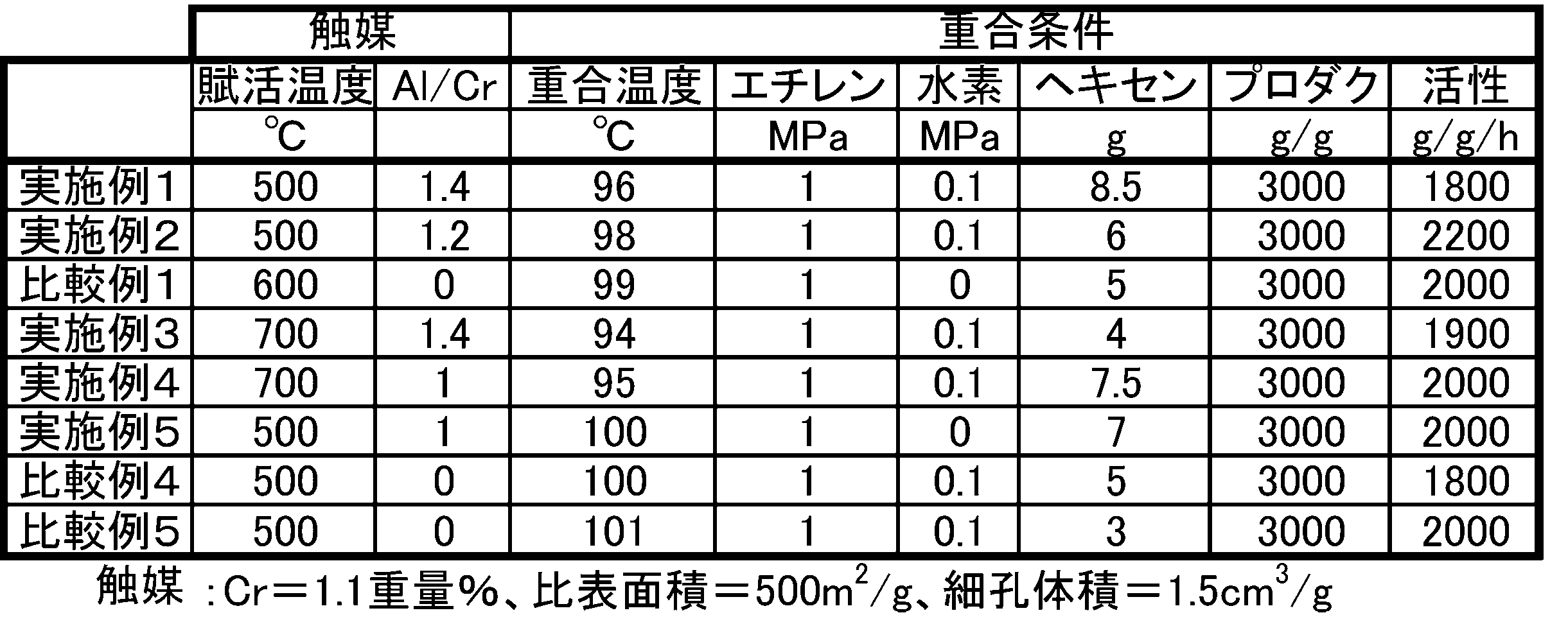


本出願は、2010年12月24日出願の日本特許出願(特願2010-287401)に基づくものであり、その内容はここに参照として取り込まれる。
Claims (14)
- クロム触媒によって重合され、炭素数4以上の短鎖分岐の分子量依存性を示す分岐度分布曲線の最大値における重量平均分子量(Mw)が、30,000以上であるポリエチレン。
- 分岐度分布曲線は、Mwが8,000~15,000のフラクションにおける炭素数4以上の分岐数の相対比をXa、Mwが200,000~400,000のフラクションにおける炭素数4以上の分岐数の相対比をXbとしたとき、これらの相対比がそれぞれ次式(A)および(B)を満足する請求項1に記載のポリエチレン。
0.60≦Xa≦1.20 ・・・(A)
0.80≦Xb≦1.40 ・・・(B) - 密度が0.940~0.960g/cm3である請求項1又は2に記載のポリエチレン。
- 主鎖1000個の炭素あたりの炭素数4以上の短鎖分岐数が3.0以下である請求項1~3のいずれかに記載のポリエチレン。
- クロム触媒は、クロム化合物を担持した無機酸化物担体を、非還元性雰囲気で400~900℃にて焼成活性化することにより少なくとも一部のクロム原子を6価とした後、不活性炭化水素溶媒中で有機アルミニウム化合物を担持させ、次いで該溶媒を除去・乾燥して得られる請求項1~4のいずれかに記載のポリエチレン。
- クロム触媒は、クロム原子に対して、トリアルキルアルミニウムおよびジアルキルアルミニウムアルコキシド化合物の少なくとも1つのモル比が0.5~10.0である請求項5に記載のポリエチレン。
- 有機アルミニウム化合物は、ジアルキルアルミニウムアルコキシドである請求項5又は6に記載のポリエチレン。
- 無機酸化物担体は、シリカである請求項5~7のいずれかに記載のポリエチレン。
- クロム化合物を担持した無機酸化物担体を、非還元性雰囲気で400~900℃にて焼成活性化することにより少なくとも一部のクロム原子を6価とした後、不活性炭化水素溶媒中で有機アルミニウム化合物を担持させ、次いで該溶媒を除去・乾燥して得られるクロム触媒によって重合することを特徴とする、炭素数4以上の短鎖分岐の分子量依存性を示す分岐度分布曲線の最大値における重量平均分子量(Mw)が30,000以上であるポリエチレンの製造方法。
- クロム触媒は、クロム原子に対して、トリアルキルアルミニウムおよびジアルキルアルミニウムアルコキシド化合物の少なくとも1つのモル比が0.5~10.0である請求項9に記載のポリエチレンの製造方法。
- 有機アルミニウム化合物は、ジアルキルアルミニウムアルコキシドである請求項9に記載のポリエチレンの製造方法。
- 無機酸化物担体は、シリカである請求項9に記載のポリエチレンの製造方法。
- 請求項1~8のいずれかに記載のポリエチレンを含む中空プラスチック成形品。
- 中空プラスチック成形品は、燃料タンク、灯油缶、ドラム缶、薬品用容器、農業用容器、溶剤用容器およびプラスチックボトルからなる群から選ばれる少なくとも一種である請求項13に記載の中空プラスチック成形品。
Priority Applications (3)
| Application Number | Priority Date | Filing Date | Title |
|---|---|---|---|
| EP11851416.5A EP2657260B1 (en) | 2010-12-24 | 2011-12-22 | Polyethylene having improved branching degree distribution |
| US13/997,568 US20130280462A1 (en) | 2010-12-24 | 2011-12-22 | Polyethylene having improved branching degree distribution |
| CN201180062583.5A CN103270054B (zh) | 2010-12-24 | 2011-12-22 | 具有改良了的支化度分布的聚乙烯 |
Applications Claiming Priority (2)
| Application Number | Priority Date | Filing Date | Title |
|---|---|---|---|
| JP2010287401 | 2010-12-24 | ||
| JP2010-287401 | 2010-12-24 |
Publications (1)
| Publication Number | Publication Date |
|---|---|
| WO2012086780A1 true WO2012086780A1 (ja) | 2012-06-28 |
Family
ID=46314046
Family Applications (1)
| Application Number | Title | Priority Date | Filing Date |
|---|---|---|---|
| PCT/JP2011/079872 Ceased WO2012086780A1 (ja) | 2010-12-24 | 2011-12-22 | 改良された分岐度分布を有するポリエチレン |
Country Status (5)
| Country | Link |
|---|---|
| US (1) | US20130280462A1 (ja) |
| EP (1) | EP2657260B1 (ja) |
| JP (2) | JP2012144724A (ja) |
| CN (1) | CN103270054B (ja) |
| WO (1) | WO2012086780A1 (ja) |
Cited By (1)
| Publication number | Priority date | Publication date | Assignee | Title |
|---|---|---|---|---|
| WO2017170316A1 (ja) | 2016-03-28 | 2017-10-05 | 日本ポリエチレン株式会社 | ポリエチレン及びその成形体 |
Families Citing this family (5)
| Publication number | Priority date | Publication date | Assignee | Title |
|---|---|---|---|---|
| JP5821746B2 (ja) * | 2011-03-30 | 2015-11-24 | 日本ポリエチレン株式会社 | エチレン系重合体の製造方法及びそれから得られたエチレン系重合体 |
| CN104459024B (zh) * | 2013-09-13 | 2016-07-06 | 中国石油天然气股份有限公司 | 一种评价铬系催化剂活性的方法 |
| KR102097132B1 (ko) * | 2016-11-24 | 2020-04-03 | 주식회사 엘지화학 | 폴리에틸렌 수지의 물성 평가 방법 |
| JP6862997B2 (ja) * | 2017-03-29 | 2021-04-21 | 日本ポリエチレン株式会社 | エチレン重合触媒の製造方法 |
| JP6962251B2 (ja) * | 2018-03-23 | 2021-11-05 | 日本ポリエチレン株式会社 | ポリエチレン系樹脂、及び、当該ポリエチレン系樹脂を含む成形品 |
Citations (17)
| Publication number | Priority date | Publication date | Assignee | Title |
|---|---|---|---|---|
| WO1994013708A1 (en) | 1992-12-17 | 1994-06-23 | Neste Oy | Process for the polymerization of ethylene by a catalyst which contains chromium and an ethylene polymer obtained by this process |
| JPH06199920A (ja) * | 1992-10-08 | 1994-07-19 | Phillips Petroleum Co | クロム触媒組成物 |
| WO2000061645A1 (en) | 1999-04-08 | 2000-10-19 | Polymer Institute Brno Spol. S R.O. | Method of preparation of ethylene copolymers suitable for manufacturing films and pipes |
| JP2001181319A (ja) * | 1999-12-27 | 2001-07-03 | Sumitomo Chem Co Ltd | 改質された粒子、それよりなる担体、それよりなるオレフィン重合用触媒成分、それを用いてなるオレフィン重合用触媒、およびオレフィン重合体の製造方法 |
| JP2002020412A (ja) | 2000-07-07 | 2002-01-23 | Japan Polyolefins Co Ltd | エチレン系重合用触媒、エチレン系重合体およびその製造方法 |
| JP2002080521A (ja) | 2000-07-07 | 2002-03-19 | Japan Polyolefins Co Ltd | エチレン系重合体およびその製造方法 |
| US6525148B1 (en) | 2000-08-18 | 2003-02-25 | Phillips Petroleum Company | Polymerization catalyst systems and processes therefor and therewith |
| JP2003096127A (ja) | 2001-07-16 | 2003-04-03 | Japan Polyolefins Co Ltd | エチレン系重合体の製造方法 |
| JP2003183287A (ja) | 2001-12-18 | 2003-07-03 | Japan Polyolefins Co Ltd | 新規な有機アルミニウム化合物、その化合物を含むエチレン系重合体製造用触媒、およびエチレン系重合体の製造方法 |
| JP2003313225A (ja) | 2002-04-25 | 2003-11-06 | Japan Polyolefins Co Ltd | エチレン系重合体の製造方法およびエチレン系重合体 |
| JP2004504416A (ja) | 2000-07-13 | 2004-02-12 | バーゼル、ポリオレフィン、ゲゼルシャフト、ミット、ベシュレンクテル、ハフツング | フッ素変性クロム触媒を用いて製造される高密度ポリオレフィンから作製される中空プラスチック製品 |
| JP2005298811A (ja) * | 2004-03-18 | 2005-10-27 | Asahi Kasei Chemicals Corp | ポリエチレン系重合体組成物 |
| JP2006512454A (ja) | 2002-12-27 | 2006-04-13 | ユニベーション・テクノロジーズ・エルエルシー | 幅広い分子量を有するポリエチレンの製造 |
| JP2006182917A (ja) | 2004-12-28 | 2006-07-13 | Nippon Polyethylene Kk | 有機ホウ素処理フッ素化クロム重合触媒及びエチレン系重合体の製造方法並びにエチレン系重合体 |
| JP2009173889A (ja) | 2007-12-28 | 2009-08-06 | Japan Polyethylene Corp | ポリエチレン系樹脂、それを用いた中空プラスチック成形品およびその用途 |
| JP2010280897A (ja) * | 1998-03-12 | 2010-12-16 | Ineos Europe Ltd | 重合触媒 |
| JP2010287401A (ja) | 2009-06-10 | 2010-12-24 | Sharp Corp | 照明装置 |
Family Cites Families (5)
| Publication number | Priority date | Publication date | Assignee | Title |
|---|---|---|---|---|
| JPS5849708A (ja) * | 1981-09-09 | 1983-03-24 | Mitsubishi Chem Ind Ltd | エチレンの重合方法 |
| EP1979385B1 (en) * | 2006-01-31 | 2011-04-20 | Basell Polyolefine GmbH | Copolymers of ethylene and at least one other 1-olefin, and process for their preparation |
| JP2008150566A (ja) * | 2006-12-20 | 2008-07-03 | Nippon Polyethylene Kk | エチレン系重合体の製造方法 |
| JP5175540B2 (ja) * | 2007-12-28 | 2013-04-03 | 日本ポリエチレン株式会社 | ポリエチレン系樹脂、それを用いた中空成形品及びその用途 |
| EP2447287B1 (en) * | 2009-06-26 | 2017-07-26 | Japan Polyethylene Corporation | Polyethylene resin, catalyst used for production of the same, method for producing the same, hollow plastic molded article containing polyethylene resin, and use of the hollow plastic molded article |
-
2011
- 2011-12-22 EP EP11851416.5A patent/EP2657260B1/en active Active
- 2011-12-22 WO PCT/JP2011/079872 patent/WO2012086780A1/ja not_active Ceased
- 2011-12-22 CN CN201180062583.5A patent/CN103270054B/zh active Active
- 2011-12-22 JP JP2011281414A patent/JP2012144724A/ja active Pending
- 2011-12-22 US US13/997,568 patent/US20130280462A1/en not_active Abandoned
-
2015
- 2015-04-03 JP JP2015077022A patent/JP2015145505A/ja active Pending
Patent Citations (19)
| Publication number | Priority date | Publication date | Assignee | Title |
|---|---|---|---|---|
| JPH06199920A (ja) * | 1992-10-08 | 1994-07-19 | Phillips Petroleum Co | クロム触媒組成物 |
| WO1994013708A1 (en) | 1992-12-17 | 1994-06-23 | Neste Oy | Process for the polymerization of ethylene by a catalyst which contains chromium and an ethylene polymer obtained by this process |
| JP2010280897A (ja) * | 1998-03-12 | 2010-12-16 | Ineos Europe Ltd | 重合触媒 |
| WO2000061645A1 (en) | 1999-04-08 | 2000-10-19 | Polymer Institute Brno Spol. S R.O. | Method of preparation of ethylene copolymers suitable for manufacturing films and pipes |
| JP2001181319A (ja) * | 1999-12-27 | 2001-07-03 | Sumitomo Chem Co Ltd | 改質された粒子、それよりなる担体、それよりなるオレフィン重合用触媒成分、それを用いてなるオレフィン重合用触媒、およびオレフィン重合体の製造方法 |
| JP2002020412A (ja) | 2000-07-07 | 2002-01-23 | Japan Polyolefins Co Ltd | エチレン系重合用触媒、エチレン系重合体およびその製造方法 |
| JP2002080521A (ja) | 2000-07-07 | 2002-03-19 | Japan Polyolefins Co Ltd | エチレン系重合体およびその製造方法 |
| JP2004504416A (ja) | 2000-07-13 | 2004-02-12 | バーゼル、ポリオレフィン、ゲゼルシャフト、ミット、ベシュレンクテル、ハフツング | フッ素変性クロム触媒を用いて製造される高密度ポリオレフィンから作製される中空プラスチック製品 |
| US6875835B2 (en) | 2000-08-18 | 2005-04-05 | Phillips Petroleum Company | Polymerization catalyst systems and processes therefor and therewith |
| US6867278B2 (en) | 2000-08-18 | 2005-03-15 | Chevron Phillips Chemical Company | Olefin polymers, method of making, and use thereof |
| US6525148B1 (en) | 2000-08-18 | 2003-02-25 | Phillips Petroleum Company | Polymerization catalyst systems and processes therefor and therewith |
| JP2003096127A (ja) | 2001-07-16 | 2003-04-03 | Japan Polyolefins Co Ltd | エチレン系重合体の製造方法 |
| JP2003183287A (ja) | 2001-12-18 | 2003-07-03 | Japan Polyolefins Co Ltd | 新規な有機アルミニウム化合物、その化合物を含むエチレン系重合体製造用触媒、およびエチレン系重合体の製造方法 |
| JP2003313225A (ja) | 2002-04-25 | 2003-11-06 | Japan Polyolefins Co Ltd | エチレン系重合体の製造方法およびエチレン系重合体 |
| JP2006512454A (ja) | 2002-12-27 | 2006-04-13 | ユニベーション・テクノロジーズ・エルエルシー | 幅広い分子量を有するポリエチレンの製造 |
| JP2005298811A (ja) * | 2004-03-18 | 2005-10-27 | Asahi Kasei Chemicals Corp | ポリエチレン系重合体組成物 |
| JP2006182917A (ja) | 2004-12-28 | 2006-07-13 | Nippon Polyethylene Kk | 有機ホウ素処理フッ素化クロム重合触媒及びエチレン系重合体の製造方法並びにエチレン系重合体 |
| JP2009173889A (ja) | 2007-12-28 | 2009-08-06 | Japan Polyethylene Corp | ポリエチレン系樹脂、それを用いた中空プラスチック成形品およびその用途 |
| JP2010287401A (ja) | 2009-06-10 | 2010-12-24 | Sharp Corp | 照明装置 |
Non-Patent Citations (21)
| Title |
|---|
| "Technical Handbook for Polyethylene", pages: 103 - 104 |
| "Technical Handbook for Polyethylene", pages: 156 - 157 |
| 0. ESPELID ET AL., J. CATAL., vol. 195, 2000, pages 125 |
| C. E. MARSDEN, PLASTICS, RUBBER AND COMPOSITES PROCESSING AND APPLICATIONS, vol. 21, 1994, pages 193 |
| C. E. MARSDEN: "Preparation of Catalysts", 1991, ELSEVIER SCIENCE PUBLISHERS, pages: 215 |
| J. POLYM. SCI., vol. 45, 2007, pages 3135 |
| J. SCHEIRS; W. KAMINSKY: "Metallocene-based Polyolefins", vol. 2, 2000, JOHN WILEY & SONS, pages: 365 |
| KAZUO MATSUURA; NAOTAKA MIKAMI: "Technical Handbook for Polyethylene", 2001, KOGYO CHOSAKAI PUBLISHING CO., LTD., pages: 148 |
| M. B. WELCH ET AL.: "Handbook of Polyolefins: Synthesis and Properties", 1993, MARCEL DEKKER, pages: 21 |
| M. P. MCDANIEL ET AL., J. CATAL., vol. 82, 1983, pages 118 |
| M. P. MCDANIEL ET AL., J. PHYS. CHEM., vol. 95, 1991, pages 3289 |
| M. P. MCDANIEL: "Advances in Catalysis", vol. 33, 1985, ACADEMIC PRESS INC., pages: 47 |
| M. P. MCDANIEL: "Handbook of Heterogeneous Catalysts", 1977, VCH, pages: 2400 |
| M. TERANO ET AL., J. MOL. CATAL. A: CHEMICAL, vol. 238, 2005, pages 142 |
| MACROMOLECULES, vol. 32, no. 11, 1999, pages 3817 |
| POLYM. ENG. SCI., vol. 45, 2005, pages 1203 |
| S. M. AUGUSTINE ET AL., J. CATAL., vol. 161, 1996, pages 641 |
| T. MOLE ET AL.: "Organoaluminum Compounds", 1972, ELSEVIER |
| T. MONOI ET AL., POLYM. J., vol. 35, 2003, pages 608 |
| T. PULLUKAT ET AL., J. POLYM. SCI., POLYM. CHEM., vol. 18, 1980, pages 2857 |
| V. J. RUDDICK, J. PHYS. CHEM., vol. 100, 1996, pages 11062 |
Cited By (1)
| Publication number | Priority date | Publication date | Assignee | Title |
|---|---|---|---|---|
| WO2017170316A1 (ja) | 2016-03-28 | 2017-10-05 | 日本ポリエチレン株式会社 | ポリエチレン及びその成形体 |
Also Published As
| Publication number | Publication date |
|---|---|
| EP2657260A4 (en) | 2014-08-06 |
| CN103270054B (zh) | 2016-05-11 |
| US20130280462A1 (en) | 2013-10-24 |
| EP2657260A1 (en) | 2013-10-30 |
| CN103270054A (zh) | 2013-08-28 |
| JP2015145505A (ja) | 2015-08-13 |
| EP2657260B1 (en) | 2016-11-09 |
| JP2012144724A (ja) | 2012-08-02 |
Similar Documents
| Publication | Publication Date | Title |
|---|---|---|
| CN103492431B (zh) | 乙烯系聚合物、乙烯系聚合物的制造方法和聚合用催化剂的制造方法、以及包含乙烯系聚合物的中空塑料成形品及其用途 | |
| JP2015145505A (ja) | 改良された分岐度分布を有するポリエチレン、その製法およびそれからなる中空プラスチック成形品 | |
| CN101429300B (zh) | 乙烯共聚物及其制成的管 | |
| JP5175540B2 (ja) | ポリエチレン系樹脂、それを用いた中空成形品及びその用途 | |
| JP5216566B2 (ja) | ポリエチレン系樹脂、それを用いた中空プラスチック成形品およびその用途 | |
| MX2012011922A (es) | Recipientes de combustible hechos a partir de composiciones de polietileno con resistencia a arrastre mejorada. | |
| WO2010150410A1 (ja) | ポリエチレン系樹脂、その製造触媒及び製造方法、並びにポリエチレン系樹脂を含む中空プラスチック成形品およびその用途 | |
| WO2017170316A1 (ja) | ポリエチレン及びその成形体 | |
| EP2105464B1 (en) | Ethylene resin composition for blow molded body, and blow molded body obtained from the same | |
| JP2002080521A (ja) | エチレン系重合体およびその製造方法 | |
| JP5358556B2 (ja) | エチレン重合用触媒及びそれを用いたエチレン系重合体の製造方法 | |
| JP2011190437A (ja) | エチレン重合用触媒、それを用いたエチレン系重合体の製造方法、並びにそれによって得られるエチレン系重合体及びエチレン系重合体粒子 | |
| JP5460140B2 (ja) | エチレン重合用触媒 | |
| JP2011006588A (ja) | クロム系触媒を用いたエチレン系重合体の製造方法 | |
| JP5846003B2 (ja) | ポリエチレン、それを用いた中空プラスチック成形品 | |
| JPH11138618A (ja) | ブロー成形体 | |
| JP5581305B2 (ja) | エチレン重合用触媒、それを用いたポリエチレンの製造方法、並びにブロー成形製品用ポリエチレン及び大型ブロー成形製品用ポリエチレン | |
| JP2020158612A (ja) | ポリエチレン系樹脂及び中空成形品 | |
| JP5891901B2 (ja) | ポリエチレンおよびその製造方法 | |
| JP2017025160A (ja) | エチレン系重合体および中空成形体 | |
| JP7456208B2 (ja) | ポリエチレン樹脂組成物、成形体及び容器 | |
| JP6862997B2 (ja) | エチレン重合触媒の製造方法 | |
| JP6962251B2 (ja) | ポリエチレン系樹脂、及び、当該ポリエチレン系樹脂を含む成形品 | |
| JP5803774B2 (ja) | エチレン重合用クロム触媒の製造方法 |
Legal Events
| Date | Code | Title | Description |
|---|---|---|---|
| WWE | Wipo information: entry into national phase |
Ref document number: 201180062583.5 Country of ref document: CN |
|
| 121 | Ep: the epo has been informed by wipo that ep was designated in this application |
Ref document number: 11851416 Country of ref document: EP Kind code of ref document: A1 |
|
| REEP | Request for entry into the european phase |
Ref document number: 2011851416 Country of ref document: EP |
|
| WWE | Wipo information: entry into national phase |
Ref document number: 2011851416 Country of ref document: EP |
|
| NENP | Non-entry into the national phase |
Ref country code: DE |
|
| WWE | Wipo information: entry into national phase |
Ref document number: 13997568 Country of ref document: US |