WO2012081702A1 - ポリアクリル酸(塩)系吸水性樹脂及びその製造方法 - Google Patents
ポリアクリル酸(塩)系吸水性樹脂及びその製造方法 Download PDFInfo
- Publication number
- WO2012081702A1 WO2012081702A1 PCT/JP2011/079219 JP2011079219W WO2012081702A1 WO 2012081702 A1 WO2012081702 A1 WO 2012081702A1 JP 2011079219 W JP2011079219 W JP 2011079219W WO 2012081702 A1 WO2012081702 A1 WO 2012081702A1
- Authority
- WO
- WIPO (PCT)
- Prior art keywords
- water
- absorbent resin
- weight
- monomer
- ppm
- Prior art date
- Legal status (The legal status is an assumption and is not a legal conclusion. Google has not performed a legal analysis and makes no representation as to the accuracy of the status listed.)
- Ceased
Links
Classifications
-
- B—PERFORMING OPERATIONS; TRANSPORTING
- B01—PHYSICAL OR CHEMICAL PROCESSES OR APPARATUS IN GENERAL
- B01J—CHEMICAL OR PHYSICAL PROCESSES, e.g. CATALYSIS OR COLLOID CHEMISTRY; THEIR RELEVANT APPARATUS
- B01J20/00—Solid sorbent compositions or filter aid compositions; Sorbents for chromatography; Processes for preparing, regenerating or reactivating thereof
- B01J20/22—Solid sorbent compositions or filter aid compositions; Sorbents for chromatography; Processes for preparing, regenerating or reactivating thereof comprising organic material
- B01J20/26—Synthetic macromolecular compounds
- B01J20/261—Synthetic macromolecular compounds obtained by reactions only involving carbon to carbon unsaturated bonds
-
- A—HUMAN NECESSITIES
- A61—MEDICAL OR VETERINARY SCIENCE; HYGIENE
- A61L—METHODS OR APPARATUS FOR STERILISING MATERIALS OR OBJECTS IN GENERAL; DISINFECTION, STERILISATION OR DEODORISATION OF AIR; CHEMICAL ASPECTS OF BANDAGES, DRESSINGS, ABSORBENT PADS OR SURGICAL ARTICLES; MATERIALS FOR BANDAGES, DRESSINGS, ABSORBENT PADS OR SURGICAL ARTICLES
- A61L15/00—Chemical aspects of, or use of materials for, bandages, dressings or absorbent pads
- A61L15/16—Bandages, dressings or absorbent pads for physiological fluids such as urine or blood, e.g. sanitary towels, tampons
- A61L15/42—Use of materials characterised by their function or physical properties
- A61L15/60—Liquid-swellable gel-forming materials, e.g. super-absorbents
-
- B—PERFORMING OPERATIONS; TRANSPORTING
- B01—PHYSICAL OR CHEMICAL PROCESSES OR APPARATUS IN GENERAL
- B01J—CHEMICAL OR PHYSICAL PROCESSES, e.g. CATALYSIS OR COLLOID CHEMISTRY; THEIR RELEVANT APPARATUS
- B01J20/00—Solid sorbent compositions or filter aid compositions; Sorbents for chromatography; Processes for preparing, regenerating or reactivating thereof
- B01J20/28—Solid sorbent compositions or filter aid compositions; Sorbents for chromatography; Processes for preparing, regenerating or reactivating thereof characterised by their form or physical properties
- B01J20/28014—Solid sorbent compositions or filter aid compositions; Sorbents for chromatography; Processes for preparing, regenerating or reactivating thereof characterised by their form or physical properties characterised by their form
-
- B—PERFORMING OPERATIONS; TRANSPORTING
- B01—PHYSICAL OR CHEMICAL PROCESSES OR APPARATUS IN GENERAL
- B01J—CHEMICAL OR PHYSICAL PROCESSES, e.g. CATALYSIS OR COLLOID CHEMISTRY; THEIR RELEVANT APPARATUS
- B01J20/00—Solid sorbent compositions or filter aid compositions; Sorbents for chromatography; Processes for preparing, regenerating or reactivating thereof
- B01J20/30—Processes for preparing, regenerating, or reactivating
- B01J20/3092—Packing of a container, e.g. packing a cartridge or column
-
- C—CHEMISTRY; METALLURGY
- C08—ORGANIC MACROMOLECULAR COMPOUNDS; THEIR PREPARATION OR CHEMICAL WORKING-UP; COMPOSITIONS BASED THEREON
- C08F—MACROMOLECULAR COMPOUNDS OBTAINED BY REACTIONS ONLY INVOLVING CARBON-TO-CARBON UNSATURATED BONDS
- C08F220/00—Copolymers of compounds having one or more unsaturated aliphatic radicals, each having only one carbon-to-carbon double bond, and only one being terminated by only one carboxyl radical or a salt, anhydride ester, amide, imide or nitrile thereof
- C08F220/02—Monocarboxylic acids having less than ten carbon atoms; Derivatives thereof
- C08F220/04—Acids; Metal salts or ammonium salts thereof
- C08F220/06—Acrylic acid; Methacrylic acid; Metal salts or ammonium salts thereof
Definitions
- the present invention relates to a polyacrylic acid (salt) water-absorbing resin and a method for producing the same. More specifically, the present invention relates to a water absorbent resin for absorbers used in paper diapers, sanitary napkins, and the like, and a method for producing the same, and has excellent yellowing prevention properties, low odor, and excellent absorbency. The present invention relates to a polyacrylic acid (salt) water-absorbing resin and a method for producing the same.
- water-absorbing resins having a high water-absorbing property have been developed, and are widely used mainly in disposable applications as absorbent articles such as paper diapers and sanitary napkins, as well as water retaining agents for agriculture and horticulture, industrial water-stopping materials, etc.
- a water-absorbent resin many hydrophilic polymers and monomers as raw materials thereof have been proposed. Among them, polyacrylic acid (salt) type using acrylic acid and / or a salt thereof as a monomer.
- Water-absorbing resins are most commonly used industrially because of their high water-absorbing performance.
- Such a polyacrylic acid (salt) water-absorbing resin is polymerized after neutralizing acrylic acid, or a polyacrylic acid salt by neutralizing polyacrylic acid obtained by polymerizing acrylic acid.
- Such neutralization and polymerization are disclosed in Patent Documents 1 to 4 and Non-Patent Document 1.
- water-absorbent resins since the main use of these water-absorbent resins is sanitary materials such as paper diapers and sanitary napkins, particular attention is paid to safety.
- highly reactive components in the water-absorbent resin for example, water-absorbent resins with little residual monomer are preferred.
- the residual monomer such as acrylic acid (salt) has an acid odor
- a water absorbent resin with a reduced amount of residual monomer is also preferred from the viewpoint of the odor of the water absorbent resin.
- Various techniques have been proposed as a method for producing such a water-absorbent resin.
- Patent Document 5 a method of polymerizing using an aqueous monomer solution containing less ⁇ -hydroxypropionic acid (Patent Document 6), and the like are known.
- Patent Documents 7 and 8 a method of adding a nitrogen compound
- Patent Document 6 a method of neutralizing ammonia in particular
- Patent Document 9 a method of adding a persulfate to a polymer and heating
- Patent Document 10 a method of adding a reducing agent to a water-containing gel and heating
- Patent Document 11 a method of adding a reducing agent, a surfactant and / or water-insoluble fine particles to a water-absorbent resin and heating
- Patent Document 11 a method of creating a granulated gel by adding any one of an inorganic reducing agent, an initiator, an oxidizing agent, and a reducing agent to a fine powder and heating
- Patent Document 12 adding a photoinitiator A method of exposing to sunlight (Patent Document 13) and the like are known.
- the problem to be solved by the present invention is a polyacrylic acid (salt) -based water-absorbing resin and a method for producing the same, wherein the amount of residual monomer is reduced, and the water-absorbing resin for absorbers suitable for practical use and its simple It is to provide a manufacturing method.
- the present inventors have studied a method for reducing the amount of residual monomer, and as a result, have found conditions that can reduce the amount of residual monomer regardless of heat treatment and additives. More specifically, the present inventors paid attention to the storage period from packing the water-absorbent resin to shipping for the first time, and keeping the storage period within a predetermined range without changing various physical properties of the water-absorbent resin. The present inventors have found that the amount of residual monomer can be reduced.
- the manufacturing method of the polyacrylic acid (salt) water-absorbing resin of the present invention for solving the above-described problems includes a polymerization step of polymerizing a monomer aqueous solution mainly composed of acrylic acid (salt), A drying step for drying the hydrogel crosslinked polymer obtained in the polymerization step, a surface crosslinking step for surface-crosslinking the water-absorbing resin being dried or dried, and a packaging step for packing the surface-crosslinked water-absorbing resin
- the water content of the water absorbent resin is 1% by weight or more, and further includes a storage step of storing the packed water absorbent resin for 3 days or more after the packaging step.
- the polyacrylic acid (salt) water-absorbing resin of the present invention for solving the above problems has an iron content of 2 ppm by weight or less, a moisture content of 1% by weight or more, and p-methoxyphenol.
- Water absorbent resin in the present specification means a water-swellable, water-insoluble polymer gelling agent and has the following physical properties. That is, as “water swellability”, the CRC (water absorption capacity under no pressure) defined by ERT441.2-02 (2002) is 5 [g / g] or more, and as “water insoluble”, ERT470.2- This refers to a polymer gelling agent having an Ext (water-soluble content) specified in 02 (2002) of 0 to 50% by weight.
- the water-absorbing resin can be appropriately designed according to its use, and is not particularly limited, but is preferably a hydrophilic cross-linked polymer obtained by cross-linking an unsaturated monomer having a carboxyl group. Further, the total amount (100% by weight) is not limited to a form of a polymer, and additives and the like may be included within the range maintaining the above performance. Furthermore, the water-absorbent resin of the present invention is not limited to the final product, and may refer to an intermediate in the water-absorbent resin production process (for example, a water-absorbent resin after drying or before surface crosslinking). These are collectively referred to as a water absorbent resin.
- polyacrylic acid (salt) optionally includes a graft component, and a repeating unit containing acrylic acid and / or a salt thereof (hereinafter also referred to as acrylic acid (salt)) as a main component. Means coalescence.
- the content (amount used) of acrylic acid (salt) is usually 50 to 100 mol%, preferably 70 to 100 mol%, based on the entire monomer (excluding the internal crosslinking agent) used in the polymerization.
- the polymer is preferably 90 to 100 mol%, particularly preferably substantially 100 mol%.
- the polyacrylic acid as a polymer essentially contains a water-soluble salt, preferably a monovalent salt, more preferably an alkali metal salt or an ammonium salt.
- EDANA European Disposables and Nonwovens Associations
- ERT is an abbreviation for the method of measuring water-absorbent resin of the European standard (almost the world standard) (EDANA Recommended Test Methods). It is. In this specification, unless otherwise specified, the physical properties of the water-absorbent resin are measured with reference to the original ERT (revised in 2002 / known literature).
- CRC is an abbreviation for Centrifugation Retention Capacity (centrifuge retention capacity) and means water absorption capacity without pressure (hereinafter also referred to as “water absorption capacity”). Specifically, after 0.200 g of the water-absorbing resin in the non-woven fabric was freely swollen with a 0.9 wt% aqueous sodium chloride solution for 30 minutes, the water absorption capacity (unit: [g] after draining with a centrifuge (250 G) / G]).
- AAP is an abbreviation for Absorption against Pressure, which means water absorption capacity under pressure.
- 0.900 g of a water-absorbing resin was added to a 0.9 wt% aqueous sodium chloride solution and allowed to swell for 1 hour under a load of 2.06 kPa (0.3 psi) (unit; g / g]). Note that the load condition may be changed to 4.83 kPa (0.7 psi) for measurement.
- Ext is an abbreviation for Extractables and means a water-soluble component. Specifically, it is the amount of dissolved polymer (unit: wt%) after adding 1.000 g of water-absorbing resin to 200 ml of 0.9 wt% sodium chloride aqueous solution and stirring for 16 hours. The amount of dissolved polymer is measured using pH titration.
- RM is an abbreviation for Residual Monomers, and means the amount of monomer (monomer) remaining in the water-absorbent resin (hereinafter also referred to as “residual monomer”). Specifically, the amount of dissolved monomer (unit: ppm by weight) after adding 1.0 g of water-absorbing resin to 200 ml of 0.9 wt% sodium chloride aqueous solution and stirring at 500 rpm for 1 hour. In addition, the measurement of the said monomer amount is performed using HPLC (high performance liquid chromatography).
- liquid permeability refers to the fluidity of liquid that passes between particles of the swollen gel under load or no load, and is a typical measurement method.
- SFC Seline Flow Conductivity / saline flow conductivity
- GBP Gel Bed Permeability / gel bed permeability
- SFC liquid flow inductivity
- GBP permeability of a 0.69 wt% sodium chloride aqueous solution to a water-absorbent resin under load or free expansion, and is measured according to the GBP test method disclosed in International Publication No. 2005/016393. Is done.
- the “initial color tone” in this specification refers to the color tone of the water-absorbent resin immediately after production or immediately after user shipment, and is usually managed with the color tone before factory shipment.
- the “time-dependent color tone” refers to the color tone of the water-absorbent resin after being stored for a long time in an unused state or after being distributed. The color tone is measured according to a method (Lab value, YI value, WB value, etc.) disclosed in International Publication No. 2009/005114.
- X to Y indicating a range means “X or more and Y or less”.
- t (ton) which is a unit of weight means “Metric ton”, and unless otherwise noted, “ppm” means “weight ppm” or “mass ppm” “Weight” and “mass”, “parts by weight” and “parts by mass”, “% by weight” and “% by mass” are treated as synonyms.
- ⁇ acid (salt) means “ ⁇ acid and / or salt thereof”, and “(meth) acryl” means “acryl and / or methacryl”.
- a method for producing a polyacrylic acid (salt) water absorbent resin according to the present invention comprises a monomer aqueous solution mainly composed of acrylic acid (salt).
- a polymerization step for polymerizing, a drying step for drying the water-containing gel-like crosslinked polymer obtained in the polymerization step, a surface crosslinking step for surface-crosslinking the water-absorbing resin during or after drying, and a surface-crosslinked water absorption A method for producing a polyacrylic acid (salt) water-absorbing resin, wherein the iron content in the monomer aqueous solution in the polymerization step is 2 ppm (relative to monomer) or less.
- the water content of the water-absorbing resin in the packaging step is 1% by weight or more, and further includes a storage step of storing the packed water-absorbing resin for 3 days or more after the packaging step.
- the iron content in the aqueous monomer solution was controlled to 2 ppm (relative to the monomer) or less and the water content of the water-absorbent resin was controlled to 1 wt% or more, and further packed after packing. It is necessary to store the water-absorbing resin in a state for a predetermined time or more. When the water content is less than 1% by weight, the effect of reducing the residual monomer amount is not seen, and when the iron content exceeds 2 ppm, an increase in the residual monomer and coloring and deterioration of the water absorbent resin are seen. It is not preferable. Furthermore, by storing the water-absorbing resin for a predetermined time after packing, the amount of residual monomer is reduced and the physical properties are stabilized.
- the water content at the time of packing the water absorbent resin is preferably 3 to 20% by weight.
- the p-methoxyphenol content in the monomer aqueous solution at the time of polymerization is 5 to 160 ppm (monomer aqueous solution; monomer), or the p-methoxyphenol content in the water absorbent resin at the time of packaging.
- the methoxyphenol content is preferably 5 to 60 ppm (water absorbent resin).
- the total content of acetic acid and propionic acid in the aqueous monomer solution at the time of polymerization is 1500 ppm (to monomer) or less.
- agglomeration of the water-absorbing resin during or after the packing process / storage process in which a water-absorbing resin having a water content of 1% by weight or more, preferably 3 to 20% by weight is stored for a predetermined period.
- it further includes an addition step of adding at least one aggregation inhibitor selected from the group consisting of polyvalent metal salts, water-insoluble fine particles, and surfactants to the water-absorbent resin before the packaging step. Is preferred.
- the coloring of the water-absorbing resin in or after the packing process / storage process in which a water-absorbing resin having a water content of 1% by weight or more, preferably 3 to 20% by weight is stored for a predetermined period.
- it further includes an addition step of adding at least one coloring inhibitor selected from the group consisting of an ⁇ -hydroxycarboxylic acid compound, an inorganic reducing agent, and a chelating agent to the water absorbent resin before the packaging step. It is preferable.
- the packaging container that can be transported in units of 15 kg to 10 t
- the packaging container used in the packaging process has a plastic container or a plastic inner bag that can be transported in units of 20 kg to 10 t. It is preferably one of the containers.
- Use of such a packaging container is advantageous in terms of moisture resistance and prevention of condensation.
- the movement distance until the water-absorbent resin in a state where the water-absorbent resin is packed in the storage process is moved to a storage place or the like is within 10 km after packing. By making the moving distance not more than the above upper limit value, it is possible to suppress the generation of fine powder due to damage during transportation or segregation due to the difference in particle diameter in the container.
- a crosslinking agent other than an epoxy crosslinking agent in the surface crosslinking step it is preferable to perform surface crosslinking using a dehydration-reactive surface crosslinking agent.
- a dehydration-reactive surface crosslinking agent and an ion-reactive crosslinking agent in combination it is preferable to perform surface crosslinking using a dehydration-reactive surface crosslinking agent and an ion-reactive crosslinking agent in combination.
- the dehydration reaction can be controlled by the heating conditions described later, and a water-absorbing resin excellent in absorption under pressure can be easily obtained.
- the crosslinked layer formed in this step and the remaining dehydration-reactive crosslinking agent hardly change or react in the storage step of the water-absorbent resin, it is preferable from the viewpoint of physical property stability.
- the present invention for storing a water-absorbing resin having a water content of 1% by weight or more, preferably 3 to 20% by weight for a long period of time includes a device for controlling at least one of temperature and humidity. It is preferable to perform the storage process in the storage place, and it is more preferable that the temperature of the storage place is 5 to 60 ° C. and the relative humidity is 10 to 70%. By performing the storage step in such an environment, formation of aggregates and coloring over time in the storage step can be reduced.
- the physical properties of the water-absorbent resin are measured at least once during the storage step.
- the physical property measurement include, but are not limited to, measurement of CRC, AAP, moisture content, residual monomer, and the like. Sampling during the measurement of physical properties should be performed temporarily, preferably within 3 hours, more preferably within 1 hour, and the method of opening should be kept to a minimum so as not to greatly damage the sealing environment. Is preferred.
- Such physical property measurement is included in the period of the storage process.
- the sampling method when measuring the physical properties, a certain amount (for example, several tens to several tens) from the surface layer part (upper part), the lower layer part (lower part) or the inside of the water-absorbent resin powder in the storage container.
- 100 g water-absorbing resin can be sampled and is not particularly limited. However, when sampling is performed on a plurality of containers of the same specification, sampling should be performed at the same position (height) from the viewpoint of data reproducibility. Is preferred.
- the sampling instrument include a scoop, a ladle, a cup, and a saddle type sampler. A sampling type sampler that can sample the inside of the powder layer of the water-absorbent resin is preferable.
- ammonium acrylate is added to all monomers in the monomer aqueous solution mainly composed of the acrylic acid (salt) at the time of polymerization. It is preferable to contain 1 mol% or more and less than 90 mol%. Furthermore, in order to reduce the amount of residual monomer more effectively, the amount of residual monomer in the water-absorbent resin at the time of packaging is set to 300 ppm or less, and the water-absorbent resin is reduced until the amount of residual monomer is reduced by 10 ppm or more in the storage step after packaging. Is preferably stored.
- Acrylic acid (salt) used for this invention contains the trace component described below, or is added as needed.
- acrylic acid is a known method (for example, production of acrylic acid comprising gas phase oxidation or collection of propane or propylene in one or two stages, collection, one or more distillations or crystallization).
- the acrylic acid production process and the water absorbent resin production process are preferably connected, and particularly preferably connected by a pipeline.
- the said pipeline can also connect each manufacturing process of acrylic acid and the manufacturing process (polymerization process) of water-absorbent resin, especially in the case of the final purification process (multistage purification) of acrylic acid, It is preferable to link only with the last purification step (especially the last distillation or crystallization)).
- the last purification step especially the last distillation or crystallization
- acrylic acid By continuously supplying acrylic acid immediately after the purification to the water-absorbing resin polymerization process through a pipeline, the residual monomer is further reduced, and the residual monomer and other physical properties are further stabilized.
- vapor generated in the acrylic acid production process can be easily supplied to the water absorbent resin production process through the pipeline, and can be used as energy in the water absorbent resin drying process, More residual monomer is reduced.
- acrylic acid is obtained not as an aqueous solution (for example, an 80% by weight acrylic acid aqueous solution) but as a 99% to 100% by weight acrylic acid containing a small amount of water.
- the pipeline is preferably kept warm or heated to 18 to 40 ° C, more preferably 20 to 30 ° C.
- Acrylic acid may be stored as necessary after purification, but the period is preferably within 30 days after purification, more preferably within 10 days after purification, and even more preferably within 5 days after purification. Preferably within 3 days after purification, most preferably within 1 day after purification. After the storage period has elapsed, the residual monomer can be further reduced by being supplied and consumed in the water-absorbent resin polymerization step.
- the present invention aims to reduce the residual monomer by providing a storage step of the water-absorbent resin for a predetermined period or longer.
- the shorter the storage period the more preferably The period is particularly preferably continuously supplied by a pipeline.
- the iron content in the aqueous monomer solution is controlled to 2 ppm or less (solid content of the monomer), preferably 0.01 to 1 ppm.
- the iron content is considered to be derived from acrylic acid, a basic substance used for neutralization of acrylic acid, a monomer aqueous solution, and then a component eluted from the storage tank, piping, and the like.
- the content thereof is preferably 0.01 to 10 ppm, more preferably 0.1 to 5 ppm, still more preferably 0.3 to 3 ppm, based on the basic substance.
- the aqueous monomer solution becomes unstable and unexpected polymerization may occur.
- the iron content exceeds the above range, polymerization delay occurs, which causes an increase in residual monomers and coloring of the water-absorbent resin, which is not preferable.
- the iron content is more than 2 ppm, there is a possibility that the water-absorbent resin may be colored, which is not preferable.
- the iron counter ion is not particularly limited and may be Fe ion, but from the viewpoint of effect, a trivalent iron compound is preferable, and iron hydroxide (III) (Fe (OH) 3 is particularly preferable. ) Or iron (III) oxide (Fe 2 O 3 .nH 2 O) is preferred.
- a predetermined amount of a phenol-based compound is contained as a polymerization inhibitor in the monomer aqueous solution or the water-absorbent resin.
- the phenolic compound include alkylphenols or alkoxyphenols, and preferable examples of the alkyl group contained therein include a t-butyl group, a methyl group, and an ethyl group.
- a particularly preferred polymerization inhibitor is p-methoxyphenol.
- the amount (content) of the phenolic compound used in the monomer aqueous solution is preferably 5 to 160 ppm, more preferably 5 to 160, based on the monomer component mainly composed of acrylic acid (salt). 130 ppm, more preferably 5 to 100 ppm, particularly preferably 5 to 60 ppm, and most preferably 5 to 30 ppm.
- the amount (content) of the phenolic compound used in the water absorbent resin is preferably 5 to 60 ppm, more preferably 5 to 30 ppm based on the water absorbent resin.
- coloring of the water absorbent resin obtained by making the usage-amount (content) of the polymerization inhibitor in monomer aqueous solution or water absorbent resin into the said range can be suppressed. Furthermore, it is possible to prevent the water-absorbent resin from being deteriorated in a storage step described later.
- the usage-amount (content) of the said polymerization inhibitor is less than 5 ppm, we are anxious about unexpected superposition
- the phenolic compound in the monomer tends to be consumed by operations such as polymerization and drying. Therefore, the phenolic compound at the time of polymerization may be reduced to about 1/5 to 1/20 by the method described later.
- the acrylic acid (salt) used in the present invention may contain saturated carboxylic acid such as formic acid, acetic acid, propionic acid, butyric acid as impurities.
- saturated carboxylic acid such as formic acid, acetic acid, propionic acid, butyric acid
- a water-absorbing resin is produced by polymerizing acrylic acid (salt) containing the saturated carboxylic acid, depending on the production process, 10 to 100% by weight, particularly 50 to 100% by weight of the saturated carboxylic acid is water-absorbing. Since it remains in the resin, an unpleasant odor such as an acid odor may be generated in the water absorbent resin.
- the content of formic acid, acetic acid, propionic acid, butyric acid, preferably the total content of acetic acid and propionic acid, which have particularly strong unpleasant odor is a single amount mainly composed of acrylic acid (salt) It is preferable to set it as 1500 ppm or less with respect to a body, It is more preferable to set it as 1000 ppm or less, It is still more preferable to set it as 500 ppm or less.
- the lower limit is not particularly limited, and is 0 ppm or more (there is no particular problem even at 0 ppm).
- the acrylic acid (salt) used in the present invention contains impurities such as acrylic acid dimer, ⁇ -hydroxypropionic acid, protoanemonin, furfural, maleic acid and the like.
- the content of the acrylic acid dimer in the monomer mainly composed of acrylic acid (salt) is preferably 2000 ppm or less, more preferably 1000 ppm or less, and still more preferably from the viewpoint of reducing the amount of residual monomer. Is 500 ppm or less, particularly preferably 100 ppm or less.
- the lower limit is not particularly limited and is 0 ppm or more (there is no particular problem even at 0 ppm).
- the content of ⁇ -hydroxypropionic acid in the monomer mainly composed of acrylic acid (salt) is preferably 1 to 1000 ppm from the viewpoint of reducing the amount of residual monomer. It should be noted that ⁇ -hydroxypropionic acid has the same effect regardless of whether it is in acid form or salt form. Therefore, ⁇ -hydroxypropionic acid salt is also treated as ⁇ -hydroxypropionic acid.
- the content of aldehydes such as protoanemonin and furfural and impurities such as maleic acid are preferably controlled from the viewpoint of improving the physical properties and water-absorbing properties of the resulting water-absorbent resin. Specifically, it is preferably less than 1 ppm each.
- This step is a step of polymerizing an aqueous monomer solution containing the above acrylic acid (salt) as a main component to obtain a hydrogel crosslinked polymer (hereinafter also referred to as “hydrogel”). It is.
- the water-absorbent resin obtained by the present invention uses, as a raw material, a monomer containing acrylic acid (salt) as a main component in an aqueous solution state (hereinafter also referred to as “monomer aqueous solution”).
- the monomer concentration in the aqueous monomer solution is not particularly limited, but is preferably 10 to 70% by weight, more preferably 15 to 65% by weight, from the viewpoint of the physical properties of the resulting water-absorbent resin.
- the content is 30 to 55% by weight.
- the acid group of the polymer is neutralized from the viewpoint of water absorption performance in the hydrogel obtained by the polymerization of the monomer aqueous solution.
- the neutralization can be carried out before, during or after the polymerization, from the viewpoint of improving the productivity of the water-absorbent resin, AAP (water absorption capacity under pressure) and SFC (saline flow conductivity), etc.
- Neutralization is preferably performed before polymerization. That is, it is preferable to use neutralized acrylic acid (that is, a partially neutralized salt of acrylic acid) as a monomer.
- the neutralization rate is preferably 10 mol% or more and less than 90 mol%, preferably 40 mol% or more and less than 80 mol%, based on the acid group. More preferably, it is 50 mol% or more and less than 74 mol%, further preferably 50 mol% or more and less than 72 mol%.
- the neutralization rate is less than 90 mol%, a water absorbent resin having a high AAP (water absorption capacity under pressure) can be obtained. Even when neutralization is performed during and after polymerization, the preferred neutralization rate for the acid groups is the same as described above.
- the acrylate monovalent salts of acrylic acid such as alkali metal salts such as lithium, sodium and potassium, ammonium salts and amine salts are usually used, preferably alkali metal salts or ammonium salts, more preferably Sodium salt, potassium salt or ammonium salt. That is, the acrylate is produced by a neutralization reaction between acrylic acid and a basic substance, and the basic substance is a sodium salt or an ammonium salt from the viewpoint of performance and cost of the resulting water-absorbent resin. Are preferable, and sodium hydroxide or ammonia is particularly preferable.
- the neutralization reaction is not limited to being performed on the monomer (acrylic acid) before the polymerization, and may be performed on the polymer during or after the polymerization.
- the neutralization reaction is preferably performed with acrylic acid as the monomer component.
- the preferable neutralization rate of acrylic acid is the said range with respect to an acid group.
- polyvalent metal salts such as a calcium salt and an aluminum salt, within the range which has water swelling property.
- the preferred neutralization rate is the above range if only the ammonium salt is used.
- the ammonium acrylate salt is based on the total monomers. It is preferably contained in an amount of 1 mol% or more, more preferably 5 mol% or more. That is, it is preferable that ammonium acrylate is contained in the monomer aqueous solution mainly composed of acrylic acid (salt) in an amount of 1 mol% or more and less than 90 mol% with respect to all monomers, and 5 mol% or more and 90 mol%. More preferably, it is contained in less than mol%.
- the temperature during neutralization is not particularly limited, but is preferably 10 to 100 ° C, more preferably 30 to 90 ° C.
- the conditions disclosed in International Publication No. 2006/522181 are preferably applied to the present invention.
- monomers other than acrylic acid (salt) may be used in combination.
- the monomer used in combination other than acrylic acid (salt) is not particularly limited.
- (B) Internal cross-linking agent In the present invention, it is preferable to use a cross-linking agent (hereinafter also referred to as “internal cross-linking agent”) from the viewpoint of the water absorption performance of the resulting water-absorbent resin.
- the crosslinking method is not particularly limited, and examples thereof include a method of adding a crosslinking agent during polymerization or after polymerization, followed by crosslinking, a method of radical crosslinking with a radical polymerization initiator, a method of radiation crosslinking with an electron beam, etc.
- a method in which a predetermined amount of an internal cross-linking agent is added to the monomer in advance for polymerization and a cross-linking reaction is performed simultaneously with or after the polymerization is preferable.
- Examples of the internal crosslinking agent used in the present invention include N, N′-methylenebisacrylamide, (poly) ethylene glycol di (meth) acrylate, (poly) propylene glycol di (meth) acrylate, and (polyoxyethylene) trimethyl.
- the amount of the internal cross-linking agent used is preferably 0.005 to 2 mol%, more preferably 0.01 to 1 mol%, and more preferably 0.05 to 0.2 mol% with respect to the monomer. More preferably, it is mol%.
- a water-soluble resin or water-absorbing resin such as starch, polyacrylic acid (salt), polyvinyl alcohol, or polyethyleneimine is added to the monomer aqueous solution. Further, 0 to 50% by weight, preferably 0 to 20% by weight, more preferably 0 to 10% by weight can be added to the monomer. Furthermore, additives such as various foaming agents (carbonates, azo compounds, bubbles, etc.), surfactants, chelating agents, chain transfer agents and the like are 0 to 5% by weight, preferably 0 to 1% by weight based on the above monomers. % Addition can also improve the physical properties of the water-absorbent resin.
- starch-acrylic acid polymer, PVA-acrylic acid polymer and the like are also polyacrylic acid ( Salt) based water-absorbent resin.
- aqueous solution polymerization or reverse phase suspension polymerization is usually employed from the viewpoint of water absorption performance of the water absorbent resin, ease of polymerization control, etc., preferably aqueous solution polymerization. More preferably, continuous aqueous solution polymerization is employed. Further, as a preferable form of the aqueous solution polymerization, continuous belt polymerization (disclosed in US Pat. Nos. 4,893,999 and 6,241,928, US Patent Application Publication No. 2005/215734, etc.), continuous or batch kneader polymerization (US Pat. No. 6,987,151).
- JP-A-6710141 JP-A-6710141 and the like, and among these, continuous belt polymerization is particularly preferable.
- a solvent other than water may be used in combination as necessary, and the type of solvent used in combination is not particularly limited.
- the aqueous solution polymerization is a method in which an aqueous monomer solution is polymerized without using a dispersion solvent.
- the reverse phase suspension polymerization is a method in which an aqueous monomer solution is suspended in a hydrophobic organic solvent for polymerization.
- a hydrophobic organic solvent for polymerization for example, U.S. Pat. Nos. 4,093,764, 4,367,323, 4,446,261, U.S. Pat. Nos. 4,683,274 and 5,244,735.
- aqueous solution polymerization or reverse phase suspension polymerization of the above monomer aqueous solution can be performed in an air atmosphere, it is preferably performed in an inert gas atmosphere such as nitrogen or argon (for example, oxygen concentration is 1% by volume or less). To do. That is, it is preferable to carry out the polymerization after sufficiently substituting the dissolved oxygen in the monomer component with an inert gas (for example, the oxygen concentration is less than 1 [mg / L]).
- these polymerizations can be carried out at any pressure of reduced pressure, normal pressure, or increased pressure.
- the size of the polymerization apparatus is appropriately determined, but it is preferably applied to the production of a water-absorbing resin on a huge scale (actual machine scale) in order to further exert the effects of the present invention.
- the size of the polymerization apparatus is, for example, preferably 100 [kg / hr] or more, more preferably 500 [kg / hr] or more, and still more preferably 1000, as a throughput for one hour per polymerization apparatus. [Kg / hr] or more.
- it is suitable for continuous production including a drying step and a surface cross-linking step.
- the upper limit of the production amount per hour is not particularly limited, but is preferably about 100 [t / hr], more preferably about 500 [t / hr] from the viewpoint of the physical properties of the obtained water-absorbent resin. preferable.
- the drying method of the present invention can dry the water-containing gel obtained in the polymerization step or the particulate water-containing gel obtained in the gel refining step to a desired resin solid content.
- the method is not particularly limited, for example, heat drying, hot air drying, vacuum drying, fluidized bed drying, infrared drying, microwave drying, drum dryer drying, dehydration by azeotropy with a hydrophobic organic solvent, high temperature Various methods such as high-humidity drying using water vapor can be employed.
- hot air drying is preferable, hot air drying with a gas having a dew point temperature of 40 to 100 ° C. is more preferable, and hot air drying with a gas having a dew point temperature of 50 to 90 ° C. is more preferable.
- the drying temperature to be applied is not particularly limited, but is preferably 50 to 300 ° C. (in the case of 100 ° C. or lower, drying is preferably performed under reduced pressure), more preferably 100 to 250 ° C., and more preferably 150 to 200 ° C. is more preferable.
- the drying time is preferably 10 to 120 minutes, more preferably 20 to 90 minutes, and further preferably 30 to 60 minutes.
- Pulverization step and classification step This step is a step for pulverizing and classifying the dried polymer obtained in the drying step to obtain a particulate water-absorbing resin.
- a dried polymer is obtained by drying the water-containing gel after polymerization, and this dried polymer can be used as it is as a dry powder (preferably with a solid content of 80% by weight or more). For improvement, it is preferably adjusted to a specific particle size.
- the particle size adjustment of the water-absorbent resin is not limited to the pulverization step and the classification step, and can be appropriately performed in any step such as a polymerization step, a granulation step, and a fine powder collection step.
- the particle size is defined by a standard sieve (JIS Z8801-1 (2000)).
- a similar classification step may be arranged before and after the surface cross-linking step. In this case, the classification step before the surface crosslinking step (after the drying step) is referred to as a first classification step, and the classification step after the surface crosslinking step is referred to as a second classification step.
- the D50 (weight average particle diameter) of the water-absorbent resin before surface crosslinking is preferably 200 to 600 ⁇ m, more preferably 200 to 550 ⁇ m, still more preferably 250 to 500 ⁇ m, and particularly preferably 350 to 500 ⁇ m. 450 ⁇ m.
- the ratio of fine particles passing through a sieve having a mesh size of 150 ⁇ m is preferably 0 to 5% by weight, more preferably 0 to 3% by weight, and still more preferably based on the entire water-absorbent resin. 0 to 1% by weight.
- the ratio of huge particles that do not pass through a sieve having an aperture of 850 ⁇ m is preferably 0 to 5% by weight, more preferably 0 to 3% by weight, and still more preferably, based on the entire water-absorbent resin. 0 to 1% by weight.
- the ratio of the particle size is preferably 150 ⁇ m or more and less than 850 ⁇ m, more preferably 150 ⁇ m or more and less than 710 ⁇ m, preferably 95% by weight or more, more preferably 98% by weight or more (upper limit 100% by weight). .
- the logarithmic standard deviation ( ⁇ ) of the particle size distribution is preferably 0.25 to 0.45, more preferably 0.30 to 0.40, and still more preferably 0.32 to 0.38.
- These particle sizes are measured by the methods disclosed in International Publication No. 2004/69915 and EDANA-ERT420.2-02.
- the particle size before surface crosslinking is applied to the particle size of the final product after surface crosslinking.
- the said particle size remove
- Fine powder recycling process In this process, the fine powder generated in the drying process and, if necessary, the pulverization process and the classification process (especially, the fine powder containing 70% by weight or more of the powder having a particle diameter of 150 ⁇ m or less) is separated and then left as it is. It is a step of recycling to the polymerization step, the drying step, etc. in a state or in a hydrated state. By performing the fine powder recycling step, particle size control, water absorption speed and liquid permeability can be improved. The amount of fine powder recycled is appropriately determined within the range of usually 0.1 to 40% by weight, preferably 1 to 30% by weight, more preferably 5 to 25% by weight, based on the whole fine powder.
- the surface crosslinking agent that can be used in the present invention is not particularly limited, and various organic crosslinking agents or inorganic crosslinking agents can be exemplified. Among these, from the viewpoint of physical properties and handleability, a crosslinking agent that can react with a carboxyl group can be preferably used.
- ring-opening reactive crosslinking agents such as polyvalent epoxy compounds and polyvalent aziridine compounds, polyhydric alcohol compounds, oxazoline compounds, mono-, di- or polyoxazolidinone compounds, alkylene carbonate compounds, oxetane compounds, cyclic urea compounds, etc.
- a dehydration-reactive crosslinking agent (a surface crosslinking agent having a hydroxyl group, an amino group, or a derivative thereof) can be suitably used, and an ion-reactive crosslinking agent such as a polyvalent metal salt or polyamine may be used in combination.
- the dehydration-reactive crosslinking agent is a crosslinking agent in which the carboxyl group of the water-absorbent resin and the functional group (for example, hydroxyl group or amino group) of the crosslinking agent can undergo a dehydration esterification reaction or a dehydration amidation reaction.
- the surface cross-linking agent is not particularly limited, and more specifically, compounds exemplified in US Pat. Nos. 6,228,930, 6071976, 6254990, and the like can be mentioned.
- mono, di, tri, tetra or polyethylene glycol monopropylene glycol, 1,3-propanediol, dipropylene glycol, 2,3,4-trimethyl-1,3-pentanediol, polypropylene glycol, glycerin, polyglycerin , 2-butene-1,4-diol, 1,4-butanediol, 1,3-butanediol, 1,5-pentanediol, 1,6-hexanediol, 1,2-cyclohexanedimethanol, etc.
- Alcohol compounds Epoxy compounds such as ethylene glycol diglycidyl ether and glycidol; Polyvalent amines such as ethylenediamine, diethylenetriamine, triethylenetetramine, tetraethylenepentamine, pentaethylenehexamine, polyethyleneimine, and polyamidepolyamine Haloepoxy compounds such as epichlorohydrin, epibromohydrin, ⁇ -methylepichlorohydrin; condensates of the above polyvalent amine compounds and haloepoxy compounds; oxazolidinone compounds such as 2-oxazolidinone; ethylene carbonate Alkylene carbonate compounds such as: oxetane compounds; cyclic urea compounds such as 2-imidazolidinone.
- an ion-reactive cross-linking agent such as a polyvalent metal salt or a polyamine polymer (a cross-linking agent capable of ion-reacting with the carboxyl group of the water-absorbent resin) may be used in combination.
- An agent particularly a dehydration-reactive crosslinking agent may be added at the same time or separately.
- a surface cross-linking agent other than the epoxy surface cross-linking agent (polyvalent epoxy compound) among the surface cross-linking agents is preferable to use.
- a surface cross-linking agent other than the epoxy surface cross-linking agent (polyvalent epoxy compound) among the surface cross-linking agents.
- an epoxy surface cross-linking agent is used as a main component, particularly when only an epoxy surface cross-linking agent is used, there may be a problem with safety due to residual.
- a dehydration-reactive cross-linking agent from the viewpoint of absorption capacity under pressure under high load (AAP 0.7 psi) and liquid permeability under load (SFC).
- the amount of the epoxy surface cross-linking agent used is preferably 0 to 20% by weight, more preferably 0 to 10%, based on the dehydration-reactive cross-linking agent. Use a small amount by weight. By doing so, the remaining epoxy surface cross-linking agent can be made below the detection limit (ND).
- the epoxy surface cross-linking agent also has a safety problem due to the remaining, and in Patent Document 16 (US Pat. No. 5,981,070), after using the epoxy surface cross-linking agent, water is added and left at room temperature. Discloses a method for reducing the residual epoxy surface cross-linking agent (claims 37-39, Example 17), but such patent document does not disclose control of the residual monomer amount, the essential Fe amount of the present application, and other configurations.
- the amount of the surface cross-linking agent used is preferably 0.001 to 10 parts by weight, more preferably 0.01 to 5 parts by weight with respect to 100 parts by weight of the water-absorbing resin, although it depends on the compounds used and combinations thereof. It is.
- water can be used in accordance with the surface cross-linking agent.
- the amount of water used is preferably 0.5 to 20 parts by weight, more preferably 0.5 to 10 parts by weight, with respect to 100 parts by weight of the water absorbent resin.
- the amount of the hydrophilic organic solvent to be used is preferably 0 to 10 parts by weight, more preferably 0 to 5 parts by weight with respect to 100 parts by weight of the water-absorbing resin.
- the amount is within a range that does not hinder the effect of the present invention, for example, 0 to 10% by weight or less, preferably 0 to 5% by weight, more preferably 0 to 1% by weight.
- a water-insoluble fine particle powder or a surfactant may coexist. The surfactant used and the amount used are disclosed in US Pat. No. 7,473,739.
- the surface treatment in the method for producing a water absorbent resin of the present invention is a step of surface cross-linking reaction for increasing the cross-linking density of the water absorbent resin surface, and the water absorbent resin after the surface cross-linking agent is mixed is preferably heated. Processed and, if necessary, cooled.
- the heating temperature is usually 70 to 300 ° C, preferably 120 to 250 ° C, more preferably 150 to 250 ° C.
- the surface cross-linking of the water-absorbent resin can be sufficiently advanced to improve the water absorption magnification under pressure and the saline flow induction rate.
- coloring the water absorbent resin can be prevented by setting the heating temperature to the upper limit value or less.
- the heating time is preferably in the range of 1 minute to 2 hours.
- heat processing can be performed using a normal dryer or a heating furnace.
- the present invention provides a polyvalent metal salt in the water-absorbing resin before the packing process in order to prevent aggregation and / or coloring of the water-absorbing resin during or after the packing process and storage process described later.
- At least one aggregation inhibitor selected from the group consisting of water-insoluble fine particles and surfactants, and / or at least one selected from the group consisting of ⁇ -hydroxycarboxylic acid compounds, inorganic reducing agents, and chelating agents. It is preferable to further include a step of adding one or more anti-coloring agents.
- the addition step of the anti-aggregation agent and / or anti-coloring agent is provided during or after the polymerization step and the surface cross-linking step, and the anti-aggregation agent and / or anti-coloring agent is preferably added in the form of an aqueous solution. .
- the water content of the water-absorbent resin can also be controlled within a predetermined range.
- the aggregation preventing agent and the coloring preventing agent will be sequentially described.
- the water absorbent resin of the present invention preferably contains a polyvalent metal salt from the viewpoint of preventing aggregation and improving liquid permeability (SFC).
- the polyvalent metal salt is preferably present on the surface of the water-absorbent resin from the viewpoint of its effect, and therefore the addition step is preferably simultaneous with or after the surface crosslinking.
- the polyvalent metal salt of the present invention is an organic acid salt or inorganic acid salt of a polyvalent metal, and polyvalent metal salts such as aluminum, zirconium, iron, titanium, calcium, magnesium, and zinc are preferable.
- the polyvalent metal salt may be either water-soluble or water-insoluble, but a water-soluble polyvalent metal salt is preferred, and a water-soluble polyvalent metal salt that dissolves in water at 25 ° C. in an amount of 2% by weight or more, more preferably 5% by weight or more. Can be suitably used.
- aluminum chloride polyaluminum chloride, aluminum sulfate, aluminum nitrate, potassium aluminum bissulfate, sodium aluminum bissulfate, potassium alum, ammonium alum, sodium alum, sodium aluminate, calcium chloride, calcium nitrate, magnesium chloride
- examples include inorganic acid salts such as magnesium sulfate, magnesium nitrate, zinc chloride, zinc sulfate, zinc nitrate, zirconium chloride, zirconium sulfate, and zirconium nitrate, and organic acid salts such as lactates and acetates of these polyvalent metals.
- the salt which has crystal water from the point of solubility with absorption liquids, such as urine.
- aluminum compounds among them, aluminum chloride, polyaluminum chloride, aluminum sulfate, aluminum nitrate, potassium bissulfate aluminum, sodium bissulfate, potassium alum, ammonium alum, sodium alum, sodium aluminate are preferred, and aluminum sulfate is particularly preferred.
- Water-containing crystal powders such as aluminum sulfate 18 hydrate and aluminum sulfate 14-18 hydrate can be most preferably used. These may be used alone or in combination of two or more.
- the content of the polyvalent metal salt contained in the water-absorbent resin of the present invention is preferably 0 to 5 parts by weight, more preferably 0.001 to 3 parts by weight, still more preferably 0.01 to 2 parts by weight. .
- water-insoluble fine particles In the present invention, it is preferable to add water-insoluble inorganic or organic fine particles (also referred to as “water-insoluble fine particles”) to the water-absorbent resin.
- water-insoluble inorganic or organic fine particles also referred to as “water-insoluble fine particles”
- the water-insoluble fine particles are preferably added to the water-absorbing resin after the drying step, and further to the water-absorbing resin before, during, or during (simultaneously) the surface cross-linking step.
- water-insoluble organic fine particles examples include organic acid salts and metal soaps of polyvalent metals having 7 or more carbon atoms disclosed in US Pat. No. 7,282,262.
- the water-insoluble inorganic fine particles that can be used are exemplified in US Pat. No. 7,638,570, and fine particles having a volume average particle size of preferably 10 ⁇ m or less, more preferably 1 ⁇ m or less, and particularly preferably 0.1 ⁇ m or less.
- silica (SiO 2 ) kaolin, talc and the like can be used, but are not particularly limited.
- the amount of these water-insoluble fine particles added is preferably 0 to 1 part by weight, more preferably 0.0001 to 0.5 part by weight, and still more preferably 0.001 to 0.00 part per 100 parts by weight of the water absorbent resin. 1 part by weight.
- surfactant In the present invention, it is preferable to add a surfactant to the water absorbent resin. By the presence of the surfactant on the surface of the water absorbent resin, the physical properties are further improved or stabilized.
- the surfactant is preferably added to the water-absorbing resin after the drying step, and further to the water-absorbing resin before, during, or during (simultaneously) the surface cross-linking step, particularly at the same time as or after mixing the cationic polymer. .
- the addition amount of the surfactant is preferably 0 to 1 part by weight, more preferably 0.0001 to 0.5 part by weight, still more preferably 0.001 to 0. 1 part by weight.
- the addition amount of the surfactant is preferably 0 to 1 part by weight, more preferably 0.0001 to 0.5 part by weight, still more preferably 0.001 to 0. 1 part by weight.
- (B) Anti-coloring agent ( ⁇ -hydroxycarboxylic acid compound)
- an ⁇ -hydroxycarboxylic acid compound means a carboxylic acid having a hydroxyl group at the ⁇ -position of the carboxyl group or a salt thereof.
- the ⁇ -hydroxycarboxylic acid compound is preferably present inside or on the surface of the water-absorbent resin from the viewpoint of its effect.
- the ⁇ -hydroxycarboxylic acid compound is preferably a non-polymeric ⁇ -hydroxycarboxylic acid.
- the molecular weight is preferably 40 to 2000, more preferably 60 to 1000, and still more preferably 100 to 500 from the viewpoint of the ease of addition and the effect of addition, and the water-soluble ⁇ -hydroxycarboxylic acid compound. Is preferably used.
- Examples of the ⁇ -hydroxycarboxylic acid compound include glycolic acid, tartaric acid, lactic acid (salt), citric acid (salt), malic acid (salt), isocitric acid (salt), glyceric acid (salt), poly ⁇ -hydroxy Examples thereof include acrylic acid (salt), among which lactic acid (salt) and malic acid (salt) are preferable, and lactic acid (salt) is more preferable.
- the addition amount of these ⁇ -hydroxycarboxylic acid compounds is preferably 0.05 to 1.0% by weight, more preferably 0.05 to 0.5% by weight, based on the water absorbent resin, from the viewpoint of cost performance. More preferably, it is 0.1 to 0.5% by weight.
- the production method of the present invention may include a step of adding an inorganic reducing agent to the water-absorbent resin from the viewpoint of further preventing coloring and deterioration and reducing the amount of residual monomer.
- Examples of the inorganic reducing agent of the present invention include an inorganic reducing agent containing a sulfur atom and an inorganic reducing agent containing a phosphorus atom.
- the inorganic reducing agent may be in an acid form, but is preferably a salt form, and the salt is a monovalent salt or a polyvalent metal salt, more preferably a monovalent salt.
- Suitable inorganic reducing agents are exemplified in U.S. Patent Application Publication No. 2006/074160, and sulfite (hydrogen) salt and the like are preferably used.
- the amount of the inorganic reducing agent added is preferably 0.001 to 1.5% by weight, more preferably 0.005 to 1.0% by weight, and still more preferably 0.01 to 0.00%, based on the water-absorbing resin. 5% by weight.
- the addition amount of the inorganic reducing agent is preferably 0.001 to 1.5% by weight, more preferably 0.005 to 1.0% by weight, and still more preferably 0.01 to 0.00%, based on the water-absorbing resin. 5% by weight.
- the inorganic reducing agent is preferably present inside or on the surface of the water-absorbent resin from the viewpoint of manifesting its effect. Therefore, the addition process can be performed at any stage in the manufacturing process. Specifically, the addition step is performed before or after or simultaneously with a polymerization step (for example, added to a hydrous gel during polymerization); a gel fragmentation step after polymerization; a surface cross-linking step or a subsequent cooling step; It can be broken.
- the inorganic reducing agent is preferably added after the surface crosslinking treatment step from the viewpoint of reducing odor.
- an odor is not limited to a simple odor of an inorganic reducing agent, but is presumed to be an odor generated in a surface cross-linking step, particularly a surface cross-linking step performed for the purpose of high SFC or high AAP.
- a chelating agent addition step may be included from the viewpoint of further prevention of coloring and deterioration.
- the chelating agent is preferably present inside or on the surface of the water-absorbent resin from the viewpoint of expressing the effect. Therefore, the addition process is, for example, a polymerization process (specifically, added to a monomer during polymerization or a hydrogel during polymerization); a gel fragmentation process after polymerization; a surface crosslinking process or a subsequent cooling process Can be performed before, after or simultaneously with the granulation step.
- a polymeric or non-polymeric chelating agent can be used without limitation, but from the viewpoint of the effect, it is preferable to use a non-polymeric chelating agent. More preferably, it is a non-polymeric compound selected from organic polyvalent phosphoric acid and amino polyvalent phosphoric acid. Suitable chelating agents are exemplified in EP 940148.
- the molecular weight of the chelating agent is preferably 100 to 5000, more preferably 200 to 1000 from the viewpoint of effect.
- polyvalent has a plurality of the functional groups in one molecule, and the number of functional groups in one molecule is preferably 2 to 30, more preferably 3 to 20, and still more preferably 4 to There are ten.
- the addition amount of the chelating agent is preferably 0.001 to 0.1% by weight, more preferably 0.002 to 0.05% by weight, and still more preferably 0.003 to 0.04% by weight with respect to the water absorbent resin. %, Particularly preferably 0.004 to 0.02% by weight.
- the water-absorbent resin in order to give various functions, a compound containing a phosphorus atom, an oxidizing agent, an organic reducing agent, an organic powder such as a metal soap, Deodorants, antibacterial agents, pulp, thermoplastic fibers, and the like may be added, preferably 0 to 3% by weight, more preferably 0 to 1% by weight.
- the water content (water content) of the water-absorbent resin at the time of packaging is essentially 1% by weight or more, preferably 3 to 20% by weight, more preferably Is controlled to be 5 to 20% by weight, more preferably 7 to 20% by weight, particularly preferably 10 to 20% by weight, and most preferably 10 to 15% by weight.
- Examples of the method for controlling the water content of the water-absorbent resin include a method for controlling the reaction temperature and time in the surface cross-linking step (specifically, a method for completing the surface cross-linking reaction at the predetermined water content).
- Other preferred forms include a method of providing a moisture content adjusting step (water addition; also referred to as “rehumidification”) after the surface crosslinking step. These plural moisture content adjustments may be used in combination.
- water (alone) an aqueous solution or an aqueous dispersion is added to the water-absorbing resin after surface cross-linking so as to achieve the above water content.
- the water may be solid (ice), gas (water vapor), or liquid, and the temperature is 0 to 150 ° C., preferably 20 to 60 ° C., and is heated or cooled as necessary.
- the addition of water is preferably performed simultaneously with the addition of the above-described various additives in an aqueous solution or aqueous dispersion, and in that case, granulation of fine powder may be performed simultaneously with the addition of water.
- the water content of the water absorbent resin may be adjusted by drying or heating after the addition.
- the amount of water added is appropriately determined depending on the water content of the water-absorbing resin after surface crosslinking and the heating and drying conditions after adding water, but is 0.1 to 50 with respect to 100 parts by weight of the water-absorbing resin. Parts by weight are preferred, 0.5 to 20 parts by weight are more preferred, and 1 to 10 parts by weight are even more preferred.
- Patent Document 15 Conventionally, in International Publication No. 2003/051940 (hereinafter referred to as “Patent Document 15”) and the like, it is disclosed that p-methoxyphenol is contained in a monomer during polymerization.
- Non-Patent Document 1 page 41, Table 5.2 discloses the amount of residual p-methoxyphenol in the water-absorbent resin produced at eight production bases A to H.
- these documents do not disclose iron content, moisture content, and storage period.
- the phenolic compound in the monomer is consumed by the polymerization process, the drying process, and the like, the content varies in the monomer and in the water-absorbent resin.
- the amount of p-methoxyphenol in the resin is not disclosed, and Non-Patent Document 1 does not disclose the amount of p-methoxyphenol in the monomer during polymerization.
- the method for controlling the p-methoxyphenol content in the water-absorbent resin obtained by the present invention is not particularly limited. Specifically, in the polymerization step, acrylic acid (salt) is added to 90 to 100 in the monomer. A monomer aqueous solution containing 30% to 55% by weight of a monomer containing a mol% has a maximum temperature of 130 ° C. or less and a polymerization time of 0.5 min to 3 hours with 0.001 to 1 mol% of a radical polymerization initiator.
- a method of performing aqueous solution polymerization or reverse phase suspension polymerization under conditions; a method of neutralizing with a basic substance having an iron content of 0 to 7 ppm in the neutralization step; and a particulate hydrous gel in the drying step In a drying temperature of 100 to 250 ° C. and a drying time of 10 to 120 minutes to a water content of 20% by weight or less; in the surface cross-linking step, with respect to 100 parts by weight of the particulate water-absorbing resin after the drying step, And the like; mixing a surface cross-linking agent 0.001 to 10 parts by weight, a method of performing 1 minute to 2 hours of heat treatment at 70 ⁇ 300 ° C..
- the p-methoxyphenol content of the resulting water-absorbent resin can be controlled (preferably 5 to 60 ppm) by performing these methods singly or appropriately in combination, preferably all in combination.
- the water-absorbing resin manufactured through the polymerization step, drying step, surface cross-linking step, etc. is packed and then packed.
- the water-absorbent resin in a fresh state is stored in a storage place for a predetermined period.
- packing refers to an act of filling the shipping container with the water-absorbent resin obtained in the present invention, and for convenience, the packing process is also referred to as a packing process.
- storage refers to storage in a state where a shipping container is filled with a water-absorbing resin, and for convenience, the storage process is also referred to as a storage process.
- the container for packing the water-absorbent resin of the present invention is not particularly limited as long as the water-absorbent resin can be left standing for a long time.
- a paper container such as a paper bag, cardboard, Tetra Pak (registered trademark), etc.
- plastic containers such as flexible container bags, containers, laminate films, pladans, blister packs and bubble cushioning materials, glass containers such as Pyrex (registered trademark), metal containers such as tanks and silos, and the like.
- a flexible container bag, a container, a paper bag, and a tank are preferable, and a flexible container bag is more preferable.
- the flexible container bag or the like preferably has a multilayer structure of an inner bag part and an outer part.
- the material constituting the inner bag portion may be a material that can prevent leakage of the water-absorbent resin, has moisture resistance, and is less prone to static electricity, and is preferably a material that is unlikely to cause condensation due to temperature changes.
- plastics such as polyethylene (PE), polypropylene (PP), polyethylene terephthalate (PET), and polyvinyl chloride (PVC), an aluminum laminate material, an aluminum vapor deposition material, and the like can be given.
- the inner bag portion is heat-sealed as necessary to prevent moisture from entering from the outside. Therefore, it is preferable that the material be heat sealable.
- the material constituting the exterior portion is preferably a woven fabric having excellent strength and is not particularly limited as long as it has the above properties, and examples thereof include polypropylene.
- a container such as a hopper arranged in each process and / or between each process described above temporarily stores the water absorbent resin, and in particular in a continuous process, the water absorbent resin is continuously supplied and discharged. Therefore, it does not correspond to the packaging container (shipping container) specified above.
- the packaging container has a structure that keeps it in a sealed state or close to a sealed state from the viewpoint of preventing the entry of moisture and moisture from the outside. Further, from the viewpoint of maintaining the stationary stability during packing and storage, the packing container preferably has a structure in which the bottom surface is a flat surface. Furthermore, it is preferable that the packing container is provided with a member capable of releasing static electricity generated when the water absorbent resin is filled to the ground.
- the method for filling the packing container with the water absorbent resin of the present invention is not particularly limited.
- gravity acting on the water absorbent resin that is, natural falling of the water absorbent resin is used.
- Examples thereof include a method using a transfer means such as a belt conveyor, a screw conveyor, a vibration conveyor, a bucket elevator, and pneumatic transportation.
- uneven distribution of the particle diameter occurs once the filling is completed. That is, the water-absorbing resin having a small particle diameter is concentrated upward, and the water-absorbing resin having a large particle diameter is concentrated downward to form an unevenly distributed layer. Therefore, uneven distribution of the particle diameter can be mitigated by setting the number of fillings to a plurality of times.
- the number of times of filling is not particularly limited, but is preferably 2 to 4 times, more preferably 2 to 3 times, and particularly preferably 2 times.
- dry air refers to a gas (air or the like) having a dew point temperature of ⁇ 10 ° C. or lower, preferably ⁇ 100 to ⁇ 10 ° C.
- the replacement with dry air suppresses moisture absorption of the water-absorbent resin and suppresses aggregation and adhesion of the water-absorbent resin, so that the effects of vibration described below can be improved.
- the temperature (air temperature) of the dry air is preferably ⁇ 10 to 100 ° C., more preferably 0 to 50 ° C., further preferably 10 to 40 ° C., and particularly preferably 20 to 30 ° C.
- the shipping container is vibrated during or after filling with the water absorbent resin, thereby reducing the amount of air existing between the particles of the water absorbent resin and suppressing uneven distribution of the particle diameter.
- the filling speed when filling the water-absorbent resin of the present invention into the shipping container is not particularly limited, but is preferably 500 [kg / hr] or more, and more preferably 1000 [kg / hr] or more.
- the filling rate is preferably 30 to 100% by volume, more preferably 50 to 99% by volume, and still more preferably 70 to 95% by volume. When the filling rate is less than 30% by volume, the filling efficiency is poor, and further, moisture in the air entrained and mixed at the time of filling may cause agglomerates of the water-absorbent resin or the fluidity may be deteriorated. is there.
- the shipping container can be defined by the weight of the water-absorbing resin to be filled in consideration of the filling rate. That is, although it depends on the volume and structure of the shipping container to be used, it is sufficient that a water-absorbing resin of 15 kg or more, more preferably 100 kg or more, still more preferably 500 kg or more, particularly preferably 800 kg or more per container. In addition, if the filling amount per container is less than 15 kg, the efficiency at the time of shipment is poor, the physical property stability of the lot (or per packing unit) is low, and the physical properties fluctuate for each lot or container, which is not preferable. .
- the upper limit is not particularly limited, but if the filling amount per container is too large, there is a risk of being damaged by the weight of the water-absorbent resin, so 100 t or less is preferable, and in the following order, 50 t or less, 10 t or less, 5 t The following is preferable, and 2 t or less is particularly preferable.
- additives such as a lubricant
- the packing amount is more than a predetermined amount
- a method for producing a polyacrylic acid (salt) water-absorbing resin according to the present invention comprises a polymerization step of polymerizing an aqueous monomer solution mainly composed of acrylic acid (salt), and the polymerization step.
- a drying step for drying the water-containing gel-like crosslinked polymer obtained in Step 1 a surface crosslinking step for surface-crosslinking the water-absorbing resin being dried or dried, and a packaging step for packing the surface-crosslinked water-absorbing resin.
- these manufacturing processes are connected with various conveyance machines (for example, a pneumatic transport machine etc.), and are substantially installed in the same plant or the same site.
- the acrylic acid production process (particularly the acrylic acid purification process) is also connected by a pipeline, and is installed in substantially the same plant or site. Furthermore, it is preferable that the storage process of storing in the same or another place after the packing process is also installed in the same plant or the same site.
- the “storage process” in the present invention means that the water absorbent resin is packed (sealed) in a packing container in the above packing process, and the water absorbent resin is shipped inside and outside the manufacturing plant of the water absorbent resin until it is shipped to the user while being packed. It means storing for a certain period in a warehouse.
- the inside of the factory means storage in the same site or the same company (including subsidiary and parent company), and the outside of the factory means outside equipment (a warehouse company other than the water absorbent resin manufacturer, etc.) Storage).
- the shorter the moving distance of the water-absorbent resin in the storage process the more preferable the moving distance is within 50 km, within 10 km, within 5 km, within 1 km, within 0.5 km. It is preferable to have the same site as the factory or the same company.
- the storage process is preferably installed adjacent to the water absorbent resin production plant (all production processes substantially linked from the polymerization process to the packing process), and further reduces the residual monomer. From the viewpoint, it is preferable that the production process of acrylic acid is also adjacent.
- the storage step of the water-absorbing resin is also set within the above distance from the manufacturing step of the water-absorbing resin.
- it may be connected by a belt conveyor or the like, or may be transported for a short distance by a hawk lift or a truck.
- the amount of residual monomer is reduced by having a storage step between the packing step and shipment. Moreover, reduction of the amount of residual monomers was accelerated
- the storage period is essentially 3 days or more, preferably 3 to 100 days, more preferably 4 to 70 days, still more preferably 5 to 50 days, particularly preferably 8 to 40 days, and most preferably 10 days. ⁇ 35 days. If the storage period is within the above range, the residual monomer is stable in a reduced state as compared with the time of packaging, and other physical properties are also stable, which is preferable. When the storage period is less than 3 days, the residual monomer is in the middle of decrease, the value is not stable, and the absolute amount of the residual monomer concentration is still large, which is not preferable. Moreover, if it is less than 100 days, possibility that coloring and aggregation of a water absorbent resin will become low.
- the storage period is defined as the starting point when the filling of the water absorbent resin is completed and the shipping container is closed.
- the residual monomer is reduced by providing a storage step for storing the water-absorbent resin for a predetermined period or more as described above.
- the residual monomer can be reduced by shortening the storage time in the above-described range.
- the mechanism by which the amount of residual monomer is reduced by providing a storage step for a predetermined period is not clear, but the present inventors have determined that the carboxyl group (—COOH) present in the polymer chain of the water absorbent resin. And the remaining monomer acrylic acid (CH 2 ⁇ CHCOOH) undergo a Michael addition reaction, and the residual monomer is taken in as a part of the water-absorbent resin, thereby presuming that the residual monomer amount is reduced.
- —COOH carboxyl group
- the value of the residual monomer amount of the water-absorbent resin after the storage step is preferably 0.5% or more, more preferably 1% or more, still more preferably 2% or more, particularly preferably with respect to the residual monomer amount at the time of packaging. Decreases by more than 5%. Although there is no limitation in particular about an upper limit, 30% or less is preferable and 20% or less is more preferable. This decrease in the residual monomer is observed at the beginning of the storage period. If the storage period is 3 days or longer, the residual monomer is stabilized in a reduced state as compared to the packaging time.
- the water content of the water-absorbent resin measured before, during or after storage is 1% by weight or more, preferably 3 to 20% by weight, more preferably 5 to 20% by weight, still more preferably 7%. -20% by weight, particularly preferably 10-20% by weight, most preferably 10-15% by weight.
- CRC non-pressure
- AAP water absorption capacity under pressure
- the change in the moisture content during the storage period is preferably within 2% by weight, more preferably within 1% by weight.
- the water content changes by more than 2% by weight it may be out of the preferable water content range, and coloration may occur, aggregates may be formed, and water absorption properties may be changed.
- the change in water absorption properties due to the change in water content is considered to be due to the change in the content of the polymer component that absorbs water due to the change in the water content of the water absorbent resin. If the moisture content is stored so that it does not change significantly, the water absorption properties will not normally change.
- the shipping container filled with the water-absorbing resin has a temperature of 0 to 60 ° C., preferably 0 to 50 ° C., more preferably 0 to 40 ° C., still more preferably 0 to 35 ° C. It is preferable to store in an atmosphere with a humidity of 10 to 90%, preferably 15 to 85%. If the shipping container has a high sealing property, it may temporarily deviate from the above temperature and relative humidity ranges. However, if the shipping container has a low sealing property, the moisture content of the water-absorbing resin is suppressed. Therefore, it is important to maintain the above temperature and relative humidity ranges.
- the water-absorbent resin filled in the shipping container by the packing process is preferably stored indoors and is more effective because it is not affected by weather conditions such as wind and rain and direct sunlight. Further, it is more preferable to store in a warehouse having air conditioning equipment. Further, from the viewpoint of damage of the water-absorbent resin due to vibration, it is preferable to stand still in a place with little vibration. In addition, from the viewpoint of damage to the water-absorbent resin due to vibrations, a certain distance from the rotating equipment in the water-absorbent resin manufacturing plant (particularly vibration equipment, specifically filling machines and classifiers). It is preferably stored, specifically 10 m or more, more preferably 20 m or more, and even more preferably 30 m or more.
- the storage amount (absolute amount) in the storage step in the present invention may be appropriately determined from the production amount and storage period of the water-absorbent resin production plant, but preferably the production amount (100 [kg / hr] or more is preferable) , 500 [kg / hr] or more is preferable) and the amount obtained by multiplying the number of storage days may be stored.
- the physical properties may be measured by extracting a necessary amount of the water-absorbent resin from each shipping container before and after the storage step or during the storage step, preferably during the storage step.
- the above-described extraction may be performed a plurality of times by changing the time and / or position.
- the water content of the water-absorbent resin is as described above. Further, by measuring the amount of residual monomer in the water-absorbent resin over time, a decrease in residual monomer can be confirmed. Further, the following physical properties may be measured. In addition, coloring and polymer deterioration can be reduced by maintaining said storage conditions.
- polyacrylic acid (salt) water-absorbing resin obtained in the present invention is preferably produced by the above-described method. That is, the polyacrylic acid (salt) water-absorbing resin of the present invention is a water-absorbing resin having an iron content of 2 ppm or less, a water content of 1 wt% or more, and a p-methoxyphenol content of 5 to 60 ppm.
- At least one flocculant selected from the group consisting of a valent metal salt, water-insoluble fine particles and a surfactant, and / or at least one selected from the group consisting of an ⁇ -hydroxycarboxylic acid compound, an inorganic reducing agent and a chelating agent.
- a water-absorbing resin containing one or more anti-coloring agents Such a water-absorbing resin has few residual monomers, is low in coloration, and exhibits high physical properties in the following CRC and AAP.
- the water content of the water absorbent resin of the present invention is 1% by weight or more, preferably 3 to 20% by weight.
- the water-absorbing resin preferably has a CRC (water absorption capacity under no pressure) of 25 [g / g] or more, and more preferably in the range of (4-3).
- AAP water absorption capacity under pressure
- the water-absorbent resin of the present invention more preferably has an SFC (saline flow conductivity) of 50 [ ⁇ 10 ⁇ 7 ⁇ cm 3 ⁇ s ⁇ g ⁇ 1 ], and preferably, an aggregation inhibitor and / or a coloring agent.
- An inhibitor, further an anti-aggregation agent and an anti-coloring agent are contained in the above range.
- the water-absorbent resin of the present invention may contain iron, mainly derived from the basic substance used for neutralization.
- the iron content is 2 ppm or less (about 2.8 ppm in terms of Fe 2 O 3 ) as Fe ions, preferably 1.5 ppm or less, more preferably 1 ppm or less, and even more preferably 0.5 ppm or less.
- a lower limit of iron content Preferably it is 0.001 ppm or more, More preferably, it is 0.01 ppm or more.
- neutralization is performed using NaOH having an iron content of 10 ppm as Fe 2 O 3
- the iron content in sodium acrylate having a neutralization rate of 75 mol% is about 3 ppm.
- Such a predetermined amount of iron accelerates the decomposition of the water absorbent resin when discarded after use, but the excess iron content deteriorates the water absorbent resin during the storage process of the predetermined time required in the present invention or during subsequent use. Or undesirably coloring.
- the iron content is controlled mainly by controlling the basic substance (especially caustic soda) used for neutralization, and in addition to controlling the trace iron content of raw materials (acrylic acid, crosslinking agent, water, etc.) It can be performed by controlling various water-absorbing resin apparatuses such as a polymerization apparatus and a monomer pipe, and resin coating, glass coating and stainless steel of the pipe.
- the iron content in the basic substance or the water-absorbing resin can be quantified by, for example, the ICP emission spectroscopic method described in JIS K1200-6. As a reference for the quantification method, International Publication No. 2008/090961 is used. You can refer to it.
- the production method of the present invention can be suitably applied to the following water-absorbent resin production method.
- the physical properties of the following and examples are defined by the EDNA method unless otherwise specified.
- AAP of the water absorbent resin according to the present invention is 20 [g / g] or more, preferably 22 [g / g] or more, more preferably 23 [g / g] or more, and still more preferably 24. [G / g] or more, and most preferably 25 [g / g] or more.
- the upper limit value of AAP is not particularly limited, but is preferably 30 [g / g] or less. When AAP is less than 20 [g / g], when water-absorbing resin is used for the water-absorbing body, there is little water return when the pressure is applied to the water-absorbing body (commonly known as Re-Wet). There is a possibility that the resin cannot be obtained.
- AAP can be controlled by the above surface cross-linking and particle size.
- the SFC of the water absorbent resin according to the present invention is preferably 30 [ ⁇ 10 ⁇ 7 ⁇ cm 3 ⁇ s ⁇ g ⁇ 1 ] or more, and more preferably 50 [ ⁇ 10 ⁇ 7 ⁇ cm 3 ⁇ s ⁇ g ⁇ . 1 ] or more, more preferably 70 [ ⁇ 10 ⁇ 7 ⁇ cm 3 ⁇ s ⁇ g ⁇ 1 ] or more, and particularly preferably 80 [ ⁇ 10 ⁇ 7 ⁇ cm 3 ⁇ s ⁇ g ⁇ 1 ] or more. is there.
- the upper limit of SFC is not particularly specified, but is preferably 3000 [ ⁇ 10 ⁇ 7 ⁇ cm 3 ⁇ s ⁇ g ⁇ 1 ] or less, more preferably 2000 [ ⁇ 10 ⁇ 7 ⁇ cm 3 ⁇ s ⁇ g ⁇ 1 ]. It is as follows.
- SFC When the SFC is larger than 3000 [ ⁇ 10 ⁇ 7 ⁇ cm 3 ⁇ s ⁇ g ⁇ 1 ], liquid leakage may occur in the water absorbent.
- SFC can be controlled by the above surface cross-linking and particle size, (2-8) (a) polyvalent metal salt, and the like.
- the water absorption capacity (CRC) of the water absorbent resin according to the present invention is preferably 25 [g / g] or more, more preferably 27 [g / g] or more, and further preferably 30 [g / g]. g] or more.
- the upper limit of CRC is not particularly limited, it is preferably 70 [g / g] or less, more preferably 50 [g / g] or less, and still more preferably 40 [g / g] or less.
- the CRC When the CRC is 25 [g / g] or more, when the water absorbent resin is used for a water absorbent body such as a paper diaper, a plurality of liquids (particularly urine) can be absorbed. Further, by setting the CRC to 70 [g / g] or less, when the water absorbent resin is used for a water absorbent body such as a paper diaper, it is possible to obtain a water absorbent resin excellent in the liquid uptake speed into the water absorbent body. . CRC can be controlled by the above internal cross-linking agent, surface cross-linking agent and the like.
- the water-soluble content (Ext) of the water-absorbent resin according to the present invention is preferably 35% by weight or less, more preferably 25% by weight or less, and further preferably 15% by weight or less.
- the gel strength may be weak and the liquid permeability may be inferior.
- a water absorbent resin is used for the water absorbent body, there is a possibility that it is impossible to obtain a water absorbent resin with little liquid return (commonly called Re-Wet) when pressure is applied to the water absorbent body.
- the water-soluble component can be controlled by the above internal cross-linking agent.
- the water-absorbent resin according to the present invention preferably has less residual monomer, and is usually controlled to 500 ppm or less, preferably 400 ppm or less, more preferably 300 ppm or less.
- the residual monomer content of the water-absorbent resin at the stage of the packaging process may be in the above range, but the residual monomer may be reduced to the above range through a storage process.
- the water absorption rate (FSR) of 1 g of water absorbent resin with respect to 20 g of physiological saline of the water absorbent resin according to the present invention is preferably 0.1 [g / g / sec] or more, more preferably 0.15. [G / g / sec] or more, more preferably 0.20 [g / g / sec] or more, and particularly preferably 0.25 [g / g / sec] or more.
- the upper limit of the FSR is not particularly specified, but is preferably 5.0 [g / g / sec] or less, and more preferably 3.0 [g / g / sec] or less.
- Such FSR is defined by the measurement method described in International Publication No. 2009/016055.
- the FSR is less than 0.05 [g / g / sec], for example, when a water-absorbing resin is used for the water-absorbing body, the liquid may not be sufficiently absorbed and liquid leakage may occur.
- the FSR can be controlled by the above particle size, foam polymerization and the like.
- the particle size of the water absorbent resin according to the present invention is preferably in the range described in the above (2-5) pulverization step / classification step. When the particle size is out of the above range, segregation of particles occurs during the storage period according to the present invention, which may cause deterioration in physical properties and vibration of the water absorbent resin.
- the water content of the water-absorbent resin according to the present invention is 1% by weight or more, preferably 3 to 20% by weight, more preferably 5 to 20% by weight, still more preferably. It is 7 to 20% by mass, particularly preferably 10 to 15% by mass.
- the water content is less than 1% by weight, not only the effects of the present invention can be obtained, but also a water-absorbent resin having inferior powder characteristics (fluidity, transportability, damage resistance).
- the water-absorbing resin is selected from the group consisting of polyvalent metal salts, water-insoluble fine particles, and surfactants. It is preferable to include at least one selected aggregation preventing agent.
- the water-absorbent resin according to the present invention can be suitably used for sanitary materials such as paper diapers, and is preferably a white powder.
- the water-absorbent resin according to the present invention has an L value (Lightness) of at least 88, preferably 89 or more, more preferably 90 or more in Hunter Lab color system measurement using a spectral color difference meter after the production of the water-absorbent resin. It is desirable.
- the upper limit of the L value is normally 100, but if it is 88, there is no problem with color tone in products such as sanitary materials.
- the b value is 0 to 12, preferably 0 to 10, more preferably 0 to 9, and the a value is -3 to 3, preferably -2 to 2, more preferably -1 to 1.
- the initial color tone is a color tone after the production of the water-absorbent resin, and is generally a color tone measured before factory shipment. Further, for example, if stored in an atmosphere of 30 ° C. or less and a relative humidity of 50% RH, it is a value measured within one year after production.
- the water-absorbent resin according to the present invention can be suitably used for sanitary materials such as paper diapers, and at that time, it is extremely clean even in a long-term storage state under high humidity and temperature conditions. It is preferable to maintain a white state.
- the long-term storage state is determined by a spectral color difference meter of the water-absorbing resin after being exposed to an atmosphere having a temperature of 70 ⁇ 1 ° C. and a relative humidity of 65 ⁇ 1% RH for 7 days as a long-term storage color stability acceleration test. It can be examined by measuring the L value (Lightness) of the Hunter Lab color system.
- the water-absorbent resin according to the present invention has an L value (Lightness) of at least 80 or more, preferably 81 or more in Hunter Lab color system measurement using a spectral color difference meter of the water-absorbent resin after the long-term storage color stability promotion test. More preferably, it is 82 or more, and still more preferably 83 or more.
- the upper limit of the L value is usually 100. However, if the L value after the accelerated test is 80 or more, it is a level at which no problem substantially occurs even in a long-term storage state under high humidity and temperature conditions.
- the b value is 0 to 15, preferably 0 to 12, more preferably 0 to 10, and the a value is -3 to 3, preferably -2 to 2, more preferably -1 to 1.
- [5] Package of polyacrylic acid (salt) water-absorbing resin in the present invention, it is a polyacrylic acid (salt) water-absorbing resin, and the iron content in the water-absorbing resin is 2 ppm or less. The percentage is 1% by weight or more, the p-methoxyphenol content is 5 to 160 ppm, and the water-absorbent resin includes at least one aggregation inhibitor selected from polyvalent metals, water-insoluble fine particles, and surfactants; And a container capable of transporting a polyacrylic acid (salt) water-absorbing resin containing at least one anti-coloring agent selected from hydroxycarboxylic acids, inorganic or organic reducing agents and chelating agents in units of 20 kg to 10 t. It also provides packed items packed in bags, paper bags, silos, etc.
- water-absorbing resin of the present invention is not particularly limited, but it can be preferably used for absorbent articles such as paper diapers, sanitary napkins and incontinence pads.
- it is preferably used for high-concentration diapers (a large amount of water-absorbent resin is used for one diaper), which has been problematic in the past due to odor and coloring derived from raw materials, and absorption in the absorbent article. Particularly excellent performance is exhibited when used in the upper body layer.
- the content (core concentration) of the water absorbent resin in the absorbent article is 30 to 100% by weight, preferably 40 to 100% by weight. %, More preferably 50 to 100% by weight, still more preferably 60 to 100% by weight, particularly preferably 70 to 100% by weight, and most preferably 75 to 95% by weight. The effect is demonstrated.
- the electric equipment used by an Example and a comparative example used the power supply of 200V or 100V.
- the physical properties of the water-absorbent resin of the present invention were measured under conditions of room temperature (20 to 25 ° C.) and humidity of 50 RH% unless otherwise specified.
- the phrase “measured promptly after sampling” means that the measurement operation of the water-absorbent resin was started within 1 to 3 hours, particularly within 1 hour after sampling.
- AAP water absorption magnification under pressure
- PSD particle size distribution
- D50 weight average particle size
- 10.0 g of the water-absorbent resin was measured under the conditions of room temperature (20 to 25 ° C.) and humidity of 50 RH%, with openings of 2000 ⁇ m, 1400 ⁇ m, 1000 ⁇ m, 850 ⁇ m, 710 ⁇ m, 600 ⁇ m, 500 ⁇ m, 425 ⁇ m, 300 ⁇ m, 212 ⁇ m, 150 ⁇ m, Charge into a 45 ⁇ m JIS standard sieve (The IIDA TESTING SIEVE: ID 80 mm) and classify for 5 minutes with a low-tap type sieve shaker (manufactured by Iida Seisakusho; ES-65 type sieve shaker; SER No. 0501). Then, PSD (particle size distribution) was measured.
- IIDA TESTING SIEVE ID 80 mm
- the color tone of the water-absorbent resin immediately after production or the water-absorbent resin in which the storage period in an atmosphere at a temperature of 30 ° C. or less and a relative humidity of 50 RH% or less is within one year after production is referred to as “initial color tone”.
- the L value measured at this time is referred to as “lightness index before exposure”.
- the above color acceleration test was carried out in a constant temperature and humidity machine (Espec Co., Ltd., small environmental tester; model SH-641) adjusted to an atmosphere of 70 ⁇ 1 ° C. and relative humidity 65 ⁇ 1 RH%.
- a powder / paste sample container filled with was put in and exposed to a high temperature and high humidity atmosphere for 7 days.
- the color tone of the water-absorbent resin after exposure is referred to as “temporal color tone”, and the L value measured at this time is referred to as “lightness index after exposure”.
- the whiteness increases as the L value approaches 100, and as the a and b values approach 0 (zero), the color becomes lighter and more white.
- the sample was allowed to stand in an oven having an atmospheric temperature of 180 ° C., and the water absorbent resin was dried. After 3 hours, the sample was taken out of the oven and cooled to room temperature in a desiccator. Thereafter, the total weight W9 [g] of the dried sample (water absorbent resin and aluminum cup) was measured, and the water content (unit: [wt%]) was calculated according to the following formula.
- the amount of p-methoxyphenol contained in the water-absorbent resin of the present invention is determined by the stirring time in the above (c) Ext (water-soluble) measurement method being 16 hours. It is calculated
- the eluent is adjusted at a ratio of 400 ml of methanol, 6 ml of n-hexane, 0.01 mol / l 2-N-morpholino-ethanesulfonic acid, sodium salt 100 ml.
- a calibration curve was prepared by analyzing a spiked reducing agent on a water-absorbing resin not containing a reducing agent.
- K Amount of iron in aqueous monomer solution
- the aqueous monomer solution was diluted about 100 times with ultrapure water, and the iron content was measured by inductively coupled plasma (ICP) emission spectrometry.
- the iron content was quantified by inductively coupled plasma (ICP) emission spectrometry to obtain a blank value.
- a blank aqueous solution was obtained by performing the same operation as above without adding the water-absorbent resin.
- the aqueous solution obtained by the above operation was measured by an inductively coupled plasma (ICP) emission analysis method described in JIS K1200-6 to determine the iron content in the water-absorbent resin.
- ICP inductively coupled plasma
- acrylic acid having a water content of 900 ppm, an acetic acid content of 770 ppm, and a propionic acid content of 130 ppm was used unless otherwise specified. Also, acrylic acid obtained in the final purification step of acrylic acid was used within several hours (no substantial storage time).
- aqueous sodium hydroxide solution (containing iron at 0.7 ppm with respect to sodium hydroxide) 29.97 parts by weight, acrylic acid (containing 70 ppm of p-methoxyphenol as a polymerization inhibitor) 35.87 parts by weight, 0.78 parts by weight of a 30% by weight polyethylene glycol diacrylate (average molecular weight 523) aqueous solution as an internal cross-linking agent, 0.88 parts by weight of a 1% by weight diethylenetriaminepentaacetic acid trisodium aqueous solution as a chelating agent, and 32.50 parts by weight of deionized water was supplied to a mixer to prepare an aqueous monomer solution.
- the temperature of the monomer aqueous solution was 95 ° C.
- acetic acid was 630 ppm with respect to the monomer
- propionic acid was 110 ppm with respect to the monomer
- iron content was 0.25 ppm with respect to the monomer.
- p-Methoxyphenol was 57 ppm relative to the monomer.
- hydrogel a sheet-like hydrogel crosslinked polymer
- the obtained sheet-like hydrated gel was continuously crushed using a meat chopper having a screen with a diameter of 7.5 mm (manufactured by Hiraga Works) to obtain a particulate hydrated gel. At this time, the moisture content of the particulate hydrous gel was 50% by weight.
- the obtained particulate hydrogel was dried at 170 ° C. for 20 minutes using a hot air circulation dryer to obtain a dried polymer.
- the obtained dried polymer was pulverized with a roll mill, and further classified using a sieve having openings of 850 ⁇ m and 150 ⁇ m to obtain a particulate water-absorbing resin having a particle size of 150 ⁇ m or more and less than 850 ⁇ m.
- the water content of the particulate water-absorbent resin was 5.8% by weight, and the water absorption capacity (CRC) under no pressure was 31 [g / g].
- an aqueous surface cross-linking agent solution consisting of 0.1 parts by weight of ethylene glycol diglycidyl ether (trade name: Denacol 810) and 5 parts by weight of deionized water is added to and mixed with 100 parts by weight of the particulate water-absorbing resin.
- the mixture was heat-treated at 120 ° C. for 30 minutes, and then allowed to cool for 1 hour to obtain a water absorbent resin (a1).
- a1 For the water absorbent resin (a1), the amount of residual monomers and the like were measured immediately after sampling. The results are shown in the table below.
- the water absorption resin (a1) had a non-pressurized water absorption capacity (CRC) of 27 [g / g] and a pressurized water absorption capacity (AAP 0.7 psi) of 24 [g / g]. Further, the iron content was 0.25 ppm, and the p-methoxyphenol content was 15 ppm.
- Example 1 About the water-absorbent resin (a1) obtained in Comparative Example 1, 25 kg per paper bag was packed and stored for 38 days in a warehouse in the factory site (moving distance from the packing place was 50 m).
- the container used for packing is a paper bag composed of an inner bag made of vinyl and an outer bag made of paper, and the tip of the inner bag can be tied and sealed.
- the storage environment was controlled by an air conditioner so that the temperature in the warehouse was 20-30 ° C and the relative humidity was 30-70%.
- the water-absorbent resin (A1) after the storage period the residual monomer amount and the like were measured immediately after sampling. The results are shown in the table below.
- the water absorption capacity (CRC) of the water absorbent resin (A1) under no pressure was 27 [g / g]
- the water absorption capacity under pressure (AAP 0.7 psi) was 24 [g / g].
- the iron content was 0.25 ppm
- the p-methoxyphenol content was 15 ppm.
- Comparative Example 2 In Comparative Example 1, except that the drying temperature was changed from 170 ° C. to 160 ° C., the same operation as in Comparative Example 1 was performed to obtain a water absorbent resin (a2).
- a2 For the water absorbent resin (a2), the amount of residual monomers and the like were measured immediately after sampling. The results are shown in the table below.
- the water absorption capacity (CRC) of the water absorbent resin (a2) without pressure was 26 [g / g]
- the water absorption capacity under pressure (AAP 0.7 psi) was 22 [g / g].
- the water content of the particulate water-absorbing resin before surface crosslinking was 6.8% by weight, and the water absorption capacity (CRC) under no pressure was 28 [g / g].
- Example 2 About the water-absorbent resin (a2) obtained in Comparative Example 2, 25 kg per bag of paper bags is packed in the same manner as in Example 1 and is stored for 38 days in a warehouse in the factory site (moving distance from the packing place is 50 m). Stored. The environment in the warehouse at the time of storage is the same as that in the first embodiment.
- the water-absorbent resin (A2) after the storage period the residual monomer amount and the like were measured immediately after sampling. The results are shown in the table below.
- the water absorption capacity (CRC) of the water absorbent resin (A2) without pressure was 26 [g / g]
- the water absorption capacity under pressure (AAP 0.7 psi) was 22 [g / g].
- the temperature of the aqueous monomer solution once increased to 95 ° C. and then decreased to 85 ° C.
- acetic acid was 630 ppm with respect to the monomer
- propionic acid was 110 ppm with respect to the monomer
- iron content was 0.25 ppm with respect to the monomer.
- the obtained sheet-like hydrated gel was continuously crushed using a meat chopper having a screen with a diameter of 7.5 mm (manufactured by Hiraga Works) to obtain a particulate hydrated gel. At this time, the moisture content of the particulate hydrous gel was 50% by weight.
- the obtained particulate hydrogel was dried at 180 ° C. for 40 minutes using a hot air circulation dryer to obtain a dried polymer.
- the obtained dried polymer was pulverized with a roll mill, and further classified using a sieve having openings of 850 ⁇ m and 150 ⁇ m to obtain a particulate water-absorbing resin having a particle size of 150 ⁇ m or more and less than 850 ⁇ m.
- the water content of the particulate water-absorbing resin was 5.0% by weight, and the water absorption capacity (CRC) under no pressure was 34 [g / g].
- the water absorption capacity (CRC) of the water absorbent resin (a3) without pressure was 28 [g / g]
- the water absorption capacity under pressure (AAP 0.7 psi) was 24 [g / g].
- the iron content was 0.25 ppm
- the p-methoxyphenol content was 12 ppm.
- Comparative Example 4 The water-absorbent resin (a3) obtained in Comparative Example 3 was packed in 20 kg per hard polyethylene container (20 kg) having a capacity of 30 L, and stored for 90 days in a warehouse in the same factory site as in Example 1.
- the container used for packing is a hard polyethylene container and can be sealed with a lid.
- the environment in the warehouse during storage was controlled so that the temperature was 20-30 ° C. and the relative humidity was 30-60%.
- the water-absorbent resin (a4) after the lapse of the storage period, the residual monomer amount and the like were measured immediately after sampling. The results are shown in the table below.
- the water absorption capacity (CRC) of the water absorbent resin (a4) under no pressure was 28 [g / g]
- the water absorption capacity under pressure (AAP 0.7 psi) was 24 [g / g].
- the iron content was 0.25 ppm.
- the water absorption capacity (CRC) of the water absorbent resin (a5) without pressure was 26 [g / g]
- the water absorption capacity under pressure (AAP 0.7 psi) was 23 [g / g].
- the iron content was 0.23 ppm.
- Comparative Example 6 The water-absorbent resin (a5) obtained in Comparative Example 5 was packed in 20 kg per one hard polyethylene container used in Comparative Example 4, and stored for 1 day in a warehouse in the same factory site as in Example 1.
- the container used for packing is a hard polyethylene container and can be sealed with a lid.
- the environment in the warehouse during storage was controlled so that the temperature was 20-30 ° C. and the relative humidity was 30-60%.
- the water-absorbent resin (a6) after the storage period the residual monomer amount and the like were measured immediately after sampling. The results are shown in the table below.
- the water absorption capacity (CRC) of the water absorbent resin (a6) without pressure was 26 [g / g]
- the water absorption capacity under pressure (AAP 0.7 psi) was 23 [g / g].
- the iron content was 0.23 ppm.
- the water absorbent resin (A3 to A6) after the storage period the amount of residual monomer and the like were measured immediately after sampling. The results are shown in the table below.
- the water absorption capacity (CRC) of the water absorbent resins (A3 to A6) under no pressure was 26 [g / g].
- the p-methoxyphenol content of the water absorbent resins (A3 to A6) was 10 ppm.
- Comparative Example 7 In Comparative Example 6, the same operation as in Comparative Example 6 was performed except that the storage period in the warehouse was changed to 125 days to obtain a water absorbent resin (a7).
- the water-absorbent resin (a7) after the lapse of the storage period, the residual monomer amount and the like were measured immediately after sampling. The results are shown in the table below. In addition, a part of water-absorbing resin (a7) aggregated, and the deterioration of fluidity was confirmed. Further, the water-absorbing resin (A3 to A6) was yellowed.
- Comparative Example 8 In Comparative Example 5, the same operation as in Comparative Example 5 was performed, except that 0.02 part by weight of sodium hydrogen sulfite was further added as a reducing agent to an aqueous liquid composed of deionized water and propylene glycol. ) For the water absorbent resin (a8), the amount of residual monomers and the like were measured immediately after sampling. The results are shown in the table below.
- Comparative Example 9 The water-absorbent resin (a8) obtained in Comparative Example 8 was packed in 20 kg per one hard polyethylene container used in Comparative Example 4, and stored for 1 day in a warehouse in the same factory site as in Example 1.
- the container used for packing is a hard polyethylene container and can be sealed with a lid.
- the environment in the warehouse during storage was controlled so that the temperature was 20-30 ° C. and the relative humidity was 30-60%.
- the water-absorbent resin (a9) after the lapse of the storage period, the residual monomer amount and the like were measured immediately after sampling. The results are shown in the table below.
- the water absorbent resin (a9) had a p-methoxyphenol content of 7 ppm.
- Example 7 In Comparative Example 8, the same operation as in Comparative Example 8 was performed except that the storage period in the warehouse was changed to 3 days (Example 7), 6 days (Example 8), and 13 days (Example 9). Water-absorbing resins (A7 to A9) were obtained.
- the temperature of the monomer aqueous solution was 95 ° C.
- the iron content in the aqueous monomer solution was 0.15 ppm relative to the monomer
- acetic acid was 650 ppm relative to the monomer
- propionic acid was 110 ppm relative to the monomer.
- the obtained sheet-like hydrated gel was continuously crushed using a meat chopper having a screen with a diameter of 7.5 mm (manufactured by Hiraga Works) to obtain a particulate hydrated gel. At this time, the moisture content of the particulate hydrous gel was 32% by weight.
- the obtained particulate hydrogel was dried at 170 ° C. for 20 minutes using a hot air circulating dryer to obtain a dried polymer.
- the obtained dried polymer was pulverized with a roll mill, and further classified using a sieve having openings of 850 ⁇ m and 150 ⁇ m to obtain a particulate water-absorbing resin having a particle size of 150 ⁇ m or more and less than 850 ⁇ m.
- the water content of the particulate water-absorbing resin was 6.2% by weight, and the water absorption capacity (CRC) under no pressure was 40 [g / g].
- an aqueous surface cross-linking agent solution consisting of 0.1 parts by weight of ethylene glycol diglycidyl ether (trade name: Denacol EX810) and 5 parts by weight of deionized water is added to and mixed with 100 parts by weight of the particulate water-absorbing resin.
- the mixture was heat-treated at 120 ° C. for 30 minutes, and then allowed to cool for 1 hour to obtain a water absorbent resin (a10).
- the amount of residual monomers and the like were measured immediately after sampling. The results are shown in the table below.
- the water absorbent resin (a10) had an iron content of 0.15 ppm and a p-methoxyphenol content of 15 ppm.
- Example 10 The water-absorbent resin (a10) obtained in Comparative Example 10 was packed into 20 kg per one rigid polyethylene container used in Comparative Example 4, and stored in a warehouse in the same factory site as Example 1 for 35 days.
- the container used for packing is a hard polyethylene container and can be sealed with a lid.
- the environment in the warehouse during storage was controlled so that the temperature was 20-30 ° C. and the relative humidity was 30-60%.
- the obtained sheet-like hydrated gel was continuously crushed using a meat chopper having a screen with a diameter of 7.5 mm (manufactured by Hiraga Works) to obtain a particulate hydrated gel. At this time, the moisture content of the particulate hydrous gel was 30% by weight.
- the obtained particulate hydrogel was dried at 170 ° C. for 20 minutes using a hot air circulating dryer to obtain a dried polymer.
- the obtained dried polymer was pulverized with a roll mill, and further classified using a sieve having openings of 850 ⁇ m and 150 ⁇ m to obtain a particulate water-absorbing resin having a particle size of 150 ⁇ m or more and less than 850 ⁇ m.
- the water content of the particulate water-absorbing resin was 6.0% by weight, and the water absorption capacity (CRC) under no pressure was 32 [g / g].
- an aqueous surface cross-linking agent solution consisting of 0.1 parts by weight of ethylene glycol diglycidyl ether (trade name: Denacol EX810) and 5 parts by weight of deionized water is added to and mixed with 100 parts by weight of the particulate water-absorbing resin. After heat treatment at 120 ° C. for 30 minutes, the mixture was allowed to cool for 1 hour to obtain a water absorbent resin (a11).
- a water absorbent resin (a11) For the water absorbent resin (a11), the amount of residual monomers and the like were measured immediately after sampling. The results are shown in the table below.
- the water-absorbent resin (a11) had an iron content of 0.05 ppm and a p-methoxyphenol content of 17 ppm.
- Comparative Example 12 The water-absorbent resin (a11) obtained in Comparative Example 11 was packed in 20 kg per one hard polyethylene container used in Comparative Example 4, and stored for 1 day in a warehouse in the same factory site as Example 1.
- the container used for packing is a hard polyethylene container and can be sealed with a lid.
- the environment in the warehouse during storage was controlled so that the temperature was 20-30 ° C. and the relative humidity was 30-60%.
- Example 11 to 14 In Comparative Example 12, the period of storage in the warehouse was changed to 3 days (Example 11), 7 days (Example 12), 14 days (Example 13), and 79 days (Example 14). In the same manner as in No. 12, water-absorbing resins (A11 to A14) were obtained.
- Comparative Example 13 In Comparative Example 12, the same operation as in Comparative Example 12 was performed except that the storage period in the warehouse was changed to 120 days, to obtain a water absorbent resin (a13).
- Example 15 In Example 14, a water-absorbent resin (A15) was obtained in the same manner as in Example 14 except that the storage period in the warehouse was extended by 1 day to 80 days. At this time, the temperature in the warehouse temporarily increased to 40 ° C. during the extended storage period.
- the residual monomer amount and the like were measured immediately after sampling. The results are shown in the table below. In addition, a part of water-absorbent resin (A15) aggregated and the deterioration of fluidity was confirmed.
- Example 16 In Example 15, after the surface cross-linking step, 0.1 parts by weight of silicon dioxide (trade name: Aerosil 200) was added as inorganic fine particles and mixed, and then the same operation as in Example 15 was performed to obtain a water absorbent resin (A16 )
- the residual monomer amount and the like were measured immediately after sampling. The results are shown in the table below.
- the temperature in the warehouse was temporarily 40 ° C. during the storage period, but no aggregation was observed in the water absorbent resin (A16).
- Example 14 In Example 5, the same operation as in Example 5 was carried out except that the aqueous solution was changed to an 8 ppm aqueous sodium hydroxide solution instead of the aqueous sodium hydroxide solution having an iron content of 0.7 ppm (vs. sodium hydroxide). (A14) was obtained. The iron content in the aqueous monomer solution was 2.3 ppm with respect to the monomer.
- Example 17 water-absorbent resin (A17) was obtained in the same manner as in Example 1 except that acetic acid and propionic acid were each added to the raw material acrylic acid so as to be 1000 ppm. The addition of acetic acid and propionic acid assumes acrylic acid with a different purification method.
- Example 15 A water-absorbent resin (a15) was obtained in the same manner as in Comparative Example 1 except that in Example 1, the p-methoxyphenol content was changed to 200 ppm of acrylic acid instead of 70 ppm of acrylic acid. In addition, p-methoxyphenol in the monomer aqueous solution was 164 ppm with respect to the monomer, and although the polymerization time was slightly delayed in the polymerization process, it was polymerized without any problem.
- the water absorbent resin (a15) For the water absorbent resin (a15), the residual monomer amount and the like were measured immediately after sampling. The results are shown in the table below.
- the water-absorbing resin (a15) was colored light brown and had poor whiteness.
- the water-absorbing resin (a15) had an iron content of 0.25 ppm and a p-methoxyphenol content of 65 ppm.
- Example 18 About the water-absorbent resin (a15) obtained in Comparative Example 15, 25 kg per paper bag was packed in the same manner as in Example 1, and stored in a warehouse in the factory site (moving distance from the packing place was 50 m) for 38 days. Stored. The environment in the warehouse at the time of storage is the same as that in the first embodiment.
- Example 19 In Example 1, except that a paper bag without a vinyl inner bag was used as a packaging container, the same operation as in Example 1 was performed, and the warehouse in the factory site (moving distance from the packing place was 50 m) And stored for 38 days. The environment in the warehouse at the time of storage is the same as that in the first embodiment.
- the water-absorbent resin (A19) after the storage period the residual monomer amount and the like were measured immediately after sampling. The results are shown in the table below. In addition, the water-absorbent resin (A19) was confirmed to have a tendency to deteriorate in fluidity.
- Example 20 In Example 1, the same operation as in Example 1 was performed except that the storage location of the water-absorbent resin was changed to a warehouse whose moving distance from the packing place was 100 km (transported by truck), and the warehouse was operated for 38 days. Stored. The environment in the warehouse at the time of storage is the same as that in the first embodiment.
- the water-absorbent resin (A20) after the storage period the residual monomer amount and the like were measured immediately after sampling. The results are shown in the table below.
- the water absorbent resin (A20) was severely segregated, and it was confirmed that the fine water absorbent resin was agglomerated near the bottom of the packaging container.
- acetic acid was 630 ppm with respect to the monomer
- propionic acid was 110 ppm with respect to the monomer
- iron content was 0.25 ppm with respect to the monomer.
- p-methoxyphenol was calculated to be 57 ppm with respect to the monomer.
- the above monomer aqueous solution was introduced into a kneader equipped with two sigma blades, and nitrogen gas was blown into the monomer aqueous solution to reduce dissolved oxygen in the monomer aqueous solution and to replace the entire inside of the kneader with nitrogen. .
- cold water of 10 ° C. was circulated through the jacket, and the temperature of the monomer aqueous solution was adjusted to 20 ° C.
- the obtained hydrogel polymer was dried at 170 ° C. for 20 minutes using a hot air circulation dryer to obtain a dried polymer.
- the obtained dried polymer was pulverized with a roll mill and further classified using a sieve having openings of 850 ⁇ m and 180 ⁇ m to obtain a particulate water-absorbing resin having a particle size of 180 ⁇ m or more and less than 850 ⁇ m.
- the water content of the particulate water-absorbing resin was 5.1% by weight, and the water absorption capacity (CRC) under no pressure was 33 [g / g].
- an aqueous surface cross-linking agent solution consisting of 0.1 parts by weight of ethylene glycol diglycidyl ether (trade name: Denacol 810) and 5 parts by weight of deionized water is added to and mixed with 100 parts by weight of the particulate water-absorbing resin. After heat treatment at 120 ° C. for 30 minutes, the mixture was allowed to cool for 1 hour to obtain a water absorbent resin (a16). For the water absorbent resin (a16), the amount of residual monomers and the like were measured immediately after sampling. The results are shown in the table below.
- the water absorption resin (a16) had a non-pressurized water absorption capacity (CRC) of 28 [g / g] and a pressurized water absorption capacity (AAP 0.7 psi) of 23 [g / g]. Further, the iron content was 0.25 ppm, and the p-methoxyphenol content was 13 ppm.
- Example 21 About the water-absorbent resin (a16) obtained in Comparative Example 16, as in Example 6, 20 kg per rigid polyethylene container is packed, and the warehouse in the factory site (the moving distance from the packing place is 85 m) is 85. Stored for days. The environment in the warehouse at the time of storage is the same as that in the sixth embodiment.
- the water-absorbent resin (A21) after the storage period the residual monomer amount and the like were measured immediately after sampling. The results are shown in the table below. The water absorbent resin (A21) was confirmed to turn yellow during the storage period.
- Example 22 acrylic acid obtained in the final purification step of acrylic acid was used as a raw material acid for the water-absorbent resin for 30 days (Example 22), 10 days (Example 23), and 1 day (Example 24). ) Water absorbent resins (A22) to (A24) were obtained after storage.
- Examples 25 to 27 In Examples 22-24, the same procedure as in Examples 22-24 was followed, except that instead of acrylic acid (100% by weight), an 80% by weight acrylic acid aqueous solution, water-absorbing resin (A25)- (A27) was obtained. In addition, it stored in the state of 80 weight% acrylic acid aqueous solution.
- Example 28 In Example 5, an aqueous liquid consisting of 10 parts by weight of deionized water and 1 part by weight of propylene glycol as a mixing aid is converted into an aqueous liquid consisting of 18 parts by weight of deionized water and 1 part by weight of propylene glycol as a mixing aid. Except having changed, operation similar to Example 5 was performed and the water absorbing resin (A28) was obtained.
- the water-absorbing resin (A28) thus obtained had a water absorption capacity (CRC) under no pressure of 24 [g / g] and a water absorption capacity under pressure (AAP of 0.7 psi) of 21 [g / g]. Further, the residual monomer was 268 ppm, and the water content was 21% by weight.
- CRC water absorption capacity
- AAP water absorption capacity under pressure
- Example 2 the moisture content increased by 1.6% by weight (Example 1) and 1.3% by weight (Example 2), respectively, but the amount of residual monomer per solid content should be calculated. Even if the effect of increasing the water content was excluded, the residual monomer was still decreased.
- Example 1 the moisture content increased by 1.6% by weight (Example 1) and 1.3% by weight (Example 2), respectively, and the amount of residual monomer was 24 ppm (Example 1) and 12 ppm, respectively. (Example 2) It is decreasing. Regarding the residual monomer, the solid content correction value excluding the influence of the increase in the moisture content also decreases. That is, it is confirmed that the residual monomer decreased by storing for 38 days.
- Example 3 to 6 and Comparative Examples 5 to 7 the water-absorbing resin having a water content of 12.8% by weight was stored for 0 to 125 days, but the residual monomer tends to decrease when stored for less than 0 to 3 days. Was not stable, but stabilized after 3 days in a reduced state. However, in the storage for 125 days in Comparative Example 7, the increase in the water content was 2% by weight or more, aggregation occurred in a part of the water-absorbent resin, and further coloring was confirmed.
- Examples 7 to 9 and Comparative Examples 8 to 9 sodium bisulfite was added to a water-absorbing resin having a water content of 13.2% by weight and stored for 0 to 13 days. Was in a decreasing trend and the value was not stable, but stabilized after 3 days in a reduced state. Further, the absolute amount of the residual monomer and the reduction range thereof were larger than those of Comparative Examples 5 to 6 and Examples 3 to 5 in which sodium bisulfite was not added.
- Example 10 to 14 and Comparative Examples 10 to 13 by using 40 mol% or 55 mol% of ammonium acrylate with respect to the total monomers, the residual monomer tends to decrease when stored for less than 0 to 3 days. The value was not stable, but stabilized after 3 days in a reduced state. Furthermore, the absolute amount of the residual monomer and the reduction range were larger than those of Comparative Examples 5 to 6 and Examples 3 to 5 in which the same operations other than the polymerization step were performed.
- Example 15 From the results of Example 15 and Example 16, it was confirmed that aggregation can be prevented by adding inorganic fine particles.
- Comparative Example 14 the iron content was high, and the color of the water-absorbent resin deteriorated during storage.
- Example 17 the total content of acetic acid and propionic acid was as high as 2000 ppm (with respect to the monomer), so that these odors filled the container during storage and an unpleasant odor occurred when opened.
- Example 19 since a paper bag without a vinyl inner bag was used, it was considered that moisture in the atmosphere was absorbed during long-term storage, and the fluidity of the water-absorbent resin deteriorated.
- Example 20 it is considered that the water-absorbent resin in the paper bag was segregated by transporting a long distance by truck. In addition, the segregated fine powder tended to easily generate aggregates during long-term storage.
- Comparative Example 16 and Example 21 are examples in which ⁇ -hydroxycarboxylic acid, a reducing agent, and a chelating agent are not used as a coloring inhibitor.
- the physical properties of the water-absorbent resins obtained in these examples and comparative examples were almost the same as those in Example 6, but it was confirmed that the color tone deteriorated by long-term storage.
- the residual monomer can be further reduced by shortening the storage period of acrylic acid or an acrylic acid aqueous solution. That is, it is preferable to connect the manufacturing process of acrylic acid (especially the purification process consisting of final distillation or crystallization) and the manufacturing process of the water-absorbent resin (connected by a pipeline, particularly connected at the above-mentioned distance). Moreover, it turns out that it is preferable to connect with the manufacturing process of a water-absorbent resin as 100% acrylic acid from the manufacturing process of acrylic acid instead of an aqueous solution state.
- Example 28 shows that CRC and AAP are lowered due to high water content, and there is a risk of aggregation.
- the residual monomer decreased in the storage process of the present invention. Moreover, it is preferable to use predetermined storage conditions and to use an anti-aggregation agent or an anti-coloring agent against the deterioration of fluidity and color tone that may occur in the storage process.
- the water absorbent resin obtained by the production method according to the present invention is suitable for sanitary materials such as paper diapers, sanitary napkins, and incontinence pads.
Landscapes
- Chemical & Material Sciences (AREA)
- Analytical Chemistry (AREA)
- Organic Chemistry (AREA)
- Chemical Kinetics & Catalysis (AREA)
- Health & Medical Sciences (AREA)
- Polymers & Plastics (AREA)
- Medicinal Chemistry (AREA)
- Materials Engineering (AREA)
- Engineering & Computer Science (AREA)
- Epidemiology (AREA)
- Life Sciences & Earth Sciences (AREA)
- Animal Behavior & Ethology (AREA)
- General Health & Medical Sciences (AREA)
- Public Health (AREA)
- Veterinary Medicine (AREA)
- Hematology (AREA)
- Dispersion Chemistry (AREA)
- Addition Polymer Or Copolymer, Post-Treatments, Or Chemical Modifications (AREA)
- Solid-Sorbent Or Filter-Aiding Compositions (AREA)
Abstract
Description
(1-1)「吸水性樹脂」
本明細書における「吸水性樹脂」とは、水膨潤性水不溶性の高分子ゲル化剤を意味し、以下の物性を有するものをいう。即ち、「水膨潤性」として、ERT441.2-02(2002)で規定されるCRC(無加圧下吸水倍率)が5[g/g]以上であり、「水不溶性」として、ERT470.2-02(2002)で規定されるExt(水可溶分)が0~50重量%である高分子ゲル化剤をいう。
本明細書における「ポリアクリル酸(塩)」とは、任意にグラフト成分を含み、繰り返し単位として、アクリル酸及び/又はその塩(以下、アクリル酸(塩)とも称する)を主成分とする重合体を意味する。
「EDANA」とは、欧州不織布工業会(European Disposables and Nonwovens Associations)の略称であり、「ERT」とは、欧州標準(ほぼ世界標準)の吸水性樹脂の測定法(EDANA Recommended Test Methods)の略称である。本明細書では、特に断りのない限り、ERT原本(2002年改定/公知文献)を参照して、吸水性樹脂の物性を測定する。
「CRC」は、Centrifuge Retention Capacity(遠心分離機保持容量)の略称であり、無加圧下吸水倍率(以下、「吸水倍率」と称することもある)を意味する。具体的には、不織布中の吸水性樹脂0.200gを0.9重量%塩化ナトリウム水溶液で30分間自由膨潤させた後、遠心分離機(250G)で水切りした後の吸水倍率(単位;[g/g])である。
「AAP」は、Absorption Against Pressureの略称であり、加圧下吸水倍率を意味する。具体的には、吸水性樹脂0.900gを0.9重量%塩化ナトリウム水溶液に添加し、1時間、2.06kPa(0.3psi)の荷重下で膨潤させた後の吸水倍率(単位;[g/g])である。尚、荷重条件を4.83kPa(0.7psi)に変更して測定することもある。
「Ext」は、Extractablesの略称であり、水可溶分を意味する。具体的には、吸水性樹脂1.000gを0.9重量%塩化ナトリウム水溶液200mlに添加し、16時間攪拌した後の溶解ポリマー量(単位;重量%)である。尚、溶解ポリマー量の測定はpH滴定を用いて行う。
「RM」は、Residual Monomersの略称であり、吸水性樹脂中に残存する単量体(モノマー)量(以下、「残存モノマー」とも称する)を意味する。具体的には、吸水性樹脂1.0gを0.9重量%塩化ナトリウム水溶液200mlに添加し、500rpmで1時間攪拌した後の溶解したモノマー量(単位;重量ppm)をいう。尚、当該モノマー量の測定はHPLC(高速液体クロマトグラフィー)を用いて行う。
・「pH」(ERT400.2-02):吸水性樹脂のpHを意味する。
・「PSD」(420.2-02):吸水性樹脂の篩分級により測定される粒子径分布を意味する。尚、PSDは、Paricle Size Distributionの略称である。
・「Moisture Content」(ERT430.2-02):吸水性樹脂の含水率を意味する。本発明での含水率は実施例に記載された方法により測定される。
・「Flow Rate」(ERT450.2-02):吸水性樹脂の流下速度を意味する。
・「Density」(ERT460.2-02):吸水性樹脂の嵩比重を意味する。
本明細書における「通液性」とは、荷重下又は無荷重下での膨潤ゲルの粒子間を通過する液の流れ性のことをいい、代表的な測定方法として、SFC(Saline Flow Conductivity/食塩水流れ誘導性)や、GBP(Gel Bed Permeability/ゲル床透過性)がある。
本明細書における「初期色調」とは、製造直後又はユーザー出荷直後の吸水性樹脂の色調をいい、通常、工場出荷前の色調で管理する。又、「経時色調」とは、未使用状態で長期間保管した後、或いは、流通を経た後の吸水性樹脂の色調をいう。色調は、国際公開第2009/005114号に開示される方法(Lab値、YI値、WB値等)に準じて測定される。
本明細書において、範囲を示す「X~Y」は「X以上、Y以下」を意味する。又、重量の単位である「t(トン)」は「Metric ton(メトリック トン)」を意味し、特に注釈のない限り、「ppm」は「重量ppm」又は「質量ppm」を意味し、「重量」と「質量」、「重量部」と「質量部」、「重量%」と「質量%」は同義語として扱う。更に、「~酸(塩)」は「~酸及び/又はその塩」を意味し、「(メタ)アクリル」は「アクリル及び/又はメタクリル」を意味する。
本発明に係るポリアクリル酸(塩)系吸水性樹脂の製造方法は、アクリル酸(塩)を主成分とする単量体水溶液を重合する重合工程と、当該重合工程で得られた含水ゲル状架橋重合体を乾燥する乾燥工程と、乾燥中の又は乾燥後の吸水性樹脂を表面架橋する表面架橋工程と、表面架橋された吸水性樹脂を梱包する梱包工程とを含む、ポリアクリル酸(塩)系吸水性樹脂の製造方法であって、上記重合工程における単量体水溶液中の鉄分含有量が2ppm(対単量体)以下であり、上記梱包工程における吸水性樹脂の含水率が1重量%以上であり、上記梱包工程後、梱包された吸水性樹脂を3日間以上保管する保管工程を更に含むことを特徴とする。
本発明に用いられるアクリル酸(塩)は、以下に記載した微量成分を含有する、又は必要により添加されてなる。
本発明では課題解決のために、単量体水溶液中の鉄分含有量を2ppm以下(対単量体の固形分)、好ましくは0.01~1ppmに制御する。当該鉄分は、アクリル酸、アクリル酸の中和に使用する塩基性物質、単量体水溶液を作成した後、その貯蔵タンクや配管等から溶出した成分等に由来すると考えられる。特に塩基性物質に由来する場合、その含有量としては、塩基性物質に対して、0.01~10ppmが好ましく、0.1~5ppmがより好ましく、0.3~3ppmが更に好ましい。
本発明では課題解決のために、単量体水溶液中又は吸水性樹脂中に所定量のフェノール系化合物を重合禁止剤として含むことが好ましい。当該フェノール系化合物としては、アルキルフェノール類又はアルコキシフェノール類等が挙げられ、好適なこれらに含まれるアルキル基としては、t-ブチル基、メチル基又はエチル基等が例示される。これらの中でも特に好ましい重合禁止剤としては、p-メトキシフェノールである。
本発明で使用するアクリル酸(塩)は、不純物として、蟻酸、酢酸、プロピオン酸、酪酸等の飽和カルボン酸を含みうる。該飽和カルボン酸を含有するアクリル酸(塩)を重合して吸水性樹脂を製造すると、その製造プロセスにもよるが、飽和カルボン酸の10~100重量%、特に50~100重量%が吸水性樹脂中に残存するため、吸水性樹脂に酸臭等の不快臭が発生する可能性がある。
本発明で使用するアクリル酸(塩)には、アクリル酸ダイマー、β-ヒドロキシプロピオン酸、プロトアネモニン、フルフラール、マレイン酸等の不純物が含まれる。
本工程は、上記アクリル酸(塩)を主成分として含む単量体水溶液を重合して、含水ゲル状架橋重合体(以下、「含水ゲル」とも称する)を得る工程である。
本発明で得られる吸水性樹脂は、その原料として、アクリル酸(塩)を主成分として含む単量体を水溶液状態(以下、「単量体水溶液」とも称する)として使用する。単量体水溶液中の単量体濃度は、特に限定されないが、得られる吸水性樹脂の物性の観点から、好ましくは10~70重量%であり、より好ましくは15~65重量%であり、更に好ましくは30~55重量%である。
本発明において、得られる吸水性樹脂の吸水性能の観点から、架橋剤(以下、「内部架橋剤」と称することもある)を使用することが好ましい。尚、架橋方法としては特に限定されないが、例えば、重合中や重合後に架橋剤を添加して後架橋する方法、ラジカル重合開始剤によりラジカル架橋する方法、電子線等により放射線架橋する方法等が挙げられ、中でも予め所定量の内部架橋剤を単量体に添加して重合を行い、重合と同時又は重合後に架橋反応させる方法が好ましい。
本発明の吸水性樹脂の物性改善を目的として、上記単量体水溶液に、澱粉、ポリアクリル酸(塩)、ポリビニルアルコール、ポリエチレンイミン等の水溶性樹脂又は吸水性樹脂を、単量体に対して0~50重量%、好ましくは0~20重量%、より好ましくは0~10重量%添加することができる。更に、各種発泡剤(炭酸塩、アゾ化合物、気泡等)、界面活性剤、キレート剤、連鎖移動剤等の添加剤を上記単量体に対して0~5重量%、好ましくは0~1重量%添加することで、吸水性樹脂の物性を改善することもできる。尚、上記水溶性樹脂又は吸水性樹脂の使用は、グラフト重合体又は吸水性樹脂組成物を与えるが、本発明では、澱粉-アクリル酸重合体やPVA-アクリル酸重合体等もポリアクリル酸(塩)系吸水性樹脂と総称する。
本発明の重合工程においては、吸水性樹脂の吸水性能や重合制御の容易性等の観点から、通常、水溶液重合又は逆相懸濁重合が採用されるが、好ましくは水溶液重合、より好ましくは連続水溶液重合が採用される。又、上記水溶液重合の好ましい形態として、連続ベルト重合(米国特許第4893999号、同第6241928号、米国特許出願公開第2005/215734号等に開示)、連続又はバッチニーダー重合(米国特許第6987151号、同第6710141号等に開示)等が挙げられ、これらの中でも、連続ベルト重合が特に好ましい。上記水溶液重合又は逆相懸濁重合を採用する場合、水以外の溶媒を必要に応じて併用してもよく、併用される溶媒の種類は特に限定されるものではない。
上記重合により得られた含水ゲルは、必要によりゲル解砕機(ニーダー、ミートチョッパー、カッターミル等)を用いて解砕され、粒子状(以下、「粒子状含水ゲル」と称することもある)にされる。即ち、連続ベルト重合又は連続ニーダー重合による重合工程と乾燥工程との間に、含水ゲルの細粒化(以下、「ゲル解砕」とも称する)工程を更に含んでもよい。
本発明の乾燥方法は、上記重合工程で得られた含水ゲル又は上記ゲル細粒化工程で得られた粒子状含水ゲルを所望する樹脂固形分まで乾燥することができればよく、その方式については特に限定されないが、例えば、加熱乾燥、熱風乾燥、減圧乾燥、流動床乾燥、赤外線乾燥、マイクロ波乾燥、ドラムドライヤー乾燥、疎水性有機溶媒との共沸による脱水、高温の水蒸気を用いた高湿乾燥等、種々の方法を採用することができる。
本工程は、上記乾燥工程で得られた乾燥重合体を粉砕、分級して粒子状の吸水性樹脂を得る工程である。
本工程は、乾燥工程及び必要により粉砕工程、分級工程で発生する微粉(特に粒子径150μm以下の粉体を70重量%以上含む微粉)を分離した後、そのままの状態で、又は、水和した状態で、重合工程や乾燥工程等にリサイクルする工程である。当該微粉リサイクル工程を行うことにより、粒度制御、吸水速度や通液性の向上が図られる。微粉リサイクル量は、微粉全体に対して、通常0.1~40重量%、好ましくは1~30重量%、更に好ましくは5~25重量%の範囲内で適宜決定される。
本工程は、上記粉砕工程、分級工程で得られた吸水性樹脂の表面近傍を、吸水性能向上のために、表面架橋剤を用いて架橋(表面架橋反応)する工程である。該表面架橋によって、より衛生材料向けに好適な吸水性樹脂とすることができる。上記表面架橋は、乾燥と同時に行ってもよいが、好ましくは乾燥工程後、より好ましくは分級工程後に行われる。尚、「表面架橋」とは、吸水性樹脂の表面層(吸水性樹脂表面から通常数10μm前後)に更に架橋密度の高い部分を設けることであり、表面でのラジカル架橋や表面重合(モノマーや架橋剤の重合で架橋層を形成)、表面架橋剤との架橋反応等で形成できる。
本発明は、後述の梱包工程・保管工程中又は後の吸水性樹脂の凝集及び/又は着色を防止するため、梱包工程以前に、上記吸水性樹脂に多価金属塩、水不溶性微粒子、及び界面活性剤からなる群から選ばれる少なくとも一つ以上の凝集防止剤、及び/又は、α-ヒドロキシカルボン酸化合物、無機還元剤、及びキレート剤からなる群から選ばれる少なくとも一つ以上の着色防止剤の添加工程を更に含むことが好ましい。
(多価金属塩)
本発明の吸水性樹脂は、凝集防止、通液性(SFC)向上等の観点から、多価金属塩を含むことが好ましい。多価金属塩はその効果の面から吸水性樹脂の表面に存在することが好ましく、よって、その添加工程は表面架橋と同時又はその後であることが好ましい。
本発明では、吸水性樹脂に水不溶性の無機又は有機微粒子(「水不溶性微粒子」とも称する)を添加することが好ましい。水不溶性の無機又は有機微粒子が、特に吸水性樹脂表面に存在することによって、より物性が向上又は安定化する。水不溶性微粒子は、乾燥工程後の吸水性樹脂、更には表面架橋工程の前後又は途中(同時)の吸水性樹脂に対して添加されることが好ましい。
本発明では、吸水性樹脂に界面活性剤を添加することが好ましい。界面活性剤が、吸水性樹脂表面に存在することによって、より物性が向上又は安定化する。界面活性剤は、乾燥工程後の吸水性樹脂、更には表面架橋工程の前後又は途中(同時)の吸水性樹脂に対して、特にカチオン性ポリマーの混合と同時又は混合後に添加されることが好ましい。
(α-ヒドロキシカルボン酸化合物)
本発明では、更なる着色防止等から、吸水性樹脂にα-ヒドロキシカルボン酸化合物を添加することが好ましい。本発明においてα-ヒドロキシカルボン酸化合物とは、カルボキシル基のα位にヒドロキシル基を有するカルボン酸又はその塩を意味する。α-ヒドロキシカルボン酸化合物は、その効果の面から吸水性樹脂の内部又は表面に存在することが好ましい。
本発明の製造方法では、更なる着色防止や劣化防止、残存モノマー量低減の観点から、吸水性樹脂に無機還元剤を添加する工程を含んでもよい。
本発明の製造方法では、更なる着色防止や劣化防止の観点から、キレート剤の添加工程を含んでもよい。キレート剤は、その効果を発現させる観点から、吸水性樹脂の内部又は表面に存在することが好ましい。よって、その添加工程は、例えば、重合工程(具体的には、重合時の単量体や重合途中の含水ゲルに添加する);重合後のゲル細分化工程;表面架橋工程やその後の冷却工程;造粒工程;の前後又は同時に行われうる。
本発明では、更に目的に応じて、種々の機能を付与させるため、吸水性樹脂に、リン原子を含む化合物、酸化剤、有機還元剤、金属石鹸等の有機粉末、消臭剤、抗菌剤、パルプや熱可塑性繊維等を、好ましくは0~3重量%、より好ましくは0~1重量%添加してもよい。
本発明の課題解決のため、梱包時における吸水性樹脂の含水率(水分量)が、必須に1重量%以上、好ましくは3~20重量%、より好ましくは5~20重量%、更に好ましくは7~20重量%、特に好ましくは10~20重量%、最も好ましくは10~15重量%となるように制御される。
上記(2-1)で説明したように、本発明では、重合時の単量体水溶液中又は吸水性樹脂中に所定量のフェノール系化合物を含有することが好ましい。
本発明の製造方法では、上記重合工程、乾燥工程、表面架橋工程等を経て製造された吸水性樹脂を梱包した後、梱包された状態の吸水性樹脂を保管場所にて所定期間保管することを特徴とする。本明細書において、「梱包」とは、本発明で得られる吸水性樹脂を出荷用容器に充填する行為をいい、便宜上、梱包する工程を梱包工程とも称する。又、「保管」とは、出荷用容器に吸水性樹脂を充填した状態で保管することをいい、便宜上、保管する工程を保管工程とも称する。
(a)梱包容器(出荷用容器)
本発明の吸水性樹脂を梱包する容器としては、吸水性樹脂を長時間静置できるものであればよく特に限定されないが、例えば、ペーパーバッグ、段ボール、テトラパック(登録商標)等の紙製容器、フレキシブルコンテナバッグ、コンテナ、ラミネートフィルム、プラダン、ブリスターパック、気泡緩衝材等のプラスチック製容器、パイレックス(登録商標)等のガラス製容器、タンク、サイロ等の金属製容器等が挙げられる。これらの中でも、フレキシブルコンテナバッグ、コンテナ、ペーパーバッグ、タンクが好ましく、フレキシブルコンテナバッグがより好ましい。
本発明の吸水性樹脂を上記梱包容器に充填する方法としては、特に限定されないが、例えば、吸水性樹脂に作用する重力、即ち、吸水性樹脂の自然落下を利用する方法や、ベルトコンベア、スクリューコンベア、振動コンベア、バケットエレベーター、空気輸送等の移送手段を利用する方法等が挙げられる。
本発明に係るポリアクリル酸(塩)系吸水性樹脂の製造方法は、アクリル酸(塩)を主成分とする単量体水溶液を重合する重合工程と、当該重合工程で得られた含水ゲル状架橋重合体を乾燥する乾燥工程と、乾燥中の又は乾燥された吸水性樹脂を表面架橋する表面架橋工程と、表面架橋された吸水性樹脂を梱包する梱包工程とを含むが、これらの製造工程は各種の搬送機(例えば、空気輸送機等)で連結され、実質的に同一プラント又は同一敷地内に設置される。また、本発明は、アクリル酸の製造工程(特にアクリル酸の精製工程)をもパイプラインで連結され、実質的に同一プラント又は同一敷地内に設置される。更に梱包工程後、同一又は別の場所で保管する保管工程も実質的に同一プラント又は同一敷地内に設置されることが好ましい。
本保管工程において、吸水性樹脂で充填された出荷用容器は、温度が0~60℃、好ましくは0~50℃、より好ましくは0~40℃、更に好ましくは0~35℃、又、相対湿度が10~90%、好ましくは15~85%の雰囲気下で保管することが好ましい。出荷用容器の密封性が高い場合、一時的に上記の温度及び相対湿度の範囲から外れてもよいが、出荷用容器の密封性が低い構造の場合に、吸水性樹脂の含水率変化を抑えるため、上記の温度及び相対湿度の範囲を維持することは重要である。更に、上記温度が60℃を超える場合、吸水性樹脂の着色や凝集が促進され、商品価値の低下を引き起こすおそれがある。従って、温度及び/又は湿度を制御できる空調設備や送風設備、換気設備を有する屋内で保管することが好ましい。
上記梱包工程により出荷用容器に充填された吸水性樹脂は、屋内に保管することが好ましく、風雨、直射日光等の気象条件に左右されないため、より効果を発揮する。又、更に空調設備を有する倉庫内に保管することがより好ましい。更に、振動による吸水性樹脂のダメージの観点から、振動の少ない場所に静置されることが好ましい。又、振動による吸水性樹脂のダメージの観点から、吸水性樹脂の製造工場内の回転機器(特に振動設備を指し、具体的には充填機や分級機をいう。)から一定の距離を離して保管することが好ましく、具体的には10m以上、より好ましくは20m以上、更に好ましくは30m以上離して保管する。更に、移動による吸水性樹脂のダメージやコストの観点から、吸水性樹脂の製造工場内又は隣接部(例えば、1km以内、更には500m以内)の倉庫などを保管場所とすることが好ましい。
本発明における保管工程での保管量(絶対量)は、吸水性樹脂の製造プラントの生産量及び保管期間から適宜決定すればよいが、好ましくは上記生産量(100[kg/hr]以上が好ましく、500[kg/hr]以上がより好ましい)に保管日数を掛け合わせた量を保管すればよい。
本発明において、保管工程の前後又は保管工程中に、好ましくは保管工程中に、吸水性樹脂を各出荷用容器から必要量抜き出して物性測定を行ってもよい。又、上述した抜き出しは、時刻及び/又は位置を変更して複数回行ってもよい。
本発明で得られるポリアクリル酸(塩)系吸水性樹脂は、好ましくは上記の方法によって製造される。即ち、本発明のポリアクリル酸(塩)系吸水性樹脂は、鉄分含有量が2ppm以下、含水率が1重量%以上、p-メトキシフェノール含有量が5~60ppmの吸水性樹脂であり、多価金属塩、水不溶性微粒子及び界面活性剤からなる群から選ばれる少なくとも1つ以上の凝集剤、及び/又は、α-ヒドロキシカルボン酸化合物、無機還元剤及びキレート剤からなる群から選ばれる少なくとも1つ以上の着色防止剤を含む、吸水性樹脂である。かような吸水性樹脂は、残存モノマーが少なく、低着色であり、以下のCRCやAAP等において高物性を示すものである。
本発明に係る吸水性樹脂のAAPは、20[g/g]以上であり、好ましくは22[g/g]以上であり、より好ましくは23[g/g]以上であり、更に好ましくは24[g/g]以上であり、最も好ましくは25[g/g]以上である。AAPの上限値は特に限定されないが、好ましくは30[g/g]以下である。AAPが20[g/g]未満の場合、吸水性樹脂が吸水体に使用された場合、吸水体に圧力が加わった際の液の戻り(通称リウェット:Re-Wetといわれる)が少ない吸水性樹脂を得ることができなくなるおそれがある。AAPは上記の表面架橋や粒度等により制御されうる。
本発明に係る吸水性樹脂のSFCは、好ましくは30[×10-7・cm3・s・g-1]以上であり、より好ましくは50[×10-7・cm3・s・g-1]以上であり、更に好ましくは70[×10-7・cm3・s・g-1]以上であり、特に好ましくは80[×10-7・cm3・s・g-1]以上である。
本発明に係る吸水性樹脂の無加圧下吸水倍率(CRC)は、好ましくは25[g/g]以上であり、より好ましくは27[g/g]以上であり、更に好ましくは30[g/g]以上である。CRCの上限値は、特に限定されないが、好ましくは70[g/g]以下であり、より好ましくは50[g/g]以下であり、更に好ましくは40[g/g]以下である。
本発明に係る吸水性樹脂の水可溶分(Ext)は、好ましくは35重量%以下であり、より好ましくは25重量%以下であり、更に好ましくは15重量%以下である。
本発明に係る吸水性樹脂は、安全性の観点より、残存モノマーは少ない方が好ましく、通常500ppm以下、好ましくは400ppm以下、より好ましくは300ppm以下に制御される。本発明では、梱包工程の段階における吸水性樹脂の残存モノマー含有量が上記範囲であってもよいが、保管工程を経ることにより残存モノマーが減少して上記範囲となってもよい。又、梱包後の保管工程中に残存モノマー量が10ppm以上低減するまで保管することが好ましい。
本発明に係る吸水性樹脂の、20gの生理食塩水に対する吸水性樹脂1gでの吸水速度(FSR)は、好ましくは0.1[g/g/sec]以上であり、より好ましくは0.15[g/g/sec]以上であり、更に好ましくは0.20[g/g/sec]以上であり、特に好ましくは0.25[g/g/sec]以上である。FSRの上限値は特に指定されないが、好ましくは5.0[g/g/sec]以下であり、より好ましくは3.0[g/g/sec]以下である。かかるFSRは、国際公開第2009/016055号に記載された測定法により規定される。
本発明に係る吸水性樹脂の粒度は、上記(2-5)粉砕工程・分級工程に記載した範囲であることが好ましい。当該粒度が上記範囲を外れると、本発明に係る保管期間中においても粒子の偏析が生じ、吸水性樹脂の物性低下や振れを招く虞がある。
本発明に係る吸水性樹脂の含水率は、1重量%以上であり、好ましくは3~20重量%であり、より好ましくは5~20質量%であり、更に好ましくは7~20質量%であり、特に好ましくは10~15質量%である。含水率が1重量%未満であると、本発明の効果が得られないだけでなく、粉体特性(流動性、搬送性、耐ダメージ)の劣った吸水性樹脂となる。かかる含水率、特に従来よりも高含水率の条件で、所定包装量で粉体の状態を維持するために、吸水性樹脂が多価金属塩、水不溶性微粒子、及び界面活性剤からなる群から選ばれる少なくとも一つ以上の凝集防止剤を含むことが好ましい。
本発明に係る吸水性樹脂は、紙オムツ等の衛生材料向けに好適に使用できるものであり、白色粉末であることが好ましい。本発明に係る吸水性樹脂は、吸水性樹脂製造後の分光式色差計によるハンターLab表色系測定において、L値(Lightness)が少なくとも88以上、好ましくは89以上、より好ましくは90以上を示すことが望まれる。尚、L値の上限は通常100であるが、88であれば衛生材料等の製品において色調による問題が発生しない。又、b値は0~12、好ましくは0~10、より好ましくは0~9、a値は-3~3、好ましくは-2~2、より好ましくは-1~1とされる。
本発明に係る吸水性樹脂は、紙オムツ等の衛生材料向けに好適に使用できるものであり、その際、高い湿度や温度条件下での長期貯蔵状態においても著しく清浄な白い状態を維持することが好ましい。
本発明においては、ポリアクリル酸(塩)系吸水性樹脂であって、吸水性樹脂中の鉄分含有量が2ppm以下であり、含水率が1重量%以上であり、p-メトキシフェノール含有量が5~160ppmであり、吸水性樹脂に、多価金属、水不溶性微粒子、界面活性剤から選ばれる少なくとも一つ以上の凝集防止剤、及び、ヒドロキシカルボン酸、無機又は有機還元剤、キレート剤から選ばれる少なくとも一つ以上の着色防止剤を含むポリアクリル酸(塩)系吸水性樹脂を、20kg~10t単位で輸送可能なコンテナ、コンテナバッグ、ペーパーバッグ、サイロ等に梱包した、梱包物をも提供する。
本発明の吸水性樹脂の用途は特に限定されないが、好ましくは、紙オムツ、生理ナプキン、失禁パッド等の吸収性物品に使用され得る。特に、従来、原料由来の臭気、着色等が問題になっていた高濃度オムツ(1枚のオムツに多量の吸水性樹脂を使用したもの)に使用さることが好ましく、前記吸収性物品中の吸収体上層部に使用された場合に、特に優れた性能が発揮される。
以下、実施例及び比較例に従い本発明をより具体的に説明するが、本発明はこれらに限定され解釈されるものではなく、異なる実施例に開示されたそれぞれの技術的手段を適宜組み合わせて得られる実施形態についても、本発明の範囲に含まれるものとする。又、便宜上、「リットル」を「L」、「重量%」を「wt%」と記すことがある。
(a)CRC(無加圧下吸水倍率)
ERT441.2-02に準じて測定した。

ERT442.2-02に規定する測定方法にしたがってAAPを測定したが、荷重のみ、4.83kPa(0.7psi)に変更した。
ERT470.2-02に従い、0.9重量%塩化ナトリウム水溶液200mlに、吸水性樹脂1.000gを添加し、16時間攪拌した後の溶解ポリマー量(単位;重量%)をpH滴定で測定した。
ERT410.2-02に従い、0.9重量%塩化ナトリウム水溶液200mlに対して、吸水性樹脂1.0を添加し、500rpmで1時間攪拌した後の溶解したモノマー量(単位;ppm)をHPLC(高速液体クロマトグラフィー)を用いて測定した。
PSD(粒子径分布)及びD50(重量平均粒子径)は、試料を標準篩で分級することで測定した。
SFCは、米国特許第5849405号明細書に開示された方法に従って測定した。
本発明において、吸水性樹脂の色調はハンターLab表色系で実施した。尚、測定装置(分光式色差計)に日本電色工業株式会社製の分光式色差計SZ-Σ80を使用し、測定条件として反射測定を選択した。又、粉末・ペースト試料用容器(内径30mm、高さ12mm)、粉末・ペースト用標準丸白板No.2及び30Φ投光パイプを用いた。
底面の直径が約50mmのアルミカップに、吸水性樹脂1.00gを量り取り、試料(吸水性樹脂及びアルミカップ)の総重量W8[g]を測定した。

本発明の吸水性樹脂に含まれるp-メトキシフェノール量は、上記(c)Ext(水可溶分)の測定方法における攪拌時間を16時間から1時間に変更した以外は、同様の操作を行って得た濾液を分析することで求められる。具体的には、該操作で得られた濾液を、高速液体クロマトグラフィーで分析することで、吸水性樹脂中のp-メトキシフェノールの含有量を求めることができる。尚、p-メトキシフェノールの含有量は、ppm(対吸水性樹脂)で表す。
200mlのビーカーに純水50gと吸水性樹脂0.5gを入れ1時間放置した。次に、メタノール50gを加えた後、マラカイトグリーン2mmolを後述の溶離液に溶解した溶液2.5gを添加した。この溶液を約30分間攪拌した後、濾過し、濾液を高速液体クロマトグラフィーで分析することによって吸水性樹脂に含まれる還元剤の量を求めた。尚、溶離液はメタノール400ml、n-ヘキサン6ml、0.01mol/l 2-N-morpholino-ethanesulfonic acid, sodium salt 100mlの比で調整される。又、検量線は還元剤を含まない吸水性樹脂に還元剤をスパイクしたものを分析することで作成した。
単量体水溶液を超純水で約100倍に希釈し、誘導結合プラズマ(ICP)発光分析法にて鉄分を測定した。超純水についても誘導結合プラズマ(ICP)発光分析法にて鉄分を定量し、ブランク値とした。
白金るつぼに吸水性樹脂1.000gを量り取り、電気炉(ヤマト科学(株)製;Muffle Furnace FO300)を用いて、当該吸水性樹脂を灰化させた。次に、電気炉から取り出した白金るつぼに硝酸水溶液(和光純薬工業(株)製;特級硝酸、及び超純水を1:1で混合した水溶液)を5ml添加して、上記灰化物を溶解した。続いて、超純水15mlを加えて、灰化物の水溶液を得た。又、吸水性樹脂を入れないで上記と同様の操作を行い、ブランク水溶液を得た。上記操作で得られた水溶液について、JIS K1200-6に記載の誘導結合プラズマ(ICP)発光分析法で測定を行い、吸水性樹脂中の鉄分量を求めた。
48.5重量%水酸化ナトリウム水溶液(鉄分を水酸化ナトリウムに対して0.7ppm含有)29.97重量部、アクリル酸(重合禁止剤としてp-メトキシフェノールを70ppm含有)35.87重量部、内部架橋剤として30重量%ポリエチレングリコールジアクリレート(平均分子量523)水溶液0.78重量部、キレート剤として1重量%ジエチレントリアミン5酢酸3ナトリウム水溶液0.88重量部、及び脱イオン水32.50重量部をミキサーに供給し、単量体水溶液を作成した。このとき、単量体水溶液の温度は95℃であった。尚、単量体水溶液中の酢酸は単量体に対して630ppm、プロピオン酸は単量体に対して110ppm、鉄分は単量体に対して0.25ppmであった。p-メトキシフェノールは、単量体に対して57ppmであった。
比較例1で得られた吸水性樹脂(a1)について、ペーパーバッグ1袋当たり25kgを梱包し、工場敷地内の倉庫(梱包場所からの移動距離が50m)で38日間保管した。梱包に使用した容器は、ビニール製の内袋と紙製の外袋とからなるペーパーバッグであり、内袋の先端部を縛って密封することができる。又、保管時の倉庫内環境が気温20~30℃、相対湿度30~70%となるようエアコンで制御した。
比較例1において、乾燥温度を170℃から160℃に変更した以外は、比較例1と同様の操作を行い、吸水性樹脂(a2)を得た。吸水性樹脂(a2)について、サンプリング後速やかに残存モノマー量等を測定した。その結果を下記表に示す。尚、吸水性樹脂(a2)の無加圧下吸水倍率(CRC)は26[g/g]、加圧下吸水倍率(AAP0.7psi)は22[g/g]であった。
比較例2で得られた吸水性樹脂(a2)について、実施例1と同様に、ペーパーバッグ1袋当たり25kgを梱包し、工場敷地内の倉庫(梱包場所からの移動距離が50m)で38日間保管した。尚、保管時の倉庫内環境についても実施例1と同様である。
48.5重量%水酸化ナトリウム水溶液(鉄分を水酸化ナトリウムに対して0.7ppm含有)29.97重量部、アクリル酸(重合禁止剤としてp-メトキシフェノールを70ppm含有)35.87重量部、内部架橋剤として30重量%ポリエチレングリコールジアクリレート(平均分子量523)水溶液0.78重量部、キレート剤として1重量%ジエチレントリアミン5酢酸3ナトリウム水溶液0.88重量部、及び脱イオン水32.50重量部をミキサーに供給し、単量体水溶液を作成した。このとき、単量体水溶液の温度は一旦95℃まで上昇し、その後85℃まで下げた。尚、単量体水溶液中の酢酸は単量体に対して630ppm、プロピオン酸は単量体に対して110ppm、鉄分は単量体に対して0.25ppmであった。
比較例3で得られた吸水性樹脂(a3)を、容量30Lの硬質ポリエチレン容器(20kg入り)1つ当たり20kg梱包し、実施例1と同じ工場敷地内の倉庫で90日間保管した。梱包に使用した容器は、硬質のポリエチレン容器であり、蓋で密封することができる。又、保管時の倉庫内環境は気温20~30℃、相対湿度30~60%となるように制御した。
比較例3で得られた吸水性樹脂(a3)を攪拌しながら、無機微粒子として二酸化ケイ素(商品名:アエロジル200)0.1重量部を添加し、更に脱イオン水10重量部及び混合助剤としてプロピレングリコール1重量部からなる水性液を添加することで含水率を調整し、1時間静置させて吸水性樹脂(a5)を得た。吸水性樹脂(a5)について、サンプリング後速やかに残存モノマー量等を測定した。その結果を下記表に示す。尚、吸水性樹脂(a5)の無加圧下吸水倍率(CRC)は26[g/g]、加圧下吸水倍率(AAP0.7psi)は23[g/g]であった。更に鉄分含有量は0.23ppmであった。
比較例5で得られた吸水性樹脂(a5)を、比較例4で使用した硬質ポリエチレン容器1つ当たり20kgに梱包し、実施例1と同じ工場敷地内の倉庫で1日間保管した。梱包に使用した容器は、硬質のポリエチレン容器であり、蓋で密封することができる。又、保管時の倉庫内環境は気温20~30℃、相対湿度30~60%となるように制御した。
比較例6において、倉庫に保管する期間を3日間(実施例3)、9日間(実施例4)、13日間(実施例5)、85日間(実施例6)に変更した以外は、比較例6と同様の操作を行い、吸水性樹脂(A3~A6)を得た。
比較例6において、倉庫に保管する期間を125日間に変更した以外は、比較例6と同様の操作を行い、吸水性樹脂(a7)を得た。
比較例5において、脱イオン水及びプロピレングリコールからなる水性液に、更に還元剤として亜硫酸水素ナトリウム0.02重量部を添加した以外は、比較例5と同様の操作を行い、吸水性樹脂(a8)を得た。吸水性樹脂(a8)について、サンプリング後速やかに残存モノマー量等を測定した。その結果を下記表に示す。
比較例8で得られた吸水性樹脂(a8)を、比較例4で使用した硬質ポリエチレン容器1つ当たり20kgに梱包し、実施例1と同じ工場敷地内の倉庫で1日間保管した。梱包に使用した容器は、硬質のポリエチレン容器であり、蓋で密封することができる。又、保管時の倉庫内環境は気温20~30℃、相対湿度30~60%となるように制御した。
比較例8において、倉庫に保管する期間を3日間(実施例7)、6日間(実施例8)、13日間(実施例9)に変更した以外は、比較例8と同様の操作を行い、吸水性樹脂(A7~A9)を得た。
28重量%アンモニア水(鉄分0.1ppm含有)46重量部、48.5重量%水酸化ナトリウム水溶液(鉄分を水酸化ナトリウムに対して0.7ppm含有)49重量部、アクリル酸(重合禁止剤としてp-メトキシフェノールを70ppm含有)144重量部、内部架橋剤として10重量%ポリエチレングリコールジアクリレート(平均分子量523)水溶液1.0重量部、キレート剤として1重量%ジエチレントリアミン5酢酸3ナトリウム水溶液3.4重量部、及び脱イオン水32重量部をミキサーに供給し、単量体水溶液を作成した。このとき、単量体水溶液の温度は95℃であった。尚、単量体水溶液中の鉄分は単量体に対して0.15ppm、酢酸は単量体に対して650ppm、プロピオン酸は単量体に対して110ppmであった。
比較例10で得られた吸水性樹脂(a10)を、比較例4で使用した硬質ポリエチレン容器1つ当たり20kgに梱包し、実施例1と同じ工場敷地内の倉庫で35日間保管した。梱包に使用した容器は、硬質のポリエチレン容器であり、蓋で密封することができる。又、保管時の倉庫内環境は気温20~30℃、相対湿度30~60%となるように制御した。
28重量%アンモニア水(鉄分0.1ppm含有)100重量部、アクリル酸(重合禁止剤としてp-メトキシフェノールを70ppm含有)216重量部、内部架橋剤として10重量%ポリエチレングリコールジアクリレート(平均分子量523)水溶液1.57重量部、キレート剤として1重量%ジエチレントリアミン5酢酸3ナトリウム水溶液4.93重量部、及び脱イオン水79重量部をミキサーに供給し、単量体水溶液を作成した。このとき、単量体水溶液の温度は95℃であった。尚、単量体水溶液中の鉄分は単量体に対して0.05ppm、酢酸は単量体に対して680ppm、プロピオン酸は単量体に対して120ppmであった。
比較例11で得られた吸水性樹脂(a11)を、比較例4で使用した硬質ポリエチレン容器1つ当たり20kgに梱包し、実施例1と同じ工場敷地内の倉庫で1日間保管した。梱包に使用した容器は、硬質のポリエチレン容器であり、蓋で密封することができる。又、保管時の倉庫内環境は気温20~30℃、相対湿度30~60%となるように制御した。
比較例12において、倉庫に保管する期間を3日間(実施例11)、7日間(実施例12)、14日間(実施例13)、79日間(実施例14)に変更した以外は、比較例12と同様の操作を行い、吸水性樹脂(A11~A14)を得た。
比較例12において、倉庫に保管する期間を120日間に変更した以外は、比較例12と同様の操作を行い、吸水性樹脂(a13)を得た。
実施例14において、倉庫に保管する期間を1日延長し80日間とした以外は、実施例14と同様の操作を行い、吸水性樹脂(A15)を得た。この際、延長保管期間中に倉庫内の温度が一時的に40℃まで上昇していた。
実施例15において、表面架橋工程後に、無機微粒子として二酸化ケイ素(商品名:アエロジル200)0.1重量部を添加し、混合した以外は実施例15と同様の操作を行い、吸水性樹脂(A16)を得た。
実施例5において、鉄分が0.7ppm(対水酸化ナトリウム)の水酸化ナトリウム水溶液に代えて、8ppmの水酸化ナトリウム水溶液に変更した以外は、実施例5と同様の操作を行い、吸水性樹脂(a14)を得た。尚、単量体水溶液中の鉄分は単量体に対して2.3ppmであった。
実施例1において、原料であるアクリル酸に、酢酸及びプロピオン酸をそれぞれ1000ppmとなるように添加した以外は実施例1と同様の操作を行い、吸水性樹脂(A17)を得た。尚、上記酢酸及びプロピオン酸の添加は、精製方法が異なるアクリル酸を想定したものである。
比較例1において、p-メトキシフェノール含有量が70ppmのアクリル酸に代えて、200ppmのアクリル酸に変更した以外は、比較例1と同様の操作を行い、吸水性樹脂(a15)を得た。尚、単量体水溶液中のp-メトキシフェノールは単量体に対して164ppmであり、重合工程で若干重合時間が遅延したものの、問題なく重合した。
比較例15で得られた吸水性樹脂(a15)について、実施例1と同様に、ペーパーバッグ1袋当たり25kgを梱包し、工場敷地内の倉庫(梱包場所からの移動距離が50m)で38日間保管した。尚、保管時の倉庫内環境についても実施例1と同様である。
実施例1において、ビニール製の内袋を有しないペーパーバッグを梱包用容器として使用した以外は、実施例1と同様の操作を行い、工場敷地内の倉庫(梱包場所からの移動距離が50m)で38日間保管した。尚、保管時の倉庫内環境については実施例1と同様である。
実施例1において、吸水性樹脂の保管場所を、梱包場所からの移動距離が100kmの倉庫に変更(トラックで輸送)した以外は、実施例1と同様の操作を行い、当該倉庫にて38日間保管した。尚、保管時の倉庫内環境については実施例1と同様である。
48.5重量%水酸化ナトリウム水溶液(鉄分を水酸化ナトリウムに対して0.7ppm含有)27.24重量部、アクリル酸(重合禁止剤としてp-メトキシフェノールを70ppm含有)31.74重量部、内部架橋剤として10重量%ポリエチレングリコールジアクリレート(平均分子量523)水溶液1.61重量部、及び脱イオン水38.54重量部をミキサーに供給して単量体水溶液を作成し、冷却した。このとき、単量体水溶液の温度は30℃であった。尚、単量体水溶液中の酢酸は単量体に対して630ppm、プロピオン酸は単量体に対して110ppm、鉄分は単量体に対して0.25ppmであった。p-メトキシフェノールは計算により、単量体に対して57ppmであった。
比較例16で得られた吸水性樹脂(a16)について、実施例6と同様に、硬質ポリエチレン容器1つ当たり20kgを梱包し、工場敷地内の倉庫(梱包場所からの移動距離が50m)で85日間保管した。尚、保管時の倉庫内環境についても実施例6と同様である。
実施例1において、吸水性樹脂の原料酸として、アクリル酸の最終の精製工程で得られたアクリル酸を、30日間(実施例22)、10日間(実施例23)、1日間(実施例24)貯蔵した後に使用して、吸水性樹脂(A22)~(A24)を得た。
実施例22~24において、アクリル酸(100重量%)に代えて、80重量%のアクリル酸水溶液に変更した以外は実施例22~24と同様の操作を行って、吸水性樹脂(A25)~(A27)を得た。なお、80重量%のアクリル酸水溶液の状態で貯蔵を行った。
実施例5において、脱イオン水10重量部及び混合助剤としてプロピレングリコール1重量部とからなる水性液を、脱イオン水18重量部及び混合助剤としてプロピレングリコール1重量部とからなる水性液に変更した以外は、実施例5と同様の操作を行って、吸水性樹脂(A28)を得た。得られた吸水性樹脂(A28)の無加圧下吸水倍率(CRC)は24[g/g]、加圧下吸水倍率(AAP0.7psi)は21[g/g]であった。更に残存モノマーは268ppmであり、含水率は21重量%であった。
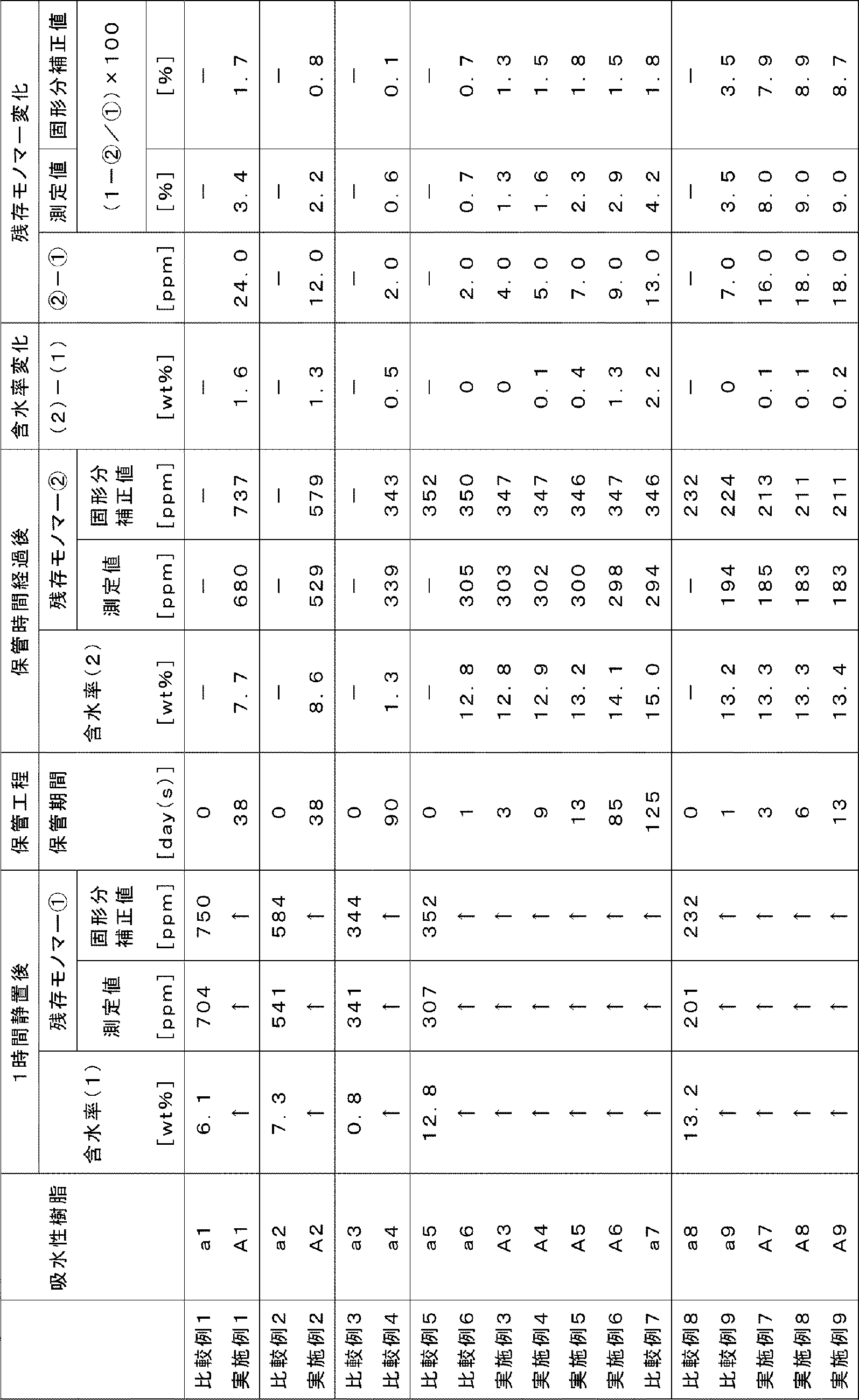
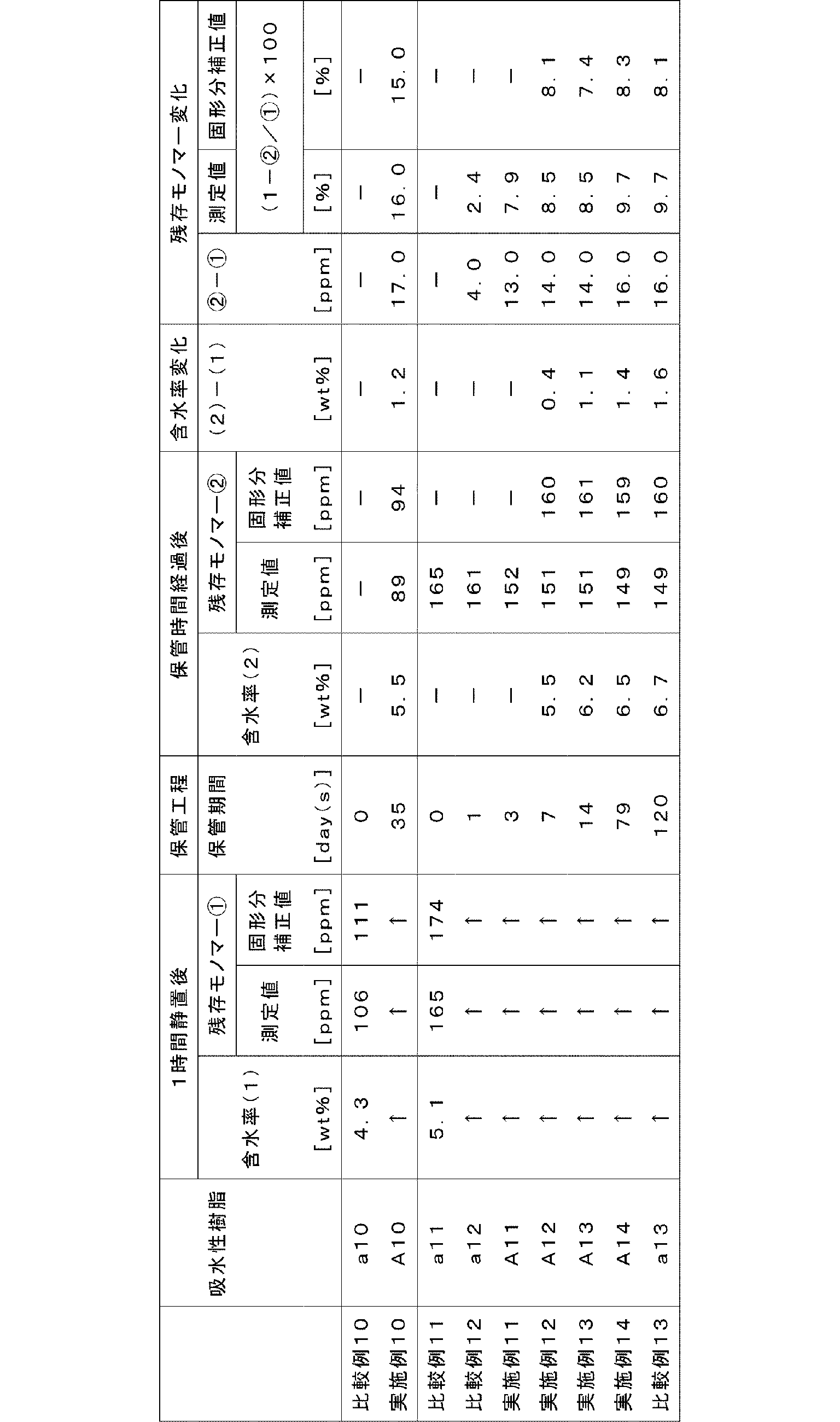
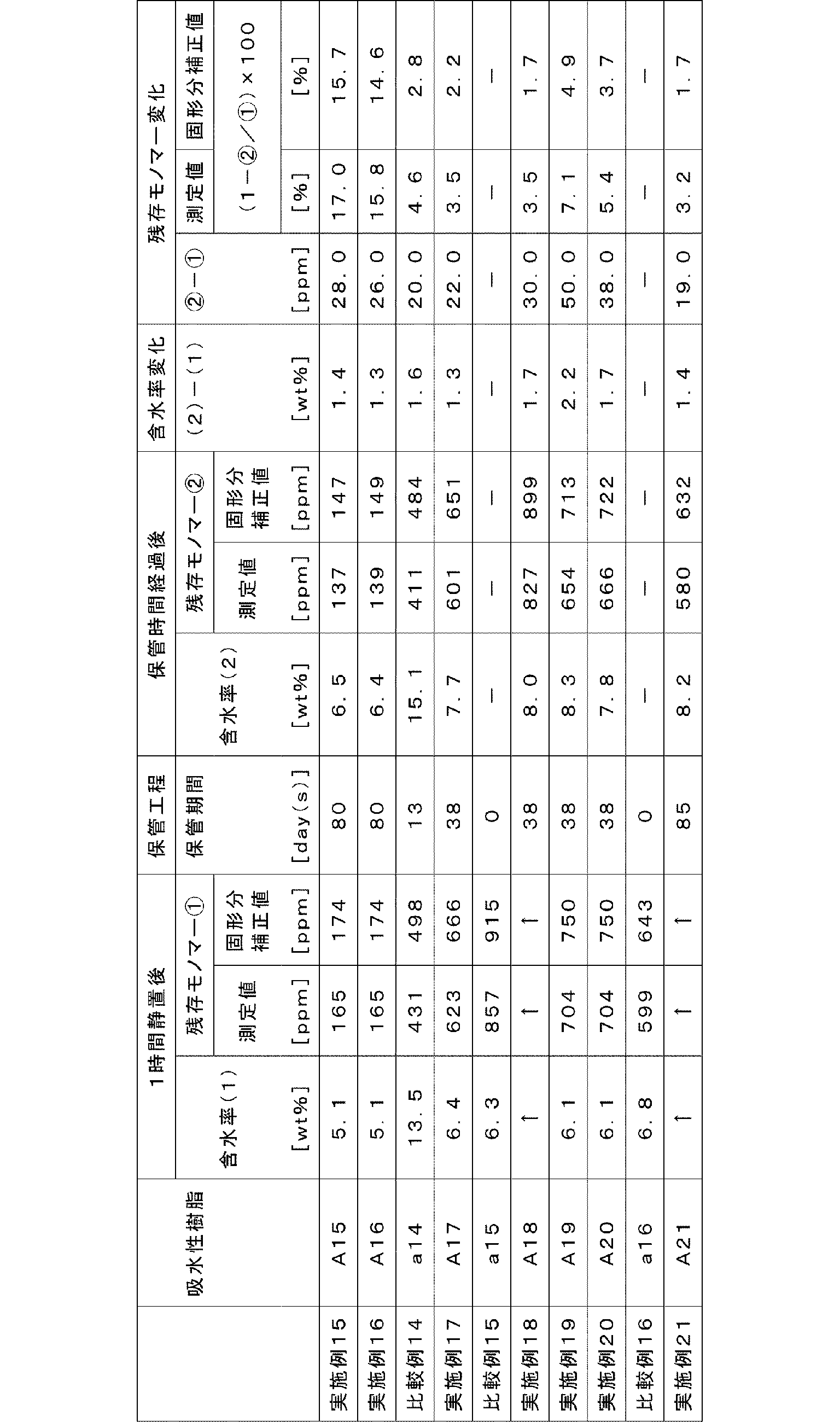
実施例1及び実施例2では含水率がそれぞれ1.6重量%(実施例1)、1.3重量%(実施例2)増加しているが、固形分あたりの残存モノマー量を計算することにより含水率増加の影響を排除してもなお、残存モノマーは減少していた。
Claims (21)
- アクリル酸(塩)を主成分とする単量体水溶液を重合する重合工程と、
当該重合工程で得られた含水ゲル状架橋重合体を乾燥する乾燥工程と、
乾燥中の又は乾燥された吸水性樹脂を表面架橋する表面架橋工程と、
表面架橋された吸水性樹脂を梱包する梱包工程と
を含む、ポリアクリル酸(塩)系吸水性樹脂の製造方法であって、
上記重合工程における単量体水溶液中の鉄分含有量が2ppm(対単量体)以下であり、
上記梱包工程における吸水性樹脂の含水率が1重量%以上であり、
上記梱包工程後、梱包された吸水性樹脂を3日間以上保管する保管工程を更に含むポリアクリル酸(塩)系吸水性樹脂の製造方法。 - 上記保管工程が100日間以下である、請求項1に記載の製造方法。
- 上記重合工程における単量体水溶液中のp-メトキシフェノール含有量が5~160重量ppm(対単量体)であり、かつ、上記梱包工程における吸水性樹脂中のp-メトキシフェノール含有量が5~60重量ppmである、請求項1又は2に記載の製造方法。
- 上記重合工程における単量体水溶液中の酢酸及びプロピオン酸の合計含有量が1500重量ppm(対単量体)以下である、請求項1~3の何れか1項に記載の製造方法。
- 上記梱包工程における吸水性樹脂の含水率が3~20重量%である、請求項1~4の何れか1項に記載の製造方法。
- 上記梱包工程以前に、多価金属塩、水不溶性微粒子、及び界面活性剤からなる群から選ばれる少なくとも一つ以上の凝集防止剤を吸水性樹脂に添加する工程を更に含む、請求項1~5の何れか1項に記載の製造方法。
- 上記梱包工程以前に、α-ヒドロキシカルボン酸化合物、無機還元剤、及びキレート剤からなる群から選ばれる少なくとも一つ以上の着色防止剤を添加する工程を更に含む、請求項1~6の何れか1項に記載の製造方法。
- 上記梱包工程で使用する梱包容器が、15kg~10t単位で輸送可能な、プラスチック製容器、又はプラスチック製の内袋を有する容器の何れかである、請求項1~7の何れか1項に記載の製造方法。
- 上記保管工程における、吸水性樹脂の移動距離が10km以内である、請求項1~8の何れか1項に記載の製造方法。
- 上記表面架橋工程において、エポキシ系架橋剤以外の架橋剤を用いて表面架橋を行う、請求項1~9の何れか1項に記載の製造方法。
- 上記表面架橋工程において、脱水反応性表面架橋剤を用いて表面架橋を行う、請求項1~10の何れか1項に記載の製造方法。
- 気温及び湿度の少なくとも一つ以上を制御する装置を備える保管場所にて保管工程を行う、請求項1~11の何れか1項に記載の製造方法。
- 上記保管工程における、梱包された吸水性樹脂の保管場所の気温が0~35℃であり、相対湿度が10~90%である、請求項1~12の何れか1項に記載の製造方法。
- 上記保管工程の間に少なくとも1回以上、吸水性樹脂の物性を測定する、請求項1~13の何れか1項に記載の製造方法。
- 上記重合工程における単量体水溶液が、全単量体に対して、アクリル酸アンモニウムを1モル%以上90モル%未満含む、請求項1~14の何れか1項に記載の製造方法。
- 上記保管工程において残存モノマー量が10ppm以上低減するまで吸水性樹脂を保管し、かつ、保管工程後の吸水性樹脂中の残存モノマー量を500ppm以下とする、請求項1~15の何れか1項に記載の製造方法。
- アクリル酸製造工程を更に含み、
当該アクリル酸製造工程と、上記重合工程から梱包工程まで実質連結された吸水性樹脂の製造工程とがパイプラインで連結され、
アクリル酸製造工程で得られるアクリル酸及び/又はアクリル酸製造工程で発生する蒸気を上記パイプラインを用いて、吸水性樹脂の製造工程に供給し、
更に上記梱包工程と保管工程とが隣接される、請求項1~16の何れか1項に記載の製造方法。 - 上記吸水性樹脂の製造工程と連結されるアクリル酸の製造工程が、アクリル酸の蒸留及び/又は晶析である、請求項17に記載の製造方法。
- 上記アクリル酸の製造工程で得られるアクリル酸が、製造後30日以内に、吸水性樹脂の重合工程に供給される、請求項17又は18に記載の製造方法。
- ポリアクリル酸(塩)系吸水性樹脂であって、
鉄分含有量が2ppm以下であり、含水率が1重量%以上であり、p-メトキシフェノール含有量が5~60ppmであり、
多価金属塩、水不溶性微粒子及び界面活性剤からなる群から選ばれる少なくとも1つ以上の凝集防止剤、及び/又は、α-ヒドロキシカルボン酸化合物、無機還元剤及びキレート剤からなる群から選ばれる少なくとも1つ以上の着色防止剤を含む、ポリアクリル酸(塩)系吸水性樹脂。 - ポリアクリル酸(塩)系吸水性樹脂の梱包物であって、
20kg~10t単位で輸送可能なコンテナ、コンテナバッグ、ペーパーバッグ、サイロ中に、請求項20に記載の吸水性樹脂を含む、ポリアクリル酸(塩)系吸水性樹脂の梱包物。
Priority Applications (3)
| Application Number | Priority Date | Filing Date | Title |
|---|---|---|---|
| US13/994,871 US9962680B2 (en) | 2010-12-17 | 2011-12-16 | Polyacrylic acid (salt)-based water absorbent resin, and method for production thereof |
| JP2012548849A JP5756128B2 (ja) | 2010-12-17 | 2011-12-16 | ポリアクリル酸(塩)系吸水性樹脂及びその製造方法 |
| CN201180060820.4A CN103261243B (zh) | 2010-12-17 | 2011-12-16 | 聚丙烯酸(盐)系吸水性树脂及其制造方法 |
Applications Claiming Priority (2)
| Application Number | Priority Date | Filing Date | Title |
|---|---|---|---|
| JP2010281382 | 2010-12-17 | ||
| JP2010-281382 | 2010-12-17 |
Publications (1)
| Publication Number | Publication Date |
|---|---|
| WO2012081702A1 true WO2012081702A1 (ja) | 2012-06-21 |
Family
ID=46244794
Family Applications (1)
| Application Number | Title | Priority Date | Filing Date |
|---|---|---|---|
| PCT/JP2011/079219 Ceased WO2012081702A1 (ja) | 2010-12-17 | 2011-12-16 | ポリアクリル酸(塩)系吸水性樹脂及びその製造方法 |
Country Status (4)
| Country | Link |
|---|---|
| US (1) | US9962680B2 (ja) |
| JP (1) | JP5756128B2 (ja) |
| CN (1) | CN103261243B (ja) |
| WO (1) | WO2012081702A1 (ja) |
Cited By (7)
| Publication number | Priority date | Publication date | Assignee | Title |
|---|---|---|---|---|
| JP2015059135A (ja) * | 2013-09-17 | 2015-03-30 | 株式会社日本触媒 | (メタ)アクリル酸系重合体組成物とその製造方法 |
| JP2015178608A (ja) * | 2014-02-28 | 2015-10-08 | 株式会社日本触媒 | ポリアクリル酸(塩)系吸水性樹脂の製造方法 |
| JP2018509347A (ja) * | 2015-02-19 | 2018-04-05 | シムライズ アーゲー | 清涼化剤を保管する方法 |
| JP2020521848A (ja) * | 2017-07-28 | 2020-07-27 | エルジー・ケム・リミテッド | 高吸水性樹脂およびその製造方法 |
| US12239956B2 (en) | 2019-12-20 | 2025-03-04 | Lg Chem, Ltd. | Preparation method of super absorbent polymer composition |
| US12337294B2 (en) | 2019-12-20 | 2025-06-24 | Lg Chem, Ltd. | Preparation method of super absorbent polymer composition |
| WO2026048556A1 (ja) * | 2024-09-02 | 2026-03-05 | 株式会社日本触媒 | 重合体粒子、及び、重合体の製造方法 |
Families Citing this family (11)
| Publication number | Priority date | Publication date | Assignee | Title |
|---|---|---|---|---|
| EP3401070B2 (en) * | 2013-08-28 | 2026-06-10 | Nippon Shokubai Co., Ltd. | Water absorbent resin powder comprising polyacrylic acid (salt)-based water absorbent resin |
| CN109608661B (zh) | 2013-08-28 | 2021-09-10 | 株式会社日本触媒 | 凝胶粉碎装置、及聚丙烯酸(盐)系吸水性树脂粉末的制造方法、以及吸水性树脂粉末 |
| WO2018132812A1 (en) | 2017-01-16 | 2018-07-19 | Domtar Paper Company, Llc | Disposable ice pack |
| CN108708171B (zh) * | 2018-03-16 | 2024-02-27 | 南通赛博通信有限公司 | 光电缆用阻水纱表面处理新工艺 |
| CA3103966A1 (en) | 2018-06-19 | 2019-12-26 | Domtar Paper Company, Llc | Expandable and/or disposable ice pack |
| CN109293822A (zh) * | 2018-09-30 | 2019-02-01 | 广州市鼎茂新材料科技有限公司 | 丙烯酸酯水性树脂乳液及其制备工艺 |
| EP4180467A4 (en) * | 2020-07-13 | 2024-11-13 | Nippon Shokubai Co., Ltd. | WATER ABSORBING AGENT COMPOSITION AND PROCESS FOR PRODUCING THE SAME |
| EP4228802A1 (en) * | 2020-10-16 | 2023-08-23 | The Procter & Gamble Company | Method of making superabsorbent polymer material using soluble polyacrylic acid polymers having double bonds |
| EP4228803A1 (en) | 2020-10-16 | 2023-08-23 | The Procter & Gamble Company | Superabsorbent polymer material comprising non-crosslinked polyacrylic acid polymer |
| WO2022169227A1 (ko) | 2021-02-03 | 2022-08-11 | 주식회사 엘지화학 | 고흡수성 수지의 제조 방법 |
| CN117241880A (zh) * | 2021-05-12 | 2023-12-15 | 株式会社日本触媒 | 聚(甲基)丙烯酸(盐)系吸水性树脂及吸收体 |
Citations (4)
| Publication number | Priority date | Publication date | Assignee | Title |
|---|---|---|---|---|
| JPH0656931A (ja) * | 1992-06-10 | 1994-03-01 | Nippon Shokubai Co Ltd | アクリル酸塩系ポリマーの製造方法および組成物 |
| JP2005530906A (ja) * | 2002-06-26 | 2005-10-13 | ダウ グローバル テクノロジーズ インコーポレイティド | 低モノマーの鉄イオン含有吸水性ポリマーの製造方法 |
| JP2009545635A (ja) * | 2006-07-31 | 2009-12-24 | 株式会社日本触媒 | 吸水性樹脂粉末の製造方法および吸水性樹脂粉末の包装物 |
| WO2010090324A1 (ja) * | 2009-02-06 | 2010-08-12 | 株式会社日本触媒 | ポリアクリル酸(塩)系吸水性樹脂およびその製造方法 |
Family Cites Families (18)
| Publication number | Priority date | Publication date | Assignee | Title |
|---|---|---|---|---|
| CA2001397A1 (en) | 1988-10-28 | 1990-04-28 | Tadao Shimomura | Method for production of acrylate and acrylate-containing polymer |
| DE69019049D1 (de) | 1989-02-28 | 1995-06-08 | Nippon Catalytic Chem Ind | Verfahren zur Herstellung von wasserabsorbierenden Polymeren verbesserter Qualität und die erhaltenen Produkte. |
| DE69030971T2 (de) | 1989-09-04 | 1997-12-11 | Nippon Catalytic Chem Ind | Verfahren zur herstellung eines wasserabsorbierenden harzes |
| JP2902201B2 (ja) | 1991-03-18 | 1999-06-07 | ストックハウゼン ルイジアナ リミティド | 超吸収性ポリマーの残留アクリル酸含量を低下させる方法 |
| TW256840B (ja) | 1992-06-10 | 1995-09-11 | Nippon Catalytic Chem Ind | |
| JP2995276B2 (ja) | 1993-01-18 | 1999-12-27 | 三洋化成工業株式会社 | 吸水性樹脂の製造法 |
| DE19752127A1 (de) | 1997-11-25 | 1999-07-29 | Stockhausen Chem Fab Gmbh | Verfahren zur Herstellung von synthetischen Polymerisaten mit sehr niedrigem Restmonomergehalt, danach hergestellte Produkte und deren Verwendung |
| DE19752128A1 (de) | 1997-11-25 | 1999-07-29 | Stockhausen Chem Fab Gmbh | Verfahren zur Herstellung von wasserlöslichen bzw. wasserquellbaren Polymerisaten mit sehr niedrigem Restmonomergehalt, danach hergestellte Produkte und deren Verwendung |
| JP2004517179A (ja) | 2000-12-29 | 2004-06-10 | ダウ グローバル テクノロジーズ インコーポレイティド | 低いモノマー含有分を有する架橋したカルボキシル含有ポリマーの吸水性樹脂 |
| JP2005008705A (ja) | 2003-06-17 | 2005-01-13 | Nippon Shokubai Co Ltd | 吸水性樹脂の製造方法 |
| DE102005042606A1 (de) | 2005-09-07 | 2007-03-08 | Basf Ag | Neutralisationsverfahren |
| DE102005042604A1 (de) | 2005-09-07 | 2007-03-08 | Basf Ag | Neutralisationsverfahren |
| DE102005042605A1 (de) | 2005-09-07 | 2007-03-08 | Basf Ag | Neutralisationsverfahren |
| CN101589066B (zh) * | 2007-01-24 | 2013-07-03 | 株式会社日本触媒 | 粒子状吸水性聚合物及其制造方法 |
| US8148485B2 (en) | 2008-03-13 | 2012-04-03 | Nippon Shokubai Co., Ltd. | Production method for water-absorbing resin |
| US9096732B2 (en) * | 2008-03-28 | 2015-08-04 | Nippon Shokubai Co., Ltd. | Conveyance method for water-absorbing resin powder substance |
| JP5730013B2 (ja) * | 2008-04-25 | 2015-06-03 | 株式会社日本触媒 | ポリアクリル酸(塩)系吸水性樹脂およびその製造方法 |
| WO2010032694A1 (ja) * | 2008-09-16 | 2010-03-25 | 株式会社日本触媒 | 吸水性樹脂の製造方法および通液性向上方法 |
-
2011
- 2011-12-16 US US13/994,871 patent/US9962680B2/en active Active
- 2011-12-16 CN CN201180060820.4A patent/CN103261243B/zh active Active
- 2011-12-16 WO PCT/JP2011/079219 patent/WO2012081702A1/ja not_active Ceased
- 2011-12-16 JP JP2012548849A patent/JP5756128B2/ja active Active
Patent Citations (4)
| Publication number | Priority date | Publication date | Assignee | Title |
|---|---|---|---|---|
| JPH0656931A (ja) * | 1992-06-10 | 1994-03-01 | Nippon Shokubai Co Ltd | アクリル酸塩系ポリマーの製造方法および組成物 |
| JP2005530906A (ja) * | 2002-06-26 | 2005-10-13 | ダウ グローバル テクノロジーズ インコーポレイティド | 低モノマーの鉄イオン含有吸水性ポリマーの製造方法 |
| JP2009545635A (ja) * | 2006-07-31 | 2009-12-24 | 株式会社日本触媒 | 吸水性樹脂粉末の製造方法および吸水性樹脂粉末の包装物 |
| WO2010090324A1 (ja) * | 2009-02-06 | 2010-08-12 | 株式会社日本触媒 | ポリアクリル酸(塩)系吸水性樹脂およびその製造方法 |
Cited By (9)
| Publication number | Priority date | Publication date | Assignee | Title |
|---|---|---|---|---|
| JP2015059135A (ja) * | 2013-09-17 | 2015-03-30 | 株式会社日本触媒 | (メタ)アクリル酸系重合体組成物とその製造方法 |
| JP2015178608A (ja) * | 2014-02-28 | 2015-10-08 | 株式会社日本触媒 | ポリアクリル酸(塩)系吸水性樹脂の製造方法 |
| JP2018509347A (ja) * | 2015-02-19 | 2018-04-05 | シムライズ アーゲー | 清涼化剤を保管する方法 |
| JP6998203B2 (ja) | 2015-02-19 | 2022-02-04 | シムライズ アーゲー | 清涼化剤を保管する方法 |
| JP2020521848A (ja) * | 2017-07-28 | 2020-07-27 | エルジー・ケム・リミテッド | 高吸水性樹脂およびその製造方法 |
| JP7080258B2 (ja) | 2017-07-28 | 2022-06-03 | エルジー・ケム・リミテッド | 高吸水性樹脂およびその製造方法 |
| US12239956B2 (en) | 2019-12-20 | 2025-03-04 | Lg Chem, Ltd. | Preparation method of super absorbent polymer composition |
| US12337294B2 (en) | 2019-12-20 | 2025-06-24 | Lg Chem, Ltd. | Preparation method of super absorbent polymer composition |
| WO2026048556A1 (ja) * | 2024-09-02 | 2026-03-05 | 株式会社日本触媒 | 重合体粒子、及び、重合体の製造方法 |
Also Published As
| Publication number | Publication date |
|---|---|
| CN103261243B (zh) | 2016-08-17 |
| US9962680B2 (en) | 2018-05-08 |
| JPWO2012081702A1 (ja) | 2014-05-22 |
| JP5756128B2 (ja) | 2015-07-29 |
| CN103261243A (zh) | 2013-08-21 |
| US20130264517A1 (en) | 2013-10-10 |
Similar Documents
| Publication | Publication Date | Title |
|---|---|---|
| JP5756128B2 (ja) | ポリアクリル酸(塩)系吸水性樹脂及びその製造方法 | |
| JP6980398B2 (ja) | 吸水剤及びその製造方法 | |
| US12187860B2 (en) | Water-absorbent resin powder and production method thereof | |
| JP6151790B2 (ja) | 吸水性樹脂を主成分とする粒子状吸水剤及びその製造方法 | |
| EP2253563B2 (en) | Process for producing water-absorbing resin | |
| JP7181948B2 (ja) | 吸水剤、及び吸水剤の製造方法 | |
| JP5421243B2 (ja) | 吸水性樹脂を主成分とする粒子状吸水剤の製造方法 | |
| CN102124039B (zh) | 吸水性树脂的制造方法和通液性提高方法 | |
| KR102226473B1 (ko) | 입자상 흡수제 및 그의 제조 방법 | |
| JP6425341B2 (ja) | ポリアクリル酸(塩)系吸水性樹脂の製造方法 | |
| JPWO2019221154A1 (ja) | 吸水性樹脂粒子の製造方法 | |
| EP2395029A1 (en) | Polyacrylic acid (salt) type water-absorbent resin and process for production of same | |
| JP7064614B2 (ja) | キレート剤を含む吸水性樹脂の製造方法 | |
| WO2009119756A1 (ja) | 吸水性樹脂粉体の輸送方法 | |
| KR102554051B1 (ko) | 흡수성 수지를 주성분으로 하는 흡수제 및 그의 제조 방법 | |
| WO2014162843A1 (ja) | 吸水剤の製造方法及び吸水剤 | |
| WO2015133498A1 (ja) | ポリアクリル酸(塩)系吸水性樹脂の製造方法 | |
| SA516380248B1 (ar) | جسيمات بوليمر ماص للماء | |
| JP2016112475A (ja) | ポリ(メタ)アクリル酸塩系吸水性樹脂を主成分とする吸水剤及びその製造方法 | |
| JP6006409B2 (ja) | ポリアクリル酸(塩)系吸水性樹脂の製造方法 | |
| WO2025058084A1 (ja) | 吸水性樹脂および吸水性樹脂の製造方法 | |
| JP2016069418A (ja) | ポリ(メタ)アクリル酸(塩)系吸水性樹脂の製造方法 | |
| US20240101766A1 (en) | Method for producing water-absorbing resin |
Legal Events
| Date | Code | Title | Description |
|---|---|---|---|
| 121 | Ep: the epo has been informed by wipo that ep was designated in this application |
Ref document number: 11848270 Country of ref document: EP Kind code of ref document: A1 |
|
| ENP | Entry into the national phase |
Ref document number: 2012548849 Country of ref document: JP Kind code of ref document: A |
|
| NENP | Non-entry into the national phase |
Ref country code: DE |
|
| WWE | Wipo information: entry into national phase |
Ref document number: 13994871 Country of ref document: US |
|
| 122 | Ep: pct application non-entry in european phase |
Ref document number: 11848270 Country of ref document: EP Kind code of ref document: A1 |