WO2012053346A1 - 含フッ素スルホラン、及び、含フッ素スルホランの製造方法 - Google Patents
含フッ素スルホラン、及び、含フッ素スルホランの製造方法 Download PDFInfo
- Publication number
- WO2012053346A1 WO2012053346A1 PCT/JP2011/072802 JP2011072802W WO2012053346A1 WO 2012053346 A1 WO2012053346 A1 WO 2012053346A1 JP 2011072802 W JP2011072802 W JP 2011072802W WO 2012053346 A1 WO2012053346 A1 WO 2012053346A1
- Authority
- WO
- WIPO (PCT)
- Prior art keywords
- atom
- fluorine
- formula
- group
- compound represented
- Prior art date
- Legal status (The legal status is an assumption and is not a legal conclusion. Google has not performed a legal analysis and makes no representation as to the accuracy of the status listed.)
- Ceased
Links
- 0 *C(CCC1)S1(=O)=O Chemical compound *C(CCC1)S1(=O)=O 0.000 description 5
Classifications
-
- H—ELECTRICITY
- H01—ELECTRIC ELEMENTS
- H01M—PROCESSES OR MEANS, e.g. BATTERIES, FOR THE DIRECT CONVERSION OF CHEMICAL ENERGY INTO ELECTRICAL ENERGY
- H01M10/00—Secondary cells; Manufacture thereof
- H01M10/05—Accumulators with non-aqueous electrolyte
- H01M10/056—Accumulators with non-aqueous electrolyte characterised by the materials used as electrolytes, e.g. mixed inorganic/organic electrolytes
- H01M10/0564—Accumulators with non-aqueous electrolyte characterised by the materials used as electrolytes, e.g. mixed inorganic/organic electrolytes the electrolyte being constituted of organic materials only
- H01M10/0566—Liquid materials
- H01M10/0569—Liquid materials characterised by the solvents
-
- C—CHEMISTRY; METALLURGY
- C07—ORGANIC CHEMISTRY
- C07D—HETEROCYCLIC COMPOUNDS
- C07D333/00—Heterocyclic compounds containing five-membered rings having one sulfur atom as the only ring hetero atom
- C07D333/02—Heterocyclic compounds containing five-membered rings having one sulfur atom as the only ring hetero atom not condensed with other rings
- C07D333/04—Heterocyclic compounds containing five-membered rings having one sulfur atom as the only ring hetero atom not condensed with other rings not substituted on the ring sulphur atom
- C07D333/06—Heterocyclic compounds containing five-membered rings having one sulfur atom as the only ring hetero atom not condensed with other rings not substituted on the ring sulphur atom with only hydrogen atoms, hydrocarbon or substituted hydrocarbon radicals, directly attached to the ring carbon atoms
- C07D333/12—Radicals substituted by halogen atoms or nitro or nitroso radicals
-
- C—CHEMISTRY; METALLURGY
- C07—ORGANIC CHEMISTRY
- C07D—HETEROCYCLIC COMPOUNDS
- C07D333/00—Heterocyclic compounds containing five-membered rings having one sulfur atom as the only ring hetero atom
- C07D333/02—Heterocyclic compounds containing five-membered rings having one sulfur atom as the only ring hetero atom not condensed with other rings
- C07D333/46—Heterocyclic compounds containing five-membered rings having one sulfur atom as the only ring hetero atom not condensed with other rings substituted on the ring sulfur atom
- C07D333/48—Heterocyclic compounds containing five-membered rings having one sulfur atom as the only ring hetero atom not condensed with other rings substituted on the ring sulfur atom by oxygen atoms
-
- H—ELECTRICITY
- H01—ELECTRIC ELEMENTS
- H01M—PROCESSES OR MEANS, e.g. BATTERIES, FOR THE DIRECT CONVERSION OF CHEMICAL ENERGY INTO ELECTRICAL ENERGY
- H01M10/00—Secondary cells; Manufacture thereof
- H01M10/05—Accumulators with non-aqueous electrolyte
- H01M10/056—Accumulators with non-aqueous electrolyte characterised by the materials used as electrolytes, e.g. mixed inorganic/organic electrolytes
- H01M10/0564—Accumulators with non-aqueous electrolyte characterised by the materials used as electrolytes, e.g. mixed inorganic/organic electrolytes the electrolyte being constituted of organic materials only
- H01M10/0566—Liquid materials
- H01M10/0567—Liquid materials characterised by the additives
-
- H—ELECTRICITY
- H01—ELECTRIC ELEMENTS
- H01M—PROCESSES OR MEANS, e.g. BATTERIES, FOR THE DIRECT CONVERSION OF CHEMICAL ENERGY INTO ELECTRICAL ENERGY
- H01M2300/00—Electrolytes
- H01M2300/0017—Non-aqueous electrolytes
- H01M2300/0025—Organic electrolyte
- H01M2300/0028—Organic electrolyte characterised by the solvent
- H01M2300/0034—Fluorinated solvents
-
- Y—GENERAL TAGGING OF NEW TECHNOLOGICAL DEVELOPMENTS; GENERAL TAGGING OF CROSS-SECTIONAL TECHNOLOGIES SPANNING OVER SEVERAL SECTIONS OF THE IPC; TECHNICAL SUBJECTS COVERED BY FORMER USPC CROSS-REFERENCE ART COLLECTIONS [XRACs] AND DIGESTS
- Y02—TECHNOLOGIES OR APPLICATIONS FOR MITIGATION OR ADAPTATION AGAINST CLIMATE CHANGE
- Y02E—REDUCTION OF GREENHOUSE GAS [GHG] EMISSIONS, RELATED TO ENERGY GENERATION, TRANSMISSION OR DISTRIBUTION
- Y02E60/00—Enabling technologies; Technologies with a potential or indirect contribution to GHG emissions mitigation
- Y02E60/10—Energy storage using batteries
Definitions
- the present invention relates to fluorine-containing sulfolane and a method for producing fluorine-containing sulfolane.
- Sulfolane compounds are used in various applications because of their excellent high temperature characteristics and high dielectric constant characteristics.
- energy storage devices such as lithium-ion batteries
- digital portable electronic devices such as mobile phones, personal digital assistants and notebook computers.
- the use of the electrolyte solution used for energy storage devices as a solvent or additive is particularly expected.
- Patent Document 1 As a sulfolane compound known so far, for example, in Patent Document 1, sulfolane is produced by reacting sulfolane with fluorine gas.
- Non-Patent Document 1 describes a reaction of adding fluorine gas to sulfolene.
- Patent Document 2 a fluorinated sulfolane compound is produced by a reaction between sulfolanes and fluorine gas.
- the sulfolane compounds have various excellent properties as described above, and various sulfolane compounds have been produced.
- the sulfolane compounds are not particularly satisfactory in terms of oxidation resistance, and correspond to higher performance of energy storage devices. Therefore, a material with better oxidation resistance has been desired.
- the present invention provides a novel fluorine-containing sulfolane that can be suitably used as an electrolyte for an energy storage device and a method for producing the same.
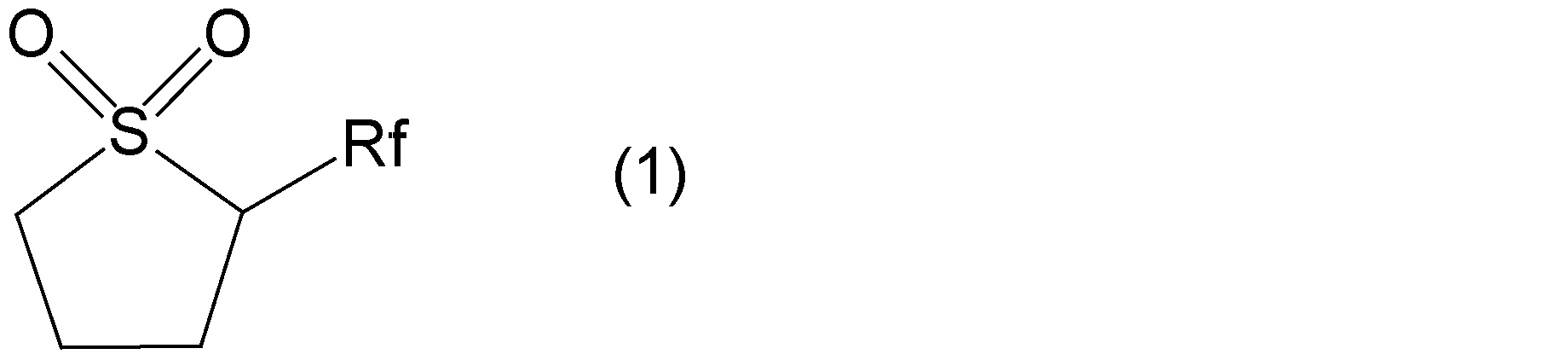
- the present invention provides the following formula (1): (In the formula, Rf is a C 1-8 fluoroalkyl group which may contain a hetero atom.) It is related with the fluorine-containing sulfolane characterized by these.
- Patent Document 1 and Non-Patent Document 1 do not disclose sulfolane having a fluoroalkyl group.
- Patent Document 2 discloses a fluorinated sulfolane compound.
- a sulfolane ring and a fluorine gas are reacted to form a sulfolane ring.
- the hydrogen atom bonded to the carbon atom is replaced with a fluorine atom, and the fluorine-containing sulfolane of the present invention cannot be produced.
- Rf is the following formula (2): (Wherein X 1 to X 4 each independently represents a trifluoromethyl group, a trifluoromethoxy group, a hydrogen atom, or a halogen atom, provided that at least one of X 1 to X 4 is A fluorine atom, a trifluoromethyl group, or a trifluoromethoxy group.) It is preferable that it is the fluoroalkyl group represented by these.
- Rf is —CF 2 CFHOCF 3 , —CH 2 CFHCF 3 , —CH 2 CH 2 CF 3 , —CFHCF 2 H, —CFHCHFCF 3 , —CF 2 CF 2 H, —CH 2 CF 2 H, and —CF It is preferably at least one group selected from the group consisting of 2 CFHCF 3 .
- the present invention relates to an electrolytic solution containing the fluorine-containing sulfolane of the present invention.
- the present invention provides the following formula (3): (In the formula, Rf is a C 1-8 fluoroalkyl group which may contain a hetero atom.) A compound represented by the following formula (1): (In the formula, Rf is a C 1-8 fluoroalkyl group which may contain a hetero atom.) A process for obtaining a fluorinated sulfolane represented by the formula:
- the oxidizing agent is preferably at least one compound selected from the group consisting of peroxides, perhalogen oxides, permanganates, and chromates.
- the compound represented by the formula (3) is obtained by reacting tetrahydrothiophene with a fluoroalkene having 2 to 8 carbon atoms:
- Rf 1 is a fluoroalkyl group having 2 to 8 carbon atoms which may contain a hetero atom.
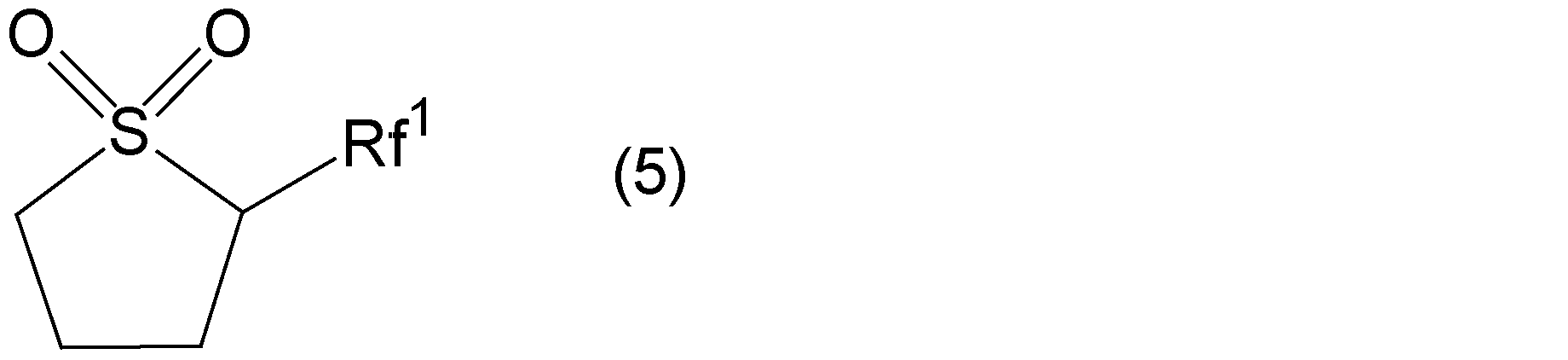
- a compound represented by The fluorine-containing sulfolane represented by the formula (1) is represented by the following formula (5):
- Rf 1 is a fluoroalkyl group having 2 to 8 carbon atoms which may contain a hetero atom.
- the fluoroalkene has the following formula (6): (Wherein X 1 to X 4 each independently represents a trifluoromethyl group, a trifluoromethoxy group, a hydrogen atom, or a halogen atom, provided that at least one of X 1 to X 4 is A fluorine atom, a trifluoromethyl group, or a trifluoromethoxy group.) It is preferable that it is a compound represented by these.
- the compound represented by the formula (3) is 1) 5-halogen-1-pentene (halogen: fluorine atom, chlorine atom, bromine atom or iodine atom) is substituted with Rf 2 X 5 (wherein Rf 2 represents the number of carbon atoms optionally containing a hetero atom) 1 to 7 fluoroalkyl groups, and X 5 is a chlorine atom, a bromine atom, or an iodine atom.)
- a compound represented by the following formula (7) (Wherein Rf 2 is a fluoroalkyl group having 1 to 7 carbon atoms which may contain a hetero atom, X 6 is a fluorine atom, a chlorine atom, a bromine atom or an iodine atom, and X 5 Is a chlorine atom, a bromine atom, or an iodine atom.) 2)
- the compound represented by the formula (7) is reacted with a thiolating agent to obtain
- Rf 2 represents — (CF 2 ) n H (n is an integer of 1 to 7), — (CF 2 ) m CF 3 (m is an integer of 1 to 6), —CF (CF 3 ) 2 and at least one group selected from the group consisting of —CH (CF 3 ) 2 .
- the fluorine-containing sulfolane of the present invention is very useful as a solvent or additive used in an electrolyte solution of an energy storage device. Moreover, the fluorine-containing sulfolane of the present invention has excellent oxidation resistance.
- the method for producing a fluorine-containing sulfolane of the present invention can reliably produce the novel fluorine-containing sulfolane by a simple method.
- Rf is a C 1-8 fluoroalkyl group which may contain a hetero atom. It is related with the fluorine-containing sulfolane characterized by these.
- the fluorine-containing sulfolane of the present invention is a fluorine-containing sulfolane having a specific structure having a fluoroalkyl group, it has excellent oxidation resistance and high electrochemical stability.
- the fluorine-containing sulfolane represented by the above formula (1) is difficult to synthesize and cannot be synthesized conventionally.
- the synthesis was succeeded for the first time by using the production method described later, and the fluorine-containing sulfolane represented by the above formula (1) has excellent oxidation resistance and high electrochemical stability. Was found to show.
- Rf is a fluoroalkyl group having 1 to 8 carbon atoms which may contain a hetero atom.
- the number of carbon atoms is preferably 2 to 8, more preferably 2 to 6, and further preferably 3 to 6.
- the “hetero atom” represents a halogen atom other than a fluorine atom, an oxygen atom, a sulfur atom, a nitrogen atom, or the like.
- “may contain a heteroatom” means that it contains a heteroatom or does not contain a heteroatom.
- fluoroalkyl group having 1 to 8 carbon atoms which may contain a hetero atom means a fluoroalkyl group having 1 to 8 carbon atoms or a fluoroalkyl group having 1 to 8 carbon atoms containing a hetero atom. Represents. In the present specification, “which may contain a hetero atom” has the same meaning hereinafter.
- the fluoroalkyl group may be an alkyl group in which at least one hydrogen atom is substituted with a fluorine atom, and may be a perfluoroalkyl group. Further, it may be a linear fluoroalkyl group or a branched fluoroalkyl group.
- Rf examples include fluoroalkyl groups such as a fluoromethyl group, a fluoroethyl group, a fluoropropyl group, a fluorobutyl group, a fluoropentyl group, and a fluorohexyl group. These fluoroalkyl groups may be linear or branched. Further, it may be a perfluoroalkyl group.
- Rf the following formula (2): (Wherein X 1 to X 4 each independently represents a trifluoromethyl group, a trifluoromethoxy group, a hydrogen atom, or a halogen atom, provided that at least one of X 1 to X 4 is A fluorine atom, a trifluoromethyl group, or a trifluoromethoxy group.) Is preferably a fluoroalkyl group represented by the following formula (2-1): (In the formula, X 3 and X 4 are the same as those in the formula (2).) It is more preferable that it is the fluoroalkyl group represented by these.
- Examples of the fluoroalkyl group represented by the formula (2) include —CF 2 CFHCF 3 , —CF 2 CF 2 H, —CF 2 CFHOCF 3 , —CFHCF 2 H, —CFHCHFHCF 3 , —CH 2 CFHCF 3 , — CH 2 CH 2 CF 3 , —CH 2 CF 2 H, —CF 2 CFClH, —CF 2 CCl 2 H, and the like can be given.
- —CF 2 CFHOCF 3 —CH 2 CFHCF 3 , —CH 2 CH 2 CF 3 , —CFHCF 2 H, —CFHCHFCF 3 , —CF 2 CF 2 H, —CH 2 CF 2 H, and — It is preferably at least one selected from the group consisting of CF 2 CFHCF 3, and at least one selected from the group consisting of —CF 2 CFHCF 3 , —CF 2 CF 2 H, and —CF 2 CFHOCF 3 It is more preferable that
- the present invention also provides the following formula (3): (In the formula, Rf is a C 1-8 fluoroalkyl group which may contain a hetero atom.) A compound represented by the following formula (1): (In the formula, Rf is a C 1-8 fluoroalkyl group which may contain a hetero atom.) A process for obtaining a fluorinated sulfolane represented by the formula: The method for producing a fluorine-containing sulfolane of the present invention may include other steps as long as it includes the step of obtaining the fluorine-containing sulfolane.
- a highly purified fluorine-containing sulfolane can be obtained by producing a fluorine-containing sulfolane and then performing a purification step.
- a method usually used for purification of an organic compound such as recrystallization, filtration and rectification can be employed.
- Rf in the above formula (3) examples include the same as Rf in the formula (1).
- the oxidizing agent those described later can be used.
- a method of reacting the compound represented by the formula (3) with an oxidant a method of introducing an oxidant into the liquid phase compound represented by the formula (3) and reacting the compound can be mentioned. Details of the method will be described later.
- first production method the production method using the compound represented by the above formula (4) is referred to as “first production method”
- second manufacturing method the production method using the compound represented by the above formula (7)
- the first production method of the present invention comprises: Tetrahydrothiophene is reacted with a fluoroalkene having 2 to 8 carbon atoms to form the following formula (4): (In the formula, Rf 1 is a fluoroalkyl group having 2 to 8 carbon atoms which may contain a hetero atom.) A step of obtaining a compound represented by: The compound represented by the above formula (4) is reacted with an oxidizing agent to form the following formula (5): (In the formula, Rf 1 is a fluoroalkyl group having 2 to 8 carbon atoms which may contain a hetero atom.) The process of obtaining the fluorine-containing sulfolane represented by these is included.
- the first production method of the present invention can produce the fluorine-containing sulfolane represented by the above formula (5) simply and reliably.
- fluorine-containing sulfolane having excellent oxidation resistance and high electrochemical stability can be produced.
- the fluoroalkene preferably has 2 to 8 carbon atoms, more preferably 3 to 6 carbon atoms.
- Examples of the fluoroalkene include fluoroethylene, fluoropropylene, fluorobutylene, fluoropentene, and fluorohexene. These fluoroalkenes may be linear or branched. Further, the structure may contain a hetero atom, and in particular, the structure may have an ether bond. Perfluoroalkene may be used.
- the fluoroalkene the following formula (6): (Wherein X 1 to X 4 each independently represents a trifluoromethyl group, a trifluoromethoxy group, a hydrogen atom, or a halogen atom, provided that at least one of X 1 to X 4 is A fluorine atom, a trifluoromethyl group, or a trifluoromethoxy group.) Is preferably a compound represented by the following formula (6-1): (Wherein X 3 and X 4 are the same as those in formula (6).) It is more preferable that it is a compound represented by these.
- Rf 1 is preferably a group represented by the above formula (2) or formula (2-1).
- Examples of the method of reacting the fluoroalkene with tetrahydrothiophene include a method of introducing the fluoroalkene into a liquid phase tetrahydrothiophene and causing the reaction.
- the reaction method can be any of batch method, semi-batch method, and flow method.
- the temperature at which the fluoroalkene reacts with the tetrahydrothiophene is preferably 60 to 150 ° C., more preferably 80 to 150 ° C.
- the reaction pressure is preferably 0.5 to 1.0 MPa.
- the reaction time varies depending on the reaction temperature and the like, but is usually 5 to 10 hours. Further, it is preferable to carry out the reaction by adding 0.1 to 8 moles of the above fluoroalkene to 1 mole of tetrahydrothiophene.
- the input amount of the fluoroalkene is more preferably 0.2 to 6 mol, and still more preferably 0.2 to 5 mol, relative to 1 mol of tetrahydrothiophene.
- the fluoroalkene When the fluoroalkene is introduced into the liquid phase tetrahydrothiophene, the fluoroalkene may be reacted with the tetrahydrothiophene in the presence of a solvent inert to the tetrahydrothiophene and the fluoroalkene.
- reaction initiator it is preferable to add a reaction initiator to the reaction system and react tetrafluorothiophene with a fluoroalkene having 2 to 8 carbon atoms.
- the reaction initiator is preferably added in an amount of 10 to 50 mol% with respect to the fluoroalkene.
- the reaction initiator may be added in a reaction vessel in which tetrahydrothiophene is reacted with the fluoroalkene.
- the reaction initiator is not particularly limited as long as it can perform the step of obtaining a compound represented by the formula (4) by reacting the tetrahydrothiophene with a fluoroalkene having 2 to 8 carbon atoms.
- the reaction initiator is preferably at least one compound selected from the group consisting of organic peroxide initiators, radical polymerization initiators, and redox initiators.
- organic peroxide initiator examples include ditert-butyl peroxide, tert-butylcumyl peroxide, dicumyl peroxide, ⁇ , ⁇ -bis (tert-butylperoxy) -p-diisopropylbenzene, 2,5- Dialkyl peroxides such as dimethyl-2,5-di (tert-butylperoxy) hexane, 2,5-dimethyl-2,5-di (tert-butylperoxy) hexane-3, 1,1-di (tert-butyl) Peroxy) -3,3,5-trimethylcyclohexane, 2,5-dimethylhexane-2,5-dihydroxyperoxide, benzoyl peroxide, tert-butylperoxybenzene, 2,5-dimethyl-2,5-di (benzoylperoxy) Hexane, tert-butylperoxymaleic acid, Examples thereof include
- the radical polymerization initiator is preferably a water-soluble initiator, and specific examples thereof include persulfates such as ammonium persulfate, sodium persulfate, and potassium persulfate, disuccinic acid peroxide, azobisisobutylamidine dihydrochloride, and the like. Organic initiators and the like. Among these, persulfates such as ammonium persulfate are preferable.
- redox initiators examples include organic initiators such as disuccinic acid peroxide and azobisisobutylamidine dihydrochloride, inorganic initiators such as persulfates and hydrogen peroxide, persulfates or hydrogen peroxide and hydroxy
- organic initiators such as disuccinic acid peroxide and azobisisobutylamidine dihydrochloride
- inorganic initiators such as persulfates and hydrogen peroxide, persulfates or hydrogen peroxide and hydroxy
- a redox initiator consisting of a combination with a reducing agent such as sodium methanesulfinate, sodium hydrogen sulfite, sodium thiosulfate, etc., and an inorganic start in which a small amount of iron, ferrous salt, silver sulfate, etc. coexist with these initiators Agents and the like.
- an ammonium persulfate / sodium hydroxymethanesulfinate / ferrous sulfate system is preferable, and it is more preferable to add ethylenediaminetetraacetic acid disodium salt as a chelating agent to this system.
- ethylenediaminetetraacetic acid disodium salt as a chelating agent to this system.
- a redox-type initiator it is preferable to use a pH buffer together.
- inorganic salts such as disodium hydrogen phosphate, sodium dihydrogen phosphate, sodium hydrogen carbonate, sodium carbonate and the like can be used.
- Disodium hydrogen phosphate dihydrate, disodium hydrogen phosphate 12 A hydrate etc. are mentioned.
- the step of reacting the compound represented by the above formula (4) with an oxidizing agent to obtain the fluorine-containing sulfolane represented by the formula (5) comprises reacting the compound represented by the above formula (4) with the oxidizing agent. It is preferable to carry out. For example, a method of introducing an oxidant into the compound represented by the above formula (4) in the liquid phase and reacting it may be mentioned.
- the reaction method can be any of batch method, semi-batch method, and flow method.
- the oxidizing agent is not particularly limited as long as it is normally used as an oxidizing agent.
- the oxidizing agent is preferably at least one compound selected from the group consisting of peroxides, perhalogen oxides, permanganates, and chromates.
- the oxidizing agent is preferably added in an amount of 100 to 500 mol% with respect to the compound represented by the formula (4).
- the oxidizing agent include organic peroxides (for example, m-chloroperbenzoic acid), organic peracids, hydrogen peroxide, xylene dioxide, chromic acids, manganese dioxide, hypochlorous acids, and periodic acids. , Carolic acids, ceric ammonium nitrate (CAN), iodosobenzenes, and the like.
- the oxidation reaction is preferably performed at 25 to 80 ° C., more preferably at 30 to 80 ° C. .
- the reaction time varies depending on the reaction temperature and the like, but is usually 5 to 10 hours.
- the second production method of the present invention has the following formula: (In the formula, X 6 is a fluorine atom, a chlorine atom, a bromine atom, or an iodine atom.) Rf 2 X 5 (wherein Rf 2 is a fluoroalkyl group having 1 to 7 carbon atoms which may contain a hetero atom, and X 5 is a chlorine atom) , Bromine atom, or iodine atom.) Is reacted with a compound represented by the following formula (7): (Wherein Rf 2 is a fluoroalkyl group having 1 to 7 carbon atoms which may contain a hetero atom, X 6 is a fluorine atom, a chlorine atom, a bromine atom or an iodine atom, and X 5 Is a chlorine atom, a bromine atom, or an iodine atom.) The compound represented by the above formula (7) is reacted with a thiola
- the fluorine-containing sulfolane represented by the above formula (10) can be produced by a simple method and is not fluorinated with fluorine gas. And fluorine-containing sulfolane having high stability can be produced.
- Halogen (X 6 ) in 5-halogen-1-pentene is a fluorine atom, a chlorine atom, a bromine atom, or an iodine atom, and among these, a bromine atom is preferable.
- Rf 2 is a fluoroalkyl group having 1 to 7 carbon atoms.
- Rf 2 is a linear or branched fluoroalkyl group.
- Rf 2 may be an alkyl group in which at least one hydrogen atom is substituted with a fluorine atom, and may be a perfluoroalkyl group.
- the hetero atom may be included.
- Rf 2 examples include fluoroalkyl groups such as a fluoromethyl group, a fluoroethyl group, a fluoropropyl group, a fluorobutyl group, a fluoropentyl group, and a fluorohexyl group. These fluoroalkyl groups may be linear or branched. Further, it may be a perfluoroalkyl group.
- — (CF 2 ) n H (n is an integer of 1 to 7), — (CF 2 ) m CF 3 (m is an integer of 1 to 6), —CF ( CF 3 ) 2 , and —CH (CF 3 ) 2 . More preferably, it is at least one selected from —C 4 F 9 , —C 2 F 5 , —CF 3 , and —CF (CF 3 ) 2 .
- liquid-phase 5-halogen-1- examples thereof include a method in which the compound represented by Rf 2 X 5 is introduced into pentene and reacted.
- the reaction method can be any of batch method, semi-batch method, and flow method.
- the reaction temperature is preferably 50 to 80 ° C, more preferably 60 to 80 ° C.
- the compounding ratio of 5-halogen-1-pentene and the compound represented by Rf 2 X 5 is preferably 1: 1 to 1: 1.5 in molar ratio. More preferably, it is 1: 1 to 1: 1.2.
- the reaction time varies depending on the reaction temperature and the like, but is usually 5 to 10 hours.
- the compound represented by 5-halogen-1-pentene and the compound represented by Rf 2 X 5 is used.
- the reaction may be carried out in the presence of an inert solvent.
- the second production method of the present invention includes a step of reacting the compound represented by the above formula (7) with a thiolating agent to obtain the compound represented by the above formula (8).
- a thiolating agent include thioalkoxide, thiourea, thiouric acid and the like.
- the amount of the thiolating agent added is preferably 1 to 1.5 mol with respect to 1 mol of the compound represented by the formula (7).
- the addition amount of the thiolating agent is more preferably 1 to 1.2 mol with respect to 1 mol of the compound represented by the formula (7).
- the second production method of the present invention includes a step of obtaining a compound represented by the above formula (9) by cyclizing the compound represented by the above formula (8).
- Examples of the method for carrying out the cyclization reaction include a method in which an alkali solution is added to a solution containing a compound represented by the formula (8) to carry out the reaction.
- Examples of the method of adding the alkaline solution include a method of adding all at once, a method of intermittently adding several times before or during the reaction, and a method of continuously dropping before or during the reaction. Any method may be used, but it is preferably added by a method of continuously dropping before or during the reaction.
- the alkaline solution examples include LiOH, NaOH, KOH, RbOH, CsOH, Be (OH) 2 , Mg (OH) 2 , Ca (OH) 2 , Sr (OH) 2 , Ba (OH) 2, and the like. Is mentioned. Among these, a solution of LiOH, NaOH, KOH is preferable. Particularly preferred are an aqueous sodium hydroxide solution and an aqueous potassium hydroxide solution.
- the concentration of the alkaline solution is preferably 20 to 40% by mass, more preferably 20 to 30% by mass.
- the addition amount of the alkaline solution in the cyclization reaction is preferably 1.2 to 4 mol with respect to 1 mol of the compound represented by the formula (8). More preferably, it is 1.2 to 2 mol, and still more preferably 1.2 to 1.5 mol.
- the temperature for the cyclization reaction is preferably 50 to 100 ° C., more preferably 60 to 100 ° C.
- the reaction time varies depending on the reaction temperature and the like, but is usually 5 to 10 hours.
- the reaction method can be any of batch method, semi-batch method, and flow method.
- the 2nd manufacturing method of this invention includes the process of oxidizing the compound represented by the said Formula (9), and obtaining the fluorine-containing sulfolane represented by the said Formula (10).
- the oxidation is preferably performed by reacting the compound represented by the formula (9) with an oxidizing agent.
- an oxidizing agent for example, a method of introducing an oxidant into the compound represented by the above formula (9) in the liquid phase and reacting it may be mentioned.
- the reaction method can be any of batch method, semi-batch method, and flow method.
- the oxidizing agent is not particularly limited as long as it is normally used as an oxidizing agent.
- the oxidizing agent is preferably at least one compound selected from the group consisting of peroxides, perhalogen oxides, permanganates and chromates.
- the oxidizing agent is preferably added so as to be 2 to 4 times (molar ratio) with respect to the compound represented by the formula (9).
- the oxidation is preferably performed at 25 to 100 ° C, more preferably 50 to 100 ° C.
- the reaction time varies depending on the reaction temperature and the like, but is usually 5 to 10 hours.
- the fluorine-containing sulfolane of the present invention can be used as various solvents, for example, reaction solvents for organic synthesis, extraction solvents for various inorganic and organic substances, dilution solvents for paints and inks, semiconductor resist solvents, dilution solvents for agricultural chemicals, etc. It can be used as a solvent for an electrolytic solution used in an energy storage device or the like. It can also be used as an additive for electrolytes used in energy storage devices and the like. In particular, it is useful as a solvent or additive for an electrolytic solution for an energy storage device.
- the present invention also provides an electrolytic solution containing the above-mentioned fluorine-containing sulfolane or the fluorine-containing sulfolane obtained by the above-described production method.
- the electrolytic solution preferably contains an electrolyte salt.
- the electrolyte salt include LiClO 4 , LiAsF 6 , LiBF 4 , LiPF 6 , LiN (SO 2 CF 3 ) 2 , and LiN (SO 2 C 2 F 5 ) 2 .
- Applications of the electrolytic solution using the fluorine-containing sulfolane of the present invention include, for example, an electrolytic capacitor, an electric double layer capacitor, a battery charged / discharged by charge transfer of ions, a solid display element such as electroluminescence, a current sensor and a gas Examples include sensors such as sensors.
- a lithium ion secondary battery it is preferable to use for a lithium ion secondary battery, and the electrolytic solution of the present invention is suitably used for a lithium ion secondary battery including a positive electrode, a negative electrode, a separator, and a nonaqueous electrolytic solution containing the electrolytic solution of the present invention.
- a lithium ion secondary battery is particularly useful as a large lithium ion secondary battery for a hybrid vehicle or a distributed power supply, but is also useful as a small lithium ion secondary battery.
- Example 1 1) 1 step (addition reaction) The reaction was carried out in a reactor equipped with a 300 mL reflux tube. 5-Bromo-1-pentene (25 g: 168 mmol), C 4 F 9 I (65.7 g: 190 mmol), azobisisobutyronitrile (hereinafter referred to as AIBN, 551 mg: 3.4 mmol) in the reaction vessel in this order. Reagent added. Thereafter, the reaction temperature was raised to around 70-80 ° C. Although it gradually became under reflux, the reflux stopped with the progress of the reaction. After stirring for 1 hour, the reaction was completed after confirming the disappearance of the raw materials. Thereafter, only the low boiling point compound was removed under reduced pressure to proceed to the next reaction.
- AIBN azobisisobutyronitrile
- the NMR data of the obtained compound 1 are as follows.
- Examples 2-4 The target product could be obtained in the same manner as in Example 1 except that the amount of compound shown in Table 1 was added.
- Example 5 1 step (addition reaction) The reaction was carried out using an autoclave, which is a pressure-resistant reaction vessel. Add tetrahydrothiophene (100 g: 1.136 mol) and initiator perbutyl D (16.7 g: 114 mmol, manufactured by NOF Corporation, di-tert-butyl peroxide), fill with hexafluoropropylene to 0.3 MPa, and apply heat The reaction temperature was raised. Gradually, heat generation was confirmed at around 120 ° C., and a decrease in pressure was also confirmed. Hexafluoropropylene was continuously added up to a limit of 0.6 MPa. The reaction was terminated when it was determined that there was no pressure drop. The reaction solution was taken out and the target product was collected by distillation. The total amount of hexafluoropropylene charged was 40 g (267 mmol).
- the NMR data of the obtained compound 5 are as follows.
- Examples 6 and 7 The target product could be obtained in the same manner as in Example 5 except that the amount of compound shown in Table 2 was added.
- the electrolyte solution is put in a three-electrode voltage measuring cell (working electrode: platinum, counter electrode: Li, reference electrode: Li, HS cell manufactured by Hosen Co., Ltd.), and the potential is run at 3 mV / sec with a potentiostat. The decomposition current was measured. Table 3 shows the measurement results.
- Test (measurement of battery characteristics) A cylindrical secondary battery was produced by the following method.
- a positive electrode active material obtained by mixing LiCoO 2 , carbon black and polyvinylidene fluoride (manufactured by Kureha Chemical Co., Ltd., trade name: KF-1000) at 90/3/7 (mass%) was mixed with N-methyl-2-pyrrolidone. What was dispersed and made into a slurry form was uniformly applied onto a positive electrode current collector (aluminum foil having a thickness of 15 ⁇ m) and dried to form a positive electrode mixture layer. Then, after compression-molding with a roller press machine, it cut
- a negative electrode current collector (thickness 10 ⁇ m) was prepared by adding styrene-butadiene rubber dispersed in distilled water to artificial graphite powder to a solid content of 6% by mass and mixing with a disperser to form a slurry. On the copper foil) and dried to form a negative electrode mixture layer, and then compression molded with a roller press and cut. Then, it dried and welded the lead body and produced the strip
- the belt-like positive electrode was overlapped with the belt-like negative electrode through a microporous polyethylene film (separator) having a thickness of 20 ⁇ m and wound in a spiral shape to obtain a laminated electrode body having a spiral winding structure. In that case, it wound so that the rough surface side of the positive electrode current collector could be the outer peripheral side. Thereafter, the electrode body was filled in a bottomed cylindrical battery case having an outer diameter of 18 mm, and the positive and negative lead bodies were welded.
- the lithium secondary battery was examined for discharge capacity, load characteristics (high temperature storage characteristics) and cycle characteristics in the following manner. The results are shown in Table 4.
- the battery was charged at 1.0 C at 4.5 V until the charging current became 1/10 C, discharged at a current equivalent to 0.2 C to 3.0 V, and the discharge capacity was determined. Thereafter, the battery was charged at 1.0 C and 4.5 V until the charging current became 1/10 C, and placed in a constant temperature bath at 85 ° C. for 2 days. Two days later, the battery was sufficiently placed to cool to room temperature and discharged at a current corresponding to 0.2 C until 3.0 V was reached. Thereafter, the battery was charged at 1.0 C at 4.5 V until the charging current became 1/10 C and discharged at a current equivalent to 0.2 C until 3.0 V, and the discharge capacity after storage was determined. The discharge capacity before storage and the discharge capacity charged after storage and discharged at 0.2 C were substituted into the following calculation formula to obtain high temperature storage characteristics.
- Cycle characteristics As for the cycle characteristics, the charge / discharge cycle performed under the above charge / discharge conditions (charging at 1.0 C until the charging current becomes 1/10 C at 4.5 V and discharging to 3.0 V at a current equivalent to 1 C) is 1
- the discharge capacity after the first cycle and the discharge capacity after 100 cycles were measured.
- the value obtained by the following formula was used as the cycle retention rate.
- the fluorine-containing sulfolane of the present invention is excellent in oxidation resistance and exhibits high electrochemical stability, it can be suitably used for various applications.
- the fluorine-containing sulfolane of the present invention is particularly useful as a solvent or additive for an electrolyte solution for an energy storage device, for example.
- the method for producing fluorine-containing sulfolane of the present invention can easily and reliably produce fluorine-containing sulfolane having excellent oxidation resistance.
Landscapes
- Chemical & Material Sciences (AREA)
- Organic Chemistry (AREA)
- Physics & Mathematics (AREA)
- Condensed Matter Physics & Semiconductors (AREA)
- General Physics & Mathematics (AREA)
- Inorganic Chemistry (AREA)
- Engineering & Computer Science (AREA)
- Manufacturing & Machinery (AREA)
- Chemical Kinetics & Catalysis (AREA)
- Electrochemistry (AREA)
- General Chemical & Material Sciences (AREA)
- Secondary Cells (AREA)
- Electric Double-Layer Capacitors Or The Like (AREA)
Abstract
エネルギー貯蔵デバイスの電解液に好適に使用可能な、新規な含フッ素スルホラン及びその製造方法を提供することを目的とする。 本発明は、下記式(1): (式中、Rfは、ヘテロ原子を含んでいてもよい炭素数1~8のフルオロアルキル基である。)で表されることを特徴とする含フッ素スルホランである。
Description
本発明は、含フッ素スルホラン、及び、含フッ素スルホランの製造方法に関する。
スルホラン化合物は、高温特性に優れ、高い誘電率特性を持つことから種々の用途に用いられている。中でも、近年の電気自動車、ハイブリッド自動車の普及や、携帯電話、携帯情報端末、ノートパソコン等のデジタル携帯電子機器の急激な普及により、リチウムイオン電池等のエネルギー貯蔵デバイスの需要が急増しており、エネルギー貯蔵デバイスに用いられる電解液の溶媒や添加剤としての用途は特に期待されるところである。
このようなエネルギー貯蔵デバイスの需要の急増に伴い、エネルギー貯蔵デバイスには更なる高エネルギー密度化、高パワー密度化等の高性能化の要求が強まっており、エネルギー貯蔵デバイスに使用される電解液に対してもより高い性能が求められるようになってきている。
これまでに知られているスルホラン化合物としては、例えば、特許文献1では、スルホランをフッ素ガスと反応させてフッ化スルホランを製造している。また、非特許文献1には、スルホレンにフッ素ガスを付加する反応が記載されている。
また、特許文献2では、スルホラン類とフッ素ガスとの反応によりフッ化スルホラン化合物を製造している。
J.Florine. Chem., 93, 1, 27, 1999
スルホラン化合物は上記のように種々の優れた特性を有し、種々のスルホラン化合物が製造されているが、特に耐酸化性の点で充分とはいえず、エネルギー貯蔵デバイスの高性能化に対応するためには、より耐酸化性に優れた材料が望まれるところであった。
本発明は、エネルギー貯蔵デバイスの電解液に好適に使用可能な、新規な含フッ素スルホラン及びその製造方法を提供するものである。
本発明者らが鋭意検討したところ、従来合成法が知られていなかった、特定の構造を有する新規な含フッ素スルホランの合成に成功した。
本発明は、下記式(1):

(式中、Rfは、ヘテロ原子を含んでいてもよい炭素数1~8のフルオロアルキル基である。)
で表されることを特徴とする含フッ素スルホランに関する。
なお、特許文献1及び非特許文献1には、フルオロアルキル基を有するスルホランは開示されていない。また、特許文献2には、フッ化スルホラン化合物が開示されているが、特許文献2に記載のフッ化スルホラン化合物の製造方法は、スルホラン類とフッ素ガスとを反応させて、スルホラン環を構成する炭素原子に結合した水素原子をフッ素原子に置き換えるものであり、本発明の含フッ素スルホランを製造することはできないものである。
で表されることを特徴とする含フッ素スルホランに関する。
なお、特許文献1及び非特許文献1には、フルオロアルキル基を有するスルホランは開示されていない。また、特許文献2には、フッ化スルホラン化合物が開示されているが、特許文献2に記載のフッ化スルホラン化合物の製造方法は、スルホラン類とフッ素ガスとを反応させて、スルホラン環を構成する炭素原子に結合した水素原子をフッ素原子に置き換えるものであり、本発明の含フッ素スルホランを製造することはできないものである。
Rfは、下記式(2):
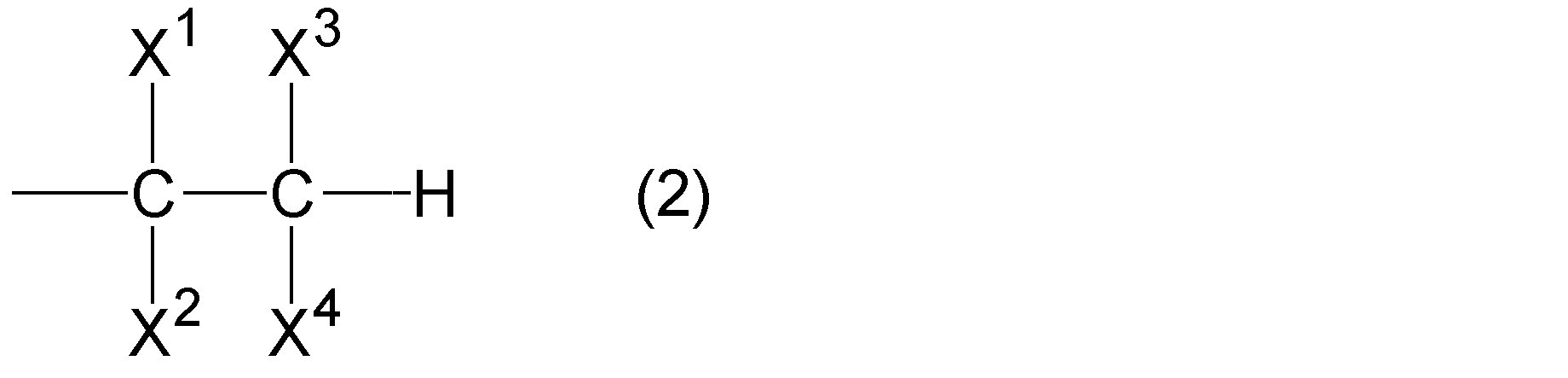
(式中、X1~X4は、それぞれ独立して、トリフルオロメチル基、トリフルオロメトキシ基、水素原子、又は、ハロゲン原子である。ただし、X1~X4のうち少なくとも1つは、フッ素原子、トリフルオロメチル基、又は、トリフルオロメトキシ基である。)
で表されるフルオロアルキル基であることが好ましい。
で表されるフルオロアルキル基であることが好ましい。
Rfは、-CF2CFHOCF3、-CH2CFHCF3、-CH2CH2CF3、-CFHCF2H、-CFHCFHCF3、-CF2CF2H、-CH2CF2H、及び、-CF2CFHCF3からなる群より選択される少なくとも1種の基であることが好ましい。
本発明は、本発明の含フッ素スルホランを含むことを特徴とする電解液に関する。
本発明は、下記式(3):

(式中、Rfは、ヘテロ原子を含んでいてもよい炭素数1~8のフルオロアルキル基である。)
で表される化合物を酸化剤と反応させて、下記式(1):
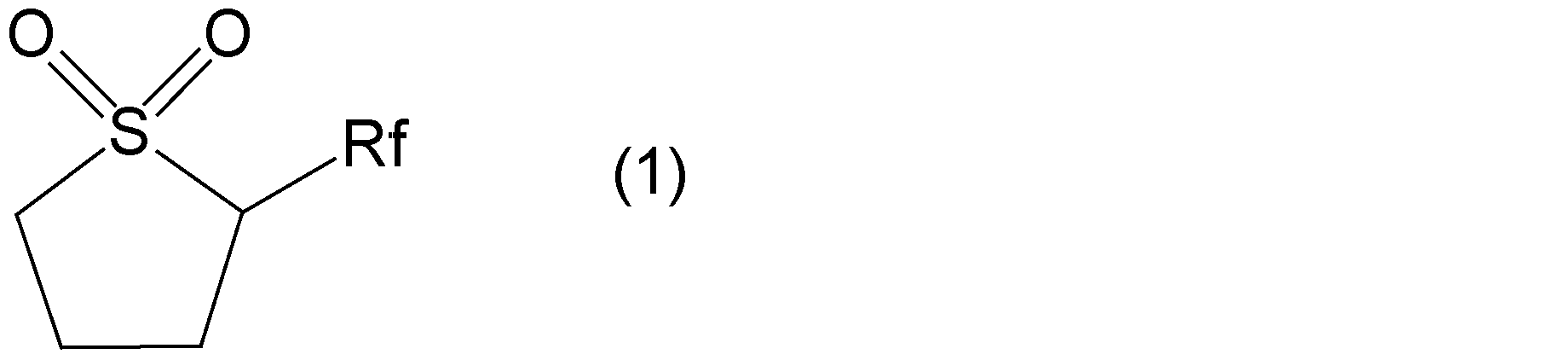
(式中、Rfは、ヘテロ原子を含んでいてもよい炭素数1~8のフルオロアルキル基である。)
で表される含フッ素スルホランを得る工程、を含むことを特徴とする含フッ素スルホランの製造方法に関する。
で表される化合物を酸化剤と反応させて、下記式(1):
で表される含フッ素スルホランを得る工程、を含むことを特徴とする含フッ素スルホランの製造方法に関する。
前記酸化剤が、過酸化物、過ハロゲン酸化物、過マンガン酸塩、及び、クロム酸塩からなる群より選択される少なくとも1種の化合物であることが好ましい。
前記式(3)で表される化合物が、テトラヒドロチオフェンに、炭素数2~8のフルオロアルケンを反応させて得られる下記式(4):

(式中、Rf1は、ヘテロ原子を含んでいてもよい炭素数2~8のフルオロアルキル基である。)
で表される化合物であり、
前記式(1)で表される含フッ素スルホランが、下記式(5):
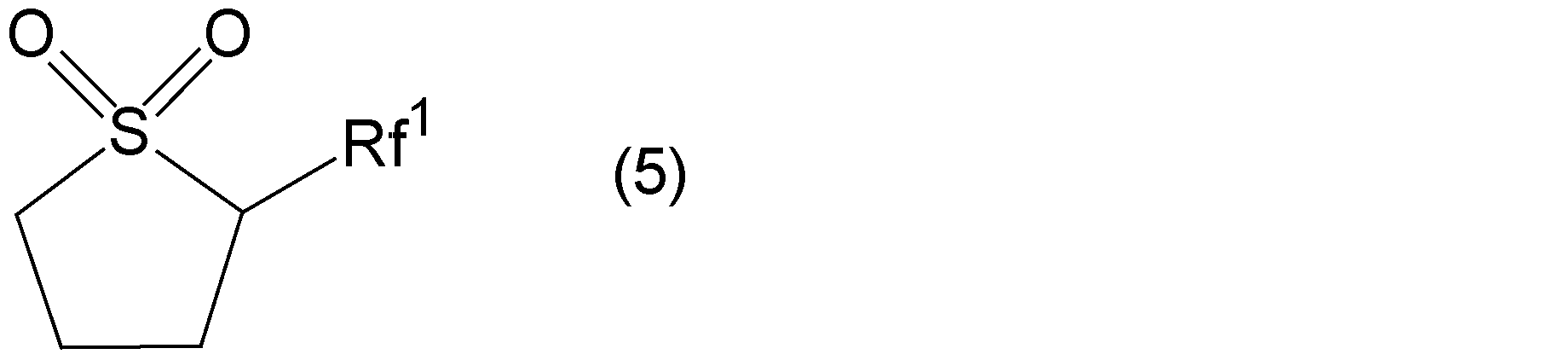
(式中、Rf1は、ヘテロ原子を含んでいてもよい炭素数2~8のフルオロアルキル基である。)
で表される化合物であることが好ましい。
で表される化合物であり、
前記式(1)で表される含フッ素スルホランが、下記式(5):
で表される化合物であることが好ましい。
前記フルオロアルケンが、下記式(6):

(式中、X1~X4は、それぞれ独立して、トリフルオロメチル基、トリフルオロメトキシ基、水素原子、又は、ハロゲン原子である。ただし、X1~X4のうち少なくとも1つは、フッ素原子、トリフルオロメチル基、又は、トリフルオロメトキシ基である。)
で表される化合物であることが好ましい。
で表される化合物であることが好ましい。
前記フルオロアルケンが、CH2=CF-CF3、CH2=CH-CF3、CF2=CF-OCF3、CFH=CFCF3、CFH=CF2、CH2=CF2、CF2=CF2、及び、CF2=CFCF3からなる群より選択される少なくとも1種の化合物であることが好ましい。
前記式(3)で表される化合物が、
1)5-ハロゲン-1-ペンテン(ハロゲン:フッ素原子、塩素原子、臭素原子、又は、ヨウ素原子)を、Rf2X5(式中、Rf2は、ヘテロ原子を含んでいてもよい炭素数1~7のフルオロアルキル基であり、X5は、塩素原子、臭素原子、又は、ヨウ素原子である。)
で表される化合物と反応させて、下記式(7):

(式中、Rf2は、ヘテロ原子を含んでいてもよい炭素数1~7のフルオロアルキル基であり、X6は、フッ素原子、塩素原子、臭素原子、又は、ヨウ素原子であり、X5は、塩素原子、臭素原子、又は、ヨウ素原子である。)で表される化合物を得る工程、
2)前記式(7)で表される化合物を、チオール化剤と反応させて、下記式(8):

(式中、Rf2は、ヘテロ原子を含んでいてもよい炭素数1~7のフルオロアルキル基であり、X5は、塩素原子、臭素原子、又は、ヨウ素原子である。)で表される化合物を得る工程、
3)前記式(8)で表される化合物を環化反応させる工程
を含む製造方法により得られる下記式(9):

(式中、Rf2は、ヘテロ原子を含んでいてもよい炭素数1~7のフルオロアルキル基である。)
で表される化合物であり、
前記式(1)で表される含フッ素スルホランが、下記式(10):

(式中、Rf2は、ヘテロ原子を含んでいてもよい炭素数1~7のフルオロアルキル基である。)
で表される化合物であることが好ましい。
1)5-ハロゲン-1-ペンテン(ハロゲン:フッ素原子、塩素原子、臭素原子、又は、ヨウ素原子)を、Rf2X5(式中、Rf2は、ヘテロ原子を含んでいてもよい炭素数1~7のフルオロアルキル基であり、X5は、塩素原子、臭素原子、又は、ヨウ素原子である。)
で表される化合物と反応させて、下記式(7):
2)前記式(7)で表される化合物を、チオール化剤と反応させて、下記式(8):
3)前記式(8)で表される化合物を環化反応させる工程
を含む製造方法により得られる下記式(9):
で表される化合物であり、
前記式(1)で表される含フッ素スルホランが、下記式(10):
で表される化合物であることが好ましい。
Rf2は、-(CF2)nH(nは、1~7の整数である)、-(CF2)mCF3(mは、1~6の整数である)、-CF(CF3)2、及び、-CH(CF3)2からなる群より選択される少なくとも1種の基であることが好ましい。
本発明の含フッ素スルホランは、エネルギー貯蔵デバイスの電解液に用いられる溶媒や添加剤として非常に有用である。また、本発明の含フッ素スルホランは優れた耐酸化性を有する。本発明の含フッ素スルホランの製造方法は、上記新規な含フッ素スルホランを、簡便な方法で確実に製造することができるものである。
本発明は、下記式(1):
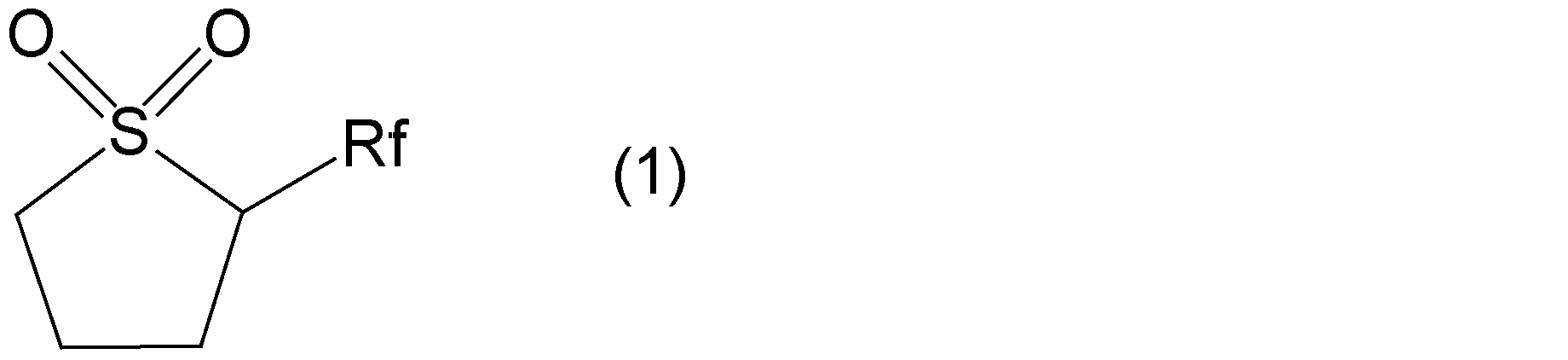
(式中、Rfは、ヘテロ原子を含んでいてもよい炭素数1~8のフルオロアルキル基である。)
で表されることを特徴とする含フッ素スルホランに関する。
で表されることを特徴とする含フッ素スルホランに関する。
本発明の含フッ素スルホランは、フルオロアルキル基を有する特定の構造の含フッ素スルホランであるため、耐酸化性に優れ、高い電気化学的安定性を示す。上記式(1)で表される含フッ素スルホランは、その合成が困難であり、従来合成することができていなかった。本発明者らが鋭意検討したところ、後述する製造方法を用いることにより初めてその合成に成功し、上記式(1)で表される含フッ素スルホランが耐酸化性に優れ、高い電気化学的安定性を示すことが見出された。耐酸化性、電気化学的安定性が向上する理由は定かではないが、スルホランにフルオロアルキル基が導入されることによって、硫黄原子に結合した酸素原子上の電子が吸引され、配位力が落ちることに起因するものではないかと推測される。
上記Rfは、ヘテロ原子を含んでいてもよい炭素数1~8のフルオロアルキル基である。炭素数は、2~8であることが好ましく、2~6であることがより好ましく、3~6であることがさらに好ましい。ここで、「ヘテロ原子」とは、フッ素原子以外のハロゲン原子や、酸素原子、硫黄原子、窒素原子等を表す。また、「ヘテロ原子を含んでいてもよい」とは、ヘテロ原子を含む、または、ヘテロ原子を含まないことを表す。すなわち、「ヘテロ原子を含んでいてもよい炭素数1~8のフルオロアルキル基」とは、炭素数1~8のフルオロアルキル基、または、ヘテロ原子を含む炭素数1~8のフルオロアルキル基を表している。本明細書における「ヘテロ原子を含んでいてもよい」は以下同様の意味を示すものである。
前記フルオロアルキル基とは、少なくとも1つの水素原子がフッ素原子で置換されたアルキル基であればよく、パーフルオロアルキル基であってもよい。また、直鎖のフルオロアルキル基であっても、分岐のフルオロアルキル基であってもよい。
Rfとしては、フルオロメチル基、フルオロエチル基、フルオロプロピル基、フルオロブチル基、フルオロペンチル基、フルオロヘキシル基等のフルオロアルキル基などが挙げられる。これらのフルオロアルキル基は、直鎖であってもよいし、分岐したものであってもよい。また、パーフルオロアルキル基であってもよい。
より具体的には、Rfとしては、下記式(2):

(式中、X1~X4は、それぞれ独立して、トリフルオロメチル基、トリフルオロメトキシ基、水素原子、又は、ハロゲン原子である。ただし、X1~X4のうち少なくとも1つは、フッ素原子、トリフルオロメチル基、又は、トリフルオロメトキシ基である。)
で表されるフルオロアルキル基であることが好ましく、下記式(2-1):

(式中、X3、X4は、式(2)と同様である。)
で表されるフルオロアルキル基であることがより好ましい。
で表されるフルオロアルキル基であることが好ましく、下記式(2-1):
で表されるフルオロアルキル基であることがより好ましい。
上記式(2)で表されるフルオロアルキル基としては、-CF2CFHCF3、-CF2CF2H、-CF2CFHOCF3、-CFHCF2H、-CFHCFHCF3、-CH2CFHCF3、-CH2CH2CF3、-CH2CF2H、-CF2CFClH、-CF2CCl2H等が挙げられる。これらの中でも、-CF2CFHOCF3、-CH2CFHCF3、-CH2CH2CF3、-CFHCF2H、-CFHCFHCF3、-CF2CF2H、-CH2CF2H、及び、-CF2CFHCF3からなる群より選択される少なくとも1種であることが好ましく、-CF2CFHCF3、-CF2CF2H、及び、-CF2CFHOCF3からなる群より選択される少なくとも1種であることがより好ましい。
本発明はまた、下記式(3):

(式中、Rfは、ヘテロ原子を含んでいてもよい炭素数1~8のフルオロアルキル基である。)
で表される化合物を酸化剤と反応させて、下記式(1):
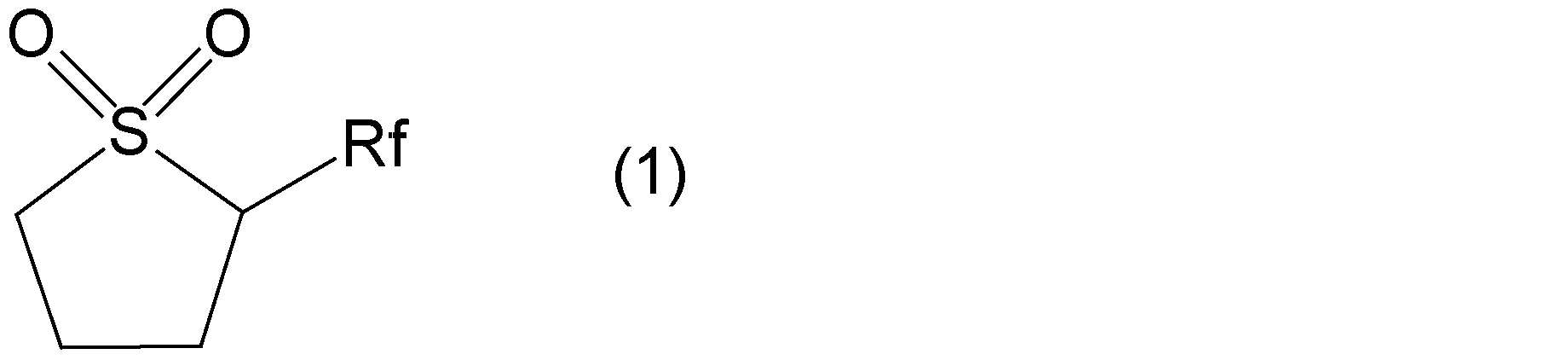
(式中、Rfは、ヘテロ原子を含んでいてもよい炭素数1~8のフルオロアルキル基である。)
で表される含フッ素スルホランを得る工程、を含むことを特徴とする含フッ素スルホランの製造方法に関する。
本発明の含フッ素スルホランの製造方法は、上記含フッ素スルホランを得る工程を含む限り、その他の工程を含んでいてもよい。例えば、含フッ素スルホランを製造した後に、精製工程を行うことにより、純度の高い含フッ素スルホランを得ることができる。上記精製工程は、再結晶、濾過、精留など通常有機化合物の精製のために行われる方法を採ることができる。
で表される化合物を酸化剤と反応させて、下記式(1):
で表される含フッ素スルホランを得る工程、を含むことを特徴とする含フッ素スルホランの製造方法に関する。
本発明の含フッ素スルホランの製造方法は、上記含フッ素スルホランを得る工程を含む限り、その他の工程を含んでいてもよい。例えば、含フッ素スルホランを製造した後に、精製工程を行うことにより、純度の高い含フッ素スルホランを得ることができる。上記精製工程は、再結晶、濾過、精留など通常有機化合物の精製のために行われる方法を採ることができる。
上記式(3)中のRfとしては、式(1)中のRfと同様のものを挙げることができる。上記酸化剤としては、後述するものを用いることができる。また、式(3)で表される化合物を酸化剤と反応させる方法としては、液相の式(3)で表される化合物に、酸化剤を導入して反応させる方法が挙げられるが、反応方法の詳細については後述する。
上記式(3)で示される化合物としては、テトラヒドロチオフェンに、炭素数2~8のフルオロアルケンを反応させて得られる下記式(4):

(式中、Rf1は、ヘテロ原子を含んでいてもよい炭素数2~8のフルオロアルキル基である。)
で表される化合物、又は、下記式(9):

(式中、Rf2は、ヘテロ原子を含んでいてもよい炭素数1~7のフルオロアルキル基である。)
で表される化合物が好ましい。
で表される化合物、又は、下記式(9):
で表される化合物が好ましい。
本発明の含フッ素スルホランの製造方法において、上記式(4)で表される化合物を用いる製造方法を「第一の製造方法」とし、上記式(7)で表される化合物を用いる製造方法を「第二の製造方法」とする。
以下、第一の製造方法について説明する。
本発明の第一の製造方法は、
テトラヒドロチオフェンに、炭素数2~8のフルオロアルケンを反応させて、下記式(4):

(式中、Rf1は、ヘテロ原子を含んでいてもよい炭素数2~8のフルオロアルキル基である。)
で表される化合物を得る工程、及び、
上記式(4)で表される化合物を酸化剤と反応させて、下記式(5):

(式中、Rf1は、ヘテロ原子を含んでいてもよい炭素数2~8のフルオロアルキル基である。)
で表される含フッ素スルホランを得る工程、を含むものである。
テトラヒドロチオフェンに、炭素数2~8のフルオロアルケンを反応させて、下記式(4):
で表される化合物を得る工程、及び、
上記式(4)で表される化合物を酸化剤と反応させて、下記式(5):
で表される含フッ素スルホランを得る工程、を含むものである。
本発明の第一の製造方法は、上記式(5)で表される含フッ素スルホランを、簡便かつ確実に製造することができる。また、耐酸化性に優れ、高い電気化学的安定性を有する含フッ素スルホランを製造することができるものである。
上記フルオロアルケンの炭素数は、2~8であることが好ましく、3~6であることがより好ましい。上記フルオロアルケンとしては、フルオロエチレン、フルオロプロピレン、フルオロブチレン、フルオロペンテン、フルオロヘキセン等が挙げられる。これらのフルオロアルケンは、直鎖であってもよいし、分岐したものであってもよい。また、構造中にヘテロ原子を含んでいてもよく、特には構造中にエーテル結合を有していてもよい。パーフルオロアルケンであってもよい。
より具体的には、前記フルオロアルケンとしては、下記式(6):

(式中、X1~X4は、それぞれ独立して、トリフルオロメチル基、トリフルオロメトキシ基、水素原子、又は、ハロゲン原子である。ただし、X1~X4のうち少なくとも1つは、フッ素原子、トリフルオロメチル基、又は、トリフルオロメトキシ基である。)
で表される化合物であることが好ましく、下記式(6-1):

(式中、X3、X4は、式(6)と同様である。)
で表される化合物であることがより好ましい。
で表される化合物であることが好ましく、下記式(6-1):
で表される化合物であることがより好ましい。
上記式(6)で表される化合物としては、例えば、CF2=CFCF3、CF2=CF2、CF2=CFOCF3、CFH=CF2、CFH=CFCF3、CH2=CFCF3、CH2=CHCF3、CH2=CF2等が挙げられる。これらの中でも、CF2=CFCF3、CF2=CF2、CF2=CFOCF3が好ましい。
上記Rf1としては、上記式(2)や式(2-1)で表される基であることが好ましい。
テトラヒドロチオフェンに、上記フルオロアルケンを反応させる方法としては、例えば、液相のテトラヒドロチオフェンに上記フルオロアルケンを導入して反応させる方法等が挙げられる。反応方式は回分式、半回分式、流通式いずれの方法でも可能である。
液相のテトラヒドロチオフェンに上記フルオロアルケンを導入する場合、テトラヒドロチオフェンに上記フルオロアルケンを反応させる温度としては、60~150℃が好ましく、より好ましくは80~150℃である。反応圧力は、0.5~1.0MPaであることが好ましい。反応時間は、反応温度等によって異なるが、通常は5~10時間である。また、テトラヒドロチオフェン1モルに対して、上記フルオロアルケンを0.1~8モル投入して反応を行うことが好ましい。上記フルオロアルケンの投入量としてより好ましくは、テトラヒドロチオフェン1モルに対して、0.2~6モルであり、更に好ましくは、0.2~5モルである。
液相のテトラヒドロチオフェンに上記フルオロアルケンを導入する場合、上記テトラヒドロチオフェン及びフルオロアルケンに対して不活性な溶媒の存在下で、テトラヒドロチオフェンに、上記フルオロアルケンを反応させてもよい。
本発明の第一の製造方法は、反応系に反応開始剤を添加して、テトラヒドロチオフェンに、炭素数2~8のフルオロアルケンを反応させることが好ましい。上記反応開始剤は、上記フルオロアルケンに対して10~50モル%添加することが好ましい。反応系に反応開始剤を添加する場合、例えば、テトラヒドロチオフェンに上記フルオロアルケンを反応させる反応容器内に反応開始剤を添加すればよい。
上記反応開始剤は、上記テトラヒドロチオフェンに、炭素数2~8のフルオロアルケンを反応させて、式(4)で表される化合物を得る工程を行うことができるものであれば特に限定されないが、例えば、上記反応開始剤としては、有機過酸化物系開始剤、ラジカル重合開始剤、及び、レドックス系開始剤からなる群より選択される少なくとも1種の化合物であることが好ましい。
有機過酸化物系開始剤としては、例えば、ジtert-ブチルペルオキシド、tert-ブチルクミルペルオキシド、ジクミルペルオキシド、α,α-ビス(tert-ブチルペルオキシ)-p-ジイソプロピルベンゼン、2,5-ジメチル-2,5-ジ(tert-ブチルペルオキシ)ヘキサン、2,5-ジメチル-2,5-ジ(tert-ブチルペルオキシ)ヘキサン-3等のジアルキルペルオキシド類、1,1-ジ(tert-ブチルペルオキシ)-3,3,5-トリメチルシクロヘキサン、2,5-ジメチルヘキサン-2,5-ジヒドロキシペルオキシド、ベンゾイルペルオキシド、tert-ブチルペルオキシベンゼン、2,5-ジメチル-2,5-ジ(ベンゾイルペルオキシ)ヘキサン、tert-ブチルペルオキシマレイン酸、tert-ブチルペルオキシソプロピルカーボネート等が挙げられる。これらの中でも、ジアルキルペルオキシド類が好ましい。
ラジカル重合開始剤としては、水溶性開始剤が好ましく、その具体例としては、過硫酸アンモニウム、過硫酸ナトリウム、過硫酸カリウム等の過硫酸類、ジコハク酸過酸化物、アゾビスイソブチルアミジン二塩酸塩等の有機系開始剤等が挙げられる。これらの中でも、過硫酸アンモニウム塩等の過硫酸類が好ましい。
レドックス系開始剤としては、ジコハク酸過酸化物、アゾビスイソブチルアミジン二塩酸塩等の有機系開始剤、過硫酸類、過酸化水素等の無機系開始剤、過硫酸類又は過酸化水素とヒドロキシメタンスルフィン酸ナトリウム、亜硫酸水素ナトリウム、チオ硫酸ナトリウム等の還元剤との組合せからなるレドックス系開始剤、さらにこれらに少量の鉄、第一鉄塩、硫酸銀などを共存させた系の無機系開始剤等が挙げられる。これらの中でも、過硫酸アンモニウム/ヒドロキシメタンスルフィン酸ナトリウム/硫酸第一鉄系が好ましく、この系にさらにキレート剤としてエチレンジアミン四酢酸2ナトリウム塩を加えることがより好ましい。なお、レドックス系開始剤を用いる場合には、pH緩衝剤を併用することが好ましい。
pH緩衝剤としては、リン酸水素二ナトリウム、リン酸二水素ナトリウム、炭酸水素ナトリウム、炭酸ナトリウム等の無機塩類を用いることができ、リン酸水素二ナトリウム2水和物、リン酸水素二ナトリウム12水和物等が挙げられる。
上記式(4)で表される化合物を酸化剤と反応させて、式(5)で表される含フッ素スルホランを得る工程は、上記式(4)で表される化合物と酸化剤とを反応させて行うことが好ましい。例えば、液相の上記式(4)で表される化合物に、酸化剤を導入して反応させる方法等が挙げられる。反応方式は回分式、半回分式、流通式いずれの方法でも可能である。
上記酸化剤としては、特に限定されず、通常酸化剤として用いられるものであればよい。例えば、酸化剤としては、過酸化物、過ハロゲン酸化物、過マンガン酸塩、及び、クロム酸塩からなる群より選択される少なくとも1種の化合物であることが好ましい。上記酸化剤は、上記式(4)で表される化合物に対して100~500モル%添加することが好ましい。
具体的な酸化剤としては、例えば、有機過酸化物(例えば、m-クロロ過安息香酸)、有機過酸、過酸化水素、二酸化ゼレン、クロム酸類、二酸化マンガン、次亜塩素酸類、過ヨウ素酸類、カロ酸類、セリックアンモニウムナイトレート(CAN)、ヨードソベンゼン類等を挙げることができる。
液相の上記式(4)で表される化合物に、酸化剤を導入して反応させる場合、上記酸化反応は、25~80℃で行うことが好ましく、30~80℃で行うことがより好ましい。反応時間は、反応温度等によって異なるが、通常は5~10時間である。
以下、第二の製造方法について説明する。
本発明の第二の製造方法は、以下の式:

(式中、X6は、フッ素原子、塩素原子、臭素原子、又は、ヨウ素原子である。)
で示される5-ハロゲン-1-ペンテンを、Rf2X5(式中、Rf2は、ヘテロ原子を含んでいてもよい炭素数1~7のフルオロアルキル基であり、X5は、塩素原子、臭素原子、又はヨウ素原子である。)
で表される化合物と反応させて、下記式(7):

(式中、Rf2は、ヘテロ原子を含んでいてもよい炭素数1~7のフルオロアルキル基であり、X6は、フッ素原子、塩素原子、臭素原子、又は、ヨウ素原子であり、X5は、塩素原子、臭素原子、又は、ヨウ素原子である。)で表される化合物を得る工程、
上記式(7)で表される化合物を、チオール化剤と反応させて、下記式(8):

(式中、Rf2は、ヘテロ原子を含んでいてもよい炭素数1~7のフルオロアルキル基であり、X5は、塩素原子、臭素原子、又は、ヨウ素原子である。)で表される化合物を得る工程、
上記式(8)で表される化合物を環化反応させて、下記式(9):

(式中、Rf2は、ヘテロ原子を含んでいてもよい炭素数1~7のフルオロアルキル基である。)
で表される化合物を得る工程、及び、
上記式(9)で表される化合物を酸化剤と反応させて、下記式(10):
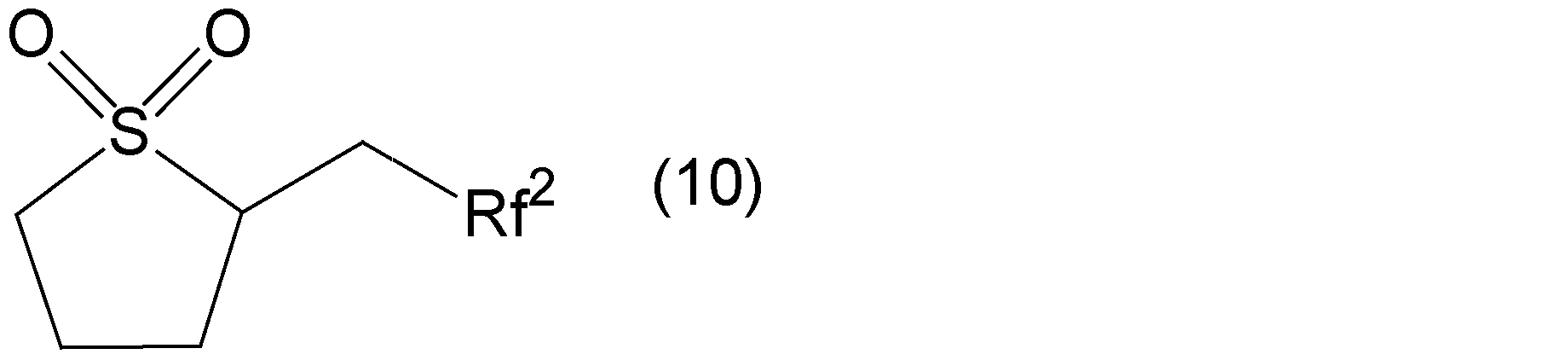
(式中、Rf2は、ヘテロ原子を含んでいてもよい炭素数1~7のフルオロアルキル基である。)
で表される含フッ素スルホランを得る工程を含むものである。
で示される5-ハロゲン-1-ペンテンを、Rf2X5(式中、Rf2は、ヘテロ原子を含んでいてもよい炭素数1~7のフルオロアルキル基であり、X5は、塩素原子、臭素原子、又はヨウ素原子である。)
で表される化合物と反応させて、下記式(7):
上記式(7)で表される化合物を、チオール化剤と反応させて、下記式(8):
上記式(8)で表される化合物を環化反応させて、下記式(9):
で表される化合物を得る工程、及び、
上記式(9)で表される化合物を酸化剤と反応させて、下記式(10):
で表される含フッ素スルホランを得る工程を含むものである。
本発明の第二の製造方法は、上記式(10)で表される含フッ素スルホランを、簡便な方法で製造することができ、また、フッ素ガスでフッ化するものでもないため、耐酸化性に優れ、安定性の高い含フッ素スルホランを製造することができる。
5-ハロゲン-1-ペンテン中のハロゲン(X6)は、フッ素原子、塩素原子、臭素原子、又は、ヨウ素原子であるが、これらの中でも、臭素原子が好ましい。
Rf2は、炭素数1~7のフルオロアルキル基である。Rf2は、直鎖又は分岐のフルオロアルキル基である。Rf2は、少なくとも1つの水素原子がフッ素原子で置換されたアルキル基であればよく、パーフルオロアルキル基であってもよい。また、ヘテロ原子を含んでいてもよい。
Rf2としては、フルオロメチル基、フルオロエチル基、フルオロプロピル基、フルオロブチル基、フルオロペンチル基、フルオロヘキシル基等のフルオロアルキル基が挙げられる。これらのフルオロアルキル基は、直鎖であってもよいし、分岐したものであってもよい。また、パーフルオロアルキル基であってもよい。
より具体的には、-(CF2)nH(nは、1~7の整数である)、-(CF2)mCF3(mは、1~6の整数である)、-CF(CF3)2、及び-CH(CF3)2等が挙げられる。より好ましくは、-C4F9、-C2F5、-CF3、及び、-CF(CF3)2から選択される少なくとも1種である。
5-ハロゲン-1-ペンテンを、Rf2X5(式中、Rf2、X5は前記同様。)で表される化合物と反応させる方法としては、例えば、液相の5-ハロゲン-1-ペンテンに上記Rf2X5で表される化合物を導入して反応させる方法等が挙げられる。反応方式は回分式、半回分式、流通式いずれの方法でも可能である。
液相の5-ハロゲン-1-ペンテンに上記Rf2X5で表される化合物を導入して反応させる方法を用いる場合、5-ハロゲン-1-ペンテンに、Rf2X5で表される化合物を反応させる温度としては、50~80℃が好ましく、より好ましくは60~80℃である。また、上記反応における、5-ハロゲン-1-ペンテンと、Rf2X5で表される化合物との配合比としては、モル比で1:1~1:1.5であることが好ましい。より好ましくは、1:1~1:1.2である。
反応時間は、反応温度等によって異なるが、通常は5~10時間である。5-ハロゲン-1-ペンテンに上記Rf2X5で表される化合物を導入して反応させる方法を用いる場合、5-ハロゲン-1-ペンテン及び上記Rf2X5で表される化合物に対して不活性な溶媒の存在下で反応を行ってもよい。
本発明の第二の製造方法は、上記式(7)で表される化合物を、チオール化剤と反応させて、上記式(8)で表される化合物を得る工程を含む。チオール化剤としては、チオアルコキサイド、チオウレア、チオ尿酸等を挙げることができる。
また、チオール化剤の添加量としては、式(7)で表される化合物1モルに対して、1~1.5モルであることが好ましい。チオール化剤の添加量としてより好ましくは、式(7)で表される化合物1モルに対して、1~1.2モルである。
また、チオール化剤の添加量としては、式(7)で表される化合物1モルに対して、1~1.5モルであることが好ましい。チオール化剤の添加量としてより好ましくは、式(7)で表される化合物1モルに対して、1~1.2モルである。
本発明の第二の製造方法は、上記式(8)で表される化合物を環化反応させて上記式(9)で表される化合物を得る工程を含む。
上記環化反応を行う方法としては、例えば、式(8)で表される化合物を含む溶液に、アルカリ溶液を添加して反応を行う方法が挙げられる。アルカリ溶液を添加する方法としては、一括して添加する方法、反応前又は反応中に数度に分けて断続的に添加する方法、反応前又は反応中に連続的に滴下する方法などが挙げられ、いずれの方法により行ってもよいが、反応前又は反応中に連続的に滴下する方法により添加するのが好ましい。
上記アルカリ溶液としては、例えば、LiOH、NaOH、KOH、RbOH、CsOH、Be(OH)2、Mg(OH)2、Ca(OH)2、Sr(OH)2、Ba(OH)2などの溶液が挙げられる。これらの中でも、LiOH、NaOH、KOHの溶液が好ましい。特に好ましくは、水酸化ナトリウム水溶液、水酸化カリウム水溶液である。
また、上記アルカリ溶液の濃度としては、20~40質量%であることが好ましく、より好ましくは、20~30質量%である。
また、上記アルカリ溶液の濃度としては、20~40質量%であることが好ましく、より好ましくは、20~30質量%である。
上記環化反応におけるアルカリ溶液の添加量としては、式(8)で表される化合物1モルに対して、1.2~4モル添加することが好ましい。より好ましくは、1.2~2モルであり、更に好ましくは、1.2~1.5モルである。
環化反応させる温度は、50~100℃が好ましく、より好ましくは60~100℃である。反応時間は、反応温度等によって異なるが、通常は5~10時間である。反応方式は回分式、半回分式、流通式いずれの方法でも可能である。
本発明の第二の製造方法は、上記式(9)で表される化合物を酸化して、上記式(10)で表される含フッ素スルホランを得る工程を含む。
上記酸化は、上記式(9)で表される化合物と酸化剤とを反応させて行うことが好ましい。例えば、液相の上記式(9)で表される化合物に、酸化剤を導入して反応させる方法等が挙げられる。反応方式は回分式、半回分式、流通式いずれの方法でも可能である。
上記酸化剤としては、特に限定されず、通常酸化剤として用いられるものであればよい。例えば、酸化剤としては、過酸化物、過ハロゲン酸化物、過マンガン酸塩及びクロム酸塩からなる群より選択される少なくとも1種の化合物であることが好ましい。上記酸化剤は、上記式(9)で表される化合物に対して、2~4倍(モル比)となるように添加することが好ましい。
液相の上記式(9)で表される化合物に、酸化剤を導入して反応させる場合、上記酸化は、25~100℃で行うことが好ましく、50~100℃で行うことがより好ましい。反応時間は、反応温度等によって異なるが、通常は5~10時間である。
本発明の含フッ素スルホランは、各種溶媒として使用することができ、例えば、有機合成の反応溶媒、各種無機・有機物の抽出溶媒、塗料・インク等の希釈溶媒、半導体レジスト溶媒、農薬類の希釈溶媒、エネルギー貯蔵デバイス等に用いられる電解液の溶媒として用いることができる。また、エネルギー貯蔵デバイス等に用いられる電解液の添加剤としても使用することができる。特に、エネルギー貯蔵デバイス用の電解液の溶媒や添加剤として有用である。
本発明は上記含フッ素スルホラン、若しくは、上記製造方法により得られる含フッ素スルホランを含むことを特徴とする電解液でもある。上記電解液は、電解質塩を含むことが好ましい。電解質塩としては、例えば、LiClO4、LiAsF6、LiBF4、LiPF6、LiN(SO2CF3)2、LiN(SO2C2F5)2などが挙げられる。
本発明の含フッ素スルホランを用いた電解液の用途としては、例えば、電解コンデンサー、電気二重層キャパシタ、イオンの電荷移動により充電/放電される電池、エレクトロルミネッセンスなどの固体表示素子、電流センサーやガスセンサーなどのセンサーなどが挙げられる。
中でも、リチウムイオン二次電池に用いることが好ましく、本発明の電解液は、正極、負極、セパレータおよび本発明の電解液を含む非水電解液を備えるリチウムイオン二次電池用として好適に使用することができる。このようなリチウムイオン二次電池は、ハイブリッド自動車用や分散電源用の大型リチウムイオン二次電池として特に有用であるが、そのほか小型のリチウムイオン二次電池としても有用である。
つぎに本発明を実施例及び比較例を挙げて説明するが、本発明はかかる実施例のみに限定されるものではない。
NMR:BRUKER社製のAC-300を使用
19F-NMR:
測定条件:282MHz(トリクロロフルオロメタン=0ppm)
1H-NMR:
測定条件:300MHz(テトラメチルシラン=0ppm)
19F-NMR:
測定条件:282MHz(トリクロロフルオロメタン=0ppm)
1H-NMR:
測定条件:300MHz(テトラメチルシラン=0ppm)
実施例1
1)1ステップ(付加反応)
300mLの還流管を設置した反応装置にて実施した。5-ブロモ-1-ペンテン(25g:168mmol)、C4F9I(65.7g:190mmol)、アゾビスイソブチロニトリル(以下、AIBNとする、551mg:3.4mmol)の順に反応容器に試薬を加えた。その後70~80℃付近まで反応温度を上げた。次第に還流下となるが、反応の進行とともに還流が止まった。1時間攪拌した後、原料の消失を確認し反応を終了した。その後溶液を減圧下で低沸化合物だけ除去し次の反応に進んだ。
1)1ステップ(付加反応)
300mLの還流管を設置した反応装置にて実施した。5-ブロモ-1-ペンテン(25g:168mmol)、C4F9I(65.7g:190mmol)、アゾビスイソブチロニトリル(以下、AIBNとする、551mg:3.4mmol)の順に反応容器に試薬を加えた。その後70~80℃付近まで反応温度を上げた。次第に還流下となるが、反応の進行とともに還流が止まった。1時間攪拌した後、原料の消失を確認し反応を終了した。その後溶液を減圧下で低沸化合物だけ除去し次の反応に進んだ。
2)2ステップ(チオール化+環化反応)
上記の溶液にチオウレア(12.8g:168mmol)とエタノール35mLを加え還流下で攪拌し、ガスクロマトグラフ(GC)で確認したところ原料が消失しBrがSHになったのを確認した。その後、30質量%KOH水溶液120gを滴下ロートで加えることで環化反応を行った(80℃、5時間)。蒸留にて目的生成物を採取した。
上記の溶液にチオウレア(12.8g:168mmol)とエタノール35mLを加え還流下で攪拌し、ガスクロマトグラフ(GC)で確認したところ原料が消失しBrがSHになったのを確認した。その後、30質量%KOH水溶液120gを滴下ロートで加えることで環化反応を行った(80℃、5時間)。蒸留にて目的生成物を採取した。
3)3ステップ(酸化反応)
環化体の化合物(43g:134.4mmol)を酢酸(45g)に溶解した後、100℃にて30質量%H2O2水溶液(45ml:403.2mmol)を滴下した。反応後2層分液している下層を抜き出して純水にて洗浄したところ、固体が析出した。固体を蒸留にて精製した。得られた目的生成物の収率は、72%であった。
環化体の化合物(43g:134.4mmol)を酢酸(45g)に溶解した後、100℃にて30質量%H2O2水溶液(45ml:403.2mmol)を滴下した。反応後2層分液している下層を抜き出して純水にて洗浄したところ、固体が析出した。固体を蒸留にて精製した。得られた目的生成物の収率は、72%であった。
得られた化合物1のNMRデータは以下の通りである。
19F-NMR:(acetone):-80.20~-82.00ppm(3F)、-110.00~-115.0ppm(2F)、-122.5~-125.22ppm(2F)、-125.13~-130.22ppm(2F)
1H-NMR:(acetone):1.50~4.00ppm(9H)
実施例2~4
表1に示す化合物、添加量にする以外は実施例1と同様の方法で、目的生成物を得ることができた。
表1に示す化合物、添加量にする以外は実施例1と同様の方法で、目的生成物を得ることができた。

実施例5
1)1ステップ(付加反応)
反応容器として耐圧の反応容器であるオートクレーブを用いて反応を行った。テトラヒドロチオフェン(100g:1.136mol)と開始剤パーブチルD(16.7g:114mmol、日油(株)製、ジtert-ブチルペルオキシド)を加え、0.3MPaまでヘキサフルオロプロピレンで満たし、熱を加えることで反応温度を上げた。次第に120℃付近で発熱が確認でき圧力の低下も確認できた。0.6MPaまでを限界値としてヘキサフルオロプロピレンを加え続けた。
圧力低下がないと判断された時点で反応を終了した。反応溶液を取り出し、目的生成物を蒸留にて採取した。ヘキサフルオロプロピレンの投入総量は、40g(267mmol)であった。
1)1ステップ(付加反応)
反応容器として耐圧の反応容器であるオートクレーブを用いて反応を行った。テトラヒドロチオフェン(100g:1.136mol)と開始剤パーブチルD(16.7g:114mmol、日油(株)製、ジtert-ブチルペルオキシド)を加え、0.3MPaまでヘキサフルオロプロピレンで満たし、熱を加えることで反応温度を上げた。次第に120℃付近で発熱が確認でき圧力の低下も確認できた。0.6MPaまでを限界値としてヘキサフルオロプロピレンを加え続けた。
圧力低下がないと判断された時点で反応を終了した。反応溶液を取り出し、目的生成物を蒸留にて採取した。ヘキサフルオロプロピレンの投入総量は、40g(267mmol)であった。
2)2ステップ(酸化反応)
得られた生成物51g(213mmol)をトリフルオロ酢酸溶媒20g中に溶解し、30質量%H2O2水溶液75mL(675.0mmol)にて酸化反応を行った(30℃、5時間)。その後、反応溶液を蒸留にて、下記の精製工程によって行った。
得られた生成物51g(213mmol)をトリフルオロ酢酸溶媒20g中に溶解し、30質量%H2O2水溶液75mL(675.0mmol)にて酸化反応を行った(30℃、5時間)。その後、反応溶液を蒸留にて、下記の精製工程によって行った。
(精製工程)
蒸留後、得られた薄黄色の固体をトルエンに熱を加えることで溶解した。その後徐々に冷却を行った後、固体の析出を確認した。スラリーの状態の中トルエンと同等量のヘキサンを加え攪拌し、1時間程度攪拌した後、桐山ロートを用いて結晶をろ過した。採取した結晶を真空乾燥することで終了した。
蒸留後、得られた薄黄色の固体をトルエンに熱を加えることで溶解した。その後徐々に冷却を行った後、固体の析出を確認した。スラリーの状態の中トルエンと同等量のヘキサンを加え攪拌し、1時間程度攪拌した後、桐山ロートを用いて結晶をろ過した。採取した結晶を真空乾燥することで終了した。
得られた化合物5のNMRデータは以下の通りである。
19F-NMR:(acetone):-209.91~-209.105ppm(1F)、-113.20~-112.9ppm、-111.90~-111.7ppm、-110.7~-110.6ppm、-110.00~-109.8ppm、-109.68~-109.4ppm、-108.99~-108.4ppm、-106.60~-106.34ppm、-105.38~-105.29ppm(2F)、-76.52~-74.128ppm(3F)
1H-NMR:(acetone):1.82~2.10ppm(1H)、2.40~2.66ppm(4H)、3.14~3.18ppm(1H)、3.40~3.67ppm(1H)、4.78~5.23ppm(1H)
実施例6、7
表2に示す化合物、添加量にする以外は実施例5と同様の方法で、目的生成物を得ることができた。
表2に示す化合物、添加量にする以外は実施例5と同様の方法で、目的生成物を得ることができた。

耐酸化性試験
(電解液の調製)
実施例1~7で得られた含フッ素スルホランとプロピレンとプロピレンカーボネート(PC)を、含フッ素スルホラン:PC=80:20体積%とし、この混合液に0.1モル%のLiPF6を溶解した溶液を調製した。また、比較例としては、含フッ素スルホランの代わりにスルホランを用いた。
(電解液の調製)
実施例1~7で得られた含フッ素スルホランとプロピレンとプロピレンカーボネート(PC)を、含フッ素スルホラン:PC=80:20体積%とし、この混合液に0.1モル%のLiPF6を溶解した溶液を調製した。また、比較例としては、含フッ素スルホランの代わりにスルホランを用いた。
(電位窓の測定)
3電極式電圧測定セル(作用極:白金、対極:Li、参照極:Li、宝泉(株)製のHSセル)に上記電解液を入れ、ポテンシオスタットで3mV/secで電位走引し、分解電流を測定した。測定結果を表3に示す。
3電極式電圧測定セル(作用極:白金、対極:Li、参照極:Li、宝泉(株)製のHSセル)に上記電解液を入れ、ポテンシオスタットで3mV/secで電位走引し、分解電流を測定した。測定結果を表3に示す。

また、実施例5で得られた化合物5を用いて非水電解液を調整し、下記の試験を行った。その結果を表4に示す。
試験(電池特性の測定)
以下の方法で円筒型二次電池を作製した。
以下の方法で円筒型二次電池を作製した。
LiCoO2とカーボンブラックとポリフッ化ビニリデン(呉羽化学(株)製、商品名:KF-1000)を90/3/7(質量%)で混合した正極活物質を、N-メチル-2-ピロリドンに分散してスラリー状としたものを正極集電体(厚さ15μmのアルミニウム箔)上に均一に塗布し、乾燥して正極合剤層を形成した。その後、ローラプレス機により圧縮成形した後、切断し、リード体を溶接して、帯状の正極を作製した。
別途、人造黒鉛粉末に、蒸留水で分散させたスチレン-ブタジエンゴムを固形分で6質量%となるように加え、ディスパーザーで混合してスラリー状としたものを負極集電体(厚さ10μmの銅箔)上に均一に塗布し、乾燥し、負極合剤層を形成し、その後、ローラプレス機により圧縮成形し、切断した。その後、乾燥し、リード体を溶接して、帯状の負極を作製した。
帯状の正極を厚さ20μmの微孔性ポリエチレンフィルム(セパレータ)を介して帯状の負極に重ね、渦巻状に巻回して渦巻状巻回構造の積層電極体とした。その際、正極集電材の粗面側が外周側になるようにして巻回した。その後、この電極体を外径18mmの有底円筒状の電池ケース内に充填し、正極および負極のリード体の溶接を行った。
ついで、後述する非水電解液を電池ケース内に注入し、電解液がセパレータなどに充分に浸透した後、封口し、予備充電、エージングを行い、筒形のリチウム二次電池を作製した。
このリチウム二次電池について、つぎの要領で放電容量、負荷特性(高温貯蔵特性)およびサイクル特性を調べた。結果を表4に示す。
(放電容量)
充放電電流をCで表示した場合、1800mAを1Cとして以下の充放電測定条件で測定を行う。評価は、後述する比較用電解液の放電容量の結果を100とした指数で行う。
充放電電流をCで表示した場合、1800mAを1Cとして以下の充放電測定条件で測定を行う。評価は、後述する比較用電解液の放電容量の結果を100とした指数で行う。
充放電条件
充電:1.0C、4.5Vにて充電電流が1/10Cになるまでを保持(CC・CV充電)
放電:1C 3.0Vcut(CC放電)
充電:1.0C、4.5Vにて充電電流が1/10Cになるまでを保持(CC・CV充電)
放電:1C 3.0Vcut(CC放電)
(高温貯蔵特性)
充電については、1.0Cで4.5Vにて充電電流が1/10Cになるまで充電し0.2C相当の電流で3.0Vまで放電し、放電容量を求めた。その後、1.0Cで4.5Vにて充電電流が1/10Cになるまで充電し、85℃の恒温槽に二日間入れた。二日後、室温に冷えるまで十分に置き0.2C相当の電流で3.0Vになるまで放電した。その後、1.0Cで4.5Vにて充電電流が、1/10Cになるまで充電し0.2C相当の電流で3.0Vになるまで放電し、貯蔵後の放電容量を求めた。貯蔵前の放電容量と、貯蔵後充電し0.2Cで放電させた放電容量を、つぎの計算式に代入して高温貯蔵特性を求めた。
充電については、1.0Cで4.5Vにて充電電流が1/10Cになるまで充電し0.2C相当の電流で3.0Vまで放電し、放電容量を求めた。その後、1.0Cで4.5Vにて充電電流が1/10Cになるまで充電し、85℃の恒温槽に二日間入れた。二日後、室温に冷えるまで十分に置き0.2C相当の電流で3.0Vになるまで放電した。その後、1.0Cで4.5Vにて充電電流が、1/10Cになるまで充電し0.2C相当の電流で3.0Vになるまで放電し、貯蔵後の放電容量を求めた。貯蔵前の放電容量と、貯蔵後充電し0.2Cで放電させた放電容量を、つぎの計算式に代入して高温貯蔵特性を求めた。

(サイクル特性)
サイクル特性については、上記の充放電条件(1.0Cで4.5Vにて充電電流が1/10Cになるまで充電し1C相当の電流で3.0Vまで放電する)で行う充放電サイクルを1サイクルとし、最初のサイクル後の放電容量と100サイクル後の放電容量を測定した。サイクル特性は、つぎの計算式で求められた値をサイクル維持率の値とした。
サイクル特性については、上記の充放電条件(1.0Cで4.5Vにて充電電流が1/10Cになるまで充電し1C相当の電流で3.0Vまで放電する)で行う充放電サイクルを1サイクルとし、最初のサイクル後の放電容量と100サイクル後の放電容量を測定した。サイクル特性は、つぎの計算式で求められた値をサイクル維持率の値とした。

(非水電解液の調製)
エチレンカーボネート、ジメチルカーボネート、実施例5で得られた化合物5を30/67/3体積%比となるように混合し、この非水電解液用溶媒にさらに電解質塩としてLiPF6を1.0モル/リットルの濃度となるように加え、25℃にて充分に撹拌し非水電解液を調製した。
エチレンカーボネート、ジメチルカーボネート、実施例5で得られた化合物5を30/67/3体積%比となるように混合し、この非水電解液用溶媒にさらに電解質塩としてLiPF6を1.0モル/リットルの濃度となるように加え、25℃にて充分に撹拌し非水電解液を調製した。
(比較用電解液の調製)
エチレンカーボネート、ジエチルカーボネートを、30/70(体積%)となるように混合し、この溶媒にさらに電解質塩としてLiPF6を1.0モル/リットルの濃度となるように加え、25℃にて充分に撹拌し比較用電解液を調製した。
エチレンカーボネート、ジエチルカーボネートを、30/70(体積%)となるように混合し、この溶媒にさらに電解質塩としてLiPF6を1.0モル/リットルの濃度となるように加え、25℃にて充分に撹拌し比較用電解液を調製した。

本発明の含フッ素スルホランは、耐酸化性に優れ、高い電気化学的安定性を示すため、種々の用途に好適に利用できる。本発明の含フッ素スルホランは、例えば、エネルギー貯蔵デバイス用の電解液の溶媒や添加剤として特に有用である。本発明の含フッ素スルホランの製造方法は、耐酸化性に優れる含フッ素スルホランを簡便かつ確実に製造することができる。
Claims (11)
- 下記式(1):

で表されることを特徴とする含フッ素スルホラン。 - Rfは、下記式(2):

- Rfは、-CF2CFHOCF3、-CH2CFHCF3、-CH2CH2CF3、-CFHCF2H、-CFHCFHCF3、-CF2CF2H、-CH2CF2H、及び、-CF2CFHCF3からなる群より選択される少なくとも1種の基である請求項2記載の含フッ素スルホラン。
- 請求項1~3のいずれかに記載の含フッ素スルホランを含むことを特徴とする電解液。
- 下記式(3):

で表される化合物を酸化剤と反応させて、下記式(1):
で表される含フッ素スルホランを得る工程、を含むことを特徴とする含フッ素スルホランの製造方法。 - 前記酸化剤が、過酸化物、過ハロゲン酸化物、過マンガン酸塩、及び、クロム酸塩からなる群より選択される少なくとも1種の化合物である請求項5記載の含フッ素スルホランの製造方法。
- 前記式(3)で表される化合物が、テトラヒドロチオフェンに、炭素数2~8のフルオロアルケンを反応させて得られる下記式(4):

で表される化合物であり、
前記式(1)で表される含フッ素スルホランが、下記式(5):
で表される化合物である、請求項5記載の含フッ素スルホランの製造方法。 - 前記フルオロアルケンが、下記式(6):

で表される化合物である請求項7記載の含フッ素スルホランの製造方法。 - 前記フルオロアルケンが、CH2=CF-CF3、CH2=CH-CF3、CF2=CF-OCF3、CFH=CFCF3、CFH=CF2、CH2=CF2、CF2=CF2、及び、CF2=CFCF3からなる群より選択される少なくとも1種の化合物である請求項8記載の含フッ素スルホランの製造方法。
- 前記式(3)で表される化合物が、
1)5-ハロゲン-1-ペンテン(ハロゲン:フッ素原子、塩素原子、臭素原子、又は、ヨウ素原子)を、Rf2X5(式中、Rf2は、ヘテロ原子を含んでいてもよい炭素数1~7のフルオロアルキル基であり、X5は、塩素原子、臭素原子、又は、ヨウ素原子である。)
で表される化合物と反応させて、下記式(7):

2)前記式(7)で表される化合物を、チオール化剤と反応させて、下記式(8):

3)前記式(8)で表される化合物を環化反応させる工程
を含む製造方法により得られる下記式(9):

で表される化合物であり、
前記式(1)で表される含フッ素スルホランが、下記式(10):
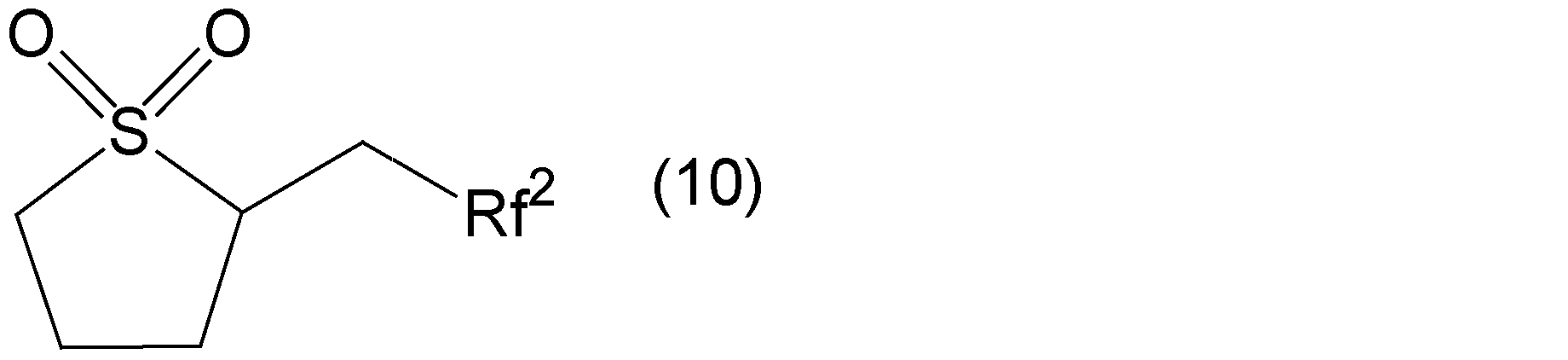
で表される化合物である、請求項5記載の含フッ素スルホランの製造方法。 - Rf2は、-(CF2)nH(nは、1~7の整数である)、-(CF2)mCF3(mは、1~6の整数である)、-CF(CF3)2、及び、-CH(CF3)2からなる群より選択される少なくとも1種の基である請求項10記載の含フッ素スルホランの製造方法。
Applications Claiming Priority (2)
| Application Number | Priority Date | Filing Date | Title |
|---|---|---|---|
| JP2010235952 | 2010-10-20 | ||
| JP2010-235952 | 2010-10-20 |
Publications (1)
| Publication Number | Publication Date |
|---|---|
| WO2012053346A1 true WO2012053346A1 (ja) | 2012-04-26 |
Family
ID=45975065
Family Applications (1)
| Application Number | Title | Priority Date | Filing Date |
|---|---|---|---|
| PCT/JP2011/072802 Ceased WO2012053346A1 (ja) | 2010-10-20 | 2011-10-03 | 含フッ素スルホラン、及び、含フッ素スルホランの製造方法 |
Country Status (2)
| Country | Link |
|---|---|
| JP (1) | JP4973805B2 (ja) |
| WO (1) | WO2012053346A1 (ja) |
Cited By (3)
| Publication number | Priority date | Publication date | Assignee | Title |
|---|---|---|---|---|
| JP2015060703A (ja) * | 2013-09-18 | 2015-03-30 | トヨタ自動車株式会社 | 非水電解質二次電池の製造方法 |
| CN111066191A (zh) * | 2017-08-08 | 2020-04-24 | 住友精化株式会社 | 非水电解液用添加剂、非水电解液及蓄电装置 |
| CN116987059A (zh) * | 2023-08-10 | 2023-11-03 | 上海纳米技术及应用国家工程研究中心有限公司 | 锂电池电解液中添加氟功能化的环丁砜用来提高电压性能的方法 |
Families Citing this family (2)
| Publication number | Priority date | Publication date | Assignee | Title |
|---|---|---|---|---|
| KR101952428B1 (ko) * | 2013-01-31 | 2019-04-22 | 솔브레인 주식회사 | 전해액 및 이를 포함하는 리튬 이차 전지 |
| WO2019187545A1 (ja) * | 2018-03-30 | 2019-10-03 | 住友精化株式会社 | 非水電解液用添加剤、非水電解液及び蓄電デバイス |
Citations (3)
| Publication number | Priority date | Publication date | Assignee | Title |
|---|---|---|---|---|
| JP2002047286A (ja) * | 2000-07-28 | 2002-02-12 | Mitsubishi Chemicals Corp | フッ化スルホラン類の製造方法 |
| JP2003132944A (ja) * | 2001-10-22 | 2003-05-09 | Mitsubishi Chemicals Corp | リチウム二次電池用非水系電解液及びそれを用いたリチウム二次電池 |
| WO2008084846A1 (ja) * | 2007-01-12 | 2008-07-17 | Daikin Industries, Ltd. | 電気二重層キャパシタ |
-
2011
- 2011-10-03 WO PCT/JP2011/072802 patent/WO2012053346A1/ja not_active Ceased
- 2011-10-03 JP JP2011219167A patent/JP4973805B2/ja active Active
Patent Citations (3)
| Publication number | Priority date | Publication date | Assignee | Title |
|---|---|---|---|---|
| JP2002047286A (ja) * | 2000-07-28 | 2002-02-12 | Mitsubishi Chemicals Corp | フッ化スルホラン類の製造方法 |
| JP2003132944A (ja) * | 2001-10-22 | 2003-05-09 | Mitsubishi Chemicals Corp | リチウム二次電池用非水系電解液及びそれを用いたリチウム二次電池 |
| WO2008084846A1 (ja) * | 2007-01-12 | 2008-07-17 | Daikin Industries, Ltd. | 電気二重層キャパシタ |
Non-Patent Citations (4)
| Title |
|---|
| CHEN, J. ET AL.: "Insertion of Fluoroalkenes into Activated C-H Bonds for the Preparation of Polyfluorinated Sulfanes, Alcohols, and Acyclic and Cyclic Ethers", INORGANIC CHEMISTRY, vol. 35, no. 23, 1996, pages 6676 - 6681 * |
| DMOWSKI, W. ET AL.: "Electrochemical trifluoromethylation of 3-sulfolene. Synthesis of meso-and DL-3,4-bis(trifluoromethyl) sulfolanes", JOURNAL OF FLUORINE CHEMISTRY, vol. 87, no. 2, 1998, pages 179 - 183 * |
| FEIRING, A.E. ET AL.: "Synthesis of partially fluorinated monomers and polymers for ion- exchange resins", JOURNAL OF FLUORINE CHEMISTRY, vol. 93, 1999, pages 93 - 101 * |
| SASAKI, Y. ET AL.: "Tetrabutylammonium phosphomolybdate on fluorapatite: an efficient solid catalyst for solvent-free selective oxidation of sulfides", TETRAHEDRON LETTERS, vol. 45, no. 52, 2004, pages 9513 - 9515 * |
Cited By (5)
| Publication number | Priority date | Publication date | Assignee | Title |
|---|---|---|---|---|
| JP2015060703A (ja) * | 2013-09-18 | 2015-03-30 | トヨタ自動車株式会社 | 非水電解質二次電池の製造方法 |
| US10217993B2 (en) | 2013-09-18 | 2019-02-26 | Toyota Jidosha Kabushiki Kaisha | Method of manufacturing non-aqueous electrolyte secondary battery |
| CN111066191A (zh) * | 2017-08-08 | 2020-04-24 | 住友精化株式会社 | 非水电解液用添加剂、非水电解液及蓄电装置 |
| CN111066191B (zh) * | 2017-08-08 | 2023-05-05 | 住友精化株式会社 | 非水电解液用添加剂、非水电解液及蓄电装置 |
| CN116987059A (zh) * | 2023-08-10 | 2023-11-03 | 上海纳米技术及应用国家工程研究中心有限公司 | 锂电池电解液中添加氟功能化的环丁砜用来提高电压性能的方法 |
Also Published As
| Publication number | Publication date |
|---|---|
| JP4973805B2 (ja) | 2012-07-11 |
| JP2012106987A (ja) | 2012-06-07 |
Similar Documents
| Publication | Publication Date | Title |
|---|---|---|
| JP6916666B2 (ja) | ビス(フルオロスルホニル)イミドアルカリ金属塩の製造方法ならびにビス(フルオロスルホニル)イミドアルカリ金属塩組成物 | |
| JP4417554B2 (ja) | 相当にフッ素化されたイオノマー | |
| KR101347015B1 (ko) | 전해질 조성물 | |
| JP5932220B2 (ja) | 高電圧用カソードのためのレドックスシャトル | |
| JP4973805B2 (ja) | 含フッ素スルホラン、及び、含フッ素スルホランの製造方法 | |
| CN106458872B (zh) | 反应性离子液体作为二次锂离子电池组中电解质用添加剂的用途 | |
| JPWO2012133202A1 (ja) | ラジカル組成物およびそれを用いた電池 | |
| JP2018035059A (ja) | リチウムビス(フルオロスルホニル)イミド組成物 | |
| JP6792394B2 (ja) | ビス(フルオロスルホニル)イミドのアルカリ金属塩と有機溶媒とを含む電解液材料の製造方法 | |
| JP2018035060A (ja) | リチウムビス(フルオロスルホニル)イミド組成物 | |
| WO2016024496A1 (ja) | モノフルオロリン酸エステル塩を含む非水電解液、及びそれを用いた非水電解液電池 | |
| JP6765380B2 (ja) | 非水電解液用添加剤、非水電解液、及び、蓄電デバイス | |
| KR20160029065A (ko) | 이중 결합 함유기를 포함하는 플루오르화 카보네이트, 이의 제조 방법 및 용도 | |
| JP2025183354A (ja) | 組成物 | |
| JP2012087092A (ja) | 含フッ素スルホン、含フッ素チオエーテル、含フッ素チオエーテルの製造方法、及び、含フッ素スルホンの製造方法 | |
| JP2017183067A (ja) | 非水電解液用添加剤、非水電解液および蓄電デバイス | |
| JP2018052760A (ja) | ビス(フルオロスルホニル)イミドのアルカリ金属塩と有機溶媒とを含む電解液材料の製造方法 | |
| TWI771515B (zh) | 非水電解液用添加劑、非水電解液及蓄電裝置 | |
| US9550736B2 (en) | Salt of bicyclic aromatic anions for Li-ion batteries | |
| KR100977626B1 (ko) | 1,3-프로프-1-엔 설톤의 제조방법 | |
| US12614758B2 (en) | Composition | |
| EP3604276A1 (en) | New components for electrolyte compositions | |
| CN111066191A (zh) | 非水电解液用添加剂、非水电解液及蓄电装置 | |
| WO2020025499A1 (en) | New components for electrolyte compositions | |
| EP3605698A1 (en) | New components for electrolyte compositions |
Legal Events
| Date | Code | Title | Description |
|---|---|---|---|
| 121 | Ep: the epo has been informed by wipo that ep was designated in this application |
Ref document number: 11834186 Country of ref document: EP Kind code of ref document: A1 |
|
| NENP | Non-entry into the national phase |
Ref country code: DE |
|
| 122 | Ep: pct application non-entry in european phase |
Ref document number: 11834186 Country of ref document: EP Kind code of ref document: A1 |