WO2012035993A1 - 洗剤粒子群の製造方法 - Google Patents
洗剤粒子群の製造方法 Download PDFInfo
- Publication number
- WO2012035993A1 WO2012035993A1 PCT/JP2011/069979 JP2011069979W WO2012035993A1 WO 2012035993 A1 WO2012035993 A1 WO 2012035993A1 JP 2011069979 W JP2011069979 W JP 2011069979W WO 2012035993 A1 WO2012035993 A1 WO 2012035993A1
- Authority
- WO
- WIPO (PCT)
- Prior art keywords
- mass
- acrylic acid
- detergent
- particle group
- surfactant
- Prior art date
- Legal status (The legal status is an assumption and is not a legal conclusion. Google has not performed a legal analysis and makes no representation as to the accuracy of the status listed.)
- Ceased
Links
Classifications
-
- C—CHEMISTRY; METALLURGY
- C11—ANIMAL OR VEGETABLE OILS, FATS, FATTY SUBSTANCES OR WAXES; FATTY ACIDS THEREFROM; DETERGENTS; CANDLES
- C11D—DETERGENT COMPOSITIONS; USE OF SINGLE SUBSTANCES AS DETERGENTS; SOAP OR SOAP-MAKING; RESIN SOAPS; RECOVERY OF GLYCEROL
- C11D11/00—Special methods for preparing compositions containing mixtures of detergents
- C11D11/0082—Special methods for preparing compositions containing mixtures of detergents one or more of the detergent ingredients being in a liquefied state, e.g. slurry, paste or melt, and the process resulting in solid detergent particles such as granules, powders or beads
-
- C—CHEMISTRY; METALLURGY
- C11—ANIMAL OR VEGETABLE OILS, FATS, FATTY SUBSTANCES OR WAXES; FATTY ACIDS THEREFROM; DETERGENTS; CANDLES
- C11D—DETERGENT COMPOSITIONS; USE OF SINGLE SUBSTANCES AS DETERGENTS; SOAP OR SOAP-MAKING; RESIN SOAPS; RECOVERY OF GLYCEROL
- C11D1/00—Detergent compositions based essentially on surface-active compounds; Use of these compounds as a detergent
- C11D1/66—Non-ionic compounds
-
- C—CHEMISTRY; METALLURGY
- C11—ANIMAL OR VEGETABLE OILS, FATS, FATTY SUBSTANCES OR WAXES; FATTY ACIDS THEREFROM; DETERGENTS; CANDLES
- C11D—DETERGENT COMPOSITIONS; USE OF SINGLE SUBSTANCES AS DETERGENTS; SOAP OR SOAP-MAKING; RESIN SOAPS; RECOVERY OF GLYCEROL
- C11D17/00—Detergent materials or soaps characterised by their shape or physical properties
- C11D17/06—Powder; Flakes; Free-flowing mixtures; Sheets
-
- C—CHEMISTRY; METALLURGY
- C11—ANIMAL OR VEGETABLE OILS, FATS, FATTY SUBSTANCES OR WAXES; FATTY ACIDS THEREFROM; DETERGENTS; CANDLES
- C11D—DETERGENT COMPOSITIONS; USE OF SINGLE SUBSTANCES AS DETERGENTS; SOAP OR SOAP-MAKING; RESIN SOAPS; RECOVERY OF GLYCEROL
- C11D3/00—Other compounding ingredients of detergent compositions covered in group C11D1/00
- C11D3/02—Inorganic compounds ; Elemental compounds
- C11D3/04—Water-soluble compounds
- C11D3/10—Carbonates ; Bicarbonates
-
- C—CHEMISTRY; METALLURGY
- C11—ANIMAL OR VEGETABLE OILS, FATS, FATTY SUBSTANCES OR WAXES; FATTY ACIDS THEREFROM; DETERGENTS; CANDLES
- C11D—DETERGENT COMPOSITIONS; USE OF SINGLE SUBSTANCES AS DETERGENTS; SOAP OR SOAP-MAKING; RESIN SOAPS; RECOVERY OF GLYCEROL
- C11D3/00—Other compounding ingredients of detergent compositions covered in group C11D1/00
- C11D3/16—Organic compounds
- C11D3/37—Polymers
- C11D3/3746—Macromolecular compounds obtained by reactions only involving carbon-to-carbon unsaturated bonds
- C11D3/3757—(Co)polymerised carboxylic acids, -anhydrides, -esters in solid and liquid compositions
- C11D3/3761—(Co)polymerised carboxylic acids, -anhydrides, -esters in solid and liquid compositions in solid compositions
-
- D—TEXTILES; PAPER
- D06—TREATMENT OF TEXTILES OR THE LIKE; LAUNDERING; FLEXIBLE MATERIALS NOT OTHERWISE PROVIDED FOR
- D06L—DRY-CLEANING, WASHING OR BLEACHING FIBRES, FILAMENTS, THREADS, YARNS, FABRICS, FEATHERS OR MADE-UP FIBROUS GOODS; BLEACHING LEATHER OR FURS
- D06L1/00—Dry-cleaning or washing fibres, filaments, threads, yarns, fabrics, feathers or made-up fibrous goods
- D06L1/12—Dry-cleaning or washing fibres, filaments, threads, yarns, fabrics, feathers or made-up fibrous goods using aqueous solvents
Definitions
- the present invention relates to a method for producing detergent particles.
- the fluidity of the detergent particle group constituting the powder detergent is an important physical property from the viewpoint of improvement in productivity and ease of use, and a detergent particle group having high fluidity is required.
- the fluidity is, for example, the time required for 100 ml of powder to flow down in a bulk density measuring device defined in JIS K3362. If the fluidity is high, the time required for filling the detergent can be shortened, so that the productivity is improved.
- a surfactant mainly composed of an anionic surfactant, an alkali agent such as sodium carbonate, and a builder such as zeolite are blended.
- an anionic surfactant such as sodium carbonate
- a builder such as zeolite
- WO-A 2006/013982 (corresponding to JP-A 2006-137925 and EP-A 1788071) describes a mixture obtained by mixing water, a surfactant composition containing a specific anionic surfactant, and base granules.
- a method for producing a mononuclear detergent particle group that is surface-modified with a fine powder is disclosed.
- WO-A 2005/083049 (corresponding to JP-A 2007-522330) is a three-way cleaning of an anionic detersive surfactant, a nonionic detersive surfactant, and a cationic detersive surfactant.
- Granular laundry detergent compositions are disclosed that contain a surfactant system and contain little or no zeolite builders and phosphate builders.
- US-B 6534474 (corresponding to JP-B 3161710) discloses a surfactant composition containing a nonionic surfactant and capable of preparing a non-liquid detergent composition by mixing with a powder raw material. Has been.
- the present invention relates to 100 parts by mass of powdered sodium carbonate having a bulk density of 400 to 600 g / L, 6 to 35 parts by mass of a nonionic surfactant, acrylic acid based on all monomer constituent units constituting the polymer or its A step of mixing 2 to 14 parts by mass of an acrylic acid type polymer (hereinafter also referred to as an acrylic acid type polymer) in which the proportion of the structural unit of the salt is 90 to 100 mol% and 8 to 35 parts by mass of water (A And the ratio of the nonionic surfactant is 60% by mass or more in the surfactant mixed with the powdered sodium carbonate in the step (A).
- the present invention also relates to a detergent particle group obtained by the production method of the present invention.
- the present invention also relates to a method for washing a textile product using the detergent particles of the present invention.
- the present invention also relates to the use of the detergent particle group of the present invention for cleaning textile products.
- the present invention relates to nonionic surfactant 6 to 100 parts by mass of powdered sodium carbonate (hereinafter sometimes referred to as “powdered sodium carbonate (L)”) having a bulk density of 400 to 600 g / L.
- a surfactant having a step (A) of mixing 35 parts by mass, 2 to 14 parts by mass of polyacrylic acid or a salt thereof, and 8 to 35 parts by mass of water, and mixing with powdered sodium carbonate in step (A)
- the present invention relates to a method for producing detergent particles, wherein the proportion of the nonionic surfactant is 60% by mass or more.
- Sodium carbonate is a powder detergent and a general-purpose alkaline agent. Increasing its blending amount leads to an improvement in detergency. However, when sodium carbonate is mixed with a liquid component such as a nonionic surfactant blended in a powder detergent, the fluidity is significantly reduced.
- the present invention provides a method capable of producing a detergent particle group having a high yield even though it contains a large amount of sodium carbonate and further contains a nonionic surfactant.
- a method capable of producing a detergent particle group excellent in fluidity with a high yield despite containing a large amount of sodium carbonate and further containing a nonionic surfactant is provided.
- the step (A) includes powdered sodium carbonate (L) and a nonionic surfactant, an acrylic acid type polymer, and a predetermined ratio with respect to the powdered sodium carbonate (L).
- This is a step of mixing water.
- the detergent particles having powder physical properties described later can be easily manufactured by mixing the additives uniformly.
- Powdered sodium carbonate (L) used in the step (A) has a bulk density of 400 to 600 g / L, preferably 450 to 550 g / L in order to suppress excellent fluidity and exudation of nonionic surfactant. It is. This bulk density is measured by a method defined by JIS K3362: 2008. Such powdered sodium carbonate (L) can be selected from those marketed as so-called light sodium carbonate (light ash, etc.).
- the average particle size of the powdered sodium carbonate (L) is preferably 60 to 150 ⁇ m, more preferably 70 to 130 ⁇ m.
- the powdered sodium carbonate of the present invention has a bulk density of 400 to 600 g / L, preferably 450 to 550 g / L, and an average particle size of 60 to 150 ⁇ m, Furthermore, 70 to 130 ⁇ m of sodium carbonate.
- the nonionic surfactant used in step (A) is preferably a nonionic surfactant having a melting point of 30 ° C. or lower.
- the melting point of the nonionic surfactant is preferably 30 ° C. or lower, more preferably 25 ° C. or lower, and further preferably 22 ° C. or lower.
- Nonionic surfactants include, for example, polyoxyalkylene alkyl ether, polyoxyalkylene alkylphenyl ether, alkyl (polyoxyalkylene) polyglycoside, polyoxyalkylene sorbitan fatty acid ester, polyoxyalkylene glycol fatty acid ester, polyoxyethylene poly Polyoxyethylene polyoxypropylene block polymers such as oxypropylene polyoxyethylene alkyl ether and polyoxyalkylene alkylol (fatty acid) amide are preferred.
- the nonionic surfactant is preferably a polyoxyalkylene alkyl ether having an alkyl group having 8 to 22 carbon atoms, and further having an alkyl group having 10 to 14 carbon atoms, and an average addition mole of an oxyalkylene group containing an oxyethylene group.
- a polyoxyalkylene alkyl ether having a number of 4 to 25 mol, more preferably 4 to 21 mol, and further 4 to 12 mol is preferable, and an oxyalkylene group other than an oxyethylene group is preferably an oxypropylene group.
- the average addition moles of oxyalkylene groups those having an addition mole number of oxypropylene groups of 0 to 3 and an average addition mole number of oxyethylene groups of 4 to 22 are preferred.
- the addition order of the oxypropylene group and the oxyethylene group may be random or block.
- a polyoxyalkylene alkyl ether obtained by adding 4 to 12 mol (preferably 6 to 10 mol) of alkylene oxide to an alcohol having 10 to 14 carbon atoms is preferable.
- the alkylene oxide include ethylene oxide and propylene oxide, and ethylene oxide is preferable.
- More preferred nonionic surfactants are polyoxyethylene alkyl ethers in which the alkyl group has 10 to 14 carbon atoms, and the average added mole number of oxyethylene groups is 4 to 12 moles, more preferably 6 to 10 moles. .
- Nonionic surfactants may be used alone or in combination of two or more.
- the melting point of the nonionic surfactant is measured using a Mettler FP81 (manufactured by Mettler Instrument AG) of an FP800 thermosystem at a temperature rising rate of 0.2 ° C./min.
- a surfactant other than the nonionic surfactant (hereinafter sometimes referred to as other surfactant) can also be used as the surfactant.
- other surfactants include anionic surfactants, cationic surfactants, and amphoteric surfactants, with anionic surfactants being preferred.
- the ratio of the nonionic surfactant in the surfactant mixed with the powdered sodium carbonate in the step (A) is 60. It is at least mass%, preferably 65 to 95 mass%, more preferably 70 to 90 mass%.
- anionic surfactant examples include sulfuric acid ester salts of alcohols having 10 to 18 carbon atoms, sulfuric acid ester salts of alkoxylated products of alcohols having 8 to 20 carbon atoms, alkylbenzene sulfonates, paraffin sulfonates, ⁇ -olefin sulfonic acids Salts, ⁇ -sulfo fatty acid salts, ⁇ -sulfo fatty acid alkyl ester salts or fatty acid salts are preferred.
- an alkylbenzene sulfonate having a linear alkyl group having 10 to 14 carbon atoms, more preferably 12 to 14 carbon atoms in the alkyl chain is preferred, and alkali metals and amines are preferred as the counter ion.
- alkali metals and amines are preferred as the counter ion.
- Sodium and / or potassium, monoethanolamine, and diethanolamine are more preferable.
- cationic surfactant examples include quaternary ammonium salts such as a carbon number alkyltrimethylammonium salt having an alkyl group having 6 to 20 carbon atoms which may be interrupted by an amide bond or an ester bond.
- amphoteric surfactants examples include carbobetaine type and sulfobetaine type.
- the surfactant used in step (A) further contains an anionic surfactant, that is, when both a nonionic surfactant and an anionic surfactant are used in step (A), the nonionic surfactant is used.
- the mass ratio of the agent / anionic surfactant is preferably 20/1 to 3/2, more preferably 10/1 to 13/7, from the viewpoint of detergency and foaming and fluidity of the resulting detergent particles. 8/1 to 7/3 is more preferable.
- step (A) 6 to 35 parts by mass, preferably 10 to 25 parts by mass, more preferably 15 to 20 parts by mass of the nonionic surfactant are mixed with 100 parts by mass of powdered sodium carbonate (L). This is preferable from the viewpoint of detergency and fluidity of the obtained particle group.
- the acrylic acid type polymer of the present invention is a structural unit in which the main structural unit constituting the polymer is derived from a monomer of acrylic acid or a salt thereof. Therefore, the acrylic acid type polymer can also be expressed as an acrylic acid homopolymer, an acrylic acid copolymer, or a salt thereof.
- the proportion of the constituent units from the acrylic acid monomer in the monomer constituent units of the acrylic acid type polymer is 90 to 100 mol%.
- the proportion of acrylic acid monomer constituent units in the monomer constituent units of the acrylic acid type polymer is preferably 95 to 100 mol%, more preferably 97 to 100 mol%, and the proportion is 100 mol% of polyacrylic acid (A homopolymer of acrylic acid) is even more preferable.
- the acrylic acid type polymer may be a salt of an alkali metal or the like.
- an acrylic acid type polymer containing a large amount of acrylic acid or a salt thereof as a monomer constituent unit of the polymer, a detergent particle group having excellent powder physical properties can be obtained.
- the acrylic acid type polymer is preferably polyacrylic acid or a salt thereof.
- Polyacrylic acid or a salt thereof can also be expressed as an acrylic acid homopolymer or a salt thereof.
- the monomer constituent unit other than the constituent unit of acrylic acid or a salt thereof constituting the acrylic acid type polymer is a constituent unit derived from a monomer copolymerizable with acrylic acid or a salt thereof, and the effect of the present invention is impaired.
- a monomer other than acrylic acid or a salt thereof for constituting the acrylic acid type polymer a nonionic monomer and / or an anionic monomer, and further an anionic monomer are preferable.
- anionic monomers include sulfonic acid monomers such as allyl sulfonic acid, vinyl sulfonic acid, and methallyl sulfonic acid, and carboxylic acid monomers other than acrylic acid such as maleic acid, methacrylic acid, and itaconic acid.
- the acrylic acid type polymer of the present invention is preferably an acrylic acid copolymer which is a copolymer of acrylic acid and allylsulfonic acid or maleic acid or a salt of the copolymer.
- the acrylic acid type polymer preferably has a weight average molecular weight of 100 to 80,000 from the viewpoint of excellent fluidity and suppression of exudation of the nonionic surfactant, and the lower limit of the weight average molecular weight is preferably 2000 or more. Therefore, the weight average molecular weight of the acrylic acid type polymer is preferably 2000 to 80000.
- the salt of the acrylic acid type polymer is preferably an alkali metal salt, more preferably a sodium salt.
- the weight average molecular weight can be measured by gel permeation chromatography using a mixed solution of acetonitrile and water (phosphate buffer) as a developing solvent and polyethylene glycol as a standard substance.
- polyacrylic acid or a salt thereof as the acrylic acid type polymer preferably has a weight average molecular weight of 100 to 80,000, more preferably 2000 to 80,000.
- the salt is preferably a sodium salt.
- an acrylic acid copolymer or a salt thereof in particular, a copolymer of acrylic acid or a salt thereof and an anionic monomer copolymerizable with acrylic acid or a salt thereof preferably has a weight average molecular weight of 100 to 80,000. 2000 to 80000 is preferable.
- the anionic monomer allyl sulfonic acid, maleic acid or a salt thereof is preferable.
- the salt is preferably a sodium salt.
- step (A) will be described in detail.
- Components described below such as a nonionic surfactant, powdered sodium carbonate (L), and an acrylic acid type polymer, are preferably preferred embodiments in the description of each component described above.
- limited may be sufficient as a process (A) by combining multiple requirements of the process (A) from which the following paragraph differs.
- step (A) 2 to 14 parts by mass of an acrylic acid type polymer with respect to 100 parts by mass of powdered sodium carbonate (L), preferably from the viewpoint of suppressing excellent fluidity and exudation of the nonionic surfactant. Is preferably 3 to 10 parts by mass, more preferably 4 to 7 parts by mass, from the viewpoint of the fluidity of the resulting particles.
- water is 8 to 35 parts by mass, preferably 12 to 12 parts by mass with respect to 100 parts by mass of powdered sodium carbonate (L) from the viewpoint of excellent fluidity and suppression of exudation of the nonionic surfactant. It is preferable to mix 28 parts by mass, more preferably 16 to 24 parts by mass, from the viewpoint of fluidity of the obtained particle group.
- step (A) a nonionic surfactant solution optionally containing water and an acrylic acid type polymer aqueous solution are mixed with the powdered sodium carbonate as separate solutions, or a nonionic surfactant, acrylic
- a premixed surfactant composition (hereinafter sometimes referred to as a surfactant composition) containing an acid type polymer and water is prepared, and the surfactant composition is used as the powdered sodium carbonate (L).
- a surfactant composition hereinafter sometimes referred to as a surfactant composition
- the nonionic surfactant solution is in a gel form, it is heated to be used in a liquid state.
- the concentration of the acrylic acid type polymer in the aqueous acrylic acid type polymer solution is preferably 5 to 60% by mass, more preferably 10 to 50% by mass.
- the amount of water in the nonionic surfactant solution should be contained within a range of the water part of the previous paragraph with respect to 100 parts by weight of the powdered sodium carbonate in consideration of the amount of water brought in from the acrylic acid type polymer aqueous solution. Can do.
- the addition order of the nonionic surfactant and the acrylic acid type polymer aqueous solution may be added simultaneously or in order.
- the other solution may be started during the charging of one solution. Either one may be input first and then the other may be input.
- an acrylic acid polymer aqueous solution is added after the nonionic surfactant solution is added. More preferably, however, it is preferred to prepare the premixed surfactant and add it to the powdered sodium carbonate (L).
- the surfactant composition is preferably a composition that becomes liquid or slurry at 60 ° C. or lower.
- the content of the nonionic surfactant in the surfactant composition is preferably 20 to 65% by mass, more preferably 25 to 55% by mass.
- the content of the acrylic acid type polymer in the surfactant composition is preferably 5 to 25% by mass, more preferably 8 to 20% by mass.
- the water content in the surfactant composition is preferably 20 to 60% by mass, more preferably 30 to 50% by mass.
- the surfactant composition may contain components other than a nonionic surfactant such as an anionic surfactant, an acrylic acid type polymer and water, but the nonionic surfactant, the acrylic acid type polymer and water
- the total content of is preferably 45 to 99.5% by mass, more preferably 60 to 99% by mass.
- the nonionic surfactant, acrylic acid type polymer, and water in the composition are each in the form of powdered sodium carbonate, and further powdered sodium carbonate (L) 100 parts by mass. Is used within the above range.
- the present invention provides a surfactant composition containing 20 to 65% by mass of a nonionic surfactant, 5 to 25% by mass of an acrylic acid type polymer, and 20 to 60% by mass of water in the step (A).
- a surfactant composition having a total content of nonionic surfactant, acrylic acid type polymer and water of 45 to 99.5% by mass is obtained with respect to 100 parts by mass of powdered sodium carbonate (L).
- the nonionic surfactant is preferably mixed at a ratio of 6 to 35 parts by weight, acrylic acid type polymer 2 to 14 parts by weight, and water 8 to 35 parts by weight. It should be noted that the numerical ranges of various component concentrations and added parts by mass in the surfactant composition are desirably the above-mentioned “more preferable numerical values”.
- the mixer for mixing powdered sodium carbonate (L), nonionic surfactant, acrylic acid type polymer, and water used in step (A) is, for example, a component in a liquid state of these, or What provided the jacket in order to control the temperature in the nozzle for adding surfactant composition or a mixer is preferable.
- the mixing conditions in the step (A) are selected so that the powdered sodium carbonate (L) and other components can be mixed efficiently.
- the stirring The fluid number of the blade is preferably 0.5 to 8, more preferably 0.8 to 4, and still more preferably 1.0 to 2.
- the fluid number of the stirring blade is preferably 0.1 to 4, more preferably 0.15 to 2.
- the fluid number of the stirring blade is preferably 0.05 to 4, more preferably 0.1 to 2.
- Fluid number V 2 / (R ⁇ g)
- V peripheral speed [m / s] at the tip of the stirring blade or crushing blade
- R Rotating radius of stirring blade or crushing blade
- g Gravity acceleration [m / s 2 ]
- step (A) powder raw materials other than powdered sodium carbonate (L) can be blended if desired.
- the blending amount is preferably 30 parts by mass or less, more preferably 25 parts by mass or less, and still more preferably 20 parts by mass or less with respect to 100 parts by mass of powdered sodium carbonate (L) from the viewpoint of solubility.
- the powder raw material other than powdered sodium carbonate (L) mainly means a powder cleaning power enhancer, an oil absorbent or a diluent at room temperature.
- a detergency enhancer a base that exhibits sequestering ability such as zeolite and citrate, a base that exhibits alkaline ability such as sodium bicarbonate and potassium carbonate, and a metal such as crystalline silicate
- examples include bases having both sequestering ability and alkaline ability
- oil absorbing agents include amorphous silica and amorphous aluminosilicate having low sequestering ability but high oil absorbing ability, and diluents. Examples thereof include sodium sulfate.
- this powder raw material in combination with powdered sodium carbonate (L) as desired, it is possible to achieve a high surfactant composition and a reduction in the adhesion of the mixture into the mixer, and to improve the cleaning power. You can also plan. Some of these may be dry-blended after the detergent particles are prepared.
- zeolite, amorphous silica and amorphous aluminosilicate are water-insoluble with an average particle size of 0.1 to 20 ⁇ m.
- Inorganic compounds can be used as surface modifiers for detergent particles.
- a water-soluble inorganic compound such as pulverized sodium sulfate having an average particle size of 0.1 to 20 ⁇ m can also be used as a surface modifier.
- the average particle size of the fine powder is measured by a method using light scattering, for example, a particle analyzer (manufactured by Horiba, Ltd.) or a measurement by microscopic observation.
- a nonionic surfactant is used as disclosed in JP-B31617110, for example.
- nonionic compounds include (i) polyoxyalkylene having an oxyalkylene group having 2 to 5 carbon atoms and a weight average molecular weight of 3000 to 30000, and (ii) a weight average molecular weight of 3000 to 30000.
- nonionic compound examples include polyethylene glycol, polypropylene glycol, and polyoxyethylene methyl ether.
- the molecular weight of the nonionic compound can be measured in the same manner as in the acrylic acid type polymer. However, if the measurement is hindered due to poor solubility in the solvent, the light scattering method is used. It can be measured using a dynamic light scattering photometer (DLS-8000 series, manufactured by Otsuka Electronics Co., Ltd.).
- the compounding amount of the nonionic compound is preferably 2 to 40 parts by mass, more preferably 2 to 30 parts by mass with respect to 100 parts by mass of the nonionic surfactant from the viewpoint of solubility and detergency.
- fatty acid salts also have the effect of suppressing the appearance of nonionic surfactants.
- the ratio in the case of using a fatty acid salt is preferably 2 with respect to 100 parts by mass of the nonionic surfactant within the ratio of the nonionic surfactant / anionic surfactant described above from the viewpoint of detergency and solubility. -30 mass parts, more preferably 4-20 mass parts.
- the in-machine temperature during mixing is preferably higher than the melting point of the nonionic surfactant.
- a temperature at which the other components, for example, the surfactant composition and the powdered sodium carbonate (L) can be efficiently mixed while substantially suppressing the collapse of the powdered sodium carbonate (L) is preferable.
- the pour point or higher of the surfactant composition to be mixed is preferable, the pour point of 10 ° C. or higher is more preferable, and the pour point of 20 ° C. or higher is still more preferable.
- the mixing time is preferably about 2 to 10 minutes.
- the in-machine temperature can be adjusted by flowing cold water or hot water through a jacket or the like. Therefore, the apparatus used for mixing preferably has a structure with a jacket.
- the mixing method of the surfactant composition and powdered sodium carbonate (L) may be batch or continuous.
- the temperature of the surfactant composition to be supplied is preferably 70 ° C. or less, more preferably 60 ° C. or less, from the viewpoint of the stability of the surfactant composition.
- the mixing blade shape is a paddle type mixer.
- a mixer having a shaft, and mixing the powder by attaching a stirring blade to the shaft for example, Henschel mixer (manufactured by Mitsui Miike Chemical Co., Ltd.), high speed mixer (manufactured by Fukae Kogyo Co., Ltd.), vertical granule Rator (Powrec Co., Ltd.), Redige Mixer (Matsubo Co., Ltd.), Proshare Mixer (Pacific Kiko Co., Ltd.), TSK-MTI Mixer (Tsukishima Kikai Co., Ltd.), JP-A10-296064 , JP-A10-296065, etc.
- the mixing blade shape is a screw type mixer.
- the screw is parallel to the container wall along the conical container.
- mixers of a type that perform mixing by revolving around the shaft while rotating for example, Nauter mixer (manufactured by Hosokawa Micron Corporation), SV mixer (manufactured by Shinko Pantech Co., Ltd.), and the like.
- a continuous mixer generally used for continuous mixing is used.
- a powdered carbonic acid is obtained using a continuous apparatus among the above-described mixers.
- Sodium (L) and other components such as a surfactant composition may be mixed.
- the detergent particle group of the present invention includes, for example, other builders generally used in garment detergents, such as sequestering agents such as citrate and sodium tripolyphosphate, and alkaline agents such as sodium bicarbonate and potassium carbonate.
- sequestering agents such as citrate and sodium tripolyphosphate
- alkaline agents such as sodium bicarbonate and potassium carbonate.
- one or more of the substrates having both sequestering ability and alkali ability such as crystalline silicate and / or other bases generally used in detergent compositions, for example, the field of detergent for clothing
- a known surfactant, a recontamination preventive agent such as maleic acrylate copolymer and carboxymethyl cellulose
- inorganic powder such as sodium sulfate and sulfite
- a fluorescent whitening agent such as sodium bicarbonate and potassium carbonate.
- a detergent particle group having a high content of sodium carbonate is obtained by the production method including the step (A).
- the detergent particle group obtained by the present invention preferably contains 40% by mass or more, more preferably 50 to 85% by mass, and still more preferably 60 to 75% by mass of sodium carbonate.
- a water-insoluble inorganic compound such as a water-insoluble inorganic salt increases the fluidity of the detergent particles in the case of a detergent particle containing a nonionic surfactant as a main surfactant as in the present invention, thereby increasing the nonionic surface activity. It is used as a surface modifier for detergent particles in order to suppress the stain from the agent.
- the amount of the water-insoluble inorganic compound used as a surface modifier of the detergent particles can be reduced, and further, it is not substantially used. Even in this case, a detergent particle group having excellent fluidity can be obtained. Therefore, the detergent particles as a whole can be reduced to a state in which a water-insoluble inorganic compound such as zeolite is 10% by mass or less, further 5% by mass or less, further 4% by mass or less, and substantially not contained.
- the detergent particle group produced according to the present invention preferably has a phosphate builder content of 5% by mass or less, more preferably 2% by mass or less, and further preferably 1% by mass or less. It is more preferable not to contain it.
- the present invention is suitable as a method for producing detergent particles for textiles such as clothing.
- the detergent particles produced according to the present invention may be a part or all of the particles constituting the powder detergent as the final product.
- the detergent particle group produced according to the present invention is a particle group that becomes a powder detergent as the final product by being mixed with other detergent particle groups. Composed. That is, the detergent particle group produced according to the present invention can be used as a powder detergent itself, while it may be used as particles constituting a part of the powder detergent. Therefore, the present invention is also suitable as a method for producing detergent particle groups (in this case, “detergent particle groups” in this specification can be read as “detergent particle groups”).
- the present invention provides a nonionic surface active agent for 100 parts by mass of powdered sodium carbonate having a bulk density of 400 to 600 g / L and an average particle size of 60 to 150 ⁇ m, and further powdered sodium carbonate (L).
- the ratio of the nonionic surfactant in the surfactant which has step (A) of mixing 35 parts by mass and is mixed with powdered sodium carbonate and further with powdered sodium carbonate (L) in step (A) is It may be a method for producing a detergent particle group that is 60% by mass or more, and a preferred embodiment thereof can be applied to the method for producing a detergent particle group of the present invention.
- the present invention can produce a particle group containing sodium carbonate and a nonionic surfactant, which is excellent in fluidity and suitable as a constituent of a detergent, even if a surface modifier is not used or reduced.
- a method for producing a nonionic surfactant-containing particle group in this case, “detergent particle group” in this specification can be read as “nonionic surfactant-containing particle group”).
- the present invention provides a nonionic surface active agent for 100 parts by mass of powdered sodium carbonate having a bulk density of 400 to 600 g / L and an average particle size of 60 to 150 ⁇ m, and further powdered sodium carbonate (L).
- a nonionic interface having a step (A) of mixing 35 parts by mass, wherein the proportion of the nonionic surfactant is 60% by mass or more in the surfactant mixed with the powdered sodium carbonate in the step (A)
- It may be a method for producing an activator-containing particle group, and a preferred embodiment thereof can be applied to the method for producing a detergent particle group of the present invention.
- the obtained nonionic surfactant-containing particle group can constitute a detergent as it is or mixed with other components.
- particles mixed with the detergent particles produced according to the present invention mainly include, for example, cleaning aid particles, enzyme particles such as protease, amylase, cellulase and lipase, percarbonate and perborate.
- Bleaching agent particles bleaching activator particles that react with hydrogen peroxide such as tetraacetylethylenediamine (TAED), alkanoyloxybenzene sulfonate and alkanoyloxybenzene carboxylic acid to produce organic peracids, alkali metal carbonates
- alkali agent particles obtained by granulating an alkali agent such as alkali metal silicate. Functional particles may be blended.
- the functional particles include softener particles obtained by granulating a softening property clay material such as bentonite, fragrance particles mainly containing a fragrance component, and silicone such as dimethylsiloxane.
- Softener particles obtained by granulating a softening property clay material such as bentonite, fragrance particles mainly containing a fragrance component, and silicone such as dimethylsiloxane.
- Antifoaming agent particles containing an antifoaming substance such as Moreover, you may mix with the surfactant particle
- the detergent particles produced according to the present invention preferably have the following physical properties.
- the physical properties of the detergent particle group are measured using the particle group that has passed through a sieve having a mesh size of 710 ⁇ m (excluding the yield). The measurement of yield, fluidity, and bulk density is performed between 1 hour and 2 hours after the production of particles.
- the average particle size, caking resistance (passage rate), and stain resistance of nonionic surfactants are evaluated using samples stored at 20 to 30 ° C. for 1 to 3 days in a sealed container. To do.
- the yield of the detergent particle group is calculated by dividing the mass of the sample that has passed through the sieve having an opening of 710 ⁇ m by the mass of the entire sample.
- the yield is preferably 80% or more, more preferably 90% or more, and still more preferably 95% or more.
- the average particle size of the detergent particles is preferably 75 ⁇ m or more, more preferably 250 ⁇ m or less, and therefore preferably 75 to 250 ⁇ m, more preferably 100 to 250 ⁇ m, and still more preferably 125 to 180 ⁇ m.
- the bulk density of the detergent particles is preferably 400 to 1000 g / L, more preferably 400 to 900 g / L, further preferably 450 to 850 g / L, and still more preferably 500 to 800 g / L.
- This bulk density is an apparent density defined in JIS K3362: 2008.
- the average particle size of the detergent particles and powdered sodium carbonate is measured by a method using a sieve. After vibrating for 5 minutes using the sieves in Appendix 1 and Appendix 2 of JISZ ⁇ 8801: 2006, the median diameter is calculated from the weight fraction according to the size of the sieve mesh.
- the bulk density when the bulk density is controlled as desired, for example, a method of blending powder raw materials having various bulk densities as a powder raw material other than sodium carbonate in the step (A) can be used.
- the fluidity of the detergent particles is preferably 10 seconds or less, more preferably 9 seconds or less, and still more preferably 8 seconds or less as the flow time. Further, according to the present invention, a product of 4 seconds or more, further 6 seconds or more can be obtained.
- the flow time is 100 mL from a hopper for measuring bulk density defined by JIS K3362, ie, a funnel (also called a hopper) shown as an example of an apparent density measuring device in the section of apparent density of JIS K3362: 2008. This is the time required for the detergent particles to flow out.
- ⁇ Caking resistance and non-ionic surfactant stain resistance are evaluated as follows. Using a filter paper (No. 2 manufactured by ADVANTEC), make a box without a top with a length of 10.2 cm, a width of 6.2 cm, and a height of 4 cm, and fix the four corners with a stapler. In advance, two lines are drawn with an oil marker on the diagonal line of the bottom portion to intersect. A 200 m sample is placed in this box, sealed in an acrylic case, and left in a thermostatic oven at a temperature of 30 ° C. for 7 days to determine caking resistance and non-ionic surfactant stain resistance.
- a filter paper No. 2 manufactured by ADVANTEC
- Judgment of the nonionic surfactant for spotting is performed by visually observing the bleeding of the oil-based marker drawn on the bottom after the sample is discharged.
- the evaluation is 1 to 5 ranks, and the status of each rank is as follows. Rank 1: There is no blur. Rank 2: Part of the line bleeds and cilia appear. Rank 3: The line bleeds almost entirely, and the average line thickness is less than 2.0 times. Rank 4: The whole line The average line thickness is 2.0 times or more and less than 3.0 times. Rank 5: The entire line is blurred and the average line thickness is 3.0 times or more.
- the evaluation of the degree of bleeding is ranked 1, 2, and 3 as acceptable products. Examples The following examples describe the practice of the present invention. The examples are illustrative of the invention and are not intended to limit the invention.
- the surfactant compositions used in Examples 1 to 8, 16 to 24, 28 to 31, and Comparative Examples 1 to 2 and 5 to 9 are a nonionic surfactant and an aqueous solution of sodium polyacrylate having an effective content of 40%. Water was mixed so as to have a mass ratio shown in Tables 1 and 2, and the temperature was adjusted to 60 ° C. to obtain. However, in Comparative Example 1, water was adjusted by evaporating water under the condition of 60 ° C. after the production. In Examples 28 to 31 and Comparative Examples 7 and 9, the acrylic acid type polymer shown in the table was used in place of sodium polyacrylate.
- the surfactant compositions used in Examples 9 to 15 and Comparative Examples 3 to 4 were a 40% effective sodium polyacrylate aqueous solution and a 30% effective anionic surfactant (non-ionic surfactant). (LAS-Na, AS-Na, ES-Na, or ⁇ -SFE) aqueous solution and predetermined water were added to the mass ratio shown in Tables 1 and 2 and mixed. The temperature was adjusted to 60 ° C. However, in Comparative Examples 3 to 4, water was adjusted by evaporating water at 60 ° C. after the production. Examples 19 and 23 to 24 were prepared by neutralizing fatty acids with 48% caustic soda in the surfactant composition. Further, Example 20 was prepared by adding a predetermined amount of polyethylene glycol into the surfactant composition.
- Example 25 the surfactant composition was not used, and the nonionic surfactant and the polyacrylic sodium aqueous solution having an effective content of 20% were used separately without being mixed. Each temperature was adjusted to 60 ° C.
- Example 26 was prepared by adding a sodium polyacrylate aqueous solution having an effective content of 40% and a nonionic surfactant aqueous solution separately to powdered sodium carbonate without mixing. The temperature of the sodium polyacrylate aqueous solution and the nonionic surfactant aqueous solution was adjusted to 60 ° C., respectively.
- Example 27 an anionic surfactant (LAS-Na) aqueous solution having an effective content of 30% and a surfactant composition (an aqueous solution containing a nonionic surfactant, polyacrylic sodium and water, the preparation method was carried out) The same as in Example 1 etc.) was added separately to powdered sodium carbonate without mixing. The temperature of the aqueous anionic surfactant solution and the surfactant composition was adjusted to 60 ° C., respectively.
- LAS-Na anionic surfactant
- a surfactant composition an aqueous solution containing a nonionic surfactant, polyacrylic sodium and water, the preparation method was carried out
- Examples 1 to 24, 28 to 31, Comparative Examples 1 to 9 100 parts by weight of powdered sodium carbonate preheated to 50 ° C. in a Redige mixer (manufactured by Matsubo Co., Ltd., with a 20 L jacket), and when mixed, sodium bicarbonate, sodium sulfate and sodium tripolyphosphate are listed in Table 2, respectively. Then, the rotation of the main shaft (the rotation speed of the main shaft: 80 r / min, the fluid number of the stirring blade: 1.07) was started. The chopper (with crushing blades) was not rotated, and hot water at 60 ° C. was passed through the jacket at 10 L / min. After stirring for 1 minute by rotation of the main shaft, a surfactant composition at 60 ° C.
- Example 25 100 parts by weight of powdered sodium carbonate preheated to 50 ° C. was put into a Redige mixer (manufactured by Matsubo Co., Ltd., with a 20 L jacket) and the main shaft (rotation speed of main shaft: 80 r / min, fluid number of stirring blade: 1. The rotation of 07) was started. The chopper (with crushing blades) was not rotated, and hot water at 60 ° C. was passed through the jacket at 10 L / min. After stirring for 1 minute by rotation of the main shaft, an aqueous 20% polyacrylic acid solution at 60 ° C. was added over 1 minute so as to have the mass parts shown in Table 2, followed by a non-ionic interface at 60 ° C. The activator was charged over 1 minute, then mixed for 6 minutes and then discharged. The physical properties of the resulting detergent particles are as shown in Table 2.
- Example 26 100 parts by weight of powdered sodium carbonate preheated to 50 ° C. was put into a Redige mixer (manufactured by Matsubo Co., Ltd., with a 20 L capacity jacket), and the main shaft (rotation speed of main shaft: 80 r / min, fluid number of stirring blade: 1. The rotation of 07) was started. The chopper (with crushing blades) was not rotated, and hot water at 60 ° C. was passed through the jacket at 10 L / min. After stirring for 1 minute by rotation of the main shaft, an aqueous polyacrylic acid solution with an effective content of 40% at 60 ° C. was added over 1 minute so as to be the mass part shown in Table 2, followed by a nonionic interface at 60 ° C. The aqueous activator solution was charged over 1 minute, then mixed for 6 minutes and then discharged. The physical properties of the resulting detergent particles are as shown in Table 2.
- Example 27 100 parts by weight of powdered sodium carbonate preheated to 50 ° C. was put into a Redige mixer (manufactured by Matsubo Co., Ltd., with a 20 L jacket) and the main shaft (rotation speed of main shaft: 80 r / min, fluid number of stirring blade: 1. The rotation of 07) was started. The chopper (with crushing blades) was not rotated, and hot water at 60 ° C. was passed through the jacket at 10 L / min. After stirring by rotating the main shaft for 1 minute, an anionic surfactant aqueous solution having an effective content of 60% at 60 ° C. was added over 1 minute so as to be part by mass shown in Table 2, followed by an interface at 60 ° C. The activator composition was charged over 1 minute, then mixed for 6 minutes and then discharged. The physical properties of the resulting detergent particles are as shown in Table 2.
- Example 32 100 parts by weight of powdered sodium carbonate preheated to 50 ° C. was put into a Redige mixer (manufactured by Matsubo Co., Ltd., with a 20 L jacket) and the main shaft (rotation speed of main shaft: 80 r / min, fluid number of stirring blade: 1. The rotation of 07) was started. The chopper (with crushing blades) was not rotated, and hot water at 60 ° C. was passed through the jacket at 10 L / min. After stirring for 1 minute by rotation of the main shaft, a nonionic surfactant at 60 ° C. was added over 1 minute, and then an aqueous solution of polyacrylic sodium with an effective content of 20% at 60 ° C. The mixture was charged over 1 minute, mixed for 6 minutes, and then discharged. The physical properties of the resulting detergent particles are as shown in Table 2.
- Tables 1 and 2 are as follows. Also. In the table, “*” means that measurement is not possible because it does not flow out of the bulk density measurement hopper defined by JIS K3362.
- the “component used in the liquid state” means a mixture of sodium carbonate in the liquid state in the step (A), and the “powder component” means a mixture of sodium carbonate in the powder state in the step (A). .
- Acrylic acid-maleic acid (3/7) copolymer: sodium salt (70 mol% neutralized), monomer ratio: acrylic acid / maleic acid 3/7 (molar ratio), average molecular weight 70000 (constitutes polymer) The proportion of acrylic acid or its salt constituting units to all monomer constituting units is 30 mol%)
- Acrylic acid-maleic acid (7/1) copolymer: sodium salt (70 mol% neutralized), monomer ratio acrylic acid / maleic acid 7/1 (molar ratio), average molecular weight 15,000 (polymer) 88% by mole of the structural unit of acrylic acid or a salt thereof with respect to all monomer structural units constituting
- Nonionic surfactant 1 Average ethylene oxide (hereinafter referred to as EO) to primary alcohol having 12 to 14 carbon atoms 6 mol added non-ionic surfactant 2: 21 to 14 carbon average primary EO added 21 mol non-ionic surfactant 3: 12 to 14 carbon primary alcohol A block addition of 9 mol on average, 2 mol on average of propylene oxide, and 9 mol on average for EO ⁇ LAS-Na: sodium alkylbenzene sulfonate with alkyl group of 12 to 14 carbon atoms ⁇ AS-Na : Sodium alkyl sulfate ester alkyl group having 12 to 16 carbon atoms ES-Na: Kao Corporation, trade name: Emar 170J EO addition
Landscapes
- Chemical & Material Sciences (AREA)
- Engineering & Computer Science (AREA)
- Life Sciences & Earth Sciences (AREA)
- Chemical Kinetics & Catalysis (AREA)
- Oil, Petroleum & Natural Gas (AREA)
- Wood Science & Technology (AREA)
- Organic Chemistry (AREA)
- Inorganic Chemistry (AREA)
- Textile Engineering (AREA)
- Detergent Compositions (AREA)
Abstract
本発明は、嵩密度が400~600g/cm3の粉末状炭酸ナトリウム100質量部に対して、非イオン界面活性剤6~35質量部、アクリル酸型ポリマー2~14質量部、及び水8~35質量部を混合する工程(A)を有し、工程(A)で粉末状炭酸ナトリウムと混合する界面活性剤中、非イオン界面活性剤の割合が60質量%以上である、洗剤粒子群の製造方法である。
Description
本発明は、洗剤粒子群の製造方法に関する。
背景技術
背景技術
粉末洗剤を構成する洗剤粒子群の流動性は、生産性の向上、使いやすさなどの観点から重要な物性であり、流動性の高い洗剤粒子群が求められている。ここで流動性とは、例えば、JIS K3362に既定された嵩密度測定装置において、100mlの粉末が流れ落ちるのに要する時間である。流動性が高ければ洗剤の充填に要する時間が短縮できるため、生産性が向上する。
一般に、衣料用の粉末洗剤では、陰イオン界面活性剤を主体とする界面活性剤、炭酸ナトリウム等のアルカリ剤、ゼオライト等のビルダー類が配合されている。従来、そのような配合系での流動性の向上が種々提案されている。
WO―A2006/013982(JP-A2006-137925及びEP―A1788071に対応する)には、水と特定の陰イオン界面活性剤を含む界面活性剤組成物とベース顆粒とを混合して得た混合物を微粉体で表面改質する、単核性洗剤粒子群の製造方法が開示されている。また、WO―A2005/083049(JP-A2007-522330に対応する)には、アニオン性洗浄性界面活性剤、非イオン性洗浄性界面活性剤、及びカチオン性洗浄性界面活性剤の3元の洗浄性界面活性剤系を含み、ゼオライトビルダー類とリン酸塩ビルダー類とを少量含むか又は全く含まない粒状洗濯洗剤組成物が開示されている。また、US-B6534474(JP-B3161710に対応する)には、非イオン界面活性剤を含有する、粉体原料との混合により非液状の洗剤組成物の調製が可能な界面活性剤組成物が開示されている。
発明の要約
発明の要約
本発明は、嵩密度が400~600g/Lの粉末状炭酸ナトリウム100質量部に対して、非イオン界面活性剤6~35質量部、ポリマーを構成している全モノマー構成単位に対するアクリル酸又はその塩の構成単位が占める割合が90~100モル%であるアクリル酸型ポリマー(以下、アクリル酸型ポリマーという場合もある)2~14質量部、及び水8~35質量部を混合する工程(A)を有し、工程(A)で粉末状炭酸ナトリウムと混合する界面活性剤中、非イオン界面活性剤の割合が60質量%以上である、洗剤粒子群の製造方法に関する。
また、本発明は、上記本発明の製造方法によって得られた洗剤粒子群に関する。
また、本発明は、上記本発明の洗剤粒子群を用いて、繊維製品を洗浄する方法に関する。
また、本発明は、上記本発明の洗剤粒子群の繊維製品の洗浄への使用に関する。
また、本発明は、嵩密度が400~600g/Lの粉末状炭酸ナトリウム(以下、“粉末状炭酸ナトリウム(L)”ということもある)100質量部に対して、非イオン界面活性剤6~35質量部、ポリアクリル酸又はその塩2~14質量部、及び水8~35質量部を混合する工程(A)を有し、工程(A)で粉末状炭酸ナトリウムと混合する界面活性剤中、非イオン界面活性剤の割合が60質量%以上である、洗剤粒子群の製造方法に関する。
発明の詳細な説明
発明の詳細な説明
炭酸ナトリウムは、粉末洗剤で汎用のアルカリ剤であり、その配合量を高めることは洗浄力の向上につながる。しかし、炭酸ナトリウムと、粉末洗剤に配合される非イオン界面活性剤等の液体成分と混合すると、流動性は著しく低下する。
本発明は、炭酸ナトリウムの含有量が多く、更には非イオン界面活性剤を含有するにもかかわらず流動性に優れた洗剤粒子群を収率よく製造できる方法を提供する。
本発明によれば、炭酸ナトリウムの含有量が多く、更には非イオン界面活性剤を含有するにもかかわらず流動性に優れた洗剤粒子群を収率よく製造できる方法が提供される。
<工程(A)>
本発明の製造方法において、工程(A)は、粉末状炭酸ナトリウム(L)と、該粉末状炭酸ナトリウム(L)に対してそれぞれ所定比率で、非イオン界面活性剤、アクリル酸型ポリマー、及び水を混合する工程である。
混合する工程において、添加物が均質に混合されることで、後述する粉末物性を有する洗剤粒子群を容易に製造することができる。
本発明の製造方法において、工程(A)は、粉末状炭酸ナトリウム(L)と、該粉末状炭酸ナトリウム(L)に対してそれぞれ所定比率で、非イオン界面活性剤、アクリル酸型ポリマー、及び水を混合する工程である。
混合する工程において、添加物が均質に混合されることで、後述する粉末物性を有する洗剤粒子群を容易に製造することができる。
工程(A)で用いる粉末状炭酸ナトリウム(L)は、優れた流動性及び非イオン界面活性剤の染み出しを抑制する上で、嵩密度が400~600g/L、好ましくは450~550g/Lである。この嵩密度は、JIS K3362:2008により規定された方法により測定されたものである。かかる粉末状炭酸ナトリウム(L)は、いわゆる軽質炭酸ナトリウム(軽灰等)として市販されているものから選定できる。また、粉末状炭酸ナトリウム(L)の平均粒径は、60~150μm、更に70~130μmが好ましい。
従って、本発明の粉末状炭酸ナトリウム、更には粉末状炭酸ナトリウム(L)は、嵩密度が400~600g/L、好ましくは450~550g/Lであり、且つ平均粒径が、60~150μm、更に70~130μmの炭酸ナトリウムである。
また、工程(A)で用いる非イオン界面活性剤としては、30℃以下に融点を有する非イオン界面活性剤が好ましい。非イオン界面活性剤の融点は、好ましくは30℃以下、より好ましくは25℃以下、更に好ましくは22℃以下である。非イオン界面活性剤としては、例えば、ポリオキシアルキレンアルキルエーテル、ポリオキシアルキレンアルキルフェニルエーテル、アルキル(ポリオキシアルキレン)ポリグリコシド、ポリオキシアルキレンソルビタン脂肪酸エステル、ポリオキシアルキレングリコール脂肪酸エステル、ポリオキシエチレンポリオキシプロピレンポリオキシエチレンアルキルエーテル等のポリオキシエチレンポリオキシプロピレンブロックポリマー、ポリオキシアルキレンアルキロール(脂肪酸)アミドが好ましい。
非イオン界面活性剤は、ポリオキシアルキレンアルキルエーテルが好ましく、炭素数8~22のアルキル基、更には炭素数10~14のアルキル基を有し、オキシエチレン基を含むオキシアルキレン基の平均付加モル数が4~25モル、更には4~21モル、更には4~12モルであるポリオキシアルキレンアルキルエーテルが好ましく、オキシエチレン基以外のオキシアルキレン基はオキシプロピレン基が好ましい。オキシアルキレン基の平均付加モル数のうち、オキシプロピレン基の付加モル数が0~3であり、オキシエチレン基の平均付加モル数が4~22のものが好ましい。オキシプロピレン基とオキシエチレン基の付加順序はランダム、ブロックであってもよい。
本発明の非イオン界面活性剤として、炭素数10~14のアルコールにアルキレンオキシドが4~12モル(好ましくは6~10モル)付加したポリオキシアルキレンアルキルエーテルが好ましい。ここで、アルキレンオキシドとしては、エチレンオキシド、プロピレンオキシド等が挙げられ、好ましくはエチレンオキシドである。より好ましい非イオン界面活性剤は、アルキル基の炭素数が10~14であり、オキシエチレン基の平均付加モル数が4~12モル、更には6~10モルであるポリオキシエチレンアルキルエーテルである。
非イオン界面活性剤は単独で用いてもよく、2種以上を併用してもよい。
なお、非イオン界面活性剤の融点は、FP800サーモシステムのメトラーFP81(MettlerInstrumenteAG製)を用い、昇温速度0.2℃/minで測定される。
なお、工程(A)では、界面活性剤として、非イオン界面活性剤以外の界面活性剤(以下、その他の界面活性剤という場合もある)を用いることもできる。その他の界面活性剤としては、陰イオン界面活性剤、陽イオン界面活性剤、両性界面活性剤が挙げられ、陰イオン界面活性剤が好ましい。ただし、本発明では、流動性や耐ケーキング性に優れた洗剤粒子群が得られる観点から、工程(A)で粉末状炭酸ナトリウムと混合する界面活性剤中、非イオン界面活性剤の割合が60質量%以上、好ましくは65~95質量%、より好ましくは70~90質量%である。また、本発明では、非イオン界面活性剤をはじめとして、最終的に洗剤粒子群に配合される界面活性剤の60質量%以上、更に80質量%以上、より更に全量(100質量%)が工程(A)において粉末状炭酸ナトリウム(L)と混合されることが好ましい。
陰イオン界面活性剤としては、炭素数10~18のアルコールの硫酸エステル塩、炭素数8~20のアルコールのアルコキシル化物の硫酸エステル塩、アルキルベンゼンスルホン酸塩、パラフィンスルホン酸塩、α-オレフィンスルホン酸塩、α-スルホ脂肪酸塩、α-スルホ脂肪酸アルキルエステル塩又は脂肪酸塩が好ましい。本発明では更に、アルキル鎖の炭素数が10~14の、より好ましくは12~14の直鎖アルキル基を有するアルキルベンゼンスルホン酸塩が好ましく、対イオンとしては、アルカリ金属類やアミン類が好ましく、ナトリウム及び/又はカリウム、モノエタノールアミン、ジエタノールアミンがより好ましい。
陽イオン界面活性剤としては、途中でアミド結合又はエステル結合で分断されていてもよい炭素数6~20のアルキル基を有する炭素数アルキルトリメチルアンモニウム塩等の第4アンモニウム塩等が挙げられる。
両性界面活性剤としては、カルボベタイン型、スルホベタイン型等が例示される。
工程(A)で用いる界面活性剤が、更に陰イオン界面活性剤を含む場合、すなわち、工程(A)で非イオン界面活性剤及び陰イオン界面活性剤の両方が用いられる場合、非イオン界面活性剤/陰イオン界面活性剤の質量比は、洗浄性や泡立ち及び得られる洗剤粒子群の流動性の観点から、20/1~3/2が好ましく、10/1~13/7がより好ましく、8/1~7/3が更に好ましい。
工程(A)では、粉末状炭酸ナトリウム(L)100質量部に対して、非イオン界面活性剤6~35質量部、好ましくは10~25質量部、より好ましくは15~20質量部を混合するのが、洗浄力と得られる粒子群の流動性の観点から、好ましい。
本発明のアクリル酸型ポリマーは、ポリマーを構成している主たる構成単位が、アクリル酸又はその塩のモノマーに由来する構造単位である。従ってアクリル酸型ポリマーは、アクリル酸ホモポリマー、アクリル酸コポリマー又はそれらの塩と表現することもできる。本発明では、アクリル酸型ポリマーのモノマー構成単位のうちアクリル酸モノマーからの構成単位が占める割合が90~100モル%である。アクリル酸型ポリマーのモノマー構成単位のうちアクリル酸モノマーの構成単位が占める割合は、好ましくは95~100モル%、より好ましくは97~100モル%であり、該割合が100モル%のポリアクリル酸(アクリル酸のホモポリマー)がより更に好ましい。アクリル酸型ポリマーは、アルカリ金属等による塩であってもよい。アクリル酸又はその塩をポリマーのモノマー構成単位として多く含むアクリル酸型ポリマーを用いることで、優れた粉末物性を有する洗剤粒子群を得ることができる。アクリル酸型ポリマーは、ポリアクリル酸又はその塩が好ましい。ポリアクリル酸又はその塩は、アクリル酸ホモポリマー又はその塩と表現することもできる。
アクリル酸型ポリマーを構成しているアクリル酸又はその塩の構成単位以外のモノマー構成単位としては、アクリル酸又はその塩と共重合可能なモノマーに由来する構成単位であり、本発明の効果を損なわず、アクリル酸のカルボン酸基を修飾しないものが選ばれる。アクリル酸型ポリマーを構成するための、アクリル酸又はその塩以外のモノマーとしては、非イオン性モノマー及び/又はアニオン性モノマー、更にアニオン性モノマーが好ましい。アニオン性モノマーとしては、具体的にはアリルスルホン酸、ビニルスルホン酸、メタリルスルホン酸等のスルホン酸系モノマーや、マレイン酸、メタクリル酸、イタコン酸等などのアクリル酸以外のカルボン酸系モノマーを挙げることができる。更には、本発明のアクリル酸型ポリマーは、アクリル酸とアリルスルホン酸又はマレイン酸とのコポリマー又はそのコポリマーの塩であるアクリル酸コポリマーが好ましい。
また、アクリル酸型ポリマーとしては、優れた流動性及び非イオン界面活性剤の染み出しを抑制する点から、重量平均分子量100~80000のものが好ましく、重量平均分子量の下限は2000以上が好ましい。従って、アクリル酸型ポリマーの重量平均分子量は、2000~80000が好ましい。アクリル酸型ポリマーの塩はアルカリ金属塩が好ましく、ナトリウム塩がより好ましい。重量平均分子量はゲルパーミエーションクロマトグラフィーにより、アセトニトリルと水の混合溶液(リン酸緩衝液)を展開溶媒とし、ポリエチレングリコールを標準物質として測定することができる。
更には、アクリル酸型ポリマーとしてポリアクリル酸又はその塩は、重量平均分子量100~80000のものが好ましく、2000~80000が好ましい。塩はナトリウム塩が好ましい。
更には、アクリル酸型ポリマーとして、アクリル酸コポリマー又はその塩、中でもアクリル酸又はその塩及びアクリル酸又はその塩と共重合可能なアニオン性モノマーのコポリマーは、重量平均分子量100~80000のものが好ましく、2000~80000が好ましい。該アニオン性モノマーとしては、アリルスルホン酸、マレイン酸もしくはその塩が好ましい。塩はナトリウム塩が好ましい。
以下工程(A)について詳述する。以下に記述する、非イオン界面活性剤、粉末状炭酸ナトリウム(L)、アクリル酸型ポリマーなどの成分は、前記したそれぞれの成分の説明における好ましい態様であることが好ましい。また工程(A)は、下記の段落の異なる工程(A)の要件を複数組合せることで、更に制限した態様であってもよい。
工程(A)では、優れた流動性及び非イオン界面活性剤の染み出しを抑制する点から、粉末状炭酸ナトリウム(L)100質量部に対して、アクリル酸型ポリマー2~14質量部、好ましくは3~10質量部、より好ましくは4~7質量部を混合するのが、得られる粒子群の流動性の観点から、好ましい。
工程(A)では、優れた流動性及び非イオン界面活性剤の染み出しを抑制する点から、粉末状炭酸ナトリウム(L)100質量部に対して、水8~35質量部、好ましくは12~28質量部、より好ましくは16~24質量部を混合するのが、得られる粒子群の流動性の観点から、好ましい。
工程(A)では、任意に水を含有してもよい非イオン界面活性剤溶液とアクリル酸型ポリマー水溶液とを別溶液として前記粉末状炭酸ナトリウムと混合する方法、又は非イオン界面活性剤、アクリル酸型ポリマー、及び水を含有するプレミックスされた界面活性剤組成物(以下、界面活性剤組成物という場合もある)を調製し、該界面活性剤組成物を前記粉末状炭酸ナトリウム(L)と混合する方法がある。
前者の場合で、非イオン界面活性剤溶液がゲル状の場合、加熱して液状にして用いる。アクリル酸型ポリマー水溶液のアクリル酸型ポリマー濃度は、好ましくは5~60質量%、より好ましくは10~50質量%である。非イオン界面活性剤溶液中の水の量は、前記粉末炭酸ナトリウム100質量部に対する前段落の水の質量部範囲内で、アクリル酸型ポリマー水溶液から持ち込まれる水分量を考慮した濃度で含有することができる。非イオン界面活性剤とアクリル酸型ポリマー水溶液の添加順序は、同時、又は順序付けて添加してもよい。一方の溶液の投入中に他方の溶液を開始してもよい。何れかを先に投入した後に、他方を投入してもよい。好ましくは、非イオン界面活性剤溶液を添加後、アクリル酸ポリマー水溶液を添加することである。しかしながら、より好ましくは、プレミックスされた界面活性剤を調整しこれを、粉末状炭酸ナトリウム(L)に添加することが、好ましい。界面活性剤組成物は、60℃以下で液状ないしスラリー状になる組成物であることが好ましい。
前者の場合で、非イオン界面活性剤溶液がゲル状の場合、加熱して液状にして用いる。アクリル酸型ポリマー水溶液のアクリル酸型ポリマー濃度は、好ましくは5~60質量%、より好ましくは10~50質量%である。非イオン界面活性剤溶液中の水の量は、前記粉末炭酸ナトリウム100質量部に対する前段落の水の質量部範囲内で、アクリル酸型ポリマー水溶液から持ち込まれる水分量を考慮した濃度で含有することができる。非イオン界面活性剤とアクリル酸型ポリマー水溶液の添加順序は、同時、又は順序付けて添加してもよい。一方の溶液の投入中に他方の溶液を開始してもよい。何れかを先に投入した後に、他方を投入してもよい。好ましくは、非イオン界面活性剤溶液を添加後、アクリル酸ポリマー水溶液を添加することである。しかしながら、より好ましくは、プレミックスされた界面活性剤を調整しこれを、粉末状炭酸ナトリウム(L)に添加することが、好ましい。界面活性剤組成物は、60℃以下で液状ないしスラリー状になる組成物であることが好ましい。
界面活性剤組成物中の非イオン界面活性剤の含有量は、20~65質量%、更に25~55質量%が好ましい。界面活性剤組成物中のアクリル酸型ポリマーの含有量は、5~25質量%、更に8~20質量%が好ましい。界面活性剤組成物中の水の含有量は、20~60質量%、更に30~50質量%が好ましい。界面活性剤組成物は、陰イオン界面活性剤などの非イオン界面活性剤とアクリル酸型ポリマーと水以外の成分を含有していてもよいが、非イオン界面活性剤とアクリル酸型ポリマーと水の含有量の合計が45~99.5質量%、更に60~99質量%であることが好ましい。かかる界面活性剤組成物を用いる場合、該組成物中の非イオン界面活性剤、アクリル酸型ポリマー、及び水が、それぞれ、前記粉末状炭酸ナトリウム、更には粉末状炭酸ナトリウム(L)100質量部に対して前記範囲となるように用いる。
従って、本発明は、工程(A)において、非イオン界面活性剤を20~65質量%、アクリル酸型ポリマーを5~25質量%及び水を20~60質量%含有する界面活性剤組成物であって、非イオン界面活性剤とアクリル酸型ポリマーと水の含有量の合計が45~99.5質量%である界面活性剤組成物を、粉末状炭酸ナトリウム(L)100質量部に対して、非イオン界面活性剤6~35質量部、アクリル酸型ポリマー2~14質量部及び水8~35質量部となる割合で混合することが好ましい。なお界面活性剤組成物中の各種成分濃度及び添加質量部の数値範囲は、前記した“より好ましい数値”であることが望まれる。
工程(A)で用いる、粉末状炭酸ナトリウム(L)、非イオン界面活性剤、アクリル酸型ポリマー、及び水を混合するための混合機は、例えば、これらのうちの液体状態にある成分、あるいは界面活性剤組成物を添加するためのノズルや混合機内の温度を制御するためにジャケットを備えたものが好ましい。
工程(A)における混合条件は粉末状炭酸ナトリウム(L)とその他の成分が効率よく混合できる混合条件を選択する。例えば、攪拌翼を具備する混合機を用いる場合、水溶性無機塩の崩壊を抑制させる観点及び混合効率の観点から、機内に具備された攪拌翼の混合羽根の形状がパドル型の場合は該攪拌翼のフルード数が好ましくは0.5~8、より好ましくは0.8~4、更に好ましくは1.0~2である。また、混合羽根の形状がスクリュー型の場合は、該攪拌翼のフルード数が好ましくは0.1~4、より好ましくは0.15~2である。また、混合羽根の形状がリボン型の場合は、該攪拌翼のフルード数が好ましくは0.05~4、より好ましくは0.1~2である。
また、本明細書で定義されるフルード数は以下の式で算出する。
フルード数=V2/(R×g)
ここで、V:攪拌翼又は解砕翼の先端の周速[m/s]
R:攪拌翼又は解砕翼の回転半径[m]
g:重力加速度[m/s2]
フルード数=V2/(R×g)
ここで、V:攪拌翼又は解砕翼の先端の周速[m/s]
R:攪拌翼又は解砕翼の回転半径[m]
g:重力加速度[m/s2]
工程(A)においては、所望により、粉末状炭酸ナトリウム(L)以外の粉体原料も配合することができる。その配合量は、溶解性の点から、粉末状炭酸ナトリウム(L)100質量部に対して好ましくは30質量部以下、より好ましくは25質量部以下、より更に好ましくは20質量部以下である。
本明細書で言う、粉末状炭酸ナトリウム(L)以外の粉体原料とは、常温で粉末の洗浄力強化剤、吸油剤又は希釈剤を主に意味する。具体的には、洗浄力強化剤としてはゼオライト、クエン酸塩等の金属イオン封鎖能を示す基剤、重炭酸ナトリウム、炭酸カリウム等のアルカリ能を示す基剤、結晶性ケイ酸塩等の金属イオン封鎖能・アルカリ能のいずれも有する基剤等が挙げられ、吸油剤として、金属イオン封鎖能は低いが高い吸油能を有する非晶質シリカや非晶質アルミノケイ酸塩が挙げられ、希釈剤として硫酸ナトリウム等が挙げられる。かかる粉体原料を所望により粉末状炭酸ナトリウム(L)と併用することで、界面活性剤組成物の高配合化及び混合機内への混合物の付着の低減が達成され、また、洗浄力の向上を図ることもできる。これらのうち一部は、洗剤粒子群を調製した後にドライブレンドしてもよく、例えば、ゼオライト、非晶質シリカ及び非晶質アルミノケイ酸塩、の平均粒径が0.1~20μmの水不溶性無機化合物は洗剤粒子の表面改質剤として使用できる。また平均粒径が0.1~20μmである、粉砕された硫酸ナトリウム等の水溶性無機化合物等も表面改質剤として使用できる。
当該微粉体の平均粒径は、光散乱を利用した方法、例えばパーティクルアナライザー(堀場製作所(株)製)、または顕微鏡観察による測定等で測定される。
本発明により製造される洗剤粒子群の非イオン界面活性剤のシミ出しの発生と、耐ケーキング性の劣化を防ぐため、例えば、JP-B3161710に開示されているように、非イオン界面活性剤を含む界面活性剤組成物に、ポリオキシアルキレン基を有する非イオン性化合物(非イオン界面活性剤を除く)を含有させてもよい。かかる非イオン性化合物としては、(i)オキシアルキレン基が炭素数2~5のオキシアルキレン基であって重量平均分子量が3000~30000のポリオキシアルキレン、及び(ii)重量平均分子量が3000~30000のポリオキシアルキレンアルキルエーテル(アルキル基の炭素数は1~4)から選ばれる1種以上の化合物が挙げられる。
前記非イオン性化合物としては、ポリエチレングリコール、ポリプロピレングリコール、ポリオキシエチレンメチルエーテルが好ましい例として挙げられる。なお、非イオン性化合物の分子量は、前記のアクリル酸型ポリマーと同様にして測定することができるが、溶媒に対する溶解性に乏しいなどの理由により測定に支障がある場合は、光散乱法を用いて測定することができ、ダイナミック光散乱光度計(DLS-8000シリーズ、大塚電子株式会社製など)を用いて測定する。
前記非イオン性化合物の配合量は、溶解性及び洗浄力の観点から非イオン界面活性剤100質量部に対して、好ましくは2~40質量部、より好ましくは2~30質量部である。
なお前記した陰イオン界面活性剤のうち脂肪酸塩もまた非イオン界面活性剤のシミ出しを抑制する効果がある。脂肪酸塩を用いる場合の割合は、洗浄力及び溶解性の観点から前記した非イオン界面活性剤/陰イオン界面活性剤の比率内で、非イオン界面活性剤100質量部に対して、好ましくは2~30質量部、より好ましくは4~20質量部である。
また、混合時の機内温度は、非イオン界面活性剤の融点以上が好ましい。粉末状炭酸ナトリウム(L)の崩壊を実質的に抑制しながら他の成分、例えば界面活性剤組成物と粉末状炭酸ナトリウム(L)を効率的に混合できる温度が好ましい。例えば、界面活性剤組成物を用いる場合は、混合する界面活性剤組成物の流動点以上が好ましく、流動点の10℃以上がより好ましく、流動点の20℃以上が更に好ましい。また、混合時間は2~10分程度が好ましい。機内温度の調整はジャケット等に冷水や温水を流すことにより行うことができる。そのため、混合に用いる装置はジャケットを備えた構造のものが好ましい。
界面活性剤組成物を用いる場合、界面活性剤組成物と粉末状炭酸ナトリウム(L)の混合方法としては、回分式でも連続式でもよい。回分式で混合する場合、予め粉末状炭酸ナトリウム(L)を混合機に仕込んだ後、界面活性剤組成物を添加することが好ましい。供給する界面活性剤組成物の温度は、界面活性剤組成物の安定性の観点から、好ましくは70℃以下、より好ましくは60℃以下である。
回分式で混合を行う場合、一般に回分式の混合に使用される混合機を用いれば、特に限定されないが、例えば混合羽根の形状がパドル型の混合機として、(1)混合槽で内部に攪拌軸を有し、この軸に攪拌翼を取り付けて粉末の混合を行う形式のミキサー:例えばヘンシェルミキサー(三井三池化工機(株)製)、ハイスピードミキサー(深江工業(株)製)、バーチカルグラニュレーター((株)パウレック製)、レディゲミキサー((株)マツボー製)、プロシェアミキサー(太平洋機工(株)製)、TSK-MTIミキサー(月島機械(株)製)、JP-A10-296064、JP-A10-296065記載の混合装置等、混合羽根の形状がリボン型の混合機として、(2)円筒型、半円筒型又は円錐型の固定された容器内でスパイラルを形成したリボン状の羽根が回転することにより混合を行う形式のミキサー:リボンミキサー(日和機械工業(株)製)、バッチニーダー(佐竹化学機械工業(株)製)、リボコーン((株)大順製作所製)、ジュリアミキサー((株)徳寿工作所製)等、混合羽根の形状がスクリュー型の混合機として、(3)コニカル状の容器に沿ってスクリューが容器の壁と平行の軸を中心として自転しながら公転することにより混合を行う形式のミキサー:例えばナウターミキサー(ホソカワミクロン(株)製)、SVミキサー(神鋼パンテック(株)製)等がある。
また、連続式で混合を行う場合、一般に連続式混合に使用されている連続式混合機を用いれば、特に限定されないが、例えば上記の混合機のうちで連続型の装置を用いて粉末状炭酸ナトリウム(L)と他の成分、例えば、界面活性剤組成物を混合させてもよい。
本発明の洗剤粒子群は、例えば、一般的に衣料用洗剤に用いられる他のビルダー、例えば、クエン酸塩、トリポリリン酸ナトリウム等の金属イオン封鎖剤や、重炭酸ナトリウム、炭酸カリウム等のアルカリ剤、結晶性珪酸塩等の金属イオン封鎖能・アルカリ能をいずれも有する基材等のうち1種以上及び/又は洗剤組成物に一般的に用いられるその他の基剤、例えば、衣料用洗剤の分野で公知の界面活性剤、アクリル酸マレイン酸コポリマーやカルボキシルメチルセルロース等の再汚染防止剤、硫酸ナトリウム、亜硫酸塩等の無機粉末、蛍光増白剤、香料等を適宣配合することができる。これらの配合時期は、工程(A)での添加やアフターブレンド工程での添加が好ましい。
上記工程(A)を含む製造方法により、炭酸ナトリウムの含有量が多い洗剤粒子群が得られる。本発明により得られる洗剤粒子群は、炭酸ナトリウムを40質量%以上、更に50~85質量%、より更に60~75質量%含有することが好ましい。本来、水不溶性無機塩のような水不溶性無機化合物は、本発明のような非イオン界面活性剤を主界面活性剤として配合する洗剤粒子の場合、洗剤粒子の流動性を高め、非イオン界面活性剤のシミ出しを抑制する上で、洗剤粒子群の表面改質剤として使用される。しかしながら本発明の製造方法によると、洗剤粒子表面が改質されるため、水不溶性無機化合物を洗剤粒子群の表面改質剤としての使用量を低減することができ、更には実質的に使用しない場合でも、流動性に優れる洗剤粒子群を得ることができる。従って、洗剤粒子群全体としてゼオライトなどの水不溶性無機化合物を10質量%以下、更には5質量%以下、更には4質量%以下、更には実質的に含有しない状態にまで低減することができる。また本発明により製造された洗剤粒子群は、リン酸系ビルダーの含有量が5質量%以下、更には2質量%以下、更には1質量%以下であることが好ましく、リン酸系ビルダーを実質的に含有しないことがより好ましい。
本発明は、衣料等の繊維製品用の洗剤粒子群の製造方法として好適である。
本発明により製造された洗剤粒子群は、最終製品としての粉末洗剤を構成する粒子群の一部乃至全部であってよい。最終製品としての粉末洗剤を構成する粒子群の一部の場合、本発明により製造された洗剤粒子群は、他の洗剤用粒子群等と混合されて最終製品としての粉末洗剤となる粒子群が構成される。すなわち、本発明により製造された洗剤粒子群は、粉末洗剤そのものとして使用できる一方で、粉末洗剤の一部を構成している粒子として使用してもよい。よって、本発明は、洗剤用粒子群の製造方法(その場合、本明細書中の「洗剤粒子群」を「洗剤用粒子群」と読み替えることが可能である)としても好適である。従って、本発明は、嵩密度が400~600g/L、更には平均粒径が60~150μmの粉末状炭酸ナトリウム、更には粉末状炭酸ナトリウム(L)100質量部に対して、非イオン界面活性剤6~35質量部、ポリマーを構成している全モノマー構成単位に対するアクリル酸又はその塩の構成単位が占める割合が90~100モル%であるアクリル酸型ポリマー2~14質量部、及び水8~35質量部を混合する工程(A)を有し、工程(A)で粉末状炭酸ナトリウム、更には粉末状炭酸ナトリウム(L)と混合する界面活性剤中、非イオン界面活性剤の割合が60質量%以上である、洗剤用粒子群の製造方法であってよく、その好ましい態様は、本発明の洗剤粒子群の製造方法に準ずることができる。また、本発明は、表面改質剤を使用しない或いは低減しても、流動性に優れた、洗剤の構成成分として好適な、炭酸ナトリウムと非イオン界面活性剤を含有する粒子群を製造できることから、非イオン界面活性剤含有粒子群の製造方法(その場合、本明細書中の「洗剤粒子群」を「非イオン界面活性剤含有粒子群」と読み替えることが可能である)としても好適である。従って、本発明は、嵩密度が400~600g/L、更には平均粒径が60~150μmの粉末状炭酸ナトリウム、更には粉末状炭酸ナトリウム(L)100質量部に対して、非イオン界面活性剤6~35質量部、ポリマーを構成している全モノマー構成単位に対するアクリル酸又はその塩の構成単位が占める割合が90~100モル%であるアクリル酸型ポリマー2~14質量部、及び水8~35質量部を混合する工程(A)を有し、工程(A)で粉末状炭酸ナトリウムと混合する界面活性剤中、非イオン界面活性剤の割合が60質量%以上である、非イオン界面活性剤含有粒子群の製造方法であってよく、その好ましい態様は、本発明の洗剤粒子群の製造方法に準ずることができる。得られた非イオン界面活性剤含有粒子群は、そのまま、或いは他の成分と混合して、洗剤を構成することができる。
本発明により製造された洗剤粒子群と混合される他の粒子として例えば、洗浄助剤粒子が主に挙げられ、プロテアーゼ、アミラーゼ、セルラーゼ及びリパーゼなどの酵素粒子、過炭酸塩及び過ホウ酸塩などの漂白剤粒子、テトラアセチルエチレンジアミン(TAED)、アルカノイルオキシベンゼンスルホン酸塩及びアルカノイルオキシベンゼンカルボン酸などの過酸化水素と反応して有機過酸などを生成する漂白活性化剤粒子、アルカリ金属炭酸塩やアルカリ金属珪酸塩などのアルカリ剤を粒状化したアルカリ剤粒子を挙げることができる。機能性粒子を配合してもよく、機能性粒子としては、ベントナイトなどの柔軟付与性の粘土物質を粒子化した柔軟剤粒子、香料成分を主目的に含有する香料粒子、及びジメチルシロキサンなどのシリコーンなどの消泡性物質を含有する消泡剤粒子を挙げることができる。また本発明とは異なる界面活性剤から構成されている界面活性剤粒子と混合してもよい。
本発明により製造された洗剤粒子群は、以下のような物性を有することが好ましい。本発明において、洗剤粒子群の物性の測定は、目開き710μmの篩を通過した粒子群を用いて行う(収率を除く)。また、収率、流動性、嵩密度の測定は、粒子製造後1時間から2時間の間に行うものとする。また、平均粒径、耐ケーキング性(通過率)、非イオン界面活性剤のシミ出し性の評価は、密閉容器中で、20~30℃で1~3日間保存した試料を用いて行うものとする。
洗剤粒子群の収率は、目開きが710μmの篩を通過した試料の質量を全体の試料の質量で除すことによって計算される。かかる収率は80%以上が好ましく、90%以上がより好ましく、95%以上が更に好ましい。
洗剤粒子群の平均粒径は75μm以上が好ましく、また、250μm以下が好ましく、従って75~250μmが好ましく、100~250μmがより好ましく、125~180μmが更に好ましい。
洗剤粒子群の嵩密度は、400~1000g/Lが好ましく、400~900g/Lがより好ましく、450~850g/Lが更に好ましく、500~800g/Lがより更に好ましい。この嵩密度は、JIS K3362:2008に規定される見掛け密度である。
洗剤粒子と粉末状炭酸ナトリウムの平均粒径は、篩を用いた方法で測定される。JISZ 8801:2006の付表1と付表2の篩を用いて5分間振動させた後、篩目のサイズによる重量分率からメジアン径を算出する。
尚、本発明において所望により嵩密度をコントロールする場合は、例えば、工程(A)において炭酸ナトリウム以外の粉体原料として種々の嵩密度の粉体原料を配合する方法を用いることができる。
また、洗剤粒子群の流動性は、流動時間として10秒以下が好ましく、9秒以下がより好ましく、8秒以下が更に好ましい。また本発明によると4秒以上、更には6秒以上のものが得られる。流動時間は、JIS K3362により規定された嵩密度測定用のホッパー、すなわち、JIS K3362:2008の見掛け密度の項において、見掛け密度測定器の例として示されている漏斗(ホッパーともいう)から、100mLの洗剤粒子群が流出するのに要する時間である。
耐ケーキング性と非イオン界面活性剤のシミ出し性については、以下のように評価する。濾紙(ADVANTEC社製、No.2)で長さ10.2cm×幅6.2cm×高さ4cmの天部のない箱を作り、四隅をステープラーでとめる。予め、底面部となる部分の対角線上に油性マーカーで2本のラインを引いて交差させる。この箱に、試料200mを入れ、アクリルのケースに封入し、温度30℃の恒温器中に7日間放置し、耐ケーキング性と非イオン界面活性剤のシミ出し性について判定する。
耐ケーキング性の判定は、以下のようにして通過率を求めることによって行う。
<通過率>
前記条件で放置した後の試料を金網(または篩、網目5mm×5mm)上に静かにおき、金網を通過した洗剤粒子群の質量を計り、試験後の試料に対する通過率を求める。
通過率(%)=(通過した洗剤粒子群の質量(g)/試料全体の質量(g))×100
通過率は50%以上が好ましく、70%以上がより好ましく、90%以上が更に好ましい。
<通過率>
前記条件で放置した後の試料を金網(または篩、網目5mm×5mm)上に静かにおき、金網を通過した洗剤粒子群の質量を計り、試験後の試料に対する通過率を求める。
通過率(%)=(通過した洗剤粒子群の質量(g)/試料全体の質量(g))×100
通過率は50%以上が好ましく、70%以上がより好ましく、90%以上が更に好ましい。
非イオン界面活性剤のシミ出し性の判定は、試料を排出後、底面に引かれた油性マーカーのにじみ具合を目視して行なう。評価は、1~5ランクとし、各ランクの状態は、下記の通りである。
ランク1:にじみが全くない。
ランク2:ラインの一部ににじみが生じ、繊毛が生えたような状態
ランク3:ラインのほぼ全体ににじみが生じ、ラインの平均的な太さが2.0倍未満
ランク4:ラインの全体ににじみが生じ、ラインの平均的な太さが2.0倍以上3.0倍未満
ランク5:ラインの全体ににじみが生じ、ラインの平均的な太さが3.0倍以上
なお、本発明においては、前記にじみ具合の評価がランク1、2、3のものを合格品とする。
実施例
次の実施例は本発明の実施について述べる。実施例は本発明の例示について述べるものであり、本発明を限定するためではない。
ランク1:にじみが全くない。
ランク2:ラインの一部ににじみが生じ、繊毛が生えたような状態
ランク3:ラインのほぼ全体ににじみが生じ、ラインの平均的な太さが2.0倍未満
ランク4:ラインの全体ににじみが生じ、ラインの平均的な太さが2.0倍以上3.0倍未満
ランク5:ラインの全体ににじみが生じ、ラインの平均的な太さが3.0倍以上
なお、本発明においては、前記にじみ具合の評価がランク1、2、3のものを合格品とする。
実施例
次の実施例は本発明の実施について述べる。実施例は本発明の例示について述べるものであり、本発明を限定するためではない。
以下の実施例に基づいて本発明を更に説明する。
<界面活性剤組成物の調製>
実施例及び比較例で使用した界面活性剤組成物は、以下の手順により製造した。
実施例及び比較例で使用した界面活性剤組成物は、以下の手順により製造した。
実施例1~8、16~24、28~31、比較例1~2、5~9で使用した界面活性剤組成物は、非イオン界面活性剤と有効分40%のポリアクリル酸ナトリウム水溶液と水とを表1~2記載の質量比率になるように混合し、温度を60℃に調整して得た。但し、比較例1は、作製後60℃の条件で水を蒸発させて水分を調整した。また、実施例28~31及び比較例7、9は、ポリアクリル酸ナトリウムの代わりに表中のアクリル酸型ポリマーを使用した。
実施例9~15、比較例3~4で使用した界面活性剤組成物は、非イオン界面活性剤中に有効分40%のポリアクリル酸ナトリウム水溶液と有効分30%の陰イオン界面活性剤(LAS-Na、AS-Na、ES-Na、又はα-SFE)水溶液と表1~2記載の質量比率になるように所定の水を加えて混合して作製した。温度は60℃に調整した。但し、比較例3~4は、作製後60℃の条件で水を蒸発させて水分を調整した。また、実施例19、23~24は、脂肪酸を48%苛性ソーダで界面活性剤組成物中にて中和して調製した。さらに、実施例20はポリエチレングリコールの所定量を界面活性剤組成物中に添加して調製した。
なお、実施例25は、界面活性剤組成物を用いず、非イオン界面活性剤と、有効分20%のポリアクリルナトリウム水溶液とを混合せずに別々に用いた。温度はそれぞれ60℃に調整した。
また、実施例26は、有効分40%のポリアクリル酸ナトリウム水溶液と、非イオン界面活性剤水溶液とを混合せずに別々に粉末状炭酸ナトリウムに添加することで調製した。ポリアクリル酸ナトリウム水溶液と非イオン界面活性剤水溶液の温度はそれぞれ60℃に調整した。
また、実施例27は、有効分30%の陰イオン界面活性剤(LAS-Na)水溶液と、界面活性剤組成物(非イオン界面活性剤とポリアクリルナトリウムと水を含む水溶液、調製法は実施例1等と同じ)とを混合せずに別々に粉末状炭酸ナトリウムに添加することで調製した。陰イオン界面活性剤水溶液と界面活性剤組成物の温度はそれぞれ60℃に調整した。
実施例1~24、28~31、比較例1~9
レディゲミキサー〔(株)マツボー製、容量20Lジャケット付き〕に50℃に予熱した粉末状炭酸ナトリウム100質量部、配合する場合は重炭酸ナトリウム、硫酸ナトリウム及びトリポリリン酸ナトリウムをそれぞれ表2に記載した質量部、を投入し、主軸(主軸の回転数:80r/min、攪拌翼のフルード数:1.07)の回転を開始した。なお、チョッパー(解砕翼付き)は回転させず、ジャケットに60℃の温水を10L/分で流した。主軸の回転による攪拌を1分間行った後、60℃の界面活性剤組成物を該組成物中の成分が表1~2記載の質量部となるように2分かけて投入し、その後6分間混合を行った後、排出した。得られた洗剤粒子の物性(測定方法は前記の通り、以下同様)は表1~2記載の通りであった。
レディゲミキサー〔(株)マツボー製、容量20Lジャケット付き〕に50℃に予熱した粉末状炭酸ナトリウム100質量部、配合する場合は重炭酸ナトリウム、硫酸ナトリウム及びトリポリリン酸ナトリウムをそれぞれ表2に記載した質量部、を投入し、主軸(主軸の回転数:80r/min、攪拌翼のフルード数:1.07)の回転を開始した。なお、チョッパー(解砕翼付き)は回転させず、ジャケットに60℃の温水を10L/分で流した。主軸の回転による攪拌を1分間行った後、60℃の界面活性剤組成物を該組成物中の成分が表1~2記載の質量部となるように2分かけて投入し、その後6分間混合を行った後、排出した。得られた洗剤粒子の物性(測定方法は前記の通り、以下同様)は表1~2記載の通りであった。
実施例25
レディゲミキサー〔(株)マツボー製、容量20Lジャケット付き〕に50℃に予熱した粉末状炭酸ナトリウム100質量部を投入し主軸(主軸の回転数:80r/min、攪拌翼のフルード数:1.07)の回転を開始した。なお、チョッパー(解砕翼付き)は回転させず、ジャケットに60℃の温水を10L/分で流した。主軸の回転による攪拌を1分間行った後、60℃の有効分20%のポリアクリルナトリウム水溶液を表2記載の質量部となるように1分かけて投入し、続いて60℃の非イオン界面活性剤を1分かけて投入し、その後6分間混合を行った後、排出した。得られた洗剤粒子の物性は表2記載の通りであった。
レディゲミキサー〔(株)マツボー製、容量20Lジャケット付き〕に50℃に予熱した粉末状炭酸ナトリウム100質量部を投入し主軸(主軸の回転数:80r/min、攪拌翼のフルード数:1.07)の回転を開始した。なお、チョッパー(解砕翼付き)は回転させず、ジャケットに60℃の温水を10L/分で流した。主軸の回転による攪拌を1分間行った後、60℃の有効分20%のポリアクリルナトリウム水溶液を表2記載の質量部となるように1分かけて投入し、続いて60℃の非イオン界面活性剤を1分かけて投入し、その後6分間混合を行った後、排出した。得られた洗剤粒子の物性は表2記載の通りであった。
実施例26
レディゲミキサー〔(株)マツボー製、容量20Lジャケット付き〕に50℃に予熱した粉末状炭酸ナトリウム100質量部を投入し主軸(主軸の回転数:80r/min、攪拌翼のフルード数:1.07)の回転を開始した。なお、チョッパー(解砕翼付き)は回転させず、ジャケットに60℃の温水を10L/分で流した。主軸の回転による攪拌を1分間行った後、60℃の有効分40%のポリアクリルナトリウム水溶液を表2記載の質量部となるように1分かけて投入し、続いて60℃の非イオン界面活性剤水溶液を1分かけて投入し、その後6分間混合を行った後、排出した。得られた洗剤粒子の物性は表2記載の通りであった。
レディゲミキサー〔(株)マツボー製、容量20Lジャケット付き〕に50℃に予熱した粉末状炭酸ナトリウム100質量部を投入し主軸(主軸の回転数:80r/min、攪拌翼のフルード数:1.07)の回転を開始した。なお、チョッパー(解砕翼付き)は回転させず、ジャケットに60℃の温水を10L/分で流した。主軸の回転による攪拌を1分間行った後、60℃の有効分40%のポリアクリルナトリウム水溶液を表2記載の質量部となるように1分かけて投入し、続いて60℃の非イオン界面活性剤水溶液を1分かけて投入し、その後6分間混合を行った後、排出した。得られた洗剤粒子の物性は表2記載の通りであった。
実施例27
レディゲミキサー〔(株)マツボー製、容量20Lジャケット付き〕に50℃に予熱した粉末状炭酸ナトリウム100質量部を投入し主軸(主軸の回転数:80r/min、攪拌翼のフルード数:1.07)の回転を開始した。なお、チョッパー(解砕翼付き)は回転させず、ジャケットに60℃の温水を10L/分で流した。主軸の回転による攪拌を1分間行った後、60℃の有効分30%の陰イオン界面活性剤水溶液を表2記載の質量部となるように1分かけて投入し、続いて60℃の界面活性剤組成物を1分かけて投入し、その後6分間混合を行った後、排出した。得られた洗剤粒子の物性は表2記載の通りであった。
レディゲミキサー〔(株)マツボー製、容量20Lジャケット付き〕に50℃に予熱した粉末状炭酸ナトリウム100質量部を投入し主軸(主軸の回転数:80r/min、攪拌翼のフルード数:1.07)の回転を開始した。なお、チョッパー(解砕翼付き)は回転させず、ジャケットに60℃の温水を10L/分で流した。主軸の回転による攪拌を1分間行った後、60℃の有効分30%の陰イオン界面活性剤水溶液を表2記載の質量部となるように1分かけて投入し、続いて60℃の界面活性剤組成物を1分かけて投入し、その後6分間混合を行った後、排出した。得られた洗剤粒子の物性は表2記載の通りであった。
実施例32
レディゲミキサー〔(株)マツボー製、容量20Lジャケット付き〕に50℃に予熱した粉末状炭酸ナトリウム100質量部を投入し主軸(主軸の回転数:80r/min、攪拌翼のフルード数:1.07)の回転を開始した。なお、チョッパー(解砕翼付き)は回転させず、ジャケットに60℃の温水を10L/分で流した。主軸の回転による攪拌を1分間行った後、60℃の非イオン界面活性剤を1分かけて投入し、続いて60℃の有効分20%のポリアクリルナトリウム水溶液を表2記載の質量部となるように1分かけて投入し、その後6分間混合を行った後、排出した。得られた洗剤粒子の物性は表2記載の通りであった。
レディゲミキサー〔(株)マツボー製、容量20Lジャケット付き〕に50℃に予熱した粉末状炭酸ナトリウム100質量部を投入し主軸(主軸の回転数:80r/min、攪拌翼のフルード数:1.07)の回転を開始した。なお、チョッパー(解砕翼付き)は回転させず、ジャケットに60℃の温水を10L/分で流した。主軸の回転による攪拌を1分間行った後、60℃の非イオン界面活性剤を1分かけて投入し、続いて60℃の有効分20%のポリアクリルナトリウム水溶液を表2記載の質量部となるように1分かけて投入し、その後6分間混合を行った後、排出した。得られた洗剤粒子の物性は表2記載の通りであった。
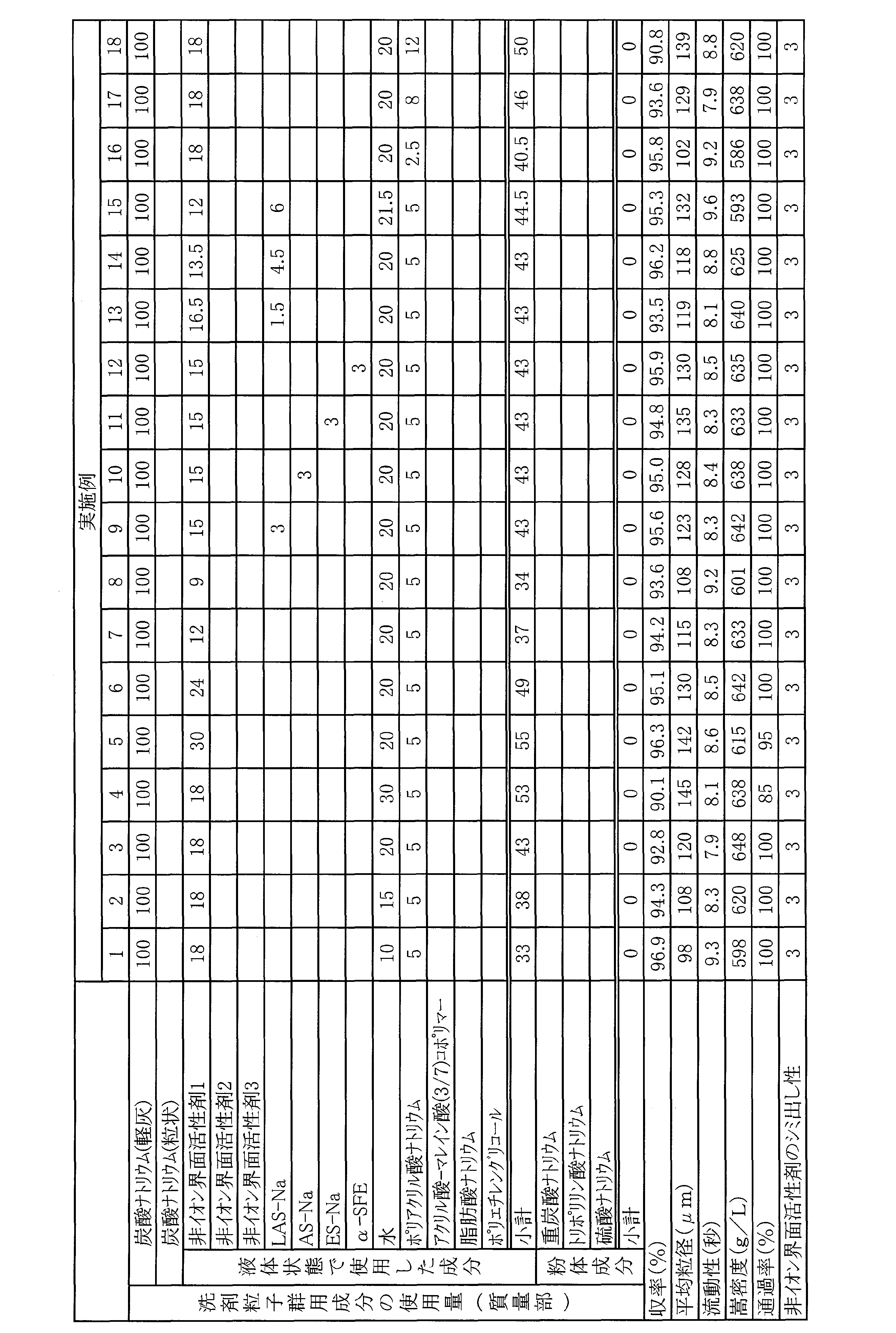
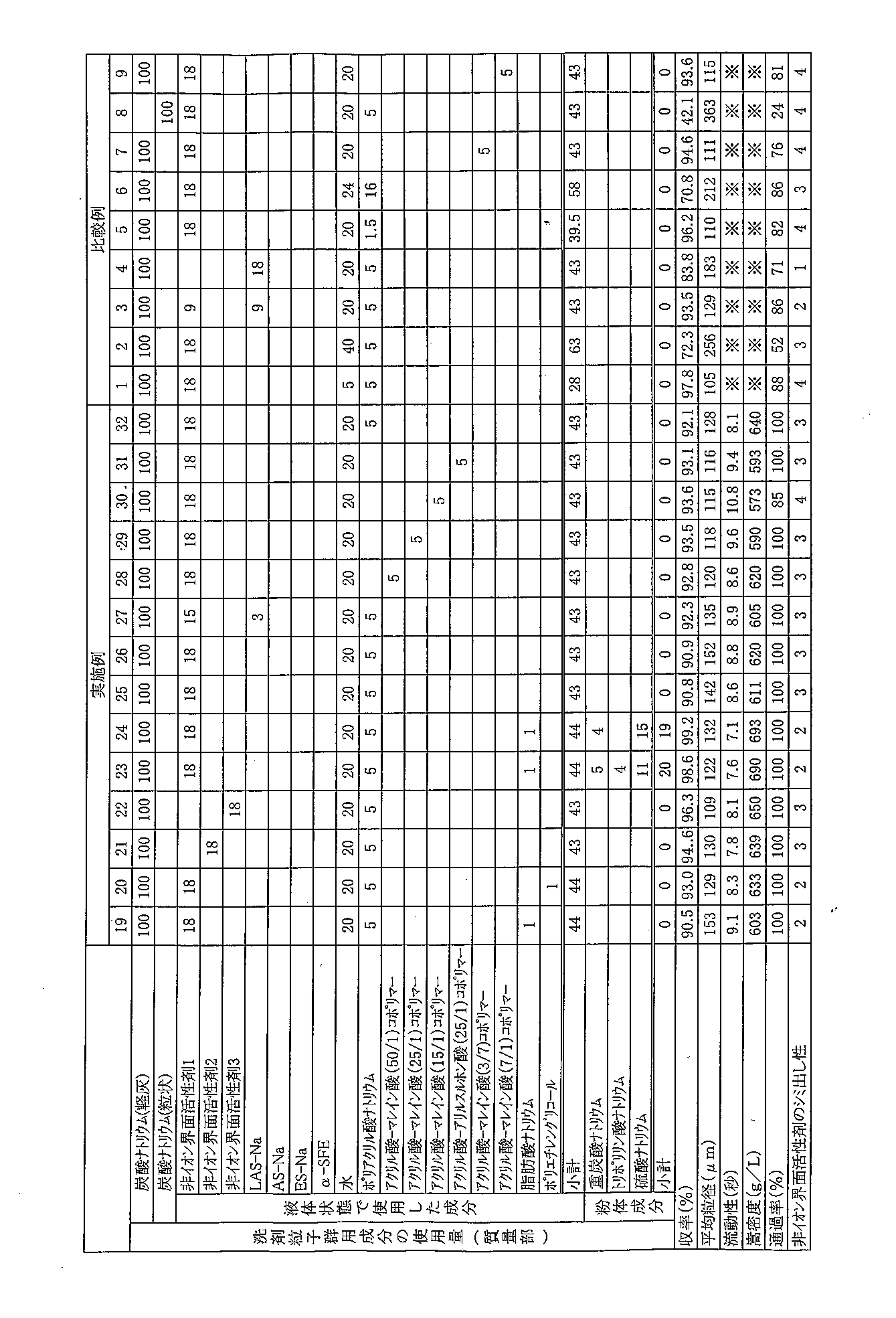
表1~2中の成分は以下のものである。また。表中「※」は、JIS K3362により規定された嵩密度測定用のホッパーから流出しないため、測定不能であることを意味する。また、「液体状態で使用した成分」は工程(A)で液体状態で炭酸ナトリウムと混合したもの、「粉体成分」は工程(A)で粉体状態で炭酸ナトリウムと混合したものを意味する。
・炭酸ナトリウム(軽灰):セントラル硝子(株)製、商品名:ソーダ灰(軽灰)、嵩密度505g/L
・炭酸ナトリウム(粒状):セントラル硝子(株)製、商品名:ソーダ灰(粒状)、嵩密度1020g/L
・硫酸ナトリウム:四国化成(株)製、商品名:中性無水芒硝A0
・重炭酸ナトリウム:東ソー(株)製、商品名:重炭酸ナトリウム
・炭酸ナトリウム(軽灰):セントラル硝子(株)製、商品名:ソーダ灰(軽灰)、嵩密度505g/L
・炭酸ナトリウム(粒状):セントラル硝子(株)製、商品名:ソーダ灰(粒状)、嵩密度1020g/L
・硫酸ナトリウム:四国化成(株)製、商品名:中性無水芒硝A0
・重炭酸ナトリウム:東ソー(株)製、商品名:重炭酸ナトリウム
・ポリアクリル酸ナトリウム:平均分子量1.5万;GPCによる測定、ポリエチレングリコール換算(ポリマーを構成している全モノマー構成単位に対するアクリル酸又はその塩の構成単位が占める割合100モル%)
・アクリル酸-マレイン酸(50/1)コポリマー:ナトリウム塩(70モル%中和)であり、モノマー比はアクリル酸/マレイン酸=50/1(モル比)、平均分子量1.5万(ポリマーを構成している全モノマー構成単位に対するアクリル酸又はその塩の構成単位が占める割合98モル%)
・アクリル酸-マレイン酸(25/1)コポリマー:ナトリウム塩(70モル%中和)であり、モノマー比はアクリル酸/マレイン酸=25/1(モル比)、平均分子量1.5万(ポリマーを構成している全モノマー構成単位に対するアクリル酸又はその塩の構成単位が占める割合96モル%)
・アクリル酸-マレイン酸(15/1)コポリマー:ナトリウム塩(70モル%中和)であり、モノマー比はアクリル酸/マレイン酸=15/1(モル比)、平均分子量1.5万(ポリマーを構成している全モノマー構成単位に対するアクリル酸又はその塩の構成単位が占める割合94モル%)
・アクリル酸-アリルスルホン酸(25/1)コポリマー:ナトリウム塩(70モル%中和)であり、モノマー比はアクリル酸/マレイン酸=25/1(モル比)、平均分子量8000(ポリマーを構成している全モノマー構成単位に対するアクリル酸又はその塩の構成単位が占める割合96モル%)
・アクリル酸-マレイン酸(50/1)コポリマー:ナトリウム塩(70モル%中和)であり、モノマー比はアクリル酸/マレイン酸=50/1(モル比)、平均分子量1.5万(ポリマーを構成している全モノマー構成単位に対するアクリル酸又はその塩の構成単位が占める割合98モル%)
・アクリル酸-マレイン酸(25/1)コポリマー:ナトリウム塩(70モル%中和)であり、モノマー比はアクリル酸/マレイン酸=25/1(モル比)、平均分子量1.5万(ポリマーを構成している全モノマー構成単位に対するアクリル酸又はその塩の構成単位が占める割合96モル%)
・アクリル酸-マレイン酸(15/1)コポリマー:ナトリウム塩(70モル%中和)であり、モノマー比はアクリル酸/マレイン酸=15/1(モル比)、平均分子量1.5万(ポリマーを構成している全モノマー構成単位に対するアクリル酸又はその塩の構成単位が占める割合94モル%)
・アクリル酸-アリルスルホン酸(25/1)コポリマー:ナトリウム塩(70モル%中和)であり、モノマー比はアクリル酸/マレイン酸=25/1(モル比)、平均分子量8000(ポリマーを構成している全モノマー構成単位に対するアクリル酸又はその塩の構成単位が占める割合96モル%)
・アクリル酸-マレイン酸(3/7)コポリマー:ナトリウム塩(70モル%中和)であり、モノマー比はアクリル酸/マレイン酸=3/7(モル比)、平均分子量70000(ポリマーを構成している全モノマー構成単位に対するアクリル酸又はその塩の構成単位が占める割合30モル%)
・アクリル酸-マレイン酸(7/1)コポリマー:ナトリウム塩(70モル%中和)であり、モノマー比はアクリル酸/マレイン酸=7/1(モル比)、平均分子量1.5万(ポリマーを構成している全モノマー構成単位に対するアクリル酸又はその塩の構成単位が占める割合88モル%)
・アクリル酸-マレイン酸(7/1)コポリマー:ナトリウム塩(70モル%中和)であり、モノマー比はアクリル酸/マレイン酸=7/1(モル比)、平均分子量1.5万(ポリマーを構成している全モノマー構成単位に対するアクリル酸又はその塩の構成単位が占める割合88モル%)
・ゼオライト:ゼオビルダー社製、商品名:ゼオビルダー(ゼオライト4A型)
・トリポリリン酸ナトリウム:下関三井化学(株)製、商品名:トリポリリン酸ソーダ)・非イオン界面活性剤1:炭素数12~14の1級アルコールにエチレンオキサイド(以下、EOと表記する)を平均6モル付加させたもの
・非イオン界面活性剤2:炭素数12~14の1級アルコールにEOを平均21モル付加させたもの
・非イオン界面活性剤3:炭素数12~14の1級アルコールにEOを平均9モル、プロピレンオキサイドを平均2モル、EOを平均9モルの順にブロック付加させたもの
・LAS-Na:アルキル基の炭素数12~14の直鎖アルキルベンゼンスルホン酸ナトリウム
・AS-Na:アルキル基の炭素数12~16のアルキル硫酸エステルナトリウム
・ES-Na:花王(株)製、商品名:エマール170J(平均EO付加モル数2)
・α-SFE:アルキル基の炭素数が12~14のα-スルホ脂肪酸メチルエステルナトリウム
・脂肪酸ナトリウム:花王(株)製、商品名:ルナックL55を48%苛性ソーダで中和したもの
・ポリエチレングリコール:花王(株)製、商品名:K-PEG6000LA(平均分子量;8500)
・トリポリリン酸ナトリウム:下関三井化学(株)製、商品名:トリポリリン酸ソーダ)・非イオン界面活性剤1:炭素数12~14の1級アルコールにエチレンオキサイド(以下、EOと表記する)を平均6モル付加させたもの
・非イオン界面活性剤2:炭素数12~14の1級アルコールにEOを平均21モル付加させたもの
・非イオン界面活性剤3:炭素数12~14の1級アルコールにEOを平均9モル、プロピレンオキサイドを平均2モル、EOを平均9モルの順にブロック付加させたもの
・LAS-Na:アルキル基の炭素数12~14の直鎖アルキルベンゼンスルホン酸ナトリウム
・AS-Na:アルキル基の炭素数12~16のアルキル硫酸エステルナトリウム
・ES-Na:花王(株)製、商品名:エマール170J(平均EO付加モル数2)
・α-SFE:アルキル基の炭素数が12~14のα-スルホ脂肪酸メチルエステルナトリウム
・脂肪酸ナトリウム:花王(株)製、商品名:ルナックL55を48%苛性ソーダで中和したもの
・ポリエチレングリコール:花王(株)製、商品名:K-PEG6000LA(平均分子量;8500)
Claims (14)
- 嵩密度が400~600g/Lの粉末状炭酸ナトリウム100質量部に対して、非イオン界面活性剤6~35質量部、ポリマーを構成している全モノマー構成単位に対するアクリル酸又はその塩の構成単位が占める割合が90~100モル%であるアクリル酸型ポリマー2~14質量部、及び水8~35質量部を混合する工程(A)を有し、工程(A)で粉末状炭酸ナトリウムと混合する界面活性剤中、非イオン界面活性剤の割合が60質量%以上である、洗剤粒子群の製造方法。
- 工程(A)において、非イオン界面活性剤、アクリル酸型ポリマー、及び水を含有する界面活性剤組成物を前記粉末状炭酸ナトリウムと混合する、請求項1記載の洗剤粒子群の製造方法。
- 工程(A)で、更に陰イオン界面活性剤を前記粉末状炭酸ナトリウムと混合し、且つ非イオン界面活性剤/陰イオン界面活性剤の質量比が20/1~3/2である、請求項1又は2記載の洗剤粒子群の製造方法。
- アクリル酸型ポリマーが、ポリアクリル酸又はその塩である請求項1~3の何れかに記載の洗剤粒子群の製造方法。
- アクリル酸型ポリマーが、アクリル酸とアリルスルホン酸又はマレイン酸とのコポリマー又はそのコポリマーの塩である、請求項1~3の何れかに記載の洗剤粒子群の製造方法。
- アクリル酸型ポリマーの重量平均分子量が2000~80000である請求項1~5の何れかに記載の洗剤粒子群の製造方法。
- 非イオン界面活性剤が、炭素数8~22のアルキル基を有し、オキシエチレン基を含むオキシアルキレン基の平均付加モル数が4~25モルであるポリオキシアルキレンアルキルエーテルである、請求項1~6の何れかに記載の洗剤粒子群の製造方法。
- 粉末状炭酸ナトリウムの平均粒径が60~150μmである、請求項1~7の何れかに記載の洗剤粒子群の製造方法。
- 得られる洗剤粒子群の平均粒径が75~250μmである、請求項1~8の何れかに記載の洗剤粒子群の製造方法。
- 得られる洗剤粒子群の嵩密度が400~1000g/Lである、請求項1~9の何れかに記載の洗剤粒子群の製造方法。
- 得られる洗剤粒子群の流動性が、JIS K3362により規定された見掛け密度測定用の漏斗から、100mLの洗剤粒子群が流出するのに要する時間として、10秒以下である、請求項1~10の何れかに記載の洗剤粒子群の製造方法。
- 請求項1~11の何れかの製造方法によって得られた洗剤粒子群。
- 請求項1~11に記載の製造方法によって得られた洗剤粒子群を用いて、繊維製品を洗浄する方法。
- 請求項1~11に記載の製造方法によって得られた洗剤粒子群の繊維製品の洗浄への使用。
Priority Applications (1)
| Application Number | Priority Date | Filing Date | Title |
|---|---|---|---|
| CN201180044558.4A CN103108948B (zh) | 2010-09-15 | 2011-09-02 | 洗涤剂颗粒群的制造方法 |
Applications Claiming Priority (4)
| Application Number | Priority Date | Filing Date | Title |
|---|---|---|---|
| JP2010206421 | 2010-09-15 | ||
| JP2010-206421 | 2010-09-15 | ||
| JP2011-128114 | 2011-06-08 | ||
| JP2011128114A JP4926285B2 (ja) | 2010-09-15 | 2011-06-08 | 洗剤粒子群の製造方法 |
Publications (1)
| Publication Number | Publication Date |
|---|---|
| WO2012035993A1 true WO2012035993A1 (ja) | 2012-03-22 |
Family
ID=45831461
Family Applications (1)
| Application Number | Title | Priority Date | Filing Date |
|---|---|---|---|
| PCT/JP2011/069979 Ceased WO2012035993A1 (ja) | 2010-09-15 | 2011-09-02 | 洗剤粒子群の製造方法 |
Country Status (4)
| Country | Link |
|---|---|
| JP (1) | JP4926285B2 (ja) |
| CN (1) | CN103108948B (ja) |
| TW (1) | TWI494425B (ja) |
| WO (1) | WO2012035993A1 (ja) |
Families Citing this family (2)
| Publication number | Priority date | Publication date | Assignee | Title |
|---|---|---|---|---|
| JP5971753B2 (ja) * | 2012-07-09 | 2016-08-17 | 花王株式会社 | 洗剤粒子の製造方法 |
| CN105255604A (zh) * | 2015-11-18 | 2016-01-20 | 华文蔚 | 一种杀菌洗衣液 |
Citations (4)
| Publication number | Priority date | Publication date | Assignee | Title |
|---|---|---|---|---|
| JPS63286496A (ja) * | 1987-04-30 | 1988-11-24 | ユニリーバー・ナームローゼ・ベンノートシヤープ | 粒状洗剤組成物の製造方法 |
| JPH06136398A (ja) * | 1992-10-28 | 1994-05-17 | Lion Corp | 粒状洗剤組成物 |
| JP2005239867A (ja) * | 2004-02-26 | 2005-09-08 | Lion Corp | 水溶性無機物質含有粒子 |
| JP2009073950A (ja) * | 2007-09-21 | 2009-04-09 | Kao Corp | リネンサプライ用粉末洗剤組成物 |
Family Cites Families (1)
| Publication number | Priority date | Publication date | Assignee | Title |
|---|---|---|---|---|
| JP5525755B2 (ja) * | 2008-05-19 | 2014-06-18 | 花王株式会社 | 界面活性剤担持用顆粒群 |
-
2011
- 2011-06-08 JP JP2011128114A patent/JP4926285B2/ja active Active
- 2011-08-31 TW TW100131359A patent/TWI494425B/zh active
- 2011-09-02 WO PCT/JP2011/069979 patent/WO2012035993A1/ja not_active Ceased
- 2011-09-02 CN CN201180044558.4A patent/CN103108948B/zh active Active
Patent Citations (4)
| Publication number | Priority date | Publication date | Assignee | Title |
|---|---|---|---|---|
| JPS63286496A (ja) * | 1987-04-30 | 1988-11-24 | ユニリーバー・ナームローゼ・ベンノートシヤープ | 粒状洗剤組成物の製造方法 |
| JPH06136398A (ja) * | 1992-10-28 | 1994-05-17 | Lion Corp | 粒状洗剤組成物 |
| JP2005239867A (ja) * | 2004-02-26 | 2005-09-08 | Lion Corp | 水溶性無機物質含有粒子 |
| JP2009073950A (ja) * | 2007-09-21 | 2009-04-09 | Kao Corp | リネンサプライ用粉末洗剤組成物 |
Also Published As
| Publication number | Publication date |
|---|---|
| TW201213538A (en) | 2012-04-01 |
| CN103108948B (zh) | 2014-11-26 |
| CN103108948A (zh) | 2013-05-15 |
| JP4926285B2 (ja) | 2012-05-09 |
| TWI494425B (zh) | 2015-08-01 |
| JP2012082390A (ja) | 2012-04-26 |
Similar Documents
| Publication | Publication Date | Title |
|---|---|---|
| JP5631127B2 (ja) | 洗剤粒子群の製造方法 | |
| JP4926285B2 (ja) | 洗剤粒子群の製造方法 | |
| JP2008189719A (ja) | 洗剤組成物 | |
| JP4799951B2 (ja) | 単核性洗剤粒子群の製造方法 | |
| JP5924805B2 (ja) | 粉末洗剤組成物 | |
| JP4170079B2 (ja) | 粉末洗浄剤組成物 | |
| JP4823224B2 (ja) | 柔軟洗剤組成物 | |
| JP2022026081A (ja) | 衣料用粒状洗剤組成物及び衣料用粒状洗剤組成物の製造方法 | |
| JP5192156B2 (ja) | 洗剤組成物の製造方法 | |
| JP4772415B2 (ja) | 単核性洗剤粒子群の製造方法 | |
| JP4970036B2 (ja) | 非イオン性界面活性剤含有粒子およびその製造方法 | |
| JP4889870B2 (ja) | 衣料用粉末洗剤組成物 | |
| JPH0711294A (ja) | 洗浄剤組成物 | |
| JP5780843B2 (ja) | 粉末洗剤組成物 | |
| JPH10306296A (ja) | 粒状消泡剤組成物および粒状洗剤組成物 | |
| JP4534193B2 (ja) | 粉末洗剤組成物 | |
| JP3881821B2 (ja) | 高嵩密度洗剤粒子群 | |
| JP4252176B2 (ja) | 高嵩密度洗剤 | |
| JP4376405B2 (ja) | 漂白洗浄剤組成物 | |
| JP2011052181A (ja) | 洗剤組成物の製造方法 | |
| KR100361131B1 (ko) | 고밀도세탁용분말세제의제조방법및그로부터제조한분말세제 | |
| JP2003193091A (ja) | 含水無機粒子及びそれを含有する洗剤組成物 | |
| KR960010807B1 (ko) | 고밀도 분말 비이온 세제 조성물 및 그 제조방법 | |
| JP4173729B2 (ja) | 界面活性剤組成物 | |
| JPH02151699A (ja) | 高嵩密度粒状洗剤組成物 |
Legal Events
| Date | Code | Title | Description |
|---|---|---|---|
| WWE | Wipo information: entry into national phase |
Ref document number: 201180044558.4 Country of ref document: CN |
|
| 121 | Ep: the epo has been informed by wipo that ep was designated in this application |
Ref document number: 11824999 Country of ref document: EP Kind code of ref document: A1 |
|
| NENP | Non-entry into the national phase |
Ref country code: DE |
|
| 122 | Ep: pct application non-entry in european phase |
Ref document number: 11824999 Country of ref document: EP Kind code of ref document: A1 |