WO2012011368A1 - 炭酸カルシウム用分散剤及びその連続生産方法 - Google Patents
炭酸カルシウム用分散剤及びその連続生産方法 Download PDFInfo
- Publication number
- WO2012011368A1 WO2012011368A1 PCT/JP2011/064729 JP2011064729W WO2012011368A1 WO 2012011368 A1 WO2012011368 A1 WO 2012011368A1 JP 2011064729 W JP2011064729 W JP 2011064729W WO 2012011368 A1 WO2012011368 A1 WO 2012011368A1
- Authority
- WO
- WIPO (PCT)
- Prior art keywords
- dispersant
- calcium carbonate
- concentration
- aqueous solution
- isopropyl alcohol
- Prior art date
- Legal status (The legal status is an assumption and is not a legal conclusion. Google has not performed a legal analysis and makes no representation as to the accuracy of the status listed.)
- Ceased
Links
Classifications
-
- C—CHEMISTRY; METALLURGY
- C08—ORGANIC MACROMOLECULAR COMPOUNDS; THEIR PREPARATION OR CHEMICAL WORKING-UP; COMPOSITIONS BASED THEREON
- C08F—MACROMOLECULAR COMPOUNDS OBTAINED BY REACTIONS ONLY INVOLVING CARBON-TO-CARBON UNSATURATED BONDS
- C08F2/00—Processes of polymerisation
- C08F2/12—Polymerisation in non-solvents
- C08F2/16—Aqueous medium
- C08F2/18—Suspension polymerisation
- C08F2/20—Suspension polymerisation with the aid of macromolecular dispersing agents
-
- C—CHEMISTRY; METALLURGY
- C08—ORGANIC MACROMOLECULAR COMPOUNDS; THEIR PREPARATION OR CHEMICAL WORKING-UP; COMPOSITIONS BASED THEREON
- C08F—MACROMOLECULAR COMPOUNDS OBTAINED BY REACTIONS ONLY INVOLVING CARBON-TO-CARBON UNSATURATED BONDS
- C08F2/00—Processes of polymerisation
- C08F2/44—Polymerisation in the presence of compounding ingredients, e.g. plasticisers, dyestuffs, fillers
-
- C—CHEMISTRY; METALLURGY
- C08—ORGANIC MACROMOLECULAR COMPOUNDS; THEIR PREPARATION OR CHEMICAL WORKING-UP; COMPOSITIONS BASED THEREON
- C08F—MACROMOLECULAR COMPOUNDS OBTAINED BY REACTIONS ONLY INVOLVING CARBON-TO-CARBON UNSATURATED BONDS
- C08F20/00—Homopolymers and copolymers of compounds having one or more unsaturated aliphatic radicals, each having only one carbon-to-carbon double bond, and only one being terminated by only one carboxyl radical or a salt, anhydride, ester, amide, imide or nitrile thereof
- C08F20/02—Monocarboxylic acids having less than ten carbon atoms, Derivatives thereof
- C08F20/04—Acids, Metal salts or ammonium salts thereof
- C08F20/06—Acrylic acid; Methacrylic acid; Metal salts or ammonium salts thereof
-
- C—CHEMISTRY; METALLURGY
- C09—DYES; PAINTS; POLISHES; NATURAL RESINS; ADHESIVES; COMPOSITIONS NOT OTHERWISE PROVIDED FOR; APPLICATIONS OF MATERIALS NOT OTHERWISE PROVIDED FOR
- C09K—MATERIALS FOR MISCELLANEOUS APPLICATIONS, NOT PROVIDED FOR ELSEWHERE
- C09K23/00—Use of substances as emulsifying, wetting, dispersing, or foam-producing agents
Definitions
- the present invention relates to a dispersant for calcium carbonate and a continuous production method thereof. More specifically, the present invention relates to a calcium carbonate dispersant in which the initial viscosity of a calcium carbonate slurry obtained by wet pulverization is low and a significant increase in viscosity over time is suppressed, and a continuous production method thereof.
- Calcium carbonate slurry obtained by wet pulverization of calcium carbonate is widely used for paper coating agents, paint pigments, and the like.
- a dispersant for calcium carbonate is used to lower the viscosity of the obtained calcium carbonate slurry.
- a dispersant containing an acrylic polymer is used in order to obtain a slurry having a low viscosity.
- Patent Document 1 discloses a method for producing a polymer having a low molecular weight by using water as a solvent and using a large amount of a molecular weight regulator such as sodium hypophosphite. Has been.
- Patent Document 2 As a method not using a molecular weight modifier such as sodium hypophosphite, for example, in Patent Document 2, the weight average molecular weight is 4,000 to 40,000, and Mw / Mn is 1.2 to 2.
- a method for producing a dispersant comprising a polymer containing a vinyl group-containing monocarboxylic acid (salt) as a constituent unit using 0 persulfate as a polymerization initiator and isopropyl alcohol as a reaction solvent and molecular weight regulator. It is disclosed.
- Patent Documents 3 and 4 also disclose a method for producing a dispersant using persulfate as a polymerization initiator and isopropyl alcohol as a reaction solvent and molecular weight regulator, as in Patent Document 2.
- the present invention has been made in view of the above problems, and the calcium carbonate slurry obtained has a low initial viscosity, suppresses a significant increase in viscosity over time, and has excellent long-term dispersion stability. And it aims at providing the continuous production method.
- a calcium carbonate slurry obtained by wet pulverization or the like has a low initial viscosity and has a small increase in viscosity over time.
- a monomer, an aqueous isopropyl alcohol solution, hypophosphite, persulfate, and sodium hydroxide are continuously supplied to the reactor, and the supply amount thereof is 100 parts by mass of the monomer, and the isopropyl alcohol. 15 to 100 parts by weight, the above hypophosphite is 2.0 to 5.0 parts by weight, the persulfate is 0.5 to 2.0 parts by weight, and the sodium hydroxide is 5.0 to 20 parts by weight.
- the present invention is as follows. 1. A calcium carbonate dispersant obtained by sequentially providing a polymerization step and a neutralization step, In the polymerization step, a monomer containing acrylic acid, an isopropyl alcohol aqueous solution, hypophosphite, persulfate, and sodium hydroxide are continuously supplied to the reactor to continuously polymerize the monomer. Process, In the polymerization step, the isopropyl alcohol, the hypophosphite, the persulfate, and the sodium hydroxide contained in the isopropyl alcohol aqueous solution are supplied in an amount of 100 parts by mass of the monomer.
- the reaction temperature of the polymerization step is 68 to 82 ° C.
- the neutralization step is a step of neutralizing 15 to 95 mol% of carboxyl groups of the monomer-derived constitutional units constituting the polymer obtained by the polymerization step.
- the isopropyl alcohol recovered by the distillation is used in the polymerization step.
- Dispersant for calcium carbonate as described in 1. 4).
- the isopropyl alcohol concentration in the isopropyl alcohol aqueous solution is 15 to 55% by mass.
- the dispersing agent for calcium carbonate in any one of. 5 The content of the acrylic acid in the monomer is 80 to 100% by mass with respect to 100% by mass of the total amount of the monomer.
- the dispersing agent for calcium carbonate in any one of. 6).
- the isopropyl alcohol recovered by the distillation is used in the polymerization step.
- the isopropyl alcohol concentration in the isopropyl alcohol aqueous solution is 15 to 55% by mass.
- the continuous production method of the dispersing agent for calcium carbonate in any one of. 12 The content of the acrylic acid in the monomer is 80 to 100% by mass with respect to 100% by mass of the total amount of the monomer.
- the dispersant for calcium carbonate of the present invention is excellent in dispersibility of calcium carbonate, and particularly exhibits excellent dispersibility and long-term dispersion stability as a dispersant for wet grinding of calcium carbonate.
- the dispersant for calcium carbonate of the present invention uses isopropyl alcohol having the function of a molecular weight regulator as a solvent, and uses a hypophosphite as a molecular weight regulator and a persulfate as a polymerization initiator in combination.
- Dispersion for calcium carbonate with less by-products such as phosphite and phosphate by-produced from hypophosphite and sulfate by-produced from persulfate by adding sodium oxide It can be used as an agent.
- the calcium carbonate slurry obtained can have a low initial viscosity and can be a calcium carbonate slurry that suppresses a significant increase in viscosity over time. Further, when the content of the acrylic acid in the monomer is 80 to 100% by mass with respect to 100% by mass of the total amount of the monomer, the dispersibility of calcium carbonate is further improved. It can be a dispersant.
- the method for continuous production of a dispersant for calcium carbonate according to the present invention efficiently produces a dispersant for calcium carbonate that forms a calcium carbonate slurry in which the initial viscosity of the calcium carbonate slurry is low and a significant increase in viscosity over time is suppressed. be able to.
- a concentration step for distilling off isopropyl alcohol is provided after the polymerization step, a dispersant for calcium carbonate with reduced isopropyl alcohol can be efficiently produced.
- the concentration step when isopropyl alcohol recovered by the distillation is used in the polymerization step, the distilled isopropyl alcohol is reused in the polymerization step, so that there is no need for disposal and cost can be reduced.
- the present invention is a dispersing agent for calcium carbonate obtained by a production method (continuous production method) sequentially comprising a polymerization step and a neutralization step, wherein the polymerization step comprises a monomer containing acrylic acid, an isopropyl alcohol aqueous solution, Hypophosphite, persulfate and sodium hydroxide are continuously supplied to the reactor, and the monomer is continuously polymerized.
- a production method continuous production method sequentially comprising a polymerization step and a neutralization step, wherein the polymerization step comprises a monomer containing acrylic acid, an isopropyl alcohol aqueous solution, Hypophosphite, persulfate and sodium hydroxide are continuously supplied to the reactor, and the monomer is continuously polymerized.
- the polymerization step isopropyl contained in the isopropyl alcohol aqueous solution.
- the supply amount of the alcohol, the hypophosphite, the persulfate, and the sodium hydroxide is such that the isopropyl alcohol is 15 to 100 parts by mass, the hypophosphite is 100 parts by mass of the monomer.
- the reaction temperature is 68 to 82 ° C.
- the neutralization step includes structural units derived from the monomer constituting the polymer obtained by the polymerization step (hereinafter also referred to as “first polymer”). It is a step of neutralizing 15 to 95 mol% of the carboxyl group possessed.
- the supply amount can be a supply amount per unit time in the continuous production method.
- “(meth) acryl” is used to mean one or both of acrylic and methacrylic.
- the dispersant of the present invention is obtained by including the polymerization step and the neutralization step.
- the raw materials used for forming the dispersant of the present invention will be described.
- the monomer polymerized by the polymerization reaction is a monomer containing at least acrylic acid. Therefore, the total amount of the monomer may be acrylic acid, and the monomer may contain acrylic acid as part of the monomer.
- the monomer other than acrylic acid (hereinafter also referred to as “other monomer”) is not particularly limited as long as it is a monomer copolymerizable with acrylic acid. Specifically, a vinyl monomer (polymerizable unsaturated compound) having radical polymerizability is exemplified.
- ethylenically unsaturated carboxylic acids other than acrylic acid include methacrylic acid, ethacrylic acid, maleic acid, fumaric acid, itaconic acid, crotonic acid, phthalic anhydride half-esterified with alkyl alcohol, and itaconic anhydride And those obtained by half-esterification with alkyl alcohol.
- Examples of the neutralized salt of the ethylenically unsaturated carboxylic acid include ethylenically unsaturated carboxylic acids in which carboxyl groups such as acrylic acid, methacrylic acid, ethacrylic acid, maleic acid, fumaric acid, itaconic acid, and crotonic acid are neutralized. Salt.
- Examples of the ethylenically unsaturated carboxylate include alkali metal salts, alkaline earth metal salts, ammonium salts, and organic amine salts.
- Examples of the (meth) acrylic acid alkyl ester compounds include methyl (meth) acrylate, ethyl (meth) acrylate, n-propyl (meth) acrylate, isopropyl (meth) acrylate, and n-butyl (meth) acrylate.
- aromatic vinyl compound examples include styrene, 2-methylstyrene, 3-methylstyrene, 4-methylstyrene, ⁇ -methylstyrene, 2,4-dimethylstyrene, 2,4-diisopropylstyrene, and 4-tert-butylstyrene.
- acid anhydride monomer examples include maleic anhydride, itaconic anhydride, citraconic anhydride, and the like.
- amino group-containing vinyl compound examples include dimethylaminomethyl (meth) acrylate, diethylaminomethyl (meth) acrylate, 2-dimethylaminoethyl (meth) acrylate, 2-diethylaminoethyl (meth) acrylate, (meth) 2- (di-n-propylamino) ethyl acrylate, 2-dimethylaminopropyl (meth) acrylate, 2-diethylaminopropyl (meth) acrylate, 2- (di-n-propylamino) (meth) acrylate And propyl, 3-dimethylaminopropyl (meth) acrylate, 3-diethylaminopropyl (meth) acrylate, 3- (di-n-propylamino) propyl (meth) acrylate, and the like.
- amide group-containing vinyl compound examples include (meth) acrylamide, N, N-dimethyl (meth) acrylamide, N, N-dimethylaminopropyl (meth) acrylamide, N-methylol (meth) acrylamide and the like.
- sulfonic acid group-containing vinyl compound examples include methallylsulfonic acid, acrylamido-2-methyl-2-propanesulfonic acid, and the like.
- polyoxyalkylene group-containing vinyl compound examples include (meth) acrylic acid esters of alcohols having a polyoxyethylene group and / or a polyoxypropylene group.
- alkoxyl group-containing vinyl compound examples include 2-methoxyethyl (meth) acrylate, 2-ethoxyethyl (meth) acrylate, 2- (n-propoxy) ethyl (meth) acrylate, and 2- (meth) acrylic acid 2- (N-butoxy) ethyl, 3-methoxypropyl (meth) acrylate, 3-ethoxypropyl (meth) acrylate, 2- (n-propoxy) propyl (meth) acrylate, 2- (n) (meth) acrylate -Butoxy) propyl and the like.
- vinyl cyanide compound examples include acrylonitrile, methacrylonitrile, ethacrylonitrile and the like.
- Examples of the vinyl ether compound include vinyl methyl ether, vinyl ethyl ether, vinyl-n-butyl ether, vinyl phenyl ether, vinyl cyclohexyl ether and the like. These may be used alone or in combination of two or more.
- Examples of the vinyl ester monomer include vinyl formate, vinyl acetate, and vinyl propionate.
- maleimide compounds such as maleimide, N-methylmaleimide, N-butylmaleimide, N-phenylmaleimide, N-cyclohexylmaleimide; maleic acid ester compounds; itaconic acid ester compounds; N-vinyl heterocyclic compounds such as vinylpyridine Is mentioned.
- methyl acrylate, butyl acrylate, and the like are preferable.
- methyl acrylate, butyl acrylate or the like together with acrylic acid a dispersant excellent in suppression of coloring can be obtained.
- the content of acrylic acid is preferably 80% by mass or more with respect to 100% by mass of the total monomer. More preferably, it is 90 mass% or more, More preferably, it is 95 mass%.
- the case where the total amount of monomers is acrylic acid is particularly preferably 100% by mass.
- the acrylic acid content is 80% by mass or more, the solubility of the resulting dispersant in water can be made sufficient.
- hypophosphite is used as a chain transfer agent.
- the hypophosphite is not particularly limited as long as it is a compound having a chain transfer action.
- the supply amount (use amount) of the hypophosphite in the polymerization step is 2.0 to 5.0 parts by mass, preferably 2.5 to 4.5 parts per 100 parts by mass of the monomer. Part by mass, more preferably 3.0 to 4.5 parts by mass.
- amount of hypophosphite supplied is within the above range, continuous polymerization of the monomer is efficiently performed.
- the amount of hypophosphite used is 5.0 parts by mass or less, a dispersant with a low content of by-product phosphite and phosphate can be obtained.
- the resulting calcium carbonate slurry has a low initial viscosity, a significant increase in viscosity over time can be suppressed, and a dispersant having excellent long-term dispersion stability can be obtained.
- the supply amount of hypophosphite is large (for example, more than 5.0 parts by mass)
- the initial viscosity of the calcium carbonate slurry increases, and the viscosity increases with time. This is presumed that the increase in viscosity is caused by the increase of phosphite and phosphate, which are by-products generated from hypophosphite, and this by-product forms a poorly soluble compound with calcium carbonate.
- sodium hydroxide is used as the basic compound. This sodium hydroxide is added to prevent oxidation of the hypophosphite in the polymerization step. Hypophosphite is oxidized to yield by-products, phosphite and phosphate. In this invention, the oxidation of the hypophosphite used as a chain transfer agent can be efficiently suppressed by using sodium hydroxide in the polymerization step.
- the supply amount (use amount) of the sodium hydroxide in the polymerization step is 5.0 to 20 parts by mass, preferably 7.0 to 15 parts by mass with respect to 100 parts by mass of the monomer.
- the supply amount of sodium hydroxide is within the above range, the oxidation of hypophosphite in the polymerization process can be efficiently suppressed, and the initial viscosity of the calcium carbonate slurry obtained by wet grinding is low, and it depends on the time A significant increase in viscosity is suppressed, and a dispersant having excellent long-term dispersion stability can be obtained.
- an aqueous solution of isopropyl alcohol is used as a solvent.
- Isopropyl alcohol also acts as a chain transfer agent in the polymerization step. Therefore, the isopropyl alcohol aqueous solution is used as a reaction solvent and a chain transfer agent.
- the isopropyl alcohol concentration of the aqueous isopropyl alcohol solution is preferably 5% by mass or more and 90% by mass or less, more preferably 10 to 80% by mass, still more preferably 15 to 60% by mass, and particularly preferably 15 to 55% by mass.
- the mass may be 17 to 50 mass% or 20 to 40 mass%.
- the weight average molecular weight of the first polymer when the weight average molecular weight of the first polymer is within the above range, it becomes a dispersant having excellent dispersion performance for dispersing calcium carbonate, and the resulting calcium carbonate slurry has a low initial viscosity, and further has a viscosity over time. It can be set as a dispersing agent with little raise.
- the dispersant can be obtained efficiently by continuous polymerization.
- the initial viscosity of the resulting calcium carbonate slurry is low, and the viscosity increases significantly over time. It can be set as the calcium carbonate slurry by which water is suppressed.
- hypophosphite and persulfate used is reduced, and by addition of sodium hydroxide, phosphite and phosphate by-produced from hypophosphite, and Since there are few by-products such as sulfate produced as a by-product from persulfate, the formation of a poorly soluble compound between the by-product and calcium carbonate is suppressed, thereby lowering the initial viscosity of the slurry, A significant increase in viscosity due to is suppressed.
- the reaction temperature in the polymerization step is 68 to 82 ° C, preferably 70 to 80 ° C.
- the reaction temperature is 68 to 82 ° C. or lower, the polymerization can be smoothly advanced and the molecular weight modifier hypophosphorous acid can be prevented from being oxidized to phosphite or phosphate. It is possible to make a dispersant having a low content of phosphite and phosphate. Moreover, the dispersing agent with few unreacted monomers can be obtained by making reaction temperature 68 degreeC or more.
- a tank reactor can be used as the reactor.
- the monomer polymerization reaction can be efficiently performed by using a tank reactor.
- a plurality of tank reactors are connected in series (hereinafter, simply referred to as “continuous tank reactor”) to efficiently perform continuous polymerization of monomers. be able to.
- the tank reactor a known reactor can be used, and one having a stirrer and a temperature control device is preferable.
- the first reactor in the polymerization step is the first reactor (upstream side), the next reactor is the second reactor, and The last reactor in the polymerization step is the nth reactor (downstream side).
- At least the monomer, the isopropyl alcohol aqueous solution, the hypophosphite, the persulfate, and the sodium hydroxide are continuously supplied to the first reactor as raw materials.
- the raw material supply ratio to the reactor may be that all of the raw material to be supplied may be supplied to the first reactor, a part of the raw material is supplied to the first reactor, and the remainder supplied to the first reactor is other than May be fed to the reactor.
- the amount (neutralization rate) for neutralizing the carboxyl group of the first polymer is 15 to 95 mol%, preferably 20 to 90 mol%.
- the neutralization ratio is 15 to 95 mol%, a dispersant having excellent dispersion performance for dispersing calcium carbonate can be obtained.
- a reactor can also be used in the neutralization step.
- a tank reactor can be used similarly to the reactor used in the polymerization step.
- a continuous tank reactor (nth group) used in the polymerization step is used.
- a tank reactor used in the neutralization step is connected, and three or more continuous tank reactors are connected in series, so that the polymerization step and the neutralization step can be performed continuously and efficiently.
- a dispersing agent can be efficiently obtained by using a continuous tank type reactor which connected three or more units in series with a polymerization process and a neutralization process.
- the acrylic polymer contained in the dispersant is a polymer obtained by polymerizing a monomer containing acrylic acid and neutralizing a part of the carboxyl group derived from the monomer.
- the composition may be derived from the hypophosphite and persulfate used in the polymerization.
- the acrylic polymer has a weight average molecular weight of preferably 4500 to 8500, more preferably 5000 to 8000. The weight average molecular weight can be measured by a GPC using a standard substance such as sodium polyacrylate.
- the dispersant of the present invention can further include a concentration step after the polymerization step.
- the concentration step is preferably provided between the polymerization step and the neutralization step.
- the concentration step is a step of obtaining a concentrated composition in which isopropyl alcohol is reduced by distilling off isopropyl alcohol from the reaction solution containing the first polymer obtained in the polymerization step.
- the content of isopropyl alcohol contained in the concentrated composition obtained by the concentration step is preferably 1% by mass or less, more preferably 5000 ppm by mass or less, still more preferably 2000 ppm by mass or less, particularly preferably. It is 1000 mass ppm or less.
- the isopropyl alcohol aqueous solution distilled off in the concentration step can be recovered. And this collect
- the aqueous isopropyl alcohol solution is reused, it is not necessary to discard the distilled isopropyl alcohol, the cost is reduced, the production efficiency is excellent, and the dispersant for calcium carbonate, which is excellent in environmental conservation, and calcium carbonate It can be set as the manufacturing method of the dispersing agent.
- the concentration of isopropyl alcohol in the isopropyl alcohol aqueous solution may change before and after the recovery.
- the concentration of the recovered isopropyl alcohol aqueous solution may be lower than that before the recovery due to distillation. In that case, it is necessary to concentrate the recovered aqueous isopropyl alcohol solution so as to have a high concentration. Depending on the concentration of the aqueous isopropyl alcohol solution, the concentration of the recovered aqueous isopropyl alcohol solution may be higher than before the recovery. When the concentration of the recovered isopropyl alcohol aqueous solution becomes higher than that before the recovery, water may be newly added to adjust the concentration.
- the isopropyl alcohol aqueous solution can be recycled by making the concentration of isopropyl alcohol in the aqueous isopropyl alcohol solution lower than the concentration of isopropyl alcohol in the recovered isopropyl alcohol aqueous solution in the concentration step.
- the concentration of isopropyl alcohol for recovering and using this aqueous isopropyl alcohol solution is preferably 15 to 55% by mass, more preferably 17 to 50% by mass, and still more preferably 20 to 40% by mass. .
- the isopropyl alcohol aqueous solution is preferably reused in the polymerization step by adjusting the isopropyl alcohol concentration.
- the concentrated composition obtained in the concentration step is subjected to the neutralization step, and a part of the carboxyl groups of the first polymer is neutralized to obtain a dispersant containing an acrylic polymer. it can.
- the continuous production method which consists of a superposition
- two or more connected continuous tank type reactive groups can be used as the polymerization step, and a thin film evaporator can be used as the concentration step.
- a tank-type reactive group can be used as a neutralization process.
- a dispersing agent of this invention it is obtained by providing the said reaction process (a) obtained by providing the said superposition
- the obtained reaction liquid (b) can be used as the dispersant of the present invention.
- the dispersant may be further added with an aqueous medium.
- the reaction liquid (b) is an aqueous solution in which an acrylic polymer is dissolved in an aqueous medium, and the hypophosphite and / or its by-products, persulfate, and In some cases, the by-product and the basic compound used in the neutralization step may be included. Furthermore, the reaction solution (b) may contain isopropyl alcohol in an amount corresponding to the content after the concentration step.
- the content of isopropyl alcohol contained in the reaction liquid (b) can be 1% by mass or less, preferably 5000 ppm by mass or less, more preferably 2000 ppm by mass or less, and still more preferably 1000 ppm by mass. It is as follows.
- preservatives examples include isothiazoline-based and parabens.
- the content thereof is preferably 0.001 to 1.0 part by mass with respect to 100 parts by mass of the acrylic polymer.
- the dispersant of the present invention may be a solution or dispersion in which an acrylic polymer and the above-described other components blended as necessary are contained in an aqueous medium. Moreover, when the dispersing agent of this invention contains the said other component, another component is added and mixed.
- the said mixing method is not specifically limited, It can carry out by a well-known method.
- the dispersant of the present invention is excellent in the dispersibility of calcium carbonate, and is suitably used as a dispersant for calcium carbonate when calcium carbonate is wet pulverized to obtain a calcium carbonate slurry.
- the calcium carbonate slurry obtained using the dispersant of the present invention has a low initial viscosity, a remarkable increase in viscosity with time is suppressed, and a slurry having excellent long-term dispersion stability can be obtained.
- the dispersant of the present invention contains the above other components, the acrylic polymer and other components added as necessary can be mixed.
- the dispersing agent of this invention is the aqueous solution or dispersion liquid by the aqueous medium containing an acrylic polymer, another component is added and mixed with this aqueous solution and dispersion liquid as needed.
- the said mixing is not specifically limited, It can carry out by a well-known method.
- Mw in Synthesis Examples, Examples and Comparative Examples means a weight average molecular weight. This “Mw” was measured by gel permeation chromatography (GPC). The GPC measurement conditions were as follows: an HLC8020 system (manufactured by Tosoh Corporation) was used as the GPC apparatus, and the columns used were G4000PWxl, G3000PWxl, and G2500PWxl (all columns manufactured by Tosoh Corporation). The eluent was 0.1M NaCl + phosphate buffer (pH 7), and the calibration curve was prepared using polyacrylic acid Na (manufactured by Sowa Kagaku Co., Ltd.).
- the viscosity of the slurry of heavy calcium carbonate after wet pulverization and the viscosity of the slurry after standing at 25 ° C. for 7 days are 25 ° C. using a B-type viscometer. , And measured at 60 rpm.
- the median diameter of the heavy calcium carbonate slurry after the wet pulverization and the 1.32 ⁇ m under integrated value of the slurry after the wet pulverization of the slurry were measured using a laser diffraction scattering type particle size distribution measuring apparatus LA-910 (Horiba, Ltd.). ).
- Example 1-1 (Preparation of Dispersant 1-1 and Preparation of Slurry Using Dispersant 1-1) Three flasks equipped with a stirrer and a condenser and a thin film evaporator were prepared, and the three flasks were designated as first to third flasks. The three flasks and the thin film evaporator are arranged in series in the order of the first flask, the second flask, the thin film evaporation group, and the third flask, and the flow from the raw material composition to the reaction product is in this order. went.
- an aqueous solution having a sodium hydroxide concentration of 48% was supplied so that the neutralization rate of the reaction solution was 22 mol%.
- the liquid in the third flask was discharged out of the system so as to keep the liquid volume at 1360 g.
- the liquid discharged from the third flask was collected to obtain Dispersant 1-1 having a solid concentration of 40% and a pH of 4.
- the Mw of the acrylic polymer 1-1 contained in the dispersant 1-1 was 6200. Further, Table 1 shows the amount of each raw material used, the concentration of each raw material, the ratio of the raw material to 100 parts of the monomer, and the like used for preparing the dispersant.
- the viscosity of this slurry on the wet pulverization day and the viscosity after standing at 25 ° C. for 7 days were measured using a B-type viscometer under the conditions of 25 ° C. and 60 rpm.
- the viscosity on the wet pulverization day was 210 mPa ⁇ s
- the viscosity after 7 days was 2000 mPa ⁇ s.
- the median diameter and 1.32 ⁇ m under integrated value on the day of wet pulverization of this slurry were measured using a laser diffraction scattering type particle size distribution measuring apparatus LA-910 (manufactured by Horiba, Ltd.).
- Example 1 The median diameter was 0.67 ⁇ m, and the 1.32 ⁇ m under value was 100%. These results are shown in Table 1.
- Tables 1 to 4 show the amount of each raw material used, the concentration of each raw material, and the ratio of the raw material to 100 parts of the monomer used for preparing the dispersant. Further, in the following Examples and Comparative Examples, in the same manner as in Example 1-1, the Mw of the acrylic polymer contained in the dispersant, the viscosity of the heavy calcium carbonate slurry after wet pulverization, and 7 at 25 ° C.
- the viscosity of the slurry after standing for one day, the median diameter of the heavy calcium carbonate slurry after wet pulverization, and the 1.32 ⁇ m under integrated value of the slurry after wet pulverization of the slurry were measured. Shown in ⁇ 4.
- the amount of IPA distilled off in the thin film evaporator and the amount of deionized water supplied were adjusted according to each polymerization condition so that the solid content concentration of the resulting dispersant was 40%.
- Example 1-2 (Preparation of Dispersant 1-2 and Preparation of Slurry Using Dispersant 1-2)
- Dispersant 1-2 was prepared using the recovered IPA aqueous solution which was distilled off during preparation of Dispersant 1-1 in Example 1-1 above.
- the IPA concentration of the IPA aqueous solution recovered in Example 1-1 was measured and found to be 40%.
- deionized water was added to prepare an aqueous solution having an IPA concentration of 35%. Then, Example 1-1 was continued using this IPA aqueous solution with the adjusted concentration.
- Example 2-2 (Preparation of Dispersant 2-2 and Preparation of Slurry Using Dispersant 2-2)
- Dispersant 2-2 was prepared using the IPA aqueous solution which was distilled off during the preparation of Dispersant 2-1, and recovered in Example 2-1.
- the IPA concentration was 25%.
- deionized water was added to prepare an aqueous solution having an IPA concentration of 22%. Then, Example 2-1 was continued using this IPA aqueous solution whose concentration was adjusted.
- Example 3-1 (Preparation of Dispersant 3-1 and Preparation of Slurry Using Dispersant 3-1)
- Example 1-1 In Example 1-1, except that the aqueous solution having a sodium hypophosphite concentration of 30% was supplied to the first flask at a rate of 0.65 g / min instead of 0.55 g / min, Example 1-1
- the liquid discharged from the third flask is collected, and the acrylic polymer 3-1 is included and the solid content concentration is 40% and the pH is 4.
- a dispersant 3-1 was obtained.
- a heavy calcium carbonate slurry was obtained in the same manner as in Example 1-1.
- Example 3-2 (Preparation of Dispersant 3-2 and Preparation of Slurry Using Dispersant 3-2)
- Dispersant 3-2 was prepared using the IPA aqueous solution which was distilled off during the preparation of Dispersant 3-1, and recovered in Example 3-1.
- the IPA concentration was 40%.
- deionized water was added to prepare an aqueous solution having an IPA concentration of 35%. Then, Example 3-1 was continued using this IPA aqueous solution with the adjusted concentration.
- Example 4-1 (Preparation of Dispersant 4-1 and Preparation of Slurry Using Dispersant 4-1)
- Example 1-1 is the same as Example 1-1 except that the supply amount of the aqueous solution having a sodium hydroxide concentration of 48% to the first flask was changed to 0.78 g / min and supplied at 1.08 g / min.
- the liquid discharged from the third flask is collected, and the acrylic polymer 4-1 is contained and the solid content concentration is 40% and the pH is 4.
- Dispersant 4-1 was obtained. Then, using the obtained dispersant 4-1, a heavy calcium carbonate slurry was obtained in the same manner as in Example 1-1.
- Example 4-2 (Preparation of Dispersant 4-2 and Preparation of Slurry Using Dispersant 4-2)
- Dispersant 4-2 was prepared using the IPA aqueous solution which was distilled off during the preparation of Dispersant 4-1, and recovered in Example 4-1.
- the IPA concentration was 40%.
- deionized water was added to prepare an aqueous solution having an IPA concentration of 35%. Then, Example 4-1 was continued using this IPA aqueous solution whose concentration was adjusted.
- Example 5-1 (Preparation of Dispersant 5-1 and Preparation of Slurry Using Dispersant 5-1)
- Example 1-1 In Example 1-1, except that the supply amount of the aqueous solution having a sodium persulfate concentration of 15% to the first flask was changed to 0.35 g / min and supplied at 0.45 g / min, Example 1-1
- the liquid discharged from the third flask is collected, and the solid content concentration is 40% and the pH is 4, including the acrylic polymer 5-1.
- Dispersant 5-1 was obtained.
- a heavy calcium carbonate slurry was obtained in the same manner as in Example 1-1.
- Example 5-2 (Preparation of Dispersant 5-2 and Preparation of Slurry Using Dispersant 5-2)
- Dispersant 5-2 was prepared using the IPA aqueous solution which was distilled off during the preparation of Dispersant 5-1, and recovered in Example 5-1.
- the IPA concentration was 40%.
- deionized water was added to prepare an aqueous solution having an IPA concentration of 35%. Then, Example 5-1 was continued using this IPA aqueous solution whose concentration was adjusted.
- Example 7-1 (Preparation of Dispersant 7-1 and Preparation of Slurry Using Dispersant 7-1)
- Example 1-1 the same procedure as in Example 1-1 was performed, except that the neutralization rate with the 48% sodium hydroxide aqueous solution in the third flask was changed from 22 mol% to 40 mol%.
- the liquid discharged from the third flask was collected, and the dispersant 7- containing the acrylic polymer 7-1 and having a solid content concentration of 40% and a pH of 5 was used. 1 was obtained.
- a heavy calcium carbonate slurry was obtained in the same manner as in Example 1-1.
- Example 7-2 (Preparation of Dispersant 7-2 and Preparation of Slurry Using Dispersant 7-2)
- Dispersant 7-2 was prepared using the IPA aqueous solution which was distilled off during the preparation of Dispersant 7-1 and recovered in Example 7-1.
- the IPA concentration was 40%.
- deionized water was added to prepare an aqueous solution having an IPA concentration of 35%. Then, Example 7-1 was continued using this IPA aqueous solution with the adjusted concentration.
- Example 1-1 (Preparation of Dispersant 1-1C and Preparation of Slurry Using Dispersant 1-1C) The above operation was continued for 20 hours in the same manner as in Example 1-1 except that the aqueous solution having an IPA concentration of 35% in Example 1-1 was used instead of the aqueous solution having an IPA concentration of 6.7%. At that time, the liquid discharged from the third flask was collected to obtain Dispersant 1-1C containing an acrylic polymer 1-1C and having a solid content concentration of 40% and a pH of 4. Then, using the obtained dispersing agent 1-1C, a heavy calcium carbonate slurry was obtained in the same manner as in Example 1-1.
- Comparative Example 1-2 (Preparation of Dispersant 1-2C and Preparation of Slurry Using Dispersant 1-2C)
- Dispersant 1-2C was prepared using the recovered IPA which was distilled off during preparation of Dispersant 1-1C in Comparative Example 1-1.
- the IPA concentration was 10 %Met.
- deionized water was added to prepare an aqueous solution having an IPA concentration of 6.7%. Then, Comparative Example 1-1 was continued using this IPA aqueous solution with the adjusted concentration.
- Comparative Example 2-1 (Preparation of Dispersant 2-1C and Preparation of Slurry Using Dispersant 2-1C) The above operation was performed in the same manner as in Example 1-1 except that the aqueous solution having an IPA concentration of 35% in Example 1-1 was supplied at 8.0 g / min instead of the aqueous solution having an IPA concentration of 65%.
- a dispersant 2-1C containing an acrylic polymer 2-1C and having a solid content concentration of 40% and a pH of 4 was obtained.
- a heavy calcium carbonate slurry was obtained in the same manner as in Example 1-1.
- Example 3-1 Preparation of Dispersant 3-1C and Preparation of Slurry Using Dispersant 3-1C
- Example 1-1 except that the supply amount of the aqueous solution having a sodium hypophosphite concentration of 30% to the first flask was changed to 0.55 g / min and supplied at 0.20 g / min, Example 1-
- the liquid discharged from the third flask is collected, and contains acrylic polymer 3-1C.
- the solid content concentration is 40% and the pH is 4 Dispersant 3-1C was obtained.
- a heavy calcium carbonate slurry was obtained in the same manner as in Example 1-1.
- Comparative Example 3-2 (Preparation of Dispersant 3-2C and Preparation of Slurry Using Dispersant 3-2C)
- Dispersant 3-2C was prepared using the recovered IPA aqueous solution which was distilled off during preparation of Dispersant 3-1C in Comparative Example 3-1.
- the IPA concentration was 40%.
- deionized water was added to prepare an aqueous solution having an IPA concentration of 35%. Then, Comparative Example 3-1 was continued using this concentration-adjusted IPA aqueous solution.
- Example 4-1 Preparation of Dispersant 4-1C and Preparation of Slurry Using Dispersant 4-1C
- Example 1-1 except that the supply amount of the aqueous solution having a sodium hypophosphite concentration of 30% to the first flask was changed to 0.50 g / min and supplied at 0.90 g / min, Example 1-
- the liquid discharged from the third flask is collected, and contains acrylic polymer 4-1C.
- the solid content concentration is 40% and the pH is 4 Dispersant 4-1C was obtained.
- a heavy calcium carbonate slurry was obtained in the same manner as in Example 1-1.
- Comparative Example 4-2 (Preparation of Dispersant 4-2C and Preparation of Slurry Using Dispersant 4-2C)
- Dispersant 4-2C was prepared using the recovered IPA aqueous solution which was distilled off during preparation of Dispersant 4-1C in Comparative Example 4-1.
- the IPA concentration was 40%.
- deionized water was added to prepare an aqueous solution having an IPA concentration of 35%. Then, Comparative Example 4-1 was continued using this concentration-adjusted IPA aqueous solution.
- Comparative Example 5-2 (Preparation of Dispersant 5-2C and Preparation of Slurry Using Dispersant 5-2C)
- Dispersant 5-2C was prepared using the recovered IPA aqueous solution which was distilled off during preparation of Dispersant 5-1C in Comparative Example 5-1.
- the IPA concentration was 40%.
- deionized water was added to prepare an aqueous solution having an IPA concentration of 35%. Then, Comparative Example 5-1 was continued using this concentration-adjusted IPA aqueous solution.
- Example 6-1 (Preparation of Dispersant 6-1C and Preparation of Slurry Using Dispersant 6-1C)
- Example 1-1 except that the supply amount of the aqueous solution having a sodium hydroxide concentration of 48% to the first flask was changed to 0.7 g / min and supplied at 2.5 g / min.
- the liquid discharged from the third flask was collected, but the liquid was in a non-uniform state separated into two layers and the appearance was uniform. No dispersant was obtained.
- the sodium hydroxide was not supplied in the 3rd flask, the neutralization rate of a reaction liquid is equivalent to 50 mol%.
- Comparative Example 6-2 (Preparation of Dispersant 6-2C and Preparation of Slurry Using Dispersant 6-2C)
- Dispersant 6-2C was prepared using the IPA aqueous solution distilled off and recovered in Preparation of Dispersant 6-1 in Comparative Example 6-1.
- the IPA concentration was 40%.
- deionized water was added to prepare an aqueous solution having an IPA concentration of 35%. Then, Comparative Example 6-1 was continued using this IPA aqueous solution whose concentration was adjusted.
- emitted from a 3rd flask was extract
- the sodium hydroxide was not supplied in the 3rd flask, the neutralization rate of a reaction liquid is equivalent to 50 mol%.
- Example 7-1 (Preparation of Dispersant 7-1C and Preparation of Slurry Using Dispersant 7-1C)
- Example 1-1 In Example 1-1, except that the supply amount of the aqueous solution having a sodium persulfate concentration of 15% to the first flask was changed to 0.30 g / min and supplied at 0.10 g / min, Example 1-1
- the liquid discharged from the third flask is collected, and contains acrylic polymer 7-1C.
- the solid content concentration is 40% and the pH is 4.
- Dispersant 7-1C was obtained. A large amount of unreacted AA remained in the dispersant 7-1C.
- a heavy calcium carbonate slurry was obtained in the same manner as in Example 1-1.
- Comparative Example 7-2 (Preparation of Dispersant 7-2C and Preparation of Slurry Using Dispersant 7-2C)
- Dispersant 7-2C was prepared using the IPA aqueous solution which was distilled off during the preparation of Dispersant 7-1C and recovered in Comparative Example 7-1.
- the IPA concentration was 40%.
- AA was found to be mixed.
- deionized water was added to prepare an aqueous solution having an IPA concentration of 35%.
- Comparative Example 7-1 was continued using this concentration-adjusted IPA aqueous solution. Then, when the above operation is continued for 20 hours, the liquid discharged from the third flask is collected, and the dispersant 7 containing the acrylic polymer 7-2C and having a solid content concentration of 40% and a pH of 4 is obtained. -2C was obtained. Then, using the obtained dispersant 7-2C, a heavy calcium carbonate slurry was obtained in the same manner as in Comparative Example 7-2.
- Comparative Example 8-2 (Preparation of Dispersant 8-2C and Preparation of Slurry Using Dispersant 8-2C)
- Dispersant 8-2C was prepared using the recovered IPA aqueous solution which was distilled off during preparation of Dispersant 8-1C in Comparative Example 8-1.
- the IPA concentration was 40%.
- deionized water was added to prepare an aqueous solution having an IPA concentration of 35%. Then, Comparative Example 8-1 was continued using this IPA aqueous solution with the adjusted concentration.
- Example 1-1 was the same as Example 1-1 except that the holding temperature (polymerization temperature) of 80 ° C. in the first flask, the second flask, and the third flask was changed to 60 ° C.
- the holding temperature polymerization temperature
- the liquid discharged from the third flask is collected, and the dispersion containing the acrylic polymer 9-1C and having a solid content concentration of 40% and a pH of 4 is obtained.
- Agent 9-1C was obtained. A large amount of unreacted AA remained in the dispersant 9-1C. Then, using the obtained dispersant 9-1C, a heavy calcium carbonate slurry was obtained in the same manner as in Example 1-1C.
- Comparative Example 9-2 (Preparation of Dispersant 9-2C and Preparation of Slurry Using Dispersant 9-2C)
- Dispersant 9-2C was prepared using the recovered IPA aqueous solution which was distilled off during preparation of Dispersant 9-1C in Comparative Example 9-1.
- the IPA concentration was 40%.
- AA was found to be mixed.
- deionized water was added to prepare an aqueous solution having an IPA concentration of 35%.
- Comparative Example 9-1 was continued using this IPA aqueous solution with the adjusted concentration. Then, when the above operation is continued for 20 hours, a liquid discharged from the third flask is collected, and a dispersant 9 containing an acrylic polymer 9-2C having a solid content concentration of 40% and a pH of 4. -2C was obtained. Then, using the obtained dispersant 9-2C, a heavy calcium carbonate slurry was obtained in the same manner as in Comparative Example 9-1.
- Example 1-1 was the same as Example 1-1 except that the holding temperature (polymerization temperature) of 80 ° C. in the first flask, the second flask, and the third flask was changed to 89 ° C.
- the holding temperature polymerization temperature
- the liquid discharged from the third flask is collected, and the dispersion containing the acrylic polymer 10-1C and having a solid content concentration of 40% and a pH of 4 is obtained.
- Agent 10-1C was obtained.
- a heavy calcium carbonate slurry was obtained in the same manner as in Example 1-1.
- Comparative Example 10-2 (Preparation of Dispersant 10-2C and Preparation of Slurry Using Dispersant 10-2C)
- Dispersant 10-2C was prepared using the recovered IPA aqueous solution which was distilled off during preparation of Dispersant 10-1C in Comparative Example 10-1.
- the IPA concentration was 40%.
- deionized water was added to prepare an aqueous solution having an IPA concentration of 35%. Then, Comparative Example 10-1 was continued using this IPA aqueous solution with the adjusted concentration.
- Example 11-1 (Preparation of Dispersant 11-1C and Preparation of Slurry Using Dispersant 11-1C)
- the supply amount of the aqueous solution having a sodium hydroxide concentration of 48% to the first flask was changed to 0.7 g / min, and was supplied at 0.6 g / min. Except that the supply was not performed, the same operation as in Example 1-1 was performed, and when the above operation was continued for 20 hours, the liquid discharged from the third flask was collected, and the acrylic polymer 11-1C was obtained.
- Dispersant 11-1C having a solid content concentration of 40% and a pH of 2 was obtained.
- the supply rate of sodium hydroxide aqueous solution was 0.6 g / min, and the neutralization rate became 13 mol% by not supplying sodium hydroxide in a 3rd flask.
- wet pulverization was carried out in the same manner as in Example 1-1.
- the slurry had a high viscosity and could not be pulverized as planned.
- Comparative Example 11-2 (Preparation of Dispersant 11-2C and Preparation of Slurry Using Dispersant 11-2C)
- Dispersant 11-2C was prepared using the recovered IPA aqueous solution which was distilled off during preparation of Dispersant 11-1C in Comparative Example 11-1.
- the IPA concentration was 40%.
- deionized water was added to prepare an aqueous solution having an IPA concentration of 35%. Then, Comparative Example 11-1 was continued using this IPA aqueous solution with the adjusted concentration.
- Example 12-1 (Preparation of Dispersant 12-1C and Preparation of Slurry Using Dispersant 12-1C) The same procedure as in Example 1-1 was performed except that the neutralization rate with the 48% aqueous sodium hydroxide solution in the third flask was changed from 22 mol% to 98 mol% in Example 1-1. Then, when the above operation was continued for 20 hours, the liquid discharged from the third flask was collected, and the dispersant 12- containing the acrylic polymer 12-1C and having a solid content concentration of 40% and a pH of 9 was obtained. 1C was obtained. Then, using the obtained dispersant 12-1C, a heavy calcium carbonate slurry was obtained in the same manner as in Example 1-1.
- Comparative Example 12-2 (Preparation of Dispersant 12-2C and Preparation of Slurry Using Dispersant 12-2C)
- Dispersant 12-2C was prepared using the recovered IPA aqueous solution which was distilled off during preparation of Dispersant 12-1C in Comparative Example 12-1.
- the IPA concentration was 40%.
- deionized water was added to prepare an aqueous solution having an IPA concentration of 35%. Then, Comparative Example 12-1 was continued using this IPA aqueous solution whose concentration was adjusted.
- Comparative Example 13-1 (Preparation of Dispersant 13-1C and Preparation of Slurry Using Dispersant 13-1C) Regarding the supply of the aqueous solution having a sodium hydroxide concentration of 48% to the first flask in Example 1-1, in Comparative Example 13-1, the aqueous solution having a sodium hydroxide concentration of 48% was not supplied to the first flask. . Otherwise, the same operation as in Example 1-1 was performed, and when the above operation was continued for 20 hours, the liquid discharged from the third flask was collected, and the solid content containing the acrylic polymer 13-1C was collected. Dispersant 13-1C having a concentration of 40% and a pH of 4 was obtained. Then, using the obtained dispersant 13-1C, a heavy calcium carbonate slurry was obtained in the same manner as in Example 1-1.
- Comparative Example 13-2 (Preparation of Dispersant 13-2C and Preparation of Slurry Using Dispersant 13-2C)
- Dispersant 13-2C was prepared using the recovered IPA aqueous solution which was distilled off during preparation of Dispersant 13-1C in Comparative Example 13-1.
- the IPA concentration was 40%.
- deionized water was added to prepare an aqueous solution having an IPA concentration of 35%. Then, Comparative Example 13-1 was continued using this IPA aqueous solution whose concentration was adjusted.
- Examples 1-1 to 7-2 the amounts of isopropyl alcohol, sodium hypophosphite, sodium persulfate, and sodium hydroxide used were 15 to 100 parts per 100 parts of monomer, respectively. It is in the range of 0 to 5.0 parts, 0.5 to 2.0 parts, and 5.0 to 20 parts, the reaction temperature in the polymerization step is in the range of 68 to 82 ° C., and The sum was 15 to 95 mol%.
- the dispersants of Examples 1-1 to 7-2 are dispersants in which the initial viscosity of the calcium carbonate slurry obtained by wet pulverization is low, and a significant increase in viscosity over time is suppressed. I understood that.
- Comparative Examples 1-1 and 1-2 the amount of IPA used was as small as 13 parts with respect to 100 parts of the monomer. Further, the weight average molecular weight of the acrylic polymer contained in the dispersant was 12,000, which was larger than the preferred range (4500-8500). From these facts, when the dispersants of Comparative Examples 1-1 and 1-2 were used, the slurry viscosity during pulverization of calcium carbonate was high, and the slurry viscosity after 7 days was significantly increased. In Comparative Examples 2-1 and 2-2, the slurry viscosity during pulverization of calcium carbonate was low.
- Comparative Examples 3-1 and 3-2 the amount of sodium hypophosphite used was as small as 1.3 parts with respect to 100 parts of the monomer, and the weight average molecular weight of the acrylic polymer was about 10,000. And slightly larger. From these things, the slurry viscosity at the time of the grinding
- the amount of sodium hypophosphite used was as large as 6.0 parts with respect to 100 parts of the monomer, so the weight average molecular weight of the acrylic polymer was Although less than the preferred range, the amount of sodium hypophosphite used was high, so the slurry viscosity during pulverization of calcium carbonate was high, and the slurry viscosity after 7 days was also markedly increased.
- Comparative Examples 5-1 and 5-2 the weight average molecular weight of the acrylic polymer was within a preferable range, but the amount of sodium hydroxide used was 2.1 with respect to 100 parts of the monomer. Therefore, the slurry viscosity during pulverization of calcium carbonate was high, and the slurry viscosity after 7 days was significantly increased.
- Comparative Examples 6-1 and 6-2 the amount of sodium hydroxide used was as high as 26.7 parts relative to 100 parts of the monomer, so that the resulting reaction liquid (dispersant) was 2 The layers were separated and were in a non-uniform state and could not be used as a dispersant.
- Comparative Examples 7-1 and 7-2 the amount of sodium persulfate used was as small as 0.3 parts with respect to 100 parts of the monomer, and therefore the weight average molecular weight of the acrylic polymer was about 9300.
- the slurry viscosity was slightly increased, the amount of unreacted acrylic acid was increased, the slurry viscosity during pulverization of calcium carbonate was high, and the slurry viscosity after 7 days was also markedly increased. Then, unreacted acrylic acid was mixed in the recovered IPA aqueous solution of Comparative Example 7-1 used in Comparative Example 7-2.
- Comparative Examples 8-1 and 8-2 the amount of sodium persulfate used was 2.7 parts relative to 100 parts of the monomer, so that the weight average molecular weight of the acrylic polymer was within a preferred range. Among them, since the amount of sodium persulfate used was large, the slurry viscosity during pulverization of calcium carbonate was high, and the slurry viscosity after 7 days was also markedly increased.
- Comparative Examples 9-1 and 9-2 the reaction temperature in the polymerization step was as low as 60 ° C., so the weight average molecular weight of the acrylic polymer was slightly increased, and unreacted acrylic acid was increased.
- the slurry viscosity during pulverization of calcium carbonate was high, and the slurry viscosity after 7 days was significantly increased.
- unreacted acrylic acid was mixed in the recovered IPA aqueous solution of Comparative Example 9-1 used in Comparative Example 9-2.
- the weight average molecular weight of the acrylic polymer was within a preferable range, but the reaction temperature in the polymerization process was as high as 89 ° C. The slurry viscosity was high, and the slurry viscosity after 7 days was markedly increased.
- Comparative Examples 11-1 and 11-2 since the carboxyl group neutralization rate was as low as 13 mol%, the viscosity of the resulting slurry was high, and the calcium carbonate could not be pulverized.
- Comparative Examples 12-1 and 12-2 although calcium carbonate was pulverized, the neutralization rate of the carboxyl group was as high as 98 mol%, so that the slurry viscosity during pulverization of calcium carbonate was high. There was also a noticeable increase in slurry viscosity after the day.
- the calcium carbonate dispersant of the present invention exhibits excellent calcium carbonate dispersibility and long-term dispersion stability, it can be effectively used particularly as a wet grinding dispersant for calcium carbonate. Moreover, according to the manufacturing method of the dispersing agent for calcium carbonate of this invention, the said dispersing agent for calcium carbonate can be manufactured with sufficient productivity. Furthermore, when the isopropyl alcohol recovered in the concentration step of the present invention is used in the polymerization step, it is not necessary to discard the distilled isopropyl alcohol, the cost can be reduced, the production efficiency is excellent, and the environmental conservation aspect. However, it can be an excellent method for producing a dispersant for calcium carbonate.
Landscapes
- Chemical & Material Sciences (AREA)
- Organic Chemistry (AREA)
- Health & Medical Sciences (AREA)
- Chemical Kinetics & Catalysis (AREA)
- Medicinal Chemistry (AREA)
- Polymers & Plastics (AREA)
- Engineering & Computer Science (AREA)
- Materials Engineering (AREA)
- Emulsifying, Dispersing, Foam-Producing Or Wetting Agents (AREA)
- Addition Polymer Or Copolymer, Post-Treatments, Or Chemical Modifications (AREA)
- Polymerisation Methods In General (AREA)
- Compounds Of Alkaline-Earth Elements, Aluminum Or Rare-Earth Metals (AREA)
Abstract
Description
この炭酸カルシウム用分散剤としては、粘度の低いスラリーを得るため、アクリル系重合体を含む分散剤が用いられる。
この分散剤を得る方法としては、例えば、特許文献1には、水を溶媒とし、次亜リン酸ナトリウム等の分子量調整剤を多く使用することにより、分子量の小さい重合体を製造する方法が開示されている。しかし、この方法で得られる分散剤を使用した場合、得られる炭酸カルシウムスラリーの粘度は高く、また、経時により粘度が顕著に上昇する場合があった。
一方、次亜リン酸ナトリウム等の分子量調整剤を使用しない方法として、例えば、特許文献2には、重量平均分子量が4,000~40,000であり、Mw/Mnが1.2~2.0であるビニル基含有モノカルボン酸(塩)を構成単位に含む重合体からなる分散剤を、重合開始剤として過硫酸塩、及び反応溶媒兼分子量調整剤としてイソプロピルアルコールを用いて製造する方法が開示されている。また、特許文献3及び4においても、特許文献2と同様に、重合開始剤として過硫酸塩、及び反応溶媒兼分子量調整剤としてイソプロピルアルコールを用いて分散剤を製造する方法が開示されている。
本発明は、上記問題点を鑑みてなされたものであって、得られる炭酸カルシウムスラリーの初期粘度が低く、経時による粘度の顕著な上昇が抑制され、長期分散安定性に優れる炭酸カルシウム用分散剤及びその連続生産方法を提供することを目的とする。
1.重合工程と中和工程とを順次備えることにより得られる炭酸カルシウム用分散剤であって、
上記重合工程は、アクリル酸を含む単量体、イソプロピルアルコール水溶液、次亜リン酸塩、過硫酸塩及び水酸化ナトリウムが連続的に反応器に供給され、上記単量体を連続的に重合させる工程であり、
上記重合工程における、上記イソプロピルアルコール水溶液に含まれるイソプロピルアルコール、上記次亜リン酸塩、上記過硫酸塩及び上記水酸化ナトリウムの供給量は、上記単量体100質量部に対して、上記イソプロピルアルコールが15~100質量部、上記次亜リン酸塩が2.0~5.0質量部、上記過硫酸塩が0.5~2.0重量部及び上記水酸化ナトリウムが5.0~20質量部であり、
上記重合工程の反応温度は、68~82℃であり、
上記中和工程は、上記重合工程により得られた重合体を構成する上記単量体由来の構成単位が有するカルボキシル基の15~95モル%を中和させる工程であることを特徴とする炭酸カルシウム用分散剤。
2.上記重合工程と上記中和工程との間に、イソプロピルアルコールを留去する濃縮工程を備える上記1.に記載の炭酸カルシウム用分散剤。
3.上記濃縮工程において、上記留去により回収されたイソプロピルアルコールを上記重合工程で用いる上記2.に記載の炭酸カルシウム用分散剤。
4.上記イソプロピルアルコール水溶液のイソプロピルアルコール濃度が、15~55質量%である上記1.乃至3.のいずれかに記載の炭酸カルシウム用分散剤。
5.上記単量体における上記アクリル酸の含有量が、該単量体全量100質量%に対して、80~100質量%である上記1.乃至4.のいずれかに記載の炭酸カルシウム用分散剤。
6.上記1.に記載の炭酸カルシウム用分散剤の連続生産方法であって、
重合工程と中和工程とを順次備え、
上記重合工程は、アクリル酸を含む単量体、イソプロピルアルコール水溶液、次亜リン酸塩、過硫酸塩及び水酸化ナトリウムが連続的に反応器に供給され、上記単量体を連続的に重合させる工程であり、
上記重合工程における、上記イソプロピルアルコール水溶液に含まれるイソプロピルアルコール、上記次亜リン酸塩、上記過硫酸塩及び上記水酸化ナトリウムの供給量は、上記単量体100質量部に対して、上記イソプロピルアルコールが15~100質量部、上記次亜リン酸塩が2.0~5.0質量部、上記過硫酸塩が0.5~2.0重量部及び上記水酸化ナトリウムが5.0~20質量部であり、
上記重合工程の反応温度は、68~82℃であり、
上記中和工程は、上記重合工程により得られた重合体を構成する上記単量体由来の構成単位が有するカルボキシル基の15~95モル%を中和させる工程であることを特徴とする炭酸カルシウム用分散剤の連続生産方法。
7.上記重合工程は、連続槽型反応器を直列に2基以上設置して行う上記6.に記載の炭酸カルシウム用分散剤の連続生産方法。
8.上記重合工程と上記中和工程との間に、イソプロピルアルコールを留去する濃縮工程を備える上記6.又7.に記載の炭酸カルシウム用分散剤の連続生産方法。
9.上記濃縮工程は、薄膜蒸発機を用いる上記8.に記載の炭酸カルシウム用分散剤の連続生産方法。
10.上記濃縮工程において、上記留去により回収されたイソプロピルアルコールを上記重合工程で用いる上記8.又は9.に記載の炭酸カルシウム用分散剤の連続生産方法。
11.上記イソプロピルアルコール水溶液のイソプロピルアルコール濃度が、15~55質量%である上記6.乃至10.のいずれかに記載の炭酸カルシウム用分散剤の連続生産方法。
12.上記単量体における上記アクリル酸の含有量が、該単量体全量100質量%に対して、80~100質量%である上記6.乃至11.のいずれかに記載の炭酸カルシウム用分散剤の連続生産方法。
また、上記単量体における上記アクリル酸の含有量が、該単量体全量100質量%に対して、80~100質量%である場合には、炭酸カルシウムの分散性が、更に優れる炭酸カルシウム用分散剤とすることができる。
また、上記重合工程の後に、イソプロピルアルコールを留去する濃縮工程を備える場合には、イソプロピルアルコールが低減された炭酸カルシウム用分散剤を効率良く製造することができる。
また、上記濃縮工程において、上記留去により回収されたイソプロピルアルコールを上記重合工程で用いる場合には、留去されたイソプロピルアルコールは重合工程で再利用され、廃棄の必要がなく、コストが削減でき、生産効率に優れ、且つ、環境保全に優れた炭酸カルシウム用分散剤の連続生産方法にすることができる。
また、上記単量体における上記アクリル酸の含有量が、該単量体全量100質量%に対して、80~100質量%である場合には、炭酸カルシウムの分散性が、更に優れる炭酸カルシウム用分散剤を効率良く製造することができる。
本発明は、重合工程と中和工程とを順次備える製造方法(連続生産方法)により得られる炭酸カルシウム用分散剤であって、上記重合工程は、アクリル酸を含む単量体、イソプロピルアルコール水溶液、次亜リン酸塩、過硫酸塩及び水酸化ナトリウムが連続的に反応器に供給され、上記単量体を連続的に重合させる工程であり、上記重合工程における、上記イソプロピルアルコール水溶液に含まれるイソプロピルアルコール、上記次亜リン酸塩、上記過硫酸塩及び上記水酸化ナトリウムの供給量は、上記単量体100質量部に対して、上記イソプロピルアルコールが15~100質量部、上記次亜リン酸塩が2.0~5.0質量部、上記過硫酸塩が0.5~2.0重量部及び上記水酸化ナトリウムが5.0~20質量部であり、上記重合工程の反応温度は、68~82℃であり、上記中和工程は、上記重合工程により得られた重合体(以下、「第1重合体」ともいう)を構成する上記単量体由来の構成単位が有するカルボキシル基の15~95モル%を中和させる工程であることを特徴とする。
また、上記供給量は、連続生産方法においては、単位時間あたりの供給量とすることができる。
また、本明細書において、「(メタ)アクリル」とは、アクリル及びメタクリルの一方又は両方を含む意味に用いる。
アクリル酸以外の単量体(以下、「他の単量体」ともいう)としては、アクリル酸と共重合可能な単量体であれば、特に限定されない。具体的には、ラジカル重合性を有するビニル系単量体(重合性不飽和化合物)が挙げられる。上記ビニル系単量体としては、例えば、アクリル酸以外のエチレン性不飽和カルボン酸、エチレン性不飽和カルボン酸の中和塩、(メタ)アクリル酸アルキルエステル化合物、芳香族ビニル化合物、酸無水物、アミノ基含有ビニル化合物、アミド基含有ビニル化合物、スルホン酸基含有ビニル化合物、ポリオキシアルキレン基含有ビニル化合物、アルコキシル基含有ビニル化合物、シアノ基含有ビニル化合物、シアン化ビニル化合物、ビニルエーテル化合物、ビニルエステル化合物、共役ジエン等が挙げられる。これらは、1種単独であるいは2種以上を組み合わせて用いることができる。
これらのうち、得られる分散剤の物性(分散安定性、着色抑制等)の面から(メタ)アクリル酸アルキルエステル化合物、及び、ポリオキシアルキレン基含有ビニル化合物が好ましい。
ビニルエステル単量体としては、ギ酸ビニル、酢酸ビニル、プロピオン酸ビニル等が挙げられる。
また、イソプロピルアルコールは、上記重合工程においては、連鎖移動剤としても作用する。従って、イソプロピルアルコール水溶液は、反応溶媒及び連鎖移動剤として用いられる。
イソプロピルアルコール水溶液のイソプロピルアルコール濃度は、好ましくは5質量%以上、90%質量%以下であり、より好ましくは10~80質量%、更に好ましくは15~60質量%であり、特に好ましくは15~55質量%であり、17~50質量%若しくは20~40質量%とすることもできる。
イソプロピルアルコールの濃度が5質量%以上であれば、イソプロピルアルコールが有する連鎖移動剤としての連鎖移動効果が有効に作用する。
また、上記第1重合体の重量平均分子量が、上記範囲内であると、炭酸カルシウムを分散させる分散性能に優れた分散剤となり、得られる炭酸カルシウムスラリーの初期粘度が低く、更に、経時による粘度上昇が少ない分散剤とすることができる。
上記槽型反応器としては公知の反応器を使用することができ、撹拌機及び温調用装置を有するものが好ましい。攪拌機は公知の攪拌翼が設置されたものであれば特に制限はなく、当該撹拌翼としてはアンカー翼、パドル翼、プロペラ翼、タービン翼、リボン翼又は大型平板翼等が挙げられる。また、上記温調用装置としては、ジャケットや内部コイル又はプレート式熱交等、公知の内部及び/又は外部熱交換器を採用することができる。さらに、反応器には攪拌効率等を高める目的で、必要に応じてバッフル等を配設しても良い。
反応器への原料の供給割合は、供給する原料の全てを第1反応器へ供給してもよく、原料の一部を第1反応器へ供給し、第1反応器に供給した残部を他の反応器に供給してもよい。これらのうち、好ましくは原料の全てを第1反応器へ供給することである。
また、第2反応器~第n反応器は、それぞれ、上流側に連結している第1反応器~第(n-1)反応器からの反応液、及び第1反応器への原料の供給が一部である場合、その残部が供給される。また、第2反応器~第n反応器には、重合工程を開始する前に、あらかじめ、イソプロピルアルコール水溶液を投入しておいてもよい。
そして、第n反応器から得られる反応液が、重合工程で得られる、第1重合体を含む反応液となる。
また、第1反応器~第n反応器において、それぞれの反応器内の温度(重合温度)は、68~82℃の範囲内であれば、同一でもよく、それぞれ異なっていてもよい。
例えば、2基の連続槽型反応器を用いる場合、第1反応器の平均滞留時間は、好ましくは60~240分であり、より好ましくは80~180分である。また、第2反応器の平均滞留時間は、好ましくは40~210分であり、より好ましくは60~150分である。この場合、第1反応器及び第2反応器の平均滞留時間が上記範囲内にあると、未反応の単量体を低減することができ、且つ、次亜リン酸の酸化を抑制することができる。
上記無機塩基性化合物としては、水酸化ナトリウム、水酸化カリウム及び水酸化リチウム等のアルカリ金属水酸化物、水酸化カルシウム及び水酸化マグネシウム等のアルカリ土類金属水酸化物、並びにアンモニア水等が挙げられる。
上記有機塩基性化合物としては、モノエタノールアミン及びトリエタノールアミン等の有機アミン化合物が挙げられる。これらの塩基性化合物のうち、揮発成分の発生が少ない、アルカリ金属水酸化物が好ましく、水酸化ナトリウムがより好ましい。
また、上記中和工程で、槽型反応器を用い、且つ上記重合工程で2基以上の連続槽型反応器を用いる場合、重合工程で用いられる連続槽型反応器(第n基)に、中和工程で用いられる槽型反応器を連結し、3基以上の連続槽型反応器を直列に連結し、重合工程と中和工程とを連続して、効率的に行うことができる。そして、重合工程及び中和工程を、3基以上を直列に連結した連続槽型反応器によることにより、効率よく分散剤を得ることができる。
上記アクリル系重合体の重量平均分子量は、好ましくは4500~8500であり、より好ましくは5000~8000である。上記重量平均分子量は、GPCにより、ポリアクリル酸ナトリウム等の標準物質を用いて測定することができる。アクリル系重合体の重量平均分子量が、上記範囲内にあると、炭酸カルシウムを分散させる分散性能に優れた分散剤となり、得られる炭酸カルシウムスラリーの初期粘度が低く、更に、経時による粘度上昇が少ない分散剤とすることができる。
上記濃縮工程では、薄膜蒸発機を用いる場合、薄膜蒸発機に適宜水を添加し、イソプロピルアルコールを水との共沸混合物として留去することができる。薄膜蒸発機を用いることにより、濃縮工程における反応液の変性を抑制し、効率的にイソプロピルアルコールの留去を行うことができる。
また、イソプロピルアルコール水溶液を回収する場合、イソプロピルアルコール水溶液のイソプロピルアルコールの濃度は、回収前と回収後とでは変化する場合がある。これは、回収されるイソプロピルアルコールは、イソプロピルアルコールと水との共沸混合物として、留去の後、回収されるため、重合工程で、高濃度のイソプロピルアルコール水溶液を使用した場合であっても、回収されるイソプロピルアルコール水溶液のイソプロピルアルコール濃度は、通常、60質量%程度以下となるためである。
一方、上記重合工程においては、製造工程の効率化のため、回収したイソプロピルアルコール水溶液を再利用する場合であっても、イソプロピルアルコール水溶液の濃度は一定の濃度で使用することが好ましい。即ち、イソプロピルアルコールの濃度を60質量%以上の高い濃度で重合工程を行った場合、回収されるイソプロピルアルコール水溶液の濃度は、留去により、回収前より低くなる場合ある。その場合は、回収したイソプロピルアルコール水溶液をその高い濃度となるように濃縮する必要がある。また、イソプロピルアルコール水溶液の濃度によっては、回収したイソプロピルアルコール水溶液の濃度が回収前より高くなる場合もある。回収したイソプロピルアルコール水溶液の濃度が回収前より高くなる場合には、新たに水を添加して、濃度を調節すればよい。しかし、回収したイソプロピルアルコール水溶液をその高い濃度となるように濃縮する場合、濃縮設備が必要となり、製造効率が劣るものとなる。
従って、イソプロピルアルコール水溶液のイソプロピルアルコールの濃度は、濃縮工程において、回収されるイソプロピルアルコール水溶液のイソプロピルアルコールの濃度より低い濃度となるようにすることにより、イソプロピルアルコール水溶液をリサイクル利用することができる。このイソプロピルアルコール水溶液を回収して用いるためのイソプロピルアルコールの濃度としては、好ましくは15~55質量%であり、より好ましくは17~50質量%以下であり、更に好ましくは20~40質量%である。尚、回収されるイソプロピルアルコール水溶液を再利用する場合、イソプロピルアルコール水溶液は、好ましくはイソプロピルアルコール濃度を調節して、重合工程で再利用される。
本発明の好ましい態様としては、重合工程として、2基以上の連結した連続槽型反応基を用い、濃縮工程としては薄膜蒸発機を用いることができる。また、中和工程としては槽型反応基を用いることができる。そして、本願発明としては、重合工程の連続槽型反応基と、濃縮工程の薄膜蒸発機と、中和工程の槽型反応基と、をこの順に直列に連結した連続生産方法(製造システム)にするのが好ましい。このような連続生産方法にすることで、分散剤を連続して、効率的に製造することができる。
尚、反応液(b)に含まれるイソプロピルアルコールの含有量は、1質量%以下にすることができ、好ましくは5000質量ppm以下であり、より好ましくは2000質量ppm以下、更に好ましくは1000質量ppm以下である。
上記消泡剤としては、ポリエーテル系、鉱物油系、シリコーン系、及び、アマイド系等が挙げられる。本発明の分散剤が、上記消泡剤を含有する場合、その含有量は、アクリル系重合体100質量部に対して、好ましくは0.01~1.0質量部である。
また、本発明の分散剤が、上記その他成分を含有する場合、その他成分を添加して混合する。尚、上記混合方法は、特に限定されず、公知の方法により行うことができる。
そして、上記の通り配合した、炭酸カルシウム及びアクリル系重合体を含む分散剤の混合物を公知の方法により、湿式粉砕することにより、炭酸カルシウムスラリーを得ることができる。
また、合成例、実施例及び比較例における「Mw」は、重量平均分子量を意味する。この「Mw」は、ゲルパーミエーションクロマトグラフィー(GPC)で測定した。このGPCの測定条件は、GPCの装置として、HLC8020システム(東ソー株式会社製)を使い、カラムは、G4000PWxl、G3000PWxl及びG2500PWxl(カラムはいずれも東ソー株式会社製)を連結して使用した。また、溶離液は、0.1MNaCl+リン酸バッファー(pH7)とし、検量線はポリアクリル酸Na(創和科学株式会社製)を使用して作成した。
また、湿式粉砕後の重質炭酸カルシウムのスラリーのメジアン径、及び、スラリーの湿式粉砕後のスラリーの1.32μmアンダー積算値は、レーザー回折散乱式粒度分布測定装置LA-910(堀場製作所株式会社製)を用いて測定した。
実施例1-1(分散剤1-1の調製及び分散剤1-1を用いたスラリーの調製)
攪拌機及びコンデンサを備えたフラスコ3基、及び薄膜蒸発機を用意し、3基のフラスコを第1~第3フラスコとした。3基のフラスコ及び薄膜蒸発機は、第1フラスコ、第2フラスコ、薄膜蒸発基、及び第3フラスコの順に直列に配置し、原料組成物から反応生成物への流れは、この順になるように行った。
まず、第1フラスコ内へ、イソプロピルアルコール(以下、単に「IPA」ともいう)濃度35%のIPA水溶液1360gを仕込み80℃に保持した。また、第2フラスコ内へ、IPA濃度35%の水溶液1360gを仕込み80℃に保持した。また、第3フラスコ内へ、脱イオン水1360gを仕込み80℃に保持した。
そして、第1フラスコ内へ、アクリル酸(以下、単に「AA」ともいう)を4.5g/分、IPA濃度35%の水溶液を9.0g/分、次亜リン酸ナトリウム濃度30%の水溶液を0.55g/分、水酸化ナトリウム濃度48%の水溶液を0.70g/分、及び過硫酸ナトリウム濃度15%の水溶液を0.30g/分で供給した。また、第1フラスコ内の反応液を、15.1g/分で第2フラスコへ移液した。
こうして、第1フラスコの液量を1360gとなるように保ち、第1フラスコにおける反応液の平均滞留時間を90分とした。また。第2フラスコも、液量を1360kgに保ちながら15.1g/分で薄膜蒸発機へ移液し、第2フラスコにおける反応液の平均滞留時間を90分とした。一方、薄膜蒸発機では、脱イオン水を4.9g/分で供給しながら、7.9g/分でIPAを減圧留去し、薄膜蒸発機から排出される(IPA水溶液が低減された)濃縮液を第3のフラスコへ移液した。そして、第3フラスコでは、反応液の中和率が22モル%になるように、水酸化ナトリウム濃度48%の水溶液を供給した。第3のフラスコの液は、液量を1360gに保つように系外への排出を行った。この運転を20時間継続した時点で、第3のフラスコから排出される液を採取し、固形分濃度が40%、PHが4、の分散剤1-1を得た。分散剤1-1に含まれるアクリル系重合体1-1のMwは6200であった。また、分散剤の調製に用いた、各原料の使用量、各原料の濃度、及び単量体100部に対する原料の割合等を表1に示す。
その後、200目濾布を通してスラリーを回収し、イオン交換水を添加して固形分を75%に調整し、重質炭酸カルシウムのスラリーを得た。そして、このスラリーの湿式粉砕当日の粘度、及び25℃で7日間静置後の粘度を、B型粘度計を用いて25℃、60rpmの条件で測定した。湿式粉砕当日の粘度は210mPa・s、7日後の粘度は2000mPa・sであった。
また、このスラリーの湿式粉砕当日のメジアン径と1.32μmアンダー積算値を、レーザー回折散乱式粒度分布測定装置LA-910(堀場製作所(株)製)を用いて測定した。メジアン径は0.67μm、1.32μmアンダー値は100%であった。これらの結果を表1に示した。
尚、以下の実施例及び比較例において、分散剤の調製に用いた、各原料の使用量、各原料の濃度、及び単量体100部に対する原料の割合等を表1~4に示す。また、以下の実施例及び比較例において、実施例1-1と同様にして、分散剤に含まれるアクリル系重合体のMw、湿式粉砕後の重質炭酸カルシウムのスラリーの粘度、25℃で7日間静置後のスラリーの粘度、湿式粉砕後の重質炭酸カルシウムのスラリーのメジアン径、及び、スラリーの湿式粉砕後のスラリーの1.32μmアンダー積算値を測定し、それぞれの測定結果を表1~4に示す。また、得られる分散剤の固形分濃度が40%となるように、各重合条件に応じて、薄膜蒸発機におけるIPA留去量、並びに脱イオン水供給量を調整した。
実施例1-2では、上記実施例1-1において、分散剤1-1の調製時に留去し、回収したIPA水溶液を用いて分散剤1-2を調製した。
上記実施例1-1にて回収したIPA水溶液のIPA濃度を測定したところ40%であった。この回収したIPA水溶液を、実施例1-1で使用したIPA水溶液の濃度と同じにするため、脱イオン水を添加して、IPA濃度35%の水溶液に調整した。そして、この濃度調節したIPA水溶液を使用して、実施例1-1を継続した。そして、この運転を20時間継続した時点で、第3のフラスコから排出される液を採取し、アクリル系重合体1-2を含む、固形分濃度が40%及びpHが4である分散剤1-2を得た。
そして、得られた分散剤1-2を用いて、実施例1-1と同様にして、重質炭酸カルシウムスラリーを得た。
実施例1-1において、第1フラスコへのIPA濃度35%の水溶液の供給を、IPA濃度が22%の水溶液に代えて9.0g/分で供給した以外は、実施例1-1と同様に実施して、上記運転を20時間継続した時点で、第3フラスコから排出される液を採取し、アクリル系重合体2-1を含む、固形分濃度が40%及びpHが4である分散剤2-1を得た。
そして、得られた分散剤2-1を用いて、実施例1-1と同様にして、重質炭酸カルシウムスラリーを得た。
実施例2-2では、上記実施例2-1において、分散剤2-1の調製時に留去し、回収したIPA水溶液を用いて分散剤2-2を調製した。
上記実施例1-1にて回収したIPA水溶液の濃度を測定したところIPA濃度は25%であった。この回収したIPA水溶液を、実施例2-1で使用したIPA水溶液の濃度と同じにするため、脱イオン水を添加して、IPA濃度22%の水溶液に調整した。そして、この濃度調節したIPA水溶液を使用して、実施例2-1を継続した。そして、上記運転を20時間継続した時点で、第3のフラスコから排出される液を採取し、アクリル系重合体2-2を含む、固形分濃度が40%及びpHが4である分散剤2-2を得た。
そして、得られた分散剤2-2を用いて、実施例2-1と同様にして、重質炭酸カルシウムスラリーを得た
実施例1-1において、第1フラスコへの次亜リン酸ナトリウム濃度30%の水溶液の供給を0.55g/分に代えて、0.65g/分で供給した以外は、実施例1-1と同様に実施して、上記運転を20時間継続した時点で、第3フラスコから排出される液を採取し、アクリル系重合体3-1を含む、固形分濃度が40%及びpHが4である分散剤3-1を得た。
そして、得られた分散剤3-1を用いて、実施例1-1と同様にして、重質炭酸カルシウムスラリーを得た。
実施例3-2では、上記実施例3-1において、分散剤3-1の調製時に留去し、回収したIPA水溶液を用いて分散剤3-2を調製した。
上記実施例3-1にて回収したIPA水溶液の濃度を測定したところIPA濃度は40%であった。この回収したIPA水溶液を、実施例3-1で使用したIPA水溶液の濃度と同じにするため、脱イオン水を添加して、IPA濃度35%の水溶液に調整した。そして、この濃度調節したIPA水溶液を使用して、実施例3-1を継続した。そして、上記運転を20時間継続した時点で、第3のフラスコから排出される液を採取し、アクリル系重合体3-2を含む、固形分濃度が40%及びpHが4である分散剤3-2を得た。
そして、得られた分散剤3-2を用いて、実施例3-1と同様にして、重質炭酸カルシウムスラリーを得た。
実施例1-1において、第1フラスコへの水酸化ナトリウム濃度48%の水溶液の供給量を0.7g/分に代えて、1.08g/分で供給した以外は、実施例1-1と同様に実施して、上記運転を20時間継続した時点で、第3フラスコから排出される液を採取し、アクリル系重合体4-1を含む、固形分濃度が40%及びpHが4である分散剤4-1を得た。
そして、得られた分散剤4-1を用いて、実施例1-1と同様にして、重質炭酸カルシウムスラリーを得た。
実施例4-2では、上記実施例4-1において、分散剤4-1の調製時に留去し、回収したIPA水溶液を用いて分散剤4-2を調製した。
上記実施例4-1にて回収したIPA水溶液の濃度を測定したところIPA濃度は40%であった。この回収したIPA水溶液を、実施例4-1で使用したIPA水溶液の濃度と同じにするため、脱イオン水を添加して、IPA濃度35%の水溶液に調整した。そして、この濃度調節したIPA水溶液を使用して、実施例4-1を継続した。そして、上記運転を20時間継続した時点で、第3のフラスコから排出される液を採取し、アクリル系重合体4-2を含む、固形分濃度が40%及びpHが4である分散剤4-2を得た。
そして、得られた分散剤4-2を用いて、実施例4-1と同様にして、重質炭酸カルシウムスラリーを得た。
実施例1-1において、第1フラスコへの過硫酸ナトリウム濃度15%の水溶液の供給量を0.30g/分に代えて、0.45g/分で供給した以外は、実施例1-1と同様に実施して、上記運転を20時間継続した時点で、第3フラスコから排出される液を採取し、アクリル系重合体5-1を含む、固形分濃度が40%及びpHが4である分散剤5-1を得た。
そして、得られた分散剤5-1を用いて、実施例1-1と同様にして、重質炭酸カルシウムスラリーを得た。
実施例5-2では、上記実施例5-1において、分散剤5-1の調製時に留去し、回収したIPA水溶液を用いて分散剤5-2を調製した。
上記実施例5-1にて回収したIPA水溶液の濃度を測定したところIPA濃度は40%であった。この回収したIPA水溶液を、実施例5-1で使用したIPA水溶液の濃度と同じにするため、脱イオン水を添加して、IPA濃度35%の水溶液に調整した。そして、この濃度調節したIPA水溶液を使用して、実施例5-1を継続した。そして、上記運転を20時間継続した時点で、第3のフラスコから排出される液を採取し、アクリル系重合体5-2を含む、固形分濃度が40%及びpHが4である分散剤5-2を得た。
そして、得られた分散剤5-2を用いて、実施例5-1と同様にして、重質炭酸カルシウムスラリーを得た。
実施例1-1において、第1フラスコ内、第2フラスコ内及び第3フラスコ内の保持温度(重合温度)の80℃を、75℃に代えて実施した以外は、実施例1-1と同様に実施して、上記運転を20時間継続した時点で、第3フラスコから排出される液を採取し、アクリル系重合体6-1を含む、固形分濃度が40%及びpHが4である分散剤6-1を得た。
そして、得られた分散剤6-1を用いて、実施例1-1と同様にして、重質炭酸カルシウムスラリーを得た。
実施例6-2では、上記実施例6-1において、分散剤6-1の調製時に留去し、回収したIPA水溶液を用いて分散剤6-2を調製した。
上記実施例6-1にて回収したIPA水溶液の濃度を測定したところIPA濃度は40%であった。この回収したIPA水溶液を、実施例6-1で使用したIPA水溶液の濃度と同じにするため、脱イオン水を添加して、IPA濃度35%の水溶液に調整した。そして、この濃度調節したIPA水溶液を使用して、実施例6-1を継続した。そして、上記運転を20時間継続した時点で、第3のフラスコから排出される液を採取し、アクリル系重合体6-2を含む、固形分濃度が40%及びpHが4である分散剤6-2を得た。
そして、得られた分散剤6-2を用いて、実施例6-1と同様にして、重質炭酸カルシウムスラリーを得た。
実施例1-1において、第3フラスコ内での48%水酸化ナトリウム水溶液による中和率を22モル%から中和率40モル%に変更した以外は、実施例1-1と同様に実施して、上記運転を20時間継続した時点で、第3フラスコから排出される液を採取し、アクリル系重合体7-1を含む、固形分濃度が40%及びpHが5である分散剤7-1を得た。
そして、得られた分散剤7-1を用いて、実施例1-1と同様にして、重質炭酸カルシウムスラリーを得た。
実施例7-2では、上記実施例7-1において、分散剤7-1の調製時に留去し、回収したIPA水溶液を用いて分散剤7-2を調製した。
上記実施例7-1にて回収したIPA水溶液の濃度を測定したところIPA濃度は40%であった。この回収したIPA水溶液を、実施例7-1で使用したIPA水溶液の濃度と同じにするため、脱イオン水を添加して、IPA濃度35%の水溶液に調整した。そして、この濃度調節したIPA水溶液を使用して、実施例7-1を継続した。そして、上記運転を20時間継続した時点で、第3のフラスコから排出される液を採取し、アクリル系重合体7-2を含む、固形分濃度が40%及びpHが5である分散剤7-2を得た。
そして、得られた分散剤7-2を用いて、実施例7-1と同様にして、重質炭酸カルシウムスラリーを得た。
実施例1-1におけるIPA濃度35%の水溶液を、IPA濃度が6.7%の水溶液に代えて用いた以外は、実施例1-1と同様に実施して、上記運転を20時間継続した時点で、第3フラスコから排出される液を採取し、アクリル系重合体1-1Cを含む、固形分濃度が40%及びpHが4である分散剤1-1Cを得た。
そして、得られた分散剤1-1Cを用いて、実施例1-1と同様にして、重質炭酸カルシウムスラリーを得た。
比較例1-2では、上記比較例1-1において、分散剤1-1Cの調製時に留去し、回収したIPAを用いて分散剤1-2Cを調製した。
上記比較例1-1にて回収したIPA水溶液の濃度を測定したところIPA濃度は10
%であった。この回収したIPA水溶液を、比較例1-1で使用したIPA水溶液の濃度と同じにするため、脱イオン水を添加して、IPA濃度6.7%の水溶液に調整した。そして、この濃度調節したIPA水溶液を使用して、比較例1-1を継続した。そして、上記運転を20時間継続した時点で、第3のフラスコから排出される液を採取し、アクリル系重合体1-2Cを含む、固形分濃度が40%及びpHが4である分散剤1-2Cを得た。
そして、得られた分散剤1-2Cを用いて、比較例1-1と同様にして、重質炭酸カルシウムスラリーを得た。
実施例1-1におけるIPA濃度35%の水溶液を、IPA濃度が65%の水溶液に代え、8.0g/分で供給した以外は、実施例1-1と同様に実施して、上記運転を20時間継続した時点で、第3フラスコから排出される液を採取し、アクリル系重合体2-1Cを含む、固形分濃度が40%及びpHが4である分散剤2-1Cを得た。
そして、得られた分散剤2-1Cを用いて、実施例1-1と同様にして、重質炭酸カルシウムスラリーを得た。
比較例2-2では、上記比較例2-1において、分散剤2-1Cの調製時に留去し、回収したIPAを用いて分散剤2-2Cを調製した。
上記比較例2-1にて回収したIPA水溶液の濃度を測定したところIPA濃度は55%であった。この回収したIPA水溶液を、比較例2-1で使用したIPA水溶液の濃度と同じにするため、回収したIPA水溶液を濃縮して、IPA濃度65%の水溶液に調整した。そして、この濃度調節したIPA水溶液を使用して、比較例2-1を継続した。そして、上記運転を20時間継続した時点で、第3のフラスコから排出される液を採取し、アクリル系重合体2-2Cを含む、固形分濃度が40%及びpHが4である分散剤2-2Cを得た。
そして、得られた分散剤2-2Cを用いて、比較例2-1と同様にして、重質炭酸カルシウムスラリーを得た。
実施例1-1において、第1フラスコへの次亜リン酸ナトリウム濃度30%の水溶液の供給量を0.55g/分に代えて、0.20g/分で供給した以外は、実施例1-1と同様に実施して、上記運転を20時間継続した時点で、第3フラスコから排出される液を採取し、アクリル系重合体3-1Cを含む、固形分濃度が40%及びpHが4である分散剤3-1Cを得た。
そして、得られた分散剤3-1Cを用いて、実施例1-1と同様にして、重質炭酸カルシウムスラリーを得た。
比較例3-2では、上記比較例3-1において、分散剤3-1Cの調製時に留去し、回収したIPA水溶液を用いて分散剤3-2Cを調製した。
上記比較例3-1にて回収したIPA水溶液の濃度を測定したところIPA濃度は40%であった。この回収したIPA水溶液を、比較例3-1で使用したIPA水溶液の濃度と同じにするため、脱イオン水を添加して、IPA濃度35%の水溶液に調整した。そして、この濃度調節したIPA水溶液を使用して、比較例3-1を継続した。そして、上記運転を20時間継続した時点で、第3のフラスコから排出される液を採取し、アクリル系重合体3-2を含む、固形分濃度が40%及びpHが4である分散剤3-2Cを得た。
そして、得られた分散剤3-2Cを用いて、比較例3-1と同様にして、重質炭酸カルシウムスラリーを得た。
実施例1-1において、第1フラスコへの次亜リン酸ナトリウム濃度30%の水溶液の供給量を0.55g/分に代えて、0.90g/分で供給した以外は、実施例1-1と同様に実施して、上記運転を20時間継続した時点で、第3フラスコから排出される液を採取し、アクリル系重合体4-1Cを含む、固形分濃度が40%及びpHが4である分散剤4-1Cを得た。
そして、得られた分散剤4-1Cを用いて、実施例1-1と同様にして、重質炭酸カルシウムスラリーを得た。
比較例4-2では、上記比較例4-1において、分散剤4-1Cの調製時に留去し、回収したIPA水溶液を用いて分散剤4-2Cを調製した。
上記比較例4-1にて回収したIPA水溶液の濃度を測定したところIPA濃度は40%であった。この回収したIPA水溶液を、比較例4-1で使用したIPA水溶液の濃度と同じにするため、脱イオン水を添加して、IPA濃度35%の水溶液に調整した。そして、この濃度調節したIPA水溶液を使用して、比較例4-1を継続した。そして、上記運転を20時間継続した時点で、第3のフラスコから排出される液を採取し、アクリル系重合体4-2を含む、固形分濃度が40%及びpHが4である分散剤4-2Cを得た。
そして、得られた分散剤4-2Cを用いて、比較例4-1と同様にして、重質炭酸カルシウムスラリーを得た。
実施例1-1において、第1フラスコへの水酸化ナトリウム濃度48%の水溶液の供給量を0.7g/分に代えて、0.2g/分で供給した以外は、実施例1-1と同様に実施して、上記運転を20時間継続した時点で、第3フラスコから排出される液を採取し、アクリル系重合体5-1Cを含む、固形分濃度が40%及びpHが4である分散剤5-1Cを得た。
そして、得られた分散剤5-1Cを用いて、実施例1-1と同様にして、重質炭酸カルシウムスラリーを得た。
比較例5-2では、上記比較例5-1において、分散剤5-1Cの調製時に留去し、回収したIPA水溶液を用いて分散剤5-2Cを調製した。
上記実施例5-1にて回収したIPA水溶液の濃度を測定したところIPA濃度は40%であった。この回収したIPA水溶液を、比較例5-1で使用したIPA水溶液の濃度と同じにするため、脱イオン水を添加して、IPA濃度35%の水溶液に調整した。そして、この濃度調節したIPA水溶液を使用して、比較例5-1を継続した。そして、上記運転を20時間継続した時点で、第3のフラスコから排出される液を採取し、アクリル系重合体5-2Cを含む、固形分濃度が40%及びpHが4である分散剤5-2Cを得た。
そして、得られた分散剤5-2Cを用いて、比較例5-1と同様にして、重質炭酸カルシウムスラリーを得た。
実施例1-1において、第1フラスコへの水酸化ナトリウム濃度48%の水溶液の供給量を0.7g/分に代えて、2.5g/分で供給した以外は、実施例1-1と同様に実施して、上記運転を20時間継続した時点で、第3フラスコから排出される液を採取したが、その液は、2層分離した不均一な状態であり、外観が均一な液としての分散剤は得られなかった。
尚、第3フラスコでは水酸化ナトリウムの供給は行わなかったが、反応液の中和率は50モル%に相当する。
比較例6-2では、上記比較例6-1において、分散剤6-1の調製時に留去し、回収したIPA水溶液を用いて分散剤6-2Cを調製した。
上記実施例6-1にて回収したIPA水溶液の濃度を測定したところIPA濃度は40%であった。この回収したIPA水溶液を、比較例6-1で使用したIPA水溶液の濃度と同じにするため、脱イオン水を添加して、IPA濃度35%の水溶液に調整した。そして、この濃度調節したIPA水溶液を使用して、比較例6-1を継続した。そして、上記運転を20時間継続した時点で、第3のフラスコから排出される液を採取したが、その液は、2層分離した不均一な状態であり、外観が均一な液としての分散剤は得られなかった。
尚、第3フラスコでは水酸化ナトリウムの供給は行わなかったが、反応液の中和率は50モル%に相当する。
実施例1-1において、第1フラスコへの過硫酸ナトリウム濃度15%の水溶液の供給量を0.30g/分に代えて、0.10g/分で供給した以外は、実施例1-1と同様に実施して、上記運転を20時間継続した時点で、第3フラスコから排出される液を採取し、アクリル系重合体7-1Cを含む、固形分濃度が40%及びpHが4である分散剤7-1Cを得た。尚、分散剤7-1Cには未反応のAAが多量に残存していた。
そして、得られた分散剤7-1Cを用いて、実施例1-1と同様にして、重質炭酸カルシウムスラリーを得た。
比較例7-2では、上記比較例7-1において、分散剤7-1Cの調製時に留去し、回収したIPA水溶液を用いて分散剤7-2Cを調製した。
上記比較例7-1にて回収したIPA水溶液の濃度を測定したところIPA濃度は40%であった。尚、回収したIPA水溶液中にはAAの混入が認められた。この回収したIPA水溶液を、比較例7-1で使用したIPA水溶液の濃度と同じにするため、脱イオン水を添加して、IPA濃度35%の水溶液に調整した。そして、この濃度調節したIPA水溶液を使用して、比較例7-1を継続した。そして、上記運転を20時間継続した時点で、第3のフラスコから排出される液を採取し、アクリル系重合体7-2Cを含む、固形分濃度が40%及びpHが4である分散剤7-2Cを得た。
そして、得られた分散剤7-2Cを用いて、比較例7-2と同様にして、重質炭酸カルシウムスラリーを得た。
実施例1-1において、第1フラスコへの過硫酸ナトリウム濃度15%の水溶液の供給量を0.30g/分に代えて、0.80g/分で供給した以外は、実施例1-1と同様に実施して、上記運転を20時間継続した時点で、第3フラスコから排出される液を採取し、アクリル系重合体8-1Cを含む、固形分濃度が40%及びpHが4である分散剤8-1Cを得た。
そして、得られた分散剤8-1Cを用いて、実施例1-1と同様にして、重質炭酸カルシウムスラリーを得た。
比較例8-2では、上記比較例8-1において、分散剤8-1Cの調製時に留去し、回収したIPA水溶液を用いて分散剤8-2Cを調製した。
上記比較例8-1にて回収したIPA水溶液の濃度を測定したところIPA濃度は40%であった。この回収したIPA水溶液を、比較例8-1で使用したIPA水溶液の濃度と同じにするため、脱イオン水を添加して、IPA濃度35%の水溶液に調整した。そして、この濃度調節したIPA水溶液を使用して、比較例8-1を継続した。そして、上記運転を20時間継続した時点で、第3のフラスコから排出される液を採取し、アクリル系重合体8-2Cを含む、固形分濃度が40%及びpHが4である分散剤8-2Cを得た。
そして、得られた分散剤8-2Cを用いて、比較例8-2と同様にして、重質炭酸カルシウムスラリーを得た。
実施例1-1において、第1フラスコ内、第2フラスコ内及び第3フラスコ内の保持温度(重合温度)の80℃を、60℃に代えて実施した以外は、実施例1-1と同様に実施して、上記運転を20時間継続した時点で、第3フラスコから排出される液を採取し、アクリル系重合体9-1Cを含む、固形分濃度が40%及びpHが4である分散剤9-1Cを得た。尚、分散剤9-1Cには未反応のAAが多量に残存していた。
そして、得られた分散剤9-1Cを用いて、実施例1-1Cと同様にして、重質炭酸カルシウムスラリーを得た。
比較例9-2では、上記比較例9-1において、分散剤9-1Cの調製時に留去し、回収したIPA水溶液を用いて分散剤9-2Cを調製した。
上記実施例9-1にて回収したIPA水溶液の濃度を測定したところIPA濃度は40%であった。尚、回収したIPA水溶液中にはAAの混入が認められた。この回収したIPA水溶液を、実施例9-1で使用したIPA水溶液の濃度と同じにするため、脱イオン水を添加して、IPA濃度35%の水溶液に調整した。そして、この濃度調節したIPA水溶液を使用して、比較例9-1を継続した。そして、上記運転を20時間継続した時点で、第3のフラスコから排出される液を採取し、アクリル系重合体9-2Cを含む、固形分濃度が40%及びpHが4である分散剤9-2Cを得た。
そして、得られた分散剤9-2Cを用いて、比較例9-1と同様にして、重質炭酸カルシウムスラリーを得た。
実施例1-1において、第1フラスコ内、第2フラスコ内及び第3フラスコ内の保持温度(重合温度)の80℃を、89℃に代えて実施した以外は、実施例1-1と同様に実施して、上記運転を20時間継続した時点で、第3フラスコから排出される液を採取し、アクリル系重合体10-1Cを含む、固形分濃度が40%及びpHが4である分散剤10-1Cを得た。
そして、得られた分散剤10-1Cを用いて、実施例1-1と同様にして、重質炭酸カルシウムスラリーを得た。
比較例10-2では、上記比較例10-1において、分散剤10-1Cの調製時に留去し、回収したIPA水溶液を用いて分散剤10-2Cを調製した。
上記実施例10-1にて回収したIPA水溶液の濃度を測定したところIPA濃度は40%であった。この回収したIPA水溶液を、比較例10-1で使用したIPA水溶液の濃度と同じにするため、脱イオン水を添加して、IPA濃度35%の水溶液に調整した。そして、この濃度調節したIPA水溶液を使用して、比較例10-1を継続した。そして、上記運転を20時間継続した時点で、第3のフラスコから排出される液を採取し、アクリル系重合体10-2Cを含む、固形分濃度が40%及びpHが4である分散剤10-2Cを得た。
そして、得られた分散剤10-2Cを用いて、比較例10-1と同様にして、重質炭酸カルシウムスラリーを得た。
実施例1-1において、第1フラスコへの水酸化ナトリウム濃度48%の水溶液の供給量を0.7g/分に代えて、0.6g/分で供給し、第3フラスコでは水酸化ナトリウムの供給を行わなかった以外は、実施例1-1と同様に実施して、上記運転を20時間継続した時点で、第3フラスコから排出される液を採取し、アクリル系重合体11-1Cを含む、固形分濃度が40%及びpHが2である分散剤11-1Cを得た。尚、上記とおり、水酸化ナトリウム水溶液の供給量を0.6g/分とし、第3フラスコでの水酸化ナトリウムの供給を行わなかったことにより、中和率は13モル%になった。
そして、得られた分散剤11-1Cを用いて、実施例1-1と同様にして湿式粉砕を行ったが、スラリーの粘度が高く、予定通り粉砕できなかった。
比較例11-2では、上記比較例11-1において、分散剤11-1Cの調製時に留去し、回収したIPA水溶液を用いて分散剤11-2Cを調製した。
上記比較例11-1にて回収したIPA水溶液の濃度を測定したところIPA濃度は40%であった。この回収したIPA水溶液を、比較例11-1で使用したIPA水溶液の濃度と同じにするため、脱イオン水を添加して、IPA濃度35%の水溶液に調整した。そして、この濃度調節したIPA水溶液を使用して、比較例11-1を継続した。そして、上記運転を20時間継続した時点で、第3のフラスコから排出される液を採取し、アクリル系重合体11-2Cを含む、固形分濃度が40%及びpHが2である分散剤11-2Cを得た。尚、比較例11-2においても、比較例11-1と同様に、中和率は13モル%になった。
そして、得られた分散剤11-2Cを用いて、比較例11-1と同様にして湿式粉砕を行ったが、スラリーの粘度が高く、予定通り粉砕できなかった。
実施例1-1において、第3フラスコ内での48%水酸化ナトリウム水溶液による中和率を22モル%から中和率98モル%に変更した以外は、実施例1-1と同様に実施して、上記運転を20時間継続した時点で、第3フラスコから排出される液を採取し、アクリル系重合体12-1Cを含む、固形分濃度が40%及びpHが9である分散剤12-1Cを得た。
そして、得られた分散剤12-1Cを用いて、実施例1-1と同様にして、重質炭酸カルシウムスラリーを得た。
比較例12-2では、上記比較例12-1において、分散剤12-1Cの調製時に留去し、回収したIPA水溶液を用いて分散剤12-2Cを調製した。
上記比較例12-1にて回収したIPA水溶液の濃度を測定したところIPA濃度は40%であった。この回収したIPA水溶液を、比較例12-1で使用したIPA水溶液の濃度と同じにするため、脱イオン水を添加して、IPA濃度35%の水溶液に調整した。そして、この濃度調節したIPA水溶液を使用して、比較例12-1を継続した。そして、上記運転を20時間継続した時点で、第3のフラスコから排出される液を採取し、アクリル系重合体12-2Cを含む、固形分濃度が40%及びpHが9である分散剤12-2Cを得た。
そして、得られた分散剤12-2Cを用いて、比較例12-1と同様にして、重質炭酸カルシウムスラリーを得た。
実施例1-1における、第1フラスコへの水酸化ナトリウム濃度48%の水溶液の供給について、比較例13-1では、第1フラスコへの水酸化ナトリウム濃度48%の水溶液の供給をしなかった。それ以外は、実施例1-1と同様に実施して、上記運転を20時間継続した時点で、第3フラスコから排出される液を採取し、アクリル系重合体13-1Cを含む、固形分濃度が40%及びpHが4である分散剤13-1Cを得た。
そして、得られた分散剤13-1Cを用いて、実施例1-1と同様にして、重質炭酸カルシウムスラリーを得た。
比較例13-2では、上記比較例13-1において、分散剤13-1Cの調製時に留去し、回収したIPA水溶液を用いて分散剤13-2Cを調製した。
上記比較例13-1にて回収したIPA水溶液の濃度を測定したところIPA濃度は40%であった。この回収したIPA水溶液を、比較例13-1で使用したIPA水溶液の濃度と同じにするため、脱イオン水を添加して、IPA濃度35%の水溶液に調整した。そして、この濃度調節したIPA水溶液を使用して、比較例13-1を継続した。そして、上記運転を20時間継続した時点で、第3のフラスコから排出される液を採取し、アクリル系重合体13-2Cを含む、固形分濃度が40%及びpHが4である分散剤13-2Cを得た。
そして、得られた分散剤13-2Cを用いて、比較例13-1と同様にして、重質炭酸カルシウムスラリーを得た。

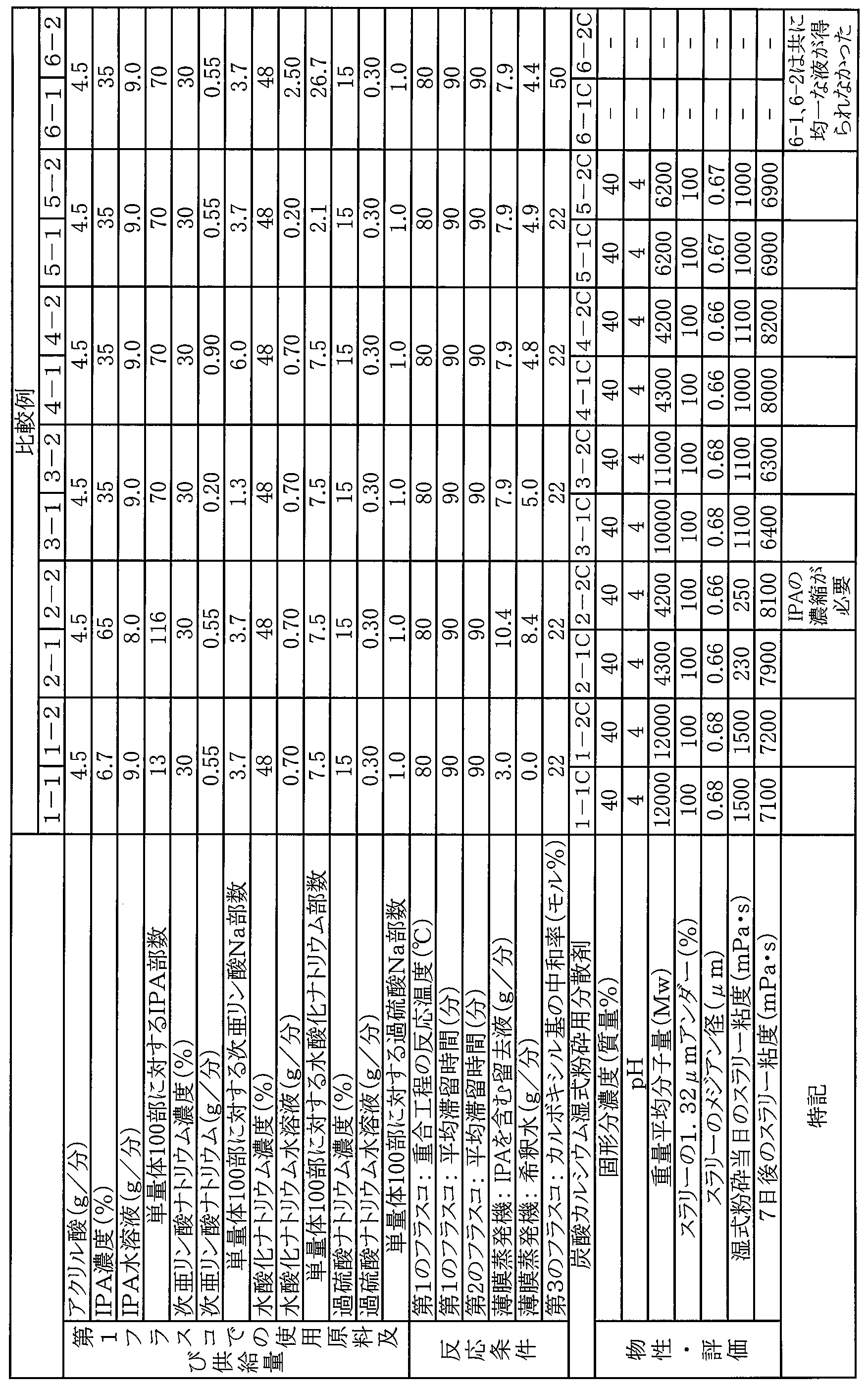
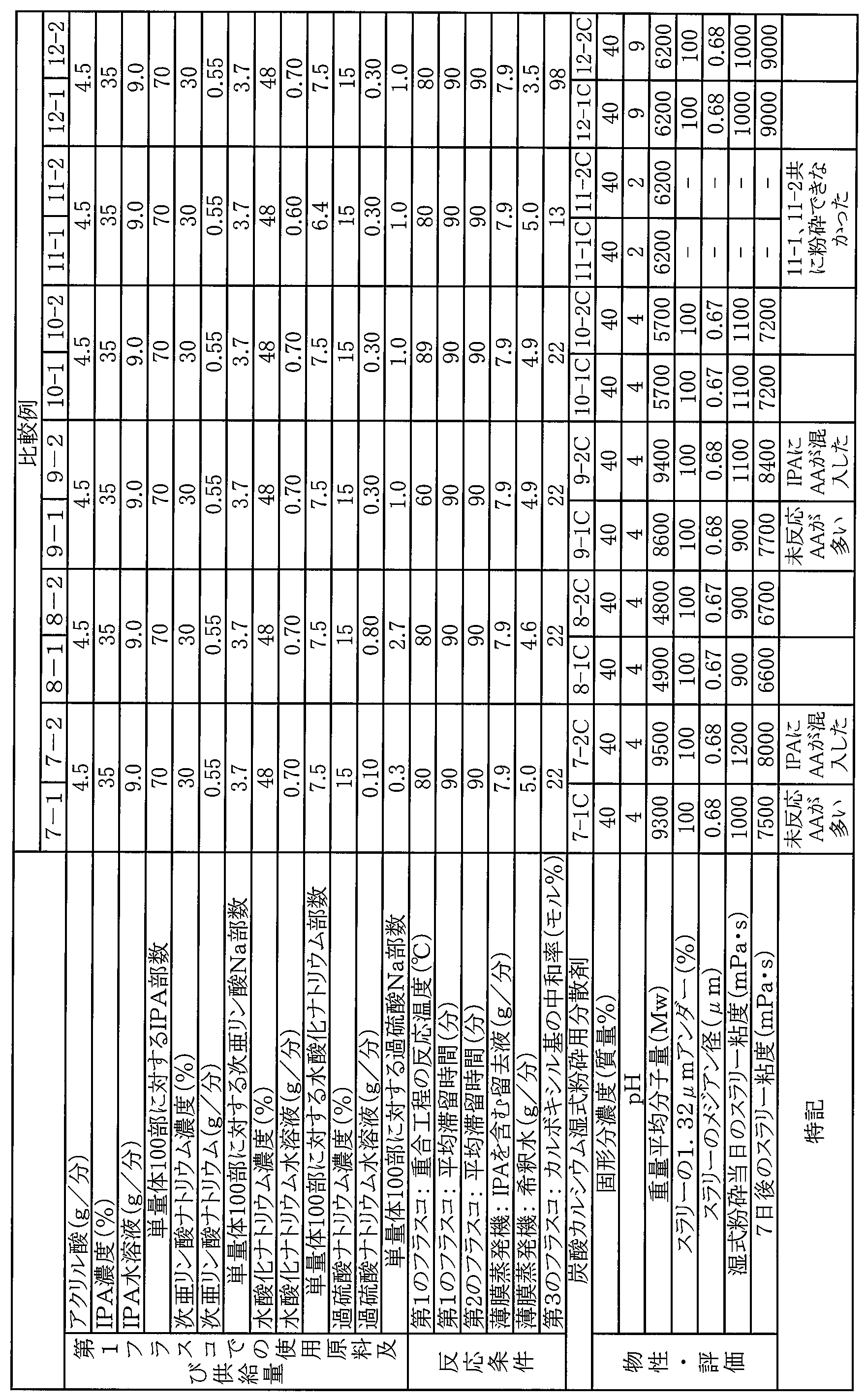

一方、比較例1-1及び1-2では、IPAの使用量が、単量体100部に対して、13部と少なかった。また、分散剤に含有されるアクリル系重合体の重量平均分子量が12000であり、好ましい範囲(4500~8500)より大きかった。これらのことから、比較例1-1及び1-2の分散剤を用いた場合、炭酸カルシウムの粉砕時のスラリー粘度が高く、また、7日後のスラリー粘度についても顕著な上昇が見られた。
また、比較例2-1及び2-2では、炭酸カルシウムの粉砕時のスラリー粘度は低かった。しかし、IPAの使用量が、単量体100部に対して、116部と多いことから、分散剤に含有されるアクリル系重合体の重量平均分子量は4300前後であり、好ましい範囲より小さかった。このため、7日後のスラリー粘度については、顕著な上昇が見られた。尚、比較例2-1及び2-2で用いたIPA水溶液濃度は、65%の高濃度であるため、回収したIPAを再利用する際には、その回収したIPA水溶液(共沸混合物)は、濃縮が必要であった。
また、比較例4-1及び4-2では、次亜リン酸ナトリウムの使用量が、単量体100部に対して、6.0部と多かったため、アクリル系重合体の重量平均分子量は、好ましい範囲より小さくなったが、次亜リン酸ナトリウムの使用量が多いため、炭酸カルシウムの粉砕時のスラリー粘度が高く、また、7日後のスラリー粘度についても顕著な上昇が見られた。
また、比較例6-1及び6-2では、水酸化ナトリウムの使用量が、単量体100部に対して、26.7部と多いため、得られた反応液(分散剤)は、2層分離し不均一な状態であり、分散剤としては使用できなかった。
また、比較例8-1及び8-2では、過硫酸ナトリウムの使用量が、単量体100部に対して、2.7部と多かったため、アクリル系重合体の重量平均分子量は、好ましい範囲内であるが、過硫酸ナトリウムの使用量が多いため、炭酸カルシウムの粉砕時のスラリー粘度が高く、また、7日後のスラリー粘度についても顕著な上昇が見られた。
また、比較例10-1及び10-2では、アクリル系重合体の重量平均分子量は好ましい範囲内であったが、重合工程における反応温度が、89℃と高かったことから、炭酸カルシウムの粉砕時のスラリー粘度が高く、また、7日後のスラリー粘度についても顕著な上昇が見られた。
また、比較例12-1及び12-2は、炭酸カルシウムの粉砕はできたが、カルボキシル基の中和率が98モル%と高かったため、炭酸カルシウムの粉砕時のスラリー粘度が高く、また、7日後のスラリー粘度についても顕著な上昇が見られた。
また、比較例13-1及び13-2では、重合工程で、水酸化ナトリウムを使用しなかったため、炭酸カルシウムの粉砕時のスラリー粘度が高く、また、7日後のスラリー粘度についても顕著な上昇が見られた。これは、重合工程での次亜リン酸ナトリウムの酸化反応が抑制されなかったためと考えられる。
また、本発明の炭酸カルシウム用分散剤の製造方法によれば、上記炭酸カルシウム用分散剤を生産性良く製造することができる。さらに、本発明の濃縮工程において回収されたイソプロピルアルコールを重合工程で用いる場合は、留去されたイソプロピルアルコールを廃棄する必要がなく、コストが削減でき、生産効率に優れ、且つ、環境保全の面でも優れた炭酸カルシウム用分散剤の製造方法とすることができる。
Claims (12)
- 重合工程と中和工程とを順次備えることにより得られる炭酸カルシウム用分散剤であって、
上記重合工程は、アクリル酸を含む単量体、イソプロピルアルコール水溶液、次亜リン酸塩、過硫酸塩及び水酸化ナトリウムが連続的に反応器に供給され、上記単量体を連続的に重合させる工程であり、
上記重合工程における、上記イソプロピルアルコール水溶液に含まれるイソプロピルアルコール、上記次亜リン酸塩、上記過硫酸塩及び上記水酸化ナトリウムの供給量は、上記単量体100質量部に対して、上記イソプロピルアルコールが15~100質量部、上記次亜リン酸塩が2.0~5.0質量部、上記過硫酸塩が0.5~2.0重量部及び上記水酸化ナトリウムが5.0~20質量部であり、
上記重合工程の反応温度は、68~82℃であり、
上記中和工程は、上記重合工程により得られた重合体を構成する上記単量体由来の構成単位が有するカルボキシル基の15~95モル%を中和させる工程であることを特徴とする炭酸カルシウム用分散剤。 - 上記重合工程と上記中和工程との間に、イソプロピルアルコールを留去する濃縮工程を備える請求項1に記載の炭酸カルシウム用分散剤。
- 上記濃縮工程において、上記留去により回収されたイソプロピルアルコールを上記重合工程で用いる請求項2に記載の炭酸カルシウム用分散剤。
- 上記イソプロピルアルコール水溶液のイソプロピルアルコール濃度が、15~55質量%である請求項1乃至3のいずれかに記載の炭酸カルシウム用分散剤。
- 上記単量体における上記アクリル酸の含有量が、該単量体全量100質量%に対して、80~100質量%である請求項1乃至4のいずれかに記載の炭酸カルシウム用分散剤。
- 請求項1に記載の炭酸カルシウム用分散剤の連続生産方法であって、
重合工程と中和工程とを順次備え、
上記重合工程は、アクリル酸を含む単量体、イソプロピルアルコール水溶液、次亜リン酸塩、過硫酸塩及び水酸化ナトリウムが連続的に反応器に供給され、上記単量体を連続的に重合させる工程であり、
上記重合工程における、上記イソプロピルアルコール水溶液に含まれるイソプロピルアルコール、上記次亜リン酸塩、上記過硫酸塩及び上記水酸化ナトリウムの供給量は、上記単量体100質量部に対して、上記イソプロピルアルコールが15~100質量部、上記次亜リン酸塩が2.0~5.0質量部、上記過硫酸塩が0.5~2.0重量部及び上記水酸化ナトリウムが5.0~20質量部であり、
上記重合工程の反応温度は、68~82℃であり、
上記中和工程は、上記重合工程により得られた重合体を構成する上記単量体由来の構成単位が有するカルボキシル基の15~95モル%を中和させる工程であることを特徴とする炭酸カルシウム用分散剤の連続生産方法。 - 上記重合工程は、連続槽型反応器を直列に2基以上設置して行う請求項6に記載の炭酸カルシウム用分散剤の連続生産方法。
- 上記重合工程と上記中和工程との間に、イソプロピルアルコールを留去する濃縮工程を備える請求項6又7に記載の炭酸カルシウム用分散剤の連続生産方法。
- 上記濃縮工程は、薄膜蒸発機を用いる請求項8に記載の炭酸カルシウム用分散剤の連続生産方法。
- 上記濃縮工程において、上記留去により回収されたイソプロピルアルコールを上記重合工程で用いる請求項8又は9に記載の炭酸カルシウム用分散剤の連続生産方法。
- 上記イソプロピルアルコール水溶液のイソプロピルアルコール濃度が、15~55質量%である請求項6乃至10のいずれかに記載の炭酸カルシウム用分散剤の連続生産方法。
- 上記単量体における上記アクリル酸の含有量が、該単量体全量100質量%に対して、80~100質量%である請求項6乃至11のいずれかに記載の炭酸カルシウム用分散剤の連続生産方法。
Priority Applications (4)
| Application Number | Priority Date | Filing Date | Title |
|---|---|---|---|
| SG2013003314A SG187092A1 (en) | 2010-07-23 | 2011-06-28 | Dispersant for calcium carbonate, and process for continuous production of the dispersant |
| JP2012525352A JP5240413B2 (ja) | 2010-07-23 | 2011-06-28 | 炭酸カルシウム用分散剤及びその連続生産方法 |
| KR1020137004456A KR101771771B1 (ko) | 2010-07-23 | 2011-06-28 | 탄산칼슘용 분산제 및 그 연속 생산 방법 |
| CN201180034811.8A CN103025416B (zh) | 2010-07-23 | 2011-06-28 | 碳酸钙用分散剂及其连续生产方法 |
Applications Claiming Priority (2)
| Application Number | Priority Date | Filing Date | Title |
|---|---|---|---|
| JP2010-166441 | 2010-07-23 | ||
| JP2010166441 | 2010-07-23 |
Publications (1)
| Publication Number | Publication Date |
|---|---|
| WO2012011368A1 true WO2012011368A1 (ja) | 2012-01-26 |
Family
ID=45496796
Family Applications (1)
| Application Number | Title | Priority Date | Filing Date |
|---|---|---|---|
| PCT/JP2011/064729 Ceased WO2012011368A1 (ja) | 2010-07-23 | 2011-06-28 | 炭酸カルシウム用分散剤及びその連続生産方法 |
Country Status (5)
| Country | Link |
|---|---|
| JP (1) | JP5240413B2 (ja) |
| KR (1) | KR101771771B1 (ja) |
| CN (1) | CN103025416B (ja) |
| SG (1) | SG187092A1 (ja) |
| WO (1) | WO2012011368A1 (ja) |
Cited By (1)
| Publication number | Priority date | Publication date | Assignee | Title |
|---|---|---|---|---|
| JP2017019946A (ja) * | 2015-07-13 | 2017-01-26 | 東亞合成株式会社 | アクリル酸系重合体塩水溶液の製造方法 |
Families Citing this family (1)
| Publication number | Priority date | Publication date | Assignee | Title |
|---|---|---|---|---|
| CN104744970A (zh) * | 2015-02-13 | 2015-07-01 | 江苏苏博特新材料股份有限公司 | 碳酸钙/梳状聚醚嵌段聚丙烯酸共聚物浆料及其制备方法 |
Citations (3)
| Publication number | Priority date | Publication date | Assignee | Title |
|---|---|---|---|---|
| JPH11128715A (ja) * | 1997-11-04 | 1999-05-18 | Nippon Shokubai Co Ltd | 無機顔料分散剤 |
| JP2000038491A (ja) * | 1998-07-23 | 2000-02-08 | Toagosei Co Ltd | 無機顔料分散剤及び分散方法 |
| JP2001087640A (ja) * | 1995-07-24 | 2001-04-03 | Sanyo Chem Ind Ltd | 分散剤 |
Family Cites Families (3)
| Publication number | Priority date | Publication date | Assignee | Title |
|---|---|---|---|---|
| DE69917106T2 (de) * | 1998-03-06 | 2005-05-19 | Nippon Shokubai Co. Ltd. | (Meth)acrylsäurepolymer und Verfahren zu seiner Herstellung |
| CN101323654A (zh) * | 2008-07-24 | 2008-12-17 | 上海东升新材料有限公司 | 低分子量丙烯酸系聚合物及其制备方法 |
| CN101423577B (zh) * | 2008-12-10 | 2010-06-23 | 娄底市裕德科技有限公司 | 聚丙烯酸或聚丙烯酸钠的制备方法 |
-
2011
- 2011-06-28 SG SG2013003314A patent/SG187092A1/en unknown
- 2011-06-28 WO PCT/JP2011/064729 patent/WO2012011368A1/ja not_active Ceased
- 2011-06-28 KR KR1020137004456A patent/KR101771771B1/ko active Active
- 2011-06-28 JP JP2012525352A patent/JP5240413B2/ja active Active
- 2011-06-28 CN CN201180034811.8A patent/CN103025416B/zh active Active
Patent Citations (3)
| Publication number | Priority date | Publication date | Assignee | Title |
|---|---|---|---|---|
| JP2001087640A (ja) * | 1995-07-24 | 2001-04-03 | Sanyo Chem Ind Ltd | 分散剤 |
| JPH11128715A (ja) * | 1997-11-04 | 1999-05-18 | Nippon Shokubai Co Ltd | 無機顔料分散剤 |
| JP2000038491A (ja) * | 1998-07-23 | 2000-02-08 | Toagosei Co Ltd | 無機顔料分散剤及び分散方法 |
Cited By (1)
| Publication number | Priority date | Publication date | Assignee | Title |
|---|---|---|---|---|
| JP2017019946A (ja) * | 2015-07-13 | 2017-01-26 | 東亞合成株式会社 | アクリル酸系重合体塩水溶液の製造方法 |
Also Published As
| Publication number | Publication date |
|---|---|
| SG187092A1 (en) | 2013-03-28 |
| JPWO2012011368A1 (ja) | 2013-09-09 |
| KR20130099007A (ko) | 2013-09-05 |
| JP5240413B2 (ja) | 2013-07-17 |
| CN103025416B (zh) | 2015-08-05 |
| CN103025416A (zh) | 2013-04-03 |
| KR101771771B1 (ko) | 2017-08-25 |
Similar Documents
| Publication | Publication Date | Title |
|---|---|---|
| CN103468028B (zh) | 一种高效钙浆分散剂及其制备方法 | |
| CN107849185B (zh) | 水溶性聚合物组合物及其制造方法、以及其利用 | |
| JP5794308B2 (ja) | アクリル酸系重合体の製造方法及びその用途 | |
| CN104812787A (zh) | 含有2-(甲基丙烯酰氧基)乙基膦酸结构单元的粒子聚合物的稳定水性分散液和其复合物 | |
| JP5915750B2 (ja) | アクリル酸系重合体組成物及びその製造方法、並びにその用途 | |
| JP5240413B2 (ja) | 炭酸カルシウム用分散剤及びその連続生産方法 | |
| JP6119850B2 (ja) | 炭酸カルシウム用分散剤及びその製造方法 | |
| JP5240411B2 (ja) | 炭酸カルシウム用分散剤及びその製造方法 | |
| CN101970582B (zh) | 颜料分散剂 | |
| CN104558383A (zh) | 含羧酸类高分子稀土荧光络合物及其制备方法、荧光化学碳粉及其制备方法 | |
| JP5036325B2 (ja) | 水性エマルションおよびその用途 | |
| CN102358766B (zh) | 一种粘土改性室温自交联核壳聚丙烯酸酯乳液的合成方法 | |
| JP6258745B2 (ja) | (メタ)アクリル酸系重合体の製造方法 | |
| JP4107036B2 (ja) | 顔料分散剤及び水性インク | |
| JP2022034316A (ja) | カーボンナノチューブ分散体、およびそれを用いた塗料 | |
| CN104387511A (zh) | 一种耐温型水性油墨用丙烯酸树脂及其制备方法 | |
| JP5336813B2 (ja) | ポリマー粒子の製造方法 | |
| JP2016108400A (ja) | ポリアクリル酸塩及び水酸化カリウムを含む透明な水溶液 | |
| JP2007262331A (ja) | ポリマー粒子の製造方法 | |
| JP2003002910A (ja) | 重合体の製造方法、分散剤、およびこれを用いた懸濁重合方法 | |
| WO2016143595A1 (ja) | 水溶性重合体の製造方法 | |
| JP2008239828A (ja) | 水系熱硬化性組成物 | |
| CN100999557A (zh) | 乳液聚合用阴离子大分子/阳离子小分子复合体的制备方法 |
Legal Events
| Date | Code | Title | Description |
|---|---|---|---|
| WWE | Wipo information: entry into national phase |
Ref document number: 201180034811.8 Country of ref document: CN |
|
| 121 | Ep: the epo has been informed by wipo that ep was designated in this application |
Ref document number: 11809542 Country of ref document: EP Kind code of ref document: A1 |
|
| WWE | Wipo information: entry into national phase |
Ref document number: 2012525352 Country of ref document: JP |
|
| NENP | Non-entry into the national phase |
Ref country code: DE |
|
| ENP | Entry into the national phase |
Ref document number: 20137004456 Country of ref document: KR Kind code of ref document: A |
|
| 122 | Ep: pct application non-entry in european phase |
Ref document number: 11809542 Country of ref document: EP Kind code of ref document: A1 |