WO2011125291A1 - ホモアダマンタン誘導体、その製造方法及びフォトレジスト用感光性材料 - Google Patents
ホモアダマンタン誘導体、その製造方法及びフォトレジスト用感光性材料 Download PDFInfo
- Publication number
- WO2011125291A1 WO2011125291A1 PCT/JP2011/001532 JP2011001532W WO2011125291A1 WO 2011125291 A1 WO2011125291 A1 WO 2011125291A1 JP 2011001532 W JP2011001532 W JP 2011001532W WO 2011125291 A1 WO2011125291 A1 WO 2011125291A1
- Authority
- WO
- WIPO (PCT)
- Prior art keywords
- oxo
- oxa
- homoadamantan
- meth
- oxy
- Prior art date
- Legal status (The legal status is an assumption and is not a legal conclusion. Google has not performed a legal analysis and makes no representation as to the accuracy of the status listed.)
- Ceased
Links
- 0 CC(C(*1CC1)OC(C)(C)CC1(CC(C2)CC3CC2C1)OC3=O)C(C)(*)OC(C(*)C(C)(C)*)=O Chemical compound CC(C(*1CC1)OC(C)(C)CC1(CC(C2)CC3CC2C1)OC3=O)C(C)(*)OC(C(*)C(C)(C)*)=O 0.000 description 1
- YCEXJLPTIKPSSG-UHFFFAOYSA-N CC(C(OC1(CC2CC(C3)C1)CC3OC2=O)=O)=C Chemical compound CC(C(OC1(CC2CC(C3)C1)CC3OC2=O)=O)=C YCEXJLPTIKPSSG-UHFFFAOYSA-N 0.000 description 1
Images
Classifications
-
- G—PHYSICS
- G03—PHOTOGRAPHY; CINEMATOGRAPHY; ANALOGOUS TECHNIQUES USING WAVES OTHER THAN OPTICAL WAVES; ELECTROGRAPHY; HOLOGRAPHY
- G03F—PHOTOMECHANICAL PRODUCTION OF TEXTURED OR PATTERNED SURFACES, e.g. FOR PRINTING, FOR PROCESSING OF SEMICONDUCTOR DEVICES; MATERIALS THEREFOR; ORIGINALS THEREFOR; APPARATUS SPECIALLY ADAPTED THEREFOR
- G03F7/00—Photomechanical, e.g. photolithographic, production of textured or patterned surfaces, e.g. printing surfaces; Materials therefor, e.g. comprising photoresists; Apparatus specially adapted therefor
- G03F7/004—Photosensitive materials
- G03F7/039—Macromolecular compounds which are photodegradable, e.g. positive electron resists
-
- C—CHEMISTRY; METALLURGY
- C07—ORGANIC CHEMISTRY
- C07D—HETEROCYCLIC COMPOUNDS
- C07D313/00—Heterocyclic compounds containing rings of more than six members having one oxygen atom as the only ring hetero atom
- C07D313/02—Seven-membered rings
- C07D313/06—Seven-membered rings condensed with carbocyclic rings or ring systems
- C07D313/10—Seven-membered rings condensed with carbocyclic rings or ring systems condensed with two six-membered rings
-
- C—CHEMISTRY; METALLURGY
- C08—ORGANIC MACROMOLECULAR COMPOUNDS; THEIR PREPARATION OR CHEMICAL WORKING-UP; COMPOSITIONS BASED THEREON
- C08F—MACROMOLECULAR COMPOUNDS OBTAINED BY REACTIONS ONLY INVOLVING CARBON-TO-CARBON UNSATURATED BONDS
- C08F20/00—Homopolymers and copolymers of compounds having one or more unsaturated aliphatic radicals, each having only one carbon-to-carbon double bond, and only one being terminated by only one carboxyl radical or a salt, anhydride, ester, amide, imide or nitrile thereof
- C08F20/02—Monocarboxylic acids having less than ten carbon atoms, Derivatives thereof
- C08F20/10—Esters
- C08F20/26—Esters containing oxygen in addition to the carboxy oxygen
-
- C—CHEMISTRY; METALLURGY
- C08—ORGANIC MACROMOLECULAR COMPOUNDS; THEIR PREPARATION OR CHEMICAL WORKING-UP; COMPOSITIONS BASED THEREON
- C08F—MACROMOLECULAR COMPOUNDS OBTAINED BY REACTIONS ONLY INVOLVING CARBON-TO-CARBON UNSATURATED BONDS
- C08F222/00—Copolymers of compounds having one or more unsaturated aliphatic radicals, each having only one carbon-to-carbon double bond, and at least one being terminated by a carboxyl radical and containing at least one other carboxyl radical in the molecule; Salts, anhydrides, esters, amides, imides, or nitriles thereof
- C08F222/10—Esters
-
- C—CHEMISTRY; METALLURGY
- C08—ORGANIC MACROMOLECULAR COMPOUNDS; THEIR PREPARATION OR CHEMICAL WORKING-UP; COMPOSITIONS BASED THEREON
- C08F—MACROMOLECULAR COMPOUNDS OBTAINED BY REACTIONS ONLY INVOLVING CARBON-TO-CARBON UNSATURATED BONDS
- C08F224/00—Copolymers of compounds having one or more unsaturated aliphatic radicals, each having only one carbon-to-carbon double bond, and at least one being terminated by a heterocyclic ring containing oxygen
-
- G—PHYSICS
- G03—PHOTOGRAPHY; CINEMATOGRAPHY; ANALOGOUS TECHNIQUES USING WAVES OTHER THAN OPTICAL WAVES; ELECTROGRAPHY; HOLOGRAPHY
- G03F—PHOTOMECHANICAL PRODUCTION OF TEXTURED OR PATTERNED SURFACES, e.g. FOR PRINTING, FOR PROCESSING OF SEMICONDUCTOR DEVICES; MATERIALS THEREFOR; ORIGINALS THEREFOR; APPARATUS SPECIALLY ADAPTED THEREFOR
- G03F7/00—Photomechanical, e.g. photolithographic, production of textured or patterned surfaces, e.g. printing surfaces; Materials therefor, e.g. comprising photoresists; Apparatus specially adapted therefor
- G03F7/004—Photosensitive materials
- G03F7/039—Macromolecular compounds which are photodegradable, e.g. positive electron resists
- G03F7/0392—Macromolecular compounds which are photodegradable, e.g. positive electron resists the macromolecular compound being present in a chemically amplified positive photoresist composition
-
- G—PHYSICS
- G03—PHOTOGRAPHY; CINEMATOGRAPHY; ANALOGOUS TECHNIQUES USING WAVES OTHER THAN OPTICAL WAVES; ELECTROGRAPHY; HOLOGRAPHY
- G03F—PHOTOMECHANICAL PRODUCTION OF TEXTURED OR PATTERNED SURFACES, e.g. FOR PRINTING, FOR PROCESSING OF SEMICONDUCTOR DEVICES; MATERIALS THEREFOR; ORIGINALS THEREFOR; APPARATUS SPECIALLY ADAPTED THEREFOR
- G03F7/00—Photomechanical, e.g. photolithographic, production of textured or patterned surfaces, e.g. printing surfaces; Materials therefor, e.g. comprising photoresists; Apparatus specially adapted therefor
- G03F7/004—Photosensitive materials
- G03F7/039—Macromolecular compounds which are photodegradable, e.g. positive electron resists
- G03F7/0392—Macromolecular compounds which are photodegradable, e.g. positive electron resists the macromolecular compound being present in a chemically amplified positive photoresist composition
- G03F7/0397—Macromolecular compounds which are photodegradable, e.g. positive electron resists the macromolecular compound being present in a chemically amplified positive photoresist composition the macromolecular compound having an alicyclic moiety in a side chain
-
- G—PHYSICS
- G03—PHOTOGRAPHY; CINEMATOGRAPHY; ANALOGOUS TECHNIQUES USING WAVES OTHER THAN OPTICAL WAVES; ELECTROGRAPHY; HOLOGRAPHY
- G03F—PHOTOMECHANICAL PRODUCTION OF TEXTURED OR PATTERNED SURFACES, e.g. FOR PRINTING, FOR PROCESSING OF SEMICONDUCTOR DEVICES; MATERIALS THEREFOR; ORIGINALS THEREFOR; APPARATUS SPECIALLY ADAPTED THEREFOR
- G03F7/00—Photomechanical, e.g. photolithographic, production of textured or patterned surfaces, e.g. printing surfaces; Materials therefor, e.g. comprising photoresists; Apparatus specially adapted therefor
- G03F7/16—Coating processes; Apparatus therefor
- G03F7/165—Monolayers, e.g. Langmuir-Blodgett
-
- G—PHYSICS
- G03—PHOTOGRAPHY; CINEMATOGRAPHY; ANALOGOUS TECHNIQUES USING WAVES OTHER THAN OPTICAL WAVES; ELECTROGRAPHY; HOLOGRAPHY
- G03F—PHOTOMECHANICAL PRODUCTION OF TEXTURED OR PATTERNED SURFACES, e.g. FOR PRINTING, FOR PROCESSING OF SEMICONDUCTOR DEVICES; MATERIALS THEREFOR; ORIGINALS THEREFOR; APPARATUS SPECIALLY ADAPTED THEREFOR
- G03F7/00—Photomechanical, e.g. photolithographic, production of textured or patterned surfaces, e.g. printing surfaces; Materials therefor, e.g. comprising photoresists; Apparatus specially adapted therefor
- G03F7/20—Exposure; Apparatus therefor
-
- G—PHYSICS
- G03—PHOTOGRAPHY; CINEMATOGRAPHY; ANALOGOUS TECHNIQUES USING WAVES OTHER THAN OPTICAL WAVES; ELECTROGRAPHY; HOLOGRAPHY
- G03F—PHOTOMECHANICAL PRODUCTION OF TEXTURED OR PATTERNED SURFACES, e.g. FOR PRINTING, FOR PROCESSING OF SEMICONDUCTOR DEVICES; MATERIALS THEREFOR; ORIGINALS THEREFOR; APPARATUS SPECIALLY ADAPTED THEREFOR
- G03F7/00—Photomechanical, e.g. photolithographic, production of textured or patterned surfaces, e.g. printing surfaces; Materials therefor, e.g. comprising photoresists; Apparatus specially adapted therefor
- G03F7/26—Processing photosensitive materials; Apparatus therefor
- G03F7/30—Imagewise removal using liquid means
-
- G—PHYSICS
- G03—PHOTOGRAPHY; CINEMATOGRAPHY; ANALOGOUS TECHNIQUES USING WAVES OTHER THAN OPTICAL WAVES; ELECTROGRAPHY; HOLOGRAPHY
- G03F—PHOTOMECHANICAL PRODUCTION OF TEXTURED OR PATTERNED SURFACES, e.g. FOR PRINTING, FOR PROCESSING OF SEMICONDUCTOR DEVICES; MATERIALS THEREFOR; ORIGINALS THEREFOR; APPARATUS SPECIALLY ADAPTED THEREFOR
- G03F7/00—Photomechanical, e.g. photolithographic, production of textured or patterned surfaces, e.g. printing surfaces; Materials therefor, e.g. comprising photoresists; Apparatus specially adapted therefor
- G03F7/26—Processing photosensitive materials; Apparatus therefor
- G03F7/30—Imagewise removal using liquid means
- G03F7/32—Liquid compositions therefor, e.g. developers
- G03F7/322—Aqueous alkaline compositions
-
- H—ELECTRICITY
- H10—SEMICONDUCTOR DEVICES; ELECTRIC SOLID-STATE DEVICES NOT OTHERWISE PROVIDED FOR
- H10P—GENERIC PROCESSES OR APPARATUS FOR THE MANUFACTURE OR TREATMENT OF DEVICES COVERED BY CLASS H10
- H10P76/00—Manufacture or treatment of masks on semiconductor bodies, e.g. by lithography or photolithography
- H10P76/20—Manufacture or treatment of masks on semiconductor bodies, e.g. by lithography or photolithography of masks comprising organic materials
- H10P76/204—Manufacture or treatment of masks on semiconductor bodies, e.g. by lithography or photolithography of masks comprising organic materials of organic photoresist masks
Definitions
- the present invention relates to a novel homoadamantane derivative, a (meth) acrylic acid ester, a production method thereof, a (meth) acrylic polymer, a positive photoresist composition, and a resist pattern forming method.
- a photoacid generator (PAG) is an essential component for causing a photosensitive action (acid decomposition).
- PAG photoacid generator
- Patent Documents Patent Documents
- An object of the present invention is to provide a polymer excellent in roughness reduction, solubility, compatibility, defect reduction, exposure sensitivity, and the like, a monomer (monomer) providing the same, and a precursor thereof (when used as a positive photoresist, Intermediates, modifiers).
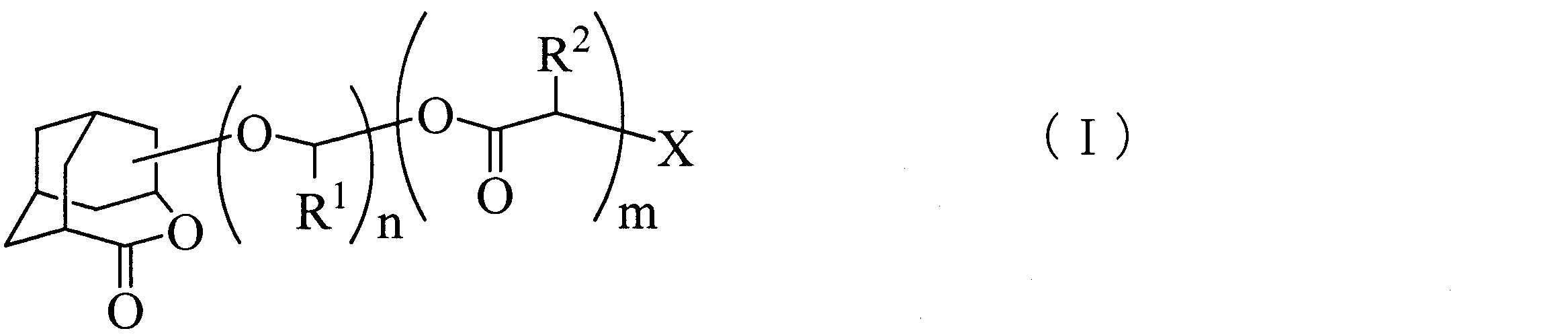
- homoadamantane derivatives represented by the following formula (I).
- R 1 and R 2 each represent a hydrogen atom or a linear, branched or cyclic hydrocarbon group having 1 to 6 carbon atoms
- X represents a hydroxyl group or a halogen atom
- n and m each represent 0 N and m are not simultaneously 0 and n is not 0.
- n is 2 or more
- a plurality of R 1 s may be the same or different from each other.
- R 2 may be the same or different. 2.
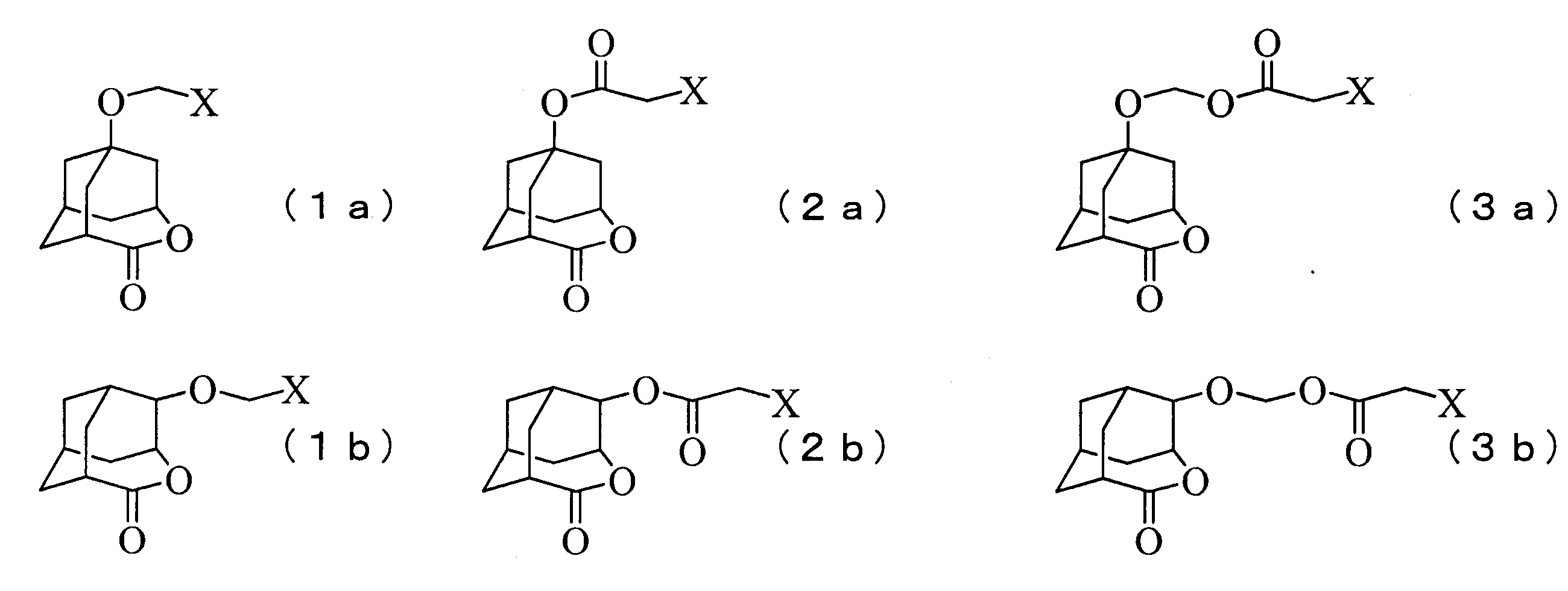
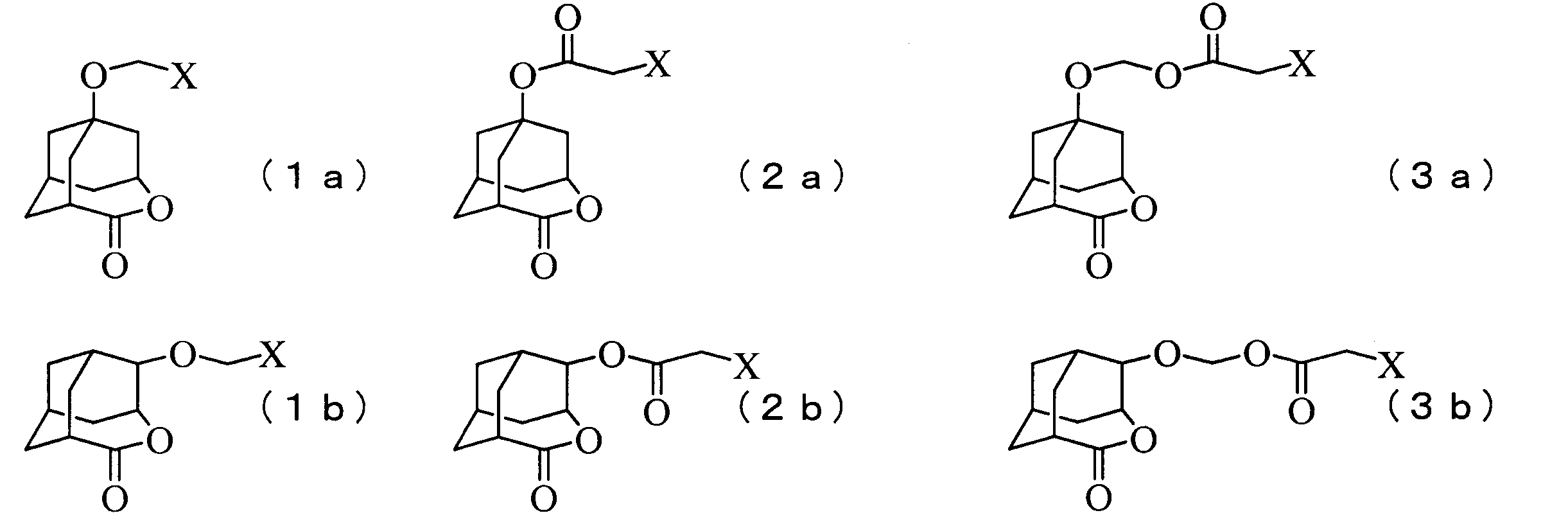
- the homoadamantane derivative according to 1 which is represented by any one of the following formulas (1) to (3): (In the formula, X represents a hydroxyl group or a halogen atom.) 3.
- n is 2 or more, a plurality of R 1 s may be the same or different, and m is 2 In the above case, the plurality of R 2 may be the same or different from each other.) 6).
- a positive photoresist composition comprising the (meth) acrylic polymer according to 10.9 and a photoacid generator. 11.
- a polymer excellent in roughness reduction, solubility, compatibility, defect reduction, exposure sensitivity, and the like a monomer (monomer) providing the polymer, and a precursor thereof ( Intermediates, modifiers).
- R 1 and R 2 each represent a hydrogen atom or a linear, branched or cyclic hydrocarbon group having 1 to 6 carbon atoms
- X represents a hydroxyl group or a halogen atom
- n and m each represent 0 to It is an integer of 3.
- n and m are not 0 at the same time.
- the plurality of R 1 may be the same or different
- the plurality of R 2 may be the same or different.
- R 1 and R 2 are preferably a hydrogen atom or a linear, branched or cyclic alkyl group having 1 to 6 carbon atoms.
- alkyl groups include linear groups such as methyl, ethyl, n-propyl, isopropyl, n-butyl, sec-butyl, tert-butyl, n-pentyl, isopentyl, hexyl, etc.
- cyclic structures such as a branched alkyl group, a cyclopentyl ring, a cyclohexyl ring, etc. are mentioned.
- R 1 and R 2 are particularly preferably a hydrogen atom or a methyl group, and particularly preferably a hydrogen atom.
- X includes a hydroxyl group, a fluorine atom, a chlorine atom, a bromine atom, and an iodine atom, and among them, a hydroxyl group, a chlorine atom, and a bromine atom are preferable.
- the position of the substituent on the homoadamantane skeleton can take any position number from 1 to 11 except for 4, 5, but is preferably 1 or 2 for ease of synthesis.
- the homoadamantane derivative of the present invention is preferably represented by any of the following formulas (1) to (3).
- X represents a hydroxyl group or a halogen atom.
- X represents a hydroxyl group or a halogen atom.
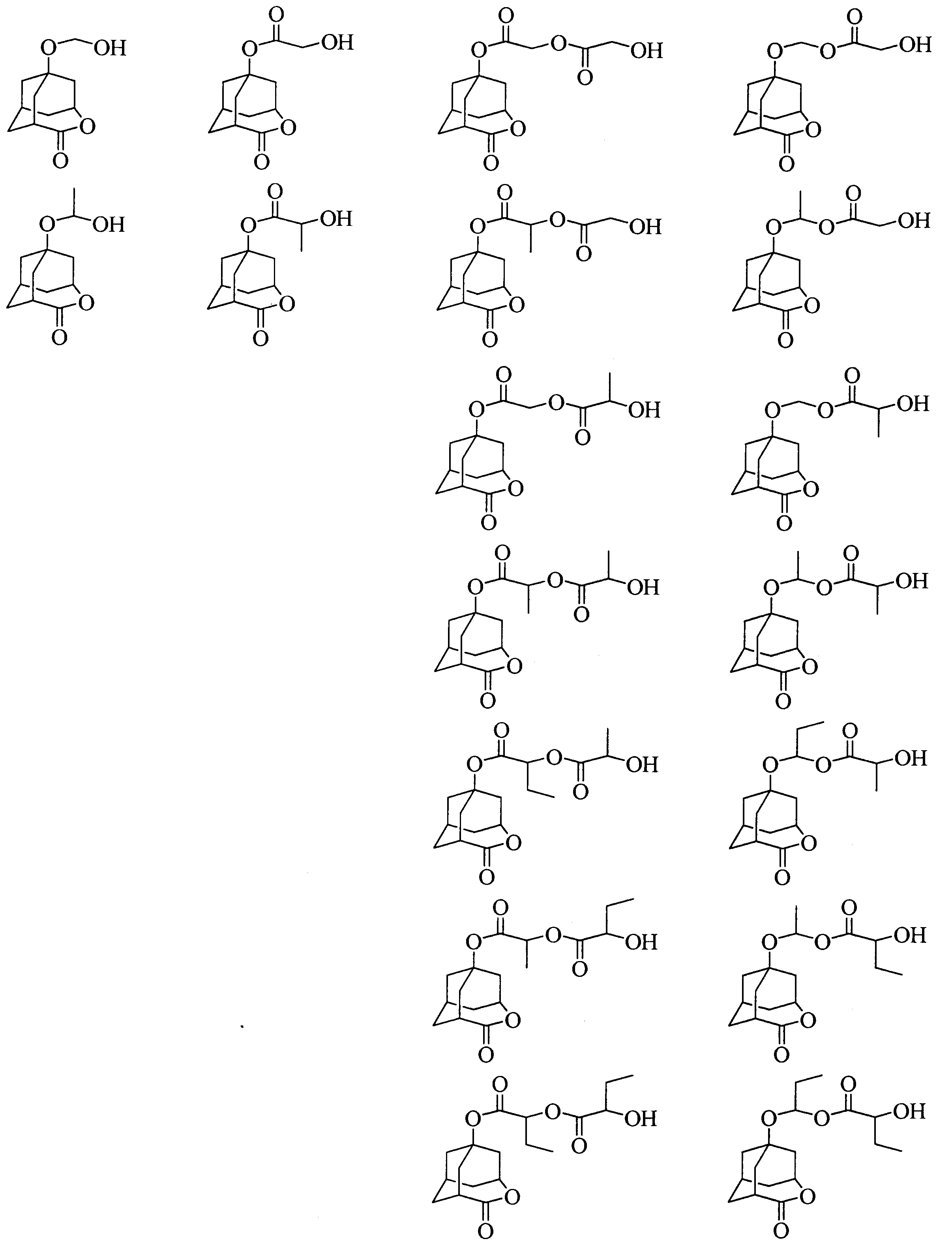
- homoadamantane derivative of the present invention represented by the above formula (I) include (5-oxo-4-oxa-5-homoadamantan-1-yl) oxymethanol, 1- (5-oxo-4 -Oxa-5-homoadamantan-1-yl) oxyethanol, 2- (5-oxo-4-oxa-5-homoadamantan-1-yl) oxy-2-oxoethanol, 2- (5-oxo-4) -Oxa-5-homoadamantan-1-yl) oxy-2-oxo-1-methylethanol, 2- (2- (5-oxo-4-oxa-5-homoadamantan-1-yl) oxy-2- Oxoethoxy) -2-oxoethanol, 2- (2- (5-oxo-4-oxa-5-homoadamantan-1-yl) oxy-2-oxo-1-methylethoxy) -2-oxoethane 2- (2- (5-oxo-4-
- the homoadamantane derivative of the present invention can be produced by various methods, and typical methods include, but are not limited to, methods including the following steps. a. A step of reacting a homoadamantyl alcohol represented by the following formula with a hydrogen halide gas in the presence of an aldehyde to obtain a homoadamantane derivative of the formula (I) which is a halogenated ether: b.
- a homoadamantyl alcohol represented by the following formula is reacted in the presence of an alkyl sulfoxide and an acid anhydride to obtain an alkylthioalkyl ether form, and this is further reacted with a halogenating agent to form a halogenated ether form (I) Obtaining a homoadamantane derivative of c.
- a step of reacting a homoadamantyl alcohol represented by the following formula with 2-hydroxycarboxylic acid halide, 2-halogenated carboxylic acid halide or 2-halogenated carboxylic acid to obtain a homoadamantane derivative of formula (I) which is an ester d.
- aldehyde examples include linear or branched aliphatic aldehydes such as formaldehyde, paraformaldehyde, acetaldehyde, propionaldehyde, butyraldehyde, and isobutyraldehyde.
- Examples of the hydrogen halide gas include a single gas such as hydrogen fluoride gas, hydrogen chloride gas, and hydrogen bromide gas, or a mixed gas thereof.
- alkyl sulfoxide examples include dimethyl sulfoxide, diethyl sulfoxide, di-n-propyl sulfoxide, diisopropyl sulfoxide, di-n-butyl sulfoxide, diisobutyl sulfoxide, di-sec-butyl sulfoxide, di-tert-butyl sulfoxide, diisopentyl sulfoxide.
- symmetric or asymmetric alkyl sulfoxides such as methyl ethyl sulfoxide and methyl-tert-butyl sulfoxide.
- acid anhydride examples include acetic anhydride, propionic anhydride, butyric anhydride, isobutyric anhydride, valeric anhydride, pivalic anhydride, benzoic anhydride, chloroacetic anhydride, trifluoroacetic anhydride, etc. And aliphatic or aromatic carboxylic acid anhydrides.
- halogenating agent examples include sulfur halides such as thionyl chloride, sulfuryl chloride, thionyl bromide, sulfuryl bromide, thionyl chlorobromide, sulfuryl chlorobromide, phosphorus trichloride, phosphorus tribromide, and triiodine.
- phosphorus halide compounds such as phosphorus trichloride, phosphoric trichloride, phosphoric tribromide, phosphorus pentachloride, and phosphorus pentabromide.
- 2-hydroxycarboxylic acid examples include aliphatic-2-hydroxycarboxylic acid such as glycolic acid, lactic acid (2-hydroxypropionic acid), 2-hydroxybutanoic acid, and acid anhydrides thereof.
- the acid examples include 2-halogenated aliphatic carboxylic acids such as 2-chloroacetic acid, 2-bromoacetic acid, 2-chloropionic acid, 2-bromopropionic acid, and acid anhydrides thereof.
- Examples of 2-hydroxycarboxylic acid halide and 2-halogenated carboxylic acid halide include halides of the above-mentioned 2-hydroxycarboxylic acid and 2-halogenated carboxylic acid.
- the halogenated ether form in step a can be obtained by reacting homoadamantyl alcohol with hydrogen halide gas in the presence of aldehyde. At this time, the reaction can be performed in the presence or absence of an organic solvent.
- the substrate concentration in the case of using an organic solvent is not particularly limited as long as it is lower than the saturation solubility of homoadamantyl alcohol, but it is preferable to adjust the substrate concentration to be about 0.1 mol / L to 10 mol / L.
- a substrate concentration of 0.1 mol / L or more is economically preferable because a necessary amount can be obtained in a normal reactor.
- a substrate concentration of 10 mol / L or less is preferable because the temperature of the reaction solution can be easily controlled. .
- Usable organic solvents include hexane, heptane, cyclohexane, ethylcyclohexane, benzene, toluene, xylene and other hydrocarbon solvents, diethyl ether, dibutyl ether, THF (tetrahydrofuran), dioxane, DME (dimethoxyethane) and other ether solvents.
- the solvent include halogen solvents such as dichloromethane and carbon tetrachloride, and these may be used alone or in combination.
- it is a halogen type solvent with a high dissolved amount of hydrogen halide gas.
- the reaction temperature is arbitrary, but if it is too high, the solubility of the hydrogen halide gas may decrease, and if it is too low, the progress of the reaction itself may be delayed.
- the pressure is arbitrary, but normal pressure is preferable because side reactions need to be controlled under pressurized conditions. If the pressure is too high, a special pressure device is required, which is not economical.
- the alkylthioalkyl ether of step b can be obtained by reacting homoadamantyl alcohol in the presence of alkyl sulfoxide and an acid anhydride. At this time, the reaction can be carried out in the presence or absence of an organic solvent, but usually the reaction proceeds by using alkylsulfoxide and acid anhydride as a reaction reagent and solvent in a large excess.
- an organic solvent is separately used, the usable organic solvent and pressure are the same as those in step a, and it is preferable to adjust the substrate concentration to be about 1 mol / L to 10 mol / L.
- a substrate concentration of 1 mol / L or more is economically preferable because a necessary amount can be obtained in a normal reactor, and a substrate concentration of 10 mol / L or less is preferable because the temperature of the reaction solution can be easily controlled.
- the reaction temperature is arbitrary, but if it is too high, the selectivity may be lowered due to side reactions, and if it is too low, the progress of the reaction itself may be delayed.
- a halogenated alkyl ether is obtained by reacting an alkylthioalkyl ether with a halogenating agent. At this time, it can be carried out in the presence or absence of an organic solvent, but a halogenating agent may be used in a large excess as a reaction reagent and a solvent.
- a halogenating agent may be used in a large excess as a reaction reagent and a solvent.
- the substrate concentration, the organic solvent that can be used, and the pressure are the same as in step a.
- the reaction temperature is arbitrary, but if it is too high, the selectivity may be lowered due to side reactions, and if it is too low, the progress of the reaction itself may be delayed.
- salt can be generated in the system by allowing a base to act on homoadamantyl alcohol and a reaction reagent, but water generated by azeotropic dehydration reaction is forced out of the system. It is possible to promote the reaction by removing it selectively.
- the esterification and etherification can be performed in the presence or absence of an organic solvent, but when an organic solvent is used, the substrate concentration is the same as in step a above.
- organic solvent examples include DMF (N, N-dimethylformamide), DMSO (dimethylsulfoxide), NMP (N-methyl-2-pyrrolidone), HMPA (hexamethyl phosphate) in addition to the solvents exemplified in the above step a.
- Aprotic polar solvents such as triamide), HMPT (hexamethyl phosphite triamide), carbon disulfide and the like, and these may be used alone or in combination.
- Examples of the base include sodium hydride, sodium hydroxide, potassium hydroxide, sodium carbonate, potassium carbonate, sodium bicarbonate, potassium bicarbonate, silver oxide, sodium phosphate, potassium phosphate, disodium monohydrogen phosphate, dipotassium hydrogen phosphate , Monosodium dihydrogen phosphate, monopotassium dihydrogen phosphate, sodium methoxide, potassium t-butoxide, triethylamine, tributylamine, trioctylamine, pyridine, N, N-dimethylaminopyridine, DBN (1,5-diazabicyclo [4 , 3,0] non-5-ene) and DBU (1,8-diazabicyclo [5,4,0] undec-7-ene) and organic amines are used.
- a hydrocarbon solvent such as cyclohexane, ethylcyclohexane, toluene, xylene or the like is preferably selected as the solvent.
- the ratio of the reaction reagent to the homodamantyl alcohol is about 0.01 to 100 times mol, preferably 1 to 1.5 times mol.
- the addition amount of the base is about 0.1 to 10 times mol, preferably 1 to 1.5 times mol with respect to homoadamantyl alcohol.
- the reaction temperature may be about ⁇ 200 to 200 ° C., preferably ⁇ 50 to 100 ° C.
- the reaction pressure is about 0.01 to 10 MPa in absolute pressure, and preferably normal pressure to 1 MPa. When the reaction time is long, the residence time is long, and when the pressure is too high, a special pressure device is required, which is not economical.
- the reaction product liquid is separated into water and an organic layer, and the product is extracted from the aqueous layer as necessary.
- the homoadamantane derivative of the present invention is obtained by distilling off the solvent from the reaction solution under reduced pressure. You may refine
- the purification method can be selected from general purification methods such as distillation, extraction washing, crystallization, activated carbon adsorption, and silica gel column chromatography in consideration of the production scale and the required purity. The method by extraction washing or crystallization is preferable because it can be handled at a low temperature and can process a large amount of sample at a time.
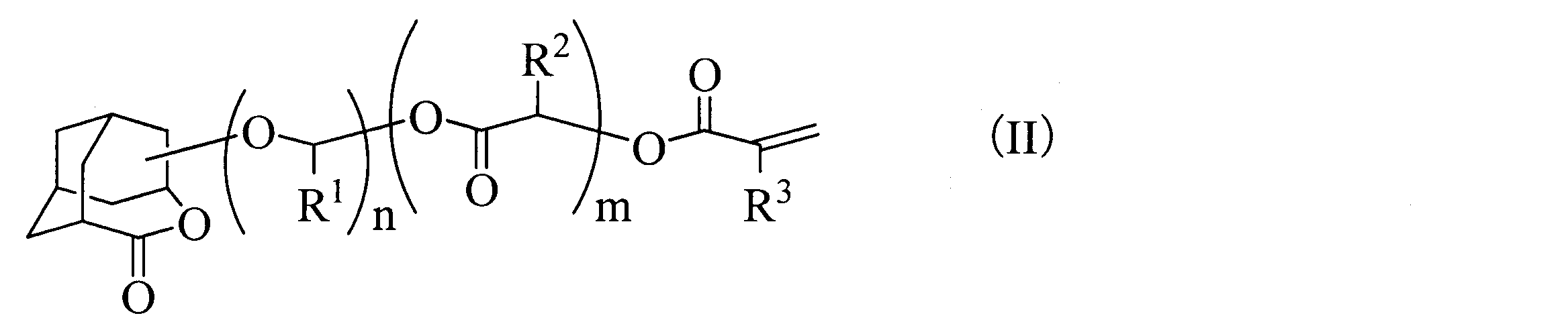
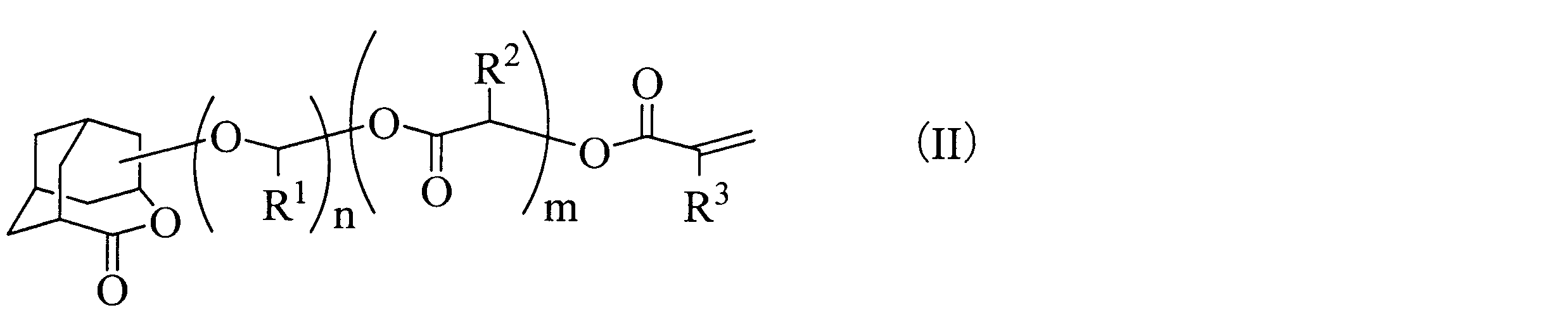
- the (meth) acrylic acid esters of the present invention are represented by the following formula (II).
- R 1 and R 2 each represent a hydrogen atom or a linear, branched or cyclic hydrocarbon group having 1 to 6 carbon atoms
- R 3 represents a hydrogen atom, a methyl group or a trifluoromethyl group.
- n and m are each an integer of 0 to 3, and n and m are not 0 at the same time.
- the plurality of R 1 may be the same or different
- m is 2 or more
- the plurality of R 2 may be the same or different.
- R 3 in formula (II) is preferably a hydrogen atom or a methyl group.
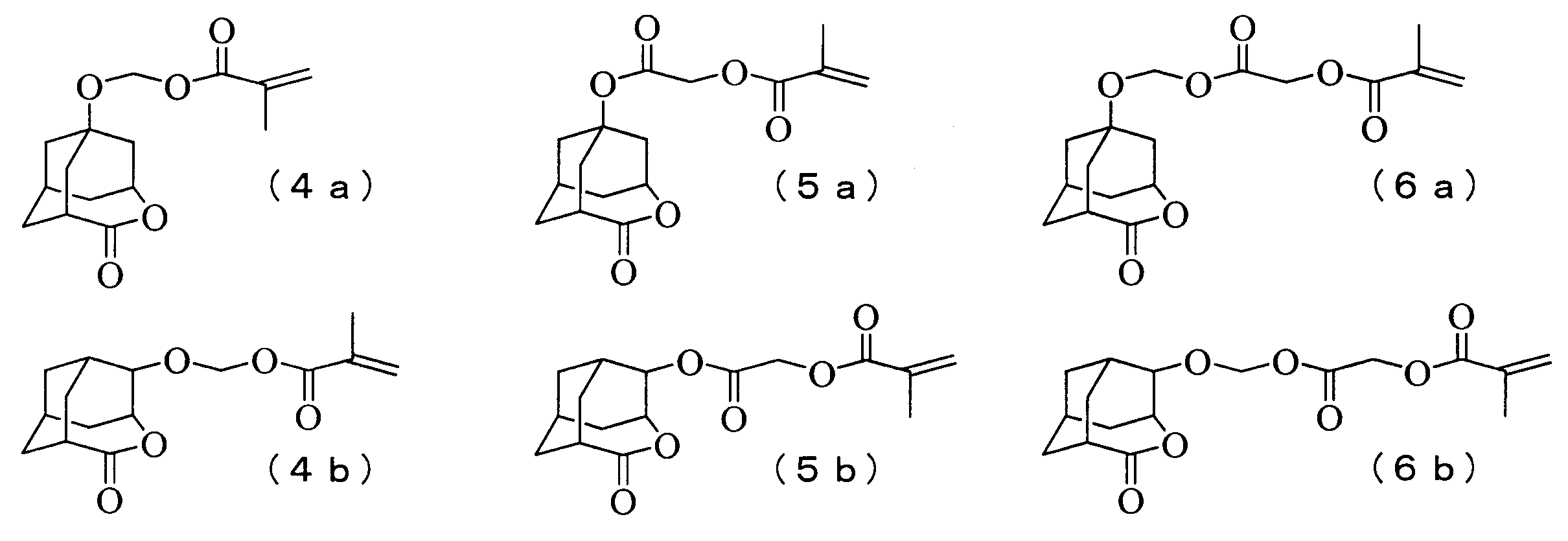
- the (meth) acrylic acid ester of the present invention is preferably represented by any of the following formulas (4) to (6).
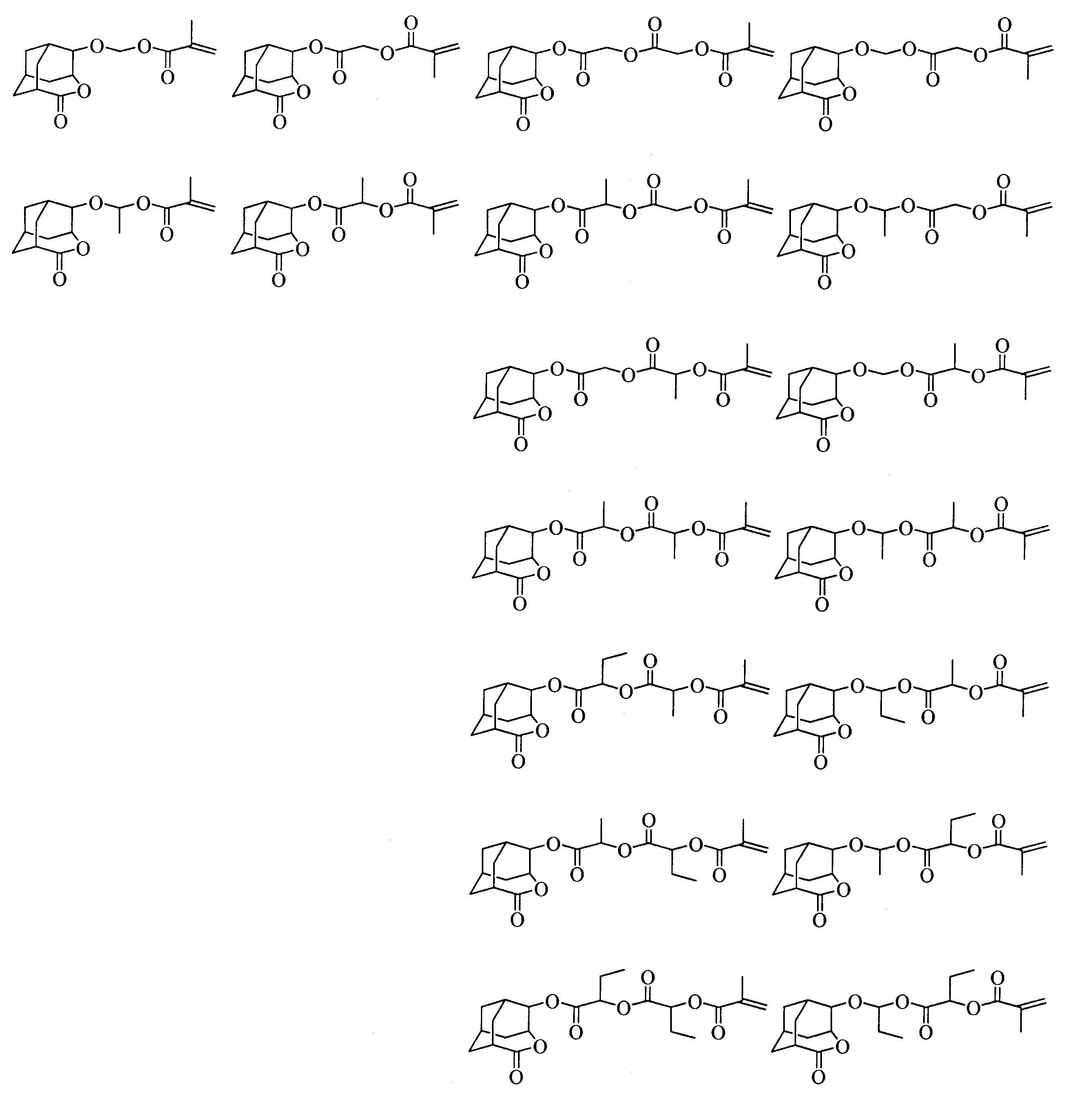
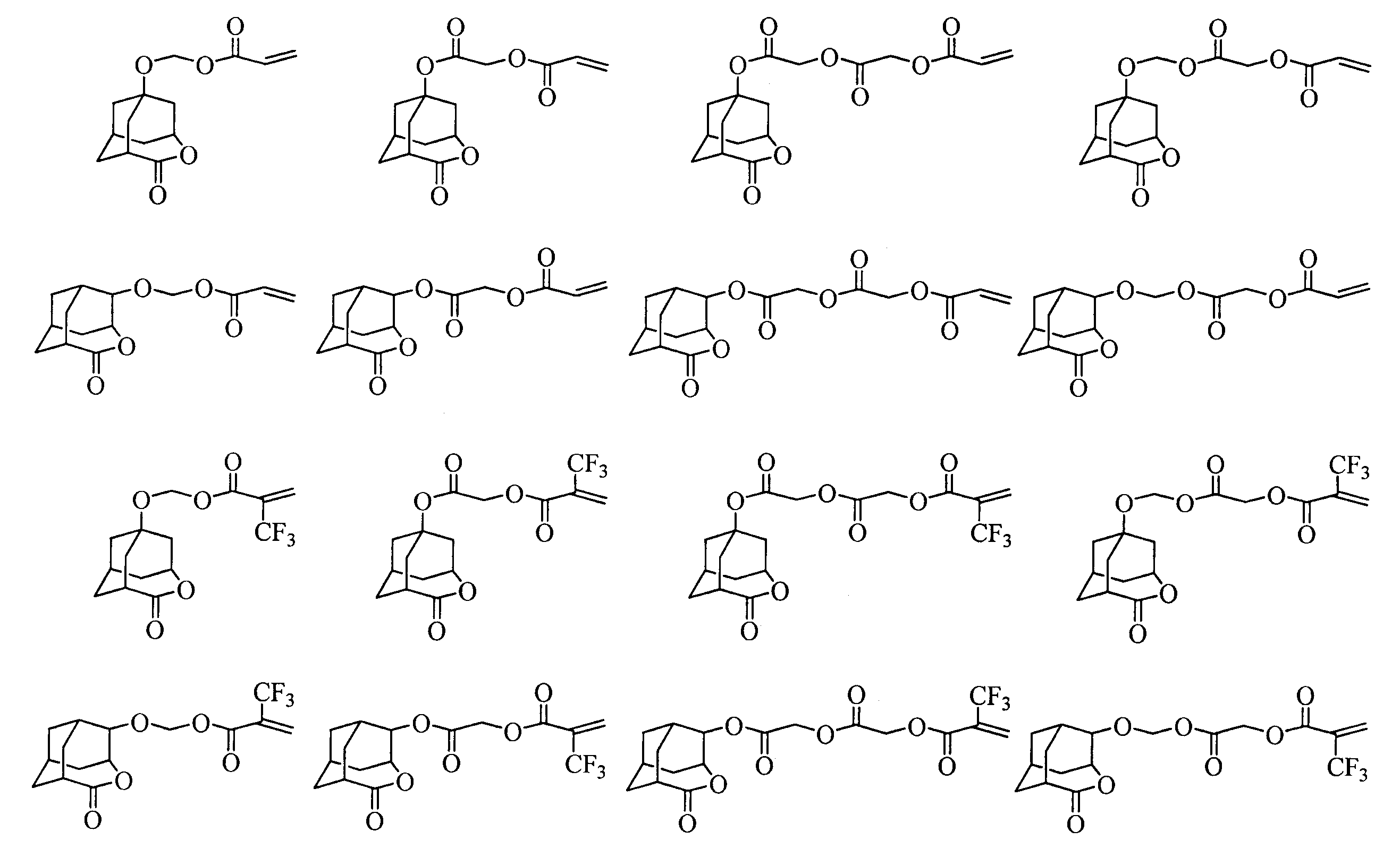
- (meth) acrylic acid ester of the present invention represented by the above formula (II) include (5-oxo-4-oxa-5-homoadamantan-1-yl) oxymethyl methacrylate, 1- (5 -Oxo-4-oxa-5-homoadamantan-1-yl) oxyethyl methacrylate, 2- (5-oxo-4-oxa-5-homoadamantan-1-yl) oxy-2-oxoethyl methacrylate, 2- (5-oxo-4-oxa-5-homoadamantan-1-yl) oxy-2-oxo-1-methylethyl methacrylate, 2- (2- (5-oxo-4-oxa-5-homoadamantane-1) -Yl) oxy-2-oxoethoxy) -2-oxoethyl methacrylate, 2- (2- (5-oxo-4-oxa-5-homoadamantan-1-yl)
- the (meth) acrylic acid ester of the present invention can be produced by various methods and is not particularly limited, but examples thereof include the following methods.
- the (meth) acrylic acid ester of formula (II) can be obtained by simply esterifying (also referred to as a (meth) acrylic acid derivative).
- (meth) acrylic acids examples include halogenated (meth) acrylic acids such as acrylic acid, methacrylic acid, 2-fluoroacrylic acid and 2-trifluoromethylacrylic acid.
- Examples of (meth) acrylic acid halides include acrylic acid fluoride, acrylic acid chloride, acrylic acid bromide, acrylic acid iodide, methacrylic acid fluoride, methacrylic acid chloride, methacrylic acid bromide, methacrylic acid iodide, 2-fluoroacrylic acid fluoride, 2 -Fluoroacrylic acid chloride, 2-fluoroacrylic acid bromide, 2-fluoroacrylic acid iodide, 2-trifluoromethyl acrylic acid fluoride, 2-trifluoromethyl acrylic acid chloride, 2-trifluoromethyl acrylic acid bromide, 2-tri Examples thereof include fluoromethylacrylic acid iodide.
- (meth) acrylic anhydrides include acrylic anhydride, methacrylic anhydride, 2-fluoroacrylic anhydride, 2-trifluoromethylacrylic anhydride, and the like.
- Examples of the (meth) acrylic acid 2-hydroxyalkyl include 2-hydroxyethyl acrylate, 2-hydroxyethyl methacrylate, 2-hydroxypropyl acrylate, 2-hydroxypropyl methacrylate, and the like.
- Esterification can generate a salt in the system by allowing a base to act on the homoadamantane derivative of formula (I) and the (meth) acrylic acid derivative, but the water generated by the azeotropic dehydration reaction is removed from the system.
- the reaction can also be promoted by forcibly removing it.
- Esterification can be carried out in the presence or absence of an organic solvent, but when an organic solvent is used, it is preferable to adjust the substrate concentration to be about 0.1 mol / L to 10 mol / L. .
- a substrate concentration of 0.1 mol / L or more is economically preferable because a necessary amount can be obtained in a normal reactor, and a substrate concentration of 10 mol / L or less is preferable because the temperature of the reaction solution can be easily controlled.
- Usable organic solvents include hexane, heptane, cyclohexane, ethylcyclohexane, benzene, toluene, xylene and other hydrocarbon solvents, diethyl ether, dibutyl ether, THF, dioxane, DME and other ether solvents, dichloromethane, carbon tetrachloride.
- aprotic polar solvents such as DMF, DMSO, NMP, HMPA, HMPT, and carbon disulfide. These may be used alone or in combination of two or more.
- Bases include sodium hydride, sodium hydroxide, potassium hydroxide, sodium carbonate, potassium carbonate, sodium bicarbonate, potassium bicarbonate, silver oxide, sodium phosphate, potassium phosphate, disodium monohydrogen phosphate, dipotassium hydrogen phosphate, Monosodium dihydrogen phosphate, monopotassium dihydrogen phosphate, sodium methoxide, potassium t-butoxide, triethylamine, tributylamine, trioctylamine, pyridine, N, N-dimethylaminopyridine, DBN (1,5-diazabicyclo [4, 3,0] nona-5-ene) and DBU (1,8-diazabicyclo [5,4,0] undec-7-ene) and organic amines are used.
- the solvent is preferably a hydrocarbon solvent such as cyclohexane, ethylcyclohexane, toluene, xylene.
- the charging ratio of the reaction reagent to the alicyclic structure-containing alcohol is, for example, about 0.01 to 100 times mol, preferably 1 to 1.5 times mol.
- the addition amount of the base is, for example, about 0.1 to 10 times mol, desirably 1 to 1.5 times mol, with respect to the alicyclic structure-containing alcohol.
- the reaction temperature may be about ⁇ 200 to 200 ° C., preferably ⁇ 50 to 100 ° C.
- the reaction pressure is, for example, about 0.01 to 10 MPa in absolute pressure, and preferably normal pressure to 1 MPa. When the reaction time is long, the residence time is long, and when the pressure is too high, a special pressure device is required, which is not economical.
- the homoadamantane derivative of the present invention is obtained by distilling off the solvent from the reaction solution under reduced pressure. You may refine
- the purification method can be selected from general purification methods such as distillation, extraction washing, crystallization, activated carbon adsorption, and silica gel column chromatography in consideration of the production scale and the required purity. The method by extraction washing or crystallization is preferable because it can be handled at a low temperature and can process a large amount of sample at a time.
- the (meth) acrylic polymer of the present invention is obtained by polymerizing a (meth) acrylic acid ester of the formula (II).
- the (meth) acrylic polymer of the present invention may be a polymer containing a repeating unit derived from one or more types of (meth) acrylic acid ester of the present invention, and only one (meth) acrylic acid ester is used. It may be a homopolymer, a copolymer using two or more types of (meth) acrylic acid esters, or a copolymer using one or more types of (meth) acrylic acid esters and other polymerizable monomers. It may be a polymer.
- the (meth) acrylic polymer of the present invention preferably contains 10 to 90 mol%, more preferably 25 to 75 mol% of repeating units derived from the (meth) acrylic acid ester of the formula (II). .
- the polymerization method is not particularly limited and can be performed by a conventional polymerization method.
- a known polymerization method such as solution polymerization (boiling point polymerization, polymerization below boiling point), emulsion polymerization, suspension polymerization, bulk polymerization, or the like may be used. It can. The smaller the amount of the high-boiling unreacted monomer remaining in the reaction liquid after polymerization, the better. It is preferable to perform an operation for removing the unreacted monomer as needed during the polymerization or after the completion of the polymerization.
- a polymerization reaction using a radical polymerization initiator in a solvent is preferable.
- a peroxide type polymerization initiator, an azo type polymerization initiator, etc. are used.
- Peroxide polymerization initiators include organic peroxides such as peroxycarbonate, ketone peroxide, peroxyketal, hydroperoxide, dialkyl peroxide, diacyl peroxide, and peroxyester (lauroyl peroxide, benzoyl peroxide). Is mentioned.
- Examples of the azo polymerization initiator include 2,2′-azobisisobutyronitrile, 2,2′-azobis (2-methylbutyronitrile), 2,2′-azobis (2,4-dimethylvalero). Nitrile) and azo compounds such as dimethyl 2,2′-azobisisobutyrate.
- one or more polymerization initiators can be appropriately used depending on the reaction conditions such as the polymerization temperature.
- Various methods can be adopted as a method for removing the used (meth) acrylic acid ester and other copolymerization monomers from the produced polymer after completion of the polymerization.
- a method of washing the acrylic polymer using a poor solvent for the polymer is preferred.
- the poor solvents for the acrylic polymer those having a low boiling point are preferable, and representative examples thereof include methanol, ethanol, n-hexane, and n-heptane.
- the (meth) acrylic acid ester of the formula (II) can be obtained from the homoadamantane derivative of the formula (I), and the (meth) acrylic acid ester of the formula (II) is further polymerized ((meta) ) An acrylic polymer can be obtained.
- the (meth) acrylic polymer of the present invention can be used as a positive photoresist. That is, from a highly reactive homoadamantane derivative of the formula (I), a homoadamantane skeleton can be introduced into a PAG, a low molecular weight positive photoresist or a positive photoresist monomer, and further into a positive photoresist polymer. .
- the carbon-carbon double bond contained in the (meth) acrylic acid ester of the formula (II) increases the polymerization rate.
- the polymer of the present invention when it has an acetal bond, it becomes acid-decomposable.
- a group is bonded to the homoadamantane skeleton through an acetal bond, and this is used for a photoresist, the bond on the side opposite to the homoadamantane side of the oxygen atom is broken by an acid, and the broken group becomes an alkali. It is expected that the roughness will be reduced.
- the (meth) acrylic polymer of the present invention introduces an adamantane skeleton and a lactone skeleton, which have been introduced from separate monomers, from the same monomer having these simultaneously, so that a (meth) acrylic polymer (photoresist It is considered that the dispersion of these skeletons in the resin) becomes more uniform, leading to a reduction in roughness.
- the resin composition containing the (meth) acrylic polymer of the present invention has various uses such as circuit forming materials (resist for semiconductor production, printed wiring boards, etc.), image forming materials (printing plate materials, relief images, etc.). In particular, it is preferably used as a resin composition for a photoresist, and more preferably used as a resin composition for a positive photoresist.
- the positive photoresist composition of the present invention is not particularly limited as long as it contains the (meth) acrylic polymer of the present invention and a photoacid generator, but 100% by mass of the positive photoresist composition of the present invention.
- those containing 2 to 50% by mass of the (meth) acrylic polymer of the present invention are preferred, and those containing 5 to 15% by mass are more preferred.
- the positive photoresist composition of the present invention includes quenchers such as organic amines, alkali-soluble resins (for example, novolak resins, phenol resins, imides). Resins, carboxyl group-containing resins, etc.) alkali-soluble components, colorants (for example, dyes), organic solvents (for example, hydrocarbons, halogenated hydrocarbons, alcohols, esters, ketones, ethers) , Cellosolves, carbitols, glycol ether esters, mixed solvents thereof, and the like) can be added.
- quenchers such as organic amines, alkali-soluble resins (for example, novolak resins, phenol resins, imides). Resins, carboxyl group-containing resins, etc.) alkali-soluble components, colorants (for example, dyes), organic solvents (for example, hydrocarbons, halogenated hydrocarbons, alcohols, esters, ketones, ethers) , Cellosolves,
- Examples of the photoacid generator include conventional compounds that efficiently generate an acid upon exposure.
- a diazonium salt for example, diphenyliodohexafluorophosphate
- a sulfonium salt for example, triphenylsulfonium hexafluoroantimony
- sulfonate esters for example, 1-phenyl-1- (4-methylphenyl) sulfonyloxy-1-benzoylmethane, 1,2,3-tri Sulfonyloxymethylbenzene, 1,3-dinitro-2- (4-phenylsulfonyloxymethyl) benzene, 1-phenyl-1- (4-methylphenylsulfonyloxymethyl) -1-hydroxy-1-benzoy Methane), oxathiazole derivatives, s- triazine derivatives, disulfone derivatives (diphenyl sulfone) imide compound, an oxime sulfonate, a diazonaphthoquinone, and benzoin preparative rate and the like.
- photoacid generators can be used alone or in combination of
- the content of the photoacid generator in the positive photoresist composition of the present invention is the strength of the acid generated by light irradiation, the monomer units based on (meth) acrylic acid esters of (meth) acrylic polymers. It can select suitably according to content etc.
- the content of the photoacid generator is preferably 0.1 to 30 parts by mass, more preferably 1 to 25 parts by mass, and further preferably 2 to 20 parts by mass with respect to 100 parts by mass of the (meth) acrylic polymer. is there.
- the positive photoresist composition of the present invention is prepared by mixing a (meth) acrylic polymer, a photoacid generator and, if necessary, the organic solvent, etc., and, if necessary, separating impurities by a conventional solid separation such as a filter. It can be prepared by removing by means.
- the positive photoresist composition is applied onto a substrate or substrate, dried, and then exposed to light (or further post-exposure baked) to expose the coating film (resist film) through a predetermined mask. By forming an image pattern and then developing it, a fine pattern can be formed with high accuracy.
- the present invention also includes a step of forming a resist film on a support using the positive photoresist composition, a step of selectively exposing the resist film, and subjecting the selectively exposed resist film to an alkali development treatment. And a resist pattern forming method including a step of forming a resist pattern.
- the step of forming a resist film using a positive resist composition can be performed using a conventional coating means such as a spin coater, a dip coater, or a roller coater.
- the thickness of the resist film is preferably 50 nm to 20 ⁇ m, more preferably 100 nm to 2 ⁇ m.
- light beams having various wavelengths such as ultraviolet rays and X-rays
- various wavelengths such as ultraviolet rays and X-rays
- semiconductor resists usually g-line, i-line, excimer laser (for example, XeCl, KrF, KrCl, ArF). , ArCl, etc.), soft X-rays, etc. are used.
- the exposure energy is, for example, about 0.1 to 1000 mJ / cm 2 , preferably about 1 to 100 mJ / cm 2 .
- the (meth) acrylic polymer contained in the positive resist composition of the present invention preferably has an acetal structure and has an acid-decomposable function.
- an acid is generated from the photoacid generator by the selective exposure, and the cyclic portion of the structural unit based on the (meth) acrylic ester in the (meth) acrylic polymer is rapidly detached by this acid, Carboxyl groups and hydroxyl groups that contribute to solubilization are generated. Therefore, a predetermined pattern can be formed with high accuracy by performing development using an alkali developer.
- 5-oxo-4-oxa-5-homoadamantan-1-ol is obtained by the method described in the literature (J. Org. Chem., 48, 1099-1101 (1983)) using 2-adamantanone as a raw material.
- Oxo-1-adamantanol was synthesized and further synthesized by reaction with formic acid consisting of formic acid and hydrogen peroxide.
- 5-Oxo-4-oxa-5-homoadamantan-2-ol is obtained from 2-adamantanone as a starting material by the method described in the literature (J. Am. Chem. Soc., 108, 15, 4484 (1986)).
- Bicyclo [3.3.1] non-6-ene-3-carboxylic acid was synthesized and further synthesized by reaction with formic acid consisting of formic acid and hydrogen peroxide.
- Example 1 Synthesis of homoadamantane derivative: (5-oxo-4-oxa-5-homoadamantan-1-yl) oxymethyl chloride Into a 1 L flask was added 54.7 g of 5-oxo-4-oxa-5-homoadamantan-1-ol. (300 mmol), 400 mL (5.6 mol) of dimethyl sulfoxide (DMSO) and 200 mL (2.1 mol) of acetic anhydride were added, and the mixture was stirred for 3 days, followed by gas chromatographic analysis. As a result, 5-oxo-4-oxa-5- It was confirmed that homoadamantan-1-ol was completely converted to a methylthiomethyl ether form.
- DMSO dimethyl sulfoxide
- Example 4 Synthesis of homodamantane derivative: 2- (5-oxo-4-oxa-5-homoadamantan-2-yl) oxy-2-oxoethyl chloride
- Example 3 5-oxo-4-oxa-5-homoadamantane
- the target 2- (5- 37.0 g (143 mmol, isolated yield 71.5%, GC purity 98.0%) of oxo-4-oxa-5-homoadamantan-2-yl) oxy-2-oxoethyl chloride was isolated.
- Each data of GC-MS, 1 H-NMR and 13 C-NMR is shown below.
- Example 5 Synthesis of homodamantane derivative: 2- (5-oxo-4-oxa-5-homoadamantan-1-yl) oxy-2-oxoethyl chloride 5-oxo-4-oxa-5-homoadamantane-1 in a 1 L flask -36.4 g (200 mmol) of all, 1.9 g (10 mmol) of paratoluenesulfonic acid monohydrate and 28.3 g (300 mmol) of chloroacetic acid were added and dissolved in 500 mL of toluene. The temperature was raised until toluene was boiled, and then stirring was continued for 8 hours. Then, 100 mL of water was added to stop the reaction.
- Example 6 Synthesis of homodamantane derivative: 2- (5-oxo-4-oxa-5-homoadamantan-2-yl) oxy-2-oxoethyl chloride
- 5-oxo-4-oxa-5-homoadamantane As a result of conducting in the same manner as in Example 5 except that 5-oxo-4-oxa-5-homoadamantan-2-ol was used instead of -1-ol, the target 2- (5-oxo-4- 49.1 g (190 mmol, isolated yield 94.9%, GC purity 98.0%) of oxa-5-homoadamantan-2-yl) oxy-2-oxoethyl chloride was isolated. Each data of GC-MS, 1 H-NMR and 13 C-NMR is shown below.
- Example 8 Synthesis of homodamantane derivative: 2- (2- (5-oxo-4-oxa-5-homoadamantan-2-yl) oxy-2-oxoethoxy) -2-oxoethanol
- 2- (5-oxo-4-oxa-5) synthesized in Example 4 instead of the synthesized 2- (5-oxo-4-oxa-5-homoadamantan-1-yl) oxy-2-oxoethyl chloride
- the target 2- (2- (5-oxo-4-oxa) -5-Homoadamantan-2-yl) oxy-2-oxoethoxy) -2-oxoethanol 11.3 g (37.9 mmol, isolated yield 75.8%, GC purity 99.0%) was isolated. It was.
- Example 9 Synthesis of homodamantane derivative: 2- (5-oxo-4-oxa-5-homoadamantan-1-yl) oxymethoxy-2-oxoethyl chloride synthesized in Example 1 in a 100 mL flask (5-oxo-4- 11.5 g (50 mmol) of oxa-5-homoadamantan-1-yl) oxymethyl chloride was added and dissolved by adding 50 mL of tetrahydrofuran, and stirring was started by adding 9.1 mL (65 mmol) of triethylamine.
- Example 10 Synthesis of homoadamantane derivative: 2- (5-oxo-4-oxa-5-homoadamantan-2-yl) oxymethoxy-2-oxoethyl chloride
- Example 9 the compound (5-oxo- (5-oxo-4-oxa-5-homoadamantan-2-yl) oxymethyl chloride synthesized in Example 2 was used instead of 4-oxa-5-homoadamantan-1-yl) oxymethyl chloride
- 12.3 g of the target 2- (5-oxo-4-oxa-5-homoadamantan-2-yl) oxymethoxy-2-oxoethyl chloride represented by the following formula ( 43 mmol, isolated yield 85.0%, GC purity 95.8%).
- Each data of GC-MS, 1 H-NMR and 13 C-NMR is shown below.
- Example 11 Synthesis of (meth) acrylic acid ester: (5-oxo-4-oxa-5-homoadamantan-1-yl) oxymethyl methacrylate
- 4.7 g (55 mmol) of methacrylic acid was used instead of chloroacetic acid
- 13.5 g (48 mmol, isolated yield) of the target (5-oxo-4-oxa-5-homoadamantan-1-yl) oxymethyl methacrylate of the following formula 96.3% rate, GC purity 97.8%) was isolated.
- Each data of GC-MS, 1 H-NMR and 13 C-NMR is shown below.
- Example 12 Synthesis of (meth) acrylic acid ester: (5-oxo-4-oxa-5-homoadamantan-2-yl) oxymethyl methacrylate
- Example 11 (5-oxo-4-oxa-) synthesized in Example 1 Example except that (5-oxo-4-oxa-5-homoadamantan-2-yl) oxymethyl chloride synthesized in Example 2 was used instead of 5-homoadamantan-1-yl) oxymethyl chloride
- GC purity 98.2% Each data of GC-MS, 1 H-NMR and 13 C-NMR is shown below.
- Example 14 Synthesis of (meth) acrylic acid ester: 2- (5-oxo-4-oxa-5-homoadamantan-2-yl) oxy-2-oxoethyl methacrylate
- the target 2- (5-oxo-4-oxa-5-homoadamantane-2- Yl) oxy-2-oxoethyl methacrylate (7.8 g, 25.3 mmol, isolated yield 84.3%, GC purity 96.9%) was isolated.
- Example 15 Synthesis of (meth) acrylic acid ester: 2- (2- (5-oxo-4-oxa-5-homoadamantan-1-yl) oxy-2-oxoethoxy) -2-oxoethyl methacrylate
- 2- instead of 2- (5-oxo-4-oxa-5-homoadamantan-1-yl) oxy-2-oxoethyl chloride synthesized in Example 3, 2- (2- (5- (5- As a result of carrying out in the same manner as in Example 13 except that oxo-4-oxa-5-homoadamantan-1-yl) oxy-2-oxoethoxy) -2-oxoethanol was used.
- Example 16 Synthesis of (meth) acrylic acid ester: 2- (2- (5-oxo-4-oxa-5-homoadamantan-2-yl) oxy-2-oxoethoxy) -2-oxoethyl methacrylate
- 2- instead of 2- (5-oxo-4-oxa-5-homoadamantan-1-yl) oxy-2-oxoethyl chloride synthesized in Example 3, 2- (2- (5- (5- (5- The same procedure as in Example 13 was conducted except that oxo-4-oxa-5-homoadamantan-2-yl) oxy-2-oxoethoxy) -2-oxoethanol was used.
- Example 17 Synthesis of (meth) acrylic acid ester: 2- (5-oxo-4-oxa-5-homoadamantan-1-yl) oxymethoxy-2-oxoethyl methacrylate
- 2- 2- (5-oxo-4-oxa-5-homoadamantane-1-synthesized in Example 9 instead of (5-oxo-4-oxa-5-homoadamantan-1-yl) oxy-2-oxoethyl chloride
- the target 2- (5-oxo-4-oxa-5-homoadamantane- 1-yl) oxymethoxy-2-oxoethyl methacrylate 7.2 g (21.3 mmol, isolated yield 70.9%, GC purity 95.3%) was isolated.
- Example 18 Synthesis of (meth) acrylic acid ester: 2- (5-oxo-4-oxa-5-homoadamantan-2-yl) oxymethoxy-2-oxoethyl methacrylate
- 2- 2- (5-Oxo-4-oxa-5-homoadamantane-) synthesized in Example 10 instead of (5-oxo-4-oxa-5-homoadamantan-1-yl) oxy-2-oxoethyl chloride
- the target 2- (5-oxo-4-oxa-5-homoadamantane- 7.6 g (22.5 mmol, isolated yield 74.9%, GC purity 95.0%) of 2-yl) oxymethoxy-2-oxoethyl methacrylate was isolated.
- Examples 27-34 Preparation of Positive Resist Composition 5 parts by weight of triphenylsulfonium nonafluorobutanesulfonate was added as a photoacid generator to 100 parts by weight of each of the copolymers P1 to P8 obtained in Examples 19 to 26. 90 parts by mass of propylene glycol monomethyl ether acetate was dissolved in 10 parts by mass of the resin composition to prepare resist compositions R1 to R8. The prepared resist compositions R1 to R8 were applied onto a silicon wafer and baked at 110 ° C. for 60 seconds to form a resist film. The wafer thus obtained was open-exposed with light having a wavelength of 248 nm at an exposure amount of 100 mJ / cm 2 .
- the film was heated at 110 ° C. for 60 seconds, and then developed with an aqueous tetramethylammonium hydroxide solution (2.38% by mass) for 60 seconds.
- Table 2 shows whether or not the resist film decreased at this time. A circle indicates that the resist film is completely removed.
- any composition containing the (meth) acrylic polymer of the present invention functions as a positive photoresist composition.
- the (meth) acrylic acid ester of the present invention has a high polymerization rate.
- the resin composition containing the (meth) acrylic polymer of the present invention can be used for circuit forming materials (resist for semiconductor production, printed wiring boards, etc.), image forming materials (printing plate materials, relief images, etc.), etc. It can be used as a positive photoresist resin composition.
Landscapes
- Physics & Mathematics (AREA)
- Chemical & Material Sciences (AREA)
- Organic Chemistry (AREA)
- Spectroscopy & Molecular Physics (AREA)
- General Physics & Mathematics (AREA)
- Chemical Kinetics & Catalysis (AREA)
- Health & Medical Sciences (AREA)
- Medicinal Chemistry (AREA)
- Polymers & Plastics (AREA)
- Materials For Photolithography (AREA)
- Organic Low-Molecular-Weight Compounds And Preparation Thereof (AREA)
- Addition Polymer Or Copolymer, Post-Treatments, Or Chemical Modifications (AREA)
- Exposure And Positioning Against Photoresist Photosensitive Materials (AREA)
- Pyrane Compounds (AREA)
Abstract
Description
1.下記式(I)で表されるホモアダマンタン誘導体。

2.下記式(1)~(3)のいずれかで表される1記載のホモアダマンタン誘導体。

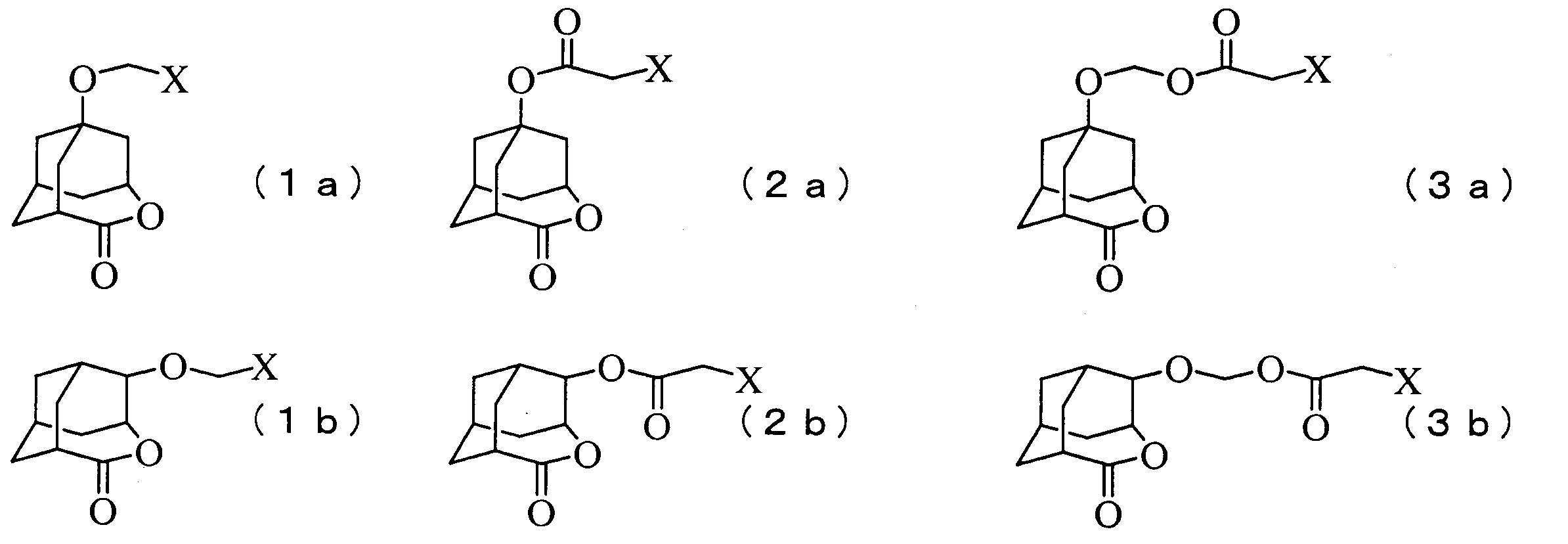
3.下記式(1a)~(3b)のいずれかで表される2記載のホモアダマンタン誘導体。
4.下記a~gのいずれかの工程を含む、1~3のいずれか記載のホモアダマンタン誘導体の製造方法。
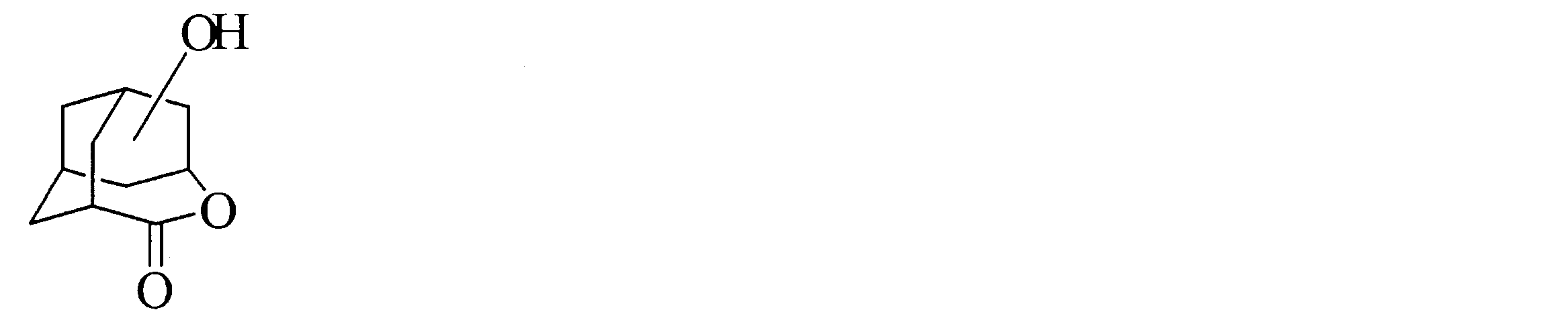
a.下記式で表わされるホモアダマンチルアルコールと、アルデヒド及びハロゲン化水素ガスとを反応させる工程
b.下記式で表わされるホモアダマンチルアルコールと、アルキルスルホキシド及び酸無水物とを反応させてアルキルチオアルキルエーテル体を得、このアルキルチオアルキルエーテル体とハロゲン化剤とを反応させる工程
c.下記式で表わされるホモアダマンチルアルコールと、2-ヒドロキシカルボン酸ハライド、2-ハロゲン化カルボン酸ハライド又は2-ハロゲン化カルボン酸を反応させる工程
d.上記a~cのいずれかで得られたハロゲン化ホモアダマンタン誘導体と、2-ヒドロキシカルボン酸と反応させる工程
e.上記a~cのいずれかで得られたハロゲン化ホモアダマンタン誘導体と、2-ハロゲン化カルボン酸と反応させる工程

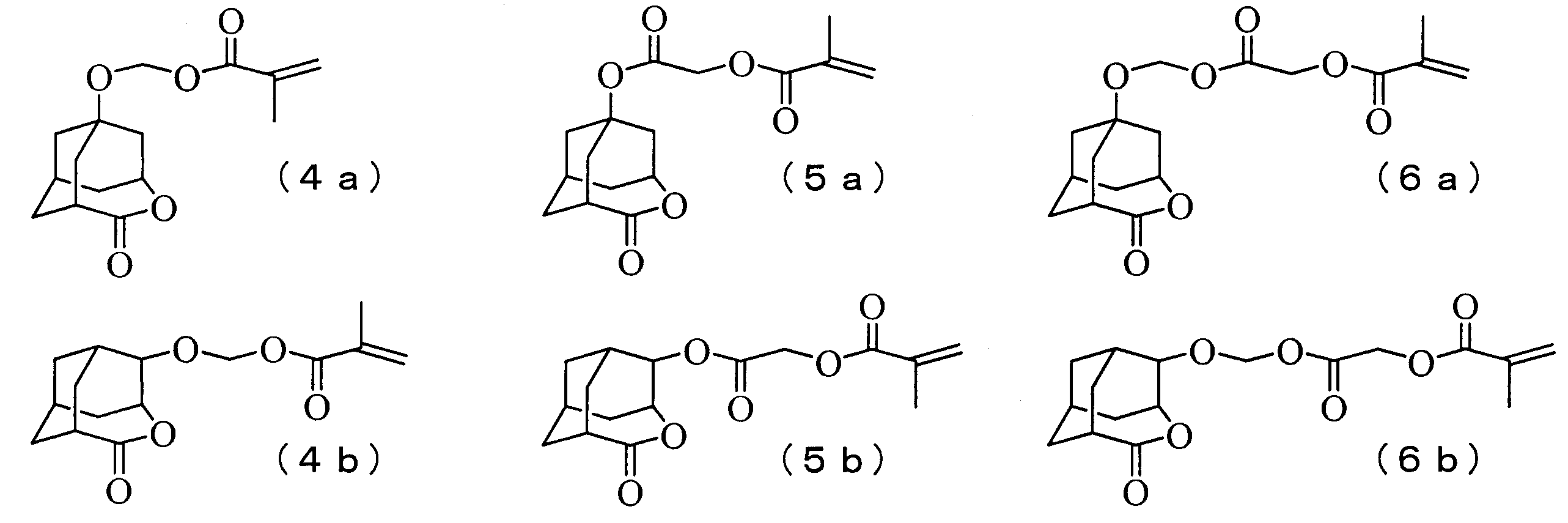
6.下記式(4)~(6)のいずれかで表される5記載の(メタ)アクリル酸エステル

9.5~7のいずれか記載の(メタ)アクリル酸エステルを重合して得られる(メタ)アクリル系重合体。
10.9記載の(メタ)アクリル系重合体及び光酸発生剤を含有するポジ型フォトレジスト組成物。
11.10に記載のポジ型フォトレジスト組成物を用いて支持体上にフォトレジスト膜を形成する工程と、該フォトレジスト膜を選択露光する工程と、選択露光された該フォトレジスト膜をアルカリ現像処理してレジストパターンを形成する工程とを含むレジストパターン形成方法。
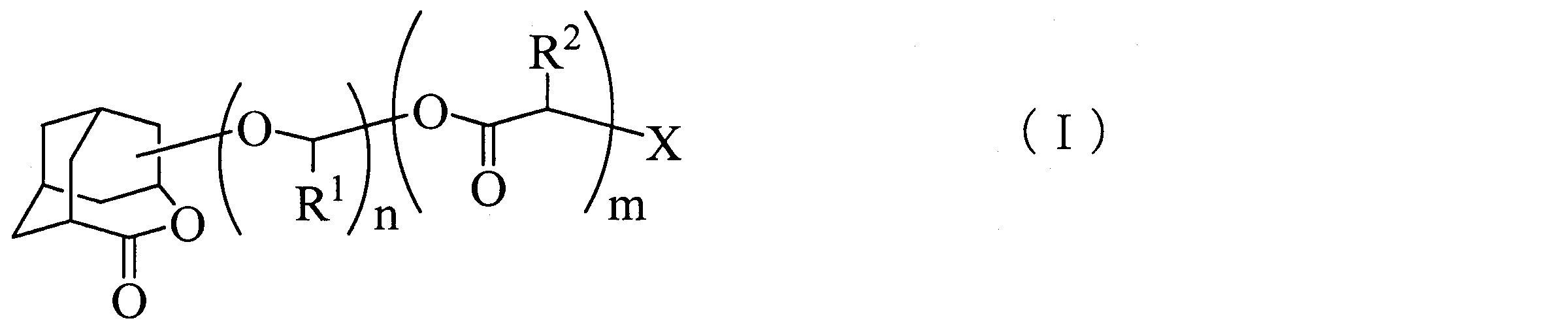
nが2以上の場合、複数のR1はそれぞれ同一でも異なっていてもよく、mが2以上の場合、複数のR2はそれぞれ同一でも異なっていてもよい。

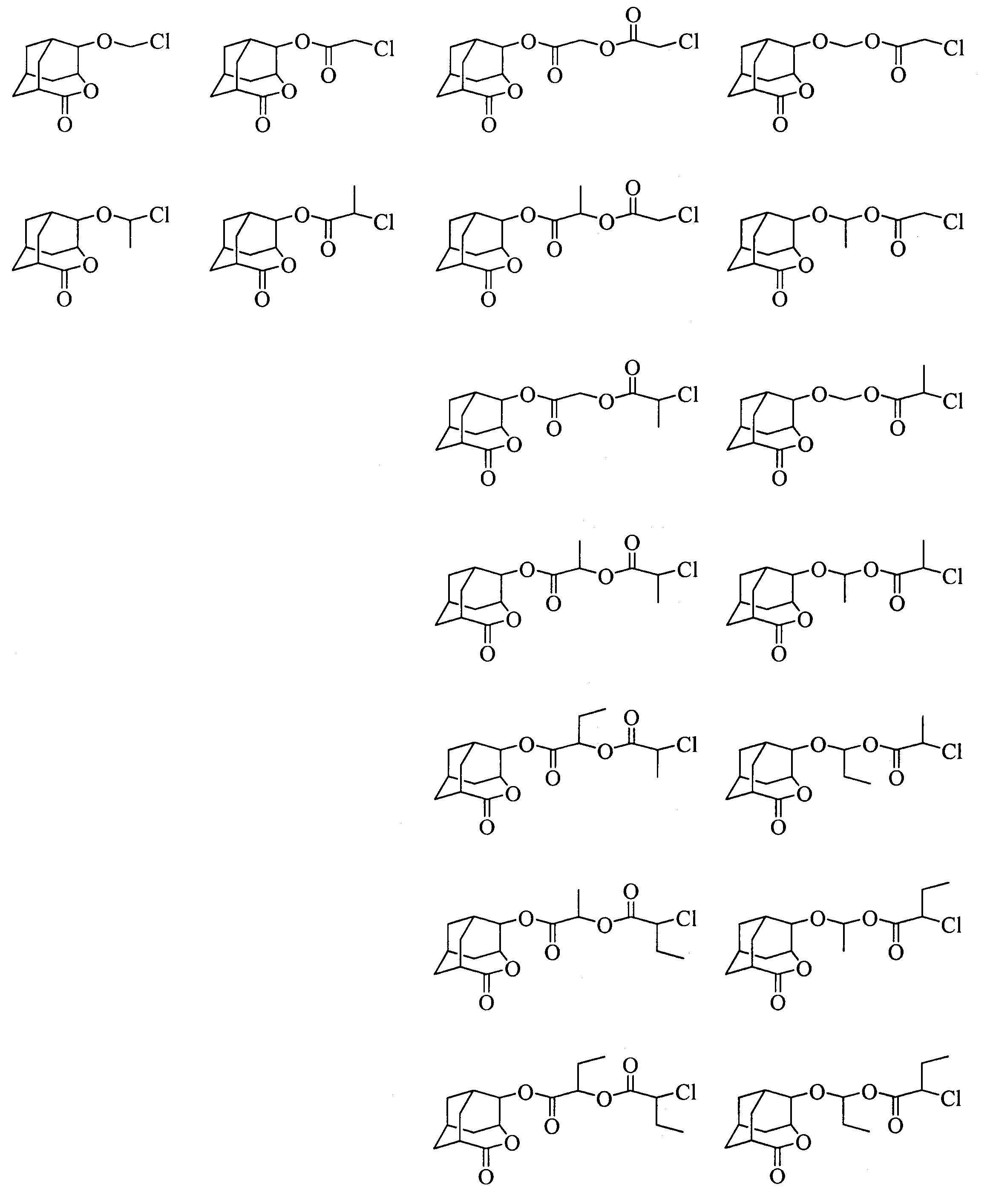
(5-オキソ-4-オキサ-5-ホモアダマンタン-2-イル)オキシメチルクロライド、1-(5-オキソ-4-オキサ-5-ホモアダマンタン-2-イル)オキシエチルクロライド、2-(5-オキソ-4-オキサ-5-ホモアダマンタン-2-イル)オキシ-2-オキソエチルクロライド、2-(5-オキソ-4-オキサ-5-ホモアダマンタン-2-イル)オキシ-2-オキソ-1-メチルエチルクロライド、2-(2-(5-オキソ-4-オキサ-5-ホモアダマンタン-2-イル)オキシ-2-オキソエトキシ)-2-オキソエチルクロライド、2-(2-(5-オキソ-4-オキサ-5-ホモアダマンタン-2-イル)オキシ-2-オキソ-1-メチルエトキシ)-2-オキソエチルクロライド、2-(2-(5-オキソ-4-オキサ-5-ホモアダマンタン-2-イル)オキシ-2-オキソエトキシ)-2-オキソ-1-メチルエチルクロライド、2-(2-(5-オキソ-4-オキサ-5-ホモアダマンタン-2-イル)オキシ-2-オキソ-1-メチルエトキシ)-2-オキソ-1-メチルエチルクロライド、2-(2-(5-オキソ-4-オキサ-5-ホモアダマンタン-2-イル)オキシ-2-オキソ-1-エチルエトキシ)-2-オキソ-1-メチルエチルクロライド、2-(2-(5-オキソ-4-オキサ-5-ホモアダマンタン-2-イル)オキシ-2-オキソ-1-メチルエトキシ)-2-オキソ-1-エチルエチルクロライド、2-(2-(5-オキソ-4-オキサ-5-ホモアダマンタン-2-イル)オキシ-2-オキソ-1-エチルエトキシ)-2-オキソ-1-エチルエチルクロライド、2-(5-オキソ-4-オキサ-5-ホモアダマンタン-2-イル)オキシメトキシ-2-オキソエチルクロライド、2-(5-オキソ-4-オキサ-5-ホモアダマンタン-2-イル)オキシメチルメトキシ-2-オキソエチルクロライド、2-(5-オキソ-4-オキサ-5-ホモアダマンタン-2-イル)オキシメトキシ-2-オキソ-1-メチルエチルクロライド、2-(5-オキソ-4-オキサ-5-ホモアダマンタン-2-イル)オキシメチルメトキシ-2-オキソ-1-メチルエチルクロライド、2-(5-オキソ-4-オキサ-5-ホモアダマンタン-2-イル)オキシエチルメトキシ-2-オキソ-1-メチルエチルクロライド、2-(5-オキソ-4-オキサ-5-ホモアダマンタン-2-イル)オキシメチルメトキシ-2-オキソ-1-エチルエチルクロライド、2-(5-オキソ-4-オキサ-5-ホモアダマンタン-2-イル)オキシエチルメトキシ-2-オキソ-1-エチルエチルクロライド、(5-オキソ-4-オキサ-5-ホモアダマンタン-2-イル)オキシメチルブロマイド、1-(5-オキソ-4-オキサ-5-ホモアダマンタン-2-イル)オキシエチルブロマイド、2-(5-オキソ-4-オキサ-5-ホモアダマンタン-2-イル)オキシ-2-オキソエチルブロマイド、2-(5-オキソ-4-オキサ-5-ホモアダマンタン-2-イル)オキシ-2-オキソ-1-メチルエチルブロマイド、2-(2-(5-オキソ-4-オキサ-5-ホモアダマンタン-2-イル)オキシ-2-オキソエトキシ)-2-オキソエチルブロマイド、2-(2-(5-オキソ-4-オキサ-5-ホモアダマンタン-2-イル)オキシ-2-オキソ-1-メチルエトキシ)-2-オキソエチルブロマイド、2-(2-(5-オキソ-4-オキサ-5-ホモアダマンタン-2-イル)オキシ-2-オキソエトキシ)-2-オキソ-1-メチルエチルブロマイド、2-(2-(5-オキソ-4-オキサ-5-ホモアダマンタン-2-イル)オキシ-2-オキソ-1-メチルエトキシ)-2-オキソ-1-メチルエチルブロマイド、2-(2-(5-オキソ-4-オキサ-5-ホモアダマンタン-2-イル)オキシ-2-オキソ-1-エチルエトキシ)-2-オキソ-1-メチルエチルブロマイド、2-(2-(5-オキソ-4-オキサ-5-ホモアダマンタン-2-イル)オキシ-2-オキソ-1-メチルエトキシ)-2-オキソ-1-エチルエチルブロマイド、2-(2-(5-オキソ-4-オキサ-5-ホモアダマンタン-2-イル)オキシ-2-オキソ-1-エチルエトキシ)-2-オキソ-1-エチルエチルブロマイド、2-(5-オキソ-4-オキサ-5-ホモアダマンタン-2-イル)オキシメトキシ-2-オキソエチルブロマイド、2-(5-オキソ-4-オキサ-5-ホモアダマンタン-2-イル)オキシメチルメトキシ-2-オキソエチルブロマイド、2-(5-オキソ-4-オキサ-5-ホモアダマンタン-2-イル)オキシメトキシ-2-オキソ-1-メチルエチルブロマイド、2-(5-オキソ-4-オキサ-5-ホモアダマンタン-2-イル)オキシメチルメトキシ-2-オキソ-1-メチルエチルブロマイド、2-(5-オキソ-4-オキサ-5-ホモアダマンタン-2-イル)オキシエチルメトキシ-2-オキソ-1-メチルエチルブロマイド、2-(5-オキソ-4-オキサ-5-ホモアダマンタン-2-イル)オキシメチルメトキシ-2-オキソ-1-エチルエチルブロマイド、2-(5-オキソ-4-オキサ-5-ホモアダマンタン-2-イル)オキシエチルメトキシ-2-オキソ-1-エチルエチルブロマイド等が挙げられる。


a.下記式で表わされるホモアダマンチルアルコールを、アルデヒドの存在下、ハロゲン化水素ガスで反応させ、ハロゲン化エーテル体である式(I)のホモアダマンタン誘導体を得る工程
b.下記式で表わされるホモアダマンチルアルコールを、アルキルスルホキシド及び酸無水物の存在下反応させてアルキルチオアルキルエーテル体を得て、さらにこれとハロゲン化剤を反応させてハロゲン化エーテル体である式(I)のホモアダマンタン誘導体を得る工程
c.下記式で表わされるホモアダマンチルアルコールと、2-ヒドロキシカルボン酸ハライド、2-ハロゲン化カルボン酸ハライド又は2-ハロゲン化カルボン酸を反応させてエステル体である式(I)のホモアダマンタン誘導体を得る工程
d.上記a~cのいずれかで得られたハロゲン化ホモアダマンタン誘導体と、2-ヒドロキシカルボン酸と反応させる工程
e.上記a~cのいずれかで得られたハロゲン化ホモアダマンタン誘導体と、2-ハロゲン化カルボン酸と反応させる工程

別途有機溶媒を使用する場合、使用できる有機溶媒、圧力は工程aと同じであり、基質濃度が1mol/L~10mol/L程度となるように調節することが好ましい。基質濃度が1mol/L以上であると、通常の反応器で必要な量が得られるため経済的に好ましく、基質濃度が10mol/L以下であると反応液の温度制御が容易となり好ましい。
反応温度は任意であるが、高すぎると副反応による選択率低下が起きる恐れがあり、低すぎると反応自体の進行が遅くなる恐れがあるので室温~60℃が好ましい。
別途有機溶媒を使用する場合、基質濃度、使用できる有機溶媒、圧力は工程aと同じである。
反応温度は任意であるが、高すぎると副反応による選択率低下が起きる恐れがあり、低すぎると反応自体の進行が遅くなる恐れがあるので室温~100℃が好ましい。
nが2以上の場合、複数のR1はそれぞれ同一でも異なっていてもよく、mが2以上の場合、複数のR2はそれぞれ同一でも異なっていてもよい。


反応温度は-200~200℃程度であればよく、好ましくは-50~100℃である。また、反応圧力は例えば絶対圧力で0.01~10MPa程度であり、好ましくは常圧~1MPaである。反応時間が長い場合は滞留時間が長くなり、圧力が高すぎる場合は特別な耐圧装置が必要となり経済的でない。
本発明の(メタ)アクリル系重合体は、本発明の(メタ)アクリル酸エステル1種類以上に由来する繰り返し単位を含む重合体であればよく、(メタ)アクリル酸エステル1種だけを用いた単独重合体であってもよく、(メタ)アクリル酸エステル2種類以上を用いた共重合体であってもよく、(メタ)アクリル酸エステル1種類以上と他の重合性モノマーとを用いた共重合体であってもよい。
上記重合法のうち、溶媒中でラジカル重合開始剤を用いた重合反応が好ましい。重合開始剤としては特に限定はないが、パーオキサイド系重合開始剤、アゾ系重合開始剤等が用いられる。
本発明の(メタ)アクリル系重合体はポジ型フォトレジストとして使用できる。即ち、反応性の高い式(I)のホモアダマンタン誘導体から、ホモアダマンタン骨格を、PAG、低分子ポジ型フォトレジスト又はポジ型フォトレジストモノマーに導入でき、さらにはポジ型フォトレジスト重合体に導入できる。
式(II)の(メタ)アクリル酸エステルに含まれる炭素炭素二重結合は重合速度を高める。
光酸発生剤の含有量は、(メタ)アクリル系重合体100質量部に対して好ましくは0.1~30質量部、より好ましくは1~25質量部、さらに好ましくは2~20質量部である。
このポジ型フォトレジスト組成物を基材又は基板上に塗布し、乾燥した後、所定のマスクを介して塗膜(レジスト膜)に光線を露光して(又は、さらに露光後ベークを行い)潜像パターンを形成し、次いで現像することにより微細なパターンを高い精度で形成できる。
尚、物性の測定方法は以下の通りである。
(1)核磁気共鳴分光法(NMR):溶媒としてクロロホルム-dを使用し、JNM-ECA500(日本電子株式会社製)で測定した。
(2)ガスクロマトグラフ-質量分析(GC-MS):EI(株式会社島津製作所製GCMS-QP2010)を用いて測定した。
(3)重量平均分子量(Mw)、分散度(Mw/Mn):HLC-8220 GPCシステム(東ソー製、カラム=TSGgel G-4000HXL+G-2000HXL)を用いてポリスチレン換算で測定した。
5-オキソ-4-オキサ-5-ホモアダマンタン-2-オールは2-アダマンタノンを原料に文献(J.Am.Chem.Soc., 108,15,4484(1986))記載の方法によりendo-ビシクロ[3.3.1]ノン-6-エン-3-カルボン酸を合成し、さらにギ酸と過酸化水素水からなる過ギ酸による反応により合成した。
ホモアダマンタン誘導体の合成:(5-オキソ-4-オキサ-5-ホモアダマンタン-1-イル)オキシメチルクロライド
1Lフラスコに、5-オキソ-4-オキサ-5-ホモアダマンタン-1-オール54.7g(300mmol)とジメチルスルホキシド(DMSO)400mL(5.6mol)、無水酢酸200mL(2.1mol)を加え、3日間攪拌した後、ガスクロ分析を行ったところ、5-オキソ-4-オキサ-5-ホモアダマンタン-1-オールが完全にメチルチオメチルエーテル体に転化していることを確認した。
1H-NMR:1.84~2.67(m,11H),3.09(t,J=5.6Hz,1H),4.63(s,1H),5.43(s,2H)
13C-NMR:29.69,30.11,34.56,34.63,38.14,39.83,41.37,68.29,73.88,82.07,177.92

ホモアダマンタン誘導体の合成:(5-オキソ-4-オキサ-5-ホモアダマンタン-2-イル)オキシメチルクロライド
塩化水素ガス導入用のノズルを取付けた1Lセパラブルフラスコに撹拌装置を取り付け、ここに5-オキソ-4-オキサ-5-ホモアダマンタン-2-オール54.7g(300mmol)、パラホルムアルデヒド13.6g(450mmol)、硫酸マグネシウム36.2g(300mmol)及び乾燥したジクロロメタン650mLを加え、氷浴で0℃に冷却、攪拌した。ここに塩化ナトリウム292g(5.0mmol)と濃硫酸700mLを混合して発生させた塩化水素ガスをノズルを通して1時間吹き込んだ。さらに3時間攪拌後、硫酸マグネシウムをろ過した後、ガスクロ分析を行ったところ5-オキソ-4-オキサ-5-ホモアダマンタン-2-オールは完全にエーテル体に転化していることを確認した。
1H-NMR:1.57(s,1H),1.84~2.25(m,9H),3.22(s,1H),3.92(s,1H),4.11(s1H),5.68(s,2H)
13C-NMR:24.78,27.76,28.53,29.72,30.41,31.67,38.49,69.91,72.30,82.15,177.48

ホモアダマンタン誘導体の合成:2-(5-オキソ-4-オキサ-5-ホモアダマンタン-1-イル)オキシ-2-オキソエチルクロライド
1Lフラスコに5-オキソ-4-オキサ-5-ホモアダマンタン-1-オール36.4g(200mmol)を加え、テトラヒドロフラン200mLで溶解させ、トリエチルアミン41.8mL(300mmol)を加えた。フラスコを氷浴で冷却した状態で、クロロ酢酸クロライド19.1mL(240mmol)を約30分かけてゆっくり滴下した。
1H-NMR:1.80~2.57(m,11H),3.24(t,J=5.8Hz,1H),3.99(t,J=0.8Hz,2H),4.68(s,1H)
13C-NMR:29.68,30.20,34.55,34.70,38.18,39.70,41.07,41.53,73.67,80.43,165.88,176.75
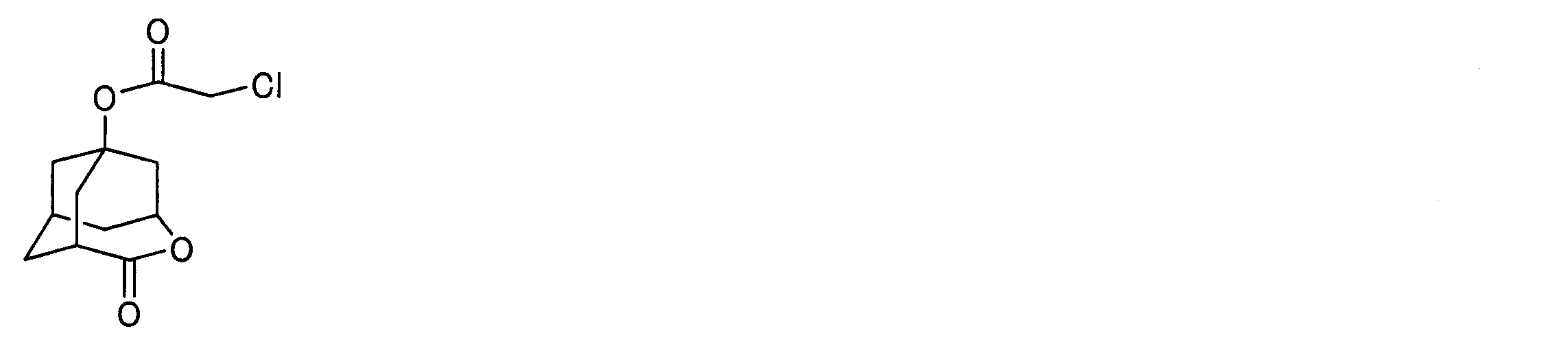
ホモアダマンタン誘導体の合成:2-(5-オキソ-4-オキサ-5-ホモアダマンタン-2-イル)オキシ-2-オキソエチルクロライド
実施例3において、5-オキソ-4-オキサ-5-ホモアダマンタン-1-オールの代わりに5-オキソ-4-オキサ-5-ホモアダマンタン-2-オールを使用したこと以外は実施例3と同様に行った結果、目的とする下記式の2-(5-オキソ-4-オキサ-5-ホモアダマンタン-2-イル)オキシ-2-オキソエチルクロライド37.0g(143mmol,単離収率71.5%,GC純度98.0%)を単離した。以下にGC-MS、1H-NMR及び13C-NMRの各データを示す。
1H-NMR:1.57(d,J=13.1Hz,1H),1.86~2.28(m,9H),3.09(s,1H),4.10(s,2H),4.29(s,1H),5.07(s,1H)
13C-NMR:24.89,27.76,28.61,29.65,30.34,31.62,40.36,40.65,72.08,73.67,165.71,176.66

ホモアダマンタン誘導体の合成:2-(5-オキソ-4-オキサ-5-ホモアダマンタン-1-イル)オキシ-2-オキソエチルクロライド
1Lフラスコに5-オキソ-4-オキサ-5-ホモアダマンタン-1-オール36.4g(200mmol)、パラトルエンスルホン酸1水和物1.9g(10mmol)、クロロ酢酸28.3g(300mmol)を加え、トルエン500mLで溶解させた。トルエンが沸騰するまで昇温し、その後、8時間撹拌を続けた後、水100mLを加えて反応を停止させた。得られた反応混合液は水洗の後、無水硫酸ナトリウムで乾燥させた。濾過,濃縮後、再結晶により精製し、目的の2-(5-オキソ-4-オキサ-5-ホモアダマンタン-1-イル)オキシ-2-オキソエチルクロライド44.1g(170mmol,単離収率85.2%,GC純度98.8%)を単離した。以下にGC-MS、1H-NMR及び13C-NMRの各データを示す。
1H-NMR:1.80~2.57(m,11H),3.24(t,J=5.8Hz,1H),3.99(t,J=0.8Hz,2H),4.68(s,1H)
13C-NMR:29.68,30.20,34.55,34.70,38.18,39.70,41.07,41.53,73.67,80.43,165.88,176.75

ホモアダマンタン誘導体の合成:2-(5-オキソ-4-オキサ-5-ホモアダマンタン-2-イル)オキシ-2-オキソエチルクロライド
実施例5において、5-オキソ-4-オキサ-5-ホモアダマンタン-1-オールの代わりに5-オキソ-4-オキサ-5-ホモアダマンタン-2-オールを使用したこと以外は実施例5と同様に行った結果、目的の2-(5-オキソ-4-オキサ-5-ホモアダマンタン-2-イル)オキシ-2-オキソエチルクロライド49.1g(190mmol,単離収率94.9%,GC純度98.0%)を単離した。以下にGC-MS、1H-NMR及び13C-NMRの各データを示す。
1H-NMR:1.57(d,J=13.1Hz,1H),1.86~2.28(m,9H),3.09(s,1H),4.10(s,2H),4.29(s,1H),5.07(s,1H)
13C-NMR:24.89,27.76,28.61,29.65,30.34,31.62,40.36,40.65,72.08,73.67,165.71,176.66

ホモアダマンタン誘導体の合成:2-(2-(5-オキソ-4-オキサ-5-ホモアダマンタン-1-イル)オキシ-2-オキソエトキシ)-2-オキソエタノール
500mLの三口フラスコに、グリコール酸4.6g(60mmol)、DMF50mL、炭酸カリウム10.4g(75mmol)、ヨウ化カリウム3.4g(20mmol)を入れ、室温で30分間撹拌した。そこへ、実施例3で合成した2-(5-オキソ-4-オキサ-5-ホモアダマンタン-1-イル)オキシ-2-オキソエチルクロライド14.9g(50mmol)のDMF30mL溶液をゆっくりと加え、45℃に昇温し、4時間撹拌した。反応終了後、トルエン100mLを加えてろ過し、得られた溶液を水洗、10wt%チオ硫酸ナトリウム水溶液での洗浄の後、無水硫酸ナトリウムで乾燥させた。濾過,濃縮後、トルエン-ヘプタン混合溶液から再結晶を行い、目的とする下記式の2-(2-(5-オキソ-4-オキサ-5-ホモアダマンタン-1-イル)オキシ-2-オキソエトキシ)-2-オキソエタノール10.8g(36.2mmol,単離収率72.4%,GC純度98.7%)を単離した。以下にGC-MS、1H-NMR及び13C-NMRの各データを示す。
1H-NMR:1.79~2.55(m,11H),3.36(t,J=6.0Hz,1H),4.42(d,J=5.2Hz,2H),4.55(s,2H),4.79(s,1H)
13C-NMR:29.61,30.39,34.67,34.72,38.30,39.85,41.31,60.85,61.13,74.36,80.11,166.23,171.99,177.64
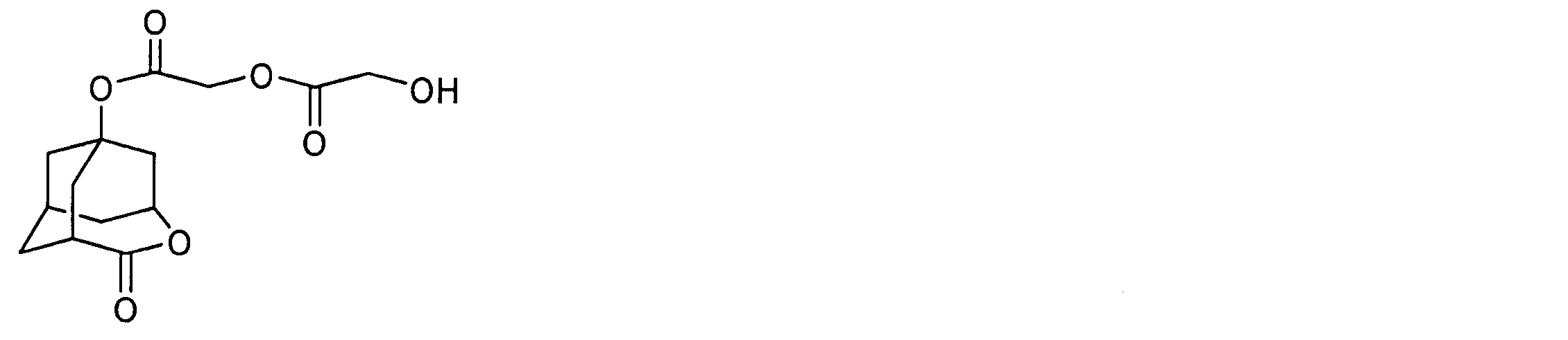
ホモアダマンタン誘導体の合成:2-(2-(5-オキソ-4-オキサ-5-ホモアダマンタン-2-イル)オキシ-2-オキソエトキシ)-2-オキソエタノール
実施例7において、実施例3で合成した2-(5-オキソ-4-オキサ-5-ホモアダマンタン-1-イル)オキシ-2-オキソエチルクロライドの代わりに実施例4で合成した2-(5-オキソ-4-オキサ-5-ホモアダマンタン-2-イル)オキシ-2-オキソエチルクロライドを使用したこと以外は実施例7と同様に行った結果、目的とする下記式の2-(2-(5-オキソ-4-オキサ-5-ホモアダマンタン-2-イル)オキシ-2-オキソエトキシ)-2-オキソエタノール11.3g(37.9mmol,単離収率75.8%,GC純度99.0%)を単離した。以下にGC-MS、1H-NMR及び13C-NMRの各データを示す。
1H-NMR:1.56(d,J=12.5Hz,1H),1.80~2.34(m,9H),3.06(s,1H),4.27(d,J=5.0Hz,2H),4.34(s,1H),4.94(s,1H),4.99(s,2H)
13C-NMR:24.94,27.78,28.72,29.55,30.19,31.67,40.42,60.78,61.11,72.33,73.81,165.34,173.65,176.38

ホモアダマンタン誘導体の合成:2-(5-オキソ-4-オキサ-5-ホモアダマンタン-1-イル)オキシメトキシ-2-オキソエチルクロライド
100mLフラスコに実施例1で合成した(5-オキソ-4-オキサ-5-ホモアダマンタン-1-イル)オキシメチルクロライド11.5g(50mmol)を入れ、テトラヒドロフラン50mLを加えて溶解させ、トリエチルアミン9.1mL(65mmol)を加えて撹拌開始した。ここへクロロ酢酸5.2g(55mmol)のテトラヒドロフラン10mL溶液を約10分かけてゆっくりと滴下した。引き続き2時間撹拌の後、水50mLを加えて反応を止めた。反応混合液にジエチルエーテル100mLを加え、水洗の後、無水硫酸ナトリウムで乾燥させた。濾過、濃縮すると、目的とする下記式の2-(5-オキソ-4-オキサ-5-ホモアダマンタン-1-イル)オキシメトキシ-2-オキソエチルクロライド13.7g(47mmol、単離収率95.0%、GC純度95.2%)を単離した。以下にGC-MS、1H-NMR及び13C-NMRの各データを示す。
1H-NMR:1.88~2.55(m,11H),3.15(t,J=5.6Hz,1H),3.91(s,2H),4.45(s,1H),5.63(s,2H)
13C-NMR:29.59,30.29,34.70,34.80,38.06,39.76,40.88,41.10,74.05,80.25,89.25,167.25,176.55

ホモアダマンタン誘導体の合成:2-(5-オキソ-4-オキサ-5-ホモアダマンタン-2-イル)オキシメトキシ-2-オキソエチルクロライド
実施例9において、実施例1で合成した(5-オキソ-4-オキサ-5-ホモアダマンタン-1-イル)オキシメチルクロライドの代わりに実施例2で合成した(5-オキソ-4-オキサ-5-ホモアダマンタン-2-イル)オキシメチルクロライドを使用したこと以外は実施例9と同様に行った結果、目的とする下記式の2-(5-オキソ-4-オキサ-5-ホモアダマンタン-2-イル)オキシメトキシ-2-オキソエチルクロライド12.3g(43mmol,単離収率85.0%,GC純度95.8%)を単離した。以下にGC-MS、1H-NMR及び13C-NMRの各データを示す。
1H-NMR:1.62(d,J=12.8Hz,1H),1.92~2.33(m,9H),2.96(s,1H),4.24(s,1H),4.26(s,2H),4.91(s,1H),5.22(s,2H)
13C-NMR:24.90,27.64,28.73,29.64,30.38,31.63,40.54,40.99,72.17,73.79,89.48,166.30,177.08

(メタ)アクリル酸エステルの合成:(5-オキソ-4-オキサ-5-ホモアダマンタン-1-イル)オキシメチルメタクリレート
実施例9において、クロロ酢酸の代わりにメタクリル酸4.7g(55mmol)を使用したこと以外は実施例9と同様に行った結果、目的とする下記式の(5-オキソ-4-オキサ-5-ホモアダマンタン-1-イル)オキシメチルメタクリレート13.5g(48mmol、単離収率96.3%、GC純度97.8%)を単離した。以下にGC-MS、1H-NMR及び13C-NMRの各データを示す。
1H-NMR:1.73~2.47(m,11H),2.04(s,3H),3.12(t,J=5.7Hz,1H),4.53(s,1H),5.29(s,2H),5.67(t,J=1.5Hz,1H),5.89(s,1H)
13C-NMR:18.17,29.64,30.13,34.50,34.83,38.36,39.59,41.12,73.80,80.49,88.62,126.52,136.49,166.86,176.74

(メタ)アクリル酸エステルの合成:(5-オキソ-4-オキサ-5-ホモアダマンタン-2-イル)オキシメチルメタクリレート
実施例11において、実施例1で合成した(5-オキソ-4-オキサ-5-ホモアダマンタン-1-イル)オキシメチルクロライドの代わりに実施例2で合成した(5-オキソ-4-オキサ-5-ホモアダマンタン-2-イル)オキシメチルクロライドを使用したこと以外は実施例11と同様に行った結果、目的とする下記式の(5-オキソ-4-オキサ-5-ホモアダマンタン-2-イル)オキシメチルメタクリレート12.9g(46mmol、単離収率92.0%、GC純度98.2%)を単離した。以下にGC-MS、1H-NMR及び13C-NMRの各データを示す。
1H-NMR:1.54(d,J=12.7Hz,1H),1.92~2.37(m,9H),2.06(s,3H),3.22(s,1H),4.08(s,1H),5.18(s,1H),5.41(s,2H),5.72(t,J=1.6Hz,1H),5.96(s,1H)
13C-NMR:18.15,24.97,27.85,28.51,29.54,30.46,31.74,40.31,72.09,73.83,88.69,126.13,136.70,166.82,177.50

(メタ)アクリル酸エステルの合成:2-(5-オキソ-4-オキサ-5-ホモアダマンタン-1-イル)オキシ-2-オキソエチルメタクリレート
200mLの三口フラスコに、メタクリル酸3.1mL(36mmol)、DMF30mL、炭酸カリウム6.2g(45mmol)、ヨウ化カリウム2.0g(12mmol)を入れ、室温で30分間撹拌した。そこへ、実施例3で合成した2-(5-オキソ-4-オキサ-5-ホモアダマンタン-1-イル)オキシ-2-オキソエチルクロライド7.8g(30mmol)のDMF20mL溶液をゆっくりと加え、45℃に昇温し、4時間撹拌した。反応終了後、トルエン60mLを加えてろ過し、得られた溶液を水洗、10wt%チオ硫酸ナトリウム水溶液での洗浄の後、無水硫酸ナトリウムで乾燥させた。濾過、濃縮後、シリカゲルカラムでの精製により、目的とする下記式の2-(5-オキソ-4-オキサ-5-ホモアダマンタン-1-イル)オキシ-2-オキソエチルメタクリレート8.0g(25.9mmol、単離収率86.3%、GC純度97.5%)を単離した。以下にGC-MS、1H-NMR及び13C-NMRの各データを示す。
1H-NMR:1.72~2.55(m,11H),1.98(s,3H),3.18(t,J=5.6Hz,1H),4.74(s,1H),4.91(s,2H),5.53(t,J=1.6Hz,1H),6.38(s,1H)
13C-NMR:18.16,29.67,30.15,34.65,34.70,38.13,39.71,41.26,60.90,74.21,80.27,126.71,134.76,166.11,166.73,178.11
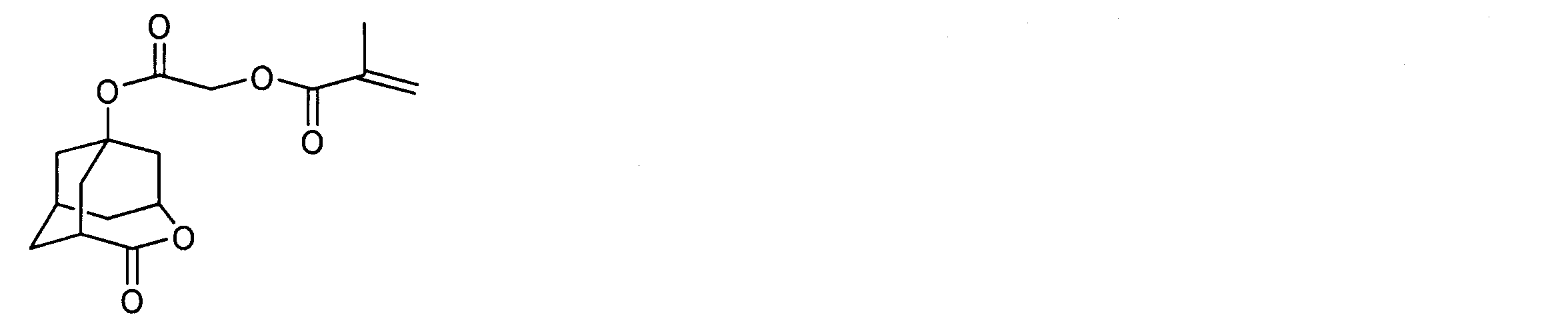
(メタ)アクリル酸エステルの合成:2-(5-オキソ-4-オキサ-5-ホモアダマンタン-2-イル)オキシ-2-オキソエチルメタクリレート
実施例13において、実施例3で合成した2-(5-オキソ-4-オキサ-5-ホモアダマンタン-1-イル)オキシ-2-オキソエチルクロライドの代わりに実施例4で合成した2-(5-オキソ-4-オキサ-5-ホモアダマンタン-2-イル)オキシ-2-オキソエチルクロライドを使用したこと以外は実施例13と同様に行った結果、目的とする下記式の2-(5-オキソ-4-オキサ-5-ホモアダマンタン-2-イル)オキシ-2-オキソエチルメタクリレート7.8g(25.3mmol、単離収率84.3%、GC純度96.9%)を単離した。以下にGC-MS、1H-NMR及び13C-NMRの各データを示す。
1H-NMR:1.58(d,J=13.4Hz,1H),1.76~2.31(m,9H),2.02(s,3H),3.08(s,1H),4.10(s,1H),4.76(s,2H),5.17(s,1H),5.87(t,J=1.5Hz,1H),6.35(s,1H)
13C-NMR:18.10,24.85,27.65,28.69,29.57,30.33,31.61,40.50,61.16,72.09,73.63,126.75,135.80,167.25,167.36,176.46

(メタ)アクリル酸エステルの合成:2-(2-(5-オキソ-4-オキサ-5-ホモアダマンタン-1-イル)オキシ-2-オキソエトキシ)-2-オキソエチルメタクリレート
実施例13において、実施例3で合成した2-(5-オキソ-4-オキサ-5-ホモアダマンタン-1-イル)オキシ-2-オキソエチルクロライドの代わりに実施例7で合成した2-(2-(5-オキソ-4-オキサ-5-ホモアダマンタン-1-イル)オキシ-2-オキソエトキシ)-2-オキソエタノールを使用したこと以外は実施例13と同様に行った結果、目的とする下記式の2-(2-(5-オキソ-4-オキサ-5-ホモアダマンタン-1-イル)オキシ-2-オキソエトキシ)-2-オキソエチルメタクリレート8.4g(22.9mmol、単離収率76.3%、GC純度97.0%)を単離した。以下にGC-MS、1H-NMR及び13C-NMRの各データを示す。
1H-NMR:1.75~2.65(m,11H),2.00(s,3H),3.30(t,J=5.9Hz,1H),4.49(s,1H),4.69(s,2H),4.74(s,2H),5.58(t,J=1.5Hz,1H),6.11(s,1H)
13C-NMR:18.13,29.62,30.18,34.68,34.74,38.20,39.89,41.09,60.93,61.08,74.27,80.83,126.59,135.40,166.05,166.46,166.74,177.35

(メタ)アクリル酸エステルの合成:2-(2-(5-オキソ-4-オキサ-5-ホモアダマンタン-2-イル)オキシ-2-オキソエトキシ)-2-オキソエチルメタクリレート
実施例13において、実施例3で合成した2-(5-オキソ-4-オキサ-5-ホモアダマンタン-1-イル)オキシ-2-オキソエチルクロライドの代わりに実施例8で合成した2-(2-(5-オキソ-4-オキサ-5-ホモアダマンタン-2-イル)オキシ-2-オキソエトキシ)-2-オキソエタノールを使用したこと以外は実施例13と同様に行った結果、目的とする下記式の2-(2-(5-オキソ-4-オキサ-5-ホモアダマンタン-2-イル)オキシ-2-オキソエトキシ)-2-オキソエチルメタクリレート)8.2g(22.4mmol、単離収率74.6%、GC純度97.2%)を単離した。以下にGC-MS、1H-NMR及び13C-NMRの各データを示す。
1H-NMR:1.49(d,J=13.5Hz,1H),1.94(s,3H),1.80~2.36(m,9H),3.02(s,1H),4.16(s,1H),4.47(s,2H),4.78(s,2H),4.95(s,1H),5.64(t,J=1.5Hz,1H),6.04(s,1H)
13C-NMR:18.07,24.82,27.78,28.52,29.73,30.49,31.72,40.19,60.70,60.74,71.96,73.45,126.78,135.42,165.85,166.10,166.79,176.57

(メタ)アクリル酸エステルの合成:2-(5-オキソ-4-オキサ-5-ホモアダマンタン-1-イル)オキシメトキシ-2-オキソエチルメタクリレート
実施例13において、実施例3で合成した2-(5-オキソ-4-オキサ-5-ホモアダマンタン-1-イル)オキシ-2-オキソエチルクロライドの代わりに実施例9で合成した2-(5-オキソ-4-オキサ-5-ホモアダマンタン-1-イル)オキシメトキシ-2-オキソエチルクロライドを使用したこと以外は実施例13と同様に行った結果、目的とする下記式の2-(5-オキソ-4-オキサ-5-ホモアダマンタン-1-イル)オキシメトキシ-2-オキソエチルメタクリレート7.2g(21.3mmol、単離収率70.9%、GC純度95.3%)を単離した。以下にGC-MS、1H-NMR及び13C-NMRの各データを示す。
1H-NMR:1.81~2.50(m,11H),1.94(s,3H),3.11(t,J=5.9Hz,1H),4.48(s,2H),4.88(s,1H),5.31(s,2H),5.69(t,J=1.5Hz,1H),6.48(s,1H)
13C-NMR:18.09,29.64,30.14,34.65,34.73,38.26,39.69,41.46,60.95,73.72,80.24,88.70,126.68,134.80,166.43,166.66,177.11
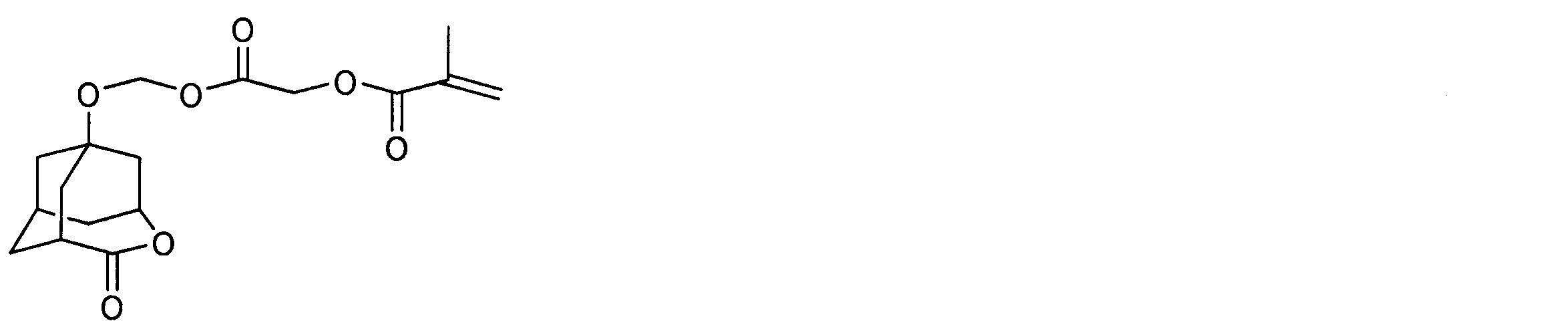
(メタ)アクリル酸エステルの合成:2-(5-オキソ-4-オキサ-5-ホモアダマンタン-2-イル)オキシメトキシ-2-オキソエチルメタクリレート
実施例13において、実施例3で合成した2-(5-オキソ-4-オキサ-5-ホモアダマンタン-1-イル)オキシ-2-オキソエチルクロライドの代わりに実施例10で合成した2-(5-オキソ-4-オキサ-5-ホモアダマンタン-2-イル)オキシメトキシ-2-オキソエチルクロライドを使用したこと以外は実施例13と同様に行った結果、目的とする下記式の2-(5-オキソ-4-オキサ-5-ホモアダマンタン-2-イル)オキシメトキシ-2-オキソエチルメタクリレート7.6g(22.5mmol、単離収率74.9%、GC純度95.0%)を単離した。以下にGC-MS、1H-NMR及び13C-NMRの各データを示す。
1H-NMR:1.63(d,J=13.3Hz,1H),1.87~2.31(m,9H),1.94(s,3H),3.08(s,1H),4.20(s,1H),4.81(s,2H),4.98(s,1H),5.54(s,2H),5.85(t,J=1.5Hz,1H),6.06(s,1H)
13C-NMR:18.19,24.88,27.76,28.66,29.51,30.48,31.76,40.24,60.65,72.29,73.89,88.73,126.84,135.89,166.16,166.28,175.92

(メタ)アクリル系共重合体の合成
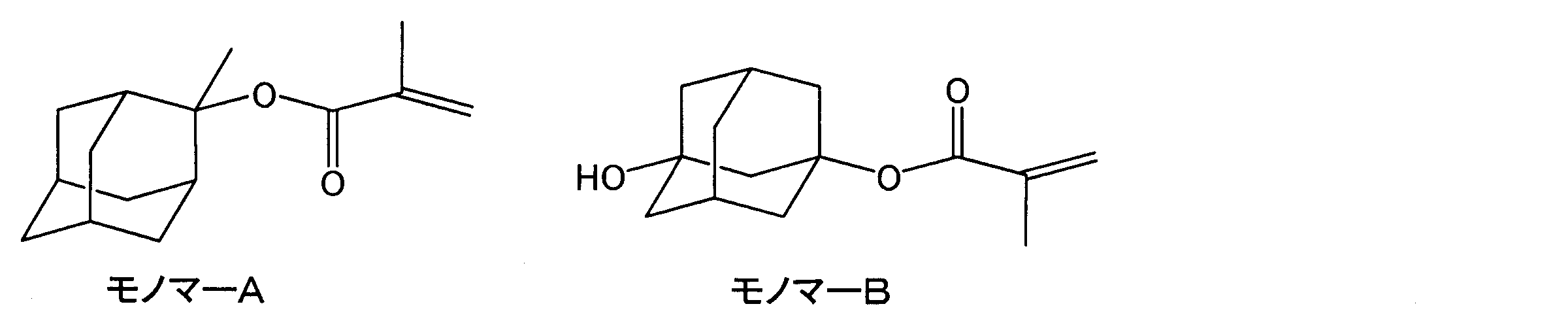
メチルイソブチルケトンに2,2’-アゾビス(イソ酪酸)ジメチル/モノマーA/モノマーB/モノマーC(実施例11~18で合成した化合物)を質量比0.1/2.0/1.0/1.0で仕込み、加熱還流下、3時間撹拌した。その後、反応液を大量のメタノールと水の混合溶媒に注いで沈殿させる動作を3回行い精製した結果、それぞれの共重合体P1~P8を得た。共重合体P1~P8の共重合組成、重量平均分子量(Mw)、分散度(Mw/Mn)を表1に示す。

ポジ型レジスト組成物の調製
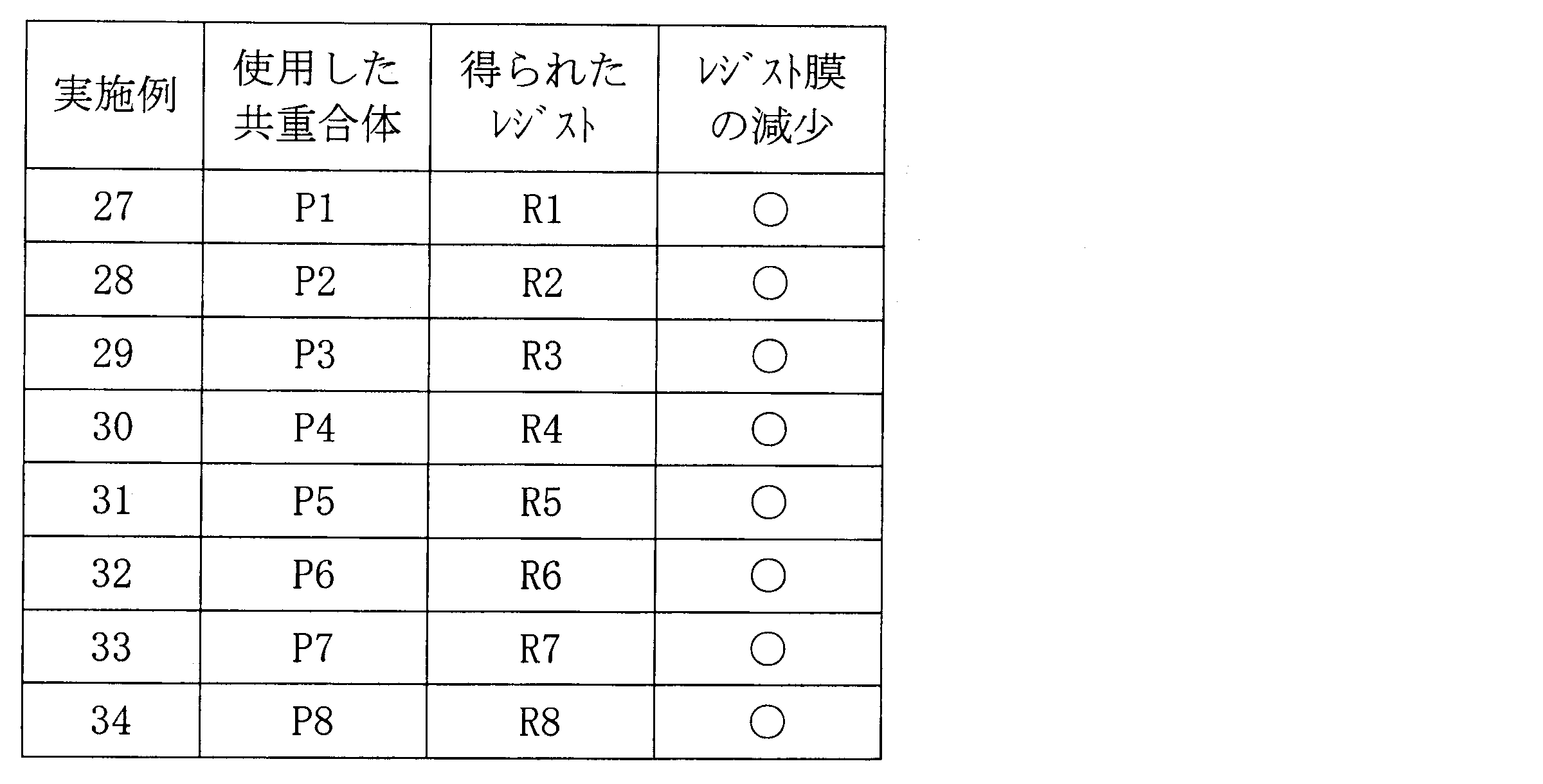
実施例19~26で得られた共重合体P1~P8それぞれ100質量部に対し、光酸発生剤としてトリフェニルスルホニウムノナフルオロブタンスルホネートを5質量部加え、得られた樹脂組成物10質量部に対してプロピレングリコールモノメチルエーテルアセテート90質量部を用いて溶解し、レジスト組成物R1~R8を調製した。シリコンウエハー上に、調製したレジスト組成物R1~R8を塗布し、110℃で、60秒間ベークを行い、レジスト膜を形成した。こうして得られたウエハーを波長248nmの光によって100mJ/cm2の露光量でオープン露光した。露光直後に110℃で、60秒間加熱した後、テトラメチルアンモニウムハイドロオキサイド水溶液(2.38質量%)で60秒間現像した。このときのレジスト膜の減少の有無を表2に示した。○印はレジスト膜が完全になくなったことを示す。
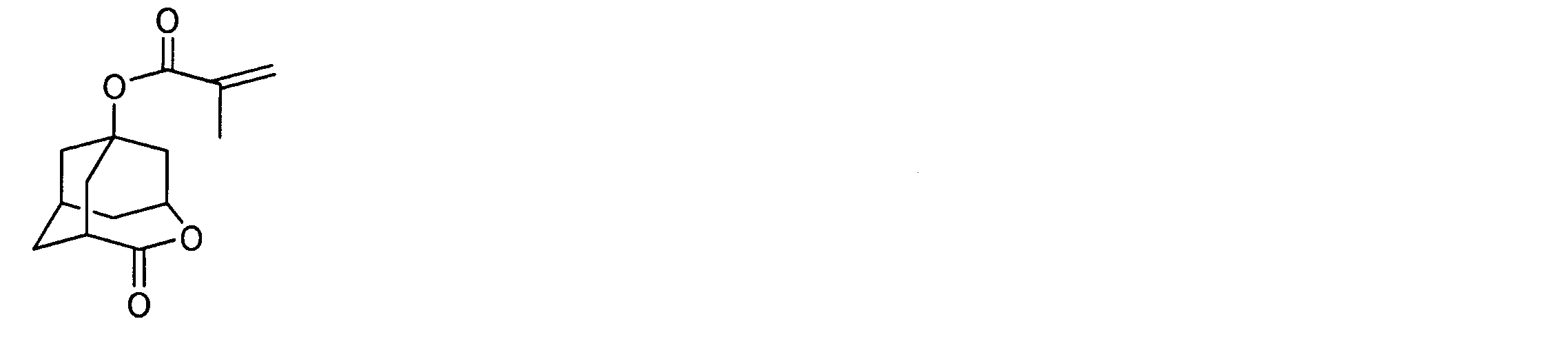
(メタ)アクリル酸エステルの合成:5-オキソ-4-オキサ-5-ホモアダマンタン-1-イルメタクリレート
実施例9において、(5-オキソ-4-オキサ-5-ホモアダマンタン-1-イル)オキシメチルクロライドの代わりに5-オキソ-4-オキサ-5-ホモアダマンタン-1-オール9.1g(50mmol)を、クロロ酢酸の代わりにメタクリル酸4.7g(55mmol)を使用したこと以外は実施例9と同様に行った結果、目的とする下記式の5-オキソ-4-オキサ-5-ホモアダマンタン-1-イルメタクリレート11.9g(48mmol、単離収率95.1%、GC純度98.7%)を単離した。
(メタ)アクリル系共重合体の合成
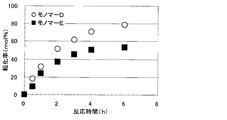
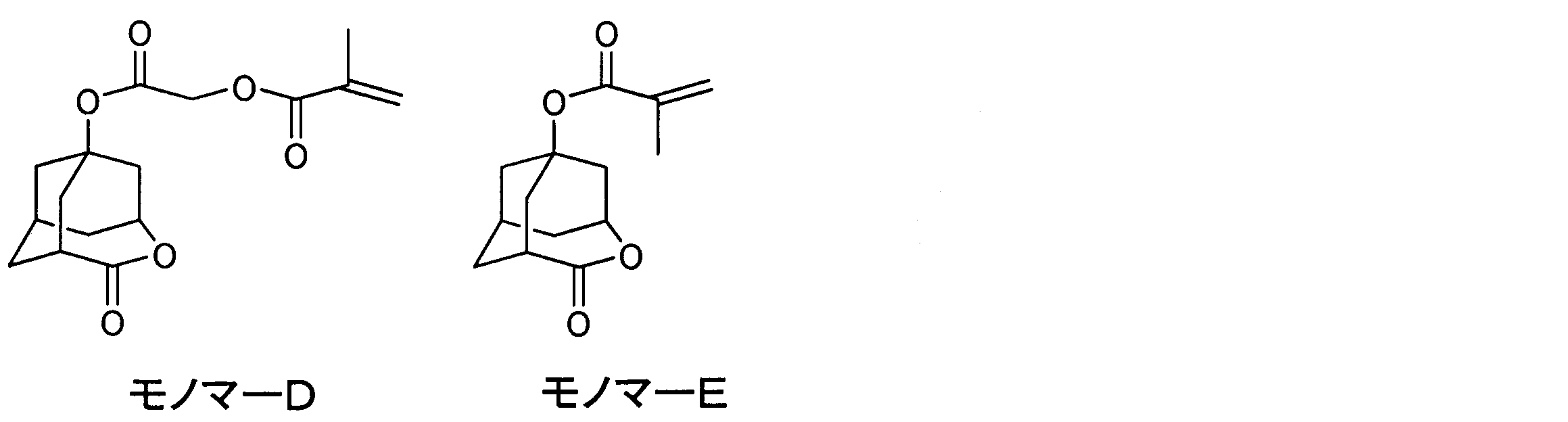
メチルイソブチルケトンに2,2’-アゾビス(イソ酪酸)ジメチル/モノマーD(実施例13で合成した化合物)/モノマーE(比較例1で合成した化合物)を質量比0.1/1.0/1.0で仕込み、加熱還流下、3時間撹拌した。その際、それぞれのモノマーの転化率を経時的に比較したものを表3と図1に示した。
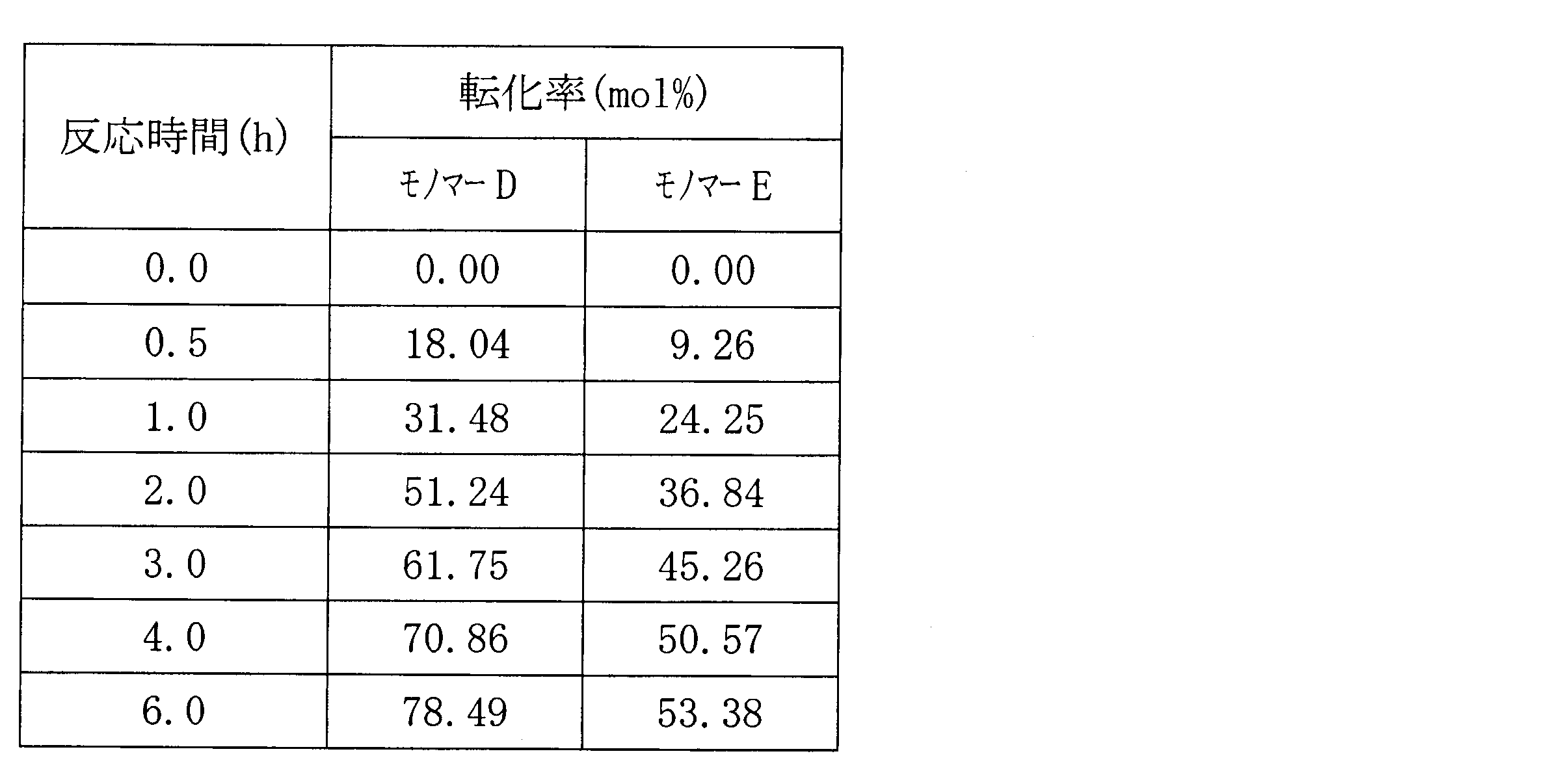
この明細書に記載の文献の内容を全てここに援用する。
Claims (11)
- 下記式(I)で表されるホモアダマンタン誘導体。
- 下記式(1)~(3)のいずれかで表される請求項1記載のホモアダマンタン誘導体。

- 下記式(1a)~(3b)のいずれかで表される請求項2記載のホモアダマンタン誘導体。
- 下記a~gのいずれかの工程を含む、請求項1~3のいずれか記載のホモアダマンタン誘導体の製造方法。
a.下記式で表わされるホモアダマンチルアルコールと、アルデヒド及びハロゲン化水素ガスとを反応させる工程
b.下記式で表わされるホモアダマンチルアルコールと、アルキルスルホキシド及び酸無水物とを反応させてアルキルチオアルキルエーテル体を得、このアルキルチオアルキルエーテル体とハロゲン化剤とを反応させる工程
c.下記式で表わされるホモアダマンチルアルコールと、2-ヒドロキシカルボン酸ハライド、2-ハロゲン化カルボン酸ハライド又は2-ハロゲン化カルボン酸を反応させる工程
d.上記a~cのいずれかで得られたハロゲン化ホモアダマンタン誘導体と、2-ヒドロキシカルボン酸と反応させる工程
e.上記a~cのいずれかで得られたハロゲン化ホモアダマンタン誘導体と、2-ハロゲン化カルボン酸と反応させる工程

- 下記式(II)で表される(メタ)アクリル酸エステル。
- 下記式(4)~(6)のいずれかで表される請求項5記載の(メタ)アクリル酸エステル

- 下記式(4a)~(6b)のいずれかで表される請求項6記載の(メタ)アクリル酸エステル。
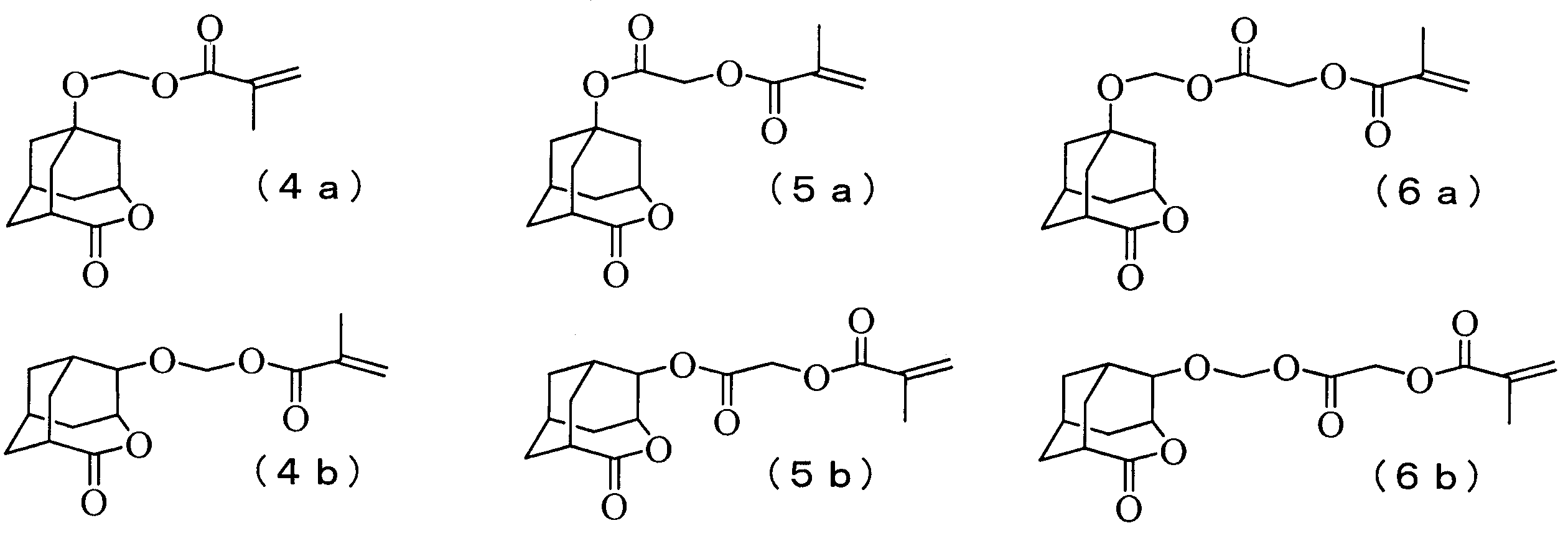
- 請求項1~3のいずれか記載のホモアダマンタン誘導体と、(メタ)アクリル酸類、(メタ)アクリル酸類ハライド、(メタ)アクリル酸類無水物、(メタ)アクリル酸類2-ヒドロキシアルキル誘導体から選択される1種以上とを反応させる請求項5~7のいずれか記載の(メタ)アクリル酸エステルの製造方法。
- 請求項5~7のいずれか記載の(メタ)アクリル酸エステルを重合して得られる(メタ)アクリル系重合体。
- 請求項9記載の(メタ)アクリル系重合体及び光酸発生剤を含有するポジ型フォトレジスト組成物。
- 請求項10に記載のポジ型フォトレジスト組成物を用いて支持体上にフォトレジスト膜を形成する工程と、該フォトレジスト膜を選択露光する工程と、選択露光された該フォトレジスト膜をアルカリ現像処理してレジストパターンを形成する工程とを含むレジストパターン形成方法。
Priority Applications (6)
| Application Number | Priority Date | Filing Date | Title |
|---|---|---|---|
| CN2011800166482A CN103097371A (zh) | 2010-04-02 | 2011-03-16 | 高金刚烷衍生物、其制备方法及光致抗蚀剂用感光性材料 |
| KR1020187034121A KR20180128100A (ko) | 2010-04-02 | 2011-03-16 | 호모아다만탄 유도체, 그 제조 방법 및 포토레지스트용 감광성 재료 |
| KR1020177021225A KR102061400B1 (ko) | 2010-04-02 | 2011-03-16 | 호모아다만탄 유도체, 그 제조 방법 및 포토레지스트용 감광성 재료 |
| KR1020127025834A KR20130034016A (ko) | 2010-04-02 | 2011-03-16 | 호모아다만탄 유도체, 그 제조 방법 및 포토레지스트용 감광성 재료 |
| US13/638,979 US20130022914A1 (en) | 2010-04-02 | 2011-03-16 | Homoadamantane derivative, method for producing the same and photosensitive materials for photoresist |
| US14/798,990 US20150316847A1 (en) | 2010-04-02 | 2015-07-14 | Homoadamantane derivative, method for producing the same and photosensitive materials for photoresist |
Applications Claiming Priority (2)
| Application Number | Priority Date | Filing Date | Title |
|---|---|---|---|
| JP2010086352A JP2011219363A (ja) | 2010-04-02 | 2010-04-02 | ホモアダマンタン誘導体、その製造方法及びフォトレジスト用感光性材料 |
| JP2010-086352 | 2010-04-02 |
Related Child Applications (2)
| Application Number | Title | Priority Date | Filing Date |
|---|---|---|---|
| US13/638,979 A-371-Of-International US20130022914A1 (en) | 2010-04-02 | 2011-03-16 | Homoadamantane derivative, method for producing the same and photosensitive materials for photoresist |
| US14/798,990 Division US20150316847A1 (en) | 2010-04-02 | 2015-07-14 | Homoadamantane derivative, method for producing the same and photosensitive materials for photoresist |
Publications (1)
| Publication Number | Publication Date |
|---|---|
| WO2011125291A1 true WO2011125291A1 (ja) | 2011-10-13 |
Family
ID=44762262
Family Applications (1)
| Application Number | Title | Priority Date | Filing Date |
|---|---|---|---|
| PCT/JP2011/001532 Ceased WO2011125291A1 (ja) | 2010-04-02 | 2011-03-16 | ホモアダマンタン誘導体、その製造方法及びフォトレジスト用感光性材料 |
Country Status (5)
| Country | Link |
|---|---|
| US (2) | US20130022914A1 (ja) |
| JP (1) | JP2011219363A (ja) |
| KR (3) | KR20180128100A (ja) |
| CN (2) | CN103097371A (ja) |
| WO (1) | WO2011125291A1 (ja) |
Cited By (3)
| Publication number | Priority date | Publication date | Assignee | Title |
|---|---|---|---|---|
| JP2013257539A (ja) * | 2012-05-15 | 2013-12-26 | Sumitomo Chemical Co Ltd | レジスト組成物及びレジストパターンの製造方法 |
| JP2013257537A (ja) * | 2012-05-14 | 2013-12-26 | Sumitomo Chemical Co Ltd | レジスト組成物及びレジストパターンの製造方法 |
| JP2014142424A (ja) * | 2013-01-22 | 2014-08-07 | Tokyo Ohka Kogyo Co Ltd | レジストパターン形成方法 |
Families Citing this family (33)
| Publication number | Priority date | Publication date | Assignee | Title |
|---|---|---|---|---|
| JP5608009B2 (ja) | 2010-08-12 | 2014-10-15 | 大阪有機化学工業株式会社 | ホモアダマンタン誘導体、その製造方法及びフォトレジスト組成物 |
| JP6014980B2 (ja) * | 2011-02-08 | 2016-10-26 | 住友化学株式会社 | 樹脂、レジスト組成物及びレジストパターンの製造方法 |
| JP2013225094A (ja) * | 2011-10-07 | 2013-10-31 | Jsr Corp | フォトレジスト組成物及びレジストパターン形成方法 |
| JP6330250B2 (ja) * | 2012-03-07 | 2018-05-30 | 住友化学株式会社 | レジストパターンの製造方法 |
| JP6123383B2 (ja) * | 2012-03-23 | 2017-05-10 | 住友化学株式会社 | 樹脂、レジスト組成物及びレジストパターンの製造方法 |
| JP6142602B2 (ja) * | 2012-03-23 | 2017-06-07 | 住友化学株式会社 | レジスト組成物及びレジストパターンの製造方法 |
| JP6123384B2 (ja) * | 2012-03-23 | 2017-05-10 | 住友化学株式会社 | 樹脂、レジスト組成物及びレジストパターンの製造方法 |
| JP6134563B2 (ja) * | 2012-04-27 | 2017-05-24 | 住友化学株式会社 | レジスト組成物及びレジストパターンの製造方法 |
| JP6134562B2 (ja) * | 2012-04-27 | 2017-05-24 | 住友化学株式会社 | レジスト組成物及びレジストパターンの製造方法 |
| JP6315748B2 (ja) * | 2012-04-27 | 2018-04-25 | 住友化学株式会社 | レジスト組成物及びレジストパターンの製造方法 |
| JP6195725B2 (ja) * | 2012-05-01 | 2017-09-13 | 住友化学株式会社 | 樹脂、レジスト組成物及びレジストパターンの製造方法 |
| JP6174362B2 (ja) * | 2012-05-14 | 2017-08-02 | 住友化学株式会社 | レジスト組成物及びレジストパターンの製造方法 |
| JP6246493B2 (ja) * | 2012-05-15 | 2017-12-13 | 住友化学株式会社 | レジスト組成物及びレジストパターンの製造方法 |
| JP6246492B2 (ja) * | 2012-05-15 | 2017-12-13 | 住友化学株式会社 | レジスト組成物及びレジストパターンの製造方法 |
| JP6246491B2 (ja) * | 2012-05-15 | 2017-12-13 | 住友化学株式会社 | レジスト組成物及びレジストパターンの製造方法 |
| JP6145303B2 (ja) * | 2012-05-18 | 2017-06-07 | 住友化学株式会社 | レジスト組成物及びレジストパターンの製造方法 |
| JP6246495B2 (ja) * | 2012-05-18 | 2017-12-13 | 住友化学株式会社 | レジスト組成物及びレジストパターンの製造方法 |
| JP6208976B2 (ja) * | 2012-05-18 | 2017-10-04 | 住友化学株式会社 | レジスト組成物及びレジストパターンの製造方法 |
| JP6246494B2 (ja) * | 2012-05-18 | 2017-12-13 | 住友化学株式会社 | レジスト組成物及びレジストパターンの製造方法 |
| JP6181996B2 (ja) * | 2012-07-03 | 2017-08-16 | 住友化学株式会社 | レジスト組成物及びレジストパターンの製造方法 |
| JP6149511B2 (ja) * | 2012-07-12 | 2017-06-21 | 住友化学株式会社 | レジスト組成物及びレジストパターンの製造方法 |
| JP6276966B2 (ja) * | 2012-11-15 | 2018-02-07 | 住友化学株式会社 | レジスト組成物及びレジストパターンの製造方法 |
| CN105474140B (zh) * | 2013-08-05 | 2018-09-25 | 阿尔卑斯电气株式会社 | 透光性导电构件及其布图方法 |
| US9772558B2 (en) | 2013-09-24 | 2017-09-26 | International Business Machines Corporation | Sulfonic acid ester containing polymers for organic solvent based dual-tone photoresists |
| EP3161019A4 (en) * | 2014-06-27 | 2018-01-24 | Henkel IP & Holding GmbH | Alkoxysilane-functionalized hydrocarbon compounds, intermediates thereof and methods of preparation thereof |
| US10174546B2 (en) * | 2015-03-03 | 2019-01-08 | Mechoshade Systems, Llc | Shade adjustment notification system and method |
| JP6864994B2 (ja) * | 2015-06-26 | 2021-04-28 | 住友化学株式会社 | レジスト組成物 |
| JP6670694B2 (ja) * | 2015-07-14 | 2020-03-25 | 住友化学株式会社 | レジスト組成物及びレジストパターン製造方法 |
| JP6960308B2 (ja) * | 2016-12-01 | 2021-11-05 | 住友化学株式会社 | レジスト組成物及びレジストパターンの製造方法 |
| CN110352184B (zh) | 2017-01-20 | 2022-02-11 | 赢创运营有限公司 | 贮存稳定的甘油(甲基)丙烯酸酯羧酸酯 |
| JP7040280B2 (ja) * | 2017-06-13 | 2022-03-23 | 住友化学株式会社 | 化合物、樹脂、レジスト組成物及びレジストパターンの製造方法 |
| JP6780602B2 (ja) | 2017-07-31 | 2020-11-04 | 信越化学工業株式会社 | レジスト組成物及びパターン形成方法 |
| EP3611155A1 (en) | 2018-08-16 | 2020-02-19 | Evonik Operations GmbH | Preparation of (meth)acrylic acid esters |
Citations (6)
| Publication number | Priority date | Publication date | Assignee | Title |
|---|---|---|---|---|
| JP2000122294A (ja) * | 1998-08-10 | 2000-04-28 | Toshiba Corp | 感光性組成物及びパタ―ン形成方法 |
| JP2003005375A (ja) * | 2001-06-21 | 2003-01-08 | Fuji Photo Film Co Ltd | ポジ型レジスト組成物 |
| WO2005108343A1 (ja) * | 2004-05-10 | 2005-11-17 | Idemitsu Kosan Co., Ltd. | アダマンタン誘導体、その製造方法及びフォトレジスト用感光材料 |
| WO2005111097A1 (ja) * | 2004-05-18 | 2005-11-24 | Idemitsu Kosan Co., Ltd. | アダマンタン誘導体、その製造方法及びフォトレジスト用感光材料 |
| JP2009223300A (ja) * | 2008-02-22 | 2009-10-01 | Tokyo Ohka Kogyo Co Ltd | ポジ型レジスト組成物、レジストパターン形成方法および高分子化合物 |
| JP2009280538A (ja) * | 2008-05-23 | 2009-12-03 | Idemitsu Kosan Co Ltd | 脂環構造含有化合物、(メタ)アクリル酸エステル類、(メタ)アクリル系重合体並びにそれを含むポジ型レジスト組成物 |
Family Cites Families (7)
| Publication number | Priority date | Publication date | Assignee | Title |
|---|---|---|---|---|
| EP1179750B1 (en) * | 2000-08-08 | 2012-07-25 | FUJIFILM Corporation | Positive photosensitive composition and method for producing a precision integrated circuit element using the same |
| TWI465467B (zh) * | 2004-03-08 | 2014-12-21 | 三菱麗陽股份有限公司 | 光阻用聚合物、光阻組成物及圖案製造方法與光阻用聚合物用原料化合物 |
| US20050282985A1 (en) * | 2004-06-17 | 2005-12-22 | Hiroshi Koyama | Fluorine-atom-containing polymerizable unsaturated-monomer, fluorine-atom-containing polymeric compound and photoresist resin composition |
| TWI400571B (zh) * | 2006-03-14 | 2013-07-01 | Fujifilm Corp | 正型光阻組成物及使用它之圖案形成方法 |
| EP1975705B1 (en) * | 2007-03-28 | 2016-04-27 | FUJIFILM Corporation | Positive resist composition and pattern-forming method |
| JP4671065B2 (ja) * | 2008-09-05 | 2011-04-13 | 信越化学工業株式会社 | ダブルパターン形成方法 |
| JP5629454B2 (ja) * | 2008-12-12 | 2014-11-19 | 富士フイルム株式会社 | 重合性化合物、ラクトン含有化合物、ラクトン含有化合物の製造方法、及び、該重合性化合物を重合させた高分子化合物 |
-
2010
- 2010-04-02 JP JP2010086352A patent/JP2011219363A/ja active Pending
-
2011
- 2011-03-16 WO PCT/JP2011/001532 patent/WO2011125291A1/ja not_active Ceased
- 2011-03-16 CN CN2011800166482A patent/CN103097371A/zh active Pending
- 2011-03-16 CN CN201510231284.XA patent/CN104877067A/zh active Pending
- 2011-03-16 KR KR1020187034121A patent/KR20180128100A/ko not_active Ceased
- 2011-03-16 US US13/638,979 patent/US20130022914A1/en not_active Abandoned
- 2011-03-16 KR KR1020127025834A patent/KR20130034016A/ko not_active Ceased
- 2011-03-16 KR KR1020177021225A patent/KR102061400B1/ko active Active
-
2015
- 2015-07-14 US US14/798,990 patent/US20150316847A1/en not_active Abandoned
Patent Citations (6)
| Publication number | Priority date | Publication date | Assignee | Title |
|---|---|---|---|---|
| JP2000122294A (ja) * | 1998-08-10 | 2000-04-28 | Toshiba Corp | 感光性組成物及びパタ―ン形成方法 |
| JP2003005375A (ja) * | 2001-06-21 | 2003-01-08 | Fuji Photo Film Co Ltd | ポジ型レジスト組成物 |
| WO2005108343A1 (ja) * | 2004-05-10 | 2005-11-17 | Idemitsu Kosan Co., Ltd. | アダマンタン誘導体、その製造方法及びフォトレジスト用感光材料 |
| WO2005111097A1 (ja) * | 2004-05-18 | 2005-11-24 | Idemitsu Kosan Co., Ltd. | アダマンタン誘導体、その製造方法及びフォトレジスト用感光材料 |
| JP2009223300A (ja) * | 2008-02-22 | 2009-10-01 | Tokyo Ohka Kogyo Co Ltd | ポジ型レジスト組成物、レジストパターン形成方法および高分子化合物 |
| JP2009280538A (ja) * | 2008-05-23 | 2009-12-03 | Idemitsu Kosan Co Ltd | 脂環構造含有化合物、(メタ)アクリル酸エステル類、(メタ)アクリル系重合体並びにそれを含むポジ型レジスト組成物 |
Cited By (3)
| Publication number | Priority date | Publication date | Assignee | Title |
|---|---|---|---|---|
| JP2013257537A (ja) * | 2012-05-14 | 2013-12-26 | Sumitomo Chemical Co Ltd | レジスト組成物及びレジストパターンの製造方法 |
| JP2013257539A (ja) * | 2012-05-15 | 2013-12-26 | Sumitomo Chemical Co Ltd | レジスト組成物及びレジストパターンの製造方法 |
| JP2014142424A (ja) * | 2013-01-22 | 2014-08-07 | Tokyo Ohka Kogyo Co Ltd | レジストパターン形成方法 |
Also Published As
| Publication number | Publication date |
|---|---|
| US20130022914A1 (en) | 2013-01-24 |
| CN103097371A (zh) | 2013-05-08 |
| KR20130034016A (ko) | 2013-04-04 |
| US20150316847A1 (en) | 2015-11-05 |
| KR20170091182A (ko) | 2017-08-08 |
| CN104877067A (zh) | 2015-09-02 |
| KR102061400B1 (ko) | 2019-12-31 |
| KR20180128100A (ko) | 2018-11-30 |
| JP2011219363A (ja) | 2011-11-04 |
Similar Documents
| Publication | Publication Date | Title |
|---|---|---|
| WO2011125291A1 (ja) | ホモアダマンタン誘導体、その製造方法及びフォトレジスト用感光性材料 | |
| JP5608009B2 (ja) | ホモアダマンタン誘導体、その製造方法及びフォトレジスト組成物 | |
| JP5270188B2 (ja) | 新規なアクリル酸エステル誘導体、高分子化合物 | |
| US20130034813A1 (en) | CHEMICALLY AMPLIFIED POSITIVE RESIST COMPOSITION FOR ArF IMMERSION LITHOGRAPHY AND PATTERN FORMING PROCESS | |
| WO2009104753A1 (ja) | 脂環構造含有化合物、(メタ)アクリル酸エステル類及びその製造方法 | |
| JPWO2008081768A1 (ja) | 脂環構造含有クロロメチルエーテル類、フォトレジスト用重合性モノマーおよびその製造方法 | |
| KR100531535B1 (ko) | (메트)아크릴산 에스테르, 그 원료 알콜, 이들의 제조방법, 이 (메트)아크릴산 에스테르를 중합하여 수득되는중합체, 화학 증폭형 레지스트 조성물, 및 패턴 형성 방법 | |
| WO2009142142A1 (ja) | 脂環構造含有化合物、(メタ)アクリル酸エステル類、(メタ)アクリル系重合体並びにそれを含むポジ型レジスト組成物 | |
| US7041846B2 (en) | Alicyclic methacrylate having oxygen substituent group on α-methyl | |
| JP2005060638A (ja) | 重合体、製造方法、レジスト組成物およびパターン形成法 | |
| JP4323250B2 (ja) | 重合体、重合体の製造方法、レジスト組成物およびパターン形成方法 | |
| JP6028047B2 (ja) | ホモアダマンタン誘導体、その製造方法及びフォトレジスト用感光性材料 | |
| JP7236830B2 (ja) | 単量体、フォトレジスト用樹脂、フォトレジスト用樹脂組成物、及びパターン形成方法 | |
| JP3623058B2 (ja) | 新規ポリマー及びこれを用いたレジスト組成物並びにこれを用いたパターン形成方法 | |
| JP5879228B2 (ja) | アダマンタン誘導体 | |
| JP6908816B2 (ja) | 含フッ素単量体、それを用いた含フッ素重合体、それを用いた化学増幅型レジストおよびそれを用いたパターン形成方法 | |
| JP4951199B2 (ja) | (メタ)アクリル酸エステルの製造方法 | |
| JP6705286B2 (ja) | 重合性単量体の製造方法、リソグラフィー用重合体の製造方法およびレジスト組成物の製造方法 | |
| JP2012001494A (ja) | アダマンタン誘導体、その製造方法及び半導体用レジスト材料 |
Legal Events
| Date | Code | Title | Description |
|---|---|---|---|
| WWE | Wipo information: entry into national phase |
Ref document number: 201180016648.2 Country of ref document: CN |
|
| 121 | Ep: the epo has been informed by wipo that ep was designated in this application |
Ref document number: 11765193 Country of ref document: EP Kind code of ref document: A1 |
|
| ENP | Entry into the national phase |
Ref document number: 20127025834 Country of ref document: KR Kind code of ref document: A |
|
| NENP | Non-entry into the national phase |
Ref country code: DE |
|
| WWE | Wipo information: entry into national phase |
Ref document number: 13638979 Country of ref document: US |
|
| 122 | Ep: pct application non-entry in european phase |
Ref document number: 11765193 Country of ref document: EP Kind code of ref document: A1 |