WO2011125254A1 - 研摩スラリー及びその研摩方法 - Google Patents
研摩スラリー及びその研摩方法 Download PDFInfo
- Publication number
- WO2011125254A1 WO2011125254A1 PCT/JP2010/070795 JP2010070795W WO2011125254A1 WO 2011125254 A1 WO2011125254 A1 WO 2011125254A1 JP 2010070795 W JP2010070795 W JP 2010070795W WO 2011125254 A1 WO2011125254 A1 WO 2011125254A1
- Authority
- WO
- WIPO (PCT)
- Prior art keywords
- polishing
- slurry
- polishing slurry
- abrasive particles
- silicon carbide
- Prior art date
- Legal status (The legal status is an assumption and is not a legal conclusion. Google has not performed a legal analysis and makes no representation as to the accuracy of the status listed.)
- Ceased
Links
Images

Classifications
-
- C—CHEMISTRY; METALLURGY
- C09—DYES; PAINTS; POLISHES; NATURAL RESINS; ADHESIVES; COMPOSITIONS NOT OTHERWISE PROVIDED FOR; APPLICATIONS OF MATERIALS NOT OTHERWISE PROVIDED FOR
- C09K—MATERIALS FOR MISCELLANEOUS APPLICATIONS, NOT PROVIDED FOR ELSEWHERE
- C09K3/00—Materials not provided for elsewhere
- C09K3/14—Anti-slip materials; Abrasives
- C09K3/1454—Abrasive powders, suspensions and pastes for polishing
- C09K3/1463—Aqueous liquid suspensions
-
- B—PERFORMING OPERATIONS; TRANSPORTING
- B24—GRINDING; POLISHING
- B24B—MACHINES, DEVICES, OR PROCESSES FOR GRINDING OR POLISHING; DRESSING OR CONDITIONING OF ABRADING SURFACES; FEEDING OF GRINDING, POLISHING, OR LAPPING AGENTS
- B24B37/00—Lapping machines or devices; Accessories
- B24B37/04—Lapping machines or devices; Accessories designed for working plane surfaces
- B24B37/042—Lapping machines or devices; Accessories designed for working plane surfaces operating processes therefor
- B24B37/044—Lapping machines or devices; Accessories designed for working plane surfaces operating processes therefor characterised by the composition of the lapping agent
-
- C—CHEMISTRY; METALLURGY
- C09—DYES; PAINTS; POLISHES; NATURAL RESINS; ADHESIVES; COMPOSITIONS NOT OTHERWISE PROVIDED FOR; APPLICATIONS OF MATERIALS NOT OTHERWISE PROVIDED FOR
- C09G—POLISHING COMPOSITIONS; SKI WAXES
- C09G1/00—Polishing compositions
- C09G1/02—Polishing compositions containing abrasives or grinding agents
-
- H—ELECTRICITY
- H10—SEMICONDUCTOR DEVICES; ELECTRIC SOLID-STATE DEVICES NOT OTHERWISE PROVIDED FOR
- H10P—GENERIC PROCESSES OR APPARATUS FOR THE MANUFACTURE OR TREATMENT OF DEVICES COVERED BY CLASS H10
- H10P90/00—Preparation of wafers not covered by a single main group of this subclass, e.g. wafer reinforcement
- H10P90/12—Preparing bulk and homogeneous wafers
- H10P90/129—Preparing bulk and homogeneous wafers by polishing
-
- H—ELECTRICITY
- H10—SEMICONDUCTOR DEVICES; ELECTRIC SOLID-STATE DEVICES NOT OTHERWISE PROVIDED FOR
- H10D—INORGANIC ELECTRIC SEMICONDUCTOR DEVICES
- H10D62/00—Semiconductor bodies, or regions thereof, of devices having potential barriers
- H10D62/80—Semiconductor bodies, or regions thereof, of devices having potential barriers characterised by the materials
- H10D62/83—Semiconductor bodies, or regions thereof, of devices having potential barriers characterised by the materials being Group IV materials, e.g. B-doped Si or undoped Ge
- H10D62/832—Semiconductor bodies, or regions thereof, of devices having potential barriers characterised by the materials being Group IV materials, e.g. B-doped Si or undoped Ge being Group IV materials comprising two or more elements, e.g. SiGe
- H10D62/8325—Silicon carbide
Definitions
- the present invention relates to a polishing slurry containing manganese oxide as a main component and a polishing method thereof, and more particularly to a polishing slurry suitable for polishing silicon carbide.
- polishing treatment has been widely used as a method for surface processing of various materials such as electronic and electrical products.
- the surface of a substrate or the like to be polished is polished with polishing particles dispersed in an aqueous liquid, that is, with a polishing slurry. It is known that the amount of polishing during this polishing process depends on the concentration of the abrasive particles.
- the polishing process for controlling the concentration of the abrasive particles are used in abrasive slurries with abrasive particles such as silicon oxide (SiO 2) or aluminum oxide (Al 2 O 3).
- abrasive particles such as silicon oxide (SiO 2) or aluminum oxide (Al 2 O 3).
- SiO 2 silicon oxide
- Al 2 O 3 aluminum oxide
- polishing treatment is performed at a polishing particle concentration, that is, a polishing slurry concentration of 10 wt% to 20 wt%.
- the polishing slurry concentration be 10 wt% to 20 wt% (see Patent Document 1 and Patent Document 2).
- silicon carbide SiC
- SiC silicon carbide
- This silicon carbide has a very high hardness and is known as a difficult-to-cut material. Therefore, silicon carbide is polished using silicon oxide abrasive particles with excellent polishing characteristics, but the surface accuracy of the polished surface is high, but the polishing speed is low and the polishing process is efficient. Is said to be difficult. For this reason, there is a strong demand for a polishing technique that can quickly polish even a difficult-to-cut material such as silicon carbide and realize a desired surface accuracy.
- an object of the present invention is to provide a polishing technique capable of realizing good surface accuracy at a high polishing speed for a polishing object which is a high hardness such as silicon carbide (SiC) and is a difficult-to-cut material.
- SiC silicon carbide
- the present inventor has intensively studied a polishing slurry in which manganese oxide is used as polishing particles and dispersed in an aqueous liquid, and even when the concentration of the polishing particles is low, the polishing speed is controlled by the chemical characteristics of the polishing particles. The inventors have found that it can be increased, and have come up with the present invention.
- the present invention provides a polishing slurry for polishing a substrate, wherein the polishing particles are mainly composed of manganese oxide, and the content of the polishing particles is less than 10% by weight based on the polishing slurry.
- the polishing slurry of the present invention has a polishing particle content of less than 10% by weight (wt%) and a low concentration as the polishing slurry.
- wt% 10% by weight
- the polishing surface can be polished smoothly. According to the present invention, a polished surface with good surface accuracy can be realized at a high polishing speed even if the polishing particle concentration is smaller than that of a conventionally used polishing slurry of silicon oxide (SiO 2 ). .
- the polishing slurry of this invention it is high hardness like silicon carbide (SiC), and it can polish the grinding
- the abrasive particles having manganese oxide as a main component means that the abrasive particles contain 90% by weight or more of manganese oxide.
- the polishing slurry of the present invention when the content of the polishing particles exceeds 10% by weight, the polishing speed increases, but the surface accuracy of the polishing surface tends to decrease.
- the lower limit of the content is 0.1% by weight or more, and if it is less than 0.1% by weight, the polishing speed is low and practical polishing becomes difficult.
- the content of the abrasive particles is more preferably 0.5% by weight to 5% by weight.
- the aqueous liquid in the polishing slurry of the present invention refers to a mixture of water or water and at least one organic solvent having solubility in water within the range of solubility, and contains at least 1% of water. Say. And as an organic solvent, alcohol, a ketone, etc. are mentioned.
- alcohols examples include methanol (methyl alcohol), ethanol (ethyl alcohol), 1-propanol (n-propyl alcohol), 2-propanol (iso-propyl alcohol, IPA), 2-methyl-1- Examples include propanol (iso-butyl alcohol), 2-methyl-2-propanol (tert-butyl alcohol), 1-butanol (n-butyl alcohol), 2-butanol (sec-butyl alcohol), and the like.
- Polyhydric alcohols include 1,2-ethanediol (ethylene glycol), 1,2-propanediol (propylene glycol), 1,3-propanediol (trimethylene glycol), 1,2,3-propanetriol. (Glycerin).
- ketones examples include propanone (acetone), 2-butanone (methyl ethyl ketone, MEK), and the like.
- tetrahydrofuran (THF), N, N-dimethylformamide (DMF), dimethyl sulfoxide (DMSO), 1,4-dioxane and the like can be used.
- the polishing slurry preferably has a pH of 7 or more.
- the pH is 7 or more, a high polishing rate can be realized while maintaining good surface accuracy.
- the pH is 7 or more
- the object to be polished is silicon carbide
- the upper limit of pH is pH 13, and when it exceeds pH 13, a change in the chemical characteristics of the abrasive particles, that is, the action of manganese oxide to etch silicon carbide begins to occur, and the tendency of roughening the surface of the polished surface increases.
- the pH is 7 to 12.
- the chemical solution is not particularly limited, but in order to suppress the adverse effect on the object to be polished, it is preferable to use potassium salt or ammonium salt, and potassium salt is particularly preferable.
- manganese dioxide As the manganese oxide, it is preferable to use manganese dioxide as the manganese oxide.
- manganese dioxide is used as the abrasive particles, a high polishing speed can be realized while maintaining good surface accuracy even for an object to be polished such as silicon carbide.
- manganese dioxide is dispersed in water as abrasive particles, the pH becomes pH 5 to 6. Therefore, when adjusting to pH 7 or higher, it is preferable to add an alkaline chemical solution.
- Manganese oxide as an abrasive particle is not particularly limited in its particle diameter shape, but in order to achieve smooth surface accuracy, 50% diameter D in the volume-based cumulative fraction of laser diffraction / scattering particle diameter distribution measurement. 50 is preferably 1 ⁇ m or less, and more preferably 0.5 ⁇ m or less.
- the object to be polished is not particularly limited, but it is preferable to use a material that is high in hardness and difficult to cut, such as aluminum oxide (Al 2 O 3 ), nitriding Examples include gallium (GaN) and silicon carbide (SiC). In particular, it is preferable to use silicon carbide (SiC) as a polishing target.
- a material that is high in hardness and difficult to cut such as aluminum oxide (Al 2 O 3 ), nitriding Examples include gallium (GaN) and silicon carbide (SiC).
- SiC silicon carbide
- polishing slurry of the present invention it is possible to polish a polishing object, which is a hard material such as silicon carbide (SiC), at a high polishing speed with good surface accuracy. It becomes possible.
- SiC silicon carbide
- the graph which shows the relationship between a slurry density
- Example 1 to Example 4 Example 1 to Example 4 were prepared by using MnO 2 having an average particle diameter D 50 of 0.5 ⁇ m as abrasive particles and dispersing them in water as an aqueous liquid. A polishing slurry having a slurry concentration was prepared. The pH of the polishing slurries of Examples 1 to 4 was pH 7.8. The average particle diameter D 50 of MnO 2 was measured by a laser diffraction / scattering particle diameter distribution measuring apparatus (LA920 manufactured by Horiba, Ltd.).
- the polishing characteristic was investigated by polishing the silicon carbide single crystal plate with each polishing slurry.
- the silicon carbide single crystal plate to be polished was a SiC single crystal (6H structure) having a diameter of 2 inches and a thickness of 330 ⁇ m, and the polishing surface was on axis (a wafer surface cut perpendicular to the crystal axis). Before polishing, the surface of the substrate to be polished was measured for average surface roughness in the range of 10 ⁇ m ⁇ 10 ⁇ m by AFM (Atomic Force Microscope: Nanoscope IIIa manufactured by Veeco), and it was Ra 2.46 nm.
- the polishing conditions were each of the polishing slurries of Examples 1 to 4, with a polishing load of 250 g / cm 2, and a silicon carbide single crystal substrate placed on a polishing pad (SUBA400, manufactured by Nitta Haas Co., Ltd.). Polished for 3 hours. After the polishing treatment, the polished surface was washed with water, and the attached slurry was removed and dried. The surface roughness was measured by AFM at any five points on the dried polished surface. The average surface roughness measurement (range of 10 ⁇ m ⁇ 10 ⁇ m) is shown in Table 1. Further, the weight of the silicon carbide single crystal substrate before and after polishing was measured, and the polishing rate was calculated from the surface area and specific gravity of the substrate with the difference in weight as the polishing amount. Each polishing speed is shown in Table 1.
- a polishing slurry having a slurry concentration of 10 wt% or more (Comparative Examples 1 to 3) and a commercially available colloidal silica (Compol 80 (silicon oxide (SiO 2 ) manufactured by Fujimi Incorporated)
- a polishing slurry (Comparative Example 4 to Comparative Example 10) using an abrasive material)) was prepared.
- the colloidal silica has an average particle diameter D 50 was 0.10 .mu.m.
- colloidal silica was dispersed in water as an aqueous liquid to prepare polishing slurries having various slurry concentrations shown in Table 1. Then, the polishing characteristics were examined under the same conditions as in Examples 1 to 4.
- the polishing slurries of Comparative Examples 1 to 3 had a pH of 8.2, and the polishing slurries of Comparative Examples 4 to 10 had a pH of 8.7 to 9.1.
- FIG. 1 is a graph showing the relationship between the polishing slurry concentration and the polishing rate with respect to the polishing particle amount.
- the amount of abrasive particles is the total weight of abrasive particles contained in 100 g of each polishing slurry, and the value obtained by dividing the polishing rate value shown in Table 1 by the total weight of the abrasive particles is the polishing rate (nm / hr ⁇ g ).
- polishing rate for abrasive particles amount such so changed, when the slurry concentration decreases in the case of MnO 2, polishing speed increases for abrasive particles amount It has been found.
- the polishing rate of MnO 2 was 5 times as high as that of SiO 2 .
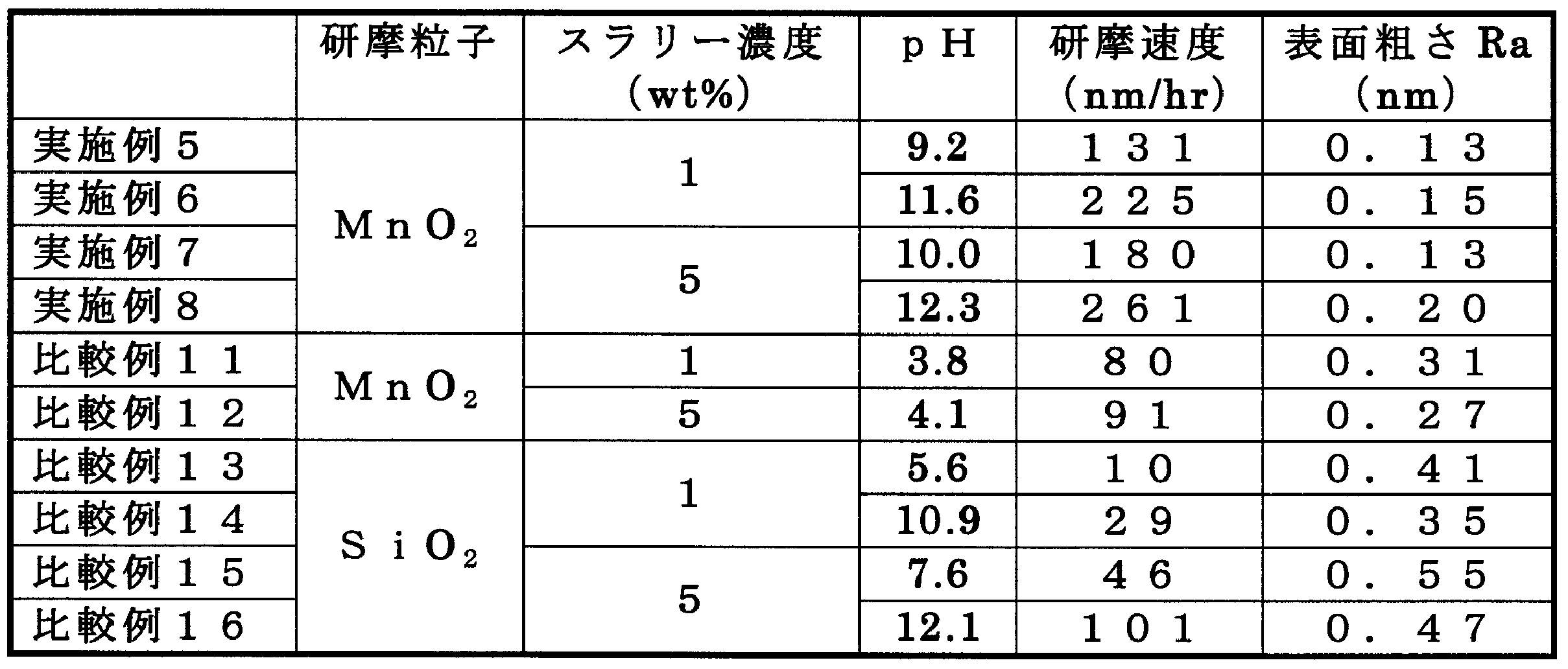
- Table 2 shows the results of adjusting the pH of the polishing slurry having a slurry concentration of 1 wt% and 5 wt% and investigating the polishing characteristics.
- Table 2 shows the cases where Examples 5 to 8 and Comparative Examples 11 and 12 are MnO 2 and Comparative Examples 13 to 16 are SiO 2 .
- MnO 2 and SiO 2 as the abrasive particles are under the same conditions as in Example 1 and Comparative Example 4, and the polishing characteristics were evaluated in the same manner.
- pH adjustment was performed using sulfuric acid or potassium hydroxide.
- a difficult-to-cut material such as silicon carbide can be polished with high surface accuracy with high efficiency and high speed.
Landscapes
- Chemical & Material Sciences (AREA)
- Organic Chemistry (AREA)
- Engineering & Computer Science (AREA)
- Materials Engineering (AREA)
- Mechanical Engineering (AREA)
- Mechanical Treatment Of Semiconductor (AREA)
- Finish Polishing, Edge Sharpening, And Grinding By Specific Grinding Devices (AREA)
Abstract
Description

Claims (7)
- 基材を研摩するための研摩スラリーにおいて、
研摩粒子は酸化マンガンを主成分とし、研摩粒子の含有量が、研摩スラリーに対して10重量%未満であることを特徴とする研摩スラリー。 - 研摩スラリーのpHがpH7以上である請求項1に記載の研摩スラリー。
- 酸化マンガンは、二酸化マンガンである請求項1または請求項2記載の研摩スラリー。
- 基材が炭化珪素である請求項1~請求項3いずれかに記載の研摩スラリー。
- 研摩粒子が酸化マンガン粒子を主成分とし、研摩粒子の含有量が、研摩スラリーに対して10重量%未満である研摩スラリーを用いて基材を研摩することを特徴とする基材の研摩方法。
- 研摩スラリーのpHをpH7以上に維持して研摩する請求項5に記載の基材の研摩方法。
- 基材が炭化珪素である請求項5または請求項6に記載の基材の研摩方法。
Priority Applications (3)
| Application Number | Priority Date | Filing Date | Title |
|---|---|---|---|
| CN201080066082XA CN102858493A (zh) | 2010-04-09 | 2010-11-22 | 研磨浆料及其研磨方法 |
| DE112010005467T DE112010005467T5 (de) | 2010-04-09 | 2010-11-22 | Poliermittel und Polierverfahren damit |
| US13/634,939 US20130012102A1 (en) | 2010-04-09 | 2010-11-22 | Polishing slurry and polishing method therefor |
Applications Claiming Priority (2)
| Application Number | Priority Date | Filing Date | Title |
|---|---|---|---|
| JP2010090837A JP2011218494A (ja) | 2010-04-09 | 2010-04-09 | 研摩スラリー及びその研摩方法 |
| JP2010-090837 | 2010-04-09 |
Publications (1)
| Publication Number | Publication Date |
|---|---|
| WO2011125254A1 true WO2011125254A1 (ja) | 2011-10-13 |
Family
ID=44762229
Family Applications (1)
| Application Number | Title | Priority Date | Filing Date |
|---|---|---|---|
| PCT/JP2010/070795 Ceased WO2011125254A1 (ja) | 2010-04-09 | 2010-11-22 | 研摩スラリー及びその研摩方法 |
Country Status (5)
| Country | Link |
|---|---|
| US (1) | US20130012102A1 (ja) |
| JP (1) | JP2011218494A (ja) |
| CN (1) | CN102858493A (ja) |
| DE (1) | DE112010005467T5 (ja) |
| WO (1) | WO2011125254A1 (ja) |
Cited By (1)
| Publication number | Priority date | Publication date | Assignee | Title |
|---|---|---|---|---|
| WO2016158328A1 (ja) * | 2015-04-01 | 2016-10-06 | 三井金属鉱業株式会社 | 研摩材および研摩スラリー |
Families Citing this family (3)
| Publication number | Priority date | Publication date | Assignee | Title |
|---|---|---|---|---|
| JP5400228B1 (ja) * | 2012-04-27 | 2014-01-29 | 三井金属鉱業株式会社 | SiC単結晶基板 |
| JP6411759B2 (ja) * | 2014-03-27 | 2018-10-24 | 株式会社フジミインコーポレーテッド | 研磨用組成物、その使用方法、及び基板の製造方法 |
| EP3950874B1 (en) * | 2019-03-27 | 2024-01-31 | Agc Inc. | Method for producing gallium oxide substrate |
Citations (4)
| Publication number | Priority date | Publication date | Assignee | Title |
|---|---|---|---|---|
| JP2001048546A (ja) * | 1999-08-04 | 2001-02-20 | Agency Of Ind Science & Technol | 超微粒子酸化マンガン粉体及びその製造方法 |
| JP2001205555A (ja) * | 1999-11-16 | 2001-07-31 | Denso Corp | メカノケミカル研磨方法及びメカノケミカル研磨装置 |
| JP2002241741A (ja) * | 2001-02-14 | 2002-08-28 | Noritake Co Ltd | 研磨加工用スラリー |
| WO2007029465A1 (ja) * | 2005-09-09 | 2007-03-15 | Asahi Glass Company, Limited | 研磨剤、被研磨面の研磨方法および半導体集積回路装置の製造方法 |
Family Cites Families (8)
| Publication number | Priority date | Publication date | Assignee | Title |
|---|---|---|---|---|
| JP3529902B2 (ja) | 1995-07-04 | 2004-05-24 | 富士通株式会社 | 半導体装置の製造方法 |
| JP3778386B2 (ja) | 1996-06-11 | 2006-05-24 | 富士通株式会社 | Mn酸化物を砥粒とする研磨剤の製造方法および半導体装置の製造方法 |
| US20050056810A1 (en) * | 2003-09-17 | 2005-03-17 | Jinru Bian | Polishing composition for semiconductor wafers |
| US20060213126A1 (en) * | 2005-03-28 | 2006-09-28 | Cho Yun J | Method for preparing a polishing slurry having high dispersion stability |
| KR20070088245A (ko) * | 2006-02-24 | 2007-08-29 | 후지필름 가부시키가이샤 | 금속용 연마액 |
| JP5202258B2 (ja) * | 2008-03-25 | 2013-06-05 | 富士フイルム株式会社 | 金属研磨用組成物、及び化学的機械的研磨方法 |
| CN101591508A (zh) * | 2008-05-30 | 2009-12-02 | 安集微电子(上海)有限公司 | 一种用于金属化学机械抛光的抛光浆料及其用途 |
| CN101608098B (zh) * | 2008-06-20 | 2013-06-12 | 安集微电子(上海)有限公司 | 一种用于金属化学机械抛光的抛光浆料及其用途 |
-
2010
- 2010-04-09 JP JP2010090837A patent/JP2011218494A/ja active Pending
- 2010-11-22 DE DE112010005467T patent/DE112010005467T5/de not_active Withdrawn
- 2010-11-22 US US13/634,939 patent/US20130012102A1/en not_active Abandoned
- 2010-11-22 WO PCT/JP2010/070795 patent/WO2011125254A1/ja not_active Ceased
- 2010-11-22 CN CN201080066082XA patent/CN102858493A/zh active Pending
Patent Citations (4)
| Publication number | Priority date | Publication date | Assignee | Title |
|---|---|---|---|---|
| JP2001048546A (ja) * | 1999-08-04 | 2001-02-20 | Agency Of Ind Science & Technol | 超微粒子酸化マンガン粉体及びその製造方法 |
| JP2001205555A (ja) * | 1999-11-16 | 2001-07-31 | Denso Corp | メカノケミカル研磨方法及びメカノケミカル研磨装置 |
| JP2002241741A (ja) * | 2001-02-14 | 2002-08-28 | Noritake Co Ltd | 研磨加工用スラリー |
| WO2007029465A1 (ja) * | 2005-09-09 | 2007-03-15 | Asahi Glass Company, Limited | 研磨剤、被研磨面の研磨方法および半導体集積回路装置の製造方法 |
Cited By (2)
| Publication number | Priority date | Publication date | Assignee | Title |
|---|---|---|---|---|
| WO2016158328A1 (ja) * | 2015-04-01 | 2016-10-06 | 三井金属鉱業株式会社 | 研摩材および研摩スラリー |
| JPWO2016158328A1 (ja) * | 2015-04-01 | 2017-09-14 | 三井金属鉱業株式会社 | 研摩材および研摩スラリー |
Also Published As
| Publication number | Publication date |
|---|---|
| JP2011218494A (ja) | 2011-11-04 |
| US20130012102A1 (en) | 2013-01-10 |
| DE112010005467T5 (de) | 2013-01-31 |
| CN102858493A (zh) | 2013-01-02 |
Similar Documents
| Publication | Publication Date | Title |
|---|---|---|
| KR101488987B1 (ko) | 경질 결정 기판 연마 방법 및 유성 연마 슬러리 | |
| TWI619805B (zh) | 用於硬脆材料之研磨用組成物、硬脆材料基板之研磨方法及製造方法 | |
| SG190703A1 (en) | Composition and method for polishing polysilicon | |
| Asghar et al. | Effect of polishing parameters on chemical mechanical planarization of C-plane (0001) gallium nitride surface using SiO2 and Al2O3 abrasives | |
| JP2001089749A (ja) | 研磨用組成物 | |
| JPH11349925A (ja) | エッジポリッシング用組成物 | |
| WO2016101332A1 (zh) | 一种化学机械抛光液 | |
| TW201213522A (en) | Polishing agent and polishing method | |
| US9994735B2 (en) | Slurry composition for polishing tungsten | |
| JP2012248594A (ja) | 研磨剤 | |
| US10364373B2 (en) | Elevated temperature CMP compositions and methods for use thereof | |
| WO2011125254A1 (ja) | 研摩スラリー及びその研摩方法 | |
| JP6393231B2 (ja) | 合成石英ガラス基板用研磨剤及び合成石英ガラス基板の研磨方法 | |
| CN102686360A (zh) | Cmp研磨液、以及使用其的研磨方法和半导体基板的制造方法 | |
| Sivanandini et al. | Chemical mechanical polishing by colloidal silica slurry | |
| JP2000008024A (ja) | 研磨用組成物及び研磨加工方法 | |
| KR102660018B1 (ko) | 합성석영유리기판용의 연마제 및 그의 제조방법, 그리고 합성석영유리기판의 연마방법 | |
| WO2012132106A1 (ja) | 研摩スラリー及びその研摩方法 | |
| JP4750214B1 (ja) | 研摩スラリー及びその研摩方法 | |
| JP2001007062A (ja) | Cmp研磨剤及び基板の研磨方法 | |
| CN116590711B (zh) | 一种用于钯和铜化学机械抛光的抛光液及其制备方法和使用方法 | |
| JPH1088111A (ja) | 研磨用組成物 | |
| JP2018067591A (ja) | 窒化物半導体基板用研磨剤組成物 | |
| CN120966368A (zh) | 一种碳化硅衬底粗抛光组合物及其制备方法和应用 | |
| JP2006344786A (ja) | ポリシリコン用研磨材およびその研磨方法 |
Legal Events
| Date | Code | Title | Description |
|---|---|---|---|
| WWE | Wipo information: entry into national phase |
Ref document number: 201080066082.X Country of ref document: CN |
|
| 121 | Ep: the epo has been informed by wipo that ep was designated in this application |
Ref document number: 10849494 Country of ref document: EP Kind code of ref document: A1 |
|
| WWE | Wipo information: entry into national phase |
Ref document number: 13634939 Country of ref document: US |
|
| WWE | Wipo information: entry into national phase |
Ref document number: 112010005467 Country of ref document: DE Ref document number: 1120100054673 Country of ref document: DE |
|
| 122 | Ep: pct application non-entry in european phase |
Ref document number: 10849494 Country of ref document: EP Kind code of ref document: A1 |