WO2011122300A1 - ポリアミド樹脂組成物、該ポリアミド樹脂組成物の製造方法および該ポリアミド樹脂組成物を用いてなる成形体 - Google Patents
ポリアミド樹脂組成物、該ポリアミド樹脂組成物の製造方法および該ポリアミド樹脂組成物を用いてなる成形体 Download PDFInfo
- Publication number
- WO2011122300A1 WO2011122300A1 PCT/JP2011/055724 JP2011055724W WO2011122300A1 WO 2011122300 A1 WO2011122300 A1 WO 2011122300A1 JP 2011055724 W JP2011055724 W JP 2011055724W WO 2011122300 A1 WO2011122300 A1 WO 2011122300A1
- Authority
- WO
- WIPO (PCT)
- Prior art keywords
- polyamide resin
- resin composition
- hectorite
- parts
- mass
- Prior art date
- Legal status (The legal status is an assumption and is not a legal conclusion. Google has not performed a legal analysis and makes no representation as to the accuracy of the status listed.)
- Ceased
Links
Images


Classifications
-
- C—CHEMISTRY; METALLURGY
- C08—ORGANIC MACROMOLECULAR COMPOUNDS; THEIR PREPARATION OR CHEMICAL WORKING-UP; COMPOSITIONS BASED THEREON
- C08J—WORKING-UP; GENERAL PROCESSES OF COMPOUNDING; AFTER-TREATMENT NOT COVERED BY SUBCLASSES C08B, C08C, C08F, C08G or C08H
- C08J3/00—Processes of treating or compounding macromolecular substances
- C08J3/20—Compounding polymers with additives, e.g. colouring
-
- C—CHEMISTRY; METALLURGY
- C08—ORGANIC MACROMOLECULAR COMPOUNDS; THEIR PREPARATION OR CHEMICAL WORKING-UP; COMPOSITIONS BASED THEREON
- C08K—Use of inorganic or non-macromolecular organic substances as compounding ingredients
- C08K3/00—Use of inorganic substances as compounding ingredients
- C08K3/34—Silicon-containing compounds
- C08K3/346—Clay
-
- C—CHEMISTRY; METALLURGY
- C08—ORGANIC MACROMOLECULAR COMPOUNDS; THEIR PREPARATION OR CHEMICAL WORKING-UP; COMPOSITIONS BASED THEREON
- C08K—Use of inorganic or non-macromolecular organic substances as compounding ingredients
- C08K5/00—Use of organic ingredients
- C08K5/54—Silicon-containing compounds
- C08K5/544—Silicon-containing compounds containing nitrogen
-
- C—CHEMISTRY; METALLURGY
- C08—ORGANIC MACROMOLECULAR COMPOUNDS; THEIR PREPARATION OR CHEMICAL WORKING-UP; COMPOSITIONS BASED THEREON
- C08K—Use of inorganic or non-macromolecular organic substances as compounding ingredients
- C08K7/00—Use of ingredients characterised by shape
- C08K7/02—Fibres or whiskers
-
- C—CHEMISTRY; METALLURGY
- C08—ORGANIC MACROMOLECULAR COMPOUNDS; THEIR PREPARATION OR CHEMICAL WORKING-UP; COMPOSITIONS BASED THEREON
- C08K—Use of inorganic or non-macromolecular organic substances as compounding ingredients
- C08K7/00—Use of ingredients characterised by shape
- C08K7/02—Fibres or whiskers
- C08K7/04—Fibres or whiskers inorganic
- C08K7/14—Glass
-
- C—CHEMISTRY; METALLURGY
- C08—ORGANIC MACROMOLECULAR COMPOUNDS; THEIR PREPARATION OR CHEMICAL WORKING-UP; COMPOSITIONS BASED THEREON
- C08J—WORKING-UP; GENERAL PROCESSES OF COMPOUNDING; AFTER-TREATMENT NOT COVERED BY SUBCLASSES C08B, C08C, C08F, C08G or C08H
- C08J2477/00—Characterised by the use of polyamides obtained by reactions forming a carboxylic amide link in the main chain; Derivatives of such polymers
- C08J2477/02—Polyamides derived from omega-amino carboxylic acids or from lactams thereof
-
- C—CHEMISTRY; METALLURGY
- C08—ORGANIC MACROMOLECULAR COMPOUNDS; THEIR PREPARATION OR CHEMICAL WORKING-UP; COMPOSITIONS BASED THEREON
- C08J—WORKING-UP; GENERAL PROCESSES OF COMPOUNDING; AFTER-TREATMENT NOT COVERED BY SUBCLASSES C08B, C08C, C08F, C08G or C08H
- C08J2477/00—Characterised by the use of polyamides obtained by reactions forming a carboxylic amide link in the main chain; Derivatives of such polymers
- C08J2477/06—Polyamides derived from polyamines and polycarboxylic acids
-
- C—CHEMISTRY; METALLURGY
- C08—ORGANIC MACROMOLECULAR COMPOUNDS; THEIR PREPARATION OR CHEMICAL WORKING-UP; COMPOSITIONS BASED THEREON
- C08K—Use of inorganic or non-macromolecular organic substances as compounding ingredients
- C08K2201/00—Specific properties of additives
- C08K2201/002—Physical properties
- C08K2201/004—Additives being defined by their length
-
- C—CHEMISTRY; METALLURGY
- C08—ORGANIC MACROMOLECULAR COMPOUNDS; THEIR PREPARATION OR CHEMICAL WORKING-UP; COMPOSITIONS BASED THEREON
- C08K—Use of inorganic or non-macromolecular organic substances as compounding ingredients
- C08K2201/00—Specific properties of additives
- C08K2201/016—Additives defined by their aspect ratio
Definitions
- the present invention relates to a polyamide resin composition, a method for producing the polyamide resin composition, and a molded body using the polyamide resin composition.
- a reinforced polyamide resin has been obtained by blending an inorganic filler.
- the polyamide resin composition is reinforced by containing a fibrous reinforcing material.
- the density of the fibrous reinforcing material is larger than that of the polyamide resin. Therefore, in order to improve the tensile strength and the flexural modulus (rigidity), the density increases as the amount of the fibrous reinforcing material used in the polyamide resin composition is increased.
- a light-weight resin it is unsuitable to use a polyamide resin composition having a high density, and therefore there are cases where the use of the polyamide resin composition having an increased density is limited.
- a polyamide resin composition having a significantly improved reinforcing efficiency has been developed by dispersing a swellable layered silicate, which is a kind of inorganic filler, at a molecular level in a resin.
- a swellable layered silicate which is a kind of inorganic filler
- the rigidity is greatly improved.
- the reinforcing effect on the tensile strength is not improved so much.
- JP2009-35593A discloses a polyamide resin composition containing a layered silicate surface-treated with an aliphatic amine such as octadecylamine for the purpose of improving the tensile strength.
- JP2009-35593A has a problem in that a process for treating the surface of the layered silicate with an aliphatic amine is necessary, which complicates the process and increases costs.
- JP2009-35593A has a problem that a process for treating the surface of the layered silicate with an aliphatic amine is necessary, which complicates the process and increases costs.
- the tensile strength is not sufficiently improved.
- JP2009-35591A includes a polyamide resin composition containing glass fiber, swellable layered silicate, and fine fibrous magnesium silicate for the purpose of improving the tensile strength of the polyamide resin. It is disclosed.
- JP2009-35591A has a problem that the density of the polyamide resin composition increases due to the use of fine fiber magnesium silicate.
- the present invention inherently has a polyamide resin by using a hectorite, a fibrous reinforcing material, and a silane coupling agent having a specific size and dispersion state in the resin composition.
- An object of the present invention is to obtain a low-density polyamide resin composition that is remarkably excellent in flexural modulus in addition to the tensile strength being applied. Furthermore, it aims at obtaining the molded object which uses the manufacturing method of this polyamide resin composition, and this polyamide resin composition.
- the present inventor uses hectorite, a fibrous reinforcing material, and a silane coupling agent in which the size and dispersion state in the resin composition are in a specific range.
- the present inventors have found that a polyamide resin composition having a remarkably excellent tensile strength and flexural modulus can be obtained without increasing the density. That is, the gist of the present invention is as follows. (1) A polyamide resin composition containing 100 parts by weight of a polyamide resin, 0.5 to 20 parts by weight of hectorite, 15 to 200 parts by weight of a fibrous reinforcing material, and 0.01 to 3 parts by weight of a silane coupling agent.
- the hectorite has an average thickness of 1 to 10 nm and an average length of the short side of 25 to 100 nm, and the average length ratio of the long side to the average length of the short side is the average length / short length of the long side.
- An average length of sides 1.5 to 5, and an average interparticle distance in the polyamide resin composition of hectorite is 10 to 200 nm.
- a step of obtaining a preparation liquid by stirring at a rotational speed of 100 to 5000 rpm a step of obtaining a resin composition containing a polyamide resin and hectorite by polymerizing the preparation liquid obtained in step (i)
- Step (3) in step (i) in which the resin composition containing the polyamide resin and hectorite obtained in step (ii) is melted to knead the fibrous reinforcing material and the silane coupling agent is melted to knead the fibrous reinforcing material and the silane coupling agent.
- the combined use of hectorite, a fibrous reinforcing material, and a silane coupling agent in which the size and dispersion state in the resin composition are in a specific range allows the polyamide resin to be pulled without increasing the density. It is possible to obtain a polyamide resin composition that is remarkably excellent in strength and flexural modulus. Furthermore, the manufacturing method of this polyamide resin composition and the molded object using this polyamide resin composition can be obtained. Such a polyamide resin composition can be suitably used in the material field requiring high mechanical properties, and has a very high industrial utility value.
- the polyamide resin composition of the present invention contains a polyamide resin, hectorite having a specific size and dispersion state in the resin composition, a fibrous reinforcing material, and a silane coupling agent.
- the polyamide resin in the present invention is a polymer having an amide bond in the main chain, the main raw material of which is aminocarboxylic acid, lactam , diamine and dicarboxylic acid, or a pair of diamine and dicarboxylic acid salts.
- the raw material of the polyamide resin include aminocarboxylic acids such as 6-aminocaproic acid, 11-aminoundecanoic acid and 12-aminododecanoic acid; lactams such as ⁇ -caprolactam, ⁇ -undecanolactam and ⁇ -laurolactam; Examples include diamines such as tetramethylene diamine, hexamethylene diamine, undecamethylene diamine, and dodecamethylene diamine; dicarboxylic acids such as adipic acid, suberic acid, sebacic acid, and dodecanedioic acid.
- aminocarboxylic acids such as 6-aminocaproic acid, 11-aminoundecanoic acid and 12-aminododecanoic acid
- lactams such as ⁇ -caprolactam, ⁇ -undecanolactam and ⁇ -laurolactam
- Examples include diamines such as tetramethylene diamine, hexam
- polyamide resins include polycaproamide (nylon 6), polytetramethylene adipamide (nylon 46), polyhexamethylene adipamide (nylon 66), polycaproamide / polyhexamethylene adipa.
- nylon 6/66 Polyundecamide
- nylon 11 polyundecamide
- polycaproamide / polyundecamide copolymer nylon 6/11
- polydodecamide nylon 12
- polycaproamide / polydodecanamide copolymer nylon 6/12
- Polyhexamethylene sebamide nylon 610
- polyhexamethylene dodecamide nylon 612
- polyundecamethylene adipamide nylon 116
- mixtures and copolymers thereof Polyhexamethylene sebamide
- nylon 612 polyhexamethylene dodecamide
- nylon 116 polyundecamethylene adipamide
- mixtures and copolymers thereof nylon 6, nylon 66, and nylon 12 are particularly preferable from the viewpoint that the effect of increasing the tensile strength by hectorite can be remarkably enhanced.
- Hectorite is used for the purpose of remarkably improving the tensile strength and flexural modulus of the polyamide resin.
- Hectorite has a structure composed of a negatively charged silicate layer mainly composed of silicate and a cation having ion exchange ability interposed between the layers.
- the composition of hectorite is generally represented by Na 0.66 (Mg 5.34 Li 0.66 ) Si 8 O 20 (OH) 4 .nH 2 O.
- Hectorite is plate-shaped and has a substantially elliptical shape or a substantially rectangular shape. Therefore, compared with the case where only the fiber reinforcing material is used, the tensile strength and the bending elastic modulus can be effectively improved while sufficiently reducing the amount of use. Therefore, even if the tensile strength and the flexural modulus are sufficiently improved, a polyamide resin composition having a sufficiently reduced density can be obtained. Further, when a swellable layered silicate other than hectorite is used, the tensile strength cannot be improved because the size of the swellable layered silicate in the polyamide resin composition does not fall within the range defined in the present invention.
- hectorite preferably has a cation exchange capacity of 30 to 100 meq / 100 g or more, and more preferably 55 to 95 meq / 100 g or more.
- the cation exchange capacity is less than 30 meq / 100 g, the swelling ability is low, and therefore the polyamide resin composition remains substantially in an uncleavable state. Therefore, the size of hectorite does not fall within the range specified in the present invention. In addition, it cannot be dispersed well in the polyamide resin composition. Therefore, it is not possible to obtain a polyamide resin composition having significantly improved tensile strength and flexural modulus.
- the cation exchange capacity of hectorite is determined in accordance with the bentonite (powder) cation exchange capacity measurement method (JBAS-106-77) according to the standard test method of the Japan Bentonite Industry Association. Specifically, an apparatus in which a leachate container, a leach tube, and a receiver are connected in the vertical direction is used. Then, by immersing the hectorite in 1N aqueous solution of ammonium acetate the pH was adjusted to 7, to replace all of its layers of ion exchange cations NH 4+, obtain NH 4+ type hectorite.
- the NH 4+ type hectorite is thoroughly washed with water and ethyl alcohol, and then immersed in a 10% by mass aqueous potassium chloride solution to replace NH 4+ in the hectorite with K + . .
- the cation exchange capacity of hectorite which is a raw material, can be determined by neutralizing titrating NH 4+ leached with the above ion exchange reaction using a 0.1N aqueous sodium hydroxide solution.
- the size of hectorite in the polyamide resin composition is essential to define the size of hectorite in the polyamide resin composition within a predetermined range.
- various physical properties of the polyamide resin composition particularly tensile strength and flexural modulus can be greatly improved.
- the shape of hectorite is plate-like as described above, and is oval or substantially rectangular.
- distributed in a molded object turns into a long piece direction.
- the size of the hectorite in the polyamide resin composition is as follows.
- Hectorite is a swellable layered silicate, that is, has a structure in which a plurality of layer structures are gathered at random and overlapped.
- the average thickness (that is, the total average thickness of the overlapping portions in the layer structure) needs to be 1 to 10 nm, and preferably 1.5 to 8 nm. That the average thickness of hectorite exceeds 10 nm indicates that cleavage is insufficient. Therefore, the size of hectorite does not fall within the range specified in the present invention.
- the hectorite cannot be dispersed well in the polyamide resin composition, sufficient rigidity and heat resistance are not exhibited.
- the thickness is less than 1 nm, there is a problem that various physical properties, in particular, the reinforcing effect of tensile strength and flexural modulus cannot be obtained sufficiently.
- FIG. 1 is an image of the layer structure of hectorite used in the present invention, taken by a transmission electron microscope (TEM).
- FIG. 2 is an image of secondary particles in which the layer structure of hectorite used in the present invention is aggregated, which is taken by a scanning electron microscope (SEM).
- SEM scanning electron microscope
- the secondary particles of hectorite before being dispersed in the resin composition are those in which the layer structure shown in FIG.
- the layer structure is regularly stacked to form secondary particles.
- the shape of the swellable layered silicate other than hectorite is significantly different from the shape of hectorite.
- the size of the swellable layered silicate in the polyamide resin composition does not fall within the range specified in the present invention.
- the average length of the short side is required to be 25 to 100 nm, and preferably 30 to 95 nm.
- the average length of the short side is less than 25 nm, sufficient rigidity and heat resistance are not exhibited.
- the average length of the short side exceeds 100 nm, rigidity and heat resistance are sufficiently developed, but tensile strength is not sufficiently developed.
- the size of hectorite in the polyamide resin composition is such that the average length of its long side is 38. It is preferably from ⁇ 500 nm, more preferably from 45 to 400 nm. If the long side average length is less than 38 nm, the tensile strength may not be sufficiently improved. On the other hand, if the average length of the long side exceeds 500 nm, the tensile strength increases, but the toughness may decrease on the other hand.
- the initial size of hectorite is not particularly limited.
- the initial size is the size of hectorite before being contained in the polyamide resin composition. That is, it is the size of secondary particles formed by a plurality of hectorite layer units gathering and overlapping, and is different from the size of hectorite contained in the polyamide resin composition.
- cleavage proceeds from the state of secondary particles to a layer unit consisting of one or several hectorites, and dispersion in the polyamide resin composition proceeds. Therefore, the size of hectorite contained in the polyamide resin composition is different from the initial size.
- the initial size (secondary particle size) is preferably used with an average particle size of 1 to 50 ⁇ m, and is preferably 5 to 45 ⁇ m. More preferably, the thickness is 10 to 40 ⁇ m.
- pulverization with a known apparatus such as a jet mill may be mentioned.
- the particle size of hectorite in the resin composition is in the above specific range.
- require average thickness and average length is explained in full detail in an Example.
- the hectorite needs to be well dispersed in the polyamide resin composition for the purpose of improving the tensile strength in the resin flow direction, particularly in a molded product obtained by injection molding.
- the average inter-particle distance in the resin composition is used as an indicator of good dispersion in the polyamide resin composition. That is, in the present invention, the average interparticle distance needs to be 10 to 200 nm, and more preferably 15 to 180 nm. There exists a problem that toughness falls that the distance between average particles is less than 10 nm. On the other hand, when it exceeds 200 nm, there exists a problem that tensile strength and a bending elastic modulus cannot be expressed with sufficient balance.
- the interparticle distance refers to a linear distance connecting the centers of adjacent hectorites of the observed hectorite by observing the inside of the resin composition with a transmission electron microscope. The measuring method will be described in detail later in the evaluation method.
- the hectorite content is required to be 0.5 to 20 parts by mass, preferably 1 to 18 parts by mass with respect to 100 parts by mass of the polyamide resin.
- the content is less than 0.5 parts by mass, there is a problem that the effect of containing hectorite is not sufficiently exhibited and the tensile strength is lowered.
- the amount exceeds 20 parts by mass, the dispersibility in the resin composition is lowered, so that the tensile strength is lowered.
- the operability during melt kneading is lowered.
- the smaller the hectorite content the higher the dispersion efficiency in the polyamide resin composition, so that cleavage proceeds.
- the hectorite may be organically treated for the purpose of improving the adhesion with the polyamide resin when blended during melt kneading.
- Examples of the organic treatment method include a method of inserting an amine or amino acid between layers.
- a swellable layered silicate other than hectorite may be used in combination with hectorite as long as the effects of the present invention are not impaired.
- swellable layered silicates other than hectorite include smectites (montmorillonite, beidellite, hectorite, soconite, etc.), vermiculites (vermiculite, etc.), micas (fluorine mica, muscovite, paragonite, phlogopite, lipidoid).
- the content of the swellable layered silicate other than hectorite is preferably 0.1 to 5 parts by mass, and 0.2 to 3 parts by mass with respect to 100 parts by mass of hectorite, from the viewpoint of not inhibiting the improvement in tensile strength. Is more preferable.
- a fibrous reinforcing material is used for the purpose of further improving the tensile strength and flexural modulus of the polyamide resin. That is, the combined use of hectorite and fibrous reinforcing material can significantly improve the tensile strength and the flexural modulus.
- fibrous reinforcing material examples include glass fiber, carbon fiber, whisker and the like.
- glass fiber is preferable from the viewpoint of the highest effect of improving tensile strength and bending elastic modulus in combination with hectorite.
- the glass fiber is not particularly limited, and ordinary fibers are used.
- the cross section of the glass fiber may be a general round shape, a rectangle, or other irregular cross section.
- the size of glass fiber is not specifically limited.
- the carbon fiber is not particularly limited, and a normal one is used.
- the size and cross-sectional shape of the carbon fiber are not particularly limited.
- the content of the fibrous reinforcing material is required to be 5 to 200 parts by mass with respect to 100 parts by mass of the polyamide resin, and preferably 10 to 180 parts by mass.
- the content is less than 5 parts by mass, there is a problem that sufficient tensile strength and flexural modulus cannot be obtained.
- it exceeds 200 mass parts there exists a problem that the operativity at the time of melt-kneading falls.
- the polyamide resin composition of the present invention must contain a fibrous reinforcing material and a silane coupling agent at the same time.
- a fibrous reinforcing material and a silane coupling agent in combination, there is an advantage that the adhesion between the polyamide resin and the fibrous reinforcing material is improved, and sufficient tensile strength and bending elastic modulus can be obtained.
- the silane coupling agent is not contained, the effect of improving the adhesion between the polyamide resin and the fibrous reinforcing material is poor, and thus the bending elastic modulus is improved, but the tensile strength is not sufficiently improved.
- a coupling agent other than the silane coupling agent is used, not only the tensile strength cannot be improved efficiently, but also the effect of improving the flexural modulus is hindered.
- the content of the silane coupling agent needs to be 0.01 to 3 parts by mass, and more preferably 0.02 to 0.9 parts by mass with respect to 100 parts by mass of the polyamide resin.
- the content is less than 0.01 parts by mass, the effect of improving the adhesion between the polyamide resin and the fibrous reinforcing material becomes insufficient, and sufficient tensile strength cannot be obtained.
- it exceeds 3 parts by mass not only the effect of improving the adhesion between the polyamide resin and the fibrous reinforcing material is saturated, but also the toughness of the polyamide resin is impaired and sufficient mechanical properties cannot be obtained.
- the silane coupling agent used in the present invention is not particularly limited, and vinyl silane silane coupling agent, acrylic silane coupling agent, epoxy silane coupling agent, amino silane coupling agent, isocyanate silane coupling agent. Etc. Of these, an epoxy-based silane coupling agent is preferable from the viewpoint of easily obtaining a sufficient tensile strength improvement effect.
- the polyamide resin composition of the present invention has a heat stabilizer, an antioxidant, a pigment, an anti-coloring agent, a weathering agent, a flame retardant, a plasticizer, a crystal nucleating agent, a release agent, etc. May be contained.
- the heat stabilizer and the antioxidant include hindered phenols, phosphorus compounds, hindered amines, sulfur compounds, copper compounds, alkali metal halides, and mixtures thereof.
- the method for producing the polyamide resin composition of the present invention will be described below.
- One of the following two methods can be used for the method for producing the polyamide resin composition of the present invention.
- the first production method of the polyamide resin composition of the present invention includes the following steps (i) to (iii). Step (i): Mixing hectorite while stirring the monomer constituting the polyamide resin, the compound having an amino group, and the inorganic acid at a temperature equal to or higher than the melting point of the monomer constituting the polyamide resin while stirring.
- Step (iii): The step of melting the resin composition containing the polyamide resin and hectorite obtained in step (ii) and kneading the fibrous reinforcing material and the silane coupling agent (hereinafter simply referred to as “kneading step”) May be called) That is, the monomer constituting the polyamide resin is set in a molten state, and hectorite is blended in the molten monomer. Thereafter, the polyamide resin composition of the present invention is obtained by polymerizing and melt-kneading the fibrous reinforcing material and the silane coupling agent (hereinafter simply referred to as “kneading step”) is called) That is, the monomer constituting the polyamide resin is set in
- the preparation step is a step in which the monomer constituting the polyamide resin by stirring is heated and melted together with a compound having an amino group and an inorganic acid to form a solution, and hectorite and water are sequentially added and stirred.
- the stirring method in the preparation step is not particularly limited as long as the monomer, hectorite, and water constituting the polyamide resin are uniformly mixed, and examples thereof include a melt mixing method while stirring with heating. In that case, the shape and the rotational speed of the stirring blade are not particularly limited.
- the temperature of the preparation process needs to be a temperature equal to or higher than the melting point of the monomer constituting the polyamide resin.
- ⁇ -caprolactam is used as the monomer constituting the polyamide resin, it is necessary to melt at a heating temperature of 69 ° C. or higher.
- a molar salt such as adipic acid / hexamethylenediamine is used, it is necessary to melt at a heating temperature of 202 ° C. or higher.
- a compound having an amino group reacts with an inorganic acid to form a quaternary amine.
- the quaternary amine penetrates between the layers of hectorite in the subsequent polymerization step. As a result, the interlayer can be changed from hydrophilic to hydrophobic, and the dispersibility of hectorite can be promoted.
- Examples of the compound having an amino group include aminocarboxylic acids such as 6-aminocaproic acid, 11-aminoundecanoic acid and 12-aminododecanoic acid, decylamine, stearylamine, dodecylamine, octadecylamine, oleylamine, benzylamine, methyldodecylamine, Examples include benzyltrialkylamines such as methyloctadecylamine, dimethyldodecylamine, dimethyloctadecylamine, benzyltrimethylamine, benzyltriethylamine, benzyltributylamine, benzyldimethyldodecylamine, and benzyldimethyloctadecylamine.
- the compound having an amino group may have a functional group other than the amino group.
- An inorganic acid is an acid having a pKa (value at 25 ° C. in water) of 6 or less.
- Specific examples include phosphoric acid, phosphorous acid, hydrochloric acid, sulfuric acid, and nitric acid. Of these, phosphorous acid is preferred from the viewpoint of easy cleavage of hectorite and low corrosiveness to equipment.
- the amount of the compound having an amino group is preferably 2 to 20 parts by mass, more preferably 3 to 10 parts by mass with respect to 100 parts by mass of hectorite. If the amount of the compound having an amino group is less than 2 parts by mass, the hectorite layer cannot be sufficiently hydrophobized, and the dispersibility of hectorite may be lowered. On the other hand, if it exceeds 20 parts by mass, the compound having an amino group may be attached to the end of the polyamide, and the degree of polymerization of the polyamide resin may not increase.
- the amount of the inorganic acid used is from the viewpoint of promoting the cleavage of hectorite, and in order to set the (average length of the long side) / (average length of the short side) of the cleaved hectorite to 1.5-10.
- the amount is preferably 0.3 to 4 parts by mass, more preferably 0.5 to 3 parts by mass with respect to 100 parts by mass of hectorite. If the amount of acid used is less than 0.3 parts by mass, hectorite may not be sufficiently cleaved. On the other hand, when it exceeds 4 mass parts, operativity may fall in a preparation process.
- the stirring rotation speed in the adjustment step needs to be 100 to 5000 rpm, and preferably 200 to 4500 rpm.
- the rotational speed is less than 100 rpm, the uniformity of the adjustment liquid is lowered.
- it exceeds 5000 rpm it becomes difficult to obtain an appropriate rotational viscosity.
- the rotational viscosity of the adjustment liquid in the adjustment step is preferably 1 to 400 Pa ⁇ s, more preferably 5 to 350 Pa ⁇ s, and particularly preferably 10 to 300 Pa ⁇ s.
- the rotational viscosity is less than 1 Pa ⁇ s, the dispersibility of hectorite is lowered, and the effect of improving the tensile strength becomes insufficient.
- it exceeds 400 Pa ⁇ s the rotational viscosity of the adjustment liquid is too high, and it becomes difficult to dispense the adjustment liquid to the polymerization apparatus.
- the polymerization step is a step of polymerizing the adjustment liquid to obtain a resin composition containing a polyamide resin and hectorite.
- Hectorite contains more hydroxyl groups than other swellable layered silicates, so water molecules can easily enter between layers (ie, have high hydrophilicity), and swell easily. In addition, the particle size is small compared to other swellable layered silicates. Therefore, as in the prior art, in the case of using a method for obtaining a polyamide resin composition by stirring the monomer and water constituting the polyamide resin such as caprolactam or aminocarboxylic acid together with hectorite and further subjecting to polymerization. There are the following problems. That is, since the hydrophilicity between the hectorite layers is high, water is rapidly absorbed and the hectorite becomes bulky.
- the monomer constituting the polyamide resin, the compound having an amino group, and the inorganic acid are subjected to the preparation step, and then hectorite is added to the polymerization step. It is attached. Therefore, the layer of hectorite is substituted with a quaternary amine formed by a reaction between a compound having an amino group and an inorganic acid, and becomes hydrophobic. Therefore, water molecules do not easily enter between the layers of hectorite, and as a result, they do not easily swell.
- the polyamide resin enters between the layers of hectorite, it is cleaved and uniformly dispersed.
- the hectorite content must be in the above range.
- the form of hectorite in the polymerization step is not particularly limited as long as the dispersibility in the monomer constituting the polyamide resin can be improved, but a powder form is preferable because the dispersibility is improved.
- the polymerization temperature in the polymerization step is preferably 240 to 280 ° C, and more preferably 245 to 275 ° C.
- the polymerization temperature is lower than 240 ° C., there are problems that it is difficult to increase the degree of polymerization and that the dispersibility of hectorite is lowered.
- the polymerization temperature exceeds 280 ° C., the polyamide resin may be decomposed and yellowed.
- the pressure in the polymerization step is preferably 0.3 to 1.5 MPa, more preferably 0.4 to 1.0 MPa. If the pressure is less than 0.3 MPa, hectorite may not be dispersed well. As a result, the tensile strength and the flexural modulus are not sufficiently expressed. On the other hand, when the pressure exceeds 1.5 MPa, improvement in polymerizability and hectorite dispersibility can be expected, but equipment specifications with high pressure resistance must be provided, which may increase the economic burden.
- the kneading step is a step of melt-kneading the fibrous reinforcing material and the silane coupling agent into the resin composition containing the polyamide resin and hectorite obtained in the polymerization step.
- kneading can be performed using a twin-screw kneading extruder or the like.
- the kneading conditions are not particularly limited, but from the viewpoint of plasticizing the resin composition and suppressing deterioration, melt kneading is preferably performed under conditions of a melting temperature of 240 to 290 ° C. and a screw rotation of 150 to 400 rpm.
- the polyamide resin obtained in the polymerization step can be supplied from the main hopper, and the fibrous reinforcing material can be supplied from the side feeder.
- the silane coupling agent can be supplied using any means.
- the supply method includes a method of supplying the polyamide resin and the silane coupling agent from the main hopper while dry blending, a method of supplying the polyamide resin and the silane coupling agent separately from the polyamide resin, or a method of supplying from the side feeder.
- the content of the fibrous reinforcing material needs to be in the above range. Furthermore, when the polyamide resin composition of the present invention is finally obtained, the content of the silane coupling agent needs to be in the above range.
- the second manufacturing method of the polyamide resin composition of the present invention includes the following step (iv).
- Hectorite, fibrous reinforcing material and silane coupling agent may be charged all at once and melt-kneaded.
- a method of kneading the fibrous reinforcing material and the silane coupling agent after melt-kneading the polyamide resin and hectorite in advance is preferable.
- a twin-screw kneading extruder or the like can be used, and the melting temperature is preferably 240 to 290 ° C. from the viewpoint of plasticizing the resin composition and suppressing deterioration.
- the fibrous reinforcing material and the silane coupling agent using a side feeder as downstream as possible on the twin-screw kneading extruder.
- the following arbitrary methods may be used to disperse hectorite in the polyamide resin. That is, using a method such as a method of dry blending and supplying a polyamide resin and hectorite from the main hopper, a method of supplying a polyamide resin from the main hopper, and a method of supplying hectorite from the side feeder, etc. Light can be dispersed.
- the hectorite content needs to be in the above range.
- the form of hectorite in the melting step is not particularly limited as long as the dispersibility in the monomer constituting the polyamide resin can be improved.
- a powder form is preferable because it facilitates dispersion.
- the content of the fibrous reinforcing material needs to be in the above range. Furthermore, when the polyamide resin composition of the present invention is finally obtained, the content of the silane coupling agent needs to be in the above range.
- the second manufacturing method Since the first manufacturing method includes a polyamide resin polymerization step (that is, step (ii)), a large facility is required to obtain a target polyamide resin composition.
- the second production method can obtain the target polyamide resin composition only by melt kneading, and therefore can obtain the polyamide resin composition with relatively simple equipment.
- the first production method and the second production method of the present invention may include a step of blending other polymers and additives as necessary, as long as the effects of the present invention are not impaired. Is possible. The blending of these other polymers and additives is performed at an arbitrary stage.
- the molded body of the present invention can be produced by subjecting the polyamide resin composition obtained in the present invention to a normal molding method.
- a normal molding method for example, it can be set as a molded object using hot melt molding methods, such as injection molding, extrusion molding, blow molding, and sintering molding.
- hot melt molding methods such as injection molding, extrusion molding, blow molding, and sintering molding.
- the molding conditions in this case are not particularly limited, but for example, a resin temperature of 230 to 290 ° C. and a mold temperature of about 80 ° C. are preferable.
- the polyamide resin composition of the present invention can be dissolved in an organic solvent solution and subjected to a casting method to form a thin film.
- a molded object it is preferable that it is a molded object which has a form in which hectorite and a fibrous reinforcement are easy to orientate, since the reinforcement effect of a hectorite and a fibrous reinforcement can be obtained more easily.
- the molded article of the present invention can be used for automobile parts, electrical parts, household goods, etc. by taking advantage of its excellent characteristics.
- it can be used around automobile transmissions and engines.
- the base plate used for pedestals such as shift levers and gearboxes around the transmission of an automobile
- the ultrathin sections were examined for hectorite or swellable layered silicate in the polyamide resin composition using a transmission electron microscope (trade name “JEM-1230 TEM” manufactured by JEOL Ltd.) (acceleration voltage: 100 kv). That is, from the observed electron micrograph, the thickness of hectorite or swellable layered silicate dispersed in the polyamide resin composition was measured, and the average value was calculated. The number of measurements was 100. (4) Average short side length and average long side length of hectorite or swellable layered silicate in the polyamide resin composition From the obtained polyamide resin composition, an ISO test piece was prepared by injection molding.
- an ultrathin section having a thickness of 70 nm was prepared using a frozen microtome.
- the ultrathin sections were examined for hectorite or swellable layered silicate in the polyamide resin composition using a transmission electron microscope (trade name “JEM-1230 TEM” manufactured by JEOL Ltd.) (acceleration voltage: 100 kv). That is, from the observed electron micrograph, the short side length and long side length of hectorite or swellable layered silicate dispersed in the polyamide resin composition were measured, and the average value was calculated. The number of measurements was 100.
- Specific modulus (flexural modulus) / (density) It shows that the bending elastic modulus per unit weight of a polyamide resin composition or a molded object obtained from it is so high that the numerical value of a specific elastic modulus is large. In the present invention, it is preferable that the specific elastic modulus is large. In the present invention, when less than 50 parts by mass of the fibrous reinforcing material is blended, 5.5 GPa or more can be practically used when the fibrous reinforcing material is blended by 50 mass parts or more. It was supposed to be.
- Example 2 (P-1) 105 parts by mass, (C-1) 50 parts by mass, and (D-1) 2 parts by mass were melt-kneaded. This is step (iii).
- the above twin screw extruder was used. The temperature of melt kneading was 270 ° C.
- the obtained polyamide resin composition was subjected to evaluation. The evaluation results are shown in Table 2.
- Example 3 105 parts by mass of (P-1), 50 parts by mass of (C-1), and 0.1 parts by mass of (D-2) were melt-kneaded. This is step (iii). For the melt-kneading, the above twin screw extruder was used.
- Example 4 100.5 parts by mass, (C-1) 50 parts by mass, and (D-1) 0.1 parts by mass were melt-kneaded. This is step (iii).
- the above twin screw extruder was used for the melt-kneading.
- the temperature of melt kneading was 270 ° C.
- the obtained polyamide resin composition was subjected to evaluation.
- the evaluation results are shown in Table 2.
- Example 5 110 parts by mass of (P-3), 50 parts by mass of (C-1), and 0.1 parts by mass of (D-1) were melt-kneaded.
- the above twin screw extruder was used for the melt-kneading.
- the temperature of melt kneading was 270 ° C.
- the obtained polyamide resin composition was subjected to evaluation.
- the evaluation results are shown in Table 2.
- Example 6 (P-5) 105 parts by mass, (C-1) 200 parts by mass, (D-1) 0.1 parts by mass were melt-kneaded.
- step (iii) For the melt-kneading, the above twin screw extruder was used. The temperature of melt kneading was 270 ° C.
- the obtained polyamide resin composition was subjected to evaluation.
- the evaluation results are shown in Table 2.
- Example 7 (P-6) 105 parts by mass, (C-1) 50 parts by mass, (D-1) 0.01 parts by mass were melt-kneaded. This is step (iii). For the melt-kneading, the above twin screw extruder was used. The temperature of melt kneading was 270 ° C. The obtained polyamide resin composition was subjected to evaluation. The evaluation results are shown in Table 2.
- Example 8 (P-7) 105 parts by mass, (C-1) 50 parts by mass, (D-1) 3 parts by mass were melt-kneaded. This is step (iii). For the melt-kneading, the above twin screw extruder was used. The temperature of melt kneading was 200 ° C.
- Example 9 107 parts by mass of (P-12), 50 parts by mass of (C-1), and 0.1 parts by mass of (D-1) were melt-kneaded. This is step (iv).
- the above twin screw extruder was used. The temperature of melt kneading was 270 ° C.
- the obtained polyamide resin composition was subjected to evaluation. The evaluation results are shown in Table 2.
- Example 10 107 parts by mass of (P-13), 50 parts by mass of (C-1), and 0.1 parts by mass of (D-1) were melt-kneaded. This is step (iv).
- Example 11 120 parts by mass of (P-4), 50 parts by mass of (C-1), and 0.1 parts by mass of (D-1) were melt-kneaded. This is step (iii).
- the above twin screw extruder was used. The temperature of melt kneading was 270 ° C.
- the obtained polyamide resin composition was subjected to evaluation. The evaluation results are shown in Table 2.
- Example 12 (P-1) 105 parts by mass, (C-2) 20 parts by mass, and (D-1) 0.1 parts by mass were melt-kneaded. This is step (iii).
- the above twin screw extruder was used. The temperature of melt kneading was 270 ° C.
- the obtained polyamide resin composition was subjected to evaluation. The evaluation results are shown in Table 2.
- Example 13 120 parts by mass of (P-4), 50 parts by mass of (C-1), and 0.1 parts by mass of (D-1) were melt-kneaded. This is step (iii).
- the above twin screw extruder was used. The temperature of melt kneading was 270 ° C.
- the obtained polyamide resin composition was subjected to evaluation. The evaluation results are shown in Table 3.
- Comparative Example 1 (P-8) 105 parts by mass, (C-1) 50 parts by mass, and (D-1) 0.1 parts by mass were kneaded. This is step (iii).
- the above twin screw extruder was used. The temperature of melt kneading was 270 ° C.
- the obtained polyamide resin composition was subjected to evaluation. The evaluation results are shown in Table 3.
- Comparative Example 2 (P-9) 105 parts by mass, (C-1) 50 parts by mass, and (D-1) 0.1 parts by mass were kneaded. This is step (iii). For the melt-kneading, the above twin screw extruder was used.
- step (v) For the melt-kneading, the above twin screw extruder was used. The temperature of melt kneading was 285 ° C. The obtained polyamide resin composition was subjected to evaluation. The evaluation results are shown in Table 3. Comparative Example 5 105 parts by mass of (P-1) and 50 parts by mass of (C-1) were melt-kneaded. For the melt-kneading, the above twin screw extruder was used. This is step (iii). The temperature of melt kneading was 270 ° C. The obtained polyamide resin composition was subjected to evaluation. The evaluation results are shown in Table 3.
- Comparative Example 6 (P-1) 105 parts by mass, (C-1) 50 parts by mass, and (D-1) 4 parts by mass were kneaded. This is step (iii).
- the above twin screw extruder was used. The temperature of melt kneading was 270 ° C.
- the obtained polyamide resin composition was subjected to evaluation. The evaluation results are shown in Table 3.
- Comparative Example 7 (P-14) 105 parts by mass, (C-1) 50 parts by mass, and (D-1) 0.1 parts by mass were kneaded. This is step (iii). For the melt-kneading, the above twin screw extruder was used.
- the above twin screw extruder was used for the melt-kneading.
- the temperature of melt kneading was 270 ° C.
- the obtained polyamide resin composition was subjected to evaluation. The evaluation results are shown in Table 3. Comparative Example 10 (P-1) 105 parts by mass, (C-1) 210 parts by mass, and (D-1) 0.1 parts by mass were kneaded.
- step (iii) For the melt-kneading, the above twin screw extruder was used for the melt-kneading. The temperature of melt kneading was 270 ° C. Since the blending of (C-1) was excessive, polyamide resin composition pellets could not be obtained.
- Comparative Example 11 120 parts by mass of (P-16), 50 parts by mass of (C-1) and 0.1 parts by mass of (D-1) were melt-kneaded. This is step (iii).
- the above twin screw extruder was used. The temperature of melt kneading was 270 ° C.
- the obtained polyamide resin composition was subjected to evaluation. The evaluation results are shown in Table 3.
- Comparative Example 12 (P-17) 105 parts by mass, (C-1) 50 parts by mass, and (D-1) 0.1 parts by mass were kneaded. This is step (iii).
- the above twin screw extruder was used. The temperature of melt kneading was 270 ° C.
- the obtained polyamide resin composition was subjected to evaluation. The evaluation results are shown in Table 3.
- the polyamide resin compositions obtained in Examples 1 to 12 were sufficiently improved in tensile strength and flexural modulus without increasing the density.
- the polyamide resin composition obtained in Comparative Example 5 was inferior in tensile strength because it did not contain a silane coupling agent.
- the polyamide resin composition obtained in Comparative Example 6 had an excessive amount of silane coupling agent, so that the toughness of the polyamide resin was impaired and the tensile strength and specific modulus were inferior.
- the polyamide resin composition obtained in Comparative Example 7 uses a swellable layered silicate other than hectorite, the ratio of the average long side length / average short side length of the swellable layered silicate is too small, It was inferior in tensile strength.
- the polyamide resin composition obtained in Comparative Example 9 was inferior in tensile strength and flexural modulus because the amount of fibrous reinforcing material was insufficient.
- the polyamide resin composition obtained in Comparative Example 11 uses a swellable layered silicate other than hectorite, the ratio of the average long side length / average short side length of the swellable layered silicate is too small, It was inferior in tensile strength.
- the polyamide resin composition obtained in Comparative Example 12 had an excessively low average number of hectorite due to an excessively low rotational speed in step (i), and was inferior in flexural modulus.
- the polyamide resin composition of the present invention can improve the tensile strength and the flexural modulus without increasing the density. Therefore, it can be suitably used in various material fields and is useful.
Landscapes
- Chemical & Material Sciences (AREA)
- Health & Medical Sciences (AREA)
- Chemical Kinetics & Catalysis (AREA)
- Medicinal Chemistry (AREA)
- Polymers & Plastics (AREA)
- Organic Chemistry (AREA)
- Dispersion Chemistry (AREA)
- Compositions Of Macromolecular Compounds (AREA)
- Polyamides (AREA)
- Processes Of Treating Macromolecular Substances (AREA)
Abstract
Description
すなわち、本発明の要旨は以下の通りである。
(1)ポリアミド樹脂100質量部、ヘクトライト0.5~20質量部、繊維状強化材15~200質量部、およびシランカップリング剤0.01~3質量部を含有するポリアミド樹脂組成物であって、前記ヘクトライトのサイズが、平均厚み1~10nmかつ短辺の平均長さ25~100nmであり、長辺の平均長さと短辺の平均長さ比率が、長辺の平均長さ/短辺の平均長さ=1.5~5であり、前記ヘクトライトのポリアミド樹脂組成物中での平均粒子間距離が10~200nmであることを特徴とするポリアミド樹脂組成物。
(2)(1)のポリアミド樹脂組成物を製造するに際し、以下の工程(i)、(ii)および(iii)をこの順に含むことを特徴とするポリアミド樹脂組成物の製造方法。
工程(i):ポリアミド樹脂を構成するモノマー、アミノ基を有する化合物および無機酸を、ポリアミド樹脂を構成するモノマーの融点以上の温度で加熱溶融下、攪拌しながらヘクトライトを配合し、さらに水を加え、回転数100~5000rpmで攪拌し、調製液を得る工程
工程(ii):工程(i)で得られた調製液を重合させ、ポリアミド樹脂とヘクトライトとを含む樹脂組成物を得る工程
工程(iii):工程(ii)で得られたポリアミド樹脂とヘクトライトとを含む樹脂組成物を溶融させて、繊維状強化材とシランカップリング剤を混練させる工程
(3)工程(i)において、B型粘度計で測定した調整液の回転粘度が1~400Pa・sとなるように混合することを特徴とする(2)のポリアミド樹脂組成物の製造方法。
(4)(1)のポリアミド樹脂組成物を製造するに際し、以下の工程(iv)を含むことを特徴とするポリアミド樹脂組成物の製造方法。
工程(iv):ポリアミド樹脂に、ヘクトライト、繊維状強化材およびシランカップリング剤を溶融混練する工程
(5)(1)のポリアミド樹脂組成物を成形して得られる成形体。
~500nmであることが好ましく、45~400nmであることがより好ましい。長辺の平均長さが38nm未満であると、引張強度が十分に向上しない場合がある。一方、長辺の平均長さが500nmを越えると、引張強度が高くなるが、一方で靭性が低下する場合がある。
工程(i):上述のポリアミド樹脂を構成するモノマー、アミノ基を有する化合物および無機酸を、ポリアミド樹脂を構成するモノマーの融点以上の温度で加熱溶融下、攪拌しながらヘクトライトを配合し、さらに水を加え、回転数100~5000rpmで攪拌し調製液を得る工程(以下、単に「調製工程」と称する場合がある)
工程(ii):工程(i)で得られた調製液を重合させ、ポリアミド樹脂とヘクトライトを含む樹脂組成物を得る工程(以下、単に「重合工程」と称する場合がある)
工程(iii):工程(ii)で得られたポリアミド樹脂とヘクトライトを含む樹脂組成物を溶融させて、繊維状強化材とシランカップリング剤を混練させる工程(以下、単に「混練工程」と称する場合がある)
すなわち、ポリアミド樹脂を構成するモノマーを溶融状態とし、該溶融状態のモノマーにヘクトライトを配合する。その後、重合に付し、繊維状強化材とシランカップリング剤を溶融混練することにより、本発明のポリアミド樹脂組成物が得られる。
ヘクトライト100質量部に対して、0.3~4質量部であることが好ましく、0.5~3質量部であることがより好ましい。酸の使用量が0.3質量部未満であると、ヘクトライトが十分に劈開しない場合がある。一方、4質量部を超えると、調製工程において操業性が低下する場合がある。
工程(iv):ポリアミド樹脂に、ヘクトライト、繊維状強化材およびシランカップリング剤を溶融混練して樹脂組成物を得る工程(以下、単に「溶融混練工程」と称する場合がある)
すなわち、本発明のポリアミド樹脂組成物の第二の製造方法においては、ポリアミド樹脂にヘクトライトを溶融混練し、次いで繊維状強化材およびシランカップリング剤を溶融混練してもよいし、ポリアミド樹脂、ヘクトライト、繊維状強化材およびシランカップリング剤を一括で仕込んで溶融混練してもよい。なお、ポリアミド樹脂中でのヘクトライトの分散を促進するために、予めポリアミド樹脂、ヘクトライトを溶融混練した後に、繊維状強化材、シランカップリング剤を混練する方法が好ましい。
(A)ポリアミド樹脂を構成するモノマー、またはポリアミド樹脂
・(A-1):ε―カプロラクタム(宇部興産社製)
・(A-2):12-アミノドデカン酸(宇部興産社製)
・(A-3):ナイロン6(ユニチカ社製、商品名「A1030BRL」)
・(A-4):ナイロン66(東レ社製、商品名「CM3001」)
(B)ヘクトライト、またはその他の膨潤性層状珪酸塩
・(B-1):ヘクトライト(Elementis Specialities社製、商品名「BentoneHC」)〔組成:Na0.66(Mg5.34Li0.66)Si8O20(OH)4・nH2O〕(陽イオン交換量:90ミリ当量/100g)
・(B-2):有機処理ヘクトライト(Elementis Specialities社製、商品名「Bentone27」)(ベンジルメチルアルキルアンモニウムが層間に挿入したヘクトライト。アルキル基の炭素数は16~18である。)〔組成:Na0.66(Mg5.34Li0.66)Si8O20(OH)4・nH2O〕(陽イオン交換量:90ミリ当量/100g)
・(B-3):膨潤性フッ素雲母(コープケミカル社製、商品名「ME-100」)(陽イオン交換量:110ミリ当量/100g)
・(B-4):モンモリロナイト(クニピア社製、商品名「クニピアF」)(陽イオン交換量:100ミリ当量/100g)
・(B-5):有機処理モンモリロナイト(ホージュン社製、商品名「エスベンNX」)(ジメチルオクタデシルアンモニウムが層間に挿入したモンモリロナイト)(陽イオン交換量:100ミリ当量/100g)
(C)繊維状強化材
・(C-1):ガラス繊維(径10μm、長さ3mmの円形断面を有するガラス繊維)(PPG社製、商品名「HP3540」)
・(C-2):ポリアクリロニトリル系(PAN系)炭素繊維(東邦テナックス社製、商品名「HTA-C6-NR」)
(D)シランカップリング剤
・(D-1):3-グリシドキシプロピルトリメトキシシラン(信越化学社製、商品名「KBM-403」)
・(D-2):3-アミノプロピルトリメトキシシラン(信越化学社製、商品名「KBM-603」)
実施例および比較例で用いた評価方法は以下の通りである。
(1)引張強度
ISO527に従って測定した。本発明においては、180MPa以上であるものを実用に耐えうるものとした。
(2)曲げ弾性率
ISO178に従って測定した。
(3)ポリアミド樹脂組成物中のヘクトライトまたは膨潤性層状珪酸塩の平均厚み
得られたポリアミド樹脂組成物から、射出成形により、ISO試験片を作製した。該試験片における成形時の樹脂の流動方向に平行な面から、適当なサイズで一部を取り出し、凍結ミクロトームを用いて厚さ70nmの超薄切片を作製した。該超薄切片を透過型電子顕微鏡(日本電子社製、商品名「JEM-1230 TEM」)(加速電圧:100kv)により、ポリアミド樹脂組成物中のヘクトライトまたは膨潤性層状珪酸塩を調べた。すなわち、観察された電子顕微鏡写真から、ポリアミド樹脂組成物中に分散しているヘクトライトまたは膨潤性層状珪酸塩の厚みを測定し、平均値を算出した。なお、測定個数は100個とした。
(4)ポリアミド樹脂組成物中のヘクトライトまたは膨潤性層状珪酸塩の平均短辺長さ、平均長辺長さ
得られたポリアミド樹脂組成物から、射出成形により、ISO試験片を作製した。該試験片における成形時の樹脂の流動方向に直角な方向から、適当なサイズで一部を取り出し、凍結ミクロトームを用いて厚さ70nmの超薄切片を作製した。該超薄切片を透過型電子顕微鏡(日本電子社製、商品名「JEM-1230 TEM」)(加速電圧:100kv)により、ポリアミド樹脂組成物中のヘクトライトまたは膨潤性層状珪酸塩を調べた。すなわち、観察された電子顕微鏡写真から、ポリアミド樹脂組成物中に分散しているヘクトライトまたは膨潤性層状珪酸塩の短辺長さ、長辺長さを測定し、平均値を算出した。なお、測定個数は100個とした。
(5)ポリアミド樹脂組成物中のヘクトライトまたは膨潤性層状珪酸塩の平均粒子間距離
得られたポリアミド樹脂組成物から、射出成形により、ISO試験片を作製した。該試験片における成形時の樹脂の流動方向に平行な方向から、適当なサイズで一部を取り出し、凍結ミクロトームを用いて厚さ70nmの超薄切片を作製した。該超薄切片を透過型電子顕微鏡(日本電子社製、商品名「JEM-1230 TEM」)(加速電圧:100kv)により、ポリアミド樹脂組成物中のヘクトライトまた膨潤性層状珪酸塩の分散状態を調べた。すなわち、観察された電子顕微鏡写真から、ポリアミド樹脂組成物中に分散しているヘクトライトまたは膨潤性層状珪酸塩の粒子間距離を測定し、平均値を算出した。粒子間距離とは、ポリアミド樹脂組成物中に分散しているヘクトライトまたは膨潤性層状珪酸塩の中心から、最も近くにあるヘクトライトまたは膨潤性層状珪酸塩の中心までの直線距離を測定したものである。なお、測定個数は100個とした。
(6)密度
ISO1183に従って、水中置換法にて、23℃の条件下で測定した。
(7)比弾性率
上記、(2)で求められた曲げ弾性率、(6)で求められた密度より、比弾性率を算出した。
比弾性率=(曲げ弾性率)/(密度)
比弾性率の数値が大きいほど、ポリアミド樹脂組成物、またはそれより得られる成形体の単位重量当たりの曲げ弾性率が高いことを示す。本発明においては、比弾性率が大きい方が好ましい。本発明においては、繊維状強化材を50質量部未満配合した場合は、5.5GPa以上、繊維状強化材を50質量部以上配合した場合は、6.5GPa以上であるものが実用に耐えうるものとした。
表1に示す割合で、ε-カプロラクタムまたは12-アミノドデカン酸、純水、リン酸を配合して、80℃で、30分間加温しながら攪拌した。ここまでは、工程(i)である。次いで、表1に示すように、ヘクトライトまたは膨潤性層状珪酸塩の種類と配合割合をそれぞれ変えて仕込み、表1に示す回転数、回転粘度で調整液を得た。その後、表1に示す圧力で260℃、1時間重合し、次いで260℃、常圧で1時間重合した。ここまでは、工程(ii)である。
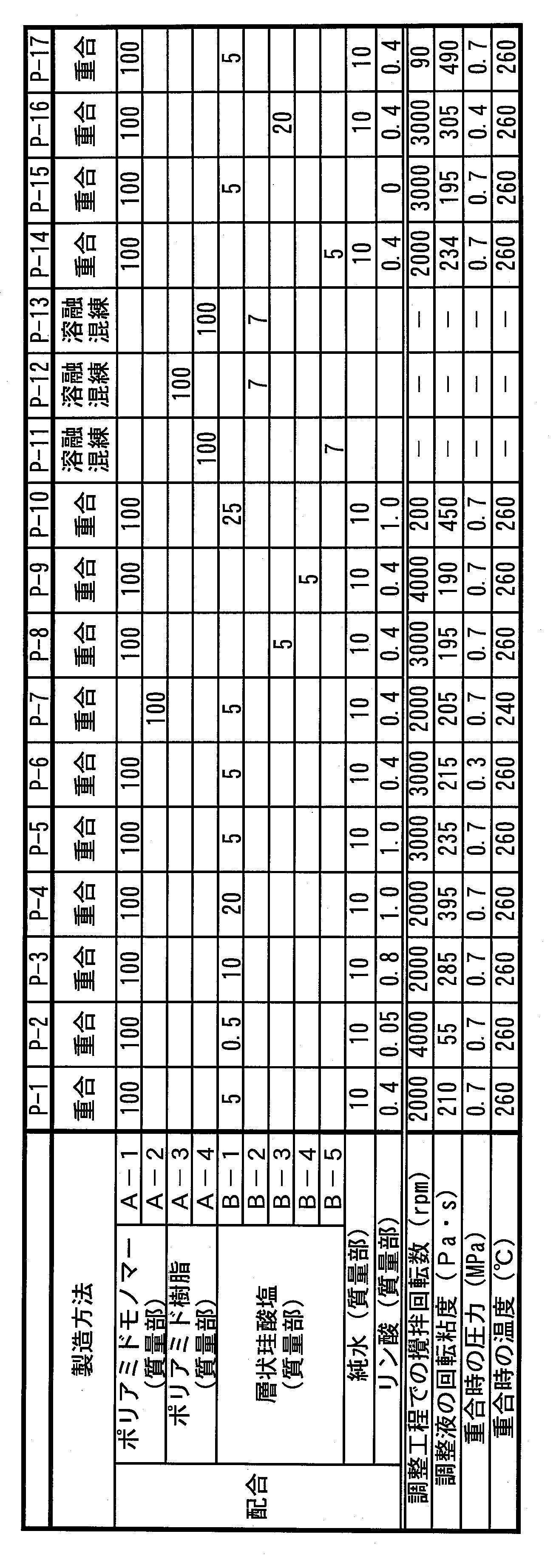
表1に示す割合で、ポリアミド樹脂と層状珪酸塩とを、280℃の溶融温度で溶融混練した。これは、工程(iv)である。
実施例1
(P-1)105質量部、(C-1)50質量部、(D-1)0.1質量部を溶融混錬した。これは、工程(iii)である。溶融混練には、二軸押出機(東芝機械社製、商品名「TEM37BS」)を使用した。溶融混練の温度は270℃だった。得られたポリアミド樹脂組成物を評価に付した。評価結果を表2に示す。
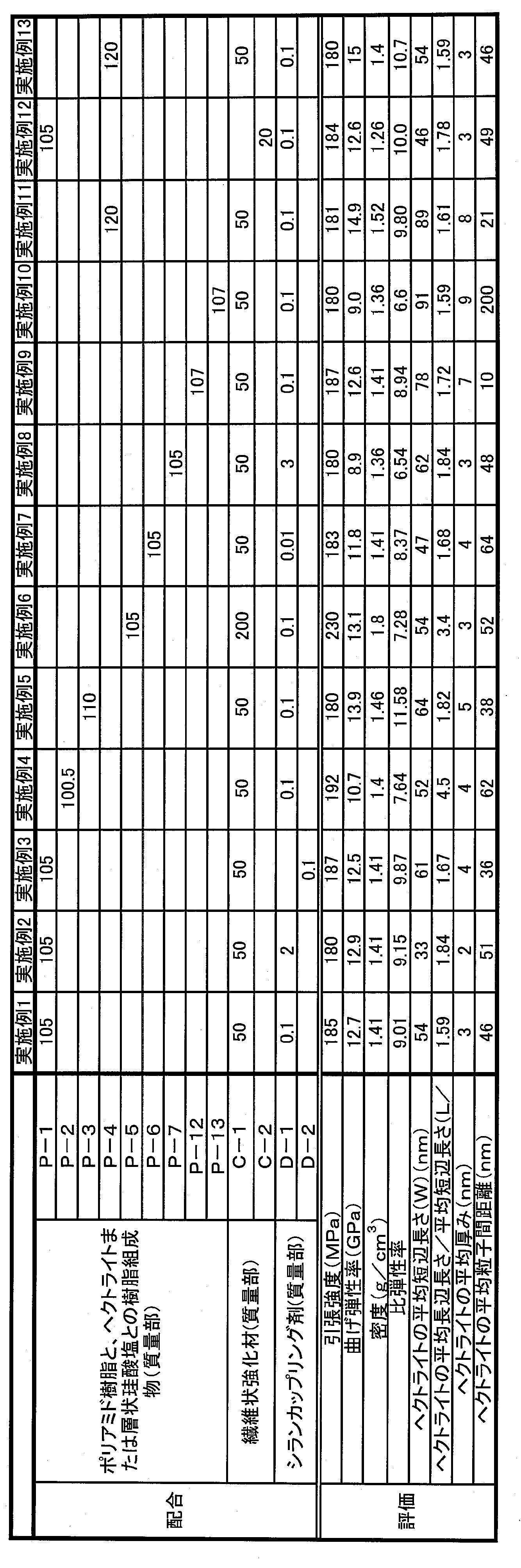
(P-1)105質量部、(C-1)50質量部、(D-1)2質量部を溶融混錬した。これは、工程(iii)である。溶融混練には、上記の二軸押出機を使用した。溶融混練の温度は270℃だった。得られたポリアミド樹脂組成物を評価に付した。評価結果を表2に示す。
実施例3
(P-1)105質量部、(C-1)50質量部、(D-2)0.1質量部を溶融混錬した。これは、工程(iii)である。溶融混練には、上記の二軸押出機を使用した。溶融混練の温度は270℃だった。得られたポリアミド樹脂組成物を評価に付した。評価結果を表2に示す。
実施例4
(P-2)100.5質量部、(C-1)50質量部、(D-1)0.1質量部を溶融混錬した。これは、工程(iii)である。溶融混練には、上記の二軸押出機を使用した。溶融混練の温度は270℃だった。得られたポリアミド樹脂組成物を評価に付した。評価結果を表2に示す。
実施例5
(P-3)110質量部、(C-1)50質量部、(D-1)0.1質量部を溶融混錬した。これは、工程(iii)である。溶融混練には、上記の二軸押出機を使用した。溶融混練の温度は270℃だった。得られたポリアミド樹脂組成物を評価に付した。評価結果を表2に示す。
実施例6
(P-5)105質量部、(C-1)200質量部、(D-1)0.1質量部を溶融混錬した。これは、工程(iii)である。溶融混練には、上記の二軸押出機を使用した。溶融混練の温度は270℃だった。得られたポリアミド樹脂組成物を評価に付した。評価結果を表2に示す。
実施例7
(P-6)105質量部、(C-1)50質量部、(D-1)0.01質量部を溶融混錬した。これは、工程(iii)である。溶融混練には、上記の二軸押出機を使用した。溶融混練の温度は270℃だった。得られたポリアミド樹脂組成物を評価に付した。評価結果を表2に示す。
実施例8
(P-7)105質量部、(C-1)50質量部、(D-1)3質量部を溶融混錬した。これは、工程(iii)である。溶融混練には、上記の二軸押出機を使用した。溶融混練の温度は200℃だった。得られたポリアミド樹脂組成物を評価に付した。評価結果を表2に示す。
実施例9
(P-12)107質量部、(C-1)50質量部、(D-1)0.1質量部を溶融混錬した。これは、工程(iv)である。溶融混練には、上記の二軸押出機を使用した。溶融混練の温度は270℃だった。得られたポリアミド樹脂組成物を評価に付した。評価結果を表2に示す。
実施例10
(P-13)107質量部、(C-1)50質量部、(D-1)0.1質量部を溶融混錬した。これは、工程(iv)である。溶融混練には、上記の二軸押出機を使用した。溶融混練の温度は270℃だった。得られたポリアミド樹脂組成物を評価に付した。評価結果を表2に示す。
実施例11
(P-4)120質量部、(C-1)50質量部、(D-1)0.1質量部を溶融混錬した。これは、工程(iii)である。溶融混練には、上記の二軸押出機を使用した。溶融混練の温度は270℃だった。得られたポリアミド樹脂組成物を評価に付した。評価結果を表2に示す。
実施例12
(P-1)105質量部、(C-2)20質量部、(D-1)0.1質量部を溶融混錬した。これは、工程(iii)である。溶融混練には、上記の二軸押出機を使用した。溶融混練の温度は270℃だった。得られたポリアミド樹脂組成物を評価に付した。評価結果を表2に示す。
実施例13
(P-4)120質量部、(C-1)50質量部、(D-1)0.1質量部を溶融混錬した。これは、工程(iii)である。溶融混練には、上記の二軸押出機を使用した。溶融混練の温度は270℃だった。得られたポリアミド樹脂組成物を評価に付した。評価結果を表3に示す。
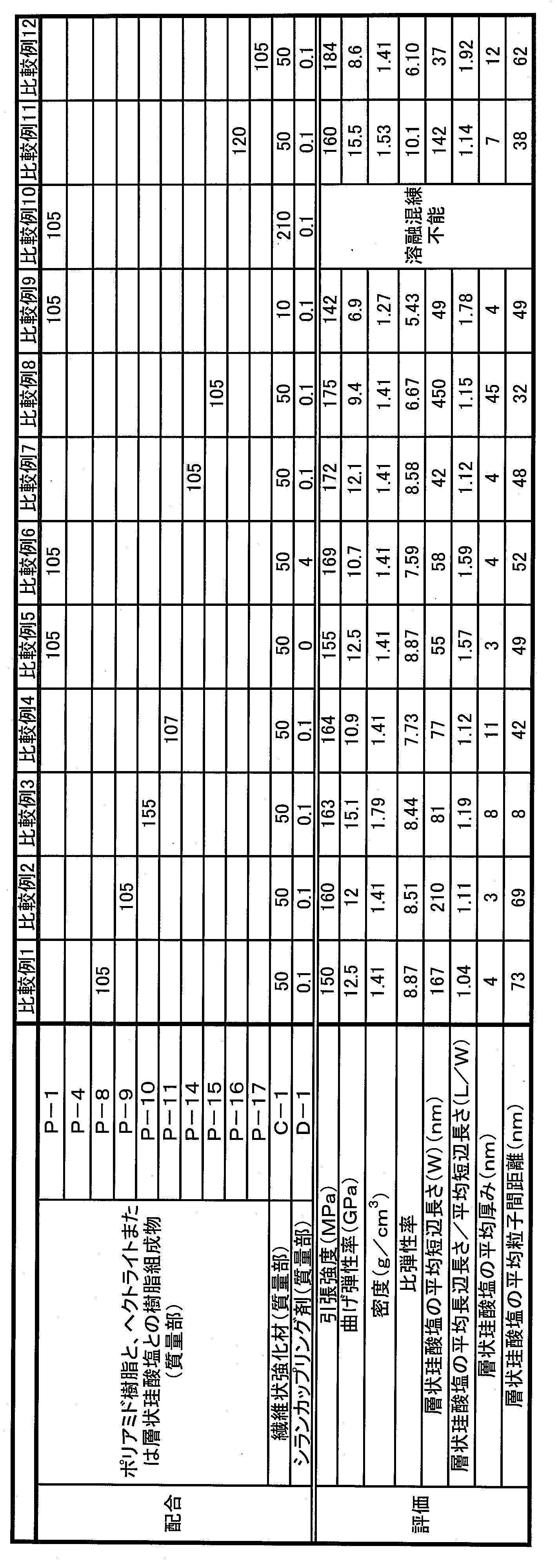
(P-8)105質量部、(C-1)50質量部、(D-1)0.1質量を溶融混錬した。これは、工程(iii)である。溶融混練には、上記の二軸押出機を使用した。溶融混練の温度は270℃だった。得られたポリアミド樹脂組成物を評価に付した。評価結果を表3に示す。
比較例2
(P-9)105質量部、(C-1)50質量部、(D-1)0.1質量を溶融混錬した。これは、工程(iii)である。溶融混練には、上記の二軸押出機を使用した。溶融混練の温度は270℃だった。得られたポリアミド樹脂組成物を評価に付した。評価結果を表3に示す。
比較例3
(P-10)155質量部、(C-1)50質量部、(D-1)0.1質量を溶融混錬した。これは、工程(iii)である。溶融混練には、上記の二軸押出機を使用した。溶融混練の温度は270℃だった。得られたポリアミド樹脂組成物を評価に付した。評価結果を表3に示す。
比較例4
(P-11)107質量部、(C-1)50質量部、(D-1)0.1質量を溶融混錬した。これは、工程(v)である。溶融混練には、上記の二軸押出機を使用した。溶融混練の温度は285℃だった。得られたポリアミド樹脂組成物を評価に付した。評価結果を表3に示す。
比較例5
(P-1)105質量部、(C-1)50質量部を溶融混錬した。溶融混練には、上記の二軸押出機を使用した。これは、工程(iii)である。溶融混練の温度は270℃だった。得られたポリアミド樹脂組成物を評価に付した。評価結果を表3に示す。
比較例6
(P-1)105質量部、(C-1)50質量部、(D-1)4質量を溶融混錬した。これは、工程(iii)である。溶融混練には、上記の二軸押出機を使用した。溶融混練の温度は270℃だった。得られたポリアミド樹脂組成物を評価に付した。評価結果を表3に示す。
比較例7
(P-14)105質量部、(C-1)50質量部、(D-1)0.1質量を溶融混錬した。これは、工程(iii)である。溶融混練には、上記の二軸押出機を使用した。溶融混練の温度は270℃だった。得られたポリアミド樹脂組成物を評価に付した。評価結果を表3に示す。
比較例8
(P-15)105質量部、(C-1)50質量部、(D-1)0.1質量を溶融混錬した。これは、工程(iii)である。溶融混練には、上記の二軸押出機を使用した。溶融混練の温度は270℃だった。得られたポリアミド樹脂組成物を評価に付した。評価結果を表3に示す。
比較例9
(P-1)105質量部、(C-1)10質量部、(D-1)0.1質量を溶融混錬した。これは、工程(iii)である。溶融混練には、上記の二軸押出機を使用した。溶融混練の温度は270℃だった。得られたポリアミド樹脂組成物を評価に付した。評価結果を表3に示す。
比較例10
(P-1)105質量部、(C-1)210質量部、(D-1)0.1質量を溶融混錬した。これは、工程(iii)である。溶融混練には、上記の二軸押出機を使用した。溶融混練の温度は270℃だった。(C-1)の配合が過多であったためポリアミド樹脂組成物ペレットを得ることができなかった。
比較例11
(P-16)120質量部、(C-1)50質量部、(D-1)0.1質量を溶融混錬した。これは、工程(iii)である。溶融混練には、上記の二軸押出機を使用した。溶融混練の温度は270℃だった。得られたポリアミド樹脂組成物を評価に付した。評価結果を表3に示す。
比較例12
(P-17)105質量部、(C-1)50質量部、(D-1)0.1質量を溶融混錬した。これは、工程(iii)である。溶融混練には、上記の二軸押出機を使用した。溶融混練の温度は270℃だった。得られたポリアミド樹脂組成物を評価に付した。評価結果を表3に示す。
Claims (5)
- ポリアミド樹脂100質量部、ヘクトライト0.5~20質量部、繊維状強化材15~200質量部、およびシランカップリング剤0.01~3質量部を含有するポリアミド樹脂組成物であって、前記ヘクトライトのサイズが、平均厚み1~10nmかつ短辺の平均長さ25~100nmであり、長辺の平均長さと短辺の平均長さ比率が、長辺の平均長さ/短辺の平均長さ=1.5~5であり、前記ヘクトライトのポリアミド樹脂組成物中での平均粒子間距離が10~200nmであることを特徴とするポリアミド樹脂組成物。
- 請求項1記載のポリアミド樹脂組成物を製造するに際し、以下の工程(i)、(ii)および(iii)をこの順に含むことを特徴とするポリアミド樹脂組成物の製造方法。
工程(i):ポリアミド樹脂を構成するモノマー、アミノ基を有する化合物および無機酸を、ポリアミド樹脂を構成するモノマーの融点以上の温度で加熱溶融下、攪拌しながらヘクトライトを配合し、さらに水を加え、回転数100~5000rpmで攪拌し、調製液を得る工程
工程(ii):工程(i)で得られた調製液を重合させ、ポリアミド樹脂とヘクトライトとを含む樹脂組成物を得る工程
工程(iii):工程(ii)で得られたポリアミド樹脂とヘクトライトとを含む樹脂組成物を溶融させて、繊維状強化材とシランカップリング剤を混練させる工程 - 工程(i)において、B型粘度計で測定した調整液の回転粘度が1~400Pa・sとなるように混合することを特徴とする請求項2に記載のポリアミド樹脂組成物の製造方法。
- 請求項1に記載のポリアミド樹脂組成物を製造するに際し、以下の工程(iv)を含むことを特徴とするポリアミド樹脂組成物の製造方法。
工程(iv):ポリアミド樹脂にヘクトライト、繊維状強化材およびシランカップリング剤を溶融混練する工程 - 請求項1に記載のポリアミド樹脂組成物を成形して得られる成形体。
Priority Applications (2)
| Application Number | Priority Date | Filing Date | Title |
|---|---|---|---|
| JP2012508191A JP5730284B2 (ja) | 2010-03-31 | 2011-03-11 | ポリアミド樹脂組成物、該ポリアミド樹脂組成物の製造方法および該ポリアミド樹脂組成物を用いてなる成形体 |
| CN201180005831.2A CN102712809B (zh) | 2010-03-31 | 2011-03-11 | 聚酰胺树脂组合物、该组合物的制造方法和使用该组合物而得的成型体 |
Applications Claiming Priority (2)
| Application Number | Priority Date | Filing Date | Title |
|---|---|---|---|
| JP2010-080443 | 2010-03-31 | ||
| JP2010080443 | 2010-03-31 |
Publications (1)
| Publication Number | Publication Date |
|---|---|
| WO2011122300A1 true WO2011122300A1 (ja) | 2011-10-06 |
Family
ID=44712023
Family Applications (1)
| Application Number | Title | Priority Date | Filing Date |
|---|---|---|---|
| PCT/JP2011/055724 Ceased WO2011122300A1 (ja) | 2010-03-31 | 2011-03-11 | ポリアミド樹脂組成物、該ポリアミド樹脂組成物の製造方法および該ポリアミド樹脂組成物を用いてなる成形体 |
Country Status (4)
| Country | Link |
|---|---|
| JP (1) | JP5730284B2 (ja) |
| CN (1) | CN102712809B (ja) |
| TW (1) | TW201141925A (ja) |
| WO (1) | WO2011122300A1 (ja) |
Cited By (2)
| Publication number | Priority date | Publication date | Assignee | Title |
|---|---|---|---|---|
| JP2016041781A (ja) * | 2014-08-15 | 2016-03-31 | ユニチカ株式会社 | ポリアミド樹脂組成物およびそれよりなる成形体 |
| US20180155540A1 (en) * | 2012-12-18 | 2018-06-07 | Agency For Science, Technology And Research | Method of preparing fiber-reinforced polymer composites and fiber-reinforced polymer composites prepared thereof |
Families Citing this family (1)
| Publication number | Priority date | Publication date | Assignee | Title |
|---|---|---|---|---|
| CN117438677A (zh) * | 2023-11-23 | 2024-01-23 | 重庆太蓝新能源有限公司 | 一种改性正极补锂剂及其制备方法和应用 |
Citations (6)
| Publication number | Priority date | Publication date | Assignee | Title |
|---|---|---|---|---|
| JPH06207044A (ja) * | 1993-01-13 | 1994-07-26 | Kuraray Co Ltd | 有機重合体組成物 |
| JPH11315204A (ja) * | 1998-03-03 | 1999-11-16 | Unitika Ltd | ポリアミド複合材料 |
| JP2000154315A (ja) * | 1998-09-18 | 2000-06-06 | Toray Ind Inc | 吹込成形用ポリアミド樹脂組成物および吹込成形品 |
| JP2003517488A (ja) * | 1998-02-13 | 2003-05-27 | ソリユテイア・インコーポレイテツド | ポリマーナノコンポジット組成物 |
| JP2006160947A (ja) * | 2004-12-09 | 2006-06-22 | Unitika Ltd | ポリアミド複合材料の射出成形方法 |
| JP2009035991A (ja) * | 2007-08-03 | 2009-02-19 | Misawa Homes Co Ltd | ユニット式建物及びユニット式建物の施工方法 |
Family Cites Families (4)
| Publication number | Priority date | Publication date | Assignee | Title |
|---|---|---|---|---|
| JP2009035593A (ja) * | 2007-07-31 | 2009-02-19 | Unitika Ltd | ガラス繊維強化ポリアミド樹脂組成物 |
| JP5543685B2 (ja) * | 2007-07-31 | 2014-07-09 | ユニチカ株式会社 | ガラス繊維強化ポリアミド樹脂組成物 |
| JP5548349B2 (ja) * | 2008-08-20 | 2014-07-16 | ユニチカ株式会社 | ガラス繊維強化ポリアミド樹脂組成物 |
| CN101564874B (zh) * | 2009-05-27 | 2012-07-04 | 靳柱山 | 纳米隔热复合材料的制备方法 |
-
2011
- 2011-03-11 JP JP2012508191A patent/JP5730284B2/ja not_active Expired - Fee Related
- 2011-03-11 WO PCT/JP2011/055724 patent/WO2011122300A1/ja not_active Ceased
- 2011-03-11 CN CN201180005831.2A patent/CN102712809B/zh not_active Expired - Fee Related
- 2011-03-21 TW TW100109504A patent/TW201141925A/zh unknown
Patent Citations (6)
| Publication number | Priority date | Publication date | Assignee | Title |
|---|---|---|---|---|
| JPH06207044A (ja) * | 1993-01-13 | 1994-07-26 | Kuraray Co Ltd | 有機重合体組成物 |
| JP2003517488A (ja) * | 1998-02-13 | 2003-05-27 | ソリユテイア・インコーポレイテツド | ポリマーナノコンポジット組成物 |
| JPH11315204A (ja) * | 1998-03-03 | 1999-11-16 | Unitika Ltd | ポリアミド複合材料 |
| JP2000154315A (ja) * | 1998-09-18 | 2000-06-06 | Toray Ind Inc | 吹込成形用ポリアミド樹脂組成物および吹込成形品 |
| JP2006160947A (ja) * | 2004-12-09 | 2006-06-22 | Unitika Ltd | ポリアミド複合材料の射出成形方法 |
| JP2009035991A (ja) * | 2007-08-03 | 2009-02-19 | Misawa Homes Co Ltd | ユニット式建物及びユニット式建物の施工方法 |
Cited By (2)
| Publication number | Priority date | Publication date | Assignee | Title |
|---|---|---|---|---|
| US20180155540A1 (en) * | 2012-12-18 | 2018-06-07 | Agency For Science, Technology And Research | Method of preparing fiber-reinforced polymer composites and fiber-reinforced polymer composites prepared thereof |
| JP2016041781A (ja) * | 2014-08-15 | 2016-03-31 | ユニチカ株式会社 | ポリアミド樹脂組成物およびそれよりなる成形体 |
Also Published As
| Publication number | Publication date |
|---|---|
| CN102712809B (zh) | 2015-03-18 |
| TW201141925A (en) | 2011-12-01 |
| JPWO2011122300A1 (ja) | 2013-07-08 |
| JP5730284B2 (ja) | 2015-06-10 |
| CN102712809A (zh) | 2012-10-03 |
Similar Documents
| Publication | Publication Date | Title |
|---|---|---|
| JP5640746B2 (ja) | ガラス繊維強化ポリアミド樹脂組成物 | |
| JP5546623B2 (ja) | 半芳香族ポリアミドの製造方法 | |
| CN112159591B (zh) | 一种空心玻璃微珠改性尼龙复合材料及其制备方法、应用 | |
| JP2006002156A (ja) | 脂肪族ポリアミドと部分芳香族ポリアミドのポリマー混合物、その成形物およびその使用 | |
| JP5911426B2 (ja) | ポリアミド樹脂組成物、およびそれから得られる成形体 | |
| JP2013053244A (ja) | ポリアミド樹脂組成物およびそれを成形してなる成形体 | |
| JP5669491B2 (ja) | ポリアミド樹脂組成物、該ポリアミド樹脂組成物の製造方法および該ポリアミド樹脂組成物を用いてなる成形体 | |
| JP2010001364A (ja) | ガラス繊維強化ポリアミド樹脂組成物 | |
| JP2011208105A (ja) | ポリアミド樹脂組成物、該ポリアミド樹脂組成物の製造方法および該ポリアミド樹脂組成物を用いてなる成形体 | |
| JP5730284B2 (ja) | ポリアミド樹脂組成物、該ポリアミド樹脂組成物の製造方法および該ポリアミド樹脂組成物を用いてなる成形体 | |
| JP7808852B2 (ja) | ポリアミド樹脂組成物およびそれからなる成形体、車載カメラ用部品 | |
| JP2009035592A (ja) | ガラス繊維強化ポリアミド樹脂組成物 | |
| JP2009035593A (ja) | ガラス繊維強化ポリアミド樹脂組成物 | |
| JP5832296B2 (ja) | ポリアミド樹脂組成物、およびポリアミド樹脂組成物の製造方法 | |
| JP5191154B2 (ja) | ポリアミド成形品の製造方法およびエンジンカバー | |
| JP2013060580A (ja) | 導電性ポリアミド樹脂組成物およびそれを成形してなる成形体 | |
| JP2010254992A (ja) | 繊維強化ポリアミド樹脂組成物 | |
| JP2013049793A (ja) | 半芳香族ポリアミド樹脂組成物ペレットおよびそれを成形してなる成形体 | |
| JP2014139274A (ja) | 半芳香族ポリアミド樹脂組成物 | |
| JP2012072309A (ja) | ポリアミド樹脂組成物、およびその製造方法 | |
| JP2012067166A (ja) | ポリアミド樹脂組成物成形体、およびその製造方法 | |
| WO2022095360A1 (zh) | 一种自组装网络聚酰胺组合物及其制备方法和应用 | |
| JP2013072019A (ja) | ポリアミド樹脂組成物、該ポリアミド樹脂組成物の製造方法 | |
| JP2013043976A (ja) | ポリアミド樹脂組成物およびそれを成形してなる成形体 | |
| JP2012012446A (ja) | ポリアミド樹脂混合物、ポリアミド樹脂成形体およびそれらの製造方法 |
Legal Events
| Date | Code | Title | Description |
|---|---|---|---|
| WWE | Wipo information: entry into national phase |
Ref document number: 201180005831.2 Country of ref document: CN |
|
| 121 | Ep: the epo has been informed by wipo that ep was designated in this application |
Ref document number: 11762540 Country of ref document: EP Kind code of ref document: A1 |
|
| WWE | Wipo information: entry into national phase |
Ref document number: 2012508191 Country of ref document: JP |
|
| NENP | Non-entry into the national phase |
Ref country code: DE |
|
| 122 | Ep: pct application non-entry in european phase |
Ref document number: 11762540 Country of ref document: EP Kind code of ref document: A1 |