WO2011043386A1 - 離型剤組成物、離型フィルム及びこれを用いた接着フィルム - Google Patents
離型剤組成物、離型フィルム及びこれを用いた接着フィルム Download PDFInfo
- Publication number
- WO2011043386A1 WO2011043386A1 PCT/JP2010/067563 JP2010067563W WO2011043386A1 WO 2011043386 A1 WO2011043386 A1 WO 2011043386A1 JP 2010067563 W JP2010067563 W JP 2010067563W WO 2011043386 A1 WO2011043386 A1 WO 2011043386A1
- Authority
- WO
- WIPO (PCT)
- Prior art keywords
- release
- film
- adhesive
- adhesive film
- resin
- Prior art date
- Legal status (The legal status is an assumption and is not a legal conclusion. Google has not performed a legal analysis and makes no representation as to the accuracy of the status listed.)
- Ceased
Links
Images


Classifications
-
- C—CHEMISTRY; METALLURGY
- C08—ORGANIC MACROMOLECULAR COMPOUNDS; THEIR PREPARATION OR CHEMICAL WORKING-UP; COMPOSITIONS BASED THEREON
- C08L—COMPOSITIONS OF MACROMOLECULAR COMPOUNDS
- C08L83/00—Compositions of macromolecular compounds obtained by reactions forming in the main chain of the macromolecule a linkage containing silicon with or without sulfur, nitrogen, oxygen or carbon only; Compositions of derivatives of such polymers
- C08L83/04—Polysiloxanes
-
- C—CHEMISTRY; METALLURGY
- C09—DYES; PAINTS; POLISHES; NATURAL RESINS; ADHESIVES; COMPOSITIONS NOT OTHERWISE PROVIDED FOR; APPLICATIONS OF MATERIALS NOT OTHERWISE PROVIDED FOR
- C09K—MATERIALS FOR MISCELLANEOUS APPLICATIONS, NOT PROVIDED FOR ELSEWHERE
- C09K3/00—Materials not provided for elsewhere
-
- B—PERFORMING OPERATIONS; TRANSPORTING
- B32—LAYERED PRODUCTS
- B32B—LAYERED PRODUCTS, i.e. PRODUCTS BUILT-UP OF STRATA OF FLAT OR NON-FLAT, e.g. CELLULAR OR HONEYCOMB, FORM
- B32B27/00—Layered products comprising a layer of synthetic resin
-
- C—CHEMISTRY; METALLURGY
- C08—ORGANIC MACROMOLECULAR COMPOUNDS; THEIR PREPARATION OR CHEMICAL WORKING-UP; COMPOSITIONS BASED THEREON
- C08G—MACROMOLECULAR COMPOUNDS OBTAINED OTHERWISE THAN BY REACTIONS ONLY INVOLVING UNSATURATED CARBON-TO-CARBON BONDS
- C08G18/00—Polymeric products of isocyanates or isothiocyanates
- C08G18/06—Polymeric products of isocyanates or isothiocyanates with compounds having active hydrogen
- C08G18/28—Polymeric products of isocyanates or isothiocyanates with compounds having active hydrogen characterised by the compounds used containing active hydrogen
- C08G18/2805—Compounds having only one group containing active hydrogen
- C08G18/288—Compounds containing at least one heteroatom other than oxygen or nitrogen
- C08G18/289—Compounds containing at least one heteroatom other than oxygen or nitrogen containing silicon
-
- C—CHEMISTRY; METALLURGY
- C09—DYES; PAINTS; POLISHES; NATURAL RESINS; ADHESIVES; COMPOSITIONS NOT OTHERWISE PROVIDED FOR; APPLICATIONS OF MATERIALS NOT OTHERWISE PROVIDED FOR
- C09J—ADHESIVES; NON-MECHANICAL ASPECTS OF ADHESIVE PROCESSES IN GENERAL; ADHESIVE PROCESSES NOT PROVIDED FOR ELSEWHERE; USE OF MATERIALS AS ADHESIVES
- C09J7/00—Adhesives in the form of films or foils
- C09J7/20—Adhesives in the form of films or foils characterised by their carriers
- C09J7/22—Plastics; Metallised plastics
-
- C—CHEMISTRY; METALLURGY
- C09—DYES; PAINTS; POLISHES; NATURAL RESINS; ADHESIVES; COMPOSITIONS NOT OTHERWISE PROVIDED FOR; APPLICATIONS OF MATERIALS NOT OTHERWISE PROVIDED FOR
- C09J—ADHESIVES; NON-MECHANICAL ASPECTS OF ADHESIVE PROCESSES IN GENERAL; ADHESIVE PROCESSES NOT PROVIDED FOR ELSEWHERE; USE OF MATERIALS AS ADHESIVES
- C09J7/00—Adhesives in the form of films or foils
- C09J7/30—Adhesives in the form of films or foils characterised by the adhesive composition
-
- C—CHEMISTRY; METALLURGY
- C09—DYES; PAINTS; POLISHES; NATURAL RESINS; ADHESIVES; COMPOSITIONS NOT OTHERWISE PROVIDED FOR; APPLICATIONS OF MATERIALS NOT OTHERWISE PROVIDED FOR
- C09J—ADHESIVES; NON-MECHANICAL ASPECTS OF ADHESIVE PROCESSES IN GENERAL; ADHESIVE PROCESSES NOT PROVIDED FOR ELSEWHERE; USE OF MATERIALS AS ADHESIVES
- C09J7/00—Adhesives in the form of films or foils
- C09J7/40—Adhesives in the form of films or foils characterised by release liners
-
- C—CHEMISTRY; METALLURGY
- C09—DYES; PAINTS; POLISHES; NATURAL RESINS; ADHESIVES; COMPOSITIONS NOT OTHERWISE PROVIDED FOR; APPLICATIONS OF MATERIALS NOT OTHERWISE PROVIDED FOR
- C09J—ADHESIVES; NON-MECHANICAL ASPECTS OF ADHESIVE PROCESSES IN GENERAL; ADHESIVE PROCESSES NOT PROVIDED FOR ELSEWHERE; USE OF MATERIALS AS ADHESIVES
- C09J7/00—Adhesives in the form of films or foils
- C09J7/40—Adhesives in the form of films or foils characterised by release liners
- C09J7/401—Adhesives in the form of films or foils characterised by release liners characterised by the release coating composition
-
- C—CHEMISTRY; METALLURGY
- C09—DYES; PAINTS; POLISHES; NATURAL RESINS; ADHESIVES; COMPOSITIONS NOT OTHERWISE PROVIDED FOR; APPLICATIONS OF MATERIALS NOT OTHERWISE PROVIDED FOR
- C09J—ADHESIVES; NON-MECHANICAL ASPECTS OF ADHESIVE PROCESSES IN GENERAL; ADHESIVE PROCESSES NOT PROVIDED FOR ELSEWHERE; USE OF MATERIALS AS ADHESIVES
- C09J7/00—Adhesives in the form of films or foils
- C09J7/40—Adhesives in the form of films or foils characterised by release liners
- C09J7/405—Adhesives in the form of films or foils characterised by release liners characterised by the substrate of the release liner
-
- C—CHEMISTRY; METALLURGY
- C08—ORGANIC MACROMOLECULAR COMPOUNDS; THEIR PREPARATION OR CHEMICAL WORKING-UP; COMPOSITIONS BASED THEREON
- C08L—COMPOSITIONS OF MACROMOLECULAR COMPOUNDS
- C08L75/00—Compositions of polyureas or polyurethanes; Compositions of derivatives of such polymers
- C08L75/04—Polyurethanes
-
- C—CHEMISTRY; METALLURGY
- C09—DYES; PAINTS; POLISHES; NATURAL RESINS; ADHESIVES; COMPOSITIONS NOT OTHERWISE PROVIDED FOR; APPLICATIONS OF MATERIALS NOT OTHERWISE PROVIDED FOR
- C09J—ADHESIVES; NON-MECHANICAL ASPECTS OF ADHESIVE PROCESSES IN GENERAL; ADHESIVE PROCESSES NOT PROVIDED FOR ELSEWHERE; USE OF MATERIALS AS ADHESIVES
- C09J2301/00—Additional features of adhesives in the form of films or foils
- C09J2301/30—Additional features of adhesives in the form of films or foils characterized by the chemical, physicochemical or physical properties of the adhesive or the carrier
- C09J2301/314—Additional features of adhesives in the form of films or foils characterized by the chemical, physicochemical or physical properties of the adhesive or the carrier the adhesive layer and/or the carrier being conductive
-
- C—CHEMISTRY; METALLURGY
- C09—DYES; PAINTS; POLISHES; NATURAL RESINS; ADHESIVES; COMPOSITIONS NOT OTHERWISE PROVIDED FOR; APPLICATIONS OF MATERIALS NOT OTHERWISE PROVIDED FOR
- C09J—ADHESIVES; NON-MECHANICAL ASPECTS OF ADHESIVE PROCESSES IN GENERAL; ADHESIVE PROCESSES NOT PROVIDED FOR ELSEWHERE; USE OF MATERIALS AS ADHESIVES
- C09J2301/00—Additional features of adhesives in the form of films or foils
- C09J2301/40—Additional features of adhesives in the form of films or foils characterized by the presence of essential components
Definitions
- the present invention relates to a release agent composition, a release film, and an adhesive film using the same, and in particular, a release film suitable for protecting an adhesive film such as an anisotropic conductive adhesive film and a release film of the release film.
- the present invention relates to a release agent composition useful for forming a layer.
- a release film with a release agent coating (release layer) on one side of a release base material such as polyester film has been widely used as a protective film for adhesive films of various adhesive films.
- the adhesive film of the adhesive film is provided on the base film by a method in which a coating liquid containing a reactive adhesive and a solvent is applied to the surface of the base film, and then the solvent is removed by heating.
- the release film that is laminated on the surface of the adhesive film and used as a protective film is usually a white biaxially stretched polyester film using a metal oxide or the like as a filler as a release base substrate, It is manufactured by coating, drying and curing a curable silicone release agent in a state dissolved in a solvent on both sides to form a release layer (Patent Document 1).
- the silicone used for such a curable silicone release agent is required to prevent surface adhesion with the adhesive film and minimize the migration of the silicone to the release base substrate on the back surface.
- a silicone a polydimethylsiloxane having —OH group at the end and a polydimethylsiloxane having hydroxy group (—hydroxypolydimethylsiloxane) at the end are subjected to a condensation reaction using an organotin catalyst to form a three-dimensional crosslinked structure.
- Mainly used are those of the type to be made, and those of polydimethylsiloxane having a vinyl group introduced at the terminal thereof and hydroxypolydimethylsiloxane are subjected to an addition reaction using a platinum catalyst.
- the adhesive film on which the release film is laminated for example, when the adhesive film is an anisotropic conductive film having an anisotropic conductive film as a pressure-sensitive adhesive film,
- the release film on one side of the anisotropic conductive film is first peeled off, and the anisotropic conductive film is heated and pressed (preliminary pressure bonding) on the ITO electrode of the liquid crystal panel, and then The release base film on the other surface of the anisotropic conductive film is peeled off, and the TAB is heated and pressed (main pressure bonding) on the pre-bonded adhesive film to securely bond the liquid crystal panel and the TAB.
- the release film plays an important role in order to stably run, supply and peel the adhesive film.
- a silicone release agent is generally used to reduce the surface energy.
- general silicone when general silicone is used, the affinity between the release layer and the pressure-sensitive adhesive film applied thereon is poor, and the adhesive force between the release layer and the pressure-sensitive adhesive film is weak overall.
- the so-called jerky phenomenon appears to be strong at both peeling start portions and not stable between the start of peeling and the end of peeling. When the jerky phenomenon appears, there arises a problem that a part of the pressure-sensitive adhesive film is peeled off from the release film side to the release layer side at a portion where a large peeling force is required.
- the present inventor has incorporated a silicone resin and an alkoxy group-containing silane-modified polyurethane resin into a release agent composition that forms a release layer of a release film.
- a so-called sea-island structure is obtained in which a large number of islands of the silica-polyurethane hybrid composite are dispersed in the sea in which the silicone resin as the main agent is in a continuous phase. It has been found that the affinity between the mold layer and the adhesive film is improved to obtain a desired peel strength and that the jerky phenomenon and the blocking phenomenon can be improved, and the present invention has been completed.
- This invention made
- the alkoxy group-containing silane-modified polyurethane resin is preferably in the range of 0 to 5% by weight to 50% by weight, more preferably 1.25% to 20% by weight in terms of solid content. Is.
- the release film of the present invention is a release film having a release base substrate and a release layer provided on one surface of the release base substrate, wherein the release layer is the above-mentioned release layer. This is a cured film of the release agent composition.
- the adhesive film of the present invention includes a release base substrate, a release layer provided on one surface of the release base substrate, and an adhesive layer provided on the release layer.
- the release layer is a cured film of the above-described release agent composition.
- the adhesive layer is made of an anisotropic conductive adhesive in which conductive particles are dispersed in a binder resin can be exemplified.
- the method for producing a release film according to the present invention comprises applying a release agent composition containing a silicone resin, an alkoxy group-containing silane-modified polyurethane resin, and a solvent onto a release base substrate and curing the release agent composition. It is a method of forming.
- the release layer is formed from a silica-polyurethane hybrid composite in a sea of silicone resin continuous phase.
- a sea-island structure in which a large number of islands of the formed thermoplastic resin exist is formed.
- the affinity for the adhesive film is partially improved in the release layer.
- the release film can be smoothly peeled without causing a jerky phenomenon, and there is a blocking phenomenon in which the release layer of the release film adheres to the adhesive layer of the adhesive film.
- the release layer of the release film can be peeled from the adhesive layer of the adhesive film without impairing the performance as an adhesive film. Moreover, according to the mold release agent composition of this invention, it becomes possible to obtain desired peeling strength by adjusting the addition amount of an alkoxy group containing silane modified polyurethane resin.
- the release agent composition according to the present invention contains a silicone resin, an alkoxy group-containing silane-modified polyurethane resin, and a solvent. Preferably, these resin components are dissolved in a solvent.
- the silicone resin used in the present invention is not particularly limited, but an addition reaction type silicone resin can be suitably used from the viewpoint of reactivity and stability.
- the addition reaction type silicone resin include known polydimethylsiloxane having an alkenyl group (for example, vinyl group, hexenyl group, etc.) in the molecule.
- Specific examples of the addition reaction type silicone include materials such as trade names X52-9201B, KS847, and KS830 manufactured by Shin-Etsu Chemical Co., Ltd.
- the release agent composition of the present invention can contain those conventionally used as a curing catalyst for addition reaction type silicone, and for example, a known platinum curing catalyst can be preferably mentioned.
- platinum-based curing catalysts include chloroplatinic acid, complex salts of chloroplatinic acid and olefins, and compounds of chloroplatinic acid and alcohols.
- alkoxy group-containing silane-modified polyurethane resin used in the present invention those described in Japanese Patent Application No. 2002-220431 can be suitably used.
- the polyurethane resin is a polyether polyurethane resin, a polycarbonate polyurethane, a polyester polyurethane, or the like can be used.
- the cured product of the silane-modified polyurethane resin containing an alkoxy group has a fine gelled silica portion (a high-order network structure of siloxane bonds).
- the content of the alkoxy group-containing silane-modified polyurethane resin in the release agent composition of the present invention is not particularly limited, but from the viewpoint of reliably achieving the effects of the present invention, the alkoxy group-containing silane-modified polyurethane resin Is preferably 0.5 wt% or more and 50 wt% or less, more preferably 1.25 wt% or more and 20 wt% or less, and further preferably 2.5 wt% or more and 12.5 wt% or less. In particular, it is 2.5 to 7.5% by weight.
- silane-modified resins that form other silica hybrid organic polymers can also be used.
- an epoxy resin, a phenol resin, a popal resin, an acrylic resin, a polystyrene resin, a polyvinyl acetate resin, a polyimide resin, a polyamideimide resin, or the like can be used.
- the release agent composition of the present invention may contain additives such as a solvent, a release control agent, and a filler.
- additives such as a solvent, a release control agent, and a filler.
- a solvent from a viewpoint of ensuring favorable solubility and film-forming property, using toluene, MEK (methyl ethyl ketone), IPA, butanol, acetone, MIBK, etc. suitably combining them. it can.
- the release agent composition of the present invention can be prepared by uniformly mixing the above-described components by a conventional method.
- FIG. 1 shows the release film according to the present invention.
- the release film 1 of this example is configured by providing a release base substrate 2 and a release layer 3 on one surface of the release base substrate 2.
- the release base substrate 2 for example, PET (polyethylene terephthalate), PEN (polyethylene naphthalate), OPP (biaxially stretched polypropylene) or the like can be suitably used.
- the release layer 3 can be formed by applying the above-described release agent composition of the present invention on the release base substrate 2, and drying and heating it appropriately.
- the release layer 3 obtained by curing the release agent composition of the present invention has a sea-island structure in which a large number of islands of a thermoplastic resin formed from a silica-polyurethane hybrid composite are dispersed in a sea of a silicone resin continuous phase.
- the release layer 3 has improved affinity with the adhesive film as compared with the release layer in which the islands made of the silica-polyurethane hybrid composite are not dispersed.
- the thickness of the release layer 3 is not particularly limited, but is preferably 0.05 ⁇ m or more and 0.5 ⁇ m or less from the viewpoint of achieving both release properties and economy.
- the adhesive film of the present invention is obtained by providing an adhesive layer on the release layer of the release film of the present invention
- FIG. 2 is a cross-sectional view showing an example of the adhesive film according to the present invention.
- the adhesive film 10 of this example is configured by providing an adhesive layer 4 on the release layer 3 of the release film 1 described above.
- an adhesive, thermoplastic, thermosetting, and photocurable resin layer can be provided in the same manner as a known adhesive film.
- resin component epoxy resin, phenoxy resin, acrylic resin can be used. Etc. can be contained.
- the resin composition for forming the adhesive layer 4 can appropriately contain a polymerization initiator, a solvent, and the like.
- the adhesive layer 4 may be formed into an anisotropic conductive film by containing conductive particles in the adhesive layer 4, and the adhesive film 10 may be an anisotropic conductive adhesive film (ACF).
- ACF anisotropic conductive adhesive film
- the resin composition for forming an adhesive layer is applied on the release layer 3 of the release film 1 described above, and this is dried and cured.
- the thickness of the adhesive layer 4 is not particularly limited, but is preferably 0.005 mm or more and 0.05 mm or less from the viewpoint of achieving both adhesiveness and economy.
- Example 1 10 parts by weight of an alkoxy group-containing silane-modified polyurethane resin solution (solid content 25%) (Ulyano U302 Arakawa Chemical Industries), 27 parts by weight of 30% addition reaction type silicone solution (KS-847 Shin-Etsu Chemical Co., Ltd.), platinum cured
- a release agent composition was prepared by uniformly mixing 0.8 parts by weight of a catalyst (PL-50T manufactured by Shin-Etsu Chemical Co., Ltd.), 30 parts by weight of toluene and 33 parts by weight of MEK.
- the solid content ratio (excluding the catalyst) of the release agent composition is 20% by weight for the alkoxy group-containing silane-modified polyurethane resin and 80% for the silicone resin.
- the obtained release agent composition was applied to one surface of a 50 ⁇ m-thick PET film as a release base substrate with a coil bar so that the dry thickness was 0.1 ⁇ m, and this was put in an oven. After maintaining at a temperature of 160 ° C. for 1 minute, it was removed from the oven. Thus, a release film in which a release layer was provided on one surface of the release base substrate was obtained.
- R 100 ⁇
- C The value of R is 50% or more.
- Example 2 Instead of 10 parts by weight of the alkoxy group-containing silane-modified polyurethane resin solution (Yuliano U302 manufactured by Arakawa Chemical Industries) of Example 1, 10 parts by weight of another alkoxy group-containing silane-modified polyurethane resin solution (Yuliano U301 manufactured by Arakawa Chemical Industries) A sample was prepared by the same method as in Example 1 except that the same experiment was performed. The results are shown in Table 1.
- Example 1 The same as Example 1 except that 20 parts by weight of a 10% ethylcellulose solution (N100, manufactured by Hercules) was blended in place of 10 parts by weight of the above alkoxy group-containing silane-modified polyurethane resin (Yuliano U302, manufactured by Arakawa Chemical Industries). Samples were prepared by the method and the same experiment was conducted. The results are shown in Table 1. In the case of Comparative Example 1, the blending ratio of cellulose is 20% by weight with respect to the entire resin solid content of the release agent composition, and the resin solid content ratio of the release agent composition is 20% by weight of cellulose, Silicone resin is about 80%.
- a 10% ethylcellulose solution N100, manufactured by Hercules
- Yuliano U302 manufactured by Arakawa Chemical Industries
- ACF Dependence of ACF peel strength on addition amount of alkoxy group-containing silane-modified polyurethane resin> The following were used as ACF.
- a phenoxy resin (YP50, manufactured by Toto Kasei Co., Ltd.), 50 parts by weight of an epoxy resin (made by 828 Yuka Shell Co., Ltd.), 100 parts by weight of an imidazole-based curing agent (HX3941HP, manufactured by Asahi Kasei Co., Ltd.), a silane coupling agent (A187 Momentive) (Performance Materials Japan G.K.) 3.2 parts by weight, 0.5 parts by weight of polybutadiene particles having an average particle diameter of 100 nm were dissolved in a solvent toluene to prepare an insulating adhesive resin, that is, a binder solution. .
- a binder was added to 100 parts by weight of this binder solution by adding 3.5 parts by weight of conductive particles of benzoguanamine particles having an average particle diameter of 5 ⁇ m and nickel-gold plating. Furthermore, this binder was coated on a PET film for peeling so that the thickness after drying was 25 ⁇ m to obtain an anisotropic conductive adhesive film. This anisotropic conductive adhesive film was cut into a slit shape having a width of 2 mm to obtain an ACF sample.
- the compounding amount of the alkoxy group-containing silane-modified polyurethane resin solution (Yuriano U302, manufactured by Arakawa Chemical Industries, Ltd.) was 20% by weight, 40% by weight, 60% by weight, and 80% by weight.
- ACF peel strength was measured by the method of “b. Initial peel strength for adhesive film ADH”. The result is shown in FIG.
- Example 1 Dependence of residual adhesive rate on addition amount of alkoxy group-containing silane-modified polyurethane resin>
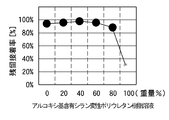
- the compounding amount of the alkoxy group-containing silane-modified polyurethane resin solution (Yuliano U302 Arakawa Chemical Industries) was 20% by weight, 40% by weight, 60% by weight, and 80% by weight.
- the residual adhesion rate was measured in the same manner as in the above method e. The result is shown in FIG.
- the release film of the present invention is useful for protecting an adhesive film such as an anisotropic conductive adhesive film, and the release agent composition of the present invention is useful for forming a release layer of the release film. .
Landscapes
- Chemical & Material Sciences (AREA)
- Organic Chemistry (AREA)
- Medicinal Chemistry (AREA)
- Polymers & Plastics (AREA)
- Health & Medical Sciences (AREA)
- Chemical Kinetics & Catalysis (AREA)
- Materials Engineering (AREA)
- Engineering & Computer Science (AREA)
- Laminated Bodies (AREA)
- Adhesive Tapes (AREA)
- Coating Of Shaped Articles Made Of Macromolecular Substances (AREA)
- Compositions Of Macromolecular Compounds (AREA)
- Adhesives Or Adhesive Processes (AREA)
Abstract
Description
一般に、接着フィルムの粘着剤被膜は、ベースフィルムの表面に反応性の粘着剤と溶剤とを含む塗液を塗工した後、加熱して溶媒を除去する方法でベースフィルム上に設けられる。
この離型剤組成物では、前記アルコキシ基含有シラン変性ポリウレタン樹脂が、固形分比率で0、5重量%以上50重量%以下が好ましく、1.25重量%以上20重量%以下である場合により効果的である。
また、本発明の離型剤組成物によれば、アルコキシ基含有シラン変性ポリウレタン樹脂の添加量の調整により所望の剥離強度を得ることが可能となる。
本発明に係る離型剤組成物は、シリコーン樹脂と、アルコキシ基含有シラン変性ポリウレタン樹脂と溶剤を含有してなり、好ましくはこれらの樹脂成分は溶媒に溶解されているものである。
本発明に用いるシリコーン樹脂としては、特に限定されることはないが、反応性及び安定性の観点からは、付加反応型のシリコーン樹脂を好適に用いることができる。付加反応型のシリコーン樹脂としては、例えば、分子中にアルケニル基(例えばビニル基、ヘキセニル基など)を有する公知のポリジメチルシロキサン等を挙げることができる。付加反応型シリコーンの具体例としては、信越化学工業株式会社の商品名X52-9201B、KS847、KS830等の材料が挙げられる。
このアルコキシ基を含有するシラン変性ポリウレタン樹脂は、その硬化物が、ゲル化した微細なシリカ部位(シロキサン結合の高次網目構造)を有するものである。
アルコキシ基含有シラン変性ポリウレタン樹脂シリカ-ポリウレタンハイブリッド複合体の含有量が少なすぎると、接着フィルムとの親和性が十分でなくブロッキング現象を防止できず、他方、多すぎると塗膜性及び離型性が劣化するおそれがあるので好ましくない。
図1に示すように、本例の離型フィルム1は、離型ベース基材2と、この離型ベース基材2の一方の面上に離型層3が設けられて構成される。
ここで、離型ベース基材2としては、例えば、PET(ポリエチレンテレフタレート)、PEN(ポリエチレンナフタレート)、OPP(2軸延伸ポリプロピレン)等を好適に用いることができる。
本発明の離型剤組成物が硬化した離型層3は、シリコーン樹脂の連続相の海の中に、シリカ-ポリウレタンハイブリッド複合体から形成された熱可塑性樹脂の多数の島が分散した海島構造を有する。そのため、この離型層3は、シリカ-ポリウレタンハイブリッド複合体による島が分散していない離型層に比して、接着フィルムとの親和性が向上したものとなる。
図2に示すように、本例の接着フィルム10は、上述した離型フィルム1の離型層3上に、接着剤層4が設けられて構成される。
接着剤層4の厚さは特に限定されることはないが、接着性及び経済性を両立させる観点からは、0.005mm以上0.05mm以下であることが好ましい。
実施例1
アルコキシ基含有シラン変性ポリウレタン樹脂溶液(固形分25%)(ユリアーノ U302 荒川化学工業社製)10重量部、30%付加反応型シリコーン溶液(KS-847 信越化学工業社製)27重量部、白金硬化触媒(PL-50T 信越化学工業社製)0.8重量部、トルエン30重量部及びMEK33重量部を、均一に混合して離型剤組成物を調製した。
なお、本実施例の場合、離型剤組成物の固形分比率(触媒を除く)は、アルコキシ基含有シラン変性ポリウレタン樹脂が20重量%、シリコーン樹脂が80%である。
実施例1で得られた離型フィルムの離型層上に、テスト用アクリル系粘着フィルム(T4090、ソニーケミカル&インフォメーションデバイス社製)を貼り合わせ、長さ200mmで幅50mmの短冊状にカットし、得られた短冊状サンプルに2kgの荷重を載せたまま70℃で20時間エージングした。エージング終了後、25℃でT型剥離試験を行い、初期剥離強度(N/5cm)を剥離強度試験機(テンシロン オリエンテック社製)を用いて測定した。
実施例1で得られた離型フィルムの一方の面に、接着フィルムADH(エポキシ系硬化剤を含む反応性の粘着液)を塗工し、80℃のオーブン内で1分間保持し、溶媒を除去した。その後、離型フィルム上の接着フィルムADH塗膜に対し、アクリル系粘着フィルム(PPテープ、日東電工社製)を貼り合わせ、長さ200mmで幅50mmの短冊状にカットし、25℃でT型剥離試験を行い、初期剥離強度(N/5cm)を剥離強度試験機(テンシロン オリエンテック社製)を用いて測定した。その結果を表1に示す。
上記b.接着フィルムADHに対する初期剥離強度の試験において、ブロッキングの発生状況をカバーフィルム(接着フィルムADHとアクリル系粘着フィルムの積層物)への転着の発生率によって調べ、次の評価基準で評価した。
[評価基準]
A:カバーフィルムへの転着の発生率 1%以下
B:カバーフィルムへの転着の発生率 1%以上10%未満
C:カバーフィルムへの転着の発生率 10%以上
結果を表1に示す。
上記b.接着フィルムADHに対する初期剥離強度の試験において、ジャーキーの発生状況を、剥離力チャートにおける最大値(Max)と最小値(Min)の差の平均の剥離力(Ave)に対する割合R(R=100×(Max―Min)/Ave)によって調べ、次の評価基準で評価した。
[評価基準]
A:Rの値が20%以下(実使用上問題のないレベル)
B:Rの値が20%以上50%未満
C:Rの値が50%以上
結果を表1に示す。
上記a.粘着フィルムに対する初期剥離強度の試験において引き剥がしたテスト用アクリル系粘着フィルムを、平滑なステンレス板にハンドローラで貼り付け、剥離強度を上述した方法で測定した(残留剥離強度)。
これとは別に未使用のテスト用アクリル系粘着フィルムを平滑なステンレス板にハンドローラで貼り付け、剥離強度を上述した方法で測定した(基準剥離強度)。そして基準剥離強度に対する残留剥離強度の割合として初期残留接着率(%)を算出した。その結果を表1に示す。
実施例1のアルコキシ基含有シラン変性ポリウレタン樹脂溶液(ユリアーノ U302 荒川化学工業社製)10重量部に代えて、他のアルコキシ基含有シラン変性ポリウレタン樹脂溶液(ユリアーノ U301 荒川化学工業社製)10重量部を配合した以外は、実施例1と同一の方法によってサンプルを作成し、同一の実験を行った。その結果を表1に示す。
上記アルコキシ基含有シラン変性ポリウレタン樹脂(ユリアーノ U302 荒川化学工業社製)10重量部に代えて、10%エチルセルロース溶液(N100、ハーキュレス社製)20重量部を配合した以外は、実施例1と同一の方法によってサンプルを作成し、同一の実験を行った。その結果を表1に示す。
なお、比較例1の場合、セルロースの配合比は、離型剤組成物の樹脂固形分全体に対して20重量%であり、離型剤組成物の樹脂固形分比率はセルロースが20重量%、シリコーン樹脂が約80%である。
上記アルコキシ基含有シラン変性ポリウレタン樹脂(ユリアーノ U302 荒川化学工業社製)を添加せず、実施例1と同一の方法によってサンプルを作成し、同一の実験を行った。その結果を表1に示す。
上記アルコキシ基含有シラン変性ポリウレタン樹脂(ユリアーノ U302 荒川化学工業社製)10重量部に代えて、ポリエステル樹脂(エリーテル VE3200 ユニチカ社製)の10重量%(トルエン/MEK=1:1)溶液20重量部を配合した以外は、実施例1と同一の方法によってサンプルを作成し、同一の実験を行った。なお、比較例3の場合、離型剤組成物の固形分比率(触媒を除く)は、ポリエステル樹脂が20重量%、シリコーン樹脂が80%である。その結果を表1に示す。
上記アルコキシ基含有シラン変性ポリウレタン樹脂(ユリアーノ U302 荒川化学工業社製)10重量部に代えて、シリカ(DF-5VLD,龍森社製)の10重量%ゾル(トルエン)20重量部を配合した以外は、実施例1と同一の方法によってサンプルを作成し、同一の実験を行った。なお、比較例4の場合、離型剤組成物の固形分比率(触媒を除く)は、20重量%、シリコーン樹脂が80%である。その結果を表1に示す。

ACFとして、以下のものを用いた。
まず、フェノキシ樹脂(YP50 東都化成社製)50重量部、エポキシ樹脂(828 油化シェル社製)50重量部、イミダゾール系硬化剤(HX3941HP 旭化成社製)100重量部、シランカップリング剤(A187 モメンティブ・パフォーマンス・マテリアルズ・ジャパン合同会社製)3.2重量部、平均粒径100nmのポリブタジエン粒子0.5重量部を、溶剤トルエンに溶解して絶縁性接着剤樹脂、すなわち、バインダー溶液を調製した。
さらに、このバインダーを剥離用のPETフィルム上に乾燥後の厚さが25μmになるようにコーティングし、異方導電性接着フィルムを得た。この異方導電性接着フィルムを幅2mmのスリット状に切断し、ACFのサンプルとした。
上記比較例1の離型フィルムにおいて10%エチルセルロース溶液(N100、ハーキュレス社製)の配合量が20重量%、40重量%、60重量%、80重量%となる離型フィルムのサンプルを作成し、上記fと同様のACFを用い、上述した方法によってACF剥離強度を測定した。その結果を図4に示す。
上記実施例1においてアルコキシ基含有シラン変性ポリウレタン樹脂溶液(ユリアーノ U302 荒川化学工業社製)の配合量を20重量%、40重量%、60重量%、80重量%とし、上記fと同様のACFを用い、上述したeの方法と同様にして残留接着率を測定した。その結果を図5に示す。
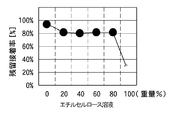
10%エチルセルロース溶液(N100、ハーキュレス社製)の配合量が20重量%である比較例1と同様にして、10%エチルセルロース溶液が40重量%、60重量%、80重量%となる離型フィルムを作成し、上記fと同様のACFを用い、上述したeの方法と同様にして残留接着率を測定した。その結果を図6に示す。
図3から明らかなように、シリコーン樹脂中にアルコキシ基含有シラン変性ポリウレタン樹脂を含有させた実施例においては、アルコキシ基含有シラン変性ポリウレタン樹脂の含有量を増加させると、接着フィルムに対する剥離強度を上昇させて所望の値にすることができる。
一方、図4から明らかなように、シリコーン樹脂中にエチルセルロースを含有させた比較例1では、エチルセルロースの含有量を増加させた場合であっても、接着フィルムに対する剥離強度は上昇せず、むしろ低下する傾向が見られる。
他方、比較例3のようにシリコーン樹脂中にポリエステルを含有させた場合には、ポリエステルの含有量を増加させても、接着フィルムに対する剥離強度は上昇しなかった。
さらに、比較例4のようにシリコーン樹脂中にシリカを含有させた場合には、ACFに対する剥離強度は実施例と比較してかなり小さく、シリカの含有量を増加させても、接着フィルムに対する剥離強度は上昇しなかった。
Claims (9)
- シリコーン樹脂とアルコキシ基含有シラン変性ポリウレタン樹脂と溶媒とを含有する離型剤組成物。
- 製膜により、シリコーン樹脂による連続相中にシリカ-ポリウレタンハイブリッド複合体が島状に分散している海島構造を形成する請求項1記載の離型剤組成物。
- 前記アルコキシ基含有シラン変性ポリウレタン樹脂の含有量が、固形分比率で0.5重量%以上50重量%以下である請求項1又は2記載の離型剤組成物。
- 離型ベース基材と、該記離型ベース基材の一方の面に設けられた離型層を有する離型フィルムであって、離型層が、請求項1又は2記載の離型剤組成物の硬化膜である離型フィルム。
- 離型層が、シリコーン樹脂による連続相中にシリカ-ポリウレタンハイブリッド複合体が島状に分散している海島構造を有する請求項4記載の離型フィルム。
- 離型ベース基材と、該離型ベース基材の一方の面に設けられた離型層と、該離型層に設けられた接着剤層とを有する接着フィルムであって、離型層が、請求項1~3のいずれかに記載の離型剤組成物の硬化膜である接着フィルム。
- 離型層が、シリコーン樹脂による連続相中にシリカ-ポリウレタンハイブリッド複合体が島状に分散している海島構造を有する請求項6記載の接着フィルム。
- 前記接着剤層が、結着樹脂中に導電粒子が分散された異方導電性接着剤からなる請求項6又は7記載の接着フィルム。
- シリコーン樹脂とアルコキシ基含有シラン変性ポリウレタン樹脂と溶媒とを含有する離型剤組成物を離型ベース基材上に塗布し、硬化させて離型層を形成する離型フィルムの製造方法。
Priority Applications (2)
| Application Number | Priority Date | Filing Date | Title |
|---|---|---|---|
| CN201080004246.6A CN102272256B (zh) | 2009-10-06 | 2010-10-06 | 脱模剂组合物、脱模薄膜以及使用它的粘合薄膜 |
| KR1020117012561A KR101725559B1 (ko) | 2009-10-06 | 2010-10-06 | 이형제 조성물, 이형 필름 및 이것을 사용한 접착 필름 |
Applications Claiming Priority (2)
| Application Number | Priority Date | Filing Date | Title |
|---|---|---|---|
| JP2009232215 | 2009-10-06 | ||
| JP2009-232215 | 2009-10-06 |
Publications (1)
| Publication Number | Publication Date |
|---|---|
| WO2011043386A1 true WO2011043386A1 (ja) | 2011-04-14 |
Family
ID=43856837
Family Applications (1)
| Application Number | Title | Priority Date | Filing Date |
|---|---|---|---|
| PCT/JP2010/067563 Ceased WO2011043386A1 (ja) | 2009-10-06 | 2010-10-06 | 離型剤組成物、離型フィルム及びこれを用いた接着フィルム |
Country Status (5)
| Country | Link |
|---|---|
| JP (1) | JP5671923B2 (ja) |
| KR (1) | KR101725559B1 (ja) |
| CN (1) | CN102272256B (ja) |
| TW (1) | TWI499639B (ja) |
| WO (1) | WO2011043386A1 (ja) |
Families Citing this family (7)
| Publication number | Priority date | Publication date | Assignee | Title |
|---|---|---|---|---|
| CN108987338B (zh) | 2017-05-31 | 2021-12-03 | 南京瀚宇彩欣科技有限责任公司 | 软性电子装置的形成方法 |
| CN107266696B (zh) * | 2017-06-12 | 2020-10-27 | 浙江洁美电子科技股份有限公司 | 一种片式元器件制程用离型膜的制造方法及其制得的离型膜 |
| KR102518776B1 (ko) * | 2017-12-27 | 2023-04-10 | 도요보 가부시키가이샤 | 세라믹 그린 시트 제조용 이형 필름 |
| CN112238664B (zh) * | 2019-07-18 | 2024-05-03 | 东丽先端材料研究开发(中国)有限公司 | 一种热固性树脂成型用薄膜材料及其成型品 |
| KR102307617B1 (ko) * | 2021-04-15 | 2021-10-05 | 주식회사 경국 | 쿠션매트 부착용 양면테이프 및 이를 이용하여 시공된 쿠션매트 |
| JP2024118532A (ja) * | 2023-02-21 | 2024-09-02 | 第一工業製薬株式会社 | ポリエステル基材用離型コート剤、離型シート及び積層体 |
| JP7500810B1 (ja) * | 2023-03-23 | 2024-06-17 | 第一工業製薬株式会社 | ポリエステル基材用離型コート剤、離型シート及び積層体 |
Citations (4)
| Publication number | Priority date | Publication date | Assignee | Title |
|---|---|---|---|---|
| JPH01149883A (ja) * | 1987-12-08 | 1989-06-12 | Dainichiseika Color & Chem Mfg Co Ltd | 剥離性処理剤 |
| JPH02208384A (ja) * | 1989-02-07 | 1990-08-17 | Nitto Denko Corp | 剥離剤及び剥離性皮膜並びに粘着部材及びセパレータ |
| JPH10279804A (ja) * | 1997-03-31 | 1998-10-20 | Jsr Corp | コーティング用組成物 |
| JP2002220431A (ja) * | 2001-01-25 | 2002-08-09 | Arakawa Chem Ind Co Ltd | アルコキシ基含有シラン変性ポリウレタン樹脂、当該樹脂組成物およびポリウレタン樹脂−シリカハイブリッド体 |
Family Cites Families (9)
| Publication number | Priority date | Publication date | Assignee | Title |
|---|---|---|---|---|
| JPS5314184A (en) * | 1976-07-26 | 1978-02-08 | Dainippon Toryo Co Ltd | Production of pigment-coated fluorescent substance |
| CN87104240A (zh) * | 1987-06-17 | 1988-12-28 | 中国原子能科学研究院 | 橡胶脱模剂 |
| US5415935A (en) * | 1992-03-31 | 1995-05-16 | E. I. Du Pont De Nemours And Company | Polymeric release film |
| US6074588A (en) * | 1993-11-22 | 2000-06-13 | Daikin Industries, Ltd. | Mold releasing agent, cured film obtained therefrom and molding method using said mold releasing agent |
| US5587502A (en) * | 1995-06-02 | 1996-12-24 | Minnesota Mining & Manufacturing Company | Hydroxy functional alkoxysilane and alkoxysilane functional polyurethane made therefrom |
| JP3477037B2 (ja) * | 1997-07-31 | 2003-12-10 | 積水化成品工業株式会社 | 熱可塑性ポリエステル系樹脂押出発泡体とその成形品並びに熱可塑性ポリエステル系樹脂押出発泡体の製造方法。 |
| US20040235683A1 (en) * | 2003-05-23 | 2004-11-25 | Moffett Robert Harvey | Mold release composition and process therewith |
| US20070141362A1 (en) * | 2005-12-19 | 2007-06-21 | Elkins Casey L | Composition for coating substrate to prevent sticking |
| JP5214229B2 (ja) * | 2007-12-04 | 2013-06-19 | モメンティブ・パフォーマンス・マテリアルズ・ジャパン合同会社 | 離型剤組成物 |
-
2010
- 2010-10-06 KR KR1020117012561A patent/KR101725559B1/ko active Active
- 2010-10-06 CN CN201080004246.6A patent/CN102272256B/zh active Active
- 2010-10-06 JP JP2010226487A patent/JP5671923B2/ja active Active
- 2010-10-06 TW TW099134279A patent/TWI499639B/zh active
- 2010-10-06 WO PCT/JP2010/067563 patent/WO2011043386A1/ja not_active Ceased
Patent Citations (4)
| Publication number | Priority date | Publication date | Assignee | Title |
|---|---|---|---|---|
| JPH01149883A (ja) * | 1987-12-08 | 1989-06-12 | Dainichiseika Color & Chem Mfg Co Ltd | 剥離性処理剤 |
| JPH02208384A (ja) * | 1989-02-07 | 1990-08-17 | Nitto Denko Corp | 剥離剤及び剥離性皮膜並びに粘着部材及びセパレータ |
| JPH10279804A (ja) * | 1997-03-31 | 1998-10-20 | Jsr Corp | コーティング用組成物 |
| JP2002220431A (ja) * | 2001-01-25 | 2002-08-09 | Arakawa Chem Ind Co Ltd | アルコキシ基含有シラン変性ポリウレタン樹脂、当該樹脂組成物およびポリウレタン樹脂−シリカハイブリッド体 |
Also Published As
| Publication number | Publication date |
|---|---|
| CN102272256A (zh) | 2011-12-07 |
| JP5671923B2 (ja) | 2015-02-18 |
| KR20120064646A (ko) | 2012-06-19 |
| JP2011099095A (ja) | 2011-05-19 |
| CN102272256B (zh) | 2015-07-29 |
| TW201130915A (en) | 2011-09-16 |
| KR101725559B1 (ko) | 2017-04-10 |
| TWI499639B (zh) | 2015-09-11 |
Similar Documents
| Publication | Publication Date | Title |
|---|---|---|
| JP5671923B2 (ja) | 離型剤組成物、離型フィルム及びこれを用いた接着フィルム | |
| JP5742161B2 (ja) | 離型剤組成物、離型フィルム及び粘着フィルム | |
| JP4876289B2 (ja) | 帯電防止シリコン離型フィルム | |
| TWI688634B (zh) | 黏著片材及光學構件 | |
| CN104507671B (zh) | 抗静电性剥离薄膜 | |
| WO2012020673A1 (ja) | 剥離剤組成物、剥離シート及び粘着体 | |
| WO1996028519A1 (en) | Pressure-sensitive adhesive composition and pressure-sensitive adhesive sheets made therefrom, and sealants, reinforcing sheets and pressure-sensitive adhesive sheets for printing produced therefrom | |
| CN107429144A (zh) | 剥离剂组成物、剥离薄板、单面粘合薄板和双面粘合薄板 | |
| CN111465639B (zh) | 层叠薄膜、脱模薄膜和层叠体 | |
| JP3599158B2 (ja) | 粘着テープ | |
| KR102069612B1 (ko) | 양면 점착 시트 | |
| JP5328005B2 (ja) | 粘着テープ用剥離剤組成物及び剥離ライナー | |
| TWI682980B (zh) | 接著劑組成物及膜卷裝體 | |
| JP2007001266A (ja) | エポキシ樹脂無機複合シート及び成形品 | |
| TWI881156B (zh) | 保護膜形成用片卷的製造方法 | |
| JP2000053934A (ja) | 接着剤組成物およびその前駆体 | |
| TW200400878A (en) | Surface protective film for adhesive resin and process for producing the same | |
| JP2018520214A (ja) | 離型コーティング材中の非シリコーン添加剤 | |
| JP3645383B2 (ja) | 両面剥離紙用付加反応硬化性シリコーン組成物および両面剥離紙 | |
| JP2001341239A (ja) | 帯電防止フィルム及び該帯電防止フィルムを用いた粘着テープ又はシート用剥離フィルム並びに粘着テープ又はシート | |
| JP4576140B2 (ja) | 接着剤組成物および接着シート | |
| JP6383966B2 (ja) | 吸着フィルム | |
| JP2009521561A (ja) | 静電気発生の少ないポリエーテルイミドポリマーからなる高温熱耐接着テープ | |
| JP2006181816A (ja) | 剥離ライナーおよび該剥離ライナーが用いられた両面粘着テープ又はシート | |
| JP4900928B2 (ja) | 保護フィルムの未硬化シリコーンの除去方法 |
Legal Events
| Date | Code | Title | Description |
|---|---|---|---|
| WWE | Wipo information: entry into national phase |
Ref document number: 201080004246.6 Country of ref document: CN |
|
| 121 | Ep: the epo has been informed by wipo that ep was designated in this application |
Ref document number: 10822056 Country of ref document: EP Kind code of ref document: A1 |
|
| ENP | Entry into the national phase |
Ref document number: 20117012561 Country of ref document: KR Kind code of ref document: A |
|
| NENP | Non-entry into the national phase |
Ref country code: DE |
|
| 122 | Ep: pct application non-entry in european phase |
Ref document number: 10822056 Country of ref document: EP Kind code of ref document: A1 |