WO2011016553A1 - 非水電解質二次電池 - Google Patents
非水電解質二次電池 Download PDFInfo
- Publication number
- WO2011016553A1 WO2011016553A1 PCT/JP2010/063381 JP2010063381W WO2011016553A1 WO 2011016553 A1 WO2011016553 A1 WO 2011016553A1 JP 2010063381 W JP2010063381 W JP 2010063381W WO 2011016553 A1 WO2011016553 A1 WO 2011016553A1
- Authority
- WO
- WIPO (PCT)
- Prior art keywords
- positive electrode
- lithium
- niobium
- titanium
- electrode active
- Prior art date
- Legal status (The legal status is an assumption and is not a legal conclusion. Google has not performed a legal analysis and makes no representation as to the accuracy of the status listed.)
- Ceased
Links
Images
Classifications
-
- H—ELECTRICITY
- H01—ELECTRIC ELEMENTS
- H01M—PROCESSES OR MEANS, e.g. BATTERIES, FOR THE DIRECT CONVERSION OF CHEMICAL ENERGY INTO ELECTRICAL ENERGY
- H01M10/00—Secondary cells; Manufacture thereof
- H01M10/05—Accumulators with non-aqueous electrolyte
- H01M10/052—Li-accumulators
-
- H—ELECTRICITY
- H01—ELECTRIC ELEMENTS
- H01M—PROCESSES OR MEANS, e.g. BATTERIES, FOR THE DIRECT CONVERSION OF CHEMICAL ENERGY INTO ELECTRICAL ENERGY
- H01M4/00—Electrodes
- H01M4/02—Electrodes composed of, or comprising, active material
- H01M4/36—Selection of substances as active materials, active masses, active liquids
- H01M4/48—Selection of substances as active materials, active masses, active liquids of inorganic oxides or hydroxides
- H01M4/52—Selection of substances as active materials, active masses, active liquids of inorganic oxides or hydroxides of nickel, cobalt or iron
- H01M4/525—Selection of substances as active materials, active masses, active liquids of inorganic oxides or hydroxides of nickel, cobalt or iron of mixed oxides or hydroxides containing iron, cobalt or nickel for inserting or intercalating light metals, e.g. LiNiO2, LiCoO2 or LiCoOxFy
-
- C—CHEMISTRY; METALLURGY
- C01—INORGANIC CHEMISTRY
- C01G—COMPOUNDS CONTAINING METALS NOT COVERED BY SUBCLASSES C01D OR C01F
- C01G45/00—Compounds of manganese
- C01G45/12—Complex oxides containing manganese and at least one other metal element
- C01G45/1221—Manganates or manganites with trivalent manganese, tetravalent manganese or mixtures thereof
- C01G45/1228—Manganates or manganites with trivalent manganese, tetravalent manganese or mixtures thereof of the type (MnO2)-, e.g. LiMnO2 or Li(MxMn1-x)O2
-
- C—CHEMISTRY; METALLURGY
- C01—INORGANIC CHEMISTRY
- C01G—COMPOUNDS CONTAINING METALS NOT COVERED BY SUBCLASSES C01D OR C01F
- C01G51/00—Compounds of cobalt
- C01G51/40—Complex oxides containing cobalt and at least one other metal element
- C01G51/42—Complex oxides containing cobalt and at least one other metal element containing alkali metals, e.g. LiCoO2
- C01G51/44—Complex oxides containing cobalt and at least one other metal element containing alkali metals, e.g. LiCoO2 containing manganese
- C01G51/50—Complex oxides containing cobalt and at least one other metal element containing alkali metals, e.g. LiCoO2 containing manganese of the type (MnO2)n-, e.g. Li(CoxMn1-x)O2 or Li(MyCoxMn1-x-y)O2
-
- C—CHEMISTRY; METALLURGY
- C01—INORGANIC CHEMISTRY
- C01G—COMPOUNDS CONTAINING METALS NOT COVERED BY SUBCLASSES C01D OR C01F
- C01G53/00—Compounds of nickel
-
- C—CHEMISTRY; METALLURGY
- C01—INORGANIC CHEMISTRY
- C01G—COMPOUNDS CONTAINING METALS NOT COVERED BY SUBCLASSES C01D OR C01F
- C01G53/00—Compounds of nickel
- C01G53/40—Complex oxides containing nickel and at least one other metal element
- C01G53/42—Complex oxides containing nickel and at least one other metal element containing alkali metals, e.g. LiNiO2
- C01G53/44—Complex oxides containing nickel and at least one other metal element containing alkali metals, e.g. LiNiO2 containing manganese
- C01G53/50—Complex oxides containing nickel and at least one other metal element containing alkali metals, e.g. LiNiO2 containing manganese of the type (MnO2)n-, e.g. Li(NixMn1-x)O2 or Li(MyNixMn1-x-y)O2
- C01G53/502—Complex oxides containing nickel and at least one other metal element containing alkali metals, e.g. LiNiO2 containing manganese of the type (MnO2)n-, e.g. Li(NixMn1-x)O2 or Li(MyNixMn1-x-y)O2 containing lithium and cobalt
-
- H—ELECTRICITY
- H01—ELECTRIC ELEMENTS
- H01M—PROCESSES OR MEANS, e.g. BATTERIES, FOR THE DIRECT CONVERSION OF CHEMICAL ENERGY INTO ELECTRICAL ENERGY
- H01M10/00—Secondary cells; Manufacture thereof
- H01M10/05—Accumulators with non-aqueous electrolyte
-
- H—ELECTRICITY
- H01—ELECTRIC ELEMENTS
- H01M—PROCESSES OR MEANS, e.g. BATTERIES, FOR THE DIRECT CONVERSION OF CHEMICAL ENERGY INTO ELECTRICAL ENERGY
- H01M10/00—Secondary cells; Manufacture thereof
- H01M10/05—Accumulators with non-aqueous electrolyte
- H01M10/056—Accumulators with non-aqueous electrolyte characterised by the materials used as electrolytes, e.g. mixed inorganic/organic electrolytes
- H01M10/0564—Accumulators with non-aqueous electrolyte characterised by the materials used as electrolytes, e.g. mixed inorganic/organic electrolytes the electrolyte being constituted of organic materials only
- H01M10/0566—Liquid materials
- H01M10/0569—Liquid materials characterised by the solvents
-
- H—ELECTRICITY
- H01—ELECTRIC ELEMENTS
- H01M—PROCESSES OR MEANS, e.g. BATTERIES, FOR THE DIRECT CONVERSION OF CHEMICAL ENERGY INTO ELECTRICAL ENERGY
- H01M4/00—Electrodes
- H01M4/02—Electrodes composed of, or comprising, active material
- H01M4/36—Selection of substances as active materials, active masses, active liquids
- H01M4/48—Selection of substances as active materials, active masses, active liquids of inorganic oxides or hydroxides
- H01M4/50—Selection of substances as active materials, active masses, active liquids of inorganic oxides or hydroxides of manganese
- H01M4/505—Selection of substances as active materials, active masses, active liquids of inorganic oxides or hydroxides of manganese of mixed oxides or hydroxides containing manganese for inserting or intercalating light metals, e.g. LiMn2O4 or LiMn2OxFy
-
- H—ELECTRICITY
- H01—ELECTRIC ELEMENTS
- H01M—PROCESSES OR MEANS, e.g. BATTERIES, FOR THE DIRECT CONVERSION OF CHEMICAL ENERGY INTO ELECTRICAL ENERGY
- H01M4/00—Electrodes
- H01M4/02—Electrodes composed of, or comprising, active material
- H01M4/62—Selection of inactive substances as ingredients for active masses, e.g. binders, fillers
- H01M4/628—Inhibitors, e.g. gassing inhibitors, corrosion inhibitors
-
- C—CHEMISTRY; METALLURGY
- C01—INORGANIC CHEMISTRY
- C01P—INDEXING SCHEME RELATING TO STRUCTURAL AND PHYSICAL ASPECTS OF SOLID INORGANIC COMPOUNDS
- C01P2002/00—Crystal-structural characteristics
- C01P2002/50—Solid solutions
-
- C—CHEMISTRY; METALLURGY
- C01—INORGANIC CHEMISTRY
- C01P—INDEXING SCHEME RELATING TO STRUCTURAL AND PHYSICAL ASPECTS OF SOLID INORGANIC COMPOUNDS
- C01P2002/00—Crystal-structural characteristics
- C01P2002/50—Solid solutions
- C01P2002/52—Solid solutions containing elements as dopants
-
- C—CHEMISTRY; METALLURGY
- C01—INORGANIC CHEMISTRY
- C01P—INDEXING SCHEME RELATING TO STRUCTURAL AND PHYSICAL ASPECTS OF SOLID INORGANIC COMPOUNDS
- C01P2002/00—Crystal-structural characteristics
- C01P2002/50—Solid solutions
- C01P2002/52—Solid solutions containing elements as dopants
- C01P2002/54—Solid solutions containing elements as dopants one element only
-
- C—CHEMISTRY; METALLURGY
- C01—INORGANIC CHEMISTRY
- C01P—INDEXING SCHEME RELATING TO STRUCTURAL AND PHYSICAL ASPECTS OF SOLID INORGANIC COMPOUNDS
- C01P2006/00—Physical properties of inorganic compounds
- C01P2006/40—Electric properties
-
- C—CHEMISTRY; METALLURGY
- C01—INORGANIC CHEMISTRY
- C01P—INDEXING SCHEME RELATING TO STRUCTURAL AND PHYSICAL ASPECTS OF SOLID INORGANIC COMPOUNDS
- C01P2006/00—Physical properties of inorganic compounds
- C01P2006/80—Compositional purity
-
- Y—GENERAL TAGGING OF NEW TECHNOLOGICAL DEVELOPMENTS; GENERAL TAGGING OF CROSS-SECTIONAL TECHNOLOGIES SPANNING OVER SEVERAL SECTIONS OF THE IPC; TECHNICAL SUBJECTS COVERED BY FORMER USPC CROSS-REFERENCE ART COLLECTIONS [XRACs] AND DIGESTS
- Y02—TECHNOLOGIES OR APPLICATIONS FOR MITIGATION OR ADAPTATION AGAINST CLIMATE CHANGE
- Y02E—REDUCTION OF GREENHOUSE GAS [GHG] EMISSIONS, RELATED TO ENERGY GENERATION, TRANSMISSION OR DISTRIBUTION
- Y02E60/00—Enabling technologies; Technologies with a potential or indirect contribution to GHG emissions mitigation
- Y02E60/10—Energy storage using batteries
-
- Y—GENERAL TAGGING OF NEW TECHNOLOGICAL DEVELOPMENTS; GENERAL TAGGING OF CROSS-SECTIONAL TECHNOLOGIES SPANNING OVER SEVERAL SECTIONS OF THE IPC; TECHNICAL SUBJECTS COVERED BY FORMER USPC CROSS-REFERENCE ART COLLECTIONS [XRACs] AND DIGESTS
- Y02—TECHNOLOGIES OR APPLICATIONS FOR MITIGATION OR ADAPTATION AGAINST CLIMATE CHANGE
- Y02T—CLIMATE CHANGE MITIGATION TECHNOLOGIES RELATED TO TRANSPORTATION
- Y02T10/00—Road transport of goods or passengers
- Y02T10/60—Other road transportation technologies with climate change mitigation effect
- Y02T10/70—Energy storage systems for electromobility, e.g. batteries
Definitions
- the present invention relates to a non-aqueous electrolyte secondary battery including a positive electrode including a positive electrode active material, a negative electrode including a negative electrode active material, and a non-aqueous electrolyte solution in which a solute is dissolved in a non-aqueous solvent. Further, the present invention relates to a non-aqueous electrolyte secondary battery using a lithium-containing transition metal composite oxide having a layered structure containing Ni and Mn as main components.
- nickel-hydrogen storage batteries are widely used as the power source for the electric vehicles.
- the use of a non-aqueous electrolyte secondary battery as a power source with higher capacity and higher output has been studied.
- a lithium-containing transition metal composite oxide mainly composed of cobalt such as lithium cobaltate (LiCoO 2 ) is mainly used as the positive electrode active material of the positive electrode. It has been.
- cobalt used in the positive electrode active material is a scarce resource, and there are problems such as high costs and difficulty in stable supply.
- a very large amount of cobalt is required, which increases the cost of the power source. was there.
- lithium nickelate (LiNiO 2 ) having a layered structure is expected as a material capable of obtaining a large discharge capacity, but has the disadvantages of poor thermal stability and poor safety and large overvoltage.
- lithium manganate (LiMn 2 O 4 ) having a spinel structure has the advantage of being rich in resources and inexpensive, but has a low energy density and elutes manganese into the non-aqueous electrolyte in a high-temperature environment. There was a drawback of doing.
- a lithium-containing transition metal oxide having a layered structure in which the main component of the transition metal is composed of two elements of nickel and manganese has attracted attention from the viewpoint of excellent thermal stability at a low cost. Proposals shown in (1) to (4) have been made.
- Lithium composite oxide having a rhombohedral structure that has a layered structure includes nickel and manganese, and has an atomic ratio error between nickel and manganese of within 10 atomic% 1).
- a positive electrode active material obtained by adding a group 4A element and a group 5A element to a lithium-containing transition metal composite oxide containing nickel or manganese (see Patent Document 4 below).
- the positive electrode active materials shown in the above (1) to (4) have the following problems.
- the positive electrode active material shown in (1) is significantly inferior in high rate charge / discharge characteristics compared to lithium cobaltate, so that it can be used as a power source for electric vehicles and the like. There was a problem that it was difficult.
- the present invention takes the above-mentioned conventional problems into consideration, and as a positive electrode active material for a non-aqueous electrolyte secondary battery, a lithium-containing transition metal composite oxide having a layered structure containing Ni and Mn as main components. In use, it is an object to improve the output characteristics under various temperature conditions by improving the positive electrode active material so that it can be suitably used as a power source for a hybrid electric vehicle or the like.
- the present invention provides a nonaqueous electrolyte secondary battery comprising a positive electrode including a positive electrode active material, a negative electrode including a negative electrode active material, and a nonaqueous electrolytic solution obtained by dissolving a solute in a nonaqueous solvent.
- the surface of the lithium-containing transition metal composite oxide containing Ni and Mn as main components and having a layered structure has a niobium-containing material and a titanium-containing material as the positive electrode active material.
- the total amount of niobium in the product and titanium in the titanium-containing material is 0.15 mol% or more and 1.5 mol% or less with respect to the total amount of transition metal in the lithium-containing transition metal composite oxide, and contains niobium
- the number of moles of niobium in the product is equal to or greater than the number of moles of titanium in the titanium-containing material.
- a positive electrode active material in which both a niobium-containing material and a titanium-containing material are present on the surface of the lithium-containing transition metal composite oxide can be used, output characteristics under various temperature conditions can be improved. It can be suitably used as a power source for a hybrid electric vehicle or the like.
- the mechanism that can improve the output characteristics is not clear, but niobium and titanium present on the surface of the lithium-containing transition metal composite oxide may cause nickel or the like in the lithium-containing transition metal composite oxide. It is inferred that this is because the valence of the transition metal changes, which causes the interface between the positive electrode and the non-aqueous electrolyte to be modified and the charge transfer reaction to be promoted.
- the amount of the niobium-containing material and the titanium-containing material present on the surface of the lithium-containing transition metal composite oxide is small, the above-described effects cannot be obtained sufficiently.
- the amount of the niobium-containing material and the titanium-containing material is excessive, the surface of the lithium-containing transition metal composite oxide is widely covered with the non-conductive niobium-containing material or titanium-containing material (the number of coating sites increases). Therefore, the charge / discharge characteristics of the battery are deteriorated.
- the total amount of niobium in the niobium-containing material and titanium in the titanium-containing material is 0.15 mol% or more and 1.5 mol% or less with respect to the total amount of transition metal in the lithium-containing transition metal composite oxide. In particular, it is preferably 0.15 mol% or more and 1.0 mol% or less. In view of cost merit, it is preferable that the amount of addition of the niobium-containing material and the titanium-containing material is as small as possible so that the above-described effects can be exhibited.
- the amount of titanium (mole number) in the titanium-containing material is larger than the amount of niobium (mole number) in the niobium-containing material, the above-described effects cannot be obtained. This is because niobium is pentavalent and titanium is tetravalent in the positive electrode active material. If the amount of titanium is greater than the amount of niobium, the effect of niobium present in pentavalent on transition metals such as nickel is effective. Not enough. Therefore, the number of moles of niobium in the niobium-containing material needs to be equal to or more than the number of moles of titanium in the titanium-containing material.
- the phrase “Ni and Mn are included in the main component” means that the ratio of the total amount of Ni and Mn to the total amount of transition metals exceeds 50 mol%.
- the composition ratio c of cobalt, the composition ratio a of nickel, and the composition ratio b of manganese are 0 ⁇ c / (a + b) ⁇ 0.40.
- the reason why the material satisfying the above condition is used is to reduce the material cost of the positive electrode active material by reducing the proportion of cobalt. Considering this, it is preferable that 0 ⁇ c / (a + b) ⁇ 0.35, and among them, 0 ⁇ c / (a + b) ⁇ 0.15 is preferable.
- the nickel composition ratio a and the manganese composition ratio b satisfy the condition of 0.7 ⁇ a / b ⁇ 3.0 for the following reason. That is, when the value of a / b exceeds 3.0 and the proportion of nickel increases, the heat stability in this lithium-containing transition metal composite oxide is extremely reduced, and the calorific value peaks. The temperature may be lowered and safety may be reduced. On the other hand, when the value of a / b is less than 0.7, the proportion of manganese increases, an impurity phase is generated, and the capacity decreases. Considering this, it is preferable that 0.7 ⁇ a / b ⁇ 2.0, and it is preferable that 0.7 ⁇ a / b ⁇ 1.5 among them.
- d in the oxygen composition ratio (2 + d) satisfies the condition of ⁇ 0.1 ⁇ d ⁇ 0.1. This is to prevent the transition metal complex oxide from being in an oxygen deficient state or an oxygen excess state and damaging its crystal structure.
- the niobium-containing material and the titanium-containing material are sintered on the surface of the lithium-containing transition metal oxide. This is because with such a configuration, the niobium-containing material or the titanium-containing material is firmly fixed on the surface of the lithium-containing transition metal oxide.
- a lithium-containing transition metal composite oxide, a predetermined amount of niobium-containing material, and a titanium-containing material are mixed using a method such as mechanofusion, and the niobium-containing material and the titanium-containing material are adhered to the surface of the lithium-containing transition metal composite oxide, and then this is below the decomposition temperature of the lithium-containing transition metal composite oxide.
- a method of sintering There is a method of sintering.
- the method for causing the niobium-containing material or the like to exist on the surface of the lithium-containing transition metal composite oxide is not limited to the above-described sintering method.
- the niobium-containing material include Nb 2 O 5 and LiNbO 3
- examples of the titanium-containing material include Li 2 TiO 3 , Li 4 Ti 5 O 12 , and TiO 2 .
- the primary particles in the positive electrode active material have a volume average particle size of 0.5 ⁇ m or more and 2 ⁇ m or less, and the secondary particles have a volume average particle size of 4 ⁇ m or more and 15 ⁇ m or less.
- the particle size of the positive electrode active material is too large, the discharge performance is deteriorated due to poor conductivity of the positive electrode active material itself.
- the particle size of the positive electrode active material is too small, the positive electrode active material is reduced. This is because, as a result of an increase in the specific surface area of the material, the reactivity with the non-aqueous electrolyte increases, and as a result, the storage characteristics and the like deteriorate.
- the lithium-containing transition metal composite oxide includes boron (B), fluorine (F), magnesium (Mg), aluminum (Al), chromium (Cr), vanadium (V), iron (Fe), copper (Cr), zinc (Zn), molybdenum (Mo), zirconium (Zr), tin (Sn), tungsten (W), sodium (Na), at least one selected from the group consisting of potassium (K) is included. May be.
- the positive electrode active material used in the non-aqueous electrolyte secondary battery of the present invention does not need to be composed of only the above-described positive electrode active material, and is mixed with the above-described positive electrode active material and another positive electrode active material. It is also possible to use it.
- the other positive electrode active material is not particularly limited as long as it is a compound that can reversibly insert and desorb lithium. For example, a layered structure capable of inserting and desorbing lithium while maintaining a stable crystal structure, Those having a spinel structure or an olivine structure can be used.
- the negative electrode active material used in the nonaqueous electrolyte secondary battery of the present invention is not particularly limited as long as it can reversibly occlude and release lithium.
- a carbon material or a metal alloyed with lithium Alternatively, an alloy material, a metal oxide, or the like can be used.
- a carbon material for the negative electrode active material For example, natural graphite, artificial graphite, mesophase pitch-based carbon fiber (MCF), mesocarbon microbeads (MCMB), coke, hard carbon Fullerenes, carbon nanotubes, and the like can be used.
- MCF mesophase pitch-based carbon fiber
- MCMB mesocarbon microbeads
- coke hard carbon Fullerenes
- carbon nanotubes and the like
- non-aqueous solvent used in the non-aqueous electrolyte solution of the non-aqueous electrolyte secondary battery of the present invention a known non-aqueous solvent that has been conventionally used can be used, for example, ethylene carbonate, propylene carbonate, Cyclic carbonates such as butylene carbonate and vinylene carbonate, and chain carbonates such as dimethyl carbonate, methyl ethyl carbonate, and diethyl carbonate can be used.
- a mixed solvent of cyclic carbonate and chain carbonate as a non-aqueous solvent with low viscosity, low melting point and high lithium ion conductivity, and the volume ratio of cyclic carbonate to chain carbonate in this mixed solvent is As described above, it is preferable to restrict the range of 2: 8 to 5: 5.
- an ionic liquid can also be used as the non-aqueous solvent for the non-aqueous electrolyte.
- the cation species and the anion species are not particularly limited, but low viscosity, electrochemical stability, hydrophobicity
- a combination using a pyridinium cation, an imidazolium cation, or a quaternary ammonium cation as the cation and a fluorine-containing imide anion as the anion is particularly preferable.
- a solute used in the non-aqueous electrolyte a known lithium salt that has been conventionally used can be used.
- a lithium salt a lithium salt containing one or more elements among P, B, F, O, S, N, and Cl can be used.
- lithium salts such as LiAsF 6 , LiClO 4 and mixtures thereof can be used.
- LiPF 6 is preferably used in order to enhance the high rate charge / discharge characteristics and durability of the nonaqueous electrolyte secondary battery.
- the separator used in the non-aqueous electrolyte secondary battery of the present invention is a material that can prevent short circuit due to contact between the positive electrode and the negative electrode and is impregnated with a non-aqueous electrolyte to obtain lithium ion conductivity.
- a polypropylene or polyethylene separator, a polypropylene-polyethylene multilayer separator, or the like can be used.
- the positive electrode active material has a niobium-containing material on the surface of the positive electrode active material particles made of a lithium-containing transition metal composite oxide having a layered structure containing Ni and Mn as main components. Since the material containing both titanium-containing materials is used, the valence of transition metals such as nickel in the positive electrode active material changes, and the interface between the positive electrode and the non-aqueous electrolyte is modified. The reaction is promoted. As a result, since the output characteristics under various temperature conditions are improved, there is an excellent effect that it can be suitably used as a power source for a hybrid electric vehicle or the like.
- non-aqueous electrolyte secondary battery according to the present invention will be specifically described with examples, but the non-aqueous electrolyte secondary battery of the present invention is not limited to the following forms or examples described below, The present invention can be appropriately modified and implemented without changing the gist thereof.
- Li 2 CO 3 and Ni 0.60 Mn 0.40 (OH) 2 obtained by the coprecipitation method are mixed at a predetermined ratio, and these are fired at 1000 ° C. for 10 hours in the air.
- Li 1.06 Ni 0.56 Mn 0.38 O 2 lithium-containing transition metal composite oxide
- the primary particles of Li 1.06 Ni 0.56 Mn 0.38 O 2 produced in this way had a volume average particle size of about 1 ⁇ m, and the secondary particles had a volume average particle size of about 7 ⁇ m. It was.
- the amount of niobium relative to the total amount of transition metal in the lithium-containing transition metal composite oxide (hereinafter sometimes simply referred to as niobium amount) and titanium relative to the total amount of transition metal in the lithium-containing transition metal composite oxide
- titanium amount was 0.5 mol%.
- the positive electrode active material a vapor growth carbon fiber (VGCF) as a conductive agent, and an N-methyl-2-pyrrolidone solution in which polyvinylidene fluoride as a binder is dissolved
- a positive electrode mixture slurry was prepared by kneading so that the mass ratio of the conductive agent to the binder was 92: 5: 3.
- this positive electrode mixture slurry was applied onto a positive electrode current collector made of an aluminum foil, dried, rolled with a rolling roller, and a positive electrode current collector tab made of aluminum was attached to produce a positive electrode.
- LiPF 6 was dissolved in a mixed solvent in which ethylene carbonate, methyl ethyl carbonate, and dimethyl carbonate were mixed at a volume ratio of 3: 3: 4 so as to have a concentration of 1 mol / liter, and further 1% by mass of vinylene carbonate. Prepared by dissolving.
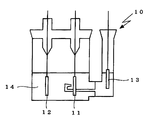
- FIG. 1 Using the positive electrode (working electrode), negative electrode (counter electrode), reference electrode, and non-aqueous electrolyte, a three-electrode test cell 10 shown in FIG. 1 was produced.
- 11 is a positive electrode
- 12 is a negative electrode
- 13 is a reference electrode
- 14 is a non-aqueous electrolyte.
- Example 1 The cell shown in the mode for carrying out the invention was used. The cell thus produced is hereinafter referred to as the present invention cell A1.
- Example 2 A three-electrode test cell was prepared in the same manner as in Example 1 except that the amount of Nb 2 O 5 was increased in the preparation of the positive electrode active material.
- the niobium amount and the titanium amount were 1.0 mol% and 0.5 mol%, respectively.
- the cell thus produced is hereinafter referred to as the present invention cell A2.
- Example 3 A three-electrode test cell was produced in the same manner as in Example 1 except that the amount of Nb 2 O 5 and the amount of TiO 2 were reduced in the production of the positive electrode active material.
- the niobium amount and the titanium amount were 0.1 mol% and 0.05 mol%, respectively.
- the cell thus produced is hereinafter referred to as the present invention cell A3.
- Comparative Example 1 In the production of the positive electrode active material, Nb 2 O 5 and TiO 2 are not mixed (that is, only the lithium-containing transition metal composite oxide composed of Li 1.06 Ni 0.56 Mn 0.38 O 2 is used as the positive electrode active material. A three-electrode test cell was prepared in the same manner as in Example 1 except that it was used. The cell thus produced is hereinafter referred to as a comparison cell Z1.
- Example 3 A three-electrode test cell was prepared in the same manner as in Example 1 except that the amount of Nb 2 O 5 and the amount of TiO 2 were increased in preparation of the positive electrode active material. In addition, as a result of measuring the niobium amount and the titanium amount of the positive electrode active material thus produced by ICP, both the niobium amount and the titanium amount were 1.0 mol%. The cell thus fabricated is hereinafter referred to as a comparison cell Z3.
- Comparative Example 4 In the preparation of the positive electrode active material, except that the reduced and Nb 2 O 5 amount and the amount of TiO 2, in the same manner as in Example 1 to prepare a three-electrode test cell. In addition, as a result of measuring the niobium amount and the titanium amount of the positive electrode active material thus produced by ICP, both the niobium amount and the titanium amount were 0.05 mol%.
- the cell thus fabricated is hereinafter referred to as a comparison cell Z4.
- the present invention cells A1 to A3 and the comparative cells Z1 to Z4 are up to 4.3 V (vs. Li / Li + ) at a current density of 0.2 mA / cm 2 under a temperature condition of 25 ° C. a constant current charging, 4.3 V after the current density was constant voltage charging until the 0.04 mA / cm 2 at (vs.Li/Li +), 2 at a current density of 0.2 mA / cm 2. Constant current discharge was performed up to 5 V (vs. Li / Li + ). The discharge capacity at this time was set as the rated capacity of the cells A1 to A3 of the present invention and the comparative cells Z1 to Z4.
- inventive cells A1 to A3 and the comparative cells Z1 to Z4 are charged to 50% of the rated capacity at the same current density as described above under the temperature condition of 25 ° C., respectively, and discharged at the same current density as above.
- the output at the time when the depth of charge (SOC) was 50% was measured.
- a positive electrode active material in which niobium and titanium are present on the surface of a lithium-containing transition metal composite oxide represented by Li 1.06 Ni 0.56 Mn 0.38 O 2
- the cells A1 to A3 of the present invention in which the total amount of niobium and titanium is 0.15 mol% or more and 1.5 mol% or less and the niobium is the same amount or more as titanium are formed on the surface of the lithium-containing transition metal composite oxide. It can be seen that the output characteristics are dramatically improved as compared with the comparative cell Z1 in which no titanium and titanium are present.
- niobium and titanium are present on the surface of the lithium-containing transition metal composite oxide, but in the comparative cell Z4 in which the total amount of niobium and titanium is 0.10 mol%, the amount of addition of niobium and titanium is too small.
- the operational effects as in the batteries A1 to A3 of the present invention are not sufficiently exhibited and the output characteristics are deteriorated.
- niobium and titanium are present on the surface of the lithium-containing transition metal composite oxide, but in the comparative cell Z3 in which the total amount of niobium and titanium is 2.0 mol%, the addition amount of niobium and titanium is too large.
- it is difficult to uniformly disperse niobium and titanium so that it is recognized that the output characteristics also deteriorate.
- the output characteristics of the comparative cell Z2 that is not equal to or greater than (the titanium content is greater than the niobium content) are degraded. Accordingly, even when a positive electrode active material in which a group 4A element and a group 5A element are added to a lithium transition metal oxide is used as in Patent Document 4, the output characteristics can be improved if the amount of the added element is not regulated. It turns out that it cannot improve.
- the positive electrode active material in which niobium and titanium are present on the surface of the lithium-containing transition metal composite oxide, and the total amount of niobium and titanium relative to the total amount of transition metals in the lithium-containing transition metal composite oxide is It is 0.15 mol% or more and 1.5 mol% or less, and niobium needs to be equal to or more than titanium.
- Example 2 Except that Li 1.07 Ni 0.46 Co 0.19 Mn 0.28 O 2 having a layered structure was used as the lithium-containing transition metal composite oxide, the same procedure as in Example 1 of the first example was performed. An electrode type test cell was prepared.
- the lithium-containing transition metal composite oxide is prepared by mixing Li 2 CO 3 and a coprecipitated hydroxide represented by Ni 0.5 Co 0.2 Mn 0.3 (OH) 2 at a predetermined ratio. Was fired at 850 ° C. for 10 hours in air.
- the volume average particle diameter of the thus Li 1.07 was obtained Ni 0.46 Co 0.19 Mn 0.28 O 2 of the primary particles is about 1 [mu] m, also the volume average particle diameter of the secondary particles It was about 6 ⁇ m.
- the cell thus produced is hereinafter referred to as the present invention battery B.
- Comparative Example 1 In the production of the positive electrode active material, Nb 2 O 5 and TiO 2 are not mixed (that is, only the lithium-containing transition metal composite oxide composed of Li 1.07 Ni 0.46 Co 0.19 Mn 0.28 O 2 is used. A three-electrode test cell was prepared in the same manner as in the above example except that it was used as a positive electrode active material. The cell thus produced is hereinafter referred to as a comparison cell Y1.
- Comparative Example 2 In the production of the positive electrode active material, a three-electrode test cell was produced in the same manner as in the example except that only Nb 2 O 5 was mixed and then fired to produce the positive electrode active material. In addition, as a result of measuring the niobium amount of the positive electrode active material thus produced by ICP, the niobium amount was 1.0 mol%. The cell thus fabricated is hereinafter referred to as a comparison cell Y2.
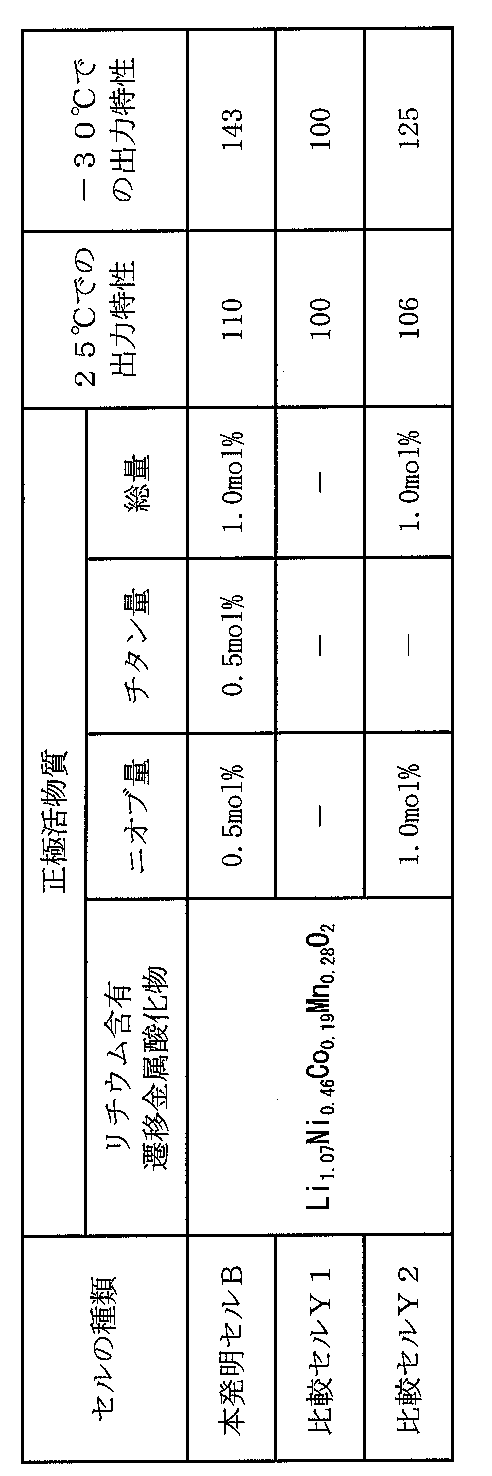
- niobium and titanium are each 0.5 mol% on the surface of the lithium-containing transition metal composite oxide represented by Li 1.07 Ni 0.46 Co 0.19 Mn 0.28 O 2.
- the cell B of the present invention using the existing positive electrode active material has an output characteristic at either 25 ° C. or ⁇ 30 ° C. as compared with the comparative cell Y1 in which niobium and titanium are not present on the surface of the lithium-containing transition metal composite oxide. It is recognized that it has improved dramatically.
- the comparison cell Y2 in which only niobium is present on the surface of the lithium-containing transition metal composite oxide (the addition amount of niobium is 1.0 mol%, so the total amount of additives is the same as that of the present invention cell B) is a comparison cell.
- Y1 it is recognized that the output characteristics are improved at both 25 ° C. and ⁇ 30 ° C., but it is recognized that the degree of improvement is extremely small compared to the cell B of the present invention. Therefore, it can be seen that both niobium and titanium must be present on the surface of the lithium-containing transition metal composite oxide.
- the improvement width of the output (25 ° C.) of the cell A1 of the present invention relative to the comparison cell Z1 is larger than the increase width of the output (25 ° C.) of the cell B of the present invention relative to the comparison cell Y1. It is done. This is because the positive electrode active material having a Co content of 10% or less, such as the cell A1 of the present invention, is more positive than the positive electrode active material (the positive electrode active material of the cell B of the present invention) containing more Co. Resistance at the interface with the electrolyte is high.
- Example 2 Except that Li 1.09 Ni 0.36 Co 0.19 Mn 0.36 O 2 having a layered structure was used as the lithium-containing transition metal composite oxide, the same procedure as in Example 1 of the first example was performed.
- An electrode type test cell was prepared.
- the lithium-containing transition metal composite oxide is prepared by mixing Li 2 CO 3 and a coprecipitated hydroxide represented by Ni 0.4 Co 0.2 Mn 0.4 (OH) 2 at a predetermined ratio.
- the volume average particle diameter of the primary particles of Li 1.09 Ni 0.36 Co 0.19 Mn 0.36 O 2 thus obtained is about 1 ⁇ m, and the volume average particle diameter of the secondary particles is It was about 6 ⁇ m.
- the cell thus produced is hereinafter referred to as the present invention battery C.
- Comparative Example 1 In the production of the positive electrode active material, Nb 2 O 5 and TiO 2 are not mixed (that is, only the lithium-containing transition metal composite oxide composed of Li 1.09 Ni 0.36 Co 0.19 Mn 0.36 O 2 is used. A three-electrode test cell was prepared in the same manner as in the above example except that it was used as a positive electrode active material. The cell thus produced is hereinafter referred to as a comparison cell X1.
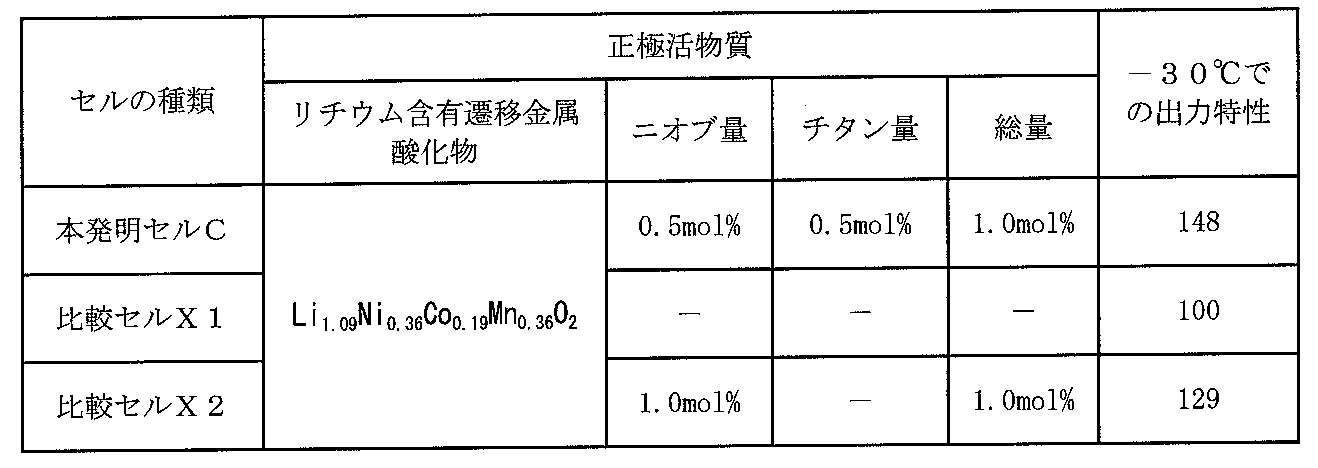
- the comparison cell X2 in which only niobium is present on the surface of the lithium-containing transition metal composite oxide (the addition amount of niobium is 1.0 mol%, so the total amount of additives is the same as that of the cell C of the present invention) is a comparison cell. It is recognized that the output characteristics at ⁇ 30 ° C. are improved as compared with X1, but the degree of improvement is recognized to be extremely small as compared with the cell C of the present invention. Therefore, it can be seen that both niobium and titanium must be present on the surface of the lithium-containing transition metal composite oxide.
- [Fourth embodiment] (Comparative Example 1) Except that Li 1.02 Ni 0.78 Co 0.19 Al 0.03 O 2 having a layered structure was used as the lithium-containing transition metal composite oxide, the same procedure as in Example 1 of the first example was performed. An electrode type test cell was prepared.
- the lithium-containing transition metal composite oxide comprises Li 2 CO 3 and a coprecipitated hydroxide represented by Ni 0.78 Co 0.19 Al 0.03 (OH) 2 , lithium and the entire transition metal. Mixing was performed so that the molar ratio was 1.02: 1, and heat treatment was performed at 750 ° C. for 20 hours in an oxygen atmosphere.
- the volume average particle diameter of the primary particles of Li 1.02 Ni 0.78 Co 0.19 Al 0.03 O 2 thus obtained is about 1 ⁇ m, and the volume average particle diameter of the secondary particles is It was about 12.5 ⁇ m.
- the niobium amount and the titanium amount were 0.5 mol% and 0.5 mol%, respectively.
- the cell thus fabricated is hereinafter referred to as a comparison cell W1.
- Comparative Example 2 In the production of the positive electrode active material, Nb 2 O 5 and TiO 2 are not mixed (that is, only the lithium-containing transition metal composite oxide composed of Li 1.02 Ni 0.78 Co 0.19 Al 0.03 O 2 is used. A three-electrode test cell was prepared in the same manner as in Comparative Example 1 except that it was used as a positive electrode active material. The cell thus fabricated is hereinafter referred to as a comparison cell W2.
- reference cell using the active material W1 is, Li 1.02 Ni 0.78 Co 0.19 Al 0.03 O 2 and a positive electrode active reference cell material using the positive electrode active material without the addition of niobium and titanium to W2 It can be seen that the output characteristics are not improved.
- the niobium-containing material and the titanium-containing material are present on the surface of the lithium-containing transition metal oxide, and the total amount of niobium and titanium with respect to the total amount of transition metal in the lithium-containing transition metal composite oxide is 0.15 mol%.
- Lithium-containing transition metal composite oxide containing Ni and Mn as main components as a lithium-containing transition metal oxide even when the amount of niobium is 1.5 mol% or less and the amount of niobium is equal to or more than the amount of titanium If the product is not used (when Li 1.02 Ni 0.78 Co 0.19 Al 0.03 O 2 is used as the lithium-containing transition metal composite oxide as in the comparative cell W1), the output characteristics are It turns out that it does not improve. Therefore, it can be seen that the output characteristic improvement effect is a unique effect when a lithium-containing transition metal composite oxide containing Ni and Mn as main components is used as the lithium-containing transition metal oxide.
- the positive electrode active material fired in the presence of niobium oxide or titanium oxide on the surface of the lithium nickel composite oxide (LiNi 0.82 Co 0.15 Al 0.03 O 2 ) disclosed in Patent Document 3 is used.
- the thermal stability of the positive electrode is improved, the high rate discharge characteristic and the low temperature discharge characteristic are rather lowered.
- the nonaqueous electrolyte secondary battery including the positive electrode according to the present invention can be used as various power sources such as a hybrid vehicle power source.
Landscapes
- Chemical & Material Sciences (AREA)
- Organic Chemistry (AREA)
- Inorganic Chemistry (AREA)
- Chemical Kinetics & Catalysis (AREA)
- Electrochemistry (AREA)
- General Chemical & Material Sciences (AREA)
- Engineering & Computer Science (AREA)
- Manufacturing & Machinery (AREA)
- Physics & Mathematics (AREA)
- Condensed Matter Physics & Semiconductors (AREA)
- General Physics & Mathematics (AREA)
- Battery Electrode And Active Subsutance (AREA)
- Secondary Cells (AREA)
Abstract
Description
(1)に示した正極活物質はコバルト酸リチウムと比べて、高率充放電特性が著しく劣っているため、電気自動車等の電源として使用することは困難であるという問題があった。
(2)に示した正極活物質において、ニッケル及びマンガンの一部を置換させるコバルトの量が多くなると、上述の如くコストが高くつくという問題が生じる一方、置換させるコバルトの量が少なくなると、高率充放電特性が大幅に低下するという問題があった。
(3)に示したような、リチウムニッケル複合酸化物の表面に、酸化ニオブ又は/及び酸化チタンを存在させて焼成した正極活物質を用いた場合、正極の熱安定性は向上するものの、高率放電特性や低温放電特性は寧ろ低下するという問題があった。
(4)に示した正極活物質ではIV抵抗が低減する旨記載されているが、各元素の添加量に関する検討が行われていないため、必ずしも高率充放電特性等の電池特性を向上させることができないという問題があった。
尚、主成分にNiとMnとを含むとは、遷移金属の総量に対するNiとMnとの総量の割合が、50モル%を超えている場合をいう。
このような構成であれば、リチウム含有遷移金属酸化物の表面にニオブ含有物やチタン含有物が強固に固定されるからである。ここで、リチウム含有遷移金属複合酸化物の表面にニオブ含有物等を焼結する具体的な方法としては、例えば、リチウム含有遷移金属複合酸化物と、所定量のニオブ含有物とチタン含有物とをメカノフュージョン等の方法を用いて混合させて、ニオブ含有物及びチタン含有物をリチウム含有遷移金属複合酸化物の表面に付着させ、その後、これをリチウム含有遷移金属複合酸化物の分解温度以下で焼結させる方法がある。
また、上記ニオブ含有物としては、Nb2O5及びLiNbO3等が例示され、上記チタン含有物としては、Li2TiO3、Li4Ti5O12、及びTiO2等が例示される。
正極活物質の粒径が大きくなり過ぎると、正極活物質自体の導電性が悪いということに起因して、放電性能が低下する一方、正極活物質の粒径が小さくなり過ぎると、正極活物質の比表面積が大きくなって非水電解液との反応性が高くなる結果、保存特性等が低下するからである。
(1)上記リチウム含有遷移金属複合酸化物には、ホウ素(B)、フッ素(F)、マグネシウム(Mg)、アルミニウム(Al)、クロム(Cr)、バナジウム(V)、鉄(Fe)、銅(Cr)、亜鉛(Zn)、モリブデン(Mo)、ジルコニウム(Zr)、錫(Sn)、タングステン(W)、ナトリウム(Na)、カリウム(K)からなる群から選択される少なくとも一種が含まれていても良い。
先ず、Li2CO3と、共沈法によって得たNi0.60Mn0.40(OH)2とを所定の割合で混合し、これらを空気中において1000℃で10時間焼成させ、NiとMnとの2元素を主成分とし層状構造を有するLi1.06Ni0.56Mn0.38O2(リチウム含有遷移金属複合酸化物)を作製した。尚、このようにして作製したLi1.06Ni0.56Mn0.38O2の一次粒子の体積平均粒径は約1μmであり、また二次粒子の体積平均粒径は約7μmであった。
負極(対極)と参照極とには、共に金属リチウムを用いた。
エチレンカーボネートとメチルエチルカーボネートとジメチルカーボネートとを3:3:4の体積比で混合させた混合溶媒に、LiPF6を1モル/リットルの濃度になるように溶解させ、更にビニレンカーボネートを1質量%溶解させて調製した。
上記正極(作用極)、負極(対極)、参照極、及び非水電解液を用いて、図1に示す三電極式試験セル10を作製した。図1において、11は正極、12は負極、13は参照極、14は非水電解液である。
(実施例1)
上記発明を実施するための形態で示したセルを用いた。
このようにして作製したセルを、以下、本発明セルA1と称する。
正極活物質の作製において、Nb2O5量を増加させたこと以外は、上記実施例1と同様にして三電極式試験用セルを作製した。尚、このようにして作製した正極活物質におけるニオブ量とチタン量とを、ICPによって測定した結果、ニオブ量とチタン量とは、それぞれ1.0mol%、0.5mol%となっていた。
このようにして作製したセルを、以下、本発明セルA2と称する。
正極活物質の作製において、Nb2O5量とTiO2量とを減少させたこと以外は、上記実施例1と同様にして三電極式試験用セルを作製した。尚、このようにして作製した正極活物質のニオブ量とチタン量とを、ICPによって測定した結果、ニオブ量とチタン量とは、それぞれ0.1mol%、0.05mol%となっていた。
このようにして作製したセルを、以下、本発明セルA3と称する。
正極活物質の作製において、Nb2O5とTiO2とを混合しない(即ち、Li1.06Ni0.56Mn0.38O2からなるリチウム含有遷移金属複合酸化物のみを正極活物質として使用する)こと以外は、上記実施例1と同様にして三電極式試験用セルを作製した。
このようにして作製したセルを、以下、比較セルZ1と称する。
正極活物質の作製において、TiO2量を増加させたこと以外は、上記実施例1と同様にして三電極式試験用セルを作製した。尚、このようにして作製した正極活物質のニオブ量とチタン量とを、ICPによって測定した結果、ニオブ量とチタン量とは、それぞれ0.5mol%、1.0mol%となっていた。
このようにして作製したセルを、以下、比較セルZ2と称する。
正極活物質の作製において、Nb2O5量とTiO2量とを増加させたこと以外は、上記実施例1と同様にして三電極式試験用セルを作製した。尚、このようにして作製した正極活物質のニオブ量とチタン量とを、ICPによって測定した結果、ニオブ量とチタン量とは、共に1.0mol%となっていた。
このようにして作製したセルを、以下、比較セルZ3と称する。
正極活物質の作製において、Nb2O5量とTiO2量とを減少させたこと以外は、上記実施例1と同様にして三電極式試験用セルを作製した。尚、このようにして作製した正極活物質のニオブ量とチタン量とを、ICPによって測定した結果、ニオブ量とチタン量とは、共に0.05mol%となっていた。
このようにして作製したセルを、以下、比較セルZ4と称する。
上記本発明セルA1~A3及び比較セルZ1~Z4を下記の条件で充放電して、各電池の出力特性を調べたので、その結果を表1に示す。尚、表1においては、比較セルZ1の出力を100とした場合の指数で表している。
先ず、上記本発明セルA1~A3及び比較セルZ1~Z4を、25℃の温度条件下、0.2mA/cm2の電流密度で4.3V(vs.Li/Li+)まで定電流充電を行い、4.3V(vs.Li/Li+)で電流密度が0.04mA/cm2となるまで定電圧充電を行った後、0.2mA/cm2の電流密度で2.5V(vs.Li/Li+)まで定電流放電を行った。そして、この時の放電容量を上記本発明セルA1~A3及び比較セルZ1~Z4の定格容量とした。
次に、本発明セルA1~A3及び比較セルZ1~Z4を、それぞれ25℃の温度条件下において、上記と同様の電流密度で定格容量の50%まで充電させ、上記と同様の電流密度で放電することにより、充電深度(SOC)が50%の時点における出力を測定した。

(実施例)
層状構造を有するLi1.07Ni0.46Co0.19Mn0.28O2をリチウム含有遷移金属複合酸化物として用いた以外は、上記第1実施例の実施例1と同様にして三電極式試験用セルを作製した。
上記リチウム含有遷移金属複合酸化物は、Li2CO3と、Ni0.5Co0.2Mn0.3(OH)2で表される共沈水酸化物とを所定の割合で混合し、これらを空気中において850℃で10時間焼成して作製した。尚、このようにして得たLi1.07Ni0.46Co0.19Mn0.28O2の一次粒子の体積平均粒径は約1μmであり、また二次粒子の体積平均粒径は約6μmであった。
このようにして作製したセルを、以下、本発明電池Bと称する。
正極活物質の作製において、Nb2O5とTiO2とを混合しない(即ち、Li1.07Ni0.46Co0.19Mn0.28O2からなるリチウム含有遷移金属複合酸化物のみを正極活物質として使用する)こと以外は、上記実施例と同様にして三電極式試験用セルを作製した。
このようにして作製したセルを、以下、比較セルY1と称する。
正極活物質の作製において、Nb2O5のみを混合した後に焼成して正極活物質を作製した以外は、実施例の場合と同様にして三電極式試験用セルを作製した。尚、このようにして作製した正極活物質のニオブ量を、ICPによって測定した結果、ニオブ量は1.0mol%となっていた。
このようにして作製したセルを、以下、比較セルY2と称する。
上記本発明セルB及び比較セルY1、Y2を上記第1実施例の実験と同様の条件(但し、温度は、25℃の他に-30℃でも行っている)で充放電して、各電池の出力特性を調べたので、その結果を表2に示す。尚、表2においては、比較セルY1の出力を100とした場合の指数で表している。
(実施例)
層状構造を有するLi1.09Ni0.36Co0.19Mn0.36O2をリチウム含有遷移金属複合酸化物として用いた以外は、上記第1実施例の実施例1と同様にして三電極式試験用セルを作製した。
上記リチウム含有遷移金属複合酸化物は、Li2CO3と、Ni0.4Co0.2Mn0.4(OH)2で表される共沈水酸化物とを所定の割合で混合し、これらを空気中において900℃で10時間焼成して作製した。尚、このようにして得たLi1.09Ni0.36Co0.19Mn0.36O2の一次粒子の体積平均粒径は約1μmであり、また二次粒子の体積平均粒径は約6μmであった。
このようにして作製したセルを、以下、本発明電池Cと称する。
正極活物質の作製において、Nb2O5とTiO2とを混合しない(即ち、Li1.09Ni0.36Co0.19Mn0.36O2からなるリチウム含有遷移金属複合酸化物のみを正極活物質として使用する)こと以外は、上記実施例と同様にして三電極式試験用セルを作製した。
このようにして作製したセルを、以下、比較セルX1と称する。
正極活物質の作製において、Nb2O5のみを混合した後に焼成して正極活物質を作製した以外は、上記実施例と同様にして三電極式試験用セルを作製した。尚、このようにして作製した正極活物質のニオブ量を、ICPによって測定した結果、ニオブ量は1.0mol%となっていた。
このようにして作製したセルを、以下、比較セルX2と称する。
上記本発明セルC及び比較セルX1、X2を上記第1実施例の実験と同様の条件(但し、温度は-30℃で行っている)で充放電して、各電池の出力特性を調べたので、その結果を表3に示す。尚、表3においては、比較セルX1の出力を100とした場合の指数で表している。
(比較例1)
層状構造を有するLi1.02Ni0.78Co0.19Al0.03O2をリチウム含有遷移金属複合酸化物として用いた以外は、上記第1実施例の実施例1と同様にして三電極式試験用セルを作製した。
上記リチウム含有遷移金属複合酸化物は、Li2CO3と、Ni0.78Co0.19Al0.03(OH)2で表される共沈水酸化物とを、リチウムと遷移金属全体とのモル比が1.02:1になるように混合し、酸素雰囲気中にて750℃で20時間熱処理して作製した。尚、このようにして得たLi1.02Ni0.78Co0.19Al0.03O2の一次粒子の体積平均粒径は約1μmであり、また二次粒子の体積平均粒径は約12.5μmであった。また、上記正極活物質中のニオブ量とチタン量とを、ICPによって測定した結果、ニオブ量とチタン量とは、それぞれ0.5mol%、0.5mol%になっていた。
このようにして作製したセルを、以下、比較セルW1と称する。
正極活物質の作製において、Nb2O5とTiO2とを混合しない(即ち、Li1.02Ni0.78Co0.19Al0.03O2からなるリチウム含有遷移金属複合酸化物のみを正極活物質として使用する)こと以外は、上記比較例1と同様にして三電極式試験用セルを作製した。
このようにして作製したセルを、以下、比較セルW2と称する。
上記比較セルW1、W2を上記第1実施例の実験と同様の条件で充放電して、各電池の出力特性を調べたので、その結果を表4に示す。尚、表4においては、比較セルW2の出力を100とした場合の指数で表している。

11 作用極(正極)
12 対極(負極)
13 参照極
14 非水電解液
Claims (7)
- 正極活物質を含む正極と、負極活物質を含む負極と、非水系溶媒に溶質を溶解させた非水電解液とを備えた非水電解質二次電池において、
主成分にNiとMnとを含み且つ層状構造を有するリチウム含有遷移金属複合酸化物の表面に、ニオブ含有物とチタン含有物とが存在するものを上記正極活物質として用い、上記ニオブ含有物中のニオブと上記チタン含有物中のチタンとの総量が、上記リチウム含有遷移金属複合酸化物中の遷移金属の総量に対して0.15mol%以上1.5mol%以下で、且つ、ニオブ含有物中のニオブのモル数がチタン含有物中のチタンのモル数と同量以上となっていることを特徴とする非水電解質二次電池。 - 上記リチウム含有遷移金属複合酸化物は、一般式Li1+xNiaMnbCocO2+d(式中、x,a,b,c,dはx+a+b+c=1、0<x≦0.1、0≦c/(a+b)<0.40、0.7≦a/b≦3.0、-0.1≦d≦0.1の条件を満たす)で表される、請求項1に記載の非水電解質二次電池。
- 上記一般式Li1+xNiaMnbCocO2+dで、0≦c/(a+b)<0.35、0.7≦a/b≦2.0となっている、請求項2に記載の非水電解質二次電池。
- 上記一般式Li1+xNiaMnbCocO2+dで、0≦c/(a+b)<0.15、0.7≦a/b≦1.5となっている、請求項3に記載の非水電解質二次電池。
- 上記ニオブ含有物と上記チタン含有物とが、上記リチウム含有遷移金属酸化物の表面に焼結されている、請求項1~請求項4の何れか1項に記載の非水電解質二次電池。
- 上記正極活物質における一次粒子の体積平均粒径が0.5μm以上2μm以下であり、二次粒子の体積平均粒径が4μm以上15μm以下である、請求項1~請求項5の何れか1項に記載の非水電解質二次電池。
- 上記非水電解液の非水系溶媒に、環状カーボネートと鎖状カーボネートとが体積比2:8~5:5の範囲で含まれる混合溶媒を用いる、請求項1~請求項6の何れか1項に記載の非水電解質二次電池。
Priority Applications (3)
| Application Number | Priority Date | Filing Date | Title |
|---|---|---|---|
| JP2011525950A JPWO2011016553A1 (ja) | 2009-08-07 | 2010-08-06 | 非水電解質二次電池 |
| US13/389,218 US20120135315A1 (en) | 2009-08-07 | 2010-08-06 | Non-aqueous electrolyte secondary battery |
| CN2010800350630A CN102473910A (zh) | 2009-08-07 | 2010-08-06 | 非水电解质二次电池 |
Applications Claiming Priority (2)
| Application Number | Priority Date | Filing Date | Title |
|---|---|---|---|
| JP2009-184021 | 2009-08-07 | ||
| JP2009184021 | 2009-08-07 |
Publications (1)
| Publication Number | Publication Date |
|---|---|
| WO2011016553A1 true WO2011016553A1 (ja) | 2011-02-10 |
Family
ID=43544447
Family Applications (1)
| Application Number | Title | Priority Date | Filing Date |
|---|---|---|---|
| PCT/JP2010/063381 Ceased WO2011016553A1 (ja) | 2009-08-07 | 2010-08-06 | 非水電解質二次電池 |
Country Status (5)
| Country | Link |
|---|---|
| US (1) | US20120135315A1 (ja) |
| JP (1) | JPWO2011016553A1 (ja) |
| KR (1) | KR20120062748A (ja) |
| CN (1) | CN102473910A (ja) |
| WO (1) | WO2011016553A1 (ja) |
Cited By (5)
| Publication number | Priority date | Publication date | Assignee | Title |
|---|---|---|---|---|
| JP2014197540A (ja) * | 2013-03-06 | 2014-10-16 | 日亜化学工業株式会社 | 非水電解液二次電池用正極活物質 |
| WO2021006129A1 (ja) * | 2019-07-08 | 2021-01-14 | 住友金属鉱山株式会社 | リチウムイオン二次電池用正極活物質、およびリチウムイオン二次電池 |
| WO2021006127A1 (ja) * | 2019-07-08 | 2021-01-14 | 住友金属鉱山株式会社 | リチウムイオン二次電池用正極活物質の製造方法 |
| WO2021006128A1 (ja) * | 2019-07-08 | 2021-01-14 | 住友金属鉱山株式会社 | リチウムイオン二次電池用正極活物質、およびリチウムイオン二次電池 |
| US11264608B2 (en) | 2018-06-26 | 2022-03-01 | Nichia Corporation | Positive electrode active material for non-aqueous electrolyte secondary battery |
Families Citing this family (8)
| Publication number | Priority date | Publication date | Assignee | Title |
|---|---|---|---|---|
| CN103400993B (zh) * | 2013-08-14 | 2014-03-26 | 青海绿草地新能源科技有限公司 | 一种电池正极和锂离子电池 |
| JP6799829B2 (ja) * | 2016-03-30 | 2020-12-16 | パナソニックIpマネジメント株式会社 | 非水電解質二次電池用正極活物質、非水電解質二次電池用正極活物質の製造方法、及び非水電解質二次電池 |
| WO2019017736A2 (ko) | 2017-07-21 | 2019-01-24 | 한양대학교 산학협력단 | 금속 도핑된 나트륨 이차전지용 양극 활물질, 이의 제조방법, 및 이를 포함하는 나트륨 이차전지 |
| JP6708193B2 (ja) * | 2017-09-28 | 2020-06-10 | 日亜化学工業株式会社 | 非水電解質二次電池用正極活物質及びその製造方法 |
| EP4012807A4 (en) * | 2019-08-05 | 2022-09-07 | Panasonic Holdings Corporation | POSITIVE ELECTRODE ACTIVE MATERIAL FOR ANHYDROUS ELECTROLYTE SECONDARY BATTERIES AND ANHYDROUS ELECTROLYTE SECONDARY BATTERY |
| CN111435744B (zh) * | 2020-01-17 | 2022-04-12 | 蜂巢能源科技有限公司 | 无钴层状正极材料及其制备方法、正极片和锂离子电池 |
| KR102493294B1 (ko) | 2020-03-13 | 2023-01-27 | 한양대학교 산학협력단 | 스핀 궤도 토크 및 자기 터널 접합 구조를 이용한 논리 소자 |
| US20250105271A1 (en) * | 2021-12-28 | 2025-03-27 | Panasonic Intellectual Property Management Co., Ltd. | Positive electrode for secondary batteries and method for producing positive electrode active material for secondary batteries |
Citations (12)
| Publication number | Priority date | Publication date | Assignee | Title |
|---|---|---|---|---|
| JPH11185758A (ja) * | 1997-12-24 | 1999-07-09 | Aichi Steel Works Ltd | 非水二次電池用正極材料 |
| JP2004253305A (ja) * | 2003-02-21 | 2004-09-09 | Mitsubishi Chemicals Corp | 表面修飾リチウムニッケル複合酸化物を用いた正極活物質、正極材料、リチウム二次電池、及び前記表面修飾リチウムニッケル複合酸化物の製造方法 |
| JP2006202702A (ja) * | 2005-01-24 | 2006-08-03 | Hitachi Maxell Ltd | 非水電解質二次電池 |
| JP2007018874A (ja) * | 2005-07-07 | 2007-01-25 | Matsushita Electric Ind Co Ltd | リチウムイオン二次電池 |
| JP2007188699A (ja) * | 2006-01-12 | 2007-07-26 | Nihon Kagaku Sangyo Co Ltd | 非水電解質二次電池及び同用正極活物質の製造方法 |
| JP2007258095A (ja) * | 2006-03-24 | 2007-10-04 | Sony Corp | 正極活物質およびその製造方法、並びに電池 |
| JP2008103244A (ja) * | 2006-10-20 | 2008-05-01 | Idemitsu Kosan Co Ltd | 二次電池用正極層及びその製造方法 |
| JP2008153017A (ja) * | 2006-12-15 | 2008-07-03 | Ise Chemicals Corp | 非水電解液二次電池用正極活物質 |
| JP2008536285A (ja) * | 2005-04-15 | 2008-09-04 | エナーセラミック インコーポレイテッド | フッ素化合物でコーティングされたリチウム二次電池用正極活物質及びその製造方法 |
| JP2008226495A (ja) * | 2007-03-08 | 2008-09-25 | Agc Seimi Chemical Co Ltd | 非水電解質二次電池用リチウム含有複合酸化物粒子及びその製造方法 |
| JP2008251480A (ja) * | 2007-03-30 | 2008-10-16 | Matsushita Electric Ind Co Ltd | 非水電解質二次電池用正極活物質およびそれを用いた非水電解質二次電池 |
| JP2009076402A (ja) * | 2007-09-21 | 2009-04-09 | Sumitomo Electric Ind Ltd | リチウム電池 |
Family Cites Families (6)
| Publication number | Priority date | Publication date | Assignee | Title |
|---|---|---|---|---|
| JP3890185B2 (ja) * | 2000-07-27 | 2007-03-07 | 松下電器産業株式会社 | 正極活物質およびこれを含む非水電解質二次電池 |
| JP4965773B2 (ja) * | 2001-06-28 | 2012-07-04 | Agcセイミケミカル株式会社 | 非水電解液二次電池用電極活物質及び非水電解液二次電池 |
| KR100670507B1 (ko) * | 2005-04-28 | 2007-01-16 | 삼성에스디아이 주식회사 | 리튬 이차 전지 |
| JP5132048B2 (ja) * | 2005-08-11 | 2013-01-30 | 三洋電機株式会社 | 非水電解質二次電池 |
| JP5430920B2 (ja) * | 2008-03-17 | 2014-03-05 | 三洋電機株式会社 | 非水電解質二次電池 |
| WO2011125410A1 (ja) * | 2010-04-01 | 2011-10-13 | 三洋電機株式会社 | 非水電解質二次電池 |
-
2010
- 2010-08-06 US US13/389,218 patent/US20120135315A1/en not_active Abandoned
- 2010-08-06 WO PCT/JP2010/063381 patent/WO2011016553A1/ja not_active Ceased
- 2010-08-06 KR KR1020127005994A patent/KR20120062748A/ko not_active Withdrawn
- 2010-08-06 CN CN2010800350630A patent/CN102473910A/zh active Pending
- 2010-08-06 JP JP2011525950A patent/JPWO2011016553A1/ja not_active Withdrawn
Patent Citations (12)
| Publication number | Priority date | Publication date | Assignee | Title |
|---|---|---|---|---|
| JPH11185758A (ja) * | 1997-12-24 | 1999-07-09 | Aichi Steel Works Ltd | 非水二次電池用正極材料 |
| JP2004253305A (ja) * | 2003-02-21 | 2004-09-09 | Mitsubishi Chemicals Corp | 表面修飾リチウムニッケル複合酸化物を用いた正極活物質、正極材料、リチウム二次電池、及び前記表面修飾リチウムニッケル複合酸化物の製造方法 |
| JP2006202702A (ja) * | 2005-01-24 | 2006-08-03 | Hitachi Maxell Ltd | 非水電解質二次電池 |
| JP2008536285A (ja) * | 2005-04-15 | 2008-09-04 | エナーセラミック インコーポレイテッド | フッ素化合物でコーティングされたリチウム二次電池用正極活物質及びその製造方法 |
| JP2007018874A (ja) * | 2005-07-07 | 2007-01-25 | Matsushita Electric Ind Co Ltd | リチウムイオン二次電池 |
| JP2007188699A (ja) * | 2006-01-12 | 2007-07-26 | Nihon Kagaku Sangyo Co Ltd | 非水電解質二次電池及び同用正極活物質の製造方法 |
| JP2007258095A (ja) * | 2006-03-24 | 2007-10-04 | Sony Corp | 正極活物質およびその製造方法、並びに電池 |
| JP2008103244A (ja) * | 2006-10-20 | 2008-05-01 | Idemitsu Kosan Co Ltd | 二次電池用正極層及びその製造方法 |
| JP2008153017A (ja) * | 2006-12-15 | 2008-07-03 | Ise Chemicals Corp | 非水電解液二次電池用正極活物質 |
| JP2008226495A (ja) * | 2007-03-08 | 2008-09-25 | Agc Seimi Chemical Co Ltd | 非水電解質二次電池用リチウム含有複合酸化物粒子及びその製造方法 |
| JP2008251480A (ja) * | 2007-03-30 | 2008-10-16 | Matsushita Electric Ind Co Ltd | 非水電解質二次電池用正極活物質およびそれを用いた非水電解質二次電池 |
| JP2009076402A (ja) * | 2007-09-21 | 2009-04-09 | Sumitomo Electric Ind Ltd | リチウム電池 |
Cited By (9)
| Publication number | Priority date | Publication date | Assignee | Title |
|---|---|---|---|---|
| JP2014197540A (ja) * | 2013-03-06 | 2014-10-16 | 日亜化学工業株式会社 | 非水電解液二次電池用正極活物質 |
| US11264608B2 (en) | 2018-06-26 | 2022-03-01 | Nichia Corporation | Positive electrode active material for non-aqueous electrolyte secondary battery |
| US12580177B2 (en) | 2018-06-26 | 2026-03-17 | Nichia Corporation | Positive electrode active material for non-aqueous electrolyte secondary battery |
| WO2021006129A1 (ja) * | 2019-07-08 | 2021-01-14 | 住友金属鉱山株式会社 | リチウムイオン二次電池用正極活物質、およびリチウムイオン二次電池 |
| WO2021006127A1 (ja) * | 2019-07-08 | 2021-01-14 | 住友金属鉱山株式会社 | リチウムイオン二次電池用正極活物質の製造方法 |
| WO2021006128A1 (ja) * | 2019-07-08 | 2021-01-14 | 住友金属鉱山株式会社 | リチウムイオン二次電池用正極活物質、およびリチウムイオン二次電池 |
| CN114096486A (zh) * | 2019-07-08 | 2022-02-25 | 住友金属矿山株式会社 | 锂离子二次电池用正极活性物质的制造方法 |
| US12249710B2 (en) | 2019-07-08 | 2025-03-11 | Panasonic Energy Co., Ltd. | Positive electrode active material for lithium ion secondary battery and lithium ion secondary battery |
| US12381212B2 (en) | 2019-07-08 | 2025-08-05 | Sumitomo Metal Mining Co., Ltd. | Method for producing positive electrode active material for lithium ion secondary battery |
Also Published As
| Publication number | Publication date |
|---|---|
| JPWO2011016553A1 (ja) | 2013-01-17 |
| CN102473910A (zh) | 2012-05-23 |
| KR20120062748A (ko) | 2012-06-14 |
| US20120135315A1 (en) | 2012-05-31 |
Similar Documents
| Publication | Publication Date | Title |
|---|---|---|
| JP6072688B2 (ja) | 非水電解質二次電池及び非水電解質二次電池の製造方法 | |
| JP5128018B1 (ja) | 非水電解質二次電池 | |
| US20110195309A1 (en) | Nonaqueous electrolyte secondary battery | |
| CN104641497B (zh) | 非水电解质二次电池及非水电解质二次电池用正极活性物质 | |
| US20090305136A1 (en) | Non-aqueous electrolyte secondary battery and method of manufacturing the same | |
| JPWO2011016553A1 (ja) | 非水電解質二次電池 | |
| JP2011070789A (ja) | 非水電解質二次電池 | |
| JP5078334B2 (ja) | 非水電解質二次電池 | |
| CN103782439B (zh) | 非水电解质二次电池 | |
| CN103782423B (zh) | 非水电解质二次电池的正极活性物质及非水电解质二次电池 | |
| US9716268B2 (en) | Nonaqueous electrolyte secondary battery | |
| CN102160215A (zh) | 非水电解质二次电池 | |
| JP4530822B2 (ja) | 非水電解質二次電池及びその充電方法 | |
| JP2009218112A (ja) | 非水電解質二次電池及びその製造方法 | |
| WO2013061922A1 (ja) | 非水電解質二次電池の正極活物質、その製造方法、及び非水電解質二次電池 | |
| KR20090091053A (ko) | 비수전해질 이차 전지 및 그의 제조 방법 | |
| CN102834954A (zh) | 非水电解质二次电池 | |
| JP5147890B2 (ja) | 非水電解質二次電池及びその充電方法 |
Legal Events
| Date | Code | Title | Description |
|---|---|---|---|
| WWE | Wipo information: entry into national phase |
Ref document number: 201080035063.0 Country of ref document: CN |
|
| 121 | Ep: the epo has been informed by wipo that ep was designated in this application |
Ref document number: 10806552 Country of ref document: EP Kind code of ref document: A1 |
|
| WWE | Wipo information: entry into national phase |
Ref document number: 2011525950 Country of ref document: JP |
|
| WWE | Wipo information: entry into national phase |
Ref document number: 13389218 Country of ref document: US |
|
| NENP | Non-entry into the national phase |
Ref country code: DE |
|
| ENP | Entry into the national phase |
Ref document number: 20127005994 Country of ref document: KR Kind code of ref document: A |
|
| 122 | Ep: pct application non-entry in european phase |
Ref document number: 10806552 Country of ref document: EP Kind code of ref document: A1 |