WO2011007738A1 - チタン板及びチタン板の製造方法 - Google Patents
チタン板及びチタン板の製造方法 Download PDFInfo
- Publication number
- WO2011007738A1 WO2011007738A1 PCT/JP2010/061722 JP2010061722W WO2011007738A1 WO 2011007738 A1 WO2011007738 A1 WO 2011007738A1 JP 2010061722 W JP2010061722 W JP 2010061722W WO 2011007738 A1 WO2011007738 A1 WO 2011007738A1
- Authority
- WO
- WIPO (PCT)
- Prior art keywords
- titanium plate
- less
- titanium
- rolling
- concentration
- Prior art date
- Legal status (The legal status is an assumption and is not a legal conclusion. Google has not performed a legal analysis and makes no representation as to the accuracy of the status listed.)
- Ceased
Links
Images
Classifications
-
- B—PERFORMING OPERATIONS; TRANSPORTING
- B21—MECHANICAL METAL-WORKING WITHOUT ESSENTIALLY REMOVING MATERIAL; PUNCHING METAL
- B21B—ROLLING OF METAL
- B21B1/00—Metal-rolling methods or mills for making semi-finished products of solid or profiled cross-section; Sequence of operations in milling trains; Layout of rolling-mill plant, e.g. grouping of stands; Succession of passes or of sectional pass alternations
- B21B1/02—Metal-rolling methods or mills for making semi-finished products of solid or profiled cross-section; Sequence of operations in milling trains; Layout of rolling-mill plant, e.g. grouping of stands; Succession of passes or of sectional pass alternations for rolling heavy work, e.g. ingots, slabs, blooms, or billets, in which the cross-sectional form is unimportant ; Rolling combined with forging or pressing
-
- B—PERFORMING OPERATIONS; TRANSPORTING
- B21—MECHANICAL METAL-WORKING WITHOUT ESSENTIALLY REMOVING MATERIAL; PUNCHING METAL
- B21B—ROLLING OF METAL
- B21B37/00—Control devices or methods specially adapted for metal-rolling mills or the work produced thereby
- B21B37/16—Control of thickness, width, diameter or other transverse dimensions
-
- B—PERFORMING OPERATIONS; TRANSPORTING
- B21—MECHANICAL METAL-WORKING WITHOUT ESSENTIALLY REMOVING MATERIAL; PUNCHING METAL
- B21B—ROLLING OF METAL
- B21B37/00—Control devices or methods specially adapted for metal-rolling mills or the work produced thereby
- B21B37/46—Roll speed or drive motor control
-
- B—PERFORMING OPERATIONS; TRANSPORTING
- B21—MECHANICAL METAL-WORKING WITHOUT ESSENTIALLY REMOVING MATERIAL; PUNCHING METAL
- B21D—WORKING OR PROCESSING OF SHEET METAL OR METAL TUBES, RODS OR PROFILES WITHOUT ESSENTIALLY REMOVING MATERIAL; PUNCHING METAL
- B21D13/00—Corrugating sheet metal, rods or profiles; Bending sheet metal, rods or profiles into wave form
-
- C—CHEMISTRY; METALLURGY
- C21—METALLURGY OF IRON
- C21D—MODIFYING THE PHYSICAL STRUCTURE OF FERROUS METALS; GENERAL DEVICES FOR HEAT TREATMENT OF FERROUS OR NON-FERROUS METALS OR ALLOYS; MAKING METAL MALLEABLE, e.g. BY DECARBURISATION OR TEMPERING
- C21D8/00—Modifying the physical properties of ferrous metals or ferrous alloys by deformation combined with, or followed by, heat treatment
- C21D8/02—Modifying the physical properties of ferrous metals or ferrous alloys by deformation combined with, or followed by, heat treatment during manufacturing of plates or strips
-
- C—CHEMISTRY; METALLURGY
- C22—METALLURGY; FERROUS OR NON-FERROUS ALLOYS; TREATMENT OF ALLOYS OR NON-FERROUS METALS
- C22C—ALLOYS
- C22C14/00—Alloys based on titanium
-
- C—CHEMISTRY; METALLURGY
- C22—METALLURGY; FERROUS OR NON-FERROUS ALLOYS; TREATMENT OF ALLOYS OR NON-FERROUS METALS
- C22F—CHANGING THE PHYSICAL STRUCTURE OF NON-FERROUS METALS AND NON-FERROUS ALLOYS
- C22F1/00—Changing the physical structure of non-ferrous metals or alloys by heat treatment or by hot or cold working
- C22F1/16—Changing the physical structure of non-ferrous metals or alloys by heat treatment or by hot or cold working of other metals or alloys based thereon
- C22F1/18—High-melting or refractory metals or alloys based thereon
- C22F1/183—High-melting or refractory metals or alloys based thereon of titanium or alloys based thereon
-
- B—PERFORMING OPERATIONS; TRANSPORTING
- B21—MECHANICAL METAL-WORKING WITHOUT ESSENTIALLY REMOVING MATERIAL; PUNCHING METAL
- B21B—ROLLING OF METAL
- B21B1/00—Metal-rolling methods or mills for making semi-finished products of solid or profiled cross-section; Sequence of operations in milling trains; Layout of rolling-mill plant, e.g. grouping of stands; Succession of passes or of sectional pass alternations
- B21B1/02—Metal-rolling methods or mills for making semi-finished products of solid or profiled cross-section; Sequence of operations in milling trains; Layout of rolling-mill plant, e.g. grouping of stands; Succession of passes or of sectional pass alternations for rolling heavy work, e.g. ingots, slabs, blooms, or billets, in which the cross-sectional form is unimportant ; Rolling combined with forging or pressing
- B21B2001/028—Slabs
Definitions
- the present invention relates to a titanium plate excellent in press formability and lubricating oil detergency and a method for producing the titanium plate.
- Titanium plate is excellent in corrosion resistance, so it can be used for heat exchanger parts such as chemical, electric power and food production plants, consumer products such as camera bodies and kitchen equipment, transport equipment parts such as motorcycles and automobiles, and home appliances. Widely used in exterior materials. Among them, the plate heat exchanger increases the heat exchange efficiency by processing the titanium plate into a wave pattern by press molding to increase the surface area. Therefore, in order to give a deep wave to the titanium plate, excellent formability is required. In addition, when a titanium plate is processed into a camera casing, an exterior product for home appliances, a member for kitchen equipment, etc., it is required to have an excellent formability and an excellent cleaning property for lubricating oil.
- the titanium plate has a high r value (Rankford value: ratio of logarithmic strain in the plate width direction to logarithmic strain in the plate thickness direction during uniaxial tensile deformation), and the plate material itself has high drawability.
- r value ratio of logarithmic strain in the plate width direction to logarithmic strain in the plate thickness direction during uniaxial tensile deformation
- the plate material itself has high drawability.
- seizure with the molding die occurs in the molding process, and this is a factor that lowers the molding limit. For this reason, in the field of molded products where emphasis is particularly placed on the drawing process, attempts have been made to improve moldability by preventing seizure with a molding die.
- Patent Documents 1 to 5 propose forming a hard surface layer having low reactivity on the surface of a titanium plate in order to prevent seizure with a molding die.
- Patent Document 1 proposes forming a titanium nitride layer having a thickness of 0.1 ⁇ m or more and 1.0 ⁇ m or less on the surface of a titanium plate and forming a nitrogen diffusion layer under the titanium nitride layer.
- Patent Document 2 proposes forming a nitrogen-enriched layer of 0.5 ⁇ m or more and 5.0 ⁇ m or less on the titanium plate surface.
- Patent Document 3 proposes that an oxide film having a thickness of 250 angstroms or more is formed on the titanium plate surface.
- Patent Document 4 proposes that the nitrogen concentration on the surface of the titanium plate is controlled within a predetermined range so that the average roughness Ra of the plate surface is 0.05 to 0.5 ⁇ m.
- Patent Document 5 proposes forming a titanium carbide-containing layer near the surface of the titanium plate and controlling the thickness of the titanium carbide-containing layer to 300 angstroms or more.
- Patent Documents 6 and 7 propose that the surface hardness of the titanium plate is appropriately reduced in order to improve the formability of the titanium plate on which the surface hard layer is formed.
- Patent Document 6 proposes that the Vickers hardness at a load of 50 gf on the titanium plate surface is 180 to 280, the Vickers hardness at a load of 200 gf is 170 or less, and the Erichsen value is 11.5 mm or more.
- Patent Document 7 proposes that the Vickers hardness at a load of 200 gf on the titanium plate surface is 170 or less and the thickness of the oxide film is 150 angstroms or more.
- Japanese Unexamined Patent Publication No. 10-60620 Japanese Unexamined Patent Publication No. 10-204609 Japanese Unexamined Patent Publication No. 6-248404 Japanese Laid-Open Patent Publication No. 2004-244671 Japanese Unexamined Patent Publication No. 2006-291362 Japanese Patent No. 3600792 Japanese Patent Laid-Open No. 2002-194591
- Patent Documents 1 to 5 are preferably applied to products subjected to processing that places importance on seizure resistance. There is a problem in that it tends to occur and the formability deteriorates.
- titanium carbide when the titanium plate is seized with the rolling roll in the cold rolling process, the titanium surface reacts with the lubricating oil to form titanium carbide. In addition, the lubricating oil enters fine irregularities formed on the surface of the titanium plate by seizure, making it difficult to clean and remove the lubricating oil. Titanium carbide is further formed in the subsequent vacuum annealing process. If titanium carbide is formed on the surface, formation of titanium oxide is hindered in the vacuum annealing process.
- the formation of a titanium carbide layer on the surface of the titanium plate also causes seizure with the molding die. That is, since the titanium carbide layer has a higher hardness than the oxide film, even if only the surface hardness is controlled, if the titanium carbide layer having a higher hardness is formed on the surface, the surface hard layer is relatively The thickness of the becomes thinner. Accordingly, the base titanium is exposed at the time of press molding, and is likely to be seized by contact with the molding die.
- high-viscosity lubricating oil may be used to prevent such seizure.
- the lubricating oil viscosity is increased, the washing and removal becomes more difficult and the productivity is hindered. There was a problem (especially when used for applications requiring high cleanliness, such as food-related materials).
- the surface layer is removed once by performing a pickling treatment after cold rolling or vacuum annealing.
- a pickling treatment after cold rolling or vacuum annealing.
- the present invention has been made based on such a background, and has a good seizure resistance, crack resistance, a smooth surface, and a titanium plate excellent in press moldability and lubricating oil detergency. It is intended to provide without requiring a complicated process.
- the titanium plate according to claim 1 has a maximum C concentration of 6 at% or less and a maximum N concentration of 7 at% or less in a region from the surface to 200 nm, and a surface oxide film.
- the arithmetic mean roughness (Ra) of the surface is 0.25 ⁇ m or less and the maximum height (Rz) of the surface is 2.0 ⁇ m or less.
- the titanium plate having such a configuration improves the formability by adjusting the surface hardness by setting the C concentration and N concentration on the surface of the titanium plate to predetermined values or less and the thickness of the oxide film within a predetermined range. be able to. Further, by setting the arithmetic average roughness (Ra) and the maximum height (Rz) of the surface within a predetermined range, a smooth surface without an oil reservoir (uneven portion) can be obtained.
- the titanium plate according to claim 2 has a Vickers hardness at a measurement load of 0.098 N on the surface higher than a Vickers hardness at a measurement load of 4.9 N, and the difference is in the range of 30-60.
- a titanium plate having such a configuration has a Vickers hardness at a measurement load of 0.098 N on the surface higher than a Vickers hardness at a measurement load of 4.9 N, and the difference is within a predetermined range.
- the hardness of the titanium plate surface can be adjusted to an appropriate range so as to be more excellent in moldability.
- the titanium plate according to claim 3 has a structure in which the crystal grain size is 20 to 80 ⁇ m in average slice length when a section cut by a cutting method prescribed in JISJG 552 is observed with an optical microscope.
- the titanium plate having such a configuration can balance the work hardening index and strength of the titanium plate by controlling the crystal grain size within a predetermined range.
- the titanium plate according to claim 4 has a thickness of 1.0 mm or less.
- a titanium plate having such a configuration can be suitably used as a member for a heat exchanger.
- the manufacturing method of the titanium plate which concerns on Claim 5 is a method of manufacturing the titanium plate as described in any one of Claim 1 to 4, Comprising: The rolling roll whose outer diameter is 150 mm or more, ester oil or A cold rolling step in which cold rolling is performed at a rolling speed of 15 m / min or more and a rolling reduction rate of 15% or less per pass using a lubricating oil composed of fats and oils, and a degree of vacuum of 5 ⁇ 10 ⁇ 4 torr or less, Or an annealing step of performing vacuum annealing in an inert environment of an argon atmosphere.
- the manufacturing method of a titanium plate having such a configuration is a lubrication introduced into the plate surface during cold rolling by defining the outer diameter of the rolling roll, the type of lubricating oil, the rolling speed, and the rolling reduction within a predetermined range.
- the amount of oil can be increased and the temperature rise during cold rolling can be suppressed.
- by performing vacuum annealing it is possible to release the strain of cold rolling to promote recrystallization and to obtain sufficient elongation.
- the oxide film thickness can be adjusted by setting the vacuum degree of vacuum annealing to a predetermined value or less.
- the titanium plate of the first aspect excellent formability can be exhibited by setting the C concentration and N concentration on the surface of the titanium plate to predetermined values or less and setting the thickness of the oxide film within a predetermined range. Further, by obtaining a smooth surface with the arithmetic average roughness (Ra) and maximum height (Rz) of the surface being within a predetermined range, seizure with a rolling roll and a molded metal fitting can be prevented, and a lubricating oil The detergency can be improved.
- Ra arithmetic average roughness
- Rz maximum height
- the titanium plate according to claim 2 it is possible to appropriately prevent cracking during molding by adjusting the hardness of the titanium plate surface to an appropriate range so as to be more excellent in moldability.
- the formability can be improved by controlling the crystal grain size within a predetermined range to balance the work hardening index and strength of the titanium plate.
- a titanium plate excellent in formability and cleanability can be suitably used as a member for a heat exchanger.
- the amount of the lubricating oil introduced into the plate surface during cold rolling by optimizing the predetermined range of the outer diameter of the rolling roll, the type of lubricating oil, the rolling speed, and the reduction rate.
- seizure during cold rolling can be prevented.
- the formability of the titanium plate can be improved by adjusting the thickness of the oxide film so that the vacuum degree of vacuum annealing is not more than a predetermined value.
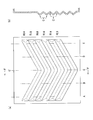
- (A) is a top view which shows the shape of the shaping die for performing a moldability evaluation.
- (B) is a sectional view taken along line FF in (a).
- a titanium plate having both seizure resistance, formability, and lubricating oil detergency is provided by paying attention to control of the surface state such as C concentration and N concentration of the titanium plate surface and surface roughness.
- the formability is a general term for the workability, crack resistance, and seizure resistance of a press mold.
- the titanium plate according to the present invention will be described in detail.
- composition Although this invention is not limited to the titanium plate of a specific composition, the pure titanium plate which consists of Ti and an unavoidable impurity is mentioned as an example.
- the inevitable impurities include O, Fe, H, C, and N.
- O is suppressed to 1500 ppm or less, more preferably 1000 ppm or less
- Fe is 1500 ppm or less. More preferably, it is preferable to suppress to 1000 ppm or less, suppress H to 130 ppm or less, suppress C to 800 ppm or less, and suppress N to 300 ppm.
- an oxide film made of titanium oxide in a predetermined thickness range is formed.
- the oxide film is too thin, when the material is extended in the molding process, the oxide film is broken and the base titanium is exposed, and seizure with the molding die tends to occur.
- the oxide film is too thick, cracks are likely to be generated and propagated in the molding process, and the moldability is hindered.
- the “surface” of the titanium plate in the present invention refers to a depth range from the outermost surface of the titanium plate to 200 nm. Specifically, the surface state of the titanium plate according to the present embodiment is defined as follows.
- the C concentration on the surface is 6 at% or less, preferably 5 at% or less, more preferably 3 at% or less.
- the N concentration on the surface is 7 at% or less, preferably 6 at% or less.
- the C concentration on the surface of the titanium plate can be controlled by optimizing the rolling roll diameter, rolling speed, pressing rate per pass, and lubricating oil in the cold rolling process, as will be described later. Further, as described later, the N concentration can be controlled by optimizing the atmosphere during vacuum annealing.
- the thickness (depth) of the oxide film is 3 to 15 nm. Further, it is preferably 5 to 15 nm, more preferably 5 to 10 nm. As will be described later, the thickness of the oxide film can be controlled by suppressing the generation of carbides during rolling and optimizing the degree of vacuum in the atmosphere during vacuum annealing.
- the C concentration, the N concentration, and the thickness of the oxide film the result of the atomic profile obtained by the X-ray photoelectron spectroscopic analysis is used. That is, a depth range from the outermost surface of the titanium plate to 200 nm is measured, and the maximum values of C concentration and N concentration in the measurement range are defined to be equal to or less than the above values.
- the thickness of the oxide film is defined by the distance between the titanium plate surface and the depth position where the O concentration is halved from the peak value.
- the measurement conditions for X-ray photoelectron spectroscopy are as follows: the X-ray source is monochromatic Al—K ⁇ , the X-ray output is 43.7 W, the photoelectron extraction angle is 45 °, and the Ar + sputtering rate is about 4.6 nm / min in terms of SiO 2. It was.
- the surface roughness can be controlled by optimizing the rolling roll diameter, rolling speed, compression rate per pass, and lubricating oil in the cold rolling process. Since the titanium plate is easy to form unevenness extending in parallel with the rolling direction, the measured value of the surface roughness was a value measured in the direction perpendicular to the rolling direction. Further, the surface roughness was specifically defined by the following two values.
- Arithmetic mean roughness (Ra) defines the average irregularities on the surface of the plate material.
- the arithmetic average roughness (Ra) exceeds 0.25 ⁇ m, the lubricating oil enters the gaps between the concaves and convexes, making it difficult to remove the lubricating oil by washing. Accordingly, the arithmetic average roughness (Ra) is set to 0.25 ⁇ m or less.
- the arithmetic average roughness (Ra) is preferably 0.22 ⁇ m or less, and more preferably 0.20 ⁇ m or less.
- the lower limit value of the arithmetic average roughness (Ra) is not particularly specified, but in reality, it is 0.05 ⁇ m or more.
- the maximum height (Rz) defines the depth of the concave portion on the surface of the plate material.
- the maximum height (Rz) exceeds 2.0 ⁇ m, the lubricating oil enters the unevenness, making it difficult to remove by washing. Accordingly, the maximum height (Rz) is set to 2.0 ⁇ m or less.
- the maximum height (Rz) is preferably 1.8 ⁇ m or less, and more preferably 1.7 ⁇ m or less.
- the lower limit value of the maximum height (Rz) is not particularly specified, but is practically 1.0 ⁇ m or more.
- Arithmetic mean roughness (Ra) and maximum height (Rz) are measured by, for example, using a surface roughness shape measuring device by a method in accordance with JISB0601: 2001. At that time, the measurement distance and the measurement speed are set to predetermined values, five points perpendicular to the rolling direction are measured, and the average value is taken as the measurement value.
- the Vickers hardness at the measurement load of 0.098N and the Vickers hardness at the measurement load of 4.9N are measured on the titanium plate surface, and these differences are within a predetermined range. It was stipulated that In the present invention, as described later, the Vickers hardness can be controlled by adjusting the conditions of cold rolling and vacuum annealing to regulate the surface state of the titanium plate within a predetermined range.
- the Vickers hardness at a measurement load of 0.098 N (10 g) can evaluate the hardness of the outermost surface of the titanium plate, and the Vickers hardness at a measurement load of 4.9 N (500 g) is Hardness can be evaluated. Further, the degree of formation of the hard layer can be evaluated by taking these differences.
- the Vickers hardness increases as the thickness increases. If the difference between the Vickers hardness at a measurement load of 0.098N and the Vickers hardness at a measurement load of 4.9N is less than 30, seizure with the tool may occur. On the other hand, if the difference between the Vickers hardness at a measurement load of 0.098N and the Vickers hardness at a measurement load of 4.9N exceeds 60, surface cracking is likely to occur during molding, and the moldability may deteriorate. . Therefore, the difference between the Vickers hardness at a measurement load of 0.098N and the Vickers hardness at a measurement load of 4.9N is preferably in the range of 30-60. More preferably, it is within the range of 40 to 60, and further preferably within the range of 40 to 55.
- the measurement of Vickers hardness is performed, for example, by a method based on JIS Z 2244 with the measurement surface as the titanium plate surface. At that time, the measurement load is 4.9 N and 0.098 N, 10 points are measured for each measurement load, and the average value is used as the measurement value.
- a micro Vickers hardness tester is used for measurement with a measurement load of 4.9 N, and an ultra micro Vickers hardness tester is used for measurement with a measurement load of 0.098 N. Then, the difference between the Vickers hardness at a measurement load of 4.9 N and the Vickers hardness at a measurement load of 0.098 N is calculated.
- the titanium plate according to the present invention preferably has a crystal grain size in the range of 20 to 80 ⁇ m in terms of an average slice length when a section cut by a cutting method specified in JIS G 0552 is observed with an optical microscope.
- the average section length of the crystal grain size is less than 20 ⁇ m, the work hardening index is low, and excellent stretch formability may not be obtained.
- the average intercept length of the crystal grain size exceeds 80 ⁇ m, the material strength may be lowered. Therefore, the average intercept length of the crystal grain size is preferably within the above range from the viewpoint of formability and strength characteristics of the titanium plate. More preferably, the thickness is 35 to 80 ⁇ m.
- the crystal grain size of the titanium plate can be controlled by the rolling reduction during cold rolling and the holding temperature and holding time in the subsequent vacuum annealing step.
- the titanium plate according to the present invention preferably has a plate thickness of 1.0 mm or less. With such a plate thickness, it can be suitably used as a member for a heat exchanger, for example, a radiation plate. It goes without saying that the plate thickness is not limited to this, and the plate thickness can be made thicker depending on the handleability and usage.
- the usage of the titanium plate according to the present invention is not limited to the members for the heat exchanger described above.
- consumer products such as camera bodies and kitchen equipment, transport equipment members such as motorcycles and automobiles, home appliances, and the like It can also be used for other exterior materials.
- the titanium plate according to the present invention has been described in detail above. According to such a titanium plate, the surface state was appropriately controlled by the C concentration, N concentration, arithmetic average roughness (Ra) and maximum height (Rz), so that excellent seizure resistance, crack resistance, formability and lubrication were achieved. Demonstrate oil cleaning.
- the titanium plate according to the present invention is subjected to X-ray diffraction by a thin film method with an incident angle of 1 ° with an X-ray source of Cu—K ⁇ , the peaks of titanium carbide and titanium nitride are not detected. . That is, a surface hard layer such as titanium carbide or titanium nitride is not formed on the surface, and generation of cracks during press molding is suppressed and seizure with the mold is suppressed.
- the titanium plate described above can be suitably manufactured by the titanium plate manufacturing method according to the present invention described below.
- two typical production steps for a titanium plate after cold rolling are introduced. The first is to perform vacuum annealing after cold rolling, and the second is to perform atmospheric annealing after cold rolling, followed by pickling.
- the present invention based on the former manufacturing process, in the cold rolling process and the vacuum annealing process, the surface roughness of the titanium plate is reduced to a smooth surface, and formation of titanium carbide is prevented, By forming an oxide film having a predetermined thickness on the surface of the titanium plate, it was possible to produce a titanium plate having both seizure resistance, crack resistance and cleanability.
- the surface state and crystal grain size of the titanium plate could be controlled by optimizing the temperature, holding time, and atmosphere.
- the titanium plate according to the present invention is manufactured through, for example, a melting process, a casting process, a hot rolling process, a cold rolling process, and an annealing process.
- the melting step, the casting step, and the hot rolling step can be performed using techniques well known to those skilled in the art.
- the titanium plate excellent in press-formability and the washability of lubricating oil is manufactured by optimizing the conditions of a cold rolling process and an annealing process, It is characterized by the above-mentioned.
- the conditions for cold rolling are as follows. (Rolling roll diameter) It is considered that the smaller the rolling roll diameter, the shorter the distance at which the titanium plate comes into contact with the rolling roll, making it difficult to seize, but in practice it has been found that the larger the rolling roll diameter, the better the suppression of titanium carbide layer formation. did. Accordingly, the rolling roll diameter is 150 mm or more, preferably 200 mm or more.
- the rolling is carried out after setting the rolling roll diameter to the above value or more, it is considered that the amount of lubricating oil introduced to the plate surface during rolling increases and the temperature rise during rolling can be suppressed. Accordingly, seizure between the titanium plate and the rolling roll can be suppressed to suppress the formation of the titanium carbide layer, and the surface roughness and Vickers hardness can be controlled within the predetermined ranges described above. Further, since titanium carbide is not formed, an oxide film is formed on the surface of the titanium plate. Furthermore, since the seizure does not occur on the surface of the titanium plate, the surface of the titanium plate can be finished smoothly. On the other hand, if the diameter of the rolling roll is set to the above numerical value or less, seizure occurs on the titanium plate surface, and a titanium carbide layer is easily formed, and the C concentration increases.
- the rolling speed is preferably 15 m / min or more. Moreover, it is more preferable to set it as 20 m / min or more, and it is still more preferable to set it as 40 m / min or more.
- the rolling speed is less than 15 m / min, seizure is likely to occur during cold rolling, and the surface C concentration increases. This is probably because an oil film of lubricating oil is easily formed between the rolling roll and the material surface. In addition, it becomes difficult to control the surface roughness and Vickers hardness within the predetermined ranges described above.
- Rolling ratio per pass It is preferable to roll at a rolling reduction of 15% or less per pass. When the rolling reduction per pass exceeds 15%, seizure occurs during cold rolling and the C concentration on the surface increases. In addition, it becomes difficult to control the surface roughness and Vickers hardness within the predetermined ranges described above.
- the rolling reduction per pass is more preferably 10% or less.
- the conditions for vacuum annealing are as follows. (Temperature and holding time)
- the vacuum annealing temperature is preferably 600 to 750 ° C. If the annealing temperature is less than 600 ° C., recrystallization does not occur sufficiently (cold rolling strain is not released) and sufficient elongation may not be obtained. Moreover, since vacuum annealing is a batch process, it cannot process in a short time. Therefore, if the annealing temperature exceeds 750 ° C., the particle size may exceed 80 ⁇ m even if the holding time is several minutes.
- the holding time is preferably 5 minutes or more and 5 hours or less.
- the vacuum annealing temperature may be any temperature range within the range of 600 to 750 ° C.
- the holding time is set according to the holding temperature. It can be selected appropriately. For example, if the vacuum annealing temperature is 650 ° C., the holding time is about 2 hours.
- the atmosphere during vacuum annealing is important for controlling the thickness and N concentration of the oxide film on the titanium plate surface.
- the degree of vacuum (atmospheric pressure in the heat treatment furnace) is set to 5 ⁇ 10 ⁇ 4 torr or less.
- the degree of vacuum is more preferably 2 ⁇ 10 ⁇ 4 torr or less.
- the pressure occupied by oxygen and nitrogen in the heat treatment furnace exhibiting a predetermined degree of vacuum is defined as the oxygen partial pressure and nitrogen partial pressure.
- the composition of the atmosphere is basically the same as the atmosphere, and nitrogen: oxygen is 4: 1. It shall consist of Then, the thickness of the oxide film on the surface of the titanium plate and the N concentration can be controlled within a predetermined range by lowering the oxygen partial pressure and the nitrogen partial pressure in the heat treatment furnace by setting the degree of vacuum below a predetermined value. If the annealing atmosphere is a nitriding atmosphere such as nitrogen, nitrides are formed on the surface of the titanium plate and the surface hardness is improved and cracking is likely to occur. Therefore, the annealing atmosphere should not be a nitriding atmosphere. It is preferable to adjust.
- the lower limit of the degree of vacuum is not particularly determined in consideration of the realistic heat treatment furnace exhaust capacity. Even if vacuum annealing is performed in an atmosphere into which an inert gas that does not react with titanium such as argon is introduced after evacuation to a specified pressure, the same effect as described above can be obtained.
- the effect of the present invention will be described by comparing an example that satisfies the requirements of the present invention with a comparative example that does not satisfy the requirements of the present invention.
- a titanium material equivalent to JIS-1 type was used, but the effect of the present invention was to use a titanium material equivalent to JIS-2 type, and other grades of pure titanium material and titanium alloy material. Needless to say, the same effect can be achieved with a titanium plate.
- an industrial pure titanium plate (JIS-1 type) was used as a material.
- the chemical composition is O: 450 ppm, Fe: 250 ppm, N: 40 ppm, and the rest: Ti and inevitable impurities.
- the titanium plate is obtained by subjecting a titanium raw material to a melting step, a casting step, and a hot rolling step well known to those skilled in the art. And the rolling coil which removed the scale by the pickling process was used as the starting material.
- Table 1 shows the conditions for cold rolling and vacuum annealing.
- vacuum annealing was performed under the conditions shown in the same table, and the specimen No. 1-14 were obtained.
- the rolling reduction of the final pass is finely adjusted so that the plate thickness is 0.5 mm.
- a test body was prepared by performing atmospheric annealing after cold rolling and then pickling treatment.
- the process up to the cold rolling step is as described above.
- the titanium plate is dipped in a hydrofluoric acid nitric acid mixed solution, and the pickling treatment with a thickness reduction of 10 ⁇ m on one side is performed. 15 was obtained.
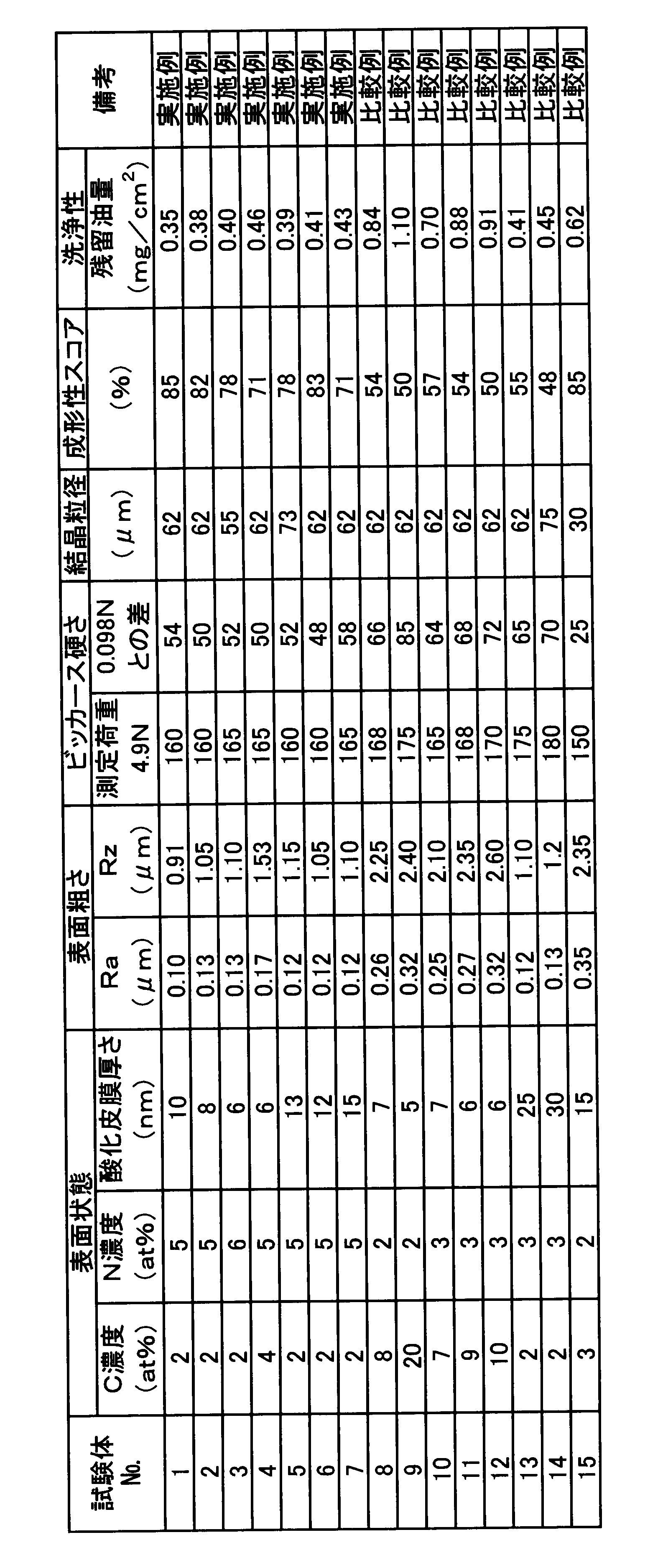
- Table 2 shows the specimen Nos. That were cold-rolled and vacuum-annealed under the conditions shown in Table 1. The results of measuring characteristics 1 to 15 are shown. (Surface condition measurement) The surface state of each specimen was measured. Specifically, the C concentration, N concentration, and oxide film thickness on the surface of each specimen were measured by X-ray photoelectron spectroscopy analysis under the above-described conditions.
- the arithmetic average roughness (Ra) and the maximum height (Rz) of each specimen were measured.
- a surface roughness shape measuring machine (Surfcom 1400D manufactured by Tokyo Seimitsu Co., Ltd.) was used, and measurement was performed by a method based on JIS B 0601: 2001. At that time, the measurement distance was 7 mm, the measurement speed was 0.3 mm / second, five points in the direction perpendicular to the rolling direction were measured, and the average value was taken as the measurement value.
- the measurement of Vickers hardness was carried out by a method based on JIS Z 2244 with the measurement surface as the surface of the test specimen.
- the measurement load was 4.9 N (500 g) and 0.098 N (10 g), 10 points were measured for each measurement load, and the average value was used as the measurement value.
- a micro Vickers hardness tester (MATSUZAWASEIKI DMH-1) was used for measurement with a measurement load of 4.9 N, and an ultra micro Vickers hardness tester (AKASHIMVK-G3) was used for measurement with a measurement load of 0.098 N. Further, the difference between the Vickers hardness at a measurement load of 4.9 N and the Vickers hardness at a measurement load of 0.098 N was calculated.
- the crystal grain size was measured by cutting each test specimen by a method based on the cutting method of JIS G 0552 and measuring the crystal grain size when the cross-sectional structure was observed with an optical microscope.
- the crystal grains had an equiaxed shape.
- the moldability was evaluated by performing a press test using a molding die simulating the heat exchange part of the plate heat exchanger for each test body.
- the shape of the molding die has six twill lines having a molding portion of 100 mm ⁇ 100 mm, a pitch of 10 mm, and a maximum height of 4 mm.
- the measurement position C is a peak side of a line passing through the mold center
- the measurement position C ′ is a valley side of a line passing through the mold center.
- press molding was performed with an 80-t hydraulic press.
- press oil having a kinematic viscosity of 34 mm 2 / s (temperature: 40 ° C.) is applied to both surfaces of each test specimen, and the lower metal is set so that the rolling direction of each test specimen coincides with the vertical direction of FIG.
- the press speed was 1 mm / s and the indentation depth was 3.6 mm.
- formability was evaluated by the number of cracks observed in each specimen after press molding. The specific evaluation method is as follows.
- the presence / absence of cracks in each specimen was visually observed at 36 intersection points of the ridge line portion and the dotted line (5 on the mountain side and 1 on the valley side) shown in FIG.
- the other measurement positions B and D were scored with 1 point when no cracks were observed, 0.5 points when necking was observed, and 0 points when cracks were observed. Then, the number of points was multiplied by the reciprocal of processing R to quantify the state of cracking, and the total was obtained.
- Formability score F ⁇ G ⁇ ⁇ E (ij) / R (j) / ( ⁇ A, C, C ′, E2 / R (j) + ⁇ B, D1 / R (j)) ⁇ 100 (1)
- Table 2 shows the moldability score of each specimen. A moldability score of 65 points or more was regarded as good moldability and less than 65 points was regarded as poor moldability.
- a test specimen No. No. 1 in which the cold rolling conditions and the vacuum annealing conditions satisfy the requirements of the present invention.
- the surface condition, Vickers hardness (difference between the measurement load of 0.098N and 4.9N), surface roughness, and crystal grain size can be regulated within the ranges specified by the present invention. It can be seen that the moldability and cleanability are good.
- test bodies 8 and 9 use mineral oil-based neat oil as the cold rolling lubricant, the test body seizes with the rolling roll during cold rolling, and the surface C concentration, surface roughness and Vickers hardness is high and both moldability and cleanability are not good. In particular, the tendency is remarkable in the test body 9 in which the rolling roll diameter is small and the rolling speed is 10 m / min.
- test body 10 had a rolling speed of 10 m / min and a reduction rate per pass of 30%, seizure occurred during cold rolling, the surface C concentration was high and the hardness was high, and the surface roughness and Vickers hardness is increased. Therefore, both moldability and cleanability are not good.
- test bodies 11 and 12 use rolling rolls with a small diameter, seizure occurs during cold rolling, the surface C concentration is high and the hardness is high, and the surface roughness and Vickers hardness are large. It has become. Therefore, both moldability and cleanability are not good.
- the test bodies 13 and 14 are not seized at the time of cold rolling, the surface C concentration and N concentration are low, and a smooth surface is obtained.
- the degree of vacuum during the subsequent vacuum annealing exceeds a predetermined value, the surface oxide film becomes too thick and the Vickers hardness is increased. Therefore, the moldability is not good.
- the surface roughness of the surface of the test body is large because the unevenness of the surface of the test body is large and the unevenness enters the unevenness. Large and low Vickers hardness. Therefore, the cleaning property is not good.
- the titanium plate of the present invention can be used, for example, in chemical, electric power, heat exchanger members such as food production plants, consumer products such as camera bodies and kitchen equipment, transport equipment members such as motorcycles and automobiles, and exterior materials such as home appliances. Is preferred.
Landscapes
- Chemical & Material Sciences (AREA)
- Engineering & Computer Science (AREA)
- Mechanical Engineering (AREA)
- Materials Engineering (AREA)
- Metallurgy (AREA)
- Organic Chemistry (AREA)
- Physics & Mathematics (AREA)
- Thermal Sciences (AREA)
- Crystallography & Structural Chemistry (AREA)
- Metal Rolling (AREA)
Abstract
Description
特許文献1では、チタン板表面に0.1μm以上、1.0μm以下の窒化チタン層を形成し、その下層に窒素の拡散層を形成することが提案されている。また、特許文献2では、チタン板表面に0.5μm以上、5.0μm以下の窒素富化層を形成することが提案されている。また、特許文献3では、チタン板表面に250オングストローム以上の酸化皮膜を生成させることが提案されている。また、特許文献4では、チタン板表面の窒素濃度を所定範囲内に制御し、板表面の平均粗さRaを0.05~0.5μmにすることが提案されている。また、特許文献5では、チタン板の表面近傍に炭化チタン含有層を形成し、かつ、当該炭化チタン含有層の厚さを300オングストローム以上に制御することが提案されている。
特許文献6では、チタン板表面における荷重50gfのビッカース硬さを180~280、荷重200gfのビッカース硬さを170以下とし、エリクセン値を11.5mm以上とすることが提案されている。また、特許文献7では、チタン板表面における荷重200gfのビッカース硬さを170以下、酸化皮膜の厚さを150オングストローム以上とすることが提案されている。
本発明は特定の組成のチタン板に限定されるものではないが、一例としてTiおよび不可避不純物からなる純チタン板が挙げられる。上記不可避不純物としては、たとえばO,Fe,H,C,Nなどが挙げられるが、母材の成形性確保の観点から、Oを1500ppm以下、より好ましくは1000ppm以下に抑制し、Feを1500ppm以下、より好ましくは1000ppm以下に抑制し、Hを130ppm以下に抑制し、Cを800ppm以下に抑制し、Nを300ppmに抑制することが好ましい。
耐焼付き性と耐割れ性を兼備するために、酸化チタンから成る所定の厚さ範囲の酸化皮膜(表面硬質層)を形成する。ここで、酸化皮膜が薄すぎると、成形工程で素材が延ばされた際に、酸化皮膜が破れて基地のチタンが露出し、成形金型と焼付きを起こしやすくなる。一方、酸化皮膜が厚すぎると、成形工程で割れが発生・進展しやすくなり、成形性が阻害される。なお、本発明におけるチタン板の「表面」とは、チタン板の最表面から200nmまでの深さ範囲のことをいう。
本実施例に係るチタン板の表面状態は、具体的には以下のように規定する。
チタン板表面に硬度の高い炭化チタン、窒化チタンが所定量以上含有されている場合は特に割れが発生しやすいと考えられる。従って、表面のC濃度は、6at%以下、好ましくは5at%以下、より好ましくは3at%以下とする。また、表面のN濃度は、7at%以下、好ましくは6at%以下とする。なお、チタン板表面のC濃度は、後記するように、冷間圧延工程の圧延ロール径、圧延速度、1パス当たりの圧化率、潤滑油を適正化することで、制御することができる。また、N濃度は、後記するように、真空焼鈍時の雰囲気を適正化することで、制御することができる。
チタン板表面の酸化皮膜の厚さが薄すぎると工具との焼付きを起こしやすくなり、厚すぎると割れが発生しやすくなり、成形性が低下する。従って、酸化皮膜の厚さ(深さ)は3~15nmとする。また、好ましくは5~15nm、より好ましくは5~10nmとする。なお、酸化皮膜の厚さは、後記するように、圧延時の炭化物の生成を抑制すると共に、真空焼鈍時の雰囲気における真空度を適正化することで、制御することができる。
チタン板の表面が平滑であると潤滑油を洗浄しやすくなるため、表面粗さを規定する。表面粗さは、後記するように、冷間圧延工程の圧延ロール径、圧延速度、1パス当たりの圧化率、潤滑油を適正化することで、制御することができる。チタン板は圧延方向と平行に伸びた凹凸が形成されやすいため、表面粗さの測定値は圧延方向と垂直方向に測定した値とした。また、表面粗さは、具体的には以下の2つの値によって規定した。
算術平均粗さ(Ra)は、板材表面の平均的な凹凸を規定するものである。ここで、算術平均粗さ(Ra)が0.25μmを超えると、凹凸の隙間に潤滑油が入り込んで洗浄による潤滑油の除去が困難となる。従って、算術平均粗さ(Ra)は0.25μm以下とする。なお、算術平均粗さ(Ra)は、0.22μm以下が好ましく、0.20μm以下がより好ましい。算術平均粗さ(Ra)の下限値は特に規定しないが、現実的には0.05μm以上となる。
最大高さ(Rz)は、板材表面の凹部の深さを規定するものである。ここで、最大高さ(Rz)が2.0μmを超えると、凹凸に潤滑油が入り込んで、洗浄除去することが困難となる。従って、最大高さ(Rz)は2.0μm以下とする。なお、最大高さ(Rz)は、1.8μm以下が好ましく、1.7μm以下がより好ましい。最大高さ(Rz)の下限値は特に規定しないが、現実的には1.0μm以上となる。
耐焼付き性と耐割れ性を兼備するために、チタン板表面における測定荷重0.098Nでのビッカース硬さと、測定荷重4.9Nでのビッカース硬さを測定し、これらの差が所定の範囲内となるように規定した。本発明では、後記するように、冷間圧延及び真空焼鈍の条件を調整してチタン板の表面状態を所定範囲に規定することにより、ビッカース硬さを制御することができる。
本発明に係るチタン板は、JIS G 0552に規定の切断法により切断した断面を光学顕微鏡で観察した場合における結晶粒径を、平均切片長さで20~80μmの範囲内とすることが好ましい。結晶粒径の平均切片長さが20μm未満では、加工硬化指数が低く、優れた張出成形性が得られない場合がある。一方、結晶粒径の平均切片長さが80μmを超えると、材料強度が低下する場合がある。従って、結晶粒径の平均切片長さは、チタン板の成形性と強度特性の観点から上記範囲内とすることが好ましい。なお、さらに好ましくは35~80μmとする。チタン板の結晶粒径は、冷間圧延時の圧下率、ならびにその後の真空焼鈍工程における保持温度と保持時間によって制御することができる。
(圧延ロール径)
圧延ロール径が小さい程、チタン板が圧延ロールと接触する距離が短くなって焼付きにくくなるとも考えられるが、実際には圧延ロール径が大きい程、炭化チタン層の形成抑制に好ましいことが判明した。従って、圧延ロール径は150mm以上、好ましくは200mm以上とする。
圧延速度は15m/min以上とすることが好ましい。また、20m/min以上とすることがより好ましく、40m/min以上とすることがより一層好ましい。圧延速度が15m/min未満だと、冷間圧延時に焼付きが発生し易くなり、表面のC濃度が上昇する。これは、圧延ロールと素材表面間に潤滑油の油膜が形成され易いためと考えられる。また、表面粗さ、ビッカース硬さを前記した所定範囲内に制御することが困難となる。
1パス当たり15%以下の圧下率で圧延することが好ましい。1パス当たりの圧下率が15%を超えると、冷間圧延時に焼付きが発生して表面のC濃度が上昇する。また、表面粗さ、ビッカース硬さを前記した所定範囲内に制御することが困難となる。なお、1パス当たりの圧下率は、10%以下がより好ましい。
ニート油等の鉱油をベースとする潤滑油を用いると、チタン板が圧延ロールと焼付きを起こして表面のC濃度が上昇する。また、表面粗さ、ビッカース硬さを前記した所定範囲内に制御することが困難となる。従って、潤滑油としては例えば、合成エステル油、油脂を用いることが好ましい。
(温度及び保持時間)
真空焼鈍の温度は、600~750℃とすることが好ましい。焼鈍温度が600℃未満だと、再結晶が十分に起こらず(冷間圧延のひずみが開放されず)、十分な伸びが得られない場合がある。また、真空焼鈍はバッチ処理であるため短時間での処理ができない。従って、焼鈍温度が750℃を超えると、保持時間が数分であっても粒径が80μmを超えるおそれがある。なお、保持時間は5分以上5時間以下が好ましい。
真空焼鈍時の雰囲気は、チタン板表面の酸化皮膜の厚さ及びN濃度を制御するために重要である。当該雰囲気は、真空焼鈍の温度と保持時間に影響を受けるものの、真空度(熱処理炉内の気圧)を5×10⁻⁴torr以下とする。真空度が5×10⁻⁴torrを超えると、チタン板が雰囲気中の酸素と反応して、表面の酸化皮膜が15nmを越えやすくなる。また、チタン板表面のN濃度が7at%を超えやすくなる。なお、真空度は、2×10⁻⁴torr以下とすることがさらに好ましい。

(表面状態の測定)
各試験体の表面状態を測定した。具体的には、各試験体表面のC濃度、N濃度、酸化皮膜厚をX線光電子分光分析によって、前記した条件で測定した。
各試験体の算術平均粗さ(Ra)と、最大高さ(Rz)を測定した。測定には、表面粗さ形状測定機(東京精密社製サーフコム1400D)を使用し、JIS B 0601:2001に準拠した方法で測定した。その際、測定距離は7mm、測定速度は0.3mm/秒とし、圧延方向に垂直方向を5点測定し、その平均値を測定値とした。
ビッカース硬さの測定は、測定面を試験体表面とし、JIS Z 2244に準拠した方法で実施した。測定荷重を4.9N(500g)及び0.098N(10g)として各測定荷重について10点測定し、その平均値を測定値として用いた。測定荷重4.9Nの測定には、マイクロビッカース硬さ試験機(MATSUZAWASEIKI DMH-1)を、測定荷重0.098Nの測定には、超マイクロビッカース硬さ試験機(AKASHIMVK-G3)を用いた。また、測定荷重4.9Nでのビッカース硬さと、測定荷重
0.098Nでのビッカース硬さとの差を算出した。
結晶粒径の測定は、各試験体をJIS G 0552の切断法に準拠した方法で切断し、その断面組織を光学顕微鏡で観察した場合における結晶粒径を測定することで行なった。なお、結晶粒は等軸状を呈していた。
成形性の評価は、各試験体に対してプレート式熱交換器の熱交換部分を模擬した成形金型を用いたプレス試験を行い、成形性を評価した。図1(a)に示すように、成形金型の形状は、成形部が100mm×100mmで、ピッチが10mm、最大高さが4mmの綾線部を6本有し、各綾線部は、頂点に、図1(a)の上から下に向かって順にR=0.4、1.8、0.8、1.0、1.4、0.6の6種のR形状を有している。なお、図1(b)に示す通り、測定位置Cは、金型中央を通る線の山側であり、測定位置C’は、金型中央を通る線の谷側である。
+ΣB,D1/R(j))×100 ・・・式(1)
A,C,C’,Eの場合は、E(ij)=1.0×(割れなし;2、くびれ;1、割れ;0)とし、
B,Dの場合は、E(ij)=0.5×(割れなし;2、くびれ;1、割れ;0)として算出した。
また、本実施例では温度(T)、潤滑油粘度(μ)、試験片板厚(t)、金型の綾線の角度(α)、およびピッチ(p)を一定としたため、F×Gを便宜的に1としてスコアを算出した。
各試験体を20×25mm2に切断してアセトン洗浄を行い、質量測定を行った後、各試験体の片面に動粘度34mm2/s(温度40℃)のプレス油を25μl塗布した。そして、70℃に加温された純水2Lをスターラーで撹拌し、その中に各試験体を3分間浸漬させて取り出した。その後、各試験体を乾燥させて質量を測定し、プレス油塗布前の質量との差から残留している油分量を評価し、残留油分が0.5mg/cm2以下の場合を洗浄性が良いとし、0.5mg/cm2を超える場合を洗浄性が悪いとした。
本出願は、2009年7月15日出願の日本特許出願(特願2009-166319)に基づくものであり、その内容はここに参照として取り込まれる。
Claims (5)
- 表面から深さ200nmまでの領域におけるC濃度の最大値が6at%以下及び、N濃度の最大値が7at%以下であり、
表面の酸化皮膜の厚さが3~15nmの範囲内であり、
表面の算術平均粗さ(Ra)が0.25μm以下であり、
表面の最大高さ(Rz)が2.0μm以下であることを特徴とするチタン板。 - 表面における測定荷重0.098Nでのビッカース硬さが、測定荷重4.9Nでのビッカース硬さよりも高く、その差が30~60の範囲内であることを特徴とする請求項1に記載のチタン板。
- JIS G 0552に規定の切断法により切断した断面を光学顕微鏡で観察した場合における結晶粒径が、平均切片長さで20~80μmの範囲内であることを特徴とする請求項1または2に記載のチタン板。
- 板厚が1.0mm以下であることを特徴とする請求項1から3のいずれか1項に記載のチタン板。
- 請求項1から4のいずれか1項に記載したチタン板を製造する方法であって、
外径が150mm以上の圧延ロールと、エステル油または油脂からなる潤滑油と、を用いて、圧延速度15m/min以上、1パス当たりの圧下率15%以下で冷間圧延を行なう冷間圧延工程と、
真空度が5×10⁻⁴torr以下、またはアルゴン雰囲気の不活性環境下で真空焼鈍を行なう焼鈍工程と、
を有することを特徴とするチタン板の製造方法。
Priority Applications (2)
| Application Number | Priority Date | Filing Date | Title |
|---|---|---|---|
| CN201080031003.1A CN102470407B (zh) | 2009-07-15 | 2010-07-09 | 钛板及钛板的制造方法 |
| KR1020127001078A KR101342819B1 (ko) | 2009-07-15 | 2010-07-09 | 티탄판 및 티탄판의 제조 방법 |
Applications Claiming Priority (2)
| Application Number | Priority Date | Filing Date | Title |
|---|---|---|---|
| JP2009166319A JP4681663B2 (ja) | 2009-07-15 | 2009-07-15 | チタン板及びチタン板の製造方法 |
| JP2009-166319 | 2009-07-15 |
Publications (1)
| Publication Number | Publication Date |
|---|---|
| WO2011007738A1 true WO2011007738A1 (ja) | 2011-01-20 |
Family
ID=43449346
Family Applications (1)
| Application Number | Title | Priority Date | Filing Date |
|---|---|---|---|
| PCT/JP2010/061722 Ceased WO2011007738A1 (ja) | 2009-07-15 | 2010-07-09 | チタン板及びチタン板の製造方法 |
Country Status (4)
| Country | Link |
|---|---|
| JP (1) | JP4681663B2 (ja) |
| KR (1) | KR101342819B1 (ja) |
| CN (1) | CN102470407B (ja) |
| WO (1) | WO2011007738A1 (ja) |
Cited By (5)
| Publication number | Priority date | Publication date | Assignee | Title |
|---|---|---|---|---|
| EP2671956A1 (en) * | 2012-06-04 | 2013-12-11 | Kabushiki Kaisha Kobe Seiko Sho (Kobe Steel, Ltd.) | Titanium alloy material excellent in scale deposition inhibiting property and formability and a method of producing the same, as well as a heat exchanger or a seawater evaporator |
| JP6156597B1 (ja) * | 2016-06-30 | 2017-07-05 | 新日鐵住金株式会社 | チタン薄板及びその製造方法 |
| JP2019020107A (ja) * | 2017-07-12 | 2019-02-07 | エイジア ヴァイタル コンポーネンツ カンパニー リミテッド | 放熱ユニットの製造方法 |
| US20210189144A1 (en) * | 2018-06-18 | 2021-06-24 | Nippon Steel Corporation | Titanium material |
| EP3778046A4 (en) * | 2018-04-03 | 2021-12-22 | Nippon Steel Corporation | TITANIUM PLATE |
Families Citing this family (16)
| Publication number | Priority date | Publication date | Assignee | Title |
|---|---|---|---|---|
| JP6057501B2 (ja) * | 2011-06-29 | 2017-01-11 | 新日鐵住金株式会社 | バレル研磨用チタン板およびその製造方法 |
| JP5615792B2 (ja) * | 2011-10-31 | 2014-10-29 | 株式会社神戸製鋼所 | チタン板、チタン板の製造方法、およびプレート式熱交換器の熱交換プレートの製造方法 |
| JP5639216B2 (ja) * | 2013-03-27 | 2014-12-10 | 株式会社神戸製鋼所 | 燃料電池セパレータ用チタン板材およびその製造方法 |
| CN104152746B (zh) * | 2014-08-26 | 2016-06-08 | 攀钢集团攀枝花钢铁研究院有限公司 | 提高钛板纵向塑性应变比的生产工艺 |
| CN104775053B (zh) * | 2015-04-28 | 2017-06-13 | 宝鸡鑫诺新金属材料有限公司 | 用于制造克氏针的医用Ti‑6Al‑7Nb合金丝的制备工艺 |
| JP6610062B2 (ja) * | 2015-07-31 | 2019-11-27 | 日本製鉄株式会社 | チタン板 |
| JP6172408B1 (ja) * | 2016-01-18 | 2017-08-02 | 新日鐵住金株式会社 | チタン板 |
| JP6119927B1 (ja) * | 2016-07-08 | 2017-04-26 | 新日鐵住金株式会社 | チタン板及びその製造方法 |
| CN106425294A (zh) * | 2016-09-21 | 2017-02-22 | 宝鸡鑫诺新金属材料有限公司 | 磁致伸缩牙科专用tc4合金棒材的制备工艺 |
| TWI660052B (zh) * | 2018-04-03 | 2019-05-21 | 日商新日鐵住金股份有限公司 | Titanium plate |
| TWI741484B (zh) | 2020-01-21 | 2021-10-01 | 日商日本製鐵股份有限公司 | 加工鈦材的製造方法 |
| JP7448859B2 (ja) * | 2020-12-24 | 2024-03-13 | 日本製鉄株式会社 | チタン材 |
| CN113088846A (zh) * | 2021-03-22 | 2021-07-09 | 湖南湘投金天钛金属股份有限公司 | 一种冷轧钛材的着色工艺 |
| JP7767157B2 (ja) * | 2022-01-11 | 2025-11-11 | 株式会社神戸製鋼所 | チタン板材の製造方法及びチタン板材 |
| WO2023170979A1 (ja) * | 2022-03-11 | 2023-09-14 | 日本製鉄株式会社 | チタン材 |
| CN116078813B (zh) * | 2023-02-17 | 2023-12-15 | 武汉威华铝业有限公司 | 一种铝板及其加工工艺与检测方法 |
Citations (3)
| Publication number | Priority date | Publication date | Assignee | Title |
|---|---|---|---|---|
| JPH10204609A (ja) * | 1997-01-23 | 1998-08-04 | Nippon Steel Corp | 成形加工用チタン薄板とその製造方法 |
| JP2002003968A (ja) * | 2000-06-21 | 2002-01-09 | Sumitomo Metal Ind Ltd | 成形性に優れたチタン板とその製造方法 |
| JP2004115876A (ja) * | 2002-09-27 | 2004-04-15 | Nippon Steel Corp | 成形性及び潤滑性に優れたチタン材とその製造方法 |
Family Cites Families (5)
| Publication number | Priority date | Publication date | Assignee | Title |
|---|---|---|---|---|
| JP3600792B2 (ja) * | 2000-12-15 | 2004-12-15 | 新日本製鐵株式会社 | 工業用純チタン薄板とその製造方法 |
| JP2002194591A (ja) * | 2000-12-21 | 2002-07-10 | Nippon Steel Corp | チタン薄板とその製造方法 |
| JP4163973B2 (ja) * | 2003-02-13 | 2008-10-08 | 新日本製鐵株式会社 | 成形性と潤滑性に優れたチタン板とその製造方法 |
| CN101050495A (zh) * | 2007-05-16 | 2007-10-10 | 宝鸡市嘉诚稀有金属材料有限公司 | 高塑性钛薄板的制造方法 |
| CN100546732C (zh) * | 2007-09-20 | 2009-10-07 | 上海桦厦实业有限公司 | 板式热交换器专用钛板的超塑性成形方法 |
-
2009
- 2009-07-15 JP JP2009166319A patent/JP4681663B2/ja not_active Expired - Fee Related
-
2010
- 2010-07-09 KR KR1020127001078A patent/KR101342819B1/ko not_active Expired - Fee Related
- 2010-07-09 WO PCT/JP2010/061722 patent/WO2011007738A1/ja not_active Ceased
- 2010-07-09 CN CN201080031003.1A patent/CN102470407B/zh not_active Expired - Fee Related
Patent Citations (3)
| Publication number | Priority date | Publication date | Assignee | Title |
|---|---|---|---|---|
| JPH10204609A (ja) * | 1997-01-23 | 1998-08-04 | Nippon Steel Corp | 成形加工用チタン薄板とその製造方法 |
| JP2002003968A (ja) * | 2000-06-21 | 2002-01-09 | Sumitomo Metal Ind Ltd | 成形性に優れたチタン板とその製造方法 |
| JP2004115876A (ja) * | 2002-09-27 | 2004-04-15 | Nippon Steel Corp | 成形性及び潤滑性に優れたチタン材とその製造方法 |
Cited By (9)
| Publication number | Priority date | Publication date | Assignee | Title |
|---|---|---|---|---|
| EP2671956A1 (en) * | 2012-06-04 | 2013-12-11 | Kabushiki Kaisha Kobe Seiko Sho (Kobe Steel, Ltd.) | Titanium alloy material excellent in scale deposition inhibiting property and formability and a method of producing the same, as well as a heat exchanger or a seawater evaporator |
| CN103451472A (zh) * | 2012-06-04 | 2013-12-18 | 株式会社神户制钢所 | 水垢附着抑制性和成形性优异的钛合金材及其制造方法,以及热交换器或海水蒸发器 |
| JP6156597B1 (ja) * | 2016-06-30 | 2017-07-05 | 新日鐵住金株式会社 | チタン薄板及びその製造方法 |
| WO2018003098A1 (ja) * | 2016-06-30 | 2018-01-04 | 新日鐵住金株式会社 | チタン薄板及びその製造方法 |
| CN109477168A (zh) * | 2016-06-30 | 2019-03-15 | 新日铁住金株式会社 | 钛薄板及其制造方法 |
| JP2019020107A (ja) * | 2017-07-12 | 2019-02-07 | エイジア ヴァイタル コンポーネンツ カンパニー リミテッド | 放熱ユニットの製造方法 |
| EP3778046A4 (en) * | 2018-04-03 | 2021-12-22 | Nippon Steel Corporation | TITANIUM PLATE |
| US20210189144A1 (en) * | 2018-06-18 | 2021-06-24 | Nippon Steel Corporation | Titanium material |
| US11760887B2 (en) * | 2018-06-18 | 2023-09-19 | Nippon Steel Corporation | Titanium material |
Also Published As
| Publication number | Publication date |
|---|---|
| CN102470407B (zh) | 2014-11-05 |
| JP2011020135A (ja) | 2011-02-03 |
| KR20120028387A (ko) | 2012-03-22 |
| JP4681663B2 (ja) | 2011-05-11 |
| CN102470407A (zh) | 2012-05-23 |
| KR101342819B1 (ko) | 2013-12-17 |
Similar Documents
| Publication | Publication Date | Title |
|---|---|---|
| JP4681663B2 (ja) | チタン板及びチタン板の製造方法 | |
| JP4584341B2 (ja) | チタン板及びチタン板の製造方法 | |
| JP3558628B2 (ja) | マグネシウム合金板およびその製造方法 | |
| JP5376507B2 (ja) | 優れた冷間成形性を有するマグネシウム合金板材及びその製造方法 | |
| JP2006205244A (ja) | 温間成形加工品及びその製造方法 | |
| CN109415794B (zh) | 钛板及其制造方法 | |
| JP2016068145A (ja) | チタン板およびその製造方法 | |
| JP2013011013A (ja) | プレス成形性と強度のバランス、及び耐食性に優れた純チタン板、並びにその製造方法 | |
| JP4306547B2 (ja) | マグネシウム合金板及びその製造方法 | |
| JP6172408B1 (ja) | チタン板 | |
| JP4928584B2 (ja) | チタン板およびその製造方法ならびにプレート式熱交換器の熱交換部材の製造方法 | |
| JP6610062B2 (ja) | チタン板 | |
| JP4799294B2 (ja) | 高成形性Al−Mg系合金板の製造方法 | |
| JP2006257475A (ja) | プレス成形性に優れたAl−Mg−Si系合金板材とその製造方法および該板材から得られる自動車外板 | |
| JP3600792B2 (ja) | 工業用純チタン薄板とその製造方法 | |
| JP7060468B2 (ja) | 圧延接合体及びその製造方法 | |
| WO2022138837A1 (ja) | チタン材 | |
| JP7704197B2 (ja) | 鋼板、めっき鋼板、プレス成形品、加工部材、プレス成形品の製造方法および加工部材の製造方法 | |
| WO2025187552A1 (ja) | チタン材、加工品および製品 | |
| JP4452753B1 (ja) | プレス成形性と強度のバランスに優れたチタンまたはチタン合金板 | |
| KR20250136362A (ko) | 티타늄재 및 그 제조 방법 |
Legal Events
| Date | Code | Title | Description |
|---|---|---|---|
| WWE | Wipo information: entry into national phase |
Ref document number: 201080031003.1 Country of ref document: CN |
|
| 121 | Ep: the epo has been informed by wipo that ep was designated in this application |
Ref document number: 10799796 Country of ref document: EP Kind code of ref document: A1 |
|
| ENP | Entry into the national phase |
Ref document number: 20127001078 Country of ref document: KR Kind code of ref document: A |
|
| NENP | Non-entry into the national phase |
Ref country code: DE |
|
| 122 | Ep: pct application non-entry in european phase |
Ref document number: 10799796 Country of ref document: EP Kind code of ref document: A1 |