WO2011002034A1 - 針状体 - Google Patents
針状体 Download PDFInfo
- Publication number
- WO2011002034A1 WO2011002034A1 PCT/JP2010/061181 JP2010061181W WO2011002034A1 WO 2011002034 A1 WO2011002034 A1 WO 2011002034A1 JP 2010061181 W JP2010061181 W JP 2010061181W WO 2011002034 A1 WO2011002034 A1 WO 2011002034A1
- Authority
- WO
- WIPO (PCT)
- Prior art keywords
- needle
- alginate
- protrusion
- pectin
- body according
- Prior art date
- Legal status (The legal status is an assumption and is not a legal conclusion. Google has not performed a legal analysis and makes no representation as to the accuracy of the status listed.)
- Ceased
Links
Images




Classifications
-
- A—HUMAN NECESSITIES
- A61—MEDICAL OR VETERINARY SCIENCE; HYGIENE
- A61K—PREPARATIONS FOR MEDICAL, DENTAL OR TOILETRY PURPOSES
- A61K9/00—Medicinal preparations characterised by special physical form
- A61K9/0012—Galenical forms characterised by the site of application
- A61K9/0019—Injectable compositions; Intramuscular, intravenous, arterial, subcutaneous administration; Compositions to be administered through the skin in an invasive manner
- A61K9/0021—Intradermal administration, e.g. through microneedle arrays or needleless injectors
-
- A—HUMAN NECESSITIES
- A61—MEDICAL OR VETERINARY SCIENCE; HYGIENE
- A61M—DEVICES FOR INTRODUCING MEDIA INTO, OR ONTO, THE BODY; DEVICES FOR TRANSDUCING BODY MEDIA OR FOR TAKING MEDIA FROM THE BODY; DEVICES FOR PRODUCING OR ENDING SLEEP OR STUPOR
- A61M37/00—Other apparatus for introducing media into the body; Percutany, i.e. introducing medicines into the body by diffusion through the skin
- A61M37/0015—Other apparatus for introducing media into the body; Percutany, i.e. introducing medicines into the body by diffusion through the skin by using microneedles
-
- A—HUMAN NECESSITIES
- A61—MEDICAL OR VETERINARY SCIENCE; HYGIENE
- A61M—DEVICES FOR INTRODUCING MEDIA INTO, OR ONTO, THE BODY; DEVICES FOR TRANSDUCING BODY MEDIA OR FOR TAKING MEDIA FROM THE BODY; DEVICES FOR PRODUCING OR ENDING SLEEP OR STUPOR
- A61M37/00—Other apparatus for introducing media into the body; Percutany, i.e. introducing medicines into the body by diffusion through the skin
- A61M37/0015—Other apparatus for introducing media into the body; Percutany, i.e. introducing medicines into the body by diffusion through the skin by using microneedles
- A61M2037/0046—Solid microneedles
Definitions
- the present invention relates to a needle-shaped body.
- the transdermal absorption method is a method in which a drug is administered to a living body such as a human body by allowing the drug to penetrate into the body through the skin.
- a drug can be easily administered to the living body without causing pain to the living body.
- JP-A-48-93192 For transdermal administration, it has been proposed, for example, in JP-A-48-93192, to use a needle-like body containing many fine protrusions (micrometer-order needles).
- a needle-like body containing many fine protrusions (micrometer-order needles).
- penetration of a drug into a living body can be promoted.
- the degree of penetration can be controlled.
- the material constituting the needle-like body is desirably a material that does not adversely affect the human body even if the damaged needle-like body remains in the body.
- biocompatible materials such as chitin and chitosan have been proposed in, for example, pamphlet of International Publication No. 2008/020632.
- Such a method for producing a needle-like body is described in, for example, International Publication No. 2008/013282 pamphlet.
- an original plate is obtained by machining, and a transfer plate is formed from the original plate.
- transfer processing molding is performed using this transfer plate, a needle-like body is obtained.
- the needle-shaped body can be produced by the method described in International Publication No. 2008/004597 pamphlet. In this process, an original plate is obtained using an etching method, and a transfer plate is formed from the original plate. By performing transfer processing molding using this transfer plate, a needle-like body is obtained.
- the needle-shaped body is required to be able to perforate the skin suitably in addition to being formed from a material having a low load on the living body.
- an object of the present invention is to provide a needle-like body that is formed of a material having a low load on a living body and can be suitably perforated in the skin.
- a needle-like body that includes a support portion and a protrusion portion extending from the support portion, and the protrusion portion is made of a material containing pectin and alginate.
- FIG. 4 is a schematic diagram illustrating a process following FIG. 3.
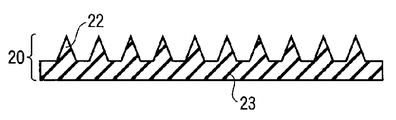
- the acicular body of the present embodiment is a molded body having a protrusion 22 and a support 23 that supports the protrusion as shown in the schematic diagram of FIG.
- the protrusion 22 is made of a material containing pectin and alginate.
- the support portion 23 preferably has a mechanical strength capable of supporting the protrusion 22 and may have flexibility.
- the support part 23 has flexibility, it can puncture more reliably with respect to flexible objects, such as a curved surface and biological skin.
- the support part 23 after forming the projection part 22, the support part 23 can also be shape
- the support part 23 may have either a single layer structure or a multilayer structure.
- the support portion 23 has a multilayer structure including an upper layer and a lower layer, and the protrusion 22 is provided on the upper layer side
- the upper layer is formed of the same material as the protrusion 22 and the material constituting the upper layer
- the lower layer can be made of a material that is more flexible than the above.
- the support part 23 may use a material with a larger malleability compared with the material which comprises the lower layer as a material of an upper layer.
- a material that is easier to compress than the material constituting the upper layer may be used. In these cases, it is easy to form the support portion 23 into a roll shape after forming the protrusion 22.
- the support part 23 may further include an adhesive sheet for fixing the layers.
- the material of the support portion 23 on the side where the protrusion 22 is provided can be the same as that of the protrusion 22.
- the support part 23 can be easily formed by integral molding together with the protruding part 22, and the manufacturing process is simplified.
- the lowermost layer of the support part 23 may be a layer having flexibility or flexibility. In this case, for example, when the layered needle-like bodies 20 are stacked and stored, the protrusion 22 is unlikely to be damaged.
- the shape of the protrusion 22 may be designed as appropriate as long as it is suitable for puncturing a target such as skin.
- it may have a cone shape, a pyramid shape, a cylindrical shape, or a prism shape.
- the protrusion 22 may have a pencil shape, that is, a shape including a columnar body and a cone-shaped tip.
- the number of the protrusions 22 is not limited, and any one of a shape having one needle-like portion on the support portion and a shape having a plurality of needle-like portions standing on the support portion may be used.
- the needle-like parts are preferably arranged in an array.
- the “array shape” indicates a state in which the unit needle-like portions are arranged, and includes, for example, a pattern such as a lattice arrangement, a close-packed arrangement, a concentric arrangement, or a random arrangement. Shall be. In the case of such a shape, it can be referred to as a “microneedle array”.
- the length and diameter of the protrusion 22 are determined according to the object to be perforated, for example.
- the protrusion 22 has, for example, several ⁇ m to several hundred ⁇ m, specifically a diameter in the range of about 1 ⁇ m to about 300 ⁇ m, and several tens ⁇ m to several hundred ⁇ m. Is designed to have a length in the range of about 10 ⁇ m to about 1000 ⁇ m.
- the aspect ratio of the protrusion 22 is preferably about 1 to 10.
- the protrusion 22 When drilling through the skin of the human body and allowing the tip 22 to reach the stratum corneum without penetrating the stratum corneum, the protrusion 22 is, for example, about 10 ⁇ m to about 300 ⁇ m, typically Is designed to have a length in the range of about 30 ⁇ m to 200 ⁇ m.
- the protrusion 22 is, for example, about 200 ⁇ m to about 700 ⁇ m, typically about 200 ⁇ m to It is designed to have a length in the range of about 500 ⁇ m, especially about 200 ⁇ m to about 300 ⁇ m.
- the protrusion 22 is designed to have a length in the range of about 200 ⁇ m to about 500 ⁇ m, for example. Further, in the case of perforating the skin of the human body, when the protrusion 22 reaches the epidermis, the protrusion 22 is designed to have a length in the range of about 200 ⁇ m to about 300 ⁇ m, for example.
- the maximum angle of the protruding portion 22 is, for example, in the range of 5 ° to 30 °, typically 10 ° to 20 °.
- the needle-like body 20 may further include a delivery product in the material constituting the protrusion 22.
- the needle-like body 20 may further include a delivery product carried on the surface of the protrusion 22.
- the delivery product include pharmacologically active substances and cosmetic compositions. When a material having a fragrance is used as a delivery product, it is preferable to use it as a cosmetic because it can give an odor when used.
- the delivery product can be administered to a living body even when it is not carried on the protrusion 22 of the needle-like body 20.
- the delivery material is applied to the skin.
- the supply is applied to the skin after perforation with the needle 20.
- the needle-like body 20 in which the delivery article is carried on the needle-like portion 22 may be used to puncture the skin, and then the delivery article may be further applied to the skin.
- the delivery material may be applied to the skin, and then the skin may be perforated using the needle-like body 20 in which the delivery material is carried on the protrusion 22.
- the delivery material is administered to the subject through a hole formed by pressing the needle-like body 20. Therefore, when a pharmacologically active substance is administered using this needle-like body 20, this delivery product is generally administered by subcutaneous injection or orally in addition to the pharmacologically active substance administered to the living body by the transdermal absorption method.
- Pharmacologically active substances can also be used.
- a pharmacologically active substance in addition to a preparation for skin application, a biologic represented by a vaccine such as an influenza virus vaccine, an analgesic administered to a cancer patient or the like, an injection such as insulin and a gene therapy, and an oral preparation are also used. be able to.
- the needle-like body 20 when the needle-like body 20 is used, a medicine generally used as an injection can be administered without causing the patient to feel pain. Furthermore, when the needle-shaped body 20 is used, a drug that is generally orally administered can be transdermally administered to a patient who is difficult or poor at swallowing the oral agent. In this respect, the needle-like body 20 is particularly suitable for application to children.
- a cosmetic composition can also be used as a delivery product.
- a cosmetic composition is a composition used as a cosmetic or a cosmetic.
- the cosmetic composition include humectants, colorants, fragrances, and physiologically active substances that exhibit cosmetic effects (improvement effects on wrinkles, acne, pregnancy lines, etc., and improvement effects on hair loss).
- the supply depth can be accurately controlled.
- the residence time of the delivery product in the living body varies depending on the supply depth.
- the delivery delivered into the stratum corneum is discharged out of the body in a relatively short period of time.
- the delivery on or near the skin can be easily removed by washing or peeling the skin.
- such a relatively small supply depth is suitable if the cosmetic composition only needs to last for a relatively short period of time.
- the needle-like body may be configured so that the protruding portion 22 punctured on the skin can be separated from the support portion 23.
- a hollow part may be provided in at least one of the protrusion and the support part.
- the hollow portion can be a through hole or a non-through hole.
- a delivery thing can be hold
- a biological tissue blood, a body fluid, etc.
- the needle-like body 20 can be used as, for example, a microneedle patch (or a microneedle device).
- a microneedle patch or a microneedle device.
- the protrusion 22 is pressed against the living body so as to be pierced.
- an applicator for fixing the insertion position and direction of the protrusion 22 may be used.
- the protrusion is made of a material containing pectin and alginate.
- pectin and alginate By mixing pectin and alginate, mechanical strength is improved specifically in a fine three-dimensional structure on the order of ⁇ m. When either pectin alone or alginate alone was used, it was difficult to produce a needle having a high strength. By mixing and using pectin and alginate, it became possible to provide a needle-like body having high mechanical strength and biocompatibility.
- Alginic acid is a polysaccharide formed by mannuronic acid and glucuronic acid, D-mannuronic acid is bound by ⁇ -1,4 bonds, and L-guluronic acid is bound by ⁇ -1,4 bonds. ing.
- This alginate is a material that is purified from plants such as brown algae and partly used for food additives.
- Alginate is a compound in which an anion derived from alginic acid and a cation derived from a base are ion-bonded. Specific examples include sodium alginate, potassium alginate, calcium alginate, and ammonium alginate.
- Pectin is a complex polysaccharide mainly composed of polygalacturonic acid in which galacturonic acid is ⁇ -1,4-linked and has a molecular weight of about 50,000 to 360,000. This pectin is a material that has been purified from plants and partly used as an edible polysaccharide as a thickening polysaccharide.
- the present inventor considered the reason for the improvement of the mechanical strength as follows.
- Alginate has ⁇ -1,4 bond of D-mannuronic acid and ⁇ -1,4 bond of L-guluronic acid. For this reason, the molecular chains are easily entangled and the packing density of the molecular chains per space is small. On the other hand, pectin repeats ⁇ -1,4 bonds of galacturonic acid. Due to this, it is considered that there is less entanglement of molecular chains and higher packing density of molecular chains per space than alginic acid.
- the space between the alginate molecular chains is filled with the molecular chains of pectin. It is considered that molecular chains are entangled and the packing density of molecular chains per space is high. As a result, it is presumed that the specific mechanical strength of the mixed material was improved.
- the protrusions In a needle-like body used for general skin puncture, the protrusions have a diameter in the range of several ⁇ m to several hundred ⁇ m, specifically in a range of about 1 ⁇ m to about 300 ⁇ m, Has a length in the range of about 10 ⁇ m to about 1000 ⁇ m. In this case, the aspect ratio of the protrusion is about 1 to 10.
- the mixing ratio (a / b) is in the range of 1.00 ⁇ a / b ⁇ 2.75, where the weight of pectin is a and the weight of alginate is b. It is preferable that it is in the range of 1.50 ⁇ a / b ⁇ 2.00.
- the acicular body of the present embodiment can be manufactured by the following method, for example.
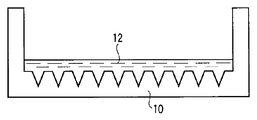
- a mold 10 as shown in FIG. 2 is prepared.
- a first concave portion 11 a having a shape corresponding to the support portion 23 of the needle-like body 20 is provided on one main surface of the mold 10.
- a second recess 11b corresponding to the protrusion 22 of the needle-like body 20 is provided on the bottom surface of the first recess.
- the second recess 11b can be referred to as a needle-like pattern.
- the mold 10 can be manufactured by various methods. For example, first, an original plate is produced using a fine processing technique. As this fine processing technique, for example, photolithography, laser beam or electron beam drawing on a resist layer, wet etching or dry etching using a pattern formed by any of these as a mask, a pattern having sufficient strength A precision machining method such as sand blasting, laser processing, or cutting processing using as a mask can be used.
- a fine processing technique for example, photolithography, laser beam or electron beam drawing on a resist layer, wet etching or dry etching using a pattern formed by any of these as a mask, a pattern having sufficient strength
- a precision machining method such as sand blasting, laser processing, or cutting processing using as a mask can be used.
- the intaglio plate produced from this original plate can be used as the mold 10.
- a duplicate plate made of nickel may be manufactured from the original plate by electroforming, and this may be used as the mold 10.
- a molten thermoplastic resin is supplied to the original plate, and the thermoplastic resin is cooled in this state. Also good.
- the obtained original plate is an intaglio plate provided with a concave portion corresponding to the needle-like protrusion, it can be used as the mold 10 itself. Further, a duplicate plate may be manufactured from this original plate, and this duplicate plate may be used as the mold 10.
- aqueous solution containing pectin and alginate is used as the acicular material (hereinafter referred to as a coating solution).
- a coating solution aqueous solution containing pectin and alginate
- the mechanical strength is uniquely improved. This was first discovered by the inventors.
- Pectin and alginate are known to be soluble in water and are preferably prepared as aqueous solutions. Here, the liquid state only needs to have fluidity enough to flow into the intaglio, and may be in a gel form.
- the total concentration of pectin and alginate in the coating solution can be set as appropriate. In order to avoid an increase in viscosity and difficulty in handling, the total concentration in the coating liquid is preferably in the range of 1 to 10 wt%. If pectin and alginate are contained at such a concentration, a desired needle-like body can be formed.
- the mixing ratio (a / b) is preferably in the range of 1.00 ⁇ a / b ⁇ 2.75. More preferably, it is in the range of 1.50 ⁇ a / b or less 2.00.
- a pharmacologically active substance or a cosmetic composition may be blended as a delivery product.
- the coating liquid is filled in the recesses 11b and a part of 11a of the mold 10 to form the layer 12 made of the coating liquid.
- a known method can be appropriately selected according to the shape and dimensions of the mold 10. Examples thereof include a spin coating method, a method using a dispenser, and a casting method.
- the mold 10 may be filled with the coating liquid in a reduced pressure atmosphere or in a vacuum.
- the layer 12 of the coating liquid filled in the mold 10 is dried and solidified by a heat source 13 to obtain a film-like needle-like body 20 as shown in FIG.
- the drying method can be appropriately selected depending on the environment, such as natural drying, bottom heating using a hot plate, drying by hot air drying.
- the heating temperature and time may be appropriately determined according to the composition of the coating liquid, the characteristics of the pharmacologically active substance and the cosmetic composition, and the like.
- the intaglio is removed to obtain the needle-like body of the present embodiment.
- the intaglio can be peeled off by physical force.
- a chemical treatment may be applied to selectively dissolve the intaglio.
- the needle-like body 20 is applied to medical use or cosmetic or cosmetic use, the needle-like body 20 can also be used for other uses.
- the needle-like body 20 is used as a punch for punching a target, but the needle-like body 20 can also be used for other purposes.
- the needle-like body 20 can be used for a MEMS (microelectromechanical system) device, an optical member, a sample jig, and drug discovery.
- MEMS microelectromechanical system
- a nickel film having a thickness of 500 ⁇ m was formed by plating on the concavo-convex structure of the original plate, which is a relief plate provided with the obtained needle-like protrusions.
- an aqueous potassium hydroxide solution containing potassium hydroxide at a concentration of 30% by mass was heated to 90 ° C., and wet etching using this aqueous solution as an etching solution was performed to remove the original plate from the nickel layer.
- a mold made of nickel and provided with a needle-like pattern corresponding to 36 regular quadrangular pyramidal protrusions on one main surface was obtained.
- an aqueous solution containing pectin and sodium alginate was prepared as a coating solution.
- the total concentration of pectin and sodium alginate in the aqueous solution was 7.5 wt%. While maintaining this total concentration, six types of aqueous solutions having different mixing ratios (a / b) were prepared by changing the weight a of pectin and the weight b of sodium alginate.
- the mixing ratio (a / b) was 0.25, 0.50, 1.00, 2.00, 4.00, and 9.00.
- the obtained coating liquid was filled into the above-mentioned mold as shown in FIG. 3 by spin coating.
- This mold was placed on a hot plate as the heat source 13 as shown in FIG. Heated at 120 ° C. for 10 minutes to dry and solidify.
- the mold 10 After drying and solidifying, the mold 10 was removed to obtain six needles of the examples.
- the mixing ratio (a / b) of pectin and sodium alginate was 0.25, 0.50, 1.00, 2.00, 4.00, and 9.00.
- a needle-like body was produced in the same manner as described above except that a sodium alginate aqueous solution was used as the coating solution.
- the concentration of sodium alginate in the aqueous solution is 7.5 wt%.
- a needle-like body was produced in the same manner as described above except that an aqueous pectin solution was used as the coating solution.
- the concentration of pectin in the aqueous solution is 7.5 wt%.
- the needle strength was measured using a needle strength measuring machine.
- the needle-like body strength measuring machine is a measuring instrument having a measuring needle for sensing a load as follows. The measuring needle is brought into contact with the inspection site at a predetermined measuring height to break the needle-like portion, and the maximum load applied to the measuring needle at this time is measured.
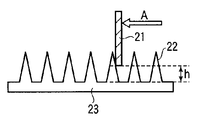
- the measuring needle 21 is arranged at a height h between the needle-like portions 22 on the support portion 23.
- the measurement height h was 10 ⁇ m.
- the measuring needle 21 is brought into contact with the needle-like portion 22 and a load is applied in the horizontal direction as indicated by an arrow A. The maximum load when the needle-like portion 22 was destroyed and laid down was taken as the needle strength.
- the strength of needles produced using a material containing pectin and sodium alginate is as follows: needles produced with sodium alginate alone (Reference Example 1), needles with pectin alone It is higher than the body (Reference Example 2).
- FIG. 7 is a diagram in which the mixing ratio (a / b) is plotted on the horizontal axis and the strength is plotted on the vertical axis for the needles of the example.
- the strengths obtained in Reference Example 1 and Reference Example 2 are shown on the vertical axis in FIG.
- FIG. 7 shows that there is a mixing ratio (a / b) that can increase the strength.
- the mixing ratio is around 1.75 (1.50 ⁇ a / b ⁇ 2.00), particularly high strength is shown.
- the acicular body of this embodiment can be used in various fields that require a fine acicular body.
- the application can be expected as a needle-like body used for a MEMS (microelectromechanical system) device, an optical member, a sample jig, drug discovery, medical use, cosmetics, or cosmetics.
- MEMS microelectromechanical system
Landscapes
- Health & Medical Sciences (AREA)
- Dermatology (AREA)
- General Health & Medical Sciences (AREA)
- Engineering & Computer Science (AREA)
- Veterinary Medicine (AREA)
- Public Health (AREA)
- Life Sciences & Earth Sciences (AREA)
- Animal Behavior & Ethology (AREA)
- Epidemiology (AREA)
- Heart & Thoracic Surgery (AREA)
- Medicinal Chemistry (AREA)
- Chemical & Material Sciences (AREA)
- Medical Informatics (AREA)
- Anesthesiology (AREA)
- Biomedical Technology (AREA)
- Pharmacology & Pharmacy (AREA)
- Hematology (AREA)
- Media Introduction/Drainage Providing Device (AREA)
- Medicinal Preparation (AREA)
- Cosmetics (AREA)
- Adornments (AREA)
- Infusion, Injection, And Reservoir Apparatuses (AREA)
Abstract
支持部(23)と、前記支持部から延びた突起部(22)とを具備する針状体である。前記突起部は、ペクチンとアルギン酸塩とを含む材料からなる。
Description
本発明は、針状体に関する。
経皮吸収法は、人体などの生体への薬剤の投与を、皮膚を通して薬剤を体内へと浸透させることによって行なう方法である。この方法を採用すると、生体に痛みを与えることなく、薬剤を生体へと簡便に投与することができる。
経皮投与には、微細な突起部(μmオーダーの針)を多数含んだ針状体を使用することが、例えば特開昭48-93192号公報に提案されている。針状体を用いて皮膚に穿孔すると、例えば、薬剤の生体への浸透を促進することができる。あるいは、その浸透度を制御することができる。
針状体を構成する材料としては、仮に破損した針状体が体内に残留した場合でも、人体に悪影響を及ぼさない材料であることが望まれる。このような材料としてはキチン、キトサン等の生体適合材料が、例えば国際公開第2008/020632号パンフレットに提案されている。
こうした針状体の製造方法は、例えば国際公開第2008/013282号パンフレットに記載されている。これにおいては、まず、機械加工を用いて原版を得、該原版から転写版を形成する。この転写版を用いて転写加工成型を行なって、針状体が得られる。
あるいは、国際公開第2008/004597号パンフレットに記載されている方法によって、針状体を製造することもできる。これにおいては、エッチング法を用いて原版を得し、該原版から転写版を形成する。この転写版を用いて転写加工成型を行なって、針状体が得られる。
針状体は、生体に低負荷な材料より形成されることに加えて、好適に皮膚に穿孔できることが要求される。
そこで、本発明は、生体に低負荷な材料より形成され、好適に皮膚に穿孔し得る針状体を提供することを目的とする。
本発明の一側面によると、支持部と、前記支持部から延びた突起部とを具備し、前記突起部は、ペクチンとアルギン酸塩と含む材料からなる針状体が提供される。
以下、図面を参照して本実施形態の針状体を説明する。
本実施形態の針状体は、図1の模式図に示されるような突起部22および突起部を支持する支持部23を有する成形体である。突起部22は、ペクチンとアルギン酸塩とを含む材料から構成される。
支持部23は、突起部22を支持し得る機械的強度を有することが好ましく、可撓性を有してもよい。支持部23が可撓性を有する場合には、曲面や生体皮膚などの可撓性を有する対象に対して、より確実に穿刺することができる。また、支持部23が可撓性を有する場合には、突起部22を形成した後に支持部23をロール状に成形することも可能となる。
支持部23は、単層構造および多層構造のいずれであってもよい。例えば、支持部23が上層と下層とを含んだ多層構造を有し、突起部22が上層側に設けられる場合、突起部22と同じ材料で上層を形成し、この上層を構成している材料と比較して可撓性に富んだ材料で下層を構成することができる。あるいは、支持部23は、上層の材料として下層を構成している材料と比較して展性のより大きな材料を使用してもよい。またさらに、下層の材料として、上層を構成している材料と比較して圧縮しやすい材料を使用してもよい。これらの場合、突起部22を形成した後に支持部23をロール状に成形することが容易である。多層構造を採用する場合には、支持部23は、層間を固定するための粘着シートをさらに含んでもよい。
支持部23のうち突起部22が設けられた側の材料は、突起部22と同一とすることができる。この場合には、支持部23は突起部22とともに、一体成形により容易に形成することができ、製造プロセスが簡略化される。
また、支持部23の最下層は、可撓性または柔軟性を有する層としてもよい。この場合、例えば、層状の針状体20を重ねて保管したときに、突起部22の破損を生じ難い。
突起部22の形状は、皮膚などの対象物に穿刺孔するのに適していればよく、適宜設計することができる。例えば、円錐形状、角錐形状、円柱形状、または角柱形状を有していてもよい。あるいは、突起部22は、鉛筆形状、すなわち、柱状の胴体部と錐形状の先端部とからなる形状を有していてもよい。突起部22の数は限定されず、支持部上に針状部が一本の形状、および支持部上に針状部が複数本林立した形状のいずれとしてもよい。
支持部上に針状部が複数林立した場合、各針状部は、アレイ状に配列していることが好ましい。ここで、「アレイ状」とは、各単位針状部が並んでいる状態を示すものであり、例えば、格子配列、最密充填配列、同心円状に配列、またはランダムに配列などのパターンを含むものとする。こうした形状の場合には、「マイクロニードルアレイ」と称することができる。
突起部22の長さおよび径は、例えば、穿孔すべき対象物に応じて定められる。人体などの生体の皮膚に穿孔する場合、突起部22は、例えば数μmから数百μm、具体的には約1μm~約300μmの範囲内の径と、数十μmから数百μm、具体的には約10μm~約1000μmの範囲内の長さとを有するように設計する。この場合、突起部22のアスペクト比は、1~10程度とすることが好ましい。
人体の皮膚に穿孔する場合であって、突起部22を角質層に貫通させることなしに、その先端を角質層内へと到達させるときには、突起部22は、例えば約10μm~約300μm、典型的には約30μm~200μmの範囲内の長さを有するように設計する。
人体の皮膚に穿孔する場合であって、突起部22を神経層へ到達させることなしに、角質層に貫通させるときには、突起部22は、例えば約200μm~約700μm、典型的には約200μm~約500μm、特には約200μm~約300μmの範囲内の長さを有するように設計する。
そして、人体の皮膚に穿孔する場合であって、突起部22を真皮へ到達させるときには、突起部22は、例えば約200μm~約500μmの範囲内の長さを有するように設計する。また、人体の皮膚に穿孔する場合であって、突起部22を表皮に到達させるときには、突起部22は、例えば約200μm~約300μmの範囲内の長さを有するように設計する。
先端が先細りしている突起部22を人体の角質層に貫通させる場合、突起部22の最大角度は、例えば5°~30°、典型的には10°~20°の範囲内とする。
針状体20は、突起部22を構成する材料中に送達物をさらに含んでいてもよい。あるいは、この針状体20は、突起部22の表面に担持された送達物をさらに含んでいてもよい。この送達物としては、例えば、薬理活性物質や化粧品組成物などが挙げられる。送達物として芳香を有する材料を用いた場合には、使用に際して匂いを付与することができることから、美容品として用いるのに好ましい。
なお、送達物は、針状体20の突起部22に担持させない場合であっても、生体に投与することができる。例えば、針状体20を用いた穿孔に先立って、送達物を皮膚に塗布しておく。あるいは、針状体20を用いた穿孔の後に、供給物を皮膚に塗布する。
また、送達物を針状部22に担持させた針状体20を使用して皮膚に穿孔し、その後、この皮膚に送達物をさらに塗布してもよい。あるいは、皮膚に送達物を塗布し、その後、送達物を突起部22に担持させた針状体20を使用して皮膚に穿孔してもよい。
いずれの場合であっても、送達物は、針状体20を押し当てることによって形成した孔を介して対象物に投与する。したがって、この針状体20を使用して薬理活性物質を投与する場合、この送達物として、一般に経皮吸収法によって生体へ投与している薬理活性物質に加え、皮下注射または経口投与していた薬理活性物質も使用することができる。例えば、薬理活性物質として、皮膚適用製剤に加え、インフルエンザウイルスワクチンなどのワクチンに代表される生物製剤、癌患者などに投与する鎮痛薬、インスリンおよび遺伝子治療薬などの注射剤ならびに経口剤も使用することができる。
また、針状体20を使用すると、一般に注射剤として使用されている薬剤を、患者に痛みを感じさせることなしに投与することができる。さらに、針状体20を使用すると、経口剤を飲み込むのが困難または苦手な患者に対し、一般に経口投与している薬剤を経皮投与することもできる。こうした点で、針状体20は、特に小児への適用に適している。
送達物として、化粧品組成物を使用することもできる。化粧品組成物は、化粧品または美容品として用いられる組成物である。この化粧品組成物としては、例えば、保湿剤、色料、香料、または美容効果(しわ、にきび、および妊娠線などに対する改善効果、ならびに脱毛に対する改善効果など)を示す生理活性物質などが挙げられる。
送達物の生体への供給に針状体20を使用すると、その供給深さを正確に制御することができる。送達物の生体内での滞留時間は、この供給深さに応じて変化する。
例えば、角質層は絶えず新陳代謝しているため、角質層内へと供給した送達物は、比較的短い期間で体外へと排出される。そして、皮膚表面またはその近傍の送達物は、皮膚の洗浄またはピーリングによって容易に除去することができる。したがって、例えば、化粧品組成物が比較的短い期間だけ効果を持続すればよい場合には、このような比較的小さな供給深さが適している。
また、突起部22を角質層に貫通させて、送達物を皮膚内に供給した場合、角質層に形成した孔は時間の経過とともに塞がる。このため、この孔を介して送達物が体外へと排出されることはほとんどなく、角質層の新陳代謝に伴なう送達物の体外への排出も生じ難い。送達物は、皮膚の洗浄またはピーリングによって除去され難く、比較的長い期間にわたって生体内に保持される。したがって、送達物に比較的長い期間にわたって効果を持続することが求められる場合には、このような比較的大きな供給深さが適している。具体的には、眉、目の周囲若しくは唇の周囲の位置における化粧品組成物による皮膚の着色効果を長期間に亘って維持することが要求される場合である。また、角質層よりも深い位置に原因がある皮膚の異常(斑点など)を、化粧品組成物によって分かり難くする場合である。さらには、そのような皮膚の異常を薬理活性物質によって治療する場合も該当する。
あるいは、送達物に比較的長い期間にわたって効果を持続することが求められる場合には、皮膚に穿刺された突起部22が支持部23から分離できるように、針状体を構成してもよい。
針状体においては、突起部および支持部の少なくとも一方に中空部が設けられていてもよい。中空部は、貫通孔または未貫通孔とすることができる。こうした中空部を備えた場合、内部に送達物を保持することができる。また、針状体を生体検査などの用途に用いる場合、生体組織(血液、体液など)を好適に保持することができる。
この針状体20は、例えばマイクロニードルパッチ(またはマイクロニードルデバイス)として用いることができる。こうした用途に使用する際には、突起部22が突き刺さるように生体に押し当てる。このとき、突起部22の挿入の位置および方向を固定するためのアプリケータを用いてもよい。
上述したとおり本実施形態の針状体においては、突起部は、ペクチンとアルギン酸塩とを含む材料からなる。
ペクチンとアルギン酸塩とを混合することにより、μmオーダーの微細な三次元構造体において、特異に機械的強度が向上する。ペクチン単独、およびアルギン酸塩単独では、いずれが用いられた場合も、強度の高い針状体を製造することが困難であった。ペクチンとアルギン酸塩とを混合して用いることによって機械的強度が高く、生体適合性を備えた針状体を提供することが可能となった。
アルギン酸は、マンヌロン酸(Mannuronic acid)、グルロン酸(Glucaric acid)により形成される多糖であり、D-マンヌロン酸はβ-1,4結合、L-グルロン酸はα-1,4結合によって結合している。このアルギン酸塩は、褐藻などの植物より精製され、一部は食品添加物に用いられる実績があるなど生体に低負荷な材料である。
アルギン酸塩は、アルギン酸由来のアニオンと塩基由来のカチオンとが、イオン結合した化合物である。例えば、具体的には、アルギン酸ナトリウム、アルギン酸カリウム、アルギン酸カルシウム、およびアルギン酸アンモニウムなどが挙げられる。
ペクチンは、ガラクツロン酸(Galacturonic acid)が、α-1,4-結合したポリガラクツロン酸を主成分とし、分子量が50,000~360,000程度の複合多糖類である。このペクチンは、植物より精製され、一部は増粘多糖類として食用に用いられる実績があるなど生体に低負荷な材料である。
ペクチンとアルギン酸塩とを混合することによる特異的な機械的強度の向上は、本発明者によって経験的に見出された。
こうした機械的強度の向上の理由について、本発明者は以下のように考察した。
アルギン酸塩は、D-マンヌロン酸のα-1,4結合、およびL-グルロン酸のβ-1,4結合を有している。このため、分子鎖が絡みやすく、空間あたりの分子鎖の充填密度が小さい状態にある。一方、ペクチンは、ガラクツロン酸のα-1,4結合を繰り返している。これに起因して、アルギン酸に比較して、分子鎖の絡み合いが少なく、空間あたりの分子鎖の充填密度が高い状態にあると考えられる。
ペクチンとアルギン酸塩とを混合することによって、アルギン酸塩の分子鎖間の空間にペクチンの分子鎖が充填される。分子鎖の絡み合いが多く、空間あたりの分子鎖の充填密度が高い状態になると考えられる。その結果、混合材料の特異的な機械的強度の向上が得られたものと推測される。
一般的な皮膚穿刺に用いられる針状体において、突起部は、数μmから数百μm、具体的には約1μm~約300μmの範囲内の径と、数十μmから数百μm、具体的には約10μm~約1000μmの範囲内の長さとを有する。この場合、突起部のアスペクト比は1~10程度である。
こうした突起部を有する針状体の場合、ペクチンの重量をaとし、アルギン酸塩の重量をbとすると、混合比(a/b)は、1.00≦a/b≦2.75の範囲にあることが好ましく、1.50≦a/b≦2.00の範囲にあることがより好ましい。
本実施形態の針状体は、例えば以下の方法により製造することができる。
<凹版を作製する工程>
まず、図2に示すような型10を用意する。型10の一主面には、針状体20の支持部23に対応した形状の第1凹部11aが設けられている。この第1凹部の底面には、針状体20の突起部22に対応した第2凹部11bが設けられている。第2凹部11bは、針状パターンと称することができる。
まず、図2に示すような型10を用意する。型10の一主面には、針状体20の支持部23に対応した形状の第1凹部11aが設けられている。この第1凹部の底面には、針状体20の突起部22に対応した第2凹部11bが設けられている。第2凹部11bは、針状パターンと称することができる。
型10は、様々な方法で製造することができる。
例えば、まず、微細加工技術を利用して、原版を作製する。この微細加工技術としては、例えば、フォトリソグラフィ、レジスト層に対するレーザービーム若しくは電子ビーム描画、これらのいずれかによって形成したパターンをマスクとして用いたウェットエッチングもしくはドライエッチング、十分な強度を有しているパターンをマスクとして用いたサンドブラスト、レーザー加工、または切削加工などの精密機械加工法を使用することができる。
例えば、まず、微細加工技術を利用して、原版を作製する。この微細加工技術としては、例えば、フォトリソグラフィ、レジスト層に対するレーザービーム若しくは電子ビーム描画、これらのいずれかによって形成したパターンをマスクとして用いたウェットエッチングもしくはドライエッチング、十分な強度を有しているパターンをマスクとして用いたサンドブラスト、レーザー加工、または切削加工などの精密機械加工法を使用することができる。
このような方法で得られた原版が針状の突起部を備える凸版である場合、この原版から作製した凹版を、型10として利用することができる。例えば、原版から電鋳によってニッケルからなる複製版を製造し、これを型10として利用しても良い。あるいは、原版が十分な耐熱性を有している場合、原版に溶融させた熱可塑性樹脂を供給し、この状態で熱可塑性樹脂を冷却することにより、得られる複製版を型10として利用しても良い。
また、得られた原版が針状の突起部に対応する凹部が設けられた凹版である場合、それ自体を型10として利用することができる。また、この原版から複製版を製造し、この複製版を型10として利用しても良い。
<針状体材料の調製工程>
針状体材料(以下、塗工液と称する)としては、ペクチンおよびアルギン酸塩を含む水溶液が用いられる。こうした水溶液を用いて形成されたμmオーダーの微細な三次元構造体においては、特異に機械的強度が向上する。これは、本発明者らによって、初めて見出された。
針状体材料(以下、塗工液と称する)としては、ペクチンおよびアルギン酸塩を含む水溶液が用いられる。こうした水溶液を用いて形成されたμmオーダーの微細な三次元構造体においては、特異に機械的強度が向上する。これは、本発明者らによって、初めて見出された。
ペクチンおよびアルギン酸塩は水に可溶であることが知られており、水溶液として調製することが好ましい。ここで液状とは、凹版に流入できる程度の流動性を備えていればよく、ゲル状であってもよい。
塗工液中におけるペクチンとアルギン酸塩との合計濃度は、適宜設定することができる。粘度が上昇して取り扱いが困難になるのを避けるため、塗工液中における合計濃度は、1~10wt%の範囲内とすることが好ましい。こうした濃度でペクチンおよびアルギン酸塩が含有されていれば、所望の針状体を形成することが可能である。
塗工液においては、ペクチンの重量をaとし、アルギン酸塩の重量をbとしたとき、混合比(a/b)は、1.00≦a/b≦2.75の範囲にあることが好ましく、1.50≦a/b以下2.00の範囲にあることがより好ましい。
ペクチンおよびアルギン酸塩を含有する水溶液中には、送達物として、薬理活性物質や化粧品組成物などが配合されてもよい。
<塗工液を充填する工程>
図3に示すように、塗工液を型10の凹部11bの中および11aの一部の中に充填して、塗工液からなる層12を形成する。塗工液の充填には、型10の形状や寸法に応じて適宜公知の方法を選択することができる。例えば、スピンコート法、ディスペンサーを用いる方法、およびキャスティング法などが挙げられる。型10への塗工液の充填は、減圧雰囲気中または真空中で行なってもよい。
図3に示すように、塗工液を型10の凹部11bの中および11aの一部の中に充填して、塗工液からなる層12を形成する。塗工液の充填には、型10の形状や寸法に応じて適宜公知の方法を選択することができる。例えば、スピンコート法、ディスペンサーを用いる方法、およびキャスティング法などが挙げられる。型10への塗工液の充填は、減圧雰囲気中または真空中で行なってもよい。
<乾燥固化工程>
型10に充填された塗工液の層12を、熱源13により乾燥固化させて、図4に示されるようなフィルム状の針状体20を得る。乾燥方法は、自然乾燥、ホットプレートを用いた底面加熱、熱風乾燥による乾燥など環境に応じて適宜選択できる。
型10に充填された塗工液の層12を、熱源13により乾燥固化させて、図4に示されるようなフィルム状の針状体20を得る。乾燥方法は、自然乾燥、ホットプレートを用いた底面加熱、熱風乾燥による乾燥など環境に応じて適宜選択できる。
加熱の温度および時間は、塗工液の組成、薬理活性物質や化粧品組成物の特性等に応じて、適宜決定すればよい。
所定時間の加熱の後、凹版を除去して、本実施形態の針状体が得られる。凹版は、物理的な力により剥離することができる。あるいは、化学的処理を施して、凹版を選択的に溶解してもよい。
なお、ここでは、針状体20を医療用途または化粧もしくは美容用途に適用することを記載したが、針状体20は、他の用途に使用することも可能である。また、ここでは、針状体20を対象物に穿孔するための穿孔具として利用することを記載したが、針状体20は、他の目的で使用することも可能である。例えば、針状体20は、MEMS(microelectromechanical system)デバイス、光学部材、試料治具および創薬などに利用することも可能である。
以下、本実施形態の針状体を具体的に説明するが、本発明はこの形態に限定されるものではない。
まず、シリコン基板に精密機械加工を施して、36個の正四角錐を6行6列の正方格子状に配列してなる凹凸構造を形成し、針状の突起部を備える原版を得た。各正四角錐は、底面の各辺が60μmの長さを有し、高さが150μmとなるように形成した。また、行方向に隣り合った正四角錐間の距離および列方向に隣り合った正四角錐間の距離はいずれも1mmとした。
得られた針状の突起部を備える凸版である原版の凹凸構造の上に、メッキ法により500μmの厚さのニッケル膜を形成した。次いで、水酸化カリウムを30質量%の濃度で含んだ水酸化カリウム水溶液を90℃に加熱し、この水溶液をエッチング液として用いたウェットエッチングを行なうことによって、ニッケル層から原版を除去した。このようにして、ニッケルからなり、一方の主面に正四角錐形状の36個の突起部に対応した針状パターンが設けられた型を得た。
塗工液としては、ペクチンとアルギン酸ナトリウムとを含有する水溶液を調製した。水溶液中におけるペクチンとアルギン酸ナトリウムとの合計濃度は、7.5wt%とした。この合計濃度を維持しつつ、ペクチンの重量aおよびアルギン酸ナトリウムの重量bを変更して、混合比(a/b)の異なる6種類の水溶液を準備した。混合比(a/b)は、0.25、0.50、1.00、2.00、4.00、および9.00とした。
得られた塗工液をスピンコート法により、図3に示すように前述の型に充填した。この型を、図4に示すように熱源13としてのホットプレート上に載置した。120℃で10分間加熱して、乾燥、固化させた。
乾燥固化後には、型10を除去して実施例の針状体を6つ得た。実施例で得られた針状体においては、ペクチンとアルギン酸ナトリウムとの混合比(a/b)は、それぞれ、0.25、0.50、1.00、2.00、4.00、および9.00である。
<参考例1>
塗工液としてアルギン酸ナトリウム水溶液を用いた以外は前述と同様にして、針状体を製造した。水溶液中におけるアルギン酸ナトリウムの濃度は、7.5wt%である。
塗工液としてアルギン酸ナトリウム水溶液を用いた以外は前述と同様にして、針状体を製造した。水溶液中におけるアルギン酸ナトリウムの濃度は、7.5wt%である。
<参考例2>
塗工液としてペクチン水溶液を用いた以外は前述と同様にして、針状体を製造した。水溶液中におけるペクチンの濃度は、7.5wt%である。
塗工液としてペクチン水溶液を用いた以外は前述と同様にして、針状体を製造した。水溶液中におけるペクチンの濃度は、7.5wt%である。
<強度測定試験>
得られた針状体の強度を、針状体強度試験機を用いて測定した。
得られた針状体の強度を、針状体強度試験機を用いて測定した。
針強度は、針状体強度測定機を用いて測定した。針状体強度測定機は、荷重を感知する測定針を有する次のような測定機器である。所定の測定高さにおいて測定針を検査部位に接触させて針状部を破壊し、この際の測定針にかかる最大荷重を計測する。
具体的には、図5に示すように、支持部23上の針状部22同士の間に測定針21を高さhに維持して配置する。ここでは、測定高さhは10μmとした。次いで、図6に示すように測定高さhを維持したまま、測定針21を針状部22に接触させ、矢印Aで示すように水平方向に荷重をかける。針状部22が破壊されて横倒しになる際の最大荷重を、針強度とした。
得られた結果を、塗工液における混合比(a/b)とともに下記表1にまとめる。

上記表1に示されるように、ペクチンとアルギン酸ナトリウムとを含む材料を用いて製造された針状体の強度は、アルギン酸ナトリウム単独で製造した針状体(参考例1)、ペクチン単独の針状体(参考例2)よりも高い。
図7は、実施例の針状体について、混合比(a/b)を横軸とし、強度を縦軸としてプロットした図である。参考のため、参考例1および参考例2で得られた強度を、図7中の縦軸上に示した。
図7によれば、強度が高められる混合比(a/b)が存在することがわかる。混合比が1.75近傍(1.50≦a/b≦2.00)では、特に大きな強度を示している。
1.00≦a/b≦2.75の際に強度が急峻に向上し、1.50≦a/b≦2.00の範囲でより高い強度を示す針状体が得られることが確認された。
本実施形態の針状体は、微細な針状体を必要とする様々な分野に利用可能である。例えば、MEMS(microelectromechanical system)デバイス、光学部材、試料治具、創薬、医療用途、化粧品、あるいは美容品用途などに用いる針状体として応用が期待できる。
10…型; 11a…第1凹部; 11b…第2凹部; 12…塗工液からなる層
13…熱源; 20…針状体; 21…測定針; 22…突起部; 23…支持部
h…測定高さ。
13…熱源; 20…針状体; 21…測定針; 22…突起部; 23…支持部
h…測定高さ。
Claims (10)
- 支持部と前記支持部から延びた突起部とを具備し、前記突起部は、ペクチンとアルギン酸塩とを含む材料からなる針状体。
- 前記支持部のうち、前記突起部が設けられた主面の材料は、前記突起部の材料と同一である請求項1に記載の針状体。
- 前記突起部の高さは10~1000μmの範囲内にある請求項1または2に記載の針状体。
- 前記材料において、前記ペクチンの重量aと、前記アルギン酸塩の重量bとは、以下の関係を満たす請求項1ないし3のいずれか1項に記載の針状体。
1.00≦a/b≦2.75 - 前記材料において、前記ペクチンの重量aと、前記アルギン酸塩の重量bとは、以下の関係を満たす請求項4に記載の針状体。
1.50≦a/b≦2.00 - 前記アルギン酸塩は、アルギン酸ナトリウムである請求項1ないし5のいずれか1項に記載の針状体。
- 前記突起部に支持された送達物をさらに具備する請求項1ないし6のいずれか1項に記載の針状体。
- 前記材料は送達物をさらに含有する請求項1ないし7のいずれか1項に記載の針状体。
- 前記送達物は、薬理活性物質である請求項7または8に記載の針状体。
- 前記送達物は、化粧品組成物である請求項7または8に記載の針状体。
Priority Applications (3)
| Application Number | Priority Date | Filing Date | Title |
|---|---|---|---|
| JP2011520965A JP5663477B2 (ja) | 2009-07-01 | 2010-06-30 | 針状体 |
| EP10794202.1A EP2450079B1 (en) | 2009-07-01 | 2010-06-30 | Needle-like material |
| US13/315,721 US20120101457A1 (en) | 2009-07-01 | 2011-12-09 | Needle device |
Applications Claiming Priority (2)
| Application Number | Priority Date | Filing Date | Title |
|---|---|---|---|
| JP2009-156661 | 2009-07-01 | ||
| JP2009156661 | 2009-07-01 |
Related Child Applications (1)
| Application Number | Title | Priority Date | Filing Date |
|---|---|---|---|
| US13/315,721 Continuation US20120101457A1 (en) | 2009-07-01 | 2011-12-09 | Needle device |
Publications (1)
| Publication Number | Publication Date |
|---|---|
| WO2011002034A1 true WO2011002034A1 (ja) | 2011-01-06 |
Family
ID=43411104
Family Applications (1)
| Application Number | Title | Priority Date | Filing Date |
|---|---|---|---|
| PCT/JP2010/061181 Ceased WO2011002034A1 (ja) | 2009-07-01 | 2010-06-30 | 針状体 |
Country Status (4)
| Country | Link |
|---|---|
| US (1) | US20120101457A1 (ja) |
| EP (1) | EP2450079B1 (ja) |
| JP (2) | JP5663477B2 (ja) |
| WO (1) | WO2011002034A1 (ja) |
Cited By (13)
| Publication number | Priority date | Publication date | Assignee | Title |
|---|---|---|---|---|
| WO2012128363A1 (ja) * | 2011-03-24 | 2012-09-27 | コスメディ製薬株式会社 | Pedfマイクロニードルアレイ及びその製造方法 |
| JP2013085738A (ja) * | 2011-10-19 | 2013-05-13 | Toppan Printing Co Ltd | 針状体および針状体製造方法 |
| JP2014079622A (ja) * | 2012-09-27 | 2014-05-08 | Kosumedei Seiyaku Kk | マイクロニードルパッチ収納容器2 |
| CN104136067A (zh) * | 2012-02-29 | 2014-11-05 | 凸版印刷株式会社 | 针状体和针状体的制造方法 |
| WO2015147030A1 (ja) * | 2014-03-26 | 2015-10-01 | 日本写真印刷株式会社 | 錐体状突起シートの梱包体及びその製造方法 |
| CN104136067B (zh) * | 2012-02-29 | 2016-11-30 | 凸版印刷株式会社 | 针状体和针状体的制造方法 |
| KR20160138172A (ko) | 2014-03-26 | 2016-12-02 | 니혼샤신 인사츠 가부시키가이샤 | 뿔체형상 돌기 시트의 곤포체의 제조 방법 |
| KR20170063591A (ko) | 2014-09-30 | 2017-06-08 | 니혼샤신 인사츠 가부시키가이샤 | 마이크로니들 시트의 곤포체 및 그 제조 방법 |
| JP2019025047A (ja) * | 2017-07-31 | 2019-02-21 | 凸版印刷株式会社 | 経皮投与デバイス |
| WO2019088315A1 (ko) * | 2017-11-01 | 2019-05-09 | 주식회사 엘지생활건강 | 탈모 방지제 및 발모 치료제 전달을 위한 용해성 미세바늘 패치 |
| JP2020018327A (ja) * | 2018-07-17 | 2020-02-06 | ロレアル | マイクロニードルシート |
| US10821275B2 (en) | 2012-06-27 | 2020-11-03 | Cosmed Pharmaceutical Co., Ltd. | Protective release sheet for microneedle patch |
| JP2020192411A (ja) * | 2012-06-27 | 2020-12-03 | コスメディ製薬株式会社 | マイクロニードルパッチの保護離型シート |
Families Citing this family (4)
| Publication number | Priority date | Publication date | Assignee | Title |
|---|---|---|---|---|
| GB201218952D0 (en) | 2012-10-22 | 2012-12-05 | Cambridge Entpr Ltd | Functional inks based on layered materials and printed layered materials |
| GB201517795D0 (en) * | 2015-10-08 | 2015-11-25 | Univ Manchester | Aerogels |
| JP2021094146A (ja) * | 2019-12-16 | 2021-06-24 | ロレアル | マイクロニードルシートを使用する美容方法 |
| JP2023150037A (ja) * | 2022-03-31 | 2023-10-16 | ロレアル | マイクロニードルシートを使用する美容方法 |
Citations (10)
| Publication number | Priority date | Publication date | Assignee | Title |
|---|---|---|---|---|
| JPS4893192A (ja) | 1972-02-14 | 1973-12-03 | ||
| JPH01313421A (ja) * | 1988-06-13 | 1989-12-18 | Arimento Kogyo Kk | アルギン酸配合剤皮軟カプセルとその製造方法 |
| JPH04356173A (ja) * | 1991-01-18 | 1992-12-09 | Nippon Carbide Ind Co Inc | 粒状物の製造方法 |
| JPH05321191A (ja) * | 1991-10-08 | 1993-12-07 | Tetra Alfa Holdings Sa | 湿気および気体に対する遮蔽性を有する単一または多層のリサイクル可能な材料並びにその製造方法 |
| JP2004002320A (ja) * | 2002-03-04 | 2004-01-08 | Medorekkusu:Kk | 生体内で相転移する液状マトリックスおよび液状経口製剤 |
| JP2008004597A (ja) | 2006-06-20 | 2008-01-10 | Canon Inc | 荷電粒子線描画方法、露光装置、及びデバイス製造方法 |
| JP2008013282A (ja) | 2006-07-03 | 2008-01-24 | Apic Yamada Corp | ワークピッチ変換装置およびワーク搬送システム |
| JP2008020632A (ja) | 2006-07-12 | 2008-01-31 | Taiyo Ink Mfg Ltd | 光硬化性・熱硬化性の一液型ソルダーレジスト組成物及びそれを用いたプリント配線板 |
| JP2008142183A (ja) * | 2006-12-07 | 2008-06-26 | Fujifilm Corp | マイクロニードルシート及びその製造方法 |
| WO2008139786A1 (ja) * | 2007-05-15 | 2008-11-20 | Cosmed Pharmaceutical Co., Ltd. | 微細針ディバイス及びその製造方法 |
Family Cites Families (10)
| Publication number | Priority date | Publication date | Assignee | Title |
|---|---|---|---|---|
| US7067116B1 (en) * | 2000-03-23 | 2006-06-27 | Warner-Lambert Company Llc | Fast dissolving orally consumable solid film containing a taste masking agent and pharmaceutically active agent at weight ratio of 1:3 to 3:1 |
| JP2005021677A (ja) * | 2003-06-10 | 2005-01-27 | Medorekkusu:Kk | 経皮投薬用パッドベース、及び注射針 |
| WO2006129386A1 (ja) * | 2005-06-03 | 2006-12-07 | Medrx Co., Ltd. | 経口腸溶性医薬組成物 |
| JP2007130417A (ja) * | 2005-11-08 | 2007-05-31 | Nano Device & System Research Inc | 経皮投与装置 |
| JP4769575B2 (ja) * | 2005-12-28 | 2011-09-07 | 帝國製薬株式会社 | 貼付剤及びその製造方法 |
| WO2007116959A1 (ja) * | 2006-04-07 | 2007-10-18 | Hisamitsu Pharmaceutical Co., Inc. | マイクロニードルデバイスおよびマイクロニードル付き経皮薬物投与装置 |
| WO2008020632A1 (en) * | 2006-08-18 | 2008-02-21 | Toppan Printing Co., Ltd. | Microneedle and microneedle patch |
| US20080114096A1 (en) * | 2006-11-09 | 2008-05-15 | Hydromer, Inc. | Lubricious biopolymeric network compositions and methods of making same |
| JP5031483B2 (ja) * | 2007-08-15 | 2012-09-19 | 凸版印刷株式会社 | 針状体、針状体の製造方法、針状体製造装置 |
| WO2010042996A1 (en) * | 2008-10-16 | 2010-04-22 | The University Of Queensland | A method and associated apparatus for coating projections on a patch assembly |
-
2010
- 2010-06-30 EP EP10794202.1A patent/EP2450079B1/en active Active
- 2010-06-30 WO PCT/JP2010/061181 patent/WO2011002034A1/ja not_active Ceased
- 2010-06-30 JP JP2011520965A patent/JP5663477B2/ja active Active
-
2011
- 2011-12-09 US US13/315,721 patent/US20120101457A1/en not_active Abandoned
-
2014
- 2014-09-05 JP JP2014181536A patent/JP5849134B2/ja active Active
Patent Citations (10)
| Publication number | Priority date | Publication date | Assignee | Title |
|---|---|---|---|---|
| JPS4893192A (ja) | 1972-02-14 | 1973-12-03 | ||
| JPH01313421A (ja) * | 1988-06-13 | 1989-12-18 | Arimento Kogyo Kk | アルギン酸配合剤皮軟カプセルとその製造方法 |
| JPH04356173A (ja) * | 1991-01-18 | 1992-12-09 | Nippon Carbide Ind Co Inc | 粒状物の製造方法 |
| JPH05321191A (ja) * | 1991-10-08 | 1993-12-07 | Tetra Alfa Holdings Sa | 湿気および気体に対する遮蔽性を有する単一または多層のリサイクル可能な材料並びにその製造方法 |
| JP2004002320A (ja) * | 2002-03-04 | 2004-01-08 | Medorekkusu:Kk | 生体内で相転移する液状マトリックスおよび液状経口製剤 |
| JP2008004597A (ja) | 2006-06-20 | 2008-01-10 | Canon Inc | 荷電粒子線描画方法、露光装置、及びデバイス製造方法 |
| JP2008013282A (ja) | 2006-07-03 | 2008-01-24 | Apic Yamada Corp | ワークピッチ変換装置およびワーク搬送システム |
| JP2008020632A (ja) | 2006-07-12 | 2008-01-31 | Taiyo Ink Mfg Ltd | 光硬化性・熱硬化性の一液型ソルダーレジスト組成物及びそれを用いたプリント配線板 |
| JP2008142183A (ja) * | 2006-12-07 | 2008-06-26 | Fujifilm Corp | マイクロニードルシート及びその製造方法 |
| WO2008139786A1 (ja) * | 2007-05-15 | 2008-11-20 | Cosmed Pharmaceutical Co., Ltd. | 微細針ディバイス及びその製造方法 |
Non-Patent Citations (1)
| Title |
|---|
| See also references of EP2450079A4 * |
Cited By (20)
| Publication number | Priority date | Publication date | Assignee | Title |
|---|---|---|---|---|
| WO2012128363A1 (ja) * | 2011-03-24 | 2012-09-27 | コスメディ製薬株式会社 | Pedfマイクロニードルアレイ及びその製造方法 |
| JPWO2012128363A1 (ja) * | 2011-03-24 | 2014-07-24 | コスメディ製薬株式会社 | Pedfマイクロニードルアレイ及びその製造方法 |
| JP2013085738A (ja) * | 2011-10-19 | 2013-05-13 | Toppan Printing Co Ltd | 針状体および針状体製造方法 |
| CN104136067A (zh) * | 2012-02-29 | 2014-11-05 | 凸版印刷株式会社 | 针状体和针状体的制造方法 |
| CN104136067B (zh) * | 2012-02-29 | 2016-11-30 | 凸版印刷株式会社 | 针状体和针状体的制造方法 |
| US11998712B2 (en) | 2012-06-27 | 2024-06-04 | Cosmed Pharmaceutical Co., Ltd. | Protective release sheet for microneedle patch |
| JP2020192411A (ja) * | 2012-06-27 | 2020-12-03 | コスメディ製薬株式会社 | マイクロニードルパッチの保護離型シート |
| US10821275B2 (en) | 2012-06-27 | 2020-11-03 | Cosmed Pharmaceutical Co., Ltd. | Protective release sheet for microneedle patch |
| JP2014079622A (ja) * | 2012-09-27 | 2014-05-08 | Kosumedei Seiyaku Kk | マイクロニードルパッチ収納容器2 |
| CN106456952A (zh) * | 2014-03-26 | 2017-02-22 | 日本写真印刷株式会社 | 锥状突起片的包装体及其制造方法 |
| KR20160138172A (ko) | 2014-03-26 | 2016-12-02 | 니혼샤신 인사츠 가부시키가이샤 | 뿔체형상 돌기 시트의 곤포체의 제조 방법 |
| US9937336B2 (en) | 2014-03-26 | 2018-04-10 | Nissha Printing Co., Ltd. | Method of manufacturing a conical-projections-sheet packaging body |
| KR20160138152A (ko) | 2014-03-26 | 2016-12-02 | 니혼샤신 인사츠 가부시키가이샤 | 추체상 돌기 시트의 곤포체 및 그 제조 방법 |
| JP5851077B1 (ja) * | 2014-03-26 | 2016-02-03 | 日本写真印刷株式会社 | 錐体状突起シートの梱包体及びその製造方法 |
| WO2015147030A1 (ja) * | 2014-03-26 | 2015-10-01 | 日本写真印刷株式会社 | 錐体状突起シートの梱包体及びその製造方法 |
| KR20170063591A (ko) | 2014-09-30 | 2017-06-08 | 니혼샤신 인사츠 가부시키가이샤 | 마이크로니들 시트의 곤포체 및 그 제조 방법 |
| US9919856B2 (en) | 2014-09-30 | 2018-03-20 | Nissha Co., Ltd. | Microneedle-sheet packaging body and method of manufacturing the same |
| JP2019025047A (ja) * | 2017-07-31 | 2019-02-21 | 凸版印刷株式会社 | 経皮投与デバイス |
| WO2019088315A1 (ko) * | 2017-11-01 | 2019-05-09 | 주식회사 엘지생활건강 | 탈모 방지제 및 발모 치료제 전달을 위한 용해성 미세바늘 패치 |
| JP2020018327A (ja) * | 2018-07-17 | 2020-02-06 | ロレアル | マイクロニードルシート |
Also Published As
| Publication number | Publication date |
|---|---|
| JPWO2011002034A1 (ja) | 2012-12-13 |
| JP5849134B2 (ja) | 2016-01-27 |
| EP2450079A1 (en) | 2012-05-09 |
| EP2450079A4 (en) | 2014-01-29 |
| EP2450079B1 (en) | 2015-02-25 |
| US20120101457A1 (en) | 2012-04-26 |
| JP2014223554A (ja) | 2014-12-04 |
| JP5663477B2 (ja) | 2015-02-04 |
Similar Documents
| Publication | Publication Date | Title |
|---|---|---|
| JP5663477B2 (ja) | 針状体 | |
| EP2865409B1 (en) | Needle-shaped body and manufacturing method for needle-shaped body | |
| JP5980347B2 (ja) | 経皮吸収シートの製造方法 | |
| JP6481613B2 (ja) | マイクロニードル、および、マイクロニードルの製造方法 | |
| JP6034398B2 (ja) | モールド成形体及び経皮吸収シートの製造方法 | |
| JP2010233674A (ja) | マイクロニードルシート及びその使用方法並びに製造方法 | |
| JP5063543B2 (ja) | 経皮吸収シートの製造方法 | |
| WO2014175310A1 (ja) | 針状体の製造方法 | |
| JP2019006798A (ja) | 針状体 | |
| JP6714319B2 (ja) | 針状体の製造方法 | |
| JP5748394B2 (ja) | 針状体製造方法および針状体 | |
| JP2015062518A (ja) | 針状体の製造方法 | |
| Borey et al. | A review recent advanced of fabrication techniques and application of micro-needle | |
| JP2017023511A (ja) | 針状体 | |
| JP5874303B2 (ja) | 針状体および針状体製造方法 | |
| Bao et al. | A fabrication of whole-dissovable microneedles patch in larger area for transdermal drug delivery | |
| JP2014018465A (ja) | 針状体および針状体の製造方法 | |
| JP2016123776A (ja) | 針状体の製造方法 | |
| JP2017158937A (ja) | 経皮吸収デバイスの製造方法 | |
| Delivery et al. | 2.2 Microneedle-mediated Drug Delivery |
Legal Events
| Date | Code | Title | Description |
|---|---|---|---|
| 121 | Ep: the epo has been informed by wipo that ep was designated in this application |
Ref document number: 10794202 Country of ref document: EP Kind code of ref document: A1 |
|
| WWE | Wipo information: entry into national phase |
Ref document number: 2011520965 Country of ref document: JP |
|
| WWE | Wipo information: entry into national phase |
Ref document number: 2010794202 Country of ref document: EP |
|
| NENP | Non-entry into the national phase |
Ref country code: DE |