WO2010116653A1 - 着色組成物、カラーフィルタ及びカラー液晶表示素子 - Google Patents
着色組成物、カラーフィルタ及びカラー液晶表示素子 Download PDFInfo
- Publication number
- WO2010116653A1 WO2010116653A1 PCT/JP2010/002175 JP2010002175W WO2010116653A1 WO 2010116653 A1 WO2010116653 A1 WO 2010116653A1 JP 2010002175 W JP2010002175 W JP 2010002175W WO 2010116653 A1 WO2010116653 A1 WO 2010116653A1
- Authority
- WO
- WIPO (PCT)
- Prior art keywords
- group
- pigment
- formula
- meth
- polymerizable unsaturated
- Prior art date
- Legal status (The legal status is an assumption and is not a legal conclusion. Google has not performed a legal analysis and makes no representation as to the accuracy of the status listed.)
- Ceased
Links
- 0 *N(*)c1nc(N(*)*)nc(-c2ccccc2)n1 Chemical compound *N(*)c1nc(N(*)*)nc(-c2ccccc2)n1 0.000 description 1
Classifications
-
- G—PHYSICS
- G02—OPTICS
- G02B—OPTICAL ELEMENTS, SYSTEMS OR APPARATUS
- G02B5/00—Optical elements other than lenses
- G02B5/20—Filters
- G02B5/201—Filters in the form of arrays
-
- C—CHEMISTRY; METALLURGY
- C09—DYES; PAINTS; POLISHES; NATURAL RESINS; ADHESIVES; COMPOSITIONS NOT OTHERWISE PROVIDED FOR; APPLICATIONS OF MATERIALS NOT OTHERWISE PROVIDED FOR
- C09B—ORGANIC DYES OR CLOSELY-RELATED COMPOUNDS FOR PRODUCING DYES, e.g. PIGMENTS; MORDANTS; LAKES
- C09B67/00—Influencing the physical, e.g. the dyeing or printing properties of dyestuffs without chemical reactions, e.g. by treating with solvents grinding or grinding assistants, coating of pigments or dyes; Process features in the making of dyestuff preparations; Dyestuff preparations of a special physical nature, e.g. tablets, films
- C09B67/0071—Process features in the making of dyestuff preparations; Dehydrating agents; Dispersing agents; Dustfree compositions
- C09B67/0084—Dispersions of dyes
- C09B67/0085—Non common dispersing agents
- C09B67/0089—Non common dispersing agents non ionic dispersing agent, e.g. EO or PO addition products
-
- C—CHEMISTRY; METALLURGY
- C09—DYES; PAINTS; POLISHES; NATURAL RESINS; ADHESIVES; COMPOSITIONS NOT OTHERWISE PROVIDED FOR; APPLICATIONS OF MATERIALS NOT OTHERWISE PROVIDED FOR
- C09B—ORGANIC DYES OR CLOSELY-RELATED COMPOUNDS FOR PRODUCING DYES, e.g. PIGMENTS; MORDANTS; LAKES
- C09B67/00—Influencing the physical, e.g. the dyeing or printing properties of dyestuffs without chemical reactions, e.g. by treating with solvents grinding or grinding assistants, coating of pigments or dyes; Process features in the making of dyestuff preparations; Dyestuff preparations of a special physical nature, e.g. tablets, films
- C09B67/0071—Process features in the making of dyestuff preparations; Dehydrating agents; Dispersing agents; Dustfree compositions
- C09B67/0084—Dispersions of dyes
- C09B67/0085—Non common dispersing agents
- C09B67/009—Non common dispersing agents polymeric dispersing agent
-
- C—CHEMISTRY; METALLURGY
- C09—DYES; PAINTS; POLISHES; NATURAL RESINS; ADHESIVES; COMPOSITIONS NOT OTHERWISE PROVIDED FOR; APPLICATIONS OF MATERIALS NOT OTHERWISE PROVIDED FOR
- C09C—TREATMENT OF INORGANIC MATERIALS, OTHER THAN FIBROUS FILLERS, TO ENHANCE THEIR PIGMENTING OR FILLING PROPERTIES ; PREPARATION OF CARBON BLACK ; PREPARATION OF INORGANIC MATERIALS WHICH ARE NO SINGLE CHEMICAL COMPOUNDS AND WHICH ARE MAINLY USED AS PIGMENTS OR FILLERS
- C09C1/00—Treatment of specific inorganic materials other than fibrous fillers; Preparation of carbon black
- C09C1/44—Carbon
- C09C1/48—Carbon black
- C09C1/56—Treatment of carbon black ; Purification
-
- G—PHYSICS
- G02—OPTICS
- G02B—OPTICAL ELEMENTS, SYSTEMS OR APPARATUS
- G02B5/00—Optical elements other than lenses
- G02B5/20—Filters
- G02B5/22—Absorbing filters
- G02B5/223—Absorbing filters containing organic substances, e.g. dyes, inks or pigments
Definitions
- the present invention relates to a colored composition, a color filter, and a color liquid crystal display element, and more particularly, formation of a colored layer useful for a color filter used in a transmissive or reflective color liquid crystal display device, a color imaging tube element, and the like.
- the present invention relates to a colored composition used in the present invention, a color filter including a colored layer formed using the colored composition, and a color liquid crystal display device including the color filter.
- a coating film of a colored radiation-sensitive composition is formed on a substrate or a substrate on which a light-shielding layer having a desired pattern has been previously formed, and a predetermined pattern is formed.
- a method of obtaining pixels of each color by irradiating radiation (hereinafter referred to as “exposure”) through a photomask having, developing and dissolving and removing unexposed portions, and then post-baking (Patent Document 1 and 2) is known.
- a method of forming a black matrix using a photopolymerizable composition containing a black material is also known.
- Patent Document 4 proposes the inclusion of a melamine resin or the like as a cross-linking agent in order to improve the chemical resistance of a colored layer formed using a colored composition.
- a coloring composition has a problem that sufficient development resistance and solvent resistance cannot be obtained when the exposure amount is low or a specific pigment is used.
- the present inventors have incorporated a crosslinking agent having a specific structure in which an oxiranyl group, an oxetanyl group or a group having a polymerizable unsaturated bond is bonded via an aminomethyloxy structure into the colorant and the binder resin.
- a crosslinking agent having a specific structure in which an oxiranyl group, an oxetanyl group or a group having a polymerizable unsaturated bond is bonded via an aminomethyloxy structure into the colorant and the binder resin.
- the present invention relates to (A) a colorant, (B) a binder resin, and (C) a compound having a structure represented by the following formula (1) (hereinafter these are collectively referred to as “specific crosslinking agent”.
- a coloring composition characterized in that it contains a pigment).
- X represents a group having an oxiranyl group, a group having an oxetanyl group or a group having a polymerizable unsaturated bond, and “*” represents a bond.
- the present invention also provides a color filter comprising a colored layer formed using the colored composition, and a color liquid crystal display device comprising the color filter.
- the “colored layer” in the present invention means a layer composed of pixels and / or a black matrix used for a color filter.
- the present invention provides a crosslinking compound having a structure represented by the above formula (1).
- X in the formula represents a group having an oxiranyl group or a group having an oxetanyl group
- “*” represents a bond.
- the present invention provides a crosslinking compound represented by any one of the following formulas (1-1) to (1-5).
- X 1 to X 6 are each independently a hydrogen atom, a group having an oxiranyl group, a group having an oxetanyl group, or a group having a polymerizable unsaturated bond.
- an alkyl group having 1 to 6 carbon atoms in which at least one of them is a group having an oxiranyl group, a group having an oxetanyl group, or a group having a polymerizable unsaturated bond, provided that the formula (1- In 1), two of X 1 to X 6 are (meth) acryloyl groups and the rest are methyl groups, and the (meth) acryloyl groups are bonded to two methyloxy groups on the same nitrogen atom.
- R 4 represents a hydrocarbon group having 1 to 12 carbon atoms
- R 5 and R 6 each independently represent a hydrogen atom or —CH 2 OX 1
- R 7 and R 8 represent Independently, it represents an alkyl group having 1 to 6 carbon atoms.
- the colored composition of the present invention has sufficient development resistance even at a low exposure amount, and can form a pixel and a black matrix having excellent solvent resistance. Therefore, the colored composition of the present invention can be used very suitably for the production of color filters for various uses such as color filters for color liquid crystal display elements, color imaging tube elements, color sensors and the like in the electronic industry.
- Coloring composition will be described components of the colored composition of the present invention.
- the colorant in the present invention is not particularly limited in color tone, and is appropriately selected according to the use of the obtained color filter, and may be any of a pigment, a dye, or a natural pigment. Since the color filter is required to have heat resistance, color developability and luminance, the colorant in the present invention is preferably an organic pigment, an inorganic pigment or an organic dye. Examples of the organic pigment include compounds classified as pigments in the Color Index (CI; issued by The Society of Dyers and Colorists), specifically, the following Color Index (C.I. ) Names can be mentioned.
- CI Color Index
- C.I. Color Index
- the organic pigment can be purified and used by a recrystallization method, a reprecipitation method, a solvent washing method, a sublimation method, a vacuum heating method, or a combination thereof.
- examples of the inorganic pigment include titanium oxide, barium sulfate, calcium carbonate, zinc white, lead sulfate, yellow lead, zinc yellow, red bean (red iron oxide (III)), cadmium red, ultramarine blue, bitumen, and chromium oxide.
- examples include green, cobalt green, amber, titanium black, synthetic iron black, and carbon black.
- organic dye examples include compounds having the following color index (CI) names.
- Disperse blue 165 C.I. I. Basic Blue 41, C.I. I. Basic Red 18, C.I. I. Molded Red 7, C.I. I. Moldant Yellow 5, C.I. I. Azo dyes such as Moldant Black 7; C. I. Bat Blue 4, C.I. I. Acid Blue 40, C.I. I. Acid Green 25, C.I. I. Reactive Blue 19, C.I. I. Reactive Blue 49, C.I. I. Disperse thread 60, C.I. I. Disperse Blue 56, C.I. I. Anthraquinone dyes such as Disperse Blue 60; C. I. Phthalocyanine dyes such as Pad Blue 5; C. I. Basic Blue 3, C.I. I.
- Quinone imine dyes such as Basic Blue 9; C. I. Solvent Yellow 33, C.I. I. Acid Yellow 3, C.I. I. Quinoline dyes such as Disperse Yellow 64; C. I. Acid Yellow 1, C.I. I. Acid Orange 3, C.I. I. Nitro dyes such as Disperse Yellow 42.
- organic pigments and inorganic pigments may be used after the particle surface is modified with a polymer.
- the polymer that modifies the particle surface of the pigment include the polymers described in JP-A-8-259876, various commercially available polymers or oligomers for dispersing pigments, and the like.
- As the polymer coating method on the carbon black surface for example, methods disclosed in JP-A-9-71733, JP-A-9-95625, JP-A-9-124969 and the like can be employed.
- a coloring agent can be used individually or in mixture of 2 or more types.
- the colorant (A) is preferably a colorant having high color developability.
- Organic pigments and / or organic dyes are preferably used.
- the black matrix is required to have a light-shielding property. Therefore, an organic pigment or carbon black is preferably used as the colorant (A).
- the coloring composition of the present invention includes C.I. I. Pigment red 254, C.I. I.
- the coloring composition of this invention is useful also at the point which improves the solvent resistance of the colored layer formed using the coloring composition containing an organic dye as (A) a coloring agent.
- the content of (A) the colorant is preferably 5% by mass or more, more preferably 10% by mass, based on the total solid content of the colored composition.
- the colored composition of the present invention has excellent solvent resistance even when the content of (A) the colorant is 30% by mass or more in the total solid content of the colored composition.
- the upper limit of the content of the colorant is preferably 70% by mass or less, particularly preferably 60% by mass or less, in the total solid content of the color composition, from the viewpoint of ensuring developability.
- solid content is components other than the solvent mentioned later.
- the binder resin (B) in the present invention is not particularly limited, but is preferably an alkali-soluble resin having an acidic functional group such as a carboxyl group or a phenolic hydroxyl group.
- a polymer having a carboxyl group hereinafter referred to as “carboxyl group-containing polymer”
- carboxyl group-containing polymer an alkali-soluble resin having an acidic functional group
- an ethylenically unsaturated monomer having one or more carboxyl groups hereinafter referred to as “carboxyl group-containing unsaturated”.
- (meth) acrylic acid means methacrylic acid or acrylic acid.
- carboxyl group-containing unsaturated monomer examples include (meth) acrylic acid, succinic acid mono [2- (meth) acryloyloxyethyl], ⁇ -carboxypolycaprolactone mono (meth) acrylate, and the like. it can. These carboxyl group-containing unsaturated monomers can be used alone or in admixture of two or more.
- the copolymerization ratio of the carboxyl group-containing unsaturated monomer is preferably 5 to 50% by mass, more preferably 10%. ⁇ 40% by weight.
- copolymer having a carboxyl group examples include, for example, JP-A-7-140654, JP-A-10-31308, JP-A-10-300922, JP-A-11-174224, JP-A-11 Examples include copolymers disclosed in JP-A-258415, JP-A-2000-56118, JP-A-2004-101728, and the like.
- a carboxyl group-containing polymer having a polymerizable unsaturated bond such as a (meth) acryloyl group in the side chain can also be used as a binder resin.
- the weight average molecular weight in terms of polystyrene (hereinafter referred to as “Mw”) measured by gel permeation chromatography (GPC, elution solvent: tetrahydrofuran) of the binder resin in the present invention is usually 1,000 to 45,000, preferably 3,000 to 30,000. If Mw is too small, the remaining film rate of the resulting film may be reduced, pattern shape, heat resistance, etc. may be impaired, and electrical characteristics may be deteriorated. On the other hand, if Mw is too large, resolution may be reduced. In addition, the pattern shape may be damaged, and dry foreign matter may be easily generated during application by the slit nozzle method.
- the ratio (Mw / Mn) of the Mw of the binder resin in the present invention and the polystyrene-equivalent number average molecular weight (hereinafter referred to as “Mn”) measured by gel permeation chromatography (GPC, elution solvent: tetrahydrofuran) is Preferably it is 1.0 to 5.0, more preferably 1.0 to 3.0.
- the binder resin in the present invention can be produced by a known method.
- the structure, Mw, and Mw / Mn can be controlled by the methods disclosed in JP2003-222717A, JP2006-259680A, and International Publication No. 07/029871.
- binder resin can be used individually or in mixture of 2 or more types.
- the content of the binder resin is usually 10 to 1,000 parts by mass, preferably 20 to 500 parts by mass with respect to 100 parts by mass of the colorant (A). If the content of the binder resin is too small, for example, the alkali developability may be decreased, or the storage stability of the resulting colored composition may be decreased. On the other hand, if the content is too large, the colorant concentration is relatively high. Therefore, it may be difficult to achieve the target color density when a thin film is formed.
- the (C) specific crosslinking agent in the present invention is a compound having a structure represented by the above formula (1), and is a component that polymerizes during the exposure or post-bake process to cure the coating film.
- the colored composition of the present invention can form a colored layer having excellent development resistance and solvent resistance.
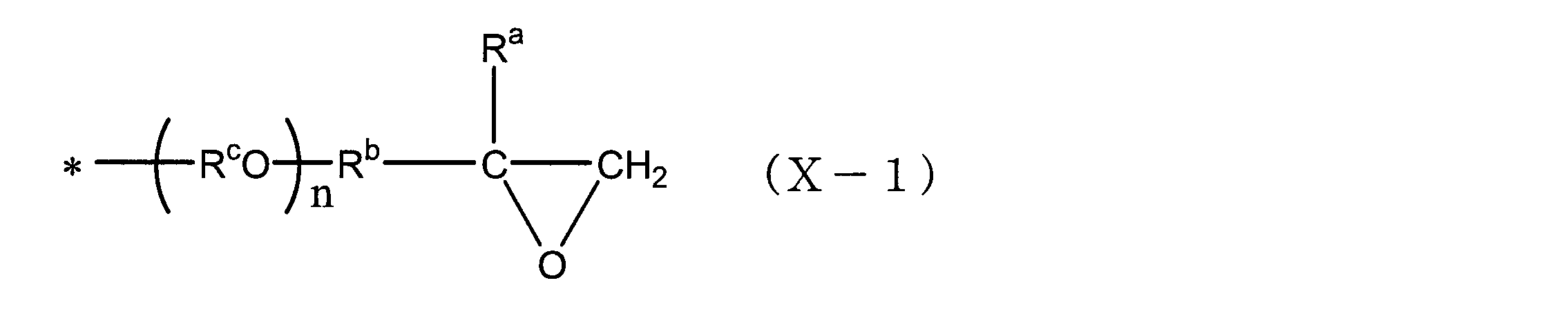
- the group having an oxiranyl group represented by X is not particularly limited, and examples thereof include a group represented by the following formula (X-1).
- R a represents a hydrogen atom or an alkyl group
- R b represents an alkylene group
- R c represents an ethylene group or a methylethylene group
- n represents 0 to 10
- R a is preferably a hydrogen atom or an alkyl group having 1 to 6 carbon atoms, particularly preferably a hydrogen atom or a methyl group.
- R b is preferably an alkylene group having 1 to 6 carbon atoms such as a methylene group, an ethylene group or a methylethylene group, and n is preferably 0 to 5.
- the group having an oxetanyl group represented by X is not particularly limited, and examples thereof include an alkyl oxetanyl group, a dialkyl oxetanyl group, an oxetanyl alkyl group, an alkyl oxetanyl alkyl group, and a dialkyl oxetanyl alkyl group.
- the alkyl group substituted on the oxetanyl group preferably has 1 to 6 carbon atoms.
- 3-C 1-6 alkyloxetane-3-yl-C 1-4 alkyl group and more specifically, 3-methyloxetane-3-ylmethyl group, 3-methyloxetane- Examples include 3-ylethyl group, 3-ethyloxetane-3-ylmethyl group, and 3-ethyloxetane-3-ylethyl group.
- the group having a polymerizable unsaturated bond represented by X is not particularly limited.
- R d represents a hydrogen atom or a methyl group
- R e independently represents an ethylene group or a methylethylene group
- l represents 2 to 10
- R f represents a hydrogen atom or a methyl group
- R g represents an ethylene group or a methylethylene group
- m represents 0 to 10
- (meth) acryloyloxyalkyl group examples include (meth) acryloyloxyethyl group, (meth) acryloyloxypropyl group, (meth) acryloyloxybutyl group and the like.
- l is preferably 2 to 5.
- m is preferably 0 to 5.
- an oxyethylene group and an oxymethylethylene group may be mixed.
- the structure of the specific crosslinking agent has two or more groups selected from a group having an oxiranyl group represented by X, a group having an oxetanyl group, and a group having a polymerizable unsaturated bond.
- X is preferably a group having an oxetanyl group, a group having a polymerizable unsaturated bond, or both of them.
- the specific crosslinking agent those having a ureido structure, a glycoluril structure, a melamine structure, a benzoguanamine structure or an imidazolidin-2-one structure are more preferable.
- the melamine structure and the benzoguanamine structure refer to a chemical structure having one or more triazine rings or phenyl-substituted triazine rings as a basic skeleton, and are a concept including a melamine compound, a benzoguanamine compound or a condensate thereof.
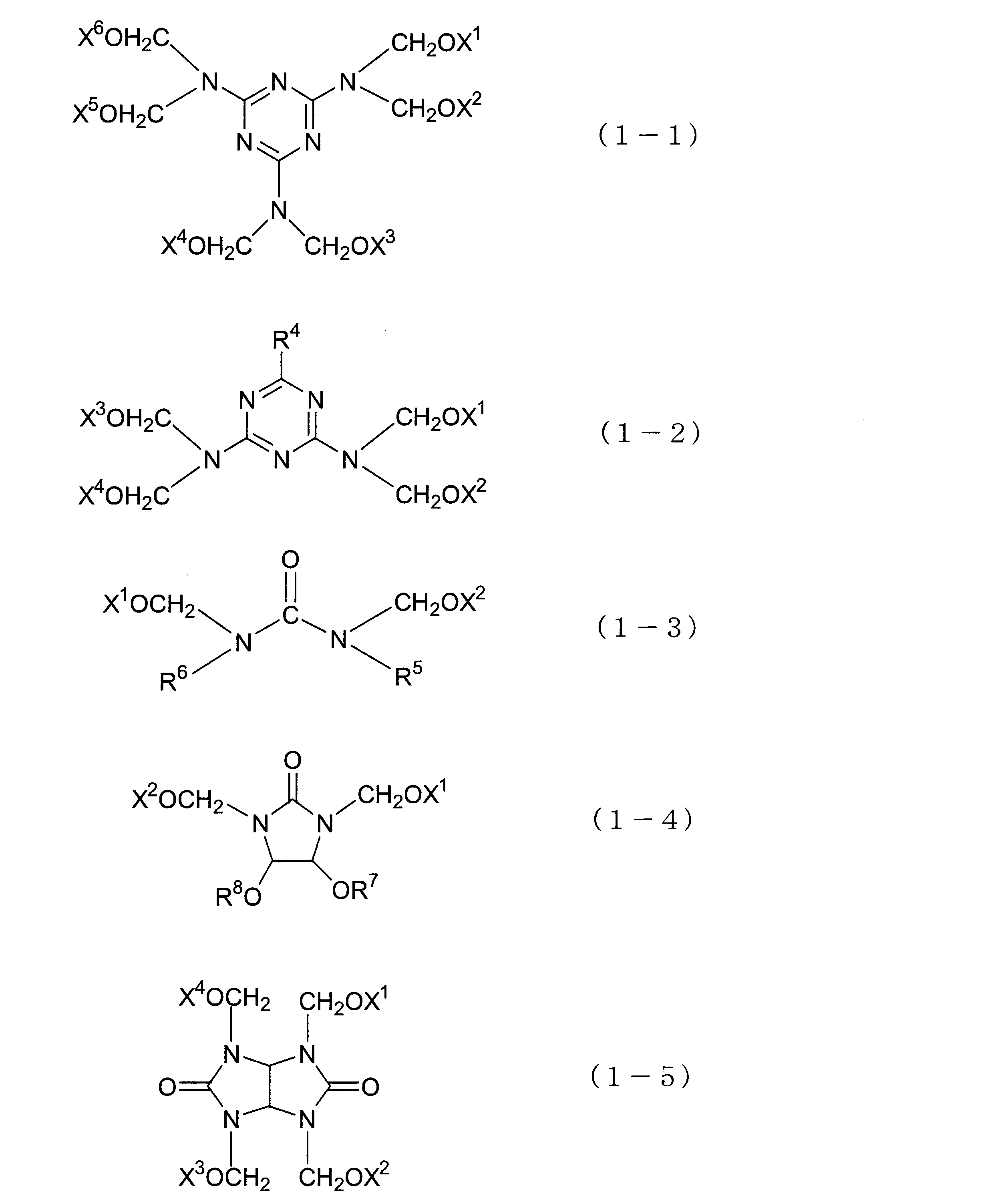
- the specific crosslinking agent is a compound selected from the following formulas (1-1), (1-2), (1-3), (1-4) and (1-5). preferable.
- X 1 to X 6 are each independently a hydrogen atom, a group having an oxiranyl group, a group having an oxetanyl group, a group having a polymerizable unsaturated bond, or an alkyl group having 1 to 6 carbon atoms.
- At least one of them is a group having an oxiranyl group, a group having an oxetanyl group, or a group having a polymerizable unsaturated bond
- R 4 represents a hydrocarbon group having 1 to 12 carbon atoms
- R 5 And R 6 each independently represent a hydrogen atom or —CH 2 OX 1
- R 7 and R 8 each independently represent an alkyl group having 1 to 6 carbon atoms.
- X 1 to X 6 in the compounds of the formulas (1-1) to (1-5) are at least two of a group having an oxiranyl group, a group having an oxetanyl group, or a group having a polymerizable unsaturated bond. It is preferable.
- the alkyl group having 1 to 6 carbon atoms in X 1 to X 6 , R 7 and R 8 include methyl group, ethyl group, n-propyl group, isopropyl group, n-butyl group, isobutyl group, sec-butyl. Group, tert-butyl group, n-pentyl group, n-hexyl group and the like.
- Examples of the hydrocarbon group having 1 to 12 carbon atoms in R 4 include an alkyl group having 1 to 12 carbon atoms and an aromatic hydrocarbon group having 6 to 12 carbon atoms. Specific examples include a methyl group, an ethyl group, an n-propyl group, an isopropyl group, and a phenyl group.
- the compounds of the formulas (1-1) and (1-2) are more preferred from the viewpoint of development resistance and solvent resistance, and particularly the formula (1-1) ) Is preferred.
- the formula (1-1) it is preferable that two or more of X 1 to X 6 are a group having an oxetanyl group or a group having a polymerizable unsaturated bond, and 2 to 2 of X 1 to X 6 More preferably, five are groups having an oxetanyl group, or at least one of X 1 to X 6 is a group having an oxetanyl group, and two or more are groups having a polymerizable unsaturated bond. .
- two or more of X 1 to X 4 are preferably a group having an oxetanyl group or a group having a polymerizable unsaturated bond, and R 4 is an aromatic group having 6 to 12 carbon atoms.
- a group hydrocarbon group is preferred.
- X 1 and X 2 is a group having an oxetanyl group
- R 5 and R 6 are -CH 2 OX 1
- X 1 of the -CH 2 OX 1 is An alkyl group having 1 to 6 carbon atoms is preferable.
- (C) specific crosslinking agent examples include compounds represented by the following (C-1) to (C-10).
- (C) specific crosslinking agent can be used individually or in mixture of 2 or more types.
- the content of (C) the specific cross-linking agent is 0.1 to 300 parts by mass, more preferably 1 to 100 parts by mass of (B) binder resin from the viewpoint of improvement in development resistance and solvent resistance. ⁇ 200 parts by weight are preferred.
- the curability of the formed colored layer can be further improved.
- the monomer having a polymerizable unsaturated bond include a polyfunctional monomer having two or more polymerizable unsaturated bonds and a monofunctional monomer having one polymerizable unsaturated bond. be able to.
- polyfunctional monomer examples include: Di (meth) acrylates of alkylene glycols such as ethylene glycol and propylene glycol; Di (meth) acrylates of polyalkylene glycols such as polyethylene glycol and polypropylene glycol; Poly (meth) acrylates of trihydric or higher polyhydric alcohols such as glycerin, trimethylolpropane, pentaerythritol, dipentaerythritol and the like, and their dicarboxylic acid-modified products; Oligo (meth) acrylates such as polyester, epoxy resin, urethane resin, alkyd resin, silicone resin, spirane resin; Di (meth) acrylates of hydroxylated polymers at both ends such as both ends hydroxypoly-1,3-butadiene, both ends hydroxypolyisoprene, both ends hydroxypolycaprolactone; Tris [2- (meth) acryloyloxyethyl] phosphate;
- Examples of the monofunctional monomer include divalent or higher polyvalent monomers such as succinic acid mono [2- (meth) acryloyloxyethyl] and phthalic acid mono [2- (meth) acryloyloxyethyl].
- Mono [(meth) acryloyloxyalkyl] esters of monovalent carboxylic acids such as ⁇ -carboxypolycaprolactone mono (meth) acrylate; N-vinylsuccin Imido, N-vinyl pyrrolidone, N-vinyl phthalimide, N-vinyl-2-piperidone, N-vinyl- ⁇ -caprolactam, N-vinyl pyrrole, N-vinyl pyrrolidine, N-vinyl imidazole, N-vinyl imidazolidine, N -Vinylindole, N-vinylindoline, N-
- the monomer having a polymerizable unsaturated bond is preferably a polyfunctional monomer, and in particular, a poly (meth) acrylate of a trihydric or higher polyhydric alcohol or a dicarboxylic acid modified product thereof, urethane.
- a poly (meth) acrylate having a structure and a poly (meth) acrylate having a caprolactone structure are preferred.
- poly (meth) acrylates of trihydric or higher polyhydric alcohols or dicarboxylic acid modified products thereof include trimethylolpropane triacrylate, trimethylolpropane trimethacrylate, pentaerythritol triacrylate, pentaerythritol trimethacrylate, pentaerythritol tetraacrylate, Pentaerythritol tetramethacrylate, dipentaerythritol pentaacrylate, dipentaerythritol pentamethacrylate, dipentaerythritol hexaacrylate, dipentaerythritol hexamethacrylate or monoesterified product of pentaerythritol triacrylate and succinic acid; pentaerythritol trimethacrylate and succinic acid Monoesterified product of dipentaerythritol Monoesterified product of taacrylate and succin
- the content of the monomer having a polymerizable unsaturated bond in the present invention is preferably 5 to 400 parts by mass, more preferably 20 to 300 parts by mass with respect to 100 parts by mass of the (C) specific crosslinking agent.
- Photopolymerization initiator- Radiation sensitivity can be imparted to the colored composition by incorporating a photopolymerization initiator into the colored composition of the present invention.
- radiation means a substance including visible light, ultraviolet light, far ultraviolet light, electron beam, X-ray and the like.
- the photopolymerization initiator is used by (C) a specific cross-linking agent and (D) a polymerizable non-polymerizing agent by exposure to radiation such as visible light, ultraviolet light, far ultraviolet light, electron beam, and X-ray. It is a compound that generates an active species capable of initiating polymerization of a monomer having a saturated bond.
- photopolymerization initiators examples include photo radical generators such as thioxanthone compounds, acetophenone compounds, biimidazole compounds, triazine compounds, O-acyloxime compounds, benzoin compounds, benzophenone compounds, Known compounds such as ⁇ -diketone compounds, polynuclear quinone compounds, and xanthone compounds can be exemplified.
- photoacid generator examples include known compounds such as an onium salt compound, a sulfone compound, a sulfonic acid ester compound, a quinonediazide compound, a sulfonimide compound, and a diazomethane compound.
- the triazine-based compounds exemplified as the photo radical generator are compounds that also function as a photo acid generator.
- a photoinitiator can be used individually or in mixture of 2 or more types, Of course, a photoradical generator and a photoacid generator can also be mixed and used.
- the photoradical generator preferably contains at least one selected from the group of thioxanthone compounds, acetophenone compounds, biimidazole compounds, triazine compounds, and O-acyloxime compounds.
- thioxanthone compounds include thioxanthone, 2-chlorothioxanthone, 2-methylthioxanthone, 2-isopropylthioxanthone, 4-isopropylthioxanthone, 2,4-dichlorothioxanthone, 2 , 4-dimethylthioxanthone, 2,4-diethylthioxanthone, 2,4-diisopropylthioxanthone and the like.
- acetophenone compound examples include 2-methyl-1- [4- (methylthio) phenyl] -2-morpholinopropan-1-one, 2-benzyl-2-dimethylamino-1- (4 -Morpholinophenyl) butan-1-one, 2- (4-methylbenzyl) -2- (dimethylamino) -1- (4-morpholinophenyl) butan-1-one, and the like.
- biimidazole compound examples include 2,2′-bis (2-chlorophenyl) -4,4 ′, 5,5′-tetraphenyl-1,2′-biimidazole, 2,2 ′.
- -Bis (2,4-dichlorophenyl) -4,4 ', 5,5'-tetraphenyl-1,2'-biimidazole, 2,2'-bis (2,4,6-trichlorophenyl) -4, 4 ′, 5,5′-tetraphenyl-1,2′-biimidazole and the like can be mentioned.
- a hydrogen donor in combination because sensitivity can be improved.
- the “hydrogen donor” as used herein means a compound that can donate a hydrogen atom to a radical generated from a biimidazole compound by exposure.
- the hydrogen donor include mercaptan-based hydrogen donors such as 2-mercaptobenzothiazole and 2-mercaptobenzoxazole, 4,4′-bis (dimethylamino) benzophenone, 4,4′-bis (diethylamino) benzophenone, and the like.
- an amine-based hydrogen donor can be used alone or in admixture of two or more. However, one or more mercaptan hydrogen donors and one or more amine hydrogen donors are used in combination. It is preferable that the sensitivity can be further improved.
- triazine compound examples include 2,4,6-tris (trichloromethyl) -s-triazine, 2-methyl-4,6-bis (trichloromethyl) -s-triazine, 2- [2 -(5-Methylfuran-2-yl) ethenyl] -4,6-bis (trichloromethyl) -s-triazine, 2- [2- (furan-2-yl) ethenyl] -4,6-bis (trichloro Methyl) -s-triazine, 2- [2- (4-diethylamino-2-methylphenyl) ethenyl] -4,6-bis (trichloromethyl) -s-triazine, 2- [2- (3,4-dimethoxy) Phenyl) ethenyl] -4,6-bis (trichloromethyl) -s-triazine, 2- (4-methoxyphenyl) -4,6-bis (t
- O-acyloxime compounds include 1,2-octanedione, 1- [4- (phenylthio) phenyl]-, 2- (O-benzoyloxime), ethanone, 1- [9-ethyl.
- a sensitizer when a photo radical generator other than a biimidazole compound such as an acetophenone compound is used, a sensitizer can be used in combination.
- a sensitizer include 4,4′-bis (dimethylamino) benzophenone, 4,4′-bis (diethylamino) benzophenone, 4-diethylaminoacetophenone, 4-dimethylaminopropiophenone, and 4-dimethyl.
- Ethyl aminobenzoate 2-ethylhexyl 4-dimethylaminobenzoate, 2,5-bis (4-diethylaminobenzal) cyclohexanone, 7-diethylamino-3- (4-diethylaminobenzoyl) coumarin, 4- (diethylamino) chalcone, etc. Can be mentioned.
- the content thereof is preferably 1 to 2000 parts by mass, more preferably 5 to 1000 parts by mass with respect to 100 parts by mass of the (C) specific crosslinking agent. If the content of the photoradical generator is too large, curing by exposure may be insufficient, while if too large, the formed colored layer tends to fall off the substrate during development.
- the photoacid generator preferably contains at least one selected from the group of onium salt compounds, sulfonimide compounds and diazomethane compounds.
- examples of the onium salt compound include diaryl iodonium salts, triarylsulfonium salts, triarylphosphonium salts and the like.
- Specific examples of the diaryliodonium salt include diphenyliodonium tetrafluoroborate, diphenyliodonium hexafluorophosphonate, diphenyliodonium hexafluoroantimonate, diphenyliodonium hexafluoroarsenate, diphenyliodonium trifluoromethanesulfonate, diphenyliodonium trifluoroacetate, diphenyl Iodonium-p-toluenesulfonate, 4-methoxyphenylphenyliodonium tetrafluoroborate, 4-methoxyphenylphenyliodonium hexafluorophosphonate, 4-methoxyphenylphenylphenyliodonium hex
- triarylsulfonium salt examples include triphenylsulfonium tetrafluoroborate, triphenylsulfonium hexafluorophosphonate, triphenylsulfonium hexafluoroantimonate, triphenylsulfonium hexafluoroarsenate, triphenylsulfonium trifluoromethanesulfonate, triphenylsulfonium hexafluorophosphonate, Phenylsulfonium trifluoroacetate, triphenylsulfonium-p-toluenesulfonate, 4-methoxyphenyldiphenylsulfonium tetrafluoroborate, 4-methoxyphenyldiphenylsulfonium hexafluorophosphonate, 4-methoxyphenyldiphenylsulfonium hexafluoroantimonate, 4-methoxy
- triarylphosphonium salt examples include triphenylphosphonium tetrafluoroborate, triphenylphosphonium hexafluorophosphonate, triphenylphosphonium hexafluoroantimonate, triphenylphosphonium hexafluoroarsenate, triphenylphosphonium trifluoromethanesulfonate, Phenylphosphonium trifluoroacetate, triphenylphosphonium-p-toluenesulfonate, 4-methoxyphenyldiphenylphosphonium tetrafluoroborate, 4-methoxyphenyldiphenylphosphonium hexafluorophosphonate, 4-methoxyphenyldiphenylphosphonium hexafluoroantimonate, 4-methoxy Phenyldiphenylphosphonium hex Fluoroarsenate, 4-methoxyphenyldiphenylphosphonium trifluoromethanes, Ph
- sulfonimide compound examples include N- (trifluoromethylsulfonyloxy) succinimide, N- (trifluoromethylsulfonyloxy) phthalimide, N- (trifluoromethylsulfonyloxy) diphenylmaleimide, N- (trimethyl).
- diazomethane compound examples include bis (trifluoromethylsulfonyl) diazomethane, bis (cyclohexylsulfonyl) diazomethane, bis (phenylsulfonyl) diazomethane, bis (p-toluenesulfonyl) diazomethane, methylsulfonyl-p-toluenesulfonyl.
- diazomethane 1-cyclohexylsulfonyl-1- (1,1-dimethylethylsulfonyl) diazomethane, bis (1,1-dimethylethylsulfonyl) diazomethane, and the like.
- the content thereof when a photoacid generator is used, the content thereof is usually 0.1 to 100 parts by mass, preferably 0.3 to 50 parts by mass with respect to 100 parts by mass of (C) the specific crosslinking agent. It is. If the content of the photoacid generator is too small, curing by exposure may be insufficient. On the other hand, if the content is too large, foreign matter may be generated in the colored composition liquid or electrical characteristics may be deteriorated. is there.
- the coloring composition of this invention can also contain a various additive as needed.
- the additive include a thermal acid generator that promotes a curing reaction by opening a ring of an oxiranyl group, an oxetanyl group, and the like of the (C) specific crosslinking agent in the post-baking step.
- thermal acid generators include 4-acetoxyphenyldimethylsulfonium hexafluoroarsenate, benzyl-4-hydroxyphenylmethylsulfonium hexafluoroantimonate, 4-acetoxyphenylbenzylmethylsulfonium hexafluoroantimonate, dibenzyl-4 -Hydroxyphenylsulfonium hexafluoroantimonate, 4-acetoxyphenylbenzylsulfonium hexafluoroantimonate, 3-benzylbenzothiazonium hexafluoroantimonate, and the like.
- additives include, for example, fillers such as glass and alumina; polymer compounds such as polyvinyl alcohol and poly (fluoroalkyl acrylates); nonionic surfactants, cationic surfactants, anionic surfactants Surfactant such as an agent; vinyltrimethoxysilane, vinyltriethoxysilane, vinyltris (2-methoxyethoxy) silane, N- (2-aminoethyl) -3-aminopropylmethyldimethoxysilane, N- (2-aminoethyl) ) -3-Aminopropyltrimethoxysilane, 3-aminopropyltriethoxysilane, 3-glycidoxypropyltrimethoxysilane, 3-glycidoxypropylmethyldimethoxysilane, 2- (3,4-epoxycyclohexyl) ethyltri Methoxysilane, 3-chloropropylmethyl Adhesion promoters such as me
- the coloring composition of the present invention contains the components (A) to (C) and other components that are optionally added, and is usually prepared as a liquid composition by blending a solvent.
- the solvent is appropriately selected as long as it is dispersed or dissolved (A) to (C) and other components constituting the coloring composition and does not react with these components and has appropriate volatility. You can choose to use.
- Alcohols such as methanol, ethanol, benzyl alcohol; Ethylene glycol monomethyl ether, ethylene glycol monoethyl ether, ethylene glycol mono-n-propyl ether, ethylene glycol mono-n-butyl ether, diethylene glycol monomethyl ether, diethylene glycol monoethyl ether, diethylene glycol mono-n-propyl ether, diethylene glycol mono-n- Butyl ether, triethylene glycol monomethyl ether, triethylene glycol monoethyl ether, propylene glycol monomethyl ether, propylene glycol monoethyl ether, dipropylene glycol monomethyl ether, dipropylene glycol monoethyl ether, dipropylene glycol mono-n-propyl ether, di Propylene glycol mono- - butyl ether, tripropylene glycol monomethyl ether, tripropylene glycol (poly) alkylene glycol monoal
- Diacetates such as propylene glycol diacetate, 1,3-butylene glycol diacetate, and 1,6-hexanediol diacetate; Lactic acid alkyl esters such as methyl lactate and ethyl lactate; Ethyl acetate, n-propyl acetate, i-propyl acetate, n-butyl acetate, i-butyl acetate, n-pentyl formate, i-pentyl acetate, 3-methoxybutyl acetate, 3-methyl-3-methoxybutyl acetate, N-butyl propionate, 3-methoxybutyl acetate, 3-methyl-3-methoxybutyl propionate, ethyl butyrate, n-propyl butyrate, i-propyl butyrate, n-butyl butyrate, ethyl hydroxyacetate, ethyl ethoxyacetate,
- benzyl alcohol ethylene glycol mono-n-butyl ether, propylene glycol monomethyl ether, propylene glycol monoethyl ether, ethylene glycol monomethyl ether acetate, ethylene glycol are used from the viewpoints of solubility, pigment dispersibility, coatability, etc.
- a high boiling point solvent such as diethyl, ⁇ -butyrolactone, ethylene carbonate, propylene carbonate, ethylene glycol monophenyl ether acetate may be used in combination.
- the high boiling point solvents can be used alone or in admixture of two or more.
- the content of the solvent is not particularly limited, but the total concentration of each component excluding the solvent from the colored composition is usually 5 from the viewpoint of applicability and stability of the obtained colored composition. An amount of ⁇ 50 mass% is preferred, and an amount of 10 ⁇ 40 mass% is particularly desirable.
- the coloring composition can be prepared by an appropriate method.
- the coloring composition is prepared by mixing the components (A) to (C) together with a solvent and other components optionally added. Can do.
- a preferable preparation method for example, a bead mill, a roll mill, or the like is used together with a part of the component (B) in the presence of (A) a colorant in a solvent, a dispersant and, if necessary, a dispersion aid. Mix and disperse while pulverizing to obtain a pigment dispersion, which is prepared by adding components (B) to (C) and, if necessary, additional solvent and other components and mixing them.
- a method can be mentioned.
- an appropriate dispersant such as a cationic, anionic, nonionic or amphoteric
- a polymer dispersant is preferable.
- a modified acrylic copolymer, an acrylic copolymer, polyurethane, polyester, a polymer copolymer alkylammonium salt or phosphate ester salt, a cationic comb graft polymer, and the like can be given.
- the cationic comb graft polymer refers to a polymer having a structure in which two or more branched polymers are grafted to one molecule of a trunk polymer having a plurality of basic groups (cationic functional groups).
- Examples thereof include polymers composed of a ring-opening polymer in which the trunk polymer part is polyethyleneimine and the branch polymer part is ⁇ -caprolactone.
- these dispersants modified acrylic copolymers, polyurethane, and cationic comb graft polymers are preferable.
- Such a dispersant is commercially available.
- Disperbyk-2000, Disperbyk-2001, BYK-LPN6919, BYK-LPN21116, BYK-LPN21324 above, BYK Dispersbyk-161, Disperbyk-162, Disperbyk-165, Disperbyk-167, Disperbyk-170, Disperbyk-182 (or more, manufactured by BYK Chemy (BYK)
- Solsperse 76500 Librisol Co., Ltd.
- Solsperse 24000 manufactured by Lubrizol Co., Ltd.
- Azisper PB821, Azisper PB822 AJISPER PB823, Adisper PB824 mention may be made of Ajisper PB827 (Ajinomoto Fine-Techno Co., Ltd.), and the like.
- the content of the dispersant is usually 100 parts by mass or less, preferably 0.5 to 100 parts by mass, more preferably 1 with respect to 100 parts by mass of the colorant (A) from the viewpoint of improving developability and the like. It is ⁇ 70 parts by mass, particularly preferably 10 to 50 parts by mass.
- the color filter of the present invention comprises a colored layer formed from the colored composition of the present invention.
- a method for forming a color filter first, a colored radiation-sensitive composition coating film is formed on a substrate or a substrate on which a light-shielding layer having a desired pattern has been previously formed, and a photo having a predetermined pattern is formed.
- a method of obtaining pixels of each color by exposing radiation through a mask, developing to dissolve and remove unexposed portions, and then post-baking.
- a light shielding layer black matrix
- a red pigment for example, is dispersed on the substrate.
- pre-baking is performed to evaporate the solvent, thereby forming a coating film.
- the coating film is exposed through a photomask, and then developed using an alkali developer to dissolve and remove the unexposed portions of the coating film, and then post-baked to form a red pixel pattern.
- a pixel array arranged in an array is formed.
- the liquid composition is applied, pre-baked, exposed, developed, and post-baked in the same manner as described above, to thereby obtain a green pixel.
- a color filter in which the pixel arrays of the three primary colors of red, green and blue are arranged on the substrate is obtained.
- the order of forming the pixels of each color is not limited to the above.
- the black matrix can be formed in the same manner as in the case of forming the pixel by using the colored composition of the present invention.
- the substrate used when forming the pixel and / or the black matrix examples include glass, silicon, polycarbonate, polyester, aromatic polyamide, polyamideimide, and polyimide.
- these substrates may be subjected to appropriate pretreatment such as chemical treatment with a silane coupling agent or the like, plasma treatment, ion plating, sputtering, gas phase reaction method, vacuum deposition, etc., if desired.
- an appropriate coating method such as a spray method, a roll coating method, a spin coating method (spin coating method), a slit die coating method, a bar coating method, or an ink jet method is used.
- spin coating and slit die coating are preferable.
- the coating thickness is usually 0.1 to 10 ⁇ m, preferably 0.2 to 8.0 ⁇ m, particularly preferably 0.2 to 6.0 ⁇ m, as the film thickness after drying.
- the radiation used for forming the pixel and / or the black matrix for example, visible light, ultraviolet light, far ultraviolet light, electron beam, X-ray or the like can be used, but the wavelength is in the range of 190 to 450 nm. Some radiation is preferred.
- the exposure dose of radiation is preferably 10 to 10,000 J / m 2 . According to the colored composition of the present invention, 800 J / m 2 or less of the exposure amount, and further it can form pixels excellent in solvent resistance at 600 J / m 2 or less of the exposure amount.
- alkali developer examples include sodium carbonate, sodium hydroxide, potassium hydroxide, tetramethylammonium hydroxide, choline, 1,8-diazabicyclo- [5.4.0] -7-undecene, 1, An aqueous solution of 5-diazabicyclo- [4.3.0] -5-nonene or the like is preferable.
- An appropriate amount of a water-soluble organic solvent such as methanol or ethanol, a surfactant, or the like can be added to the alkaline developer. In addition, it is usually washed with water after alkali development.
- a development processing method a shower development method, a spray development method, a dip (immersion) development method, a paddle (liquid accumulation) development method, or the like can be applied.
- the development conditions are preferably 5 to 300 seconds at room temperature.
- a method for obtaining pixels of each color by an ink jet method disclosed in Japanese Patent Laid-Open Nos. 4-2615033 and 7-318723 is also known.
- the color filter of the present invention thus obtained is extremely useful for high-definition color liquid crystal surface elements, color image pickup tube elements, color sensors and the like.
- the color liquid crystal display element of the present invention comprises the color filter of the present invention.
- the color liquid crystal display element of the present invention can have an appropriate structure.
- the color filter is formed on a substrate different from the driving substrate on which the thin film transistor (TFT) is arranged, and the driving substrate and the substrate on which the color filter is formed are opposed to each other with a liquid crystal layer interposed therebetween. Can be taken.
- a substrate on which a color filter is formed on the surface of a driving substrate on which a thin film transistor (TFT) is disposed, and a substrate on which an ITO (tin-doped indium oxide) electrode is formed are opposed to each other through a liquid crystal layer.
- the structure can be taken.
- the latter structure has the advantage that the aperture ratio can be remarkably improved, and a bright and high-definition liquid crystal display element can be obtained.
- Preparation Example 2 (A) 20 parts by mass of carbon black as a colorant, 4 parts by mass of Disperbyk-167 as a dispersant (in terms of solid content), and 3-methoxybutyl acetate as a solvent so that the solid content concentration is 24% by mass,
- the pigment dispersion (A-2) was prepared by processing with a bead mill.
- Synthesis example 2 A flask equipped with a condenser and a stirrer was charged with 800 g of cyclohexanone, heated to 100 ° C. while injecting nitrogen gas into the flask, and at the same temperature, 60.0 g of styrene, 60.0 g of methacrylic acid, 65. methyl methacrylate. A mixture of 0 g, butyl methacrylate 65.0 g, and azobisisobutyronitrile 10.0 g was added dropwise over 1 hour, and further reacted at 100 ° C. for 3 hours, and then 2.0 g of azobisisobutyronitrile was added.
- Synthesis example 4 In a four-necked flask equipped with a stirrer, thermometer, reflux condenser, and gas introduction tube, 580 g of Cymel 300, 642 g of 3-ethyl-3-hydroxymethyloxetane, 580 g of propylene glycol monomethyl ether acetate, and 2 g of p-toluenesulfonic acid were added. The mixture was heated to 80 ° C. and reacted for 1 hour while distilling off the generated methanol. Then, it neutralized with 0.1N sodium hydroxide aqueous solution, and the non volatile matter was 80 mass% by vacuum concentration.
- a specific cross-linking agent in which an average of about 4 of the 6 methoxy groups in the compound represented by the formula (a) is substituted with a (3-ethyloxetane-3-yl) methoxy group is used.
- the obtained specific crosslinking agent mixture is designated as specific crosslinking agent [C-2].
- a compound in which an average of about 4 of the 6 methoxy groups in the compound represented by the formula (a) is substituted with a (3-ethyloxetane-3-yl) methoxy group is obtained.
- Synthesis example 5 In a four-necked flask equipped with a stirrer, thermometer, reflux condenser and gas introduction tube, 126 g of melamine, 202 g of 92% paraformaldehyde (Mitsubishi Gas Chemical Co., Ltd.), 1393 g of 2-hydroxyethyl acrylate, 520 g of 2-hydroxyethyl methacrylate Then, 256 g of methanol was added, the temperature was raised to 80 ° C., a methylolation reaction was performed at 80 ° C. for 1 hour, 1 g of p-toluenesulfonic acid was added, and an etherification reaction was performed at 80 ° C. for 3 hours.
- the obtained specific crosslinking agent mixture is designated as specific crosslinking agent [C-3].
- specific crosslinking agent [C-3] Of the six methoxy groups in the compound represented by the above formula (a), a compound having an average of about 3 substituted with an acryloyloxyethyloxy group and an average of about 1 with a methacryloyloxyethyloxy group It was confirmed by 1 H-NMR and GPC that it was obtained.
- Synthesis Example 6 A four-necked flask equipped with a stirrer, thermometer, reflux condenser and gas introduction tube was charged with 126 g of melamine, 202 g of 92% paraformaldehyde, 290 g of 3-ethyl-3-hydroxymethyloxetane, and 160 g of methanol, and the temperature was raised to 80 ° C. The methylolation reaction was carried out at 80 ° C. for 1 hour, 1 g of p-toluenesulfonic acid was added, and the etherification reaction was carried out at 80 ° C. for 3 hours.
- Synthesis example 7 In a four-necked flask equipped with a stirrer, thermometer, reflux condenser and gas introduction tube, 580 g of Cymel 300, 325 g of 3-ethyl-3-hydroxymethyloxetane, 325 g of 2-hydroxyethyl acrylate, glycidol (manufactured by NOF Corporation) ) 104 g, toluene 580 g and p-toluenesulfonic acid 1 g were charged and heated to 80 ° C., and the reaction was carried out for 3 hours while distilling off the generated methanol.
- an average of about 2 is a (3-ethyloxetane-3-yl) methoxy group and an average of about 2 is acryloyl.
- a solution of a specific cross-linking agent mixture containing a specific cross-linking agent having an average of about 1 oxyethyloxy group substituted with a glycidyloxy group was obtained.
- the obtained specific crosslinking agent mixture is designated as specific crosslinking agent [C-5].
- an average of about 2 is a (3-ethyloxetane-3-yl) methoxy group and an average of about 2 is acryloyloxyethyloxy. It was confirmed by 1 H-NMR and GPC that a compound having an average of about 1 group substituted with a glycidyloxy group was obtained.
- Synthesis example 8 In a four-necked flask equipped with a stirrer, thermometer, reflux condenser and gas introduction tube, melamine 126 g, 202% paraformaldehyde 202 g, 2-hydroxyethyl acrylate 1393 g, 2-hydroxyethyl vinyl ether (manufactured by Maruzen Petrochemical Co., Ltd.) 280 g Then, 256 g of methanol was added, the temperature was raised to 80 ° C., and a methylolation reaction was performed at 80 ° C. for 1 hour, 1 g of paratoluenesulfonic acid was added, and an etherification reaction was performed at 80 ° C. for 3 hours.
- R is a methyl group or an ethyl group.
- Synthesis Example 11 In a four-necked flask equipped with a stirrer, thermometer, reflux condenser and gas introduction tube, 126 g of melamine, 202 g of 92% paraformaldehyde, 464 g of 2-hydroxyethyl acrylate, 116 g of 3-ethyl-3-hydroxymethyloxetane, and 32 g of methanol The mixture was heated up to 80 ° C. and subjected to a methylolation reaction at 80 ° C. for 1 hour, 1 g of p-toluenesulfonic acid was added, and an etherification reaction was carried out at 80 ° C. for 3 hours.
- the obtained specific crosslinker mixture is designated as specific crosslinker [C-9].
- specific crosslinker [C-9] Of the six methoxy groups in the compound represented by the formula (a), an average of about 4 is an acryloyloxyethyloxy group and an average of about 1 is (3-ethyloxetane-3-yl) methoxy. It was confirmed by 1 H-NMR that a compound substituted with a group was obtained.
- Example 1 Preparation of coloring composition (A) 100.0 parts by mass of pigment dispersion (A-1) as a colorant, (B) 26.0 parts by mass of a binder resin [B-1] solution as a binder resin, and a binder resin [B- 2) 6.6 parts by mass of the solution, (C) 9.9 parts by mass of the solution containing the specific cross-linking agent [C-1] as the specific cross-linking agent, and (D) Toagosei as the monomer having a polymerizable unsaturated bond 5.4 parts by mass of M-402 (dipentaerythritol hexaacrylate) manufactured by Toyo Gosei Co., Ltd.
- M-402 dipentaerythritol hexaacrylate
- Pattern formation The colored radiation-sensitive composition obtained was applied to a soda glass substrate with a SiO 2 film formed on the surface to prevent elution of sodium ions, using a spin coater, and then on a hot plate at 90 ° C. Was pre-baked for 2 minutes to form a film having a thickness of 1.7 ⁇ m.
- each wavelength of 365 nm, 405 nm, and 436 nm was applied to the coating film through a photomask having a plurality of slits having different sizes in a width range of 5 to 50 ⁇ m using a high-pressure mercury lamp. Exposed ultraviolet light was exposed. The exposure amount at this time was 500 J / m 2 .
- the substrate was subjected to shower development using a 0.04 mass% potassium hydroxide aqueous solution at 23 ° C. for 1 minute, then washed with ultrapure water and air-dried. Thereafter, post-baking was performed in a clean oven at 220 ° C. for 30 minutes to form a pixel array in which red stripe pixel patterns were arranged on the substrate.
- the obtained colored radiation-sensitive composition was applied to a soda glass substrate having a SiO 2 film formed on its surface to prevent elution of sodium ions, using a spin coater, and then a hot plate at 90 ° C. The film was pre-baked for 2 minutes to form a film having a thickness of 1.7 ⁇ m. Next, after cooling the substrate to room temperature, the coating film was exposed to ultraviolet rays including wavelengths of 365 nm, 405 nm, and 436 nm without using a photomask using a high-pressure mercury lamp. The exposure amount at this time was 500 J / m 2 .
- the substrate was subjected to shower development using a 0.04 mass% potassium hydroxide aqueous solution at 23 ° C. for 1 minute, then washed with ultrapure water and air-dried. Thereafter, post-baking was performed in a clean oven at 220 ° C. for 30 minutes to form a red cured film on the substrate.
- the substrate on which the red cured film was formed was immersed in N-methylpyrrolidone at 60 ° C. for 30 minutes.
- the film thickness ratio before and after immersion film thickness after immersion ⁇ 100 / film thickness before immersion
- the case where the film thickness ratio before and after immersion was less than 95% or the N-methylpyrrolidone after immersion was slightly colored was evaluated as “B”, and the case where cracks occurred after immersion was evaluated as “C”.
- Example 1 As shown in Table 1, a colored radiation-sensitive composition was prepared in the same manner as in Example 1 except that the type and content (parts by mass) of each component were changed. Subsequently, various evaluation was performed like Example 1 using the obtained colored radiation-sensitive composition. The results are shown in Table 1.
- each component is as follows.
- c-1 Cymel 300 manufactured by Nippon Cytec Industries, Ltd. (compound of formula (a) as a main component)
- c-2 Cymel 1123 manufactured by Nippon Cytec Industries, Ltd. (compound of formula (c) as a main component)
- D-1 Dipentaerythritol hexaacrylate (trade name M-402, manufactured by Toagosei Co., Ltd.)
- D-2 monoesterified product of dipentaerythritol pentaacrylate and succinic acid, dipentaerythritol hexaacrylate and mixture of dipentaerythritol pentaacrylate (trade name TO-1382, manufactured by Toagosei Co., Ltd.)
- D-3 Pentaerythritol tetraacrylate (trade name M-450, manufactured by Toagosei Co., Ltd.)
- E-1 2-methyl-1- [4- (methylthio) pheny
Landscapes
- Chemical & Material Sciences (AREA)
- Physics & Mathematics (AREA)
- Organic Chemistry (AREA)
- Dispersion Chemistry (AREA)
- Chemical Kinetics & Catalysis (AREA)
- General Physics & Mathematics (AREA)
- Optics & Photonics (AREA)
- Materials For Photolithography (AREA)
- Optical Filters (AREA)
Abstract
Description
本発明の他の課題は、前記着色組成物から形成された画素を有するカラーフィルタ、及び当該カラーフィルタを具備するカラー液晶表示素子を提供することにある。

本発明でいう「着色層」は、カラーフィルタに用いられる画素及び/又はブラックマトリックスからなる層を意味する。
したがって、本発明の着色組成物は、電子工業分野におけるカラー液晶表示素子用カラーフィルタを始め、カラー撮像管素子、カラーセンサー等の各種用途のカラーフィルタの製造に極めて好適に使用することができる。
着色組成物
以下、本発明の着色組成物の構成成分について説明する。
本発明における着色剤は、色調が特に限定されるものではなく、得られるカラーフィルタの用途に応じて適宜選定され、顔料、染料あるいは天然色素の何れでもよい。カラーフィルタには耐熱性、発色性及び輝度が求められることから、本発明における着色剤としては、有機顔料、無機顔料又は有機染料が好ましい。
前記有機顔料としては、例えば、カラーインデックス(C.I.;The Society of Dyers and Colourists 社発行)においてピグメントに分類されている化合物、具体的には、下記のようなカラーインデックス(C.I.)名が付されているものを挙げることができる。
C.I.ピグメントブルー15、C.I.ピグメントブルー15:3、C.I.ピグメントブルー15:4、C.I.ピグメントブルー15:6、C.I.ピグメントブルー60、C.I.ピグメントブルー80;
C.I.ピグメントグリーン7、C.I.ピグメントグリーン36、C.I.ピグメントグリーン58;
C.I.ピグメントブラウン23、C.I.ピグメントブラウン25;
C.I.ピグメントブラック1、C.I.ピグメントブラック7。
C.I.アシッドイエロー11、C.I.アシッドオレンジ7、C.I.アシッドレッド37、C.I.アシッドレッド180、C.I.アシッドブルー29、C.I.ダイレクトレッド28、C.I.ダイレクトレッド83、C.I.ダイレクトイエロー12、C.I.ダイレクトオレンジ26、C.I.ダイレクトグリーン28、C.I.ダイレクトグリーン59、C.I.リアクティブイエロー2、C.I.リアクティブレッド17、C.I.リアクティブレッド120、C.I.リアクティブブラック5、C.I.ディスパースオレンジ5、C.I.ディスパースレッド58、C.I.ディスパースブルー165、C.I.ベーシックブルー41、C.I.ベーシックレッド18、C.I.モルダントレッド7、C.I.モルダントイエロー5、C.I.モルダントブラック7等のアゾ系染料;
C.I.バットブルー4、C.I.アシッドブルー40、C.I.アシッドグリーン25、C.I.リアクティブブルー19、C.I.リアクティブブルー49、C.I.ディスパースレッド60、C.I.ディスパースブルー56、C.I.ディスパースブルー60等のアントラキノン系染料;
C.I.パッドブルー5等のフタロシアニン系染料;
C.I.ベーシックブルー3、C.I.ベーシックブルー9等のキノンイミン系染料;
C.I.ソルベントイエロー33、C.I.アシッドイエロー3、C.I.ディスパースイエロー64等のキノリン系染料;
C.I.アシッドイエロー1、C.I.アシッドオレンジ3、C.I.ディスパースイエロー42等のニトロ系染料。
(A)着色剤は、単独で又は2種以上を混合して使用することができる。
一方、本発明の着色組成物をブラックマトリックスの形成に用いる場合、ブラックマトリックスには遮光性が要求されることから、(A)着色剤としては有機顔料又はカーボンブラックが好ましく用いられる。
また、本発明の着色組成物は、(A)着色剤として、C.I.ピグメントレッド254、C.I.ピグメントグリーン58及びカーボンブラックよりなる群から選ばれる少なくとも1種を含有する着色組成物を用いて形成された着色層の耐溶剤性を向上させる点で特に有用である。また、本発明の着色組成物は、(A)着色剤として、有機染料を含有する着色組成物を用いて形成された着色層の耐溶剤性を向上させる点でも有用である。
本発明における(B)バインダー樹脂としては、特に限定されるものではないが、カルボキシル基、フェノール性水酸基等の酸性官能基を有するアルカリ可溶性樹脂であることが好ましい。中でも、カルボキシル基を有する重合体(以下、「カルボキシル基含有重合体」という。)が好ましく、特に、1個以上のカルボキシル基を有するエチレン性不飽和単量体(以下、「カルボキシル基含有不飽和単量体」という。)と他の共重合可能なエチレン性不飽和単量体(以下、「共重合性不飽和単量体」という。)との共重合体(カルボキシル基を有する共重合体)が好ましい。なお、本願明細書において、(メタ)アクリル酸とはメタクリル酸又はアクリル酸を示す。
カルボキシル基含有不飽和単量体と共重合性不飽和単量体との共重合体において、カルボキシル基含有不飽和単量体の共重合割合は、好ましくは5~50質量%、更に好ましくは10~40質量%である。このような範囲でカルボキシル基含有不飽和単量体を共重合させることにより、アルカリ現像性及び保存安定性に優れた着色組成物を得ることができる。
N-フェニルマレイミド、N-シクロヘキシルマレイミドの如きN-位置換マレイミド;
スチレン、α-メチルスチレン、p-ヒドロキシスチレン、p-ヒドロキシ-α-メチルスチレン、p-ビニルベンジルグリシジルエーテル、アセナフチレンの如き芳香族ビニル化合物;
メチル(メタ)アクリレート、n-ブチル(メタ)アクリレート、2-エチルヘキシル(メタ)アクリレート、2-ヒドロキシエチル(メタ)アクリレート、アリル(メタ)アクリレート、ベンジル(メタ)アクリレート、ポリエチレングルコール(n=2~10)メチルエーテル(メタ)アクリレート、ポリプロピレングルコール(n=2~10)メチルエーテル(メタ)アクリレート、ポリエチレングリコール(n=2~10)モノ(メタ)アクリレート、ポリプロピレングリコール(n=2~10)モノ(メタ)アクリレート、シクロヘキシル(メタ)アクリレート、イソボルニル(メタ)アクリレート、トリシクロ[5.2.1.02,6]デカン-8-イル(メタ)アクリレート、ジシクロペンテニル(メタ)アクリレート、グリセロールモノ(メタ)アクリレート、4-ヒドロキシフェニル(メタ)アクリレート、パラクミルフェノールのエチレンオキサイド変性(メタ)アクリレート、グリシジル(メタ)アクリレート、3,4-エポキシシクロヘキシルメチル(メタ)アクリレート、3-〔(メタ)アクリロイルオキシメチル〕オキセタン、3-〔(メタ)アクリロイルオキシメチル〕-3-エチルオキセタンの如き不飽和カルボン酸エステル;
シクロヘキシルビニルエーテル、イソボルニルビニルエーテル、トリシクロ[5.2.1.02,6]デカン-8-イルビニルエーテル、ペンタシクロペンタデカニルビニルエーテル、3-(ビニルオキシメチル)-3-エチルオキセタンの如きビニルエーテル;
ポリスチレン、ポリメチル(メタ)アクリレート、ポリ-n-ブチル(メタ)アクリレート、ポリシロキサンの如き重合体分子鎖の末端にモノ(メタ)アクリロイル基を有するマクロモノマー等を挙げることができる。
これらの共重合性不飽和単量体は、単独で又は2種以上を混合して使用することができる。
また、本発明におけるバインダー樹脂のMwと、ゲルパーミエーションクロマトグラフィー(GPC、溶出溶媒:テトラヒドロフラン)で測定したポリスチレン換算数平均分子量(以下、「Mn」という。)の比(Mw/Mn)は、好ましくは1.0~5.0、より好ましくは1.0~3.0である。
本発明において、バインダー樹脂の含有量は、(A)着色剤100質量部に対して、通常、10~1,000質量部、好ましくは20~500質量部である。バインダー樹脂の含有量が少なすぎると、例えば、アルカリ現像性が低下したり、得られる着色組成物の保存安定性が低下したりするおそれがあり、一方多すぎると、相対的に着色剤濃度が低下するため、薄膜としたときに目的とする色濃度を達成することが困難となるおそれがある。
本発明における(C)特定架橋剤は、上記式(1)で表される構造を有する化合物であり、露光又はポストベーク工程の際に重合し、塗膜を硬化させる成分である。本発明の着色組成物は、(C)特定架橋剤を含有することにより、現像耐性と耐溶剤性に優れた着色層を形成することができる。



また、X1~X6、R7及びR8における炭素数1~6のアルキル基としては、メチル基、エチル基、n-プロピル基、イソプロピル基、n-ブチル基、イソブチル基、sec-ブチル基、tert-ブチル基、n-ペンチル基、n-ヘキシル基等が挙げられる。
式(1-1)において、X1~X6のうちの2つ以上がオキセタニル基を有する基又は重合性不飽和結合を有する基であることが好ましく、X1~X6のうちの2~5つがオキセタニル基を有する基であるか、又はX1~X6のうちの少なくとも1つがオキセタニル基を有する基であり、かつ2つ以上が重合性不飽和結合を有する基であることが更に好ましい。
式(1-2)において、X1~X4のうちの2つ以上がオキセタニル基を有する基又は重合性不飽和結合を有する基であることが好ましく、R4が炭素数6~12の芳香族炭化水素基であることが好ましい。
式(1-3)において、X1及びX2がオキセタニル基を有する基であることが好ましく、R5及びR6が-CH2OX1であり、かつ該-CH2OX1のX1が炭素数1~6のアルキル基であることが好ましい。

本発明において、(C)特定架橋剤の含有量は、現像耐性の向上及び耐溶剤性の向上の点から、(B)バインダー樹脂100質量部に対して0.1~300質量部、更に1~200質量部が好ましい。
本発明においては、更に(D)重合性不飽和結合を有する単量体(但し、上記(C)成分を除く。)を使用することにより、形成される着色層の硬化性を更に高めることができる。重合性不飽和結合を有する単量体としては、2個以上の重合性不飽和結合を有する多官能性単量体、及び1個の重合性不飽和結合を有する単官能性単量体を挙げることができる。
エチレングリコール、プロピレングリコール等のアルキレングリコールのジ(メタ)アクリレート類;
ポリエチレングリコール、ポリプロピレングリコール等のポリアルキレングリコールのジ(メタ)アクリレート類;
グリセリン、トリメチロールプロパン、ペンタエリスリトール、ジペンタエリスリトール等の3価以上の多価アルコールのポリ(メタ)アクリレート類や、それらのジカルボン酸変性物;
ポリエステル、エポキシ樹脂、ウレタン樹脂、アルキド樹脂、シリコーン樹脂、スピラン樹脂等のオリゴ(メタ)アクリレート類;
両末端ヒドロキシポリ-1,3-ブタジエン、両末端ヒドロキシポリイソプレン、両末端ヒドロキシポリカプロラクトン等の両末端ヒドロキシル化重合体のジ(メタ)アクリレート類;
トリス〔2-(メタ)アクリロイルオキシエチル〕フォスフェート;
イソシアヌル酸エチレンオキシド変性トリアクリレート;
ウレタン構造を有するポリ(メタ)アクリレート;
カプロラクトン構造を有するポリ(メタ)アクリレート
等を挙げることができる。
これらの多官能性単量体は、単独で又は2種以上を混合して使用することができる。
これらの単官能性単量体は、単独で又は2種以上を混合して使用することができる。
本発明の着色組成物には、光重合開始剤を含有せしめることにより、着色組成物に感放射線性を付与することができる。ここでいう「放射線」は、可視光線、紫外線、遠紫外線、電子線、X線等を含むものを意味する。
本発明における(E)光重合開始剤は、可視光線、紫外線、遠紫外線、電子線、X線等の放射線の露光により、(C)特定架橋剤及び場合により使用される(D)重合性不飽和結合を有する単量体の重合を開始しうる活性種を発生する化合物である。
このような光重合開始剤としては、光ラジカル発生剤として、例えば、チオキサントン系化合物、アセトフェノン系化合物、ビイミダゾール系化合物、トリアジン系化合物、O-アシルオキシム系化合物、ベンゾイン系化合物、ベンゾフェノン系化合物、α-ジケトン系化合物、多核キノン系化合物、キサントン系化合物等の公知の化合物を挙げることができる。
また、光酸発生剤として、例えば、オニウム塩化合物、スルホン化合物、スルホン酸エステル化合物、キノンジアジド化合物、スルホンイミド化合物、ジアゾメタン化合物等の公知の化合物を挙げることができる。なお、光ラジカル発生剤として例示したトリアジン系化合物は、光酸発生剤としても機能する化合物である。
本発明において、光ラジカル発生剤としては、チオキサントン系化合物、アセトフェノン系化合物、ビイミダゾール系化合物、トリアジン系化合物、O-アシルオキシム系化合物の群から選ばれる少なくとも1種を含有することが好ましい。
前記ジアリールヨードニウム塩の具体例としては、ジフェニルヨードニウムテトラフルオロボレート、ジフェニルヨードニウムヘキサフルオロホスホネート、ジフェニルヨードニウムヘキサフルオロアンチモネート、ジフェニルヨードニウムヘキサフルオロアルセネート、ジフェニルヨードニウムトリフルオロメタンスルホナート、ジフェニルヨードニウムトリフルオロアセテート、ジフェニルヨードニウム-p-トルエンスルホナート、4-メトキシフェニルフェニルヨードニウムテトラフルオロボレート、4-メトキシフェニルフェニルヨードニウムヘキサフルオロホスホネート、4-メトキシフェニルフェニルヨードニウムヘキサフルオロアンチモネート、4-メトキシフェニルフェニルヨードニウムヘキサフルオロアルセネート、4-メトキシフェニルフェニルヨードニウムトリフルオロメタンスルホナート、4-メトキシフェニルフェニルヨードニウムトリフルオロアセテート、4-メトキシフェニルフェニルヨードニウム-p-トルエンスルホナート、ビス(4-tert-ブチルフェニル)ヨードニウムテトラフルオロボレート、ビス(4-tert-ブチルフェニル)ヨードニウムヘキサフルオロホスホネート、ビス(4-tert-ブチルフェニル)ヨードニウムヘキサフルオロアンチモネート、ビス(4-tert-ブチルフェニル)ヨードニウムヘキサフルオロアルセネート、ビス(4-tert-ブチルフェニル)ヨードニウムトリフルオロメタンスルホナート、ビス(4-tert-ブチルフェニル)ヨードニウムトリフルオロアセテート、ビス(4-tert-ブチルフェニル)ヨードニウム-p-トルエンスルホナート等を挙げることができる。
本発明の着色組成物は、必要に応じて、種々の添加剤を含有することもできる。
添加剤としては、ポストベーク工程の際に(C)特定架橋剤が有するオキシラニル基、オキセタニル基等を開環させ硬化反応を促進する熱酸発生剤を挙げることができる。
本発明の着色組成物は、前記(A)~(C)成分、及び任意的に加えられる他の成分を含有するものであるが、通常、溶媒を配合して液状組成物として調製される。
前記溶媒としては、着色組成物を構成する(A)~(C)成分や他の成分を分散又は溶解し、かつこれらの成分と反応せず、適度の揮発性を有するものである限り、適宜に選択して使用することができる。
メタノール、エタノール、ベンジルアルコール等のアルコール類;
エチレングリコールモノメチルエーテル、エチレングリコールモノエチルエーテル、エチレングリコールモノ-n-プロピルエーテル、エチレングリコールモノ-n-ブチルエーテル、ジエチレングリコールモノメチルエーテル、ジエチレングリコールモノエチルエーテル、ジエチレングリコールモノ-n-プロピルエーテル、ジエチレングリコールモノ-n-ブチルエーテル、トリエチレングリコールモノメチルエーテル、トリエチレングリコールモノエチルエーテル、プロピレングリコールモノメチルエーテル、プロピレングリコールモノエチルエーテル、ジプロピレングリコールモノメチルエーテル、ジプロピレングリコールモノエチルエーテル、ジプロピレングリコールモノ-n-プロピルエーテル、ジプロピレングリコールモノ-n-ブチルエーテル、トリプロピレングリコールモノメチルエーテル、トリプロピレングリコールモノエチルエーテル等の(ポリ)アルキレングリコールモノアルキルエーテル類;
ジエチレングリコールジメチルエーテル、ジエチレングリコールメチルエチルエーテル、ジエチレングリコールジエチルエーテル、テトラヒドロフラン等の他のエーテル類;
メチルエチルケトン、シクロヘキサノン、2-ヘプタノン、3-ヘプタノン、ジアセトンアルコール(4-ヒドロキシ-4-メチルペンタン-2-オン)、4-ヒドロキシ-4-メチルヘキサン-2-オン等のケトン類;
乳酸メチル、乳酸エチル等の乳酸アルキルエステル類;
酢酸エチル、酢酸n-プロピル、酢酸i-プロピル、酢酸n-ブチル、酢酸i-ブチル、ぎ酸n-ペンチル、酢酸i-ペンチル、3-メトキシブチルアセテート、3-メチル-3-メトキシブチルアセテート、プロピオン酸n-ブチル、3-メトキシブチルアセテート、3-メチル-3-メトキシブチルプロピオネート、酪酸エチル、酪酸n-プロピル、酪酸i-プロピル、酪酸n-ブチル、ヒドロキシ酢酸エチル、エトキシ酢酸エチル、3-メトキシプロピオン酸メチル、3-メトキシプロピオン酸エチル、3-エトキシプロピオン酸メチル、3-エトキシプロピオン酸エチル、ピルビン酸メチル、ピルビン酸エチル、ピルビン酸n-プロピル、アセト酢酸メチル、アセト酢酸エチル、2-ヒドロキシ-2-メチルプロピオン酸エチル、2-ヒドロキシ-3-メチル酪酸メチル、2-オキソ酪酸酸エチル等の他のエステル類;
トルエン、キシレン等の芳香族炭化水素類;
N-メチルピロリドン、N,N-ジメチルホルムアミド、N,N-ジメチルアセトアミド等のアミド類
等を挙げることができる。
前記溶媒は、単独で又は2種以上を混合して使用することができる。
前記高沸点溶媒は、単独で又は2種以上を混合して使用することができる。
本発明のカラーフィルタは、本発明の着色組成物から形成された着色層を備えるものである。
カラーフィルタを形成する方法としては、第一に、基板上あるいは予め所望のパターンの遮光層を形成した基板上に、着色感放射線性組成物の塗膜を形成して、所定のパターンを有するフォトマスクを介して放射線を露光し、現像して未露光部を溶解除去し、その後ポストベークすることにより、各色の画素を得る方法が知られている。
具体的には、まず、基板の表面上に、必要に応じて、画素を形成する部分を区画するように遮光層(ブラックマトリックス)を形成し、この基板上に、例えば赤色の顔料が分散され感放射線性を付与した着色組成物の液状組成物を塗布したのち、プレベークを行って溶剤を蒸発させ、塗膜を形成する。次いで、この塗膜にフォトマスクを介して露光したのち、アルカリ現像液を用いて現像して、塗膜の未露光部を溶解除去し、その後ポストベークすることにより、赤色の画素パターンが所定の配列で配置された画素アレイを形成する。
その後、緑色又は青色の顔料が分散された各着色組成物の液状組成物を用い、前記と同様にして、各液状組成物の塗布、プレベーク、露光、現像及びポストベークを行って、緑色の画素アレイ及び青色の画素アレイを同一基板上に順次形成することにより、赤色、緑色及び青色の三原色の画素アレイが基板上に配置されたカラーフィルタを得る。但し、本発明においては、各色の画素を形成する順序は、前記のものに限定されない。
また、ブラックマトリックスは、本発明の着色組成物を用い、前記画素の形成の場合と同様にして形成することができる。
また、これらの基板には、所望により、シランカップリング剤等による薬品処理、プラズマ処理、イオンプレーティング、スパッタリング、気相反応法、真空蒸着等の適宜の前処理を施しておくこともできる。
着色組成物の液状組成物を基板に塗布する際には、スプレー法、ロールコート法、回転塗布法(スピンコート法)、スリットダイ塗布法、バー塗布法、インクジェット法等の適宜の塗布法を採用することができるが、特に、スピンコート法、スリットダイ塗布法が好ましい。
塗布厚さは、乾燥後の膜厚として、通常、0.1~10μm、好ましくは0.2~8.0μm、特に好ましくは0.2~6.0μmである。
また、前記アルカリ現像液としては、例えば、炭酸ナトリウム、水酸化ナトリウム、水酸化カリウム、テトラメチルアンモニウムハイドロオキサイド、コリン、1,8-ジアザビシクロ-[5.4.0]-7-ウンデセン、1,5-ジアザビシクロ-[4.3.0]-5-ノネン等の水溶液が好ましい。
前記アルカリ現像液には、例えばメタノール、エタノール等の水溶性有機溶剤や界面活性剤等を適量添加することもできる。なお、アルカリ現像後は、通常、水洗する。
現像処理法としては、シャワー現像法、スプレー現像法、ディップ(浸漬)現像法、パドル(液盛り)現像法等を適用することができる。現像条件は、常温で5~300秒が好ましい。
このようにして得られる本発明のカラーフィルタは、高精細なカラー液晶表素子、カラー撮像管素子、カラーセンサー等に極めて有用である。
本発明のカラー液晶表示素子は、本発明のカラーフィルタを具備するものである。
本発明のカラー液晶表示素子は、適宜の構造をとることができる。例えば、カラーフィルタを、薄膜トランジスター(TFT)が配置された駆動用基板とは別の基板上に形成して、駆動用基板とカラーフィルタを形成した基板とが、液晶層を介して対向した構造をとることができる。更には、薄膜トランジスター(TFT)が配置された駆動用基板の表面上にカラーフィルタを形成した基板と、ITO(錫をドープした酸化インジュウム)電極を形成した基板とが、液晶層を介して対向した構造をとることもできる。後者の構造は、開口率を格段に向上させることができ、明るく高精細な液晶表示素子が得られるという利点を有する。
調製例1
(A)着色剤としてC.I.ピグメントレッド254(チバスペシャリティケミカルズ社製、商品名BK-CF)15質量部、分散剤としてBYK-LPN21324を4質量部(固形分換算)、溶媒としてプロピレングリコールモノメチルエーテルアセテート/プロピレングリコールモノエチルエーテル=80/20(質量比)混合物を固形分濃度が19質量%となるように用いて、ビーズミルにより処理して、顔料分散液(A-1)を調製した。
(A)着色剤としてカーボンブラック20質量部、分散剤としてDisperbyk-167を4質量部(固形分換算)、溶媒として3-メトキシブチルアセテートを固形分濃度が24質量%となるように用いて、ビーズミルにより処理して、顔料分散液(A-2)を調製した。
(A)着色剤としてC.I.ピグメントグリーン58(大日本インキ化学工業株式会社製)/C.I.ピグメントイエロー150=60/40(質量比)混合物15質量部、分散剤としてBYK-LPN6919を4質量部(固形分換算)、溶媒としてプロピレングリコールモノメチルエーテルアセテート/プロピレングリコールモノメチルエーテル=90/10(質量比)混合物を固形分濃度が19質量%となるように用いて、ビーズミルにより処理して、ビーズミルにより12時間混合・分散して、顔料分散液(A-3)を調製した。
(A)着色剤としてC.I.ピグメントグリーン36/C.I.ピグメントイエロー150=60/40(質量比)混合物15質量部、分散剤としてBYK-LPN6919を4.0質量部(固形分換算)、溶媒としてプロピレングリコールモノメチルエーテルアセテート/プロピレングリコールモノメチルエーテル=90/10(質量比)混合物を固形分濃度が19質量%となるように用いて、ビーズミルにより処理して、ビーズミルにより12時間混合・分散して、顔料分散液(A-4)を調製した。
(A)着色剤としてC.I.ピグメントグリーン58を14.2質量部、有機染料であるソルベントイエロー33を0.8質量部、分散剤としてBYK-LPN6919を4.0質量部(固形分換算)、溶媒としてプロピレングリコールモノメチルエーテルアセテート/プロピレングリコールモノメチルエーテル=90/10(質量比)混合物を固形分濃度が19質量%となるように用いて、ビーズミルにより処理して、ビーズミルにより12時間混合・分散して、顔料分散液(A-5)を調製した。
合成例1
冷却管と攪拌機を備えたフラスコに、p-ビニルベンジルグリシジルエーテル44.0g、N-フェニルマレイミド40.0g、ベンジルメタクリレート16.0gをプロピレングリコールモノメチルエーテルアセテート300gに溶解し、更に2,2’-アゾビスイソブチロニトリル8.0g及びα-メチルスチレンダイマー8.0gを投入し、その後15分間窒素パージした。窒素パージの後、反応液を攪拌及び窒素バブリングしながら80℃に加熱し5時間重合した。
次いで、この反応溶液にメタクリル酸17.0g、p-メトキシフェノール0.5g及びテトラブチルアンモニウムブロマイド4.4gを添加し、120℃の温度で9時間反応させた。更に、無水こはく酸18.5gを添加し、100℃の温度で6時間反応させた後、液温度を85℃に保持したまま2回水洗し、減圧濃縮を行うことにより、バインダー樹脂[B-1]を33質量%含む溶液を得た。このバインダー樹脂[B-1]のMwは7,800であった。
冷却管、攪拌機を備えたフラスコに、シクロヘキサノン800gを仕込み、フラスコに窒素ガスを注入しながら100℃に加熱して、同温度で、スチレン60.0g、メタクリル酸60.0g、メタクリル酸メチル65.0g、メタクリル酸ブチル65.0g、及びアゾビスイソブチロニトリル10.0gの混合物を1時間かけて滴下し、更に100℃で3時間反応させた後、アゾビスイソブチロニトリル2.0gをシクロヘキサノン50gで溶解させたものを添加し、更に100℃で1時間反応を続けてバインダー樹脂溶液を得た。室温まで冷却した後、バインダー樹脂溶液約2gをサンプリングして180℃で20分加熱乾燥して不揮発分を測定し、先に合成したバインダー樹脂溶液の不揮発分が20質量%となるようにシクロヘキサノンを添加して、バインダー樹脂[B-2]を含む溶液を得た。このバインダー樹脂[B-2]のMwはMw=30,000であった。
合成例3
攪拌機、温度計、還流コンデンサー及び気体導入管を備えた4ッ口フラスコに、日本サイテックインダストリーズ株式会社製サイメル300(下記式(a)で表される化合物が主成分)580g、3-エチル-3-ヒドロキシメチルオキセタン(東亞合成株式会社製、商品名OXT-101)970g、トルエン580g、p-トルエンスルホン酸2gを仕込み80℃に加熱し、発生するメタノールを留去しながら3時間反応を行った。
その後、0.1N水酸化ナトリウム水溶液で中和し、減圧濃縮により溶剤をプロピレングリコールモノメチルエーテルアセテートに置換するとともに、不揮発分を80質量%とした。このようにして、下記式(a)で表される化合物中の6個のメトキシ基が全て(3-エチルオキセタン-3-イル)メトキシ基で置換された特定架橋剤を含む溶液を得た。得られた特定架橋剤を特定架橋剤[C-1]とする。なお、下記式(a)で表される化合物中の6個のメトキシ基が全て(3-エチルオキセタン-3-イル)メトキシ基で置換された化合物が得られていることは、1H-NMR及びGPCにより確認した。

攪拌機、温度計、還流コンデンサー及び気体導入管を備えた4ッ口フラスコに、サイメル300を580g、3-エチル-3-ヒドロキシメチルオキセタン642g、プロピレングリコールモノメチルエーテルアセテート580g、p-トルエンスルホン酸2gを仕込み80℃に加熱し、発生するメタノールを留去しながら1時間反応を行った。
その後、0.1N水酸化ナトリウム水溶液で中和し、減圧濃縮により不揮発分を80質量%とした。このようにして、上記式(a)で表される化合物中の6個のメトキシ基のうち、平均約4個が(3-エチルオキセタン-3-イル)メトキシ基で置換された特定架橋剤を含む特定架橋剤混合物の溶液を得た。得られた特定架橋剤混合物を特定架橋剤[C-2]とする。なお、上記式(a)で表される化合物中の6個のメトキシ基のうち、平均約4個が(3-エチルオキセタン-3-イル)メトキシ基で置換された化合物が得られていることは、1H-NMR及びGPCにより確認した。
攪拌機、温度計、還流コンデンサー及び気体導入管を備えた4ッ口フラスコに、メラミン126g、92%パラホルムアルデヒド(三菱瓦斯化学株式会社製)202g、2-ヒドロキシエチルアクリレート1393g、2-ヒドロキシエチルメタクリレート520g、メタノール256gを仕込み80℃まで昇温し、80℃で1時間メチロール化反応を行なった後、p-トルエンスルホン酸を1g加え、80℃でエーテル化反応を3時間行なった。
その後、0.1N水酸化ナトリウム水溶液で中和し、減圧蒸留によりメタノール、2-ヒドロキシエチルアクリレート、2-ヒドロキシエチルメタクリレートを留去し、溶剤をプロピレングリコールモノメチルエーテルアセテートに置換するとともに、不揮発分を80%とした。このようにして、上記式(a)で表される化合物中の6個のメトキシ基のうち、平均約3個がアクリロイルオキシエチルオキシ基で、平均約1個がメタクリロイルオキシエチルオキシ基で置換された特定架橋剤を含む特定架橋剤混合物の溶液を得た。得られた特定架橋剤混合物を特定架橋剤[C-3]とする。なお、上記式(a)で表される化合物中の6個のメトキシ基のうち、平均約3個がアクリロイルオキシエチルオキシ基で、平均約1個がメタクリロイルオキシエチルオキシ基で置換された化合物が得られていることは、1H-NMR及びGPCにより確認した。
攪拌機、温度計、還流コンデンサー及び気体導入管を備えた4ッ口フラスコに、メラミン126g、92%パラホルムアルデヒド202g、3-エチル-3-ヒドロキシメチルオキセタン290g、メタノール160gを仕込み80℃まで昇温し、80℃で1時間メチロール化反応を行なった後、p-トルエンスルホン酸を1g加え、80℃でエーテル化反応を3時間行なった。
その後、0.1N水酸化ナトリウム水溶液で中和し、減圧蒸留によりメタノール、3-エチル-3-ヒドロキシメチルオキセタンを留去し、溶剤をプロピレングリコールモノメチルエーテルアセテートに置換するとともに、不揮発分を80質量%とした。このようにして、上記式(a)で表される化合物中の6個のメトキシ基のうち、平均約2個が(3-エチルオキセタン-3-イル)メトキシ基で置換された特定架橋剤を含む特定架橋剤混合物の溶液を得た。得られた特定架橋剤混合物を特定架橋剤[C-4]とする。なお、上記式(a)で表される化合物中の6個のメトキシ基のうち、平均約2個が(3-エチルオキセタン-3-イル)メトキシ基で置換された化合物が得られていることは、1H-NMR及びGPCにより確認した。
攪拌機、温度計、還流コンデンサー及び気体導入管を備えた4ッ口フラスコに、サイメル300を580g、3-エチル-3-ヒドロキシメチルオキセタン325g、2-ヒドロキシエチルアクリレート325g、グリシドール(日本油脂株式会社製)104g、トルエン580g、p-トルエンスルホン酸1gを仕込み80℃に加熱し、発生するメタノールを留去しながら3時間反応を行なった。
その後、0.1N水酸化ナトリウム水溶液で中和し、減圧濃縮により溶剤をプロピレングリコールモノメチルエーテルアセテートに置換するとともに、不揮発分を80質量%とした。このようにして、上記式(a)で表される化合物中の6個のメトキシ基のうち、平均約2個が(3-エチルオキセタン-3-イル)メトキシ基で、平均約2個がアクリロイルオキシエチルオキシ基で、平均約1個がグリシジルオキシ基で置換された特定架橋剤を含む特定架橋剤混合物の溶液を得た。得られた特定架橋剤混合物を特定架橋剤[C-5]とする。なお、上記式(a)で表される化合物中の6個のメトキシ基のうち、平均約2個が(3-エチルオキセタン-3-イル)メトキシ基で、平均約2個がアクリロイルオキシエチルオキシ基で、平均約1個がグリシジルオキシ基で置換された化合物が得られていることは、1H-NMR及びGPCにより確認した。
攪拌機、温度計、還流コンデンサー及び気体導入管を備えた4ッ口フラスコに、メラミン126g、92%パラホルムアルデヒド202g、2-ヒドロキシエチルアクリレート1393g、2-ヒドロキシエチルビニルエーテル(丸善石油化学株式会社製)280g、メタノール256gを仕込み80℃まで昇温し、80℃で1時間メチロール化反応を行なった後、パラトルエンスルホン酸を1g加え、80℃でエーテル化反応を3時間行なった。
その後、0.1N水酸化ナトリウム水溶液で中和し、減圧蒸留によりメタノール、2-ヒドロキシエチルアクリレート、2-ヒドロキエチルビニルエーテルを留去し、溶剤をプロピレングリコールモノメチルエーテルアセテートに置換するとともに、不揮発分を80質量%とした。このようにして、上記式(a)で表される化合物中の6個のメトキシ基のうち、平均約3個がアクリロイルオキシエチルオキシ基で、平均約1個がビニルオキシエチルオキシ基で置換された特定架橋剤を含む特定架橋剤混合物の溶液を得た。得られた特定架橋剤混合物を特定架橋剤[C-6]とする。なお、上記式(a)で表される化合物中の6個のメトキシ基のうち、平均約3個がアクリロイルオキシエチルオキシ基で、平均約1個がビニルオキシエチルオキシ基で置換された化合物が得られていることは、1H-NMR及びGPCにより確認した。
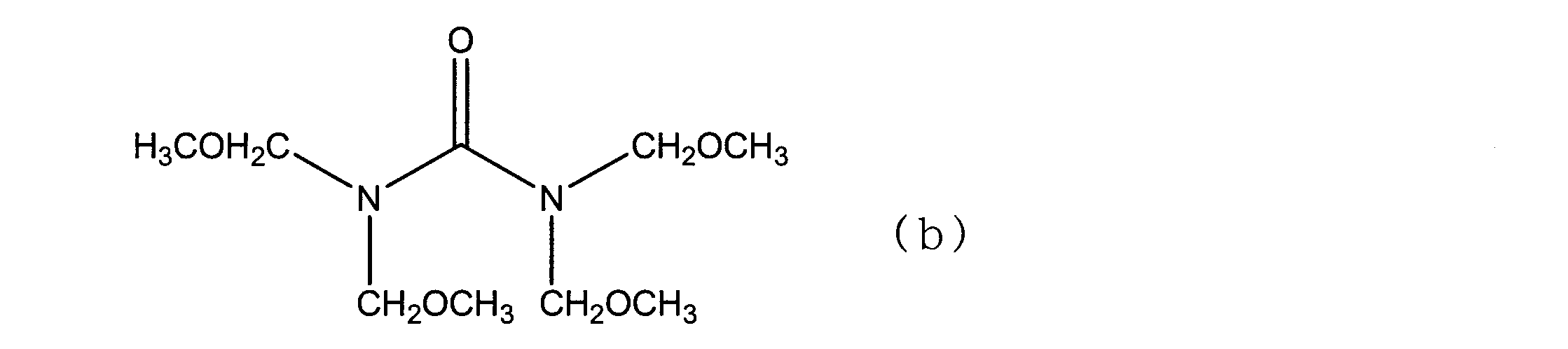
攪拌機、温度計、還流コンデンサー及び気体導入管を備えた4ッ口フラスコに、日本サイテックインダストリーズ株式会社製UFR65(下記式(b)で表される化合物が主成分)351g、3-エチル-3-ヒドロキシメチルオキセタン313g、トルエン350g、p-トルエンスルホン酸2gを仕込み80℃に加熱し、発生するメタノールを留去しながら3時間反応を行った。
その後、0.1N水酸化ナトリウム水溶液で中和し、減圧濃縮により溶剤をプロピレングリコールモノメチルエーテルアセテートに置換するとともに、不揮発分を80質量%とした。このようにして、下記式(b)で表される化合物中の4個のメトキシ基のうち、平均約2個が(3-エチルオキセタン-3-イル)メトキシ基で置換された特定架橋剤を含む特定架橋剤混合物の溶液を得た。得られた特定架橋剤混合物を特定架橋剤[C-7]とする。なお、下記式(b)で表される化合物中の4個のメトキシ基のうち、平均約2個が(3-エチルオキセタン-3-イル)メトキシ基で置換された化合物が得られていることは、1H-NMR及びGPCにより確認した。
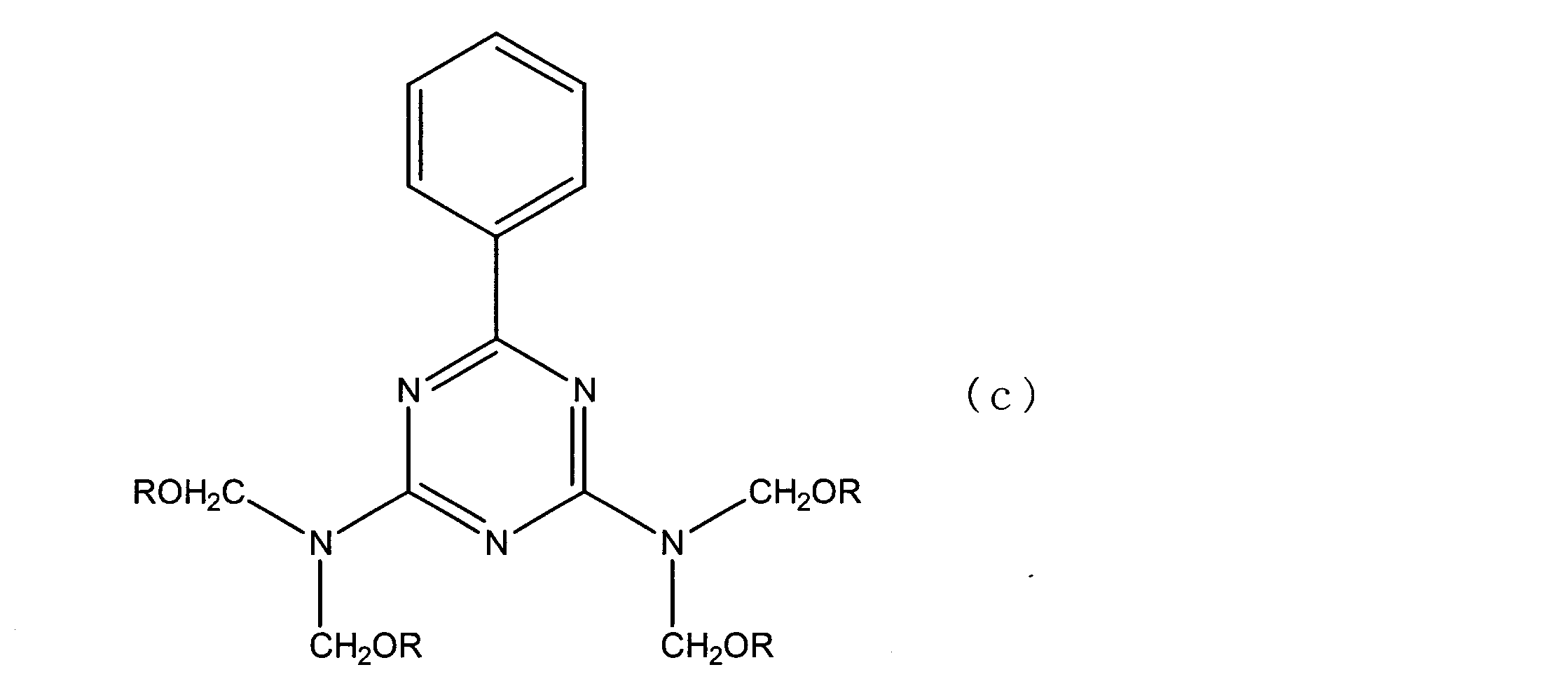
攪拌機、温度計、還流コンデンサー及び気体導入管を備えた4ッ口フラスコに、日本サイテックインダストリーズ株式会社製サイメル1123(下記式(c)で表される化合物が主成分)を575g、3-エチル-3-ヒドロキシメチルオキセタン302g、トルエン575g、p-トルエンスルホン酸2gを仕込み80℃に加熱し、発生するメタノールとエタノールを留去しながら3時間反応を行なった。
その後、0.1N水酸化ナトリウム水溶液で中和し、減圧濃縮により溶剤をプロピレングリコールモノメチルエーテルアセテートに置換するとともに、不揮発分を80質量%とした。このようにして、下記式(c)で表される化合物中の4個のアルコキシ基のうち、平均約2個が(3-エチルオキセタン-3-イル)メトキシ基で置換された特定架橋剤を含む特定架橋剤混合物の溶液を得た。得られた特定架橋剤混合物を特定架橋剤[C-8]とする。なお、下記式(c)で表される化合物中の4個のアルコキシ基のうち、平均約2個が(3-エチルオキセタン-3-イル)メトキシ基で置換された化合物が得られていることは、1H-NMR及びGPCにより確認した。
攪拌機、温度計、還流コンデンサー及び気体導入管を備えた4ッ口フラスコに、メラミン126g、92%パラホルムアルデヒド202g、2-ヒドロキシエチルアクリレート464g、3-エチル-3-ヒドロキシメチルオキセタン116g、メタノール32gを仕込み80℃まで昇温し、80℃で1時間メチロール化反応を行なった後、p-トルエンスルホン酸を1g加え、80℃でエーテル化反応を3時間行なった。
その後、0.1N水酸化ナトリウム水溶液で中和し、減圧蒸留によりメタノール、2-ヒドロキシエチルアクリレート、3-エチル-3-ヒドロキシメチルオキセタンを留去し、溶剤をプロピレングリコールモノメチルエーテルアセテートに置換するとともに、不揮発分を80%とした。このようにして、上記式(a)で表される化合物中の6個のメトキシ基のうち、平均約4個がアクリロイルオキシエチルオキシ基で、平均約1個が(3-エチルオキセタン-3-イル)メトキシ基で置換された特定架橋剤を含む特定架橋剤混合物の溶液を得た。得られた特定架橋剤混合物を特定架橋剤[C-9]とする。なお、上記式(a)で表される化合物中の6個のメトキシ基のうち、平均約4個がアクリロイルオキシエチルオキシ基で、平均約1個が(3-エチルオキセタン-3-イル)メトキシ基で置換された化合物が得られていることは、1H-NMRにより確認した。
実施例1
着色組成物の調製
(A)着色剤として顔料分散液(A-1)100.0質量部、(B)バインダー樹脂としてバインダー樹脂[B-1]溶液26.0質量部とバインダー樹脂[B-2]溶液6.6質量部、(C)特定架橋剤として特定架橋剤[C-1]を含む溶液を9.9質量部、(D)重合性不飽和結合を有する単量体として東亞合成株式会社製M-402(ジペンタエリスリトールヘキサアクリレート)5.4質量部と東亞合成株式会社製TO-1382(ジペンタエリスリトールペンタアクリレートとこはく酸とのモノエステル化物、ジペンタエリスリトールヘキサアクリレートならびにジペンタエリスリトールペンタアクリレートの混合物)3.6質量部、(E)光重合開始剤としてチバ・スペシャルティー・ケミカルズ社製イルガキュア907(2-メチル-1-〔4-(メチルチオ)フェニル〕-2-モルフォリノプロパン-1-オン)4.3質量部、溶媒として3-エトキシプロピオン酸エチルを着色組成物の固形分濃度が20質量%となるよう混合して、着色感放射線性組成物を調製した。
得られた着色感放射線性組成物について、下記の手順にしたがって評価を行った。評価結果を表1に示す。
得られた着色感放射線性組成物を、表面にナトリウムイオンの溶出を防止するSiO2膜が形成されたソーダガラス基板に、スピンコーターを用いて塗布したのち、90℃のホットプレート上で2分間プレベークを行って、膜厚1.7μmの塗膜を形成した。
次いで、基板を室温に冷却したのち、高圧水銀ランプを用い、幅5~50μmの範囲でサイズの相異なる複数のスリットを有するフォトマスクを介して、塗膜に365nm、405nm及び436nmの各波長を含む紫外線を露光した。このときの露光量は500J/m2であった。その後、基板を23℃の0.04質量%水酸化カリウム水溶液を用いて1分間シャワー現像したのち、超純水で洗浄して風乾した。その後、220℃のクリーンオーブン内で30分間ポストベークを行なって、基板上に赤色のストライプ状画素パターンが配列された画素アレイを形成した。
上記パターンの形成において得られた基板を観察し、未露光部に残渣が残っているかどうかにつき、以下の三段階で評価した。
A:残渣が認められない。
B:残渣が少し認められる。
C:残渣が多く認められる。
上記パターンの形成において、幅50μmの画素パターンの現像前後での膜厚比(現像後の膜厚×100/現像前の膜厚)が95%以上である場合を「A」、現像前後での膜厚比が95%未満であるか、あるいはパターンの一部に欠けが認められる場合を「B」、現像後にパターンが全て基板から剥がれる場合を「C」、として評価した。
また、パターン全体が剥離することなく残存していた画素パターンの幅の最小値を形成可能な最小パターンの幅(μm)として評価した。
得られた着色感放射線性組成物を、表面にナトリウムイオンの溶出を防止するSiO2膜が形成されたソーダガラス基板に、スピンコーターを用いて塗布したのち、90℃のホットプレート上で2分間プレベークを行って、膜厚1.7μmの塗膜を形成した。
次いで、基板を室温に冷却したのち、高圧水銀ランプを用い、フォトマスクを介さずに、塗膜に365nm、405nmおよび436nmの各波長を含む紫外線を露光した。このときの露光量は500J/m2であった。その後、基板を23℃の0.04質量%水酸化カリウム水溶液を用いて1分間シャワー現像したのち、超純水で洗浄して風乾した。その後、220℃のクリーンオーブン内で30分間ポストベークを行なって、基板上に赤色の硬化膜を形成した。
次いで、赤色の硬化膜が形成された基板を、60℃のN-メチルピロリドンに30分間浸漬した。その結果、浸漬前後での膜厚比(浸漬後の膜厚×100/浸漬前の膜厚)が95%以上であり且つ浸漬後のN-メチルピロリドンが全く着色しなかった場合を「A」、浸漬前後での膜厚比が95%未満であるかあるいは浸漬後のN-メチルピロリドンが若干着色した場合を「B」、浸漬後にクラックが発生した場合を「C」、として評価した。
実施例1において、表1に示すように各成分の種類及び含有量(質量部)を変更した以外は実施例1と同様にして、着色感放射線性組成物を調製した。
次いで、得られた着色感放射線性組成物を用いて、実施例1と同様にして各種評価を行った。結果を表1に示す。
c-1:日本サイテックインダストリーズ株式会社製サイメル300(式(a)の化合物が主成分)
c-2:日本サイテックインダストリーズ株式会社製サイメル1123(式(c)の化合物が主成分)
D-1:ジペンタエリスリトールヘキサアクリレート(商品名M-402、東亞合成株式会社製)
D-2:ジペンタエリスリトールペンタアクリレートとこはく酸とのモノエステル化物、ジペンタエリスリトールヘキサアクリレート並びにジペンタエリスリトールペンタアクリレートの混合物(商品名TO-1382、東亞合成株式会社製)
D-3:ペンタエリスリトールテトラアクリレート(商品名M-450、東亞合成社製)E-1:2-メチル-1-〔4-(メチルチオ)フェニル〕-2-モルフォリノプロパン-1-オン(商品名イルガキュア907、チバ・スペシャルティー・ケミカルズ社製)
E-2:エタノン,1-[9-エチル-6-(2-メチルベンゾイル)-9H-カルバゾール-3-イル]-,1-(O-アセチルオキシム)(商品名IRGACURE OX02、チバ・スペシャルティー・ケミカルズ社製)
EEP:3-エトキシプロピオン酸エチル
MBA:3-メトキシブチルアセテート

Claims (9)
- (A)着色剤、(B)バインダー樹脂、及び(C)下記式(1)で表される構造を有する化合物を含有することを特徴とする着色組成物。
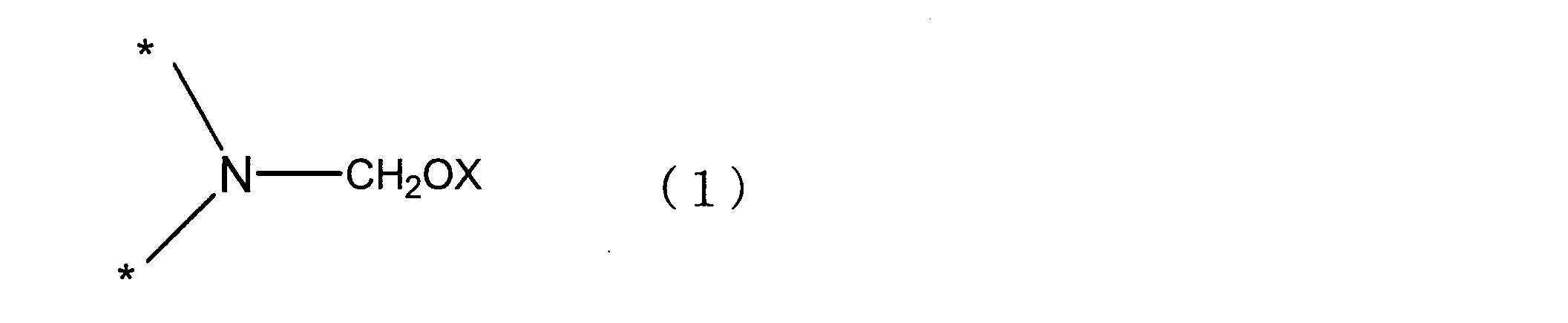
- (C)成分が、ウレイド構造、グリコールウリル構造、メラミン構造、ベンゾグアナミン構造又はイミダゾリジン-2-オン構造を有するものである請求項1記載の着色組成物。
- (C)成分が、下記式(1-1)、(1-2)、(1-3)、(1-4)及び(1-5)から選ばれる化合物である請求項1又は2記載の着色組成物。
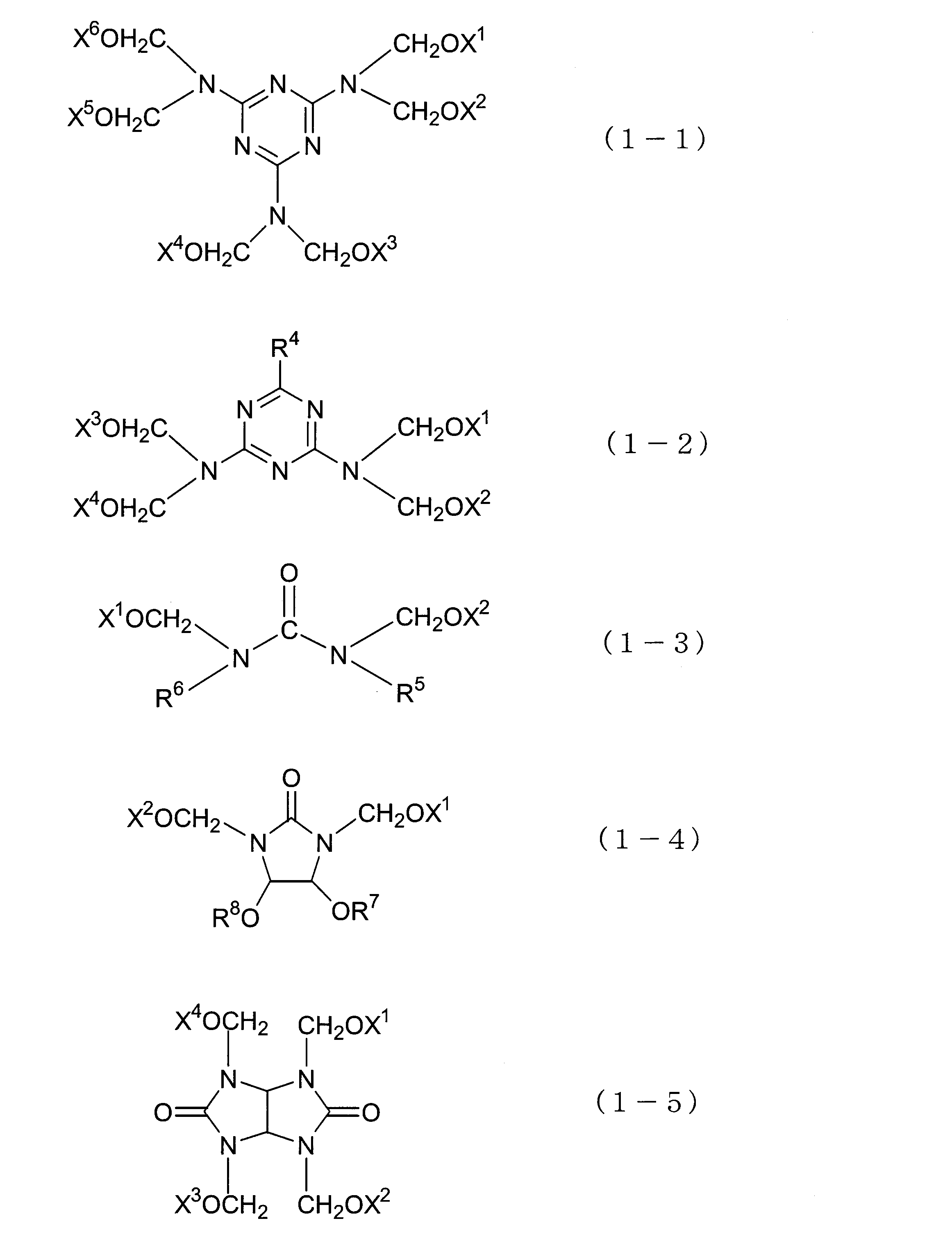
- 更に(D)重合性不飽和結合を有する単量体(但し、上記(C)成分を除く。)を含有する請求項1~3のいずれか1項に記載の着色組成物。
- 更に(E)光重合開始剤を含有する請求項1~4のいずれか1項に記載の着色組成物。
- 請求項1~5のいずれか1項に記載の着色組成物を用いて形成された着色層を備えてなるカラーフィルタ。
- 請求項6に記載のカラーフィルタを具備するカラー液晶表示素子。
- 下記式(1)で表される構造を有する、架橋用化合物。

- 下記式(1-1)~(1-5)のいずれかで表される、架橋用化合物。

Priority Applications (2)
| Application Number | Priority Date | Filing Date | Title |
|---|---|---|---|
| CN201080009916.3A CN102341731B (zh) | 2009-03-30 | 2010-03-26 | 着色组合物、滤色器以及彩色液晶显示元件 |
| JP2011508219A JP5454571B2 (ja) | 2009-03-30 | 2010-03-26 | 着色組成物、カラーフィルタ及びカラー液晶表示素子 |
Applications Claiming Priority (2)
| Application Number | Priority Date | Filing Date | Title |
|---|---|---|---|
| JP2009-081427 | 2009-03-30 | ||
| JP2009081427 | 2009-03-30 |
Publications (1)
| Publication Number | Publication Date |
|---|---|
| WO2010116653A1 true WO2010116653A1 (ja) | 2010-10-14 |
Family
ID=42935954
Family Applications (1)
| Application Number | Title | Priority Date | Filing Date |
|---|---|---|---|
| PCT/JP2010/002175 Ceased WO2010116653A1 (ja) | 2009-03-30 | 2010-03-26 | 着色組成物、カラーフィルタ及びカラー液晶表示素子 |
Country Status (5)
| Country | Link |
|---|---|
| JP (1) | JP5454571B2 (ja) |
| KR (1) | KR101602005B1 (ja) |
| CN (1) | CN102341731B (ja) |
| TW (1) | TWI472517B (ja) |
| WO (1) | WO2010116653A1 (ja) |
Cited By (6)
| Publication number | Priority date | Publication date | Assignee | Title |
|---|---|---|---|---|
| JP2011084726A (ja) * | 2009-09-18 | 2011-04-28 | Fujifilm Corp | 着色硬化性組成物、カラーフィルタ、及びカラーフィルタの製造方法 |
| JP2013092753A (ja) * | 2011-10-03 | 2013-05-16 | Jsr Corp | 着色組成物、カラーフィルタ及び表示素子 |
| JP2013101337A (ja) * | 2011-10-20 | 2013-05-23 | Mitsubishi Chemicals Corp | 着色樹脂組成物、カラーフィルタ、液晶表示装置及び有機el表示装置 |
| JP2013136739A (ja) * | 2011-11-28 | 2013-07-11 | Mitsubishi Chemicals Corp | 着色樹脂組成物、カラーフィルタ、液晶表示装置及び有機el表示装置 |
| WO2013146183A1 (ja) * | 2012-03-26 | 2013-10-03 | 東レ株式会社 | 感光性黒色樹脂組成物及び樹脂ブラックマトリックス基板 |
| WO2016005196A1 (en) * | 2014-07-08 | 2016-01-14 | Clariant International Ltd | Cyan colorant composition having improved chroma and hue, pigment composition therefor, and use thereof for forming images |
Families Citing this family (5)
| Publication number | Priority date | Publication date | Assignee | Title |
|---|---|---|---|---|
| TWI604272B (zh) | 2013-05-24 | 2017-11-01 | 奇美實業股份有限公司 | 彩色濾光片用藍色感光性樹脂組成物及其應用 |
| JP6459477B2 (ja) * | 2013-12-25 | 2019-01-30 | Jsr株式会社 | 着色組成物、着色硬化膜及び表示素子 |
| TW201638668A (zh) * | 2015-04-22 | 2016-11-01 | 奇美實業股份有限公司 | 感光性樹脂組成物、畫素層、保護膜、間隙體、薄膜電晶體、彩色濾光片及液晶顯示裝置 |
| KR102348810B1 (ko) * | 2015-10-01 | 2022-01-07 | 동우 화인켐 주식회사 | 착색 감광성 수지 조성물, 이를 포함하는 컬러필터 및 표시장치 |
| CN109923447B (zh) * | 2016-11-14 | 2021-03-30 | 日本板硝子株式会社 | 光吸收性组合物及滤光器 |
Citations (8)
| Publication number | Priority date | Publication date | Assignee | Title |
|---|---|---|---|---|
| GB1321922A (en) * | 1970-04-27 | 1973-07-04 | Ciba Geigy Ag | Ethers processes for their manufacture and their use |
| JPS4995972A (ja) * | 1973-01-08 | 1974-09-11 | ||
| JPH03256048A (ja) * | 1990-03-07 | 1991-11-14 | Nippon Soda Co Ltd | めっきレジスト剥離防止剤 |
| JPH08211607A (ja) * | 1994-11-15 | 1996-08-20 | Hoechst Japan Ltd | 感光性樹脂組成物 |
| JPH09100423A (ja) * | 1995-10-04 | 1997-04-15 | Hoechst Ind Kk | コーティング組成物及び保護膜付きカラーフィルターの製造方法 |
| JPH1017779A (ja) * | 1996-07-02 | 1998-01-20 | Hoechst Ind Kk | 感光性樹脂組成物 |
| JPH1088068A (ja) * | 1996-09-03 | 1998-04-07 | Clariant Ag | コーティング組成物 |
| JP2007225717A (ja) * | 2006-02-21 | 2007-09-06 | Toppan Printing Co Ltd | カラーフィルタ及び液晶表示装置 |
Family Cites Families (2)
| Publication number | Priority date | Publication date | Assignee | Title |
|---|---|---|---|---|
| US5882843A (en) * | 1994-11-15 | 1999-03-16 | Hoechst Japan Limited | Photosensitive resin composition for color filter production |
| JP2004233635A (ja) * | 2003-01-30 | 2004-08-19 | Konica Minolta Holdings Inc | 熱現像材料の製造方法 |
-
2010
- 2010-03-26 KR KR1020117020143A patent/KR101602005B1/ko active Active
- 2010-03-26 JP JP2011508219A patent/JP5454571B2/ja active Active
- 2010-03-26 CN CN201080009916.3A patent/CN102341731B/zh active Active
- 2010-03-26 WO PCT/JP2010/002175 patent/WO2010116653A1/ja not_active Ceased
- 2010-03-29 TW TW99109369A patent/TWI472517B/zh active
Patent Citations (8)
| Publication number | Priority date | Publication date | Assignee | Title |
|---|---|---|---|---|
| GB1321922A (en) * | 1970-04-27 | 1973-07-04 | Ciba Geigy Ag | Ethers processes for their manufacture and their use |
| JPS4995972A (ja) * | 1973-01-08 | 1974-09-11 | ||
| JPH03256048A (ja) * | 1990-03-07 | 1991-11-14 | Nippon Soda Co Ltd | めっきレジスト剥離防止剤 |
| JPH08211607A (ja) * | 1994-11-15 | 1996-08-20 | Hoechst Japan Ltd | 感光性樹脂組成物 |
| JPH09100423A (ja) * | 1995-10-04 | 1997-04-15 | Hoechst Ind Kk | コーティング組成物及び保護膜付きカラーフィルターの製造方法 |
| JPH1017779A (ja) * | 1996-07-02 | 1998-01-20 | Hoechst Ind Kk | 感光性樹脂組成物 |
| JPH1088068A (ja) * | 1996-09-03 | 1998-04-07 | Clariant Ag | コーティング組成物 |
| JP2007225717A (ja) * | 2006-02-21 | 2007-09-06 | Toppan Printing Co Ltd | カラーフィルタ及び液晶表示装置 |
Non-Patent Citations (2)
| Title |
|---|
| KUDO, T. ET AL.: "Fabrication Process of Color Filters Using Pigmented Photoresists", JAPANESE JOURNAL OF APPLIED PHYSISCS, vol. 37, no. 6A, June 1998 (1998-06-01), pages 3594 - 3603 * |
| KUDO, T. ET AL.: "PIGMENTED PHOTORESISTS FOR COLOR FILTERS", JOURNAL OF PHOTOPOLYMER SCIENCE AND TECHNOLOGY, vol. 9, no. 1, 1996, pages 109 - 120 * |
Cited By (8)
| Publication number | Priority date | Publication date | Assignee | Title |
|---|---|---|---|---|
| JP2011084726A (ja) * | 2009-09-18 | 2011-04-28 | Fujifilm Corp | 着色硬化性組成物、カラーフィルタ、及びカラーフィルタの製造方法 |
| US8741509B2 (en) | 2009-09-18 | 2014-06-03 | Fujifilm Corporation | Colored curable composition, color filter, and method for producing color filter |
| JP2013092753A (ja) * | 2011-10-03 | 2013-05-16 | Jsr Corp | 着色組成物、カラーフィルタ及び表示素子 |
| JP2013101337A (ja) * | 2011-10-20 | 2013-05-23 | Mitsubishi Chemicals Corp | 着色樹脂組成物、カラーフィルタ、液晶表示装置及び有機el表示装置 |
| JP2013136739A (ja) * | 2011-11-28 | 2013-07-11 | Mitsubishi Chemicals Corp | 着色樹脂組成物、カラーフィルタ、液晶表示装置及び有機el表示装置 |
| WO2013146183A1 (ja) * | 2012-03-26 | 2013-10-03 | 東レ株式会社 | 感光性黒色樹脂組成物及び樹脂ブラックマトリックス基板 |
| JP5333696B1 (ja) * | 2012-03-26 | 2013-11-06 | 東レ株式会社 | 感光性黒色樹脂組成物及び樹脂ブラックマトリックス基板 |
| WO2016005196A1 (en) * | 2014-07-08 | 2016-01-14 | Clariant International Ltd | Cyan colorant composition having improved chroma and hue, pigment composition therefor, and use thereof for forming images |
Also Published As
| Publication number | Publication date |
|---|---|
| JP5454571B2 (ja) | 2014-03-26 |
| CN102341731B (zh) | 2014-06-25 |
| TW201040151A (en) | 2010-11-16 |
| JPWO2010116653A1 (ja) | 2012-10-18 |
| CN102341731A (zh) | 2012-02-01 |
| TWI472517B (zh) | 2015-02-11 |
| KR20110132556A (ko) | 2011-12-08 |
| KR101602005B1 (ko) | 2016-03-17 |
Similar Documents
| Publication | Publication Date | Title |
|---|---|---|
| JP5454571B2 (ja) | 着色組成物、カラーフィルタ及びカラー液晶表示素子 | |
| JP5515714B2 (ja) | 着色組成物、カラーフィルタおよびカラー液晶表示素子 | |
| TWI459133B (zh) | 著色層形成用感放射線性組成物、彩色濾光片及彩色液晶顯示元件 | |
| JP5446423B2 (ja) | 着色組成物、カラーフィルタおよびカラー液晶表示素子 | |
| JP5962099B2 (ja) | 着色組成物、カラーフィルタ及び表示素子 | |
| JP5636675B2 (ja) | カラーフィルタ用着色組成物、カラーフィルタ及びカラー液晶表示素子 | |
| JP6911971B2 (ja) | 着色組成物、着色硬化膜及び表示素子 | |
| CN102141730A (zh) | 着色组合物、滤色器和显示元件 | |
| JP5510080B2 (ja) | カラーフィルタ用着色組成物、カラーフィルタ及びカラー液晶表示素子 | |
| CN109870877B (zh) | 着色感光性树脂组合物、彩色滤光片和图像显示装置 | |
| JP5338333B2 (ja) | 着色層形成用感放射線性組成物、カラーフィルタおよびカラー液晶表示素子 | |
| JP5663878B2 (ja) | 着色感放射線性組成物、カラーフィルタおよびカラー液晶表示素子 | |
| TW201533169A (zh) | 著色組成物、著色硬化膜及顯示元件 | |
| JP6074949B2 (ja) | 着色組成物、カラーフィルタ及び表示素子 | |
| JP2010262027A (ja) | 着色感放射線性組成物、カラーフィルタおよびカラー液晶表示素子 | |
| JP5439937B2 (ja) | 着色感放射線性組成物、カラーフィルタおよびカラー液晶表示素子 | |
| JP5590294B2 (ja) | 着色組成物、カラーフィルタ及びカラー液晶表示素子 | |
| CN102023481B (zh) | 着色组合物、滤色器和彩色液晶显示元件 | |
| WO2011013318A1 (ja) | 着色組成物、カラーフィルタ及びカラー液晶表示素子 | |
| JP5353415B2 (ja) | 着色組成物、カラーフィルタおよびカラー液晶表示素子 |
Legal Events
| Date | Code | Title | Description |
|---|---|---|---|
| WWE | Wipo information: entry into national phase |
Ref document number: 201080009916.3 Country of ref document: CN |
|
| 121 | Ep: the epo has been informed by wipo that ep was designated in this application |
Ref document number: 10761361 Country of ref document: EP Kind code of ref document: A1 |
|
| ENP | Entry into the national phase |
Ref document number: 2011508219 Country of ref document: JP Kind code of ref document: A |
|
| ENP | Entry into the national phase |
Ref document number: 20117020143 Country of ref document: KR Kind code of ref document: A |
|
| NENP | Non-entry into the national phase |
Ref country code: DE |
|
| 122 | Ep: pct application non-entry in european phase |
Ref document number: 10761361 Country of ref document: EP Kind code of ref document: A1 |