WO2010109778A1 - 浸炭焼入れ性の優れた炭素鋼板およびその製造方法 - Google Patents
浸炭焼入れ性の優れた炭素鋼板およびその製造方法 Download PDFInfo
- Publication number
- WO2010109778A1 WO2010109778A1 PCT/JP2010/001456 JP2010001456W WO2010109778A1 WO 2010109778 A1 WO2010109778 A1 WO 2010109778A1 JP 2010001456 W JP2010001456 W JP 2010001456W WO 2010109778 A1 WO2010109778 A1 WO 2010109778A1
- Authority
- WO
- WIPO (PCT)
- Prior art keywords
- less
- mass
- annealing
- steel sheet
- cold rolling
- Prior art date
- Legal status (The legal status is an assumption and is not a legal conclusion. Google has not performed a legal analysis and makes no representation as to the accuracy of the status listed.)
- Ceased
Links
Images


Classifications
-
- C—CHEMISTRY; METALLURGY
- C22—METALLURGY; FERROUS OR NON-FERROUS ALLOYS; TREATMENT OF ALLOYS OR NON-FERROUS METALS
- C22C—ALLOYS
- C22C38/00—Ferrous alloys, e.g. steel alloys
- C22C38/02—Ferrous alloys, e.g. steel alloys containing silicon
-
- C—CHEMISTRY; METALLURGY
- C21—METALLURGY OF IRON
- C21D—MODIFYING THE PHYSICAL STRUCTURE OF FERROUS METALS; GENERAL DEVICES FOR HEAT TREATMENT OF FERROUS OR NON-FERROUS METALS OR ALLOYS; MAKING METAL MALLEABLE, e.g. BY DECARBURISATION OR TEMPERING
- C21D1/00—General methods or devices for heat treatment, e.g. annealing, hardening, quenching or tempering
- C21D1/06—Surface hardening
-
- C—CHEMISTRY; METALLURGY
- C21—METALLURGY OF IRON
- C21D—MODIFYING THE PHYSICAL STRUCTURE OF FERROUS METALS; GENERAL DEVICES FOR HEAT TREATMENT OF FERROUS OR NON-FERROUS METALS OR ALLOYS; MAKING METAL MALLEABLE, e.g. BY DECARBURISATION OR TEMPERING
- C21D8/00—Modifying the physical properties of ferrous metals or ferrous alloys by deformation combined with, or followed by, heat treatment
- C21D8/02—Modifying the physical properties of ferrous metals or ferrous alloys by deformation combined with, or followed by, heat treatment during manufacturing of plates or strips
- C21D8/0221—Modifying the physical properties of ferrous metals or ferrous alloys by deformation combined with, or followed by, heat treatment during manufacturing of plates or strips characterised by the working steps
- C21D8/0226—Hot rolling
-
- C—CHEMISTRY; METALLURGY
- C21—METALLURGY OF IRON
- C21D—MODIFYING THE PHYSICAL STRUCTURE OF FERROUS METALS; GENERAL DEVICES FOR HEAT TREATMENT OF FERROUS OR NON-FERROUS METALS OR ALLOYS; MAKING METAL MALLEABLE, e.g. BY DECARBURISATION OR TEMPERING
- C21D8/00—Modifying the physical properties of ferrous metals or ferrous alloys by deformation combined with, or followed by, heat treatment
- C21D8/02—Modifying the physical properties of ferrous metals or ferrous alloys by deformation combined with, or followed by, heat treatment during manufacturing of plates or strips
- C21D8/0221—Modifying the physical properties of ferrous metals or ferrous alloys by deformation combined with, or followed by, heat treatment during manufacturing of plates or strips characterised by the working steps
- C21D8/0236—Cold rolling
-
- C—CHEMISTRY; METALLURGY
- C21—METALLURGY OF IRON
- C21D—MODIFYING THE PHYSICAL STRUCTURE OF FERROUS METALS; GENERAL DEVICES FOR HEAT TREATMENT OF FERROUS OR NON-FERROUS METALS OR ALLOYS; MAKING METAL MALLEABLE, e.g. BY DECARBURISATION OR TEMPERING
- C21D8/00—Modifying the physical properties of ferrous metals or ferrous alloys by deformation combined with, or followed by, heat treatment
- C21D8/02—Modifying the physical properties of ferrous metals or ferrous alloys by deformation combined with, or followed by, heat treatment during manufacturing of plates or strips
- C21D8/0247—Modifying the physical properties of ferrous metals or ferrous alloys by deformation combined with, or followed by, heat treatment during manufacturing of plates or strips characterised by the heat treatment
- C21D8/0263—Modifying the physical properties of ferrous metals or ferrous alloys by deformation combined with, or followed by, heat treatment during manufacturing of plates or strips characterised by the heat treatment following hot rolling
-
- C—CHEMISTRY; METALLURGY
- C21—METALLURGY OF IRON
- C21D—MODIFYING THE PHYSICAL STRUCTURE OF FERROUS METALS; GENERAL DEVICES FOR HEAT TREATMENT OF FERROUS OR NON-FERROUS METALS OR ALLOYS; MAKING METAL MALLEABLE, e.g. BY DECARBURISATION OR TEMPERING
- C21D8/00—Modifying the physical properties of ferrous metals or ferrous alloys by deformation combined with, or followed by, heat treatment
- C21D8/02—Modifying the physical properties of ferrous metals or ferrous alloys by deformation combined with, or followed by, heat treatment during manufacturing of plates or strips
- C21D8/0247—Modifying the physical properties of ferrous metals or ferrous alloys by deformation combined with, or followed by, heat treatment during manufacturing of plates or strips characterised by the heat treatment
- C21D8/0268—Modifying the physical properties of ferrous metals or ferrous alloys by deformation combined with, or followed by, heat treatment during manufacturing of plates or strips characterised by the heat treatment between cold rolling steps
-
- C—CHEMISTRY; METALLURGY
- C21—METALLURGY OF IRON
- C21D—MODIFYING THE PHYSICAL STRUCTURE OF FERROUS METALS; GENERAL DEVICES FOR HEAT TREATMENT OF FERROUS OR NON-FERROUS METALS OR ALLOYS; MAKING METAL MALLEABLE, e.g. BY DECARBURISATION OR TEMPERING
- C21D8/00—Modifying the physical properties of ferrous metals or ferrous alloys by deformation combined with, or followed by, heat treatment
- C21D8/02—Modifying the physical properties of ferrous metals or ferrous alloys by deformation combined with, or followed by, heat treatment during manufacturing of plates or strips
- C21D8/04—Modifying the physical properties of ferrous metals or ferrous alloys by deformation combined with, or followed by, heat treatment during manufacturing of plates or strips to produce plates or strips for drawing, e.g. for deep-drawing
- C21D8/0421—Modifying the physical properties of ferrous metals or ferrous alloys by deformation combined with, or followed by, heat treatment during manufacturing of plates or strips to produce plates or strips for drawing, e.g. for deep-drawing characterised by the working steps
- C21D8/0426—Hot rolling
-
- C—CHEMISTRY; METALLURGY
- C21—METALLURGY OF IRON
- C21D—MODIFYING THE PHYSICAL STRUCTURE OF FERROUS METALS; GENERAL DEVICES FOR HEAT TREATMENT OF FERROUS OR NON-FERROUS METALS OR ALLOYS; MAKING METAL MALLEABLE, e.g. BY DECARBURISATION OR TEMPERING
- C21D8/00—Modifying the physical properties of ferrous metals or ferrous alloys by deformation combined with, or followed by, heat treatment
- C21D8/02—Modifying the physical properties of ferrous metals or ferrous alloys by deformation combined with, or followed by, heat treatment during manufacturing of plates or strips
- C21D8/04—Modifying the physical properties of ferrous metals or ferrous alloys by deformation combined with, or followed by, heat treatment during manufacturing of plates or strips to produce plates or strips for drawing, e.g. for deep-drawing
- C21D8/0421—Modifying the physical properties of ferrous metals or ferrous alloys by deformation combined with, or followed by, heat treatment during manufacturing of plates or strips to produce plates or strips for drawing, e.g. for deep-drawing characterised by the working steps
- C21D8/0436—Cold rolling
-
- C—CHEMISTRY; METALLURGY
- C21—METALLURGY OF IRON
- C21D—MODIFYING THE PHYSICAL STRUCTURE OF FERROUS METALS; GENERAL DEVICES FOR HEAT TREATMENT OF FERROUS OR NON-FERROUS METALS OR ALLOYS; MAKING METAL MALLEABLE, e.g. BY DECARBURISATION OR TEMPERING
- C21D8/00—Modifying the physical properties of ferrous metals or ferrous alloys by deformation combined with, or followed by, heat treatment
- C21D8/02—Modifying the physical properties of ferrous metals or ferrous alloys by deformation combined with, or followed by, heat treatment during manufacturing of plates or strips
- C21D8/04—Modifying the physical properties of ferrous metals or ferrous alloys by deformation combined with, or followed by, heat treatment during manufacturing of plates or strips to produce plates or strips for drawing, e.g. for deep-drawing
- C21D8/0447—Modifying the physical properties of ferrous metals or ferrous alloys by deformation combined with, or followed by, heat treatment during manufacturing of plates or strips to produce plates or strips for drawing, e.g. for deep-drawing characterised by the heat treatment
- C21D8/0463—Modifying the physical properties of ferrous metals or ferrous alloys by deformation combined with, or followed by, heat treatment during manufacturing of plates or strips to produce plates or strips for drawing, e.g. for deep-drawing characterised by the heat treatment following hot rolling
-
- C—CHEMISTRY; METALLURGY
- C21—METALLURGY OF IRON
- C21D—MODIFYING THE PHYSICAL STRUCTURE OF FERROUS METALS; GENERAL DEVICES FOR HEAT TREATMENT OF FERROUS OR NON-FERROUS METALS OR ALLOYS; MAKING METAL MALLEABLE, e.g. BY DECARBURISATION OR TEMPERING
- C21D8/00—Modifying the physical properties of ferrous metals or ferrous alloys by deformation combined with, or followed by, heat treatment
- C21D8/02—Modifying the physical properties of ferrous metals or ferrous alloys by deformation combined with, or followed by, heat treatment during manufacturing of plates or strips
- C21D8/04—Modifying the physical properties of ferrous metals or ferrous alloys by deformation combined with, or followed by, heat treatment during manufacturing of plates or strips to produce plates or strips for drawing, e.g. for deep-drawing
- C21D8/0447—Modifying the physical properties of ferrous metals or ferrous alloys by deformation combined with, or followed by, heat treatment during manufacturing of plates or strips to produce plates or strips for drawing, e.g. for deep-drawing characterised by the heat treatment
- C21D8/0468—Modifying the physical properties of ferrous metals or ferrous alloys by deformation combined with, or followed by, heat treatment during manufacturing of plates or strips to produce plates or strips for drawing, e.g. for deep-drawing characterised by the heat treatment between cold rolling steps
-
- C—CHEMISTRY; METALLURGY
- C21—METALLURGY OF IRON
- C21D—MODIFYING THE PHYSICAL STRUCTURE OF FERROUS METALS; GENERAL DEVICES FOR HEAT TREATMENT OF FERROUS OR NON-FERROUS METALS OR ALLOYS; MAKING METAL MALLEABLE, e.g. BY DECARBURISATION OR TEMPERING
- C21D9/00—Heat treatment, e.g. annealing, hardening, quenching or tempering, adapted for particular articles; Furnaces therefor
- C21D9/46—Heat treatment, e.g. annealing, hardening, quenching or tempering, adapted for particular articles; Furnaces therefor for sheet metals
-
- C—CHEMISTRY; METALLURGY
- C21—METALLURGY OF IRON
- C21D—MODIFYING THE PHYSICAL STRUCTURE OF FERROUS METALS; GENERAL DEVICES FOR HEAT TREATMENT OF FERROUS OR NON-FERROUS METALS OR ALLOYS; MAKING METAL MALLEABLE, e.g. BY DECARBURISATION OR TEMPERING
- C21D9/00—Heat treatment, e.g. annealing, hardening, quenching or tempering, adapted for particular articles; Furnaces therefor
- C21D9/52—Heat treatment, e.g. annealing, hardening, quenching or tempering, adapted for particular articles; Furnaces therefor for wires; for strips ; for rods of unlimited length
- C21D9/54—Furnaces for treating strips or wire
- C21D9/56—Continuous furnaces for strip or wire
- C21D9/561—Continuous furnaces for strip or wire with a controlled atmosphere or vacuum
-
- C—CHEMISTRY; METALLURGY
- C22—METALLURGY; FERROUS OR NON-FERROUS ALLOYS; TREATMENT OF ALLOYS OR NON-FERROUS METALS
- C22C—ALLOYS
- C22C38/00—Ferrous alloys, e.g. steel alloys
- C22C38/001—Ferrous alloys, e.g. steel alloys containing N
-
- C—CHEMISTRY; METALLURGY
- C22—METALLURGY; FERROUS OR NON-FERROUS ALLOYS; TREATMENT OF ALLOYS OR NON-FERROUS METALS
- C22C—ALLOYS
- C22C38/00—Ferrous alloys, e.g. steel alloys
- C22C38/008—Ferrous alloys, e.g. steel alloys containing tin
-
- C—CHEMISTRY; METALLURGY
- C22—METALLURGY; FERROUS OR NON-FERROUS ALLOYS; TREATMENT OF ALLOYS OR NON-FERROUS METALS
- C22C—ALLOYS
- C22C38/00—Ferrous alloys, e.g. steel alloys
- C22C38/04—Ferrous alloys, e.g. steel alloys containing manganese
-
- C—CHEMISTRY; METALLURGY
- C22—METALLURGY; FERROUS OR NON-FERROUS ALLOYS; TREATMENT OF ALLOYS OR NON-FERROUS METALS
- C22C—ALLOYS
- C22C38/00—Ferrous alloys, e.g. steel alloys
- C22C38/06—Ferrous alloys, e.g. steel alloys containing aluminium
-
- C—CHEMISTRY; METALLURGY
- C22—METALLURGY; FERROUS OR NON-FERROUS ALLOYS; TREATMENT OF ALLOYS OR NON-FERROUS METALS
- C22C—ALLOYS
- C22C38/00—Ferrous alloys, e.g. steel alloys
- C22C38/14—Ferrous alloys, e.g. steel alloys containing titanium or zirconium
-
- C—CHEMISTRY; METALLURGY
- C22—METALLURGY; FERROUS OR NON-FERROUS ALLOYS; TREATMENT OF ALLOYS OR NON-FERROUS METALS
- C22C—ALLOYS
- C22C38/00—Ferrous alloys, e.g. steel alloys
- C22C38/18—Ferrous alloys, e.g. steel alloys containing chromium
-
- C—CHEMISTRY; METALLURGY
- C22—METALLURGY; FERROUS OR NON-FERROUS ALLOYS; TREATMENT OF ALLOYS OR NON-FERROUS METALS
- C22C—ALLOYS
- C22C38/00—Ferrous alloys, e.g. steel alloys
- C22C38/18—Ferrous alloys, e.g. steel alloys containing chromium
- C22C38/32—Ferrous alloys, e.g. steel alloys containing chromium with boron
-
- C—CHEMISTRY; METALLURGY
- C22—METALLURGY; FERROUS OR NON-FERROUS ALLOYS; TREATMENT OF ALLOYS OR NON-FERROUS METALS
- C22C—ALLOYS
- C22C38/00—Ferrous alloys, e.g. steel alloys
- C22C38/18—Ferrous alloys, e.g. steel alloys containing chromium
- C22C38/40—Ferrous alloys, e.g. steel alloys containing chromium with nickel
-
- C—CHEMISTRY; METALLURGY
- C22—METALLURGY; FERROUS OR NON-FERROUS ALLOYS; TREATMENT OF ALLOYS OR NON-FERROUS METALS
- C22C—ALLOYS
- C22C38/00—Ferrous alloys, e.g. steel alloys
- C22C38/18—Ferrous alloys, e.g. steel alloys containing chromium
- C22C38/40—Ferrous alloys, e.g. steel alloys containing chromium with nickel
- C22C38/42—Ferrous alloys, e.g. steel alloys containing chromium with nickel with copper
-
- C—CHEMISTRY; METALLURGY
- C22—METALLURGY; FERROUS OR NON-FERROUS ALLOYS; TREATMENT OF ALLOYS OR NON-FERROUS METALS
- C22C—ALLOYS
- C22C38/00—Ferrous alloys, e.g. steel alloys
- C22C38/18—Ferrous alloys, e.g. steel alloys containing chromium
- C22C38/40—Ferrous alloys, e.g. steel alloys containing chromium with nickel
- C22C38/44—Ferrous alloys, e.g. steel alloys containing chromium with nickel with molybdenum or tungsten
-
- C—CHEMISTRY; METALLURGY
- C23—COATING METALLIC MATERIAL; COATING MATERIAL WITH METALLIC MATERIAL; CHEMICAL SURFACE TREATMENT; DIFFUSION TREATMENT OF METALLIC MATERIAL; COATING BY VACUUM EVAPORATION, BY SPUTTERING, BY ION IMPLANTATION OR BY CHEMICAL VAPOUR DEPOSITION, IN GENERAL; INHIBITING CORROSION OF METALLIC MATERIAL OR INCRUSTATION IN GENERAL
- C23C—COATING METALLIC MATERIAL; COATING MATERIAL WITH METALLIC MATERIAL; SURFACE TREATMENT OF METALLIC MATERIAL BY DIFFUSION INTO THE SURFACE, BY CHEMICAL CONVERSION OR SUBSTITUTION; COATING BY VACUUM EVAPORATION, BY SPUTTERING, BY ION IMPLANTATION OR BY CHEMICAL VAPOUR DEPOSITION, IN GENERAL
- C23C8/00—Solid state diffusion of only non-metal elements into metallic material surfaces; Chemical surface treatment of metallic material by reaction of the surface with a reactive gas, leaving reaction products of surface material in the coating, e.g. conversion coatings, passivation of metals
- C23C8/06—Solid state diffusion of only non-metal elements into metallic material surfaces; Chemical surface treatment of metallic material by reaction of the surface with a reactive gas, leaving reaction products of surface material in the coating, e.g. conversion coatings, passivation of metals using gases
- C23C8/08—Solid state diffusion of only non-metal elements into metallic material surfaces; Chemical surface treatment of metallic material by reaction of the surface with a reactive gas, leaving reaction products of surface material in the coating, e.g. conversion coatings, passivation of metals using gases only one element being applied
- C23C8/20—Carburising
- C23C8/22—Carburising of ferrous surfaces
Definitions
- the present invention relates to a carbon steel sheet having excellent carburizing and hardenability and a method for producing the same.
- automotive parts and industrial machine parts such as chain parts, gear parts, and clutch parts are manufactured by hardening the surface by heat treatment such as quenching after molding.
- the material is required to satisfy not only processability that can withstand complicated processing when processing into parts, but also hardenability for surface hardening.
- the hardenability and workability of the material are contradictory properties from the viewpoint of material design.
- softening the material is effective for improving the workability, but many elements added to increase the hardenability increase the hardness of the steel sheet and sacrifice the workability.
- Patent Document 1 discloses annealing in a hydrogen atmosphere or Ar atmosphere in which the nitrogen content is suppressed to 10% by volume or less. I can't find anything. Moreover, the technique which considered the carburizing process by the low carbon potential which is made into object by this invention is not disclosed.
- the present invention has an object to provide a B-added steel sheet that has excellent hardenability even under carburizing conditions with a low carbon potential and that has workability, and to optimize its manufacturing method.
- the present invention employs the following means in order to solve the above-described problems.
- C 0.20 mass% or more, 0.45 mass% or less, Si: 0.05 mass% or more, 0.8 mass% or less, Mn: 0.85 mass %: 2.0 mass% or less, P: 0.001 mass% or more, 0.04 mass% or less, S: 0.0001 mass% or more, 0.006 mass% or less, Al: 0.01 mass% or more 0.1 mass% or less, Ti: 0.005 mass% or more, 0.3 mass% or less, B: 0.0005 mass% or more, 0.01 mass% or less, and N: 0.001 mass% or more, It contains 0.01% by mass or less of components, the balance is Fe and inevitable impurities, and the K value obtained by 3C + Mn + 0.5Si is 2.0 or more; the surface hardness is 77 or less on the Rockwell hardness B scale The average content of N in the region from the surface layer to a depth of 100 ⁇ m is 10
- the carbon steel plate described in (1) above has Nb: 0.01% by mass or more and 0.5% by mass or less, V: 0.01% by mass or more, 0.5% by mass or less, Ta: 0.00%. 01% by mass or more, 0.5% by mass or less, W: 0.01% by mass or more, 0.5% by mass or less, Sn: 0.003% by mass or more, 0.03% by mass or less, Sb: 0.003% by mass %, 0.03% by mass or less, and As: 0.003% by mass or more and 0.03% by mass or less, may further contain one or more components.
- a second aspect of the present invention is a heating step in which the slab is heated at 1200 ° C. or lower; a hot rolling step in which the slab is hot-rolled at a finish rolling temperature of 800 ° C. or higher and 940 ° C. or lower to obtain a steel plate. And a first cooling step of cooling the steel plate at a cooling rate of 20 ° C./second or higher until the steel plate reaches 650 ° C. or lower; following the first cooling step, the steel plate at a cooling rate of 20 ° C./second or lower. A second cooling step for cooling the steel plate; a scraping step for scraping the steel plate at 650 ° C. or lower and 400 ° C.
- a first annealing step in which annealing is performed at a temperature of 660 ° C. or more for 10 hours or more in an atmosphere in which a dew point of ⁇ 20 ° C. or less and a dew point of 400 ° C. or more is ⁇ 40 ° C. or less is provided.
- the atmosphere is set to 95% or more of hydrogen and the annealing temperature is in the range of Ac1 to Ac1 + 50 ° C.
- the cooling rate up to 30 ° C may be set to 5 ° C / hour or less.
- a first cold rolling process for cold rolling the steel sheet at a rolling rate of 5% or more and 60% or less after the pickling process is further performed. You may prepare.
- a second cold rolling process in which the steel sheet is cold-rolled at a rolling rate of 5% to 60% after the first annealing process. And after the second cold rolling step, the dew point of 95% or more of hydrogen and up to 400 ° C. is ⁇ 20 ° C. or lower, the dew point of 400 ° C. or higher is ⁇ 40 ° C. or lower, and the temperature is 660 ° C. or higher. And a second annealing step for annealing the steel sheet.
- the atmosphere is set to 95% or more of hydrogen and the annealing temperature is in the range of Ac1 to Ac1 + 50 ° C.
- the cooling rate up to 30 ° C may be set to 5 ° C / hour or less.
- a third cold rolling process in which the steel sheet is cold-rolled at a rolling rate of 5% or more and 60% or less after the second annealing process. And after the third cold rolling step, the dew point of 95% or more of hydrogen and up to 400 ° C. is ⁇ 20 ° C. or lower, the dew point of 400 ° C. or higher is ⁇ 40 ° C. or lower, and the temperature is 660 ° C. or higher. And a third annealing step for annealing the steel sheet.
- the atmosphere is set to 95% or more of hydrogen and the annealing temperature is in the range of Ac1 to Ac1 + 50 ° C.
- the cooling rate up to 30 ° C may be set to 5 ° C / hour or less.
- a third cold rolling process in which the steel sheet is cold-rolled at a rolling rate of 5% to 60% after the second annealing process. And after the third cold rolling step, the dew point of 95% or more of hydrogen and up to 400 ° C. is ⁇ 20 ° C. or lower, the dew point of 400 ° C. or higher is ⁇ 40 ° C. or lower, and the temperature is 660 ° C. or higher. And a third annealing step for annealing the steel sheet.
- the atmosphere is set to 95% or more of hydrogen and the annealing temperature is in the range of Ac1 to Ac1 + 50 ° C.
- the cooling rate up to 30 ° C may be set to 5 ° C / hour or less.
- a second cold rolling process in which the steel sheet is cold-rolled at a rolling rate of 5% to 60% after the first annealing process. And after the second cold rolling step, the dew point of 95% or more of hydrogen and up to 400 ° C. is ⁇ 20 ° C. or lower, the dew point of 400 ° C. or higher is ⁇ 40 ° C. or lower, and the temperature is 660 ° C. or higher. And a second annealing step for annealing the steel sheet.
- the atmosphere is set to 95% or more of hydrogen and the annealing temperature is in the range of Ac1 to Ac1 + 50 ° C.
- the cooling rate up to 30 ° C may be set to 5 ° C / hour or less.
- a third cold rolling process in which the steel sheet is cold-rolled at a rolling rate of 5% or more and 60% or less after the second annealing process. And after the third cold rolling step, the dew point of 95% or more of hydrogen and up to 400 ° C. is ⁇ 20 ° C. or lower, the dew point of 400 ° C. or higher is ⁇ 40 ° C. or lower, and the temperature is 660 ° C. or higher. And a third annealing step for annealing the steel sheet.
- the atmosphere is set to 95% or more of hydrogen and the annealing temperature is in the range of Ac1 to Ac1 + 50 ° C.
- the cooling rate up to 30 ° C may be set to 5 ° C / hour or less.
- a third cold rolling process in which the steel sheet is cold-rolled at a rolling rate of 5% to 60% after the second annealing process. And after the third cold rolling step, the dew point of 95% or more of hydrogen and up to 400 ° C. is ⁇ 20 ° C. or lower, the dew point of 400 ° C. or higher is ⁇ 40 ° C. or lower, and the temperature is 660 ° C. or higher. And a third annealing step for annealing the steel sheet.
- the atmosphere is set to 95% or more of hydrogen and the annealing temperature is in the range of Ac1 to Ac1 + 50 ° C.
- the cooling rate up to 30 ° C may be set to 5 ° C / hour or less.
- the first cold rolling step of cold rolling the steel plate at a rolling rate of 5% to 60% after the pickling step is further performed. You may prepare.
- a second cold rolling process in which the steel sheet is cold-rolled at a rolling rate of 5% to 60% after the first annealing process. And after the second cold rolling step, the dew point of 95% or more of hydrogen and up to 400 ° C. is ⁇ 20 ° C. or lower, the dew point of 400 ° C. or higher is ⁇ 40 ° C. or lower, and the temperature is 660 ° C. or higher. And a second annealing step for annealing the steel sheet.
- the atmosphere is set to 95% or more of hydrogen and the annealing temperature is in the range of Ac1 to Ac1 + 50 ° C.
- the cooling rate up to 30 ° C may be set to 5 ° C / hour or less.
- a third cold rolling process in which the steel sheet is cold-rolled at a rolling rate of 5% to 60% after the second annealing process. And after the third cold rolling step, the dew point of 95% or more of hydrogen and up to 400 ° C. is ⁇ 20 ° C. or lower, the dew point of 400 ° C. or higher is ⁇ 40 ° C. or lower, and the temperature is 660 ° C. or higher. And a third annealing step for annealing the steel sheet.
- the atmosphere is set to 95% or more of hydrogen and the annealing temperature is in the range of Ac1 to Ac1 + 50 ° C.
- the cooling rate up to 30 ° C may be set to 5 ° C / hour or less.
- a third cold rolling process in which the steel sheet is cold-rolled at a rolling rate of 5% or more and 60% or less after the second annealing process. And after the third cold rolling step, the dew point of 95% or more of hydrogen and up to 400 ° C. is ⁇ 20 ° C. or lower, the dew point of 400 ° C. or higher is ⁇ 40 ° C. or lower, and the temperature is 660 ° C. or higher. And a third annealing step for annealing the steel sheet.
- the atmosphere is set to 95% or more of hydrogen and the annealing temperature is in the range of Ac1 to Ac1 + 50 ° C.
- the cooling rate up to 30 ° C may be set to 5 ° C / hour or less.
- a second cold rolling process in which the steel sheet is cold-rolled at a rolling rate of 5% to 60% after the first annealing process. And after the second cold rolling step, the dew point of 95% or more of hydrogen and up to 400 ° C. is ⁇ 20 ° C. or lower, the dew point of 400 ° C. or higher is ⁇ 40 ° C. or lower, and the temperature is 660 ° C. or higher. And a second annealing step for annealing the steel sheet.
- the atmosphere is set to 95% or more of hydrogen and the annealing temperature is in the range of Ac1 to Ac1 + 50 ° C.
- the cooling rate up to 30 ° C may be set to 5 ° C / hour or less.
- the atmosphere is set to 95% or more of hydrogen and the annealing temperature is in the range of Ac1 to Ac1 + 50 ° C.
- the cooling rate up to 30 ° C may be set to 5 ° C / hour or less.
- a third cold rolling step of cold rolling the steel plate at a rolling rate of 5% to 60% after the second annealing step is performed.
- the dew point of 95% or more of hydrogen and up to 400 ° C. is ⁇ 20 ° C. or lower
- the dew point of 400 ° C. or higher is ⁇ 40 ° C. or lower
- the temperature is 660 ° C. or higher.
- a third annealing step for annealing the steel sheet is performed in the method for producing a carbon steel plate according to (25).
- the atmosphere is set to 95% or more of hydrogen and the annealing temperature is in the range of Ac1 to Ac1 + 50 ° C.
- the cooling rate up to 30 ° C may be set to 5 ° C / hour or less.
- C 0.20% by mass or more and 0.45% by mass or less
- Si 0.05% by mass or more, 0.8% by mass or less
- Mn 0.85% by mass %: 2.0 mass% or less
- P 0.001 mass% or more, 0.04 mass% or less
- S 0.0001 mass% or more, 0.006 mass% or less
- Al 0.01 mass% or more 0.1 mass% or less
- Ti 0.005 mass% or more, 0.3 mass% or less
- B 0.0005 mass% or more, 0.01 mass% or less
- N 0.001 mass% or more
- Cr 0.01% by mass or more, 2.0% by mass or less
- Ni 0.01% by mass or more, 1.0% by mass or less
- Cu 0.005% by mass %, 0.5% by mass or less
- Mo 0.01% by mass or more, 1.0% by mass or less of one or more components.
- the balance has Fe and inevitable impurities; the K ′ value obtained by 3C + Mn + 0.5Si + Cr + Ni + Mo + Cu is 2.0 or more; the surface hardness is 77 or less on the Rockwell hardness B scale; the depth from the surface layer
- the carbon steel sheet has an average N content of 100 ppm or less in a 100 ⁇ m region. This carbon steel sheet is carburized in a carburizing atmosphere having a carbon potential of 0.6 or less.
- the carbon steel plate described in (31) above has Nb: 0.01% by mass or more and 0.5% by mass or less, V: 0.01% by mass or more, 0.5% by mass or less, Ta: 0.00%. 01% by mass or more, 0.5% by mass or less, W: 0.01% by mass or more, 0.5% by mass or less, Sn: 0.003% by mass or more, 0.03% by mass or less, Sb: 0.003% by mass %, 0.03% by mass or less, and As: 0.003% by mass or more, 0.03% by mass or less, may further contain one or more components.
- the carbon steel plate according to (31) or (32) above is a steel plate obtained by hot-rolling the slab at a finish rolling temperature of 800 ° C. or higher and 940 ° C. or lower; A first cooling step for cooling the steel plate at a cooling rate of 20 ° C./second or more until the steel plate reaches 650 ° C. or lower; a cooling rate of 20 ° C. following the first cooling step; A second cooling step for cooling the steel plate at a speed of less than / second; a scraping step for scraping the steel plate at 650 ° C. or lower and 400 ° C. or higher; a pickling step for pickling the steel plate; And a first annealing step of annealing at a temperature of 660 ° C.
- the K value or K ′ value is 2.0 or more, and the surface layer average N amount is specified to be 100 ppm or less, so that it is high even under carburizing conditions with low carbon potential. Hardenability can be exhibited, and a B-added carbon steel plate having high workability can be obtained.
- the effect of stabilizing the precipitates and improving the toughness, and the effect of suppressing the component fluctuation of the steel sheet surface layer part can be obtained.
- the carbon steel plate excellent in workability and the carburizing property after a process can be manufactured stably. According to the methods described in the above (4) to (30), the workability and softening of the carbon steel sheet can be further improved.
- the present invention not only has an excellent carburizing and quenching property that prevents generation of an abnormal layer due to poor hardenability during carburization of B-added steel, but also a steel material that is excellent in workability to parts and the like. It can be manufactured.
- the inventors varied the composition of the B-added steel sheet and the manufacturing conditions during the manufacturing process, conducted a hardness change and structural investigation of the surface layer during carburizing and quenching, and affected the hardenability of the surface layer.
- the relationship between tissues and ingredients was clarified.
- a structure softened from martensite such as pearlite, sorbite, and troostite, which are not martensite, may be generated in the surface layer portion, and is often found particularly in the extreme surface layer portion of about 100 ⁇ m from the surface.
- FIG. 1 shows the occurrence of an abnormal layer for a material that has been carburized and quenched with a 0.22% C-based carbon potential at 0.3.
- the abnormal layer is greatly related to the nitrogen (N) content (surface layer average N amount) in the steel sheet surface layer part from the steel sheet surface to the plate thickness direction 100 ⁇ m and the K value (or K ′ value) obtained from the steel sheet component. Turned out to be.
- the surface layer average N amount is a value obtained by analyzing the content of nitrogen (N) in the swarf of the steel plate obtained by plane-cutting 100 ⁇ m in the thickness direction from the surface of the steel plate before carburizing and quenching. is there.
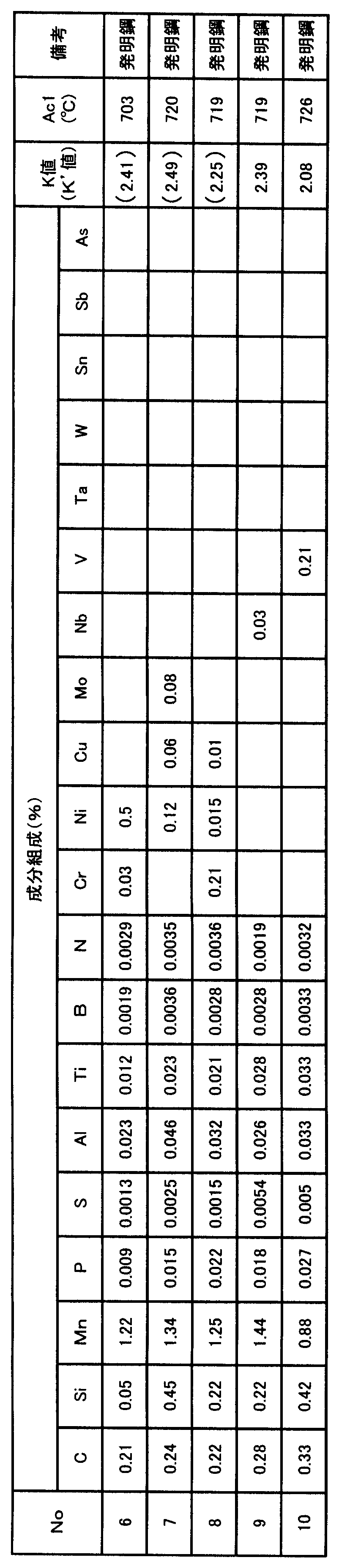
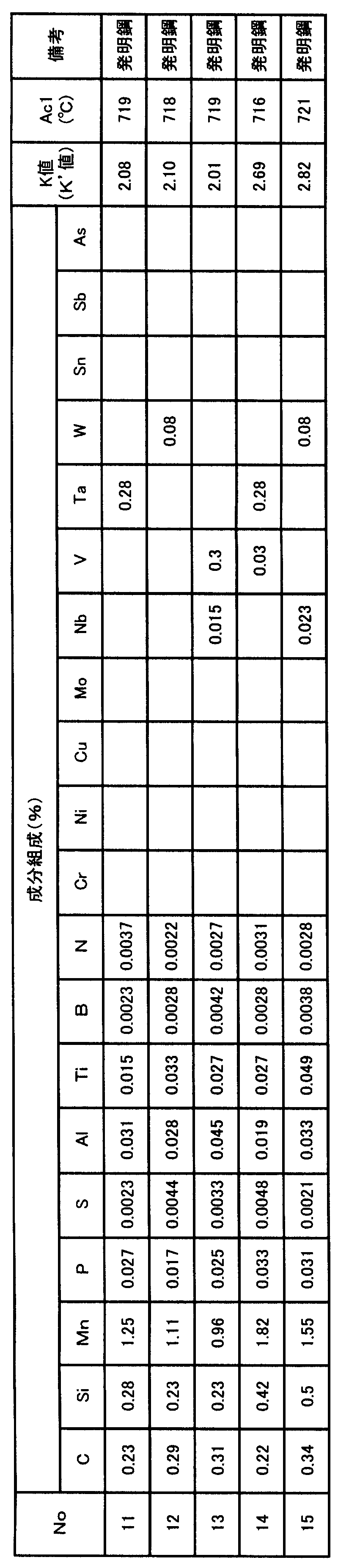
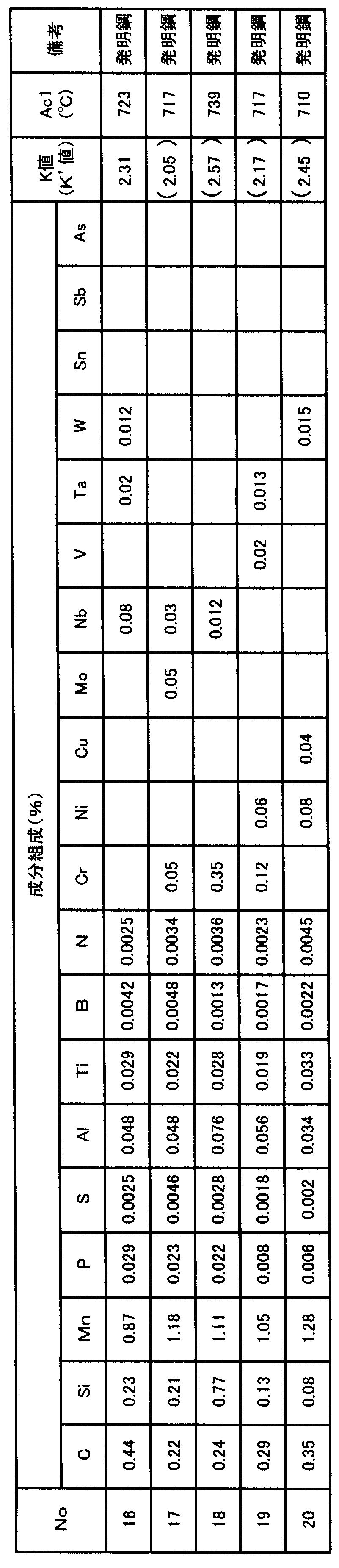
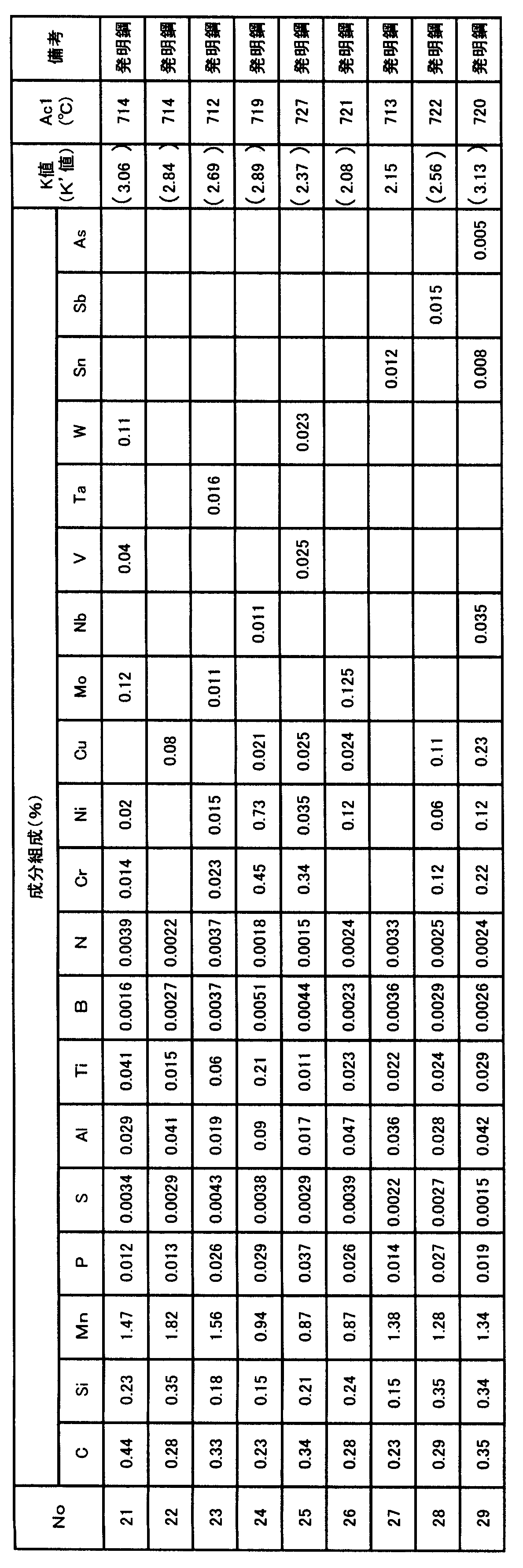
- K value 3C + Mn + 0.5Si (1)
- C, Mn, and Si show content (mass%) of each element.
- K ′ value 3C + Mn + 0.5Si + Cr + Ni + Mo + Cu (2)
- C, Mn, Si, Cr, Ni, Mo, and Cu indicate the content (% by mass) of each element.
- K ′ value the K element shown here as the amount of alloy elements. did it.
- the higher this K value (K ′ value) the better the hardenability is ensured.
- the upper limit of the K value (K ′ when Cr, Ni, Mo, Cu is included) is not particularly defined, but if it exceeds 3.6, the hardenability is too high and the above-mentioned defects such as cracking may occur. Therefore, 3.6 or less is desirable.
- the surface hardness of the steel sheet is specified to be 77 or less on the Rockwell hardness B scale (HRB).
- HRB Rockwell hardness B scale
- a machining experiment simulating tooth profile machining was performed as an evaluation of processability, and the presence or absence of cracks in a portion subjected to shear deformation of the root portion of the tooth mold was investigated.
- a steel material having a thickness of 3 mm was manufactured as a test material by using a steel material having a 0.22% C-based component as the steel material and changing the hot rolling, cold rolling, and annealing conditions.
- the shape of the tooth profile was a rack-shaped mold made with a module of 1.5 mm defined in JIS-B1703, pressed 2 mm against a steel plate with a thickness of 3 mm, and evaluated for the presence or absence of cracks in the tooth forming profile.
- the lower limit of the K value (K ′ value) is defined from the viewpoint of ensuring hardenability.
- K the harder it is, and it is advantageous for the hardness at the time of quenching.
- workability is inferior, problems such as cracking occur at the time of processing. Therefore, it is necessary to carry out the manufacturing method defined in the present invention and to soften the steel sheet while controlling the atmosphere during annealing.
- C A basic element necessary to obtain the strength of the steel sheet. If the carbon content is less than 0.20%, the required strength as a product cannot be obtained, and the hardenability of the central part of the component is also lowered, and desired characteristics cannot be obtained. However, if a large amount of C exceeding 0.45% is contained, it is difficult to ensure toughness and formability after heat treatment, so 0.20 to 0.45% by mass (hereinafter, unless otherwise specified, the content is The C content was determined in the range of (in mass%). A more preferable range is 0.20 to 0.40%.
- Si Used as a deoxidizer for steel, effective from the viewpoint of hardenability, and needs to contain 0.05% or more of Si.
- the upper limit is set to 0.80% because surface properties are deteriorated due to scale wrinkles and the like during hot rolling as the Si content increases.
- a more preferred range is 0.05 to 0.50%.
- Mn Used as a deoxidizer and effective from the viewpoint of hardenability. In the present invention, it is necessary to add 0.85% or more from the viewpoint of ensuring hardenability in carburization performed at low Cp, but if Mn is too high, impact characteristics due to structural changes after quenching and tempering due to segregation.
- the upper limit is specified to be 2.0%. A more preferred range is 0.90 to 1.80%.
- the steel according to the present invention is a harmful element from the viewpoint of toughness and workability, and the lower the P content, the better.
- the upper limit is specified to 0.04%. Further, the lower limit is desirable, but the lower limit is specified to be 0.001% because reducing the cost from 0.001% greatly increases the industrial cost. A more preferred range is 0.003 to 0.025%.
- S promotes the formation of non-metallic inclusions in the steel, and deteriorates the formability and toughness after heat treatment. For this reason, the lower the S content, the better, and the upper limit is defined as 0.006%. Although the lower limit is desirable, the lower limit is specified to be 0.0001% because a reduction from 0.0001% greatly increases the industrial cost. A more preferred range is 0.0001 to 0.003%.
- Al Used as a deoxidizer for steel. For this purpose, 0.01% or more of Al is necessary. However, even if Al exceeding 0.10% is added, the effect is saturated and surface defects are likely to occur. Al is also effective for fixing N, and promotes nitrogen absorption during the production of steel sheets. However, if its content exceeds 0.10%, the Al nitride becomes stable, which inhibits grain growth during the carburizing heat treatment and causes hardenability to deteriorate. Therefore, the Al content is specified in the range of 0.01 to 0.10%. A more preferred range is 0.01 to 0.06%.
- Ti Effective for deoxidation of steel and fixation of N, 0.005% or more of addition is necessary in relation to the amount of N. However, even if adding Ti exceeding 0.30%, the effect is saturated and the cost also increases. Furthermore, since the amount of precipitates due to nitrogen absorption during the manufacturing process increases, grain growth during carburization is hindered and the hardenability is deteriorated. Therefore, the range of Ti is specified to be 0.01 to 0.30%. A more preferred range is 0.01 to 0.10%.
- B An effective element that improves the hardenability of steel, and the effect is seen from a very small amount. In order to obtain the effect of improving hardenability, 0.0005% or more must be added. However, if a large amount of B exceeding 0.01% is contained, the castability deteriorates and cracks occur during slab casting. Furthermore, adverse effects such as generation of B-based compounds in the steel and a reduction in toughness are observed. Therefore, the B content is specified to be 0.0005% to 0.01%. A more preferred range is 0.0005 to 0.005%.
- N Combines with B to form a nitride, which deteriorates the hardenability improvement effect of B.
- the N content is preferably as low as possible, but reducing it to less than 0.001% causes an increase in cost.
- the content exceeds 0.01% as the average composition of steel, a large amount of elements for fixing N such as AL and Ti is required, and precipitates such as AlN and TiN cause grain growth during carburization. It inhibits and reduces hardenability, and not only causes abnormal layers, but also deteriorates mechanical properties such as toughness. Therefore, the upper limit of N content is specified as 0.01%. A more preferred range is 0.001 to 0.006%.
- N easily penetrates into the steel during the manufacturing process, and enters from the atmosphere during hot rolling and annealing, so it is easy to concentrate especially in the surface layer part, and its influence is suppressed to deteriorate the hardenability of the part surface layer part. Necessary to prevent. If the nitrogen intrusion from the atmosphere during heating or annealing exceeds 100 ppm, the amount of nitrides deposited during cutting or annealing increases, grain growth during heating before quenching is delayed, and hardenability deteriorates. Therefore, it is particularly important that the N content (surface layer average N amount) in the surface layer portion (in the range of 100 ⁇ m in the thickness direction from the surface) is regulated to 100 ppm or less. More preferably, the N content in the surface layer is 70 ppm or less.
- Cr It is an effective element that can be added from the viewpoint of hardenability of steel, and the effect becomes remarkable at 0.01% or more, but even if added over 2%, the effect is saturated, and the cost is also reduced. Get higher. Therefore, the content is specified to be 0.01 to 2.0%. A more preferred range is 0.05 to 0.50%.
- Ni It is an effective element from the viewpoint of improving the hardenability and toughness of steel. Addition at 0.01% or more is effective, but if it exceeds 1%, it only causes an increase in cost. The content is specified to be 0.02 to 1.0% because it does not change much. A more preferred range is 0.05 to 0.50%.
- Cu It is an effective element from the viewpoint of improving the hardenability and toughness of steel. Addition at 0.01% or more is effective, but adding more than 0.5% only causes an increase in cost. Since the effect does not change much, the content is specified to be 0.005 to 0.5%. A more preferred range is 0.02 to 0.35%.
- Mo An effective element for improving the hardenability of steel, and an element effective for increasing the softening resistance by tempering. In order to obtain the effect, addition of 0.01% or more is necessary. However, even if the content exceeds 1.0%, the effect is saturated and the cost increases, so the content is defined as 0.01 to 1.0%. A more preferred range is 0.01 to 0.40%.
- Nb Forms carbonitride and is effective for stabilizing precipitates and improving toughness at 0.01% or more, but adding more than 0.5% causes an increase in cost. Since this leads to a decrease in hardenability, the range is specified as 0.01 to 0.5%. A more preferred range is 0.01 to 0.20%.
- V Carbonitride is formed in the same way as Nb, and it is effective at 0.01% or more for stabilizing precipitates and improving toughness. However, adding more than 0.5% only increases the cost. The effect does not change so much and leads to a decrease in hardenability due to carbide formation. Therefore, the range is specified as 0.01 to 0.5%. A more preferred range is 0.01 to 0.20%.
- Ta Nb
- V forms carbonitride and is effective in stabilizing precipitates and improving toughness at 0.01% or more, but adding more than 0.5% causes an increase in cost. As a result, the effect does not change much and leads to a decrease in hardenability due to carbide formation. Therefore, the range is specified as 0.01 to 0.5%. A more preferred range is 0.01 to 0.30%.
- W Carbonitride is formed in the same way as Nb, V, and Ta, and it is effective at 0.01% or more to stabilize precipitates and improve toughness. However, even if added over 0.5%, the cost increases. However, the effect is not much changed, and the hardenability is reduced due to the formation of carbides. Therefore, the range is specified as 0.01 to 0.5%. A more preferred range is 0.01 to 0.20%.
- Sn, Sb, and As may be added in a required amount.
- Sn, Sb, As: 0.003-0.03% each Sn, Sb, and As are elements that have a high tendency to segregate at the interface, the surface, and the like, and have a function of suppressing surface layer reactions during production processes such as nitrogen absorption and decarburization. By adding it, even when the steel material is exposed to a high temperature atmosphere during heating or annealing in the hot rolling process, the reaction of elements such as nitrogen and carbon that tend to fluctuate components can be suppressed, and significant component fluctuations can be prevented. is there. Therefore, it may be added as necessary.
- the content of oxygen (O) is not specified, but when the oxide is agglomerated and coarsened, the ductility is lowered, so the oxygen content is preferably 0.025% or less. . Less oxygen is preferred, but it is technically difficult to make it less than 0.0001%, so 0.0001% or more is preferred.
- the carbon steel sheet of the present invention may contain impurities inevitably mixed in the manufacturing process in addition to the above elements, but it is preferable that impurities are not mixed as much as possible.
- Hot rolling is important in the present invention considered through consistent optimization with the steel material components and the subsequent annealing process, and suppresses component fluctuations in the surface layer portion of the steel sheet, that is, N intrusion and decarburization to the surface layer portion as much as possible. This is very important. Therefore, heating is set to 1200 ° C. or less without applying high-temperature heating exceeding 1200 ° C., which is normally used (S1). At this time, as the soaking time becomes longer, more nitrogen penetrates into the surface layer portion, which affects the quenching characteristics of the product. Therefore, it is important that the heating time is not long. Specifically, it is desirable to heat so that the retention time may be 60 minutes at 1200 ° C. and 90 minutes at 1100 ° C.
- finish rolling temperature 800 ° C. or higher and 940 ° C. or lower (S2). If the finish rolling temperature is lower than 800 ° C., defects due to seizure occur frequently. If the finish rolling temperature is higher than 940 ° C., the frequency of occurrence of defects due to scale increases, resulting in a decrease in product yield and an increase in cost.
- cooling to 650 ° C. or lower is performed at a cooling rate of 20 ° C./second or more (S3, first cooling). If the cooling to 650 ° C. after the end of rolling is made slower than 20 ° C./second, the structure variation called pearlite band accompanying segregation occurs, which leads to deterioration of workability. Therefore, after the end of rolling, the cooling rate is controlled to a cooling rate of 20 ° C./second or less up to 650 ° C. or less, and then the uniform pearlite transformation, barlite + bainite structure, bainite structure, etc. up to the take-off temperature, Slow cooling at 20 ° C./second or less is performed (S4, second cooling).
- the coiling temperature can be systematically uniform, so that the systematic fluctuation in the coil can be reduced by winding at a temperature of 650 ° C. or lower and 400 ° C. or higher (S5).
- the hot-rolled steel sheet manufactured by the above process is pickled (S6). After pickling, annealing and cold rolling are carried out according to the product plate thickness and the required softening level, and the following matters are important as manufacturing conditions at that time.
- the steel sheet according to the present invention has a high carbon content, so that the characteristics cannot be obtained by a continuous annealing process used in so-called mild steel sheets.
- a process of annealing a coil as it is called batch annealing or box annealing is applied (S7, first annealing).
- the annealing atmosphere was an atmosphere mainly composed of hydrogen, and the hydrogen concentration was 95% or more.
- the inside of the annealing furnace is temporarily replaced with nitrogen at room temperature to form a nitrogen atmosphere and then replaced with hydrogen.
- the dew point is -20 ° C or less, and the temperature is 400 ° C or more and the holding time (the holding time depends on the material, but for the softening of the steel plate according to the present invention It is desirable to maintain the temperature at 660 ° C. or more for 10 hours or more.) It is important from the viewpoint of preventing fluctuations in the surface layer component that the dew point is ⁇ 40 ° C. or less. Decarburization occurs, and an abnormal layer with poor quenching is generated when carburizing at a low carbon potential. By completing this series of steps (hot rolling + heat treatment), a steel sheet according to the present invention having excellent workability and excellent carburizing and quenching properties in carburizing treatment after processing can be obtained.
- annealing is performed in a temperature range from Ac1 point to Ac1 + 50 ° C. and the cooling rate after annealing is 5 ° C./hour or less to Ac1-30 ° C. or less.
- generated by Ac1 or more tends to coarsen the ferrite phase produced
- the phase ratio of the austenite phase becomes too high in the composition of the steel of the present invention, and partly pearlite is generated during cooling, so that the temperature of high temperature annealing in the present invention is It is preferable that it is Ac1 + 50 degrees C or less. Further, in the steel of the present invention, the effect is saturated even if it is slowly cooled to Ac1-30 ° C. or lower, and the cost increases due to the prolonged annealing time. Therefore, the end point temperature of the slow cooling is up to the above Ac1-30 ° C. It is preferable that Ac1 here indicates the temperature at which the austenite phase appears in the temperature raising process.
- a sample is taken from a hot-rolled steel sheet, and the expansion curve when the temperature is raised at 0.3 ° C./s with a formaster tester is shown.
- the A1 transformation point was determined by measurement.
- cold rolling process is used to finish the product thickness with high accuracy and to efficiently soften in combination with annealing. Therefore, in the series of steps described above, after hot rolling and scraping (S5), pickling (S6), cold rolling (S6-2, first cold rolling) may be performed. .
- cold rolling with a rolling rate of 5% or more promotes spheroidization of carbides, recrystallization without nucleation, and relatively large grain size upon completion of recrystallization, which tends to cause coarsening due to grain growth, and promotes softening. To do.
- the upper limit is not particularly defined, but if rolling is performed at a rolling rate exceeding 60%, the uniformity of the metal structure of the steel sheet by cold rolling further increases, but the higher the cold rolling rate, the finer the recrystallized grains during annealing. Therefore, since it is necessary to increase the annealing time for softening, the cold rolling rate can be determined from the viewpoint of cost and product homogenization.
- the steel sheet is again subjected to cold rolling (S7-2, second cold rolling) with a reduction rate of 5% or more, and then in an atmosphere containing 95% or more of hydrogen.
- Annealing may be performed (S7-3, second annealing).
- the steel sheet is subjected to cold rolling (S7-4, third cold rolling) with a rolling reduction of 5% or more
- annealing S7-5, third annealing
- manufacturing method it is also possible to implement the above-mentioned annealing process more than 3 degree
- the carbon steel sheet according to an embodiment of the present invention can be restated as follows, that is, by mass, C: 0.20 to 0.45%, Si: 0.05 to 0.8%, Mn: 0 .85 to 2.0%, P: 0.001 to 0.04%, S: 0.0001 to 0.006%, Al: 0.01 to 0.1%, Ti: 0.005 to 0.3 %, B: 0.0005 to 0.01%, N: 0.001 to 0.01%, the balance is Fe and inevitable impurities, and the value represented by 3C + Mn + 0.5Si + Cr + Ni + Mo + Cu is 2.0 or more
- the steel plate surface hardness is 77 or less on the Rockwell hardness B scale (HRB), the average nitrogen (N) content from the surface layer to 100 ⁇ m is 100 ppm or less, and the carbon potential (Cp) is 0.6 or less.
- Carburizing and quenching used in a mild carburizing atmosphere It is a carbon steel plate with excellent properties.
- C, Mn, Si, Cr, N, Mo, and Cu indicate the content (% by mass) of each element, and are treated as zero when not included.
- the above-mentioned carbon steel sheet is further mass%, Cr: 0.01 to 2.0%, Ni: 0.01 to 1.0%, Cu: 0.005 to 0.5%, Mo: 0.01 to One or more of 1.0% may be contained, and the value represented by 3C + Mn + 0.5Si + Cr + Ni + Mo + Cu may be 2.0 or more.
- the above-mentioned carbon steel sheet is further mass%, Nb: 0.01 to 0.5%, V: 0.01 to 0.5%, Ta: 0.01 to 0.5%, W: 0.01 to You may contain 1 type, or 2 or more types of 0.5%.
- the carbon steel sheet described above may further contain one type of Sn: 0.003-0.03%, Sb: 0.003-0.03%, and As: 0.003-0.03% by mass%. You may contain 2 or more types.
- the finish rolling temperature of hot rolling is set to 800 ° C. or more and 940 ° C. or less, and the cooling rate is 20 ° C./second to 650 ° C. after finishing rolling.
- a dew point of 95% or higher hydrogen and up to 400 ° C. May be produced by annealing at a temperature of 660 ° C. or more for 10 hours or more in an atmosphere having a dew point of ⁇ 20 ° C. or less and a dew point of ⁇ 40 ° C. or less at ⁇ 40 ° C. or less.
- the annealing may be performed after cold rolling at a rolling rate of 5% to 60%.
- the dew point of hydrogen is 95% or more and up to 400 ° C is -20 ° C or less, and the dew point of 400 ° C or more is -40 ° C or less.
- annealing may be performed again at a temperature of 660 ° C. or higher.
- cold rolling at a rolling rate of 5% or more and 60% or less is performed, the dew point of hydrogen is 95% or more and up to 400 ° C is -20 ° C or less, and the dew point of 400 ° C or more is -40 ° C or less. May be annealed at a temperature of 660 ° C.
- the atmosphere is set to 95% or more of hydrogen and the annealing temperature is annealed in the range of Ac1 to Ac1 + 50 ° C., and the cooling rate after annealing is set to 5 to 1-30 ° C. You may cool slowly below °C / hour.
- the surface hardness of the obtained steel sheet was measured with the Rockwell hardness B scale (HRB), and the surface layer average N amount was obtained by planing 100 ⁇ m in the thickness direction from the surface of the steel sheet before carburizing and quenching.
- the content of nitrogen (N) in the swarf of the steel plate was analyzed. Thereafter, the carved sample was carburized and quenched, and the presence or absence of an abnormal layer on the surface was examined.
- the carburizing treatment was performed by a gas carburizing method, and the carbon potential was measured by a CO2 amount control method using an infrared gas analyzer. No. in Table 7 to Table 12 The numerical part of the column indicates the No. in Table 1 to Table 6. It was made to understand under what conditions the material with which component was carried out.
- the surface hardness HRB Rockwell hardness B scale
- the surface hardness HRB Rockwell hardness B scale
- Tables 7 to 12 From the tooth profile processing test results (Tables 7 to 12), if the HRB is 77 or less, cracks will occur. Confirmed that it does not occur. That is, it was confirmed that the steel sheet according to the present invention is excellent in workability.
- the steel sheet according to the present invention exhibits sufficient performance even at a low carbon potential (CP ⁇ 0.6), and not only is excellent in carburization but also in workability. It was confirmed to be excellent.
- this steel material can be applied not only to automobile parts and various industrial machine parts, but also to a wide range of tools and blades, it is needless to say that the field of application is wide, used throughout the industry, and industrially valuable. Yes.
Landscapes
- Chemical & Material Sciences (AREA)
- Engineering & Computer Science (AREA)
- Mechanical Engineering (AREA)
- Materials Engineering (AREA)
- Metallurgy (AREA)
- Organic Chemistry (AREA)
- Physics & Mathematics (AREA)
- Thermal Sciences (AREA)
- Crystallography & Structural Chemistry (AREA)
- Chemical Kinetics & Catalysis (AREA)
- Heat Treatment Of Sheet Steel (AREA)
- Solid-Phase Diffusion Into Metallic Material Surfaces (AREA)
Abstract
Description
本願は、2009年3月27日に、日本に出願された特願2009-079959号に基づき優先権を主張し、その内容をここに援用する。
ここで言うカーボンポテンシャルは、鋼材を浸炭する際の雰囲気の浸炭能力を示す値である。カーボンポテンシャルは、浸炭する温度でのガス雰囲気と平衡に達したときの鋼表面の炭素濃度に相当する。
上記(2)、(32)に記載の構成によれば、析出物の安定化や靭性改善の効果や、鋼板表層部の成分変動を抑制する効果が得られる。
上記(3)、(33)に記載の方法によれば、加工性及び加工後の浸炭処理性に優れた炭素鋼板を安定して製造することができる。
上記(4)~(30)に記載の方法によれば、炭素鋼板の加工性や軟質化を更に向上させることができる。
K値=3C+Mn+0.5Si・・・(1)
但し、C,Mn,Siは、それぞれの元素の含有量(質量%)を示す。
K’値=3C+Mn+0.5Si+Cr+Ni+Mo+Cu・・・(2)
但し、C,Mn,Si,Cr,Ni,Mo,Cuは、それぞれの元素の含有量(質量%)を示す。尚、上述の成分が含まれていない時は零として扱う。
C:鋼板の強度を得るために必要な基本元素である。0.20%未満の炭素含有量では、製品としての要求される強度が得られず、また、部品中心部の焼入れ性も低下して所望の特性が得られない。しかし、0.45%を超える多量のCが含有されると熱処理後における靭性や成形性を確保することが難しいため0.20~0.45質量%(以下、特に断りのない限り含有量は質量%で示す)の範囲にC含有量を定めた。さらに好ましい範囲は0.20から0.40%である。
Sn、Sb、As:それぞれ0.003~0.03%
Sn、Sb、及びAsは、界面、表面等に偏析する傾向が高い元素であり、吸窒や脱炭等の製造工程中での表層反応を抑制する働きがある。その添加により、熱間圧延工程の加熱時や焼鈍時の高温雰囲気中に鋼材がさらされる状態でも、窒素や炭素等の成分変動しやすい元素の反応を抑制し、著しい成分変動を防止できる効果がある。従って、必要に応じて添加するとよい。添加量に関しては、0.003%より少ないと、その効果が小さく、また、0.03%より多量に添加しても効果が飽和するだけでなく、靭性の低下、また、浸炭時間の長時間化を招くなど、コスト増につながる。そのため、0.003~0.03%添加することが望ましい。
熱間圧延は鋼材成分、及びその後の焼鈍工程との一貫最適化を通して考える本発明においては、重要であり、鋼板の表層部の成分変動、すなわち表層部へのN侵入や脱炭を極力抑制することが重要である。そこで、加熱は通常使用される1200℃を超えるような高温加熱は適用せずに、1200℃以下とする(S1)。また、この際、均熱時間も長時間となるほど表層部への窒素侵入が多くなり、製品の焼入れ特性に影響するため、加熱時間は長時間にならないようにすることが重要である。具体的には、1200℃では保定時間として60分を、1100℃では90分を超えないように加熱することが望ましい。
ここにおけるAc1は昇温過程でオーステナイト相が出現する温度を示し、本発明では熱延鋼板からサンプルを採取し、フォーマスター試験機にて0.3℃/sで昇温した時の膨張曲線を測定し、A1変態点を求めた。また、文献等にはAc1を成分から求める簡便な方法もあり、一例として、William C.Leslie著のThe Physical Metallurgy of Steelには、Ac1(℃)=723-10.7×%Mn-16.9×%Ni+29.1×%Si+16.9×%Cr+290×%As+6.38×%Wが示されており、これらの経験式を用いることも可能である。
また、本発明製造方法においては、軟質化の観点からは上述の焼鈍工程を冷延と組み合わせ3度を超えて実施することも可能であり、その場合も上述した製造条件内で実施することが必要である。
上述の炭素鋼板は、更に質量%で、Cr:0.01~2.0%、Ni:0.01~1.0%、Cu:0.005~0.5%、Mo:0.01~1.0%の1種または2種以上を含有し、3C+Mn+0.5Si+Cr+Ni+Mo+Cuで示される値が2.0以上であってもよい。
上述の炭素鋼板は、更に質量%で、Nb:0.01~0.5%、V:0.01~0.5%、Ta:0.01~0.5%、W:0.01~0.5%の1種または2種以上を含有してもよい。
上述の炭素鋼板は、さらに、質量%で、Sn:0.003~0.03%、Sb:0.003~0.03%、及び、As:0.003~0.03%の1種又は2種以上を含有しても良い。
上述の成分を有するスラブを熱間圧延する際に、1200℃以下で加熱し、熱間圧延の仕上げ圧延温度を800℃以上940℃以下とし、仕上げ圧延終了後650℃まで冷却速度20℃/秒以上で冷却し、その後冷却速度20℃/秒以下で冷却し、捲取温度650℃以下400℃以上で捲き取り、その後、酸洗を行った後、水素95%以上、且つ400℃までの露点を-20℃以下、400℃以上の露点を-40℃以下とした雰囲気において、温度660℃以上で10時間以上焼鈍して浸炭焼入れ性に優れた炭素鋼板を製造してもよい。
前記酸洗の後に、5%以上60%以下の圧延率で冷間圧延を施した後に、前記焼鈍を行ってもよい。
前記焼鈍の後に、5%以上60%以下の圧延率で冷間圧延を施した後、水素95%以上、且つ400℃までの露点を-20℃以下、400℃以上の露点を-40℃以下の雰囲気で、温度660℃以上で再度焼鈍してもよい。
前記2度目の焼鈍後に、5%以上60%以下の圧延率の冷間圧延を施し、水素95%以上、且つ400℃までの露点を-20℃以下、400℃以上の露点を-40℃以下の雰囲気で、温度660℃以上で焼鈍してもよい。
前記熱延板または冷延板に行う焼鈍において、雰囲気を水素95%以上として且つ焼鈍温度をAc1~Ac1+50℃の範囲で焼鈍し、焼鈍後の冷却速度をAc1-30℃までの冷却速度を5℃/時間以下の緩冷却してもよい。
表1~表6に示す成分を有する鋼を真空溶解にて50kgの鋼塊に鋳造して得られた鋼片を、表7~表12に記載の条件で熱間圧延した。熱間圧延は大気雰囲気にて加熱し、熱延板の厚みは冷延を実施しない場合は3mmとし、冷延を施す場合は冷延後の板厚が3mmになるように熱延板厚を設定した。熱延板は、塩酸により酸洗した後、焼鈍あるいは冷延を行って、3mm厚みの評価用の鋼板を作成した。詳細の製造条件及び評価結果を表7~表12に示す。その後、表7~表12の記載の条件で、焼鈍するもの、又は冷間圧延した後焼鈍するもの、さらに、1回目の焼鈍後冷間圧延と焼鈍をさらに実施したもの(2回焼鈍)、また、それを再々度繰り返したもの(3回焼鈍)を表7~表12に示すように、各処理条件に従って実施した。焼鈍の雰囲気については、常温で一旦、炉内を窒素で置換した後に所定の水素量になるまで水素を導入してから昇温した。また、露点の測定は薄膜酸化アルミニウム水分センサーによる露点計を用いて測定した。
得られた鋼板の表面硬さをロックウェル硬度Bスケール(HRB)にて測定、また、表層平均N量は、浸炭焼入れ前の鋼板の表面部を表面から厚さ方向に100μmを平削りにより採取した鋼板の切り粉中の窒素(N)の含有量を分析した。その後、歯型加工を行った試料を浸炭焼入れし、表面の異常層の有無を調査した。
なお浸炭処理はガス浸炭法により行い、カーボンポテンシャルは赤外線ガス分析計によるCO2量制御法によって測定した。
表7~表12のNo.欄の数字部分は、表1~表6のNo.と対応しており、どの成分をもった材料が、どの条件で実施されているか分かるようにした。



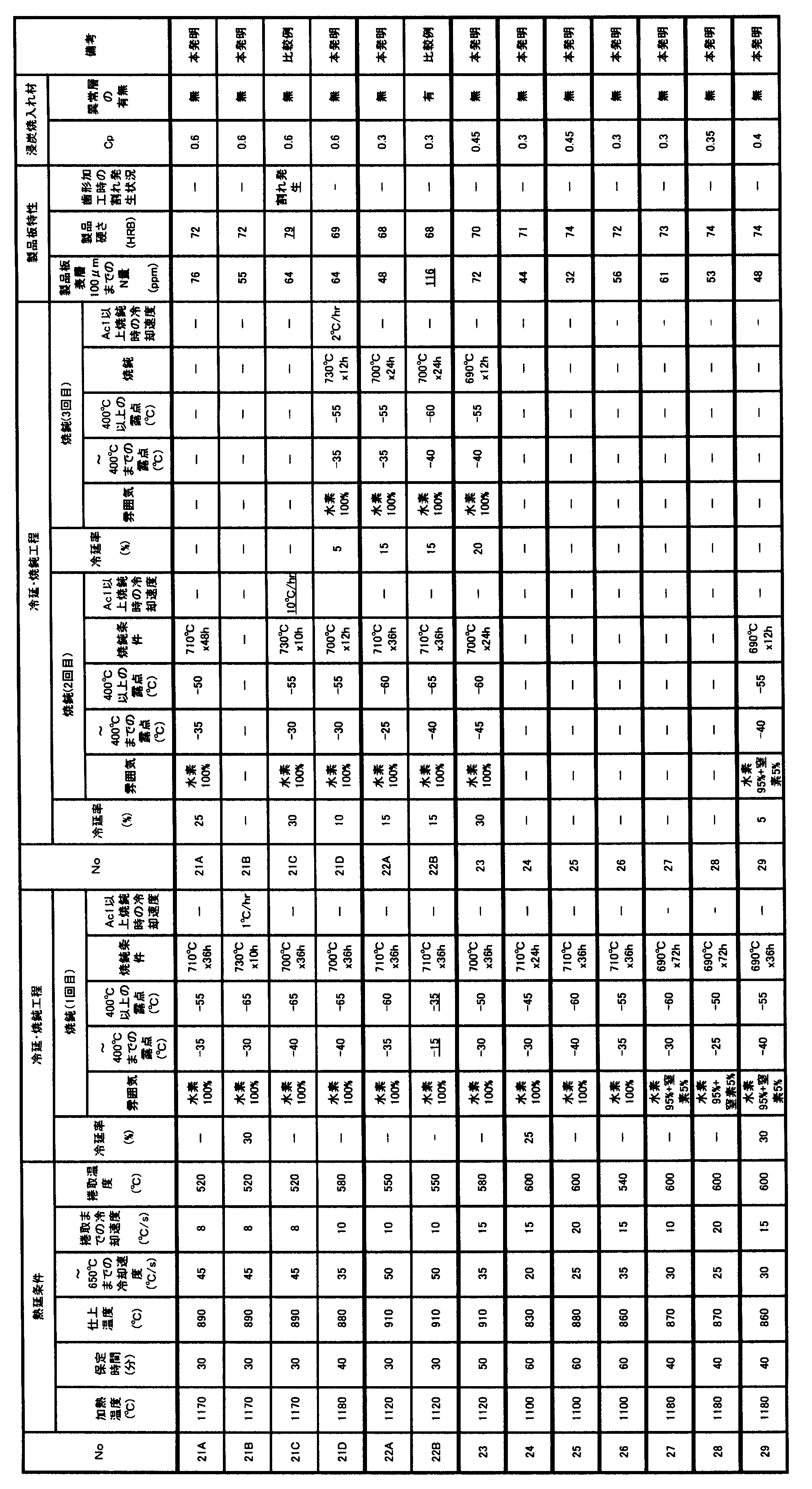

Claims (33)
- カーボンポテンシャルが0.6以下の浸炭雰囲気で浸炭される炭素鋼板であって、
C: 0.20質量%以上、0.45質量%以下、
Si: 0.05質量%以上、0.8質量%以下、
Mn: 0.85質量%以上、2.0質量%以下、
P: 0.001質量%以上、0.04質量%以下、
S: 0.0001質量%以上、0.006質量%以下、
Al: 0.01質量%以上、0.1質量%以下、
Ti: 0.005質量%以上、0.3質量%以下、
B: 0.0005質量%以上、0.01質量%以下、及び
N: 0.001質量%以上、0.01質量%以下
の成分を含有し、
残部がFe及び不可避的不純物を有し、
3C+Mn+0.5Siで求められるK値が2.0以上であり;
表面硬度がロックウェル硬度Bスケールで77以下であり;
表層から深さ100μmまでの領域におけるNの平均含有量が100ppm以下である;
ことを特徴とする炭素鋼板。 - Nb: 0.01質量%以上、0.5質量%以下、
V: 0.01質量%以上、0.5質量%以下、
Ta: 0.01質量%以上、0.5質量%以下、
W: 0.01質量%以上、0.5質量%以下、
Sn: 0.003質量%以上、0.03質量%以下、
Sb: 0.003質量%以上、0.03質量%以下、及び
As: 0.003質量%以上、0.03質量%以下
の1種又は2種以上の成分を更に含有する
ことを特徴とする請求項1に記載の炭素鋼板。 - スラブを1200℃以下で加熱する加熱工程と;
800℃以上940℃以下の仕上げ圧延温度で前記スラブを熱間圧延して鋼板を得る熱間圧延工程と;
前記鋼板が650℃以下になるまで冷却速度20℃/秒以上で前記鋼板を冷却する第1の冷却工程と;
前記第1の冷却工程に続き、冷却速度20℃/秒以下で前記鋼板を冷却する第2の冷却工程と;
650℃以下400℃以上で前記鋼板を捲き取る捲き取り工程と;
前記鋼板を酸洗する酸洗工程と;
前記鋼板を、水素95%以上、且つ400℃までの露点を-20℃以下、400℃以上の露点を-40℃以下とした雰囲気において、温度660℃以上で10時間以上焼鈍する第1の焼鈍工程と;
を備えることを特徴とする、請求項1又は2に記載の炭素鋼板の製造方法。 - 前記第1の焼鈍工程では、雰囲気を水素95%以上として且つ焼鈍温度をAc1~Ac1+50℃の範囲で焼鈍し、焼鈍後Ac1-30℃までの冷却速度を5℃/時間以下に設定する
ことを特徴とする請求項3に記載の炭素鋼板の製造方法。 - 前記酸洗工程の後に、5%以上60%以下の圧延率で前記鋼板を冷間圧延する第1の冷間圧延工程
を更に備えることを特徴とする請求項4に記載の炭素鋼板の製造方法。 - 前記第1の焼鈍工程の後に、5%以上60%以下の圧延率で前記鋼板を冷間圧延する第2の冷間圧延工程と;
前記第2の冷間圧延工程の後に、水素95%以上、且つ400℃までの露点を-20℃以下、400℃以上の露点を-40℃以下の雰囲気で、温度660℃以上で前記鋼板を焼鈍する第2の焼鈍工程と;
を更に備えることを特徴とする請求項5に記載の炭素鋼板の製造方法。 - 前記第2の焼鈍工程では、雰囲気を水素95%以上として且つ焼鈍温度をAc1~Ac1+50℃の範囲で焼鈍し、焼鈍後Ac1-30℃までの冷却速度を5℃/時間以下に設定する
ことを特徴とする請求項6に記載の炭素鋼板の製造方法。 - 前記第2の焼鈍工程の後に、5%以上60%以下の圧延率で前記鋼板を冷間圧延する第3の冷間圧延工程と;
前記第3の冷間圧延工程の後に、水素95%以上、且つ400℃までの露点を-20℃以下、400℃以上の露点を-40℃以下の雰囲気で、温度660℃以上で前記鋼板を焼鈍する第3の焼鈍工程と;
を更に備えることを特徴とする請求項7に記載の炭素鋼板の製造方法。 - 前記第3の焼鈍工程では、雰囲気を水素95%以上として且つ焼鈍温度をAc1~Ac1+50℃の範囲で焼鈍し、焼鈍後Ac1-30℃までの冷却速度を5℃/時間以下に設定する
ことを特徴とする請求項8に記載の炭素鋼板の製造方法。 - 前記第2の焼鈍工程の後に、5%以上60%以下の圧延率で前記鋼板を冷間圧延する第3の冷間圧延工程と;
前記第3の冷間圧延工程の後に、水素95%以上、且つ400℃までの露点を-20℃以下、400℃以上の露点を-40℃以下の雰囲気で、温度660℃以上で前記鋼板を焼鈍する第3の焼鈍工程と;
を更に備えることを特徴とする請求項6に記載の炭素鋼板の製造方法。 - 前記第3の焼鈍工程では、雰囲気を水素95%以上として且つ焼鈍温度をAc1~Ac1+50℃の範囲で焼鈍し、焼鈍後Ac1-30℃までの冷却速度を5℃/時間以下に設定する
ことを特徴とする請求項10に記載の炭素鋼板の製造方法。 - 前記第1の焼鈍工程の後に、5%以上60%以下の圧延率で前記鋼板を冷間圧延する第2の冷間圧延工程と;
前記第2の冷間圧延工程の後に、水素95%以上、且つ400℃までの露点を-20℃以下、400℃以上の露点を-40℃以下の雰囲気で、温度660℃以上で前記鋼板を焼鈍する第2の焼鈍工程と;
を更に備えることを特徴とする請求項4に記載の炭素鋼板の製造方法。 - 前記第2の焼鈍工程では、雰囲気を水素95%以上として且つ焼鈍温度をAc1~Ac1+50℃の範囲で焼鈍し、焼鈍後Ac1-30℃までの冷却速度を5℃/時間以下に設定する
ことを特徴とする請求項12に記載の炭素鋼板の製造方法。 - 前記第2の焼鈍工程の後に、5%以上60%以下の圧延率で前記鋼板を冷間圧延する第3の冷間圧延工程と;
前記第3の冷間圧延工程の後に、水素95%以上、且つ400℃までの露点を-20℃以下、400℃以上の露点を-40℃以下の雰囲気で、温度660℃以上で前記鋼板を焼鈍する第3の焼鈍工程と;
を更に備えることを特徴とする請求項13に記載の炭素鋼板の製造方法。 - 前記第3の焼鈍工程では、雰囲気を水素95%以上として且つ焼鈍温度をAc1~Ac1+50℃の範囲で焼鈍し、焼鈍後Ac1-30℃までの冷却速度を5℃/時間以下に設定する
ことを特徴とする請求項14に記載の炭素鋼板の製造方法。 - 前記第2の焼鈍工程の後に、5%以上60%以下の圧延率で前記鋼板を冷間圧延する第3の冷間圧延工程と;
前記第3の冷間圧延工程の後に、水素95%以上、且つ400℃までの露点を-20℃以下、400℃以上の露点を-40℃以下の雰囲気で、温度660℃以上で前記鋼板を焼鈍する第3の焼鈍工程と;
を更に備えることを特徴とする請求項12に記載の炭素鋼板の製造方法。 - 前記第3の焼鈍工程では、雰囲気を水素95%以上として且つ焼鈍温度をAc1~Ac1+50℃の範囲で焼鈍し、焼鈍後Ac1-30℃までの冷却速度を5℃/時間以下に設定する
ことを特徴とする請求項16に記載の炭素鋼板の製造方法。 - 前記酸洗工程の後に、5%以上60%以下の圧延率で前記鋼板を冷間圧延する第1の冷間圧延工程
を更に備えることを特徴とする請求項3に記載の炭素鋼板の製造方法。 - 前記第1の焼鈍工程の後に、5%以上60%以下の圧延率で前記鋼板を冷間圧延する第2の冷間圧延工程と;
前記第2の冷間圧延工程の後に、水素95%以上、且つ400℃までの露点を-20℃以下、400℃以上の露点を-40℃以下の雰囲気で、温度660℃以上で前記鋼板を焼鈍する第2の焼鈍工程と;
を更に備えることを特徴とする請求項18に記載の炭素鋼板の製造方法。 - 前記第2の焼鈍工程では、雰囲気を水素95%以上として且つ焼鈍温度をAc1~Ac1+50℃の範囲で焼鈍し、焼鈍後Ac1-30℃までの冷却速度を5℃/時間以下に設定する
ことを特徴とする請求項19に記載の炭素鋼板の製造方法。 - 前記第2の焼鈍工程の後に、5%以上60%以下の圧延率で前記鋼板を冷間圧延する第3の冷間圧延工程と;
前記第3の冷間圧延工程の後に、水素95%以上、且つ400℃までの露点を-20℃以下、400℃以上の露点を-40℃以下の雰囲気で、温度660℃以上で前記鋼板を焼鈍する第3の焼鈍工程と;
を更に備えることを特徴とする請求項20に記載の炭素鋼板の製造方法。 - 前記第3の焼鈍工程では、雰囲気を水素95%以上として且つ焼鈍温度をAc1~Ac1+50℃の範囲で焼鈍し、焼鈍後Ac1-30℃までの冷却速度を5℃/時間以下に設定する
ことを特徴とする請求項21に記載の炭素鋼板の製造方法。 - 前記第2の焼鈍工程の後に、5%以上60%以下の圧延率で前記鋼板を冷間圧延する第3の冷間圧延工程と;
前記第3の冷間圧延工程の後に、水素95%以上、且つ400℃までの露点を-20℃以下、400℃以上の露点を-40℃以下の雰囲気で、温度660℃以上で前記鋼板を焼鈍する第3の焼鈍工程と;
を更に備えることを特徴とする請求項19に記載の炭素鋼板の製造方法。 - 前記第3の焼鈍工程では、雰囲気を水素95%以上として且つ焼鈍温度をAc1~Ac1+50℃の範囲で焼鈍し、焼鈍後Ac1-30℃までの冷却速度を5℃/時間以下に設定する
ことを特徴とする請求項23に記載の炭素鋼板の製造方法。 - 前記第1の焼鈍工程の後に、5%以上60%以下の圧延率で前記鋼板を冷間圧延する第2の冷間圧延工程と;
前記第2の冷間圧延工程の後に、水素95%以上、且つ400℃までの露点を-20℃以下、400℃以上の露点を-40℃以下の雰囲気で、温度660℃以上で前記鋼板を焼鈍する第2の焼鈍工程と;
を更に備えることを特徴とする請求項3に記載の炭素鋼板の製造方法。 - 前記第2の焼鈍工程では、雰囲気を水素95%以上として且つ焼鈍温度をAc1~Ac1+50℃の範囲で焼鈍し、焼鈍後Ac1-30℃までの冷却速度を5℃/時間以下に設定する
ことを特徴とする請求項25に記載の炭素鋼板の製造方法。 - 前記第2の焼鈍工程の後に、5%以上60%以下の圧延率で前記鋼板を冷間圧延する第3の冷間圧延工程と;
前記第3の冷間圧延工程の後に、水素95%以上、且つ400℃までの露点を-20℃以下、400℃以上の露点を-40℃以下の雰囲気で、温度660℃以上で前記鋼板を焼鈍する第3の焼鈍工程と;
を更に備えることを特徴とする請求項26に記載の炭素鋼板の製造方法。 - 前記第3の焼鈍工程では、雰囲気を水素95%以上として且つ焼鈍温度をAc1~Ac1+50℃の範囲で焼鈍し、焼鈍後Ac1-30℃までの冷却速度を5℃/時間以下に設定する
ことを特徴とする請求項27に記載の炭素鋼板の製造方法。 - 前記第2の焼鈍工程の後に、5%以上60%以下の圧延率で前記鋼板を冷間圧延する第3の冷間圧延工程と;
前記第3の冷間圧延工程の後に、水素95%以上、且つ400℃までの露点を-20℃以下、400℃以上の露点を-40℃以下の雰囲気で、温度660℃以上で前記鋼板を焼鈍する第3の焼鈍工程と;
を更に備えることを特徴とする請求項25に記載の炭素鋼板の製造方法。 - 前記第3の焼鈍工程では、雰囲気を水素95%以上として且つ焼鈍温度をAc1~Ac1+50℃の範囲で焼鈍し、焼鈍後Ac1-30℃までの冷却速度を5℃/時間以下に設定する
ことを特徴とする請求項29に記載の炭素鋼板の製造方法。 - カーボンポテンシャルが0.6以下の浸炭雰囲気で浸炭される炭素鋼板であって、
C: 0.20質量%以上、0.45質量%以下、
Si: 0.05質量%以上、0.8質量%以下、
Mn: 0.85質量%以上、2.0質量%以下、
P: 0.001質量%以上、0.04質量%以下、
S: 0.0001質量%以上、0.006質量%以下、
Al: 0.01質量%以上、0.1質量%以下、
Ti: 0.005質量%以上、0.3質量%以下、
B: 0.0005質量%以上、0.01質量%以下、及び
N: 0.001質量%以上、0.01質量%以下
の成分を含有し、
Cr: 0.01質量%以上、2.0質量%以下、
Ni: 0.01質量%以上、1.0質量%以下、
Cu: 0.005質量%以上、0.5質量%以下、及び
Mo: 0.01質量%以上、1.0質量%以下
の1種又は2種以上の成分を更に含有し;
残部がFe及び不可避的不純物を有し;
3C+Mn+0.5Si+Cr+Ni+Mo+Cuで求められるK’値が2.0以上であり;
表面硬度がロックウェル硬度Bスケールで77以下であり;
表層から深さ100μmまでの領域におけるNの平均含有量が100ppm以下である;
ことを特徴とする炭素鋼板。 - Nb: 0.01質量%以上、0.5質量%以下、
V: 0.01質量%以上、0.5質量%以下、
Ta: 0.01質量%以上、0.5質量%以下、
W: 0.01質量%以上、0.5質量%以下、
Sn: 0.003質量%以上、0.03質量%以下、
Sb: 0.003質量%以上、0.03質量%以下、及び
As: 0.003質量%以上、0.03質量%以下
の1種又は2種以上の成分を更に含有する
ことを特徴とする請求項31に記載の炭素鋼板。 - スラブを1200℃以下で加熱する加熱工程と;
800℃以上940℃以下の仕上げ圧延温度で前記スラブを熱間圧延して鋼板を得る熱間圧延工程と;
前記鋼板が650℃以下になるまで冷却速度20℃/秒以上で前記鋼板を冷却する第1の冷却工程と;
前記第1の冷却工程に続き、冷却速度20℃/秒以下で前記鋼板を冷却する第2の冷却工程と;
650℃以下400℃以上で前記鋼板を捲き取る捲き取り工程と;
前記鋼板を酸洗する酸洗工程と;
前記鋼板を、水素95%以上、且つ400℃までの露点を-20℃以下、400℃以上の露点を-40℃以下とした雰囲気において、温度660℃以上で10時間以上焼鈍する第1の焼鈍工程と;
を備えることを特徴とする、請求項31又は32に記載の炭素鋼板の製造方法。
Priority Applications (5)
| Application Number | Priority Date | Filing Date | Title |
|---|---|---|---|
| JP2010529172A JP4659142B2 (ja) | 2009-03-27 | 2010-03-03 | 浸炭焼入れ性の優れた炭素鋼板およびその製造方法 |
| CA2736374A CA2736374A1 (en) | 2009-03-27 | 2010-03-03 | Carbon steel sheet having excellent carburization properties, and method for producing same |
| KR1020117005139A KR101122840B1 (ko) | 2009-03-27 | 2010-03-03 | 침탄 켄칭성이 우수한 탄소 강판 및 그 제조 방법 |
| CN201080002531.4A CN102149839B (zh) | 2009-03-27 | 2010-03-03 | 渗碳淬火性优异的碳钢板及其制造方法 |
| US12/998,035 US20120006451A1 (en) | 2009-03-27 | 2010-03-03 | Carbon steel sheet having excellent carburization properties, and method for producing same |
Applications Claiming Priority (2)
| Application Number | Priority Date | Filing Date | Title |
|---|---|---|---|
| JP2009079959 | 2009-03-27 | ||
| JP2009-079959 | 2009-03-27 |
Publications (1)
| Publication Number | Publication Date |
|---|---|
| WO2010109778A1 true WO2010109778A1 (ja) | 2010-09-30 |
Family
ID=42780478
Family Applications (1)
| Application Number | Title | Priority Date | Filing Date |
|---|---|---|---|
| PCT/JP2010/001456 Ceased WO2010109778A1 (ja) | 2009-03-27 | 2010-03-03 | 浸炭焼入れ性の優れた炭素鋼板およびその製造方法 |
Country Status (7)
| Country | Link |
|---|---|
| US (1) | US20120006451A1 (ja) |
| JP (1) | JP4659142B2 (ja) |
| KR (1) | KR101122840B1 (ja) |
| CN (1) | CN102149839B (ja) |
| CA (1) | CA2736374A1 (ja) |
| TW (1) | TWI362424B (ja) |
| WO (1) | WO2010109778A1 (ja) |
Cited By (5)
| Publication number | Priority date | Publication date | Assignee | Title |
|---|---|---|---|---|
| JP2010255066A (ja) * | 2009-04-28 | 2010-11-11 | Jfe Steel Corp | 高炭素熱延鋼板およびその製造方法 |
| WO2012056785A1 (ja) * | 2010-10-27 | 2012-05-03 | 新日本製鐵株式会社 | 表面硬化用機械構造用鋼、及び、機械構造用鋼部品とその製造方法 |
| WO2014104113A1 (ja) * | 2012-12-28 | 2014-07-03 | 新日鐵住金株式会社 | 浸炭用鋼 |
| WO2014199919A1 (ja) * | 2013-06-13 | 2014-12-18 | 新日鐵住金株式会社 | 引張強さが950~1600MPaであるパーライト組織ボルト用の鋼線の製造用の線材、引張強さが950~1600MPaであるパーライト組織ボルト用の鋼線、パーライト組織ボルト、及び、それらの製造方法 |
| JP2017031492A (ja) * | 2015-08-05 | 2017-02-09 | 新日鐵住金株式会社 | 冷延鋼板の製造方法及び冷延鋼板 |
Families Citing this family (12)
| Publication number | Priority date | Publication date | Assignee | Title |
|---|---|---|---|---|
| KR101617505B1 (ko) | 2011-04-27 | 2016-05-02 | 신닛테츠스미킨 카부시키카이샤 | 핫 스탬프 부재용 강판 및 그 제조 방법 |
| KR101382675B1 (ko) * | 2012-03-19 | 2014-04-07 | 주식회사 포스코 | 내마모성과 가공성이 우수한 저합금 열연 강판 및 그 제조방법 |
| PL2891727T3 (pl) * | 2012-08-28 | 2019-04-30 | Nippon Steel & Sumitomo Metal Corp | Blacha stalowa cienka |
| EP2984198B1 (en) | 2013-04-10 | 2021-06-23 | Tata Steel IJmuiden B.V. | Product formed by hot forming of metallic coated steel sheet, method to form the product, and steel strip |
| JP5812048B2 (ja) * | 2013-07-09 | 2015-11-11 | Jfeスチール株式会社 | 焼入れ性および加工性に優れる高炭素熱延鋼板およびその製造方法 |
| CA2917303C (en) | 2013-08-30 | 2017-10-24 | Jfe Steel Corporation | Mechanical structural component and method for manufacturing same |
| CN104178695B (zh) * | 2014-07-10 | 2017-04-26 | 燕山大学 | 一种风电轴承用中碳硼微合金化钢的制备方法 |
| BR112017007275A2 (pt) * | 2014-10-16 | 2017-12-26 | Nippon Steel & Sumitomo Metal Corp | chapa de aço de alto carbono e método de fabricação da mesma |
| KR101751530B1 (ko) | 2015-12-28 | 2017-06-27 | 주식회사 포스코 | 공구용 강판 및 그 제조방법 |
| TWI665310B (zh) * | 2018-10-02 | 2019-07-11 | 日商新日鐵住金股份有限公司 | 滲碳用鋼板及滲碳用鋼板的製造方法 |
| CN113549830B (zh) * | 2021-07-16 | 2022-05-20 | 鞍钢股份有限公司 | 高表面硬度折弯性能优异的中碳球化索氏体工具钢及其生产方法 |
| CN117604375B (zh) * | 2023-11-22 | 2026-02-13 | 南京钢铁股份有限公司 | 一种冷成型工程机械截齿用钢的制备方法 |
Citations (4)
| Publication number | Priority date | Publication date | Assignee | Title |
|---|---|---|---|---|
| JPH03188217A (ja) * | 1989-12-18 | 1991-08-16 | Sumitomo Metal Ind Ltd | 高炭素薄鋼板の製造方法 |
| JPH05331534A (ja) * | 1992-05-29 | 1993-12-14 | Nisshin Steel Co Ltd | 含b鋼板の焼鈍方法 |
| JPH10251757A (ja) * | 1997-03-14 | 1998-09-22 | Sumitomo Metal Ind Ltd | 成形性にすぐれた高炭素薄鋼板の製造方法 |
| JP2003328075A (ja) * | 2002-05-16 | 2003-11-19 | Nippon Steel Corp | バーリング加工時のバラツキが少ない浸炭焼入れ用鋼板及びその製造方法 |
Family Cites Families (3)
| Publication number | Priority date | Publication date | Assignee | Title |
|---|---|---|---|---|
| JP4445365B2 (ja) * | 2004-10-06 | 2010-04-07 | 新日本製鐵株式会社 | 伸びと穴拡げ性に優れた高強度薄鋼板の製造方法 |
| JP4846308B2 (ja) * | 2005-09-09 | 2011-12-28 | 新日本製鐵株式会社 | 使用中の硬さ変化が少ない高靭性耐摩耗鋼およびその製造方法 |
| CN101490295B (zh) * | 2006-07-14 | 2012-09-19 | 新日本制铁株式会社 | 拉伸凸缘性和疲劳特性优异的高强度钢板 |
-
2010
- 2010-03-03 JP JP2010529172A patent/JP4659142B2/ja active Active
- 2010-03-03 CA CA2736374A patent/CA2736374A1/en not_active Abandoned
- 2010-03-03 TW TW099106131A patent/TWI362424B/zh not_active IP Right Cessation
- 2010-03-03 WO PCT/JP2010/001456 patent/WO2010109778A1/ja not_active Ceased
- 2010-03-03 KR KR1020117005139A patent/KR101122840B1/ko active Active
- 2010-03-03 US US12/998,035 patent/US20120006451A1/en not_active Abandoned
- 2010-03-03 CN CN201080002531.4A patent/CN102149839B/zh active Active
Patent Citations (4)
| Publication number | Priority date | Publication date | Assignee | Title |
|---|---|---|---|---|
| JPH03188217A (ja) * | 1989-12-18 | 1991-08-16 | Sumitomo Metal Ind Ltd | 高炭素薄鋼板の製造方法 |
| JPH05331534A (ja) * | 1992-05-29 | 1993-12-14 | Nisshin Steel Co Ltd | 含b鋼板の焼鈍方法 |
| JPH10251757A (ja) * | 1997-03-14 | 1998-09-22 | Sumitomo Metal Ind Ltd | 成形性にすぐれた高炭素薄鋼板の製造方法 |
| JP2003328075A (ja) * | 2002-05-16 | 2003-11-19 | Nippon Steel Corp | バーリング加工時のバラツキが少ない浸炭焼入れ用鋼板及びその製造方法 |
Cited By (7)
| Publication number | Priority date | Publication date | Assignee | Title |
|---|---|---|---|---|
| JP2010255066A (ja) * | 2009-04-28 | 2010-11-11 | Jfe Steel Corp | 高炭素熱延鋼板およびその製造方法 |
| WO2012056785A1 (ja) * | 2010-10-27 | 2012-05-03 | 新日本製鐵株式会社 | 表面硬化用機械構造用鋼、及び、機械構造用鋼部品とその製造方法 |
| WO2014104113A1 (ja) * | 2012-12-28 | 2014-07-03 | 新日鐵住金株式会社 | 浸炭用鋼 |
| JP5862802B2 (ja) * | 2012-12-28 | 2016-02-16 | 新日鐵住金株式会社 | 浸炭用鋼 |
| WO2014199919A1 (ja) * | 2013-06-13 | 2014-12-18 | 新日鐵住金株式会社 | 引張強さが950~1600MPaであるパーライト組織ボルト用の鋼線の製造用の線材、引張強さが950~1600MPaであるパーライト組織ボルト用の鋼線、パーライト組織ボルト、及び、それらの製造方法 |
| JPWO2014199919A1 (ja) * | 2013-06-13 | 2017-02-23 | 新日鐵住金株式会社 | 引張強さが950〜1600MPaであるパーライト組織ボルト用の鋼線の製造用の線材、引張強さが950〜1600MPaであるパーライト組織ボルト用の鋼線、パーライト組織ボルト、及び、それらの製造方法 |
| JP2017031492A (ja) * | 2015-08-05 | 2017-02-09 | 新日鐵住金株式会社 | 冷延鋼板の製造方法及び冷延鋼板 |
Also Published As
| Publication number | Publication date |
|---|---|
| JP4659142B2 (ja) | 2011-03-30 |
| CA2736374A1 (en) | 2010-09-30 |
| TW201038748A (en) | 2010-11-01 |
| JPWO2010109778A1 (ja) | 2012-09-27 |
| TWI362424B (en) | 2012-04-21 |
| KR20110038172A (ko) | 2011-04-13 |
| KR101122840B1 (ko) | 2012-03-21 |
| CN102149839A (zh) | 2011-08-10 |
| US20120006451A1 (en) | 2012-01-12 |
| CN102149839B (zh) | 2015-06-03 |
Similar Documents
| Publication | Publication Date | Title |
|---|---|---|
| JP4659142B2 (ja) | 浸炭焼入れ性の優れた炭素鋼板およびその製造方法 | |
| JP4782243B2 (ja) | 焼入れ性に優れたボロン添加鋼板および製造方法 | |
| EP2801636A1 (en) | High carbon hot-rolled steel sheet and method for producing same | |
| TWI548755B (zh) | 氮化處理用鋼板及其製造方法 | |
| CN108315637B (zh) | 高碳热轧钢板及其制造方法 | |
| KR20200062926A (ko) | 수소취성 저항성이 우수한 초고강도 냉연강판 및 그 제조 방법 | |
| CN111655893B (zh) | 高碳热轧钢板及其制造方法 | |
| WO2015045951A1 (ja) | 耐遅れ破壊性およびボルト成形性に優れた高強度ボルト用鋼およびボルト | |
| EP2868764B1 (en) | Steel sheet for soft nitriding and method for manufacturing the same | |
| KR20210009606A (ko) | 강도가 향상된 오스테나이트계 스테인리스강 및 그 제조 방법 | |
| JP5614330B2 (ja) | 軟窒化処理用鋼板およびその製造方法 | |
| JPWO2019131099A1 (ja) | 熱延鋼板およびその製造方法 | |
| JP5489497B2 (ja) | 焼入性に優れたボロン鋼鋼板の製造方法 | |
| JP5601861B2 (ja) | ボロン鋼圧延焼鈍鋼板の製造法 | |
| JP2002146480A (ja) | 冷間加工性に優れた線材・棒鋼およびその製造方法 | |
| JP2019044254A (ja) | 金型 | |
| JP5515949B2 (ja) | 板厚方向の材質均一性に優れた低炭素鋼材の製造方法 | |
| JP2004346346A (ja) | 耐熱処理変形性および表面処理特性に優れた快削工具鋼と、それを用いた金型 | |
| JP2001064751A (ja) | 局部延性及び熱処理後の靭性に優れた低合金鋼熱延鋼板及びその製造方法 | |
| JPH09296251A (ja) | 冷間加工性および被削性に優れた肌焼鋼 |
Legal Events
| Date | Code | Title | Description |
|---|---|---|---|
| WWE | Wipo information: entry into national phase |
Ref document number: 201080002531.4 Country of ref document: CN |
|
| WWE | Wipo information: entry into national phase |
Ref document number: 2010529172 Country of ref document: JP |
|
| 121 | Ep: the epo has been informed by wipo that ep was designated in this application |
Ref document number: 10755585 Country of ref document: EP Kind code of ref document: A1 |
|
| ENP | Entry into the national phase |
Ref document number: 20117005139 Country of ref document: KR Kind code of ref document: A |
|
| WWE | Wipo information: entry into national phase |
Ref document number: 2736374 Country of ref document: CA |
|
| WWE | Wipo information: entry into national phase |
Ref document number: 12998035 Country of ref document: US |
|
| NENP | Non-entry into the national phase |
Ref country code: DE |
|
| 122 | Ep: pct application non-entry in european phase |
Ref document number: 10755585 Country of ref document: EP Kind code of ref document: A1 |