WO2010098158A1 - 活性炭用スライムコントロール剤、活性炭装置への通水方法、有機物含有水の処理方法及び処理装置 - Google Patents
活性炭用スライムコントロール剤、活性炭装置への通水方法、有機物含有水の処理方法及び処理装置 Download PDFInfo
- Publication number
- WO2010098158A1 WO2010098158A1 PCT/JP2010/050607 JP2010050607W WO2010098158A1 WO 2010098158 A1 WO2010098158 A1 WO 2010098158A1 JP 2010050607 W JP2010050607 W JP 2010050607W WO 2010098158 A1 WO2010098158 A1 WO 2010098158A1
- Authority
- WO
- WIPO (PCT)
- Prior art keywords
- activated carbon
- containing water
- control agent
- water
- slime control
- Prior art date
- Legal status (The legal status is an assumption and is not a legal conclusion. Google has not performed a legal analysis and makes no representation as to the accuracy of the status listed.)
- Ceased
Links
Images

Classifications
-
- A—HUMAN NECESSITIES
- A01—AGRICULTURE; FORESTRY; ANIMAL HUSBANDRY; HUNTING; TRAPPING; FISHING
- A01N—PRESERVATION OF BODIES OF HUMANS OR ANIMALS OR PLANTS OR PARTS THEREOF; BIOCIDES, e.g. AS DISINFECTANTS, AS PESTICIDES OR AS HERBICIDES; PEST REPELLANTS OR ATTRACTANTS; PLANT GROWTH REGULATORS
- A01N59/00—Biocides, pest repellants or attractants, or plant growth regulators containing elements or inorganic compounds
- A01N59/08—Alkali metal chlorides; Alkaline earth metal chlorides
-
- A—HUMAN NECESSITIES
- A01—AGRICULTURE; FORESTRY; ANIMAL HUSBANDRY; HUNTING; TRAPPING; FISHING
- A01N—PRESERVATION OF BODIES OF HUMANS OR ANIMALS OR PLANTS OR PARTS THEREOF; BIOCIDES, e.g. AS DISINFECTANTS, AS PESTICIDES OR AS HERBICIDES; PEST REPELLANTS OR ATTRACTANTS; PLANT GROWTH REGULATORS
- A01N3/00—Preservation of plants or parts thereof, e.g. inhibiting evaporation, improvement of the appearance of leaves or protection against physical influences such as UV radiation using chemical compositions; Grafting wax
-
- A—HUMAN NECESSITIES
- A01—AGRICULTURE; FORESTRY; ANIMAL HUSBANDRY; HUNTING; TRAPPING; FISHING
- A01N—PRESERVATION OF BODIES OF HUMANS OR ANIMALS OR PLANTS OR PARTS THEREOF; BIOCIDES, e.g. AS DISINFECTANTS, AS PESTICIDES OR AS HERBICIDES; PEST REPELLANTS OR ATTRACTANTS; PLANT GROWTH REGULATORS
- A01N59/00—Biocides, pest repellants or attractants, or plant growth regulators containing elements or inorganic compounds
-
- B—PERFORMING OPERATIONS; TRANSPORTING
- B01—PHYSICAL OR CHEMICAL PROCESSES OR APPARATUS IN GENERAL
- B01D—SEPARATION
- B01D65/00—Accessories or auxiliary operations, in general, for separation processes or apparatus using semi-permeable membranes
- B01D65/08—Prevention of membrane fouling or of concentration polarisation
-
- C—CHEMISTRY; METALLURGY
- C02—TREATMENT OF WATER, WASTE WATER, SEWAGE, OR SLUDGE
- C02F—TREATMENT OF WATER, WASTE WATER, SEWAGE, OR SLUDGE
- C02F1/00—Treatment of water, waste water, or sewage
- C02F1/28—Treatment of water, waste water, or sewage by sorption
- C02F1/283—Treatment of water, waste water, or sewage by sorption using coal, charred products, or inorganic mixtures containing them
-
- C—CHEMISTRY; METALLURGY
- C02—TREATMENT OF WATER, WASTE WATER, SEWAGE, OR SLUDGE
- C02F—TREATMENT OF WATER, WASTE WATER, SEWAGE, OR SLUDGE
- C02F1/00—Treatment of water, waste water, or sewage
- C02F1/30—Treatment of water, waste water, or sewage by irradiation
- C02F1/32—Treatment of water, waste water, or sewage by irradiation with ultraviolet light
-
- C—CHEMISTRY; METALLURGY
- C02—TREATMENT OF WATER, WASTE WATER, SEWAGE, OR SLUDGE
- C02F—TREATMENT OF WATER, WASTE WATER, SEWAGE, OR SLUDGE
- C02F1/00—Treatment of water, waste water, or sewage
- C02F1/44—Treatment of water, waste water, or sewage by dialysis, osmosis or reverse osmosis
-
- C—CHEMISTRY; METALLURGY
- C02—TREATMENT OF WATER, WASTE WATER, SEWAGE, OR SLUDGE
- C02F—TREATMENT OF WATER, WASTE WATER, SEWAGE, OR SLUDGE
- C02F1/00—Treatment of water, waste water, or sewage
- C02F1/44—Treatment of water, waste water, or sewage by dialysis, osmosis or reverse osmosis
- C02F1/441—Treatment of water, waste water, or sewage by dialysis, osmosis or reverse osmosis by reverse osmosis
-
- C—CHEMISTRY; METALLURGY
- C02—TREATMENT OF WATER, WASTE WATER, SEWAGE, OR SLUDGE
- C02F—TREATMENT OF WATER, WASTE WATER, SEWAGE, OR SLUDGE
- C02F1/00—Treatment of water, waste water, or sewage
- C02F1/50—Treatment of water, waste water, or sewage by addition or application of a germicide or by oligodynamic treatment
-
- C—CHEMISTRY; METALLURGY
- C02—TREATMENT OF WATER, WASTE WATER, SEWAGE, OR SLUDGE
- C02F—TREATMENT OF WATER, WASTE WATER, SEWAGE, OR SLUDGE
- C02F1/00—Treatment of water, waste water, or sewage
- C02F1/72—Treatment of water, waste water, or sewage by oxidation
-
- C—CHEMISTRY; METALLURGY
- C02—TREATMENT OF WATER, WASTE WATER, SEWAGE, OR SLUDGE
- C02F—TREATMENT OF WATER, WASTE WATER, SEWAGE, OR SLUDGE
- C02F1/00—Treatment of water, waste water, or sewage
- C02F1/72—Treatment of water, waste water, or sewage by oxidation
- C02F1/76—Treatment of water, waste water, or sewage by oxidation with halogens or compounds of halogens
-
- C—CHEMISTRY; METALLURGY
- C02—TREATMENT OF WATER, WASTE WATER, SEWAGE, OR SLUDGE
- C02F—TREATMENT OF WATER, WASTE WATER, SEWAGE, OR SLUDGE
- C02F9/00—Multistage treatment of water, waste water or sewage
-
- C—CHEMISTRY; METALLURGY
- C02—TREATMENT OF WATER, WASTE WATER, SEWAGE, OR SLUDGE
- C02F—TREATMENT OF WATER, WASTE WATER, SEWAGE, OR SLUDGE
- C02F1/00—Treatment of water, waste water, or sewage
- C02F1/66—Treatment of water, waste water, or sewage by neutralisation; pH adjustment
-
- C—CHEMISTRY; METALLURGY
- C02—TREATMENT OF WATER, WASTE WATER, SEWAGE, OR SLUDGE
- C02F—TREATMENT OF WATER, WASTE WATER, SEWAGE, OR SLUDGE
- C02F2103/00—Nature of the water, waste water, sewage or sludge to be treated
- C02F2103/02—Non-contaminated water, e.g. for industrial water supply
- C02F2103/04—Non-contaminated water, e.g. for industrial water supply for obtaining ultra-pure water
-
- C—CHEMISTRY; METALLURGY
- C02—TREATMENT OF WATER, WASTE WATER, SEWAGE, OR SLUDGE
- C02F—TREATMENT OF WATER, WASTE WATER, SEWAGE, OR SLUDGE
- C02F2103/00—Nature of the water, waste water, sewage or sludge to be treated
- C02F2103/34—Nature of the water, waste water, sewage or sludge to be treated from industrial activities not provided for in groups C02F2103/12 - C02F2103/32
- C02F2103/346—Nature of the water, waste water, sewage or sludge to be treated from industrial activities not provided for in groups C02F2103/12 - C02F2103/32 from semiconductor processing, e.g. waste water from polishing of wafers
-
- C—CHEMISTRY; METALLURGY
- C02—TREATMENT OF WATER, WASTE WATER, SEWAGE, OR SLUDGE
- C02F—TREATMENT OF WATER, WASTE WATER, SEWAGE, OR SLUDGE
- C02F2209/00—Controlling or monitoring parameters in water treatment
- C02F2209/29—Chlorine compounds
-
- C—CHEMISTRY; METALLURGY
- C02—TREATMENT OF WATER, WASTE WATER, SEWAGE, OR SLUDGE
- C02F—TREATMENT OF WATER, WASTE WATER, SEWAGE, OR SLUDGE
- C02F5/00—Softening water; Preventing scale; Adding scale preventatives or scale removers to water, e.g. adding sequestering agents
Definitions
- the present invention relates to a slime control agent for activated carbon and a method for passing water through an activated carbon device using this slime control agent.
- the present invention also relates to a method and apparatus for treating organic-containing water using this slime control agent, and in particular, a system for producing ultrapure water used in an electronic device manufacturing factory and an electronic device manufacturing factory.
- organic fouling wastewater containing high or low concentration organic matter (TOC) using reverse osmosis membrane (RO) membrane separator
- RO reverse osmosis membrane
- ultrapure water is used as cleaning water, and ultrapure water is generally manufactured using industrial water or wastewater discharged from the factory as raw water, using a flow including activated carbon treatment and subsequent RO membrane separation treatment. Is done.
- the purpose of the activated carbon treatment is to remove the oxidizing agent in the raw water or to remove organic matter and chromaticity.
- the organic matter is adsorbed and concentrated in the activated carbon tower, microorganisms easily propagate in the activated carbon tower using the organic matter as a nutrient source.
- microorganisms cannot exist in the presence of an oxidizing agent. Therefore, there are no microorganisms in the activated carbon inflow water exposed to the oxidant.
- the oxidant removal mechanism in the activated carbon is a catalytic decomposition reaction on the activated carbon surface and proceeds in the upper part of the tower, so that the oxidant is not present in the middle and lower parts of the activated carbon tower. Accordingly, the inside of the activated carbon tower becomes a hotbed of microorganisms, and generally about 10 3 cells / ml to 10 7 cells / ml of cells leak from the activated carbon tower.
- the activated carbon tower is an indispensable device for ultrapure water production equipment as a means for removing oxidizers and organic substances, it can be a hotbed of microorganisms as described above, so if the concentration of organic matter flowing into the activated carbon tower is high, activated carbon There was a problem that the safety filter or RO membrane installed in the latter stage caused biofouling due to microorganisms flowing out from the tower and clogged.
- Hot water sterilization and chlorine sterilization methods have been performed for sterilization in the activated carbon tower.
- Hot water sterilization is a method in which hot water of 80 ° C. or higher is passed through the activated carbon tower for 1 hour or more, but it is necessary to pass and hold hot hot water for a long time, which is industrially advantageous. It's not a method.
- Japanese Patent Laid-Open No. 5-64782 proposes a method of adding NaClO to backwash water to perform backwashing.
- the lower part of the activated carbon tower into which backwash water flows is proposed. Since NaClO is decomposed on the surface of the layer, NaClO does not reach the entire activated carbon tower, and a sufficient sterilizing effect cannot be obtained.
- RO membrane separation treatment has been used in many fields because it can effectively remove impurities (ions, organic substances, fine particles, etc.) in water.
- impurities ions, organic substances, fine particles, etc.
- a method of purifying by RO membrane treatment has been widely adopted (for example, JP 2002-336886 A).
- the membrane surface of the RO membrane may be blocked by biological metabolites produced by organic matter decomposition by microorganisms, and the flux may be reduced.
- JP 2006-263510 A discloses a slime control agent for membrane separation containing a combined chlorine agent composed of a chlorine-based oxidizing agent and a sulfamic acid compound as a slime control agent that does not cause deterioration of the RO membrane, and a chlorine-based oxidation agent.
- a slime control agent for membrane separation containing an agent and a sulfamic acid compound is described.
- wastewater discharged from the electronic device manufacturing factory may be mixed with a nonionic surfactant that may adhere to the membrane surface of the RO membrane separator and reduce the flux. could not be applied.
- Water containing organic matter is a technology for obtaining high-quality treated water by efficiently reducing the TOC concentration in water while simultaneously performing stable treatment over a long period of time by preventing flux reduction and bio-fouling due to film adhesion of organic matter.
- a scale inhibitor more than 5 times the weight of calcium ions in the organic substance-containing water is added, and before or after or simultaneously with the addition of the scale inhibitor, an alkaline agent is added to the organic substance-containing water so that the pH becomes 9.5 or more.
- the waste water adjusted to pH 9.5 or more is treated with activated carbon, and then subjected to RO membrane separation treatment, thereby suppressing the growth of microorganisms in the activated carbon tower and the RO membrane separation apparatus.
- a method and apparatus for stably obtaining Patent No. 3906855.
- the activated carbon tower is provided to adsorb and remove the oxidizing agent mixed in the raw water and the organic matter in the raw water.
- a predetermined amount of scale inhibitor is added to the water to be treated (hereinafter sometimes referred to as “RO feed water”) to be introduced into the RO membrane separation device, and the pH is adjusted to 9.5 or more and passed through the RO membrane separation device.
- RO feed water water to be treated
- Watering reduces the flux due to organic membrane adhesion in the RO membrane separator and prevents bio-fouling for stable treatment over a long period of time, while efficiently reducing the TOC concentration in water. It becomes possible to obtain treated water of quality.
- microorganisms cannot live in an alkaline region of pH 9.5 or higher.
- nonionic surfactants that may lower the flux are desorbed from the membrane surface in an alkaline region having a pH of 9.5 or higher, so that the adhesion of these components to the RO membrane surface is suppressed.
- ⁇ Scale generation is prevented by adding to the RO water supply a scale inhibitor that is at least 5 times the weight of calcium ions in the RO water supply.
- an organic agent-containing water is added with a scale inhibitor that is at least 5 times the weight of calcium ions in the organic substance-containing water, and an alkaline agent is added to the organic substance-containing water before, after, or simultaneously with the addition of the scale inhibitor.
- a scale inhibitor that is at least 5 times the weight of calcium ions in the organic substance-containing water
- an alkaline agent is added to the organic substance-containing water before, after, or simultaneously with the addition of the scale inhibitor.
- raw water is treated with an activated carbon tower, then treated with a cation exchange tower or a softening tower, and then treated with an RO membrane separator.
- cation exchange is performed.
- the tower or the softening tower cannot be operated under a high alkali condition from the viewpoint of controlling the scale formation in the tower. Therefore, the cation exchange tower or the softening tower and the activated carbon tower in the preceding stage are not subjected to the neutral condition. It is necessary to drive.
- An object of the present invention is to solve the above-mentioned conventional problems and to provide a slime control agent capable of effectively suppressing slime in the entire activated carbon layer and a water passing method to the activated carbon device. Further, the present invention is an organic substance-containing water that can suppress the growth of microorganisms in the activated carbon tower and in the reverse osmosis membrane separation apparatus and can perform the stable treatment for a long time in the flow including the activated carbon treatment and the subsequent RO membrane separation treatment. An object is to provide a processing method and a processing apparatus.
- the slime control agent for activated carbon according to the first aspect is characterized by containing a combined chlorine agent composed of a chlorine-based oxidizing agent and a sulfamic acid compound.
- the water flow method to the activated carbon device of the second aspect is characterized in that the slime control agent of the first aspect is present in the water supply or washing water to the activated carbon device.
- the treatment method of organic matter-containing water of the third aspect includes a slime control agent addition step of adding a slime control agent to the organic matter-containing water, an activated carbon treatment step of treating the organic matter-containing water that has undergone the slime control agent addition step with activated carbon,
- the slime control agent of the first aspect is used as the slime control agent. It is characterized by.
- the method for treating organic substance-containing water according to the fourth aspect is the hardness component removing process of reducing the hardness by passing the organic substance-containing water that has undergone the activated carbon treatment process through a cation exchange means in the third aspect, and the hardness component removing process.
- the organic matter-containing water treatment apparatus includes a slime control agent addition means for adding a slime control agent to the organic matter-containing water, an activated carbon treatment means for treating the organic matter-containing water that has passed through the slime control agent addition means with activated carbon,
- An organic matter-containing water treatment apparatus comprising reverse osmosis membrane separation means for subjecting organic substance-containing water that has passed through the activated carbon treatment means to reverse osmosis membrane separation means, wherein the slime control agent is the slime control agent of the first aspect, To do.
- the processing apparatus for organic substance-containing water is the hardness component removing means provided with a cation exchange means through which the organic substance-containing water that has passed through the activated carbon treatment means is passed, and the hardness component removing means in the fifth aspect.
- a scale inhibitor adding means for adding to the organic substance-containing water a scale inhibitor of 5 weight times or more of calcium ions in the organic substance-containing water that has passed through the hardness component removing means, and before, after, or simultaneously with the scale inhibitor adding means, PH adjustment means for adjusting the pH of the organic substance-containing water introduced into the subsequent reverse osmosis membrane separation means to be 9.5 or higher by adding alkali to the organic substance-containing water. is there.
- the activated carbon slime control agent of the present invention contains a combined chlorine agent composed of a chlorine-based oxidizing agent and a sulfamic acid compound, and suppresses the growth of viable bacteria in the activated carbon device. Moreover, even if this combined chlorinating agent contacts with activated carbon, it is hard to be decomposed
- pH of RO water supply may be set to 9.5 or more by addition of an alkali.
- microorganisms cannot live in alkaline areas. Therefore, by adjusting the pH of the RO water supply to 9.5 or higher, it is possible to create an environment where there are nutrient sources but microorganisms cannot live, and biofouling in the RO membrane separation device can be suppressed.
- nonionic surfactants that may lower the flux are desorbed from the membrane surface in the alkaline region.
- these components are added to the RO membrane surface. It becomes possible to suppress adhesion.
- a scale dispersant at least 5 times the calcium ion concentration of the hardness component removal treated water. The reason is as follows.
- ions such as calcium ions present in the raw water can be removed by the cation exchange treatment, but some of the scale components present in the raw water are complex or suspended. .
- Such a substance is not removed by the cation exchange treatment, but flows into the RO membrane separation apparatus and becomes a nuclear substance that causes scale formation on the membrane surface. Therefore, it is possible to suppress the scale trouble on the RO film surface by adding a scale inhibitor to suppress the growth of such scale nuclear material on the film surface. Under high pH RO operating conditions where the pH of the RO feed water is 9.5 or higher, even if a very small amount of calcium ions is mixed, calcium carbonate and other scales are generated and the RO membrane is clogged. In addition, it is preferable to prevent the formation of scale by adding a scale inhibitor at least 5 times the weight of calcium ions in the water.
- the activated carbon slime control agent of the present invention contains a combined chlorine agent comprising a chlorine-based oxidizing agent and a sulfamic acid compound.
- chlorine-based oxidizing agent used in the present invention, and examples thereof include chlorine gas, chlorine dioxide, hypochlorous acid or a salt thereof, chlorous acid or a salt thereof, chloric acid or a salt thereof, perchloric acid or a salt thereof, Examples thereof include chlorinated isocyanuric acid or a salt thereof.
- specific examples of the salt form include alkali metal hypochlorites such as sodium hypochlorite and potassium hypochlorite, alkali metal chlorites such as sodium chlorite and potassium chlorite.
- salts, alkali metal chlorates such as ammonium chlorate, sodium chlorate and potassium chlorate, and alkaline earth metal chlorates such as calcium chlorate and barium chlorate.
- hypochlorite is easy to handle and can be preferably used.
- Examples of the sulfamic acid compound include a compound represented by the following general formula [1] or a salt thereof.
- R 1 and R 2 are each independently hydrogen or a hydrocarbon having 1 to 8 carbon atoms.
- sulfamic acid compounds include N-methylsulfamic acid, N, N-dimethylsulfamic acid, N-phenylsulfamic acid and the like in addition to sulfamic acid in which R 1 and R 2 are both hydrogen.
- the salt of the sulfamic acid compound include alkali metal salts such as sodium salt and potassium salt, ammonium salt and guanidine salt. Specific examples include sodium sulfamate and potassium sulfamate. it can.
- the sulfamic acid and these sulfamic acid salts can be used alone or in combination of two or more.
- chlorinated oxidants such as hypochlorite and sulfamic acid compounds such as sulfamate are mixed, they combine to form chlorosulfamate and stabilize, dissociating by pH like conventional chloramines. It is possible to maintain a stable free chlorine concentration in water without causing a difference in sex and resulting fluctuation in free chlorine concentration.
- the ratio of the chlorine-based oxidizing agent to the sulfamic acid compound is not particularly limited, but the sulfamic acid compound is preferably 0.5 to 5.0 moles per mole of effective chlorine in the chlorine-based oxidizing agent. More preferably, the amount is 0.5 to 2.0 mol.
- the slime control agent for activated carbon of the present invention may contain components other than the combined chlorine agent of a chlorine-based oxidizing agent and a sulfamic acid compound as long as the effect is not impaired.
- components other than the combined chlorine agent of a chlorine-based oxidizing agent and a sulfamic acid compound as long as the effect is not impaired.
- examples of other components include alkali agents, azoles, anionic polymers, phosphonic acids and the like.
- the alkali agent is used to stabilize the combined chlorine agent in the slime control agent for activated carbon, and sodium hydroxide, potassium hydroxide, etc. are usually used.
- the dosage form of the activated carbon slime control agent of the present invention is not particularly limited.
- a combined chlorine agent of a chlorine-based oxidizing agent and a sulfamic acid compound, an azole, an anionic polymer It may be a one-component drug composed of at least one of phosphonic acids, and may be a two-component drug in which each component is divided into two liquids.
- the two-pack type drug include a two-pack type drug composed of a liquid A containing a combined chlorine agent of a chlorine-based oxidizing agent and a sulfamic acid compound, and other component B liquids.
- a one-component drug it is preferable to adjust the pH to 12 or more by adding an alkali such as sodium hydroxide or potassium hydroxide in order to maintain the stability of the combined chlorine agent. Is more preferable.
- an alkali such as sodium hydroxide or potassium hydroxide
- the method for passing water through the activated carbon device of the present invention is to prevent slime failure by making the activated carbon device slime control agent of the present invention exist in the water supply or washing water to the activated carbon device.
- the concentration of the bound chlorine agent in water is not particularly limited as long as the initial slime prevention effect can be obtained, but the concentration of the bound chlorine agent is 0.1 to 10 mg / L, particularly 1 to 5 mg / liter. It is preferable to add so as to be L.
- An activated carbon tower is suitable as the activated carbon device.
- the slime control agent of the present invention may be added to the inflow water to the activated carbon device, sodium hypochlorite is added to the inflow water to the activated carbon device, and the slime control agent of the present invention is washed with the washing water during the reverse cleaning. You may make it add to. If it is made like the latter, the usage-amount of a slime control agent can be decreased and chemical
- the slime control agent is added to the inflow water to the activated carbon device, as in the embodiment of the treatment method and treatment device for organic matter-containing water described below. preferable.
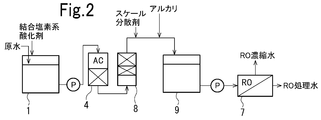
- FIG. 1 and 2 are system diagrams showing embodiments of the method and apparatus for treating organic substance-containing water according to the present invention.
- P is a pump.
- a slime control agent for activated carbon of the present invention and a flocculant and, if necessary, a pH adjuster are added to the raw water (organic-containing water such as industrial water) introduced through the raw water tank 1
- water is sequentially passed through the pressure filtration tower 3, the activated carbon tower 4, and the filtration water tank 5, and then introduced into the RO membrane separation device 7 through the safety filter 6 to perform the RO membrane separation treatment.
- Examples of water include, but are not limited to, industrial water such as groundwater and river water, and factory wastewater such as wastewater from the semiconductor device manufacturing process.
- the slime control agent to be added is added so that the combined chlorine concentration is preferably 1 mg-Cl 2 / L or more, more preferably 1 to 50 mg-Cl 2 / L.
- the combined chlorinating agent since the combined chlorinating agent has a low ability to decompose and remove from activated carbon, it immediately leaks from the activated carbon tower 4 in the subsequent stage, and a bactericidal effect can be obtained, but the addition concentration is less than 1 mg-Cl 2 / L. In this case, or when the water flow SV in the activated carbon tower 4 is less than 20 hr ⁇ 1 , the concentration leaked from the activated carbon tower 4 becomes extremely low, and a device installed in or behind the activated carbon tower 4 (for example, the softening tower in FIG. 2). Slime may grow in 8). In addition, even if an excessively large amount of the combined chlorine agent is added, the cost of the chemical increases easily. Therefore, the combined chlorine concentration is preferably 50 mg-Cl 2 / L or less.
- the pH is adjusted to the optimum coagulation pH range, and the coagulant is added. It is preferable that water is passed through an activated carbon tower after removing suspended substances in advance by coagulation filtration or the like.
- This aggregating filtration means may be any means capable of removing suspended substances contained in raw water by performing treatment such as pressure filtration, gravity filtration, microfiltration, ultrafiltration, pressurized flotation, precipitation, etc. It is not limited.
- the activated carbon used for the activated carbon tower 4 is not particularly limited, such as coal-based or coconut shell-based, and the shape is not particularly limited, such as granular activated carbon and spherical activated carbon.
- the type of the activated carbon tower 4 is not particularly limited, such as a fluidized bed or a fixed bed, but a fixed bed is preferable in order to suppress pulverized coal leakage.
- the water flow SV of the activated carbon tower 4 is preferably 20 hr ⁇ 1 or more.
- the water flow SV of the activated carbon tower 4 is particularly 50 hr ⁇ 1.
- it is particularly preferably 20 to 40 hr ⁇ 1 .
- FIG. 2 after adding the slime control agent of this invention and the pH adjuster as needed to the raw water introduced through the raw water tank 1, the water is sequentially passed through the activated carbon tower 4 and the softening tower 8, and then the scale.
- a dispersant is added so as to be 5 times or more the calcium ion concentration of the discharged water of the softening tower 8 (hereinafter sometimes referred to as “softening treated water”), and then adjusted to pH 9.5 or higher by adding alkali. After that, it is introduced into the RO membrane separation device 7 through the intermediate tank 9 in a high pH state and subjected to RO membrane separation treatment.
- an H-type cation exchange resin whose ion exchange group is H, a Na-type cation exchange resin which is Na, or a chelate resin can be used as long as it can remove hardness components in raw water.
- the type of the softening tower 8 is not particularly limited, such as a fluidized bed or a fixed bed.
- the treatment for removing the hardness component is not limited to the softening tower but may be a cation exchange tower. Moreover, although it does not limit at all to a tower type thing, the thing of a tower form is preferable from the surface of processing efficiency similarly to an activated carbon tower.
- the treatment is usually carried out at SV 10 to 40 hr ⁇ 1 in terms of treatment efficiency and hardness component removal effect.
- a chelate scale inhibitor such as ethylenediaminetetraacetic acid (EDTA) or nitrilotriacetic acid (NTA), which easily dissociates in the alkaline region and forms a complex with metal ions, is suitable.
- EDTA ethylenediaminetetraacetic acid
- NTA nitrilotriacetic acid
- low molecular weight polymers such as (meth) acrylic acid polymers and salts thereof, maleic acid polymers and salts thereof, ethylenediaminetetramethylenephosphonic acid and salts thereof, hydroxyethylidene diphosphonic acid and salts thereof, nitrilotri
- phosphonic acid and phosphonate such as methylenephosphonic acid and its salt, phosphonobutanetricarboxylic acid and its salt, hexametaphosphoric acid and its salt, inorganic polyphosphoric acid and inorganic polymeric phosphate such as tripolyphosphoric acid and its salt, etc.
- These scale inhibitors may be used individually by 1 type, and may use 2 or more types together.
- the addition amount of the scale inhibitor is at least 5 times the calcium ion concentration in the effluent of the softening tower 8 (water to which the scale inhibitor is added).
- the addition amount of the scale inhibitor is less than 5 times the calcium ion concentration in the softened treated water, the effect of adding the scale inhibitor cannot be sufficiently obtained. Even if an excessive amount of the scale inhibitor is added, it is not preferable from the viewpoint of drug cost, and therefore, it is preferably 5 to 50 times the calcium ion concentration in the softened water.
- the water to which the scale inhibitor is added is then added with an alkali, so that the pH of the water (RO feed water) introduced into the subsequent RO membrane separation device 7 is 9.5 or higher, preferably 10 or higher, more preferably 10. Adjust to 5-12, for example, pH 10.5-11.
- the alkali used here is not particularly limited as long as it is an inorganic alkaline agent that can adjust the pH of the RO water supply to 9.5 or higher, such as sodium hydroxide or potassium hydroxide.
- the addition position of the scale dispersant and alkali is not particularly limited as long as it is between the softening tower 8 and the RO membrane separator 7.
- the order of addition of these agents is arbitrary, but for the purpose of completely suppressing the growth of microorganisms in the system and completely suppressing the scale formation in the system, after adding a scale dispersant, an alkali is added. It is preferable to adjust the pH of the RO water supply to be 9.5 or higher.
- the remaining bound chlorine agent may be reduced and removed by reduction using a reducing agent as necessary.
- the reducing agent used here is not particularly limited as long as it can remove the combined chlorine agent such as sodium bisulfite.
- a reducing agent may be used individually by 1 type, and may mix and use 2 or more types.
- the amount of the reducing agent added may be an amount that can completely remove the remaining bound chlorine agent.
- the reducing agent is usually added on the inlet side of the softening tower 8. However, since the combined chlorine agent has a weak effect of degrading the RO membrane, the combined chlorine agent decomposition treatment with a reducing agent is usually unnecessary.
- Examples of the RO membrane of the RO membrane separation device 7 of FIGS. 1 and 2 include those having alkali resistance, such as polyetheramide composite membrane, polyvinyl alcohol composite membrane, aromatic polyamide membrane, etc., preferably 1500 mg / L.
- salt rejection rate This is an RO membrane for low fouling of the system.
- the reason why it is preferable to use such a low fouling RO membrane is as follows.
- the low-fouling RO membrane is superior in contamination resistance because it eliminates the chargeability of the membrane surface and improves the hydrophilicity as compared with a commonly used aromatic polyamide membrane.
- the antifouling effect is reduced, and the flux decreases with time.
- the RO membrane may be of any type such as spiral type, hollow fiber type, tubular type and the like.
- RO treated water The permeated water of the RO membrane separation device 7 (hereinafter sometimes referred to as “RO treated water”) is adjusted to pH 4 to 8 by adding an acid, and further subjected to activated carbon treatment or the like as necessary. Used or released.
- the acid used here include, but are not limited to, mineral acids such as hydrochloric acid and sulfuric acid.
- RO concentrated water The concentrated water of the RO membrane separation device 7 (hereinafter sometimes referred to as “RO concentrated water”) is discharged out of the system and processed.
- FIG. 1 and 2 show an example of an embodiment of the present invention, and the present invention is not limited to the illustrated one as long as the gist of the present invention is not exceeded.
- RO membrane separation The processing by the apparatus is not limited to one-stage processing, and may be multi-stage processing having two or more stages. Furthermore, you may provide the mixing tank for addition of pH adjustment, a scale inhibitor, etc.
- Example 1 A slime comprising industrial chlorine water containing TOC 1 mg / LasC and a combined chlorinating agent of sodium hypochlorite and a sulfamic acid compound (specifically sodium sulfamate) (a molar ratio of sulfamine compound to 1 mol of available chlorine).
- a control agent was added so that the combined chlorine concentration was 5 mg-Cl 2 / L, and then a coagulation filtration treatment was performed under the conditions of PAC (polyaluminum chloride) addition amount 10 mg / L and pH 6.
- the flow rate was 60L / hr through the RO membrane separator (Nitto Denko ultra-low pressure aromatic polyamide RO membrane "ES-20") and the recovery rate. Water was passed under conditions of 80%. The pH of the RO feed water was 5.5.
- Example 1 Comparative Example 1
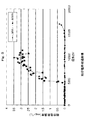
- the combined chlorine concentration in the effluent from the activated carbon tower was measured, and the results are shown in FIG.
- Example 2> After adding the same slime control agent as in Example 1 to a wastewater having a TOC concentration of 20 mg / L and a calcium concentration of 5 mg / L containing a nonionic surfactant to a binding chlorine concentration of 1 mg-Cl 2 / L, PAC (Polyaluminum chloride) The aggregation filtration process was performed on the conditions of the addition amount of 20 mg / L and pH 6.5.
- PAC Polyaluminum chloride
- Aggregated and filtered treated water was passed through a fixed bed activated carbon tower under the condition of SV20hr -1 , then passed through the softening tower under the condition of SV15hr -1 and then a chelate scale inhibitor (well manufactured by Kurita Kogyo Co., Ltd.).
- a chelate scale inhibitor well manufactured by Kurita Kogyo Co., Ltd.
- RO membrane separator Naitto Denko ultra-low pressure aromatic polyamide type
- Example 2 ⁇ Evaluation of the effect of inhibiting the growth of live bacteria>
- Example 2 and Comparative Example 2 the number of viable bacteria at each point was examined, and the results are shown in Table 1.
- Example 2 using the slime control agent that is the bound chlorine agent of the present invention, no viable bacteria were observed at all measurement points, whereas in Comparative Example 2, activated carbon-treated water. 210,000 cells / mL and 1000000 cells / mL in the softening tower treated water were observed.
Landscapes
- Life Sciences & Earth Sciences (AREA)
- Engineering & Computer Science (AREA)
- Chemical & Material Sciences (AREA)
- Organic Chemistry (AREA)
- Water Supply & Treatment (AREA)
- Environmental & Geological Engineering (AREA)
- Hydrology & Water Resources (AREA)
- Health & Medical Sciences (AREA)
- General Health & Medical Sciences (AREA)
- Environmental Sciences (AREA)
- Agronomy & Crop Science (AREA)
- Zoology (AREA)
- Dentistry (AREA)
- Plant Pathology (AREA)
- Wood Science & Technology (AREA)
- Pest Control & Pesticides (AREA)
- Inorganic Chemistry (AREA)
- Toxicology (AREA)
- Chemical Kinetics & Catalysis (AREA)
- Separation Using Semi-Permeable Membranes (AREA)
- Water Treatment By Sorption (AREA)
- Agricultural Chemicals And Associated Chemicals (AREA)
- Treatment Of Water By Ion Exchange (AREA)
- Treatment Of Water By Oxidation Or Reduction (AREA)
Abstract
Description

<実施例1>
TOC1mg/LasCを含む工業用水に、次亜塩素酸ナトリウムとスルファミン酸化合物(具体的にはスルファミン酸ナトリウム)との結合塩素剤(有効塩素1モルに対するスルファミン化合物のモル比1.5)よりなるスライムコントロール剤を結合塩素濃度として5mg-Cl2/Lとなるよう添加した後、PAC(ポリ塩化アルミニウム)添加量10mg/L、pH6の条件で凝集濾過処理を行った。凝集濾過処理水を活性炭塔にSV20hr-1の条件で通水した後、RO膜分離装置(日東電工製超低圧芳香族ポリアミド型RO膜「ES-20」)に通水量60L/hr、回収率80%の条件で通水した。RO給水のpHは5.5であった。
TOC1mg/LasCを含む工業用水に、次亜塩素酸ナトリウムとアンモニアとの反応物よりなるクロラミンを結合塩素濃度として8~10mg-Cl2/Lとなるよう添加した以外は実施例1と同条件で処理を行った。
<実施例2>
非イオン性界面活性剤を含むTOC濃度20mg/L、カルシウム濃度5mg/Lの排水に、実施例1と同じスライムコントロール剤を結合塩素濃度として1mg-Cl2/Lとなるよう添加した後、PAC(ポリ塩化アルミニウム)添加量20mg/L、pH6.5の条件で凝集濾過処理を行った。凝集濾過処理水を固定床式活性炭塔にSV20hr-1の条件で通水した後、軟化塔にSV15hr-1の条件で通水し、その後、キレート系スケール防止剤(栗田工業(株)製ウェルクリンA801)を10mg/L(軟化塔処理水のカルシウムイオン濃度の5重量倍)添加し、NaOHを添加してpH10.5とした後、RO膜分離装置(日東電工製超低圧芳香族ポリアミド型RO膜「ES-20」)で通水量60L/h、回収率80%の条件でRO膜分離処理を行った。なお、RO給水のpHは9.5であった。
非イオン性界面活性剤を含むTOC濃度20mg/L、カルシウム濃度5mg/Lを含む排水に、上記スライムコントロール剤の代りに、NaClOを遊離塩素濃度として1mg-Cl2/Lとなるよう添加した以外は、実施例2と同条件で処理を行った。
実施例2及び比較例2において、各ポイントにおける生菌数を調べ、結果を表1に示した。

実施例2及び比較例2において、RO膜分離装置のモジュール間差圧の経日変化を調べ、結果を表2に示した。

なお、本出願は、2009年2月27日付で出願された日本特許出願(特願2009-046619)に基づいており、その全体が引用により援用される。
Claims (10)
- 塩素系酸化剤とスルファミン酸化合物とからなる結合塩素剤を含有することを特徴とする活性炭用スライムコントロール剤。
- 請求項1において、塩素系酸化剤は、塩素ガス、二酸化塩素、次亜塩素酸又はその塩、亜塩素酸又はその塩、塩素酸又はその塩、過塩素酸又はその塩、塩素化イソシアヌル酸又はその塩よりなる群から選ばれた少なくとも1つであることを特徴とする活性炭用スライムコントロール剤。
- 請求項1において、塩素系酸化剤は、次亜塩素酸ナトリウム及び次亜塩素酸カリウムの少なくとも一方であることを特徴とする活性炭用スライムコントロール剤。
- 請求項1ないし3のいずれか1項において、スルファミン酸化合物は、スルファミン酸、N-メチルスルファミン酸、N,N-ジメチルスルファミン酸、N-フェニルスルファミン酸及びこれらの塩よりなる群から選ばれた少なくとも1つであることを特徴とする活性炭用スライムコントロール剤。
- 請求項1ないし3のいずれか1項において、スルファミン酸化合物は、スルファミン酸ナトリウム及びスルファミン酸カリウムの少なくとも一方であることを特徴とする活性炭用スライムコントロール剤。
- 活性炭装置への給水又は洗浄水中に、請求項1ないし5のいずれか1項に記載のスライムコントロール剤を存在させることを特徴とする活性炭装置への通水方法。
- 有機物含有水にスライムコントロール剤を添加するスライムコントロール剤添加工程と、
該スライムコントロール剤添加工程を経た有機物含有水を活性炭で処理する活性炭処理工程と、
該活性炭処理工程を経た有機物含有水を逆浸透膜分離手段に通水する逆浸透膜分離工程と
を有する有機物含有水の処理方法において、
前記スライムコントロール剤として請求項1ないし5のいずれか1項に記載のスライムコントロール剤を用いることを特徴とする有機物含有水の処理方法。 - 請求項7において、
前記活性炭処理工程を経た有機物含有水をカチオン交換手段に通水して硬度を低減させる硬度成分除去工程と、
該硬度成分除去工程を経た有機物含有水に、該硬度成分除去工程を経た有機物含有水中に含まれるカルシウムイオンの5重量倍以上のスケール防止剤を添加するスケール防止剤添加工程と、
該スケール防止剤添加工程の前、後又は同時に、有機物含有水にアルカリを添加して、後段の逆浸透膜分離手段に導入される有機物含有水のpHが9.5以上となるように調整するpH調整工程と
をさらに有することを特徴とする有機物含有水の処理方法。 - 有機物含有水にスライムコントロール剤を添加するスライムコントロール剤添加手段と、
該スライムコントロール剤添加手段を経た有機物含有水を活性炭で処理する活性炭処理手段と、
該活性炭処理手段を経た有機物含有水を逆浸透膜分離処理する逆浸透膜分離手段と
を有する有機物含有水の処理装置において、
前記スライムコントロール剤が請求項1ないし5のいずれか1項に記載のスライムコントロール剤であることを特徴とする有機物含有水の処理装置。 - 請求項9において、
該活性炭処理手段を経た有機物含有水が通水されるカチオン交換手段を備えた硬度成分除去手段と、
該硬度成分除去手段を経た有機物含有水に、該硬度成分除去手段を経た有機物含有水中のカルシウムイオンの5重量倍以上のスケール防止剤を添加するスケール防止剤添加手段と、
該スケール防止剤添加手段の前、後又は同時に、有機物含有水にアルカリを添加して後段の逆浸透膜分離手段に導入される有機物含有水のpHが9.5以上となるように調整するpH調整手段と
をさらに有することを特徴とする有機物含有水の処理装置。
Priority Applications (4)
| Application Number | Priority Date | Filing Date | Title |
|---|---|---|---|
| KR1020117019620A KR101671168B1 (ko) | 2009-02-27 | 2010-01-20 | 활성탄용 슬라임 컨트롤제, 활성탄 장치에 대한 통수 방법, 유기물 함유수의 처리 방법 및 처리 장치 |
| BRPI1009754-6A BRPI1009754B1 (pt) | 2009-02-27 | 2010-01-20 | Método para tratar água que contém matéria orgânica |
| CN201080003945.9A CN102271519B (zh) | 2009-02-27 | 2010-01-20 | 活性炭用黏质控制剂、对活性炭装置的通水方法、含有机物的水的处理方法及处理装置 |
| US13/138,248 US9598297B2 (en) | 2009-02-27 | 2010-01-20 | Method for treating organic-matter-containing water |
Applications Claiming Priority (2)
| Application Number | Priority Date | Filing Date | Title |
|---|---|---|---|
| JP2009046619A JP5608988B2 (ja) | 2009-02-27 | 2009-02-27 | 活性炭用スライムコントロール剤、活性炭装置への通水方法、有機物含有水の処理方法及び処理装置 |
| JP2009-046619 | 2009-02-27 |
Publications (1)
| Publication Number | Publication Date |
|---|---|
| WO2010098158A1 true WO2010098158A1 (ja) | 2010-09-02 |
Family
ID=42665368
Family Applications (1)
| Application Number | Title | Priority Date | Filing Date |
|---|---|---|---|
| PCT/JP2010/050607 Ceased WO2010098158A1 (ja) | 2009-02-27 | 2010-01-20 | 活性炭用スライムコントロール剤、活性炭装置への通水方法、有機物含有水の処理方法及び処理装置 |
Country Status (7)
| Country | Link |
|---|---|
| US (1) | US9598297B2 (ja) |
| JP (1) | JP5608988B2 (ja) |
| KR (1) | KR101671168B1 (ja) |
| CN (1) | CN102271519B (ja) |
| BR (1) | BRPI1009754B1 (ja) |
| TW (1) | TWI504572B (ja) |
| WO (1) | WO2010098158A1 (ja) |
Cited By (3)
| Publication number | Priority date | Publication date | Assignee | Title |
|---|---|---|---|---|
| JP2011183273A (ja) * | 2010-03-05 | 2011-09-22 | Kurita Water Ind Ltd | 水処理方法及び超純水製造方法 |
| KR20210137984A (ko) | 2019-03-26 | 2021-11-18 | 쿠리타 고교 가부시키가이샤 | 유기물 및 칼슘 함유수의 처리 방법 및 장치 |
| US20210387886A1 (en) * | 2018-12-27 | 2021-12-16 | Organo Corporation | Sterilization method for water system, method of removing nitrosamine compound from water system and drinking water production method |
Families Citing this family (20)
| Publication number | Priority date | Publication date | Assignee | Title |
|---|---|---|---|---|
| JP5573605B2 (ja) * | 2010-11-04 | 2014-08-20 | 住友金属鉱山株式会社 | 超純水製造システムおよびその洗浄方法、ならびにそれを用いた超純水の製造方法 |
| JP2015097990A (ja) * | 2013-11-19 | 2015-05-28 | 栗田工業株式会社 | 逆浸透膜の阻止率向上方法、逆浸透膜、及び水処理方法 |
| DE102014107489A1 (de) * | 2014-04-17 | 2015-10-22 | BLüCHER GMBH | Adsorptive Filtereinheit mit verlängerter Einsatz- und/oder Standzeit |
| JP6325658B2 (ja) * | 2014-05-08 | 2018-05-16 | オルガノ株式会社 | ろ過処理方法 |
| JP6533056B2 (ja) * | 2014-12-25 | 2019-06-19 | オルガノ株式会社 | ろ過処理システムおよびろ過処理方法 |
| US10155203B2 (en) * | 2016-03-03 | 2018-12-18 | Lg Nanoh2O, Inc. | Methods of enhancing water flux of a TFC membrane using oxidizing and reducing agents |
| JP6057002B1 (ja) * | 2016-03-24 | 2017-01-11 | 栗田工業株式会社 | 逆浸透膜用スケール防止剤及び逆浸透膜処理方法 |
| WO2018078988A1 (ja) * | 2016-10-25 | 2018-05-03 | オルガノ株式会社 | 逆浸透膜を用いる水処理方法および水処理装置 |
| JP7008470B2 (ja) * | 2017-10-26 | 2022-01-25 | オルガノ株式会社 | 逆浸透膜処理方法および逆浸透膜処理システム |
| US11130691B2 (en) | 2017-12-22 | 2021-09-28 | Cabot Corporation | Anti-scaling composition for water systems |
| JP2019122943A (ja) * | 2018-01-19 | 2019-07-25 | オルガノ株式会社 | 水処理方法および水処理装置 |
| JP7220112B2 (ja) * | 2019-03-29 | 2023-02-09 | 栗田工業株式会社 | 膜分離方法 |
| JP2021065845A (ja) * | 2019-10-24 | 2021-04-30 | 栗田工業株式会社 | 排水回収システム |
| JP6973565B1 (ja) * | 2020-05-28 | 2021-12-01 | 栗田工業株式会社 | 逆浸透膜処理方法 |
| JP7074156B2 (ja) * | 2020-06-01 | 2022-05-24 | 栗田工業株式会社 | 水処理方法及び水処理装置 |
| JP2022006437A (ja) * | 2020-06-24 | 2022-01-13 | オルガノ株式会社 | 水処理方法、水処理装置、および活性炭用スライム抑制剤 |
| KR102246909B1 (ko) | 2020-09-01 | 2021-04-30 | 주식회사 한 수 | 미생물 살균제, 이의 제조방법 및 이를 이용한 수처리 방법 |
| JP2023051430A (ja) * | 2021-09-30 | 2023-04-11 | 野村マイクロ・サイエンス株式会社 | 超純水製造システム、超純水製造方法 |
| JP2023183542A (ja) * | 2022-06-16 | 2023-12-28 | オルガノ株式会社 | 水処理方法および水処理装置 |
| JP7626812B1 (ja) | 2023-08-10 | 2025-02-04 | 野村マイクロ・サイエンス株式会社 | 純水用水の製造方法及び製造装置、純水製造方法及び純水製造システム |
Citations (3)
| Publication number | Priority date | Publication date | Assignee | Title |
|---|---|---|---|---|
| JP2004267830A (ja) * | 2003-03-05 | 2004-09-30 | Kurita Water Ind Ltd | 生物処理水含有水の処理方法 |
| JP2005169372A (ja) * | 2003-11-18 | 2005-06-30 | Kurita Water Ind Ltd | 有機物含有排水の処理方法及び処理装置 |
| JP2006263510A (ja) * | 2005-03-22 | 2006-10-05 | Kurita Water Ind Ltd | 膜分離用スライム防止剤及び膜分離方法 |
Family Cites Families (20)
| Publication number | Priority date | Publication date | Assignee | Title |
|---|---|---|---|---|
| US3101318A (en) * | 1961-04-10 | 1963-08-20 | Herbert M Watson | Method and composition for removing detergents and other contaminants from laundry wastes |
| US3170883A (en) * | 1962-04-02 | 1965-02-23 | Cortez Chemicals Company | Stabilization of chlorine in aqueous solutions |
| US4724079A (en) * | 1985-01-11 | 1988-02-09 | Gloria Stephan Sale | Water purification process |
| JPH0790219B2 (ja) * | 1990-08-01 | 1995-10-04 | 日本錬水株式会社 | 純水製造装置及び製造方法 |
| JP2520206B2 (ja) | 1991-09-06 | 1996-07-31 | 日本碍子株式会社 | 水の活性炭処理方法 |
| CA2186963C (en) * | 1996-10-01 | 1999-03-30 | Riad A. Al-Samadi | High water recovery membrane purification process |
| US6398965B1 (en) * | 1998-03-31 | 2002-06-04 | United States Filter Corporation | Water treatment system and process |
| US6589426B1 (en) * | 1999-09-29 | 2003-07-08 | Zenon Environmental Inc. | Ultrafiltration and microfiltration module and system |
| KR100339129B1 (ko) * | 1999-12-13 | 2002-05-31 | 심상희 | 알칼리 금속 또는 알칼리 토금속의 차아브롬산염을 이용한미생물 오염제어방법 및 이에 사용되는 오염제어시스템 |
| JP5055662B2 (ja) | 2001-05-11 | 2012-10-24 | 栗田工業株式会社 | 超純水製造装置及び超純水製造方法 |
| JP3832399B2 (ja) * | 2001-08-28 | 2006-10-11 | 栗田工業株式会社 | 殺菌殺藻剤組成物及び水系の殺菌殺藻方法 |
| US7186344B2 (en) * | 2002-04-17 | 2007-03-06 | Water Visions International, Inc. | Membrane based fluid treatment systems |
| EP1550369B1 (en) | 2002-05-22 | 2008-07-02 | Kurita Water Industries Ltd. | Composition for prevention of slime and method for preventing slime |
| US6858145B2 (en) * | 2002-09-12 | 2005-02-22 | Chemitreat Pte Ltd | Method of removing organic impurities from water |
| CN100528765C (zh) * | 2003-11-18 | 2009-08-19 | 栗田工业株式会社 | 含有机物排水的处理方法及处理装置 |
| KR101098679B1 (ko) * | 2003-11-18 | 2011-12-23 | 쿠리타 고교 가부시키가이샤 | 유기물 함유 배수 처리 방법 및 처리 장치 |
| JP3906855B2 (ja) | 2004-08-10 | 2007-04-18 | 栗田工業株式会社 | 有機物及び酸化剤含有排水の処理方法及び処理装置 |
| CN101007664A (zh) * | 2006-01-25 | 2007-08-01 | 肖贤明 | 一种饮用水的消毒方法 |
| JP2007253115A (ja) | 2006-03-24 | 2007-10-04 | Kurita Water Ind Ltd | 有機物含有排水の処理方法及び処理装置 |
| WO2008089279A1 (en) * | 2007-01-19 | 2008-07-24 | The Purolite Company | Reduced fouling of reverse osmosis membranes |
-
2009
- 2009-02-27 JP JP2009046619A patent/JP5608988B2/ja active Active
-
2010
- 2010-01-20 WO PCT/JP2010/050607 patent/WO2010098158A1/ja not_active Ceased
- 2010-01-20 CN CN201080003945.9A patent/CN102271519B/zh active Active
- 2010-01-20 KR KR1020117019620A patent/KR101671168B1/ko active Active
- 2010-01-20 US US13/138,248 patent/US9598297B2/en active Active
- 2010-01-20 BR BRPI1009754-6A patent/BRPI1009754B1/pt not_active IP Right Cessation
- 2010-02-10 TW TW099104170A patent/TWI504572B/zh active
Patent Citations (3)
| Publication number | Priority date | Publication date | Assignee | Title |
|---|---|---|---|---|
| JP2004267830A (ja) * | 2003-03-05 | 2004-09-30 | Kurita Water Ind Ltd | 生物処理水含有水の処理方法 |
| JP2005169372A (ja) * | 2003-11-18 | 2005-06-30 | Kurita Water Ind Ltd | 有機物含有排水の処理方法及び処理装置 |
| JP2006263510A (ja) * | 2005-03-22 | 2006-10-05 | Kurita Water Ind Ltd | 膜分離用スライム防止剤及び膜分離方法 |
Cited By (3)
| Publication number | Priority date | Publication date | Assignee | Title |
|---|---|---|---|---|
| JP2011183273A (ja) * | 2010-03-05 | 2011-09-22 | Kurita Water Ind Ltd | 水処理方法及び超純水製造方法 |
| US20210387886A1 (en) * | 2018-12-27 | 2021-12-16 | Organo Corporation | Sterilization method for water system, method of removing nitrosamine compound from water system and drinking water production method |
| KR20210137984A (ko) | 2019-03-26 | 2021-11-18 | 쿠리타 고교 가부시키가이샤 | 유기물 및 칼슘 함유수의 처리 방법 및 장치 |
Also Published As
| Publication number | Publication date |
|---|---|
| CN102271519A (zh) | 2011-12-07 |
| BRPI1009754B1 (pt) | 2020-03-10 |
| KR20110132335A (ko) | 2011-12-07 |
| US9598297B2 (en) | 2017-03-21 |
| CN102271519B (zh) | 2015-10-14 |
| JP2010202524A (ja) | 2010-09-16 |
| BRPI1009754A2 (pt) | 2015-08-25 |
| JP5608988B2 (ja) | 2014-10-22 |
| KR101671168B1 (ko) | 2016-11-01 |
| US20110297614A1 (en) | 2011-12-08 |
| TW201043579A (en) | 2010-12-16 |
| TWI504572B (zh) | 2015-10-21 |
Similar Documents
| Publication | Publication Date | Title |
|---|---|---|
| JP5608988B2 (ja) | 活性炭用スライムコントロール剤、活性炭装置への通水方法、有機物含有水の処理方法及び処理装置 | |
| JP5304651B2 (ja) | 有機物含有水の処理方法及び処理装置 | |
| CN106457150B (zh) | 过滤处理系统和过滤处理方法 | |
| US20130048558A1 (en) | Water treatment method and ultrapure water producing method | |
| KR20130040791A (ko) | 결합 염소제, 그 제조 및 사용 방법 | |
| JP5050605B2 (ja) | 有機物処理方法及び有機物処理装置 | |
| WO2013179775A1 (ja) | 透過膜の洗浄剤及び洗浄方法 | |
| JP2010201312A (ja) | 膜分離方法 | |
| JP2018153749A (ja) | 逆浸透膜を用いる水処理方法および水処理システム | |
| JP3906855B2 (ja) | 有機物及び酸化剤含有排水の処理方法及び処理装置 | |
| TW202333807A (zh) | 水系統的微生物污染抑制方法 | |
| CN101597097B (zh) | 含有机物排水的处理方法 | |
| JP7141919B2 (ja) | 逆浸透膜処理方法、逆浸透膜処理システム、水処理方法、および水処理システム | |
| JP2015196104A (ja) | 活性炭の前処理方法 | |
| KR102246909B1 (ko) | 미생물 살균제, 이의 제조방법 및 이를 이용한 수처리 방법 | |
| TW202333806A (zh) | 水系統的微生物污染抑制方法 | |
| JP2014180586A (ja) | 逆浸透膜処理におけるスケール生成防止方法および逆浸透膜処理用スケール防止剤 | |
| JP2013119071A (ja) | 逆浸透膜処理におけるスケール生成防止方法および逆浸透膜処理用スケール防止剤 |
Legal Events
| Date | Code | Title | Description |
|---|---|---|---|
| WWE | Wipo information: entry into national phase |
Ref document number: 201080003945.9 Country of ref document: CN |
|
| 121 | Ep: the epo has been informed by wipo that ep was designated in this application |
Ref document number: 10746040 Country of ref document: EP Kind code of ref document: A1 |
|
| WWE | Wipo information: entry into national phase |
Ref document number: 13138248 Country of ref document: US |
|
| ENP | Entry into the national phase |
Ref document number: 20117019620 Country of ref document: KR Kind code of ref document: A |
|
| NENP | Non-entry into the national phase |
Ref country code: DE |
|
| 122 | Ep: pct application non-entry in european phase |
Ref document number: 10746040 Country of ref document: EP Kind code of ref document: A1 |
|
| REG | Reference to national code |
Ref country code: BR Ref legal event code: B01A Ref document number: PI1009754 Country of ref document: BR |
|
| ENP | Entry into the national phase |
Ref document number: PI1009754 Country of ref document: BR Kind code of ref document: A2 Effective date: 20110829 |