WO2010090176A1 - 硫酸酸性水溶液からのニッケル回収方法 - Google Patents
硫酸酸性水溶液からのニッケル回収方法 Download PDFInfo
- Publication number
- WO2010090176A1 WO2010090176A1 PCT/JP2010/051400 JP2010051400W WO2010090176A1 WO 2010090176 A1 WO2010090176 A1 WO 2010090176A1 JP 2010051400 W JP2010051400 W JP 2010051400W WO 2010090176 A1 WO2010090176 A1 WO 2010090176A1
- Authority
- WO
- WIPO (PCT)
- Prior art keywords
- nickel
- sulfuric acid
- cobalt
- hydroxide
- aqueous solution
- Prior art date
- Legal status (The legal status is an assumption and is not a legal conclusion. Google has not performed a legal analysis and makes no representation as to the accuracy of the status listed.)
- Ceased
Links
Images


Classifications
-
- C—CHEMISTRY; METALLURGY
- C01—INORGANIC CHEMISTRY
- C01G—COMPOUNDS CONTAINING METALS NOT COVERED BY SUBCLASSES C01D OR C01F
- C01G45/00—Compounds of manganese
- C01G45/01—Preparation or separation involving a liquid-liquid extraction, an adsorption or an ion-exchange
-
- C—CHEMISTRY; METALLURGY
- C01—INORGANIC CHEMISTRY
- C01G—COMPOUNDS CONTAINING METALS NOT COVERED BY SUBCLASSES C01D OR C01F
- C01G51/00—Compounds of cobalt
- C01G51/01—Preparation or separation involving a liquid-liquid extraction, an adsorption or an ion-exchange
-
- C—CHEMISTRY; METALLURGY
- C01—INORGANIC CHEMISTRY
- C01G—COMPOUNDS CONTAINING METALS NOT COVERED BY SUBCLASSES C01D OR C01F
- C01G51/00—Compounds of cobalt
- C01G51/04—Oxides
-
- C—CHEMISTRY; METALLURGY
- C01—INORGANIC CHEMISTRY
- C01G—COMPOUNDS CONTAINING METALS NOT COVERED BY SUBCLASSES C01D OR C01F
- C01G53/00—Compounds of nickel
- C01G53/01—Preparation or separation involving a liquid-liquid extraction, an adsorption or an ion-exchange
-
- C—CHEMISTRY; METALLURGY
- C01—INORGANIC CHEMISTRY
- C01G—COMPOUNDS CONTAINING METALS NOT COVERED BY SUBCLASSES C01D OR C01F
- C01G53/00—Compounds of nickel
- C01G53/04—Oxides
-
- C—CHEMISTRY; METALLURGY
- C22—METALLURGY; FERROUS OR NON-FERROUS ALLOYS; TREATMENT OF ALLOYS OR NON-FERROUS METALS
- C22B—PRODUCTION AND REFINING OF METALS; PRETREATMENT OF RAW MATERIALS
- C22B23/00—Obtaining nickel or cobalt
- C22B23/04—Obtaining nickel or cobalt by wet processes
- C22B23/0407—Leaching processes
- C22B23/0415—Leaching processes with acids or salt solutions except ammonium salts solutions
- C22B23/043—Sulfurated acids or salts thereof
-
- C—CHEMISTRY; METALLURGY
- C22—METALLURGY; FERROUS OR NON-FERROUS ALLOYS; TREATMENT OF ALLOYS OR NON-FERROUS METALS
- C22B—PRODUCTION AND REFINING OF METALS; PRETREATMENT OF RAW MATERIALS
- C22B23/00—Obtaining nickel or cobalt
- C22B23/04—Obtaining nickel or cobalt by wet processes
- C22B23/0453—Treatment or purification of solutions, e.g. obtained by leaching
- C22B23/0461—Treatment or purification of solutions, e.g. obtained by leaching by chemical methods
-
- C—CHEMISTRY; METALLURGY
- C22—METALLURGY; FERROUS OR NON-FERROUS ALLOYS; TREATMENT OF ALLOYS OR NON-FERROUS METALS
- C22B—PRODUCTION AND REFINING OF METALS; PRETREATMENT OF RAW MATERIALS
- C22B3/00—Extraction of metal compounds from ores or concentrates by wet processes
- C22B3/20—Treatment or purification of solutions, e.g. obtained by leaching
- C22B3/44—Treatment or purification of solutions, e.g. obtained by leaching by chemical processes
-
- Y—GENERAL TAGGING OF NEW TECHNOLOGICAL DEVELOPMENTS; GENERAL TAGGING OF CROSS-SECTIONAL TECHNOLOGIES SPANNING OVER SEVERAL SECTIONS OF THE IPC; TECHNICAL SUBJECTS COVERED BY FORMER USPC CROSS-REFERENCE ART COLLECTIONS [XRACs] AND DIGESTS
- Y02—TECHNOLOGIES OR APPLICATIONS FOR MITIGATION OR ADAPTATION AGAINST CLIMATE CHANGE
- Y02P—CLIMATE CHANGE MITIGATION TECHNOLOGIES IN THE PRODUCTION OR PROCESSING OF GOODS
- Y02P10/00—Technologies related to metal processing
- Y02P10/20—Recycling
Definitions
- the present invention relates to a method for recovering nickel from an acidic sulfuric acid aqueous solution, and more specifically, from an acidic sulfuric acid aqueous solution containing nickel, cobalt, and iron, aluminum, manganese and other impurity elements, iron, aluminum, manganese and other impurity elements.
- nickel By effectively separating the nickel, the economic efficiency as a smelting process is enhanced, and nickel can be effectively used as a raw material for nickel industrial materials such as metallic nickel, nickel oxide, and ferronickel.
- the present invention relates to a method for recovering nickel from an acidic sulfuric acid aqueous solution, in which cobalt, which is an expensive valuable metal, can be separated at the same time as an easily usable byproduct. Thereby, it is suitably used as a method for separating and recovering nickel and cobalt from a leaching solution containing various impurity elements produced from leaching steps of various leaching methods such as a high pressure acid leaching method of nickel oxide ore.
- the leachate produced includes nickel, cobalt, and various types of impurity elements such as iron, aluminum, manganese, zinc, chromium, magnesium, and silicon contained in the ore. From this, it was an important issue in the smelting process to separate and recover nickel from cobalt by an efficient means as needed.
- Hydrometallurgical method (A) This method includes steps including the following (1) to (4), and a mixed sulfide containing nickel and cobalt is produced from nickel oxide ore using a high pressure acid leaching method.
- Leaching step Slurry nickel oxide ore, add sulfuric acid, and stir at a temperature of 220-280 ° C. to form a leaching slurry.
- Solid-liquid separation step The leaching slurry is washed using a multi-stage thickener to separate into a leaching solution containing nickel and cobalt and a leaching residue containing iron as hematite.
- Neutralization step Adjusting the pH to be 4 or less using calcium carbonate while suppressing oxidation of the leachate to produce a neutralized precipitate containing trivalent iron. Separate into slurry and nickel recovery mother liquor.
- Sulfurization step Hydrogen sulfide gas is blown into the nickel recovery mother liquor to produce a sulfide containing nickel and cobalt, which is separated from the poor solution.
- Hydrometallurgical method (B) In this method, when sulfuric acid is added to nickel oxide ore and leached, iron is used as natrojarosite to form a leaching residue, and a leachate containing nickel and cobalt is obtained. A neutralizing agent is added to the obtained leachate. Then, the step of removing iron and aluminum, the neutralized solution obtained is treated by solvent extraction using a monothiophosphinic acid compound as an extractant, cobalt is extracted, and the extraction residual liquid containing nickel and cobalt are extracted. And a step of obtaining a hydroxide by neutralizing the obtained extraction residual solution containing nickel and the back extraction solution containing cobalt with an alkali.
- nickel hydroxide is washed with an alkaline solution to remove sulfur and chlorine
- the nickel hydroxide is supplied together with nickel oxide ore to a ferronickel production plant including a calcination and reduction melting step.
- Nickel is used as part of the raw material for producing ferronickel (see, for example, Patent Document 2).
- Hydrometallurgical method (C) This method is a so-called RIP (Resin in pull) method in which an ion exchange resin is added to an acid leaching solution slurry formed in an atmospheric pressure or high pressure acid leaching step of nickel oxide ore. And leaching the resin to obtain an acidic eluent containing nickel and cobalt, aluminum, iron, etc.
- RIP Resin in pull
- the step of removing iron and aluminum, and the resulting neutralized solution is treated with solvent extraction with Cyanex 272 extractant to extract cobalt, manganese, etc., and the extraction residual solution containing nickel and the reverse containing cobalt
- a step of obtaining an extract, and a step of obtaining a hydroxide by neutralizing the obtained extraction residual liquid containing nickel with magnesium hydroxide for example, References 3.
- nickel and cobalt are not separated but recovered as a mixed sulfide of these, so that the obtained mixed sulfide is, for example, a chlorine leaching method. It is suitable as a raw material for a smelting process with a step of leaching and then separating nickel and cobalt and recovering each as a high-purity product, but it is limited to the load of cobalt, sulfur, etc. in the feedstock For example, there is a problem that it cannot be used directly as a raw material for producing ferronickel or stainless steel.
- the obtained nickel hydroxide has been subjected to cobalt separation and sulfur removal, and can be used as a ferronickel production raw material.
- the nickel concentration of the neutralization solution that is the starting solution for the solvent extraction step is several g of the same level as the leachate.
- the solvent extraction process using such a thin liquid the amount of the extractant used and the equipment capacity become excessive, and there is a problem that it is not economically efficient due to the loss of the extractant and the equipment cost.
- the obtained nickel hydroxide is separated from cobalt, and can be effectively used as a raw material for nickel industrial materials such as metallic nickel, nickel oxide, and ferronickel.
- the RIP Resin in pull
- the concentration of nickel in the acidic eluent that is the starting liquid for the solvent extraction process is 10 to 80 g / L at most, although a concentration effect by using an ion exchange resin is expected.
- JP 2006-241529 (first page, second page, FIG. 1) JP 2008-527164 A (first page, second page)
- An object of the present invention is to efficiently remove iron, aluminum, manganese and other impurity elements from an acidic sulfuric acid aqueous solution containing nickel, cobalt, iron, aluminum, manganese and other impurity elements in view of the above-mentioned problems of the prior art.
- nickel can be recovered in a form that can be effectively used as a raw material for nickel industrial materials such as metallic nickel, nickel oxide, and ferronickel.
- Another object of the present invention is to provide a method for recovering nickel from an acidic sulfuric acid aqueous solution that can separate cobalt, which is an expensive valuable metal, as a by-product that is easy to use.
- the present inventors have conducted extensive research on a method for recovering nickel from a sulfuric acid aqueous solution containing nickel and cobalt and iron, aluminum, manganese and other impurity elements.
- the step of subjecting the acidic sulfuric acid aqueous solution to oxidation neutralization treatment under specific conditions to remove iron and aluminum, the obtained solution after oxidation neutralization treatment to neutralization treatment under specific conditions, nickel and cobalt A step of separating and recovering the mixed hydroxide containing, a step of subjecting the obtained mixed hydroxide to a dissolution treatment under specific conditions to obtain a concentrated solution of nickel and cobalt while removing manganese, and the resulting concentration Subjecting the solution to oxidation treatment under specific conditions to remove manganese, and subjecting the obtained post-oxidation treatment solution to solvent extraction treatment under specific conditions to obtain an extraction residual liquid and cover containing nickel.
- a method for recovering nickel from a sulfuric acid aqueous solution containing nickel and cobalt and iron, aluminum, manganese and other impurity elements there is provided a method for recovering nickel from an acidic sulfuric acid aqueous solution, which comprises the following steps (1) to (5).
- Product (a) is removed.
- Step (2) Calcium hydroxide is added to the post-oxidation neutralized solution obtained in the above step (1) and subjected to neutralization to separate and recover the mixed hydroxide containing nickel and cobalt.
- Step (3) The mixed hydroxide obtained in the step (2) is subjected to a dissolution treatment in a sulfuric acid solution having a concentration of 50% by mass or more, and a precipitate (b) containing manganese and gypsum produced. Is removed to obtain a nickel and cobalt concentrate.
- Step (4): The concentrated solution obtained in the step (3) is subjected to solvent extraction using a phosphoric acid ester-based acidic extractant, and an extraction residual solution containing nickel and a back extract containing cobalt are obtained. obtain.
- nickel recovery from an aqueous sulfuric acid solution characterized by further comprising the following step (6) following the step (3): A method is provided.
- the precipitate (c) containing manganese and cobalt produced is removed, and the resulting post-oxidation neutralization treatment solution is transferred to the step (4).
- a method for recovering nickel from an acidic sulfuric acid aqueous solution characterized in that in the first or second invention, the method further comprises the following step (7) or step (8).
- the oxidation neutralization treatment in the step (1) satisfies the following requirements (a) to (c):
- a method for recovering nickel from an acidic sulfuric acid aqueous solution There is provided a method for recovering nickel from an acidic sulfuric acid aqueous solution.
- the content ratio of sulfurous acid gas in the mixed gas is 1 to 10% by volume with respect to air or oxygen gas as a dilution gas.
- the oxidation-reduction potential (based on silver / silver chloride electrode) is 400 to 600 mV.
- the pH is 4.0 to 4.5.
- the neutralization treatment in the step (2) satisfies the following requirement (d): A method for recovering nickel from an aqueous sulfuric acid solution is provided. (D) The pH is 7.5 to 7.7.
- the dissolution treatment satisfies the following requirements (e) and (f):
- a method for recovering nickel from an acidic sulfuric acid aqueous solution is provided.
- the slurry concentration is 30 to 40% by mass.
- the pH at the end of dissolution of the mixed hydroxide is 1.5 to 2.2.
- step (3) in any one of the first to third inventions, there is provided means for transferring the precipitate (b) to the step (1).
- a method for recovering nickel from an acidic sulfuric acid aqueous solution is provided.
- the neutralization treatment satisfies the following requirements (G) to (G):
- a method for recovering nickel from an acidic sulfuric acid aqueous solution is provided.
- the pH is 7.5 to 8.0.
- the neutralizing agent is magnesium hydroxide.
- the reaction temperature is a temperature not lower than 80 ° C. and not higher than the boiling point.
- the oxidation neutralization treatment in the step (6) satisfies the following requirements (nu) to (wa):
- a method for recovering nickel from an aqueous sulfuric acid solution is provided.
- Nu The content ratio of sulfurous acid gas in the mixed gas is 1 to 10% by volume with respect to air or oxygen gas.
- the oxidation-reduction potential (based on silver / silver chloride electrode) is 500 to 600 mV.
- E The pH is 5.0 to 6.0.
- the neutralizing agent is sodium hydroxide. Is provided.
- the sulfuric acid aqueous solution includes a step of adding a sulfuric acid solution to a slurry of nickel oxide ore and leaching under high temperature and high pressure.
- a method for recovering nickel from an acidic sulfuric acid aqueous solution, which is a leachate produced is provided.
- the method for recovering nickel from sulfuric acid aqueous solution of the present invention efficiently separates iron, aluminum, manganese and other impurity elements from sulfuric acid aqueous solution containing nickel and cobalt and iron, aluminum, manganese and other impurity elements.
- nickel hydroxide whose nickel quality is concentrated to 40% by mass or more can be recovered, and this can be effectively used as a raw material for nickel industrial materials such as metallic nickel, nickel oxide and ferronickel. Can do.
- cobalt which is an expensive valuable metal, can be separated as an available byproduct. From the above, its industrial value is extremely large.
- FIG. 1 is a graph showing the distribution rate (removal rate) of precipitates produced by iron, aluminum, and nickel in a liquid in a neutralization treatment using calcium carbonate as a neutralizing agent according to a conventional method.
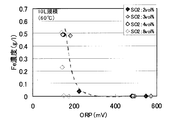
- FIG. 2 shows the relationship between the iron concentration in the liquid and the oxidation-reduction potential (ORP) when oxidation neutralization is performed using a mixed gas of sulfurous acid gas and air and calcium carbonate in step (1) of the present invention.
- FIG. FIG. 3 shows a change in oxidation-reduction potential (ORP) with the lapse of reaction time when oxidation neutralization is performed using a mixed gas composed of sulfurous acid gas and air and calcium carbonate in step (1) of the present invention.
- the method for recovering nickel from a sulfuric acid aqueous solution of the present invention is a method for recovering nickel from a sulfuric acid aqueous solution containing nickel and cobalt and iron, aluminum, manganese and other impurity elements, It includes the following steps (1) to (5).
- Process (1) Precipitation containing iron and aluminum produced by adding calcium carbonate to the acidic aqueous sulfuric acid solution while blowing a mixed gas composed of sulfurous acid gas and air or oxygen gas, and subjecting to oxidation neutralization treatment.
- Product (a) is removed.
- Step (2) Calcium hydroxide is added to the post-oxidation neutralized solution obtained in the above step (1) and subjected to neutralization to separate and recover the mixed hydroxide containing nickel and cobalt.
- Step (3) The mixed hydroxide obtained in the step (2) is subjected to a dissolution treatment in a sulfuric acid solution having a concentration of 50% by mass or more, and a precipitate (b) containing manganese and gypsum produced. Is removed to obtain a nickel and cobalt concentrate.
- Step (4): The concentrated solution obtained in the step (3) is subjected to solvent extraction using a phosphoric acid ester-based acidic extractant, and an extraction residual solution containing nickel and a back extract containing cobalt are obtained. obtain.
- step (1) calcium carbonate is added to the acidic sulfuric acid aqueous solution while blowing a mixed gas composed of sulfurous acid gas and air or oxygen gas, followed by oxidation neutralization treatment, and the produced iron
- step (2) calcium hydroxide is added to the post-oxidation neutralization treatment solution, followed by neutralization treatment, and nickel and cobalt are contained.
- the mixed hydroxide obtained in the step (2) is subjected to a dissolution treatment in a sulfuric acid solution having a concentration of 50% by mass or more. It is important to obtain a nickel and cobalt concentrate by removing the precipitate (b) containing manganese and gypsum.
- step (1) calcium carbonate is added while blowing a mixed gas composed of sulfurous acid (SO 2 ) gas and air or oxygen gas, and the oxidation neutralization treatment is performed.
- SO 2 sulfurous acid
- air or oxygen gas oxygen gas
- oxidation neutralization treatment is performed.
- a peroxide is generated, and divalent iron is rapidly and completely oxidized to trivalent iron to generate iron hydroxide (Fe (OH) 3 ).
- iron hydroxide Fe (OH) 3
- step (2) by adding calcium carbonate, such oxidation conditions can be achieved, and the pH of the trivalent iron and aluminum hydroxide can be maintained at a sufficiently low pH. And substantially complete removal of aluminum can be achieved. This solves the problem of iron and aluminum with high accumulation in the extractant. This detail will be described later in the detailed description of the process.
- step (2) the post-oxidation neutralization treatment solution is subjected to a neutralization treatment, and the mixed hydroxide containing nickel and cobalt is separated and recovered, whereby the nickel and cobalt in the sulfuric acid aqueous solution are removed.
- the mixed hydroxide containing nickel and cobalt is separated and recovered, whereby the nickel and cobalt in the sulfuric acid aqueous solution are removed.
- the concentration of nickel in the concentrate is 30 to 70 g / L with respect to several g / L in the leachate.
- the amount of extractant used and the capacity of the extractant The economic efficiency is greatly improved by the loss of the extractant and the reduction of the equipment cost.
- the mixed hydroxide is dissolved in a sulfuric acid solution having a concentration of 50% by mass or more to obtain a concentrated solution having a high nickel concentration, and is contained in the mixed hydroxide.
- manganese is separated as a precipitate in the form of manganese oxide (Mn 3 O 4 , Mn 2 O 3 , MnO 2 ).
- divalent manganese is oxidized to tetravalent manganese in a high-concentration sulfuric acid solution, and a precipitate is formed depending on solubility.
- gypsum (CaSO 4 ) formed from calcium contained in the mixed hydroxide also forms a precipitate due to solubility. This detail will be described later in the detailed description of the process.
- Process (1) calcium carbonate is added to a sulfuric acid aqueous solution containing nickel, cobalt, iron, aluminum, manganese and other impurity elements while blowing a mixed gas of sulfurous acid gas and air or oxygen gas.
- the precipitate (a) containing iron and aluminum is removed by subjecting to an oxidation neutralization treatment.
- iron and aluminum having a high accumulation property in the extractant are almost completely removed.
- step (1) as the neutralizing agent, an equilibrium pH is lower than other alkaline agents, nickel loss due to local neutralization can be prevented, and inexpensive calcium carbonate is used.
- a mixed gas composed of sulfurous acid gas and air or oxygen gas is used as the divalent iron oxidant in the liquid.
- addition of hydrogen peroxide or other peroxides is effective as the oxidizing agent, but their use for removing iron is not cost effective.
- a mixed gas composed of sulfurous acid gas and air or oxygen gas is effective as an oxidizing agent for divalent iron by the above-described mechanism of action.
- FIG. 1 shows the removal rate (distribution rate to the generated precipitate) of iron, aluminum and nickel in the liquid in the neutralization treatment using calcium carbonate as a neutralizing agent according to the conventional method.
- a limonite ore leachate having a composition of Ni: 3.3 g / L, Fe: 0.6 g / L and Al: 3.4 g / L (after neutralizing free sulfuric acid)
- a calcium carbonate slurry having a concentration of 20% by mass, maintaining the liquid temperature at 60 ° C. and maintaining the pH at a predetermined value in the range of 4 to 5 for 5 minutes. Filtered and analyzed.
- FIG. 1 shows that the removal rate of iron is 10 to 20% even under pH conditions in which nickel is precipitated by 1% or more.
- the removal rate of aluminum can be removed almost completely at pH 4 or higher.
- FIG. 2 shows the iron concentration and redox potential (ORP) in the liquid when the oxidation neutralization treatment is performed using the mixed gas of sulfurous acid gas and air and calcium carbonate by the method of the above step (1).
- ORP iron concentration and redox potential
- FIG. 3 shows a change in oxidation-reduction potential (ORP) with the lapse of reaction time when an oxidation neutralization treatment is performed using a mixed gas of sulfurous acid gas and air and calcium carbonate by the method of the above step (1).
- ORP oxidation-reduction potential
- the conditions for the oxidative neutralization treatment are not particularly limited, but it is preferable that the following requirements (a) to (c) are satisfied.
- the content ratio of sulfurous acid gas in the mixed gas is 1 to 10% by volume with respect to air or oxygen gas as a dilution gas, and preferably 1 to 5% by volume when the dilution gas is air.
- the oxidation-reduction potential (based on silver / silver chloride electrode) is 400 to 600 mV.
- the pH is 4.0 to 4.5.
- the content ratio of sulfurous acid gas is preferably as high as possible for improving the oxidation efficiency by adding sulfurous acid gas, and to obtain high iron removal rate with respect to air or oxygen gas. 1% by volume or more is used.
- the said content rate exceeds 10 volume%, the tendency for sulfurous acid gas to act as a reducing agent will become strong, and there exists a tendency for oxidation efficiency to fall.
- the dilution gas is air, if the content ratio exceeds 5% by volume, it is difficult to reliably determine the end point of the oxidation neutralization reaction by controlling the oxidation-reduction potential. If the exhaust gas containing sulfurous acid gas discharged from a general metal smelting factory is used as it is, the mixed gas is supplied at a low cost.
- the redox potential (silver / silver chloride electrode standard) of the oxidative neutralization reaction it is desirable to increase the oxidation removal rate of iron, and when the oxidation removal of iron is almost completed. 500 mV or more is used.
- the oxidation-reduction potential (silver / silver chloride electrode standard) exceeds 600 mV, the effect of removing iron beyond that is small, and the amount of oxidizing agent used increases.
- a method for controlling the oxidation-reduction potential it can be carried out mainly by adjusting the content ratio of the sulfurous acid gas in the mixed gas and the amount of blowing.
- the pH of the oxidative neutralization reaction is preferably as high as possible in order to increase the oxidation removal efficiency of iron, and 4.0 or more is used in order to obtain a high iron removal rate.
- the pH can be controlled by adjusting the amount of calcium carbonate added.
- the liquid temperature is not particularly limited, but is preferably 40 to 80 ° C., more preferably about 60 ° C. in order to obtain a high iron removal rate. That is, when the liquid temperature is lower than 40 ° C., iron is not sufficiently removed by oxidation. On the other hand, if the liquid temperature exceeds 80 ° C., the reaction vessel is restricted in terms of equipment, and the temperature rise energy is also required, which is expensive.
- the oxidation neutralization treatment is not particularly limited, but is performed using a reaction vessel provided with a stirring mechanism, an ORP control mechanism, a pH control mechanism, and a liquid temperature control mechanism.
- the slurry after the oxidation neutralization treatment is solid-liquid separated using a filter such as a filter press to obtain a precipitate (a) containing iron and aluminum and a clear solution after the oxidation neutralization treatment. It is preferable. That is, it is important to prevent the iron and aluminum components from leaking as suspension (SS) in the subsequent steps.
- Process (2) In the step (2), calcium hydroxide is added to the post-oxidation neutralization treatment solution obtained in the step (1), followed by neutralization treatment, and the mixed hydroxide containing nickel and cobalt is separated. It is a process to collect. Here, nickel and cobalt in the solution after the oxidation neutralization treatment are once recovered as a precipitate. As a result, a mixed hydroxide having a nickel quality of 25 to 45% by mass can be obtained, so that a concentrated solution having a high nickel concentration can be obtained by the subsequent dissolution treatment, and the nickel that is the starting solution in the solvent extraction treatment can be obtained. The density can be greatly improved. In the solvent extraction process using the concentrated solution of high nickel concentration as the starting liquid, the amount of extractant used and the capacity of the equipment can be reduced, and the economic efficiency is reduced by the loss of the extractant and the equipment cost. Greatly improved.
- the conditions for the neutralization treatment are not particularly limited, but it is preferable to satisfy the following requirements (d).
- the pH is 7.5 to 7.7. That is, the pH of the neutralization reaction is preferably as high as possible in order to improve the precipitation rate (recovery rate) of nickel and cobalt, and 7.5 or higher is used in order to obtain a high recovery rate of 97% or higher.
- the pH exceeds 7.7, the precipitation rate of manganese in the liquid rapidly increases and is contained in the mixed hydroxide, and further, the subsequent solvent extraction treatment adversely affects the cobalt extraction efficiency.
- the pH of the neutralization reaction is selected in consideration of the precipitation rate (recovery rate) of nickel and cobalt and the manganese precipitation rate.
- a neutralizing agent for realizing such pH conditions other alkaline agents are used, but this can be achieved by using inexpensive calcium hydroxide.
- the liquid temperature is not particularly limited, but is preferably 50 to 80 ° C., more preferably about 60 ° C. in order to obtain a high recovery rate of nickel and cobalt. That is, when the liquid temperature is less than 50 ° C., the reaction rate is slow and an unreacted part is generated in the neutralizing agent. On the other hand, if the liquid temperature exceeds 80 ° C., the reaction vessel is restricted in terms of equipment, and the temperature rise energy is also required, which is expensive.
- the neutralization treatment is not particularly limited, but is performed using a reaction vessel provided with a stirring mechanism, a pH control mechanism, and a liquid temperature control mechanism. Moreover, it is preferable to solid-liquid-separate the whole quantity of the slurry after neutralization process using filter, such as a filter press, and to obtain the mixed hydroxide and filtrate containing nickel and cobalt.
- the method of the present invention is applied to a hydrometallurgy method using a high-pressure acid leaching method of nickel oxide ore, the filtrate and the cleaning solution containing nickel and cobalt that slightly leak are leached or Since it can be reused as washing water for the leach residue in the subsequent solid-liquid separation step, the loss of nickel and cobalt in the step (2) hardly occurs.
- Step (3) the mixed hydroxide obtained in the step (2) is subjected to a dissolution treatment in a sulfuric acid solution having a concentration of 50% by mass or more, and a precipitate containing manganese and gypsum produced ( This is a step of removing b) to obtain a nickel and cobalt concentrate.
- nickel and cobalt contained in the mixed hydroxide are dissolved to obtain a concentrated solution having a high nickel concentration, and manganese is converted into manganese oxide (Mn 3 O 4 , Mn 2 O 3 , MnO 2 ). In the form of a precipitate.
- 40 to 60% of manganese can be oxidized and removed, and a nickel dissolution rate of 99% and a cobalt dissolution rate of 96% are achieved.
- the dissolution treatment is performed as follows.
- the mixed hydroxide is mixed with a sulfuric acid solution having a predetermined concentration, water is then added to adjust the slurry concentration, and then the sulfuric acid solution having a predetermined concentration is adjusted so that the pH at the end of dissolution becomes a predetermined value.
- a fixed amount was added.
- a sulfuric acid solution having a concentration of 64% by mass is added to a mixed hydroxide having a moisture content of 30 to 50% by mass so that the equivalent is 1 equivalent to nickel and cobalt contained, and is first mixed.
- water is added to adjust the slurry concentration to 30 to 40% by mass.
- a sulfuric acid solution having a concentration of 64% by mass is added again to adjust the pH of the solution to be between 1.5 and 2.2.
- the sulfuric acid concentration of the sulfuric acid solution used when dissolving the mixed hydroxide is 50% by mass or more, preferably 50 to 98% by mass, more preferably 64 to 98% by mass or more. .
- a concentrated solution having a high nickel concentration can be obtained, and 40 to 60% of manganese contained in the mixed hydroxide can be separated as a precipitate. That is, when the sulfuric acid concentration is less than 50% by mass, a concentrated solution having a high nickel concentration is obtained, and manganese is oxidized and separated as a precipitate in the form of manganese oxide (Mn 3 O 4 , Mn 2 O 3 , MnO 2 ). Insufficient to do.
- the dissolution treatment conditions are not particularly limited, but preferably satisfy the following requirements (e) and (f).
- the slurry concentration of the sulfuric acid solution slurry charged with the mixed hydroxide is 30 to 40% by mass.
- the pH at the end of dissolution of the mixed hydroxide is 1.5 to 2.2.
- the slurry concentration is preferably as high as possible to increase the nickel concentration of the obtained concentrated liquid, and 30% by mass or more is effective.
- the slurry concentration exceeds 40% by mass, it is not desirable because it is necessary to strengthen the cleaning of valuable metal adhering to the leaching residue.
- a concentrated solution with a higher concentration can be produced by gradually adding the mixed hydroxide while dissolving it in the sulfuric acid solution.
- the pH at the end of dissolution is preferably as low as possible in order to increase the dissolution rate of nickel and cobalt, and 1.5 to 2.2, which does not substantially change the dissolution rate, is used. It is important to adjust the pH without excessively reducing the amount of neutralizing agent used in the subsequent solvent extraction treatment.
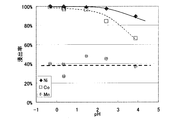
- FIG. 4 shows the relationship between the leaching rate (dissolution rate) and pH of nickel, cobalt, and manganese when the mixed hydroxide is dissolved in a sulfuric acid solution having a concentration of 64% by mass.
- FIG. 4 shows that when the pH is 2.2 or less, the dissolution rate of nickel and cobalt is almost 100% and the dissolution rate of manganese is 40 to 60%.
- the mixed hydroxide the limonite ore leachate (after neutralizing the free sulfuric acid) was subjected to oxidative neutralization, and then neutralized to obtain Ni: 22% by mass, Co: 1.1% by mass.
- Mn A compound having a composition of 5.4 mass is used.
- a sulfuric acid solution having a concentration of 64 mass% is added in various amounts and mixed, and then pure water is added to adjust the slurry concentration. It adjusted to 30 mass%. Thereafter, the pH at the end of dissolution was measured, and the dissolved slurry was filtered and analyzed.
- the dissolution treatment is not particularly limited, but is performed using a reaction vessel equipped with a stirring mechanism and a pH measurement mechanism.
- the slurry after the dissolution treatment may be solid-liquid separated using a filter such as a filter press to obtain a concentrate containing nickel and cobalt and a precipitate (b) containing manganese and gypsum. preferable.
- a filter such as a filter press to obtain a concentrate containing nickel and cobalt and a precipitate (b) containing manganese and gypsum. preferable.
- Step (4) the concentrated liquid obtained in the step (3) is subjected to a solvent extraction treatment using a phosphate ester-based acidic extractant, and an extraction residual liquid containing nickel and back extraction containing cobalt. This is a step of obtaining a liquid. Here, nickel and cobalt in the concentrated liquid are separated. At this time, when manganese coexists in the concentrated solution, it is extracted together with cobalt by the extractant and further distributed in the back extract.
- an aqueous phase composed of the concentrated liquid and an organic phase composed of a solvent containing a phosphoric acid ester-based acidic extractant are mixed, pH is adjusted, and cobalt is extracted into the organic phase.
- the phosphoric acid ester-based acidic extractant is not particularly limited, and can be used as long as nickel and cobalt are well separated and calcium extraction is small.
- trade name Cyanex 272 manufactured by Cytec Corporation in the United States is used. Used.
- the pH can be easily adjusted using an aqueous solution containing an alkali agent such as sodium hydroxide.
- the equilibrium pH of the aqueous phase is preferably maintained at about 5.
- 98% or more of cobalt can be extracted by appropriately setting the volume ratio between the organic phase and the aqueous phase and the number of extraction stages.
- nickel loss since about 10% of nickel is also extracted at this time, it is possible to prevent nickel loss by providing a scrubbing stage for washing the organic phase with dilute acid before back-extracting cobalt from the organic phase after extraction. It is effective in doing.
- cobalt extracted in the organic phase is back extracted as a sulfate together with an impurity element such as manganese.
- Process (5) is a step of adding a neutralizing agent to the extraction residual liquid obtained in the step (4) and subjecting it to a neutralization treatment, and separating and recovering the produced nickel hydroxide. As a result, a nickel hydroxide precipitate having a nickel quality of 40 to 45% by mass is obtained.
- nickel in the extraction residual liquid forms a precipitate as nickel hydroxide by a neutralization reaction, and is recovered by filtration.
- the neutralization treatment is not particularly limited, and it is preferable to satisfy the following requirements (g) to (l).
- the pH is 7.5 to 8.0.
- the neutralizing agent is magnesium hydroxide.
- the reaction temperature is a temperature not lower than 80 ° C. and not higher than the boiling point.
- the pH of the neutralization treatment is preferably as high as possible in order to avoid the loss of nickel, and 7.5 or more that provides a sufficient nickel precipitation rate is used.
- pH exceeds 8.0 the effect beyond it will not be acquired but the usage-amount of a neutralizing agent will increase.
- other alkaline agents are used as the neutralizing agent.
- magnesium hydroxide is preferable.
- a temperature of 80 ° C. or more and a boiling point or less at which a practical neutralization reaction rate can be obtained is preferable.
- Step (6) In the recovery method of the present invention, following the step (3), the following step (6) may be included as necessary. As a result, manganese remaining in the concentrated liquid is removed as a hydroxide, so that it is possible to suppress a decrease in efficiency of cobalt extraction by manganese in the subsequent solvent extraction process. In addition, since the extraction load in the solvent extraction step is reduced, a smaller solvent extraction step can be designed. Step (6): Sulfurous acid gas and the nickel and cobalt concentrate obtained in the step (3) are added.
- the oxidation neutralization treatment is not particularly limited, and it is preferable to satisfy the following requirements (nu) to (wa).
- Nu The content ratio of sulfurous acid gas in the mixed gas is 1 to 10% by volume with respect to air or oxygen gas.
- the oxidation-reduction potential (based on silver / silver chloride electrode) is 500 to 600 mV.
- E The pH is 5.0 to 6.0.
- W The neutralizing agent is sodium hydroxide.
- the content ratio of sulfurous acid gas is preferably as high as possible to improve the oxidation efficiency by adding sulfurous acid gas, and to obtain high manganese removal rate with respect to air or oxygen gas 1% by volume or more is used.
- the said content rate exceeds 10 volume%, the tendency for sulfurous acid gas to act as a reducing agent will become strong, and there exists a tendency for oxidation efficiency to fall.
- the redox potential (silver / silver chloride electrode standard) of the oxidative neutralization reaction the higher the requirement for increasing the oxidation removal rate of manganese, 500 mV or higher is used.
- the redox potential (silver / silver chloride electrode standard) exceeds 600 mV, the effect of removing manganese beyond that is small, and the amount of oxidizing agent used increases.
- a method for controlling the oxidation-reduction potential it can be carried out mainly by adjusting the content ratio of the sulfurous acid gas in the mixed gas and the amount of blowing.
- the pH of the oxidative neutralization reaction is preferably as high as possible to increase the oxidation removal efficiency of manganese, and 5.0 or more is used to obtain a high manganese removal rate.
- pH exceeds 6.0 since the coprecipitation of nickel and cobalt increases, the yield decreases.
- sodium hydroxide can be used as a neutralizing agent, and the amount added can be adjusted.
- the liquid temperature is not particularly limited, but 40 to 80 ° C. is preferable and about 60 ° C. is more preferable in order to obtain a high manganese removal rate. That is, when the liquid temperature is lower than 40 ° C., iron is not sufficiently removed by oxidation. On the other hand, if the liquid temperature exceeds 80 ° C., the reaction vessel is restricted in terms of equipment, and the temperature rise energy is also required, which is expensive.
- Step (7), (8) The recovery method of the present invention may further include the following step (7) or step (8) as necessary. Thereby, cobalt is collect
- Step (8) Hydrogen sulfide gas or alkali sulfide is added to the back-extracted liquid obtained in the step (4) and subjected to sulfiding treatment, and the produced cobalt sulfide is separated and recovered.
- the neutralization treatment is not particularly limited, and it is preferable to satisfy the following requirements (F) to (T). Thereby, cobalt hydroxide containing manganese is obtained.
- the pH is 7.5 to 9.0.
- the neutralizing agent does not contain calcium which forms a hardly soluble salt such as sodium hydroxide, sodium carbonate, sodium hydrogen carbonate, ammonia or the like.
- the reaction temperature is a temperature not lower than 80 ° C. and not higher than the boiling point.
- the sulfiding treatment is not particularly limited, and it is preferable that the following requirements (l) to (tu) are satisfied. Thereby, cobalt sulfide from which manganese is partially separated is obtained.
- L The pH is 2.0 to 4.0.
- Redox potential (based on silver / silver chloride electrode) is ⁇ 250 to ⁇ 100 mV.
- Iv The reaction temperature is a temperature of 60 ° C. to the boiling point or lower.
- the sulfuric acid aqueous solution used in the recovery method of the present invention contains nickel and cobalt, iron, aluminum, manganese and other impurity elements, and is produced from various smelting methods of nickel oxide ore.
- a leachate produced from a step of adding a sulfuric acid solution to a slurry of nickel oxide ore and leaching under high temperature and high pressure by the following leaching step and solid-liquid separation step can be mentioned.
- Leaching step Slurry nickel oxide ore, add sulfuric acid, and stir at a temperature of 220-280 ° C. to form a leaching slurry.
- Solid-liquid separation step The leaching slurry is washed using a multi-stage thickener and separated into a leaching solution containing nickel and cobalt and a leaching residue.
- the nickel oxide ore is mainly a so-called laterite ore such as limonite or saprolite ore.
- the nickel content of the laterite ore is usually 0.8 to 2.5% by mass, and nickel is contained as a hydroxide or a hydrous silicic clay (magnesium silicate) mineral.
- the iron content is 10 to 50% by mass and is mainly in the form of trivalent hydroxide (goethite), but partly divalent iron is contained in the hydrous silicic clay. .
- the silicic acid content is contained in silica minerals such as quartz and cristobalite (amorphous silica) and hydrous silicic clay. Further, most of the chromium content is contained as a chromite mineral containing iron or magnesium.
- magnesia content is contained in hydrous silicic clay minerals as well as silicic clay minerals that are unweathered and contain almost no nickel which has high hardness. Further, cobalt, aluminum, and manganese exist as components that coexist in the mineral or minerals that have each element as a main component.
- the composition of the leachate produced by processing in the leaching step and the solid-liquid separation step using the nickel oxide ore is, for example, Ni: 3.0 to 8.0 g / L, Co: 0.3 to 1.0 g / L, Fe: 2.0-10.0 g / L, Al: 1.0-5.0 g / L, and Mn: 2.0-5.0 g / L, in addition, It contains zinc, chromium, magnesium, silicon and the like, and is suitably used as an acidic sulfuric acid aqueous solution for the recovery method of the present invention.
- Example 1 Using the leachate obtained by the high pressure acid leaching method of the laterite ore, nickel was separated and nickel hydroxide was recovered.
- Laterite ore leaching process Laterite ore (composition; Ni: 1.1 mass%, Co: 0.1 mass%, Fe: 42.0 mass%, Mn: 0.8 mass%, Al: 2.7 (Mass%) 500 g was collected, and a sulfuric acid solution 150 g having a concentration of 64 mass% and water were added to adjust the slurry concentration to 30 mass%. This slurry was placed in a heat-resistant container having a volume of 3 liters, and the container was charged into an electrically heated autoclave having an internal volume of 3.5 liters and heated to 250 ° C.
- leaching slurry neutralized the remaining sulfuric acid using a calcium carbonate slurry having a concentration of 20% by mass, and then solid-liquid separated to obtain Ni: 3.8 g / L, Co: 0.2 g / L, A leachate having a composition of Fe: 2.0 g / L, Al: 4.1 g / L and Mn: 2.8 g / L and having a pH of 2.5 was obtained.
- Step (1) (oxidation neutralization treatment of leachate) A mixed gas composed of sulfurous acid gas and air (containing 3% by volume of SO 2 gas with respect to air) was blown into 10 L of the leachate prepared as described above while controlling the liquid temperature at 60 ° C., and at the same time a concentration of 20 mass. % Calcium carbonate slurry was added to keep the oxidation pH at 4.5. Thereafter, when the oxidation-reduction potential (silver / silver chloride electrode reference) reaches 500 mV, the slurry after oxidation neutralization is filtered, and the precipitate (a) containing iron and aluminum is separated and oxidized. A solution after neutralization was obtained and analyzed.
- oxidation-reduction potential silver / silver chloride electrode reference
- composition of the resulting solution after the oxidation neutralization treatment is as follows: Ni: 3.7 g / L, Co: 0.2 g / L, Fe: ⁇ 0.001 g / L, Al: ⁇ 0.001 g / L and Mn: 2 0.8 g / L. This shows that iron and aluminum are almost completely removed.
- Step (2) Recovery of mixed hydroxide by neutralization treatment
- a calcium hydroxide slurry having a concentration of 20% by mass was added to control the pH to 7.6.
- the slurry was filtered, and the resulting mixed hydroxide containing nickel and cobalt was obtained and analyzed.
- the composition of the obtained mixed hydroxide was as follows: Ni: 15.2% by mass, Co: 1.4% by mass, Fe: ⁇ 0.01% by mass, Mn: 4.4% by mass, Al: ⁇ 0.01
- the precipitation ratio of nickel and cobalt was 98%.
- Step (3) dissolution treatment of mixed hydroxide
- a sulfuric acid solution having a concentration of 64% by mass was added and mixed, and then pure water was added to adjust the slurry concentration to 30% by mass.
- a sulfuric acid solution having a concentration of 64% by mass was added again to adjust the pH at the end of dissolution to 2.0.
- the dissolved slurry was filtered to separate the produced precipitate (b) containing manganese and gypsum, and a nickel and cobalt concentrate was obtained and analyzed.
- the composition of the obtained concentrate was Ni: 65.5 g / L, Co: 5.9 g / L, and Mn: 10.5 g / L. From this, the dissolution rate of nickel and cobalt was 98%, and the elution rate of manganese was 55%. It can be seen that 45% of the manganese in the mixed hydroxide is removed.
- Step (4) solvent extraction treatment
- the aqueous phase consisting of the concentrate obtained in step (3) and the organic phase consisting of the solvent containing the phosphate ester-based acidic extractant are mixed in a ratio that the organic / aqueous phase ratio is 2, and the pH is adjusted to 4.5.
- cobalt is extracted into the organic phase, and then the two phases are separated, and the resulting organic phase and sulfuric acid solution are mixed at a ratio of the organic / water phase ratio of 2 to obtain cobalt in the sulfuric acid solution.
- a back extract containing was obtained and analyzed.
- the composition of the obtained extraction residual liquid was Ni: 50.5 g / L, Co: ⁇ 0.1 g /, and Mn: ⁇ 0.1 g / L.
- the composition of the back extract was Ni: 0.6 g / L, Co: 5.5 g /, and Mn: 10.0 g / L. This shows that nickel and cobalt are sufficiently separated.
- Step (5) neutralization treatment of extraction residual liquid
- the extraction residual liquid obtained in the step (4) is neutralized by adding magnesium hydroxide slurry, Ni: 44.4% by mass, Co: ⁇ 0.1% by mass, Fe: ⁇ 0.1% by mass %, Mn: ⁇ 0.1% by mass, Al: ⁇ 0.1% by mass, nickel hydroxide having a composition of 0.1% by mass was obtained.
- nickel hydroxide that can be effectively used as a raw material for nickel industrial materials such as metallic nickel, nickel oxide, and ferronickel can be separated and recovered.
- Example 2 Using the concentrate obtained in the step (3) of Example 1, the manganese removal (step (6)) was performed according to the following procedure. First, the liquid temperature of the concentrated liquid is controlled to 60 ° C., and a mixed gas composed of sulfurous acid gas and air (containing 1% by volume of SO 2 gas with respect to air) is blown, and at the same time sodium hydroxide having a concentration of 4 mol / L An aqueous solution was added to keep the pH at 5.0. Here, the oxidation-reduction potential (silver / silver chloride electrode standard) was maintained at 550 mV for 4 hours.
- a mixed gas composed of sulfurous acid gas and air containing 1% by volume of SO 2 gas with respect to air
- Example 1 the sulfuric acid aqueous solution is subjected to oxidation neutralization treatment under predetermined conditions to remove iron and aluminum, and the obtained solution after oxidation neutralization treatment is neutralized under predetermined conditions.
- a process of separating and recovering a mixed hydroxide containing nickel and cobalt, which is subjected to a treatment, and subjecting the obtained mixed hydroxide to a dissolution treatment under specific conditions, while removing manganese, a concentrated solution of nickel and cobalt A step of subjecting the obtained concentrated solution to oxidation treatment under predetermined conditions to remove manganese, and subjecting the resulting post-oxidation treatment solution to solvent extraction treatment under predetermined conditions to extract nickel Effectively used as a raw material for industrial materials since the process of obtaining a back extract containing the residual liquid and cobalt and the process of subjecting the obtained extracted residual liquid to neutralization were sequentially performed according to the method of the present invention.
- the method for recovering nickel from the sulfuric acid aqueous solution of the present invention efficiently separates iron, aluminum, manganese and other impurity elements from the sulfuric acid aqueous solution containing nickel and cobalt and iron, aluminum, manganese and other impurity elements.
- nickel hydroxide having a nickel grade concentrated to 40% by mass or more can be recovered.
- nickel hydroxide having a low content of impurity elements can be obtained from a sulfuric acid aqueous solution having a high manganese content. It is suitable as a method for recovery.
Landscapes
- Chemical & Material Sciences (AREA)
- Organic Chemistry (AREA)
- Engineering & Computer Science (AREA)
- Inorganic Chemistry (AREA)
- Metallurgy (AREA)
- Mechanical Engineering (AREA)
- Materials Engineering (AREA)
- Manufacturing & Machinery (AREA)
- General Chemical & Material Sciences (AREA)
- Chemical Kinetics & Catalysis (AREA)
- Geology (AREA)
- Geochemistry & Mineralogy (AREA)
- General Life Sciences & Earth Sciences (AREA)
- Environmental & Geological Engineering (AREA)
- Life Sciences & Earth Sciences (AREA)
- Manufacture And Refinement Of Metals (AREA)
- Inorganic Compounds Of Heavy Metals (AREA)
Abstract
Description
湿式製錬方法(A):
この方法は、下記の(1)~(4)を含む工程からなり、ニッケル酸化鉱石から、高圧酸浸出(High Pressure Acid Leach)法を用いて、ニッケル及びコバルトを含有する混合硫化物が製造される(例えば、特許文献1参照。)。
(1)浸出工程:ニッケル酸化鉱石をスラリー化して硫酸を添加し、220~280℃の温度で撹拌処理し、浸出スラリーを形成する。
(2)固液分離工程:前記浸出スラリーを多段階のシックナーを用いて洗浄し、ニッケル及びコバルトを含む浸出液と鉄をヘマタイトとして含む浸出残渣とに分離する。
(3)中和工程:前記浸出液の酸化を抑制しながら、炭酸カルシウムを用いてpHが4以下となるよう調整し、3価の鉄を含有する中和殿物を生成し、中和殿物スラリーとニッケル回収用母液とに分離する。及び
(4)硫化工程:前記ニッケル回収用母液に硫化水素ガスを吹きこみ、ニッケル及びコバルトを含有する硫化物を生成し、貧液と分離する。
この方法は、ニッケル酸化鉱石に硫酸を添加して浸出する際に、鉄をナトロジャロサイトとして浸出残渣を形成し、ニッケル及びコバルトを含む浸出液を得る工程、得られた浸出液に中和剤を添加して、鉄及びアルミニウムを除去する工程、得られた中和液を、モノチオホスフィン酸化合物を抽出剤とする溶媒抽出で処理し、コバルトを抽出して、ニッケルを含む抽出残液とコバルトを含む逆抽出液を得る工程、及び得られたニッケルを含む抽出残液とコバルトを含む逆抽出液を、それぞれアルカリで中和して水酸化物を得る工程からなる。ここで、さらに、得られた水酸化ニッケルをアルカリ液で洗浄してイオウと塩素を除去した後、ニッケル酸化鉱石とともに、焼成及び還元熔解工程を含むフェロニッケル製造プラントへ供給することによって、水酸化ニッケルをフェロニッケルの製造原料の一部として使用する(例えば、特許文献2参照。)。
この方法は、ニッケル酸化鉱石の大気圧又は高圧酸浸出工程で形成された酸浸出液スラリー中にイオン交換樹脂を添加する、いわゆるRIP(Resin in pulp)法において、スニッケル及びコバルトを吸着した樹脂をスラリーから分離し、この樹脂を浸出して、Ni濃度10~80g/Lのニッケルとコバルト、アルミニウム、鉄等を含む酸性溶離液を得る工程、前記酸性溶離液をpH4.5~5で中和して、鉄とアルミニウムを除去する工程、得られた中和液を、シアネックス272抽出剤で溶媒抽出で処理し、コバルト、マンガン等を抽出して、ニッケルを含む抽出残液とコバルトを含む逆抽出液を得る工程、及び得られたニッケルを含む抽出残液を、水酸化マグネシウムで中和して水酸化物を得る工程からなる(例えば、特許文献3参照。)。
また、湿式製錬方法(C)では、得られた水酸化ニッケルは、コバルトの分離がなされており、金属ニッケル、酸化ニッケル、フェロニッケル等のニッケル工業材料の原料として効果的に利用することができるが、一方、製錬プロセスとしては、浸出工程でRIP(Resin in pulp)法を採用するので、高価なイオン交換樹脂のスラリー中での磨耗等によりその使用量とロスが過大となり、浸出法自体に経済上の問題があることのほか、溶媒抽出工程の始液となる酸性溶離液のニッケル濃度も、イオン交換樹脂の使用による濃縮効果が期待されるものの、高々10~80g/Lであるので、このような薄液を用いた溶媒抽出処理においては、湿式製錬方法(B)と同様、抽出剤の使用量及び設備容量が過大となるという問題があった。
しかも、湿式製錬方法(B)及び(C)では、溶媒抽出工程の始液からのマンガンの除去のための特別な工程は設けられていないので、始液からコバルトを有機相へ抽出するための抽出剤として燐酸エステル系酸性抽出剤を採用する際、共抽出されるマンガンの影響によりコバルトの抽出効率が悪化するため、さらに抽出剤の使用量の増加とコバルトを含有する逆抽出液中のマンガン濃度の上昇という問題もあった。
下記の工程(1)~(5)を含むことを特徴とする硫酸酸性水溶液からのニッケル回収方法が提供される。
工程(1):前記硫酸酸性水溶液に、亜硫酸ガスと空気又は酸素ガスからなる混合ガスを吹き込みながら、炭酸カルシウムを添加して酸化中和処理に付し、生成された鉄及びアルミニウムを含有する沈殿物(a)を除去する。
工程(2):前記工程(1)で得られた酸化中和処理後液に、水酸化カルシウムを添加して中和処理に付し、ニッケル及びコバルトを含有する混合水酸化物を分離回収する。
工程(3):前記工程(2)で得られた混合水酸化物を、濃度50質量%以上の硫酸溶液中で溶解処理に付し、生成されたマンガン及び石膏を含有する沈殿物(b)を除去してニッケル及びコバルトの濃縮液を得る。
工程(4):前記工程(3)で得られた濃縮液を、燐酸エステル系酸性抽出剤を用いて溶媒抽出処理に付し、ニッケルを含有する抽出残液とコバルトを含有する逆抽出液を得る。
工程(5):前記工程(4)で得られた抽出残液に、中和剤を添加して中和処理に付し、生成された水酸化ニッケルを分離回収する。
工程(6):前記工程(3)で得られたニッケル及びコバルトの濃縮液に、亜硫酸ガスと空気又は酸素ガスからなる混合ガスを吹き込みながら、中和剤を添加して、酸化中和処理に付し、生成されたマンガン及びコバルトを含有する沈殿物(c)を除去し、得られた酸化中和処理後液を、前記工程(4)に移送する。
工程(7):前記工程(4)で得られた逆抽出液に、中和剤を添加して中和処理に付し、生成された水酸化コバルトを分離回収する。
工程(8):前記工程(4)で得られた逆抽出液に、硫化水素ガス又は硫化アルカリを添加して硫化処理に付し、生成された硫化コバルトを分離回収する。
(イ)前記混合ガス中の亜硫酸ガスの含有割合は、希釈ガスである空気又は酸素ガスに対して1~10容量%である。
(ロ)酸化還元電位(銀/塩化銀電極基準)は、400~600mVである。
(ハ)pHは、4.0~4.5である。
(ニ)pHは、7.5~7.7である。
(ホ)スラリー濃度は、30~40質量%である。
(ヘ)混合水酸化物の溶解終了時のpHは、1.5~2.2である。
(ト)pHは、7.5~8.0である。
(チ)前記中和剤は、水酸化マグネシウムである。
(リ)反応温度は、80℃以上沸騰点以下の温度である。
(ヌ)前記混合ガス中の亜硫酸ガスの含有割合は、空気又は酸素ガスに対して1~10容量%である。
(ル)酸化還元電位(銀/塩化銀電極基準)は、500~600mVである。
(オ)pHは、5.0~6.0である。
(ワ)前記中和剤は、水酸化ナトリウムである。
が提供される。
本発明の硫酸酸性水溶液からのニッケルの回収方法は、ニッケル及びコバルトと、鉄、アルミニウム及びマンガンその他の不純物元素とを含有する硫酸酸性水溶液から、ニッケルを回収する方法であって、
下記の工程(1)~(5)を含むことを特徴とする。
工程(1):前記硫酸酸性水溶液に、亜硫酸ガスと空気又は酸素ガスからなる混合ガスを吹き込みながら、炭酸カルシウムを添加して酸化中和処理に付し、生成された鉄及びアルミニウムを含有する沈殿物(a)を除去する。
工程(2):前記工程(1)で得られた酸化中和処理後液に、水酸化カルシウムを添加して中和処理に付し、ニッケル及びコバルトを含有する混合水酸化物を分離回収する。
工程(3):前記工程(2)で得られた混合水酸化物を、濃度50質量%以上の硫酸溶液中で溶解処理に付し、生成されたマンガン及び石膏を含有する沈殿物(b)を除去してニッケル及びコバルトの濃縮液を得る。
工程(4):前記工程(3)で得られた濃縮液を、燐酸エステル系酸性抽出剤を用いて溶媒抽出処理に付し、ニッケルを含有する抽出残液とコバルトを含有する逆抽出液を得る。
工程(5):前記工程(4)で得られた抽出残液に、中和剤を添加して中和処理に付し、生成された水酸化ニッケルを分離回収する。
上記工程(1)は、ニッケル及びコバルトと、鉄、アルミニウム及びマンガンその他の不純物元素とを含有する硫酸酸性水溶液に、亜硫酸ガスと空気又は酸素ガスからなる混合ガスを吹き込みながら、炭酸カルシウムを添加して酸化中和処理に付し、生成された鉄及びアルミニウムを含有する沈殿物(a)を除去する工程である。
ここで、後続の溶媒抽出処理において前記抽出剤中への蓄積性の高い鉄及びアルミニウムを略完全に除去する。
図1より、ニッケルが1%以上沈殿するようなpH条件下でも、鉄の除去率が10~20%ていどであることが分かる。これに対して、アルミニウムの除去率は、pH4以上で略完全に除去することができることが分かる。
(イ)前記混合ガス中の亜硫酸ガスの含有割合は、希釈ガスである空気又は酸素ガスに対して1~10容量%、希釈ガスが空気の場合には、好ましくは1~5容量%である。
(ロ)酸化還元電位(銀/塩化銀電極基準)は、400~600mVである。
(ハ)pHは、4.0~4.5である。
上記工程(2)は、上記工程(1)で得られた酸化中和処理後液に、水酸化カルシウムを添加して中和処理に付し、ニッケル及びコバルトを含有する混合水酸化物を分離回収する工程である。ここで、前記酸化中和処理後液中のニッケル及びコバルトを一旦沈殿物として回収する。これによって、ニッケル品位が25~45質量%の混合水酸化物が得られるので、後続の溶解処理で高ニッケル濃度の濃縮液を得て、さらに、溶媒抽出処理において、その始液となるのニッケル濃度を大幅に向上させることが可能となる。この高ニッケル濃度の濃縮液を始液として用いた溶媒抽出処理においては、抽出剤の使用量及び設備容量を低減することができ、抽出剤の損失と設備コストの低下により経済上の効率性が格段に向上する。
(ニ)pHは、7.5~7.7である。
すなわち、中和反応のpHとしては、ニッケル及びコバルトの沈殿率(回収率)を向上させるためには高い程望ましく、97%以上の高回収率を得るためには7.5以上が用いられる。一方、pHが7.7を超えると、液中のマンガンの沈殿率が急上昇し、前記混合水酸化物に含有され、さらに後続の溶媒抽出処理でコバルトの抽出効率に悪影響を及ぼすようになる。したがって、中和反応のpHはニッケル及びコバルトの沈殿率(回収率)とマンガン沈殿率を考慮して選ばれる。なお、このようなpH条件を実現するための中和剤としては、他のアルカリ剤も用いられるが、安価な水酸化カルシウムの使用により達成することができる。
上記工程(3)は、上記工程(2)で得られた混合水酸化物を、濃度50質量%以上の硫酸溶液中で溶解処理に付し、生成されたマンガン及び石膏を含有する沈殿物(b)を除去してニッケル及びコバルトの濃縮液を得る工程である。ここで、該混合水酸化物中に含有されるニッケル及びコバルトを溶解して、高ニッケル濃度の濃縮液を得るとともに、マンガンをマンガン酸化物(Mn3O4、Mn2O3、MnO2)の形態で沈殿物として分離する。この工程により、マンガンの40~60%を酸化除去することが可能であり、またニッケル溶解率99%、コバルト溶解率96%が達成される。
前記混合水酸化物を、所定濃度の硫酸溶液と混合し、次いで水を添加してスラリー濃度を調整し、その後、溶解終了時のpHが所定値になるように、所定濃度の硫酸溶液の所定量を添加した。例えば、水分率が30~50質量%の混合水酸化物に、含有されるニッケルとコバルトに対して1当量となるように、濃度64質量%硫酸溶液を添加し1次混合する。次いで、30~40質量%のスラリー濃度となるように、水を添加して調整する。最後に、再度濃度64質量%硫酸溶液を添加し、溶液のpHが1.5~2.2の間に入るように調整する。
(ホ)混合水酸化物を投入した硫酸溶液スラリーのスラリー濃度は、30~40質量%である。
(ヘ)混合水酸化物の溶解終了時のpHは、1.5~2.2である。
図4は、混合水酸化物を濃度64質量%の硫酸溶液で溶解処理した際のニッケル、コバルト及びマンガンの浸出率(溶解率)とpHの関係を示す。図4より、pHが2.2以下では、ニッケル及びコバルトの溶解率がほぼ100%で一定であること、マンガンの溶解率が40~60%であることが分かる。
ここで、混合水酸化物として、リモナイト鉱の浸出液(遊離硫酸を中和後)を酸化中和処理し、次いで中和処理して得られた、Ni:22質量%、Co:1.1質量及びMn:5.4質量の組成を有するものを使用し、該混合水酸化物に、濃度64質量%の硫酸溶液を添加量を変えて添加し混合後、純水を添加してスラリー濃度を30質量%に調整した。その後、溶解終了時のpHを測定し、溶解スラリーをろ過して分析した。
上記工程(4)は、上記工程(3)で得られた濃縮液を、燐酸エステル系酸性抽出剤を用いて溶媒抽出処理に付し、ニッケルを含有する抽出残液とコバルトを含有する逆抽出液を得る工程である。
ここで、上記濃縮液中のニッケルとコバルトを分離する。この際、上記濃縮液中にマンガンが共存する場合、コバルトとともに、前記抽出剤により抽出され、さらに逆抽出液中に分配される。
上記燐酸エステル系酸性抽出剤としては、特に限定されるものではなく、ニッケルとコバルトの分離がよく、かつカルシウムの抽出が少ないものであれば利用できるが、例えば米国Cytec社製の商品名Cyanex272が用いられる。
上記工程(5)は、上記工程(4)で得られた抽出残液に、中和剤を添加して中和処理に付し、生成された水酸化ニッケルを分離回収する工程である。これによって、ニッケル品位が40~45質量%の水酸化ニッケル沈殿物が得られる。
ここで、上記抽出残液中のニッケルは、中和反応によって水酸化ニッケルとして沈殿物を形成し、ろ過分離して回収される。
(ト)pHは、7.5~8.0である。
(チ)前記中和剤は、水酸化マグネシウムである。
(リ)反応温度は、80℃以上沸騰点以下の温度である。
また、(チ)の要件において、前記中和剤としては、他のアルカリ剤が用いられるが、例えば、水酸化カルシウムを用いると、石膏が生成析出して沈殿物に混じりニッケル品位を低下させてしまうので、水酸化マグネシウムが好ましい。
また、(リ)の要件において、中和剤として水酸化マグネシウムを用いる場合は、実用的な中和反応の速度が得られる、80℃以上沸騰点以下の温度が好ましい。
本発明の回収方法において、さらに、上記工程(3)に続いて、必要に応じて、下記の工程(6)を含むことができる。これにより、上記濃縮液中に残存したマンガンが水酸化物として除去されるので、後続の溶媒抽出処理において、マンガンによるコバルト抽出への効率低下を抑えることができる。また、溶媒抽出工程における抽出負荷が低減されるため、より小さな溶媒抽出工程の設計が可能となる
工程(6):前記工程(3)で得られたニッケル及びコバルトの濃縮液に、亜硫酸ガスと空気又は酸素ガスからなる混合ガスを吹き込みながら、中和剤を添加して、酸化中和処理に付し、生成されたマンガン及びコバルトを含有する沈殿物(c)を除去し、得られた酸化中和処理後液を、前記工程(4)に移送する。
(ヌ)前記混合ガス中の亜硫酸ガスの含有割合は、空気又は酸素ガスに対して1~10容量%である。
(ル)酸化還元電位(銀/塩化銀電極基準)は、500~600mVである。
(オ)pHは、5.0~6.0である。
(ワ)前記中和剤は、水酸化ナトリウムである。
本発明の回収方法において、さらに、必要に応じて、下記の工程(7)又は工程(8)を含むことができる。これによって、上記工程(4)で得られた逆抽出液から、コバルトが、水酸化コバルト又は硫化コバルトとして回収される。これらの回収物は、コバルト精製工程を含むプロセスの原料として好適である。
工程(7):前記工程(4)で得られた逆抽出液に、中和剤を添加して中和処理に付し、生成された水酸化コバルトを分離回収する。
工程(8):前記工程(4)で得られた逆抽出液に、硫化水素ガス又は硫化アルカリを添加して硫化処理に付し、生成された硫化コバルトを分離回収する。
(カ)pHは、7.5~9.0である。
(ヨ)前記中和剤は、水酸化ナトリウム、炭酸ナトリウム、炭酸水素ナトリウム、アンモニア等の難溶解性の塩を形成するカルシウムを含有しないものである。
(タ)反応温度は、80℃以上沸騰点以下の温度である。
(レ)pHは、2.0~4.0である。
(ソ)酸化還元電位(銀/塩化銀電極基準)は、-250~-100mVである。
(ツ)反応温度は、60℃~沸騰点以下の温度である。
本発明の回収方法に用いる硫酸酸性水溶液としては、ニッケル及びコバルトと、鉄、アルミニウム及びマンガンその他の不純物元素とを含有するものであり、ニッケル酸化鉱石の種々の製錬方法から産出されるものが好ましく用いられるが、例えば、下記の浸出工程及び固液分離工程により、ニッケル酸化鉱石のスラリーに硫酸溶液を添加し、高温高圧下に浸出する工程から産出される浸出液が挙げられる。
浸出工程:ニッケル酸化鉱石をスラリー化して硫酸を添加し、220~280℃の温度で撹拌処理し、浸出スラリーを形成する。
固液分離工程:前記浸出スラリーを多段階のシックナーを用いて洗浄し、ニッケル及びコバルトを含む浸出液と浸出残渣とに分離する。
ラテライト鉱の高圧酸浸出法で得た浸出液を用いて、ニッケルを分離し、水酸化ニッケルの回収を行なった。
(1)ラテライト鉱の浸出工程
ラテライト鉱(組成;Ni:1.1質量%、Co:0.1質量%、Fe:42.0質量%、Mn:0.8質量%、Al:2.7質量%)500gを採取し、濃度64質量%の硫酸溶液150gと水を加え、スラリー濃度30質量%に調整した。
このスラリーを、容積3リットルの耐熱容器に入れ、容器を内容積3.5リットルの電気加熱式オートクレーブに装入して攪拌機によって攪拌しながら250℃に加熱し、この温度で、1時間維持した後に室温まで冷却し、浸出スラリーをオートクレーブから取り出した。得られた浸出スラリーは、濃度20質量%の炭酸カルシウムスラリーを用いて残留する硫酸を中和処理した後、固液分離して、Ni:3.8g/L、Co:0.2g/L、Fe:2.0g/L、Al:4.1g/L及びMn:2.8g/Lの組成を有する、pHが2.5の浸出液を得た。
上記のように作成した浸出液10Lに、液温を60℃に制御しながら、亜硫酸ガスと空気からなる混合ガス(空気に対し3容量%のSO2ガスを含む。)を吹き込み、同時に濃度20質量%の炭酸カルシウムスラリーを添加して、酸化pHを4.5に保持した。その後、酸化還元電位(銀/塩化銀電極基準)が500mVに到達した時点で、酸化中和後スラリーをろ過し、生成された鉄及びアルミニウムを含有する沈殿物(a)を分離して、酸化中和処理後液を得て分析した。
得られた酸化中和処理後液の組成は、Ni:3.7g/L、Co:0.2g/L、Fe:<0.001g/L、Al:<0.001g/L及びMn:2.8g/Lであった。これより、鉄とアルミニウムが略完全に除去されることが分かる。
工程(1)で得られた酸化中和処理後液10Lに、液温を60℃に制御しながら、濃度20質量%の水酸化カルシウムスラリーを添加してpHを7.6に制御して中和処理し、中和後スラリーをろ過し、生成されたニッケル及びコバルトを含有する混合水酸化物を得て分析した。
得られた混合水酸化物の組成は、Ni:15.2質量%、Co:1.4質量%、Fe:<0.01質量%、Mn:4.4質量%、Al:<0.01質量%であり、ニッケルとコバルトの沈殿率は、98%であった。
工程(2)で得られた混合水酸化物300gを、濃度64質量%の硫酸溶液100mLを添加し混合後、純水を添加してスラリー濃度を30質量%に調整した。さらに、再度濃度64質量%硫酸溶液を添加し、溶解終了時のpHを2.0に調整した。その後、溶解スラリーをろ過して、生成されたマンガン及び石膏を含有する沈殿物(b)を分離して、ニッケル及びコバルトの濃縮液を得て分析した。
得られた濃縮液の組成は、Ni:65.5g/L、Co:5.9g/及びMn:10.5g/Lであった。これより、ニッケルとコバルトの溶解率は、98%であり、マンガンの溶出率は55%であった。混合水酸化物中のマンガンの45%が除去されることが分かる。
工程(3)で得られた濃縮液からなる水相と燐酸エステル系酸性抽出剤を含む溶媒からなる有機相を有機/水相比が2となる割合で混合し、pHを4.5に調整して有機相にコバルトを抽出し、その後両相を分離する3段の抽出段、及び得られた有機相と硫酸溶液を有機/水相比が2となる割合で混合して硫酸溶液にコバルトを抽出し、その後両相を分離する2段の逆抽出段、及び有機相を希酸で洗浄するスクラビング段からなる設備を用いて、溶媒抽出処理し、ニッケルを含有する抽出残液とコバルトを含有する逆抽出液を得て分析した。
得られた抽出残液の組成は、Ni:50.5g/L、Co:<0.1g/及びMn:<0.1g/Lであった。また、逆抽出液の組成は、Ni:0.6g/L、Co:5.5g/及びMn:10.0g/Lであった。これより、ニッケルとコバルトの分離が十分に行われていることが分かる。
工程(4)で得られた抽出残液に、水酸化マグネシウムスラリーを添加して中和処理し、Ni:44.4質量%、Co:<0.1質量%、Fe:<0.1質量%、Mn:<0.1質量%、Al:<0.1質量%の組成を有する水酸化ニッケルを得た。これより、金属ニッケル、酸化ニッケル、フェロニッケル等のニッケル工業材料の原料として効果的に利用することができる水酸化ニッケルを分離回収することができることが分かる。
上記実施例1の工程(3)で得られた濃縮液を用いて、以下の手順に従い、脱マンガン(工程(6))を行なった。
まず、前記濃縮液の液温を60℃に制御し、亜硫酸ガスと空気からなる混合ガス(空気に対し1容量%でSO2ガスを含む。)を吹き込み、同時に濃度4mol/Lの水酸化ナトリウム水溶液を添加して、pHを5.0に保持した。ここで、酸化還元電位(銀/塩化銀電極基準)を550mVに4時間保持した。その後、酸化中和後スラリーをろ過し、生成されたマンガン及びコバルトを含有する沈殿物(c)を分離し、酸化中和処理後液を得て分析した。
得られた酸化中和処理後液の組成は、Mn:5.9g/Lであった。これより、工程(4)の溶媒抽出工程における抽出負荷が低減されるため、より小さな溶媒抽出工程の設計が可能となることが分かる。
Claims (10)
- ニッケル及びコバルトと、鉄、アルミニウム及びマンガンその他の不純物元素とを含有する硫酸酸性水溶液から、ニッケルを回収する方法であって、
下記の工程(1)~(5)を含むことを特徴とする硫酸酸性水溶液からのニッケル回収方法。
工程(1):前記硫酸酸性水溶液に、亜硫酸ガスと空気又は酸素ガスからなる混合ガスを吹き込みながら、炭酸カルシウムを添加して酸化中和処理に付し、生成された鉄及びアルミニウムを含有する沈殿物(a)を除去する。
工程(2):前記工程(1)で得られた酸化中和処理後液に、水酸化カルシウムを添加して中和処理に付し、ニッケル及びコバルトを含有する混合水酸化物を分離回収する。
工程(3):前記工程(2)で得られた混合水酸化物を、濃度50質量%以上の硫酸溶液中で溶解処理に付し、生成されたマンガン及び石膏を含有する沈殿物(b)を除去してニッケル及びコバルトの濃縮液を得る。
工程(4):前記工程(3)で得られた濃縮液を、燐酸エステル系酸性抽出剤を用いて溶媒抽出処理に付し、ニッケルを含有する抽出残液とコバルトを含有する逆抽出液を得る。
工程(5):前記工程(4)で得られた抽出残液に、中和剤を添加して中和処理に付し、生成された水酸化ニッケルを分離回収する。 - さらに、前記工程(3)に続いて、下記の工程(6)を含むことを特徴とする請求項1に記載の硫酸酸性水溶液からのニッケル回収方法。
工程(6):前記工程(3)で得られたニッケル及びコバルトの濃縮液に、亜硫酸ガスと空気又は酸素ガスからなる混合ガスを吹き込みながら、中和剤を添加して、酸化中和処理に付し、生成されたマンガン及びコバルトを含有する沈殿物(c)を除去し、得られた酸化中和処理後液を、前記工程(4)に移送する。 - さらに、下記の工程(7)又は工程(8)を含むことを特徴とする請求項1又は2に記載の硫酸酸性水溶液からのニッケル回収方法。
工程(7):前記工程(4)で得られた逆抽出液に、中和剤を添加して中和処理に付し、生成された水酸化コバルトを分離回収する。
工程(8):前記工程(4)で得られた逆抽出液に、硫化水素ガス又は硫化アルカリを添加して硫化処理に付し、生成された硫化コバルトを分離回収する。 - 前記工程(1)において、酸化中和処理は、下記の(イ)~(ハ)の要件を満足することを特徴とする請求項1~3のいずれかに記載の硫酸酸性水溶液からのニッケル回収方法。
(イ)前記混合ガス中の亜硫酸ガスの含有割合は、希釈ガスである空気又は酸素ガスに対して1~10容量%である。
(ロ)酸化還元電位(銀/塩化銀電極基準)は、400~600mVである。
(ハ)pHは、4.0~4.5である。 - 前記工程(2)において、中和処理は、下記の(ニ)の要件を満足することを特徴とする請求項1~3のいずれかに記載の硫酸酸性水溶液からのニッケル回収方法。
(ニ)pHは、7.5~7.7である。 - 前記工程(3)において、溶解処理は、下記の(ホ)及び(ヘ)の要件を満足することを特徴とする請求項1~3のいずれかに記載の硫酸酸性水溶液からのニッケル回収方法。
(ホ)スラリー濃度は、30~40質量%である。
(ヘ)混合水酸化物の溶解終了時のpHは、1.5~2.2である。 - 前記工程(3)において、沈殿物(b)を、前記工程(1)へ移送する手段を備えることを特徴とする請求項1~3のいずれかに記載の硫酸酸性水溶液からのニッケル回収方法。
- 前記工程(5)において、中和処理は、下記の(ト)~(リ)の要件を満足することを特徴とする請求項1~3のいずれかに記載の硫酸酸性水溶液からのニッケル回収方法。
(ト)pHは、7.5~8.0である。
(チ)前記中和剤は、水酸化マグネシウムである。
(リ)反応温度は、80℃以上沸騰点以下の温度である。 - 前記工程(6)において、酸化中和処理は、下記の(ヌ)~(ワ)の要件を満足することを特徴とする請求項2又は3に記載の硫酸酸性水溶液からのニッケル回収方法。
(ヌ)前記混合ガス中の亜硫酸ガスの含有割合は、空気又は酸素ガスに対して1~10容量%である。
(ル)酸化還元電位(銀/塩化銀電極基準)は、500~600mVである。
(オ)pHは、5.0~6.0である。
(ワ)前記中和剤は、水酸化ナトリウムである。 - 前記硫酸酸性水溶液は、ニッケル酸化鉱石のスラリーに硫酸溶液を添加し、高温高圧下に浸出する工程から産出される浸出液であることを特徴とする請求項1~9のいずれかに記載の硫酸酸性水溶液からのニッケル回収方法。
Priority Applications (2)
| Application Number | Priority Date | Filing Date | Title |
|---|---|---|---|
| US13/057,683 US8580213B2 (en) | 2009-02-04 | 2010-02-02 | Method for recovering nickel from sulfuric acid aqueous solution |
| AU2010211729A AU2010211729B2 (en) | 2009-02-04 | 2010-02-02 | Method for collecting nickel from acidic sulfuric acid solution |
Applications Claiming Priority (2)
| Application Number | Priority Date | Filing Date | Title |
|---|---|---|---|
| JP2009023376A JP5157943B2 (ja) | 2009-02-04 | 2009-02-04 | 硫酸酸性水溶液からのニッケル回収方法 |
| JP2009-023376 | 2009-02-04 |
Publications (1)
| Publication Number | Publication Date |
|---|---|
| WO2010090176A1 true WO2010090176A1 (ja) | 2010-08-12 |
Family
ID=42542069
Family Applications (1)
| Application Number | Title | Priority Date | Filing Date |
|---|---|---|---|
| PCT/JP2010/051400 Ceased WO2010090176A1 (ja) | 2009-02-04 | 2010-02-02 | 硫酸酸性水溶液からのニッケル回収方法 |
Country Status (4)
| Country | Link |
|---|---|
| US (1) | US8580213B2 (ja) |
| JP (1) | JP5157943B2 (ja) |
| AU (1) | AU2010211729B2 (ja) |
| WO (1) | WO2010090176A1 (ja) |
Cited By (5)
| Publication number | Priority date | Publication date | Assignee | Title |
|---|---|---|---|---|
| JP2012001414A (ja) * | 2010-06-21 | 2012-01-05 | Sumitomo Metal Mining Co Ltd | 低塩素硫酸ニッケル/コバルト溶液の製造方法 |
| JP2013076108A (ja) * | 2011-09-29 | 2013-04-25 | Jx Nippon Mining & Metals Corp | アルミニウム及びマンガンの分離方法 |
| CN103146934A (zh) * | 2013-03-11 | 2013-06-12 | 昆明理工大学 | 一种利用微流体技术萃取分离钴、镍的方法 |
| JP2019031703A (ja) * | 2017-08-07 | 2019-02-28 | 住友金属鉱山株式会社 | イリジウムの回収方法 |
| JP2021172856A (ja) * | 2020-04-24 | 2021-11-01 | Jx金属株式会社 | 金属含有溶液中のマグネシウムイオン除去方法及び、金属回収方法 |
Families Citing this family (47)
| Publication number | Priority date | Publication date | Assignee | Title |
|---|---|---|---|---|
| US8571366B2 (en) | 2008-05-09 | 2013-10-29 | Hewlett-Packard Development Company, L.P. | Proximity free space optical interconnect |
| JP5445777B2 (ja) * | 2010-07-28 | 2014-03-19 | 住友金属鉱山株式会社 | 低品位ニッケル酸化鉱石からのフェロニッケル製錬原料の製造方法 |
| HUE044184T2 (hu) * | 2011-01-25 | 2019-10-28 | Univ Queensland | Javított ércfeldolgozási eljárás |
| US10662503B2 (en) | 2011-01-25 | 2020-05-26 | The University Of Queensland | Method of ore processing using mixture including acidic leach solution and oxidizing agent |
| JP5704410B2 (ja) * | 2012-03-21 | 2015-04-22 | 住友金属鉱山株式会社 | 製鉄用ヘマタイトの製造方法 |
| JP5500208B2 (ja) * | 2012-06-12 | 2014-05-21 | 住友金属鉱山株式会社 | 中和処理方法 |
| JP5644878B2 (ja) * | 2013-01-21 | 2014-12-24 | 住友金属鉱山株式会社 | 固液分離処理方法、並びにニッケル酸化鉱石の湿式製錬方法 |
| WO2015075038A1 (de) | 2013-11-19 | 2015-05-28 | Forschungs- und Transferzentrum Leipzig e.V. an der Hochschule für Technik, Wirtschaft und Kultur Leipzig (FH) | Modulares chirurgisches trainingssystem |
| JP5892301B2 (ja) * | 2013-12-16 | 2016-03-23 | 住友金属鉱山株式会社 | ニッケル酸化鉱石の湿式製錬における中和方法 |
| JP6201905B2 (ja) * | 2014-06-16 | 2017-09-27 | 住友金属鉱山株式会社 | 廃ニッケル水素電池からの有価金属の回収方法 |
| JP6314730B2 (ja) * | 2014-07-30 | 2018-04-25 | 住友金属鉱山株式会社 | 廃ニッケル水素電池からの有価金属の回収方法 |
| US10807879B2 (en) | 2016-03-16 | 2020-10-20 | Jx Nippon Mining & Metals Corporation | Processing method for lithium ion battery scrap |
| WO2017159745A1 (ja) | 2016-03-16 | 2017-09-21 | Jx金属株式会社 | リチウムイオン電池スクラップの処理方法 |
| JP6448684B2 (ja) * | 2017-03-03 | 2019-01-09 | Jx金属株式会社 | リチウム回収方法 |
| US11961980B2 (en) | 2017-03-31 | 2024-04-16 | Jx Metals Corporation | Lithium ion battery scrap treatment method |
| KR102044481B1 (ko) * | 2018-02-12 | 2019-12-02 | 주식회사 영풍 | 아연제련공정 중 발생한 부산물로부터 코발트를 회수하는 방법 |
| JP7052635B2 (ja) * | 2018-08-21 | 2022-04-12 | 住友金属鉱山株式会社 | 銅とニッケル及びコバルトの分離方法 |
| JP6539922B1 (ja) * | 2018-08-30 | 2019-07-10 | 日揮株式会社 | 硫酸ニッケル化合物の製造方法 |
| JP7217612B2 (ja) | 2018-10-31 | 2023-02-03 | Jx金属株式会社 | リチウムイオン二次電池の正極活物質廃棄物の処理方法 |
| JP7094877B2 (ja) | 2018-12-27 | 2022-07-04 | Jx金属株式会社 | 有価金属の回収方法 |
| JP7175756B2 (ja) | 2018-12-27 | 2022-11-21 | Jx金属株式会社 | 有価金属の回収方法 |
| JP7198081B2 (ja) * | 2018-12-27 | 2022-12-28 | Jx金属株式会社 | 有価金属の回収方法 |
| AU2019428963B2 (en) * | 2019-02-13 | 2023-08-03 | KEMCO (Korea Energy Materials Company) | Economical method, using combination of wet and dry processes, for smelting nickel from nickel sulfide ores |
| JP6964618B2 (ja) | 2019-03-29 | 2021-11-10 | Jx金属株式会社 | リチウムイオン電池スクラップの処理方法 |
| EP4030533A4 (en) * | 2019-09-14 | 2023-10-18 | Hunan Jin Yuan New Materials Joint Stock Company Limited | PROCESSES FOR SEPARATING MANGANESE-LITHIUM AND PREPARING PRE-EXTRACTION LIQUID DURING COMPLETE RECOVERY OF WASTE TERNARY BATTERY, AND METHOD FOR COMPLETE RECOVERY OF COBALT-NICKEL-MANGANESE-LITHIUM ELEMENTS IN WASTE TERNARY BATTERY |
| CN111153476A (zh) * | 2019-12-31 | 2020-05-15 | 河北中科同创科技发展有限公司 | 一种多次沉淀回收化学镀镍废水中镍的方法 |
| CN111268750B (zh) * | 2020-02-14 | 2022-08-12 | 李成文 | 镍盐生产方法 |
| CA3173751A1 (en) | 2020-04-21 | 2021-10-28 | Hirotaka ARIYOSHI | Method for producing lithium hydroxide |
| JP7634980B2 (ja) | 2020-12-14 | 2025-02-25 | Jx金属サーキュラーソリューションズ株式会社 | リチウムイオン電池廃棄物の処理方法 |
| CN113136604B (zh) * | 2021-03-25 | 2022-09-16 | 深圳市祺鑫环保科技有限公司 | 铜回收方法 |
| JP7585928B2 (ja) * | 2021-03-26 | 2024-11-19 | 住友金属鉱山株式会社 | ニッケル酸化鉱石の湿式製錬方法 |
| CN113881843B (zh) * | 2021-05-31 | 2024-03-22 | 金川集团股份有限公司 | 一种降低镍精矿中镁含量的生产系统及生产方法 |
| CN113718115A (zh) * | 2021-08-25 | 2021-11-30 | 金川集团股份有限公司 | 一种钴系统新型除铁净化工艺方法 |
| EP4174195A1 (en) * | 2021-10-29 | 2023-05-03 | Eramet | Recovery of nickel and/or cobalt contained in an iron and/or aluminum solid residue |
| WO2023105904A1 (ja) | 2021-12-09 | 2023-06-15 | Jx金属株式会社 | 金属浸出方法 |
| US20250043384A1 (en) | 2021-12-09 | 2025-02-06 | Jx Advanced Metals Corporation | Metal leaching method |
| KR102471399B1 (ko) * | 2022-02-17 | 2022-11-28 | (주)에코프로머티리얼즈 | 니켈, 코발트 및 망간의 분리 회수를 위한 2단 추출을 이용한 용매추출방법 |
| EP4257711A4 (en) | 2022-02-17 | 2024-08-21 | Ecopro Materials Co., Ltd. | SOLVENT EXTRACTION PROCESS WITH TWO-STAGE EXTRACTION FOR SEPARATION AND RECOVERY OF NICKEL, COBALT AND MANGANESE |
| WO2023188489A1 (ja) | 2022-03-31 | 2023-10-05 | Jx金属株式会社 | 金属浸出方法及び金属回収方法 |
| KR20230144827A (ko) * | 2022-04-08 | 2023-10-17 | (주)에코프로머티리얼즈 | 니켈, 코발트 및 망간의 분리 회수를 위한 용매추출방법 |
| CN114797871A (zh) * | 2022-04-12 | 2022-07-29 | 湘潭大学 | 一种用于降解电镀废水中污染物的钙铁复合催化剂的制备 |
| US20230391632A1 (en) * | 2022-06-01 | 2023-12-07 | The Secretary, Ministry Of Electronics And Information Technology, Govt. Of India | Method for recovery of metal oxides/carbonates from assorted waste li-ion batteries |
| WO2024239283A1 (zh) * | 2023-05-24 | 2024-11-28 | 宜昌邦普时代新能源有限公司 | 粗制氢氧化钴连续选择性浸出工艺、浸出装置及二段浸出设备、钴产品生产工艺及生产系统 |
| WO2025000491A1 (zh) * | 2023-06-30 | 2025-01-02 | 青美邦新能源材料有限公司 | 一种氢氧化镍钴质量提升方法 |
| KR20260041929A (ko) | 2023-09-20 | 2026-03-27 | 제이엑스 메탈즈 서큘러 솔루션즈 씨오., 엘티디. | 금속 회수 방법 |
| WO2025062751A1 (ja) | 2023-09-20 | 2025-03-27 | Jx金属サーキュラーソリューションズ株式会社 | 金属回収方法 |
| WO2025220452A1 (en) | 2024-04-15 | 2025-10-23 | Jx Metals Circular Solutions Co., Ltd. | Method for removing impurities and method for recovering metals |
Citations (6)
| Publication number | Priority date | Publication date | Assignee | Title |
|---|---|---|---|---|
| JPS50140319A (ja) * | 1974-02-28 | 1975-11-11 | ||
| JPH0892665A (ja) * | 1994-09-20 | 1996-04-09 | Catalysts & Chem Ind Co Ltd | ニッケルおよび/またはコバルトの選択的分離回収方法 |
| JP2000234130A (ja) * | 1999-02-12 | 2000-08-29 | Taiheiyo Kinzoku Kk | 酸化鉱石から有価金属を回収する方法 |
| JP2006001817A (ja) * | 2004-06-21 | 2006-01-05 | Sumitomo Metal Mining Co Ltd | ニッケルとコバルトを含む混合水酸化物の還元溶解方法 |
| JP2006144102A (ja) * | 2004-11-24 | 2006-06-08 | Sumitomo Metal Mining Co Ltd | ニッケル及び/又はコバルト硫化物の回収方法 |
| JP2009203082A (ja) * | 2008-02-26 | 2009-09-10 | Sumitomo Metal Mining Co Ltd | 高純度硫酸ニッケル溶液の製造方法 |
Family Cites Families (6)
| Publication number | Priority date | Publication date | Assignee | Title |
|---|---|---|---|---|
| US3141764A (en) * | 1960-02-15 | 1964-07-21 | Yawata Iron & Steel Co | Treatment of iron ores containing nickel and chromium |
| CA1206339A (en) * | 1983-03-29 | 1986-06-24 | Donald R. Weir | Recovery of cobalt and nickel from sulphidic material |
| RU2203969C2 (ru) * | 2001-05-14 | 2003-05-10 | Воропанова Лидия Алексеевна | Способ селективной экстракции ионов меди, кобальта и никеля из водных растворов |
| JP4525428B2 (ja) | 2004-05-13 | 2010-08-18 | 住友金属鉱山株式会社 | ニッケル酸化鉱石の湿式製錬方法 |
| WO2006069416A1 (en) | 2004-12-30 | 2006-07-06 | Bhp Billiton Ssm Technology Pty Ltd | Extraction of nickel and cobalt from a resin eluate stream |
| JP4880909B2 (ja) | 2005-03-03 | 2012-02-22 | 大平洋金属株式会社 | ニッケル化合物またはコバルト化合物から硫黄などを除去する精製方法、フェロニッケルの製造方法 |
-
2009
- 2009-02-04 JP JP2009023376A patent/JP5157943B2/ja active Active
-
2010
- 2010-02-02 US US13/057,683 patent/US8580213B2/en active Active
- 2010-02-02 WO PCT/JP2010/051400 patent/WO2010090176A1/ja not_active Ceased
- 2010-02-02 AU AU2010211729A patent/AU2010211729B2/en active Active
Patent Citations (6)
| Publication number | Priority date | Publication date | Assignee | Title |
|---|---|---|---|---|
| JPS50140319A (ja) * | 1974-02-28 | 1975-11-11 | ||
| JPH0892665A (ja) * | 1994-09-20 | 1996-04-09 | Catalysts & Chem Ind Co Ltd | ニッケルおよび/またはコバルトの選択的分離回収方法 |
| JP2000234130A (ja) * | 1999-02-12 | 2000-08-29 | Taiheiyo Kinzoku Kk | 酸化鉱石から有価金属を回収する方法 |
| JP2006001817A (ja) * | 2004-06-21 | 2006-01-05 | Sumitomo Metal Mining Co Ltd | ニッケルとコバルトを含む混合水酸化物の還元溶解方法 |
| JP2006144102A (ja) * | 2004-11-24 | 2006-06-08 | Sumitomo Metal Mining Co Ltd | ニッケル及び/又はコバルト硫化物の回収方法 |
| JP2009203082A (ja) * | 2008-02-26 | 2009-09-10 | Sumitomo Metal Mining Co Ltd | 高純度硫酸ニッケル溶液の製造方法 |
Cited By (7)
| Publication number | Priority date | Publication date | Assignee | Title |
|---|---|---|---|---|
| JP2012001414A (ja) * | 2010-06-21 | 2012-01-05 | Sumitomo Metal Mining Co Ltd | 低塩素硫酸ニッケル/コバルト溶液の製造方法 |
| JP2013076108A (ja) * | 2011-09-29 | 2013-04-25 | Jx Nippon Mining & Metals Corp | アルミニウム及びマンガンの分離方法 |
| CN103146934A (zh) * | 2013-03-11 | 2013-06-12 | 昆明理工大学 | 一种利用微流体技术萃取分离钴、镍的方法 |
| CN103146934B (zh) * | 2013-03-11 | 2015-03-04 | 昆明理工大学 | 一种利用微流体技术萃取分离钴、镍的方法 |
| JP2019031703A (ja) * | 2017-08-07 | 2019-02-28 | 住友金属鉱山株式会社 | イリジウムの回収方法 |
| JP2021172856A (ja) * | 2020-04-24 | 2021-11-01 | Jx金属株式会社 | 金属含有溶液中のマグネシウムイオン除去方法及び、金属回収方法 |
| JP7348130B2 (ja) | 2020-04-24 | 2023-09-20 | Jx金属株式会社 | 金属含有溶液中のマグネシウムイオン除去方法及び、金属回収方法 |
Also Published As
| Publication number | Publication date |
|---|---|
| JP5157943B2 (ja) | 2013-03-06 |
| AU2010211729A1 (en) | 2010-08-12 |
| US20110135547A1 (en) | 2011-06-09 |
| US8580213B2 (en) | 2013-11-12 |
| AU2010211729B2 (en) | 2014-05-15 |
| JP2010180439A (ja) | 2010-08-19 |
Similar Documents
| Publication | Publication Date | Title |
|---|---|---|
| JP5157943B2 (ja) | 硫酸酸性水溶液からのニッケル回収方法 | |
| CA2856341C (en) | Method for producing high-purity nickel sulfate | |
| JP6004023B2 (ja) | スカンジウムの回収方法 | |
| JP2005350766A (ja) | ニッケル酸化鉱石の湿式製錬方法 | |
| JP6439530B2 (ja) | スカンジウムの回収方法 | |
| JP6798078B2 (ja) | イオン交換処理方法、スカンジウムの回収方法 | |
| EP2850217B1 (en) | Removal of ferric iron as hematite at atmospheric pressure | |
| WO2023056505A1 (en) | Process for recovering value metals from nickel and cobalt bearing lateritic ore | |
| KR101751084B1 (ko) | 산화물 광석으로부터 비금속을 회수하는 공정 | |
| AU2019428963B2 (en) | Economical method, using combination of wet and dry processes, for smelting nickel from nickel sulfide ores | |
| CN117642519A (zh) | 高纯度镍和钴化合物的产生 | |
| JP2004285368A (ja) | コバルト水溶液の精製方法 | |
| JP5892301B2 (ja) | ニッケル酸化鉱石の湿式製錬における中和方法 | |
| CA2949580A1 (en) | Process for selective acid leaching nickel and cobalt from a mixed hydroxide intermediate | |
| WO2013187367A1 (ja) | 中和処理方法 | |
| JP2008231470A (ja) | 硫化工程の反応制御方法 | |
| JP2025536860A (ja) | マンガンの回収の方法 | |
| CN120677257A (zh) | 从硫酸锌溶液中回收铜的方法 | |
| JP2022055767A (ja) | 脱亜鉛処理方法、ニッケル酸化鉱石の湿式製錬方法 | |
| KR20080058458A (ko) | 대기압에서의 라테라이트 광석 침출 방법 |
Legal Events
| Date | Code | Title | Description |
|---|---|---|---|
| 121 | Ep: the epo has been informed by wipo that ep was designated in this application |
Ref document number: 10738508 Country of ref document: EP Kind code of ref document: A1 |
|
| WWE | Wipo information: entry into national phase |
Ref document number: 12011500001 Country of ref document: PH |
|
| WWE | Wipo information: entry into national phase |
Ref document number: 2010211729 Country of ref document: AU |
|
| ENP | Entry into the national phase |
Ref document number: 2010211729 Country of ref document: AU Date of ref document: 20100202 Kind code of ref document: A |
|
| WWE | Wipo information: entry into national phase |
Ref document number: 13057683 Country of ref document: US |
|
| NENP | Non-entry into the national phase |
Ref country code: DE |
|
| 122 | Ep: pct application non-entry in european phase |
Ref document number: 10738508 Country of ref document: EP Kind code of ref document: A1 |