WO2010084783A1 - プリズムシート用表面保護フィルム、およびその製造方法、およびそれが貼り付けられたプリズムシート - Google Patents
プリズムシート用表面保護フィルム、およびその製造方法、およびそれが貼り付けられたプリズムシート Download PDFInfo
- Publication number
- WO2010084783A1 WO2010084783A1 PCT/JP2010/000419 JP2010000419W WO2010084783A1 WO 2010084783 A1 WO2010084783 A1 WO 2010084783A1 JP 2010000419 W JP2010000419 W JP 2010000419W WO 2010084783 A1 WO2010084783 A1 WO 2010084783A1
- Authority
- WO
- WIPO (PCT)
- Prior art keywords
- protective film
- surface protective
- layer
- prism sheet
- fatty acid
- Prior art date
- Legal status (The legal status is an assumption and is not a legal conclusion. Google has not performed a legal analysis and makes no representation as to the accuracy of the status listed.)
- Ceased
Links
Classifications
-
- G—PHYSICS
- G02—OPTICS
- G02B—OPTICAL ELEMENTS, SYSTEMS OR APPARATUS
- G02B1/00—Optical elements characterised by the material of which they are made; Optical coatings for optical elements
- G02B1/04—Optical elements characterised by the material of which they are made; Optical coatings for optical elements made of organic materials, e.g. plastics
- G02B1/045—Light guides
-
- B—PERFORMING OPERATIONS; TRANSPORTING
- B32—LAYERED PRODUCTS
- B32B—LAYERED PRODUCTS, i.e. PRODUCTS BUILT-UP OF STRATA OF FLAT OR NON-FLAT, e.g. CELLULAR OR HONEYCOMB, FORM
- B32B25/00—Layered products comprising a layer of natural or synthetic rubber
- B32B25/04—Layered products comprising a layer of natural or synthetic rubber comprising rubber as the main or only constituent of a layer, which is next to another layer of the same or of a different material
- B32B25/08—Layered products comprising a layer of natural or synthetic rubber comprising rubber as the main or only constituent of a layer, which is next to another layer of the same or of a different material of synthetic resin
-
- B—PERFORMING OPERATIONS; TRANSPORTING
- B32—LAYERED PRODUCTS
- B32B—LAYERED PRODUCTS, i.e. PRODUCTS BUILT-UP OF STRATA OF FLAT OR NON-FLAT, e.g. CELLULAR OR HONEYCOMB, FORM
- B32B27/00—Layered products comprising a layer of synthetic resin
- B32B27/06—Layered products comprising a layer of synthetic resin as the main or only constituent of a layer, which is next to another layer of the same or of a different material
- B32B27/08—Layered products comprising a layer of synthetic resin as the main or only constituent of a layer, which is next to another layer of the same or of a different material of synthetic resin
-
- B—PERFORMING OPERATIONS; TRANSPORTING
- B32—LAYERED PRODUCTS
- B32B—LAYERED PRODUCTS, i.e. PRODUCTS BUILT-UP OF STRATA OF FLAT OR NON-FLAT, e.g. CELLULAR OR HONEYCOMB, FORM
- B32B27/00—Layered products comprising a layer of synthetic resin
- B32B27/30—Layered products comprising a layer of synthetic resin comprising vinyl (co)polymers; comprising acrylic (co)polymers
- B32B27/302—Layered products comprising a layer of synthetic resin comprising vinyl (co)polymers; comprising acrylic (co)polymers comprising aromatic vinyl (co)polymers, e.g. styrenic (co)polymers
-
- B—PERFORMING OPERATIONS; TRANSPORTING
- B32—LAYERED PRODUCTS
- B32B—LAYERED PRODUCTS, i.e. PRODUCTS BUILT-UP OF STRATA OF FLAT OR NON-FLAT, e.g. CELLULAR OR HONEYCOMB, FORM
- B32B27/00—Layered products comprising a layer of synthetic resin
- B32B27/32—Layered products comprising a layer of synthetic resin comprising polyolefins
-
- B—PERFORMING OPERATIONS; TRANSPORTING
- B32—LAYERED PRODUCTS
- B32B—LAYERED PRODUCTS, i.e. PRODUCTS BUILT-UP OF STRATA OF FLAT OR NON-FLAT, e.g. CELLULAR OR HONEYCOMB, FORM
- B32B7/00—Layered products characterised by the relation between layers; Layered products characterised by the relative orientation of features between layers, or by the relative values of a measurable parameter between layers, i.e. products comprising layers having different physical, chemical or physicochemical properties; Layered products characterised by the interconnection of layers
- B32B7/04—Interconnection of layers
- B32B7/06—Interconnection of layers permitting easy separation
-
- B—PERFORMING OPERATIONS; TRANSPORTING
- B32—LAYERED PRODUCTS
- B32B—LAYERED PRODUCTS, i.e. PRODUCTS BUILT-UP OF STRATA OF FLAT OR NON-FLAT, e.g. CELLULAR OR HONEYCOMB, FORM
- B32B7/00—Layered products characterised by the relation between layers; Layered products characterised by the relative orientation of features between layers, or by the relative values of a measurable parameter between layers, i.e. products comprising layers having different physical, chemical or physicochemical properties; Layered products characterised by the interconnection of layers
- B32B7/04—Interconnection of layers
- B32B7/12—Interconnection of layers using interposed adhesives or interposed materials with bonding properties
-
- C—CHEMISTRY; METALLURGY
- C09—DYES; PAINTS; POLISHES; NATURAL RESINS; ADHESIVES; COMPOSITIONS NOT OTHERWISE PROVIDED FOR; APPLICATIONS OF MATERIALS NOT OTHERWISE PROVIDED FOR
- C09J—ADHESIVES; NON-MECHANICAL ASPECTS OF ADHESIVE PROCESSES IN GENERAL; ADHESIVE PROCESSES NOT PROVIDED FOR ELSEWHERE; USE OF MATERIALS AS ADHESIVES
- C09J7/00—Adhesives in the form of films or foils
- C09J7/20—Adhesives in the form of films or foils characterised by their carriers
- C09J7/22—Plastics; Metallised plastics
- C09J7/24—Plastics; Metallised plastics based on macromolecular compounds obtained by reactions involving only carbon-to-carbon unsaturated bonds
- C09J7/241—Polyolefin, e.g.rubber
-
- C—CHEMISTRY; METALLURGY
- C09—DYES; PAINTS; POLISHES; NATURAL RESINS; ADHESIVES; COMPOSITIONS NOT OTHERWISE PROVIDED FOR; APPLICATIONS OF MATERIALS NOT OTHERWISE PROVIDED FOR
- C09J—ADHESIVES; NON-MECHANICAL ASPECTS OF ADHESIVE PROCESSES IN GENERAL; ADHESIVE PROCESSES NOT PROVIDED FOR ELSEWHERE; USE OF MATERIALS AS ADHESIVES
- C09J7/00—Adhesives in the form of films or foils
- C09J7/40—Adhesives in the form of films or foils characterised by release liners
- C09J7/401—Adhesives in the form of films or foils characterised by release liners characterised by the release coating composition
-
- G—PHYSICS
- G02—OPTICS
- G02B—OPTICAL ELEMENTS, SYSTEMS OR APPARATUS
- G02B5/00—Optical elements other than lenses
- G02B5/02—Diffusing elements; Afocal elements
- G02B5/0205—Diffusing elements; Afocal elements characterised by the diffusing properties
- G02B5/021—Diffusing elements; Afocal elements characterised by the diffusing properties the diffusion taking place at the element's surface, e.g. by means of surface roughening or microprismatic structures
- G02B5/0231—Diffusing elements; Afocal elements characterised by the diffusing properties the diffusion taking place at the element's surface, e.g. by means of surface roughening or microprismatic structures the surface having microprismatic or micropyramidal shape
-
- G—PHYSICS
- G02—OPTICS
- G02B—OPTICAL ELEMENTS, SYSTEMS OR APPARATUS
- G02B5/00—Optical elements other than lenses
- G02B5/04—Prisms
- G02B5/045—Prism arrays
-
- B—PERFORMING OPERATIONS; TRANSPORTING
- B32—LAYERED PRODUCTS
- B32B—LAYERED PRODUCTS, i.e. PRODUCTS BUILT-UP OF STRATA OF FLAT OR NON-FLAT, e.g. CELLULAR OR HONEYCOMB, FORM
- B32B2307/00—Properties of the layers or laminate
- B32B2307/70—Other properties
- B32B2307/748—Releasability
-
- B—PERFORMING OPERATIONS; TRANSPORTING
- B32—LAYERED PRODUCTS
- B32B—LAYERED PRODUCTS, i.e. PRODUCTS BUILT-UP OF STRATA OF FLAT OR NON-FLAT, e.g. CELLULAR OR HONEYCOMB, FORM
- B32B2457/00—Electrical equipment
- B32B2457/20—Displays, e.g. liquid crystal displays, plasma displays
- B32B2457/202—LCD, i.e. liquid crystal displays
-
- B—PERFORMING OPERATIONS; TRANSPORTING
- B32—LAYERED PRODUCTS
- B32B—LAYERED PRODUCTS, i.e. PRODUCTS BUILT-UP OF STRATA OF FLAT OR NON-FLAT, e.g. CELLULAR OR HONEYCOMB, FORM
- B32B2551/00—Optical elements
-
- C—CHEMISTRY; METALLURGY
- C09—DYES; PAINTS; POLISHES; NATURAL RESINS; ADHESIVES; COMPOSITIONS NOT OTHERWISE PROVIDED FOR; APPLICATIONS OF MATERIALS NOT OTHERWISE PROVIDED FOR
- C09J—ADHESIVES; NON-MECHANICAL ASPECTS OF ADHESIVE PROCESSES IN GENERAL; ADHESIVE PROCESSES NOT PROVIDED FOR ELSEWHERE; USE OF MATERIALS AS ADHESIVES
- C09J2203/00—Applications of adhesives in processes or use of adhesives in the form of films or foils
Definitions
- the present invention relates to a surface protective film for a prism sheet, a manufacturing method thereof, and a prism sheet to which the film is attached.
- the prism sheet has a plurality of triangular prisms serving as lens surfaces on one side, and can improve the brightness of the liquid crystal display.
- a surface protection film is attached to the prism formed on the surface of the prism sheet for protection.
- the adhesive used for the surface protective film is a rubber-based adhesive that has a small increase in adhesive strength due to heating or passage of time. An adhesive is used.
- the surface protection film is handled as a scroll.
- the rubber-based pressure-sensitive adhesive generally has a large force (development force) required for unwinding from the scroll, and there is a problem that the deployment force gradually increases when stored as a scroll for a long period of time.
- a surface protective film with a large unfolding force is drawn out from the roll while the surface protective film is pulled. Therefore, when the surface protective film is affixed to the prism sheet, the surface protective film is lifted from the adhesive surface with the prism sheet. There is a problem that a so-called “float” is generated. For this reason, there has been a demand for a surface protective film having a small development force (so-called “light development”).
- Patent Document 1 proposes a surface protective film in which a release layer is difficult to transfer to an adhesive layer.
- the release layer of the surface protective film described in Patent Document 1 is formed by applying a release agent to the substrate.
- a release agent is applied using an organic solvent, the load on the environment is large. Further, when an aqueous dispersion of a release agent is applied, a drying process is required.
- an ultraviolet curable resin liquid as a release agent is applied, an ultraviolet irradiation device is required.
- An object of the present invention is to provide a surface protection film for a prism sheet that has a small development force from a scroll and is less likely to have a decrease in adhesive force even if a release layer adheres to the adhesive layer.
- Another object of the present invention is to provide a method for producing a surface protective film for a prism sheet of the present invention.
- the present invention provides a surface protective film of the following [1] to [6], a method for producing the surface protective film of the following [7], and a prism sheet on which the surface protective film of the following [8] is attached.
- [1] Molding raw material A containing saturated fatty acid bisamide and polyolefin resin, and molding raw material B containing styrene elastomer Manufactured by co-extrusion, (A) A release layer mainly composed of saturated fatty acid bisamide and having a thickness of 1 to 100 nm; (B) a polyolefin resin layer as a base material layer; and (C) a styrene elastomer layer as an adhesive layer.
- Surface protection film for prism sheets are examples of the following [1] to [6], a method for producing the surface protective film of the following [7], and a prism sheet on which the surface protective film of the following [8] is attached.
- the saturated fatty acid bisamide is ethylene bis stearamide, methylene bis stearamide, or hexamethylene bis stearamide.
- the saturated fatty acid bisamide is a saturated fatty acid aromatic bisamide.
- a prism sheet having a plurality of triangular prisms on the lens surface and (A) a release layer mainly composed of saturated fatty acid bisamide and having a thickness of 1 to 100 nm, (B) Including a surface protective film for a prism sheet in which a polyolefin resin layer as a material layer, and (C) a styrene elastomer layer as an adhesive layer are laminated, A prism sheet having a surface protective film attached thereto, wherein a depth of penetration of the prism into the pressure-sensitive adhesive layer is 0.3 ⁇ m or more.
- a surface protective film for a prism sheet that has a small development force from a scroll and that does not easily lower the adhesive force even when a release layer adheres to the adhesive layer.
- the surface protective film for a prism sheet of the present invention is (A) A release layer mainly composed of saturated fatty acid bisamide and having a thickness of 1 to 100 nm, (B) a polyolefin resin layer as a base material layer, and (C) a styrene elastomer layer as an adhesive layer in this order. Are stacked.
- the thickness of the surface protective film for a prism sheet of the present invention is not particularly limited, but the lower limit is usually 12 ⁇ m, preferably 20 ⁇ m, and the upper limit is usually 100 ⁇ m, preferably 60 ⁇ m, more preferably 50 ⁇ m, still more preferably. 45 ⁇ m.
- the release layer is mainly composed of saturated fatty acid bisamide.
- “consisting mainly of” means that the release layer is formed of saturated fatty acid bisamide bleeded out from the olefin resin layer. More specifically, it means that the content of saturated fatty acid bisamide is 90% by weight or more of the entire release layer.
- Saturated fatty acid bisamides include, for example, saturated fatty acid aliphatic bisamides such as ethylene bis stearamide, methylene bis stearamide, and hexamethylene bis stearamide; and m-xylylene bis stearamide, and NN ′ Saturated fatty acid aromatic bisamides such as distearyl isophthalic acid amide are preferred.
- saturated fatty acid aliphatic bisamides ethylene bis stearamide is more preferable.
- saturated fatty acid aromatic bisamides m-xylylene bisstearic acid amide is more preferable.
- the thickness of the release layer is 1 to 100 nm.
- the lower limit of the thickness is preferably 5 nm, more preferably 7 nm, and still more preferably 9 nm.
- the upper limit of the thickness is preferably 80 nm, more preferably 60 nm, and still more preferably 40 nm.
- the release layer is in contact with the pressure-sensitive adhesive layer and transferred to the surface of the pressure-sensitive adhesive layer. Therefore, if the ridgeline of the prism on the surface of the prism sheet breaks through the release layer and the depth of penetration of the prism into the adhesive is 0.3 ⁇ m or more, there will be no occurrence of floating, which is a practical problem. No adhesive force can be secured.
- the release layer When the release layer has a thickness of 100 nm or less, it adheres to the pressure-sensitive adhesive layer when the surface protection film is rewound from the roll by the ridgeline of the prismatic prism of the prism sheet when the prism sheet is attached ( That is, the transferred release layer is broken through, and the prism sheet and the pressure-sensitive adhesive layer come into contact with each other. Thereby, a practically sufficient adhesive strength can be obtained.
- the thickness of the release layer is 1 nm or more, the deploying force from the scroll can be sufficiently reduced.
- the thickness of the release layer is obtained by the following method.
- the surface protective film for a prism sheet of the present invention is dyed with ruthenium tetroxide, and the release layer and the base material layer are dyed using the difference in ease of dyeing.
- a resin sample in which a surface protective film is sealed is repeatedly thinned using an ultramicrotome (Reicart ULTRACUT S, manufactured by Leica Co., Ltd.) with a section thickness set to 70 nm to create a plurality of thin film pieces.
- An observation thin film piece capable of observing the cross section of the release layer and the base material layer is selected from a plurality of thin film pieces using a transmission electron microscope. The observation thin film piece was observed using a transmission electron microscope, and the thickness of the release layer was measured at three locations. The average value of the measured values is taken as the thickness of the release layer.
- Base material layer A base material layer consists of polyolefin resin.
- the release layer of the surface protective film for a prism sheet of the present invention is formed by bleeding out the release agent from the base material layer.
- the saturated fatty acid bisamide added to the polyolefin-based resin for forming the release layer remains.
- polyolefin resins examples include low density polyethylene resin, medium density polyethylene resin, high density polyethylene resin, linear low density polyethylene resin, ethylene- ⁇ -olefin copolymer resin, ethylene-ethyl acrylate copolymer resin, ethylene-acetic acid.
- examples include vinyl copolymer resins, ethylene-methyl acrylate copolymer resins, ethylene-n-butyl acrylate copolymer resins, and polypropylene resins, and mixtures thereof.
- Such a resin may contain an additive usually added to the resin.
- the additive include an antioxidant, an ultraviolet absorber, and an antiaging agent.
- the amount of the additive is usually 5% by weight or less, preferably 3% by weight or less, based on the entire resin.
- the thickness of the base material layer can be appropriately adjusted according to the material of the prism sheet and the shape of the prism, and is generally set to 4 to 80 ⁇ m, preferably 20 to 50 ⁇ m.
- the pressure-sensitive adhesive layer contains a styrene-based elastomer.
- the pressure-sensitive adhesive layer mainly contains a styrene-based elastomer and preferably further contains a tackifier.
- the main component means that it occupies the most weight among all components of the pressure-sensitive adhesive layer, and preferably means that it is contained by 50% by weight or more.
- the styrene elastomer used in the present invention is preferably the following polymer (i), the following polymer (ii), or a mixture thereof.
- the “polymer (i)” includes the following polymer block A and the following polymer block B, and is represented by the general formula [AB] n (wherein A represents the polymer block A and B represents the polymer block B). , N represents an integer of 1 to 3, and is a copolymer (I) having a structure represented by the formula (I) or a hydrogenated product thereof.
- n represents an integer of 1 to 3
- the structure represented by the formula [AB] n includes, for example, AB, ABAB, And a structure represented by ABABABAB.
- a and B may be the same or different in repetition.
- the “polymer (ii)” includes the following polymer block A and the following polymer block B, and is represented by the general formula ABA (the symbols in the formula are as defined above) or the general formula (A— B) xY (wherein x represents an integer of 2 or more, Y represents a coupling agent residue, and other symbols are as defined above). Or a hydrogenated product thereof.
- the styrenic elastomer is a mixture of the polymer (i) and the polymer (ii), and the total amount and weight of the polymer block A contained in the polymer (i) and the polymer (ii).
- Polymer block A is a polymer block in which aromatic alkenyl compound units are continuous and mainly composed of aromatic alkenyl compound units.
- Polymer block B is an aromatic alkenyl-conjugated diene copolymer block containing conjugated diene compound units and aromatic alkenyl compound units randomly.
- the “aromatic alkenyl compound unit” is a repeating unit derived from an aromatic alkenyl compound.
- aromatic alkenyl compound examples include styrene, tert-butylstyrene, ⁇ -methylstyrene, p-methylstyrene, p-ethylstyrene, divinylbenzene, 1,1-diphenylethylene, vinylnaphthalene, vinylanthracene, N , N-diethyl-p-aminoethylstyrene, vinylpyridine and the like.
- conjugated diene compound examples include 1,3-butadiene, isoprene, 2,3-dimethyl-1,3-butadiene, 1,3-pentadiene, 2-methyl-1,3-octadiene, 1,3- Examples include hexadiene, 1,3-cyclohexadiene, 4,5-diethyl-1,3-octadiene, 3-butyl-1,3-octadiene, myrcene, and chloroprene.
- the thickness of the pressure-sensitive adhesive layer is not particularly limited, but is 2 to 20 ⁇ m, preferably 3 to 15 ⁇ m.
- the pressure-sensitive adhesive layer of the present invention usually contains a tackifier.
- the tackifier examples include petroleum-based resins such as aliphatic copolymers, aromatic copolymers, aliphatic / aromatic copolymers and alicyclic copolymers, and coumarone-indene resins. , Terpene resins, terpene phenol resins, polymerized rosin resins such as rosin, (alkyl) phenol resins, xylene resins or hydrogenated products such as those generally used for pressure-sensitive adhesives are used without particular limitation can do. It is more preferable to use a tackifier having a softening point of 90 to 140 ° C. These tackifiers may be used alone or in combination of two or more. In addition, in order to improve peelability and weather resistance, it is more preferable to use a hydrogenated resin as a tackifier. Moreover, you may use the tackifier marketed as a mixture with an olefin resin.
- the tackifier is preferably compatible with the polymer block B having a conjugated diene compound unit or a hydrogenated conjugated diene compound unit.
- the tackifier is used in an amount that can prevent adhesive residue when the surface protective film is peeled off from the adherend.
- the blending ratio of the tackifier is preferably 5 to 50 parts by weight, more preferably 20 to 40 parts by weight with respect to 100 parts by weight of the styrene elastomer.
- the blending ratio varies depending on the type of tackifier. For example, in the case of a tackifier having a softening point of 90 to 140 ° C., it is preferably 15 to 40 weights, more preferably 20 to 20 weights per 100 parts by weight of the styrene elastomer. 30 parts by weight. If the amount of the tackifier is within this range, even if the surface protective film is applied to the prism sheet for a long time, the adhesive force is not easily lowered, and the surface protective film bonded to the prism sheet is difficult to lift.
- known additives such as a softening agent, an antioxidant, and an adhesion progressing preventing agent can be blended as necessary for the purpose of controlling the adhesive strength.
- softener examples include low molecular weight diene polymer, polyisobutylene hydrogenated polyisoprene, hydrogenated polybutadiene, paraffin process oil, naphthene process oil, aromatic process oil, castor oil, tall oil, natural oil, liquid Examples thereof include polyisobutylene resin, polybutene, and hydrogenated products thereof. These softeners may be used alone or in combination of two or more.
- the antioxidant is not particularly limited.
- a phenol-based antioxidant eg, monophenol-based antioxidant, bisphenol-based antioxidant, polymer-type phenol-based antioxidant
- sulfur-based antioxidant examples thereof include phosphorus antioxidants.
- Adhesion progress inhibitors include fatty acid amides, polyethyleneimine long-chain alkyl grafts, soybean oil-modified alkyd resin (Arakawa Chemical Co., trade name “Arachid 251”), tall oil-modified alkyd resin (Arakawa Chemical Co., Ltd., product) Name "Arachid 6300").
- Adhesion progress inhibitors include fatty acid amides, polyethyleneimine long-chain alkyl grafts, soybean oil-modified alkyd resin (Arakawa Chemical Co., trade name “Arachid 251”), tall oil-modified alkyd resin (Arakawa Chemical Co., Ltd., product) Name "Arachid 6300").
- the surface protective film for a prism sheet of the present invention may further include an intermediate layer between the base material layer and the pressure-sensitive adhesive layer.
- the release layer is formed by bleeding out to the surface in the process where the surface of the base material layer (opposite side of the adhesive layer) melted immediately after coextrusion comes into contact with the cooling roll and solidifies. At this time, saturated fatty acid bisamide bleeds out also on the surface of the base material layer opposite to the release layer. When the saturated fatty acid bisamide layer is in contact with the pressure-sensitive adhesive layer, the bonding force between the base material layer and the pressure-sensitive adhesive layer may be reduced.
- the intermediate layer has a function of preventing a decrease in the bonding force.
- the intermediate layer may be a resin that can be bonded to the base material layer and the adhesive layer, but a layer made of a polyolefin resin is preferable.
- the polyolefin resin in the intermediate layer contains a saturated fatty acid bisamide and a styrene elastomer.
- Such an intermediate layer may be manufactured using the end material of the surface protective film for prism sheet.
- the surface protective film for a prism sheet of the present invention is produced by co-extrusion of a molding raw material A made of a polyolefin resin containing a saturated fatty acid bisamide and a molding raw material B containing a styrene elastomer.
- the saturated fatty acid bisamide is usually synthesized by a dehydration condensation reaction between a diamine and a saturated fatty acid. For this reason, saturated fatty acid bisamide may contain diamine and saturated fatty acid as impurities.
- the diamine and saturated fatty acid described above are related to the characteristics of the method for producing a surface protective film for a prism sheet according to the present invention in which a release layer is formed by bleed out. It was found that the production apparatus was contaminated during the production of the prism sheet surface protective film. Therefore, the saturated fatty acid bisamide used in the present invention preferably has a low content of diamine and saturated fatty acid.
- Molding raw material A and molding raw material B can be prepared by mixing each component by a known method.
- the molding raw material A specifically, it can be prepared by pelletizing a polyolefin-based resin containing a saturated fatty acid amide with a twin screw extruder.
- the thickness of the release layer formed on the surface of the base material layer can be adjusted.
- the lower limit of the amount of the saturated fatty acid bisamide contained in the molding raw material A is preferably 1 part by weight, more preferably 1.5 parts by weight with respect to 100 parts by weight of the polyolefin-based resin in order to form a release layer by bleeding out. Part.
- the upper limit of the amount of saturated fatty acid bisamide contained in the molding raw material A is to obtain sufficient adhesive strength with the prism sheet by forming a release layer having an appropriate thickness, and the peeled release layer is formed on the molding roll. From the viewpoint of suppressing adhesion, the amount is preferably 4 parts by weight, more preferably 2 to 3 parts by weight with respect to 100 parts by weight of the polyolefin resin.
- a molding raw material A made of a polyolefin resin containing saturated fatty acid bisamide and a molding raw material B containing a styrene elastomer are coextruded by, for example, a T-die method using two or more multilayer extruders. Thereafter, the resin side from which the forming raw material A is extruded is rapidly cooled with a cooling roll. Thereby, a multilayer film is obtained.
- the extrusion temperature is preferably 160 to 230 ° C.
- a base material layer and an adhesive layer are formed by coextrusion.
- the base layer immediately after co-extrusion comes into contact with the cooling roll, and the saturated fatty acid bisamide contained in the forming raw material A bleeds out to the surface of the base layer due to its own properties, thereby forming a release layer. Is done.
- a release layer of 1 to 100 nm is formed on the surface of the base material layer.
- the surface protective film of the present invention thus formed is usually cooled by a cast roll, wound by a take-up roll, and stored as a roll.
- the cast roll temperature is set to 20 to 90 ° C.
- the release layer of the present invention is a layer formed on the surface of the base material layer opposite to the pressure-sensitive adhesive layer.
- the surface protective film for a prism sheet of the present invention is usually wound up and stored as a scroll.
- the release layer contacts the pressure-sensitive adhesive surface of the wound pressure-sensitive adhesive layer.
- a part of the release layer is transferred to the surface of the adhesive surface.
- the adhesive force of the surface protective film is significantly reduced by the transfer of the release layer.
- the ridge line of the prism of the prism sheet breaks through the transferred release layer. Thereby, even if the release layer is transferred, the adhesive force of the adhesive layer is exhibited.
- the prism biting depth of the prism sheet into the pressure-sensitive adhesive layer is preferably 0.3 ⁇ m or more. Thereby, an appropriate adhesive strength is exhibited.
- the upper limit of the bite depth is not particularly limited, but is usually 2 ⁇ m or less.
- the biting depth was affixed at a speed of 300 mm / min using a 2 kg pressure rubber roller in an environment of a room temperature of 23 ° C. and a relative humidity of 50%, and left in that state for 30 minutes, and then a surface protective film was applied. This is a numerical value measured by freezing the prism sheet using a freezing microtome and observing the cut section using a scanning electron microscope.
- the bite depth is adjusted by adjusting the shear modulus and thickness of the pressure-sensitive adhesive layer of the surface protective film of the present invention according to the size of the prism ridge of the prism of the prism sheet to which the surface protective film of the present invention is applied. Can be adjusted.
- the shear modulus (23 ° C.) of the pressure-sensitive adhesive layer is preferably 5 ⁇ 10 6 or less.
- the shear elastic modulus is preferably 5 ⁇ 10 4 or more.
- the thickness of the pressure-sensitive adhesive layer is preferably 4 ⁇ m or more. However, from the viewpoint of cost, the thickness is preferably 15 ⁇ m or less.
- the roll of the surface protective film of the present invention can be easily rewound.
- the deploying force at a speed of 20 m / min with a 50 mm width scroll is preferably 3.5 N or less, more preferably 2 N or less.
- the surface protective film of the present invention preferably has a pasting adhesive strength at 23 ° C. measured under the following conditions of 0.05 to 0.50 N / 25 mm. [conditions] Within 3 days from the creation of the surface protective film, a 25 mm wide surface protective film is applied so as to cover the lens surface of the prism sheet. A prism sheet made of acrylic resin having a thickness of 130 ⁇ m and having a prism pitch of 50 ⁇ m and a height of 25 ⁇ m is used. A surface protective film is attached at a speed of 300 mm / min using a 2 kg pressure-bonded rubber roller in an environment of room temperature 23 ° C. and relative humidity 50%. After being left for 2 weeks in an environment of room temperature 23 ° C.
- the surface protective film is peeled off at a speed of 300 mm / min in accordance with JIS Z0237, and the 180 ° peel strength is measured.
- the direction in which the surface protective film is peeled off is the ridge line direction of the prism.
- the 180 degree peel strength measured in this way is defined as the adhesive strength with time at 23 ° C.
- the surface protective film for a prism sheet of the present invention is attached to the lens surface of the prism sheet.
- Prism sheet with a surface protective film to which the surface protective film for a prism sheet of the present invention is attached A prism sheet having a plurality of triangular prisms on the lens surface, and (A) a release layer mainly composed of saturated fatty acid bisamide and having a thickness of 1 to 100 nm, (B) Including a surface protective film for a prism sheet in which a polyolefin resin layer as a material layer, and (C) a styrene elastomer layer as an adhesive layer are laminated,
- a prism sheet to which the surface protective film for a prism sheet of the present invention is attached for example, in a plurality of triangular prisms having apex angles of about 90 ° on the ridge line on the lens surface, between the vertices of adjacent prisms.
- the distance is about 10 to 1000 ⁇ m.
- a prism sheet to which such a surface protective film is attached A prism sheet having a plurality of triangular prisms on a lens surface, and the prism sheet according to any one of [1] to [6] attached to a lens surface of the prism sheet; A prism sheet on which a surface protective film is attached, in which a depth of biting of the prism into the pressure-sensitive adhesive layer is 0.3 ⁇ m or more, is preferable.
- Example 1 As a forming raw material A, a mixture of 100 parts by weight of polypropylene “Y900GV (manufactured by Prime Polymer)” and 1 part by weight of ethylene bis-stearic acid amide “Alflow H50F (manufactured by NOF Corporation)” which is a saturated fatty acid bisamide, and a forming raw material B As a styrene elastomer “Dynalon 1320P (manufactured by JSR)” 100 parts by weight, tackifier “Alcon P100 (manufactured by Arakawa Chemical)” 20 parts by weight, and antioxidant “Irganox 1010 (manufactured by Ciba Specialty Chemicals)” The mixture consisting of 1 part by weight was coextruded by the T-die method under the following conditions to prepare a surface protective film.
- Y900GV polypropylene
- Alflow H50F manufactured by NOF Corporation
- the surface protective film had a substrate layer thickness of 34 ⁇ m and an adhesive layer thickness of 6 ⁇ m.
- the thickness of the release layer of the surface protective film was 6 nm.
- Method for measuring thickness of release layer> The thickness of the release layer was determined by the following method.
- the prism sheet surface protective film was dyed with ruthenium tetroxide, and the release layer and the base material layer were dyed separately using the difference in ease of dyeing.
- a plurality of thin film pieces were prepared by repeatedly thinning a resin sample in which a surface protective film was encapsulated using an ultramicrotome (REICART ULTRACUT S, manufactured by Leica Co., Ltd.) having a section thickness set to 70 nm.
- An observation thin film piece capable of observing the cross section of the release layer and the base material layer was selected from a plurality of thin film pieces using a transmission electron microscope (JEM-2100, manufactured by JEOL). Observation thin film pieces were observed using a transmission electron microscope (JEOL, JEM-2100), and the thickness of the release layer was measured at three locations. The average value of the measured values was taken as the thickness of the release layer.
- Example 2 A surface protective film was prepared in the same manner as in Example 1 except that the amount of ethylenebisstearic acid amide was 1.5 parts by weight.
- the surface protective film had a substrate layer thickness of 34 ⁇ m, an adhesive layer thickness of 6 ⁇ m, and a release layer thickness of 9 nm.
- Example 3 A surface protective film was prepared in the same manner as in Example 1 except that the amount of ethylenebisstearic acid amide was 3 parts by weight.
- the surface protective film had a substrate layer thickness of 34 ⁇ m and an adhesive layer thickness of 6 ⁇ m. Moreover, the thickness of the release layer of the surface protective film was 80 nm.
- Example 4 The end material produced when both ends of the surface protective film of the present invention were trimmed was molded into pellets using a twin screw extruder.
- a forming raw material A a mixture composed of 100 parts by weight of polypropylene “Y900GV (manufactured by Prime Polymer)” and 1 part by weight of ethylene bis-stearic acid amide “Alflow H50F (manufactured by NOF Corporation)” which is a saturated fatty acid bisamide, and an intermediate layer
- the surface protective film had a base material layer thickness of 28 ⁇ m, an intermediate layer thickness of 6 ⁇ m, and an adhesive layer thickness of 6 ⁇ m. Moreover, the thickness of the release layer of the surface protective film was 65 nm.
- Example 5 A surface protective film was prepared in the same manner as in Example 1 except that 3 parts by weight of methylene bis stearamide “Bisamide LA (manufactured by Nippon Kasei Co., Ltd.)” was used as the saturated fatty acid bisamide.
- the surface protective film had a substrate layer thickness of 34 ⁇ m and an adhesive layer thickness of 6 ⁇ m. Moreover, the thickness of the release layer of the surface protective film was 40 nm.
- Example 6 A surface protective film was prepared in the same manner as in Example 1 except that 2.5 parts by weight of hexamethylene bis-stearic acid “Sripacs ZHS (manufactured by Nippon Kasei Co., Ltd.)” was used as the saturated fatty acid bisamide.
- the surface protective film had a substrate layer thickness of 34 ⁇ m and an adhesive layer thickness of 6 ⁇ m. Moreover, the thickness of the release layer of the surface protective film was 15 nm.
- Example 7 A surface protective film was prepared in the same manner as in Example 1 except that 2.5 parts by weight of m-xylylene bis stearamide “Sripacs PXS (Nihon Kasei Co., Ltd.)” was used as the saturated fatty acid bisamide.
- the surface protective film had a substrate layer thickness of 34 ⁇ m and an adhesive layer thickness of 6 ⁇ m. Moreover, the thickness of the release layer of the surface protective film was 30 nm.
- Comparative Example 1 A surface protective film was obtained in the same manner as in Example 1 except that the saturated fatty acid bisamide was not used.
- Example 2 A surface protective film was prepared in the same manner as in Example 1 except that the amount of ethylenebisstearic acid amide was changed to 0.5 parts by weight. An attempt was made to measure the thickness of the release layer, but the release agent layer could not be observed.
- Example 3 A surface protective film was prepared in the same manner as in Example 1 except that the amount of ethylenebisstearic acid amide was changed to 5 parts by weight. The thickness of the release layer of the surface protective film was 200 nm.
- Example 4 A surface protective film was prepared in the same manner as in Example 1 except that 3 parts by weight of stearic acid amide “Alflow S-10 (manufactured by NOF Corporation)” was used as the saturated fatty acid amide. A surface protective film was prepared. An attempt was made to measure the thickness of the release layer, but the release agent layer could not be observed.
- Example 5 Similar to Example 1 except that 3 parts by weight of oleic acid amide “Alflow E-10 (manufactured by NOF Corporation)” which is an unsaturated fatty acid amide was used instead of ethylene bisstearic acid amide which is a saturated fatty acid bisamide.
- the surface protection film was created by the method. An attempt was made to measure the thickness of the release layer, but the release agent layer could not be observed.
- Example 6 The same procedure as in Example 1 except that 3 parts by weight of erucic acid amide “Alflow P-10 (manufactured by NOF Corporation)” which is an unsaturated fatty acid amide was used instead of ethylene bisstearic acid amide which is a saturated fatty acid bisamide.
- the surface protection film was created by the method. A surface protective film was prepared. An attempt was made to measure the thickness of the release layer, but the release agent layer could not be observed.
- Example 7 Example 1 except that 3 parts by weight of ethylene bisoleic acid amide “Alflow AD-281 (manufactured by NOF Corporation)”, an unsaturated fatty acid bisamide, was used instead of ethylene bisstearic acid amide, which is a saturated fatty acid bisamide.
- a surface protective film was prepared in the same manner. The thickness of the release layer of the surface protective film was 20 nm.
- Each surface protective film was wound around a paper core having an inner diameter of 3 inches to create a 50 mm wide scroll. Based on JIS Z0237, the surface protection film was rewound from the roll at a rewinding speed of 20 m / min, and the high-speed rewinding force was measured. The obtained measured value is the deployment force. Excellent when the deployment force is 2 N / 50 mm or less ((), better than 2 N / 50 mm, good when it is 3.5 N / 50 mm or less ( ⁇ ), poor when the deployment force exceeds 3.5 N / 50 mm ( X).
- the prism is made of an acrylic resin with a thickness of 130 ⁇ m, and the prism pitch is 50 ⁇ m and the height is 25 ⁇ m.
- a test piece was prepared by attaching a surface protective film having a width of 25 mm so as to cover the lens surface of the sheet. The surface protective film was attached to the prism sheet at a rate of 300 mm / min using a 2 kg pressure-bonded rubber roller at a room temperature of 23 ° C. and a relative humidity of 50%. After leaving the test piece in that state for 30 minutes, the presence or absence of floating was evaluated. Those in which no floating occurred were evaluated as good ( ⁇ ), and those in which floating occurred were evaluated as poor ( ⁇ ).
- the initial adhesive force of the test piece in which no lifting occurred was measured.
- the surface protective film was peeled off at a speed of 300 mm / min, and the 180-degree peel strength was measured.
- the direction in which the surface protective film was peeled was the ridge line direction of the prism.
- the obtained 180 degree peel strength is the initial adhesive strength.
- the depth of penetration into the adhesive was 0.6 ⁇ m.
- a surface protective film having a width of 25 mm was attached so as to cover the lens surface of the prism sheet.
- a prism sheet made of acrylic resin having a thickness of 130 ⁇ m and a prism pitch of 50 ⁇ m and a height of 25 ⁇ m was used.
- a surface protective film was attached at a speed of 300 mm / min using a 2 kg pressure-bonded rubber roller in an environment of room temperature of 23 ° C. and relative humidity of 50%. After being left for 2 weeks in an environment of room temperature 23 ° C. and relative humidity 50%, the surface protective film was peeled off at a speed of 300 mm / min in accordance with JIS Z0237, and the 180 ° peel strength was measured.
- the direction in which the surface protective film was peeled was the ridge line direction of the prism.
- the 180 degree peel strength measured in this way was defined as the adhesive strength with time at 23 ° C.
- Example 8 As a forming raw material A, a mixture of 100 parts by weight of polypropylene “Y900GV (manufactured by Prime Polymer)” and 3 parts by weight of ethylene bis stearic acid amide “Alflow H50F (manufactured by NOF Corporation)” which is a saturated fatty acid bisamide, and a forming raw material B As 100 parts by weight of a styrene elastomer “Dynalon 1320P (manufactured by JSR)”, 15 parts by weight of a tackifier “Alcon P100 (manufactured by Arakawa Chemical)” as a tackifier, and “Irganox 1010 as an antioxidant” (Ciba Specialty Chemicals Co., Ltd.) "A mixture consisting of 1 part by weight was coextruded by the T-die method under the following conditions to produce a surface protective film.
- Y900GV manufactured by Prime Polymer
- Alflow H50F manufactured by
- the surface protective film had a thickness of 40 ⁇ m, a base material layer thickness of 34 ⁇ m, and an adhesive layer thickness of 6 ⁇ m. Moreover, the thickness of the release layer of the surface protective film was 49 nm. ⁇ Conditions> Extrusion temperature: 200 ° C Cast roll temperature: 25 ° C
- Example 9 A surface protective film was obtained in the same manner as in Example 8, except that the amount of the tackifier “Arakawa Chemical Co., Ltd.)” was 20 parts by weight. Moreover, the thickness of the release layer of the surface protective film was 50 nm.
- Example 10 A surface protective film was obtained in the same manner as in Example 8 except that the amount of the tackifier “Arakawa Chemical Co., Ltd.)” was 25 parts by weight. Moreover, the thickness of the release layer of the surface protective film was 48 nm.
- Example 11 A surface protective film was obtained in the same manner as in Example 8, except that the amount of the tackifier “Alcon P100 (manufactured by Arakawa Chemical Co.)” was 30 parts by weight. Moreover, the thickness of the release layer of the surface protective film was 53 nm.
- Example 12 A surface protective film was obtained in the same manner as in Example 8, except that the amount of the tackifier “Alcon P100 (manufactured by Arakawa Chemical Co.)” was 35 parts by weight. Moreover, the thickness of the release layer of the surface protective film was 55 nm.
- Example 13 A surface protective film was obtained in the same manner as in Example 8 except that the amount of the tackifier “Arakawa Chemical Co., Ltd.)” was 40 parts by weight. Moreover, the thickness of the release layer of the surface protective film was 48 nm.
- Example 14 A surface protective film was obtained in the same manner as in Example 8, except that the amount of the tackifier “Arakawa Chemical Co., Ltd.)” was 45 parts by weight. Moreover, the thickness of the release layer of the surface protective film was 52 nm.
- Example 8 A surface protective film was obtained in the same manner as in Example 8 except that no saturated fatty acid bisamide was used.
- Comparative Example 9 A surface protective film was obtained in the same manner as in Example 8 except that the saturated fatty acid bisamide was not used and the tackifier “Alcon P100 (Arakawa Chemical Co., Ltd.)” was changed to 30 parts by weight.
- Each surface protective film was wound around a paper core having an inner diameter of 3 inches to prepare a 50 mm wide scroll. Based on JIS Z0237, the surface protection film was rewound from the roll at a rewinding speed of 20 m / min, and the high-speed rewinding force was measured. The measured value obtained is the deployment force. Excellent when the deployment force is 2 N / 50 mm or less ( ⁇ ), better than 2 N / 50 mm, good when it is 3.5 N / 50 mm or less ( ⁇ ), poor when the deployment force exceeds 3.5 N / 50 mm ( X).
- Adhesive strength at 23 ° C pasting time Adhesive strength measured by the same method as the initial adhesive strength except that the surface protective film was left to stand for 1 week in a 23 ° C environment was defined as 23 ° C pasting adhesive strength at 23 ° C. [result]
- the surface protective film not using the saturated fatty acid bisamide has an appropriate adhesive force, but is inferior in the developing force in spite of the amount of the tackifier being suppressed.
- the surface protective film of the present invention using ethylene bis stearic acid amide which is a saturated fatty acid bisamide can obtain an appropriate developing force and an appropriate initial adhesive force.
- Example 15 As a forming raw material A, a mixture of 100 parts by weight of polypropylene “Y900GV (manufactured by Prime Polymer)” and 3 parts by weight of ethylene bis stearic acid amide “Alflow H50F (manufactured by NOF Corporation)” which is a saturated fatty acid bisamide, and a forming raw material B As 100 parts by weight of a styrene elastomer “Dynalon 1320P (manufactured by JSR)”, 20 parts by weight of a tackifier “Alcon P100 (manufactured by Arakawa Chemical)” as a tackifier, and “Irganox 1010 as an antioxidant” (Ciba Specialty Chemicals Co., Ltd.) "A mixture of 1 part by weight was coextruded by the T-die method under the following conditions to prepare a surface protective film.
- the surface protective film had a thickness of 40 ⁇ m, a base material layer
- Adhesive strength room temperature
- a surface protection film roll was prepared and then cured for one week in a constant temperature layer at 23 ° C., and then adhered to the lens surface of the prism sheet and the acrylic plate.
- Pasting conditions were as follows: JIS Z0237 was a product that was pasted at a speed of 300 mm / min using a 2 kg pressure rubber roller in an environment of room temperature 23 ° C. and relative humidity 50%, and then left in a 23 ° C. environment for 1 day.
- the 180 degree peel strength at 25 mm width was measured at a speed of 300 mm / min.
- the measured adhesive force was made into lens surface adhesive force (normal temperature) and flat surface adhesive force (normal temperature), respectively.
- Adhesive strength (40 ° C) The adhesive strength measured by the same method as the adhesive strength (room temperature) except that the curing condition of the roll of the surface protective film was 40 ° C., respectively, the lens surface adhesive strength (40 ° C.) and the flat surface adhesive strength (40 ° C.). It was.
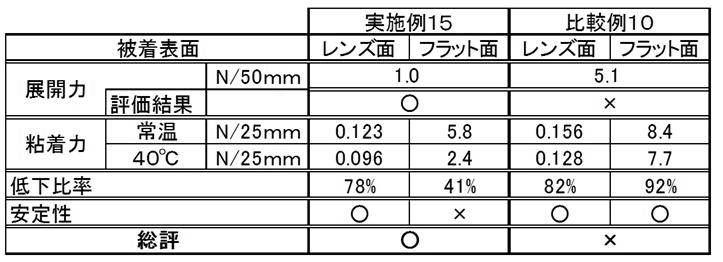
- the surface protective film not using saturated fatty acid bisamide is excellent in adhesive temperature stability but inferior in developing ability.
- the surface protective film of the present invention using ethylene bis-stearic acid amide which is a saturated fatty acid bisamide, when applied to the lens surface of the prism sheet, has both the temperature stability of the adhesive force and the development force. Also excellent.
- the surface protective film of the present invention can be used for protecting the lens surface of the prism sheet.
Landscapes
- Physics & Mathematics (AREA)
- General Physics & Mathematics (AREA)
- Optics & Photonics (AREA)
- Chemical & Material Sciences (AREA)
- Organic Chemistry (AREA)
- Chemical Kinetics & Catalysis (AREA)
- Laminated Bodies (AREA)
- Adhesives Or Adhesive Processes (AREA)
- Adhesive Tapes (AREA)
- Optical Elements Other Than Lenses (AREA)
Abstract
Description
[1]
飽和脂肪酸ビスアミドおよびポリオレフィン系樹脂を含有する成形原料A、および
スチレン系エラストマーを含有する成形原料B
を共押出することによって製造される、
(A)飽和脂肪酸ビスアミドから主としてなる、厚さが1~100nmである離型層
(B)基材層としてのポリオレフィン系樹脂層、および
(C)粘着剤層としてのスチレン系エラストマー層
が積層されたプリズムシート用表面保護フィルム。
[2]
前記成形原料Aは、ポリオレフィン系樹脂100重量部に対して飽和脂肪酸ビスアミドを1~4重量部含有する請求項1に記載のプリズムシート用表面保護フィルム。
[3]
飽和脂肪酸ビスアミドがエチレンビスステアリン酸アミド、メチレンビスステアリン酸アミド、またはヘキサメチレンビスステアリン酸アミドである、[1]または[2]に記載のプリズムシート用表面保護フィルム。
[4]
飽和脂肪酸ビスアミドが、飽和脂肪酸芳香族ビスアミドである[1]または[2]に記載のプリズムシート用表面保護フィルム。
[5]
前記基材層、および前記粘着剤層の間に、中間層が形成されている[1]~[4]のいずれか1項に記載のプリズムシート用表面保護フィルム。
[6]
前記中間層が、飽和脂肪酸ビスアミドを含有する、ポリオレフィン系樹脂とスチレン系エラストマーとの混合物である[5]に記載のプリズムシート用表面保護フィルム。
[7]
(A)飽和脂肪酸ビスアミドから主としてなる厚さ1~100nmの離型層、
(B)基材層であるポリオレフィン系樹脂層、
(C)粘着剤層であるスチレン系エラストマー層がこの順で積層されたプリズムシート用表面保護フィルムの製造方法であって、
ポリオレフィン系樹脂100重量部に対して飽和脂肪酸ビスアミドを1~4重量部を含有する成形原料A、およびスチレン系エラストマーを含有する成形原料Bを共押出する、プリズムシート用表面保護フィルムの製造方法。
[8]
レンズ面に複数の三角柱状のプリズムを有するプリズムシート、および
前記レンズ面に貼り付けられた、(A)飽和脂肪酸ビスアミドから主としてなる、厚さが1~100nmである離型層、(B)基材層としてのポリオレフィン系樹脂層、および
(C)粘着剤層としてのスチレン系エラストマー層が積層されたプリズムシート用表面保護フィルム
を含み、
前記プリズムの前記粘着剤層への食い込み深さが0.3μm以上であることを特徴とする
表面保護フィルムが貼り付けられたプリズムシート。
(A)飽和脂肪酸ビスアミドから主としてなる、厚さが1~100nmである離型層
(B)基材層となるポリオレフィン系樹脂層、および
(C)粘着剤層となるスチレン系エラストマー層
がこの順で積層されている。
本発明のプリズムシート用表面保護フィルムの厚さは特に制限されないが、その下限は、通常12μm、好ましくは20μmであり、その上限は、通常100μm、好ましくは60μm、より好ましくは50μm、更に好ましくは、45μmである。
離型層は、飽和脂肪酸ビスアミドから主としてなる。ここで、「から主としてなる」とは、離型層がオレフィン系樹脂層からブリードアウトした飽和脂肪酸ビスアミドにより形成されていることを指す。なお、より具体的には、飽和脂肪酸ビスアミドの含有量が、離型層全体の90重量%以上であることを意味する。
m-キシリレンビスステアリン酸アミド、およびN-N’-ジステアリルイソフタル酸アミド等の飽和脂肪酸芳香族ビスアミドが好ましい。飽和脂肪酸脂肪族ビスアミドのなかでは、エチレンビスステアリン酸アミドがより好ましい。また、飽和脂肪酸芳香族ビスアミドのなかでは、m-キシリレンビスステアリン酸アミドがより好ましい。
これらの飽和脂肪酸ビスアミドは単独で用いてよく、2種以上を組み合わせて用いてもよい。
また、他の離型剤を併用してもよい。
厚さの下限は、好ましくは5nm、より好ましく7nm、更に好ましくは9nmである。一方、厚さの上限は、好ましくは80nm、より好ましく60nm、更に好ましくは40nmである。
基材層は、ポリオレフィン系樹脂からなる。
粘着剤層は、スチレン系エラストマーを含有する。
「重合体(i)」は、下記重合体ブロックAおよび下記重合体ブロックBを含み、一般式[A-B]n(式中、Aは重合体ブロックAを、Bは重合体ブロックBを、nは1~3の整数を表す。)で表される構造を有する共重合体(I)またはその水素添加物である。「n」が1~3の整数を表すことから、明らかなように、「式[A-B]nで表される構造」としては、例えば、A-B、A-B-A-B、およびA-B-A-B-A-Bで表されるの構造が挙げられる。これらのブロック共重合体においては、AおよびBは、それぞれ繰り返しにおいて同一であってもよく、異なっていてもよい。
「重合体(ii)」は、下記重合体ブロックAおよび下記重合体ブロックBを含み、一般式A-B-A(式中の記号は前記と同意義を表す。)もしくは一般式(A-B)x-Y(式中、xは2以上の整数を表し、Yはカップリング剤残基を、その他の記号は前記と同意義を表す。)
で表される構造を有する共重合体(II)またはその水素添加物である。
スチレン系エラストマーとしては、前記重合体(i)と前記重合体(ii)の混合物であって、かつ前記重合体(i)と前記重合体(ii)に含まれる重合体ブロックAの総量と重合体ブロックBの総量との重量比が5:95~25:75の範囲内である混合物が好ましい。
「重合体ブロックA」は、芳香族アルケニル化合物単位が連続し、芳香族アルケニル化合物単位を主体とする重合体ブロックである。
「重合体ブロックB」は、共役ジエン化合物単位と芳香族アルケニル化合物単位がランダムに含まれる芳香族アルケニル-共役ジエン共重合体ブロックである。
(D)中間層
本発明のプリズムシート用表面保護フィルムは、前記基材層、および前記粘着剤層の間に、中間層を更に含んでもよい。
本発明のプリズムシート用表面保護フィルムは、飽和脂肪酸ビスアミドを含有するポリオレフィン系樹脂からなる成型原料A、およびスチレン系エラストマーを含有する成型原料Bを共押出することによって製造される。
なお、飽和脂肪酸ビスアミドは、通常、ジアミンと飽和脂肪酸との脱水縮合反応によって合成される。このため、飽和脂肪酸ビスアミドは、不純物としてジアミン、および飽和脂肪酸を含有する場合がある。本発明者らの検討によれば、ブリードアウトにより離型層を形成させるという本発明のプリズムシート用表面保護フィルムの製造方法の特徴に関連し、上述のジアミン、および飽和脂肪酸は、本発明のプリズムシート用表面保護フィルムの製造時に、製造装置を汚染することが判明した。従って、本発明に用いられる飽和脂肪酸ビスアミドは、ジアミン、および飽和脂肪酸の含有率が低いことが好ましい。
上述のように、本発明のプリズムシート用表面保護フィルムは、通常、巻き取られて、巻物として保管される。この際、離型層は、巻きつけた粘着剤層の粘着面に接触する。この巻物を展開してプリズムシートと貼り付けるとき、離型層の一部は粘着面の表面に転写される。通常、離型層の転写により、表面保護フィルムの粘着力は大幅に低下するが、本発明の表面保護フィルムにおいては、プリズムシートのプリズムの稜線が転写した離型層を突き破る。これにより、離型層が転写されていたとしても粘着剤層の粘着力が発揮される。
本発明の表面保護フィルムは、その粘着剤層へのプリズムシートのプリズム食い込み深さが0.3μm以上であることが好ましい。これによって、適当な粘着力が発揮される。食い込み深さの上限は特に限定されないが、通常2μm以下である。
本発明の表面保護フィルムの巻物は、容易に巻き戻すことができる。50mm幅の巻物での20m/分の速度での展開力は、好ましくは3.5N以下、さらに好ましくは2N以下である。このような展開力とすることにより、例えば、巻物の幅が1000mmを超える場合においても、展開時に生じる音を低減し、プリズムシートへの貼り付け後の浮きの発生を防ぐことができる。
本発明の表面保護フィルムは、好ましくは、下記の条件で測定される23℃での貼付経時粘着力が、0.05~0.50N/25mmである。
[条件]
表面保護フィルムを作成してから3日間以内に、プリズムシートのレンズ面を覆うように25mm幅の表面保護フィルムを貼り付ける。厚さが130μmのアクリル樹脂からなり、プリズムのピッチ50μm、高さ25μmであるプリズムシートを使用する。室温23℃及び相対湿度50%の環境下、2kgの圧着ゴムローラーを用いて、300mm/分の速度で表面保護フィルムを貼り付ける。室温23℃及び相対湿度50%の環境下で2週間放置した後、JIS Z0237に準拠し、表面保護フィルムを300mm/分の速度で引き剥がして180度剥離強度を測定する。表面保護フィルムを剥離する方向はプリズムの稜線方向とする。このようにして測定された180度剥離強度を23℃での貼付経時接着力とする。
本発明のプリズムシート用表面保護フィルムは、プリズムシートのレンズ面に貼り付けられる。
レンズ面に複数の三角柱状のプリズムを有するプリズムシート、および
前記レンズ面に貼り付けられた、(A)飽和脂肪酸ビスアミドから主としてなる、厚さが1~100nmである離型層、(B)基材層としてのポリオレフィン系樹脂層、および
(C)粘着剤層としてのスチレン系エラストマー層が積層されたプリズムシート用表面保護フィルム
を含み、
前記プリズムの前記粘着剤層への食い込み深さが0.3μm以上であることを特徴とする
表面保護フィルム付きプリズムシート
もまた、本発明の一態様である。
レンズ面に複数の三角柱状のプリズムを有するプリズムシート、および
前記プリズムシートのレンズ面に貼り付けられた前記[1]~前記[6]のいずれか1項に記載のプリズムシートを含み、
前記プリズムの前記粘着剤層への食い込み深さが0.3μm以上であることを特徴とする表面保護フィルムが貼り付けられたプリズムシート
が好ましい。
成形原料Aとして、ポリプロピレン「Y900GV(プライムポリマー社製)」100重量部と飽和脂肪酸ビスアミドであるエチレンビスステアリン酸アミド「アルフローH50F(日油社製)」1重量部からなる混合物と、成形原料Bとして、スチレン系エラストマー「ダイナロン1320P(JSR社製)」100重量部、粘着付与剤「アルコンP100(荒川化学社製)」20重量部、および酸化防止剤「イルガノックス1010(チバスペシャルティケミカルズ社製)」1重量部からなる混合物を、下記の条件で、Tダイ法により共押出し、表面保護フィルムを作成した。表面保護フィルムは基材層の厚さが34μm、粘着剤層の厚さが6μmであった。
表面保護フィルムの離型層の厚さは6nmであった。
<条件>
押し出し温度:200℃
キャストロール温度:25℃
<離型層の厚さの測定方法>
離型層の厚さは、下記の方法で求めた。プリズムシート用表面保護フィルムを四酸化ルテニウムで染色し、離型層と基材層とは染色され易さの違いを利用して染め分けた。表面保護フィルムを封入した樹脂試料を、切片厚さを70nmに設定したウルトラミクロトーム(ライカ社製、REICHERT ULTRACUT S)を用いて繰り返し薄く削り複数の薄膜片を作成した。複数の薄膜片の中から透過型電子顕微鏡(JEOL社製、JEM-2100)を用いて離型層と基材層との断面を観察できる観察用薄膜片を選んだ。透過型電子顕微鏡(JEOL社製、JEM-2100)を用いて観察用薄膜片を観察し、離型層の厚さを3カ所測定した。測定値の平均値を離型層の厚さとした。
エチレンビスステアリン酸アミドの量を1.5重量部にしたこと以外は実施例1と同様の方法で表面保護フィルムを作成した。表面保護フィルムは基材層の厚さが34μm、粘着層の厚さが6μm、離型層の厚さは9nmであった。
エチレンビスステアリン酸アミドの量を3重量部にしたこと以外は実施例1と同様の方法で、表面保護フィルムを作成した。表面保護フィルムは基材層の厚さが34μm、粘着層の厚さが6μmであった。また、表面保護フィルムの離型層の厚さは80nmであった。
本発明の表面保護フィルムの両端をトリミングした時に生じた端材を二軸押出機を用いてペレットに成型した。
成形原料Aとして、ポリプロピレン「Y900GV(プライムポリマー社製)」100重量部と飽和脂肪酸ビスアミドであるエチレンビスステアリン酸アミド「アルフローH50F(日油社製)」1重量部からなる混合物と、中間層を形成する原料として、ポリプロピレン「Y900GV(プライムポリマー社製)」70重量部と上記ペレット30重量部とからなる混合物と、成形原料Bとして、スチレン系エラストマー「ダイナロン1320P(JSR社製)」100重量部、粘着付与剤「アルコンP100(荒川化学社製)」20重量部、および酸化防止剤「イルガノックス1010(チバスペシャルティケミカルズ社製)」1重量部からなる混合物とを、実施例1と同様の条件で、Tダイ法により共押出し、表面保護フィルムを作成した。
表面保護フィルムは基材層の厚さが28μm、中間層の厚さが6μm、粘着層の厚さが6μmであった。また、表面保護フィルムの離型層の厚さは65nmであった。
飽和脂肪酸ビスアミドとしてメチレンビスステアリン酸アミド「ビスアマイドLA(日本化成社製)」3重量部を用いたこと以外は実施例1と同様の方法で、表面保護フィルムを作成した。表面保護フィルムは基材層の厚さが34μm、粘着層の厚さが6μmであった。また、表面保護フィルムの離型層の厚さは40nmであった。
飽和脂肪酸ビスアミドとしてヘキサメチレンビスステアリン酸アミド「スリパックスZHS(日本化成社製)」2.5重量部を用いたこと以外は実施例1と同様の方法で、表面保護フィルムを作成した。表面保護フィルムは基材層の厚さが34μm、粘着層の厚さが6μmであった。また、表面保護フィルムの離型層の厚さは15nmであった。
飽和脂肪酸ビスアミドとしてm-キシリレンビスステアリン酸アミド「スリパックスPXS(日本化成社製)」2.5重量部を用いたこと以外は実施例1と同様の方法で、表面保護フィルムを作成した。表面保護フィルムは基材層の厚さが34μm、粘着層の厚さが6μmであった。また、表面保護フィルムの離型層の厚さは30nmであった。
(比較例1)
飽和脂肪酸ビスアミドを使用しなかったこと以外は実施例1と同様の方法で表面保護フィルムを得た。
エチレンビスステアリン酸アミドの量を0.5重量部に変更したこと以外は実施例1と同様の方法で、表面保護フィルム作成した。離型層の厚さを測定しようとしたが、離型剤層を観察できなかった。
エチレンビスステアリン酸アミドの量を5重量部に変更したこと以外は実施例1と同様の方法で、表面保護フィルムを作成した。表面保護フィルムの離型層の厚さは200nmであった。
飽和脂肪酸アミドとしてステアリン酸アミド「アルフローS-10(日油社製)」3重量部を使用したこと以外は実施例1と同様の方法で、表面保護フィルムを作成した。表面保護フィルム作成した。離型層の厚さを測定しようとしたが、離型剤層を観察できなかった。
飽和脂肪酸ビスアミドであるエチレンビスステアリン酸アミドにかえて、不飽和脂肪酸アミドであるオレイン酸アミド「アルフローE-10(日油社製)」を3重量部使用したこと以外は実施例1と同様の方法で、表面保護フィルムを作成した。離型層の厚さを測定しようとしたが、離型剤層を観察できなかった。
飽和脂肪酸ビスアミドであるエチレンビスステアリン酸アミドにかえて、不飽和脂肪酸アミドであるエルカ酸アミド「アルフローP-10(日油社製)」を3重量部使用したこと以外は実施例1と同様の方法で、表面保護フィルムを作成した。表面保護フィルム作成した。離型層の厚さを測定しようとしたが、離型剤層を観察できなかった。
飽和脂肪酸ビスアミドであるエチレンビスステアリン酸アミドにかえて、不飽和脂肪酸ビスアミドであるエチレンビスオレイン酸アミド「アルフローAD-281(日油社製)」を3重量部使用したこと以外は実施例1と同様の方法で、表面保護フィルムを作成した。表面保護フィルムの離型層の厚さは20nmであった。
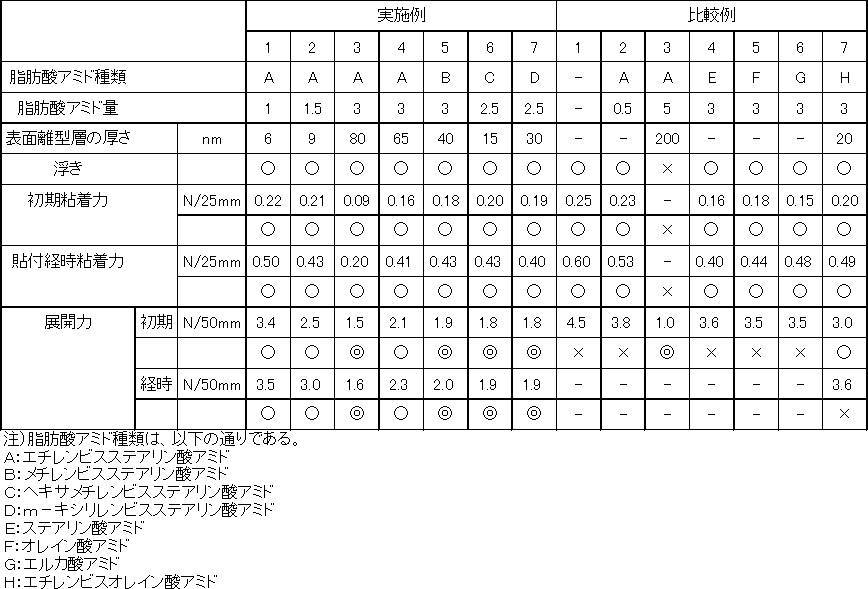
得られた実施例1~7及び比較例1~7の表面保護フィルムについて、以下の項目を評価した。
それらの結果を表1に示す。
表面保護フィルムをそれぞれ内径3インチの紙芯に巻きつけて50mm幅の巻物を作成した。JIS Z0237に準拠し、20m/分の巻戻し速度で巻物から表面保護フィルムを巻き戻し、高速巻戻し力を測定した。得られた測定値が展開力である。
展開力が2N/50mm以下の場合を優(◎)、2N/50mmを超え、3.5N/50mm以下である場合を良(○)、展開力が3.5N/50mmを超える場合を不良(×)と評価した。
(展開力の経時安定性の評価)
また展開力が優または良の評価であった巻物を40℃の恒温槽で1週間養生させた後、展開力を測定し、同様の基準で展開力を評価した。なお、初期粘着力が不良であった比較例3は評価しなかった。
厚さが130μmのアクリル樹脂からなり、プリズムのピッチが50μm、高さが25μmであるプリズムシートに対して、プリズムシートのレンズ面を覆うように25mm幅の表面保護フィルムを貼り付けて試験片を作成した。なお、室温23℃、相対湿度50%で、2kgの圧着ゴムローラーを用いて、300mm/分の速度で表面保護フィルムをプリズムシートに貼り付けた。その状態で試験片を30分間放置した後、浮きの有無を評価した。浮きが発生しなかったものを良(○)、浮きが発生したものを不良(×)と評価した。
また、プリズムシートのプリズムの稜線の頂点が粘着剤への食い込んだ深さを走査型電子顕微鏡(SEM)にて観察した結果、粘着剤への食い込み深さは0.6μmであった。
プリズムシートのレンズ面を覆うように25mm幅の表面保護フィルムを貼り付けた。厚さが130μmのアクリル樹脂からなり、プリズムのピッチ50μm、高さ25μmであるプリズムシートを使用した。室温23℃及び相対湿度50%の環境下、2kgの圧着ゴムローラーを用いて、300mm/分の速度で表面保護フィルムを貼り付けた。室温23℃及び相対湿度50%の環境下で2週間放置した後、JIS Z0237に準拠し、表面保護フィルムを300mm/分の速度で引き剥がして180度剥離強度を測定した。表面保護フィルムを剥離する方向はプリズムの稜線方向とした。このようにして測定された180度剥離強度を23℃での貼付経時接着力とした。
成形原料Aとして、ポリプロピレン「Y900GV(プライムポリマー社製)」100重量部と飽和脂肪酸ビスアミドであるエチレンビスステアリン酸アミド「アルフローH50F(日油社製)」3重量部からなる混合物と、成形原料Bとして、スチレン系エラストマー「ダイナロン1320P(JSR社製)」100重量部、粘着付与剤としての粘着付与剤「アルコンP100(荒川化学社製)」15重量部、および酸化防止剤としての「イルガノックス1010(チバスペシャルティケミカルズ社製)」1重量部からなる混合物を、下記の条件で、Tダイ法により共押出し、表面保護フィルムを作成した。表面保護フィルムは、厚さが40μm、基材層の厚さが34μm、粘着剤層の厚さが6μmであった。
また、表面保護フィルムの離型層の厚さは49nmであった。
<条件>
押し出し温度:200℃
キャストロール温度:25℃
粘着付与剤「アルコンP100(荒川化学社製)」の量を20重量部にしたこと以外は実施例8と同様の方法で表面保護フィルムを得た。
また、表面保護フィルムの離型層の厚さは50nmであった。
粘着付与剤「アルコンP100(荒川化学社製)」の量を25重量部にしたこと以外は実施例8と同様の方法で表面保護フィルムを得た。
また、表面保護フィルムの離型層の厚さは48nmであった。
粘着付与剤「アルコンP100(荒川化学社製)」の量を30重量部にしたこと以外は実施例8と同様の方法で表面保護フィルムを得た。
また、表面保護フィルムの離型層の厚さは53nmであった。
粘着付与剤「アルコンP100(荒川化学社製)」の量を35重量部にしたこと以外は実施例8と同様の方法で表面保護フィルムを得た。
また、表面保護フィルムの離型層の厚さは55nmであった。
粘着付与剤「アルコンP100(荒川化学社製)」の量を40重量部にしたこと以外は実施例8と同様の方法で表面保護フィルムを得た。
また、表面保護フィルムの離型層の厚さは48nmであった。
粘着付与剤「アルコンP100(荒川化学社製)」の量を45重量部にしたこと以外は実施例8と同様の方法で表面保護フィルムを得た。
また、表面保護フィルムの離型層の厚さは52nmであった。
飽和脂肪酸ビスアミドを使用しなかったこと以外は実施例8と同様の方法で表面保護フィルムを得た。
(比較例9)
飽和脂肪酸ビスアミドを使用しなかったこと及び粘着付与剤「アルコンP100(荒川化学社製)」を30重量部にしたこと以外は実施例8と同様の方法で表面保護フィルムを得た。
得られた実施例8~14及び比較例8~9の表面保護フィルムについて、以下の項目を評価した。
それらの結果を表2に示す。
表面保護フィルムをそれぞれ内径3インチの紙芯に巻きつけて50mm幅の巻物を作成した。JIS Z0237に準拠し、20m/分の巻戻し速度で巻物から表面保護フィルムを巻き戻し、高速巻戻し力を測定した。得られた測定値が展開力である。
展開力が2N/50mm以下の場合を優(◎)、2N/50mmを超え、3.5N/50mm以下である場合を良(○)、展開力が3.5N/50mmを超える場合を不良(×)と評価した。
表面保護フィルムを作成してから3日間以内に、プリズムシートのレンズ面を覆うように貼り付けた。プリズムシートとしては、厚さが130μmのアクリル樹脂からなり、プリズムのピッチ50μm、高さ25μmであるものを用意した。貼り付け条件は、室温23℃及び相対湿度50%の環境下、2kgの圧着ゴムローラーを用いて、300mm/分の速度で貼り付け、その状態で30分間放置した後、JIS Z0237に準拠し、25mm幅における180度剥離強度を300mm/分の速度で測定した。この際の剥離方向はプリズムの稜線方向とした。このようにして測定された剥離強度を初期接着力とした。
表面保護フィルムの貼り付け後、23℃環境下で1週間放置した以外は初期粘着力と同様の方法で測定した粘着力を23℃貼付経時粘着力とした。
[結果]

成形原料Aとして、ポリプロピレン「Y900GV(プライムポリマー社製)」100重量部と飽和脂肪酸ビスアミドであるエチレンビスステアリン酸アミド「アルフローH50F(日油社製)」3重量部からなる混合物と、成形原料Bとして、スチレン系エラストマー「ダイナロン1320P(JSR社製)」100重量部、粘着付与剤としての粘着付与剤「アルコンP100(荒川化学社製)」20重量部、および酸化防止剤としての「イルガノックス1010(チバスペシャルティケミカルズ社製)」1重量部からなる混合物厚を、下記の条件で、Tダイ法により共押出し、表面保護フィルムを作成した。表面保護フィルムは、厚さが40μm、基材層の厚さが34μm、粘着剤層の厚さが6μmであった。
また、表面保護フィルムの離型層の厚さは50nmであった。
押し出し温度:200℃
キャストロール温度:25℃
飽和脂肪酸ビスアミドを使用しなかったこと以外は実施例15と同様の方法で表面保護フィルムの巻物を得た。
上記のようにして得られた各表面保護フィルムについて、以下の項目を評価した。それらの結果を表3に示す。
実施例及び比較例の各表面保護フィルムの50mm幅の巻物をJIS Z0237に準拠し、20m/分の巻戻し速度で高速巻戻し力を測定し、展開力とした。
表面保護フィルムの巻物を作成後23℃の恒温層で1週間養生させた物を、プリズムシートのレンズ面及びアクリル板に貼り付けた。貼り付け条件は、室温23℃及び相対湿度50%の環境下、2kgの圧着ゴムローラーを用いて、300mm/分の速度で貼り付けた後、23℃環境下で1日間放置した物をJIS Z0237に準拠し、25mm幅における180度剥離強度を300mm/分の速度で測定した。このようにして測定された粘着力をそれぞれ、レンズ面粘着力(常温)、フラット面粘着力(常温)とした。
表面保護フィルムの巻物の養生条件が40℃にしたこと以外は粘着力(常温)と同様の方法で測定した粘着力をそれぞれ、レンズ面粘着力(40℃)、フラット面粘着力(40℃)とした。
レンズ面、フラット面それぞれの粘着力(40℃)を粘着力(常温)で割った値を粘着力の低下比率とした。低下比率が70%以上の場合を安定性良(○)、70%未満の場合を安定性不良(×)と評価した。
Claims (8)
- 飽和脂肪酸ビスアミドおよびポリオレフィン系樹脂を含有する成形原料A、および
スチレン系エラストマーを含有する成形原料B
を共押出することによって製造される、
(A)飽和脂肪酸ビスアミドから主としてなる、厚さが1~100nmである離型層、
(B)基材層としてのポリオレフィン系樹脂層、および
(C)粘着剤層としてのスチレン系エラストマー層
が積層されたプリズムシート用表面保護フィルム。 - 前記成形原料Aが、ポリオレフィン系樹脂100重量部に対して飽和脂肪酸ビスアミドを1~4重量部含有する請求項1に記載のプリズムシート用表面保護フィルム。
- 飽和脂肪酸ビスアミドが、エチレンビスステアリン酸アミド、メチレンビスステアリン酸アミド、またはヘキサメチレンビスステアリン酸アミドである、請求項1または2に記載のプリズムシート用表面保護フィルム。
- 飽和脂肪酸ビスアミドが、飽和脂肪酸芳香族ビスアミドである請求項1または2に記載のプリズムシート用表面保護フィルム。
- 前記基材層、および前記粘着剤層の間に、中間層を有する請求項1~4のいずれか1項に記載のプリズムシート用表面保護フィルム。
- 前記中間層が、飽和脂肪酸ビスアミドを含有する、ポリオレフィン系樹脂とスチレン系エラストマーとの混合物である請求項5に記載のプリズムシート用表面保護フィルム。
- (A)飽和脂肪酸ビスアミドから主としてなる厚さ1~100nmの離型層、
(B)基材層となるポリオレフィン系樹脂層、
(C)粘着剤層となるスチレン系エラストマー層がこの順で積層されたプリズムシート用表面保護フィルムの製造方法であって、
ポリオレフィン系樹脂100重量部に対して飽和脂肪酸ビスアミドを1~4重量部含有する成形原料A、およびスチレン系エラストマーを含有する成形原料Bを共押出する、プリズムシート用表面保護フィルムの製造方法。 - レンズ面に複数の三角柱状のプリズムを有するプリズムシート、および
前記レンズ面に貼り付けられた、(A)飽和脂肪酸ビスアミドから主としてなる、厚さが1~100nmである離型層、(B)基材層としてのポリオレフィン系樹脂層、および
(C)粘着剤層としてのスチレン系エラストマー層が積層されたプリズムシート用表面保護フィルム
を含み、
前記プリズムの前記粘着剤層への食い込み深さが0.3μm以上である
表面保護フィルムが貼り付けられたプリズムシート。
Priority Applications (3)
| Application Number | Priority Date | Filing Date | Title |
|---|---|---|---|
| CN201080005414.3A CN102292655B (zh) | 2009-01-26 | 2010-01-26 | 棱镜片用表面保护膜、其制造方法以及贴合有该棱镜片用表面保护膜的棱镜片 |
| KR1020117015248A KR101276968B1 (ko) | 2009-01-26 | 2010-01-26 | 프리즘 시트용 표면 보호 필름, 및 그 제조 방법, 및 그것이 첩부된 프리즘 시트 |
| JP2010521256A JP4565058B2 (ja) | 2009-01-26 | 2010-01-26 | プリズムシート用表面保護フィルム、およびその製造方法、およびそれが貼り付けられたプリズムシート |
Applications Claiming Priority (2)
| Application Number | Priority Date | Filing Date | Title |
|---|---|---|---|
| JP2009014188 | 2009-01-26 | ||
| JP2009-014188 | 2009-01-26 |
Publications (1)
| Publication Number | Publication Date |
|---|---|
| WO2010084783A1 true WO2010084783A1 (ja) | 2010-07-29 |
Family
ID=42355838
Family Applications (1)
| Application Number | Title | Priority Date | Filing Date |
|---|---|---|---|
| PCT/JP2010/000419 Ceased WO2010084783A1 (ja) | 2009-01-26 | 2010-01-26 | プリズムシート用表面保護フィルム、およびその製造方法、およびそれが貼り付けられたプリズムシート |
Country Status (5)
| Country | Link |
|---|---|
| JP (2) | JP4565058B2 (ja) |
| KR (1) | KR101276968B1 (ja) |
| CN (1) | CN102292655B (ja) |
| TW (1) | TWI445794B (ja) |
| WO (1) | WO2010084783A1 (ja) |
Cited By (5)
| Publication number | Priority date | Publication date | Assignee | Title |
|---|---|---|---|---|
| JP2013121989A (ja) * | 2011-06-15 | 2013-06-20 | Sekisui Chem Co Ltd | 粘着剤組成物、および表面保護フィルム |
| JP2013173875A (ja) * | 2012-02-27 | 2013-09-05 | Nitto Denko Corp | 粘着テープ |
| JP2013227372A (ja) * | 2012-04-24 | 2013-11-07 | Nitto Denko Corp | 粘着テープ |
| JP2016169264A (ja) * | 2015-03-11 | 2016-09-23 | 積水化学工業株式会社 | 表面保護フィルム、及び、表面保護フィルム付きプリズムシート |
| WO2023090358A1 (ja) * | 2021-11-17 | 2023-05-25 | 積水化学工業株式会社 | 表面保護フィルム付き光学シート、及び、表面保護フィルム |
Families Citing this family (12)
| Publication number | Priority date | Publication date | Assignee | Title |
|---|---|---|---|---|
| KR101276968B1 (ko) * | 2009-01-26 | 2013-06-19 | 세키스이가가쿠 고교가부시키가이샤 | 프리즘 시트용 표면 보호 필름, 및 그 제조 방법, 및 그것이 첩부된 프리즘 시트 |
| JP2013072062A (ja) * | 2011-09-29 | 2013-04-22 | Sekisui Chem Co Ltd | フラット面用表面保護フィルムの巻回体、およびその製造方法 |
| CN103254804A (zh) * | 2012-02-15 | 2013-08-21 | 日东电工株式会社 | 表面保护片 |
| WO2013153990A1 (ja) | 2012-04-10 | 2013-10-17 | 東洋紡株式会社 | 自己粘着性表面保護フィルム |
| KR102110863B1 (ko) | 2012-10-05 | 2020-05-14 | 도요보 가부시키가이샤 | 자기 점착성 표면 보호 필름 |
| CN103197435B (zh) * | 2013-04-11 | 2015-04-22 | 杭州亿超电子商务有限公司 | 眼镜片的加工方法 |
| JP6515917B2 (ja) | 2014-06-18 | 2019-05-22 | 東洋紡株式会社 | 自己粘着性表面保護フィルム |
| JP2016084481A (ja) * | 2016-02-04 | 2016-05-19 | 積水化学工業株式会社 | フラット面用表面保護フィルムの巻回体、およびその製造方法 |
| JP6863770B2 (ja) * | 2016-02-24 | 2021-04-21 | 積水化学工業株式会社 | ハーフカット加工用粘着フィルム及び被着体の加工方法 |
| JP2017179385A (ja) * | 2017-07-04 | 2017-10-05 | 積水化学工業株式会社 | フラット面用表面保護フィルムの巻回体、およびその製造方法 |
| EP3593988A1 (en) * | 2018-07-12 | 2020-01-15 | Sika Technology Ag | A self-adhering sealing device with an adhesive sealant layer |
| JP7461152B2 (ja) * | 2020-01-31 | 2024-04-03 | 三井化学東セロ株式会社 | 積層フィルム、包装材、および包装体 |
Citations (5)
| Publication number | Priority date | Publication date | Assignee | Title |
|---|---|---|---|---|
| JPH07118615A (ja) * | 1993-10-20 | 1995-05-09 | Sekisui Chem Co Ltd | 表面保護シート |
| JPH07224255A (ja) * | 1993-12-17 | 1995-08-22 | Sekisui Chem Co Ltd | 表面保護フイルム |
| JP2000136367A (ja) * | 1998-11-02 | 2000-05-16 | Nitto Denko Corp | 表面保護フィルム用の粘着性組成物及び表面保護フィルム |
| JP2003049132A (ja) * | 2001-08-06 | 2003-02-21 | Nitto Denko Corp | 表面保護シート |
| JP2006219520A (ja) * | 2005-02-08 | 2006-08-24 | Nitto Denko Corp | 表面保護シート、およびその製造方法 |
Family Cites Families (6)
| Publication number | Priority date | Publication date | Assignee | Title |
|---|---|---|---|---|
| JPH08225775A (ja) * | 1994-10-20 | 1996-09-03 | Nippon Carbide Ind Co Inc | 表面保護フィルム |
| JP2002285116A (ja) * | 2001-03-26 | 2002-10-03 | Nitto Denko Corp | 表面保護シートおよびその製造方法 |
| CN101189317A (zh) * | 2005-06-06 | 2008-05-28 | 积水化学工业株式会社 | 表面保护膜 |
| JP4987361B2 (ja) * | 2006-06-19 | 2012-07-25 | 積水化学工業株式会社 | 表面保護フィルム |
| JPWO2008032691A1 (ja) * | 2006-09-13 | 2010-01-28 | 積水化学工業株式会社 | 表面保護フィルム |
| KR101276968B1 (ko) * | 2009-01-26 | 2013-06-19 | 세키스이가가쿠 고교가부시키가이샤 | 프리즘 시트용 표면 보호 필름, 및 그 제조 방법, 및 그것이 첩부된 프리즘 시트 |
-
2010
- 2010-01-26 KR KR1020117015248A patent/KR101276968B1/ko active Active
- 2010-01-26 CN CN201080005414.3A patent/CN102292655B/zh active Active
- 2010-01-26 JP JP2010521256A patent/JP4565058B2/ja active Active
- 2010-01-26 TW TW099102106A patent/TWI445794B/zh active
- 2010-01-26 WO PCT/JP2010/000419 patent/WO2010084783A1/ja not_active Ceased
- 2010-08-02 JP JP2010173372A patent/JP5596462B2/ja active Active
Patent Citations (5)
| Publication number | Priority date | Publication date | Assignee | Title |
|---|---|---|---|---|
| JPH07118615A (ja) * | 1993-10-20 | 1995-05-09 | Sekisui Chem Co Ltd | 表面保護シート |
| JPH07224255A (ja) * | 1993-12-17 | 1995-08-22 | Sekisui Chem Co Ltd | 表面保護フイルム |
| JP2000136367A (ja) * | 1998-11-02 | 2000-05-16 | Nitto Denko Corp | 表面保護フィルム用の粘着性組成物及び表面保護フィルム |
| JP2003049132A (ja) * | 2001-08-06 | 2003-02-21 | Nitto Denko Corp | 表面保護シート |
| JP2006219520A (ja) * | 2005-02-08 | 2006-08-24 | Nitto Denko Corp | 表面保護シート、およびその製造方法 |
Cited By (6)
| Publication number | Priority date | Publication date | Assignee | Title |
|---|---|---|---|---|
| JP2013121989A (ja) * | 2011-06-15 | 2013-06-20 | Sekisui Chem Co Ltd | 粘着剤組成物、および表面保護フィルム |
| JP2013173875A (ja) * | 2012-02-27 | 2013-09-05 | Nitto Denko Corp | 粘着テープ |
| WO2013129463A1 (ja) * | 2012-02-27 | 2013-09-06 | 日東電工株式会社 | 粘着テープ |
| JP2013227372A (ja) * | 2012-04-24 | 2013-11-07 | Nitto Denko Corp | 粘着テープ |
| JP2016169264A (ja) * | 2015-03-11 | 2016-09-23 | 積水化学工業株式会社 | 表面保護フィルム、及び、表面保護フィルム付きプリズムシート |
| WO2023090358A1 (ja) * | 2021-11-17 | 2023-05-25 | 積水化学工業株式会社 | 表面保護フィルム付き光学シート、及び、表面保護フィルム |
Also Published As
| Publication number | Publication date |
|---|---|
| JPWO2010084783A1 (ja) | 2012-07-19 |
| TW201033323A (en) | 2010-09-16 |
| KR101276968B1 (ko) | 2013-06-19 |
| TWI445794B (zh) | 2014-07-21 |
| CN102292655B (zh) | 2014-06-18 |
| JP4565058B2 (ja) | 2010-10-20 |
| CN102292655A (zh) | 2011-12-21 |
| JP5596462B2 (ja) | 2014-09-24 |
| JP2010241152A (ja) | 2010-10-28 |
| KR20110123724A (ko) | 2011-11-15 |
Similar Documents
| Publication | Publication Date | Title |
|---|---|---|
| JP4565058B2 (ja) | プリズムシート用表面保護フィルム、およびその製造方法、およびそれが貼り付けられたプリズムシート | |
| JP5127903B2 (ja) | 表面保護フィルム | |
| EP2116580A1 (en) | Surface protection sheet | |
| JP6027512B2 (ja) | 表面保護フィルム | |
| JP7428221B2 (ja) | 積層フィルム。 | |
| JP5530090B2 (ja) | 表面保護フィルム | |
| JP2011213753A (ja) | 粘着テープ | |
| JP2011241313A (ja) | 粘着テープ | |
| JP2011241355A (ja) | 粘着テープ | |
| JP2011213752A (ja) | 粘着テープ | |
| JP2011042777A (ja) | 粘着テープ | |
| JP7264053B2 (ja) | 粘着性樹脂組成物、及びそれを用いた保護フィルム | |
| WO2013021830A1 (ja) | 粘着テープ | |
| JP2013072062A (ja) | フラット面用表面保護フィルムの巻回体、およびその製造方法 | |
| KR20190113807A (ko) | 점착성 수지 조성물 및 그것으로 이루어지는 적층 필름 | |
| JP2011016859A (ja) | シート状粘着組成物、及びそれを有する粘着シート | |
| JPH11207882A (ja) | ブロッキング防止性に優れた表面保護フィルム及びその製造方法 | |
| JP2011016354A (ja) | 表面保護フィルム | |
| CN103254812A (zh) | 表面保护片 | |
| CN103254809A (zh) | 表面保护片 | |
| JP2017179385A (ja) | フラット面用表面保護フィルムの巻回体、およびその製造方法 | |
| CN107573862A (zh) | 一种粘合性树脂组合物及自粘型保护膜 | |
| JP2016084481A (ja) | フラット面用表面保護フィルムの巻回体、およびその製造方法 | |
| JP2011016860A (ja) | シート状粘着組成物、及びそれを有する粘着シート | |
| JP2010132889A (ja) | 表面保護シート |
Legal Events
| Date | Code | Title | Description |
|---|---|---|---|
| WWE | Wipo information: entry into national phase |
Ref document number: 201080005414.3 Country of ref document: CN |
|
| WWE | Wipo information: entry into national phase |
Ref document number: 2010521256 Country of ref document: JP |
|
| 121 | Ep: the epo has been informed by wipo that ep was designated in this application |
Ref document number: 10733390 Country of ref document: EP Kind code of ref document: A1 |
|
| ENP | Entry into the national phase |
Ref document number: 20117015248 Country of ref document: KR Kind code of ref document: A |
|
| NENP | Non-entry into the national phase |
Ref country code: DE |
|
| 122 | Ep: pct application non-entry in european phase |
Ref document number: 10733390 Country of ref document: EP Kind code of ref document: A1 |