WO2010079841A1 - 熱電変換材料および熱電変換素子 - Google Patents
熱電変換材料および熱電変換素子 Download PDFInfo
- Publication number
- WO2010079841A1 WO2010079841A1 PCT/JP2010/050299 JP2010050299W WO2010079841A1 WO 2010079841 A1 WO2010079841 A1 WO 2010079841A1 JP 2010050299 W JP2010050299 W JP 2010050299W WO 2010079841 A1 WO2010079841 A1 WO 2010079841A1
- Authority
- WO
- WIPO (PCT)
- Prior art keywords
- thermoelectric conversion
- conversion material
- rare earth
- aluminum
- yttrium
- Prior art date
- Legal status (The legal status is an assumption and is not a legal conclusion. Google has not performed a legal analysis and makes no representation as to the accuracy of the status listed.)
- Ceased
Links
Images



Classifications
-
- C—CHEMISTRY; METALLURGY
- C01—INORGANIC CHEMISTRY
- C01G—COMPOUNDS CONTAINING METALS NOT COVERED BY SUBCLASSES C01D OR C01F
- C01G9/00—Compounds of zinc
- C01G9/006—Compounds containing zinc, with or without oxygen or hydrogen, and containing two or more other elements
-
- C—CHEMISTRY; METALLURGY
- C04—CEMENTS; CONCRETE; ARTIFICIAL STONE; CERAMICS; REFRACTORIES
- C04B—LIME, MAGNESIA; SLAG; CEMENTS; COMPOSITIONS THEREOF, e.g. MORTARS, CONCRETE OR LIKE BUILDING MATERIALS; ARTIFICIAL STONE; CERAMICS; REFRACTORIES; TREATMENT OF NATURAL STONE
- C04B35/00—Shaped ceramic products characterised by their composition; Ceramics compositions; Processing powders of inorganic compounds preparatory to the manufacturing of ceramic products
- C04B35/01—Shaped ceramic products characterised by their composition; Ceramics compositions; Processing powders of inorganic compounds preparatory to the manufacturing of ceramic products based on oxide ceramics
- C04B35/453—Shaped ceramic products characterised by their composition; Ceramics compositions; Processing powders of inorganic compounds preparatory to the manufacturing of ceramic products based on oxide ceramics based on zinc, tin, or bismuth oxides or solid solutions thereof with other oxides, e.g. zincates, stannates or bismuthates
-
- H—ELECTRICITY
- H10—SEMICONDUCTOR DEVICES; ELECTRIC SOLID-STATE DEVICES NOT OTHERWISE PROVIDED FOR
- H10N—ELECTRIC SOLID-STATE DEVICES NOT OTHERWISE PROVIDED FOR
- H10N10/00—Thermoelectric devices comprising a junction of dissimilar materials, i.e. devices exhibiting Seebeck or Peltier effects
- H10N10/80—Constructional details
- H10N10/85—Thermoelectric active materials
- H10N10/851—Thermoelectric active materials comprising inorganic compositions
- H10N10/855—Thermoelectric active materials comprising inorganic compositions comprising compounds containing boron, carbon, oxygen or nitrogen
-
- C—CHEMISTRY; METALLURGY
- C01—INORGANIC CHEMISTRY
- C01P—INDEXING SCHEME RELATING TO STRUCTURAL AND PHYSICAL ASPECTS OF SOLID INORGANIC COMPOUNDS
- C01P2002/00—Crystal-structural characteristics
- C01P2002/50—Solid solutions
-
- C—CHEMISTRY; METALLURGY
- C01—INORGANIC CHEMISTRY
- C01P—INDEXING SCHEME RELATING TO STRUCTURAL AND PHYSICAL ASPECTS OF SOLID INORGANIC COMPOUNDS
- C01P2002/00—Crystal-structural characteristics
- C01P2002/50—Solid solutions
- C01P2002/52—Solid solutions containing elements as dopants
-
- C—CHEMISTRY; METALLURGY
- C01—INORGANIC CHEMISTRY
- C01P—INDEXING SCHEME RELATING TO STRUCTURAL AND PHYSICAL ASPECTS OF SOLID INORGANIC COMPOUNDS
- C01P2004/00—Particle morphology
- C01P2004/01—Particle morphology depicted by an image
- C01P2004/03—Particle morphology depicted by an image obtained by SEM
-
- C—CHEMISTRY; METALLURGY
- C01—INORGANIC CHEMISTRY
- C01P—INDEXING SCHEME RELATING TO STRUCTURAL AND PHYSICAL ASPECTS OF SOLID INORGANIC COMPOUNDS
- C01P2004/00—Particle morphology
- C01P2004/01—Particle morphology depicted by an image
- C01P2004/04—Particle morphology depicted by an image obtained by TEM, STEM, STM or AFM
-
- C—CHEMISTRY; METALLURGY
- C01—INORGANIC CHEMISTRY
- C01P—INDEXING SCHEME RELATING TO STRUCTURAL AND PHYSICAL ASPECTS OF SOLID INORGANIC COMPOUNDS
- C01P2006/00—Physical properties of inorganic compounds
- C01P2006/32—Thermal properties
-
- C—CHEMISTRY; METALLURGY
- C01—INORGANIC CHEMISTRY
- C01P—INDEXING SCHEME RELATING TO STRUCTURAL AND PHYSICAL ASPECTS OF SOLID INORGANIC COMPOUNDS
- C01P2006/00—Physical properties of inorganic compounds
- C01P2006/40—Electric properties
-
- C—CHEMISTRY; METALLURGY
- C01—INORGANIC CHEMISTRY
- C01P—INDEXING SCHEME RELATING TO STRUCTURAL AND PHYSICAL ASPECTS OF SOLID INORGANIC COMPOUNDS
- C01P2006/00—Physical properties of inorganic compounds
- C01P2006/80—Compositional purity
-
- C—CHEMISTRY; METALLURGY
- C04—CEMENTS; CONCRETE; ARTIFICIAL STONE; CERAMICS; REFRACTORIES
- C04B—LIME, MAGNESIA; SLAG; CEMENTS; COMPOSITIONS THEREOF, e.g. MORTARS, CONCRETE OR LIKE BUILDING MATERIALS; ARTIFICIAL STONE; CERAMICS; REFRACTORIES; TREATMENT OF NATURAL STONE
- C04B2235/00—Aspects relating to ceramic starting mixtures or sintered ceramic products
- C04B2235/02—Composition of constituents of the starting material or of secondary phases of the final product
- C04B2235/30—Constituents and secondary phases not being of a fibrous nature
- C04B2235/32—Metal oxides, mixed metal oxides, or oxide-forming salts thereof, e.g. carbonates, nitrates, (oxy)hydroxides, chlorides
- C04B2235/3217—Aluminum oxide or oxide forming salts thereof, e.g. bauxite, alpha-alumina
-
- C—CHEMISTRY; METALLURGY
- C04—CEMENTS; CONCRETE; ARTIFICIAL STONE; CERAMICS; REFRACTORIES
- C04B—LIME, MAGNESIA; SLAG; CEMENTS; COMPOSITIONS THEREOF, e.g. MORTARS, CONCRETE OR LIKE BUILDING MATERIALS; ARTIFICIAL STONE; CERAMICS; REFRACTORIES; TREATMENT OF NATURAL STONE
- C04B2235/00—Aspects relating to ceramic starting mixtures or sintered ceramic products
- C04B2235/02—Composition of constituents of the starting material or of secondary phases of the final product
- C04B2235/30—Constituents and secondary phases not being of a fibrous nature
- C04B2235/32—Metal oxides, mixed metal oxides, or oxide-forming salts thereof, e.g. carbonates, nitrates, (oxy)hydroxides, chlorides
- C04B2235/3217—Aluminum oxide or oxide forming salts thereof, e.g. bauxite, alpha-alumina
- C04B2235/3222—Aluminates other than alumino-silicates, e.g. spinel (MgAl2O4)
-
- C—CHEMISTRY; METALLURGY
- C04—CEMENTS; CONCRETE; ARTIFICIAL STONE; CERAMICS; REFRACTORIES
- C04B—LIME, MAGNESIA; SLAG; CEMENTS; COMPOSITIONS THEREOF, e.g. MORTARS, CONCRETE OR LIKE BUILDING MATERIALS; ARTIFICIAL STONE; CERAMICS; REFRACTORIES; TREATMENT OF NATURAL STONE
- C04B2235/00—Aspects relating to ceramic starting mixtures or sintered ceramic products
- C04B2235/02—Composition of constituents of the starting material or of secondary phases of the final product
- C04B2235/30—Constituents and secondary phases not being of a fibrous nature
- C04B2235/32—Metal oxides, mixed metal oxides, or oxide-forming salts thereof, e.g. carbonates, nitrates, (oxy)hydroxides, chlorides
- C04B2235/3224—Rare earth oxide or oxide forming salts thereof, e.g. scandium oxide
-
- C—CHEMISTRY; METALLURGY
- C04—CEMENTS; CONCRETE; ARTIFICIAL STONE; CERAMICS; REFRACTORIES
- C04B—LIME, MAGNESIA; SLAG; CEMENTS; COMPOSITIONS THEREOF, e.g. MORTARS, CONCRETE OR LIKE BUILDING MATERIALS; ARTIFICIAL STONE; CERAMICS; REFRACTORIES; TREATMENT OF NATURAL STONE
- C04B2235/00—Aspects relating to ceramic starting mixtures or sintered ceramic products
- C04B2235/02—Composition of constituents of the starting material or of secondary phases of the final product
- C04B2235/30—Constituents and secondary phases not being of a fibrous nature
- C04B2235/32—Metal oxides, mixed metal oxides, or oxide-forming salts thereof, e.g. carbonates, nitrates, (oxy)hydroxides, chlorides
- C04B2235/3224—Rare earth oxide or oxide forming salts thereof, e.g. scandium oxide
- C04B2235/3225—Yttrium oxide or oxide-forming salts thereof
-
- C—CHEMISTRY; METALLURGY
- C04—CEMENTS; CONCRETE; ARTIFICIAL STONE; CERAMICS; REFRACTORIES
- C04B—LIME, MAGNESIA; SLAG; CEMENTS; COMPOSITIONS THEREOF, e.g. MORTARS, CONCRETE OR LIKE BUILDING MATERIALS; ARTIFICIAL STONE; CERAMICS; REFRACTORIES; TREATMENT OF NATURAL STONE
- C04B2235/00—Aspects relating to ceramic starting mixtures or sintered ceramic products
- C04B2235/02—Composition of constituents of the starting material or of secondary phases of the final product
- C04B2235/30—Constituents and secondary phases not being of a fibrous nature
- C04B2235/32—Metal oxides, mixed metal oxides, or oxide-forming salts thereof, e.g. carbonates, nitrates, (oxy)hydroxides, chlorides
- C04B2235/3224—Rare earth oxide or oxide forming salts thereof, e.g. scandium oxide
- C04B2235/3227—Lanthanum oxide or oxide-forming salts thereof
-
- C—CHEMISTRY; METALLURGY
- C04—CEMENTS; CONCRETE; ARTIFICIAL STONE; CERAMICS; REFRACTORIES
- C04B—LIME, MAGNESIA; SLAG; CEMENTS; COMPOSITIONS THEREOF, e.g. MORTARS, CONCRETE OR LIKE BUILDING MATERIALS; ARTIFICIAL STONE; CERAMICS; REFRACTORIES; TREATMENT OF NATURAL STONE
- C04B2235/00—Aspects relating to ceramic starting mixtures or sintered ceramic products
- C04B2235/02—Composition of constituents of the starting material or of secondary phases of the final product
- C04B2235/30—Constituents and secondary phases not being of a fibrous nature
- C04B2235/32—Metal oxides, mixed metal oxides, or oxide-forming salts thereof, e.g. carbonates, nitrates, (oxy)hydroxides, chlorides
- C04B2235/3224—Rare earth oxide or oxide forming salts thereof, e.g. scandium oxide
- C04B2235/3229—Cerium oxides or oxide-forming salts thereof
-
- C—CHEMISTRY; METALLURGY
- C04—CEMENTS; CONCRETE; ARTIFICIAL STONE; CERAMICS; REFRACTORIES
- C04B—LIME, MAGNESIA; SLAG; CEMENTS; COMPOSITIONS THEREOF, e.g. MORTARS, CONCRETE OR LIKE BUILDING MATERIALS; ARTIFICIAL STONE; CERAMICS; REFRACTORIES; TREATMENT OF NATURAL STONE
- C04B2235/00—Aspects relating to ceramic starting mixtures or sintered ceramic products
- C04B2235/02—Composition of constituents of the starting material or of secondary phases of the final product
- C04B2235/30—Constituents and secondary phases not being of a fibrous nature
- C04B2235/32—Metal oxides, mixed metal oxides, or oxide-forming salts thereof, e.g. carbonates, nitrates, (oxy)hydroxides, chlorides
- C04B2235/3284—Zinc oxides, zincates, cadmium oxides, cadmiates, mercury oxides, mercurates or oxide forming salts thereof
-
- C—CHEMISTRY; METALLURGY
- C04—CEMENTS; CONCRETE; ARTIFICIAL STONE; CERAMICS; REFRACTORIES
- C04B—LIME, MAGNESIA; SLAG; CEMENTS; COMPOSITIONS THEREOF, e.g. MORTARS, CONCRETE OR LIKE BUILDING MATERIALS; ARTIFICIAL STONE; CERAMICS; REFRACTORIES; TREATMENT OF NATURAL STONE
- C04B2235/00—Aspects relating to ceramic starting mixtures or sintered ceramic products
- C04B2235/02—Composition of constituents of the starting material or of secondary phases of the final product
- C04B2235/30—Constituents and secondary phases not being of a fibrous nature
- C04B2235/44—Metal salt constituents or additives chosen for the nature of the anions, e.g. hydrides or acetylacetonate
- C04B2235/443—Nitrates or nitrites
-
- C—CHEMISTRY; METALLURGY
- C04—CEMENTS; CONCRETE; ARTIFICIAL STONE; CERAMICS; REFRACTORIES
- C04B—LIME, MAGNESIA; SLAG; CEMENTS; COMPOSITIONS THEREOF, e.g. MORTARS, CONCRETE OR LIKE BUILDING MATERIALS; ARTIFICIAL STONE; CERAMICS; REFRACTORIES; TREATMENT OF NATURAL STONE
- C04B2235/00—Aspects relating to ceramic starting mixtures or sintered ceramic products
- C04B2235/02—Composition of constituents of the starting material or of secondary phases of the final product
- C04B2235/30—Constituents and secondary phases not being of a fibrous nature
- C04B2235/44—Metal salt constituents or additives chosen for the nature of the anions, e.g. hydrides or acetylacetonate
- C04B2235/449—Organic acids, e.g. EDTA, citrate, acetate, oxalate
-
- C—CHEMISTRY; METALLURGY
- C04—CEMENTS; CONCRETE; ARTIFICIAL STONE; CERAMICS; REFRACTORIES
- C04B—LIME, MAGNESIA; SLAG; CEMENTS; COMPOSITIONS THEREOF, e.g. MORTARS, CONCRETE OR LIKE BUILDING MATERIALS; ARTIFICIAL STONE; CERAMICS; REFRACTORIES; TREATMENT OF NATURAL STONE
- C04B2235/00—Aspects relating to ceramic starting mixtures or sintered ceramic products
- C04B2235/70—Aspects relating to sintered or melt-casted ceramic products
- C04B2235/80—Phases present in the sintered or melt-cast ceramic products other than the main phase
-
- C—CHEMISTRY; METALLURGY
- C04—CEMENTS; CONCRETE; ARTIFICIAL STONE; CERAMICS; REFRACTORIES
- C04B—LIME, MAGNESIA; SLAG; CEMENTS; COMPOSITIONS THEREOF, e.g. MORTARS, CONCRETE OR LIKE BUILDING MATERIALS; ARTIFICIAL STONE; CERAMICS; REFRACTORIES; TREATMENT OF NATURAL STONE
- C04B2235/00—Aspects relating to ceramic starting mixtures or sintered ceramic products
- C04B2235/70—Aspects relating to sintered or melt-casted ceramic products
- C04B2235/96—Properties of ceramic products, e.g. mechanical properties such as strength, toughness, wear resistance
- C04B2235/9607—Thermal properties, e.g. thermal expansion coefficient
Definitions
- the present invention relates to a metal oxide-based thermoelectric conversion material used for a thermoelectric conversion element.
- thermoelectric conversion elements using metal oxides have been proposed as a technology to solve the high temperature durability and toxicity that have been a problem with conventional metal compound thermoelectric conversion elements, and research has rapidly progressed. Yes.
- the characteristics of the thermoelectric conversion element are Seebeck coefficient ⁇ ( ⁇ V ⁇ K ⁇ 1 ), conductivity ⁇ (S ⁇ cm ⁇ 1 ), and thermal conductivity ⁇ (W ⁇ m), which are thermoelectromotive forces per unit temperature difference.
- ⁇ 1 ⁇ K ⁇ 1 represented by several characteristic factors.
- thermoelectric output factor represented by ⁇ 2 ⁇
- a dimensionless figure of merit ZT multiplied by T is used as a performance index. In general, the larger these values, the better the thermoelectric characteristics.
- thermoelectric conversion element is usually manufactured by combining two kinds of metals or semiconductors.
- a p-type semiconductor in which carriers are holes and an n-type semiconductor in which electrons are carriers. are required to be combined.
- a high ZT of about 0.7 (NaCo 2 O 4 polycrystal), which is p-type and comparable to a metal compound, has been reported. Only ZT of a certain level is obtained, which is an obstacle to the spread of thermoelectric conversion devices using metal oxides. At present, there is a very strong demand for breakthroughs in thermoelectric properties of n-type oxide semiconductors.
- Patent Document 1 zinc oxide doped with aluminum (Al) (Al—ZnO) is known as an n-type oxide semiconductor that exhibits high thermoelectric properties (Patent Document 1).
- Al-ZnO due to the high Debye temperature and the high speed of acoustic phonons, the extremely high thermal conductivity is a factor that hinders further improvement of ZT.
- dissolving Mg and Ni together with Al in ZnO (Non-Patent Document 1).
- Patent Document 3 there are reports on a system doped with La (Patent Document 2) and a system doped with Ce (Patent Document 3) based on Al—ZnO.
- the particle size of zinc oxide is preferably 200 nm or less (for example, paragraphs 0006 and 0013 of Patent Document 2).
- Non-patent Document 2 a ZnO sintered body doped with yttrium (Y) has been studied. Similarly, a zinc oxide sintered body doped with praseodymium (Pr) has been studied (Non-patent Document 2).
- the present invention intends to provide an n-type oxide semiconductor (n-type thermoelectric conversion material) that exhibits higher thermoelectric conversion characteristics than conventional n-type oxide semiconductors mainly composed of zinc oxide. is there.
- the inventors of the present invention have a zinc oxide sintered body containing zinc oxide as a main component and containing yttrium (Y) and aluminum (Al), although the thermal conductivity is lower than that of Al-ZnO. It has been found that this is an excellent thermoelectric conversion material having very high electrical conductivity and Seebeck coefficient and high thermoelectric properties.
- the present inventors further comprise La, Ce, Pr, Nd, Pm, Sm, Eu, Gd, Tb, Dy, Ho, and Y in zinc oxide (Al—ZnO) doped with aluminum (Al).
- As a thermoelectric conversion material doped with a rare earth metal selected from the group the inventors have found a production method capable of obtaining a material with higher performance. The present invention is based on these findings.
- thermoelectric conversion material is provided, and the thermoelectric conversion material is a thermoelectric conversion material represented by a composition formula of the following formula (I): Zn (1-xy) Al x Y y O (I) (Wherein Zn is zinc, Al is aluminum, Y is yttrium, x> 0, y> 0, and x + y ⁇ 0.1) At least a part of aluminum and yttrium has a structure existing in and / or between crystal lattices of zinc oxide.
- thermoelectric conversion material in which a zinc oxide (ZnO) powder, a rare earth element powder, and an aluminum oxide (Al 2 O 3 ) powder are mixed by milling and molded.
- ZnO zinc oxide
- rare earth element powder rare earth element powder
- Al 2 O 3 aluminum oxide
- the rare earth element is yttrium (Y), and a rare earth element having an ionic radius larger than yttrium: lanthanum (La), cerium (Ce), praseodymium (Pr), neodymium (Nd), promethium (Pm), samarium (Sm) ), Eurobium (Eu), gadolinium (Gd), terbium (Tb), dysprosium (Dy), and holmium (Ho), and the zinc oxide powder has a primary particle size of
- the method is characterized by using one having a thickness of 0.5 ⁇ m or more and 5 ⁇ m or less.
- thermoelectric conversion material another method for producing a thermoelectric conversion material, and the method includes: Preparing an aqueous solution comprising zinc ions, rare earth element ions, and aluminum ions, generating an oxide precursor from the aqueous solution, and calcining the precursor to obtain an oxide;
- the rare earth element is yttrium (Y), and a rare earth element having an ionic radius larger than that of yttrium: lanthanum (La), cerium (Ce), praseodymium (Pr), neodymium (Nd), promethium (Pm), samarium (Sm) , Eurobium (Eu), gadolinium (Gd), terbium (Tb), dysprosium (Dy), and holmium (Ho).
- thermoelectric conversion material according to the present invention exhibits high electrical conductivity and Seebeck coefficient, and further has low thermal conductivity, and thus can exhibit high thermoelectric conversion characteristics. Therefore, application to a highly efficient thermoelectric conversion element becomes possible.
- thermoelectric conversion material by this invention It is a figure which shows the temperature dependence of the electrical conductivity of the thermoelectric conversion material by this invention. It is a figure which shows the temperature dependence of the Seebeck coefficient of the thermoelectric conversion material by this invention. It is a figure which shows the temperature dependence of the dimensionless figure of merit ZT of the thermoelectric conversion material by this invention. It is a figure which shows the temperature dependence of the electrical conductivity of the thermoelectric conversion material by this invention. It is a figure which shows the temperature dependence of the Seebeck coefficient of the thermoelectric conversion material by this invention. It is a figure which shows the temperature dependence of the dimensionless figure of merit ZT of the thermoelectric conversion material by this invention.
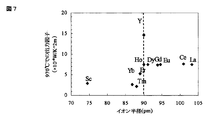
- thermoelectric conversion material by this invention It is a figure which shows an output factor with respect to the ion radius of the rare earth metal ion doped to a zinc oxide sintered compact. It is a photograph which shows the result of the transmission electron microscope-energy dispersive X ray spectroscopy elemental analysis of the thermoelectric conversion material by this invention. It is a photograph which shows the result of the transmission electron microscope-energy dispersive X ray spectroscopy elemental analysis of the thermoelectric conversion material by this invention. It is a photograph which shows the result of the scanning Auger microscope of the thermoelectric conversion material by this invention. It is a figure which shows the result of the time-of-flight type secondary ion mass spectrometry of the thermoelectric conversion material by this invention.
- thermoelectric conversion material is a thermoelectric conversion material mainly composed of a zinc oxide represented by the formula (I): Zn (1-xy) Al x Y y O, and includes aluminum and At least a part of yttrium has a structure existing in and / or between crystal lattices of zinc oxide.
- Zn is zinc
- Al is aluminum
- Y is yttrium.
- the ratio of the molar amount of Al to the total molar amount of Zn, Al, and Y (that is, x in the formula (I)) is greater than 0, and the ratio of the molar amount of Y to the total molar amount of Zn, Al, and Y.
- thermoelectric conversion material according to the present invention has a high electrical conductivity, a Seebeck coefficient, and a low thermal conductivity, so that it becomes a high-performance n-type oxide semiconductor thermoelectric conversion material having high thermoelectric properties.
- thermoelectric conversion material according to the present invention has such high thermoelectric properties is not clear, but is expected as follows. However, the following theory is only an expectation, and the present invention is not limited to this theory.
- zinc oxide doped with aluminum is further doped with yttrium (Y).
- Aluminum may be present at any crystal site, such as in the crystal lattice of zinc oxide, between crystal lattices, or at grain boundaries. However, aluminum is doped by substitutional solid solution of zinc oxide at the zinc site. It is considered that free electrons are generated, and this is a carrier responsible for high electron conduction, giving high conductivity.
- Yttrium may be present at any crystal site in the crystal lattice of zinc oxide, between crystal lattices, or at grain boundaries. However, since yttrium has a larger ionic radius than zinc, yttrium is composed of zinc oxide.
- thermoelectric conversion material it is considered that the substitutional solid solution at the zinc site is difficult, and it is considered that many yttrium ions are present at the positions between crystal lattices where the resistance is not increased due to carrier scattering or barrier layer formation. That is, in the thermoelectric conversion material according to the present invention, carriers exhibiting high conductivity are generated by doping aluminum, and doped yttrium scatters only phonons without scattering carriers generated by doping aluminum. It functions as a reaction center, and it is thought that high thermoelectric properties are expressed.
- thermoelectric characteristics can be obtained by doping yttrium
- doping other rare earth metals such as conventional La and Ce
- the rare earth metal has an ionic radius of about 74.5 pm to 104.5 pm when trivalent and hexacoordinate are assumed.
- the ion radius described here is the one reported by Shannon (RD Shanon, Acta. Crystallography A, 32, 751, 1976).
- the ionic radius of the rare earth metal to be doped is close to the ionic radius of Zn 2+ (60 pm for 4-coordinate, 75 pm for 6-coordinate), substitutional solid solution of zinc oxide is likely to occur in the crystal lattice and is generated by Al doping. There is a possibility that carriers are scattered by the rare earth metal and conductivity becomes low.
- the ion radius of the rare earth metal to be doped is too large, it becomes difficult to dissolve the rare earth metal in the crystal lattice or between the crystal lattices, and the rare earth metal tends to segregate at the grain boundaries. Since the segregated rare earth metal may become a high resistance barrier layer when carriers pass through the grain boundary, the conductivity may also be lowered.
- the rare earth metal further doped into the zinc oxide doped with aluminum has an ionic radius that is moderately larger than the ionic radius of zinc and is small enough to facilitate solid solution between crystal lattices.
- yttrium having an ionic radius of 90 pm many of the yttrium ions are present at positions in the crystal that do not cause high resistance due to the above carrier scattering and barrier layer formation, and have higher thermoelectric properties. We believe that thermoelectric conversion materials for physical semiconductors can be realized.
- the ratio of the total molar amount of Al and Y to the total molar amount of Zn, Al and Y is 0.07 or less, more preferably 0.06 or less.
- the ratio of the molar amount of Y to the total molar amount of Zn, Al and Y is the mole of Al relative to the total molar amount of Zn, Al and Y.
- the ratio of the molar amount of Y to the total molar amount of Zn, Al, and Y is set to 0.001 or more and 0.03 or less, whereby the electrical conductivity. Is extremely high, and high thermoelectric properties can be obtained.
- the ratio of the molar amount of Al to the total molar amount of Zn, Al and Y is too small, the number of electrons as carriers may be reduced and the improvement in thermoelectric properties may be reduced. If the ratio of the molar amount of Al is too large, a large amount of low-conductivity spinel phase (ZnAl 2 O 4 or the like) may be generated and segregated at the grain boundaries of the zinc oxide particles, possibly reducing the conductivity. is there.
- the ratio of the molar amount of Al to the total molar amount of Zn, Al, and Y is 0.001 or more and 0.05 or less, so Is extremely high, and high thermoelectric properties can be obtained.
- thermoelectric conversion material can take any form of a thin film, a thick film, and a bulk molded body in accordance with the module form.
- a sheet molding method In the case of a thick film, a sheet molding method, a screen printing method, an aerosol deposition method, a doctor blade method, or the like can be used.
- the shape of the bulk molded body is most preferably required for modularization of the thermoelectric conversion material.
- a conventional ceramic molding process can be used, and for example, a commercially available oxide powder can be used as a raw material.
- zinc oxide (ZnO) powder, yttrium oxide (Y 2 O 3 ) powder, and aluminum oxide (Al 2 O 3 ) powder are mixed by dry or wet milling, molded, and then given.
- a bulk molded body can be prepared by sintering the molded body at a temperature (hereinafter, this method may be referred to as “solid phase method” in the present specification).
- the powder by firing the powder at a predetermined temperature or higher in advance and sufficiently dissolving the rare earth metal or aluminum in the zinc oxide, followed by molding and sintering.
- zinc nitrate, yttrium, and aluminum nitrate, hydroxide salt, or chloride salt are dissolved in water to produce an oxide precursor from an aqueous solution containing zinc ion, yttrium ion, and aluminum ion.
- a known or general technique capable of obtaining a metal oxide which comprises firing a precursor to form an oxide, and firing and processing the precursor (hereinafter referred to as the present specification). This method is sometimes referred to as “wet reaction method”).
- examples of the method for obtaining the oxide precursor include a coprecipitation method, a uniform precipitation method, a citric acid method, and a complex polymerization method.
- thermoelectric conversion material obtained by this method aluminum and yttrium have a structure that exists in or between the crystal lattices of zinc oxide, so it is considered that higher thermoelectric properties can be realized.
- fine particles having a composition of ZnAl 2 O 4 are formed in the ZnO primary particles, and the fine particles having a composition different from that of ZnO do not hinder the movement of electrons (that is, high conductivity).
- thermoelectric characteristics are obtained.
- a dry molding method or a wet molding method can be suitably used.
- the dry molding method include a uniaxial press molding method, a hot press method, and a hot forge method.
- the wet molding method include an injection molding method, a cast molding method, an extrusion molding method, a pressure molding method, and a centrifugal molding method.
- CIP hydrostatic pressure press
- the firing temperature for producing the zinc oxide sintered body may be a temperature at which ZnO is sintered and the dopant is solid-solved in the ZnO crystal lattice, and preferably 1000 to 1500 ° C.
- a spark plasma sintering (SPS) method or the like may be used.
- thermoelectric conversion characteristics of the thermoelectric conversion material in the present invention can be measured with a thermoelectric characteristic measuring apparatus (for example, “RZ2001i” manufactured by Ozawa Science). In each temperature range (for example, 0 to 1000 ° C), it is possible to measure the conductivity ( ⁇ ) and Seebeck coefficient ( ⁇ ) when a temperature difference is applied to both ends of the sample, thereby the thermoelectric output factor ( ⁇ 2 ⁇ ) Can be requested.
- a thermoelectric characteristic measuring apparatus for example, “RZ2001i” manufactured by Ozawa Science.
- the thermal conductivity ⁇ can be obtained by a laser flash thermophysical property measuring apparatus (for example, “LFA-502” manufactured by Kyoto Electronics Industry Co., Ltd.).
- the electrical conductivity at room temperature can be obtained using a conductivity measuring device (for example, “Loresta GP” manufactured by Mitsubishi Chemical Corporation).
- thermoelectric conversion material having a primary particle size of 0.5 ⁇ m or more and 5 ⁇ m or less is used in the aforementioned “solid phase method”.
- a thermoelectric conversion material having higher conductivity and thermoelectric properties can be obtained.
- yttrium oxide powder and aluminum oxide powder having a primary particle size of 100 nm or less are preferable to use.
- the thermoelectric conversion material with higher electroconductivity and thermoelectric property can be obtained.
- aluminum and yttrium have a structure that exists in or between the crystal lattices of zinc oxide, so it is considered that higher thermoelectric properties can be realized. .
- thermoelectric characteristics are obtained.
- a method using a zinc oxide powder having a primary particle size of 0.5 ⁇ m or more and 5 ⁇ m or less is an ion larger than yttrium.
- thermoelectric conversion material in which zinc oxide (ZnO) powder, rare earth element oxide powder, and aluminum oxide (Al 2 O 3 ) powder are milled (preferably dry-type).
- the rare earth element has a larger ion radius than yttrium: lanthanum (La), cerium (Ce), praseodymium (Pr), neodymium (Nd), promethium (Pm), samarium (Sm), eurobium (Eu), gadolinium (Gd), terbium (Tb), dysprosium (Dy), and holmium (Ho)
- the primary particle size of the zinc oxide powder is 0.5 ⁇ m. Production method, which comprises using the one above 5 ⁇ m or less is provided.
- thermoelectric conversion material made of zinc oxide doped with rare earth elements is preferably as follows: : Zn (1-x-y) Al x M y O (Wherein Zn is zinc, Al is aluminum, M is a rare earth element (excluding those having an ionic radius smaller than yttrium), x> 0, y> 0, and x + y ⁇ 0. 1).
- Zn is zinc
- Al is aluminum
- M is a rare earth element (excluding those having an ionic radius smaller than yttrium)
- a thermoelectric conversion material with higher conductivity and thermoelectric properties can be obtained.
- the above-mentioned “wet reaction method” is applied to a rare earth element having a larger ionic radius than yttrium: lanthanum (La), cerium (Ce), praseodymium (Pr), neodymium (Nd ), Promethium (Pm), samarium (Sm), eurobium (Eu), gadolinium (Gd), terbium (Tb), dysprosium (Dy), and aluminum doped with one selected from the group consisting of holmium (Ho)
- thermoelectric conversion material comprising preparing an aqueous solution containing zinc ions, rare earth element ions, and aluminum ions, and generating an oxide precursor from the aqueous solution.
- the rare earth element is yttrium (Y), and a rare earth element having a larger ionic radius than yttrium: lanthanum (La), cerium (Ce ), Praseodymium (Pr), neodymium (Nd), promethium (Pm), samarium (Sm), eurobium (Eu), gadolinium (Gd), terbium (Tb), dysprosium (Dy), and holmium (Ho) Is selected from.
- Y yttrium
- a rare earth element having a larger ionic radius than yttrium lanthanum (La), cerium (Ce ), Praseodymium (Pr), neodymium (Nd), promethium (Pm), samarium (Sm), eurobium (Eu), gadolinium (Gd), terbium (Tb), dysprosium (Dy), and holmium (Ho) Is selected from.
- thermoelectric conversion material with higher conductivity and thermoelectric properties can be obtained.
- aluminum and rare earth elements are present in the zinc oxide grains, that is, the structure exists in or between the crystal lattices of zinc oxide. It is considered that higher thermoelectric properties can be realized.
- This thin plate-like body is baked at 500 ° C. for 1 hour to collect a white powder, pressed with a uniaxial press molding machine, and further subjected to isostatic pressing (CIP), thereby forming a disk shape having a diameter of about 25 mm and a thickness of about 7 mm A pellet was prepared.
- CIP isostatic pressing
- Sample 11 was produced by sintering this disk-shaped pellet by sintering at 1400 ° C. for 10 hours in the air.
- ICP-MS inductively coupled plasma mass spectrometer
- Samples 21-73 Preparation of sintered zinc oxide containing rare earth metal and aluminum by dry mixing method
- Zinc oxide powder manufactured by High Purity Chemical Laboratory, particle size of about 1 ⁇ m
- aluminum oxide powder ⁇ -Al 2 O 3 , High Purity Chemical Laboratory
- rare earth oxide powder Y 2 O 3 , Eu 2 O 3 , Gd 2 O 3 , Dy 2 O 3 , Er 2 O 3 , Tm 2 O 3 , Yb 2 O 3 , CeO 2 , Sc 2 O 3 , Ho 2 O 3 : all manufactured by Shin-Etsu Chemical Co., Ltd., La 2 O 3 : manufactured by Daiichi Rare Element Chemical Co., Ltd.
- Evaluation 1 X-ray diffraction measurement As a result of X-ray diffraction measurement of the obtained sample, it was almost attributed to a wurtzite zinc oxide single phase.
- Evaluation 2 Conductivity measurement of zinc oxide sintered body containing rare earth metal and aluminum at room temperature The obtained zinc oxide sintered body was cut into a size of 5 mm ⁇ 5 mm ⁇ 15 mm with a diamond cutter, and the entire surface was sandpaper The sample for measurement was prepared by polishing with.
- Evaluation 3 Thermoelectric property measurement of zinc oxide sintered body containing rare earth metal and aluminum
- the obtained zinc oxide sintered body was cut into a prismatic shape of about 5 mm ⁇ about 5 mm ⁇ about 15 mm to prepare a measurement sample.
- Conductivity ( ⁇ ) and Seebeck coefficient ( ⁇ ) when a temperature difference is applied to both ends of the sample in each temperature range (for example, 0 to 1000 ° C.) using a thermoelectric property measuring apparatus (“RZ2001i” manufactured by Ozawa Kagaku). was measured.
- the obtained zinc oxide sintered body was cut into a plate of 5 mm ⁇ 5 mm ⁇ 1 mm thickness using a laser flash thermophysical property measuring device (“LFA-502” manufactured by Kyoto Electronics Industry Co., Ltd.) at room temperature.
- LFA-502 manufactured by Kyoto Electronics Industry Co., Ltd.
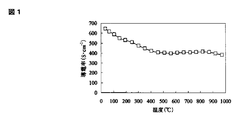
- FIG. 1 is a graph showing the conductivity at each temperature in Sample 11
- FIG. 2 is a graph showing the Seebeck coefficient at each temperature in Sample 11
- FIG. 3 is a graph showing the dimensionless figure of merit ZT and temperature in Sample 11. It is the graph which showed the relationship.
- FIG. 4 is a graph showing the conductivity at each temperature of samples 30, 34 and 35
- FIG. 5 is a graph showing the Seebeck coefficient at each temperature of these samples
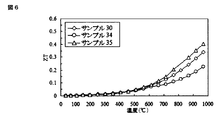
- FIG. 6 is a graph showing the dimensionless figure of merit ZT and temperature of these samples. It is the graph which showed this relationship.
- the conductivity of Sample 11 tended to slightly decrease with increasing temperature, and it was confirmed that metallic electronic conduction was exhibited. This indicates that Al is dissolved as a dopant in the crystal of zinc oxide.
- a high conductivity of 380 S ⁇ cm ⁇ 1 or higher was exhibited in a temperature range from room temperature to 1000 ° C.
- the Seebeck coefficient showed a negative value, and it was confirmed that the zinc oxide sintered body of Sample 11 was an n-type material.
- the absolute value of the Seebeck coefficient was as high as 200 ⁇ V ⁇ K ⁇ 1 or higher in the temperature range of 800 to 1000 ° C.
- ZT in 972 degreeC is 0.58, and showed the high thermoelectric characteristic.
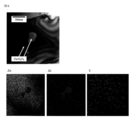
- Evaluation 4 Transmission electron microscope-energy dispersive X-ray spectroscopy elemental analysis (TEM-EDS) Samples 11 and 35 were observed with a transmission electron microscope, and Zn, Al, and Y were mapped with elements by energy dispersive X-ray spectroscopy. The resulting photographs were as shown in FIGS. In any sample, it was confirmed that aluminum and yttrium were present in the zinc oxide grains.
- TEM-EDS Transmission electron microscope-energy dispersive X-ray spectroscopy elemental analysis
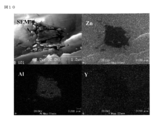
- FIG. 10 shows the results of analysis of the tissue structure of Sample 11 produced by the coprecipitation method using a scanning Auger microscope (“PHI700” manufactured by ULVAC-PHI). It was found by scanning electron microscopy that zinc oxide covered the particles made of spinel ZnAl 2 O 4 . In addition, as a result of element mapping analysis of this structure, only Zn and Al were detected as spinel compounds as metals, whereas Al and Y other than Zn were uniformly distributed in a trace amount in the surrounding zinc oxide portion. I found out. This suggested that Al and Y were uniformly dissolved in the zinc oxide structure.
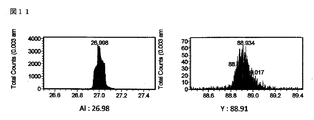
- Time-of-flight secondary ion mass spectrometry High-sensitivity analysis of trace metals in the zinc oxide tissue portion of sample 11 was analyzed by a time-of-flight secondary ion mass spectrometer ("TRIV V nanoTOF" manufactured by ULVAC-PHI). The result is shown in FIG. As a result, it was possible to perform quantitative analysis for each element based on the time-of-flight difference, and it was revealed that Y and Al exist uniformly in the structure of zinc oxide.
Landscapes
- Chemical & Material Sciences (AREA)
- Engineering & Computer Science (AREA)
- Organic Chemistry (AREA)
- Ceramic Engineering (AREA)
- Inorganic Chemistry (AREA)
- Manufacturing & Machinery (AREA)
- Materials Engineering (AREA)
- Structural Engineering (AREA)
- Compositions Of Oxide Ceramics (AREA)
- Inorganic Compounds Of Heavy Metals (AREA)
Abstract
Description
また本発明者らは、アルミニウム(Al)をドープした酸化亜鉛(Al−ZnO)に、さらにLa、Ce、Pr、Nd、Pm、Sm、Eu、Gd、Tb、Dy、Ho、およびYからなる群から選択される希土類金属をドープした熱電変換材料について、より性能の高い材料が得られる製造方法を見出した。
本発明はこれら知見に基づくものである。
Zn(1−x−y)AlxYyO (I)
(式中、Znは亜鉛であり、Alはアルミニウムであり、Yはイットリウムであり、x>0であり、y>0であり、x+y<0.1である)
アルミニウムおよびイットリウムの少なくとも一部が、酸化亜鉛の結晶格子中および/または結晶格子間に存在する構造を有することを特徴とするものである。
また、本発明による熱電変換材料の製造方法が提供され、その方法は、酸化亜鉛(ZnO)粉末、希土類元素粉末、酸化アルミニウム(Al2O3)粉末をミリングにより混合し、成型した後、所定温度で成型体を焼結処理する工程を少なくとも含んでなり、
前記希土類元素が、イットリウム(Y)、およびイットリウムよりも大きなイオン半径を有する希土類元素:ランタン(La)、セリウム(Ce)、プラセオジウム(Pr)、ネオジウム(Nd)、プロメチウム(Pm)、サマリウム(Sm)、ユウロビウム(Eu)、ガドリニウム(Gd)、テルビウム(Tb)、ジスプロシウム(Dy)、およびホルミウム(Ho)からなる群から選択されるものであり、かつ
前記酸化亜鉛粉末として、その一次粒径が0.5μm以上5μm以下のものを用いることを特徴とする方法である。
また、本発明によれば、別の熱電変換材料の製造方法が提供され、その方法は、
亜鉛イオン、希土類元素イオン、およびアルミニウムイオンを含んでなる水溶液を用意し、この水溶液から酸化物前駆体を生成し、この前駆体を焼成することで酸化物を得ることを少なくとも含んでなり、
前記希土類元素がイットリウム(Y)、およびイットリウムよりも大きなイオン半径を有する希土類元素:ランタン(La)、セリウム(Ce)、プラセオジウム(Pr)、ネオジウム(Nd)、プロメチウム(Pm)、サマリウム(Sm)、ユウロビウム(Eu)、ガドリニウム(Gd)、テルビウム(Tb)、ジスプロシウム(Dy)、およびホルミウム(Ho)からなる群から選択されるものであることを特徴とする方法である。
本発明による熱電変換材料は、式(I):Zn(1−x−y)AlxYyOで表される亜鉛酸化物を主成分とする熱電変換材料であって、アルミニウムおよびイットリウムの少なくとも一部が、酸化亜鉛の結晶格子中および/または結晶格子間に存在する構造を有するものである。
ここで、Znは亜鉛であり、Alはアルミニウムであり、Yはイットリウムである。
また、ZnとAlとYとの合計モル量に対するAlのモル量の比率(すなわち式(I)のx)は0より大きく、ZnとAlとYとの合計モル量に対するYのモル量の比率(すなわち式(I)のy)は0より大きく、ZnとAlとYとの合計モル量に対するAlとYとの合計モル量の比率(すなわち式(I)のx+y)は0.10より小さい。
本発明による熱電変換材料は、そのモジュール形態に合わせて、薄膜状、厚膜状やバルク成型体のいずれもの形態を取ることが可能である。
また、亜鉛、イットリウム、およびアルミニウムの硝酸塩、水酸化物塩、または塩化物塩等を水に溶解し、亜鉛イオン、イットリウムイオン、アルミニウムイオンを含んでなる水溶液から酸化物前駆体を生成し、この前駆体を焼成することで酸化物とし、これを焼成、加工処理することを含んでなる、金属酸化物を得ることのできる公知または一般的な手法を用いることも可能である(以下、本明細書においてこの方法を「湿式反応法」と呼ぶことがある)。ここで、酸化物前駆体を得るための手法としては、共沈法、均一沈殿法、クエン酸法、錯体重合法などを挙げることができる。この方法によって得られた熱電変換材料にあっては、アルミニウムおよびイットリウムが、酸化亜鉛の結晶格子中または結晶格子間に存在する構造であるため、より高い熱電特性が実現できているものと考えられる。さらに、ZnO一次粒子の粒内に、ZnAl2O4の組成の微粒子が生成しており、このZnOとは異なる組成の微粒子が電子の移動を妨げず(つまり高い伝導率)、他方、この微粒子がフォノンを散乱することで熱伝導率を低下させているものと考えられる(後記する例における、透過型電子顕微鏡−エネルギー分散型X線分光法元素分析(TEM−EDS)結果参照)。その結果、良好な熱電特性が得られているものと考えられる。
Zn(1−x−y)AlxMyO
(式中、Znは亜鉛であり、Alはアルミニウムであり、Mは希土類元素(イットリウムよりイオン半径の小さいものを除く)であり、x>0であり、y>0であり、x+y<0.1である)。この方法により、より導電性および熱電物性の高い熱電変換材料を得ることができる。さらにこの態様においても、希土類元素酸化物粉末および酸化アルミニウム粉末についても、その一次粒径が100nm以下のものを用いることが好ましい。これにより、より導電性および熱電物性の高い熱電変換材料を得ることができる。
Zn(1−x−y)AlxMyO
(式中、Znは亜鉛であり、Alはアルミニウムであり、Mは希土類元素(イットリウムよりイオン半径の小さいものを除く)であり、x>0であり、y>0であり、x+y<0.1である)。この方法により、より導電性および熱電物性の高い熱電変換材料を得ることができる。この方法によって得られた熱電変換材料にあっては、アルミニウムおよび希土類元素が、酸化亜鉛の粒内に入り込んで存在するため、すなわち酸化亜鉛の結晶格子中または結晶格子間に存在する構造であるため、より高い熱電特性が実現できているものと考えられる。
湿式反応法として共沈法を用いた希土類金属及びアルミニウムを含む酸化亜鉛焼結体の作製
酢酸亜鉛(和光純薬製)0.098molと、ドーパントとなる希土類としてイットリウムを含む硝酸イットリウムn水和物(和光純薬製)0.001molを蒸留水1000mlに溶解させ、室温で約1時間攪拌した。作製した金属塩水溶液に、0.1M水酸化ナトリウム水溶液1000mlを室温で攪拌しながら1時間かけて滴下し、その後約20時間攪拌を行った。更に、この懸濁液を攪拌しながら、乳酸アルミニウム(和光純薬製)0.001molを蒸留水10mlに溶解させた溶液を10分かけて滴下し、その後約20時間攪拌を行った。攪拌終了後、遠心分離することで白色ゲルを回収し、蒸留水による洗浄処理と遠心分離を、上澄みのpHが7程度になるまで繰り返すことで白色ゲルを得た。さらに、得られた白色ゲルを吸引ろ過して、100mlのエタノールで洗浄後、60℃で2時間乾燥することで、白色の薄板状体を得た。
湿式反応法としてクエン酸法を用いた希土類金属及びアルミニウムを含む酸化亜鉛焼結体の作製
硝酸亜鉛六水和物(和光純薬製)、硝酸アルミニウム九水和物(和光純薬製)、希土類金属硝酸塩(硝酸イットリウム、硝酸セリウム、硝酸ランタン、それぞれ和光純薬製)を表1に示す所定のモル比になるように秤量し、0.25molのクエン酸(和光純薬製)とともに500mlビーカーに入れ、250mlの蒸留水に溶解後、約2時間攪拌を行った。更に、120℃で攪拌しながら水を蒸発させたあと、マントルヒーターで450℃に加熱し、クエン酸、硝酸等の有機物を熱分解し、黒色~灰色の酸化亜鉛前駆体を得た。その後、500℃で1時間、更に800℃で4時間仮焼し、各種金属イオンをドープした酸化亜鉛粉末を得た。なお、サンプル13、14の調製にあってはクエン酸量を0.75molとした。
この粉末を一軸プレス成型機でプレス処理し、さらに静水圧プレス(CIP)処理することにより、直径約25mmで厚み約7mmの円盤状ペレットを作製した。この円盤状ペレットを、大気中で1400℃で約10時間焼成することにより焼結させ、サンプル12~16を作製した。
乾式混合法による希土類金属及びアルミニウムを含む酸化亜鉛焼結体の作製
酸化亜鉛粉末(高純度化学研究所製、粒径約1μm)、酸化アルミニウム粉末(γ−Al2O3、高純度化学研究所製、粒径約2~3μm)及び希土類酸化物粉末(Y2O3、Eu2O3、Gd2O3、Dy2O3、Er2O3、Tm2O3、Yb2O3、CeO2、Sc2O3、Ho2O3:すべて信越化学製、La2O3:第一稀元素化学工業製)を用意した。これらの原料を表1に示す所定のモル比になるように秤量した後、ポリエチレン製ボトルに投入し、ナイロン被覆した鉄球ボールを加え、乾式ボールミル処理を15時間行った。金属メッシュふるいにより粉末を分取した後、一軸プレス成型機でプレス処理し、さらに静水圧プレス(CIP)処理することにより、直径約25mmで厚み約7mmの円盤状ペレットを作製した。この円盤状ペレットを、大気中で1400℃で約10時間焼成することにより焼結させ、サンプル21~73を作製した。なお、サンプル21~26および28、38、39の調整においては、酸化アルミニウム粉末として粒径の小さいもの(γ−Al2O3、大明化学工業製、一次粒子径7nm)。また、サンプル71~73の調整においては、酸化亜鉛粉末として粒径の小さいもの(ハクスイテック製、粒径約200nm)を用いた。
なお、原料に用いた希土類酸化物粉末のうち、高純度化学研究所製のY2O3(品番:BB)ついてその粒径をSEM観察したところ、粒径は20~30nmであった。また、大明化学製のγ−Al2O3(品番:TM−300)についてその粒径をSEM観察したところ、粒径は100nm以下であった。
得られたサンプルのX線回折測定を行った結果、ほぼウルツ鉱型酸化亜鉛単相に帰属された。
得られた酸化亜鉛焼結体を、ダイヤモンドカッターで5mm×5mm×15mmのサイズに切出し、全ての表面をサンドペーパーで研磨することにより、測定サンプルを作製した。
得られた酸化亜鉛焼結体を約5mm×約5mm×約15mmの角柱状に切出して測定サンプルを作成した。熱電物性測定装置(オザワ科学製、“RZ2001i”)を用いて、各温度域(例えば、0~1000℃)におけるサンプル両端に温度差をつけた際の導電率(σ)及びゼーベック係数(α)の測定を行なった。また、レーザーフラッシュ熱物性測定装置(京都電子工業製、“LFA−502”)を用いて、得られた酸化亜鉛焼結体を5mm×5mm×1mm厚の板状に切出した測定サンプルで、室温~1000℃までの熱伝導率(κ)を測定した。
さらに、導電率、ゼーベック係数、熱導電率の測定結果を用いて、972℃での出力因子(=α2σ)及び、無次元性能指数ZT(=α2σ/κ)を算出した。
各サンプルの972℃での導電率、ゼーベック係数、熱導電率、及び出力因子、無次元性能指数を表1に示す。
サンプル11および35について、透過型電子顕微鏡による観察を行い、またZn、Al、およびYについてエネルギー分散型X線分光法により元素のマッピングを行った。その結果の写真は図8および9に示される通りであった。いずれのサンプルにおいても、アルミニウムおよびイットリウムが、酸化亜鉛の粒内に入り込んで存在することが確認された。
図10に、共沈法で作製したサンプル11の組織構造の走査型オージェ顕微鏡(アルバックファイ製、“PHI700”)による分析結果を示す。走査型電子顕微鏡により、スピネルZnAl2O4からなる粒子を取り囲むように酸化亜鉛が覆っていることが分かった。またこの組織の元素マッピング解析を行った結果、スピネル化合物は金属としてZn、Alのみしか検出されないのに対し、周囲の酸化亜鉛部分には、Zn以外に、Al及びYが微量に均一に分布していることが分かった。このことから、酸化亜鉛組織中には、AlとYが均一に固溶していることが示唆された。
サンプル11の酸化亜鉛組織部分における微量金属の高感度分析を、飛行時間型二次イオン質量分析計(アルバックファイ製、“TRIFT V nanoTOF”)による分析を行った。その結果を図11に示す。その結果、飛行時間差により元素別の定量分析を行うことができ、酸化亜鉛の構造中にYとAlが、均一に存在することが明らかとなった。

Claims (13)
- 下記式(I)の組成式で表される熱電変換材料であって:
Zn(1−x−y)AlxYyO (I)
(式中、Znは亜鉛であり、Alはアルミニウムであり、Yはイットリウムであり、x>0であり、y>0であり、x+y<0.1である)
アルミニウムおよびイットリウムの少なくとも一部が、酸化亜鉛の結晶格子中および/または結晶格子間に存在する構造を有することを特徴とする、熱電変換材料。 - 前記式(I)において、x+y≦0.07である、請求項1に記載の熱電変換材料。
- 前記式(I)において、x+y≦0.06である、請求項1に記載の熱電変換材料。
- 前記式(I)において、y<x+0.01である、請求項1に記載の熱電変換材料。
- 前記前記式(I)において、y≦xである、請求項1に記載の熱電変換材料。
- n型熱電変換材料とp型熱電変換材料とを組み合わせた熱電変換素子であって、前記n型熱電変換材料が請求項1に記載の熱電変換材料であることを特徴とする、熱電変換素子。
- 熱電変換材料の製造方法であって、
酸化亜鉛(ZnO)粉末、希土類元素粉末、酸化アルミニウム(Al2O3)粉末をミリングにより混合し、成型した後、所定温度で成型体を焼結処理する工程を少なくとも含んでなり、
前記希土類元素が、イットリウム(Y)、およびイットリウムよりも大きなイオン半径を有する希土類元素:ランタン(La)、セリウム(Ce)、プラセオジウム(Pr)、ネオジウム(Nd)、プロメチウム(Pm)、サマリウム(Sm)、ユウロビウム(Eu)、ガドリニウム(Gd)、テルビウム(Tb)、ジスプロシウム(Dy)、およびホルミウム(Ho)からなる群から選択されるものであり、かつ
前記酸化亜鉛粉末として、その一次粒径が0.5μm以上5μm以下のものを用いることを特徴とする、製造方法。 - 前記希土類元素がイットリウムであり、請求項1に記載の熱電変換材料が得られる、請求項7に記載の製造方法。
- 熱電変換材料が下記の組成式で表わされるものである、請求項7に記載の製造方法:
Zn(1−x−y)AlxMyO
(式中、Znは亜鉛であり、Alはアルミニウムであり、Mは希土類元素(イットリウムよりイオン半径の小さいものを除く)であり、x>0であり、y>0であり、x+y<0.1である)。 - 熱電変換材料の製造方法であって、
亜鉛イオン、希土類元素イオン、およびアルミニウムイオンを含んでなる水溶液を用意し、この水溶液から酸化物前駆体を生成し、この前駆体を焼成することで酸化物を得ることを少なくとも含んでなり、
前記希土類元素がイットリウム(Y)、およびイットリウムよりも大きなイオン半径を有する希土類元素:ランタン(La)、セリウム(Ce)、プラセオジウム(Pr)、ネオジウム(Nd)、プロメチウム(Pm)、サマリウム(Sm)、ユウロビウム(Eu)、ガドリニウム(Gd)、テルビウム(Tb)、ジスプロシウム(Dy)、およびホルミウム(Ho)からなる群から選択されるものであることを特徴とする、製造方法。 - 前記酸化物が、請求項1に記載の組成式で表わされるものであるか、また請求項9に定義される組成式で表わされるものである、請求項10に記載の製造方法。
- アルミニウムおよび/または希土類元素の少なくとも一部が、酸化亜鉛を主成分とする粒子の粒内に、希土類元素とアルミニウムとの酸化物(MAlO3)または亜鉛とアルミニウムとの酸化物(ZnAl2O4)からなる粒子として存在する、請求項7または10の製造方法によって得られた熱電変換材料。
- 下記式の組成式で表される熱電変換材料であって:
Zn(1−x−y)AlxMyO
(式中、Znは亜鉛であり、Alはアルミニウムであり、Mは希土類元素(イットリウムよりイオン半径の小さいものを除く)であり、x>0であり、y>0であり、x+y<0.1である)
アルミニウムおよび/または希土類元素の少なくとも一部が、酸化亜鉛を主成分とする粒子の粒内に、希土類元素とアルミニウムとの酸化物(MAlO3)または亜鉛とアルミニウムとの酸化物(ZnAl2O4)からなる粒子として存在することを特徴とする、熱電変換材料。
Priority Applications (2)
| Application Number | Priority Date | Filing Date | Title |
|---|---|---|---|
| US13/143,270 US9079781B2 (en) | 2009-01-06 | 2010-01-06 | Thermoelectric conversion material and thermoelectric conversion element |
| JP2010545800A JPWO2010079841A1 (ja) | 2009-01-06 | 2010-01-06 | 熱電変換材料および熱電変換素子 |
Applications Claiming Priority (6)
| Application Number | Priority Date | Filing Date | Title |
|---|---|---|---|
| JP2009000778 | 2009-01-06 | ||
| JP2009-000778 | 2009-01-06 | ||
| JP2009-005871 | 2009-01-14 | ||
| JP2009005871 | 2009-01-14 | ||
| JP2009276816 | 2009-12-04 | ||
| JP2009-276816 | 2009-12-04 |
Publications (1)
| Publication Number | Publication Date |
|---|---|
| WO2010079841A1 true WO2010079841A1 (ja) | 2010-07-15 |
Family
ID=42316603
Family Applications (1)
| Application Number | Title | Priority Date | Filing Date |
|---|---|---|---|
| PCT/JP2010/050299 Ceased WO2010079841A1 (ja) | 2009-01-06 | 2010-01-06 | 熱電変換材料および熱電変換素子 |
Country Status (3)
| Country | Link |
|---|---|
| US (1) | US9079781B2 (ja) |
| JP (2) | JPWO2010079841A1 (ja) |
| WO (1) | WO2010079841A1 (ja) |
Cited By (2)
| Publication number | Priority date | Publication date | Assignee | Title |
|---|---|---|---|---|
| JP2012144409A (ja) * | 2011-01-14 | 2012-08-02 | Tosoh Corp | 酸化物焼結体、それから成るターゲットおよび透明導電膜 |
| JP2013157362A (ja) * | 2012-01-26 | 2013-08-15 | Toyota Motor Corp | 熱電半導体 |
Families Citing this family (1)
| Publication number | Priority date | Publication date | Assignee | Title |
|---|---|---|---|---|
| US11968899B2 (en) * | 2012-02-07 | 2024-04-23 | Ethan James Ciccotelli | Method and device for the generation of electricity directly from heat |
Citations (7)
| Publication number | Priority date | Publication date | Assignee | Title |
|---|---|---|---|---|
| JPS62132380A (ja) * | 1985-12-05 | 1987-06-15 | Toshiba Corp | N型熱電素子 |
| JPS62179781A (ja) * | 1986-02-04 | 1987-08-06 | Toshiba Corp | N型熱電素子 |
| JP2001284661A (ja) * | 2000-03-30 | 2001-10-12 | Unitika Ltd | 高温用n型熱電素子組成物 |
| JP2002033528A (ja) * | 2000-07-13 | 2002-01-31 | Unitika Ltd | 高温用熱電変換モジュール |
| JP2003286010A (ja) * | 2002-03-27 | 2003-10-07 | National Institute Of Advanced Industrial & Technology | 混合伝導性酸化物 |
| JP2006347861A (ja) * | 2005-05-20 | 2006-12-28 | Idemitsu Kosan Co Ltd | 亜鉛系酸化物の製造方法及びその方法により製造される亜鉛系酸化物 |
| WO2007108147A1 (ja) * | 2006-03-22 | 2007-09-27 | Murata Manufacturing Co., Ltd. | 熱電半導体、熱電変換素子および熱電変換モジュール |
Family Cites Families (1)
| Publication number | Priority date | Publication date | Assignee | Title |
|---|---|---|---|---|
| JPH0426514A (ja) * | 1990-05-18 | 1992-01-29 | Lion Corp | 板状導電性酸化亜鉛の製造方法 |
-
2010
- 2010-01-06 US US13/143,270 patent/US9079781B2/en not_active Expired - Fee Related
- 2010-01-06 JP JP2010545800A patent/JPWO2010079841A1/ja active Pending
- 2010-01-06 WO PCT/JP2010/050299 patent/WO2010079841A1/ja not_active Ceased
-
2013
- 2013-12-27 JP JP2013271291A patent/JP5673794B2/ja not_active Expired - Fee Related
Patent Citations (7)
| Publication number | Priority date | Publication date | Assignee | Title |
|---|---|---|---|---|
| JPS62132380A (ja) * | 1985-12-05 | 1987-06-15 | Toshiba Corp | N型熱電素子 |
| JPS62179781A (ja) * | 1986-02-04 | 1987-08-06 | Toshiba Corp | N型熱電素子 |
| JP2001284661A (ja) * | 2000-03-30 | 2001-10-12 | Unitika Ltd | 高温用n型熱電素子組成物 |
| JP2002033528A (ja) * | 2000-07-13 | 2002-01-31 | Unitika Ltd | 高温用熱電変換モジュール |
| JP2003286010A (ja) * | 2002-03-27 | 2003-10-07 | National Institute Of Advanced Industrial & Technology | 混合伝導性酸化物 |
| JP2006347861A (ja) * | 2005-05-20 | 2006-12-28 | Idemitsu Kosan Co Ltd | 亜鉛系酸化物の製造方法及びその方法により製造される亜鉛系酸化物 |
| WO2007108147A1 (ja) * | 2006-03-22 | 2007-09-27 | Murata Manufacturing Co., Ltd. | 熱電半導体、熱電変換素子および熱電変換モジュール |
Cited By (2)
| Publication number | Priority date | Publication date | Assignee | Title |
|---|---|---|---|---|
| JP2012144409A (ja) * | 2011-01-14 | 2012-08-02 | Tosoh Corp | 酸化物焼結体、それから成るターゲットおよび透明導電膜 |
| JP2013157362A (ja) * | 2012-01-26 | 2013-08-15 | Toyota Motor Corp | 熱電半導体 |
Also Published As
| Publication number | Publication date |
|---|---|
| JP5673794B2 (ja) | 2015-02-18 |
| US9079781B2 (en) | 2015-07-14 |
| JP2014090199A (ja) | 2014-05-15 |
| US20110260120A1 (en) | 2011-10-27 |
| JPWO2010079841A1 (ja) | 2012-06-28 |
Similar Documents
| Publication | Publication Date | Title |
|---|---|---|
| Li et al. | Enhanced mid-temperature thermoelectric performance of textured SnSe polycrystals made of solvothermally synthesized powders | |
| Masuda et al. | Thermoelectric performance of Bi-and Na-substituted Ca 3 Co 4 O 9 improved through ceramic texturing | |
| Li et al. | Polycrystalline BiCuSeO oxide as a potential thermoelectric material | |
| Li et al. | Enhanced thermoelectric performance of Ca-doped BiCuSeO in a wide temperature range | |
| Lan et al. | Enhanced thermoelectric properties of Pb‐doped BiCuSeO ceramics | |
| Gautam et al. | Thermoelectric properties of pulsed current sintered nanocrystalline Al-doped ZnO by chemical vapour synthesis | |
| JP5660031B2 (ja) | ドープ薄層を有する複合材料及びその製造方法 | |
| JP2008124417A (ja) | 熱電変換材料およびその製造方法 | |
| Cha et al. | High-temperature thermoelectric properties of Sm3+-doped Ca3Co4O9+ δ fabricated by spark plasma sintering | |
| Wang et al. | Thermoelectric properties of c-axis oriented Ni-substituted NaCoO2 thermoelectric oxide by the citric acid complex method | |
| JP5673794B2 (ja) | 熱電変換材料および熱電変換素子 | |
| US20260011560A1 (en) | Palladium cobalt oxide thin film, delafossite-type oxide thin film, schottky electrode having delafossite-type oxide thin film, method for producing palladium cobalt oxide thin film, and method for producing delafossite-type oxide thin film | |
| JP5546143B2 (ja) | 透明薄膜形成用の複合酸化物焼結体及び透明薄膜形成用材料 | |
| Zhang et al. | Thermoelectric properties of solution combustion synthesized Al-doped ZnO | |
| JP5095517B2 (ja) | アルミニウム含有酸化亜鉛系n型熱電変換材料 | |
| JP4592209B2 (ja) | 結晶配向バルクZnO系焼結体材料の製造方法およびそれにより製造された熱電変換デバイス | |
| Han | High temperature thermoelectric properties of ZnO based materials | |
| Van Nong et al. | Microstructure and thermoelectric properties of screen-printed thick films of misfit-layered cobalt oxides with Ag addition | |
| Ahmad et al. | Synergistically improving the thermoelectric performance of In2O3 via a dual-doping and nanostructuring approach | |
| JP2010080828A (ja) | 熱電材料およびその製造方法 | |
| JP2004134454A (ja) | 熱電変換材料及びその製造方法 | |
| JP2013197460A (ja) | 熱電変換材料の製造方法及び熱電変換材料 | |
| Han et al. | Sintering behavior and thermoelectric properties of LaCoO 3 ceramics with Bi 2 O 3–B 2 O 3–SiO 2 as a sintering aid | |
| TW202409317A (zh) | 鈀鈷氧化物靶材、赤鐵礦型氧化物靶材及鈀鈷氧化物靶材之製造方法 | |
| JP2010030855A (ja) | 結晶配向性構造体およびその製造方法。 |
Legal Events
| Date | Code | Title | Description |
|---|---|---|---|
| 121 | Ep: the epo has been informed by wipo that ep was designated in this application |
Ref document number: 10729259 Country of ref document: EP Kind code of ref document: A1 |
|
| ENP | Entry into the national phase |
Ref document number: 2010545800 Country of ref document: JP Kind code of ref document: A |
|
| WWE | Wipo information: entry into national phase |
Ref document number: 13143270 Country of ref document: US |
|
| NENP | Non-entry into the national phase |
Ref country code: DE |
|
| 122 | Ep: pct application non-entry in european phase |
Ref document number: 10729259 Country of ref document: EP Kind code of ref document: A1 |