WO2010064512A1 - 耐水性偏光フィルム、及びその製造方法、及び画像表示装置 - Google Patents
耐水性偏光フィルム、及びその製造方法、及び画像表示装置 Download PDFInfo
- Publication number
- WO2010064512A1 WO2010064512A1 PCT/JP2009/068788 JP2009068788W WO2010064512A1 WO 2010064512 A1 WO2010064512 A1 WO 2010064512A1 JP 2009068788 W JP2009068788 W JP 2009068788W WO 2010064512 A1 WO2010064512 A1 WO 2010064512A1
- Authority
- WO
- WIPO (PCT)
- Prior art keywords
- polarizing film
- water
- group
- resistant polarizing
- resistant
- Prior art date
- Legal status (The legal status is an assumption and is not a legal conclusion. Google has not performed a legal analysis and makes no representation as to the accuracy of the status listed.)
- Ceased
Links
Classifications
-
- G—PHYSICS
- G02—OPTICS
- G02B—OPTICAL ELEMENTS, SYSTEMS OR APPARATUS
- G02B5/00—Optical elements other than lenses
- G02B5/30—Polarising elements
-
- G—PHYSICS
- G02—OPTICS
- G02B—OPTICAL ELEMENTS, SYSTEMS OR APPARATUS
- G02B5/00—Optical elements other than lenses
- G02B5/30—Polarising elements
- G02B5/3025—Polarisers, i.e. arrangements capable of producing a definite output polarisation state from an unpolarised input state
- G02B5/3033—Polarisers, i.e. arrangements capable of producing a definite output polarisation state from an unpolarised input state in the form of a thin sheet or foil, e.g. Polaroid
-
- C—CHEMISTRY; METALLURGY
- C09—DYES; PAINTS; POLISHES; NATURAL RESINS; ADHESIVES; COMPOSITIONS NOT OTHERWISE PROVIDED FOR; APPLICATIONS OF MATERIALS NOT OTHERWISE PROVIDED FOR
- C09B—ORGANIC DYES OR CLOSELY-RELATED COMPOUNDS FOR PRODUCING DYES, e.g. PIGMENTS; MORDANTS; LAKES
- C09B31/00—Disazo and polyazo dyes of the type A->B->C, A->B->C->D, or the like, prepared by diazotising and coupling
- C09B31/02—Disazo dyes
-
- C—CHEMISTRY; METALLURGY
- C09—DYES; PAINTS; POLISHES; NATURAL RESINS; ADHESIVES; COMPOSITIONS NOT OTHERWISE PROVIDED FOR; APPLICATIONS OF MATERIALS NOT OTHERWISE PROVIDED FOR
- C09B—ORGANIC DYES OR CLOSELY-RELATED COMPOUNDS FOR PRODUCING DYES, e.g. PIGMENTS; MORDANTS; LAKES
- C09B31/00—Disazo and polyazo dyes of the type A->B->C, A->B->C->D, or the like, prepared by diazotising and coupling
- C09B31/02—Disazo dyes
- C09B31/08—Disazo dyes from a coupling component "C" containing directive hydroxyl and amino groups
-
- G—PHYSICS
- G02—OPTICS
- G02F—OPTICAL DEVICES OR ARRANGEMENTS FOR THE CONTROL OF LIGHT BY MODIFICATION OF THE OPTICAL PROPERTIES OF THE MEDIA OF THE ELEMENTS INVOLVED THEREIN; NON-LINEAR OPTICS; FREQUENCY-CHANGING OF LIGHT; OPTICAL LOGIC ELEMENTS; OPTICAL ANALOGUE/DIGITAL CONVERTERS
- G02F1/00—Devices or arrangements for the control of the intensity, colour, phase, polarisation or direction of light arriving from an independent light source, e.g. switching, gating or modulating; Non-linear optics
- G02F1/01—Devices or arrangements for the control of the intensity, colour, phase, polarisation or direction of light arriving from an independent light source, e.g. switching, gating or modulating; Non-linear optics for the control of the intensity, phase, polarisation or colour
- G02F1/13—Devices or arrangements for the control of the intensity, colour, phase, polarisation or direction of light arriving from an independent light source, e.g. switching, gating or modulating; Non-linear optics for the control of the intensity, phase, polarisation or colour based on liquid crystals, e.g. single liquid crystal display cells
- G02F1/133—Constructional arrangements; Operation of liquid crystal cells; Circuit arrangements
- G02F1/1333—Constructional arrangements; Manufacturing methods
- G02F1/1335—Structural association of cells with optical devices, e.g. polarisers or reflectors
Definitions
- the present invention relates to a water-resistant polarizing film excellent in mechanical strength and optical characteristics, a method for producing the same, and an image display device.
- the polarizing film is an optical film having a function of transmitting specific linearly polarized light from polarized light or natural light.
- the polarizing film is used, for example, as a constituent member of a liquid crystal display device or a lens of polarized sunglasses.
- Patent Document 1 a polarizing film containing an organic dye is known. Furthermore, a water-resistant polarizing film containing an organic dye is also known (Patent Document 1).
- the water-resistant polarizing film of Patent Document 1 is composed of an organic compound having two or more sulfonic acid groups and 4,4′-tetramethyldiaminodiphenylmethane, 4,4′-dipyridyl, melamine, or tetraaminopyrimidine.
- the water-resistant polarizing film of Patent Document 1 has a problem in that it has low mechanical strength and low optical properties (such as transmittance and polarization degree).
- An object of the present invention is to provide a water-resistant polarizing film excellent in mechanical strength and optical characteristics and a method for producing the same.
- the present inventors diligently studied the cause of the inferior mechanical strength and optical characteristics of the polarizing film of Patent Document 1. As a result, the present inventors have found that the cause is the use of a cyclic compound (such as the above 4,4'-tetramethyldiaminodiphenylmethane or 4,4'-dipyridyl).
- a cyclic compound such as the above 4,4'-tetramethyldiaminodiphenylmethane or 4,4'-dipyridyl.
- the water-resistant polarizing film of the present invention contains an organic dye having an anionic group and an acyclic compound having 2 to 5 nitrogen atoms.
- the acyclic compound has two nitrogen atoms.
- the acyclic compound has 2 to 5 cationic groups containing a nitrogen atom.
- the cationic group is an amino group or a salt thereof.
- the acyclic compound is a linear aliphatic diamine or a salt thereof, or a linear aliphatic ether diamine or a salt thereof.
- the acyclic compound is an aliphatic diamine having 2 to 8 carbon atoms or a salt thereof, or an aliphatic ether diamine having 2 to 8 carbon atoms or a salt thereof.
- the organic dye has two or more anionic groups.
- the manufacturing method of a water-resistant polarizing film is provided.
- a treatment liquid containing an acyclic compound having 2 to 5 nitrogen atoms is brought into contact with one surface or both surfaces of a polarizing film containing an organic dye having an anionic group.
- the concentration of the acyclic compound in the treatment liquid is 5% by mass to 30% by mass.
- an image display device has any one of the above water-resistant polarizing films.
- the water-resistant polarizing film of the present invention is hardly eroded by water and is excellent in mechanical strength and optical characteristics.
- an image display device having excellent durability and high display performance can be provided.
- the water-resistant polarizing film excellent in mechanical strength and an optical characteristic can be obtained by the simple process of making a process liquid contact one surface or both surfaces of a polarizing film.
- the water-resistant polarizing film of the present invention contains an organic dye having an anionic group and an acyclic compound having 2 to 5 nitrogen atoms.
- the method for producing a water-resistant polarizing film of the present invention comprises a step of bringing a treatment liquid containing an acyclic compound having 2 to 5 nitrogen atoms into contact with one or both sides of a polarizing film containing an organic dye having an anionic group At least.
- the acyclic compound is cross-linked with the organic dye, and the acyclic compound enters the polarizing film.
- a water-resistant polarizing film excellent in mechanical strength and optical properties (such as transmittance and polarization degree) can be obtained.
- water-resistant polarizing film of the present invention contacting the polarizing film with a treatment liquid containing an acyclic compound having 2 to 5 nitrogen atoms may be referred to as “water resistance treatment”.
- water resistance treatment contacting the polarizing film with a treatment liquid containing an acyclic compound having 2 to 5 nitrogen atoms
- a to B means “A or more and B or less”.
- dye which has an anionic group contained in a polarizing film will not be specifically limited if it is an organic compound which shows a two-color absorptivity.
- the anionic group has a fixed anion group bonded to the skeleton of the organic dye, and usually a counter ion is bonded to the fixed anion group. Some or all of the counter ions are substituted with a cationic species of an acyclic compound having 2 to 5 nitrogen atoms.
- anionic group examples include a sulfonic acid group, a carboxyl group, a phosphoric acid group, and a base thereof.
- the anionic group is preferably a sulfonate group or a sulfonate group, and more preferably a sulfonate group (—SO 3 M group).
- the number of anionic groups (substitution number) in the organic dye is not particularly limited, but is preferably 2 or more, more preferably 2 to 5, and more preferably 2 to 4.
- An organic dye having two or more anionic groups has high affinity for an aqueous solvent. Therefore, the organic dye can be dissolved in an aqueous solvent, and a good coating solution can be easily prepared.
- a polarizing film can be obtained by using this coating liquid.
- the two or more anionic groups constitute a crosslinking point with an acyclic compound when the polarizing film is subjected to water resistance treatment.
- the organic dye is a compound that can form a polarizing film exhibiting absorption dichroism.
- the polarizing film is an optical film having a function of transmitting specific linearly polarized light from natural light or polarized light.
- organic dye for example, compounds described in Japanese Patent Application Laid-Open No. 2007-126628, Japanese Patent Application Laid-Open No. 2006-323377 and the like can be used.
- the positions of the anionic groups are preferably not adjacent (not ortho positions), and the positions of the anionic groups are in the meta position. More preferably it is.
- the organic dye in which the anionic group is in the meta position reduces steric hindrance between the anionic groups. For this reason, the said organic pigment
- organic dye for example, an azo compound represented by the following general formula (I) or general formula (II) is preferable.
- the azo compound represented by the above general formula (I) or (II) has two or more anionic groups, and the two anionic groups of the naphthyl group (formula A) are bonded at the meta position. .
- Q 1 represents a substituted or unsubstituted aryl group
- Q 2 represents a substituted or unsubstituted arylene group
- A represents an anionic group
- M Re represents a counter ion of the anionic group
- R represents a hydrogen atom, a substituted or unsubstituted alkyl group having 1 to 3 carbon atoms, a substituted or unsubstituted acetyl group, a substituted or unsubstituted benzoyl group, or a substituted group.
- it represents an unsubstituted phenyl group
- k represents an integer of 0 to 3
- l represents an integer of 0 to 3.
- substituted or unsubstituted means substituted with a substituent or not substituted with a substituent.
- the aryl group or arylene group represented by Q 1 or Q 2 may have a substituent or may not have a substituent. Regardless of whether the aryl group or arylene group represented by Q 1 or Q 2 is substituted or unsubstituted, the azo compound of the general formula (I) or (II) exhibits absorption dichroism.
- the substituent include a halogeno group, a nitro group, a cyano group, a dihydroxypropyl group, a phenylamino group, —OM, —COOM, —SO 3 M, carbon Examples thereof include an alkyl group having 1 to 6 carbon atoms, an alkoxy group having 1 to 6 carbon atoms, an alkylamino group having 1 to 6 carbon atoms, and an acylamino group having 1 to 6 carbon atoms.
- the substituent is an anionic group such as a nitro group or a —SO 3 M group.
- M represents a counter ion.
- the condensed ring group which benzene rings condensed like a naphthyl group other than a phenyl group is mentioned.
- the arylene group include a phenylene group and a condensed ring group in which a benzene ring is condensed, such as a naphthylene group.
- Q 1 in the general formulas (I) and (II) is preferably a phenyl group which may have a substituent, and more preferably a phenyl group having a substituent at the para position.
- Q 2 in the general formula (II) is preferably a naphthylene group which may have a substituent, and more preferably a 1,4-naphthylene group which may have a substituent.
- a in the general formulas (I) and (II) is, for example, a sulfonic acid group, a carboxyl group, a phosphoric acid group or a base thereof, preferably a sulfonic acid group or a sulfonic acid group, and more preferably Is a sulfonate group.
- M in the above general formulas (I) and (II) is a hydrogen atom, an alkali metal atom, an alkaline earth metal atom, or a metal ion.
- M in the general formula (I) or (II) is an acyclic compound.
- R in the above general formulas (I) and (II) is preferably a hydrogen atom or a substituted or unsubstituted alkyl group having 1 to 3 carbon atoms, and more preferably a hydrogen atom.
- k in the general formulas (I) and (II) is preferably an integer of 0 to 2, more preferably an integer of 0 to 1.
- l in the general formulas (I) and (II) is preferably an integer of 0 to 2, more preferably an integer of 0 to 1.
- the organic dye is more preferably an azo compound represented by the following general formula (III).
- X represents a hydrogen atom, a halogen atom, a nitro group, a cyano group, a substituted or unsubstituted alkyl group having 1 to 4 carbon atoms, or a substituted or unsubstituted alkoxy group having 1 to 4 carbon atoms. Or a —SO 3 M group.
- R and M in the general formula (III) are the same as R and M in the general formula (I).
- the alkyl group having 1 to 4 carbon atoms or the alkoxy group having 1 to 4 carbon atoms of X in the general formula (III) has a substituent, the substituent is exemplified by the above aryl group or arylene group. The same thing as a group is mentioned.
- X in the general formula (III) is preferably a hydrogen atom, a nitro group, or a cyano group, and more preferably a nitro group.
- Each organic dye such as the azo compound exhibits liquid crystallinity (lyotropic liquid crystallinity) in a state dissolved in a solvent. Specifically, each organic dye such as the azo compound forms a supramolecular aggregate when dissolved in a solvent. When the liquid containing the organic dye is cast in a predetermined direction, a shear stress is applied to the supramolecular aggregate. As a result, a coating film in which the long axis of the supramolecular aggregate is oriented in the casting direction can be formed. The obtained coating film exhibits good absorption dichroism because the organic dye is oriented in a predetermined direction. Particularly, in the azo compound represented by the general formula (III), two or more —SO 3 M groups are not adjacent to each other.
- the azo compound has a small steric hindrance between —SO 3 M groups. For this reason, a water-resistant polarizing film having a high degree of polarization can be obtained by linearly orienting the azo compound before and after the water resistance treatment.
- the azo compounds represented by the above general formulas (I) to (III) can be obtained, for example, by the following method.
- a monoazo compound is obtained by diazotization and coupling reaction of an aniline derivative and a naphthalenesulfonic acid derivative by a conventional method. After the diazotization of this monoazo compound, this is subjected to a coupling reaction with an aminonaphthol disulfonic acid derivative.
- the acyclic compound contained in the water-resistant polarizing film has 2 to 5 nitrogen atoms.
- the water-resistant polarizing film containing the organic dye and the acyclic compound is excellent in mechanical strength and optical characteristics. The reason why the water-resistant polarizing film of the present invention is excellent in mechanical strength and optical properties is presumed as follows.
- an organic dye is elongated or flat.
- Such an organic dye has a property of being oriented in substantially the same direction at a predetermined interval from an adjacent organic dye.
- a polarizing film is obtained by fixing the oriented organic dye.
- a polarizing film having excellent water resistance is formed by bonding a crosslinking agent to an anionic group (such as —SO 3 M group) of the oriented organic dye to form a large organic dye molecule. Is obtained.
- a cyclic compound is used as the cross-linking agent, the interval between the organic dyes is disturbed (that is, the orientation of the organic dye is disturbed), so that the optical properties of the polarizing film are deteriorated. Furthermore, since the cyclic compound is bulky and rigid, the mechanical strength of the polarizing film also decreases. On the other hand, when an acyclic compound is used as the cross-linking agent as in the present invention, it is difficult to disturb the interval between the organic dyes, so that the mechanical strength of the polarizing film is hardly lowered. Furthermore, since the acyclic compound is more flexible than the cyclic compound, the mechanical strength of the polarizing film is hardly reduced.
- the crosslinking agent is an acyclic compound
- the crosslinking agent is an acyclic compound
- the cross-linking agent may be combined with an anionic group of the organic dye. The cross-linking point becomes complicated. For this reason, the orientation of the organic dye is disturbed, and the optical properties of the polarizing film are lowered.
- the acyclic compound used in the present invention is preferably a compound having 2 or 3 nitrogen atoms, and more preferably a compound having 2 nitrogen atoms.
- the acyclic compound having 2 to 5 nitrogen atoms may be linear or branched, but is preferably linear.
- a linear acyclic compound By using a linear acyclic compound, a water-resistant polarizing film having more excellent mechanical strength can be obtained.
- the said nitrogen atom is contained in the cationic group couple
- the cationic group include amino groups, guanidino groups, imino groups, ammonium bases, and salts thereof.
- the salt include inorganic acid salts such as hydrochloride, sulfate, and phosphate; organic acid salts such as acetic acid, formic acid, and oxalic acid.
- an amino group or its salt is preferable.
- the acyclic compound is preferably a compound having 2 to 5 cationic groups containing a nitrogen atom, more preferably a compound having 2 or 3 cationic groups, and having 2 cationic groups. Compounds are more preferred.
- the acyclic compound is preferably a compound in which a cationic group is bonded to at least both ends of the main chain.
- Examples of the acyclic compound having 2 to 5 nitrogen atoms include aliphatic diamines such as alkyl diamines or salts thereof; aliphatic triamines such as alkyl triamines or salts thereof; aliphatic tetraamines such as alkyl tetraamines; Examples thereof include aliphatic pentaamines such as alkyl pentaamines or salts thereof; aliphatic ether diamines such as alkyl ether diamines or salts thereof.
- the acyclic compound is an aliphatic diamine having 2 to 8 carbon atoms or a salt thereof, and / or an aliphatic ether diamine having 2 to 8 carbon atoms or a salt thereof.
- linear aliphatic diamines examples include ethylenediamine, 1,3-propanediamine, 1,4-butanediamine, 1,5-pentanediamine, 1,6-hexanediamine, 1,7-heptanediamine, 1,8 -Octanediamine, 1,9-nonanediamine, 1,10-decanediamine, 1,11-undecanediamine, 1,12-dodecanediamine and the like.
- straight chain having 2 to 8 carbon atoms such as 1,3-propanediamine, 1,4-butanediamine, 1,5-pentanediamine, 1,6-hexanediamine, 1,7-heptanediamine and the like. It is preferable to use the alkyldiamine.
- Examples of the branched aliphatic diamine include 1-butyl-1,2-ethanediamine, 1,1-dimethyl-1,4-butanediamine, 1-ethyl-1,4-butanediamine, 1,2- Dimethyl-1,4-butanediamine, 1,3-dimethyl-1,4-butanediamine, 1,4-dimethyl-1,4-butanediamine, 2,3-dimethyl-1,4-butanediamine, 2- Examples thereof include methyl-1,5-pentanediamine and 3-methyl-1,5-pentanediamine.
- Aliphatic triamines include diethylenetriamine, dipropylenetriamine, 1,2,4-butanetriamine, 1,2,5-pentanetriamine, 1,3,5-pentanetriamine, 1,2,6-hexanetriamine, 1, Examples include 4,7-heptanetriamine.
- Examples of the aliphatic tetraamine include triethylenetetramine and tetraethylenetetramine.
- Examples of the aliphatic pentaamine include tetraethylenepentamine.
- linear aliphatic ether diamine having 2 to 8 carbon atoms examples include 2,2′-oxybis (ethylamine), 3,3′-oxybis (propylamine), 1,2-bis (2-aminoethoxy) Examples include ethane.
- the content of the organic dye in the water-resistant polarizing film of the present invention is preferably 80% by mass or more and less than 100% by mass, and more preferably 90% by mass or more and less than 100% by mass with respect to the total mass of the polarizing film. is there.
- the content of the acyclic compound in the water-resistant polarizing film of the present invention is preferably more than 0 and 20% by mass or less, more preferably 1% by mass to 10% by mass with respect to the total mass of the polarizing film. is there.
- the water-resistant polarizing film may contain other components in addition to the organic dye and the acyclic compound as long as the effects of the present invention are not impaired.
- examples of other components include other organic dyes (organic dyes other than organic dyes having an anionic group), various additives, and arbitrary polymers.
- the water-resistant polarizing film exhibits absorption dichroism in at least a part of wavelengths in the visible light region (wavelength 380 nm to 780 nm).
- the transmittance of the water-resistant polarizing film is 38% or more, preferably 39% or more, and more preferably 40% or more.
- the water-resistant polarizing film has a degree of polarization (degree of polarization determined from the Y value corrected for visibility) of 98% or more, and preferably 99% or more.
- the thickness of the water-resistant polarizing film is not particularly limited, but is preferably 0.1 ⁇ m to 10 ⁇ m. When the thickness of the water-resistant polarizing film is less than 1 ⁇ m, the water-resistant polarizing film may be used in a state of being laminated on a base material in order to ensure self-supporting properties.
- the water-resistant polarizing film of the present invention can be produced, for example, through the following steps A to C, and further, after the step C, the following step D may be performed.
- Process A The process of forming the coating film containing an organic pigment
- Process B The process of obtaining a polarizing film by drying the coating film formed at the process A.
- Step C A step of bringing a treatment liquid containing an acyclic compound having 2 to 5 nitrogen atoms into contact with one or both surfaces of the polarizing film obtained in Step B (water resistance treatment).
- Step D A step of washing the polarizing film in order to remove excess treatment liquid adhering to the polarizing film.
- a coating liquid containing an organic dye is applied onto a substrate to form a coating film.
- the organic dye the dyes exemplified above are used, and an azo compound represented by the general formula (III) is preferably used.
- a coating liquid can be prepared by dissolving the organic dye in an appropriate solvent.
- the organic dye forms a supramolecular aggregate in the solution, and as a result, exhibits a liquid crystal phase.
- the liquid crystal phase is not particularly limited, and examples thereof include a nematic liquid crystal phase, a smectic liquid crystal phase, a cholesteric liquid crystal phase, and a hexagonal liquid crystal phase.
- the liquid crystal phase can be confirmed and identified by an optical pattern observed with a polarizing microscope.
- the solvent is not particularly limited, and a conventionally known solvent can be used.
- a solvent that can dissolve the organic dye satisfactorily is used.
- a coating solution in which the organic dye is well dissolved it is difficult for the organic dye to precipitate when the coating liquid is applied onto a substrate to form a film. Therefore, a polarizing film having excellent transmittance can be obtained.
- the solvent in which the organic dye can be dissolved well is, for example, an aqueous solvent.
- the aqueous solvent include water, a hydrophilic solvent, a mixed solvent of water and a hydrophilic solvent, and the like.
- the hydrophilic solvent is a solvent that can be uniformly dissolved in water.
- examples of the hydrophilic solvent include alcohols such as methanol, ethanol, methyl alcohol and isopropyl alcohol; glycols such as ethylene glycol and diethylene glycol; cellosolves such as methyl cellosolve and ethyl cellosolve; ketones such as acetone and methyl ethyl ketone; acetic acid Examples include esters such as ethyl.
- the solvent is water or a mixed solvent of water and a hydrophilic solvent.
- the concentration of the organic dye in the coating solution is preferably adjusted to a concentration showing a liquid crystal phase. Specifically, the concentration of the organic dye is preferably 0.5% by mass to 50% by mass. In a part of such a concentration range, the coating liquid can exhibit a liquid crystal phase.
- the pH of the coating solution is preferably adjusted to about pH 4 to 10, more preferably about pH 6 to 8.
- an additive may be added to the coating solution.
- additives include plasticizers, heat stabilizers, light stabilizers, lubricants, antioxidants, ultraviolet absorbers, flame retardants, colorants, antistatic agents, antibacterial agents, compatibilizers, cross-linking agents, and thickeners. Agents and the like.
- the concentration of the additive in the coating solution is preferably more than 0 and 10% by mass or less.
- a surfactant may be added to the coating liquid.
- the surfactant is added to improve the wettability and coatability of the coating liquid to the substrate surface. It is preferable to use a nonionic surfactant as the surfactant.
- the concentration of the surfactant in the coating liquid is preferably more than 0 and 5% by mass or less.
- the method for preparing the coating liquid is not particularly limited, and for example, an organic dye may be added to a container containing a solvent, or a solvent may be added to a container containing an organic dye.
- a coating film can be formed by applying the coating liquid on a suitable substrate.
- the substrate is used for uniformly spreading the coating liquid.
- the type of the substrate is not particularly limited as long as it is suitable for this purpose.
- a synthetic resin film (a film means a sheet including what is generally called a sheet), a glass plate, or the like can be used.
- the substrate is a single polymer film.
- the substrate is a laminate comprising a polymer film. This laminate preferably further comprises an alignment layer on the polymer film.
- the polymer film is not particularly limited, but a film excellent in transparency (for example, a haze value of 5% or less) is preferable.
- the thickness of the base material can be appropriately designed according to the strength and the like. From the viewpoint of reduction in thickness and weight, the thickness of the substrate is preferably 300 ⁇ m or less, more preferably 5 ⁇ m to 200 ⁇ m, and more preferably 10 ⁇ m to 100 ⁇ m.
- the alignment layer can be formed by performing an alignment treatment on the substrate.
- the alignment treatment include mechanical alignment treatment such as rubbing treatment and chemical alignment treatment such as photo-alignment treatment.
- the coating liquid is applied on the substrate (preferably on the alignment layer of the substrate).
- the viscosity of the coating liquid at the time of application is preferably 0.1 mPa ⁇ s to 30 mPa ⁇ s, and more preferably 0.5 mPa ⁇ s to 3 mPa ⁇ s.
- the viscosity is a value measured with a rheometer (manufactured by Haake, product name: rheostress 600, measurement condition: double cone sensor shear rate 1000 (1 / s)).
- the hydrophilic treatment may be a dry treatment or a wet treatment.
- the dry treatment include discharge treatment such as corona treatment, plasma treatment or glow discharge treatment; flame treatment; ozone treatment; UV ozone treatment; ionizing active ray treatment such as ultraviolet treatment or electron beam treatment.
- the wet treatment include ultrasonic treatment using a solvent such as water and acetone, alkali treatment, anchor coat treatment, and the like. These processes may be performed independently or in combination of two or more.
- an application method using an appropriate coater may be employed.
- the coater include a bar coater, a reverse roll coater, a forward rotation roll coater, a gravure coater, a rod coater, a slot die coater, a slot orifice coater, a curtain coater, and a fountain coater.
- dye is orientated by the shear stress added at the time of casting of a coating liquid, it can replace with this or can use this together, and can also orientate an organic pigment
- the other means include, for example, a means for applying a coating liquid on a substrate that has been subjected to an orientation treatment, and a magnetic field or an electric field applied after forming a coating film by applying the coating liquid on the substrate. The means to do is mentioned. Even if these other means are performed alone, a coating film in which the organic dye is oriented in a predetermined direction can be formed.
- step B the coating film formed in step A is dried.
- the method for drying the coating film may be either natural drying or forced drying.
- forced drying for example, an air circulation type constant temperature oven in which hot air or cold air circulates, a heater using microwaves or far infrared rays, a roll heated for temperature control, a heated heat pipe roll, heated A drying means such as a metal belt can be used.
- the drying temperature is equal to or lower than the isotropic phase transition temperature of the coating liquid, and it is preferable to gradually raise the temperature from a low temperature to a high temperature.
- the drying temperature is preferably 10 ° C. to 80 ° C., more preferably 20 ° C. to 60 ° C.
- the drying time can be appropriately selected depending on the drying temperature and the type of solvent. In order to obtain a dry coating film with small thickness variation, the drying time is, for example, 1 minute to 30 minutes, preferably 1 minute to 10 minutes.
- the coating film has a higher concentration in the process of drying, and the oriented organic dye is fixed. By fixing the orientation of the organic dye, absorption dichroism is produced.
- the obtained dry coating film is a polarizing film.
- the thickness of the obtained polarizing film (dried coating film) is preferably 0.1 ⁇ m to 10 ⁇ m.
- the amount of residual solvent in the polarizing film is preferably 1% by mass or less, more preferably 0.5% by mass or less, with respect to the total mass of the polarizing film.
- Step C a treatment liquid containing an acyclic compound having 2 to 5 nitrogen atoms is brought into contact with the surface of the polarizing film obtained in Step B (the surface opposite to the bonding surface of the substrate).
- the acyclic compound contained in the treatment liquid the above-exemplified acyclic compounds are used, and preferably a linear alkyldiamine having 2 to 8 carbon atoms is used.
- the treatment liquid is obtained by dissolving or dispersing the acyclic compound in a solvent.
- a solvent an aqueous solvent is preferably used.
- the aqueous solvent those exemplified in the column of the coating liquid can be used.
- the concentration of the acyclic compound in the treatment liquid is preferably 5% by mass to 30% by mass, and more preferably 10% by mass to 20% by mass.
- a water-resistant polarizing film excellent in mechanical strength and optical properties can be obtained by bringing the treatment liquid into contact with one or both surfaces of the polarizing film obtained in Step B.
- the method for bringing the treatment liquid into contact with the polarizing film is not particularly limited. Examples of the contact method include a method of applying a treatment liquid to the surface of the polarizing film, a method of immersing the polarizing film in the treatment liquid, and the like.
- the treatment liquid can be applied using various coaters or sprays. When these methods are employed, the surface of the polarizing film is preferably washed with water or an arbitrary solvent and dried.
- the contact method is preferably a method of immersing the polarizing film in the treatment liquid. According to this method, the treatment liquid can be reliably brought into contact with the entire polarizing film. In addition, according to this method, the treatment liquid easily penetrates into the polarizing film, so that many organic dyes and acyclic compounds can be crosslinked. For this reason, water resistance can be reliably provided to the polarizing film.
- step D the surface of the polarizing film after the water resistance treatment is washed and / or dried.
- Step D is performed in order to remove excess processing liquid adhering to the water-resistant polarizing film obtained in Step C above.
- the polarizing film after the water resistance treatment may be washed with water and then dried. Further, the polarizing film after the water resistance treatment may be simply dried. Further, the production method of the present invention may further include other steps in addition to the above steps A to D.
- the water-resistant polarizing film of the present invention can be used as a polarizing plate, for example, by laminating a protective film on one or both sides.
- a retardation film may be further laminated on the water-resistant polarizing film.
- the water-resistant polarizing film obtained by the production method of the present invention can be used in a state of being laminated on the base material, or can be used by being peeled off from the base material. When using the said water-resistant polarizing film in the state laminated
- the water-resistant polarizing film of the present invention is preferably incorporated in an image display device.
- the image display device having the water-resistant polarizing film of the present invention includes a liquid crystal display device, an organic EL display, a plasma display, and the like.
- a preferred application of the image display device is a television.
- the thickness of the polarizing film is determined by peeling a part of the polarizing film from the polymer film and using a three-dimensional non-contact surface shape measurement system (manufactured by Ryoka System Co., Ltd., product name “Micromap MM5200”) The level difference with the polarizing film was measured.
- Polarization degree (k 1 ⁇ k 2 ) / (k 1 + k 2 )
- k 1 represents a transmittance of the maximum transmittance direction of linearly polarized light
- k 2 represents a transmittance of a linearly polarized light in a direction perpendicular to the maximum transmittance direction.
- Example 1 4-Nitroaniline and 8-amino-2-naphthalenesulfonic acid are described in the usual method (Toyo Hosoda, “Theoretical Manufacturing, Dye Chemistry, 5th Edition”, published on July 15, 1968, Technique Hall, pages 135-152.
- the monoazo compound was obtained by diazotization and coupling reaction by the above method.
- the obtained monoazo compound was diazotized by the conventional method and further subjected to coupling reaction with 1-amino-8-naphthol-2,4-disulfonic acid lithium salt to obtain a crude product. This was salted out with lithium chloride to obtain an azo compound of the following structural formula (IV).
- the azo compound of the above formula (IV) was dissolved in ion exchange water to prepare a 20% by mass coating solution.
- this coating solution was observed at room temperature (23 ° C.) in accordance with the method for observing a liquid crystal phase, the coating solution showed a nematic liquid crystal phase.
- a bar coater (manufactured by BUSHMAN, product name “Mayer rot HS4”) is applied on a norbornene polymer film (manufactured by ZEON Corporation, trade name “ZEONOR”) subjected to rubbing treatment and corona treatment. It was used and coated and allowed to dry naturally in a constant temperature room at 23 ° C.
- the obtained polarizing film had a thickness of 0.4 ⁇ m.
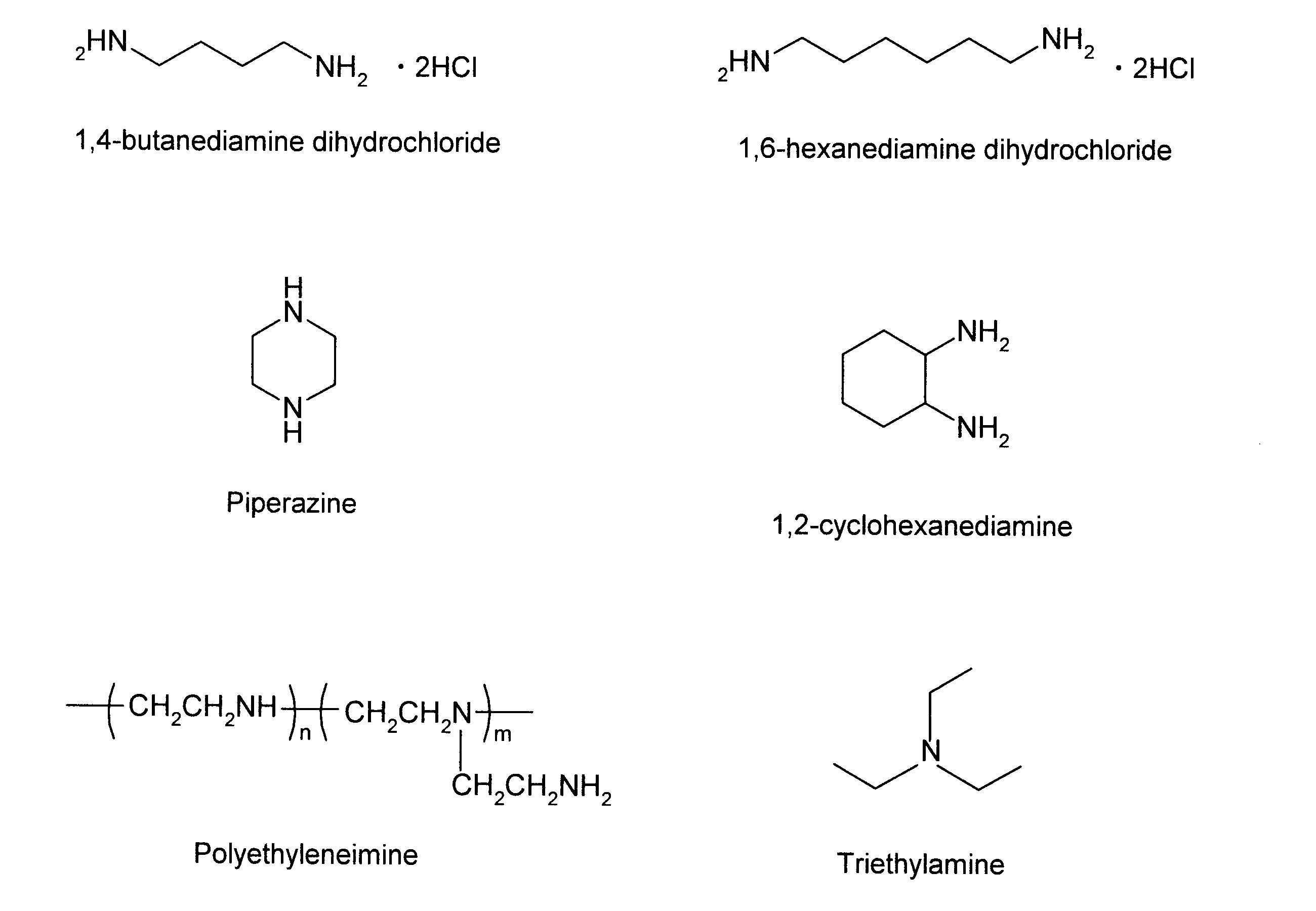
- the polarizing film was immersed in an aqueous solution (concentration: 10% by mass) containing 1,4-butanediamine hydrochloride (manufactured by Tokyo Chemical Industry Co., Ltd.) for 1 minute. Next, the polarizing film was washed with water and dried to prepare a water-resistant polarizing film.
- the measurement results of the water-resistant polarizing film of Example 1 are shown in Table 1.
- the reference examples in Table 1 are the transmittance and the degree of polarization of the polarizing film before the water resistance treatment in Example 1 (the polarizing film of Example 1 that was not subjected to the water resistance treatment).
- Example 2 A water-resistant polarizing film was produced in the same manner as in Example 1 except that 1,4-butanediamine hydrochloride was replaced with 1,6-hexanediamine hydrochloride (manufactured by Tokyo Chemical Industry Co., Ltd.). .
- Table 1 shows the measurement results of the water-resistant polarizing film of Example 2.
- Example 3 A water-resistant polarizing film was prepared in the same manner as in Example 1 except that 1,4-butanediamine hydrochloride was replaced with 2,2′-oxybisethyl hydrochloride (manufactured by Tokyo Chemical Industry Co., Ltd.). Produced. Table 1 shows the measurement results of the water-resistant polarizing film of Example 3.
- Example 1 A water-resistant polarizing film was produced in the same manner as in Example 1 except that the 1,4-butanediamine hydrochloride was replaced with piperazine (manufactured by Tokyo Chemical Industry Co., Ltd.). Table 1 shows the measurement results of the water-resistant polarizing film of Comparative Example 1.
- Example 2 A water-resistant polarizing film was produced in the same manner as in Example 1, except that 1,4-butanediamine hydrochloride was replaced with 1,2-cyclohexanediamine (manufactured by Tokyo Chemical Industry Co., Ltd.). Table 1 shows the measurement results of the water-resistant polarizing film of Comparative Example 2.
- Example 4 A water-resistant polarizing film was produced in the same manner as in Example 1 except that triethylamine (manufactured by Tokyo Chemical Industry Co., Ltd.) was used instead of the 1,4-butanediamine hydrochloride. Table 1 shows the measurement results of the polarizing film of Comparative Example 4.
- the polarizing film of the comparative example 4 melt
- Examples 1 to 3 using an acyclic compound cracks do not occur and the transmittance and the degree of polarization are also excellent.
- Comparative Examples 1 and 2 using a cyclic compound have cracks and are inferior in mechanical strength. Even when an acyclic compound is used, Comparative Example 3 using an acyclic compound having 250 nitrogen atoms is inferior in transmittance and degree of polarization. Even when an acyclic compound is used, Comparative Example 4 using an acyclic compound having one nitrogen atom does not have water resistance.
- the transmittance and the degree of polarization in Examples 1 to 3 are the same as the transmittance and the degree of polarization in the reference example. From this, it can be seen that the transmittance and the degree of polarization are not affected even when the water resistance treatment using an acyclic compound is performed.
- the water-resistant polarizing film of the present invention can be used for image display devices such as liquid crystal display devices, polarized sunglasses, and the like.
- the production method of the present invention can be suitably used when producing a water-resistant polarizing film that is hardly eroded by water.
Landscapes
- Physics & Mathematics (AREA)
- Chemical & Material Sciences (AREA)
- General Physics & Mathematics (AREA)
- Optics & Photonics (AREA)
- Organic Chemistry (AREA)
- Nonlinear Science (AREA)
- Mathematical Physics (AREA)
- Crystallography & Structural Chemistry (AREA)
- Polarising Elements (AREA)
- Liquid Crystal (AREA)
- Paints Or Removers (AREA)
Abstract
Description
特許文献1の耐水性偏光フィルムは、スルホン酸基を2個以上有する有機化合物と、4,4’-テトラメチルジアミノジフェニルメタン、4,4’-ジピリジル、メラミン又はテトラアミノピリミジンと、からなる。
本発明の他の好ましい耐水性偏光フィルムは、上記非環式化合物が、窒素原子を含むカチオン性基を2個~5個有する。
本発明の他の好ましい耐水性偏光フィルムは、上記カチオン性基が、アミノ基又はその塩である。
本発明の他の好ましい耐水性偏光フィルムは、上記非環式化合物が、炭素数2~8の脂肪族ジアミン若しくはその塩、又は、炭素数2~8の脂肪族エーテルジアミン若しくはその塩である。
本発明の他の好ましい耐水性偏光フィルムは、上記有機色素が、アニオン性基を2個以上有する。
この耐水性偏光フィルムの製造方法は、アニオン性基を有する有機色素を含む偏光フィルムの一面又は両面に、窒素原子を2個~5個有する非環式化合物を含む処理液を接触させる。
本発明の好ましい耐水性偏光フィルムの製造方法は、上記処理液中の非環式化合物の濃度が、5質量%~30質量%である。
この画像表示装置は、上記いずれかの耐水性偏光フィルムを有する。
この耐水性偏光フィルムを、例えば、画像表示装置に組み込むことにより、耐久性に優れ且つ表示性能の高い画像表示装置を提供できる。
また、本発明の製造方法によれば、偏光フィルムの一面又は両面に、処理液を接触させるという簡単な処理によって、機械的強度及び光学特性に優れた耐水性偏光フィルムを得ることができる。
なお、本明細書において、偏光フィルムに、窒素原子を2個~5個有する非環式化合物を含む処理液を接触させることを、「耐水化処理」という場合がある。
また、本明細書において、「A~B」は、「A以上B以下」を意味する。
(アニオン性基を有する有機色素について)
偏光フィルムに含まれるアニオン性基を有する有機色素は、二色吸収性を示す有機化合物であれば特に限定されない。
上記アニオン性基は、有機色素の骨格に結合した固定アニオン基を有し、通常、該固定アニオン基に対イオンが結合している。
上記対イオンの一部又は全部は、窒素原子を2個~5個有する非環式化合物のカチオン種で置換されたものである。
アニオン性基を2個以上有する有機色素は、水系溶媒に対する親和性が高い。そのため、前記有機色素を水系溶媒に溶解させることができ、良好なコーティング液を容易に調製できる。このコーティング液を用いることにより、偏光フィルムを得ることができる。
上記2個以上のアニオン性基は、前記偏光フィルムに耐水化処理を行ったときに、非環状化合物と架橋点を構成する。
なお、偏光フィルムとは、自然光又は偏光から特定の直線偏光を透過する機能を有する光学フィルムである。


なお、一般式(I)及び(II)のRの炭素数1~3のアルキル基、ベンゾイル基又はフェニル基が置換基を有する場合、その置換基としては、上記アリール基又はアリーレン基で例示した置換基と同様のものが挙げられる。
上記アリーレン基としては、フェニレン基の他、ナフチレン基などのようなベンゼン環が縮合した縮合環基が挙げられる。
上記一般式(I)及び(II)のQ1は、好ましくは置換基を有していてもよいフェニル基であり、さらに好ましくはパラ位に置換基を有するフェニル基である。
上記一般式(II)のQ2は、好ましくは置換基を有していてもよいナフチレン基であり、さらに好ましくは置換基を有していてもよい1,4-ナフチレン基である。

一般式(III)のR及びMは、上記一般式(I)のR及びMと同様である。
なお、一般式(III)のXの炭素数1~4のアルキル基又は炭素数1~4のアルコキシ基が置換基を有する場合、その置換基としては、上記アリール基又はアリーレン基で例示した置換基と同様のものが挙げられる。
特に、上記一般式(III)で表されるアゾ化合物は、2個以上の-SO3M基がそれぞれ隣接していない。よって、前記アゾ化合物は、-SO3M基同士の立体障害が小さい。このため、耐水化処理前後において、前記アゾ化合物が直線的に配向することによって、偏光度の高い耐水性偏光フィルムを得ることができる。
耐水性偏光フィルムに含まれる非環式化合物は、窒素原子を2個~5個有する。
上記有機色素と非環式化合物とを含む耐水性偏光フィルムは、機械的強度及び光学特性に優れている。
本発明の耐水性偏光フィルムが機械的強度及び光学特性に優れている理由は、次のように推察される。
一方、本願発明のように、上記架橋剤として非環式化合物を用いれば、上記有機色素の間隔を乱し難いので、偏光フィルムの機械的強度が低下し難い。さらに、非環式化合物は、環式化合物に比して柔軟であるため、偏光フィルムの機械的強度も低下し難い。
さらに、架橋剤が、非環式化合物であっても、その非環式化合物が窒素原子を多数(例えば、数十個~数百個)有する場合には、上記有機色素のアニオン性基との架橋点が複雑になる。このため、上記有機色素の配向が乱れ、偏光フィルムの光学特性が低下する。
一方、本願発明のように、上記架橋剤として窒素原子2個~5個有する非環式化合物を用いれば、適度な架橋点で隣接する有機色素間を架橋できる。このため、有機色素の配向を乱すことなく、耐水性に優れた偏光フィルムを得ることができる。
もっとも、光学特性に特に優れた耐水性偏光フィルムを得るためには、比較的少ない架橋点によって隣接する有機色素間を架橋することが好ましい。
このため、本発明に用いられる非環式化合物は、窒素原子を2個又は3個有する化合物が好ましく、特に、窒素原子を2個有する化合物がさらに好ましい。
上記塩としては、塩酸塩、硫酸塩、リン酸塩などの無機酸塩;酢酸、蟻酸、シュウ酸などの有機酸塩などが挙げられる。
これらの中では、カチオン性基としては、アミノ基又はその塩が好ましい。
上記非環式化合物は、前記窒素原子を含むカチオン性基を2個~5個有する化合物が好ましく、前記カチオン性基を2個又は3個有する化合物がさらに好ましく、前記カチオン性基を2個有する化合物がより好ましい。
上記非環式化合物は、その主鎖の少なくとも両末端部にカチオン性基がそれぞれ結合している化合物が好ましい。
脂肪族テトラアミンとしては、トリエチレンテトラミン、テトラエチレンテトラミンなどが挙げられる。
脂肪族ペンタアミンとしては、テトラエチレンペンタミンなどが挙げられる。
本発明の耐水性偏光フィルム中における上記非環式化合物の含有量は、偏光フィルムの総質量に対し、好ましくは0を超え20質量%以下であり、さらに好ましくは1質量%~10質量%である。
他の成分としては、他の有機色素(アニオン性基を有する有機色素以外の有機色素)、各種添加剤、任意のポリマーなどが挙げられる。
上記耐水性偏光フィルムは、可視光領域(波長380nm~780nm)の少なくとも一部の波長において吸収二色性を示す。
上記耐水性偏光フィルムの透過率は、38%以上であり、好ましくは39%以上であり、さらに好ましくは40%以上である。
上記耐水性偏光フィルムの偏光度(視感度補正したY値より求めた偏光度)は、98%以上であり、好ましくは99%以上である。
また、上記耐水性偏光フィルムの厚みは、特に限定されないが、好ましくは0.1μm~10μmである。この耐水性偏光フィルムの厚みが1μm未満である場合には、自立性を確保するために、基材上に積層された状態で使用してもよい。
本発明の耐水性偏光フィルムは、例えば、下記工程A~工程Cを経て製造でき、さらに、工程Cの後、下記工程Dを行ってもよい。
工程A:アニオン性を有する有機色素を含むコーティング液を基材上に塗布することによって、有機色素を含む塗膜を形成する工程。
工程B:工程Aで形成された塗膜を乾燥することによって、偏光フィルムを得る工程。
工程C:工程Bで得られた偏光フィルムの一面又は両面に、窒素原子を2個~5個有する非環式化合物を含む処理液を接触させる工程(耐水化処理)。
工程D:前記偏光フィルムに付着した余分な処理液を取り除くため、前記偏光フィルムを洗浄などする工程。
工程Aにおいては、有機色素を含むコーティング液を、基材上に塗布し、塗膜を形成する。
上記有機色素としては、上記例示の色素などが用いられ、好ましくは一般式(III)で表されるアゾ化合物が用いられる。上記有機色素を、適当な溶媒に溶解させることによって、コーティング液を調製することができる。前記コーティング液は、有機色素が液中で超分子会合体を形成し、その結果、液晶相を示す。液晶相は、特に限定されず、ネマチック液晶相、スメクチック液晶相、コレステリック液晶相、ヘキサゴナル液晶相などが挙げられる。該液晶相は、偏光顕微鏡で観察される光学模様によって、確認、識別できる。
また、コーティング液のpHは、好ましくはpH4~10程度、さらに好ましくはpH6~8程度に調整される。
親水化処理は、乾式処理でもよく、湿式処理でもよい。乾式処理としては、例えば、コロナ処理、プラズマ処理又はグロー放電処理などの放電処理;火炎処理;オゾン処理;UVオゾン処理;紫外線処理又は電子線処理などの電離活性線処理などが挙げられる。湿式処理としては、例えば、水やアセトンなどの溶媒を用いた超音波処理、アルカリ処理、アンカーコート処理などを例示できる。これらの処理は、単独で行ってもよいし、2つ以上を組み合せて行ってもよい。
なお、上記有機色素は、コーティング液の流延時に加わる剪断応力によって配向するが、これに代えて又はこれに併用して、他の手段によって有機色素を配向させることもできる。
上記他の手段としては、例えば、配向処理が施された基材上にコーティング液を塗布する手段、及び、基材上にコーティング液を塗布して塗膜を形成した後、磁場又は電場を印加する手段などが挙げられる。これらの他の手段を単独で行っても、有機色素が所定方向に配向した塗膜を形成できる。
工程Bにおいては、上記工程Aで形成された塗膜を乾燥する。
該塗膜を乾燥する方法は、自然乾燥、強制的な乾燥の何れでもよい。強制的な乾燥には、例えば、熱風又は冷風が循環する空気循環式恒温オーブン、マイクロ波若しくは遠赤外線などを利用したヒーター、温度調節用に加熱されたロール、加熱されたヒートパイプロール、加熱された金属ベルトなどの乾燥手段を用いることができる。乾燥温度は、コーティング液の等方相転移温度以下であり、低温から高温へ徐々に昇温させることが好ましい。具体的には、前記乾燥温度は、好ましくは10℃~80℃であり、さらに好ましくは20℃~60℃である。かかる温度範囲であれば厚みバラツキの小さい乾燥塗膜を得ることができる。
乾燥時間は、乾燥温度や溶媒の種類によって、適宜、選択され得る。厚みバラツキの小さい乾燥塗膜を得るためには、乾燥時間は、例えば1分~30分であり、好ましくは1分~10分である。
得られた偏光フィルム(乾燥塗膜)の厚みは、好ましくは0.1μm~10μmである。前記偏光フィルム中における残存溶媒量は、偏光フィルムの総質量に対し、好ましくは1質量%以下であり、さらに好ましくは0.5質量%以下である。
工程Cにおいては、工程Bで得られた偏光フィルムの表面(基材の接合面と反対面)に、窒素原子を2個~5個有する非環式化合物を含む処理液を接触させる。
工程Dにおいては、耐水化処理後の偏光フィルムの表面を、洗浄及び/又は乾燥する。
工程Dは、上記工程Cで得られた耐水性偏光フィルムに付着している余分な処理液を取り除くために実施される。例えば、耐水化処理後の偏光フィルムを水で洗浄した後、乾燥してもよい。また、耐水化処理後の偏光フィルムを、単に乾燥するだけでもよい。
また、本発明の製造方法は、上記工程A~工程D以外に、さらに、他の工程を有していてもよい。
本発明の耐水性偏光フィルムは、例えば、その一面又は両面に保護フィルムを積層することにより、偏光板として使用できる。偏光板として使用する場合、さらに、耐水性偏光フィルムに位相差フィルムを積層してもよい。
本発明の製造方法で得られた耐水性偏光フィルムは、上記基材上に積層された状態で使用でき、或いは、上記基材から引き剥がして使用することもできる。前記耐水性偏光フィルムを基材上に積層された状態で使用する場合、該基材は、保護フィルムとして利用され得る。
本発明の耐水性偏光フィルムを有する画像表示装置は、液晶表示装置、有機ELディスプレイ、及びプラズマディスプレイなどを含む。前記画像表示装置の好ましい用途はテレビである。
2枚のスライドガラスの間にコーティング液を少量挟み込み、偏光顕微鏡(オリンパス(株)製、製品名「OPTIPHOT-POL」)を用いて、液晶相を観察した。
偏光フィルムの厚みは、ポリマーフィルムから偏光フィルムの一部を剥離し、3次元非接触表面形状計測システム((株)菱化システム製、製品名「Micromap MM5200」)を用いて、前記ポリマーフィルムと偏光フィルムとの段差を測定した。
偏光フィルムを、処理液に浸漬した際に、偏光フィルムが溶解するか否かを目視で観察した。偏光フィルムが溶解しなかった場合を「耐水性あり」と評価し、偏光フィルムが溶解した場合を「耐水性なし」と評価した。
耐水化処理後の偏光フィルムを、偏光顕微鏡(オリンパス(株)製、製品名「OPTIPHOT-POL」)の観察ステージに載せ、これを倍率100倍で観察し、前記フィルムに亀裂が生じているかどうかを確認した。
グラントムソン偏光子を備える分光光度計(日本分光(株)製、製品名「U-4100」)を用いて、波長380nm~780nmの直線偏光を偏光フィルムに入射させ、波長毎に視感度補正係数をかけて積分することにより、前記波長領域における平均のk1及びk2を測定した。このk1及びk2を下記式1及び式2に代入することにより、透過率及び偏光度を求めた。
式1:単体透過率=(k1+k2)/2
式2:偏光度=(k1-k2)/(k1+k2)
なお、k1は、最大透過率方向の直線偏光の透過率を表し、k2は、最大透過率方向に直交する方向の直線偏光の透過率を表す。
4-ニトロアニリンと8-アミノ-2-ナフタレンスルホン酸とを、常法(細田豊著「理論製造 染料化学 第5版」昭和43年7月15日技法堂発行、135ページ~152ページに記載の方法)により、ジアゾ化及びカップリング反応させて、モノアゾ化合物を得た。得られたモノアゾ化合物を、前記常法によりジアゾ化し、さらに、1-アミノ-8-ナフトール-2,4-ジスルホン酸リチウム塩とカップリング反応させて粗生成物を得た。これを塩化リチウムで塩析することによって、下記の構造式(IV)のアゾ化合物を得た。

前記コーティング液を、ラビング処理及びコロナ処理が施されたノルボルネン系ポリマーフィルム(日本ゼオン(株)製、商品名「ゼオノア」)上に、バーコータ(BUSHMAN社製、製品名「Mayer rot HS4」)を用いて塗布し、23℃の恒温室内で十分に自然乾燥させた。得られた偏光フィルムは、厚み0.4μmであった。
上記1,4-ブタンジアミン塩酸塩を、1,6-ヘキサンジアミン塩酸塩(東京化成工業(株)製)に代えたこと以外は、実施例1と同様の方法で耐水性偏光フィルムを作製した。実施例2の耐水性偏光フィルムの各測定結果を、表1に示す。
上記1,4-ブタンジアミン塩酸塩を、2,2’-オキシビスエチル塩酸塩(東京化成工業(株)製)に代えたこと以外は、実施例1と同様の方法で耐水性偏光フィルムを作製した。実施例3の耐水性偏光フィルムの各測定結果を、表1に示す。
上記1,4-ブタンジアミン塩酸塩を、ピペラジン(東京化成工業(株)製)に代えたこと以外は、実施例1と同様の方法で耐水性偏光フィルムを作製した。比較例1の耐水性偏光フィルムの各測定結果を、表1に示す。
上記1,4-ブタンジアミン塩酸塩を、1,2-シクロヘキサンジアミン(東京化成工業(株)製)に代えたこと以外は、実施例1と同様の方法で耐水性偏光フィルムを作製した。比較例2の耐水性偏光フィルムの各測定結果を、表1に示す。
上記1,4-ブタンジアミン塩酸塩を、ポリエチレンイミン((株)日本触媒製、商品名「エポミンSP-200」、平均分子量=1万、推定窒素数=約250個)に代えたこと以外は、実施例1と同様の方法で耐水性偏光フィルムを作製した。比較例3の耐水性偏光フィルムの各測定結果を、表1に示す。
上記1,4-ブタンジアミン塩酸塩を、トリエチルアミン(東京化成工業(株)製)に代えたこと以外は、実施例1と同様の方法で耐水性偏光フィルムを作製した。比較例4の偏光フィルムの各測定結果を、表1に示す。
なお、比較例4の偏光フィルムは、トリエチルアミンを含む処理液に浸漬した際に溶解したので、耐水性を有しない。また、比較例4の偏光フィルムは、前述のように溶解したので、亀裂の確認、並びに、透過率及び偏光度の測定を行うことができなかった。

非環式化合物を用いた実施例1~3は、亀裂が発生せず、さらに、透過率及び偏光度にも優れている。一方、環式化合物を用いた比較例1及び2は、亀裂が発生し、機械的強度が劣っている。
また、非環式化合物を用いる場合であっても、窒素原子を250個有する非環式化合物を用いた比較例3は、透過率及び偏光度が劣っている。非環式化合物を用いる場合であっても、窒素原子を1個有する非環式化合物を用いた比較例4は、耐水性がない。
なお、実施例1~3の透過率及び偏光度は、参考例の透過率及び偏光度と同じである。このことから、非環式化合物を用いた耐水化処理を行っても、透過率及び偏光度には影響がないことが判る。
実施例1~3の耐水性偏光フィルムをそれぞれ、60℃、90%RHの恒温室内に500時間放置した。放置後の耐水性偏光フィルムの偏光度を、上記測定方法に従って測定した。その結果、実施例1~3の耐水性偏光フィルムの偏光度低下率は、何れも5%未満であった。このことから、実施例1~3の耐水性偏光フィルムは、耐久性にも優れている。
偏光度低下率={(作製直後の偏光フィルムの偏光度-500時間放置後の偏光フィルムの偏光度)/作製直後の偏光フィルムの偏光度}×100。
本発明の製造方法は、水に浸食され難い耐水性偏光フィルムを製造する際に、好適に利用できる。
Claims (10)
- アニオン性基を有する有機色素と、窒素原子を2個~5個有する非環式化合物と、を含む耐水性偏光フィルム。
- 前記非環式化合物が、窒素原子を2個有する請求項1に記載の耐水性偏光フィルム。
- 前記非環式化合物が、窒素原子を含むカチオン性基を2個~5個有する請求項1に記載の耐水性偏光フィルム。
- 前記カチオン性基が、アミノ基又はその塩である請求項3に記載の耐水性偏光フィルム。
- 前記非環式化合物が、直鎖状の脂肪族ジアミン若しくはその塩、又は、直鎖状の脂肪族エーテルジアミン若しくはその塩である請求項1~4のいずれかに記載の耐水性偏光フィルム。
- 前記非環式化合物が、炭素数2~8の脂肪族ジアミン若しくはその塩、又は、炭素数2~8の脂肪族エーテルジアミン若しくはその塩である請求項1~5のいずれかに記載の耐水性偏光フィルム。
- 前記有機色素が、アニオン性基を2個以上有する請求項1~6のいずれかに記載の耐水性偏光フィルム。
- アニオン性基を有する有機色素を含む偏光フィルムの一面又は両面に、窒素原子を2個~5個有する非環式化合物を含む処理液を接触させる、耐水性偏光フィルムの製造方法。
- 前記処理液中の非環式化合物の濃度が、5質量%~30質量%である請求項8に記載の耐水性偏光フィルムの製造方法。
- 請求項1~7のいずれかに記載の耐水性偏光フィルムを有する画像表示装置。
Priority Applications (3)
| Application Number | Priority Date | Filing Date | Title |
|---|---|---|---|
| US13/058,094 US20110134526A1 (en) | 2008-12-03 | 2009-11-04 | Water-resistant polarizing film, process for producing water-resistant polarizing film, and image display device |
| KR1020117002663A KR101212415B1 (ko) | 2008-12-03 | 2009-11-04 | 내수성 편광 필름 및 그 제조 방법, 및 화상 표시 장치 |
| CN200980145883.2A CN102216818B (zh) | 2008-12-03 | 2009-11-04 | 耐水性偏振薄膜及其制造方法和图像显示装置 |
Applications Claiming Priority (4)
| Application Number | Priority Date | Filing Date | Title |
|---|---|---|---|
| JP2008308126 | 2008-12-03 | ||
| JP2008-308126 | 2008-12-03 | ||
| JP2009060390A JP5305997B2 (ja) | 2008-12-03 | 2009-03-13 | 耐水性偏光フィルム、及びその製造方法、及び画像表示装置 |
| JP2009-060390 | 2009-03-13 |
Publications (1)
| Publication Number | Publication Date |
|---|---|
| WO2010064512A1 true WO2010064512A1 (ja) | 2010-06-10 |
Family
ID=42233166
Family Applications (1)
| Application Number | Title | Priority Date | Filing Date |
|---|---|---|---|
| PCT/JP2009/068788 Ceased WO2010064512A1 (ja) | 2008-12-03 | 2009-11-04 | 耐水性偏光フィルム、及びその製造方法、及び画像表示装置 |
Country Status (6)
| Country | Link |
|---|---|
| US (1) | US20110134526A1 (ja) |
| JP (1) | JP5305997B2 (ja) |
| KR (1) | KR101212415B1 (ja) |
| CN (1) | CN102216818B (ja) |
| TW (1) | TWI441800B (ja) |
| WO (1) | WO2010064512A1 (ja) |
Families Citing this family (7)
| Publication number | Priority date | Publication date | Assignee | Title |
|---|---|---|---|---|
| JP5568800B2 (ja) | 2010-09-08 | 2014-08-13 | 日東電工株式会社 | 耐水化された光学異方性フィルムの製造方法、及び画像表示装置 |
| JP5887660B2 (ja) | 2011-12-07 | 2016-03-16 | 日東電工株式会社 | 耐水性光学異方性フィルムの製造方法 |
| JP5990821B2 (ja) | 2012-02-09 | 2016-09-14 | 日東電工株式会社 | 耐水性有機薄膜の製造方法 |
| JP6059088B2 (ja) | 2012-06-14 | 2017-01-11 | 日東電工株式会社 | 耐水性有機薄膜、耐水性有機薄膜の製造方法、及び、耐水性有機薄膜を有する画像表示装置 |
| JP6427351B2 (ja) * | 2014-07-22 | 2018-11-21 | 日東電工株式会社 | 耐水性偏光フィルム |
| JP6427350B2 (ja) * | 2014-07-22 | 2018-11-21 | 日東電工株式会社 | 耐水性偏光フィルム |
| JP7064281B2 (ja) * | 2016-10-26 | 2022-05-10 | 日東電工株式会社 | 投影装置、及び自動車 |
Citations (3)
| Publication number | Priority date | Publication date | Assignee | Title |
|---|---|---|---|---|
| JP2005202386A (ja) * | 2003-12-17 | 2005-07-28 | Nippon Synthetic Chem Ind Co Ltd:The | 偏光フィルムの製造方法 |
| JP2006323377A (ja) * | 2005-04-21 | 2006-11-30 | Mitsubishi Chemicals Corp | 異方性色素膜用組成物、異方性色素膜及び偏光素子 |
| JP2007126628A (ja) * | 2005-04-04 | 2007-05-24 | Mitsubishi Chemicals Corp | 異方性色素膜用色素、該色素を含む組成物、異方性色素膜及び偏光素子 |
Family Cites Families (9)
| Publication number | Priority date | Publication date | Assignee | Title |
|---|---|---|---|---|
| JP3803394B2 (ja) * | 1993-04-21 | 2006-08-02 | 三井化学株式会社 | アゾ化合物及び該化合物を用いた偏光フィルム |
| KR20040038817A (ko) * | 2002-11-01 | 2004-05-08 | 스미또모 가가꾸 고오교오 가부시끼가이샤 | 착색 감광성 수지 조성물, 및 이를 포함하는 칼라 필터 |
| JP4562133B2 (ja) * | 2005-04-14 | 2010-10-13 | 日本化薬株式会社 | 偏光素膜、偏光板、及びその製造法 |
| US20090040609A1 (en) * | 2005-04-21 | 2009-02-12 | Mitsubishi Chemical Corporation | Composition for anisotropic dye film, anisotropic dye film, and polarizing device |
| JP4784972B2 (ja) * | 2005-04-26 | 2011-10-05 | 日東電工株式会社 | 光学フィルム、液晶パネル、および液晶表示装置 |
| KR20080027360A (ko) * | 2005-07-19 | 2008-03-26 | 닛토덴코 가부시키가이샤 | 편광판 및 화상 표시 장치 |
| JP2007241269A (ja) * | 2006-02-10 | 2007-09-20 | Mitsubishi Chemicals Corp | 樹脂組成物、並びに光学素子及び液晶表示素子 |
| US20090142517A1 (en) * | 2006-05-26 | 2009-06-04 | Sumitomo Chemical Company, Limited | Polarizing film with adhesive, optical laminate, and set of polarizing films |
| US8350995B2 (en) * | 2006-06-19 | 2013-01-08 | Fujifilm Corporation | Optical film, production method of optical film, optically-compensatory film, polarizing plate and liquid crystal display device |
-
2009
- 2009-03-13 JP JP2009060390A patent/JP5305997B2/ja not_active Expired - Fee Related
- 2009-11-04 KR KR1020117002663A patent/KR101212415B1/ko not_active Expired - Fee Related
- 2009-11-04 US US13/058,094 patent/US20110134526A1/en not_active Abandoned
- 2009-11-04 CN CN200980145883.2A patent/CN102216818B/zh not_active Expired - Fee Related
- 2009-11-04 WO PCT/JP2009/068788 patent/WO2010064512A1/ja not_active Ceased
- 2009-11-10 TW TW098138062A patent/TWI441800B/zh not_active IP Right Cessation
Patent Citations (3)
| Publication number | Priority date | Publication date | Assignee | Title |
|---|---|---|---|---|
| JP2005202386A (ja) * | 2003-12-17 | 2005-07-28 | Nippon Synthetic Chem Ind Co Ltd:The | 偏光フィルムの製造方法 |
| JP2007126628A (ja) * | 2005-04-04 | 2007-05-24 | Mitsubishi Chemicals Corp | 異方性色素膜用色素、該色素を含む組成物、異方性色素膜及び偏光素子 |
| JP2006323377A (ja) * | 2005-04-21 | 2006-11-30 | Mitsubishi Chemicals Corp | 異方性色素膜用組成物、異方性色素膜及び偏光素子 |
Also Published As
| Publication number | Publication date |
|---|---|
| KR101212415B1 (ko) | 2012-12-13 |
| US20110134526A1 (en) | 2011-06-09 |
| TW201026644A (en) | 2010-07-16 |
| JP5305997B2 (ja) | 2013-10-02 |
| JP2010156937A (ja) | 2010-07-15 |
| CN102216818A (zh) | 2011-10-12 |
| KR20110028379A (ko) | 2011-03-17 |
| CN102216818B (zh) | 2014-10-29 |
| TWI441800B (zh) | 2014-06-21 |
Similar Documents
| Publication | Publication Date | Title |
|---|---|---|
| JP5305997B2 (ja) | 耐水性偏光フィルム、及びその製造方法、及び画像表示装置 | |
| JP5323439B2 (ja) | 耐水性偏光膜の製造方法 | |
| JP4676010B2 (ja) | 耐水性偏光フィルム、耐水性偏光フィルムの製造方法、及び画像表示装置 | |
| US8785607B2 (en) | Method for manufacturing water resistant optically anisotropic film, and image display device | |
| TWI396719B (zh) | 異向性色素膜用組成物,異向性色素膜及偏光元件 | |
| CN100390583C (zh) | 各向异性染料膜用染料组合物、各向异性染料膜和偏振元件 | |
| JP5752178B2 (ja) | 耐水性偏光膜の製造方法 | |
| JP6059088B2 (ja) | 耐水性有機薄膜、耐水性有機薄膜の製造方法、及び、耐水性有機薄膜を有する画像表示装置 | |
| JP5243885B2 (ja) | 耐水性光学フィルムの製造方法、及び画像表示装置 | |
| JP6427351B2 (ja) | 耐水性偏光フィルム | |
| JP6427350B2 (ja) | 耐水性偏光フィルム | |
| JP6107352B2 (ja) | 異方性色素膜用色素、該色素を含む組成物、異方性色素膜及び偏光素子 | |
| JP2007121458A (ja) | 異方性色素膜用基板、異方性色素膜及びその製造方法、並びに偏光素子 |
Legal Events
| Date | Code | Title | Description |
|---|---|---|---|
| WWE | Wipo information: entry into national phase |
Ref document number: 200980145883.2 Country of ref document: CN |
|
| 121 | Ep: the epo has been informed by wipo that ep was designated in this application |
Ref document number: 09830280 Country of ref document: EP Kind code of ref document: A1 |
|
| ENP | Entry into the national phase |
Ref document number: 20117002663 Country of ref document: KR Kind code of ref document: A |
|
| WWE | Wipo information: entry into national phase |
Ref document number: 13058094 Country of ref document: US |
|
| NENP | Non-entry into the national phase |
Ref country code: DE |
|
| 122 | Ep: pct application non-entry in european phase |
Ref document number: 09830280 Country of ref document: EP Kind code of ref document: A1 |