WO2010058593A1 - 精製緑茶抽出物 - Google Patents
精製緑茶抽出物 Download PDFInfo
- Publication number
- WO2010058593A1 WO2010058593A1 PCT/JP2009/006262 JP2009006262W WO2010058593A1 WO 2010058593 A1 WO2010058593 A1 WO 2010058593A1 JP 2009006262 W JP2009006262 W JP 2009006262W WO 2010058593 A1 WO2010058593 A1 WO 2010058593A1
- Authority
- WO
- WIPO (PCT)
- Prior art keywords
- green tea
- tea extract
- mass
- purified green
- purified
- Prior art date
- Legal status (The legal status is an assumption and is not a legal conclusion. Google has not performed a legal analysis and makes no representation as to the accuracy of the status listed.)
- Ceased
Links
Classifications
-
- A—HUMAN NECESSITIES
- A23—FOODS OR FOODSTUFFS; TREATMENT THEREOF, NOT COVERED BY OTHER CLASSES
- A23F—COFFEE; TEA; THEIR SUBSTITUTES; MANUFACTURE, PREPARATION, OR INFUSION THEREOF
- A23F3/00—Tea; Tea substitutes; Preparations thereof
- A23F3/16—Tea extraction; Tea extracts; Treating tea extract; Making instant tea
- A23F3/163—Liquid or semi-liquid tea extract preparations, e.g. gels or liquid extracts in solid capsules
-
- A—HUMAN NECESSITIES
- A23—FOODS OR FOODSTUFFS; TREATMENT THEREOF, NOT COVERED BY OTHER CLASSES
- A23L—FOODS, FOODSTUFFS OR NON-ALCOHOLIC BEVERAGES, NOT OTHERWISE PROVIDED FOR; PREPARATION OR TREATMENT THEREOF
- A23L33/00—Modifying nutritive qualities of foods; Dietetic products; Preparation or treatment thereof
- A23L33/10—Modifying nutritive qualities of foods; Dietetic products; Preparation or treatment thereof using additives
- A23L33/105—Plant extracts, their artificial duplicates or their derivatives
Definitions
- the present invention relates to a purified green tea extract and a food or drink containing the purified green tea extract.
- a method of adding catechins to foods and drinks such as beverages using a tea extract such as a concentrate of green tea extract is known.
- the catechins are not only bitter and astringent, but are also included in the concentrate of green tea extract.
- Other ingredients enhance the bitterness, astringency, astringency, egg taste and miscellaneous taste.
- Patent Documents 1 to 3 an adsorption method
- Patent Documents 4 to 5 an extraction method
- rutin contained in tea is only known as a component that supports the quality of black tea as is the case with theaflavin (Non-patent Document 1).
- the present invention includes the following components (A) and (B): (A) Non-polymer catechins (B) containing rutin, and the mass ratio [(B) / (A)] of (B) rutin and (A) non-polymer catechins is 0.03 or less. And (A) to provide a purified green tea extract having a gallate content in non-polymer catechins of 0.01 to 70% by mass.
- the present invention also provides a food or beverage containing the purified green tea extract.
- the present invention provides a purified green tea extract containing a high concentration of catechins and having an unpleasant astringent taste reduced, and a food and drink containing the purified green tea extract.
- the purified green tea extract of the present invention contains a high concentration of non-polymer catechins, the unpleasant astringent taste is reduced and the hue is excellent. Therefore, the purified green tea extract of the present invention can be used in a wide range of applications if it is blended into food and drink products, and can be continuously ingested for a long period of time. Therefore, the physiological effect of non-polymer catechins is sufficiently expected. be able to.
- the present inventor examined the unpleasant astringent taste of the purified green tea extract blended in the food and drink with the intention of developing a food and drink that contains a high concentration of non-polymer catechins and can be ingested for a long period of time. As a result, they found that the astringent taste factor of the purified green tea extract is the rutin contained in the purified green tea extract. The inventor further investigated, but rutin alone does not exhibit an unpleasant astringent taste, but when a coexistence with a high concentration of non-polymer catechins in a purified green tea extract, an unpleasant astringent taste is strongly felt. I got the knowledge.
- non-polymer catechins refers to non-epimeric catechins such as catechin, gallocatechin, catechin gallate and gallocatechin gallate, epicatechin, epigallocatechin, epicatechin gallate and epigallocatechin gallate. And the like, and the concentration of non-polymer catechins is defined based on the total amount of the above eight types.
- “gallate form of non-polymer catechins” is a general term for catechin gallate, gallocatechin gallate, epicatechin gallate and epigallocatechin gallate.
- the “gallate body ratio in non-polymer catechins” is a numerical value expressed as a percentage of the total mass of these four types to the total mass of eight types of non-polymer catechins.
- Rutin is a kind of flavonoid and is a glycoside in which ⁇ -rutinose (6-O- ⁇ -L-rhamnosyl-D- ⁇ -glucose) is bound to the oxygen atom at the 3-position of quercetin.
- the purified green tea extract of the present invention is characterized in that the rutin content is significantly reduced.
- the content of (B) rutin is 0.03 or less in mass ratio [(B) / (A)] to (A) non-polymer catechins, from the viewpoint of suppressing astringency, It is preferably 0.025 or less, more preferably 0.02 or less, further 0.015 or less, and particularly preferably 0.010 or less.
- the lower limit of the mass ratio [(B) / (A)] may be 0 without substantially containing rutin, but from the viewpoint of purification efficiency, it is 0.0001 or more, and further 0.005 or more. Preferably there is.
- “substantially does not contain rutin” means that the amount of rutin is below the detection limit in “measurement of rutin” in the examples described later.
- the purified green tea extract of the present invention has a gallate content in the non-polymer catechins of 0.01 to 70% by mass, but from the viewpoint of bitterness suppression, 0.1 to 60% by mass, and more preferably 1 to It is preferably 55% by mass, more preferably 1 to 50% by mass, further 1 to 45% by mass, and particularly preferably 1 to 40% by mass.
- the purified green tea extract of the present invention preferably contains 25 to 95% by mass of non-polymer catechins in the solid content in order to easily and continuously ingest a large amount of non-polymer catechins, and preferably 36 to 95% by mass. %, More preferably 40 to 90% by mass, and particularly preferably 50 to 80% by mass.
- the “solid content” means a dry residue obtained by drying a sample for 3 hours with an electric constant temperature dryer at 105 ° C.
- the purified green tea extract of the present invention is preferably as the content mass ratio [(C) / (A)] of (C) caffeine and (A) non-polymer catechins is lower, specifically, the mass ratio [ (C) / (A)] is preferably 0.17 or less, more preferably 0.15 or less, and particularly preferably 0.13 or less. Within this range, caffeine is not excessive when ingesting non-polymer catechins, which is preferable in terms of suppressing bitterness and astringency.
- the lower limit of the mass ratio [(C) / (A)] may be 0 without substantially containing caffeine, but from the viewpoint of purification efficiency, 0.001 or more, and further 0.01 or more. It is preferable that Here, “substantially does not contain caffeine” means that the amount of caffeine is below the detection limit in “Measurement of caffeine” in the examples described later.
- the purified green tea extract of the present invention has a hue of 0.8 or less, further 0.7 or less, further 0.6 or less, particularly 0.5 or less. Thereby, it can be set as the refined green tea extract which was further excellent in the hue.
- “hue” is a value obtained by measuring OD400 by the method described in Examples below.
- green tea extract used for purification examples include an extract obtained from green tea leaves.
- examples of the green tea leaves used for the extraction include green tea leaves made from tea leaves obtained from the genus Camellia, for example, C. sinensis and C. assamica, Yabuki species, or hybrids thereof.
- the tea leaves that are made include sencha, sayha, gyokuro, tencha, and kettle roasted tea.
- a method for extracting tea for example, conventional methods such as stirring extraction, column method, drip extraction and the like can be employed.
- an organic acid such as sodium ascorbate or an organic acid salt may be added to the extraction water in advance.
- a method of extracting under a so-called non-oxidizing atmosphere while removing dissolved oxygen by bubbling degassing or inert gas such as nitrogen gas may be used in combination.
- the extract thus obtained can be used in the present invention as it is, even if it is dried and concentrated.
- examples of the green tea extract include liquid, slurry, semi-solid, and solid.
- the green tea extract instead of the extract extracted from the green tea leaves, a concentrate obtained by dissolving or diluting the concentrate of the green tea extract in water or an organic solvent may be used, or the extract extracted from the green tea leaves And a green tea extract concentrate may be used in combination.
- the concentrate of the green tea extract is one obtained by removing at least a part of the solvent from the extract extracted from tea leaves with water and / or a hydrophilic organic solvent.
- JP-A-59-219384 It can be prepared by the methods described in JP-A-4-20589, JP-A-5-260907, JP-A-5-306279, and the like.
- Commercially available products may be used as the concentrate of the green tea extract. Examples thereof include “Polyphenone” manufactured by Mitsui Norin, “Theafuran” manufactured by ITO EN, and “Sunphenon” manufactured by Taiyo Kagaku.
- Green tea extract is phase-separated with a hydrophobic organic solvent, and after removing the hydrophobic organic solvent from the obtained organic layer, water is added to prepare an aqueous solution, which is contacted with activated carbon at least once.
- Method. A precipitate formed by mixing a green tea extract with a hydrophilic organic solvent and water is separated, and then the resulting solution is centrifuged at a temperature of 25 ° C. or less (preferably 5 to 20 ° C.) to obtain a precipitate.
- a green tea extract that has been treated with an enzyme having tannase activity may be used.
- the treatment method for example, the method described in JP-A-2004-321105 can be employed.
- the hydrophobic organic solvent used for the purification of the green tea extract is not particularly limited as long as it can be separated into an organic layer and an aqueous layer, for example, hydrocarbons such as hexane and toluene, halogenated hydrocarbons such as dichloromethane, Examples are esters such as ethyl acetate. Of these, esters, particularly ethyl acetate, are preferred from the viewpoint of use in foods and drinks.
- the amount of the hydrophobic organic solvent used is preferably 1 to 50 times, particularly 10 to 40 times the mass of the green tea extract (dry mass) from the viewpoint of purification efficiency.
- the green tea extract a green tea extract obtained by extracting green tea leaves with water or hot water or a concentrate obtained by diluting a concentrate of green tea with water is preferably used.
- the hydrophilic organic solvent include alcohols such as methanol and ethanol, and ketones such as acetone. Among these, alcohol, particularly ethanol is preferable from the viewpoint of use for food and drink.
- the mixing mass ratio of the hydrophilic organic solvent and water is preferably 60/40 to 97/3, more preferably 60/40 to 95/5, and particularly preferably 85/15 to 95/5.
- the extraction efficiency of non-polymer catechins can be obtained by using the hydrophilic organic solvent aqueous solution in a mass ratio of 2 to 8 times, particularly 3 to 6 times the mass of the green tea extract (dry mass). In view of the purification efficiency of the green tea extract, etc.
- the activated carbon used for the contact treatment is not particularly limited as long as it is generally used at an industrial level.
- ZN-50 manufactured by Hokuetsu Carbon Co., Ltd.
- Kuraray Coal GLC Kuraray Coal PK-D
- Kuraray Coal PW Kuraray Coal PW
- white birch AW50 white birch A
- white birch M white birch C
- the activated carbon is used in an amount of 0.01 to 8 parts by weight, more preferably 0.02 to 5 parts by weight, particularly 0.02 to 3 parts by weight, based on 100 parts by weight of water or a hydrophilic organic solvent aqueous solution. It is preferable in terms of low in-removal efficiency and cake resistance in the filtration step.
- the treatment time is preferably an aging time of about 10 to 180 minutes, and these treatments are preferably carried out at 10 to 60 ° C., further 10 to 50 ° C., particularly 10 to 40 ° C.
- the mass ratio [(C) / (A)] of the purified green tea extract should be adjusted within the above range by increasing the amount of activated carbon used for contact treatment or by performing contact treatment a plurality of times. Can do. When the contact treatment with activated carbon is performed a plurality of times, it is preferable to provide a filtration step between the treatment steps.
- the centrifuge is not particularly limited as long as it can be cooled, and general equipment such as a separation plate type, a cylindrical type, and a decanter type can be used.
- the temperature is 25 ° C. or lower, but 5 to 20 ° C., more preferably 10 to 15 ° C.
- the rotation speed and time are preferably adjusted so as to obtain a desired hue.
- the rotation speed is 3000 to 10000 rpm, further 5000 to 10000 rpm, particularly 6000 to 10000 rpm. It is preferably 2 to 30 minutes, more preferably 0.2 to 20 minutes, particularly preferably 0.2 to 15 minutes.
- the membrane filter used for the filtration preferably has a pore size of 0.01 to 10 ⁇ m, more preferably 0.1 to 0.5 ⁇ m, and the material thereof is nitrocellulose, polyvinyl chloride, polytetrafluoroethylene or the like. It is preferable.
- the purified green tea extract of the present invention thus obtained has a high concentration and contains non-polymer catechins.
- the purified green tea extract of the present invention can be used as it is by mixing it with food or beverage.
- the solvent may be removed by a method such as vacuum concentration or thin film concentration.
- powder when powder is desirable as a product form of the purified green tea extract, it can be pulverized by a method such as spray drying or freeze drying.
- the water content in the purified green tea extract is preferably 10% by mass or less, more preferably 8% by mass or less, and particularly preferably 5% by mass or less, while the lower limit is 0.1% by mass, further 1% by mass, especially 3% by mass % Is preferred.
- the water content in the purified green tea extract is a value measured by the method described in the examples below.
- the purified green tea extract is excellent in hue, it is preferable to use the purified green tea extract in a beverage.
- the beverage of the present invention include tea beverages and non-tea beverages.
- tea beverages include green tea beverages, oolong tea beverages, and black tea beverages.
- Non-tea beverages include soft drinks (eg fruit juice, vegetable juice, sports drinks, isotonic drinks), non-alcoholic drinks such as coffee drinks, nutrition drinks, beauty drinks, beer, wine, sake, plum wine. , Alcoholic beverages such as sparkling liquor, whiskey, brandy, shochu, rum, gin, liqueur and the like.
- Examples of food include confectionery (eg, baked confectionery such as bread, cake, cookies, biscuits, chewing gum, chocolate, candy), dessert (eg, jelly, yogurt, ice cream), retort food, seasoning (For example, sauce, soup, dressing, mayonnaise, cream).
- confectionery eg, baked confectionery such as bread, cake, cookies, biscuits, chewing gum, chocolate, candy
- dessert eg, jelly, yogurt, ice cream
- retort food eg, sauce, soup, dressing, mayonnaise, cream
- seasoning for example, sauce, soup, dressing, mayonnaise, cream.
- the form of food / beverage products is not specifically limited, As long as it is a form which is easy to ingest, any of solid, powder, liquid, gel form, slurry form, etc. may be sufficient.
- the food or beverage using the purified green tea extract of the present invention has a concentration of non-polymer catechins of 0.05 to 0.5% by mass, preferably 0.06 to 0.5% by mass, and further 0.08 to When the content is adjusted to 0.5% by mass, more preferably 0.092 to 0.4% by mass, particularly preferably 0.11 to 0.3% by mass, particularly preferably 0.12 to 0.3% by mass, It is preferable in that a food or beverage having an unpleasant astringent taste and a good flavor can be obtained.
- the beverage of the present invention includes antioxidants, fragrances, organic acids, organic acid salts, inorganic acids, inorganic acid salts, inorganic salts, pigments, emulsifiers, preservatives, seasonings, sweeteners, acidulants, gums, oils.
- Additives such as vitamins, amino acids, fruit juice extracts, vegetable extracts, nectar extracts, pH adjusters, and quality stabilizers may be used alone or in combination.
- the pH (25 ° C.) of the beverage of the present invention is preferably 2 to 7, preferably 2 to 6.5 from the viewpoint of taste and stability of non-polymer catechins.
- the beverage of the present invention is a container packed in a normal packaging container such as a molded container mainly composed of polyethylene terephthalate (so-called PET bottle), a metal can, a paper container combined with a metal foil or a plastic film, or a bottle.
- PET bottle polyethylene terephthalate
- a metal can a paper container combined with a metal foil or a plastic film
- a bottle can be provided as a beverage.
- the container-packed beverage can be sterilized by heating after filling the container like a metal can, it can be manufactured under the sterilization conditions defined in the Food Sanitation Law.
- PET bottles and paper containers that cannot be sterilized by retort sterilize under the same conditions as above, for example, after sterilizing at high temperature and short time with a plate heat exchanger, etc. The method is adopted.
- the mobile phase A solution is a distilled aqueous solution containing 0.1 mol / L of acetic acid
- the B solution is an acetonitrile solution containing 0.1 mol / L of acetic acid
- the flow rate is 1 mL / min
- the sample injection amount is 10 ⁇ L
- the UV detector wavelength is The measurement was performed under the condition of 280 nm.
- the gradient conditions are as follows.
- the sample solution was filtered with a filter (0.45 ⁇ m), a high-performance liquid chromatograph (model Waters 2695, manufactured by WATERS) was used, and a column (Shimpach VP ODS, 150 ⁇ 4.6 mm ID) was installed. And a gradient method at a column temperature of 40 ° C.
- the mobile phase C solution was a distilled aqueous solution containing 0.05% by mass of phosphoric acid
- the D solution was a methanol solution
- the flow rate was 1 mL / min
- the sample injection amount was 10 ⁇ L
- the UV detector wavelength was 368 nm.
- the gradient conditions are as follows.
- Score 5 Strong astringency. 4: Astringent taste is slightly strong. 3: Astringent taste is slightly weak. 2: Astringent taste is slightly weak. 1: Astringent taste is weak.
- the moisture content of the purified green tea extract was measured by a normal pressure heating drying method. That is, about 1 g of a sample was weighed and dried at 105 ° C. for 3 hours, and the dried sample was weighed. The moisture content (% by mass) per solid content was calculated from the mass of the sample before and after drying.
- This green tea extract is kept at a temperature of 15 ° C., tannase (Kikkoman Tannase KTFH, 500 U / g) is added to the green tea extract at a concentration of 430 ppm, held for 55 minutes, and the solution is heated to 90 ° C. Then, the reaction was stopped by maintaining the enzyme for 2 minutes to deactivate the enzyme (pH 5.2). Next, it is concentrated under reduced pressure at 70 ° C. and 6.7 kpa to a Brix concentration of 20%, and further spray-dried to obtain 1.0 kg of “green tea extract 2”, which is a concentrate of the powdered extract. It was.
- tannase Korean Tannase KTFH, 500 U / g
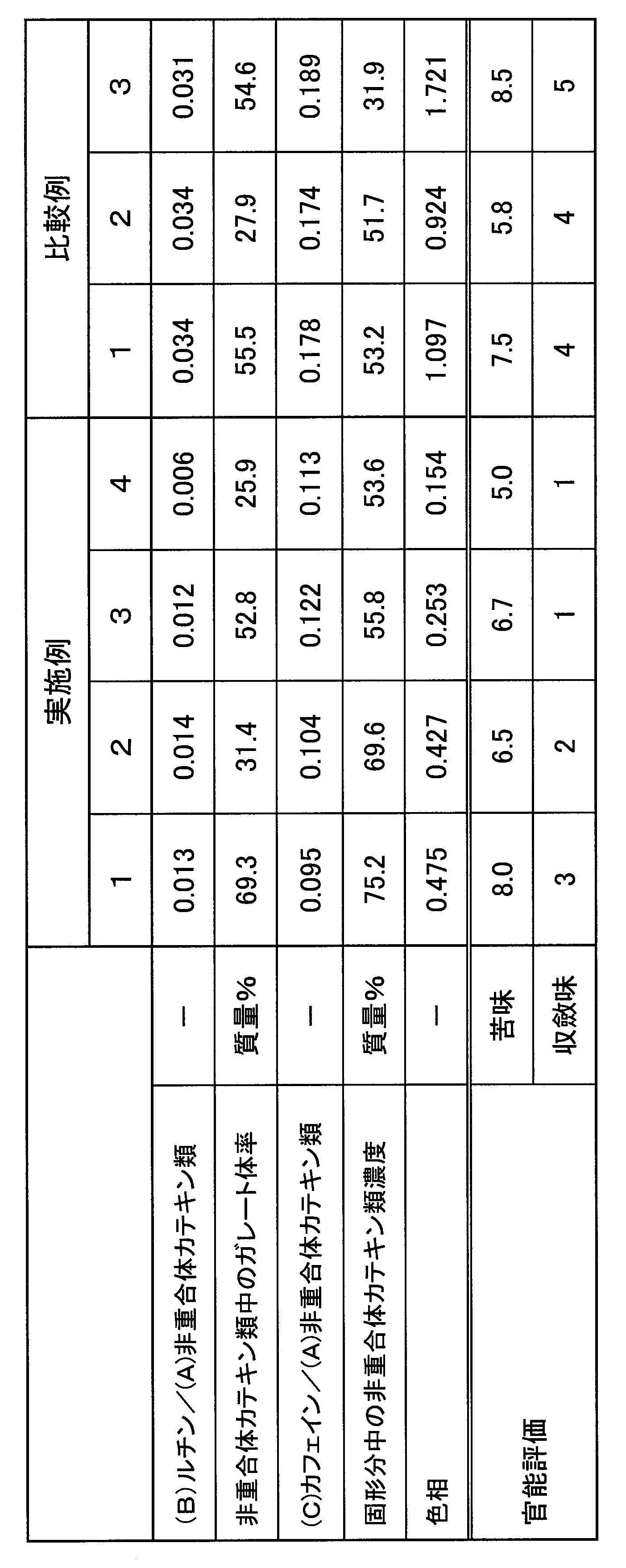
- Example 1 After dissolving 5.0 g of “green tea extract 1” in 100 g of ion-exchanged water, 100 mL of ethyl acetate was added and mixed. After separation by standing, after removing the aqueous layer, the ethyl acetate was distilled off with an evaporator, water was added, and the resulting aqueous solution was brought into contact with 0.025 g of activated carbon (Dazai SGP, manufactured by Phutamura Chemical Co., Ltd.). Subsequently, filtration was performed with a 0.2 ⁇ m membrane filter. Then, it was freeze-dried under the conditions of 93.3 Pa and 25 ° C. to obtain “Purified Green Tea Extract 1”. The analysis values are shown in Table 2.
- Example 2 “Purified green tea extract 2” was obtained in the same manner as in Example 1 except that 5.0 g of “green tea extract 2” was used instead of 5.0 g of “green tea extract 1”. The analysis values are shown in Table 2.
- Example 3 200 g of “green tea extract 1” was put into 800 g of 92 mass% ethanol aqueous solution, and stirring was continued for about 3 hours at room temperature. Thereafter, the produced precipitate was filtered with No. 2 filter paper. To the obtained filtrate, 417 g of ion-exchanged water was added, and the mixture was stirred for about 5 minutes under 15 ° C. and 100 rpm stirring conditions. The mixed solution was separated using a small cooling centrifuge (manufactured by Hitachi Koki Co., Ltd.) to separate turbid components deposited at an operating temperature of 15 ° C. (6000 rpm, 5 minutes).
- a small cooling centrifuge manufactured by Hitachi Koki Co., Ltd.
- the obtained solution was brought into contact with 30 g of activated carbon (Kuraray Coal GLC, manufactured by Kuraray Chemical Co., Ltd.), followed by filtration through a 0.2 ⁇ m membrane filter.
- activated carbon Karl Fischer Coal GLC, manufactured by Kuraray Chemical Co., Ltd.
- alcohol was distilled off with an evaporator, and the resulting solution was brought into contact with 1 g of activated carbon (Taiko SGP, manufactured by Phutamura Chemical Co., Ltd.), followed by filtration through a 0.2 ⁇ m membrane filter.
- it was freeze-dried under the conditions of 93.3 Pa and 25 ° C. to obtain “Purified Green Tea Extract 3”.
- the analysis values are shown in Table 2.
- Example 4 “Purified green tea extract 4” was obtained in the same manner as in Example 3 except that 200 g of “green tea extract 2” was used instead of 200 g of “green tea extract 1”. The analysis values are shown in Table 2.
- Comparative Example 1 200 g of “green tea extract 1” was put into 800 g of 92 mass% ethanol aqueous solution, and stirring was continued for about 3 hours at room temperature. Thereafter, the produced precipitate was filtered with No. 2 filter paper. To the obtained filtrate, 417 g of ion-exchanged water was added, and the mixture was stirred for about 5 minutes under 15 ° C. and 100 rpm stirring conditions. From the mixed solution, a turbid component precipitated at an operating temperature of 15 ° C. was separated using a small cooling centrifuge (manufactured by Hitachi Koki Co., Ltd.) (6000 rpm, 5 minutes). Next, alcohol was distilled off from the obtained solution with an evaporator, and then lyophilized under conditions of 93.3 Pa and 25 ° C. to obtain “green tea extract a”. The analysis values are shown in Table 2.
- Comparative Example 2 “Green tea extract b” was obtained in the same manner as in Comparative Example 1 except that 200 g of “green tea extract 2” was used instead of 200 g of “green tea extract 1”. The analysis values are shown in Table 2.
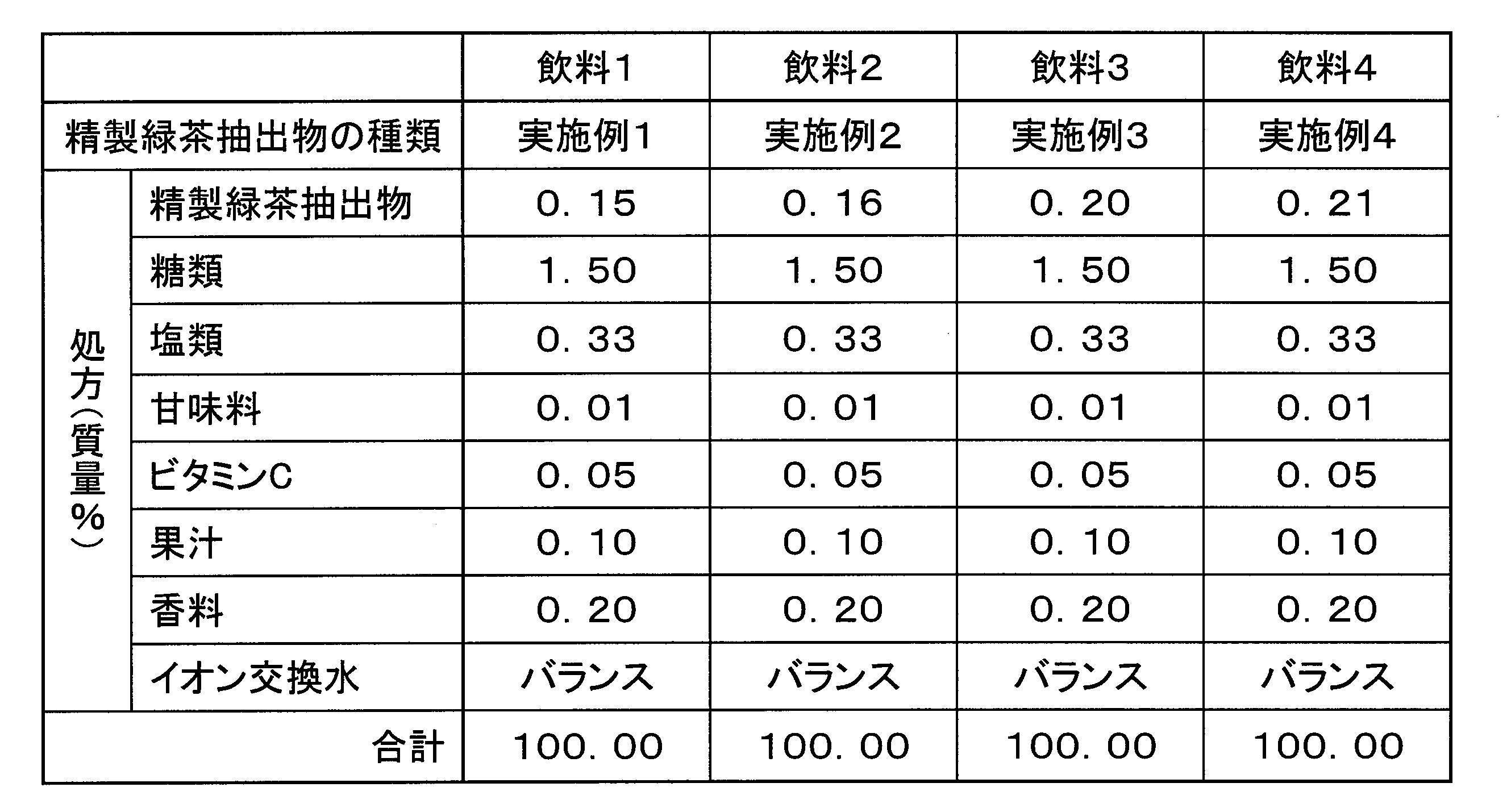
- Example 5 Using the purified green tea extracts of Examples 1 to 4, each component was blended in the proportions shown in Table 4 to prepare a beverage having a non-polymerized catechin concentration of 0.11% by mass. Subsequently, the obtained beverage was subjected to sterilization treatment and hot pack filling based on the Food Sanitation Law to obtain a container-packed beverage. The obtained container-packed drink did not have an unpleasant astringency and was easy to drink.
Landscapes
- Life Sciences & Earth Sciences (AREA)
- Chemical & Material Sciences (AREA)
- Polymers & Plastics (AREA)
- Food Science & Technology (AREA)
- Engineering & Computer Science (AREA)
- Health & Medical Sciences (AREA)
- Nutrition Science (AREA)
- Mycology (AREA)
- Botany (AREA)
- Dispersion Chemistry (AREA)
- Tea And Coffee (AREA)
- Seasonings (AREA)
- Non-Alcoholic Beverages (AREA)
Abstract
Description
一方、茶に含まれるルチンは、テアフラビンと同様に紅茶の品質を支える成分として知られているに過ぎない(非特許文献1)。
(A)非重合体カテキン類
(B)ルチン
を含有し、(B)ルチンと、(A)非重合体カテキン類との含有質量比[(B)/(A)]が0.03以下であり、かつ(A)非重合体カテキン類中のガレート体率が0.01~70質量%である、精製緑茶抽出物を提供するものである。
本発明はまた、上記精製緑茶抽出物を配合した食品又は飲料を提供するものである。
本発明の精製緑茶抽出物は、高濃度の非重合体カテキン類を含有するにも拘らず、不快な収斂味が低減されるとともに、色相に優れるものである。したがって、本発明の精製緑茶抽出物は、飲食品へ配合すれば幅広い用途展開が可能であり、また長期間継続摂取することが可能であるから非重合体カテキン類による生理効果を十分に期待することができる。
本発明の精製緑茶抽出物は、ルチンの含有量が顕著に低減されていることを特徴とするものである。具体的には、(B)ルチンの含有量は、(A)非重合体カテキン類に対する質量比[(B)/(A)]で0.03以下であるが、収斂味抑制の観点から、0.025以下、更に0.02以下、更に0.015以下、特に0.010以下であることが好ましい。なお、質量比[(B)/(A)]の下限値は実質的にルチンを含有せず0であってもよいが、精製効率の観点から、0.0001以上、更に0.005以上であることが好ましい。ここで、本発明において「実質的にルチンを含有しない」とは、後掲の実施例の「ルチンの測定」においてルチン量が検出限界以下であることをいう。
本発明の精製緑茶抽出物は、大量の非重合体カテキン類を簡便に継続摂取するために、固形分中に非重合体カテキン類を25~95質量%含有することが好ましく、36~95質量%、更に40~90質量%、特に50~80質量%含有することが好ましい。ここで、「固形分」とは、試料を105℃の電気恒温乾燥機で3時間乾燥して得た乾燥残分をいう。
茶を抽出する方法としては、例えば、攪拌抽出、カラム法、ドリップ抽出等の従来の方法を採用することができる。また、抽出用水にあらかじめアスコルビン酸ナトリウムなどの有機酸又は有機酸塩類を添加してもよい。更に、煮沸脱気や窒素ガス等の不活性ガスを通気して溶存酸素を除去しつつ、いわゆる非酸化的雰囲気下で抽出する方法も併用してもよい。このようにして得られた抽出液は、そのままでも、乾燥、濃縮しても本発明に使用できる。緑茶抽出物の形態としては、例えば、液体、スラリー、半固体、固体等が挙げられる。
(i)緑茶抽出物を疎水性有機溶媒で分相し、得られた有機層から疎水性有機溶媒を留去した後、水を添加して水溶液を調製し、活性炭と少なくとも1回接触処理する方法。
(ii)緑茶抽出物に親水性有機溶媒と水と混合して生成した沈殿を分離し、次いで得られた溶液を25℃以下(好ましくは5~20℃)の温度で遠心分離し析出物を分離し、次いで親水性有機溶媒水溶液中又は水中で活性炭と少なくとも2回接触処理する方法。
なお、緑茶抽出物として、タンナーゼ活性を有する酵素で処理したものを用いてもよく、その処理方法としては、例えば、特開2004-321105号公報に記載の方法を採用することができる。
一方、親水性有機溶媒としては、例えば、メタノール、エタノール等のアルコール、アセトン等のケトンが例示される。中でも、飲食品への使用の点から、アルコール、特にエタノールが好ましい。親水性有機溶媒と水との混合質量比は60/40~97/3、更に60/40~95/5、特に85/15~95/5であることが好ましい。また、その親水性有機溶媒水溶液を、緑茶抽出物の質量(乾燥質量)に対して、2~8倍、特に3~6倍の質量比率で使用することが、非重合体カテキン類の抽出効率、緑茶抽出物の精製効率等の点で好ましい。
活性炭の使用量は、水又は親水性有機溶媒水溶液100質量部に対して0.01~8質量部、更に0.02~5質量部、特に0.02~3質量部添加することが、カフェイン除去効率、ろ過工程におけるケーク抵抗が小さい点で好ましい。
処理時間は、10~180分程度の熟成時間を設けることが好ましく、これらの処理は10~60℃、更に10~50℃、特に10~40℃で行うことが好ましい。
なお、精製緑茶抽出物の質量比[(C)/(A)]は、活性炭の使用量を増量して接触処理するか、あるいは接触処理を複数回実施することで上記範囲内に調整することができる。活性炭との接触処理を複数回実施する場合、各処理工程間でろ過工程を設けることが好ましい。
本発明の飲料としては、例えば、茶飲料、非茶系飲料が挙げられる。茶飲料としては、例えば、緑茶飲料、烏龍茶飲料、紅茶飲料が挙げられる。また、非茶系飲料としては、清涼飲料(例えば、果汁ジュース、野菜ジュース、スポーツ飲料、アイソトニック飲料)、コーヒー飲料、栄養ドリンク剤、美容ドリンク剤等の非アルコール飲料、ビール、ワイン、清酒、梅酒、発泡酒、ウィスキー、ブランデー、焼酎、ラム、ジン、リキュール類等のアルコール飲料が挙げられる。
また、食品としては、例えば、菓子類(例えば、パン、ケーキ、クッキー、ビスケット等の焼菓子、チューインガム、チョコレート、キャンデー)、デザート類(例えば、ゼリー、ヨーグルト、アイスクリーム)、レトルト食品、調味料(例えば、ソース、スープ、ドレッシング、マヨネーズ、クリーム)が挙げられる。なお、飲食品の形態は特に限定されず、摂取しやすい形態であれば、固形、粉末、液体、ゲル状、スラリー状等のいずれであってもよい。
また、容器詰飲料は、例えば、金属缶のように容器に充填後、加熱殺菌できる場合にあっては食品衛生法に定められた殺菌条件で製造することができる。PETボトル、紙容器のようにレトルト殺菌できないものについては、あらかじめ上記と同等の殺菌条件、例えばプレート式熱交換器などで高温短時間殺菌後、一定の温度まで冷却して容器に充填する等の方法が採用される。また無菌下で、充填された容器に別の成分を配合して充填してもよい。
試料溶液をフィルター(0.45μm)で濾過し、高速液体クロマトグラフ(型式SCL-10AVP、島津製作所製)を用い、オクタデシル基導入液体クロマトグラフ用パックドカラム(L-カラムTM ODS、4.6mmφ×250mm:財団法人 化学物質評価研究機構製)を装着し、カラム温度35℃でグラディエント法により行った。移動相A液は酢酸を0.1mol/L含有する蒸留水溶液、B液は酢酸を0.1mol/L含有するアセトニトリル溶液とし、流速は1mL/分、試料注入量は10μL、UV検出器波長は280nmの条件で行った。なお、グラディエント条件は以下の通りである。
0 97% 3%
5 97% 3%
37 80% 20%
43 80% 20%
43.5 0% 100%
48.5 0% 100%
49 97% 3%
60 97% 3%
試料溶液をフィルター(0.45μm)で濾過し、高速液体クロマトグラフ(型式Waters2695、WATERS製)を用い、カラム(Shimpach VP ODS、150×4.6mmI.D.)を装着し、カラム温度40℃でグラディエント法により行った。移動相C液はリン酸を0.05質量%含有する蒸留水溶液、D液はメタノール溶液とし、流速は1mL/分、試料注入量は10μL、UV検出器波長は368nmの条件で行った。なお、グラディエントの条件は、以下のとおりである。
0 95% 5%
20 80% 20%
40 30% 70%
41 0% 100%
46 0% 100%
47 95% 5%
60 95% 5%
硫酸キニーネ2水和物を表1に記載の苦味強度に対応した濃度に調整した。各実施例及び比較例で得られた精製緑茶抽出物を、非重合体カテキン類濃度0.2質量%となるようにイオン交換水で希釈した後、評価パネラー4名による官能試験を行った。官能試験は、評価サンプルを試飲して標準苦味溶液のどのサンプルと苦味の強さが等しいかを協議により判断した。

各実施例及び比較例で得られた精製緑茶抽出物を、非重合体カテキン類濃度0.2質量%となるようにイオン交換水で希釈した後、評価パネラー4名による官能試験を行った。官能試験は、下記の基準で飲用直後の不快な収斂味を評価し、その後協議により最終スコアを決定した。
4:収斂味がわずかに強い。
3:収斂味がわずかに弱い。
2:収斂味がやや弱い。
1:収斂味が弱い。
非重合体カテキン類濃度0.2質量%となるよう調整した試料溶液を、分光光度計(U2810形、日立製作所製)で400nmの吸光度を測定した。
精製緑茶抽出物の含水率は、常圧加熱乾燥法により測定した。すなわち、試料約1gを秤量し、105℃で3時間乾燥し、乾燥後の試料を秤量した。乾燥前後の試料の質量から固形分当たりの含水率(質量%)を算出した。
緑茶葉(ケニア産、大葉種)3kgに88℃の熱水45kgを添加し、60分間攪拌してバッチ抽出した。次いで、100メッシュ金網で粗ろ過後、抽出液中の微粉を除去する為に遠心分離操作を行い、「緑茶抽出液」36.8kg(pH5.3)を得た(緑茶抽出液中の非重合体カテキン類濃度=0.88質量%、非重合体カテキン類中のガレート体率=51.6質量%、カフェイン=0.17質量%)。緑茶抽出液の一部を凍結乾燥し、緑茶抽出液の濃縮物である「緑茶抽出物1」を得た。「緑茶抽出物1」中の非重合体カテキン類濃度=32.8質量%、非重合体カテキン類中のガレート体率=51.6質量%、カフェイン/非重合体カテキン類比=0.193であった。
緑茶葉(ケニア産、大葉種)3kgに88℃の熱水45kgを添加し、60分間攪拌してバッチ抽出した。次いで、100メッシュ金網で粗ろ過後、抽出液中の微粉を除去する為に遠心分離操作を行い、「緑茶抽出液」36.8kg(pH5.3)を得た(緑茶抽出液中の非重合体カテキン類濃度=0.88質量%、非重合体カテキン類中のガレート体率=51.6質量%、カフェイン=0.17質量%)。この緑茶抽出液を温度15℃に保持し、タンナーゼ(キッコーマン社製タンナーゼKTFH、500U/g)を緑茶抽出液に対して430ppmとなる濃度で添加し、55分間保持し、90℃に溶液を加熱して、2分間保持し酵素を失活させ、反応を止めた(pH5.2)。次いで70℃、6.7kpaの条件下で減圧濃縮によりBrix濃度20%まで濃縮処理を行い、更に噴霧乾燥して粉末状の抽出液の濃縮物である「緑茶抽出物2」1.0kgを得た。得られた「緑茶抽出物2」は非重合体カテキン類濃度=30.5質量%、非重合体カテキン類中のガレート体率=31.6質量%、カフェイン/非重合体カテキン類比=0.183であった。
「緑茶抽出物1」5.0gをイオン交換水100gに溶解した後、酢酸エチル100mLを添加し、混合した。静置による分層後、水層を除去した後、エバポレータにより酢酸エチルを留去し、水を添加し、得られた水溶液を活性炭(太閤SGP、フタムラ化学株式会社製)0.025gと接触させ、続けて0.2μmメンブランフィルターによって濾過を行った。その後、93.3Pa、25℃の条件で凍結乾燥して「精製緑茶抽出物1」を得た。その分析値を表2に示す。
「緑茶抽出物1」5.0gに換えて、「緑茶抽出物2」5.0gを用いた以外は実施例1と同様にして「精製緑茶抽出物2」を得た。その分析値を表2に示す。
92質量%エタノール水溶液800g中に、「緑茶抽出物1」200gを投入し、室温のまま約3時間の攪拌を続けた。その後、生成している沈殿を2号ろ紙で濾過した。得られたろ液にイオン交換水を417g添加し、15℃、100rpm攪拌条件下で約5分間攪拌を行った。その混合溶液を、小型冷却遠心分離機(日立工機社製)を用い、操作温度15℃で析出した濁り成分を分離した(6000rpm、5分)。得られた溶液を活性炭(クラレコールGLC、クラレケミカル社製)30gと接触させ、続けて0.2μmメンブランフィルターによってろ過を行った。次に、エバポレータにてアルコールを留去し、得られた溶液を活性炭(太閤SGP、フタムラ化学株式会社製)1gと接触させ、続けて0.2μmメンブランフィルターによって濾過を行なった。その後、93.3Pa、25℃の条件で凍結乾燥して「精製緑茶抽出物3」を得た。その分析値を表2に示す。
「緑茶抽出物1」200gに換えて、「緑茶抽出物2」200gを用いた以外は実施例3と同様にして「精製緑茶抽出物4」を得た。その分析値を表2に示す。
92質量%エタノール水溶液800g中に、「緑茶抽出物1」200gを投入し、室温のまま約3時間の攪拌を続けた。その後、生成している沈殿を2号ろ紙で濾過した。得られたろ液にイオン交換水を417g添加し、15℃、100rpm攪拌条件下で約5分間攪拌を行った。その混合溶液を、小型冷却遠心分離機(日立工機社製)を用いて操作温度15℃で析出した濁り成分を分離した(6000rpm、5分)。次に、得られた溶液をエバポレータにてアルコール留去し、その後93.3Pa、25℃の条件で凍結乾燥して「緑茶抽出物a」を得た。その分析値を表2に示す。
「緑茶抽出物1」200gに換えて「緑茶抽出物2」200gを用いた以外は比較例1と同様にして「緑茶抽出物b」を得た。その分析値を表2に示す。
三井農林社製ポリフェノンHGを用いた。その分析値を表2に示す。
実施例1~4の精製緑茶抽出物の凍結乾燥品と、実施例2及び実施例3において凍結乾燥せずにそのまま凍結したものについて、含水率と下記条件における濁度(NTU)を測定した。その結果を表3に示す。
なお、濁度は上記凍結乾燥品と上記凍結品とを、それぞれBrix12になるようにイオン交換水で溶解し、その水溶液の濁度を測定した。ここで、濁度測定には、濁度計(Turbidimeter/TN-100 EUTECH INSTRUMENTS社製)を使用し、含水率は前述の方法で測定した。また、凍結品は、25℃、10分の解凍条件で解凍後、測定を実施した。

また、保存時の外観観察から、精製緑茶抽出物中の含水率が10質量%以下であれば、25℃においても精製緑茶抽出物の腐敗を防ぐことができ、また含水率の下限値が0.1質量%以上であれば、空気酸化等による保存時の着色を防止できる。
実施例1~4の精製緑茶抽出物を用い、表4に記載の割合で各成分を配合して非重合カテキン類濃度が0.11質量%の飲料を調製した。次いで、得られた飲料を食品衛生法に基づく殺菌処理及びホットパック充填を行って容器詰飲料とした。得られた容器詰飲料は、不快な収斂味がなく、飲みやすい飲料であった。
Claims (7)
- 次の成分(A)及び(B):
(A)非重合体カテキン類
(B)ルチン
を含有し、
(B)ルチンと、(A)非重合体カテキン類との含有質量比[(B)/(A)]が0.03以下であり、かつ
(A)非重合体カテキン類中のガレート体率が0.01~70質量%である、
精製緑茶抽出物。 - (C)カフェインと(A)非重合体カテキン類との含有質量比[(C)/(A)]が0.17以下である、請求項1記載の精製緑茶抽出物。
- 色相が0.8以下である、請求項1又は2記載の精製緑茶抽出物。
- 当該精製緑茶抽出物中の含水率が10質量%以下である、請求項1~3のいずれか1項に記載の精製緑茶抽出物。
- 請求項1~4のいずれか1項に記載の精製緑茶抽出物を配合した食品。
- 請求項1~4のいずれか1項に記載の精製緑茶抽出物を配合した飲料。
- 容器詰飲料である、請求項6項記載の飲料。
Priority Applications (2)
| Application Number | Priority Date | Filing Date | Title |
|---|---|---|---|
| CN2009801457577A CN102215698A (zh) | 2008-11-21 | 2009-11-20 | 精制绿茶提取物 |
| US13/130,453 US20110223310A1 (en) | 2008-11-21 | 2009-11-20 | Purified green tea extract |
Applications Claiming Priority (2)
| Application Number | Priority Date | Filing Date | Title |
|---|---|---|---|
| JP2008298313 | 2008-11-21 | ||
| JP2008-298313 | 2008-11-21 |
Publications (1)
| Publication Number | Publication Date |
|---|---|
| WO2010058593A1 true WO2010058593A1 (ja) | 2010-05-27 |
Family
ID=42198036
Family Applications (1)
| Application Number | Title | Priority Date | Filing Date |
|---|---|---|---|
| PCT/JP2009/006262 Ceased WO2010058593A1 (ja) | 2008-11-21 | 2009-11-20 | 精製緑茶抽出物 |
Country Status (4)
| Country | Link |
|---|---|
| US (1) | US20110223310A1 (ja) |
| JP (1) | JP5366771B2 (ja) |
| CN (1) | CN102215698A (ja) |
| WO (1) | WO2010058593A1 (ja) |
Cited By (2)
| Publication number | Priority date | Publication date | Assignee | Title |
|---|---|---|---|---|
| CN103118553A (zh) * | 2010-09-21 | 2013-05-22 | 花王株式会社 | 谷物食品及其制造方法 |
| JP2018113990A (ja) * | 2018-04-27 | 2018-07-26 | 花王株式会社 | 容器詰飲料 |
Families Citing this family (6)
| Publication number | Priority date | Publication date | Assignee | Title |
|---|---|---|---|---|
| WO2015094224A1 (en) * | 2013-12-18 | 2015-06-25 | Nestec S.A. | Methods for increasing the clarity and refreshing attributes and reducing the bitterness and astringency of green tea |
| JP6162668B2 (ja) * | 2014-09-12 | 2017-07-12 | 花王株式会社 | 容器詰飲料 |
| CN104366505A (zh) * | 2014-12-10 | 2015-02-25 | 韦星平 | 抗氧化天然食品添加剂 |
| JP6336172B2 (ja) * | 2017-04-04 | 2018-06-06 | 花王株式会社 | 容器詰飲料 |
| JP7145376B2 (ja) * | 2018-04-26 | 2022-10-03 | ライオン株式会社 | 組成物及びその製造方法 |
| JP7500544B2 (ja) * | 2019-03-29 | 2024-06-17 | サントリーホールディングス株式会社 | カテキン類含有飲料、その製造方法及びカテキン類含有飲料の苦味を低減する方法 |
Citations (7)
| Publication number | Priority date | Publication date | Assignee | Title |
|---|---|---|---|---|
| JP2002233333A (ja) * | 2001-02-09 | 2002-08-20 | Umai Kk | ポリフェノール含有食品 |
| WO2005053415A1 (ja) * | 2003-12-02 | 2005-06-16 | Kao Corporation | 容器詰飲料 |
| JP2006129757A (ja) * | 2004-11-04 | 2006-05-25 | Pharma Foods International Co Ltd | 苦味やえぐ味を低減した緑茶抽出物、及び該抽出物を含有する飲食品 |
| WO2007109802A2 (en) * | 2006-03-23 | 2007-09-27 | Herbalscience Singapore Pte. Ltd. | Extracts and methods comprising green tea species |
| JP2008079609A (ja) * | 2006-08-31 | 2008-04-10 | Kao Corp | 精製茶抽出物の製造方法 |
| WO2008072360A1 (ja) * | 2006-12-14 | 2008-06-19 | Ito En, Ltd. | カテキン組成物及びその製造方法 |
| WO2008081542A1 (ja) * | 2006-12-28 | 2008-07-10 | Kao Corporation | 茶抽出物 |
Family Cites Families (13)
| Publication number | Priority date | Publication date | Assignee | Title |
|---|---|---|---|---|
| JPS59219384A (ja) * | 1983-05-30 | 1984-12-10 | Mitsui Norin Kk | 天然抗酸化剤の製造方法 |
| US4839187A (en) * | 1984-06-14 | 1989-06-13 | Nestec Sa | Antioxidant compositions |
| US6569446B1 (en) * | 1996-09-20 | 2003-05-27 | The Howard Foundation | Solubilization of flavonols |
| DE19735385A1 (de) * | 1997-08-14 | 1999-02-18 | Wild Gmbh & Co Kg Rudolf | Saures Getränk |
| AU2003275679A1 (en) * | 2002-10-28 | 2004-05-13 | Kao Corporation | Method of removing caffeine from caffeine-containing catechin compound composition |
| JP4225814B2 (ja) * | 2002-11-29 | 2009-02-18 | 花王株式会社 | カフェイン含有カテキン類組成物の脱カフェイン方法 |
| JP2007001893A (ja) * | 2005-06-22 | 2007-01-11 | Ito En Ltd | カテキン組成物及びその製造方法 |
| JP4542047B2 (ja) * | 2005-10-20 | 2010-09-08 | 花王株式会社 | 精製緑茶抽出物の製造方法 |
| JP4745784B2 (ja) * | 2005-10-13 | 2011-08-10 | 花王株式会社 | 精製緑茶抽出物 |
| US9808023B2 (en) * | 2006-03-02 | 2017-11-07 | Kao Corporation | Process for producing purified tea extract |
| US7745486B2 (en) * | 2006-07-17 | 2010-06-29 | Quercegen Pharma Llc | Quercetin-containing compositions |
| EP2008530B1 (de) * | 2007-06-19 | 2011-01-19 | Symrise AG | Aromakomposition zum Verringern oder Unterdrücken von unerwünschtem bitteren und adstringierenden Eindruck |
| AU2008298187B2 (en) * | 2007-09-11 | 2013-06-20 | Suntory Beverage & Food Limited | Food or Drink with improved Sweetener Taste |
-
2009
- 2009-11-20 WO PCT/JP2009/006262 patent/WO2010058593A1/ja not_active Ceased
- 2009-11-20 US US13/130,453 patent/US20110223310A1/en not_active Abandoned
- 2009-11-20 CN CN2009801457577A patent/CN102215698A/zh active Pending
- 2009-11-20 JP JP2009264441A patent/JP5366771B2/ja active Active
Patent Citations (7)
| Publication number | Priority date | Publication date | Assignee | Title |
|---|---|---|---|---|
| JP2002233333A (ja) * | 2001-02-09 | 2002-08-20 | Umai Kk | ポリフェノール含有食品 |
| WO2005053415A1 (ja) * | 2003-12-02 | 2005-06-16 | Kao Corporation | 容器詰飲料 |
| JP2006129757A (ja) * | 2004-11-04 | 2006-05-25 | Pharma Foods International Co Ltd | 苦味やえぐ味を低減した緑茶抽出物、及び該抽出物を含有する飲食品 |
| WO2007109802A2 (en) * | 2006-03-23 | 2007-09-27 | Herbalscience Singapore Pte. Ltd. | Extracts and methods comprising green tea species |
| JP2008079609A (ja) * | 2006-08-31 | 2008-04-10 | Kao Corp | 精製茶抽出物の製造方法 |
| WO2008072360A1 (ja) * | 2006-12-14 | 2008-06-19 | Ito En, Ltd. | カテキン組成物及びその製造方法 |
| WO2008081542A1 (ja) * | 2006-12-28 | 2008-07-10 | Kao Corporation | 茶抽出物 |
Cited By (3)
| Publication number | Priority date | Publication date | Assignee | Title |
|---|---|---|---|---|
| CN103118553A (zh) * | 2010-09-21 | 2013-05-22 | 花王株式会社 | 谷物食品及其制造方法 |
| CN103118553B (zh) * | 2010-09-21 | 2015-07-08 | 花王株式会社 | 谷物食品及其制造方法 |
| JP2018113990A (ja) * | 2018-04-27 | 2018-07-26 | 花王株式会社 | 容器詰飲料 |
Also Published As
| Publication number | Publication date |
|---|---|
| CN102215698A (zh) | 2011-10-12 |
| JP2010148499A (ja) | 2010-07-08 |
| US20110223310A1 (en) | 2011-09-15 |
| JP5366771B2 (ja) | 2013-12-11 |
Similar Documents
| Publication | Publication Date | Title |
|---|---|---|
| JP5366771B2 (ja) | 精製緑茶抽出物 | |
| JP5399864B2 (ja) | 精製茶抽出物 | |
| JP5969717B1 (ja) | 緑茶抽出組成物 | |
| JP4902655B2 (ja) | 茶抽出物 | |
| TWI607708B (zh) | Green tea extract composition | |
| US20090104337A1 (en) | Process for producing purified green tea extract | |
| JP5336340B2 (ja) | 精製茶抽出物の製造方法 | |
| JP4800779B2 (ja) | 精製緑茶抽出物の製造法 | |
| JP5820110B2 (ja) | 精製茶抽出物 | |
| CN102361562B (zh) | 多酚组合物 | |
| JP5717385B2 (ja) | 精製緑茶抽出物の製造方法 | |
| JP6777572B2 (ja) | 茶飲料 | |
| JP4383337B2 (ja) | 高濃度カテキン含有容器詰烏龍茶飲料 | |
| JP5806455B2 (ja) | 精製カテキン類含有茶抽出物の製造方法 | |
| JP6702907B2 (ja) | 非重合体カテキン類含有飲料 | |
| JP5727767B2 (ja) | 精製緑茶抽出物の製造方法 | |
| JP5427499B2 (ja) | 精製茶抽出物の製造方法 | |
| JP2011182696A (ja) | 精製茶抽出物の製造方法 | |
| JP4119829B2 (ja) | 緑茶容器詰飲料 | |
| JP2014096994A (ja) | 精製緑茶抽出物の製造方法 | |
| JP5185780B2 (ja) | 精製茶抽出物 | |
| JP2013138635A (ja) | 緑茶抽出物 |
Legal Events
| Date | Code | Title | Description |
|---|---|---|---|
| WWE | Wipo information: entry into national phase |
Ref document number: 200980145757.7 Country of ref document: CN |
|
| 121 | Ep: the epo has been informed by wipo that ep was designated in this application |
Ref document number: 09827374 Country of ref document: EP Kind code of ref document: A1 |
|
| WWE | Wipo information: entry into national phase |
Ref document number: 13130453 Country of ref document: US |
|
| NENP | Non-entry into the national phase |
Ref country code: DE |
|
| 122 | Ep: pct application non-entry in european phase |
Ref document number: 09827374 Country of ref document: EP Kind code of ref document: A1 |