WO2010047181A1 - 誘電体セラミックおよび積層セラミックコンデンサ - Google Patents
誘電体セラミックおよび積層セラミックコンデンサ Download PDFInfo
- Publication number
- WO2010047181A1 WO2010047181A1 PCT/JP2009/065291 JP2009065291W WO2010047181A1 WO 2010047181 A1 WO2010047181 A1 WO 2010047181A1 JP 2009065291 W JP2009065291 W JP 2009065291W WO 2010047181 A1 WO2010047181 A1 WO 2010047181A1
- Authority
- WO
- WIPO (PCT)
- Prior art keywords
- dielectric ceramic
- ceramic
- dielectric
- present
- main component
- Prior art date
- Legal status (The legal status is an assumption and is not a legal conclusion. Google has not performed a legal analysis and makes no representation as to the accuracy of the status listed.)
- Ceased
Links
Images

Classifications
-
- H—ELECTRICITY
- H01—ELECTRIC ELEMENTS
- H01G—CAPACITORS; CAPACITORS, RECTIFIERS, DETECTORS, SWITCHING DEVICES, LIGHT-SENSITIVE OR TEMPERATURE-SENSITIVE DEVICES OF THE ELECTROLYTIC TYPE
- H01G4/00—Fixed capacitors; Processes of their manufacture
- H01G4/002—Details
- H01G4/018—Dielectrics
- H01G4/06—Solid dielectrics
- H01G4/08—Inorganic dielectrics
- H01G4/12—Ceramic dielectrics
- H01G4/1209—Ceramic dielectrics characterised by the ceramic dielectric material
- H01G4/1218—Ceramic dielectrics characterised by the ceramic dielectric material based on titanium oxides or titanates
- H01G4/1227—Ceramic dielectrics characterised by the ceramic dielectric material based on titanium oxides or titanates based on alkaline earth titanates
-
- C—CHEMISTRY; METALLURGY
- C04—CEMENTS; CONCRETE; ARTIFICIAL STONE; CERAMICS; REFRACTORIES
- C04B—LIME, MAGNESIA; SLAG; CEMENTS; COMPOSITIONS THEREOF, e.g. MORTARS, CONCRETE OR LIKE BUILDING MATERIALS; ARTIFICIAL STONE; CERAMICS; REFRACTORIES; TREATMENT OF NATURAL STONE
- C04B35/00—Shaped ceramic products characterised by their composition; Ceramics compositions; Processing powders of inorganic compounds preparatory to the manufacturing of ceramic products
- C04B35/01—Shaped ceramic products characterised by their composition; Ceramics compositions; Processing powders of inorganic compounds preparatory to the manufacturing of ceramic products based on oxide ceramics
- C04B35/46—Shaped ceramic products characterised by their composition; Ceramics compositions; Processing powders of inorganic compounds preparatory to the manufacturing of ceramic products based on oxide ceramics based on titanium oxides or titanates
- C04B35/462—Shaped ceramic products characterised by their composition; Ceramics compositions; Processing powders of inorganic compounds preparatory to the manufacturing of ceramic products based on oxide ceramics based on titanium oxides or titanates based on titanates
- C04B35/465—Shaped ceramic products characterised by their composition; Ceramics compositions; Processing powders of inorganic compounds preparatory to the manufacturing of ceramic products based on oxide ceramics based on titanium oxides or titanates based on titanates based on alkaline earth metal titanates
- C04B35/468—Shaped ceramic products characterised by their composition; Ceramics compositions; Processing powders of inorganic compounds preparatory to the manufacturing of ceramic products based on oxide ceramics based on titanium oxides or titanates based on titanates based on alkaline earth metal titanates based on barium titanates
- C04B35/4682—Shaped ceramic products characterised by their composition; Ceramics compositions; Processing powders of inorganic compounds preparatory to the manufacturing of ceramic products based on oxide ceramics based on titanium oxides or titanates based on titanates based on alkaline earth metal titanates based on barium titanates based on BaTiO3 perovskite phase
-
- C—CHEMISTRY; METALLURGY
- C04—CEMENTS; CONCRETE; ARTIFICIAL STONE; CERAMICS; REFRACTORIES
- C04B—LIME, MAGNESIA; SLAG; CEMENTS; COMPOSITIONS THEREOF, e.g. MORTARS, CONCRETE OR LIKE BUILDING MATERIALS; ARTIFICIAL STONE; CERAMICS; REFRACTORIES; TREATMENT OF NATURAL STONE
- C04B35/00—Shaped ceramic products characterised by their composition; Ceramics compositions; Processing powders of inorganic compounds preparatory to the manufacturing of ceramic products
- C04B35/01—Shaped ceramic products characterised by their composition; Ceramics compositions; Processing powders of inorganic compounds preparatory to the manufacturing of ceramic products based on oxide ceramics
- C04B35/48—Shaped ceramic products characterised by their composition; Ceramics compositions; Processing powders of inorganic compounds preparatory to the manufacturing of ceramic products based on oxide ceramics based on zirconium or hafnium oxides, zirconates, zircon or hafnates
- C04B35/49—Shaped ceramic products characterised by their composition; Ceramics compositions; Processing powders of inorganic compounds preparatory to the manufacturing of ceramic products based on oxide ceramics based on zirconium or hafnium oxides, zirconates, zircon or hafnates containing also titanium oxides or titanates
-
- H—ELECTRICITY
- H01—ELECTRIC ELEMENTS
- H01B—CABLES; CONDUCTORS; INSULATORS; SELECTION OF MATERIALS FOR THEIR CONDUCTIVE, INSULATING OR DIELECTRIC PROPERTIES
- H01B3/00—Insulators or insulating bodies characterised by the insulating materials; Selection of materials for their insulating or dielectric properties
- H01B3/02—Insulators or insulating bodies characterised by the insulating materials; Selection of materials for their insulating or dielectric properties mainly consisting of inorganic substances
- H01B3/12—Insulators or insulating bodies characterised by the insulating materials; Selection of materials for their insulating or dielectric properties mainly consisting of inorganic substances ceramics
-
- H—ELECTRICITY
- H01—ELECTRIC ELEMENTS
- H01G—CAPACITORS; CAPACITORS, RECTIFIERS, DETECTORS, SWITCHING DEVICES, LIGHT-SENSITIVE OR TEMPERATURE-SENSITIVE DEVICES OF THE ELECTROLYTIC TYPE
- H01G4/00—Fixed capacitors; Processes of their manufacture
- H01G4/30—Stacked capacitors
-
- C—CHEMISTRY; METALLURGY
- C04—CEMENTS; CONCRETE; ARTIFICIAL STONE; CERAMICS; REFRACTORIES
- C04B—LIME, MAGNESIA; SLAG; CEMENTS; COMPOSITIONS THEREOF, e.g. MORTARS, CONCRETE OR LIKE BUILDING MATERIALS; ARTIFICIAL STONE; CERAMICS; REFRACTORIES; TREATMENT OF NATURAL STONE
- C04B2235/00—Aspects relating to ceramic starting mixtures or sintered ceramic products
- C04B2235/02—Composition of constituents of the starting material or of secondary phases of the final product
- C04B2235/30—Constituents and secondary phases not being of a fibrous nature
- C04B2235/32—Metal oxides, mixed metal oxides, or oxide-forming salts thereof, e.g. carbonates, nitrates, (oxy)hydroxides, chlorides
- C04B2235/3205—Alkaline earth oxides or oxide forming salts thereof, e.g. beryllium oxide
- C04B2235/3206—Magnesium oxides or oxide-forming salts thereof
-
- C—CHEMISTRY; METALLURGY
- C04—CEMENTS; CONCRETE; ARTIFICIAL STONE; CERAMICS; REFRACTORIES
- C04B—LIME, MAGNESIA; SLAG; CEMENTS; COMPOSITIONS THEREOF, e.g. MORTARS, CONCRETE OR LIKE BUILDING MATERIALS; ARTIFICIAL STONE; CERAMICS; REFRACTORIES; TREATMENT OF NATURAL STONE
- C04B2235/00—Aspects relating to ceramic starting mixtures or sintered ceramic products
- C04B2235/02—Composition of constituents of the starting material or of secondary phases of the final product
- C04B2235/30—Constituents and secondary phases not being of a fibrous nature
- C04B2235/32—Metal oxides, mixed metal oxides, or oxide-forming salts thereof, e.g. carbonates, nitrates, (oxy)hydroxides, chlorides
- C04B2235/3205—Alkaline earth oxides or oxide forming salts thereof, e.g. beryllium oxide
- C04B2235/3208—Calcium oxide or oxide-forming salts thereof, e.g. lime
-
- C—CHEMISTRY; METALLURGY
- C04—CEMENTS; CONCRETE; ARTIFICIAL STONE; CERAMICS; REFRACTORIES
- C04B—LIME, MAGNESIA; SLAG; CEMENTS; COMPOSITIONS THEREOF, e.g. MORTARS, CONCRETE OR LIKE BUILDING MATERIALS; ARTIFICIAL STONE; CERAMICS; REFRACTORIES; TREATMENT OF NATURAL STONE
- C04B2235/00—Aspects relating to ceramic starting mixtures or sintered ceramic products
- C04B2235/02—Composition of constituents of the starting material or of secondary phases of the final product
- C04B2235/30—Constituents and secondary phases not being of a fibrous nature
- C04B2235/32—Metal oxides, mixed metal oxides, or oxide-forming salts thereof, e.g. carbonates, nitrates, (oxy)hydroxides, chlorides
- C04B2235/3205—Alkaline earth oxides or oxide forming salts thereof, e.g. beryllium oxide
- C04B2235/3213—Strontium oxides or oxide-forming salts thereof
-
- C—CHEMISTRY; METALLURGY
- C04—CEMENTS; CONCRETE; ARTIFICIAL STONE; CERAMICS; REFRACTORIES
- C04B—LIME, MAGNESIA; SLAG; CEMENTS; COMPOSITIONS THEREOF, e.g. MORTARS, CONCRETE OR LIKE BUILDING MATERIALS; ARTIFICIAL STONE; CERAMICS; REFRACTORIES; TREATMENT OF NATURAL STONE
- C04B2235/00—Aspects relating to ceramic starting mixtures or sintered ceramic products
- C04B2235/02—Composition of constituents of the starting material or of secondary phases of the final product
- C04B2235/30—Constituents and secondary phases not being of a fibrous nature
- C04B2235/32—Metal oxides, mixed metal oxides, or oxide-forming salts thereof, e.g. carbonates, nitrates, (oxy)hydroxides, chlorides
- C04B2235/3205—Alkaline earth oxides or oxide forming salts thereof, e.g. beryllium oxide
- C04B2235/3215—Barium oxides or oxide-forming salts thereof
-
- C—CHEMISTRY; METALLURGY
- C04—CEMENTS; CONCRETE; ARTIFICIAL STONE; CERAMICS; REFRACTORIES
- C04B—LIME, MAGNESIA; SLAG; CEMENTS; COMPOSITIONS THEREOF, e.g. MORTARS, CONCRETE OR LIKE BUILDING MATERIALS; ARTIFICIAL STONE; CERAMICS; REFRACTORIES; TREATMENT OF NATURAL STONE
- C04B2235/00—Aspects relating to ceramic starting mixtures or sintered ceramic products
- C04B2235/02—Composition of constituents of the starting material or of secondary phases of the final product
- C04B2235/30—Constituents and secondary phases not being of a fibrous nature
- C04B2235/32—Metal oxides, mixed metal oxides, or oxide-forming salts thereof, e.g. carbonates, nitrates, (oxy)hydroxides, chlorides
- C04B2235/3224—Rare earth oxide or oxide forming salts thereof, e.g. scandium oxide
-
- C—CHEMISTRY; METALLURGY
- C04—CEMENTS; CONCRETE; ARTIFICIAL STONE; CERAMICS; REFRACTORIES
- C04B—LIME, MAGNESIA; SLAG; CEMENTS; COMPOSITIONS THEREOF, e.g. MORTARS, CONCRETE OR LIKE BUILDING MATERIALS; ARTIFICIAL STONE; CERAMICS; REFRACTORIES; TREATMENT OF NATURAL STONE
- C04B2235/00—Aspects relating to ceramic starting mixtures or sintered ceramic products
- C04B2235/02—Composition of constituents of the starting material or of secondary phases of the final product
- C04B2235/30—Constituents and secondary phases not being of a fibrous nature
- C04B2235/32—Metal oxides, mixed metal oxides, or oxide-forming salts thereof, e.g. carbonates, nitrates, (oxy)hydroxides, chlorides
- C04B2235/3231—Refractory metal oxides, their mixed metal oxides, or oxide-forming salts thereof
- C04B2235/3239—Vanadium oxides, vanadates or oxide forming salts thereof, e.g. magnesium vanadate
-
- C—CHEMISTRY; METALLURGY
- C04—CEMENTS; CONCRETE; ARTIFICIAL STONE; CERAMICS; REFRACTORIES
- C04B—LIME, MAGNESIA; SLAG; CEMENTS; COMPOSITIONS THEREOF, e.g. MORTARS, CONCRETE OR LIKE BUILDING MATERIALS; ARTIFICIAL STONE; CERAMICS; REFRACTORIES; TREATMENT OF NATURAL STONE
- C04B2235/00—Aspects relating to ceramic starting mixtures or sintered ceramic products
- C04B2235/02—Composition of constituents of the starting material or of secondary phases of the final product
- C04B2235/30—Constituents and secondary phases not being of a fibrous nature
- C04B2235/32—Metal oxides, mixed metal oxides, or oxide-forming salts thereof, e.g. carbonates, nitrates, (oxy)hydroxides, chlorides
- C04B2235/3231—Refractory metal oxides, their mixed metal oxides, or oxide-forming salts thereof
- C04B2235/3241—Chromium oxides, chromates, or oxide-forming salts thereof
-
- C—CHEMISTRY; METALLURGY
- C04—CEMENTS; CONCRETE; ARTIFICIAL STONE; CERAMICS; REFRACTORIES
- C04B—LIME, MAGNESIA; SLAG; CEMENTS; COMPOSITIONS THEREOF, e.g. MORTARS, CONCRETE OR LIKE BUILDING MATERIALS; ARTIFICIAL STONE; CERAMICS; REFRACTORIES; TREATMENT OF NATURAL STONE
- C04B2235/00—Aspects relating to ceramic starting mixtures or sintered ceramic products
- C04B2235/02—Composition of constituents of the starting material or of secondary phases of the final product
- C04B2235/30—Constituents and secondary phases not being of a fibrous nature
- C04B2235/32—Metal oxides, mixed metal oxides, or oxide-forming salts thereof, e.g. carbonates, nitrates, (oxy)hydroxides, chlorides
- C04B2235/3231—Refractory metal oxides, their mixed metal oxides, or oxide-forming salts thereof
- C04B2235/3244—Zirconium oxides, zirconates, hafnium oxides, hafnates, or oxide-forming salts thereof
-
- C—CHEMISTRY; METALLURGY
- C04—CEMENTS; CONCRETE; ARTIFICIAL STONE; CERAMICS; REFRACTORIES
- C04B—LIME, MAGNESIA; SLAG; CEMENTS; COMPOSITIONS THEREOF, e.g. MORTARS, CONCRETE OR LIKE BUILDING MATERIALS; ARTIFICIAL STONE; CERAMICS; REFRACTORIES; TREATMENT OF NATURAL STONE
- C04B2235/00—Aspects relating to ceramic starting mixtures or sintered ceramic products
- C04B2235/02—Composition of constituents of the starting material or of secondary phases of the final product
- C04B2235/30—Constituents and secondary phases not being of a fibrous nature
- C04B2235/32—Metal oxides, mixed metal oxides, or oxide-forming salts thereof, e.g. carbonates, nitrates, (oxy)hydroxides, chlorides
- C04B2235/3262—Manganese oxides, manganates, rhenium oxides or oxide-forming salts thereof, e.g. MnO
-
- C—CHEMISTRY; METALLURGY
- C04—CEMENTS; CONCRETE; ARTIFICIAL STONE; CERAMICS; REFRACTORIES
- C04B—LIME, MAGNESIA; SLAG; CEMENTS; COMPOSITIONS THEREOF, e.g. MORTARS, CONCRETE OR LIKE BUILDING MATERIALS; ARTIFICIAL STONE; CERAMICS; REFRACTORIES; TREATMENT OF NATURAL STONE
- C04B2235/00—Aspects relating to ceramic starting mixtures or sintered ceramic products
- C04B2235/02—Composition of constituents of the starting material or of secondary phases of the final product
- C04B2235/30—Constituents and secondary phases not being of a fibrous nature
- C04B2235/32—Metal oxides, mixed metal oxides, or oxide-forming salts thereof, e.g. carbonates, nitrates, (oxy)hydroxides, chlorides
- C04B2235/327—Iron group oxides, their mixed metal oxides, or oxide-forming salts thereof
- C04B2235/3279—Nickel oxides, nickalates, or oxide-forming salts thereof
-
- C—CHEMISTRY; METALLURGY
- C04—CEMENTS; CONCRETE; ARTIFICIAL STONE; CERAMICS; REFRACTORIES
- C04B—LIME, MAGNESIA; SLAG; CEMENTS; COMPOSITIONS THEREOF, e.g. MORTARS, CONCRETE OR LIKE BUILDING MATERIALS; ARTIFICIAL STONE; CERAMICS; REFRACTORIES; TREATMENT OF NATURAL STONE
- C04B2235/00—Aspects relating to ceramic starting mixtures or sintered ceramic products
- C04B2235/02—Composition of constituents of the starting material or of secondary phases of the final product
- C04B2235/30—Constituents and secondary phases not being of a fibrous nature
- C04B2235/32—Metal oxides, mixed metal oxides, or oxide-forming salts thereof, e.g. carbonates, nitrates, (oxy)hydroxides, chlorides
- C04B2235/3281—Copper oxides, cuprates or oxide-forming salts thereof, e.g. CuO or Cu2O
-
- C—CHEMISTRY; METALLURGY
- C04—CEMENTS; CONCRETE; ARTIFICIAL STONE; CERAMICS; REFRACTORIES
- C04B—LIME, MAGNESIA; SLAG; CEMENTS; COMPOSITIONS THEREOF, e.g. MORTARS, CONCRETE OR LIKE BUILDING MATERIALS; ARTIFICIAL STONE; CERAMICS; REFRACTORIES; TREATMENT OF NATURAL STONE
- C04B2235/00—Aspects relating to ceramic starting mixtures or sintered ceramic products
- C04B2235/02—Composition of constituents of the starting material or of secondary phases of the final product
- C04B2235/30—Constituents and secondary phases not being of a fibrous nature
- C04B2235/32—Metal oxides, mixed metal oxides, or oxide-forming salts thereof, e.g. carbonates, nitrates, (oxy)hydroxides, chlorides
- C04B2235/3284—Zinc oxides, zincates, cadmium oxides, cadmiates, mercury oxides, mercurates or oxide forming salts thereof
-
- C—CHEMISTRY; METALLURGY
- C04—CEMENTS; CONCRETE; ARTIFICIAL STONE; CERAMICS; REFRACTORIES
- C04B—LIME, MAGNESIA; SLAG; CEMENTS; COMPOSITIONS THEREOF, e.g. MORTARS, CONCRETE OR LIKE BUILDING MATERIALS; ARTIFICIAL STONE; CERAMICS; REFRACTORIES; TREATMENT OF NATURAL STONE
- C04B2235/00—Aspects relating to ceramic starting mixtures or sintered ceramic products
- C04B2235/02—Composition of constituents of the starting material or of secondary phases of the final product
- C04B2235/30—Constituents and secondary phases not being of a fibrous nature
- C04B2235/34—Non-metal oxides, non-metal mixed oxides, or salts thereof that form the non-metal oxides upon heating, e.g. carbonates, nitrates, (oxy)hydroxides, chlorides
- C04B2235/3418—Silicon oxide, silicic acids or oxide forming salts thereof, e.g. silica sol, fused silica, silica fume, cristobalite, quartz or flint
-
- C—CHEMISTRY; METALLURGY
- C04—CEMENTS; CONCRETE; ARTIFICIAL STONE; CERAMICS; REFRACTORIES
- C04B—LIME, MAGNESIA; SLAG; CEMENTS; COMPOSITIONS THEREOF, e.g. MORTARS, CONCRETE OR LIKE BUILDING MATERIALS; ARTIFICIAL STONE; CERAMICS; REFRACTORIES; TREATMENT OF NATURAL STONE
- C04B2235/00—Aspects relating to ceramic starting mixtures or sintered ceramic products
- C04B2235/60—Aspects relating to the preparation, properties or mechanical treatment of green bodies or pre-forms
- C04B2235/602—Making the green bodies or pre-forms by moulding
- C04B2235/6025—Tape casting, e.g. with a doctor blade
-
- C—CHEMISTRY; METALLURGY
- C04—CEMENTS; CONCRETE; ARTIFICIAL STONE; CERAMICS; REFRACTORIES
- C04B—LIME, MAGNESIA; SLAG; CEMENTS; COMPOSITIONS THEREOF, e.g. MORTARS, CONCRETE OR LIKE BUILDING MATERIALS; ARTIFICIAL STONE; CERAMICS; REFRACTORIES; TREATMENT OF NATURAL STONE
- C04B2235/00—Aspects relating to ceramic starting mixtures or sintered ceramic products
- C04B2235/65—Aspects relating to heat treatments of ceramic bodies such as green ceramics or pre-sintered ceramics, e.g. burning, sintering or melting processes
- C04B2235/652—Reduction treatment
-
- C—CHEMISTRY; METALLURGY
- C04—CEMENTS; CONCRETE; ARTIFICIAL STONE; CERAMICS; REFRACTORIES
- C04B—LIME, MAGNESIA; SLAG; CEMENTS; COMPOSITIONS THEREOF, e.g. MORTARS, CONCRETE OR LIKE BUILDING MATERIALS; ARTIFICIAL STONE; CERAMICS; REFRACTORIES; TREATMENT OF NATURAL STONE
- C04B2235/00—Aspects relating to ceramic starting mixtures or sintered ceramic products
- C04B2235/65—Aspects relating to heat treatments of ceramic bodies such as green ceramics or pre-sintered ceramics, e.g. burning, sintering or melting processes
- C04B2235/658—Atmosphere during thermal treatment
- C04B2235/6582—Hydrogen containing atmosphere
-
- C—CHEMISTRY; METALLURGY
- C04—CEMENTS; CONCRETE; ARTIFICIAL STONE; CERAMICS; REFRACTORIES
- C04B—LIME, MAGNESIA; SLAG; CEMENTS; COMPOSITIONS THEREOF, e.g. MORTARS, CONCRETE OR LIKE BUILDING MATERIALS; ARTIFICIAL STONE; CERAMICS; REFRACTORIES; TREATMENT OF NATURAL STONE
- C04B2235/00—Aspects relating to ceramic starting mixtures or sintered ceramic products
- C04B2235/65—Aspects relating to heat treatments of ceramic bodies such as green ceramics or pre-sintered ceramics, e.g. burning, sintering or melting processes
- C04B2235/658—Atmosphere during thermal treatment
- C04B2235/6588—Water vapor containing atmospheres
-
- C—CHEMISTRY; METALLURGY
- C04—CEMENTS; CONCRETE; ARTIFICIAL STONE; CERAMICS; REFRACTORIES
- C04B—LIME, MAGNESIA; SLAG; CEMENTS; COMPOSITIONS THEREOF, e.g. MORTARS, CONCRETE OR LIKE BUILDING MATERIALS; ARTIFICIAL STONE; CERAMICS; REFRACTORIES; TREATMENT OF NATURAL STONE
- C04B2235/00—Aspects relating to ceramic starting mixtures or sintered ceramic products
- C04B2235/70—Aspects relating to sintered or melt-casted ceramic products
- C04B2235/74—Physical characteristics
- C04B2235/79—Non-stoichiometric products, e.g. perovskites (ABO3) with an A/B-ratio other than 1
Definitions
- the present invention relates to a dielectric ceramic and a multilayer ceramic capacitor formed using the dielectric ceramic, and more particularly to a dielectric ceramic used under a relatively large electric field.
- a multilayer ceramic capacitor is generally manufactured as follows.
- a ceramic green sheet containing a dielectric ceramic raw material powder provided with a conductive material serving as an internal electrode with a desired pattern on its surface is prepared.
- a dielectric ceramic for example, a material mainly composed of BaTiO 3 is used.
- a plurality of ceramic green sheets including the ceramic green sheet provided with the conductive material described above are laminated and thermocompression bonded, thereby producing an integrated raw laminate.
- this raw laminate is fired, whereby a sintered laminate is obtained.
- An internal electrode made of the above-described conductive material is formed inside the laminate.
- external electrodes are formed on the outer surface of the laminate so as to be electrically connected to specific ones of the internal electrodes.
- the external electrode is formed, for example, by applying and baking a conductive paste containing conductive metal powder and glass frit on the outer surface of the laminate.
- Patent Document 1 discloses a dielectric ceramic that exhibits high life characteristics in a high-temperature load test at a temperature of 150 ° C. and an electric field strength of 10 kV / mm.
- the dielectric ceramic described in Patent Document 1 has a problem that life characteristics in a high-temperature load test are slightly deteriorated when an electric field strength exceeding 10 kV / mm is applied.
- an object of the present invention is to provide a dielectric ceramic exhibiting sufficient high-temperature load resistance characteristics even at a high electric field strength of about 15 kV / mm, and a multilayer ceramic capacitor formed using this dielectric ceramic. That is.
- a dielectric ceramic according to the present invention the general formula (Ba 1-him Ca h Sr i Gd m) k (Ti 1-yjnop Zr y Hf j Mg n Zn o Mn p )
- the main component is a perovskite compound represented by O 3 , and 0 ⁇ h ⁇ 0.03, 0 ⁇ i ⁇ 0.03, 0.042 ⁇ m ⁇ 0.074, 0.94 ⁇ k ⁇ 1.075, 0 ⁇ (y + j) ⁇ 0.05, 0.015 ⁇ n ⁇ 0.07, 0 ⁇ o ⁇ 0.04, 0 ⁇ p ⁇ 0.05, and 1.0 ⁇ m / (n + o ) ⁇ 4.3.
- the dielectric ceramic according to the present invention contains 3.0 mol parts or less of M (M is at least one selected from V, Cr, Cu and Ni) with respect to 100 mol parts of the main component, and contains Si. It is preferable to contain 0.2 to 8 mole parts.
- the dielectric ceramic according to the present invention has R (R is La, Ce, Pr, Nd, Sm, Eu, Tb, Dy, Ho, Er, Tm, Yb, Lu with respect to 100 mole parts of the main component. , At least one selected from Y and Sc) is also preferably contained in an amount of 2.0 mol parts or less.
- the present invention is electrically connected to a laminated body including a plurality of laminated dielectric ceramic layers and internal electrodes formed along a specific interface between the dielectric ceramic layers, and a specific internal electrode.
- the present invention is also directed to a multilayer ceramic capacitor including an external electrode formed on the outer surface of the multilayer body.
- the multilayer ceramic capacitor according to the present invention is characterized in that the dielectric ceramic layer is made of the dielectric ceramic according to the present invention.
- the high temperature load resistance is excellent even under high electric field strength due to the interaction between Gd dissolved in the A site of the perovskite and Mg dissolved in the B site of the perovskite. Characteristics can be obtained.
- the content of Gd is relatively large and the content ratio is appropriate with respect to the content of Mg, excellent high-temperature load resistance can be ensured even under a large electric field strength of about 15 kV / mm. .
- FIG. 1 is a cross-sectional view schematically showing a multilayer ceramic capacitor 1 configured using a dielectric ceramic according to the present invention.
- the multilayer ceramic capacitor 1 includes a multilayer body 2.
- the multilayer body 2 includes a plurality of laminated dielectric ceramic layers 3 and a plurality of internal electrodes 4 and 5 respectively formed along a plurality of specific interfaces between the plurality of dielectric ceramic layers 3. Yes.
- the internal electrodes 4 and 5 are preferably composed mainly of Ni.
- the internal electrodes 4 and 5 are formed so as to reach the outer surface of the laminate 2, but the internal electrode 4 that is drawn to one end face 6 of the laminate 2 and the internal electrode that is drawn to the other end face 7. 5 are alternately arranged inside the stacked body 2.
- External electrodes 8 and 9 are formed on the outer surface of the laminate 2 and on the end faces 6 and 7, respectively.
- the external electrodes 8 and 9 are formed, for example, by applying and baking a conductive paste mainly composed of Cu.
- One external electrode 8 is electrically connected to the internal electrode 4 on the end face 6, and the other external electrode 9 is electrically connected to the internal electrode 5 on the end face 7.
- the first plating films 10 and 11 made of Ni or the like and the second plating film made of Sn or the like thereon are further formed as necessary.
- 12 and 13 are formed, respectively.
- the dielectric ceramic layer 3 is composed of the dielectric ceramic according to the present invention.
- Dielectric ceramic according to the present invention the general formula (Ba 1-him Ca h Sr i Gd m) k (Ti 1-yjnop Zr y Hf j Mg n Zn o Mn p) perovskite compound represented by O 3
- the main component is 0 ⁇ h ⁇ 0.03, 0 ⁇ i ⁇ 0.03, 0.042 ⁇ m ⁇ 0.074, 0.94 ⁇ k ⁇ 1.075, 0 ⁇ (y + j) ⁇ 0.05, 0.015 ⁇ n ⁇ 0.07, 0 ⁇ o ⁇ 0.04, 0 ⁇ p ⁇ 0.05, and 1.0 ⁇ m / (n + o) ⁇ 4.3. It is a feature.
- the dielectric ceramic according to the present invention which is mainly composed of BaTiO 3 , is characterized in that Gd is dissolved in the A site of the perovskite and Mg is dissolved in the B site. It is.
- Gd and Mg are present substantially uniformly in the grains in the main crystal grains mainly composed of BaTiO 3 .
- the content m of Gd and the content n of Mg satisfy the ranges defined in the present invention, Gd is present at the A site from the viewpoint of ionic radius and charge compensation, and Mg is It exists in B site.
- the Gd content m is 0.042 to 0.074
- the Mg content n is 0.015 to 0.07
- the ratio of the Gd content to the total content of Mg and Zn is m /
- Ca and Sr may exist in the A site.
- Zr, Hf, and Mn may exist in the B site.
- these upper limit values exceed the range defined in the present invention, the high temperature load resistance characteristics deteriorate.
- Mn is dissolved in the B site. At this time, since it is considered that oxygen vacancies in the crystal grains are reduced, the high temperature load resistance is further improved.
- the A / B site ratio k of perovskite is 0.94 to 1.075.
- Gd and Mg are likely to be dissolved in a predetermined site. Therefore, this appropriate value of k contributes to the improvement of the high temperature load resistance.
- the aforementioned Gd, Mg, Mn and the like are mainly present in the main crystal grains, but may be present at grain boundaries and triple points within the range not impairing the object of the present invention.
- the dielectric ceramic of the present invention has an appropriate amount of M (M is at least one selected from V, Cr, Cu and Ni) as necessary to ensure various electrical characteristics and reliability.
- M is at least one selected from V, Cr, Cu and Ni
- Si, R is at least one selected from La, Ce, Pr, Nd, Sm, Eu, Tb, Dy, Ho, Er, Tm, Yb, Lu, Y and Sc).
- the positions of these M, Si, and R are not particularly limited.
- the M is contained in an amount of 3.0 mol parts or less with respect to 100 mol parts of the main component.
- the Si is preferably contained in an amount of 0.2 to 8 mol parts with respect to 100 mol parts of the main component.
- the R is preferably contained in an amount of 2.0 mol parts or less with respect to 100 mol parts of the main component.
- a dielectric ceramic according to the present invention for example if produced by a ceramic raw material solid phase synthesis, Gd, Mg, in order to ensure solid solution such as Mn, BaCO 3 and a starting material of BaTiO 3 It is preferable that Gd 2 O 3 , MgCO 3 and MnCO 3 are mixed together with TiO 2 and synthesized by heat treatment. In this way, a BaTiO 3 powder modified with Gd, Mg, Mn or the like is obtained.
- each compound such as M, Si, and R is added to the modified BaTiO 3 -based powder and mixed.
- BaCO 3 , CaCO 3 , SrCO 3 or the like may be added. After mixing and drying, a ceramic raw material powder is obtained.
- SiO 2 powder is used as a starting material for Si, but it is not preferable that this SiO 2 powder is mixed with BaCO 3 and TiO 2 which are starting materials for BaTiO 3 . In such a case, Si is combined with Gd at the time of heat treatment synthesis, which may prevent solid solution of Gd at the A site, and control of solid solution of Gd becomes complicated.
- the same method as in the past can be employed.
- an organic solvent such as polyvinyl butyral binder and ethanol was added to the obtained ceramic raw material powder and mixed by a ball mill to obtain a ceramic slurry.
- This ceramic slurry was formed into a sheet by a doctor blade method to obtain a ceramic green sheet.
- a conductive paste containing Ni as a main component was screen-printed on the ceramic green sheet to form a conductive paste film to be an internal electrode. And the ceramic green sheet in which this conductive paste film was formed was laminated
- the raw laminate is heated to a temperature of 350 ° C. in a nitrogen atmosphere to burn the binder, and then the oxygen partial pressure is H 2 ⁇ which is one digit lower than the Ni / NiO equilibrium oxygen partial pressure.
- a reducing atmosphere composed of N 2 —H 2 O gas firing was performed at 1150 to 1300 ° C. for 2 hours to obtain a sintered laminate.
- This laminate was provided with a dielectric layer obtained by sintering a ceramic green sheet and an internal electrode obtained by sintering a conductive paste film.
- a silver paste containing B 2 O 3 —SiO 2 —BaO glass frit is applied to both end faces of the fired laminate, and is baked at a temperature of 800 ° C. in a nitrogen atmosphere to be electrically connected to the internal electrodes. External electrodes were formed.
- the outer dimensions of the multilayer ceramic capacitor thus obtained were 3.2 mm in length, 1.6 mm in width and 0.7 mm in thickness, and the thickness of the dielectric ceramic layer interposed between the internal electrodes was 3 ⁇ m. It was. Further, the number of dielectric ceramic layers effective for capacitance formation was 100, and the counter electrode area per dielectric ceramic layer was 2.1 mm 2 .
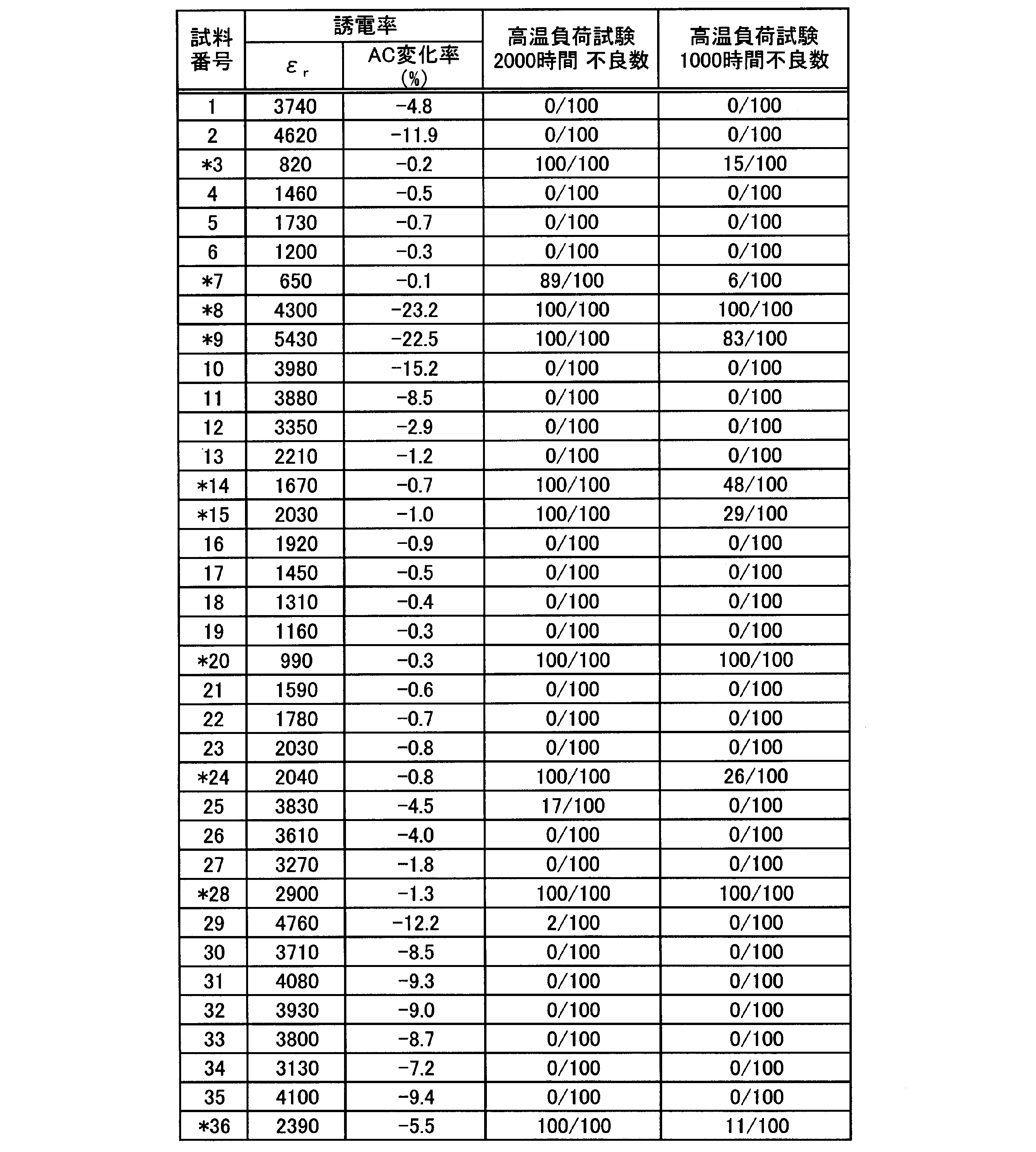
- the dielectric constant ⁇ of the dielectric ceramic constituting the dielectric ceramic layer in the multilayer ceramic capacitor according to each of the above samples was measured under the conditions of 25 ° C., 1 kHz, and 1 V rms . The results are shown in Table 2.
- the dielectric constant ⁇ was measured under the condition of voltage 0.05V rms, the ratio (%) to the dielectric constant ⁇ under the condition of 1V rms described above was obtained, and shown in Table 2 as “AC change rate (%)”. It was. The lower the absolute value of the AC change rate, the better the dielectric material with less voltage dependency.
- a high temperature load test was performed on 100 samples of the multilayer ceramic capacitor under conditions of a temperature of 125 ° C. and an electric field strength of 15 kV / mm per dielectric ceramic layer.
- a sample having an insulation resistance value of 100 k ⁇ during the test was regarded as defective, and the number of defects was counted when 1000 hours passed and 2000 hours passed.
- samples with sample numbers not marked with * are samples within the range of the present invention and within a preferable range with respect to the R content.
Landscapes
- Engineering & Computer Science (AREA)
- Chemical & Material Sciences (AREA)
- Ceramic Engineering (AREA)
- Power Engineering (AREA)
- Manufacturing & Machinery (AREA)
- Materials Engineering (AREA)
- Microelectronics & Electronic Packaging (AREA)
- Inorganic Chemistry (AREA)
- Structural Engineering (AREA)
- Organic Chemistry (AREA)
- Composite Materials (AREA)
- Ceramic Capacitors (AREA)
- Compositions Of Oxide Ceramics (AREA)
- Inorganic Insulating Materials (AREA)
- Fixed Capacitors And Capacitor Manufacturing Machines (AREA)
Abstract
Description
誘電体セラミックの出発原料として、各々純度99.8%以上のBaCO3、CaCO3、SrCO3、TiO2、ZrO2、HfO2、Gd2O3、MgCO3、ZnO、およびMnCO3の各粉末を準備した。

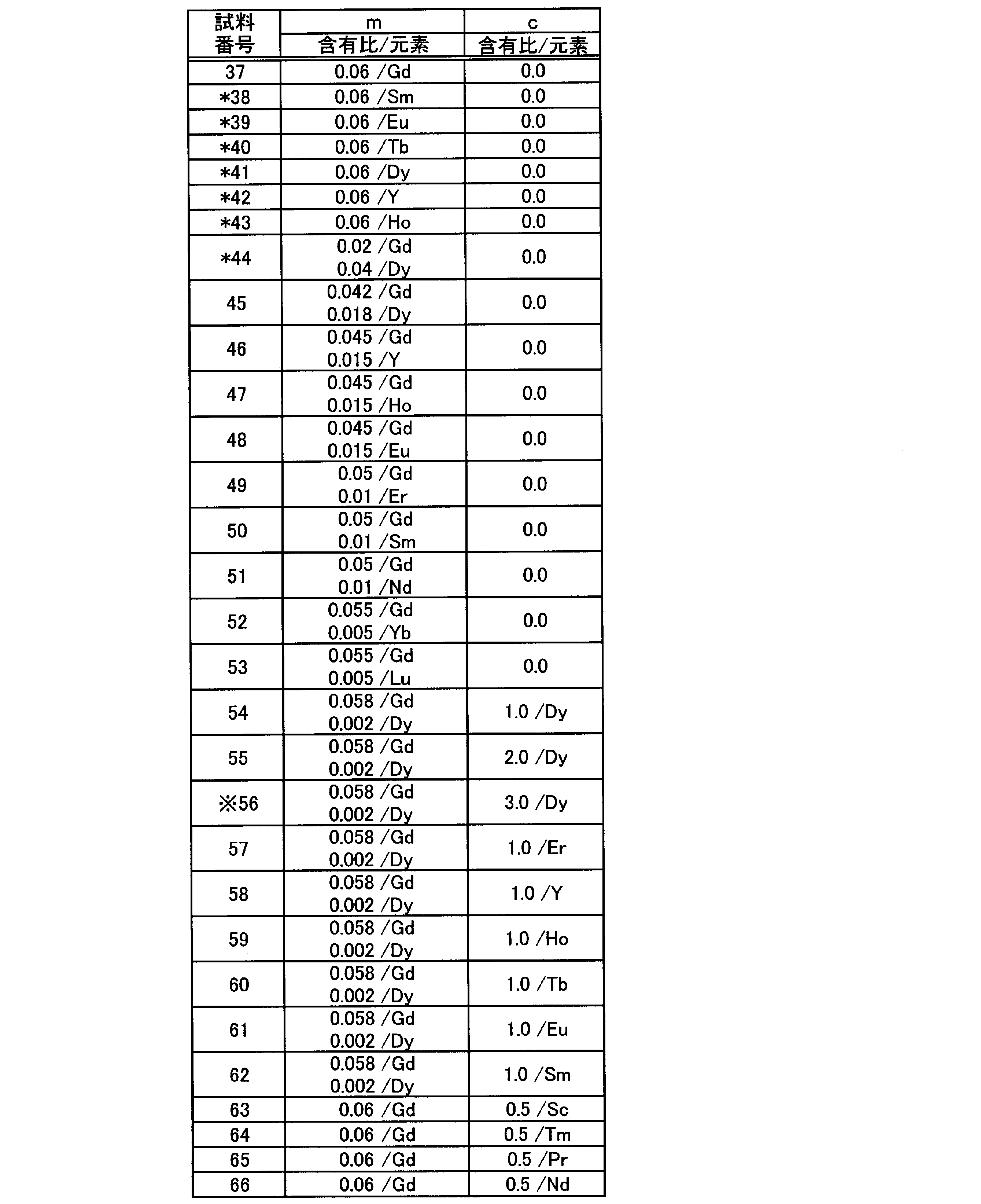
誘電体セラミックの出発原料として、各々純度99.8%以上のBaCO3、SrCO3、TiO2、Gd2O3、Sm2O3、Eu2O3、Tb2O3、DyCO3、Y2O3、Ho2O3、およびMnCO3の各粉末を準備した。

2 積層体
3 誘電体セラミック層
4,5 内部電極
8,9 外部電極
Claims (5)
- 一般式が(Ba1-h-i-mCahSriGdm)k(Ti1-y-j-n-o-pZryHfjMgnZnoMnp)O3で表わされるぺロブスカイト化合物を主成分とし、
0≦h≦0.03、
0≦i≦0.03、
0.042≦m≦0.074、
0.94≦k≦1.075、
0≦(y+j)≦0.05、
0.015≦n≦0.07、
0≦o≦0.04、
0≦p≦0.05、および
1.0<m/(n+o)<4.3
を満足する、誘電体セラミック。 - 前記主成分100モル部に対し、さらに、M(Mは、V、Cr、CuおよびNiから選ばれる少なくとも1種)を3.0モル部以下含み、かつ、Siを0.2~8モル部含む、請求項1に記載の誘電体セラミック。
- 前記主成分100モル部に対し、さらに、R(Rは、La、Ce、Pr、Nd、Sm、Eu、Tb、Dy、Ho、Er、Tm、Yb、Lu、YおよびScから選ばれる少なくとも1種)を2.0モル部以下含む、請求項1または2に記載の誘電体セラミック。
- 積層された複数の誘電体セラミック層および前記誘電体セラミック層間の特定の界面に沿って形成された内部電極を含む積層体と、前記内部電極の特定のものに電気的に接続されるように前記積層体の外表面上に形成された外部電極とを備え、
前記誘電体セラミック層は請求項1ないし3のいずれかに記載の誘電体セラミックからなる、積層セラミックコンデンサ。 - 前記内部電極の主成分がNiである、請求項4に記載の積層セラミックコンデンサ。
Priority Applications (3)
| Application Number | Priority Date | Filing Date | Title |
|---|---|---|---|
| CN200980141724.5A CN102186793B (zh) | 2008-10-21 | 2009-09-02 | 电介体陶瓷及层叠陶瓷电容器 |
| JP2010534751A JP5423682B2 (ja) | 2008-10-21 | 2009-09-02 | 誘電体セラミックおよび積層セラミックコンデンサ |
| US13/090,818 US8385049B2 (en) | 2008-10-21 | 2011-04-20 | Dielectric ceramic and laminated ceramic capacitor |
Applications Claiming Priority (2)
| Application Number | Priority Date | Filing Date | Title |
|---|---|---|---|
| JP2008-271066 | 2008-10-21 | ||
| JP2008271066 | 2008-10-21 |
Related Child Applications (1)
| Application Number | Title | Priority Date | Filing Date |
|---|---|---|---|
| US13/090,818 Continuation US8385049B2 (en) | 2008-10-21 | 2011-04-20 | Dielectric ceramic and laminated ceramic capacitor |
Publications (1)
| Publication Number | Publication Date |
|---|---|
| WO2010047181A1 true WO2010047181A1 (ja) | 2010-04-29 |
Family
ID=42119229
Family Applications (1)
| Application Number | Title | Priority Date | Filing Date |
|---|---|---|---|
| PCT/JP2009/065291 Ceased WO2010047181A1 (ja) | 2008-10-21 | 2009-09-02 | 誘電体セラミックおよび積層セラミックコンデンサ |
Country Status (4)
| Country | Link |
|---|---|
| US (1) | US8385049B2 (ja) |
| JP (1) | JP5423682B2 (ja) |
| CN (1) | CN102186793B (ja) |
| WO (1) | WO2010047181A1 (ja) |
Cited By (5)
| Publication number | Priority date | Publication date | Assignee | Title |
|---|---|---|---|---|
| CN103597562A (zh) * | 2011-08-23 | 2014-02-19 | 株式会社村田制作所 | 层叠陶瓷电容器以及层叠陶瓷电容器的制造方法 |
| CN105359236A (zh) * | 2013-07-09 | 2016-02-24 | 株式会社村田制作所 | 层叠陶瓷电容器 |
| JP2017228737A (ja) * | 2016-06-24 | 2017-12-28 | 太陽誘電株式会社 | 積層セラミックコンデンサ、セラミック粉末、およびそれらの製造方法 |
| JP2020184587A (ja) * | 2019-05-08 | 2020-11-12 | 太陽誘電株式会社 | セラミック電子部品 |
| US12437923B2 (en) | 2021-11-17 | 2025-10-07 | Taiyo Yuden Co., Ltd. | Multilayer ceramic electronic device with zirconium |
Families Citing this family (5)
| Publication number | Priority date | Publication date | Assignee | Title |
|---|---|---|---|---|
| CN103360072A (zh) * | 2012-03-31 | 2013-10-23 | 深圳光启创新技术有限公司 | 一种介质陶瓷及制备方法、制备的超材料 |
| WO2013163416A1 (en) * | 2012-04-27 | 2013-10-31 | Kemet Electronics Corporation | Coefficient of thermal expansion compensating compliant component |
| WO2021003434A1 (en) * | 2019-07-03 | 2021-01-07 | Injectense, Inc. | Hermetic heterogeneous integration platform for active and passive electronic components |
| KR102894865B1 (ko) * | 2021-10-21 | 2025-12-04 | 삼성전기주식회사 | 세라믹 전자부품 |
| CN114394832B (zh) * | 2022-01-19 | 2022-11-29 | 江苏科技大学 | 一种介电温度稳定的锆钛酸钡基瓷料及其制备方法 |
Citations (2)
| Publication number | Priority date | Publication date | Assignee | Title |
|---|---|---|---|---|
| WO2004067473A1 (ja) * | 2003-01-31 | 2004-08-12 | Murata Manufacturing Co., Ltd. | 誘電体セラミックおよびその製造方法ならびに積層セラミックコンデンサ |
| WO2006067958A1 (ja) * | 2004-12-24 | 2006-06-29 | Murata Manufacturing Co., Ltd. | 誘電体セラミックおよび積層セラミックコンデンサ |
Family Cites Families (8)
| Publication number | Priority date | Publication date | Assignee | Title |
|---|---|---|---|---|
| JPH03278415A (ja) | 1990-03-28 | 1991-12-10 | Taiyo Yuden Co Ltd | 磁器コンデンサ及びその製造方法 |
| JP3250923B2 (ja) | 1994-11-28 | 2002-01-28 | 京セラ株式会社 | 誘電体磁器組成物 |
| JP2002050536A (ja) | 2000-07-31 | 2002-02-15 | Murata Mfg Co Ltd | 耐還元性誘電体セラミックおよび積層セラミックコンデンサ |
| JP4506084B2 (ja) * | 2002-04-16 | 2010-07-21 | 株式会社村田製作所 | 非還元性誘電体セラミックおよびその製造方法ならびに積層セラミックコンデンサ |
| JP2005187296A (ja) * | 2003-12-26 | 2005-07-14 | Murata Mfg Co Ltd | 誘電体セラミック組成物及び積層セラミックコンデンサ |
| JP4797693B2 (ja) * | 2006-02-27 | 2011-10-19 | 株式会社村田製作所 | 誘電体セラミック組成物、およびそれを用いた積層セラミックコンデンサ |
| JP2008201616A (ja) * | 2007-02-19 | 2008-09-04 | Taiyo Yuden Co Ltd | 誘電体セラミックス及び積層セラミックコンデンサ |
| JP4858248B2 (ja) | 2007-03-14 | 2012-01-18 | Tdk株式会社 | 誘電体磁器組成物および電子部品 |
-
2009
- 2009-09-02 JP JP2010534751A patent/JP5423682B2/ja active Active
- 2009-09-02 WO PCT/JP2009/065291 patent/WO2010047181A1/ja not_active Ceased
- 2009-09-02 CN CN200980141724.5A patent/CN102186793B/zh active Active
-
2011
- 2011-04-20 US US13/090,818 patent/US8385049B2/en active Active
Patent Citations (2)
| Publication number | Priority date | Publication date | Assignee | Title |
|---|---|---|---|---|
| WO2004067473A1 (ja) * | 2003-01-31 | 2004-08-12 | Murata Manufacturing Co., Ltd. | 誘電体セラミックおよびその製造方法ならびに積層セラミックコンデンサ |
| WO2006067958A1 (ja) * | 2004-12-24 | 2006-06-29 | Murata Manufacturing Co., Ltd. | 誘電体セラミックおよび積層セラミックコンデンサ |
Cited By (9)
| Publication number | Priority date | Publication date | Assignee | Title |
|---|---|---|---|---|
| CN103597562A (zh) * | 2011-08-23 | 2014-02-19 | 株式会社村田制作所 | 层叠陶瓷电容器以及层叠陶瓷电容器的制造方法 |
| CN103597562B (zh) * | 2011-08-23 | 2016-07-06 | 株式会社村田制作所 | 层叠陶瓷电容器以及层叠陶瓷电容器的制造方法 |
| CN105359236A (zh) * | 2013-07-09 | 2016-02-24 | 株式会社村田制作所 | 层叠陶瓷电容器 |
| CN105359236B (zh) * | 2013-07-09 | 2018-03-16 | 株式会社村田制作所 | 层叠陶瓷电容器 |
| JP2017228737A (ja) * | 2016-06-24 | 2017-12-28 | 太陽誘電株式会社 | 積層セラミックコンデンサ、セラミック粉末、およびそれらの製造方法 |
| JP2020184587A (ja) * | 2019-05-08 | 2020-11-12 | 太陽誘電株式会社 | セラミック電子部品 |
| US11694849B2 (en) | 2019-05-08 | 2023-07-04 | Taiyo Yuden Co., Ltd. | Ceramic electronic device |
| JP7573956B2 (ja) | 2019-05-08 | 2024-10-28 | 太陽誘電株式会社 | セラミック電子部品 |
| US12437923B2 (en) | 2021-11-17 | 2025-10-07 | Taiyo Yuden Co., Ltd. | Multilayer ceramic electronic device with zirconium |
Also Published As
| Publication number | Publication date |
|---|---|
| US8385049B2 (en) | 2013-02-26 |
| CN102186793A (zh) | 2011-09-14 |
| CN102186793B (zh) | 2014-08-27 |
| JP5423682B2 (ja) | 2014-02-19 |
| US20110205687A1 (en) | 2011-08-25 |
| JPWO2010047181A1 (ja) | 2012-03-22 |
Similar Documents
| Publication | Publication Date | Title |
|---|---|---|
| JP5423682B2 (ja) | 誘電体セラミックおよび積層セラミックコンデンサ | |
| JP5564944B2 (ja) | 誘電体セラミック組成物及び積層セラミックコンデンサ | |
| JP4626892B2 (ja) | 誘電体セラミック、及び積層セラミックコンデンサ | |
| JP3039397B2 (ja) | 誘電体磁器組成物とそれを用いた積層セラミックコンデンサ | |
| JP5455164B2 (ja) | 誘電体磁器組成物、及び積層セラミックコンデンサ | |
| JP4831142B2 (ja) | 誘電体セラミックおよび積層セラミックコンデンサ | |
| JP5234035B2 (ja) | 誘電体セラミックおよび積層セラミックコンデンサ | |
| JP5224147B2 (ja) | 誘電体セラミック、及び積層セラミックコンデンサ | |
| US9406440B2 (en) | Dielectric ceramic and laminated ceramic capacitor | |
| JP5240199B2 (ja) | 誘電体セラミック及び積層セラミックコンデンサ | |
| US8213153B2 (en) | Dielectric ceramic and laminated ceramic capacitor | |
| US9153382B2 (en) | Multilayer ceramic capacitor and method for manufacturing multilayer ceramic capacitor | |
| JP5087938B2 (ja) | 誘電体セラミック組成物及び積層セラミックコンデンサ | |
| US8748329B2 (en) | Dielectric ceramic composition and laminated ceramic electronic component | |
| JP5423785B2 (ja) | 誘電体セラミックおよび積層セラミックコンデンサ | |
| JP4506233B2 (ja) | 誘電体セラミックおよび積層セラミックコンデンサ | |
| JP7262640B2 (ja) | セラミックコンデンサ | |
| CN118561592B (zh) | 一种陶瓷电容器材料、制备方法及多层陶瓷片式电容器 | |
| JP5729419B2 (ja) | 積層セラミックコンデンサ | |
| WO2010021087A1 (ja) | 誘電体セラミックおよび積層セラミックコンデンサ | |
| JP2006169050A (ja) | 誘電体磁器組成物及び磁器コンデンサ並びにこれらの製造方法 |
Legal Events
| Date | Code | Title | Description |
|---|---|---|---|
| WWE | Wipo information: entry into national phase |
Ref document number: 200980141724.5 Country of ref document: CN |
|
| 121 | Ep: the epo has been informed by wipo that ep was designated in this application |
Ref document number: 09821881 Country of ref document: EP Kind code of ref document: A1 |
|
| WWE | Wipo information: entry into national phase |
Ref document number: 2010534751 Country of ref document: JP |
|
| NENP | Non-entry into the national phase |
Ref country code: DE |
|
| 122 | Ep: pct application non-entry in european phase |
Ref document number: 09821881 Country of ref document: EP Kind code of ref document: A1 |