WO2009142243A1 - カウンタウェイト - Google Patents
カウンタウェイト Download PDFInfo
- Publication number
- WO2009142243A1 WO2009142243A1 PCT/JP2009/059282 JP2009059282W WO2009142243A1 WO 2009142243 A1 WO2009142243 A1 WO 2009142243A1 JP 2009059282 W JP2009059282 W JP 2009059282W WO 2009142243 A1 WO2009142243 A1 WO 2009142243A1
- Authority
- WO
- WIPO (PCT)
- Prior art keywords
- heavy
- aggregate
- particle size
- concrete
- less
- Prior art date
- Legal status (The legal status is an assumption and is not a legal conclusion. Google has not performed a legal analysis and makes no representation as to the accuracy of the status listed.)
- Ceased
Links
Images

Classifications
-
- E—FIXED CONSTRUCTIONS
- E02—HYDRAULIC ENGINEERING; FOUNDATIONS; SOIL SHIFTING
- E02F—DREDGING; SOIL-SHIFTING
- E02F9/00—Component parts of dredgers or soil-shifting machines, not restricted to one of the kinds covered by groups E02F3/00 - E02F7/00
- E02F9/18—Counterweights
-
- B—PERFORMING OPERATIONS; TRANSPORTING
- B66—HOISTING; LIFTING; HAULING
- B66C—CRANES; LOAD-ENGAGING ELEMENTS OR DEVICES FOR CRANES, CAPSTANS, WINCHES, OR TACKLES
- B66C23/00—Cranes comprising essentially a beam, boom, or triangular structure acting as a cantilever and mounted for translatory of swinging movements in vertical or horizontal planes or a combination of such movements, e.g. jib-cranes, derricks, tower cranes
- B66C23/62—Constructional features or details
- B66C23/72—Counterweights or supports for balancing lifting couples
- B66C23/74—Counterweights or supports for balancing lifting couples separate from jib
-
- C—CHEMISTRY; METALLURGY
- C04—CEMENTS; CONCRETE; ARTIFICIAL STONE; CERAMICS; REFRACTORIES
- C04B—LIME, MAGNESIA; SLAG; CEMENTS; COMPOSITIONS THEREOF, e.g. MORTARS, CONCRETE OR LIKE BUILDING MATERIALS; ARTIFICIAL STONE; CERAMICS; REFRACTORIES; TREATMENT OF NATURAL STONE
- C04B28/00—Compositions of mortars, concrete or artificial stone, containing inorganic binders or the reaction product of an inorganic and an organic binder, e.g. polycarboxylate cements
- C04B28/02—Compositions of mortars, concrete or artificial stone, containing inorganic binders or the reaction product of an inorganic and an organic binder, e.g. polycarboxylate cements containing hydraulic cements other than calcium sulfates
-
- C—CHEMISTRY; METALLURGY
- C04—CEMENTS; CONCRETE; ARTIFICIAL STONE; CERAMICS; REFRACTORIES
- C04B—LIME, MAGNESIA; SLAG; CEMENTS; COMPOSITIONS THEREOF, e.g. MORTARS, CONCRETE OR LIKE BUILDING MATERIALS; ARTIFICIAL STONE; CERAMICS; REFRACTORIES; TREATMENT OF NATURAL STONE
- C04B2111/00—Mortars, concrete or artificial stone or mixtures to prepare them, characterised by specific function, property or use
- C04B2111/00241—Physical properties of the materials not provided for elsewhere in C04B2111/00
- C04B2111/0031—Heavy materials, e.g. concrete used as ballast material
Definitions
- the present invention relates to a counterweight that is filled with heavy concrete, and more particularly to a counterweight that is suitably used in construction machines such as hydraulic excavators.
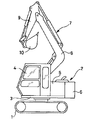
- the excavator includes a lower traveling body 1 and an upper revolving body 2 that is turnably mounted on the lower traveling body 1, and the upper revolving body 2 is an operation provided on a revolving frame 3.
- the working unit 7 is provided at the front portion of the swivel frame 3 so as to be able to move up and down.
- the working device 7 is comprised by the boom 8, the arm 9, and the bucket 10, and performs excavation work, such as earth and sand.
- the counterweight 6 is formed as a hollow box 62 having a concrete inlet 61 on the upper surface, and the box 62 has a weight made of iron pieces, concrete, heavy concrete, or the like.
- the conditioning material is filled to the desired weight. Thereby, the weight balance of the upper swing body 2 with respect to the work device 7 is adjusted.
- Such heavy concrete filled in the counterweight 6 is concrete in which the unit volume mass is increased by using a heavy aggregate having a specific gravity larger than that of an aggregate used for general concrete.
- a heavy concrete filled in the counterweight 6 for example, a concrete in which a substance having a high specific gravity such as ore or iron scrap is mixed is known (see Patent Document 1).
- the slump value is increased by increasing the unit water amount in the concrete, but the weight filled in the box 62 of the counterweight 6
- the unit water volume is increased in concrete, the density of heavy concrete decreases, and the heavy aggregate settles, resulting in material separation of heavy aggregate and cement paste, and filling the box 62 with heavy concrete. It is known that the rate will decline. Therefore, as the heavy concrete for filling the box 62 with the counterweight 6, it is common to use hard concrete with a reduced amount of water and a slump value.
- the counterweight 6 is manufactured by injecting into and vibrating.
- heavy aggregates used for such heavy concrete conventionally, artificial heavy aggregates such as iron scrap, natural heavy aggregates such as magnetite, hematite, sand iron, etc. have been used. These heavy aggregates not only have a large density difference from cement paste, but especially iron ores such as magnetite and hematite have a relatively coarse particle size distribution, so when these iron ores are used as heavy aggregates, Viscosity tends to decrease. Therefore, in the conventional heavy concrete, heavy aggregate having a large particle size settles in the cement paste at the time of vibration molding, and the cement paste and heavy aggregate are separated, and the counterweight 6 enters the box 62 inside. There was a problem that the filling rate of heavy concrete decreased.
- JP 2008-106564 A Japanese Patent Laid-Open No. 7-25654
- Patent Document 2 is intended to suppress material separation between the cement paste and the heavy aggregate by using a predetermined iron ore as the heavy aggregate.
- the price of iron ore has risen, so the production cost of heavy concrete has risen, and the production cost of the counterweight has also increased accordingly.
- the present invention is a heavy aggregate that replaces the conventionally used iron ore, and is formed by filling heavy concrete using a heavy aggregate that is unlikely to cause material separation from cement paste.
- An object of the present invention is to provide a counterweight that can be manufactured at the same time and that effectively improves the filling rate of heavy concrete into the box.
- the present invention is a counterweight comprising a box and heavy concrete filled in the box, wherein the heavy concrete includes at least heavy fine aggregate,
- the counterweight is characterized in that the heavy fine aggregate contains 20 mass% or more of aggregate having a particle size of less than 0.15 mm and 20 mass% or more of aggregate having a particle size of 2.5 mm or more and less than 5 mm. (Invention 1).
- the heavy fine aggregate in the heavy concrete in the above invention is composed of an aggregate having a particle size of less than 0.15 mm (fine particles) and an aggregate having a particle size of 2.5 mm or more and less than 5 mm (coarse particles). Because it has an unevenly distributed particle size distribution, it is possible to obtain a sufficient unit volume mass as heavy concrete without causing material separation when blended into concrete, and thus a counter with improved loading ratio of heavy concrete Weight can be provided.
- the heavy concrete contains 20% by mass or more of aggregates having a particle size of 2.5 mm or more and less than 5 mm, the fluidity of the heavy concrete during vibration molding can be ensured, so that workability is good.
- vibration molding heavy concrete can be filled into every corner of the counterweight box.
- the particle size of the aggregate is determined by whether or not it passes through a sieve having a predetermined nominal size.
- an aggregate having a particle size of less than 0.15 mm has a nominal size of 0.15 mm.
- the aggregate passing through the sieve means an aggregate having a particle size of 2.5 mm or more and less than 5 mm, which means an aggregate that passes through a sieve having a nominal size of 5 mm but does not pass through a sieve having a size of 2.5 mm.
- heavy aggregate weight coarse aggregate, heavy fine aggregate means an aggregate having a density of 3.5 g / cm 3 or more.
- the heavy concrete further includes heavy coarse aggregate, and the heavy fine aggregate and the heavy coarse aggregate have 5 fine aggregates having a particle size of less than 0.075 mm. It is preferably contained in an amount of at least mass% (Invention 2).
- heavy aggregate (heavy fine aggregate and heavy coarse aggregate) contains 5% by mass or more of fine aggregate having a particle size of less than 0.075 mm, thereby improving the viscosity of the concrete paste.
- the density of the paste can be increased to reduce the density difference from the aggregate (aggregate having a particle size of 0.075 mm or more) (density difference: 2.5 g / cm 3 or less).
- the heavy fine aggregate and the heavy coarse aggregate are barite (Invention 3). Since the particle size distribution of the fine aggregate obtained by crushing predetermined barite is unevenly distributed in the coarse and fine particles, according to this invention (Invention 3), barite without special particle size adjustment Is simply pulverized into a predetermined fine aggregate particle size distribution (the content of aggregates having a particle size of less than 0.15 mm is 20% by mass or more, and the content of aggregates having a particle size of 2.5 mm or more and less than 5 mm is 20 mass% or more), and it is possible to manufacture a heavy aggregate that can suppress the occurrence of material separation in heavy concrete, so that the production cost of heavy aggregate and heavy concrete can be reduced, resulting in a counter The weight manufacturing cost can be reduced.
- the heavy fine aggregate and the heavy coarse aggregate are preferably obtained by crushing barite so that the maximum particle size is 20 to 70 mm. (Invention 4).
- the barite is crushed so as to have a maximum particle size of 20 to 70 mm, so that a specific fine aggregate particle size distribution (particle size 0) is obtained without special particle size adjustment. It is possible to easily produce a heavy aggregate having an aggregate content of less than 15 mm and an aggregate content of not less than 2.5 mm and less than 5 mm. Therefore, the manufacturing cost of heavy aggregate and heavy concrete can be reduced, and as a result, the manufacturing cost of the counterweight can be reduced.
- the average tensile strength of the aggregate having a particle diameter of 9 to 11 mm obtained by crushing the barite is 4.0 to 10.0 N / mm 2.
- Preferred (Invention 5) if the average tensile strength of the aggregate having a particle diameter of 9 to 11 mm obtained from barite is within the above numerical range, the barite is coarsened during the production of the aggregate.
- the desired fine aggregate particle size distribution can be easily obtained only by pulverization (the content of aggregates having a particle size of less than 0.15 mm is 20% by mass or more, and the content of aggregates having a particle size of 2.5 to 5 mm is easily Since a heavy aggregate having 20 mass% or more) can be obtained, steps such as particle size adjustment can be omitted, and the production cost of heavy aggregate can be reduced. Thereby, the manufacturing cost of the counterweight can be further reduced.
- the water-cement ratio of the heavy concrete is preferably 30 to 60% (Invention 6). According to this invention (invention 6), the workability of heavy concrete can be ensured when the water cement ratio is within the above range.
- a counterweight formed by filling heavy concrete using heavy aggregate which is a heavy aggregate replacing conventional iron ore and hardly separates from cement paste. Can do.
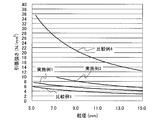
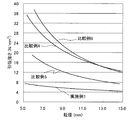
- FIG. 1 is a side view showing a hydraulic excavator using a counterweight according to an embodiment of the present invention. It is a graph which shows the result of the tensile strength test of the aggregate of Example 1, Example 2, Comparative Example 1, and Comparative Example 4. 6 is a graph showing the results of tensile strength tests of aggregates of Example 1 and Comparative Examples 4 to 6.
- the counterweight 6 includes a box 62 and a concrete inlet 61 that is provided on the upper surface of the box 62 and communicates with the inside of the box 62, and has a predetermined particle size distribution.
- the box 62 is filled with heavy concrete containing heavy aggregate.
- the heavy concrete includes at least heavy fine aggregate, and further includes heavy coarse aggregate and water.
- This heavy fine aggregate contains 20% by mass or more of aggregates having a particle size of less than 0.15 mm and 20% by mass or more of aggregates having a particle size of 2.5 mm or more and less than 5 mm. .20% by mass or more of aggregates of less than 15 mm and 25% by mass or more of aggregates having a particle size of 2.5 mm or more and less than 5 mm.
- the content of aggregate having a particle size of less than 0.15 mm in heavy fine aggregate is 20% by mass or more. it can.
- the aggregate content of the aggregate having a particle size of 2.5 mm or more and less than 5 mm is 20% by mass or more, the desired workability can be ensured without reducing the fluidity of the heavy concrete.
- the heavy concrete is filled into the box of the counterweight, and the heavy concrete is filled into every corner of the box when vibration molding is performed, the filling rate into the box can be effectively improved. At the same time, it is possible to improve compaction due to vibration or the like.
- the heavy aggregate of the present invention preferably contains 5% by mass or more of fine aggregate having a particle size of less than 0.075 mm, more preferably 5 to 10% by mass, and 5 to 8% by mass. Particularly preferred.
- fine powder aggregate By including 5% by mass or more of such fine powder aggregate, the viscosity of cement paste in heavy concrete can be improved.
- the density of ordinary Portland cement is 3.16 g / cm 3 and the above fine powder is used. Since the density of the aggregate is 3.5 g / cm 3 or more, the density of the paste can be increased. As a result, occurrence of material separation between the paste and the aggregate can be further suppressed.
- barite can be used as the natural ore that is the raw material of the heavy aggregate of the present invention.
- the barite has a density of about 4.0 g / cm 3 and has a sufficient density as a heavy aggregate, and according to the heavy aggregate obtained by pulverizing such barite, the particle size is 0.00. Since a large amount of fine aggregate less than 075 mm is contained, the density difference between the paste and the aggregate can be reduced (density difference: 2.5 g / cm 3 or less), whereby a heavy aggregate obtained from barite and Occurrence of material separation from the paste can be further suppressed.
- the average tensile strength of the aggregate having a particle diameter of 9 to 11 mm obtained by coarsely pulverizing such barite is 4.0 to 10.0 N / mm 2 .
- Such barite is preferably used, and barite having 4.0 to 8.0 N / mm 2 is more preferable.
- the desired fine aggregate particle size distribution (particle size) can be obtained by roughly crushing such barite.
- a weight aggregate having an aggregate content of less than 0.15 mm is 20% by mass or more, and an aggregate having a particle size of 2.5 mm or more and less than 5 mm is 20% by mass or more.
- the heavy aggregate of the present invention is obtained by using a crusher (eg, jaw crusher) or the like so that the maximum particle size of the heavy aggregate obtained is 20 to 70 mm, preferably 20 to 50 mm. It can be produced by roughly pulverizing the natural ore.
- a crusher eg, jaw crusher
- the obtained heavy aggregate has a predetermined fine aggregate particle size distribution (bones having a particle size of less than 0.15 mm is 20% by mass or more and a particle size of 2.5 mm or more and less than 5 mm)
- the particle size may be adjusted so that the material is 20% by mass or more.
- the desired fine aggregate particle size distribution (the content ratio of the aggregate having a particle size of less than 0.15 mm is 20% by mass or more by simply coarsely crushing such barite.
- the material can be manufactured. Therefore, the step of adjusting the particle size after coarsely pulverizing natural ore can be omitted, the manufacturing cost of heavy aggregate can be reduced, and as a result, the manufacturing cost of the counterweight can also be reduced.
- the cement contained in the heavy concrete is not particularly limited.
- various Portland cements such as ordinary Portland cement, early-strength Portland cement, medium heat Portland cement, low heat Portland cement; blast furnace cement, fly ash cement, etc.
- Various mixed cements cement (eco-cement) composed of a pulverized product of gypsum and gypsum manufactured using municipal waste incineration ash and / or sewage sludge incineration ash as raw materials can be used.
- various admixtures may be added to the heavy concrete as desired.
- a water reducing agent for example, a water reducing agent, an antifoaming agent, etc.
- water reducing agents include, but are not limited to, lignin-based, naphthalene sulfonic acid-based, melamine-based, polycarboxylic acid-based water reducing agents, AE water reducing agents, high-performance water reducing agents, and high-performance AE water reducing agents. is not.
- an antifoaming agent especially when it is necessary to suppress the entrainment of air.
- Heavy concrete can be manufactured by mixing the above heavy aggregate and cement, adding water, and kneading by a conventional method.
- the water-cement ratio in heavy concrete is not particularly limited, but is preferably 30 to 60%, more preferably 35 to 50%. When the water-cement ratio is within the above range, it is possible to obtain a high-density heavy concrete with a small amount of unit water and to ensure the workability of the heavy concrete.
- the fine aggregate rate (s / a) in the heavy concrete is preferably 40 to 60%. Furthermore, it is preferable to determine the blending of various concrete raw materials so that the slump at the time of kneading is 0 to 3 cm.
- heavy concrete obtained as described above is poured into the box 62 from the concrete inlet 61, and compacted and aired appropriately using a vibrator such as a table vibrator or a rod-like vibrator. It is possible to manufacture by removing the metal and filling it so that there is no gap. Since the content of fine particles (aggregates having a particle size of less than 0.15 mm) in such heavy concrete is high, the viscosity of heavy concrete can be improved and coarse particles (particle size of 2.5 mm or more and less than 5 mm). Since the flow rate of the heavy concrete is not lowered due to the high content of (aggregate), the filling rate of the heavy concrete into the box 62 can be effectively improved. The occurrence of material separation between the cement paste and the heavy aggregate can be further suppressed.
- a vibrator such as a table vibrator or a rod-like vibrator.
- the counterweight 6 according to the present embodiment may be appropriately adjusted so that the weight required for the counterweight 6 is obtained by filling the inside of the box 62 with normal concrete together with heavy concrete. Further, iron scrap or the like may be thrown into the box 62 together with heavy concrete. If the heavy concrete according to the present embodiment is used, the heavy concrete is sufficiently applied to the gap generated inside the box 62 by the iron scrap or the like. Can be filled.
- the counterweight 6 thus obtained can be used as a counterweight for construction machines such as a hydraulic excavator, a mobile crane, a bulldozer, and the like. Specifically, as shown in FIG. 2, a counterweight 6 may be attached to the rear portion of the machine room 5 of the upper swing body 2 of the excavator.
- the counterweight according to the present embodiment improves the viscosity of the cement paste because the heavy aggregate in the heavy concrete filled in the box has a predetermined particle size distribution. Therefore, when vibration molding is performed, the heavy aggregate in the heavy concrete does not settle, and the heavy concrete is filled to every corner of the box.
- the present invention is not limited to this, and may be used as a counterweight for an elevator, for example.
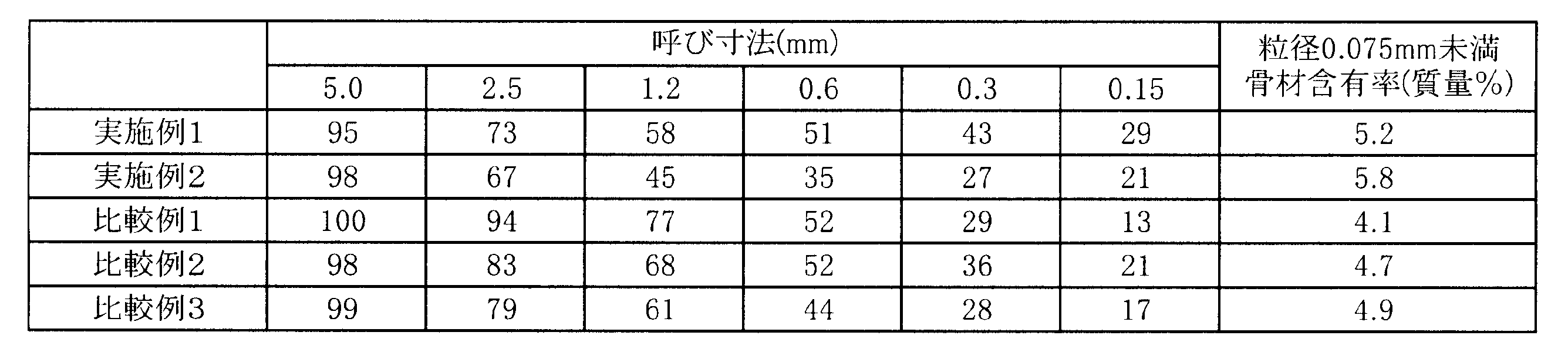
- the heavy fine aggregate is passed through a sieve having a nominal size of 0.15 to 5.0 mm and passed through each sieve.
- the mass ratio (mass%) of the aggregate was measured.
- the aggregate content (% by mass) having a particle size of less than 0.075 mm in the above heavy aggregates (Examples 1 and 2, Comparative Examples 1 to 3) was also determined. The results are shown in Table 2.
- the content of the aggregate having a particle size of less than 0.15 mm is 20% by mass or more, and the bone having a particle size of 2.5 mm or more and less than 5 mm.
- the content of the material was 20% by mass or more, whereas the weight fine aggregate of Comparative Example 1 had a content of less than 20% by mass.
- the weight fine aggregate of Comparative Example 2 has an aggregate content of less than 20% by mass with a particle size of 2.5 mm or more and less than 5 mm, and the weight fine aggregate of Comparative Example 3 has a particle size of less than 0.15 mm.
- the aggregate content was less than 20% by mass.
- Example 1 and Example 2 had a content of fine aggregates having a particle size of less than 0.075 mm of 5% by mass or more, whereas Comparative Example 1 The weight aggregate of ⁇ 3 was less than 5% by mass.
- the average tensile strength of the aggregate having a particle size of 9 to 11 mm among the aggregates of Examples 1 and 2 was 4.0 to 10.0 N / mm 2 .
- the average tensile strength of aggregates having a particle size of 9 to 11 mm was less than 4.0 N / mm 2 . Therefore, if the barite has an average tensile strength of 4.0 to 10.0 N / mm 2 among aggregates obtained by coarse pulverization, the average particle strength is 9 to 11 mm.
- the content of aggregates having a particle size of less than 0.15 mm is 20% by mass or more, and the content of aggregates having a particle size of 2.5 mm or more and less than 5 mm is 20% by mass or more. It was confirmed that it was possible to manufacture heavy aggregates of the above and heavy aggregates including the heavy fine aggregates.
- the barite has an average tensile strength of 4.0 to 10.0 N / mm 2 among aggregates of 9 to 11 mm among aggregates obtained by coarse pulverization, the particle size is 0. It was confirmed that a heavy aggregate containing 5% by mass or more of fine aggregate less than 0.075 mm can be produced.
- the tensile strength of the heavy aggregates of Examples 1 and 2 is in the range of 4.0 to 10.0 N / mm 2 with almost no dependence on the particle size.
- the tensile strength of the aggregates of Comparative Examples 4 to 6 increased as the particle size decreased.
- the fine aggregate having a particle size of 5 mm or less has a small ratio of those pulverized to a fine powder and is distributed substantially uniformly in the range of the particle size of 5 mm or less.
- the content of aggregates having a diameter of less than 0.15 mm did not reach 20% by mass.
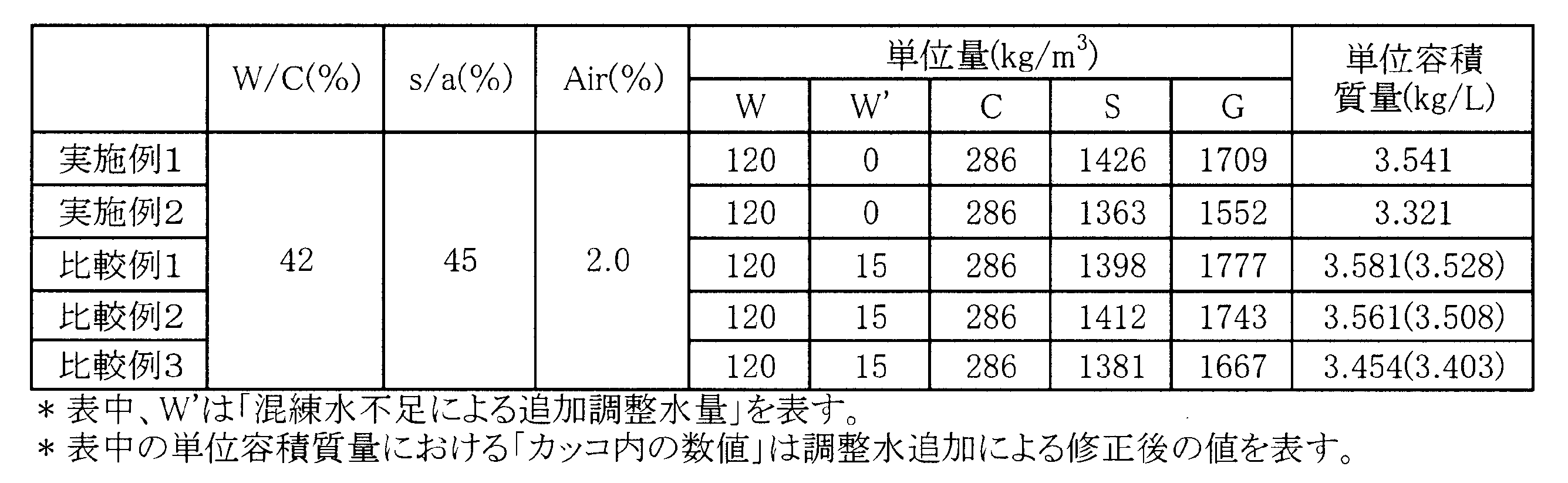
- Heavy aggregate (heavy fine aggregate S, heavy coarse aggregate G) obtained as described above, ordinary Portland cement C (manufactured by Taiheiyo Cement, density: 3.16 g / cm 3 ), water W, Were kneaded with the formulation shown in Table 3 to produce heavy concrete.
- the blends of the heavy concretes of Examples 1 and 2 and Comparative Examples 1 to 3 were determined so that the slump value measured according to JIS-A1101 was 0 to 1.0 cm. Further, in the heavy concretes of Comparative Examples 1 to 3, since the kneading water was insufficient, adjustment water W ′ was added to obtain a slump equivalent to that of Examples 1 and 2.
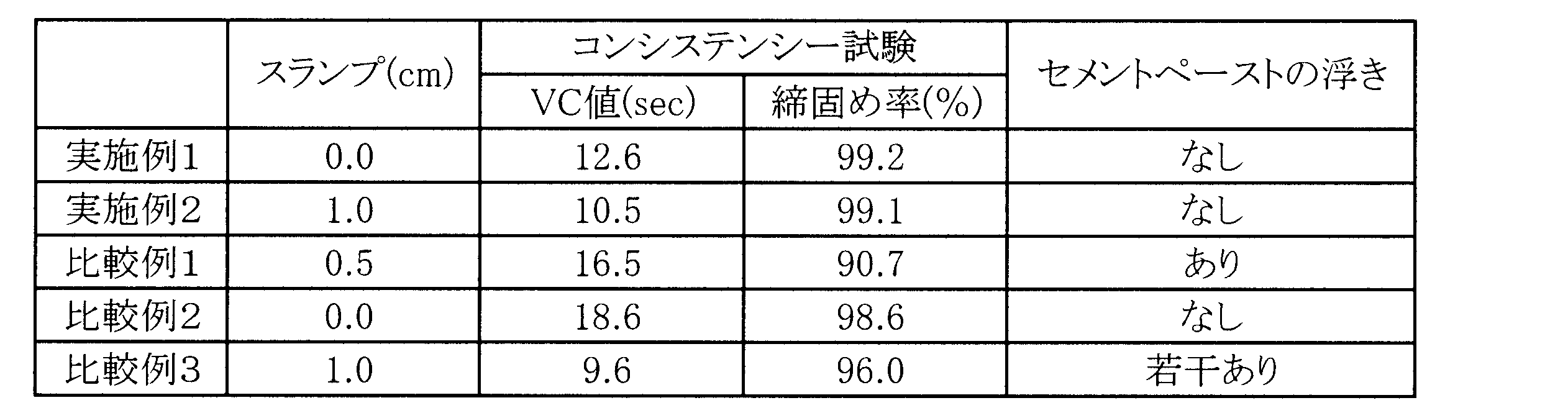
- the unit volume mass of the heavy concrete after compaction by the above test was measured, and the ratio of the unit volume mass to the design value was calculated as the compaction rate (%). The results are shown in Table 4. Furthermore, the heavy concrete after compaction as described above was visually observed to determine whether or not the cement paste was lifted. The results are shown in Table 4.
- the compaction rate of the heavy concrete of Comparative Example 1 was 2% or more lower than that of the heavy concrete of Example 1 and Example 2.
- the heavy concrete of Comparative Example 1 since material separation occurs, it is considered that the heavy aggregate having a large specific gravity settles at the bottom of the container (box) and the filling rate is lowered.
- the heavy concretes of Examples 1 and 2 have a high compaction rate, and it was confirmed that the filling rate can be effectively improved without causing material separation during vibration molding. Therefore, according to the heavy concrete of Example 1 and Example 2, heavy concrete can be filled to every corner of the box of a counterweight.
- the heavy concrete of Comparative Example 2 has a higher VC value and low fluidity during vibration molding.
- the content of the aggregate having a particle size of 2.5 mm or more and less than 5 mm in the fine aggregate is less than 20% by mass, the aggregate is fine as a whole. It is considered that the fluidity is lowered. Therefore, even when the counterweight box is filled and vibration molded, it is considered difficult to fill the corners of the box with heavy concrete.
- the heavy concrete of Comparative Example 3 shows a VC value equivalent to that of the heavy concrete of Example 1 and Example 2 and has good workability, but is a heavy fine aggregate with a particle size of less than 0.15 mm. Since the content ratio is less than 20% by mass, some material separation occurs, and a heavy aggregate with a relatively large particle size settles, which is considered to reduce the compaction rate. .
- the counterweight of the present invention is useful as a counterweight for construction machines such as hydraulic excavators.
Landscapes
- Engineering & Computer Science (AREA)
- Chemical & Material Sciences (AREA)
- Structural Engineering (AREA)
- Ceramic Engineering (AREA)
- Inorganic Chemistry (AREA)
- Materials Engineering (AREA)
- Chemical Kinetics & Catalysis (AREA)
- Organic Chemistry (AREA)
- Mining & Mineral Resources (AREA)
- Civil Engineering (AREA)
- General Engineering & Computer Science (AREA)
- Mechanical Engineering (AREA)
- Component Parts Of Construction Machinery (AREA)
- Curing Cements, Concrete, And Artificial Stone (AREA)
- On-Site Construction Work That Accompanies The Preparation And Application Of Concrete (AREA)
Abstract
Description
本実施形態に係るカウンタウェイト6は、図1に示すように、函体62と、函体62の上面に設けられ函体62内部に連通するコンクリート注入口61とを備え、所定の粒度分布を有する重量骨材を含む重量コンクリートを函体62の内部に充填してなるものである。
表1に示す重晶石をそれぞれジョークラッシャー(製品名:ファインジョークラッシャー,前川工業所社製)に投入し、得られる骨材の最大粒径が40mmとなるように粗粉砕し、重量骨材を製造した。

上述のようにして得られた重量骨材(実施例1,実施例2,比較例1)について、地盤工学会基準(JGS 3421-2005)「岩石の点載荷試験方法」に準拠して点載荷試験を行った。本試験例では、より簡易的に骨材強度を得ることを目的として引張強さ(N/mm2)を求めた。また、比較として金属スラグ系骨材(太平洋セメント社製,商品名:DSM骨材,比較例4)、石灰石(比較例5)及び硬質砂岩(比較例6)の引張強さも同様にして求めた。なお、比較例4~6の骨材は、得られる骨材の最大粒径が20mmとなるようにする以外は、実施例1~2及び比較例1~3と同様にして粗粉砕することにより製造した。結果を図3及び図4に示す。
上述のようにして得られた重量骨材(重量細骨材S,重量粗骨材G)と、普通ポルトランドセメントC(太平洋セメント社製,密度:3.16g/cm3)と、水Wとを表3に示す配合で混練し、重量コンクリートを製造した。なお、実施例1~2及び比較例1~3のいずれの重量コンクリートも、JIS-A1101に準拠して測定されるスランプ値が0~1.0cmとなるように配合を決定した。また、比較例1~3の重量コンクリートにおいては、混練水が不足していたため、実施例1~2と同等のスランプを得るために調整水W’を追加した。
上述のようにして得られた重量コンクリート(実施例1~2,比較例1~3)について、JSCE-F507「RCD用コンクリートのコンシステンシー試験方法」に準拠してVC(Vibrating Consolidation)値を測定した。結果を表4に示す。なお、VC値は、コンクリートに振動を加えた際の締め固まるまでの時間を意味し、この値が小さいほど作業性がよいと評価することができる。
62…函体
Claims (6)
- 函体と、前記函体に充填された重量コンクリートとを備えるカウンタウェイトであって、
前記重量コンクリートには、少なくとも重量細骨材が含まれ、
前記重量細骨材が、粒径0.15mm未満の骨材を20質量%以上含み、かつ粒径2.5mm以上5mm未満の骨材を20質量%以上含むことを特徴とするカウンタウェイト。 - 前記重量コンクリートには、重量粗骨材がさらに含まれ、
前記重量細骨材及び前記重量粗骨材には、粒径0.075mm未満の微粒骨材が5質量%以上含まれていることを特徴とする請求項1に記載のカウンタウェイト。 - 前記重量細骨材及び前記重量粗骨材の全部又は一部が、重晶石であることを特徴とする請求項1又は2に記載のカウンタウェイト。
- 前記重量細骨材及び前記重量粗骨材が、最大粒径が20~70mmとなるように重晶石を破砕することにより得られることを特徴とする請求項1又は2に記載のカウンタウェイト。
- 前記重晶石を破砕して得られる粒径9~11mmの骨材の平均引張強さが、4.0~10.0N/mm2であることを特徴とする請求項3又は4に記載のカウンタウェイト。
- 前記重量コンクリートの水セメント比が、30~60%であることを特徴とする請求項1~5のいずれかに記載のカウンタウェイト。
Priority Applications (5)
| Application Number | Priority Date | Filing Date | Title |
|---|---|---|---|
| CN200980118843.9A CN102036931B (zh) | 2008-05-23 | 2009-05-20 | 配重 |
| US12/993,669 US8523226B2 (en) | 2008-05-23 | 2009-05-20 | Counterweight |
| JP2010513045A JP5130359B2 (ja) | 2008-05-23 | 2009-05-20 | カウンタウェイト |
| BRPI0913036A BRPI0913036A2 (pt) | 2008-05-23 | 2009-05-20 | contrapeso |
| DE112009001244.2T DE112009001244B4 (de) | 2008-05-23 | 2009-05-20 | Gegengewicht |
Applications Claiming Priority (2)
| Application Number | Priority Date | Filing Date | Title |
|---|---|---|---|
| JP2008135959 | 2008-05-23 | ||
| JP2008-135959 | 2008-05-23 |
Publications (1)
| Publication Number | Publication Date |
|---|---|
| WO2009142243A1 true WO2009142243A1 (ja) | 2009-11-26 |
Family
ID=41340169
Family Applications (1)
| Application Number | Title | Priority Date | Filing Date |
|---|---|---|---|
| PCT/JP2009/059282 Ceased WO2009142243A1 (ja) | 2008-05-23 | 2009-05-20 | カウンタウェイト |
Country Status (7)
| Country | Link |
|---|---|
| US (1) | US8523226B2 (ja) |
| JP (1) | JP5130359B2 (ja) |
| KR (1) | KR101587460B1 (ja) |
| CN (1) | CN102036931B (ja) |
| BR (1) | BRPI0913036A2 (ja) |
| DE (1) | DE112009001244B4 (ja) |
| WO (1) | WO2009142243A1 (ja) |
Families Citing this family (9)
| Publication number | Priority date | Publication date | Assignee | Title |
|---|---|---|---|---|
| JP5356341B2 (ja) * | 2010-09-16 | 2013-12-04 | 日立建機株式会社 | 建設機械 |
| CN105367015A (zh) * | 2014-08-26 | 2016-03-02 | 中国海洋石油总公司 | 一种管道配重用混凝土 |
| US9587377B2 (en) | 2015-02-06 | 2017-03-07 | Harnischfeger Technologies, Inc. | Raised counterweight for a mining machine |
| CN104929182A (zh) * | 2015-05-20 | 2015-09-23 | 成都科创佳思科技有限公司 | 一种挖掘机配重 |
| US10138071B1 (en) * | 2017-12-14 | 2018-11-27 | McCloskey International Limited | Counterweight stacker |
| TR201807042A2 (tr) * | 2018-05-18 | 2018-06-21 | Ugur Beton Metal Ve Plastik Sanayi Turizm Ticaret Ltd Sirketi | Çeli̇k ve ağir beton bi̇leşenleri̇nden oluşan denge ağirliği ve buna i̇li̇şki̇n üreti̇m yöntemi̇ |
| CN109386019B (zh) * | 2018-11-05 | 2021-04-20 | 山东帝盟重工机械有限公司 | 一种挖掘机配重的制造方法 |
| US20220334054A1 (en) * | 2019-09-20 | 2022-10-20 | Microtrace, Llc | Taggant systems with remotely detectable spectral signatures |
| CN114772991A (zh) * | 2022-05-25 | 2022-07-22 | 中国天楹股份有限公司 | 一种使用垃圾焚烧底灰和废弃塑料制备重力储能块的方法 |
Citations (2)
| Publication number | Priority date | Publication date | Assignee | Title |
|---|---|---|---|---|
| JPH0634437Y2 (ja) * | 1987-08-10 | 1994-09-07 | 株式会社小松製作所 | コンクリ−ト充填カウンタウエイト |
| JP2008106564A (ja) * | 2006-10-27 | 2008-05-08 | Hitachi Constr Mach Co Ltd | カウンタウエイト及びその製造方法 |
Family Cites Families (18)
| Publication number | Priority date | Publication date | Assignee | Title |
|---|---|---|---|---|
| US3485383A (en) * | 1968-02-09 | 1969-12-23 | Manitowoc Co | Auxiliary support for cranes |
| DE2122710C3 (de) * | 1970-05-12 | 1981-04-02 | Sika AG, vorm. Kaspar Winkler & Co., Zürich | Zusatzmittel zu Zement, Mörtel und Beton und Verfahren zu dessen Herstellung |
| US4264060A (en) * | 1977-02-25 | 1981-04-28 | Automated Production Systems Corporation | Apparatus for treating metallic scrap in the recovery of metal therefrom |
| US4252763A (en) * | 1978-06-06 | 1981-02-24 | Raymond International Builders, Inc. | Method and apparatus for cement lining of pipes |
| FR2581895B1 (fr) * | 1985-05-15 | 1990-02-02 | Solvay | Dispositif d'enrobage |
| JP2887050B2 (ja) | 1993-07-07 | 1999-04-26 | 新日本製鐵株式会社 | 重量コンクリート |
| JP3505694B2 (ja) * | 1995-04-13 | 2004-03-08 | 同和鉱業株式会社 | 重量コンクリート |
| US6296436B1 (en) * | 1997-04-08 | 2001-10-02 | Allied Gator, Inc. | Multipurpose counterweight housing and counterweight |
| US6533319B1 (en) * | 1998-12-23 | 2003-03-18 | Deere & Company | Ballast attachment for tractor three-point hitch |
| EP1236699A1 (en) * | 2001-03-01 | 2002-09-04 | Sika AG, vorm. Kaspar Winkler & Co. | Composite material and shaped article with thermal conductivity and specific gravity on demand |
| FR2825698B1 (fr) * | 2001-06-07 | 2004-07-09 | Bpb Plc | Plaque a base de liant cimentaire, procede de fabrication d'une telle plaque, extrudeur pour la mise en oeuvre d'un tel procede, et utilisation d'une telle plaque |
| JP3862575B2 (ja) * | 2001-09-28 | 2006-12-27 | 新キャタピラー三菱株式会社 | カウンタウエイト及びそのリサイクル方法 |
| US7152883B2 (en) * | 2003-02-25 | 2006-12-26 | Douglas Dynamics, L.L.C. | Ballast assembly for vehicles |
| JP2006273654A (ja) * | 2005-03-29 | 2006-10-12 | Taiheiyo Cement Corp | 重量コンクリート |
| US7618062B2 (en) * | 2006-12-04 | 2009-11-17 | Deere & Company | Three point hitch ballast assembly for working machine |
| CN101066857A (zh) | 2007-04-27 | 2007-11-07 | 中国海洋石油总公司 | 管道涂敷用混凝土 |
| KR101233228B1 (ko) * | 2008-02-27 | 2013-02-14 | 가부시키가이샤 고마쓰 세이사쿠쇼 | 작업 차량 |
| JP4253355B1 (ja) * | 2008-05-23 | 2009-04-08 | 太平洋セメント株式会社 | 重量骨材及び重量コンクリート |
-
2009
- 2009-05-20 BR BRPI0913036A patent/BRPI0913036A2/pt not_active IP Right Cessation
- 2009-05-20 DE DE112009001244.2T patent/DE112009001244B4/de not_active Expired - Fee Related
- 2009-05-20 US US12/993,669 patent/US8523226B2/en not_active Expired - Fee Related
- 2009-05-20 CN CN200980118843.9A patent/CN102036931B/zh not_active Expired - Fee Related
- 2009-05-20 WO PCT/JP2009/059282 patent/WO2009142243A1/ja not_active Ceased
- 2009-05-20 KR KR1020107026068A patent/KR101587460B1/ko not_active Expired - Fee Related
- 2009-05-20 JP JP2010513045A patent/JP5130359B2/ja not_active Expired - Fee Related
Patent Citations (2)
| Publication number | Priority date | Publication date | Assignee | Title |
|---|---|---|---|---|
| JPH0634437Y2 (ja) * | 1987-08-10 | 1994-09-07 | 株式会社小松製作所 | コンクリ−ト充填カウンタウエイト |
| JP2008106564A (ja) * | 2006-10-27 | 2008-05-08 | Hitachi Constr Mach Co Ltd | カウンタウエイト及びその製造方法 |
Non-Patent Citations (2)
| Title |
|---|
| KAZUHISA SHIRAISHI ET AL.: "Hoshasen Shaheiyo Concrete ni Kansuru Kenkyu (6th report): Kakushu Juryo Kotsuzai no Seishitsu", ARCHITECTURAL INSTITUTE OF JAPAN KENKYU HOKOKU, 1957, pages 91 - 94 * |
| YUKIO KAMIYAMA ET AL.: "Chile-san Jitekkoseki no Juryo Concrete-yo Kotsuzai e Tekiyo ni Tsuite", ARCHITECTURAL INSTITUTE OF JAPAN TAIKAI GAKUJUTSU KOEN KOGAISHU, September 1983 (1983-09-01), pages 71 - 72 * |
Also Published As
| Publication number | Publication date |
|---|---|
| CN102036931A (zh) | 2011-04-27 |
| JP5130359B2 (ja) | 2013-01-30 |
| BRPI0913036A2 (pt) | 2019-09-24 |
| DE112009001244T5 (de) | 2011-03-24 |
| CN102036931B (zh) | 2014-12-03 |
| JPWO2009142243A1 (ja) | 2011-09-29 |
| US20120003071A1 (en) | 2012-01-05 |
| KR101587460B1 (ko) | 2016-01-21 |
| DE112009001244B4 (de) | 2017-05-11 |
| KR20110013412A (ko) | 2011-02-09 |
| US8523226B2 (en) | 2013-09-03 |
Similar Documents
| Publication | Publication Date | Title |
|---|---|---|
| JP5130359B2 (ja) | カウンタウェイト | |
| JP4253355B1 (ja) | 重量骨材及び重量コンクリート | |
| JP5379893B1 (ja) | 工事用充填材 | |
| JP5536260B2 (ja) | 工事用充填材 | |
| JP6124519B2 (ja) | 流動化処理土 | |
| JP4109376B2 (ja) | 石灰処理土を用いたソイルモルタルの製造方法及びそれを用いた盛土工法 | |
| JP2007015880A (ja) | 重量骨材及び重量コンクリート並びにそれらの製造方法 | |
| JP4880625B2 (ja) | 重量骨材を含むカウンターウェイト | |
| JP2007131804A (ja) | 地盤埋戻し材 | |
| Hameed et al. | Self compacting concrete: use of waste marble powder as filler material | |
| JP2011079990A (ja) | 注入材 | |
| JP2017031656A (ja) | 重量流動化処理土 | |
| Zha et al. | Size effect and damage mechanisms in cementitious tungsten tailing backfill materials with varying hydroxypropyl methyl cellulose dosages | |
| JP5734756B2 (ja) | セメント含有組成物、地盤改良用スラリー及び地盤改良方法 | |
| JP4979365B2 (ja) | コンクリート混和材を用いたコンクリート | |
| JP3101129B2 (ja) | 重量コンクリートの製造方法 | |
| JP7603398B2 (ja) | 地盤改良工法 | |
| JP6372123B2 (ja) | コンクリートの固化体の製造方法 | |
| JP2006273654A (ja) | 重量コンクリート | |
| JPH04321546A (ja) | コンクリート組成物 | |
| JP2934343B2 (ja) | 細骨材 | |
| JP2024003963A (ja) | 地盤改良方法および地盤改良材 | |
| JP2699164B2 (ja) | 重量コンクリート及びこの重量コンクリートを使用する高比重異型ブロックの製造方法 | |
| JP2007015879A (ja) | 重量セメント並びに重量コンクリート及びその製造方法 | |
| JPH0656491A (ja) | モルタルの調製方法およびそれを利用する工法 |
Legal Events
| Date | Code | Title | Description |
|---|---|---|---|
| WWE | Wipo information: entry into national phase |
Ref document number: 200980118843.9 Country of ref document: CN |
|
| 121 | Ep: the epo has been informed by wipo that ep was designated in this application |
Ref document number: 09750605 Country of ref document: EP Kind code of ref document: A1 |
|
| WWE | Wipo information: entry into national phase |
Ref document number: 2010513045 Country of ref document: JP |
|
| ENP | Entry into the national phase |
Ref document number: 20107026068 Country of ref document: KR Kind code of ref document: A |
|
| WWE | Wipo information: entry into national phase |
Ref document number: 8255/DELNP/2010 Country of ref document: IN |
|
| WWE | Wipo information: entry into national phase |
Ref document number: 12993669 Country of ref document: US |
|
| RET | De translation (de og part 6b) |
Ref document number: 112009001244 Country of ref document: DE Date of ref document: 20110324 Kind code of ref document: P |
|
| 122 | Ep: pct application non-entry in european phase |
Ref document number: 09750605 Country of ref document: EP Kind code of ref document: A1 |
|
| ENP | Entry into the national phase |
Ref document number: PI0913036 Country of ref document: BR Kind code of ref document: A2 Effective date: 20101122 |