WO2009119475A1 - 耐食性に優れたクロメートフリー被覆溶融亜鉛めっき鋼板 - Google Patents
耐食性に優れたクロメートフリー被覆溶融亜鉛めっき鋼板 Download PDFInfo
- Publication number
- WO2009119475A1 WO2009119475A1 PCT/JP2009/055586 JP2009055586W WO2009119475A1 WO 2009119475 A1 WO2009119475 A1 WO 2009119475A1 JP 2009055586 W JP2009055586 W JP 2009055586W WO 2009119475 A1 WO2009119475 A1 WO 2009119475A1
- Authority
- WO
- WIPO (PCT)
- Prior art keywords
- dip galvanized
- hot
- chromate
- steel sheet
- galvanized layer
- Prior art date
- Legal status (The legal status is an assumption and is not a legal conclusion. Google has not performed a legal analysis and makes no representation as to the accuracy of the status listed.)
- Ceased
Links
Images


Classifications
-
- C—CHEMISTRY; METALLURGY
- C23—COATING METALLIC MATERIAL; COATING MATERIAL WITH METALLIC MATERIAL; CHEMICAL SURFACE TREATMENT; DIFFUSION TREATMENT OF METALLIC MATERIAL; COATING BY VACUUM EVAPORATION, BY SPUTTERING, BY ION IMPLANTATION OR BY CHEMICAL VAPOUR DEPOSITION, IN GENERAL; INHIBITING CORROSION OF METALLIC MATERIAL OR INCRUSTATION IN GENERAL
- C23C—COATING METALLIC MATERIAL; COATING MATERIAL WITH METALLIC MATERIAL; SURFACE TREATMENT OF METALLIC MATERIAL BY DIFFUSION INTO THE SURFACE, BY CHEMICAL CONVERSION OR SUBSTITUTION; COATING BY VACUUM EVAPORATION, BY SPUTTERING, BY ION IMPLANTATION OR BY CHEMICAL VAPOUR DEPOSITION, IN GENERAL
- C23C2/00—Hot-dipping or immersion processes for applying the coating material in the molten state without affecting the shape; Apparatus therefor
- C23C2/04—Hot-dipping or immersion processes for applying the coating material in the molten state without affecting the shape; Apparatus therefor characterised by the coating material
- C23C2/06—Zinc or cadmium or alloys based thereon
-
- C—CHEMISTRY; METALLURGY
- C23—COATING METALLIC MATERIAL; COATING MATERIAL WITH METALLIC MATERIAL; CHEMICAL SURFACE TREATMENT; DIFFUSION TREATMENT OF METALLIC MATERIAL; COATING BY VACUUM EVAPORATION, BY SPUTTERING, BY ION IMPLANTATION OR BY CHEMICAL VAPOUR DEPOSITION, IN GENERAL; INHIBITING CORROSION OF METALLIC MATERIAL OR INCRUSTATION IN GENERAL
- C23C—COATING METALLIC MATERIAL; COATING MATERIAL WITH METALLIC MATERIAL; SURFACE TREATMENT OF METALLIC MATERIAL BY DIFFUSION INTO THE SURFACE, BY CHEMICAL CONVERSION OR SUBSTITUTION; COATING BY VACUUM EVAPORATION, BY SPUTTERING, BY ION IMPLANTATION OR BY CHEMICAL VAPOUR DEPOSITION, IN GENERAL
- C23C28/00—Coating for obtaining at least two superposed coatings either by methods not provided for in a single one of groups C23C2/00 - C23C26/00 or by combinations of methods provided for in subclasses C23C and C25C or C25D
- C23C28/30—Coatings combining at least one metallic layer and at least one inorganic non-metallic layer
- C23C28/32—Coatings combining at least one metallic layer and at least one inorganic non-metallic layer including at least one pure metallic layer
- C23C28/322—Coatings combining at least one metallic layer and at least one inorganic non-metallic layer including at least one pure metallic layer only coatings of metal elements only
- C23C28/3225—Coatings combining at least one metallic layer and at least one inorganic non-metallic layer including at least one pure metallic layer only coatings of metal elements only with at least one zinc-based layer
-
- C—CHEMISTRY; METALLURGY
- C23—COATING METALLIC MATERIAL; COATING MATERIAL WITH METALLIC MATERIAL; CHEMICAL SURFACE TREATMENT; DIFFUSION TREATMENT OF METALLIC MATERIAL; COATING BY VACUUM EVAPORATION, BY SPUTTERING, BY ION IMPLANTATION OR BY CHEMICAL VAPOUR DEPOSITION, IN GENERAL; INHIBITING CORROSION OF METALLIC MATERIAL OR INCRUSTATION IN GENERAL
- C23C—COATING METALLIC MATERIAL; COATING MATERIAL WITH METALLIC MATERIAL; SURFACE TREATMENT OF METALLIC MATERIAL BY DIFFUSION INTO THE SURFACE, BY CHEMICAL CONVERSION OR SUBSTITUTION; COATING BY VACUUM EVAPORATION, BY SPUTTERING, BY ION IMPLANTATION OR BY CHEMICAL VAPOUR DEPOSITION, IN GENERAL
- C23C2/00—Hot-dipping or immersion processes for applying the coating material in the molten state without affecting the shape; Apparatus therefor
- C23C2/26—After-treatment
-
- C—CHEMISTRY; METALLURGY
- C23—COATING METALLIC MATERIAL; COATING MATERIAL WITH METALLIC MATERIAL; CHEMICAL SURFACE TREATMENT; DIFFUSION TREATMENT OF METALLIC MATERIAL; COATING BY VACUUM EVAPORATION, BY SPUTTERING, BY ION IMPLANTATION OR BY CHEMICAL VAPOUR DEPOSITION, IN GENERAL; INHIBITING CORROSION OF METALLIC MATERIAL OR INCRUSTATION IN GENERAL
- C23C—COATING METALLIC MATERIAL; COATING MATERIAL WITH METALLIC MATERIAL; SURFACE TREATMENT OF METALLIC MATERIAL BY DIFFUSION INTO THE SURFACE, BY CHEMICAL CONVERSION OR SUBSTITUTION; COATING BY VACUUM EVAPORATION, BY SPUTTERING, BY ION IMPLANTATION OR BY CHEMICAL VAPOUR DEPOSITION, IN GENERAL
- C23C2/00—Hot-dipping or immersion processes for applying the coating material in the molten state without affecting the shape; Apparatus therefor
- C23C2/26—After-treatment
- C23C2/261—After-treatment in a gas atmosphere, e.g. inert or reducing atmosphere
-
- C—CHEMISTRY; METALLURGY
- C23—COATING METALLIC MATERIAL; COATING MATERIAL WITH METALLIC MATERIAL; CHEMICAL SURFACE TREATMENT; DIFFUSION TREATMENT OF METALLIC MATERIAL; COATING BY VACUUM EVAPORATION, BY SPUTTERING, BY ION IMPLANTATION OR BY CHEMICAL VAPOUR DEPOSITION, IN GENERAL; INHIBITING CORROSION OF METALLIC MATERIAL OR INCRUSTATION IN GENERAL
- C23C—COATING METALLIC MATERIAL; COATING MATERIAL WITH METALLIC MATERIAL; SURFACE TREATMENT OF METALLIC MATERIAL BY DIFFUSION INTO THE SURFACE, BY CHEMICAL CONVERSION OR SUBSTITUTION; COATING BY VACUUM EVAPORATION, BY SPUTTERING, BY ION IMPLANTATION OR BY CHEMICAL VAPOUR DEPOSITION, IN GENERAL
- C23C2/00—Hot-dipping or immersion processes for applying the coating material in the molten state without affecting the shape; Apparatus therefor
- C23C2/34—Hot-dipping or immersion processes for applying the coating material in the molten state without affecting the shape; Apparatus therefor characterised by the shape of the material to be treated
- C23C2/36—Elongated material
- C23C2/40—Plates; Strips
-
- C—CHEMISTRY; METALLURGY
- C23—COATING METALLIC MATERIAL; COATING MATERIAL WITH METALLIC MATERIAL; CHEMICAL SURFACE TREATMENT; DIFFUSION TREATMENT OF METALLIC MATERIAL; COATING BY VACUUM EVAPORATION, BY SPUTTERING, BY ION IMPLANTATION OR BY CHEMICAL VAPOUR DEPOSITION, IN GENERAL; INHIBITING CORROSION OF METALLIC MATERIAL OR INCRUSTATION IN GENERAL
- C23C—COATING METALLIC MATERIAL; COATING MATERIAL WITH METALLIC MATERIAL; SURFACE TREATMENT OF METALLIC MATERIAL BY DIFFUSION INTO THE SURFACE, BY CHEMICAL CONVERSION OR SUBSTITUTION; COATING BY VACUUM EVAPORATION, BY SPUTTERING, BY ION IMPLANTATION OR BY CHEMICAL VAPOUR DEPOSITION, IN GENERAL
- C23C28/00—Coating for obtaining at least two superposed coatings either by methods not provided for in a single one of groups C23C2/00 - C23C26/00 or by combinations of methods provided for in subclasses C23C and C25C or C25D
- C23C28/30—Coatings combining at least one metallic layer and at least one inorganic non-metallic layer
- C23C28/34—Coatings combining at least one metallic layer and at least one inorganic non-metallic layer including at least one inorganic non-metallic material layer, e.g. metal carbide, nitride, boride, silicide layer and their mixtures, enamels, phosphates and sulphates
- C23C28/345—Coatings combining at least one metallic layer and at least one inorganic non-metallic layer including at least one inorganic non-metallic material layer, e.g. metal carbide, nitride, boride, silicide layer and their mixtures, enamels, phosphates and sulphates with at least one oxide layer
Definitions
- the present invention relates to a chromate-free coated hot-dip galvanized steel sheet having a chromate-free chemical conversion coating that does not contain chromium on the surface of a hot-dip galvanized layer, and in particular, has excellent corrosion resistance such as white rust resistance.
- the present invention relates to a chromate-free coated hot-dip galvanized steel sheet.
- the hot dip galvanized steel sheet is usually manufactured by dipping in a hot dip galvanizing bath containing a small amount of Al. This is because Al has the effect of suppressing the formation of the Fe—Zn alloy layer at the interface between the hot dip galvanized layer and the base steel sheet and enhancing the adhesion of the hot dip galvanized layer.
- Al added to the hot dip galvanizing bath combines with oxygen (O) to form an Al-based oxide on the surface of the hot dip galvanized layer.
- Patent Document 1 discloses a steel sheet containing a small amount of Al and Mg and whose orientation index of the Zn (00 ⁇ 2) plane parallel to the plated surface is controlled. ing.
- the present applicant also contains a trace amount of Al and Mn in the hot dip galvanized layer and an oxide containing Mn on the surface of the hot dip galvanized layer (a composite oxide of Mn and Al and / or Fe).
- Patent Document 2 JP 2002-371342 A JP 2007-314831 A
- An object of the present invention is to provide a chromate-free coated hot-dip galvanized steel sheet having excellent corrosion resistance (particularly white rust resistance).
- the chromate-free coated hot-dip galvanized steel sheet of the present invention that has solved the above-mentioned problems is a chromate-free coated hot-dip galvanized steel sheet having a hot-dip galvanized layer and a chromate-free film.
- Al concentration profile in the depth direction by discharge optical emission spectrometry, it has a maximum peak in the amount of Al in the region from the outermost surface of the hot dip galvanized layer to a depth of 20 nm.
- Al and O at a depth of 20 nm from the outermost surface are summarized as follows: Al: 2.5% (meaning mass%; hereinafter, the same applies to the components) or more, and O: 2.0% or more.
- Have. Al and O on the outermost surface of the hot-dip galvanized layer preferably satisfy Al: 1.0% or more and O: 10.0% or more.
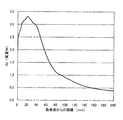
- FIG. 8 is a graph showing the transition of the Al amount with respect to the distance from the outermost surface of the hot dip galvanized layer.
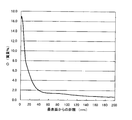
- FIG. 8 is a graph showing the transition of the O amount with respect to the distance from the outermost surface of the hot dip galvanized layer.
- FIG. 25 is a graph showing the transition of the Al amount with respect to the distance from the outermost surface of the hot dip galvanized layer.
- FIG. 25 is a graph showing the transition of the O amount with respect to the distance from the outermost surface of the hot dip galvanized layer.
- the present inventors have studied by paying attention to the distribution of Al amount and O amount in the hot-dip galvanized layer.
- the amount of Al present in the region from the outermost surface of the hot dip galvanized layer to a depth of 20 nm has a close relationship with the corrosion resistance (particularly white rust resistance), and the maximum peak of the amount of Al in that region. It has been found that the intended purpose can be achieved if a hot-dip galvanized layer having a certain Al concentration profile is provided.
- it is particularly effective to control the cooling process after hot dip galvanizing.
- the hot dip galvanized layer solidifies.
- the inventors have found that it is important to cool a temperature range from about 440 ° C. to over 400 ° C. over a predetermined time (slow cooling or isothermal holding), and have completed the present invention.
- the “region from the outermost surface of the hot dip galvanized layer to the depth of 20 nm”, which is the Al existing region where corrosion resistance is most effectively exhibited, is particularly referred to as “near the surface” and is hot dip galvanized. It may be distinguished from the outermost surface of the layer (outermost surface layer).
- the “outermost surface” of the hot-dip galvanized layer does not mean the outermost surface as plated, but the surface is flattened by performing treatment such as skin pass rolling or leveling correction using a leveler, for example. It means the outermost surface part after being converted.
- the “near the surface” is not strictly limited to a position 20 nm deep from the outermost surface of the hot dip galvanized layer (hereinafter sometimes abbreviated as D 20 nm ), and is generally 20 nm ⁇ 10 nm. Those within the range are acceptable, and are included within the range of “near the surface”. This is because a steel sheet provided with a hot-dip galvanized layer having a maximum peak of Al in such a range can also exhibit good corrosion resistance.
- Examples of the Al concentration profile of the hot dip galvanized layer include the pattern shown in FIG. FIG. 1 shows No. 1 in Table 1 of Examples described later. 8 shows an Al concentration profile, which has a maximum peak in the amount of Al at a position 20 nm (D 20 nm ) from the outermost surface of the hot-dip galvanized layer. This is in balance with the O distribution in the hot dip galvanized layer, and even if Al does not reach the outermost layer of the hot dip galvanized layer, it becomes aluminum oxide, so it becomes stable in terms of energy and diffuses to the surface layer. This is thought to be due to the loss of the driving force required for the operation.
- the Al concentration profile in the present invention is not limited to the pattern of FIG.
- the outermost surface of the hot dip galvanized layer may have an Al concentration profile in which the Al amount of D 20 nm is substantially the same (for example, No. 5 in Table 1). In any case, good corrosion resistance is exhibited (see Examples described later).
- the present invention since a layer of aluminum oxide [Al 2 O 3 (alumina)] that functions as an oxidation-resistant barrier layer is formed on the surface of the hot-dip galvanized layer, it is considered that good corrosion resistance is ensured. . That is, when the chromate-free film is wrinkled and moisture reaches the plating surface through the gap between the films, electron movement occurs between the film surface and the plating surface through the film, and Zn is eluted. Corrosion proceeds. As a result, the effect of the barrier layer by the chromate-free film is reduced.
- Al 2 O 3 (alumina) aluminum oxide
- Al is an easily oxidizable element as compared with Zn, and a part of Al in the hot dip galvanized layer is combined with O and is considered to exist as Al 2 O 3 (alumina) on the surface of the hot dip galvanized layer. Since alumina is an electrical insulator and does not pass electrons, it functions as an oxidation-resistant barrier layer. As a result, it is considered that the movement of electrons from Zn that is about to move into the chromate-free film can be inhibited, and the corrosion resistance is improved by preventing the progress of corrosion.
- the hot dip galvanized layer characterizing the present invention will be described.
- the hot dip galvanized layer in the present invention has an Al concentration profile in the depth direction that has a maximum peak in the amount of Al in a region (near the surface) from the outermost surface of the hot dip galvanized layer to a depth of 20 nm. is doing.
- the Al concentration profile in the depth direction is measured by high frequency glow discharge optical emission spectrometry (GD-OES). Specifically, analysis was performed under the following conditions, with a ⁇ 4 mm region of the hot dip galvanized layer as a measurement target.
- Measuring device “GDA750 (device name)” manufactured by SPECTRUM ANALYTIK GmbH
- Measurement conditions Glow discharge source (anhydrous GDS) -Spectrum Analytic-Grim type used in argon gas with power of 50 W and 2.5 hectopascals, 50% measurement pulse
- the Al amount and the O amount at a position (D 20 nm ) 20 nm deep from the outermost surface of the hot dip galvanized layer are Al: 2.5% or more and O: 2.0% or more.
- the amount of Al and the amount of O are less than the above ranges, the amount of Al 2 O 3 generated in the vicinity of the surface of the hot dip galvanized layer decreases, and the desired corrosion resistance cannot be obtained.
- D The Al content of 20 nm is preferably 2.8% or more, more preferably 3% or more.
- D The amount of O at 20 nm is preferably 2.5% or more, more preferably 3% or more.
- the upper limit of the Al content and the O content at D 20 nm is not particularly limited from the viewpoint of corrosion resistance, but if it is excessive, a large amount of Al 2 O 3 is formed, the electrical conductivity is lowered, and the spot weldability is deteriorated.
- D The amount of Al of 20 nm is preferably about 4.5% or less, more preferably 4% or less.
- D O amount of 20 nm is preferably about 10% or less, more preferably 9% or less.
- the Al content and the O content on the outermost surface of the hot-dip galvanized layer are Al: 1.0% or more and O: 10.0% or more. It is preferable.
- the amount of Al is more preferably 1.3% or more, still more preferably 1.5% or more.
- the amount of O is more preferably 11% or more, and still more preferably 12% or more. Thereby, corrosion resistance further improves.
- the Al amount of D 0 nm is preferably 5.5% or less, and more preferably 5% or less.
- the amount of O at D 0 nm is preferably 30% or less, and more preferably 25% or less.
- the adhesion amount of the hot dip galvanized layer to the steel plate may be, for example, about 30 to 150 g / m 2 with respect to the area of the steel plate. That is, the thickness of the hot dip galvanized layer may be about 4 to 21 ⁇ m, for example.
- the adhesion amount of the hot dip galvanized layer may be controlled using, for example, a gas wipe with respect to the steel plate pulled up from the hot dip galvanizing bath.
- the chromate-free film is not particularly limited as long as it does not contain even chromium, and an organic, inorganic, or organic-inorganic composite rust preventive film can be used.
- the inorganic rust preventive film include, for example, lithium silicate, sodium silicate, and phosphoric acid compound.
- examples of commercially available products include a product number “Lithium silicate 45 (trade name)” manufactured by Nissan Chemical Co., Ltd., a product number “Sodium silicate 3 (product number)” manufactured by Nihon Kagaku, and ammonium dihydrogen phosphate manufactured by Yoneyama Chemical Co., Ltd. Can be mentioned.
- organic rust preventive film examples include, for example, ethylene-acrylic acid resin, styrene-maleic acid resin, styrene-acrylic resin, polyurethane resin, and the like.
- Commercially available products include, for example, acrylic resin made by Nippon Pure Chemical Co., Ltd., “AC-10S (product number)”, trade name “Superflex 150 (product name)” by Daiichi Kogyo Seiyaku Co., Ltd., manufactured by Toho Chemical Co., Ltd.
- a crosslinking agent may be added to the organic anticorrosive film.
- the crosslinking agent include a glycidyl group-containing crosslinking agent (for example, “Epicron CR5L (trade name)” manufactured by Dainippon Ink & Chemicals, Inc.), an aziridinyl group.
- a cross-linking agent for example, “Chemite DZ-22E (trade name)” manufactured by Nippon Shokubai Co., Ltd.
- rust preventive additives for the above rust preventive film, as rust preventive additives, tannic acid type, vanadic acid type, phosphate type, phosphite type, polyphosphate type, sulfur organic compound, benzotriazole, molybdate Wax may be added in order to add an additive based on a system, a tungstate, a silane coupling agent, or to improve the lubricity of the film.
- the silica fine particles refer to fine particles having an average particle diameter of several nanometers to several hundreds of nanometers in a primary particle state, and representative one is colloidal silica.
- colloidal silica is contained in the rust preventive film, for example, “Iron and Steel” Vol. 89 (2003, issued by the Japan Iron and Steel Institute), pages 116-122, “Rust prevention behavior of silica in galvanized steel in organic coatings” By elution and reprecipitation of the silica in the rust preventive coating, corrosion of the defective portion can be prevented and the overall corrosion resistance can be significantly increased.
- colloidal silica In order to effectively exhibit the effect of adding such colloidal silica, it is preferably used in the range of 1 to 30% by mass with respect to the solid matter of the rust preventive film. If the amount is less than 1% by mass, the above-mentioned effects due to the blending are hardly exhibited. On the other hand, if the blending exceeds 30% by weight, not only the effect is saturated but also the film forming property and adhesion as a rust-proof coating are deteriorated. Because. A more preferable amount of colloidal silica is 5 to 25% by mass.
- colloidal silica is not particularly limited, but as a commercial product, for example, “XS”, “XL”, “OL”, “O”, “O” of “Snowtex (trade name)” series (manufactured by Nissan Chemical Industries, Ltd.), “ 40 ",” N “,” UP “, etc. can be used preferably.
- the film thickness of the rust preventive film is not particularly limited, but is preferably 0.2 to 3.0 ⁇ m, more preferably 0.5 to 1.5 ⁇ m. If it is less than 0.2 ⁇ m, the corrosion resistance improving effect by the rust preventive film cannot be sufficiently obtained. On the other hand, when the thickness exceeds 3.0 ⁇ m, the spot weldability required for practical use as a rust-proof steel plate is significantly impaired.
- the steel plate used for this invention will not be specifically limited if it is used for a hot dip galvanized steel plate, For example, Al killed steel plate, IF steel, etc. are mentioned.
- the hot dip galvanized layer solidifies.
- the temperature range is cooled for at least 10 seconds in an atmosphere containing O 2 gas. Specifically, the above temperature range may be cooled (slow cooling) over 10 seconds or may be kept isothermal at a predetermined temperature within the above temperature range.
- the time until the hot-dip galvanized layer is solidified is set to at least 10 seconds, and the time until solidification is extended, so that the Al in the hot-dip galvanized layer diffuses at least to the vicinity of the “surface vicinity”. Therefore, the corrosion resistance improving effect by controlling the Al concentration distribution in the plating layer is effectively exhibited.
- a hot dip galvanizing bath is prepared, and a hot dip galvanized layer is formed on the surface of the base steel plate.
- the temperature of the plating bath is preferably controlled to about 470 to 450 ° C.
- the immersion time in the plating bath is preferably about 2 to 10 seconds.
- the amount of Al in the hot dip galvanizing bath is preferably 0.16 to 0.22%. If the Al content in the plating bath is less than 0.16%, the Fe—Al intermetallic compound that contributes to improving the adhesion between the steel sheet and the hot dip galvanized layer is not sufficiently formed at the interface between the steel sheet and the hot dip galvanized layer. The Fe—Zn alloy layer that adversely affects the adhesion is formed, and the adhesion between the steel sheet and the hot dip galvanized layer is deteriorated.
- the present invention employs a cooling means for extending the time until solidification of the hot dip galvanized layer for the purpose of promoting the diffusion of Al to the hot dip galvanized layer surface. When the amount of Al decreases, the alloying reaction of Fe and Zn tends to be further promoted.
- Al in the plating bath is more preferably 0.17% or more, and further preferably 0.18% or more.
- Al in the plating bath is preferably 0.22% or less, more preferably 0.21% or less, and still more preferably 0.20% or less.
- the remaining components of the hot dip galvanizing bath are Zn and inevitable impurities.
- the inevitable impurities include Ti, Mn, Mg, Pb, Ni, Co, Sb, As, In, Cu, and Fe as elements inevitably mixed from a base steel plate.
- These inevitable impurity elements may be contained in a range of approximately 0.02% or less in total. The present inventors have confirmed that the effects of the present invention are not impaired even if such elements are contained.
- the steel sheet is pulled up from the hot dip galvanizing bath and cooled to solidify the hot dip galvanized layer.
- the temperature range of 440 ° C. or lower and 400 ° C. or higher is cooled in an O 2 gas-containing atmosphere for at least 10 seconds.
- cooling over 10 seconds or more means that the time (holding time) for the plated steel plate to pass through the cooling temperature range is 10 seconds or more.
- a temperature range of 440 ° C. or lower and over 400 ° C. may be cooled (slowly cooled) at a predetermined cooling rate, or may be kept isothermal at a predetermined temperature within the above temperature range.
- the temperature range (440 ° C. or lower and over 400 ° C.).
- the melting point of zinc is about 420 ° C., and even if it is kept at a temperature range of 400 ° C. or lower for a long time, Al does not diffuse and the amount of Al in the vicinity of the surface of the hot dip galvanized layer cannot be secured.
- the temperature exceeds 440 ° C., the alloying reaction of Zn and Fe is promoted, and the adhesion between the base steel sheet and the hot dip galvanized layer is lowered.
- a preferable temperature range is 405 ° C. or higher and 435 ° C. or lower, and more preferably 410 ° C. or higher and 430 ° C. or lower.
- the time (holding time) for the plated steel plate to pass through the above temperature range is at least 10 seconds.
- the holding time is less than 10 seconds, Al diffusion is insufficient, and Al 2 O 3 that functions as an oxidation-resistant barrier layer is not formed in the vicinity of the surface of the hot-dip galvanized layer.
- the longer the holding time the better, preferably 13 seconds or more, more preferably 15 seconds or more.
- the upper limit of the holding time is not particularly limited from the viewpoint of improving corrosion resistance due to Al diffusion, but is preferably 30 seconds or less and more preferably 25 seconds or less in consideration of spot weldability and the like.
- the above temperature range (440 ° C. or lower and over 400 ° C.) may be gradually cooled for 10 seconds or more, or 10 seconds at a temperature within the above temperature range as in the examples described later.
- the isothermal holding may be performed as described above.
- the hot-dip galvanized steel sheet may be cooled to a temperature (T1) of 440 ° C. or lower and higher than 400 ° C., held at the temperature of T1 for 10 seconds or more, and then cooled.
- the time for passing through the above temperature range may be controlled using, for example, a heater (for example, an infrared heater).
- a heater for example, an infrared heater.
- Cooling in the above temperature range is performed in an inert gas atmosphere containing O 2 gas. This is because the introduction of O 2 gas causes O atoms to enter the hot-dip galvanized layer and combine with Al to form an Al 2 O 3 barrier layer.
- O 2 gas As the inert gas, Ar gas or the like can be used in addition to N 2 gas.
- the concentration of O 2 gas contained in the atmosphere may be about 0.005 to 0.05 volume% (50 to 500 ppm), for example.
- the cooling method until the steel sheet is pulled up from the plating bath and cooled to the above temperature range is not particularly limited.
- the cooling atmosphere is an inert gas atmosphere (for example, a pure N 2 gas atmosphere). ), And the cooling rate may be about 1 to 5 ° C./second.
- the cooling rate when cooling to room temperature after passing through the temperature range is not particularly limited, and may be about 10 to 30 ° C./second.
- the cooling atmosphere may be an inert gas atmosphere (for example, an N 2 gas atmosphere, an Ar gas atmosphere, or the like). This is to prevent surface oxidation of the hot dip galvanized layer.
- the hot-dip galvanized steel sheet obtained by cooling to room temperature is coated with a chromate-free coating after the surface roughness is adjusted to about 1 ⁇ m with Ra after skin pass rolling (SKP rolling) and the flatness is corrected using a leveler. do it.
- a chromate-free film is formed on the surface of the hot dip galvanized steel sheet.
- the method for forming the chromate-free film is not particularly limited, and for example, a bar coater, a roll coater, a spray ringer, or the like can be employed.
- the chromate-free coated hot-dip galvanized steel sheet thus obtained exhibits excellent corrosion resistance comparable to that of the chromate-coated hot-dip galvanized steel sheet, so that it can be used, for example, for automobiles, buildings, or home appliances. it can.
- Example 1 Using an experimental machine, Al killed steel (cold-rolled steel sheet, plate thickness: 0.8 mm) was hot-dip galvanized under the following conditions, and then the chromate-free coating was coated to obtain a chromate-free coated hot-dip galvanized steel sheet.
- Al killed steel contains C: 0.05%, Si: 0.02%, Mn: 0.19%, Al: 0.047%, P: 0.015%, S: 0.012%, The balance is a steel plate made of iron and inevitable impurities.
- the above-mentioned Al killed steel sheet is annealed at 850 ° C. for 1 minute in an N 2 gas atmosphere containing 5% by volume of H 2, and then the intrusion plate temperature is set to 460 ° C. in a hot dip galvanizing bath at 460 ° C. It was immersed and adjusted by gas wiping so that the plating adhesion amount was about 100 g / m 2 .
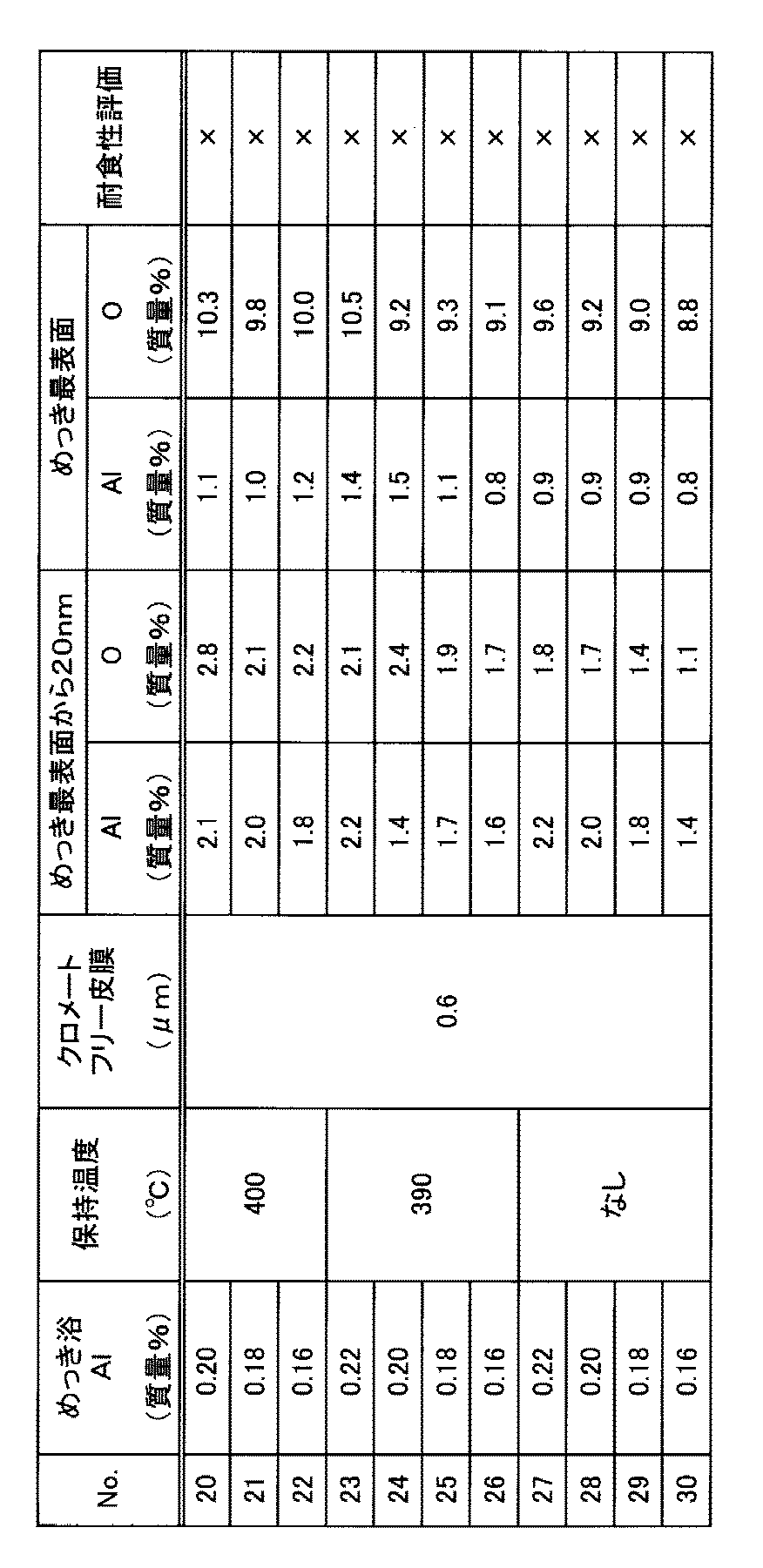
- the composition of the hot dip galvanizing bath contains the amount of Al shown in Table 1 or 2 below, with the balance being Zn and inevitable impurities.
- the steel was cooled to the holding temperature shown in Table 1 or 2 below in a pure N 2 gas atmosphere at a cooling rate of 3 ° C./second. Subsequently, it was kept isothermally at the above temperature for 10 seconds in an N 2 gas atmosphere containing 0.01% by volume of O 2 gas using an infrared heater. Then, in a pure N 2 gas atmosphere to room temperature, and then cooled at a cooling rate of 20 ° C. / sec.
- an experimental machine is used to hold the steel sheet from the hot dip galvanizing bath in the furnace, so the time for passing through the temperature range of 440 ° C. or lower and 400 ° C. or higher is held at the above holding temperature. It is almost equal to the time (10 seconds).
- No. Nos. 27 to 30 are examples of cooling from 460 ° C. to room temperature at a cooling rate of 20 ° C./second without isothermal holding in the above temperature range after galvanizing.
- the hot-dip galvanized steel sheet cooled to room temperature is adjusted to 0.8% elongation and surface roughness Ra to about 1 ⁇ m by lab skin pass rolling (lab SKP rolling), and the flatness is corrected using a leveler. went.
- the measurement apparatus and measurement conditions used for the measurement are as described above. The measurement results are shown in Table 1 or Table 2 below.
- the hot dip galvanized layer of the present invention example has a maximum Al content at a depth of 20 nm when the Al content is measured in the depth direction from the outermost surface on the chromate-free film side.
- the hot dip galvanized layer of the comparative example has the maximum amount of Al at a position where the depth is 40 nm.
- the following emulsion composition was applied and dried on the surface of the hot dip galvanized steel sheet cooled to room temperature using a bar coater so that the film thickness after drying was 0.6 ⁇ m, and the chromate-free film was coated.
- the emulsion composition was prepared by the following procedure. Add 626 parts of water and 160 parts of ethylene-acrylic acid copolymer to the autoclave, add triethylamine and NaOH, and stir at high speed in an atmosphere of 150 ° C. and 5 Pa to obtain an emulsion of ethylene-acrylic acid copolymer. It was.
- the ethylene-acrylic acid copolymer contains 20% acrylic acid and has a melt index (MI) of 300.
- the triethylamine was added at 40 mol% with respect to 1 mol of the carboxyl group in the ethylene-acrylic acid copolymer, and the NaOH was added at 15 mol% with respect to 1 mol of the carboxyl group in the ethylene-acrylic acid copolymer.
- a glycidyl group-containing crosslinking agent (Dainippon Ink & Chemicals, “Epicron CR5L (trade name)”) and an aziridinyl group-containing crosslinking agent (manufactured by Nippon Shokubai, “Chemite DZ-22E (trade name)” 4,4′-bis (ethyleneiminocarbonylamido) diphenylmethane), and silica particles having a particle diameter of 4 to 6 nm (manufactured by Nissan Chemical Industries, “Snowtex XS (trade name)”) and vanadic acid Ammonium was added to obtain an emulsion composition.
- the glycidyl group-containing cross-linking agent and the aziridinyl group-containing cross-linking agent each have a solid content of 5%.
- the silica particles were added so that the solid content was 25%.
- the ammonium vanadate was added so as to be 5% with respect to the chromate-free film amount (attachment amount).
- the formation of the chromate-free film was carried out by heating at an ultimate temperature (PMT) of 100 ° C. for 60 seconds.
- the obtained chromate-free coated hot-dip galvanized steel sheet was subjected to the salt spray test specified in JIS Z2371, using a flat plate with the back and edge portions sealed, and the white rust occurrence area ratio after 120 hours at 35 ° C. Judging by the following criteria, corrosion resistance (white rust resistance) was evaluated. A 5% NaCl aqueous solution was used for the salt spray test. The area ratio of white rust was determined visually.
- No. Nos. 1 to 19 are examples of the present invention in which the amount of Al and the amount of O at the position of the hot dip galvanized layer at a depth of 20 nm satisfy the requirements of the present invention, and all are excellent in corrosion resistance. It was also found that the more the amount of Al in the hot dip galvanizing bath and the higher the holding temperature after plating, the more likely to suppress the occurrence of white rust.
- No. Nos. 20 to 30 are examples that do not satisfy the requirements defined in the present invention. Since Nos. 20 to 26 were kept in a temperature range of 400 ° C. or less after hot dip galvanizing, the Al content at a position 20 nm from the outermost surface of the hot dip galvanized layer was reduced, and the corrosion resistance was lowered. No. Nos. 27 to 30 are examples of cooling to room temperature after hot dip galvanization without maintaining isothermal in a predetermined temperature range, and the corrosion resistance was also lowered.
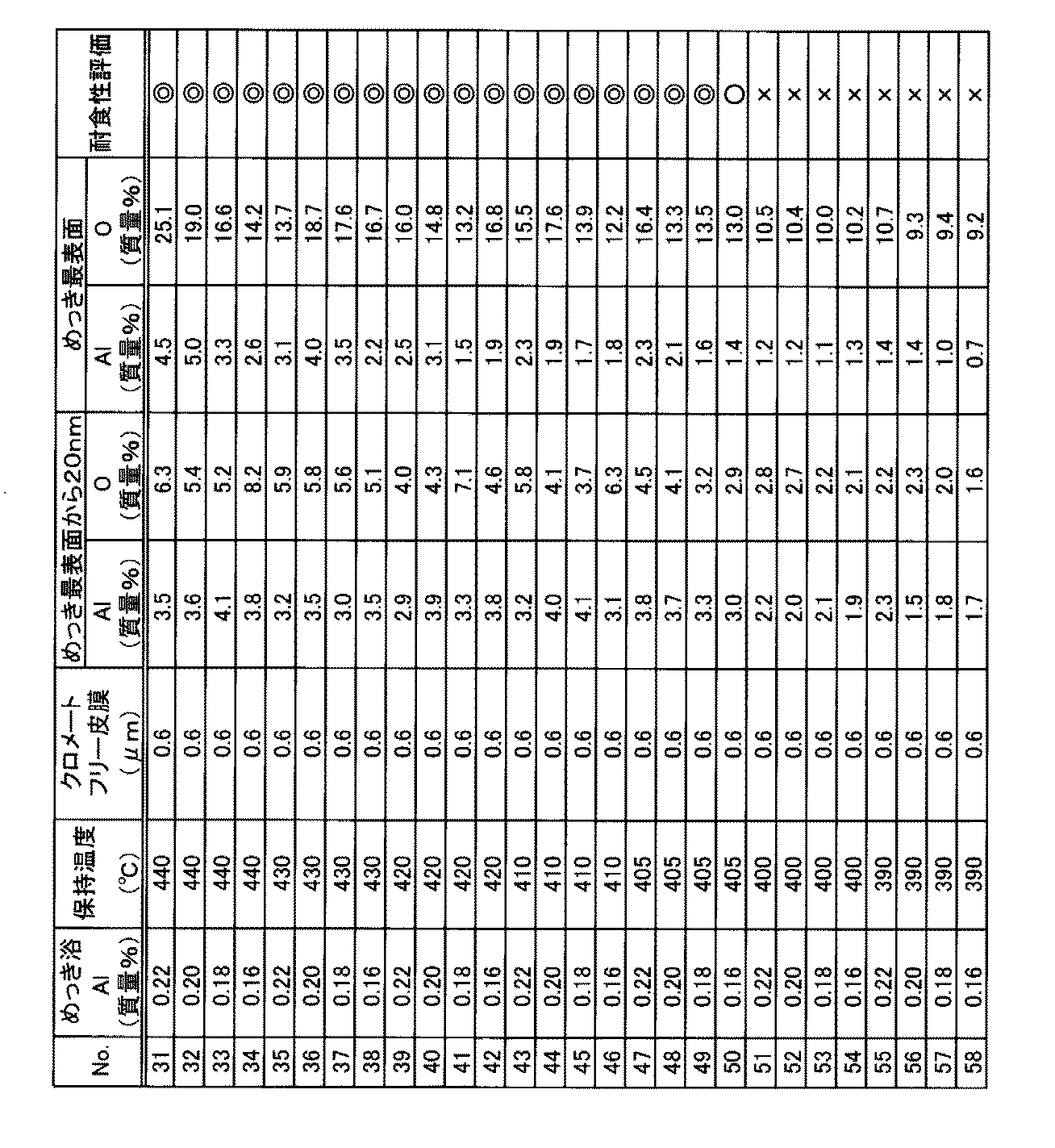
- Example 2 In the above experimental example 1, as the hot dip galvanizing bath, the amount of Al shown in the following Table 3 is contained, and a plating bath in which the balance is Zn and inevitable impurities is used, and the above Table 1 or Table 2 using an infrared heater. Instead of holding the isothermal temperature for 10 seconds at the holding temperature shown in Fig. 5, the surface was flattened under the same conditions as in Experimental Example 1 except that an infrared heater was used to hold the isothermal temperature for 15 seconds with the holding time shown in Table 3 below. A galvanized copper plate was obtained. In this experimental example, an experimental machine is used to hold the steel sheet from the hot dip galvanizing bath in the furnace, so the time for passing through the temperature range of 440 ° C. or lower and 400 ° C. or higher is held at the above holding temperature. It is almost equal to the set time (15 seconds).
- No. Nos. 31 to 50 are examples of the present invention in which the Al amount and the O amount at the depth of 20 nm of the hot-dip galvanized layer satisfy the requirements of the present invention, and all are excellent in corrosion resistance. It was also found that the more the amount of Al in the hot dip galvanizing bath and the higher the holding temperature after plating, the more likely to suppress the occurrence of white rust.
- No. Nos. 51 to 58 are examples that do not satisfy the requirements specified in the present invention.
- the aluminum content at a position 20 nm from the outermost surface of the hot dip galvanization layer is reduced because the temperature is kept at 400 ° C. or lower. Corrosion resistance decreased.
Landscapes
- Chemical & Material Sciences (AREA)
- Chemical Kinetics & Catalysis (AREA)
- Engineering & Computer Science (AREA)
- Materials Engineering (AREA)
- Mechanical Engineering (AREA)
- Metallurgy (AREA)
- Organic Chemistry (AREA)
- Inorganic Chemistry (AREA)
- Coating With Molten Metal (AREA)
- Chemical Treatment Of Metals (AREA)
Abstract
Description
上記溶融亜鉛めっき層の最表面におけるAlおよびOは、Al:1.0%以上、およびO:10.0%以上を満足することが好ましい。
まず、本発明を特徴付ける溶融亜鉛めっき層について説明する。
上述したとおり、本発明における溶融亜鉛めっき層は、溶融亜鉛めっき層の最表面から深さ20nmまでの領域(表面近傍)にAl量の最大ピークを有するような深さ方向のAl濃度プロファイルを有している。
測定装置:SPECTRUM ANALYTIK GmbH社製の「GDA750(装置名)」
測定条件:電力50W、2.5ヘクトパスカルのアルゴンガス中、グロー放電源(無水GDS)-Spectruma Analytik-Grimm型を使用、測定パルスは50%
クロメートフリー皮膜は、クロムさえ含んでいなければ特に制限はなく、有機系もしくは無機系、或いは有機無機複合系の防錆皮膜を使用できる。
本発明に用いられる鋼板は、溶融亜鉛めっき鋼板に用いられるものであれば特に限定されず、例えば、Alキルド鋼板やIF鋼などが挙げられる。
実験機を用いてAlキルド鋼(冷延鋼板、板厚は0.8mm)を下記の条件で溶融亜鉛めっきし、次いでクロメートフリー皮膜を被覆してクロメートフリー被覆溶融亜鉛めっき鋼板を得た。Alキルド鋼は、C:0.05%、Si:0.02%、Mn:0.19%、Al:0.047%、P:0.015%、S:0.012%を含有し、残部が鉄および不可避不純物からなる鋼板である。
<耐食性の評価基準>
◎(合格) :白錆の発生無し。
○(合格) :白錆の発生面積率が0%を超え、10%以下。
△(不合格):白錆の発生面積率が10%を超え、30%以下。
×(不合格):白錆の発生面積率が30%を超えた。

上記実験例1において、溶融亜鉛めっき浴として、下記表3に示す量のAlを含有し、残部がZnおよび不可避不純物であるめっき浴を用いる点と、赤外線ヒーターを用いて上記表1または表2に示す保持温度で10秒間等温保持する代わりに、赤外線ヒーターを用いて下記表3に示す保持時間で15秒間等温保持する点以外は、上記実験例1と同じ条件で表面を平坦化させた溶融亜鉛めっき銅板を得た。なお、本実験例では、実験機を用い、溶融亜鉛めっき浴から出た鋼板を炉内で保持しているため、440℃以下400℃超の温度域を通過する時間は、上記保持温度で保持した時間(15秒間)とほぼ等しくなっている。
Claims (9)
- 溶融亜鉛めっき層およびクロメートフリー皮膜を有するクロメートフリー被覆溶融亜鉛めっき鋼板であって、
前記溶融亜鉛めっき層について、高周波グロー放電発光分光分析による深さ方向のAl濃度プロファイルを測定したとき、前記溶融亜鉛めっき層の最表面から深さ20nmまででの領域にAl量の最大ピークを有しており、
前記溶融亜鉛めっき層の最表面から深さ20nmの位置におけるAlおよびOは、Al:2.5%(質量%の意味。以下、成分について同じ。)以上、およびO:2.0%以上を満足することを特徴とする耐食性に優れたクロメートフリー被覆溶融亜鉛めっき鋼板。 - 前記溶融亜鉛めっき層の最表面におけるAlおよびOは、Al:1.0%以上、およびO:10.0%以上を満足するものである請求項1に記載のクロメートフリー被覆溶融亜鉛めっき鋼板。
- 前記溶融亜鉛めっき層の最表面から深さ20nmの位置におけるAlが、Al:4.5%以下を満足する請求項1に記載のクロメートフリー被覆溶融亜鉛めっき鋼板。
- 前記溶融亜鉛めっき層の最表面から深さ20nmの位置におけるOが、O:10%以下を満足する請求項1に記載のクロメートフリー被覆溶融亜鉛めっき鋼板。
- 前記溶融亜鉛めっき層の最表面におけるAlが、Al:5.5%以下を満足する請求項1に記載のクロメートフリー被覆溶融亜鉛めっき鋼板。
- 前記溶融亜鉛めっき層の最表面におけるOが、O:30%以下を満足する請求項1に記載のクロメートフリー被覆溶融亜鉛めっき鋼板。
- 前記溶融亜鉛めっき層の付着量が、前記鋼板の面積に対して、30~150g/m2である請求項1に記載のクロメートフリー被覆溶融亜鉛めっき鋼板。
- 前記クロメートフリー皮膜が、前記クロメートフリー皮膜の固形物中に占める比率で1~30質量%のコロイダルシリカを含有する請求項1に記載のクロメートフリー被覆溶融亜鉛めっき鋼板。
- 前記クロメートフリー皮膜の膜厚が0.2~3.0μmである請求項1に記載のクロメートフリー被覆溶融亜鉛めっき鋼板。
Priority Applications (2)
| Application Number | Priority Date | Filing Date | Title |
|---|---|---|---|
| CN200980108945.2A CN101970706B (zh) | 2008-03-27 | 2009-03-23 | 耐腐蚀性优良的无铬覆盖热浸镀锌钢板 |
| KR1020107021141A KR101249583B1 (ko) | 2008-03-27 | 2009-03-23 | 내식성이 우수한 크로메이트-프리 피복 용융 아연 도금 강판 |
Applications Claiming Priority (2)
| Application Number | Priority Date | Filing Date | Title |
|---|---|---|---|
| JP2008-084683 | 2008-03-27 | ||
| JP2008084683 | 2008-03-27 |
Publications (1)
| Publication Number | Publication Date |
|---|---|
| WO2009119475A1 true WO2009119475A1 (ja) | 2009-10-01 |
Family
ID=41113668
Family Applications (1)
| Application Number | Title | Priority Date | Filing Date |
|---|---|---|---|
| PCT/JP2009/055586 Ceased WO2009119475A1 (ja) | 2008-03-27 | 2009-03-23 | 耐食性に優れたクロメートフリー被覆溶融亜鉛めっき鋼板 |
Country Status (5)
| Country | Link |
|---|---|
| JP (1) | JP5588112B2 (ja) |
| KR (1) | KR101249583B1 (ja) |
| CN (1) | CN101970706B (ja) |
| TW (1) | TWI409361B (ja) |
| WO (1) | WO2009119475A1 (ja) |
Cited By (1)
| Publication number | Priority date | Publication date | Assignee | Title |
|---|---|---|---|---|
| JP2021508771A (ja) * | 2017-12-26 | 2021-03-11 | ポスコPosco | 加工後耐食性に優れた亜鉛合金めっき鋼材及びその製造方法 |
Families Citing this family (7)
| Publication number | Priority date | Publication date | Assignee | Title |
|---|---|---|---|---|
| JP5355141B2 (ja) * | 2009-02-24 | 2013-11-27 | 株式会社神戸製鋼所 | めっき表面とクロメートフリー皮膜との密着性に優れたクロメートフリー皮膜被覆溶融亜鉛めっき鋼板およびその製造方法 |
| CN103695891A (zh) * | 2013-12-12 | 2014-04-02 | 江苏克罗德科技有限公司 | 环保的热浸镀锌钢板及其制备方法 |
| CN103983201A (zh) * | 2014-05-14 | 2014-08-13 | 首钢总公司 | 一种检测冷轧板磷化膜厚度的方法 |
| JP6569194B2 (ja) * | 2014-08-06 | 2019-09-04 | Jfeスチール株式会社 | 耐食性に優れた表面処理溶融亜鉛めっき鋼板 |
| JP6831617B2 (ja) * | 2014-11-05 | 2021-02-17 | 日本製鉄株式会社 | 耐食性に優れた溶融亜鉛めっき鋼板と合金化溶融亜鉛めっき鋼板およびそれらの製造方法 |
| JP7006257B2 (ja) * | 2017-12-27 | 2022-01-24 | 日本製鉄株式会社 | ホットスタンプ成形体及びホットスタンプ成形体の製造方法 |
| TWI687546B (zh) * | 2019-04-18 | 2020-03-11 | 中國鋼鐵股份有限公司 | 耐高溫氧化之複合鍍鋅鋼板及其製造方法與應用 |
Citations (4)
| Publication number | Priority date | Publication date | Assignee | Title |
|---|---|---|---|---|
| JPS6156270A (ja) * | 1984-08-24 | 1986-03-20 | Nippon Kokan Kk <Nkk> | 極低炭素鋼の溶融亜鉛めつき方法 |
| JPS6428350A (en) * | 1987-07-24 | 1989-01-30 | Taiyo Seiko Kk | Hot dip aluminum alloy coated steel sheet and its production |
| JP2004003004A (ja) * | 2002-04-18 | 2004-01-08 | Jfe Steel Kk | プレス成形性に優れた溶融亜鉛めっき鋼板とその製造方法 |
| JP2007023309A (ja) * | 2005-07-12 | 2007-02-01 | Nisshin Steel Co Ltd | 耐食性に優れた溶融亜鉛合金めっき鋼板 |
Family Cites Families (6)
| Publication number | Priority date | Publication date | Assignee | Title |
|---|---|---|---|---|
| JP2755387B2 (ja) * | 1988-04-12 | 1998-05-20 | 大洋製鋼株式会社 | プレコート鋼板用溶融亜鉛アルミニウム合金めっき鋼板の製造方法およびプレコート鋼板 |
| EP1142700A4 (en) * | 1999-10-08 | 2004-04-14 | Jfe Steel Corp | STEEL SHEET COATED WITH ZINC-BASED METAL AND SURFACE TREATED |
| JP2004019000A (ja) * | 2002-06-20 | 2004-01-22 | Sumitomo Metal Ind Ltd | 外観、加工性、耐食性に優れた溶融Zn−Alめっき鋼板とその製造方法 |
| KR100707255B1 (ko) * | 2003-04-18 | 2007-04-13 | 제이에프이 스틸 가부시키가이샤 | 프레스 성형성이 우수한 용융아연 도금강판과 그 제조방법 |
| JP4318610B2 (ja) * | 2004-07-30 | 2009-08-26 | 株式会社神戸製鋼所 | 表面処理金属板 |
| JP4704956B2 (ja) * | 2006-05-24 | 2011-06-22 | 株式会社神戸製鋼所 | 耐白錆性に優れたノンクロメート被覆溶融亜鉛めっき鋼板 |
-
2009
- 2009-02-24 JP JP2009041261A patent/JP5588112B2/ja active Active
- 2009-03-20 TW TW098109178A patent/TWI409361B/zh active
- 2009-03-23 CN CN200980108945.2A patent/CN101970706B/zh active Active
- 2009-03-23 WO PCT/JP2009/055586 patent/WO2009119475A1/ja not_active Ceased
- 2009-03-23 KR KR1020107021141A patent/KR101249583B1/ko active Active
Patent Citations (4)
| Publication number | Priority date | Publication date | Assignee | Title |
|---|---|---|---|---|
| JPS6156270A (ja) * | 1984-08-24 | 1986-03-20 | Nippon Kokan Kk <Nkk> | 極低炭素鋼の溶融亜鉛めつき方法 |
| JPS6428350A (en) * | 1987-07-24 | 1989-01-30 | Taiyo Seiko Kk | Hot dip aluminum alloy coated steel sheet and its production |
| JP2004003004A (ja) * | 2002-04-18 | 2004-01-08 | Jfe Steel Kk | プレス成形性に優れた溶融亜鉛めっき鋼板とその製造方法 |
| JP2007023309A (ja) * | 2005-07-12 | 2007-02-01 | Nisshin Steel Co Ltd | 耐食性に優れた溶融亜鉛合金めっき鋼板 |
Cited By (2)
| Publication number | Priority date | Publication date | Assignee | Title |
|---|---|---|---|---|
| JP2021508771A (ja) * | 2017-12-26 | 2021-03-11 | ポスコPosco | 加工後耐食性に優れた亜鉛合金めっき鋼材及びその製造方法 |
| JP7244722B2 (ja) | 2017-12-26 | 2023-03-23 | ポスコ カンパニー リミテッド | 加工後耐食性に優れた亜鉛合金めっき鋼材及びその製造方法 |
Also Published As
| Publication number | Publication date |
|---|---|
| CN101970706A (zh) | 2011-02-09 |
| JP2009256781A (ja) | 2009-11-05 |
| KR20100113174A (ko) | 2010-10-20 |
| JP5588112B2 (ja) | 2014-09-10 |
| TWI409361B (zh) | 2013-09-21 |
| KR101249583B1 (ko) | 2013-04-01 |
| TW200949011A (en) | 2009-12-01 |
| CN101970706B (zh) | 2012-10-31 |
Similar Documents
| Publication | Publication Date | Title |
|---|---|---|
| JP5588112B2 (ja) | 耐食性に優れたクロメートフリー被覆溶融亜鉛めっき鋼板 | |
| JP6368730B2 (ja) | 溶融Al−Zn−Mg−Siめっき鋼板とその製造方法 | |
| AU2016226812B2 (en) | HOT-DIP Al-Zn-Mg-Si COATED STEEL SHEET AND METHOD OF PRODUCING SAME | |
| JP5640312B2 (ja) | 耐食性と溶接性に優れる亜鉛系合金めっき鋼材及び耐食性に優れる塗装鋼材 | |
| EP2455509B1 (en) | Hot-dip al-zn plated steel sheet | |
| JP6645273B2 (ja) | 溶融Al−Zn−Mg−Siめっき鋼板とその製造方法 | |
| JP7549965B2 (ja) | 溶融Al-Zn-Mg-Si系めっき鋼板及びその製造方法、並びに、塗装鋼板及びその製造方法 | |
| JP2022549841A (ja) | 優れた耐黒変性及び耐アルカリ性を付与する三元系溶融亜鉛合金めっき鋼板用表面処理組成物、これを用いて表面処理された三元系溶融亜鉛合金めっき鋼板及びその製造方法 | |
| JP3868243B2 (ja) | 溶接性、耐食性に優れたクロメートフリー処理溶融亜鉛−アルミニウム合金めっき鋼板 | |
| TWI872671B (zh) | 鍍敷鋼材 | |
| WO2014181653A1 (ja) | 塗装後耐食性に優れるAl系合金めっき鋼材 | |
| EP3901296A1 (en) | Surface-treated steel sheet | |
| EP4230756A1 (en) | Plated steel sheet for automobile structural members | |
| WO2022149596A1 (ja) | 表面処理鋼板 | |
| JP2002241916A (ja) | 耐食性、加工性および溶接性に優れためっき鋼板とその製造方法 | |
| JP5101250B2 (ja) | 樹脂被覆鋼板 | |
| JP3599716B2 (ja) | 表面外観および曲げ加工性に優れた溶融Al−Zn系合金めっき鋼板およびその製造方法 | |
| JP7393551B2 (ja) | 加工性及び耐食性に優れたアルミニウム系合金めっき鋼板及びこの製造方法 | |
| JP6480132B2 (ja) | 溶融Al系めっき鋼板 | |
| JP7475162B2 (ja) | 塗装鋼板及び塗装鋼板の製造方法 | |
| JP4704956B2 (ja) | 耐白錆性に優れたノンクロメート被覆溶融亜鉛めっき鋼板 | |
| JP3910912B2 (ja) | 後処理めっき鋼板 | |
| TWI396773B (zh) | 熔融鍍鋅鋼板 | |
| JP3810743B2 (ja) | 後処理めっき鋼板 | |
| JP6771749B2 (ja) | 複層めっき鋼板およびその製造方法 |
Legal Events
| Date | Code | Title | Description |
|---|---|---|---|
| WWE | Wipo information: entry into national phase |
Ref document number: 200980108945.2 Country of ref document: CN |
|
| 121 | Ep: the epo has been informed by wipo that ep was designated in this application |
Ref document number: 09724816 Country of ref document: EP Kind code of ref document: A1 |
|
| ENP | Entry into the national phase |
Ref document number: 20107021141 Country of ref document: KR Kind code of ref document: A |
|
| WWE | Wipo information: entry into national phase |
Ref document number: 6022/CHENP/2010 Country of ref document: IN |
|
| NENP | Non-entry into the national phase |
Ref country code: DE |
|
| 122 | Ep: pct application non-entry in european phase |
Ref document number: 09724816 Country of ref document: EP Kind code of ref document: A1 |