WO2006137397A1 - 熱可塑性樹脂組成物 - Google Patents
熱可塑性樹脂組成物 Download PDFInfo
- Publication number
- WO2006137397A1 WO2006137397A1 PCT/JP2006/312320 JP2006312320W WO2006137397A1 WO 2006137397 A1 WO2006137397 A1 WO 2006137397A1 JP 2006312320 W JP2006312320 W JP 2006312320W WO 2006137397 A1 WO2006137397 A1 WO 2006137397A1
- Authority
- WO
- WIPO (PCT)
- Prior art keywords
- resin composition
- fibers
- thermoplastic
- group
- fiber
- Prior art date
- Legal status (The legal status is an assumption and is not a legal conclusion. Google has not performed a legal analysis and makes no representation as to the accuracy of the status listed.)
- Ceased
Links
Classifications
-
- C—CHEMISTRY; METALLURGY
- C08—ORGANIC MACROMOLECULAR COMPOUNDS; THEIR PREPARATION OR CHEMICAL WORKING-UP; COMPOSITIONS BASED THEREON
- C08K—Use of inorganic or non-macromolecular organic substances as compounding ingredients
- C08K5/00—Use of organic ingredients
- C08K5/0008—Organic ingredients according to more than one of the "one dot" groups of C08K5/01 - C08K5/59
- C08K5/0083—Nucleating agents promoting the crystallisation of the polymer matrix
-
- C—CHEMISTRY; METALLURGY
- C08—ORGANIC MACROMOLECULAR COMPOUNDS; THEIR PREPARATION OR CHEMICAL WORKING-UP; COMPOSITIONS BASED THEREON
- C08K—Use of inorganic or non-macromolecular organic substances as compounding ingredients
- C08K5/00—Use of organic ingredients
- C08K5/16—Nitrogen-containing compounds
- C08K5/20—Carboxylic acid amides
-
- C—CHEMISTRY; METALLURGY
- C08—ORGANIC MACROMOLECULAR COMPOUNDS; THEIR PREPARATION OR CHEMICAL WORKING-UP; COMPOSITIONS BASED THEREON
- C08L—COMPOSITIONS OF MACROMOLECULAR COMPOUNDS
- C08L67/00—Compositions of polyesters obtained by reactions forming a carboxylic ester link in the main chain; Compositions of derivatives of such polymers
- C08L67/04—Polyesters derived from hydroxycarboxylic acids, e.g. lactones
-
- C—CHEMISTRY; METALLURGY
- C08—ORGANIC MACROMOLECULAR COMPOUNDS; THEIR PREPARATION OR CHEMICAL WORKING-UP; COMPOSITIONS BASED THEREON
- C08L—COMPOSITIONS OF MACROMOLECULAR COMPOUNDS
- C08L2205/00—Polymer mixtures characterised by other features
- C08L2205/14—Polymer mixtures characterised by other features containing polymeric additives characterised by shape
- C08L2205/16—Fibres; Fibrils
-
- C—CHEMISTRY; METALLURGY
- C08—ORGANIC MACROMOLECULAR COMPOUNDS; THEIR PREPARATION OR CHEMICAL WORKING-UP; COMPOSITIONS BASED THEREON
- C08L—COMPOSITIONS OF MACROMOLECULAR COMPOUNDS
- C08L97/00—Compositions of lignin-containing materials
- C08L97/02—Lignocellulosic material, e.g. wood, straw or bagasse
Definitions
- the present invention relates to a thermoplastic resin composition containing plant-derived resin and having excellent moldability and heat resistance.
- biodegradable fats and oils such as polylactic acid have attracted particular attention as an example of a fat composition using plant-derived fats and are being commercialized for various uses.
- the biodegradable resin can be used for applications such as containers and packaging, agricultural films, etc. that are supposed to be disposed of for a short period of time, housing for household appliances and OA equipment, and automotive parts. In particular, there are a wide variety of applications that can maintain the initial characteristics for a long period of time.
- Patent Document 1 JP-A-9-278991 discloses a molded article having both transparency and crystallinity by adding a transparent nucleating agent such as aliphatic amide to an aliphatic polyester such as polylactic acid.
- Patent Document 1 JP-A-9-278991 Disclosure of the invention
- the present invention has been made in view of the above-described problems of the prior art, and an object of the present invention is to provide a plant-derived rosin composite material having a sufficiently high crystallization rate and excellent moldability and heat resistance.
- thermoplastic resin composition of the present invention having excellent moldability and heat resistance was completed. That is, the present invention relates to a thermoplastic resin composition specified by the following items [1] to [9].
- a thermoplastic resin composition comprising an organic crystal nucleating agent comprising one or more compounds (excluding ethylenebis-12-hydroxystearic acid amide).
- the organic crystal nucleating agent is a carboxylic acid amide having a polar group substituted at the predetermined interval and a carboxylic acid ester power.
- the polar group is a hydroxyl group, a glycidyl group, a carboxyl group, an amino group, and one or more groups selected from a nitro group, a cyano group, and an isocyanate group [1]
- thermoplastic rosin composition according to item 1 above.
- the fiber is contained in an amount of 40% by mass or less by weight in the total amount of the thermoplastic resin composition.
- thermoplastic rosin composition comprising an organic crystal nucleating agent comprising thermoplastic plant-derived rosin and ethylenebis 12-hydroxystearic acid amide, and occupies the total amount of the thermoplastic rosin composition
- thermoplastic resin composition characterized by containing fibers at a weight ratio of 40% by mass or less.
- thermoplastic resin composition according to [1].
- a fiber such as kenaf fiber in plant-derived coconut oil and the organic crystal nucleating agent of the present invention In particular, the growth of the crystal phase, the so-called transcrystal layer, that causes the polylactic acid molecules to quickly aggregate around the fiber and bring about a good effect on improving the heat resistance of the composition, is promoted specifically. It can be inferred that the effect of Therefore, a thermoplastic resin composition excellent in heat resistance and moldability can be obtained by an unexpected synergistic effect of the organic crystal nucleating agent of the present invention and fibers in promoting the formation of crystal nuclei and the formation of a transcrystal layer. Realized.
- the present invention can provide a plant-derived coconut resin composite material having a sufficiently high crystallization rate and excellent moldability. Further, when fibers are added, the crystallization rate is sufficiently high. It is possible to provide a plant-derived rosin composite material having excellent properties and heat resistance.
- the thermoplastic rosin composition of the present invention comprises a thermoplastic plant-derived rosin (hereinafter simply referred to as "plant-derived rosin”) and a carboxylic acid amide having a polar group at a specific site in the molecule.
- a composition containing an organic crystal nucleating agent that is one or more of low molecular compounds such as carboxylic acid ester, a plant-derived resin, and a force having a polar group at a specific site in the molecule It is a composition containing an organic crystal nucleating agent composed of a low molecular compound such as an amide ester carboxylate and fibers such as kenaf fibers.
- the plant-derived rosin is not particularly limited as long as it is derived from plants.
- polylactic acid can be obtained by using a saccharide contained in corn cocoon or the like as a starting material.
- Succinic acid can be used.
- Plant-derived resins based on succinic acid include esters such as polybutylene succinate.
- starch, amylose, cellulose, cellulose ester, chitin, chitosan, gellan gum, carboxyl group-containing cellulose, carboxyl group-containing starch, pectinic acid, alginic acid and other polysaccharides are also plant-derived rosins.
- Hydroxybutyrate synthesized by microorganisms and polybetahydroxyalkanoate are not derived from plants. It can be used because it has the same significance as plant-derived resin in that it does not require petroleum resources.
- artificially synthesized biodegradable oligomers and polymers 1. Artificially synthesized modified biodegradable oligomers and polymers, natural synthesized biodegradable oligomers and polymers with denatured body strength S, and moderate bond strength between molecules, excellent thermoplasticity, and extremely high viscosity when melted. An increase is preferable because it has excellent moldability.
- polyesters having crystallinity and modified products of aliphatic polyesters and modified products of aliphatic polyesters are more preferable.
- polyamino acids and modified polyamino acids are preferred, and aliphatic polyamino acids and modified polyamino acids are more preferred.
- modified products of polyols and polyols are preferable, and modified products of aliphatic polyols and aliphatic polyols are more preferable.
- Petroleum-derived rosin can also be mixed with plant-derived resins.
- Examples of petroleum-derived resins include polypropylene, polystyrene, ABS, nylon, polyethylene terephthalate, polybutylene terephthalate, polycarbonate, urea resin, melamine resin, alkyd resin, acrylic resin, unsaturated polyester resin, diester Allyl phthalate resin, epoxy resin, silicone resin, cyanate resin, isocyanate resin, furan resin, keton resin, xylene resin, thermosetting polyimide, thermosetting polyamide, styrylpyridine
- Examples include alloys of thermosetting resins such as system resins, nitrile-terminated resins, addition-curable quinoxalines, and addition-curable polyquinoxaline resins, and the plant-derived resins.
- a curing agent and a curing accelerator necessary for the curing reaction can be used.
- the low molecular weight compound used as the organic crystal nucleating agent in the present invention is a compound having a molecular weight of 1,000 or less, more preferably a compound having a molecular weight of 100 to 900.
- the molecular weight of the low molecular weight compound exceeds 1,000, the compatibility with the plant-derived resin is lowered, and the dispersibility may be lowered or the molded product strength may bleed out.
- carboxylic acid amides and carboxylic acid esters are preferred, and a single compound may be used by mixing a plurality of compounds.
- Examples of the carboxylic acid amide include an aliphatic monocarboxylic acid amide, an aliphatic biscarboxylic acid amide, and an aromatic carboxylic acid amide.
- Examples of the carboxylic acid ester include an aliphatic monocarboxylic acid ester and an aliphatic biscarboxylic acid amide.
- Examples include esters and aromatic carboxylic acid esters. These compounds have at least one amide group or ester group. It may be above.
- a compound containing an amide group causes crystallization of plant-derived rosin during molding of the thermoplastic rosin composition of the present invention, which has a higher melting point than when it contains an ester group. It is preferable because crystal nuclei can be generated quickly.
- bisamide is particularly preferable in that the crystallization rate can be further improved.
- aliphatic monocarboxylic acid amide examples include lauric acid amide, normicinic acid amide, oleic acid amide, stearic acid amide, ergic acid amide, N-oleylpalmitic acid amide, N-oleyloleic acid amide, N-oleylstearic acid amide, N-stearylolenic acid amide, N-stearylstearic acid amide, N-stearylelic acid amide, methylenebis Stearic acid amide, ethylene bis lauric acid amide, ethylene bis-power purinic acid amide, ethylene bis-deic acid amide, ethylene bis-stearic acid amide, ethylene bis-sell acid amide, ethylene bis-isostearic acid amide, butylene bis-stearic acid amide, p-Xylylenebisstearin And the like can
- aliphatic monocarboxylic acid ester examples include lauric acid ester, palmitic acid ester, oleic acid ester, stearic acid ester, and L force acid ester.
- the polar group of the low molecular weight compound in the present invention may be any of oxygen-containing substituents, nitrogen-containing substituents, and halogen groups.
- the low molecular weight compound in the present invention preferably has at least two of these polar groups, and the interval between any two of the polar groups is preferably 34 ⁇ 4 angstroms.
- the distance between two polar groups means that the atoms constituting the entire molecule satisfy the known bond angle at each bond, while This is the linear distance between the carbon atoms to which the polar group is bonded in the most extended state of the body.
- These compounds may have 3 or more polar groups.
- the oxygen-containing substituent includes a hydroxyl group, a glycidyl group, a carboxyl group, and the like
- the nitrogen-containing substituent includes an amino group, a nitro group, Cyano group, isocyanate group and the like
- Different types of polar groups may be contained in one molecule. However, when there are multiple types of polar groups in the molecular structure and when the number of polar groups is 3 or more, the above polar groups are affected by the chemical interaction between polar groups.
- the distance between two polar groups is in the range of 34 ⁇ 10 angstroms when the whole molecule is in the most extended state, while each atom constituting the whole molecule satisfies a known bond angle in each bond. In some cases, it may function well.
- substitution in the present invention means substitution of a hydrogen atom bonded to a carbon atom in a molecule when it does not have a polar group.
- the most characteristic feature of the present invention is that it has been found that the spacing between polar groups has a special effect on the crystallization of plant-derived resins. It was not known at all that it was possible to achieve an excellent crystallization rate by prescribing.
- Examples of the carboxylic acid amides and carboxylic acid esters in which a part of the molecule is substituted with a polar group and having the above preferable conditions include, for example, ethylene bis 12-hydroxystearic acid amide, hexamethylene bis- 10- Hydroxy stearic acid amide, hexamethylene bis-9,10 Dihydroxy stearic acid amide, p Xylylene bis 9,10 Dihydroxy stearic acid amide, p Xylylene bis 10, 11-Dihydroxy stearic acid amide, Ethylene bis mono 12-aminostearic acid Amide, hexamethylenebis-1,10-aminostearic acid amide, Hexamethylene bis-1,9,10 Diaminostearic acid amide, p-Xylylene bis-1,9,10 Diaminostearic acid amide, p-Xylylene bis-10,11-Diaminostearin Acid amide, ethylene bis 12-cyan Stearamide, hexamethylene bis
- carboxylic acid amides substituted with hydroxyl groups ie, ethylene bis-12-hydroxystearic acid amide, hexamethylene bis-10-hydroxy stearic acid amide, hexamethylene bis 9,10 dihydroxystearic acid amide, p-xylylene bis 1,11-dihydroxystearic acid amide, etc. are preferable in that the crystallization speed of plant-derived rosin can be further improved.
- it is a bisamide that contains 2 or more and 8 or less methylene groups, or 1 or more and 4 or less phenyl groups between two amide bonds of carboxylic acid bisamide.
- rubonic acid bisamides such as hexamethylene bis-9,10 dihydroxystearic acid amide, p-xylylene bis-1,11-dihydroxystearic acid amide, p-xylylene bis 9,10 dihydroxystearic acid amide.
- the melting point of the carboxylic acid amide and carboxylic acid ester in which a part of the molecule is substituted with a polar group is preferably 20 to 300 ° C. If the melting point of the low molecular weight compound is less than 20 ° C If there is, the molded body tends to bleed out and the appearance of the molded body tends to be impaired.On the other hand, if it exceeds 300 ° C, it is difficult to melt under general molding processing conditions! It is in.
- the content of the organic crystal nucleating agent comprising a low molecular weight compound in which a part of the molecule is substituted with a polar group is 0. It is preferably 1 to 20% by mass, more preferably 0.1 to 10% by mass. If the content of the organic crystal nucleating agent comprising a low-molecular compound having a polar group is less than the lower limit, the degree of improvement in rigidity and crystallization speed tends to be insufficient, and on the other hand, exceeds the upper limit. In some cases, the plasticizer action becomes excessively strong, so that the rigidity tends to decrease, the molded product may bleed out, and the appearance of the molded product may be impaired.
- thermoplastic resin composition of the present invention can impart higher heat resistance by further containing fibers.
- the weight ratio force of the fibers in the total amount of the thermoplastic resin composition of the present invention is 0% by mass or less because the impact resistance and moldability are particularly excellent.
- plant fibers such as kenaf, synthetic organic fibers such as aramid fibers and wholly aromatic polyester fibers, inorganic fibers such as glass fibers and metal fibers can be used. These may be used alone or in combination of two or more, or different types of fibers may be used in combination.
- the plant fiber in the present invention refers to a fiber derived from a plant, and specific examples thereof include fibers capable of obtaining strength such as wood, kenaf, bamboo and hemp. These fibers preferably have an average fiber length of 20 mm or less. In addition, pulps obtained by delignification of these plant fibers are particularly preferred because they are less degraded due to thermal decomposition and discoloration. Kenaf and bamboo have high photosynthesis and fast growth, so they can absorb a large amount of carbon dioxide, making it an excellent solution for simultaneously solving global problems such as global warming and deforestation caused by carbon dioxide. U.
- the synthetic organic fibers in the present invention include polyamide fibers such as aramid fibers and nylon fibers, and polyester fibers such as polyarylate fibers and polyethylene terephthalate fibers. , Ultra-high strength polyethylene fiber, polypropylene fiber, and the like.
- Aramid fiber and polyarylate fiber are aromatic compounds, have higher heat resistance and higher strength than other fibers, and are light in color. It is particularly desirable because of its low specific gravity.
- Examples of the inorganic fiber in the present invention include carbon fiber, metal fiber, glass fiber, metal silicate, inorganic oxide fiber, and inorganic nitride fiber.
- each of the above fibers is a polygon, indeterminate shape or uneven shape in which the cross section of the fiber is not circular, and has a high aspect ratio or a small fiber diameter. This is desirable because the total area increases.
- each of the above fibers can be subjected to a surface treatment as necessary in order to increase the affinity with the base resin or the entanglement between the fibers.
- a surface treatment method treatment with a coupling agent such as silane or titanate, ozone or plasma treatment, or treatment with an alkyl phosphate ester type surfactant is effective.
- treatment methods that can be used normally for surface modification of fillers are not particularly limited to these.
- the average fiber length (number average fiber length of fibers excluding crushed pieces) of each of the above-mentioned fibers is preferably 100 ⁇ m to 20 mm, and particularly in the range of 0.1 mm to 10 mm. It is valid. Moreover, it is preferable to include a fiber having a fiber length of 300 m to 20 mm.
- the thermoplastic resin composition of the present invention includes an inorganic filler, a reinforcing material, a colorant (such as acid titanium), and a stabilizer (such as a radical scavenger and an antioxidant) as necessary.
- a colorant such as acid titanium
- a stabilizer such as a radical scavenger and an antioxidant
- flame retardants known metal hydrates, halogen flame retardants, phosphorus flame retardants, etc.
- known crystal nucleating agents talc, etc.
- antibacterial agents and fungicides can be used in combination.
- silica, alumina, sand, clay, slag and the like can be used.
- an acicular inorganic material or the like can be used.
- the antibacterial agent silver ions, copper ions, zeolites containing these, and the like can be used.
- thermoplastic resin composition of the present invention as described above can be used for an electrical container such as a casing of an electronic product by a method such as an injection molding method, a film molding method, a professional molding method, or a foam molding method. It can be processed into molded products for electronic equipment, building materials, automotive parts, daily necessities, medical uses, agricultural uses, etc.
- the mixing method of the various components of the thermoplastic resin composition in the present invention is not particularly limited, and mixing by a known mixer such as a tumbler, a ribbon blender, a uniaxial or biaxial kneader or the like. And melt mixing using an extruder, roll or the like.
- the method for molding the thermoplastic resin composition of the present invention is not particularly limited, and is necessary for the production of ordinary electrical and electronic equipment products such as known injection molding, injection 'compression molding, and compression molding methods. It is possible to use the molding method described above. Regarding the temperature at the time of melt mixing and molding, it is possible to set a range in which the temperature is higher than the melting temperature of the base resin and the plant fiber or plant-derived resin is not thermally deteriorated.
- Polylactic acid resin (trade name “TE-4000” manufactured by Utica Co., Ltd.) was used as plant-derived resin.
- Carboxylic acid amide compounds as organic crystal nucleating agents are ethylene bis-12-hydroxy stearic acid amide, hexamethylene bis-1,9-dihydroxy stearic acid amide, p-xylylene bis 1,9,10-dihydroxy stearic acid amide. Hexamethylene bis-12-hydroxystearic acid amide and ethylene bis 9,10-dihydroxystearic acid amide were used.
- kenaf fiber a fiber derived from bast with an average fiber length of 5 mm was used, and as the glass fiber, a fiber having a fiber diameter of 10 m and an average fiber length of 5 mm (manufactured by Asahi Fiber Glass) was used.
- the inorganic FILLER one, using 50 mass 0/0 particle size 4 m Mizusani ⁇ aluminum (Sani ⁇ sodium containing Yuryou 0.05 wt%).
- each material for the thermoplastic resin composition shown in the following examples and comparative examples was set so that the temperature of the composition was about 190 ° C. Then, the mixture was melted and mixed to produce pellets for injection molding.
- the molded body with good moldability and releasability is sufficiently crystallized, and the holding time in the mold required to take out the test piece without warping or sinking (cooling Time) was measured and used as an index of moldability.
- the deflection temperature under load (HDT) was measured in accordance with JIS K 7191-2.
- the measurement conditions were a load of 1.8 MPa, a heating rate of 2 ° CZmin, and a distance between fulcrums of 100 mm.
- the above HDT was used as an index of heat resistance.
- thermoplastic resin composition having a high temperature is a composition having a high crystallization rate as soon as crystallization occurs even at a higher temperature.
- the measurement was performed in a nitrogen atmosphere, and the temperature was changed in the order of steps 1 to 3 below.
- Step 1 Temperature increase from 20 ° C to 200 ° C at a temperature increase rate of 30 ° CZmin
- Step 2 Keep constant temperature for 5 min at 200 ° C
- Step 3 Decrease temperature from 200 ° C to 20 ° C at a temperature decrease rate of 5 ° CZmin
- Polylactic acid ⁇ 97.5 wt% as a plant-derived ⁇ the ⁇ composition obtained by mixing 2.5 mass 0/0 Echirenbi scan one 12-hydroxystearic acid amide as the organic crystal nucleating agent, mixing kneading A pellet was prepared by melt mixing using a machine. The temperature of the kneader was set so that the temperature of the above resin composition was about 190 ° C.
- the carboxylic acid amides A to E are the following compounds.
- thermoplastic soy sauce composition of the present invention is superior in moldability to the resin composition of each comparative example related to the prior art. : I understand that.
- Example 3 shown in Table 2 and Reference Example 3 and Comparative Example 3 were made.
- the comparative power between Example 4 and Example 5 and Comparative Example 3 when the low molecular weight compound in which the fiber and part of the molecule are substituted with polar groups is added simultaneously to the plant-derived resin, the fiber is added alone.
- the heat resistance of the resin composition is further improved (Example 3 and Example 4).
- the moldability of the resin composition is further improved compared to the case where a low molecular weight compound in which a part of the molecule is substituted with a polar group is added alone (Reference Example 3, Example 5) (Examples). 3, Example 4).
- Example 6 As shown in Example 1, Example 5 and Example 112 described in Table 8, Comparative Example 2-3, Reference Example 3, a part of the fibers and molecules are polar groups in the plant-derived resin.
- the amount of the low molecular weight compound in which a part of the molecule is substituted with a polar group is added, compared with the case where the fiber is added alone (Comparative Example 3).
- the heat resistance of the fat composition is improved (Examples 11 to 21). Power!
- the moldability of the resin composition is further improved compared to the case where a low molecular weight compound in which a part of the molecule is substituted with a polar group is added alone (Reference Example 3, Example 5, and Example 22). (Examples 11 to 21).
- Example 12 described in 10, Example 23-27, Example 15 described in Table 11, Table 28-32, Example 33- 37 described in Table 13.
- the moldability of the resin composition is further improved compared to the case where a low molecular weight compound in which a part of the molecule is substituted with a polar group is added alone (Example 38) (Example 39 described in Table 15). — 42, Example 43-46 described in Table 17).
- the flame retardant thermoplastic resin composition of the present invention is applied to electrical / electronic equipment applications, building materials applications, automotive parts applications, daily necessities applications by methods such as injection molding, film molding, blow molding, and foam molding. It is processed into molded products for medical use, agricultural use, toy use and entertainment use.
Landscapes
- Chemical & Material Sciences (AREA)
- Health & Medical Sciences (AREA)
- Chemical Kinetics & Catalysis (AREA)
- Medicinal Chemistry (AREA)
- Polymers & Plastics (AREA)
- Organic Chemistry (AREA)
- Crystallography & Structural Chemistry (AREA)
- Compositions Of Macromolecular Compounds (AREA)
- Biological Depolymerization Polymers (AREA)
Abstract
熱可塑性の植物由来樹脂および、分子中に少なくとも2個の極性基を有し、その中のいずれか2個の極性基の間隔が34±4オングストロームである低分子化合物の1種または2種以上からなる有機結晶核剤を含む熱可塑性樹脂組成物を使用することで、結晶化速度が十分に速く、成形性及び耐熱性に優れた植物由来樹脂複合材料を提供する。
Description
熱可塑性樹脂組成物
技術分野
[0001] 本発明は、植物由来榭脂を含有し、成形性や耐熱性に優れる熱可塑性榭脂組成 物に関する。
背景技術
[0002] 石油原料の代替として、近年、植物由来樹脂が注目され、各種の植物由来榭脂を 利用した榭脂組成物の実用化検討が盛んに行われている。植物由来榭脂を利用し た榭脂組成物の一例として、最近では、ポリ乳酸をはじめとする生分解性榭脂が特に 注目され、各種用途で製品化されつつある。前記の生分解性榭脂の用途としては、 容器包装や農業用フィルム等のように使用期間が短ぐ廃棄を前提とした用途や、家 電製品や OA機器のハウジング及び自動車用部品などのように、初期の特性を長期 間保持できるような高機能用途まで、実に多岐にわたっている。
[0003] 植物由来樹脂の多くは結晶性榭脂であり、耐熱性など、その本来の材料特性を発 揮させるためには、榭脂を結晶化させることが重要である。しかし、植物由来樹脂の 大部分の結晶化速度は遅ぐ結晶化が終了した成形体を得るためには、成形加工時 において、榭脂の結晶化温度に調節した金型内部に長時間保持するか、成形後に 成形品を結晶化温度にてァニール処理する必要があった。しかし、成形加工時にお ける金型内部での長時間の保持は、実用的ではなぐ且つ結晶化が不十分になりや すぐまた、成形後のァニール処理による結晶化は、成形品が結晶化する過程で変 形しやす!/、と!/、う欠点がある。
[0004] そこで、力かる問題点を改善すベぐ植物由来樹脂の結晶化速度を向上させるた めの様々な方法が提案されている。例えば、特許文献 1 (特開平 9— 278991号公報 )には、ポリ乳酸などの脂肪族ポリエステルに脂肪族アミド等の透明核剤を添加する ことによって、透明性及び結晶性を併有する成形体が得られることが記載されている 特許文献 1:特開平 9 - 278991号公報
発明の開示
発明が解決しょうとする課題
[0005] し力しながら、上記特許文献 1に例示されて 、る脂肪族アミド等の透明核剤を添カロ した場合、透明核剤を無添加のポリ乳酸の場合に比べ結晶化速度の向上は認めら れるものの、その効果は十分ではなぐこのため十分な結晶化度を有する成形体を 得るためには成形後に熱処理する必要がある。また、結晶化度が低いため、例えば 射出成形の際に金型内での結晶固化が不十分となりやすぐその結果、十分な離型 性が得られず、さらには離型時に成形体が変形しやすくなるなどの欠点がある。
[0006] 本発明は、上記従来技術の有する課題に鑑みてなされたものであり、結晶化速度 が十分に速く、成形性及び耐熱性に優れた植物由来榭脂複合材料を提供すること を目的とする。
課題を解決するための手段
[0007] 本発明者らは、上記課題を解決すべく鋭意研究を重ねた結果、カルボン酸アミドゃ カルボン酸エステルのうち、分子中の特定の部位に極性基を有するものを結晶核剤 として添カ卩した場合に、それ以外のカルボン酸アミドゃカルボン酸エステルを添カロし た場合に比べて植物由来樹脂の結晶化速度が飛躍的に向上することを見出した。
[0008] さらに、ケナフ繊維などの繊維を添加した場合に、当該結晶核剤又はケナフ繊維な どの繊維のみをそれぞれ添加した場合に比べて、植物由来樹脂の成形性が向上す ることと、さらに驚くべきことに、耐熱性が飛躍的に向上することを見出した。これによ り、成形性に優れ、かつ耐熱性にも優れる本発明の熱可塑性榭脂組成物を完成する に至った。すなわち、本発明は、以下の [1]〜 [9]の事項により特定される熱可塑性 榭脂組成物に関する。
[0009] [1]熱可塑性の植物由来榭脂および、分子中に少なくとも 2個の極性基を有し、そ の中のいずれ力 2個の極性基の間隔が 34±4オングストロームである低分子化合物 (但し、エチレンビス— 12—ヒドロキシステアリン酸アミドを除く)の 1種または 2種以上 カゝらなる有機結晶核剤を含む熱可塑性榭脂組成物。
[0010] [2]前記有機結晶核剤が、前記所定の間隔で極性基が置換するカルボン酸アミド およびカルボン酸エステル力 選択される 1種または 2種以上の低分子化合物力 な
るものである [1]に記載の熱可塑性榭脂組成物。
[0011] [3]前記極性基が、含酸素置換基、含窒素置換基およびハロゲン基から選択され る 1種または 2種以上の基である [ 1 ]または [2]に記載の熱可塑性榭脂組成物。
[0012] [4]前記極性基が、水酸基、グリシジル基、カルボキシル基、アミノ基および、ニトロ 基、シァノ基、イソシァネート基力 選択される 1種または 2種以上の基である [1]から
[3]の 、ずれか 1項に記載の熱可塑性榭脂組成物。
[0013] [5]さらに繊維を、熱可塑性榭脂組成物の総量に占める重量割合で 40質量%以 下含有せしめたことを特徴とする、 [1]から [4]の ヽずれか 1項に記載の熱可塑性榭 脂組成物。
[0014] [6]熱可塑性の植物由来榭脂およびエチレンビス 12 ヒドロキシステアリン酸ァ ミドからなる有機結晶核剤を含む熱可塑性榭脂組成物であって、熱可塑性榭脂組成 物の総量に占める重量割合で 40質量%以下で繊維を含有せしめたことを特徴とす る熱可塑性榭脂組成物。
[0015] [7]前記繊維が、植物由来繊維、合成有機繊維および無機繊維から選択される 1 種または 2種以上の繊維であることを特徴とする、 [5]または [6]に記載の熱可塑性 榭脂組成物。
[0016] [8]前記繊維の平均繊維長 (破砕片を除く繊維の数平均繊維長)が 100 μ m〜20 mmであることを特徴とする [5]から [7]のいずれか 1項に記載の熱可塑性榭脂組成 物。
[0017] [9]前記繊維が 300 m〜20mmの繊維長の繊維を含むことを特徴とする [5]から
[8]の 、ずれか 1項に記載の熱可塑性榭脂組成物。
発明の効果
[0018] 本発明では、カルボン酸アミドゃカルボン酸エステルなどの低分子化合物の特定 の部位に存在する極性基のそれぞれと植物由来樹脂との間の高い化学的親和性に より、当該化合物の近傍に存在する植物由来樹脂が溶融状態から冷却されると可及 的速やかに結晶状態となって多数の結晶核を生成する。この効果により、成形性に 優れた熱可塑性榭脂組成物が実現される。
[0019] また、植物由来榭脂中でのケナフ繊維などの繊維と本発明の有機結晶核剤との共
存により、繊維の周囲にポリ乳酸分子が速やかに凝集して、組成物の耐熱性の向上 に良好な効果をもたらす原因となる結晶相、いわゆるトランスクリスタル層の成長が特 異的に促進されるという効果も得られると推察できる。従って、結晶核の生成及びトラ ンスクリスタル層の生成の促進における、本発明の有機結晶核剤と繊維との想定外 の相乗効果により、耐熱性、成形性に優れた熱可塑性榭脂組成物が実現される。
[0020] この結果、本発明は、結晶化速度が十分に速ぐ成形性に優れた植物由来榭脂複 合材料が提供でき、さらに繊維を添加した場合、結晶化速度が十分に速ぐ成形性と 耐熱性に優れた植物由来榭脂複合材料を提供することができる。
発明を実施するための最良の形態
[0021] 以下、本発明の好適な実施形態について詳細に説明する。
[0022] 本発明の熱可塑性榭脂組成物は、熱可塑性の植物由来榭脂(以下、単に「植物由 来榭脂」という)と、分子中の特定の部位に極性基を有するカルボン酸アミドゃカルボ ン酸エステルなどの低分子化合物の 1種または 2種以上力 なる有機結晶核剤を含 有する組成物、および、植物由来樹脂と、分子中の特定の部位に極性基を有する力 ルボン酸アミドゃカルボン酸エステルなどの低分子化合物からなる有機結晶核剤とケ ナフ繊維をはじめとする繊維を含有する組成物である。
[0023] 本発明における、植物由来榭脂としては、植物に由来するものであれば特に限定さ れるものではなぐ例えば、トウモロコシゃ芋などに含まれる糖質を出発原料として得 られる、ポリ乳酸ゃコハク酸を使用することができる。コハク酸を基にした植物由来榭 脂としては、ポリブチレンサクシネートなどのエステル類がある。また、澱粉、アミロー ス、セルロース、セルロースエステル、キチン、キトサン、ゲランガム、カルボキシル基 含有セルロース、カルボキシル基含有デンプン、ぺクチン酸、アルギン酸などの多糖 類なども植物由来榭脂である。
[0024] また、微生物により合成されるヒドロキシブチレート及び Zまたはヒドロキシバリレート の重合体であるポリベータヒドロキシアルカノエート (ゼネ力社製、商品名:バイオポー ル等)などは、植物由来ではないが、石油資源を必要としない点で、植物由来樹脂と 同様の意義を持っため使用することが出来る。
[0025] 以上の様な植物由来樹脂の中でも、人工合成した生分解性オリゴマー及びポリマ
一、人工合成した生分解性オリゴマー及びポリマーの変性体、天然合成した生分解 性オリゴマー及びポリマーの変性体力 S、分子間の結合力が適度であるため熱可塑性 に優れ、溶融時の粘度が著しく上昇することは無ぐ良好な成形加工性を有するため 好ましい。なかでも、結晶性を有するポリエステル類及びポリエステル類の変性体が 好ましぐ脂肪族ポリエステル類及び脂肪族ポリエステル類の変性体が更に好まし 、 。また、ポリアミノ酸類及びポリアミノ酸類の変性体が好ましぐ脂肪族ポリアミノ酸類 及び脂肪族ポリアミノ酸類の変性体が更に好ましい。また、ポリオール類及びポリオ ール類の変性体が好ましく、脂肪族ポリオール類及び脂肪族ポリオール類の変性体 が更に好ましい。
[0026] また、石油由来の榭脂も、植物由来樹脂に混合することが可能である。石油由来の 榭脂として、例えば、ポリプロピレン、ポリスチレン、 ABS、ナイロン、ポリエチレンテレ フタレート、ポリブチレンテレフタレート、ポリカーボネート、尿素樹脂、メラミン榭脂、ァ ルキド榭脂、アクリル榭脂、不飽和ポリエステル榭脂、ジァリルフタレート榭脂、ェポキ シ榭脂、シリコーン榭脂、シァネート系榭脂、イソシァネート系榭脂、フラン榭脂、ケト ン榭脂、キシレン榭脂、熱硬化型ポリイミド、熱硬化型ポリアミド、スチリルピリジン系榭 脂、二トリル末端型榭脂、付加硬化型キノキサリン、付加硬化型ポリキノキサリン榭脂 などの熱硬化性榭脂と、前記植物由来樹脂とのァロイが挙げられる。熱硬化性榭脂 を使用する場合は、硬化反応に必要な硬化剤や硬化促進剤を使用できる。
[0027] 本発明における有機結晶核剤となる低分子化合物とは、その分子量が 1, 000以 下の化合物であり、より好ましくは分子量 100〜900の化合物である。当該低分子化 合物の分子量が 1, 000を超えると、植物由来樹脂との相溶性が低下して、分散性が 低下したり成形体力もブリードアウトしたりする場合がある。なかでも、カルボン酸アミ ド及びカルボン酸エステルが好ましく、 1種の化合物でも複数の化合物を混合して使 用してちょい。
[0028] カルボン酸アミドとしては、脂肪族モノカルボン酸アミド、脂肪族ビスカルボン酸アミ ド、および芳香族カルボン酸アミドが挙げられ、カルボン酸エステルとしては、脂肪族 モノカルボン酸エステル、脂肪族ビスカルボン酸エステル、芳香族カルボン酸エステ ルが挙げられる。これらの化合物が有するアミド基またはエステル基は 1個でも 2個以
上でもよい。これらの中でも、アミド基を含む化合物は、エステル基を含む場合に比 ベて融点が高ぐ本発明における熱可塑性榭脂組成物の成形時に、植物由来榭脂 の結晶化を起こさせる原因となる結晶核を速やかに生成することができるため好まし い。さらに、ビスアミドは結晶化速度をより向上させることができる点で特に好ましい。
[0029] 脂肪族モノカルボン酸アミド、脂肪族ビスカルボン酸アミドおよび芳香族カルボン酸 アミドの具体例としては、ラウリン酸アミド、ノ ルミチン酸アミド、ォレイン酸アミド、ステ アリン酸アミド、エル力酸アミド、 N—ォレイルパルミチン酸アミド、 N—ォレイルォレイ ン酸アミド、 N—ォレイルステアリン酸アミド、 N—ステアリルォレイン酸アミド、 N—ステ ァリルステアリン酸アミド、 N—ステアリルエル力酸アミド、メチレンビスステアリン酸アミ ド、エチレンビスラウリン酸アミド、エチレンビス力プリン酸アミド、エチレンビス才レイン 酸アミド、エチレンビスステアリン酸アミド、エチレンビスエル力酸アミド、エチレンビス イソステアリン酸アミド、ブチレンビスステアリン酸アミド、 p—キシリレンビスステアリン 酸アミドなどを例示することができる。
[0030] 脂肪族モノカルボン酸エステル、脂肪族ビスカルボン酸エステルおよび芳香族カル ボン酸エステルの具体例としては、ラウリン酸エステル、パルミチン酸エステル、ォレ イン酸エステル、ステアリン酸エステル、エル力酸エステル、 N—ォレイルパルミチン 酸エステル、 N—ォレイルォレイン酸エステル、 N—ォレイルステアリン酸エステル、 N—ステアリルォレイン酸エステル、 N—ステアリルステアリン酸エステル、 N—ステア リルエル力酸エステル、メチレンビスステアリン酸エステル、エチレンビスラウリン酸ェ ステノレ、エチレンビス力プリン酸エステノレ、エチレンビス才レイン酸エステノレ、エチレン ビスステアリン酸エステノレ、エチレンビスエノレカ酸エステノレ、エチレンビスイソステアリ ン酸エステル、ブチレンビスステアリン酸エステル、 p—キシリレンビスステアリン酸ェ ステルなどを例示することができる。
[0031] 本発明における低分子化合物が有する極性基としては、含酸素置換基および含窒 素置換基、ハロゲン基の中であれば何れもよい。本発明における低分子化合物は、 これらの極性基を少なくとも 2個有し、その中のいずれか 2つの極性基間の間隔が、 3 4±4オングストロームであることが好ましい。 2つの極性基間の間隔とは、分子全体を 構成する各原子がそれぞれの結合において既知の結合角を満たしながら、分子全
体が最も伸展した状態において、極性基が結合している炭素原子間の直線的距離 である。これらの化合物が有する極性基の数は 3つ以上でもよい。また、極性基の種 類は、より具体的には、含酸素置換基には、水酸基および、グリシジル基、カルボキ シル基等が含まれ、含窒素置換基には、アミノ基および、ニトロ基、シァノ基、イソシァ ネート基等が含まれる。また、ひとつの分子中に異なる種類の極性基が含まれていて もよい。ただし、分子構造中に含まれる極性基の種類が複数に及ぶ場合、および極 性基の数が 3つ以上に及ぶ場合は、極性基間の化学的な相互作用による影響から、 上記の極性基のうち、二つの極性基間の間隔が分子全体を構成する各原子がそれ ぞれの結合において既知の結合角を満たしながら、分子全体が最も伸展した状態に おいて 34 ± 10オングストロームの範囲にある場合も好ましく機能することがある。な お、本発明における「置換」とは、極性基を有さない場合の分子中の炭素原子に結 合する水素原子を置換することを意味する。
[0032] 本発明の最も特徴とするところは、極性基間の間隔が植物由来樹脂の結晶化に特 異的に影響していることを見いだした点であり、従来、極性基間の間隔を規定するこ とで、優れた結晶化速度を達成できることは全く知られて 、なかった。
[0033] 上記の好ましい条件を備えた、分子の一部を極性基で置換したカルボン酸アミドぉ よびカルボン酸エステルとしては、例えば、エチレンビス 12—ヒドロキシステアリン 酸アミド、へキサメチレンビス一 10—ヒドロキシステアリン酸アミド、へキサメチレンビス - 9, 10 ジヒドロキシステアリン酸アミド、 p キシリレンビス一 9, 10 ジヒドロキシス テアリン酸アミド、 p キシリレンビス 10, 11—ジヒドロキシステアリン酸アミド、、ェ チレンビス一 12—アミノステアリン酸アミド、へキサメチレンビス一 10—アミノステアリ ン酸アミド、へキサメチレンビス一 9, 10 ジアミノステアリン酸アミド、 p キシリレンビ ス一 9, 10 ジアミノステアリン酸アミド、 p キシリレンビス一 10, 11—ジアミノステア リン酸アミド、、エチレンビス一 12—シァノステアリン酸アミド、へキサメチレンビス一 1 0 シァノステアリン酸アミド、へキサメチレンビス 9, 10 ジシァノステアリン酸アミ ド、 p キシリレンビス一 9, 10 ジシァノステアリン酸アミド、 p キシリレンビス一 10, 11—ジシァノステアリン酸アミド、、エチレンビス一 12—グリシジルステアリン酸アミド 、へキサメチレンビス一 10 グリシジルステアリン酸アミド、へキサメチレンビス一 9, 1
0 ジグリシジルステアリン酸アミド、 p キシリレンビス— 9, 10 ジグリシジルステア リン酸アミド、 p キシリレンビス一 10, 11—ジグリシジルステアリン酸アミド、、ェチレ ンビス一 12—ヒドロキシステアリン酸エステル、へキサメチレンビス一 10—ヒドロキシス テアリン酸エステル、へキサメチレンビス 9, 10 ジヒドロキシステアリン酸エステル 、 p キシリレンビス一 9, 10 ジヒドロキシステアリン酸エステル、 p キシリレンビス - 10, 11—ジヒドロキシステアリン酸エステル、、エチレンビス一 12—アミノステアリン 酸エステル、へキサメチレンビス 10—アミノステアリン酸エステル、へキサメチレン ビス— 9, 10 ジアミノステアリン酸エステル、 p キシリレンビス— 9, 10 ジアミノス テアリン酸エステル、 P キシリレンビス一 10, 11—ジアミノステアリン酸エステル、、 エチレンビス一 12—シァノステアリン酸エステル、へキサメチレンビス一 10—シァノス テアリン酸エステル、へキサメチレンビス 9, 10 ジシァノステアリン酸エステル、 p —キシリレンビス一 9, 10 ジシァノステアリン酸エステル、 p キシリレンビス一 10, 1 1—ジシァノステアリン酸エステル、、エチレンビス一 12—グリシジルステアリン酸エス テル、へキサメチレンビス 10—グリシジルステアリン酸エステル、へキサメチレンビ ス一 9, 10 ジグリシジルステアリン酸エステル、 p キシリレンビス一 9, 10 ジグリ シジルステアリン酸エステル、 p キシリレンビス— 10, 11—ジグリシジルステアリン酸 エステル、、などがある。この中でも、水酸基で置換したカルボン酸アミド、すなわちェ チレンビス一 12—ヒドロキシステアリン酸アミド、へキサメチレンビス一 10—ヒドロキシ ステアリン酸アミド、へキサメチレンビス一 9, 10 ジヒドロキシステアリン酸アミド、 p— キシリレンビス一 10, 11—ジヒドロキシステアリン酸アミド、、などは、植物由来榭脂の 結晶化速度をより向上させることができる点で好ましい。さらに、カルボン酸ビスアミド の 2つのアミド結合の間にメチレン基が 2個以上 8個以内、あるいは、フエニル基が 1 つ以上 4つ以下含まれているビスアミドで、水酸基の置換基が 3個以上 6個以内の力 ルボン酸ビスアミド、すなわちへキサメチレンビス— 9, 10 ジヒドロキシステアリン酸 アミド、 p キシリレンビス一 10, 11—ジヒドロキシステアリン酸アミド、 p キシリレンビ ス 9, 10 ジヒドロキシステアリン酸アミドなどは特に好ましい。
また、分子の一部を極性基で置換したカルボン酸アミドおよびカルボン酸エステル の融点は、好ましくは 20〜300°Cである。当該低分子化合物の融点が 20°C未満で
あると成形体力 ブリードアウトして成形体の外観が損なわれる傾向にあり、他方、 30 0°Cを超えると一般的な成形加工条件では溶融させにく!、ため、成形加工性が低下 する傾向にある。
[0035] 本発明の熱可塑性榭脂組成物において、分子の一部を極性基で置換した低分子 化合物からなる有機結晶核剤の含有量は、植物由来榭脂 100質量%に対して 0. 0 1〜20質量%であることが好ましぐ 0. 1〜10質量%であることがより好ましい。極性 基を有する低分子化合物からなる有機結晶核剤の含有量が前記下限値未満である と、剛性及び結晶化速度の向上の程度が不十分となる傾向にあり、他方、前記上限 値を超える場合には、可塑剤的作用が過剰に強く発現するようになるために、剛性が 低下したり、成形体力 ブリードアウトしたり、成形体の外観が損なわれる傾向が顕著 になる恐れがある。
[0036] また、本発明の熱可塑性榭脂組成物は、さらに繊維を含有することにより、より高い 耐熱性を付与することができる。繊維を使用する場合には、本発明の熱可塑性榭脂 組成物の総量に占める繊維の重量割合力 0質量%以下になるようにすると、耐衝撃 性や成形性が特に優れるので好まし 、。
[0037] 本発明における繊維としては、ケナフなどの植物繊維、ァラミド繊維や全芳香族ポリ エステル繊維といった合成有機繊維、ガラス繊維、金属繊維といった無機繊維を使 用することができる。これらは 1種でも良ぐまた 2種以上を混合して使用してもよぐま た異なる種類の繊維を混合して使用してもよい。
[0038] 本発明における植物繊維とは、植物に由来する繊維をいい、具体例として、木材、 ケナフ、竹、麻類など力も得られる繊維を挙げることができる。これらの繊維は、平均 繊維長が 20mm以下のものが好ましい。また、これらの植物繊維を脱リグニンゃ脱ぺ クチンして得られるパルプ等は、熱による分解や変色と 、つた劣化が少な 、ため特に 好ましい。ケナフや竹は光合成速度が速く成長が速いので、二酸化炭素を多量に吸 収できることから、二酸ィ匕炭素による地球温暖化、森林破壊という地球問題を同時に 解決する手段の一つとしても優れて ヽるので、植物繊維の中でも好ま U、。
[0039] 本発明における合成有機繊維としては、ァラミド繊維やナイロン繊維などのポリアミ ド繊維、ポリアリレート繊維やポリエチレンテレフタレート繊維などのポリエステル繊維
、超高強度ポリエチレン繊維、ポリプロピレン繊維、などが挙げられる。
[0040] ァラミド繊維やポリアリレート繊維は芳香族化合物であり、他の繊維に比べ耐熱性 が高ぐかつ高強度であること、淡色であることから榭脂に添加しても意匠性を損なわ ないこと、比重も低いことから、特に望ましい。
[0041] 本発明における無機繊維としては、炭素繊維、金属繊維、ガラス繊維、金属ケィ酸 塩、無機酸化物繊維、無機窒化物繊維などが上げられる。
[0042] 上記の各繊維の形状は、繊維断面を円状ではなぐ多角形、不定形あるいは凹凸 のある形状のもので、アスペクト比が高いものや、繊維径の小さいもの力 榭脂との接 合面積が大きくなるため、望ましい。
[0043] また、上記の各繊維には必要に応じて、基材となる榭脂との親和性または繊維間の 絡み合いを高めるために、表面処理を施すことができる。表面処理方法としては、シ ラン系、チタネート系などのカップリング剤による処理、オゾンやプラズマ処理、さらに は、アルキルリン酸エステル型の界面活性剤による処理などが有効である。しかしな がら、これらに特に限定されるものでは無ぐ充填材の表面改質に通常使用できる処 理方法が可能である。
[0044] 上記の各繊維の平均繊維長 (破砕片を除く繊維の数平均繊維長)は、 100 μ m〜 20mmであることが好ましぐ 0. 1mm以上 10mm以下の範囲であると、特に有効で ある。また、 300 m〜20mmの繊維長の繊維を含むことが好ましい。
[0045] その他、本発明の熱可塑性榭脂組成物には、必要に応じて、無機フィラー、補強材 、着色剤 (酸ィ匕チタンなど)、安定剤 (ラジカル補足剤、酸化防止剤など)、難燃剤 (公 知の金属水和物やハロゲン系難燃剤、リン系難燃剤等)、公知の結晶核剤 (タルク等 )、抗菌剤や防かび材などを併用できる。無機フィラーとしては、シリカ、アルミナ、砂 、粘土、鉱滓などを使用できる。補強材としては針状無機物などを使用できる。抗菌 剤としては、銀イオン、銅イオン、これらを含有するゼオライトなどを使用できる。
[0046] 以上の様な本発明の熱可塑性榭脂組成物は、射出成形法、フィルム成形法、プロ 一成形法、発泡成形法などの方法により、電ィ匕製品の筐体などの電気 ·電子機器用 途、建材用途、自動車部品用途、 日用品用途、医療用途、農業用途などの成形体 に加工できる。
[0047] 本発明における熱可塑性榭脂組成物の各種配合成分の混合方法には、特に制限 はなぐ公知の混合機、たとえばタンブラ一、リボンプレンダー、単軸や二軸の混練機 等による混合や押出機、ロール等による溶融混合が挙げられる。
[0048] 本発明の熱可塑性榭脂組成物を成形する方法としては、特に制限はなぐ公知の 射出成形、射出'圧縮成形、圧縮成形法等、通常の電気'電子機器製品の製造に必 要とされる成形方法を用いることができる。これらの溶融混合や成形時における温度 については、基材となる榭脂の溶融温度以上でかつ植物繊維や植物由来樹脂が熱 劣化しな 、範囲を設定することが可能である。
実施例
[0049] 以下、具体例を挙げて本発明をさらに詳細に説明する。
まず、本発明例および比較例、参考例で用いた原材料について説明する。植物由 来榭脂としては、ポリ乳酸榭脂 (ュ-チカ (株)製商品名「TE-4000」)を用いた。有機 結晶核剤としてのカルボン酸アミド化合物は、エチレンビス— 12—ヒドロキシステアリ ン酸アミド、およびへキサメチレンビス一 9, 10—ジヒドロキシステアリン酸アミド、 p— キシリレンビス一 9, 10—ジヒドロキシステアリン酸アミド、へキサメチレンビス一 12—ヒ ドロキシステアリン酸アミド、エチレンビス一 9, 10—ジヒドロキシステアリン酸アミドを 使用した。ケナフ繊維としては、平均繊維長 5mmの靭皮由来の繊維を用い、ガラス繊 維としては、繊維径 10 m、平均繊維長 5mmの繊維 (旭ファイバーグラス製)を用いた 。無機フイラ一としては、 50質量0 /0粒径 4 mの水酸ィ匕アルミニウム(酸ィ匕ナトリウム含 有量 0.05質量%)を用いた。
[0050] 次に、本発明例及び比較例における、成形性、耐熱性の評価方法を示す。
[0051] (1)榭脂組成物の混練
下記の実施例と比較例に示した熱可塑性榭脂組成物用の各材料を、この組成物 の温度が約 190°Cになるように設定した、混練機(二軸タイプを使用)内で、溶融混 合して、射出成型用のペレットを作成した。
[0052] (2)評価用サンプルの作成
100°Cで 7時間以上乾燥させたペレットを用いて、金型表面温度を 110°Cに設定し て、射出成型機で板厚 3. 2mmの成型体 (長さ 130mm、幅 12mm)をそれぞれ作成
し、各種評価用サンプルとした。ちなみに、射出成型機のバレルおよびノズルの温度 は 190°Cまたは 200°Cに設定した。
[0053] (3)射出成形性の評価
(2)で成型したサンプルについて、成型性、離型性が良ぐ成形体の結晶固化が十 分で、反り、ひけがない試験片を取り出すために要する金型内部での保持時間 (冷 却時間)を測定し、成型性の指標とした。
[0054] (4)耐熱性の評価
(2)で成型したサンプルについて、 JIS K 7191— 2に準拠して、荷重たわみ温度 (HDT)を測定した。測定条件は、荷重を 1. 8MPa、昇温速度を 2°CZmin、支点間 距離を 100mmとした。上記の HDTを耐熱性の指標とした。
[0055] (5) DSCによる結晶化速度の測定
上記のペレットから 5〜10mgの試料を採取してアルミニウム製パンに挟み、熱示差 分析装置 (セイコーインスツルメンッ社製、商品名「EXSTAR6200」)を用いて結晶 化速度を評価した。なお、これらの測定は等速降温モードで行った。すなわち、試料 を溶融した状態力 ある温度 (本実施例の場合は 20°C)まで一定の速度で降温し、 結晶化に伴う吸熱ピークが現れる温度を測定し、結晶化速度の指標とした。すなわち 、この温度が高い熱可塑性榭脂組成物は、より高温でも結晶化が起こりやすぐ結晶 化速度が大きな組成物であるといえる。なお、測定は窒素雰囲気下で行い、測定の 際には以下のステップ 1〜3の順で温度を変化させた。
[0056] ステップ 1:昇温速度 30°CZminで 20°Cから 200°Cまで昇温
ステップ 2: 200°Cで 5minの定温保持
ステップ 3:降温速度 5°CZminで 200°Cから 20°Cまで降温
[0057] (6)極性基の間隔の解析
分子の一部を極性基で置換した低分子化合物の極性基の間隔の解析は、分子モ デリングによる解析によった。ケンブリッジソフト'コープ社製分子モデリングソフト「Ch em 3D」(商品名)を用いて、分子全体を構成する各原子がそれぞれの結合におい て既知の結合角を満たしながら、分子全体が最も伸展した状態においての、極性基 が結合している炭素原子間の間隔を求めた。
[0058] (参考例 1)
植物由来榭脂としてポリ乳酸榭脂を 97. 5質量%、有機結晶核剤としてエチレンビ ス一 12 ヒドロキシステアリン酸アミドを 2. 5質量0 /0を混合してなる榭脂組成物を、混 練機を用いて溶融混合してペレットを作成した。なお、上記の榭脂組成物の温度が 約 190°Cになるように、混練機の温度を設定した。
[0059] 次に、得られたペレットを、 100°Cで 7時間以上、乾燥させた後、バレル温度を 190 °Cに設定した射出成型機を使用して、評価用サンプルを成型した。上記評価方法に 従 、評価した結果を表 1に示す。
[0060] (実施例 1 46)、(比較例 1 22)、(参考例 2— 8)
表 1乃至 17に示した配合の榭脂組成物を用いたこと以外は参考例 1と同様にして、 各種評価用サンプルを作成した。評価結果を表 1乃至 17に示す。
[0061] [表 1]


表 2

※低温度の金型 (表面温度 25°C) で成型後、 1 00°C4時間の ァニール処理により結晶化したサンプルを使用した。
[0063] 表 1乃至 17において、カルボン酸アミド A〜Eは以下の化合物である。
A: エチレンビス 12—ヒドロキシステアリン酸アミド
B: へキサメチレンビス 9, 10 ジヒドロキシステアリン酸アミド
C: p キシリレンビス 9, 10 ジヒドロキシステアリン酸アミド
D: へキサメチレンビス一 12—ヒドロキシステアリン酸アミド
E: エチレンビス 9, 10 ジヒドロキシステアリン酸アミド
[0064] [表 3]

※低温度の金型 (表面温度 25°C) で成型後、 1 00°C4時間の ァニール処理によリ結晶化したサンプルを使用した。 表 4]
表 4

表 5
〔¾006 表 6

※低温度の金型 (表面温度 25°C) で成型後、 1 00°C4時間の ァニール処理によリ結晶化したサンプルを使用した。
s〔¾ffl006


※低温度の金型 (表面温度 25°C) で成型後、 1 00°C4時間の ァニール処理によリ結晶化したサンプルを使用した。
is007 表 8

※低温度の金型 (表面温度 25°C) で成型後、 1 00°C4時間の ァニール処理によリ結晶化したサンプルを使用した。
表 9


※低温度の金型 (表面温度 25°C) で成型後、 1 00°C4時間の ァニール処理によリ結晶化したサンプルを使用した。
表 10

※低温度の金型 (表面温度 25°C) で成型後、 1 00°C4時間の ァニール処理によリ結晶化したサンプルを使用した。
[0072] [表 11]
表 11

※低温度の金型 (表面温度 25°C) で成型後、 1 00°C4時間の ァニール処理によリ結晶化したサンプルを使用した。
^〔〕〔¾00741
表 12

※低温度の金型 (表面温度 2 5°C) で成型後、 1 00°C4時間の
ァニール処理によリ結晶化したサンプルを使用した。
^ 〔〕〔00731
表 13

※低温度の金型 (表面温度 25°C) で成型後、 1 00°C4時間の ァニール処理によリ結晶化したサンプルを使用した。
表 14
SsS007I

※低温度の金型 (表面温度 25°C) で成型後、 1 00°C4時間の ァニール処理によリ結晶化したサンプルを使用した。
ί0075
S3S007I 表 15

※低温度の金型 (表面温度 2 5°C) で成型後、 1 0 0°C4時間の ァニール処理によリ結晶化したサンプルを使用した。
表 16
¾007

※低温度の金型 (表面温度 25°C) で成型後、 1 00°C4時間の ァニール処理によリ結晶化したサンプルを使用した。
形)で
18MPCa.

[0079] 上記表 1および表 4、表 5に示した結果から、本発明の熱可塑性榭月 組成物は、従 来技術にかかわる各比較例の榭脂組成物よりも、成型性に優れて 、:ることが分かる。
[0080] さらに、表 2に示した実施例 3と参考例 3および比較例 3との比較と、表 3に示した実
施例 4と実施例 5および比較例 3との比較力も明らかなように、植物由来樹脂に繊維 と分子の一部を極性基で置換した低分子化合物を同時に添加すると、繊維を単独で 添加した場合 (比較例 3)に比べて、榭脂組成物の耐熱性が一層向上する(実施例 3 、実施例 4)。加えて、分子の一部を極性基で置換した低分子化合物を単独で添加し た場合 (参考例 3、実施例 5)に比べて、榭脂組成物の成形性が一層向上する (実施 例 3、実施例 4)。
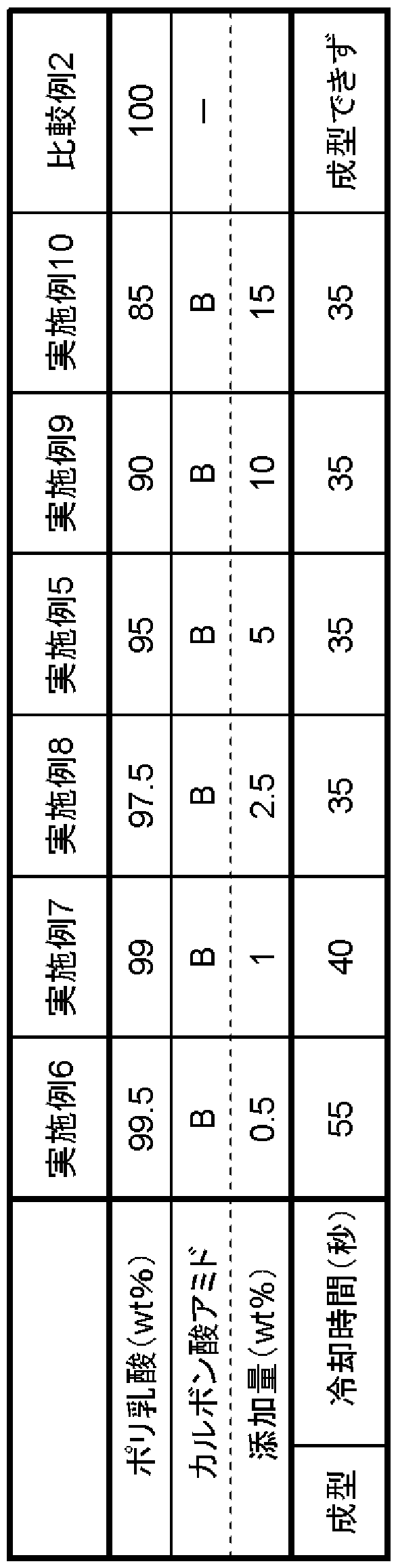
[0081] 表 6 表 8に記載の実施例 1、実施例 5および実施例 11 22、比較例 2— 3、参考 例 3に示すように、植物由来樹脂に繊維と分子の一部を極性基で置換した低分子化 合物を同時に添加すると、分子の一部を極性基で置換した低分子化合物の添加量 に関わらず、繊維を単独で添加した場合 (比較例 3)に比べて、榭脂組成物の耐熱性 がー層向上する(実施例 11〜21)。力!]えて、分子の一部を極性基で置換した低分子 化合物を単独で添加した場合 (参考例 3、実施例 5、実施例 22)に比べて、榭脂組成 物の成形性が一層向上する(実施例 11〜21)。
[0082] 表 9 表 11に記載の実施例 7、実施例 12、実施例 15、実施例 23— 32、比較例 2
8、参考例 5、および表 12、表 13に記載の実施例 33— 37、比較例 2、比較例 9 13、参考例 5に示すように、植物由来樹脂に繊維と分子の一部を極性基で置換した 低分子化合物を同時に添加すると、繊維の添加量に関わらず、繊維を単独で添加し た場合 (表 9記載の比較例 3— 8、表 12記載の比較例 9— 13)に比べて、榭脂組成物 の耐熱性が一層向上する(表 10記載の実施例 12、実施例 23— 27、表 11記載の実 施例 15、表 28— 32、表 13記載の実施例 33— 37)。力!]えて、分子の一部を極性基 で置換した低分子化合物を単独で添加した場合 (参考例 5、実施例 7)に比べて、榭 脂組成物の成形性が一層向上する(表 10記載の実施例 12、実施例 23— 27、表 11 記載の実施例 15、表 28— 32、表 13記載の実施例 33— 37)。
[0083] 表 14と表 15に記載の実施例 38— 42、比較例 2、比較例 14— 18、および表 16と 表 17に記載の実施例 38、実施例 43— 46、比較例 14、比較例 19— 22に示すように 、植物由来樹脂に無機フィラーを混合した系においても、繊維と分子の一部を極性 基で置換した低分子化合物を同時に添加すると、繊維の添加量に関わらず、繊維を 単独で添加した場合 (表 14記載の比較例 15— 18、表 16記載の比較例 19— 22)に
比べて、榭脂組成物の耐熱性が一層向上する(表 15記載の実施例 39— 42、表 17 記載の実施例 43— 46)。力!]えて、分子の一部を極性基で置換した低分子化合物を 単独で添加した場合 (実施例 38)に比べて、榭脂組成物の成形性が一層向上する( 表 15記載の実施例 39— 42、表 17記載の実施例 43— 46)。
産業上の利用可能性
本発明の難燃性熱可塑性榭脂組成物は、射出成型法、フィルム成形法、ブロー成 形法、発泡成形法などの方法により、電気 ·電子機器用途、建材用途、自動車部品 用途、 日用品用途、医療用途、農業用途、玩具用と、娯楽用途などの成型体に加工 される。
Claims
[1] 熱可塑性の植物由来榭脂および、分子中に少なくとも 2個の極性基を有し、その中 のいずれか 2個の極性基の間隔が 34±4オングストロームである低分子化合物(但し
、エチレンビス一 12—ヒドロキシステアリン酸アミドを除く)の 1種または 2種以上力 な る有機結晶核剤を含む熱可塑性榭脂組成物。
[2] 前記有機結晶核剤は、前記所定の間隔で極性基が置換するカルボン酸アミドおよ びカルボン酸エステル力 選択される 1種または 2種以上の低分子化合物力 なるも のである請求項 1に記載の熱可塑性榭脂組成物。
[3] 前記極性基が、含酸素置換基、含窒素置換基およびハロゲン基から選択される 1 種または 2種以上の基である請求項 1または 2に記載の熱可塑性榭脂組成物。
[4] 前記極性基が、水酸基、グリシジル基、カルボキシル基、アミノ基および、ニトロ基、 シァノ基、イソシァネート基力 選択される 1種または 2種以上の基である請求項 1か ら 3のいずれか 1項に記載の熱可塑性榭脂組成物。
[5] さらに繊維を、熱可塑性榭脂組成物の総量に占める重量割合で 40質量%以下含 有せしめたことを特徴とする、請求項 1から 4のいずれか 1項に記載の熱可塑性榭脂 組成物。
[6] 熱可塑性の植物由来榭脂およびエチレンビス— 12—ヒドロキシステアリン酸アミド カゝらなる有機結晶核剤を含む熱可塑性榭脂組成物であって、熱可塑性榭脂組成物 の総量に占める重量割合で 40質量%以下で繊維を含有せしめたことを特徴とする 熱可塑性榭脂組成物。
[7] 前記繊維が、植物由来繊維、合成有機繊維および無機繊維から選択される 1種ま たは 2種以上の繊維であることを特徴とする、請求項 5または 6に記載の熱可塑性榭 脂組成物。
[8] 前記繊維の平均繊維長 (破砕片を除く繊維の数平均繊維長)が 100 μ m〜20mm であることを特徴とする請求項 5から 7のいずれか 1項に記載の熱可塑性榭脂組成物
[9] 前記繊維が 300 μ m〜20mmの繊維長の繊維を含むことを特徴とする請求項 5か ら 8のいずれか 1項に記載の熱可塑性榭脂組成物。
Priority Applications (3)
| Application Number | Priority Date | Filing Date | Title |
|---|---|---|---|
| CN200680022301.8A CN101203571B (zh) | 2005-06-20 | 2006-06-20 | 热塑性树脂组合物 |
| JP2007522293A JP4894756B2 (ja) | 2005-06-20 | 2006-06-20 | 熱可塑性樹脂組成物 |
| US11/922,041 US8710145B2 (en) | 2005-06-20 | 2006-06-20 | Thermoplastic resin composition |
Applications Claiming Priority (2)
| Application Number | Priority Date | Filing Date | Title |
|---|---|---|---|
| JP2005-179121 | 2005-06-20 | ||
| JP2005179121 | 2005-06-20 |
Publications (1)
| Publication Number | Publication Date |
|---|---|
| WO2006137397A1 true WO2006137397A1 (ja) | 2006-12-28 |
Family
ID=37570426
Family Applications (1)
| Application Number | Title | Priority Date | Filing Date |
|---|---|---|---|
| PCT/JP2006/312320 Ceased WO2006137397A1 (ja) | 2005-06-20 | 2006-06-20 | 熱可塑性樹脂組成物 |
Country Status (4)
| Country | Link |
|---|---|
| US (1) | US8710145B2 (ja) |
| JP (1) | JP4894756B2 (ja) |
| CN (1) | CN101203571B (ja) |
| WO (1) | WO2006137397A1 (ja) |
Cited By (3)
| Publication number | Priority date | Publication date | Assignee | Title |
|---|---|---|---|---|
| JP2009024081A (ja) * | 2007-07-19 | 2009-02-05 | Unitika Ltd | 結晶性ポリ乳酸樹脂組成物およびそれからなる成形体 |
| JP2009132814A (ja) * | 2007-11-30 | 2009-06-18 | Kao Corp | ポリ乳酸樹脂組成物 |
| JP2009249532A (ja) * | 2008-04-08 | 2009-10-29 | Kao Corp | ポリ乳酸樹脂組成物 |
Families Citing this family (5)
| Publication number | Priority date | Publication date | Assignee | Title |
|---|---|---|---|---|
| FI20115218A0 (fi) * | 2011-03-03 | 2011-03-03 | Teknologian Tutkimuskeskus Vtt Oy | Menetelmä lämpömuokattavan plastisoidun sellulloosakuitu-PLA-kompaundin valmistamiseksi ja PLA-selluloosakompaundin iskulujuuden parantamiseksi |
| PL3277233T3 (pl) * | 2015-03-31 | 2024-11-18 | Laboratoires Thea | Urządzenie do dozowania płynu ze sterylnej butelki opakowaniowej z membraną bifunkcyjną |
| JP6939005B2 (ja) | 2017-03-24 | 2021-09-22 | 富士フイルムビジネスイノベーション株式会社 | 樹脂成形体用樹脂組成物、及び樹脂成形体 |
| WO2019113520A1 (en) * | 2017-12-07 | 2019-06-13 | Joshua Munoz | Edc-free biopolymer based compositions and uses thereof |
| CN115926384A (zh) * | 2021-10-04 | 2023-04-07 | 长春工业大学 | 一种pbs/ebhs复合材料及其制备方法 |
Citations (2)
| Publication number | Priority date | Publication date | Assignee | Title |
|---|---|---|---|---|
| JP2004051666A (ja) * | 2002-07-16 | 2004-02-19 | Toyota Central Res & Dev Lab Inc | ポリ乳酸複合材料及び成形体 |
| JP2005105245A (ja) * | 2003-01-10 | 2005-04-21 | Nec Corp | ケナフ繊維強化樹脂組成物 |
Family Cites Families (9)
| Publication number | Priority date | Publication date | Assignee | Title |
|---|---|---|---|---|
| JP3411168B2 (ja) | 1995-12-21 | 2003-05-26 | 三井化学株式会社 | 脂肪族ポリエステル成形体の製造方法及びそれにより製造された成形体 |
| JP3695607B2 (ja) | 1996-04-10 | 2005-09-14 | ヤマハマリン株式会社 | 船外機 |
| EP1008629A1 (en) * | 1998-05-30 | 2000-06-14 | DAICEL CHEMICAL INDUSTRIES, Ltd. | Biodegradable polyester resin composition, biodisintegrable resin composition, and molded objects of these |
| JP3945264B2 (ja) * | 2002-02-04 | 2007-07-18 | 株式会社豊田中央研究所 | ポリ乳酸複合材料及び成形体 |
| JP2004231910A (ja) | 2003-02-03 | 2004-08-19 | Toyo Ink Mfg Co Ltd | 繊維含有熱可塑性樹脂組成物及びその利用 |
| JP2004339454A (ja) | 2003-03-18 | 2004-12-02 | Toray Ind Inc | 樹脂組成物およびそれからなる成形品 |
| JP4572516B2 (ja) | 2003-07-18 | 2010-11-04 | 東レ株式会社 | 樹脂組成物の製造方法 |
| JP4384949B2 (ja) | 2003-07-30 | 2009-12-16 | 三菱樹脂株式会社 | 射出成形体 |
| JP2005060474A (ja) * | 2003-08-08 | 2005-03-10 | Toyota Central Res & Dev Lab Inc | 脂肪族ポリエステル組成物及びその成形体 |
-
2006
- 2006-06-20 US US11/922,041 patent/US8710145B2/en active Active
- 2006-06-20 CN CN200680022301.8A patent/CN101203571B/zh active Active
- 2006-06-20 JP JP2007522293A patent/JP4894756B2/ja active Active
- 2006-06-20 WO PCT/JP2006/312320 patent/WO2006137397A1/ja not_active Ceased
Patent Citations (2)
| Publication number | Priority date | Publication date | Assignee | Title |
|---|---|---|---|---|
| JP2004051666A (ja) * | 2002-07-16 | 2004-02-19 | Toyota Central Res & Dev Lab Inc | ポリ乳酸複合材料及び成形体 |
| JP2005105245A (ja) * | 2003-01-10 | 2005-04-21 | Nec Corp | ケナフ繊維強化樹脂組成物 |
Cited By (3)
| Publication number | Priority date | Publication date | Assignee | Title |
|---|---|---|---|---|
| JP2009024081A (ja) * | 2007-07-19 | 2009-02-05 | Unitika Ltd | 結晶性ポリ乳酸樹脂組成物およびそれからなる成形体 |
| JP2009132814A (ja) * | 2007-11-30 | 2009-06-18 | Kao Corp | ポリ乳酸樹脂組成物 |
| JP2009249532A (ja) * | 2008-04-08 | 2009-10-29 | Kao Corp | ポリ乳酸樹脂組成物 |
Also Published As
| Publication number | Publication date |
|---|---|
| US20090286926A1 (en) | 2009-11-19 |
| JP4894756B2 (ja) | 2012-03-14 |
| CN101203571A (zh) | 2008-06-18 |
| US8710145B2 (en) | 2014-04-29 |
| JPWO2006137397A1 (ja) | 2009-01-22 |
| CN101203571B (zh) | 2014-12-17 |
Similar Documents
| Publication | Publication Date | Title |
|---|---|---|
| US8586658B2 (en) | Polylactic acid resin composition and molded item | |
| Varsavas et al. | Effects of glass fiber reinforcement and thermoplastic elastomer blending on the mechanical performance of polylactide | |
| US20090054559A1 (en) | Polylactic acid resin composition and molded article | |
| US7790069B2 (en) | Flame-retardant thermoplastic resin composition | |
| WO2004063282A1 (ja) | ケナフ繊維強化樹脂組成物 | |
| CN108841085B (zh) | 一种高刚性、高耐热聚丙烯材料及其制备方法,一种注塑成型产品及其制备方法 | |
| JP5479747B2 (ja) | ポリ乳酸樹脂組成物 | |
| KR20120108798A (ko) | 폴리유산 복합재료 조성물의 제조방법 | |
| KR101604043B1 (ko) | 폴리락트산 수지 조성물 | |
| JP5463670B2 (ja) | 熱可塑性樹脂組成物 | |
| Tábi et al. | Thermal and mechanical analysis of injection moulded poly (lactic acid) filled with poly (ethylene glycol) and talc | |
| WO2006137397A1 (ja) | 熱可塑性樹脂組成物 | |
| Shi et al. | Crystallization behavior, heat resistance, and mechanical performances of PLLA/myo‐inositol blends | |
| JP5412886B2 (ja) | 難燃性ポリ乳酸系樹脂組成物 | |
| JP5592696B2 (ja) | 脂肪族ポリエステル樹脂組成物 | |
| CN103502361A (zh) | 生物基聚合物组合物 | |
| JP2010083914A (ja) | ポリ乳酸樹脂組成物、及びその製造方法 | |
| KR20070119304A (ko) | 셀룰로오즈 유도체를 이용한 생분해성 수지 조성물 | |
| Kumar et al. | Mechanical and thermal properties of chitosan filled poly lactic acid/basalt fiber hybrid composites | |
| JP2007262339A (ja) | ポリ乳酸系ポリエステル樹脂組成物、その製造方法、それを用いた成形体 | |
| KR102720881B1 (ko) | 내열성이 개선된 폴리유산 복합재료 조성물 및 이의 제조방법 | |
| JP5525830B2 (ja) | ポリ乳酸樹脂組成物 | |
| CN107075232A (zh) | 包含氨基三嗪衍生物和羧酸酰胺的聚酯树脂组合物 | |
| JP2013159672A (ja) | ポリ乳酸樹脂組成物、および成形体 | |
| ES2363076B1 (es) | Material composite. |
Legal Events
| Date | Code | Title | Description |
|---|---|---|---|
| WWE | Wipo information: entry into national phase |
Ref document number: 200680022301.8 Country of ref document: CN |
|
| 121 | Ep: the epo has been informed by wipo that ep was designated in this application | ||
| WWE | Wipo information: entry into national phase |
Ref document number: 2007522293 Country of ref document: JP |
|
| WWE | Wipo information: entry into national phase |
Ref document number: 11922041 Country of ref document: US |
|
| NENP | Non-entry into the national phase |
Ref country code: DE |
|
| 122 | Ep: pct application non-entry in european phase |
Ref document number: 06766981 Country of ref document: EP Kind code of ref document: A1 |