WO2006088002A1 - 電解液および電池 - Google Patents
電解液および電池 Download PDFInfo
- Publication number
- WO2006088002A1 WO2006088002A1 PCT/JP2006/302490 JP2006302490W WO2006088002A1 WO 2006088002 A1 WO2006088002 A1 WO 2006088002A1 JP 2006302490 W JP2006302490 W JP 2006302490W WO 2006088002 A1 WO2006088002 A1 WO 2006088002A1
- Authority
- WO
- WIPO (PCT)
- Prior art keywords
- negative electrode
- compound
- battery
- electrolytic solution
- electrolyte
- Prior art date
- Legal status (The legal status is an assumption and is not a legal conclusion. Google has not performed a legal analysis and makes no representation as to the accuracy of the status listed.)
- Ceased
Links
Classifications
-
- H—ELECTRICITY
- H01—ELECTRIC ELEMENTS
- H01M—PROCESSES OR MEANS, e.g. BATTERIES, FOR THE DIRECT CONVERSION OF CHEMICAL ENERGY INTO ELECTRICAL ENERGY
- H01M10/00—Secondary cells; Manufacture thereof
- H01M10/42—Methods or arrangements for servicing or maintenance of secondary cells or secondary half-cells
- H01M10/4235—Safety or regulating additives or arrangements in electrodes, separators or electrolyte
-
- H—ELECTRICITY
- H01—ELECTRIC ELEMENTS
- H01M—PROCESSES OR MEANS, e.g. BATTERIES, FOR THE DIRECT CONVERSION OF CHEMICAL ENERGY INTO ELECTRICAL ENERGY
- H01M10/00—Secondary cells; Manufacture thereof
- H01M10/05—Accumulators with non-aqueous electrolyte
-
- H—ELECTRICITY
- H01—ELECTRIC ELEMENTS
- H01M—PROCESSES OR MEANS, e.g. BATTERIES, FOR THE DIRECT CONVERSION OF CHEMICAL ENERGY INTO ELECTRICAL ENERGY
- H01M10/00—Secondary cells; Manufacture thereof
- H01M10/05—Accumulators with non-aqueous electrolyte
- H01M10/052—Li-accumulators
- H01M10/0525—Rocking-chair batteries, i.e. batteries with lithium insertion or intercalation in both electrodes; Lithium-ion batteries
-
- H—ELECTRICITY
- H01—ELECTRIC ELEMENTS
- H01M—PROCESSES OR MEANS, e.g. BATTERIES, FOR THE DIRECT CONVERSION OF CHEMICAL ENERGY INTO ELECTRICAL ENERGY
- H01M10/00—Secondary cells; Manufacture thereof
- H01M10/05—Accumulators with non-aqueous electrolyte
- H01M10/056—Accumulators with non-aqueous electrolyte characterised by the materials used as electrolytes, e.g. mixed inorganic/organic electrolytes
- H01M10/0564—Accumulators with non-aqueous electrolyte characterised by the materials used as electrolytes, e.g. mixed inorganic/organic electrolytes the electrolyte being constituted of organic materials only
- H01M10/0566—Liquid materials
- H01M10/0567—Liquid materials characterised by the additives
-
- H—ELECTRICITY
- H01—ELECTRIC ELEMENTS
- H01M—PROCESSES OR MEANS, e.g. BATTERIES, FOR THE DIRECT CONVERSION OF CHEMICAL ENERGY INTO ELECTRICAL ENERGY
- H01M10/00—Secondary cells; Manufacture thereof
- H01M10/05—Accumulators with non-aqueous electrolyte
- H01M10/056—Accumulators with non-aqueous electrolyte characterised by the materials used as electrolytes, e.g. mixed inorganic/organic electrolytes
- H01M10/0564—Accumulators with non-aqueous electrolyte characterised by the materials used as electrolytes, e.g. mixed inorganic/organic electrolytes the electrolyte being constituted of organic materials only
- H01M10/0566—Liquid materials
- H01M10/0568—Liquid materials characterised by the solutes
-
- H—ELECTRICITY
- H01—ELECTRIC ELEMENTS
- H01M—PROCESSES OR MEANS, e.g. BATTERIES, FOR THE DIRECT CONVERSION OF CHEMICAL ENERGY INTO ELECTRICAL ENERGY
- H01M4/00—Electrodes
- H01M4/02—Electrodes composed of, or comprising, active material
-
- H—ELECTRICITY
- H01—ELECTRIC ELEMENTS
- H01M—PROCESSES OR MEANS, e.g. BATTERIES, FOR THE DIRECT CONVERSION OF CHEMICAL ENERGY INTO ELECTRICAL ENERGY
- H01M6/00—Primary cells; Manufacture thereof
- H01M6/14—Cells with non-aqueous electrolyte
- H01M6/16—Cells with non-aqueous electrolyte with organic electrolyte
-
- H—ELECTRICITY
- H01—ELECTRIC ELEMENTS
- H01M—PROCESSES OR MEANS, e.g. BATTERIES, FOR THE DIRECT CONVERSION OF CHEMICAL ENERGY INTO ELECTRICAL ENERGY
- H01M10/00—Secondary cells; Manufacture thereof
- H01M10/05—Accumulators with non-aqueous electrolyte
- H01M10/058—Construction or manufacture
- H01M10/0587—Construction or manufacture of accumulators having only wound construction elements, i.e. wound positive electrodes, wound negative electrodes and wound separators
-
- H—ELECTRICITY
- H01—ELECTRIC ELEMENTS
- H01M—PROCESSES OR MEANS, e.g. BATTERIES, FOR THE DIRECT CONVERSION OF CHEMICAL ENERGY INTO ELECTRICAL ENERGY
- H01M2300/00—Electrolytes
- H01M2300/0085—Immobilising or gelification of electrolyte
-
- H—ELECTRICITY
- H01—ELECTRIC ELEMENTS
- H01M—PROCESSES OR MEANS, e.g. BATTERIES, FOR THE DIRECT CONVERSION OF CHEMICAL ENERGY INTO ELECTRICAL ENERGY
- H01M4/00—Electrodes
- H01M4/02—Electrodes composed of, or comprising, active material
- H01M4/13—Electrodes for accumulators with non-aqueous electrolyte, e.g. for lithium-accumulators; Processes of manufacture thereof
- H01M4/139—Processes of manufacture
-
- Y—GENERAL TAGGING OF NEW TECHNOLOGICAL DEVELOPMENTS; GENERAL TAGGING OF CROSS-SECTIONAL TECHNOLOGIES SPANNING OVER SEVERAL SECTIONS OF THE IPC; TECHNICAL SUBJECTS COVERED BY FORMER USPC CROSS-REFERENCE ART COLLECTIONS [XRACs] AND DIGESTS
- Y02—TECHNOLOGIES OR APPLICATIONS FOR MITIGATION OR ADAPTATION AGAINST CLIMATE CHANGE
- Y02E—REDUCTION OF GREENHOUSE GAS [GHG] EMISSIONS, RELATED TO ENERGY GENERATION, TRANSMISSION OR DISTRIBUTION
- Y02E60/00—Enabling technologies; Technologies with a potential or indirect contribution to GHG emissions mitigation
- Y02E60/10—Energy storage using batteries
-
- Y—GENERAL TAGGING OF NEW TECHNOLOGICAL DEVELOPMENTS; GENERAL TAGGING OF CROSS-SECTIONAL TECHNOLOGIES SPANNING OVER SEVERAL SECTIONS OF THE IPC; TECHNICAL SUBJECTS COVERED BY FORMER USPC CROSS-REFERENCE ART COLLECTIONS [XRACs] AND DIGESTS
- Y02—TECHNOLOGIES OR APPLICATIONS FOR MITIGATION OR ADAPTATION AGAINST CLIMATE CHANGE
- Y02P—CLIMATE CHANGE MITIGATION TECHNOLOGIES IN THE PRODUCTION OR PROCESSING OF GOODS
- Y02P70/00—Climate change mitigation technologies in the production process for final industrial or consumer products
- Y02P70/50—Manufacturing or production processes characterised by the final manufactured product
Definitions
- the present invention relates to an electrolytic solution and a battery using the electrolytic solution.
- the positive electrode includes lithium and cobalt (Co) or manganese.
- a compound oxide containing (Mn) and the like, and using an electrolyte such as a solvent such as ethylene carbonate and an electrolyte salt such as lithium hexafluorophosphate in practical use has been put into practical use.
- Patent Document 1 Pamphlet of International Publication No. 01Z22519
- Patent Document 2 Japanese Patent Laid-Open No. 7-312227
- Patent Document 3 Japanese Patent Laid-Open No. 10-177814
- the present invention has been made in view of significant problems, and an object of the present invention is to provide an electrolytic solution capable of improving battery characteristics such as charging / discharging efficiency if the battery swells and a battery using the same. There is to do.
- a first electrolytic solution according to the present invention contains 4 fluoro-1,3 dixolan-2-one and a compound having a peptone capturing ability.
- the second electrolytic solution according to the present invention contains hexaethylenetetramine.
- a first battery according to the present invention comprises an electrolyte solution together with a positive electrode and a negative electrode, and the electrolyte solution comprises 4 fluoro-1,3 dioxolan-2-one and a compound having a proton scavenging ability. Is included.
- a second battery of the present invention includes an electrolyte solution together with a positive electrode and a negative electrode, and the electrolyte solution contains hexaethylenetetramine.
- the first electrolytic solution of the present invention 4 fluoro-1,3 dioxolan-2-one and a compound having a proton scavenging ability are included, so that a free acid is generated by a compound having a proton scavenging ability. Can be captured effectively. Therefore, according to the first battery of the present invention using this electrolytic solution, the decomposition reaction of the electrolytic solution can be suppressed, and for example, the battery can be prevented from swelling.
- the second electrolytic solution of the present invention since it contains hexaethylenetetramine, the reactivity can be lowered while effectively capturing the free acid. Therefore, according to the battery of the present invention using this electrolytic solution, the decomposition reaction of the electrolytic solution can be suppressed, and battery characteristics such as charge / discharge efficiency can be improved.
- FIG. 1 is an exploded perspective view showing a configuration of a secondary battery according to an embodiment of the present invention.
- FIG. 2 is a cross-sectional view showing a configuration along the line II of the wound electrode body shown in FIG.
- FIG. 3 is a characteristic diagram showing an example of cycle characteristics in a secondary battery manufactured in an example.
- FIG. 4 is a characteristic diagram showing the relationship between the high-temperature storage time and the battery thickness in the secondary battery produced in the example.
- FIG. 5 is another characteristic diagram showing an example of cycle characteristics of the secondary battery manufactured in the example.
- FIG. 1 shows an exploded configuration example of the secondary battery according to the first embodiment of the present invention.
- This secondary battery is a so-called lithium ion secondary battery in which the capacity of the negative electrode is represented by a capacity component due to insertion and extraction of lithium as an electrode reactant.
- This secondary battery includes a wound electrode body 20 to which a positive electrode lead 11 and a negative electrode lead 12 are attached. It has a configuration housed inside a rumm-shaped exterior member 31.
- Each of the positive electrode lead 11 and the negative electrode lead 12 has a strip shape, for example, and is led out from the inside of the exterior member 31 to the outside, for example, in the same direction.
- the positive electrode lead 11 is made of a metal material such as aluminum (A1)
- the negative electrode lead 12 is made of a metal material such as nickel (Ni)! RU
- the exterior member 31 is made of, for example, a rectangular laminated film in which a nylon film, an aluminum foil, and a polypropylene film are bonded together in this order.
- the exterior member 31 is disposed, for example, so that the polypropylene film side and the wound electrode body 20 face each other, and the outer edge portions are adhered to each other by fusion or adhesive.
- Adhesive film 32 is inserted.
- the adhesion film 32 is made of a material having adhesion to the positive electrode lead 11 and the negative electrode lead 12.
- polyethylene, poly Propylene and modified polyethylene are preferably composed of polyolefin resin such as modified polypropylene.
- FIG. 2 shows a cross-sectional structure along the line II of the wound electrode body 20 shown in FIG.
- the wound electrode body 20 is obtained by laminating a positive electrode 21 and a negative electrode 22 with a separator 23 and an electrolyte layer 24 interposed therebetween, and the outermost peripheral portion is protected by a protective tape 25.
- the positive electrode 21 includes, for example, a positive electrode current collector 21A and a positive electrode active material layer 21B provided on both surfaces or one surface of the positive electrode current collector 21A.
- a positive electrode current collector 21A for example, there is an exposed part without providing the positive electrode active material layer 21B at one end in the longitudinal direction, and the positive electrode lead 11 is attached to this exposed part.
- the positive electrode current collector 21A is made of, for example, a metal material such as aluminum.
- the positive electrode active material layer 21B includes, for example, one or more positive electrode materials capable of inserting and extracting lithium as an electrode reactant as a positive electrode active material.
- positive electrode material capable of inserting and extracting lithium include lithium transition metal oxide, lithium phosphorous oxide, lithium sulfide, and a layer containing lithium.
- Lithium-containing compounds such as intercalation compounds are suitable, and two or more kinds may be mixed and used. In particular, to increase the energy density, it can be expressed by the general formula Li MIO or Li MIIPO.
- the lithium composite oxide or lithium phosphate compound to be used is preferable.
- Ml and ⁇ contain one or more transition metals such as cobalt, nickel, manganese, iron (Fe), aluminum, vanadium), titanium (Ti) and zirconium (Zr). It is preferable to include at least one of them.
- the values of X and y depend on the charge / discharge status of the battery, and are usually in the range of 0.05.x ⁇ x ⁇ l.10, 0.05 ⁇ y ⁇ l.10.
- Specific examples of the lithium composite oxide represented by Li MI O include LiCoO, LiNiO, LiNi Co
- Li MIIPO lithium phosphorus oxide represented by Li MIIPO
- the positive electrode active material layer 21B also contains, for example, a conductive agent, and may further contain a binder as necessary.
- a conductive agent include carbon materials such as graphite, carbon black, and ketjen black, and one or a mixture of two or more are used.
- a metal material or a conductive polymer material may be used as long as it is a conductive material.
- the binder include synthetic rubber such as styrene butadiene rubber, fluorine rubber or ethylene propylene gen rubber, or a polymer material such as polyvinylidene fluoride, and one or more of them are mixed. Used together.
- the negative electrode 22 includes a negative electrode current collector 22A and a negative electrode active material layer 22B provided on both surfaces or one surface of the negative electrode current collector 22A, as with the positive electrode 21.
- the negative electrode current collector 22A for example, there is an exposed portion where the negative electrode active material layer 22B is not provided at one end in the longitudinal direction, and the negative electrode lead 12 is attached to this exposed portion.
- the negative electrode current collector 22A is made of a metal material such as copper (Cu), for example.
- the negative electrode active material layer 22B includes, for example, any one or more of negative electrode materials capable of inserting and extracting lithium as an electrode reactant as a negative electrode active material. If necessary, for example, a binder similar to that of the positive electrode active material layer 21B may be included.
- Examples of the negative electrode material capable of inserting and extracting lithium include carbon materials such as graphite, hard black lead-free carbon, and easily graphite-compatible carbon. These carbon materials are preferred because they can provide a high charge / discharge capacity with very little change in the crystal structure that occurs during charge / discharge, and good charge / discharge cycle characteristics. In particular, black lead is preferable because it has a large capacity and a high energy density can be obtained.
- the negative electrode material capable of inserting and extracting lithium is also capable of inserting and extracting lithium and includes at least one of a metal element and a metalloid element as a constituent element. Materials are also mentioned. This is because a high energy density can be obtained by using such a material.
- the negative electrode material may be a metal element, or may be a single metal element, an alloy or a compound, and may have at least a part of one or more of these phases.
- alloys include those containing one or more metal elements and one or more metalloid elements in addition to those composed of two or more metal elements.
- the nonmetallic element may be included.
- Examples of the metal element or metalloid element constituting the negative electrode material include magnesium (Mg), boron (B), aluminum, gallium (Ga), indium (In), and key that can form an alloy with lithium. Elemental (Si), Germanium (Ge), Tin (Sn), Lead (Pb), Bismuth (Bi), Force Domium (Cd), Silver (Ag), Zinc ( ⁇ ), Hafnium (Hf), Zirconium, Yttrium ( Y), palladium (Pd) or platinum (Pt). These may be crystalline or amorphous.
- the negative electrode material those containing a 4B group metal element or a semimetal element as a constituent element in the short-period type periodic table are preferable, and at least one of ca and tin is particularly preferable. It is included as a constituent element. This is because silicon and tin can obtain a high energy density with a large ability to occlude and release lithium.
- tin for example, as a second constituent element other than tin, silicon, nickel, copper, iron, connort, manganese, zinc, indium, silver, titanium, germanium, bismuth, These include those containing at least one of the group consisting of antimony (Sb) and chromium (Cr).
- Sb antimony
- Cr chromium
- tin, nickel, copper, iron, connort, manganese, zinc, indium, silver, titanium, germanium, bismuth, antimony and chromium are also available. Examples include at least one member of the group.
- Examples of the tin compound or the key compound include those containing oxygen (O) or carbon (C), and include the second constituent element described above in addition to tin or key. May be.
- Examples of the anode material capable of inserting and extracting lithium further include other metal compounds or polymer materials.
- Other metal compounds include oxides such as iron oxide, ruthenium oxide or molybdenum oxide, or LiN.
- Examples of the molecular material include polyacetylene.
- the capacity of the negative electrode material capable of inserting and extracting lithium is larger than the capacity of the positive electrode 21, and lithium metal is deposited on the negative electrode 22 during charging. Shina.
- the separator 23 is made of, for example, a porous film made of a synthetic resin such as polytetrafluoroethylene, polypropylene, or polyethylene, or a porous film made of a ceramic.
- a structure in which a material film is laminated may be used.
- a porous membrane made of polyolefin is preferable because it is excellent in short-circuit preventing effect and can improve battery safety by a shutdown effect.
- polyethylene is preferable as a material constituting the separator 23 because a shutdown effect can be obtained within a range of 100 ° C. or higher and 160 ° C. or lower and the electrochemical stability is excellent.
- Polypropylene is also preferred.
- a resin having chemical stability can be used by copolymerizing or blending with polyethylene or polypropylene.
- the electrolyte layer 24 includes, for example, an electrolytic solution and a polymer compound that holds the electrolytic solution, and has a so-called gel shape.
- the electrolytic solution contains, for example, a nonaqueous solvent and an electrolyte salt dissolved in the nonaqueous solvent.
- non-aqueous solvent examples include ethylene carbonate, propylene carbonate, butylene carbonate, vinylene carbonate, ⁇ -butyrorataton, ⁇ -valerolataton, 1,2-dimethoxyethane, tetrahydrofuran, 2-methyltetrahydrofuran, 1, 3 Dioxolane, 4-methyl 1,3 Dioxolane, methyl acetate, methyl propionate, ethyl propionate, dimethyl carbonate, ethyl methyl carbonate, jetyl carbonate, sulfolane, dimethyl sulfoxide, trimethyl phosphate or at least some of these compounds In which hydrogen is replaced by hydrogen or rogen.
- 4 fluoro-1,3 dixolan-2-one which is a fluoride of ethylene carbonate. This is because 4 fluoro-1,3dioxolane-2-one can form a stable protective film on the surface of the negative electrode 22 and suppress the decomposition reaction of the solvent.
- the solvent one kind may be used alone, or plural kinds may be mixed and used.
- electrolyte salt examples include LiAsF, LiPF, LiBF, LiCIO, LiB (C H), Li
- lithium salts those having a fluorine atom are preferable because high conductivity can be obtained.
- the electrolyte salt one kind may be used alone, or a plurality kinds may be mixed and used.
- the content of the electrolyte salt is preferably in the range of 0.5 molZkg or more and 3. OmolZkg or less with respect to the solvent. Outside this range, there is a risk that sufficient battery characteristics may not be obtained due to an extreme decrease in ionic conductivity.
- the electrolytic solution contains a compound having a proton scavenging ability as an additive.
- free acids such as hydrofluoric acid produced by hydrolysis of 4 fluoro-1,3 dioxolan 2one can be effectively captured, and the decomposition reaction of electrolytes and the like is suppressed even under high temperature conditions. Because it can.
- the compound having proton capturing ability include nitrogen compounds having an unshared electron pair. This is because free acid can be captured by unshared electron pairs in nitrogen.
- hexamethylenetetramine represented by the structural formula shown in Chemical Formula 1, the cyclic compound shown in Chemical Formula 2 or the cyclic compound shown in Chemical Formula 3 is preferable. This is because a higher effect can be obtained.
- Rl, R2, and R3 represent a hydrogen group or a substituent.
- R2 and R3 may be the same or different.
- p and q each represent an integer of 2 or more.
- the substituent include a halogen group, an alkyl group, an alkylene group, a phenol group, a naphthyl group, and an alkoxy group.
- the cyclic compound shown in Chemical formula 2 and the cyclic compound shown in Chemical formula 3 are 1, 3, 5-triazine shown in Chemical formula 4, and shown in Chemical formula 5.
- the lithium salt shown in Chemical formula 7 is also preferable.
- examples of such a lithium salt include lithium bistrifluoromethanesulfonate shown in Figure 8 or bispentafluoroethanesulfonic acid imide lithium shown in Chemical Formula 9.
- nitrogen compounds having an unshared electron pair include 3-methyl-2-oxazolidinone shown in Chemical formula 10 and 1, 3 shown in Chemical formula 1, 3.
- Chemical formula 10 3-methyl-2-oxazolidinone shown in Chemical formula 10 and 1, 3 shown in Chemical formula 1, 3.
- Chemical formula 10 3-methyl-2-oxazolidinone shown in Chemical formula 10 and 1, 3 shown in Chemical formula 1, 3.
- N-methyl succinimide shown in Chemical Formula 12
- 5-fluoro-1, 3-dimethyl-1,3-dimethyluracil triphenylamine shown in Chemical formula 14
- pyridine shown in Chemical formula 15
- pyrazine shown in Chemical formula 16 and so on.
- the concentration of the nitrogen compound in the electrolytic solution preferably satisfies Equation 2. High within this range! This is because the effect is obtained.
- the nitrogen compound having an unshared electron pair is represented by the structural formula shown in Chemical Formula 17. Particularly preferred is ruhexaethylenetetramine.
- This compound is a tricyclic cage type compound, and all the unshared electron pairs of the bridgehead nitrogen atom are oriented in the center of the molecule and have a high electron density molecular vacancy.
- hexaethylenetetramine has a high ability to capture free acids such as hydrofluoric acid, and it is possible to suppress reaction of the captured free acid with a solvent or the like due to steric hindrance.
- the content of hexaethylenetetramine in the electrolytic solution is preferably in the range of 0.001% by mass to 5% by mass. This is because if the content is low, the ionic conductivity decreases if the effect of capturing the free acid is not high enough.
- the polymer compound is not particularly limited as long as it absorbs the solvent and gels, for example, fluorine such as polyvinylidene fluoride or a copolymer of vinylidene fluoride and hexafluoropropylene.
- fluorine such as polyvinylidene fluoride or a copolymer of vinylidene fluoride and hexafluoropropylene.
- examples thereof include ether polymer compounds such as polyethylene polymer or polyethylene oxide or a crosslinked polymer containing polyethylene oxide, polyacrylonitrile, polyacrylate, or those containing polymethacrylate as a repeating unit.
- a fluorine-based polymer compound is desirable from the viewpoint of redox stability.
- For high molecular weight compounds either one type may be used alone, or two or more types may be used in combination.
- the secondary battery can be manufactured, for example, as follows.
- a positive electrode active material, a binder, and a conductive agent are mixed to prepare a positive electrode mixture, and dispersed in a solvent such as N-methyl 2-pyrrolidone to prepare a positive electrode mixture slurry.
- this positive electrode mixture slurry is applied to both surfaces or one surface of the positive electrode current collector 21A, dried, and compression molded to form the positive electrode active material layer 21B to produce the positive electrode 21.
- the positive electrode lead 11 is joined to the positive electrode current collector 21A by, for example, ultrasonic welding or spot welding.
- an electrolytic solution and a polymer compound are prepared, and an electrolyte layer 24 is formed on one side of the positive electrode active material layer 21B, that is, on both sides of the positive electrode 21! /.
- a negative electrode active material and a binder are mixed to prepare a negative electrode mixture, and dispersed in a solvent such as N-methyl-2-pyrrolidone to prepare a negative electrode mixture slurry.
- this negative electrode mixture slurry is applied to both surfaces or one surface of the negative electrode current collector 22A, dried, and compression molded to form the negative electrode active material layer 22B, whereby the negative electrode 22 is produced.
- the negative electrode lead 12 is joined to the negative electrode current collector 22A by, for example, ultrasonic welding or spot welding, and at the same time as the positive electrode 21 on the negative electrode active material layer 22B, that is, on both surfaces or one surface of the negative electrode 22.
- the electrolyte layer 24 is formed.
- the positive electrode 21 and the negative electrode 22 on which the electrolyte layer 24 is formed are stacked with the separator 23 interposed therebetween and wound, and the protective tape 25 is adhered to the outermost periphery to form the wound electrode body 20.
- the wound electrode body 20 is sandwiched between the exterior members 31 and the outer edge portions of the exterior members 31 are closely adhered by heat fusion or the like and sealed.
- an adhesion film 32 is inserted between the positive electrode lead 11 and the negative electrode lead 12 and the exterior member 31.
- the secondary battery described above may be manufactured as follows. First, the positive electrode 21 and the negative electrode 22 are prepared as described above, the positive electrode lead 11 and the negative electrode lead 12 are attached to the positive electrode 21 and the negative electrode 22, and then the positive electrode 21 and the negative electrode 22 are stacked with the separator 23 interposed therebetween. Then, the protective tape 25 is adhered to the outermost periphery to form a wound body. Next, the wound body is sandwiched between the exterior members 31, and the outer peripheral edge except for one side is heat-sealed to form a bag shape, and is stored inside the exterior member 31.
- an electrolyte composition containing an electrolytic solution, a monomer that is a raw material for the polymer compound, and other materials such as a polymerization initiator or a polymerization inhibitor as necessary is prepared, and the interior of the exterior member 31 is prepared. inject.
- the opening of the exterior member 31 is heat-sealed in a vacuum atmosphere and sealed. Next, heat is applied to polymerize the monomer to form a polymer compound, thereby forming the gel electrolyte layer 24, and assembling the secondary battery shown in FIGS.
- the secondary battery when charged, for example, lithium ions are extracted from the positive electrode 21 and inserted in the negative electrode 22 through the electrolytic solution.
- lithium ions When discharging is performed, for example, lithium ions are released from the negative electrode 22 and inserted into the positive electrode 21 through the electrolytic solution.
- the electrolyte contains 4-fluoro 1,3-dioxolan-2-one and a compound having proton scavenging ability
- free acid such as hydrofluoric acid produced by hydrolysis of 4 fluoro-1,3 dioxolane 2 -on is effectively captured by the compound having proton capturing ability, and the decomposition reaction of the electrolyte is suppressed.
- the electrolyte contains 4 fluoro-1,3-dioxolan-2-one and a compound having a proton scavenging ability.
- the free acid can be effectively captured by the compound having the ton capturing ability, and the decomposition reaction of the electrolyte can be suppressed. Therefore, the swelling of the battery can be suppressed.
- the compound having proton capturing ability includes a nitrogen compound having an unshared electron pair, a higher effect can be obtained.
- the electrolytic solution according to the present embodiment since the hexethylenetetramine is contained, the reactivity can be reduced while capturing free acid effectively. Therefore, according to the secondary battery according to the present embodiment using this electrolytic solution, decomposition reaction of the electrolytic solution can be suppressed, and battery characteristics such as charge / discharge efficiency can be improved.
- the secondary battery according to the second embodiment of the present invention includes a capacity component due to insertion and extraction of lithium whose capacity of the negative electrode is an electrode reactant, and a capacity component due to precipitation and dissolution of lithium, and It is represented by the sum.
- This secondary battery has the same configuration and effects as those of the secondary battery according to the first embodiment, except that the configuration of the negative electrode active material layer is different. can do. Therefore, description will be made using the same reference numerals with reference to FIGS. In addition
- the negative electrode active material layer 22B is configured so that, for example, the charge capacity of a negative electrode material capable of inserting and extracting lithium is smaller than the charge capacity of the positive electrode 21, so that an open circuit voltage ( That is, when the battery voltage is lower than the overcharge voltage, lithium metal begins to deposit on the negative electrode 22. Therefore, in this secondary battery, both the negative electrode material capable of inserting and extracting lithium and lithium metal function as the negative electrode active material, and the negative electrode material capable of inserting and extracting lithium is lithium metal. It becomes a base material for the precipitation. Examples of the negative electrode material capable of inserting and extracting lithium include the same materials as in the first embodiment, and among these, a carbon material capable of inserting and extracting lithium is preferred.
- the overcharge voltage refers to an open circuit voltage when the battery is overcharged.
- “lithium” is one of the guidelines established by the Japan Storage Battery Industry Association (Battery Industry Association). Refers to a voltage that is higher than the open circuit voltage of a “fully charged” battery as defined and defined in the “Secondary Battery Safety Evaluation Criteria Guidelines” (SBA G1101). In other words, it refers to a voltage higher than the open circuit voltage after charging using the charging method, standard charging method, or recommended charging method used to determine the nominal capacity of each battery.
- This secondary battery is the same as a conventional lithium ion secondary battery in that a negative electrode material capable of inserting and extracting lithium is used for the negative electrode 22, and lithium metal is deposited on the negative electrode 22. This is the same as the conventional lithium metal secondary battery.
- the maximum deposition capacity of lithium metal deposited on the anode 22 at the maximum voltage before the open circuit voltage becomes the overcharge voltage is It is preferable that it is 0.05 times or more and 3.0 times or less of the charge capacity capacity of the negative electrode material capable of inserting and extracting sulfur. This is because if the amount of deposited lithium metal is too large, the same problem as in the conventional lithium metal secondary battery occurs, and if the amount is too small, the charge / discharge capacity cannot be sufficiently increased. Further, for example, the discharge capacity capability of the negative electrode material capable of inserting and extracting lithium is preferably 150 mAhZg or more. Lichiu The greater the ability to occlude and release the metal, the less the amount of lithium metal deposited.
- the charge capacity capacity of the negative electrode material is, for example, constant current up to OV in the case of an electrochemical cell that uses lithium metal as a negative electrode and a negative electrode material capable of occluding and releasing lithium as a positive electrode active material.
- the quantity of electricity when discharged at The discharge capacity capacity of the negative electrode material can be obtained, for example, from the amount of electricity when it is charged to 2.5 V over 10 hours by the constant current method.
- lithium ions when charged, lithium ions are released from the positive electrode 21, and the negative electrode material that can first occlude and release lithium contained in the negative electrode 22 through the electrolytic solution. Occluded.
- lithium metal begins to deposit on the surface of the negative electrode material capable of inserting and extracting lithium in a state where the open circuit voltage is lower than the overcharge voltage. After that, lithium metal continues to deposit on the anode 22 until charging is completed.
- lithium metal force ions deposited on the negative electrode 22 are eluted and inserted in the positive electrode 21 through the electrolytic solution.
- lithium ions occluded in the anode material capable of occluding and releasing lithium in the anode 22 are released and inserted in the cathode 21 through the electrolytic solution.
- the electrolyte contains 4 fluoro-1,3 dioxolan-2-one and a compound having a proton scavenging ability, free acid such as hydrofluoric acid generated by hydrolysis of 4 fluoro 1,3 dioxolan-2-one, etc. Is effectively trapped by the compound having proton trapping ability, and the decomposition reaction of the electrolytic solution is suppressed.
- LiCoO lithium cobaltate
- a positive electrode mixture was prepared by mixing polyvinylidene fluoride as a binder. After being dispersed in N-methyl 2-pyrrolidone as a solvent to form a positive electrode mixture slurry, it is uniformly applied to a positive electrode current collector 21A made of aluminum foil, dried, and compressed by a roll press. Thus, the positive electrode active material layer 21B was formed to produce the positive electrode 21. After that, the positive electrode lead 11 was attached to the positive electrode current collector 21A.
- a negative electrode mixture was prepared by mixing artificial graphite as a negative electrode active material and polyvinylidene fluoride as a binder, and this negative electrode mixture was dispersed in N-methyl 2-pyrrolidone as a solvent. After forming a negative electrode mixture slurry, it is uniformly applied to a negative electrode current collector 22A made of copper foil, dried, and compression-molded with a roll press to form a negative electrode active material layer 22B, thereby producing a negative electrode 22 did.
- the capacity ratio between the positive electrode 21 and the negative electrode 22 was designed so that the capacity of the negative electrode 22 was expressed by a capacity component due to insertion and extraction of lithium. After that, the negative electrode lead 12 was attached to the negative electrode current collector 22A.
- the concentration of dioxolan-2-one was 0.1 molZkg, and the additive concentration was 0.06 molZkg.
- the additive is a nitrogen compound having an unshared electron pair, specifically, hexamethylenetetramine in Example 1-1, and 3-methyl-2-oxazolidinone in Example 1-2.
- Example 1 1,3-diacetyl-2-imidazolidinone was used, in Examples 1-4, N-methylsuccinimide was used, in Examples 1-5, 5-fluoro-1,3-dimethyluracil was used, and in Examples 1-6 Triphenylamine, lithium bistrifluoromethanesulfonate imide in Example 1-7, lithium bispentafluoroethanesulfonate imide in Example 1-8, pyridine in Example 1-9,
- Example 1 —10 is pyrazine
- examples 1-11 are 1, 3, 5 triazine
- examples 1-12 are 2, 2, 4, 4, 6, 6 hexafluoro 1, 3, 5 triaza 2, 4 , 6 Triphospholine
- Example For 1-13 2, 2, 4, 4, 6, 6 Hexaclo mouth 1, 3, 5 Triaza-2, 4, 4, 6-Triphospholine.
- the obtained electrolytic solution was mixed with hexafluoropropylene, which is a polymer compound, and vinyl fluoride.
- a gel electrolyte layer 24 was formed on each of the positive electrode 21 and the negative electrode 22 by being held in a copolymer with yuriden.
- the ratio of hexafluoropropylene in the copolymer was 6.9% by mass.
- the positive electrode 21 and the negative electrode 22 each formed with the electrolyte layer 24 were laminated via a separator 23 having a thickness of 20 ⁇ m and having a polyethylene film force, and wound to produce a wound electrode body 20.
- the obtained wound electrode body 20 was sandwiched between exterior members 31 made of a laminate film and sealed under reduced pressure to produce the secondary battery shown in FIG. 1 and FIG.
- Example IV Hexamethylenethelamine 1.8
- Example 1-2 3-Methyl-2-Yasoso “Lishi” non 7.2
- Example 1-3 1,3-Siacetyl-2-Imita y Lysison 8.7
- Example 1-4 N-methylsuccinimide 8.1
- Example 1-5 5-Fluoro P-1,3-Si "methyluracil 3.5
- Example 1-6 Triphenylamine 7.0
- Example 1-10 Hyphen 4.2
- Example 1-11 1,3,5- ⁇ Reactin 3.1
- Example 1 using a nitrogen compound having an unshared electron pair
- the electrolyte solution contains a compound having a proton scavenging ability, it is possible to suppress swelling of the battery even during high temperature storage.
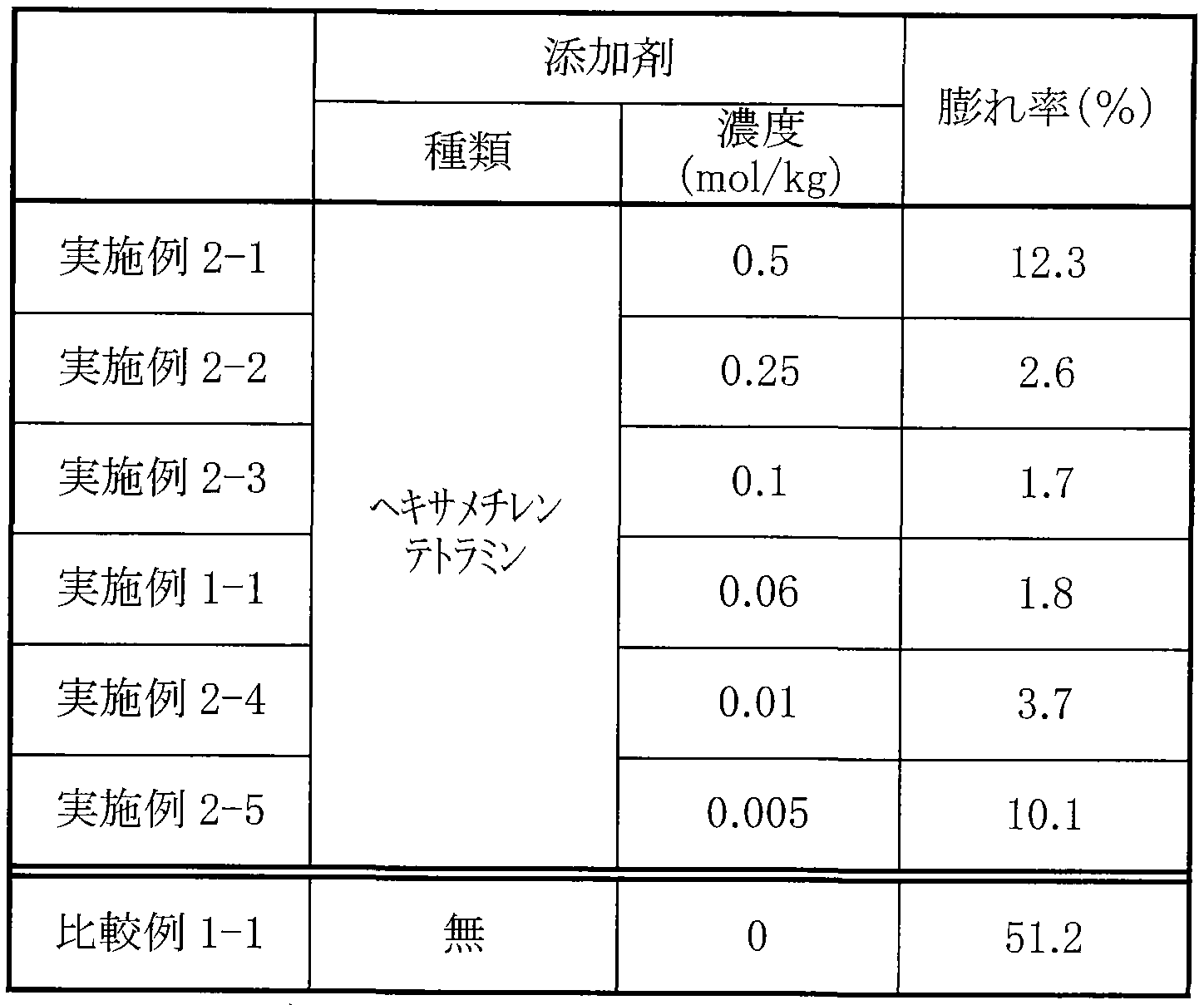
- Examples 2-1 to 2-5 are the same as those in Example 1 except that the concentration of the additive in the electrolytic solution was changed within the range of 0.05 molZkg to 0.5 molZkg as shown in Table 2.
- a secondary battery was fabricated in the same manner as in 1. At that time, the concentration of 4-fluoro-1,3-dioxan-2-one in the electrolyte was 0.1 ImolZkg. There are 4 unshared electron pairs in the hexamethylenetetramine used as an additive.
- Example 3-1 to 3-5 the concentration of the additive in the electrolytic solution is as shown in Table 3.
- a secondary battery was fabricated in the same manner as in Example 1-1 except that the amount was changed within the range of 5 molZkg, in which case 4 fluoro-1,3 dioxolane-2
- Examples 4-1 to 4-5 were the same as those in Example 1 except that the concentration of the additive in the electrolytic solution was changed within the range of 0.02 molZkg to 2. OmolZkg as shown in Table 4.
- a secondary battery was fabricated in the same manner as in Example 7. At that time, the concentration of 4-fluoro-1,3-dioxolane-2-one in the electrolyte was set to 0.1 mol / kg.
- Examples 5-1 to 5-5 were carried out except that the concentration of the additive in the electrolytic solution was changed within the range of 0.02 molZkg to 2. OmolZkg as shown in Table 5.
- a secondary battery was fabricated in the same manner as in Example 1-7. At that time, the concentration of 4-fluoro-1,3-dioxolane-2-one in the electrolyte was 0.2 molZkg.
- Equation 2 [4 Fluoro-1,3 dioxolan-2-one concentration (molZkg) / number of unshared electron pairs in nitrogen compound] X 0.
- the swelling rate during high temperature storage was lower than in Examples 5-4 and 5-5.
- lithium cobaltate (LiCoO) as a positive electrode active material graphite as a conductive agent
- polyvinylidene fluoride as a binder are mixed.
- a positive electrode mixture was prepared, and this positive electrode mixture was dispersed in N-methyl-2-pyrrolidone as a solvent to form a positive electrode mixture slurry, which was then uniformly applied to the positive electrode current collector 21A made of aluminum foil and dried. Then, the positive electrode active material layer 21 B was formed by compression molding with a roll press machine to produce the positive electrode 21. After that, the positive electrode lead 11 was attached to the positive electrode current collector 21A.
- MCMB mesocarbon microbeads
- polyvinylidene fluoride as a binder
- MCMB mesocarbon microbeads
- a negative electrode current collector 22A made of copper foil, dried, and compression-molded with a roll press to form a negative electrode active material layer 22B.
- a negative electrode 22 was produced. After that, the negative electrode lead 12 was attached to the negative electrode current collector 22A.
- the additive was hexaethylenetetramine in Example 6-1 and hexamethylenetetramine in Example 6-2.
- the content of the additive in the electrolytic solution was 0.5% by mass.
- Hexamethylenetetramine is a compound in which the unshared electron pairs of nitrogen atoms are oriented toward the outside of the molecule as shown in Chemical Formula 1.
- the obtained electrolytic solution is held in a copolymer of hexafluoropropylene and vinylidene fluoride, which is a polymer compound, so that each of positive electrode 21 and negative electrode 22 has a gel-like state.
- An electrolyte layer 24 was formed.
- the ratio of hexafluoropropylene in the copolymer was 6.9% by mass.
- the positive electrode 21 and the negative electrode 22 each formed with the electrolyte layer 24 were laminated through a separator 23 having a thickness of 20 ⁇ m and having a polyethylene film force, and wound to produce a wound electrode body 20.
- the obtained wound electrode body 20 was sandwiched between exterior members 31 made of a laminate film, and sealed under reduced pressure to produce the secondary battery shown in Figs.
- Example 6-1 except that hexaethylenetetramine or hexamethylenetetramine was mixed as an additive.
- a secondary battery was fabricated in the same manner as described above.
- the high-temperature storage characteristics were determined by measuring the thickness of the battery and the discharge capacity retention rate as follows. First, the constant current and constant voltage charge of 1C at 23 ° C is set to the upper limit 4.2V, the total charge time is 2.5 hours, then the constant current discharge of 1C is performed at 23 ° C to the end voltage 3.OV. Then, the discharge capacity before storage was determined. Subsequently, the battery is overcharged by performing a constant current and constant voltage charge of 1C at 23 ° C up to the upper limit of 4.331V for a total charge time of 2.5 hours, and stored in a constant temperature bath at 60 ° C. The battery thickness was measured against the storage time.
- Example 6-1 containing hexaethylenetetramine in the electrolyte was Example 6 containing hexamethylenetetramine.
- Cycle characteristics were improved compared to Comparative Example 6-1, which did not contain 2 or these, and furthermore, under high temperature conditions, swelling and a decrease in discharge capacity were small.
- the present invention has been described with reference to the embodiments and examples. However, the present invention is not limited to the above embodiments and examples, and various modifications can be made.
- the secondary battery having a wound structure has been specifically described, but the present invention can be applied to other stacked layers in which the positive electrode and the negative electrode are folded or the positive electrode and the negative electrode are stacked.
- the present invention can be similarly applied to a secondary battery having a structure.
- the case where lithium is used as the electrode reactant has been described, but other long-period periodic tables such as sodium (Na) or potassium (K) are used.
- the present invention also applies to the case of using a Group 1 element, a Group 2 element in a long-period periodic table such as magnesium or calcium (Ca), another light metal such as aluminum, lithium, or an alloy thereof. And similar effects can be obtained.
- a positive electrode active material or a solvent that can occlude and release the electrode reactant is selected according to the electrode reactant.
- electrolytes in which an electrolytic solution is held in a polymer compound.
- other electrolytes may be used.
- Other electrolytes include, for example, only an electrolytic solution, a mixture of a solid electrolyte having ionic conductivity and an electrolytic solution, or a mixture of a solid electrolyte and a gel electrolyte.
- the solid electrolyte for example, a polymer solid electrolyte in which an electrolyte salt is dispersed in a polymer compound having ion conductivity, or an inorganic solid electrolyte made of ion conductive glass or ionic crystals can be used.
- the polymer compound for example, polyethylene polymer or an ether polymer compound such as a crosslinked product containing polyethylene oxide, or an ester polymer compound such as polymetatalylate or polyacrylate is used alone or in combination. Or can be used by copolymerizing in the molecule.
- the inorganic solid electrolyte lithium nitride or lithium iodide may be used. Togashi.
- the present invention uses, for example, a cylindrical, square, coin, or button type using a metal container for the exterior member.
- a metal container for the exterior member for example, a metal container for the exterior member.
- the same effect can be obtained in this case as well. It can be applied not only to secondary batteries but also to primary batteries.
Landscapes
- Chemical & Material Sciences (AREA)
- Engineering & Computer Science (AREA)
- Chemical Kinetics & Catalysis (AREA)
- Electrochemistry (AREA)
- General Chemical & Material Sciences (AREA)
- Manufacturing & Machinery (AREA)
- Physics & Mathematics (AREA)
- Condensed Matter Physics & Semiconductors (AREA)
- General Physics & Mathematics (AREA)
- Inorganic Chemistry (AREA)
- Materials Engineering (AREA)
- Secondary Cells (AREA)
- Primary Cells (AREA)
Abstract
Description




Claims


Priority Applications (3)
| Application Number | Priority Date | Filing Date | Title |
|---|---|---|---|
| US11/815,392 US8916291B2 (en) | 2005-02-18 | 2006-02-14 | Electrolytic solution and battery |
| JP2007503650A JPWO2006088002A1 (ja) | 2005-02-18 | 2006-02-14 | 電解液および電池 |
| KR1020077018899A KR101318522B1 (ko) | 2005-02-18 | 2006-02-14 | 전해액 및 전지 |
Applications Claiming Priority (4)
| Application Number | Priority Date | Filing Date | Title |
|---|---|---|---|
| JP2005-041894 | 2005-02-18 | ||
| JP2005041894 | 2005-02-18 | ||
| JP2005-157100 | 2005-05-30 | ||
| JP2005157100 | 2005-05-30 |
Publications (1)
| Publication Number | Publication Date |
|---|---|
| WO2006088002A1 true WO2006088002A1 (ja) | 2006-08-24 |
Family
ID=36916408
Family Applications (1)
| Application Number | Title | Priority Date | Filing Date |
|---|---|---|---|
| PCT/JP2006/302490 Ceased WO2006088002A1 (ja) | 2005-02-18 | 2006-02-14 | 電解液および電池 |
Country Status (5)
| Country | Link |
|---|---|
| US (1) | US8916291B2 (ja) |
| JP (1) | JPWO2006088002A1 (ja) |
| KR (1) | KR101318522B1 (ja) |
| TW (1) | TW200642132A (ja) |
| WO (1) | WO2006088002A1 (ja) |
Cited By (8)
| Publication number | Priority date | Publication date | Assignee | Title |
|---|---|---|---|---|
| JP2008123732A (ja) * | 2006-11-09 | 2008-05-29 | Matsushita Electric Ind Co Ltd | 非水電解質二次電池 |
| EP2124286A1 (en) * | 2008-05-21 | 2009-11-25 | Samsung SDI Co., Ltd. | Electrolyte and lithium ion secondary battery comprising the same |
| JP2011049109A (ja) * | 2009-08-28 | 2011-03-10 | Sharp Corp | 非水電解質電池 |
| CN102044675A (zh) * | 2009-10-23 | 2011-05-04 | 深圳市比克电池有限公司 | 锂电池正极浆料添加剂、浆料、电池及制备方法 |
| JP2012104439A (ja) * | 2010-11-12 | 2012-05-31 | Mitsubishi Chemicals Corp | 非水系電解液及びそれを用いた非水系電解液二次電池 |
| JP2014523101A (ja) * | 2011-07-18 | 2014-09-08 | エルジー・ケム・リミテッド | 非水電解液及びそれを用いたリチウム二次電池 |
| JP2021197278A (ja) * | 2020-06-15 | 2021-12-27 | Muアイオニックソリューションズ株式会社 | 非水電解液およびそれを用いた蓄電デバイス |
| JP2022523945A (ja) * | 2019-04-30 | 2022-04-27 | エルジー エナジー ソリューション リミテッド | リチウム二次電池用非水電解質及びこれを含むリチウム二次電池 |
Families Citing this family (7)
| Publication number | Priority date | Publication date | Assignee | Title |
|---|---|---|---|---|
| KR101125653B1 (ko) * | 2010-08-23 | 2012-03-27 | 솔브레인 주식회사 | 리튬 이차 전지용 전해액 및 이를 포함하는 리튬 이차 전지 |
| US9786947B2 (en) * | 2011-02-07 | 2017-10-10 | Sila Nanotechnologies Inc. | Stabilization of Li-ion battery anodes |
| US9406932B2 (en) | 2014-01-15 | 2016-08-02 | Ford Global Technologies, Llc | Composition for reducing moisture in a battery electrolyte |
| KR102233777B1 (ko) | 2014-08-25 | 2021-03-30 | 삼성에스디아이 주식회사 | 리튬 전지 전해질용 첨가제, 이를 포함하는 리튬 전지용 전해질 및 상기 전해질을 채용한 리튬 전지 |
| EP3353844B1 (en) | 2015-03-27 | 2022-05-11 | Mason K. Harrup | All-inorganic solvents for electrolytes |
| US10707531B1 (en) | 2016-09-27 | 2020-07-07 | New Dominion Enterprises Inc. | All-inorganic solvents for electrolytes |
| CN111934015B (zh) * | 2020-08-28 | 2022-08-19 | 珠海市赛纬电子材料股份有限公司 | 一种锂离子电池非水电解液及含该非水电解液的锂离子电池 |
Citations (10)
| Publication number | Priority date | Publication date | Assignee | Title |
|---|---|---|---|---|
| JPH09296274A (ja) * | 1996-01-30 | 1997-11-18 | Nagano Pref Gov | 金属錯体形成用水溶液、錫−銀合金めっき浴およびこのめっき浴を用いためっき物の製造方法 |
| JPH09296289A (ja) * | 1996-03-04 | 1997-11-18 | Nagano Pref Gov | 錫−銀系合金めっき浴およびこのめっき浴を用いためっき物の製造方法 |
| JP2000067915A (ja) * | 1998-08-26 | 2000-03-03 | Sony Corp | 非水電解液二次電池 |
| JP2001093572A (ja) * | 1999-09-27 | 2001-04-06 | Hitachi Ltd | 非水電解液二次電池及びそれを用いた電気自動車、ハイブリット式自動車及び電力貯蔵システム |
| JP2001266940A (ja) * | 2000-03-16 | 2001-09-28 | Tomiyama Pure Chemical Industries Ltd | 二次電池用非水電解液 |
| JP2004022174A (ja) * | 2002-06-12 | 2004-01-22 | Yuasa Corp | 非水電解質電池 |
| JP2004241339A (ja) * | 2003-02-10 | 2004-08-26 | Nec Corp | 二次電池用電解液および非水電解液二次電池 |
| JP2005071678A (ja) * | 2003-08-21 | 2005-03-17 | Sony Corp | 電池 |
| JP2005228565A (ja) * | 2004-02-12 | 2005-08-25 | Sony Corp | 電解液および電池 |
| JP2005235734A (ja) * | 2004-01-20 | 2005-09-02 | Sony Corp | 電池およびその充放電方法、並びにその充放電制御素子 |
Family Cites Families (8)
| Publication number | Priority date | Publication date | Assignee | Title |
|---|---|---|---|---|
| US4789610A (en) * | 1986-11-06 | 1988-12-06 | Matsushita Electric Industrial Co., Ltd. | Solid-electrolyte secondary cell |
| JPH07312227A (ja) | 1994-05-17 | 1995-11-28 | Mitsubishi Chem Corp | リチウム二次電池 |
| JPH09213348A (ja) * | 1996-01-31 | 1997-08-15 | Sanyo Electric Co Ltd | 非水系電解液電池 |
| JP3758107B2 (ja) | 1996-08-07 | 2006-03-22 | 三井化学株式会社 | イオン伝導性高分子ゲル電解質および該高分子ゲル電解質を含む固体電池 |
| JP2001022519A (ja) | 1999-07-06 | 2001-01-26 | Casio Comput Co Ltd | 画像情報処理装置、および、記憶媒体 |
| EP1414097A4 (en) * | 2001-07-05 | 2005-03-09 | Bridgestone Corp | NONAQUEOUS ELECTROLYTE ELEMENT, ELECTROLYTE STABILIZING AGENT, PHOSPHAZENE DERIVATIVE, AND PROCESS FOR PREPARING THE SAME |
| JP4543710B2 (ja) * | 2004-03-11 | 2010-09-15 | 日産自動車株式会社 | 組電池 |
| US7285362B2 (en) * | 2004-05-17 | 2007-10-23 | Battelle Energy Alliance, Llc | Safe battery solvents |
-
2006
- 2006-02-14 KR KR1020077018899A patent/KR101318522B1/ko not_active Expired - Lifetime
- 2006-02-14 US US11/815,392 patent/US8916291B2/en active Active
- 2006-02-14 JP JP2007503650A patent/JPWO2006088002A1/ja active Pending
- 2006-02-14 WO PCT/JP2006/302490 patent/WO2006088002A1/ja not_active Ceased
- 2006-02-15 TW TW095105135A patent/TW200642132A/zh not_active IP Right Cessation
Patent Citations (10)
| Publication number | Priority date | Publication date | Assignee | Title |
|---|---|---|---|---|
| JPH09296274A (ja) * | 1996-01-30 | 1997-11-18 | Nagano Pref Gov | 金属錯体形成用水溶液、錫−銀合金めっき浴およびこのめっき浴を用いためっき物の製造方法 |
| JPH09296289A (ja) * | 1996-03-04 | 1997-11-18 | Nagano Pref Gov | 錫−銀系合金めっき浴およびこのめっき浴を用いためっき物の製造方法 |
| JP2000067915A (ja) * | 1998-08-26 | 2000-03-03 | Sony Corp | 非水電解液二次電池 |
| JP2001093572A (ja) * | 1999-09-27 | 2001-04-06 | Hitachi Ltd | 非水電解液二次電池及びそれを用いた電気自動車、ハイブリット式自動車及び電力貯蔵システム |
| JP2001266940A (ja) * | 2000-03-16 | 2001-09-28 | Tomiyama Pure Chemical Industries Ltd | 二次電池用非水電解液 |
| JP2004022174A (ja) * | 2002-06-12 | 2004-01-22 | Yuasa Corp | 非水電解質電池 |
| JP2004241339A (ja) * | 2003-02-10 | 2004-08-26 | Nec Corp | 二次電池用電解液および非水電解液二次電池 |
| JP2005071678A (ja) * | 2003-08-21 | 2005-03-17 | Sony Corp | 電池 |
| JP2005235734A (ja) * | 2004-01-20 | 2005-09-02 | Sony Corp | 電池およびその充放電方法、並びにその充放電制御素子 |
| JP2005228565A (ja) * | 2004-02-12 | 2005-08-25 | Sony Corp | 電解液および電池 |
Cited By (14)
| Publication number | Priority date | Publication date | Assignee | Title |
|---|---|---|---|---|
| JP2008123732A (ja) * | 2006-11-09 | 2008-05-29 | Matsushita Electric Ind Co Ltd | 非水電解質二次電池 |
| US9368834B2 (en) | 2008-05-21 | 2016-06-14 | Samsung Sdi Co., Ltd. | Electrolyte for lithium ion secondary battery and lithium ion secondary battery comprising the same |
| EP2124286A1 (en) * | 2008-05-21 | 2009-11-25 | Samsung SDI Co., Ltd. | Electrolyte and lithium ion secondary battery comprising the same |
| US8771881B2 (en) | 2008-05-21 | 2014-07-08 | Samsung Sdi Co., Ltd. | Electrolyte for lithium ion secondary battery and lithium ion secondary battery comprising the same |
| JP2011049109A (ja) * | 2009-08-28 | 2011-03-10 | Sharp Corp | 非水電解質電池 |
| CN102044675A (zh) * | 2009-10-23 | 2011-05-04 | 深圳市比克电池有限公司 | 锂电池正极浆料添加剂、浆料、电池及制备方法 |
| JP2012104439A (ja) * | 2010-11-12 | 2012-05-31 | Mitsubishi Chemicals Corp | 非水系電解液及びそれを用いた非水系電解液二次電池 |
| JP2014523101A (ja) * | 2011-07-18 | 2014-09-08 | エルジー・ケム・リミテッド | 非水電解液及びそれを用いたリチウム二次電池 |
| US9871271B2 (en) | 2011-07-18 | 2018-01-16 | Lg Chem, Ltd. | Non-aqueous electrolyte and lithium secondary battery using the same |
| JP2022523945A (ja) * | 2019-04-30 | 2022-04-27 | エルジー エナジー ソリューション リミテッド | リチウム二次電池用非水電解質及びこれを含むリチウム二次電池 |
| JP7250401B2 (ja) | 2019-04-30 | 2023-04-03 | エルジー エナジー ソリューション リミテッド | リチウム二次電池用非水電解質及びこれを含むリチウム二次電池 |
| US12148886B2 (en) | 2019-04-30 | 2024-11-19 | Lg Energy Solution, Ltd. | Non-aqueous electrolyte for lithium secondary battery and lithium secondary battery including the same |
| JP2021197278A (ja) * | 2020-06-15 | 2021-12-27 | Muアイオニックソリューションズ株式会社 | 非水電解液およびそれを用いた蓄電デバイス |
| JP7507014B2 (ja) | 2020-06-15 | 2024-06-27 | Muアイオニックソリューションズ株式会社 | 非水電解液およびそれを用いた蓄電デバイス |
Also Published As
| Publication number | Publication date |
|---|---|
| KR20070103041A (ko) | 2007-10-22 |
| US20090053599A1 (en) | 2009-02-26 |
| US8916291B2 (en) | 2014-12-23 |
| KR101318522B1 (ko) | 2013-10-16 |
| TW200642132A (en) | 2006-12-01 |
| JPWO2006088002A1 (ja) | 2008-07-03 |
| TWI338395B (ja) | 2011-03-01 |
Similar Documents
| Publication | Publication Date | Title |
|---|---|---|
| US7718314B2 (en) | Cathode material and battery | |
| US20160126600A1 (en) | Battery | |
| KR20090005973A (ko) | 전지 | |
| CN102037602A (zh) | 高能量锂离子二次电池 | |
| KR101318522B1 (ko) | 전해액 및 전지 | |
| CN100481606C (zh) | 电解液及电池 | |
| JP2008004503A (ja) | 非水電解質組成物及び非水電解質二次電池 | |
| JP2009252645A (ja) | 非水電解質二次電池および非水電解質組成物 | |
| CN101630759B (zh) | 电解液和电池 | |
| JP2009302022A (ja) | 非水電解液二次電池 | |
| JP5109359B2 (ja) | 非水電解質二次電池 | |
| JP2004265792A (ja) | 電池 | |
| JP4993159B2 (ja) | 二次電池 | |
| JP2008305772A (ja) | 非水電解液二次電池及び非水電解液 | |
| JP2008171589A (ja) | 負極および電池 | |
| JP4867218B2 (ja) | リチウムイオン二次電池 | |
| CN100527518C (zh) | 电池 | |
| JP2007035391A (ja) | 正極材料,正極および電池 | |
| JP4784133B2 (ja) | 二次電池および電池 | |
| JP2007134245A (ja) | 電解液および電池 | |
| US20100081061A1 (en) | Electrolytic solution and battery | |
| JP2006253086A (ja) | 高分子電解質、電池および電池の製造方法 | |
| JP2006228566A (ja) | 電解液および電池 | |
| JP2012018916A (ja) | 非水電解質および非水電解質電池 | |
| JP2009252600A (ja) | 非水電解液二次電池および非水電解液組成物 |
Legal Events
| Date | Code | Title | Description |
|---|---|---|---|
| 121 | Ep: the epo has been informed by wipo that ep was designated in this application | ||
| WWE | Wipo information: entry into national phase |
Ref document number: 2007503650 Country of ref document: JP |
|
| WWE | Wipo information: entry into national phase |
Ref document number: 11815392 Country of ref document: US |
|
| WWE | Wipo information: entry into national phase |
Ref document number: 1020077018899 Country of ref document: KR |
|
| WWE | Wipo information: entry into national phase |
Ref document number: 200680005446.7 Country of ref document: CN |
|
| NENP | Non-entry into the national phase |
Ref country code: DE |
|
| 122 | Ep: pct application non-entry in european phase |
Ref document number: 06713631 Country of ref document: EP Kind code of ref document: A1 |