WO2006043418A1 - アルコキシド化合物、薄膜形成用原料及び薄膜の製造方法 - Google Patents
アルコキシド化合物、薄膜形成用原料及び薄膜の製造方法 Download PDFInfo
- Publication number
- WO2006043418A1 WO2006043418A1 PCT/JP2005/018445 JP2005018445W WO2006043418A1 WO 2006043418 A1 WO2006043418 A1 WO 2006043418A1 JP 2005018445 W JP2005018445 W JP 2005018445W WO 2006043418 A1 WO2006043418 A1 WO 2006043418A1
- Authority
- WO
- WIPO (PCT)
- Prior art keywords
- thin film
- compound
- alkoxide compound
- iron
- raw material
- Prior art date
- Legal status (The legal status is an assumption and is not a legal conclusion. Google has not performed a legal analysis and makes no representation as to the accuracy of the status listed.)
- Ceased
Links
Classifications
-
- C—CHEMISTRY; METALLURGY
- C07—ORGANIC CHEMISTRY
- C07C—ACYCLIC OR CARBOCYCLIC COMPOUNDS
- C07C215/00—Compounds containing amino and hydroxy groups bound to the same carbon skeleton
- C07C215/02—Compounds containing amino and hydroxy groups bound to the same carbon skeleton having hydroxy groups and amino groups bound to acyclic carbon atoms of the same carbon skeleton
- C07C215/04—Compounds containing amino and hydroxy groups bound to the same carbon skeleton having hydroxy groups and amino groups bound to acyclic carbon atoms of the same carbon skeleton the carbon skeleton being saturated
- C07C215/06—Compounds containing amino and hydroxy groups bound to the same carbon skeleton having hydroxy groups and amino groups bound to acyclic carbon atoms of the same carbon skeleton the carbon skeleton being saturated and acyclic
- C07C215/08—Compounds containing amino and hydroxy groups bound to the same carbon skeleton having hydroxy groups and amino groups bound to acyclic carbon atoms of the same carbon skeleton the carbon skeleton being saturated and acyclic with only one hydroxy group and one amino group bound to the carbon skeleton
-
- C—CHEMISTRY; METALLURGY
- C23—COATING METALLIC MATERIAL; COATING MATERIAL WITH METALLIC MATERIAL; CHEMICAL SURFACE TREATMENT; DIFFUSION TREATMENT OF METALLIC MATERIAL; COATING BY VACUUM EVAPORATION, BY SPUTTERING, BY ION IMPLANTATION OR BY CHEMICAL VAPOUR DEPOSITION, IN GENERAL; INHIBITING CORROSION OF METALLIC MATERIAL OR INCRUSTATION IN GENERAL
- C23C—COATING METALLIC MATERIAL; COATING MATERIAL WITH METALLIC MATERIAL; SURFACE TREATMENT OF METALLIC MATERIAL BY DIFFUSION INTO THE SURFACE, BY CHEMICAL CONVERSION OR SUBSTITUTION; COATING BY VACUUM EVAPORATION, BY SPUTTERING, BY ION IMPLANTATION OR BY CHEMICAL VAPOUR DEPOSITION, IN GENERAL
- C23C16/00—Chemical coating by decomposition of gaseous compounds, without leaving reaction products of surface material in the coating, i.e. chemical vapour deposition [CVD] processes
- C23C16/22—Chemical coating by decomposition of gaseous compounds, without leaving reaction products of surface material in the coating, i.e. chemical vapour deposition [CVD] processes characterised by the deposition of inorganic material, other than metallic material
- C23C16/30—Deposition of compounds, mixtures or solid solutions, e.g. borides, carbides, nitrides
- C23C16/40—Oxides
-
- H—ELECTRICITY
- H10—SEMICONDUCTOR DEVICES; ELECTRIC SOLID-STATE DEVICES NOT OTHERWISE PROVIDED FOR
- H10D—INORGANIC ELECTRIC SEMICONDUCTOR DEVICES
- H10D1/00—Resistors, capacitors or inductors
- H10D1/60—Capacitors
- H10D1/68—Capacitors having no potential barriers
- H10D1/682—Capacitors having no potential barriers having dielectrics comprising perovskite structures
-
- H—ELECTRICITY
- H10—SEMICONDUCTOR DEVICES; ELECTRIC SOLID-STATE DEVICES NOT OTHERWISE PROVIDED FOR
- H10P—GENERIC PROCESSES OR APPARATUS FOR THE MANUFACTURE OR TREATMENT OF DEVICES COVERED BY CLASS H10
- H10P14/00—Formation of materials, e.g. in the shape of layers or pillars
- H10P14/60—Formation of materials, e.g. in the shape of layers or pillars of insulating materials
- H10P14/63—Formation of materials, e.g. in the shape of layers or pillars of insulating materials characterised by the formation processes
- H10P14/6326—Deposition processes
- H10P14/6328—Deposition from the gas or vapour phase
- H10P14/6334—Deposition from the gas or vapour phase using decomposition or reaction of gaseous or vapour phase compounds, i.e. chemical vapour deposition
-
- H—ELECTRICITY
- H10—SEMICONDUCTOR DEVICES; ELECTRIC SOLID-STATE DEVICES NOT OTHERWISE PROVIDED FOR
- H10P—GENERIC PROCESSES OR APPARATUS FOR THE MANUFACTURE OR TREATMENT OF DEVICES COVERED BY CLASS H10
- H10P14/00—Formation of materials, e.g. in the shape of layers or pillars
- H10P14/60—Formation of materials, e.g. in the shape of layers or pillars of insulating materials
- H10P14/69—Inorganic materials
- H10P14/692—Inorganic materials composed of oxides, glassy oxides or oxide-based glasses
- H10P14/6938—Inorganic materials composed of oxides, glassy oxides or oxide-based glasses the material containing at least one metal element, e.g. metal oxides, metal oxynitrides or metal oxycarbides
- H10P14/69398—Inorganic materials composed of oxides, glassy oxides or oxide-based glasses the material containing at least one metal element, e.g. metal oxides, metal oxynitrides or metal oxycarbides the material having a perovskite structure, e.g. BaTiO3
Definitions
- Alkoxide compound raw material for thin film formation, and method for producing thin film
- the present invention relates to a novel metal compound (iron compound) having a specific amino alcohol as a ligand, a raw material for forming a thin film containing the metal compound, and iron using the raw material for forming a thin film
- the present invention relates to a method for producing a containing thin film.
- Iron-containing thin films are mainly used as electronic parts such as high-dielectric capacitors, ferroelectric capacitors, gate insulating films, and rear films, and magnetic members.
- a flame deposition method As a method for producing the above thin film, a flame deposition method, a sputtering method, an ion plating method, a coating thermal decomposition method, a MOD method such as a sol-gel method, a chemical vapor deposition method (hereinafter simply referred to as CVD).
- CVD chemical vapor deposition method
- it has many advantages such as being excellent in composition controllability and step coverage, suitable for mass production, and being able to integrate hybrids.
- the chemical vapor deposition method including the Atomic Layer D method is the optimal manufacturing process.
- Patent Document 1 reports an alkoxide compound of silicon having an alcohol having an alkoxy group at the terminal as a ligand.
- Various metal compounds using an alcohol having a terminal amino group as a donor group coordinated to a metal atom as a ligand have also been reported.
- Patent Documents 2 and 3 disclose titanium compounds and zirconium compounds. Non-patent document 1 reports a lanthanide compound, and Non-patent document 2 reports a copper aminoalkoxide compound.
- Patent Document 1 Japanese Patent Laid-Open No. 6-321824
- Patent Document 2 JP 2000-351784
- Patent Document 3 Japanese Patent Laid-Open No. 2003-119171
- Non-Patent Document 1 Inorganic Chemistry, Vol.36, No.16, 1997, p3545_3552
- Non-Patent Document 2 Inorganic Chemistry, Vol.36, No.14, 1997, p2930-2937
- the properties required of compounds used as raw materials are liquid or have a low melting point and a liquid state It can be transported with a vapor pressure, and the vapor pressure is large and easy to vaporize.
- precursors when used for the production of multi-component thin films, it should not be altered by ligand exchange or chemical reaction during mixing with other precursors or during storage, and during thin film deposition by heat and / or oxidation. It is required that the decomposition behavior of is similar to other precursors used together. For iron, there were no compounds that were fully satisfactory in these respects.
- an iron-containing alkoxide compound using a specific amino alcohol as a ligand can solve the above-mentioned problems, and have reached the present invention.
- the present invention was obtained by vaporizing an alkoxide compound represented by the following general formula (I), a thin film forming raw material containing the alkoxide compound, and the thin film forming raw material.
- the present invention provides a method for producing a thin film in which a vapor containing an alkoxide compound is introduced onto a substrate and decomposed and Z or chemically reacted to form a thin film on the substrate.
- R 1 and R 2 each independently represent a hydrogen atom or an alkyl group having 1 to 4 carbon atoms
- R 3 and R 4 represent an alkyl group having 1 to 4 carbon atoms
- FIG. 1 is a schematic diagram showing an example of a CVD apparatus used in the thin film production method of the present invention.
- the alkoxide compound of the present invention is represented by the above general formula (I) and is particularly suitable as a precursor for a thin film production method having a vaporization step such as a CVD method including an ALD method.
- the alkoxide compound of the present invention represented by the above general formula (I) has greater decomposability by heat, Z or oxygen, and greater stability to chemical reaction than the known iron alkoxide compound. .
- the alkyl group represented by R 1 , R 2 , R 3 and R 4 :! To 4 includes, for example, methylol, ethyl, propyl, isopropyl, butyl, Examples include secondary butyl, tertiary butyl, and isobutyl.
- the alkanedyl group represented by A may have one or more branches at any position as long as the total number of carbon atoms is:! -8.
- alkanedyl group represented by A there is a group that gives a 5-membered ring structure or 6-membered ring structure that is an energetically stable structure when a dialkylamino group that is a terminal donor group is coordinated to an iron atom.
- Preferable examples of the alkanedyl group include groups represented by the following general formula ( ⁇ ⁇ ).
- the alkoxide compound of the present invention may have optical isomers. The force is not distinguished by the optical isomerism.
- R 5 to R 8 each independently represents a hydrogen atom or an alkyl group having 1 to 4 carbon atoms, X represents 0 or 1, and the number of carbon atoms of the group represented by the formula (The total of 1 is 8)
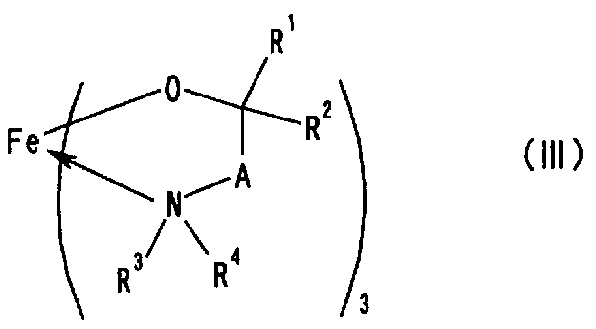
- the alkoxide compound of the present invention in the case where the terminal donor group in the ligand is coordinated to an iron atom to form a ring structure is represented by the following general formula ( ⁇ ).
- the alkoxide compound of the present invention is a concept that includes both the force represented by the above general formula (I) and the alkoxide compound represented by the following general formula (III).
- R 1 and R 2 each independently represent a hydrogen atom or an alkyl group having 1 to 4 carbon atoms.
- R 3 and R 4 represent an alkyl group having 1 to 4 carbon atoms,
- alkoxide compound of the present invention include the following compounds No .:! To No. 15.
- R 1 and R 2 are preferably a hydrogen atom or a methyl group.
- R 3 and R 4 are preferably a methyl group.
- A is preferably a methylene group.
- R ⁇ R 4 and A are arbitrarily selected depending on the solubility in the solvent used, the thin film formation reaction, etc. You can choose.
- the alkoxide compound of the present invention can be produced by applying known reactions that are not particularly limited by the production method.
- a well-known general alkoxide compound synthesis method using the corresponding amino alcohol may be applied.
- an inorganic salt such as an iron halide or nitrate, or a hydrate thereof
- the corresponding alcohol compound are mixed with sodium, sodium hydride, sodium amide, sodium hydroxide, sodium methylate, ammonia, ammine, etc.
- Inorganic salts such as iron halides and nitrates or hydrates thereof, and alkali metal alcohols such as sodium alkoxides, lithium alkoxides and potassium alkoxides of the corresponding alcohol compounds.
- Examples of the reactive intermediate used in the method (4) include iron amide compounds such as tris (dialkylamino) iron and tris (bis (trimethylsilyl) amino) iron.
- the raw material for forming a thin film of the present invention contains the alkoxide compound of the present invention as a precursor of a thin film, and the form thereof is a method for producing a thin film to which the raw material for forming a thin film is applied (for example, Depending on the flame deposition method, sputtering method, ion plating method, coating pyrolysis method, MOD method such as sol-gel method, CVD method including ALD method, etc., it is selected as appropriate.
- the alkoxide compound of the present invention is particularly useful as a CV D raw material among the thin film forming raw materials because of its physical properties.
- the raw material for forming a thin film of the present invention is a chemical vapor deposition (CVD) raw material
- the form thereof is appropriately selected depending on the method such as the transporting and supplying method of the CVD method used.
- the CVD raw material is vaporized by heating and Z or depressurizing in the raw material container, and is transferred to the deposition reaction section together with a carrier gas such as argon, nitrogen, helium or the like used as necessary.
- a carrier gas such as argon, nitrogen, helium or the like used as necessary.
- the alkoxide compound of the present invention represented by the above general formula (I) itself is a raw material for CVD.
- the alkoxide of the present invention represented by the above general formula (I) The compound itself or a solution obtained by dissolving the alkoxide compound in an organic solvent becomes a raw material for CVD.
- a CVD raw material is vaporized and supplied independently for each component (hereinafter sometimes referred to as a single source method), and a multi-component raw material is obtained in advance.
- a method of vaporizing and supplying a mixed raw material mixed in composition hereinafter sometimes referred to as a cocktail sauce method.
- a cocktail source method a mixture or a mixed solution of only the alkoxide compound of the present invention, or a mixture or mixed solution of the alkoxide compound of the present invention and another precursor is a raw material for CVD.
- the organic solvent used for the above-mentioned CVD raw material a common organic solvent which is not particularly restricted can be used.
- the organic solvent include alcohols such as methanol, ethanol, 2_propanol, and n-butanol; acetates such as ethyl acetate, butyl acetate, and methoxyethyl acetate; ethylene glycol monomethyl ethere, ethylene glyconolemonoethylo Ether alcohols such as reetenole, ethyleneglycolenobutinoleatenore, diethylene glycol monomethyl ether; ethers such as tetrahydrofuran, tetrahydropyran, ethylene glycol dimethyl ether, diethylene glycol dimethyl ether, triethylene glycol dimethyl ether, dibutyl ether, dioxane Methyl butyl ketone, methyl isobutyl ketone, ethyl buty
- the total amount of the alkoxide compound of the present invention and other precursors in the organic solvent is 0.01 to 2.0 monolet / litnor, particularly 0.05 to 1.0 monolith / The power to make it a lit-no-re
- one kind selected from a group of compounds used as an organic ligand such as an alcohol compound, a glycol compound, a ⁇ diketonic compound, a cyclopentagen compound, and an organic amine compound or Examples include compounds of two or more types and silicon or metal.
- Other precursor metal species include, for example, magnesium, strength ruthenium, strontium, barium, titanium, zirconium, hafnium, nocnadium, niobium, tantanole, manganese, iron, ruthenium, cobalt, rhodium, iridium, nickel nickel.
- Examples of the alcohol compound used as the organic ligand include methanol, ethanol, propanol, isopropanol, butanol, 2-butanol, isobutanol, tertiary butanol, amino alcohol, and isoamino alcohol.
- Alkyl alcohols such as tertiary amino alcohols; 2-methoxyethanol, 2_ethoxyethanol, 2_butoxy ethanol, 2_ (2-methoxyethoxy) ethanol, 2-methoxy_ 1_methylethanolanol, 2-methoxy mono 1,1-dimethylethanol, 2_ethoxy-1,1,1-dimethylethanol, 2-isopropoxy-1,1-dimethylethanol, 2-butoxy-1,1-dimethyl Ethanol, 2_ (2-methoxyethoxy) -1,1, 1-dimethylethanol, 2_propoxy_1, 1-jetylethanol, 2_secondary butoxy_1, 1-jetylethanol, 3-methoxy_1, 1—
- Examples include ether alcohols such as dimethylpropanol; dialkylamino alcohols that give the alkoxide compounds of the present invention.
- Glycol compounds used as the above organic ligands include 1,2-ethanediol, 1,2-propanediol, 1,3-propanediol, 2,4-hexanediol, 2, 2 —Dimethyl-1,3_propanediol, 2,2-Dethyl-1,3_propanediol, 1,3-butanediol, 2,4-butanediol, 2,2-jetinoleol 1,3 butanediol, 2 ethyl-2- Butyl-1,3 propanediol, 2,4 pentanediol, 2-methyl-1,3 propanediol, 2-methyl-2,4 pentanediol, 2,4 hexanediol, 2,4 dimethyl-2,4 pentanediol, etc.S Can be mentioned.
- the ⁇ -diketone compound used as the organic ligand includes acetylethylacetone, hexane 2,4-dione, 5-methylhexane 2,4-dione, heptane 2,4-dione, 2 methylheptane 3,5 dione, 5 methylheptane 2,4-dione, 6 methylheptane 2,4-dione, 2,2 dimethylheptane 3,5 dione, 2, 6-dimethylheptane 3,5 dione, 2, 2 , 6 Trimethylheptane 3,5 dione, 2, 2, 6, 6-Tetramethylheptane 1,3,5-dione, Octane 1,2,4-dione, 2, 2, 6_ Trimethinoleoctane 3,5-dione 2, 6 _Dimethinoleoctane 1,5—Dione 2,9_ Dimethyl nonane 4,6—Dione 2_Methyl _6_Ethyldecane 1,3,5-Dione 2,
- Examples of the cyclopentagen compound used as the organic ligand include cyclopentagen, methylcyclopentagen, ethylcyclopentagen, propylcyclopentagen, isopropylcyclopentagen, butylcyclopentagen, second Examples include butyl cyclopentagen, isobutyl cyclopentagen, tert-butyl cyclopentagen, dimethyl cyclopentagen, tetramethyl cyclopentagen, pentamethyl cyclopentagen and the like.
- Examples of the organic amine compound used as the organic ligand include methenoleamine, ethylamine, propylamine, isopropylamine, butylamine, sec-butylamine, tert-butylamine, isobutylamine, dimethylamine, jetylamine, dipropylamine. , Disopropylamine, ethylmethylamine, propylmethylamine, isopropylmethylamine and the like.
- the other precursors described above preferably have similar thermal and / or oxidative degradation behavior to the alkoxide compound of the present invention in the case of the single source method. In addition to the similar behavior of heat and / or oxidative degradation, it is preferable not to cause alteration by chemical reaction during mixing.
- Examples of the bismuth compound that can be used in the case of mixing a bismuth compound as the alkoxide compound of the present invention and other precursors include triphenyl bismuth, tri (o-methylphenyl) bismuth, tri (m_methylphenyl) bismuth.
- Triaryl bismuth compounds such as tri (p _methylphenyl) bismuth; trialkyl bismuth compounds such as trimethyl bismuth; j3 diketones such as tris (2, 2, 6, 6-tetramethylheptane _ 3, 5-dionate) bismuth Complexes; cyclopentadienyl complexes such as tris (cyclopentadienyl) bismuth and tris (methylcyclopentadienyl) bismuth; tris (tertiary butoxy) bismuth, tris (tertiary bisoxy) bismuth, tris ( Alkoxy with low molecular weight alcohols such as ethoxy) bismuth , Alkoxide compound represented by the general formula shown in the following [I inhibit 5], tris alkoxy bismuth compounds and the like having the same ligand as the alkoxy Cid compounds of the present invention.
- R e and R f each independently represent a hydrogen atom or an alkyl group having 1 to 3 carbon atoms, R g represents an alkyl group having 1 to 4 carbon atoms, and n is 1 Or 2)
- the raw material for forming a thin film of the present invention may contain a nucleophilic reagent as needed to impart stability to the alkoxide compound of the present invention and other precursors.
- the nucleophilic reagent include ethylene glycol ethers such as glyme, diglyme, triglyme, and tetraglyme, 18 crown 6, dicyclohexylo 18 crown-6, 24 crown-8, dicyclohexylo 24 crown-8, dibenzo 24 Crown ethers such as crown 1-8, ethylenediamine, ⁇ , ⁇ 'tetramethylethylenediamine, diethylenetriamine, triethylenetetramine, tetraethylenepentamine, pentaethylenehexamine, 1, 1, 4, 7, 7_ Pentamethino retylene triamine, 1, 1, 4, 7, 10, 10-hexamethyltriethylenetetramine, polyamines such as triethoxytriethyleneamine, cyclic polyamines such as cyclam
- the raw material for forming a thin film of the present invention contains as little impurities metal elements as possible, impurities halogen such as impurity chlorine, and impurities organic components as much as possible.
- the impurity metal element content is preferably lOOppb or less, more preferably lOppb or less for each element. Lppm or less is preferred for the total amount, lOOppb or less is more preferred.
- the total amount of impurity halogen is preferably lOOppm or less, more preferably lOppm or less, and most preferably lppm or less.
- the total amount of impurity organics is preferably 500 ppm or less, more preferably 50 ppm or less, and most preferably 10 ppm or less.
- moisture is particles in the raw material for thin film formation.
- the water content is preferably 10 ppm or less, more preferably 10 ppm or less.
- the raw material for forming a thin film of the present invention can be used in particle measurement by a light scattering liquid particle detector in a liquid phase in order to reduce or prevent particle contamination of a produced thin film. It is preferred that the number of particles greater than 3 m be less than 100 in the liquid phase lml. 0. It is more preferred that the number of particles greater than 2 xm is less than 1000 in the liquid phase lml. More preferably, the number of particles larger than 0.2 xm is 100 or less in 1 ml of liquid phase.
- the method for producing a thin film of the present invention uses the raw material for forming a thin film of the present invention, vaporized vapors of the alkoxide compound of the present invention and other precursors used as necessary, and if necessary.
- the reactive gas used in the above is introduced onto the substrate, and then the precursor is decomposed and / or chemically reacted on the substrate to grow and deposit a thin film on the substrate.
- well-known general conditions, methods and the like that are not particularly limited can be used for the transport and supply method of raw materials, the deposition method, the production conditions, the production equipment, and the like.
- Examples of the reactive gas used as necessary include, for example, oxygen, ozone, nitrogen dioxide, nitric oxide, water vapor, hydrogen peroxide, formic acid, acetic acid, and anhydrous acetic acid.
- Examples of reducing compounds include hydrogen, and examples of compounds that produce nitrides include organic amine compounds such as monoalkylamines, dialkylamines, trianolenoquinamines, and alkylendiamines. , Hydrazine, ammonia and the like.
- Examples of the transport and supply method include the gas transport method, the liquid transport method, the single source method, and the cocktail sauce method.
- thermal CVD for depositing a thin film by reacting source gas or source gas and reactive gas only by heat
- plasma CVD using heat and plasma heat and light
- ALD Atomic Lay
- the production conditions include reaction temperature (substrate temperature), reaction pressure, deposition rate, and the like.
- the reaction temperature is preferably 250 ° C. to 800 ° C., more preferably 160 ° C. or higher, which is the temperature at which the alkoxide compound of the present invention sufficiently reacts.
- the reaction pressure is preferably from atmospheric pressure to lOPa in the case of thermal CVD or photo-CVD, and preferably 10 to 2000 Pa in the case of using plasma.
- the deposition rate can be controlled by the raw material supply conditions (vaporization temperature, vaporization pressure), reaction temperature and reaction pressure. If the deposition rate is large, the properties of the obtained thin film may deteriorate. If the deposition rate is small, there will be a problem with productivity.
- the thickness of the thin film formed from the raw material for forming a thin film according to the present invention is selected from the force appropriately selected according to the application: usually:! To 10000 nm, preferably 5 to:! OOOnm.
- annealing treatment is performed in an inert atmosphere, an oxidizing atmosphere, or a reducing atmosphere in order to obtain better electrical characteristics.
- a reflow process may be provided if step filling is required.
- the temperature is usually 400 ⁇ : 1200 ° C, 500 ⁇ 800 ° C force S preferred.
- the thin film produced by the method for producing a thin film of the present invention using the raw material for forming a thin film of the present invention can be obtained by appropriately selecting a precursor of other components, a reactive gas, and production conditions.
- a desired type of thin film such as nitride ceramics or glass can be obtained.
- the composition of the thin film to be manufactured include iron, iron-bismuth composite oxide, iron oxide, iron carbide, iron nitride, iron-titanium composite oxide, iron-zirconium composite oxide, and iron-aluminum composite oxide. , Iron-rare earth complex oxide, iron-bismuth-titanium complex oxide, and the like.
- the alkoxide compound of the present invention is particularly suitable as a raw material for forming a thin film, which is mixed with a bismuth compound as another precursor to produce a thin film made of iron-bismuth composite oxide.
- these thin film applications include high dielectric capacitor films, gate insulating films, gate films, ferroelectric capacitor films, capacitor films, barrier film, and other electronic component members, optical fibers, optical waveguides, optical amplifiers, optical switches, etc.
- the volatilization characteristic was evaluated by vapor pressure measurement.
- the vapor pressure was measured by a method in which the system was fixed at a constant pressure and the vapor temperature near the liquid level was measured. Change the system pressure and steam The vapor temperature was measured at 3 to 4 points, and the vapor pressure P (Torr) at 150 ° C and 200 ° C was calculated from the Clavius-Clapeyron plot by applying the vapor pressure equation. The results are shown in Table 1.
- Compound No. 3 which is an alkoxide compound of the present invention, has a higher vapor pressure than Comparative Compound No. 1, and can be formed even at a relatively low temperature. Thus, it was confirmed that it is suitable as an iron precursor for use in a thin film production method having a vaporization step such as a CVD method.
- Ethylcyclohexane was dried with a sodium metal wire, and under an argon stream, 10% by mass of the previous fraction and 10% by mass of the kettle residue were cut and purified by distillation to obtain a solvent having a water content of less than lppm.
- a solvent having a water content of less than lppm To 500 ml of this solvent, 0.2 mol of Compound No. 2 and 0.2 mol of tris (1-methoxy-2-methyl-2-propoxy) bismuth were blended in an argon atmosphere to obtain an iron-bismuth cocktail sauce.
- an iron bismuth composite oxide thin film was produced on a silicon wafer using the cocktail source obtained above under the following conditions. The film thickness and composition of the manufactured thin film were measured using fluorescent X-rays. The measurement results are shown below.
- Vaporization chamber temperature 170 ° C, raw material flow rate: 20mg / min, reaction pressure: 500Pa, reaction time: 30min, substrate temperature: 380 ° C, carrier Ar: 700sccm, oxygen gas: 700sccm, deposition time: 15min , Post-deposition annealing conditions: oxygen flow rate 10 min in OOsccm
- Ethylcyclohexane was dried with a sodium metal wire, and under an argon stream, 10% by mass of the previous fraction and 10% by mass of the kettle residue were cut and purified by distillation to obtain a solvent having a water content of less than lppm.
- a solvent having a water content of less than lppm To 500 ml of this solvent, 0.2 mol of tris (1-methoxy-2-methyl-1-propoxy) iron and 0.2 mol of tris (1-methoxy_2_methyl_2_propoxy) bismuth in an argon atmosphere Blended to obtain a comparative cocktail sauce of iron and bismuth.
- an iron-bismuth composite oxide thin film was produced on a silicon wafer using the comparative cocktail source obtained above under the following conditions.
- the film thickness and composition of the manufactured thin film were measured in the same manner as in Example 2 above. The measurement results are as follows Shown in
- Vaporization chamber temperature 230 ° C, raw material flow rate: 20mgZ min, reaction pressure: 500Pa, reaction time: 30min, substrate temperature: 380 ° C, carrier Ar: 700sccm, oxygen gas: 700sccm, annealing conditions after deposition: oxygen 10 minutes in lOOsccm
- Example 2 the Fe / Bi ratio in the thin film forming raw material and the Fe / Bi ratio in the obtained thin film are in good agreement.
- Comparative Example 1 the Fe / Bi ratio in the raw material for thin film formation does not match the Fe / Bi ratio in the obtained thin film. This indicates that the alkoxide compound of the present invention provides good thin film composition control.
- the present invention it is possible to provide an iron alkoxide compound that can be transported in a liquid state and has a high vapor pressure and can be easily vaporized, and the iron alkoxide compound can be produced by a CVD method or the like. Suitable as a precursor for use in
- the raw material for forming a thin film of the present invention containing the alkoxide compound of the present invention is used, it is possible to produce a thin film having excellent composition controllability, particularly when a multi-component thin film is produced by a CVD method. Show the effect.
Landscapes
- Chemical & Material Sciences (AREA)
- Organic Chemistry (AREA)
- Inorganic Chemistry (AREA)
- General Chemical & Material Sciences (AREA)
- Chemical Kinetics & Catalysis (AREA)
- Engineering & Computer Science (AREA)
- Materials Engineering (AREA)
- Mechanical Engineering (AREA)
- Metallurgy (AREA)
- Chemical Vapour Deposition (AREA)
- Organic Low-Molecular-Weight Compounds And Preparation Thereof (AREA)
Abstract
Description




Claims
Priority Applications (3)
| Application Number | Priority Date | Filing Date | Title |
|---|---|---|---|
| CN200580036149A CN100595187C (zh) | 2004-10-21 | 2005-10-05 | 烷氧基化合物、薄膜形成用原料和薄膜的制造方法 |
| KR1020077011009A KR101195736B1 (ko) | 2004-10-21 | 2005-10-05 | 알콕시드 화합물, 박막형성용 원료 및 박막의 제조방법 |
| US11/665,833 US7501153B2 (en) | 2004-10-21 | 2005-10-05 | Alkoxide compound, thin film-forming material and method for forming thin film |
Applications Claiming Priority (4)
| Application Number | Priority Date | Filing Date | Title |
|---|---|---|---|
| JP2004-306777 | 2004-10-21 | ||
| JP2004306777 | 2004-10-21 | ||
| JP2004-343513 | 2004-11-29 | ||
| JP2004343513A JP4632765B2 (ja) | 2004-10-21 | 2004-11-29 | アルコキシド化合物、薄膜形成用原料及び薄膜の製造方法 |
Publications (1)
| Publication Number | Publication Date |
|---|---|
| WO2006043418A1 true WO2006043418A1 (ja) | 2006-04-27 |
Family
ID=36202837
Family Applications (1)
| Application Number | Title | Priority Date | Filing Date |
|---|---|---|---|
| PCT/JP2005/018445 Ceased WO2006043418A1 (ja) | 2004-10-21 | 2005-10-05 | アルコキシド化合物、薄膜形成用原料及び薄膜の製造方法 |
Country Status (6)
| Country | Link |
|---|---|
| US (1) | US7501153B2 (ja) |
| JP (1) | JP4632765B2 (ja) |
| KR (1) | KR101195736B1 (ja) |
| CN (1) | CN100595187C (ja) |
| TW (1) | TW200628480A (ja) |
| WO (1) | WO2006043418A1 (ja) |
Families Citing this family (17)
| Publication number | Priority date | Publication date | Assignee | Title |
|---|---|---|---|---|
| FI117979B (fi) * | 2000-04-14 | 2007-05-15 | Asm Int | Menetelmä oksidiohutkalvojen valmistamiseksi |
| JP4823069B2 (ja) * | 2004-11-02 | 2011-11-24 | 株式会社Adeka | 金属化合物、薄膜形成用原料及び薄膜の製造方法 |
| JP4781012B2 (ja) * | 2005-05-30 | 2011-09-28 | 株式会社Adeka | アルコール化合物を配位子とした金属化合物及び薄膜形成用原料並びに薄膜の製造方法 |
| US8400047B2 (en) * | 2009-03-12 | 2013-03-19 | Canon Kabushiki Kaisha | Piezoelectric material, piezoelectric device, and method of producing the piezoelectric device |
| KR101335019B1 (ko) * | 2012-03-14 | 2013-12-02 | 한국화학연구원 | 원자층 증착 기술을 이용한 안티몬을 포함하는 박막의 형성 방법 |
| WO2012148085A2 (ko) * | 2011-04-26 | 2012-11-01 | 한국화학연구원 | 안티몬 아미노 알콕사이드 화합물 및 이의 제조 방법, 이 안티몬 아미노 알콕사이드 화합물을 이용하고 원자층 증착 기술을 이용하는 안티몬을 포함하는 박막의 형성 방법 |
| JP5690684B2 (ja) | 2011-08-02 | 2015-03-25 | 株式会社Adeka | アルコキシド化合物 |
| US9790238B2 (en) * | 2012-05-04 | 2017-10-17 | Korea Research Institute Of Chemical Technology | Strontium precursor, method for preparing same, and method for forming thin film by using same |
| CN104470892B (zh) * | 2012-11-13 | 2017-05-17 | 株式会社艾迪科 | 金属醇盐化合物、薄膜形成用原料、薄膜的制造方法和醇化合物 |
| US20140170786A1 (en) | 2012-12-13 | 2014-06-19 | Juanita N. Kurtin | Ceramic composition having dispersion of nano-particles therein and methods of fabricating same |
| JP6249875B2 (ja) * | 2014-05-14 | 2017-12-20 | 株式会社Adeka | コバルト化合物、薄膜形成用原料及び薄膜の製造方法 |
| US10464959B2 (en) | 2015-06-18 | 2019-11-05 | Intel Corporation | Inherently selective precursors for deposition of second or third row transition metal thin films |
| US9608202B1 (en) * | 2015-11-24 | 2017-03-28 | Intel Corporation | Provision of structural integrity in memory device |
| US10607695B2 (en) | 2015-11-24 | 2020-03-31 | Intel Corporation | Provision of structural integrity in memory device |
| CN111032663A (zh) * | 2017-08-30 | 2020-04-17 | 株式会社Adeka | 金属醇盐化合物、薄膜形成用原料及薄膜的制造方法 |
| US11623935B2 (en) | 2018-12-17 | 2023-04-11 | Adeka Corporation | Raw material for forming thin film by atomic layer deposition method, method of producing thin film, and alkoxide compound |
| JP7669367B2 (ja) * | 2020-07-09 | 2025-04-28 | 株式会社Adeka | アルコキシド化合物、薄膜形成用原料及び薄膜の製造方法 |
Citations (2)
| Publication number | Priority date | Publication date | Assignee | Title |
|---|---|---|---|---|
| JP2000351784A (ja) * | 1999-04-30 | 2000-12-19 | Pohang Eng College | 有機金属錯体およびその製造方法並びにそれを用いた有機金属化学成長法 |
| JP2004027337A (ja) * | 2002-06-28 | 2004-01-29 | Asahi Denka Kogyo Kk | 化学気相成長用原料及びこれを用いた薄膜の製造方法 |
Family Cites Families (8)
| Publication number | Priority date | Publication date | Assignee | Title |
|---|---|---|---|---|
| DE4307663A1 (de) | 1993-03-11 | 1994-09-15 | Hoechst Ag | Flüchtige Metall-alkoholate bifunktioneller beta-Etheralkohole, Verfahren zu deren Herstellung und ihre Verwendung |
| TW346676B (en) * | 1996-05-14 | 1998-12-01 | Matsushita Electron Co Ltd | Method of manufacturing layered ferroelectric Bi containing film |
| US6303391B1 (en) * | 1997-06-26 | 2001-10-16 | Advanced Technology Materials, Inc. | Low temperature chemical vapor deposition process for forming bismuth-containing ceramic films useful in ferroelectric memory devices |
| KR100480499B1 (ko) | 2001-09-04 | 2005-04-06 | 학교법인 포항공과대학교 | 란타늄 착체 및 이를 이용한 비엘티 박막의 제조방법 |
| US6887523B2 (en) * | 2002-12-20 | 2005-05-03 | Sharp Laboratories Of America, Inc. | Method for metal oxide thin film deposition via MOCVD |
| DE602004014258D1 (de) * | 2003-03-17 | 2008-07-17 | Sigma Aldrich Co | Alkoholate der seltenerdmetalle als vorstufen für metalloxidschichten und -filme |
| US7714155B2 (en) * | 2004-02-18 | 2010-05-11 | Adeka Corporation | Alkoxide compound, material for thin film formation, and process for thin film formation |
| JP4823069B2 (ja) * | 2004-11-02 | 2011-11-24 | 株式会社Adeka | 金属化合物、薄膜形成用原料及び薄膜の製造方法 |
-
2004
- 2004-11-29 JP JP2004343513A patent/JP4632765B2/ja not_active Expired - Fee Related
-
2005
- 2005-10-05 KR KR1020077011009A patent/KR101195736B1/ko not_active Expired - Lifetime
- 2005-10-05 US US11/665,833 patent/US7501153B2/en not_active Expired - Lifetime
- 2005-10-05 CN CN200580036149A patent/CN100595187C/zh not_active Expired - Lifetime
- 2005-10-05 WO PCT/JP2005/018445 patent/WO2006043418A1/ja not_active Ceased
- 2005-10-19 TW TW094136573A patent/TW200628480A/zh not_active IP Right Cessation
Patent Citations (2)
| Publication number | Priority date | Publication date | Assignee | Title |
|---|---|---|---|---|
| JP2000351784A (ja) * | 1999-04-30 | 2000-12-19 | Pohang Eng College | 有機金属錯体およびその製造方法並びにそれを用いた有機金属化学成長法 |
| JP2004027337A (ja) * | 2002-06-28 | 2004-01-29 | Asahi Denka Kogyo Kk | 化学気相成長用原料及びこれを用いた薄膜の製造方法 |
Also Published As
| Publication number | Publication date |
|---|---|
| KR20070067214A (ko) | 2007-06-27 |
| US7501153B2 (en) | 2009-03-10 |
| JP2006143693A (ja) | 2006-06-08 |
| TWI350837B (ja) | 2011-10-21 |
| JP4632765B2 (ja) | 2011-02-16 |
| US20080085365A1 (en) | 2008-04-10 |
| KR101195736B1 (ko) | 2012-10-29 |
| CN101065349A (zh) | 2007-10-31 |
| CN100595187C (zh) | 2010-03-24 |
| TW200628480A (en) | 2006-08-16 |
Similar Documents
| Publication | Publication Date | Title |
|---|---|---|
| JP4565897B2 (ja) | 薄膜形成用原料及び薄膜の製造方法 | |
| JP4889481B2 (ja) | アルコキシド化合物、薄膜形成用原料及び薄膜の製造方法 | |
| JP4610487B2 (ja) | 金属化合物、薄膜形成用原料及び薄膜の製造方法 | |
| WO2005019234A1 (ja) | 希土類金属錯体、薄膜形成用原料及び薄膜の製造方法 | |
| JP4632765B2 (ja) | アルコキシド化合物、薄膜形成用原料及び薄膜の製造方法 | |
| KR101437663B1 (ko) | 금속 알콕시드 화합물, 박막 형성용 원료 및 박막의제조방법 | |
| KR101953721B1 (ko) | 알콕시드 화합물 및 박막 형성용 원료 | |
| WO2019044448A1 (ja) | 金属アルコキシド化合物、薄膜形成用原料及び薄膜の製造方法 | |
| KR102791292B1 (ko) | 원자층 퇴적법용 박막 형성 원료, 박막의 제조 방법 및 알콕시드 화합물 | |
| KR20220161371A (ko) | 원자층 퇴적법용 박막 형성용 원료 및 박막의 제조 방법 | |
| JP2006182709A (ja) | 薄膜形成用原料、薄膜の製造方法及び金属化合物 | |
| WO2018088078A1 (ja) | 化合物、薄膜形成用原料、原子層堆積法用の薄膜形成用原料及び薄膜の製造方法 | |
| JP6116007B2 (ja) | 薄膜形成用原料及び薄膜の製造方法 | |
| JP4781012B2 (ja) | アルコール化合物を配位子とした金属化合物及び薄膜形成用原料並びに薄膜の製造方法 | |
| KR102822492B1 (ko) | 화합물, 박막 형성용 원료 및 박막의 제조 방법 | |
| JP2006045083A (ja) | 薄膜形成用原料、薄膜の製造方法及び金属化合物 | |
| KR102768702B1 (ko) | 박막 형성용 원료, 박막의 제조 방법 및 신규의 스칸듐 화합물 | |
| JP4823069B2 (ja) | 金属化合物、薄膜形成用原料及び薄膜の製造方法 | |
| WO2018042871A1 (ja) | ジアザジエニル化合物、薄膜形成用原料及び薄膜の製造方法 | |
| JP5063074B2 (ja) | 薄膜形成用原料、薄膜の製造方法及び亜鉛化合物 | |
| JP2006312600A (ja) | 金属化合物、薄膜形成用原料、薄膜の製造方法及び薄膜 | |
| KR20230117368A (ko) | 인듐 화합물, 박막 형성용 원료, 박막 및 그 제조 방법 | |
| JP2006249046A (ja) | 珪素アルコキシド化合物、薄膜形成用原料及び薄膜の製造方法 |
Legal Events
| Date | Code | Title | Description |
|---|---|---|---|
| AK | Designated states |
Kind code of ref document: A1 Designated state(s): AE AG AL AM AT AU AZ BA BB BG BR BW BY BZ CA CH CN CO CR CU CZ DE DK DM DZ EC EE EG ES FI GB GD GE GH GM HR HU ID IL IN IS KE KG KM KP KR KZ LC LK LR LS LT LU LV LY MA MD MG MK MN MW MX MZ NA NG NI NO NZ OM PG PH PL PT RO RU SC SD SE SG SK SL SM SY TJ TM TN TR TT TZ UA UG US UZ VC VN YU ZA ZM ZW |
|
| AL | Designated countries for regional patents |
Kind code of ref document: A1 Designated state(s): GM KE LS MW MZ NA SD SL SZ TZ UG ZM ZW AM AZ BY KG KZ MD RU TJ TM AT BE BG CH CY CZ DE DK EE ES FI FR GB GR HU IE IS IT LT LU LV MC NL PL PT RO SE SI SK TR BF BJ CF CG CI CM GA GN GQ GW ML MR NE SN TD TG |
|
| 121 | Ep: the epo has been informed by wipo that ep was designated in this application | ||
| WWE | Wipo information: entry into national phase |
Ref document number: 11665833 Country of ref document: US Ref document number: 200580036149.4 Country of ref document: CN |
|
| NENP | Non-entry into the national phase |
Ref country code: DE |
|
| WWE | Wipo information: entry into national phase |
Ref document number: 1020077011009 Country of ref document: KR |
|
| 122 | Ep: pct application non-entry in european phase |
Ref document number: 05790569 Country of ref document: EP Kind code of ref document: A1 |
|
| WWP | Wipo information: published in national office |
Ref document number: 11665833 Country of ref document: US |