US9976191B2 - Rice whole genome breeding chip and application thereof - Google Patents
Rice whole genome breeding chip and application thereof Download PDFInfo
- Publication number
- US9976191B2 US9976191B2 US14/650,762 US201314650762A US9976191B2 US 9976191 B2 US9976191 B2 US 9976191B2 US 201314650762 A US201314650762 A US 201314650762A US 9976191 B2 US9976191 B2 US 9976191B2
- Authority
- US
- United States
- Prior art keywords
- rice
- chip
- genomic dna
- snp
- breeding
- Prior art date
- Legal status (The legal status is an assumption and is not a legal conclusion. Google has not performed a legal analysis and makes no representation as to the accuracy of the status listed.)
- Active, expires
Links
Images


Classifications
-
- C—CHEMISTRY; METALLURGY
- C12—BIOCHEMISTRY; BEER; SPIRITS; WINE; VINEGAR; MICROBIOLOGY; ENZYMOLOGY; MUTATION OR GENETIC ENGINEERING
- C12Q—MEASURING OR TESTING PROCESSES INVOLVING ENZYMES, NUCLEIC ACIDS OR MICROORGANISMS; COMPOSITIONS OR TEST PAPERS THEREFOR; PROCESSES OF PREPARING SUCH COMPOSITIONS; CONDITION-RESPONSIVE CONTROL IN MICROBIOLOGICAL OR ENZYMOLOGICAL PROCESSES
- C12Q1/00—Measuring or testing processes involving enzymes, nucleic acids or microorganisms; Compositions therefor; Processes of preparing such compositions
- C12Q1/68—Measuring or testing processes involving enzymes, nucleic acids or microorganisms; Compositions therefor; Processes of preparing such compositions involving nucleic acids
- C12Q1/6876—Nucleic acid products used in the analysis of nucleic acids, e.g. primers or probes
- C12Q1/6888—Nucleic acid products used in the analysis of nucleic acids, e.g. primers or probes for detection or identification of organisms
- C12Q1/6895—Nucleic acid products used in the analysis of nucleic acids, e.g. primers or probes for detection or identification of organisms for plants, fungi or algae
-
- C—CHEMISTRY; METALLURGY
- C12—BIOCHEMISTRY; BEER; SPIRITS; WINE; VINEGAR; MICROBIOLOGY; ENZYMOLOGY; MUTATION OR GENETIC ENGINEERING
- C12Q—MEASURING OR TESTING PROCESSES INVOLVING ENZYMES, NUCLEIC ACIDS OR MICROORGANISMS; COMPOSITIONS OR TEST PAPERS THEREFOR; PROCESSES OF PREPARING SUCH COMPOSITIONS; CONDITION-RESPONSIVE CONTROL IN MICROBIOLOGICAL OR ENZYMOLOGICAL PROCESSES
- C12Q1/00—Measuring or testing processes involving enzymes, nucleic acids or microorganisms; Compositions therefor; Processes of preparing such compositions
- C12Q1/68—Measuring or testing processes involving enzymes, nucleic acids or microorganisms; Compositions therefor; Processes of preparing such compositions involving nucleic acids
- C12Q1/6813—Hybridisation assays
- C12Q1/6834—Enzymatic or biochemical coupling of nucleic acids to a solid phase
- C12Q1/6837—Enzymatic or biochemical coupling of nucleic acids to a solid phase using probe arrays or probe chips
-
- G06F19/22—
-
- G—PHYSICS
- G16—INFORMATION AND COMMUNICATION TECHNOLOGY [ICT] SPECIALLY ADAPTED FOR SPECIFIC APPLICATION FIELDS
- G16B—BIOINFORMATICS, i.e. INFORMATION AND COMMUNICATION TECHNOLOGY [ICT] SPECIALLY ADAPTED FOR GENETIC OR PROTEIN-RELATED DATA PROCESSING IN COMPUTATIONAL MOLECULAR BIOLOGY
- G16B30/00—ICT specially adapted for sequence analysis involving nucleotides or amino acids
-
- C—CHEMISTRY; METALLURGY
- C12—BIOCHEMISTRY; BEER; SPIRITS; WINE; VINEGAR; MICROBIOLOGY; ENZYMOLOGY; MUTATION OR GENETIC ENGINEERING
- C12Q—MEASURING OR TESTING PROCESSES INVOLVING ENZYMES, NUCLEIC ACIDS OR MICROORGANISMS; COMPOSITIONS OR TEST PAPERS THEREFOR; PROCESSES OF PREPARING SUCH COMPOSITIONS; CONDITION-RESPONSIVE CONTROL IN MICROBIOLOGICAL OR ENZYMOLOGICAL PROCESSES
- C12Q2600/00—Oligonucleotides characterized by their use
- C12Q2600/13—Plant traits
-
- C—CHEMISTRY; METALLURGY
- C12—BIOCHEMISTRY; BEER; SPIRITS; WINE; VINEGAR; MICROBIOLOGY; ENZYMOLOGY; MUTATION OR GENETIC ENGINEERING
- C12Q—MEASURING OR TESTING PROCESSES INVOLVING ENZYMES, NUCLEIC ACIDS OR MICROORGANISMS; COMPOSITIONS OR TEST PAPERS THEREFOR; PROCESSES OF PREPARING SUCH COMPOSITIONS; CONDITION-RESPONSIVE CONTROL IN MICROBIOLOGICAL OR ENZYMOLOGICAL PROCESSES
- C12Q2600/00—Oligonucleotides characterized by their use
- C12Q2600/156—Polymorphic or mutational markers
Definitions
- This application contains a sequence listing, which is submitted electronically via EFS-Web as an ASCII formatted sequence listing with a file name “688936_1US Sequence Listing.txt”, creation date of Jun. 4, 2015, and having a size of about 14 MB.
- the sequence listing submitted via EFS-Web is part of the specification and is herein incorporated by reference in its entirety.
- the present invention relates to the fields of genomics, molecular biology, bioinformatics and molecular plant breeding, in particular relates to a rice whole genome breeding chip and the application thereof.
- Molecular marker technologies are impotent tools for molecular breeding.
- Conventional molecular marker techniques such as RFLP (Restriction Fragment Length Polymorphism) and SSR (Simple Sequence Repeat), play an important role in the research on functional genome.
- conventional molecular marker techniques have many limitations such as low throughout, low quantity and complicated operation processes, and they do not meet the needs of large scale breeding for commercial purpose.
- high throughput molecular marker techniques In order to precisely regulate a target gene, efficiently select genetic background and accurately analyze and identify the varieties for breeding, there is a need for developing and utilizing high throughput molecular marker techniques.
- there are mainly two platforms for high throughput molecular marker techniques one is based on the second generation sequencing technology, and the other is based on gene chip technology.
- SNP array McNally et al., Genomewide SNP variation reveals relationships among landraces and modern varieties of rice. Proc Natl Acad Sci USA. 2009, 106: 12273-12278
- SFP Single Feature Polymorphism
- DArT Diversity Array Technology
- RAD Restriction site Associated DNA
- SNP sites have the advantages of wide distribution and easy automated detection; among these array-based genotyping technologies, SNP array is most suitable for large scale of commercialized breeding.
- Illumina Infinium MaizeSNP50 chip has been used for identification of germplasm resources and association study in maize (Ganal et al., A large maize ( Zea mays L.) SNP genotyping array: development and germplasm genotyping, and genetic mapping to compare with the B73 reference genome.
- Infinium SNP chip technology from Illumina Inc. is a genome-wide SNP detection platform, which is currently well developed and widely used, wherein the chips produced by laser confocal optical fiber bead chip technology and unique bead array technology can bear a huge number of beads, thereby coupling to a large number of SNP probes.
- the human SNP chips produced by Illumina Inc. can accommodate several millions of SNP markers (http://www.illumina.com).
- each SNP probe sequence comprising 20-50 deoxynucleotides is coupled to specific beads, wherein the types of the beads depend on the number of the loaded SNPs, from several thousands to above ten millions.
- Each type of beads are coded and detected by their particular address sequence and SNP probe sequence.
- Illumina Infinium SNP chips have been widely used in the genome variation research on species including human and mice, etc. In the case of lacking stable and effective high-density genome-wide breeding chips in rice breeding field, the chip design based on Illumina Infinium platform according to the present invention satisfies the needs for large scale of rice breeding.
- One object of the present invention is to provide a rice whole genome breeding chip.
- Another object of the present invention is to provide use of the above chip for rice genomic breeding.
- the present invention provides a SNP molecular marker combination for rice breeding, which is comprised of 58,290 SNP sites, and the nucleotide sequences thereof are respectively represented by SEQ ID NOs.1-58290.
- the present invention provides a rice whole genome breeding chip, named as Rice60K, which comprises 58,290 SNP sites and has nucleotide sequences represented by SEQ ID NOs.1-58290. Most of the 58,290 sequences consist of 101 bases and have a base mutation at position 71.
- the present invention has conducted genome-wide sequencing on 211 rice varieties by using Illumina sequencing technology, and 2.5 times of genome coverage has been obtained for each sample. Meanwhile, the inventors have downloaded sequencing data of 520 endemic rice varieties from public database (http://www.ebi.ac.uk/ena/, accession numbers of ERP000106, ERP000235 and ERP000236) and 1 time genome coverage for each of the samples was also obtained (Huang et al., Genome-wide association studies of 14 agronomic traits in rice landraces. Nat Genet. 2010, 42: 961-967).
- the genome sequencing data of 731 rice varieties are achieved in total.
- the genomes of 731 rice varieties related to the present invention are all obtained by conventional means.
- the SNPs are identified and screened by the following steps:
- SNP sites with high quality are selected from the sequencing data of 731 rice varieties.
- the SNP sites with high quality should meet the following criteria: SNP sequences are located in specific sequence regions, a SNP site has only two base forms, each of which has a specific proportion, and heterozygous genotypes in the varieties are most likely avoided.
- the following conditions are set in the present invention: (1) when the ratios of every kind of base at a site are sorted in descending order, the frequency of the second base is not less than 5%; (2) the number of samples having the third base is less than 10, and the frequency thereof is less than 2.5% (these bases possibly are resulted by errors in sequencing); (3) the frequency of heterozygous genotype is less than 5%; (4) this SNP site is located in non-repeating region.
- Genotypes of the above-mentioned SNP sites are extracted from 731 rice varieties, and SNP genotypes with missing values are imputed by LD-KNN algorithm (K nearest neighbors). Since the coverage of sequencing was low and a lot of SNP sites were missed, the missing values need to be imputed. It is stipulated in the present invention that the SNP sites after being imputed should meet the following criteria: (1) the ratio of the missing values is less than 50%; (2) at least one linked SNP can be found in the 100 kb region of the rice genome, that is to say, r 2 value (r is a correlation coefficient of allele frequency) of LD (linkage disequilibrium) is not less than 0.25. There are 3,679,919 SNP sites which can meet the above criteria.
- SNP sites are obtained after the first screening.
- the 50 bp sequences are extracted at both sides of the SNP sites of Nipponbare (TIGR rice genome anotation version 6.1, http://rice.plantbiology.msu.edu/), Zhenshan 97 and Minghui 63, and a sequence at any side of the SNP sites which meets the following conditions is retained: (1) the sequences of Nipponbare and Zhenshan 97, or the sequences of Nipponbare and Minghui 63 are consistent; (2) the identity of the sequences in any other region of the genome is less than 85%. This step is used for ensuring the specificity and conservatism of the probe sequences on the genome.
- All the SNPs are divided into 125,062 linkage groups.
- the rice genome is divided into multiple regions, each comprising 100 kb, with 3,728 regions in total in the genome-wide.
- r 2 value of linkage disequilibrium for any two SNPs in each region is calculated, the SNPs are divided into 125,062 linkage groups by using a greedy algorithm on the basis of r 2 ⁇ 0.64; the SNPs in the same group are considered redundant and referred to as a linkage group. This step is used for ensuring that the selected SNP sites represent the genetic diversity of the varieties as far as possible.
- SNP sites which have the minor allele frequency (MAF) are selected from each linkage group and the SNP sites with the maximum allele frequency are provided for Infinium iSelect scoring system of Illumina (http://www.illumina.com/) for scoring, the sites with a score less than 0.6 are removed, and 283,451 SNPs are obtained.
- MAF minor allele frequency
- the present invention defines a comprehensive scoring system, in consideration of Illumina iSelect scoring system scores of the SNP sites, MAF, and the average r 2 value of LD for other SNP sites in the same linkage group and the locations in genes.
- the weighting parameters of all the factors are as follows: (1) the weighting of A/T and G/C change SNP sites (Infinium I) is 0, the weightings of other types of SNP sites (Infinium II) are 20 (since Infinium I needs two kinds of beads to detect one SNP, while Infinium II only needs one kind of bead, and it is best to choose Infinium II in order to deploy SNP sites as many as possible on a chip); (2) the weighting of Illumina iSelect scoring system is 10 (the values of scoring reflect the success rate for probe designing); (3) the weighting of minor allele frequency (MAF) is 40 (the higher the MAF is, the bigger the possibility of polymorphism between any two varieties is); (4) the weighting of LD average r 2 value is
- 58,290 tagSNP sites are obtained in total. Since 60,000 kinds of beads are needed according to requirements for designing of Illumina Infinium iSelect HD, the chip is named Rice60K. All the 58,290 tag SNP sites correspond to the Nos. 1-58290 DNA sequences in the sequence listing. These tag sequences are provided for Illumina for designing Infinium SNP chip.
- the Rice60K gene chip in the present invention is an optical fiber bead chip made by Infinium SNP chip technology (U.S. Pat. No. 6,429,027) and can detect 24 samples simultaneously on a chip.
- the present invention provides a method for preparing the above gene chip, comprising the steps of: (1) obtaining genome sequences of plenty of rice varieties by resequencing, and, and analyzing and identifying SNP sites using Nipponbare genome as reference sequence in combination with resequencing data of other rice varieties in the public database, and selecting representative SNP markers to directly synthesize probe; the nucleotide sequences of the SNP markers are respectively represented by SEQ ID NOs.1-58,290; (2) preparing SNP chips using Infinium chip manufacture technology; (3) testing the accuracy and the application efficiency of the chips.
- the present invention provides the use of a Rice60K rice whole genome breeding chip in detecting rice DNA samples, comprising the steps of:
- genome DNA is extracted from rice tissues including seeds or leaves in accordance with the requirement for detection.
- For extracting DNA from young rice leaves it is preferable to use Promega or Qiagen plant genome preparation kit, and for extracting DNA from endosperms of rice seeds, it is preferable to use the complicated plant genome preparation kit from Beijing ComWin Biotech.
- electrophoresis detection is carried out using 1% agarose gel and the electrophoresis results are evaluated by gel imaging system to ensure that the genome DNA has a good integrity and the size of the genome DNA fragments is more than 10 kb in length.
- concentration of genome DNA is measured by ultra-violet spectrophotometer, and the genome DNA is diluted to a working concentration of 10-50 ng/ ⁇ l.
- the gene chips are detected according to Infinium assay standard protocol, and scanned using Illumina HiScan chip scanner.
- the scanning results from Illumina HiScan are analyzed to calling genotypes by using GenomeStudio software, and programmed by using R language to obtain a comparing result of genotypes.
- the present invention provides the use of the above Rice60K rice whole genome breeding chip in fingerprint analysis of rice germplasm resource.
- the present invention provides the use of the above Rice60K rice whole genome breeding chip in identification of genotypes of rice hybrid progeny.
- the present invention provides the use of the above Rice60K rice whole genome breeding chip in identification of rice varieties.
- the present invention provides the use of the above Rice60K rice whole genome breeding chip in detecting rice breeding materials.
- the present invention provides the use of the above Rice60K rice whole genome breeding chip in rice genome-wide association study.
- the present invention has the following advantages and effects:
- the present invention has advantages including high throughout, low cost for a single marker data, etc. It is difficult to develop 200 polymorphism SSR markers in rice genomes by traditional method.
- Rice60K breeding chip is used for detecting any two of the varieties, any two of the indica varieties, any two of the japonica varieties, or one indica variety and one japonica variety, and about 14,000, 10,000, 8,000 and 19,000 polymorphism SNP sites with high quality can be obtained on average, respectively.
- the present invention has advantages including good repeatability, high throughout, and simple data analysis, etc.
- the technological repeatability of detecting rice samples by using Rice60K breeding chip can be above 99.99%, and it is difficult for the other prior genotyping platforms to reach such a percentage.
- the present invention has advantages including simple data analysis and comparability between data from different laboratories.
- sequencing technology the cost of sequencing is becoming lower, and the sequencing throughout is increasing.
- the requirement for sequencing data analysis is getting higher and higher, and professional analysis software and bioinformatics experts are also needed for the analysis, while the data analysis of Rice60K breeding chip platform is relatively very simple; since sequencing itself is random and it is difficult to directly compare the different batches of sequencing data with low coverage, and the cost of deep sequencing is still high; since most of the markers on the Rice60K breeding chip are fixed, it is convenient to compare different batches of detection data.
- a great number of sequencing data generated by the second generation sequencing system provides important foundational data for designing a gene chip. Therefore, the second generation sequencing and the gene chip systems are complementary to each other.
- Rice60K according to the present invention has a wide range of applicability.
- the markers selected on the Rice60K chip involves more and wider range of rice varieties.
- the markers on the Rice6K chip were mainly selected from the sequencing data of over 520 endemic rice varieties, while the markers on the Rice60K chip come from over 730 rice varieties, including both the previous endemic rice varieties in China and the ones from rice mini-core collection of germplasm resources from all over the world, as well as the parents of rice hybrids which are widely planted in China.
- the genetic diversity represented by the markers on the Rice60K chip is more abundant.
- the design of Rice6K chip is mainly focused on the difference between subspecies of japonica and indica, the proportion of polymorphism SNPs is low within subspecies, especially between japonica varieties.
- the markers on the Rice60K breeding chip it is desirable to select the polymorphic sites between the varieties within rice subspecies, especially between japonica varieties, such that the Rice60K breeding chip can be used well not only for detecting cross population between rice subspecies, but also for detecting cross population within rice subspecies (see Example 6); 3) Rice60K chip includes a large number of sites related to function genes.
- the markers on the Rice60K chip are apt to select the SNP sites in gene coding region, especially the sites affecting the change of gene function, such as non-sense mutations, while this was not taken into account when the Rice6K chip was designed;
- the Rice60K chip includes about 1000 SNP sites in the cloned important rice genes, while the Rice6K chip has few functional gene sites.
- the Rice60K breeding chip comprises all the SNP sites with high quality on Rice6K chip, Rice60K chip thus has more markers and the distribution density of the markers on the genome is higher.
- FIG. 1 is schematic diagram showing the distribution of 51,599 SNP markers on rice genome on the Rice60K rice whole genome breeding chip.
- Reference genome is Nipponbare (TIGR rice genome annotation version 6.1).
- the curve on each chromosome is the ligature of the number of SNP sites in each 100-kb region, the maximum is set for 25 SNPs/100-kb, and the dot on each chromosome indicates the position of centromere.
- FIG. 2 is a genotype clustering diagram of 195 rice homozygous varieties.
- the distance is the ratio of the number of polymorphic sites between two varieties to the number of total sites, and the genotypes of 195 rice samples were clustered using hierarchical cluster analysis method.
- the ids of the samples are Nos. 1-195, respectively.
- the indica group is at the left side
- the japonica group is at the right side
- the intermediate types are in the middle.
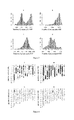
- FIG. 3 are schematic diagrams showing the distributions of polymorphism SNPs among different types of rice obtained by Rice60K chip detection.
- the panels show the histograms of polymorphism SNP sites distribution between any two varieties.
- Panel A is a diagram showing the number distribution between random two varieties;
- panel B is a diagram showing the number distribution between two subspecies of indica and japonica ;
- panel C is a diagram showing the number distribution between indica varieties;
- panel D is a diagram showing the number distribution between japonica varieties.
- FIG. 4 are genotyping maps of representative lines from 4 segregating populations. Each line on the chromosome indicates one SNP site, grey parts indicate female parent (Zhenshan 97) homozygous genotype, and black parts indicate male parent homozygous genotype.
- Panel A is a map of a line of Zhenshan 97/Minghui 63 RIL population;
- panel B is a map of a line of Zhenshan 97/XiZang 2;
- panel C is a map of a introgression line of introducing Nipponbare into Zhenshan 97;
- panel D is a map of a introgression line of introducing ordinary wild rice (IRGC-105491) into Zhenshan 97.
- FIG. 5 is schematic diagram showing SNP genotyping comparison of five Shuhui 527 samples with different origins. Grey lines indicate SNP sites consistent with the standard Shuhui 527 sample, and black lines indicate SNP sites which are not consistent with the standard sample.
- FIG. 6 are schematic diagrams showing the genetic background detection results of the improved line A8 from Kongyu 131 by Rice6K and Rice60K chips, respectively.
- the background is recovered consistent with genotype of recipient parent Kongyu 131, and the black lines are heterozygous genotype SNP sites.
- the triangle arrows indicate the location of target gene Pit.
- Panel 6A is a diagram showing the detection result of Rice6K; and panel 6B is a diagram showing the detection result of Rice60K.
- FIG. 7 is a Manhattan plot showing the association study for grain wide trait of Huanghuazhan lineage.
- genome-wide sequences for 211 rice varieties were sequenced by Illumina sequencing technology, and 2.5 times genome coverage data was obtained for each sample, see Table 1.
- sequencing data of 520 endemic rice varieties were also downloaded from public database (http://www.ebi.ac.uk/ena/, accession numbers of ERP000106, ERP000235 and ERP000236), and 1 time genome coverage data was obtained for each of the samples (Huang et al., Genome-wide association studies of 14 agronomic traits in rice landraces. Nat Genet. 2010, 42: 961-967).
- the genome sequencing data of 731 rice varieties were obtained. The SNPs were identified and screened according to the following steps:
- SNP sites with high quality were identified from the sequencing data of 731 rice varieties.
- the SNP sites with high quality should meet the following conditions: (1) when the ratios of every kind of base at a site are sorted in descending order, the frequency of the second base is not less than 5%; (2) the number of samples having the third base is less than 10, and the frequency thereof is less than 2.5%; (3) the frequency of heterozygous genotype is less than 5%; (4) this SNP site is located in non-repeating region.
- Genotypes of the above-mentioned SNP sites were extracted from 731 rice varieties, and the SNP genotypes with missing values were imputed by LD-KNN algorithm (K nearest neighbors). 3,679,919 SNP sites with missing values can be imputed by this method. Afterwards, these sites should meet the following conditions: (1) the ratio of the missing values is less than 50%; (2) at least one linked SNP can be found in the 100 kb region of the rice genome, that is to say, r 2 value of linkage disequilibrium (LD) is not less than 0.25, wherein r is a correlation coefficient of allele frequency.
- LD linkage disequilibrium
- All the SNPs were divided into 125,062 linkage groups.
- the rice genome was divided into bins (small region), each comprising 100 kb, with 3,728 bins in total in the genome-wide.
- r 2 value of linkage disequilibrium for any two SNPs in each bin was calculated, the SNPs were divided by using greedy algorithm on the basis of r 2 ⁇ 0.64; the SNPs in the same group were considered redundant.
- SNP sites which had the minor allele frequency (MAF) were selected from each linkage group and SNP sites with the maximum allele frequency were provided for Illumina Infinium iSelect scoring system (http://www.illumina.com/) for scoring, and the sites with a score less than 0.6 were removed.
- MAF minor allele frequency
- the present invention defines a comprehensive scoring system, in consideration of Illumina iSelect scoring system scores of the SNP sites, MAF, and the average r 2 value of LD for other SNP sites in the same linkage group and the locations in genes.
- the weighting parameters of all the factors were determined experientially and they are as follows: (1) the weighting of A/T and G/C change SNP sites (Infinium I) is 0, the weightings of other types of SNP sites (Infinium II) are 20; (2) the weighting of Illumina iSelect scoring system is 10; (3) the weighting of minor allele frequency (MAF) is 40; 4) the weighting of LD average r 2 value is 5; (5) depending on the location of a SNP in the gene region, the weightings of intergenic, intron, promoter, 5′-end non-coding region (5′-UTR) and 3′-end non-coding region (3′-UTR) are 1, 1.5, 2, 2 and 2.5, respectively, and the weightings of synonymous mutation, non-s
- 58,290 tag SNP sites were obtained in total, and 60,000 kinds of beads are needed according to the requirements for designing of Illumina Infinium iSelect HD. All the 58,290 tag SNP sites correspond to the Nos. 1-58,290 DNA sequences in the sequence listing. These tag sequences were provided for Illumina for designing Infinium SNP chip. 51,599 effective sites meeting the requirements for detection were obtained by chip preparation, and the distribution of these sites on genome-wide was shown in FIG. 1 .
- genome DNA was extracted from rice tissues including seeds or leaves in accordance with the requirement for detection.
- Promega plant genome preparation kit Wang Chemical 96 DNA Plant System Kit, Item No. FF3760 or FF3761, Beijing Promega biological technology Co. Ltd.
- the complicated plant genome preparation kit from Beijing ComWin Biotech (SurePlant DNA Kit, Item No. CW0555, Beijing ComWin Biotech Co. Ltd.).
- electrophoresis detection was carried out using 1-1.5% (W/W) agarose gel, and the electrophoresis results were evaluated by gel imaging system (Gel Doc XR System, Bio-Rad Co., US) to ensure that the genome DNA has a good integrity and the size of the genome DNA fragments is more than 10 kb in length.
- the concentration of genome DNA was measured by micro-volume ultra-violet spectrophotometer (Q5000, Quawell Co., US) or similar nucleic acid and protein detector, and the genome DNA was adjusted to a working concentration of 10-50 ng/ ⁇ l.
- Detection of the gene chips the gene chips were detected according to Infinium assay standard protocol (Infinium HD Assay Ultra Protocol Guide, http://www.illumina com/), and scanned using Illumina HiScan chip scanner (HiScan, Illumina Co., US).
- Example 2 270 varieties from the mini-core collection of rice germplasm resource (No. WCR001-270) from China National Seed Group CO., LTD., were detected by Rice60K breeding chip in the present invention, and among them, 195 representative varieties of self-pollinating homozygote were selected for analysis.
- the genotypes of the 195 representative varieties were detected by Rice60K breeding chip, and 195 varieties may be divided into three groups by cluster analysis: indica group, japonica group, and intermediate group (see FIG. 2 ), which was consistent with the classification results based on phenotype.
- the genotypes of the following populations were detected by Rice60K chip in the present invention: 2 recombinant inbred line (RIL) populations, i.e., Zhenshan 97/Minghui 63 RIL population, Zhenshan 97/Zizang 2 RIL population, and 2 chromosome segment substitution line (CSSL) populations, i.e., a introgression line of Zhenshan 97, into which Nipponbare was introduced, and a introgression line of Zhenshan 97. into which an ordinary wild rice (IRGC-105491) was introduced (refer to the method of Example 2); the genotypes of one representative line from each of the populations are shown in FIG. 4 .
- FIG. 4 2 recombinant inbred line
- Rice60K chip has very good effect on genotyping for different populations with advantages of high density of markers and clear recombinant breakpoints.
- Rice60K chip can detect the double crossover region which can not be detected by the traditional molecular markers such as SSR, furthermore, it has more accurate and reliable detection results due to the high density of markers.
- SSR traditional molecular markers
- the results demonstrate that, as a molecular marker detection system, Rice60K rice whole genome breeding chip can genotype rice cross segregating populations well.
- the rice varieties Kongyu 131 and improved line A8 thereof were detected in the present invention (Refer to the method of Example 2).
- A8 is a single plant of the BC4F1 generation, the target gene is rice blast resistance gene Pi2 (Zhou et al., The eight amino-acid differences within three leucine-rich repeats between Pi2 and Piz-t resistance proteins determine the resistance specificity to Magnaporthe grisea. Mol Plant Microbe Interact. 2006, 19: 1216-1228).
- the genetic background of A8 is shown in FIG. 6 . It can be seen from FIG.
- the plant has not only introduced Pi2 gene and the big fragment adjacent to Pi2 gene on chromosome 6, but also has combined at least 3 donor fragments on chromosomes 1 and 12.
- Both Rice6K chip and Rice60K chip can effectively detect Pi2 gene and the big fragments adjacent to Pi2 gene.
- the effect of Rice60K chip is significantly better than that of Rice6K chip when detecting the other background.
- the recipient parent Kongyu 131 is japonica
- the donor parent Pi2 gene and the adjacent regions are indica fragments, and the other locations are in japonica background.
- Rice6K chip is mainly designed for indica and japonica hybrids, when it is used for detecting the hybrids between japonica , the polymorphism is low; while Rice60K breeding chip can effectively detect the hybrids between japonica since it has greatly increased marker density and the polymorphism between japonica varieties was taken into account when designing the probe. It thus can be seen that Rice60K rice whole genome breeding chip has good effect in analyzing genetic background of breeding materials.
- Huanghuazhan and its lineage varieties a total number of which is 21, were collected to investigate an important agronomic trait, viz. grain width, and to analyze the relationship between genome change and gain width of Huanghuazhan and its lineage varieties.
- Quality control was given to the genotyping results from Rice60K chip (Refer to the method of Example 2), and genotyping information with high quality was obtained by screening.
- SNP sites of the samples with GenTrain Score less than 6 were removed, since these sites have poor reliability and can not be used for data analysis.
- the sites with a missing genotype rate less than 0.2 in these 21 varieties were further removed, since the missing sites can not be effectively used for further analysis of the data due to data loss, and finally 42,387 SNP sites were obtained.
- the chip according to the present invention is a SNP chip manufactured by Infinium SNP chip technology, which comprises 58,290 SNP sites and can be used to analyze molecular marker fingerprint of rice variety resources, identity genotype of progeny of cross populations, identity authenticity of varieties, analyze and screen genetic background of breeding materials, and analyze the association of agronomic traits.
- the chip thus has important economic values and prospects of application.
Landscapes
- Chemical & Material Sciences (AREA)
- Life Sciences & Earth Sciences (AREA)
- Organic Chemistry (AREA)
- Proteomics, Peptides & Aminoacids (AREA)
- Engineering & Computer Science (AREA)
- Health & Medical Sciences (AREA)
- Analytical Chemistry (AREA)
- Zoology (AREA)
- Wood Science & Technology (AREA)
- Biotechnology (AREA)
- Physics & Mathematics (AREA)
- Bioinformatics & Cheminformatics (AREA)
- Biophysics (AREA)
- General Health & Medical Sciences (AREA)
- Molecular Biology (AREA)
- Biochemistry (AREA)
- Microbiology (AREA)
- Immunology (AREA)
- General Engineering & Computer Science (AREA)
- Genetics & Genomics (AREA)
- Botany (AREA)
- Mycology (AREA)
- Bioinformatics & Computational Biology (AREA)
- Evolutionary Biology (AREA)
- Medical Informatics (AREA)
- Spectroscopy & Molecular Physics (AREA)
- Theoretical Computer Science (AREA)
- Measuring Or Testing Involving Enzymes Or Micro-Organisms (AREA)
- Chemical Kinetics & Catalysis (AREA)
- General Chemical & Material Sciences (AREA)
- Medicinal Chemistry (AREA)
- Apparatus Associated With Microorganisms And Enzymes (AREA)
- Breeding Of Plants And Reproduction By Means Of Culturing (AREA)
Applications Claiming Priority (1)
| Application Number | Priority Date | Filing Date | Title |
|---|---|---|---|
| PCT/CN2013/000131 WO2014121419A1 (zh) | 2013-02-07 | 2013-02-07 | 水稻全基因组育种芯片及其应用 |
Publications (2)
| Publication Number | Publication Date |
|---|---|
| US20160153056A1 US20160153056A1 (en) | 2016-06-02 |
| US9976191B2 true US9976191B2 (en) | 2018-05-22 |
Family
ID=51299142
Family Applications (1)
| Application Number | Title | Priority Date | Filing Date |
|---|---|---|---|
| US14/650,762 Active 2033-03-31 US9976191B2 (en) | 2013-02-07 | 2013-02-07 | Rice whole genome breeding chip and application thereof |
Country Status (6)
| Country | Link |
|---|---|
| US (1) | US9976191B2 (it) |
| JP (1) | JP5960917B1 (it) |
| KR (1) | KR102015929B1 (it) |
| CN (1) | CN105008599B (it) |
| PH (1) | PH12015501735B1 (it) |
| WO (1) | WO2014121419A1 (it) |
Families Citing this family (62)
| Publication number | Priority date | Publication date | Assignee | Title |
|---|---|---|---|---|
| CN105567792B (zh) * | 2014-10-10 | 2018-12-21 | 中国种子集团有限公司 | 含抗稻瘟病基因重组dna片段植株的选育方法 |
| CN105567791B (zh) * | 2014-10-10 | 2018-12-21 | 中国种子集团有限公司 | 含抗稻瘟病基因重组dna片段植株的选育方法 |
| CN105567790B (zh) * | 2014-10-10 | 2018-12-21 | 中国种子集团有限公司 | 含目标基因组dna片段植株的选育方法 |
| CN105567793B (zh) * | 2014-10-10 | 2018-12-21 | 中国种子集团有限公司 | 含抗稻瘟病基因重组dna片段植株的选育方法 |
| CN104328507B (zh) * | 2014-10-11 | 2016-03-30 | 中国水稻研究所 | 一种用于水稻品种鉴定的snp芯片、制备方法及用途 |
| CN106893769B (zh) * | 2015-12-18 | 2021-11-19 | 中国种子集团有限公司 | 重组核酸片段RecCR012602及其检测方法 |
| CN105550537A (zh) * | 2016-01-07 | 2016-05-04 | 中国种子集团有限公司 | 鉴定水稻dna身份的方法及其应用 |
| CN105671156B (zh) * | 2016-02-19 | 2018-09-04 | 中国科学院植物研究所 | 水稻籽粒镉含量相关基因LCd-11的SNP分子标记的应用 |
| CN105543397B (zh) * | 2016-02-26 | 2018-12-25 | 中国科学院植物研究所 | 水稻籽粒镉含量相关基因LCd-38的SNP分子标记的应用 |
| CN105671164B (zh) * | 2016-02-29 | 2019-03-08 | 中国科学院植物研究所 | 水稻籽粒镉含量相关基因LCd-41的SNP分子标记的应用 |
| CN105567853B (zh) * | 2016-02-29 | 2019-03-08 | 中国科学院植物研究所 | 水稻籽粒镉含量相关基因LCd-22的SNP分子标记的应用 |
| CN105624319B (zh) * | 2016-03-24 | 2018-12-25 | 中国科学院植物研究所 | 水稻籽粒镉含量相关基因LCd-31的SNP分子标记的应用 |
| CN107304451B (zh) * | 2016-04-22 | 2022-02-25 | 中国种子集团有限公司 | 重组核酸片段RecCR010375及其检测引物与应用 |
| CN107304447B (zh) * | 2016-04-22 | 2021-11-26 | 中国种子集团有限公司 | 重组核酸片段RecCR010007及其检测引物与应用 |
| CN107304450B (zh) * | 2016-04-22 | 2021-12-14 | 中国种子集团有限公司 | 重组核酸片段RecCR010160及其检测引物与应用 |
| CN107304445B (zh) * | 2016-04-22 | 2021-11-26 | 中国种子集团有限公司 | 重组核酸片段RecCR010315及其检测引物与应用 |
| CN107304446B (zh) * | 2016-04-22 | 2021-11-26 | 中国种子集团有限公司 | 重组核酸片段RecCR010374及其检测引物与应用 |
| CN106599612B (zh) * | 2016-10-28 | 2020-04-28 | 上海阅尔基因技术有限公司 | 一种基于高通量测序数据的指纹识别方法 |
| WO2018103037A1 (zh) * | 2016-12-08 | 2018-06-14 | 中国种子集团有限公司 | 水稻全基因组育种芯片及其应用 |
| NO344051B1 (en) * | 2017-05-04 | 2019-08-26 | Patogen As | Novel virus in Fish and Method for detection |
| CN108650065B (zh) * | 2018-03-15 | 2021-09-10 | 西安电子科技大学 | 基于窗口的流式数据缺失处理方法 |
| CN108796108A (zh) * | 2018-05-23 | 2018-11-13 | 湖南杂交水稻研究中心 | 水稻两系不育系系谱鉴定的方法 |
| CN111684113B (zh) * | 2018-10-25 | 2023-06-09 | 武汉双绿源创芯科技研究院有限公司 | 水稻绿色基因芯片与应用 |
| CN110283925B (zh) * | 2019-05-10 | 2020-06-30 | 武汉双绿源创芯科技研究院有限公司 | 一种用于鉴定水稻绿色基因指纹的方法 |
| CN110484651B (zh) * | 2019-09-25 | 2023-12-19 | 中国农业科学院作物科学研究所 | 一种小麦产量相关基因TaNRT2-6D中的分子标记及其应用 |
| CN110867209B (zh) * | 2019-11-28 | 2022-11-15 | 中国农业大学 | 预测籼稻亚种穗粒数强优势杂交组合的snp标记及其高通量检测方法 |
| CN111088382B (zh) * | 2019-11-28 | 2023-01-31 | 北京市农林科学院 | 一种玉米全基因组snp芯片及其应用 |
| CN111218521A (zh) * | 2020-01-13 | 2020-06-02 | 福建农林大学 | 稻瘟病抗性基因Pib的功能特异性分子标记及其检测方法与应用 |
| WO2021221784A2 (en) * | 2020-02-28 | 2021-11-04 | University Of Florida Research Foundation, Incorporated | Circular bifunctional aptamers and trifunctional aptamers targeting tau |
| CN113584199B (zh) * | 2020-04-30 | 2023-09-26 | 深圳华大生命科学研究院 | 水稻冷不回生性状相关的分子标记及其应用 |
| CN113584200B (zh) * | 2020-04-30 | 2023-09-26 | 深圳华大生命科学研究院 | 水稻冷不回生性状相关的分子标记及其应用 |
| CN111635957B (zh) * | 2020-07-20 | 2023-06-30 | 湖北省农业科学院粮食作物研究所 | 一种检测小麦抗条锈病qtl的分子标记及其在抗病育种中的应用 |
| CN112410435A (zh) * | 2020-08-31 | 2021-02-26 | 厦门大学 | 一种大黄鱼基因组育种芯片及应用 |
| CN112595675B (zh) * | 2020-09-29 | 2022-03-08 | 华中农业大学 | 一种基于高光谱的米粒品质功能基因解析方法 |
| CN112359102A (zh) * | 2020-11-17 | 2021-02-12 | 中国农业科学院烟草研究所 | 一种基于基因组学构建烟草核心种质的方法及其应用 |
| CN112501346B (zh) * | 2020-12-28 | 2022-08-02 | 中国水稻研究所 | 一种与水稻白叶枯病抗性相关的snp分子标记、检测引物对及应用 |
| CN112852989B (zh) * | 2020-12-31 | 2023-08-18 | 中国科学院东北地理与农业生态研究所 | 一种与大豆农艺性状相关的snp位点组合、液相基因芯片及应用 |
| CN112760400B (zh) * | 2021-01-11 | 2022-06-28 | 吉林大学 | 与玉米行粒数相关的snp分子标记及其应用 |
| CN112725510B (zh) * | 2021-02-03 | 2022-05-17 | 中国水稻研究所 | 一套用于水稻品种籼粳鉴定的snp标记、引物组、试剂盒及应用 |
| CN113308562B (zh) * | 2021-05-24 | 2022-08-23 | 浙江大学 | 棉花全基因组40k单核苷酸位点及其在棉花基因分型中的应用 |
| CN113684280A (zh) * | 2021-07-07 | 2021-11-23 | 中国海洋大学三亚海洋研究院 | 一种仿刺参抗高温育种低密度12k snp芯片及应用 |
| CN113736898B (zh) * | 2021-08-09 | 2024-07-05 | 上海市农业生物基因中心 | 水稻抽穗期调控基因OsGI的分子标记及其应用 |
| CN114250315B (zh) * | 2021-10-20 | 2023-04-25 | 华智生物技术有限公司 | 一种与水稻镉吸收相关基因OsNramp5连锁的SNP分子标记及其应用 |
| CN113870946B (zh) * | 2021-11-02 | 2025-04-25 | 华南农业大学 | 一种水稻snp位点的筛选方法以及鉴定水稻品种的方法 |
| CN114703311B (zh) * | 2022-02-07 | 2024-06-21 | 徐州锦莱卓生物科技有限公司 | 水稻籽粒大小控制基因smg11的单倍型鉴定标记方法 |
| CN114525356B (zh) * | 2022-02-07 | 2024-07-23 | 徐州锦莱卓生物科技有限公司 | 水稻粒长控制基因gs3的单倍型鉴定标记及其筛选方法 |
| CN117334250A (zh) * | 2022-06-24 | 2024-01-02 | 中国农业大学 | 基于测序数据优选功能位点的方法及应用 |
| CN115216557A (zh) * | 2022-07-05 | 2022-10-21 | 河南农业大学 | 小麦超高密度snp芯片制备方法及应用 |
| CN115223656B (zh) * | 2022-07-21 | 2025-08-19 | 全国农业技术推广服务中心 | 一种基于等位基因频率的snp数据量化编码方法 |
| CN116064903B (zh) * | 2022-09-28 | 2023-07-18 | 云南省农业科学院农业环境资源研究所 | 水稻广谱抗稻瘟病基因Pi69(t)共分离分子标记及其专用引物 |
| CN115644051B (zh) * | 2022-11-04 | 2023-05-26 | 上海中科荃银分子育种技术有限公司 | 一种选育三系杂交水稻不育系的方法 |
| CN115910205B (zh) * | 2022-11-07 | 2026-01-02 | 新疆农垦科学院 | 一种基于标记显性效应权重的玉米杂种优势群划分方法 |
| CN116144794B (zh) * | 2023-03-09 | 2023-12-19 | 华中农业大学 | 牛12k sv液相芯片及其设计方法和应用 |
| CN116574829B (zh) * | 2023-04-03 | 2024-03-12 | 中国农业科学院作物科学研究所 | 与水稻中胚轴伸长基因qML3相连锁的分子标记及其应用 |
| CN116694806B (zh) * | 2023-06-27 | 2025-03-28 | 沈阳农业大学 | 一种粳稻全基因组snp位点组合、基因芯片及其应用 |
| CN116705155A (zh) * | 2023-08-03 | 2023-09-05 | 海南大学三亚南繁研究院 | 一种全基因dna数据的定义方法 |
| CN118222753B (zh) * | 2024-04-26 | 2025-02-11 | 江西省农业科学院水稻研究所 | 水稻种子耐储基因OsNBS2连锁分子标记在鉴定耐储水稻品种中的应用 |
| CN118957134B (zh) * | 2024-08-30 | 2025-11-04 | 浙江大学 | 一种水稻谷粒宽度相关的分子标记及其应用 |
| CN119061191B (zh) * | 2024-10-23 | 2025-06-20 | 广西壮族自治区农业科学院 | 用于火龙果种质资源鉴定的snp、引物、指纹图谱及其应用 |
| CN119824106B (zh) * | 2025-02-25 | 2025-12-23 | 上海市农业科学院 | 一种用于崇明白山羊血统鉴定的snp分子标记组合及其应用 |
| CN120952810B (zh) * | 2025-07-10 | 2026-01-20 | 北京丰捷一佳农业科技有限公司 | 基于区块链的玉米育种材料电子标签溯源方法及系统 |
| CN120656541B (zh) * | 2025-07-18 | 2026-02-03 | 中国农业科学院作物科学研究所 | 一种高通量基因型智能分析方法 |
Citations (3)
| Publication number | Priority date | Publication date | Assignee | Title |
|---|---|---|---|---|
| US6582908B2 (en) * | 1990-12-06 | 2003-06-24 | Affymetrix, Inc. | Oligonucleotides |
| CN1675373A (zh) | 2002-06-10 | 2005-09-28 | 株式会社植物基因组研究中心 | 用于鉴别水稻品种的方法 |
| CN102747138A (zh) | 2012-03-05 | 2012-10-24 | 中国种子集团有限公司 | 一种水稻全基因组snp芯片及其应用 |
Family Cites Families (2)
| Publication number | Priority date | Publication date | Assignee | Title |
|---|---|---|---|---|
| JPH06113850A (ja) * | 1992-10-09 | 1994-04-26 | Sumitomo Chem Co Ltd | オリゴヌクレオチドを用いるイネ品種の識別方法およびそのオリゴヌクレオチド |
| JP5749466B2 (ja) * | 2010-09-10 | 2015-07-15 | 国立研究開発法人農業・食品産業技術総合研究機構 | イネまたはそれに由来する組織、あるいはそれらの加工品の品種鑑定法 |
-
2013
- 2013-02-07 CN CN201380056318.5A patent/CN105008599B/zh active Active
- 2013-02-07 WO PCT/CN2013/000131 patent/WO2014121419A1/zh not_active Ceased
- 2013-02-07 JP JP2015527760A patent/JP5960917B1/ja active Active
- 2013-02-07 KR KR1020157013126A patent/KR102015929B1/ko active Active
- 2013-02-07 US US14/650,762 patent/US9976191B2/en active Active
-
2015
- 2015-08-07 PH PH12015501735A patent/PH12015501735B1/en unknown
Patent Citations (3)
| Publication number | Priority date | Publication date | Assignee | Title |
|---|---|---|---|---|
| US6582908B2 (en) * | 1990-12-06 | 2003-06-24 | Affymetrix, Inc. | Oligonucleotides |
| CN1675373A (zh) | 2002-06-10 | 2005-09-28 | 株式会社植物基因组研究中心 | 用于鉴别水稻品种的方法 |
| CN102747138A (zh) | 2012-03-05 | 2012-10-24 | 中国种子集团有限公司 | 一种水稻全基因组snp芯片及其应用 |
Non-Patent Citations (16)
Also Published As
| Publication number | Publication date |
|---|---|
| KR102015929B1 (ko) | 2019-08-28 |
| JP2016525340A (ja) | 2016-08-25 |
| PH12015501735A1 (en) | 2015-12-07 |
| JP5960917B1 (ja) | 2016-08-02 |
| KR20150113947A (ko) | 2015-10-08 |
| US20160153056A1 (en) | 2016-06-02 |
| CN105008599B (zh) | 2016-11-02 |
| PH12015501735B1 (en) | 2015-12-07 |
| CN105008599A (zh) | 2015-10-28 |
| WO2014121419A1 (zh) | 2014-08-14 |
Similar Documents
| Publication | Publication Date | Title |
|---|---|---|
| US9976191B2 (en) | Rice whole genome breeding chip and application thereof | |
| CN102747138B (zh) | 一种水稻全基因组snp芯片及其应用 | |
| US20210285063A1 (en) | Genome-wide maize snp array and use thereof | |
| CN113308562B (zh) | 棉花全基因组40k单核苷酸位点及其在棉花基因分型中的应用 | |
| CN113795597A (zh) | 一种大豆snp分型检测芯片及其在分子育种与基础研究中的应用 | |
| CN114107550B (zh) | 一种与大豆百粒重相关的qtl、分子标记、扩增引物及应用 | |
| CN108779459A (zh) | 棉花全基因组snp芯片及其应用 | |
| CN112852989B (zh) | 一种与大豆农艺性状相关的snp位点组合、液相基因芯片及应用 | |
| CN107090494B (zh) | 与谷子码粒数性状相关的分子标记及其检测引物和应用 | |
| CN107090450B (zh) | 与谷子穗长性状相关的分子标记及其检测引物和应用 | |
| CN107090495B (zh) | 与谷子脖长性状相关的分子标记及其检测引物和应用 | |
| CN115992265B (zh) | 一种石斑鱼全基因组液相芯片及其应用 | |
| CN108998550A (zh) | 用于水稻基因分型的snp分子标记及其应用 | |
| CN114574613B (zh) | 一种小麦-拟鹅观草全基因组液相芯片及应用 | |
| CN113215297B (zh) | 一个与芝麻含油量主效qtl位点紧密连锁的分子标记id0159及其应用 | |
| Lyu et al. | High-density genetic linkage map construction in sunflower (Helianthus annuus L.) using SNP and SSR markers | |
| CN115927733B (zh) | 分子标记及其应用 | |
| WO2020082314A1 (zh) | 水稻绿色基因芯片与应用 | |
| CN120193113A (zh) | 玉米7号染色体上与玉米穗粗相关的分子标记及其应用 | |
| CN113355449A (zh) | 一种长穗偃麦草3e染色体特异共显性kasp分子标记及其应用 | |
| CN119020527A (zh) | 玉米高密度全基因组SNP固相芯片Mazie15K及其应用 | |
| CN109136399B (zh) | 一种与谷子穗重性状相关的snp标记及其检测引物和应用 | |
| CN107447022B (zh) | 一种预测玉米杂种优势的snp分子标记及应用 | |
| CN118773363A (zh) | 基于kasp技术检测转基因大豆的引物和方法 | |
| CN117925894A (zh) | 核桃抗炭疽病的snp分子标记及应用 |
Legal Events
| Date | Code | Title | Description |
|---|---|---|---|
| AS | Assignment |
Owner name: HUAZHONG AGRICULTURAL UNIVERSITY, CHINA Free format text: ASSIGNMENT OF ASSIGNORS INTEREST;ASSIGNORS:ZHOU, FASONG;CHEN, HAODONG;XIE, WEIBO;AND OTHERS;SIGNING DATES FROM 20150402 TO 20150413;REEL/FRAME:035872/0979 Owner name: SHENZHEN INSTITUTE OF MOLECULAR CROP DESIGN, CHINA Free format text: ASSIGNMENT OF ASSIGNORS INTEREST;ASSIGNORS:ZHOU, FASONG;CHEN, HAODONG;XIE, WEIBO;AND OTHERS;SIGNING DATES FROM 20150402 TO 20150413;REEL/FRAME:035872/0979 Owner name: CHINA NATIONAL SEED GROUP CO., LTD., CHINA Free format text: ASSIGNMENT OF ASSIGNORS INTEREST;ASSIGNORS:ZHOU, FASONG;CHEN, HAODONG;XIE, WEIBO;AND OTHERS;SIGNING DATES FROM 20150402 TO 20150413;REEL/FRAME:035872/0979 Owner name: FRONTIER LABORATORIES OF SYSTEMS CROP DESIGN CO., Free format text: ASSIGNMENT OF ASSIGNORS INTEREST;ASSIGNORS:ZHOU, FASONG;CHEN, HAODONG;XIE, WEIBO;AND OTHERS;SIGNING DATES FROM 20150402 TO 20150413;REEL/FRAME:035872/0979 |
|
| STCF | Information on status: patent grant |
Free format text: PATENTED CASE |
|
| MAFP | Maintenance fee payment |
Free format text: PAYMENT OF MAINTENANCE FEE, 4TH YEAR, LARGE ENTITY (ORIGINAL EVENT CODE: M1551); ENTITY STATUS OF PATENT OWNER: LARGE ENTITY Year of fee payment: 4 |
|
| MAFP | Maintenance fee payment |
Free format text: PAYMENT OF MAINTENANCE FEE, 8TH YEAR, LARGE ENTITY (ORIGINAL EVENT CODE: M1552); ENTITY STATUS OF PATENT OWNER: LARGE ENTITY Year of fee payment: 8 |