US6071802A - Method for manufacturing semiconductor device having self-aligned contact - Google Patents
Method for manufacturing semiconductor device having self-aligned contact Download PDFInfo
- Publication number
- US6071802A US6071802A US08/961,453 US96145397A US6071802A US 6071802 A US6071802 A US 6071802A US 96145397 A US96145397 A US 96145397A US 6071802 A US6071802 A US 6071802A
- Authority
- US
- United States
- Prior art keywords
- layer
- forming
- oxide layer
- landing pad
- gate electrodes
- Prior art date
- Legal status (The legal status is an assumption and is not a legal conclusion. Google has not performed a legal analysis and makes no representation as to the accuracy of the status listed.)
- Expired - Lifetime
Links
Images




Classifications
-
- H—ELECTRICITY
- H10—SEMICONDUCTOR DEVICES; ELECTRIC SOLID-STATE DEVICES NOT OTHERWISE PROVIDED FOR
- H10B—ELECTRONIC MEMORY DEVICES
- H10B12/00—Dynamic random access memory [DRAM] devices
- H10B12/01—Manufacture or treatment
- H10B12/02—Manufacture or treatment for one transistor one-capacitor [1T-1C] memory cells
- H10B12/03—Making the capacitor or connections thereto
- H10B12/033—Making the capacitor or connections thereto the capacitor extending over the transistor
-
- H—ELECTRICITY
- H10—SEMICONDUCTOR DEVICES; ELECTRIC SOLID-STATE DEVICES NOT OTHERWISE PROVIDED FOR
- H10B—ELECTRONIC MEMORY DEVICES
- H10B12/00—Dynamic random access memory [DRAM] devices
- H10B12/01—Manufacture or treatment
- H10B12/02—Manufacture or treatment for one transistor one-capacitor [1T-1C] memory cells
- H10B12/03—Making the capacitor or connections thereto
- H10B12/033—Making the capacitor or connections thereto the capacitor extending over the transistor
- H10B12/0335—Making a connection between the transistor and the capacitor, e.g. plug
-
- H—ELECTRICITY
- H10—SEMICONDUCTOR DEVICES; ELECTRIC SOLID-STATE DEVICES NOT OTHERWISE PROVIDED FOR
- H10B—ELECTRONIC MEMORY DEVICES
- H10B12/00—Dynamic random access memory [DRAM] devices
- H10B12/01—Manufacture or treatment
- H10B12/09—Manufacture or treatment with simultaneous manufacture of the peripheral circuit region and memory cells
-
- H—ELECTRICITY
- H10—SEMICONDUCTOR DEVICES; ELECTRIC SOLID-STATE DEVICES NOT OTHERWISE PROVIDED FOR
- H10B—ELECTRONIC MEMORY DEVICES
- H10B12/00—Dynamic random access memory [DRAM] devices
- H10B12/30—DRAM devices comprising one-transistor - one-capacitor [1T-1C] memory cells
- H10B12/48—Data lines or contacts therefor
- H10B12/485—Bit line contacts
-
- H—ELECTRICITY
- H10—SEMICONDUCTOR DEVICES; ELECTRIC SOLID-STATE DEVICES NOT OTHERWISE PROVIDED FOR
- H10B—ELECTRONIC MEMORY DEVICES
- H10B12/00—Dynamic random access memory [DRAM] devices
- H10B12/30—DRAM devices comprising one-transistor - one-capacitor [1T-1C] memory cells
- H10B12/31—DRAM devices comprising one-transistor - one-capacitor [1T-1C] memory cells having a storage electrode stacked over the transistor
- H10B12/315—DRAM devices comprising one-transistor - one-capacitor [1T-1C] memory cells having a storage electrode stacked over the transistor with the capacitor higher than a bit line
Definitions
- the present invention relates to a semiconductor device manufacturing method, and more particularly, to a method for manufacturing a semiconductor memory device having a contact.
- DRAM dynamic random access memory
- a contact in a cell array portion particularly, a contact for connecting a storage electrode of a capacitor to a semiconductor substrate is usually formed between a bit line and a gate electrode line.
- a semiconductor memory device of 64M DRAM or more adopts a capacitor on bit-line (COB) structure, which results in an increase of a step difference between a cell array region and a peripheral circuit region. Accordingly, it is very difficult to secure an appropriate focus margin and form a fine pattern.
- COB capacitor on bit-line
- a method for manufacturing a semiconductor device comprising the steps of forming gate electrodes on a semiconductor substrate, the gate electrodes being covered with a nitride spacer. Then, a thermal oxide layer is formed on the exposed surface of the semiconductor substrate between the gate electrodes, and an etch stop layer is then formed on the entire surface of the resultant structure having the thermal oxide layer to an appropriate thickness such that the space between the gate electrodes is not buried. Then, a first interlayer dielectric (ILD) film covering the space is formed between the gate electrodes and the top of the gate electrodes, and the first ILD film is then patterned to form a landing pad hole which exposes the spacer and the etch stop layer. Then, the etch stop layer and the thermal oxide layer are removed to expose the surface of the semiconductor substrate, and then the landing pad hole is filled with a conductive material to form a contact plug, resulting in landing pads.
- ILD interlayer dielectric
- a first conductive layer is formed on the entire surface of the resultant structure having the landing pad hole, and the first conductive layer is etched until the surface of the first ILD film is exposed, to form the contact plug in the landing pad hole.
- the first conductive layer is preferably formed by a chemical mechanical polishing (CMP) method or by etching back the first conductive layer.
- the method for manufacturing the semiconductor device further comprises the steps of forming a second ILD film on the resultant structure having the landing pads. Then, the second ILD film is patterned to form a bit line contact hole which exposes the surface of a part of the lancing pads, and a bit line contact plug is then formed in the hit line contact hole. Then, a bit line which is connected to the bit line contact plug is formed on the resultant structure having the bit line contact plug.
- the manufacturing method further comprises the steps of forming a third ILD film on the resultant structure having the bit line. Then, the third ILD film is patterned to form a storage electrode contact hole which exposes the surface of the other part of the landing pads, and a storage electrode is then formed, which is connected to the semiconductor substrate via the storage electrode contact hole and the other part of the landing pads. Then, a dielectric film is formed on the storage electrode, and then an upper electrode is formed on the dielectric layer to complete a capacitor.
- a method for manufacturing a semiconductor memory device comprising the steps of forcing a gate electrode on a semiconductor substrate having a cell array region and a peripheral circuit region, the gate electrode being covered with a spacer. Then, a planarized first interlayer dielectric (ILD) film is formed on the semiconductor substrate having the gate electrode, and a second ILD film is then formed on the first ILD film. Then, a remaining preventing layer is formed on the second ILD film, and the remaining preventing layer, the second ILD film and the first ILD film are patterned in sequence to form a landing pad hole which simultaneously exposes an active region of the semiconductor substrate, and a part of the spacer in the cell array region. Then, a contact plug is formed in the landing pad hole, resulting in landing pads.
- ILD interlayer dielectric
- a method for manufacturing a semiconductor device comprising the steps of forming gate electrodes on a semiconductor substrate, the gate electrodes being covered with a nitride spacer. Then, a thermal oxide layer is formed on the surface of the semiconductor substrate which is exposed between the gate electrodes. Then, an etch stop layer is formed on the entire surface of the resultant structure having the thermal oxide layer to an appropriate thickness such that the space between the gate electrodes is not buried. Then, a first oxide layer is formed in the space between the gate electrodes, and then a second oxide layer is formed on the first oxide layer.
- a polysilicon layer is formed on the second oxide layer, and the polysilicon layer, the second oxide layer, the first oxide layer, the etch stop layer and the thermal oxide layer are partially etched in sequence, to form a landing pad hole which simultaneously exposes the surface of the semiconductor substrate and a part of the spacer. Then, a landing pad is formed in the landing pad hole.
- a sufficient alignment margin can be secured in the formation of a landing pad without damaging the semiconductor substrate, and the step difference in the semiconductor substrate can be minimized.
- FIG. 1 shows the layout of a cell array region of a semiconductor memory device manufactured by a method according to a first embodiment of the present invention
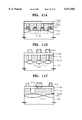
- FIGS. 2a through 14c are section views illustrating the semiconductor memory device manufacturing method according to the first embodiment of the present invention.
- FIGS. 15a through 21b are section views illustrating a semiconductor memory device manufacturing method according to a second embodiment of the present invention.
- FIGS. 22 through 28 are section views illustrating a semiconductor memory device manufacturing method according to a third embodiment of the present invention.
- a bit line and a storage electrode of a capacitor are connected to an active region of a semiconductor substrate via self-aligned landing pads.
- FIG. 1 shows the layout of a cell array region of a semiconductor memory device manufactured by a method according to the first embodiment of the present invention.
- FIG. 1 shows the state where landing pads 117a and 117b are formed on a gate electrode 105 in a self-aligning manner, and the formation of a bit line thereon is completed.
- reference character "AA" represents an active region
- reference numeral 105 represents a gate electrode
- reference numeral 107 represents a spacer for capping the gate electrode 105
- reference numeral 117a represents a landing pad for connecting a storage electrode of a capacitor to a semiconductor substrate
- reference numeral 117b represents a landing pad for connecting the bit line to the semiconductor substrate.
- reference numeral 120 represents a bit line contact hole
- reference numeral 123 represents a bit line.
- FIGS. 2a, 3a, . . . , 14a are section views cut along line 1--1 of FIG. 1
- FIGS. 2a, 2b, . . . , 14b are section views cut along line 2--2 of FIG. 1
- FIGS. 2c, 3c, . . . , 14c are section views cut along line 3--3 of FIG. 1.
- a gate electrode 105 and a spacer 107 for capping the gate electrode 105 are formed in sequence on a semiconductor substrate 101 in which an active region and a non-active region are divided by an isolation film 103 such as a field oxide layer. Then, a source/drain (not shown) is formed in the active region between the gate electrodes 105 by an ion implantation process, thereby completing a transistor consisting of the gate electrode 105 and the source/drain.
- a thermal oxide layer (not shown) is formed on the semiconductor substrate 101 to a thickness of approximately 50-150 ⁇ . If the thickness of the thermal oxide layer exceeds the above range, the thermal oxide layer should be partially etched when etching the silicon nitride layer as an etch stop layer in a subsequent step.
- a field oxide layer may be etched together, so that the thermal oxide layer can be grown to a minimum thickness.
- an etch stop layer 109 made of silicon nitride is formed on the entire surface of the resultant structure having the thermal oxide layer to a thickness of at least 100 ⁇ .
- the etch stop layer 109 is formed to the optimum thickness, to at least 100 ⁇ , such that the space between the gate electrodes 105 is not buried.
- a first oxide layer 111 is formed on the resultant structure having the etch stop layer 109 to a thickness that is sufficient to completely bury the space between the gate electrodes 105.
- the first oxide layer 111 is planarized by a chemical mechanical polishing (CMP) process, using the etch stop layer 109 as an etching end point, thereby resulting in a planarized first oxide layer 111a.
- CMP chemical mechanical polishing
- a second oxide layer 113 e.g., an oxide layer formed by chemical vapor deposition (CVD) is formed on the planarized first oxide layer 111a to a predetermined thickness, to form a first interlayer dielectric (ILD) film 114 consisting of the first oxide layer 111a and the second oxide layer 113.
- the thickness of the second oxide layer 113 is controlled such that the thickness of the first ILD film 114 be the same as that of landing pads to be formed in a subsequent step.
- the first ILD film 114 and the etch stop layer 109 are patterned by photolithography, to form a first ILD film pattern 114a.
- a landing pad hole 116 is also formed, which exposes the spacer 107 covering the gate electrode 105 and the etch stop layer 109 formed on the semiconductor substrate 101.
- the exposed thermal oxide layer (not shown) is removed by dry or wet etching so that the surface of the semiconductor substrate 101 is exposed by the landing pad hole 116.
- a first conductive layer 117 e.g., an impurity-doped polysilicon layer, is formed in the landing pad hole 116 and on the first ILD pattern 114a.
- the first conductive layer 117 is etched by CMP or an etch back process until the surface of the first ILD pattern 114a is exposed, thereby forming landing pads 117a and 117b in the landing pad holes 116.
- a conductive material e.g., impurity-doped polysilicon
- the landing pad hole 116 is first formed, and then the first conductive layer 117 is deposited and planarized, resulting in self-aligned landing pads 117a and 117b.
- the first ILD film 114 made of an oxide having a high etching selectivity to the semiconductor substrate 101 is etched so that damage to the semiconductor substrate can be prevented even though it may be mis-aligned. Also, when etching the first conductive layer 117 by a CMP process to form the landing pads 117a and 117b, the surface of the semiconductor substrate is precisely planarized after the landing pads 117a and 117b are formed. Thus, when forming an ILD film on the surface of the semiconductor substrate, the ILD film can be formed by only a deposition step, without a need for a step of reflowing insulation material such as borophosphosilicate glass (BPSG) or an additional planarizing step.
- BPSG borophosphosilicate glass
- a second ILD film 119 e.g., an oxide layer such as BPSG, is deposited to a thickness of approximately 500 ⁇ 3,000 ⁇ on the resultant structure having the landing pads 117a and 117b.
- the landing pads 117a and 117b are formed by the above-described patterning method, so that there is no need for an extra step for planarizing the insulation film.
- the second ILD film 119 is patterned to form a second ILD film pattern 119a having a bit line contact hole 120 which exposes the landing pad 117b connected to the drain in the cell array region of the semiconductor substrate 101, and a landing pad connected to the active region and a landing pad connected to the gate electrode in the peripheral circuit region.
- a second conductive layer e.g., an impurity-doped polysilicon layer, is formed on the entire surface of the resultant structure, to a thickness sufficient to bury the bit line contact hole 120.
- the second conductive layer 121 is etched by a CMP process or an etch back process until the second ILD film pattern 119a is exposed, thereby forming a bit line contact plug 121a.
- a third conductive layer e.g., an amorphous tungsten silicide (WSi x ) layer, is formed by a CVD process or a physical vapor deposition method, and then patterned to form a bit line 123.
- WSi x amorphous tungsten silicide
- the reason for depositing the tungsten silicide forming the bit line 123 in an amorphous state is to free the same from stress in a subsequent thermal process. That is, if a crystallized tungsten silicide is deposited, lifting occurs in the interface with the upper layer due to stress in a high-temperature thermal process performed at 600° C. or higher.
- a third ILD film 125 is formed on the entire surface of the semiconductor substrate 101 having the bit line 123.
- the third ILD film 125 is formed of an oxide layer which can be deposited at a lower temperature, i.e., at 500° C. or less, that is, a low-temperature oxide layer.
- a method for forming the third ILD film 125 there is a method for forming an O 3 -tetraethyl ortho silicate (TEOS) undoped silicate glass (USG) layer by an atmosphere pressure chemical vapor deposition (APCVD) method.
- TEOS O 3 -tetraethyl ortho silicate
- USG atmosphere pressure chemical vapor deposition
- a plasma type oxide layer may be deposited on the semiconductor substrate 101 having the bit line 123 to a thickenss of 100 ⁇ 2,000 ⁇ , and BPSG is then deposited on the plasma type oxide layer, and then reflowing is performed.
- the second method requires an additional planarization step since the plasma type oxide layer without flow characteristics is used.
- a good planarized layer can be formed even though the thickness of the deposited layer is 3,500 ⁇ or less due to its excellent filling characteristics so that an additional process such as flowing is unnecessary.
- the amorphous tungsten silicide is crystallized via a phase shift at near 600° C., thereby increasing stress.
- the third ILD film 125 is composed of a low-temperature oxide layer which is formed at a lower temperature of 500° C., the lifting phenomenon in the interface between the tungsten silicide layer and the upper layer thereof can be prevented.
- the third ILD film 125 and the second ILD film pattern 119a are patterned to form a third ILD film pattern 125a and the second ILD film pattern 119b, resulting in a storage electrode contact hole 126 which exposes the surface of the landing pad 117a connected to the source of the transistor.
- a fourth conductive layer i.e., an impurity-doped polysilicon layer, is formed on the entire surface of the resultant structure having the storage electrode contact hole 126, and then patterned to form a storage electrode 127.
- a step difference corresponding to only the thickness of the storage electrode 127 exists on the semiconductor substrate 101.
- a dielectric film 131 and a plate electrode 133 are sequentially formed on the storage electrode 127, completing a capacitor.
- a nitride layer is forced on the storage electrode 127 prior to the formation of the dielectric layer 131.
- the resultant structure is heated to approximately 750° C. under a nitrogen atmophere, and then an oxidation process is performed on the resultant structure when the temperature exceeds 750° C., thereby forming the dielectric film 131 having a nitride/oxide structure.
- the dielectric film 131 is formed by the above method, oxidation of the bit line 123 during an oxidation process can be prevented.
- a patterning method is used for forming the landing pad, and the bit line is formed after the bit line contact pad is formed so that the step difference on the semiconductor substrate can be minimized and the semiconductor substrate can be planarized by a simpler process.
- the step difference between the cell array region and the peripheral circuit region are decreased to the thickness of the storage electrode.
- a method capable of solving the problem of a dishing phenomenon is provided. Dishing may occur in a peripheral circuit region when the conductive layer deposited on a portion other than the inside of the landing pad hole is etched by a CMP method.
- FIGS. 15a and 15b through FIGS. 21a and 21b are section views illustrating a semiconductor memory device manufacturing method according to the second embodiment of the present invention.
- FIGS. 15a, 16a, . . . , 21a show a cell array region
- FIGS. 15b, 16b, . . . , 21b show a peripheral circuit region.
- a gate electrode 220 is formed on a semiconductor substrate 200 by a shallow trench isolation (STI) method, in which an isolation region and an active region is divided.
- the gate electrode 220 may be formed to have a polycide structure consisting of a polysilicon layer and a tungsten silicide layer.
- the interval between the gate electrodes 220 is less than 0.5 ⁇ m in the cell array region while that in the peripheral circuit region may be several tens of ⁇ m.
- a spacer 222 covering the gate electrode 220 is formed using a silicon nitride layer in a subsequent step in consideration of the etching selectivity of the silicon nitride layer to an oxide layer used as an ILD film.
- a source/drain (not shown) is formed in the active region between the gate electrodes 220 in the cell array region by an ion implantation process, thereby completing a transistor consisting of the gate electrode 220 and the source/drain.
- BPSG is deposited on the resultant structure to a thickness of 4,000 ⁇ or more, and then flowed at a higher temperature. Then, planarization is performed by a CMP process, using the spacer 222 as an etching end point, thereby forming a first ILD film 230.
- the gate electrodes 220 are formed with a narrower interval in the cell array region, dishing does not occur on the surface of the first ILD film 230 after the planarization using the CMP process.
- the interval between the gate electrodes 220 is comparatively wider in the peripheral circuit region, so that dishing represented by "D" in FIG. 16B, occurs on the surface of the first ILD film 230 after the CMP process.
- an oxide layer is deposited to a predetermined thickness on the first ILD film 230 to form a second ILD film 240.
- dishing is reflected on the second ILD film 240 in the peripheral circuit region.
- impurity-undoped polysilicon material is deposited on the second ILD film 240 to a thickness of several hundred ⁇ , to form a remaining preventing layer 245.
- the thickness of the remaining preventing layer 245 may differ according to the degree of dishing on the second ILD film 240, however, the thickness is preferably 200-1,000 ⁇ .
- the impurity-undoped polysilicon forming the remaining preventing layer 245 is very rapidly etched compared to the impurity-doped polysilicon. Thus, when etching back the impurity-doped polysilicon layer in a subsequent step, no residue remains in the portion in which the dishing occured.
- the remaining preventing layer 245 prevents diffused reflection of incident beams from the tungsten silicide layer of the gate electrode during a photolithography process for forming the contact, so that the deformation of a photoresist material is also prevented. Also, an increase in the contact size, caused by a poor etching selectivity between the photoresist material used for forming a contact in a subsequent step and the oxide layer forming the second ILD film 240, is prevented by the remaining preventing layer 245.
- a landing pad hole h 2 is formed by sequentially etching the remaining preventing layer 245, the second ILD film 240 and the first ILD film 230 using a general photolithography process, such that the active region of the semiconductor substrate 200 and the spacer 222 are partially exposed at the same time.
- the second ILD film 240 is etched using an equipment which provides excellent etching selectivity to the spacer 222 covering the gate electrode 220, such that the spacer 222 is protected and a short between the gate electrode 220 and the landing pad is prevented.
- a conductive layer 250 for forming a landing pad e.g., an impurity-doped polysilicon layer, is deposited on the entire surface of the resultant structure having the landing pad hole h 2 , to a thickness sufficient to completely bury the landing pad hole h 2 .
- a portion of the conductive layer 250 other than the portion formed in the landing pad hole h 2 , and the remaining preventing layer 245 are all removed by a CMP process, thereby forming a landing pad 260 in a self-align manner.
- the remaining preventing layer 245 may remain in the peripheral circuit region in which dishing occurred.
- the impurity-undoped polysilicon is removed by as much as 4 ⁇ 5 times faster than the impurity-doped polysilicon, the doped polysilicon material and the remaining preventing layer 245 are completely removed from all regions of the cell array region and peripheral circuit region except the landing pad 260. As a result, any remaining layer is not formed on the second ILD film 240.
- the unintended material on the ILD film, caused by the dishing can be prevented from remaining.
- FIGS. 22 through 28 are section views illustrating a semiconductor memory device manufacturing method according to third embodiment of the present invention.
- a gate electrode 320 is formed on a semiconductor substrate 310 by an STI method, in which an isolation region 312 and an active region are divided.
- the gate electrode 320 is formed to have a polycide structure consisting of, e.g., a polysilicon layer and a tungsten silicide layer.
- a spacer 322 covering the gate electrode 320 is formed using a silicon nitride layer in a subsequent step in consideration of the etching selectivity of the silicon nitride layer to an oxide layer used as an ILD film.
- a source/drain (not shown) is formed in the active region between the gate electrodes 320 in the cell array region by an ion implantation process, thereby completing a transistor consisting of the gate electrode 320 and source/drain.
- a thermal oxide layer 323 is formed to a thickness of 50 ⁇ 150 ⁇ on the semiconductor substrate 310.
- an etch stop layer 325 made of silicon nitride is formed on the entire surface of the resultant structure having the thermal oxide layer 323 to a thickness of approximately 100 ⁇ .
- the etch stop layer 325 is formed to a thickness at least 100 ⁇ such that the space between the gate electrodes 320 is not buried.
- a first oxide layer 327 is formed on the space between the gate electrodes 320 in the resultant structure having the etch stop layer 325.
- the distance between the gate electrodes is 0.15 ⁇ m or less.
- a material having excellent flow characteristics e.g., BPSG or spin-on glass (SOG) is first deposited on the resultant structure having the etch stop layer 325, to a thickness of approximately 1,000 ⁇ , and the deposited layer is then etched at 45° angle to widen the opening between the gate electrodes 320.
- BPSG or SOG is deposited thereon to a thickness of 5,000 ⁇ , and then planarized by a flowing process, thereby resulting in a BPSG layer or an SOG layer. Then, the BPSG layer or the SOG layer is planarized by a CMP process, using the etch stop layer 325 as an etching end point, thereby completing the first oxide layer 327.
- a second oxide layer 329 e.g., a P-TEOS layer capable of being deposited at a lower temperature, is deposited on the entire surface of the resultant structure having the first oxide layer 327 to a thickness of approximately 2,000 ⁇ . Also, in order to prevent the entrance of the landing pad hole from being widened during a subsequent etching process for forming a landing pad hole, a polysilicon layer is deposited to a thickness of approximately 500 ⁇ .
- a photoresist pattern 333 is formed on the polysilicon layer 331 to define a region in which a landing pad is to be formed.
- the polysilicon layer 331, the second oxide layer 329, the first oxide layer 327, the etch stop layer 325 and the thermal oxide layer 323 are sequentially etched using the photoresist pattern 333 as a mask, thereby forming a polysilicon layer pattern 331a, a second oxide layer pattern 329a and an etch stop layer pattern 325.
- a landing pad hole A which simultaneously exposes the surface of the semiconductor substrate 310 and the spacer 322 is formed.
- the etching process is performed under the condition for an oxide layer, so that the spacer 322 made of nitride and the surface of the semiconductor substrate 310 made of silicon are not damaged. Then, the photoresist pattern 333 is removed.
- a conductive layer e.g., an impurity-doped polysilicon layer
- a conductive layer is deposited on the resultant structure having the landing pad hole A, to a thickness sufficient to fill the landing pad hole A.
- the conductive layer and the polysilicon layer pattern 331 are etched by a CMP process, using the second oxide layer pattern 329a as an etch stop layer, thereby forming a planarized landing pad 340 in the landing pad hole A.
- a second oxide layer pattern formed in the space of each landing pad, using a P-TEOS is repeatedly formed in the cell array region, and the second oxide pattern made of P-TEOS also exists in the region other than the cell array region, so that the surface of the semiconductor substrate is accurately planarized without dishing.
- a landing pad is formed by a patterning method so that a sufficient alignment margin can be secured without damaging the semiconductor substrate. Also, after a bit line contact pad is formed, a bit line is formed thereon, so that the step difference in the semiconductor substrate is minimized and the semiconductor substrate is planarized by a simpler process. As a result, the step difference between the cell array region and the peripheral circuit region is decreased to the thickness of a storage electrode.
Landscapes
- Engineering & Computer Science (AREA)
- Manufacturing & Machinery (AREA)
- Semiconductor Memories (AREA)
- Internal Circuitry In Semiconductor Integrated Circuit Devices (AREA)
- Electrodes Of Semiconductors (AREA)
Priority Applications (1)
| Application Number | Priority Date | Filing Date | Title |
|---|---|---|---|
| US09/536,216 US6316803B1 (en) | 1996-10-30 | 2000-03-27 | Integrated circuit memory devices having self-aligned contact |
Applications Claiming Priority (4)
| Application Number | Priority Date | Filing Date | Title |
|---|---|---|---|
| KR1019960050492A KR100200748B1 (ko) | 1996-10-30 | 1996-10-30 | 반도체장치의 제조방법 |
| KR96-50492 | 1996-10-30 | ||
| KR1019960069320A KR100230396B1 (en) | 1996-12-20 | 1996-12-20 | Semiconductor device making method |
| KR96-69320 | 1996-12-20 |
Related Child Applications (1)
| Application Number | Title | Priority Date | Filing Date |
|---|---|---|---|
| US09/536,216 Continuation US6316803B1 (en) | 1996-10-30 | 2000-03-27 | Integrated circuit memory devices having self-aligned contact |
Publications (1)
| Publication Number | Publication Date |
|---|---|
| US6071802A true US6071802A (en) | 2000-06-06 |
Family
ID=26632242
Family Applications (2)
| Application Number | Title | Priority Date | Filing Date |
|---|---|---|---|
| US08/961,453 Expired - Lifetime US6071802A (en) | 1996-10-30 | 1997-10-30 | Method for manufacturing semiconductor device having self-aligned contact |
| US09/536,216 Expired - Lifetime US6316803B1 (en) | 1996-10-30 | 2000-03-27 | Integrated circuit memory devices having self-aligned contact |
Family Applications After (1)
| Application Number | Title | Priority Date | Filing Date |
|---|---|---|---|
| US09/536,216 Expired - Lifetime US6316803B1 (en) | 1996-10-30 | 2000-03-27 | Integrated circuit memory devices having self-aligned contact |
Country Status (7)
| Country | Link |
|---|---|
| US (2) | US6071802A (ja) |
| EP (3) | EP0840371B1 (ja) |
| JP (2) | JPH10135333A (ja) |
| CN (2) | CN1123927C (ja) |
| DE (1) | DE69737783T2 (ja) |
| RU (1) | RU2190897C2 (ja) |
| TW (1) | TW405236B (ja) |
Cited By (12)
| Publication number | Priority date | Publication date | Assignee | Title |
|---|---|---|---|---|
| US6303431B1 (en) * | 1999-07-16 | 2001-10-16 | Taiwan Semiconductor Manufacturing Co., Ltd. | Method of fabricating bit lines |
| US20020155699A1 (en) * | 2001-04-23 | 2002-10-24 | Nec Corporation, Hitachi, Ltd. | Semiconductor device and method of fabricating the same |
| US20020187606A1 (en) * | 2000-06-16 | 2002-12-12 | Drynan John M. | Interconnect line selectively isolated from an underlying contact plug |
| US20030139010A1 (en) * | 2002-01-24 | 2003-07-24 | Wang Chih Hsin | Method of forming a semiconductor array of floating gate memory cells having strap regions and a peripheral logic device region, and the array of memory cells formed thereby |
| US6649308B1 (en) * | 1998-03-30 | 2003-11-18 | Texas Instruments-Acer Incorporated | Ultra-short channel NMOSFETS with self-aligned silicide contact |
| US6716732B2 (en) * | 2000-11-10 | 2004-04-06 | Samsung Electronics Co., Ltd. | Method for fabricating a contact pad of semiconductor device |
| US20050026412A1 (en) * | 2000-06-16 | 2005-02-03 | Drynan John M. | Interconnect line selectively isolated from an underlying contact plug |
| US20050136590A1 (en) * | 2003-12-19 | 2005-06-23 | Hynix Semiconductor Inc. | Method for forming capacitor of semiconductor device |
| US20070249151A1 (en) * | 2006-04-24 | 2007-10-25 | Elpida Memory, Inc. | Method of manufacturing semiconductor device and semiconductor device |
| US9379194B2 (en) * | 2014-11-09 | 2016-06-28 | Tower Semiconductor Ltd. | Floating gate NVM with low-moisture-content oxide cap layer |
| US9431455B2 (en) * | 2014-11-09 | 2016-08-30 | Tower Semiconductor, Ltd. | Back-end processing using low-moisture content oxide cap layer |
| US20230049896A1 (en) * | 2021-08-06 | 2023-02-16 | Taiwan Semiconductor Manufacturing Company, Ltd. | Method of manufacturing a semiconductor device |
Families Citing this family (19)
| Publication number | Priority date | Publication date | Assignee | Title |
|---|---|---|---|---|
| US6342419B1 (en) * | 1999-04-19 | 2002-01-29 | Taiwan Semiconductor Manufacturing Co., Ltd. | DRAM capacitor and a method of fabricating the same |
| KR100351890B1 (ko) * | 1999-05-08 | 2002-09-12 | 주식회사 하이닉스반도체 | 반도체 소자의 플러그층 형성 방법 |
| KR100334393B1 (ko) * | 1999-06-30 | 2002-05-03 | 박종섭 | 반도체소자의 제조방법 |
| KR100331848B1 (ko) * | 1999-07-20 | 2002-04-09 | 박종섭 | 반도체 소자의 콘택 패드 형성 방법 |
| JP2001102550A (ja) * | 1999-09-02 | 2001-04-13 | Samsung Electronics Co Ltd | 自己整合コンタクトを有する半導体メモリ装置及びその製造方法 |
| KR100366620B1 (ko) * | 1999-09-02 | 2003-01-09 | 삼성전자 주식회사 | 자기정합 콘택을 갖는 반도체 메모리장치 및 그 제조방법 |
| JP4667551B2 (ja) * | 1999-10-19 | 2011-04-13 | ルネサスエレクトロニクス株式会社 | 半導体装置 |
| JP2002319632A (ja) * | 2001-04-20 | 2002-10-31 | Mitsubishi Electric Corp | 半導体装置及びその製造方法 |
| US7709367B2 (en) * | 2006-06-30 | 2010-05-04 | Hynix Semiconductor Inc. | Method for fabricating storage node contact in semiconductor device |
| US7666343B2 (en) * | 2006-10-18 | 2010-02-23 | Polymer Group, Inc. | Process and apparatus for producing sub-micron fibers, and nonwovens and articles containing same |
| JP2007158370A (ja) * | 2007-01-31 | 2007-06-21 | Oki Electric Ind Co Ltd | 窒化膜サイドウォール付きゲートを有する半導体装置の製造方法 |
| JP2010080798A (ja) * | 2008-09-29 | 2010-04-08 | Renesas Technology Corp | 半導体集積回路装置および半導体集積回路装置の製造方法 |
| JP5268618B2 (ja) * | 2008-12-18 | 2013-08-21 | 株式会社東芝 | 半導体装置 |
| KR20110120695A (ko) * | 2010-04-29 | 2011-11-04 | 삼성전자주식회사 | 반도체 소자 |
| JP5127907B2 (ja) * | 2010-11-11 | 2013-01-23 | ルネサスエレクトロニクス株式会社 | 半導体装置 |
| US8440533B2 (en) * | 2011-03-04 | 2013-05-14 | Globalfoundries Singapore Pte. Ltd. | Self-aligned contact for replacement metal gate and silicide last processes |
| JP5858952B2 (ja) * | 2013-05-20 | 2016-02-10 | 三菱電機株式会社 | 半導体装置の製造方法 |
| US9716160B2 (en) | 2014-08-01 | 2017-07-25 | International Business Machines Corporation | Extended contact area using undercut silicide extensions |
| CN106847670A (zh) * | 2017-02-14 | 2017-06-13 | 上海华虹宏力半导体制造有限公司 | 半导体器件的制造方法 |
Citations (7)
| Publication number | Priority date | Publication date | Assignee | Title |
|---|---|---|---|---|
| JPS61156883A (ja) * | 1984-12-28 | 1986-07-16 | Toshiba Corp | 半導体装置の製造方法 |
| US5292677A (en) * | 1992-09-18 | 1994-03-08 | Micron Technology, Inc. | Reduced mask CMOS process for fabricating stacked capacitor multi-megabit dynamic random access memories utilizing single etch stop layer for contacts |
| US5296400A (en) * | 1991-12-14 | 1994-03-22 | Hyundai Electronics Industries Co., Ltd. | Method of manufacturing a contact of a highly integrated semiconductor device |
| US5312769A (en) * | 1990-11-15 | 1994-05-17 | Matsushita Electric Industrial Co Ltd | Method of making a semiconductor memory device |
| US5387532A (en) * | 1988-03-25 | 1995-02-07 | Kabushiki Kaisha Toshiba | Semiconductor memory having capacitor electrode formed above bit line |
| US5550071A (en) * | 1994-10-28 | 1996-08-27 | Hyundai Electronics Industries Co., Ltd. | Method for forming micro contacts of semiconductor device |
| US5858865A (en) * | 1995-12-07 | 1999-01-12 | Micron Technology, Inc. | Method of forming contact plugs |
Family Cites Families (6)
| Publication number | Priority date | Publication date | Assignee | Title |
|---|---|---|---|---|
| JP3199717B2 (ja) * | 1989-09-08 | 2001-08-20 | 株式会社東芝 | 半導体装置およびその製造方法 |
| US5137842A (en) * | 1991-05-10 | 1992-08-11 | Micron Technology, Inc. | Stacked H-cell capacitor and process to fabricate same |
| KR950000660B1 (ko) * | 1992-02-29 | 1995-01-27 | 현대전자산업 주식회사 | 고집적 소자용 미세콘택 형성방법 |
| KR940016805A (ko) * | 1992-12-31 | 1994-07-25 | 김주용 | 반도체 소자의 적층 캐패시터 제조 방법 |
| US5340763A (en) * | 1993-02-12 | 1994-08-23 | Micron Semiconductor, Inc. | Multi-pin stacked capacitor utilizing micro villus patterning in a container cell and method to fabricate same |
| US6015986A (en) * | 1995-12-22 | 2000-01-18 | Micron Technology, Inc. | Rugged metal electrodes for metal-insulator-metal capacitors |
-
1997
- 1997-10-29 EP EP97308636A patent/EP0840371B1/en not_active Expired - Lifetime
- 1997-10-29 EP EP06075803A patent/EP1684343A3/en not_active Withdrawn
- 1997-10-29 EP EP06075802A patent/EP1684342B1/en not_active Expired - Lifetime
- 1997-10-29 RU RU97118478/28A patent/RU2190897C2/ru active
- 1997-10-29 DE DE69737783T patent/DE69737783T2/de not_active Expired - Lifetime
- 1997-10-30 CN CN97121269A patent/CN1123927C/zh not_active Expired - Lifetime
- 1997-10-30 JP JP9298970A patent/JPH10135333A/ja active Pending
- 1997-10-30 TW TW086116225A patent/TW405236B/zh not_active IP Right Cessation
- 1997-10-30 US US08/961,453 patent/US6071802A/en not_active Expired - Lifetime
-
2000
- 2000-03-27 US US09/536,216 patent/US6316803B1/en not_active Expired - Lifetime
- 2000-04-11 JP JP2000109865A patent/JP3236001B2/ja not_active Expired - Fee Related
-
2002
- 2002-11-07 CN CNB02150265XA patent/CN1200457C/zh not_active Expired - Lifetime
Patent Citations (7)
| Publication number | Priority date | Publication date | Assignee | Title |
|---|---|---|---|---|
| JPS61156883A (ja) * | 1984-12-28 | 1986-07-16 | Toshiba Corp | 半導体装置の製造方法 |
| US5387532A (en) * | 1988-03-25 | 1995-02-07 | Kabushiki Kaisha Toshiba | Semiconductor memory having capacitor electrode formed above bit line |
| US5312769A (en) * | 1990-11-15 | 1994-05-17 | Matsushita Electric Industrial Co Ltd | Method of making a semiconductor memory device |
| US5296400A (en) * | 1991-12-14 | 1994-03-22 | Hyundai Electronics Industries Co., Ltd. | Method of manufacturing a contact of a highly integrated semiconductor device |
| US5292677A (en) * | 1992-09-18 | 1994-03-08 | Micron Technology, Inc. | Reduced mask CMOS process for fabricating stacked capacitor multi-megabit dynamic random access memories utilizing single etch stop layer for contacts |
| US5550071A (en) * | 1994-10-28 | 1996-08-27 | Hyundai Electronics Industries Co., Ltd. | Method for forming micro contacts of semiconductor device |
| US5858865A (en) * | 1995-12-07 | 1999-01-12 | Micron Technology, Inc. | Method of forming contact plugs |
Cited By (28)
| Publication number | Priority date | Publication date | Assignee | Title |
|---|---|---|---|---|
| US6649308B1 (en) * | 1998-03-30 | 2003-11-18 | Texas Instruments-Acer Incorporated | Ultra-short channel NMOSFETS with self-aligned silicide contact |
| US6303431B1 (en) * | 1999-07-16 | 2001-10-16 | Taiwan Semiconductor Manufacturing Co., Ltd. | Method of fabricating bit lines |
| US20110115008A1 (en) * | 2000-06-16 | 2011-05-19 | Drynan John M | Interconnect line selectively isolated from an underlying contact plug |
| US20050026412A1 (en) * | 2000-06-16 | 2005-02-03 | Drynan John M. | Interconnect line selectively isolated from an underlying contact plug |
| US20020187606A1 (en) * | 2000-06-16 | 2002-12-12 | Drynan John M. | Interconnect line selectively isolated from an underlying contact plug |
| US7573087B2 (en) * | 2000-06-16 | 2009-08-11 | Micron Technology, Inc. | Interconnect line selectively isolated from an underlying contact plug |
| US6781182B2 (en) * | 2000-06-16 | 2004-08-24 | Micron Technology, Inc. | Interconnect line selectively isolated from an underlying contact plug |
| US20040262657A1 (en) * | 2000-06-16 | 2004-12-30 | Drynan John M. | Interconnect line selectively isolated from an underlying contact plug |
| US9123786B2 (en) | 2000-06-16 | 2015-09-01 | Micron Technology, Inc. | Interconnect line selectively isolated from an underlying contact plug |
| US7888774B2 (en) | 2000-06-16 | 2011-02-15 | Micron Technology, Inc. | Interconnect line selectively isolated from an underlying contact plug |
| US8796815B2 (en) | 2000-06-16 | 2014-08-05 | Micron Technology, Inc. | Interconnect line selectively isolated from an underlying contact plug |
| US20070096190A1 (en) * | 2000-06-16 | 2007-05-03 | Drynan John M | Interconnect line selectively isolated from an underlying contact plug |
| US6969882B2 (en) | 2000-06-16 | 2005-11-29 | Micron Technology, Inc. | Interconnect line selectively isolated from an underlying contact plug |
| US20060033123A1 (en) * | 2000-06-16 | 2006-02-16 | Drynan John M | Interconnect line selectively isolated from an underlying contact plug |
| US20100013048A1 (en) * | 2000-06-16 | 2010-01-21 | Drynan John M | Interconnect line selectively isolated from an underlying contact plug |
| US6716732B2 (en) * | 2000-11-10 | 2004-04-06 | Samsung Electronics Co., Ltd. | Method for fabricating a contact pad of semiconductor device |
| US20020155699A1 (en) * | 2001-04-23 | 2002-10-24 | Nec Corporation, Hitachi, Ltd. | Semiconductor device and method of fabricating the same |
| US6849539B2 (en) | 2001-04-23 | 2005-02-01 | Nec Corporation | Semiconductor device and method of fabricating the same |
| KR100630978B1 (ko) * | 2001-04-23 | 2006-10-04 | 엔이씨 일렉트로닉스 가부시키가이샤 | 반도체 디바이스 및 그 제조 방법 |
| US20030139010A1 (en) * | 2002-01-24 | 2003-07-24 | Wang Chih Hsin | Method of forming a semiconductor array of floating gate memory cells having strap regions and a peripheral logic device region, and the array of memory cells formed thereby |
| US6861698B2 (en) | 2002-01-24 | 2005-03-01 | Silicon Storage Technology, Inc. | Array of floating gate memory cells having strap regions and a peripheral logic device region |
| US20050136590A1 (en) * | 2003-12-19 | 2005-06-23 | Hynix Semiconductor Inc. | Method for forming capacitor of semiconductor device |
| US7056803B2 (en) | 2003-12-19 | 2006-06-06 | Hynix Semiconductor Inc. | Method for forming capacitor of semiconductor device |
| US20070249151A1 (en) * | 2006-04-24 | 2007-10-25 | Elpida Memory, Inc. | Method of manufacturing semiconductor device and semiconductor device |
| US9379194B2 (en) * | 2014-11-09 | 2016-06-28 | Tower Semiconductor Ltd. | Floating gate NVM with low-moisture-content oxide cap layer |
| US9431455B2 (en) * | 2014-11-09 | 2016-08-30 | Tower Semiconductor, Ltd. | Back-end processing using low-moisture content oxide cap layer |
| US20230049896A1 (en) * | 2021-08-06 | 2023-02-16 | Taiwan Semiconductor Manufacturing Company, Ltd. | Method of manufacturing a semiconductor device |
| US11996297B2 (en) * | 2021-08-06 | 2024-05-28 | Taiwan Semiconductor Manufacturing Company, Ltd. | Method of manufacturing a semiconductor device |
Also Published As
| Publication number | Publication date |
|---|---|
| EP0840371A2 (en) | 1998-05-06 |
| JPH10135333A (ja) | 1998-05-22 |
| EP1684342A2 (en) | 2006-07-26 |
| TW405236B (en) | 2000-09-11 |
| RU2190897C2 (ru) | 2002-10-10 |
| JP3236001B2 (ja) | 2001-12-04 |
| DE69737783D1 (de) | 2007-07-19 |
| CN1426101A (zh) | 2003-06-25 |
| EP0840371B1 (en) | 2007-06-06 |
| US6316803B1 (en) | 2001-11-13 |
| CN1181628A (zh) | 1998-05-13 |
| EP0840371A3 (en) | 2005-02-16 |
| JP2000323573A (ja) | 2000-11-24 |
| DE69737783T2 (de) | 2008-02-28 |
| EP1684343A3 (en) | 2010-03-03 |
| EP1684342A3 (en) | 2010-03-03 |
| CN1123927C (zh) | 2003-10-08 |
| EP1684342B1 (en) | 2011-06-01 |
| CN1200457C (zh) | 2005-05-04 |
| EP1684343A2 (en) | 2006-07-26 |
Similar Documents
| Publication | Publication Date | Title |
|---|---|---|
| US6071802A (en) | Method for manufacturing semiconductor device having self-aligned contact | |
| US6759704B2 (en) | Method for fabricating semiconductor device, and semiconductor device, having storage node contact plugs | |
| US6974986B2 (en) | Semiconductor memory device and method of manufacturing the same | |
| US6881659B2 (en) | Methods of forming self-aligned contact structures in semiconductor integrated circuit devices | |
| KR100503519B1 (ko) | 반도체 장치 및 그 제조방법 | |
| US6479341B1 (en) | Capacitor over metal DRAM structure | |
| US6074918A (en) | Methods of fabrication DRAM transistor cells with a self-aligned storage electrode contact | |
| US6168984B1 (en) | Reduction of the aspect ratio of deep contact holes for embedded DRAM devices | |
| US7851354B2 (en) | Semiconductor memory device having local etch stopper and method of manufacturing the same | |
| KR100726145B1 (ko) | 반도체소자 제조방법 | |
| US20060261392A1 (en) | Semiconductor device and method of manufacturing the same | |
| US6100137A (en) | Etch stop layer used for the fabrication of an overlying crown shaped storage node structure | |
| JP4964407B2 (ja) | 半導体装置及びその製造方法 | |
| US6037211A (en) | Method of fabricating contact holes in high density integrated circuits using polysilicon landing plug and self-aligned etching processes | |
| US6207574B1 (en) | Method for fabricating a DRAM cell storage node | |
| US7273807B2 (en) | Method for fabricating semiconductor device by forming damascene interconnections | |
| US5998249A (en) | Static random access memory design and fabrication process featuring dual self-aligned contact structures | |
| US6589837B1 (en) | Buried contact structure in semiconductor device and method of making the same | |
| US5858833A (en) | Methods for manufacturing integrated circuit memory devices including trench buried bit lines | |
| US6404020B1 (en) | Method of forming contact pads in a semiconductor device and a semiconductor device formed using the method | |
| US7074725B2 (en) | Method for forming a storage node of a capacitor | |
| KR20050119498A (ko) | 커패시터 제조 방법 | |
| KR100273706B1 (ko) | 반도체 장치의 제조방법 | |
| KR20010036748A (ko) | 하부막질의 소모를 최소화 하는 반도체 장치의 디램 제조 방법 | |
| KR20050067467A (ko) | 반도체소자 제조 방법 |
Legal Events
| Date | Code | Title | Description |
|---|---|---|---|
| AS | Assignment |
Owner name: SAMSUNG ELECTRONICS CO., LTD., KOREA, REPUBLIC OF Free format text: ASSIGNMENT OF ASSIGNORS INTEREST;ASSIGNORS:BAN, HYO-DONG;CHOE, HYUN-CHEOL;CHOI, CHANG-SIK;REEL/FRAME:009017/0848 Effective date: 19971120 |
|
| STCF | Information on status: patent grant |
Free format text: PATENTED CASE |
|
| FEPP | Fee payment procedure |
Free format text: PAYOR NUMBER ASSIGNED (ORIGINAL EVENT CODE: ASPN); ENTITY STATUS OF PATENT OWNER: LARGE ENTITY |
|
| FPAY | Fee payment |
Year of fee payment: 4 |
|
| FPAY | Fee payment |
Year of fee payment: 8 |
|
| FPAY | Fee payment |
Year of fee payment: 12 |