EP4560084A1 - Absorbeur acoustique avec corps absorbeur en plusieurs parties - Google Patents
Absorbeur acoustique avec corps absorbeur en plusieurs parties Download PDFInfo
- Publication number
- EP4560084A1 EP4560084A1 EP24215344.3A EP24215344A EP4560084A1 EP 4560084 A1 EP4560084 A1 EP 4560084A1 EP 24215344 A EP24215344 A EP 24215344A EP 4560084 A1 EP4560084 A1 EP 4560084A1
- Authority
- EP
- European Patent Office
- Prior art keywords
- absorber
- sound
- elements
- sound absorber
- fabric cover
- Prior art date
- Legal status (The legal status is an assumption and is not a legal conclusion. Google has not performed a legal analysis and makes no representation as to the accuracy of the status listed.)
- Pending
Links
Images

Classifications
-
- E—FIXED CONSTRUCTIONS
- E04—BUILDING
- E04B—GENERAL BUILDING CONSTRUCTIONS; WALLS, e.g. PARTITIONS; ROOFS; FLOORS; CEILINGS; INSULATION OR OTHER PROTECTION OF BUILDINGS
- E04B1/00—Constructions in general; Structures which are not restricted either to walls, e.g. partitions, or floors or ceilings or roofs
- E04B1/62—Insulation or other protection; Elements or use of specified material therefor
- E04B1/74—Heat, sound or noise insulation, absorption, or reflection; Other building methods affording favourable thermal or acoustical conditions, e.g. accumulating of heat within walls
- E04B1/82—Heat, sound or noise insulation, absorption, or reflection; Other building methods affording favourable thermal or acoustical conditions, e.g. accumulating of heat within walls specifically with respect to sound only
- E04B1/84—Sound-absorbing elements
- E04B1/8404—Sound-absorbing elements block-shaped
-
- E—FIXED CONSTRUCTIONS
- E04—BUILDING
- E04B—GENERAL BUILDING CONSTRUCTIONS; WALLS, e.g. PARTITIONS; ROOFS; FLOORS; CEILINGS; INSULATION OR OTHER PROTECTION OF BUILDINGS
- E04B1/00—Constructions in general; Structures which are not restricted either to walls, e.g. partitions, or floors or ceilings or roofs
- E04B1/62—Insulation or other protection; Elements or use of specified material therefor
- E04B1/74—Heat, sound or noise insulation, absorption, or reflection; Other building methods affording favourable thermal or acoustical conditions, e.g. accumulating of heat within walls
- E04B1/82—Heat, sound or noise insulation, absorption, or reflection; Other building methods affording favourable thermal or acoustical conditions, e.g. accumulating of heat within walls specifically with respect to sound only
- E04B1/84—Sound-absorbing elements
- E04B1/86—Sound-absorbing elements slab-shaped
-
- E—FIXED CONSTRUCTIONS
- E04—BUILDING
- E04B—GENERAL BUILDING CONSTRUCTIONS; WALLS, e.g. PARTITIONS; ROOFS; FLOORS; CEILINGS; INSULATION OR OTHER PROTECTION OF BUILDINGS
- E04B1/00—Constructions in general; Structures which are not restricted either to walls, e.g. partitions, or floors or ceilings or roofs
- E04B1/62—Insulation or other protection; Elements or use of specified material therefor
- E04B1/74—Heat, sound or noise insulation, absorption, or reflection; Other building methods affording favourable thermal or acoustical conditions, e.g. accumulating of heat within walls
- E04B1/82—Heat, sound or noise insulation, absorption, or reflection; Other building methods affording favourable thermal or acoustical conditions, e.g. accumulating of heat within walls specifically with respect to sound only
- E04B1/84—Sound-absorbing elements
- E04B2001/8414—Sound-absorbing elements with non-planar face, e.g. curved, egg-crate shaped
Definitions
- the invention relates to a sound absorber with an absorber body comprising a sound-insulating or room sound-absorbing material and at least partially comprising a fabric covering with a fastening device in the form of a groove or a gap for inserting the fabric covering into the material of the absorber body.
- Such sound absorbers with absorber cores or absorber body elements made of a generally plate-shaped, sound-insulating material, such as polyester or melamine resin foam, are used, for example, to improve acoustics and for sound insulation in rooms of buildings.
- the sound absorbers are used, among other things, as wall elements, ceiling elements, or partition walls for separating individual workstations in a multi-workspace space. In the realization of such sound absorbers, it is known to realize the absorber body from a single-piece sound-insulating material without the need for an additional frame for the construction of the absorber body.
- Such a well-known sound absorber is, for example, in DE 10 2018 007 848 B4 disclosed.
- the fabric covering which completely covers the absorber body of the sound absorber, is attached via grooves on the back, into which a fabric covering is pulled from the front and over the side edges and inserted. This means that no extra fastening device for the fabric covering in the form of additional elements is necessary.
- the front and side edges are also completely covered with the fabric covering to improve the acoustics and, if necessary, also for optical effects.
- the object of the present invention is to provide a sound absorber with a sound absorbing element arranged via grooves or gaps on the front or the To provide a fabric cover attached to the back of the absorber body, which allows greater flexibility in producing the absorption properties in different areas of the sound absorber with even higher sound insulation properties and offers a greater variety of shapes and variants with regard to the design of the front and/or back of the absorber body.
- a sound absorber is provided with an absorber body which is formed at least partially from sound-insulating and/or room sound-absorbing material, with a fabric covering which at least partially covers at least one visible front side of the absorber body, with a fastening device for the fabric covering which has a groove or incision or several grooves on a rear side or the front side of the absorber body for inserting and fixing an edge region of the fabric covering, wherein the sound absorber is characterized in that the absorber body is formed from at least two separate body elements which are inserted one inside the other in a box-like manner and each have a corresponding inner/outer shape, and in that at least one of the body elements has, at least partially, a fabric covering which is fastened in the groove or a gap.
- the sound absorber therefore no longer has, as previously, a one-piece absorber body made of sound-insulating material, such as e.g. B. melamine resin foam or polyester and/or foam, but is formed from at least two separate body elements that can be inserted into one another in a box-like manner.
- a multi-part form of the absorber body has the advantage that, on the one hand, different types of sound-insulating material or even non-insulating materials can be used, for example for stiffeners.
- a much more flexible design and variation of the sound absorption properties of the sound absorber can be achieved.
- the nested form of such parts of the absorber body also enables 3D constructions with specifically optimized acoustic insulation properties.
- the multi-part shape of the absorber body which consists of several separate body elements.
- This type of design of the absorber body also allows for different heights of the individual body elements in a sound absorber, i.e., with different thicknesses or relative insertion positions of the material used in the absorber body and its respective body elements, a three-dimensional, relief-like shape of sound absorbers can also be produced with the invention.
- the individual body elements can, for example, be manufactured slightly protruding or slightly recessed relative to the rest of the front and/or back of the sound absorber.
- the absorber body can be manufactured with comparatively simple technical means and a small number of parts at low cost, and it also has an overall compact, uniform basic shape without the need for complex fastening means between the individual body elements.
- the latter can optionally be used to fix the parts to one another, for example in the form of adhesive dots.
- the individual body elements i.e., individual parts of the sound absorber
- the only fastening device would be a groove formed in the front side for inserting the fabric covering.
- the groove can also be made in the form of a continuous gap or cut in the material.
- both the rear area and the side edges are at least partially covered with a fabric covering, thus creating a visually and acoustically different appearance from the rest of the separate part of the absorber body.
- the variation options and flexibility in realizing the sound insulation properties and the visual design of such sound absorbers are thus significantly improved compared to previously known elements of this type.
- the nested body elements of the absorber body have, at least in part, a different thickness to create a relief-like, raised, or recessed shape, at least on the front side of the absorber body of the sound absorber.
- This measure allows the individual regions of the sound absorber to be locally designed with different heights or recessed in certain areas, without requiring complex processing of the material of the panels of the absorber body.
- the separately formed body elements can, for example, be punched or cut out from sheets of polyester or foam material of different thicknesses and manufactured in the appropriate and corresponding shape so that they can be nested and, by nesting, already have a certain degree of hold to one another.
- At least one of the body elements of the absorber body of the sound absorber is formed as a cutout from the (original) material of the absorber body itself.
- the cut-out part of the separated body element can then be provided with or without a fabric covering, with fastening in a groove as a fastening device, and reinserted into the remainder of the absorber body, i.e., into the second body element separated from it.
- the elements then have the same thickness. They can be mounted flush with one another or with an attachment. In the latter case, a stepped 3D shape of the absorber body would be realized from elements of equal thickness. Manufacturing is thus comparatively simple, with a surprisingly significantly greater flexibility in the variant form and in the possibilities for influencing the acoustic properties of the sound absorber itself.
- the fabric covering is at least partially pulled around an outer side edge of the sound absorber to the rear side and fixed in the groove or notch of the fastening device or a gap between two separate body elements of the absorber body.
- the fabric covering can be attached virtually continuously on both a front side and a rear side in order to achieve a visual or acoustic sound-insulating effect on three sides.
- the fabric coverings can, for example, be inserted into a groove of the fastening device on a first side and fixed there, and on the opposite side, be inserted into a gap or notch between two body elements without an additional groove.
- corresponding grooves can also be provided on both the rear and front sides of the absorber body.
- the fabric covering is provided on a plugged-in body element located inside the absorber body.
- the outer edge and side areas of the sound absorber are thus not covered with fabric.
- a one-piece shape of the body element at the edge area i.e., on the outside of the absorber body, also offers the advantage that the sound-absorbing effects of the material of the absorber body itself are present both at the side edges and at the front edge areas due to the uniform material, such as foam.
- the groove of the fastening device for the fabric cover on the body elements of the absorber body is realized as a partial or continuous incision in the material of the absorber body itself.
- the fastening device according to this embodiment thus consists of a gap or a groove, which is provided by cutting into at least part of the material of the absorber body itself.
- the respective shape of the fabric cover, which is intended for acoustic improvement or for optical or design aspects, is cut into the material of the absorber body, which is one-piece in its initial state, at the corresponding point using, for example, a knife or punching tool.
- a clamping hold is thus preferably achieved according to the invention without additional fastening means, such as clamps, retaining clips, adhesives, seams, or staples.
- a fabric cover with a certain elasticity can be inserted in a pre-tensioned manner and thus form a differently shaped and acoustically effective area in the finished absorber body, for example in the central region of the first body element of the absorber body.
- a groove for attaching the fabric covers could also be inserted as a continuous gap or cut between a first body element and a second body element, which are provided as separate body elements of the absorber body. This further facilitates the production of the sound absorber.
- the fabric cover is simply inserted into the groove already present in the form of the gap between two body elements provided separately according to the invention when the parts are assembled.
- At least one body element is provided on the sound absorber so as to be flush with a front side of the absorber body.
- the separated body element is provided with the same thickness as the first body element (main body) of the absorber body.
- this body element is thus provided on the sound absorber so as to be flush with at least the front side, and preferably with both the front side and the back side.
- the flush connection allows for the provision of surfaces with different sound-absorbing effects on a flat surface of the sound absorber due to different materials or a fabric covering on one of the parts.
- the sound absorbers are thus essentially uniformly flat on the visible side (front side) and/or the back side.
- At least one of the body elements is either protruding from the first body element of the absorber body or recessed from it in order to provide a relief-like shape and design of the sound absorber at least in certain individual, selected areas.
- a combination of the two aspects is of course also possible and within the scope of the present invention as defined in the claims.
- At least one of the separate body elements is made of a different material and/or structure than the rest of the absorber body, i.e. the other body elements.
- the absorber body made of the same material (e.g. polyester or melamine resin foam)
- different, differently acting sound-absorbing regions can be created in one and the same sound absorber.
- using larger-pore foam can create a stronger sound insulation effect in a central region of a body element of the absorber body, while to ensure sufficient rigidity and stability of the sound absorber overall, a foam with smaller pores and thus greater strength is used in the outer edge regions, for example.
- the body elements and the absorber body as a whole each have angular and/or round outer contours, in particular in the form of figurative or graphically designed image elements or parts thereof.
- an interlaced and non-straight outer contour can achieve further sound-insulating effects.
- a sound absorber with attractive elements that visually fit into the respective room can also be realized using any outer contour shape.
- round sound absorbers can be realized in addition to angular or rectangular ones.
- Pictorial representations for kindergartens or schools, for example, in the form of animals or plant representations, can also be realized.
- the different outer contours can be easily realized in the separately provided body elements by providing the cutouts of the outer shape and the cutouts for the inner body elements inserted into the outer body elements accordingly – if necessary, even differently.
- This also allows
- body elements that are designed differently in terms of colour or material either through the type and shape of the material for these body elements or through a fabric cover selected for them, any desired visual representation of such a sound absorber can be created, which, in addition to the technical effects of the different sound absorption areas, also offers a visually appealing form for the design of interior spaces in buildings.
- At least one of the body elements of the absorber body is formed from a stiff material that is more rigid than the sound-insulating material of the other body elements, in particular to stiffen an edge region or a rear side of the sound absorber.
- the body elements in these regions namely in particular the edge or a rear side of the sound absorber, can thus be realized with greater rigidity and thus with the associated reduced sound insulation properties.
- the greater rigidity has the advantage that the sound absorbers as a whole have such inherent rigidity that they securely hold their shape even without additional frames or fastening stiffeners and can also be set up independently in the room.
- the groove of the fastening device for the fabric cover is realized in the form of a gap or a cut or incision between nested body elements.
- the groove can be continuous or cover only part of the thickness of the absorber body. penetrate.
- an incision created for example, by punching or cutting out the inventive body elements of the sound absorber from an originally single-piece foam board material.
- This type of gap between the nested body elements has the advantage that no complex machining is required to create an insertion groove for the fabric cover.
- the existing incisions or grooves can also be effectively used to secure the edge areas of the fabric cover.
- fixing means are provided between nested body elements to prevent relative displacement.
- Such fixing means can be, for example, adhesive dots or clips, suture elements, or the like.
- the individual elements can thus be additionally secured.
- the additional fixing can be provided locally or over the entire circumference of a side edge of a body element. Fixing by means of adhesive dots or adhesive elements can be advantageous in order to avoid the need for additional mechanical elements for attaching the fixing elements.
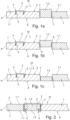
- a first exemplary embodiment of a sound absorber 10 according to the invention is shown in a partial cross-sectional view, comprising an absorber body 1 and at least two separate body elements 1.1, 1.2 of the absorber body 1.
- the sound absorber 10 serves for the acoustic optimization of building spaces, for example as a wall element, ceiling element or also as a partition wall, partition wall or table divider element between different workstations.
- the sound absorber 10 has an absorber body 1 made of a material that is at least partially sound-insulating and absorbs room sound, for example a melamine resin foam, a polyester or a foam material or another sound-insulating material known in the field of acoustics, such as nonwovens or cellulose-based materials.
- a fabric cover 2 is further provided as a cover for a front side 3 in selected areas of the sound absorber 10.
- the fabric cover 2 is fixed with a fastening device 4, which here consists of a groove 5, in which the fabric cover is clamped with its side edges and fixed by the clamping effect.
- a slot, gap, or incision 7 can also simply serve as the fastening device 4 for the fabric cover 2.
- the absorber body 1 is formed from at least two separate body elements 1.1, 1.2, wherein the body element 1.2 in this example is formed as a somewhat thicker element than the rest of the absorber body 1. In the example of the Fig. 1b it is the same thickness, and in the example of Fig. 1c Element 1.2 is thinner than element 1.1.
- Fig. 1a The body element 1.2 protrudes slightly from the body element 1.1 at the front of the sound absorber 10.
- a raised structure is created, at least partially, on the sound absorber 10, which enables even better acoustic insulation of sound waves.
- Such a quasi-three-dimensional design of the sound absorber 10 according to the invention can also be produced in a different form, for example, by the body element 1.2 not protruding from the body element 1.1, but being somewhat thinner (cf. Fig. 1c ) and thus forms a recess or a local depression.
- the fabric covering 2 attached at least partially to the absorber body 1
- Different materials can be used for the fabric covering or for the various body elements 1.1, 1.2, 1.3, 1.4.
- the body elements 1.1, 1.2 can also be made of the same material with a sound-insulating effect. In the latter case, they can also be cut out, punched out or lasered out as simple cutouts from an originally one-piece foam panel element of the absorber body 1.
- both the illustrated grooves 5 and gaps or notches 7 can be used.
- the grooves 5 can be present on a front side 3 of the sound absorber 10 or on the rear side 6. In the latter case, the fabric covers 2 are then pulled at least on one side around a side edge 9 of the absorber body 1 and fastened on the rear side 6 in the grooves 5 by inserting them.
- the fabric covers 2 can also be used according to the invention in gaps or notches 7 between two body elements 1.1, 1.2 that are separated from one another but subsequently inserted into one another. As a result, grooves 5 are at least partially no longer required.
- FIG. 1b shows an embodiment of a sound absorber 10 according to the invention, in which the second body element 1.2 is provided with the same thickness as the first body element 1.1.
- a central second body element 1.2 can be cut out of the originally one-piece absorber body 1, for example by punching or cutting.
- the use of a second body element 1.2 made of a different foam material than the first body element 1.1 is also possible.
- the second body element 1.2 inserted into the notches 7 is, according to the example of Fig. 1b slightly pushed out upwards and is held in this position due to the elasticity in the notches 7 on the first body element 1.1. This also results in Fig.
- the pushed-out middle second body element 1.2 can, according to a variant, also be provided with a fabric cover 2, which is then similar to the following Fig. 2 in the incisions 7 directly without the need for a groove 5 as a fastening device 4.
- an additional fixing means 8 can be provided between the first body element 1.1 and the second body element 1.2, for example in the form of adhesive dots or in the form of staples, needles or the like, in order to securely ensure the pushed-out, protruding position of the body element 1.2 in relation to the absorber body 1.
- this is not absolutely necessary and can also be omitted.
- Fig. 1c The further variant of the first embodiment shown has, in contrast to the previous two examples, a second body element 1.2 with a smaller thickness than the first body element 1.1. This results in a structured front side 3 in the form that a depression on the Body element 1.2 in relation to the front side 3 of the rest of the absorber body 1.
- the fabric covers 2 can be realized differently than shown and also enclose the second body element 1.2.
- Further fixing means 8 are also similar to Fig. 1b explains here what is also true for the other embodiments in the drawings of the patent application.
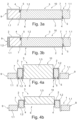
- Fig. 2 1 shows a second exemplary embodiment of a sound absorber 10 according to the invention in a partial cross-sectional view.
- a simple cutout from the originally one-piece plate element of the absorber body 1 is provided here as a second body element 1.2.
- the body element 1.2 is then inserted back into the separate first body element 1.1.
- a flat, continuous planar design of the absorber body 1 is also provided on the front side 3, which as a wall panel or ceiling panel then forms the visible side of the absorber body 10.
- the assembly of the fabric cover 2 is comparatively easy to produce by inserting it into the groove 5 on the back 6 of the body element 1.2 in the example of the Fig. 2 , for example, by means of a spatula or a plug-in element. Additional fastening means are not required, nor are special tools required for the realization of the sound absorber 10 according to the invention. Nevertheless, the separate body elements 1.1, 1.2 in combination with the fabric cover 2 provided at least partially in some areas allow a more diverse design and different acoustically effective areas of such sound absorbers 10 to be produced. Also in this embodiment of the Fig.
- Further separate body elements 1.3, 1.4 can be provided in addition to the two body elements 1.1, 1.2 shown, as well as different and other further areas, each of which can be provided with a fabric cover 2 as a cover for the optical and acoustic variation of the front sides 3 and rear sides 6.
- a side edge 9 can also be covered with a fabric cover (cf. Fig. 3a, 3b ).
- a first body element 1.1 which externally surrounds a second inner body element 1.2.
- the thickness of the two body elements 1.1, 1.2 is the same, but, as can be seen from the hatching, different materials are selected for the inner body element 1.2 and the outer body element 1.1 of the absorber body 1.
- different materials which is also optional here - for example, foams with different densities
- the acoustic effects on the front side 3 of the sound absorber 10 are varied depending on the requirements and application.
- Optical effects such as different colors, different structures or surface designs, can also be produced with the separate body elements 1.1, 1.2 and, if necessary, further body elements 1.3, 1.4, etc.
- a fabric cover 2 is no longer provided on one side to cover one of the sides (front side 3 or back side 6). Rather, the fabric cover 2 is laterally wrapped around the side edge 9 (left side in Fig. 3 ) is pulled around over a larger section of the back 6 of the sound absorber 10. On the back 6, the fabric cover 2 is then also inserted into a groove 5 or alternatively simply into the cut or gap 7 which is present between the two separated body elements 1.1, 1.2.
- the dimensions are such that the body elements 1.1, 1.2 as well as the fabric cover 2 can be mounted on the absorber body 1 by simply inserting them in without the need for additional holding means, fixing elements, etc.
- extra fixing means 8 may nevertheless be provided.
- additional fixing means 8 for the fabric cover 2 may also be present, such as an adhesive, a bonding agent, staples, or the like, if this is required by the size or material shape of the fabric cover 2 and/or the thickness of the plate elements of the absorber body 1. This also applies to the other embodiments described above and below.
- a stiffening element in the form of a thin, plate-like body element 1.2 is inserted as a second body element 1.2 on the side edge 9 of the absorber body 1 under the laterally wrapped fabric cover 2.
- This further body element 1.2 serves to stiffen the side edges in order to avoid an undesirable rounding of the edges of the sound absorber 10.
- the shape of the absorber body 1 can otherwise be as in Fig. 3a shown consist of a first and second body element 1.1, 1.2 or alternatively and differently than in Fig. 3b shown from a single-piece body element 1.1 in the middle. In this case, only the stiffened side edge would be present as a second body element 1.2 in this example.
- the other aspects correspond to those for the design of the Fig. 3a or the previous embodiments.
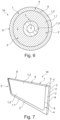
- Fig. 4a 1 shows a schematic cross-sectional view of another exemplary embodiment of a sound absorber 10 according to the invention.
- three different body elements 1.1, 1.2, 1.3 are provided, which can be formed from the same or different materials as the absorber body 1.
- the three body elements 1.1, 1.2, 1.3 each have different thicknesses and are inserted into one another in a pyramid-like manner such that the middle body element 1.3 has the greatest thickness and gradually decreasing thicknesses are present towards the outside of the sound absorber 10.
- fabric covers 2 are present at least in sections, which are fixed in fastening devices 4 provided for this purpose, for example in the form of grooves 5 or incisions or gaps 7 between the body elements 1.1, 1.2, 1.3 by simply inserting the edges of the fabric cover 2.
- the three body elements 1.1, 1.2, 1.3 are each provided with the same thickness and can either be made of the same foam material by simply punching or cutting out an originally one-piece absorber body 1 or with different materials for different acoustic effects. After insertion, the body elements 1.1, 1.2, 1.3 are held together by the elastic shape of the foam with clamping. Alternatively or additionally, further fixing means 8, as above with Fig. 1b described, are provided in the cuts 7. In contrast to the example of the Fig. 4a is at Fig.
- the middle body element 1.2 is provided with a fabric cover 2, which is held clamped in the notches 7 or gaps to the other body elements, without additional grooves 5 being provided as fastening devices 4 for the fabric cover 2.
- the assembly and mounting of the fabric cover 2 is thus even further simplified compared to the previous examples.
- fabric covers 2 can be pulled around the side edges 9 similar to the example of the Fig. 3a, 3b be present, or only local areas provided on the front side 3 with a fabric cover 2 and corresponding grooves 5 for fastening the fabric can be realized.
- a sound absorber 10 which is shown in a plan view of the Fig. 5a and a perspective view in the Fig. 5b is shown, it is such a pyramid-shaped sound absorber 10 formed by interlocking body elements 1.1, 1.2, 1.3, 1.4, as it is shown in the cross-sectional view in simplified form in the Fig. 3a or Fig. 3b
- the body elements 1.1, 1.2, 1.3, 1.4 are square in shape and have rounded corners, and are realized by increasing thickness or by different height positions from the outside to the inside.
- a kind of stepped pyramid of sound-absorbing material of the absorber body 1 is realized by simply connecting the individual body elements 1.1, 1.2, 1.3, 1.4.
- the body elements 1.1 to 1.4 are each provided in a different shape and color, so that an alternating dark and light stepped shape is achieved in the sound absorber 10 as a whole. This can be achieved partially or entirely by using a fabric cover 2, which is inserted into the corresponding gaps or incisions 7 or grooves 5 of the fastening device 4, or by selecting the material for the sound-insulating materials of the absorber body 1. For example, different, highly sound-insulating types of polyester or foam materials with different colors can be used. Or, for example, a fabric cover 2 in a different color can be partially attached only to the innermost absorber body 1.4, which is then inserted into the groove between the innermost and second-innermost body element in order to realize the fastening and fixing.
- This embodiment of the Fig. 5a, Fig. 5b shows the great flexibility and variability in the design and adaptation possibilities of sound effects of such sound absorbers 10 according to the invention. Due to the quasi-three-dimensional shape of the protruding pyramid according to this embodiment of the sound absorber 10, even sound waves arriving from the side are hit and attenuated.
- the protruding shape of the thickening or raised protruding individual elements of the absorber body 1 can, for example, also be realized as a round shape. In addition to protruding, thickening elements, depressions can also be realized in individual areas.
- a fabric cover 2 can be pulled over the side edges 9 and fixed in a groove 5 on a rear side 6 of the absorber body 1 by inserting the edge of the fabric cover 2.
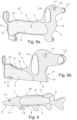
- the Fig. 6 again shows a plan view of another embodiment of a sound absorber 10 according to the invention, of a basically round shape and form.
- Three separately provided absorber bodies 1.1, 1.2, 1.3 are cut out in a circular shape according to the respective outer/inner shape and inserted into one another to form the absorber body 1 of the sound absorber 10 with an opening located in the middle.
- a fabric cover 2 or by different material selection of the polyester or Melamine resin foam, for example, different colors and structures of the body elements 1.1, 1.2 and 1.3 are available in order to design the visual effect and sound absorption of the different areas according to the requirements of an interior.
- a fabric cover 2 is also fixed in this embodiment with a fastening device 4 in corresponding grooves 5, which in this embodiment are provided on the front side 3 instead of on the back side 6 of the sound absorber 10.
- a fabric cover 2 can alternatively also be partially pulled around the side edges 9.
- the embodiment of the Fig. 6 has an absorber body 1 with uniform thickness of the body elements 1.1, 1.2, 1.3, resulting in an overall flat plate shape. Alternatively, different thicknesses of the elements of the absorber body 1 can be selected to create elevations or depressions in a relief-like manner.
- an absorber body 1 is provided, which is realized from a first body element 1.1 and a second body element 1.2.
- the second body element 1.2 is inserted into the interior of the body element 1.1 in such a way that it is enclosed by the outer body element 1.1 only on three sides.
- the body elements 1.1, 1.2 are mounted to each other by inserting them into one another.
- a fabric cover 2 according to the invention is also provided, which here also surrounds the side edges 9 of the absorber body 1, so that both on the front side 3 and on the back side 6 the same, in the Fig. 7 shown form of various materials for sound insulation.
- the grooves 5 of the fastening device 4 for the fabric cover 2 are thus formed both on the back and across the upper side edge as well as on the front side 3.
- Such an element can be used as a sound absorber 10, for example, as a partition on work tables, adjustable walls or the like, since it is provided on both sides with the different areas of the individual body elements 1.1, 1.2 according to the invention and various surface structures through the fabric cover 2 or the respective choice of material of the body elements 1.1, 1.2.
- Such a sound absorber 10 can also be suspended, for example, in a slatted manner as a ceiling element in a building.
- Fig. 8a in a top view
- Fig. 8b in a partial perspective view
- Fig. 9 shown in a top view
- the sound absorbers 10 are realized as an example with figurative shapes from various interlocking body elements 1.1, 1.2, 1.3, 1.4 of the absorber body 1, namely as a dog ( Fig. 8a, 8b ) or as fish ( Fig. 9 ).
- a dog Fig. 8a, 8b
- fish Fig. 9
- the absorber body 1 is formed on a front side 3 with a central body element 1.2 provided with a fabric cover 2, which is surrounded from the outside by a first body element 1.1 made of the original material, for example a polyamide.
- the fabric cover 2 is inserted into a groove 5 with its edge area as a fastening device 4.
- the ears, the eye and the snout of the dog are formed in this embodiment from further separate body elements 1.3, 1.4 in a different color or material form in black.
- these elements are not necessarily flush with the front side 6, but rather slightly protrude. This results in quasi-protruding ears, eyes, and snouts due to the protruding body elements 1.3, 1.4, which in turn leads to the improved acoustic insulation effect due to the three-dimensional shape of the sound absorber 10.
- a groove 5 as a notch 7 on the front side 3 provides a fabric cover 2 in the central area in a different color than the rest of the absorber body 1.
- the eye of the fish is formed by a separate body element 1.3 slightly protruding from the front side 3, which is also realized in a darker color to make the fish shape recognizable and to create a three-dimensional effect for sound absorption.
- An even better sound absorption effect can be achieved through the outer angled and nested outer shape formed by fins and snout.
- a sound absorber 10 also has greater acceptance and the possibility of different interior design options, for example in schools, kindergartens or the like.
Landscapes
- Physics & Mathematics (AREA)
- Acoustics & Sound (AREA)
- Engineering & Computer Science (AREA)
- Architecture (AREA)
- Electromagnetism (AREA)
- Civil Engineering (AREA)
- Structural Engineering (AREA)
- Building Environments (AREA)
Applications Claiming Priority (1)
| Application Number | Priority Date | Filing Date | Title |
|---|---|---|---|
| DE102023132980.4A DE102023132980A1 (de) | 2023-11-27 | 2023-11-27 | Schallabsorber mit mehrteiligem Absorberkörper |
Publications (1)
| Publication Number | Publication Date |
|---|---|
| EP4560084A1 true EP4560084A1 (fr) | 2025-05-28 |
Family
ID=93656012
Family Applications (1)
| Application Number | Title | Priority Date | Filing Date |
|---|---|---|---|
| EP24215344.3A Pending EP4560084A1 (fr) | 2023-11-27 | 2024-11-26 | Absorbeur acoustique avec corps absorbeur en plusieurs parties |
Country Status (2)
| Country | Link |
|---|---|
| EP (1) | EP4560084A1 (fr) |
| DE (1) | DE102023132980A1 (fr) |
Citations (4)
| Publication number | Priority date | Publication date | Assignee | Title |
|---|---|---|---|---|
| US5923002A (en) * | 1997-11-12 | 1999-07-13 | Owens Corning Fiberglas Technology, Inc. | Acoustical room paneling and method of installation |
| EP2980329A2 (fr) * | 2014-07-30 | 2016-02-03 | GiB Gesellschaft für innovative Bautechnologie mbH | Élément de paroi et de plafond, et montage de paroi et de plafond composés d'éléments |
| DE202020104224U1 (de) * | 2020-07-22 | 2020-08-06 | Quattro Schallabsorber Gmbh | Schallabsorber mit einem flächigen Absorberkörper |
| DE102018007848B4 (de) | 2018-10-04 | 2022-01-13 | Quattro Schallabsorber Gmbh | Schallabsorber mit einem Stoffbezug |
Family Cites Families (2)
| Publication number | Priority date | Publication date | Assignee | Title |
|---|---|---|---|---|
| CH700728B1 (de) * | 2007-07-13 | 2010-10-15 | Albers & Co | Akustikelemente. |
| DE102007033613A1 (de) * | 2007-07-17 | 2009-01-22 | Erich Diel | Schallabsorber |
-
2023
- 2023-11-27 DE DE102023132980.4A patent/DE102023132980A1/de active Pending
-
2024
- 2024-11-26 EP EP24215344.3A patent/EP4560084A1/fr active Pending
Patent Citations (4)
| Publication number | Priority date | Publication date | Assignee | Title |
|---|---|---|---|---|
| US5923002A (en) * | 1997-11-12 | 1999-07-13 | Owens Corning Fiberglas Technology, Inc. | Acoustical room paneling and method of installation |
| EP2980329A2 (fr) * | 2014-07-30 | 2016-02-03 | GiB Gesellschaft für innovative Bautechnologie mbH | Élément de paroi et de plafond, et montage de paroi et de plafond composés d'éléments |
| DE102018007848B4 (de) | 2018-10-04 | 2022-01-13 | Quattro Schallabsorber Gmbh | Schallabsorber mit einem Stoffbezug |
| DE202020104224U1 (de) * | 2020-07-22 | 2020-08-06 | Quattro Schallabsorber Gmbh | Schallabsorber mit einem flächigen Absorberkörper |
Also Published As
| Publication number | Publication date |
|---|---|
| DE102023132980A1 (de) | 2025-05-28 |
Similar Documents
| Publication | Publication Date | Title |
|---|---|---|
| DE2516412C3 (de) | Gießgeformte Schale zum Verpacken von Frischfleisch, Fisch oder Geflügel | |
| DE1609569C3 (de) | Unterdecke mit mittels Aufhängegliedern an der Rohdecke gehaltenen Tragschienen | |
| DE2004843A1 (de) | Behälter für Insektengiftplatten | |
| DE102015117643A1 (de) | Rahmenelement, Profilteil, Klemmleiste und Schutzgitter | |
| EP4560084A1 (fr) | Absorbeur acoustique avec corps absorbeur en plusieurs parties | |
| DE202015100068U1 (de) | Frontblende für Möbel | |
| EP2770497A2 (fr) | Instrument à manche type basse avec plaque de recouvrement traversante | |
| DE9205273U1 (de) | Befestigungselement zur verdeckten Halterung | |
| DE102018128677A1 (de) | Tafel- oder plattenförmiges Akustikelement | |
| DE10242519B4 (de) | Schublade oder dergleichen | |
| WO2017055124A1 (fr) | Élément d'absorption acoustique | |
| DE202014100557U1 (de) | Möbelauszug und Frontblende für einen Möbelauszug | |
| DE19903836C2 (de) | Abdeckung für Licht- und/oder Lüftungsschächte sowie Profilstab hierfür | |
| DE2539788C2 (de) | Randabdeckung für einen Flansch durch eine U-förmigen Querschnitt aufweisende elastische Randleiste | |
| DE202018106479U1 (de) | Tafel- oder plattenförmiges Akustikelement | |
| DE69000322T2 (de) | Verkleidungselement oder trennwand mit einem blech. | |
| DE1954172U (de) | Bauelementensatz fuer die herstellung von decken oder waenden nach der sogenannten trockenbauweise. | |
| CH611143A5 (en) | Frame support | |
| CH499291A (de) | Leiste zur Herstellung der Zarge von Schubladen bzw. des Rahmens kastenförmiger Kleinmöbel | |
| DE2238747A1 (de) | Rasterdecke | |
| DE3217133A1 (de) | Warenverkaufsstaender | |
| DE102005017351B4 (de) | Zweiteiliges Metallprofil für eine Licht- und/oder Lüftungsschachtabdeckung | |
| DE102020100168A1 (de) | Tafel- oder plattenförmiges Akustikelement | |
| DE367387C (de) | Sprechmaschinentrichter aus Holz | |
| DE2022156A1 (de) | Selbsttaetig einstellbare Deckenleiste fuer Schraenke mit Raumhoehe |
Legal Events
| Date | Code | Title | Description |
|---|---|---|---|
| PUAI | Public reference made under article 153(3) epc to a published international application that has entered the european phase |
Free format text: ORIGINAL CODE: 0009012 |
|
| STAA | Information on the status of an ep patent application or granted ep patent |
Free format text: STATUS: THE APPLICATION HAS BEEN PUBLISHED |
|
| AK | Designated contracting states |
Kind code of ref document: A1 Designated state(s): AL AT BE BG CH CY CZ DE DK EE ES FI FR GB GR HR HU IE IS IT LI LT LU LV MC ME MK MT NL NO PL PT RO RS SE SI SK SM TR |
|
| STAA | Information on the status of an ep patent application or granted ep patent |
Free format text: STATUS: REQUEST FOR EXAMINATION WAS MADE |