EP4560059A1 - False-twist textured yarn, and clothes, woven knitted product, twist yarn, and composite false-twist textured yarn including same - Google Patents
False-twist textured yarn, and clothes, woven knitted product, twist yarn, and composite false-twist textured yarn including same Download PDFInfo
- Publication number
- EP4560059A1 EP4560059A1 EP23842745.4A EP23842745A EP4560059A1 EP 4560059 A1 EP4560059 A1 EP 4560059A1 EP 23842745 A EP23842745 A EP 23842745A EP 4560059 A1 EP4560059 A1 EP 4560059A1
- Authority
- EP
- European Patent Office
- Prior art keywords
- false
- textured yarn
- twist
- twist textured
- yarn
- Prior art date
- Legal status (The legal status is an assumption and is not a legal conclusion. Google has not performed a legal analysis and makes no representation as to the accuracy of the status listed.)
- Pending
Links
Images


Classifications
-
- D—TEXTILES; PAPER
- D02—YARNS; MECHANICAL FINISHING OF YARNS OR ROPES; WARPING OR BEAMING
- D02G—CRIMPING OR CURLING FIBRES, FILAMENTS, THREADS, OR YARNS; YARNS OR THREADS
- D02G3/00—Yarns or threads, e.g. fancy yarns; Processes or apparatus for the production thereof, not otherwise provided for
- D02G3/22—Yarns or threads characterised by constructional features, e.g. blending, filament/fibre
- D02G3/26—Yarns or threads characterised by constructional features, e.g. blending, filament/fibre with characteristics dependent on the amount or direction of twist
-
- D—TEXTILES; PAPER
- D01—NATURAL OR MAN-MADE THREADS OR FIBRES; SPINNING
- D01F—CHEMICAL FEATURES IN THE MANUFACTURE OF ARTIFICIAL FILAMENTS, THREADS, FIBRES, BRISTLES OR RIBBONS; APPARATUS SPECIALLY ADAPTED FOR THE MANUFACTURE OF CARBON FILAMENTS
- D01F8/00—Conjugated, i.e. bi- or multicomponent, artificial filaments or the like; Manufacture thereof
- D01F8/04—Conjugated, i.e. bi- or multicomponent, artificial filaments or the like; Manufacture thereof from synthetic polymers
- D01F8/14—Conjugated, i.e. bi- or multicomponent, artificial filaments or the like; Manufacture thereof from synthetic polymers with at least one polyester as constituent
-
- D—TEXTILES; PAPER
- D01—NATURAL OR MAN-MADE THREADS OR FIBRES; SPINNING
- D01D—MECHANICAL METHODS OR APPARATUS IN THE MANUFACTURE OF ARTIFICIAL FILAMENTS, THREADS, FIBRES, BRISTLES OR RIBBONS
- D01D5/00—Formation of filaments, threads, or the like
- D01D5/22—Formation of filaments, threads, or the like with a crimped or curled structure; with a special structure to simulate wool
-
- D—TEXTILES; PAPER
- D02—YARNS; MECHANICAL FINISHING OF YARNS OR ROPES; WARPING OR BEAMING
- D02G—CRIMPING OR CURLING FIBRES, FILAMENTS, THREADS, OR YARNS; YARNS OR THREADS
- D02G1/00—Producing crimped or curled fibres, filaments, yarns, or threads, giving them latent characteristics
- D02G1/02—Producing crimped or curled fibres, filaments, yarns, or threads, giving them latent characteristics by twisting, fixing the twist and backtwisting, i.e. by imparting false twist
-
- D—TEXTILES; PAPER
- D02—YARNS; MECHANICAL FINISHING OF YARNS OR ROPES; WARPING OR BEAMING
- D02G—CRIMPING OR CURLING FIBRES, FILAMENTS, THREADS, OR YARNS; YARNS OR THREADS
- D02G1/00—Producing crimped or curled fibres, filaments, yarns, or threads, giving them latent characteristics
- D02G1/02—Producing crimped or curled fibres, filaments, yarns, or threads, giving them latent characteristics by twisting, fixing the twist and backtwisting, i.e. by imparting false twist
- D02G1/0206—Producing crimped or curled fibres, filaments, yarns, or threads, giving them latent characteristics by twisting, fixing the twist and backtwisting, i.e. by imparting false twist by false-twisting
-
- D—TEXTILES; PAPER
- D02—YARNS; MECHANICAL FINISHING OF YARNS OR ROPES; WARPING OR BEAMING
- D02G—CRIMPING OR CURLING FIBRES, FILAMENTS, THREADS, OR YARNS; YARNS OR THREADS
- D02G1/00—Producing crimped or curled fibres, filaments, yarns, or threads, giving them latent characteristics
- D02G1/18—Producing crimped or curled fibres, filaments, yarns, or threads, giving them latent characteristics by combining fibres, filaments, or yarns, having different shrinkage characteristics
-
- D—TEXTILES; PAPER
- D02—YARNS; MECHANICAL FINISHING OF YARNS OR ROPES; WARPING OR BEAMING
- D02G—CRIMPING OR CURLING FIBRES, FILAMENTS, THREADS, OR YARNS; YARNS OR THREADS
- D02G3/00—Yarns or threads, e.g. fancy yarns; Processes or apparatus for the production thereof, not otherwise provided for
- D02G3/02—Yarns or threads characterised by the material or by the materials from which they are made
- D02G3/04—Blended or other yarns or threads containing components made from different materials
- D02G3/045—Blended or other yarns or threads containing components made from different materials all components being made from artificial or synthetic material
-
- D—TEXTILES; PAPER
- D03—WEAVING
- D03D—WOVEN FABRICS; METHODS OF WEAVING; LOOMS
- D03D15/00—Woven fabrics characterised by the material, structure or properties of the fibres, filaments, yarns, threads or other warp or weft elements used
- D03D15/20—Woven fabrics characterised by the material, structure or properties of the fibres, filaments, yarns, threads or other warp or weft elements used characterised by the material of the fibres or filaments constituting the yarns or threads
- D03D15/283—Woven fabrics characterised by the material, structure or properties of the fibres, filaments, yarns, threads or other warp or weft elements used characterised by the material of the fibres or filaments constituting the yarns or threads synthetic polymer-based, e.g. polyamide or polyester fibres
-
- D—TEXTILES; PAPER
- D03—WEAVING
- D03D—WOVEN FABRICS; METHODS OF WEAVING; LOOMS
- D03D15/00—Woven fabrics characterised by the material, structure or properties of the fibres, filaments, yarns, threads or other warp or weft elements used
- D03D15/20—Woven fabrics characterised by the material, structure or properties of the fibres, filaments, yarns, threads or other warp or weft elements used characterised by the material of the fibres or filaments constituting the yarns or threads
- D03D15/292—Conjugate, i.e. bi- or multicomponent, fibres or filaments
-
- D—TEXTILES; PAPER
- D03—WEAVING
- D03D—WOVEN FABRICS; METHODS OF WEAVING; LOOMS
- D03D15/00—Woven fabrics characterised by the material, structure or properties of the fibres, filaments, yarns, threads or other warp or weft elements used
- D03D15/40—Woven fabrics characterised by the material, structure or properties of the fibres, filaments, yarns, threads or other warp or weft elements used characterised by the structure of the yarns or threads
- D03D15/47—Woven fabrics characterised by the material, structure or properties of the fibres, filaments, yarns, threads or other warp or weft elements used characterised by the structure of the yarns or threads multicomponent, e.g. blended yarns or threads
-
- D—TEXTILES; PAPER
- D03—WEAVING
- D03D—WOVEN FABRICS; METHODS OF WEAVING; LOOMS
- D03D15/00—Woven fabrics characterised by the material, structure or properties of the fibres, filaments, yarns, threads or other warp or weft elements used
- D03D15/40—Woven fabrics characterised by the material, structure or properties of the fibres, filaments, yarns, threads or other warp or weft elements used characterised by the structure of the yarns or threads
- D03D15/49—Woven fabrics characterised by the material, structure or properties of the fibres, filaments, yarns, threads or other warp or weft elements used characterised by the structure of the yarns or threads textured; curled; crimped
-
- D—TEXTILES; PAPER
- D10—INDEXING SCHEME ASSOCIATED WITH SUBLASSES OF SECTION D, RELATING TO TEXTILES
- D10B—INDEXING SCHEME ASSOCIATED WITH SUBLASSES OF SECTION D, RELATING TO TEXTILES
- D10B2331/00—Fibres made from polymers obtained otherwise than by reactions only involving carbon-to-carbon unsaturated bonds, e.g. polycondensation products
- D10B2331/04—Fibres made from polymers obtained otherwise than by reactions only involving carbon-to-carbon unsaturated bonds, e.g. polycondensation products polyesters, e.g. polyethylene terephthalate [PET]
-
- D—TEXTILES; PAPER
- D10—INDEXING SCHEME ASSOCIATED WITH SUBLASSES OF SECTION D, RELATING TO TEXTILES
- D10B—INDEXING SCHEME ASSOCIATED WITH SUBLASSES OF SECTION D, RELATING TO TEXTILES
- D10B2501/00—Wearing apparel
Definitions
- the present invention relates to a false-twist textured yarn, and clothing, a woven or knitted fabric, a twist yarn, and a composite false-twist textured yarn including the same.
- worsted-wool feeling fabric has been demanded having softness, feelings such as dryness and resilience, and both high sensitiveness of worsted-wool feeling such as natural appearance and functionality such as stretchability.
- Patent Document 1 proposes a fiber having thick-to-thin unevenness in a fiber axis direction of a single fiber constituting a multifilament obtained by joining two types of polyester polymers having different melt viscosities, and a woven or knitted fabric using the fiber.
- Patent Document 2 proposes a polyester composite false twist yarn including a polyester yarn having latent crimping performance and another polyester yarn.
- the present invention has been made in view of the above circumstances, and an object of the present invention is to provide a false-twist textured yarn that exhibits high sensitiveness of worsted-wool feeling having natural appearance with glare suppressed while having feelings such as dryness and resilience, and high grainy feeling, and functionality such as stretchability, and a composite false-twist textured yarn, a twist yarn, a woven or knitted fabric, and clothing including the false-twist textured yarn.
- the present invention has the following structures.
- the composite false-twist textured yarn, the twist yarn, the woven or knitted fabric, and the clothing using the false-twist textured yarn of the present invention may be suitably used for an item in the field of outerwear worn as a women's or men's wear, for example, clothing such as a jacket, a suit, or a lower garment.
- the false-twist textured yarn of the present invention includes the polyester-based thermoplastic resin A and the polyester-based thermoplastic resin B, and satisfies the following requirements.
- the false-twist textured yarn of the present invention is obtained by performing false-twist texturing on the composite fiber including the polyester-based thermoplastic resin A and the polyester-based thermoplastic resin B. Since a random crimped form is obtained for each single yarn by performing false-twist texturing, dryness, stretchability, and resilience can be obtained.
- the false-twist textured yarn of the present invention includes the polyester-based thermoplastic resin A and the polyester-based thermoplastic resin B.
- polyester-based resin to be used for the false-twist textured yarn of the present invention it is preferable to use a polyethylene terephthalate-based resin with a main repeat unit of ethylene terephthalate, a polytrimethylene terephthalate-based resin with a main repeat unit of trimethylene terephthalate, or a polybutylene terephthalate-based resin with a main repeat unit of butylene terephthalate. More preferably, both the polyester-based thermoplastic resin A and the polyester-based thermoplastic resin B have a main repeat unit of ethylene terephthalate.
- the phrase "the main repeating unit is ethylene terephthalate" means that the proportion of a structure derived from ethylene terephthalate contained in the repeating unit is 60 mol% or more. The same applies hereinafter.
- the polyethylene terephthalate-based resin, the polytrimethylene terephthalate-based resin, and the polybutylene terephthalate-based resin described above may have a small amount (usually less than 30 mol% (amount with respect to the total amount 100 mol% of acid components, diol components)) of copolymerization components as necessary.
- the copolymerization components of the polyester-based thermoplastic resin A are 8 mol% or less, the strength is maintained even after alkali weight reduction, so that softness is easily obtained, which is preferable.
- the copolymerization components are 8 mol% or less, a molecular orientation in the false-twist textured yarn can be maintained even after dyeing processing, so that dimensional stability is improved.
- the copolymerization components are 5 mol% or less in both the polyester-based thermoplastic resin A and the polyester-based thermoplastic resin B, and more preferably, both of the polyester-based thermoplastic resin A and the polyester-based thermoplastic resin B are polyethylene terephthalate resins that contain no copolymerization component.
- polyethylene terephthalate containing no copolymerization component the boiling water shrinkage rate of the false-twist textured yarn can be easily reduced, so that crimps are easily exhibited in the woven or knitted fabric, and stretchability and resilience are easily obtained, and further, recycling of the fibers to fibers is also facilitated.
- the boiling water shrinkage rate of the false-twist textured yarn before crack formation (hereinafter referred to as the false-twist textured yarn before crack formation) is preferably 10.0% or less.
- the boiling water shrinkage rate is 10.0% or less, the fibers are not bound in the woven or knitted fabric, and the stretchability is further improved.
- the polyester-based thermoplastic resin A and the polyester-based thermoplastic resin B in the present invention may contain one kind or two or more kinds of a micropore forming agent, a cationic dyeable agent, a coloring inhibitor, a heat stabilizer, a flame retardant, a fluorescent brightener, a delusterant, a colorant, an antistatic agent, a moisture absorbent, an antibacterial agent, inorganic fine particles, and the like as necessary within a range in which the object of the present invention is not impaired.
- the difference (M A - M B , hereinafter may be simply referred to as "difference in weight-average molecular weight") between the weight-average molecular weight M A of the polyester-based thermoplastic resin A and the weight-average molecular weight M B of the polyester-based thermoplastic resin B is 2,000 to 15,000.
- difference in weight-average molecular weight is less than 2000, the stretchability of the false-twist textured yarn is lowered, and the effect of suppressing glare becomes insufficient.
- the difference in weight-average molecular weight is preferably 5000 or more.
- the difference in weight-average molecular weight is more than 15000, the strength of the raw yarn decreases, and spinning becomes unstable.
- the difference in weight-average molecular weight is preferably 13000 or less.
- a value of the weight-average molecular weight M A of the polyester-based thermoplastic resin A is preferably in a range of 20000 to 28000
- a value of the weight-average molecular weight M B of the polyester-based thermoplastic resin B is preferably in a range of 12000 to 20000.
- the weight-average molecular weight in the present invention is measured by the method described in Examples.
- the polyester-based thermoplastic resin A and the polyester-based thermoplastic resin B are eccentrically joined.
- a coil-shaped structure is obtained due to the difference in shrinkage between the polyester-based thermoplastic resin A and the polyester-based thermoplastic resin B, and thus the stretchability of the obtained woven fabric is improved.
- the term "eccentrically joined” refers to a state in which the polyester-based thermoplastic resin A and the polyester-based thermoplastic resin B are present in a joined state without being substantially separated in a cross section substantially perpendicular to the fiber axis of the false-twist textured yarn, and the position of the center of gravity of each of the polyester-based thermoplastic resins is shifted.
- Examples of the structure eccentrically joined include a side-by-side type structure and an eccentric core-sheath type structure, and a structure in which a part of the polyester-based thermoplastic resin A (1) is exposed from the polyester-based thermoplastic resin B (2) as illustrated in the cross-sectional shape of the false-twist textured yarn in Fig. 1 .
- the false-twist textured yarn is of a side-by-side type, it is necessary to form a slit parallel to the fiber axis direction in the polyester-based thermoplastic resin B at the time of the composite fiber before being subjected to false-twist texturing.
- the cross-sectional structure has a shape in which the polyester-based thermoplastic resin A (1) is covered with the polyester-based thermoplastic resin B (2).
- the false-twist textured yarn having the cross-sectional structure illustrated in Fig. 1 can be obtained, for example, by obtaining an eccentric core-sheath type composite fiber and then exposing a part of the polyester-based thermoplastic resin A by alkali weight reduction.
- a part of the polyester-based thermoplastic resin A by forming an eccentric core-sheath type composite fiber using the polyester-based thermoplastic resins having a difference in the weight-average molecular weight described above, fine unevenness may be stably formed at the joint interface between the polyester-based thermoplastic resin A and the polyester-based thermoplastic resin B.
- the unevenness is exposed to form a slit to be described later.
- the ratio (t min /D) of the minimum value t min of the thickness t (3) of the polyester-based thermoplastic resin B (2) covering the polyester-based thermoplastic resin A (1) to the fiber diameter D of the composite fiber is preferably 0.01 to 0.10.
- (t min /D) is 0.01 or more, fabric quality is improved in that generation of fuzz is suppressed, and slit formability is improved.
- (t min /D) is 0.02 or more.
- (t min /D) is 0.10 or less, the stretchability is further improved by sufficient crimp exhibit ability.
- (t min /D) is 0.08 or less.
- a length C t of a portion in which a region having the thickness t satisfying 1.00t min ⁇ t ⁇ 1.05t min and the circumferential line of the composite fiber are overlapped preferably satisfies C t ⁇ 0.33C with respect to a circumferential length C of the entire composite fiber.
- the apparent thick-to-thin ratio (D thick /D thin ) is 1.05 to 3.00.
- the apparent thick-to-thin ratio (D thick /D thin ) refers to a ratio of a fiber diameter (D thick ) of a portion where a width of a false-twist textured yarn bundle in a direction perpendicular to the fiber axis direction is relatively larger than an average value to a fiber diameter (D thin ) of a portion where the width is relatively smaller than the average value at a load of 0.11 cN/dtex.
- the apparent thick-to-thin ratio (D thick /D thin ) of the false-twist textured yarn of the present invention is less than 1.05, grain appearance is not obtained when the false-twist textured yarn is formed into a woven or knitted fabric.
- the apparent thick-to-thin ratio (D thick /D thin ) is preferably 1.25 or more, more preferably 1.40 or more.
- the apparent thick-to-thin ratio (D thick /D thin ) exceeds 3.00, the appearance deviates from natural appearance and does not become a preferable appearance.
- the apparent thick-to-thin ratio (D thick /D thin ) is preferably 2.00 or less.
- the false-twist textured yarn of the present invention has a slit in a single-fiber axis direction and a crack in a direction substantially orthogonal to the single-fiber axis direction on a surface of the single fiber surface.
- the crack is unevenness in a direction substantially orthogonal to the single-fiber axis direction of the false-twist textured yarn, and the depth of the crack is preferably 0.5 to 5.0 ⁇ m.
- the slit is unevenness formed in the single-fiber axis direction of the false-twist textured yarn, and the depth of the slit is preferably 0.1 to 1.5 ⁇ m.
- the depth of the crack is 0.5 ⁇ m or more or the depth of the slit is 0.1 ⁇ m or more, the effect of suppressing glare is further improved.
- the depth of the slit is 5.0 ⁇ m or less or the depth of the slit is 1.5 ⁇ m or less, the wear resistance is improved.
- the depth of the crack or the slit is measured at a point that is deepest thereof.
- the direction substantially orthogonal to the fiber axis direction of the false-twist textured yarn is a direction along the circumference of a single fiber of a false-twist textured yarn 4, and is a direction within ⁇ 80° with respect to the fiber axis direction.
- Fig. 3 is a perspective view illustrating one embodiment of a surface of the false-twist textured yarn of the present invention.
- the false-twist textured yarn 4 has slits 6 in the single-fiber axis direction and cracks 5 in a direction substantially orthogonal to the single-fiber axis direction on the single fiber surface of the false-twist textured yarn 4.
- the length of the crack is not particularly limited.
- about 1/2 of the length of the outer circumference of the single fiber of the false-twist textured yarn is preferable because it is well-balanced with slit formation and glare can be further suppressed when the false-twist textured yarn is formed into a woven or knitted fabric.
- "about 1/2 of the length of the outer circumference” may be an aspect in which a crack is formed in about 1/2 of the length of the outer circumference of the single fiber by one crack, or two or more cracks are formed to be dispersed in a region of about 1/2 of the length of the outer circumference of the single fiber.
- the frequency at which cracks are formed is preferably in a dispersion form in which 10 or less cracks are dispersed over substantially the entire region in the outer circumference direction of the region where no slit is formed, and it is more preferable that cracks are formed at a frequency at which such a dispersion form exists within a range of 1 cm in the fiber axis direction.
- the fiber axis direction of the false-twist textured yarn refers to the longitudinal direction of the false-twist textured yarn 4.
- the length of the false-twist textured yarn in the circumferential direction in which such slits are formed is not particularly limited, but about 1/2 of the length of the outer circumference of the single fiber of the false-twist textured yarn is preferable because it is well-balanced with crack formation and glare can be further suppressed when the false-twist textured yarn is formed into a woven or knitted fabric. It is particularly preferable that both cracks and slits are formed in the single fiber constituting the false-twist textured yarn.
- an aspect is preferable that has a region in which a crack is formed on about a half of the outer circumference and a region in which a slit is formed on about a half circumference of the outer circumference.
- the depth and length of each of the cracks and the slits are measured using an electron microscope, and an average value obtained by measuring ten cracks or slits in one false-twist textured yarn is used.
- a specific measurement method is as described in Examples.
- Examples of the method for forming cracks on the surface of the false-twist textured yarn include a method in which the false-twist textured yarn after being subjected to pin draw within a range not exceeding the natural draw ratio of the composite fiber is subjected to alkali weight reduction.
- the draw ratio is set as described above, a difference in orientation of molecules constituting the composite fiber is generated in the length direction of the fiber, and a portion not oriented is preferentially eluted by alkali, so that the weight reduction rate is different in the fiber length direction, and unevenness in a direction substantially orthogonal to the fiber axis direction, that is, cracks are formed.
- the slits may also be formed by obtaining a false-twist textured yarn from a composite fiber having an eccentric core-sheath structure and then performing alkali weight reduction.
- a method for forming the slits based on a composite fiber having an eccentric core-sheath structure will be described in detail.
- the amount of the polyester-based thermoplastic resin B is preferentially reduced, so that the polyester-based thermoplastic resin A is exposed to expose the unevenness, which is at the joint interface, and the unevenness (slits) in the fiber axis direction is formed.
- the slit can be formed more stably based on the composite fiber having the eccentric core-sheath structure described above and can be formed into a deep slit, and thus the composite fiber having the eccentric core-sheath structure is preferable.
- the false-twist textured yarn is not limited to a particular cross-sectional shape, and cross-sectional shapes such as a circular shape, an elliptical shape, and a triangular shape can be adopted, but a circular shape is more preferable because the composite fiber for obtaining the false-twist textured yarn can be stably spun when the cross-sectional shape is a circular shape.
- the ratio S A : S B of the area (S A ) of the polyester-based thermoplastic resin A to the area (S B ) of the polyester-based thermoplastic resin B in the cross section of the false-twist textured yarn before formation of cracks is preferably 70 : 30 to 30 : 70, more preferably 60 : 40 to 40 : 60, physical properties are improved.
- S A ⁇ S B is further preferable.
- the single yarn fineness of the false-twist textured yarn in the present invention is preferably 3.0 dtex or more.
- the upper limit is preferably 5.0 dtex or less. Within this range, dryness in forming into a woven or knitted fabric is enhanced, and a touch closer to worsted-wool may be obtained.
- the single yarn fineness is a value calculated by total fineness (dtex)/number of filaments.
- the false-twist textured yarn of the present invention preferably has a stretch recovery rate (crimp rigidity (CR)) measured from the decomposed yarn of the woven or knitted fabric of 25.0% or more.
- CR stretch recovery rate
- CR is 25.0% or more, crimps are exhibited in the woven or knitted fabric, and better stretchability is obtained.
- CR is more preferably 30.0% or more.
- CR is preferably 50.0% or less.
- CR can be measured by the method described in Examples including the case of using the composite false-twist textured yarn described later. Examples of the method for setting CR within the above range include increasing the draw ratio at the time of false-twist texturing to increase the orientation difference between the polyester-based thermoplastic resin A and the polyester-based thermoplastic resin B.
- a composite false-twist textured yarn of the present invention includes the false-twist textured yarn of the present invention and at least one kind of another thread. With this configuration, grainy feeling in forming into a woven or knitted fabric can be further improved.
- the other thread is not particularly limited as long as it is different from the false-twist textured yarn of the present invention, but in particular, the thread is preferably constituted of a polyester-based resin because of satisfactory mechanical properties and excellent dimensional stability against humidity and temperature changes.
- the polyester-based resin it is preferable to use a polyethylene terephthalate-based resin with a main repeat unit of ethylene terephthalate, a polytrimethylene terephthalate-based resin with a main repeat unit of trimethylene terephthalate, or a polybutylene terephthalate-based resin with a main repeat unit of butylene terephthalate.
- the polyethylene terephthalate-based resin or the polybutylene terephthalate-based resin described above may have a small amount (usually less than 30 mol% (amount with respect to total 100 mol% of acid components, diol components) of copolymerization components as necessary.
- all the threads constituting the composite false-twist textured yarn are more preferably polyethylene terephthalate resins that do not contain a shared synthetic component.
- the boiling water shrinkage rate of the other thread is preferably 10.0% or less.
- the boiling water shrinkage rate is 10.0% or less, the false-twist textured yarn and the other thread are hardly bound in the woven or knitted fabric, and the stretchability is further improved.
- the other thread is preferably an explicit crimping yarn.
- the "explicit crimping yarn” is yarn having a stretch recovery rate of 5.0% or more, and refers to a thread in which two kinds of polymers having different contractility are combined in a side-by-side or eccentric core-sheath type, or a yarn to which crimpiness is mechanically imparted by false-twist texturing.
- the CR of the other thread is preferably 10.0 to 20.0% higher than the CR of the false-twist textured yarn.
- the twist yarn of the present invention includes any one of the false-twist textured yarn and the composite false-twist textured yarn, and has a twist coefficient of 1200 to 6000.
- the twist coefficient is preferably 1500 to 4500.
- the twist yarn direction is preferably the same as a twisting direction of false twisting.
- the resilience is further improved.
- the woven or knitted fabric of the present invention includes any one of the false-twist textured yarn, the composite false-twist textured yarn, or their twist yarn in at least a part thereof.
- the ratio at which these are used is preferably 30 mass% or more, and more preferably 40 mass% or more, with respect to the mass of the woven or knitted fabric.
- all the fibers constituting the woven or knitted fabric include any one of the false-twist textured yarn, the composite false-twist textured yarn, or the twist yarn of the present invention.
- the woven or knitted fabric of the present invention has a fabric structure as a woven fabric or a knitted fabric.
- a woven fabric texture is selected from plain weave, twill weave, satin weave, and derivative weave thereof according to feelings and design properties. Furthermore, a multiple weave texture such as double weave may be employed.
- a knitted fabric texture may be selected according to desired feelings and design properties, and examples of weft knitting include Jersey stitch, rubber stitch, pearl stitch, tuck stitch, float stitch, lace stitch, and derivative texture thereof, and examples of warp knitting include single denbigh stitch, single van dyke stich, single cord stitch, Berlin stitch, double denbigh stitch, atlas stitch, cord stitch, half tricot stitch, satin stitch, sharkskin stitch, and derivative texture thereof.
- it is more preferable to use a relatively simple woven and knitted structure such as plain weave or derivative texture thereof, twill weave or derivative texture thereof, and satin weave in order to have a delicate worsted-wool feeling and a deep natural appearance.
- the clothing of the present invention include the woven or knitted fabric of the present invention in at least a part of the clothing thereof.
- clothing may be provided having the feelings such as dryness and resilience, high sensitiveness of worsted-wool feeling such as natural appearance, and functionality such as stretchability, which are given to the false-twist textured yarn, the composite false-twist textured yarn or the twist yarn, or the woven or knitted fabric of the present invention.
- the clothing of the present invention includes an item in the field of outerwear worn as a women's or men's garment, sportswear, and outdoor wear particularly a jacket, a suit, lower garment, and clothing including a part thereof, for example, a front main panel, a back main panel, a collar, a sleeve, a chest pocket, and a side pocket, innerwear, socks, hats, and the like.
- the false-twist textured yarn of the present invention may be produced by false-twist texturing a composite fiber obtained by winding discharged thermoplastic resins as an undrawn yarn or a half drawn yarn and subjecting the resultant to alkali weight reduction.
- a composite fiber obtained by winding discharged thermoplastic resins as an undrawn yarn or a half drawn yarn and subjecting the resultant to alkali weight reduction.
- using the composite fiber obtained in the step of drawing after being wound as a half drawn yarn, for false-twist texturing is preferable because the composite fiber is particularly excellent in stretchability when formed into the woven or knitted fabric and subjected to dyeing processing due to an orientation difference between the polyester-based thermoplastic resin A and the polyester-based thermoplastic resin B, and is also excellent in resistance to embrittlement due to alkali weight reduction because of an increase in orientation of the polyester resin A.
- the polyester-based thermoplastic resin A and the polyester-based thermoplastic resin B are individually melted, and ejected from a spinneret, and wound up as the undrawn yarn or the half drawn yarn at a spinning speed of preferably 1400 m/min to 3800 m/min.
- the yarn is preferably wound as a half drawn yarn at a spinning speed of 2500 m/min to 3800 m/min.
- the false-twist textured yarn of the present invention is preferable because the false-twist textured yarn is excellent in wear resistance after alkali weight reduction. Since the half drawn yarn is more crystallized than the undrawn yarn, a local fiber cutting due to alkali weight reduction can be inhibited.
- a spinning temperature is preferably +20°C to +50°C higher than each of melting points (T mA , T mB ) of the polyester-based thermoplastic resin A and the polyester-based thermoplastic resin B.
- T mA , T mB melting points
- the spinneret used in the method for producing the false-twist textured yarn of the present invention may have any of common internal structures so long as the spinneret renders stable spinning with respect to quality and operation.
- the cross-section of the false-twist textured yarn of the present invention is of a side-by-side type, a slit in a direction substantially parallel to the fiber axis direction is obtained on the surface of the polyester-based thermoplastic resin A by making the spinneret shape uneven.
- the composite fiber In order for the composite fiber to have a cross section of an eccentric core-sheath type, it is preferable to precisely control the minimum value t min of the thickness t of the polyester-based thermoplastic resin B covering the polyester-based thermoplastic resin A and a length C t of a portion in which a region having the thickness t in the cross-section of the composite fiber satisfying 1.00t min ⁇ t ⁇ 1.05t min and the circumferential line of the composite fiber are overlapped, and a spinning method using distribution plates as exemplified in Japanese Patent Laid-open Publication No. 2011-174215 , Japanese Patent Laid-open Publication No. 2011-208313 , and Japanese Patent Laid-open Publication No. 2012-136804 is suitably used.
- the obtained eccentric core-sheath type composite fiber may be directly used as an eccentric core-sheath type false-twist textured yarn, or may be used as a false-twist textured yarn having a cross-sectional structure as illustrated in Fig. 1 by alkali weight reduction.
- t min of the composite fiber When the t min of the composite fiber is excessively small, the effect of suppressing the ejected-filament bending cannot be sufficiently obtained, and as a result, fluff may be generated in the false-twist textured yarn, step passability may be deteriorated, or strength may be deteriorated. Also, an excessive increase in t min can be suppressed, and the crimpiness of the false-twist textured yarn can be exhibited in a suitable range to improve the stretchability of the woven or knitted fabric.
- a cross-sectional form of single yarn can be controlled by disposition of distribution holes in a final distribution plate installed most downstream among the plurality of distribution plates.
- a false-twist texturing device as illustrated in Fig. 4 at a draw ratio within a range not exceeding a natural draw ratio of the yarn, and then false-twist texturing while being subjected to heater draw to form a false-twist textured yarn.
- Fig. 4 is a schematic view of the false-twist texturing device used in production of the false-twist textured yarn of the present invention.
- a composite fiber 7 is subjected to heat draw by a hot pin 9 between a first feed roller 8 and a second feed roller 10, and is further subjected to false-twist texturing by a heater 11 and a twister 12 between the second feed roller 10 and a third feed roller 13.
- a heater 11 and a twister 12 between the second feed roller 10 and a third feed roller 13.
- another thread 16 is mixed, it is supplied from a fourth feed roller 17 to the heater 11 together with the composite fiber 7 to perform false-twist texturing, to form a false-twist textured yarn or a composite false-twist textured yarn 14, which is to be wound by a winding section 15.
- a half drawn yarn obtained by composite spinning at a spinning speed of 2500 m/min to 3800 m/min is subjected to pin draw at a yarn speed of 100 to 800 m/min, a pin draw ratio described later, and a hot pin temperature of 70 to 120°C, and then subjected to false-twist texturing at the heater draw ratio described later and a heater temperature of 140 to 200°C
- a false-twist textured yarn having an apparent thick-to-thin ratio of 1.05 or more and 3.00 or less may be obtained.
- a desired thick-to-thin ratio may be obtained by performing draw in a region of the lower limit of the natural draw ratio ⁇ 1.2 times to the upper limit of the natural draw ratio ⁇ 0.8 times, and performing false-twist texturing such that the total draw ratio represented by the pin draw ratio ⁇ the heater draw ratio is the upper limit of the natural draw ratio ⁇ 1.1 times, whereby a crack and a slit may be formed on the surface of the false-twist textured yarn by the alkali treatment.
- the total draw ratio is set to the upper limit of the natural draw ratio ⁇ 1.3 times or more, the orientation difference between the polyester-based thermoplastic resins constituting the composite fiber is increased, so that stretchability is easily obtained, which is preferable.
- another thread may be combined by mixing or the like to form a composite false-twist textured yarn.
- the combining method is not particularly limited, and typical methods such as interlaced fiber mixing and Taslan fiber mixing can be used with no problem.
- the false-twist textured yarn or the composite false-twist textured yarn obtained by the false-twist texturing is used to obtain a woven fabric or a knitted fabric.
- weaving is performed using an air-jet loom, a water-jet loom, a rapier loom, a projectile loom, a shuttle loom, or the like.
- knitting is performed using a weft knitting machine such as a flat knitting machine, a full-fashion knitting machine, a circular knitting machine, a computer jacquard knitting machine, a socks knitting machine, and a cylindrical knitting machine, or a warp knitting machine such as a tricot knitting machine, a raschel knitting machine, an air-jet loom, and a milanese knitting machine.
- a weft knitting machine such as a flat knitting machine, a full-fashion knitting machine, a circular knitting machine, a computer jacquard knitting machine, a socks knitting machine, and a cylindrical knitting machine
- a warp knitting machine such as a tricot knitting machine, a raschel knitting machine, an air-jet loom, and a milanese knitting machine.
- the woven or knitted fabric obtained at the above-described step of forming the woven or knitted fabric is subjected to an alkali weight reduction treatment so that an alkali weight reduction rate is 5% or more, more preferably 10 to 25%.
- an alkali weight reduction rate is 5% or more, more preferably 10 to 25%.
- the false-twist textured yarn subjected to pin draw within a range not exceeding the natural draw ratio of the composite fiber having an eccentric structure has an orientation difference in the fiber length direction, and the weight reduction rate due to alkali is different in the fiber length direction. Therefore, unevenness in a direction substantially orthogonal to the fiber axis direction, that is, cracks are formed by performing alkali weight reduction processing.
- a slit is formed by removing a part of the polyester-based thermoplastic resin B of the eccentric core-sheath type composite fiber and exposing a part of the polyester-based thermoplastic resin A.
- the slit depth can be easily controlled by controlling the exposed state of the polyester-based thermoplastic resin A.
- the alkali weight reduction step is preferably a batch type weight reduction process (for example, liquid flow reduction) because resilience is easily obtained.
- feed and tension management of each step are appropriately performed.
- overfeed is within 10% in a feed amount and a facility of, for example, a roll-to-roll system capable of controlling, and that a liquid amount and a flow rate area controlled so that an excessive tension is not applied to a travel direction in a batch-type jet dyeing machine or the like.
- Dyeing is preferably performed in a dyeing solution at 110 to 130°C using a disperse dye or a cationic dye, though depending on the dyeability of the thermoplastic resins constituting the false-twist textured yarn or another thread to be combined.
- the latent crimping yarn when a latent crimping yarn is used as another thread, the latent crimping yarn also exhibits the structure due to the thermal history in the dyeing step or the alkali weight reduction step, and becomes an explicit crimping yarn.
- the weight-average molecular weights of the polyester-based thermoplastic resin A and the polyester-based thermoplastic resin B used in the composite fiber were measured using "TOSO GMHHR-H (S) HT” manufactured by Tosoh Corporation as a gel permeation chromatography (GPC) tester.
- a multifilament including composite fibers, embedded in an embedding material such as an epoxy resin continuously at 10 locations at intervals of 1 cm in the fiber axis direction was used as a sample, and each sample was photographed with a transmission electron microscope (TEM) to obtain an image thereof at such a magnification that 10 or more fibers can be observed.
- TEM transmission electron microscope
- metal dyeing was performed to render the contrast of a joint portion between the polyester-based thermoplastic resin A and the polyester-based thermoplastic resin B clear.
- WinROOF 2015 manufactured by Mitani Corporation as image analysis software, the fiber diameter D was measured from all the single yarns in the observation image, and the circumferential length C and the thickness t of the polyester-based thermoplastic resin B were individually measured therefrom.
- the fiber diameter D was a circle equivalent diameter.
- the fiber diameter D, the circumferential length C, the thickness t, and the area ratio Sa of the polyester-based thermoplastic resin A of the present invention were obtained by preparing and averaging 10 sets of the obtained fiber diameters D, circumferential lengths C, thicknesses t, and area ratios Sa and determining the fiber diameter D to three significant figures and the circumferential length C and the thickness t to two significant figures.
- the thickness t was measured at 360 points every 1° in the fiber circumferential direction, the smallest thickness was t min , and the length of a portion in which a region having the thickness t satisfying 1.00t min ⁇ t ⁇ 1.05t min and the circumferential line of the composite fiber are overlapped was C t .
- the area ratio Sa of the polyester-based thermoplastic resin A was subtracted from the total area S of the cross section to obtain the area ratio Sb of the polyester-based thermoplastic resin B.
- the false-twist textured yarn is taken out from the woven or knitted fabric after the dyeing step (finishing thermal setting), and both ends of the false-twist textured yarn are fixed in a state where a load of 0.11 cN/dtex was applied.
- the diameter of a fiber bundle was continuously measured at 500 locations at intervals of 1.0 mm in the fiber axis direction.
- the fiber diameter (D thick ) of the thick portion and the fiber diameter (D thin ) of the thin portion were determined by defining a portion thinner than an average value of all the measurement data as the thin portion (thin portion ⁇ average value) and defining a portion thicker than the average value of all the measurement data as the thick portion (thick portion > average value).
- the apparent thick-to-thin ratio was obtained by rounding off the third decimal place to two decimal places.
- the composite fiber was pulled out from the woven or knitted fabric after the finishing thermal setting without applying an external force, and the presence or absence of a crack or a slit was confirmed.
- a side surface in a fiber axis direction was observed at a magnification of 2,000 times.
- the largest depths and lengths of the crack or the slit were measured, and an average value obtained by measuring 10 cracks and 10 slits in one false-twist textured yarn was defined as the crack depth and the slit depth, respectively.
- the crack refers to a groove in a direction substantially orthogonal to the fiber axis direction
- the slit is a groove in a direction substantially parallel to the fiber axis direction.
- the width of the crack was within the range of 1.0 to 30.0 ⁇ m.
- cracks were formed at a frequency that such a distribution form of 10 or less cracks being over substantially the entire area in the outer circumference direction of the region was present within a range of 1 cm in the fiber axis direction.
- the slit length was 100 ⁇ m or more in all the cases where there was a slit.
- the case where neither a crack nor a slit was observed was denoted as "none".
- the false-twist textured yarn was taken out from the woven or knitted fabric after the dyeing processing, and the fineness and the number of filaments were measured in accordance with JIS L 1013 (2010) 8.3.1, method B and JIS L 1013 (2010) 8.4, respectively, to obtain a single yarn fineness by the fineness/the number of filaments.
- the composite false-twist textured yarn was wound without being composited for measurement, and evaluation was performed (single yarn fineness of false-twist textured yarn before crack formation). Furthermore, heat treatment equivalent to the dyeing processing, and in the case where alkali weight reduction processing has been performed, processing equivalent thereto are performed, and evaluation was performed (single yarn fineness of the false-twist textured yarn).
- the stretch recovery rate (CR) was measured according to JIS L 1013:2021, Testing methods for man-made filament yarns 8.12, except that a small skein (skein length: 20 cm, the number of turns: 1) produced from a false-twist textured yarn decomposed from the sample of the woven or knitted fabric in the present invention was used as a sample. The measurement was performed 5 times, and the result was obtained by rounding off the second decimal place of the average value to one decimal place.
- the composite false-twist textured yarn was wound without being composited for measurement, and heat treatment equivalent to the dyeing processing, and in the case where alkali weight reduction processing has been performed, processing equivalent thereto are performed, and evaluation was performed.
- the composite false-twist textured yarn was wound without being composited for measurement, and evaluation was performed.
- twist coefficient (K) Number of twists (T/m) ⁇ ⁇ (fineness (dtex) ⁇ 0.9).
- An elongation rate in a direction along the false-twist textured yarn or the composite false-twist textured yarn of the present invention was measured in accordance with JIS L 1096 (2010) 8.16.1, method B.
- the false-twist textured yarn or the composite false-twist textured yarn of the present invention was used for both the warp and the weft, the elongation rate of each of the warp and the weft was measured, and an average value thereof was used as the result.
- the woven or knitted fabric was dyed black, and the dyed woven or knitted fabric was observed using a digital microscope "VHX-2000" manufactured by KEYENCE CORPORATION.
- the observation conditions were a magnification of 50 times, illuminance settings of auto 60, a supercharge of 60 ms, and a gain of 0 dB.
- a region (S2) having a lightness of 200 to 255 was extracted from the entire observation region (S1), and the degree of glare suppression was calculated by the following formula.
- Degree of glare suppression 1 / S 2 / S 1
- Samples of the woven or knitted fabric in the present invention were subjected to sensory evaluation in five stages of very good (5 points), good (4 points), normal (3 points), not very good (2 points), and bad (1 point) by using 10 healthy adults (5 men and 5 women) as evaluators to evaluate the grainy feeling of the woven or knitted fabric visually and dryness and resilience thereof by touch, and an average value of the inspectors was rounded off to perform evaluation.
- a woven fabric made of a false-twist textured yarn of polyethylene terephthalate having the same total fineness and the same number of filaments as those in Examples and Comparative Examples was defined as normal (three points).
- Polyethylene terephthalate having a weight-average molecular weight of 25,000 was used as the polyester-based thermoplastic resin A
- polyethylene terephthalate having a weight-average molecular weight of 15,000 was used as the polyester-based thermoplastic resin B
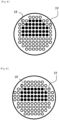
- the polyester-based thermoplastic resin A and the polyester-based thermoplastic resin B were caused to flow into a composite fiber spinneret having 36 ejection holes so as to have a mass composition ratio of 50 : 50 at a spinning temperature of 290°C, with disposition of distribution holes in a final distribution plate installed most downstream among a plurality of distribution plates being in a shape illustrated in Fig. 5.
- Example 5 is a schematic view of a final distribution plate of the false-twist textured yarn of the present invention according to Example 1, in which a group of distribution holes 19 of the polyester-based thermoplastic resin B is formed in an eccentric core-sheath type around a group of distribution holes 18 of the polyester-based thermoplastic resin A among distribution holes in the final distribution plate.
- the half drawn yarn was fed from a feed roller, and the obtained composite fiber was subjected to false-twist texturing at a processing speed of 400 m/min, a pin draw ratio of 1.40 times, a pin temperature of 80°C, a heater draw ratio of 1.20 times, a heater temperature of 170°C, a false twist coefficient of 28,000, and a twisting direction of S, to obtain a false-twist textured yarn having a fineness of 143 dtex.
- ATF 12 manufactured by TMT Machinery Co., Ltd.
- the false-twist textured yarn was used as the warp and the weft, and a woven fabric having a plain texture having a warp density of 105 yarns/2.54 cm and a weft density of 90 yarns/2.54 cm was produced.
- the woven fabric was further subjected to scouring, relaxation treatment, and intermediate thermal setting. Thereafter, the alkali weight reduction processing (weight reduction rate 20%) was performed to form a crack and a slit on the single yarn surface of the false-twist textured yarn, and as the dyeing step, dyeing was performed at a concentration of 1.0 owf% and a temperature of 130°C for 30 minutes using a disperse dye "Dystar Navy BlueS-GL", and finishing thermal setting was performed at 160°C. At this time, the apparent thick-to-thin ratio (D thick /D thin ) was 1.23, and the stretch recovery rate (CR) was 20.0%. The results are shown in Table 1.
- a false-twist textured yarn and a woven fabric were obtained in the same manner as in Example 1 except that the total fineness of the half drawn yarn was 270 dtex, the pin draw ratio was 1.45 times, and the heater draw ratio was 1.30 times in Example 1.
- the obtained false-twist textured yarn had an elongation recovery rate (CR) of 28.0% and the obtained woven fabric had an elongation rate of 25%, which means they had more excellent stretchability.
- CR elongation recovery rate
- a false-twist textured yarn and a woven fabric were obtained in the same manner as in Example 1 except that the pin draw ratio was 1.35 times and the heater draw ratio was 1.20 times in Example 1. The results are shown in Table 1.
- a false-twist textured yarn and a woven fabric were obtained in the same manner as in Example 1 except that the pin draw ratio was 1.20 times and the heater draw ratio was 1.35 times in Example 1. The results are shown in Table 1.
- a false-twist textured yarn and a woven fabric were obtained in the same manner as in Example 2 except that the number of spinneret holes was changed to obtain a half drawn yarn having a total fineness of 240 dtex and 48 single yarn filaments. The results are shown in Table 1.
- a woven fabric was obtained in the same manner as in Example 2 except that in the false-twisting step, a half drawn yarn made of polyethylene terephthalate fibers were joined as another thread before a heater to form a composite false-twist textured yarn in which the mixing ratio of the false-twist textured yarn was 63% at a heater draw ratio of the other thread of 1.50 times, and the warp density was 88 yarns/inch (2.54 cm) and the weft density was 75 yarns/inch (2.54 cm).
- the obtained woven fabric had a more excellent grainy feeling due to the difference in dyeability between the false-twist textured yarn and the other thread. The results are shown in Table 1.
- a half drawn yarn was obtained in the same manner as in Example 1 except that the number of spinneret holes and the inflow amount of the polyester-based thermoplastic resin were changed to obtain a half drawn yarn having a total fineness of 113 dtex and 24 single yarn filaments.
- a composite false-twist textured yarn and a woven fabric were obtained in the same manner as in Example 6 using this half drawn yarn as another thread.
- the obtained woven fabric had a more excellent grainy feeling due to the difference in dyeability between the false-twist textured yarn and the other thread, and further had a high CR of the other thread, and thus had excellent stretchability.
- Table 1 The results are shown in Table 1.
- a woven fabric was obtained in the same manner as in Example 2 except that yarn twisting was performed on the false-twist textured yarn obtained in Example 2 with a twist coefficient of 3000 in the twisting direction S.
- the convergence of the false-twist textured yarn was improved by the yarn twisting, the passability through the weaving step was good, and further, the stretchability and the resilience of the woven fabric were equivalent to those in the case of not performing yarn twisting.
- the results are shown in Table 1.
- a woven fabric was obtained in the same manner as in Example 2 except that yarn twisting was performed on the false-twist textured yarn obtained in Example 2 with a twist coefficient of 3000 in a twisting direction Z.
- the convergence of the false-twist textured yarn was improved by the yarn twisting, and the passability through the weaving step was good.
- the stretchability of the woven fabric was the same as that in the case where no yarn twisting was performed. The results are shown in Table 1.
- a woven fabric was obtained in the same manner as in Example 2 except that yarn twisting was performed on the false-twist textured yarn obtained in Example 2 with a twist coefficient of 10000 in the twisting direction S.
- the convergence of the false-twist textured yarn was improved by the yarn twisting, and the passability through the weaving step was good.
- the results are shown in Table 1.
- a woven fabric was obtained in the same manner as in Example 1 except that polyester having a weight-average molecular weight of 25,000 obtained by copolymerizing isophthalic acid (IPA) with respect to an acid component in an amount of 10 mol% was used as the polyester-based thermoplastic resin A.
- IPA isophthalic acid
- a woven fabric was obtained in the same manner as in Example 1 except that a polyester having a weight-average molecular weight of 19,000 was used as the polyester-based thermoplastic resin A. The results are shown in Table 1.
- a false-twist textured yarn and a woven fabric were obtained in the same manner as in Example 2 except that alkali weight reduction processing was not performed. Since the obtained woven fabric was not subjected to alkali weight reduction, cracks and slits were not formed, the glare suppression was low, and the worsted-wool appearance was poor. The results are shown in Table 2.
- Polyethylene terephthalate having a weight-average molecular weight of 20,000 was caused to flow into a fiber spinneret (round hole) having 36 discharge holes at a spinning temperature of 290°C. Threads ejected from the spinneret were cooled by an air-cooling device, oiled, and wound up with a winder at a speed of 2,600 m/min, to be stably wound up as a half drawn yarn having a total fineness of 240 dtex and 36 single yarn filaments.
- a false-twist texturing and a woven fabric were obtained in the same manner as in Example 2 except that this half drawn yarn was used.
- a false-twist textured yarn and a woven fabric were obtained in the same manner as in Example 2 except that polyethylene terephthalate having a weight-average molecular weight of 20,000 was used as the polyester-based thermoplastic resin A and polyethylene terephthalate having a weight-average molecular weight of 19,000 was used as the polyester-based thermoplastic resin B.
- the obtained woven fabric was poor in stretchability and had a small difference in molecular weight, so that sufficient unevenness was not obtained at the joint interface of the composite fiber, cracks cannot be formed, and since the degree of glare suppression was low, the worsted-wool appearance was poor.
- Table 2 The results are shown in Table 2.
- a woven fabric were obtained in the same manner as in Example 2 except that the spinneret used in Example 2, which was the spinneret of the distribution plate type, was replaced with a spinneret of the type described in Japanese Patent Laid-open Publication No. H09-157941 , to obtain a side-by-side type composite fiber constituted of the polyester-based thermoplastic resin A and the polyester-based thermoplastic resin B.
- the polyester-based thermoplastic resin A was exposed at the time of the composite fiber, and no slit was formed even when alkali weight reduction was performed, so that the degree of glare suppression was low and the worsted-wool appearance was poor.
- Table 2 The results are shown in Table 2.
- a woven fabric was obtained in the same manner as in Example 2 except that only draw was performed without passing through the twister of the false-twist texturing machine in Example 2.
- the obtained woven fabric had a smooth surface and was poor in dryness. The results are shown in Table 2.
- a false-twist texture having an apparent thick-to-thin ratio (D thick /D thin ) of 1.02 and a woven fabric were obtained in the same manner as in Example 2 except that pin draw was not performed and the heater draw ratio was 1.68 times in the false-twist texturing of Example 2.
- the thick-to-thin ratio of the false-twist textured yarn was small and the naturalness was low, and the structure in the longitudinal direction of the fiber was uniform, the orientation difference in the longitudinal direction of the molecules constituting the fiber was small, and cracks due to alkali weight reduction were not obtained, so that glare suppression was low, and the worsted-wool appearance was poor.
- Table 2 The results are shown in Table 2.
- a false-twist texture having an apparent thick-to-thin ratio (D thick /D thin ) of 3.20 was obtained at a pin draw ratio of 1.30 times and a heater draw ratio of 1.02 in the false-twist texturing in Example 2.
- a woven fabric was obtained in the same manner as in Example 2 except that the warp density was 88 yarns/inch (2.54 cm) and the weft density was 75 yarns/inch (2.54 cm).
- the obtained woven fabric had a large thick-to-thin ratio of the false-twist textured yarn and had a grain with mechanical contrasting density, and was poor in worsted-wool appearance. The results are shown in Table 2.
- a woven fabric were obtained in the same manner as in Example 2 except that the disposition of the distribution holes of the final distribution plate of the spinneret used was changed from that in Fig. 5 to Fig. 6 so that the value of the minimum value t min of the thickness t of the polyester-based thermoplastic resin B covering the polyester-based thermoplastic resin A increased by 10 times, to obtain a core-sheath type composite fiber constituted of the polyester-based thermoplastic resin A and the polyester-based thermoplastic resin B and having (t min /D) of 0.20.
- FIG. 6 is a schematic view of the final distribution plate according to the present Comparative Example 1, in which a group of distribution holes 19 of the polyester-based thermoplastic resin B is formed in an eccentric core-sheath type around a group of distribution holes 18 of the polyester-based thermoplastic resin A among distribution holes in the final distribution plate, but the minimum value t min of the thickness t is as described above.
- the polyester-based thermoplastic resin B covering the polyester-based thermoplastic resin A was thick, so that a joint interface was not exposed even when alkali weight reduction processing was performed, slits were not formed, and thus the degree of glare suppression was low, and the woven fabric was poor in worsted-wool appearance. In addition, the woven fabric was poor also in stretchability.
Landscapes
- Engineering & Computer Science (AREA)
- Textile Engineering (AREA)
- Mechanical Engineering (AREA)
- Chemical & Material Sciences (AREA)
- Chemical Kinetics & Catalysis (AREA)
- General Chemical & Material Sciences (AREA)
- Yarns And Mechanical Finishing Of Yarns Or Ropes (AREA)
Applications Claiming Priority (2)
| Application Number | Priority Date | Filing Date | Title |
|---|---|---|---|
| JP2022116920 | 2022-07-22 | ||
| PCT/JP2023/023110 WO2024018814A1 (ja) | 2022-07-22 | 2023-06-22 | 仮撚加工糸並びにこれを含む複合仮撚加工糸、撚糸、織編物及び衣類 |
Publications (1)
| Publication Number | Publication Date |
|---|---|
| EP4560059A1 true EP4560059A1 (en) | 2025-05-28 |
Family
ID=89617599
Family Applications (1)
| Application Number | Title | Priority Date | Filing Date |
|---|---|---|---|
| EP23842745.4A Pending EP4560059A1 (en) | 2022-07-22 | 2023-06-22 | False-twist textured yarn, and clothes, woven knitted product, twist yarn, and composite false-twist textured yarn including same |
Country Status (7)
| Country | Link |
|---|---|
| US (1) | US20260009167A1 (https=) |
| EP (1) | EP4560059A1 (https=) |
| JP (1) | JPWO2024018814A1 (https=) |
| KR (1) | KR20250038198A (https=) |
| CN (1) | CN119452130A (https=) |
| TW (1) | TW202415820A (https=) |
| WO (1) | WO2024018814A1 (https=) |
Families Citing this family (1)
| Publication number | Priority date | Publication date | Assignee | Title |
|---|---|---|---|---|
| WO2022158310A1 (ja) * | 2021-01-25 | 2022-07-28 | 東レ株式会社 | 複合繊維並びにこれを含む複合混繊繊維、織編物及び衣類 |
Family Cites Families (28)
| Publication number | Priority date | Publication date | Assignee | Title |
|---|---|---|---|---|
| US3626442A (en) * | 1969-08-26 | 1971-12-07 | Du Pont | Bicomponent polyester textile filament |
| JPS50123922A (https=) * | 1974-03-22 | 1975-09-29 | ||
| JPS6269820A (ja) * | 1985-09-24 | 1987-03-31 | Nippon Ester Co Ltd | 凹凸を有するポリエステル繊維とその製造法 |
| US6074751A (en) * | 1995-09-13 | 2000-06-13 | Toray Industries, Inc. | Composite textured yarn, a process for its production, woven or knitted fabrics made thereof, and an apparatus for producing it |
| JPH09157941A (ja) | 1995-11-30 | 1997-06-17 | Toray Ind Inc | 潜在捲縮性複合繊維及び製造方法 |
| JPH11315437A (ja) * | 1998-04-28 | 1999-11-16 | Unitika Ltd | 特殊断面ポリエステル加工糸及び織編物 |
| JP3692001B2 (ja) * | 2000-01-13 | 2005-09-07 | 三菱レイヨン株式会社 | 伸縮性織物 |
| JP2003293226A (ja) * | 2002-04-01 | 2003-10-15 | Nippon Ester Co Ltd | 潜在捲縮性ポリ乳酸複合繊維及びその不織布 |
| JP3545749B2 (ja) * | 2002-05-02 | 2004-07-21 | 帝人ファイバー株式会社 | 梳毛調布帛及びその製造方法 |
| JP3802471B2 (ja) | 2002-09-30 | 2006-07-26 | 三菱レイヨン株式会社 | ポリエステル複合マルチフィラメント繊維及びその製造方法並びにその織編物 |
| KR100667624B1 (ko) * | 2002-11-26 | 2007-01-11 | 주식회사 코오롱 | 고신축성 사이드 바이 사이드형 복합 필라멘트 및 그의제조방법 |
| KR100540558B1 (ko) * | 2003-11-04 | 2006-01-10 | 주식회사 효성 | 잠재 신축성 공기교락사 및 상기 사로 제조한 신축성스웨이드조 직물 |
| AU2005212087B9 (en) * | 2004-02-13 | 2011-01-06 | Toray Industries, Inc. | Leather-like sheeting and process for production thereof |
| KR100531617B1 (ko) * | 2004-03-25 | 2005-11-28 | 주식회사 효성 | 복합섬유 및 이의 제조방법 |
| CN100529248C (zh) * | 2004-08-02 | 2009-08-19 | 东丽株式会社 | 皮革状片状物及其制造方法 |
| JP5205841B2 (ja) * | 2006-07-12 | 2013-06-05 | 東レ株式会社 | 仮撚加工糸およびその製造方法 |
| JP4935721B2 (ja) * | 2007-03-19 | 2012-05-23 | 東レ株式会社 | 伸縮性シートとその製造方法 |
| JP2009138284A (ja) * | 2007-12-04 | 2009-06-25 | Opelontex Co Ltd | 交絡加工糸 |
| JP5703785B2 (ja) * | 2010-01-29 | 2015-04-22 | 東レ株式会社 | 複合口金 |
| JP5505030B2 (ja) * | 2010-03-30 | 2014-05-28 | 東レ株式会社 | 複合口金および複合繊維の製造方法 |
| JP5728936B2 (ja) * | 2010-12-27 | 2015-06-03 | 東レ株式会社 | 複合口金および複合繊維の製造方法 |
| JP2014173196A (ja) * | 2013-03-06 | 2014-09-22 | Gifu Univ | 混繊糸、織物および編み物、複合材料、並びに、複合材料の製造方法 |
| KR20150065517A (ko) * | 2013-12-05 | 2015-06-15 | 도레이케미칼 주식회사 | 인테리어용 저융점 폴리에스테르 가연사 및 그 제조방법 |
| RU2654403C2 (ru) * | 2014-04-09 | 2018-05-17 | Ниппон Стил Энд Сумитомо Метал Корпорейшн | Образованное штамповкой изделие, автомобильный конструктивный элемент, включающий в себя изделие, способ изготовления и устройство для изготовления образованного штамповкой изделия |
| JP6696288B2 (ja) * | 2016-04-26 | 2020-05-20 | 東レ株式会社 | 嵩高構造糸 |
| CN110088365B (zh) * | 2016-12-14 | 2022-06-07 | 东丽株式会社 | 偏心芯鞘复合纤维及混纤丝 |
| JP6454765B2 (ja) | 2017-09-19 | 2019-01-16 | ユニチカトレーディング株式会社 | ポリエステル複合仮撚糸及びその製造方法 |
| KR102756936B1 (ko) * | 2018-11-06 | 2025-01-21 | 도레이 카부시키가이샤 | 신축 가공사, 섬유제품, 복합구금 및 복합섬유의 제조 방법 |
-
2023
- 2023-06-22 WO PCT/JP2023/023110 patent/WO2024018814A1/ja not_active Ceased
- 2023-06-22 US US18/993,640 patent/US20260009167A1/en active Pending
- 2023-06-22 EP EP23842745.4A patent/EP4560059A1/en active Pending
- 2023-06-22 KR KR1020247035910A patent/KR20250038198A/ko active Pending
- 2023-06-22 JP JP2023539093A patent/JPWO2024018814A1/ja active Pending
- 2023-06-22 CN CN202380049312.9A patent/CN119452130A/zh active Pending
- 2023-07-14 TW TW112126335A patent/TW202415820A/zh unknown
Also Published As
| Publication number | Publication date |
|---|---|
| US20260009167A1 (en) | 2026-01-08 |
| WO2024018814A1 (ja) | 2024-01-25 |
| KR20250038198A (ko) | 2025-03-19 |
| JPWO2024018814A1 (https=) | 2024-01-25 |
| CN119452130A (zh) | 2025-02-14 |
| TW202415820A (zh) | 2024-04-16 |
Similar Documents
| Publication | Publication Date | Title |
|---|---|---|
| EP3556915B1 (en) | Eccentric core-sheath composite fiber and combined filament yarn | |
| US6276121B1 (en) | Crimped yarn, textile fabric, and process for preparing the same | |
| US10323341B2 (en) | Highly air-permeable woven fabric resistant to washing | |
| US20070071974A1 (en) | Scalloped oval bicomponent fibers with good wicking, and high uniformity spun yarns comprising such fibers | |
| EP4560059A1 (en) | False-twist textured yarn, and clothes, woven knitted product, twist yarn, and composite false-twist textured yarn including same | |
| EP4560060A1 (en) | Composite fiber, structural yarn, woven and knitted fabric, and clothing | |
| CN114144549A (zh) | 芯鞘型复合假捻丝及其制备方法 | |
| KR102479830B1 (ko) | 심초형 복합가연사 및 이의 제조방법 | |
| JP3621293B2 (ja) | 多色部分融着仮撚加工糸及びその製造方法 | |
| EP4283027A1 (en) | Composite fiber, composite mixed-filament fiber including same, woven/knitted fabric, and garment | |
| KR101938818B1 (ko) | 수축률이 다양한 폴리에스테르 복합사 및 이를 이용한 직물의 제조방법 | |
| EP4442875A1 (en) | Eccentric core-sheath composite false twisted yarn and woven/knitted fabric using same | |
| JP3992604B2 (ja) | ポリエステル混繊糸 | |
| JP2025086938A (ja) | 織編物、衣類及び織編物の製造方法 | |
| JP4863483B2 (ja) | 複合糸 | |
| JP2001214335A (ja) | 低収縮ポリエステル太細糸およびそれからなるポリエステル混繊糸 | |
| JP2003278039A (ja) | ポリエステル複合仮撚糸 | |
| JP2019123970A (ja) | 織物 | |
| JP2005194661A (ja) | ポリエステル混繊糸 | |
| WO2024185641A1 (ja) | 中空断面繊維並びにこれを含む加工糸、複合加工糸、撚糸、織編物及び衣類 | |
| JP2023144367A (ja) | 多層構造織物および衣料 | |
| CN120677278A (zh) | 聚酯纤维以及特里科经编织物 | |
| KR20230009069A (ko) | 심초형 복합가연사 및 이의 제조방법 | |
| JP2001172836A (ja) | 低収縮ポリエステル糸およびそれからなるポリエステル混繊糸 | |
| JP2019085676A (ja) | ポリエステル複合仮撚糸 |
Legal Events
| Date | Code | Title | Description |
|---|---|---|---|
| STAA | Information on the status of an ep patent application or granted ep patent |
Free format text: STATUS: THE INTERNATIONAL PUBLICATION HAS BEEN MADE |
|
| PUAI | Public reference made under article 153(3) epc to a published international application that has entered the european phase |
Free format text: ORIGINAL CODE: 0009012 |
|
| STAA | Information on the status of an ep patent application or granted ep patent |
Free format text: STATUS: REQUEST FOR EXAMINATION WAS MADE |
|
| 17P | Request for examination filed |
Effective date: 20250207 |
|
| AK | Designated contracting states |
Kind code of ref document: A1 Designated state(s): AL AT BE BG CH CY CZ DE DK EE ES FI FR GB GR HR HU IE IS IT LI LT LU LV MC ME MK MT NL NO PL PT RO RS SE SI SK SM TR |
|
| DAV | Request for validation of the european patent (deleted) | ||
| DAX | Request for extension of the european patent (deleted) |