EP4530471A2 - Pompe à vide à spirales et système de pompe à vide à spirales - Google Patents
Pompe à vide à spirales et système de pompe à vide à spirales Download PDFInfo
- Publication number
- EP4530471A2 EP4530471A2 EP25156934.9A EP25156934A EP4530471A2 EP 4530471 A2 EP4530471 A2 EP 4530471A2 EP 25156934 A EP25156934 A EP 25156934A EP 4530471 A2 EP4530471 A2 EP 4530471A2
- Authority
- EP
- European Patent Office
- Prior art keywords
- spiral
- drive shaft
- scroll vacuum
- vacuum pump
- scroll
- Prior art date
- Legal status (The legal status is an assumption and is not a legal conclusion. Google has not performed a legal analysis and makes no representation as to the accuracy of the status listed.)
- Pending
Links
Images











Classifications
-
- F—MECHANICAL ENGINEERING; LIGHTING; HEATING; WEAPONS; BLASTING
- F04—POSITIVE - DISPLACEMENT MACHINES FOR LIQUIDS; PUMPS FOR LIQUIDS OR ELASTIC FLUIDS
- F04C—ROTARY-PISTON, OR OSCILLATING-PISTON, POSITIVE-DISPLACEMENT MACHINES FOR LIQUIDS; ROTARY-PISTON, OR OSCILLATING-PISTON, POSITIVE-DISPLACEMENT PUMPS
- F04C18/00—Rotary-piston pumps specially adapted for elastic fluids
- F04C18/02—Rotary-piston pumps specially adapted for elastic fluids of arcuate-engagement type, i.e. with circular translatory movement of co-operating members, each member having the same number of teeth or tooth-equivalents
- F04C18/0207—Rotary-piston pumps specially adapted for elastic fluids of arcuate-engagement type, i.e. with circular translatory movement of co-operating members, each member having the same number of teeth or tooth-equivalents both members having co-operating elements in spiral form
- F04C18/0215—Rotary-piston pumps specially adapted for elastic fluids of arcuate-engagement type, i.e. with circular translatory movement of co-operating members, each member having the same number of teeth or tooth-equivalents both members having co-operating elements in spiral form where only one member is moving
-
- F—MECHANICAL ENGINEERING; LIGHTING; HEATING; WEAPONS; BLASTING
- F01—MACHINES OR ENGINES IN GENERAL; ENGINE PLANTS IN GENERAL; STEAM ENGINES
- F01C—ROTARY-PISTON OR OSCILLATING-PISTON MACHINES OR ENGINES
- F01C21/00—Component parts, details or accessories not provided for in groups F01C1/00 - F01C20/00
- F01C21/02—Arrangements of bearings
-
- F—MECHANICAL ENGINEERING; LIGHTING; HEATING; WEAPONS; BLASTING
- F04—POSITIVE - DISPLACEMENT MACHINES FOR LIQUIDS; PUMPS FOR LIQUIDS OR ELASTIC FLUIDS
- F04C—ROTARY-PISTON, OR OSCILLATING-PISTON, POSITIVE-DISPLACEMENT MACHINES FOR LIQUIDS; ROTARY-PISTON, OR OSCILLATING-PISTON, POSITIVE-DISPLACEMENT PUMPS
- F04C18/00—Rotary-piston pumps specially adapted for elastic fluids
- F04C18/02—Rotary-piston pumps specially adapted for elastic fluids of arcuate-engagement type, i.e. with circular translatory movement of co-operating members, each member having the same number of teeth or tooth-equivalents
- F04C18/0207—Rotary-piston pumps specially adapted for elastic fluids of arcuate-engagement type, i.e. with circular translatory movement of co-operating members, each member having the same number of teeth or tooth-equivalents both members having co-operating elements in spiral form
- F04C18/0246—Details concerning the involute wraps or their base, e.g. geometry
- F04C18/0253—Details concerning the base
- F04C18/0261—Details of the ports, e.g. location, number, geometry
-
- F—MECHANICAL ENGINEERING; LIGHTING; HEATING; WEAPONS; BLASTING
- F04—POSITIVE - DISPLACEMENT MACHINES FOR LIQUIDS; PUMPS FOR LIQUIDS OR ELASTIC FLUIDS
- F04C—ROTARY-PISTON, OR OSCILLATING-PISTON, POSITIVE-DISPLACEMENT MACHINES FOR LIQUIDS; ROTARY-PISTON, OR OSCILLATING-PISTON, POSITIVE-DISPLACEMENT PUMPS
- F04C18/00—Rotary-piston pumps specially adapted for elastic fluids
- F04C18/02—Rotary-piston pumps specially adapted for elastic fluids of arcuate-engagement type, i.e. with circular translatory movement of co-operating members, each member having the same number of teeth or tooth-equivalents
- F04C18/0207—Rotary-piston pumps specially adapted for elastic fluids of arcuate-engagement type, i.e. with circular translatory movement of co-operating members, each member having the same number of teeth or tooth-equivalents both members having co-operating elements in spiral form
- F04C18/0246—Details concerning the involute wraps or their base, e.g. geometry
- F04C18/0269—Details concerning the involute wraps
-
- F—MECHANICAL ENGINEERING; LIGHTING; HEATING; WEAPONS; BLASTING
- F04—POSITIVE - DISPLACEMENT MACHINES FOR LIQUIDS; PUMPS FOR LIQUIDS OR ELASTIC FLUIDS
- F04C—ROTARY-PISTON, OR OSCILLATING-PISTON, POSITIVE-DISPLACEMENT MACHINES FOR LIQUIDS; ROTARY-PISTON, OR OSCILLATING-PISTON, POSITIVE-DISPLACEMENT PUMPS
- F04C23/00—Combinations of two or more pumps, each being of rotary-piston or oscillating-piston type, specially adapted for elastic fluids; Pumping installations specially adapted for elastic fluids; Multi-stage pumps specially adapted for elastic fluids
- F04C23/001—Combinations of two or more pumps, each being of rotary-piston or oscillating-piston type, specially adapted for elastic fluids; Pumping installations specially adapted for elastic fluids; Multi-stage pumps specially adapted for elastic fluids of similar working principle
-
- F—MECHANICAL ENGINEERING; LIGHTING; HEATING; WEAPONS; BLASTING
- F04—POSITIVE - DISPLACEMENT MACHINES FOR LIQUIDS; PUMPS FOR LIQUIDS OR ELASTIC FLUIDS
- F04C—ROTARY-PISTON, OR OSCILLATING-PISTON, POSITIVE-DISPLACEMENT MACHINES FOR LIQUIDS; ROTARY-PISTON, OR OSCILLATING-PISTON, POSITIVE-DISPLACEMENT PUMPS
- F04C23/00—Combinations of two or more pumps, each being of rotary-piston or oscillating-piston type, specially adapted for elastic fluids; Pumping installations specially adapted for elastic fluids; Multi-stage pumps specially adapted for elastic fluids
- F04C23/008—Hermetic pumps
-
- F—MECHANICAL ENGINEERING; LIGHTING; HEATING; WEAPONS; BLASTING
- F04—POSITIVE - DISPLACEMENT MACHINES FOR LIQUIDS; PUMPS FOR LIQUIDS OR ELASTIC FLUIDS
- F04C—ROTARY-PISTON, OR OSCILLATING-PISTON, POSITIVE-DISPLACEMENT MACHINES FOR LIQUIDS; ROTARY-PISTON, OR OSCILLATING-PISTON, POSITIVE-DISPLACEMENT PUMPS
- F04C25/00—Adaptations of pumps for special use of pumps for elastic fluids
- F04C25/02—Adaptations of pumps for special use of pumps for elastic fluids for producing high vacuum
-
- F—MECHANICAL ENGINEERING; LIGHTING; HEATING; WEAPONS; BLASTING
- F04—POSITIVE - DISPLACEMENT MACHINES FOR LIQUIDS; PUMPS FOR LIQUIDS OR ELASTIC FLUIDS
- F04C—ROTARY-PISTON, OR OSCILLATING-PISTON, POSITIVE-DISPLACEMENT MACHINES FOR LIQUIDS; ROTARY-PISTON, OR OSCILLATING-PISTON, POSITIVE-DISPLACEMENT PUMPS
- F04C27/00—Sealing arrangements in rotary-piston pumps specially adapted for elastic fluids
- F04C27/005—Axial sealings for working fluid
-
- F—MECHANICAL ENGINEERING; LIGHTING; HEATING; WEAPONS; BLASTING
- F04—POSITIVE - DISPLACEMENT MACHINES FOR LIQUIDS; PUMPS FOR LIQUIDS OR ELASTIC FLUIDS
- F04C—ROTARY-PISTON, OR OSCILLATING-PISTON, POSITIVE-DISPLACEMENT MACHINES FOR LIQUIDS; ROTARY-PISTON, OR OSCILLATING-PISTON, POSITIVE-DISPLACEMENT PUMPS
- F04C2240/00—Components
- F04C2240/40—Electric motor
-
- F—MECHANICAL ENGINEERING; LIGHTING; HEATING; WEAPONS; BLASTING
- F04—POSITIVE - DISPLACEMENT MACHINES FOR LIQUIDS; PUMPS FOR LIQUIDS OR ELASTIC FLUIDS
- F04C—ROTARY-PISTON, OR OSCILLATING-PISTON, POSITIVE-DISPLACEMENT MACHINES FOR LIQUIDS; ROTARY-PISTON, OR OSCILLATING-PISTON, POSITIVE-DISPLACEMENT PUMPS
- F04C2240/00—Components
- F04C2240/50—Bearings
-
- F—MECHANICAL ENGINEERING; LIGHTING; HEATING; WEAPONS; BLASTING
- F04—POSITIVE - DISPLACEMENT MACHINES FOR LIQUIDS; PUMPS FOR LIQUIDS OR ELASTIC FLUIDS
- F04C—ROTARY-PISTON, OR OSCILLATING-PISTON, POSITIVE-DISPLACEMENT MACHINES FOR LIQUIDS; ROTARY-PISTON, OR OSCILLATING-PISTON, POSITIVE-DISPLACEMENT PUMPS
- F04C2240/00—Components
- F04C2240/60—Shafts
-
- F—MECHANICAL ENGINEERING; LIGHTING; HEATING; WEAPONS; BLASTING
- F04—POSITIVE - DISPLACEMENT MACHINES FOR LIQUIDS; PUMPS FOR LIQUIDS OR ELASTIC FLUIDS
- F04C—ROTARY-PISTON, OR OSCILLATING-PISTON, POSITIVE-DISPLACEMENT MACHINES FOR LIQUIDS; ROTARY-PISTON, OR OSCILLATING-PISTON, POSITIVE-DISPLACEMENT PUMPS
- F04C2240/00—Components
- F04C2240/80—Other components
- F04C2240/807—Balance weight, counterweight
-
- F—MECHANICAL ENGINEERING; LIGHTING; HEATING; WEAPONS; BLASTING
- F04—POSITIVE - DISPLACEMENT MACHINES FOR LIQUIDS; PUMPS FOR LIQUIDS OR ELASTIC FLUIDS
- F04C—ROTARY-PISTON, OR OSCILLATING-PISTON, POSITIVE-DISPLACEMENT MACHINES FOR LIQUIDS; ROTARY-PISTON, OR OSCILLATING-PISTON, POSITIVE-DISPLACEMENT PUMPS
- F04C2240/00—Components
- F04C2240/80—Other components
- F04C2240/808—Electronic circuits (e.g. inverters) installed inside the machine
-
- F—MECHANICAL ENGINEERING; LIGHTING; HEATING; WEAPONS; BLASTING
- F04—POSITIVE - DISPLACEMENT MACHINES FOR LIQUIDS; PUMPS FOR LIQUIDS OR ELASTIC FLUIDS
- F04C—ROTARY-PISTON, OR OSCILLATING-PISTON, POSITIVE-DISPLACEMENT MACHINES FOR LIQUIDS; ROTARY-PISTON, OR OSCILLATING-PISTON, POSITIVE-DISPLACEMENT PUMPS
- F04C29/00—Component parts, details or accessories of pumps or pumping installations, not provided for in groups F04C18/00 - F04C28/00
- F04C29/0042—Driving elements, brakes, couplings, transmissions specially adapted for pumps
-
- F—MECHANICAL ENGINEERING; LIGHTING; HEATING; WEAPONS; BLASTING
- F04—POSITIVE - DISPLACEMENT MACHINES FOR LIQUIDS; PUMPS FOR LIQUIDS OR ELASTIC FLUIDS
- F04C—ROTARY-PISTON, OR OSCILLATING-PISTON, POSITIVE-DISPLACEMENT MACHINES FOR LIQUIDS; ROTARY-PISTON, OR OSCILLATING-PISTON, POSITIVE-DISPLACEMENT PUMPS
- F04C29/00—Component parts, details or accessories of pumps or pumping installations, not provided for in groups F04C18/00 - F04C28/00
- F04C29/04—Heating; Cooling; Heat insulation
Definitions
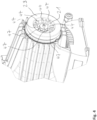
- the present disclosure relates to the improvement of scroll vacuum pumps and scroll vacuum pump systems with multiple scroll vacuum pumps of different designs.
- the scroll vacuum pumps each comprise a pumping system comprising a fixed spiral component and a movable spiral component cooperating with the latter for pumping purposes, a drive shaft rotating about an axis of rotation during operation with an eccentric section for driving the movable spiral component, and an electric drive motor for the drive shaft.
- Scroll vacuum pumps are generally known, e.g. from EP 3 153 708 A2 , EP 3 617 511 A2 and EP 3 647 599 A2 .
- a scroll pump is a positive displacement pump that compresses against atmospheric pressure and can be used, among other things, as a compressor.
- a scroll vacuum pump can be used to create a vacuum in a chamber connected to a gas inlet of the scroll vacuum pump.
- At least two bearing points spaced apart along the axis of rotation are provided for the rotary mounting of the drive shaft, wherein all bearing points are located on the side of the drive motor facing the eccentric section and/or between a front balancing weight and a rear balancing weight of the drive shaft.
- the drive motor is arranged at least partially, preferably completely, within the pump housing.
- the drive motor is surrounded by the pump housing in the circumferential direction over at least more than half of its axial length, preferably over its entire axial length.
- the positioning element can be inserted axially into a recess.
- the recess can be formed in the drive shaft.
- the recess can be formed jointly by the drive shaft on the one hand and a motor rotor of the drive motor or a radially inner sleeve element that is non-rotatably connected to the motor rotor of the drive motor on the other.
- the drive motor comprises a radially inner motor rotor and a radially outer motor stator, wherein the motor rotor is clamped between an abutment and the balancing weight placed on the rear end of the drive shaft.
- the drive motor comprises a radially inner motor rotor, which is pushed onto the drive shaft directly or by means of a radially inner sleeve element that is connected to the motor rotor in a rotationally fixed manner, in particular with a clearance fit, wherein a form-fitting connection effective in the circumferential direction is provided between the motor rotor and the sleeve element on the one hand and the drive shaft on the other hand.
- the positive connection can be formed by a positioning element of a positioning aid, which determines the circumferential positioning of the balancing weight relative to the drive shaft.
- the positioning element and/or the positioning aid can be the positioning element or the positioning aid described above.
- the motor rotor of the drive motor can be provided with a radially inner sleeve element that is connected to the motor rotor in a rotationally fixed manner and with which the motor rotor is pushed onto the drive shaft, in particular with a clearance fit.
- the sleeve element can be the sleeve element described above.
- the drive motor comprises a radially inner motor rotor and a radially outer motor stator, wherein the motor rotor is provided with a radially inner sleeve element which is connected to the motor rotor in a rotationally fixed manner and with which the motor rotor is pushed onto the drive shaft, in particular with a clearance fit.
- the sleeve element is in particular the sleeve element described above.
- the inner diameter of the motor rotor can be adapted to the outer diameter of the relevant section of the drive shaft. This can be advantageous, for example, in a system with several scroll vacuum pumps of different designs that differ from one another in terms of the inner diameter of the motor rotor. In particular, this makes it possible to use one drive shaft for different motor rotors.
- the sleeve element can be designed in one piece or in several parts.
- the motor rotor and the sleeve element can be pressed together.
- the sleeve element can be provided with a circumferential shoulder against which the motor rotor rests. This shoulder can form an abutment for the motor rotor, which can be clamped between this abutment and a clamping element.
- the clamping element can, for example, be mounted on the front side of the rear end of the drive shaft.
- the clamping element can be a balancing weight, in particular the balancing weight described above.
- the drive shafts of the different scroll vacuum pumps are of identical construction.
- the scroll vacuum pumps can differ from one another with regard to the inner diameter of a radially inner motor rotor of the drive motor, whereby sleeve elements with different wall thicknesses are provided to adapt the drive shafts to the different inner diameters, each of which is arranged between the drive shaft and the motor rotor.
- the motor rotors are each connected to the sleeve element in a rotationally fixed manner and are pushed onto the drive shaft with the sleeve element, in particular with a clearance fit.
- the drive shaft is provided with a front balancing weight and a rear balancing weight, wherein the front balancing weight and the rear balancing weight differ from each other with regard to the material from which they are made.
- the concept of using different materials for the balancing weights creates an additional parameter that can be varied to adapt the balancing weights to the respective conditions.
- the available space for a balancing weight may vary due to the different sizes of the pump systems. However, this does not necessarily mean that a smaller space also requires a smaller balancing mass, as the required balancing mass depends on the properties of the entire rotating system. In other words, in such a scroll vacuum pump system, it may be necessary to accommodate a comparatively large balancing mass in a comparatively small space. in order to meet the respective balancing requirements, while avoiding or at least minimizing constructive adjustments.
- Advantageous further developments can therefore provide for the material of one balancing weight to have a higher density than the material of the other balancing weight.
- the front balancing weight has a higher density. This allows pump systems of different sizes to be compensated for by balancing weights of different densities while maintaining the same dimensions of the remaining rotating system.
- the front balancing weight is made of brass and the rear balancing weight is made of steel.
- the scroll vacuum pumps differ in terms of the pumping system, wherein the drive shaft is provided with a front balancing weight and a rear balancing weight, and wherein the scroll vacuum pumps differ from one another in terms of the front balancing weight and/or the rear balancing weight.
- the drive shaft is provided with at least one balancing weight, wherein the balancing weight comprises several balancing sections which are arranged along a longitudinal axis, which in the installed state runs parallel to the axis of rotation of the drive shaft, and which each have a partial ring shape and enclose the drive shaft with their opening facing the drive shaft, and wherein the balancing sections differ from one another with regard to the width of their openings.
- the available installation space can be optimally utilized.
- the balancing weight having the different balancing sections can be the front balancing weight of the drive shaft, which also has a rear balancing weight.
- the opening widths of the balancing sections increase in the direction of the pump system.
- a balancing section is arranged relative to the axis of rotation of the drive shaft at the level of the eccentric section of the drive shaft.
- each balancing section can be defined in a plane perpendicular to the longitudinal axis by a pitch circle with a radius constant along the longitudinal axis, the openings of the balancing sections differing from one another with regard to the size of the radii.
- the partial circles are not arranged concentrically.
- the partial circles can each comprise an angle in the range of 120° to 180°, in particular in the range of 150° and 170°.
- the balancing weight can be made in one piece. This makes it possible to machine the balancing weight from a single workpiece.
- At least one pressure relief valve is arranged in each of the bypass channels.
- a pin-shaped positioning element 85 serves as a positioning aid for the respective pressure element 87 or 31, as an anti-twist device when tightening the central screw 83, and as a circumferentially effective positive connection between the motor rotor 21 or the sleeve element 33 on the one hand and the drive shaft 17 on the other.
- This positioning pin 85 extends parallel to the axis of rotation 15 of the drive shaft 17 and is arranged at a radial distance from the axis of rotation 15.
- the positioning pin 85 can be inserted in the axial direction into a recess formed jointly by the drive shaft 17 on the one hand and the motor rotor 21 or the sleeve element 33 connected to the motor rotor 21 in a rotationally fixed manner.
- the positioning pin 85 projects axially rearward and is received with its rear end in a positioning receptacle which is designed as a blind hole on the side of the pressure element 87 or 31 facing the rear end of the drive shaft 17.
- motor cover 103 is laser engraved (not shown). This facilitates variable design compared to printing.
- the drive motor is not completely arranged within the pump housing 41.
- the motor cover 103 has a receiving space that has an axial depth dimensioned such that the rear end of the drive motor, which projects axially rearwardly from the pump housing 41, is accommodated in this receiving space.
- the motor rotor 21 is also provided with cooling projections 47 projecting in the axial direction on its rear end face.
- cooling projections 47 are arranged only on this rear end face of the motor rotor 21, and the front end face of the motor rotor 21 does not have such cooling projections. This advantageously saves axial installation space.
- the cooling projections 47 are designed such that they each act as a balancing weight.
- the fixed spiral component 11 also referred to as the spiral housing, is screwed onto the front end of the pump housing 41 and is surrounded by a hood 105, which is also attached to the pump housing 41 and in which a fan 95 is also housed.
- a special feature of the scroll vacuum pump system is that it features a set of 95 fans with different performance levels, yet all of the same dimensions. Fans with a supply voltage of 24V are available, as well as those with a supply voltage of, for example, 48V or 230V. This increases the system's variability.
- the movable spiral component 13 is connected to the eccentric section 19 via a flange bearing 91 designed as a rolling bearing.
- a thrust washer 93 is located axially between the movable spiral component 13 and the eccentric section 19.
- a shim 94 is located between a circumferential shoulder of the drive shaft 17 at the transition to the eccentric section 19 and the flange bearing 91. The correct alignment in the circumferential direction between the stationary spiral component 11 and the pump housing 41 is ensured by a positioning pin 97.
- the pump housing 41 is supported on a base formed by an electronics housing 43.
- the electronics housing 43 comprises a housing part 43a, which is provided on its underside with rubber feet 107, which are received in recesses formed on the underside and are thus arranged countersunk.
- the electronics housings 43 of the various scroll vacuum pumps differ, among other things, in a housing cover 43b forming the lower cover of the housing part 43a. This will be discussed in more detail elsewhere.
- Each electronics housing 43 houses an electronics unit 45 comprising electronic, electrical, and electromechanical components that serve, among other things, to supply power and control the respective scroll vacuum pump.
- the scroll vacuum pumps of the scroll vacuum pump system according to the invention also differ from one another with regard to the electronics unit 45.
- a special feature of the scroll vacuum pump system according to the invention is that the housing parts 43a of the different scroll vacuum pumps are structurally identical.
- the housing parts 43a are each formed as a cast part. Consequently, despite different electronic equipment 45 for the individual scroll vacuum pumps, only one housing part 43a is required.
- the housing parts 43a differ slightly with regard to post-processing for adaptation to the respective electronic equipment 45.
- post-processing serves, for example, to adapt openings to the geometry of connectors or cables of the electronic equipment 45, which must be accommodated on the housing part or routed through a wall of the housing part.
- post-processing can consist of partially or completely removing the inner walls of a respective housing part 43a by milling in order to adapt the installation space available in the housing part 43a to the respective space requirements of the electronic equipment 45.
- the pump housing 41 is screwed to the electronics housing 43.
- the section BB at the bottom center shows the area of the scroll vacuum pump where a gas ballast valve is located.
- the gas ballast valves 79 are designed differently for the individual scroll vacuum pumps.
- the gas ballast valve 79 is provided with a cover 81.
- the gas ballast valve 79 each has a rotary knob 82 for making adjustments.
- the gas to be pumped enters the pumping system comprising the two spiral components 11, 13 via the inlet flange 77 and is expelled via the outlet flange 78.
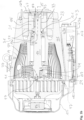
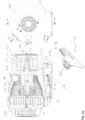
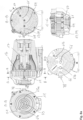
- the two scroll vacuum pumps according to Fig. 1a and 1b and 2a and 2b are each equipped with a three-phase asynchronous motor 21, 23 for driving the drive shaft 17.
- the two scroll vacuum pumps differ, among other things, in their size.
- the pump system with the two spiral components 11, 13 and the asynchronous motor with rotor 21 and stator 23 in the scroll vacuum pump according to Fig. 1a and 1b a smaller diameter than the scroll vacuum pump Fig. 2a and 2b , whereby - as already mentioned - the two drive shafts 17 are identical in construction and thus have the same size.
- the diameter of the drive shaft 17 in the area of the sleeve element 33 is 24 mm in this embodiment. To adapt the diameter of the drive shaft 17 in this area to the respective inner diameter of the motor rotor 21 is used - as already mentioned - the correspondingly dimensioned sleeve element 33 which is pressed onto the motor rotor 21.
- the pumping system also has a diameter that is larger than that of the scroll vacuum pump Fig. 1a and 1b
- the scroll vacuum pump system according to the invention is not limited to these electric drive motors.
- a synchronous reluctance motor can also be provided as the rotary drive for the drive shaft 17.
- the modular principle provided by the invention is particularly advantageous with regard to this variability desired in practice due to its diverse adaptability.
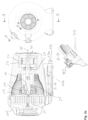
- the balancing system for balancing the rotating system comprising in particular the drive shaft 17 and the movable spiral component 13 of the pumping system comprises a front balancing weight 29 and a rear balancing weight 31.
- the rear balancing weight 31 is located in front of the rear bearing point 27.
- the pressure element 87 for clamping the motor rotor 21 is designed to be rotationally symmetrical.
- the front balancing weight 29 is made of a material with a higher density than the material of the rear balancing weight 31 due to the comparatively limited available installation space in the area of the eccentric section 19 of the drive shaft 17.
- the front balancing weight 29 is made of brass and the rear balancing weight 31 is made of steel.
- the two balancing weights 29, 31 are made of the same material, namely steel.
- the eccentric drive formed by the drive shaft 17 with the eccentric section 19 is located within the pump housing 41 and is surrounded by a deformable sleeve in the form of a bellows 89.
- the bellows 89 serves, on the one hand, to seal the eccentric drive from the suction area of the scroll vacuum pump and, on the other hand, to prevent rotation of the movable spiral component 13.
- the bellows 89 is attached to the side of the movable spiral component 13 facing the drive.
- the rear end of the bellows 89 is attached to a housing base within the pump housing 41 by means of screws.
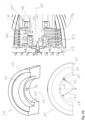
- Fig. 3c shows in sections perpendicular to the rotation axis 15 of the scroll vacuum pump Fig. 3a and 3b in the left illustration (section BB in Fig. 3b ) a view of the rear balancing weight 31 and in the right illustration (section AA in Fig. 3b ) the arrangement of a balancing section of the front balancing weight 39 in relation to the bellows 89, the flange bearing 91 and the eccentric section 19 of the drive shaft 17.
- the balancing section of the front balancing weight 29, shown in section is partially annular in shape such that the inner radius is adapted to the outer radius of the flange bearing 91. This allows for optimal use of the available installation space.
- FIG. 3d shows an enlarged section of the Fig. 3b the arrangement of the front balancing weight 29 in the area of the eccentric section 19 of the drive shaft 17 and the flange bearing 91.
- balancing sections 35 differ from each other in terms of the width of their openings 37. This is evident both from the perspective view at the top left in Fig. 3d as well as the top view at the bottom left in Fig. 3d can be found.
- a special feature is that the two radii R1, R2 are not the same size and the two pitch circles are not arranged concentrically, as is particularly evident the illustration below left in Fig. 3d can be seen.
- the center point of the rear balancing section 35 in the installed state lies on the axis of rotation 15, since this balancing section encompasses the central section 17b of the drive shaft 17.
- the other center point of the pitch circle with the larger radius R2 lies accordingly outside the openings 37 of the balancing sections 35.
- Fig. 3e The left shows three views of the rear balancing weight 31, illustrating its construction.
- the balancing weight 31 is constructed in one piece.
- the balancing weight 31 comprises two balancing sections 39 that flare conically outward.
- the balancing sections 39 each flare in a V-shape, defining an opening angle of approximately 20°.
- the balancing weight 31 comprises a circular cylinder section 40, the central axis of which, when installed, coincides with the rotational axis 15 of the drive shaft 17.
- the thickness of this circular cylinder section 40, measured along the rotational axis 15, is substantially smaller than the thickness of each balancing section 39.
- Fig. 3b can be removed, the balancing weight 31 with its circular cylinder section 40 is facing the rear end of the drive shaft 17 when installed.
- the example of the scroll vacuum pump according to Fig. 2a and 2b It can be seen that the balancing weight 31 with its circular cylinder section 40 is inserted into the sleeve element 33.
- the balancing section 39 located between the circular cylinder section 40 and the outer balancing section 39 is shortened in the radial direction compared to the outer balancing section 39, but is otherwise congruent with it and aligned to overlap it.
- Both balancing sections 39 thus widen in a V-shape, i.e., in a projection along the rotation axis 15, the outlines of the two balancing sections 39 are delimited by two straight lines that diverge radially outward in a V-shape.
- the two outlines of the balancing sections 39 are delimited by a radially inner circular section that has a smaller radius than a respective radially outer circular section, which forms the radially outer boundary of the respective outline.
- the rear balancing weight 31 allows for simple and cost-effective production as well as easy adaptation to the respective drive motor. However, adaptation is not absolutely necessary in every case.
- the rear balancing weight 31 can be designed in such a way that it can be used with the asynchronous motor of a scroll vacuum pump according to Fig. 2a and 2b , in particular with the sleeve element 33, as well as with the IPM motor of a scroll vacuum pump according to Fig. 3a and 3b can work together.
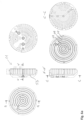
- a manufacturing arrangement 109 is shown in which a plurality of balancing weights 31 are arranged in a rosette-like manner on a circle. This illustrates that a plurality of balancing weights 31 can be manufactured by cutting from a flat material disc and subsequent individual machining.
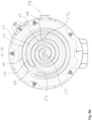
- Fig. 4 shows a view of the rear end of a scroll vacuum pump after Fig. 1a and 1b with the motor cover 103 removed. This shows the rear end face of the motor rotor 21, which is surrounded by a part of the motor stator 23.
- the housing cover 43b made of aluminum, for example, is placed on the underside of the housing part 43a.
- the underside is—like the recessed support surfaces in the housing part 43a according to Fig. 5a - provided with a sealing material, whereby additional the inside of the housing cover 43b is completely covered with a sealing material consisting, for example, of cellular rubber.
- This provides a particularly effective seal for the electronics housing 43 in order to meet the requirements of the higher protection class.
- the electronics housings 43 also differ in their respective electronic equipment 45.
- the electronics housing 43 according to Fig. 5a provided with a connection for a cold appliance plug 44, to which a power supply unit for supplying power to the scroll vacuum pump can be connected.
- the electronics housing 43 is Fig. 5b provided with a different mains plug 44, for example a mains plug of type Harting.
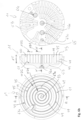
- Fig. 6a shows an overview of various views of a fixed spiral component 11, also referred to as a spiral casing, of a scroll vacuum pump according to the invention.
- the three upper views in Fig. 6a are enlarged in Fig. 6b shown, whereas the three lower representations of the Fig. 6a enlarged in Fig. 6c are shown.
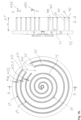
- FIG. 7a an overview with various representations of a movable spiral component 13, also referred to as orbiter, for the spiral casing 11 according to the Fig. 6a , 6b and 6c .
- the stationary spiral component 11 comprises a spiral arrangement with spiral walls 49 and spiral base 51, as well as a support 53 for the spiral arrangement.
- the two radially outer spiral walls 49 lie on concentric circles and are interrupted in the circumferential direction. This creates a parallel pumping structure consisting of parallel pumping channels formed by the respective spiral grooves 50, which merge into a helical pumping channel formed by a helical spiral groove 50 and delimited by a helical spiral wall 49.
- the second, partially circular spiral wall 49 viewed from the radially outer side, has a greater thickness WD2 than the spiral-shaped spiral wall 49, which has a wall thickness WD1 in its radially inner direction.
- WD2 3.71 mm
- WD1 3.47 mm.
- the stability of the circumferentially interrupted circular spiral wall 49 is increased by this increased thickness WD2.
- the spiral walls 49 are each provided at their end facing away from the spiral base 51 with an elongated sealing element 75, which is also referred to as a tip seal.
- the sealing element 75 for the radially outermost spiral wall 49 has a comparatively great length, since it continues to the further radially inner, spirally extending spiral wall 49 and reaches to the radially inner end of this spiral wall 49, located in the region of the central axis of the spiral casing 11.
- a special feature of this long sealing element 75 is that it is radially outer at the part-circular Spiral wall 49 is guided to the end 76 of this spiral wall 49, which extends to a gas inlet 67 (cf. Fig. 7a and 7b ) of the pumping system.
- the gas pumped from radially outside to radially inside along the spiral grooves 50 can exit the spiral grooves 50 via a central inlet opening 55 and two bypass openings 61a, 63a into a channel system of the stationary spiral component 11, described in more detail below.
- These openings 55, 61a, 63a are each formed in the spiral base 51.
- the two bypass openings 61a, 63a are arranged offset from one another in the circumferential direction and are located on the same radius with respect to a central axis of the spiral casing 11.
- openings 56a, 61c, 63c Aligned with these openings 55, 61a, 63a are openings 56a, 61c, 63c formed on the side of the support 53 facing away from the spiral arrangement. These openings 56a, 61c, 63c serve to accommodate valves, which will be discussed in more detail elsewhere.
- an axial outlet opening 65 is formed radially further outwards, which can optionally either be closed or form an axial gas outlet of the spiral housing 11 and thus of the pumping system of the scroll vacuum pump.
- the mentioned openings communicate with a channel system of the spiral casing 11, which is shown on the left and right in the illustrations.
- Fig. 6c is shown.
- the central inlet opening 55 leads to an outlet channel 59 designed as a straight bore, which opens at the radial outlet 57 of the spiral casing 11.
- One bypass opening 63a leads directly to this outlet channel 59.
- the channel section leading from there to the radial outlet 57 is thus not only a section of the outlet channel 59, but also forms a bypass channel 63 for gas originating from the bypass opening 63a.
- bypass channel 61 leads from the further bypass opening 61c to the outlet channel 59.
- This bypass channel 61 is part of a straight bore 64 which is introduced to produce the bypass channel 61.
- This bore 64 and the outlet channel 69 extend at an angle to one another which corresponds to the angular offset of the two bypass openings 61c, 63c in the circumferential direction.
- a further special feature of the pump system according to the invention which is evident in both the spiral casing 11 and the orbiter 13, is that the groove depth NT is comparatively large.
- the groove depth is 50 mm.
- the ratios are 3.93 and 3.87, respectively.
- a groove depth of 52 mm can be provided as an alternative. This then results in even larger ratios of groove depth to groove width.
- the movable spiral component 13 also comprises a spiral arrangement with spiral walls 69 and spiral base 71, as well as a plate-shaped support 73 for the spiral arrangement.
- the two radially outer spiral walls 69 extend on concentric circles and are interrupted in the circumferential direction in the region of a gas inlet 67.
- a radially inner spiral wall 69 extends spirally.
- the spiral walls 69 are in turn provided with a sealing element 75 (tip seal) at their end facing away from the spiral base 71.
- these spiral walls 69 are provided with a thickness WD2, which is greater than the thickness WD1 of the spiral spiral wall 69.
- WD2 3.71 mm
- WD1 3.46 mm.
- the radially outer spiral groove 70 between the two part-circular spiral walls 69 has a groove width NB2, while the spirally extending spiral groove 70 delimited by the spiral spiral wall 69 has a groove width NB1.
- NB2 12.92 mm
- NB1 12.58 mm.
- NT 50 mm
- a groove depth of 52 mm can be provided as an alternative. This then results in even larger ratios of groove depth to groove width.
- Fig. 8a shows in an overview different views of the spiral casing of Fig. 6a , 6b and 6c and the orbiter of Fig. 7a and 7b comprehensive pumping system of the scroll vacuum pump Fig. 3a and 3b
- the pumping system of the scroll vacuum pumps according to Fig. 1a and 1b as well as Fig. 2a and 2b is trained accordingly.
- Fig. 8b shows an enlarged view of the top left (section AA) of Fig. 8a .
- Fig. 8c shows an enlarged view of the top right (section BB) of Fig. 8a .
- Fig. 8d shows an enlarged view of the bottom right (section CC) of Fig. 8a .
- Fig. 8b The interaction of the interlocking spiral walls 49, 69 can be seen, which partially enclose crescent-shaped or sickle-shaped volumes.
- gas enters the chamber via the gas inlet 67, which is Fig. 8b only hinted at its position (see, for example, Fig. 7b ), inflowing gas to the center of the pumping system and via the inlet opening 55 into the outlet channel 59 when the outlet valve 56 (cf. e.g. Fig. 8d ) opens at sufficiently high pressure.
- the pumped gas passes through the outlet channel 59 to the radial outlet 57 and thus to the outlet flange 78, if - as in Fig. 8d shown - the axial outlet opening 65 is closed by means of a plug 66.
- Fig. 9 shows a concept referred to as a conical gap design which can be provided in the inventive scroll vacuum pumps according to the present disclosure, namely in the area where the spiral spiral wall 49 of the fixed scroll member interacts with the spiral spiral wall 69 of the movable scroll member.
- the numerical values indicate the radial distance (in mm) between the facing wall surfaces, i.e. the size of the radial gap between the wall surfaces.
- the scroll vacuum pump is not operating, i.e., the drive shaft is not rotating and the orbiter, and thus its spiral wall 69, is stationary.
- the spiral casing and the orbiter are at ambient temperature.
Landscapes
- Engineering & Computer Science (AREA)
- Mechanical Engineering (AREA)
- General Engineering & Computer Science (AREA)
- Applications Or Details Of Rotary Compressors (AREA)
- Rotary Pumps (AREA)
Priority Applications (1)
| Application Number | Priority Date | Filing Date | Title |
|---|---|---|---|
| EP25156934.9A EP4530471A3 (fr) | 2023-08-08 | 2023-08-08 | Pompe à vide à spirales et système de pompe à vide à spirales |
Applications Claiming Priority (2)
| Application Number | Priority Date | Filing Date | Title |
|---|---|---|---|
| EP25156934.9A EP4530471A3 (fr) | 2023-08-08 | 2023-08-08 | Pompe à vide à spirales et système de pompe à vide à spirales |
| EP23190388.1A EP4253720B1 (fr) | 2023-08-08 | 2023-08-08 | Pompe à vide à spirales et système de pompe à vide à spirales |
Related Parent Applications (2)
| Application Number | Title | Priority Date | Filing Date |
|---|---|---|---|
| EP23190388.1A Division EP4253720B1 (fr) | 2023-08-08 | 2023-08-08 | Pompe à vide à spirales et système de pompe à vide à spirales |
| EP23190388.1A Division-Into EP4253720B1 (fr) | 2023-08-08 | 2023-08-08 | Pompe à vide à spirales et système de pompe à vide à spirales |
Publications (2)
| Publication Number | Publication Date |
|---|---|
| EP4530471A2 true EP4530471A2 (fr) | 2025-04-02 |
| EP4530471A3 EP4530471A3 (fr) | 2025-07-02 |
Family
ID=87567462
Family Applications (4)
| Application Number | Title | Priority Date | Filing Date |
|---|---|---|---|
| EP24197627.3A Active EP4506537B1 (fr) | 2023-08-08 | 2023-08-08 | Pompe à vide à spirales |
| EP25156928.1A Pending EP4530470A3 (fr) | 2023-08-08 | 2023-08-08 | Pompe à vide à spirales et système de pompe à vide à spirales |
| EP23190388.1A Active EP4253720B1 (fr) | 2023-08-08 | 2023-08-08 | Pompe à vide à spirales et système de pompe à vide à spirales |
| EP25156934.9A Pending EP4530471A3 (fr) | 2023-08-08 | 2023-08-08 | Pompe à vide à spirales et système de pompe à vide à spirales |
Family Applications Before (3)
| Application Number | Title | Priority Date | Filing Date |
|---|---|---|---|
| EP24197627.3A Active EP4506537B1 (fr) | 2023-08-08 | 2023-08-08 | Pompe à vide à spirales |
| EP25156928.1A Pending EP4530470A3 (fr) | 2023-08-08 | 2023-08-08 | Pompe à vide à spirales et système de pompe à vide à spirales |
| EP23190388.1A Active EP4253720B1 (fr) | 2023-08-08 | 2023-08-08 | Pompe à vide à spirales et système de pompe à vide à spirales |
Country Status (3)
| Country | Link |
|---|---|
| EP (4) | EP4506537B1 (fr) |
| CN (1) | CN120693445A (fr) |
| WO (1) | WO2025032188A1 (fr) |
Families Citing this family (4)
| Publication number | Priority date | Publication date | Assignee | Title |
|---|---|---|---|---|
| EP4407183A1 (fr) | 2024-05-31 | 2024-07-31 | Pfeiffer Vacuum Technology AG | Pompe à vide à spirales et son procédé de mise en oeuvre |
| EP4467810A3 (fr) | 2024-07-15 | 2025-02-26 | Pfeiffer Vacuum Technology AG | Pompe à vide à spirales et procédé de fabrication d'une pompe à vide à spirales |
| EP4621238A3 (fr) * | 2025-07-16 | 2025-11-12 | Pfeiffer Vacuum Technology AG | Procédé de montage d'une pompe à vide à spirales |
| EP4636251A2 (fr) | 2025-09-09 | 2025-10-22 | Pfeiffer Vacuum Technology AG | Pompe à vide à spirales |
Citations (3)
| Publication number | Priority date | Publication date | Assignee | Title |
|---|---|---|---|---|
| EP3153708A1 (fr) | 2015-10-06 | 2017-04-12 | Pfeiffer Vacuum Gmbh | Pompe a spirales et procede destine au fonctionnement d'une pompe a spirales |
| EP3617511A2 (fr) | 2019-10-07 | 2020-03-04 | Pfeiffer Vacuum Gmbh | Pompes à spirales et procédé de fabrication pour des telles pompes |
| EP3647599A2 (fr) | 2019-10-07 | 2020-05-06 | Pfeiffer Vacuum Gmbh | Pompe à vide, pompe d'extraction et procédé de fabrication des telles pompes |
Family Cites Families (23)
| Publication number | Priority date | Publication date | Assignee | Title |
|---|---|---|---|---|
| GB809445A (en) * | 1954-02-27 | 1959-02-25 | Heraeus Gmbh W C | Improvements in or relating to rotary high vacuum pumps |
| JPS60206989A (ja) * | 1984-03-30 | 1985-10-18 | Mitsubishi Electric Corp | スクロ−ル形流体機械 |
| US6884047B1 (en) * | 2003-10-20 | 2005-04-26 | Varian, Inc. | Compact scroll pump |
| DE102006058842A1 (de) * | 2006-12-13 | 2008-06-19 | Pfeiffer Vacuum Gmbh | Vakuumpumpe mit Lüfter |
| FR2968731B1 (fr) * | 2010-12-13 | 2015-02-27 | Danfoss Commercial Compressors | Systeme thermodynamique equipe d'une pluralite de compresseurs |
| CN102817840B (zh) * | 2011-06-07 | 2014-08-27 | 思科涡旋科技(杭州)有限公司 | 一种带有绕动式推力轴承的涡卷式容积位移装置 |
| US9605676B2 (en) * | 2013-05-31 | 2017-03-28 | Emerson Climate Technologies, Inc. | Variable speed scroll compressor |
| JP6165576B2 (ja) * | 2013-09-30 | 2017-07-19 | 株式会社日立産機システム | スクロール式流体機械 |
| CN105443377A (zh) * | 2014-06-10 | 2016-03-30 | 丹佛斯(天津)有限公司 | 涡旋压缩机 |
| US10954944B2 (en) * | 2015-04-27 | 2021-03-23 | Emerson Climate Technologies, Inc. | Compressor having counterweight assembly |
| JP6325041B2 (ja) * | 2016-08-31 | 2018-05-16 | 三菱重工サーマルシステムズ株式会社 | スクロール流体機械およびチップシール |
| US11193490B2 (en) * | 2018-03-30 | 2021-12-07 | Kabushiki Kaisha Toyota Jidoshokki | Scroll compressor including bushing mounted on eccentric shaft containing cylindrical and auxiliary weight portions and balancer disposed above annular rotor remote from back pressure chamber |
| EP4336713A3 (fr) * | 2018-07-19 | 2024-06-05 | Agilent Technologies, Inc. | Système de pompage à vide comprenant une pompe à vide lubrifiée à l'huile |
| WO2020222827A1 (fr) * | 2019-04-30 | 2020-11-05 | Agilent Technologies, Inc. | Palier de butée à film d'huile double face dans une pompe à spirale |
| CN110159528B (zh) * | 2019-05-23 | 2020-11-17 | 浙江大学 | 一种双侧双槽并联式无油涡旋空压机 |
| CN110185614B (zh) * | 2019-06-26 | 2020-10-02 | 浙江大学 | 一种干式双涡旋真空泵 |
| JP2021014801A (ja) * | 2019-07-10 | 2021-02-12 | ダイキン工業株式会社 | スクロール圧縮機 |
| JP7220692B2 (ja) * | 2019-10-07 | 2023-02-10 | プファイファー・ヴァキューム・ゲーエムベーハー | 真空ポンプ、スクロールポンプ及びその製造方法 |
| EP3708840B1 (fr) * | 2020-07-22 | 2025-02-26 | Pfeiffer Vacuum Technology AG | Pompe à vide avec clapet antiretour |
| JP7534951B2 (ja) * | 2020-12-22 | 2024-08-15 | サンデン株式会社 | スクロール型圧縮機 |
| CN113431781A (zh) * | 2021-08-05 | 2021-09-24 | 临海市谭氏真空设备有限公司 | 干式涡旋真空泵 |
| EP3940234B1 (fr) * | 2021-09-29 | 2023-08-23 | Pfeiffer Vacuum Technology AG | Pompe et procédé de fabrication d'une couche antifriction |
| CN116470689A (zh) * | 2023-03-27 | 2023-07-21 | 北京通嘉宏瑞科技有限公司 | 一体轴式真空泵电机 |
-
2023
- 2023-08-08 EP EP24197627.3A patent/EP4506537B1/fr active Active
- 2023-08-08 EP EP25156928.1A patent/EP4530470A3/fr active Pending
- 2023-08-08 EP EP23190388.1A patent/EP4253720B1/fr active Active
- 2023-08-08 EP EP25156934.9A patent/EP4530471A3/fr active Pending
-
2024
- 2024-08-08 CN CN202480015459.0A patent/CN120693445A/zh active Pending
- 2024-08-08 WO PCT/EP2024/072497 patent/WO2025032188A1/fr active Pending
Patent Citations (3)
| Publication number | Priority date | Publication date | Assignee | Title |
|---|---|---|---|---|
| EP3153708A1 (fr) | 2015-10-06 | 2017-04-12 | Pfeiffer Vacuum Gmbh | Pompe a spirales et procede destine au fonctionnement d'une pompe a spirales |
| EP3617511A2 (fr) | 2019-10-07 | 2020-03-04 | Pfeiffer Vacuum Gmbh | Pompes à spirales et procédé de fabrication pour des telles pompes |
| EP3647599A2 (fr) | 2019-10-07 | 2020-05-06 | Pfeiffer Vacuum Gmbh | Pompe à vide, pompe d'extraction et procédé de fabrication des telles pompes |
Also Published As
| Publication number | Publication date |
|---|---|
| EP4506537C0 (fr) | 2025-10-08 |
| EP4506537A1 (fr) | 2025-02-12 |
| WO2025032188A1 (fr) | 2025-02-13 |
| EP4253720C0 (fr) | 2025-10-01 |
| EP4506536A1 (fr) | 2025-02-12 |
| EP4530470A3 (fr) | 2025-07-02 |
| EP4530470A2 (fr) | 2025-04-02 |
| EP4506537B1 (fr) | 2025-10-08 |
| EP4530471A3 (fr) | 2025-07-02 |
| CN120693445A (zh) | 2025-09-23 |
| EP4253720A3 (fr) | 2024-06-19 |
| EP4253720A2 (fr) | 2023-10-04 |
| EP4253720B1 (fr) | 2025-10-01 |
Similar Documents
| Publication | Publication Date | Title |
|---|---|---|
| EP4506537B1 (fr) | Pompe à vide à spirales | |
| DE69114245T2 (de) | Spiralverdichter. | |
| DE69618612T2 (de) | Einrichtung zur erzeugung einer nachgiebigen radialen andruckkraft mit hilfe eines gleitenden blocks für spiral verdrängermaschine | |
| DE102011001041B4 (de) | Magnetisch angetriebene Pumpenanordnung mit einer Mikropumpe mit Zwangsspuelung und Arbeitsverfahren | |
| EP2273124B1 (fr) | Pompe centrifuge et procédé d'équilibrage de la poussée axiale dans une pompe centrifuge | |
| DE19952296C2 (de) | Spiralmaschine, insbesondere Spiralverdichter | |
| DE19518101A1 (de) | Selbstansaugende Pumpe | |
| EP0671569A1 (fr) | Joint universel à rotation, notamment pour machine à vis sans fin excentrique | |
| DE10223958A1 (de) | Schneckenkompressor | |
| DE102009056231A1 (de) | Schneckenverdichter (Scroll-Verdichter) | |
| DE3521284C2 (fr) | ||
| DE69928172T2 (de) | Vacuumpumpe | |
| DE4322240A1 (de) | Hydraulische Zahnradmaschine (Pumpe oder Motor), insbesondere Innenzahnradmaschine | |
| DE10040020A1 (de) | Schraubenverdichter | |
| DE102017104063B4 (de) | Elektrische Gerotorpumpe mit Steuerspiegel | |
| EP4506536B1 (fr) | Pompe à vide à spirales et système de pompe à vide à spirales | |
| EP1343645A2 (fr) | Appareil de chauffage automobile comportant une pompe de recirculation de caloporteur integree | |
| DE69726477T2 (de) | Seitenkanalpumpe mit speziell geformten Schaufeln und Seitenkanälen | |
| EP4217610B1 (fr) | Groupe moteur-pompe | |
| DE4220830A1 (de) | Fluidverdichter | |
| DE4220713C2 (de) | Rotationskolbenverdichter | |
| DE9207087U1 (de) | Rotationskolbenmaschine | |
| DE4121510C2 (de) | Rotationskolbenverdichter mit einem geschlossenen Gehäuse | |
| DE4234055C2 (de) | Spiralkompressor | |
| DE19606856A1 (de) | Dynamische Dichtung für eine geschlossene Kreiselpumpe |
Legal Events
| Date | Code | Title | Description |
|---|---|---|---|
| PUAI | Public reference made under article 153(3) epc to a published international application that has entered the european phase |
Free format text: ORIGINAL CODE: 0009012 |
|
| STAA | Information on the status of an ep patent application or granted ep patent |
Free format text: STATUS: THE APPLICATION HAS BEEN PUBLISHED |
|
| AC | Divisional application: reference to earlier application |
Ref document number: 4253720 Country of ref document: EP Kind code of ref document: P |
|
| AK | Designated contracting states |
Kind code of ref document: A2 Designated state(s): AL AT BE BG CH CY CZ DE DK EE ES FI FR GB GR HR HU IE IS IT LI LT LU LV MC ME MK MT NL NO PL PT RO RS SE SI SK SM TR |
|
| REG | Reference to a national code |
Ref country code: DE Ref legal event code: R079 Free format text: PREVIOUS MAIN CLASS: F04C0027000000 Ipc: F01C0021020000 |
|
| PUAL | Search report despatched |
Free format text: ORIGINAL CODE: 0009013 |
|
| AK | Designated contracting states |
Kind code of ref document: A3 Designated state(s): AL AT BE BG CH CY CZ DE DK EE ES FI FR GB GR HR HU IE IS IT LI LT LU LV MC ME MK MT NL NO PL PT RO RS SE SI SK SM TR |
|
| RIC1 | Information provided on ipc code assigned before grant |
Ipc: F04C 27/00 20060101ALI20250526BHEP Ipc: F04C 25/02 20060101ALI20250526BHEP Ipc: F04C 23/00 20060101ALI20250526BHEP Ipc: F04C 18/02 20060101ALI20250526BHEP Ipc: F01C 21/02 20060101AFI20250526BHEP |
|
| STAA | Information on the status of an ep patent application or granted ep patent |
Free format text: STATUS: REQUEST FOR EXAMINATION WAS MADE |
|
| 17P | Request for examination filed |
Effective date: 20250922 |
|
| GRAP | Despatch of communication of intention to grant a patent |
Free format text: ORIGINAL CODE: EPIDOSNIGR1 |
|
| STAA | Information on the status of an ep patent application or granted ep patent |
Free format text: STATUS: GRANT OF PATENT IS INTENDED |