EP4520516A2 - Komponenten für schuhartikel mit leichten, selektiv gestützten textilkomponenten - Google Patents
Komponenten für schuhartikel mit leichten, selektiv gestützten textilkomponenten Download PDFInfo
- Publication number
- EP4520516A2 EP4520516A2 EP25154534.9A EP25154534A EP4520516A2 EP 4520516 A2 EP4520516 A2 EP 4520516A2 EP 25154534 A EP25154534 A EP 25154534A EP 4520516 A2 EP4520516 A2 EP 4520516A2
- Authority
- EP
- European Patent Office
- Prior art keywords
- base member
- upper base
- component
- support
- polymeric material
- Prior art date
- Legal status (The legal status is an assumption and is not a legal conclusion. Google has not performed a legal analysis and makes no representation as to the accuracy of the status listed.)
- Pending
Links
Images









Classifications
-
- A—HUMAN NECESSITIES
- A43—FOOTWEAR
- A43B—CHARACTERISTIC FEATURES OF FOOTWEAR; PARTS OF FOOTWEAR
- A43B23/00—Uppers; Boot legs; Stiffeners; Other single parts of footwear
- A43B23/22—Supports for the shank or arch of the uppers
- A43B23/227—Supports for the shank or arch of the uppers fixed on the outside of the shoe
-
- A—HUMAN NECESSITIES
- A43—FOOTWEAR
- A43B—CHARACTERISTIC FEATURES OF FOOTWEAR; PARTS OF FOOTWEAR
- A43B23/00—Uppers; Boot legs; Stiffeners; Other single parts of footwear
- A43B23/02—Uppers; Boot legs
- A43B23/0205—Uppers; Boot legs characterised by the material
-
- A—HUMAN NECESSITIES
- A43—FOOTWEAR
- A43B—CHARACTERISTIC FEATURES OF FOOTWEAR; PARTS OF FOOTWEAR
- A43B23/00—Uppers; Boot legs; Stiffeners; Other single parts of footwear
- A43B23/02—Uppers; Boot legs
- A43B23/0205—Uppers; Boot legs characterised by the material
- A43B23/0235—Different layers of different material
-
- A—HUMAN NECESSITIES
- A43—FOOTWEAR
- A43B—CHARACTERISTIC FEATURES OF FOOTWEAR; PARTS OF FOOTWEAR
- A43B23/00—Uppers; Boot legs; Stiffeners; Other single parts of footwear
- A43B23/02—Uppers; Boot legs
- A43B23/04—Uppers made of one piece; Uppers with inserted gussets
-
- A—HUMAN NECESSITIES
- A43—FOOTWEAR
- A43B—CHARACTERISTIC FEATURES OF FOOTWEAR; PARTS OF FOOTWEAR
- A43B23/00—Uppers; Boot legs; Stiffeners; Other single parts of footwear
- A43B23/08—Heel stiffeners; Toe stiffeners
-
- B—PERFORMING OPERATIONS; TRANSPORTING
- B05—SPRAYING OR ATOMISING IN GENERAL; APPLYING FLUENT MATERIALS TO SURFACES, IN GENERAL
- B05D—PROCESSES FOR APPLYING FLUENT MATERIALS TO SURFACES, IN GENERAL
- B05D3/00—Pretreatment of surfaces to which liquids or other fluent materials are to be applied; After-treatment of applied coatings, e.g. intermediate treating of an applied coating preparatory to subsequent applications of liquids or other fluent materials
- B05D3/02—Pretreatment of surfaces to which liquids or other fluent materials are to be applied; After-treatment of applied coatings, e.g. intermediate treating of an applied coating preparatory to subsequent applications of liquids or other fluent materials by baking
- B05D3/0254—After-treatment
-
- B—PERFORMING OPERATIONS; TRANSPORTING
- B29—WORKING OF PLASTICS; WORKING OF SUBSTANCES IN A PLASTIC STATE IN GENERAL
- B29D—PRODUCING PARTICULAR ARTICLES FROM PLASTICS OR FROM SUBSTANCES IN A PLASTIC STATE
- B29D35/00—Producing footwear
- B29D35/0054—Producing footwear by compression moulding, vulcanising or the like; Apparatus therefor
-
- B—PERFORMING OPERATIONS; TRANSPORTING
- B29—WORKING OF PLASTICS; WORKING OF SUBSTANCES IN A PLASTIC STATE IN GENERAL
- B29D—PRODUCING PARTICULAR ARTICLES FROM PLASTICS OR FROM SUBSTANCES IN A PLASTIC STATE
- B29D35/00—Producing footwear
- B29D35/02—Producing footwear made in one piece using a moulding technique, e.g. by injection moulding or casting
-
- B—PERFORMING OPERATIONS; TRANSPORTING
- B29—WORKING OF PLASTICS; WORKING OF SUBSTANCES IN A PLASTIC STATE IN GENERAL
- B29D—PRODUCING PARTICULAR ARTICLES FROM PLASTICS OR FROM SUBSTANCES IN A PLASTIC STATE
- B29D35/00—Producing footwear
- B29D35/12—Producing parts thereof, e.g. soles, heels, uppers, by a moulding technique
- B29D35/126—Uppers
Definitions
- Some aspects of the present invention relate to footwear components made from lightweight textile structures that are selectively supported at various areas to provide desired local characteristics.
- the textile structure will be formed at least in part by a circular knitting process, and it may constitute a sock or sock-type structure.
- the textile structure may be selectively supported, for example, by a support member bonded to it and/or by a support material coated to or embedded within fibers of the textile structure. Additional aspects of this invention relate to precursors to these components, to articles of footwear including one or more of these selectively supported components, to methods of making these footwear components, to articles of footwear containing these components, and/or to methods of making such articles of footwear.
- Conventional articles of athletic footwear include two primary elements, namely, an upper and a sole structure.
- the upper provides a covering for the foot that securely receives and positions the foot with respect to the sole structure.
- the upper may have a configuration that protects the foot and provides ventilation, thereby cooling the foot and removing perspiration.
- the sole structure is secured to a lower surface of the upper and generally is positioned between the foot and any contact surface.
- the sole structure supports the foot and may provide traction and help control potentially harmful foot motion, such as over pronation.
- the upper forms a void on the interior of the footwear for receiving the foot.
- the void has the general shape of the foot, and access to the void is provided at an ankle opening.
- the upper may extend over the instep and toe areas of the foot, along the medial and lateral sides of the foot, and around the heel area of the foot.
- a lacing system often is incorporated into the upper to allow selective changes to the size of the ankle opening and to permit the wearer to modify certain dimensions of the upper, particularly girth, to accommodate feet with varying proportions.
- the upper may include a tongue that extends under the lacing system to enhance the comfort of the footwear (e.g., to moderate pressure applied to the foot by the laces).
- the upper also may include a heel counter to limit or control movement of the heel.
- the sole structure generally incorporates multiple layers that are conventionally referred to as an "insole,” a “midsole,” and an “outsole.”
- the insole (which also may constitute a sock liner) is a thin member located within the upper and adjacent the plantar (lower) surface of the foot to enhance footwear comfort, e.g., to wick away moisture and provide a soft, comfortable feel.
- the midsole which is traditionally attached to the upper along the entire length of the upper, forms the middle layer of the sole structure and serves a variety of purposes that include controlling foot motions and attenuating impact forces.
- the outsole forms the ground-contacting element of footwear and is usually fashioned from a durable, wear-resistant material that includes texturing or other features to improve traction.
- aspects of this invention relate to footwear components made from lightweight textile structures (e.g., including circular knitted structures made from natural or synthetic fibers) that are selectively supported at various areas to provide desired local characteristics (such as stiffness or support), as well as to methods of making such components and articles of footwear containing such components. Additional aspects of this invention relate to uncured precursors to selectively supported footwear components and methods of incorporating such selectively supported components into footwear structures.
- lightweight textile structures e.g., including circular knitted structures made from natural or synthetic fibers
- Some aspects of this invention relate to methods of forming selectively supported upper components for articles of footwear. Some examples of these methods may include one or more of: (a) engaging an upper base member with a jig such that the upper base member surrounds a first portion of the jig, wherein the first portion of the jig is substantially flat and thin, e.g., having a substantially planar first surface, a substantially planar second surface opposite the first surface, and a thickness of less than 1 inch between the first and second surfaces (and in some examples, a thickness of less than 1 ⁇ 2 inch or less than % inch); (b) positioning a first support member adjacent a surface of the upper base member such that the upper base member is located between the first support member and the jig, wherein a surface of the first support member adjacent the surface of the upper base member includes a bonding or adhesive material (e.g., a hot melt layer); (c) applying a compressive force to the first and second surfaces of the jig through the upper base member and the first
- Additional aspects of this invention relate to the upper base members and/or footwear components produced by the various methods described above, as well as to precursors to these components.
- thermoset polymeric materials of this same type may be provided at one or more other areas of the upper base member.
- the different areas of the upper base member may have the same or different hardness or stiffness characteristics.
- the textile material of the upper base member may include one or more portions having uncured reactive polymeric material coating individual fibers and/or provided in interstitial spaces between individual fibers of the textile material, optionally wherein the "uncured" portion(s) of the upper base member has (have) thermoplastic properties.
- the reactive polymeric material(s) may be of the various types and/or have the various properties described above.
- Additional potential features in accordance with some aspects of this invention include precursors to components for articles of footwear like those described above, wherein the precursors include: (a) an upper base member including a textile material made from natural or synthetic fibers; and (b) a first reactive polymeric material coating individual fibers and/or provided in interstitial spaces between individual fibers of a first portion of the upper base member, wherein the first reactive polymeric material exhibits thermoplastic properties as long as it is not exposed to thermoset curing conditions and is capable of becoming a first cured, thermoset polymeric material after it is exposed to thermoset curing conditions.
- Uncured reactive polymeric materials of this same type (having the same or different compositions, concentrations, and/or application density levels) may be provided at one or more other areas of the upper base member as well.
- the reactive polymeric material(s) may be of the various types and/or have the various properties described above. Such components including uncured reactive polymeric material(s) may be stored, optionally for an extended period of time (days, weeks, months, etc.), and then the reactive polymeric material may be cured in a desired manner (e.g., optionally selectively cured in a desired areas of portions of the upper base member so as to provide a desired final shape and/or pattern of hardened or stiffened areas). In this manner, a large bulk of "uncured" footwear components may be produced and stored, and these components can then be available for further production as desired or needed.
- a desired manner e.g., optionally selectively cured in a desired areas of portions of the upper base member so as to provide a desired final shape and/or pattern of hardened or stiffened areas.
- the upper base member will include a single foot-insertion opening and an otherwise enclosed volume (e.g., a sock or sock-like structure, optionally one produced by a circular knitting process and having an open end and a closed end (e.g., closed by a sewn seam)). Additionally, these selectively supported footwear upper base members may be incorporated into overall footwear structures in relatively easy and simple manners.
- a single foot-insertion opening and an otherwise enclosed volume e.g., a sock or sock-like structure, optionally one produced by a circular knitting process and having an open end and a closed end (e.g., closed by a sewn seam)
- these selectively supported footwear upper base members may be incorporated into overall footwear structures in relatively easy and simple manners.
- Fig. 1A further shows all (100%) of this example jig 100 has having flat and parallel surfaces.
- the portion of the jig 100 (if any) that will extend outside of an upper base member during production processes may include a ball, hole, slot, groove, ridge, or other structure, e.g., to enable the jig 100 to be grasped or handled more easily (e.g., by robotic arms or other machinery, by an operator, etc.).
- Fig. 1B shows another example jig or base support structure 150.
- heating elements or resistors 154 are provided on one or both surfaces 152a, 152b of the jig 150.
- the heating elements or resistors 154 may be formed to have a flat structure and/or may be recessed into the surface(s) 152a, 152b such that the overall jig surface(s) 152a, 152b maintain substantially flat and/or substantially parallel characteristics as described above.
- a single heating element and/or single resistor 154 may be provided to simultaneously heat both sides or surfaces 152a, 152b of the jig 150 at a specific location. While the heating elements or resistors 154 may be powered in any desired manner, Fig.
- FIG. 1B illustrates conductor leads 156 for supplying power to the heating elements or resistors 154. No specific circuit arrangement is required (or should be implied from the representative conductor leads 156 shown in Fig. 1B ).
- flexible heating elements such as heating elements in/on a silicone base or membrane
- Flexible heating elements of suitable constructions are known and are commercially available.
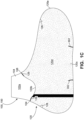
- Fig. 1C illustrates an upper base member 120 fit onto a substantially flat jig 100, 150, e.g., of the various types described above.
- the upper base member 120 constitutes a conventional ankle high sock structure, e.g., having a circular knit structure with one closed end 120a (optionally closed by a sewn seam) and one open end 120b, through which the jig 100, 150 is inserted into the enclosed interior chamber defined by the sock.
- the upper base member 120 While other circular knit and/or sock-type structures may be provided as an upper base member 120, in at least some examples of this invention, at least some of the upper base member 120 will constitute a textile component, e.g., formed from textile fibers, knitted, woven, and/or otherwise incorporated together.
- the jig 100, 150 may be shaped so as to substantially fill the interior chamber defined by the upper base member 120, but it may further include a portion 104 that extends out beyond the open end of the upper base member 120. This extending portion 104 may be used, for example, for engaging the jig 100, 150 with another component (e.g., manufacturing machinery) and/or for otherwise handling the jig 100, 150.
- the upper base member 120 may be specially shaped (different from a conventional sock, if desired) to better engage around and/or accommodate the jig 100, 150.
- the upper base member 120 and/or the jig 100, 150 may include markings, indentations, notches, and/or other components or indicia provided for alignment purposes (e.g., to assure that the upper base member 120 is properly oriented on the jig 100, 150 for further processing).
- Figs. 1A and 1B illustrate jigs 100, 150 as including one or more indicia 106 with which the top rim 126 of the upper base member 120 is to align when properly mounted on the jig 100 (see Fig. 1C ).
- footwear uppers provide various support and/or containment functions, such as shape support, heel area support (e.g., heel counter type structures), lace or other securing system supports, motion control functions, foot positioning functions, etc.
- some footwear uppers provide water-resistance, waterproofing features, stain resistance, dirt resistance, abrasion resistance, durability, and the like.
- footwear uppers may help provide desired aesthetics (e.g., colors and color combinations) to the overall shoe construction. Conventional socks, by themselves, or even if engaged with a separate footwear sole structure, may not provide all the desired functions of a footwear upper.
- a conventional sock or other upper base member 120 may be engaged with one or more "support members.”
- Figs. 2A-2C illustrate various example support members 200, 220, 240 of a "wrap around" type that are configured as contiguous (but optionally multi-part) structures that wrap around the bottom 120c of an upper base member 120 when mounted on a jig 100, 150 and extend along an exterior surface 120d of the upper base member 120 along both sides of the jig 100, 150.
- One or more "wrap around" support members 200, 220, 240 of this type may be provided with a single upper base member 120 without departing from this invention.
- Various example features of these support members 200, 220, and 240 are described in more detail below.
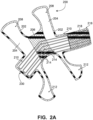
- Support member 200 ( Fig. 2A ) includes an exterior base component 202 to which additional support materials 204 are engaged on opposite sides of a central area 206 of the exterior base component 202.
- this example support member 200 will be oriented with respect to an upper base member (e.g., 120) in a manner such that the support materials 204 will directly face and contact opposite sides of the exterior surface (e.g., 120d) of the upper base member 120 on jig 100, 150.
- an underside or interior of the support member 200 is illustrated in Fig. 2A .
- the support member 200 includes side heel support areas 208 (for both the lateral and medial sides of the upper), instep/midfoot support areas 210 (for both the lateral and medial sides), and forefoot side edge support areas 212 (for both the lateral and medial sides).
- the exterior base component 202 is a non-woven textile and the additional supports 204 include EVA foams.
- Other example exterior base components 202 include, but are not limited to: polyurethanes, TPUs, suedes, leathers (natural or synthetic), spacer meshes, other textiles, and the like.
- Other example support materials 204, when present, include but are not limited to: polyurethanes or other foams, textiles, inelastic components, etc.
- Materials including the upper materials described in U.S. Patent No. 8,429,835 may be used for base component 202 and/or additional support materials 204.
- the additional support materials 204 when present, may be engaged with the exterior base component 202 in any desired manner, such as by adhesives or cements, by stitching or sewing, etc.
- the interior surface of the exterior base component 202 at these support areas 208, 210, and 212 in this example are predominantly covered by the additional support materials 204, although a greater or lesser coverage by the additional support material(s) 204 may be used without departing from this invention (in fact, if desired, support material(s) 204 could be eliminated from this structure).
- the central area 206 of the exterior base component 202 supports the arch area of a wearer's foot, and in this example, remains uncovered by additional supports material 204. While this illustrated central area 206 primarily supports the midfoot/arch area, support may be provided at the bottom heel, bottom forefoot, and/or any desired portion(s) or combination of portions of the plantar surface of the foot.
- any desired area, portion, or proportion of the base component 202 and/or the additional support material(s) 204 may include a bonding or adhesive agent (e.g., a layer) applied to it.
- a bonding or adhesive agent e.g., a layer
- at least some of the perimeter area of the base component 202 may include a bonding or adhesive material applied to it, such as a hot melt adhesive, a pressure sensitive adhesive, reactive polyurethane adhesives (PUR), etc.
- PUR reactive polyurethane adhesives
- the entire base component 202 and additional support material(s) 204, if any, will not be covered with the bonding or adhesive materials so as to allow some relative movement or flexibility between layers of the overall upper structure.
- the bonding or adhesive agent may be applied to the base component 202 and/or additional support material(s) 204 in any desired manner, such as by coating, spraying, printing, etc.
- the side instep/midfoot support areas 210 in this example structure 200 include elongated wire-like strands 214 of substantially inelastic material that extend along the sides and around the interior bottom central area 206 of the support member 200 at the midfoot area. These strands 214 help provide a close and adjustable fit around at wearer's foot (e.g., when a lace or other securing system is tightened).
- substantially inelastic as used herein in this context, means a material that does not increase in length more than 10% in a direction of an applied tensile force, under forces typically used in tightening a shoe lace around a human foot.
- a securing system for a footwear upper is provided as part of the support member 200 in this example construction. More specifically, the medial instep/midfoot support area 210 of this example structure includes a securing strap 216 at its free end. The free end of the securing strap 216 has one portion of a mechanical fastener 218 engaged with it (a portion of a hook-and-loop fastener, in this specific example, although a portion of a snap, buckle, or other securing component could be used).
- this securing strap 216 portion will extend over the instep area of the upper at the midfoot to engage another portion of a mechanical fastener 230 provided on the exterior surface of the exterior base component 202 at the lateral instep/midfoot support area (another portion of a hook-and-loop fastener, not visible in the view of Fig. 2A , but see Fig. 5B ).
- a mechanical fastener 230 provided on the exterior surface of the exterior base component 202 at the lateral instep/midfoot support area
- the strands 214 will at least partially wrap around the foot, holding and fitting the support member 200 to the wearer's foot.
- Fig. 2B illustrates another example support member 220 that may be engaged with an upper base member, like member 120 shown in Fig. 1C .
- This example support member 220 is similar to that shown in Fig. 2A and includes an exterior base component 202 to which additional support materials 204 are engaged on opposite sides of a central area 206 of the exterior base component 202.
- this example support member 220 will be oriented with respect to an upper base member (e.g., 120) in a manner such that the additional support materials 204 will directly face and contact opposite sides of the exterior surface (e.g., 120d) of the upper base member 120.
- an underside or interior of the support member 220 is illustrated in Fig. 2B .
- a bonding or adhesive material e.g., of the types described above, may be provided on some or all of the interior surface(s) of exterior base component 202 and/or additional support material(s) 204.
- this example support member 220 includes side heel support areas 208 (for both the lateral and medial sides) and forefoot side edge support areas 212 (for both the lateral and medial sides).
- each side of the interior of support member 220 includes two separate areas of additional support material 204 (e.g., made of EVA or other material as described above). More specifically, as shown in Fig.
- the exterior base component 202 of this support member 220 may be made of a material such that the strip(s) 226 provided along the instep/midfoot sides are substantially inelastic.
- Substantially inelastic strips 226 of this type also called “bands” or “straps” herein) can provide at least some of the fit and securing functions of the substantially inelastic strands 214 described above in conjunction with Fig. 2A .
- Fig. 2C illustrates another example support member 240.
- This support member 240 is similar to those illustrated in Figs. 2A and 2B , and the same reference numbers are used to refer to the same or similar parts (and the detailed description thereof is omitted).
- each individual strip 226 has one or more substantially inelastic strands 214 engaged with it.
- each strip 226 includes a single strand 214 engaged with it, and the strands 214 extend beyond the free end of each strip 226 to form an exposed loop 228.
- the exposed loop 228 may be used to engage a shoe lace or other securing system for the upper.
- the opposite ends of the strands 214 extend down the strip 226 and toward the central area 206 and engage to at least one of and/or between the exterior base component 202 and/or the additional support material 204.
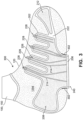
- the overall combination or assembly of the jig 100, 150, upper base member 120, and support member 240 is represented in Fig. 3 by reference number 300.
- Multiple support members may be provided on a single upper base member 120, if desired, including separate support members on each side of jig/upper base member, if desired.
- alignment aids and/or indicia may be removable (e.g., washed off, etc.) so that they do not appear in the final upper construction. Additionally or alternatively, if desired, features of the alignment aids and/or indicia may be incorporated to blend into and/or form a portion of an overall aesthetic design of the upper component.
- connection of the assembly 300 to the conveyance system further may include electrical connections and/or hardware/connectors for other components necessary or desired for the production process (e.g., connections or hardware for heating elements 154, for heating/coolant flow, for inductive heating, etc.).
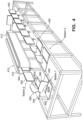
- the portion of the assembly 300 located between the pressure plates 402 when closed and under compressive force may be less than 1 inch thick, and in some examples, less than 3 ⁇ 4 inch thick, less than 1 ⁇ 2 inch thick, or even less than 1 ⁇ 4 inch thick.
- the zone 410 may include programmable components to allow application of controlled and programmable heating, pressing, and/or cooling protocols to the assembly 300. Also, if desired, the zone 410 may include coils and/or other appropriate components to induce inductive heating of jig 100.
- the applied heat and/or pressure in zone 410 optionally heating the hot melt material on support 202/204 from inside and through the material of the upper base member 120, causes the hot melt material of the support member 200, 220, 240 to melt (and optionally draw into the structure of the upper base member 120 toward the heat source), which adheres the support member 240 to the upper base member 120.
- the entire assembly 300 is attached to and removed from the pressure plates 402 and/or an area between pressure plates 402.
- jigs 100, 150 may remain engaged with (optionally removably engaged with) the pressure plate(s) 402.
- the upper base member 120 and support member(s) 200, 220, 240 may be engaged and properly positioned with respect to one another and with respect to the jig 100, 150
- the combined upper base member 120 and support member(s) 200, 220, 240 may be removed from its respective jig 100, 150 as a combined, unitary, single component 420.
- This combined, unitary, single component 420 which may be comprised of a sock or sock-type component 120 having one or more support components 200, 220, 240 adhered to it by a bonding or adhesive material, then may be used for constructing an article of footwear as will be described in more detail below in conjunction with Figs. 5A-5D .
- the combined, unitary, single footwear components 420 produced by the process described in conjunction with Fig. 4 may be stored until needed for further production. Their relatively flat production and structure at this time in the process makes storage and handling very space efficient. Also, because the overall components 420 may have some flexibility and stretchability (e.g., because of the sock-type construction of the upper base member 120), a single sized upper component 420 (with a single sized support member 200, 220, 240 engaged with it) may be used for a range of final footwear sizes (e.g., for a range of 2-6 conventional shoe sizes in length and/or for a range of 2-6 conventional shoe sizes in width, and in some examples, for a range of 2-4 conventional shoe sizes in length and/or for a range of 2-4 conventional shoe sizes in width). This feature can save significant tooling and/or inventory costs (e.g., as compared to tooling/inventory costs associated with building molds and/or maintaining inventories for upper components at every specific size interval).
- the item pressed may have a three-dimensional structure.
- the jig and pressure plates could be designed to have complementary shaped surfaces so as to allow pressure to be applied around the structure in various different directions.
- a three-dimensional jig and upper base member 120 (with one or more support members engaged therewith) could be mounted in a vacuum chamber in which an outer surface pulls inward under vacuum pressure to apply compressive force to the upper base member and jig surfaces inside the chamber.
- some or all of the support member 200, 220, 240 may be shaped and/or otherwise treated so as to be formed into and/or maintained in a desired shape (e.g., using thermoplastic or thermosetting properties, using shape memory materials, etc., the shape of at least some portion of the upper component 420 (e.g., support member 200, 220, 240) may be modified). Additionally or alternatively, if desired, at least some portions of the support member 200, 220, 240 and/or the upper base member 120 may be maintained in the desired shape at this stage solely by the presence of the underlying support base 500.
- a desired shape e.g., using thermoplastic or thermosetting properties, using shape memory materials, etc.
- the shape of at least some portion of the upper component 420 e.g., support member 200, 220, 240
- at least some portions of the support member 200, 220, 240 and/or the upper base member 120 may be maintained in the desired shape at this stage solely by the presence of the underlying support base 500.
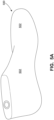
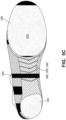
- Figs. 5B and 5C illustrate an example footwear component 420 in which a support member 200 like that illustrated in Fig. 2A is engaged with the upper base member 120.
- the upper base member 200 includes a securing flap 216 having a portion of a fastener system on its underside (218, see Fig. 2A ) that engages a portion of the fastener system 230 included at the exterior surface of the support member 200.
- the flap 216 extends over the wearer's instep area from one side of component 420 to the other and secures the upper to the wearer's foot in use.
- the bottom plantar support surface ( Fig. 5C ) is a continuous structure such that no strobel element and/or bottom seam is needed to close off the foot-receiving chamber.
- the rear heel area of this example upper base member 120 constitutes a continuous structure without the need for a rear heel seam and/or sewing step.
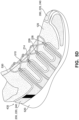
- the upper component 420 may be engaged with at least a portion of a sole structure for an article of footwear.
- the upper component 420 (including an upper base member 120 and one or more support members 200, 220, 240) may be engaged with a midsole impact force attenuating component, such as one or more midsole foam elements 520 as shown in Fig. 5D .
- any desired manner of connecting these components 420 and 520 may be used without departing from this invention, including manners conventionally known or used in the footwear art, such as one or more of: adhesive or cements (e.g., applied to portions of the exterior bottom and/or side surfaces of the upper component 420, applied to the top surface of the midsole component 520, etc.); mechanical connectors, such as hook-and-loop type fasteners (optionally releasable mechanical connectors); sewing or stitching; etc.
- adhesive or cements e.g., applied to portions of the exterior bottom and/or side surfaces of the upper component 420, applied to the top surface of the midsole component 520, etc.
- mechanical connectors such as hook-and-loop type fasteners (optionally releasable mechanical connectors); sewing or stitching; etc.
- any desired type of midsole component construction may be applied to the upper component 420 without departing from this invention, including, for example, midsole components including one or more fluid-filled bladders, midsole components including one or more foam impact force absorbing columns, midsole components including mechanical impact force absorbing columns or elements, etc.
- the bottom surface of midsole component 520 may be structured to provide natural motion, traction, and/or durability and/or to otherwise engage a contact surface in use.
- Additional sole components or structures may be applied to the midsole component 520 and/or the upper component 420 without departing from the invention, such as one or more outsole elements (e.g., rubber or TPU ground contacting pads), cleat base components, cleats (permanently or removably mounted), cup-sole components, etc.
- outsole elements e.g., rubber or TPU ground contacting pads
- cleat base components e.g., rubber or TPU ground contacting pads
- cleats e.g., cleat base components
- cleats permanently or removably mounted
- cup-sole components e.g., cup-sole components, etc.
- any desired manner of connecting the outsole element(s) to the remainder of the structure may be used without departing from this invention, including manners conventionally known or used in the footwear art, such as one or more of: adhesive or cements, mechanical connectors, sewing or stitching, etc.
- This support member 600 and upper base component 602 combination may be engaged with a sole structure, e.g., in the manners described herein (including in the manner described above with respect to Figs. 5A-5D ).
- Figs. 6A and 6B further illustrate that the upper base component 602 may have an extended upper area 606 that extends up to or even beyond a wearer's ankle (and optionally beyond the top of support base 500). If desired, this upper area 606 may be constructed and fit like a conventional sock (e.g., as a circular knitted construction).
- the example of Figs. 6A and 6B lacks the additional support materials 204 shown in some of the other example support members 200, 220, 240.
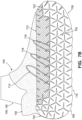
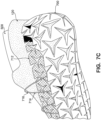
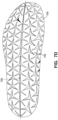
- FIGs. 7A through 7D illustrate an example construction in which a ground engaging sole structure is directly engaged with an upper base member 120 rather than to an upper base component that includes a support member 200, 220, 240, e.g., as shown in the other figures.
- Fig. 7A shows an example sole component 700 formed as an integral web of generally triangular shaped pods 702 (e.g., in a tessellated configuration). Sole structures of this type also are described in U.S. Patent Appln. No.
- FIG. 7B and 7C further shows a substantially flat upper support member 712 engaged with the upper base member 120, e.g., for providing shape or support for the sides of the final footwear component.
- the upper support member 712 and the sole structure 700 may overlap and/or may be applied to the upper base member 120 in a single flat pressing step.
- Substantially inelastic strands 714 also are provided, optionally with looped or closed free ends (716), for wrapping around the sides and/or bottom of the foot and/or supporting a lace or other type closure system.
- the overall combination 750 shown in Fig. 7B (e.g., jig 100, 150, upper base member 120, upper support(s) 712 (if any), and sole structure 700) can be pressed together, e.g., in a process like those described in conjunction with Figs. 3 and 4 , to engage the upper support(s) 712 (if any) and/or sole structure 700 with an exterior surface of the upper base member 120, e.g., using a hot melt adhesive. Then, if desired, as shown in Figs.
- the combined upper base member 120, upper support(s) 712 (if any), and sole structure 700 may be engaged over a base support 500 for further shaping (e.g., using thermoplastic or thermosetting properties, using shape memory materials, etc., the shape of at least some portion(s) of the upper component may be temporarily or permanently modified).
- the sole member 700 in this illustrated example wraps around the side and rear heel areas 720 to provide additional support for the heel (e.g., akin to a type of heel counter construction) and extends upward at the forward toe area 722 to provide additional stiffness or structure around the toe area.
- at least some areas of the sole member 700 may be somewhat thicker (e.g., include a foam material), e.g., to provide impact force attenuation properties.
- the combined upper base member 120, upper support(s) 712 (if any), and sole structure 700 may be worn directly as an article of footwear, for example, if exterior surfaces of at least some of the pod areas 702 of the sole structure 700 are formed to include a material suitable for use as a ground-contacting surface (e.g., having sufficient wear resistance, traction characteristics, and the like to function in a desired manner for contacting the ground).
- a ground-contacting surface e.g., having sufficient wear resistance, traction characteristics, and the like to function in a desired manner for contacting the ground.
- other sole components may be engaged with one or more of the pod areas 702 of the sole structure 700, such as one or more outsole components (e.g., rubber, thermoplastic polyurethanes, etc.); one or more traction elements (e.g., cleats or spikes, bases for mounting cleats or spikes, etc.); etc.
- the additional sole component(s) when present, may be engaged with the sole structure 700 or other footwear component(s) in conventional manners as are known or used in the art, such as by bonding (using adhesives or cements), by mechanical connectors, by sewing or stitching, etc.
- a substantially flat jig 100, 150 to which a single piece upper base member 120 (e.g., a sock or sock-type structure) was applied.
- At least one single piece support member 200, 220, 240 was wrapped around a bottom 120c of the upper base member 120 (akin to a taco shell) to lie adjacent the opposing flat sides of the upper base member 120.
- Other options are possible. For example, for at least some materials, after pressing, a permanent crease is formed at the bottom of the upper base member 120 and/or the support member 200, 220, 240 (at the location of the fold).
- This crease can be undesirable (e.g., aesthetically displeasing, uncomfortable feeling to the bottom of the foot, adversely impacting bonding with other footwear components, etc.).
- Various ways of avoiding the issues created by this crease may be used in some methods according to this invention. For example, if possible, additional heat and/or pressure may be applied to the creased area over a flat or rounded surface to eliminate or reduce the severity of the crease (e.g., akin to ironing out the crease).
- the underlying sole component e.g., midsole foam
- the underlying sole component may be formed to include a sufficiently soft plantar support surface and/or with a corresponding groove in the plantar support surface (to accommodate the fold line) so that the crease is not substantially felt by the wearer.
- an underlying sole component of this type could be used to moderate the feel of inelastic strands (if any) that extend beneath the foot, like those shown in Fig. 2A , and particularly looped inelastic strands like those shown in Fig. 6B .
- Fig. 2B illustrates an alternative configuration of a two-piece support member 220 in broken lines in which the bottom area 206 of support member 220 is separated or cut to form a lateral side of the support member 220 (including free edge 206L at the bottom area 206) separated from a medial side of the support member 220 (including free edge 206M at the bottom area).
- a support member 200, 220, 240 can be used. More specifically, as one example, the lateral side of support member 220 and the separate medial side of support member 220 shown in Fig. 2B ), with their bonding or adhesive material containing sides oriented upward, may be releasably and temporarily fixed to the exposed surfaces 402a of pressure plates 402.
- This releasable and temporary engagement of the support members 220 to the pressure plate surfaces 402a may be accomplished in any desired manner, for example, using a light adhesive, electrostatic charge, vacuum attachment, or the like (e.g., any method providing sufficient holding force to hold the support members 220 in position with respect to the pressure plate surface 402a during transport (e.g., from Station 1 to Station 2) and/or while the pressure plates 402 move to engage against the sides of upper base member 120).
- a light adhesive, electrostatic charge, vacuum attachment, or the like e.g., any method providing sufficient holding force to hold the support members 220 in position with respect to the pressure plate surface 402a during transport (e.g., from Station 1 to Station 2) and/or while the pressure plates 402 move to engage against the sides of upper base member 120).
- the support members 220 do not extend continuously and wrap around the bottom edge of the upper base member 120 and the jig, the heating and pressure applying steps will not produce a crease or fold line on the support member(s) 2
- some aspects of this invention relate to footwear components made from lightweight textile structures that are selectively supported at various areas to provide desired local characteristics, as well as to methods of making such components.
- the embodiments of the invention described in Figs. 1A-7D describe various pressing methods of making footwear components using a sock or sock-type structure as an upper base member.
- a sock or sock-type structure as the upper base member is advantageous because of the soft, flexible, and conforming fit and feel provided by conventional sock and sock-type structures (e.g., circular knitted fabric components made from natural and/or synthetic fiber containing materials, optionally having a closed toe end and an open end for inserting the foot) and because such structures eliminate various other processing steps, such as engagement of the upper with a strobel or bottom, plantar support surface and/or other sewing steps (e.g., to close the bottom and/or heel area of the upper).
- conventional sock and sock-type structures e.g., circular knitted fabric components made from natural and/or synthetic fiber containing materials, optionally having a closed toe end and an open end for inserting the foot
- such structures eliminate various other processing steps, such as engagement of the upper with a strobel or bottom, plantar support surface and/or other sewing steps (e.g., to close the bottom and/or heel area of the upper).
- Additional aspects of this invention relate to other ways of providing a footwear component using sock and sock-type structures as an upper base member.
- One specific example relates to the use of certain reactive polymeric materials to provide shape, support, hardness, and/or stiffness to one or more predetermined localized areas of a sock or sock-type upper base member.
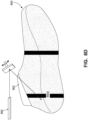
- a reactive polymeric material 820 may be applied to a surface (e.g., the exterior surface) of the upper base member 800. This may be accomplished, for example, with the upper base member 800 in a flat condition ( Fig.
- Fig. 8A e.g., on a flat jig type structure 802 or in a more shaped, three-dimensional condition ( Fig. 8B , e.g., on a base support 804, optionally a base support having an exterior surface shaped as the desired shape of at least a portion of the final footwear component).
- any desired curable, reactive polymeric materials 820 may be used without departing from this invention.
- reactive polymeric materials 820 will be used that exhibit the following characteristics: the reactive polymeric material(s) 820 will have thermoplastic properties as long as it is maintained below a certain temperature (e.g., the material will become soft, pliable, and easily deformable when heated), but after it is heated above a certain temperature optionally for a sufficient time period, the reactive polymeric material will "cure” and harden in an irreversible manner (e.g., by forming cross links, such as ester bond cross links).
- the reactive polymeric material(s) 820 may include a water-based reactive polymer solution, and in some examples, the reactive polymeric material(s) 820 may include an acrylic acid copolymer and a cross-linking agent. In some embodiments of this invention, the reactive polymeric material(s) 820 will include a polymeric binder material free of formaldehyde, phenols, and isocyanates. As a specific example, reactive polymeric materials 820 that may be used in at least some examples of this invention are available from BASF Corporation under the trademark ACRODUR ® .
- the reactive polymeric material(s) 820 may be applied to the upper base member 800 in any desired manner without departing from general aspects of this invention. In some more specific examples of this invention, however, e.g., as shown in Figs. 8A-8C , the reactive polymeric material 820 may be selectively applied only to local areas of the upper base member 800 where stiffening, hardening, and/or additional support is desired in the upper base member 800.
- the reactive polymeric material 820 is applied to the upper base member 800 as a series of relatively small dots (of any desired shape) or segments (e.g., straight or curved line segments) at predetermined areas of the upper base member 800 by a printing process (as shown by the movable print head 806 member in Figs. 8A and 8B ). Any desired process may be used to selectively apply the reactive polymeric material 820 to areas of the upper base member 800, such as printing (e.g., screen printing, jet printing, etc.); by masking techniques (e.g., masking areas of the upper base member 800 to apply the reactive polymeric material only to desired locations); by spraying techniques; by coating techniques; etc.
- printing e.g., screen printing, jet printing, etc.
- masking techniques e.g., masking areas of the upper base member 800 to apply the reactive polymeric material only to desired locations
- spraying techniques by coating techniques; etc.
- the print head 806 moves to selected areas of the upper base member 800 (shown by arrow 808) and applies small "dots" or “segments” of reactive polymeric material 820 to the predetermined desired areas at a predetermined desired "application density level" (e.g., a predetermined amount of reactive polymeric material (e.g., grams) per unit area (e.g., cm 2 ) or volume (cm 3 ) of the upper base member 800). While the applied dots or segments may overlap one another, this is not a requirement.
- a predetermined amount of reactive polymeric material e.g., grams
- FIG. 8C shows an example upper base member 800 with both dots (e.g., at the heel area) and segments (at the midfoot area) of reactive polymeric material 820 applied to it (the combination of an upper base member 800 with one or more areas of uncured reactive polymeric material 820 applied to it is represented by reference number 850 in Fig. 8C ). Spacing between dots and/or segments, dot and/or segment dimensions, and/or the like, also may be used to control the application density level.
- Reactive polymeric material applications processes in accordance with examples of this invention may coat individual fibers of the textile upper base member 800 (or portions thereof) and/or fill interstitial areas between fibers of the textile base member with the reactive polymeric material 820.
- any desired number of separated areas of reactive polymeric material 820 may be applied to an upper base member 800 without departing from this invention.
- the reactive polymeric material 820 may be applied (and eventually cured): over at least a portion of a bottom surface of the upper base member (e.g., to form a support plate for supporting all or some portion(s) of the plantar surface of a wearer's foot and/or for supporting a cleat or other sole component); at an area around one or more sides and/or rear heel area of a wearer's foot (e.g., to provide a heel counter type structure); at an area around the sides or instep of a wearer's foot (e.g., to provide shape support to the upper); at a toe area (e.g., to provide a more defined toe box); along the instep area to provide supports for a shoe lace (e.g., extending in a top-to-bottom direction of the upper base
- the so-treated upper base member/uncured reactive polymeric material combination 850 can be removed from any support member (e.g., element 802 or 804) and stored until further processing is desired (e.g., footwear production as will be explained in more detail below).
- uncured, reactive polymeric material treated upper base members 850 e.g., as shown in Fig. 8C , after any necessary drying
- a single "uncured" component of this type may be produced and used for producing a wide variety of different finally “cured” component parts (e.g., depending on the upper properties desired, depending on user preferences, depending on commercial demand, etc.), including component parts over a range of sizes (e.g., due to stretchability of the textile portion of component 850).
- the treated upper base member 850 may have some flexibility and stretchability (e.g., because of the sock-type construction of the upper base member 800), a single sized treated upper base member 850 may be used for a range of final footwear sizes (e.g., for a range of 2-6 conventional shoe sizes in length and/or for a range of 2-6 conventional shoe sizes in width, and in some examples, for a range of 2-4 conventional shoe sizes in length and/or for a range of 2-4 conventional shoe sizes in width).
- final footwear sizes e.g., for a range of 2-6 conventional shoe sizes in length and/or for a range of 2-6 conventional shoe sizes in width, and in some examples, for a range of 2-4 conventional shoe sizes in length and/or for a range of 2-4 conventional shoe sizes in width.
- an uncured, reactive polymeric material treated upper base member 850 (e.g., as shown in Fig. 8C ) may be applied to a support base 804 having a desired shape for the final footwear component.
- the assembly shown in Fig. 8C may be heated to a temperature sufficient to take advantage of the thermoplastic properties of the reactive polymeric material 820 and allow the component 850 to be manipulated to a desired shape.
- the temperature at this shaping stage should be sufficient to allow the component 850 to be shaped due to its thermoplastic properties but insufficient to finally cure the reactive polymeric component, as will be described in more detail below.
- This type of shaping can occur in any desired manner, for example, by pressing, by pushing/pulling the component 850 against the surface of the support base 804 using vacuum pressure, by hand, etc.
- the shaped component 850 may be removed from the support base 804 and optionally stored again (with the shaped component 850 retaining its shape and its thermoplastic properties (which can allow the shaped component 850 to be heated, re-shaped, or further shaped in the future, if desired)).
- the reactive polymeric material 820 may be cured (e.g., by raising the temperature of the finally shaped component 850 above the reactive polymer curing temperature). Curing of this type causes cross linking, e.g., formation of ester cross linking bonds, which converts the reactive polymeric material to a cured, thermoset state (at which the shapes of any cured parts are irreversibly fixed).
- an upper base member 800 when an upper base member 800 includes reactive polymeric material 820 in more than one area, the reactive polymeric materials 820 may be the same or different in the different areas. Varying the stiffness and/or hardness properties on different areas of a single upper base member may be accomplished in various manners in accordance with some aspects of this invention. For example, the use of different reactive polymeric materials 820 at different areas may provide varying hardness and/or stiffness at the different areas of the upper base member 800.
- different concentrations of reactive polymeric materials 820 in aqueous solutions may be applied at different areas of the upper base member 800 and/or different "dot" or “segment” spacings and/or sizes may be used at different areas of the upper base member (to thereby alter the "application density levels" (e.g., in g/cm 2 and/or g/cm 3 ) of the reactive polymeric material 820 on the upper base member 800.
- Figs. 8A through 8C relate to constructions and methods in which the reactive polymeric material 820 is applied to predetermined, targeted areas of an upper base member 800 and then all (or substantially all) of the reactive polymeric material 820 on the upper base member 800 may be exposed to curing conditions and cured to a hardened or stiffened (thermoset) state (thereby forming a finally and irreversibly hardened footwear component that may be further processed to a final article of footwear product).
- Other footwear component production methods and techniques are possible.
- the final footwear component may have both cured and uncured reactive polymeric material(s) 820 in or on it.
- a greater proportion of the upper base member 800 surface and/or volume may have reactive polymeric material 820 applied to it than the proportion thereof having reactive polymeric material 820 that is eventually cured.
- This will leave some portion of the reactive polymeric material 820 on the upper base member 800 with thermoplastic properties (and potentially capable of being altered in shape, e.g., upon heating to a temperature below the curing temperature) and some portion of the reactive polymeric material 820 cured and thermoset (and not capable of being altered in shape upon re-heating).
- the remaining thermoplastic portion also could be cured at a later time, in a separate curing step, if desired.
- the reactive polymeric material(s) 820 may be applied (e.g., by coating, spraying, printing, etc.) to at least 50% of an overall surface area and/or volume of the upper base member 820 and then only one or more selected portions of this surface area and/or volume (e.g., less than 50% of the overall surface area and/or volume in some examples) will be exposed to effective curing/thermosetting conditions.
- At least 50%, at least 65%, at least 75%, at least 90%, or even up to 100% of the surface area and/or volume of the upper base member 800 may have reactive polymeric material applied to it, but less than 95%, less than 90%, less than 75%, less than 65%, or even less than 50% of this overall surface area and/or volume with reactive polymeric material applied to it will then be cured/thermoset.
- X is a total exterior surface area and/or volume of the upper base member 800
- Y is a total exterior surface area and/or volume of the upper base member 800 to which the reactive polymeric material 820 is applied
- Z is a total exterior surface area and/or volume of the upper base member 800 including reactive polymeric material 820 that is cured/thermoset.
- Systems and methods according to examples of this invention may accomplish this "selective exposure" to curing/thermosetting conditions in various ways, such as: by applying an insulative "mask” over areas of the surface at which curing is not desired (so that insufficient heat transfers through the insulative mask during the curing process to cure any reactive polymeric material(s) 820 located behind the mask); by applying a heat conductive "mask” over areas of the surface at which curing is desired (so that sufficient heat quickly transfers through the heat conductive mask to the areas where curing of the reactive polymeric material(s) 820 is desired and completed before the reactive polymeric material 820 in the "unmasked areas” reaches the curing conditions); by using a heated die for heating that selectively applies heat only at desired locations; by selectively heating areas of the surface 850d where curing is desired using laser radiation (such as the scanning laser source 900 shown in Fig.
- a heat gun, or other targeted heat applying source by selectively activating portions of an array of heat elements provided on a base member 902 that supports the treated upper base member 850; by providing a base member 902 having heat elements located at predetermined areas for heating the footwear component 850; etc.
- the base member 902 may be shaped so as to hold at least the portions of the footwear component 850 (including the upper base member 800 with the reactive polymeric material 820 applied to it as described above) to be cured in a final desired shape for the curing process (i.e., during curing, the portion of the reactive polymeric material 820 exposed to effective curing conditions will be thermoset and irreversibly maintained in this shape).
- this type of shaping can be assisted, for example, by pressing, by pushing/pulling the component 850 against the surface of the support base 902 using vacuum pressure, etc. Curing may take place in multiple steps, if desired (e.g., with one area of the component 850 cured in one step and one or more other areas of the component 850 cured in one or more other steps).
Landscapes
- Engineering & Computer Science (AREA)
- Mechanical Engineering (AREA)
- Chemical & Material Sciences (AREA)
- Materials Engineering (AREA)
- Footwear And Its Accessory, Manufacturing Method And Apparatuses (AREA)
- Knitting Of Fabric (AREA)
Applications Claiming Priority (4)
| Application Number | Priority Date | Filing Date | Title |
|---|---|---|---|
| US14/247,981 US9861162B2 (en) | 2014-04-08 | 2014-04-08 | Components for articles of footwear including lightweight, selectively supported textile components |
| EP15719342.6A EP3128865B1 (de) | 2014-04-08 | 2015-04-08 | Komponenten für schuhartikel mit leichten, selektiv gestützten textilkomponenten |
| PCT/US2015/024832 WO2015157366A1 (en) | 2014-04-08 | 2015-04-08 | Components for articles of footwear including lightweight, selectively supported textile components |
| EP20157455.5A EP3673762B1 (de) | 2014-04-08 | 2015-04-08 | Komponenten für schuhartikel mit leichten, selektiv gestützten textilkomponenten |
Related Parent Applications (2)
| Application Number | Title | Priority Date | Filing Date |
|---|---|---|---|
| EP20157455.5A Division EP3673762B1 (de) | 2014-04-08 | 2015-04-08 | Komponenten für schuhartikel mit leichten, selektiv gestützten textilkomponenten |
| EP15719342.6A Division EP3128865B1 (de) | 2014-04-08 | 2015-04-08 | Komponenten für schuhartikel mit leichten, selektiv gestützten textilkomponenten |
Publications (2)
| Publication Number | Publication Date |
|---|---|
| EP4520516A2 true EP4520516A2 (de) | 2025-03-12 |
| EP4520516A3 EP4520516A3 (de) | 2025-05-14 |
Family
ID=53015915
Family Applications (3)
| Application Number | Title | Priority Date | Filing Date |
|---|---|---|---|
| EP20157455.5A Active EP3673762B1 (de) | 2014-04-08 | 2015-04-08 | Komponenten für schuhartikel mit leichten, selektiv gestützten textilkomponenten |
| EP15719342.6A Active EP3128865B1 (de) | 2014-04-08 | 2015-04-08 | Komponenten für schuhartikel mit leichten, selektiv gestützten textilkomponenten |
| EP25154534.9A Pending EP4520516A3 (de) | 2014-04-08 | 2015-04-08 | Komponenten für schuhartikel mit leichten, selektiv gestützten textilkomponenten |
Family Applications Before (2)
| Application Number | Title | Priority Date | Filing Date |
|---|---|---|---|
| EP20157455.5A Active EP3673762B1 (de) | 2014-04-08 | 2015-04-08 | Komponenten für schuhartikel mit leichten, selektiv gestützten textilkomponenten |
| EP15719342.6A Active EP3128865B1 (de) | 2014-04-08 | 2015-04-08 | Komponenten für schuhartikel mit leichten, selektiv gestützten textilkomponenten |
Country Status (5)
| Country | Link |
|---|---|
| US (2) | US9861162B2 (de) |
| EP (3) | EP3673762B1 (de) |
| CN (1) | CN106455744A (de) |
| TW (3) | TWI702011B (de) |
| WO (1) | WO2015157366A1 (de) |
Families Citing this family (69)
| Publication number | Priority date | Publication date | Assignee | Title |
|---|---|---|---|---|
| US20100199406A1 (en) * | 2009-02-06 | 2010-08-12 | Nike, Inc. | Thermoplastic Non-Woven Textile Elements |
| US20130255103A1 (en) | 2012-04-03 | 2013-10-03 | Nike, Inc. | Apparel And Other Products Incorporating A Thermoplastic Polymer Material |
| US20140373389A1 (en) * | 2013-06-25 | 2014-12-25 | Nike, Inc. | Braided Upper With Overlays For Article Of Footwear |
| MX365912B (es) | 2013-06-25 | 2019-06-19 | Nike Innovate Cv | Artículo de calzado con parte superior trenzada. |
| US10863794B2 (en) | 2013-06-25 | 2020-12-15 | Nike, Inc. | Article of footwear having multiple braided structures |
| US10383388B2 (en) * | 2014-03-07 | 2019-08-20 | Nike, Inc. | Article of footware with upper incorporating knitted component providing variable compression |
| US9861162B2 (en) * | 2014-04-08 | 2018-01-09 | Nike, Inc. | Components for articles of footwear including lightweight, selectively supported textile components |
| US10674791B2 (en) | 2014-12-10 | 2020-06-09 | Nike, Inc. | Braided article with internal midsole structure |
| US9668544B2 (en) | 2014-12-10 | 2017-06-06 | Nike, Inc. | Last system for articles with braided components |
| DE102015208763A1 (de) * | 2015-05-12 | 2016-11-17 | Adidas Ag | Anpassbares Schuhoberteil und anpassbare Sohle |
| USD773798S1 (en) * | 2015-05-18 | 2016-12-13 | Nike, Inc. | Sock |
| US9976237B2 (en) * | 2015-05-18 | 2018-05-22 | Nike, Inc. | Sock with heel locating features |
| US10555581B2 (en) | 2015-05-26 | 2020-02-11 | Nike, Inc. | Braided upper with multiple materials |
| US20160345675A1 (en) | 2015-05-26 | 2016-12-01 | Nike, Inc. | Hybrid Braided Article |
| US11103028B2 (en) | 2015-08-07 | 2021-08-31 | Nike, Inc. | Multi-layered braided article and method of making |
| US10278450B2 (en) | 2015-10-07 | 2019-05-07 | Nike, Inc. | Sole structures and articles of footwear having an elongated hexagonal siping pattern and/or a heel pocket structure |
| US12232564B2 (en) | 2015-11-09 | 2025-02-25 | Under Armour, Inc. | Method of forming an article of footwear |
| EP4205589B1 (de) | 2015-12-07 | 2025-01-22 | Nike Innovate C.V. | Dreidimensionales drucken mit unverlierbarem element |
| US10390584B2 (en) | 2016-01-19 | 2019-08-27 | Fuerst Group, Inc. | Footwear article having cord structure |
| TWI641640B (zh) | 2016-02-04 | 2018-11-21 | 亨茲曼國際公司 | 於物體上製造聚合物材料層之三維沈積方法 |
| US11445779B2 (en) * | 2016-07-21 | 2022-09-20 | Nike, Inc. | Article of footwear with multiple layers, retention system for an article of footwear, and methods of manufacture |
| WO2018089686A1 (en) | 2016-11-09 | 2018-05-17 | Nike Innovate C.V. | Textiles and articles, and processes for making the same |
| TWI616149B (zh) * | 2016-12-07 | 2018-03-01 | Shuang Bang Ind Corp | 具挺性之立體襪鞋的製造方法 |
| WO2018144119A1 (en) | 2017-02-03 | 2018-08-09 | Nike Innovate C.V. | Fiber-bound engineered materials formed utilizing carrier screens |
| US12011063B2 (en) * | 2017-02-03 | 2024-06-18 | Nike, Inc. | Fiber-bound engineered materials formed using zonal scrims |
| WO2018144124A1 (en) | 2017-02-03 | 2018-08-09 | Nike Innovate C.V. | Fiber-bound engineered materials formed using engineered scrims |
| WO2018144118A1 (en) | 2017-02-03 | 2018-08-09 | Nike Innovate C.V. | Fiber-bound engineered materials formed as a synthetic leather |
| WO2018144120A1 (en) | 2017-02-03 | 2018-08-09 | Nike Innovate C.V. | Fiber-bound engineered materials formed using foundation scrims |
| TWI734387B (zh) | 2017-02-21 | 2021-07-21 | 荷蘭商耐克創新有限合夥公司 | 加固鞋類部件的方法以及加固鞋類部件的系統 |
| EP3589150B1 (de) * | 2017-02-28 | 2023-05-10 | Under Armour, Inc. | Schuhoberteil und schuhwerk mit dem schuhoberteil |
| US10694817B2 (en) * | 2017-03-07 | 2020-06-30 | Adidas Ag | Article of footwear with upper having stitched polymer thread pattern and methods of making the same |
| US10194714B2 (en) | 2017-03-07 | 2019-02-05 | Adidas Ag | Article of footwear with upper having stitched polymer thread pattern and methods of making the same |
| CN114617332B (zh) | 2017-05-30 | 2025-05-02 | 耐克创新有限合伙公司 | 用于编结的鞋类的机械锁鞋底结构 |
| US11202483B2 (en) | 2017-05-31 | 2021-12-21 | Nike, Inc. | Braided articles and methods for their manufacture |
| US10806210B2 (en) | 2017-05-31 | 2020-10-20 | Nike, Inc. | Braided articles and methods for their manufacture |
| US11051573B2 (en) | 2017-05-31 | 2021-07-06 | Nike, Inc. | Braided articles and methods for their manufacture |
| US10485302B2 (en) * | 2017-07-07 | 2019-11-26 | Reebok International Limited | Method of making an upper |
| US11357288B2 (en) * | 2017-07-31 | 2022-06-14 | Nike, Inc. | Upper for an article of footwear |
| TWI643571B (zh) * | 2017-09-29 | 2018-12-11 | 双邦實業股份有限公司 | 圓管針織鞋之製法 |
| US10932516B2 (en) * | 2018-01-05 | 2021-03-02 | Patrick Hogan | Convertible footwear |
| USD918220S1 (en) | 2018-06-13 | 2021-05-04 | Juniper Networks, Inc. | Display screen or portions thereof with animated graphical user interface |
| US10778534B2 (en) | 2018-06-13 | 2020-09-15 | Juniper Networks, Inc. | Virtualization infrastructure underlay network performance measurement and monitoring |
| USD952997S1 (en) * | 2018-07-31 | 2022-05-31 | Nike, Inc. | Shoe |
| EP3791746B1 (de) * | 2018-08-30 | 2023-10-04 | ASICS Corporation | Schuh und verfahren zur herstellung davon |
| US10993499B2 (en) * | 2018-11-03 | 2021-05-04 | Jennifer Stirling | Protective soft-shelled foot covering |
| DE102018220513B4 (de) * | 2018-11-28 | 2021-08-26 | Adidas Ag | Verfahren zum Bereitstellen mindestens eines Abschnitts eines Kleidungsstücks oder Schuhwerks und Abschnitt eines Kleidungsstücks oder Schuhwerks |
| US11013295B2 (en) * | 2018-11-30 | 2021-05-25 | Nike, Inc. | Sockliner assemblies for articles of footwear |
| CN113163901B (zh) * | 2018-12-07 | 2022-10-14 | 耐克创新有限合伙公司 | 具有舒适且有保护性的前包头的鞋类物品 |
| USD938711S1 (en) * | 2019-04-10 | 2021-12-21 | Brooks Sports, Inc. | Shoe upper |
| KR102638414B1 (ko) | 2019-04-26 | 2024-02-19 | 나이키 이노베이트 씨.브이. | 복수 부재 판상 구조물을 동반하는 신발류 물품을 형성하는 방법 및 그에 의해 형성되는 물품 |
| CN114468459B (zh) | 2019-08-02 | 2024-09-10 | 耐克创新有限合伙公司 | 用于鞋类物品的鞋外底 |
| US11185127B2 (en) | 2019-08-20 | 2021-11-30 | Puma SE | Article of footwear |
| EP4155444A1 (de) | 2019-11-18 | 2023-03-29 | NIKE Innovate C.V. | Oberteil für schuhwerk und verfahren zur herstellung desselben |
| USD920640S1 (en) | 2019-12-10 | 2021-06-01 | Puma SE | Article of footwear |
| TWI813927B (zh) * | 2020-01-06 | 2023-09-01 | 荷蘭商耐克創新有限合夥公司 | 用於鞋類部件製品的噴塗系統與方法 |
| JP7726450B2 (ja) * | 2020-01-24 | 2025-08-20 | インキューブ ソリューションズ (プライベート) リミテッド | 単層の衣類布地 |
| IT202000004468A1 (it) * | 2020-03-03 | 2021-09-03 | Macpi Spa Pressing Div | Semilavorato in maglia per la fabbricazione di calze, calzature e guanti e processo per la sua realizzazione |
| CN111493446B (zh) * | 2020-05-26 | 2021-06-11 | 福建华峰新材料有限公司 | 纬编单面、双面袜鞋及其生产方法 |
| JP7187519B2 (ja) | 2020-11-11 | 2022-12-12 | 美津濃株式会社 | シューズ |
| US20250009545A1 (en) * | 2021-02-17 | 2025-01-09 | Aspen Medical Products, Llc | Orthopedic precast with thermal cover for custom othosis creation |
| US11701823B1 (en) | 2021-05-19 | 2023-07-18 | Under Armour, Inc. | Method of making footwear components |
| USD957800S1 (en) * | 2021-07-22 | 2022-07-19 | Nike, Inc. | Shoe |
| USD1029475S1 (en) | 2021-07-22 | 2024-06-04 | Nike, Inc. | Shoe |
| US12290142B2 (en) * | 2022-03-03 | 2025-05-06 | Acushnet Company | Golf shoe sole with localized sidewalls reinforcement structure |
| US11986048B2 (en) * | 2022-03-03 | 2024-05-21 | Acushnet Company | Golf shoe sole with localized sidewalls reinforcement structure |
| US12364308B2 (en) * | 2022-03-03 | 2025-07-22 | Acushnet Company | Golf shoe with reinforcement structure |
| FR3133979B1 (fr) * | 2022-03-29 | 2025-06-27 | Decathlon Sa | Article chaussant, et procédé de fabrication d’un tel article chaussant |
| US12150513B2 (en) | 2022-09-14 | 2024-11-26 | Lululemon Athletica Canada Inc. | Upper for article of footwear incorporating a knitted butterfly workpiece |
| US12295449B1 (en) | 2022-11-18 | 2025-05-13 | Nike, Inc. | Article of footwear incorporating an upper assembly |
Citations (1)
| Publication number | Priority date | Publication date | Assignee | Title |
|---|---|---|---|---|
| US8429835B2 (en) | 2009-10-21 | 2013-04-30 | Nike, Inc. | Composite shoe upper and method of making same |
Family Cites Families (267)
| Publication number | Priority date | Publication date | Assignee | Title |
|---|---|---|---|---|
| US1320202A (en) | 1919-10-28 | Melville c | ||
| US503062A (en) | 1893-08-08 | Of boston | ||
| US234163A (en) | 1880-11-09 | Crimping-machine for boots and shoes | ||
| US182253A (en) | 1876-09-12 | Improvement in the methods of forming last-blanks | ||
| US1002393A (en) | 1907-10-11 | 1911-09-05 | Miller O A Treeing Machine Co | Vamp-creasing machine. |
| US985467A (en) | 1910-07-25 | 1911-02-28 | William P Speer | Shoe-crimper. |
| US1155087A (en) | 1915-07-13 | 1915-09-28 | William H O'connor | Steam-heated last. |
| US1385647A (en) | 1918-07-22 | 1921-07-26 | Los Angeles Trust And Savings | Shoe-machine |
| US1733733A (en) | 1928-11-20 | 1929-10-29 | Edgar H Hess | Shoe and cushioning member or middle sole therefor |
| US2174462A (en) | 1934-06-14 | 1939-09-26 | Freeman Co Louis G | Shoe upper shaping machine |
| US2071775A (en) | 1935-01-30 | 1937-02-23 | United Shoe Machinery Corp | Manufacture of shoes |
| US2147197A (en) | 1936-11-25 | 1939-02-14 | Hood Rubber Co Inc | Article of footwear |
| US2278199A (en) | 1938-05-02 | 1942-03-31 | Hoza John | Means for smoothing the linings of shoes |
| US2251468A (en) | 1939-04-05 | 1941-08-05 | Salta Corp | Rubber shoe sole |
| FR861723A (fr) | 1939-11-17 | 1941-02-15 | Perfectionnement dans la fabrication des chaussures et produit industriel nouveau | |
| US2314098A (en) | 1941-04-26 | 1943-03-16 | Mary C Mcdonald | Method of making shoes |
| GB566137A (en) | 1942-06-10 | 1944-12-15 | British United Shoe Machinery | Improvements in or relating to the stiffening of shoes and stiffeners adapted for use for such purpose |
| US2432533A (en) | 1944-04-25 | 1947-12-16 | Margolin Meyer | Ventilated midsole |
| US2580840A (en) | 1948-10-19 | 1952-01-01 | Rogndal Rikard | Lightweight, flexible, resilient, and nonskid sole for footwear |
| US2641004A (en) | 1950-12-26 | 1953-06-09 | David V Whiting | Method for producing knitted shoe uppers of shrinkable yarn |
| US2963722A (en) | 1958-08-26 | 1960-12-13 | Us Shoc Corp | Method of shoe construction |
| US3035292A (en) * | 1958-10-16 | 1962-05-22 | Beckwith Arden Inc | Process of forming and stiffening shoe parts by means of a polymerizable and thermoplastic resin |
| US3067442A (en) | 1960-06-27 | 1962-12-11 | Leslynn Products Corp | Last blocks and shoe lasts manufactured therefrom |
| US3239861A (en) * | 1962-11-13 | 1966-03-15 | Monsanto Co | Stiffening shoe uppers |
| US3237227A (en) | 1964-04-10 | 1966-03-01 | Formulast Corp | Directionally shrinking lasted shoe uppers |
| US3745600A (en) | 1969-03-07 | 1973-07-17 | J Rubico | Method of making shoes over sheathed last utilizing a lasting element |
| US3983204A (en) | 1969-04-02 | 1976-09-28 | Uniroyal, Inc. | Recessed last and method of lasting and molding a shoe sole to upper including positioning insole in recessed last |
| GB1262204A (en) | 1969-09-05 | 1972-02-02 | British United Shoe Machinery | Improvements in or relating to a method of making shoes |
| US3605152A (en) * | 1969-10-20 | 1971-09-20 | Usm Corp | Method for stiffening |
| GB1430067A (en) | 1972-06-27 | 1976-03-31 | British United Shoe Machinery | Apparatus for the preparation of shoe uppers for a lasting operation |
| US3758903A (en) | 1972-08-04 | 1973-09-18 | Ro Search Inc | Method and apparatus for unit molding |
| US3757436A (en) | 1972-12-04 | 1973-09-11 | Compo Ind Inc | Apparatus provided with lasting tabs and method of lasting |
| FR2331297A1 (fr) | 1975-11-13 | 1977-06-10 | Ours Rosette | Procede de fabrication de chaussures a tige haute et chaussures ainsi fabriquees |
| US4187619A (en) | 1978-03-06 | 1980-02-12 | Gibbs Don W | Strap fastening means for a sock and shoe combination |
| US4340626A (en) | 1978-05-05 | 1982-07-20 | Rudy Marion F | Diffusion pumping apparatus self-inflating device |
| US4272850A (en) | 1979-05-25 | 1981-06-16 | W. H. Brine Company | Body protective pads |
| FR2462120A1 (fr) | 1979-08-03 | 1981-02-13 | Sifsa | Conformateur de galbage pour la partie arriere de chaussures |
| US4266314A (en) | 1979-09-07 | 1981-05-12 | Londner Epouse Ours Rosette | Method of manufacture of sports shoes, and shoes manufactured by said method |
| US4494266A (en) | 1980-05-01 | 1985-01-22 | Hans Bartneck | Molded shoe |
| US4333193A (en) | 1980-05-01 | 1982-06-08 | The United States Shoe Corporation | Shoe molding process |
| AU1358183A (en) | 1982-04-15 | 1983-10-20 | Slaughter, J.H. | Footwear |
| EP0113422B1 (de) | 1982-12-09 | 1988-10-19 | Klaus Dollst | Vorrichtung zum Wärmen und Trocknen von Schuhen |
| IT1163288B (it) | 1983-05-02 | 1987-04-08 | Bertolaja Costantino Mec Off | Macchina per l'assemblaggio semiautomatico di calzature con suole a scatola |
| US4484398A (en) | 1983-07-21 | 1984-11-27 | Goodwin Boyd G | Spiked shoe protector |
| US4508582A (en) | 1984-02-06 | 1985-04-02 | Bata Schuh Ag. | Process for joining polyurethane coated fabrics |
| US4741062A (en) | 1985-09-06 | 1988-05-03 | Roger Blanc | Last for automated shoe manufacture |
| US4668557A (en) | 1986-07-18 | 1987-05-26 | The University Of Iowa Research Foundation | Polyhedron cell structure and method of making same |
| JPS6325004U (de) | 1986-07-31 | 1988-02-18 | ||
| US4756098A (en) | 1987-01-21 | 1988-07-12 | Gencorp Inc. | Athletic shoe |
| US4858340A (en) | 1988-02-16 | 1989-08-22 | Prince Manufacturing, Inc. | Shoe with form fitting sole |
| CA1338369C (en) | 1988-02-24 | 1996-06-11 | Jean-Pierre Vermeulen | Shock absorbing system for footwear application |
| US4967492A (en) | 1988-07-29 | 1990-11-06 | Rosen Henri E | Adjustable girth shoes |
| US4899412A (en) | 1988-09-07 | 1990-02-13 | R. G. Barry Corporation | Slipper and method of making same |
| JPH04505107A (ja) | 1988-10-03 | 1992-09-10 | ジェン ジェン ホールディングズ,インコーポレイテッド | 加熱エンボスされた靴 |
| US5060402A (en) | 1989-02-17 | 1991-10-29 | Rosen Henri E | Adjustable girth shoe construction |
| ATE228785T1 (de) | 1990-01-10 | 2002-12-15 | Anatomic Res Inc | Aufbau einer schuhsohle mit umfassenden rändern |
| AU1977192A (en) | 1991-06-17 | 1993-01-12 | Puma Aktiengesellschaft Rudolf Dassler Sport | Method of producing a shaped shoe part from a strip of fabric, and a shaped shoe part produced by this method |
| USD339459S (en) | 1991-11-05 | 1993-09-21 | Asics Corporation | Shoe sole |
| USD344170S (en) | 1991-11-18 | 1994-02-15 | Acoff Roy B | Tennis shoes |
| US5351352A (en) | 1992-06-19 | 1994-10-04 | John Chillemi | Method of forming a seamless shoe |
| JPH09509594A (ja) | 1994-02-28 | 1997-09-30 | オレク、アダム・エイチ | ひも管を有する靴 |
| US5718064A (en) | 1994-04-04 | 1998-02-17 | Nine West Group Inc. | Multi-layer sole construction for walking shoes |
| CN1104214C (zh) * | 1994-05-18 | 2003-04-02 | 住友橡胶工业株式会社 | 鞋底 |
| US5469639A (en) | 1994-12-02 | 1995-11-28 | Sessa; Raymond V. | Shoe sole having insert with graduated cushioning properties |
| US5729912A (en) | 1995-06-07 | 1998-03-24 | Nike, Inc. | Article of footwear having adjustable width, footform and cushioning |
| US5692319A (en) | 1995-06-07 | 1997-12-02 | Nike, Inc. | Article of footwear with 360° wrap fit closure system |
| ES2236749T3 (es) | 1995-08-14 | 2005-07-16 | Yaktrax, Inc. | Dispositivo de aumento de la traccion. |
| USD420786S (en) | 1995-09-21 | 2000-02-22 | Pillow Tech International Ltd. | Spikeless golf shoe sole |
| EP0777982A1 (de) | 1995-12-04 | 1997-06-11 | Global Sports Technologies Inc. | Sportschuhe mit beschichteter Sohle |
| GB2307873B (en) * | 1995-12-05 | 1999-03-17 | Gates Rubber Co | Latex dipping method for manufacturing waterproof knee boots |
| DE19601219C1 (de) | 1996-01-15 | 1997-01-02 | Rudolf Hieblinger | Sportschuh, insbesondere Fußballschuh |
| US20050034330A1 (en) * | 1996-11-12 | 2005-02-17 | Baychar | Running shoes, hiking shoes and boots, snowboard boots, alpine boots, hiking boots, and the like, having waterproof/breathable moisture transfer characteristics |
| US5926974A (en) | 1997-01-17 | 1999-07-27 | Nike, Inc. | Footwear with mountain goat traction elements |
| GB9805619D0 (en) | 1998-03-18 | 1998-05-13 | Noise Cancellation Tech | Cushioned earphones |
| US6519876B1 (en) | 1998-05-06 | 2003-02-18 | Kenton Geer Design Associates, Inc. | Footwear structure and method of forming the same |
| GB2341308B (en) | 1998-09-14 | 2001-03-28 | Mitre Sports Internat Ltd | Sports footwear and studs therefor |
| US6178662B1 (en) | 1999-02-02 | 2001-01-30 | David K. Legatzke | Dispersed-air footpad |
| US6558784B1 (en) | 1999-03-02 | 2003-05-06 | Adc Composites, Llc | Composite footwear upper and method of manufacturing a composite footwear upper |
| US6286233B1 (en) | 1999-04-08 | 2001-09-11 | David E Gaither | Internally laced shoe |
| US6401366B2 (en) | 1999-04-16 | 2002-06-11 | Nike, Inc. | Athletic shoe with stabilizing frame |
| US20020166262A1 (en) | 1999-07-02 | 2002-11-14 | Bbc International Ltd. | Flex sole with mesh insert enhancement |
| US6564476B1 (en) | 1999-07-02 | 2003-05-20 | Bbc International, Ltd. | Flex sole |
| US6571490B2 (en) | 2000-03-16 | 2003-06-03 | Nike, Inc. | Bladder with multi-stage regionalized cushioning |
| DE10036100C1 (de) | 2000-07-25 | 2002-02-14 | Adidas Int Bv | Schuh |
| IT1318737B1 (it) | 2000-08-07 | 2003-09-10 | Nextec Srl | Procedimento per impermeabilizzare semilavorati di calzature, capi edaccessori di abbigliamento, nonche' semilavorati ottenuti con tale |
| ES2346743T3 (es) | 2001-09-13 | 2010-10-20 | Daniel James Plant | Material flexible absorbente de energia y procedimientos de fabricacion del mismo. |
| US20030066207A1 (en) | 2001-10-09 | 2003-04-10 | David Gaither | Internally laced shoe |
| FR2832909B1 (fr) | 2001-12-03 | 2004-04-02 | Actis Ets | Forme avec dispositif de prehension, pour la fabrication de chaussures |
| FR2836340B1 (fr) | 2002-02-28 | 2004-09-03 | Salomon Sa | Article chaussant a serrage elastique |
| DE10222897B4 (de) | 2002-05-23 | 2017-10-26 | Adidas International Marketing B.V. | Schuh |
| FR2848390B1 (fr) * | 2002-12-12 | 2005-07-08 | Salomon Sa | Article chaussant notamment pour l'escalade |
| US6931762B1 (en) | 2002-12-18 | 2005-08-23 | Nike, Inc. | Footwear with knit upper and method of manufacturing the footwear |
| USD488916S1 (en) | 2003-01-31 | 2004-04-27 | Columbia Insurance Company | Outsole |
| US7254906B2 (en) | 2003-02-24 | 2007-08-14 | Kwame Morris | Foot cushioning construct and system for use in an article of footwear |
| US20060108044A1 (en) | 2003-03-12 | 2006-05-25 | Koji Matsumoto | Apparatus for orienting and laminating binder-adhered wood chips and method of manufacturing wooden composite material |
| US20040181972A1 (en) | 2003-03-19 | 2004-09-23 | Julius Csorba | Mechanism of tying of shoes circumferentially embracing the foot within the shoe |
| US7272897B2 (en) | 2003-03-28 | 2007-09-25 | Zu Sheng Yu | Sandal having a variety of lacing styles |
| USD487614S1 (en) | 2003-05-15 | 2004-03-23 | Wolverine World Wide, Inc. | Footwear sole |
| US7010872B2 (en) | 2003-05-16 | 2006-03-14 | The Timberland Company | Modular shoe |
| WO2004105530A1 (en) * | 2003-05-30 | 2004-12-09 | Louise Heather Averill | Improved shoe |
| US7424783B2 (en) | 2003-06-30 | 2008-09-16 | Nike, Inc. | Article of apparel incorporating a stratified material |
| JP2005143637A (ja) | 2003-11-12 | 2005-06-09 | Shoken Ki | 靴の製造方法 |
| US7252870B2 (en) | 2003-12-31 | 2007-08-07 | Kimberly-Clark Worldwide, Inc. | Nonwovens having reduced Poisson ratio |
| GB0402103D0 (en) | 2004-02-02 | 2004-03-03 | Hengelmolen Rudy | Tubular graft |
| JP5020064B2 (ja) | 2004-03-12 | 2012-09-05 | エスアールアイ インターナショナル | 機械的メタ材料 |
| US7160621B2 (en) | 2004-06-28 | 2007-01-09 | General Electric Company | Energy absorbing articles |
| GB0418759D0 (en) | 2004-08-23 | 2004-09-22 | Auxetix Ltd | Uses of auxetic fibres |
| US7793434B2 (en) | 2004-09-03 | 2010-09-14 | Nike, Inc. | Article of footwear having an upper with a structured intermediate layer |
| US7293371B2 (en) | 2004-09-22 | 2007-11-13 | Nike, Inc. | Woven shoe with integral lace loops |
| US20060117606A1 (en) | 2004-12-03 | 2006-06-08 | Eddie Chen | Shoe having a protective wrap |
| KR100627143B1 (ko) | 2004-12-31 | 2006-09-25 | 박장원 | 입체형 신발 갑피용 가교발포 성형체 및 그 제조방법 |
| US7475497B2 (en) | 2005-01-18 | 2009-01-13 | Nike, Inc. | Article of footwear with a perforated midsole |
| US8661564B2 (en) | 2005-02-15 | 2014-03-04 | Pinwrest Development Group, LLC. | Protective articles having a plurality of core members |
| US8220072B2 (en) | 2005-02-15 | 2012-07-17 | The Dodd Group, LLC | Protective shin guard |
| US8961733B2 (en) | 2005-02-15 | 2015-02-24 | Pinwrest Development Group, Llc | Method of improving the impact-protective properties of a conformable substrate |
| ITTV20050044A1 (it) | 2005-03-25 | 2006-09-26 | Bruno Zanatta | Struttura di calzatura a calzata regolabile |
| US7310894B1 (en) | 2005-05-12 | 2007-12-25 | Schwarzman John L | Footwear for use in shower |
| US8065818B2 (en) * | 2005-06-20 | 2011-11-29 | Nike, Inc. | Article of footwear having an upper with a matrix layer |
| US7631440B2 (en) | 2005-07-15 | 2009-12-15 | The Timberland Company | Shoe with anatomical protection |
| US7287342B2 (en) | 2005-07-15 | 2007-10-30 | The Timberland Company | Shoe with lacing |
| US7637032B2 (en) | 2005-07-29 | 2009-12-29 | Nike, Inc. | Footwear structure with textile upper member |
| US7401418B2 (en) | 2005-08-17 | 2008-07-22 | Nike, Inc. | Article of footwear having midsole with support pillars and method of manufacturing same |
| CN2870531Y (zh) | 2005-10-13 | 2007-02-21 | 李锡宏 | 一种透气鞋底 |
| US9380831B2 (en) * | 2005-10-28 | 2016-07-05 | Nike, Inc. | Article of apparel with zonal force attenuation properties |
| GB0522560D0 (en) | 2005-11-04 | 2005-12-14 | Auxetic Technologies Ltd | A process for the preparation of auxetic foams |
| US7849609B2 (en) | 2006-03-31 | 2010-12-14 | Nike, Inc. | Interior and upper members for articles of footwear and other foot-receiving devices |
| US20070240333A1 (en) | 2006-04-12 | 2007-10-18 | Deckers Outdoor Corporation | Chassis for footwear and method of making footwear |
| US7870681B2 (en) | 2006-05-25 | 2011-01-18 | Nike, Inc. | Article of footwear having an upper with thread structural elements |
| US7574818B2 (en) | 2006-05-25 | 2009-08-18 | Nike, Inc. | Article of footwear having an upper with thread structural elements |
| US8418380B2 (en) | 2006-05-25 | 2013-04-16 | Nike, Inc. | Article of footwear having an upper incorporating a tensile strand with a cover layer |
| US8904671B2 (en) | 2006-05-25 | 2014-12-09 | Nike, Inc. | Footwear incorporating a tensile element with a deposition layer |
| US8312645B2 (en) | 2006-05-25 | 2012-11-20 | Nike, Inc. | Material elements incorporating tensile strands |
| US8312646B2 (en) | 2006-05-25 | 2012-11-20 | Nike, Inc. | Article of footwear incorporating a tensile element |
| US7546698B2 (en) | 2006-05-25 | 2009-06-16 | Nike, Inc. | Article of footwear having an upper with thread structural elements |
| MX2008016445A (es) | 2006-06-20 | 2009-01-22 | Geox Spa | Elemento permeable al vapor que se va a utilizar en la composicion de suelas para calzado, suela provista de dicho elemento permeable al vapor, y calzado provisto de dicha suela. |
| US20080011021A1 (en) | 2006-06-27 | 2008-01-17 | Hbi Branded Apparel Enterprises, Llc. | Fabrics having knit structures exhibiting auxetic properties and garments formed thereby |
| US7685740B2 (en) | 2006-07-13 | 2010-03-30 | Nike, Inc. | Dance shoe |
| US8887411B2 (en) | 2006-08-01 | 2014-11-18 | Reebok International Limited | Athletic shoe having a segmented upper |
| US7455567B2 (en) | 2006-08-02 | 2008-11-25 | Hanesbrands Inc. | Garments having auxetic foam layers |
| US8225530B2 (en) | 2006-11-10 | 2012-07-24 | Nike, Inc. | Article of footwear having a flat knit upper construction or other upper construction |
| USD614382S1 (en) | 2006-12-06 | 2010-04-27 | Salomon S.A.S. | Footwear |
| USD571543S1 (en) | 2007-02-26 | 2008-06-24 | J. S. Company Orlando Inc. | Pair of outsoles for a woman's shoes |
| EP2674050B1 (de) | 2007-02-28 | 2016-12-07 | NIKE Innovate C.V. | Schuhartikel mit einer Sohlenstruktur aus polygonen Laschen |
| US7788827B2 (en) | 2007-03-06 | 2010-09-07 | Nike, Inc. | Article of footwear with mesh on outsole and insert |
| CH714441B1 (it) | 2007-04-03 | 2019-06-14 | Geox Spa | Procedimento per realizzare una calzatura impermeabile all'acqua e traspirante al vapore acqueo e calzatura ottenuta col procedimento. |
| US7797856B2 (en) | 2007-04-10 | 2010-09-21 | Reebok International Ltd. | Lightweight sole for article of footwear |
| US7793435B1 (en) | 2007-04-10 | 2010-09-14 | Reebok International Ltd. | Article of footwear having an integrated support system |
| WO2008130839A1 (en) | 2007-04-18 | 2008-10-30 | Nike, Inc. | Article of footwear construction with binding portions |
| GB2455167A (en) | 2007-09-04 | 2009-06-03 | Univ Malta | Bimetallic or bimaterial members and systems which exhibit negative Poisson's ratio |
| WO2009030017A1 (en) | 2007-09-06 | 2009-03-12 | Powerdisk Development Ltd. | Energy storage and return spring |
| US7934325B2 (en) | 2007-09-07 | 2011-05-03 | Nike, Inc. | Gymnastics footwear |
| US8037621B2 (en) | 2007-09-13 | 2011-10-18 | Nike, Inc. | Article of footwear including a woven strap system |
| US8001704B2 (en) | 2007-10-09 | 2011-08-23 | Nike, Inc. | Footwear with a foot stabilizer |
| US9795181B2 (en) | 2007-10-23 | 2017-10-24 | Nike, Inc. | Articles and methods of manufacture of articles |
| WO2009062030A1 (en) | 2007-11-07 | 2009-05-14 | Linckia Development Llc | Footware suspension system |
| US8241450B2 (en) | 2007-12-17 | 2012-08-14 | Nike, Inc. | Method for inflating a fluid-filled chamber |
| US8341857B2 (en) | 2008-01-16 | 2013-01-01 | Nike, Inc. | Fluid-filled chamber with a reinforced surface |
| EP2240042B1 (de) | 2008-01-18 | 2015-07-29 | NIKE Innovate C.V. | Schuh mit einstellbarer grösse |
| ITCT20080001U1 (it) | 2008-03-07 | 2009-09-08 | Meli Giuseppe | Dispositivo perfezionato per la produzione di strutture composite con sezione piana a geometria assimetrica chirale o auxetic ma utilizzabile per la produzione di grigliati di qualunque forma.realizzabile anche attraverso la compenetrazione di elemen |
| KR100869451B1 (ko) | 2008-03-19 | 2008-11-19 | (주)한비트레이딩 | 발가락 신발 |
| US8046937B2 (en) | 2008-05-02 | 2011-11-01 | Nike, Inc. | Automatic lacing system |
| US7824735B2 (en) | 2008-05-02 | 2010-11-02 | Ppg Industries Ohio, Inc. | Method for selectively coating substrates |
| US20090277043A1 (en) | 2008-05-08 | 2009-11-12 | Nike, Inc. | Article of Footwear with Integrated Arch Strap |
| US8365441B2 (en) | 2008-06-17 | 2013-02-05 | Brown Shoe Company, Inc. | Shoe with traction outsole |
| US8122616B2 (en) | 2008-07-25 | 2012-02-28 | Nike, Inc. | Composite element with a polymer connecting layer |
| US20100043255A1 (en) | 2008-08-21 | 2010-02-25 | Trevino Steven M | External sole liner and method of manufacturing and using the same |
| GB2463446A (en) | 2008-09-15 | 2010-03-17 | Auxetic Technologies Ltd | Honeycomb construction system |
| EP2334211A1 (de) | 2008-10-06 | 2011-06-22 | Societe de Technologie Michelin | Schuh mit rutschfester sohle |
| US8516723B2 (en) | 2008-10-08 | 2013-08-27 | Nike, Inc. | Midfoot insert construction |
| US8109012B2 (en) | 2008-10-09 | 2012-02-07 | Nike, Inc. | Article of footwear with drainage features |
| CN102215710B (zh) | 2008-10-10 | 2014-01-22 | 耐克国际有限公司 | 具有中底结构的鞋类物品 |
| US20100095551A1 (en) | 2008-10-16 | 2010-04-22 | Honey Gupta | Footwear, footwear inserts and socks for reducing contact forces |
| US8544515B2 (en) | 2008-11-10 | 2013-10-01 | Mkp Structural Design Associates, Inc. | Ultralightweight runflat tires based upon negative poisson ratio (NPR) auxetic structures |
| US20100126041A1 (en) | 2008-11-17 | 2010-05-27 | Altama Footwear | Foot-Bed |
| US8490299B2 (en) | 2008-12-18 | 2013-07-23 | Nike, Inc. | Article of footwear having an upper incorporating a knitted component |
| EP2361023B1 (de) | 2008-12-19 | 2013-02-13 | Daniel James Plant | Energieabsorbierendes system |
| US8112907B2 (en) | 2009-01-03 | 2012-02-14 | Eric Byeung Kim | Disposable cushion shoe insert |
| US8196316B2 (en) | 2009-01-26 | 2012-06-12 | Nike, Inc. | Article of footwear with two part midsole assembly |
| US8850719B2 (en) * | 2009-02-06 | 2014-10-07 | Nike, Inc. | Layered thermoplastic non-woven textile elements |
| US8171655B2 (en) | 2009-03-18 | 2012-05-08 | Wolverine World Wide, Inc. | Sole construction and related method of manufacture |
| US8132340B2 (en) | 2009-04-07 | 2012-03-13 | Nike, Inc. | Footwear incorporating crossed tensile strand elements |
| US8388791B2 (en) | 2009-04-07 | 2013-03-05 | Nike, Inc. | Method for molding tensile strand elements |
| WO2010125397A1 (en) | 2009-05-01 | 2010-11-04 | Global Composites Group | Auxetic knitted fabric |
| GB0910621D0 (en) | 2009-06-19 | 2009-08-05 | Univ Exeter | Auxetic material |
| CA3034829C (en) | 2009-06-22 | 2021-09-07 | 1158990 B.C. Ltd. | Springs for shoes |
| US8266827B2 (en) | 2009-08-24 | 2012-09-18 | Nike, Inc. | Article of footwear incorporating tensile strands and securing strands |
| IT1395799B1 (it) | 2009-10-06 | 2012-10-26 | Meise Holding Gmbh | Suola per calzature che favorisce la traspirazione del piede. |
| US20110099845A1 (en) | 2009-11-03 | 2011-05-05 | Miller Michael J | Customized footwear and methods for manufacturing |
| FR2952790B1 (fr) | 2009-11-23 | 2012-01-06 | Salomon Sas | Chaussure a semelage ameliore |
| US10716357B2 (en) | 2010-01-04 | 2020-07-21 | Applied Ft Composite Solutions Inc. | Unibody construction footwear and method for making the same |
| US20110179668A1 (en) | 2010-01-28 | 2011-07-28 | Vincent Fleming | Method and Product for Manufacturing Vulcanized Footwear or Cupsole Footwear |
| US8640291B2 (en) | 2010-01-28 | 2014-02-04 | Pierre Andre Senizergues | Method and product for manufacturing vulcanized footwear or cupsole footwear |
| US20110192056A1 (en) | 2010-02-05 | 2011-08-11 | Deckers Outdoor Corporation | Footwear including a self-adjusting midsole |
| US8544197B2 (en) | 2010-02-11 | 2013-10-01 | Nike, Inc. | Article of footwear incorporating an illuminable panel |
| GB201003012D0 (en) | 2010-02-23 | 2010-04-07 | Rolls Royce Plc | Vibration damping structures |
| US8479414B2 (en) | 2010-03-01 | 2013-07-09 | Nike, Inc. | Footwear insole |
| US8479415B2 (en) | 2010-03-30 | 2013-07-09 | Nike, Inc. | Article of footwear with a detachable wrap |
| US8844171B2 (en) | 2010-04-07 | 2014-09-30 | Nike, Inc. | Article of footwear with a ball contacting surface |
| US8387282B2 (en) | 2010-04-26 | 2013-03-05 | Nike, Inc. | Cable tightening system for an article of footwear |
| WO2011160131A2 (en) | 2010-06-18 | 2011-12-22 | K-2 Corporation | Dynamic fit sleeve and independent lacing support cage for running footwear |
| US8578632B2 (en) | 2010-07-19 | 2013-11-12 | Nike, Inc. | Decoupled foot stabilizer system |
| US8631589B2 (en) | 2010-07-30 | 2014-01-21 | Nike, Inc. | Article of footwear incorporating floating tensile strands |
| US8973288B2 (en) | 2010-07-30 | 2015-03-10 | Nike, Inc. | Footwear incorporating angled tensile strand elements |
| US8595878B2 (en) | 2010-08-02 | 2013-12-03 | Nike, Inc. | Method of lasting an article of footwear |
| FR2966394B1 (fr) | 2010-10-22 | 2013-06-28 | Inergy Automotive Systems Res | Reservoir pour vehicule et/ou tubulure de remplissage pour un tel reservoir |
| US8322050B2 (en) | 2010-11-05 | 2012-12-04 | Shoes For Crews, Llc | Outsole tread pattern |
| US20120124865A1 (en) | 2010-11-12 | 2012-05-24 | Steve Opie | Court shoe cover |
| IT1402785B1 (it) | 2010-11-19 | 2013-09-18 | Geox Spa | Calzatura traspirante con suola impermeabile e traspirante |
| US9055784B2 (en) | 2011-01-06 | 2015-06-16 | Nike, Inc. | Article of footwear having a sole structure incorporating a plate and chamber |
| US8732982B2 (en) | 2011-01-18 | 2014-05-27 | Saucony IP Holdings, LLC | Footwear |
| TW201231283A (en) | 2011-01-25 | 2012-08-01 | Ying-Chun Huang | A method of improving friction resistance |
| DE102011009641B4 (de) | 2011-01-27 | 2013-04-04 | Puma SE | Verfahren zum Herstellen eines Schuhoberteils eines Schuhs, insbesondere eines Sportschuhs |
| US9107474B2 (en) | 2011-02-04 | 2015-08-18 | Nike, Inc. | Article of footwear with decoupled upper |
| US8875418B2 (en) | 2011-02-04 | 2014-11-04 | Nike, Inc. | Tendon assembly for an article of footwear |
| US8839532B2 (en) | 2011-03-15 | 2014-09-23 | Nike, Inc. | Article of footwear incorporating a knitted component |
| US9021720B2 (en) | 2011-03-16 | 2015-05-05 | Nike, Inc. | Fluid-filled chamber with a tensile member |
| US20120272550A1 (en) | 2011-03-21 | 2012-11-01 | Gloria Parce | PeepZ Cleat Covers |
| US8800172B2 (en) | 2011-04-04 | 2014-08-12 | Nike, Inc. | Article of footwear having a knit upper with a polymer layer |
| WO2012166244A1 (en) | 2011-04-08 | 2012-12-06 | Dashamerica, Inc. D/B/A Pearl Izumi Usa, Inc. | Seamless upper for footwear and method for making the same |
| US8950089B2 (en) | 2011-04-20 | 2015-02-10 | Keen, Inc. | Heat retention and insulation system for wearable articles |
| US20130312284A1 (en) | 2011-05-27 | 2013-11-28 | Nike, Inc. | Article of Footwear Having Welded Upper |
| GB201109949D0 (en) | 2011-06-14 | 2011-07-27 | Dow Corning | Pressure material |
| US8844167B2 (en) | 2011-07-18 | 2014-09-30 | Nike, Inc. | Article of footwear having an upper with cord elements |
| US20130025157A1 (en) | 2011-07-27 | 2013-01-31 | Nike, Inc. | Upper with Zonal Contouring and Fabrication of Same |
| US9161593B2 (en) * | 2011-08-17 | 2015-10-20 | Sure Foot Corporation | Heel traction aid and method of manufacture therefor |
| KR101165793B1 (ko) | 2011-08-26 | 2012-07-16 | (주)지원에프알에스 | 충격 흡수성과 분산성 및 유연성이 강화된 신발창 |
| USD653844S1 (en) | 2011-09-22 | 2012-02-14 | Nike, Inc. | Shoe outsole |
| US8595956B2 (en) | 2011-09-29 | 2013-12-03 | C. & J. Clark International Limited | Footwear with elastic footbed cover and soft foam footbed |
| US20130104428A1 (en) | 2011-10-26 | 2013-05-02 | Chad O'Brien | Athletic Shoe Sole Cover |
| US9295304B2 (en) | 2011-12-21 | 2016-03-29 | Nike, Inc. | Articles of footwear |
| US9491984B2 (en) | 2011-12-23 | 2016-11-15 | Nike, Inc. | Article of footwear having an elevated plate sole structure |
| USD717034S1 (en) | 2011-12-29 | 2014-11-11 | Vibram S.P.A. | Sole for footwear |
| WO2013121578A1 (ja) * | 2012-02-17 | 2013-08-22 | 株式会社アシックス | 靴およびその製造方法 |
| US8448474B1 (en) | 2012-02-20 | 2013-05-28 | Nike, Inc. | Article of footwear incorporating a knitted component with a tongue |
| US8925129B2 (en) | 2012-02-24 | 2015-01-06 | Nike, Inc. | Methods of manufacturing articles of footwear with tensile strand elements |
| WO2013138439A1 (en) | 2012-03-13 | 2013-09-19 | New Balance Athletic Shoe, Inc. | Foamed parts having a fabric component, and systems and methods for manufacturing same |
| DE102012206062B4 (de) * | 2012-04-13 | 2019-09-12 | Adidas Ag | Schuhoberteil |
| US8991069B2 (en) | 2012-05-18 | 2015-03-31 | Implus Footcare, Llc | Traction device for footwear |
| DE102012013432B4 (de) * | 2012-07-05 | 2015-05-07 | Bk Giulini Gmbh | Füllstoffmischung und deren Verwendung für die Herstellung von thermoplastischen Schuhversteifungsmaterialien |
| RU2639964C2 (ru) | 2012-08-27 | 2017-12-25 | Найк Инновэйт С.В. | Динамические материалы, внедряемые в изделия как единое целое с ними, для достижения регулируемых характеристик физической проницаемости |
| US20150128449A1 (en) | 2012-08-29 | 2015-05-14 | Chung-Kuang Lin | Shoe structure and manufacturing method thereof |
| TWM459743U (zh) | 2012-08-29 | 2013-08-21 | Chong-Guang Lin | 鞋體結構 |
| US9629397B2 (en) | 2012-08-31 | 2017-04-25 | Under Armour, Inc. | Articles of apparel including auxetic materials |
| US9538798B2 (en) | 2012-08-31 | 2017-01-10 | Under Armour, Inc. | Articles of apparel including auxetic materials |
| EP2706342B1 (de) | 2012-09-11 | 2015-07-08 | Fei Company | Zusammenwirkendes Kapillarröhrchen und Verschluss zur Verwendung in einem Hochdrucktiefkühlgerät |
| KR101426154B1 (ko) | 2012-11-07 | 2014-08-01 | 성호동 | 신발 |
| US9066558B2 (en) | 2012-12-17 | 2015-06-30 | Nike, Inc. | Electronically controlled bladder assembly |
| US9872535B2 (en) | 2012-12-20 | 2018-01-23 | Nike, Inc. | Article of footwear with a harness and fluid-filled chamber arrangement |
| US20140173932A1 (en) | 2012-12-21 | 2014-06-26 | Nike, Inc. | Woven Footwear Upper With Lockout |
| US20140237850A1 (en) | 2013-02-22 | 2014-08-28 | Nike, Inc. | Footwear With Reactive Layers |
| US10136695B2 (en) | 2013-02-26 | 2018-11-27 | Nike, Inc. | Footwear upper having selectively located padding |
| US9545128B2 (en) | 2013-03-04 | 2017-01-17 | Nike, Inc. | Article of footwear incorporating a knitted component with tensile strand |
| US9709274B2 (en) | 2013-03-15 | 2017-07-18 | Rolls-Royce Plc | Auxetic structure with stress-relief features |
| US8567098B2 (en) | 2013-03-19 | 2013-10-29 | Henry Hsu | Article of footwear with detachable upper and lower designs |
| US9301576B2 (en) | 2013-04-23 | 2016-04-05 | Nike, Inc. | Method of printing onto an article |
| CN105377538B (zh) | 2013-05-24 | 2021-06-29 | 伊科斯克有限公司 | 鞋类制品和用于形成鞋类制品的方法 |
| US20140373389A1 (en) | 2013-06-25 | 2014-12-25 | Nike, Inc. | Braided Upper With Overlays For Article Of Footwear |
| US10863794B2 (en) | 2013-06-25 | 2020-12-15 | Nike, Inc. | Article of footwear having multiple braided structures |
| US20150027001A1 (en) | 2013-07-24 | 2015-01-29 | Starensier, Inc. | Tapeless waterproof footwear |
| US9402439B2 (en) | 2013-09-18 | 2016-08-02 | Nike, Inc. | Auxetic structures and footwear with soles having auxetic structures |
| USD707934S1 (en) | 2013-11-30 | 2014-07-01 | Nike, Inc. | Shoe outsole |
| USD716027S1 (en) | 2014-02-28 | 2014-10-28 | Nike, Inc. | Shoe outsole |
| US9861162B2 (en) * | 2014-04-08 | 2018-01-09 | Nike, Inc. | Components for articles of footwear including lightweight, selectively supported textile components |
| US9872537B2 (en) | 2014-04-08 | 2018-01-23 | Nike, Inc. | Components for articles of footwear including lightweight, selectively supported textile components |
| KR101437472B1 (ko) | 2014-04-15 | 2014-11-04 | 송수복 | 신발 갑피, 그 제조방법 및 이를 이용한 신발 |
| US9474326B2 (en) | 2014-07-11 | 2016-10-25 | Nike, Inc. | Footwear having auxetic structures with controlled properties |
| US10064448B2 (en) | 2014-08-27 | 2018-09-04 | Nike, Inc. | Auxetic sole with upper cabling |
-
2014
- 2014-04-08 US US14/247,981 patent/US9861162B2/en active Active
-
2015
- 2015-04-07 TW TW104111118A patent/TWI702011B/zh active
- 2015-04-07 TW TW109126774A patent/TWI771730B/zh active
- 2015-04-07 TW TW111124692A patent/TWI833267B/zh active
- 2015-04-08 EP EP20157455.5A patent/EP3673762B1/de active Active
- 2015-04-08 EP EP15719342.6A patent/EP3128865B1/de active Active
- 2015-04-08 WO PCT/US2015/024832 patent/WO2015157366A1/en not_active Ceased
- 2015-04-08 CN CN201580030700.8A patent/CN106455744A/zh active Pending
- 2015-04-08 EP EP25154534.9A patent/EP4520516A3/de active Pending
-
2018
- 2018-01-08 US US15/864,996 patent/US10912350B2/en active Active
Patent Citations (1)
| Publication number | Priority date | Publication date | Assignee | Title |
|---|---|---|---|---|
| US8429835B2 (en) | 2009-10-21 | 2013-04-30 | Nike, Inc. | Composite shoe upper and method of making same |
Also Published As
| Publication number | Publication date |
|---|---|
| TW202042688A (zh) | 2020-12-01 |
| TWI771730B (zh) | 2022-07-21 |
| US10912350B2 (en) | 2021-02-09 |
| TWI702011B (zh) | 2020-08-21 |
| TW201542118A (zh) | 2015-11-16 |
| EP3673762A1 (de) | 2020-07-01 |
| EP4520516A3 (de) | 2025-05-14 |
| EP3673762B1 (de) | 2025-02-19 |
| EP3128865A1 (de) | 2017-02-15 |
| US20180125166A1 (en) | 2018-05-10 |
| US20150282565A1 (en) | 2015-10-08 |
| EP3128865B1 (de) | 2020-05-06 |
| TWI833267B (zh) | 2024-02-21 |
| CN106455744A (zh) | 2017-02-22 |
| WO2015157366A1 (en) | 2015-10-15 |
| TW202241302A (zh) | 2022-11-01 |
| US9861162B2 (en) | 2018-01-09 |
Similar Documents
| Publication | Publication Date | Title |
|---|---|---|
| US10912350B2 (en) | Components for articles of footwear including lightweight, selectively supported textile components | |
| US9861161B2 (en) | Components for articles of footwear including lightweight, selectively supported textile components | |
| EP3153053B1 (de) | Schnürsenkelloser schuh | |
| US20250098818A1 (en) | Shoe | |
| US20190380440A1 (en) | Laceless shoe | |
| US11350701B2 (en) | Laceless shoe |
Legal Events
| Date | Code | Title | Description |
|---|---|---|---|
| PUAI | Public reference made under article 153(3) epc to a published international application that has entered the european phase |
Free format text: ORIGINAL CODE: 0009012 |
|
| STAA | Information on the status of an ep patent application or granted ep patent |
Free format text: STATUS: THE APPLICATION HAS BEEN PUBLISHED |
|
| AC | Divisional application: reference to earlier application |
Ref document number: 3128865 Country of ref document: EP Kind code of ref document: P Ref document number: 3673762 Country of ref document: EP Kind code of ref document: P |
|
| AK | Designated contracting states |
Kind code of ref document: A2 Designated state(s): AL AT BE BG CH CY CZ DE DK EE ES FI FR GB GR HR HU IE IS IT LI LT LU LV MC MK MT NL NO PL PT RO RS SE SI SK SM TR |
|
| REG | Reference to a national code |
Ref country code: DE Ref legal event code: R079 Free format text: PREVIOUS MAIN CLASS: B29D0035000000 Ipc: A43B0023040000 |
|
| PUAL | Search report despatched |
Free format text: ORIGINAL CODE: 0009013 |
|
| AK | Designated contracting states |
Kind code of ref document: A3 Designated state(s): AL AT BE BG CH CY CZ DE DK EE ES FI FR GB GR HR HU IE IS IT LI LT LU LV MC MK MT NL NO PL PT RO RS SE SI SK SM TR |
|
| RIC1 | Information provided on ipc code assigned before grant |
Ipc: B29D 35/00 20100101ALI20250409BHEP Ipc: A43B 23/08 20060101ALI20250409BHEP Ipc: A43B 23/02 20060101ALI20250409BHEP Ipc: A43B 1/04 20220101ALI20250409BHEP Ipc: B29D 35/12 20100101ALI20250409BHEP Ipc: A43B 23/04 20060101AFI20250409BHEP |
|
| P01 | Opt-out of the competence of the unified patent court (upc) registered |
Free format text: CASE NUMBER: APP_24993/2025 Effective date: 20250526 |
|
| STAA | Information on the status of an ep patent application or granted ep patent |
Free format text: STATUS: REQUEST FOR EXAMINATION WAS MADE |
|
| 17P | Request for examination filed |
Effective date: 20251106 |