EP4502084A2 - Dekorfolie und verfahren zur herstellung einer dekorfolie - Google Patents
Dekorfolie und verfahren zur herstellung einer dekorfolie Download PDFInfo
- Publication number
- EP4502084A2 EP4502084A2 EP24219386.0A EP24219386A EP4502084A2 EP 4502084 A2 EP4502084 A2 EP 4502084A2 EP 24219386 A EP24219386 A EP 24219386A EP 4502084 A2 EP4502084 A2 EP 4502084A2
- Authority
- EP
- European Patent Office
- Prior art keywords
- decorative sheet
- layer
- surface protective
- protective layer
- sheet according
- Prior art date
- Legal status (The legal status is an assumption and is not a legal conclusion. Google has not performed a legal analysis and makes no representation as to the accuracy of the status listed.)
- Pending
Links
Images




Classifications
-
- B—PERFORMING OPERATIONS; TRANSPORTING
- B05—SPRAYING OR ATOMISING IN GENERAL; APPLYING FLUENT MATERIALS TO SURFACES, IN GENERAL
- B05D—PROCESSES FOR APPLYING FLUENT MATERIALS TO SURFACES, IN GENERAL
- B05D5/00—Processes for applying liquids or other fluent materials to surfaces to obtain special surface effects, finishes or structures
- B05D5/06—Processes for applying liquids or other fluent materials to surfaces to obtain special surface effects, finishes or structures to obtain multicolour or other optical effects
- B05D5/061—Special surface effect
- B05D5/062—Wrinkled, cracked or ancient-looking effect
-
- B—PERFORMING OPERATIONS; TRANSPORTING
- B05—SPRAYING OR ATOMISING IN GENERAL; APPLYING FLUENT MATERIALS TO SURFACES, IN GENERAL
- B05D—PROCESSES FOR APPLYING FLUENT MATERIALS TO SURFACES, IN GENERAL
- B05D3/00—Pretreatment of surfaces to which liquids or other fluent materials are to be applied; After-treatment of applied coatings, e.g. intermediate treating of an applied coating preparatory to subsequent applications of liquids or other fluent materials
- B05D3/06—Pretreatment of surfaces to which liquids or other fluent materials are to be applied; After-treatment of applied coatings, e.g. intermediate treating of an applied coating preparatory to subsequent applications of liquids or other fluent materials by exposure to radiation
- B05D3/061—Pretreatment of surfaces to which liquids or other fluent materials are to be applied; After-treatment of applied coatings, e.g. intermediate treating of an applied coating preparatory to subsequent applications of liquids or other fluent materials by exposure to radiation using U.V.
- B05D3/065—After-treatment
-
- B—PERFORMING OPERATIONS; TRANSPORTING
- B05—SPRAYING OR ATOMISING IN GENERAL; APPLYING FLUENT MATERIALS TO SURFACES, IN GENERAL
- B05D—PROCESSES FOR APPLYING FLUENT MATERIALS TO SURFACES, IN GENERAL
- B05D3/00—Pretreatment of surfaces to which liquids or other fluent materials are to be applied; After-treatment of applied coatings, e.g. intermediate treating of an applied coating preparatory to subsequent applications of liquids or other fluent materials
- B05D3/06—Pretreatment of surfaces to which liquids or other fluent materials are to be applied; After-treatment of applied coatings, e.g. intermediate treating of an applied coating preparatory to subsequent applications of liquids or other fluent materials by exposure to radiation
- B05D3/061—Pretreatment of surfaces to which liquids or other fluent materials are to be applied; After-treatment of applied coatings, e.g. intermediate treating of an applied coating preparatory to subsequent applications of liquids or other fluent materials by exposure to radiation using U.V.
- B05D3/065—After-treatment
- B05D3/067—Curing or cross-linking the coating
-
- B—PERFORMING OPERATIONS; TRANSPORTING
- B05—SPRAYING OR ATOMISING IN GENERAL; APPLYING FLUENT MATERIALS TO SURFACES, IN GENERAL
- B05D—PROCESSES FOR APPLYING FLUENT MATERIALS TO SURFACES, IN GENERAL
- B05D3/00—Pretreatment of surfaces to which liquids or other fluent materials are to be applied; After-treatment of applied coatings, e.g. intermediate treating of an applied coating preparatory to subsequent applications of liquids or other fluent materials
- B05D3/06—Pretreatment of surfaces to which liquids or other fluent materials are to be applied; After-treatment of applied coatings, e.g. intermediate treating of an applied coating preparatory to subsequent applications of liquids or other fluent materials by exposure to radiation
- B05D3/068—Pretreatment of surfaces to which liquids or other fluent materials are to be applied; After-treatment of applied coatings, e.g. intermediate treating of an applied coating preparatory to subsequent applications of liquids or other fluent materials by exposure to radiation using ionising radiations (gamma, X, electrons)
-
- B—PERFORMING OPERATIONS; TRANSPORTING
- B05—SPRAYING OR ATOMISING IN GENERAL; APPLYING FLUENT MATERIALS TO SURFACES, IN GENERAL
- B05D—PROCESSES FOR APPLYING FLUENT MATERIALS TO SURFACES, IN GENERAL
- B05D5/00—Processes for applying liquids or other fluent materials to surfaces to obtain special surface effects, finishes or structures
- B05D5/02—Processes for applying liquids or other fluent materials to surfaces to obtain special surface effects, finishes or structures to obtain a matt or rough surface
-
- B—PERFORMING OPERATIONS; TRANSPORTING
- B05—SPRAYING OR ATOMISING IN GENERAL; APPLYING FLUENT MATERIALS TO SURFACES, IN GENERAL
- B05D—PROCESSES FOR APPLYING FLUENT MATERIALS TO SURFACES, IN GENERAL
- B05D7/00—Processes, other than flocking, specially adapted for applying liquids or other fluent materials to particular surfaces or for applying particular liquids or other fluent materials
- B05D7/02—Processes, other than flocking, specially adapted for applying liquids or other fluent materials to particular surfaces or for applying particular liquids or other fluent materials to macromolecular substances, e.g. rubber
- B05D7/04—Processes, other than flocking, specially adapted for applying liquids or other fluent materials to particular surfaces or for applying particular liquids or other fluent materials to macromolecular substances, e.g. rubber to surfaces of films or sheets
-
- C—CHEMISTRY; METALLURGY
- C08—ORGANIC MACROMOLECULAR COMPOUNDS; THEIR PREPARATION OR CHEMICAL WORKING-UP; COMPOSITIONS BASED THEREON
- C08J—WORKING-UP; GENERAL PROCESSES OF COMPOUNDING; AFTER-TREATMENT NOT COVERED BY SUBCLASSES C08B, C08C, C08F, C08G or C08H
- C08J5/00—Manufacture of articles or shaped materials containing macromolecular substances
- C08J5/18—Manufacture of films or sheets
-
- C—CHEMISTRY; METALLURGY
- C08—ORGANIC MACROMOLECULAR COMPOUNDS; THEIR PREPARATION OR CHEMICAL WORKING-UP; COMPOSITIONS BASED THEREON
- C08J—WORKING-UP; GENERAL PROCESSES OF COMPOUNDING; AFTER-TREATMENT NOT COVERED BY SUBCLASSES C08B, C08C, C08F, C08G or C08H
- C08J7/00—Chemical treatment or coating of shaped articles made of macromolecular substances
- C08J7/04—Coating
- C08J7/0427—Coating with only one layer of a composition containing a polymer binder
-
- C—CHEMISTRY; METALLURGY
- C08—ORGANIC MACROMOLECULAR COMPOUNDS; THEIR PREPARATION OR CHEMICAL WORKING-UP; COMPOSITIONS BASED THEREON
- C08J—WORKING-UP; GENERAL PROCESSES OF COMPOUNDING; AFTER-TREATMENT NOT COVERED BY SUBCLASSES C08B, C08C, C08F, C08G or C08H
- C08J7/00—Chemical treatment or coating of shaped articles made of macromolecular substances
- C08J7/04—Coating
- C08J7/046—Forming abrasion-resistant coatings; Forming surface-hardening coatings
-
- C—CHEMISTRY; METALLURGY
- C08—ORGANIC MACROMOLECULAR COMPOUNDS; THEIR PREPARATION OR CHEMICAL WORKING-UP; COMPOSITIONS BASED THEREON
- C08J—WORKING-UP; GENERAL PROCESSES OF COMPOUNDING; AFTER-TREATMENT NOT COVERED BY SUBCLASSES C08B, C08C, C08F, C08G or C08H
- C08J7/00—Chemical treatment or coating of shaped articles made of macromolecular substances
- C08J7/12—Chemical modification
- C08J7/16—Chemical modification with polymerisable compounds
- C08J7/18—Chemical modification with polymerisable compounds using wave energy or particle radiation
-
- C—CHEMISTRY; METALLURGY
- C08—ORGANIC MACROMOLECULAR COMPOUNDS; THEIR PREPARATION OR CHEMICAL WORKING-UP; COMPOSITIONS BASED THEREON
- C08L—COMPOSITIONS OF MACROMOLECULAR COMPOUNDS
- C08L33/00—Compositions of homopolymers or copolymers of compounds having one or more unsaturated aliphatic radicals, each having only one carbon-to-carbon double bond, and only one being terminated by only one carboxyl radical, or of salts, anhydrides, esters, amides, imides or nitriles thereof; Compositions of derivatives of such polymers
- C08L33/04—Homopolymers or copolymers of esters
- C08L33/06—Homopolymers or copolymers of esters of esters containing only carbon, hydrogen and oxygen, which oxygen atoms are present only as part of the carboxyl radical
- C08L33/08—Homopolymers or copolymers of acrylic acid esters
-
- C—CHEMISTRY; METALLURGY
- C09—DYES; PAINTS; POLISHES; NATURAL RESINS; ADHESIVES; COMPOSITIONS NOT OTHERWISE PROVIDED FOR; APPLICATIONS OF MATERIALS NOT OTHERWISE PROVIDED FOR
- C09D—COATING COMPOSITIONS, e.g. PAINTS, VARNISHES OR LACQUERS; FILLING PASTES; CHEMICAL PAINT OR INK REMOVERS; INKS; CORRECTING FLUIDS; WOODSTAINS; PASTES OR SOLIDS FOR COLOURING OR PRINTING; USE OF MATERIALS THEREFOR
- C09D135/00—Coating compositions based on homopolymers or copolymers of compounds having one or more unsaturated aliphatic radicals, each having only one carbon-to-carbon double bond, and at least one being terminated by a carboxyl radical, and containing at least another carboxyl radical in the molecule, or of salts, anhydrides, esters, amides, imides or nitriles thereof; Coating compositions based on derivatives of such polymers
- C09D135/02—Homopolymers or copolymers of esters
-
- C—CHEMISTRY; METALLURGY
- C09—DYES; PAINTS; POLISHES; NATURAL RESINS; ADHESIVES; COMPOSITIONS NOT OTHERWISE PROVIDED FOR; APPLICATIONS OF MATERIALS NOT OTHERWISE PROVIDED FOR
- C09D—COATING COMPOSITIONS, e.g. PAINTS, VARNISHES OR LACQUERS; FILLING PASTES; CHEMICAL PAINT OR INK REMOVERS; INKS; CORRECTING FLUIDS; WOODSTAINS; PASTES OR SOLIDS FOR COLOURING OR PRINTING; USE OF MATERIALS THEREFOR
- C09D4/00—Coating compositions, e.g. paints, varnishes or lacquers, based on organic non-macromolecular compounds having at least one polymerisable carbon-to-carbon unsaturated bond ; Coating compositions, based on monomers of macromolecular compounds of groups C09D183/00 - C09D183/16
-
- C—CHEMISTRY; METALLURGY
- C09—DYES; PAINTS; POLISHES; NATURAL RESINS; ADHESIVES; COMPOSITIONS NOT OTHERWISE PROVIDED FOR; APPLICATIONS OF MATERIALS NOT OTHERWISE PROVIDED FOR
- C09D—COATING COMPOSITIONS, e.g. PAINTS, VARNISHES OR LACQUERS; FILLING PASTES; CHEMICAL PAINT OR INK REMOVERS; INKS; CORRECTING FLUIDS; WOODSTAINS; PASTES OR SOLIDS FOR COLOURING OR PRINTING; USE OF MATERIALS THEREFOR
- C09D5/00—Coating compositions, e.g. paints, varnishes or lacquers, characterised by their physical nature or the effects produced; Filling pastes
- C09D5/16—Antifouling paints; Underwater paints
- C09D5/1681—Antifouling coatings characterised by surface structure, e.g. for roughness effect giving superhydrophobic coatings or Lotus effect
-
- C—CHEMISTRY; METALLURGY
- C09—DYES; PAINTS; POLISHES; NATURAL RESINS; ADHESIVES; COMPOSITIONS NOT OTHERWISE PROVIDED FOR; APPLICATIONS OF MATERIALS NOT OTHERWISE PROVIDED FOR
- C09D—COATING COMPOSITIONS, e.g. PAINTS, VARNISHES OR LACQUERS; FILLING PASTES; CHEMICAL PAINT OR INK REMOVERS; INKS; CORRECTING FLUIDS; WOODSTAINS; PASTES OR SOLIDS FOR COLOURING OR PRINTING; USE OF MATERIALS THEREFOR
- C09D7/00—Features of coating compositions, not provided for in group C09D5/00; Processes for incorporating ingredients in coating compositions
- C09D7/40—Additives
- C09D7/66—Additives characterised by particle size
-
- B—PERFORMING OPERATIONS; TRANSPORTING
- B05—SPRAYING OR ATOMISING IN GENERAL; APPLYING FLUENT MATERIALS TO SURFACES, IN GENERAL
- B05D—PROCESSES FOR APPLYING FLUENT MATERIALS TO SURFACES, IN GENERAL
- B05D2201/00—Polymeric substrate or laminate
- B05D2201/04—Laminate
-
- B—PERFORMING OPERATIONS; TRANSPORTING
- B05—SPRAYING OR ATOMISING IN GENERAL; APPLYING FLUENT MATERIALS TO SURFACES, IN GENERAL
- B05D—PROCESSES FOR APPLYING FLUENT MATERIALS TO SURFACES, IN GENERAL
- B05D2252/00—Sheets
-
- B—PERFORMING OPERATIONS; TRANSPORTING
- B05—SPRAYING OR ATOMISING IN GENERAL; APPLYING FLUENT MATERIALS TO SURFACES, IN GENERAL
- B05D—PROCESSES FOR APPLYING FLUENT MATERIALS TO SURFACES, IN GENERAL
- B05D2502/00—Acrylic polymers
- B05D2502/005—Acrylic polymers modified
-
- B—PERFORMING OPERATIONS; TRANSPORTING
- B05—SPRAYING OR ATOMISING IN GENERAL; APPLYING FLUENT MATERIALS TO SURFACES, IN GENERAL
- B05D—PROCESSES FOR APPLYING FLUENT MATERIALS TO SURFACES, IN GENERAL
- B05D2601/00—Inorganic fillers
-
- B—PERFORMING OPERATIONS; TRANSPORTING
- B05—SPRAYING OR ATOMISING IN GENERAL; APPLYING FLUENT MATERIALS TO SURFACES, IN GENERAL
- B05D—PROCESSES FOR APPLYING FLUENT MATERIALS TO SURFACES, IN GENERAL
- B05D2602/00—Organic fillers
-
- C—CHEMISTRY; METALLURGY
- C08—ORGANIC MACROMOLECULAR COMPOUNDS; THEIR PREPARATION OR CHEMICAL WORKING-UP; COMPOSITIONS BASED THEREON
- C08F—MACROMOLECULAR COMPOUNDS OBTAINED BY REACTIONS ONLY INVOLVING CARBON-TO-CARBON UNSATURATED BONDS
- C08F222/00—Copolymers of compounds having one or more unsaturated aliphatic radicals, each having only one carbon-to-carbon double bond, and at least one being terminated by a carboxyl radical and containing at least one other carboxyl radical in the molecule; Salts, anhydrides, esters, amides, imides, or nitriles thereof
- C08F222/10—Esters
- C08F222/1006—Esters of polyhydric alcohols or polyhydric phenols
- C08F222/106—Esters of polycondensation macromers
- C08F222/1063—Esters of polycondensation macromers of alcohol terminated polyethers
-
- C—CHEMISTRY; METALLURGY
- C08—ORGANIC MACROMOLECULAR COMPOUNDS; THEIR PREPARATION OR CHEMICAL WORKING-UP; COMPOSITIONS BASED THEREON
- C08J—WORKING-UP; GENERAL PROCESSES OF COMPOUNDING; AFTER-TREATMENT NOT COVERED BY SUBCLASSES C08B, C08C, C08F, C08G or C08H
- C08J2323/00—Characterised by the use of homopolymers or copolymers of unsaturated aliphatic hydrocarbons having only one carbon-to-carbon double bond; Derivatives of such polymers
- C08J2323/02—Characterised by the use of homopolymers or copolymers of unsaturated aliphatic hydrocarbons having only one carbon-to-carbon double bond; Derivatives of such polymers not modified by chemical after treatment
-
- C—CHEMISTRY; METALLURGY
- C08—ORGANIC MACROMOLECULAR COMPOUNDS; THEIR PREPARATION OR CHEMICAL WORKING-UP; COMPOSITIONS BASED THEREON
- C08J—WORKING-UP; GENERAL PROCESSES OF COMPOUNDING; AFTER-TREATMENT NOT COVERED BY SUBCLASSES C08B, C08C, C08F, C08G or C08H
- C08J2433/00—Characterised by the use of homopolymers or copolymers of compounds having one or more unsaturated aliphatic radicals, each having only one carbon-to-carbon double bond, and only one being terminated by only one carboxyl radical, or of salts, anhydrides, esters, amides, imides, or nitriles thereof; Derivatives of such polymers
- C08J2433/04—Characterised by the use of homopolymers or copolymers of compounds having one or more unsaturated aliphatic radicals, each having only one carbon-to-carbon double bond, and only one being terminated by only one carboxyl radical, or of salts, anhydrides, esters, amides, imides, or nitriles thereof; Derivatives of such polymers esters
- C08J2433/06—Characterised by the use of homopolymers or copolymers of compounds having one or more unsaturated aliphatic radicals, each having only one carbon-to-carbon double bond, and only one being terminated by only one carboxyl radical, or of salts, anhydrides, esters, amides, imides, or nitriles thereof; Derivatives of such polymers esters of esters containing only carbon, hydrogen, and oxygen, the oxygen atom being present only as part of the carboxyl radical
Definitions
- the present invention relates to a decorative sheet used for surface decoration or the like for the interior/exterior finish, fittings, furniture, furnishing materials, flooring materials, and the like of buildings, and a method for manufacturing the decorative sheet.
- a decorative sheet imparts design properties or durability to the surface. Therefore, the decorative sheet is commonly and widely used by being pasted to the surface of wood materials, woody boards, metal plates, non-combustible boards, paper substrates, resin substrates, or the like through an adhesive to form a decorative plate.
- the imparting of the design properties is selected according to the requirements or applications from the range from those in which patterns, such as wood grain and stone grain, are formed using various printing methods to plain surfaces without patterns.
- the gloss level of the surface is also an important item as the design properties, and is selected according to the requirements or applications from the range from a high gloss surface like a mirror surface to a low gloss surface with no reflection.
- the imparting of the durability is mentioned as a function, which is of equal importance to the design properties, of the decorative sheet.
- the durability is a comprehensive evaluation of scratch resistance, contamination resistance, and whether the scratch resistance or the contamination resistance is continuously secured for a long period of time, and the requirements vary depending on the environment or the circumstances in which the decorative sheet is used, but the decorative sheet always having high performance is required.
- a surface protective layer on the outermost surface in the decorative sheet. Further, it is common to add a gloss adjuster (matting additive) into the surface protective layer to adjust the gloss level described above, particularly, to achieve low gloss.
- the decorative sheet is commonly subjected to processing, such as cutting or bending, to form a decorative plate or a decorative material, and therefore preferably has processability which allows the decorative sheet to withstand the processing.
- the decorative sheet is required to simultaneously achieve low gloss, and fingerprint resistance, scratch resistance, contamination resistance, and bending processability.
- higher scratch resistance is required when the decorative sheet is used for a table top or the like.
- a method including adding a gloss adjuster at a high concentration and roughening the surface is mentioned for achieving low gloss.
- the addition of a large amount of the gloss adjuster causes the following problems. (1) Fingerprint stains are hard to remove, so that the fingerprint resistance decreases. (2) In a scratch resistance test, the gloss adjuster is separated, so that the scratch resistance decreases. (3) Dirt is hard to remove, so that the contamination resistance decreases. (4) Whitening occurs with the gloss adjuster as a trigger during bending, so that the bending processability decreases. With respect to an improvement of the scratch resistance, by increasing the crosslinking density of a resin used for the surface protective layer, (5) the sheet is greatly curled by curing shrinkage, which makes it difficult to laminate the sheet onto the base material.
- a decorative sheet which develops low gloss, and fingerprint resistance, high durability (particularly scratch resistance or contamination resistance), and processability (lamination and bending processing to a substrate) by optimizing an irregular shape of a surface protective layer to achieve low gloss and, further, repeating an experiment to find necessary structural elements for materials used for the surface protective layer.
- a decorative sheet includes: a base material layer; and a surface protective layer provided on one surface of the base material layer, in which the surface protective layer has ridge-like parts provided to project in a ridge-like shape and form an irregular shape on the surface, RSm/Ra of the irregular shape of the surface protective layer is within the range of 10 or more and 300 or less, the surface protective layer contains an ionizing radiation curable resin as a main material, the ionizing radiation curable resin contains, as a main component, a tetrafunctional acrylic resin containing a repeating structure, the repeating structure is any one of the structures of ethylene oxide, propylene oxide, and ⁇ -caprolactone, and the number of repetitions of the repeating structure is 12 or more.
- One aspect of the present invention can provide a decorative sheet simultaneously achieving low gloss, and fingerprint resistance, scratch resistance, contamination resistance, and bending processability.
- a decorative sheet 1 of this embodiment contains a pattern layer 3, an adhesive layer 7 (heat-sensitive adhesive layer, anchor coat layer, dry lamination adhesive layer), a transparent resin layer 4, and a surface protective layer 5 deposited in this order on the front surface side, which is one surface of a base material layer (substrate layer) 2. Further, a concealing layer 8 and a primer layer 6 are provided on the back surface side, which is the other surface of the base material layer 2.
- the pattern layer 3, the adhesive layer 7, the transparent resin layer 4, the concealing layer 8, and the primer layer 6 may be omitted.
- the decorative sheet 1 of this embodiment constitutes a decorative material 11 by being pasted to a board B.
- the board B is not particularly limited and contains, for example, woody boards, inorganic boards, metal plates, composite plates containing a plurality of materials, and the like.
- one optionally selected from paper, synthetic resin or synthetic resin foam, rubber, non-woven fabric, synthetic paper, metallic foil, and the like is usable, for example.
- paper thin paper, titanium paper, resin-impregnated paper, and the like can be mentioned.
- synthetic resin polyethylene, polypropylene, polybutylene, polystyrene, polycarbonate, polyester, polyamide, an ethylene-vinyl acetate copolymer, polyvinyl alcohol, acryl, and the like can be mentioned.
- ethylene-propylene copolymer rubber ethylene-propylene-diene copolymer rubber, styrene-butadiene copolymer rubber, styreneisoprene-styrene block copolymer rubber, styrene-butadiene-styrene block copolymer rubber, polyurethane, and the like
- the non-woven fabric organic or inorganic non-woven fabrics are usable.
- metals of the metallic foil aluminum, iron, gold, silver, and the like can be mentioned.
- the primer layer 6 is preferably provided between the base material layer 2 and the base material B.
- the base material layer 2 may be subjected to surface modification treatment, such as corona treatment, plasma treatment, ozone treatment, electron beam treatment, ultraviolet treatment, and dichromic acid treatment, for example.
- the primer layer 6 the same materials as those of the pattern layer 3 described later are usable.
- the primer layer 6 is provided on the back surface of the decorative sheet 1, and therefore, considering that the decorative sheet 1 is wound up in a web shape, inorganic fillers may be added to the primer layer 6 to avoid blocking and enhance the adhesion with an adhesive.
- inorganic fillers silica, alumina, magnesia, titanium oxide, barium sulfate, and the like can be mentioned.
- the layer thickness of the base material layer 2 is preferably within the range of 20 um or more and 250 um or less considering printing workability or cost.
- the pattern layer 3 is a layer in which pattern printing is applied to the base material layer 2 using ink.
- a binder of the ink any of simple substances or modified products of nitrocellulose, cellulose, vinyl chloride-vinyl acetate copolymer, polyvinyl butyral, polyurethane, acryl, polyester, and the like can be selected and used as appropriate, for example.
- the binder may be an aqueous type, a solvent type, or an emulsion type, and may be a one-component type or a two-component type using a curing agent. Further, a method may be used which uses a curable ink and includes curing the ink by irradiation with ultraviolet rays, electron beams, or the like.
- the most common method is a method which uses a urethane-based ink and includes curing the ink with isocyanate.
- pigments, colorants such as dyes, extenders, solvents, and various additives contained in common ink are added to the pattern layer 3, for example.
- highly versatile pigments include condensed azo, insoluble azo, quinacridone, isoindoline, anthraquinone, imidazolone, cobalt, phthalocyanine, carbon, titanium oxide, iron oxide, and pearl pigments, such as mica, for example.
- a light stabilizer is added to the ink above, which suppresses the deterioration of the decorative sheet 1 itself caused by the photodegradation of the ink, and thus the life of the decorative sheet 1 can be extended.
- the adhesive layer 7 is a layer also referred to as a heat-sensitive adhesive layer, an anchor coat layer, or a dry lamination adhesive layer.
- Resin materials of the adhesive layer 7 are not particularly limited, and any of resin materials, such as acrylic, polyester-based, polyurethane-based, and epoxy-based resin materials, can be selected and used as appropriate, for example.
- resin materials of the adhesive layer 7 an ethylene-vinyl acetate copolymer resin-based adhesive is also usable, for example.
- a coating method can be selected as appropriate according to the viscosity or the like of the adhesive. In common, a gravure coating method is used. The adhesive is applied to the upper surface of the pattern layer 3 by the gravure coating method, and then the pattern layer 3 is laminated to the transparent resin layer 4. The adhesive layer 7 can be omitted when sufficient adhesive strength between the transparent resin layer 4 and the pattern layer 3 can be obtained.
- an olefin-based resin is preferably used as a resin material of the transparent resin layer 4.
- the olefin-based resin include, for example, polypropylene, polyethylene, polybutene, and the like, and, in addition thereto, those obtained by homopolymerizing or copolymerizing two or more types of ⁇ -olefins (e.g., propylene, 1-butene, 1-pentene, 1-hexene, 1-heptene, 1-octene, 1-nonene, 1-decene, 1-undecene, 1-dodecene, tridecene, 1-tetradecene, 1-pentadecene, 1-hexadecene, 1-heptadecene, 1-octadecene, 1-nonadecene, 1-eicosene, 3-methyl-1-butene, 3-methyl-1-pentene, 3-ethl-1-pentene, 4-methyl-1-pen
- highly crystalline polypropylene is preferably used as the resin of the transparent resin layer 4.
- various additives such as a heat stabilizer, a light stabilizer, an anti-blocking agent, a catalyst scavenger, a colorant, a light scattering agent, and a gloss adjuster, can be added, for example, as necessary.
- a heat stabilizer phenol-based, sulfur-based, phosphorus-based, hydrazine-based heat stabilizers and the like are commonly added in any combination thereof.
- As the light stabilizer hindered amine-based light stabilizers and the like are commonly added in any combination thereof.
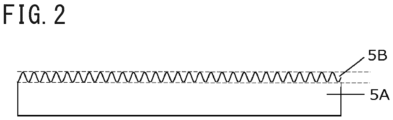
- the surface protective layer 5 has a core part 5A and ridge-like parts 5B provided to project in a ridge shape from one surface of the core part 5A. Thus, an irregular shape is formed on the surface of the surface protective layer 5.
- the "ridge-like” refers to a shape which is elongated and raised and in which the elongated and raised parts are linearly connected in a plan view.
- the ridge-like parts 5B may be curved or linear in a plan view, but is preferably curved from the viewpoint of fingerprint resistance on the surface of the decorative sheet 1.
- the ridge-like part 5B is, for example, a part from the lowest part to the tip of the irregular shape provided on the surface of the surface protective layer 5, and the core part 5A refers to a part excluding the ridge-like parts 5B of the surface protective layer 5.
- FIG. 2 is a cross-sectional view schematically illustrating a cross section (cross section in the thickness direction of the surface protective layer 5) of the ridge-like parts 5B of the surface protective layer 5.
- FIG. 3 is a plane photograph illustrating the configuration of the surface of the surface protective layer 5.
- FIG. 3 is a plane photograph obtained by a laser microscope (OLS-4000 manufactured by Olympus).
- the ridge-like parts 5B have a shape which is elongated and raised and in which the elongated and raised parts are linearly connected in a plan view as illustrated in the plane photograph of FIG. 3 .
- the ridge-like parts 5B are formed by irradiating the surface of an ionizing radiation curable resin with an ionizing radiation of a specific wavelength, and shrinking the surface of the ionizing radiation curable resin as described later.
- the shape of such ridge-like parts 5B can be expressed by a ratio RSm/Ra of a surface roughness index RSm (um) in the horizontal direction (which is the plane direction of the surface protective layer 5, and the left-right direction in FIG. 2 ) to a surface roughness index Ra (um) in the vertical direction (which is the depth direction of the ridge-like parts 5B and the thickness direction of the surface protective layer 5, and the vertical direction in FIG. 2 ).
- the RSm/Ra is preferably 10 or more and 300 or less.
- the RSm/Ra is more preferably 10 or more and 250 or less.
- the RSm/Ra is less than 10
- the shape of the ridge-like parts 5B is excessively fine, making it hard to wipe off dirt and deteriorating contamination resistance.
- the RSm/Ra is larger than 300, the interval between the ridge-like parts is excessively large, and therefore low gloss is not achieved.
- the RSm/Ra is still more preferably 50 or more and 200 or less.
- the interval between the ridge-like parts is moderately wide, and therefore the affinity with water or detergents (water containing surfactants or alcohol) is improved. Therefore, in the case of a decorative sheet having the RSm/Ra within the numerical range, even when the surface of the decorative sheet is dirty, the dirt can be wiped off with water or the detergent.
- the RSm/Ra is most preferably 80 or more and 150 or less.
- a commonly commercially available cleaning sponge easily enters between the ridge-like parts. Therefore, when the decorative sheet surface is dirty, the dirt can be wiped off using the commonly commercially available cleaning sponge.
- the Ra and the RSm are measured values when measured using a line roughness meter (according to JIS B0601 (ISO 4287)).
- the cross-sectional shape in the thickness direction of the surface protective layer 5 of the ridge-like parts 5B may be a sine wave shape.
- the "sine wave shape” refers to a shape in which a line from the lowest position C to the highest position (vertex) D of the ridge-like part 5B can be represented by a sine wave as illustrated in FIG. 5 .
- the shape between the adjacent ridge-like parts 5B may be a recessed curved shape. More specifically, the shape of the lowest position C of the ridge-like part 5B may be a recessed curved shape.
- the acrylate When acrylate is irradiated with a light with a wavelength of 200 nm or less as a first irradiation light, the acrylate can be self-excited. Therefore, by irradiating the acrylate with a light of 200 nm or less, the acrylate can be crosslinked. The light of 200 nm or less reaches a depth of about several tens to several hundreds of nm in the acrylate. Therefore, only the surface is crosslinked, and a part under the surface has fluidity, and therefore fine irregular shapes continuous in a wavy shape like folded wrinkles are generated.
- the light of 200 nm or less is absorbed by oxygen in the atmosphere. Therefore, the treatment of acrylate requires the introduction of nitrogen gas for the control of the reaction atmosphere.
- the residual oxygen concentration in the reaction atmosphere is preferably suppressed to 2000 ppm or less.
- the residual oxygen concentration in the reaction atmosphere is more preferably 1000 ppm or less.
- the integrated light intensity of the first irradiation light is preferably set to 0.5 mJ/cm 2 or more and 200 mJ/cm 2 or less.
- the integrated light intensity is more preferably 1 mJ/cm 2 or more and 100 mJ/cm 2 or less.
- the integrated light intensity is still more preferably 3 mJ/cm 2 or more and 50 mJ/cm 2 or less.
- the integrated light intensity is most preferably 5 mJ/cm 2 or more and 30 mJ/cm 2 or less.
- the curing shrinkage reaction When the integrated light intensity is less than 0.5 mJ/cm 2 , the curing shrinkage reaction is weak and the irregular shapes are not sufficiently formed, and therefore the gloss does not decrease. When the integrated light intensity is more than 200 mJ/cm 2 , the curing shrinkage reaction becomes excessively strong, so that the surface condition deteriorates.
- the light with a wavelength of 200 nm or less which is the first irradiation light, can be extracted by an excimer VUV light.
- the excimer VUV light can be produced from a noble gas or noble gas halide compound lamp.
- a noble gas or noble gas halide compound lamp When electrons with high energy are given to the lamp filled with a noble gas or a noble gas halide compound from the outside, a large number of discharge plasmas (dielectric barrier discharges) are generated.
- This plasma discharge excites atoms of a discharge gas (noble gas), so that the discharge gas momentarily enters an excimer state.
- the gas When returning from this excimer state to the ground state, the gas emits a light in the wavelength region peculiar to the excimer.
- Gas used for the excimer lamp may be any conventionally used gas insofar as the gas emits the light of 200 nm or less.
- gas such as Xe, Ar, and Kr, or mixed gases of noble gases, such as ArBr and ArF, and a halogen gas are usable.
- the excimer lamp has a wavelength (center wavelength) varying depending on the gas, and has a wavelength of about 172 nm (Xe), about 126 nm (Ar), about 146 nm (Kr), about 165 nm (ArBr), about 193 nm (ArF), or the like, for example.
- a xenon lamp emitting an excimer light having a center wavelength of 172 nm is preferably used as a light source. Further, considering a facility maintenance cost, the availability of materials, or the like, a xenon lamp is preferably used as a light source.
- the light with a wavelength of 200 nm or less which is the first irradiation light, reaches only a depth of several tens to several hundreds of nm from the outermost surface in acrylate, and therefore the inside of the surface protective layer 5 having the ridge-like parts 5B formed by the irradiation with the light of 200 nm or less has fluidity, and thus a curing reaction needs to be further advanced.
- an ionizing radiation or a UV light with a wavelength longer than that of the light with a wavelength of 200 nm or less, which is the first irradiation light is usable as a second irradiation light.
- an ionizing radiation of a type different from the second irradiation light or a UV light with a wavelength longer than that of the second irradiation light may be emitted as a third irradiation light.
- the surface protective layer 5 having the ridge-like parts 5B is preferably formed only by the irradiation with the two types of the lights of the first irradiation light and the second irradiation light.
- the third irradiation light may be emitted when the strength of the surface protective layer 5 is not sufficient only by the irradiation with the second irradiation light.
- the integrated light intensity of the second irradiation light is preferably set to 10 mJ/cm 2 or more and 500 mJ/cm 2 or less.
- the integrated light intensity is more preferably 50 mJ/cm 2 or more and 400 mJ/cm 2 or less.
- the integrated light intensity is still more preferably 100 mJ/cm 2 or more and 300 mJ/cm 2 or less.
- the integrated light intensity is less than 10 mJ/cm 2 , the curing reaction is weak and sufficient strength cannot be imparted to the entire surface protective layer 5, and therefore scratch resistance tends to decrease.
- the integrated light intensity is more than 200 mJ/cm 2 , the curing reaction tends to be excessively strong, so that the surface condition tends to deteriorate.
- the integrated light intensity of the second irradiation light is preferably larger than the integrated light intensity of the first irradiation light.
- the integrated light intensity of the second irradiation light is preferably 1.1 times or more and 50.0 times or less and more preferably 5.0 times or more and 30.0 times or less the integrated light intensity of the first irradiation light.
- the curing reaction is weak, so that sufficient strength cannot be imparted to the entire surface protective layer 5 in some cases.
- the curing reaction to the entire surface protective layer 5 becomes excessively strong, so that the ridge-like parts 5B are deformed in some cases.
- FIGS. 6A to 6J are views schematically illustrating the changes with time of the irradiance of the first irradiation light and the changes with time of the irradiance of the second irradiation light.
- FIGS. 6A, 6C, 6E, 6G, and 6I are views schematically illustrating the changes with time of the irradiance of the first irradiation light.
- FIGS. 6B, 6D, 6F, 6H, and 6J are views schematically illustrating the changes with time of the irradiance of the second irradiation light.
- the irradiance of the first irradiation light may gradually increase with the progress of an irradiation time, and then gradually decrease with the progress of the irradiation time as illustrated in FIG. 6A .
- the irradiance of the first irradiation light may gradually decrease with the progress of the irradiation time as illustrated in FIG. 6C .
- the irradiance of the first irradiation light may gradually increase with the progress of the irradiation time as illustrated in FIG. 6E .
- the irradiance of the first irradiation light may gradually decrease with the progress of the irradiation time, and then gradually increase with the progress of the irradiation time as illustrated in FIG. 6G .
- the irradiance of the first irradiation light may be constant from the start of the irradiation to the end of the irradiation as illustrated in FIG. 6I .
- the irradiance of the second irradiation light may gradually increase with the progress of the irradiation time, and then gradually decrease with the progress of the irradiation time as illustrated in FIG. 6B .
- the irradiance of the second irradiation light may gradually decrease with the progress of the irradiation time as illustrated in FIG. 6D .
- the irradiance of the second irradiation light may gradually increase with the progress of the irradiation time as illustrated in FIG. 6F .
- the irradiance of the second irradiation light may gradually decrease with the progress of the irradiation time, and then gradually increase with the progress of the irradiation time as illustrated in FIG. 6H .
- the irradiance of the second irradiation light may be constant from the start of the irradiation to the end of the irradiation as illustrated in FIG. 6J .
- the irradiation forms of the first irradiation light illustrated in FIGS. 6A, 6C, 6E, 6G, and 6I and the irradiation forms of the second irradiation light illustrated in FIGS. 6B, 6D, 6F, 6H, and 6J can be used in combination as appropriate.
- the irradiation form of the first irradiation light illustrated in FIG. 6A and the irradiation form of the second irradiation light illustrated in FIG. 6F may be used in combination.
- the irradiation form of the first irradiation light illustrated in FIG. 6G and the irradiation form of the second irradiation light illustrated in FIG. 6F may be used in combination.
- the irradiation form of the first irradiation light illustrated in FIG. 6C and the irradiation form of the second irradiation light illustrated in FIG. 6F may be used in combination.
- the ridge-like parts 5B formed by the light irradiation with the light of 200 nm or less has a finer structure than the structure of an irregular shape formed by mechanical processing, such as embossing, on the surface of the surface protective layer 5.
- the formation of such a fine irregular shape on the surface of the surface protective layer 5 enables an improvement of the fingerprint resistance while maintaining a matte feeling on the surface of the decorative sheet 1.
- the layer thickness of the surface protective layer 5 is preferably set in the range of 2 um or more and 20 um or less.
- the layer thickness of the surface protective layer 5 is more preferably in the range of 3 um or more and 20 um or less.
- the layer thickness of the surface protective layer 5 is still more preferably in the range of 5 um or more and 15 um or less.
- the layer thickness of the surface protective layer 5 is most preferably in the range of 5 um or more and 12 um or less.
- the layer thickness of the surface protective layer 5 is preferably set such that a ratio of the layer thickness of the ridge-like parts 5B to the layer thickness of the core part 5A (Layer thickness of the ridge-like parts 5B/Layer thickness of the core part 5A) is 0.01 or more and 2.0 or less and more preferably set such that the ratio is 0.1 or more and 1.0 or less.
- the pattern layer 3 and the surface protective layer 5 can be formed by various printing methods, such as a gravure printing method, an offset printing method, a screen printing method, an electrostatic printing method, and an inkjet printing method, for example.
- the surface protective layer 5 covers the entire surface on the front surface side of the base material layer 2, and therefore can also be formed by various coating methods, such as a roll coating method, a knife coating method, a microgravure coating method, and a die coating method, for example.
- the printing methods or the coating methods may be selected separately depending on the layer to be formed or the same method may be selected for collective processing.
- the pattern layer 3 and the surface protective layer 5 may be synchronized from the viewpoint of design properties.
- the synchronization requires the collective formation of the surface protective layer 5 after the formation of the pattern layer 3, and therefore the gravure printing method is preferably used. Further, the gravure printing method can be performed at relatively high speed, and thus is advantageous also in terms of cost, which is preferable.
- the synchronization means that 50% or more, preferably 70% or more, and most preferably 90% or more of a part where the surface protective layer 5 is formed overlaps with the pattern part of the pattern layer 3 in a plan view.
- the coating amount may be adjusted in the printing methods and the coating methods described above.
- One in which a surface protective layer is formed on a substrate (base material layer) and one in which no surface protective layer is formed thereon are produced, and then the coating amount can be calculated from a mass difference therebetween in various printing methods and coating methods.
- the surface protective layer 5 contains the ionizing radiation curable resin as a main material.
- the main material refers to the fact that the material is contained in a proportion of 60 parts by mass or more, more preferably 70 parts by mass or more, and most preferably 80 parts by mass or more based on 100 parts by mass of the surface protective layer.
- known substances such as various monomers or commercially available oligomers, are usable.
- (meth)acrylic resin, silicone-based resin, polyester-based resin, urethane-based resin, amide-based resin, and epoxy-based resin are usable.
- the ionizing radiation curable resin may be either a water-based resin or a non-water-based (organic solvent-based) resin.
- a main component of the ionizing radiation curable resin constituting the surface protective layer 5 is a tetrafunctional acrylate resin containing a repeating structure.
- the tetrafunctional acrylate resin pentaerythritol tetraacrylate and the like are usable, for example.
- the main component refers to a component contained in a proportion 60 parts by mass or more, more preferably 70 parts by mass or more, and most preferably 80 parts by mass or more based on 100 parts by mass of the resin component constituting the ionizing radiation curable resin.
- a tri- or less- functional acrylate resin is not preferable because the crosslinking degree is insufficient, so that the scratch resistance decreases.
- a penta- or more- functional acrylate resin is not preferable because the crosslinking degree becomes excessively high, and therefore the processability decreases.
- a suitable viscosity range of the ionizing radiation curable resin is 10 to 500 mPa ⁇ s and an optimum viscosity range thereof is 50 to 300 mPa ⁇ s.
- an organic solvent or a difunctional acrylate resin having a low viscosity can be added.
- the use of the organic solvent is not preferable from the viewpoint of environmental loads.
- the difunctional acrylate resin is not preferable because the scratch resistance decreases when the addition amount is large.
- the content of the difunctional acrylate resin is preferably within the range of 10% by mass or more and 30% by mass or less and more preferably within the range of 15% by mass or more and 20% by mass or less of the content (mass) of the tetrafunctional acrylate resin.
- the repeating structure is any one of an ethylene oxide (EO) structure, a propylene oxide (PO) structure, and an ⁇ -caprolactone (CL) structure.
- the repeating structure is more preferably ethylene oxide or propylene oxide.
- the ethylene oxide structure, the propylene oxide structure, and the ⁇ -caprolactone structure are preferable because the molecules are freely rotatable and highly flexible, so that the molecules are easily folded by the light of 200 nm or less and fine irregular shapes are easily formed.
- the number of repetitions of the repeating structure is set to 12 or more.
- the number of repetitions thereof is more preferably 12 or more and 50 or less and most preferably 20 or more and 50 or less.
- the ionizing radiation curable resin constituting the surface protective layer 5 does not sufficiently shrink when irradiated with a vacuum ultraviolet light (VUV light), so that the surface protective layer 5 does not have low gloss.
- VUV light vacuum ultraviolet light
- the number of repetitions is larger than 50, the crosslinking density decreases, so that the scratch resistance of the surface protective layer 5 deteriorates.
- the number of repetitions of the repeating structure above can be analyzed by using MALDI-TOF-MS.
- the MALDI-TOF-MS spectrum of the ionizing radiation curable resin has a normal distribution having a molecular weight distribution in some cases.
- the number of repetitions is the number of repetitions equivalent to the molecular weight having the strongest peak in the mass spectrum of the MALDI-TOF-MS.
- the surface protective layer 5 may contain particles.
- particles having an optimum particle size and an optimum content enables the formation of a uniform surface.
- organic materials such as PE wax, PP wax, resin beads, or inorganic materials, such as silica, glass, alumina, titania, zirconia, calcium carbonate, and barium sulfate, are usable, for example.
- the average particle size of the particles is preferably 10 um or less.
- the average particle size is more preferably 1 um or more and 8 um or less, still more preferably 2 um or more and 6 um or less, and most preferably 3 um or more and 5 um or less.
- the average particle size larger than 10 um is not preferable because the scratch resistance decreases due to particle pull-out.
- the average particle size less than 1 um is not preferable because an effect of uniformizing the surface is low.
- the "particle size (average particle size)" may be a value (average value) obtained by particle size distribution measurement of the particles to be used or a value obtained by actually measuring and averaging the particle sizes of a plurality of particles from the observation of a cross section of the obtained decorative material.
- the particle size values to be obtained are substantially the same.
- the average particle size of the particles to be added to the surface protective layer 5 may be the median size (D50) measured by a laser diffraction/scattering type particle size distribution measuring device.
- the addition amount of the particles is preferably 0.5 part by mass or more and 10 parts by mass or less based on 100 parts by mass of the ionizing radiation curable resin.
- the addition amount of the particles is more preferably 2 parts by mass or more and 8 parts by mass or less, still more preferably 2 parts by mass or more and 6 parts by mass or less, and most preferably 4 parts by mass or more and 5 parts by mass or less.
- the surface protective layer 5 can form a uniform surface condition due to the particles contained in the addition amount described above, which is preferable.
- the photoinitiator is not particularly limited, and examples thereof include a benzophenone-type, an acetophenone-type, a benzoin ether-type, and a thioxanthone-type, for example.
- an ultraviolet absorber and a light stabilizer can be added to the surface protective layer 5 as necessary.
- an ultraviolet absorber a benzotriazole type, a benzoate type, a benzophenone type, a triazine type, and the like are commonly added in any combination, for example.
- a hindered amine type and the like are commonly added in any combination, for example.
- Such a decorative sheet 1 has gloss level of 5.0 or less although the decorative sheet 1 does not contain the gloss adjuster (matting additive), and thus provides a decorative sheet having extremely low gloss level.
- the gloss level of a decorative sheet having a surface protective layer is 8 or less, the content ratio of the gloss adjuster in the surface protective layer is high, so that the surface protective layer becomes cloudy. Therefore, there has been a risk that the hues and the patterns of the colored pattern layer have not been clearly developed or the design properties of the decorative sheet have deteriorated.
- the content ratio of the gloss adjuster in the surface protective layer is much higher, and therefore it has been difficult to form a surface protective layer having a smooth surface without causing streaks, unevenness, and the like in the formation of the surface protective layer.
- the decorative sheet 1 can provide a decorative sheet with low gloss level in which the gloss level is 5.0 or less while maintaining the same level of performance as that of a decorative sheet with gloss level of 20 or more.
- gloss level is a measured value when measured at an incident angle of 60° using a gloss level meter according to JIS Z8741 (ISO 2813).
- the concealment property can be imparted using a colored sheet for the base material layer 2 or by separately providing an opaque concealing layer 8.
- the concealing layer 8 can be basically formed of the same material as that of the pattern layer 3. However, it is intended to impart the concealment property, opaque pigments, titanium oxide, iron oxide, and the like are preferably used as pigments, for example. Further, to enhance the concealment property, metals, such as gold, silver, copper, and aluminum, can be added, for example. In common, flake-shaped aluminum is added in many cases.
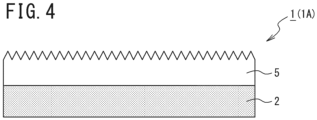
- a manufacturing example of a decorative sheet 1 (1A) is described with reference to FIG. 4 .
- a resin film is used as the base material layer 2, and the surface protective layer 5 is formed by printing on the upper surface of the base material layer 2.
- the light with a wavelength of 200 nm or less (first irradiation light) is emitted to the surface of the applied ionizing radiation curable resin to shrink the surface of the ionizing radiation curable resin.
- an ionizing radiation or a UV light with a wavelength longer than that of the light with a wavelength of 200 nm or less, which is first the irradiation light is emitted.
- the decorative sheet 1 (1A) is formed which includes the surface protective layer 5 having the core part 5A and the ridge-like parts 5B provided to project in a ridge-like shape from one surface (upper surface) of the core part 5A.
- an ionizing radiation or a UV light with a wavelength longer than that of the light with a wavelength of 200 nm or less, which is the first irradiation light may be emitted only once.
- the integrated light intensity of the light with a wavelength of 200 nm or less, which is the first irradiation light may be set to 0.5 mJ/cm 2 or more and 200 mJ/cm 2 or less.
- the decorative sheet 1 includes the surface protective layer 5 on which the irregular shape is formed on the surface.
- the gloss (gloss level) of the surface protective layer can be adjusted even when the surface protective layer does not contain the gloss adjuster (matting additive).
- the gloss adjuster reduces the oil repellency of a layer formed of a resin material, and therefore fingerprints are easily attached.
- the surface protective layer 5 according to this embodiment does not contain the gloss adjuster, and therefore does not absorb oil, so that the oil repellency is relatively improved. Therefore, fingerprints are hardly attached to the decorative sheet 1 having the surface protective layer 5 in various situations, such as on-site construction, furniture assembly, and daily life of residents.
- the oil repellency of the surface protective layer 5 is improved, so that oil stains or the adsorption of contaminants to the surface of the decorative sheet 1 can be suppressed.
- the surface protective layer 5 not containing the gloss adjuster when the surface of the decorative sheet 1 is scratched, particles of the gloss adjuster do not fall off, which can make it hard to cause gloss changes or scratches on the surface of the decorative sheet 1.
- the surface protective layer 5 is formed in a single layer, but the present invention is not limited to such a configuration.
- a configuration may be acceptable in which the surface protective layer 5 is formed in a multilayer.
- the surface protective layer 5 may have the irregular shape formed on the surface by depositing two or more layers of the same ionizing radiation curable resin or depositing two or more layers of different ionizing radiation curable resins.
- the outermost layer of the surface protective layer 5 contains the ionizing radiation curable resin as a main material
- the ionizing radiation curable resin contains, as a main component, a tetrafunctional acrylic resin containing a repeating structure
- the repeating structure is any one of the structures of ethylene oxide, propylene oxide, and ⁇ -caprolactone
- the number of repetitions of the repeating structure is 12 or more
- a layer located on the base material layer 2 side of the surface protective layer 5 i.e., layer located below the outermost layer of the surface protective layer 5 is not particularly limited, for example.
- a 55 ⁇ m thick olefin film (manufactured by RIKEN TECHNOS CORP.) was used as a base material layer, one surface of the base material layer was subjected to corona treatment, and the one surface was coated with a coating liquid for surface protective layer described below.
- the layer thickness of the coating liquid for surface protective layer was set to 5 um.
- an Xe excimer lamp with a wavelength of 172 nm was emitted to the surface of the coating liquid for surface protective layer such that the integrated light intensity was 100 mJ/cm 2 to shrink the surface.
- an ionizing radiation was emitted at 100 kGy to cure the coating liquid for surface protective layer, thereby forming the surface protective layer 5, and thus a decorative sheet of Example 1 having a total thickness of 60 um was obtained.
- the coating liquid for surface protective layer was formed by compounding particles described below with an ionizing radiation curable resin described below.
- Example 2 A decorative sheet of Example 2 was obtained in the same manner as in Example 1, except for replacing the ionizing radiation curable resin of Example 1 with an ionizing radiation curable resin described below.
- Example 3 A decorative sheet of Example 3 was obtained in the same manner as in Example 1, except for replacing the ionizing radiation curable resin of Example 1 with an ionizing radiation curable resin described below.
- Example 4 A decorative sheet of Example 4 was obtained in the same manner as in Example 1, except for replacing the ionizing radiation curable resin of Example 1 with an ionizing radiation curable resin described below.
- Example 5 A decorative sheet of Example 5 was obtained in the same manner as in Example 1, except for replacing the ionizing radiation curable resin of Example 1 with an ionizing radiation curable resin described below.
- Caprolactone-modified pentaerythritol tetraacrylate (30 moles of caprolactone (CL) added)
- a decorative sheet of Example 6 having a total thickness of 56 um was obtained in the same manner as in Example 1, except for setting the layer thickness of the coating liquid for surface protective layer of Example 1 to 1 um.
- a decorative sheet of Example 7 having a total thickness of 57 um was obtained in the same manner as in Example 1, except for setting the layer thickness of the coating liquid for surface protective layer of Example 1 to 2 um.
- a decorative sheet of Example 8 having a total thickness of 75 um was obtained in the same manner as in Example 1, except for setting the layer thickness of the coating liquid for surface protective layer of Example 1 to 20 um.
- a decorative sheet of Example 9 having a total thickness of 80 ⁇ m was obtained in the same manner as in Example 1, except for setting the layer thickness of the coating liquid for surface protective layer of Example 1 to 25 um.
- a decorative sheet of Example 10 was obtained in the same manner as in Example 9, except that the particles of Example 9 were not compounded.
- a decorative sheet of Example 11 was obtained in the same manner as in Example 3, except that the particles of Example 3 were not compounded.
- a decorative sheet of Example 12 was obtained in the same manner as in Example 1, except for replacing the particles of Example 1 with particles described below.
- a decorative sheet of Example 13 was obtained in the same manner as in Example 1, except for replacing the particles of Example 1 with particles described below.
- a decorative sheet of Example 14 was obtained in the same manner as in Example 1, except for setting the compounding amount of the particles of Example 1 to 10 parts by mass.
- a decorative sheet of Example 15 was obtained in the same manner as in Example 1, except for setting the compounding amount of the particles of Example 1 to 11 parts by mass.
- a decorative sheet of Example 16 having a total thickness of 56 um was obtained in the same manner as in Example 1, except that the layer thickness of the coating liquid for surface protective layer of Example 1 was set to 1 um and the particles of Example 1 were not compounded.
- Example 17 A decorative sheet of Example 17 was obtained in the same manner as in Example 1, except for replacing the ionizing radiation curable resin of Example 1 with an ionizing radiation curable resin described below.
- a decorative sheet of Example 18 having a total thickness of 80 um was obtained in the same manner as in Example 2, except for setting the layer thickness of the coating liquid for surface protective layer of Example 2 to 25 um.
- a decorative sheet of Comparative Example 1 was obtained in the same manner as in Example 1, except that the excimer lamp irradiation of Example 1 was not performed and the compounding amount of the particles was set to 15 parts by mass.
- a decorative sheet of Comparative Example 2 was obtained in the same manner as in Example 1, except for replacing the ionizing radiation curable resin of Example 1 with an ionizing radiation curable resin described below.
- a decorative sheet of Comparative Example 3 was obtained in the same manner as in Example 1, except for replacing the ionizing radiation curable resin of Example 1 with an ionizing radiation curable resin described below.
- a decorative sheet of Comparative Example 4 was obtained in the same manner as in Example 1, except for replacing the ionizing radiation curable resin of Example 1 with an ionizing radiation curable resin described below.
- the evaluation criteria were as follows.
- the 60° gloss level was measured using a Rhopoint IQ (manufactured by Konica Minolta).
- the 60° gloss level of the surface of each decorative sheet was measured and defined as "Initial gloss level”. Subsequently, a fingerprint resistance evaluation liquid was attached onto the surface protective layer, and then the fingerprint resistance evaluation liquid attached to the surface of the decorative sheet was wiped off. Thereafter, the 60° gloss level of a part where the fingerprint resistance evaluation liquid was wiped off was measured and defined as "[Gloss level after wiping]". Herein, higher fatty acid was used as the fingerprint resistance evaluation liquid.
- Fingerprint wiping rate (%) (Gloss level after wiping/Initial gloss level) ⁇ 100
- the evaluation criteria were as follows.
- the evaluation criteria were as follows.
- the obtained decorative sheet was pasted to a woody board B using a urethane-based adhesive, and then a steel wool rubbing test was carried out as a scratch resistance evaluation.
- the decorative sheet surface was rubbed 20 times with steel wool under a 300 g load, and scratches or gloss changes occurring on the decorative sheet surface were visually confirmed.
- the evaluation criteria were as follows.
- the obtained decorative sheet was cut into a 10 cm square and allowed to still stand under conditions of 25°C and 50%RH for 48 hours. Then, the average of the distances between the four corners and the plane surface was calculated. More specifically, in this curling property test, the curling property of the decorative sheet was evaluated by measuring the shortest distance d from the surface (plane surface) of a test table on which the decorative sheet was placed to each corner of the decorative sheet as illustrated in FIG. 7 , and then averaging the values of the shortest distances d.
- the evaluation criteria are as follows.
- the obtained decorative sheet was subjected to lapping processing.
- the processability state was evaluated by observing whether whitening or cracks occurred in a bent part of the surface of the decorative sheet using an optical microscope. This lapping processability is equivalent to so-called bending processability.
- the evaluation criteria were as follows.
- the decorative sheets of Examples 1 to 18 can provide decorative sheets simultaneously achieving fingerprint resistance, scratch resistance, contamination resistance, and bending processability while having low gloss.
- the layer thickness of the surface protective layer or the particle size and the addition amount of the particles to be compounded in addition to the surface shape of the surface protective layer or the resin composition of the surface protective layer, a further performance improvement can be achieved.
- the present disclosure further relates to the following embodiments.
Landscapes
- Chemical & Material Sciences (AREA)
- Engineering & Computer Science (AREA)
- Organic Chemistry (AREA)
- Health & Medical Sciences (AREA)
- Materials Engineering (AREA)
- Wood Science & Technology (AREA)
- Physics & Mathematics (AREA)
- Plasma & Fusion (AREA)
- Life Sciences & Earth Sciences (AREA)
- Polymers & Plastics (AREA)
- Medicinal Chemistry (AREA)
- Chemical Kinetics & Catalysis (AREA)
- Toxicology (AREA)
- General Health & Medical Sciences (AREA)
- Manufacturing & Machinery (AREA)
- Crystallography & Structural Chemistry (AREA)
- General Chemical & Material Sciences (AREA)
- Laminated Bodies (AREA)
Applications Claiming Priority (3)
| Application Number | Priority Date | Filing Date | Title |
|---|---|---|---|
| JP2021080798 | 2021-05-12 | ||
| PCT/JP2021/041625 WO2022239270A1 (ja) | 2021-05-12 | 2021-11-11 | 化粧シート、及び化粧シートの製造方法 |
| EP21931925.8A EP4116095B1 (de) | 2021-05-12 | 2021-11-11 | Dekorfolie und herstellungsverfahren für dekorfolie |
Related Parent Applications (2)
| Application Number | Title | Priority Date | Filing Date |
|---|---|---|---|
| EP21931925.8A Division EP4116095B1 (de) | 2021-05-12 | 2021-11-11 | Dekorfolie und herstellungsverfahren für dekorfolie |
| EP21931925.8A Division-Into EP4116095B1 (de) | 2021-05-12 | 2021-11-11 | Dekorfolie und herstellungsverfahren für dekorfolie |
Publications (2)
| Publication Number | Publication Date |
|---|---|
| EP4502084A2 true EP4502084A2 (de) | 2025-02-05 |
| EP4502084A3 EP4502084A3 (de) | 2025-04-16 |
Family
ID=84028130
Family Applications (2)
| Application Number | Title | Priority Date | Filing Date |
|---|---|---|---|
| EP21931925.8A Active EP4116095B1 (de) | 2021-05-12 | 2021-11-11 | Dekorfolie und herstellungsverfahren für dekorfolie |
| EP24219386.0A Pending EP4502084A3 (de) | 2021-05-12 | 2021-11-11 | Dekorfolie und verfahren zur herstellung einer dekorfolie |
Family Applications Before (1)
| Application Number | Title | Priority Date | Filing Date |
|---|---|---|---|
| EP21931925.8A Active EP4116095B1 (de) | 2021-05-12 | 2021-11-11 | Dekorfolie und herstellungsverfahren für dekorfolie |
Country Status (7)
| Country | Link |
|---|---|
| US (1) | US20230146524A1 (de) |
| EP (2) | EP4116095B1 (de) |
| JP (1) | JPWO2022239270A1 (de) |
| KR (1) | KR20240007054A (de) |
| CN (1) | CN115623867B (de) |
| PL (1) | PL4116095T3 (de) |
| WO (1) | WO2022239270A1 (de) |
Cited By (1)
| Publication number | Priority date | Publication date | Assignee | Title |
|---|---|---|---|---|
| EP4527618A4 (de) * | 2022-05-20 | 2025-08-20 | Toppan Holdings Inc | Dekorfolie und verfahren zur herstellung einer dekorfolie |
Families Citing this family (15)
| Publication number | Priority date | Publication date | Assignee | Title |
|---|---|---|---|---|
| KR20240031961A (ko) * | 2021-07-06 | 2024-03-08 | 도판 홀딩스 가부시키가이샤 | 화장 시트 및 화장 시트의 제조 방법 |
| CN118284657A (zh) * | 2021-11-26 | 2024-07-02 | 凸版控股株式会社 | 装饰片以及装饰片的制造方法 |
| JPWO2023106340A1 (de) * | 2021-12-07 | 2023-06-15 | ||
| CN118843541A (zh) * | 2022-03-11 | 2024-10-25 | 凸版控股株式会社 | 装饰片以及装饰片的制造方法 |
| CN118946459A (zh) * | 2022-03-31 | 2024-11-12 | 凸版控股株式会社 | 装饰片以及装饰片的制造方法 |
| WO2023249082A1 (ja) * | 2022-06-24 | 2023-12-28 | Toppanホールディングス株式会社 | 化粧シート |
| JPWO2023249081A1 (de) * | 2022-06-24 | 2023-12-28 | ||
| WO2024010066A1 (ja) * | 2022-07-06 | 2024-01-11 | Toppanホールディングス株式会社 | 化粧シート及び化粧シートの製造方法 |
| EP4647250A4 (de) * | 2023-01-04 | 2026-04-29 | Toppan Holdings Inc | Dekorfolie |
| JP7582559B1 (ja) * | 2023-01-04 | 2024-11-13 | Toppanホールディングス株式会社 | 化粧シート |
| KR20250140514A (ko) * | 2023-01-25 | 2025-09-25 | 도판 홀딩스 가부시키가이샤 | 화장 시트 |
| WO2024158027A1 (ja) * | 2023-01-25 | 2024-08-02 | Toppanホールディングス株式会社 | 化粧シート |
| EP4691766A4 (de) * | 2023-03-27 | 2026-06-24 | Toppan Holdings Inc | Dekorfolie |
| EP4751908A1 (de) * | 2023-07-24 | 2026-06-03 | Toppan Holdings Inc. | Dekorfolie |
| WO2025127142A1 (ja) * | 2023-12-14 | 2025-06-19 | Toppanホールディングス株式会社 | 化粧シート |
Family Cites Families (36)
| Publication number | Priority date | Publication date | Assignee | Title |
|---|---|---|---|---|
| DE19846659C2 (de) * | 1998-10-09 | 2001-07-26 | Wkp Wuerttembergische Kunststo | Schichtwerkstoff und Verfahren zum Herstellen eines solchen |
| KR101165111B1 (ko) * | 2004-09-30 | 2012-07-12 | 다이니폰 인사츠 가부시키가이샤 | 화장재 |
| US8187695B2 (en) * | 2005-09-30 | 2012-05-29 | Dai Nippon Printing Co., Ltd. | Shaping sheet, resin decorative material and method of producing the same |
| CN102066075B (zh) * | 2008-06-30 | 2014-09-17 | 大日本印刷株式会社 | 装饰片、装饰树脂成形品的制造方法以及装饰树脂成形品 |
| US20110171429A1 (en) * | 2010-01-12 | 2011-07-14 | Ming-Hung Huang | Low gloss surface decorative film and decorated article formed therewith |
| JP5799954B2 (ja) * | 2010-09-14 | 2015-10-28 | コニカミノルタ株式会社 | 防眩性フィルム、防眩性フィルムの製造方法、偏光板及び液晶表示装置 |
| EP2752294B1 (de) * | 2011-09-30 | 2017-03-01 | Dai Nippon Printing Co., Ltd. | Zierfolie und aus kunstharz geformter zierartikel daraus |
| JP5850165B2 (ja) * | 2012-08-31 | 2016-02-03 | 王子ホールディングス株式会社 | 印刷用シート、加飾シート、および粘着性加飾シート |
| EP2946035A1 (de) * | 2013-01-17 | 2015-11-25 | Armstrong World Industries, Inc. | Härtungsverfahren dafür und daraus hergestellte produkte |
| JP6121792B2 (ja) * | 2013-05-13 | 2017-04-26 | 三洋化成工業株式会社 | 活性エネルギー線硬化性樹脂組成物 |
| US20160152833A1 (en) * | 2013-06-14 | 2016-06-02 | Covestro Deutschland Ag | Direction-independently impact-resistant 3-d molded parts |
| JP6350184B2 (ja) * | 2013-09-30 | 2018-07-04 | 大日本印刷株式会社 | 化粧シート及び化粧板 |
| JP6728568B2 (ja) * | 2014-03-27 | 2020-07-22 | 大日本印刷株式会社 | シート |
| JP5800968B1 (ja) * | 2014-08-08 | 2015-10-28 | 株式会社Dnpファインケミカル | 活性エネルギー線硬化型インク組成物、このインク組成物を用いた積層体、及び基材上に像を形成する像形成方法 |
| JP5991367B2 (ja) * | 2014-11-18 | 2016-09-14 | 大日本印刷株式会社 | スライドパッド用シート、突起部付きスライドパッド用シート、及びこれらを用いたスライドパッド |
| KR102038573B1 (ko) * | 2015-09-30 | 2019-10-30 | 다이니폰 인사츠 가부시키가이샤 | 화장 시트 및 화장판 |
| JP6086358B1 (ja) * | 2016-01-19 | 2017-03-01 | 東洋インキScホールディングス株式会社 | 紫外線硬化型樹脂組成物および積層体 |
| JP6658184B2 (ja) * | 2016-03-24 | 2020-03-04 | 東洋インキScホールディングス株式会社 | 紫外線硬化型コート剤組成物および積層体 |
| JP6131517B1 (ja) * | 2016-08-09 | 2017-05-24 | 東洋インキScホールディングス株式会社 | 艶消し被覆組成物、化粧材及びその製造方法 |
| US12128654B2 (en) * | 2016-09-16 | 2024-10-29 | Dai Nippon Printing Co., Ltd. | Cosmetic sheet and cosmetic plate |
| CN109789677A (zh) * | 2016-09-28 | 2019-05-21 | 大日本印刷株式会社 | 装饰片和装饰板 |
| JP6965919B2 (ja) * | 2017-03-31 | 2021-11-10 | 大日本印刷株式会社 | 加飾シート、加飾樹脂成形品、及びこれらの製造方法 |
| US11572466B2 (en) * | 2017-05-22 | 2023-02-07 | Lg Hausys, Ltd. | Low-gloss cured product having excellent stain resistance, and manufacturing method therefor |
| JP7202774B2 (ja) * | 2017-09-29 | 2023-01-12 | デクセリアルズ株式会社 | 光学体、光学体の製造方法、及び発光装置 |
| EP3489268A1 (de) * | 2017-11-23 | 2019-05-29 | Allnex Belgium, S.A. | Strahlungshärtbare zusammensetzung |
| JP7003667B2 (ja) | 2018-01-05 | 2022-02-10 | 凸版印刷株式会社 | 化粧材 |
| JP7735051B2 (ja) * | 2018-06-21 | 2025-09-08 | 三菱ケミカル株式会社 | アクリル艶消樹脂フィルム |
| KR102180634B1 (ko) * | 2018-08-29 | 2020-11-18 | (주)엘지하우시스 | 내오염성 및 논슬립성이 우수한 바닥재 |
| KR102331112B1 (ko) * | 2018-09-14 | 2021-11-26 | (주)엘엑스하우시스 | 촉감이 우수한 저광택의 데코 시트 |
| KR102405876B1 (ko) * | 2018-11-22 | 2022-06-07 | (주)엘엑스하우시스 | 내오염성 및 심미적 효과가 우수한 장식재 및 이의 제조방법 |
| KR102608459B1 (ko) * | 2018-11-23 | 2023-12-04 | (주)엘엑스하우시스 | 내스크래치성 및 내오염성이 우수한 장식재 및 이의 제조방법 |
| JP7363034B2 (ja) * | 2019-01-17 | 2023-10-18 | 三菱ケミカル株式会社 | 硬化物 |
| JP7044982B2 (ja) * | 2020-03-03 | 2022-03-31 | 凸版印刷株式会社 | 化粧シート、化粧板及び化粧シートの製造方法 |
| JP7777918B2 (ja) * | 2020-07-07 | 2025-12-01 | スリーエム イノベイティブ プロパティズ カンパニー | フィルム及びその製造方法 |
| US20230364640A1 (en) * | 2020-09-14 | 2023-11-16 | Dai Nippon Printing Co., Ltd. | Matte article |
| US20230025597A1 (en) * | 2020-12-28 | 2023-01-26 | Toppan Inc. | Decorative sheet and method for manufacturing decorative sheet |
-
2021
- 2021-11-11 JP JP2022520846A patent/JPWO2022239270A1/ja active Pending
- 2021-11-11 KR KR1020227029807A patent/KR20240007054A/ko active Pending
- 2021-11-11 EP EP21931925.8A patent/EP4116095B1/de active Active
- 2021-11-11 US US17/908,220 patent/US20230146524A1/en active Pending
- 2021-11-11 EP EP24219386.0A patent/EP4502084A3/de active Pending
- 2021-11-11 WO PCT/JP2021/041625 patent/WO2022239270A1/ja not_active Ceased
- 2021-11-11 CN CN202180019575.6A patent/CN115623867B/zh active Active
- 2021-11-11 PL PL21931925.8T patent/PL4116095T3/pl unknown
Cited By (1)
| Publication number | Priority date | Publication date | Assignee | Title |
|---|---|---|---|---|
| EP4527618A4 (de) * | 2022-05-20 | 2025-08-20 | Toppan Holdings Inc | Dekorfolie und verfahren zur herstellung einer dekorfolie |
Also Published As
| Publication number | Publication date |
|---|---|
| WO2022239270A1 (ja) | 2022-11-17 |
| KR20240007054A (ko) | 2024-01-16 |
| JPWO2022239270A1 (de) | 2022-11-17 |
| EP4502084A3 (de) | 2025-04-16 |
| EP4116095A4 (de) | 2023-11-01 |
| EP4116095A1 (de) | 2023-01-11 |
| CN115623867A (zh) | 2023-01-17 |
| EP4116095A8 (de) | 2023-03-08 |
| US20230146524A1 (en) | 2023-05-11 |
| CN115623867B (zh) | 2026-07-10 |
| EP4116095B1 (de) | 2025-02-12 |
| PL4116095T3 (pl) | 2025-04-22 |
Similar Documents
| Publication | Publication Date | Title |
|---|---|---|
| EP4116095B1 (de) | Dekorfolie und herstellungsverfahren für dekorfolie | |
| EP4101640B1 (de) | Dekorfolie und verfahren zur herstellung einer dekorfolie | |
| EP4368389A1 (de) | Dekorfolie und herstellungsverfahren für dekorfolie | |
| EP4446110A1 (de) | Dekorfolie und verfahren zur herstellung einer dekorfolie | |
| EP4438294A1 (de) | Dekorfolie und verfahren zur herstellung einer dekorfolie | |
| EP4464510A1 (de) | Dekorfolie und verfahren zur herstellung einer dekorfolie | |
| EP4501632A1 (de) | Dekorfolie und verfahren zur herstellung einer dekorfolie | |
| EP4559675A1 (de) | Dekorfolie und verfahren zur herstellung einer dekorfolie | |
| US20240425717A1 (en) | Decorative sheet and method for manufacturing decorative sheet | |
| JP2025023274A (ja) | 化粧シート | |
| EP4545294A1 (de) | Dekorfolie | |
| US20250092282A1 (en) | Decorative sheet and method for manufacturing decorative sheet | |
| WO2023224115A1 (ja) | 化粧シート、及び化粧シートの製造方法 |
Legal Events
| Date | Code | Title | Description |
|---|---|---|---|
| PUAI | Public reference made under article 153(3) epc to a published international application that has entered the european phase |
Free format text: ORIGINAL CODE: 0009012 |
|
| STAA | Information on the status of an ep patent application or granted ep patent |
Free format text: STATUS: THE APPLICATION HAS BEEN PUBLISHED |
|
| AC | Divisional application: reference to earlier application |
Ref document number: 4116095 Country of ref document: EP Kind code of ref document: P |
|
| AK | Designated contracting states |
Kind code of ref document: A2 Designated state(s): AL AT BE BG CH CY CZ DE DK EE ES FI FR GB GR HR HU IE IS IT LI LT LU LV MC MK MT NL NO PL PT RO RS SE SI SK SM TR |
|
| REG | Reference to a national code |
Ref country code: DE Ref legal event code: R079 Free format text: PREVIOUS MAIN CLASS: C09D0004000000 Ipc: C08J0007040000 |
|
| PUAL | Search report despatched |
Free format text: ORIGINAL CODE: 0009013 |
|
| AK | Designated contracting states |
Kind code of ref document: A3 Designated state(s): AL AT BE BG CH CY CZ DE DK EE ES FI FR GB GR HR HU IE IS IT LI LT LU LV MC MK MT NL NO PL PT RO RS SE SI SK SM TR |
|
| RIC1 | Information provided on ipc code assigned before grant |
Ipc: C09D 4/00 20060101ALI20250310BHEP Ipc: B05D 7/04 20060101ALI20250310BHEP Ipc: B05D 5/06 20060101ALI20250310BHEP Ipc: B05D 5/02 20060101ALI20250310BHEP Ipc: B05D 3/06 20060101ALI20250310BHEP Ipc: C08J 7/18 20060101ALI20250310BHEP Ipc: C08J 7/046 20200101ALI20250310BHEP Ipc: C08J 7/04 20200101AFI20250310BHEP |
|
| STAA | Information on the status of an ep patent application or granted ep patent |
Free format text: STATUS: REQUEST FOR EXAMINATION WAS MADE |
|
| 17P | Request for examination filed |
Effective date: 20250903 |