EP4497705A1 - Transportsystem und transportsteuerungsverfahren - Google Patents
Transportsystem und transportsteuerungsverfahren Download PDFInfo
- Publication number
- EP4497705A1 EP4497705A1 EP23788050.5A EP23788050A EP4497705A1 EP 4497705 A1 EP4497705 A1 EP 4497705A1 EP 23788050 A EP23788050 A EP 23788050A EP 4497705 A1 EP4497705 A1 EP 4497705A1
- Authority
- EP
- European Patent Office
- Prior art keywords
- transportation
- command
- assignment processing
- transport vehicle
- time
- Prior art date
- Legal status (The legal status is an assumption and is not a legal conclusion. Google has not performed a legal analysis and makes no representation as to the accuracy of the status listed.)
- Pending
Links
Images


Classifications
-
- G—PHYSICS
- G05—CONTROLLING; REGULATING
- G05D—SYSTEMS FOR CONTROLLING OR REGULATING NON-ELECTRIC VARIABLES
- G05D1/00—Control of position, course, altitude or attitude of land, water, air or space vehicles, e.g. using automatic pilots
- G05D1/60—Intended control result
- G05D1/69—Coordinated control of the position or course of two or more vehicles
- G05D1/698—Control allocation
-
- H—ELECTRICITY
- H10—SEMICONDUCTOR DEVICES; ELECTRIC SOLID-STATE DEVICES NOT OTHERWISE PROVIDED FOR
- H10P—GENERIC PROCESSES OR APPARATUS FOR THE MANUFACTURE OR TREATMENT OF DEVICES COVERED BY CLASS H10
- H10P72/00—Handling or holding of wafers, substrates or devices during manufacture or treatment thereof
- H10P72/30—Handling or holding of wafers, substrates or devices during manufacture or treatment thereof for conveying, e.g. between different workstations
- H10P72/32—Handling or holding of wafers, substrates or devices during manufacture or treatment thereof for conveying, e.g. between different workstations between different workstations
- H10P72/3218—Conveying cassettes, containers or carriers
-
- G—PHYSICS
- G05—CONTROLLING; REGULATING
- G05D—SYSTEMS FOR CONTROLLING OR REGULATING NON-ELECTRIC VARIABLES
- G05D1/00—Control of position, course, altitude or attitude of land, water, air or space vehicles, e.g. using automatic pilots
- G05D1/60—Intended control result
- G05D1/69—Coordinated control of the position or course of two or more vehicles
- G05D1/698—Control allocation
- G05D1/6987—Control allocation by centralised control off-board any of the vehicles
-
- B—PERFORMING OPERATIONS; TRANSPORTING
- B61—RAILWAYS
- B61B—RAILWAY SYSTEMS; EQUIPMENT THEREFOR NOT OTHERWISE PROVIDED FOR
- B61B3/00—Elevated railway systems with suspended vehicles
- B61B3/02—Elevated railway systems with suspended vehicles with self-propelled vehicles
-
- B—PERFORMING OPERATIONS; TRANSPORTING
- B65—CONVEYING; PACKING; STORING; HANDLING THIN OR FILAMENTARY MATERIAL
- B65G—TRANSPORT OR STORAGE DEVICES, e.g. CONVEYORS FOR LOADING OR TIPPING, SHOP CONVEYOR SYSTEMS OR PNEUMATIC TUBE CONVEYORS
- B65G43/00—Control devices, e.g. for safety, warning or fault-correcting
- B65G43/10—Sequence control of conveyors operating in combination
-
- B—PERFORMING OPERATIONS; TRANSPORTING
- B65—CONVEYING; PACKING; STORING; HANDLING THIN OR FILAMENTARY MATERIAL
- B65G—TRANSPORT OR STORAGE DEVICES, e.g. CONVEYORS FOR LOADING OR TIPPING, SHOP CONVEYOR SYSTEMS OR PNEUMATIC TUBE CONVEYORS
- B65G49/00—Conveying systems characterised by their application for specified purposes not otherwise provided for
- B65G49/05—Conveying systems characterised by their application for specified purposes not otherwise provided for for fragile or damageable materials or articles
- B65G49/06—Conveying systems characterised by their application for specified purposes not otherwise provided for for fragile or damageable materials or articles for fragile sheets, e.g. glass
- B65G49/061—Lifting, gripping, or carrying means, for one or more sheets forming independent means of transport, e.g. suction cups, transport frames
-
- G—PHYSICS
- G05—CONTROLLING; REGULATING
- G05D—SYSTEMS FOR CONTROLLING OR REGULATING NON-ELECTRIC VARIABLES
- G05D1/00—Control of position, course, altitude or attitude of land, water, air or space vehicles, e.g. using automatic pilots
- G05D1/20—Control system inputs
- G05D1/22—Command input arrangements
- G05D1/221—Remote-control arrangements
-
- G—PHYSICS
- G05—CONTROLLING; REGULATING
- G05D—SYSTEMS FOR CONTROLLING OR REGULATING NON-ELECTRIC VARIABLES
- G05D1/00—Control of position, course, altitude or attitude of land, water, air or space vehicles, e.g. using automatic pilots
- G05D1/60—Intended control result
- G05D1/644—Optimisation of travel parameters, e.g. of energy consumption, journey time or distance
-
- G—PHYSICS
- G05—CONTROLLING; REGULATING
- G05D—SYSTEMS FOR CONTROLLING OR REGULATING NON-ELECTRIC VARIABLES
- G05D1/00—Control of position, course, altitude or attitude of land, water, air or space vehicles, e.g. using automatic pilots
- G05D1/60—Intended control result
- G05D1/65—Following a desired speed profile
-
- G—PHYSICS
- G05—CONTROLLING; REGULATING
- G05D—SYSTEMS FOR CONTROLLING OR REGULATING NON-ELECTRIC VARIABLES
- G05D1/00—Control of position, course, altitude or attitude of land, water, air or space vehicles, e.g. using automatic pilots
- G05D1/60—Intended control result
- G05D1/656—Interaction with payloads or external entities
- G05D1/667—Delivering or retrieving payloads
-
- G—PHYSICS
- G06—COMPUTING OR CALCULATING; COUNTING
- G06Q—INFORMATION AND COMMUNICATION TECHNOLOGY [ICT] SPECIALLY ADAPTED FOR ADMINISTRATIVE, COMMERCIAL, FINANCIAL, MANAGERIAL OR SUPERVISORY PURPOSES; SYSTEMS OR METHODS SPECIALLY ADAPTED FOR ADMINISTRATIVE, COMMERCIAL, FINANCIAL, MANAGERIAL OR SUPERVISORY PURPOSES, NOT OTHERWISE PROVIDED FOR
- G06Q10/00—Administration; Management
- G06Q10/08—Logistics, e.g. warehousing, loading or distribution; Inventory or stock management
- G06Q10/087—Inventory or stock management, e.g. order filling, procurement or balancing against orders
- G06Q10/0874—Inventory fulfillment
-
- H—ELECTRICITY
- H10—SEMICONDUCTOR DEVICES; ELECTRIC SOLID-STATE DEVICES NOT OTHERWISE PROVIDED FOR
- H10P—GENERIC PROCESSES OR APPARATUS FOR THE MANUFACTURE OR TREATMENT OF DEVICES COVERED BY CLASS H10
- H10P72/00—Handling or holding of wafers, substrates or devices during manufacture or treatment thereof
- H10P72/06—Apparatus for monitoring, sorting, marking, testing or measuring
- H10P72/0612—Production flow monitoring, e.g. for increasing throughput
-
- H—ELECTRICITY
- H10—SEMICONDUCTOR DEVICES; ELECTRIC SOLID-STATE DEVICES NOT OTHERWISE PROVIDED FOR
- H10P—GENERIC PROCESSES OR APPARATUS FOR THE MANUFACTURE OR TREATMENT OF DEVICES COVERED BY CLASS H10
- H10P72/00—Handling or holding of wafers, substrates or devices during manufacture or treatment thereof
- H10P72/30—Handling or holding of wafers, substrates or devices during manufacture or treatment thereof for conveying, e.g. between different workstations
- H10P72/32—Handling or holding of wafers, substrates or devices during manufacture or treatment thereof for conveying, e.g. between different workstations between different workstations
- H10P72/3216—Handling or holding of wafers, substrates or devices during manufacture or treatment thereof for conveying, e.g. between different workstations between different workstations using a general scheme of a conveying path within a factory
-
- H—ELECTRICITY
- H10—SEMICONDUCTOR DEVICES; ELECTRIC SOLID-STATE DEVICES NOT OTHERWISE PROVIDED FOR
- H10P—GENERIC PROCESSES OR APPARATUS FOR THE MANUFACTURE OR TREATMENT OF DEVICES COVERED BY CLASS H10
- H10P72/00—Handling or holding of wafers, substrates or devices during manufacture or treatment thereof
- H10P72/30—Handling or holding of wafers, substrates or devices during manufacture or treatment thereof for conveying, e.g. between different workstations
- H10P72/32—Handling or holding of wafers, substrates or devices during manufacture or treatment thereof for conveying, e.g. between different workstations between different workstations
- H10P72/3221—Overhead conveying
-
- B—PERFORMING OPERATIONS; TRANSPORTING
- B65—CONVEYING; PACKING; STORING; HANDLING THIN OR FILAMENTARY MATERIAL
- B65G—TRANSPORT OR STORAGE DEVICES, e.g. CONVEYORS FOR LOADING OR TIPPING, SHOP CONVEYOR SYSTEMS OR PNEUMATIC TUBE CONVEYORS
- B65G2201/00—Indexing codes relating to handling devices, e.g. conveyors, characterised by the type of product or load being conveyed or handled
- B65G2201/02—Articles
- B65G2201/0297—Wafer cassette
-
- G—PHYSICS
- G05—CONTROLLING; REGULATING
- G05D—SYSTEMS FOR CONTROLLING OR REGULATING NON-ELECTRIC VARIABLES
- G05D2105/00—Specific applications of the controlled vehicles
- G05D2105/20—Specific applications of the controlled vehicles for transportation
- G05D2105/28—Specific applications of the controlled vehicles for transportation of freight
Definitions
- the present invention relates to a transportation system and a transportation control method.
- a transportation system causing a plurality of transport vehicles to execute a load grabbing request has been known (for example, refer to Patent Literature 1).
- a load grabbing request with the highest priority (the degree of priority for an article that is required to be transported earlier) is extracted, and a load grabbing command is allocated to a selected transport vehicle so as to cause it to execute the load grabbing request.
- Patent Literature 1 WO 2019/198330
- the number of loads transported is, for example, the number of loads transported per unit time. There is a problem in that the number of loads transported is insufficient with respect to the number of transportation commands.
- the present disclosure describes a transportation system and a transportation control method that can ensure a sufficient number of loads transported.
- a transportation system of the present disclosure includes a plurality of transport vehicles and a controller configured to assign a transportation command to the transport vehicles, the controller executing specific assignment processing to preferentially assign the transportation command having a relatively short transportation time or transportation distance to the transport vehicles.
- the controller executes the specific assignment processing.
- the specific assignment processing preferentially executes the transportation command having a relatively short transportation time or transportation distance.
- the transportation command is completed relatively early. This can increase the number of loads transported per unit time in the entire transportation system.
- this transportation system can ensure a sufficient number of loads transported.
- each transport vehicle is not restrained for a long period of time, and thus a certain number of idling vehicles (the transport vehicles that are in an idling state) can be ensured.
- the transport vehicle that is in the idling state means a transport vehicle that is not in operation and, in other words, means a transport vehicle to which the transportation command has not been allocated (including a transport vehicle having completed unloading).
- the controller may assign the transportation command in ascending order of the transportation time or the transportation distance in the specific assignment processing. As the transportation time or the transportation distance becomes shorter, the transportation command is completed even earlier. Thus, when the transportation command with a shorter transportation time or transportation distance is executed more preferentially, the number of loads transported can be further increased.
- the controller may suspend the transportation command having the transportation time or the transportation distance exceeding a certain value in the specific assignment processing.
- the transport vehicles do not execute the transportation command that is time-consuming (costly), and thus the number of loads transported per unit time can be increased, thus increasing the number of loads transported.
- the controller may execute the specific assignment processing under the condition that an operating rate of the transport vehicles equals or exceeds a threshold.
- the specific assignment processing is not always executed, but the specific assignment processing is executed only when the operating rate becomes the threshold or more.
- the transportation command is assigned, for example, in order of being received (or generated) regardless of the transportation time or the transportation distance.
- appropriate assignment processing according to the conditions of the entire transportation system is enabled. Consequently, transportation efficiency in the transportation system improves.
- effects of easily handling the command with a long transportation time or transportation distance and making it difficult for the command to remain can also be expected.
- the controller may select a transport vehicle capable of reaching first an article to be transported indicated in the transportation command among the transport vehicles and assign the transportation command to the transport vehicle in the specific assignment processing. In this case, loading and loaded traveling by the transport vehicles are started earlier. Thus, the transportation command can be completed even earlier.
- Another aspect of the present disclosure is a transportation control method for, in a transportation system including a plurality of transport vehicles, assigning a transportation command to the transport vehicles, the transportation control method preferentially assigning the transportation command having a relatively short transportation time or transportation distance to the transport vehicles.
- the specific assignment processing when there are a plurality of the transportation commands, the specific assignment processing is executed.
- the specific assignment processing preferentially executes the transportation command having a relatively short transportation time or transportation distance.
- the transportation command is completed relatively early. This can increase the number of loads transported per unit time in the entire transportation system.
- this transportation control method can ensure a sufficient number of loads transported.
- the present disclosure can ensure a sufficient number of loads transported.
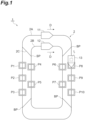
- a transportation system 1 illustrated in FIG. 1 and FIG. 2 is a system in which transport vehicles 10 travel along a track 2 laid on, for example, the ceiling of a factory or the like.
- the transportation system 1 constitutes a transportation system transporting a load (article) L.
- the load L is, for example, a container storing a plurality of semiconductor wafers, but it may also be a glass substrate, a general component, or the like.
- the transportation system 1 mainly includes the track 2, a plurality of transport vehicles 11, 12, 13, ..., a higher-level controller 5 (refer to FIG. 2 ), and a transport vehicle controller (a controller) 20.
- the transport vehicles 10 when collectively referring to the transport vehicles, they may be referred to as the transport vehicles 10, and when referring to individual transport vehicles, they may be referred to as the transport vehicle 11 (the transport vehicle 12 or the transport vehicle 13).
- the track 2 is a traveling path set in advance for causing the transport vehicles 10 to travel.
- the track 2 is a one-way traveling path.
- a traveling direction D (a forward direction) of the transport vehicles 10 on the track 2 is set to one direction as indicated by the arrow in FIG. 1 , and traveling in the opposite direction is prohibited.
- the track 2 is hung from, for example, the ceiling of a factory or the like.
- the track 2 includes branch points BP.
- the branch points BP are points separating a branch path from a main path.
- the track 2 has two loop traveling paths 2A and 2B, and four connecting traveling paths 2C, which connect the loop traveling paths 2A and 2B to each other so as to enable the transport vehicles 10 to mutually come and go.
- the branch points BP are provided at the positions where the connecting traveling paths 2C connect to the loop traveling path 2A (branch off from the loop traveling path 2A).
- the transport vehicles 10 are configured to be capable of transferring the load L.
- the transport vehicles 10 are overhead traveling unmanned transport vehicles traveling along the track 2.
- the transport vehicles 10 are also referred to as, for example, carts (transport carts), traveling vehicles (traveling carts), or overhead traveling vehicles (overhead traveling carts).
- a plurality of load ports for grabbing and/or unloading the load L (as an example, 10 load ports, or a first port P1 to a 10th port P10) are arranged.
- the transport vehicle 10 grabs the load L placed at any of the load ports and unloads the load L at any of the other loads as a transportation destination.
- the transport vehicle 10 has a traveling unit causing the transport vehicle 10 to travel, a position acquisition unit configured to acquire the position of the transport vehicle 10 on the track 2, a vehicle controller configured to control the operation of the transport vehicle 10, a branch mechanism configured to switch the traveling direction of the transport vehicle 10 at the branch point BP, and the like (all of them are not illustrated).
- the transport vehicle 10 periodically transmits traveling information on the traveling state of the transport vehicle 10 to the transport vehicle controller 20.
- the traveling information is information indicating the state of the transport vehicle 10 itself.
- the traveling information includes at least position information of the transport vehicle 10, vehicle speed information of the transport vehicle 10, information on whether the load L is loaded, information on the traveling state of the transport vehicle 10, and, when the transport vehicle 10 is traveling, a scheduled traveling route related to the schedule of the traveling (a traveling plan).
- the traveling state of the transport vehicle 10 includes assigned traveling, loading (load grabbing), loaded traveling, unloading, and the like.
- the transport vehicle controller 20 receives a transportation command corresponding to a load grabbing request to acquire the load L at any of the load ports (load grabbing ports).
- the higher-level controller 5 is, for example, a manufacture controller or the like.
- Examples of the load grabbing ports include load ports of processing apparatuses, check-in and check-out ports of stockers, and buffers as temporary storage locations for the load L.
- the load grabbing ports are also referred to as from ports.
- the method for generating the transportation command is not limited to a particular method, and various known methods can be used.
- the transport vehicle controller 20 may generate the transportation command in response to a load grabbing request from the higher-level controller 5 or the like and transmit the transportation command to a certain transport vehicle 10.
- the transportation command includes at least a command configured to cause the transport vehicle 10 to travel to the position of the load grabbing port on the track 2, a command configured to cause the transport vehicle 10 to grab the load L at the load grabbing port, a command configured to cause the transport vehicle 10 to travel to the position of the unloading port in a loaded state on the track 2, and a command configured to cause the transport vehicle 10 to unload the load L at the unloading port.
- the transport vehicle controller 20 assigns the transportation command to a vacant transport vehicle among the transport vehicles 10.
- the vacant transport vehicle is the transport vehicle 10 to which the transportation command has not been assigned and includes the transport vehicle 10 that is vacant, which is not transporting the load L. Details of the normal assignment processing and other types of transportation control are described below.
- the transportation system 1 of the present embodiment is configured to be able to maximize the number of loads transported (a workload) in the entire transportation system 1, for example, when the transport vehicle controller 20 has received (or generated) many transportation commands.
- the number of loads transported or the workload is the number of transportation commands executed and completed per unit time.
- the transport vehicle controller 20 executes specific assignment processing that is different from the normal assignment processing in a certain transportation state in the entire transportation system 1.
- the transport vehicle controller 20 assigns the transportation command by considering a combination of the transport vehicles 11, 12, 13, ... and the transportation command so that the number of loads transported can be maximized. In the transportation system 1, the number of loads transported is improved by such transportation control.
- the transport vehicle controller 20 has a transportation command transmitter and receiver 21, a transportation state determination unit 23, an operating rate calculation unit 24, an operating rate determination unit 25, an assignment processing unit 26, a transportation command table 27, a system state table 28, and an assignment result table 29.
- the transport vehicle controller 20 is an electronic control unit constituted by a processor such as a central processing unit (CPU), a read only memory (ROM), a random access memory (RAM), and the like.
- the transportation command transmitter and receiver 21 receives the transportation command indicating a load grabbing request for the load L from the higher-level controller 5. A plurality of the transportation commands can be transmitted simultaneously or sequentially from the higher-level controller 5.
- the transportation command transmitter and receiver 21 stores the received transportation command in the transportation command table 27.
- the transportation command table 27 stores therein one or more transportation commands.
- the transportation command for which allocation processing by the assignment processing unit 26 has been completed may be deleted from the transportation command table 27 or the processed transportation command may be managed separately from the transportation command for which the allocation processing has not been completed.
- the transportation state determination unit 23 determines whether the state of the transportation command stored in the transportation command table 27 has changed. The transportation state determination unit 23 determines that the transportation state has changed if, for example, the transportation command stored in the transportation command table 27 has changed since the previous determination (for example, if a new transportation command has been stored). Note that the transportation state determination unit 23 may determine that the transportation state has changed if a certain amount of time has elapsed since the previous determination (even if no new transportation command has been stored). The transportation state determination unit 23 may also have the function of a vehicle transmitter and receiver configured to acquire vehicle state information from the transport vehicles 10 through polling communication. In that case, the transportation state determination unit 23 stores the acquired vehicle state information in the system state table 28. In addition to the vehicle state information, the system state table 28 may also store therein the state of paths or buffers (storage shelves called OHBs) and the like.
- OHBs storage shelves
- the operating rate calculation unit 24 calculates an operating rate of the transport vehicles 10 in the entire transportation system 1.
- the denominator, or population, in the calculation of the "operating rate” is the total number of the transport vehicles 10 in the transportation system 1, and the numerator in the calculation of the "operating rate” is, for example, the number of transport vehicles 10 that are collecting or transporting the load L (refer to FIG. 3 ).
- the numerator in the calculation of the "operating rate” is, in other words, the number of the transport vehicles 10 to which the transportation command has been allocated, the transport vehicles 10 having not yet completed unloading.
- the operating rate determination unit 25 determines whether the current operating rate in the transportation system 1 is a certain threshold or more based on the operating rate calculated by the operating rate calculation unit 24.
- the operating rate determination unit 25 stores therein the certain threshold about the operating rate.
- the threshold may be, for example, a value between 5% and 30% or a value between 10% and 20%.
- the threshold stored in the operating rate determination unit 25 and used for the determination may be set or changed as appropriate.
- the operating rate determination unit 25 determines that the current operating rate equals or exceeds the threshold if the operating rate calculated by the operating rate calculation unit 24 equals or exceeds the threshold.
- the operating rate determination unit 25 determines that the current operating rate is not the threshold or more if the operating rate calculated by the operating rate calculation unit 24 is less than the threshold.
- the operating rate determination unit 25 of the present embodiment uses the "operating rate” as an indicator, the determination may be performed with an "idling rate” as an indicator, as opposed to the "operating rate.”
- the transport vehicle 10 that is in an idling state is the transport vehicle 10 to which the transportation command has not been allocated and the transport vehicle 10 having completed unloading.
- the transportation state determination unit 23, the operating rate calculation unit 24, and the operating rate determination unit 25 constitute a system state determination unit 22 configured to manage various indicators such as a vehicle operating rate and determine a system state.
- the various indicators are, for example, system performance indicators including a transportation lead time (a moving average) and/or the number of loads transported and completed per unit time.
- the system state determination unit 22 refers to the system state table 28 to manage the various indicators and determine the system state.
- the assignment processing unit 26 performs either one control out of the normal assignment processing and the specific assignment processing based on a determination result in the operating rate determination unit 25.
- the normal assignment processing executed by the assignment processing unit 26 is known assignment processing (or allocation processing).
- the specific assignment processing executed by the assignment processing unit 26 is assignment processing (or allocation processing) unique to the present embodiment and is control that places emphasis on the number of loads transported in the entire system.
- the assignment processing unit 26, for example, stores therein a certain value (a cost threshold) about a lead time (a transportation cost). Each transportation command has a cost related to a transportation time or a transportation distance as the transportation cost.
- the assignment processing unit 26 subjects only the transportation command having the transportation cost related to the transportation time or the transportation distance of a certain value or less among the transportation commands to the assignment processing in the specific assignment processing. More specifically, for example, the assignment processing unit 26 arranges a plurality of transportation commands subjected to the assignment processing in descending order of the transportation cost and assigns the transportation command in order from the top (in ascending order of the transportation cost). Transportation control by the assignment processing unit 26 is described in detail in the description of the transportation control method. Note that the concept of being “large” or “small” about the transportation cost is equivalent to the concept of being “long” or “short.” The reason for this is that the transportation cost is a cost related to the transportation time or the transportation distance.
- the assignment processing unit 26 stores assignment results of the normal assignment processing and the specific assignment processing in the assignment result table 29.
- a transmitter configured to transmit the transportation command to the transport vehicles 10 is provided.
- the cost (the transportation cost) related to the transportation time or the transportation distance of each transportation command may be a value calculated by the transport vehicle controller 20.
- the transport vehicle controller 20 may calculate the cost of each transportation command by considering the traveling state of the transport vehicles 10 on the track 2, the position and distribution of vacant transport vehicles, and the like.
- the top row of FIG. 3 shows the state of the transport vehicle 10, and the bottom row shows a traveling state.
- “collecting” also referred to as “retrieving” indicates a state from assigned traveling to the completion of loading.
- Transport also referred to as delivering indicates a state from loaded traveling to the completion of unloading.
- the time including an idling time, a collecting time during which the transport vehicle 10 is in a collection state, and a transportation time during which the transport vehicle 10 is in a transportation state means the processing time, that is, the lead time.
- the present embodiment uses the certain value (the cost threshold) about the lead time of each transportation command.
- the transportation command transmitter and receiver 21 of the transport vehicle controller 20 receives a load grabbing request from the higher-level controller 5 and receives a transportation command in response to the load grabbing request (Step S01).
- the transportation command transmitter and receiver 21 sequentially stores the received transportation command in the transportation command table 27 (Step S02).
- the transportation state determination unit 23 determines whether the state of the transportation command has changed (Step S03).
- the transportation state determination unit 23 determines that the transportation state has changed if the transportation command stored in the transportation command table 27 has changed since the previous determination (Step S03; YES). For example, if a new transportation command is stored in the transportation command table 27 compared to that in the previous determination, the transportation state determination unit 23 determines that the transportation state has changed. Note that the transportation state determination unit 23 may determine that the transportation state has changed if a certain amount of time has elapsed since the previous determination (even if no new transportation command has been stored). In that case, routing to the two types of assignment processing in Step S04 to Step S07 becomes a fixed-cycle event.
- Step S03 if the transportation command stored in the transportation command table 27 is the same as that in the previous determination, the transportation state determination unit 23 determines that the transportation state has not changed (Step S03; NO). In that case, the process returns to the processing in Step S01.
- Step S05 determines whether the operating rate equals or exceeds the threshold.
- the operating rate determination unit 25 compares the operating rate calculated in Step S04 with the threshold stored in advance.
- the threshold is, for example, a value within the range described above. If the operating rate determination unit 25 determines that the operating rate equals or exceeds the threshold (Step S05; YES), the specific assignment processing by the assignment processing unit 26 is executed (Step S06). Thus, the transport vehicle controller 20 executes the specific assignment processing under the condition that the operating rate of the transport vehicles 10 equals or exceeds the threshold. On the other hand, if the operating rate determination unit 25 determines that the operating rate is not the threshold or more (less than the threshold) (Step S05; NO), the normal assignment processing by the assignment processing unit 26 is executed (Step S07).
- the assignment processing unit 26 assigns the transportation command to the vacant transport vehicle among the transport vehicles 10.
- the transportation command is assigned, for example, in order of being received or generated.
- the assignment processing unit 26, for example, selects the transport vehicle 10 capable of reaching first the load L to be transported indicated in the transportation command among the transport vehicles 10 and assigns the transportation command to the transport vehicle 10.
- the assignment processing unit 26 subjects only the transportation command having the transportation cost related to the transportation time or the transportation distance smaller than the threshold among the transportation commands to the assignment processing.
- the assignment processing unit 26, for example, arranges a plurality of transportation commands subjected to the assignment processing in descending order of the transportation cost and assigns the transportation command in order from the top (in ascending order of the transportation cost). For example, in the state illustrated in FIG. 1 , the transport vehicle 11 is idling, the transport vehicle 12 is idling, and the transport vehicle 13 is loaded traveling toward the ninth port P9, which is an unloading port.
- the assignment processing unit 26 stores therein "90" as the certain value.
- the assignment processing unit 26 does not perform the assignment processing on T1 and T2 because T1 and T2 exceed the certain value. That is, the transport vehicle controller 20 suspends the transportation command having the transportation time or the transportation distance exceeding the certain value in the specific assignment processing.
- the assignment processing unit 26 assigns the transportation command T3 to the transport vehicle 12 because the transport vehicle 12 can reach the seventh port P7 earlier than the transport vehicle 13. That is, the assignment processing unit 26 selects the transport vehicle 10 capable of reaching first the load L to be transported indicated in the transportation command among the transport vehicles 10 and assigns the transportation command to the transport vehicle 10.
- FIG. 5 illustrates a state that can occur immediately after the state illustrated in FIG. 1 .
- the transport vehicle 11 is idling
- the transport vehicle 12 is loaded traveling toward the seventh port P7, which is an unloading port, (executing T3 above), and the transport vehicle 13 is idling.
- the assignment processing unit 26 does not perform the assignment processing on T1 and T2 because T1 and T2 exceed the certain value. That is, the transport vehicle controller 20 suspends the transportation command having the transportation time or the transportation distance exceeding the certain value in the specific assignment processing.
- the assignment processing unit 26 determines that, about T4 and T5, their arrangement enables simultaneous transfer and assigns the transportation command T4 to the transport vehicle 13 and assigns the transportation command T5 to the transport vehicle 11. In this case too, the assignment processing unit 26 selects the transport vehicle 10 capable of reaching first the load L to be transported indicated in the transportation command among the transport vehicles 10 and assigns the transportation command to the transport vehicle 10.
- the transportation command having a short transportation time or transportation distances is preferentially processed, thereby maximizing the number of loads transported.
- the transport vehicle controller 20 executes the specific assignment processing.
- the specific assignment processing preferentially executes the transportation command having a relatively short transportation time or transportation distance.
- the transportation command is completed relatively early. This can increase the number of loads transported per unit time in the entire transportation system 1.
- this transportation system 1 and transportation control method can ensure a sufficient number of loads transported.
- each transport vehicle is not restrained for a long period of time, and thus a certain number of idling vehicles can be secured.
- the present embodiment can accumulate data such as the operating rate based on the results of execution of the specific assignment processing, the number of transportation commands allocated, and the number of unallocated transportation commands.
- the transport vehicle controller 20 assigns the transportation command in ascending order of the transportation time or the transportation distance in the specific assignment processing.
- the transportation command with a shorter transportation time or transportation distance is executed more preferentially, the number of loads transported can be further increased.
- the transport vehicle controller 20 suspends the transportation command having the transportation time or the transportation distance exceeding the certain value in the specific assignment processing.
- the transport vehicles 10 do not execute the transportation command that is time-consuming (costly), and thus the number of loads transported per unit time can be increased, thus further increasing the number of loads transported.
- the transport vehicle controller 20 executes the specific assignment processing under the condition that the operating rate of the transport vehicles 10 equals or exceeds the threshold. That is, the specific assignment processing is not always executed, but the specific assignment processing is executed only when the operating rate becomes the threshold or more.
- the operating rate is low (in the case of Step S05; NO)
- the transportation command is assigned, for example, in order of being received (or generated) regardless of the transportation time or the transportation distance.
- appropriate assignment processing according to the conditions of the entire transportation system 1 is enabled. Consequently, transportation efficiency in the transportation system 1 improves.
- effects of easily handling the command with a long transportation time or transportation distance and making it difficult for the command to remain can also be expected.
- the transport vehicle controller 20 selects the transport vehicle 10 capable of reaching first the load L to be transported indicated in the transportation command among the transport vehicles 10 and assigns the transportation command to the transport vehicle 10 in the specific assignment processing. This starts loading and loaded traveling by the transport vehicles 10 earlier. Thus, the transportation command can be completed even earlier.
- the controller suspends the transportation command having the transportation time or the transportation distance exceeding the certain value and assigns the transportation command in ascending order of the transportation time or the transportation distance in the specific assignment processing.
- the controller may suspend the transportation command having the transportation time or the transportation distance exceeding the certain value and assign the transportation command regardless of the transportation time or the transportation distance in the specific assignment processing.
- the controller may determine the order of assignment based on other factors. The controller only needs to preferentially assign the transportation command having a relatively short transportation time or transportation distance.
- the controller may allow the transportation command having the transportation time or the transportation distance exceeding the certain value to be processed (not suspend it) and assign the transportation command in ascending order of the transportation time or the transportation distance in the specific assignment processing.
- the controller may execute a relief measure. That is, the controller may forcibly assign the transportation command if a certain condition is satisfied regardless of the length of the transportation time or the transportation distance (even if the transportation time or the transportation distance is long enough to exceed the certain value).
- the certain value (the cost threshold) related to the lead time of each transportation command is used, but differently from this, another certain value (cost threshold) related to a waiting time may be used. Alternatively, the certain value about the lead time and the other certain value about the waiting time may be used together.
- Step S05 When the operating rate has increased to a certain level or more, the step of determining the operating rate (Step S05) may be omitted.
- vehicle balance control is turned off or reduced, the transport vehicles 10 that are in the idling state can be dispersed.
- reservation processing and/or swapping processing as known pieces of transportation control may be combined with each other. These pieces of processing can be executed based on the positions of the load grabbing ports and the unloading ports and the positions of the transport vehicles 10.
- the execution criteria for executing the specific assignment processing are not limited to the above embodiment.
- a different threshold or the like may be provided, and the specific assignment processing may be performed only when the threshold is exceeded. Control based on the circumstances of the factory or the like (the user side) may be caused to interrupt the specific assignment control of the above embodiment with appropriate determination criteria and timing.
- the track layout in which the transportation system of the present disclosure is used is not limited to the example in FIG. 1 ( FIG. 5 ), and various track layouts can be employed.
- the overhead traveling vehicles are described as an example of the transport vehicles 10, but other examples of the traveling vehicles include unmanned traveling vehicles and stacker cranes configured to travel on tracks laid on the ground or platforms.
Landscapes
- Engineering & Computer Science (AREA)
- Physics & Mathematics (AREA)
- General Physics & Mathematics (AREA)
- Aviation & Aerospace Engineering (AREA)
- Radar, Positioning & Navigation (AREA)
- Remote Sensing (AREA)
- Automation & Control Theory (AREA)
- Business, Economics & Management (AREA)
- Economics (AREA)
- Development Economics (AREA)
- Marketing (AREA)
- Finance (AREA)
- Mechanical Engineering (AREA)
- Transportation (AREA)
- Entrepreneurship & Innovation (AREA)
- Human Resources & Organizations (AREA)
- Accounting & Taxation (AREA)
- Operations Research (AREA)
- Quality & Reliability (AREA)
- Strategic Management (AREA)
- Tourism & Hospitality (AREA)
- General Business, Economics & Management (AREA)
- Theoretical Computer Science (AREA)
- Control Of Position, Course, Altitude, Or Attitude Of Moving Bodies (AREA)
Applications Claiming Priority (2)
| Application Number | Priority Date | Filing Date | Title |
|---|---|---|---|
| JP2022066474 | 2022-04-13 | ||
| PCT/JP2023/007383 WO2023199628A1 (ja) | 2022-04-13 | 2023-02-28 | 搬送システム及び搬送制御方法 |
Publications (2)
| Publication Number | Publication Date |
|---|---|
| EP4497705A1 true EP4497705A1 (de) | 2025-01-29 |
| EP4497705A4 EP4497705A4 (de) | 2026-03-25 |
Family
ID=88329287
Family Applications (1)
| Application Number | Title | Priority Date | Filing Date |
|---|---|---|---|
| EP23788050.5A Pending EP4497705A4 (de) | 2022-04-13 | 2023-02-28 | Transportsystem und transportsteuerungsverfahren |
Country Status (7)
| Country | Link |
|---|---|
| US (1) | US20250341845A1 (de) |
| EP (1) | EP4497705A4 (de) |
| JP (1) | JP7816499B2 (de) |
| KR (1) | KR20240172754A (de) |
| CN (1) | CN118984800A (de) |
| TW (1) | TW202344453A (de) |
| WO (1) | WO2023199628A1 (de) |
Family Cites Families (9)
| Publication number | Priority date | Publication date | Assignee | Title |
|---|---|---|---|---|
| JP3663726B2 (ja) * | 1996-03-25 | 2005-06-22 | 株式会社豊田自動織機 | 物流システムにおける搬送経路設定方法及び装置。 |
| JPH10214115A (ja) * | 1997-01-29 | 1998-08-11 | Nec Corp | 無人搬送車制御装置 |
| JP4016410B2 (ja) | 1998-11-17 | 2007-12-05 | 村田機械株式会社 | 搬送台車システム |
| WO2011014599A2 (en) * | 2009-07-29 | 2011-02-03 | Siemens Industry, Inc. | System and method for delivery route assistance |
| JP5725066B2 (ja) * | 2013-03-21 | 2015-05-27 | 株式会社Ihi | 自動搬送システム |
| JP6747217B2 (ja) * | 2016-09-27 | 2020-08-26 | 株式会社ダイフク | 物品搬送設備 |
| JP7006775B2 (ja) | 2018-04-12 | 2022-01-24 | 村田機械株式会社 | 搬送車システム及び搬送車制御方法 |
| US20210247762A1 (en) * | 2020-02-12 | 2021-08-12 | Qualcomm Incorporated. | Allocating Vehicle Computing Resources to One or More Applications |
| WO2022049929A1 (ja) * | 2020-09-02 | 2022-03-10 | 村田機械株式会社 | 搬送車システム、及び搬送車制御方法 |
-
2023
- 2023-02-28 WO PCT/JP2023/007383 patent/WO2023199628A1/ja not_active Ceased
- 2023-02-28 CN CN202380033167.5A patent/CN118984800A/zh active Pending
- 2023-02-28 EP EP23788050.5A patent/EP4497705A4/de active Pending
- 2023-02-28 KR KR1020247037040A patent/KR20240172754A/ko active Pending
- 2023-02-28 US US18/855,438 patent/US20250341845A1/en active Pending
- 2023-02-28 JP JP2024514834A patent/JP7816499B2/ja active Active
- 2023-03-24 TW TW112111025A patent/TW202344453A/zh unknown
Also Published As
| Publication number | Publication date |
|---|---|
| KR20240172754A (ko) | 2024-12-10 |
| WO2023199628A1 (ja) | 2023-10-19 |
| JP7816499B2 (ja) | 2026-02-18 |
| US20250341845A1 (en) | 2025-11-06 |
| CN118984800A (zh) | 2024-11-19 |
| TW202344453A (zh) | 2023-11-16 |
| EP4497705A4 (de) | 2026-03-25 |
| JPWO2023199628A1 (de) | 2023-10-19 |
Similar Documents
| Publication | Publication Date | Title |
|---|---|---|
| US10717599B2 (en) | Control system for storage and retrieval systems | |
| CN112278674B (zh) | 调度方法、装置、设备及存储介质 | |
| JP7498858B2 (ja) | 注文処理及び出庫方法、設備、システム、並びに記憶媒体 | |
| US6647316B2 (en) | Traffic management system and method for materials handling using traffic balancing and traffic density | |
| EP3389084B1 (de) | Fördersystem und förderverfahren | |
| CN112198880B (zh) | 一种agv任务分配方法、物流分拣方法及系统 | |
| CN112644946A (zh) | 仓储机器人的控制方法、装置、设备及存储介质 | |
| JP4766111B2 (ja) | 搬送車システム | |
| CN112214024A (zh) | 一种agv任务分配方法、物流分拣方法及系统 | |
| CN113493081A (zh) | 一种货物拣选方法、装置、系统、存储介质及电子设备 | |
| KR102608150B1 (ko) | 반송 시스템 및 반송 제어 방법 | |
| WO2019187631A1 (ja) | 搬送システム、搬送コントローラ、及び、搬送車の制御方法 | |
| JP2004281622A (ja) | 搬送台車システム | |
| EP4497705A1 (de) | Transportsystem und transportsteuerungsverfahren | |
| JP2020033110A (ja) | 倉庫設備の制御システム及び制御方法 | |
| JPWO2010073475A1 (ja) | 搬送車システムおよび搬送車制御方法 | |
| JP7069845B2 (ja) | 搬送システム及び搬送方法 | |
| JP4135721B2 (ja) | 搬送車システム | |
| JP2001130719A (ja) | 自動倉庫 | |
| JP2000148242A (ja) | 搬送台車システム | |
| JP2002087547A (ja) | 入出庫制御装置及びその入出庫制御装置を有する自動倉庫 | |
| JPH11292218A (ja) | 自動倉庫の棚管理装置 | |
| JPH05139507A (ja) | 自動倉庫の出庫運転装置 | |
| JPH05127744A (ja) | 無人搬送車のための運行制御装置 | |
| JPS63143102A (ja) | 無人搬送車への作業割付制御方式 |
Legal Events
| Date | Code | Title | Description |
|---|---|---|---|
| STAA | Information on the status of an ep patent application or granted ep patent |
Free format text: STATUS: THE INTERNATIONAL PUBLICATION HAS BEEN MADE |
|
| PUAI | Public reference made under article 153(3) epc to a published international application that has entered the european phase |
Free format text: ORIGINAL CODE: 0009012 |
|
| STAA | Information on the status of an ep patent application or granted ep patent |
Free format text: STATUS: REQUEST FOR EXAMINATION WAS MADE |
|
| 17P | Request for examination filed |
Effective date: 20241023 |
|
| AK | Designated contracting states |
Kind code of ref document: A1 Designated state(s): AL AT BE BG CH CY CZ DE DK EE ES FI FR GB GR HR HU IE IS IT LI LT LU LV MC ME MK MT NL NO PL PT RO RS SE SI SK SM TR |
|
| DAV | Request for validation of the european patent (deleted) | ||
| DAX | Request for extension of the european patent (deleted) | ||
| REG | Reference to a national code |
Ref country code: DE Ref legal event code: R079 Free format text: PREVIOUS MAIN CLASS: B65G0001000000 Ipc: G06Q0010087000 |
|
| A4 | Supplementary search report drawn up and despatched |
Effective date: 20260220 |
|
| RIC1 | Information provided on ipc code assigned before grant |
Ipc: G06Q 10/087 20230101AFI20260216BHEP Ipc: H10P 72/30 20260101ALN20260216BHEP |