EP4480461A2 - Systeme zur anwendung und überwachung einer augentherapie - Google Patents
Systeme zur anwendung und überwachung einer augentherapie Download PDFInfo
- Publication number
- EP4480461A2 EP4480461A2 EP24212449.3A EP24212449A EP4480461A2 EP 4480461 A2 EP4480461 A2 EP 4480461A2 EP 24212449 A EP24212449 A EP 24212449A EP 4480461 A2 EP4480461 A2 EP 4480461A2
- Authority
- EP
- European Patent Office
- Prior art keywords
- cornea
- cross
- eye
- light
- linking agent
- Prior art date
- Legal status (The legal status is an assumption and is not a legal conclusion. Google has not performed a legal analysis and makes no representation as to the accuracy of the status listed.)
- Pending
Links
Images









Classifications
-
- A—HUMAN NECESSITIES
- A61—MEDICAL OR VETERINARY SCIENCE; HYGIENE
- A61N—ELECTROTHERAPY; MAGNETOTHERAPY; RADIATION THERAPY; ULTRASOUND THERAPY
- A61N5/00—Radiation therapy
- A61N5/06—Radiation therapy using light
- A61N5/0613—Apparatus adapted for a specific treatment
- A61N5/0625—Warming the body, e.g. hyperthermia treatment
-
- A—HUMAN NECESSITIES
- A61—MEDICAL OR VETERINARY SCIENCE; HYGIENE
- A61B—DIAGNOSIS; SURGERY; IDENTIFICATION
- A61B3/00—Apparatus for testing the eyes; Instruments for examining the eyes
- A61B3/10—Objective types, i.e. instruments for examining the eyes independent of the patients' perceptions or reactions
- A61B3/101—Objective types, i.e. instruments for examining the eyes independent of the patients' perceptions or reactions for examining the tear film
-
- A—HUMAN NECESSITIES
- A61—MEDICAL OR VETERINARY SCIENCE; HYGIENE
- A61B—DIAGNOSIS; SURGERY; IDENTIFICATION
- A61B3/00—Apparatus for testing the eyes; Instruments for examining the eyes
- A61B3/10—Objective types, i.e. instruments for examining the eyes independent of the patients' perceptions or reactions
- A61B3/107—Objective types, i.e. instruments for examining the eyes independent of the patients' perceptions or reactions for determining the shape or measuring the curvature of the cornea
-
- A—HUMAN NECESSITIES
- A61—MEDICAL OR VETERINARY SCIENCE; HYGIENE
- A61F—FILTERS IMPLANTABLE INTO BLOOD VESSELS; PROSTHESES; DEVICES PROVIDING PATENCY TO, OR PREVENTING COLLAPSING OF, TUBULAR STRUCTURES OF THE BODY, e.g. STENTS; ORTHOPAEDIC, NURSING OR CONTRACEPTIVE DEVICES; FOMENTATION; TREATMENT OR PROTECTION OF EYES OR EARS; BANDAGES, DRESSINGS OR ABSORBENT PADS; FIRST-AID KITS
- A61F9/00—Methods or devices for treatment of the eyes; Devices for putting in contact-lenses; Devices to correct squinting; Apparatus to guide the blind; Protective devices for the eyes, carried on the body or in the hand
-
- A—HUMAN NECESSITIES
- A61—MEDICAL OR VETERINARY SCIENCE; HYGIENE
- A61F—FILTERS IMPLANTABLE INTO BLOOD VESSELS; PROSTHESES; DEVICES PROVIDING PATENCY TO, OR PREVENTING COLLAPSING OF, TUBULAR STRUCTURES OF THE BODY, e.g. STENTS; ORTHOPAEDIC, NURSING OR CONTRACEPTIVE DEVICES; FOMENTATION; TREATMENT OR PROTECTION OF EYES OR EARS; BANDAGES, DRESSINGS OR ABSORBENT PADS; FIRST-AID KITS
- A61F9/00—Methods or devices for treatment of the eyes; Devices for putting in contact-lenses; Devices to correct squinting; Apparatus to guide the blind; Protective devices for the eyes, carried on the body or in the hand
- A61F9/007—Methods or devices for eye surgery
- A61F9/008—Methods or devices for eye surgery using laser
-
- A—HUMAN NECESSITIES
- A61—MEDICAL OR VETERINARY SCIENCE; HYGIENE
- A61N—ELECTROTHERAPY; MAGNETOTHERAPY; RADIATION THERAPY; ULTRASOUND THERAPY
- A61N5/00—Radiation therapy
- A61N5/06—Radiation therapy using light
- A61N5/0613—Apparatus adapted for a specific treatment
- A61N5/062—Photodynamic therapy, i.e. excitation of an agent
-
- A—HUMAN NECESSITIES
- A61—MEDICAL OR VETERINARY SCIENCE; HYGIENE
- A61F—FILTERS IMPLANTABLE INTO BLOOD VESSELS; PROSTHESES; DEVICES PROVIDING PATENCY TO, OR PREVENTING COLLAPSING OF, TUBULAR STRUCTURES OF THE BODY, e.g. STENTS; ORTHOPAEDIC, NURSING OR CONTRACEPTIVE DEVICES; FOMENTATION; TREATMENT OR PROTECTION OF EYES OR EARS; BANDAGES, DRESSINGS OR ABSORBENT PADS; FIRST-AID KITS
- A61F9/00—Methods or devices for treatment of the eyes; Devices for putting in contact-lenses; Devices to correct squinting; Apparatus to guide the blind; Protective devices for the eyes, carried on the body or in the hand
- A61F9/007—Methods or devices for eye surgery
- A61F9/008—Methods or devices for eye surgery using laser
- A61F2009/00844—Feedback systems
-
- A—HUMAN NECESSITIES
- A61—MEDICAL OR VETERINARY SCIENCE; HYGIENE
- A61F—FILTERS IMPLANTABLE INTO BLOOD VESSELS; PROSTHESES; DEVICES PROVIDING PATENCY TO, OR PREVENTING COLLAPSING OF, TUBULAR STRUCTURES OF THE BODY, e.g. STENTS; ORTHOPAEDIC, NURSING OR CONTRACEPTIVE DEVICES; FOMENTATION; TREATMENT OR PROTECTION OF EYES OR EARS; BANDAGES, DRESSINGS OR ABSORBENT PADS; FIRST-AID KITS
- A61F9/00—Methods or devices for treatment of the eyes; Devices for putting in contact-lenses; Devices to correct squinting; Apparatus to guide the blind; Protective devices for the eyes, carried on the body or in the hand
- A61F9/007—Methods or devices for eye surgery
- A61F9/008—Methods or devices for eye surgery using laser
- A61F2009/00855—Calibration of the laser system
- A61F2009/00857—Calibration of the laser system considering biodynamics
-
- A—HUMAN NECESSITIES
- A61—MEDICAL OR VETERINARY SCIENCE; HYGIENE
- A61F—FILTERS IMPLANTABLE INTO BLOOD VESSELS; PROSTHESES; DEVICES PROVIDING PATENCY TO, OR PREVENTING COLLAPSING OF, TUBULAR STRUCTURES OF THE BODY, e.g. STENTS; ORTHOPAEDIC, NURSING OR CONTRACEPTIVE DEVICES; FOMENTATION; TREATMENT OR PROTECTION OF EYES OR EARS; BANDAGES, DRESSINGS OR ABSORBENT PADS; FIRST-AID KITS
- A61F9/00—Methods or devices for treatment of the eyes; Devices for putting in contact-lenses; Devices to correct squinting; Apparatus to guide the blind; Protective devices for the eyes, carried on the body or in the hand
- A61F9/007—Methods or devices for eye surgery
- A61F9/008—Methods or devices for eye surgery using laser
- A61F2009/00861—Methods or devices for eye surgery using laser adapted for treatment at a particular location
- A61F2009/00872—Cornea
-
- A—HUMAN NECESSITIES
- A61—MEDICAL OR VETERINARY SCIENCE; HYGIENE
- A61F—FILTERS IMPLANTABLE INTO BLOOD VESSELS; PROSTHESES; DEVICES PROVIDING PATENCY TO, OR PREVENTING COLLAPSING OF, TUBULAR STRUCTURES OF THE BODY, e.g. STENTS; ORTHOPAEDIC, NURSING OR CONTRACEPTIVE DEVICES; FOMENTATION; TREATMENT OR PROTECTION OF EYES OR EARS; BANDAGES, DRESSINGS OR ABSORBENT PADS; FIRST-AID KITS
- A61F9/00—Methods or devices for treatment of the eyes; Devices for putting in contact-lenses; Devices to correct squinting; Apparatus to guide the blind; Protective devices for the eyes, carried on the body or in the hand
- A61F9/007—Methods or devices for eye surgery
- A61F9/0079—Methods or devices for eye surgery using non-laser electromagnetic radiation, e.g. non-coherent light or microwaves
-
- A—HUMAN NECESSITIES
- A61—MEDICAL OR VETERINARY SCIENCE; HYGIENE
- A61N—ELECTROTHERAPY; MAGNETOTHERAPY; RADIATION THERAPY; ULTRASOUND THERAPY
- A61N5/00—Radiation therapy
- A61N5/06—Radiation therapy using light
- A61N2005/0635—Radiation therapy using light characterised by the body area to be irradiated
- A61N2005/0643—Applicators, probes irradiating specific body areas in close proximity
-
- A—HUMAN NECESSITIES
- A61—MEDICAL OR VETERINARY SCIENCE; HYGIENE
- A61N—ELECTROTHERAPY; MAGNETOTHERAPY; RADIATION THERAPY; ULTRASOUND THERAPY
- A61N5/00—Radiation therapy
- A61N5/06—Radiation therapy using light
- A61N2005/0658—Radiation therapy using light characterised by the wavelength of light used
- A61N2005/0661—Radiation therapy using light characterised by the wavelength of light used ultraviolet
-
- A—HUMAN NECESSITIES
- A61—MEDICAL OR VETERINARY SCIENCE; HYGIENE
- A61N—ELECTROTHERAPY; MAGNETOTHERAPY; RADIATION THERAPY; ULTRASOUND THERAPY
- A61N5/00—Radiation therapy
- A61N5/06—Radiation therapy using light
- A61N5/067—Radiation therapy using light using laser light
Definitions
- the interferometer also includes one or more beam splitters adapted to split the beam of light and direct a first portion to be reflected from the surface of the eye, and direct a second portion to be reflected from the reference surface; and combine the reflected first portion and the reflected second portion to form a superimposed beam.
- the interferometer also includes a polarizing filter, and a camera for capturing an intensity pattern of the superimposed beam emerging from the polarizing filter. The controller analyzes the intensity pattern by determining a phase offset, for a plurality of points in the captured intensity pattern, between the reflected first portion and the reflected second portion based on the captured intensity pattern.
- aspects of the present disclosure further provide a method of monitoring an eye.
- the method includes emitting a beam of light from a light source having a known polarization.
- the method also includes splitting the beam and directing a first portion to be reflected from a surface of the eye, and directing a second portion to be reflected from a reference surface.
- the method also includes interfering the first portion of the beam and second portion of the beam to create a superimposed beam.
- the method also includes directing the superimposed beam through a polarizing filter.
- the method also includes capturing an intensity pattern of the superimposed beam emerging from the polarizing filter.
- the method also includes analyzing the captured intensity pattern to determine a surface profile of the surface of the eye.
- aspects of the present disclosure further provide a system for applying a controlled amount of cross-linking in corneal tissue of an eye.
- the system includes an applicator adapted to apply a cross-linking agent to the eye.
- the system also includes a light source adapted to emit a photoactivating light.
- the system also includes a targeting system adapted to create targeting feedback information indicative of a position of a cornea of the eye.
- the system also includes a mirror array having a plurality of mirrors arranged in rows and columns. The plurality of mirrors are adapted to selectively direct the photoactivating light toward the eye according to a pixelated intensity pattern having pixels corresponding to the plurality of mirrors in the mirror array.
- the system also includes an interferometer adapted to monitor an amount of cross-linking in the corneal tissue.
- the interferometer monitors the amount of cross-linking in the corneal tissue by interfering a beam of light reflected from a surface of the eye with a reference beam of light reflected from a reference surface.
- the interferometer monitors the amount of cross-linking in the corneal tissue by also capturing, via an associated camera, a series of images of interference patterns due to optical interference between the beam of light and the reference beam of light. The series of images are indicative of a plurality of profiles of the surface of the eye.
- the system also includes a head restraint device for restraining a position of a head associated with the eye.
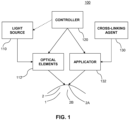
- FIG. 1 provides a block diagram of an example delivery system 100 for delivering a cross-linking agent 130 and an activator to a cornea 2 of an eye 1 in order to initiate molecular cross-linking of corneal collagen within the cornea 2.
- Cross-linking can stabilize corneal tissue and improve its biomechanical strength.
- the delivery system 100 includes an applicator 132 for applying the cross-linking agent 130 to the cornea 2.
- the delivery system 100 includes a light source 110 and optical elements 112 for directing light to the cornea 2.
- the delivery system 100 also includes a controller 120 that is coupled to the applicator 132 and the optical elements 112.
- the applicator 132 may be an apparatus adapted to apply the cross-linking agent 130 according to particular patterns on the cornea 2 advantageous for causing cross-linking to take place within the corneal tissues.
- the applicator 132 may apply the cross-linking agent 130 to a corneal surface 2A (e.g., an epithelium), or to other locations on the eye 1. Particularly, the applicator 132 may apply the cross-linking agent 130 to an abrasion or cut of the corneal surface 2A to facilitate the transport or penetration of the cross-linking agent through the cornea 2 to a mid-depth region 2B.
- a corneal surface 2A e.g., an epithelium
- the applicator 132 may apply the cross-linking agent 130 to an abrasion or cut of the corneal surface 2A to facilitate the transport or penetration of the cross-linking agent through the cornea 2 to a mid-depth region 2B.
- eye therapy treatments may initially achieve desired reshaping of the cornea 2, the desired effects of reshaping the cornea 2 may be mitigated or reversed at least partially if the collagen fibrils within the cornea 2 continue to change after the desired reshaping has been achieved. Indeed, complications may result from further changes to the cornea 2 after treatment. For example, a complication known as post-LASIK ectasia may occur due to the permanent thinning and weakening of the cornea 2 caused by LASIK surgery. In post-LASIK ectasia, the cornea 2 experiences progressive steepening (bulging).
- aspects of the present disclosure provide approaches for initiating molecular cross-linking of corneal collagen to stabilize corneal tissue and improve its biomechanical strength.
- embodiments may provide devices and approaches for preserving the desired corneal structure and shape that result from an eye therapy treatment, such as LASIK surgery or thermokeratoplasty.
- aspects of the present disclosure may provide devices and approaches for monitoring the shape, molecular cross-linking, and biomechanical strength of the corneal tissue and providing feedback to a system for providing iterative initiations of cross-linking of the corneal collagen.
- the devices and approaches disclosed herein may be used to preserve desired shape or structural changes following an eye therapy treatment by stabilizing the corneal tissue of the cornea 2.
- the devices and approaches disclosed herein may also be used to enhance the strength or biomechanical structural integrity of the corneal tissue apart from any eye therapy treatment.
- aspects of the present disclosure provide devices and approaches for preserving the desired corneal structure and shape that result from an eye treatment, such as LASIK surgery or thermokeratoplasty.
- embodiments may provide approaches for initiating molecular cross-linking of the corneal collagen to stabilize the corneal tissue and improve its biomechanical strength and stiffness after the desired shape change has been achieved.
- embodiments may provide devices and approaches for monitoring cross-linking in the corneal collagen and the resulting changes in biomechanical strength to provide a feedback to a system for inducing cross-linking in corneal tissue.
- Some approaches initiate molecular cross-linking in a treatment zone of the cornea 2 where structural changes have been induced by, for example, LASIK surgery or thermokeratoplasty.
- initiating cross-linking directly in this treatment zone may result in undesired haze formation.
- aspects of the present disclosure also provide alternative techniques for initiating cross-linking to minimize haze formation.
- the structural changes in the cornea 2 are stabilized by initiating cross-linking in selected areas of corneal collagen outside of the treatment zone. This cross-linking strengthens corneal tissue neighboring the treatment zone to support and stabilize the actual structural changes within the treatment zone.
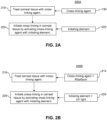
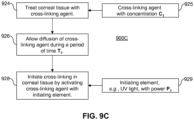
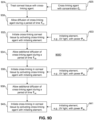
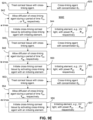
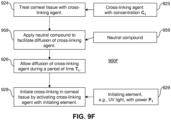
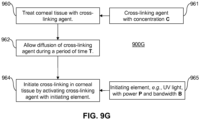
- step 210 the corneal tissue is treated with the cross-linking agent 130.
- Step 210 may occur, for example, after a treatment is applied to generate structural changes in the cornea and produce a desired shape change.
- step 210 may occur, for example, after it has been determined that the corneal tissue requires stabilization or strengthening.
- the cross-linking agent 130 is then activated in step 220 with an initiating element 222.
- the initiating element 222 may be the light source 110 shown in FIG. 1 .
- Activation of the cross-linking agent 130 for example, may be triggered thermally by the application of microwaves or light.
- the UV light may be generally applied to the corneal surface 2A (e.g. the epithelium) of the cornea 2 to activate cross-linking.
- regions of the cornea 2 requiring stabilization may extend from the corneal surface 2A to a mid-depth region 2B in the corneal stroma 2C.
- Generally applying UV light to the corneal surface 2A may not allow sufficient penetration of the UV light to activate necessary cross-linking at a mid-depth region of the cornea.
- embodiments according to aspects of the present disclosure provide a delivery system that accurately and precisely delivers UV light to the mid-depth region 2B where stronger and more stable corneal structure is required.
- treatment may generate desired changes in corneal structure at the mid-depth region 2B.
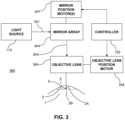
- the beam of light 341 from the light source 110 is scanned over multiple mirrors adapted in an array.
- the beam of light 341 can be scanned over the mirrors in the mirror array 344 using, for example, one or more adjustable mirrors to direct the beam of light 341 to point at each mirror in turn.
- the beam of light 341 can be scanned over each mirror one at a time.
- the beam of light 341 can be split into one or more additional beams of light using, for example, a beam splitter, and the resultant multiple beams of light can then be simultaneously scanned over multiple mirrors in the mirror array 344.
- the light pattern 345 is properly considered a time-averaged light pattern, as the output of the light pattern 345 at any one particular instant in time may constitute light from as few as a single pixel in the pixelated light pattern 345.
- the laser scanning technology of the delivery system 300 may be similar to the technology utilized by Digital Light Processing TM (DLP ® ) display technologies.
- the controller can utilize an objective lens position motor 348 to raise and/or lower the objective lens 346 in order to adjust the focal plane 6 of the light pattern 345 emitted from the mirror array 344.
- the controller 120 is adapted to control the delivery of the light source 110 to the cornea 2 in three dimensions.
- the three-dimensional pattern is generated by delivering the UV light to selected regions 5 on successive planes (parallel to the focal plane 6), which extend from the corneal surface 2A to the mid-depth region 2B within the corneal stroma.
- the cross-linking agent 130 introduced into the selected regions 5 is then activated as described above.
- the controller 120 can control the activation of the cross-linking agent 130 within the cornea 2 according to a three dimensional profile.
- the controller 120 can utilize the laser scanning technology of the laser scanning device 300 to strengthen and stiffen the corneal tissues by activating cross-linking in a three-dimensional pattern within the cornea 2.
- the objective lens 346 can be replaced by an optical train consisting of mirrors and/or lenses to properly focus the light pattern 345 emitted from the mirror array 344.
- the objective lens motor 348 can be replaced by a motorized device for adjusting the position of the eye 1 relative to the objective lens 346, which can be fixed in space. For example, a chair or lift that makes fine motor step adjustments and adapted to hold a patient during eye treatment can be utilized to adjust the position of the eye 1 relative to the objective lens 346.
- the use of laser scanning technologies allows cross-linking to be activated beyond the corneal surface 2A of the cornea 2, at depths where stronger and more stable corneal structure is desired, for example, where structural changes have been generated by an eye therapy treatment.
- the application of the initiating element i.e., the light source 110
- the application of the initiating element is applied precisely according to a selected three-dimensional pattern and is not limited to a two-dimensional area at the corneal surface 2A of the cornea 2.
- the embodiments described herein may initiate cross-linking in the cornea according to an annular pattern defined, for example, by a thermokeratoplasty applicator
- the initiation pattern in other embodiments is not limited to a particular shape. Indeed, energy may be applied to the cornea in non-annular patterns, so cross-linking may be initiated in areas of the cornea that correspond to the resulting non-annular changes in corneal structure. Examples of the non-annular shapes by which energy may be applied to the cornea are described in U.S. Patent Serial No. 12/113,672, filed on May 1, 2008 , the contents of which are entirely incorporated herein by reference.
- aspects of the present disclosure can be employed to reduce the amount of time required to achieve the desired cross-linking.
- the time can be reduced from minutes to seconds.
- aspects of the present disclosure allow larger doses of the initiating element, e.g ., multiples of 5 J/cm 2 , to be applied to reduce the time required to achieve the desired cross-linking.
- Highly accelerated cross-linking is particularly possible when using laser scanning technologies (such as in the delivery system 300 provided in FIG. 3 ) in combination with a feedback system 400 as shown in FIG. 4 , such as a rapid video eye-tracking system, described below.
- aspects of the present disclosure provide techniques for real time monitoring of the changes to the collagen fibrils with a feedback system 400 shown in FIG. 4 . These techniques may be employed to confirm whether appropriate doses of the cross-linking agent 130 have been applied during treatment and/or to determine whether the cross-linking agent 130 has been sufficiently activated by the initiating element (e.g., the light source 110). General studies relating to dosage may also apply these monitoring techniques.
- the real time video image data 504 (e.g., the series of images captured by the video camera 510) are sent to the controller 120, which may include processing hardware, such as a conventional personal computer or the like.
- the controller 120 analyzes the data from the video camera 10, for example, according to programmed instructions on computerreadable storage media, e.g ., data storage hardware.
- the controller 120 identifies the image of the cornea 2 in the video image data 504 and determines the position of the cornea 2 relative to the delivery system 500, and particularly relative to the laser scanning device 300.
- the controller 120 sends instructions 506 to the laser scanning device 300 to direct a pattern of UV light 508 to the position of the cornea 2.
- the instructions 506 can adjust optical aspects of the laser scanning device 300 to center the pattern of UV light 508 output from the laser scanning device 300 on the cornea 2.
- the pattern of UV light 508 activates the cross-linking agent 130 in desired areas and depths of corneal tissue according to aspects of the present disclosure described herein.
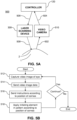
- FIG. 5B illustrates an exemplary operation of the delivery system 500 shown in FIG. 5A .
- the video camera 510 captures the video image data 504 of the eye 1 based on the photons 502 reflected from the eye 1.
- the video image data 504 is sent to the controller 120.
- the controller 120 sends the instructions 506 to the laser scanning device 300 according to the detected position of the cornea 2.
- the initiating element e.g., UV light
- the system 500 shown in FIG. 5A can correlate pixels of the video camera 510 with the pixels of the laser scanning device 300, so the real time video image date 504 from the video camera 120 can be employed to direct the pattern of UV light 508 from the laser scanning device 300 accurately to the desired corneal tissue even if there is some movement by the eye 1.
- the system 500 can be employed to map, associate, and/or correlate pixels in the video camera 510 with pixels in the laser scanning device 300.
- the system 500 does not require mechanical tracking of the eye 1 and mechanical adjustment (of the laser scanning device 300) to apply the pattern of UV light 508 accurately to the cornea 2.
- Another technique for real time monitoring of the cornea 2 during cross-linking treatment employs interferometry with a specialized phasecam interferometer (e.g ., manufactured by 4dTechnology, Arlington, AZ).
- the interferometer takes up to 25 frames per second with a very short exposure so as to substantially minimize motion during an exposure duration. In an example, the exposure time can be less than one millisecond.
- IOP intraocular pressure
- the deflection of the cornea 2 is determined by developing a difference map between the peaks and valleys of the cardiac pulsate flow cycles. The deflection of the cornea provides an indicator for the strength of the corneal tissue.
- aspects of the present disclosure provide techniques for real time monitoring of the changes in the strength of the corneal tissue. These techniques may be employed to confirm whether appropriate doses of the cross-linking agent have been applied during treatment. Moreover, real time monitoring may be employed to identify when further application of the initiating element yields no additional cross-linking. Where the initiating element is UV light, determining an end point for the application of the initiating element protects the corneal tissue from unnecessary exposure to UV light. Accordingly, the safety of the cross-linking treatment is enhanced.
- the controller 120 for the cross-linking delivery system e.g ., the delivery system 100 in FIG. 1 ) can automatically cease further application of UV light when the real time monitoring determines that no additional cross-linking is occurring.
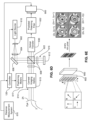
- FIG. 6A illustrates a phase-shifting interferometer adapted to measure the surface shape of the cornea 2 by comparing a reference beam 616 (i.e., reference wavefront) reflected from a reference mirror 612 and a signal beam 614 (i.e., signal wavefront) reflected from the corneal surface 2A.
- Interferometry involves the analysis of an interference pattern created by the superposition of two or more waves.
- the interferometer illustrated in FIG. 6A is adapted as a Twyman-Green interferometer and is adapted to record the interference pattern, i.e., interferogram, of the superposition of the reference beam 616 and the signal beam 614 using a CCD detector 660 such as a camera.
- the quarter wave plate 608 can cause an incoming beam of light having a polarization that is a combination of two orthogonal components, to result in an outgoing beam of light where one of the two orthogonal polarization components is phase-delayed relative to the other by onequarter wavelength.
- the quarter-wave plates 608 can convert linearly polarized light to circularly polarized light.
- the interferometer also has an optical transfer 630, which can include a combination of lenses, filters, and mirrors to focus, align, and direct a superimposed beam 635 to a holographic element 640.
- the superimposed beam 635 is a superposition of the signal beam 614 and the reference beam 616.
- the holographic element 640 can split the superimposed beam 635 into four copies for being applied to a polarizing quad filter 650.
- the output of the polarizing quad filter 650 is then recorded by the CCD detector 660.
- the resulting image or intensity pattern captured by the CCD detector 660 is then sent to the controller 120 for analysis.
- the controller 120 can also receive an input from a distance measurement system 670 adapted to monitor a distance between the eye 1 and aspects of the interferometer. Additional optical elements may be included at various locations within the optical path of the interferometer to spread and/or focus the beams of light.
- a beam of light is emitted from the light source 610.
- the beam of light is then spread and collimated with the lenses 602, 604 such as is appropriate for directing the beam toward the polarizing beam splitter 622.
- the spread beam is then reflected on the mirror 606 and directed toward the polarizing beam splitter 622.
- a half-wave plate or other suitable birefringent material or polarizing filter may be inserted in the optical path between the light source 610 and the polarizing beam splitter (PBS) 622 to cause the beam of light directed to the PBS 622 to have an appropriate polarization angle relative to the PBS to allow a desired amount of light having orthogonal polarizations to be transmitted and reflected by the PBS 622.
- the polarization of the incoming beam of light can be selected such that the PBS 622 allows roughly equal amounts of light to be reflected and transmitted, with each having orthogonal linear polarization.
- the light directed toward the optical transfer 630 is a superposition of the reference beam 616 and the signal beam 614, which may be orthogonally polarized relative to one another.
- the reference beam 616 and the signal beam 614 can be orthogonally circularly polarized relative to one another.
- the optical transfer 630 may include a combination of lenses, mirrors, and apertures to relay the superimposed beam 635 onto the holographic element 640.
- the aperture (not separately shown), which can be incorporated in the optical transfer 630, can be chosen such that the diffraction-limited spot size at the CCD detector 660 is approximately 2 effective pixels in diameter in order to avoid aliasing of the interference pattern spatial frequency. An appropriate selection of the aperture ensures that spatial frequencies higher than the pixel spacing of the CCD detector 660 are not present in the resulting interferograms measured by the CCD detector 660.
- FIG. 6C provides an exemplary interference pattern (i.e ., interferogram), which is the intensity pattern (i.e., image) detected by the CCD detector 660 and output from the polarizing quad filter 650.
- the difference in optical path length between the signal beam 614 and the reference beam 616 may be revealed by the interference pattern (i.e. , interferogram) recorded by the CCD detector, and allows for performing profilometry ( i.e ., measuring the absolute three-dimensional profile of a solid object) of the corneal surface 2A of the eye 1.
- the holographic element 640 splits the superposition beam 635 into four substantially identical copies and projects the four copies onto the polarizing quad filter 650.
- Additional optical elements may be employed to provide a collimated beam to the polarizing quad filter 650.
- the polarizing quad filter 650 is divided into four quadrants, with each quadrant introducing a different effective phase-delay between the reference and test wavefronts at each pixel.
- the phase mask may be constructed from a birefringent plate, or from four separate birefringent plates.
- the polarizing mask 640 may be constructed from an array of four polarizers, with each having a different polarizing angle.
- the second quadrant of the polarizing quad filter 650 therefore interferes in-phase quadrature components of the signal beam 614 and the reference beam 616.
- Eq. 2c may provide the intensity of light passing through the third quadrature of the polarizing quad filter 650, which has a polarizing angle of 90 degrees relative to the x, y orientation of the pixel array.
- the third quadrant of the polarizing quad filter 650 therefore interferes out-of-phase components of the signal beam 614 and the reference beam 616.
- Eq. 2d may provide the intensity of light passing through the fourth quadrature of the polarizing quad filter 650, which has a polarizing angle of 135 degrees relative to the x, y orientation of the pixel array.
- the fourth quadrant of the polarizing quad filter 650 therefore interferes out-of-phase quadrature components of the signal beam 614 and the reference beam 616.
- Systems implementing algorithms for computing a profile of the corneal surface 2A of the eye 1 from the phase difference map may also take as an input a distance between the corneal surface 2A and the interferometer (which can be provided, for example, by the distance measurement system 670).
- the distance monitored by the distance measurement system 670 can be used to determine a scaling of the intensity patterns captured by the CCD detector 660 and to determine a radius of curvature of the cornea 2, and thus the optical power of the eye 1.
- the distance measurement system 670 may be implemented by two cameras focusing on the cornea 2, but oriented at an angle relative to one another, and separated by a known distance, such that the angle between the orientations of the two cameras when both are focused on the cornea 2 provides an estimation of the distance according to standard trigonometric analysis.
- the distance measurement system 670 may be implemented as a high resolution camera capturing images from a known position.
- the high resolution camera may be oriented at approximately 90° to the optical axis of the eye 1, such that the edge of the eye 1 can be mapped to a pixel location of the high resolution camera, which corresponds to a distance from the interferometer.
- the distance measurement system 670 may be implemented as a separate interferometer, such as a Michelson interferometer.
- the distance measurement system 670 may be adapted as an active ranging technique which uses reflected signals correlated with reference signals to measure time delays, such as a doppler, ultrasound, or optical ranging system.
- the distance measurement system 670 may be implemented by a configuration having multiple slit lamps, such as the configuration illustrated by FIG.
- Dynamic interferometry in the present implementations uses polarization to generate the required phase shift and captures multiple fringe images on a single camera to acquire the data. Dynamic interferometers can make single-frame phase measurements with short exposures while capturing the phase changes. Moreover, signal averaging can be advantageously employed with dynamic interferometry, e.g., to reduce systematic errors.
- the positioning motors 617 may include a single motor or multiple motors for manipulating a position of one or more aspects of the corneal imaging optics 615 according to input signals from the controller 120.
- the positioning motors 617 may include a first and second motor for manipulating the position of a convergent lens most proximate the cornea 2 according to input signals from the controller 120.
- the positioning motors may be adapted to adjust the position of the convergent lens in directions wholly or partially perpendicular to the orientation of the signal beam 614, or in a direction parallel to the orientation of the signal beam 614.
- the positioning motors may incorporate piezo electric crystals for making fine adjustments.
- the controller 120 may be further adapted to adjust the position of the corneal imaging optics 615 according to information received by the camera 660.
- the tracked position of the eye can be used to adjust a position of the eye 1.
- a bite plate and/or another head restraint device
- Adjusting the positioning motors can move the position of the patient's head, and thus the position of the patient's eye. Tracking the position of the eye 1 allows for aligning the monitoring system and/or the treatment system by moving the eye 1 ( e.g., via the bite plate 770 connected to positioning motors 772), by moving the monitoring and/or treatment system ( e.g ., by adjusting a position of an objective optical element), or any combination thereof.
- the pixelated polarizing filter 652 symbolically represents a portion of the pixelated polarizing filter 652, which is shown as an array, with each set of four pixels forming a group of linear micropolarizers.
- the pixelated polarizing filter 652 may be referred to as a pixelated polarizing plate.
- Alternating the out-of-phase signals advantageously minimizes the amount of phase-dependent error due to smearing of the sensing array in the CCD detector 660, which can be particularly prone to smearing effects for short exposure times.
- the four interferograms can then be analyzed to compute phase difference map(s) associated with the surface(s) being monitored and determine surface profile(s) for the surface(s).
- the four interferograms can be intensity patterns captured by the CCD detector 660, each associated with a polarization state ( e.g ., 0°, 90°, 180°, 270°).
- the pixelated polarizing filter 652 is illustrated as being positioned adjacent to the CCD detector 660, however the pixelated polarizing filter 652 can alternatively be positioned at the focal plane of the optical transfer 630 and additional relay optics can be used to convey the light transmitted through the pixelated polarizing filter 652 to the CCD detector 660.
- additional relay optics can be used to convey the light transmitted through the pixelated polarizing filter 652 to the CCD detector 660.
- optical elements may be employed to scale the effective pixel size of the CCD detector 660 as desired relative to the pixelated polarizing filter 652 by introducing magnifying optical elements.
- the physical spacing of the pixelated polarizing filter 652 and the sensor array of the CCD detector 660 do not need to be equal.
- the interferograms pictured in FIG. 6E can be created from the output of the pixelated polarizing filter 652 by combining every fourth pixel in the CCD detector 660 to create the four interferogram patterns. Similar to the configuration of the interferometer shown in FIG. 6A , the pixelated polarizing filter 652 allows for the four interferograms to be captured simultaneously with a single exposure of the CCD detector 660. In an example, the duration of the exposure of the CCD detector 660 can be less than one millisecond and can be as low as thirty microseconds.
- phase-shifting interferometers have been shown employing polarizing beam splitters and polarizing masks to compare the phase differences between the reference beam 616 and the signal beam 614 in FIGS. 6A through 6E
- any interferometer for comparing the phase shift between a reference beam reflected from a known reference surface and a signal beam reflected from a surface of the eye 1 can be employed to perform profilometry of the eye 1.
- phase difference map can be created, for example, using the interferograms and Eqs. 2 and 3.
- the surface shape of the eye 1 relative to the reference mirror 612 can be extracted from the phase difference map.
- the phase difference map may be a table which provides the phase difference between the reference beam 616 and the signal beam 614 for each effective pixel position of the four interferograms.
- the phase difference map includes ambiguities according to the modulo 2 ⁇ behavior of the arctangent function in Eq. 3. This ambiguity can be resolved by the process of spatial phase unwrapping.
- the profile of the corneal surface 2A may be estimated based on the phase difference map and an estimated distance from the corneal surface 2A to the interferometer, which may be supplied by the distance measurement system 670.
- the analysis of the measurements to estimate the profile of the corneal surface 2A may be performed by the controller 120.
- an estimation of dynamic deformation is advantageously based on samples from the full phase-space of the perturbation.
- Systems may incorporate synchronizing devices to associate corneal surface profile measurements with an indication of a phase of the subject's heartbeat.
- the phase of the subject's heartbeat may be indicated by a separate cardiac measurement device, or may be extracted from the series of measurements by a signal processing technique adapted to effectively wrap or fold measurements on top of one another according to their associated phase and then optimizing the associated phases to minimize noise in the phase space modulation.
- Systems relying on perturbations other than IOP may similarly incorporate sensors to synchronize corneal surface profile estimations with an associated phase of the source of the perturbation.
- embodiments according to the present disclosure may provide integrated systems that evaluate additional characteristics of the eye 1 in addition to using an interferometer to measure the corneal surface 2A and strength of the corneal tissue.
- Embodiments may provide analyses of any combination of topography, wavefront, autorefraction, keratometry, pupillometry, tear film measurement, etc.
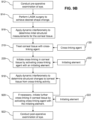
- the pre-operative and post-operative examinations in steps 916 and 918, respectively may include determining visual acuity, refractive error, pupil size, intraocular pressure (IOP), corneal thickness, corneal topography, wavefront analysis, presence of dry eye-related disorders, etc. Aspects of the examination may be conducted at least in part with configurations of the present disclosure.
- the interferometry techniques described above in connection with FIGS. 6A through 6E may be employed to measure tear film thickness and evaluate tear film stability. Problems relating to tear film break-up and dry eye can be diagnosed. Indeed, such evaluation enables a practitioner to determine during a pre-operative examination whether a patient is a candidate for refractive surgery, such as LASIK (see step 912 of FIG. 9B ). Tear film measurement can be enhanced with artificial tears containing microbeads of specific sizes and concentrations. The artificial tears can optionally have fluorescent markers to assist in measuring tear fluid dynamics by a measurement apparatus sensitive to fluorescence.
- an interferometer can provide data on the strength of the cornea 2 by measuring deflections of the corneal surface caused cardiac pulsate flow cycles.
- changes in diastolic and systolic pressure magnitudes and differences may be analyzed with data from the interferometer to determine IOP and other biomechanical characteristics of the cornea 2.
- the interferometer in other implementations can provide data on the corneal structure by measuring the response of the cornea 2 to a deformation that is applied from a controlled external source.
- a controlled external source For example, an ultrasonic pulse may be applied to the eye 1.
- pulses sweeping through a range of frequencies may be applied to the eye 1 and the interferometer can look for resonances that indicate the structural properties of the cornea tissue.
- the external source is positioned so that it is not in direct contact with the eye, and a puff of air or the like may be delivered to cause deformation of the cornea 2 in a controlled manner.
- the light source 610 in the interferometry system may be a multispectral light source.
- moving a reference arm of the interferometer which can adjust a position of the reference surface 612, allows for probing the different surfaces within the eye.
- the different surfaces within the eye can be probed by looking at the different spectral oscillations off of each refractive surface interface (e.g ., the interfaces between the layers associated with the eye 1).
- the spectral oscillations can be the constructive and deconstructive interference between the layers at different wavelengths. In this manner, the surface layer shape as well as layer thickness can be measured.
- the surfaces and layers that can be measured include, without limitation: the tear film layers, the endothelium, Bowman's membrane, stroma, Descemet's membrane, and the endothelium.
- the surfaces that can be measured include the surfaces defined by the interfaces between each of the refractive layers (e.g., the tear film layers, the endothelium, Bowman's membrane, stroma, Descemet's membrane, and the endothelium).
- layers (and associated surfaces defined by interfaces between the layers) may include, for example, a contact lens and its tear film above and between the contact lens and the epithelium. Implementations may also measure posterior and anterior surfaces of the lens of the eye.
- FIG. 1 may depict a Shack-Hartmann wavefront sensor, or may employ a Shack-Hartmann sensor in combination with an interferometer to conduct profilometry of the cornea 2.
- the Shack-Hartmann wavefront sensor provides information for the treatment of the cornea 2 by analyzing light emerging from the optical system of the eye 1 and detecting aberrations of the cornea 2.
- a Shack-Hartmann wavefront sensor employs an array of microlenses of the same focal length.
- a light source is directed to create a virtual light source near the rear of the eye 1 to provide light for emerging from the eye 1.
- Each microlens creates a beam focused onto a spot on a focal plane where a photon sensor, e.g., a CCD camera, is placed.
- a photon sensor e.g., a CCD camera
- the displacement of the spot with respect to a precalibrated position is proportional to the local slope of the wavefront emerging from the eye 1. Detecting the spots and integrating their displacements across the focal plan provides an estimate of the wavefront shape, which is itself an estimate of the shape of the corneal surface 2A of the eye 1.
- embodiments according to the present disclosure may combine the use of an interferometer (and a wavefront sensor) with a Scheimpflug camera, which determines the thickness of the cornea 2, i.e., corneal pachymetry, as well as the thickness of the intraocular lens.
- a Scheimpflug camera determines the thickness of the cornea 2, i.e., corneal pachymetry, as well as the thickness of the intraocular lens.
- Such embodiments provide data on the anterior as well as posterior segments of the eye, enabling a full biomechanical analysis of the eye particularly after a treatment such as thermokeratoplasty has been applied.
- Some embodiments may employ a rotating Scheimpflug camera to capture, for example, 25 or 50 images, to collect data on the anterior segment.
- other embodiments may scan along one plane and then rotate 90 degrees to scan across another plane to define a grid according to which the anterior segment may be analyzed.
- Still further embodiments may provide information on the surface of the eye 1 using an interferometer arranged such that the reference beam 614 is reflected from the eye 1 at some incident angle, which allows the interferometer to be sensitive to motion along the bisector of the incident angle.
- the motion may be due to, for example, dynamic deformation of the corneal surface 2A of the eye 1.
- Comparisons between multiple measurements with such an angled interferometer configuration can also provide information on the surface strain of the eye 1.
- the interferometry techniques described above may be employed for real-time monitoring of cross-linking and may be used with thermokeratoplasty or LASIK surgery. However, these techniques are not limited to such applications.
- aspects of the present disclosure may be employed to treat keratoconus.
- data from the interferometer provides a pattern of the keratoconus that can be used to guide the application of an initiating element, e.g., via laser scanning and eye tracking technologies, and increase the amount of cross-linking in desired areas.
- data from the interferometer can be used by a controller to guide the hardware that generates cross-linking activity.
- the feedback system 400 may comprise an interferometer similar to the interferometers provided in FIGS. 6A and 6D . In such a configuration, the signal beam 614 can be considered the measurements 402, and the data from the interferometer ( i.e., the interferograms) can be considered the feedback information 404.
- the interferometry techniques above may also be employed to monitor other procedures that surgically or mechanically modify aspects of the eye 1.
- penetrating keratoplasty is used to treat the cornea 2
- the biomechanics of the corneal graft can be monitored and the tensioning of the sutures can be monitored in real-time.
- Another technique for real time monitoring employs polarimetry to measure corneal birefringence and to determine the structure of the corneal tissue.
- the technique measures the structure of the corneal tissue by applying polarized light to the corneal tissue.
- Birefringence describes the effect of some materials to retard transmitted light polarized along an axis of birefringence of the material relative to transmitted light polarized orthogonal to the axis of birefringence.
- a birefringent material may receive a light signal having components polarized both parallel and perpendicular to the axis of birefringence, and the transmitted light can emerge with one of the components phase delayed relative to the other.
- the effect of transmitting linearly polarized light through a birefringent material is to rotate the polarization of the transmitted light relative to the incoming light, and the amount of rotation of the polarization can be adjusted by modifying the orientation of the birefringent material.
- the effect of some materials to effectively decompose a light beam into two beams when it passes through the material that have anisotropic (directionally dependent) structure can describe the effect of a birefringent material. If the material has a single axis of birefringence, two refractive indices can be respectively assigned for polarizations parallel and perpendicular to the axis of birefringence for an arbitrary incoming light signal. The light of one polarization propagates more slowly through the birefringent structure than light of the other polarization and becomes retarded in phase.
- parameters characterizing birefringence are the axis of birefringence and the magnitude of retardation.
- the corneal stroma is anisotropic and its index of refraction depends on direction.
- the cornea behaves like a curved biaxial crystal with the fast axis orthogonal to the corneal surface and the slow axis (or corneal polarization axis) tangential to the corneal surface.
- a light beam emerging from the living eye after a double pass through the ocular optics contains information on the polarization properties of all ocular structures (except optically inactive humours).
- a portion of a light beam which enters the eye and passes through the cornea may be reflected at the iris and then pass back through the cornea to exit the eye.
- the light emerging from the eye has thus completed a double pass of the cornea. Analysis of the portion of the light beam reflected from the iris and emerging from the eye can reveal structural information about the cornea 2.
- FIG. 7A illustrates the increase in Young's modulus with age and is associated with cross-linking as demonstrated in: Nathaniel E. Knox Cartwright, John R Tyrer, and John Marshall, Age-Related Differences in the Elasticity of the Human Cornea. Invest. Ophthalmol. Vis. Sci. September 16, 2010; doi:10.1167/iovs.09-4798 , the contents of which is herein incorporated by reference in its entirety.
- Young's modulus provides a measure of the elasticity or stiffness of a material. Generally, a higher value of Young's modulus indicates a greater resistance to deformation under a particular stress load.
- Young's modulus can be computed as a ratio of applied stress (i.e ., tensile or compressive pressure) to measured strain (i.e ., dimensionless measure of deformation) of a material, and can be measured experimentally by taking a slope of a graph of stress versus strain for a particular material. Referring to TABLE 1, it has been shown that the stiffening effects of applying Riboflavin and UV light to initiate cross-linking appears to be equivalent to the effect of aging to the cornea by more than 500 years. TABLE 1 Condition Young's Modulus Age (Years) Normal 0.49 80 UV Riboflavin 2.25 600 Glutaraldehyde 3.76 1000
- light emerging from the eye after a double pass through the corneal tissues may be less polarized than the incoming light. That is, in a system measuring the polarization properties of light emerging from the eye following a double pass through the corneal tissues, the emerging light may include a larger fraction of depolarized light than the incoming light.
- TABLE 2 a study has shown that the amount of depolarized light emerging from the eye following a double pass of the corneal tissue generally correlates with the age of the subjects in the study. See Bueno, J.M. J. Op. A: Pure Appl. Opt. 6 (2004), S91-S99 , the contents of which is herein incorporated by reference in its entirety.
- the degree of polarization may provide a measure of corneal stiffness, and thus a measure of cross-linking activity.
- a lesser degree of polarization (or equivalently, an increased amount of depolarized light) may be indicative of an increased amount of corneal stiffness, and thus be indicative of an increased amount of cross-linking activity.
- the information gained from the degree of polarization may be used in an implementation apart from a particular subject's age.
- a degree of polarization of light emerging after a double pass through the corneal tissues of a patient's eye can provide information indicative of a baseline amount of corneal stiffness before commencing an eye therapy treatment.
- the progress of an eye therapy treatment can then be checked at intervals by measuring subsequent degrees of polarization, and, if desired, variable parameters for controlling the application of the eye therapy treatment can be adjusted according to the corneal stiffness indicated by the subsequent measurements of degree of polarization.
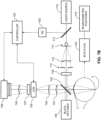
- FIGS. 7B through 7E provide laboratory set-ups that may be employed to measure corneal birefringence and polarization properties of light emerging after a double pass through the corneal tissues. Any of the set-ups and systems provided in FIGS. 7B through 7E may be coupled to an analysis system adapted to analyze obtained information indicative of the polarization properties of the cornea 2. The analysis of the information may be carried out by, for example, solving for a Mueller matrix describing the optical effect of the corneal tissue on the light reflecting from the iris 5.
- the measurement and analysis systems for measuring the corneal birefringence of the corneal tissues may be referred to as a corneal polarimetry system.
- the feedback system 400 may comprise a corneal polarimetry system.
- Information indicative of the polarization properties of the cornea 2 obtained by any of the systems illustrated in FIGS. 7B through 7E may provide the measurements 402.
- the intensity of light e.g., the intensity detected by the CCD camera 760 in FIGS. 7B through 7E
- the degree of polarization computed by the analysis system of the corneal polarimetry system may comprise the feedback information 404, which is then passed to the controller 120.
- the controller 120 may be adapted to analyze the feedback information 404 and provide the command signals 406 to the light source 110.
- the controller 120 may be further adapted to provide the command signals 406 to additional components to control the amount and degree of cross-linking activity being initiated in the cornea 2.
- the birefringence can be calculated.
- the three images of the pupil's plane recorded according to the three independent polarization states of the analyzer can be used to provide independent variables to solve the Mueller-Stokes matrix with retardation ⁇ and azimuth ⁇ (fast axis).
- the corneal polarimetry system shown in FIG. 7B includes a laser source 710, which can be a 633 nm He-Ne laser.
- the laser source 710 illuminates the eye 1, and light reflected form the iris 5 after a double pass through the corneal tissue is passed through a liquid-crystal modulator (“LCM”) 730.
- the LCM 730 may be an LCM provided by Meadowlark Optics, such as the HEX69.
- the controller 120 may send and receive signals to both the camera 760 and the LCM 730 and may be adapted to analyze the intensity information provided by the camera 760 in combination with different polarization settings of the LCM 730 to determine the birefringence of the cornea 2.
- the controller 120 may receive signals from a reference detector (“RD") 762 to account for brightness fluctuations in the laser source 710.
- RD reference detector
- the polarimetry system of FIG. 7B further includes a beam splitter 712 for splitting the output of the laser source 710 toward the RD 762, with the rest continuing on toward the spatial filter 714.
- the spatial filter 714 is provided to filter and expand the output of the laser source 710, and may include a microscope objective and a pinhole.
- the filtered and expanded light is then directed toward a first lens 716 to collimate the beam.
- the beam then passes through an aperture 718, which controls the size of the beam.
- the aperture 718 may have a diameter of 12 mm.
- the output of the aperture 718 is then passed through a linear polarizer 720, which is oriented with its transmission axis of polarization at a 45° to a horizontal orientation.
- the beam is then split again by a second beam splitter 722, which reflects the beam toward the eye 1. Some of the light then completes a double pass of the cornea 2, with reflection at the iris 5. The reflected light then emerges back through the cornea 2, and half passes through the second beam splitter 722 to be directed toward the camera 760.
- a black diffuser 728 is also provided to reduce undesirable reflection and scattering from the portions of the beam that are directed to the black diffuser 728 by the second beam splitter 722.
- Lenses 724, 726 conjugate the pupil plane of the eye 1 with the LCM 730, which may be, for example, 15 mm in diameter.
- a second linear polarizer 732 is placed behind the LCM 730, and is oriented parallel to the linear polarizer 720. The combination of the LCM 730 and the second linear polarizer 732 act as a polarization state analyzer ("PSA").
- PSA polarization state analyzer
- the LCM 730 may be oriented with a fast axis in a vertical orientation.
- the LCM 730 may produce three completely independent polarization states. A series of three images may then be obtained, with each image indicative of the intensity of light detected by the camera 760 in one of the three different polarization states. Each pixel of the images corresponds to an area of the pupil plane.
- the intensities detected by the camera 760 of the different polarization states provide information for solving the Mueller matrix of a birefringent sample with retardation ⁇ and fast axis orientation ⁇ according to the Mueller-Stokes formalism, the details of which are provided elsewhere. See, e.g., Bueno J.M., et al. Applied Optics (2002), v.41, 116-124 .
- the position of the eye 1 may be stabilized by a bite plate 770 mounted on a three axis micrometric positioner 772.
- a subject/patient bites down on the bite plate 770
- the position of the subject's head is stabilized. Moving the bite plate 770 using the micrometric positioner 772 controls the position of the subject's eye 1.
- the controller 120 may be the same controller as that shown in FIG. 4 .
- the controller 120 may be adapted to analyze the birefringence information extracted by the corneal polarimetry system and map the birefringence of the cornea 2 to an equivalent amount of cross-linking.
- the mapping may be performed according to birefringence information obtained in a preliminary (i.e., pretreatment) examination of a subject.
- the mapping may be calibrated according to additional measures of corneal stiffness of the subject.
- the mapping may be informed according to average amounts of corneal birefringence observed in subjects with similar characteristics and profiles to the particular subject being monitored by the corneal polarimetry system.
- the controller 120 may be replaced by a separate controller different from the controller utilized to control the cross-linking activity.
- the separate controller may be adapted to automatically send and receive information to and from the controller 120, or may be adapted as a completely separate system that provides the birefringence information to be evaluated by a user, or by a physician.
- FIGS. 7C , 7D , and 7E provide alternative configurations of corneal polarimetry systems useful for detecting information indicative of the corneal birefringence. Details of the configurations in FIGS. 7C through 7E may be found in Bueno, J.M. J. Op. A: Pure Appl. Opt. 6 (2004), S91-S99 ; Richert M., et al. EPJ Web of Conferences 5 (2010), 1-5 ; Knighton R.W and Huang, X.R. Invest. Opt. Vis. Sci. 43
- the laser source 710 may be a collimated infrared laser beam with 780 nm wavelength and 1.5 mm in diameter.
- the linear polarizer 720 may be oriented to vertically polarize the light from the laser source 710.
- the polarized light is then directed by the second beam splitter 722 to complete a double pass of the corneal tissues and collimated by the lenses 724, 726.
- the lenses 724, 726 may be achromatic doublets.
- the beam is then passed through an analyzer unit, which includes a rotatory retarder 734 and a vertical polarizer 736.
- An aperture 738 limits the size of the beam to 5 mm, and the objective 740 focuses the beam on the imaging plane of the camera 760.
- Rotating the rotatory retarder 734 provides different polarization states of the analyzer unit.
- the analyzer unit may be adapted in four independent polarization states and images may be recorded with the camera 760 in each orientation. The images thus obtained can then be analyzed to extract the birefringence information.
- the four independent polarization states may correspond to orientations of the rotatory retarder 734 with the fast axis at -45°, 0°, 30°, and 60°.
- Either of the corneal polarimetry systems provided in FIGS. 7B or 7C may optionally further include a video camera to control the correct positioning of the subject's eye 1 by use of the micrometric positioner 772.
- the additional video camera can be adapted to be connected to a controller (such as the controller 120) which automatically detects the location of the eye 1 and corrects the position of the eye 1 by adjusting the micrometric positioner 772, which moves the subject's head through the bite plate 770.
- the video camera can be adapted to display the video feed of the eye 1 on a display and an operator can use a manual method of manipulating the micrometric positioner 772 according to the displayed video of the eye 1.
- the video feed of the eye 1 may be superimposed on a target or annulus, and an operator may adjust the micrometric positioner 772 with a joystick to maintain the eye 1 in a desirable location relative to the video feed.
- the corneal polarimetry system can be mounted on a motorized system and can be adapted to move automatically instead of, or in addition to, the micrometric positioner 772 moving the eye 1.
- FIG. 7D schematically illustrates a further configuration of a corneal polarimetry system arranged in a backscattering configuration.
- the corneal polarimetry system of FIG. 7D includes the laser source 710, which may be a Nd-Yag doubled continuous laser from Spectra Physics that operates at 532 nm.
- a linear polarizer 751 vertically polarizes the light from the laser source 710.
- the linearly polarized light is then passed through two nematic liquid crystals 752, 753 oriented with their fast axis indicated by the arrows in FIG. 7D having angles ⁇ 1 and ⁇ 2 with the orientation of the linear polarizer 751, respectively.
- the linear polarizer 751 and the two nematic liquid crystals 752, 753 may be considered a polarization state generator.
- the two nematic liquid crystals 752, 753 act as adjustable retardance elements.
- the beam may then optionally be passed through a spatial filter 754.
- the beam then completes a double pass the corneal tissue of the eye 1, and is reflected toward a polarization state analyzer.
- the polarization state analyzer includes the same components as the polarization state generator, but the beam passes through in reverse order.
- the beam is then focused by the objective lens 740 to an imaging plane of the camera 760.
- the values of the orientation and retardance of each of the retardance elements 752, 753 are chosen in order to minimize the propagation of errors from intensities to the calculus of Mueller matrices. Similar to the analysis of the corneal polarimetry systems already discussed, the Mueller matrix of the corneal tissue is obtained by successively generating four linearly independent states of polarization and by analyzing the backscattering field
- the corneal polarimetry system having a backscattering configuration of FIG. 7D may be adapted with an angle of approximately 10° between the input beam and the output beam, and the laser source 710 may be, for example, approximately 1.5 m from the cornea 2.
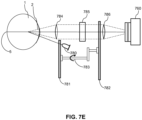
- FIG. 7E schematically illustrates yet another configuration of a corneal polarimetry system useful in extracting birefringence information of the corneal tissue.
- the corneal polarimetry system of FIG. 7E includes light-emitting diode (“LED") 780.
- the LED 780 can have a peak wavelength of 585 nm and can be oriented 7.1° below the optic axis of the cornea 2.
- Light reflected from the poster surface of the cornea 2 formed the so-called fourth Pukinje image (P IV ), which is a small, inverted image of the LED.
- Identical achromatic collimating lenses 784, 786 magnify the Pukinje image and focus the image on the imaging plane of the camera 760.
- the camera 760 can be replaced by an eyepiece for a user to look through and observe the cornea 2.
- light from the LED 780 polarized by the first linear polarizer 781 is blocked by the second linear polarizer 782 unless the light has undergone a change in polarization.
- the double-pass through the corneal tissue converts the light emitted from the LED 780 having a polarization oriented according the first linear polarizer 781 to an elliptical polarization state.
- a Berek variable retarder (“BVR") 785 is located in the collimated beam between the collimated lenses 784, 786.
- the BVR may be acquired from New Focus of Santa Clara, CA, and may include a tiltable, rotatable plate of MgF 2 .
- the BVR 785 can be adjusted in azimuth and retardance to cancel the effect of birefringence during a double pass through the corneal tissue. Estimates of the corneal birefringence may be obtained by the corneal polarimetry system shown in FIG.
- the angle of illumination is an important aspect in the techniques directed to measuring birefringence in the cornea 2, because it affects the observed birefringent pattern.
- the polarized illumination of the eye may be varied from converging to meet the radius of curvature of the cornea 2 to providing a collimated beam.
- birefringence analysis i.e ., corneal polarimetry
- interferometry analysis i.e ., corneal topography analysis only
- corneal topography analysis i.e ., corneal topography analysis
- birefringence analysis i.e ., corneal polarimetry
- corneal topography analysis i.e ., corneal topography analysis
- corneal topography analysis i.e ., corneal polarimetry
- FIG. 8A illustrates a configuration utilizing multiple slit lamps to perform corneal topography and pachymetry.
- the multiple slit lamp configuration may also provide targeting information to implementations of the feedback system 400.
- the multiple slit lamp configuration shown in FIG. 8A includes four slit lamps 802, 804, 806, 808.
- Each of the slit lamps 802, 804, 806, 808 may be similar to a conventional slit lamp employed in the field of optometry and ophthalmology to examine a patient's eye and to diagnose conditions existing in the layers of the eye.
- Each of the slit lamps may be adapted to illuminate a portion of the cornea 2 with light emerging from a slit.
- the slit may be an aperture having a narrow dimension and a broad dimension.
- the light emerging from the slit lamp may be approximately considered as a sheet of light, which illuminates a plane of the cornea 2.
- the four slit lamps 802, 804, 806, 808 may be oriented off-center from the optical axis of the cornea 2, and may be oriented with each at 45° with respect to the eye 1. Furthermore, the four slit lamps may be positioned such that they are equally spaced around the eye 1.
- the first slit lamp 802 may be positioned above the eye 1 and may direct a sheet of light downward at 45° with respect to the eye 1.
- the second slit lamp 804 may be positioned to the left of the eye 1 and may direct a sheet of light rightward at 45° with respect to the eye 1.
- the third slit lamp 806 may be positioned below the eye 1 and may direct a sheet of light upward at 45° with respect to the eye 1.
- the fourth slit lamp 808 may be positioned to the right of the eye 1 and may direct a sheet of light leftward at 45° with respect to the eye 1.
- the second slit lamp 804 is positioned further into the page than the first slit lamp 802 and the third slit lamp 806.
- the fourth slit lamp 808 is positioned further out of the page than the first slit lamp 802 and the third slit lamp 806.
- the intensity pattern created by the multiple slit lamps illuminating cornea 2 is directed by the corneal imaging optics 810 to the camera 860. Intensity patterns detected by the camera 860 are then analyzed by the controller 120 to extract corneal topography and pachymetry information.
- An illustrative schematic of an example intensity pattern created by the four slit lamp configuration is provided in FIG. 8B .
- the four slit lamps illuminate four curved lines on the cornea 2.
- the shape and thickness of the pattern observed on the cornea 2 provides information indicative of the shape of the corneal surface ( i.e ., corneal topography) and the thickness of the cornea 2 (i.e., corneal pachymetry).
- the thickness of the sheets of light observed with the camera 860 provide an indication of the corneal thickness when the precise parameters of the slit lamp orientation and position are known, including the thickness of the aperture of the slit lamps 802, 804, 806, 808.
- the illumination pattern observed in the camera 860 changes as the sheets of light emitted from the slit lamps scan over the surface of the cornea 2.
- the four curved lines sweep out a grid on the cornea 2. The curvature of the lines provide information indicative of the three dimensional profile of the eye surface.
- a complete three dimensional profile of the corneal surface may be extracted.
- the light reflected from the cornea 2 toward the corneal imaging optics 810 includes light reflected from the corneal surface (i.e., the anterior surface) and from the posterior surface of the cornea 2.
- the cornea 2 is illuminated with a line 830 having a top edge 831 and a bottom edge 832.
- the top edge 831 describes the anterior surface of the cornea 2
- the bottom edge 832 describes the posterior surface of the cornea 2.
- proximate edge an edge closer to the direction of the associated slit lamp
- distal edge an edge further from the direction of the associated slit lamp
- the proximate edge describes the anterior surface of the cornea 2 while the distal edge describes the posterior surface of the cornea 2.
- the light emerging from the cornea 2 and directed toward the camera 860 includes information on the position of the posterior surface and therefore the thickness of the cornea 2.
- the emerging light may also experience some spreading due to the diffusive optical characteristics of the corneal tissue.
- Ray tracing may also be employed to trace lines from slit lamps (e.g., the slit lamp 802) to the camera 860 to provide an estimate of anterior and posterior surfaces of cornea 2, and thus the shape and thickness of the cornea 2 at multiple locations may be extracted. By defining the shape and thickness of the cornea 2 at multiple locations, a three-dimensional profile of the cornea 2 may be determined. Using the camera 860, the surface estimates from the multiple slit lamp configuration may be matched to corneal surface estimates from an interferometry system (e.g ., the interferometer systems of FIGS. 6A , 6D ) to provide an even better estimate of the full corneal topography.
- an interferometry system e.g ., the interferometer systems of FIGS. 6A , 6D
- the controller 120 can determine the center position of the cornea 2.
- the controller 120 can determine the center position by, for example, determining the apex of the three dimensional profile of the cornea surface.
- the determined center position may then be used in conjunction with adjustable optical and mechanical components to align any of the implementations of the feedback system 400 previously discussed.
- the multiple slit lamp configuration illustrated in FIG. 8A also includes a distance measurement system 670 for determining the distance between the multiple slit lamps 802, 804, 806, 808 and the eye 1.
- the distance (or information indicative of the distance) is passed to the controller 120.
- the controller 120 uses the distance provided by the distance measurements system 670 in combination with the images from the camera 860 to get the radius of curvature of the eye 1, and thus the optical power of the eye 1.
- the distance measurement can also allow for scaling the images observed on the camera 860.
- the distance measurement system 670 may be implemented by two cameras focusing on the surface of the cornea 2, but oriented at an angle relative to one another, and separated by a known distance, such that the angle between the orientations of the two cameras when both are focused on the eye 1 provides an estimation of the distance according to standard trigonometric analysis.
- the distance measurement system 670 may be implemented as a high resolution camera capturing images from a known position.
- the high resolution camera may be oriented at approximately 90° to the optical axis of the eye 1, such that the edge of the eye 1 can be mapped to a pixel location of the high resolution camera, which corresponds to a distance from the slit lamps 802, 804, 806, 808.
- the distance measurement system 670 may be adapted according to an active ranging technique which uses reflected signals correlated with reference signals to measure time delays, such as a doppler, ultrasound, or optical ranging system.
- the distance may be estimated directly from the slit lamps, camera, and optical elements illustrated in FIG. 8A .
- Such a distance measurement may be performed by finely adjusting the position of the eye (e.g., via a positioning system mounted to a bite plate or head restraint similar to the micronometric positioner 772 shown in FIGS.
- the intensity pattern observed by the camera 860 reflects a characteristic pattern (e.g., a cross centered on the apex of the cornea 2 formed by an overlap between the light of the upper and lower slit lamps 802, 806, and an overlap from the light of the side slit lamps 804, 808) that is indicative of a particular known distance.
- the position of the eye 1 - or the position of the slit lamps and associated optics - may then be adjusted by known steps relative to the known distance as desired.
- FIG. 8B schematically illustrates an image of the cornea 2 detected by the camera 860 in a configuration utilizing four slit lamps.
- FIG. 8C illustrates an exemplary configuration of the bite plate 770 for stabilizing a patient's eye 1 during treatment and evaluation.
- the bite plate 770 includes a coupling 850 for connecting the bite plate 770 to an external component, such as a stationary rigid member or a member adapted to be moved by the micrometric positioner 772 of FIGS. 7B and 7C .
- an implementation of the bite plate 770 also includes a deformable material 840 distributed generally in a shape suitable for a user to bite on to.
- the bite plate 770 may be implemented as a bar ( i.e., a bite bar).
- aspects of the bite plate 770 may resemble a protective mouth guard, a dental bite plate or bite tray, or a similar device.
- the bite plate 770 desirably fixes the location of a subject's head, and thereby fixes the location of the subject's eye 1, and can be replaced and/or supplemented by additional mechanical components adapted to restrain a subject's head ( e.g ., head restraint device(s)) and thereby fix the position of the eye 1.
- the bite plate 770 and/or additional mechanical components for restraining a subject's head may be incorporated in the feedback systems (such as the exemplary interferometer systems described in connection with FIGS. 6A and 6D or the polarimetry systems described in connection with FIGS.
- cross-linking activation systems such as the delivery system 100 described in connection with FIG. 1 .
- a subject's head e.g., a patient's head
- the application of cross-linking and/or the monitoring of cross-linking activity can be more accurately performed.
- aspects of the present disclosure may employ a positioning mechanism that fixedly positions the eye 1 and/or patient's head relative to the interferometer.
- the measurements of the deflections of the corneal surface 2A are more accurate when the patient's head is absolutely registered over several cardiac cycles.
- the patient bites onto a fixed bite plate (such as the bite plate 770 illustrated in FIG. 8C ) that minimizes motion of the patient's head while the images are taken by the interferometer.
- the bite plate 770 may be disposable and formed from a moldable material, e.g ., a gel, soft plastic, a heat-moldable material, or the like.
- the bite plate 770 may also contain an RFID chip to monitor usage or to allow access to different diagnostic software modules. With the bite plate 770, even if the patient rotates his or her eyes, the head (skull) does not shift. As such, the rotation of the saccadic eye movements can be nulled out, e.g., by an algorithm, as a tilt in the direction of the motion. Additionally or alternatively, a chinrest and/or headrest may be employed to maintain cranial fixation and allow for the measurement of multiple frames over time.
- the corneal polarimetry systems illustrated in FIGS. 7B through 7E may also utilize the bite plate 770 to stabilize the patient's eye 1. Additionally, some embodiments may employ a visible fixation light source or object to help the patient align his or her eye relative to the interferometer. This visible fixation light source or object may be incorporated into the interferometer.
- a camera may be employed to assist in aligning the interferometry system.
- the camera may be incorporated within the interferometer and may operate similar to the video camera 510 in FIG. 5A .
- the camera may be coaxially or non-coaxially aligned with the interferometer.
- the camera may also be employed to capture images that can be used for repeated future alignment.
- the camera may be employed for achieving alignment for secondary systems or procedures that are combined with the use of the interferometer. Additional mechanical, optical and or electrical control systems for course and fine alignment and adjustment of the interferometer to the corneal surface 2A may be employed, such as by manipulation of the positioning motors 617 described in connection with FIG. 6D .
- FIG. 9A provides a flowchart for activating the cross-linking agent 130 in a staged procedure according to an aspect of the present disclosure. It is understood that the application of the cross-linking agent 130 and the activation of the cross-linking agent 130 described above may occur in a staged procedure.
- heat is applied in a thermokeratoplasty treatment or LASIK surgery is performed to generate structural changes in the cornea 2 and produce a desired shape change in a treatment zone according to a desired pattern.
- a predetermined amount of time passes.
- the predetermined amount of time can be, for example, a period of approximately one week and may correspond to a period of time between a patient's appointments with a doctor.
- the changes to the corneal shape are checked.
- the changes to the corneal shape can be checked with one or more of the feedback systems previously described, including a system for performing profilometry of the cornea 2, such as the interferometry systems of FIGS. 6A through 6E or the polarimetry systems of FIGS. 7B through 7E .
- the steps 906 may correspond to follow up, e.g., weekly, appointments with the patient after the treatment in step 902.
- cross-linking is generated in selected areas of the cornea 2 to stabilize the structural changes in steps 210 and 220, similarly to the techniques described in connection with FIG. 2 .
- the patient may be treated with a slight overcorrection in step 902 to account for any reversal that may occur before the cross-linking is initiated.
- additional treatment may be applied in step 902 according to decision step 910 after the treatment zone has been checked in step 906. It is noted that the staged procedure illustrated in FIG. 9A can be employed when cross-linking is activated within the treatment zone, or outside the treatment zone as described herein.
- FIG. 9B provides a flowchart for using an interferometer to conduct pre-operative and post-operative examination of the corneal structure to be treated with LASIK surgery and the cross-linking agent 130.
- a pre-operative examination of the eye 1 is performed.
- the pre-operative examination may be performed using any of the feedback systems discussed above, or may be performed according to conventional techniques for determining whether a patient requires LASIK surgery.
- LASIK surgery is performed to achieve the shape change desired according to the pre-operative examination in step 912.
- dynamic interferometry is employed (such as, e.g., the dynamic interferometry systems described in connection with FIGS.
- step 210 and 220 the corneal tissue is treated with the cross-linking agent 130 to and cross-linking is initiated in the corneal tissue with the initiating element 222.
- the determination of the corneal strength performed in step 916 may be used in part to adjust the amount of cross-linking treatment applied in step 210.
- step 918 which may be similar to step 916, the corneal tissue is evaluated again with dynamic interferometry to determine the biomechanical strength of the corneal tissue.
- step 920 it is determined if the measure of corneal strength or stiffness indicated in step 918 according to the dynamic interferometry system, is sufficient to halt further cross-linking treatment, or if cross-linking treatment should continue to further strengthen the corneal tissue.
- the cornea 2 may receive additional cross-linking therapy by a further application of the initating element 222, and step 918 may be repeated once again.
- a post-operative examination of the eye 1 is conducted in step 922.
- the Riboflavin may be the cross-linking agent 130, and may be applied topically to the corneal surface 2A, and transepithelial delivery allows the Riboflavin to be applied to the corneal stroma.
- the application of the cross-linking agent 130 generally sufficiently introduces Riboflavin to mid-depth regions of the corneal tissue where stronger and more stable structure is desired.
- the cross-linking agent 925 having a concentration C 1 is applied to the cornea 2 in step 924.
- the cross-linking agent 925 may be applied topically to the corneal surface 2A (e.g. , the epithelium) of the cornea 2.
- a period of time T 1 is allowed to pass.
- the cross-linking agent 925 diffuses into the underlying corneal structure according to an exponential gradient.
- the distribution of cross-linking agent i.e. , concentration of cross-linking agent 925 at depths at and below the corneal surface 2A, depends at least on the concentration C 1 and the period of time T 1 .
- the initiating element 929 is applied to the cornea in step 928 with a power P 1 .
- the initiating element 929 may be UV light.
- the power P 1 of the initiating element determines the extent to which the distribution of cross-linking agent 925 is activated. For example, an initiating element applied with a power greater than P 1 may reach greater depths below the corneal surface 2A and allow the cross-linking agent 925 to be activated at these depths.
- the power P1 may be selected according to the concentration C 1 and the time T 1 .
- the parameters C 1 , P 1 , and T 1 may be selected to achieve the appropriate amount of cross-linking at desired depths of the cornea 2.
- the cross-linking agent 925 with a concentration C 1 is applied to the cornea in step 924.
- the cross-linking agent 925 diffuses into the underlying corneal structure during a period of time T 11 .
- the initiating element 933 with power P 11 is then applied to the cornea in step 932.
- the initiating element is also applied in one or more additional steps (936, 940) after additional periods of time are allowed to pass.
- the cross-linking agent 925 applied in step 924 diffuses farther into the underlying corneal structure during a second period of time T 12 .
- the initiating element 933 with power P 12 is then applied to the cornea 2 in step 932 to provide further activation of the cross-linking agent 925.
- the initiating element may be applied in any number of additional steps.
- FIG. 9D illustrates the concluding steps 938 and 940 where the initiating element 941 with power P 1a is finally applied after a period of time T 1a .
- each application of the initiating element occurs after periods of time T 11 , T 12 , ... , T 1a , respectively, have passed.
- the cross-linking agent diffuses to increasing depths in the underlying corneal structure, and is incrementally activated with each application of the initiating element with powers P 11 , P 12 , ... , P 1a .
- the cross-linking agent is activated as it moves to increasing depths in the cornea 2.
- the powers P 11 , P 12 , ... , P 1a may include any combination of the same and/or different power values.
- T 1a may include any combination of the same and/or different time values.
- the parameters C 1 ; P 11 , P 12 , ... , P 1a ; and T 11 , T 12 , ... , T 1a may be selected to achieve the appropriate amount of cross-linking at desired depths of the cornea 2.
- the periods of time T 11 , T 12 , ... , T 1a are selected to allow the desired amounts of cross-linking agent to reach targeted regions of the cornea 2.
- the powers P 11 , P 12 , ... , P 1a are selected so that the desired amount of cross-linking is activated at these regions.
- the concentration of C 1 of the cross-linking agent 925 is applied to the cornea 2 in step 924. Similar to the embodiment 900D above, the initiating element 945 is applied one or more times in step 944 with powers P 11 , P 12 , ... , P 1a after respective periods of time T 11 , T 12 , ... , T 1a in step 942. However, in the embodiment 900E, additional concentrations C 2 , ..., C n of the cross-linking agent (947, 953) may be applied to the cornea 2. For example, in step 946, the concentration of C 2 of the cross-linking agent 947 is applied to the cornea 2.
- the initiating element 951 is then applied one or more times in step 950 with powers P 21, P 22 , ... , P 2b after respective periods of time T 21 , T 22 , ... , T 2b in step 948. Additional applications of the cross-linking agent may be applied until the final concentration C n of the cross-linking agent 953 is applied to the cornea 2 in step 952.
- the initiating element 957 is then applied one or more times in step 956 with powers P n1 , P n2 , ... , P nm after respective periods of time T n1 , T n2 , ... , T nm in step 954.
- the concentrations C 1 , C 2 , ... , C n may include any combination of concentration values.
- the concentrations C 1 , C 2 , ... , C n may be varied to combine varying distribution gradients and achieve a desired distribution of the cross-linking agent in the cornea 2.
- Each application of the concentrations C 1 , C 2 , ... , C n of the cross-linking agent may be activated by a single application of the initiating element after a period of time. In this case, the values of a, b, ..., m in FIG. 9E are equal to 1.
- each application of the concentrations C 1 , C 2 , ... , C n may be activated by a series of applications of the initiating element with powers P 11 , .. , P 1a ; P 21 , .. , P 2b ; and P n1 , .. , P nm , respectively.
- the values of a, b, ..., m in FIG. 9E are greater than 1.
- the values of a, b, ..., m may include other combinations of values.
- Each application of the initiating element occurs after respective periods of time T 11 , .. , T 1a ; .. , T 2b ; and T n1 , .. , T nm to allow the cross-linking agent to move to increasing depths before being activated.
- the powers P 11 , .., P 1a ; P 21 , .. , P 2b ; and P n1 , .. , P nm may include any combination of power values.
- the periods of time T 11 , .. , T 1a ; .. , T 2b ; and T n1 , .. , T nm may include any combination of time values.
- T 2b ; and T n1 , .. , T nm may be selected to achieve the appropriate amount of cross-linking at desired depths of the cornea 2.
- the periods of time T 11 , .., T 1a ; T 21 , .. , T 2b ; and T n1 , .. , T nm are selected to allow the desired amounts of cross-linking agent at concentrations C 1 , C 2 , ... , C n to reach targeted regions of the cornea 2.
- the powers P 11 , .. , P 1a ; P 21 , .. , P 2b ; and P n1 , .. , P nm are selected so that the desired amount of cross-linking is activated at these regions.
- varying the combination of concentrations, periods of time, and power allows the dosage of cross-linking to be spatially tailored.
- the combination of concentrations, periods of time, and power may also be chosen based in part on feedback information 404 provided by the feedback system 400 shown in FIG. 4 .
- the combination of concentrations, periods of time, and power may be computed by the controller 120 automatically based on the feedback information 404 or may be manually input by an operator (such as a doctor) after studying the feedback information 404.
- the feedback information 404 may include images from a video camera ( FIG. 5A ), from an interferometer ( FIG. 6 ), from a polarimetry system ( FIG. 7 ), or from any combination of these.
- the cross linking agent may be dissolved in a different carrier to promote delivery across the corneal surface 2A.
- the cross-linking agent may be combined in varying concentrations with another agent, such as EDTA, benzalkonium chloride, or an alcohol, to promote further delivery across the corneal surface 2A.
- a second (neutral) compound may be applied after any of the concentrations C 1 , C 2 , ... , C n of the cross-linking agent has been applied.
- the second compound applies a pressure to the cross-linking agent and promotes diffusion of the cross-linking agent to depths of the cornea 2.
- FIG. 9F which provides an embodiment 900F similar to the embodiment 900C
- the neutral compound 959 is applied in step 958 after the cross-linking agent 925 has been applied.
- the neutral compound 959 may be applied at any time during the embodiments described herein.
- the neutral compound 959 may be applied at a time when diffusion of the cross-linking agent has slowed and needs to be encouraged by the neutral compound.
- the UV light is applied according to frequencies (or wavelengths) that correspond with an absorption spectrum of the cross-linking agent, e.g. , Riboflavin. Effective absorption of the UV light by the cross-linking agent results in activation of the cross-linking agent.
- the absorption spectrum indicates the amount of absorption exhibited by a given concentration of cross-linking agent as a function of frequency.
- An absorption peak in the absorption spectrum indicates the frequencies at which the UV light is most effectively absorbed by the cross-linking agent.
- a spectrophotometer may be employed to apply the UV light according to frequencies within a narrow bandwidth, e.g. , approximately 0.1 nm resolution.
- the Beer-Lambert law states that the absorption of the UV light is directly proportional to the concentration of the absorbing material. At sufficiently high concentrations, however, the absorption spectra show absorption flattening, where the absorption peak appears to flatten because close to 100 % of the UV light is already being absorbed (saturation). The phenomenon of absorption flattening can result in deviations from the Beer-Lambert law. Such deviation may occur when concentrations of cross-linking agent used in the embodiments are exposed to a narrow bandwidth of frequencies, e.g. , approximately 0.1 nm resolution. With this narrow bandwidth, saturation occurs and the cross-linking agent reaches a point where no more UV light can be absorbed.
- a light-emitting diode may be employed to apply the UV light to the cross-linking agent.
- the bandwidth of frequencies from the LED is typically broader than the bandwidth of frequencies from the spectrophotometer.
- the resolution from the LED may be approximately 10 nm.
- the absorption behavior is different when the greater resolution of the LED is employed.
- the activation of the cross-linking agent increases with the absorption of additional frequencies in the bandwidth. Accordingly, the absorption may be controlled by increasing the bandwidth of the excitation source (e.g. , the light source 110 in FIG. 1 ), particularly as a function of concentration of the cross-linking agent (or corneal depth as described previously).
- the cross-linking agent 961 is applied to the cornea 2 in step 960 with a concentration C.
- the cross-linking agent 961 may be applied topically to the corneal surface 2A of the cornea 2.
- a period of time T is allowed to pass.
- the cross-linking agent 961 diffuses into the underlying corneal structure according to an exponential gradient.
- the distribution of cross-linking agent, i.e. , concentration of cross-linking agent at depths at and below the epithelium depends at least on the concentration C and the period of time T.
- the initiating element 965 is applied to the cornea 2 in step 964.
- the initiating element 965 may be UV light.
- the initiating element 965 in FIG. 9G is applied with a power P and a bandwidth B.
- the power P and bandwidth B with which the initiating element is applied determines the extent to which the distribution of cross-linking is activated.
- an initiating element applied with a power greater than P may reach greater depths below the corneal surface 2A and allow the cross-linking agent to be activated at these depths.
- an initiating element applied according to a relatively greater bandwidth B of frequencies e.g. , from an LED source with approximately 10 nm resolution, results in greater absorption of the UV light and activation of the cross-linking agent.
- the selection of the power P and bandwidth B may depend on the concentration C and the time T.
- the parameters C, P, T, and B may be selected to achieve the appropriate amount of cross-linking at desired depths of the cornea.
- the initiating element may be applied in one or more additional steps after additional applications of cross-linking agent at one or more concentrations and/or after one or more periods of time to allow the cross-linking agent to diffuse into the corneal tissue.
- the initiating element e.g. , UV light
- the initiating element may be applied in the examples above according to one or more selected bandwidths to control the activation of the cross-linking agent further.
- the UV light may be delivered with laser scanning technologies, such as by a laser scanning device 300 described in connection with FIG. 3 .
- laser scanning technologies such as by a laser scanning device 300 described in connection with FIG. 3 .
- embodiments may employ aspects of single photon laser scanning or Digital Light Processing TM (DLP ® ) technologies.
- DLP ® Digital Light Processing TM
- the use of laser scanning technologies allows cross-linking to be activated more effectively beyond the surface of the cornea 2, at depths where stronger and more stable corneal structure is desired.
- treatment may activate cross-linking at a mid-depth region after the cross-linking agent has moved to this region through diffusion after a period of time.
- the application of the initiating element may be applied precisely according to a selected three-dimensional pattern. The power and bandwidth with which the UV light is applied determines in part how deeply the scanning laser penetrates into the cornea 2, and as such, may be varied as described previously.
- embodiments stabilize a three-dimensional structure of corneal tissue through controlled application and activation of cross-linking in the corneal tissue.
- the cross-linking agent and/or the initiating element are applied in a series of timed and controlled steps to activate cross-linking incrementally.
- the delivery and activation of the cross-linking agent at depths in the cornea 2 depend on the concentration(s) of the cross-linking agent and the power(s) of the initiating element.
- embodiments provide systems, methods, and devices for monitoring cross-linking activity in the cornea 2 and for monitoring the position of the cornea 2 and the biomechanical strength of the cornea 2.
- the incremental steps may be informed, at least in part, by feedback information 404 from the feedback system 400.
- the various choices in the incremental approach relating to decisions whether to perform additional eye therapy or cross-linking treatment can be determined partially or completely based on the feedback information 404 from the feedback system 400.
- the various choices relating to the proper amounts of eye therapy treatment, the concentrations of the cross-linking agent 130, the power, bandwidth, duration, and time delay of the initiating element 222 can each be determined partially or completely based on the feedback information 404 from the feedback system 400.
- the feedback system 400 may include a video camera, an interferometer, a polarimetry system, a wavefront sensor, a Shack-Hartmann sensor, or any combination of these.
- the controller 120 may automatically determine adjustments to parameters (e.g. , power, bandwidth, time delay duration, concentration, etc.). Furthermore, the controller 120 may be adapted to activate the cross-linking agent in incremental steps according to the automatically determined adjustments without intervention from a user of the system. Alternatively, the controller 120 may be adapted to automatically determine the adjustments and to prompt the user before activating the cross-linking agent before each incremental step, or may prompt the user after a pre-determined number of incremental activations with no user intervention. The prompt may display, for example, the proposed parameters with which to apply the next incremental step(s) and allow the user to either approve, deny, or modify the proposed automatically determined parameters. In an implementation, the prompt may be displayed via a user interface system coupled to the controller 120.
- parameters e.g. , power, bandwidth, time delay duration, concentration, etc.
- the controller 120 may be adapted to activate the cross-linking agent in incremental steps according to the automatically determined adjustments without intervention from a user of the system.
- the controller 120 may be adapted to automatically determine the adjustments
- Embodiments may apply a mask to ensure that cross-linking activity is limited to selected areas of the cornea.
- a mask 1010 may be positioned over the corneal surface 2A before the initiating element 222, i.e. , the UV light, from the light source 110 is applied.
- FIG. 10B illustrates an example pattern 1014 for the mask 1010.
- the mask 1010 may be a device similar to a contact lens that is approximately 5 mm in diameter.
- a zone of structural changes in the cornea 2 may be in an annular pattern. To stabilize the structural changes in the treatment zone, cross-linking is initiated outside this annular treatment zone.
- cross-linking may be initiated in areas in the center and/or periphery of this annular treatment zone.
- Cross-linking in the areas outside the annular treatment zone provides the corresponding corneal tissue with sufficient strength to stabilize the changes to the new structure in the annular treatment zone.
- cross-linking does not have to be initiated directly in the annular treatment zone to preserve the structural changes in the annular treatment zone.
- the mask 1010 of FIG. 10A only allows UV light from the light source 110 to pass to the cornea 2 and the cross-linking agent 130, e.g. , Riboflavin, is activated in areas outside the treatment zone according to the pattern 1014.
- a UV-blocking material 1012 helps to define the pattern 1014 on the mask 1010. This UV-blocking material 1012 corresponds with the treatment zone to minimize the activation of cross-linking within the treatment zone.
- the pattern 1014 may be structurally defined as a cut-out from the mask 1010. In any case, any UV light from the light source 110 outside this pattern 1014 is blocked by the mask 1010. Accordingly, the mask 1010 provides more precise activation of the cross-linking agent 130.
- the cross-linking agent 130 in step 210 may be applied more broadly to the corneal surface 2A.
- the mask 1010 is applied to the eye 1 in step 215 and the initiating element 222 is delivered in step 220 to initiate cross-linking according to the pattern in the mask 1010.
- the controlled application of the initiating element 222 determines the areas of cross-linking.
- the mask 1010 is employed to deliver the initiating element 222 to the cornea 2 according to a particular pattern, masks may also be employed in some embodiments to deliver the cross-linking agent according to the specific pattern.
- the light source 110 of the initiating element 222 shown in FIG. 10A would be replaced by a source of the cross-linking agent 130 (such as the applicator 132 of FIG. 1 ).
- the system 1000 may employ a mask 1010, the devices employed for patterned initiation of a cross-linking agent is not limited to the use of such masks.
- Embodiments include more general systems and methods that activate a cross-linking agent according to a precise pattern, regardless of the type of device that actually directs the initiating element to specific areas of the cornea.
- a system 1100 transforms the initiating element 222, e.g., UV light, from the light source 110 to define a desired pattern 1114 as shown in FIG. 11B .
- the system 1100 does not block the initiating element 222 from the light source 110 from reaching areas outside a pattern. As illustrated in FIG.
- an optical device 1110 receives UV light as a collimated beam 1122 from the light source 110 and transforms the collimated beam 1122 into the desired pattern of light 1120.
- the pattern of light 1120 thus delivers the UV light to the cornea 2 according to a pattern 1114 that corresponds to areas outside the treatment zone.
- the pattern 1114 matches the areas where initiation of the cross-linking agent is desired.
- any number or types of optical devices such as lenses, beam-splitters, and the like, may be employed to achieve the desired shape for delivering an initiating element.
- the use of a mask 1010 as illustrated in FIG. 10A may be combined with the use of an optical device 1110.
- cross-linking agents such as Riboflavin
- Riboflavin may be effectively applied to the stroma by removing the overlying epithelium before application, it has been shown that cross-linking agents can chemically transition across the epithelium into the stroma. Indeed, Riboflavin may also be delivered to the stroma by applying it topically on the epithelium.
- the epithelium may be treated to promote the transition of the cross-linking agent through the epithelium. Accordingly, in the embodiments described herein, no removal of the epithelium is required. Advantageously, this eliminates the post-operative pain, healing period, and other complications associated with the removal of the epithelium.
- Riboflavin as the cross-linking agent and UV light as the initiating element in the embodiments above is described for illustrative purposes only.
- other types of cross-linking agents may be alternatively or additionally employed according to aspects of the present disclosure.
- Rose Bengal 4,5,6,7-tetrachloro-2',4',5',7'-tetraiodofluorescein
- Rose Bengal has been approved for application to the eye as a stain to identify damage to conjunctival and corneal cells.
- Rose Bengal can also initiate cross-linking activity within corneal collagen to stabilize the corneal tissue and improve its biomechanical strength.
- photoactivating light may be applied to initiate cross-linking activity by causing the Rose Bengal to convert O 2 in the corneal tissue into singlet oxygen.
- the photoactivating light may include, for example, UV light or green light.
- the photoactivating light may include photons having energy levels sufficient to individually convert O 2 into singlet oxygen, or may include photons having energy levels sufficient to convert O 2 into singlet oxygen in combination with other photons, or any combination thereof.
- aspects of the present disclosure may be employed in combination with LASIK surgery.
- LASIK surgery an instrument called a microkeratome is used to cut a thin flap in the cornea.
- the flap is peeled back and the underlying corneal tissue is reshaped by the application of an excimer laser. After the desired reshaping of the cornea is achieved, the cornea flap is put back in place to complete the surgery.
- a cross-linking agent is applied to the regions of the cornea treated by the LASIK surgery.
- the outer surface of the cornea e.g. , in the area of the flap, is treated with a cross-linking agent, e.g. , Riboflavin, after the flap is put back in place.
- the cross-linking agent is then activated with an initiating element. Activation of the cross-linking agent, for example, may be triggered thermally by the application of microwaves or light to corresponding areas of the cornea.
- Cross-linking occurs in the area of application.
- the cross-linking agent is applied to the outer surface of the cornea, i.e. , the epithelium, it has been shown that cross-linking agents can chemically transition across the outer surface into the underlying corneal tissue, i.e. , the stroma.
- the cross-linking agent may be delivered to the underlying corneal tissue by applying the cross-linking agent topically to the outer surface of the cornea.
- the outer surface may be treated to promote the transition of the cross-linking agent therethrough.
- the cross-linking agent may be applied to (i) the inner surface of the flap only, (ii) the underlying corneal tissue only, or (iii) both the inner surface of the flap and the underlying corneal tissue.
- the cross-linking agent is then activated with an initiating element. Again, activation of the cross-linking agent may be triggered thermally by the application of microwaves or light.
- the initiating element may be applied before the flap is put back, the initiating element additionally or alternatively may be applied to the treated areas after the flap is put back in place. In this case, the initiating element can be delivered through the outer surface of the cornea.
- the inner surface of the flap and/or the underlying corneal tissue are treated with a cross-linking agent after the flap is peeled back.
- the cross-linking agent is then activated with an initiating element.
- the cross-linking agent may be applied to (i) the inner surface of the flap only, (ii) the underlying corneal tissue only, or (iii) both the inner surface of the flap and the underlying corneal tissue.
- the outer surface of the cornea e.g. , in the area of the flap, is treated with a cross-linking agent after the flap is put back in place.
- the cross-linking agent is then activated in step with an initiating element.
- activation of the cross-linking agent may be triggered thermally by the application of microwaves or light.
- the cross-linking agent may be activated with an initiating element according to a single act, rather than two separate acts.
- the initiating element may be delivered in the single act after the flap is put back in place.
- a cross-linking agent may be applied and activated in different regions at different points during LASIK treatment.
- the cross-linking agent may be applied to any combination of the outer surface of the cornea, the inner surface of the flap, and the exposed underlying corneal tissue.
- specially tailored concentrations of cross-linking agent may be applied in combination with varying levels of initiating element to these regions to achieve the appropriate amount of stability and strength in the cornea.
- FIG. 12A illustrates the activation of cross-linking in the regions of the cornea treated by the LASIK surgery.
- a cross-linking agent In particular, the underlying corneal tissue is exposed. Therefore, in act 1230, the underlying corneal tissue is treated with a cross-linking agent 1202 after act 1220.
- the cross-linking agent 1230 may be applied, for example, by dripping a measured amount and concentration of the cross-linking agent 1202 topically onto the exposed underlying corneal tissue.
- the cross-linking agent 1202 is then activated in act 1240 with an initiating element 1204 while the flap remains peeled back. Activation of the cross-linking agent 1202 may be triggered thermally by the application of microwaves or light.
- Ribloflavin may be applied as the cross-linking agent 1202 to the corneal tissue.
- a photoactivating light such as ultraviolet (UV) light
- UV light may be applied as an initiating element 1204 to initiate cross-linking in the corneal areas treated with Ribloflavin.
- an appropriate amount of Riboflavin is applied to the targeted regions of the cornea and an appropriate amount of UV light is applied to match the application of Riboflavin.
- damage to the eye may result if too much Riboflavin and UV light reach the endothelium. This may occur, in particular, if too much time passes between the application of the Riboflavin in act 1230 and the application of the UV light in act 1240. The passage of time allows the Riboflavin to diffuse more deeply into the corneal tissue to the endothelium, and the UV light may reach the Riboflavin at the endothelium.
- embodiments apply the UV light in act 1240 according to a power and duration that ensure that the application of the UV light does not damage the endothelium.
- the resulting energy determines the depth to which the UV light penetrates in the corneal tissue.
- the power and duration are based in part on the amount of time that has passed since the application of the cross-linking agent. Because the rate of diffusion for a given concentration of the cross-linking agent is known, embodiments can use the time data to calculate how far the cross-linking agent has traveled into the corneal tissue. Therefore, in act 1232, a time period T 1 is determined from the time t when the cross-linking agent 1202 is applied in act 1230. Based on this time period T 1 , a distance d representing how far the cross-linking agent has traveled into the corneal tissue is determined in act 1234.
- the power and duration are also based on the distance that the cross-linking agent and the UV light can travel though the cornea before reaching the endothelium. This distance generally corresponds with the thickness of the cornea. Therefore, in act 1236, the corneal thickness c is determined. By determining the diffusion distance d of the cross-linking agent and determining the thickness c of the cornea, the appropriate power P and duration T 2 can be determined in act 1238.
- the embodiments can apply the UV light to the cross-linking agent in the cornea in act 1240 while preventing damage to the endothelium.
- act 1236 may determine an "effective" thickness c by adjusting for the fact that the corneal flap is peeled back. For example, peeling back the flap may reduce the effective thickness of the cornea to 120 ⁇ m, and embodiments may apply the UV light according to a power P and duration T 2 that delivers the UV light to a depth of 100 ⁇ m.
- an embodiment 1300 may employ a corneal treatment system 1310 (e.g. , for applying LASIK surgery), a cross-linking agent applicator 1320 (e.g. , for applying Riboflavin to the cornea), and a light source 1330 (e.g. , for delivering the UV light to the cornea).
- a corneal treatment system 1310 e.g. , for applying LASIK surgery
- a cross-linking agent applicator 1320 e.g. , for applying Riboflavin to the cornea
- a light source 1330 e.g., for delivering the UV light to the cornea.
- aspects of the present invention integrate the operation of the treatment system 1310, the cross-linking agent applicator 1320, and the light source 1330.
- a controller 1302, e.g ., a computer or other processing device receives input data from the treatment system 1310 and the cross-linking agent applicator 1320 and determines parameters for the operation of the light source 1330.
- the treatment system 1310 creates a flap that is peeled back and reduces the cornea's effective thickness c , and the cross-linking agent applicator applies the cross-linking agent at a particular time t .
- the controller 1302 receives the effective thickness c and the time t as input data. Applying the process described in FIG. 12B , the controller 1302 then determines the appropriate power P and duration T 2 for the application of the light by the light source 1330.
- embodiments of the present disclosure may describe stabilizing corneal structure after treatments, such as LASIK surgery and thermokeratoplasty, it is understood that aspects of the present disclosure are applicable in any context where it is advantageous to form a stable three-dimensional structure of corneal tissue through cross-linking.
- the present disclosure includes systems having controllers for providing various functionality to process information and determine results based on inputs.
- the controllers may be implemented as a combination of hardware and software elements.
- the hardware aspects may include combinations of operatively coupled hardware components including microprocessors, logical circuitry, communication/networking ports, digital filters, memory, or logical circuitry.
- the controller may be adapted to perform operations specified by a computer-executable code, which may be stored on a computer readable medium.
- the controller 120 may be a programmable processing device, such as an external conventional computer or an on-board field programmable gate array (FPGA) or digital signal processor (DSP), that executes software, or stored instructions.
- FPGA field programmable gate array
- DSP digital signal processor
- physical processors and/or machines employed by embodiments of the present disclosure for any processing or evaluation may include one or more networked or non-networked general purpose computer systems, microprocessors, field programmable gate arrays (FPGA's), digital signal processors (DSP's), micro-controllers, and the like, programmed according to the teachings of the exemplary embodiments of the present disclosure, as is appreciated by those skilled in the computer and software arts.
- the physical processors and/or machines may be externally networked with the image capture device(s) (e.g. , the CCD detector 660, camera 760, or camera 860), or may be integrated to reside within the image capture device.
- Appropriate software can be readily prepared by programmers of ordinary skill based on the teachings of the exemplary embodiments, as is appreciated by those skilled in the software art.
- the devices and subsystems of the exemplary embodiments can be implemented by the preparation of application-specific integrated circuits or by interconnecting an appropriate network of conventional component circuits, as is appreciated by those skilled in the electrical art(s).
- the exemplary embodiments are not limited to any specific combination of hardware circuitry and/or software.
- the exemplary embodiments of the present disclosure may include software for controlling the devices and subsystems of the exemplary embodiments, for driving the devices and subsystems of the exemplary embodiments, for enabling the devices and subsystems of the exemplary embodiments to interact with a human user, and the like.
- software can include, but is not limited to, device drivers, firmware, operating systems, development tools, applications software, and the like.
- Such computer readable media further can include the computer program product of an embodiment of the present disclosure for performing all or a portion (if processing is distributed) of the processing performed in implementations.
- Computer code devices of the exemplary embodiments of the present disclosure can include any suitable interpretable or executable code mechanism, including but not limited to scripts, interpretable programs, dynamic link libraries (DLLs), Java classes and applets, complete executable programs, and the like. Moreover, parts of the processing of the exemplary embodiments of the present disclosure can be distributed for better performance, reliability, cost, and the like.
- interpretable or executable code mechanism including but not limited to scripts, interpretable programs, dynamic link libraries (DLLs), Java classes and applets, complete executable programs, and the like.
- Computer-readable media may include, for example, a floppy disk, a flexible disk, hard disk, magnetic tape, any other suitable magnetic medium, a CD-ROM, CDRW, DVD, any other suitable optical medium, punch cards, paper tape, optical mark sheets, any other suitable physical medium with patterns of holes or other optically recognizable indicia, a RAM, a PROM, an EPROM, a FLASH-EPROM, any other suitable memory chip or cartridge, a carrier wave or any other suitable medium from which a computer can read.
- a floppy disk a flexible disk, hard disk, magnetic tape, any other suitable magnetic medium, a CD-ROM, CDRW, DVD, any other suitable optical medium, punch cards, paper tape, optical mark sheets, any other suitable physical medium with patterns of holes or other optically recognizable indicia, a RAM, a PROM, an EPROM, a FLASH-EPROM, any other suitable memory chip or cartridge, a carrier wave or any other suitable medium from which a computer can read.
Landscapes
- Health & Medical Sciences (AREA)
- Life Sciences & Earth Sciences (AREA)
- Biomedical Technology (AREA)
- Engineering & Computer Science (AREA)
- General Health & Medical Sciences (AREA)
- Animal Behavior & Ethology (AREA)
- Public Health (AREA)
- Veterinary Medicine (AREA)
- Ophthalmology & Optometry (AREA)
- Heart & Thoracic Surgery (AREA)
- Biophysics (AREA)
- Surgery (AREA)
- Physics & Mathematics (AREA)
- Nuclear Medicine, Radiotherapy & Molecular Imaging (AREA)
- Medical Informatics (AREA)
- Molecular Biology (AREA)
- Radiology & Medical Imaging (AREA)
- Pathology (AREA)
- Vascular Medicine (AREA)
- Optics & Photonics (AREA)
- Eye Examination Apparatus (AREA)
- Laser Surgery Devices (AREA)
- Radiation-Therapy Devices (AREA)
Applications Claiming Priority (11)
| Application Number | Priority Date | Filing Date | Title |
|---|---|---|---|
| US31584010P | 2010-03-19 | 2010-03-19 | |
| US31911110P | 2010-03-30 | 2010-03-30 | |
| US32652710P | 2010-04-21 | 2010-04-21 | |
| US32813810P | 2010-04-26 | 2010-04-26 | |
| US37702410P | 2010-08-25 | 2010-08-25 | |
| US38896310P | 2010-10-01 | 2010-10-01 | |
| US40910310P | 2010-11-01 | 2010-11-01 | |
| US42337510P | 2010-12-15 | 2010-12-15 | |
| EP11757076.2A EP2547298B1 (de) | 2010-03-19 | 2011-03-18 | Systeme zur anwendung und überwachung einer augentherapie |
| PCT/US2011/029033 WO2011116306A2 (en) | 2010-03-19 | 2011-03-18 | Systems and methods for applying and monitoring eye therapy |
| EP19162368.5A EP3556330B1 (de) | 2010-03-19 | 2011-03-18 | System zur anwendung und überwachung einer augentherapie |
Related Parent Applications (3)
| Application Number | Title | Priority Date | Filing Date |
|---|---|---|---|
| EP11757076.2A Division EP2547298B1 (de) | 2010-03-19 | 2011-03-18 | Systeme zur anwendung und überwachung einer augentherapie |
| EP19162368.5A Division EP3556330B1 (de) | 2010-03-19 | 2011-03-18 | System zur anwendung und überwachung einer augentherapie |
| EP19162368.5A Division-Into EP3556330B1 (de) | 2010-03-19 | 2011-03-18 | System zur anwendung und überwachung einer augentherapie |
Publications (2)
| Publication Number | Publication Date |
|---|---|
| EP4480461A2 true EP4480461A2 (de) | 2024-12-25 |
| EP4480461A3 EP4480461A3 (de) | 2025-02-12 |
Family
ID=44649852
Family Applications (3)
| Application Number | Title | Priority Date | Filing Date |
|---|---|---|---|
| EP24212449.3A Pending EP4480461A3 (de) | 2010-03-19 | 2011-03-18 | Systeme zur anwendung und überwachung einer augentherapie |
| EP19162368.5A Active EP3556330B1 (de) | 2010-03-19 | 2011-03-18 | System zur anwendung und überwachung einer augentherapie |
| EP11757076.2A Active EP2547298B1 (de) | 2010-03-19 | 2011-03-18 | Systeme zur anwendung und überwachung einer augentherapie |
Family Applications After (2)
| Application Number | Title | Priority Date | Filing Date |
|---|---|---|---|
| EP19162368.5A Active EP3556330B1 (de) | 2010-03-19 | 2011-03-18 | System zur anwendung und überwachung einer augentherapie |
| EP11757076.2A Active EP2547298B1 (de) | 2010-03-19 | 2011-03-18 | Systeme zur anwendung und überwachung einer augentherapie |
Country Status (4)
| Country | Link |
|---|---|
| US (3) | US20110237999A1 (de) |
| EP (3) | EP4480461A3 (de) |
| JP (1) | JP6377906B2 (de) |
| WO (1) | WO2011116306A2 (de) |
Families Citing this family (117)
| Publication number | Priority date | Publication date | Assignee | Title |
|---|---|---|---|---|
| US8192026B2 (en) | 2007-06-20 | 2012-06-05 | Tearscience, Inc. | Tear film measurement |
| US7758190B2 (en) | 2007-06-20 | 2010-07-20 | Tearscience, Inc. | Tear film measurement |
| US8545487B2 (en) | 2007-12-05 | 2013-10-01 | Avedro Inc. | Eye therapy system |
| US8915592B2 (en) | 2009-04-01 | 2014-12-23 | Tearscience, Inc. | Apparatuses and methods of ocular surface interferometry (OSI) employing polarization and subtraction for imaging, processing, and/or displaying an ocular tear film |
| US9642520B2 (en) | 2009-04-01 | 2017-05-09 | Tearscience, Inc. | Background reduction apparatuses and methods of ocular surface interferometry (OSI) employing polarization for imaging, processing, and/or displaying an ocular tear film |
| US8888286B2 (en) | 2009-04-01 | 2014-11-18 | Tearscience, Inc. | Full-eye illumination ocular surface imaging of an ocular tear film for determining tear film thickness and/or providing ocular topography |
| PT2420180T (pt) | 2009-04-01 | 2019-09-04 | Tearscience Inc | Instrumento para medir a(s) espessura(s) da camada de película lacrimal ocular |
| US9888839B2 (en) | 2009-04-01 | 2018-02-13 | Tearscience, Inc. | Methods and apparatuses for determining contact lens intolerance in contact lens wearer patients based on dry eye tear film characteristic analysis and dry eye symptoms |
| WO2011050164A1 (en) | 2009-10-21 | 2011-04-28 | Avedro, Inc. | Eye therapy |
| EP4480461A3 (de) * | 2010-03-19 | 2025-02-12 | Avedro, Inc. | Systeme zur anwendung und überwachung einer augentherapie |
| US9622911B2 (en) | 2010-09-30 | 2017-04-18 | Cxl Ophthalmics, Llc | Ophthalmic treatment device, system, and method of use |
| WO2012145159A1 (en) * | 2011-04-20 | 2012-10-26 | Avedro, Inc. | Controlled cross-linking initiation and corneal topography feedback systems for directing cross-linking |
| WO2012154627A2 (en) * | 2011-05-06 | 2012-11-15 | California Institute Of Technology | Light delivery device and related compositions, methods and systems |
| WO2012162529A1 (en) | 2011-05-24 | 2012-11-29 | Avedro, Inc. | Systems and methods for reshaping an eye feature |
| JP6122845B2 (ja) | 2011-06-02 | 2017-04-26 | アヴェドロ・インコーポレーテッドAvedro,Inc. | 時間ベースの光活性剤の送達又は光活性マーカの存在をモニターするシステム及び方法 |
| US9095414B2 (en) * | 2011-06-24 | 2015-08-04 | The Regents Of The University Of California | Nonlinear optical photodynamic therapy (NLO-PDT) of the cornea |
| US8641194B2 (en) * | 2011-07-08 | 2014-02-04 | Johnson & Johnson Vision Care, Inc. | System for in vivo analysis of tear film in the human eye via phase shifting interferometry |
| DE102011052002B4 (de) * | 2011-07-20 | 2013-04-11 | Telesto GmbH | Lasertherapiesystem mit UVA- und IR-Laser-Licht zur gerichteten Erzeugung einer dermalen Kollagen-Matrix |
| JP2015500670A (ja) * | 2011-10-02 | 2015-01-08 | アヴェドロ・インコーポレーテッドAvedro,Inc. | 眼治療を適用及びモニタするシステム及び方法 |
| DE102011116760A1 (de) * | 2011-10-20 | 2013-04-25 | Carl Zeiss Meditec Ag | Ophthalmologisches Lasersystem und Verfahren zur laserchirurgischen Behandlung der Cornea |
| WO2013106563A1 (en) * | 2012-01-10 | 2013-07-18 | David Muller | Application of energy in medical treatments |
| JP2013146447A (ja) * | 2012-01-20 | 2013-08-01 | Canon Inc | 撮影装置、画像処理方法、及びプログラム |
| WO2013148896A1 (en) | 2012-03-29 | 2013-10-03 | Cxl Ophthalmics, Llc | Ocular treatment solutions, delivery devices and delivery augmentation methods |
| US9566301B2 (en) | 2012-03-29 | 2017-02-14 | Cxl Ophthalmics, Llc | Compositions and methods for treating or preventing diseases associated with oxidative stress |
| EP2830554A1 (de) | 2012-03-29 | 2015-02-04 | CXL Ophthalmics, LLC | Okulares vernetzungssystem und verfahren zum verschliessen von wunden in der augenhornhaut |
| WO2013163367A1 (en) * | 2012-04-25 | 2013-10-31 | Tearscience, Inc. | Apparatuses and methods of ocular surface interferometry (osi) employing polarization and subtraction for imaging, processing, and/or displaying an ocular tear film |
| DE102012209667A1 (de) * | 2012-06-08 | 2013-12-12 | Oculus Optikgeräte GmbH | Verfahren und Analysegerät zur Messung einer Hornhaut |
| EP2872081B2 (de) * | 2012-07-16 | 2025-07-16 | Avedro, Inc. | Systeme zur hornhautvernetzung mit gepulstem licht |
| US9323218B2 (en) * | 2012-07-20 | 2016-04-26 | City University Of Hong Kong | Generating full-parallax digital holograms |
| US9891422B2 (en) * | 2012-09-12 | 2018-02-13 | Washington State University | Digital confocal optical profile microscopy |
| US9339177B2 (en) | 2012-12-21 | 2016-05-17 | Tearscience, Inc. | Full-eye illumination ocular surface imaging of an ocular tear film for determining tear film thickness and/or providing ocular topography |
| WO2014172625A1 (en) | 2013-04-18 | 2014-10-23 | The Board Of Trustees Of The University Of Illinois | Pattern stimulus for visual function testing |
| EP2991539B1 (de) | 2013-05-03 | 2021-11-03 | Tearscience, Inc. | Augenlidbeleuchtungssysteme und verfahren zur abbildung von meibomdrüsen für meibomdrüsenanalyse |
| US9498114B2 (en) | 2013-06-18 | 2016-11-22 | Avedro, Inc. | Systems and methods for determining biomechanical properties of the eye for applying treatment |
| US9498122B2 (en) | 2013-06-18 | 2016-11-22 | Avedro, Inc. | Systems and methods for determining biomechanical properties of the eye for applying treatment |
| US20160151202A1 (en) * | 2013-07-19 | 2016-06-02 | The General Hospital Corporation | System, method and arrangements for modifying optical and mechanical properties of biological tissues |
| US10117576B2 (en) * | 2013-07-19 | 2018-11-06 | The General Hospital Corporation | System, method and computer accessible medium for determining eye motion by imaging retina and providing feedback for acquisition of signals from the retina |
| US9357912B2 (en) | 2013-09-09 | 2016-06-07 | Yan Zhang | Apparatus and method for characterizing biomechanical properties of eye tissue |
| TW201509369A (zh) * | 2013-09-14 | 2015-03-16 | Crystalvue Medical Corp | 光學裝置及其運作方法 |
| ES2871378T3 (es) * | 2013-10-30 | 2021-10-28 | Alcon Inc | Control de reticulación |
| US9795290B2 (en) | 2013-11-15 | 2017-10-24 | Tearscience, Inc. | Ocular tear film peak detection and stabilization detection systems and methods for determining tear film layer characteristics |
| US10564447B2 (en) | 2013-11-20 | 2020-02-18 | Iwane Mitsui | Contact lens for corrected-cornea crosslinking, corrected-cornea crosslinking method, and ring-shaped contact lens |
| ES2930652T3 (es) * | 2013-12-20 | 2022-12-20 | Phronema S R L | Disposición y procedimiento para comparar una estructura ocular con una reproducción de estructura |
| US10314763B2 (en) * | 2013-12-31 | 2019-06-11 | Teeny Clean, Llc | Eyelid care appliance |
| US12023099B2 (en) * | 2014-03-06 | 2024-07-02 | Adom, Advanced Optical Technologies Ltd. | System and method for performing tear film structure measurement |
| KR102198852B1 (ko) * | 2014-03-24 | 2021-01-05 | 삼성전자 주식회사 | 홍채 인식 장치 및 이를 포함하는 모바일 장치 |
| EP3122297B8 (de) * | 2014-03-26 | 2024-02-14 | AMO Development, LLC | Konfokales augenlasersystem |
| US10441465B2 (en) | 2014-03-26 | 2019-10-15 | Optimedica Corporation | Registration of LOI fiducials with camera |
| US10441463B2 (en) | 2014-03-26 | 2019-10-15 | Optimedica Corporation | Confocal laser eye surgery system and improved confocal bypass assembly |
| TW201546486A (zh) * | 2014-06-11 | 2015-12-16 | Univ Nat Cheng Kung | 利用數位微型反射鏡元件之多光子螢光激發顯微裝置 |
| US9883970B2 (en) | 2014-06-27 | 2018-02-06 | TECLens, LLC | Real time acoustic dosimetry for corneal collagen crosslinking |
| WO2016004385A1 (en) | 2014-07-02 | 2016-01-07 | IDx, LLC | Systems and methods for alignment of the eye for ocular imaging |
| SG11201701777PA (en) * | 2014-09-09 | 2017-04-27 | Lumithera Inc | Multi-wavelength phototherapy devices, systems, and methods for the non-invasive treatment of damaged or diseased tissue |
| JP6120338B2 (ja) * | 2014-10-10 | 2017-04-26 | 石根 三井 | リング状角膜矯正用コンタクトレンズ |
| JP5828535B1 (ja) | 2014-10-10 | 2015-12-09 | 石根 三井 | 矯正角膜クロスリンキング用コンタクトレンズ |
| JP6644799B2 (ja) | 2014-10-27 | 2020-02-12 | アヴェドロ・インコーポレーテッドAvedro,Inc. | 眼の架橋処置のためのシステム及び方法 |
| US10114205B2 (en) | 2014-11-13 | 2018-10-30 | Avedro, Inc. | Multipass virtually imaged phased array etalon |
| KR102606740B1 (ko) | 2014-12-02 | 2023-11-24 | 아베드로 인코퍼레이티드 | 눈의 교차 결합 치료법을 위한 시스템, 방법 및 조성물 |
| WO2016123167A1 (en) * | 2015-01-28 | 2016-08-04 | The United States Of America, As Represented By The Secretary, Department Of Health & Human Services | Confocal laser method and device for measurement of optical properties of toric intraocular lenses |
| CN105982639A (zh) * | 2015-02-09 | 2016-10-05 | 明达医学科技股份有限公司 | 眼压检测装置 |
| TWI569224B (zh) * | 2015-02-17 | 2017-02-01 | 國立臺灣大學 | 眼角膜楊氏模數演算方法及使用其之量測系統 |
| WO2016172695A1 (en) | 2015-04-24 | 2016-10-27 | Avedro, Inc. | Systems and methods for photoactivating a photosensitizer applied to an eye |
| EP4483884A3 (de) | 2015-05-22 | 2025-03-05 | Avedro Inc. | Systeme zur überwachung der vernetzungsaktivität für hornhautbehandlungen |
| DE102015006798B4 (de) * | 2015-05-27 | 2018-08-09 | Mbda Deutschland Gmbh | Verfahren und Vorrichtung zur Bilderfassung eines Zielobjektes |
| US11207410B2 (en) | 2015-07-21 | 2021-12-28 | Avedro, Inc. | Systems and methods for treatments of an eye with a photosensitizer |
| CN108348151B (zh) * | 2015-09-02 | 2021-05-11 | 通用医疗公司 | 基于生物组织的监测特性执行过程 |
| EP4400089A3 (de) | 2015-12-03 | 2024-09-25 | Avedro, Inc. | Systeme und verfahren zur behandlung eines auges mit einer maskenvorrichtung |
| WO2017111027A1 (ja) * | 2015-12-22 | 2017-06-29 | 石根 三井 | 矯正角膜クロスリンキング用コンタクトレンズ及びその製造方法 |
| WO2017136721A1 (en) * | 2016-02-03 | 2017-08-10 | Yizheng Zhu | Methods, systems and apparatus of interferometry for imaging and sensing |
| WO2017180851A1 (en) | 2016-04-13 | 2017-10-19 | Avedro, Inc. | Systems and methods for delivering drugs to an eye |
| US11406805B2 (en) | 2016-08-08 | 2022-08-09 | Avedro, Inc. | Systems and methods for cross-linking treatments of an eye |
| WO2018049265A1 (en) | 2016-09-08 | 2018-03-15 | Amo Development, Llc | Eye tissue measurements |
| CN106693205B (zh) * | 2016-12-23 | 2019-04-19 | 中国科学院苏州生物医学工程技术研究所 | 核黄素紫外胶联机构 |
| CN106621063B (zh) * | 2016-12-23 | 2019-05-14 | 中国科学院苏州生物医学工程技术研究所 | 具有眼球位置实时追踪的核黄素紫外胶联装置 |
| US12029916B2 (en) * | 2017-01-03 | 2024-07-09 | Li-Da Huang | Method and apparatus for brain function enhancement |
| EP3568058A4 (de) * | 2017-01-11 | 2020-11-11 | Avedro, Inc. | Systeme und verfahren zur bestimmung der vernetzungsverteilung in einer hornhaut und/oder strukturmerkmale einer hornhaut |
| CN110300539A (zh) * | 2017-02-02 | 2019-10-01 | 诺华股份有限公司 | 用于混合模式手术激光照明的像素化阵列光学器件 |
| FI127458B (en) * | 2017-05-18 | 2018-06-29 | Icare Finland Oy | Device and method for measuring eye physiological parameters |
| US11892292B2 (en) * | 2017-06-06 | 2024-02-06 | RD Synergy Ltd. | Methods and systems of holographic interferometry |
| US11280603B2 (en) | 2017-08-01 | 2022-03-22 | Otm Technologies Ltd. | Optical systems and methods for measuring rotational movement |
| IT201700098576A1 (it) * | 2017-09-04 | 2019-03-04 | Asa S R L | Apparecchiatura per laserterapia |
| EP3459509B1 (de) * | 2017-09-20 | 2023-06-07 | Ziemer Ophthalmic Systems AG | Ophthalmologische vorrichtung zum bearbeiten von augengewebe mittels eines gepulsten bearbeitungslasterstrahls |
| US11690511B2 (en) | 2017-12-01 | 2023-07-04 | Lutronic Vision Inc. | Polarization filtering for improved eye imaging |
| WO2019132982A1 (en) | 2017-12-29 | 2019-07-04 | Xinova, LLC | Systems and methods for measuring postlens tear film thickness |
| US12042433B2 (en) | 2018-03-05 | 2024-07-23 | Avedro, Inc. | Systems and methods for eye tracking during eye treatment |
| WO2019171642A1 (ja) * | 2018-03-06 | 2019-09-12 | オリンパス株式会社 | 内視鏡光学系及び内視鏡装置 |
| WO2019173762A1 (en) | 2018-03-08 | 2019-09-12 | Avedro, Inc. | Micro-devices for treatment of an eye |
| US11185224B2 (en) * | 2018-03-13 | 2021-11-30 | Emory University | Ocular monitoring headset |
| US11030438B2 (en) | 2018-03-20 | 2021-06-08 | Johnson & Johnson Vision Care, Inc. | Devices having system for reducing the impact of near distance viewing on myopia onset and/or myopia progression |
| CN110864640A (zh) * | 2018-08-28 | 2020-03-06 | 合肥京东方显示技术有限公司 | 光学系统及利用感光相机测量物体应变的方法 |
| CN109157748A (zh) * | 2018-09-13 | 2019-01-08 | 清华大学深圳研究生院 | 一种用于角膜交联的智能系统及控制方法 |
| EP3852606A4 (de) | 2018-09-19 | 2022-06-22 | Avedro Inc. | Systeme und verfahren zur augenverfolgung während der augenbehandlung |
| US12453652B2 (en) | 2018-09-19 | 2025-10-28 | Avedro, Inc. | Systems and methods treating for corneal ectatic disorders |
| US12251339B2 (en) * | 2018-09-20 | 2025-03-18 | Carl Zeiss Meditec Ag | Producing cuts in the interior of the eye |
| JP7596262B2 (ja) * | 2018-10-09 | 2024-12-09 | アヴェドロ・インコーポレーテッド | 角膜架橋治療のための光活性化システム及び方法 |
| EP3887757A4 (de) | 2018-10-30 | 2022-10-19 | RD Synergy Ltd. | Verfahren und systeme zur holografischen interferometrie |
| US10932864B2 (en) | 2018-11-28 | 2021-03-02 | Rxsight, Inc. | Tracking-based illumination control system |
| US11013593B2 (en) | 2018-12-02 | 2021-05-25 | Rxsight, Inc. | Light adjustable lens tracking system and method |
| EP3890741A1 (de) | 2018-12-04 | 2021-10-13 | Avedro Inc. | Verbindungen und zusammensetzungen für augenbehandlungen |
| MX2021008821A (es) | 2019-01-25 | 2021-08-24 | Avedro Inc | Derivados de bis (diazirina) como foto-reticulante para el tratamiento de trastornos ectasicos de cornea. |
| EP3918518A4 (de) * | 2019-02-01 | 2022-10-12 | Children's National Medical Center | System und verfahren zur intraoperativen nicht-invasiven nervenidentifizierung mittels snapshot-polarimetrie |
| EP3930648A4 (de) | 2019-02-26 | 2022-11-23 | Avedro, Inc. | Systeme und verfahren zur vernetzung von behandlungen trockener augen |
| WO2020198421A1 (en) * | 2019-03-28 | 2020-10-01 | TECLens, LLC | Corneal crosslinking with catalyst distribution control |
| IT201900010341A1 (it) * | 2019-06-27 | 2020-12-27 | Vision Eng Italy Srl | Dispositivo, sistema e metodo di trattamento di un tessuto corneale |
| JP7624433B2 (ja) | 2019-08-06 | 2025-01-30 | アヴェドロ・インコーポレーテッド | 角膜の架橋治療のための光活性化システム及び方法 |
| CN111256828A (zh) * | 2020-01-17 | 2020-06-09 | 业成科技(成都)有限公司 | 偏振光3d影像量测之机构及其制造方法 |
| KR102391066B1 (ko) * | 2020-02-25 | 2022-04-28 | 한국표준과학연구원 | 다층박막 두께 및 형상 측정을 위한 진동둔감 간섭계 |
| CN111632285B (zh) * | 2020-05-28 | 2022-05-03 | 杜颖 | 一种关节痛风治疗装置 |
| CN116133578A (zh) * | 2020-07-16 | 2023-05-16 | 波士顿眼科诊断股份有限公司 | 用于采集和量化眼部染色的图像的系统和方法 |
| WO2022060300A1 (en) * | 2020-09-17 | 2022-03-24 | Singapore Health Services Pte Ltd | Methods and systems for polarization-sensitive optical coherence tomography |
| CN116669668A (zh) * | 2020-12-22 | 2023-08-29 | 克莱里奥视觉股份有限公司 | 基于多光子激发的liric校准 |
| DE102021100645B4 (de) | 2021-01-14 | 2024-12-19 | Schwind Eye-Tech-Solutions Gmbh | Verfahren zum Prognostizieren einer zukünftigen Position eines Zielpunktes eines Auges zum Ausgleichen einer Latenz einer Bildauswertung; Steuereinrichtung sowie Behandlungsvorrichtung |
| US12293513B2 (en) | 2021-03-08 | 2025-05-06 | Avedro, Inc. | Systems and methods for generating patient-specific corneal cross-linking treatment patterns |
| WO2022220782A1 (en) * | 2021-04-12 | 2022-10-20 | Tutchenko Larysa | System and method for generating corneal birefringence patterns |
| CN116077840B (zh) * | 2022-09-06 | 2023-10-03 | 首都医科大学附属北京同仁医院 | 一种超声波角膜塑形仪 |
| GB2635586A (en) * | 2023-11-07 | 2025-05-21 | Lightfield Medical Inc | Systems and methods for analyzing the eye |
| US20250268754A1 (en) * | 2024-02-22 | 2025-08-28 | Alcon Inc. | Dynamic surgical feedback for eye tissue |
Citations (1)
| Publication number | Priority date | Publication date | Assignee | Title |
|---|---|---|---|---|
| US11367208B2 (en) | 2019-06-25 | 2022-06-21 | Nvidia Corporation | Image-based keypoint generation |
Family Cites Families (286)
| Publication number | Priority date | Publication date | Assignee | Title |
|---|---|---|---|---|
| US3169459A (en) | 1963-03-11 | 1965-02-16 | Michael A Friedberg | Method of determining surface contours of an eye |
| US4034750A (en) * | 1975-04-22 | 1977-07-12 | Maurice Seiderman | Electrochemically linking collagen fibrils to animal tissue |
| US4161013A (en) * | 1977-05-23 | 1979-07-10 | Massachusetts Institute Of Technology | Electromechanochemical device |
| US4326529A (en) * | 1978-05-26 | 1982-04-27 | The United States Of America As Represented By The United States Department Of Energy | Corneal-shaping electrode |
| US4805616A (en) * | 1980-12-08 | 1989-02-21 | Pao David S C | Bipolar probes for ophthalmic surgery and methods of performing anterior capsulotomy |
| US4381007A (en) * | 1981-04-30 | 1983-04-26 | The United States Of America As Represented By The United States Department Of Energy | Multipolar corneal-shaping electrode with flexible removable skirt |
| US4712543A (en) | 1982-01-20 | 1987-12-15 | Baron Neville A | Process for recurving the cornea of an eye |
| US4461294A (en) * | 1982-01-20 | 1984-07-24 | Baron Neville A | Apparatus and process for recurving the cornea of an eye |
| US4665913A (en) | 1983-11-17 | 1987-05-19 | Lri L.P. | Method for ophthalmological surgery |
| US4732148A (en) * | 1983-11-17 | 1988-03-22 | Lri L.P. | Method for performing ophthalmic laser surgery |
| US5484432A (en) * | 1985-09-27 | 1996-01-16 | Laser Biotech, Inc. | Collagen treatment apparatus |
| US4976709A (en) * | 1988-12-15 | 1990-12-11 | Sand Bruce J | Method for collagen treatment |
| US4764007A (en) * | 1986-02-24 | 1988-08-16 | The United States Of America As Represented By The Secretary Of The Air Force | Glare susceptibility tester |
| GB8606821D0 (en) * | 1986-03-19 | 1986-04-23 | Pa Consulting Services | Corneal reprofiling |
| US5019074A (en) * | 1987-03-09 | 1991-05-28 | Summit Technology, Inc. | Laser reprofiling system employing an erodable mask |
| US4891043A (en) * | 1987-05-28 | 1990-01-02 | Board Of Trustees Of The University Of Illinois | System for selective release of liposome encapsulated material via laser radiation |
| US5171318A (en) | 1987-11-09 | 1992-12-15 | Chiron Ophthalmics, Inc. | Treated corneal prosthetic device |
| US4969912A (en) * | 1988-02-18 | 1990-11-13 | Kelman Charles D | Human collagen processing and autoimplant use |
| US4881543A (en) | 1988-06-28 | 1989-11-21 | Massachusetts Institute Of Technology | Combined microwave heating and surface cooling of the cornea |
| US5098426A (en) * | 1989-02-06 | 1992-03-24 | Phoenix Laser Systems, Inc. | Method and apparatus for precision laser surgery |
| US5152759A (en) * | 1989-06-07 | 1992-10-06 | University Of Miami, School Of Medicine, Dept. Of Ophthalmology | Noncontact laser microsurgical apparatus |
| US5103005A (en) * | 1989-07-21 | 1992-04-07 | Coors Biotech, Inc. | Method for recovery of riboflavin |
| US5016615A (en) * | 1990-02-20 | 1991-05-21 | Riverside Research Institute | Local application of medication with ultrasound |
| US5490849A (en) * | 1990-07-13 | 1996-02-13 | Smith; Robert F. | Uniform-radiation caustic surface for photoablation |
| US5779696A (en) * | 1990-07-23 | 1998-07-14 | Sunrise Technologies International, Inc. | Method and apparatus for performing corneal reshaping to correct ocular refractive errors |
| US6342053B1 (en) * | 1990-07-23 | 2002-01-29 | Laser Biotech, Inc. | Apparatus for cornea reshaping |
| US5318022A (en) * | 1991-03-01 | 1994-06-07 | John Taboada | Method and apparatus for determining hemoglobin oxygenation such as in ocular and other vascular beds |
| EP1159986A3 (de) * | 1991-11-06 | 2004-01-28 | LAI, Shui, T. | Verfahren und Vorrichtung für Hornhautchirurgie |
| US6325792B1 (en) | 1991-11-06 | 2001-12-04 | Casimir A. Swinger | Ophthalmic surgical laser and method |
| US5171254A (en) | 1991-11-19 | 1992-12-15 | Sher Neal A | Eye fixation device |
| WO1993016631A1 (en) | 1992-02-27 | 1993-09-02 | Phoenix Laser Systems, Inc. | Automated laser workstation for high precision surgical and industrial interventions |
| RU2086215C1 (ru) | 1992-03-17 | 1997-08-10 | Александр Иосифович Симановский | Способ определения истинного внутриглазного давления, коэффициента легкости оттока и минутного объема продуцирования камерной влаги |
| US6450641B2 (en) | 1992-06-02 | 2002-09-17 | Lasersight Technologies, Inc. | Method of corneal analysis using a checkered placido apparatus |
| JP2965101B2 (ja) | 1992-07-31 | 1999-10-18 | 株式会社ニデック | 眼科装置 |
| CA2141577A1 (en) | 1992-08-03 | 1994-02-17 | David R. Hennings | Method and apparatus for exposing a human eye to a controlled pattern of radiation spots |
| IL103290A (en) | 1992-09-25 | 1996-06-18 | Ben Nun Joshua | Ophthalmologic examination and/or treatment apparatus |
| US5608472A (en) | 1992-11-06 | 1997-03-04 | Research Development Foundation | Eye imaging system |
| US5891131A (en) * | 1993-02-01 | 1999-04-06 | Arizona Board Of Regents | Method and apparatus for automated simulation and design of corneal refractive procedures |
| AU6559394A (en) | 1993-04-15 | 1994-11-08 | Board Of Regents, The University Of Texas System | Raman spectrometer |
| US5461212A (en) | 1993-06-04 | 1995-10-24 | Summit Technology, Inc. | Astigmatic laser ablation of surfaces |
| AU716040B2 (en) * | 1993-06-24 | 2000-02-17 | Bausch & Lomb Incorporated | Ophthalmic pachymeter and method of making ophthalmic determinations |
| US20020002369A1 (en) * | 1993-08-23 | 2002-01-03 | Hood Larry L. | Method and apparatus for modifying visual acuity by moving a focal point of energy within a cornea |
| US20020042612A1 (en) | 1997-10-27 | 2002-04-11 | Hood Larry L. | Method and apparatus for modifications of visual acuity by thermal means |
| US5634921A (en) * | 1993-08-23 | 1997-06-03 | Hood; Larry | Method and apparatus for modifications of visual acuity by thermal means |
| JPH09511161A (ja) * | 1994-02-09 | 1997-11-11 | ケラビジヨン, インコーポレイテッド | 角膜を反曲させる電気外科的方法 |
| JP3263275B2 (ja) | 1994-04-05 | 2002-03-04 | ザ リージェンツ オブ ザ ユニバーシティ オブ カリフォルニア | 生体組織のレーザー処理のための装置並びに火焔状斑点母斑のレーザー処理装置 |
| US6293938B1 (en) * | 1994-04-08 | 2001-09-25 | Summit Technology, Inc. | Photo-refractive keratectomy |
| US20050187599A1 (en) | 1994-05-06 | 2005-08-25 | Hugh Sharkey | Method and apparatus for controlled contraction of soft tissue |
| WO1996005884A1 (en) * | 1994-08-22 | 1996-02-29 | Iomed, Inc. | Iontophoretic delivery device with integral hydrating means |
| RU2098057C1 (ru) | 1994-10-20 | 1997-12-10 | Ольга Александровна Киселева | Способ лечения отслойки сетчатки, осложненной субретинальным швартообразованием |
| US5624437A (en) * | 1995-03-28 | 1997-04-29 | Freeman; Jerre M. | High resolution, high speed, programmable laser beam modulating apparatus for microsurgery |
| HU213450B (en) | 1995-04-26 | 1997-06-30 | Ladanyi Jozsef | Gel contains gelatin and process for producing it |
| US5910110A (en) * | 1995-06-07 | 1999-06-08 | Mentor Ophthalmics, Inc. | Controlling pressure in the eye during surgery |
| US6551307B2 (en) * | 2001-03-23 | 2003-04-22 | Gholam A. Peyman | Vision correction using intrastromal pocket and flap |
| US5782822A (en) * | 1995-10-27 | 1998-07-21 | Ir Vision, Inc. | Method and apparatus for removing corneal tissue with infrared laser radiation |
| US20020013573A1 (en) * | 1995-10-27 | 2002-01-31 | William B. Telfair | Apparatus and method for tracking and compensating for eye movements |
| US6033396A (en) * | 1995-11-06 | 2000-03-07 | Huang; David | Apparatus and method for performing laser thermal keratoplasty with minimized regression |
| US6520956B1 (en) * | 1995-11-06 | 2003-02-18 | David Huang | Apparatus and method for performing laser thermal keratoplasty with minimized regression |
| US6441047B2 (en) | 1995-11-17 | 2002-08-27 | Alcon Manufacturing Ltd.. | Combination therapy for treating glaucoma |
| US7141049B2 (en) | 1999-03-09 | 2006-11-28 | Thermage, Inc. | Handpiece for treatment of tissue |
| US7452358B2 (en) | 1996-01-05 | 2008-11-18 | Thermage, Inc. | RF electrode assembly for handpiece |
| US20070244496A1 (en) | 1996-02-07 | 2007-10-18 | Hellenkamp Johann F | Automatic surgical device and control assembly for cutting a cornea |
| DE19614823A1 (de) * | 1996-04-15 | 1997-10-16 | Mann Gerhard Chem Pharm Fab | Ophthalmische Zusammensetzung mit verlängerter Verweilzeit am Auge |
| US6726684B1 (en) | 1996-07-16 | 2004-04-27 | Arthrocare Corporation | Methods for electrosurgical spine surgery |
| US7353829B1 (en) * | 1996-10-30 | 2008-04-08 | Provectus Devicetech, Inc. | Methods and apparatus for multi-photon photo-activation of therapeutic agents |
| US20060149343A1 (en) * | 1996-12-02 | 2006-07-06 | Palomar Medical Technologies, Inc. | Cooling system for a photocosmetic device |
| JP3828626B2 (ja) * | 1996-12-27 | 2006-10-04 | 株式会社ニデック | 眼科手術装置 |
| RU2127099C1 (ru) | 1997-04-07 | 1999-03-10 | Борзенок Сергей Анатольевич | Глазные капли "неокератоник" |
| RU2127100C1 (ru) | 1997-04-17 | 1999-03-10 | Борзенок Сергей Анатольевич | Глазные капли "пиротоник" |
| US6302876B1 (en) * | 1997-05-27 | 2001-10-16 | Visx Corporation | Systems and methods for imaging corneal profiles |
| RU2121825C1 (ru) | 1997-06-24 | 1998-11-20 | Межотраслевой научно-технический комплекс "Микрохирургия глаза" | Глазные капли "интертоник" |
| US6104959A (en) | 1997-07-31 | 2000-08-15 | Microwave Medical Corp. | Method and apparatus for treating subcutaneous histological features |
| US6299307B1 (en) * | 1997-10-10 | 2001-10-09 | Visx, Incorporated | Eye tracking device for laser eye surgery using corneal margin detection |
| US6007499A (en) * | 1997-10-31 | 1999-12-28 | University Of Washington | Method and apparatus for medical procedures using high-intensity focused ultrasound |
| RU2130762C1 (ru) | 1997-12-10 | 1999-05-27 | Федоров Святослав Николаевич | Устройство для офтальмохирургических операций |
| US20030135122A1 (en) | 1997-12-12 | 2003-07-17 | Spectrx, Inc. | Multi-modal optical tissue diagnostic system |
| US20080027328A1 (en) * | 1997-12-29 | 2008-01-31 | Julia Therapeutics, Llc | Multi-focal treatment of skin with acoustic energy |
| US5885275A (en) * | 1998-01-15 | 1999-03-23 | Diomed, Inc. | Medical spacing guide |
| US6161544A (en) | 1998-01-28 | 2000-12-19 | Keratoform, Inc. | Methods for accelerated orthokeratology |
| US20020013577A1 (en) * | 1998-03-06 | 2002-01-31 | Frey Rudolph W. | Laser beam delivery and eye tracking system |
| BR9908692A (pt) * | 1998-03-09 | 2001-12-04 | Ista Pharmaceuticals Inc | Uso de agentes de enrijecimento corneal emortocerotologia enzimática |
| US6398753B2 (en) | 1998-04-03 | 2002-06-04 | Mcdaniel David H. | Ultrasound enhancement of percutaneous drug absorption |
| US6188500B1 (en) | 1998-04-03 | 2001-02-13 | Psc Scanning, Inc. | Method for generating multiple scan lines in a thin scanner |
| WO1999057529A1 (en) | 1998-05-04 | 1999-11-11 | The Board Of Regents | Combined fluorescence and reflectance spectroscopy |
| US6099521A (en) * | 1998-05-26 | 2000-08-08 | Shadduck; John H. | Semiconductor contact lens cooling system and technique for light-mediated eye therapies |
| US6162210A (en) | 1998-08-06 | 2000-12-19 | Shadduck; John H. | Laser mediated treatments for presbyopia and hyperopia |
| PT1105037E (pt) | 1998-08-19 | 2002-11-29 | Autonomous Technologies Corp | Aparelho e metodo para medir defeitos de visao de um olho humano |
| US6101411A (en) | 1998-09-24 | 2000-08-08 | Newsome; David A. | Dilation enhancer |
| US6218360B1 (en) | 1998-11-19 | 2001-04-17 | The Schepens Eye Research Institute | Collagen based biomaterials and methods of preparation and use |
| US6402739B1 (en) * | 1998-12-08 | 2002-06-11 | Y-Beam Technologies, Inc. | Energy application with cooling |
| US6617963B1 (en) | 1999-02-26 | 2003-09-09 | Sri International | Event-recording devices with identification codes |
| ATE298536T1 (de) * | 1999-03-09 | 2005-07-15 | Thermage Inc | Vorichtung zur behandlung von gewebe |
| AU5274000A (en) | 1999-06-04 | 2000-12-28 | Sunrise Technologies International, Inc. | Prevention of regression in refractive keratoplasty |
| US6280436B1 (en) * | 1999-08-10 | 2001-08-28 | Memphis Eye & Cataract Associates Ambulatory Surgery Center | Eye tracking and positioning system for a refractive laser system |
| JP2002058695A (ja) | 1999-09-03 | 2002-02-26 | Carl Zeiss Jena Gmbh | 眼の照射方法及び装置 |
| US6946440B1 (en) * | 1999-09-15 | 2005-09-20 | Dewoolfson Bruce H | Composition for stabilizing corneal tissue during or after orthokeratology lens wear |
| CN1309340C (zh) | 1999-10-21 | 2007-04-11 | 泰克诺拉斯眼科系统有限公司 | 定制的角膜轮廓生成 |
| US6319273B1 (en) | 1999-12-16 | 2001-11-20 | Light Sciences Corporation | Illuminating device for treating eye disease |
| US6673067B1 (en) | 2000-01-31 | 2004-01-06 | Gholam A. Peyman | System and method for thermally and chemically treating cells at sites of interest in the body to impede cell proliferation |
| US7073510B2 (en) * | 2000-02-11 | 2006-07-11 | The General Hospital Corporation | Photochemical tissue bonding |
| US8215314B2 (en) * | 2000-02-11 | 2012-07-10 | The General Hospital Corporation | Photochemical tissue bonding |
| AU4998401A (en) * | 2000-02-11 | 2001-08-20 | Gen Hospital Corp | Photochemical tissue bonding |
| US6493905B2 (en) | 2000-03-10 | 2002-12-17 | Dana Stettler | Hinge system for watercraft trim flap |
| US6394999B1 (en) * | 2000-03-13 | 2002-05-28 | Memphis Eye & Cataract Associates Ambulatory Surgery Center | Laser eye surgery system using wavefront sensor analysis to control digital micromirror device (DMD) mirror patterns |
| US6949093B1 (en) | 2000-03-21 | 2005-09-27 | Minu, L.L.C. | Adjustable universal implant blank for modifying corneal curvature and methods of modifying corneal curvature therewith |
| US7867186B2 (en) | 2002-04-08 | 2011-01-11 | Glaukos Corporation | Devices and methods for treatment of ocular disorders |
| JP2001299941A (ja) | 2000-04-27 | 2001-10-30 | Hamamatsu Photonics Kk | レーザ治療装置 |
| US6494878B1 (en) * | 2000-05-12 | 2002-12-17 | Ceramoptec Industries, Inc. | System and method for accurate optical treatment of an eye's fundus |
| WO2001096915A2 (en) * | 2000-06-15 | 2001-12-20 | 3M Innovative Properties Company | Microfabrication of organic optical elements |
| US6668190B2 (en) | 2000-06-16 | 2003-12-23 | Wayne State University | Method and apparatus for activating molecules to stimulate neurological tissue |
| WO2002000228A1 (fr) | 2000-06-29 | 2002-01-03 | Rohto Pharmaceutical Co., Ltd. | Composition ophtalmique contenant de l'oxygene |
| WO2002024116A1 (en) * | 2000-09-20 | 2002-03-28 | Shahinian, Lee, Jr. | Self-preserved nasal, inhalable, and topical ophthalmic preparations and medications |
| AU2001294818B2 (en) * | 2000-09-26 | 2006-08-17 | Calhoun Vision, Inc. | Power adjustment of adjustable lens |
| US6905641B2 (en) * | 2000-09-26 | 2005-06-14 | Calhoun Vision, Inc. | Delivery system for post-operative power adjustment of adjustable lens |
| CA2423595C (en) * | 2000-10-13 | 2013-01-08 | The Johns Hopkins University | Plasminogen activator to prevent corneal and subepithelial haze after laser vision correction surgery |
| US20020099363A1 (en) * | 2001-01-23 | 2002-07-25 | Woodward Benjamin W. | Radiation treatment system and method of using same |
| US7753943B2 (en) * | 2001-02-06 | 2010-07-13 | Qlt Inc. | Reduced fluence rate PDT |
| US7044945B2 (en) * | 2001-03-30 | 2006-05-16 | Sand Bruce J | Prevention of regression in thermal ciliary muscle tendinoplasty |
| US6766042B2 (en) | 2001-04-26 | 2004-07-20 | Memphis Eye & Contact Associates | System to automatically detect eye corneal striae |
| US6918904B1 (en) * | 2001-11-07 | 2005-07-19 | Minu, L.L.C. | Method of reshaping the cornea by controlled thermal delivery |
| US20030208190A1 (en) | 2001-07-20 | 2003-11-06 | Cynthia Roberts | Methods and instruments for refractive ophthalmic surgery |
| US20030030908A1 (en) | 2001-08-13 | 2003-02-13 | Yeou-Yen Cheng | Virtually imaged phased array (VIPA) with machined radiation window boundary |
| US20050149006A1 (en) * | 2001-11-07 | 2005-07-07 | Peyman Gholam A. | Device and method for reshaping the cornea |
| US9155652B2 (en) | 2001-11-07 | 2015-10-13 | Gholam A. Peyman | Method for laser correction of refractive errors of an eye with a thin cornea |
| US9681942B2 (en) * | 2001-11-07 | 2017-06-20 | Gholam A. Peyman | Method for prevention of rejection and sever encapsulation of a supportive or functioning implant |
| US20070142828A1 (en) * | 2001-11-07 | 2007-06-21 | Minu, Llc | Method and system for altering the refractive properties of the eye |
| US20070135805A1 (en) * | 2001-11-07 | 2007-06-14 | Minu Telesystems Llc | Device and method for reshaping the cornea |
| AU2002353960A1 (en) * | 2001-11-09 | 2003-05-26 | Wavefront Sciences, Inc. | System and method for perfoming optical corrective procedure with real-time feedback |
| EP1467760A2 (de) | 2002-01-23 | 2004-10-20 | Light Sciences Corporation | Systeme und verfahren zur photodynamischen therapie |
| US7130835B2 (en) | 2002-03-28 | 2006-10-31 | Bausch & Lomb Incorporated | System and method for predictive ophthalmic correction |
| AU2003260583A1 (en) | 2002-04-03 | 2003-10-20 | The Regents Of The University Of California | System and method for quantitative or qualitative measurement of exogenous substances in tissue and other materials using laser-induced fluorescence spectroscopy |
| EP1358839B1 (de) | 2002-04-05 | 2005-02-23 | SIS AG Surgical Instrument Systems | Vorrichtung und Verfahren zur Bestimmung von geometrischen Messwerten eines Auges |
| US6758564B2 (en) | 2002-06-14 | 2004-07-06 | Physical Sciences, Inc. | Line-scan laser ophthalmoscope |
| US7133137B2 (en) * | 2002-06-27 | 2006-11-07 | Visx, Incorporated | Integrated scanning and ocular tomography system and method |
| DE10323422B4 (de) | 2002-08-23 | 2022-05-05 | Carl Zeiss Meditec Ag | Vorrichtung und Verfahren zur Messung eines optischen Durchbruchs in einem Gewebe |
| ITTO20021007A1 (it) | 2002-11-19 | 2004-05-20 | Franco Bartoli | Apparecchiatura laser ad eccimeri e metodo di pilotaggio |
| US7377917B2 (en) * | 2002-12-09 | 2008-05-27 | The Trustees Of Dartmouth College | Feedback control of thermokeratoplasty treatments |
| EP1575435B1 (de) * | 2002-12-09 | 2010-03-10 | The Trustees of Dartmouth College | Elektrisch-induziertes thermokeratoplastisches system |
| US20060177430A1 (en) | 2002-12-20 | 2006-08-10 | Chakshu Research Inc | Treatment of ocular disorders with ophthalmic formulations containing methylsulfonylmethane as a transport enhancer |
| US7004902B2 (en) | 2003-03-21 | 2006-02-28 | Reichert, Inc. | Method and apparatus for measuring biomechanical characteristics of corneal tissue |
| US20110098790A1 (en) * | 2009-10-26 | 2011-04-28 | Albert Daxer | Methods for treating corneal disease |
| US7223275B2 (en) | 2003-05-27 | 2007-05-29 | Yichieh Shiuey | System for cutting the cornea of an eye |
| KR20070030158A (ko) | 2003-08-22 | 2007-03-15 | 코세 코퍼레이션 | 일중항산소 소거제 및 그것을 사용한 조성물 |
| JP4152836B2 (ja) | 2003-08-22 | 2008-09-17 | 富士通株式会社 | 分波機能を備えた光部品および波長分散補償器 |
| US20050096515A1 (en) | 2003-10-23 | 2005-05-05 | Geng Z. J. | Three-dimensional surface image guided adaptive therapy system |
| ES2322850T3 (es) | 2004-02-03 | 2009-06-30 | Iroc Ag | Dispositivo oftalmologico. |
| DE102004018628A1 (de) * | 2004-04-16 | 2005-11-03 | Carl Zeiss Meditec Ag | Vorrichtung und Verfahren zur Erkennung von Augenbewegungen |
| DE102004021754A1 (de) | 2004-04-30 | 2005-11-24 | Reinhardt Thyzel | Vorrichtung zum Entfernen von Epithelzellen aus einem Linsenkapselsack eines menschlichen oder tierischen Auges |
| US8571648B2 (en) | 2004-05-07 | 2013-10-29 | Aesthera | Apparatus and method to apply substances to tissue |
| US7727544B2 (en) * | 2004-05-07 | 2010-06-01 | The Regents Of The University Of California | Treatment of myopia |
| ITMI20041625A1 (it) | 2004-08-06 | 2004-11-06 | Roberto Pinelli | Apparato per la correzione della presbiopia |
| JP5334415B2 (ja) | 2004-08-24 | 2013-11-06 | ザ ジェネラル ホスピタル コーポレイション | 試料の機械的歪み及び弾性的性質を測定するプロセス、システム及びソフトウェア |
| US8221399B2 (en) * | 2004-12-01 | 2012-07-17 | Nidek Co., Ltd. | Ophthalmic apparatus |
| US20060135957A1 (en) * | 2004-12-21 | 2006-06-22 | Dorin Panescu | Method and apparatus to align a probe with a cornea |
| US7871378B1 (en) | 2004-12-22 | 2011-01-18 | Achevé Technology, Inc. | Device and method to measure corneal biomechanical properties and its application to intraocular pressure measurement |
| US8394084B2 (en) | 2005-01-10 | 2013-03-12 | Optimedica Corporation | Apparatus for patterned plasma-mediated laser trephination of the lens capsule and three dimensional phaco-segmentation |
| US20060276777A1 (en) | 2005-04-08 | 2006-12-07 | Coroneo Minas T | Corneal shaping |
| US20060287662A1 (en) | 2005-05-26 | 2006-12-21 | Ntk Enterprises, Inc. | Device, system, and method for epithelium protection during cornea reshaping |
| WO2007001926A2 (en) | 2005-06-24 | 2007-01-04 | Hyperbranch Medical Technology, Inc. | Low-swelling hydrogel sealants for wound repair |
| US20070027509A1 (en) * | 2005-07-29 | 2007-02-01 | Eisenberg Elliot S | Automated panretinal laser photocoagulation |
| DE102005035870A1 (de) * | 2005-07-30 | 2007-02-01 | Carl Zeiss Meditec Ag | Optisches Scan-System |
| US7292347B2 (en) | 2005-08-01 | 2007-11-06 | Mitutoyo Corporation | Dual laser high precision interferometer |
| US8388668B2 (en) | 2005-08-05 | 2013-03-05 | Gholam A. Peyman | Methods to regulate polarization of excitable cells |
| US20070048340A1 (en) * | 2005-08-31 | 2007-03-01 | Searete Llc, A Limited Liability Corporation Of The State Of Delaware | Multi step patterning of a skin surface |
| US20070055227A1 (en) * | 2005-09-08 | 2007-03-08 | Refractec, Inc. | Probe used for an ocular procedure |
| US20070074722A1 (en) * | 2005-09-21 | 2007-04-05 | Kurve Technology, Inc. | Medicament delivery control, monitoring, and reporting system and method |
| WO2007044309A2 (en) * | 2005-10-05 | 2007-04-19 | Vasix Corporation | Device and method for inhibiting age complex formation |
| EP1779891A1 (de) | 2005-10-28 | 2007-05-02 | Abdula Kurkayev | Verfahren zum Aktivieren eines Photosensibilisators |
| JP5498699B2 (ja) | 2005-10-31 | 2014-05-21 | シーアールエス・アンド・アソシエイツ | 対象物の変形特性を測定する装置 |
| DE102005056958A1 (de) * | 2005-11-29 | 2007-06-06 | Rowiak Gmbh | Verfahren und Vorrichtung zum Bearbeiten eines Werkstücks |
| US20070203547A1 (en) | 2005-12-15 | 2007-08-30 | Costello Benedict J | Medical device identification |
| WO2007082127A2 (en) * | 2006-01-05 | 2007-07-19 | El Hage Sami G | Combination therapy for long-lasting ckrtm |
| WO2007081750A2 (en) | 2006-01-06 | 2007-07-19 | The Curators Of The University Of Missouri | Ultrasound-mediated transcleral drug delivery |
| US20070203478A1 (en) | 2006-02-21 | 2007-08-30 | Herekar Satish V | Method and system for elasto-modulation of ocular tissue |
| US8182471B2 (en) | 2006-03-17 | 2012-05-22 | Amo Manufacturing Usa, Llc. | Intrastromal refractive correction systems and methods |
| RU2309713C1 (ru) | 2006-03-17 | 2007-11-10 | ЗАО "Екатеринбургский центр МНТК "Микрохирургия глаза" | Способ лечения начальных стадий кератоконуса путем эксимерлазерной хирургии |
| WO2007112946A1 (en) * | 2006-03-30 | 2007-10-11 | Universite De Geneve | Intraocular lens with drug delivery system attached thereto |
| EP2004209B1 (de) | 2006-04-13 | 2013-07-24 | Euclid Systems Corporation | Zusammensetzung und verfahren zur stabilisierung des hornhautgewebes nach einem refraktiven chirurgischen eingriff |
| US8624721B2 (en) | 2006-04-17 | 2014-01-07 | Warsaw Orthopedic, Inc. | Method and apparatus for embedding a transmitter into a tool, and a system for monitoring the tool |
| EP2016456A4 (de) | 2006-04-20 | 2010-08-25 | Xceed Imaging Ltd | Durchweg optisches system und verfahren zur bereitstellung einer vergrösserten schärfentiefe bei der abbildung |
| WO2007127172A2 (en) * | 2006-04-27 | 2007-11-08 | The Trustees Of Columbia University In The City Of New York | Layered bio-adhesive compositions and uses thereof |
| WO2007128051A1 (en) | 2006-05-03 | 2007-11-15 | Vision Crc Limited | Biological polysiloxanes |
| EP1854438B1 (de) | 2006-05-09 | 2018-07-04 | IROC Services AG | Ophthalmologische Vorrichtung zur Vorbeugung einer Myopie |
| EP2020906B1 (de) | 2006-05-26 | 2013-09-18 | The Cleveland Clinic Foundation | System zum messen der biomechanischen eigenschaften in einem auge |
| US20070282313A1 (en) | 2006-06-01 | 2007-12-06 | University Of Southern California | Method and apparatus to guide laser corneal surgery with optical measurement |
| US20070291277A1 (en) | 2006-06-20 | 2007-12-20 | Everett Matthew J | Spectral domain optical coherence tomography system |
| US7561279B2 (en) * | 2006-06-29 | 2009-07-14 | Engineering Synthesis Design, Inc. | Scanning simultaneous phase-shifting interferometer |
| DE102006030219A1 (de) * | 2006-06-30 | 2008-01-03 | Iroc Ag | Bestrahlungssystem für medizinische Anwendungen |
| JP3940161B1 (ja) | 2006-07-03 | 2007-07-04 | 朝日インテック株式会社 | 医療用ガイドワイヤ、医療用ガイドワイヤとマイクロカテーテルとの組立体、および医療用ガイドワイヤとバルーンカテーテルとガイディングカテーテルとの組立体 |
| US20080015660A1 (en) * | 2006-07-13 | 2008-01-17 | Priavision, Inc. | Method And Apparatus For Photo-Chemical Oculoplasty/Keratoplasty |
| US10729585B2 (en) | 2006-07-19 | 2020-08-04 | Alcon Inc. | Computer program for ophthalmological surgery |
| US8345258B2 (en) * | 2006-09-07 | 2013-01-01 | 4 D Technology Corporation | Synchronous frequency-shift mechanism in fizeau interferometer |
| US20080063627A1 (en) * | 2006-09-12 | 2008-03-13 | Surmodics, Inc. | Tissue graft materials containing biocompatible agent and methods of making and using same |
| US7496174B2 (en) | 2006-10-16 | 2009-02-24 | Oraya Therapeutics, Inc. | Portable orthovoltage radiotherapy |
| KR101502632B1 (ko) | 2006-10-24 | 2015-03-17 | 캘리포니아 인스티튜트 오브 테크놀로지 | 신체 조직의 물리적 및/또는 화학적 성질에 영향을 주는 광화학적 요법 |
| US8466203B2 (en) * | 2006-12-06 | 2013-06-18 | David Choohyun Paik | Method of stabilizing human eye tissue by reaction with nitrite and related agents such as nitro compounds |
| WO2008070848A2 (en) * | 2006-12-07 | 2008-06-12 | Priavision, Inc. | Method and material for in situ corneal structural augmentation |
| WO2008095075A1 (en) | 2007-02-01 | 2008-08-07 | Ls Biopath, Inc. | Optical system for identification and characterization of abnormal tissue and cells |
| DE102007005699A1 (de) * | 2007-02-05 | 2008-08-07 | Carl Zeiss Meditec Ag | Koagulationssystem |
| US8580789B2 (en) * | 2007-04-02 | 2013-11-12 | The Cleveland Clinic Foundation | Treating glaucoma |
| US8115919B2 (en) * | 2007-05-04 | 2012-02-14 | The General Hospital Corporation | Methods, arrangements and systems for obtaining information associated with a sample using optical microscopy |
| WO2008154349A2 (en) * | 2007-06-06 | 2008-12-18 | Oregon Health & Science University | Method and apparatus for localized polarization sensitive imaging |
| US8202272B2 (en) * | 2007-07-19 | 2012-06-19 | Avedro, Inc. | Eye therapy system |
| US8992516B2 (en) * | 2007-07-19 | 2015-03-31 | Avedro, Inc. | Eye therapy system |
| US8377047B2 (en) * | 2007-08-01 | 2013-02-19 | Amo Development, Llc. | Systems and methods for fine-tuning refractive surgery |
| EP2187900B1 (de) | 2007-08-16 | 2016-11-09 | The Schepens Eye Research Institute, Inc. | Therapeutische zusammensetzungen zur behandlung von entzündungen von okular- und adnexgeweben |
| US8603081B2 (en) * | 2007-08-23 | 2013-12-10 | Ntk Enterprises, Inc. | System and method for defining and controlling LTK and other surgical eye procedures to produce little or no stromal collagen shrinkage |
| WO2009042159A1 (en) | 2007-09-24 | 2009-04-02 | The Johns Hopkins University | Wearable photoactivator for ocular therapeutic applications and use thereof |
| DE102007052103A1 (de) | 2007-10-31 | 2009-05-07 | Medizinisches Laserzentrum Lübeck GmbH | Vorrichtung zur schonenden Lasertherapie der Retina |
| JP2011503232A (ja) | 2007-11-20 | 2011-01-27 | ザ ブリガム アンド ウィメンズ ホスピタル インコーポレイテッド | 免疫応答の調節 |
| EP2220112B1 (de) | 2007-11-26 | 2015-08-26 | Yissum Research Development Company of the Hebrew University of Jerusalem Ltd. | Faserartige polypeptide und polysaccharide enthaltende zusammensetzungen |
| US8545487B2 (en) * | 2007-12-05 | 2013-10-01 | Avedro Inc. | Eye therapy system |
| US20090149923A1 (en) * | 2007-12-07 | 2009-06-11 | 21X Corporation Dba Priavision, Inc. | Method for equi-dosed time fractionated pulsed uva irradiation of collagen/riboflavin mixtures for ocular structural augmentation |
| US20100057060A1 (en) * | 2007-12-07 | 2010-03-04 | Seros Medical, Llc | In Situ UV/Riboflavin Ocular Treatment System |
| US8348935B2 (en) | 2008-01-23 | 2013-01-08 | Avedro, Inc. | System and method for reshaping an eye feature |
| US7821647B2 (en) * | 2008-02-21 | 2010-10-26 | Corning Incorporated | Apparatus and method for measuring surface topography of an object |
| CN101969900A (zh) | 2008-03-14 | 2011-02-09 | 欧几里得系统公司 | 紫外照射用于治疗角膜薄弱障碍 |
| US9125735B2 (en) | 2008-04-04 | 2015-09-08 | Forsight Labs, Llc | Method of correcting vision using corneal onlays |
| WO2009146151A2 (en) | 2008-04-04 | 2009-12-03 | Forsight Labs, Llc | Corneal onlay devices and methods |
| WO2009145842A2 (en) * | 2008-04-04 | 2009-12-03 | Forsight Labs, Llc | Therapeutic device for pain management and vision |
| WO2009132221A1 (en) | 2008-04-23 | 2009-10-29 | The Cleveland Clinic Foundation | Method for modeling biomechanical properties of an eye |
| US20090275929A1 (en) * | 2008-04-30 | 2009-11-05 | Amo Development, Llc | System and method for controlling measurement in an eye during ophthalmic procedure |
| US7898656B2 (en) | 2008-04-30 | 2011-03-01 | The General Hospital Corporation | Apparatus and method for cross axis parallel spectroscopy |
| WO2010011119A1 (es) | 2008-07-22 | 2010-01-28 | Choza Remero Andres Abelino | Solución oftálmica para engrosar córneas |
| EP2349148A1 (de) | 2008-08-08 | 2011-08-03 | Glostrup Hospital | System und verfahren zur behandlung von erkrankungen der linsen |
| RU2391078C2 (ru) | 2008-08-14 | 2010-06-10 | Сергей Игоревич Анисимов | Способ лечения кератоконуса воздействием ультрафиолетового излучения и устройство для его осуществления (варианты) |
| IT1393402B1 (it) * | 2008-08-28 | 2012-04-20 | Sooft Italia Spa | Uso di enhancer eventualmente con riboflavina, nonche' relative composizioni oftalmiche per cross-linking corneale del cheratocono o di altre patologie ectasiche corneali |
| DE102008046834A1 (de) | 2008-09-11 | 2010-03-18 | Iroc Ag | Steuerprogramm zum Steuern elektromagnetischer Strahlung für eine Quervernetzung von Augengewebe |
| US20100082018A1 (en) * | 2008-09-26 | 2010-04-01 | Daryus Panthakey | Method and system for reshaping the cornea |
| US8366689B2 (en) * | 2008-09-30 | 2013-02-05 | Avedro, Inc. | Method for making structural changes in corneal fibrils |
| US8258768B2 (en) * | 2008-12-12 | 2012-09-04 | Schneider Electric USA, Inc. | Low EMI producing switch-mode power supply within an intelligent electronic device |
| US8226232B2 (en) | 2008-12-17 | 2012-07-24 | Technion Research And Development Foundation, Ltd. | System and method for fast retinal imaging |
| US8496651B2 (en) | 2009-01-27 | 2013-07-30 | Technolas Perfect Vision Gmbh | System and method for refractive surgery with augmentation by intrastromal corrective procedure |
| WO2010093908A2 (en) | 2009-02-12 | 2010-08-19 | University Of Rochester | Aberration control by corneal collagen crosslinking combined with beam-shaping technique |
| EP2395906A4 (de) | 2009-02-12 | 2017-06-28 | Novartis Ag | Verfahren und vorrichtung zur abbildung von augenoberflächen |
| US7883210B2 (en) | 2009-04-24 | 2011-02-08 | Filar Paul A | Apparatus for photographing the anterior segment and retina of the eye through the use of a camera attachment |
| US20100286156A1 (en) | 2009-05-06 | 2010-11-11 | Roberto Pinelli | Collyrium For The Treatment Of Conical Cornea With Cross-Linking Trans-Epithelial Technique |
| EP2253321A1 (de) | 2009-05-06 | 2010-11-24 | Roberto Pinelli | Collyrium zur Behandlung von Cornea conica mit transepithelialer Vernetzungstechnik |
| US20100318017A1 (en) | 2009-06-11 | 2010-12-16 | Lewis Scott E | Method of improving vision using contact lenses and corneal collagen crosslinking |
| US20120203161A1 (en) | 2009-08-12 | 2012-08-09 | Seros Medical, Llc | Deuterated water and riboflavin solution for extending singlet oxygen lifetimes in treatment of ocular tissue and method of use |
| US8710099B2 (en) | 2009-09-10 | 2014-04-29 | New York University | Treatment of cancer using the sodium salt of a benzoic acid derivative |
| US8518028B2 (en) * | 2009-09-30 | 2013-08-27 | Abbott Medical Optics Inc. | Methods for enhancing accommodation of a natural lens of an eye |
| US8948863B2 (en) | 2009-10-09 | 2015-02-03 | Board Of Regents, The University Of Texas System | Photokinetic ocular drug delivery methods and apparatus |
| US20130245536A1 (en) * | 2009-10-21 | 2013-09-19 | Avedro, Inc. | Systems and methods for corneal cross-linking with pulsed light |
| WO2011050164A1 (en) * | 2009-10-21 | 2011-04-28 | Avedro, Inc. | Eye therapy |
| EP2490621A4 (de) | 2009-10-23 | 2013-04-03 | Ivantis Inc | Augenimplantatsystem und -verfahren |
| US20120215155A1 (en) * | 2010-03-19 | 2012-08-23 | Avedro Inc. | Controlled cross-linking initiation and corneal topography feedback systems for directing cross-linking |
| US20120283621A1 (en) | 2010-03-19 | 2012-11-08 | Avedro, Inc. | Sterilizing application of cross-linking agent |
| EP4480461A3 (de) * | 2010-03-19 | 2025-02-12 | Avedro, Inc. | Systeme zur anwendung und überwachung einer augentherapie |
| US20110288466A1 (en) | 2010-04-13 | 2011-11-24 | Avedro, Inc. | Systems and methods for activating cross-linking in an eye |
| RU2428152C1 (ru) | 2010-04-19 | 2011-09-10 | Сергей Васильевич Безик | Способ мобилизации интраокулярной линзы для удаления вторичной катаракты с использованием бимануальной автоматизированной системы аспирации-ирригации при наличии фимоза переднего капсулорексиса |
| EP2380535B1 (de) | 2010-04-21 | 2015-04-08 | IROC Innocross AG | Vorrichtung für die Vernetzung von okulärem Gewebe mit elektromagnetischer Strahlung |
| DE102010020194B4 (de) * | 2010-05-07 | 2022-09-08 | Carl Zeiss Meditec Ag | Vorrichtung zur Stabilisierung der Augenhornhaut |
| IT1400982B1 (it) | 2010-07-05 | 2013-07-05 | Pinelli | Collirio osmotico trans-epiteliale per la cura del cheratocono. |
| US9622911B2 (en) | 2010-09-30 | 2017-04-18 | Cxl Ophthalmics, Llc | Ophthalmic treatment device, system, and method of use |
| US20120083772A1 (en) * | 2010-09-30 | 2012-04-05 | Curveright Llc | Corneal treatment system and method |
| BR112013017875B1 (pt) | 2011-01-12 | 2021-06-29 | Sooft Italia Spa | Composição oftálmica |
| US9005099B2 (en) | 2011-02-15 | 2015-04-14 | Seros Medical, Llc | Method and apparatus for the delivery of photochemical (cross-linking) treatment to scleral tissue |
| US8111394B1 (en) | 2011-04-01 | 2012-02-07 | IsoSpec Technologies, LP | Raman spectrometer for monitoring traces of dissolved organic and inorganic substances |
| RU2456971C1 (ru) | 2011-04-19 | 2012-07-27 | Федеральное государственное учреждение "Межотраслевой научно-технический комплекс "Микрохирургия глаза" имени академика С.Н. Федорова Федерального агентства по высокотехнологичной медицинской помощи" | Способ лечения прогрессирующего кератоконуса |
| EP3838123A1 (de) | 2011-04-29 | 2021-06-23 | The General Hospital Corporation | Verfahren und anordnungen zur gewinnung von informationen und zur bereitstellung von analysen für biologische gewebe |
| WO2012158991A2 (en) | 2011-05-18 | 2012-11-22 | Avedro, Inc. | Controlled application of cross-linking agent |
| US20140066835A1 (en) * | 2011-05-24 | 2014-03-06 | Avedro, Inc. | Systems and methods for corneal cross-linking with pulsed light |
| WO2012162529A1 (en) | 2011-05-24 | 2012-11-29 | Avedro, Inc. | Systems and methods for reshaping an eye feature |
| US9144491B2 (en) * | 2011-06-02 | 2015-09-29 | University Of Rochester | Method for modifying the refractive index of an optical material |
| JP6122845B2 (ja) * | 2011-06-02 | 2017-04-26 | アヴェドロ・インコーポレーテッドAvedro,Inc. | 時間ベースの光活性剤の送達又は光活性マーカの存在をモニターするシステム及び方法 |
| US10813791B2 (en) * | 2011-06-02 | 2020-10-27 | University Of Rochester | Method for modifying the refractive index of ocular tissues and applications thereof |
| WO2012174453A2 (en) | 2011-06-15 | 2012-12-20 | Sybotics, Llc | Systems and methods for binocular iris imaging |
| JP2015500670A (ja) * | 2011-10-02 | 2015-01-08 | アヴェドロ・インコーポレーテッドAvedro,Inc. | 眼治療を適用及びモニタするシステム及び方法 |
| US20130110091A1 (en) | 2011-10-26 | 2013-05-02 | Ntk Enterprises, Inc. | Apparatus and method for performing surgical eye procedures including ltk and cxl procedures |
| WO2013148713A1 (en) | 2012-03-28 | 2013-10-03 | Cxl Ophthalmics, Llc | Ocular treatment system and method using red and gold phototherapy |
| EP2830554A1 (de) | 2012-03-29 | 2015-02-04 | CXL Ophthalmics, LLC | Okulares vernetzungssystem und verfahren zum verschliessen von wunden in der augenhornhaut |
| WO2013148896A1 (en) | 2012-03-29 | 2013-10-03 | Cxl Ophthalmics, Llc | Ocular treatment solutions, delivery devices and delivery augmentation methods |
| US9566301B2 (en) | 2012-03-29 | 2017-02-14 | Cxl Ophthalmics, Llc | Compositions and methods for treating or preventing diseases associated with oxidative stress |
| JP5989523B2 (ja) | 2012-05-01 | 2016-09-07 | 株式会社トプコン | 眼科装置 |
| EP2872081B2 (de) * | 2012-07-16 | 2025-07-16 | Avedro, Inc. | Systeme zur hornhautvernetzung mit gepulstem licht |
| WO2014081875A1 (en) | 2012-11-20 | 2014-05-30 | David Muller | Systems and methods for treating glaucoma |
| US20140276361A1 (en) | 2012-11-20 | 2014-09-18 | Avedro, Inc. | Systems and methods for treating glaucoma |
| WO2014145666A2 (en) | 2013-03-15 | 2014-09-18 | Avedro, Inc. | Treatments of extracellular matrices of the eye |
| WO2014145684A1 (en) | 2013-03-15 | 2014-09-18 | Avedro, Inc. | Systems and methods for treating glaucoma |
| EP2999471B1 (de) | 2013-05-19 | 2020-12-16 | Avedro, Inc. | Vernetzungssysteme, -verfahren und -zusammensetzungen |
| US9498114B2 (en) | 2013-06-18 | 2016-11-22 | Avedro, Inc. | Systems and methods for determining biomechanical properties of the eye for applying treatment |
| DE102013211854B4 (de) | 2013-06-21 | 2017-01-05 | Universität Rostock | Verfahren und Vorrichtung zur Bestimmung einer spektralen Änderung von gestreutem Licht |
| JP6644799B2 (ja) | 2014-10-27 | 2020-02-12 | アヴェドロ・インコーポレーテッドAvedro,Inc. | 眼の架橋処置のためのシステム及び方法 |
| US10114205B2 (en) | 2014-11-13 | 2018-10-30 | Avedro, Inc. | Multipass virtually imaged phased array etalon |
| KR102606740B1 (ko) | 2014-12-02 | 2023-11-24 | 아베드로 인코퍼레이티드 | 눈의 교차 결합 치료법을 위한 시스템, 방법 및 조성물 |
-
2011
- 2011-03-18 EP EP24212449.3A patent/EP4480461A3/de active Pending
- 2011-03-18 US US13/051,699 patent/US20110237999A1/en not_active Abandoned
- 2011-03-18 EP EP19162368.5A patent/EP3556330B1/de active Active
- 2011-03-18 WO PCT/US2011/029033 patent/WO2011116306A2/en not_active Ceased
- 2011-03-18 EP EP11757076.2A patent/EP2547298B1/de active Active
- 2011-03-18 JP JP2013501337A patent/JP6377906B2/ja active Active
-
2014
- 2014-12-12 US US14/569,164 patent/US11179576B2/en active Active
-
2020
- 2020-12-15 US US17/123,089 patent/US20210101020A1/en active Pending
Patent Citations (1)
| Publication number | Priority date | Publication date | Assignee | Title |
|---|---|---|---|---|
| US11367208B2 (en) | 2019-06-25 | 2022-06-21 | Nvidia Corporation | Image-based keypoint generation |
Non-Patent Citations (6)
| Title |
|---|
| BUENO J.M. ET AL., APPLIED OPTICS, vol. 41, 2002, pages 116 - 124 |
| BUENO, J.M. J. OP. A: PURE APPL. OPT., vol. 6, 2004, pages 91 - 99 |
| BUENO, J.M., J. OP. A: PURE APPL. OPT., vol. 6, 2004, pages 91 - 99 |
| KNIGHTON R.WHUANG, X.R., INVEST. OPT. VIS. SCI., vol. 43, 2002, pages 82 - 86 |
| NATHANIEL E. KNOX CARTWRIGHTJOHN R TYRERJOHN MARSHALL: "Age-Related Differences in the Elasticity of the Human Cornea", INVEST. OPHTHALMOL. VIS. SCI., 16 September 2010 (2010-09-16) |
| RICHERT M. ET AL., EPJ WEB OF CONFERENCES, vol. 5, 2010, pages 1 - 5 |
Also Published As
| Publication number | Publication date |
|---|---|
| EP4480461A3 (de) | 2025-02-12 |
| US11179576B2 (en) | 2021-11-23 |
| EP2547298A4 (de) | 2013-11-20 |
| EP2547298B1 (de) | 2019-05-08 |
| EP2547298A2 (de) | 2013-01-23 |
| US20150100012A1 (en) | 2015-04-09 |
| US20210101020A1 (en) | 2021-04-08 |
| JP6377906B2 (ja) | 2018-08-22 |
| EP3556330B1 (de) | 2024-12-18 |
| WO2011116306A3 (en) | 2012-02-09 |
| US20110237999A1 (en) | 2011-09-29 |
| EP3556330A1 (de) | 2019-10-23 |
| WO2011116306A2 (en) | 2011-09-22 |
| JP2013521988A (ja) | 2013-06-13 |
Similar Documents
| Publication | Publication Date | Title |
|---|---|---|
| US20210101020A1 (en) | Systems and methods for applying and monitoring eye therapy | |
| US10582851B2 (en) | Integrated device for ophthalmology | |
| EP1221890B1 (de) | System für die patientenspezifische profilierung der hornhaut | |
| JP6122845B2 (ja) | 時間ベースの光活性剤の送達又は光活性マーカの存在をモニターするシステム及び方法 | |
| US20180235808A1 (en) | Controlled cross-linking initiation and corneal topography feedback systems for directing cross-linking | |
| US20130085370A1 (en) | Systems and methods for applying and monitoring eye therapy | |
| JP2014519866A (ja) | 架橋を指向させるための制御された架橋開始及び角膜トポグラフィーフィードバックシステム | |
| WO2009100866A1 (en) | Method and arrangement for determining corneal radii | |
| EP2815694B1 (de) | Integrierte Vorrichtung für Ophthalmologie |
Legal Events
| Date | Code | Title | Description |
|---|---|---|---|
| PUAI | Public reference made under article 153(3) epc to a published international application that has entered the european phase |
Free format text: ORIGINAL CODE: 0009012 |
|
| STAA | Information on the status of an ep patent application or granted ep patent |
Free format text: STATUS: THE APPLICATION HAS BEEN PUBLISHED |
|
| AC | Divisional application: reference to earlier application |
Ref document number: 2547298 Country of ref document: EP Kind code of ref document: P Ref document number: 3556330 Country of ref document: EP Kind code of ref document: P |
|
| AK | Designated contracting states |
Kind code of ref document: A2 Designated state(s): AL AT BE BG CH CY CZ DE DK EE ES FI FR GB GR HR HU IE IS IT LI LT LU LV MC MK MT NL NO PL PT RO RS SE SI SK SM TR |
|
| REG | Reference to a national code |
Ref country code: DE Ref legal event code: R079 Free format text: PREVIOUS MAIN CLASS: A61F0009008000 Ipc: A61F0009000000 |
|
| PUAL | Search report despatched |
Free format text: ORIGINAL CODE: 0009013 |
|
| AK | Designated contracting states |
Kind code of ref document: A3 Designated state(s): AL AT BE BG CH CY CZ DE DK EE ES FI FR GB GR HR HU IE IS IT LI LT LU LV MC MK MT NL NO PL PT RO RS SE SI SK SM TR |
|
| RIC1 | Information provided on ipc code assigned before grant |
Ipc: A61F 9/007 20060101ALI20250109BHEP Ipc: A61F 9/008 20060101ALI20250109BHEP Ipc: A61B 3/107 20060101ALI20250109BHEP Ipc: A61M 35/00 20060101ALI20250109BHEP Ipc: A61N 5/06 20060101ALI20250109BHEP Ipc: A61B 3/10 20060101ALI20250109BHEP Ipc: A61F 9/00 20060101AFI20250109BHEP |
|
| STAA | Information on the status of an ep patent application or granted ep patent |
Free format text: STATUS: REQUEST FOR EXAMINATION WAS MADE |