EP4461607A2 - Airbag - Google Patents
Airbag Download PDFInfo
- Publication number
- EP4461607A2 EP4461607A2 EP24180735.3A EP24180735A EP4461607A2 EP 4461607 A2 EP4461607 A2 EP 4461607A2 EP 24180735 A EP24180735 A EP 24180735A EP 4461607 A2 EP4461607 A2 EP 4461607A2
- Authority
- EP
- European Patent Office
- Prior art keywords
- seams
- seam
- nonlinear
- imaginary line
- airbag
- Prior art date
- Legal status (The legal status is an assumption and is not a legal conclusion. Google has not performed a legal analysis and makes no representation as to the accuracy of the status listed.)
- Pending
Links
- 239000004744 fabric Substances 0.000 claims abstract description 301
- 238000009958 sewing Methods 0.000 claims abstract description 185
- 238000004519 manufacturing process Methods 0.000 claims description 22
- 238000000034 method Methods 0.000 claims description 13
- 238000012360 testing method Methods 0.000 description 25
- 238000005452 bending Methods 0.000 description 23
- 230000000052 comparative effect Effects 0.000 description 18
- 238000010586 diagram Methods 0.000 description 18
- 229920002302 Nylon 6,6 Polymers 0.000 description 12
- 238000005259 measurement Methods 0.000 description 12
- 229920002050 silicone resin Polymers 0.000 description 12
- 239000000835 fiber Substances 0.000 description 10
- 239000012141 concentrate Substances 0.000 description 9
- 239000011248 coating agent Substances 0.000 description 8
- 238000000576 coating method Methods 0.000 description 8
- 239000000523 sample Substances 0.000 description 8
- 239000000463 material Substances 0.000 description 6
- 238000004873 anchoring Methods 0.000 description 4
- 238000013461 design Methods 0.000 description 4
- 230000001771 impaired effect Effects 0.000 description 4
- 230000037303 wrinkles Effects 0.000 description 3
- 238000013459 approach Methods 0.000 description 2
- 230000005540 biological transmission Effects 0.000 description 2
- 230000007547 defect Effects 0.000 description 2
- 238000009792 diffusion process Methods 0.000 description 2
- 230000000694 effects Effects 0.000 description 2
- 230000014759 maintenance of location Effects 0.000 description 2
- 238000005457 optimization Methods 0.000 description 2
- 230000000704 physical effect Effects 0.000 description 2
- 229920000728 polyester Polymers 0.000 description 2
- 239000002356 single layer Substances 0.000 description 2
- 238000003860 storage Methods 0.000 description 2
- 239000002759 woven fabric Substances 0.000 description 2
- VZSRBBMJRBPUNF-UHFFFAOYSA-N 2-(2,3-dihydro-1H-inden-2-ylamino)-N-[3-oxo-3-(2,4,6,7-tetrahydrotriazolo[4,5-c]pyridin-5-yl)propyl]pyrimidine-5-carboxamide Chemical compound C1C(CC2=CC=CC=C12)NC1=NC=C(C=N1)C(=O)NCCC(N1CC2=C(CC1)NN=N2)=O VZSRBBMJRBPUNF-UHFFFAOYSA-N 0.000 description 1
- YLZOPXRUQYQQID-UHFFFAOYSA-N 3-(2,4,6,7-tetrahydrotriazolo[4,5-c]pyridin-5-yl)-1-[4-[2-[[3-(trifluoromethoxy)phenyl]methylamino]pyrimidin-5-yl]piperazin-1-yl]propan-1-one Chemical compound N1N=NC=2CN(CCC=21)CCC(=O)N1CCN(CC1)C=1C=NC(=NC=1)NCC1=CC(=CC=C1)OC(F)(F)F YLZOPXRUQYQQID-UHFFFAOYSA-N 0.000 description 1
- DEXFNLNNUZKHNO-UHFFFAOYSA-N 6-[3-[4-[2-(2,3-dihydro-1H-inden-2-ylamino)pyrimidin-5-yl]piperidin-1-yl]-3-oxopropyl]-3H-1,3-benzoxazol-2-one Chemical compound C1C(CC2=CC=CC=C12)NC1=NC=C(C=N1)C1CCN(CC1)C(CCC1=CC2=C(NC(O2)=O)C=C1)=O DEXFNLNNUZKHNO-UHFFFAOYSA-N 0.000 description 1
- MKYBYDHXWVHEJW-UHFFFAOYSA-N N-[1-oxo-1-(2,4,6,7-tetrahydrotriazolo[4,5-c]pyridin-5-yl)propan-2-yl]-2-[[3-(trifluoromethoxy)phenyl]methylamino]pyrimidine-5-carboxamide Chemical compound O=C(C(C)NC(=O)C=1C=NC(=NC=1)NCC1=CC(=CC=C1)OC(F)(F)F)N1CC2=C(CC1)NN=N2 MKYBYDHXWVHEJW-UHFFFAOYSA-N 0.000 description 1
- AFCARXCZXQIEQB-UHFFFAOYSA-N N-[3-oxo-3-(2,4,6,7-tetrahydrotriazolo[4,5-c]pyridin-5-yl)propyl]-2-[[3-(trifluoromethoxy)phenyl]methylamino]pyrimidine-5-carboxamide Chemical compound O=C(CCNC(=O)C=1C=NC(=NC=1)NCC1=CC(=CC=C1)OC(F)(F)F)N1CC2=C(CC1)NN=N2 AFCARXCZXQIEQB-UHFFFAOYSA-N 0.000 description 1
- 230000001154 acute effect Effects 0.000 description 1
- BXKDSDJJOVIHMX-UHFFFAOYSA-N edrophonium chloride Chemical compound [Cl-].CC[N+](C)(C)C1=CC=CC(O)=C1 BXKDSDJJOVIHMX-UHFFFAOYSA-N 0.000 description 1
- 238000007689 inspection Methods 0.000 description 1
Images





Classifications
-
- B—PERFORMING OPERATIONS; TRANSPORTING
- B60—VEHICLES IN GENERAL
- B60R—VEHICLES, VEHICLE FITTINGS, OR VEHICLE PARTS, NOT OTHERWISE PROVIDED FOR
- B60R21/00—Arrangements or fittings on vehicles for protecting or preventing injuries to occupants or pedestrians in case of accidents or other traffic risks
- B60R21/02—Occupant safety arrangements or fittings, e.g. crash pads
- B60R21/16—Inflatable occupant restraints or confinements designed to inflate upon impact or impending impact, e.g. air bags
- B60R21/23—Inflatable members
- B60R21/235—Inflatable members characterised by their material
-
- B—PERFORMING OPERATIONS; TRANSPORTING
- B60—VEHICLES IN GENERAL
- B60R—VEHICLES, VEHICLE FITTINGS, OR VEHICLE PARTS, NOT OTHERWISE PROVIDED FOR
- B60R21/00—Arrangements or fittings on vehicles for protecting or preventing injuries to occupants or pedestrians in case of accidents or other traffic risks
- B60R21/02—Occupant safety arrangements or fittings, e.g. crash pads
- B60R21/16—Inflatable occupant restraints or confinements designed to inflate upon impact or impending impact, e.g. air bags
- B60R21/23—Inflatable members
- B60R21/231—Inflatable members characterised by their shape, construction or spatial configuration
- B60R21/2334—Expansion control features
- B60R21/2338—Tethers
-
- B—PERFORMING OPERATIONS; TRANSPORTING
- B60—VEHICLES IN GENERAL
- B60R—VEHICLES, VEHICLE FITTINGS, OR VEHICLE PARTS, NOT OTHERWISE PROVIDED FOR
- B60R21/00—Arrangements or fittings on vehicles for protecting or preventing injuries to occupants or pedestrians in case of accidents or other traffic risks
- B60R21/02—Occupant safety arrangements or fittings, e.g. crash pads
- B60R21/16—Inflatable occupant restraints or confinements designed to inflate upon impact or impending impact, e.g. air bags
- B60R21/23—Inflatable members
- B60R21/231—Inflatable members characterised by their shape, construction or spatial configuration
- B60R21/2334—Expansion control features
- B60R21/2338—Tethers
- B60R2021/23382—Internal tether means
-
- B—PERFORMING OPERATIONS; TRANSPORTING
- B60—VEHICLES IN GENERAL
- B60R—VEHICLES, VEHICLE FITTINGS, OR VEHICLE PARTS, NOT OTHERWISE PROVIDED FOR
- B60R21/00—Arrangements or fittings on vehicles for protecting or preventing injuries to occupants or pedestrians in case of accidents or other traffic risks
- B60R21/02—Occupant safety arrangements or fittings, e.g. crash pads
- B60R21/16—Inflatable occupant restraints or confinements designed to inflate upon impact or impending impact, e.g. air bags
- B60R21/23—Inflatable members
- B60R21/235—Inflatable members characterised by their material
- B60R2021/23533—Inflatable members characterised by their material characterised by the manufacturing process
- B60R2021/23538—Sewing
-
- B—PERFORMING OPERATIONS; TRANSPORTING
- B60—VEHICLES IN GENERAL
- B60R—VEHICLES, VEHICLE FITTINGS, OR VEHICLE PARTS, NOT OTHERWISE PROVIDED FOR
- B60R21/00—Arrangements or fittings on vehicles for protecting or preventing injuries to occupants or pedestrians in case of accidents or other traffic risks
- B60R21/02—Occupant safety arrangements or fittings, e.g. crash pads
- B60R21/16—Inflatable occupant restraints or confinements designed to inflate upon impact or impending impact, e.g. air bags
- B60R21/23—Inflatable members
- B60R21/235—Inflatable members characterised by their material
- B60R2021/23571—Inflatable members characterised by their material characterised by connections between panels
- B60R2021/23576—Sewing
-
- B—PERFORMING OPERATIONS; TRANSPORTING
- B60—VEHICLES IN GENERAL
- B60R—VEHICLES, VEHICLE FITTINGS, OR VEHICLE PARTS, NOT OTHERWISE PROVIDED FOR
- B60R21/00—Arrangements or fittings on vehicles for protecting or preventing injuries to occupants or pedestrians in case of accidents or other traffic risks
- B60R21/34—Protecting non-occupants of a vehicle, e.g. pedestrians
- B60R21/36—Protecting non-occupants of a vehicle, e.g. pedestrians using airbags
Definitions
- the present invention relates to an airbag to be used in a vehicle-mounted airbag device. More specifically, the invention relates to an airbag having reduced tearing at the seams, the airbag being made by sewing a wide tether cloth between opposing base fabric panels so that a predetermined thickness is maintained when it is inflated.
- the present invention relates to an airbag to be used in a vehicle-mounted airbag device. More specifically, the invention relates to an airbag having reduced tearing at the seams, the airbag being made by sewing a wide tether cloth between opposing base fabric panels so that a predetermined thickness is maintained when it is inflated.
- PTL 1 describes a pedestrian airbag, wherein the tether between opposing panels is a wide tether reaching a length of about 1/2 to 1/3 of the vehicle width.
- the tether supports the deployed inflated structure of the airbag which covers the wide hood cover (bonnet) of the vehicle.
- PTL 1 does not specifically describe the manner of the seam between the panel and tether (composed of the joint of the split body), nor does it describe the strength of the seam.
- PTL 2 discloses providing a bag structure for an airbag device that has a low inertial mass for the bag and can reduce the number of parts and lower production cost, the airbag device having a bag 21 formed by sewing a seam between a gas inlet side half 21a in which a gas inlet is formed, and a butting side half 21b, with placement of a cloth string 23 (corresponding to a tether), one end of which is attached to the gas inlet side half 21a inside the bag 21 and the other end of which is sewn inside the butting side half 21b, the shape of the bag 21 being restricted by the string 23 during inflated deployment, wherein the string 23 is placed so that the direction in which the weft or warp extends is diagonal to the lengthwise direction of the string 23 (bias placement), while the other end of the string 23 is sewn to the inner surface of the butting side half 21b, setting non-sewn parts ⁇ of prescribed widths on both sides in the widthwise direction.
- PTL 2 states that sewing to a test piece at a section beyond the full width of the tether, or sewing at a section approximately equal to the full width of the tether, has tended to result in greater tendency for tearing, compared to sewing with non-sewn parts of prescribed width set on both sides of the tether (see relevant Table 1).
- PTL 2 also states that if the sewn section is essentially rectangular with C-chamfering on both edge corners (angle ⁇ ) to gradually increase the area in the lengthwise direction, and sewing is in an approximately ellipsoid manner while gently varying the area at both ends in the lengthwise direction, then it is possible to prevent inconveniences such as peeling, without concentration of stress at the seams, even when impactful force is exerted on the tether during inflated deployment of the bag (see the relevant Fig. 4b, Fig. 5 and Fig. 6 ).
- This is a driving seat airbag having a defined deployed inflated structure with a thin-string tether.
- the tether described in PTL 2 has relatively narrow overall width, with the panel and tether being connected by a single continuous seam.
- PTL 3 relates to a collision protection device for passengers inside a vehicle, and especially an automobile, comprising a cushion or cover plate, an airbag, an anchoring component, an electronic or mechanical device and a gas generator, the airbag comprising a covered or uncovered woven fabric, a stock (2) and a top (1) having a gas inlet opening, optionally with a flame preventing device, and a monolayer or multilayer safety stop band (corresponding to a tether) (3), wherein the edges of the safety stop band are anchored to the inner edges of the safety stop band by a roughly circular or rectangular seam (4), together with one or more of the top, bottom, and other components (see relevant Figs. 1 to 4 ).
- PTL 3 proposes a double sewing closure which is essentially oblong but rounder on the side that faces the force than on the side where force is not applied, a single assembly with a closed circular form provided on the side where the seam as a whole faces impact, and a double seam which is open on the side where force is not applied (see relevant Fig. 2a, Fig. 2b and Fig.
- the tether described in PTL 3 has relatively narrow overall width, with the panel and tether being connected by a single continuous seam.
- Conventional airbags in vehicle-mounted airbag devices have been constructed so that a tether connecting together opposing panels determines the distance between the opposing panels, for when the thickness after full inflation is to be defined.
- PTL 1 describes a pedestrian airbag wherein the tether between opposing panels is a wide tether reaching a length of about 1/2 to 1/3 of the vehicle width.
- the tether supports the deployed inflated structure of the airbag which covers the wide hood cover (bonnet) of the vehicle.
- PTL 1 does not specifically describe the manner of the seam between the panel and tether (composed of the joint of the split body), nor does it describe the strength of the seam.
- PTL 2 discloses providing a bag structure for an airbag device that has a low inertial mass for the bag and can reduce the number of parts and lower production cost, the airbag device having a bag 21 formed by sewing a seam between a gas inlet side half 21a in which a gas inlet is formed, and a butting side half 21b, with placement of a cloth string 23 (corresponding to a tether), one end of which is attached to the gas inlet side half 21a inside the bag 21 and the other end of which is sewn inside the butting side half 21b, the shape of the bag 21 being restricted by the string 23 during inflated deployment, wherein the string 23 is placed so that the direction in which the weft or warp extends is diagonal to the lengthwise direction of the string 23 (bias placement), while the other end of the string 23 is sewn to the inner surface of the butting side half 21b, setting non-sewn parts ⁇ of prescribed widths on both sides in the widthwise direction.
- PTL 2 states that sewing to a test piece at a section beyond the full width of the tether, or sewing at a section approximately equal to the full width of the tether, has tended to result in greater tendency for tearing, compared to sewing with non-sewn parts of prescribed width set on both sides of the tether (see relevant Table 1).
- PTL 2 also states that if the sewn section is essentially rectangular with C-chamfering on both edge corners (angle ⁇ ) to gradually increase the area in the lengthwise direction, and sewing is in an approximately ellipsoid manner while gently varying the area at both ends in the lengthwise direction, then it is possible to prevent inconveniences such as peeling, without concentration of stress at the seams, even when impactful force is exerted on the tether during inflated deployment of the bag (see the relevant Fig. 4b, Fig. 5 and Fig. 6 ).
- This is a driving seat airbag having a defined deployed inflated structure with a thin-string tether.
- a geometric seam line such as an approximately ellipsoid shape, is proposed.
- the tether described in PTL 2 has relatively narrow overall width, with the panel and tether being connected by a single continuous seam.
- PTL 3 relates to a collision protection device for passengers inside a vehicle, and especially an automobile, comprising a cushion or cover plate, an airbag, an anchoring component, an electronic or mechanical device and a gas generator, the airbag comprising a covered or uncovered woven fabric, a stock (2) and a top (1) having a gas inlet opening, optionally with a flame preventing device, and a monolayer or multilayer safety stop band (corresponding to a tether) (3), wherein the edges of the safety stop band are anchored to the inner edges of the safety stop band by a roughly circular or rectangular seam (4), together with one or more of the top, bottom, and other components (see relevant Figs. 1 to 4 ).
- PTL 3 proposes a double sewing closure which is essentially oblong but rounder on the side that faces the force than on the side where force is not applied, a single assembly with a closed circular form provided on the side where the seam as a whole faces impact, and a double seam which is open on the side where force is not applied (see relevant Fig. 2a, Fig. 2b and Fig.
- the tether described in PTL 3 has relatively narrow overall width, with the panel and tether being connected by a single continuous seam.
- Thinner base fabrics are in demand for increasingly lighter weights and compact structures of airbags, but since a thin base fabric generally lowers strength, this increases the risk of tearing at seams. It is therefore important to reduce tearing by the manner of sewing (the form of the sewing assembly).
- the present inventors focused on the fact that sewing between a wide tether fabric and base fabric panel as described in PTL 1, for example, creates origins for tearing at the edges of the seams due to concentration of stress during inflated deployment, tending to lead to damage to the seams, as shown in Fig. 1 . Such seam damage must be avoided in order to maintain internal pressure in the airbag in order to protect the human body (of a pedestrian).
- an object of the present invention to provide an airbag with reduced tearing at seams, the airbag having wide tether cloths sewn together so that opposing base fabric panels maintain a predetermined thickness during inflation, as well as a method for producing the airbag using a sewing form with high strength.
- Thinner base fabrics are in demand for increasingly lighter weights and compact structures of airbags, but since a thin base fabric generally lowers strength, this increases the risk of tearing at seams. It is therefore important to reduce tearing by the manner of sewing (the form of the sewing assembly).
- the present inventors focused on the fact that sewing between a wide tether fabric and base fabric panel as described in PTL 1, for example, creates origins for tearing at the edges of the seams due to concentration of stress during inflated deployment, tending to lead to damage to the seams, as shown in Fig. 1 . Such seam damage must be avoided in order to maintain internal pressure in the airbag in order to protect the human body (of a pedestrian).
- an object of the present invention to provide an airbag with reduced tearing at seams, the airbag having wide tether cloths sewn together so that opposing base fabric panels maintain a predetermined thickness during inflation, as well as a method for producing the airbag using a sewing form with high strength.
- the present invention provides the following.
- the present invention provides the following.
- the invention provides an airbag which has reduced tearing at the seams due to a specific sewing form for the seams, the airbag being made by sewing a wide tether cloth between opposing base fabric panels so that a predetermined thickness is maintained when it is inflated, as well as a method for producing it.
- the straight linear seams are discrete and nonlinear sections directed toward the seam allowance end (the depth direction) of the tether cloth are present at the edge of each seam, the amount of stitching is greater compared to simple straight linear seams, while applied stress is diffused in the depth direction, thereby further increasing the strength.
- this specific sewing form has numerous discrete straight linear seams with numerous seam edges as well, this increases the number of locations where stress tends to concentrate, compared to a simple single straight linear seam with only two edges, resulting in reduced stress per edge and preventing tearing from the edges.
- the airbag of the invention can therefore be suitably used as an automobile airbag, and especially as a pedestrian airbag.
- the invention provides an airbag which has reduced tearing at the seams due to a specific sewing form for the seams, the airbag being made by sewing a wide tether cloth between opposing base fabric panels so that a predetermined thickness is maintained when it is inflated, as well as a method for producing it.
- the multiple nonlinear seams protruding to the opposite side from the seam allowance end (the depth direction) of the tether cloth (the side subjected to stress) are preferably discrete, and since nonlinear sections (partial curves) are present which are directed toward the seam allowance end of the tether cloth, the amount of stitching is greater compared to simple straight linear seams, while applied stress is diffused in the depth direction, thereby further increasing the strength.
- this specific sewing form has numerous nonlinear sections (partial curves) as well when the multiple nonlinear seams are discrete, this increases the number of locations where stress tends to concentrate, compared to a simple single straight linear seam with only two edges, and yet it results in reduced stress per edge, to prevent tearing from the edges.
- the airbag of the invention can therefore be suitably used as an automobile airbag, and especially as a pedestrian airbag.
- One embodiment of the invention is an airbag having a bag comprising a pair of base fabric panels sewn together at the outer perimeter edges, and a tether cloth of prescribed width stitched to each of the pair of base fabric panels on the inner side of the bag so as to restrict the distance between the pair of base fabric panels during inflation of the bag, wherein the stitching between the base fabric panels and the tether cloth includes multiple straight linear seams arranged discretely along an imaginary line extending in the widthwise direction of the tether cloth, with the edges of the straight linear seams having nonlinear sections that are nonlinear with predetermined angles and predetermined lengths from the imaginary line toward the seam allowance edge on the tether cloth.
- the seam between the base fabric panel and the tether cloth may be the seam shown as 66a (41a) in (B) for the pedestrian airbag described in PTL 1 shown in Fig. 1 , for example.
- the present inventors found that stress tends to concentrate at the edges of the seams and form tearing origins, and devised a seam with a specific sewing form that can further reduce occurrence of tearing.
- the "specific sewing form” referred to herein is a sewing form in which the seams between the base fabric panels and the tether cloth include multiple straight linear seams arranged discretely along an imaginary line extending in the widthwise direction of the tether cloth, and the edges of the straight linear seams having nonlinear sections that are nonlinear with predetermined angles and predetermined lengths from the imaginary line toward the seam allowance edge on the tether cloth.
- imaging line refers to a folding line when one imagines a form in which the folds of the tether cloth sheet overlap with the base fabric panel sheet when the base fabric panels and tether cloth are stitched together. This corresponds approximately to the location (line) of action of the tether restricting the spacing with the pair of base fabric panels, where it is subjected to inflation pressure during inflation of the airbag.
- the "imaginary line” may be a straight line or nonlinear seam design line for passage of a sewing machine needle when the panel base fabrics and tether cloth are sewn together.
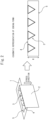
- FIG. 2 An example of the specific sewing form is shown in Fig. 2 , as a seam with inverted triangles aligned at a fixed spacing along an imaginary line.
- the "imaginary line” corresponds to the line (4) at the upper end of the seam allowance of the tether cloth.
- a plurality of inverted triangles are aligned on an imaginary line on one side, the total amount of the lengths on the one side ensuring a total sewing length at the parts subjected to stress as required for a wide tether, to avoid simple reduction in the amount of sewing due to excessive spacing between the seams, which results in lower strength. Since in this example the straight linear seams formed on one of the sides of each of the inverted triangles is discrete, and the edges of each of the seams has nonlinear sections (the other two sides of the inverted triangles) facing the seam allowance of the tether cloth (5 in Fig.
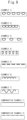
- Fig. 4 shows another example of the specific sewing form for Examples 1-1 to 1-4, 1-6 and 1-7 below. It will be seen that all of these examples have the specific sewing form described above.
- the prescribed width of the tether cloth is preferably 50 mm to 500 mm, more preferably 100 mm to 500 mm, even more preferably 100 mm to 400 mm and most preferably 200 mm to 400 mm.
- the specific sewing form has strength allowing it to withstand wide tether stress within this range.
- the length of a single straight linear seam of the multiple ones aligned discretely along an imaginary line extending in the widthwise direction of the tether cloth is preferably 5 mm to 100 mm and more preferably 10 mm to 50 mm. Within this range it will be possible to ensure a total amount of seams of sufficient length and a sufficient number of seam edges, to withstand stress during inflated deployment. An insufficient length reduces the amount of sewing on which stress acts.
- the spacings between the straight linear seams arranged along the imaginary line is preferably 5 mm to 50 mm and more preferably 7 mm to 20 mm. Within this range it will be possible to ensure a total amount of seams of sufficient length and a sufficient number of seam edges, to withstand stress during inflated deployment. If the spacings are too large there will be less sewing on which stress acts, and if they are too narrow it will be difficult for the stress to diffuse.
- the ratio: (straight linear seam spacing/straight linear seam length), as the ratio of the straight linear seam spacing with respect to the straight linear seam length, is preferably 0.2 to 1.5 and more preferably 0.3 to 1.0. Within this range it will be possible to ensure a total amount of seams of sufficient length and a sufficient number of seam edges, to withstand stress during inflated deployment.
- the bending angle at the edges of the straight linear seams is preferably 60° to 120° and more preferably 70° to 110°. If the bending angle is less than 60° or greater than 120°, the sewing form will approach a dotted linear form and stress will be less able to diffuse in the depth direction when stress is applied ( Fig. 2 , bottom), thus reducing the strength. In other words, if the bending angles are too acute then the edges will be nearly straight linear, while if they are too obtuse the edges will likewise be nearly straight linear.
- the lengths of the nonlinear sections at the edges of the straight linear seams is preferably 3 mm to 50 mm and more preferably 5 mm to 30 mm. If the lengths are less than 3 mm it will be difficult for applied stress to diffuse in the depth direction ( Fig. 2 , bottom), reducing the strength, while if they are greater than 50 mm the diffusion of pressure will be satisfactory but the increased number of seams will lower productivity. In other words, if the lengths are too short the edges will be nearly straight linear, resulting in fewer sections subjected to stress.
- the multiple straight linear seams arranged discretely along the imaginary line are preferably present at 2 to 20, more preferably present at 2 to 10, even more preferably present at 3 to 10 and most preferably present at 4 to 7, per 10 cm length of the imaginary line.
- the lengths of the imaginary lines are the distances between two edges on the outermost side, of the edges of the multiple discretely arranged straight linear seams. Within this range it will be possible to ensure a total amount of seams of sufficient length and a sufficient number of seam edges, to withstand stress during inflated deployment.
- the straight linear seams may be polygonal or half-circular, or portions thereof, with one side shared with the imaginary line, so long as the condition for the specific sewing form is satisfied.
- the straight linear seams may also be partial continuous square waves on the imaginary line.
- nonlinear sections may be on only one end, being nonlinear at both ends exhibits a higher effect for diffusion of stress. For a square wave, a smaller amplitude will approach a straight linear, resulting in fewer sections subjected to stress. If stress is diffused at each of the multiple straight linear seams arranged discretely along the imaginary line, it is not necessary for all of them to completely coincide with the imaginary line, and some may be disposed ahead of or behind the imaginary line.
- the specific sewing form may have the same inverted triangles aligned at intervals, or it may have inverted triangles and rectangles aligned in an alternating manner.
- Sewing of the base fabric panels and tether cloth in a manner containing straight linear seams may be sewing to a test piece at a section beyond the full width of the tether, or sewing at a section approximately equal to the full width of the tether, or sewing with non-sewn parts of prescribed width set on both sides of the tether. If sewing of the base fabric panels and the tether cloth is sewing to a test piece at a section beyond the full width of the tether or sewing at a section approximately equal to the full width of the tether, then the deployed inflated structure of the airbag will be supported by the full width of the tether, resulting in satisfactory material utilization efficiency.
- the airbag of the invention is preferably a pedestrian airbag.
- One aspect of the invention is a method for producing an airbag having a bag comprising a pair of base fabric panels sewn together at the outer perimeter edges, and a tether cloth of prescribed width stitched to each of the pair of base fabric panels on the inner side of the bag so as to restrict the distance between the pair of base fabric panels during inflation of the bag, the method comprising the following step: a step of stitching the base fabric panels and tether cloth in a manner to include multiple straight linear seams arranged discretely along an imaginary line extending in the widthwise direction of the tether cloth, with the edges of the straight linear seams having nonlinear sections that are nonlinear with predetermined angles and predetermined lengths from the imaginary line toward the seam allowance edge on the tether cloth.
- the sewing method is not particularly restricted, and for example, it may be a specific sewing form in which the tether cloth and base fabric panels are sewn by plane sewing with flat overlapping, which eliminates excess time and effort for the sewing operation and therefore does not notably reduce productivity.
- the stitching means is also not particularly restricted, and for example, it may be manual sewing along a sewing line drawn in advance on the base fabric using a LU-2210 Series by Juki Co., or a programmed sewing form using an industrial sewing machine such as the AMS-221EN Series by Juki Co.
- the multiple straight linear seams arranged discretely along the imaginary line are parts of continuous seams, this will allow productivity to be improved by a step of continuous sewing. There will also be fewer sewing starts and sewing ends, thus contributing to a lower number of sewing defects.
- the tether cloth is not particularly restricted, and may be a plain weave fabric with a woven density of 49/inch, woven using nylon 66 multifilament fibers with a total denier of 470 dtex and 136 filaments as the warp and weft yarns.
- a covering may also be layered to impart heat resistance to the tether cloth, by coating of a silicone resin at 25 g/m 2 , for example.
- the panel base fabric is not particularly restricted, and may be a plain weave fabric with a woven density of 72/inch, woven using nylon 66 multifilament fibers with a total denier of 235 dtex and 72 filaments as the warp and weft yarns.
- a covering may also be layered to impart heat resistance and internal pressure retention to the tether cloth, by coating of a silicone resin at 17 g/m 2 , for example.
- the stitching thread composing the specific sewing form is also not particularly restricted, and nylon 66 or polyester thread may be used as the stitching thread in a sewing machine.
- the stitching thread size is not particularly restricted but is preferably 400 dtex to 2000 dtex from the viewpoint of both strength and storability.
- the stitching thread preferably includes twisting from the viewpoint of sewing manageability, where the twisting may be single twisting or twisting of multiple raw threads such as triple twisting.
- the top and bottom threads may be the same or different.
- One embodiment of the invention is an airbag having a bag comprising a pair of base fabric panels sewn together at the outer perimeter edges, and a tether cloth of prescribed width stitched to each of the pair of base fabric panels on the inner side of the bag so as to restrict the distance between the pair of base fabric panels during inflation of the bag, wherein the stitching between the base fabric panels and the tether cloth includes multiple nonlinear seams protruding toward the side opposite from the seam allowance end of the tether cloth, the apexes of the multiple nonlinear seams being on an imaginary line extending in the widthwise direction of the tether cloth.
- the seam between each base fabric panel and the tether cloth may be the seam shown as 66a (41a) in diagram (B) for the pedestrian airbag described in PTL 1 shown in Fig. 6 , for example.
- the present inventors found that stress tends to concentrate at the edges of the seams and form tearing origins, and devised a seam with a specific sewing form that can further reduce occurrence of tearing.
- the "specific sewing form” referred to herein is a sewing form in which seams between the base fabric panels and the tether cloth include multiple nonlinear seams protruding toward the side opposite from the seam allowance end of the tether cloth, the apexes of the multiple nonlinear seams being on an imaginary line extending in the widthwise direction of the tether cloth.
- imaging line refers to a folding line when one imagines a form in which the folds of the tether cloth sheet overlap with the base fabric panel sheet when the base fabric panels and tether cloth are stitched together. This corresponds approximately to the location (line) of action of the tether restricting the spacing with the pair of base fabric panels, where it is subjected to inflation pressure during inflation of the airbag.
- the "imaginary line” may be a straight line or nonlinear seam design line for passage of a sewing machine needle when the panel base fabrics and tether cloth are sewn together.
- FIG. 7 An example of the specific sewing form is shown in Fig. 7 , as a seam with circular forms aligned at a fixed spacing along an imaginary line.
- the "imaginary line” corresponds to the line (4) at the upper end of the seam allowance of the tether cloth.
- a plurality of circles are aligned on an imaginary line on one side, such that the total amount of the lengths of the portions that are the protrusions on the side opposite from the seam allowance end of the tether cloth ensure a total sewing length at the parts subjected to stress as required for a wide tether, to avoid simple reduction in the amount of sewing due to excessive spacing between the seams, which results in lower strength.
- the nonlinear seams aligned on the imaginary line are discrete, with two nonlinear sections (partial curves) facing the edge of the seam allowance of the tether cloth (5 in Fig.
- Fig. 9 shows another example of the specific sewing form for Examples 2-1 to 2-7 below. It will be seen that all of these examples have the specific sewing form described above.
- the prescribed width of the tether cloth is preferably 50 mm to 500 mm, more preferably 100 mm to 500 mm and even more preferably 200 mm to 400 mm.
- the specific sewing form has strength allowing it to withstand wide tether stress within this range.
- the distance between the imaginary line extending in the widthwise direction of the tether cloth and the part of each multiple nonlinear seam aligned along the imaginary line which is furthest from the imaginary line is preferably 1 mm to 100 mm, more preferably 5 mm to 50 mm and even more preferably 10 mm to 20 mm. Within this range it is possible to ensure nonlinear sections (partial curves) of sufficient length without affecting productivity.
- the borders between the portions of the protrusions on the side opposite from the seam allowance end of the tether cloth and the portions protruding to the seam allowance end of the tether cloth are the parts where the multiple nonlinear seams protruding toward the side opposite from the seam allowance end of the tether cloth are furthest from the imaginary line.
- the multiple nonlinear seams protruding toward the side opposite from the seam allowance end of the tether cloth are the top parts, as divided by the borders where the protrusion shapes face upward and downward, in the examples of circles or sine curves in Fig. 7 .
- the widths of the nonlinear seams are preferably 5 mm to 100 mm, more preferably 10 mm to 100 mm, even more preferably 10 mm to 50 mm and most preferably 20 mm to 50 mm. Within this range it will be possible to ensure seams of sufficient length to withstand stress during inflated deployment.
- the lengths of the parts protruding to the side opposite from the seam allowance end of the tether cloth in the direction parallel to the imaginary line are the widths of the nonlinear seams, and the boundary between the part protruding to the side opposite from the seam allowance end of the tether cloth and the part protruding to the seam allowance end of the tether cloth is the start or end of the width of each nonlinear seam.
- the value calculated by (distance between part furthest from the imaginary line and imaginary line)/(width of each nonlinear seam) for the nonlinear seam is preferably 0.1 to 2.0 and more preferably 0.5 to 1.0. Within this range it will be possible to ensure seams of sufficient length, and nonlinear sections (partial curves) of sufficient length to withstand stress during inflated deployment.
- the spacing between apexes of the protrusions of the nonlinear seams aligned along the seam line is preferably 5 mm to 100 mm, more preferably 10 mm to 100 mm, even more preferably 15 mm to 100 mm and most preferably 20 mm to 50 mm. Within this range it will be possible to ensure a total amount of seams of sufficient length, and a sufficient number of nonlinear sections (partial curves) to withstand stress during inflated deployment. If the spacing is too wide the amount of stitching subjected to stress will be reduced, and if it is too narrow the locations will be less likely to concentrate stress, resulting in increased stress per location.
- the locations furthest from the edge of the seam allowance of the tether cloth are the apexes of the protrusions of the nonlinear seams, as shown in Fig. 7 .
- the nonlinear seams have roughly straight linear portions on the imaginary line, the midpoints of those portions are the apexes of the nonlinear seams.
- the values of the spacing between apexes of the protrusions of the nonlinear seams aligned along the imaginary line minus the width of each nonlinear seam (corresponding to the distance between the edges of the nonlinear seams) is preferably 0 mm to 50 mm and more preferably 3 mm to 30 mm. Within this range it will be possible to ensure the total amount of seams of sufficient length to withstand stress during inflated deployment.
- the value calculated by (spacing between apexes of the protrusions of the nonlinear seams - width of each nonlinear seam)/(width of each nonlinear seam) for the nonlinear seams is preferably 0 to 1.5 and more preferably 0 to 1.0. Within this range it will be possible to ensure the total amount of seams of sufficient length to withstand stress during inflated deployment.
- the nonlinear seams aligned along the imaginary line are preferably present at 2 to 20, more preferably present at 2 to 10, even more preferably present at 3 to 10 and most preferably present at 4 to 7, per 10 cm length of the imaginary line.
- the lengths of the imaginary lines are the distances between two seam edges on the outermost side, of the edges of the multiple nonlinear seams. Within this range it will be possible to ensure a total amount of seams of sufficient length, and a sufficient number of nonlinear sections (partial curves) to withstand stress during inflated deployment.
- the nonlinear seams may be circular or elliptical, or portions thereof, with one side shared with the imaginary line, so long as the condition for the specific sewing form is satisfied.
- the nonlinear seams may be continuous instead of discrete, or they may be portions of a continuous sine curve parallel to the imaginary line.
- Sewing of the base fabric panels and tether cloth in a manner containing nonlinear seams may be sewing to a test piece at a section beyond the full width of the tether, or sewing at a section approximately equal to the full width of the tether, or sewing with non-sewn parts of prescribed width set on both sides of the tether. If sewing of the base fabric panels and the tether cloth is sewing to a test piece at a section beyond the full width of the tether or sewing at a section approximately equal to the full width of the tether, then the deployed inflated structure of the airbag will be supported by the full width of the tether, resulting in satisfactory material utilization efficiency.
- the airbag of the invention is preferably a pedestrian airbag.
- Another aspect of the invention is a method for producing an airbag having a bag comprising a pair of base fabric panels sewn together at the outer perimeter edges, and a tether cloth of prescribed width stitched to each of the pair of base fabric panels on the inner side of the bag so as to restrict the distance between the pair of base fabric panels during inflation of the bag, the method comprising the following step: a step of stitching between the base fabric panels and the tether cloth which includes multiple nonlinear seams protruding toward the side opposite from the seam allowance end of the tether cloth, wherein the apexes of the protrusions of the multiple nonlinear seams are on an imaginary line extending in the widthwise direction of the tether cloth.
- the sewing method is not particularly restricted, and for example, it may be a specific sewing form in which the tether cloth and base fabric panels are sewn by plane sewing with flat overlapping, which eliminates excess time and effort for the sewing operation and therefore does not notably reduce productivity.
- the stitching means is also not particularly restricted, and for example, it may be manual sewing along a sewing line drawn in advance on the base fabric using a LU-2210 Series by Juki Co., or a programmed sewing form using an industrial sewing machine such as the AMS-221EN Series by Juki Co.
- the multiple nonlinear seams aligned along the imaginary line may be all or part of a continuous seam, allowing productivity to be improved by a step of continuous sewing. There will also be fewer sewing starts and sewing ends, thus contributing to a lower number of sewing defects.
- the tether cloth is not particularly restricted, and may be a plain weave fabric with a woven density of 49/inch woven using nylon 66 multifilament fibers with a total denier of 470 dtex and 136 filaments as the warp and weft yarns.
- a covering may also be layered over to impart heat resistance to the tether cloth, by coating of a silicone resin at 25 g/m 2 , for example.
- the panel base fabric is not particularly restricted, and may be a plain weave fabric with a woven density of 72/inch, woven using nylon 66 multifilament fibers with a total denier of 235 dtex and 72 filaments as the warp and weft yarns.
- a covering may also be layered over to impart heat resistance and internal pressure retention to the tether cloth, by coating of a silicone resin at 17 g/m 2 , for example.
- the stitching thread composing the specific sewing form is also not particularly restricted, and nylon 66 or polyester thread may be used as the stitching thread in a sewing machine.
- the stitching thread size is not particularly restricted but is preferably 400 dtex to 2000 dtex from the viewpoint of both strength and storability.
- the stitching thread preferably includes twisting from the viewpoint of sewing manageability, where the twisting may be single twisting or twisting of multiple raw threads such as triple twisting.
- the top and bottom threads may be the same or different.
- a plain weave fabric woven using nylon 66 multifilament fibers as the warp yarn and weft yarn was coated with a silicone resin.
- the total fineness of the base fabric used was 235 dtex, the number of filaments was 72, the woven density was 72/inch and the silicone resin coating amount was 17 g/m 2 .
- a plain weave fabric woven using nylon 66 multifilament fibers as the warp yarn and weft yarn was coated with a silicone resin.
- the total fineness of the base fabric used was 470 dtex, the number of filaments was 136, the woven density was 49/inch and the silicone resin coating amount was 25 g/m 2 .
- Airbag sewing thread (total fineness: 1880 dtex, nylon 66 multifilament fibers, 940 dtex, double-twisted) by Gunze, Ltd. was used for the top thread and bottom thread.
- a LU-2210W-7 by Juki Col was used for sewing of the specific sewing form.
- the panel base fabric and the tether cloth were each cut into strips along the base fabric grain to 300 mm warp ⁇ 500 mm weft.
- the tether cloth was placed over the main base fabric with a shift of 100 mm in the weft direction, and sewn with sewing thread using a sewing machine in a specific sewing form with a stitch number of 50/10 cm in a range of 270 mm within the center in the widthwise direction, leaving a tether cloth seam allowance of 15 mm.
- a repeat of 3 stitches (or overlapping stitches) was formed at the beginning and end of sewing.
- the edges were mutually overlapped in the lengthwise direction of the main base fabric so that the strip formed a loop, and the overlapping part was sewed by 3 rows of linear sewing (7a) in the warp direction of the base fabric, with a stitch number of 35/10 cm.
- the loop length was 320 mm around the circumference.
- the edges of the tether cloth furthest from the specific sewing form were folded and the tether cloth was sewed together by 3 rows of linear sewing (7b) in the warp direction of the base fabric with a stitch number of 35/10 cm, at the middle part of the specific sewing form and the fold-over section.
- the length from the fold-over section to the imaginary line of the specific sewing form was 200 mm.
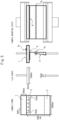
- a jig as shown by "Jig shape” in Fig. 5 holding the test piece by a loop of the main base fabric and tether cloth, was mounted on a TENSELON universal material tester by A&D Co., Ltd.
- the test piece mounted on the tester As seen from the lateral direction (the direction allowing the thickness of the test piece to be observed), as indicated by "Sample mounting state” in Fig. 5 , it was adjusted so that the tether cloth was perpendicular to the main base fabric (forming a T-shape).
- the stroke was adjusted during this time so that the tether cloth was pulled parallel to the direction of tension, the stroke (distance from the imaginary line to the anchoring point of the tether cloth) being 200 to 400 mm.
- Test pieces having a seam strength per 1 cm of imaginary line (N/cm) of less than 350 N/cm were evaluated as "P"
- those with 350 N/cm or greater and less than 450 N/cm were evaluated as "F”
- those with 450 N/cm or greater were evaluated as "G”.
- a test piece fabricated as described above was folded perpendicular to the imaginary line and the folded crease of the test piece was fitted under a 3 cm ⁇ 6 cm plate, applying a load total of 1 Kg together with the plate for 30 seconds.
- the probe of a thickness gauge (FFA-10 by Ozaki Manufacturing Co., Ltd.) was then set with the center of the crease at the center line of the probe, and the value was measured after 1 minute.
- the position of the crease was set to have the minimum number of sewing lines running through the crease, and the average of measurement at 3 locations was recorded as the seam bending thickness value. Samples with a bending thickness of 3.5 mm or smaller were evaluated as "G", and those with a bending thickness larger than 3.5 were evaluated as "P".
- Test pieces were fabricated having seams with the sewing forms shown in Table 1, and the seam strength per 1 cm of imaginary line (N/cm) and the seam bending thickness (mm) (perpendicular to the imaginary line) were measured. The results are shown in Table 1 below.
- Example 1-4 Based on Example 1-4 it is seen that the seam strength per 1 cm of imaginary line is reduced when the straight linear seam lengths are less than 5 mm.
- a plain weave fabric woven using nylon 66 multifilament fibers as the warp yarn and weft yarn was coated with a silicone resin.
- the total fineness of the base fabric used was 235 dtex, the number of filaments was 72, the woven density was 72/inch and the silicone resin coating amount was 17 g/m 2 .
- a plain weave fabric woven using nylon 66 multifilament fibers as the warp yarn and weft yarn was coated with a silicone resin.
- the total fineness of the base fabric used was 470 dtex, the number of filaments was 136, the woven density was 49/inch and the silicone resin coating amount was 25 g/m 2 .
- Airbag sewing thread (total fineness: 1880 dtex, nylon 66 multifilament fibers, 940 dtex, double-twisted) by Gunze, Ltd. was used for the top thread and bottom thread.
- a LU-2210W-7 by Juki Col was used for sewing of the specific sewing form.
- the panel base fabric and the tether cloth were each cut into strips along the base fabric grain to 300 mm warp ⁇ 500 mm weft.
- the tether cloth was placed over the main base fabric with a shift of 100 mm in the weft direction, and sewed with sewing thread using a sewing machine in a specific sewing form with a stitch number of 50/10 cm in a range of 270 mm within the center in the widthwise direction, leaving a tether cloth seam allowance of 15 mm.
- a repeat of 3 stitches (or overlapping stitches) was formed at the beginning and end of sewing.
- edges were mutually overlapped in the lengthwise direction of the main base fabric so that the strip formed a loop, and the overlapping part was sewed by 3 rows of linear sewing (7a) in the warp direction of the base fabric, with a stitch number of 35/10 cm.
- the loop length was 320 mm around the circumference.
- the edges of the tether cloth furthest from the specific sewing form were folded and the tether cloth was sewed together by 3 rows of linear sewing (7b) in the warp direction of the base fabric with a stitch number of 35/10 cm, at the middle part of the specific sewing form and the fold-over section.
- the length from the fold-over section to the imaginary line of the specific sewing form was 200 mm.
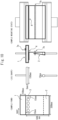
- Ajig having the jig shape shown in Fig. 10 holding the test piece by a loop of the main base fabric and tether cloth, was mounted on a TENSILON universal material tester by A&D Co., Ltd.
- the test piece mounted on the tester As seen from the lateral direction (the direction allowing the thickness of the test piece to be observed), as indicated by "Sample mounting state" in Fig. 10 , it was adjusted so that the tether cloth was perpendicular to the main base fabric (forming a T-shape).
- the stroke was adjusted during this time so that the tether cloth was pulled parallel to the direction of tension, the stroke (distance from the imaginary line to the anchoring point of the tether cloth) being 200 to 400 mm.
- Test pieces having a seam strength per 1 cm of imaginary line (N/cm) of less than 330 N/cm were evaluated as "P", those with 330 N/cm or greater and less than 440 N/cm were evaluated as "F”, and those with 440 N/cm or greater were evaluated as "G”.
- a test piece fabricated as described above was folded perpendicular to the imaginary line and the crease of the test piece was fitted under a 3 cm ⁇ 6 cm plate, applying a load total of 1 Kg together with the plate for 30 seconds.
- the probe of a thickness gauge (FFA-10 by Ozaki Manufacturing Co., Ltd.) was then set with the center of the crease at the center line of the probe, and the value was measured after 1 minute.
- the position of the crease was set to have the minimum number of sewing lines running through the crease, and the average of measurement at 3 locations was recorded as the seam bending thickness value. Samples with a bending thickness of 3.5 mm or smaller were evaluated as "G", and those with a bending thickness larger than 3.5 mm were evaluated as "P".
- Test pieces were fabricated having seams with the sewing forms shown in Table 2, and the seam strength per 1 cm of imaginary line (N/cm) and the seam bending thickness (mm) (perpendicular to the imaginary line) were measured. The results are shown in Table 2 below.
- the invention provides an airbag which has reduced tearing at the seams due to a specific sewing form for the seams, the airbag being made by sewing a wide tether cloth between opposing base fabric panels so that a predetermined thickness is maintained when it is inflated, as well as a method for producing it.
- This specific sewing form ensures that the total amount of the lengths of the seams at the parts subjected to stress is as required for a wide tether (that is, it avoids simple reduction in the amount of sewing due to excessive spacing between the seams, which results in lower strength).
- this specific sewing form has the straight linear seams discrete and has nonlinear sections which directed toward the seam allowance end (the depth direction) of the tether cloth, at the edge of each seam, the amount of stitching is greater compared to simple straight linear seams, while applied stress is diffused in the depth direction, thereby further increasing the strength.
- this specific sewing form has numerous discrete straight linear seams with numerous seam edges as well, this increases the number of locations where stress tends to concentrate, compared to a simple single straight linear seam with only two edges, resulting in reduced stress per edge and preventing tearing from the edges.
- the airbag of the invention can therefore be suitably used as an automobile airbag, and especially as a pedestrian airbag.
- the invention provides an airbag which has reduced tearing at the seams due to a specific sewing form for the seams, the airbag being made by sewing a wide tether cloth between opposing base fabric panels so that a predetermined thickness is maintained when it is inflated, as well as a method for producing it.
- This specific sewing form ensures that the total amount of the lengths of the seams at the parts subjected to stress is as required for a wide tether (that is, it avoids simple reduction in the amount of sewing due to excessive spacing between the seams, which results in lower strength).
- the multiple nonlinear seams protruding to the opposite side from the seam allowance end (the depth direction) of the tether cloth (the side subjected to stress) are preferably discrete, and since nonlinear sections (partial curves) are present which are directed toward the seam allowance end (the depth direction) of the tether cloth, the amount of stitching is greater compared to simple straight linear seams, while applied stress is diffused in the depth direction, forming wrinkles in the panel base fabric, and thereby further increasing the strength.
- this specific sewing form has numerous nonlinear sections (partial curves) as well when the multiple nonlinear seams are discrete, this increases the number of locations where stress tends to concentrate, compared to a simple single straight linear seam with only two edges, and yet results in reduced stress per edge, to prevent tearing from the edges.
- the airbag of the invention can therefore be suitably used as an automobile airbag, and especially as a pedestrian airbag.
- An airbag having a bag comprising a pair of base fabric panels sewn together at the outer perimeter edges, and a tether cloth of prescribed width stitched to each of the pair of base fabric panels on the inner side of the bag so as to restrict the distance between the pair of base fabric panels during inflation of the bag, wherein the stitching between the base fabric panels and the tether cloth includes multiple straight linear seams arranged discretely along an imaginary line extending in the widthwise direction of the tether cloth, with the edges of the straight linear seams having nonlinear sections that are nonlinear with predetermined angles and predetermined lengths from the imaginary line toward the seam allowance edge on the tether cloth.
- each straight linear seam is part of a different seam.
- a method for producing an airbag having a bag comprising a pair of base fabric panels sewn together at the outer perimeter edges, and a tether cloth of prescribed width stitched to each of the pair of base fabric panels on the inner side of the bag so as to restrict the distance between the pair of base fabric panels during inflation of the bag, the method comprising the following step: a step of stitching the base fabric panels and tether cloth in a manner to include multiple straight linear seams arranged discretely along an imaginary line extending in the widthwise direction of the tether cloth, with the edges of the straight linear seams having nonlinear sections that are nonlinear with predetermined angles and predetermined lengths from the imaginary line toward the seam allowance edge on the tether cloth.
- the method for producing an airbag according to item 13 which comprises a step of continuously sewing so that the straight linear seams are part of a continuous seam.
- An airbag having a bag comprising a pair of base fabric panels sewn together at the outer perimeter edges, and a tether cloth of prescribed width stitched to each of the pair of base fabric panels on the inner side of the bag so as to restrict the distance between the pair of base fabric panels during inflation of the bag, wherein the stitching between the base fabric panels and the tether cloth includes multiple nonlinear seams protruding toward the side opposite from the seam allowance end of the tether cloth, the apexes of the protrusions of the multiple nonlinear seams being on an imaginary line extending in the widthwise direction of the tether cloth.
- each nonlinear seam is 5 mm to 100 mm, where the widths of the nonlinear seams are the lengths of the multiple nonlinear seams aligned along the imaginary line, in the direction parallel to the imaginary line.
- each nonlinear seam is part of a continuous seam.
- a method for producing an airbag having a bag comprising a pair of base fabric panels sewn together at the outer perimeter edges, and a tether cloth of prescribed width stitched to each of the pair of base fabric panels on the inner side of the bag so as to restrict the distance between the pair of base fabric panels during inflation of the bag, the method comprising the following step: a step of stitching between the base fabric panels and the tether cloth which includes multiple nonlinear seams protruding toward the side opposite from the seam allowance end of the tether cloth, wherein the apexes of the multiple nonlinear seams are on an imaginary line extending in the widthwise direction of the tether cloth.
- the method for producing an airbag according to item 29, which comprises a step of continuously sewing so that each nonlinear seam is all or part of a continuous seam.
Landscapes
- Engineering & Computer Science (AREA)
- Mechanical Engineering (AREA)
- Air Bags (AREA)
Applications Claiming Priority (4)
| Application Number | Priority Date | Filing Date | Title |
|---|---|---|---|
| JP2021213198 | 2021-12-27 | ||
| JP2021213078 | 2021-12-27 | ||
| PCT/JP2022/047929 WO2023127798A1 (ja) | 2021-12-27 | 2022-12-26 | エアバッグ |
| EP22916021.3A EP4458622A4 (de) | 2021-12-27 | 2022-12-26 | Airbag |
Related Parent Applications (2)
| Application Number | Title | Priority Date | Filing Date |
|---|---|---|---|
| EP22916021.3A Division-Into EP4458622A4 (de) | 2021-12-27 | 2022-12-26 | Airbag |
| EP22916021.3A Division EP4458622A4 (de) | 2021-12-27 | 2022-12-26 | Airbag |
Publications (2)
| Publication Number | Publication Date |
|---|---|
| EP4461607A2 true EP4461607A2 (de) | 2024-11-13 |
| EP4461607A3 EP4461607A3 (de) | 2024-11-27 |
Family
ID=86998929
Family Applications (2)
| Application Number | Title | Priority Date | Filing Date |
|---|---|---|---|
| EP24180735.3A Pending EP4461607A3 (de) | 2021-12-27 | 2022-12-26 | Airbag |
| EP22916021.3A Withdrawn EP4458622A4 (de) | 2021-12-27 | 2022-12-26 | Airbag |
Family Applications After (1)
| Application Number | Title | Priority Date | Filing Date |
|---|---|---|---|
| EP22916021.3A Withdrawn EP4458622A4 (de) | 2021-12-27 | 2022-12-26 | Airbag |
Country Status (3)
| Country | Link |
|---|---|
| EP (2) | EP4461607A3 (de) |
| JP (2) | JP7684437B2 (de) |
| WO (1) | WO2023127798A1 (de) |
Families Citing this family (1)
| Publication number | Priority date | Publication date | Assignee | Title |
|---|---|---|---|---|
| CN116949697B (zh) * | 2023-07-21 | 2025-10-03 | 华懋(厦门)新材料科技股份有限公司 | 一种一次成型的安全气囊导气袋自动缝纫设备及其制造工艺 |
Citations (3)
| Publication number | Priority date | Publication date | Assignee | Title |
|---|---|---|---|---|
| JPH0546615U (ja) | 1991-11-29 | 1993-06-22 | 本田技研工業株式会社 | エアバッグ装置のバッグ構造 |
| JPH11501269A (ja) | 1995-04-28 | 1999-02-02 | メルセデス−ベンツ、アクテイエンゲゼルシヤフト | 車両の乗客用衝突保護装置 |
| JP2019172170A (ja) | 2018-03-29 | 2019-10-10 | 豊田合成株式会社 | エアバッグ |
Family Cites Families (17)
| Publication number | Priority date | Publication date | Assignee | Title |
|---|---|---|---|---|
| US5224732A (en) * | 1991-07-16 | 1993-07-06 | Toyota Motor Co Ltd | Inflatable restraint system for side impact crash protection |
| JPH05186961A (ja) * | 1992-01-06 | 1993-07-27 | Takata Kk | エアバッグの吊紐の縫着構造 |
| JPH05319189A (ja) * | 1992-05-13 | 1993-12-03 | Toray Ind Inc | エアバッグ |
| JP2002370597A (ja) * | 2001-06-13 | 2002-12-24 | Asahi Kasei Corp | エアバッグ |
| JP2008273250A (ja) * | 2007-04-25 | 2008-11-13 | Takata Corp | 歩行者用エアバッグ装置 |
| JP5098998B2 (ja) * | 2008-12-25 | 2012-12-12 | 豊田合成株式会社 | エアバッグ |
| US8371612B2 (en) | 2009-09-17 | 2013-02-12 | Autoliv Asp, Inc. | Inflatable airbag assemblies with lateral and longitudinal tethers |
| US9211864B2 (en) * | 2012-01-24 | 2015-12-15 | Autoliv Asp, Inc. | Tether attachment arrangement for a vehicle airbag cushion and method of attaching |
| WO2014054324A1 (ja) * | 2012-10-05 | 2014-04-10 | オートリブ ディベロップメント エービー | カーテンエアバッグ装置 |
| DE102014016124B4 (de) * | 2014-10-24 | 2021-05-06 | Autoliv Development Ab | Gassack-Einrichtung |
| JP6519275B2 (ja) * | 2015-03-31 | 2019-05-29 | Joyson Safety Systems Japan株式会社 | エアバッグ及び歩行者用エアバッグ装置 |
| JPWO2017119355A1 (ja) * | 2016-01-06 | 2018-10-25 | 東レ株式会社 | 防護服 |
| JP6769377B2 (ja) * | 2017-03-31 | 2020-10-14 | 豊田合成株式会社 | エアバッグ装置 |
| DE102017124029A1 (de) * | 2017-10-16 | 2019-04-18 | Dalphi Metal Espana, S.A. | Gassack für ein kraftfahrzeug sowie verfahren zur befestigung eines haltebands am gassackgewebe eines gassacks |
| US10464519B2 (en) * | 2017-10-18 | 2019-11-05 | Trw Vehicle Safety Systems Inc. | Airbag for oblique crash protection |
| JP7163208B2 (ja) * | 2019-02-01 | 2022-10-31 | 株式会社タチエス | 車両用シート |
| US11130466B2 (en) * | 2019-03-08 | 2021-09-28 | Trw Vehicle Safety Systems Inc. | Airbag with deployment controlling tether |
-
2022
- 2022-12-26 JP JP2023571010A patent/JP7684437B2/ja active Active
- 2022-12-26 WO PCT/JP2022/047929 patent/WO2023127798A1/ja not_active Ceased
- 2022-12-26 EP EP24180735.3A patent/EP4461607A3/de active Pending
- 2022-12-26 EP EP22916021.3A patent/EP4458622A4/de not_active Withdrawn
-
2025
- 2025-05-15 JP JP2025081859A patent/JP2025111844A/ja active Pending
Patent Citations (3)
| Publication number | Priority date | Publication date | Assignee | Title |
|---|---|---|---|---|
| JPH0546615U (ja) | 1991-11-29 | 1993-06-22 | 本田技研工業株式会社 | エアバッグ装置のバッグ構造 |
| JPH11501269A (ja) | 1995-04-28 | 1999-02-02 | メルセデス−ベンツ、アクテイエンゲゼルシヤフト | 車両の乗客用衝突保護装置 |
| JP2019172170A (ja) | 2018-03-29 | 2019-10-10 | 豊田合成株式会社 | エアバッグ |
Also Published As
| Publication number | Publication date |
|---|---|
| JPWO2023127798A1 (de) | 2023-07-06 |
| WO2023127798A1 (ja) | 2023-07-06 |
| EP4458622A1 (de) | 2024-11-06 |
| JP2025111844A (ja) | 2025-07-30 |
| EP4458622A4 (de) | 2024-12-11 |
| JP7684437B2 (ja) | 2025-05-27 |
| EP4461607A3 (de) | 2024-11-27 |
Similar Documents
| Publication | Publication Date | Title |
|---|---|---|
| US7883112B2 (en) | Textile gas guide for inflatable curtain | |
| US8573637B2 (en) | Side curtain airbag and method and apparatus for manufacturing a side curtain airbag | |
| JP2005105437A (ja) | エアバッグ用袋織基布 | |
| CN107709641B (zh) | 安全气囊用基布、安全气囊及安全气囊用基布的制造方法 | |
| JP4100687B2 (ja) | エアーバッグ | |
| JPH08506296A (ja) | エアバッグおよびエアバッグの製造方法 | |
| EP4461607A2 (de) | Airbag | |
| JP2003513837A (ja) | 帯状物、および帯状物の製造方法 | |
| KR20040068265A (ko) | 에어백 | |
| EP0608437A1 (de) | Luftsack mit hoher berstfestigkeit | |
| JP2014223841A (ja) | シートベルト装置 | |
| JP6740692B2 (ja) | エアバッグ | |
| JPH10166978A (ja) | 車両用エアバッグ | |
| CN111155219B (zh) | 安全气囊用织物、其制造方法及安全气囊 | |
| JPH02204151A (ja) | エアーバッグ用袋織地 | |
| CN118451010A (zh) | 气囊 | |
| JP3769768B2 (ja) | エアバッグの圧力調整機構 | |
| JP5653612B2 (ja) | カーテンバッグ | |
| JP5309156B2 (ja) | 膨張可能エアバッグ | |
| JP3016719B2 (ja) | エアバッグ | |
| JP3413909B2 (ja) | 車両用エアバッグの製造方法 | |
| JP2604245Y2 (ja) | エアバッグ用袋体 | |
| JP2515185Y2 (ja) | 自動車用エアーバック | |
| JP2001277970A (ja) | エアバッグ用布 | |
| JPH05238340A (ja) | エアバッグ装置のエアバッグ本体 |
Legal Events
| Date | Code | Title | Description |
|---|---|---|---|
| PUAI | Public reference made under article 153(3) epc to a published international application that has entered the european phase |
Free format text: ORIGINAL CODE: 0009012 |
|
| STAA | Information on the status of an ep patent application or granted ep patent |
Free format text: STATUS: REQUEST FOR EXAMINATION WAS MADE |
|
| PUAL | Search report despatched |
Free format text: ORIGINAL CODE: 0009013 |
|
| STAA | Information on the status of an ep patent application or granted ep patent |
Free format text: STATUS: EXAMINATION IS IN PROGRESS |
|
| 17P | Request for examination filed |
Effective date: 20240607 |
|
| AC | Divisional application: reference to earlier application |
Ref document number: 4458622 Country of ref document: EP Kind code of ref document: P |
|
| AK | Designated contracting states |
Kind code of ref document: A2 Designated state(s): AL AT BE BG CH CY CZ DE DK EE ES FI FR GB GR HR HU IE IS IT LI LT LU LV MC ME MK MT NL NO PL PT RO RS SE SI SK SM TR |
|
| AK | Designated contracting states |
Kind code of ref document: A3 Designated state(s): AL AT BE BG CH CY CZ DE DK EE ES FI FR GB GR HR HU IE IS IT LI LT LU LV MC ME MK MT NL NO PL PT RO RS SE SI SK SM TR |
|
| RIC1 | Information provided on ipc code assigned before grant |
Ipc: B60R 21/2338 20110101ALI20241022BHEP Ipc: B60R 21/235 20060101ALI20241022BHEP Ipc: B60R 21/36 20110101AFI20241022BHEP |
|
| 17Q | First examination report despatched |
Effective date: 20241111 |