EP4458775A1 - Verfahren zur herstellung eines verbundkathodenmaterials - Google Patents
Verfahren zur herstellung eines verbundkathodenmaterials Download PDFInfo
- Publication number
- EP4458775A1 EP4458775A1 EP23200124.8A EP23200124A EP4458775A1 EP 4458775 A1 EP4458775 A1 EP 4458775A1 EP 23200124 A EP23200124 A EP 23200124A EP 4458775 A1 EP4458775 A1 EP 4458775A1
- Authority
- EP
- European Patent Office
- Prior art keywords
- nickel
- solid electrolyte
- cathode material
- composite cathode
- manganese compound
- Prior art date
- Legal status (The legal status is an assumption and is not a legal conclusion. Google has not performed a legal analysis and makes no representation as to the accuracy of the status listed.)
- Granted
Links
Images








Classifications
-
- H—ELECTRICITY
- H01—ELECTRIC ELEMENTS
- H01M—PROCESSES OR MEANS, e.g. BATTERIES, FOR THE DIRECT CONVERSION OF CHEMICAL ENERGY INTO ELECTRICAL ENERGY
- H01M4/00—Electrodes
- H01M4/02—Electrodes composed of, or comprising, active material
- H01M4/04—Processes of manufacture in general
- H01M4/049—Manufacturing of an active layer by chemical means
-
- H—ELECTRICITY
- H01—ELECTRIC ELEMENTS
- H01M—PROCESSES OR MEANS, e.g. BATTERIES, FOR THE DIRECT CONVERSION OF CHEMICAL ENERGY INTO ELECTRICAL ENERGY
- H01M4/00—Electrodes
- H01M4/02—Electrodes composed of, or comprising, active material
- H01M4/13—Electrodes for accumulators with non-aqueous electrolyte, e.g. for lithium-accumulators; Processes of manufacture thereof
- H01M4/139—Processes of manufacture
- H01M4/1391—Processes of manufacture of electrodes based on mixed oxides or hydroxides, or on mixtures of oxides or hydroxides, e.g. LiCoOx
-
- C—CHEMISTRY; METALLURGY
- C01—INORGANIC CHEMISTRY
- C01G—COMPOUNDS CONTAINING METALS NOT COVERED BY SUBCLASSES C01D OR C01F
- C01G53/00—Compounds of nickel
- C01G53/40—Complex oxides containing nickel and at least one other metal element
- C01G53/42—Complex oxides containing nickel and at least one other metal element containing alkali metals, e.g. LiNiO2
- C01G53/44—Complex oxides containing nickel and at least one other metal element containing alkali metals, e.g. LiNiO2 containing manganese
- C01G53/54—Complex oxides containing nickel and at least one other metal element containing alkali metals, e.g. LiNiO2 containing manganese of the type (Mn2O4)-, e.g. Li(NixMn2-x)O4 or Li(MyNixMn2-x-y)O4
-
- H—ELECTRICITY
- H01—ELECTRIC ELEMENTS
- H01M—PROCESSES OR MEANS, e.g. BATTERIES, FOR THE DIRECT CONVERSION OF CHEMICAL ENERGY INTO ELECTRICAL ENERGY
- H01M10/00—Secondary cells; Manufacture thereof
- H01M10/05—Accumulators with non-aqueous electrolyte
- H01M10/056—Accumulators with non-aqueous electrolyte characterised by the materials used as electrolytes, e.g. mixed inorganic/organic electrolytes
- H01M10/0561—Accumulators with non-aqueous electrolyte characterised by the materials used as electrolytes, e.g. mixed inorganic/organic electrolytes the electrolyte being constituted of inorganic materials only
- H01M10/0562—Solid materials
-
- H—ELECTRICITY
- H01—ELECTRIC ELEMENTS
- H01M—PROCESSES OR MEANS, e.g. BATTERIES, FOR THE DIRECT CONVERSION OF CHEMICAL ENERGY INTO ELECTRICAL ENERGY
- H01M4/00—Electrodes
- H01M4/02—Electrodes composed of, or comprising, active material
- H01M4/04—Processes of manufacture in general
- H01M4/0471—Processes of manufacture in general involving thermal treatment, e.g. firing, sintering, backing particulate active material, thermal decomposition, pyrolysis
-
- H—ELECTRICITY
- H01—ELECTRIC ELEMENTS
- H01M—PROCESSES OR MEANS, e.g. BATTERIES, FOR THE DIRECT CONVERSION OF CHEMICAL ENERGY INTO ELECTRICAL ENERGY
- H01M4/00—Electrodes
- H01M4/02—Electrodes composed of, or comprising, active material
- H01M4/36—Selection of substances as active materials, active masses, active liquids
- H01M4/362—Composites
- H01M4/366—Composites as layered products
-
- H—ELECTRICITY
- H01—ELECTRIC ELEMENTS
- H01M—PROCESSES OR MEANS, e.g. BATTERIES, FOR THE DIRECT CONVERSION OF CHEMICAL ENERGY INTO ELECTRICAL ENERGY
- H01M4/00—Electrodes
- H01M4/02—Electrodes composed of, or comprising, active material
- H01M4/36—Selection of substances as active materials, active masses, active liquids
- H01M4/48—Selection of substances as active materials, active masses, active liquids of inorganic oxides or hydroxides
- H01M4/50—Selection of substances as active materials, active masses, active liquids of inorganic oxides or hydroxides of manganese
- H01M4/505—Selection of substances as active materials, active masses, active liquids of inorganic oxides or hydroxides of manganese of mixed oxides or hydroxides containing manganese for inserting or intercalating light metals, e.g. LiMn2O4 or LiMn2OxFy
-
- H—ELECTRICITY
- H01—ELECTRIC ELEMENTS
- H01M—PROCESSES OR MEANS, e.g. BATTERIES, FOR THE DIRECT CONVERSION OF CHEMICAL ENERGY INTO ELECTRICAL ENERGY
- H01M4/00—Electrodes
- H01M4/02—Electrodes composed of, or comprising, active material
- H01M4/36—Selection of substances as active materials, active masses, active liquids
- H01M4/48—Selection of substances as active materials, active masses, active liquids of inorganic oxides or hydroxides
- H01M4/52—Selection of substances as active materials, active masses, active liquids of inorganic oxides or hydroxides of nickel, cobalt or iron
- H01M4/525—Selection of substances as active materials, active masses, active liquids of inorganic oxides or hydroxides of nickel, cobalt or iron of mixed oxides or hydroxides containing iron, cobalt or nickel for inserting or intercalating light metals, e.g. LiNiO2, LiCoO2 or LiCoOxFy
-
- H—ELECTRICITY
- H01—ELECTRIC ELEMENTS
- H01M—PROCESSES OR MEANS, e.g. BATTERIES, FOR THE DIRECT CONVERSION OF CHEMICAL ENERGY INTO ELECTRICAL ENERGY
- H01M4/00—Electrodes
- H01M4/02—Electrodes composed of, or comprising, active material
- H01M4/62—Selection of inactive substances as ingredients for active masses, e.g. binders, fillers
-
- C—CHEMISTRY; METALLURGY
- C01—INORGANIC CHEMISTRY
- C01P—INDEXING SCHEME RELATING TO STRUCTURAL AND PHYSICAL ASPECTS OF SOLID INORGANIC COMPOUNDS
- C01P2004/00—Particle morphology
- C01P2004/60—Particles characterised by their size
- C01P2004/61—Micrometer sized, i.e. from 1-100 micrometer
-
- C—CHEMISTRY; METALLURGY
- C01—INORGANIC CHEMISTRY
- C01P—INDEXING SCHEME RELATING TO STRUCTURAL AND PHYSICAL ASPECTS OF SOLID INORGANIC COMPOUNDS
- C01P2004/00—Particle morphology
- C01P2004/80—Particles consisting of a mixture of two or more inorganic phases
- C01P2004/82—Particles consisting of a mixture of two or more inorganic phases two phases having the same anion, e.g. both oxidic phases
- C01P2004/84—Particles consisting of a mixture of two or more inorganic phases two phases having the same anion, e.g. both oxidic phases one phase coated with the other
-
- C—CHEMISTRY; METALLURGY
- C01—INORGANIC CHEMISTRY
- C01P—INDEXING SCHEME RELATING TO STRUCTURAL AND PHYSICAL ASPECTS OF SOLID INORGANIC COMPOUNDS
- C01P2006/00—Physical properties of inorganic compounds
- C01P2006/12—Surface area
-
- H—ELECTRICITY
- H01—ELECTRIC ELEMENTS
- H01M—PROCESSES OR MEANS, e.g. BATTERIES, FOR THE DIRECT CONVERSION OF CHEMICAL ENERGY INTO ELECTRICAL ENERGY
- H01M10/00—Secondary cells; Manufacture thereof
- H01M10/05—Accumulators with non-aqueous electrolyte
- H01M10/052—Li-accumulators
-
- H—ELECTRICITY
- H01—ELECTRIC ELEMENTS
- H01M—PROCESSES OR MEANS, e.g. BATTERIES, FOR THE DIRECT CONVERSION OF CHEMICAL ENERGY INTO ELECTRICAL ENERGY
- H01M4/00—Electrodes
- H01M4/02—Electrodes composed of, or comprising, active material
- H01M2004/021—Physical characteristics, e.g. porosity, surface area
-
- H—ELECTRICITY
- H01—ELECTRIC ELEMENTS
- H01M—PROCESSES OR MEANS, e.g. BATTERIES, FOR THE DIRECT CONVERSION OF CHEMICAL ENERGY INTO ELECTRICAL ENERGY
- H01M4/00—Electrodes
- H01M4/02—Electrodes composed of, or comprising, active material
- H01M2004/026—Electrodes composed of, or comprising, active material characterised by the polarity
- H01M2004/027—Negative electrodes
-
- H—ELECTRICITY
- H01—ELECTRIC ELEMENTS
- H01M—PROCESSES OR MEANS, e.g. BATTERIES, FOR THE DIRECT CONVERSION OF CHEMICAL ENERGY INTO ELECTRICAL ENERGY
- H01M4/00—Electrodes
- H01M4/02—Electrodes composed of, or comprising, active material
- H01M2004/026—Electrodes composed of, or comprising, active material characterised by the polarity
- H01M2004/028—Positive electrodes
-
- H—ELECTRICITY
- H01—ELECTRIC ELEMENTS
- H01M—PROCESSES OR MEANS, e.g. BATTERIES, FOR THE DIRECT CONVERSION OF CHEMICAL ENERGY INTO ELECTRICAL ENERGY
- H01M2220/00—Batteries for particular applications
- H01M2220/20—Batteries in motive systems, e.g. vehicle, ship, plane
-
- H—ELECTRICITY
- H01—ELECTRIC ELEMENTS
- H01M—PROCESSES OR MEANS, e.g. BATTERIES, FOR THE DIRECT CONVERSION OF CHEMICAL ENERGY INTO ELECTRICAL ENERGY
- H01M2300/00—Electrolytes
- H01M2300/0017—Non-aqueous electrolytes
- H01M2300/0065—Solid electrolytes
- H01M2300/0068—Solid electrolytes inorganic
-
- Y—GENERAL TAGGING OF NEW TECHNOLOGICAL DEVELOPMENTS; GENERAL TAGGING OF CROSS-SECTIONAL TECHNOLOGIES SPANNING OVER SEVERAL SECTIONS OF THE IPC; TECHNICAL SUBJECTS COVERED BY FORMER USPC CROSS-REFERENCE ART COLLECTIONS [XRACs] AND DIGESTS
- Y02—TECHNOLOGIES OR APPLICATIONS FOR MITIGATION OR ADAPTATION AGAINST CLIMATE CHANGE
- Y02E—REDUCTION OF GREENHOUSE GAS [GHG] EMISSIONS, RELATED TO ENERGY GENERATION, TRANSMISSION OR DISTRIBUTION
- Y02E60/00—Enabling technologies; Technologies with a potential or indirect contribution to GHG emissions mitigation
- Y02E60/10—Energy storage using batteries
Definitions
- the present disclosure relates to a cathode material of a secondary battery, and more particularly to a preparation method of a composite cathode material including a dry mechanical mixing manner to treat the precursor and the solid electrolyte material so that a coating layer made of solid electrolyte material is coated on the surface of the cathode material simultaneously when the cathode material is formed.
- the process is simple and fast, and the performance of the cathode material is improved sufficiently.
- lithium manganese nickel oxide / spinel (LiMn 1.5 Ni 0.5 O 4 ) is a cathode material that can be charged at high voltage (5V). Due to the high potential, the lithium manganese nickel oxide material has a higher energy density compared to lithium cobalt oxide and lithium iron phosphate. LMNO-based batteries can be used in high energy and high rate applications.
- LMNO will be decomposed by the electrolyte under high voltage, and it is easy to lead to the problems such as the decline of capacity development, rate performance and cycle life. Therefore, the surface modification of LMNO has become an important topic.
- a conventional way of using LMNO in combination with the solid electrolyte is to coat the solid electrolyte on the LMNO material to improve the microstructure of the LMNO surface.
- an ion-conducting and conductive framework surface is formed on the surface of LMNO.
- the problem of poor circulation of LMNO under high pressure is alleviated sufficiently.
- the conductivity of LMNO is improved.
- the conventional LMNO with the solid electrolyte coated thereon needs to go through complicated processes, and the performance of LMNO may be degraded during the processes of coating the solid electrolyte.
- An object of the present disclosure is to provide a preparation method of a composite cathode material.
- the solid electrolyte material is coated on the surface of the cathode material simultaneously when the cathode material is formed. The process is simple and fast, and the performance of the cathode material is improved sufficiently.
- the dry mechanical mixing method is used to mix the nickel-manganese compound material, such as Ni 0.25 Mn 0.75 (OH) 2 or Ni 0.25 Mn 0.75 O is mixed with the solid electrolyte material in advance, and then the lithium source is added to mix and sintered to form a composite cathode material with a core and a coating layer.
- the inner core is made of LiNi 0.5 Mn 1.5 O 4
- the outer coating layer is made of the solid electrolyte material.
- the solid electrolyte material of lithium aluminum titanium phosphate (LATP) has good ionic conductivity, when the lithium aluminum titanium phosphate (LATP) is coated on the surface of the cathode material of lithium nickel manganese oxide (LMNO) to form a composite cathode material, it facilitates to improve the rate performance and cycle performance of the cathode material of lithium nickel manganese oxide (LMNO), and the coating layer of lithium aluminum titanium phosphate (LATP) can also provide the protection to slow down the impact of the material surface being damaged by the electrolyte solution.
- LATP lithium aluminum titanium phosphate
- the weight percentage of the solid electrolyte material relative to nickel-manganese compound material such as Ni 0.25 Mn 0.75 (OH) 2 or Ni 0.25 Mn 0.75 O, is controlled and ranged from 0.2 wt.% to 1.0 wt.%, preferably between 0.2 wt.% and 0.3 wt.%. That is to say, in the present disclosure, only a small amount of lithium titanium aluminum phosphate (LATP) solid electrolyte material is added to form the coating layer to improve the rate performance of the cathode material of lithium nickel manganese oxide (LMNO), and the manufacturing cost is further reduced.
- LATP lithium titanium aluminum phosphate
- Another object of the present disclosure is to provide a preparation method of a composite cathode material.
- the lithium aluminum titanium phosphate (LATP) is mixed with the pretreatment material of the nickel-manganese compound material through a mechanical mixing way such as a mechanofusion method in the present disclosure. Then, the pretreatment material with the LATP mixed is sintered to form the composite cathode material of lithium nickel manganese oxide (LMNO) with the LATP coated thereon.
- the working temperature of the mixing process is ranged for example between 25°C and 45°C, and the mixing processing is performed in stages at a rotating speed ranged from 700 rpm to 3500 rpm for 5 minutes and 30 minutes.
- LATP lithium aluminum titanium phosphate
- the working temperature, the rotating speed and the working time it allows to avoid the structural defects of the solid electrolyte coating layer caused by high temperature and the excessive friction between particles.
- the cathode material of lithium nickel manganese oxide (LMNO) can exert low impedance and good charge and discharge performance through the coating layer of LATP solid electrolyte material.
- the nickel-manganese compound material is Ni 0.25 Mn 0.75 (OH) 2
- the step (b) includes a first heat treatment process after the mechanical mixing, and the first heat treatment process has a holding temperature ranged from 300 °C to 850 °C, a treating time ranged from 5 hours to 7 hours, and a temperature rising rate of 2.5°C/min.
- the nickel-manganese compound material is Ni 0.25 Mn 0.75 O
- the step (a) includes a pre-oxidation process
- the pre-oxidation process has a holding temperature ranged from 300°C to 850 °C, a treating time ranged from 5 hours to 7 hours, and a temperature rising rate of 2.5 °C/min.
- the step (b) includes a first heat treatment process after the mechanical mixing, and the first heat treatment process has a holding temperature ranged from 300°C to 750°C, a treating time ranged from 5 hours to 7 hours, and a temperature rising rate of 2.5°C/min.
- the nickel-manganese compound material and the solid electrolyte material are mixed at a rotating speed of 700 rpm for 5 minutes, mixed at a rotating speed of 1400 rpm for 5 minutes, mixed at a rotating speed of 2100 rpm for 5 minutes, mixed at a rotating speed of 2800 rpm for 10 minutes and mixed at a rotating speed of 3500 rpm for 10 minutes in the mechanical mixing of the step (b).
- the nickel-manganese compound material and the solid electrolyte material are mixed at a working temperature ranged from 25 °C to 45 °C in the mechanical mixing of the step (b).
- the solid electrolyte material has a chemical formula of Li 1+z Al z Ti 2-z (PO 4 ) 3 , z ⁇ 2.
- the mechanical mixing includes a mechanofusion method.
- the lithium source and the composite material are mixed at a rotating speed of 700 rpm for 5 minutes, and mixed at a rotating speed of 1400 rpm for 30 minutes in a mechanical manner of the step (c).
- the step (c) includes a second heat treatment process, and the second heat treatment process has a holding temperature ranged from 300°C to 710°C, a treating time ranged from 24 hours to 30 hours, and a temperature rising rate of 2.5°C/min.
- the nickel-manganese compound material has a molar ratio of 1:1.02 relative to the lithium source in the composite material in the step (c).
- the weight percentage of the solid electrolyte material relative to the nickel-manganese compound material is ranged from 0.2 wt.% to 0.3 wt.%.
- the nickel-manganese compound material has an average particle size ranged from 10 microns to 20 microns
- the solid electrolyte material has an average particle size ranged from 1 micron and 5 microns.
- first and second features are formed in direct contact
- additional features may be formed between the first and second features, such that the first and second features may not be in direct contact
- FIG. 1 is a schematic structural view illustrating a composite cathode material according to an embodiment of the present disclosure.
- the composite cathode material 1 includes a core 10 and a coating layer 20.
- the core 10 is made of the cathode material of lithium nickel manganese oxide (LNMO).
- the lithium nickel manganese oxide (LNMO) is LiNi 0.5 Mn 1.5 O 4 .
- the coating layer 20 is made of the solid electrolyte material of lithium aluminum titanium phosphate (LATP).
- the lithium aluminum titanium phosphate (LATP) is Li 1.3 Al 0.3 Ti 1.7 (PO 4 ) 3 .
- the lithium nickel manganese oxide (LMNO) cathode material is a high-voltage cathode material that does not contain cobalt elements, and has a high redox potential and a high energy density.
- the composite cathode material 1 is used in the liquid electrolyte 30, and Li + ions 11 are allowed in the intercalation/deintercalation with the lithium nickel manganese oxide (LMNO) cathode material in the inner core 10 through the coating layer 20 of the solid electrolyte.
- the lithium titanium aluminum phosphate (LATP) is mixed with the pretreatment material through a mechanical mixing way such as a mechanofusion method.
- the pretreatment material with the LATP mixed is sintered to form the composite cathode material of lithium nickel manganese oxide (LMNO) with the LATP coated thereon.
- the pretreatment material is the nickel-manganese compound material, such as the Ni 0.25 Mn 0.75 (OH) 2 or Ni 0.25 Mn 0.75 O.
- the lithium nickel manganese oxide (LMNO) cathode material is not directly used for coating process.
- FIG. 2A is a SEM image showing the nickel-manganese compound material of Ni 0.25 Mn 0.75 (OH) 2 of the present disclosure.
- FIG. 2B is a SEM image showing the nickel-manganese compound material of Ni 0.25 Mn 0.75 O of the present disclosure.
- 2C is a SEM image showing the lithium aluminum titanium phosphate (LATP) of the present disclosure.
- LATP lithium aluminum titanium phosphate
- the types, the composition ratio and the material properties of the core 10 and the coating layer 20 for the composite cathode material 1 are adjustable according to the practical requirements, and are not limited thereto.
- the dry mechanofusion method is used to pretreat the precursor and the solid electrolyte material in the preparation method of the composite cathode material 1 of the present disclosure.
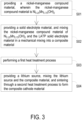
- FIG. 3 is a flow chart illustrating a preparation method of the composite cathode material according to a first embodiment of the present disclosure.
- a nickel-manganese compound material is provided, as shown in the step S01.
- the nickel-manganese compound material is Ni 0.25 Mn 0.75 (OH) 2 .
- the nickel-manganese compound material of Ni 0.25 Mn 0.75 (OH) 2 has an average particle size ranged from 10 microns to 20 microns.
- the average particle size of the nickel-manganese compound material is 12.90 microns with the surface area of 0.6 m 2 /g.
- a solid electrolyte material of lithium titanium aluminum phosphate (LATP) is provided.
- the solid electrolyte material has an average particle size ranged from 1 micron to 5 microns. Preferably but not exclusively, the average particle size of the solid electrolyte material is 1.79 microns.
- the nickel-manganese compound material of Ni 0.25 Mn 0.75 (OH) 2 and the LATP solid electrolyte material are mixed in a mechanical mixing to form a composite material, as shown in the step S02.
- the LATP solid electrolyte material has a weight percentage relative to the nickel-manganese compound material of Ni 0.25 Mn 0.75 (OH) 2 , and the weight percentage is ranged from 0.2 wt.% to 1.0 wt.%.
- the mechanical mixing refers to the dry mechanofusion method.
- the nickel-manganese compound material and the solid electrolyte material are mixed at a rotating speed of 700 rpm for 5 minutes, mixed at a rotating speed of 1400 rpm for 5 minutes, mixed at a rotating speed of 2100 rpm for 5 minutes, mixed at a rotating speed of 2800 rpm for 10 minutes and mixed at a rotating speed of 3500 rpm for 10 minutes in the mechanical mixing.
- the nickel-manganese compound material and the solid electrolyte material are mixed at a working temperature ranged from 25 °C to 45 °C in the mechanical mixing.
- a first heat treatment process is performed, as shown in the step S03.
- the first heat treatment process has a holding temperature ranged from 300°C to 850°C, a treating time ranged from 5 hours to 7 hours, and a temperature rising rate of 2.5°C/min.
- a lithium source such as the lithium hydroxide is provided, and the lithium source and the foregoing composite material are mixed and sintered to form the composite cathode material 1.
- the nickel-manganese compound material of Ni 0.25 Mn 0.75 (OH) 2 has a molar ratio of 1:1.02 relative to the lithium source in the composite material.
- the lithium source and the composite material are sintered in a second heat treatment process.
- the second heat treatment process has a holding temperature ranged from 300°C to 710°C, a treating time ranged from 24 hours to 30 hours, and a temperature rising rate of 2.5°C/min.
- the obtained composite cathode material 1 includes a core 10 and a coating layer 20.
- the core 10 is made of LiNi 0.5 Mn 1.5 O 4 , and coated by the coating layer 20, and the coating layer 20 is made of the LATP solid electrolyte material.
- the weight percentage of LATP solid electrolyte material relative to the nickel-manganese compound material of Ni 0.25 Mn 0.75 (OH) 2 is further controlled and ranged from 0.2 wt.% to 1.0 wt.%. so as to obtain an optimized coating effect of the solid electrolyte material.
- FIGS. 4A to 4D are SEM images showing the cathode electrode material of the first comparative example.
- the lithium nickel manganese oxide (LMNO) cathode material of LiNi 0.5 Mn 1.5 O 4 ) is not coated with the LATP solid electrolyte material.
- FIGS. 5A to 5D are SEM images showing the composite cathode material of the first example of the present disclosure.
- the weight percentage of LATP solid electrolyte material relative to the nickel-manganese compound material of Ni 0.25 Mn 0.75 (OH) 2 is 0.2 wt.%, and the composite cathode material is obtained through the forgoing steps S01 ⁇ S04.
- FIGS. 6A to 6D are SEM images showing the composite cathode material of the second example of this present disclosure.
- the weight percentage of LATP solid electrolyte material relative to the nickel-manganese compound material of Ni 0.25 Mn 0.75 (OH) 2 is 0.5 wt.%, and the composite cathode material is obtained through the forgoing steps S01 ⁇ S04.
- FIGS. 7A to 7D are SEM images showing the composite cathode material of the third example of this present disclosure.
- the weight percentage of LATP solid electrolyte material relative to the nickel-manganese compound material of Ni 0.25 Mn 0.75 (OH) 2 is 1.0 wt.%, and the composite cathode material is obtained through the forgoing steps S01 ⁇ S04.
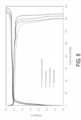
- FIG. 8 shows the voltage vs. the charge and discharge capacity curves of the first comparative example, the first example, the second example and the third example of the present disclosure.
- the button batteries made of the first comparative example, the first example, the second example and the third example of the present disclosure are tested at a charge-discharge rate (C-rate) of 0.1C to obtain the results.
- the positive electrode sheet of the button battery is made of the cathode material, the conductive agent and the binder in a ratio of 94:4:2, and the negative electrode sheet is made of lithium metal.
- the electrolyte solution of the button battery includes 1.15 M lithium hexafluorophosphate (LiPF 6 ), ethylene carbonate (EC), diethyl carbonate (DEC), ethyl methyl carbonate (EMC) and 5 wt.% fluoroethylene carbonate (FEC).
- LiPF 6 lithium hexafluorophosphate
- EC ethylene carbonate
- DEC diethyl carbonate
- EMC ethyl methyl carbonate
- FEC fluoroethylene carbonate
- Table 1 also lists the rate performance results of the first comparative example, the first example, the second example and the third example of the present disclosure charged at 0.2 and then discharged at 1C/2C/3C/5C. As shown in FIG.
- the capacities and the rate performance of the first example, the second example and the third example of the present disclosure are all better than those of the first comparative example.
- the dry mechanical mixing method is used in the present disclosure to mix the nickel-manganese compound material of Ni 0.25 Mn 0.75 (OH) 2 and the LATP solid electrolyte material in advance.
- the lithium source is added to mix and sinter with the forgoing composite material to form the composite cathode material with a core and a coating layer.
- the capacity and the rate performance of the lithium nickel manganese oxide (LMNO) cathode material is improved.
- FIG. 9 shows the retention vs. the cycle number curves of the first comparative example, the first example, the second example and the third example of the present disclosure.
- the button batteries made of the first comparative example, the first example, the second example and the third example of the present disclosure are tested at a charge-discharge rate (C-rate) of 1C to obtain the results.
- C-rate charge-discharge rate
- the capacity retention rates of the first example, the second example and the third example of the present disclosure are all better than those of the first comparative example. It can be seen that the composite positive electrode material formed by the preparation method of the present disclosure has the advantages of improving the cycle performance and the cycle life of lithium nickel manganese oxide (LMNO) cathode material.
- LMNO lithium nickel manganese oxide
- FIG. 10 is a flow chart illustrating a preparation method of the composite cathode material according to a second embodiment of the present disclosure.
- a nickel-manganese compound material is provided, as shown in the step S01'.
- the nickel-manganese compound material is Ni 0.25 Mn 0.75 O.
- the nickel-manganese compound material of Ni 0.25 Mn 0.75 O is made from Ni 0.25 Mn 0.75 (OH) 2 through a pre-oxidation process.
- Ni 0.25 Mn 0.75 (OH) 2 is treated through a pre-oxidation process to obtain the nickel-manganese compound material of Ni 0.25 Mn 0.75 O.
- the nickel-manganese compound material of Ni 0.25 Mn 0.75 O has an average particle size ranged from 10 microns to 20 microns.
- the average particle size of the nickel-manganese compound material is 13.96 microns with the surface area of 20.49 m 2 /g.
- the pre-oxidation process has a holding temperature ranged from 300°C to 850 °C, a treating time ranged from 5 hours to 7 hours, and a temperature rising rate of 2.5 °C/min.
- the nickel-manganese compound material of Ni 0.25 Mn 0.75 O can be obtained by other processing procedures, and the present disclosure is not limited thereto.
- a solid electrolyte material of lithium titanium aluminum phosphate (LATP) is provided, the nickel-manganese compound material of Ni 0.25 Mn 0.75 O and the LATP solid electrolyte material are mixed in a dry mechanofusion method to form a composite material.
- the LATP solid electrolyte material has a weight percentage relative to the nickel-manganese compound material of Ni 0.25 Mn 0.75 O, and the weight percentage is ranged from 0.2 wt.% to 1.0 wt.%.
- the nickel-manganese compound material and the solid electrolyte material are mixed at a rotating speed of 700 rpm for 5 minutes, mixed at a rotating speed of 1400 rpm for 5 minutes, mixed at a rotating speed of 2100 rpm for 5 minutes, mixed at a rotating speed of 2800 rpm for 10 minutes and mixed at a rotating speed of 3500 rpm for 10 minutes in the mechanical mixing. Furthermore, the nickel-manganese compound material and the solid electrolyte material are mixed at a working temperature ranged from 25 °C to 45 °C in the mechanical mixing.
- a first heat treatment process is performed, as shown in the step S03'.
- the first heat treatment process has a holding temperature ranged from 300°C to 750°C, a treating time ranged from 5 hours to 7 hours, and a temperature rising rate of 2.5°C/min.
- a lithium source such as the lithium hydroxide is provided, and the lithium source and the foregoing composite material are mixed and sintered to form the composite cathode material.
- the forgoing nickel-manganese compound material of Ni 0.25 Mn 0.75 O has a molar ratio of 1:1.02 relative to the lithium source in the composite material.
- the lithium source and the composite material are sintered in a second heat treatment process.
- the second heat treatment process has a holding temperature ranged from 300°C to 710°C, a treating time ranged from 24 hours to 30 hours, and a temperature rising rate of 2.5°C/min.
- the obtained composite cathode material 1 includes a core 10 and a coating layer 20.
- the core 10 is made of LiNi 0.5 Mn 1.5 O 4 , and coated by the coating layer 20, and the coating layer 20 is made of the LATP solid electrolyte material.
- the weight percentage of LATP solid electrolyte material relative to the nickel-manganese compound material of Ni 0.25 Mn 0.75 O is further controlled and ranged from 0.2 wt.% to 1.0 wt.%. so as to obtain an optimized coating effect of the solid electrolyte material.
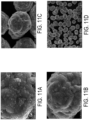
- FIGS. 11A to 11D are SEM images showing the composite cathode material of the fourth example of this present disclosure.
- the weight percentage of LATP solid electrolyte material relative to the nickel-manganese compound material of Ni 0.25 Mn 0.75 O is 0.2 wt.%, and the composite cathode material is obtained through the forgoing steps S01' ⁇ S04'.
- FIGS. 12A to 12D are SEM images showing the composite cathode material of the fifth example of this present disclosure.
- the weight percentage of LATP solid electrolyte material relative to the nickel-manganese compound material of Ni 0.25 Mn 0.75 O is 0.3 wt.%, and the composite cathode material is obtained through the forgoing steps S01' ⁇ S04'.
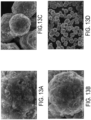
- FIGS. 13A to 13D are SEM images showing the composite cathode material of the sixth example of this present disclosure.
- the weight percentage of LATP solid electrolyte material relative to the nickel-manganese compound material of Ni 0.25 Mn 0.75 O is 0.5 wt.%, and the composite cathode material is obtained through the forgoing steps S01' ⁇ S04'.
- FIG. 14 shows the voltage vs. the charge and discharge capacity curves of the first comparative example, the fourth example, the fifth example and the sixth example of the present disclosure.
- the button batteries made of the first comparative example, the fourth example, the fifth example and the sixth example of the present disclosure are tested at a charge-discharge rate (C-rate) of 0.1C to obtain the results.
- the positive electrode sheet of the button battery is made of the cathode material, the conductive agent and the binder in a ratio of 94:4:2, and the negative electrode sheet is made of lithium metal.
- the electrolyte solution of the button battery includes 1.15 M lithium hexafluorophosphate (LiPF 6 ), ethylene carbonate (EC), diethyl carbonate (DEC), ethyl methyl carbonate (EMC) and 5 wt.% fluoroethylene carbonate (FEC).
- LiPF 6 lithium hexafluorophosphate
- EC ethylene carbonate
- DEC diethyl carbonate
- EMC ethyl methyl carbonate
- FEC fluoroethylene carbonate
- Table 2 also lists the rate performance results of the first comparative example, the fourth example, the fifth example and the sixth example of the present disclosure charged at 0.2 and then discharged at 1C/2C/3C/5C. As shown in FIG.
- the capacities and the rate performance of the fourth example, the fifth example and the sixth example of the present disclosure are all better than those of the first comparative example.
- the dry mechanical mixing method is used in the present disclosure to mix the nickel-manganese compound material of Ni 0.25 Mn 0.75 O and the LATP solid electrolyte material in advance.
- the lithium source is added to mix and sinter with the forgoing composite material to form the composite cathode material with a core and a coating layer.
- the capacity and the rate performance of the lithium nickel manganese oxide (LMNO) cathode material is improved.
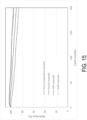
- FIG. 15 shows the retention vs. the cycle number curves of the first comparative example, the fourth example, the fifth example and the sixth example of the present disclosure.
- the button batteries made of the first comparative example, the fourth example, the fifth example and the sixth example of the present disclosure are tested at a charge-discharge rate (C-rate) of 1C to obtain the results.
- C-rate charge-discharge rate
- the capacity retention rates of the fourth example, the fifth example and the sixth example of the present disclosure are all better than those of the first comparative example. It can be seen that the composite positive electrode material formed by the preparation method of the present disclosure has the advantages of improving the cycle performance and the cycle life of lithium nickel manganese oxide (LMNO) cathode material.
- LMNO lithium nickel manganese oxide
- the weight percentage of the LATP solid electrolyte material relative to the nickel-manganese compound material is controlled and ranged from 0.2 wt.% to 1.0 wt.% in the present disclosure, so that a better coating effect of the composite cathode material is resulted.
- the weight percentage of the LATP solid electrolyte material relative to the nickel-manganese compound material is controlled and ranged from 0.2 wt.% to 0.3 wt.%.
- lithium titanium aluminum phosphate (LATP) solid electrolyte is added to form the coating layer to improve the rate performance of the cathode material of lithium nickel manganese oxide (LMNO).
- the manufacturing cost is further reduced, and an optimized solid-electrolyte coating effect is achieved.
- the lithium aluminum titanium phosphate (LATP) is mixed with the pretreatment material of the nickel-manganese compound material in the present disclosure, and then the pretreatment material with the LATP mixed is sintered to form the composite cathode material of lithium nickel manganese oxide (LMNO) with the LATP coated thereon.
- the pretreatment material can be for example the nickel-manganese compound material of Ni 0.25 Mn 0.75 (OH) 2 or Ni 0.25 Mn 0.75 O.
- the cathode material of lithium nickel manganese oxide (LMNO) material is not directly used for coating process.
- LATP solid electrolyte material is added into the lithium nickel manganese oxide (LMNO) cathode material and add.
- the average particle size of lithium nickel manganese oxide (LMNO) cathode material is about 15.13 microns, with a surface area of 0.31 m 2 /g.
- The is directly coated on the surface of the lithium nickel manganese oxide (LMNO) cathode material in the same mixing manner, so as to obtain the second comparative example.
- LATP solid electrolyte material is added into the lithium nickel manganese oxide (LMNO) cathode material and add.
- the average particle size of lithium nickel manganese oxide (LMNO) cathode material is about 15.13 microns, with a surface area of 0.31 m 2 /g.
- the LATP solid electrolyte material is directly coated on the surface of the lithium nickel manganese oxide (LMNO) cathode material in the same mixing manner, and a further sintering process is performed, so as to obtain the third comparative example.
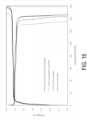
- FIG. 16 shows the voltage vs. the charge and discharge capacity curves of the second comparative example, the third comparative example, the first example and the fourth example of the present disclosure.
- the button batteries made of the second comparative example, the third comparative example, the first example and the fourth example of the present disclosure are tested at a charge-discharge rate (C-rate) of 0.1C to obtain the results.
- C-rate charge-discharge rate
- Table 3 also lists the rate performance results of the second comparative example, the third comparative example, the first example and the fourth example of the present disclosure charged at 0.2 and then discharged at 1C/2C/3C/5C. As shown in FIG.
- the capacities and the rate performance of the first example and the fourth example of the present disclosure are all better than those of the second comparative example and the third comparative example.
- the dry mechanical mixing method is used to mix the nickel-manganese compound material and the LATP solid electrolyte material in advance.
- the lithium source is added to mix and sinter with the forgoing composite material to form the composite cathode material with a core and a coating layer. It can be seen that the capacity and the rate performance of the composite cathode material prepared through the present disclosure are better than those of the lithium nickel manganese oxide (LMNO) cathode material with the LATP solid electrolyte material directly coated thereon.
- LMNO lithium nickel manganese oxide
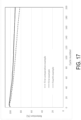
- FIG. 17 shows the retention vs. the cycle number curves of the third comparative example, the first example and the fourth example of the present disclosure.
- the button batteries made of the third comparative example, the first example and the fourth example of the present disclosure are tested at a charge-discharge rate (C-rate) of 1C to obtain the results.
- C-rate charge-discharge rate
- the capacity retention rates of the first example and the fourth example of the present disclosure are all better than those of the third comparative example.
- the retention after 200th cycles of the first example and the fourth example of the present disclosure is about 10% higher than that of the third comparative example.
- the lithium aluminum titanium phosphate (LATP) is mixed with the pretreatment material of the nickel-manganese compound material firstly through a mechanical mixing way such as a mechanofusion method according to the preparation method of the present disclosure. Then, the pretreatment material with the LATP mixed is sintered to form the composite cathode material of lithium nickel manganese oxide (LMNO) with the LATP coated thereon. In this way, the generation of Mn 3+ is reduced, and the dissolution of Mn 3+ from the positive electrode material and the reduction and deposition on the negative electrode are avoided from resulting in cycle electrical decline.
- LMNO lithium nickel manganese oxide
- the preparation method of the present disclosure uses the dry mechanofusion method to mix the nickel-manganese compound material and the solid electrolyte material, and then performs the heat treatment to produce the LMNO cathode material, so that the solid electrolyte material is coated on the surface of the LMNO cathode material simultaneously when the LMNO cathode material is formed.
- the process is simple and fast.
- the performance of the composite cathode material obtained is improved sufficiently and better than that of the LMNO cathode material with the solid electrolyte material directly coated thereon.
- the compositions of the nickel-manganese compound material of Ni 0.25 Mn 0.75 (OH) 2 or Ni 0.25 Mn 0.75 O, the solid electrolyte material of lithium titanium aluminum phosphate (Li 1.3 Al 0.3 Ti 1.7 (PO 4 ) 3 , LATP) and the cathode material of lithium nickel manganese oxide (LiNi 0.5 Mn 1.5 O 4 , LMNO) are adjustable according to the practical requirements.
- the lithium source is added to mix and sinter, and the composite cathode material including the lithium nickel manganese oxide of LiNi 2x Mn 2y O 4 with the lithium titanium aluminum phosphate of Li 1+z Al z Ti 2-z (PO 4 ) 3 coated on the surface thereof is obtained. It is not redundantly described herein.
- the present disclosure provides a preparation method of a composite cathode material.
- the dry mechanofusion method to mix the precursor and the solid electrolyte material, the solid electrolyte material is coated on the surface of the cathode material simultaneously when the cathode material is formed.
- the process is simple and fast, and the performance of the cathode material is improved sufficiently.
- the dry mechanical mixing method is used to mix the nickel-manganese compound material, such as Ni 0.25 Mn 0.75 (OH) 2 or Ni 0.25 Mn 0.75 O is mixed with the solid electrolyte material in advance, and then the lithium source is added to mix and sintered to form a composite cathode material with a core and a coating layer.
- the inner core is made of LiNi 0.5 Mn 1.5 O 4
- the outer coating layer is made of the solid electrolyte material.
- the solid electrolyte material of lithium aluminum titanium phosphate (LATP) has good ionic conductivity, when the lithium aluminum titanium phosphate (LATP) is coated on the surface of the cathode material of lithium nickel manganese oxide (LMNO) to form a composite cathode material, it facilitates to improve the rate performance and cycle performance of the cathode material of lithium nickel manganese oxide (LMNO), and the coating layer of lithium aluminum titanium phosphate (LATP) can also provide the protection to slow down the impact of the material surface being damaged by the electrolyte solution.
- LATP lithium aluminum titanium phosphate
- the weight percentage of the solid electrolyte material relative to nickel-manganese compound material such as Ni 0.25 Mn 0.75 (OH) 2 or Ni 0.25 Mn 0.75 O, is controlled and ranged from 0.2 wt.% to 1.0 wt.%, preferably between 0.2 wt.% and 0.3 wt.%. That is to say, in the present disclosure, only a small amount of lithium titanium aluminum phosphate (LATP) solid electrolyte material is added to form the coating layer to improve the rate performance of the cathode material of lithium nickel manganese oxide (LMNO), and the manufacturing cost is further reduced.
- LATP lithium titanium aluminum phosphate
- the lithium aluminum titanium phosphate (LATP) is mixed with the pretreatment material of the nickel-manganese compound material through a mechanical mixing way such as a mechanofusion method in the present disclosure. Then, the pretreatment material with the LATP mixed is sintered to form the composite cathode material of lithium nickel manganese oxide (LMNO) with the LATP coated thereon. In this way, the generation of Mn 3+ is reduced, and the dissolution of Mn 3+ from the positive electrode material and the reduction and deposition on the negative electrode are avoided from resulting in cycle electrical decline.
- the working temperature of the mixing process is ranged for example between 25°C and 45°C, and the mixing processing is performed in stages at a rotating speed ranged from 700 rpm to 3500 rpm for 5 minutes and 30 minutes.
- LATP lithium aluminum titanium phosphate
- the working temperature, the rotating speed and the working time it allows to avoid the structural defects of the solid electrolyte coating layer caused by high temperature and the excessive friction between particles.
- the cathode material of lithium nickel manganese oxide (LMNO) can exert low impedance and good charge and discharge performance through the coating layer of LATP solid electrolyte material.
Landscapes
- Chemical & Material Sciences (AREA)
- General Chemical & Material Sciences (AREA)
- Chemical Kinetics & Catalysis (AREA)
- Electrochemistry (AREA)
- Inorganic Chemistry (AREA)
- Engineering & Computer Science (AREA)
- Manufacturing & Machinery (AREA)
- Composite Materials (AREA)
- Organic Chemistry (AREA)
- Materials Engineering (AREA)
- Physics & Mathematics (AREA)
- Condensed Matter Physics & Semiconductors (AREA)
- General Physics & Mathematics (AREA)
- Battery Electrode And Active Subsutance (AREA)
- Inorganic Compounds Of Heavy Metals (AREA)
- Secondary Cells (AREA)
Priority Applications (2)
| Application Number | Priority Date | Filing Date | Title |
|---|---|---|---|
| MA69078A MA69078B1 (fr) | 2023-05-05 | 2023-09-27 | Procédé de préparation d'un matériau de cathode composite |
| HRP20250869TT HRP20250869T1 (hr) | 2023-05-05 | 2023-09-27 | Postupak pripreme kompozitnog katodnog materijala |
Applications Claiming Priority (1)
| Application Number | Priority Date | Filing Date | Title |
|---|---|---|---|
| TW112116679A TWI863251B (zh) | 2023-05-05 | 2023-05-05 | 複合式正極材料的製備方法 |
Publications (3)
| Publication Number | Publication Date |
|---|---|
| EP4458775A1 true EP4458775A1 (de) | 2024-11-06 |
| EP4458775B1 EP4458775B1 (de) | 2025-07-02 |
| EP4458775C0 EP4458775C0 (de) | 2025-07-02 |
Family
ID=88207229
Family Applications (1)
| Application Number | Title | Priority Date | Filing Date |
|---|---|---|---|
| EP23200124.8A Active EP4458775B1 (de) | 2023-05-05 | 2023-09-27 | Verfahren zur herstellung eines verbundkathodenmaterials |
Country Status (9)
| Country | Link |
|---|---|
| US (1) | US20240372062A1 (de) |
| EP (1) | EP4458775B1 (de) |
| JP (1) | JP7727694B2 (de) |
| KR (1) | KR102840752B1 (de) |
| AU (1) | AU2023237062B1 (de) |
| ES (1) | ES3037952T3 (de) |
| HR (1) | HRP20250869T1 (de) |
| MA (1) | MA69078B1 (de) |
| TW (1) | TWI863251B (de) |
Citations (1)
| Publication number | Priority date | Publication date | Assignee | Title |
|---|---|---|---|---|
| US8906553B1 (en) * | 2010-02-26 | 2014-12-09 | Nei Corporation | High voltage cathode material for Li-ion batteries |
Family Cites Families (13)
| Publication number | Priority date | Publication date | Assignee | Title |
|---|---|---|---|---|
| EP1786052B1 (de) * | 2004-08-18 | 2012-09-19 | Central Research Institute of Electric Power Industry | Organische elektrolytbatterie und prozess zur herstellung eines positiv-elektrodenblatts zur verwendung darin |
| CN100452488C (zh) * | 2005-10-28 | 2009-01-14 | 比亚迪股份有限公司 | 三元复合锂离子电池正极材料的制备方法 |
| CN102034967A (zh) * | 2010-11-09 | 2011-04-27 | 中国海洋石油总公司 | 一种高电压锂电池正极材料氧化镍锰锂的共沉淀制法 |
| CN102683709A (zh) * | 2012-05-22 | 2012-09-19 | 吉首大学 | 一种高电压镍锰酸锂正极材料的表面包覆方法 |
| JP6015591B2 (ja) * | 2012-10-26 | 2016-10-26 | トヨタ自動車株式会社 | 非水電解液二次電池 |
| JP7358363B2 (ja) * | 2018-09-07 | 2023-10-10 | 株式会社カネカ | 被覆正極活物質及びリチウムイオン二次電池の製造方法 |
| JP7403289B2 (ja) * | 2019-11-27 | 2023-12-22 | 太平洋セメント株式会社 | リチウムイオン二次電池用正極活物質複合体及びその製造方法 |
| CN111490243B (zh) * | 2020-05-25 | 2022-03-11 | 蜂巢能源科技有限公司 | 一种锂离子电池用复合正极材料、其制备方法及用途 |
| CN111600014B (zh) * | 2020-05-26 | 2022-11-22 | 宁波容百新能源科技股份有限公司 | 一种改性的高比容量高镍三元正极材料及其制备方法 |
| CN112635756B (zh) * | 2020-12-21 | 2022-09-27 | 国联汽车动力电池研究院有限责任公司 | 一种高镍正极材料及其制备方法和应用 |
| JP7784077B2 (ja) * | 2021-07-07 | 2025-12-11 | 三星電子株式会社 | 非水電解質二次電池用被覆正極活物質及び該被覆正極活物質を含有する非水電解質二次電池。 |
| CN114388812B (zh) * | 2022-03-23 | 2022-06-03 | 宜宾锂宝新材料有限公司 | 一种镍锰尖晶石型正极材料及其制备方法和应用 |
| CN115084480B (zh) * | 2022-07-19 | 2023-09-01 | 成都大学 | 一种金属氧化物-金属硫化物异质结材料及其制备方法和应用 |
-
2023
- 2023-05-05 TW TW112116679A patent/TWI863251B/zh active
- 2023-06-15 US US18/210,470 patent/US20240372062A1/en active Pending
- 2023-09-26 AU AU2023237062A patent/AU2023237062B1/en active Active
- 2023-09-26 JP JP2023163963A patent/JP7727694B2/ja active Active
- 2023-09-27 HR HRP20250869TT patent/HRP20250869T1/hr unknown
- 2023-09-27 KR KR1020230130015A patent/KR102840752B1/ko active Active
- 2023-09-27 EP EP23200124.8A patent/EP4458775B1/de active Active
- 2023-09-27 ES ES23200124T patent/ES3037952T3/es active Active
- 2023-09-27 MA MA69078A patent/MA69078B1/fr unknown
Patent Citations (1)
| Publication number | Priority date | Publication date | Assignee | Title |
|---|---|---|---|---|
| US8906553B1 (en) * | 2010-02-26 | 2014-12-09 | Nei Corporation | High voltage cathode material for Li-ion batteries |
Non-Patent Citations (1)
| Title |
|---|
| LI LI ET AL: "Stabilizing a high-voltage LiNi 0.5 Mn 1.5 O 4 cathode towards all solid state batteries: a Li-Al-Ti-P-O solid electrolyte nano-shell with a host material", NANOSCALE, vol. 11, no. 18, 9 May 2019 (2019-05-09), United Kingdom, pages 8967 - 8977, XP093141184, ISSN: 2040-3364, DOI: 10.1039/C9NR01655D * |
Also Published As
| Publication number | Publication date |
|---|---|
| MA69078B1 (fr) | 2025-08-29 |
| TW202445896A (zh) | 2024-11-16 |
| EP4458775B1 (de) | 2025-07-02 |
| KR102840752B1 (ko) | 2025-07-30 |
| JP2024160916A (ja) | 2024-11-15 |
| KR20240161758A (ko) | 2024-11-12 |
| TWI863251B (zh) | 2024-11-21 |
| ES3037952T3 (en) | 2025-10-08 |
| JP7727694B2 (ja) | 2025-08-21 |
| US20240372062A1 (en) | 2024-11-07 |
| HRP20250869T1 (hr) | 2025-09-26 |
| AU2023237062B1 (en) | 2024-10-03 |
| EP4458775C0 (de) | 2025-07-02 |
Similar Documents
| Publication | Publication Date | Title |
|---|---|---|
| JP7027387B2 (ja) | ドープニオブ酸チタンおよび電池 | |
| CN112151798B (zh) | 一种氟化物/氧化物共包覆正极材料及其制备方法 | |
| US11056681B2 (en) | Positive electrode active material for nonaqueous electrolyte secondary battery, method for producing same, and nonaqueous electrolyte secondary battery using said positive electrode active material | |
| KR100889622B1 (ko) | 안전성이 우수한 리튬 이차전지용 양극 활물질 및 그제조방법과 이를 포함하는 리튬 이차전지 | |
| EP3437148B1 (de) | Lithium-ionen-batterie für automobilanwendung | |
| EP3267517B1 (de) | Positivelektrodenaktivsubstanz für sekundärbatterie mit wasserfreiem elektrolyt und verfahren zur herstellung davon | |
| JP5742935B2 (ja) | 正極活物質粒子、並びにそれを用いた正極及び全固体電池 | |
| KR20180063858A (ko) | 리튬이차전지용 니켈계 활물질 전구체, 그 제조방법, 이로부터 형성된 리튬이차전지용 니켈계 활물질 및 이를 포함하는 양극을 함유한 리튬이차전지 | |
| EP4033565B1 (de) | Positives aktives elektrodenmaterial für eine lithium-ionen-sekundärbatterie sowie lithium-ionen-sekundärbatterie | |
| CN118658993B (zh) | 正极材料及其制备方法和应用 | |
| EP3486220B2 (de) | Katodenaktivmaterial für eine lithiumsekundärbatterie sowie lithiumsekundärbatterie damit | |
| EP4458775A1 (de) | Verfahren zur herstellung eines verbundkathodenmaterials | |
| CN114122343B (zh) | 用于全固态电池的包含含有三元氧化物涂层的阴极活性材料及其制造方法 | |
| KR20180094567A (ko) | 리튬 이차 전지용 양극 활물질 | |
| KR102946408B1 (ko) | 소듐 이차전지용 양극 활물질, 이의 제조방법 및 이를 포함하는 소듐 이차전지 | |
| EP3489198A1 (de) | Kathodenaktivmaterial einer lithiumsekundärbatterie | |
| EP4368576B1 (de) | Kern-schale-partikel und lithium-ionen-batterie | |
| CN118888752B (zh) | 一种复合补钠剂及其制备方法与应用 | |
| CN118899408A (zh) | 复合式正极材料的制备方法 | |
| KR20250079335A (ko) | 리튬 이차전지용 인공 sei막의 제조방법 | |
| JP2024109445A (ja) | リチウムニッケルマンガン複合酸化物粒子、リチウムイオン二次電池 | |
| EP4671212A1 (de) | Positivelektrodenaktivmaterial, sekundärbatterie und verfahren zur herstellung eines positivelektrodenaktivmaterials | |
| EP4704176A1 (de) | Negativelektrodenmaterial für sekundärbatterie, sekundärbatterie und verfahren zur herstellung eines negativelektrodenmaterials für eine sekundärbatterie | |
| EP3499611A2 (de) | Lithium-metall-komplex-oxid und herstellungsverfahren dafür |
Legal Events
| Date | Code | Title | Description |
|---|---|---|---|
| REG | Reference to a national code |
Ref country code: HR Ref legal event code: TUEP Ref document number: P20250869T Country of ref document: HR |
|
| PUAI | Public reference made under article 153(3) epc to a published international application that has entered the european phase |
Free format text: ORIGINAL CODE: 0009012 |
|
| STAA | Information on the status of an ep patent application or granted ep patent |
Free format text: STATUS: REQUEST FOR EXAMINATION WAS MADE |
|
| 17P | Request for examination filed |
Effective date: 20240508 |
|
| AK | Designated contracting states |
Kind code of ref document: A1 Designated state(s): AL AT BE BG CH CY CZ DE DK EE ES FI FR GB GR HR HU IE IS IT LI LT LU LV MC ME MK MT NL NO PL PT RO RS SE SI SK SM TR |
|
| RAV | Requested validation state of the european patent: fee paid |
Extension state: MA Effective date: 20241213 |
|
| REG | Reference to a national code |
Ref country code: DE Ref legal event code: R079 Free format text: PREVIOUS MAIN CLASS: C01G0053000000 Ipc: C01G0053540000 Ref document number: 602023004487 Country of ref document: DE |
|
| GRAP | Despatch of communication of intention to grant a patent |
Free format text: ORIGINAL CODE: EPIDOSNIGR1 |
|
| STAA | Information on the status of an ep patent application or granted ep patent |
Free format text: STATUS: GRANT OF PATENT IS INTENDED |
|
| RIC1 | Information provided on ipc code assigned before grant |
Ipc: H01M 10/052 20100101ALI20250317BHEP Ipc: H01M 4/62 20060101ALI20250317BHEP Ipc: H01M 10/0562 20100101ALI20250317BHEP Ipc: H01M 4/525 20100101ALI20250317BHEP Ipc: H01M 4/505 20100101ALI20250317BHEP Ipc: H01M 4/36 20060101ALI20250317BHEP Ipc: C01G 53/54 20250101AFI20250317BHEP |
|
| INTG | Intention to grant announced |
Effective date: 20250415 |
|
| GRAS | Grant fee paid |
Free format text: ORIGINAL CODE: EPIDOSNIGR3 |
|
| GRAA | (expected) grant |
Free format text: ORIGINAL CODE: 0009210 |
|
| STAA | Information on the status of an ep patent application or granted ep patent |
Free format text: STATUS: THE PATENT HAS BEEN GRANTED |
|
| AK | Designated contracting states |
Kind code of ref document: B1 Designated state(s): AL AT BE BG CH CY CZ DE DK EE ES FI FR GB GR HR HU IE IS IT LI LT LU LV MC ME MK MT NL NO PL PT RO RS SE SI SK SM TR |
|
| REG | Reference to a national code |
Ref country code: GB Ref legal event code: FG4D |
|
| REG | Reference to a national code |
Ref country code: CH Ref legal event code: EP |
|
| REG | Reference to a national code |
Ref country code: DE Ref legal event code: R096 Ref document number: 602023004487 Country of ref document: DE |
|
| REG | Reference to a national code |
Ref country code: IE Ref legal event code: FG4D |
|
| REG | Reference to a national code |
Ref country code: MA Ref legal event code: VAGR Ref document number: 69078 Country of ref document: MA Kind code of ref document: B1 |
|
| U01 | Request for unitary effect filed |
Effective date: 20250729 |
|
| U07 | Unitary effect registered |
Designated state(s): AT BE BG DE DK EE FI FR IT LT LU LV MT NL PT RO SE SI Effective date: 20250804 |
|
| REG | Reference to a national code |
Ref country code: HR Ref legal event code: T1PR Ref document number: P20250869 Country of ref document: HR |
|
| REG | Reference to a national code |
Ref country code: ES Ref legal event code: FG2A Ref document number: 3037952 Country of ref document: ES Kind code of ref document: T3 Effective date: 20251008 |
|
| REG | Reference to a national code |
Ref country code: HR Ref legal event code: ODRP Ref document number: P20250869 Country of ref document: HR Payment date: 20250916 Year of fee payment: 3 |
|
| PGFP | Annual fee paid to national office [announced via postgrant information from national office to epo] |
Ref country code: NO Payment date: 20250925 Year of fee payment: 3 |
|
| PGFP | Annual fee paid to national office [announced via postgrant information from national office to epo] |
Ref country code: TR Payment date: 20250925 Year of fee payment: 3 |
|
| PGFP | Annual fee paid to national office [announced via postgrant information from national office to epo] |
Ref country code: HR Payment date: 20250916 Year of fee payment: 3 |
|
| U20 | Renewal fee for the european patent with unitary effect paid |
Year of fee payment: 3 Effective date: 20250930 |
|
| VSFP | Annual fee paid to validation state [announced via postgrant information from national office to epo] |
Ref country code: MA Payment date: 20251008 Year of fee payment: 3 |
|
| PG25 | Lapsed in a contracting state [announced via postgrant information from national office to epo] |
Ref country code: IS Free format text: LAPSE BECAUSE OF FAILURE TO SUBMIT A TRANSLATION OF THE DESCRIPTION OR TO PAY THE FEE WITHIN THE PRESCRIBED TIME-LIMIT Effective date: 20251102 |
|
| PG25 | Lapsed in a contracting state [announced via postgrant information from national office to epo] |
Ref country code: GR Free format text: LAPSE BECAUSE OF FAILURE TO SUBMIT A TRANSLATION OF THE DESCRIPTION OR TO PAY THE FEE WITHIN THE PRESCRIBED TIME-LIMIT Effective date: 20251003 |
|
| PG25 | Lapsed in a contracting state [announced via postgrant information from national office to epo] |
Ref country code: CZ Free format text: LAPSE BECAUSE OF FAILURE TO SUBMIT A TRANSLATION OF THE DESCRIPTION OR TO PAY THE FEE WITHIN THE PRESCRIBED TIME-LIMIT Effective date: 20250702 |
|
| PG25 | Lapsed in a contracting state [announced via postgrant information from national office to epo] |
Ref country code: PL Free format text: LAPSE BECAUSE OF FAILURE TO SUBMIT A TRANSLATION OF THE DESCRIPTION OR TO PAY THE FEE WITHIN THE PRESCRIBED TIME-LIMIT Effective date: 20250702 |
|
| PG25 | Lapsed in a contracting state [announced via postgrant information from national office to epo] |
Ref country code: RS Free format text: LAPSE BECAUSE OF FAILURE TO SUBMIT A TRANSLATION OF THE DESCRIPTION OR TO PAY THE FEE WITHIN THE PRESCRIBED TIME-LIMIT Effective date: 20251002 |
|
| PGFP | Annual fee paid to national office [announced via postgrant information from national office to epo] |
Ref country code: ES Payment date: 20251020 Year of fee payment: 3 |
|
| PG25 | Lapsed in a contracting state [announced via postgrant information from national office to epo] |
Ref country code: SM Free format text: LAPSE BECAUSE OF FAILURE TO SUBMIT A TRANSLATION OF THE DESCRIPTION OR TO PAY THE FEE WITHIN THE PRESCRIBED TIME-LIMIT Effective date: 20250702 |
|
| PG25 | Lapsed in a contracting state [announced via postgrant information from national office to epo] |
Ref country code: SK Free format text: LAPSE BECAUSE OF FAILURE TO SUBMIT A TRANSLATION OF THE DESCRIPTION OR TO PAY THE FEE WITHIN THE PRESCRIBED TIME-LIMIT Effective date: 20250702 |