EP4381982A1 - Sohlenkontaktkörper - Google Patents
Sohlenkontaktkörper Download PDFInfo
- Publication number
- EP4381982A1 EP4381982A1 EP21956863.1A EP21956863A EP4381982A1 EP 4381982 A1 EP4381982 A1 EP 4381982A1 EP 21956863 A EP21956863 A EP 21956863A EP 4381982 A1 EP4381982 A1 EP 4381982A1
- Authority
- EP
- European Patent Office
- Prior art keywords
- toe
- raised part
- contact body
- step surface
- sole contact
- Prior art date
- Legal status (The legal status is an assumption and is not a legal conclusion. Google has not performed a legal analysis and makes no representation as to the accuracy of the status listed.)
- Pending
Links
Images




Classifications
-
- A—HUMAN NECESSITIES
- A43—FOOTWEAR
- A43B—CHARACTERISTIC FEATURES OF FOOTWEAR; PARTS OF FOOTWEAR
- A43B13/00—Soles; Sole-and-heel integral units
- A43B13/37—Sole and heel units
-
- A—HUMAN NECESSITIES
- A43—FOOTWEAR
- A43B—CHARACTERISTIC FEATURES OF FOOTWEAR; PARTS OF FOOTWEAR
- A43B7/00—Footwear with health or hygienic arrangements
- A43B7/14—Footwear with health or hygienic arrangements with foot-supporting parts
- A43B7/1405—Footwear with health or hygienic arrangements with foot-supporting parts with pads or holes on one or more locations, or having an anatomical or curved form
- A43B7/1415—Footwear with health or hygienic arrangements with foot-supporting parts with pads or holes on one or more locations, or having an anatomical or curved form characterised by the location under the foot
- A43B7/145—Footwear with health or hygienic arrangements with foot-supporting parts with pads or holes on one or more locations, or having an anatomical or curved form characterised by the location under the foot situated under the toes, i.e. the phalanges
-
- A—HUMAN NECESSITIES
- A43—FOOTWEAR
- A43B—CHARACTERISTIC FEATURES OF FOOTWEAR; PARTS OF FOOTWEAR
- A43B7/00—Footwear with health or hygienic arrangements
- A43B7/14—Footwear with health or hygienic arrangements with foot-supporting parts
- A43B7/1405—Footwear with health or hygienic arrangements with foot-supporting parts with pads or holes on one or more locations, or having an anatomical or curved form
- A43B7/1415—Footwear with health or hygienic arrangements with foot-supporting parts with pads or holes on one or more locations, or having an anatomical or curved form characterised by the location under the foot
- A43B7/1445—Footwear with health or hygienic arrangements with foot-supporting parts with pads or holes on one or more locations, or having an anatomical or curved form characterised by the location under the foot situated under the midfoot, i.e. the second, third or fourth metatarsal
-
- A—HUMAN NECESSITIES
- A43—FOOTWEAR
- A43B—CHARACTERISTIC FEATURES OF FOOTWEAR; PARTS OF FOOTWEAR
- A43B7/00—Footwear with health or hygienic arrangements
- A43B7/14—Footwear with health or hygienic arrangements with foot-supporting parts
- A43B7/1405—Footwear with health or hygienic arrangements with foot-supporting parts with pads or holes on one or more locations, or having an anatomical or curved form
- A43B7/1455—Footwear with health or hygienic arrangements with foot-supporting parts with pads or holes on one or more locations, or having an anatomical or curved form with special properties
- A43B7/147—Footwear with health or hygienic arrangements with foot-supporting parts with pads or holes on one or more locations, or having an anatomical or curved form with special properties for sick or disabled persons, e.g. persons having osteoarthritis or diabetes
-
- A—HUMAN NECESSITIES
- A43—FOOTWEAR
- A43B—CHARACTERISTIC FEATURES OF FOOTWEAR; PARTS OF FOOTWEAR
- A43B7/00—Footwear with health or hygienic arrangements
- A43B7/14—Footwear with health or hygienic arrangements with foot-supporting parts
- A43B7/26—Footwear with health or hygienic arrangements with foot-supporting parts with toe-spacers or toe-spreaders
Definitions
- the present disclosure relates to improvements in a sole contact body for footwear such as shoes, athletic shoes, sandals, etc., the sole contact body being suitable for correction of hallux valgus and digitus quintus varus.
- Patent literature 1 discloses a sock lining for high heels.
- the sock lining disclosed in Patent literature 1 includes a transverse front raised part corresponding to a toe portion of a foot.
- Patent literature 1 describes that increasing the load surface of the toes can prevent the toes from tilting to the sides and thereby prevent foot distortion, which is a factor of hallux valgus.
- Patent literature 1 only prevents foot distortion associated with wearing high heels.
- Patent literature 2 also discloses a sock lining for high heel shoes.
- the sock lining disclosed in Patent literature 2 includes a raised part for forming a transverse arch and recesses for accommodating the first-toe balls (metatarsophalangeal joints/tissue under the MTP joints) of the first and fifth toes (see FIGS. 1A and 1B and paragraph [0027] in Patent literature 2).
- Patent literature 2 the toe side of the first and fifth toes relative to the first-toe balls is lifted by the raised part. Therefore, the sock lining of Patent literature 2 cannot apply a correction force to the first and fifth toes toward the medial and lateral foot sides, respectively, on the toe side relative to the first-toe balls of the first and fifth toes.
- a main problem to be solved by the present disclosure is providing a sole contact body capable of correcting a collapse of the transverse arch of a foot and restoring the transverse arch of the foot to its normal state to correct hallux valgus and digitus quintus varus effortlessly, naturally and effectively through wearing footwear in daily life.
- a sole contact body for use in footwear such as a shoe, an athletic shoe, and a sandal includes a raised part.
- the raised part is configured to contact each of second, third, and fourth toes and lift the second, third, and fourth toes at positions of metatarsophalangeal joints and proximal interphalangeal joints thereof, and is configured to fit between a first toe and a fifth toe so as not to lift the first toe and the fifth toe over entire lengths thereof.
- the raised part includes a first-toe-side step surface configured to contact a side portion of the first toe on a tip side relative to a position of a metatarsophalangeal joint thereof; and a fifth-toe-side step surface configured to contact a side portion of the fifth toe on a tip side relative to a position of a metatarsophalangeal joint thereof.
- the positions of the metatarsophalangeal joints and proximal interphalangeal joints of the second to fourth toes can be lifted.
- the raised part is not present under the first and fifth toes, so that the first and fifth toes are not lifted over their entire length. Since the length of the ligament at the metatarsophalangeal joints does not change, the first toe is pulled toward a lateral foot side at its metatarsophalangeal joint, and the fifth toe is pulled toward a medial foot side at its metatarsophalangeal joint.
- the first-toe-side step surface contacts a side portion of the first toe and applies a correction force to the first toe toward the medial foot side
- the fifth-toe-side step surface contacts a side portion of the fifth toe and applies a correction force to the fifth toe toward the lateral foot side.
- the sole contact body further includes a space formed on a medial foot side of the raised part, in which the first toe is accommodated without being lifted; and a space formed on a lateral foot side of the raised part, in which the fifth toe is accommodated without being lifted.
- the first-toe-side step surface is formed so as to extend along a virtual vertical plane that intersects a virtual horizontal plane at an angle of 90 degrees to 60 degrees toward a center side of the raised part, the horizontal plane including left and right base portions of the raised part; and the fifth-toe-side step surface is formed so as to extend along a virtual vertical plane that intersects the horizontal plane at an angle of 90 degrees to 60 degrees toward the center side.
- the first-toe-side step surface has a maximum height of 8 mm to 11 mm
- the fifth-toe-side step surface has a maximum height of 4 mm to 7 mm.
- the first-toe-side step surface and the fifth-toe-side step surface contact the side portion of the first toe and the side portion of the fifth toe on the tip side, respectively, in an area at least part of which is gently curved toward a center side of the raised part.
- the sole contact body further includes a toe-side slope that contacts with the second, third, and fourth toes on a tip side.
- the toe-side slope is present under the tips of the second to fourth toes, the toe side of the second to fourth toes is not in a floating state but is in a state where they can hold the toe-side slope firmly even when the second to fourth toes are lifted at the positions of their metatarsophalangeal joints and proximal interphalangeal joints as described above.
- the inventor has found that by enabling the lifted second to fourth toes to hold firmly as described above, a transverse arch in which the first toe and the fifth toe are at lower positions can be effectively produced.
- a portion of the raised part on a rear side relative to the toe-side slope is configured to gradually decrease in height and left-right width toward the rear side.
- the sole contact body further includes a ridge-like part formed at a position directly above the first-toe-side step surface, the ridge-like part protruding from an upper surface of the raised part and extending in a front and rear direction.
- the ridge-like part has a width of 3 mm to 8 mm and protrudes from the upper surface of the raised part by 5 mm to 9 mm.
- a side surface of the ridge-like part facing a medial foot side is flush with the first-toe-side step surface.
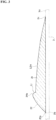
- FIGS. 1 to 11 illustrate a first example of a sole contact body 1.
- FIGS. 12 to 18 illustrate a second example of the sole contact body 1.
- the sole contact body 1 serves as a part of footwear such as a shoe, athletic shoe, sandal, etc., that comes into contact with the sole of a foot, or a member that comes into contact with the sole of a foot when additionally combined with such footwear.
- the sole contact body 1 serves as an insole or an inner sole (a sock lining).
- the sole contact body 1 has a function to correct a collapse of the transverse arch Ac of a foot and restore the transverse arch Ac to its normal state as illustrated in FIG. 20 effortlessly, naturally and effectively through wearing footwear provided with the sole contact body 1 in daily life.
- FIG. 19 illustrates the bone structure of a normal left foot.
- a ligament 101 (a deep transverse metatarsal ligament 101) connecting adjacent metatarsi 102 is located at the positions of the metatarsophalangeal joints 100 (MTP joints) of a first toe f1 to a fifth toe f5.
- MTP joints metatarsophalangeal joints 100
- the transverse arch Ac is formed at the position of the ligament 101 as illustrated in FIG. 20 .
- the second toe f2 to the fourth toe f4 are in a floating state at the positions of their metatarsophalangeal joints 100, with the second toe f2 at the highest position and the fourth toe f4 at the lowest position ( FIG. 20 ).
- FIG. 21 illustrates the bone structure of a left foot with hallux valgus.
- the transverse arch Ac is lost; the metatarsophalangeal joint 100 of the first toe f1 protrudes toward a medial foot side x (right foot side); and a tip side of the first toe f1 is located on a lateral foot side y compared to a normal left foot.
- the first toe f1 to the fifth toe f5 are positioned at the same height, and the width of the foot is wider due to the deformity of the first toe f1.
- hallux valgus often progresses as follows:
- digitus quintus varus is a state in which the transverse arch Ac is lost; the metatarsophalangeal joint 100 of the fifth toe f5 protrudes toward the lateral foot side y; and a tip side of the fifth toe f5 is positioned on the medial foot side x, compared to a normal foot.
- the sole contact body 1 has a function that can effectively correct hallux valgus and digitus quintus varus at the same time.
- the sole contact body 1 includes a raised part 2.
- the sole contact body 1 is typically composed of rubber or plastic having rubbery elasticity.
- the sole contact body 1 is configured by integrally forming a raised-part component 2a, which becomes the raised part 2, on an upper surface 3a of a base part 3 shaped so as to conform with the outline of the inside of footwear.
- the sole contact body 1 may also be configured by fixing a bottom surface of the raised-part component 2a, which becomes the raised part 2, on an upper surface of a base plate shaped so as to conform with the outline of the inside of footwear.
- the sole contact body 1 may also be configured by fixing the above-mentioned raised-part component 2a on an upper surface of the insole of existing footwear or an existing sandal.
- the raised part 2 is configured to contact each of the second toe f2, the third toe f3, and the fourth toe f4 to lift the positions of their metatarsophalangeal joints 100 and proximal interphalangeal joints 104 (PIP joints), and is configured to fit between the first toe f1 and the fifth toe f5 so as not to lift the first toe f1 and the fifth toe f5 over their entire length. That is, as will be described later, the raised part 2 is configured to have a height and shape that enable a foot to have a normal transverse arch Ac (see FIG. 20 ).
- FIGS. 1 and 2 illustrate the raised part 2 constituting the sole contact body 1 for a left foot.
- the raised part 2 is formed so as to extend in a front and rear direction at a position midway in a left and right direction of the base part 3 with a space between a front end 3b (the toe side) of the base part 3 and a front end 2b of the raised part 2 and with a space between a rear end 3c (the heel side) of the base part 3 and a rear end 2c of the raised part 2.
- a space 3d is formed between a side of the raised part 2 on the medial foot side x and an edge of the base part 3 on the medial foot side x to accommodate the first toe
- a space 3e is formed between a side of the raised part 2 on the lateral foot side y and an edge of the base part 3 on the lateral foot side y to accommodate the fifth toe.
- a space in which the first toe f1 is accommodated without being lifted and a space in which the fifth toe f5 is accommodated without being lifted are formed on the medial foot side x and on the lateral foot side y, respectively, with the raised part 2 placed therebetween.
- the base part 3 is further provided with a medial auxiliary raised part 4 corresponding to the medial longitudinal arch of a foot and a lateral auxiliary raised part 5 corresponding to the lateral longitudinal arch of the foot.
- the rear end 3c i.e., the heel side of the base part 3 preferably has a shape in which the medial foot side x is high and the lateral foot side y is low, as illustrated in FIG. 9 .
- the calcaneus is located on the lateral foot side y; and on the heel side of a foot, part of tissue on the medial foot side x is not supported by a bone.
- the configuration illustrated in FIG. 9 can prevent foot deformity due to the morphology of the calcaneus.
- the raised part 2 includes: a first-toe-side step surface 2d configured to contact a side portion of the first toe f1 on a tip side relative to the position of the metatarsophalangeal joint 100 of the first toe f1; a fifth-toe-side step surface 2e configured to contact a side portion of the fifth toe f5 on a tip side relative to the position of the metatarsophalangeal joint 100 of the fifth toe f5; and a toe-side slope 2f configured to contact ventral sides of the second toe f2, the third toe f3, and the fourth toe f4 on a tip side.
- a slope lower end 2fa of the toe-side slope 2f is identical with the front end 2b of the raised part 2.
- a portion of the raised part 2 on the rear side relative to a slope upper end 2fb of the toe-side slope 2f is configured to gradually decrease in height and left-right width of the raised part 2 toward the rear end 2c of the raised part 2.
- the front end 2b of the raised part 2 is located under the tips of the second toe f2 to the fourth toe f4; the slope upper end 2fb of the toe-side slope 2f of the raised part 2 is located under anterior ends 103a of the proximal phalanxes 103 of the second toe f2 to the fourth toe f4; and the rear end 2c of the raised part 2 is located under posterior ends 102a of the metatarsi 102 of the second toe f2 to the fourth toe f4.
- a ridgeline 2g extending in the left and right direction is formed by the slope upper end 2fb of the toe-side slope 2f.
- the front end 2b side of the raised part 2 is highest at the position of the ridgeline 2g.
- Formed between the front end 2b of the raised part 2 and the ridgeline 2g is the toe-side slope 2f extending along the left and right direction.
- the toe-side slope 2f forms a curved surface with the below side being the inside of the curve (see FIG. 3 ).
- a small step 2j facing the rear side Formed between the step 2j and the rear end 2c of the raised part 2 is an upper surface 2k of the raised part 2, which is a gently sloping surface.
- the dimension in the left and right direction on the front end 2b side of the raised part 2 is set to be substantially equal to the distance between the first toe f1 and the fifth toe f5 in a healthy state. Accordingly, a first-toe-side step surface 2d (the right side in FIG. 4 ) facing the medial foot side x and a fifth-toe-side step surface 2e facing the lateral foot side y (the left side in FIG. 4 ) are formed on the front end 2b side of the raised part 2.
- the toe-side slope 2f of the raised part 2 is configured to have an inclination so as to be higher on a side to be in contact with the second toe f2 and lower on a side to be in contact with the fourth toe f4 in a cross section along the left and right direction. This configuration is based on the positional relationship of the second toe f2 to the fourth toe f4 in a healthy state.
- the first toe-side step surface 2d and the fifth toe-side step surface 2e end slightly on a front side relative to a position z (see FIG. 2 ) approximately in the middle of the raised part 2 in the front and rear direction. These end positions roughly correspond to the positions of the metatarsophalangeal joints 100 of the first toe f1 and the fifth toe f5.
- the raised part 2 is in a shape along an imaginary curved surface with the below side being the inside of the curve in a cross section along the left and right direction ( FIG. 7 , FIG. 8 ).
- FIG. 10 illustrates the bone structure of a left foot placed on the sole contact body 1.
- the raised part 2 is located under the second toe f2 to the fourth toe f4 between the tips and the posterior ends 102a of the metatarsi 102 of the second toe f2 to the fourth toe f4.
- the positions of the metatarsophalangeal joints 100 and the proximal interphalangeal joints 104 of the second toe f2 to the fourth toe f4 can be lifted.
- the ridgeline 2g of the raised part 2 contacts the second toe f2 to the fourth toe f4 on the anterior end 103a side of their proximal phalanxes 103, and on the rear side relative to the ridgeline 2g, the upper surface of the raised part 2 contacts the second toe f2 to the fourth toe f4 on the posterior end 103b side of their proximal phalanxes 103.
- the second toe f2 to the fourth toe f4 are lifted at two locations, the anterior end 103a side and the posterior end 103b side of the proximal phalanxes 103 with the anterior end 103a side higher (see FIG. 11 ).
- the second toe f2 to the fourth toe f4 are also lifted at the positions of their proximal interphalangeal joints 104.
- the raised part 2 is not present under the first toe f1 and the fifth toe f5, and no other structure for lifting the first toe f1 and the fifth toe f5 is provided, so that the first toe f1 and the fifth toe f5 are not lifted over their entire length.
- the first toe f1 and the fifth toe f5 contact the upper surface 3a of the base part 3 with their pads on both sides of the raised part 2.
- the toe side of the second toe f2 to the fourth toe f4 is not in a floating state but is in a state where they can hold the toe-side slope 2f firmly even when the second toe f2 to the fourth toe f4 are lifted as described above (see FIG. 11 ).
- the inventor has found that by enabling the lifted second toe f2 to fourth toe f4 to hold firmly as described above, the transverse arch Ac in which the first toe f1 and the fifth toe f5 are at lower positions can be effectively produced.
- the first toe f1 is pulled toward the lateral foot side y at the position of its metatarsophalangeal joint 100 and the fifth toe f5 is pulled toward the medial foot side x at its metatarsophalangeal joint 100 under the condition illustrated in FIGS. 10 and 11 .
- the first-toe-side step surface 2d contacts a side portion of the first toe f1 to apply a correction force to the first toe toward the medial foot side x
- the fifth-toe-side step surface 2e contacts a side portion of the fifth toe f5 to apply a correction force to the fifth toe f5 toward the lateral foot side y.
- the first-toe-side step surface 2d so as to extend along a virtual vertical plane S2 that intersects a virtual horizontal plane S1 at an angle ⁇ 1 of 90 degrees to 60 degrees toward a center side 2i of the raised part 2, the horizontal plane S1 including left and right base portions 2h of the raised part 2 (a lower end of the first-toe-side step surface 2d and a lower end of the fifth-toe-side step surface 2e), and to form the fifth-toe-side step surface 2e so as to extend along a virtual vertical plane S3 that intersects the horizontal plane S1 at an angle ⁇ 2 of 90 degrees to 60 degrees toward the center side 2i.
- the first-toe-side step surface 2d has a height h1. That is, the maximum value of the height h1 from the horizontal plane S1 to the top of the raised part 2 (the position of reference numeral 2fb) is preferably in the range of 8 mm to 11 mm, and the maximum value of a height h2 of the fifth-toe-side step surface 2e is preferably in the range of 4 mm to 7 mm.
- Such configuration of the heights ensures that the first-toe-side step surface 2d contacts a side portion of the first toe f1 to apply a correction force toward the medial foot side x and the fifth-toe-side step surface 2e contacts a side portion of the fifth toe f5 to apply a correction force toward the lateral foot side y on the tip side relative to their metatarsophalangeal joints 100.
- the first-toe-side step surface 2d and the fifth-toe-side step surface 2e contact the side portion of the first toe f1 and the side portion of the fifth toe f5 on the tip side, respectively, in an area at least part of which is gently curved toward the center side 2i of the raised part 2.
- a sole contact body for a right foot is configured in a manner that is line symmetrical with the sole contact body 1 for a left foot described above.
- FIGS. 12 to 18 illustrate a second example in which the configuration of the sole contact body 1 (the first example) described above is partially changed.
- a ridge-like part 2m protruding from the upper surface 2k of the raised part 2 and extending in the front and rear direction is formed at a position directly above the first-toe-side step surface 2d.
- the ridge-like part 2m is formed so as to trace an edge portion 2n extending along the front and rear direction of the raised part 2, at which the first-toe-side step surface 2d and the upper surface 2k of the raised part 2 are in contact when the ridge-like part 2m is not provided (see FIGS. 15 and 16 ).
- the ridge-like part 2m is formed so as to extend between the front end 2b of the raised part 2 and a lower end of the step 2j behind the ridgeline 2g in an area directly above the first-toe-side step surface 2d.
- the ridge-like part 2m has a dome-shape outline in cross section perpendicular to its continuous direction at any position in the continuous direction.
- the ridge-like part 2m is provided at a position where it can fit between the first toe f1 and the second toe f2. Due to the ridge-like part 2m, the second toe f2 can be positioned on the lateral foot side y of the ridge-like part 2m and the first toe f1 can be positioned off the raised part 2 on the medial foot side x of the ridge-like part 2m using the ridge-like part 2m as a guide by the tactile sense of the foot even in a shoe, of which inside cannot be seen from the outside, enabling it possible to put on the shoe without difficulty.
- the ridge-like part 2m together with the first-toe-side step surface 2d, ensures that the tip side of the first toe f1 is kept in a sufficiently lowered state on the side of the raised part 2 without excessively lifting the second toe f2 to the fourth toe f4.
- a protrusion dimension h3 (see FIGS. 15 and 16 ) of the ridge-like part 2m by which the ridge-like part 2m protrudes from the upper surface 2k of the raised part 2 is preferably in the range of 5 mm to 9 mm.
- a width w1 (see FIGS. 15 and 16 ) of the ridge-like part 2m is preferably in the range of 3 mm to 8 mm.
- a side surface 2o of the ridge-like part 2m facing the medial foot side x be flush with the first-toe-side step surface 2d (see FIGS. 15 and 16 ).
- the present disclosure is not limited to the embodiment described above but includes all embodiments that can achieve an object of the present disclosure.
Landscapes
- Health & Medical Sciences (AREA)
- Epidemiology (AREA)
- General Health & Medical Sciences (AREA)
- Public Health (AREA)
- Diabetes (AREA)
- Rheumatology (AREA)
- Footwear And Its Accessory, Manufacturing Method And Apparatuses (AREA)
- Orthopedics, Nursing, And Contraception (AREA)
Applications Claiming Priority (3)
| Application Number | Priority Date | Filing Date | Title |
|---|---|---|---|
| PCT/JP2021/033262 WO2023037485A1 (ja) | 2021-09-10 | 2021-09-10 | 足裏接触体 |
| PCT/JP2021/041531 WO2023037565A1 (ja) | 2021-09-10 | 2021-11-11 | 足裏接触体 |
| PCT/JP2021/045815 WO2023037568A1 (ja) | 2021-09-10 | 2021-12-13 | 足裏接触体 |
Publications (2)
| Publication Number | Publication Date |
|---|---|
| EP4381982A1 true EP4381982A1 (de) | 2024-06-12 |
| EP4381982A4 EP4381982A4 (de) | 2025-07-30 |
Family
ID=83598291
Family Applications (1)
| Application Number | Title | Priority Date | Filing Date |
|---|---|---|---|
| EP21956863.1A Pending EP4381982A4 (de) | 2021-09-10 | 2021-12-13 | Sohlenkontaktkörper |
Country Status (4)
| Country | Link |
|---|---|
| US (1) | US20240381974A1 (de) |
| EP (1) | EP4381982A4 (de) |
| JP (1) | JP7152826B1 (de) |
| KR (1) | KR102869004B1 (de) |
Families Citing this family (2)
| Publication number | Priority date | Publication date | Assignee | Title |
|---|---|---|---|---|
| WO2024134822A1 (ja) * | 2022-12-22 | 2024-06-27 | 株式会社 リフト | 雪駄型シューズ |
| JP7798309B1 (ja) * | 2025-06-06 | 2026-01-14 | 有限会社Opti | インソール及び履物 |
Family Cites Families (26)
| Publication number | Priority date | Publication date | Assignee | Title |
|---|---|---|---|---|
| US2036890A (en) * | 1935-01-24 | 1936-04-07 | Slater David Ralph | Arch support |
| US2089384A (en) * | 1935-05-28 | 1937-08-10 | Levitt Sophia | Foot corrective appliance |
| US2486653A (en) * | 1946-09-20 | 1949-11-01 | Harry E Hukill | Basic arch foundation |
| DE1235773B (de) * | 1961-11-29 | 1967-03-02 | Scholl Werke G M B H Fuer Fabr | Schuheinsatz zur rutschfesten Halterung des Fusses im Schuhwerk |
| US3841005A (en) * | 1973-10-01 | 1974-10-15 | I Cox | Metatarsal pad mounting for weight distributing shoe shank |
| JPS5411065Y2 (de) * | 1975-08-11 | 1979-05-19 | ||
| US4631841A (en) * | 1985-03-14 | 1986-12-30 | Hickey John L | Shoe insert device |
| US4803989A (en) * | 1988-02-08 | 1989-02-14 | Collins Jack N | Full width metatarsal pad |
| JP3369885B2 (ja) * | 1996-12-25 | 2003-01-20 | 正人 木野 | 靴及び付属品 |
| FR2838308B1 (fr) * | 2002-04-15 | 2004-10-29 | Pascal Chenut | Semelle orthopedique proprioceptive comprenant des moyens modulaires de correction |
| US6694648B2 (en) * | 2002-07-19 | 2004-02-24 | Julie Eriksen | Metatarsal arch support |
| JP4163237B2 (ja) * | 2002-10-08 | 2008-10-08 | 株式会社村井 | 履き物用中敷 |
| US20060254092A1 (en) * | 2005-05-12 | 2006-11-16 | Rachel Stevens | Anterior transverse arch support with phalanges grip |
| JP5211275B2 (ja) * | 2007-07-10 | 2013-06-12 | 株式会社オステオ | 履物中敷及び履物 |
| US20100269371A1 (en) * | 2009-04-28 | 2010-10-28 | Geoffrey Alan Gray | Orthotic shoe insert for high-heeled shoes |
| JPWO2011059045A1 (ja) * | 2009-11-13 | 2013-04-04 | 学校法人 久留米大学 | 扁平足の予防もしくは治療用、ダイエット用及び/又は足裏の筋肉や脚筋力の鍛錬用の履き物用内底及び履き物 |
| JP5364797B2 (ja) | 2009-12-06 | 2013-12-11 | 和芳 蒲田 | ハイヒール用中敷 |
| KR20130044683A (ko) * | 2011-10-24 | 2013-05-03 | 박종수 | 발가락 교정수단이 구비된 기능성 깔창 |
| JP5808934B2 (ja) | 2011-04-19 | 2015-11-10 | 共和ゴム株式会社 | ハイヒール靴用インソール及びハイヒール靴 |
| KR101325038B1 (ko) * | 2011-12-09 | 2013-11-04 | 조재영 | 맞춤형 인솔 |
| US9060563B2 (en) * | 2013-03-18 | 2015-06-23 | Fusco Industrial Corporation | Arch support insole for shoes |
| TWM466530U (zh) * | 2013-06-28 | 2013-12-01 | Jet Crown Internat Co Ltd | 醫用矯正鞋墊結構 |
| TW201804928A (zh) * | 2016-08-11 | 2018-02-16 | 藍愈青 | 前緩衝墊 |
| US9943132B1 (en) * | 2016-10-17 | 2018-04-17 | Fusco Industrial Corporation | Support insole for shoes |
| US20180200099A1 (en) * | 2017-01-13 | 2018-07-19 | Jason R. Hanft | Forefoot Orthotic Device |
| US20210274885A1 (en) * | 2020-03-05 | 2021-09-09 | Mohammed R. Billah | A foot apparel |
-
2021
- 2021-12-13 KR KR1020247003508A patent/KR102869004B1/ko active Active
- 2021-12-13 US US18/689,126 patent/US20240381974A1/en active Pending
- 2021-12-13 EP EP21956863.1A patent/EP4381982A4/de active Pending
- 2021-12-13 JP JP2022521647A patent/JP7152826B1/ja active Active
Also Published As
| Publication number | Publication date |
|---|---|
| KR102869004B1 (ko) | 2025-10-02 |
| JP7152826B1 (ja) | 2022-10-13 |
| JPWO2023037568A1 (de) | 2023-03-16 |
| US20240381974A1 (en) | 2024-11-21 |
| EP4381982A4 (de) | 2025-07-30 |
| KR20240027109A (ko) | 2024-02-29 |
Similar Documents
| Publication | Publication Date | Title |
|---|---|---|
| EP3672439B1 (de) | Schuh für menschen | |
| JP5808934B2 (ja) | ハイヒール靴用インソール及びハイヒール靴 | |
| TW347313B (en) | Shoe sole and shoe and sandal including the sole | |
| EP3827689A1 (de) | Schuhinnensohle | |
| EP4381982A1 (de) | Sohlenkontaktkörper | |
| EP2641495B1 (de) | Schuhwerk | |
| JPH09140405A (ja) | 外反母趾対策用履物および靴中敷き | |
| JP7635260B2 (ja) | ソール構造およびシューズ | |
| KR200414204Y1 (ko) | 신발 | |
| CN221690227U (zh) | 力线引导件、中底及鞋子 | |
| JP2019217063A (ja) | 靴用インソール | |
| WO2023037565A1 (ja) | 足裏接触体 | |
| WO2023037568A1 (ja) | 足裏接触体 | |
| CN117794416A (zh) | 脚掌接触体 | |
| JP2001258928A (ja) | 足裏の凹凸を正常に整える靴下 | |
| KR20260019145A (ko) | 발가락 편의에 맞춘 구두 발바닥 접촉체 | |
| US11020263B2 (en) | Reverse insole | |
| US11540588B1 (en) | Footwear insole | |
| JP7397531B2 (ja) | 靴の中敷き、及び中敷き構造を備えた靴 | |
| JP7648258B1 (ja) | 履物 | |
| KR102332280B1 (ko) | 족저근막염 안창 | |
| JPH0618482Y2 (ja) | 靴の中底 | |
| EP3888483A1 (de) | Schuhsohlenstruktur mit hohem absatz und damit ausgerüsteter schuh mit hohem absatz | |
| JP2022072544A (ja) | 靴底及び靴 | |
| CN117297226A (zh) | 力线引导件、中底及鞋子 |
Legal Events
| Date | Code | Title | Description |
|---|---|---|---|
| STAA | Information on the status of an ep patent application or granted ep patent |
Free format text: STATUS: THE INTERNATIONAL PUBLICATION HAS BEEN MADE |
|
| PUAI | Public reference made under article 153(3) epc to a published international application that has entered the european phase |
Free format text: ORIGINAL CODE: 0009012 |
|
| STAA | Information on the status of an ep patent application or granted ep patent |
Free format text: STATUS: REQUEST FOR EXAMINATION WAS MADE |
|
| 17P | Request for examination filed |
Effective date: 20240304 |
|
| AK | Designated contracting states |
Kind code of ref document: A1 Designated state(s): AL AT BE BG CH CY CZ DE DK EE ES FI FR GB GR HR HU IE IS IT LI LT LU LV MC MK MT NL NO PL PT RO RS SE SI SK SM TR |
|
| DAV | Request for validation of the european patent (deleted) | ||
| DAX | Request for extension of the european patent (deleted) | ||
| REG | Reference to a national code |
Ref country code: DE Ref legal event code: R079 Free format text: PREVIOUS MAIN CLASS: A43B0007140000 Ipc: A43B0007145000 |
|
| A4 | Supplementary search report drawn up and despatched |
Effective date: 20250701 |
|
| RIC1 | Information provided on ipc code assigned before grant |
Ipc: A43B 7/145 20220101AFI20250625BHEP Ipc: A43B 7/26 20060101ALI20250625BHEP |