EP4308573B1 - Cyclische verbindungen und verfahren zur verwendung davon - Google Patents
Cyclische verbindungen und verfahren zur verwendung davon Download PDFInfo
- Publication number
- EP4308573B1 EP4308573B1 EP22715442.4A EP22715442A EP4308573B1 EP 4308573 B1 EP4308573 B1 EP 4308573B1 EP 22715442 A EP22715442 A EP 22715442A EP 4308573 B1 EP4308573 B1 EP 4308573B1
- Authority
- EP
- European Patent Office
- Prior art keywords
- compound
- pharmaceutically acceptable
- pyrazol
- methyl
- acceptable salt
- Prior art date
- Legal status (The legal status is an assumption and is not a legal conclusion. Google has not performed a legal analysis and makes no representation as to the accuracy of the status listed.)
- Active
Links
Classifications
-
- A—HUMAN NECESSITIES
- A61—MEDICAL OR VETERINARY SCIENCE; HYGIENE
- A61K—PREPARATIONS FOR MEDICAL, DENTAL OR TOILETRY PURPOSES
- A61K31/00—Medicinal preparations containing organic active ingredients
- A61K31/33—Heterocyclic compounds
- A61K31/395—Heterocyclic compounds having nitrogen as a ring hetero atom, e.g. guanethidine or rifamycins
- A61K31/435—Heterocyclic compounds having nitrogen as a ring hetero atom, e.g. guanethidine or rifamycins having six-membered rings with one nitrogen as the only ring hetero atom
- A61K31/4353—Heterocyclic compounds having nitrogen as a ring hetero atom, e.g. guanethidine or rifamycins having six-membered rings with one nitrogen as the only ring hetero atom ortho- or peri-condensed with heterocyclic ring systems
- A61K31/4365—Heterocyclic compounds having nitrogen as a ring hetero atom, e.g. guanethidine or rifamycins having six-membered rings with one nitrogen as the only ring hetero atom ortho- or peri-condensed with heterocyclic ring systems the heterocyclic ring system having sulfur as a ring hetero atom, e.g. ticlopidine
-
- A—HUMAN NECESSITIES
- A61—MEDICAL OR VETERINARY SCIENCE; HYGIENE
- A61K—PREPARATIONS FOR MEDICAL, DENTAL OR TOILETRY PURPOSES
- A61K31/00—Medicinal preparations containing organic active ingredients
- A61K31/33—Heterocyclic compounds
- A61K31/395—Heterocyclic compounds having nitrogen as a ring hetero atom, e.g. guanethidine or rifamycins
- A61K31/435—Heterocyclic compounds having nitrogen as a ring hetero atom, e.g. guanethidine or rifamycins having six-membered rings with one nitrogen as the only ring hetero atom
- A61K31/4353—Heterocyclic compounds having nitrogen as a ring hetero atom, e.g. guanethidine or rifamycins having six-membered rings with one nitrogen as the only ring hetero atom ortho- or peri-condensed with heterocyclic ring systems
- A61K31/4375—Heterocyclic compounds having nitrogen as a ring hetero atom, e.g. guanethidine or rifamycins having six-membered rings with one nitrogen as the only ring hetero atom ortho- or peri-condensed with heterocyclic ring systems the heterocyclic ring system containing a six-membered ring having nitrogen as a ring heteroatom, e.g. quinolizines, naphthyridines, berberine, vincamine
-
- A—HUMAN NECESSITIES
- A61—MEDICAL OR VETERINARY SCIENCE; HYGIENE
- A61K—PREPARATIONS FOR MEDICAL, DENTAL OR TOILETRY PURPOSES
- A61K31/00—Medicinal preparations containing organic active ingredients
- A61K31/33—Heterocyclic compounds
- A61K31/395—Heterocyclic compounds having nitrogen as a ring hetero atom, e.g. guanethidine or rifamycins
- A61K31/435—Heterocyclic compounds having nitrogen as a ring hetero atom, e.g. guanethidine or rifamycins having six-membered rings with one nitrogen as the only ring hetero atom
- A61K31/44—Non condensed pyridines; Hydrogenated derivatives thereof
- A61K31/4427—Non condensed pyridines; Hydrogenated derivatives thereof containing further heterocyclic ring systems
- A61K31/444—Non condensed pyridines; Hydrogenated derivatives thereof containing further heterocyclic ring systems containing a six-membered ring with nitrogen as a ring heteroatom, e.g. amrinone
-
- A—HUMAN NECESSITIES
- A61—MEDICAL OR VETERINARY SCIENCE; HYGIENE
- A61K—PREPARATIONS FOR MEDICAL, DENTAL OR TOILETRY PURPOSES
- A61K31/00—Medicinal preparations containing organic active ingredients
- A61K31/33—Heterocyclic compounds
- A61K31/395—Heterocyclic compounds having nitrogen as a ring hetero atom, e.g. guanethidine or rifamycins
- A61K31/435—Heterocyclic compounds having nitrogen as a ring hetero atom, e.g. guanethidine or rifamycins having six-membered rings with one nitrogen as the only ring hetero atom
- A61K31/47—Quinolines; Isoquinolines
- A61K31/4738—Quinolines; Isoquinolines ortho- or peri-condensed with heterocyclic ring systems
- A61K31/4743—Quinolines; Isoquinolines ortho- or peri-condensed with heterocyclic ring systems condensed with ring systems having sulfur as a ring hetero atom
-
- A—HUMAN NECESSITIES
- A61—MEDICAL OR VETERINARY SCIENCE; HYGIENE
- A61K—PREPARATIONS FOR MEDICAL, DENTAL OR TOILETRY PURPOSES
- A61K31/00—Medicinal preparations containing organic active ingredients
- A61K31/33—Heterocyclic compounds
- A61K31/395—Heterocyclic compounds having nitrogen as a ring hetero atom, e.g. guanethidine or rifamycins
- A61K31/535—Heterocyclic compounds having nitrogen as a ring hetero atom, e.g. guanethidine or rifamycins having six-membered rings with at least one nitrogen and one oxygen as the ring hetero atoms, e.g. 1,2-oxazines
- A61K31/5375—1,4-Oxazines, e.g. morpholine
- A61K31/5377—1,4-Oxazines, e.g. morpholine not condensed and containing further heterocyclic rings, e.g. timolol
-
- A—HUMAN NECESSITIES
- A61—MEDICAL OR VETERINARY SCIENCE; HYGIENE
- A61P—SPECIFIC THERAPEUTIC ACTIVITY OF CHEMICAL COMPOUNDS OR MEDICINAL PREPARATIONS
- A61P35/00—Antineoplastic agents
-
- A—HUMAN NECESSITIES
- A61—MEDICAL OR VETERINARY SCIENCE; HYGIENE
- A61P—SPECIFIC THERAPEUTIC ACTIVITY OF CHEMICAL COMPOUNDS OR MEDICINAL PREPARATIONS
- A61P35/00—Antineoplastic agents
- A61P35/04—Antineoplastic agents specific for metastasis
-
- C—CHEMISTRY; METALLURGY
- C07—ORGANIC CHEMISTRY
- C07D—HETEROCYCLIC COMPOUNDS
- C07D495/00—Heterocyclic compounds containing in the condensed system at least one hetero ring having sulfur atoms as the only ring hetero atoms
- C07D495/02—Heterocyclic compounds containing in the condensed system at least one hetero ring having sulfur atoms as the only ring hetero atoms in which the condensed system contains two hetero rings
- C07D495/04—Ortho-condensed systems
-
- C—CHEMISTRY; METALLURGY
- C07—ORGANIC CHEMISTRY
- C07D—HETEROCYCLIC COMPOUNDS
- C07D495/00—Heterocyclic compounds containing in the condensed system at least one hetero ring having sulfur atoms as the only ring hetero atoms
- C07D495/12—Heterocyclic compounds containing in the condensed system at least one hetero ring having sulfur atoms as the only ring hetero atoms in which the condensed system contains three hetero rings
- C07D495/14—Ortho-condensed systems
Definitions
- This present application relates to tricyclic, and other multi-cyclic compounds, that are useful for treating proliferative disorders such as cancer.
- Genomic instability is a hallmark of cancer cells, with high rates of mutation and genomic rearrangements leading to aggressive and therapy-resistant tumors. See Hanahan and Weinberg, Cell, 144, pp. 646-674 (2011 ) and McGranahan and Swanton, Cell 168, pp. 613-628 (2017 ).
- Dysregulation of DNA replication contributes to genomic instability and tumorigenesis.
- Eukaryotic cells divide by a directed, highly regulated step-wise process known as the cell cycle.
- DNA replication is an essential part of the highly-regulated, step-wise cell cycle, and this tight regulation ensures that DNA replication occurs only once during S-phase, and occurs with high-fidelity.
- CDC7 kinase (also known as DDK) is activated by binding to its regulatory protein, DBF4 (ASK in eukaryotes), which then phosphorylates chromatin loaded minichromosome maintenance (MCM) 2, 4 and 6 proteins at multiple phosphorylation sites to initiate DNA synthesis.
- DBF4 regulatory protein
- MCM minichromosome maintenance
- CDC7 kinase plays important roles in the maintenance of DNA replication forks and DNA damage response pathways. See Yamada, et al., Cell Cycle 13, pp. 1859-1866 (2014 ).
- CDC7 is a highly conserved serine/threonine kinase from yeast to humans. Knockdown of CDC7 was shown to cause cell death in cancer cells, but not in normal cells, in which p53-dependent pathways arrest the cell cycle in G1 phase. The apoptotic response induced in cancer cells by CDC7 depletion is not mediated by p53, but rather by p38 MAPK. See Montagnoli, et al., Cancer Res., 64, pp. 7110-7116 (2004 ) and Im and Lee, J. Biol. Chem., 283, pp. 25171-25177 (2008 ). In addition, CDC7 up-regulation has been correlated with poor prognosis in various cancer types.
- substituted [5,6]cyclic-4(3H)-pyrimidinone compounds useful as inhibitors of protein kinases, specifically CDC7 inhibitors.
- WO2010/101302 relates to substituted thienopyrimidine compounds having a strong CDC7 inhibitory activity, which is useful for the prophylaxis or treatment of cancer.
- EP2540728 similarly relates to substituted thienopyrimidine compounds having a strong CDC7 inhibitory activity, which are useful for the prophylaxis or treatment of cancer.
- WO2011/123419 relates to tricyclic compounds for inihibiting PBK activity.
- fused compounds are inhibitors of CDC7 kinase, and are useful for treating diseases such as proliferative diseases such as cancers.
- a pharmaceutical composition comprising a compound of Formula (I), or a pharmaceutically acceptable salt thereof, and at least one pharmaceutically acceptable excipient.
- Also provided herein is a method of inhibiting cell proliferation, in vitro or in vivo , comprising contacting a cell with an effective amount of a compound of Formula (I) or a pharmaceutically acceptable salt thereof, or a pharmaceutical composition thereof as defined herein.
- Also provided herein is a method of inhibiting CDC7 kinase activity, in vitro or in vivo , comprising contacting a cell with an effective amount of a compound of Formula (I) or a pharmaceutically acceptable salt thereof, or a pharmaceutical composition thereof as defined herein.
- Also provided herein is a method of treating cancer in a subject in need of such treatment, comprising administering to the subject an effective amount of a compound of Formula (I), or a pharmaceutically acceptable salt thereof, or a pharmaceutical composition thereof as defined herein.
- Also provided herein is a method of treating a CDC7-associated disease or disorder in a subject in need of such treatment, comprising administering to the subject an effective amount of a compound of Formula (I), or a pharmaceutically acceptable salt thereof, or a pharmaceutical composition thereof as defined herein.
- Also provided herein is a method of treating a cancer in a subject in need thereof, comprising administering an effective amount of a compound of Formula (I), or a pharmaceutically acceptable salt thereof, or a pharmaceutical composition thereof as defined herein, to a subject identified as having a cancer associated with CDC7.
- Also provided herein is a method of treating cancer and/or inhibiting metastasis associated with a particular cancer in a subject in need of such treatment, comprising administering to the subject an effective amount of a compound of Formula (I), or a pharmaceutically acceptable salt thereof or a pharmaceutical composition thereof as defined herein.
- Also provided herein is a compound of Formula (I), or a pharmaceutically acceptable salt thereof, or a pharmaceutical composition thereof as defined herein for use in the treatment of cancer.
- Also provided herein is a compound of Formula (I), or a pharmaceutically acceptable salt thereof, or a pharmaceutical composition thereof as defined herein for use in the treatment of a CDC7-associated disease or disorder.
- Also provided herein is a compound of Formula (I), or a pharmaceutically acceptable salt thereof or a pharmaceutical composition thereof as defined herein for use in the treatment of cancer and/or inhibiting metastasis associated with a particular cancer.
- Also provided herein is a compound of Formula (I), or a pharmaceutically acceptable salt thereof for use in the inhibition of CDC7 kinase activity.
- Also provided herein is a compound of Formula (I), or a pharmaceutically acceptable salt thereof or a pharmaceutical composition thereof as defined herein, for use in the treatment of a CDC7-associated disease or disorder.
- Also provided herein is a compound of Formula (I), or a pharmaceutically acceptable salt thereof, as defined herein in the manufacture of a medicament for the treatment of cancer and/or inhibiting metastasis associated with a particular cancer.
- Also provided herein is a compound of Formula (I), or a pharmaceutically acceptable salt thereof, defined herein in the manufacture of a medicament for the inhibition of CDC7 kinase activity.
- Also provided herein is a compound of Formula (I), or a pharmaceutically acceptable salt thereof, as defined herein, in the manufacture of a medicament for the treatment of a CDC7-associated disease or disorder.
- Also provided are methods of treating an individual with a CDC7-associated cancer that include administering a compound of Formula (I), or a pharmaceutically acceptable salt thereof, before, during, or after administration of other anticancer drug(s) (e.g., a first CDC7 kinase inhibitor or another kinase inhibitor).
- a compound of Formula (I) or a pharmaceutically acceptable salt thereof, before, during, or after administration of other anticancer drug(s) (e.g., a first CDC7 kinase inhibitor or another kinase inhibitor).
- Also provided herein is a process for preparing a compound of Formula (I), or a pharmaceutically acceptable salt thereof.
- Also provided herein is a compound of Formula (I), or a pharmaceutically acceptable salt thereof obtained by a process of preparing the compound as defined herein.
- tautomer refers to compounds whose structures differ markedly in arrangement of atoms, but which exist in easy and rapid equilibrium, and it is to be understood that compounds provided herein may be depicted as different tautomers, and when compounds have tautomeric forms, all tautomeric forms are intended to be within the scope of the disclosure, and the naming of the compounds does not exclude any tautomer.
- An example of a tautomeric forms includes the following example:
- certain compounds provided herein may contain one or more centers of asymmetry and may therefore be prepared and isolated in a mixture of isomers such as a racemic mixture, or in an enantiomerically pure form.
- halo refers to one of the halogens, group 17 of the periodic table.
- the term refers to fluorine, chlorine, bromine and iodine.
- the term refers to fluorine or chlorine.
- C1-C6 alkyl refers to a linear or branched hydrocarbon chain containing 1, 2, 3, 4, 5 or 6 carbon atoms, for example methyl, ethyl, n-propyl, iso-propyl, n-butyl, sec-butyl, tert-butyl, n-pentyl and n-hexyl.
- Alkyl groups may be unsubstituted or substituted by one or more substituents as described herein.
- C1-C6 haloalkyl refers to a hydrocarbon chain substituted with at least one halogen atom independently chosen at each occurrence, for example fluorine, chlorine, bromine and iodine.
- the halogen atom may be present at any position on the hydrocarbon chain.
- C1-C6 haloalkyl may refer to chloromethyl, fluoromethyl, difluoromethyl, trifluoromethyl, chloroethyl e.g. 1-chloroethyl and 2-chloroethyl, trichloroethyl e.g.
- C1-C6 alkoxy refers to a C1-C6 alkyl group which is attached to a molecule via oxygen. This includes moieties where the alkyl part may be linear or branched, such as methoxy, ethoxy, n-propoxy, iso-propoxy, n-butoxy, sec-butoxy, tert-butoxy, n-pentoxy and n-hexoxy.
- hydroxyl refers to an -OH radical
- C1-C6 hydroxyalkyl refers to a hydrocarbon chain substituted with one hydroxyl radical.
- the hydroxyl radical may be present at any position on the hydrocarbon chain.
- C1-C6 hydroxyalkyl may refer to hydroxymethyl, hydroxyethyl e.g. 1-hydroxyethyl and 2-hydroxyethyl, and 2-hydroxyisopropyl.
- aryl refers to a 6-10 all carbon mono- or bicyclic aromatic ring systems.
- Non-limiting examples of aryl groups include phenyl and naphthyl.
- heteroaryl refers to a 5-10 membered mono- or bicyclic group wherein each ring in the system is aromatic; wherein one or more carbon atoms in at least one ring in the system is/are replaced with an heteroatom independently selected from N, O, and S.
- heteroaryl groups include pyridine, pyrimidine, pyrrole, imidazole, and indole.
- cycloalkyl refers to a saturated or partially unsaturated mono- or bicyclic carbon group having 3 to 10 ring atoms; wherein bicyclic systems include fused, spiro (optionally referred to as “spirocycloalkyl” groups), and bridged ring systems.
- Fused cycloalkyl groups can include one ring that is aromatic and another ring that is saturated or partially saturated, such as 1,2,3,4-tetrahydronaphthalene and 2,3-dihydro-1H-indene.
- Non-limiting examples of cycloalkyl groups include cyclopropyl, cyclohexyl, spiro[2.3]hexyl, and bicyclo[1.1.1]pentyl.
- a substituent for example on an akyl group, a cycloalkyl group can share a carbon atom with the alkyl chain.
- heterocyclyl refers to a saturated or partially unsaturated hydrocarbon monocyclic or bicyclic ring system that is not fully aromatic having at least one heteroatom within the ring selected from N, O and S.
- Bicyclic heterocyclyl groups include fused, spiro (optionally referred to as “spiroheterocyclyl” groups), and bridged ring systems.
- Fused heterocyclyl groups can contain one ring that is aromatic, and another ring that is saturated or partially saturated, such as 5,6,7,8-tetrahydroquinoline and indoline.
- the heterocyclyl group may be denoted as a "3 to 10 membered heterocyclyl group," which is a ring system containing 3, 4, 5, 6, 7, 8, 9 or 10 atoms at least one being a heteroatom. For example there may be 1, 2 or 3 heteroatoms, optionally 1 or 2.
- the heterocyclyl group may be bonded to the rest of the molecule through any carbon atom or through a heteroatom such as nitrogen.
- Exemplary heterocyclyl groups include, but are not limited to, piperidinyl, piperazinyl, morpholino, tetrahydropyranyl, azetidinyl, oxetanyl, and 2-azaspiro[3.3]heptanyl.
- a heterocyclyl group can share a carbon atom with the alkyl chain.
- geometric refers to substituent atoms or groups attached to the same atom in a molecule.
- the symbol depicts the point of attachment of an atom or moiety to the indicated atom or group in the remainder of the molecule.
- a ring in compounds of Formula (I) comprising does not contain two adjacent oxygen atoms or two adjacent S atoms.
- the compounds of Formula (I) include pharmaceutically acceptable salts thereof.
- the compounds of Formula (I) also include other salts of such compounds which are not necessarily pharmaceutically acceptable salts, and which may be useful as intermediates for preparing and/or purifying compounds of Formula (I) and/or for separating enantiomers of compounds of Formula (I).
- Non-limiting examples of pharmaceutically acceptable salts of compounds of Formula (I) include trifluoroacetic acid and hydrochloride salts.
- the compounds of Formula (I) or their salts may be isolated in the form of solvates, and accordingly that any such solvate is included within the scope of the present disclosure.
- compounds of Formula (I) and salts thereof can exist in unsolvated as well as solvated forms with pharmaceutically acceptable solvents such as water, ethanol, and the like.
- the compounds of Formula (I) include the compounds of Examples 1-96 and pharmaceutically acceptable salts and solvates thereof. In some embodiments, the compounds of Formula (I) are in the free base form. In some embodiments, the compounds of Formula (I) are in the salt form (e.g., a pharmaceutically acceptable salt).
- the compounds of Formula (I) include stereoisomers and pharmaceutically acceptable salts and solvates thereof. In some embodiments, the compounds of Formula (I) are in the free base form. In some embodiments, the compounds of Formula (I) are in the salt form.
- pharmaceutically acceptable indicates that the compound, or salt or composition thereof is compatible chemically and/or toxicologically with the other ingredients comprising a formulation and/or the subject being treated therewith.
- Protecting groups can be a temporary substituent which protects a potentially reactive functional group from undesired chemical transformations.
- the choice of the particular protecting group employed is well within the skill of one of ordinary skill in the art. A number of considerations can determine the choice of protecting group including, but not limited to, the functional group being protected, other functionality present in the molecule, reaction conditions at each step of the synthetic sequence, other protecting groups present in the molecule, functional group tolerance to conditions required to remove the protecting group, and reaction conditions for the thermal decomposition of the compounds provided herein.
- the field of protecting group chemistry has been reviewed ( Greene, T. W.; Wuts, P. G. M. Protective Groups in Organic Synthesis, 2.sup.nd ed.; Wiley: New York, 1991 ).
- a nitrogen protecting group can be any temporary substituent which protects an amine moiety from undesired chemical transformations.
- moieties formed when such protecting groups are bonded to an amine include, but are not limited to allylamine, benzylamines (e.g., benzylamine, p -methoxybenzylamine, 2,4-dimethoxybenzylamine, and tritylamine), acetylamide, trichloroacetammide, trifluoroacetamide, pent-4-enamide, phthalimides, carbamates (e.g., methyl carbamate, t -butyl carbamate, benzyl carbamate, allyl carbamates, 2,2,2-trichloroethyl carbamate, and 9-fluorenylmethyl carbamate), imines, and sulfonamides (e.g., benzene sulfonamide, p -toluenesulfon
- An oxygen protecting group can be any temporary substituent which protects a hydroxyl moiety from undesired chemical transformations.
- moieties formed when such protecting groups are bonded to a hydroxyl include, but are not limited to esters (e.g., acetyl, t -butyl carbonyl, and benzoyl), benzyl (e.g., benzyl, p-methoxybenzyl, and 2,4-dimethoxybenzyl, and trityl), carbonates (e.g., methyl carbonate, allyl carbonate, 2,2,2-trichloroethyl carbonate and benzyl carbonate) ketals, and acetals, and ethers.
- esters e.g., acetyl, t -butyl carbonyl, and benzoyl
- benzyl e.g., benzyl, p-methoxybenzyl, and 2,4-dimethoxybenzy
- Compounds provided herein may also contain unnatural proportions of atomic isotopes at one or more of the atoms that constitute such compounds. That is, an atom, in particular when mentioned in relation to a compound according to Formula (I), comprises all isotopes and isotopic mixtures of that atom, either naturally occurring or synthetically produced, either with natural abundance or in an isotopically enriched form.
- the compounds provided herein therefore also comprise compounds with one or more isotopes of one or more atoms, and mixtures thereof, including radioactive compounds, wherein one or more nonradioactive atoms has been replaced by one of its radioactive enriched isotopes.
- Radiolabeled compounds are useful as therapeutic agents, e.g., cancer therapeutic agents, research reagents, e.g., assay reagents, and diagnostic agents, e.g., in vivo imaging agents. All isotopic variations of the compounds provided herein, whether radioactive or not, are intended to be encompassed within the scope of the present disclosure.
- test compounds to act as CDC7 inhibitors may be demonstrated by the biological and computational assays described herein. IC 50 values are shown in Tables 2 and 3.
- Compounds of Formula (I) are useful for treating diseases and disorders which can be treated with a CDC7 kinase inhibitor, such as CDC7-associated cancers, including hematological cancers and solid tumors.
- a CDC7 kinase inhibitor such as CDC7-associated cancers, including hematological cancers and solid tumors.
- treat or “treatment” refer to therapeutic or palliative measures.
- Beneficial or desired clinical results include, but are not limited to, alleviation, in whole or in part, of symptoms associated with a disease or disorder or condition, diminishment of the extent of disease, stabilized (i.e., not worsening) state of disease, delay or slowing of disease progression, amelioration or palliation of the disease state (e.g., one or more symptoms of the disease), and remission (whether partial or total), whether detectable or undetectable.
- Treatment can also mean prolonging survival as compared to expected survival if not receiving treatment.
- the term "subject” refers to any animal, including mammals such as mice, rats, other rodents, rabbits, dogs, cats, swine, cattle, sheep, horses, primates, and humans. In some embodiments, the subject is a human. In some embodiments, the subject has experienced and/or exhibited at least one symptom of the disease or disorder to be treated and/or prevented.
- the subject has been identified or diagnosed as having a cancer with a dysregulation of a CDC7 gene, a CDC7 protein, or expression or activity, or level of any of the same (a CDC7-associated cancer) (e.g., as determined using a regulatory agency-approved, e.g., FDA-approved, assay or kit).
- the subject has a tumor that is positive for a dysregulation of a CDC7 gene, a CDC7 protein, or expression or activity, or level of any of the same (e.g., as determined using a regulatory agency-approved assay or kit).
- the subject can be a subject with a tumor(s) that is positive for a dysregulation of a CDC7 gene, a CDC7 protein, or expression or activity, or level of any of the same (e.g., identified as positive using a regulatory agency-approved, e.g., FDA-approved, assay or kit).
- the subject can be a subject whose tumors have a dysregulation of a CDC7 gene, a CDC7 protein, or expression or activity, or a level of the same (e.g., where the tumor is identified as such using a regulatory agency-approved, e.g., FDA-approved, kit or assay).
- the subject is suspected of having a CDC7-associated cancer.
- the subject has a clinical record indicating that the subject has a tumor that has a dysregulation of a CDC7 gene, a CDC7 protein, or expression or activity, or level of any of the same (and optionally the clinical record indicates that the subject should be treated with any of the compositions provided herein).
- the subject is a pediatric subject.
- the subject has been identified or diagnosed as having a cancer that, based on histological examination, is determined to be associated with a dysregulation of a CDC7 gene, a CDC7 protein, or expression or activity, or level of any of the same (a CDC7-associated cancer).
- the term "pediatric subject” as used herein refers to a subject under the age of 21 years at the time of diagnosis or treatment.
- the term “pediatric” can be further be divided into various subpopulations including: neonates (from birth through the first month of life); infants (1 month up to two years of age); children (two years of age up to 12 years of age); and adolescents (12 years of age through 21 years of age (up to, but not including, the twenty-second birthday)).
- Berhman RE Kliegman R, Arvin AM, Nelson WE. Nelson Textbook of Pediatrics, 15th Ed. Philadelphia: W.B. Saunders Company, 1996 ; Rudolph AM, et al. Rudolph's Pediatrics, 21st Ed.
- a pediatric subject is from birth through the first 28 days of life, from 29 days of age to less than two years of age, from two years of age to less than 12 years of age, or 12 years of age through 21 years of age (up to, but not including, the twenty-second birthday).
- a pediatric subject is from birth through the first 28 days of life, from 29 days of age to less than 1 year of age, from one month of age to less than four months of age, from three months of age to less than seven months of age, from six months of age to less than 1 year of age, from 1 year of age to less than 2 years of age, from 2 years of age to less than 3 years of age, from 2 years of age to less than seven years of age, from 3 years of age to less than 5 years of age, from 5 years of age to less than 10 years of age, from 6 years of age to less than 13 years of age, from 10 years of age to less than 15 years of age, or from 15 years of age to less than 22 years of age.
- compounds of Formula (I), or a pharmaceutically acceptable salt thereof are useful for preventing diseases and disorders as defined herein (for example, autoimmune diseases, inflammatory diseases, and cancer).
- diseases and disorders as defined herein (for example, autoimmune diseases, inflammatory diseases, and cancer).
- preventing means the prevention of the onset, recurrence or spread, in whole or in part, of the disease or condition as described herein, or a symptom thereof.
- CDC7-associated cancer refers to cancers associated with or having a dysregulation of a CDC7 gene, a CDC7 kinase (also called herein CDC7 kinase protein), or the expression or activity or level of any (e.g., one or more) of the same (e.g., any of the types of dysregulation of a CDC7 gene, a CDC7 kinase, a CDC7 kinase domain, or the expression or activity or level of any of the same described herein).
- Non-limiting examples of a CDC7-associated disease or disorder include, for example, cancer and gastrointestinal disorders such as irritable bowel syndrome (IBS).
- CDC7-associated cancer refers to cancers associated with or having a dysregulation of a CDC7 gene, a CDC7 kinase, or expression or activity, or level of any of the same. Non-limiting examples of a CDC7-associated cancer are described herein.
- a genetic mutation e.g., a chromosomal translocation that results in the expression of a fusion protein including a CDC7 kinase domain and a fusion partner, a mutation in a CDC7 gene that results in the expression of a CDC7 protein that includes a deletion of at least one amino acid as compared to a wild-type CDC7 protein, a mutation in a CDC7 gene that results in the expression of a CDC7 protein with one or more point mutations as compared to a wild-type CDC7 protein, a mutation in a CDC7 gene that results in the expression of a CDC7 protein with at least one inserted amino acid as compared to a wild-type CDC7 protein, a gene duplication that results in an increased level of CDC7 protein in a cell, or a mutation in a regulatory sequence
- a dysregulation of a CDC7 gene, a CDC7 protein, or expression or activity, or level of any of the same can be a mutation in a CDC7 gene that encodes a CDC7 protein that is constitutively active or has increased activity as compared to a protein encoded by a CDC7 gene that does not include the mutation.
- an increased copy number of the CDC7 gene can result in overexpression of CDC7 kinase.
- a dysregulation of a CDC7 gene, a CDC7 protein, or expression or activity, or level of any of the same can be the result of a gene or chromosome translocation which results in the expression of a fusion protein that contains a first portion of CDC7 that includes a functional kinase domain, and a second portion of a partner protein (i.e., that is not CDC7).
- dysregulation of a CDC7 gene, a CDC7 protein, or expression or activity or level of any of the same can be a result of a gene translocation of one CDC7 gene with another non-CDC7 gene.
- wild-type describes a nucleic acid (e.g., a CDC7 gene or a CDC7 mRNA) or protein (e.g., a CDC7 protein) that is found in a subject that does not have a CDC7-associated disease, e.g., a CDC7-associated cancer (and optionally also does not have an increased risk of developing a CDC7-associated disease and/or is not suspected of having a CDC7-associated disease), or is found in a cell or tissue from a subject that does not have a CDC7-associated disease, e.g., a CDC7-associated cancer (and optionally also does not have an increased risk of developing a CDC7-associated disease and/or is not suspected of having a CDC7-associated disease).
- a CDC7-associated disease e.g., a CDC7-associated cancer
- a CDC7-associated cancer e.g., a CDC7-associated cancer
- regulatory agency refers to a country's agency for the approval of the medical use of pharmaceutical agents with the country.
- FDA U.S. Food and Drug Administration
- m is 1. In some embodiments, m is 2. In some embodiments, m is 3. In some embodiments, m is 4.
- R 2 is a 5 membered heteroaryl optionally substituted with 1 or 2 substituents independently selected from the group consisting of halogen and C1-C6 alkyl. In some embodiments, R 2 is a 5 membered heteroaryl substituted with 1 or 2 substituents independently selected from the group consisting of halogen and C1-C6 alkyl.
- R 2 is a 5 membered heteroaryl group selected from the group consisting of pyrrolyl, pyrazolyl, imidazolyl, triazolyl, tetrazolyl, furanyl, thiophenyl, oxazolyl, isoxazolyl, isothiazolyl, thiazolyl, furzanyl, oxadiazolyl, thiadiazolyl, oxatriazolyl, and thiatriazolyl.
- the 5 membered heteroaryl of R 2 is pyrazolyl or isothiazolyl.
- R 2 is 4-pyrazolyl, 5-pyrazolyl, or 5-isothiazolyl.
- R 2 is a 6 membered heteroaryl optionally substituted with 1 or 2 substituents independently selected from the group consisting of halogen and C1-C6 alkyl. In some embodiments, R 2 is a 6 membered heteroaryl substituted with 1 or 2 substituents independently selected from the group consisting of halogen and C1-C6 alkyl.
- R 2 is a 6 membered heteroaryl group selected from the group consisting of pyridyl, pyrimidinyl, pyrazinyl, pyridazinyl, and triazinyl.
- the 6 membered heteroaryl of R 2 is pyridyl, pyrimidinyl, or pyridazinyl.
- the 6 membered heteroaryl of R 2 is pyridyl.
- R 2 is 4-pyridyl.
- R 2 is 4-pyrimidinyl.
- R 2 is 4-pyridazinyl.
- the heteroaryl of R 2 is substituted with one substituent selected from halogen and C1-C6 alkyl. In some embodiments, the heteroaryl of R 2 is substituted with one substituent selected from fluoro, chloro, and methyl. In some embodiments, the heteroaryl of R 2 is substituted with two substituents independently selected from halogen and C1-C6 alkyl. In some embodiments, the heteroaryl of R 2 is substituted with two substituents independently selected from fluoro and methyl.
- the substituents on R 2 are the same. In some embodiments, the substituents on R 2 are different.
- R 2 is an unsubstituted 5-6 membered heteroaryl, such as an unsubstituted pyrazolyl, isothiazolyl, pyridyl, or pyridazinyl.
- R 2 is a 5-6 membered heterocyclyl optionally substituted with 1 or 2 substituents independently selected from the group consisting of halogen and C1-C6 alkyl. In some embodiments, R 2 is an unsubstituted 5-6 membered heterocyclyl. In some embodiments, R 2 is morpholinyl, piperidinyl, or piperazinyl. In some embodiments, R 2 is morpholinyl. In some embodiments, R 2 is 4-morpholinyl.
- Ring A is C6-C10 cycloalkyl. In some embodiments, Ring A is cyclohexyl. In some embodiments, Ring A is bicyclo[2.2.2]octanyl.
- Ring A is 6-10 membered heterocyclyl. In some embodiments, Ring A is tetrahydropyranyl. In some embodiments, Ring A is piperidinyl.
- one or two R 4 is independently halogen. In some embodiments, one R 4 is fluoro or chloro. In some embodiments, one R 4 is fluoro. In some embodiments, one R 4 is chloro. In some embodiments, two R 4 are fluoro.
- one R 4 is hydroxyl.
- one R 4 is independently C1-C6 alkyl. In some embodiments, one or two R 4 is independently selected C1-C6 alkyl. In some embodiments, one R 4 is independently selected from the group consisting of -CH 3 , -CH 2 CH 3 , -CH(CH 3 ) 2 , -CH(CH 3 )CH 2 CH 3 , -C(CH 3 ) 2 CH 2 CH 3 , and -C(CH 3 ) 3 .
- each R 4 is independently C1-C6 alkoxy. In some embodiments, one R 4 is C1-C6 alkoxy. In some embodiments, each R 4 is independently methoxy, ethoxy, or isopropoxy. In some embodiments, one R 4 is methoxy, ethoxy, or isopropoxy. In some embodiments, each R 4 is methoxy. In some embodiments, one R 4 is methoxy.
- one R 4 is C1-C6 hydroxyalkyl. In some embodiments, one R 4 is C1-C6 hydroxyalkyl. In some embodiments, one R 4 is -CH 2 OH or -C(CH 3 )OH. In some embodiments, one R 4 is -CH 2 OH or -C(CH 3 ) 2 OH.
- one R 4 is C1-C6 haloalkyl. In some embodiments, one or two R 4 are independently selected C1-C6 haloalkyl. In some embodiments, one R 4 is -CF 3 . In some embodiments, one R 4 is -CHF 2 . In some embodiments, one R 4 is -CF 3 . In some embodiments, one R 4 is -CHF 2 . In some embodiments, one R 4 is -CF 2 CH 3 . In some embodiments, one R 4 is CH 2 CF 2 CH 3 .
- one R 4 is C1-C6 alkoxy(C1-C6 alkyl)-. In some embodiments, one R 4 is C1-C3 alkoxy(C1-C3 alkyl)-. In some embodiments, one R 4 is independently methoxy(C1-C6 alkyl)-. In some embodiments, one R 4 is -CH 2 OCH 3 .
- one R 4 is C2-C6 alkynyl. In some embodiments, one R 4 is 1-propynyl.
- one R 4 is C3-C6 cycloalkyl. In some embodiments, R 4 is cyclopentyl.
- one R 4 is -NR A R B .
- one of R A and R B is hydrogen and the other of R A and R B is C1-C6 alkyl.
- R A and R B are both C1-C6 alkyl.
- R 4 is -NH 2 .
- one R 4 is a 4-6 membered heterocyclyl optionally substituted with 1 or 2 independently selected halogen. In some embodiments, one R 4 is a 4-6 membered heterocyclyl substituted with 1 or 2 independently selected halogen. In some embodiments, one R 4 is a 4-6 membered heterocyclyl substituted with 1 or 2 fluoro. In some embodiments, one R 4 is a 4-6 membered heterocyclyl substituted with germinal difluoro groups.
- one R 4 is azetidinyl, oxetanyl, pyrrolidinyl, tetrahydrofuryl, piperidinyl, piperazinyl, tetrahydrofuryl, mopholinyl, or dioxanyl; each optionally substituted with 1 or 2 independently selected halogen.
- one R 4 is pyrrolidinyl optionally substituted with 1 or 2 independently selected halogen.
- one R 4 is pyrrolidinyl substituted with 1 or 2 independently selected halogen.
- one R 4 is azetidinyl optionally substituted with 1 or 2 independently selected halogen.
- one R 4 is azetidinyl substituted with 1 or 2 independently selected halogen.
- the 1 or 2 independently selected halogen are fluoro.
- the 2 independently selected halogen are germinal difluoro groups.
- one R 4 is an unsubstituted 4-6 membered heterocyclyl.
- the unsubstituted 4-6 membered heterocyclyl of R 4 is azetidinyl, oxetanyl, pyrrolidinyl, tetrahydrofuryl, piperidinyl, piperazinyl, tetrahydrofuryl, mopholinyl, or dioxanyl.
- one R 4 is an unsubstituted pyrrolidinyl or unsubstituted azetidinyl.
- one R 4 is selected from the group consisting of
- m is 2, 3, or 4; and two of the 2, 3, or 4 R 4 groups are geminal. In some embodiments, m is 2; and both (i.e., two) R 4 groups are geminal. In some embodiments, m is 3; and wherein two of the three R 4 groups are geminal. In some embodiments, m is 4; and wherein each pair of R 4 groups are geminal.
- R 1 is halogen. In some embodiments, R 1 is fluoro or chloro. In some embodiments, R 1 is fluoro. In some embodiments, R 1 is hydrogen.
- R 3 is C1-C6 alkyl. In some embodiments, R 3 is methyl. In some embodiments, R 3 is hydrogen.
- m is 2; one R 4 is hydroxyl; and the other R 4 is C1-C6 alkyl.
- m is 2 and each R 4 is fluoro.
- m is 2; one R 4 is hydroxyl; and the other R 4 is C1-C6 haloalkyl.
- m is 2; one R 4 is hydroxyl; and the other R 4 is C2-C6 alkynyl.
- m is 2; one R 4 is hydroxyl; and the other R 4 is C3-C6 cycloalkyl.
- m is 2; one R 4 is hydroxyl; and the other R 4 is C1-C6 alkoxy(C1-C6 alkyl)- .
- m is 2; each R 4 is independently selected C1-C6 alkyl.
- m is 2; one R 4 is C1-C6 alkyl; and the other R 4 is C1-C6 hydroxyalkyl.
- m is 2; one R 4 is C1-C6 alkyl; and the other R 4 is C1-C6 alkoxy.
- m is 2; one R 4 is C1-C6 alkyl; and the other R 4 is - NR A R B .
- m is 2; one R 4 is C1-C6 alkyl; and the other R 4 is 4-6 membered heterocyclyl optionally substituted with 1 or 2 independently selected halogen.
- m is 4; two R 4 are fluoro; one R 4 is C1-C6 alkoxy; and one R 4 is C1-C6 alkyl.
- m is 4; two R 4 are fluoro; one R 4 is C1-C6 hydroxyalkyl; and one R 4 is C1-C6 alkyl.
- m is 4; two R 4 are fluoro; one R 4 is hydroxyl; and one R 4 is C1-C6 alkyl.
- m is 4; two R 4 are fluoro; one R 4 is hydroxyl; and one R 4 is C1-C6 alkoxy(C1-C6 alkyl)- .
- R 1 is hydrogen; R 2 is an unsubstituted pyrazolyl; m is 2; one R 4 is hydroxyl; and the other R 4 is C1-C6 alkyl.
- R 1 is hydrogen; R 2 is an unsubstituted pyrazolyl; m is 2 and each R 4 is fluoro.
- R 1 is hydrogen; R 2 is an unsubstituted pyrazolyl; m is 2; one R 4 is hydroxyl; and the other R 4 is C1-C6 haloalkyl.
- R 1 is hydrogen; R 2 is an unsubstituted pyrazolyl; m is 4; two R 4 are fluoro; one R 4 is C1-C6 alkoxy; and one R 4 is C1-C6 alkyl.
- R 1 is hydrogen; R 2 is an unsubstituted pyrazolyl; m is 4; two R 4 are fluoro; one R 4 is C1-C6 hydroxyalkyl; and one R 4 is C1-C6 alkyl.
- R 1 is hydrogen; R 2 is an unsubstituted pyridinyl; m is 2; one R 4 is hydroxyl; and the other R 4 is C1-C6 alkyl.
- R 1 is hydrogen;
- R 2 is an unsubstituted pyridinyl;
- m is 2 and each R 4 is fluoro.
- R 1 is hydrogen; R 2 is an unsubstituted pyridinyl; m is 2; one R 4 is hydroxyl; and the other R 4 is C1-C6 haloalkyl.
- R 1 is hydrogen;
- R 2 is an unsubstituted pyridinyl;
- m is 4;
- two R 4 are fluoro; one R 4 is C1-C6 alkoxy; and one R 4 is C1-C6 alkyl.
- R 1 is hydrogen;
- R 2 is an unsubstituted pyridinyl;
- m is 4;
- two R 4 are fluoro; one R 4 is C1-C6 hydroxyalkyl; and one R 4 is C1-C6 alkyl.
- R 1 is hydrogen; R 2 is an unsubstituted isothiazolyl; m is 2; one R 4 is hydroxyl; and the other R 4 is C1-C6 alkyl.
- R 1 is hydrogen; R 2 is an unsubstituted isothiazolyl; m is 2 and each R 4 is fluoro.
- R 1 is hydrogen; R 2 is an unsubstituted isothiazolyl; m is 2; one R 4 is hydroxyl; and the other R 4 is C1-C6 haloalkyl.
- R 1 is hydrogen; R 2 is an unsubstituted isothiazolyl; m is 4; two R 4 are fluoro; one R 4 is C1-C6 alkoxy; and one R 4 is C1-C6 alkyl.
- R 1 is hydrogen; R 2 is an unsubstituted isothiazolyl; m is 4; two R 4 are fluoro; one R 4 is C1-C6 hydroxyalkyl; and one R 4 is C1-C6 alkyl.
- Ring A is cyclohexyl; m is 2; one R 4 is hydroxyl; and the other R 4 is C1-C6 alkyl.
- Ring A is cyclohexyl; m is 2 and each R 4 is fluoro.
- Ring A is cyclohexyl; m is 2; one R 4 is hydroxyl; and the other R 4 is C1-C6 haloalkyl.
- Ring A is cyclohexyl; m is 4; two R 4 are fluoro; one R 4 is C1-C6 alkoxy; and one R 4 is C1-C6 alkyl.
- Ring A is cyclohexyl; m is 4; two R 4 are fluoro; one R 4 is C1-C6 hydroxyalkyl; and one R 4 is C1-C6 alkyl.
- Ring A is bicyclo[2.2.2]octanyl; m is 2; one R 4 is hydroxyl; and the other R 4 is C1-C6 alkyl.
- Ring A is bicyclo[2.2.2]octanyl; m is 2 and each R 4 is fluoro.
- Ring A is bicyclo[2.2.2]octanyl; m is 2; one R 4 is hydroxyl; and the other R 4 is C1-C6 haloalkyl.
- Ring A is bicyclo[2.2.2]octanyl; m is 4; two R 4 are fluoro; one R 4 is C1-C6 alkoxy; and one R 4 is C1-C6 alkyl.
- Ring A is bicyclo[2.2.2]octanyl; m is 4; two R 4 are fluoro; one R 4 is C1-C6 hydroxyalkyl; and one R 4 is C1-C6 alkyl.
- Ring A is tetrahydropyranyl; m is 2; one R 4 is hydroxyl; and the other R 4 is C1-C6 alkyl.
- Ring A is tetrahydropyranyl; m is 2 and each R 4 is fluoro.
- Ring A is tetrahydropyranyl; m is 2; one R 4 is hydroxyl; and the other R 4 is C1-C6 haloalkyl.
- Ring A is tetrahydropyranyl; m is 4; two R 4 are fluoro; one R 4 is C1-C6 alkoxy; and one R 4 is C1-C6 alkyl.
- Ring A is tetrahydropyranyl; m is 4; two R 4 are fluoro; one R 4 is C1-C6 hydroxyalkyl; and one R 4 is C1-C6 alkyl.
- the compound of Formula (I) is a compound of Formula (I-A): or a pharmaceutically acceptable salt thereof.
- the compound of Formula (I) is a compound of Formula (I-B): or a pharmaceutically acceptable salt thereof.
- the compound of Formula (I) is a compound of Formula (I-C): or a pharmaceutically acceptable salt thereof.
- the compound of Formula (I) is a compound of Formula (I-D): or a pharmaceutically acceptable salt thereof.
- the compound of Formula (I) is a compound of Formula (I-E): or a pharmaceutically acceptable salt thereof.
- the compound of Formula (I) is a compound of Formula I-F): or a pharmaceutically acceptable salt thereof.
- the compound of Formula (I) is a compound of Formula I-G): or a pharmaceutically acceptable salt thereof.
- the compound of Formula (I) is a compound of Formula I-H): or a pharmaceutically acceptable salt thereof.
- the compound of Formula (I) is a compound of Formula I-J): or a pharmaceutically acceptable salt thereof.
- the compound of Formula (I) is a compound of Formula I-K): or a pharmaceutically acceptable salt thereof.
- the compound of Formula (I) is a compound of Formula I-L): or a pharmaceutically acceptable salt thereof.
- the compound of Formula (I) is a compound of Formula I-M): or a pharmaceutically acceptable salt thereof.
- the compound of Formula (I) is a compound of Formula I-N): or a pharmaceutically acceptable salt thereof.
- the compound of Formula (I) is a compound of Formula I-O): or a pharmaceutically acceptable salt thereof.
- the compound of Formula (I) is a compound of Formula I-P): or a pharmaceutically acceptable salt thereof.
- Table 1 depicts compounds of Formula (I). Unless otherwise specified, all stereochemistry in Table 1 is understood to be arbitrarily assigned.
- the compound of Formula (I), or a pharmaceutically acceptable salt thereof is a compound selected from Table 1, or a pharmaceutically acceptable salt thereof.
- Table 1 Example compounds Compound No. Structure 1 2 3 4 5 6 7 8 9 10 11 12 13 14 15 16 17 18 19 20 21 22 23 24 25 26 27 28 29 30 31 32 33 34 35 36 37 38 39 40 41 42 43 44 45 46 47 48 49 50 51 52 53 54 55 56 57 58 59 60 61 62 63 64 65 66 67 68 69 70 71 72 73 74 75 76 77 78 79 80 81 82 83 84 85 86 87 88 89 90 91 92 93 94 95 96
- a method of treating cancer comprising administering to the subject a therapeutically effective amount of a compound of Formula (I), or a pharmaceutically acceptable salt thereof or a pharmaceutical composition thereof.
- a method for treating a CDC7-associated cancer in a subject in need of such treatment comprising a) detecting a dysregulation of a CDC7 gene, a CDC7 kinase, or the expression or activity or level of any of the same in a sample from the subject; and b) administering a therapeutically effective amount of a compound of Formula (I), or a pharmaceutically acceptable salt thereof.
- the dysregulation of a CDC7 gene, a CDC7 kinase, or the expression or activity or level of any of the same includes one or more fusion proteins.
- the cancer e.g., CDC7-associated cancer
- the cancer is a hematological cancer.
- the cancer e.g., CDC7-associated cancer
- the cancer e.g., CDC7-associated cancer
- a lung cancer e.g., small cell lung carcinoma or non-small cell lung carcinoma
- thyroid cancer e.g., papillary thyroid cancer, medullary thyroid cancer (e.g., sporadic medullary thyroid cancer or hereditary medullary thyroid cancer), differentiated thyroid cancer, recurrent thyroid cancer, or refractory differentiated thyroid cancer
- thyroid adenoma endocrine gland neoplasms
- lung adenocarcinoma bronchioles lung cell carcinoma, multiple endocrine neoplasia type 2A or 2B (MEN2A or MEN2B, respectively)
- pheochromocytoma parathyroid hyperplasia
- breast cancer mammary cancer
- mammary carcinoma mammary neoplasm
- colorectal cancer e.g., metastatic colorectal cancer
- papillary renal cell carcinoma e.g., metastatic colorec
- the cancer e.g., CDC7-associated cancer
- ALL acute lymphoblastic leukemia
- AML acute myeloid leukemia
- cancer in adolescents adrenocortical carcinoma
- anal cancer appendix cancer
- astrocytoma atypical teratoid/rhabdoid tumor
- basal cell carcinoma bile duct cancer
- bladder cancer bone cancer
- brain stem glioma brain tumor
- breast cancer bronchial tumor
- Burkitt lymphoma carcinoid tumor, unknown primary carcinoma, cardiac tumors, cervical cancer, childhood cancers, chordoma
- CML chronic myelogenous leukemia
- chronic myeloproliferative neoplasms neoplasms by site, neoplasms, colon cancer, colorectal cancer, craniopharyngioma, cutaneous T
- ALL acute lymphoblastic leukemia
- AML acute myeloid le
- a hematological cancer is selected from the group consisting of leukemias, lymphomas (non-Hodgkin's lymphoma), Hodgkin's disease (also called Hodgkin's lymphoma), and myeloma, for instance, acute lymphocytic leukemia (ALL), acute myeloid leukemia (AML), acute promyelocytic leukemia (APL), chronic lymphocytic leukemia (CLL), chronic myeloid leukemia (CML), chronic myelomonocytic leukemia (CMML), chronic neutrophilic leukemia (CNL), acute undifferentiated leukemia (AUL), anaplastic large-cell lymphoma (ALCL), prolymphocytic leukemia (PML), juvenile myelomonocyctic leukemia (JMML), adult T-cell ALL, AML with triline
- ALL acute lymphocytic leukemia
- AML acute myeloid leukemia
- hematological cancers include myeloproliferative disorders (MPD) such as polycythemia vera (PV), essential thrombocytopenia (ET) and idiopathic primary myelofibrosis (IMF/IPF/PMF).
- MPD myeloproliferative disorders
- PV polycythemia vera
- ET essential thrombocytopenia
- IMF/IPF/PMF idiopathic primary myelofibrosis
- the hematological cancer e.g., the hematological cancer that is a CDC7-associated cancer
- AML or CMML.
- the cancer is a solid tumor.
- solid tumors e.g., solid tumors that are CDC7-associated cancers
- thyroid cancer e.g., papillary thyroid carcinoma, medullary thyroid carcinoma
- lung cancer e.g., lung adenocarcinoma, small-cell lung carcinoma
- pancreatic cancer pancreatic ductal carcinoma
- breast cancer colon cancer
- colorectal cancer prostate cancer
- renal cell carcinoma head and neck tumors
- neuroblastoma melanoma
- the cancer is selected from the group consisting of lung cancer, papillary thyroid cancer, medullary thyroid cancer, differentiated thyroid cancer, recurrent thyroid cancer, refractory differentiated thyroid cancer, multiple endocrine neoplasia type 2A or 2B (MEN2A or MEN2B, respectively), pheochromocytoma, parathyroid hyperplasia, breast cancer, colorectal cancer, papillary renal cell carcinoma, ganglioneuromatosis of the gastroenteric mucosa, and cervical cancer.
- the subject is a human.
- a method for treating a subject diagnosed with or identified as having a CDC7-associated cancer comprising administering to the subject a therapeutically effective amount of a compound of Formula (I), or a pharmaceutically acceptable salt thereof, or a pharmaceutical composition thereof as defined herein.
- a compound of Formula (I), or a pharmaceutically acceptable salt thereof is selected from Examples 1-96, or a pharmaceutically acceptable salt thereof.
- the compound of Formula (I), or a pharmaceutically acceptable salt thereof, administered to the subject is a compound of Formula (I-A), (I-B), (I-C), (I-D), (I-E), (I-F), (I-G), (I-H), (I-I), (I-J), (I-K), (I-L), (I-M), (I-N), (I-O), or (I-P), or a pharmaceutically acceptable salt of any of the foregoing.
- Dysregulation of a CDC7 kinase, a CDC7 gene, or the expression or activity or level of any (e.g., one or more) of the same can contribute to tumorigenesis.
- a fusion protein can have increased kinase activity as compared to a wild-type CDC7 protein, increased expression (e.g., increased levels) of a wild-type CDC7 kinase in a mammalian cell can occur due to aberrant cell signaling and/or dysregulated autocrine/paracrine signaling (e.g., as compared to a control non-cancerous cell), CDC7 mRNA splice variants may also result in dysregulation of CDC7.
- the compounds provided herein exhibit brain and/or central nervous system (CNS) penetrance. Such compounds are capable of crossing the blood brain barrier and inhibiting a CDC7 kinase in the brain and/or other CNS structures. In some embodiments, the compounds provided herein are capable of crossing the blood brain barrier in an effective amount.
- treatment of a subject with cancer e.g., a CDC7-associated cancer such as a CDC7-associated brain or CNS cancer
- administration e.g., oral administration
- the compounds provided herein are useful for treating a primary brain tumor or metastatic brain tumor.
- the compounds can be used in the treatment of one or more of gliomas such as glioblastoma (also known as glioblastoma multiforme), astrocytomas, oligodendrogliomas, ependymomas, and mixed gliomas, meningiomas, medulloblastomas, gangliogliomas, schwannomas (neurilemmomas), and craniopharyngiomas (see, for example, the tumors listed in Louis, D.N. et al. Acta Neuropathol 131(6), 803-820 (June 2016 )).
- the brain tumor is a primary brain tumor.
- the subject has previously been treated with another anticancer agent, e.g., another CDC7 inhibitor (e.g., a compound that is not a compound of General Formula (I)) or a multi-kinase inhibitor.
- another anticancer agent e.g., another CDC7 inhibitor (e.g., a compound that is not a compound of General Formula (I)) or a multi-kinase inhibitor.
- the brain tumor is a metastatic brain tumor.
- the subject has previously been treated with another anticancer agent, e.g., another CDC7 inhibitor (e.g., a compound that is not a compound of Formula (I)) or a multi-kinase inhibitor.
- an assay used to determine whether the subject has a dysregulation of a CDC7 gene, or a CDC7 kinase, or expression or activity or level of any of the same, using a sample from a subject can include, for example, next generation sequencing, immunohistochemistry, fluorescence microscopy, break apart FISH analysis, Southern blotting, Western blotting, FACS analysis, Northern blotting, and PCR-based amplification (e.g., RT-PCR and quantitative real-time RT-PCR).
- the assays are typically performed, e.g., with at least one labelled nucleic acid probe or at least one labelled antibody or antigen-binding fragment thereof. Assays can utilize other detection methods known in the art for detecting dysregulation of a CDC7 gene, a CDC7 kinase, or expression or activity or levels of any of the same.
- the sample is a biological sample or a biopsy sample (e.g., a paraffin-embedded biopsy sample) from the subject.
- the subject is a subject suspected of having a CDC7-associated cancer, a subject having one or more symptoms of a CDC7-associated cancer, and/or a subject that has an increased risk of developing a CDC7-associated cancer).
- dysregulation of a CDC7 gene, a CDC7 kinase, or the expression or activity or level of any of the same can be identified using a liquid biopsy (variously referred to as a fluid biopsy or fluid phase biopsy).
- a liquid biopsy can be used to detect total tumor burden and/or the dysregulation of a CDC7 gene, a CDC7 kinase, or the expression or activity or level of any of the same.
- Liquid biopsies can be performed on biological samples obtained relatively easily from a subject (e.g., via a simple blood draw) and are generally less invasive than traditional methods used to detect tumor burden and/or dysregulation of a CDC7 gene, a CDC7 kinase, or the expression or activity or level of any of the same.
- liquid biopsies can be used to detect the presence of dysregulation of a CDC7 gene, a CDC7 kinase, or the expression or activity or level of any of the same at an earlier stage than traditional methods.
- the biological sample to be used in a liquid biopsy can include, blood, plasma, urine, cerebrospinal fluid, saliva, sputum, broncho-alveolar lavage, bile, lymphatic fluid, cyst fluid, stool, ascites, and combinations thereof.
- a liquid biopsy can be used to detect circulating tumor cells (CTCs).
- CTCs circulating tumor cells
- a liquid biopsy can be used to detect cell-free DNA.
- cell-free DNA detected using a liquid biopsy is circulating tumor DNA (ctDNA) that is derived from tumor cells.
- Analysis of ctDNA can be used to identify dysregulation of a CDC7 gene, a CDC7 kinase, or the expression or activity or level of any of the same.
- ctDNA derived from a single gene can be detected using a liquid biopsy.
- ctDNA derived from a plurality of genes e.g., 2, 3, 4, 5, 6, 7, 8, 9, 10, 15, 20, 25, 30, 35, 40, 45, 50, 55, 60, 65, 70, 75, 80, 85, 90, 95, 100 or more, or any number of genes in between these numbers
- a liquid biopsy e.g., 2, 3, 4, 5, 6, 7, 8, 9, 10, 15, 20, 25, 30, 35, 40, 45, 50, 55, 60, 65, 70, 75, 80, 85, 90, 95, 100 or more, or any number of genes in between these numbers
- ctDNA derived from a plurality of genes can be detected using any of a variety of commercially-available testing panels (e.g., commercially-available testing panels designed to detect dysregulation of a CDC7 gene, a CDC7 kinase, or the expression or activity or level of any of the same).
- Liquid biopsies can be used to detect dysregulation of a CDC7 gene, a CDC7 kinase, or the expression or activity or level of any of the same including, without limitation, point mutations or single nucleotide variants (SNVs), copy number variants (CNVs), genetic fusions (e.g., translocations or rearrangements), insertions, deletions, or any combination thereof.
- a liquid biopsy can be used to detect a germline mutation. In some embodiments, a liquid biopsy can be used to detect a somatic mutation. In some embodiments, a liquid biopsy can be used to detect a primary genetic mutation (e.g., a primary mutation or a primary fusion that is associated with initial development of a disease, e.g., cancer). In some embodiments, a dysregulation of a CDC7 gene, a CDC7 kinase, or the expression or activity or level of any of the same identified using a liquid biopsy is also present in a cancer cell that is present in the subject (e.g., in a tumor).
- a primary genetic mutation e.g., a primary mutation or a primary fusion that is associated with initial development of a disease, e.g., cancer.
- a dysregulation of a CDC7 gene, a CDC7 kinase, or the expression or activity or level of any of the same identified using a liquid biopsy is also present in a cancer cell that
- any of the types of dysregulation of a CDC7 gene, a CDC7 kinase, or the expression or activity or level of any of the same described herein can be detected using a liquid biopsy.
- a genetic mutation identified via a liquid biopsy can be used to identify the subject as a candidate for a particular treatment. For example, detection of dysregulation of a CDC7 gene, a CDC7 kinase, or the expression or activity or level of any of the same in the subject can indicate that the subject will be responsive to a treatment that includes administration of a compound of Formula (I), or a pharmaceutically acceptable salt thereof.
- Liquid biopsies can be performed at multiple times during a course of diagnosis, a course of monitoring, and/or a course of treatment to determine one or more clinically relevant parameters including, without limitation, progression of the disease and/or efficacy of a treatment.
- a first liquid biopsy can be performed at a first time point and a second liquid biopsy can be performed at a second time point during a course of diagnosis, a course of monitoring, and/or a course of treatment.
- the first time point can be a time point prior to diagnosing a subject with a disease (e.g., when the subject is healthy), and the second time point can be a time point after subject has developed the disease (e.g., the second time point can be used to diagnose the subject with the disease).
- the first time point can be a time point prior to diagnosing a subject with a disease (e.g., when the subject is healthy), after which the subject is monitored, and the second time point can be a time point after monitoring the subject.
- the first time point can be a time point after diagnosing a subject with a disease, after which a treatment is administered to the subject, and the second time point can be a time point after the treatment is administered; in such cases, the second time point can be used to assess the efficacy of the treatment (e.g., if the genetic mutation(s) detected at the first time point are reduced in abundance or are undetectable).
- a treatment to be administered to a subject can include a compound of Formula (I), or a pharmaceutically acceptable salt thereof.
- the efficacy of a compound of Formula (I), or a pharmaceutically acceptable salt thereof can be determined by assessing the allele frequency of a dysregulation of a CDC7 gene in cfDNA obtained from a subject at different time points, e.g., cfDNA obtained from the subject at a first time point and cfDNA obtained from the subject at a second time point, where at least one dose of a compound of Formula (I), or a pharmaceutically acceptable salt thereof, is administered to the subject between the first and second time points.
- Some embodiments of these methods can further include administering to the subject at least one dose of the compound of Formula (I), or a pharmaceutically acceptable salt thereof, between the first and second time points.
- a reduction e.g., a 1% to about a 99% reduction, a 1% to about a 95% reduction, a 1% to about a 90% reduction, a 1% to about a 85% reduction, a 1% to about a 80% reduction, a 1% to about a 75% reduction, a 1% reduction to about a 70% reduction, a 1% reduction to about a 65% reduction, a 1% reduction to about a 60% reduction, a 1% reduction to about a 55% reduction, a 1% reduction to about a 50% reduction, a 1% reduction to about a 45% reduction, a 1% reduction to about a 40% reduction, a 1% reduction to about a 35% reduction, a 1% reduction to about a 30% reduction, a 1% reduction to about a 25% reduction, a 1% reduction to about a 20% reduction, a 1% reduction to about a 15% reduction, a 1% reduction to about a 10% reduction, a 1% to about a 5% reduction, a
- the AF is reduced such that the level is below the detection limit of the instrument.
- an increase in the allele frequency (AF) of the dysregulation of a CDC7 gene in the cfDNA obtained from the subject at the second time point as compared to the allele frequency (AF) of the dysregulation of a CDC7 gene in the cfDNA obtained from the subject at the first time point indicates that the compound of Formula (I), or a pharmaceutically acceptable salt thereof, was not effective in the subject.
- Some embodiments of these methods can further include, administering additional doses of a compound of Formula (I), or a pharmaceutically acceptable salt thereof, to a subject in which a compound of Formula (I), or a pharmaceutically acceptable salt thereof, was determined to be effective.
- Some embodiments of these methods can further include, administering a different treatment (e.g., a treatment that does not include the administration of a compound of Formula (I), or a pharmaceutically acceptable salt thereof, as a monotherapy) to a subject in which a compound of Formula (I), or a pharmaceutically acceptable salt thereof, was determined not to be effective.
- a different treatment e.g., a treatment that does not include the administration of a compound of Formula (I), or a pharmaceutically acceptable salt thereof, as a monotherapy
- the CDC7-associated cancer is a high microsatellite instability (MSI-H) cancer. In other embodiments, the CDC7-associated cancer is not a high microsatellite instability (MSI-H) cancer. In some embodiments, the MSI-H status is determined by detection of repetitive DNA sequences selected from the group consisting of: mononucleotide repeat markers, dinucleotide repeat markers, quasimonomorphic markers, or a combination of any of the foregoing.
- a tumor associated with the cancer comprises a phenotype selected from the group consisting of: chromosome instability (CIN), a spindle checkpoint assembly defect, a mitosis defect, a Gl/S checkpoint defect, and combinations thereof.
- a tumor associated with the cancer comprises a Wnt signaling pathway mutation.
- the Wnt signaling pathway mutation is selected from the group consisting of: an Adenomatous polyposis coli (APC) gene mutation, a FAT1 mutation, a FAT4 mutation, or a combination of any of the foregoing.
- the time difference between the first and second time points can be about 1 day to about 1 year, about 1 day to about 11 months, about 1 day to about 10 months, about 1 day to about 9 months, about 1 day to about 8 months, about 1 day to about 7 months, about 1 day to about 6 months, about 1 day to about 5 months, about 1 day to about 4 months, about 1 day to about 3 months, about 1 day to about 10 weeks, about 1 day to about 2 months, about 1 day to about 6 weeks, about 1 day to about 1 month, about 1 day to about 25 days, about 1 day to about 20 days, about 1 day to about 15 days, about 1 day to about 10 days, about 1 day to about 5 days, about 2 days to about 1 year, about 5 days to about 1 year, about 10 days to about 1 year, about 15 days to about 1 year, about 20 days to about 1 year, about 25 days to about 1 year, about 1 month to about 1 year, about 6 weeks to about 1 year, about 2 months to about 1 year, about 3 months to about 1 year, about 4 months to
- the subject can be previously identified as having a cancer having a dysregulated CDC7 gene (e.g., any of the examples of a dysregulated CDC7 gene described herein).
- a subject can have been previously diagnosed as having any of the types of cancer described herein.
- the subject can have one or more metastases (e.g., one or more brain metastases).
- the cfDNA comprises ctDNA such as CDC7-associated ctDNA.
- the cfDNA is ctDNA such as CDC7-associated ctDNA.
- at least some portion of cfDNA is determined to be CDC7-associated ctDNA, for example, a sequenced and/or quantified amount of the total cfDNA is determined to have a CDC7 fusion and/or overexpression of CDC7.
- compositions provided herein may be, for example, surgery, radiotherapy, and chemotherapeutic agents, such as other kinase inhibitors, signal transduction inhibitors and/or monoclonal antibodies.
- a surgery may be open surgery or minimally invasive surgery.
- Compounds of Formula (I), or a pharmaceutically acceptable salt thereof therefore may also be useful as adjuvants to cancer treatment, that is, they can be used in combination with one or more additional therapies or therapeutic agents, for example, a chemotherapeutic agent that works by the same or by a different mechanism of action.
- a compound of Formula (I), or a pharmaceutically acceptable salt thereof can be used prior to administration of an additional therapeutic agent or additional therapy.
- a subject in need thereof can be administered one or more doses of a compound of Formula (I), or a pharmaceutically acceptable salt thereof for a period of time and then undergo at least partial resection of the tumor.
- the treatment with one or more doses of a compound of Formula (I), or a pharmaceutically acceptable salt thereof reduces the size of the tumor (e.g., the tumor burden) prior to the at least partial resection of the tumor.
- a subject in need thereof can be administered one or more doses of a compound of Formula (I), or a pharmaceutically acceptable salt thereof for a period of time and under one or more rounds of radiation therapy.
- the treatment with one or more doses of a compound of Formula (I), or a pharmaceutically acceptable salt thereof reduces the size of the tumor (e.g., the tumor burden) prior to the one or more rounds of radiation therapy.
- a subject has a cancer (e.g., a locally advanced or metastatic tumor) that is refractory or intolerant to standard therapy (e.g., administration of a chemotherapeutic agent, such as a first CDC7 inhibitor or a multikinase inhibitor, immunotherapy, or radiation (e.g., radioactive iodine)).
- a chemotherapeutic agent such as a first CDC7 inhibitor or a multikinase inhibitor, immunotherapy, or radiation (e.g., radioactive iodine)
- a cancer e.g., a locally advanced or metastatic tumor
- prior therapy e.g., administration of a chemotherapeutic agent, such as a first CDC7 inhibitor or a multikinase inhibitor, immunotherapy, or radiation (e.g., radioactive iodine)
- a subject has a cancer (e.g., a locally advanced or metastatic tumor) that has no standard therapy.
- a subject is CDC7-kinase inhibitor naive.
- the subject is naive to treatment with a selective CDC7-kinase inhibitor.
- a subject is not CDC7-kinase inhibitor naive.
- a subject has undergone prior therapy.
- a subject having NSCLC e.g., a CDC7-associated NSCLS
- a subject having a thyroid cancer e.g., a CDC7-associated thyroid cancer
- a subject having a thyroid cancer has received treatment with one or more of sorafenib, lenvatinib, and radioactive iodine prior to treatment with a compound of Formula (I), or a pharmaceutically acceptable salt thereof.
- a subject having a colorectal cancer has received treatment with a fluoropyrimidine-based chemotherapy, with or without ant-VEGF-directed therapy or anti-EGFR-directed therapy, prior to treatment with a compound of Formula (I), or a pharmaceutically acceptable salt thereof.
- a subject having a pancreatic cancer e.g., a CDC7-associated pancreatic cancer
- a subject having a breast cancer has received treatment with one or more of anthracycline, taxane, HER2-directed therapy, and hormonal therapy prior to treatment with a compound of Formula (I), or a pharmaceutically acceptable salt thereof.
- a subject having a MTC e.g., a CDC7-associated MTC cancer
- the compound of Formula (I), or a pharmaceutically acceptable salt thereof is administered in combination with an effective amount of at least one additional therapeutic agent selected from one or more additional therapies or therapeutic (e.g., chemotherapeutic) agents.
- Non-limiting examples of additional therapeutic agents include: other CDC7-targeted therapeutic agents (i.e. a first or second CDC7 kinase inhibitor), other kinase inhibitors (e.g., receptor tyrosine kinase-targeted therapeutic agents (e.g., Trk inhibitors or EGFR inhibitors)), signal transduction pathway inhibitors, checkpoint inhibitors, modulators of the apoptosis pathway (e.g., obataclax); cytotoxic chemotherapeutics, angiogenesis-targeted therapies, immune-targeted agents, including immunotherapy, and radiotherapy.
- CDC7-targeted therapeutic agents i.e. a first or second CDC7 kinase inhibitor
- other kinase inhibitors e.g., receptor tyrosine kinase-targeted therapeutic agents (e.g., Trk inhibitors or EGFR inhibitors)
- signal transduction pathway inhibitors e.g.,
- the other CDC7-targeted therapeutic is a multikinase inhibitor exhibiting CDC7 inhibition activity. In some embodiments, the other CDC7-targeted therapeutic inhibitor is selective for a CDC7 kinase.
- Exemplary CDC7 kinase inhibitors can exhibit inhibition activity (IC 50 ) against a CDC7 kinase of less than about 1000 nM, less than about 500 nM, less than about 200 nM, less than about 100 nM, less than about 50 nM, less than about 25 nM, less than about 10 nM, or less than about 1 nM as measured in an assay as described herein.
- a CDC7 kinase inhibitors can exhibit inhibition activity (IC 50 ) against a CDC7 kinase of less than about 25 nM, less than about 10 nM, less than about 5 nM, or less than about 1 nM as measured in an assay as provided herein.
- Non-limiting examples of kinase-targeted therapeutic agents include TAK931, SRA141, and PHA-767491.
- Non-limiting examples of multi-kinase inhibitors include alectinib (9-Ethyl-6,6-dimethyl-8-[4-(morpholin-4-yl)piperidin-1-yl]-11-oxo-6,11-dihydro-5H-benzo[b]carbazole-3-carbonitrile); amuvatinib (MP470, HPK56) (N-(1,3-benzodioxol-5-ylmethyl)-4-([1]benzofuro[3,2-d]pyrimidin-4-yl)piperazine-1-carbothioamide); apatinib (YN968D1) (N-[4-(1-cyanocyclopentyl) phenyl-2-(4-picolyl)amino-3-Nicotinamide methanesulphonate); cabozantinib (Cometriq XL-184) (N-(4-((6,7-Dimethoxyquinolin-4-yl
- Non-limiting examples of receptor tyrosine kinase (e.g., Trk) targeted therapeutic agents include afatinib, cabozantinib, cetuximab, crizotinib, dabrafenib, entrectinib, erlotinib, gefitinib, imatinib, lapatinib, lestaurtinib, nilotinib, pazopanib, panitumumab, pertuzumab, sunitinib, trastuzumab, 1-((3S,4R)-4-(3-fluorophenyl)-1-(2-methoxyethyl)pyrrolidin-3-yl)-3-(4-methyl-3-(2- methylpyrimidin-5-yl)-1-phenyl- lH-pyrazol-5-yl)urea, AG 879, AR-772, AR-786, AR-256, AR-618, AZ-
- Non-limiting examples of a BRAF inhibitor include dabrafenib, vemurafenib (also called RG7204 or PLX4032), sorafenib tosylate, PLX-4720, GDC-0879, BMS-908662 (Bristol-Meyers Squibb), LGX818 (Novartis), PLX3603 (Hofmann-LaRoche), RAF265 (Novartis), RO5185426 (Hofmann-LaRoche), and GSK2118436 (GlaxoSmithKline). Additional examples of a BRAF inhibitor are known in the art.
- the receptor tyrosine kinase inhibitor is an epidermal growth factor receptor typrosine kinase inhibitor (EGFR).
- EGFR inhibitors can include osimertinib (merelectinib, Tagrisso), erlotinib (Tarceva), gefitinib (Iressa), cetuximab (Erbitux), necitumumab (Portrazza), neratinib (Nerlynx), lapatinib (Tykerb), panitumumab (Vectibix), and vandetanib (Caprelsa).
- signal transduction pathway inhibitors include Ras-Raf-MEK-ERK pathway inhibitors (e.g., binimetinib, selumetinib, encorafenib, sorafenib, trametinib, and vemurafenib), PI3K-Akt-mTOR-S6K pathway inhibitors (e.g., everolimus, rapamycin, perifosine, temsirolimus), and other kinase inhibitors, such as baricitinib, brigatinib, capmatinib, danusertib, ibrutinib, milciclib, quercetin, regorafenib, ruxolitinib, semaxanib, AP32788, BLU285, BLU554, INCB39110, INCB40093, INCB50465, INCB52793, INCB54828, MGCD265, NMS-088, NMS-12
- Non-limiting examples of checkpoint inhibitors include ipilimumab, tremelimumab, nivolumab, pidilizumab, MPDL3208A, MEDI4736, MSB0010718C, BMS-936559, BMS-956559, BMS-935559 (MDX-1105), AMP-224, and pembrolizumab.
- cytotoxic chemotherapeutics are selected from arsenic trioxide, bleomycin, cabazitaxel, capecitabine, carboplatin, cisplatin, cyclophosphamide, cytarabine, dacarbazine, daunorubicin, docetaxel, doxorubicin, etoposide, fluorouracil, gemcitabine, irinotecan, lomustine, methotrexate, mitomycin C, oxaliplatin, paclitaxel, pemetrexed, temozolomide, and vincristine.
- Non-limiting examples of angiogenesis-targeted therapies include aflibercept and bevacizumab.
- an immunotherapy refers to an agent that modulates the immune system.
- an immunotherapy can increase the expression and/or activity of a regulator of the immune system.
- an immunotherapy can decrease the expression and/or activity of a regulator of the immune system.
- an immunotherapy can recruit and/or enhance the activity of an immune cell.
- the immunotherapy is a cellular immunotherapy (e.g., adoptive T-cell therapy, dendritic cell therapy, natural killer cell therapy).
- the cellular immunotherapy is sipuleucel-T (APC8015; Provenge TM ; Plosker (2011) Drugs 71(1): 101-108 ).
- the cellular immunotherapy includes cells that express a chimeric antigen receptor (CAR).
- the cellular immunotherapy is a CAR-T cell therapy.
- the CAR-T cell therapy is tisagenlecleucel (Kymriah TM ).
- the immunotherapy is an antibody therapy (e.g., a monoclonal antibody, a conjugated antibody).
- the antibody therapy is bevacizumab (Mvasti TM , Avastin ® ), trastuzumab (Herceptin ® ), avelumab (Bavencio ® ), rituximab (MabThera TM , Rituxan ® ), edrecolomab (Panorex), daratumuab (Darzalex ® ), olaratumab (Lartruvo TM ), ofatumumab (Arzerra ® ), alemtuzumab (Campath ® ), cetuximab (Erbitux ® ), oregovomab, pembrolizumab (Keytruda ® ), dinutiximab (Unituxin ® ), obinutuzumab (Ga
- the immunotherapy is an antibody-drug conjugate.
- the antibody-drug conjugate is gemtuzumab ozogamicin (Mylotarg TM ), inotuzumab ozogamicin (Besponsa ® ), brentuximab vedotin (Adcetris ® ), ado-trastuzumab emtansine (TDM-1; Kadcyla ® ), mirvetuximab soravtansine (IMGN853) or anetumab ravtansine
- the immunotherapy includes blinatumomab (AMG103; Blincyto ® ) or midostaurin (Rydapt).
- the immunotherapy includes a toxin. In some embodiments, the immunotherapy is denileukin diftitox (Ontak ® ).
- the immunotherapy is a cytokine therapy.
- the cytokine therapy is an interleukin 2 (IL-2) therapy, an interferon alpha (IFN ⁇ ) therapy, a granulocyte colony stimulating factor (G-CSF) therapy, an interleukin 12 (IL-12) therapy, an interleukin 15 (IL-15) therapy, an interleukin 7 (IL-7) therapy or an erythropoietin-alpha (EPO) therapy.
- the IL-2 therapy is aldesleukin (Proleukin ® ).
- the IFN ⁇ therapy is IntronA ® (Roferon-A ® ).
- the G-CSF therapy is filgrastim (Neupogen ® ).
- the immunotherapy is an immune checkpoint inhibitor. In some embodiments, the immunotherapy includes one or more immune checkpoint inhibitors. In some embodiments, the immune checkpoint inhibitor is a CTLA-4 inhibitor, a PD-1 inhibitor or a PD-L1 inhibitor. In some embodiments, the CTLA-4 inhibitor is ipilimumab (Yervoy ® ) or tremelimumab (CP-675,206). In some embodiments, the PD-1 inhibitor is pembrolizumab (Keytruda ® ) or nivolumab (Opdivo ® ). In some embodiments, the PD-L1 inhibitor is atezolizumab (Tecentriq ® ), avelumab (Bavencio ® ) or durvalumab (Imfinzi TM ).
- the immunotherapy is mRNA-based immunotherapy.
- the mRNA-based immunotherapy is CV9104 (see, e.g., Rausch et al. (2014) Human Vaccin Immunother 10(11): 3146-52 ; and Kubler et al. (2015) J. Immunother Cancer 3:26 ).
- the immunotherapy is bacillus Calmette-Guerin (BCG) therapy.
- the immunotherapy is an oncolytic virus therapy.
- the oncolytic virus therapy is talimogene alherparepvec (T-VEC; Imlygic ® ).
- the immunotherapy is a cancer vaccine.
- the cancer vaccine is a human papillomavirus (HPV) vaccine.
- the HPV vaccine is Gardasil ® , Gardasil9 ® or Cervarix ® .
- the cancer vaccine is a hepatitis B virus (HBV) vaccine.
- the HBV vaccine is Engerix-B ® , Recombivax HB ® or GI-13020 (Tarmogen ® ).
- the cancer vaccine is Twinrix ® or Pediarix ® .
- the cancer vaccine is BiovaxID ® , Oncophage ® , GVAX, ADXS11-001, ALVAC-CEA, PROSTVAC ® , Rindopepimut ® , CimaVax-EGF, lapuleucel-T (APC8024; Neuvenge TM ), GRNVAC1, GRNVAC2, GRN-1201, hepcortespenlisimut-L (Hepko-V5), DCVAX ® , SCIB1, BMT CTN 1401, PrCa VBIR, PANVAC, ProstAtak ® , DPX-Survivac, or viagenpumatucel-L (HS-110).
- the immunotherapy is a peptide vaccine.
- the peptide vaccine is nelipepimut-S (E75) (NeuVax TM ), IMA901, or SurVaxM (SVN53-67).
- the cancer vaccine is an immunogenic personal neoantigen vaccine (see, e.g., Ott et al. (2017) Nature 547: 217-221 ; Sahin et al. (2017) Nature 547: 222-226 ).
- the cancer vaccine is RGSH4K, or NEO-PV-01.
- the cancer vaccine is a DNA-based vaccine.
- the DNA-based vaccine is a mammaglobin-A DNA vaccine (see, e.g., Kim et al. (2016) OncoImmunology 5(2): e1069940 ).
- immune-targeted agents are selected from aldesleukin, interferon alfa-2b, ipilimumab, lambrolizumab, nivolumab, prednisone, and sipuleucel-T.
- Non-limiting examples of radiotherapy include radioiodide therapy, external-beam radiation, and radium 223 therapy.
- Additional kinase inhibitors include those described in, for example, U.S. Patent No. 7,514,446 ; 7,863,289 ; 8,026,247 ; 8,501,756 ; 8,552,002 ; 8,815,901 ; 8,912,204 ; 9,260,437 ; 9,273,051 ; U.S. Publication No. US 2015/0018336 ; International Publication No.
- tumorigenesis may vary between different cancer types, the cellular and molecular mechanisms required for metastasis appear to be similar for all solid tumor types.
- the cancer cells lose growth inhibitory responses, undergo alterations in adhesiveness and produce enzymes that can degrade extracellular matrix components. This leads to detachment of tumor cells from the original tumor, infiltration into the circulation through newly formed vasculature, migration and extravasation of the tumor cells at favorable distant sites where they may form colonies.
- a number of genes have been identified as being promoters or suppressors of metastasis.
- GDNF glial cell-derived neurotrophic factor
- CDC7 receptor tyrosine kinase a glial cell-derived neurotrophic factor
- overexpression of glial cell-derived neurotrophic factor (GDNF) and its CDC7 receptor tyrosine kinase have been correlated with cancer proliferation and metastasis. See, e.g., Zeng, et al. J. Int. Med. Res. (2008) 36(4): 656-64 .
- methods for inhibiting, preventing, aiding in the prevention, or decreasing the symptoms of metastasis of a cancer in a subject in need thereof comprising administering to the subject an effective amount of a compound of Formula (I), or a pharmaceutically acceptable salt thereof or a pharmaceutical composition thereof.
- Such methods can be used in the treatment of one or more of the cancers described herein. See, e.g., US Publication No. 2013/0029925 ; International Publication No. WO 2014/083567 ; and US Patent No. 8,568,998 .
- the additional therapeutic agent is crizotinib. In some embodiments, the additional therapeutic agent is osimertinib. In some embodiments, the subject has been administered one or more doses of a compound of Formula (I), or a pharmaceutically acceptable salt thereof, prior to administration of the pharmaceutical composition.
- the cancer is a lung cancer (e.g., a CDC7-associated lung cancer).
- the additional therapeutic agent is a PARP inhibitor (e.g., olaparib).
- the additional therapeutic agent is an ATR inhibitor (e.g., ceralasertib).
- the additional therapeutic agent is a Wee1 inhibitor (e.g., AZD-1775).
- the additional therapeutic agent is an EGFR inhibitor (e.g., lapatinib).
- tumor is an art known term and means the formation of an additional tumor (e.g., a solid tumor) at a site distant from a primary tumor in a subject, where the additional tumor includes the same or similar cancer cells as the primary tumor.
- additional tumor e.g., a solid tumor
- Also provided are methods of decreasing the risk of developing a metastasis or an additional metastasis in a subject having a CDC7-associated cancer that include: selecting, identifying, or diagnosing a subject as having a CDC7-associated cancer, and administering an effective amount of a compound of Formula (I), or a pharmaceutically acceptable salt thereof to the subject selected, identified, or diagnosed as having a CDC7-associated cancer. Also provided are methods of decreasing the risk of developing a metastasis or an additional metastasis in a subject having a CDC7-associated cancer that includes administering an effective amount of a compound of Formula (I), or a pharmaceutically acceptable salt thereof to a subject having a CDC7-associated cancer.
- the decrease in the risk of developing a metastasis or an additional metastasis in a subject having a CDC7-associated cancer can be compared to the risk of developing a metastasis or an additional metastasis in the subject prior to treatment, or as compared to a subject or a population of subjects having a similar or the same CDC7-associated cancer that has received no treatment or a different treatment.
- the additional therapeutic agent is crizotinib.
- the additional therapeutic agent is osimertinib.
- the subject has been administered one or more doses of a compound of Formula (I), or a pharmaceutically acceptable salt thereof, prior to administration of the pharmaceutical composition.
- the cancer is a lung cancer (e.g., a CDC7-associated lung cancer).
- risk of developing a metastasis means the risk that a subject having a primary tumor will develop an additional tumor (e.g., a solid tumor) at a site distant from a primary tumor in a subject over a set period of time, where the additional tumor includes the same or similar cancer cells as the primary tumor.
- additional tumor e.g., a solid tumor
- risk of developing additional metastases means the risk that a subject having a primary tumor and one or more additional tumors at sites distant from the primary tumor (where the one or more additional tumors include the same or similar cancer cells as the primary tumor) will develop one or more further tumors distant from the primary tumor, where the further tumors include the same or similar cancer cells as the primary tumor.
- Treatment of a subject having a cancer with a multi-kinase inhibitor (MKI) or target-specific kinase inhibitor can result in dysregulation of a CDC7 gene, a CDC7 kinase, or the expression or activity or level of the same in the cancer, and/or resistance to a CDC7 inhibitor.
- MKI multi-kinase inhibitor
- target-specific kinase inhibitor e.g., a BRAF inhibitor, an EGFR inhibitor, a MEK inhibitor, an ALK inhibitor, a ROS1 inhibitor, a MET inhibitor, an aromatase inhibitor, a RAF inhibitor, a RET inhibitor, or a RAS inhibitor
- Treatment of a subject having a cancer with a CDC7 inhibitor in combination with a multi-kinase inhibitor or a target-specific kinase inhibitor can have increased therapeutic efficacy as compared to treatment of the same subject or a similar subject with the CDC7 inhibitor as a monotherapy, or the multi-kinase inhibitor or the target-specific kinase inhibitor as a monotherapy.
- a target-specific kinase inhibitor e.g., a BRAF inhibitor, an EGFR inhibitor, a MEK inhibitor, an ALK inhibitor, a ROS1 inhibitor, a MET inhibitor, an aromatase inhibitor, a RAF inhibitor, a RET inhibitor, or a RAS inhibitor
- a cancer e.g., any of the cancers described herein
- a target-specific kinase inhibitor e.g., a BRAF inhibitor, an EGFR inhibitor, a MEK inhibitor, an ALK inhibitor, a ROS1 inhibitor, a MET inhibitor, an aromatase inhibitor, a RAF inhibitor, a RET inhibitor, or a RAS inhibitor
- administering e.g., as a monotherapy
- administering to the subject i) an effective dose of a compound of Formula (I), or a pharmaceutically acceptable salt thereof as a monotherapy, or (ii) an effective dose of a compound of Formula (I), or a pharmaceutically acceptable salt thereof, and an effective dose of the previously administered MKI or the previously administered target-specific kinase inhibitor.
- a subject having a cancer e.g., any of the cancers described herein
- a target specific kinase inhibitor e.g., a BRAF inhibitor, an EGFR inhibitor, a MEK inhibitor, an ALK inhibitor, a ROS1 inhibitor, a MET inhibitor, an aromatase inhibitor, a RAF inhibitor, a RET inhibitor, or a RAS inhibitor
- a monotherapy e.g., as a monotherapy
- identifying a subject having a cancer cell that has a dysregulation of a CDC7 gene, a CDC7 kinase, or the expression or activity or level of the same identifying a subject having a cancer cell that has a dysregulation of a CDC7 gene, a CDC7 kinase, or the expression or activity or level of the same; and administering to the identified subject (i) an effective dose of a compound of Formula (I), or a pharmaceutically acceptable salt thereof as a monotherapy, or (ii) an effective
- a subject having a cancer e.g., any of the cancers described herein
- a target-specific kinase inhibitor e.g., a BRAF inhibitor, an EGFR inhibitor, a MEK inhibitor, an ALK inhibitor, a ROS1 inhibitor, a MET inhibitor, an aromatase inhibitor, a RAF inhibitor, a RET inhibitor, or a RAS inhibitor
- a monotherapy e.g., as a monotherapy
- identifying a subject having a cancer cell that has a dysregulation of a CDC7 gene, a CDC7 kinase, or the expression or activity or level of the same identifying a subject having a cancer cell that has a dysregulation of a CDC7 gene, a CDC7 kinase, or the expression or activity or level of the same; and administering to the identified subject (i) an effective dose of a compound of Formula (I), or a pharmaceutically acceptable salt thereof as a monotherapy, or (ii) an
- a method for inhibiting CDC7 kinase activity in a mammalian cell comprising contacting the mammalian cell with a compound of Formula (I).
- the contacting is in vitro.
- the contacting is in vivo.
- the contacting is in vivo, wherein the method comprises administering an effective amount of a compound of Formula (I), or a pharmaceutically acceptable salt thereof to a subject having a mammalian cell having CDC7 kinase activity.
- the mammalian cell is a mammalian cancer cell.
- the mammalian cancer cell is any cancer as described herein.
- the mammalian cancer cell is a CDC7-associated mammalian cancer cell.
- a method for inhibiting CDC7 kinase activity in a mammalian mammalian cell comprising contacting the mammalian cell with a compound of Formula (I).
- the contacting is in vitro.
- the contacting is in vivo.
- the contacting is in vivo, wherein the method comprises administering an effective amount of a compound of Formula (I), or a pharmaceutically acceptable salt thereof to a mammal having a mammalian cell having CDC7 kinase activity.
- the mammalian cell is a mammalian cancer cell.
- the mammalian cancer cell is any cancer as described herein.
- the mammalian cancer cell is a CDC7-associated mammalian cancer cell.
- the mammalian cell is a gastrointestinal mammalian cell.
- contacting refers to the bringing together of indicated moieties in an in vitro system or an in vivo system.
- "contacting" a CDC7 kinase with a compound provided herein includes the administration of a compound provided herein to a subject, such as a human, having a CDC7 kinase, as well as, for example, introducing a compound provided herein into a sample containing a mammalian cellular or purified preparation containing the CDC7 kinase.
- Also provided herein is a method of inhibiting mammalian cell proliferation, in vitro or in vivo, the method comprising contacting a mammalian cell with an effective amount of a compound of Formula (I), or a pharmaceutically acceptable salt thereof, or a pharmaceutical composition thereof as defined herein.
- a "CDC7 kinase inhibitor” as defined herein includes any compound exhibiting CDC7 inhibition activity.
- a CDC7 kinase inhibitor is selective for a CDC7 kinase.
- Exemplary CDC7 kinase inhibitors can exhibit inhibition activity (IC 50 ) against a CDC7 kinase of less than about 1000 nM, less than about 500 nM, less than about 200 nM, less than about 100 nM, less than about 50 nM, less than about 25 nM, less than about 10 nM, or less than about 1 nM as measured in an assay as described herein.
- a CDC7 kinase inhibitor can exhibit inhibition activity (IC 50 ) against a CDC7 kinase of less than about 25 nM, less than about 10 nM, less than about 5 nM, or less than about 1 nM as measured in an assay as provided herein.
- a "first CDC7 kinase inhibitor” or “first CDC7 inhibitor” is a CDC7 kinase inhibitor as defined herein, but which does not include a compound of Formula (I), or a pharmaceutically acceptable salt thereof as defined herein.
- a “second CDC7 kinase inhibitor” or a “second CDC7 inhibitor” is a CDC7 kinase inhibitor as defined herein, but which does not include a compound of Formula (I), or a pharmaceutically acceptable salt thereof as defined herein.
- first and second CDC7 kinase inhibitors are described herein.
- a first or second CDC7 kinase inhibitor can be selected from the group consisting of TAK931, SRA141, and PHA-767491.
- the phrase "effective amount” means an amount of compound that, when administered to a subject in need of such treatment, is sufficient to (i) treat a CDC7-associated disease or disorder (such as a CDC7-associated cancer), (ii) attenuate, ameliorate, or eliminate one or more symptoms of the particular disease, condition, or disorder, or (iii) delay the onset of one or more symptoms of the particular disease, condition, or disorder described herein.
- a compound of Formula (I), or a pharmaceutically acceptable salt thereof that will correspond to such an amount will vary depending upon factors such as the particular compound, disease condition and its severity, the identity (e.g., weight) of the subject in need of treatment, but can nevertheless be routinely determined by one skilled in the art.
- compounds of Formula (I), including pharmaceutically acceptable salts thereof can be administered in the form of pharmaceutical compositions.
- These compositions can be prepared in a manner well known in the pharmaceutical art, and can be administered by a variety of routes, depending upon whether local or systemic treatment is desired and upon the area to be treated. Administration can be topical (including transdermal, epidermal, ophthalmic and to mucous membranes including intranasal, vaginal and rectal delivery), pulmonary ( e.g. , by inhalation or insufflation of powders or aerosols, including by nebulizer; intratracheal or intranasal), oral or parenteral.
- topical including transdermal, epidermal, ophthalmic and to mucous membranes including intranasal, vaginal and rectal delivery
- pulmonary e.g. , by inhalation or insufflation of powders or aerosols, including by nebulizer; intratracheal or intranasal
- Oral administration can include a dosage form formulated for once-daily or twice-daily (BID) administration.
- Parenteral administration includes intravenous, intraarterial, subcutaneous, intraperitoneal intramuscular or injection or infusion; or intracranial, e.g. , intrathecal or intraventricular, administration.
- Parenteral administration can be in the form of a single bolus dose, or can be, for example, by a continuous perfusion pump.
- Pharmaceutical compositions and formulations for topical administration can include transdermal patches, ointments, lotions, creams, gels, drops, suppositories, sprays, liquids and powders. Conventional pharmaceutical carriers, aqueous, powder or oily bases, thickeners and the like may be necessary or desirable.
- compositions which contain, as the active ingredient, a compound of Formula (I) or pharmaceutically acceptable salt thereof, in combination with one or more pharmaceutically acceptable excipients.
- the compound of Formula (I), or a pharmaceutically acceptable salt thereof, present in the composition is a compound of Formula (I-A), (I-B), (I-C), (I-D), (I-E), (I-F), (I-G), (I-H), (I-I), (I-J), (I-K), (I-L), (I-M), (I-N), (I-O), or (I-P), or a pharmaceutically acceptable salt of any of the foregoing.
- compositions can be in the form of tablets, pills, powders, lozenges, sachets, cachets, elixirs, suspensions, emulsions, solutions, syrups, aerosols (as a solid or in a liquid medium), ointments containing, for example, up to 10% by weight of the active compound, soft and hard gelatin capsules, suppositories, sterile injectable solutions, and sterile packaged powders.
- the composition is formulated for oral administration.
- the composition is a solid oral formulation.
- the composition is formulated as a tablet or capsule.
- compositions containing a compound of Formula (I) or a pharmaceutically acceptable salt thereof with a pharmaceutically acceptable carrier can be prepared by intimately mixing the compound of Formula (I), or a pharmaceutically acceptable salt thereof with a pharmaceutical carrier according to conventional pharmaceutical compounding techniques.
- the carrier can take a wide variety of forms depending upon the desired route of administration (e.g., oral, parenteral).
- the composition is a solid oral composition.
- Suitable pharmaceutically acceptable carriers are well known in the art. Descriptions of some of these pharmaceutically acceptable carriers can be found in The Handbook of Pharmaceutical Excipients, published by the American Pharmaceutical Association and the Pharmaceutical Society of Great Brita in.
- any of the usual pharmaceutical media can be employed.
- suitable carriers and additives include water, glycols, oils, alcohols, flavoring agents, preservatives, stabilizers, coloring agents and the like;
- suitable carriers and additives include starches, sugars, diluents, granulating agents, lubricants, binders, disintegrating agents and the like.
- Suitable binders include, without limitation, starch, gelatin, natural sugars such as glucose or beta-lactose, corn sweeteners, natural and synthetic gums such as acacia, tragacanth or sodium oleate, sodium stearate, magnesium stearate, sodium benzoate, sodium acetate, sodium chloride and the like.
- Disintegrators include, without limitation, starch, methyl cellulose, agar, bentonite, xanthan gum and the like.
- Solid oral preparations can also be coated with substances such as sugars or be enteric-coated so as to modulate major site of absorption.
- the carrier will usually consist of sterile water and other ingredients can be added to increase solubility or preservation.
- Injectable suspensions or solutions can also be prepared utilizing aqueous carriers along with appropriate additives.
- the pharmaceutical compositions herein will contain, per dosage unit, e.g. , tablet, capsule, powder, injection, teaspoonful and the like, an amount of the active ingredient necessary to deliver an effective dose as described herein.
- compositions comprising a compound of Formula (I) or a pharmaceutically acceptable salt thereof can be formulated in a unit dosage form, each dosage containing from about 1 to about 1,000 mg (1 g) of the active ingredient.
- unit dosage form refers to physically discrete units suitable as unitary dosages for human subjects and other subjects, each unit containing a predetermined quantity of active material (i.e. , a compound of Formula (I) or a pharmaceutically acceptable salt thereof) calculated to produce the desired therapeutic effect, in association with a suitable pharmaceutical excipient.
- the active compound may be effective over a wide dosage range and is generally administered in a pharmaceutically effective amount.
- Optimal dosages to be administered can be readily determined by those skilled in the art. It will be understood, therefore, that the amount of the compound actually administered will usually be determined by a physician, and will vary according to the relevant circumstances, including the mode of administration, the actual compound administered, the strength of the preparation, the condition to be treated, and the advancement of the disease condition. In addition, factors associated with the particular subject being treated, including subject response, age, weight, diet, time of administration and severity of the subject's symptoms, will result in the need to adjust dosages.
- kits useful for example, in the treatment of CDC7-associated diseases or disorders, such as cancer, which include one or more containers containing a pharmaceutical composition comprising an effective amount of a compound provided herein.
- kits can further include, if desired, one or more of various conventional pharmaceutical kit components, such as, for example, containers with one or more pharmaceutically acceptable carriers, additional containers, etc., as will be readily apparent to those skilled in the art.
- Instructions, either as inserts or as labels, indicating quantities of the components to be administered, guidelines for administration, and/or guidelines for mixing the components, can also be included in the kit.
- the compounds provided herein, including salts thereof, can be prepared using known organic synthesis techniques and can be synthesized according to any of numerous possible synthetic routes.
- the reactions for preparing the compounds provided herein can be carried out in suitable solvents which can be readily selected by one of skill in the art of organic synthesis.
- suitable solvents can be substantially non-reactive with the starting materials (reactants), the intermediates, or products at the temperatures at which the reactions are carried out, e.g. , temperatures which can range from the solvent's freezing temperature to the solvent's boiling temperature.
- a given reaction can be carried out in one solvent or a mixture of more than one solvent.
- suitable solvents for a particular reaction step can be selected by the skilled artisan.
- Preparation of the compounds provided herein can involve the protection and deprotection of various chemical groups.
- the need for protection and deprotection, and the selection of appropriate protecting groups, can be readily determined by one skilled in the art.
- the chemistry of protecting groups can be found, for example, in Protecting Group Chemistry, 1st Ed., Oxford University Press, 2000 ; March's Advanced Organic Chemistry: Reactions, Mechanisms, and Structure, 5th Ed., Wiley-Interscience Publication, 2001 ; and Peturssion, S. et al., "Protecting Groups in Carbohydrate Chemistry," J. Chem. Educ., 74(11), 1297 (1997 ).
- Reactions can be monitored according to any suitable method known in the art.
- product formation can be monitored by spectroscopic means, such as nuclear magnetic resonance spectroscopy (e.g. , 1 H or 13 C), infrared spectroscopy, spectrophotometry (e.g. , UV-visible), mass spectrometry, or by chromatographic methods such as high performance liquid chromatography (HPLC), liquid chromatography-mass spectroscopy (LCMS), or thin layer chromatography (TLC).
- HPLC high performance liquid chromatography
- LCMS liquid chromatography-mass spectroscopy
- TLC thin layer chromatography
- Compounds can be purified by those skilled in the art by a variety of methods, including high performance liquid chromatography (HPLC) (" Preparative LC-MS Purification: Improved Compound Specific Method Optimization" K.F. Blom, et al., J. Combi. Chem. 6(6), 874 (2004 ), normal phase silica chromatography, and
- LC-Mass spectra were taken with Agilent 1260-6125B single quadrupole mass spectrometer using a Welch Biomate column (C18, 2.7 ⁇ m, 4.6*50 mm) or waters H-Class SQD2 system. The detection was by DAD (254 nm and 210 nm and 280 nm).
- Example 1 Compound 1: 2-(1H-pyrazol-4-yl)-6,7,8,9-tetrahydrothieno[2,3-c]quinolin-4(5H)-one
- Step B 2-iodo-6, 7, 8,9-tetrahydro-4H-thieno[2, 3-c]chromen-4-one:
- Step C 2-(1H-pyrazol-4-yl)-6,7,8, 9-tetrahydro-4H-thieno[2,3-c]chromen-4-one:
- Step D 2-(1H-pyrazol-4-yl)-6, 7,8,9-tetrahydrothieno[2,3-c]quinolin-4(5H)-one (Compound 1):
- Example 2 Compound 2: 1,8,8-trifluoro-2-(1H-pyrazol-4-yl)-5,6,7,9-tetrahydrothieno[2,3-c]quinolin-4-one
- Step B Methyl 3-bromo-4-fluoro-5-[1-(2-trimethylsilylethoxymethyl)pyrazol-4-yl]thiophene-2-carboxylate:
- Step C 1,8,8-trifluoro-2-[1-(2-trimethylsilylethoxymethyl)pyrazol-4-yl]-7,9-dihydro-6H-thieno[2,3-c]chromen-4-one
- Step D 1,8,8-trifluoro-2-[1-(2-trimethylsilylethoxymethyl)pyrazol-4-yl]-5,6,7,9-tetrahydrothieno[2,3-c]quinolin-4-one:
- Step E 1,8,8-trifluoro-2-(1H-pyrazol-4-yl)-5, 6,7,9-tetrahydrothieno[2,3-c]quinolin-4-one (Compound 2):
- Oxalyl chloride (738 mg, 5.82 mmol, 1.2 eq.) was dissolved in anhydrous DCM (5.0 mL) under a nitrogen atmosphere and cooled to -78 °C.
- a solution of DMSO (909 mg, 11.6 mmol, 2.0 eq.) in anhydrous DCM (5.0 mL) was added dropwise, and the resulting mixture was stirred for 20 min.
- 2-Benzyloxycyclohexanol (1.0 g, 4.85 mmol, 1.0 eq.) in anhydrous DCM (5.0 mL) was added dropwise to form a white precipitate.
- Step C 6-(benzyloxy)-6,7,8, 9-tetrahydrothieno[2,3-c]chromen-4-one:
- Step D 6-(benzyloxy)-2-iodo-6,7,8,9-tetrahydrothieno[2,3-c]chromen-4-one
- Step E 6-(benzyloxy)-2-(1-((2-(trimethylsilyl)ethoxy)methyl)-1H-pyrazol-4-yl)-6,7,8,9-tetrahydro-4H-thieno[2,3-c]chromen-4-one:
- Step F 6-(benzyloxy)-2-(1-((2-(trimethylsilyl)ethoxy)methyl)-1-pyrazol-4-yl)-6,7,8,9-tetrahydrothieno[2,3-c]quinolin-4(5H)-one:
- Step G (S)-6-hydroxy-2-(1H-pyrazol-4-yl)-6, 7,8, 9-tetrahydrothieno[2,3-c]quinolin-4(5H)-one (Compound 3) & (R)-6-hydroxy-2-(1H-pyrazol-4-yl)-6,7,8,9-tetrahydrothieno[2,3-c]quinolin-4(5H)-one (Compound 4):
- Step A 6-bromo-2-(1H-pyrazol-4-yl)-6,7,8,9-tetrahydrothieno[2,3-c]quinolin-4(5H)-one:
- Step B (R)-6-(3,3-difluoropyrrolidin-1-yl)-2-(1H-pyrazol-4-yl)-6,7,8,9-tetrahydrothieno[2,3-c]quinolin-4(5H)-one (Compound 5) and (S)-6-(3,3-difluoropyrrolidin-1-yl)-2-(1H-pyrazol-4-yl)-6,7,8,9-tetrahydrothieno[2,3-c]quinolin-4(5H)-one (Compound 6):
- Examples 7 and 8 -Compounds 7 and 8 6-methoxy-2-(1H-pyrazol-4-yl)-6,7,8,9-tetrahydro-,9-ethanothieno[2,3-c]quinolin-4(5H)-one (Compound 7) & 6-hydroxy-2-(1H-pyrazol-4-yl)-6,7,8,9-tetrahydro-6,9-ethanothieno[2,3-c]quinolin-4(5H)-one (Compound 8).
- Step A 6-methoxy-2-(1-((2-(trimethylsilyl)ethoxy)methyl)-1H-pyrazol-4-yl)-6,7,8,9-tetrahydro-4H-6,9-ethanothieno[2, 3-c]chromen-4-one:
- Step B 6-methoxy-2-(1-((2-(trimethylsilyl)ethoxy)methyl)-1H-pyrazol-4-yl)-6,7,8,9-tetrahydro-6,9-ethanothieno[2,3-c]quinolin-4(5H)-one:
- Step C 6-methoxy-2-(1H-pyrazol-4-yl)-6,7,8,9-tetrahydro-6,9-ethanothieno[2,3-c]quinolin-4(5H)-one (Compound7):
- Step D 6-hydroxy-2-(1H-pyrazol-4-yl)-6,7,8,9-tetrahydro-6,9-ethanothieno[2,3-c]quinolin-4(5H)-one (Compound 8):
- Step A methyl 3-bromo-5-(pyridin-4-yl)thiophene-2-carboxylate:
- Cesium carbonate (210 mg, 680 ⁇ mol, 2.0 eq.), Pd(dppf)Cl 2 (240 mg, 330 ⁇ mol, 1.0 eq.) and dicyclohexyl-[2-(2,4,6-triisopropylphenyl)phenyl]phosphane (160 mg, 330 ⁇ mol, 1.0 eq.) was added to a solution of methyl 3,5-dibromothiophene-2-carboxylate (100 mg, 330 ⁇ mol, 1.0 eq.) and 4-pyridylboronic acid (45 mg, 370 ⁇ mol, 1.1 eq.) in 1,4-dioxane (10.0 mL).
- Step B 6-methoxy-2-(pyridin-4-yl)-6,7,8,9-tetrahydro-4H-6,9-ethanothieno[2,3-c]chromen-4-one:
- Cesium carbonate (330 mg, 1.0 mmol, 3.0 eq.) and Sphos-Pd-G3 (52 mg, 67 ⁇ mol, 0.2 eq.) were added to a solution of methyl 3-bromo-5-(4-pyridyl)thiophene-2-carboxylate (100 mg, 340 ⁇ mol, 1.0 eq.) and 1-methoxybicyclo[2.2.2]octan-2-one (100 mg, 670 ⁇ mol, 2.0 eq.) in toluene (4.0 mL).
- Step C 6-methoxy-2-(pyridin-4-yl)-6,7,8,9-tetrahydro-4H-6,9-ethanothieno[2,3-c]chromen-4-one:
- Step D 6-methoxy-2-(pyridin-4-yl)-6,7,8,9-tetrahydro-6,9-ethanothieno[2,3-c]quinolin-4(5H)-one:
- Step E 6-hydroxy-2-(pyridin-4-yl)-6,7,8,9-tetrahydro-6,9-ethanothieno[2,3-c]quinolin-4(5H)-one (Compound 9):
- Step A 4-methoxy-8-(1-((2-(trimethylsilyl)ethoxy)methyl)-1H-pyrazol-4-yl)-3,4-dihydro-1H,6H-pyrano[4,3-b]thieno[3,2-d]pyran-6-one
- Step B 4-methoxy-8-(1-((2-(trimethylsilyl)ethoxy)methyl)-1H-pyrazol-4-yl)-3,4-dihydro-1H,6H-pyrano[4,3-b]thieno[3,2-d]pyran-6-one:
- Step C (R)-4-methoxy-8-(1H-pyrazol-4-yl)-1,3,4,5-tetrahydro-6H-pyrano[4,3-b]thieno[3,2-d]pyridin-6-one (Compound 10) and (S)-4-methoxy-8-(1H-pyrazol-4-yl)-1,3,4,5-tetrahydro-6H-pyrano[4,3-b]thieno[3,2-d]pyridin-6-one (Compound 11):
- Examples 12 and 13 - Compounds 12 and 13 (S)-6-(azetidin-1-yl)-8,8-difluoro-2-(1H-pyrazol-4-yl)-6,7,8,9-tetrahydrothieno[2,3-c]quinolin-4(5H)-one (Compound 12) & (R)-6-(azetidin-1-yl)-8,8-difluoro-2-(1H-pyrazol-4-yl)-6,7,8,9-tetrahydrothieno[2,3-c]quinolin-4(5H)-one (Compound 13) (stereochemistry is arbitrarily assigned)
- Step B (((5,5-difluoro-2,2-dimethoxycyclohexyl)oxy)methyl)benzene
- Step D 6-(benzyloxy)-8,8-difluoro-2-(1-((2-(trimethylsilyl)ethoxy)methyl)-1H-pyrazol-4-yl)-6,7,8,9-tetrahydro-4H-thieno[2,3-c]chromen-4-one:
- Step E 6-(benzyloxy)-8,8-difluoro-2-(1-((2-(trimethylsilyl)ethoxy)methyl)-1H-pyrazol-4-yl)-6,7,8,9-tetrahydrothieno[2,3-c]quinolin-4(5H)-one:
- Step F 8,8-difluoro-6-hydroxy-2-(1H-pyrazol-4-yl)-6,7,8,9-tetrahydrothieno[2,3-c]quinolin-4(5H)-one:
- Step G (R)-6-(azetidin-1-yl)-8,8-difluoro-2-(1H-pyrazol-4-yl)-6, 7,8, 9-tetrahydrothieno[2, 3-c]quinolin-4(5H)-one (Compound 12) and (S)-6-(azetidin-1-yl)-8,8-difluoro-2-(1H-pyrazol-4-yl)-6, 7,8,9-tetrahydrothieno[2,3-c]quinolin-4(5H)-one (Compound 13):
- the concentrate which contained 6-chloro-8,8-difluoro-2-(1H-pyrazol-4-yl)-5,6,7,9-tetrahydrothieno[2,3-c]quinolin-4-one was dissolved in MeCN (3.0 mL), and KI (241 mg, 1.45 mmol, 10.0 eq.) and azetidine (170 mg, 2.9 mmol, 20. eq.) were added.
- Examples 14 and 15 - Compounds 14 and 15 (S)-8,8-difluoro-6-(hydroxymethyl)-6-methyl-2-(1H-pyrazol-4-yl)-6,7,8,9-tetrahydrothieno[2,3-c]quinolin-4(5H)-one (Compound 14) & (R)-8,8-difluoro-6-(hydroxymethyl)-6-methyl-2-(1H-pyrazol-4-yl)-6,7,8,9-tetrahydrothieno[2,3-c]quinolin-4(5H)-one (Compound 15) (stereochemistry is arbitrarily assigned)
- Step A methyl 5,5-difluoro-2-hydroxycyclohex-1-ene-1-carboxylate:
- Step C methyl 8,8-difluoro-6-methyl-4-oxo-2-(1-((2-(trimethylsilyl)ethoxy)methyl)-1H-pyrazol-4-yl)-6,7,8,9-tetrahydro-4H-thieno[2,3-c]chromene-6-carboxylate:
- Step D 8,8-difluoro-6-(hydroxymethyl)-6-methyl-2-(1-((2-(trimethylsilyl)ethoxy)methyl)-1H-pyrazol-4-yl)-6,7,8,9-tetrahydro-4H-thieno[2,3-c]chromen-4-one:
- Step E 8,8-difluoro-6-(hydroxymethyl)-6-methyl-2-(1-((2-(trimethylsilyl)ethoxy)methyl)-1H-pyrazol-4-yl)-6,7,8,9-tetrahydrothieno[2,3-c]quinolin-4(5H)-one:
- Step F (S)-8,8-difluoro-6-(hydroxymethyl)-6-methyl-2-(1H-pyrazol-4-yl)-6,7,8,9-tetrahydrothieno[2,3-c]quinolin-4(5H)-one (Compound 14) and (R)-8,8-difluoro-6-(hydroxymethyl)-6-methyl-2-(1H-pyrazol-4-yl)-6,7,8,9-tetrahydrothieno[2,3-c]quinolin-4(5H)-one (Compound 15):
- Examples 16 and 17 - Compounds 16 and 17 (S)-4-hydroxy-4-isopropyl-8-(1H-pyrazol-4-yl)-1,3,4,5-tetrahydro-6H-pyrano[4,3-b]thieno[3,2-d]pyridin-6-one (Compound 16) and (R)-4-hydroxy-4-isopropyl-8-(1H-pyrazol-4-yl)-1,3,4,5-tetrahydro-6H-pyrano[4,3-b]thieno[3,2-d]pyridin-6-one (Compound 17)
- Step A 4-(benzyloxy)-8-(1-((2-(trimethylsilyl)ethoxy)methyl)-1H-pyrazol-4-yl)-3, 4-dihydro-1H,6H-pyrano[4,3-b]thieno[3,2-d]pyran-6-one:
- Step B 4-(benzyloxy)-8-(1-((2-(trimethylsilyl)ethoxy)methyl)-1H-pyrazol-4-yl)-1,3,4,5-tetrahydro-6H-pyrano[4,3-b]thieno[3,2-d]pyridin-6-one:
- Step D Tert-butyl 4-(4-hydroxy-6-oxo-3,4,5,6-tetrahydro-1H-pyrano[4,3-b]thieno[3,2-d]pyridin-8-yl)-1H-pyrazole-1-carboxylate:
- Dess-Martin Periodinane (425 mg, 1.00 mmol, 3.0 eq.) was added to a solution of tert-butyl 4-(4-hydroxy-6-oxo-3,4,5,6-tetrahydro-1H-pyrano[4,3-b]thieno[3,2-d]pyridin-8-yl)-1H-pyrazole-1-carboxylate (130 mg, 334 ⁇ mol, 1.0 eq.) in DCM (3.0 mL) and DMF (3.0 mL) at 0 °C. The mixture was stirred at room temperature for 2 h, then saturated Na 2 S 2 O 3 (aq) and NaHCO 3 (aq) was added along with water (10 mL).
- Step F (S)-4-hydroxy-4-isopropyl-8-(1H-pyrazol-4-yl)-1,3,4,5-tetrahydro-6H-pyrano[4,3-b]thieno[3,2-d]pyridin-6-one (Compound 16) and (R)-4-hydroxy-4-isopropyl-8-(1H-pyrazol-4-yl)-1,3,4,5-tetrahydro-6H-pyrano[4,3-b]thieno[3,2-d]pyridin-6-one (Compound 17):
- Examples 18 and 19 - Compounds 18 and 19 (S)-4-ethyl-4-hydroxy-8-(1H-pyrazol-4-yl)-1,3,4,5-tetrahydro-6H-pyrano[4,3-b]thieno[3,2-d]pyridin-6-one (Compound 18) & (R)-4-ethyl-4-hydroxy-8-(1H-pyrazol-4-yl)-1,3,4,5-tetrahydro-6H-pyrano[4,3-b]thieno[3,2-d]pyridin-6-one (Compound 19)
- Examples 20 and 21 - Compounds 20 and 21 Compounds 20 and 21: ( S )-4-( tert -butyl)-4-hydroxy-8-(1 H -pyrazol-4-yl)-3,4-dihydro-1 H -pyrano[4,3- b ]thieno[3,2-d]pyridin-6(5 H )-one (Compound 20) & ( R )-4-( tert- butyl)-4-hydroxy-8-(1 H -pyrazol-4-yl)-3,4-dihydro-1 H -pyrano[4,3- b ]thieno[3,2- d ]pyridin-6(5 H )-one (Compound 21). (Stereochemistry for Compounds 20 and 21 is arbitrarily assigned)
- Examples 22 and 23 - Compounds 22 and 23 (S)-4-(tert-butyl)-4-hydroxy-8-(pyridin-4-yl)-1,3,4,5-tetrahydro-6H-pyrano[4,3-b]thieno[3,2-d]pyridin-6-one (Compound 22) & ( R) -4-(tert-butyl)-4-hydroxy-8-(pyridin-4-yl)-1,3,4,5-tetrahydro-6H-pyrano[4,3-b]thieno[3,2-d]pyridin-6-one (Compound 23) (Stereochemistry for Compounds 22 and 23 is arbitrarily assigned)
- Step A 4-(benzyloxy)-8-(pyridin-4-yl)-3,4-dihydro-1H,6H-pyrano[4,3-b]thieno[3,2-d]pyran-6-one:
- Step B 4-(benzyloxy)-8-(pyridin-4-yl)-1,3,4,5-tetrahydro-6H-pyrano[4,3-b]thieno[3,2-d]pyridin-6-one:
- Step C 4-hydroxy-8-(pyridin-4-yl)-1,3,4,5-tetrahydro-6H-pyrano[4,3-b]thieno[3,2-d]pyridin-6-one:
- Step E (S)-4-(tert-butyl)-4-hydroxy-8-(pyridin-4-yl)-1,3,4,5-tetrahydro-6H-pyrano[4,3-b]thieno[3,2-d]pyridin-6-one (Compound 22) & (R)-4-(tert-butyl)-4-hydroxy-8-(pyridin-4-yl)-1, 3,4,5-tetrahydro-6H-pyrano[4,3-b]thieno[3,2-d]pyridin-6-one (Compound 23):
- Step A 4-bromo-3-fluoro-1-((2-(trimethylsilyl)ethoxy)methyl)-1H-pyrazole:
- Step B 3-fluoro-4-(4, 4,5, 5-tetramethyl-1, 3, 2-dioxaborolan-2-yl)-1-((2-(trimethylsilyl)ethoxy)methyl)-1H-pyrazole:
- Step C methyl 3-bromo-5-(3-fluoro-1-((2-(trimethylsilyl)ethoxy)methyl)-1H-pyrazol-4-yl)thiophene-2-carboxylate:
- Step D 4-(benzyloxy)-8-(3-fluoro-1-((2-(trimethylsilyl)ethoxy)methyl)-1H-pyrazol-4-yl)-4-isopropyl-3, 4-dihydro-1H, 6H-pyrano[4,3-b]thieno[3,2-d]pyran-6-one:
- Step E 8-(3-fluoro-1H-pyrazol-4-yl)-4-hydroxy-4-isopropyl-3,4-dihydro-1H,6H-pyrano[4,3-b]thieno[3,2-d]pyran-6-one:
- Step F (R)-8-(3-fluoro-1H-pyrazol-4-yl)-4-hydroxy-4-isopropyl-1,3,4,5-tetrahydro-6H-pyrano[4,3-b]thieno[3,2-d]pyridin-6-one
- Compound 26 & (S)-8-(3-fluoro-1H-pyrazol-4-yl)-4-hydroxy-4-isopropyl-1, 3, 4, 5-tetrahydro-6H-pyrano[4, 3-b]thieno[3,2-d]pyridin-6-one
- Step B 3-(benzyloxy)-4,4-dimethoxy-3-(trifluoromethyl)tetrahydro-2H-pyran:
- Step D 4-(benzyloxy)-4-(trifluoromethyl)-8-(1-((2-(trimethylsilyl)ethoxy)methyl)-1H-pyrazol-4-yl)-3, 4-dihydro-1H, 6H-pyrano[4,3-b]thieno[3,2-d]pyran-6-one:
- Step E 4-(benzyloxy)-4-(trifluoromethyl)-8-(1-((2-(trimethylsilyl)ethoxy)methyl)-1H-pyrazol-4-yl)-1,3, 4, 5-tetrahydro-6H-pyrano[4, 3-b]thieno[3,2-d]pyridin-6-one:
- Step F (S)-4-hydroxy-8-(1H-pyrazol-4-yl)-4-(trifluoromethyl)-1,3, 4,5-tetrahydro-6H-pyrano[4,3-b]thieno[3,2-d]pyridin-6-one (Compound 28) & (R)-4-hydroxy-8-(1H-pyrazol-4-yl)-4-(trifluoromethyl)-1, 3, 4, 5-tetrahydro-6H-pyrano[4, 3-b]thieno[3,2-d]pyridin-6-one (Compound 29):
- Examples 30 and 31 - Compounds 30 and 31 (S)-4-hydroxy-8-(1-methyl-1H-pyrazol-5-yl)-4-(trifluoromethyl)-1,3,4,5-tetrahydro-6H-pyrano[4,3-b]thieno[3,2-d]pyridin-6-one (Compound 30) and (R)-4-hydroxy-8-(1-methyl-1H-pyrazol-5-yl)-4-(trifluoromethyl)-1,3,4,5-tetrahydro-6H-pyrano[4,3-b]thieno[3,2-d]pyridin-6-one (Compound31) (Stereochemistry for Compounds 30 and 31 is arbitrarily assigned)
- Examples 32 and 33 - Compounds 32 and 33 (S)-4-hydroxy-8-(5-methyl-1H-pyrazol-4-yl)-4-(trifluoromethyl)-1,3,4,5-tetrahydro-6H-pyrano[4,3-b]thieno[3,2-d]pyridin-6-one (Compound 32) & (R)-4-hydroxy-8-(5-methyl-1H-pyrazol-4-yl)-4-(trifluoromethyl)-1,3,4,5-tetrahydro-6H-pyrano[4,3-b]thieno[3,2-d]pyridin-6-one (Compound 33) (Stereochemistry for Compounds 32 and 33 is arbitrarily assigned).
- Step B Benzyl 2-diazo-6-hydroxy-3-oxohexanoate:
- Step D benzyl 2-methyl-3-oxotetrahydro-2H-pyran-2-carboxylate:
- Step E Benzyl 4-methyl-6-oxo-8-(1-((2-(trimethylsilyl)ethoxy)methyl)-1H-pyrazol-4-yl)-1,2,4,6-tetrahydropyrano[3, 4-b]thieno[3,2-d]pyran-4-carboxylate:
- Step G 4-(hydroxymethyl)-4-methyl-8-(1-((2-(trimethylsilyl)ethoxy)methyl)-lH-pyrazol-4-yl)-1,5-dihydro-2H-pyrano[3,4-b]thieno[3,2-d]pyridin-6(4H)-one:
- Step H (S)-4-(hydroxymethyl)-4-methyl-8-(1H-pyrazol-4-yl)-1,5-dihydro-2H-pyrano[3,4-b]thieno[3,2-d]pyridin-6(4H)-one (Compound 34) & (R)-4-(hydroxymethyl)-4-methyl-8-(1H-pyrazol-4-yl)-1,5-dihydro-2H-pyrano[3,4-b]thieno[3,2-d]pyridin-6(4H)-one (Compound 35):
- Examples 36 and 37 - Compounds 36 and 37 (S)-6-(difluoromethyl)-6-hydroxy-2-(1H-pyrazol-4-yl)-6,7,8,9-tetrahydrothieno[2,3-c]quinolin-4(5H)-one (Compound 36) & (R)-6-(difluoromethyl)-6-hydroxy-2-(1H-pyrazol-4-yl)-6,7,8,9-tetrahydrothieno[2,3-c]quinolin-4(5H)-one (Compound 37) (Stereochemistry for Compounds 36 and 37 is arbitrarily assigned)
- Step A 2-(1-((2-(trimethylsilyl)ethoxy)methyl)-1H-pyrazol-4-yl)-8,9-dihydro-4H-thieno(2,3-c]chromene-4,6(7H)-dione:
- Methyl 3-bromo-5-(1-((2-(trimethylsilyl)ethoxy)methyl)-1H-pyrazol-4-yl)thiophene-2-carboxylate 200 mg, 480 ⁇ mol, 1.0 eq
- cyclohexane-1,2-dione 1.1 g, 9.6 mmol, 20 eq
- Sphos-Pd-G3 56 mg, 96 ⁇ mol, 0.20 eq
- Cs 2 CO 3 470 mg, 1.40 mmol, 3.0 eq
- Na 2 S 2 O 5 18 mg, 0.096 mmol, 0.20 eq
- Step B 6-(difluoromethyl)-6-hydroxy-2-(1-((2-(trimethylsilyl)ethoxy)methyl)-1H-pyrazol-4-yl)-6,7,8,9-tetrahydro-4H-thieno[2,3-c]chromen-4-one:
- Step C 6-(difluoromethyl)-6-hydroxy-2-(1-((2-(trimethylsilyl)ethoxy)methyl)-1H-pyrazol-4-yl)-6,7,8,9-tetrahydro-4H-thieno[2,3-c]chromen-4-one:
- 6-(Difluoromethyl)-6-hydroxy-2-(1-((2-(trimethylsilyl)ethoxy)methyl)-1H-pyrazol-4-yl)-6,7,8,9-tetrahydro-4H-thieno[2,3-c]chromen-4-one (65 mg, 0.14 mmol) was added to NH 4 OH (5.0 mL, sat. aq.) followed by MeOH (5.0 mL). The mixture was heated to 95 °C in a microwave reactor for 10 h.
- Step D (S)-6-(difluoromethyl)-6-hydroxy-2-(1H-pyrazol-4-yl)-6,7,8,9-tetrahydrothieno[2,3-c]quinolin-4(5H)-one (Compound 36) and (R)-6-(difluoromethyl)-6-hydroxy-2-(1H-pyrazol-4-yl)-6,7,8,9-tetrahydrothieno[2,3-c]quinolin-4(5H)-one (Compound 37):
- Examples 38 and 39 - Compounds 38 and 39 (S)-9-methoxy-9-methyl-2-(1H-pyrazol-4-yl)-6,7,8,9-tetrahydrothieno[2,3-c]quinolin-4(5H)-one (Compound 38) & (R)-9-methoxy-9-methyl-2-(1H-pyrazol-4-yl)-6,7,8,9-tetrahydrothieno[2,3-c]quinolin-4(5H)-one (Compound 39) (Stereochemistry for Compounds 38 and 39 is arbitrarily assigned)
- Methyl 3-bromothiophene-2-carboxylate (0.50 g, 2.3 mmol, 1.0 eq.) and cyclohexane-1,3-dione (1.5 g, 14 mmol, 6.0 eq.) was dissolved in toluene (80.0 mL) before Cs 2 CO 3 (2.2 g, 6.8 mmol, 3.0 eq.) and SPhos-Pd-G3 (180 mg, 230 ⁇ mol, 0.10 eq.) were added. The mixture was heated to 105 °C for 16 h, cooled, and diluted with H 2 O (50 mL).
- Step B 7, 8-dihydrothieno[2, 3-c]quinoline-4,9(5H, 6H)-dione:
- Step C 5-((2-(trimethylsilyl)ethoxy)methyl)-7, 8-dihydrothieno[2, 3-c]quinoline-4, 9(5H, 6H)-dione:
- Step D 9-hydroxy-9-methyl-5-((2-(trimethylsilyl)ethoxy)methyl)-6, 7,8,9-tetrahydrothieno[2,3-c]quinolin-4(5H)-one:
- Step E 9-methoxy-9-methyl-5-((2-(trimethylsilyl)ethoxy)methyl)-6, 7,8,9-tetrahydrothieno[2,3-c]quinolin-4(5H)-one:
- Step F 2-iodo-9-methoxy-9-methyl-5-((2-(trimethylsilyl)ethoxy)methyl)-6,7,8,9-tetrahydrothieno[2,3-c]quinolin-4(5H)-one:
- Step G 9-methoxy-9-methyl-5-((2-(trimethylsilyl)ethoxy)methyl)-2-(1-((2-(trimethylsilyl) ethoxy)methyl)-1H-pyrazol-4-yl)-6,7,8,9-tetrahydrothieno[2,3-c]quinolin-4(5H)-one:
- Step H (9S)-9-methoxy-9-methyl-2-(1H-pyrazol-4-yl)-5,6,7,8-tetrahydrothieno[2,3-c]quinolin-4-one (Compound 38) and (9R)-9-methoxy-9-methyl-2-(1H-pyrazol-4-yl)-5,6,7,8-tetrahydrothieno[2,3-c]quinolin-4-one (Compound 39):
- BCl 3 (1.0 M, 1.1 mL, 1.1 mmol, 5.0 eq.) was added to a solution of 9-methoxy-9-methyl-5-((2-(trimethylsilyl)ethoxy)methyl)-2-(1-((2-(trimethylsilyl)ethoxy)methyl)-1H-pyrazol-4-yl)-6,7,8,9-tetrahydrothieno[2,3-c]quinolin-4(5H)-one (130 mg, 0.22 mmol, 1.0 eq.) in DCM (13.0 mL) at 0 °C. After 10 min, NH 3 /MeOH was added (to pH 9), and the mixture was concentrated in vacuo.
- Examples 40 and 41 - Compounds 40 and 41 (S)-6-hydroxy-6-methyl-2-(1H-pyrazol-4-yl)-6,7,8,9-tetrahydrothieno[2,3-c]quinolin-4(5H)-one (Compound 40) & (R)-6-hydroxy-6-methyl-2-(1H-pyrazol-4-yl)-6,7,8,9-tetrahydrothieno[2,3-c]quinolin-4(5H)-one (Compound 41) (Stereochemistry for Compounds 40 and 41 is arbitrarily assigned)
- Step A tert-butyl 4-(6-hydroxy-4-oxo-4, 5,6, 7,8, 9-hexahydrothieno[2, 3-c]quinolin-2-yl)-1H-pyrazole-1-carboxylate:
- Triethylamine (280 mg, 2.8 mmol, 2.0 eq), DMAP (85 mg, 70 ⁇ mol, 0.50 eq.) and (Boc) 2 O (300 mg, 1.40 mmol, 1.0 eq.) was added to a suspension of 6-hydroxy-2-(1H-pyrazol-4-yl)-6,7,8,9-tetrahydro-5H-thieno[2,3-c]quinolin-4-one (400 mg, 1.40 mmol, 1.0 eq.) in DMF (20.0 mL). The mixture was stirred at rt for 16 h then extracted with EtOAc (50 mL ⁇ 3).
- Step B tert-butyl 4-(4,6-dioxo-5,7,8,9-tetrahydrothieno[2,3-c]quinolin-2-yl)pyrazole-1-carboxylate:
- Step C (S)-6-hydroxy-6-methyl-2-(1H-pyrazol-4-yl)-6,7,8,9-tetrahydrothieno[2,3-c]quinolin-4(5H)-one (Compound 40) and (R)-6-hydroxy-6-methyl-2-(1H-pyrazol-4-yl)-6,7,8,9-tetrahydrothieno[2, 3-c]quinolin-4(5H)-one (Compound 41):
- Methylmagnesium bromide (1.0 M, 4.8 mL, 4.8 mmol, 3.0 eq.) was added to a solution of tert-butyl 4-(6-hydroxy-4-oxo-4,5,6,7,8,9-hexahydrothieno[2,3-c]quinolin-2-yl)-1H-pyrazole-1-carboxylate (60 mg, 0.16 mmol, 1.0 eq.) in THF (24.0 mL).
- Examples 42 and 43 - Compounds 42 and 43 (S)-4-(difluoromethyl)-4-hydroxy-8-(1H-pyrazol-4-yl)-1,3,4,5-tetrahydro-6H-pyrano[4,3-b]thieno[3,2-d]pyridin-6-one (Compound 42) & (R)-4-(difluoromethyl)-4-hydroxy-8-(1H-pyrazol-4-yl)-1,3,4,5-tetrahydro-6H-pyrano[4,3-b]thieno[3,2-d]pyridin-6-one (Compound 43) (Stereochemistry for Compounds 42 and 43 is arbitrarily assigned)
- Step A 4-hydroxy-8-(1-((2-(trimethylsilyl)ethoxy)methyl)-1H-pyrazol-4-yl)-3, 4-dihydro-1H, 6H-pyrano[4,3-b]thieno[3,2-d]pyran-6-one:
- Step B 8-(1-((2-(trimethylsilyl)ethoxy)methyl)-1H-pyrazol-4-yl)- yl)-1H,3H-pyrano[4,3-b]thieno[3,2-d]pyran-4,6-dione:
- Step C 4-(difluoromethyl)-4-hydroxy-8-(1-((2-(trimethylsilyl)ethoxy)methyl)-1H-pyrazol-4-yl)-3, 4-dihydro-1H, 6H-pyrano[4,3-b]thieno[3,2-d]pyran-6-one:
- Step D 4-(difluoromethyl)-4-hydroxy-8-(1-((2-(trimethylsilyl)ethoxy)methyl)-1H-pyrazol-4-yl)-1,3,4,5-tetrahydro-6H-pyrano[4,3-b]thieno[3,2-d]pyridin-6-one:
- Aqueous ammonia (8.0 mL, 25% w/w) was added to a solution of 4-(difluoromethyl)-4-hydroxy-8-(1-((2-(trimethylsilyl)ethoxy)methyl)-1H-pyrazol-4-yl)-3,4-dihydro-1H,6H-pyrano[4,3-b]thieno[3,2-d]pyran-6-one (140 mg, 260 ⁇ mol, 1.0 eq.) in i -PrOH (8.0 mL). The mixture was heated to 100 °C in a microwave reactor for 6 h then cooled and concentrated.
- Step E (S)-4-(difluoromethyl)-4-hydroxy-8-(1H-pyrazol-4-yl)-1,3, 4, 5-tetrahydro-6H-pyrano[4, 3-b]thieno[3,2-d]pyridin-6-one (Compound 42) and (R)-4-(difluoromethyl)-4-hydroxy-8-(1H-pyrazol-4-yl)-1,3,4,5-tetrahydro-6H-pyrano[4,3-b]thieno[3,2-d]pyridin-6-one (Compound 43):
- Examples 44 and 45 - Compounds 44 and 45 (S)-4-hydroxy-4-isopropyl-8-(pyridin-4-yl)-1,3,4,5-tetrahydro-6H-pyrano[4,3-b]thieno[3,2-d]pyridin-6-one (Compound 44) & (R)-4-hydroxy-4-isopropyl-8-(pyridin-4-yl)-1,3,4,5-tetrahydro-6H-pyrano[4,3-b]thieno[3,2-d]pyridin-6-one (Compound 45) (Stereochemistry for Compounds 44 and 45 are assigned arbitrarily)
- Step A 4,4-dimethoxy-3-(prop-1-en-2-yl)tetrahydro-2H-pyran-3-ol:
- Step B 3-hydroxy-3-isopropyltetrahydro-4H-pyran-4-one:
- Step C 4-hydroxy-4-isopropyl-8-(pyridin-4-yl)-3,4-dihydro-1H,6H-pyrano[4,3-b]thieno[3,2-d]pyran-6-one:
- Step D (S)-4-hydroxy-4-isopropyl-8-(pyridin-4-yl)-1,3,4,5-tetrahydro-6H-pyrano[4, 3-b]thieno[3,2-d]pyridin-6-one (Compound 44) & (R)-4-hydroxy-4-isopropyl-8-(pyridin-4-yl)-1,3,4,5-tetrahydro-6H-pyrano[4,3-b]thieno[3,2-d]pyridin-6-one (Compound 45):
- Examples 46 and 47 - Compounds 46 and 47 (S)-4-hydroxy-4-isopropyl-8-(isothiazol-5-yl)-1,3,4,5-tetrahydro-6H-pyrano[4,3-b]thieno[3,2-d]pyridin-6-one (Compound 46) & (R)-4-hydroxy-4-isopropyl-8-(isothiazol-5-yl)-1,3,4,5-tetrahydro-6H-pyrano[4,3-b]thieno[3,2-d]pyridin-6-one (Compound 47)
- Examples 48 and 49 - Compounds 48 and 49 (S)-8,8-difluoro-6-hydroxy-6-(methoxymethyl)-2-(1H-pyrazol-4-yl)-6,7,8,9-tetrahydrothieno[2,3-c]quinolin-4(5H)-one (Compound 48) & (R)-8,8-difluoro-6-hydroxy-6-(methoxymethyl)-2-(1H-pyrazol-4-yl)-6,7,8,9-tetrahydrothieno[2,3-c]quinolin-4(5H)-one (Compound 49)
- Step B 5,5-difluoro-2,2-dimethoxy-1-vinylcyclohexan-1-ol:
- Step C (((5,5-difluoro-2,2-dimethoxy-1-vinylcyclohexyl)oxy)methyl)benzene:
- Step D (1-(benzyloxy)-5,5-difluoro-2,2-dimethoxycyclohexyl)methanol:
- Step E (((5,5-difluoro-2,2-dimethoxy-1-(methoxymethyl)cyclohexyl)oxy)methyl)benzene:
- Step F 2-(benzyloxy)-4,4-difluoro-2-(methoxymethyl)cyclohexan-1-one:
- Step G 6-(benzyloxy)-8,8-difluoro-6-(methoxymethyl)-2-(1-((2-(trimethylsilyl)ethoxy) methyl)-1H-pyrazol-4-yl)-6,7,8,9-tetrahydro-4H-thieno[2,3-c]chromen-4-one:
- Step H 6-(benzyloxy)-8,8-difluoro-6-(methoxymethyl)-2-(1-((2-(trimethylsilyl)ethoxy) methyl)-1H-pyrazol-4-yl)-6,7,8,9-tetrahydrothieno[2,3-c]quinolin-4(5H)-one:
- Step I (S)-8,8-difluoro-6-hydroxy-6-(methoxymethyl)-2-(1H-pyrazol-4-yl)-6,7,8,9-tetrahydrothieno[2,3-c]quinolin-4(5H)-one (Compound 48) & (R)-8,8-difluoro-6-hydroxy-6-(methoxymethyl)-2-(1H-pyrazol-4-yl)-6,7,8,9-tetrahydrothieno[2,3-c]quinolin-4(5H)-one (Compound 49):
- Step A 1-ethyl-5,5-difluoro-2,2-dimethoxycyclohexan-1-ol:
- Step B 2-ethyl-4,4-difluoro-2-hydroxycyclohexan-1-one:
- Step C 6-ethyl-8,8-difluoro-6-hydroxy-2-(1-((2-(trimethylsilyl)ethoxy)methyl)-lH-pyrazol-4-yl)-6,7,8,9-tetrahydro-4H-thieno[2,3-c]chromen-4-one:
- Step D 6-ethyl-8,8-difluoro-6-hydroxy-2-(1-((2-(trimethylsilyl)ethoxy)methyl)-1H-pyrazol-4-yl)-6,7,8,9-tetrahydrothieno[2,3-c]quinolin-4(5H)-one:
- Step E (S)-6-ethyl-8,8-difluoro-6-hydroxy-2-(1H-pyrazol-4-yl)-6,7,8,9-tetrahydrothieno[2,3-c]quinolin-4(5H)-one (Compound 50) and (R)-6-ethyl-8,8-difluoro-6-hydroxy-2-(1H-pyrazol-4-yl)-6,7,8,9-tetrahydrothieno[2,3-c]quinolin-4(5H)-one (Compound 51):
- Step B 4, 4-difluoro-1,1,2-trimethoxy-2-methylcyclohexane:
- Step C 4,4-difluoro-2-methoxy-2-methylcyclohexan-1-one:
- Step D 8,8-difluoro-6-methoxy-6-methyl-2-(1-((2-(trimethylsilyl)ethoxy)methyl)-1H-pyrazol-4-yl)-6,7,8,9-tetrahydro-4H-thieno[2,3-c]chromen-4-one:
- Step E 8,8-difluoro-6-methoxy-6-methyl-2-(1-((2-(trimethylsilyl)ethoxy)methyl)-1H-pyrazol-4-yl)-6,7,8,9-tetrahydrothieno[2,3-c]quinolin-4(5H)-one:
- Step F (S)-8,8-difluoro-6-methoxy-6-methyl-2-(1H-pyrazol-4-yl)-6,7,8,9-tetrahydrothieno[2,3-c]quinolin-4(5H)-one (Compound 52) & (R)-8,8-difluoro-6-methoxy-6-methyl-2-(1H-pyrazol-4-yl)-6,7,8,9-tetrahydrothieno[2,3-c]quinolin-4(5H)-one (Compound 53):
- Step A (((5,5-difluoro-2,2-dimethoxy-1-methylcyclohexyl)oxy)methyl)benzene:
- Step B 2-(benzyloxy)-4,4-difluoro-2-methylcyclohexan-1-one:
- Step C 6-(benzyloxy)-8,8-difluoro-6-methyl-2-(1-((2-(trimethylsilyl)ethoxy)methyl)-lH-pyrazol-4-yl)-6,7,8,9-tetrahydro-4H-thieno[2,3-c]chromen-4-one:
- Step D 6-(benzyloxy)-8,8-difluoro-6-methyl-2-(1-((2-(trimethylsilyl)ethoxy)methyl)-1H-pyrazol-4-yl)-6,7,8,9-tetrahydrothieno[2,3-c]quinolin-4(5H)-one:
- Step E (R)-8,8-difluoro-6-hydroxy-6-methyl-2-(1H-pyrazol-4-yl)-6,7,8, 9-tetrahydrothieno[2, 3-c]quinolin-4(5H)-one (Compound 54) & (S)-8,8-difluoro-6-hydroxy-6-methyl-2-(1H-pyrazol-4-yl)-6,7,8,9-tetrahydrothieno[2,3-c]quinolin-4(5H)-one (Compound 55) (Stereoisomers are arbitrarily assigned) :
- Step A 4-methyl-6-oxo-8-(1-((2-(trimethylsilyl)ethoxy)methyl)-1H-pyrazol-4-yl)-1,4,5, 6-tetrahydro-2H-pyrano[3,4-b]thieno[3,2-d]pyridine-4-carbaldehyde:
- Step B 4-(1-hydroxyethyl)-4-methyl-8-(1-((2-(trimethylsilyl)ethoxy)methyl)-1H-pyrazol-4-yl)-1,5-dihydro-2H-pyrano[3,4-b]thieno[3,2-d]pyridin-6(4H)-one:
- Step C 4-acetyl-4-methyl-8-(1-((2-(trimethylsilyl)ethoxy)methyl)-1H-pyrazol-4-yl)-1,5-dihydro-2H-pyrano[3, 4-b]thieno[3,2-d]pyridin-6(4H)-one:
- Step D 4-(2-hydroxypropan-2-yl)-4-methyl-8-(1-((2-(trimethylsilyl)ethoxy)methyl)-1H-pyrazol-4-yl)-1,5-dihydro-2H-pyrano[3, 4-b]thieno[3, 2-d]pyridin-6(4H)-one:
- Step E (S)-4-(2-hydroxypropan-2-yl]-4-methyl-8-(1H-pyrazol-4-yl)-1,5-dihydro-2H-pyrano[3,4-b]thieno[3,2-d]pyridin-6(4H)-one (Compound 56) & (R)-4-(2-hydroxypropan-2-yl)-4-methyl-8-(1H-pyrazol-4-yl)-1, 5-dihydro-2H-pyrano[3, 4-b]thieno[3,2-d]pyridin-6(4H)-one (Compound 57):
- Example 58 Compound 58: 4,4-dimethyl-8-(1H-pyrazol-4-yl)-1,3,4,5-tetrahydro-6H-pyrano[4,3-b]thieno[3,2-d]pyridin-6-one
- Step A 4,4-dimethyl-8-(1-((2-(trimethylsilyljethoxy)methyl)-1H-pyrazol-4-yl)-3,4-dihydro-1H,6H-pyrano[4,3-b]thieno[3,2-d]pyran-6-one:
- Methyl 3-bromo-5-(1-((2-(trimethylsilyl)ethoxy)methyl)-1H-pyrazol-4-yl)thiophene-2-carboxylic acid (100 mg, 240 ⁇ mol, 1.0 eq.) was dissolved in DMF (10.0 mL) before 3,3-dimethyltetrahydropyran-4-one (61 mg, 480 ⁇ mol, 2.0 eq.), Na 2 S 2 O 5 (9.0 mg, 48 ⁇ mol, 0.20 eq.), Cs 2 CO 3 (230 mg, 720 ⁇ mol, 3.0 eq.) and BINAP-Pd-G3 (24 mg, 24 ⁇ mol, 0.10 eq.) were added.
- Step B 4, 4-dimethyl-8-(1H-pyrazol-4-yl)-3, 4-dihydro-1H, 6H-pyrano[4, 3-b]thieno[3,2-d]pyran-6-one:
- Step C 4, 4-dimethyl-8-(1H-pyrazol-4-yl)-1, 3, 4,5-tetrahydro-6H-pyrano[4, 3-b]thieno[3,2-d]pyridin-6-one:
- Examples 59 and 60 - Compounds 59 and 60 Compounds 59 and 60: (S)-4-(tert-butyl)-8-(3-fluoropyridin-4-yl)-4-hydroxy-1,3,4,5-tetrahydro-6H-pyrano[4,3-b]thieno[3,2-d]pyridin-6-one (Compound 59) and (R)-4-(tert-butyl)-8-(3-fluoropyridin-4-yl)-4-hydroxy-1,3,4,5-tetrahydro-6H-pyrano[4,3-b]thieno[3,2-d]pyridin-6-one (Compound 60) (Stereochemistry for Compounds 59 and 60 is arbitrarily assigned)
- Step B 4,4-dimethoxydihydro-2H-pyran-3(4H)-one:
- Step D 4-(tert-butyl)-4-hydroxy-3, 4-dihydro-1H, 6H-pyrano[4, 3-b]thieno[3, 2-d]pyran-6-one:
- Step E (4-(tert-butylj-4-hydroxy-6-oxo-4,6-dihydro-1H,3H-pyrano[4,3-b]thieno[3,2-d]pyran-8-yl)boronic acid:
- Step F 10-tert-butyl-4-(3-fluoro-4-pyridyl)-10-hydroxy-8,12-dioxa-5-thiatricyclo[7.4.0.0 2,6 ]trideca-1(9),2(6),3-trien-7-one:
- Step G (S)-4-(tert-butyl)-8-(3-fluoropyridin-4-yl)-4-hydroxy-1, 3,4,5-tetrahydro-6H-pyrano[4, 3-b]thieno[3,2-d]pyridin-6-one (Compound 59) and (R)-4-(tert-butyl)-8-(3-fluoropyridin-4-yl)-4-hydroxy-1, 3, 4,5-tetrahydro-6H-pyrano[4,3-b]thieno[3, 2-d]pyridin-6-one (Compound 60):
- Step A 10-tert-butyl-10-hydroxy-4-(2-methyl-4-pyridyl)-8,12-dioxa-5-thiatricyclo[7.4.0.0 2,6 ]trideca-1(9),2(6),3-trien-7-one:
- Step B (S)-4-(tert-butyl)-4-hydroxy-8-(2-methylpyridin-4-yl)-1,3,4,5-tetrahydro-6H-pyrano[4,3-b]thieno[3, 2-d]pyridin-6-one (Compound 61) and (R)-4-(tert-butyl)-4-hydroxy-8-(2-methylpyridin-4-yl)-1, 3, 4, 5-tetrahydro-6H-pyrano[4, 3-b]thieno[3, 2-d]pyridin-6-one (Compound 62):
Landscapes
- Chemical & Material Sciences (AREA)
- Organic Chemistry (AREA)
- Health & Medical Sciences (AREA)
- Veterinary Medicine (AREA)
- General Health & Medical Sciences (AREA)
- Medicinal Chemistry (AREA)
- Public Health (AREA)
- Pharmacology & Pharmacy (AREA)
- Life Sciences & Earth Sciences (AREA)
- Animal Behavior & Ethology (AREA)
- Epidemiology (AREA)
- General Chemical & Material Sciences (AREA)
- Nuclear Medicine, Radiotherapy & Molecular Imaging (AREA)
- Chemical Kinetics & Catalysis (AREA)
- Oncology (AREA)
- Pharmaceuticals Containing Other Organic And Inorganic Compounds (AREA)
- Heterocyclic Carbon Compounds Containing A Hetero Ring Having Oxygen Or Sulfur (AREA)
- Pyrane Compounds (AREA)
- Saccharide Compounds (AREA)
Claims (19)
- Verbindung der Formel (I):
 oder ein pharmazeutisch verträgliches Salz davon;wobei:R1 Wasserstoff oder Halogen ist;R2 ein 5-6-gliedriges Heteroaryl optional substituiert mit 1 oder 2 Substituenten unabhängig ausgewählt aus der Gruppe bestehend aus Halogen und C1-C6-Alkyl; oder ein 5-6-gliedriges Heterocyclyl optional substituiert mit 1 oder 2 Substituenten unabhängig ausgewählt aus der Gruppe bestehend aus Halogen und C1-C6-Alkyl ist;R3 Wasserstoff oder C1-C6-Alkyl ist;Ring A ein C6-C10-Cycloalkyl oder ein 6-10-gliedriges Heterocyclyl ist;jedes R4 unabhängig ausgewählt ist aus der Gruppe bestehend aus Halogen, Hydroxyl, C1-C6-Alkyl, C1-C6-Alkoxy, C1-C6-Hydroxyalkyl, C1-C6-Halogenalkyl, C1-C6-Alkoxy(C1-C6-Alkyl)-, -C(=O)C1-C6-Alkyl, C2-C6-Alkinyl, C3-C6-Cycloalkyl, -NRARB und 4-6-gliedrigem Heterocyclyl optional substituiert mit 1 oder 2 unabhängig ausgewählten Halogen;jedes RA und RB unabhängig Wasserstoff oder C1-C6-Alkyl ist; undm 0, 1, 2, 3 oder 4 ist;wobei sich der Begriff "Cycloalkyl" auf eine gesättigte oder teilweise ungesättigte mono-oder bicyclische Kohlenstoffgruppe mit 3 bis 10 Ringatomen bezieht; wobei bicyclische Systeme kondensierte, Spiro- (optional als "Spirocycloalkyl"-Gruppen bezeichnet) und verbrückte Ringsysteme beinhalten; und wobei kondensierte Cycloalkylgruppen einen Ring, der aromatisch ist, und einen anderen Ring, der gesättigt oder teilweise gesättigt ist, beinhalten können;wobei sich der Begriff "Heterocyclyl" auf ein gesättigtes oder teilweise ungesättigtes monocyclisches oder bicyclisches Kohlenwasserstoffringsystem bezieht, das nicht vollständig aromatisch ist, mit zumindest einem Heteroatom innerhalb des Rings ausgewählt aus N, O und S; wobei bicyclische Heterocyclylgruppen kondensierte, Spiro- (optional als "Spiroheterocyclyl"-Gruppen bezeichnet) und verbrückte Ringsysteme beinhalten; und wobei kondensierte Heterocyclylgruppen einen Ring, der aromatisch ist, und einen anderen Ring, der gesättigt oder teilweise gesättigt ist, enthalten können; undwobei sich der Begriff "5-6-gliedriges Heteroaryl" auf eine 5-6-gliedrige monocyclische Gruppe bezieht, wobei das Ringsystem aromatisch ist; wobei ein oder mehrere Kohlenstoffatome in dem Ringsystem durch ein Heteroatom unabhängig ausgewählt aus N, O und S ersetzt ist/sind.
 - Verbindung nach Anspruch 1, wobei m 1, 2, 3 oder 4 ist.
- Verbindung nach Anspruch 1 oder Anspruch 2, wobei R2 ein 5-gliedriges Heteroaryl optional substituiert mit 1 oder 2 Substituenten unabhängig ausgewählt aus der Gruppe bestehend aus Halogen und C1-C6-Alkyl ist.
- Verbindung nach einem der Ansprüche 1-3, wobei das 5-gliedrige Heteroaryl von R2 Pyrazolyl oder Isothiazolyl ist.
- Verbindung nach Anspruch 1 oder Anspruch 2, wobei R2 ein 6-gliedriges Heteroaryl optional substituiert mit 1 oder 2 Substituenten unabhängig ausgewählt aus der Gruppe bestehend aus Halogen und C1-C6-Alkyl ist.
- Verbindung nach einem der Ansprüche 1, 2 und 5, wobei das 6-gliedrige Heteroaryl von R2 Pyridyl, Pyrimidinyl oder Pyridazinyl ist.
- Verbindung nach einem der Ansprüche 1-6, wobei R2 ein unsubstituiertes 5-6-gliedriges Heteroaryl ist.
- Verbindung nach Anspruch 7, wobei R2 ausgewählt ist aus der Gruppe bestehend aus Pyrazolyl, Isothiazolyl, Pyridyl und Pyridazinyl.
- Verbindung nach einem von Anspruch 1 oder Anspruch 2, wobei R2 ein 5-6-gliedriges Heteroaryl optional substituiert mit 1 oder 2 Substituenten unabhängig ausgewählt aus der Gruppe bestehend aus Halogen und C1-C6-Alkyl ist.
- Verbindung nach einem der Ansprüche 1, 2 und 9, wobei R2 Morpholinyl ist.
- Verbindung nach einem der Ansprüche 1-10, wobei Ring A C6-C10-Cycloalkyl ist.
- Verbindung nach einem der Ansprüche 1-10, wobei Ring A 6-10-gliedriges Heterocyclyl ist.
- Verbindung nach Anspruch 1, wobei m 0 ist.
- Verfahren nach einem der Ansprüche 1-13, wobei die Verbindung der Formel (I) eine Verbindung der Formel (I-A):
 oder ein pharmazeutisch verträgliches Salz davon;eine Verbindung der Formel (I-B):
 oder ein pharmazeutisch verträgliches Salz davon;eine Verbindung der Formel (I-C):
 oder ein pharmazeutisch verträgliches Salz davon;eine Verbindung der Formel (I-D):
 oder ein pharmazeutisch verträgliches Salz davon;eine Verbindung der Formel (I-E):
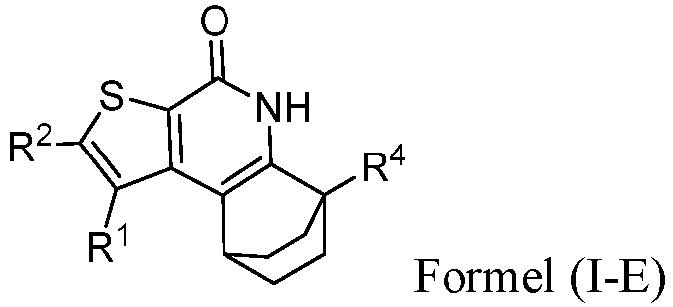 oder ein pharmazeutisch verträgliches Salz davon;eine Verbindung der Formel (I-F):
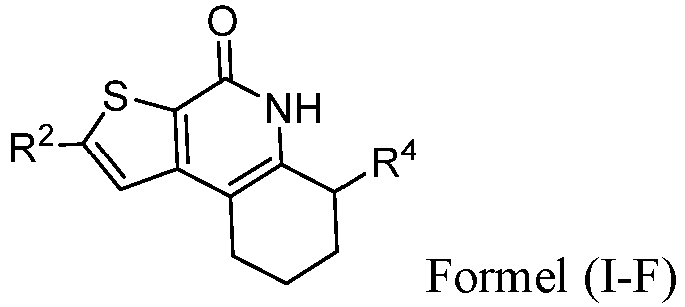 oder ein pharmazeutisch verträgliches Salz davon;eine Verbindung der Formel (I-G):
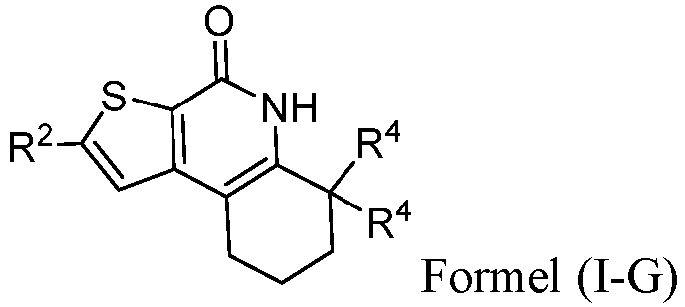 oder ein pharmazeutisch verträgliches Salz davon;Verbindung der Formel (I-H):
 oder ein pharmazeutisch verträgliches Salz davon;eine Verbindung der Formel(I-I):
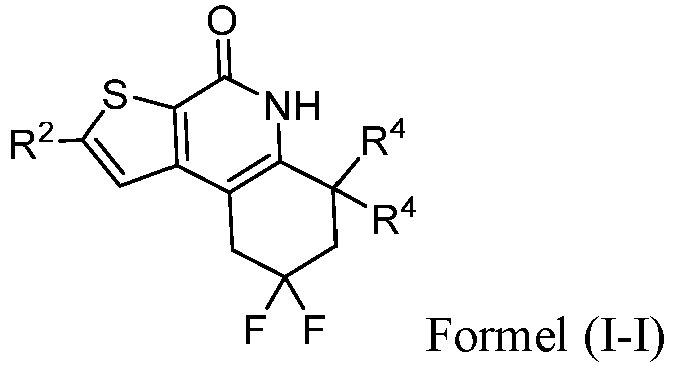 oder ein pharmazeutisch verträgliches Salz davon;eine Verbindung der Formel (I-J):
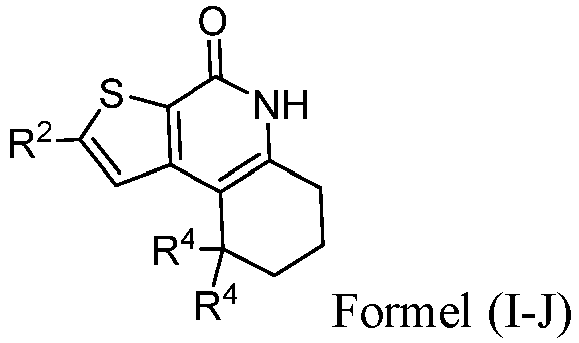 oder ein pharmazeutisch verträgliches Salz davon;eine Verbindung der Formel (I-K):
 oder ein pharmazeutisch verträgliches Salz davon;eine Verbindung der Formel (I-L):
 oder ein pharmazeutisch verträgliches Salz davon;eine Verbindung der Formel (I-M):
 oder ein pharmazeutisch verträgliches Salz davon;eine Verbindung der Formel (I-N):
 oder ein pharmazeutisch verträgliches Salz davon;eine Verbindung der Formel (I-O):
 oder ein pharmazeutisch verträgliches Salz davon; odereine Verbindung der Formel (I-P):
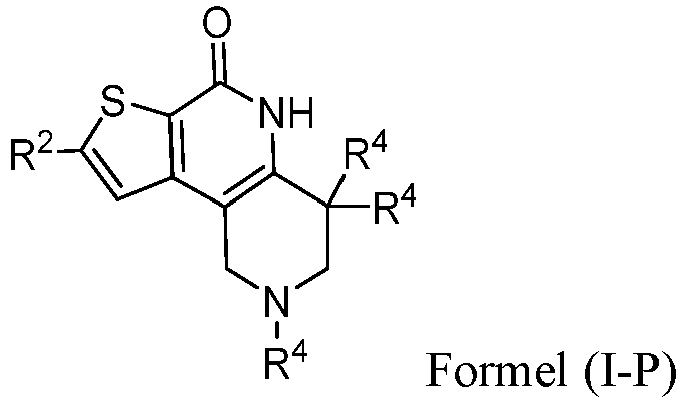 oder ein pharmazeutisch verträgliches Salz davon ist.
 - Verbindung nach Anspruch 1, wobei die Verbindung ausgewählt ist aus der Gruppe bestehend aus den Verbindungen in der Tabelle unten, und pharmazeutisch verträglichen Salzen davon.
Verbindung Nr. Struktur 1 
2 
3 
4 
5 
6 
7 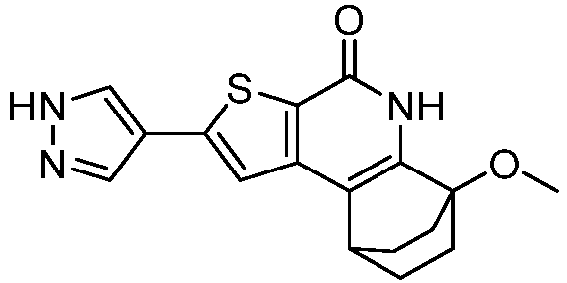
8 
9 
10 
11 
12 
13 
14 
15 
16 
17 
18 
19 
20 
21 
22 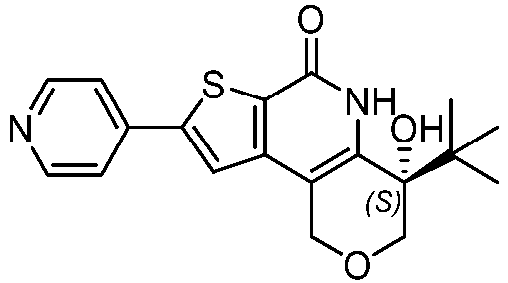
23 
24 
25 
26 
27 
28 
29 
30 
31 
32 
33 
34 
35 
36 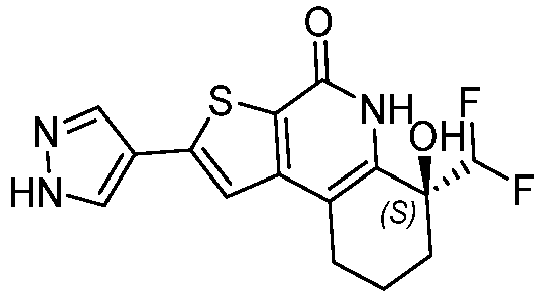
37 
38 
39 
40 
41 
42 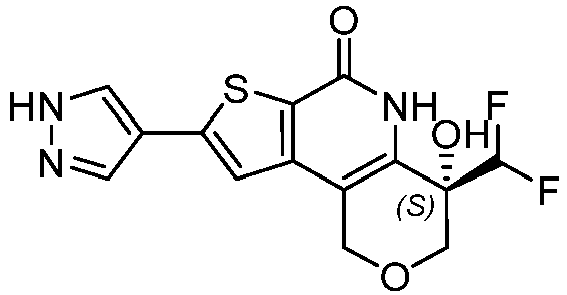
43 
44 
45 
46 
47 
48 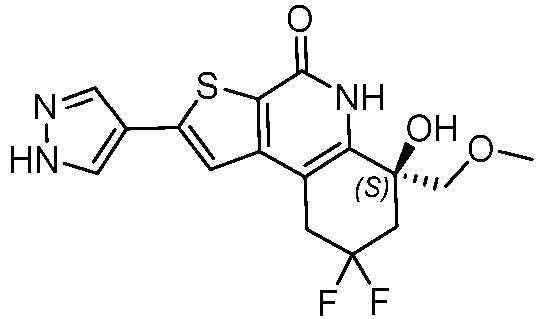
49 
50 
51 
52 
53 
54 
55 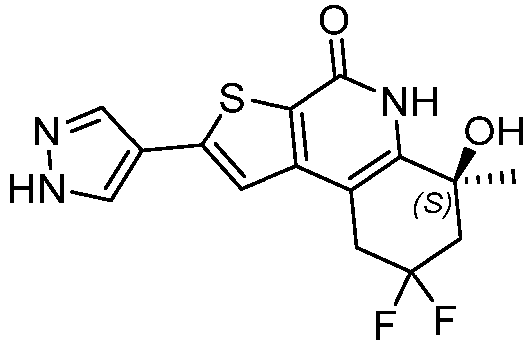
56 
57 
58 
59 
60 
61 
62 
63 
64 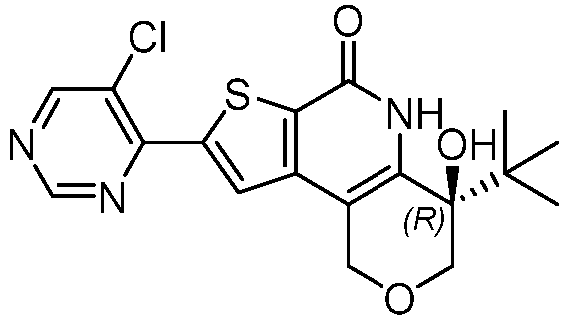
65 
66 
67 
68 
69 
70 
71 
72 
73 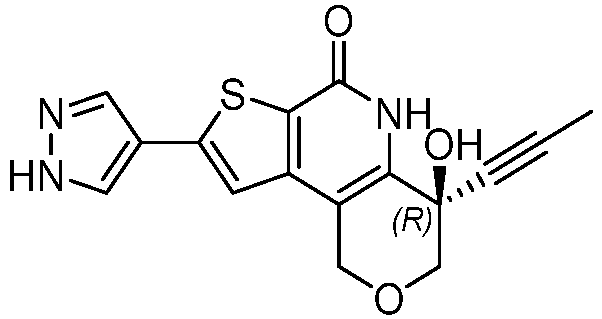
74 
75 
76 
77 
78 
79 
80 
81 
82 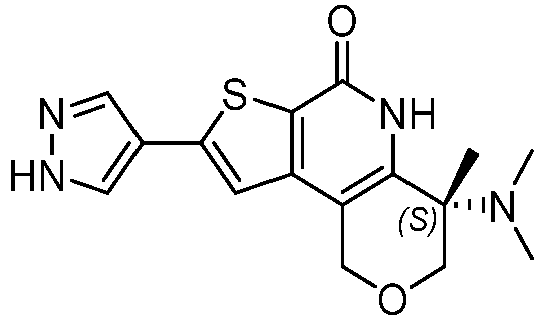
83 
84 
85 
86 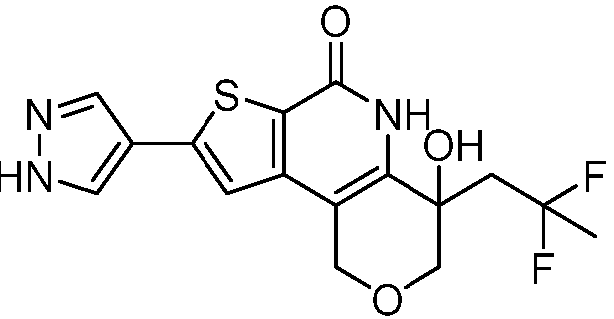
87 
88 
89 
90 
91 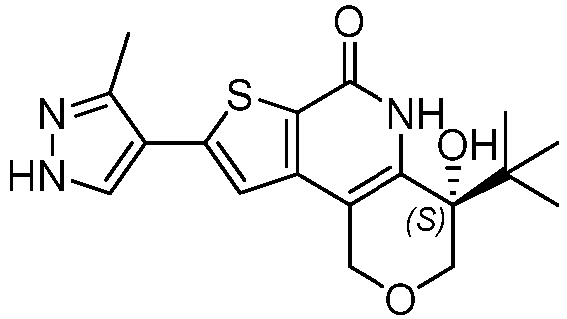
92 
93 
94 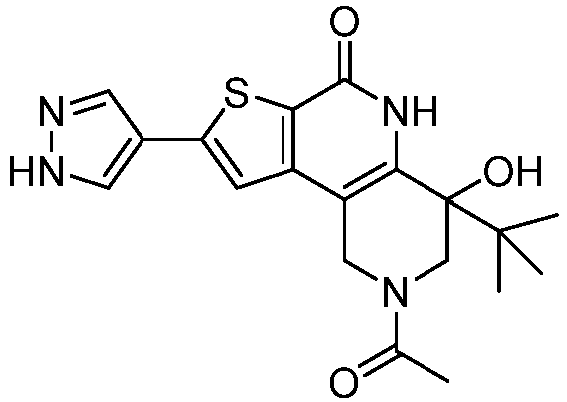
95 
96 
- Pharmazeutische Zusammensetzung, umfassend eine Verbindung nach einem der Ansprüche 1-15 oder ein pharmazeutisch verträgliches Salz davon und zumindest einen pharmazeutisch verträglichen Hilfsstoff.
- Verbindung nach einem der Ansprüche 1-15 oder ein pharmazeutisch verträgliches Salz davon oder eine pharmazeutische Zusammensetzung nach Anspruch 16 zur Verwendung in einem Verfahren zum Behandeln von Krebs bei einem Subjekt, das dessen bedarf, umfassend Verabreichen einer wirksamen Menge der Verbindung nach einem der Ansprüche 1-15 oder eines pharmazeutisch verträglichen Salzes davon oder einer pharmazeutischen Zusammensetzung nach Anspruch 16 an das Subjekt.
- Verbindung nach einem der Ansprüche 1-15 oder ein pharmazeutisch verträgliches Salz davon oder eine pharmazeutische Zusammensetzung nach Anspruch 16 zur Verwendung in einem Verfahren zum Behandeln von Krebs bei einem Subjekt, das dessen bedarf, umfassend:(a) Bestimmen, ob der Krebs mit einer Dysregulation eines CDC7-Gens, einer CDC7-Kinase oder Expression oder Aktivität oder Niveau von beliebigen davon assoziiert ist; und(b) wenn bestimmt ist, dass der Krebs mit einer Dysregulation eines CDC7-Gens, einer CDC7-Kinase oder Expression oder Aktivität oder Niveau von beliebigen davon assoziiert ist, Verabreichen einer wirksamen Menge der Verbindung nach einem der Ansprüche 1-15 oder eines pharmazeutisch verträglichen Salzes davon oder der pharmazeutischen Zusammensetzung nach Anspruch 16 an das Subjekt.
- Verbindung nach einem der Ansprüche 1-15 oder ein pharmazeutisch verträgliches Salz davon oder eine pharmazeutische Zusammensetzung nach Anspruch 16 zur Verwendung in dem Verfahren nach Anspruch 17 oder Anspruch 18, wobei das Verfahren ferner Verabreichen einer zusätzlichen Therapie oder eines zusätzlichen therapeutischen Mittels an das Subjekt umfasst.
Priority Applications (1)
| Application Number | Priority Date | Filing Date | Title |
|---|---|---|---|
| EP25174114.6A EP4574214A3 (de) | 2021-03-18 | 2022-03-17 | Cyclische verbindungen und verfahren zur verwendung davon |
Applications Claiming Priority (3)
| Application Number | Priority Date | Filing Date | Title |
|---|---|---|---|
| US202163162711P | 2021-03-18 | 2021-03-18 | |
| US202263297058P | 2022-01-06 | 2022-01-06 | |
| PCT/US2022/020712 WO2022197898A1 (en) | 2021-03-18 | 2022-03-17 | Cyclic compounds and methods of using same |
Related Child Applications (1)
| Application Number | Title | Priority Date | Filing Date |
|---|---|---|---|
| EP25174114.6A Division EP4574214A3 (de) | 2021-03-18 | 2022-03-17 | Cyclische verbindungen und verfahren zur verwendung davon |
Publications (2)
| Publication Number | Publication Date |
|---|---|
| EP4308573A1 EP4308573A1 (de) | 2024-01-24 |
| EP4308573B1 true EP4308573B1 (de) | 2025-05-07 |
Family
ID=81325449
Family Applications (2)
| Application Number | Title | Priority Date | Filing Date |
|---|---|---|---|
| EP25174114.6A Pending EP4574214A3 (de) | 2021-03-18 | 2022-03-17 | Cyclische verbindungen und verfahren zur verwendung davon |
| EP22715442.4A Active EP4308573B1 (de) | 2021-03-18 | 2022-03-17 | Cyclische verbindungen und verfahren zur verwendung davon |
Family Applications Before (1)
| Application Number | Title | Priority Date | Filing Date |
|---|---|---|---|
| EP25174114.6A Pending EP4574214A3 (de) | 2021-03-18 | 2022-03-17 | Cyclische verbindungen und verfahren zur verwendung davon |
Country Status (17)
| Country | Link |
|---|---|
| US (1) | US20240199634A1 (de) |
| EP (2) | EP4574214A3 (de) |
| JP (1) | JP7808616B2 (de) |
| KR (1) | KR20230172490A (de) |
| AU (1) | AU2022240640A1 (de) |
| BR (1) | BR112023018914A2 (de) |
| CA (1) | CA3212212A1 (de) |
| CL (1) | CL2023002761A1 (de) |
| CO (1) | CO2023012196A2 (de) |
| CR (1) | CR20230487A (de) |
| EC (1) | ECSP23075535A (de) |
| ES (1) | ES3034384T3 (de) |
| IL (1) | IL305925A (de) |
| MX (1) | MX2023010821A (de) |
| PE (1) | PE20240098A1 (de) |
| TW (1) | TW202300150A (de) |
| WO (1) | WO2022197898A1 (de) |
Family Cites Families (68)
| Publication number | Priority date | Publication date | Assignee | Title |
|---|---|---|---|---|
| DE602004021472D1 (en) | 2003-02-20 | 2009-07-23 | Smithkline Beecham Corp | Pyrimiidinverbindungen |
| CN1832943A (zh) | 2003-08-08 | 2006-09-13 | 默克公司 | 趋化因子受体活性的四氢吡喃杂环环戊基杂芳基调制剂 |
| WO2005099363A2 (en) | 2004-03-26 | 2005-10-27 | Whitehead Institute For Biomedical Research | Methods of diagnosing, preventing and treating cancer metastasis |
| GB0512324D0 (en) | 2005-06-16 | 2005-07-27 | Novartis Ag | Organic compounds |
| PE20060664A1 (es) | 2004-09-15 | 2006-08-04 | Novartis Ag | Amidas biciclicas como inhibidores de cinasa |
| NZ565255A (en) | 2005-06-22 | 2010-04-30 | Plexxikon Inc | Pyrrolo[2,3-b] pyridine derivatives as protein kinase inhibitors |
| TWI411607B (zh) | 2005-11-14 | 2013-10-11 | Vitae Pharmaceuticals Inc | 天門冬胺酸蛋白酶抑制劑 |
| KR101616388B1 (ko) | 2006-03-27 | 2016-04-29 | 네르비아노 메디칼 사이언시스 에스.알.엘. | 키나제 억제제로서의 피리딜- 및 피리미디닐-치환된 피롤-, 티오펜- 및 푸란-유도체 |
| WO2008079909A1 (en) | 2006-12-21 | 2008-07-03 | Plexxikon, Inc. | Pyrrolo [2,3-b] pyridines as kinase modulators |
| US7872018B2 (en) | 2006-12-21 | 2011-01-18 | Plexxikon, Inc. | Compounds and methods for kinase modulation, and indications therefor |
| PE20121126A1 (es) | 2006-12-21 | 2012-08-24 | Plexxikon Inc | Compuestos pirrolo [2,3-b] piridinas como moduladores de quinasa |
| EA201000092A1 (ru) | 2007-07-09 | 2010-06-30 | Астразенека Аб | Тризамещенные пиримидиновые производные для лечения пролиферативных заболеваний |
| JP2010533729A (ja) | 2007-07-17 | 2010-10-28 | プレキシコン,インコーポレーテッド | キナーゼ調節のための化合物と方法、及びそのための適応 |
| CA2693967A1 (en) | 2007-07-19 | 2009-01-29 | Schering Corporation | Heterocyclic amide compounds as protein kinase inhibitors |
| EP2215091B1 (de) | 2007-12-04 | 2016-03-30 | Nerviano Medical Sciences S.r.l. | Substituierte dihydropteridin-6-on-derivate, ihre herstellung und ihre verwendung als kinase inhibitoren |
| JP5767101B2 (ja) | 2008-03-28 | 2015-08-19 | ネルビアーノ・メデイカル・サイエンシーズ・エツセ・エルレ・エルレ | キナーゼ阻害剤として活性な3,4−ジヒドロ−2h−ピラジノ[1,2−a]インドール−1−オン誘導体、これらの調製方法、およびこれらを含む医薬組成物 |
| WO2009143018A2 (en) | 2008-05-19 | 2009-11-26 | Plexxikon, Inc. | Compounds and methods for kinase modulation, and indications therefor |
| PE20091846A1 (es) | 2008-05-19 | 2009-12-16 | Plexxikon Inc | DERIVADOS DE PIRROLO[2,3-d]-PIRIMIDINA COMO MODULADORES DE CINASAS |
| AU2009248774B2 (en) | 2008-05-23 | 2012-05-31 | Novartis Ag | Derivatives of quinolines and quinoxalines as protein tyrosine kinase inhibitors |
| CN102112478A (zh) | 2008-06-10 | 2011-06-29 | 普莱希科公司 | 用于激酶调节的5h-吡咯[2,3-b]吡嗪衍生物和其适应症 |
| ES2536730T3 (es) | 2008-09-19 | 2015-05-28 | Nerviano Medical Sciences S.R.L. | Derivados de 3,4-dihidro-2H-pirrolo[1,2-a]pirazin-1-ona |
| JO3265B1 (ar) | 2008-12-09 | 2018-09-16 | Novartis Ag | مثبطات بيريديلوكسى اندولات vegf-r2 واستخدامها لعلاج المرض |
| JP5645839B2 (ja) * | 2009-03-05 | 2014-12-24 | 武田薬品工業株式会社 | Cdc7キナーゼ阻害剤としてのチエノピリミジン |
| WO2010111527A1 (en) | 2009-03-26 | 2010-09-30 | Plexxikon, Inc. | Pyrazolo [ 3, 4 -b] pyridines as kinase inhibitors and their medical use |
| ES2679379T3 (es) | 2009-06-15 | 2018-08-24 | Nerviano Medical Sciences S.R.L. | Derivados de pirimidinilpirrolopiridinona sustituidos, proceso para su preparación y su uso como inhibidores de cinasa |
| JP5883395B2 (ja) | 2010-01-29 | 2016-03-15 | ネルビアーノ・メデイカル・サイエンシーズ・エツセ・エルレ・エルレ | タンパク質キナーゼモジュレーターとしての6,7−ジヒドロイミダゾ[1,5−a]ピラジン−8(5h)−オン誘導体 |
| SG183304A1 (en) * | 2010-02-17 | 2012-09-27 | Takeda Pharmaceutical | Heterocyclic compound |
| EP2536414B1 (de) | 2010-02-18 | 2016-07-13 | INSERM (Institut National de la Santé et de la Recherche Médicale) | Verfahren zur vorbeugung von krebsmetastasen |
| TWI503323B (zh) * | 2010-03-29 | 2015-10-11 | Oncotherapy Science Inc | 三環化合物以及含此化合物之pbk抑制劑 |
| SG189396A1 (en) * | 2010-10-13 | 2013-05-31 | Millennium Pharm Inc | Heteroaryls and uses thereof |
| EP2668190B1 (de) | 2011-01-26 | 2016-08-17 | Nerviano Medical Sciences S.r.l. | Tricyclische pyrroloderivate, verfahren zu ihrer herstellung und ihre verwendung als kinasehemmer |
| JP5925808B2 (ja) | 2011-01-26 | 2016-05-25 | ネルビアーノ・メデイカル・サイエンシーズ・エツセ・エルレ・エルレ | 三環式誘導体、これらの調製方法およびこれらのキナーゼ阻害剤としての使用 |
| PT2672967T (pt) | 2011-02-07 | 2018-12-07 | Plexxikon Inc | Compostos e métodos de modulação da quinase e suas indicações |
| US9199979B2 (en) | 2011-02-24 | 2015-12-01 | Nerviano Medical Sciences S.R.L. | Thiazolylphenyl-benzenesulfonamido derivatives as kinase inhibitors |
| US9284298B2 (en) | 2011-04-11 | 2016-03-15 | Nerviano Medical Sciences S.R.L. | Pyrazolyl-pyrimidine derivatives as kinase inhibitors |
| US9283224B2 (en) | 2011-04-19 | 2016-03-15 | Nerviano Medical Sciences S.R.L. | Substituted pyrimidinyl-pyrroles active as kinase inhibitors |
| PT2707359T (pt) | 2011-05-12 | 2017-01-09 | Nerviano Medical Sciences Srl | Derivados de indazol substituídos ativos como inibidores de quinase |
| JP6016915B2 (ja) | 2011-07-28 | 2016-10-26 | ネルビアーノ・メデイカル・サイエンシーズ・エツセ・エルレ・エルレ | キナーゼ阻害剤として活性なアルキニル置換ピリミジニルピロール |
| US9145418B2 (en) | 2011-10-07 | 2015-09-29 | Nerviano Medical Sciences S.R.L. | Substituted 3,4-dihydropyrrolo[1,2-a]pyrazin-1(2H)-ones as protein kinase inhibitors |
| JP6063945B2 (ja) | 2011-10-07 | 2017-01-18 | ネルビアーノ・メデイカル・サイエンシーズ・エツセ・エルレ・エルレ | キナーゼ阻害剤としての4−アルキル置換3,4−ジヒドロピロロ[1,2−a]ピラジン−1(2H)−オン誘導体 |
| US8377946B1 (en) | 2011-12-30 | 2013-02-19 | Pharmacyclics, Inc. | Pyrazolo[3,4-d]pyrimidine and pyrrolo[2,3-d]pyrimidine compounds as kinase inhibitors |
| US8822460B2 (en) | 2012-04-06 | 2014-09-02 | Janssen Pharmaceutica Nv | Fused cyclopentyl antagonists of CCR2 |
| LT2872491T (lt) | 2012-07-11 | 2021-08-25 | Blueprint Medicines Corporation | Fibroblasto augimo faktoriaus receptoriaus inhibitoriai |
| BR112015002152B1 (pt) | 2012-08-02 | 2021-04-27 | Nerviano Medical Sciences S.R.L. | Compostos de pirróis substituídos ativos como inibidores de quinases, processo para a preparação de tais compostos, composição farmacêutica, método in vitro para a inibição da atividade de proteínas quinases da família jak e produto compreendendo os referidos compostos |
| CN104870446B (zh) | 2012-11-07 | 2019-08-13 | 内尔维阿诺医学科学有限公司 | 取代的嘧啶基和吡啶基吡咯并吡啶酮类、其制备方法及其作为激酶抑制剂的用途 |
| HK1213189A1 (zh) | 2012-11-29 | 2016-06-30 | 耶达研究及发展有限公司 | 预防肿瘤转移、癌症治疗和预後及鉴定为推定转移抑制剂的试剂的方法 |
| US9499522B2 (en) | 2013-03-15 | 2016-11-22 | Blueprint Medicines Corporation | Compositions useful for treating disorders related to kit |
| EP2997030B1 (de) | 2013-05-14 | 2017-08-09 | Nerviano Medical Sciences S.R.L. | Pyrrolo[2,3-d]pyrimidinderivate, verfahren zu ihrer herstellung und ihre verwendung als kinase-hemmer |
| CA2912568A1 (en) | 2013-05-30 | 2014-12-04 | Plexxikon Inc. | Compounds for kinase modulation, and indications therefor |
| US10407509B2 (en) | 2013-07-30 | 2019-09-10 | Blueprint Medicines Corporation | NTRK2 fusions |
| EP3027654B1 (de) | 2013-07-30 | 2019-09-25 | Blueprint Medicines Corporation | Pik3c2g-fusionen |
| ES2683127T3 (es) | 2013-10-17 | 2018-09-25 | Blueprint Medicines Corporation | Composiciones útiles para tratar trastornos relacionados con la KIT |
| WO2015058129A1 (en) | 2013-10-17 | 2015-04-23 | Blueprint Medicines Corporation | Compositions useful for treating disorders related to kit |
| RU2704112C2 (ru) | 2013-10-25 | 2019-10-24 | Блюпринт Медсинс Корпорейшн | Ингибиторы рецептора фактора роста фибробластов |
| US9695165B2 (en) | 2014-01-15 | 2017-07-04 | Blueprint Medicines Corporation | Inhibitors of the fibroblast growth factor receptor |
| UA121206C2 (uk) | 2014-01-24 | 2020-04-27 | Турнінґ Поінт Терапьютикс, Інк. | Діарильні макроцикли як модулятори протеїнкіназ |
| EP3132056B1 (de) | 2014-04-18 | 2021-11-24 | Blueprint Medicines Corporation | Pik3ca-fusionen |
| US20170044621A1 (en) | 2014-04-18 | 2017-02-16 | Blueprint Medicines Corporation | Met fusions |
| US10378063B2 (en) | 2014-06-10 | 2019-08-13 | Blueprint Medicines Corporation | RAF1 fusions |
| EP3155118A1 (de) | 2014-06-10 | 2017-04-19 | Blueprint Medicines Corporation | Pkn1-fusionen |
| US10370725B2 (en) | 2014-07-17 | 2019-08-06 | Blueprint Medicines Corporation | FGR fusions |
| US10370723B2 (en) | 2014-07-17 | 2019-08-06 | Blueprint Medicines Corporation | TERT fusions |
| WO2016011147A1 (en) | 2014-07-17 | 2016-01-21 | Blueprint Medicines Corporation | Prkc fusions |
| US9688680B2 (en) | 2014-08-04 | 2017-06-27 | Blueprint Medicines Corporation | Compositions useful for treating disorders related to kit |
| KR102562866B1 (ko) | 2014-11-14 | 2023-08-04 | 네르비아노 메디칼 사이언시스 에스.알.엘. | 단백질 키나아제 억제제로서의 6-아미노-7-바이사이클로-7-데아자-퓨린 유도체 |
| WO2016081450A1 (en) | 2014-11-18 | 2016-05-26 | Blueprint Medicines Corporation | Prkacb fusions |
| CN112409373A (zh) * | 2017-05-21 | 2021-02-26 | 南京正济医药研究有限公司 | 作为抗癌剂的取代的[5,6]环-4(3h)-嘧啶酮 |
| WO2019165473A1 (en) * | 2018-02-26 | 2019-08-29 | Sierra Oncology, Inc | Methods of treatment of cancer comprising cdc7 inhibitors |
-
2022
- 2022-03-03 TW TW111107716A patent/TW202300150A/zh unknown
- 2022-03-17 MX MX2023010821A patent/MX2023010821A/es unknown
- 2022-03-17 WO PCT/US2022/020712 patent/WO2022197898A1/en not_active Ceased
- 2022-03-17 EP EP25174114.6A patent/EP4574214A3/de active Pending
- 2022-03-17 EP EP22715442.4A patent/EP4308573B1/de active Active
- 2022-03-17 US US18/282,318 patent/US20240199634A1/en active Pending
- 2022-03-17 PE PE2023002640A patent/PE20240098A1/es unknown
- 2022-03-17 JP JP2023557019A patent/JP7808616B2/ja active Active
- 2022-03-17 BR BR112023018914A patent/BR112023018914A2/pt unknown
- 2022-03-17 KR KR1020237035621A patent/KR20230172490A/ko active Pending
- 2022-03-17 CA CA3212212A patent/CA3212212A1/en active Pending
- 2022-03-17 CR CR20230487A patent/CR20230487A/es unknown
- 2022-03-17 ES ES22715442T patent/ES3034384T3/es active Active
- 2022-03-17 IL IL305925A patent/IL305925A/en unknown
- 2022-03-17 AU AU2022240640A patent/AU2022240640A1/en active Pending
-
2023
- 2023-09-15 CL CL2023002761A patent/CL2023002761A1/es unknown
- 2023-09-15 CO CONC2023/0012196A patent/CO2023012196A2/es unknown
- 2023-10-04 EC ECSENADI202375535A patent/ECSP23075535A/es unknown
Also Published As
| Publication number | Publication date |
|---|---|
| CA3212212A1 (en) | 2022-09-22 |
| PE20240098A1 (es) | 2024-01-18 |
| KR20230172490A (ko) | 2023-12-22 |
| AU2022240640A1 (en) | 2023-10-05 |
| JP7808616B2 (ja) | 2026-01-29 |
| CR20230487A (es) | 2024-02-15 |
| MX2023010821A (es) | 2023-09-28 |
| EP4574214A3 (de) | 2025-08-20 |
| BR112023018914A2 (pt) | 2023-10-10 |
| EP4574214A2 (de) | 2025-06-25 |
| IL305925A (en) | 2023-11-01 |
| TW202300150A (zh) | 2023-01-01 |
| EP4308573A1 (de) | 2024-01-24 |
| CL2023002761A1 (es) | 2024-03-22 |
| WO2022197898A1 (en) | 2022-09-22 |
| US20240199634A1 (en) | 2024-06-20 |
| ECSP23075535A (es) | 2024-01-31 |
| CO2023012196A2 (es) | 2023-10-30 |
| JP2024511028A (ja) | 2024-03-12 |
| ES3034384T3 (en) | 2025-08-18 |
Similar Documents
| Publication | Publication Date | Title |
|---|---|---|
| JP7723666B2 (ja) | 環式化合物およびその使用方法 | |
| JP2022515198A (ja) | FGFRチロシンキナーゼの阻害剤としての置換ピラゾロ[1,5-a]ピリジン化合物 | |
| KR102336291B1 (ko) | 암을 치료하기 위한 NIK 억제제로서의 3-(2-아미노피리미딘-4-일)-5-(3-하이드록시프로피닐)-1H-피롤로[2,3-c]피리딘 유도체 | |
| WO2022164789A1 (en) | Tricyclic compounds useful in the treatment of cancer, autoimmune and inflammatory disoders | |
| WO2022155202A1 (en) | Fused heterocycles and uses of same | |
| TW202332429A (zh) | 治療性化合物及其使用方法 | |
| EP4558505A2 (de) | Cyclische verbindungen und verfahren zur verwendung davon | |
| US20230101747A1 (en) | Cyclic compounds and methods of using same | |
| EP4308573B1 (de) | Cyclische verbindungen und verfahren zur verwendung davon | |
| HK40127987A (en) | Cyclic compounds and methods of using same | |
| CN117120442A (zh) | 用于治疗癌症、自身免疫性病症和炎性病症的三环化合物 | |
| CN117120447A (zh) | 环状化合物和其使用方法 | |
| WO2025059027A1 (en) | Cyclopenta[e]pyrazolo[1,5-a]pyrimidine derivatives as malt1 inhibitors | |
| CN116490507A (zh) | 用于治疗癌症的杂环包缩合cdc7激酶抑制剂 | |
| EA052528B1 (ru) | Циклические соединения и способы их применения |
Legal Events
| Date | Code | Title | Description |
|---|---|---|---|
| STAA | Information on the status of an ep patent application or granted ep patent |
Free format text: STATUS: UNKNOWN |
|
| STAA | Information on the status of an ep patent application or granted ep patent |
Free format text: STATUS: THE INTERNATIONAL PUBLICATION HAS BEEN MADE |
|
| PUAI | Public reference made under article 153(3) epc to a published international application that has entered the european phase |
Free format text: ORIGINAL CODE: 0009012 |
|
| STAA | Information on the status of an ep patent application or granted ep patent |
Free format text: STATUS: REQUEST FOR EXAMINATION WAS MADE |
|
| 17P | Request for examination filed |
Effective date: 20231011 |
|
| AK | Designated contracting states |
Kind code of ref document: A1 Designated state(s): AL AT BE BG CH CY CZ DE DK EE ES FI FR GB GR HR HU IE IS IT LI LT LU LV MC MK MT NL NO PL PT RO RS SE SI SK SM TR |
|
| DAX | Request for extension of the european patent (deleted) | ||
| RAV | Requested validation state of the european patent: fee paid |
Extension state: MA Effective date: 20231011 |
|
| REG | Reference to a national code |
Ref country code: HK Ref legal event code: DE Ref document number: 40104099 Country of ref document: HK |
|
| GRAP | Despatch of communication of intention to grant a patent |
Free format text: ORIGINAL CODE: EPIDOSNIGR1 |
|
| STAA | Information on the status of an ep patent application or granted ep patent |
Free format text: STATUS: GRANT OF PATENT IS INTENDED |
|
| INTG | Intention to grant announced |
Effective date: 20241120 |
|
| GRAS | Grant fee paid |
Free format text: ORIGINAL CODE: EPIDOSNIGR3 |
|
| GRAA | (expected) grant |
Free format text: ORIGINAL CODE: 0009210 |
|
| STAA | Information on the status of an ep patent application or granted ep patent |
Free format text: STATUS: THE PATENT HAS BEEN GRANTED |
|
| AK | Designated contracting states |
Kind code of ref document: B1 Designated state(s): AL AT BE BG CH CY CZ DE DK EE ES FI FR GB GR HR HU IE IS IT LI LT LU LV MC MK MT NL NO PL PT RO RS SE SI SK SM TR |
|
| REG | Reference to a national code |
Ref country code: GB Ref legal event code: FG4D |
|
| REG | Reference to a national code |
Ref country code: CH Ref legal event code: EP |
|
| REG | Reference to a national code |
Ref country code: DE Ref legal event code: R096 Ref document number: 602022014291 Country of ref document: DE |
|
| P01 | Opt-out of the competence of the unified patent court (upc) registered |
Free format text: CASE NUMBER: APP_19964/2025 Effective date: 20250425 |
|
| REG | Reference to a national code |
Ref country code: IE Ref legal event code: FG4D |
|
| REG | Reference to a national code |
Ref country code: ES Ref legal event code: FG2A Ref document number: 3034384 Country of ref document: ES Kind code of ref document: T3 Effective date: 20250818 |
|
| REG | Reference to a national code |
Ref country code: NL Ref legal event code: MP Effective date: 20250507 |
|
| PG25 | Lapsed in a contracting state [announced via postgrant information from national office to epo] |
Ref country code: FI Free format text: LAPSE BECAUSE OF FAILURE TO SUBMIT A TRANSLATION OF THE DESCRIPTION OR TO PAY THE FEE WITHIN THE PRESCRIBED TIME-LIMIT Effective date: 20250507 Ref country code: PT Free format text: LAPSE BECAUSE OF FAILURE TO SUBMIT A TRANSLATION OF THE DESCRIPTION OR TO PAY THE FEE WITHIN THE PRESCRIBED TIME-LIMIT Effective date: 20250908 |
|
| REG | Reference to a national code |
Ref country code: LT Ref legal event code: MG9D |
|
| PG25 | Lapsed in a contracting state [announced via postgrant information from national office to epo] |
Ref country code: NO Free format text: LAPSE BECAUSE OF FAILURE TO SUBMIT A TRANSLATION OF THE DESCRIPTION OR TO PAY THE FEE WITHIN THE PRESCRIBED TIME-LIMIT Effective date: 20250807 Ref country code: GR Free format text: LAPSE BECAUSE OF FAILURE TO SUBMIT A TRANSLATION OF THE DESCRIPTION OR TO PAY THE FEE WITHIN THE PRESCRIBED TIME-LIMIT Effective date: 20250808 |
|
| PG25 | Lapsed in a contracting state [announced via postgrant information from national office to epo] |
Ref country code: PL Free format text: LAPSE BECAUSE OF FAILURE TO SUBMIT A TRANSLATION OF THE DESCRIPTION OR TO PAY THE FEE WITHIN THE PRESCRIBED TIME-LIMIT Effective date: 20250507 Ref country code: NL Free format text: LAPSE BECAUSE OF FAILURE TO SUBMIT A TRANSLATION OF THE DESCRIPTION OR TO PAY THE FEE WITHIN THE PRESCRIBED TIME-LIMIT Effective date: 20250507 |
|
| REG | Reference to a national code |
Ref country code: AT Ref legal event code: MK05 Ref document number: 1792404 Country of ref document: AT Kind code of ref document: T Effective date: 20250507 |
|
| PG25 | Lapsed in a contracting state [announced via postgrant information from national office to epo] |
Ref country code: BG Free format text: LAPSE BECAUSE OF FAILURE TO SUBMIT A TRANSLATION OF THE DESCRIPTION OR TO PAY THE FEE WITHIN THE PRESCRIBED TIME-LIMIT Effective date: 20250507 |
|
| PG25 | Lapsed in a contracting state [announced via postgrant information from national office to epo] |
Ref country code: HR Free format text: LAPSE BECAUSE OF FAILURE TO SUBMIT A TRANSLATION OF THE DESCRIPTION OR TO PAY THE FEE WITHIN THE PRESCRIBED TIME-LIMIT Effective date: 20250507 |
|
| PG25 | Lapsed in a contracting state [announced via postgrant information from national office to epo] |
Ref country code: AT Free format text: LAPSE BECAUSE OF FAILURE TO SUBMIT A TRANSLATION OF THE DESCRIPTION OR TO PAY THE FEE WITHIN THE PRESCRIBED TIME-LIMIT Effective date: 20250507 |
|
| PG25 | Lapsed in a contracting state [announced via postgrant information from national office to epo] |
Ref country code: RS Free format text: LAPSE BECAUSE OF FAILURE TO SUBMIT A TRANSLATION OF THE DESCRIPTION OR TO PAY THE FEE WITHIN THE PRESCRIBED TIME-LIMIT Effective date: 20250807 |
|
| PG25 | Lapsed in a contracting state [announced via postgrant information from national office to epo] |
Ref country code: IS Free format text: LAPSE BECAUSE OF FAILURE TO SUBMIT A TRANSLATION OF THE DESCRIPTION OR TO PAY THE FEE WITHIN THE PRESCRIBED TIME-LIMIT Effective date: 20250907 |
|
| PG25 | Lapsed in a contracting state [announced via postgrant information from national office to epo] |
Ref country code: LV Free format text: LAPSE BECAUSE OF FAILURE TO SUBMIT A TRANSLATION OF THE DESCRIPTION OR TO PAY THE FEE WITHIN THE PRESCRIBED TIME-LIMIT Effective date: 20250507 |
|
| PG25 | Lapsed in a contracting state [announced via postgrant information from national office to epo] |
Ref country code: SM Free format text: LAPSE BECAUSE OF FAILURE TO SUBMIT A TRANSLATION OF THE DESCRIPTION OR TO PAY THE FEE WITHIN THE PRESCRIBED TIME-LIMIT Effective date: 20250507 Ref country code: DK Free format text: LAPSE BECAUSE OF FAILURE TO SUBMIT A TRANSLATION OF THE DESCRIPTION OR TO PAY THE FEE WITHIN THE PRESCRIBED TIME-LIMIT Effective date: 20250507 |
|
| PG25 | Lapsed in a contracting state [announced via postgrant information from national office to epo] |
Ref country code: CZ Free format text: LAPSE BECAUSE OF FAILURE TO SUBMIT A TRANSLATION OF THE DESCRIPTION OR TO PAY THE FEE WITHIN THE PRESCRIBED TIME-LIMIT Effective date: 20250507 |
|
| PG25 | Lapsed in a contracting state [announced via postgrant information from national office to epo] |
Ref country code: EE Free format text: LAPSE BECAUSE OF FAILURE TO SUBMIT A TRANSLATION OF THE DESCRIPTION OR TO PAY THE FEE WITHIN THE PRESCRIBED TIME-LIMIT Effective date: 20250507 |
|
| PG25 | Lapsed in a contracting state [announced via postgrant information from national office to epo] |
Ref country code: SK Free format text: LAPSE BECAUSE OF FAILURE TO SUBMIT A TRANSLATION OF THE DESCRIPTION OR TO PAY THE FEE WITHIN THE PRESCRIBED TIME-LIMIT Effective date: 20250507 |
|
| REG | Reference to a national code |
Ref country code: DE Ref legal event code: R097 Ref document number: 602022014291 Country of ref document: DE |
|
| PLBE | No opposition filed within time limit |
Free format text: ORIGINAL CODE: 0009261 |
|
| STAA | Information on the status of an ep patent application or granted ep patent |
Free format text: STATUS: NO OPPOSITION FILED WITHIN TIME LIMIT |
|
| REG | Reference to a national code |
Ref country code: CH Ref legal event code: L10 Free format text: ST27 STATUS EVENT CODE: U-0-0-L10-L00 (AS PROVIDED BY THE NATIONAL OFFICE) Effective date: 20260318 |