EP4297130A1 - Negativelektrodenmaterial und herstellungsverfahren dafür sowie lithium-ionen-batterie - Google Patents
Negativelektrodenmaterial und herstellungsverfahren dafür sowie lithium-ionen-batterie Download PDFInfo
- Publication number
- EP4297130A1 EP4297130A1 EP23769098.7A EP23769098A EP4297130A1 EP 4297130 A1 EP4297130 A1 EP 4297130A1 EP 23769098 A EP23769098 A EP 23769098A EP 4297130 A1 EP4297130 A1 EP 4297130A1
- Authority
- EP
- European Patent Office
- Prior art keywords
- negative electrode
- electrode material
- silicon
- particle size
- based active
- Prior art date
- Legal status (The legal status is an assumption and is not a legal conclusion. Google has not performed a legal analysis and makes no representation as to the accuracy of the status listed.)
- Pending
Links
Images


Classifications
-
- H—ELECTRICITY
- H01—ELECTRIC ELEMENTS
- H01M—PROCESSES OR MEANS, e.g. BATTERIES, FOR THE DIRECT CONVERSION OF CHEMICAL ENERGY INTO ELECTRICAL ENERGY
- H01M4/00—Electrodes
- H01M4/02—Electrodes composed of, or comprising, active material
- H01M4/13—Electrodes for accumulators with non-aqueous electrolyte, e.g. for lithium-accumulators; Processes of manufacture thereof
- H01M4/134—Electrodes based on metals, Si or alloys
-
- H—ELECTRICITY
- H01—ELECTRIC ELEMENTS
- H01M—PROCESSES OR MEANS, e.g. BATTERIES, FOR THE DIRECT CONVERSION OF CHEMICAL ENERGY INTO ELECTRICAL ENERGY
- H01M4/00—Electrodes
- H01M4/02—Electrodes composed of, or comprising, active material
- H01M4/36—Selection of substances as active materials, active masses, active liquids
- H01M4/48—Selection of substances as active materials, active masses, active liquids of inorganic oxides or hydroxides
-
- H—ELECTRICITY
- H01—ELECTRIC ELEMENTS
- H01M—PROCESSES OR MEANS, e.g. BATTERIES, FOR THE DIRECT CONVERSION OF CHEMICAL ENERGY INTO ELECTRICAL ENERGY
- H01M10/00—Secondary cells; Manufacture thereof
- H01M10/05—Accumulators with non-aqueous electrolyte
- H01M10/052—Li-accumulators
- H01M10/0525—Rocking-chair batteries, i.e. batteries with lithium insertion or intercalation in both electrodes; Lithium-ion batteries
-
- H—ELECTRICITY
- H01—ELECTRIC ELEMENTS
- H01M—PROCESSES OR MEANS, e.g. BATTERIES, FOR THE DIRECT CONVERSION OF CHEMICAL ENERGY INTO ELECTRICAL ENERGY
- H01M4/00—Electrodes
- H01M4/02—Electrodes composed of, or comprising, active material
- H01M4/13—Electrodes for accumulators with non-aqueous electrolyte, e.g. for lithium-accumulators; Processes of manufacture thereof
- H01M4/139—Processes of manufacture
- H01M4/1395—Processes of manufacture of electrodes based on metals, Si or alloys
-
- H—ELECTRICITY
- H01—ELECTRIC ELEMENTS
- H01M—PROCESSES OR MEANS, e.g. BATTERIES, FOR THE DIRECT CONVERSION OF CHEMICAL ENERGY INTO ELECTRICAL ENERGY
- H01M4/00—Electrodes
- H01M4/02—Electrodes composed of, or comprising, active material
- H01M4/36—Selection of substances as active materials, active masses, active liquids
- H01M4/38—Selection of substances as active materials, active masses, active liquids of elements or alloys
- H01M4/386—Silicon or alloys based on silicon
-
- H—ELECTRICITY
- H01—ELECTRIC ELEMENTS
- H01M—PROCESSES OR MEANS, e.g. BATTERIES, FOR THE DIRECT CONVERSION OF CHEMICAL ENERGY INTO ELECTRICAL ENERGY
- H01M4/00—Electrodes
- H01M4/02—Electrodes composed of, or comprising, active material
- H01M4/36—Selection of substances as active materials, active masses, active liquids
- H01M4/48—Selection of substances as active materials, active masses, active liquids of inorganic oxides or hydroxides
- H01M4/483—Selection of substances as active materials, active masses, active liquids of inorganic oxides or hydroxides for non-aqueous cells
-
- H—ELECTRICITY
- H01—ELECTRIC ELEMENTS
- H01M—PROCESSES OR MEANS, e.g. BATTERIES, FOR THE DIRECT CONVERSION OF CHEMICAL ENERGY INTO ELECTRICAL ENERGY
- H01M4/00—Electrodes
- H01M4/02—Electrodes composed of, or comprising, active material
- H01M4/36—Selection of substances as active materials, active masses, active liquids
- H01M4/48—Selection of substances as active materials, active masses, active liquids of inorganic oxides or hydroxides
- H01M4/485—Selection of substances as active materials, active masses, active liquids of inorganic oxides or hydroxides of mixed oxides or hydroxides for inserting or intercalating light metals, e.g. LiTi2O4 or LiTi2OxFy
-
- H—ELECTRICITY
- H01—ELECTRIC ELEMENTS
- H01M—PROCESSES OR MEANS, e.g. BATTERIES, FOR THE DIRECT CONVERSION OF CHEMICAL ENERGY INTO ELECTRICAL ENERGY
- H01M4/00—Electrodes
- H01M4/02—Electrodes composed of, or comprising, active material
- H01M4/36—Selection of substances as active materials, active masses, active liquids
- H01M4/58—Selection of substances as active materials, active masses, active liquids of inorganic compounds other than oxides or hydroxides, e.g. sulfides, selenides, tellurides, halogenides or LiCoFy; of polyanionic structures, e.g. phosphates, silicates or borates
- H01M4/583—Carbonaceous material, e.g. graphite-intercalation compounds or CFx
-
- H—ELECTRICITY
- H01—ELECTRIC ELEMENTS
- H01M—PROCESSES OR MEANS, e.g. BATTERIES, FOR THE DIRECT CONVERSION OF CHEMICAL ENERGY INTO ELECTRICAL ENERGY
- H01M4/00—Electrodes
- H01M4/02—Electrodes composed of, or comprising, active material
- H01M4/62—Selection of inactive substances as ingredients for active masses, e.g. binders, fillers
- H01M4/624—Electric conductive fillers
- H01M4/625—Carbon or graphite
-
- H—ELECTRICITY
- H01—ELECTRIC ELEMENTS
- H01M—PROCESSES OR MEANS, e.g. BATTERIES, FOR THE DIRECT CONVERSION OF CHEMICAL ENERGY INTO ELECTRICAL ENERGY
- H01M4/00—Electrodes
- H01M4/02—Electrodes composed of, or comprising, active material
- H01M2004/021—Physical characteristics, e.g. porosity, surface area
-
- H—ELECTRICITY
- H01—ELECTRIC ELEMENTS
- H01M—PROCESSES OR MEANS, e.g. BATTERIES, FOR THE DIRECT CONVERSION OF CHEMICAL ENERGY INTO ELECTRICAL ENERGY
- H01M4/00—Electrodes
- H01M4/02—Electrodes composed of, or comprising, active material
- H01M2004/026—Electrodes composed of, or comprising, active material characterised by the polarity
- H01M2004/027—Negative electrodes
-
- H—ELECTRICITY
- H01—ELECTRIC ELEMENTS
- H01M—PROCESSES OR MEANS, e.g. BATTERIES, FOR THE DIRECT CONVERSION OF CHEMICAL ENERGY INTO ELECTRICAL ENERGY
- H01M4/00—Electrodes
- H01M4/02—Electrodes composed of, or comprising, active material
- H01M4/36—Selection of substances as active materials, active masses, active liquids
- H01M4/362—Composites
- H01M4/366—Composites as layered products
-
- Y—GENERAL TAGGING OF NEW TECHNOLOGICAL DEVELOPMENTS; GENERAL TAGGING OF CROSS-SECTIONAL TECHNOLOGIES SPANNING OVER SEVERAL SECTIONS OF THE IPC; TECHNICAL SUBJECTS COVERED BY FORMER USPC CROSS-REFERENCE ART COLLECTIONS [XRACs] AND DIGESTS
- Y02—TECHNOLOGIES OR APPLICATIONS FOR MITIGATION OR ADAPTATION AGAINST CLIMATE CHANGE
- Y02E—REDUCTION OF GREENHOUSE GAS [GHG] EMISSIONS, RELATED TO ENERGY GENERATION, TRANSMISSION OR DISTRIBUTION
- Y02E60/00—Enabling technologies; Technologies with a potential or indirect contribution to GHG emissions mitigation
- Y02E60/10—Energy storage using batteries
Definitions
- the present disclosure relates to the technical field of secondary batteries, and in particular to a negative electrode material and a preparation method thereof and a lithium-ion battery.
- the silicon-based negative electrode material has the specific capacity exceeding 3000mAh/g, but when being applied to the lithium-ion batteries, has relatively poor cycle stability and a relatively high battery expansion rate compared with the graphite material, thus the practical application thereof is restricted. Therefore, to develop a material with good cycle stability and a low expansion rate is of great significance.
- the cycle and expansion properties of the lithium-ion battery can be improved by improving properties such as chemical structure and electrical conductivity of the battery material, and also can be improved by adjusting the properties of the battery material and improving the properties of a battery electrode sheet, for example, distribution uniformity and consistency of material particles in the electrode sheet.
- the prior art has the problems of uneven distribution and poor consistency of material particles in the electrode sheet.
- the negative electrode material includes a silicon-based active material, wherein the silicon-based active material includes at least one of SiO x , SiO x /C, SiO x /M, Si, Si/C, and Si/M, 0 ⁇ x ⁇ 2, and M includes at least one of metal, nonmetal, metal oxide, and nonmetal oxide.
- the particle size distribution of the negative electrode material is: 0 ⁇ D 5 ⁇ 65 ⁇ m, 0 ⁇ D 25 ⁇ 69 ⁇ m, 0 ⁇ D 75 ⁇ 75 ⁇ m, and 0 ⁇ D 95 ⁇ 79 ⁇ m.
- an infrared spectrum of the negative electrode material tested in a range of wave number of 3200 cm -1 -3600 cm -1 has a broad peak.
- wadell degree of sphericity of the negative electrode material is greater than or equal to 0.8.
- particle size D50 of the silicon-based active material is greater than 0 ⁇ m, and equal to or less than 80 ⁇ m.
- a specific surface area of the silicon-based active material is 0-10 m 2 /g, and is other than 0.
- tap density of the silicon-based active material is 0.5 g/m 3 ⁇ 2 g/m 3 .
- the negative electrode material further includes a doping material doped in the silicon-based active material.
- the negative electrode material further includes a doping material doped in the silicon-based active material, and the doping material includes at least one of an alkali metal, an alkali-earth metal, an alkali metal oxide, and an alkali-earth metal oxide.
- the negative electrode material further includes a doping material doped in the silicon-based active material, and a weight percentage b of the doping material in the negative electrode material satisfies: 0 ⁇ b ⁇ 20%.
- the particle size distribution of the negative electrode material is: 0 ⁇ D 5 ⁇ 65 ⁇ m, 0 ⁇ D 16 ⁇ 67 ⁇ m, 0 ⁇ D 84 ⁇ 77 ⁇ m, and 0 ⁇ D 95 ⁇ 79 ⁇ m.
- the sorting coefficient B and the crest factor A of the particle size distribution of the negative electrode material satisfy: 0 ⁇ B/A ⁇ 5.
- the negative electrode material further includes a coating layer located on a surface of the silicon-based active material, and the coating layer includes at least one of a flexible polymer and a conductive material.
- the conductive material includes flake graphite and a nanocarbon material.
- the flexible polymer includes a natural flexible polymer and/or a synthetic flexible polymer.
- the flexible polymer includes at least one of polyolefin and derivatives thereof, polyvinyl alcohol and derivatives thereof, polyacrylic acid and derivatives thereof, polyamide and derivatives thereof, carboxymethyl cellulose and derivatives thereof, alginic acid and derivatives thereof, and polycarbonate and derivatives thereof.
- the flexible polymer has a weight-average molecular weight of 2000-1000000.
- the flexible polymer contains a thermally crosslinked functional group
- the thermally crosslinked functional group includes at least one of an epoxy group, a carboxyl group, a hydroxyl group, an amino group, a double bond, and a triple bond.
- the flake graphite includes natural flake graphite and/or artificial flake graphite.
- the nanocarbon material includes at least one of conductive graphite, graphene, carbon nanotube, and carbon nanofiber.
- a mass percentage of the flexible polymer is 0-10%, excluding 0.
- a mass percentage of the flake graphite is 0-20%, excluding 0.
- a mass percentage of the nanocarbon material is 0-5%, excluding 0.
- the coating layer has a thickness of 10 nm ⁇ 5000 nm.
- a mass proportion of the coating layer in the negative electrode material is 0-20%, excluding 0.
- the mass proportion of the coating layer in the negative electrode material is 2%-10%.
- the present disclosure further provides a preparation method of a negative electrode material, includes the following steps:
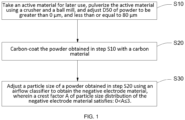
- a method of preparing the powdered negative electrode material includes: pulverizing a silicon-based active material to obtain the powdered negative electrode material.
- the method of pulverizing includes crushing and ball milling.
- an apparatus used for the crushing includes a crusher, and a crushing power p of the crusher satisfies: 0 ⁇ p ⁇ 300 kW.
- an apparatus used for the ball milling includes a ball mill, and a rotational speed v1 of the ball mill satisfies: 0 ⁇ v1 ⁇ 1500 rpm.
- an apparatus used for adjusting the particle size includes a classifier; and a frequency f of an induced draft fan of the classifier satisfies: 0 ⁇ f ⁇ 100 Hz.
- the sorting coefficient B and the crest factor A satisfy: 0 ⁇ B/A ⁇ 5.
- the particle size D50 of the silicon-based active material is greater than 0 ⁇ m, and less than or equal to 80 ⁇ m.
- the method of preparing the powdered negative electrode material further includes: carbon-coating the pulverized silicon-based active material with a carbon material to obtain the powdered negative electrode material, wherein a weight percentage a of the carbon material in the negative electrode material satisfies: 0 ⁇ a ⁇ 15%.
- the method of preparing the powdered negative electrode material further includes: polymer-coating the pulverized silicon-based active material or carbon-coating the pulverized silicon-based active material with a carbon material to obtain the powdered negative electrode material.
- a method of the polymer-coating includes the following steps:
- the flexible polymer contains a thermally crosslinked functional group
- the thermally crosslinked functional group includes at least one of an epoxy group, a carboxyl group, a hydroxyl group, an amino group, a double bond, and a triple bond.
- the solvent includes at least one of water, methanol, ethanol, polypyrrolidone, isopropanol, acetone, petroleum ether, tetrahydrofuran, ethyl acetate, N,N-dimethylacetamide, N,N-dimethylformamide, n-hexane, and halogenated hydrocarbon.
- the anti-solvent includes a poor solvent for the flexible polymer.
- the anti-solvent includes at least one of methanol, ethanol, polypyrrolidone, isopropanol, acetone, petroleum ether, tetrahydrofuran, ethyl acetate, N,N-dimethylacetamide, N,N-dimethylformamide, n-hexane, and halogenated hydrocarbon.
- a temperature of the thermal treatment is 100 oC-400 oC.
- the thermal treatment lasts for 2 h-12 h.
- the method of preparing the powdered negative electrode material further includes: doping the pulverized silicon-based active material with a doping material to obtain the powdered negative electrode material.
- the doping material includes at least one of an alkali metal, an alkali-earth metal, an alkali metal oxide, and an alkali-earth metal oxide.
- a weight percentage b of the doping material in the negative electrode material satisfies: 0 ⁇ b ⁇ 20%.
- the present disclosure further provides a lithium-ion battery, including the negative electrode material according to any one of the above or the negative electrode material prepared by the preparation method of any one of the above.
- the term “granularity”, which can be used interchangeably with the term “particle size”, refers to size of a particle, the granularity of a spherical particle is represented by diameter, and for an irregular particle, diameter of a sphere having the same behavior as the particle can be used as an equivalent diameter of this particle.
- cumulative curve also referred to as “cumulative frequency curve” is a method of representing a cumulative frequency of a deposited substance (gravel) with an image.
- SiO x may be a single compound such as SiO 2 , also may be a heterogeneous compound, for example, consisting of one or more of SiO 2 , SiO 1.5 , SiO, SiO 0.5 , etc., and also may be a composite material containing Si and SiO 2 .
- the SiO x /C may be an SiO x material containing carbon.
- SiO x /M may be a composite material containing SiO x and M, and also may be a composite material of a material containing Si and a material containing three elements M, Si, and O or constituent thereof.
- Si/M may be a composite material containing two elements Si and M or constituents.
- a negative electrode material with suitable particle size distribution is obtained, and the problems such as relatively poor electrical conductivity and relatively poor cycle and rate capabilities existing in the existing negative electrode materials can be solved.
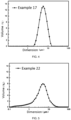
- the crest factor A of the particle size of the negative electrode material to satisfy 0 ⁇ A ⁇ 3
- distribution at tail ends of two sides of the granularity (particle size) distribution curve (i.e., granularity distribution) of the negative electrode material can be more concentrated (centralized), and particles that differ too much from a median value of the particle size will not appear.
- the crest factor A may be 0.5, 1, 1.2, 1.5, 1.8, 2, 2.5, 2.8, or 3 etc., or an interval value between any two endpoint values in the above, and definitely also may be other values within the above range, which is not limited herein.
- the crest factor A of the particle size distribution consistency of various particles of the negative electrode material can be guaranteed, so that when the negative electrode material is subjected to slurry adjustment and coating, the stability of the slurry is improved, and a binder and a conductive agent have better distribution consistency on surfaces of different particles of the negative electrode material, so that a coated electrode sheet has good consistency, and different particles have high consistency in expansion and contraction in a charging and discharging process, it will not cause the electrode sheet to be extremely easily destroyed, deteriorate the cycle performance of the battery, or increase the expansion of the battery due to uneven expansion and contraction of local particles of the electrode sheet, finally, the performance consistency of the battery is high, and because large differences in the granularity of the material particles are avoided, the conductive agent can be uniformly and effectively attached to various material particles, and the rate capability of the battery is improved.
- the prepared negative electrode material can be allowed to have an ideal high specific capacity.
- A>3 particles greatly different from the median particle size exist in the material, which results in a relatively large difference between the granularities of various particles of the material, and after performing coating to form the electrode sheet, in the cycling process of the battery, stress is concentrated partially, so that the electrode sheet is pulverized or even falls off, and the battery fails relatively quickly.
- the particle size distribution of the negative electrode material is: 0 ⁇ D 5 ⁇ 65 ⁇ m, 0 ⁇ D 25 ⁇ 69 ⁇ m, 0 ⁇ D 75 ⁇ 75 ⁇ m, and 0 ⁇ D 95 ⁇ 79 ⁇ m.
- the sorting coefficient B of the particle size distribution of the negative electrode material by selecting the sorting coefficient B of the particle size distribution of the negative electrode material to satisfy 0 ⁇ B ⁇ 3, it can be ensured that the distribution of the granularity of the negative electrode material in a middle segment (between two sides) of the granularity distribution curve is more concentrated.
- the binder when the negative electrode material is made into the electrode sheet with the binder, the binder is further evenly and consistently distributed, thus improving peel strength of the electrode sheet, and facilitating construction of a stable and complete conductive network with the electrode sheet.
- the sorting coefficient B of the particle size By selecting the sorting coefficient B of the particle size, it can be ensured that the granularity distribution of the negative electrode material is concentrated, and optionally, the sorting coefficient B may be 0.5, 1, 1.2, 1.5, 1.8, 2, 2.5, 2.8, or 3 etc., or an interval value between any two endpoint values in the above, and definitely also may be other values in the above range, which is not limited herein.
- the particle size distribution of the negative electrode material is: 0 ⁇ D 5 ⁇ 65 ⁇ m, 0 ⁇ D 16 ⁇ 67 ⁇ m, 0 ⁇ D 84 ⁇ 77 ⁇ m, and 0 ⁇ D 95 ⁇ 79 ⁇ m.
- the sorting coefficient B and the crest factor A satisfy: 0 ⁇ B/A ⁇ 5.
- the ratio B/A of the sorting coefficient B to the crest factor A may be 0.5, 0.8, 1, 1.2, 1.5, 1.8, 2, 2.5, 2.8, 3, 3.2, 3.5, 3.8, 4, 4.2, 4.5, 4.8, or 5 etc., or an interval value between any two endpoint values in the above, and definitely also may be other values in the above range, which is not limited herein.
- agglomeration of the silicon-based active material particles can be avoided more effectively, thus effectively exerting high performance of the battery.
- B/A>5 after the negative electrode material is subjected to slurry adjustment and coating, the silicon-based active material particles are aggregated, which affects the battery performance.
- an infrared spectrum of the negative electrode material tested in a range of wave number of 3200 cm -1 -3600 cm -1 has a broad peak.
- the negative electrode material in the present disclosure has a polar group, such as -OH group, which is more advantageous to the binding of the negative electrode material with the binder.
- the wadell degree of sphericity of the negative electrode material is greater than or equal to 0.6. When the degree of sphericity is higher, the consistency of the electrode sheet is also significantly improved.
- the wadell degree of sphericity of the negative electrode material is greater than or equal to 0.8.
- the wadell degree of sphericity of the negative electrode material may be 0.8, 0.9, 1.0, 1.1, 1.2, 1.3, 1.4, 1.5 and etc., or an interval value between any two endpoint values in the above.
- the negative electrode material further includes a coating layer located on a surface of the silicon-based active material, and the coating layer includes at least one of a flexible polymer and a conductive material.
- the conductive material includes at least one of flake graphite or a nanocarbon material.
- the flexible polymer includes a natural flexible polymer and/or a synthetic flexible polymer.
- the flexible polymer includes at least one of polyolefin and derivatives thereof, polyvinyl alcohol and derivatives thereof, polyacrylic acid and derivatives thereof, polyamide and derivatives thereof, carboxymethyl cellulose and derivatives thereof, alginic acid and derivatives thereof, and polycarbonate and derivatives thereof.
- the flexible polymer has a weight-average molecular weight of 2000-1000000.
- the weight-average molecular weight of the flexible polymer being in the above range can effectively avoid the phenomenon of agglomeration of the negative electrode material, and meanwhile better exert the buffering effect of the flexible polymer on the negative electrode material.
- the weight-average molecular weight of the flexible polymer may be, for example, 5000-500000, 10000-100000 or 50000-90000, such as 2000, 3000, 4000, 5000, 6000, 7000, 8000, 9000, 10000, 20000, 30000, 50000, 80000, 100000, 200000, 300000, 500000, 800000 or 1000000 and etc., or an interval value between any two endpoint values in the above, and definitely also may be other values in the above ranges, which is not limited herein.
- the flexible polymer contains a thermally crosslinked functional group
- the thermally crosslinked functional group includes at least one of an epoxy group, a carboxyl group, a hydroxyl group, an amino group, a double bond, and a triple bond.
- the flake graphite includes natural flake graphite and/or artificial flake graphite.
- the nanocarbon material includes at least one of conductive graphite, graphene, carbon nanotube, and carbon nanofiber.
- a mass percentage of the flexible polymer is 0-10%, excluding 0.
- the mass percentage of the flexible polymer being in the above range can effectively avoid the phenomenon of agglomeration of the negative electrode material, and meanwhile effectively exert the buffering effect of the flexible polymer on the negative electrode material, without affecting the ideal high specific capacity possessed by the negative electrode material in the present disclosure.
- the mass percentage of the flexible polymer may be, for example, 0.1%-8.5%, 1%-7.5% or 2.5%-5%, such as 1%, 2%, 3%, 4%, 5%, 6%, 7%, 8%, 9% or 10%, or an interval value between any two endpoint values in the above, and definitely also may be other values in the above ranges, which is not limited herein.
- a mass percentage of the flake graphite is 0-20%, excluding 0.
- the mass percentage of the flake graphite being in the above range likewise can effectively avoid the phenomenon of coagulation of the material during combination, and meanwhile effectively exert the electrical conductivity of the flake graphite, without affecting the ideal high specific capacity possessed by the negative electrode material in the present disclosure.
- the mass percentage of the flake graphite may be, for example, 0.1%-16%, 1%-14% or 5%-8%, such as 1%, 2%, 3%, 4%, 5%, 6%, 7%, 8%, 9%, 10%, 11%, 12%, 13%, 14%, 15%, 16%, 17%, 18%, 19% or 20%, or an interval value between any two endpoint values in the above, and definitely also may be other values in the above ranges, which is not limited herein.
- a mass percentage of the nanocarbon material is 0-5%, excluding 0.
- the mass percentage of the nanocarbon material being in the above range likewise can effectively avoid phenomenon of agglomeration of the material during combination, and meanwhile effectively exert the electrical conductivity of the nanocarbon material, without affecting the high specific capacity possessed by the negative electrode material in the present disclosure.
- the mass percentage of the nanocarbon material may be, for example, 0.1%-4.6%, 0.9%-4.1% or 1.9%-2.1%, such as 0.5%, 1.0%, 1.5%, 2.0%, 2.5%, 3.0%, 3.5%, 4.0%, 4.5% or 5%, or an interval value between any two endpoint values in the above, and definitely also may be other values in the above ranges, which is not limited herein.
- the coating layer has a thickness of 10 nm ⁇ 5000 nm.
- the thickness of the coating layer may be, for example, 50 nm ⁇ 1000 nm, 100 nm ⁇ 800 nm or 300 nm ⁇ 500 nm, such as 10 nm, 50 nm, 100 nm, 200 nm, 500 nm, 800 nm, 1000 nm, 2000 nm, 3000 nm, 4000 nm or 5000 nm, or an interval value between any two endpoint values in the above, and definitely also may be other values in the above ranges, which is not limited herein.
- a mass proportion of the coating layer in the negative electrode material is 0-20%, excluding 0.
- the mass proportion of the coating layer in the negative electrode material may be, for example, 2%-18%, 4%-15% or 6%-12%, such as 1%, 2%, 3%, 4%, 5%, 6%, 7%, 8%, 9%, 10%, 11%, 12%, 13%, 14%, 15%, 16%, 17%, 18%, 19% or 20%, or an interval value between any two endpoint values, and definitely also may be other values in the above ranges, which is not limited herein.
- the mass proportion of the coating layer in the negative electrode material is 2%-10%.
- the thickness and the proportion of the coating layer of the negative electrode material being in the above ranges of the present disclosure can effectively exert the buffering effect on the negative electrode material, and effectively ensure the electrical conductivity of the negative electrode material, without affecting the high specific capacity possessed by the negative electrode material in the present disclosure.
- the particle size D50 of the silicon-based active material is greater than 0 ⁇ m, and less than or equal to 80 ⁇ m, and methods of testing the particle size include a laser scattering method.
- the particle size D50 of the silicon-based active material may be, for example, 10 ⁇ m-70 ⁇ m, 20 ⁇ m-60 ⁇ m or 30 ⁇ m-50 ⁇ m, such as 1 ⁇ m, 5 ⁇ m, 10 ⁇ m, 15 ⁇ m, 20 ⁇ m, 30 ⁇ m, 40 ⁇ m, 50 ⁇ m, 60 ⁇ m, 70 ⁇ m or 80 ⁇ m, or an interval value between any two endpoint values, and definitely also may be other values in the above ranges, which is not limited herein.
- the particle size of the silicon-based active material by reasonably selecting the particle size of the silicon-based active material, performances such as cycle performance and battery expansion after the negative electrode material of the lithium-ion battery is made into the battery can be ensured, and if the particle size D50 of the silicon-based active material is greater than 80 ⁇ m, the cycle performance and the battery expansion property of the battery will be adversely affected.
- the silicon-based active material has a specific surface area of 0-10 m 2 /g, and is other than 0.
- the specific surface area of the silicon-based active material may be, for example, 1 m 2 /g-9 m 2 /g, 2 m 2 /g-8 m 2 /g or 3 m 2 /g-7 m 2 /g, such as 1 m 2 /g, 2 m 2 /g, 3 m 2 /g, 4 m 2 /g, 5 m 2 /g, 6 m 2 /g, 7 m 2 /g, 8 m 2 /g, 9 m 2 /g or 10 m 2 /g, or an interval value between any two endpoint values, and definitely also may be other values in the above ranges, which is not limited herein.
- the specific surface area of the silicon-based active material being in the above ranges can ensure the high specific capacity and high first capacity efficiency of the negative electrode material in the present disclosure.
- tap density of the silicon-based active material is 0.5 g/m 3 ⁇ 2 g/m 3 .
- the tap density of the silicon-based active material may be 0.7 g/m 3 ⁇ 1.8 g/m 3 , 0.9 g/m 3 ⁇ 1.6 g/m 3 or 1.0 g/m 3 ⁇ 1.4 g/m 3 , such as 0.5 g/m 3 , 0.6 g/m 3 , 0.8 g/m 3 , 1.0 g/m 3 , 1.2 g/m 3 , 1.5 g/m 3 , 1.8 g/m 3 or 2 g/m 3 , or an interval value between any two endpoint values, and definitely also may be other values in the above ranges, which is not limited herein.
- the tap density of the silicon-based active material being in the above ranges likewise can ensure the high specific capacity and the high first capacity efficiency of the negative electrode material in the present disclosure.
- the negative electrode material further includes a doping material doped in the silicon-based active material, and the doping material includes at least one of an alkali metal, an alkali-earth metal, an alkali metal oxide, and an alkali-earth metal oxide.
- a weight percentage b of the doping material in the negative electrode material satisfies: 0 ⁇ b ⁇ 20%.
- the alkali metal may be one selected from the group consisting of lithium, sodium, and potassium; the alkali-earth metal may be selected from the group consisting of magnesium, calcium, strontium, and barium; the alkali metal oxide may be selected from the group consisting of lithium oxide, sodium oxide, and potassium oxide; the alkali-earth metal oxide may be selected from the group consisting of magnesium oxide, calcium oxide, strontium oxide, and barium oxide.
- the mass percentage b of the doping material in the negative electrode material may be 1%, 3%, 5%, 8%, 10%, 12%, 15%, 18% or 20% and etc., or an interval value between any two endpoint values, and definitely also may be other values in the above range, which is not limited herein.
- intrinsic conductivity of the silicon-based active material can be improved, and by further selecting a type and a content of the doping material, the conductivity of the silicon-based active material can be improved more effectively.
- the negative electrode materials in various embodiments in the above are not contradictory to each other, they can be randomly combined, for example, the particle size of the silicon-based active material and the specific surface area of the silicon-based active material are combined and limited and so on.
- An embodiment of the present disclosure further provides a preparation method of a negative electrode material, wherein the preparation method includes the following steps:
- the negative electrode material includes a silicon-based active material, and the silicon-based active material includes at least one of SiO x , SiO x /C, SiO x /M, Si, Si/C, and Si/M, wherein 0 ⁇ x ⁇ 2, and M includes at least one of metal, nonmetal, metal oxide, and nonmetal oxide.
- a method of preparing the powdered negative electrode material further includes: pulverizing the silicon-based active material to obtain the powdered negative electrode material.
- the silicon-based active material is pulverized, to obtain the powdered negative electrode material with a suitable particle size, and then the crest factor A of the particle size of the powdered negative electrode material is reasonably selected, to obtain the silicon-based negative electrode material with suitable particle size distribution, which can solve the problems such as low initial Coulombic efficiency, relatively poor electrical conductivity, relatively poor cycle and rate capabilities of the existing silicon-based active materials as negative electrode materials.
- the method of pulverizing includes crushing and ball milling.
- an apparatus used for the crushing includes a crusher, and a crushing power p of the crusher satisfies: 0 ⁇ p ⁇ 300 kW.
- an apparatus used for the ball milling includes a ball mill, and a rotational speed v1 of the ball mill satisfies: 0 ⁇ v1 ⁇ 1500 rpm.
- an apparatus used for adjusting the particle size includes a classifier; and a frequency f of an induced draft fan of the classifier satisfies: 0 ⁇ f ⁇ 100 Hz.
- the sorting coefficient B and the crest factor A satisfy: 0 ⁇ B/A ⁇ 5.
- the particle size D50 of the silicon-based active material is greater than 0 ⁇ m, and less than or equal to 80 ⁇ m.
- the crushing power p of the crusher may be, for example, 40 kW-260 kW, 80 kW-210 kW or 120 kW-180 kW, such as 5 kW, 10 kW, 20 kW, 50 kW, 100 kW, 150 kW, 200 kW, 250 kW or 300 kW, or an interval value between any two endpoint values;
- the rotational speed v1 of the ball mill may be, for example, 50 rpm-1400 rpm, 300 rpm-1200 rpm or 500 rpm-900 rpm, such as 200 rpm, 400 rpm, 600 rpm, 800 rpm, 1000 rpm, 1200 rpm or 1500 rpm, or an interval value between any two endpoint values, and definitely also may be other values in the above ranges, which is not limited herein.
- the silicon-based active material with a suitable particle size can be
- the frequency f of an induced draft fan of the classifier may be, for example, 6 Hz-95 Hz, 25 Hz-75 Hz or 35 Hz-65 Hz, such as 1 Hz, 5 Hz, 10 Hz, 20 Hz, 30 Hz, 50 Hz, 70 Hz, 90 Hz or 100 Hz, or an interval value between any two endpoint values, and definitely also may be other values in the above ranges, which is not limited herein.
- the sorting coefficient B and the crest factor A of the particle size distribution of the negative electrode material can satisfy: 0 ⁇ B ⁇ 3, and O ⁇ A ⁇ 3.
- the particle size D50 of the silicon-based active material may be, for example, 4 ⁇ m-80 ⁇ m, 25 ⁇ m-75 ⁇ m or 45 ⁇ m-65 ⁇ m, such as 1 ⁇ m, 5 ⁇ m, 10 ⁇ m, 15 ⁇ m, 20 ⁇ m, 30 ⁇ m, 40 ⁇ m, 50 ⁇ m, 60 ⁇ m, 70 ⁇ m or 80 ⁇ m, or an interval value between any two endpoint values, and definitely also may be other values in the above ranges, which is not limited herein.
- the method of preparing the powdered negative electrode material further includes: carbon-coating the pulverized silicon-based active material with a carbon material to obtain the powdered negative electrode material, wherein a weight percentage a of the carbon material in the negative electrode material satisfies: 0 ⁇ a ⁇ 15%.
- the weight percentage a of the carbon material in the negative electrode material may be 2.5%-14.5%, 4.5%-10.5% or 6.5%-8.5%, such as 1%, 2%, 3%, 4%, 5%, 6%, 7%, 8%, 9%, 10%, 11%, 12%, 13%, 14% or 15%, or an interval value between any two endpoint values, and definitely also may be other values in the above ranges, which is not limited herein.
- the carbon material is coated on the surface of the silicon-based active material, and the problems of volume change and electrical conductivity of the silicon-based negative electrode material of the lithium-ion battery during lithium intercalation and deintercalation can be effectively solved.
- a method of carbon-coating includes: mixing a third starting material including a sintered product and an organic carbon source and performing a thermal treatment on the mixture, in a protective atmosphere or a vacuum environment.
- the above method of carbon-coating includes: mixing the third starting material including the above sintered product and the organic carbon source and performing a thermal treatment on the mixture, in a protective atmosphere or a vacuum environment.
- the above carbon-coating can be exemplified by gas-phase carbon-coating and/or solid-phase carbon-coating.
- the carbon-coating in the present disclosure uses a manner of gas-phase carbon-coating, and a specific method includes: heating the above sintered product to 600 °C-1000 °C in a protective atmosphere, feeding an organic carbon source gas, and keeping the temperature for 0.5 h-10 h, and then cooling.
- the organic carbon source gas can be selected from hydrocarbons (such as alkanes, cycloalkanes, alkenes, alkynes, and aromatic hydrocarbons), and may be, for example, at least one of methane, ethylene, acetylene, and benzene.
- a temperature of the thermal treatment in the manner of gas-phase carbon-coating specifically may be, for example, 650 oC-950 oC, 750 oC-850 oC or 780 oC-820 oC, such as 600 oC, 700 oC, 800 oC, 900 oC, and 1000 oC
- the temperature of the thermal treatment specifically may be kept for, for example, 1.0 h-9.0 h, 3.0 h-7.0 h, or 5.0 h-6.0 h, such as 0.5 h, 1.5 h, 2.5 h, 3.5 h, 4.5 h, 5.5 h, 6.5 h, 7.5 h, 8.5 h, 9.5 h, and 10 h, or an interval value between any two endpoint values, which is not limited herein.
- the temperature of the thermal treatment may be 700-900 °C, and the temperature of the thermal treatment may be kept for 3-9 h.
- the carbon-coating in the present disclosure uses a manner of solid-phase carbon-coating, and a specific method includes: fusing the above sintered product with the carbon source for more than 0.5 h, carbonizing an obtained carbon mixture at 600 °C-1000 °C for 2 h-6 h, and cooling.
- the carbon source optionally includes at least one selected from the group consisting of polyolefins, resins, rubbers, saccharides (such as glucose, sucrose, starch, and cellulose), organic acids, and asphalt.
- the temperature of the thermal treatment in the manner of solid-phase carbon-coating specifically may be, for example, 650 oC-950 oC, 710 oC-880 oC or 750 oC-810 oC, such as 600 oC, 700 oC, 800 oC, 900 oC, and 1000 oC
- the temperature of the thermal treatment specifically may be 2 h, 3 h, 4 h, 5 h, 6 h and etc., or an interval value between any two endpoint values, which is not limited herein.
- the temperature of the thermal treatment may be 700 oC-900 oC, and the temperature of the thermal treatment may be kept for 3 h-5 h.
- the fusion is optionally performed in a fusion machine, and a rotational speed of the fusion machine is 500 r/min-3000 r/min.
- the rotational speed of the fusion machine specifically may be, for example, 900 r/min-2600 r/min, 1100 r/min-2200 r/min or 1400 r/min-1800 r/min, such as 500 r/min, 800 r/min, 1000 r/min, 1500 r/min, 2000 r/min, 2500 r/min, and 3000 r/min, or an interval value between any two endpoint values in the above, which is not limited herein.
- the rotational speed of the fusion machine may be 1000-3000 r/min.
- a gap width of cutter of the fusion machine can be selected according to needs, for example, 0.5 cm.
- the protective atmosphere in the above manner of carbon-coating can be at least one selected from the group consisting of helium, neon, argon, and nitrogen.
- the method of preparing the powdered negative electrode material further includes: polymer-coating the pulverized silicon-based active material, or after carbon-coating the pulverized silicon-based active material with a carbon material, performing polymer-coating to obtain the powdered negative electrode material.
- a method of the polymer-coating includes the following steps:
- the flexible polymer contains a thermally crosslinked functional group
- the thermally crosslinked functional group includes at least one of an epoxy group, a carboxyl group, a hydroxyl group, an amino group, a double bond, and a triple bond.
- the solvent includes at least one of water, methanol, ethanol, polypyrrolidone, isopropanol, acetone, petroleum ether, tetrahydrofuran, ethyl acetate, N,N-dimethylacetamide, N,N-dimethylformamide, n-hexane, and halogenated hydrocarbon.
- the anti-solvent includes a poor solvent for the flexible polymer.
- the anti-solvent includes at least one of methanol, ethanol, polypyrrolidone, isopropanol, acetone, petroleum ether, tetrahydrofuran, ethyl acetate, N,N-dimethylacetamide, N,N-dimethylformamide, n-hexane, and halogenated hydrocarbon.
- a temperature of the thermal treatment is 100 °C-400 °C, and the thermal treatment lasts for 2 h-12 h.
- the temperature of the thermal treatment may be, for example, 140 oC-360 oC, 180 oC-280 oC or 220 oC-260 oC, such as 100 oC, 120 oC, 150 oC, 180 oC, 200 oC, 220 oC, 250 oC, 280 oC, 300 oC, 320 oC, 350 oC, 380 oC or 400 oC, or an interval value between any two endpoint values, and definitely also may be other values in the above ranges, which is not limited herein.
- the thermal treatment may last for, for example, 4.5 h-10.5 h, 6.5 h-9.5 h or 7.5 h-8.5 h, such as 2 h, 3 h, 4 h, 5 h, 6 h, 7 h, 8 h, 9 h, 10 h, 11 h or 12 h, or an interval value between any two endpoint values, and definitely also may be other values in the above ranges, which is not limited herein.
- the method of preparing the powdered negative electrode material further includes: doping the pulverized silicon-based active material with a doping material to obtain the powdered negative electrode material.
- the doping material includes at least one of an alkali metal, an alkali-earth metal, an alkali metal oxide, and an alkali-earth metal oxide.
- a weight percentage b of the doping material in the negative electrode material satisfies: 0 ⁇ b ⁇ 20%.
- the alkali metal may be at least one selected from lithium, sodium, or potassium; the alkali-earth metal may be at least one selected from magnesium, calcium, strontium, or barium; the alkali metal oxide may be at least one selected from lithium oxide, sodium oxide, or potassium oxide; the alkali-earth metal oxide may be at least one selected from the group consisting of magnesium oxide, calcium oxide, strontium oxide, and barium oxide.
- the mass percentage b of the doping material in the negative electrode material may be 1%, 3%, 5%, 8%, 10%, 12%, 15%, 18% or 20% and etc., and definitely also may be other values in the above range, which is not limited herein.
- doping a metal material in the negative electrode material intrinsic conductivity of the silicon-based active material can be improved, and by further selecting a type and a content of the doping material, the conductivity of the silicon-based active material can be improved more effectively. It should be noted that doping the pulverized silicon-based active material with the doping material can be performed before or after the carbon-coating.
- An embodiment of the present disclosure further provides a lithium-ion battery, wherein the lithium-ion battery includes the above negative electrode material or the negative electrode material of the lithium-ion battery prepared by the above preparation method.
- the present disclosure provides a negative electrode material and a preparation method thereof and a lithium-ion battery, which solve the problems such as non-uniformity of material particles and poor electrical conductivity, relatively poor cycle stability and rate capability of the existing silicon-based materials in the negative electrode sheet of the battery.
- the negative electrode material provided in the present disclosure, by adjusting the crest factor A of the particle size distribution of the negative electrode material to satisfy 0 ⁇ A ⁇ 3, distribution at tail ends of two sides of the granularity of the negative electrode material can be more concentrated, and particles that differ too much from a median value of the particle size will not appear.
- the crest factor A of the particle size distribution consistency of various particles of the negative electrode material can be guaranteed, so that when the negative electrode material is subjected to slurry adjustment and coating, the stability of the slurry is improved, and the binder and the conductive agent have better distribution consistency on surfaces of different particles, thus, the coated electrode sheet has good consistency, and different particles have high consistency in expansion and contraction in the charging and discharging process, it will not cause the electrode sheet to be extremely easily destroyed, deteriorate the cycle performance of the battery, or increase the expansion of the battery due to uneven expansion and contraction of local particles of the electrode sheet, finally, the performance consistency of the battery is high, and because large differences in the granularity of the material particles are avoided, the conductive agent can be uniformly and effectively attached to various material particles, and the rate capability of the battery is improved.
- the prepared negative electrode material can be allowed to have an ideal high specific capacity.
- the crest factor A of the particle size distribution of the negative electrode material satisfies: 0 ⁇ A ⁇ 3, so that the coating layer contained in the negative electrode material, such as the coating layer of the flexible polymer on each particle, has good thickness consistency, thus the buffering effect of the flexible polymer on the volume change during charging and discharging of the material is better, the cycle performance of the material is improved, and the expansion of the material is reduced.
- the sorting coefficient B of the particle size distribution of the negative electrode material by selecting the sorting coefficient B of the particle size distribution of the negative electrode material to satisfy 0 ⁇ B ⁇ 3, it can be ensured that the distribution of the granularity of the negative electrode material in a middle segment (between two sides) of the granularity distribution curve is more concentrated, thus, when the negative electrode material is made into the electrode sheet with the binder, the binder is further evenly and consistently distributed, thus improving peel strength of the electrode sheet, and facilitating construction of a stable and complete conductive network with the electrode sheet.
- the ratio B/A of the sorting coefficient B to the crest factor A in the present disclosure agglomeration of the silicon-based active material particles can be avoided more effectively, thus the negative electrode material is made to effectively exert high performance of the battery.
- a preparation method of a negative electrode material of the lithium-ion battery, as shown in FIG. 1 includes the following step S10 to step S30:
- a preparation method of a negative electrode material of the lithium-ion battery includes the following step S10 to step S30:
- a preparation method of a negative electrode material of the lithium-ion battery includes the following step S10 to step S30:
- a preparation method of a negative electrode material of the lithium-ion battery includes the following step S10 to step S30:
- a preparation method of a negative electrode material of the lithium-ion battery includes the following step S10 to step S30:
- a preparation method of a negative electrode material of the lithium-ion battery includes the following step S10 to step S30:
- a preparation method of a negative electrode material of the lithium-ion battery includes the following step S10 to step S30:
- a preparation method of a negative electrode material of the lithium-ion battery includes the following step S10 to step S30:
- a preparation method of a negative electrode material of the lithium-ion battery includes the following step S10 to step S30:
- a preparation method of a negative electrode material of the lithium-ion battery includes the following step S10 to step S40:
- Step S10 taking 1 kg of SiO bulk material for later use, pulverizing the bulk material using a crusher and a ball mill, and adjusting D50 of SiO powder to about 5 ⁇ m, wherein a crushing power p of the crusher was 100 kW, and a rotational speed v1 of the ball mill was 800 rpm; and step S20, adjusting a particle size of a powder obtained in step S10 using an airflow classifier, wherein a frequency f of an induced draft fan of the classifier was 58 Hz, to obtain a final negative electrode material.
- Step S10 taking 1 kg of SiO bulk material for later use, pulverizing the bulk material using a crusher and a ball mill, and adjusting D50 of SiO powder to about 20 ⁇ m, wherein a crushing power p of the crusher was 90 kW, and a rotational speed v1 of the ball mill was 600 rpm;
- Step S10 taking 1 kg of SiO bulk material for later use, pulverizing the bulk material using a crusher and a ball mill, and adjusting D50 of SiO powder to about 20 ⁇ m, wherein a crushing power p of the crusher was 90 kW, and a rotational speed v1 of the ball mill was 600 rpm;
- Step S10 taking 1 kg of SiO bulk material for later use, pulverizing the bulk material using a crusher and a ball mill, and adjusting D50 of SiO powder to about 5 ⁇ m, wherein a crushing power p of the crusher was 100 kW, and a rotational speed v1 of the ball mill was 800 rpm;
- Step S10 taking 1 kg of SiO bulk material for later use, pulverizing the bulk material using a crusher and a ball mill, and adjusting D50 of SiO powder to about 5 ⁇ m, wherein a crushing power p of the crusher was 100 kW, and a rotational speed v1 of the ball mill was 800 rpm;
- Step S10 taking 1 kg of SiO bulk material for later use, pulverizing the bulk material using a crusher and a ball mill, and adjusting D50 of SiO powder to about 5 ⁇ m, wherein a crushing power p of the crusher was 100 kW, and a rotational speed v1 of the ball mill was 800 rpm;
- Step S10 taking 1 kg of SiO bulk material for later use, pulverizing the bulk material using a crusher and a ball mill, and adjusting D50 of SiO powder to about 5 ⁇ m, wherein a crushing power p of the crusher was 100 kW, and a rotational speed v1 of the ball mill was 800 rpm;
- Step S10 taking 1 kg of SiO bulk material for later use, pulverizing the bulk material using a crusher and a ball mill, and adjusting D50 of SiO powder to about 5 ⁇ m, wherein a crushing power p of the crusher was 110 kW, and a rotational speed v1 of the ball mill was 750 rpm;
- Step S10 taking 1 kg of SiO bulk material for later use, pulverizing the bulk material using a crusher and a ball mill, and adjusting D50 of SiO powder to about 20 ⁇ m, wherein a crushing power p of the crusher was 90 kW, and a rotational speed v1 of the ball mill was 600 rpm;
- Step S10 taking 1 kg of SiO bulk material for later use, pulverizing the bulk material using a crusher and a ball mill, and adjusting D50 of SiO powder to about 5 ⁇ m, wherein a crushing power p of the crusher was 110 kW, and a rotational speed v1 of the ball mill was 750 rpm;
- a preparation method of a negative electrode material of the lithium-ion battery includes the following step S10 to step S30:
- a preparation method of a negative electrode material of the lithium-ion battery includes the following step S10 to step S30:
- a preparation method of a negative electrode material of the lithium-ion battery includes the following step S10 to step S30:
- a preparation method of a negative electrode material of the lithium-ion battery includes the following step S10 to step S30:
- the lithium-ion battery prepared with the negative electrode material in the present disclosure has excellent capacity efficiency, cycle performance, charge-discharge performance, and expansion property, and also has high peel strength, thus the performance of the lithium-ion battery can be effectively improved.
- the present disclosure provides a negative electrode material and a preparation method thereof and a lithium-ion battery.
- the negative electrode material in the present disclosure by limiting the crest factor A of the particle size distribution of the negative electrode material, consistency of particles of the negative electrode material can be ensured, so that the coated electrode sheet has good consistency, further enabling the performance consistency of the battery to be high, and improving the performance of the battery; in addition, by further limiting the sorting coefficient B and the ratio B/A, the negative electrode material can be allowed to have better particle size distribution and higher battery performance, and therefore has excellent practical performance and a wide application prospect.
Landscapes
- Chemical & Material Sciences (AREA)
- Chemical Kinetics & Catalysis (AREA)
- Electrochemistry (AREA)
- General Chemical & Material Sciences (AREA)
- Engineering & Computer Science (AREA)
- Materials Engineering (AREA)
- Manufacturing & Machinery (AREA)
- Inorganic Chemistry (AREA)
- Composite Materials (AREA)
- Battery Electrode And Active Subsutance (AREA)
Applications Claiming Priority (3)
| Application Number | Priority Date | Filing Date | Title |
|---|---|---|---|
| CN202210427071 | 2022-04-21 | ||
| CN202210769600.9A CN116979052A (zh) | 2022-04-21 | 2022-06-30 | 硅基负极材料及其制备方法和锂离子电池 |
| PCT/CN2023/089279 WO2023202636A1 (zh) | 2022-04-21 | 2023-04-19 | 负极材料及其制备方法和锂离子电池 |
Publications (2)
| Publication Number | Publication Date |
|---|---|
| EP4297130A1 true EP4297130A1 (de) | 2023-12-27 |
| EP4297130A4 EP4297130A4 (de) | 2024-11-13 |
Family
ID=88372392
Family Applications (1)
| Application Number | Title | Priority Date | Filing Date |
|---|---|---|---|
| EP23769098.7A Pending EP4297130A4 (de) | 2022-04-21 | 2023-04-19 | Negativelektrodenmaterial und herstellungsverfahren dafür sowie lithium-ionen-batterie |
Country Status (5)
| Country | Link |
|---|---|
| US (1) | US20250087679A1 (de) |
| EP (1) | EP4297130A4 (de) |
| JP (1) | JP7713532B2 (de) |
| KR (1) | KR20230150873A (de) |
| WO (1) | WO2023202636A1 (de) |
Family Cites Families (18)
| Publication number | Priority date | Publication date | Assignee | Title |
|---|---|---|---|---|
| US6991875B2 (en) * | 2002-08-28 | 2006-01-31 | The Gillette Company | Alkaline battery including nickel oxyhydroxide cathode and zinc anode |
| JP5143437B2 (ja) * | 2007-01-30 | 2013-02-13 | 日本カーボン株式会社 | リチウムイオン二次電池用負極活物質の製造方法、負極活物質及び負極 |
| JP2012256543A (ja) | 2011-06-09 | 2012-12-27 | Mitsui Mining & Smelting Co Ltd | 非水電解液二次電池用負極 |
| EP2750224B1 (de) * | 2011-08-22 | 2020-09-16 | Connexx Systems Corporation | Aktives kompositmaterial für lithium-sekundärbatterien und herstellungsverfahren dafür |
| US9819007B2 (en) * | 2011-11-11 | 2017-11-14 | Kabushiki Kaisha Toyota Jidoshokki | Negative-electrode material and negative electrode for use in lithium-ion secondary battery as well as lithium-ion secondary battery |
| KR101430709B1 (ko) * | 2012-07-19 | 2014-08-14 | 엠케이전자 주식회사 | 이차 전지용 음극 활물질 및 이를 포함하는 이차 전지 |
| TW201421771A (zh) | 2012-11-16 | 2014-06-01 | Quan An Resource Co Ltd | 矽材料之製備方法及其應用 |
| KR20190074313A (ko) | 2016-11-11 | 2019-06-27 | 쇼와 덴코 가부시키가이샤 | 부극 재료 및 리튬 이온 전지 |
| CN108054368B (zh) * | 2017-12-12 | 2020-08-11 | 贝特瑞新材料集团股份有限公司 | 一种硅基负极材料、其制备方法及在锂离子电池的用途 |
| CN115472816A (zh) * | 2019-10-22 | 2022-12-13 | 安普瑞斯(南京)有限公司 | 一种硅氧颗粒及其制备方法和应用 |
| WO2021092869A1 (zh) | 2019-11-14 | 2021-05-20 | 宁德新能源科技有限公司 | 负极材料及包含其的电化学装置和电子装置 |
| CN110797520B (zh) * | 2019-11-14 | 2021-06-25 | 宁德新能源科技有限公司 | 负极材料及包含其的电化学装置和电子装置 |
| KR20210094685A (ko) * | 2020-01-21 | 2021-07-30 | 대주전자재료 주식회사 | 규소-규소 복합산화물-탄소 복합체, 이의 제조방법 및 이를 포함하는 음극 활물질 |
| EP4141990A4 (de) * | 2020-04-23 | 2023-11-01 | Ningde Amperex Technology Limited | Negativelektrodenmaterial, elektrodenstück damit, elektrochemische vorrichtung und elektronische vorrichtung |
| CN111533120A (zh) * | 2020-05-08 | 2020-08-14 | 珠海冠宇电池股份有限公司 | 一种负极活性材料及具有改善的高电压快充循环性能的锂离子电池 |
| CN113169340B (zh) * | 2020-12-28 | 2022-07-15 | 宁德新能源科技有限公司 | 负极材料、电化学装置和电子设备 |
| CN114256452A (zh) * | 2021-11-11 | 2022-03-29 | 珠海冠宇电池股份有限公司 | 一种负极活性材料及含有该负极活性材料的负极片和锂离子电池 |
| CN114373927B (zh) * | 2021-12-30 | 2024-11-22 | 珠海冠宇电池股份有限公司 | 一种负极材料及包括该负极材料的负极极片 |
-
2023
- 2023-04-19 EP EP23769098.7A patent/EP4297130A4/de active Pending
- 2023-04-19 US US18/284,616 patent/US20250087679A1/en active Pending
- 2023-04-19 KR KR1020237033602A patent/KR20230150873A/ko not_active Ceased
- 2023-04-19 JP JP2023560802A patent/JP7713532B2/ja active Active
- 2023-04-19 WO PCT/CN2023/089279 patent/WO2023202636A1/zh not_active Ceased
Also Published As
| Publication number | Publication date |
|---|---|
| JP7713532B2 (ja) | 2025-07-25 |
| EP4297130A4 (de) | 2024-11-13 |
| JP2024519441A (ja) | 2024-05-14 |
| US20250087679A1 (en) | 2025-03-13 |
| WO2023202636A1 (zh) | 2023-10-26 |
| KR20230150873A (ko) | 2023-10-31 |
Similar Documents
| Publication | Publication Date | Title |
|---|---|---|
| EP3955345A1 (de) | Silicium-sauerstoff-partikel für elektrodenmaterial, herstellungsverfahren und verwendung davon | |
| CN112331380B (zh) | 一种复合导电浆料及其制备方法和应用 | |
| EP3690996A1 (de) | Kohlenstoffmatrixverbundstoffmaterial, herstellungsverfahren dafür und lithium-ionen-batterie damit | |
| CN106654269B (zh) | 用于动力锂离子电池的石墨负极材料及其制备方法和应用 | |
| WO2023183754A1 (en) | Solvent-free process for preparing lithium-ion batteries | |
| CN106711461A (zh) | 一种球形多孔硅碳复合材料及其制备方法与用途 | |
| US20160359162A1 (en) | Composition for preparing silicon-carbon composite, silicon-carbon composite, electrode for secondary battery comprising same, and method for producing silicon-carbon composite | |
| WO2020197673A1 (en) | Cathode electrode compositions for battery applications | |
| WO2016008455A2 (zh) | 一种多元复合负极材料、其制备方法及包含其的锂离子电池 | |
| CN112687853B (zh) | 硅氧颗粒团聚体及其制备方法、负极材料、电池 | |
| CN110350161B (zh) | 一种硅碳负极前驱体的制备方法 | |
| CN103915609A (zh) | 硅-氧化硅-碳复合材料、锂离子二次电池负极材料、其制备方法和应用 | |
| WO2026021530A1 (zh) | 一种正极材料及其制备方法、二次电池及用电设备 | |
| CN107658452A (zh) | 一种硅/碳纳米管/碳氧化硅复合材料及制备方法和应用 | |
| CN116454252B (zh) | 一种钠离子电池负极材料及其制备方法 | |
| CN112635712A (zh) | 一种负极片和锂离子电池 | |
| CN111755678A (zh) | 一种锂离子电池用硅碳负极材料及其制备方法 | |
| EP4297130A1 (de) | Negativelektrodenmaterial und herstellungsverfahren dafür sowie lithium-ionen-batterie | |
| CN113948685A (zh) | 一种锂离子电池硅基复合负极材料及其制备方法 | |
| CN113422018A (zh) | 一种高倍率多晶复合颗粒锂电负极活性材料的制备方法 | |
| CN114789996A (zh) | 高分散性的碳纳米管及其制备方法、二次电池 | |
| CN112687851A (zh) | 硅氧颗粒及其制备方法、负极材料和电池 | |
| EP4234638B1 (de) | Russ, schlamm und lithium-ionen-sekundärbatterie | |
| EP4235846B1 (de) | Russ, schlamm und lithium-ionen-sekundärbatterie | |
| CN111403717A (zh) | 一种新型负极材料、制备方法及其用途 |
Legal Events
| Date | Code | Title | Description |
|---|---|---|---|
| STAA | Information on the status of an ep patent application or granted ep patent |
Free format text: STATUS: UNKNOWN |
|
| STAA | Information on the status of an ep patent application or granted ep patent |
Free format text: STATUS: THE INTERNATIONAL PUBLICATION HAS BEEN MADE |
|
| PUAI | Public reference made under article 153(3) epc to a published international application that has entered the european phase |
Free format text: ORIGINAL CODE: 0009012 |
|
| STAA | Information on the status of an ep patent application or granted ep patent |
Free format text: STATUS: REQUEST FOR EXAMINATION WAS MADE |
|
| 17P | Request for examination filed |
Effective date: 20230922 |
|
| AK | Designated contracting states |
Kind code of ref document: A1 Designated state(s): AL AT BE BG CH CY CZ DE DK EE ES FI FR GB GR HR HU IE IS IT LI LT LU LV MC ME MK MT NL NO PL PT RO RS SE SI SK SM TR |
|
| RAV | Requested validation state of the european patent: fee paid |
Extension state: MA Effective date: 20240308 |
|
| STAA | Information on the status of an ep patent application or granted ep patent |
Free format text: STATUS: EXAMINATION IS IN PROGRESS |
|
| A4 | Supplementary search report drawn up and despatched |
Effective date: 20241011 |
|
| RIC1 | Information provided on ipc code assigned before grant |
Ipc: H01M 4/36 20060101ALI20241007BHEP Ipc: H01M 4/38 20060101ALI20241007BHEP Ipc: H01M 4/485 20100101ALI20241007BHEP Ipc: H01M 4/1395 20100101ALI20241007BHEP Ipc: H01M 4/134 20100101ALI20241007BHEP Ipc: H01M 10/0525 20100101ALI20241007BHEP Ipc: H01M 4/48 20100101ALI20241007BHEP Ipc: H01M 4/62 20060101AFI20241007BHEP |
|
| 17Q | First examination report despatched |
Effective date: 20241023 |
|
| DAX | Request for extension of the european patent (deleted) | ||
| RAV | Requested validation state of the european patent: fee paid |
Extension state: MA Effective date: 20240308 |