EP4277941B1 - Uretdiongruppen enthaltende zusammensetzungen - Google Patents
Uretdiongruppen enthaltende zusammensetzungen Download PDFInfo
- Publication number
- EP4277941B1 EP4277941B1 EP21835784.6A EP21835784A EP4277941B1 EP 4277941 B1 EP4277941 B1 EP 4277941B1 EP 21835784 A EP21835784 A EP 21835784A EP 4277941 B1 EP4277941 B1 EP 4277941B1
- Authority
- EP
- European Patent Office
- Prior art keywords
- groups
- hydroxide
- compounds
- component
- bis
- Prior art date
- Legal status (The legal status is an assumption and is not a legal conclusion. Google has not performed a legal analysis and makes no representation as to the accuracy of the status listed.)
- Active
Links
Classifications
-
- C—CHEMISTRY; METALLURGY
- C08—ORGANIC MACROMOLECULAR COMPOUNDS; THEIR PREPARATION OR CHEMICAL WORKING-UP; COMPOSITIONS BASED THEREON
- C08G—MACROMOLECULAR COMPOUNDS OBTAINED OTHERWISE THAN BY REACTIONS ONLY INVOLVING UNSATURATED CARBON-TO-CARBON BONDS
- C08G18/00—Polymeric products of isocyanates or isothiocyanates
- C08G18/06—Polymeric products of isocyanates or isothiocyanates with compounds having active hydrogen
- C08G18/08—Processes
- C08G18/16—Catalysts
- C08G18/18—Catalysts containing secondary or tertiary amines or salts thereof
- C08G18/1875—Catalysts containing secondary or tertiary amines or salts thereof containing ammonium salts or mixtures of secondary of tertiary amines and acids
-
- C—CHEMISTRY; METALLURGY
- C08—ORGANIC MACROMOLECULAR COMPOUNDS; THEIR PREPARATION OR CHEMICAL WORKING-UP; COMPOSITIONS BASED THEREON
- C08G—MACROMOLECULAR COMPOUNDS OBTAINED OTHERWISE THAN BY REACTIONS ONLY INVOLVING UNSATURATED CARBON-TO-CARBON BONDS
- C08G18/00—Polymeric products of isocyanates or isothiocyanates
- C08G18/06—Polymeric products of isocyanates or isothiocyanates with compounds having active hydrogen
- C08G18/28—Polymeric products of isocyanates or isothiocyanates with compounds having active hydrogen characterised by the compounds used containing active hydrogen
- C08G18/30—Low-molecular-weight compounds
- C08G18/38—Low-molecular-weight compounds having heteroatoms other than oxygen
- C08G18/3855—Low-molecular-weight compounds having heteroatoms other than oxygen having sulfur
- C08G18/3876—Low-molecular-weight compounds having heteroatoms other than oxygen having sulfur containing mercapto groups
-
- C—CHEMISTRY; METALLURGY
- C08—ORGANIC MACROMOLECULAR COMPOUNDS; THEIR PREPARATION OR CHEMICAL WORKING-UP; COMPOSITIONS BASED THEREON
- C08G—MACROMOLECULAR COMPOUNDS OBTAINED OTHERWISE THAN BY REACTIONS ONLY INVOLVING UNSATURATED CARBON-TO-CARBON BONDS
- C08G18/00—Polymeric products of isocyanates or isothiocyanates
- C08G18/06—Polymeric products of isocyanates or isothiocyanates with compounds having active hydrogen
- C08G18/70—Polymeric products of isocyanates or isothiocyanates with compounds having active hydrogen characterised by the isocyanates or isothiocyanates used
- C08G18/72—Polyisocyanates or polyisothiocyanates
- C08G18/77—Polyisocyanates or polyisothiocyanates having heteroatoms in addition to the isocyanate or isothiocyanate nitrogen and oxygen or sulfur
- C08G18/78—Nitrogen
- C08G18/79—Nitrogen characterised by the polyisocyanates used, these having groups formed by oligomerisation of isocyanates or isothiocyanates
- C08G18/798—Nitrogen characterised by the polyisocyanates used, these having groups formed by oligomerisation of isocyanates or isothiocyanates containing urethdione groups
-
- C—CHEMISTRY; METALLURGY
- C09—DYES; PAINTS; POLISHES; NATURAL RESINS; ADHESIVES; COMPOSITIONS NOT OTHERWISE PROVIDED FOR; APPLICATIONS OF MATERIALS NOT OTHERWISE PROVIDED FOR
- C09D—COATING COMPOSITIONS, e.g. PAINTS, VARNISHES OR LACQUERS; FILLING PASTES; CHEMICAL PAINT OR INK REMOVERS; INKS; CORRECTING FLUIDS; WOODSTAINS; PASTES OR SOLIDS FOR COLOURING OR PRINTING; USE OF MATERIALS THEREFOR
- C09D175/00—Coating compositions based on polyureas or polyurethanes; Coating compositions based on derivatives of such polymers
Definitions
- the present invention relates to a process for preparing compounds containing thioallophanate groups, compositions containing uretdione groups and the use of these compositions for producing polythiourethane plastics or coatings.
- the invention also relates to coating compositions containing the compositions and to substrates coated with the coating composition.
- Polyaddition products containing uretdione groups are known as crosslinking components for thermally crosslinkable polyurethane (PUR) coating and adhesive compositions.
- the crosslinking principle in these products is the thermal ring opening of the uretdione groups to form isocyanate groups and their reaction with a hydroxy-functional or amino-functional binder.
- crosslinkers containing uretdione groups are now used almost exclusively for the production of release-free polyurethane (PUR) powder coatings (e.g. DE-A 2 312 391 , DE-A 2 420 475 , EP-A 0 045 994 , EP-A 0 045 996 , EP-A 0 045 998 , EP-A 0 639 598 or EP-A 0 669 353 ).
- PUR polyurethane
- organometallic catalysts known from polyurethane chemistry, such as tin(II) acetate, tin(II) octoate, tin(II) ethylcaproate, tin(II) laurate, dibutyltin diacetate, dibutyltin dilaurate, dibutyltin maleate (e.g.
- EP-A 0 639 598 or N,N,N'-trisubstituted amidines, in particular bicyclic amidines such as 1,5-diazabicyclo[4.3.0]non-5-ene (DBN) and 1,8-diazabicyclo[5.4.0]undec-7ene (DBU) (e.g. EP-A 0 803 524 or WO 2011/115669 ).
- DBN 1,5-diazabicyclo[4.3.0]non-5-ene
- DBU 1,8-diazabicyclo[5.4.0]undec-7ene
- the bicyclic amidines mentioned allow the lowest baking temperatures. At the same time, however, they lead to a yellowing that is unacceptably high for many applications.
- Lewis acid catalysts such as the tin or zinc compounds mentioned above, are inhibited by acidic groups, such as carboxyl groups. They can therefore only develop their full catalytic activity in a uretdione system if the hydroxy-functional binder used is free of carboxyl groups. This can be achieved, for example, by simultaneously adding a sufficient amount of an agent that is reactive towards carboxyl groups, for example a carbodiimide or an epoxide.
- quaternary ammonium hydroxides and ammonium fluorides e.g. EP-A 1 334 987
- ammonium carboxylates e.g. EP-A 1 475 399 , EP-A 1 522 547
- phosphonium hydroxides, alcoholates or carboxylates e.g. WO 2005/085315
- metal hydroxides and alcoholates e.g. EP-A 1 475 400
- the WO 2020/065438 A1 describes two-component adhesive compositions in which polythiols are used for the first time as reaction partners for uretdione crosslinkers. These compositions cure after the addition of amine accelerators such as 1,8-diazabicyclo[5.4.0]undec-7-ene (DBU), tris-(dimethylaminomethyl)-phenol or tetramethylammonium hydroxide, possibly even at room temperature within a few hours.
- amine accelerators such as 1,8-diazabicyclo[5.4.0]undec-7-ene (DBU), tris-(dimethylaminomethyl)-phenol or tetramethylammonium hydroxide, possibly even at room temperature within a few hours.
- Tetramethylammonium hydroxide coating systems based on crosslinking components containing uretdione groups and polythiols are cured at low temperatures to form thioallophanate groups, resulting in fully crosslinked paint films with excellent flow and high gloss.
- references to "comprising”, “containing” etc. preferably mean “consisting essentially of” and very particularly preferably “consisting of”.
- the further embodiments mentioned in the patent claims and in the description can be combined as desired, unless the context clearly indicates the opposite.
- An "organic compound” or “organic radical” contains at least one moiety comprising a covalent carbon-hydrogen bond.
- aliphatic is defined as non-aromatic hydrocarbon groups that are saturated or unsaturated.
- aromatic is defined as hydrocarbon radicals that consist of both an aromatic and a saturated or unsaturated hydrocarbon group directly bonded to the aromatic radical.
- alicyclic or "cycloaliphatic” is defined as optionally substituted, carbocyclic or heterocyclic compounds or moieties that are not aromatic (such as cycloalkanes, cycloalkenes or oxa-, thia-, aza- or thiazacycloalkanes).
- Particular examples are cyclohexyl groups, cyclopentyl groups and their N- or O-heterocyclic derivatives such as pyrimidine, pyrazine, tetrahydropyran or tetrahydrofuran.
- At least one refers to 1 or more, for example 2, 3, 4, 5, 6, 7, 8, 9 or more. In the context of components of the compounds described herein, this statement does not refer to the absolute amount of molecules, but to the type of component. "At least one catalyst” therefore means, for example, that only one type of compound or several different types of compounds of this type can be included, without specifying the amount of the individual compounds.
- suitable substituents are -F, -Cl, -Br, -I, -OH, - OCH 3 , -OCH 2 CH 3 , -O-isopropyl or -on-propyl, -OCF 3 , -CF 3 , -SC 1-6 -alkyl and/or (optionally via an attached heteroatom) a linear or branched, aliphatic and/or alicyclic structural unit having 1 to 12 carbon atoms, each acting as a replacement for a carbon-bonded hydrogen atom of the molecule in question.
- Preferred substituents are halogen (especially -F, -Cl), C 1-6 -alkoxy (especially methoxy and ethoxy), hydroxy, trifluoromethyl and trifluoromethoxy, each acting as a replacement for a carbon-bonded hydrogen atom of the molecule in question.
- the component A) containing uretdione groups is any compound A1) which optionally contains isocyanate-functional uretdione groups, such as can be obtained by methods known per se, for example by oligomerization of monomeric isocyanates, and/or polyaddition compounds A2) which can be obtained by reacting compounds A1) containing isocyanate-functional uretdione groups with alcohols and/or amines.
- component A) is a compound A1) containing isocyanate-functional uretdione groups and/or polyaddition compounds A2) obtainable by reacting compounds A1) containing isocyanate-functional uretdione groups with alcohols and/or amines.
- Suitable isocyanates for preparing the compounds A1) containing uretdione groups are any mono-, di- and triisocyanates having aliphatically, cycloaliphatically, araliphatically and/or aromatically bound isocyanate groups which can be obtained in various ways, for example by phosgenation in the liquid or gas phase or by a phosgene-free route, such as by thermal urethane cleavage.
- Preferred monoisocyanates are those in the molecular weight range 99 to 300, such as n-butyl isocyanate, n-amyl isocyanate, n-hexyl isocyanate, n-heptyl isocyanate, n-octyl isocyanate, undecyl isocyanate, dodecyl isocyanate, tetradecyl isocyanate, cetyl isocyanate, stearyl isocyanate, cyclopentyl isocyanate, cyclohexyl isocyanate, 3- or 4-methylcyclohexyl isocyanate, benzyl isocyanate, phenyl isocyanate or naphthyl isocyanate.
- Preferred diisocyanates are those in the molecular weight range 140 to 400, such as: B. 1,4-diisocyanatobutane, 1,5-diisocyanatopentane (pentamethylene diisocyanate, PDI), 1,6-diisocyanatohexane (hexamethylene diisocyanate, HDI), 2-methyl-1,5-diisocyanatopentane, 1,5-diisocyanato-2,2-dimethylpentane, 2,2,4- or 2,4,4-trimethyl-1,6-diisocyanatohexane, 1,10-diisocyanatodecane, 1,3- and 1,4-diisocyanatocyclohexane, 1,3- and 1,4-bis-(isocyanatomethyl)-cyclohexane, 1,3-diisocyanato-2(4)-methylcyclohexane, 1-isocyanato-3,3,5-trimethyl-5-
- a particularly suitable triisocyanate is 4-isocyanatomethyl-1,8-octane diisocyanate (triisocyanatononane; TIN).
- Mixtures of at least two such mono-, di- and/or triisocyanates can also be used to prepare the compounds A1) containing uretdione groups.
- Monomeric diisocyanates are preferably used to prepare the compounds A1) containing uretdione groups.
- the preparation of the compounds A1) containing uretdione groups can be carried out by various methods, which are generally based on the usual processes known from the literature for the oligomerization of simple diisocyanates, as described, for example, in J. Pract. Chem. 336 (1994) 185 - 200 , the DE-A 16 70 666 , DE-A 19 54 093 , DE-A 24 14 413 , DE-A 24 52 532 , DE-A 26 41 380 , DE-A 37 00 209 , DE-A 39 00 053 , DE-A 39 28 503 , EP-A 336 205 , EP-A 339 396 and EP-A 798 299 described.
- the compounds A1) containing uretdione groups can be free of isocyanate groups if monoisocyanates are used exclusively or if they are used in part. However, they are preferably prepared using at least additional di- and/or triisocyanates in amounts such that compounds A1) containing uretdione groups are obtained which have an average NCO functionality of at least 1.6, preferably from 1.8 to 3.5, particularly preferably from 1.9 to 3.2, very particularly preferably from 2.0 to 2.7.
- these compounds A1) containing isocyanate-functional uretdione groups contain, in addition to linear difunctional uretdione structures, further, at least trifunctional polyisocyanate molecules.
- These higher-functional components of the compounds A1) are in particular the known secondary products of diisocyanates with isocyanurate, allophanate, biuret, urethane and/or iminooxadiazinedione structure.
- the compounds A1) containing uretdione groups are generally freed from the unreacted monomer excess immediately after their preparation as described above by modifying simple monomeric mono-, di- and/or triisocyanates by known methods, for example by thin-film distillation or extraction. They therefore generally have residual contents of monomeric diisocyanates of less than 5% by weight, preferably less than 2% by weight, particularly preferably less than 1% by weight.
- polyaddition compounds A2) such as can be obtained by reacting at least some of the free isocyanate groups of the above-described compounds A1) containing isocyanate-functional uretdione groups with alcohols and/or amines.
- Suitable alcohols for the preparation of the polyaddition compounds A2) are, for example, simple aliphatic or cycloaliphatic monoalcohols, such as methanol, ethanol, n-propanol, isopropanol, n-butanol, isobutanol, sec-butanol, the isomeric pentanols, hexanols, octanols and nonanols, n-decanol, n-dodecanol, n-tetradecanol, n-hexadecanol, n-octadecanol, cyclohexanol, the isomeric methylcyclohexanols and hydroxymethylcyclohexane, ether alcohols, such as 2-methoxyethanol, 2-ethoxyethanol, 2-propoxyethanol, 2-butoxyethanol, diethylene glycol monomethyl ether, diethylene glycol monoethyl ether,
- suitable alcohols for preparing the polyaddition compounds A2) are any at least difunctional polyols in the molecular weight range 62 to 22,000, preferably those which have an average functionality of 2 to 6 and a number-average molecular weight of 62 to 18,000, particularly preferably an average functionality of 2 to 4 and a number-average molecular weight of 90 to 12,000.
- Suitable polyols for preparing the polyaddition compounds A2) are, for example, simple polyhydric alcohols having 2 to 14, preferably 4 to 10 carbon atoms, such as.
- Suitable polyols for preparing the polyaddition compounds A2) are also the usual polymeric polyether polyols, polyester polyols, polycarbonate polyols and/or polyacrylate polyols known from polyurethane chemistry, which usually have a number-average molecular weight of 200 to 22,000, preferably 250 to 18,000, particularly preferably 250 to 12,000.
- polyurethane chemistry usually have a number-average molecular weight of 200 to 22,000, preferably 250 to 18,000, particularly preferably 250 to 12,000.
- a broad overview of suitable polymeric polyols for preparing the polyaddition compounds A2) can be found, for example, in N. Adam et al. Polyurethanes. In: Ullmann's Encyclopedia of Industrial Chemistry, Wiley-VCH Verlag GmbH & Co. KgaA; 2005.
- Suitable polyether polyols are, for example, those described in DE 26 22 951 B , column 6, line 65 to column 7, line 26, of the EP-A 0 978 523 Page 4, line 45 to page 5, line 14 or the WO 2011/069966 , page 4, line 20 to page 5, line 23, provided that they correspond to the information given above regarding functionality and molecular weight.
- Suitable polyester polyols are, for example, those described in EP-A 0 978 523 , page 5, lines 17 to 47 or the EP-A 0 659 792 , page 6, lines 32 to 45, provided they correspond to the information given above with regard to functionality and molecular weight.
- polyester polyols are condensation products of polyhydric alcohols, such as 1,2-ethanediol, 1,2-propanediol, diethylene glycol, 1,4-butanediol, 1,6-hexanediol, neopentyl glycol, 1,4-cyclohexanedimethanol, 1,4-cyclohexanediol, perhydrobisphenol, 1,1,1-trimethylolpropane, 1,2,3-propanetriol, pentaerythritol and/or sorbitol, with sub-zero amounts of polybasic carboxylic acids or carboxylic acid anhydrides, such as e.g. B.
- polyhydric alcohols such as 1,2-ethanediol, 1,2-propanediol, diethylene glycol, 1,4-butanediol, 1,6-hexanediol, neopentyl glycol, 1,4-cyclohexan
- lactones such as e.g. ⁇ -caprolactone
- simple polyhydric alcohols such as those mentioned above by way of example, as starter molecules by ring opening.
- Suitable polycarbonate polyols are in particular the known reaction products of dihydric alcohols, for example those mentioned above as examples in the list of polyhydric alcohols, with diaryl carbonates, such as diphenyl carbonate, dimethyl carbonate or phosgene.
- suitable polycarbonate polyols are those which, in addition to carbonate structures, also contain ester groups.
- polyester carbonate diols such as those prepared, for example, according to the teaching of DE-AS 1 770 245 can be obtained by reacting dihydric alcohols with lactones, such as in particular ⁇ -caprolactone, and subsequently reacting the resulting polyesterdiols with diphenyl or dimethyl carbonate.
- Suitable polyacrylate polyols are, for example, those described in WO 2011/124710 Page 10, line 32 to page 13, line 18, provided that they correspond to the information given above with regard to functionality and molecular weight.
- Particularly preferred polyacrylate polyols are polymers or copolymers of hydroxyalkyl esters of acrylic acid or methacrylic acid, such as hydroxyethyl (meth)acrylate, hydroxypropyl (meth)acrylate or hydroxybutyl (meth)acrylate, optionally together with acrylic acid alkyl esters and/or methacrylic acid alkyl esters, such as methyl (meth)acrylate, ethyl (meth)acrylate, n-butyl (meth)acrylate, isobutyl (meth)acrylate, 2-ethylhexyl (meth)acrylate, cyclohexyl (meth)acrylate, isobornyl (meth)acrylate, Lauryl (meth)acrylate, s
- Suitable polyols are, for example, the known polyacetal polyols obtainable by reacting simple glycols, such as diethylene glycol, triethylene glycol, 4,4'-dioxethoxy-diphenyldimethylmethane (adduct of 2 mol of ethylene oxide with bisphenol A) or hexanediol, with formaldehyde or polyacetals produced by polycondensation of cyclic acetals, such as trioxane.
- simple glycols such as diethylene glycol, triethylene glycol, 4,4'-dioxethoxy-diphenyldimethylmethane (adduct of 2 mol of ethylene oxide with bisphenol A) or hexanediol
- formaldehyde or polyacetals produced by polycondensation of cyclic acetals, such as trioxane.
- polystyrene resin for the preparation of the polyaddition compounds A2) are, for example, those in EP-A 0 689 556 and EP-A 0 937 110 described, e.g. special polyols obtainable by reacting epoxidized fatty acid esters with aliphatic or aromatic polyols with epoxide ring opening, as well as polybutadienes containing hydroxyl groups.
- Suitable amines for preparing the polyaddition compounds A2) are, for example, simple aliphatic or cycloaliphatic monoamines, such as methylamine, ethylamine, n-propylamine, isopropylamine, the isomeric butylamines, pentylamines, hexylamines and octylamines, n-dodecylamine, n-tetradecylamine, n-hexadecylamine, n-octadecylamine, cyclohexylamine, the isomeric methylcyclohexylamines and aminomethylcyclohexane, secondary monoamines, such as dimethylamine, diethylamine, dipropylamine, diisopropylamine, dibutylamine, diisobutylamine, bis(2-ethylhexyl)amine, N-methyl- and N-ethylcyclohexy
- Suitable amines also include any aliphatic and cycloaliphatic amines with at least two primary and/or secondary bonded amino groups, such as: B. 1,2-diaminoethane, 1,2-diaminopropane, 1,3-diaminopropane, 1,4-diaminobutane, 1,2-diamino-2-methylpropane, 1,5-diaminopentane, 1,3-diamino-2,2-dimethylpropane, 1,6-diaminohexane, 1,5-diamino-2-methylpentane, 1,6-diamino-2,2,4-trimethylhexane, 1,6-diamino-2,4,4-trimethylhexane, 1,7-diaminoheptane, 1,8-diaminooctane, 2,5-diamino-2,5-dimethylhexane, 1,9-diaminonon
- Suitable amines are also amino-functional polyalkylene glycols, such as 1,2-bis(aminoethoxy)ethane, 1,11-diamino-3,6,9-trioxaundecane, 1,13-diamino-4,7,10-trioxatridecane and in particular the amine-functionalized polyalkylene glycols with number-average molecular weights of up to 5000, preferably up to 2000, particularly preferably up to 1000, sold commercially under the trade name Jeffamine® by Huntsman Corp.
- sterically hindered aliphatic diamines with two secondary amino groups can also be used to prepare the polyaddition compounds A2), such as those from EP-A 0 403 921 known reaction products of aliphatic and/or cycloaliphatic diamines with maleic or fumaric acid esters, which according to the teaching of EP-A 1 767 559 available bisadduct of acrylonitrile to isophoronediamine or the one used, for example, in DE-A 19 701 835 described hydrogenation products from aliphatic and/or cycloaliphatic diamines and ketones, such as diisopropyl ketone, accessible Schiff bases.
- polyamines are also the polyamidoamines, polyimines and/or polyvinylamines known as crosslinking components for epoxy resins.
- amino alcohols such as 2-aminoethanol, the isomeric aminopropanols and -butanols, 3-amino-1,2-propanediol and 1,3-diamino-2-propanol are also suitable for the preparation of the polyaddition compounds A2).
- the alcohols and/or amines mentioned are used either individually or as mixtures of at least two such alcohols and/or amines.
- the preparation of the polyaddition compound A2) containing uretdione groups can be carried out by different methods, for example the processes known from the literature for the preparation of polyuretdione compositions, as described, for example, in WO 99/11690 and WO 2011/115669 are described as examples.
- the reaction is preferably carried out while maintaining an equivalent ratio of isocyanate groups to isocyanate-reactive groups of 2:1 to 0.5:1, preferably 1.5:1 to 0.7:1, particularly preferably 1:1 to 0.9:1.
- the polyaddition compounds A2) are compounds which are prepared by reacting isocyanate-functional compounds A1) containing uretdione groups with at least difunctional polyols in the molecular weight range 62 to 22,000 and optionally monoalcohols while maintaining an equivalent ratio of isocyanate groups to isocyanate-reactive groups of 2:1 to 0.5:1.
- the reaction can be carried out solvent-free or in a suitable solvent that is inert towards isocyanate groups.
- Suitable solvents for preparing the polyaddition compounds A2) are in particular those which are inert towards the isocyanate groups of the compound A1), for example the known conventional aprotic paint solvents such as.
- the reaction of the compounds A1) containing isocyanate-functional uretdione groups with the alcohols and/or amines to form the polyaddition compounds A2) containing uretdione groups can be carried out without catalysis.
- conventional catalysts known from polyurethane chemistry can also be used to accelerate the reaction. Examples include tert. amines, such as: B.
- triethanolamine triisopropanolamine, N-methyl and N-ethyl diethanolamine, dimethylaminoethanol, 2-(N,N-dimethylaminoethoxy)ethanol, N,N',N"-tris-(dialkylaminoalkyl)hexahydrotriazines, e.g. N,N', N"-tris-(dimethylaminopropyl)-s-hexahydrotriazine and/or bis(dimethylaminoethyl)ether; metal salts, such as B.
- Preferred catalysts are tert-amines, bismuth and tin compounds of the type mentioned.
- the polyaddition compounds A2) containing uretdione groups in solvent-free form in a preferred embodiment have a content of free isocyanate groups of less than 5% by weight, preferably less than 2% by weight and particularly preferably less than 1% by weight.
- Polyaddition compounds A2) free of isocyanate groups are very particularly preferred.
- component A) containing uretdione groups is combined with at least one component B) containing at least one thiol group as a reaction partner.
- Suitable components B) are also compounds which have at least one thiol group per molecule.
- Component B) is preferably at least difunctional polythiols in the molecular weight range 80 to 22,000.
- Suitable thiofunctional components B) are preferably polythiols, for example simple alkanethiols, such as methanedithiol, 1,2-ethanedithiol, 1,1-propaneedithiol, 1,2-propaneedithiol, 1,3-propaneedithiol, 2,2-propaneedithiol, 1,4-butaneedithiol, 2,3-butaneedithiol, 1,5-pentaneedithiol, 1,6-hexaneedithiol, 1,2,3-propanetrithiol, 1,1-cyclohexaneedithiol, 1,2-cyclohexaneedithiol, 2,2-dimethylpropane-1,3-dithiol, 3,4-dimethoxybut
- Particularly preferred thiofunctional components B) are polyether and polyester thiols of the type mentioned. Very particularly preferred are 4-mercaptomethyl-1,8-dimercapto-3,6-dithiaoctane, 1,1,3,3-tetrakis(mercaptomethylthio)propane, 5,7-dimercaptomethyl-1,11-dimercapto-3,6,9-trithiaundecane, 4,7-dimercaptomethyl-1,11-dimercapto-3,6,9-trithiaundecane, 4,8-dimercapto-methyl-1,11-dimercapto-3,6,9-trithiaundecane, trimethylolpropane tris(2-mercaptoacetate), trimethylolpropane tris(3-mercaptopropionate), pentaerythritol tetrakis(2-mercaptoacetate) and Pentaerythritol tetrakis(3-mercapto
- At least one component A) containing at least one uretdione group and at least one component B) containing a thiol group are present in such amounts that 0.5 to 2.0, preferably 0.7 to 1.5, particularly preferably 0.8 to 1.2, very particularly preferably exactly one thiol group of component B) is present for each uretdione group of component A).
- At least one quaternary ammonium hydroxide is used as catalyst C) in the process according to the invention.
- These catalysts C) are compounds of the general formula in which R 1 , R 2 , R 3 and R 4 independently of one another represent identical or different radicals which are saturated or unsaturated, linear or branched, aliphatic, cycloaliphatic, araliphatic or aromatic organic radicals having 1 to 18 carbon atoms which are substituted or unsubstituted and/or have heteroatoms in the chain, where R 1 and R 2 can also form heterocyclic rings having 3 to 8 carbon atoms in combination with one another together with the nitrogen atom and optionally with a further heteroatom, which can optionally be further substituted, with the proviso that at least one of the radicals R 1 to R 4 has at least two, preferably at least 3 carbon atoms.
- Preferred catalysts C) are those of the general formula (I) in which R 1 , R 2 , R 3 and R 4 independently of one another represent identical or different radicals which are saturated or unsaturated, linear or branched, aliphatic, cycloaliphatic, araliphatic or aromatic organic radicals having 2 to 10, preferably 3 to 10 carbon atoms, which are substituted or unsubstituted and/or have heteroatoms in the chain, where R 1 and R 2 can also form heterocyclic rings having 3 to 5 carbon atoms in combination with one another together with the nitrogen atom and optionally with a further heteroatom, which can optionally be further substituted.
- catalysts C) are those of the general formula (I) in which R 1 , R 2 , R 3 and R 4 independently of one another represent identical or different radicals which represent a phenyl, benzyl, phenylethyl radical or saturated or unsaturated, linear or branched, aliphatic or cycloaliphatic organic radicals having 2 to 8, preferably 3 to 8 carbon atoms, which are substituted or unsubstituted and/or heteroatoms in the chain, where R 1 and R 2 can also form heterocyclic rings with 3 to 5 carbon atoms in combination with the nitrogen atom and optionally with another heteroatom, which can optionally be further substituted,
- Preferred catalysts C) are tetrapropylammonium hydroxide, tetrabutylammonium hydroxide, tetrahexylammonium hydroxide, tetraoctylammonium hydroxide, hexadecyltrimethylammonium hydroxide and benzyltrimethylammonium hydroxide, particularly preferably tetrabutylammonium hydroxide, tetrahexylammonium hydroxide and tetraoctylammonium hydroxide.
- a particularly preferred catalyst C) is tetrabutylammonium hydroxide.
- the catalysts C) are used in the process according to the invention either individually or as mixtures of at least two such catalysts in an amount of 0.001 to 15% by weight, preferably 0.005 to 12% by weight, particularly preferably 0.01 to 1% by weight, based on the total weight of components A) and B), excluding any solvents, auxiliaries or additives present in these components.
- the process according to the invention is excellently suited for the production of polythiourethane plastics and is used for this purpose.
- the process according to the invention is preferably used for the production of coating materials.
- compositions preferably coating agents, containing at least one component A) containing at least one uretdione group, at least one component B) containing at least one thiol group and at least one quaternary ammonium hydroxide as catalyst C) and optionally further auxiliaries and additives, with the proviso that at least one residue of the quaternary ammonium hydroxide has at least 2, preferably at least 3 carbon atoms, are also the subject of the invention.
- the process according to the invention is carried out and the compositions according to the invention are cured, as a rule, in the temperature range from 20 to 200°C, preferably from 60 to 180°C, particularly preferably from 70 to 170°C and very particularly preferably from 80 to 100°C, preferably over a period of from 1 minute to 12 hours, preferably 30 minutes to 3 hours.
- uretdione groups originally contained in component A) usually react completely to form thioallophanate groups.
- the invention further relates to the use of at least one composition according to the invention for producing polythiourethane plastics.
- the invention further relates to the use of at least one composition according to the invention for producing coating agents.
- any substrates can be considered as substrates for the coatings formulated with the aid of the compositions according to the invention, such as metal, wood, glass, stone, ceramic materials, concrete, hard and flexible plastics, textiles, leather and paper, which can optionally also be provided with conventional primers before coating.
- the invention further relates to coating compositions comprising at least one composition according to the invention and a substrate coated with a coating composition according to the invention optionally cured under the action of heat.
- compositions according to the invention to which the usual auxiliaries and additives known to the person skilled in the art from paint technology, such as solvents, UV stabilizers, antioxidants, flow agents, rheology additives, slip additives, dyes, matting agents, flame retardants, hydrolysis inhibitors, microbicides, algicides, water scavengers, thixotropic agents, wetting agents, deaerating agents, adhesion promoters, fillers and/or pigments, can optionally be incorporated, produce films with good paint properties under the curing conditions mentioned.
- auxiliaries and additives known to the person skilled in the art from paint technology, such as solvents, UV stabilizers, antioxidants, flow agents, rheology additives, slip additives, dyes, matting agents, flame retardants, hydrolysis inhibitors, microbicides, algicides, water scavengers, thixotropic agents, wetting agents, deaerating agents, adhesion promoters, fillers and/or pigments
- the invention also relates to polythiourethane plastics, preferably coatings obtained by using the coating agents described above.
- the NCO content was determined titrimetrically according to DIN EN ISO 11909:2007-05.
- the residual monomer contents were measured by gas chromatography with an internal standard according to DIN EN ISO 10283:2007-11.
- compositions of the uretdione model compounds were determined by gel permeation chromatography based on DIN 55672-1:2016-03 (gel permeation chromatography (GPC) - Part 1: tetrahydrofuran (THF) as eluent), with the change that a flow rate of 0.6 ml/min was used instead of 1.0 ml/min.
- GPC gel permeation chromatography
- THF tetrahydrofuran
- the uretdione byproducts formed during the curing of the compositions according to the invention were determined using protocone-decoupled 13 C-NMR spectra (recorded using CDCl 3 as a solvent on a Bruker DPX-400 device).
- the individual structural elements have the following chemical shifts (in ppm): Uretdione: 157.1; Isocyanurate: 148.4;
- the solvent resistance was determined using xylene as a typical paint solvent. To do this, a small amount of the solvent was placed in a test tube and a cotton ball was placed on the opening so that an atmosphere saturated with xylene was created inside the test tube. The test tube was then placed on the paint surface with the cotton ball and left there for 5 minutes.
- HDI-UD1 HDI-uretdione model compound
- Example 1 of the EP-A 0 789 017 According to the process described, 1,3-bis(6-isocyanatohexyl)-1,3-diazetidine-2,4-dione (ideal bis(6-isocyanatohexyl)uretdione) was prepared by tributylphosphine-catalyzed oligomerization of 1,6-diisocyanatohexane (HDI) and subsequent distillative workup. NCO content: 25.0% monomeric HDI: ⁇ 0.03% Viscosity (23°C): 28 mPas
- HDI-UD2 HDI-polyuretdione crosslinker
- TMAH Tetramethylammonium hydroxide 25% in water
- TBAH Tetrabutylammonium hydroxide 20% in water; Sigma Aldrich Chemie GmbH, Kunststoff, DE.
- PETHP pentaerythritol tetrakis(3-hydroxypropionate), prepared by Pd-catalyzed hydrogenation of pentaerythritol tetrakis(3-benzyloxypropionate), which was obtained according to the procedure described in Organic Letters 2007 9, 10, 1951-1954 and an adapted variant of the procedure described in Beilstein J. Org. Chem. 2015, 11, 233-241.
- 750 mg Pd/C were added at RT to a solution of 7.5 g (9.6 mmol) of the tetrabenzyl ether in 300 ml of a 1:1 mixture of chloroform/methanol.
- reaction mixture was flushed with argon at RT for 5 minutes and then reacted with hydrogen at RT for three days. After filtration through Celite, the reaction mixture was concentrated on a rotary evaporator and the product PETHP was purified by column chromatography (SiO 2 , ethyl acetate/methanol (95:5)).
- PETMP 0.37 g (3.03 meq) of PETMP were mixed with 2.10 g (2.70 meq) of the HDI polyurethane crosslinker (HDI-UD2) corresponding to an equivalent ratio of thiol groups to uretdione groups of 1.1:1 to form a coating agent, dissolved in 1 ml of butyl acetate and stirred for 10 minutes.
- HDI-UD2 the HDI polyurethane crosslinker
- the aqueous tetrabutylammonium hydroxide solution was applied to a degreased glass plate using a paint dumbbell in a layer thickness of 150 ⁇ m.
- HDI-polyuretdione crosslinker HDI-UD2
- a coating agent was prepared which was dissolved in 0.2 ml of butyl acetate and, after addition of 0.12 mg (0.05% by weight, based on solids) of the aqueous tetrabutylammonium hydroxide solution as catalyst, applied to a degreased glass plate using a paint dumbbell in an application layer thickness of 150 ⁇ m.
- PETMP as a binder
- PETHP as a binder
- a smooth, colorless-transparent coating was obtained which had a pendulum damping of 60 s and a water resistance of 0.
- a smooth, colorless-transparent coating was obtained which had a pendulum damping of 14 s and a water resistance of 0.
- a coating with a pendulum damping of 146 s and a water resistance of 0 was obtained, but it had very poor flow and an extremely high number of bubbles and specks.
- PETMP pentaerythritol tetrakis (3-mercaptopropionate) were mixed with 23.2 g (0.030 eq) of the HDI polyurethane crosslinker (HDI-UD2) corresponding to an equivalent ratio of thiol groups to uretdione groups of 1.1:1 to form a coating agent, dissolved in 10 ml butyl acetate and stirred for 10 min. After adding 0.68 g (0.025 wt.
- HDI-UD2 the HDI polyurethane crosslinker
- a smooth, colorless-transparent coating was obtained which had a pendulum damping of 182 s and a water resistance of 0.
- a smooth, colorless-transparent coating was obtained which had a pendulum damping of 142 s and a water resistance of 0.
- the reaction mixture gelled immediately. No coating could be applied.
Landscapes
- Chemical & Material Sciences (AREA)
- Organic Chemistry (AREA)
- Health & Medical Sciences (AREA)
- Chemical Kinetics & Catalysis (AREA)
- Medicinal Chemistry (AREA)
- Polymers & Plastics (AREA)
- Life Sciences & Earth Sciences (AREA)
- Engineering & Computer Science (AREA)
- Materials Engineering (AREA)
- Wood Science & Technology (AREA)
- Polyurethanes Or Polyureas (AREA)
Description
- Die vorliegende Erfindung betrifft ein Verfahren zur Herstellung von Thioallophanatgruppen enthaltenden Verbindungen, Uretdiongruppen enthaltende Zusammensetzungen und die Verwendung dieser Zusammensetzungen zur Herstellung von Polythiourethan-Kunststoffen oder Beschichtungen. Außerdem betrifft die Erfindung Beschichtungsmittel, enthaltend die Zusammensetzungen, und mit dem Beschichtungsmittel beschichtete Substrate.
- Uretdiongruppen enthaltende Polyadditionsprodukte sind als Vernetzerkomponenten für thermisch vernetzbare Polyurethan (PUR)-Lack- und Klebstoffzusammensetzungen bekannt. Als Vernetzungsprinzip dient bei diesen Produkten die thermische Ringöffnung der Uretdiongruppen zu Isocyanatgruppen und deren Reaktion mit einem hydroxyfunktionellen oder aminofunktionellen Bindemittel.
- In der Praxis finden Uretdiongruppen enthaltende Vernetzer heute fast ausschließlich zur Herstellung abspalterfreier Polyurethan-(PUR)-Pulverlacke Verwendung (z. B.
DE-A 2 312 391 ,DE-A 2 420 475 ,EP-A 0 045 994 ,EP-A 0 045 996 ,EP-A 0 045 998 ,EP-A 0 639 598 oderEP-A 0 669 353 ). Die Verwendung Uretdiongruppen enthaltender Polyurethane als Vernetzerkomponenten für lösemittelhaltige oder wäßrige Einkomponentensystem ist zwar ebenfalls bereits beschrieben (z. B.WO 99/11690 WO 2014/053269 ), unter anderem aufgrund der vergleichsweise geringen Reaktivität der in Form von Uretdionstrukturen intern blockiert vorliegenden Isocyanatgruppen, die in Kombination mit Polyolen in der Regel Einbrenntemperaturen von mindestens 160°C erforderlich macht, konnten sich solche Systeme im Markt bisher aber nicht durchsetzen. - Es hat nicht an Versuchen gefehlt, die Aushärtetemperaturen Uretdiongruppen enthaltender Lacksysteme durch Einsatz geeigneter Katalysatoren zu erniedrigen. Zu diesem Zweck wurden bereits unterschiedliche Verbindungen vorgeschlagen, beispielsweise die aus der Polyurethanchemie bekannten metallorganischen Katalysatoren, wie Zinn(II)-acetat, Zinn(II)-octoat, Zinn(II)-ethylcaproat, Zinn(II)-laurat, Dibutylzinndiacetat, Dibutylzinndilaurat, Dibutylzinnmaleat (z. B.
EP-A 0 045 994 ,EP-A 0 045 998 ,EP-A 0 601 079 ,WO 91/07452 DE-A 2 420 475 ), Eisen(III)-chlorid, Zinkchlorid, Zink-2-ethylcaproat und Molybdänglykolat, tertiäre Amine, wie Triethylamin, Pyridin, Methylpyridin, Benzyldimethylamin, N,N-Endoethylenpiperazin, N-Methylpiperidin, Pentamethyldiethylentriamin, N,N-Dimethylaminocyclohexan und N,N'-Dimethylpiperazin (z. B.EP-A 0 639 598 ) oder N,N,N'-trisubstituierte Amidine, insbesondere bicyclische Amidine, wie 1,5-Diazabicyclo[4.3.0]non-5-en (DBN) und 1,8-Diazabicyclo[5.4.0]undec-7ene (DBU) (z. B.EP-A 0 803 524 oderWO 2011/115669 ). - Von diesen Katalysatoren erlauben die genannten bicyclischen Amidine die niedrigsten Einbrenntemperaturen. Sie führen gleichzeitig jedoch zu einer für viele Anwendungsbereiche inakzeptabel hohen Vergilbung.
- Nach der Lehre der
EP-A 1 137 689 werden Lewissäure-Katalysatoren, wie z. B. die vorstehend genannten Zinn- oder Zinkverbindungen, durch saure Gruppen, wie z. B. Carboxylgruppen, inhibiert. Ihre volle katalytische Aktivität können sie in einem Uretdionsystem daher nur entfalten, wenn das eingesetzte hydroxyfunktionelle Bindemittel frei von Carboxylgruppen ist. Dies lässt sich beispielsweise durch gleichzeitige Zugabe einer ausreichenden Menge eines gegenüber Carboxylgruppen reaktiven Agens, beispielsweise eines Carbodiimids oder eines Epoxids, erreichen. - In Abwesenheit von Carboxylgruppen bzw. unter Mitverwendung einer gegenüber Carboxylgruppen reaktiven Verbindung stellen auch quarternäre Ammoniumhydroxide und Ammoniumfluoride (z. B.
EP-A 1 334 987 ), Ammoniumcarboxylate (z. B.EP-A 1 475 399 ,EP-A 1 522 547 ), Phosphoniumhydroxide, -alkoholate oder -carboxylate (z. B.WO 2005/085315 ) oder Metallhydroxide und -alkoholate (z. B.EP-A 1 475 400 ) geeignete Katalysatoren dar, mit denen sich die Aushärtetemperatur von Uretdion/Polyolsystemen deutlich absenken lässt. - Die
WO 2020/065438 A1 beschreibt zweikomponentige Klebstoffzusammensetzungen, bei denen erstmals Polythiole als Reaktionspartner für Uretdionvernetzer zum Einsatz kommen. Diese Zusammensetzungen härten nach Zugabe aminischer Beschleuniger, wie z. B. 1,8-Diazabicyclo[5.4.0]undec-7-en (DBU), Tris-(dimethylaminomethyl)-phenol oder Tetramethylammoniumhydroxid, gegebenenfalls bereits bei Raumtemperatur innerhalb weniger Stunden aus. - Nachteilig ist jedoch, dass sich mit dieser katalysierten Polythiol/Uretdion-Zusammensetzung keine optisch ansprechenden Lacke und Beschichtungen herstellen lassen, da unzumutbare Oberflächendefekte, insbesondere starke Verlaufsstörungen und Blasenbildungen, auftreten.
- Wie jetzt überraschend gefunden wurde, erlauben quarternäre Ammoniumhydroxide mit längerkettigen Alkylsubstituenten am Stickstoffatom als das in der
WO 2020/065438 eingesetzte Tetramethylammoniumhydroxid Beschichtungssysteme auf Basis Uretdiongruppen enthaltender Vernetzerkomponenten und Polythiolen bei niedrigen Temperaturen unter Bildung von Thioallophanatgruppen auszuhärten, wobei vollvernetzte Lackfilme mit ausgezeichnetem Verlauf und hohem Glanz erhalten werden. - Gegenstand der vorliegenden Erfindung ist ein Verfahren zur Herstellung von Thioallophanatgruppen enthaltenden Verbindungen umfassend Umsetzung von
- A) mindestens einer, mindestens eine Uretdiongruppe aufweisenden Komponente mit
- B) mindestens einer, mindestens eine Thiolgruppe aufweisenden Komponente in Gegenwart
- C) mindestens eines Katalysators der allgemeinen Formel

R1, R2, R3 und R4 unabhängig voneinander für gleiche oder verschiedene Reste stehen, die gesättigte oder ungesättigte, lineare oder verzweigte, aliphatische, cycloaliphatische, araliphatische oder aromatische organische Reste mit 1 bis 18 Kohlenstoffatomen bedeuten, die substituiert oder unsubstituiert sind und/oder Heteroatome in der Kette aufweisen, wobei R1 und R2 auch in Kombination untereinander gemeinsam mit dem Stickstoffatom und gegebenenfalls mit einem weiteren Heteroatom heterocyclische Ringe mit 3 bis 8 Kohlenstoffatomen bilden können, die gegebenenfalls weiter substituiert sein können, mit der Maßgabe, dass mindestens einer der Reste R1 bis R4 mindestens zwei Kohlenstoffatome aufweist. - Erfindungsgemäß bedeuten die Bezugnahmen auf "umfassend", "enthaltend" usw. bevorzugt "im Wesentlichen bestehend aus" und ganz besonders bevorzugt "bestehend aus". Die in den Patentansprüchen und in der Beschreibung genannten weiteren Ausführungsformen können beliebig kombiniert werden, sofern sich aus dem Kontext nicht eindeutig das Gegenteil ergibt.
- Eine "organische Verbindung" oder "organischer Rest" enthält mindestens eine Einheit, die eine kovalente Kohlenstoff-Wasserstoff-Bindung umfasst.
- Vorliegend ist der Begriff "aliphatisch" definiert als nicht-aromatische Kohlenwasserstoffgruppen, die gesättigt oder ungesättigt sind.
- Vorliegend ist der Begriff "araliphatisch" definiert als Kohlenwasserstoffreste, die sowohl aus einer aromatischen als auch aus einer gesättigten oder ungesättigten Kohlenwasserstoffgruppe bestehen, die direkt an den aromatischen Rest gebunden ist.
- Vorliegend ist der Begriff "alicyclisch" oder "cycloaliphatisch" definiert als gegebenenfalls substituierte, carbocyclische oder heterocyclische Verbindungen oder Einheiten, die nicht aromatisch sind (wie z. B. Cycloalkane, Cycloalkene oder Oxa-, Thia-, Aza- oder Thiazacycloalkane). Besondere Beispiele sind Cyclohexylgruppen, Cyclopentylgruppen und ihre N- oder O-heterocyclischen Derivate wie z. B. Pyrimidin, Pyrazin, Tetrahydropyran oder Tetrahydrofuran.
- "Mindestens ein", wie hierin verwendet, bezieht sich auf 1 oder mehr, beispielsweise 2, 3, 4, 5, 6, 7, 8, 9 oder mehr. Im Zusammenhang mit Bestandteilen der hierin beschriebenen Verbindungen bezieht sich diese Angabe nicht auf die absolute Menge an Molekülen, sondern auf die Art des Bestandteils. "Mindestens eines Katalysators" bedeutet daher beispielsweise, dass nur eine Art von Verbindung oder mehrere verschiedene Arten von Verbindungen dieser Art, ohne Angaben über die Menge der einzelnen Verbindungen zu machen, enthalten sein können.
- Zahlenwerte, die hierin ohne Dezimalstellen angegeben sind, beziehen sich jeweils auf den vollen angegebenen Wert mit einer Dezimalstelle. So steht beispielsweise "99%" für "99,0%".
- Numerische Bereiche, die in dem Format "in/von x bis y" angegeben sind, schließen die genannten Werte ein. Wenn mehrere bevorzugte numerische Bereiche in diesem Format angegeben sind, ist es selbstverständlich, dass alle Bereiche, die durch die Kombination der verschiedenen Endpunkte entstehen, ebenfalls erfasst werden.
- Für den Fall, dass die Gruppen oder Verbindungen als "gegebenenfalls substituiert" oder "substituiert" offenbart werden, sind geeignete Substituenten -F, -Cl, -Br, -I, -OH, - OCH3, -OCH2CH3, -O-Isopropyl oder -O-n-Propyl, -OCF3, -CF3, -S-C1-6-Alkyl und/oder (gegebenenfalls über ein angehängtes Heteroatom) eine lineare oder verzweigte, aliphatische und/oder alicyclische Struktureinheit mit 1 bis 12 Kohlenstoffatomen, die jeweils als Ersatz für ein kohlenstoffgebundenes Wasserstoffatom des betreffenden Moleküls fungiert. Bevorzugte Substituenten sind Halogen (insbesondere -F, -Cl), C1-6-Alkoxy (insbesondere Methoxy und Ethoxy), Hydroxy, Trifluormethyl und Trifluormethoxy, die jeweils als Ersatz für ein an Kohlenstoff gebundenes Wasserstoffatom des betreffenden Moleküls fungieren.
- Bei der Uretdiongruppe aufweisenden Komponente A) handelt es sich um beliebige, gegebenenfalls isocyanatfunktionelle Uretdiongruppen enthaltende Verbindungen A1), wie sie nach an sich bekannten Methoden, beispielsweise durch Oligomerisierung monomerer Isocyanate, erhältlich sind, und/oder durch Umsetzung isocyanatfunktioneller Uretdiongruppen enthaltender Verbindungen A1) mit Alkoholen und/oder Aminen erhältliche Polyadditionsverbindungen A2).
- In einer ersten bevorzugten Ausführungsform handelt es sich bei der Komponente A) um eine isocyanatfunktionelle Uretdiongruppen enthaltende Verbindungen A1) und/oder durch Umsetzung isocyanatfunktioneller Uretdiongruppen enthaltender Verbindungen A1) mit Alkoholen und/oder Aminen erhältliche Polyadditionsverbindungen A2).
- Geeignete Isocyanate zur Herstellung der Uretdiongruppen enthaltenden Verbindungen A1) sind beliebige, auf verschiedene Weise, beispielsweise durch Phosgenierung in der Flüssig- oder Gasphase oder auf phosgenfreien Weg, wie z. B. durch thermische Urethanspaltung, zugängliche Mono-, Di- und Triisocyanate mit aliphatisch, cycloaliphatisch, araliphatisch und/oder aromatisch gebundenen Isocyanatgruppen.
- Bevorzugte Monoisocyanate sind solche des Molekulargewichtsbereichs 99 bis 300, wie z. B. n-Butylisocyanat, n-Amylisocyanat, n-Hexylisocyanat, n-Heptylisocyanat, n-Octylisocyanat, Undecylisocyanat, Dodecylisocyanat, Tetradecylisocyanat, Cetylisocyanat, Stearylisocyanat, Cyclopentylisocyanat, Cyclohexylisocyanat, 3- bzw. 4-Methylcyclohexylisocyanat, Benzylisocyanat, Phenylisocyanat oder Naphtylisocyanat.
- Bevorzugte Diisocyanate sind solche des Molekulargewichtsbereichs 140 bis 400, wie z. B. 1,4-Diisocyanatobutan, 1,5-Diisocyanatopentan (Pentamethylendiisocyanat, PDI), 1,6-Diisocyanatohexan (Hexamethylendiisocyanat, HDI), 2-Methyl-1,5-diisocyanatopentan, 1,5-Diisocyanato-2,2-dimethyl-pentan, 2,2,4- bzw. 2,4,4-Trimethyl-1,6-diisocyanatohexan, 1,10-Diisocyanatodecan, 1,3- und 1,4-Diisocyanatocyclohexan, 1,3- und 1,4-Bis-(isocyanatomethyl)-cyclohexan, 1,3-Diisocyanato-2(4)-methylcyclohexan, 1-Isocyanato-3,3,5-trimethyl-5-isocyanatomethylcyclohexan (Isophorondiisocyanat, IPDI), 2,4'- und 4,4'-Diisocyanatodicyclohexylmethan (H12-MDI), 4,4'-Diisocyanato-3,3'-dimethyldicyclohexylmethan, 4,4'-Diisocyanato-3,3',5,5'-tetramethyldicyclohexylmethan, 4,4'-Diisocyanato-1,1'-bi(cyclohexyl), 4,4'-Diisocyanato-3,3'-dimethyl-1,1'-bi(cyclohexyl), 4,4'-Diisocyanato-2,2',5,5'-tetra-methyl-1,1'-bi(cyclohexyl), 1,8-Diisocyanato-p-menthan, 1,3-Diisocyanatoadamantan, 1,3-Dimethyl-5,7-diisocyanatoadamantan, 1-Isocyanato-1-methyl-4(3)isocyanato-methylcyclohexan, Bis-(isocyanatomethyl)-norbornan (NBDI), 1,3- und 1,4-Bis(isocyanatomethyl)benzol (Xylylendiisocyanat, XDI), 1,3- und 1,4-Bis(2-isocyanatopropan-2-yl)benzol (Tetramethylxylylendiisocyanat, TMXDI), 1,3-Bis(isocyanatomethyl)-4-methylbenzol, 1,3-Bis(isocyanatomethyl)-4-ethylbenzol, 1,3-Bis(isocyanatomethyl)-5-methylbenzol, 1,3-Bis(isocyanatomethyl)-4,5-dimethylbenzol, 1,4-Bis(isocyanatomethyl)-2,5-dimethylbenzol, 1,4-Bis(isocyanatomethyl)-2,3,5,6-tetramethylbenzol, 1,3-Bis(isocyanatomethyl)-5-tert.-butylbenzol, 1,3-Bis(isocyanatomethyl)-4-chlorbenzol, 1,3-Bis(isocyanatomethyl)-4,5-dichlorbenzol, 1,3-Bis(isocyanatomethyl)-2,4,5,6-tetrachlorbenzol, 1,4-Bis(isocyanatomethyl)-2,3,5,6-tetrachlorbenzol, 1,4-Bis(isocyanatomethyl)-2,3,5,6-tetrabrombenzol, 1,4-Bis(2-isocyanatoethyl)benzol und 1,4-Bis(isocyanatomethyl)naphthalin, 1,2-, 1,3- und 1,4-Diisocyanatobenzol (Phenylendiisocyanat), 2,4- und 2,6-Diisocyanatotoluol (Toluylendiisocyanat, TDI), 2,3,5,6-Tetramethyl-1 ,4-diisocyanatobenzol, die isomeren Diethylphenylendiisocyanate, Diisopropylphenylendiisocyanate, Diisododecylphenylendiisocyanate und Biphenyldiisocyanate, 3,3'-Dimethoxybiphenyl-4,4'-diisocyanat, 2,2'-, 2,4'- und 4,4'-Diisocyanatodiphenylmethan (MDI), 3,3'-Dimethyldiphenylmethan-4,4'-diisocyanat, 4,4'-Diisocyanatodiphenylethan, 1,5-Diisocyanatonaphthalin (Naphthylendiisocyanat, NDI), Diphenyletherdiisocyanat, Ethylenglycoldiphenyletherdiisocyanat, Diethylenglycoldiphenyletherdiisocyanat, 1,3-Propylenglycoldiphenyletherdiisocyanat, Benzophenondiisocyanat, Triisocyanatobenzol, 2,4,6-Triisocyanatotoluol, Trimethylbenzoltriisocyanat, Diphenylmethan-2,4,4'-triisocyanat, 3-Methyldiphenylmethan-4,6,4'-triisocyanat, die isomeren Naphthalintriisocyanate und Methylnaphthalindiisocyanate, Triphenylmethantriisocyanatoder 2,4-Diisocyanato-1-[(5-isocyanato-2-methylphenyl)methyl]benzol.
- Weitere ebenfalls geeignete Diisocyanate finden sich darüber hinaus beispielsweise in Justus Liebigs Annalen der Chemie Band 562 (1949) S. 75 - 136.
- Als besonders geeignetes Triisocyanat sei beispielhaft 4-Isocyanatomethyl-1,8-octandiisocyanat (Triisocyanatononan; TIN) genannt.
- Zur Herstellung der Uretdiongruppen enthaltenden Verbindungen A1) können auch Mischungen aus mindestens zwei solcher Mono-, Di- und/oder Triisocyanate zum Einsatz kommen.
- Bevorzugt kommen zu Herstellung der Uretdiongruppen enthaltenden Verbindungen A1) monomere Diisocyanate zum Einsatz.
- Besonders bevorzugt ist die Verwendung von PDI, HDI, IPDI, XDI, NBDI und/oder H12-MDI.
- Die Herstellung der Uretdiongruppen enthaltenden Verbindungen A1) kann nach unterschiedlichen Methoden erfolgen, denen im allgemeinen die üblichen literaturbekannten Verfahren zur Oligomerisierung einfacher Diisocyanaten zugrunde liegen, wie sie beispielsweise in J. Prakt. Chem. 336 (1994) 185 - 200, der
DE-A 16 70 666 ,DE-A 19 54 093 ,DE-A 24 14 413 ,DE-A 24 52 532 ,DE-A 26 41 380 ,DE-A 37 00 209 ,DE-A 39 00 053 ,DE-A 39 28 503 ,EP-A 336 205 EP-A 339 396 EP-A 798 299 - Die Uretdiongruppen enthaltenden Verbindungen A1) können bei ausschließlicher Verwendung oder anteiliger Mitverwendung von Monoisocyanaten frei von Isocyanatgruppen sein. Vorzugsweise kommen zu ihrer Herstellung jedoch zumindest zusätzlich Di- und/oder Triisocyanate in solchen Mengen zum Einsatz, dass Uretdiongruppen enthaltende Verbindungen A1) erhalten werden, die eine mittlere NCO-Funktionalität von mindestens 1,6, vorzugsweise von 1,8 bis 3,5, besonders bevorzugt von 1,9 bis 3,2, ganz besonders bevorzugt von 2,0 bis 2,7 aufweisen.
- Bei mittleren NCO-Funktionalitäten von > 2,0 liegen in diesen isocyanatfunktionellen Uretdiongruppen enthaltenden Verbindungen A1) neben linearen difunktionellen Uretdionstrukturen noch weitere, mindestens trifunktionelle Polyisocyanatmoleküle vor. Bei diesen höherfunktionellen Bestandteilen der Verbindungen A1) handelt es sich insbesondere um die bekannten Folgeprodukte von Diisocyanaten mit Isocyanurat-, Allophanat-, Biuret-, Urethan- und/oder Iminooxadiazindionstruktur.
- Die Uretdiongruppen enthaltenden Verbindungen A1) werden im allgemeinen unmittelbar im Anschluß an ihre oben beschriebene Herstellung durch Modifizierung einfacher monomerer Mono-, Di- und/oder Triisocyanate nach bekannten Methoden, beispielsweise durch Dünnschichtdestillation oder Extraktion, vom nicht umgesetzten Monomerüberschuß befreit. Sie weisen daher in der Regel Restgehalte an monomeren Diisocyanaten von weniger als 5 Gew.-%, vorzugsweise weniger als 2 Gew.-%, besonders bevorzugt weniger als 1 Gew.-%, auf.
- Unabhängig vom gewählten Herstellverfahren weisen die Uretdiongruppen enthaltenden Verbindungen A1) im Allgemeinen einen Gehalt an Uretdionstrukturen (berechnet als C2N2O2, Molekulargewicht = 84) von 10 bis 25 Gew.-%, vorzugsweise von 12 bis 23 Gew.-%, besonders bevorzugt von 14 bis 20 Gew.-% auf.
- In einer weiteren bevorzugten Ausführungsform handelt es sich bei der Komponente A1) um Uretdiongruppen enthaltende Verbindungen auf Basis von PDI, HDI, IPDI, XDI, NBDI und/oder H12-MDI, die bevorzugt eine mittlere NCO-Funktionalität von mindestens 1,6 aufweisen und besonders bevorzugt einen Gehalt an Uretdionstrukturen (berechnet als C2N2O2, Molekulargewicht = 84) von 10 bis 25 Gew.-% aufweisen.
- Als Uretdiongruppen aufweisende Komponente A) der erfindungsgemäßen Zusammensetzungen ebenfalls geeignet sind Polyadditionsverbindungen A2), wie sie sich durch Umsetzung zumindest eines Teils der freien Isocyanatgruppen der vorstehend beschriebenen isocyanatfunktionellen Uretdiongruppen enthaltenden Verbindungen A1) mit Alkoholen und/oder Aminen erhalten lassen.
- Geeignete Alkohole zur Herstellung der Polyadditionsverbindungen A2) sind beispielsweise einfache aliphatische bzw. cycloaliphatische Monoalkohole, wie Methanol, Ethanol, n-Propanol, Isopropanol, n-Butanol, Isobutanol, sec-Butanol, die isomeren Pentanole, Hexanole, Octanole und Nonanole, n-Decanol, n-Dodecanol, n-Tetradecanol, n-Hexadecanol, n-Octadecanol, Cyclohexanol, die isomeren Methylcyclohexanole und Hydroxymethylcyclohexan, Etheralkohole, wie 2-Methoxyethanol, 2-Ethoxyethanol, 2-Propoxyethanol, 2-Butoxyethanol, Diethylenglykolmonomethylether, Diethylenglykolmonoethylether, Diethylenglykolmonobutylether, 3-Methoxy-1-butanol und Glycerin-1,3-diethylether, Esteralkohole, wie Hydroxyethylacetat, Butylglycolat, Ethyllactat, Glycerindiacetat oder solche, wie sie sich durch Umsetzung der genannten Monoalkohole mit Lactonen erhalten lassen oder Etheralkohole, wie sie sich durch Umsetzung der genannten Monoalkohole mit Alkylenoxiden, insbesondere Ethylenoxid und/oder Propylenoxid, erhalten lassen.
- Ebenfalls geeignete Alkohole zur Herstellung der Polyadditionsverbindungen A2) sind beliebige mindestens difunktionellen Polyole des Molekulargewichtsbereiches 62 bis 22000, vorzugsweise solche, die eine mittlere Funktionalität von 2 bis 6 und ein zahlenmittleres Molekulargewicht von 62 bis 18000, besonders bevorzugt eine mittlere Funktionalität von 2 bis 4 und ein zahlenmittleres Molekulargewicht von 90 bis 12000, aufweisen.
- Geeignete Polyole zur Herstellung der Polyadditionsverbindungen A2) sind beispielsweise einfache mehrwertige Alkohole mit 2 bis 14, vorzugsweise 4 bis 10 Kohlenstoffatomen, wie z. B. 1,2-Ethandiol, 1,2- und 1,3-Propandiol, die isomeren Butandiole, Pentandiole, Hexandiole, Heptandiole und Octandiole, 1,10-Decandiol, 1,12-Dodecandiol, 1,2- und 1,4-Cyclohexandiol, 1,4-Cyclohexandimethanol, 1,4-Bis(2-hydroxyethoxy)-benzol, 2,2-Bis-(4-hydroxyphenyl)-propan (Bisphenol A), 2,2-Bis-(4-hydroxycyclohexyl)-propan (Perhydrobisphenol), 1,2,3-Propantriol, 1,2,4-Butantriol, 1,1,1-Trimethylolethan, 1,2,6-Hexantriol, 1,1,1-Trimethylolpropan (TMP), Bis-(2-hydroxyethyl)-hydrochinon, 1,2,4- und 1,3,5-Trihydroxycyclohexan, 1,3,5-Tris(2-hydroxyethyl)-isocyanurat, 3(4),8(9)-Bis-(hydroxymethyl)-tricyclo-[5.2.1.02,6]decane, Di-Trimethylolpropan, 2,2-Bis(hydroxymethyl)-1,3-propandiol (Pentaerythrit), 2,2,6,6-Tetrakis(hydroxymethyl)-4-oxa-heptan-1,7-diol (Dipentaerythrit), Mannitol oder Sorbitol, niedermolekulare Etheralkohole, wie z. B. Diethylenglykol, Triethylenglykol, Tetraethylenglykol, Dipropylenglykol oder Dibutylenglykol oder niedermolekulare Esteralkohole, wie z. B. Hydroxypivalinsäureneopentylglykolester.
- Geeignete Polyole zur Herstellung der Polyadditionsverbindungen A2) sind auch die üblichen aus der Polyurethanchemie bekannten polymeren Polyetherpolyole, Polyesterpolyole, Polycarbonatpolyole und/oder Polyacrylatpolyole, die üblicherweise ein zahlenmittleres Molekulargewicht von 200 bis 22000, vorzugsweise von 250 bis 18000, besonders bevorzugt von 250 bis 12000 aufweisen. Ein breiter Überblick über geeignete polymere Polyole zur Herstellung der Polyadditionsverbindungen A2) findet sich beispielsweise in N. Adam et al. Polyurethanes. In: Ullmann's Encyclopedia of Industrial Chemistry, Wiley-VCH Verlag GmbH & Co. KgaA; 2005. URL: https://doi.org/10.1002/14356007.a21_665.pub2. Geeignete Polyetherpolyole sind beispielsweise solche der in der
DE 26 22 951 B , Spalte 6, Zeile 65 bis Spalte 7, Zeile 26, derEP-A 0 978 523 Seite 4, Zeile 45 bis Seite 5, Zeile 14 oder derWO 2011/069966 , Seite 4, Zeile 20 bis Seite 5, Zeile 23 genannten Art, sofern sie den oben gemachten Angaben hinsichtlich Funktionalität und Molekulargewicht entsprechen. Besonders bevorzugte Polyetherpolyole sind Anlagerungsprodukte von Ethylenoxid und/oder Propylenoxid an 1,2-Propandiol, 1,3-Propandiol, Glycerin, Trimethylolpropan, Ethylendiamin und/oder Pentaerythrit oder die beispielsweise gemäß Angew. Chem. 72, 927 (1960) (https://doi.org/10.1002/ange.19600722402) durch Polymerisation von Tetrahydrofuran erhältlichen Polytetramethylenetherglykole mit zahlenmittleren Molekuargewichten von 400 g/mol bis 4000 g/mol. - Geeignete Polyesterpolyole sind beispielsweise solche der in der
EP-A 0 978 523 , Seite 5, Zeilen 17 bis 47 oder derEP-A 0 659 792 , Seite 6, Zeilen 32 bis 45 genannten Art, sofern sie den oben gemachten Angaben hinsichtlich Funktionalität und Molekulargewicht entsprechen. Besonders bevorzugte Polyesterpoylole sind Kondensationsprodukte mehrwertiger Alkohole, wie z. B. 1,2-Ethandiol, 1,2-Propandiol, Diethylenglykol, 1,4-Butandiol, 1,6-Hexandiol, Neopentylglykol, 1,4-Cyclohexandimethanol, 1,4-Cyclohexandiol, Perhydrobisphenol, 1,1,1-Trimethylolpropan, 1,2,3-Propantriol, Pentaerythrit und/oder Sorbitol, mit unterschüssigen Mengen an mehrwertigen Carbonsäuren bzw. Carbonsäureanhydriden, wie z. B. Bernsteinsäure, Adipinsäure, Sebazinsäure, Dodecandisäure, Glutarsäureanhydrid, Maleinsäureanhydrid, Phthalsäureanhydrid, Isophthalsäure, Terephthalsäure, Trimellitsäure Hexahydrophthalsäureanhydrid und/oder Tetrahydrophthalsäureanhydrid, oder solche, wie sie in an sich bekannter Weise aus Lactonen, wie z. B. ε-Caprolacton, und einfachen mehrwertigen Alkoholen, wie z. B. den oben beispielhaft genannten, als Startermolekülen unter Ringöffnung erhältlich sind. - Geeignete Polycarbonatpolyole sind insbesondere die an sich bekannten Umsetzungsprodukte zweiwertiger Alkohole, beispielsweise solcher, wie sie oben in der Liste der mehrwertigen Alkohole beispielhaft genannt sind, mit Diarylcarbonaten, wie z. B. Diphenylcarbonat, Dimethylcarbonat oder Phosgen. Ebenfalls geeignete Polycarbonatpolyole sind solche, die neben Carbonatstrukturen zusätzlich Estergruppen enthalten. Hierbei handelt es sich insbesondere um die an sich bekannten Polyestercarbonatdiole, wie sie beispielsweise gemäß der Lehre der
DE-AS 1 770 245 durch Umsetzung zweiwertiger Alkohole mit Lactonen, wie insbesondere ε-Caprolacton, und anschließende Reaktion der dabei entstehenden Polyesterdiole mit Diphenyl- oder Dimethylcarbonat erhalten werden können. - Geeignete Polyacrylatpolyole sind beispielsweise solche der in
WO 2011/124710 Seite 10, Zeile 32 bis Seite 13, Zeile 18 genannten Art, sofern sie den oben gemachten Angaben hinsichtlich Funktionalität und Molekulargewicht entsprechen. Besonders bevorzugte Polyacrylatpolyole sind Polymerisate bzw. Copolymerisate von Hydroxyalkylestern der Acrylsäure oder Methacrylsäure, wie z. B. Hydroxyethyl(meth)acrylat, Hydroxypropyl(meth)acrylat oder Hydroxybutyl(meth)acrylat, gegebenenfalls gemeinsam mit Acrylsäurealkylestern und/oder Methacrylsäurealkylestern, wie z. B. Methyl(meth)acrylat, Ethyl(meth)acrylat, n-Butyl(meth)acrylat, iso-Butyl(meth)acrylat, 2-Ethylhexyl(meth)acrylat, Cyclohexyl(meth)acrylat, Isobornyl(meth)acrylat, Lauryl(meth)acrylat, Styrol oder anderen copolymerisierbaren olefinisch ungesättigten Monomeren, wie z. B. Acrylsäure, Methacrylsäure oder Maleinsäuredimethylester. - Geeignete Polyole sind beispielsweise auch die bekannten, durch Umsetzung einfacher Glykole, wie z. B. Diethylenglykol, Triethylenglykol, 4,4'-Dioxethoxy-diphenyldimethylmethan (Addukt von 2 mol Ethylenoxid an Bisphenol A) oder Hexandiol, mit Formaldehyd erhältlichen Polyacetalpolyole oder auch durch Polykondensation cyclischer Acetale, wie z. B. Trioxan, hergestellte Polyacetale.
- Weitere geeignete Polyole zur Herstellung der Polyadditionsverbindungen A2) sind beispielsweise auch die in
EP-A 0 689 556 undEP-A 0 937 110 beschriebenen, z. B. durch Umsetzung epoxidierter Fettsäureester mit aliphatischen oder aromatischen Polyolen unter Epoxidringöffung erhältlichen speziellen Polyole ebenso wie Hydroxylgruppen enthaltende Polybutadiene. - Geeignete Amine zur Herstellung der Polyadditionsverbindungen A2) sind beispielsweise einfache aliphatische bzw. cycloaliphatische Monoamine, wie z. B. Methylamin, Ethylamin, n-Propylamin, Isopropylamin, die isomeren Butylamine, Pentylamine, Hexylamine und Octylamine, n-Dodecylamin, n-Tetradecylamin, n-Hexadecylamin, n-Octadecylamin, Cyclohexylamin, die isomeren Methylcyclohexylamine sowie Aminomethylcyclohexan, sekundäre Monoamine, wie Dimethylamin, Diethylamin, Dipropylamin, Diisopropylamin, Dibutylamin, Diisobutylamin, Bis(2-ethylhexyl)-amin, N-Methyl- und N-Ethylcyclohexylamin sowie Dicyclohexylamin.
- Geeignete Amine sind auch beliebige aliphatische und cycloaliphatische Amine mit mindestens zwei primär und/oder sekundär gebundenen Aminogruppen, wie z. B. 1,2-Diaminoethan, 1,2-Diaminopropan, 1,3-Diaminopropan, 1,4-Diaminobutan, 1,2-Diamino-2-methylpropan, 1,5-Diaminopentan, 1,3-Diamino-2,2-dimethylpropan, 1,6-Diaminohexan, 1,5-Diamino-2-methylpentan, 1,6-Diamino-2,2,4-trimethylhexan, 1,6-Diamino-2,4,4-trimethylhexan, 1,7-Diaminoheptan, 1,8-Diaminooctan, 2,5-Diamino-2,5-dimethylhexan, 1,9-Diaminononan, 2-Methyl-1,8-diaminooctan, 1,10-Diaminodecan, 1,11-Diaminoundecan, 1,12-Diaminododecan, 1,2-Diaminocyclopentan, 1,2-Diaminocyclohexan, 1-Amino-3,3,5-trimethyl-5-aminomethylcyclohexan (Isophorondiamin, IPDA), 3(4)-Aminomethyl-1-methylcyclohexylamin, 1,3-Diamino-2- und/oder -4-methylcyclohexan, Isopropyl-2,4- und/oder 2,6-diaminocyclohexan, 1,3-Bis(aminomethyl)-cyclohexan, 1,8-p-Diaminomenthan, Bis(4-aminocyclohexyl)-methan, Bis(4-amino-3-methylcyclohexyl)-methan, Bis(4-amino-3,5-dimethylcyclohexyl)-methan, Bis(4-amino-2,3,5-trimethylcyclohexyl)-methan, 1,1-Bis(4-aminocyclohexyl)-propan, 2,2-Bis(4-aminocyclohexyl)-propan, 1,1-Bis(4-aminocyclohexyl)-ethan, 1,1-Bis(4-aminocyclohexyl)-butan, 2,2-Bis(4-aminocyclohexyl)-butan, 1,1-Bis(4-amino-3-methylcyclohexyl)-ethan, 2,2-Bis(4-amino-3-methylcyclohexyl)-propan, 1,1-Bis(4-amino-3,5-dimethylcyclohexyl)-ethan, 2,2-Bis(4-amino-3,5-dimethylcyclohexyl)-propan, 2,2-Bis(4-amino-3,5-dimethylcyclohexyl)-butan, 2,4-Diaminodicyclohexylmethan, 4-Aminocyclohexyl-4-amino-3-methylcyclohexyl-methan, 4-Amino-3,5-dimethylcyclohexyl-4-amino-3-methylcyclohexyl-methan und 2-(4-Aminocyclohexyl)-2-(4-amino-3-methylcyclohexyl)-methan, m-Xylylendiamin, Methyliminobispropylamin, Iminobispropylamin, Bis(6-aminohexyl)-amin, N,N-Bis(3-aminopropyl)-ethylendiamin, 4-Aminomethyl-1,8-octandiamin, Bis(aminopropyl)piperazin, Aminoethylpiperazin, Diethylentriamin, Dipropylentriamin, Triethylentetramin, Tetraethylenpentamin, Pentaethylenhexamin, Heptaethylenoctamin.
- Geeignete Amine sind auch aminofunktionelle Polyalkylenglykole, wie z. B. 1,2-Bis(aminoethoxy)-ethan, 1,11-Diamino-3,6,9-trioxaundecan, 1,13-Diamino-4,7,10-trioxatride-can und insbesondere die unter dem Handelsnamen Jeffamine® von Firma Huntsman Corp. kommerziell vertriebenen aminfunktionalisierten Polyalkylenglykole mit zahlenmittleren Molekulargewichten bis zu 5000, bevorzugt bis zu 2000, besonders bevorzugt bis zu 1000.
- Gegebenenfalls können auch sterisch gehinderte aliphatische Diamine mit zwei sekundär gebundenen Aminogruppen zur Herstellung der Polyadditionsverbindungen A2) eingesetzt werden, wie z. B. die aus
EP-A 0 403 921 bekannten Umsetzungsprodukte aliphatischer und/oder cycloaliphatischer Diamine mit Maleinsäure- oder Fumarsäureestern, das gemäß der Lehre derEP-A 1 767 559 erhältliche Bisaddukt von Acrylnitril an Isophorondiamin oder die beispielsweise in derDE-A 19 701 835 beschriebenen Hydrierungsprodukte aus aliphatischen und/oder cycloaliphatischen Diaminen und Ketonen, wie z. B. Diisopropylketon, zugänglicher Schiffscher Basen. - Weitere geeignete Polyamine sind darüberhinaus auch die als Vernetzerkomponenten für Epoxyharze bekannten Polyamidoamine, Polyimine und/oder Polyvinylamine.
- Zur Herstellung der Polyadditionsverbindungen A2) sind schließlich auch Aminoalkohole, wie z. B. 2-Aminoethanol, die isomeren Aminopropanole und -butanole, 3-Amino-1,2-propandiol und 1,3-Diamino-2-propanol, geeignet.
- Bei der Herstellung der Polyadditionsverbindungen A2) aus den isocyanatfunktionellen Uretdiongruppen enthaltenden Verbindungen A1) kommen die genannten Alkohole und/oder Amine entweder einzeln oder als Mischungen aus mindestens zwei solcher Alkohole und/oder Amine zum Einsatz.
- Die Herstellung der Uretdiongruppen enthaltenden Polyadditionsverbindung A2) kann nach unterschiedlichen Methoden erfolgen, beispielsweise den literaturbekannten Verfahren zur Herstellung von Polyuretdionzusammensetzungen, wie sie z. B. in
WO 99/11690 WO 2011/115669 beispielhaft beschrieben sind. - Dabei können neben den isocyanatfunktionellen Uretdiongruppen enthaltenden Verbindungen A1) gegebenenfalls weitere monomere Isocyanate der oben genannten Art, und/oder oligomere Polyisocyanate, vorzugsweise solche mit Isocyanurat-, Biuret-, Iminooxadazindion-, Allophanat- und/oder Urethan-Struktur, in einer Menge von bis zu 30 Gew.-%, bezogen auf das Gesamtgewicht aller Reaktionspartner (umfassend die isocyanatfunktionellen Uretdiongruppen enthaltenden Verbindungen A1), Alkohole und/oder Amine) mitverwendet werden.
- Die Umsetzung erfolgt vorzugsweise unter Einhaltung eines Äquivalentverhältnisses von Isocyanatgruppen zu gegenüber Isocyanaten reaktiven Gruppen von 2 : 1 bis 0,5 : 1, vorzugsweise von 1,5 : 1 bis 0,7 : 1, besonders bevorzugt von 1 : 1 bis 0,9 : 1.
- In einer weiteren bevorzugten Ausführungsform handelt es sich bei den Polyadditionsverbindungen A2) um Verbindungen, die durch Umsetzung isocyanatfunktioneller, Uretdiongruppen enthaltender Verbindungen A1) mit mindestens difunktionellen Polyolen des Molekulargewichtsbereiches 62 bis 22000 und gegebenenfalls Monoalkoholen unter Einhaltung eines Äquivalentverhältnisses von Isocyanatgruppen zu gegenüber Isocyanaten reaktiven Gruppen von 2 : 1 bis 0,5 : 1 hergestellt werden.
- Die Umsetzung kann lösemittelfrei oder in einem geeigneten gegenüber Isocyanatgruppen inerten Lösungsmittel durchgeführt werden.
- Geeignete Lösemittel zur Herstellung der Polyadditionsverbindungen A2) sind insbesondere solche, die sich gegenüber den Isocyanatgruppen der Verbindung A1) inert verhalten, beispielsweise die bekannten üblichen aprotischen Lacklösemittel wie z. B. Ethylacetat, Isopropylacetat, Butylacetat, Isobutylacetat, Amylacetat, 2-Ethylhexylacetat, Ethylenglykolmonomethyletheracetat, Ethylenglykolmonoethyletheracetat, Ethylenglykolmonobutyletheracetat, 1-Methoxypropyl-2-acetat, 3-Methoxy-n-butylacetat, Aceton, Diethylketon, 2-Butanon, 4-Methyl-2-pentanon, Diisobutylketon Cyclohexanon, Cyclohexan, Toluol, Xylol, Chlor-benzol, Dichlorbenzol, Testbenzin, höher substituierte Aromaten, wie sie beispielsweise unter den Bezeichnungen Solventnaphtha, Solvesso®, Isopar®, Nappar® (Deutsche EXXON CHEMICAL GmbH, Köln, DE) und Shellsol® (Deutsche Shell Chemie GmbH, Eschborn, DE) im Handel sind, aber auch Lösemittel wie Propylenglykoldiacetat, Diethylenglykoldimethylether, Dipropylenglykoldimethylether, Diethylenglykolethyl- und -butyletheracetat, Ethylethoxypropionat, Propylencarbonat, N-Methylpyrrolidon und N-Methylcaprolactam, Dioxan, Tetrahydrofuran oder beliebige Gemische solcher Lösemittel.
- Die Umsetzung der isocyanatfunktionellen Uretdiongruppen enthaltenden Verbindungen A1) mit den Alkoholen und/oder Aminen zur Uretdiongruppen enthaltenden Polyadditionsverbindungen A2) kann unkatalysiert erfolgen. Zur Reaktionsbeschleunigung können aber auch übliche aus der Polyurethanchemie bekannte Katalysatoren zum Einsatz kommen. Beispielhaft seien hier genannt tert. Amine, wie z. B. Triethylamin, Tributylamin, Dimethylbenzylamin, Diethylbenzylamin, Pyridin, Methylpyridin, Dicyclohexylmethylamin, Dimethylcyclohexylamin, N,N,N',N'-Tetramethyldiaminodiethylether, Bis-(dimethylaminopropyl)-harnstoff, N-Methyl- bzw. N-Ethylmorpholin, N-Cocomorpholin, N-Cyclohexylmorpholin, N,N,N',N'-Tetramethylethylendiamin, N,N,N',N'-Tetramethy-1,3-butandiamin, N,N,N',N'-Tetramethyl-1,6-hexandiamin, Pentamethyldiethylentriamin, N-Methylpiperidin, N-Dimethylaminoethylpiperidin, N,N'-Dimethylpiperazin, N-Methyl-N'-dimethylaminopiperazin, 1,8-Diazabicyclo(5.4.0)undec-7-en, 1,2-Dimethylimidazol, 2-Methylimidazol, N,N-Dimethylimidazol-β-phenylethylamin, 1,4-Diazabicyclo-(2,2,2)-octan, Bis-(N,N-dimethylaminoethyl)adipat; Alkanolaminverbindungen, wie z. B. Triethanolamin, Triisopropanolamin, N-Methyl- und N-Ethyl-diethanolamin, Dimethylaminoethanol, 2-(N,N-Dimethylaminoethoxy)ethanol, N,N',N"-Tris-(dialkylaminoalkyl)hexahydrotriazine, z. B. N,N', N"-Tris-(dimethylaminopropyl)-s-hexahydrotriazin und/oder Bis(dimethylaminoethyl)ether; Metallsalze, wie z. B. anorganische und/oder organische Verbindungen des Eisens, Bleis, Wismuths, Zinks, und/oder Zinns in üblichen Oxidationsstufen des Metalls, beispielsweise Eisen(II)-chlorid, Eisen(III)-chlorid, Wismut(III)-acetat, Wismut(III)-2-ethylhexanoat, Wismut(III)-octoat, Wismut(III)-neodecanoat, Zinkchlorid, Zink-2-ethylcaproat, Zinn(II)-octoat, Zinn(II)-ethylcaproat, Zinn(II)-palmitat, Dibutylzinn(IV)-dilaurat (DBTL), Dibutyldilaurylzinnmercaptid, oder Bleioctoat; Amidine, wie z. B. 2,3-Dimethyl-3,4,5,6-tetrahydropyrimidin; Alkalihydroxide, wie z. B. Natriumhydroxid und Alkalialkoholate, wie z. B. Natriummethylat und Kaliumisopropylat, sowie Alkalisalze von langkettigen Fettsäuren mit 10 bis 20 C-Atomen und gegebenenfalls seitenständigen OH-Gruppen.
- Bevorzugte Katalysatoren sind tert. Amine, Wismuth- und Zinnverbindungen der genannten Art.
- Unabhängig von der Art ihrer Herstellung weisen die Uretdiongruppen enthaltenden Polyadditionsverbindungen A2) in lösemittelfreier Form in einer bevorzugten Ausführungsform einen Gehalt an freien Isocyanatgruppen von weniger als 5 Gew.-%, vorzugsweise von weniger als 2 Gew.-% und besonders bevorzugt von weniger als 1 Gew.-% auf. Ganz besonders bevorzugt sind isocyanatgruppenfreie Polyadditionsverbindungen A2).
- Beim erfindungsgemäßen Verfahren wird die Uretdiongruppen aufweisende Komponente A) mit mindestens einer, mindestens eine Thiolgruppe aufweisenden Komponente B) als Reaktionspartner kombiniert.
- Geeignete Komponenten B) sind daneben auch Verbindungen, welche mindestens eine Thiolgruppe pro Molekül aufweisen. Vorzugsweise handelt es sich bei der Komponente B) um mindestens difunktionelle Polythiole des Molekulargewichtsbereiches 80 bis 22000. Geeignete thiofunktionelle Komponenten B) sind vorzugsweise Polythiole, beispielsweise einfache Alkanthiole, wie z. B. Methandithiol, 1,2-Ethandithiol, 1,1-Propandithiol, 1,2-Propandithiol, 1,3-Propandithiol, 2,2-Propandithiol, 1,4-Butandithiol, 2,3-Butandithiol, 1,5-Pentandithiol, 1,6-Hexandithiol, 1,2,3-Propantrithiol, 1,1-Cyclohexandithiol, 1,2-Cyclohexandithiol, 2,2-Dimethylpropan-1,3-dithiol, 3,4-Dimethoxybutan-1,2-dithiol oder 2-Methylcyclohexan-2,3-dithiol, Thioethergruppen enthaltenden Polythiole, wie z. B. 2,4-Dimercaptomethyl-1,5-dimercapto-3-thiapentan, 4-Mercaptomethyl-1,8-dimercapto-3,6-dithiaoctan, 4,8-Dimercaptomethyl-1,11 -dimercapto-3,6,9-trithiaundecan, 4,7-Dimercaptomethyl-1,11-dimer-capto-3,6,9-trithiaundecan, 5,7-Dimercaptomethyl-1,11-dimercapto-3,6,9-trithiaundecan, 5,6-Bis-(mercaptoethylthio)-1,10-dimercapto-3,8-dithiadecan, 4,5-Bis-(mercaptoethylthio)-1,10-dimercapto-3,8-dithiadecan, Tetrakis(mercaptomethyl)methan, 1,1,3,3-Tetrakis(mercaptomethylthio)propan, 1,1,5,5-Tetrakis(mercaptomethylthio)-3-thiapentan, 1,1,6,6-Tetrakis(mercaptomethylthio)-3,4-dithiahexan, 2-Mercaptoethylthio-1,3-dimercaptopropan, 2,3-Bis(mercaptoethylthio)-1-mercaptopropan, 2,2-Bis(mercaptomethyl)-1,3-dimercaptopropan, Bis-(mercaptomethyl)sulfid, Bis(mercaptomethyl)disulfid, Bis(mercaptoethyl)sulfid, Bis(mercapto-ethyl)disulfid, Bis(mercaptopropyl)sulfid, Bis(mercaptopropyl)disulfid, Bis(mercaptomethyl-thio)methan, Tris(mercaptomethylthio)methan, Bis(mercaptoethylthio)methan, Tris(mercapto-ethylthio)methan, Bis(mercaptopropylthio)methan, 1,2-Bis(mercaptomethylthio)ethan, 1,2-Bis-(mercaptoethylthio)ethan, 2-Mercaptoethylthio)ethan, 1,3-Bis(mercaptomethylthio)propan, 1,3-Bis(mercaptopropylthio)propan, 1,2,3-Tris(mercaptomethylthio)propan, 1,2,3-Tris(mercapto-ethylthio)propan, 1,2,3-Tris(mercaptopropylthio)propan, Tetrakis(mercaptomethylthio)methan, Tetrakis(mercaptoethylthiomethyl)methan, Tetrakis(mercaptopropylthiomethyl)methan, 2,5-Dimercapto-1,4-dithian, 2,5-Bis(mercaptomethyl)-1,4-dithian und dessen gemäß
JP-A 07118263 - Besonders bevorzugte thiofunktionelle Komponenten B) sind Polyether- und Polyesterthiole der genannten Art. Ganz besonders bevorzugt sind 4-Mercaptomethyl-1,8-dimercapto-3,6-dithiaoctan, 1,1,3,3-Tetrakis(mercaptomethylthio)propan, 5,7-Dimercaptomethyl-1,11-dimercapto-3,6,9-trithiaundecan, 4,7-Dimercaptomethyl-1,11-dimercapto-3,6,9-trithiaundecan, 4,8-Dimercapto-methyl-1,11-dimercapto-3,6,9-trithiaundecan, Trimethylolpropan-tris(2-mercaptoacetat), Trimethylolpropan-tris(3-mercaptopropionat), Pentaerythrit-tetrakis(2-mercaptoacetat) und Pentaerythrit-tetrakis(3-mercaptopropionat).
- Nach einer weiteren bevorzugten Ausführungsform des erfindungsgemäßen Verfahrens und der erfindungsgemäßen Zusammensetzung liegen mindestens eine, mindestens eine Uretdiongruppe aufweisende Komponente A) und mindestens eine, eine Thiolgruppe aufweisende Komponente B) in solchen Mengen vor, dass auf jede Uretdiongruppe der Komponente A) 0,5 bis 2,0, vorzugsweise 0,7 bis 1,5, besonders bevorzugt 0,8 bis 1,2, ganz besonders bevorzugt genau eine Thiolgruppe der Komponente B) entfällt.
- Zur Beschleunigung der Reaktion zwischen den Uretdiongruppen der Komponente A) und den Thiolgruppen der Komponente B) wird beim erfindungsgemäßen Verfahren mindestens ein quarternäres Ammoniumhydroxid als Katalysator C) eingesetzt.
- Bei diesen Katalysatoren C) handelt es sich um Verbindungen der allgemeinen Formel

R1, R2, R3 und R4 unabhängig voneinander für gleiche oder verschiedene Reste stehen, die gesättigte oder ungesättigte, lineare oder verzweigte, aliphatische, cycloaliphatische, araliphatische oder aromatische organische Reste mit 1 bis 18 Kohlenstoffatomen bedeuten, die substituiert oder unsubstituiert sind und/oder Heteroatome in der Kette aufweisen, wobei R1 und R2 auch in Kombination untereinander gemeinsam mit dem Stickstoffatom und gegebenenfalls mit einem weiteren Heteroatom heterocyclische Ringe mit 3 bis 8 Kohlenstoffatomen bilden können, die gegebenenfalls weiter substituiert sein können, mit der Maßgabe, dass mindestens einer der Reste R1 bis R4 mindestens zwei, bevorzugt mindestens 3 Kohlenstoffatome aufweist. - Bevorzugte Katalysatoren C) sind solche der allgemeinen Formel (I), in welcher
R1, R2, R3 und R4 unabhängig voneinander für gleiche oder verschiedene Reste stehen, die gesättigte oder ungesättigte, lineare oder verzweigte, aliphatische, cycloaliphatische, araliphatische oder aromatische organische Reste mit 2 bis 10, bevorzugt 3 bis 10 Kohlenstoffatomen bedeuten, die substituiert oder unsubstituiert sind und/oder Heteroatome in der Kette aufweisen, wobei R1 und R2 auch in Kombination untereinander gemeinsam mit dem Stickstoffatom und gegebenenfalls mit einem weiteren Heteroatom heterocyclische Ringe mit 3 bis 5 Kohlenstoffatomen bilden können, die gegebenenfalls weiter substituiert sein können. - Besonders bevorzugte Katalysatoren C) sind solche der allgemeinen Formel (I) in welcher
R1, R2, R3 und R4unabhängig voneinander für gleiche oder verschiedene Reste stehen, die einen Phenyl-, Benzyl-, Phenylethylrest oder gesättigte oder ungesättigte, lineare oder verzweigte, aliphatische oder cycloaliphatische organische Reste mit 2 bis 8, bevorzugt 3 bis 8 Kohlenstoffatomen bedeuten, die substituiert oder unsubstituiert sind und/oder Heteroatome in der Kette aufweisen, wobei R1 und R2 auch in Kombination untereinander gemeinsam mit dem Stickstoffatom und gegebenenfalls mit einem weiteren Heteroatom heterocyclische Ringe mit 3 bis 5 Kohlenstoffatomen bilden können, die gegebenenfalls weiter substituiert sein können, - Als geeignete Katalysatoren C) der allgemeinen Formel (I) seien beispielhaft genannt Ethyltrimethylammoniumhydroxid, n-Hexyltrimethylammoniumhydroxid, Cyclohexyltrimethylammoniumhydroxid, Hexadecyltrimethylammoniumhydroxid, Phenyltrimethylammoniumhydroxid, Benzyltrimethylammoniumhydroxid, Diethyldimethylammoniumhydroxid, N-Ethyl-N,N-dimethylcyclohexylammoniumhydroxid Methyltriethylammoniumhydroxid, Methyltributylammoniumhydroxid, Tetraethylammoniumhydroxid, Tetrapropylammoniumhydroxid, Tetrabutylammoniumhydroxid, Tetrapentylammoniumhydroxid, Tetrahexylammoniumhydroxid, Tetraoctylammoniumhydroxid, Tetradecylammoniumhydroxid, Tetraoctadecylammoniumhydroxid, Trihexyltetradecylammoniumhydroxid, 2-Hydroxyethyltrimethylammoniumhydroxid, N,N-Dimethyl-N-dodecyl-N-(2-hydroxyethyl)ammoniumhydroxid, N-(2-Hydroxyethyl)-N,N-dimethyl-N-(2,2'-dihydroxymethylbutyl)-ammoniumhydroxid und 1-(2-Hydroxyethyl)-1,4-diazabicyclo-[2.2.2]-octanhydroxid (Monoaddukt von Äthylenoxid und Wasser an 1,4-Diazabicyclo-[2.2.2]-octan), N-Äthylpyridiniumhydroxyd
- Bevorzugte Katalysatoren C) sind Tetrapropylammoniumhydroxid, Tetrabutylammoniumhydroxid, Tetrahexylammoniumhydroxid, Tetraoctylammoniumhydroxid, Hexadecyltrimethylammoniumhydroxid und Benzyltrimethylammoniumhydroxid, besonders bevorzugt Tetrabutylammoniumhydroxid, Tetrahexylammoniumhydroxid und Tetraoctylammoniumhydroxid,.
- Ganz besonders bevorzugter Katalysator C) ist Tetrabutylammoniumhydroxid.
- Die Katalysatoren C) kommen beim erfindungsgemäßen Verfahren in einer bevorzugten Ausführungsform entweder einzeln oder als Mischungen aus mindestens zwei solcher Katalysatoren in einer Menge von 0,001 bis 15 Gew.-%, vorzugsweise 0,005 bis 12 Gew.-%, besonders bevorzugt 0,01 bis 1 Gew.-%, bezogen auf das Gesamtgewicht der Komponenten A) und B), exklusive gegebenenfalls in diesen Komponenten vorliegender Lösemittel, Hilfs- oder Zusatzstoffe, zum Einsatz.
- Das erfindungsgemäße Verfahren eignet sich hervorragend zur Herstellung von Polythiourethan-Kunststoffen und wird hierfür verwendet. Bevorzugt findet das erfindungsgemäße Verfahren zur Herstellung von Beschichtungsmitteln Anwendung.
- Daher sind Zusammensetzungen, vorzugsweise Beschichtungsmittel, enthaltend wenigstens eine, mindestens eine Uretdiongruppe aufweisende Komponente A), mindestens eine, mindestens eine Thiolgruppe aufweisende Komponente B) und mindestens ein quarternäres Ammoniumhydroxid als Katalysator C) sowie gegebenenfalls weitere Hilfs- und Zusatzstoffe, mit der Maßgabe, dass mindestens ein Rest des quarternäres Ammoniumhydroxids mindestens 2, bevorzugt mindestens 3 Kohlenstoffatome aufweist, ebenfalls Gegenstand der Erfindung.
- Die Durchführung des erfindungsgemäßen Verfahrens und Aushärtung der erfindungsgemäßen Zusammensetzungen erfolgt in Abhängigkeit von der Aktivität des eingesetzten Katalysators in der Regel im Temperaturbereich von 20 bis 200°C, vorzugsweise von 60 bis 180°C, besonders bevorzugt von 70 bis 170°C und ganz besonders bevorzugt von 80 bis 100°C, vorzugsweise über einen Zeitraum von 1 Minute bis zu 12 Stunden, bevorzugt 30 Minuten bis 3 Stunden.
- Unter diesen Bedingungen reagieren die in Komponente A) ursprünglich enthaltenen Uretdiongruppen in der Regel vollständig unter Bildung von Thioallophanatgruppen ab.
- Ein weiterer Gegenstand der Erfindung ist die Verwendung mindestens einer erfindungsgemäßen Zusammensetzung zur Herstellung von Polythiourethan-Kunststoffen. Außerdem ist ein weiterer Gegenstand der Erfindung die Verwendung mindestens einer erfindungsgemäßen Zusammensetzung zur Herstellung von Beschichtungsmitteln.
- Als Untergründe für die mit Hilfe der erfindungsgemäßen Zusammensetzungen formulierten Beschichtungen kommen beliebige Substrate in Betracht, wie z. B. Metall, Holz, Glas, Stein, keramische Materialien, Beton, harte und flexible Kunststoffe, Textilien, Leder und Papier, die vor der Beschichtung gegebenenfalls auch mit üblichen Grundierungen versehen werden können.
- Weitere Gegenstände der Erfindung sind Beschichtungsmittel enthaltend mindestens eine erfindungsgemäße Zusammensetzung und ein Substrat, beschichtet mit einem gegebenenfalls unter Wärmeeinwirkung ausgehärteten erfindungsgemäßen Beschichtungsmittel.
- Die mit den erfindungsgemäßen Zusammensetzungen formulierten Beschichtungsmittel, denen gegebenenfalls die üblichen, dem Fachmann aus der Lacktechnologie bekannten Hilfs- und Zusatzmittel, wie z. B. Lösungsmittel, UV-Stabilisatoren, Antioxidantien, Verlaufsmittel, Rheologieadditive, Slipadditive, Farbstoffe, Mattierungsmittel, Flammschutzmittel, Hydrolyseschutzmittel, Mikrobizide, Algizide, Wasserfänger, Thixotropieträger, Netzmittel, Entlüftungsmittel, Haftvermittler, Füllstoffe und/oder Pigmente, einverleibt werden können, ergeben unter den genannten Aushärtebedingungen Filme mit guten lacktechnischen Eigenschaften.
- Ebenfalls Gegenstand der Erfindung sind Polythiourethan-Kunststoffe, vorzugsweise Beschichtungen, die durch Verwendung der oben beschriebenen Beschichtungsmittel erhalten wurden.
- Alle Prozentangaben beziehen sich, soweit nichts Anderslautendes vermerkt, auf das Gewicht.
- Die Bestimmung der NCO-Gehalte erfolgte titrimetrisch nach DIN EN ISO 11909:2007-05.
- Sämtliche Viskositätsmessungen erfolgten mit einem Physica MCR 51 Rheometer der Fa. Anton Paar Germany GmbH (DE) nach DIN EN ISO 3219:1994-10 bei einer Scherrate 5 von 250 s-1.
- Die Rest-Monomeren Gehalte wurden nach DIN EN ISO 10283:2007-11 gaschromatographisch mit internem Standard gemessen.
- Die Zusammensetzungen der Uretdion-Modellverbindungen wurden durch Gelpermationschromatographie in Anlehnung an DIN 55672-1:2016-03 (Gelpermeationschromatographie (GPC) - Teil 1: Tetrahydrofuran (THF) als Elutionsmittel) ermittelt, mit der Änderung, dass mit einer Flußrate von 0,6 ml/min statt 1,0 ml/min gearbeitet wurde. Die den Chromatogrammen entnommenen Anteile der unterschiedlichen Oligomere in Flächen-%, welche softwaregestützt ermittelt wurden, wurden näherungsweise jeweils Anteilen in Gew.-% gleichgesetzt.
- Die Bestimmung der Pendeldämpfung nach König erfolgte nach DIN EN ISO 1522:2007-04 auf Glasplatten.
- Zur Bestimmung der bei der Aushärtung der erfindungsgemäßen Zusammensetzungen entstehenden Uretdionfolgeprodukte erfolgte anhand protokonenentkoppelter 13C-NMR-Spektren (aufgenommen unter Verwendung von CDCl3 als Lösungsmittel an einem Gerät Bruker DPX-400). Die einzelnen Strukturelemente weisen folgende chemische Verschiebungen (in ppm) auf: Uretdion: 157.1; Isocyanurat: 148.4; Die Bestimmung der Lösemittelbeständigkeit erfolgte mit Xylol als typischem Lacklösemittel. Dazu wurde eine kleine Menge des Lösemittels in ein Reagenzglas gegeben und mit einem Wattebausch an der Öffnung versehen, so dass eine mit Xylol gesättigte Atmosphäre innerhalb des Reagenzglases entstand. Das Reagenzglas wurde anschließend mit dem Wattebausch auf die Lackoberfläche gebracht und verblieben dort für 5 Min. Nach Abwischen des Lösemittels wurde der Film auf Zerstörung/Erweichung/Haftverlust geprüft. (0= keine Veränderung, 5= Film zerstört). Mit dem gleichen Verfahren wurde die Wasserfestigkeit bestimmt, so dass auch nach Einwirkung von Wasser (1 Stunde) der Film auf Zerstörung/Erweichung/Haftverlust geprüft wurde. (0= keine Veränderung, 5= Film zerstört)
- Nach dem in Beispiel 1 der
EP-A 0 789 017 beschriebenen Verfahren wurde durch Tributylphosphin-katalysierte Oligomerisierung von 1,6-Diisocyanatohexan (HDI) und anschließende destillative Aufarbeitung 1,3-bis(6-isocyanatohexyl)-1,3-diazetidin-2,4-dion (ideales Bis(6-isocyanatohexyl)-uretdion) hergestellt.NCO-Gehalt: 25,0 % monomeres HDI: < 0,03 % Viskosität (23°C): 28 mPas - Nach gelpermeationschromatographischer Untersuchung (GPC) liegt folgende Zusammensetzung vor:
HDI-Uretdion (n = 2): 99,2 % (nach GPC) HDI-Isocyanurat (n = 3): 0,4% (nach GPC) höhere Oligomere: 0,4 % (nach GPC) - 10 g (0,0595 val) des vorstehend beschriebenen HDI-Uretdions wurden in 30 ml Dichlormethan gelöst, mit 2 g (0,0625 mol) Methanol versetzt und bei 40°C unter trockenem Stickstoff gerührt, bis nach 8 h IR-spektroskopisch kein Isocyanat mehr nachweisbar war. Anschließend wurden Dichlomethan und überschüssiges Methanol mit Hilfe eines Rotationsverdampfers entfernt. Es lag das Dimethylurethan des Bis(6-isocyanatohexyl)-uretdions (HDI-UD1) als farbloser Feststoff vor.
Uretdiongruppengehalt: 21,0 % (berechnet als C2N2O2, Molekulargewicht 84) - 1000 g (5,95 val) des vorstehend beschriebenen idealen Bis(6-isocyanatohexyl)-uretdions (NCO-Gehalt: 25,0 %) wurden in 800 g Butylacetat gelöst, mit 4,6 g (0,2 Gew.-%) einer 10 %igen Lösung von Dibutylzinndilaurat (DBTL) in Butylacetat versetzt und unter trockenem Stickstoff und Rühren auf 80°C erwärmt. Zu dieser Lösung wurde innerhalb von 2 Stunden eine Mischung aus 347,5 g (4,76 val) 2,2,4-Trimethylpentan-1,3-diol und 154,7 g (1,19 val) 2-Ethyl-1-hexanol zugetropft. Nach einer Rührzeit von 16 Stunden bei 80°C betrug der NCO-Gehalt < 0,2 %. Es wurde eine praktisch farblose Lösung eines HDI-Polyuretdionvernetzers (HDI-UD2) erhalten.
NCO-Gehalt: 0,16 % Uretdiongruppengehalt: 10,8 % (berechnet als C2N2O2, Molekulargewicht 84) Uretdion-Funktionalität: 5 (berechnet) Festkörpergehalt:: ca. 65 % Viskosität (23°C): 1400 mPas - TMAH: Tetramethylammoniumhydroxid 25% in Wasser; Sigma Aldrich Chemie GmbH, München, DE.
- TBAH: Tetrabutylammoniumhydroxid 20% in Wasser; Sigma Aldrich Chemie GmbH, München, DE.
-
- PETMP: Pentaerythrit-tetrakis(3-mercaptopropionat); Sigma Aldrich Chemie, GmbH, München, DE
- GDMP: Ethylenglycol-bis(3-mercaptopropionat); BRUNO BOCK Chemische Fabrik GmbH & Co. KG
- TMPMP: Trimethylolpropan-tris(3-mercaptopropionat) BRUNO BOCK Chemische Fabrik GmbH & Co. KG
- PETHP: Pentaerythrit-tetrakis(3-hydroxypropionat), hergestellt durch Pd-katalysierte Hydrierung von Pentaerythrit-tetrakis(3-benzyloxypropionat), das nach den in Organic Letters 2007 9, 10, 1951-1954 und einer angepassten Variante des in Beilstein J. Org. Chem. 2015, 11, 233-241 beschrieben Verfahren erhalten wurde. Hierzu wurden einer Lösung von 7,5 g (9,6 mmol) des Tetrabenzylethers in 300 ml einer 1:1 Mischung von Chloroform / Methanol 750 mg Pd/C bei RT zugefügt. Das Reaktionsgemisch wurde 5 Minuten mit Argon bei RT gespült und anschließend drei Tage bei RT mit Wasserstoff umgesetzt. Nach Filtration über Celite wurde das Reaktionsgemisch am Rotationsverdampfer eingeengt und das Produkt PETHP säulenchromatographisch (SiO2, Ethylacetat/Methanol (95 :5)) gereinigt.
- 0,37 g (3,03 mval) PETMP wurden mit 2,10 g (2,70 mval) des HDI-Polyuretdionvernetzers (HDI-UD2) entsprechend einem Äquivalentverhältnis von Thiolgruppen zu Uretdiongruppen von 1,1 : 1 zu einem Beschichtungsmittel gemischt, in 1 ml Butylacetat gelöst und 10 min lang gerührt. Nach Zugabe von 0,06 g (0,05 Gew.-%, bezogen auf Festkörper) der wässrigen Tetrabutylammoniumhydroxid-Lösung als Katalysator, wurde die Mischung mittels einer Lackhantel in einer Auftrags-Schichtdicke von 150 µm auf eine entfettete Glasplatte appliziert.
- Zum Vergleich wurde nach dem gleichen Verfahren aus 61 mg (0,57 mval) PETHP und 411 mg (0,52 mval) des HDI-Polyuretdionvernetzers (HDI-UD2), entsprechend einem Äquivalentverhältnis von Hydroxylgruppen zu Uretdiongruppen von 1,1 : 1, ein Beschichtungsmittel hergestellt, das in 0,2 ml Butylacetat gelöst und nach Zugabe von 0,12 mg (0,05 Gew.-%, bezogen auf Festkörper) der wässrigen Tetrabutylammoniumhydroxid-Lösung als Katalysator mittels einer Lackhantel in einer Auftrags-Schichtdicke von 150 µm auf eine entfettete Glasplatte appliziert.
- Beide Lacke wurden nach 15-minütigem Ablüften bei Raumtemperatur innerhalb von 60 min bei 100°C ausgehärtet. Unter Verwendung von PETMP als Bindemittel wurde eine harte, elastische und völlig transparente Beschichtung erhalten. Das Reaktionsgemisch mit dem tetrafunktionellen Alkohol PETHP führte zu keiner Filmbildung.
- Die folgende Tabelle zeigt die lacktechnischen Eigenschaften der ausgehärteten Materialen:
PETMP als Bindemittel (erfindungsgemäß) PETHP als Bindemittel (Vergleich) Verlauf gut inhomogen Transparenz durchsichtig nicht durchsichtig Filmbildung sehr gut keine Filmbildung Lösemittelbeständigkeit sehr gut schlecht Wasserbeständigkeit sehr gut nicht wasserbeständig - 4,0 g (0,032 val) TMPMP (Festkörpergehalt: 100 %) wurden mit 21,7 g (0,027 val) des HDI-Polyuretdionvernetzers (HDI-UD2) entsprechend einem Äquivalentverhältnis von Thiolgruppen zu Uretdiongruppen von 1,1 : 1 zu einem Beschichtungsmittel gemischt und nach Zugabe von 0,06 g (0,05 Gew.-%, bezogen auf Festkörper) der wässrigen Tetrabutylammoniumhydroxid-Lösung als Katalysator mittels einer Lackhantel in einer Auftrags-Schichtdicke von 150 µm auf eine entfettete Glasplatte appliziert. Nach 15-minütigem Ablüften bei Raumtemperatur wurde der Lack innerhalb von 60 min bei 100°C ausgehärtet.
- Man erhielt eine glatt verlaufene, farblos-transparente Beschichtung, die eine Pendeldämpfung von 60 s und eine Wasserbeständigkeit von 0 aufwies.
- 4,0 g (0,038 val) GDMP (Festkörpergehalt: 100 %) wurden mit 29,1 g (0,035 val) des HDI-Polyuretdionvernetzers (HDI-UD2) entsprechend einem Äquivalentverhältnis von Thiolgruppen zu Uretdiongruppen von 1,1 : 1 zu einem Beschichtungsmittel gemischt und nach Zugabe von 0,3 g (0,2 Gew.-%, bezogen auf Festkörper) der wässrigen Tetrabutylammoniumhydroxid-Lösung als Katalysator mittels einer Lackhantel in einer Auftrags-Schichtdicke von 150 µm auf eine entfettete Glasplatte appliziert. Nach 15-minütigem Ablüften bei Raumtemperatur wurde der Lack innerhalb von 60 min bei 100°C ausgehärtet.
- Man erhielt eine glatt verlaufene, farblos-transparente Beschichtung, die eine Pendeldämpfung von 14 s und eine Wasserbeständigkeit von 0 aufwies.
- 4,0 g (0,033 val) PETMP wurden mit 23,2 g (0,030 val) des HDI-Polyuretdionvernetzers (HDI-UD2) entsprechend einem Äquivalentverhältnis von Thiolgruppen zu Uretdiongruppen von 1,1 : 1 zu einem Beschichtungsmittel gemischt, in 10 ml Butylacetat gelöst und 10 min lang gerührt. Nach Zugabe von 0,03 g (0,025 Gew.-%, bezogen auf Festkörper) der wässrigen Tetramethylammoniumhydroxid-Lösung als Katalysator, wurde die Mischung mittels einer Lackhantel in einer Auftrags-Schichtdicke von 150 µm auf eine entfettete Glasplatte appliziert.
- Man erhielt eine Beschichtung mit einer Pendeldämpfung von 168 s und einer Wasserbeständigkeit von 0, die aber einen sehr schlechten Verlauf und extrem viele Blasen aufwies.
- 4,0 g (0,032 val) TMPMP wurden mit 21,7 (0,027 val) des HDI-Polyuretdionvernetzers (HDI-UD2) entsprechend einem Äquivalentverhältnis von Thiolgruppen zu Uretdiongruppen von 1,1 : 1 zu einem Beschichtungsmittel gemischt, in 10 ml Butylacetat gelöst und 10 min lang gerührt. Nach Zugabe von 0.03 g (0,025 Gew.-%, bezogen auf Festkörper) der wässrigen Tetramethylammoniumhydroxid-Lösung als Katalysator, wurde die Mischung mittels einer Lackhantel in einer Auftrags-Schichtdicke von 150 µm auf eine entfettete Glasplatte appliziert.
- Man erhielt eine Beschichtung mit einer Pendeldämpfung von 146 s und eine Wasserbeständigkeit von 0, die aber einen sehr schlechten Verlauf sowie extrem viele Blasen und Stippen aufwies.
- 4 g (0,033 val) PETMP: Pentaerythritol tetrakis (3-mercaptopropionat) wurden mit 23,2 g (0,030 val) des HDI-Polyuretdionvernetzers (HDI-UD2) entsprechend einem Äquivalentverhältnis von Thiolgruppen zu Uretdiongruppen von 1,1 : 1 zu einem Beschichtungsmittel gemischt, in 10 ml Butylacetat gelöst und 10 min lang gerührt. Nach Zugabe von 0,68 g (0,025 Gew. %, bezogen auf Festkörper) einer 5:95-Mischung (Gewicht) der wässrigen Tetrabutylammoniumhydroxid-Lösung mit Dimethylsulfoxid (DMSO) als Katalysator, wurde die Mischung mittels einer Lackhantel in einer Auftrags-Schichtdicke von 150 µm auf eine entfettete Glasplatte appliziert.
- Man erhielt eine glatt verlaufene, farblos-transparente Beschichtung, die eine Pendeldämpfung von 182 s und eine Wasserbeständigkeit von 0 aufwies.
- 4,0 g (0,032 val) TMPMP wurden mit 21,7 (0,027 val) des HDI-Polyuretdionvernetzers (HDI-UD2) entsprechend einem Äquivalentverhältnis von Thiolgruppen zu Uretdiongruppen von 1,1 : 1 zu einem Beschichtungsmittel gemischt, in 10 ml Butylacetat gelöst und 10 min lang gerührt. Nach Zugabe von 0,64 g (0,025 Gew. %, bezogen auf Festkörper) einer 5:95-Mischung (Gewicht) der wässrigen Tetrabutylammoniumhydroxid-Lösung mit DMSO als Katalysator, wurde die Mischung mittels einer Lackhantel in einer Auftrags-Schichtdicke von 150 µm auf eine entfettete Glasplatte appliziert.
- Man erhielt eine glatt verlaufene, farblos-transparente Beschichtung, die eine Pendeldämpfung von 142 s und eine Wasserbeständigkeit von 0 aufwies.
- 4,0 g (0,033 val) PETMP wurden mit 23,2 g (0,030 val) des HDI-Polyuretdionvernetzers (HDI-UD2) entsprechend einem Äquivalentverhältnis von Thiolgruppen zu Uretdiongruppen von 1,1 : 1 zu einem Beschichtungsmittel gemischt, in 5 ml Butylacetat gelöst und 10 min lang gerührt. Als Katalysator wurden 0,013 g (0,05 Gew. %, bezogen auf Festkörper) 1,8-Diazabicyclo[5.4.0]undec-7ene (DBU) zugegeben.
- Die Reaktionsmischung gelierte sofort. Es konnte keine Beschichtung appliziert werden.
Claims (15)
- Verfahren zur Herstellung von Thioallophanatgruppen enthaltenden Verbindungen, umfassend Umsetzung vonA) mindestens einer, mindestens eine Uretdiongruppe aufweisende Komponente mitB) mindestens einer, mindestens eine Thiolgruppe aufweisenden Komponente in Gegenwart vonC) mindestens einem Katalysator der allgemeinen Formelnin welcher
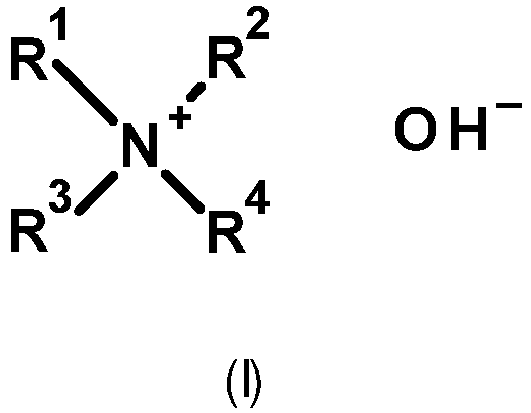
R1, R2, R3 und R4 unabhängig voneinander für gleiche oder verschiedene Reste stehen, die gesättigte oder ungesättigte, lineare oder verzweigte, aliphatische, cycloaliphatische, araliphatische oder aromatische organische Reste mit 1 bis 18 Kohlenstoffatomen bedeuten, die substituiert oder unsubstituiert sind und/oder Heteroatome in der Kette aufweisen, wobei R1 und R2 auch in Kombination untereinander gemeinsam mit dem Stickstoffatom und gegebenenfalls mit einem weiteren Heteroatom heterocyclische Ringe mit 3 bis 8 Kohlenstoffatomen bilden können, die gegebenenfalls weiter substituiert sein können, mit der Maßgabe, dass mindestens einer der Reste R1 bis R4 mindestens zwei Kohlenstoffatome aufweist. - Verfahren gemäß Anspruch 1, dadurch gekennzeichnet, dass es sich bei der Komponente A) um eine isocyanatfunktionelle Uretdiongruppen enthaltende Verbindungen A1) und/oder durch Umsetzung isocyanatfunktioneller Uretdiongruppen enthaltender Verbindungen A1) mit Alkoholen und/oder Aminen erhältliche Polyadditionsverbindungen A2) handelt.
- Verfahren gemäß Anspruch 2, dadurch gekennzeichnet, dass es sich bei der Komponente A1) um Uretdiongruppen enthaltende Verbindungen auf Basis von PDI, HDI, IPDI, XDI, NBDI und/oder H12-MDI handelt, die bevorzugt eine mittlere NCO-Funktionalität von mindestens 1,6 aufweisen und besonders bevorzugt einen Gehalt an Uretdionstrukturen (berechnet als C2N2O2, Molekulargewicht = 84) von 10 bis 25 Gew.-% aufweisen.
- Verfahren gemäß Anspruch 2 oder 3, dadurch gekennzeichnet, dass es sich bei den Polyadditionsverbindungen A2) um Verbindungen handelt, die durch Umsetzung isocyanatfunktioneller, Uretdiongruppen enthaltender Verbindungen A1) mit mindestens difunktionellen Polyolen des Molekulargewichtsbereiches 62 bis 22000 und gegebenenfalls Monoalkoholen unter Einhaltung eines Äquivalentverhältnisses von Isocyanatgruppen zu gegenüber Isocyanaten reaktiven Gruppen von 2 : 1 bis 0,5 : 1 hergestellt werden.
- Verfahren gemäß einem der Ansprüche 2 bis 4, dadurch gekennzeichnet, dass die Uretdiongruppen enthaltenden Polyadditionsverbindungen A2) in lösemittelfreier Form einen Gehalt an freien Isocyanatgruppen von weniger als 5 Gew.-% aufweisen.
- Verfahren gemäß einem der Ansprüche 1 bis 5, dadurch gekennzeichnet, dass es sich bei der Komponente B) um mindestens difunktionelle Polythiole des Molekulargewichtsbereiches 80 bis 22000 handelt.
- Verfahren gemäß einem der Ansprüche 1 bis 6, dadurch gekennzeichnet, dass die Komponenten A) und B) in solchen Mengen vorliegen, dass auf jede Uretdiongruppe der Komponente A) 0,5 bis 2,0 Thiolgruppen der Komponente B) entfällt.
- Verfahren gemäß einem der Ansprüche 1 bis 7, dadurch gekennzeichnet, dass es sich bei der Komponente C) um Verbindungen der allgemeinen Formel (I) handelt, in welcher
R1, R2, R3 und R4 unabhängig voneinander für gleiche oder verschiedene Reste stehen, die gesättigte oder ungesättigte, lineare oder verzweigte, aliphatische, cycloaliphatische, araliphatische oder aromatische organische Reste mit 2 bis 10, bevorzugt 3 bis 10 Kohlenstoffatomen bedeuten, die substituiert oder unsubstituiert sind und/oder Heteroatome in der Kette aufweisen, wobei R1 und R2 auch in Kombination untereinander gemeinsam mit dem Stickstoffatom und gegebenenfalls mit einem weiteren Heteroatom heterocyclische Ringe mit 3 bis 5 Kohlenstoffatomen bilden können, die gegebenenfalls weiter substituiert sein können, - Verfahren gemäß einem der Ansprüche 1 bis 8, dadurch gekennzeichnet, dass es sich beim Katalysator C) um Tetrapropylammoniumhydroxid, Tetrabutylammoniumhydroxid, Tetrahexylammoniumhydroxid, Tetraoctylammoniumhydroxid, Hexadecyltrimethylammoniumhydroxid und Benzyltrimethylammoniumhydroxid, bevorzugt um Tetrabutylammoniumhydroxid, Tetrahexylammoniumhydroxid und Tetraoctylammoniumhydroxid, besonders bevorzugt um Tetrabutylammoniumhydroxid handelt.
- Verfahren gemäß einem der Ansprüche 1 bis 9, dadurch gekennzeichnet, dass die Komponente C) in einer Menge von 0,001 bis 15 Gew.-%, bezogen auf das Gesamtgewicht der Komponenten A) und B), exklusive gegebenenfalls in diesen Komponenten vorliegender Lösemittel, Hilfs- oder Zusatzstoffe, zum Einsatz kommt.
- Zusammensetzung enthaltend wenigstens eine, mindestens eine Uretdiongruppe aufweisende Komponente A), mindestens eine, mindestens eine Thiolgruppe aufweisende Komponente B) und mindestens ein quarternäres Ammoniumhydroxid als Katalysator C) sowie gegebenenfalls weitere Hilfs- und Zusatzstoffe, mit der Maßgabe, dass mindestens ein Rest des quarternäres Ammoniumhydroxids mindestens 2 Kohlenstoffatome aufweist.
- Verwendung von Zusammensetzungen gemäß Anspruch 11 zur Herstellung von Polythiourethan-Kunststoffen oder Beschichtungsmitteln.
- Beschichtungsmittel enthaltend mindestens eine Zusammensetzung gemäß Anspruch 11.
- Substrat, beschichtet mit einem gegebenenfalls unter Wärmeeinwirkung ausgehärteten Beschichtungsmittel gemäß Anspruch 13.
- Polythiourethan-Kunststoff, erhältlich oder hergestellt aus einer gegebenenfalls unter Wärmeeinwirkung ausgehärteten Zusammensetzung gemäß Anspruch 11.
Applications Claiming Priority (2)
| Application Number | Priority Date | Filing Date | Title |
|---|---|---|---|
| EP21151281.9A EP4029892A1 (de) | 2021-01-13 | 2021-01-13 | Uretdiongruppen enthaltende zusammensetzungen |
| PCT/EP2021/087296 WO2022152536A1 (de) | 2021-01-13 | 2021-12-22 | Uretdiongruppen enthaltende zusammensetzungen |
Publications (2)
| Publication Number | Publication Date |
|---|---|
| EP4277941A1 EP4277941A1 (de) | 2023-11-22 |
| EP4277941B1 true EP4277941B1 (de) | 2025-01-01 |
Family
ID=74205613
Family Applications (2)
| Application Number | Title | Priority Date | Filing Date |
|---|---|---|---|
| EP21151281.9A Ceased EP4029892A1 (de) | 2021-01-13 | 2021-01-13 | Uretdiongruppen enthaltende zusammensetzungen |
| EP21835784.6A Active EP4277941B1 (de) | 2021-01-13 | 2021-12-22 | Uretdiongruppen enthaltende zusammensetzungen |
Family Applications Before (1)
| Application Number | Title | Priority Date | Filing Date |
|---|---|---|---|
| EP21151281.9A Ceased EP4029892A1 (de) | 2021-01-13 | 2021-01-13 | Uretdiongruppen enthaltende zusammensetzungen |
Country Status (2)
| Country | Link |
|---|---|
| EP (2) | EP4029892A1 (de) |
| WO (1) | WO2022152536A1 (de) |
Families Citing this family (1)
| Publication number | Priority date | Publication date | Assignee | Title |
|---|---|---|---|---|
| WO2025110733A1 (ko) * | 2023-11-21 | 2025-05-30 | 지에스칼텍스 주식회사 | 바이오매스 기반 폴리올, 이의 제조방법 및 정제방법 |
Family Cites Families (46)
| Publication number | Priority date | Publication date | Assignee | Title |
|---|---|---|---|---|
| DE1770245C3 (de) | 1968-04-23 | 1979-11-15 | Bayer Ag, 5090 Leverkusen | Verfahren zur Herstellung von gegebenenfalls vernetzten Polyurethanen |
| DE1954093C3 (de) | 1968-11-15 | 1978-12-21 | Mobay Chemical Corp., Pittsburgh, Pa. (V.St.A.) | Verfahren zur Herstellung von polymeren organischen Isocyanaten |
| DE2312391A1 (de) | 1973-03-13 | 1974-09-19 | Bayer Ag | Pulverfoermige, vernetzbare ueberzugsmittel |
| DE2414413C3 (de) | 1974-03-26 | 1978-08-24 | Bayer Ag, 5090 Leverkusen | Verwendung von Lösungen von Polyisocyanaten mit Isocyanuratstruktur in Zweikomponenten-Polyurethan-Lacken |
| DE2420475A1 (de) | 1974-04-27 | 1975-11-06 | Bayer Ag | Uretdiongruppen aufweisende polyadditionsprodukte |
| DE2452532C3 (de) | 1974-11-06 | 1978-08-24 | Bayer Ag, 5090 Leverkusen | Verfahren zur Herstellung von Polyisocyanaten mit Isocyanurat-Struktur |
| DE2622951B2 (de) | 1976-05-21 | 1979-09-06 | Bayer Ag, 5090 Leverkusen | Verfahren zur Herstellung von elastischen Fonnkörpern |
| DE2641380C2 (de) | 1976-09-15 | 1989-11-23 | Bayer Ag, 5090 Leverkusen | Verfahren zur Herstellung von Polyisocyanaten mit Isocyanuratstruktur |
| DE3030539A1 (de) | 1980-08-13 | 1982-04-01 | Chemische Werke Hüls AG, 4370 Marl | Verfahren zur herstellung von abspaltfreien polyurethan-pulverlacken sowie die danach hergestellten lacke |
| DE3030588A1 (de) | 1980-08-13 | 1982-03-18 | Chemische Werke Hüls AG, 4370 Marl | Verfahren zur herstellung von blockierungsmittelfreien polyurethan-pulverlacken mit hoher lagerstabilitaet, die oberhalb 120(grad) c haertbar sind, sowie die danach hergestellten polyurethan-pulverlacke |
| DE3030572A1 (de) | 1980-08-13 | 1982-03-18 | Chemische Werke Hüls AG, 4370 Marl | Verfahren zur herstellung von uretdiongruppenhaltigen polyadditionsprodukten sowie die danach hergestellten produkte |
| DE3700209A1 (de) | 1987-01-07 | 1988-07-21 | Bayer Ag | Verfahren zur herstellung von polyisocyanaten mit biuretstruktur |
| DE3811350A1 (de) | 1988-04-02 | 1989-10-19 | Bayer Ag | Verfahren zur herstellung von isocyanuratpolyisocyanaten, die nach diesem verfahren erhaltenen verbindungen und ihre verwendung |
| DE3814167A1 (de) | 1988-04-27 | 1989-11-09 | Bayer Ag | Verfahren zur herstellung von isocyanuratgruppen aufweisenden polyisocyanaten und ihre verwendung |
| DE3900053A1 (de) | 1989-01-03 | 1990-07-12 | Bayer Ag | Verfahren zur herstellung von uretdion- und isocyanuratgruppen aufweisenden polyisocyanaten, die nach diesem verfahren erhaeltlichen polyisocyanate und ihre verwendung in zweikomponenten-polyurethanlacken |
| DE59007601D1 (de) | 1989-06-23 | 1994-12-08 | Bayer Ag | Verfahren zur Herstellung von Überzügen. |
| DE3928503A1 (de) | 1989-08-29 | 1991-03-07 | Bayer Ag | Verfahren zur herstellung von loesungen von isocyanuratgruppen aufweisenden polyisocyanaten in lackloesungsmitteln und ihre verwendung |
| JPH05502050A (ja) | 1989-11-20 | 1993-04-15 | イーストマン ケミカル カンパニー | 粉体塗料組成物 |
| CA2115763A1 (en) | 1991-08-27 | 1993-03-04 | Robert B. Barbee | Thermosetting powder coating compositions |
| DE4308097A1 (de) | 1993-03-15 | 1994-09-22 | Henkel Kgaa | Polyol für ein Isocyanat-Gießharz und Beschichtungen |
| DE4327573A1 (de) | 1993-08-17 | 1995-02-23 | Bayer Ag | Uretdion-Pulverlackvernetzer mit niedriger Schmelzviskosität |
| JP2766611B2 (ja) | 1993-10-19 | 1998-06-18 | ホーヤ株式会社 | 反応性オリゴマー |
| US5502147A (en) | 1993-12-21 | 1996-03-26 | Bayer Corporation | Aliphatic rim elastomers |
| DE4406444A1 (de) | 1994-02-28 | 1995-08-31 | Huels Chemische Werke Ag | Hydroxyl- und uretdiongruppenhaltige Polyadditionsprodukte und Verfahren zu ihrer Herstellung sowie deren Verwendung zur Herstellung abspaltfreier Polyurethan-Pulverlacke hoher Reaktivität und die danach hergestellten Polyurethan-Pulverlacke |
| DE19603245A1 (de) | 1996-01-30 | 1997-07-31 | Bayer Ag | Dünnschichtdestillation von Uretdiondiisocyanaten |
| DE19611849A1 (de) | 1996-03-26 | 1997-10-02 | Bayer Ag | Neue Isocyanattrimerisate und Isocyanattrimerisatmischungen, deren Herstellung und Verwendung |
| DE19616496A1 (de) | 1996-04-25 | 1997-10-30 | Bayer Ag | Abspaltfreier Polyurethan-Pulverlack mit niedriger Einbrenntemperatur |
| DE19646424A1 (de) | 1996-11-11 | 1998-05-14 | Henkel Kgaa | Verwendung von Polyolen für Isocyanat-Gießharze und -Beschichtungsmassen |
| DE19701835A1 (de) | 1997-01-21 | 1998-07-23 | Huels Chemische Werke Ag | Kalthärtende, lösemittelarme oder lösemittelfreie Zweikomponenten-Polyurethan-Polyharnstoff-Massen |
| JPH10319203A (ja) * | 1997-05-20 | 1998-12-04 | Nippon Polyurethane Ind Co Ltd | プラスチックレンズの製造方法 |
| JPH10319204A (ja) * | 1997-05-20 | 1998-12-04 | Nippon Polyurethane Ind Co Ltd | プラスチックレンズの製造方法 |
| US5814689A (en) | 1997-08-29 | 1998-09-29 | Arco Chemical Technology, L.P. | Low viscosity polyuretidione polyurethanes and their use as curatives for solvent and water borne coatings |
| DE19835113A1 (de) | 1998-08-04 | 2000-02-10 | Basf Ag | Verfahren zur Herstellung von kompakten, transparenten Polyisocyanat-Polyadditionsprodukten |
| DE19856878A1 (de) | 1998-12-10 | 2000-06-15 | Inst Polymerforschung Dresden | Härtbare uretdiongruppenhaltige Massen und ein Verfahren zu ihrer Herstellung und Verarbeitung sowie ihre Verwendung |
| DE10205608A1 (de) | 2002-02-11 | 2003-08-21 | Degussa | Bei niedriger Temperatur härtbare feste uretdiongruppenhaltige Polyurethan-Pulverlackzusammensetzungen |
| DE10320267A1 (de) | 2003-05-03 | 2004-11-18 | Degussa Ag | Bei niedriger Temperatur härtbare feste uretdiongruppenhaltige Polyurethan-Pulverlackzusammensetzungen |
| DE10320266A1 (de) | 2003-05-03 | 2004-11-18 | Degussa Ag | Feste Uretdiongruppenhaltige Polyurethan-Pulverlackzusammensetzungen bei niedriger Temperatur härtbar |
| DE10346957A1 (de) | 2003-10-09 | 2005-05-04 | Degussa | Hochreaktive, flüssige uretdiongruppenhaltige Polyurenthansysteme, die bei niedriger Temperatur härtbar sind |
| DE102004011005A1 (de) | 2004-03-06 | 2005-09-22 | Degussa Ag | Bei niedriger Temperatur härtbare uretdiongruppenhaltige Polyurethanzusammensetzungen |
| US20070066786A1 (en) | 2005-09-22 | 2007-03-22 | The Hanson Group, Llc | Methods of preparing and using polyurea elastomers |
| DE102009057597A1 (de) | 2009-12-09 | 2011-06-16 | Bayer Materialscience Ag | Polyrethan-Prepolymere |
| US9080074B2 (en) | 2010-03-19 | 2015-07-14 | Bayer Materialscience Llc | Low temperature curing polyuretdione compositions |
| WO2011124710A1 (de) | 2010-04-09 | 2011-10-13 | Basf Se | Durch energieeintrag reparable beschichtungen |
| DE102012218081A1 (de) | 2012-10-04 | 2014-04-10 | Evonik Industries Ag | Neuartige hydrophile Polyisocyanate mit verbesserter Lagerstabilität |
| US20210024793A1 (en) * | 2018-03-16 | 2021-01-28 | 3M Innovative Properties Company | Compositions, method of bonding, and assembly |
| EP3856816A1 (de) | 2018-09-25 | 2021-08-04 | 3M Innovative Properties Company | Polymeres material mit uretdionhaltigem material, polythiol und saurer stabilisator, zweiteilige zusammensetzungen und verfahren |
-
2021
- 2021-01-13 EP EP21151281.9A patent/EP4029892A1/de not_active Ceased
- 2021-12-22 EP EP21835784.6A patent/EP4277941B1/de active Active
- 2021-12-22 WO PCT/EP2021/087296 patent/WO2022152536A1/de not_active Ceased
Also Published As
| Publication number | Publication date |
|---|---|
| EP4277941A1 (de) | 2023-11-22 |
| WO2022152536A1 (de) | 2022-07-21 |
| EP4029892A1 (de) | 2022-07-20 |
Similar Documents
| Publication | Publication Date | Title |
|---|---|---|
| EP2890690B1 (de) | Bindemittel mit cyclischen carbonatstrukturen | |
| EP2596042B1 (de) | Polyisocyanatgemische | |
| EP2389403B1 (de) | Polyurethanvergussmassen | |
| EP2596041B1 (de) | Polyurethane mit hoher lichtbrechung | |
| EP3872108A1 (de) | Uretdiongruppen enthaltende zusammensetzungen | |
| EP2222744B1 (de) | Cycloaliphatische strukturelemente enthaltende polyisocyanatgemische | |
| EP2930009B1 (de) | Verfahren zum verdrucken eines mehrkomponentensystems | |
| EP4277941B1 (de) | Uretdiongruppen enthaltende zusammensetzungen | |
| EP3601405B1 (de) | Aufbau von beschichtungen durch getrenntes auftragen von polyisocyanatzusammensetzungen und vernetzungskatalysatoren | |
| WO2021004980A1 (de) | Verfahren zur herstellung von allophanat- und/oder thioallophanatgruppen enthaltenden verbindungen | |
| EP4157912B1 (de) | Bei niedrigen temperaturen vernetzende uretdiongruppen enthaltende zusammensetzungen | |
| EP3997183B1 (de) | Verfahren zur herstellung von isocyanuraten aus uretdionen | |
| EP4265663A1 (de) | Polyaspartat-basierte zweikomponenten-beschichtungszusammensetzungen zur herstellung von beschichtungen mit guten selbstheilungseigenschaften bei gleichzeitig geringer klebrigkeit | |
| DE3018198A1 (de) | Neue isocyanato-isocyanurate, ein verfahren zu ihrer herstellung, sowie ihre verwendung als isocyanat-komponente in polyurethan-lacken | |
| EP4574874A1 (de) | Polyisocyanatgemisch | |
| EP4574864A1 (de) | Polyisocyanatgemisch | |
| WO2025224257A1 (de) | Ein-komponenten-beschichtungsmittel für nahrungsmittelbehälter | |
| DE10023180A1 (de) | Wärmehärtendes lösemittel- und monomerfreies 2K-Beschichtungsmaterial |
Legal Events
| Date | Code | Title | Description |
|---|---|---|---|
| STAA | Information on the status of an ep patent application or granted ep patent |
Free format text: STATUS: UNKNOWN |
|
| STAA | Information on the status of an ep patent application or granted ep patent |
Free format text: STATUS: THE INTERNATIONAL PUBLICATION HAS BEEN MADE |
|
| PUAI | Public reference made under article 153(3) epc to a published international application that has entered the european phase |
Free format text: ORIGINAL CODE: 0009012 |
|
| STAA | Information on the status of an ep patent application or granted ep patent |
Free format text: STATUS: REQUEST FOR EXAMINATION WAS MADE |
|
| 17P | Request for examination filed |
Effective date: 20230814 |
|
| AK | Designated contracting states |
Kind code of ref document: A1 Designated state(s): AL AT BE BG CH CY CZ DE DK EE ES FI FR GB GR HR HU IE IS IT LI LT LU LV MC MK MT NL NO PL PT RO RS SE SI SK SM TR |
|
| DAV | Request for validation of the european patent (deleted) | ||
| DAX | Request for extension of the european patent (deleted) | ||
| GRAP | Despatch of communication of intention to grant a patent |
Free format text: ORIGINAL CODE: EPIDOSNIGR1 |
|
| STAA | Information on the status of an ep patent application or granted ep patent |
Free format text: STATUS: GRANT OF PATENT IS INTENDED |
|
| INTG | Intention to grant announced |
Effective date: 20240813 |
|
| GRAS | Grant fee paid |
Free format text: ORIGINAL CODE: EPIDOSNIGR3 |
|
| GRAA | (expected) grant |
Free format text: ORIGINAL CODE: 0009210 |
|
| STAA | Information on the status of an ep patent application or granted ep patent |
Free format text: STATUS: THE PATENT HAS BEEN GRANTED |
|
| AK | Designated contracting states |
Kind code of ref document: B1 Designated state(s): AL AT BE BG CH CY CZ DE DK EE ES FI FR GB GR HR HU IE IS IT LI LT LU LV MC MK MT NL NO PL PT RO RS SE SI SK SM TR |
|
| REG | Reference to a national code |
Ref country code: GB Ref legal event code: FG4D Free format text: NOT ENGLISH |
|
| REG | Reference to a national code |
Ref country code: DE Ref legal event code: R096 Ref document number: 502021006318 Country of ref document: DE |
|
| REG | Reference to a national code |
Ref country code: CH Ref legal event code: EP |
|
| REG | Reference to a national code |
Ref country code: IE Ref legal event code: FG4D Free format text: LANGUAGE OF EP DOCUMENT: GERMAN |
|
| REG | Reference to a national code |
Ref country code: LT Ref legal event code: MG9D |
|
| REG | Reference to a national code |
Ref country code: NL Ref legal event code: MP Effective date: 20250101 |
|
| PG25 | Lapsed in a contracting state [announced via postgrant information from national office to epo] |
Ref country code: NL Free format text: LAPSE BECAUSE OF FAILURE TO SUBMIT A TRANSLATION OF THE DESCRIPTION OR TO PAY THE FEE WITHIN THE PRESCRIBED TIME-LIMIT Effective date: 20250101 |
|
| PG25 | Lapsed in a contracting state [announced via postgrant information from national office to epo] |
Ref country code: FI Free format text: LAPSE BECAUSE OF FAILURE TO SUBMIT A TRANSLATION OF THE DESCRIPTION OR TO PAY THE FEE WITHIN THE PRESCRIBED TIME-LIMIT Effective date: 20250101 |
|
| PG25 | Lapsed in a contracting state [announced via postgrant information from national office to epo] |
Ref country code: PL Free format text: LAPSE BECAUSE OF FAILURE TO SUBMIT A TRANSLATION OF THE DESCRIPTION OR TO PAY THE FEE WITHIN THE PRESCRIBED TIME-LIMIT Effective date: 20250101 |
|
| PG25 | Lapsed in a contracting state [announced via postgrant information from national office to epo] |
Ref country code: ES Free format text: LAPSE BECAUSE OF FAILURE TO SUBMIT A TRANSLATION OF THE DESCRIPTION OR TO PAY THE FEE WITHIN THE PRESCRIBED TIME-LIMIT Effective date: 20250101 |
|
| PG25 | Lapsed in a contracting state [announced via postgrant information from national office to epo] |
Ref country code: IS Free format text: LAPSE BECAUSE OF FAILURE TO SUBMIT A TRANSLATION OF THE DESCRIPTION OR TO PAY THE FEE WITHIN THE PRESCRIBED TIME-LIMIT Effective date: 20250501 Ref country code: NO Free format text: LAPSE BECAUSE OF FAILURE TO SUBMIT A TRANSLATION OF THE DESCRIPTION OR TO PAY THE FEE WITHIN THE PRESCRIBED TIME-LIMIT Effective date: 20250401 |
|
| PG25 | Lapsed in a contracting state [announced via postgrant information from national office to epo] |
Ref country code: HR Free format text: LAPSE BECAUSE OF FAILURE TO SUBMIT A TRANSLATION OF THE DESCRIPTION OR TO PAY THE FEE WITHIN THE PRESCRIBED TIME-LIMIT Effective date: 20250101 |
|
| PG25 | Lapsed in a contracting state [announced via postgrant information from national office to epo] |
Ref country code: LV Free format text: LAPSE BECAUSE OF FAILURE TO SUBMIT A TRANSLATION OF THE DESCRIPTION OR TO PAY THE FEE WITHIN THE PRESCRIBED TIME-LIMIT Effective date: 20250101 Ref country code: PT Free format text: LAPSE BECAUSE OF FAILURE TO SUBMIT A TRANSLATION OF THE DESCRIPTION OR TO PAY THE FEE WITHIN THE PRESCRIBED TIME-LIMIT Effective date: 20250502 |
|
| PG25 | Lapsed in a contracting state [announced via postgrant information from national office to epo] |
Ref country code: BG Free format text: LAPSE BECAUSE OF FAILURE TO SUBMIT A TRANSLATION OF THE DESCRIPTION OR TO PAY THE FEE WITHIN THE PRESCRIBED TIME-LIMIT Effective date: 20250101 Ref country code: GR Free format text: LAPSE BECAUSE OF FAILURE TO SUBMIT A TRANSLATION OF THE DESCRIPTION OR TO PAY THE FEE WITHIN THE PRESCRIBED TIME-LIMIT Effective date: 20250402 |
|
| PG25 | Lapsed in a contracting state [announced via postgrant information from national office to epo] |
Ref country code: CZ Free format text: LAPSE BECAUSE OF FAILURE TO SUBMIT A TRANSLATION OF THE DESCRIPTION OR TO PAY THE FEE WITHIN THE PRESCRIBED TIME-LIMIT Effective date: 20250101 |
|
| PG25 | Lapsed in a contracting state [announced via postgrant information from national office to epo] |
Ref country code: SE Free format text: LAPSE BECAUSE OF FAILURE TO SUBMIT A TRANSLATION OF THE DESCRIPTION OR TO PAY THE FEE WITHIN THE PRESCRIBED TIME-LIMIT Effective date: 20250101 |
|
| REG | Reference to a national code |
Ref country code: DE Ref legal event code: R097 Ref document number: 502021006318 Country of ref document: DE |
|
| PG25 | Lapsed in a contracting state [announced via postgrant information from national office to epo] |
Ref country code: SM Free format text: LAPSE BECAUSE OF FAILURE TO SUBMIT A TRANSLATION OF THE DESCRIPTION OR TO PAY THE FEE WITHIN THE PRESCRIBED TIME-LIMIT Effective date: 20250101 |
|
| PG25 | Lapsed in a contracting state [announced via postgrant information from national office to epo] |
Ref country code: DK Free format text: LAPSE BECAUSE OF FAILURE TO SUBMIT A TRANSLATION OF THE DESCRIPTION OR TO PAY THE FEE WITHIN THE PRESCRIBED TIME-LIMIT Effective date: 20250101 |
|
| PG25 | Lapsed in a contracting state [announced via postgrant information from national office to epo] |
Ref country code: IT Free format text: LAPSE BECAUSE OF FAILURE TO SUBMIT A TRANSLATION OF THE DESCRIPTION OR TO PAY THE FEE WITHIN THE PRESCRIBED TIME-LIMIT Effective date: 20250101 |
|
| PG25 | Lapsed in a contracting state [announced via postgrant information from national office to epo] |
Ref country code: EE Free format text: LAPSE BECAUSE OF FAILURE TO SUBMIT A TRANSLATION OF THE DESCRIPTION OR TO PAY THE FEE WITHIN THE PRESCRIBED TIME-LIMIT Effective date: 20250101 |
|
| PG25 | Lapsed in a contracting state [announced via postgrant information from national office to epo] |
Ref country code: RO Free format text: LAPSE BECAUSE OF FAILURE TO SUBMIT A TRANSLATION OF THE DESCRIPTION OR TO PAY THE FEE WITHIN THE PRESCRIBED TIME-LIMIT Effective date: 20250101 |
|
| PG25 | Lapsed in a contracting state [announced via postgrant information from national office to epo] |
Ref country code: SK Free format text: LAPSE BECAUSE OF FAILURE TO SUBMIT A TRANSLATION OF THE DESCRIPTION OR TO PAY THE FEE WITHIN THE PRESCRIBED TIME-LIMIT Effective date: 20250101 |
|
| PLBE | No opposition filed within time limit |
Free format text: ORIGINAL CODE: 0009261 |
|
| STAA | Information on the status of an ep patent application or granted ep patent |
Free format text: STATUS: NO OPPOSITION FILED WITHIN TIME LIMIT |
|
| 26N | No opposition filed |
Effective date: 20251002 |
|
| PGFP | Annual fee paid to national office [announced via postgrant information from national office to epo] |
Ref country code: DE Payment date: 20251119 Year of fee payment: 5 |
|
| PGFP | Annual fee paid to national office [announced via postgrant information from national office to epo] |
Ref country code: AT Payment date: 20260113 Year of fee payment: 5 |