EP4212343B1 - Inkjet head, production method for inkjet head, and inkjet-recording device - Google Patents
Inkjet head, production method for inkjet head, and inkjet-recording device Download PDFInfo
- Publication number
- EP4212343B1 EP4212343B1 EP20953219.1A EP20953219A EP4212343B1 EP 4212343 B1 EP4212343 B1 EP 4212343B1 EP 20953219 A EP20953219 A EP 20953219A EP 4212343 B1 EP4212343 B1 EP 4212343B1
- Authority
- EP
- European Patent Office
- Prior art keywords
- channel
- substrate
- nozzle
- liquid
- silicon
- Prior art date
- Legal status (The legal status is an assumption and is not a legal conclusion. Google has not performed a legal analysis and makes no representation as to the accuracy of the status listed.)
- Active
Links
Images








Classifications
-
- B—PERFORMING OPERATIONS; TRANSPORTING
- B41—PRINTING; LINING MACHINES; TYPEWRITERS; STAMPS
- B41J—TYPEWRITERS; SELECTIVE PRINTING MECHANISMS, i.e. MECHANISMS PRINTING OTHERWISE THAN FROM A FORME; CORRECTION OF TYPOGRAPHICAL ERRORS
- B41J2/00—Typewriters or selective printing mechanisms characterised by the printing or marking process for which they are designed
- B41J2/005—Typewriters or selective printing mechanisms characterised by the printing or marking process for which they are designed characterised by bringing liquid or particles selectively into contact with a printing material
- B41J2/01—Ink jet
- B41J2/17—Ink jet characterised by ink handling
- B41J2/18—Ink recirculation systems
-
- B—PERFORMING OPERATIONS; TRANSPORTING
- B41—PRINTING; LINING MACHINES; TYPEWRITERS; STAMPS
- B41J—TYPEWRITERS; SELECTIVE PRINTING MECHANISMS, i.e. MECHANISMS PRINTING OTHERWISE THAN FROM A FORME; CORRECTION OF TYPOGRAPHICAL ERRORS
- B41J2/00—Typewriters or selective printing mechanisms characterised by the printing or marking process for which they are designed
- B41J2/005—Typewriters or selective printing mechanisms characterised by the printing or marking process for which they are designed characterised by bringing liquid or particles selectively into contact with a printing material
- B41J2/01—Ink jet
- B41J2/135—Nozzles
- B41J2/16—Production of nozzles
- B41J2/1606—Coating the nozzle area or the ink chamber
-
- B—PERFORMING OPERATIONS; TRANSPORTING
- B41—PRINTING; LINING MACHINES; TYPEWRITERS; STAMPS
- B41J—TYPEWRITERS; SELECTIVE PRINTING MECHANISMS, i.e. MECHANISMS PRINTING OTHERWISE THAN FROM A FORME; CORRECTION OF TYPOGRAPHICAL ERRORS
- B41J2/00—Typewriters or selective printing mechanisms characterised by the printing or marking process for which they are designed
- B41J2/005—Typewriters or selective printing mechanisms characterised by the printing or marking process for which they are designed characterised by bringing liquid or particles selectively into contact with a printing material
- B41J2/01—Ink jet
- B41J2/135—Nozzles
- B41J2/16—Production of nozzles
- B41J2/1607—Production of print heads with piezoelectric elements
- B41J2/161—Production of print heads with piezoelectric elements of film type, deformed by bending and disposed on a diaphragm
-
- B—PERFORMING OPERATIONS; TRANSPORTING
- B41—PRINTING; LINING MACHINES; TYPEWRITERS; STAMPS
- B41J—TYPEWRITERS; SELECTIVE PRINTING MECHANISMS, i.e. MECHANISMS PRINTING OTHERWISE THAN FROM A FORME; CORRECTION OF TYPOGRAPHICAL ERRORS
- B41J2/00—Typewriters or selective printing mechanisms characterised by the printing or marking process for which they are designed
- B41J2/005—Typewriters or selective printing mechanisms characterised by the printing or marking process for which they are designed characterised by bringing liquid or particles selectively into contact with a printing material
- B41J2/01—Ink jet
- B41J2/135—Nozzles
- B41J2/16—Production of nozzles
- B41J2/1621—Manufacturing processes
- B41J2/1623—Manufacturing processes bonding and adhesion
-
- B—PERFORMING OPERATIONS; TRANSPORTING
- B41—PRINTING; LINING MACHINES; TYPEWRITERS; STAMPS
- B41J—TYPEWRITERS; SELECTIVE PRINTING MECHANISMS, i.e. MECHANISMS PRINTING OTHERWISE THAN FROM A FORME; CORRECTION OF TYPOGRAPHICAL ERRORS
- B41J2/00—Typewriters or selective printing mechanisms characterised by the printing or marking process for which they are designed
- B41J2/005—Typewriters or selective printing mechanisms characterised by the printing or marking process for which they are designed characterised by bringing liquid or particles selectively into contact with a printing material
- B41J2/01—Ink jet
- B41J2/135—Nozzles
- B41J2/16—Production of nozzles
- B41J2/1621—Manufacturing processes
- B41J2/164—Manufacturing processes thin film formation
- B41J2/1642—Manufacturing processes thin film formation thin film formation by CVD [chemical vapor deposition]
-
- B—PERFORMING OPERATIONS; TRANSPORTING
- B41—PRINTING; LINING MACHINES; TYPEWRITERS; STAMPS
- B41J—TYPEWRITERS; SELECTIVE PRINTING MECHANISMS, i.e. MECHANISMS PRINTING OTHERWISE THAN FROM A FORME; CORRECTION OF TYPOGRAPHICAL ERRORS
- B41J2/00—Typewriters or selective printing mechanisms characterised by the printing or marking process for which they are designed
- B41J2/005—Typewriters or selective printing mechanisms characterised by the printing or marking process for which they are designed characterised by bringing liquid or particles selectively into contact with a printing material
- B41J2/01—Ink jet
- B41J2/135—Nozzles
- B41J2/14—Structure thereof only for on-demand ink jet heads
- B41J2/14201—Structure of print heads with piezoelectric elements
- B41J2/14233—Structure of print heads with piezoelectric elements of film type, deformed by bending and disposed on a diaphragm
-
- B—PERFORMING OPERATIONS; TRANSPORTING
- B41—PRINTING; LINING MACHINES; TYPEWRITERS; STAMPS
- B41J—TYPEWRITERS; SELECTIVE PRINTING MECHANISMS, i.e. MECHANISMS PRINTING OTHERWISE THAN FROM A FORME; CORRECTION OF TYPOGRAPHICAL ERRORS
- B41J2/00—Typewriters or selective printing mechanisms characterised by the printing or marking process for which they are designed
- B41J2/005—Typewriters or selective printing mechanisms characterised by the printing or marking process for which they are designed characterised by bringing liquid or particles selectively into contact with a printing material
- B41J2/01—Ink jet
- B41J2/135—Nozzles
- B41J2/14—Structure thereof only for on-demand ink jet heads
- B41J2/14201—Structure of print heads with piezoelectric elements
- B41J2/14233—Structure of print heads with piezoelectric elements of film type, deformed by bending and disposed on a diaphragm
- B41J2002/14241—Structure of print heads with piezoelectric elements of film type, deformed by bending and disposed on a diaphragm having a cover around the piezoelectric thin film element
-
- B—PERFORMING OPERATIONS; TRANSPORTING
- B41—PRINTING; LINING MACHINES; TYPEWRITERS; STAMPS
- B41J—TYPEWRITERS; SELECTIVE PRINTING MECHANISMS, i.e. MECHANISMS PRINTING OTHERWISE THAN FROM A FORME; CORRECTION OF TYPOGRAPHICAL ERRORS
- B41J2/00—Typewriters or selective printing mechanisms characterised by the printing or marking process for which they are designed
- B41J2/005—Typewriters or selective printing mechanisms characterised by the printing or marking process for which they are designed characterised by bringing liquid or particles selectively into contact with a printing material
- B41J2/01—Ink jet
- B41J2/135—Nozzles
- B41J2/14—Structure thereof only for on-demand ink jet heads
- B41J2002/14467—Multiple feed channels per ink chamber
-
- B—PERFORMING OPERATIONS; TRANSPORTING
- B41—PRINTING; LINING MACHINES; TYPEWRITERS; STAMPS
- B41J—TYPEWRITERS; SELECTIVE PRINTING MECHANISMS, i.e. MECHANISMS PRINTING OTHERWISE THAN FROM A FORME; CORRECTION OF TYPOGRAPHICAL ERRORS
- B41J2202/00—Embodiments of or processes related to ink-jet or thermal heads
- B41J2202/01—Embodiments of or processes related to ink-jet heads
- B41J2202/11—Embodiments of or processes related to ink-jet heads characterised by specific geometrical characteristics
-
- B—PERFORMING OPERATIONS; TRANSPORTING
- B41—PRINTING; LINING MACHINES; TYPEWRITERS; STAMPS
- B41J—TYPEWRITERS; SELECTIVE PRINTING MECHANISMS, i.e. MECHANISMS PRINTING OTHERWISE THAN FROM A FORME; CORRECTION OF TYPOGRAPHICAL ERRORS
- B41J2202/00—Embodiments of or processes related to ink-jet or thermal heads
- B41J2202/01—Embodiments of or processes related to ink-jet heads
- B41J2202/12—Embodiments of or processes related to ink-jet heads with ink circulating through the whole print head
Definitions
- the present invention relates to an inkjet head, an inkjet head manufacturing method, and an inkjet recording apparatus.
- a silicon processing process is applied to ensure processing accuracy for the nozzle substrate and the channel substrate of the inkjet head.
- a process of processing and bonding a silicon nozzle substrate and a channel substrate having a circulation channel is performed.
- a silicon nozzle substrate may have a substrate thickness of 100 ⁇ m or less from the viewpoint of flow path design, which makes handling during manufacturing difficult. Therefore, nozzles are formed on a silicon substrate having a support layer, and the support layer is removed after bonding to the channel substrate.
- a head chip is manufactured in which the silicon nozzle substrate and the channel substrate are integrated.
- a liquid-repellent film is formed on the ejection surface of the silicon nozzle substrate in order to stabilize the ejection direction of the ink droplets and improve the ejection performance.
- Patent Document 1 discloses a manufacturing method in which a liquid-repellent film is formed after bonding a nozzle substrate and a channel substrate. However, since the liquid-repellent film is also formed inside the channel, it is assumed that the wettability is lowered and ejection defects may occur. In order to remove the liquid-repellent film, a process such as oxygen plasma treatment is commonly applied. However, in a channel structure such as that disclosed in Patent Document 1, particularly in a structure having a circulation channel in the upper stage of the nozzle, oxygen ions or oxygen radicals often do not reach the channel, and often it cannot be removed.
- Patent Document 2 discloses a method of forming a liquid-repellent film on a nozzle substrate after nozzle processing and bonding it to a channel substrate.
- the liquid-repellent film may unintentionally wrap around the joint surface side of the nozzle substrate during manufacturing.
- the reliability of the bonding portion is reduced if the removal of the liquid-repellent film by the oxygen plasma treatment is insufficient. Therefore, it is desirable to form the liquid-repellent film after bonding the nozzle substrate and the channel substrate.
- the present invention has been made in view of the above-described problems and circumstances, and an object thereof is to provide an inkjet head, an inkjet head manufacturing method, and an inkjet recording apparatus that are excellent in ink ejectability.
- the present inventor found the following in the process of examining the causes of the above problems.
- the inventors By setting the positional relationship between the nozzles of the silicon nozzle substrate and the circulation channels of the channel substrate to satisfy a specific condition, the inventors have found that it is possible to obtain an inkjet head including a silicon nozzle substrate in which formation of a liquid-repellent film in the channel substrate is suppressed and a channel substrate having a circulation channel, which led to the present invention. That is, the above problems related to the present invention are solved by an inkjet head according to claim 1 and a method of producing an inkjet head according to claim 7.
- an inkjet head including a silicon nozzle substrate having a liquid-repellent film on the ejection surface side and a channel substrate having a circulation channel, formation of a liquid-repellent film in the channel substrate is suppressed.
- an inkjet head with excellent ink ejectability and a method for manufacturing an inkjet head in which formation of a liquid-repellent film in the channel substrate during manufacturing is suppressed.
- an inkjet recording apparatus having an inkjet head with excellent ink ejection properties.
- the direction in which the recording medium M is conveyed is defined as the front-rear direction
- the direction orthogonal to the direction in which the recording medium M is conveyed on the printing surface of the recording medium M that is, the printing width direction of the inkjet head 100 is defined as the left-right direction
- the thickness direction of the recording medium M is defined as the up-down direction.
- the arrows in the channels in the drawings indicate the directions in which the ink flows.
- FIG. 3 is a perspective view showing an example of an embodiment of the inkjet head of the present invention
- FIG. 4 and FIG. 5 are cross-sectional views in the left-right direction of the lower portion of the inkjet head 100 shown in FIG. 3 and an exploded perspective view of the inkjet head 100.
- FIG. 1 is a schematic diagram of an inkjet recording apparatus 200 equipped with, for example, the inkjet head 100 of the present invention shown in FIG. 3 .
- FIG. 2 is a bottom view of a head unit of the inkjet recording apparatus 200 shown in FIG. 1 .
- the inkjet recording apparatus 200 shown in FIG. 1 includes a paper feeding unit 210, an image recording unit 220, a paper discharge unit 230, and an ink circulation system (see FIG. 19 ) as an ink supply device.
- the inkjet recording apparatus 200 conveys the recording medium M stored in the paper feeding unit 210 to the image recording unit 220, forms an image on the recording medium M in the image recording unit 220, and the recording medium M on which the image is formed is conveyed to the paper discharge unit 230.
- the paper feeding unit 210 includes a paper feed tray 211 that stores the recording medium M, and a medium supply unit 212 that conveys and supplies the recording medium M from the paper feed tray 211 to the image recording unit 220.
- the medium supply unit 212 includes a ring-shaped belt whose inner side is supported by two rollers, and the recording medium M is fed from the paper feed tray 211 by rotating the rollers while the recording medium M is placed on the belt. It is conveyed to the image recording unit 220.
- the image recording unit 220 includes a conveying drum 221, a delivery unit 222, a heating unit 223, a head unit 224, a fixing unit 225, and a delivery section 226.
- the conveying drum 221 has a cylindrical surface, and an outer peripheral surface thereof serves as a conveying surface on which the recording medium M is placed.
- the conveying drum 221 conveys the recording medium M along the conveying surface by rotating in the direction of the arrow in FIG. 1 while holding the recording medium M on the conveying surface.
- the conveying drum 221 includes a claw portion and a suction portion (not shown). The end of the recording medium M is pressed by the claw.
- the recording medium M is held on the conveying surface by drawing the recording medium M toward the conveying surface using the suction unit.
- the delivery unit 222 is provided between the medium supply unit 212 of the paper feeding unit 210 and the conveying drum 221, and picks up the recording medium M conveyed from the medium supply unit 212 by holding one end of the recording medium M conveyed from the medium supply unit 212 with the swing arm 222a. It is transferred to the conveying drum 221 via the delivery drum 222b.
- the heating unit 223 is provided between the arrangement position of the delivery drum 222b and the arrangement position of the head unit 224, and heats the recording medium M conveyed by the conveying drum 221 so that the temperature of the recording medium M is within a predetermined temperature range.
- the heating unit 223 has, for example, an infrared heater, and energizes the infrared heater based on a control signal supplied from a control unit (not shown) to cause the heater to generate heat.
- the head unit 224 has a rectangular ink ejection surface whose longitudinal direction is the direction orthogonal to the conveying direction of the recording medium M (left-right direction).
- the ink ejection surface is arranged facing the conveying drum 221 with a predetermined distance therebetween.
- the longitudinal length of the ink ejection surface of the head unit 224 corresponds to the printing width of the recording medium M.
- the head unit 224 ejects an ink onto the recording medium M at an appropriate timing according to the rotation of the conveying drum 221 holding the recording medium M to form an image.
- the head unit 224 ejects an ink onto the recording medium M at an appropriate timing according to the rotation of the conveying drum 221 holding the recording medium M to form an image.
- four head units 224 respectively corresponding to four color inks of yellow (Y), magenta (M), cyan (C), and black (K) are used to print the recording medium M, which are arranged in the order of Y, M, C, and K at predetermined intervals from the upstream side in the conveying direction of the recording medium M.
- a pair of inkjet heads 100 adjacent in the front-rear direction are arranged in a staggered manner at different positions in the front-rear direction.
- the inkjet head 100 has a rectangular ink ejection surface whose longitudinal direction is the left-right direction, and on the ink ejection surface, a plurality of nozzles 111 are arranged at approximately equal intervals along the left-right direction.
- a liquid-repellent film 14 is formed on the ink ejection surface.
- the head unit 224 is used in a fixed position with respect to the rotating shaft of the conveying drum 221 when recording an image. That is, the inkjet recording apparatus 200 is an inkjet recording apparatus 200 that performs image recording by a one-pass drawing method using a line head.
- the fixing unit 225 has a light emitting unit arranged across the width of the conveying drum 221 in the X direction, and irradiates the recording medium M placed on the conveying drum 221 with energy rays such as ultraviolet rays from the light emitting unit. Then, the ink ejected onto the recording medium M is cured and fixed.
- the light emitting unit of the fixing unit 225 is arranged downstream of the arrangement position of the head unit 224 and upstream of the arrangement position of the delivery drum 226a of the delivery section 226 in the conveyance direction, facing the conveyance surface.
- the delivery section 226 has a belt loop 226b having a ring-shaped belt whose inside is supported by two rollers, and a cylindrical delivery drum 226a that delivers the recording medium M from the conveying drum 221 to the belt loop 226b.
- the recording medium M transferred from the conveying drum 221 onto the belt loop 226b by the delivery drum 226a is conveyed by the belt loop 226b and delivered to the paper discharge unit 230.
- the paper discharge unit 230 has a plate-shaped paper discharge tray 231 on which the printed recording medium PM delivered from the image recording unit 220 by the delivery section 226 is placed.
- the inkjet head 100 of the present embodiment includes a head chip 1, a wiring board 2 on which the head chip 1 is arranged, a drive circuit board 4 connected to a wiring board 2 via a flexible board 3, a manifold 5 storing ink to be supplied to the head chip 1, a housing 6 housing the manifold 5 inside, a cap receiving plate 7 attached to close the bottom opening of the housing 6, and a cover member 9 attached to the housing 6.
- the illustration of the manifold 5 is omitted in FIG. 3
- the illustration of the cover member 9 is omitted in FIG. 4 and FIG. 5 .
- the head chip 1 is a member in the shape of a substantially square prism elongated in the left-right direction, and includes a pressure chamber substrate 13, a channel substrate 12, a silicon nozzle substrate 11, and a liquid-repellent film 14, which are configured to be laminated in this order from the manifold 5 side.
- the head chip 1 will be described later in detail with reference to FIG. 6 to FIG. 18B .
- the general configuration of the inkjet head 100 will be described below.
- the silicon nozzle substrate 11 is a plate-like body mainly made of silicon (Si), and has nozzles 111 penetrating between both main surfaces.
- the main surface of the silicon nozzle substrate 11 opposite to the channel substrate 12 constitutes an ink ejection surface.
- a liquid-repellent film 14 is formed on the ink ejection surface of the silicon nozzle substrate 11.
- the channel substrate 12 has a substrate body forming an ink channel and an ink channel formed by the substrate body.
- the channel substrate 12 has, as an ink channel, at least a through channel that penetrates the substrate body and is located facing the nozzle 111, and an individual circulation channel that is provided for circulating the ink within the inkjet recording apparatus 200.
- the pressure chamber substrate 13 is provided with a mechanism for applying pressure to the ink supplied from the manifold 5 to the head chip 1 so as to eject the ink from the nozzles 111 of the silicon nozzle substrate toward the recording medium M through the channel substrate 12.
- a mechanism for applying pressure may be of a shear-mode type or a bend-mode type.
- the pressure chamber substrate 13 has, for example, a supply channel for supplying ink from the manifold 5 to the channel substrate 12 and a common circulation channel communicating with the individual circulation channels of the channel substrate 12.
- a part of the ink supplied to the head chip 1 is ejected from the nozzles 111 by pressurization, and the remaining part is discharged from the head chip 1 through the individual circulation channels and the common circulation channel.
- the ink discharged from the head chip 1 is supplied to the head chip 1 again by the ink circulation system (see FIG. 19 ).
- a wiring board 2 is arranged on the upper surface of the head chip 1, and two flexible boards 3 connected to a driving circuit board 4 are provided on both edges of the wiring board 2 along the front-rear direction.
- the wiring board 2 is formed in a substantially rectangular plate shape elongated in the left-right direction, and has an opening 22 in a substantially central portion thereof.
- the widths of the wiring board 2 in the left-right direction and the width in the front-rear direction are formed to be larger than those of the head chip 1.
- the opening 22 is formed in a substantially rectangular shape elongated in the left-right direction, and when the head chip 1 is attached to the wiring board 2, the inlet of the ink supply channel of the pressure chamber substrate 13 in the head chip 1 and the outlet of the common circulation channel, for example, the inlet of each supply channel 131 in the head chip 1 shown in FIG 13 and the outlet of the second common circulation channel 135 are exposed upward.
- the "inlet” of the ink channel refers to the upstream end
- the "outlet” refers to the downstream end.
- the flexible board 3 electrically connects the drive circuit board 4 and the electrode portion of the wiring board 2, and signals from the drive circuit board 4 may be applied to the drive electrodes provided on the partition wall 136 inside the head chip 1 through the flexible board 3.
- the lower end of the manifold 5 is attached and fixed to the outer edge of the wiring board 2 by adhesion. That is, the manifold 5 is arranged above the pressure chamber substrate 13 of the head chip 1 and connected to the head chip 1 via the wiring board 2.
- the manifold 5 is a member molded from resin, is provided above the pressure chamber substrate 13 of the head chip 1, and stores ink supplied to the head chip 1. Specifically, as shown in FIG. 4 , the manifold 5 is elongated in the left-right direction, and is provided with a hollow main body portion 52 constituting an ink reservoir 51 and a first to a fourth ink ports 53 to 56 constituting ink channels.
- the ink reservoir 51 is divided into two chambers, a first liquid chamber 51a on the upper side and a second liquid chamber 51b on the lower side, by a filter F for removing dust in the ink.
- the first ink port 53 communicates with the right upper end of the first liquid chamber 51a and is used to introduce an ink into the ink reservoir 51.
- a first joint 81a is externally inserted at the tip of the first ink port 53.
- the second ink port 54 communicates with the upper left end of the first liquid chamber 51a and is used to remove air bubbles in the first liquid chamber 51a.
- a second joint 81b is externally fitted to the tip of the second ink port 54.
- the third ink port 55 communicates with the upper left end of the second liquid chamber 51b and is used to remove air bubbles in the second liquid chamber 51b.
- a third joint 82a is externally inserted at the tip of the third ink port 55.
- the fourth ink port 56 communicates with a discharge liquid chamber 57 that communicates with the outlet of the common circulation channel of the head chip 1, and the ink discharged from the head chip 1 is discharged to the outside of the inkjet head 100 through the fourth ink port 56.
- the housing 6 is, for example, a member formed by die casting using aluminum as a material, and is elongated in the left-right direction.
- the housing 6 is formed so as to accommodate the manifold 5 to which the head chip 1, the wiring board 2 and the flexible board 3 are attached, and the bottom of the housing 6 is open.
- Mounting holes 68 for mounting the housing 6 to the main body of the printer are formed at both ends of the housing 6 in the left-right direction.
- the cap receiving plate 7 has a nozzle opening 71 elongated in the left-right direction at its substantially central portion.
- the nozzle substrate 11 is exposed through the nozzle opening 71 and attached so as to close the bottom opening of the housing 6.
- the head chip 1 has features. Among the head chip 1, the laminated structure of the channel substrate 12, the silicon nozzle substrate 11, and the liquid-repellent film 14 is particularly distinctive. In the following, the laminate of the channel substrate 12, the silicon nozzle substrate 11, and the liquid-repellent film 14 in the head chip 1, will be described with reference to FIG. 6 to FIG. 11 .
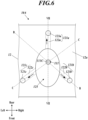
- FIG. 6 shows an enlarged plan view of the vicinity of the nozzle 111 of the laminate 10A, which is an example of the laminate of the channel substrate 12, the silicon nozzle substrate 11, and the liquid-repellent film 14, viewed from the channel substrate 12 side in the inkjet head 100 shown in FIG. 2 .
- FIG. 7 is a cross-sectional view of the laminate 10A shown in FIG. 6 cut along line VII-VII.
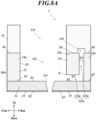
- FIG. 8A is a cross-sectional view of an example of a shear-mode type head chip using the laminate 10A shown in FIG. 6 and FGI. 7.
- FIG. 8B shows a cross-sectional view of an example embodiment.
- FIG. 8B It shows a bend-mode head chip using a laminate of a channel substrate 12, a silicon nozzle substrate 11, and a liquid-repellent film 14, which has a configuration different from that of the laminate 10A, particularly a configuration in which the channel substrate 12 is different.
- the laminate shown in FIG. 8B is also a laminate used in the inkjet head 100 shown in FIG. 2 , like the laminate 10A.
- the laminate 10A has an ink channel surface S1 and an ink ejection surface S2 opposite the channel surface S1, and it has a silicon nozzle substrate 11 having nozzles 111 penetrating from the channel surface S1 to the ejection surface S2; a channel substrate 12 provided with a substrate body 12a having an ink channel and a forming surface of the ink channel, which is joined to the channel surface S1 of the silicon nozzle substrate 11; and a liquid-repellent film 14 provided on the ejection surface S2 of the silicon nozzle substrate 11.
- a plurality of nozzles 111 are provided on a silicon nozzle substrate 11 that is rectangular in a plan view.
- the nozzles 111 are formed in a row along the long side direction (left-right direction) of the silicon nozzle substrate 11 and are positioned substantially at a center of the short side direction (front-back direction).
- the nozzle 111 has an inverted truncated cone shape, and the diameter on the side of the channel surface S1 is larger than the diameter on the side of the ejection surface S2 in a plan view.
- the diameter of the nozzles 111 is adjusted according to the specifications of the inkjet head 100.
- the diameter of the nozzles 111 may be generally 20 to 200 ⁇ m on the channel S1 side, and generally 10 to 100 ⁇ m on the ejection surface S2 side.
- the angle ⁇ used in Expression 1 is determined by the height of the nozzle 111 (thickness of the silicon nozzle substrate 11) and the diameter of the nozzle 111 on the channel surface S1 side and the ejection surface S2 side.
- the shape of height and diameter of the nozzle 111 are adjusted so that Expression 1 holds true.
- the number, formation position, and shape of the nozzles 111 on the silicon nozzle substrate 11 are not limited thereto. Depending on the design of the inkjet head 100, they are adjusted appropriately so that at least Expression 1 is valid.
- the number of nozzles 111 and the formation position of the nozzles 111 may be adjusted as shown in the example shown in FIG. 16 below, where a plurality of nozzles 111 may be arranged in four rows per row so as to be parallel to the long side direction.
- the cross-section may be a shape that gradually decreases from the channel surface S1 toward the ejection surface S2.
- the silicon nozzle substrate 11 may be a plate-like body composed mainly of silicon (Si), for example, a substrate whose surface is made of single-crystal silicon with a (100) surface of the substrate 11 may be cited.
- Si silicon
- an SOI (Silicon On Insulator) substrate having an Si active layer and a support layer that forms the nozzle 111 and sandwiching an oxide film layer (also referred to as a BOX layer) between the active layer and the support layer may also be used.
- the nozzle substrate By configuring the nozzle substrate with a material mainly composed of silicon, the nozzles may be processed with high precision, and the nozzle substrate may be formed with less positional errors and less variation in nozzle shape.
- the thickness of the silicon nozzle substrate 11 is not particularly limited, it is preferable that the thickness is within the range of 10 to 100 ⁇ m because the effects of the present invention are more remarkable. More preferably, the thickness of the silicon nozzle substrate 11 is in the range of 30 to 60 ⁇ m.
- the channel substrate 12 has, as an ink channel, a through channel 125 that penetrates the substrate body 12a so as to face the nozzle 111, and three individual circulation channels 121a, 121b, and 121c that communicate with the through channel 125, extend in a direction away from the nozzle 111, and have a portion overlapping the substrate body 12a in a plan view seen from the opposite side of the surface S3 of the channel substrate 12 joined to the silicon nozzle substrate 11.
- the surface S3 where the channel substrate 12 is bonded to the silicon nozzle substrate 11 is specifically the lower surface S3 of the substrate body 12a.
- the upper surface S4 of the substrate body 12a is joined to the lower surface of the pressure chamber substrate 13, for example, as shown in FIG. 8A and FIG. 8B .
- the substrate body 12a of the channel substrate 12 is preferably made of silicon (Si), stainless steel (SUS) or 42 alloy, from the viewpoint that the through channel 125 and the individual circulation channels 121a, 121b, and 121c are easy to process (high accuracy), and that the ink temperature can be easily kept uniform due to the high thermal conductivity.
- the same material may also be employed for the pressure chamber substrate 13. It is preferred that the material constituting the substrate body 12a of the channel substrate 12 and the material constituting the pressure chamber substrate 13 are materials having close coefficients of thermal expansion.
- Bonding of the pressure chamber substrate 13 to the channel substrate 12, and the channel substrate 12 to the silicon nozzle substrate 11 may be made, for example, with a known adhesive.
- the adhesive is selected and used from the known adhesives according to the constituent materials of each substrate.
- FIG. 8A which shows an example not according to the invention, is a cross-sectional view schematically showing a case where the head chip 1, for example, in which the pressure chamber substrate 13 is laminated on the laminate 10A, has a shear-mode type pressure mechanism.
- the pressure chamber substrate 13 has an ink supply channel 131 communicating with the through channel 125 and having substantially the same diameter as the through channel 125, and a common circulation channel 134 communicating with the individual circulation channel 121a.
- the shear-mode pressure mechanism for example, the through channel 125 and the supply channel 131 function as pressure chambers.
- the partition wall partitioning each supply channel 131 in the left-right direction is repeatedly displaced in a shear-mode type by the drive electrode, thereby pressure is applied to the ink in the chamber, and the ink is ejected from the nozzle 111.
- the common circulation channel 134 is a channel which is disposed to extend in the left-right direction so as to communicate with each individual circulation channel 121a corresponding to each nozzle 111, and is a channel which collectively discharges the ink discharged from each individual circulation channel 121a to the outside of the head chip 1.
- each of the individual circulation channels 121b and 121c also communicates with another common circulation channel 134 included in the pressure chamber substrate 13, and the ink collected in the common circulation channel 134 is discharged to the outside of the head chip 1.
- FIG. 8B which shows an example not according to the invention, shows a cross-section of an example embodiment of a head chip with a bend-mode type pressure mechanism.
- the head chip 1 shown in FIG. 8B has: a silicon nozzle substrate 11 having a channel surface S1, an ejection surface S2 of ink, and nozzles 111 penetrating from a channel surface S1 to an ejection surface S2; a channel substrate 12 bonded to the channel surface S1 of the silicon nozzle substrate 11; a pressure chamber substrate 13 bonded to a surface S4 of the channel substrate 12 opposite to the surface S3 bonded to the silicon nozzle substrate 11; and a liquid-repellent film 14 provided on the ejection surface S2 of the silicon nozzle substrate 11.
- the channel substrate 12 has, as an ink channel, a through channel 125 penetrating the substrate body 12a so as to face the nozzle 111, an individual circulating channel 121 communicating with the through channel 125, extending in a direction away from the nozzle 111, and having a portion overlapping with the substrate body S3 in a plan view seen from the opposite side of the surface 12a bonded to the silicon nozzle substrate 11 of the channel substrate 12, and a common circulating channel 126 communicating with the individual circulating channel 121.
- the channel substrate 12 may have a plurality of individual circulating channels 121 communicating with the through channel 125 positioned to face the nozzles 111 in the same manner as the laminate 10A.
- a cross-section of the head chip 1 cut along a plane orthogonal to the channel surface 111C of the silicon nozzle substrate 11 so as to include the central S1 of the nozzles 111 and the individual circulating channel 121 is configured to have the same shape in each individual circulating channel 121.
- the common circulating channel 126 has the same function as that of the common circulating channel 134 provided in the pressure chamber substrate 13 in the head chip 1 shown in FIG. 8A .
- the common circulating channel is provided as the common circulating channel 126 in the channel substrate 12.
- the common circulating channel 126 is a channel disposed to extend in the left-right direction so as to communicate with each corresponding individual circulating channel 121, and is a channel for collectively discharging the ink discharged from each individual circulating channel 121 to the outside of the head chip 1.
- the individual circulating channel 121 includes only the connecting portion 122 while the individual circulating channel 121 of the head chip 1 shown in FIG. 8A includes the connecting portion 122 and the extension portion 123 as will be described later.
- the pressure chamber substrate 13 included in the head chip 1 illustrated in FIG. 8B has in the order from the channel substrate 12 side: a pressure chamber layer 13a, a diaphragm 13V, and a spacer layer 13b having a space 13S in contact with the diaphragm 13V and having a piezoelectric element 13P on the diaphragm 13V inside the space 13S.
- the pressure chamber substrate 13 includes an ink supply channel 131 that penetrates the spacer layer 13b, the diaphragm 13V, and the pressure chamber layer 13a and communicates with the through channel 125 of the channel substrate 12.
- the supply channel 131 is present as a supply channel 131a that has a larger diameter and functions as a main pressure chamber in the pressure chamber layer 13a.
- the supply channel 131 exists as a supply channel 131b having a smaller diameter than the supply channel 131a in the spacer layer 13b and the diaphragm 13V.
- An inlet of the supply channel 131b serves as an inlet of ink supplied from the manifold 5 to the head chip 1, and the ink is supplied to a pressure chamber composed of the supply channel 131a and the through channel 125.
- the piezoelectric element 13P is displaced by the drive electrodes, and the diaphragm 13V is thereby displaced, whereby the ink in the pressure chamber (the supply channel 131a and the through channel 125) is pressurized and the ink is ejected from the nozzle 111.
- the ink present in the through channel 125 is pressurized and ejected from the nozzle 111.
- the size and position of the through channel 125 in a plan view are not particularly limited as long as the through channel 125 is formed to pass through the substrate body 12a and is located at a position facing the nozzle 111.
- the channel substrate 12 forms an ink channel by the inner wall surface of the substrate body 12a.
- the inner surface is referred to as a formation surface of an ink channel.
- a formation surface of the through channel 125 in the substrate body 12a is indicated by F1.
- the number of through channel 125 corresponding to one nozzle 111 is normally one.
- the through channel 125 communicates with three individual circulating channels 121a, 121b, and 121c.
- the number n of individual circulating channel corresponding to one through channel 125 is not particularly limited as long as it is 1 or more.
- the number is preferably 1 to 4, and more preferably 1 or 2 from the viewpoint of ease of production.
- the individual circulating channels 121a, 121b, and 121c each have portions 122a, 122b, and 122c (hereinafter also referred to as "connecting portions") that communicate with the through channel 125 and extend in a direction away from the nozzle 111.
- the connecting portions 122a, 122b, and 122c are portions that overlap the substrate body 12a in a plan view seen from the opposite side of the surface S3 of the channel substrate 12 joined to the silicon nozzle substrate 11, that is, in a plan view seen from the top surface S4 side of the substrate body 12a.
- the individual circulation channels 121a, 121b, and 121c each further includes extension portions 123a, 123b, and 123c that extend upward from ends of the connecting portions 122a, 122b, and 122c farthest from the nozzle 111 to reach the position of the upper surface S4 of the substrate body 12a.
- the formation surfaces of the connecting portions 122a, 122b, and 122c of the individual circulating channels 121a, 121b, and 121c are denoted by F2.
- the formation surfaces of the extension portions 123a, 123b, and 123c are denoted by F3.
- the connecting portions 122a, 122b, and 122c of the individual circulating channels 121a, 121b, and 121c have a rectangular channel cross-section and are provided so as to be parallel to the channel surface S1 with the channel surface S1 of the silicon nozzle substrate 11 as a lower surface.
- the upper surface of the connecting portions 122a, 122b, and 122c is the formation surface F2 of the substrate body 12a provided to face the channel surface S1.
- each of the connecting portions 122a, 122b, and 122c are not limited thereto as long as the condition of the following Expression 1 is satisfied.
- the channel cross-section of each of the connecting portions 122a, 122b, and 122c may have a circular shape including an elliptical shape or a polygonal shape.
- the upper and lower surfaces of the connecting portions 122a, 122b, and 122c may be a pair of formation surfaces F2 formed on the substrate body 12a so as to be parallel to the channel surface S1 of the silicon nozzle substrate 11 and face each other with a predetermined distance therebetween.
- the upper and lower surfaces of the connecting portions 122a, 122b, and 122c may be provided at a predetermined angle with respect to the channel surface S1 of the silicon nozzle substrate 11.
- the liquid-repellent film 14 is formed to cover the entire ejection surface S2 of the silicon nozzle substrate 11.
- the liquid-repellent film 14 is not formed on member surfaces other than the ejection surface S2, Specifically, it is not formed on the channel surface S1 of the silicon nozzle substrate 11, the nozzle 111 the formation surface of the nozzle 111, and the inner wall surface of the channel substrate 12.
- the inner wall surfaces of the channel substrate 12 are, for example, the formation surface F1 of the through channel 125, the formation surface F2 of the connecting portions 122a, 122b, and 122c of the individual circulation channels 121a, 121b, and 121c, and the formation surface F3 of the extension portions 123a, 123b, and 123c.
- Each symbol in Expression 1 indicates the following meanings in a cross-section obtained by cutting the silicon nozzle substrate 11 and the channel substrate 12 along a plane orthogonal to the channel surface S1 of the silicon nozzle substrate 11 so as to include the center 111C of the nozzle 111 and the individual circulation channels 121a, 121b, or 121c.
- the cross-sectional view of the laminate 10A shown in FIG. 7 is a cross-section obtained by cutting the laminate 10A along a plane orthogonal to the channel surface S1 of the silicon nozzle substrate 11 so as to include the center 111C of the nozzle 111 and the individual circulation channels 121a. Expression 1 will be described below with reference to the cross-sectional view shown in FIG. 7 .
- ⁇ is an angle formed by a straight line connecting a first nozzle end (a nozzle end indicated by “A” in FIG. 7 , hereinafter also referred to as a "nozzle end A”) located on an ejection surface S2 on a side farther from an individual circulation channel 121a and a second nozzle end (a nozzle end indicated by "B” in FIG. 7 , hereinafter also referred to as a "nozzle end B”) located on a channel surface S1 on a side closer to the individual circulation channel 121a with the ejection surface S2.
- the individual circulation channel 121a is composed of the connecting portion 122a communicating with the through channel 125 and the extension portion 123a extending from the connecting portion 122a. Therefore, the intersection of the formation surface F1 of the through channel 125 and the formation surface of the individual circulation channel 121a in the substrate body 12a is an intersection of the formation surface F1 of the through channel 125 and the formation surface F2 of the connecting portion 122a in the substrate body 12a.
- the connecting portion 122a of the individual circulation channels 121a uses the channel surface S1 of the silicone nozzle substrate 11 as a lower surface. Therefore, in the cross-section shown in FIG. 7 , there is one intersection between the formation surfaces F1 and F2, and that point is the farthest intersection X from the channel surface S1.
- the intersection X is the farthest point from the channel surface S1 at the boundary of the through channel 125 and the connecting portion 122a. In other words, the intersection X represents the farthest point from the channel surface S1 at the inlet of the connecting portion 122a.
- the formation surface F1 and the formation surface F2 have two intersections, of which the farthest point from the channel surface S1 is used as the intersection X as an indicator in the present invention.
- H1 is a distance from the ejection surface S2 to an intersection X farthest from the channel surface S1 among the intersections of the formation surface F1 of the through channel 125 and the formation surface of the individual circulating channel 121a in the substrate body 12a.
- FIG. 7 which shows an example not according to the invention
- the length of L x tan ⁇ and the length of the H1 are indicated by a double-headed arrow of a broken line side by side.
- a position separated by L x tan ⁇ upward from the ejection surface S2 is referred to as a height of L x tan ⁇
- a position of the height of L x tan ⁇ on the formation surface F1 of the through channel 125 is indicated by Y in FIG. 7 .
- the positional relationship between the individual circulating channel 121a, to be specific, between the inlet of the connecting portion 122a of the individual circulating channel 121a and the nozzle 111 satisfies Expression 1.
- the position Y at the height of L x tan ⁇ on the formation surface F1 of the through channel 125 is located above an intersection X farthest from the channel surface S1 among the intersections of the formation surface F1 of the through channel 125 and the formation surfaces of the individual circulation channel 121a in the substrate body 12a.
- the liquid-repellent film 14 for example, a liquid-repellent film formed of a fluoropolymer layer is exemplified. It is preferable that the liquid-repellent film 14 further includes a base layer containing a silicone compound and a fluoropolymer layer provided in this order from the side of the ejection surface S2 of the silicone nozzle substrate 11.
- the liquid-repellent film 14 may be formed, for example, on the ejection surface S2 of the silicon nozzle substrate 11 alone before the silicon nozzle substrate 11 and the channel substrate 12 are bonded to each other, or may be formed on the ejection surface S2 of the silicon nozzle substrate 11 in the laminate after the silicon nozzle substrate 11 and the channel substrate 12 are bonded to each other.
- the fluoropolymer layer a layer formed using a raw fluoropolymer having a hydrolyzable silyl group and a fluorine atom substituted long chain hydrocarbon group or a fluorine atom substituted polyoxyalkylene group is preferred.
- a perfluoropolyether compound having a hydrolyzable silyl group is preferred. It is more preferred that the perfluoropolyether compound has a fluoroalkyl group, preferably a perfluoroalkyl group, at an end different from that having a hydrolyzable silyl group.
- commercially available products such as OPTOOL (registered trademark, Daikin Industries, Ltd.), may be used.
- the raw fluoropolymer has a hydrolyzable silyl group
- a silanol group Si-OH group
- a strong siloxane bond Si-O-OH group
- the liquid-repellent film 14 thus formed has a fluoropolymer chain, for example, a perfluorinated polyether chain, extending from the bond ends with the silicon nozzle substrate 11 to the surface. Furthermore, it has liquid repellency by, for example, having a configuration with perfluoroalkyl groups on the topmost surface.
- a siloxane bond (Si-O-Si) may be formed between the base layer and the fluoropolymer. It is preferable that the base layer has a silicon oxide (SiO 2 ) layer at least on the fluoropolymer layer side.
- the base layer may be formed by known methods such as vapor deposition, sputtering, or CVD. The thickness of the base layer may be generally 10 to 100 nm.
- a method of applying a raw fluoropolymer composition containing the raw material fluoropolymer is applied to the ejection surface S2 and cured. Curing includes drying and reaction, for example, the hydrolytic condensation reaction described above.
- the liquid-repellent agent may contain only the raw fluoropolymer or may include a solvent. In addition, it may contain any solid components as required.
- the liquid-repellent agent may be applied by vapor deposition.
- a liquid-repellent film 14 specifically a fluoropolymer layer
- the liquid-repellent agent that is the vapor deposition source is placed on the ejection surface S2 side, and the deposition is performed.
- the liquid-repellent agent adheres to the ejection surface S2 of the silicon nozzle substrate 11 and the inner wall (formation surface) of the nozzle 111. Further, it enters inside the channel substrate 12 from the nozzle 111 and adheres to the inner wall surface of the substrate body 12a. At that time, in the substrate body 12a of the channel substrate 12, the liquid-repellent agent does not adhere to the inner wall surface up to the position Y of the height of L x tan ⁇ , but adheres to the inner wall surface above it.
- the positional relationship between the inlet of the connecting portion 122a of the individual circulating channel 121a and the nozzle 111 satisfies Expression 1. That is, the inlet of the connecting portion 122a of the individual circulating channel 121a is entirely below the position Y at the height of L x tan ⁇ . As a result, the liquid-repellent agent does not adhere to the formation surface F2 of the connecting portion 122a of the individual circulating channel 121a and the portion of the channel surface S1 corresponding to the lower surface of the connecting portion 122a in the substrate body 12a.
- the liquid-repellent agent adhered to the above position of the laminate of the channel substrate 12 and the silicon nozzle substrate 11 is cured to form a liquid-repellent film. Since curing is usually performed by heating, during heating, the liquid-repellent agent enters the inner side of the channel substrate 12.
- the liquid-repellent agent adhering to the inner wall surface, specifically, the liquid-repellent agent adhering to the inner wall surface above the position Y of the height of L x tan ⁇ is similarly cured to form a liquid-repellent film.
- the liquid-repellent film formed on the inner wall surface of the channel substrate 12 after curing may be selectively removed by treatment, for example, UV ozone irradiation, oxygen plasma irradiation.
- the irradiation does not reach the portion overlapping the substrate body 12a viewed from the upper side of the channel substrate 12. Therefore, if the formation surface F2 of the connecting portion 122a of the individual circulation channel 121a and the portion of the channel surface S1 corresponding to the lower surface of the connecting portion 122a are formed with a liquid-repellent film, it is almost not possible to remove the liquid-repellent film by this method. In the cross-section shown in FIG.
- a liquid-repellent film is not formed on the formation surface F2 of the connecting portion 122a of the individual circulation channel 121a and the portion of the channel surface S1 corresponding to the lower surface of the connecting portion 122a. Therefore, substantially all of the liquid-repellent film formed on the inner wall surface of the channel substrate 12 may be removed by UV ozone irradiation or oxygen plasma irradiation from above the channel substrate 12. In addition, this method also makes it possible to remove the liquid-repellent film formed on the surface on which the nozzles 111 are formed.
- the laminate 10A in which the liquid-repellent film 14 is formed only on the ejection surface S2 of the silicon nozzle substrate 11 is obtained.
- the liquid-repellent film 14 is not necessarily formed on the entire surface of the ejection surface S2 as long as it is formed at least around the nozzle 111, but is preferably formed on the entire surface.
- the cross-section obtained by cutting the laminate 10A along a plane orthogonal to the channel surface S1 of the silicon nozzle substrate 11 so as to include the center 111C of the nozzle 111 and the individual circulation channel 121a satisfies the Expression 1.
- a cross-section cut along a plane orthogonal to the channel surface S1 of the silicon nozzle substrate 11 so as to include the center 111C of the nozzle 111 and the individual circulation channel 121b that is, the cross-section of the laminate 10A cut along line B-B shown in FIG. 6 also satisfies Expression 1.
- a cross-section cut along a plane orthogonal to the channel surface S1 of the silicon nozzle substrate 11 so as to include the center 111C of the nozzle 111 and the individual circulation channel 121c, that is, the cross-section of the laminate 10A cut along line C-C shown in FIG. 6 also satisfies Expression 1.
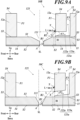
- a laminate 10B whose-cross section is shown in FIG. 9A and a laminate 10C whose cross-section is shown in FIG. 9B are laminates in which the enlarged plan view of the vicinity of the nozzle 111 seen from the channel substrate 12 side is substantially the same as the laminate 10A.
- the laminate 10A, the laminate 10B, and the laminate 10C are laminates having the same plan view except that the diameters of the nozzles 111 on the channel surface S1 are different from each other.
- the laminate 10B and the laminate 10C are configured such that the diameter of the nozzle 111 of the silicon nozzle substrate 11 in a plan view decreases stepwise from the channel surface S1 toward the ejection surface S2.
- the number of stages constituting the nozzle 111 is two, however, the number of stages may be selected as appropriate.
- the cross-sectional shape of the nozzle 111 in each stage is not particularly limited as long as it is formed so as to satisfy Expression 1.
- the cross-sectional view of the laminate 10B shown in FIG. 9A is a cross-sectional view cut along a plane orthogonal to the channel surface S1 of the silicon nozzle substrate 11 so as to include the center 111C of the nozzle 111 and the individual circulating channel 121a.
- the laminate 10B shown in FIG. 9A is different from the laminate 10A in that the cross-section of the nozzle 111 of the silicon nozzle substrate 11 decreases in two stages from the channel surface S1 toward the ejection surface S2.
- the nozzle 111 in the laminate 10B has a larger opening diameter in the channel surface S1 than the nozzle 111 in the laminate 10A. The diameter is greatly reduced in the first stage from the channel surface S1 toward the ejection surface S2, and the diameter is not greatly reduced in the second stage.
- the maximum angle is used among the angles formed by the straight line connecting the nozzle end A (the nozzle end on the side far from the individual circulation channel 121a located on the ejection surface S2) and an end of each stage on the channel surface S1 side and closer to the individual circulation channel 121a, and the ejection surface S2.
- the end portion on the channel surface S1 side and closer to the individual circulation channel 121a is indicated by B2 in FIG. 9A .
- the end portion on the channel surface S1 side and closer to the individual circulation channel 121a is indicated by B1 in FIG. 9A .
- the laminate 10B shown in FIG. 9A is different from the laminate 10A in that, as for the channel substrate 12, the connecting portion 122a of the individual circulation channel 121a has both upper and lower surfaces formed with the formation surface F2 of the substrate main body 12a. Therefore, in the laminate 10B, there are two intersections of the formation surface F1 of the through channel 125 and the formation surface F2 of the connecting portion 122a.
- the intersection X related to L used in Expression 1 is an intersection farthest from the channel surface S1 among these intersections, that is, an intersection farthest from the channel surface S1 at the inlet of the connecting portion 122a.
- FIG. 9A the length of L x tan ⁇ and the length of H1 are shown side by side with a dashed double-headed arrow.
- Y indicates the position of the height of L x tan ⁇ on the formation surface F1 of the through channel 125.
- Expression 1 the positional relationship between the individual circulation channel 121a, more specifically, the inlet of the connecting portion 122a of the individual circulation channel 121a and the nozzle 111 satisfies Expression 1. That is, in FIG.
- the position Y at the height of L x tan ⁇ on the formation surface F1 of the through channel 125 is located above the intersection X farthest from the channel surface S1 among the intersections of the formation surface F1 of the through channel 125 and the formation surface of the individual circulation channel 121a in the substrate body 12a.
- a cross-sectional view of the laminate 10C shown in FIG. 9B is a cross-section cut along a plane orthogonal to the channel surface S1 of the silicon nozzle substrate 11 so as to include the center 111C of the nozzle 111 and the individual circulation channels 121a.
- the laminate 10C shown in FIG. 9B is different from the laminate 10A in that the cross-section of the nozzle 111 decreases in two stages from the channel surface S1 toward the ejection surface S2 for the silicon nozzle substrate 11.
- the nozzle 111 in the laminate 10C has a larger diameter of the opening on the channel surface S1 than the nozzle 111 in the laminate 10A, and the diameter is reduced at the first stage from the channel surface S1 toward the ejection surface S2.
- the laminate 10C has a smaller diameter of the openings on the channel surface S1 than the nozzles 111 of the laminate 10B, and the decrease rate of the diameter in the first stage is small.
- the end portion on the channel surface S1 side and closer to the individual circulation channel 121a is indicated by B2 in FIG. 9B .
- the end portion on the side of the channel surface S1 and closer to the individual circulation channel 121a is indicated by B1 in FIG. 9B .
- the laminate 10C shown in FIG. 9B is different from the laminate 10A in that, regarding the channel substrate 12, the connecting portion 122a of the individual circulation channel 121a has both upper and lower surfaces formed by the formation surface F2 of the substrate body 12a, and is not parallel to the channel surface S1 but rises toward the extension portion 123a. Therefore, in the laminate 10C, there are two intersections of the formation surface F1 of the through channel 125 and the formation surface F2 of the connecting portion 122a.
- the intersection X related to L used in Expression 1 is the farthest intersection from the channel surface S1 among these intersections, that is, the farthest intersection from the channel surface S1 at the inlet of the connecting portion 122a.
- FIG. 9B the length of L x tan ⁇ and the length of H1 are shown side by side with a dashed double-headed arrow.
- Y indicates the position of the height of L x tan ⁇ on the formation surface F1 of the through channel 125.
- Expression 1 the positional relationship between the individual circulation channel 121a, more specifically, the inlet of the connecting portion 122a of the individual circulation channel 121a and the nozzle 111 satisfies Expression 1. That is, in FIG.
- the position Y of the height of L x tan ⁇ on the formation surface F1 of the through channel 125 is located above the intersection X farthest from the channel surface S1 among the intersections of the formation surface F1 of the through channel 125 and the formation surface of the individual circulation channel 121a in the substrate body 12a.
- the positional relationship with the nozzles 111 in all of the three individual circulation channels 121a, 121b, and 121c of the laminate 10C satisfies Expression 1.
- the liquid-repellent film 14 is formed on the ejection surface S2
- the liquid-repellent film is not formed on a portion of the inner wall surface of the channel substrate 12 that is difficult to remove.
- the liquid-repellent film formed on the inner wall surface of the channel substrate 12 may be removed efficiently.
- FIG. 10 is an enlarged plan view of the vicinity of the nozzle 111 of a laminate 10D which is an example of the laminate of the channel substrate 12, the silicon nozzle substrate 11, and the liquid-repellent film 14, viewed from the channel substrate 12 side in the inkjet head 100 shown in FIG. 2 . It is a cross-sectional view of the laminate 10D shown in FIG. 10 cut along line XI-XI.
- the laminate 10D has two individual circulating channels 121a and 121b, and these individual circulating channels 121a and 121b are located on a straight line passing through the center of the nozzle 111 on the channel surface S1, and the center 111C of the nozzle 111 and the center 125C of the through channel 125 coincide with each other in a plan view seen from the upper surface S4 side of the channel substrate 12.
- the silicon nozzle substrate 11 and the liquid-repellent film 14 in the laminae 10D have the same configuration as that of the laminate 10A.
- the channel substrate 12 of the laminate 10D has two individual circulating channels 122a and 122b respectively having connecting portions 121a and 121b extending back and forth around the through channel 125.
- the cross-section of the laminate 10D cut along the line XI-XI shown in FIG. 11 is a cross-section cut along a plane orthogonal to the channel surface S1 of the silicon nozzle substrate 11 so as to include the centers of the nozzle 111 and the through channel 125 and the two individual circulating channels 121a and 121b.
- the two individual circulating channels 121a and 121b are symmetrical with respect to the through channel 125.
- the individual circulating channel 121a in the channel substrate 12 of the laminate 10D has the same configuration as that of the individual circulating channel 121a in the channel substrate 12 of the laminate 10A, and includes a connecting portion 122a communicating with the through channel 125 and extending in a direction away from the nozzle 111, and an extension portion 123a extending upward from the farthest end of the connecting portion 122a from the nozzle 111 and reaching the upper surface S4 of the substrate body 12a.
- the individual circulating channel 121b in a symmetrical relationship with the individual circulating channel 121a is also composed of a connecting portion 122b communicating with the through channel 125 and an extension portion 123b extending upward from the connecting portion 122b and reaching a position of the upper surface S4 of the substrate body 12a.
- the positional relationship between each of the individual circulating channels 121a and 121b and the nozzle 111 satisfies Expression 1.
- Expression 1 the nozzle end portion located on the ejection surface S2 on the side far from the individual circulating channel 121a is denoted by Ai, and the nozzle end portion located on the channel surface S1 on the side close to the individual circulating channel 121a is denoted by Bi.
- An angle formed by a straight line connecting the nozzle end portion Ai and the nozzle end portion Bi and the ejection surface S2 is defined as ⁇ , and L x tan ⁇ is obtained in the same manner as in the case of the laminate 10A.
- FIG. 11 the position at the height of L x tan ⁇ on the formation surface F1 of the through channel 125 is indicated by Y.
- the description of L is omitted, and the distance from the channel surface S1 of the silicon nozzle substrate 11 to the position Y at the height of L x tan ⁇ is indicated by H3.
- the positional relationship between the individual circulating channels 121a and 121b, to be specific, the inlets of the connecting portions 122a and 122b of the individual circulating channels 121b and 122a, and the nozzle 111 satisfies Expression 1. That is, in FIG. 11 , the position Y at a height of L x tan ⁇ on the formation surface of the through channel 125 on the side of the individual circulating channel 121a is located above an intersection X between the formation surface F1 of the through channel 125 and the formation surface F2 of the individual circulating channel 121a in the substrate body 12a.
- the position Y at the height of L x tan ⁇ on the formation surface F1 side of the individual circulation channel 121b of the through channel 125 is located above the intersection X of the formation surface F1 of the through channel 125 and the formation surface F2 of the individual circulation channel 121b in the substrate body 12a.
- Each symbol in Expression 2 has the following meaning in a cross-section cut along a plane orthogonal to the channel surface 121a of the silicon nozzle substrate 11 so as to include the centers of the nozzle 111 and the through channel 125 and the two individual circulating channels 121a and 121b, that is, in a cross-section shown in FIG. 11 . Equation 2 will be described below with reference to the cross-sectional view shown in FIG. 11 .
- D1 is the diameter of the nozzle 111 on the ejection surface S2 of the silicon nozzle substrate 11
- D2 is the diameter of the nozzle 111 on the channel surface S1 of the silicon nozzle substrate 11
- t is the thickness of the silicon nozzle substrate 11.
- D1, D2, and t in the silicon nozzle substrate 11 are preferably in the same ranges as described for the laminate 10A.
- W is the width of the through channel 125. In FIG. 11 , W is the distance between the formation surface F1 of the through channel 125 on the side communicating with the individual circulation channel 121a and the formation surface F1 of the through channel 125 on the side communicating with the individual circulation channel 121b.
- H2 is a distance from a channel surface S1 of the silicon nozzle substrate 11 to an intersection X farthest from the channel surface S1 among intersections of a formation surface F1 of the through channel 125 and a formation surface F2 of the individual circulating channels 121a and 121b in the substrate body 12a.
- H3 and H2 are shown side by side by a double-headed arrow of a broken line.
- the positional relationship between the individual circulating channels 121a and 121b, the through channel 125, and the nozzle 111 is H3 > H2, and it is understood that Expression 2 is satisfied.
- satisfying Expression 1 and satisfying Expression 2 have the same meaning.
- the positional relationship between the individual circulation channels 121a and 121b, the through channel 125, and the nozzle 111 satisfies Equations 1 and 2.
- the liquid-repellent film 14 when forming the liquid-repellent film 14 on the ejection surface S2, the liquid-repellent film is not formed on a portion of the inner wall surface of the channel substrate 12 that is difficult to remove.
- the liquid-repellent film formed on the inner wall surface of the channel substrate 12 may be efficiently removed by subsequent processing.
- the number of rows of the nozzles 111 is four will be described with reference to FIG. 12 to FIG. 18B .
- the number of rows and the arrangement of the nozzles 111 may be appropriately changed, and for example, the number of rows may be one as described above, may be any of two to three rows, and may be five or more.
- FIG. 12 is a bottom view of an example of the head unit 224 of the inkjet recording apparatus 200 shown in FIG. 1 , which is different from the head unit shown in FIG. 2 .
- the number of rows of the nozzles 111 in the inkjet head 100 is four while the number of rows of the nozzles 111 in the inkjet head 100 shown in FIG. 2 is one.
- a perspective view of the inkjet head 100 in which the number of rows of the nozzles 111 is four and a cross-sectional view of a lower portion of the inkjet head 100 in the left-right direction are the same as those shown in FIG. 3 and FIG. 4 .
- FIG. 13 is an exploded perspective view of the head chip 1 constituting the inkjet head 100 of the head unit 224 shown in FIG. 12 .
- FIG. 14A and FIG. 14B are a plan view and a bottom view, respectively, of the pressure chamber substrate 13 of the head chip 1 shown in FIG. 13 .
- the FIG. 15A and FIG 15B are a plan view and a bottom view, respectively, of the channel substrate 12 of the head chip 1 shown in FIG. 13 .
- FIG. 16 is a plan view of silicon nozzle substrate 11 of head chip 1 shown in FIG. 13 .
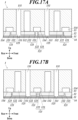
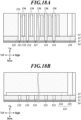
- FIG. 17A to FIG. 18B are cross-sectional views of the head chip 1 shown in FIG. 13 cut along lines XVIIA-XVIIA, XVIIB-XVIIB, XVIIIA-XVIIIA, and XVIIIB-XVIIIB, respectively.
- the head chip 1 is a member having a substantially quadrangular prism shape elongated in the left-right direction, and is configured by stacking a pressure chamber substrate 13, a channel substrate 12, a silicon nozzle substrate 11, and a liquid-repellent film 14 in this order ( FIG. 13 to FIG. 18B ). In FIG. 13 , the silicon nozzle substrate 11 and the liquid-repellent film 14 are shown without being decomposed.
- the head chip 1 shown in FIG. 13 is a head chip having a shear-mode type pressure mechanism.
- the pressure chamber substrate 13 is provided with a supply channel 131, an air chamber 132, and a common circulating channel 133 (see FIG. 13 , FIG. 14A, and FIG.14B ).
- the supply channel 131 and the air chamber 132 are provided in large numbers so as to be alternately arranged in the left-right direction, and are provided in four rows in the front-rear direction.
- the supply channel 131 has a substantially rectangular cross section, is formed along the up-down direction, has an inlet on the upper surface of the pressure chamber substrate 13, and has an outlet on the lower surface.
- the supply channel 131 communicates with the ink reservoir 51 of the manifold 5 at an end portion in the upper direction, an ink is supplied to the supply channel 131 from the ink reservoir 51, and the ink to be ejected from the nozzle 111 is stored in the supply channel 131.
- the supply channel 131 of the pressure chamber substrate 13 and the through channel 125 of the channel substrate 12 constitute a pressure chamber in a shear-mode type pressure mechanism. In the head chip 1 shown in FIG.
- the pressure chamber is configured along the up-down direction so as to have a substantially rectangular cross-section of the same area across the supply channel 131 of the pressure-chamber substrate 13 and the through channel 125 of the channel substrate 12, and communicates with the nozzle 111 at an end portion in the lower direction (see FIG. 17A and FIG. 17B ).
- the air chamber 132 has a substantially rectangular cross-section slightly larger than the supply channel 131, and is formed so as to be parallel to the supply channel 131 along the up-down direction. Unlike the supply channel 131, the air chamber 132 does not communicate with the ink reservoir 51, and the ink does not flow into the air chamber 132 (see FIG. 17A and FIG. 17B ).
- the supply channel 131 and the air chamber 132 are formed to be separated from each other by a partition wall 136 as a pressure-generating unit formed of a piezoelectric material (see FIG. 18A ).
- the partition wall 136 is provided with drive electrodes (not shown), and when a voltage is applied to the drive electrodes, a portion of the partition wall 136 between the adjacent supply channel 131 repeats shear-mode type displacement, whereby a pressure is applied to the ink in the supply channel 131.
- the supply channel 131 located at the end portion in the left-right direction having the partition wall 136 only on one side is not used, and the other supply channel 131 having the partition wall 136 on both sides is used.
- the supply channel 131 may be formed without providing the air chamber 132. However, as described above, it is preferable that the supply channel 131 and the air chamber 132 are alternately provided so that the supply channels 131 are not adjacent to each other. As a result, the supply channels 131 may be prevented from adjoining each other, so that when the partition wall 136 adjacent to one supply channel 131 is deformed, the other supply channels 131 are not affected.
- the common circulating channel 133 is formed by connecting a first common circulating channel 134 and a second common circulating channel 135 (see FIG. 13 and FIG. 14B ).
- the first common circulating channels 134 is provided on the lower surface side of the pressure chamber substrate 13 along the left-right direction in three rows on the front side, the rear side, and the central portion of the head chip 1 so as to avoid the portions where the supply channels 131 and the air chambers 132 are provided.
- a plurality of individual circulating channels 121 provided in the channel substrate 12 are connected to the lower surface side of the first common circulating channel 134.
- the individual circulating channel 121 includes a connecting portion 122 communicating with the through channel 125 and an extension portion 123 extending from the connecting portion 122, and the ink is discharged from the through channel 125 of the channel substrate 12 through the connecting portion 122 from the extension portion 123, and may join in the first common circulating channel 134 ( FIG. 14B , FIG. 15A , FIG. 17A, and FIG. 17B ).
- the first common circulating channel 134 is connected to the second common circulating channel 135 capable of discharging the ink to the outside of the head chip 1 in the vicinity of the right end portion. Therefore, the first common circulating channel 134 is a channel through which the ink flowing from the extension portion 123 of the individual circulating channel 121 flows toward the second common circulating channel 135.
- the second common circulation channel 135 is formed along the up-down direction similarly to the supply channel 131.
- the second common circulation channel 135 communicates with the first common circulation channel 134 on the lower surface side of the pressure chamber substrate 13, and communicates with the discharge liquid chamber 57 of the manifold 5 on the upper surface side, and is a flow path for discharging the ink flowing from the first common circulation channel 134 toward the upper side (the side opposite to the silicon nozzle substrate 11 side) to the outside of the head chip 1.
- the second common circulation channel 135 is provided in the vicinity of the right end portion of the head chip 1 and communicates with the first common circulation channel 134, and the second common circulation channel 135 is provided so as to have a larger volume than the individual supply channel 131, and thus it is possible to increase the discharge efficiency of the ink.
- a through channel 125 which communicates with the supply channel 131 of the pressure chamber substrate 13 and is formed along the up-down direction so as to have a substantially rectangular cross-section having the same area as that of the supply channel 131, and an individual circulation channel 121 which is provided so as to branch from the through channel 125 are formed (see FIG. 17A and FIG. 17B ).
- the through channel 125 of the channel substrate 12 and the supply channel 131 of the pressure chamber substrate 13 together function as a pressure chamber.
- the individual circulating channel 121 includes a connecting portion 122 communicating with the through channel 125 and an extension portion 123 extending from the connecting portion 122.
- the individual circulating channel 121 is a flow path in which an inlet of the connecting portion 122 is connected to the through channel 125, an outlet of the extension portion 123 is connected to the first common circulating channel 134, and the ink in the through channel 125 is discharged to the first common circulating channel 134. It is preferable that at least two individual circulation channels 121 are provided in each of the supply channels 131 from the viewpoint of facilitating the discharge of air bubbles and foreign matter together with the ink. In addition, as shown in FIG. 17A and FIG.
- two individual circulation channels 121 one being placed in the forward direction and the other being placed in the rear direction of the supply channel 131, may be provided because it is possible to obtain an effect of easily discharging the air bubbles and the foreign matter together with the ink, and the manufacturing efficiency is high.
- the silicon nozzle substrate 11 has an ink channel surface S1 and an ink ejection surface S2 facing the channel surface S1, and has the nozzles 111 penetrating from the channel surface S1 to the ejection surface S2.
- the channel substrate 12 is bonded to the channel surface S1 of the silicon nozzle substrate 11, and the liquid-repellent film 14 is provided on the ejection surface S2 of the silicon nozzle substrate 11.
- the nozzles 111 formed by the silicon nozzle substrate 11 are provided so as to correspond to the individual through channel 125 of the channel substrate 12.
- the configurations of the silicon nozzle substrate 11 and the liquid-repellent film 14 may be, for example, the same configurations as those in the above-described laminates 10A to 10D.
- the XVIIA-XVIIA cross-section ( FIG. 17A ) and the XVIIB-XVIIB cross-section ( FIG. 17B ) of the head chip 1 shown in FIG. 13 correspond to a cross-section obtained by cutting the head chip 1 in which the pressure chamber substrate 13, the channel substrate 12, the silicon nozzle substrate 11, and the liquid-repellent film 14 are stacked along a plane orthogonal to the channel surface S1 of the silicon nozzle substrate 11 so as to include the center of the nozzle 111 and the individual circulating channel 121.
- the positional relationship between each of the individual circulation channels 121 and the nozzles 111 satisfies the above Expression 1.
- the ink circulation system 8 is an ink supply unit for generating a circulation flow of an ink from a pressure chamber composed of a supply channel 131 and a through channel 125 in the inkjet head 100 to a common circulation channel 131 via individual circulation channels 121.
- the ink circulation system 8 includes a supply sub-tank 81, a circulation sub-tank 82, and a main tank 83 ( FIG. 19 ).
- the supply sub-tank 81 is filled with an ink to be supplied to the ink reservoir 51 of the manifold 5, and is connected to the first ink port 53 by an ink channel 84.
- the circulation sub-tank 82 is filled with the ink discharged from the discharge liquid chamber 57 of the manifold 5, and is connected to the fourth ink port 56 by an ink channel 85.
- the supply sub-tank 81 and the circulation sub-tank 82 are provided at different positions in the up-down direction (gravity direction) with respect to the nozzle surface (hereinafter also referred to as a "position reference surface") of the head chip 1.
- a pressure P1 due to a water head difference between the position reference surface and the supply sub-tank 81 and a pressure P2 due to a water head difference between the position reference surface and the circulation sub-tank 82 are generated.
- the supply sub-tank 81 and the circulation sub-tank 82 are connected to each other through an ink channel 86, and the pressure applied by the pump 88 may return the ink from the circulation sub-tank 82 to the supply sub-tank 81.
- the main tank 83 is filled with an ink to be supplied to the supply sub-tank 81, and is connected to the supply sub-tank 81 by an ink channel 87.
- the ink may be supplied from the main tank 83 to the supply sub-tank 81 by the pressure applied by the pump 89.
- the ink circulation system 8 As an example of the ink circulation system 8, a method of controlling the circulation of the ink by the water head difference has been described. However, as long as the configuration is capable of generating a circulating flow of ink, it is naturally possible to change the configuration as appropriate.
- the inkjet head of the present invention may be produced by, for example, a production method including the following first to third steps.
- the pressure chamber substrate is bonded to the channel substrate side of the obtained laminate. Thereby, a head chip is obtained.
- the first step to the third step will be described by taking as an example a case where a laminate 10D according to the present invention is manufactured as a laminate in which a channel substrate, a silicon nozzle substrate, and a liquid-repellent film are laminated.
- a laminate 10D according to the present invention is manufactured as a laminate in which a channel substrate, a silicon nozzle substrate, and a liquid-repellent film are laminated.
- the same reference symbols used in the laminate 10D shown in FIG. 7 have the same meanings as those in the case of the laminate 10D. In the following, only the reference symbols necessary for describing the manufacturing method are used for the description.
- FIG. 20 is a cross-sectional view showing a laminate of the channel substrate 12 and the silicon nozzle substrate 11 obtained in the first step.
- the first step is a step of bonding the channel substrate 12 in which the through channel 125 and the two individual circulating channel 121a and 121b are formed to the channel surface S1 of the silicon nozzle substrate 11 in which the nozzles 111 are formed.
- the silicon nozzle substrate 11 is prepared, for example, by the following method.
- a silicon base substrate is prepared as a base member.
- the base substrate is composed of a first support layer having a thickness of 200 ⁇ m or more, a BOX layer, and a silicon nozzle substrate layer.
- the silicon nozzle substrate layer is a layer that becomes the silicon nozzle substrate 11.
- a resist pattern is provided on the front face of the base substrate on the silicon nozzle substrate layer side (the face serving as the ejection face S2 of the silicon nozzle substrate 11) using a mask corresponding to the position where the nozzle 111 is to be formed, and the nozzle hole is processed by etching to form the nozzle 111.
- the etching method for example, reactive ion etching (RIE) by the Bosch method, which facilitates deep etching, is used. Note that laser perforation or blasting may be used (used in combination) to form the nozzle.
- RIE reactive ion etching
- a second support layer having a thickness of 200 ⁇ m or more, for example, is applied to the surface of the base substrate on the side of the silicon nozzle substrate layer (the surface serving as the ejection surface S2 of the silicon nozzle substrate 11) in which the nozzle holes that will become the nozzles 111 are formed in the silicon nozzle substrate layer.
- the first support layer and the BOX layer are removed to obtain the silicon nozzle substrate 11 with the second support layer, in which the channel surface S1 side of the silicon nozzle substrate 11 is exposed.
- the channel substrate 12 is obtained by forming the through channel 125 and the two individual circulating channels 121a and 121b at positions illustrated in FIG. 10 and FIG. 11 on a base substrate serving as a base member by a known method, thereby obtaining the channel substrate 12 including the through channel 125 which is a flow path of the ink, the two individual circulating channels 121a and 121b, and the substrate body 12a having the formation surfaces (F1 to F3) of these flow paths.
- the first step is performed by, for example, joining the channel surface S2 of the silicon nozzle substrate 11 with the second support layer and the lower surface S3 of the substrate body 12a of the channel substrate 12, and then removing the second support layer.
- the use of the second support layer is useful in protecting the silicon nozzle substrate 11, especially when the thickness of the silicon nozzle substrate 11 is about 10 to 100 ⁇ m. If necessary, the silicon nozzle substrate 11 and the channel substrate 12 may be bonded without using the second support layer.
- the channel substrate 12 and the silicon nozzle substrate 11 may be joined by using, for example, a known adhesive.
- the adhesive is appropriately selected and used from known adhesives according to the constituent material of each substrate.
- Specific examples of the commercially available epoxy adhesive include Epotek 353ND (manufactured by Epoxy Technology Co., Ltd.).
- a laminate of the channel substrate 12 and the silicon nozzle substrate 11 is referred to as a laminate La.
- FIG. 21 is a cross-sectional view showing a laminate La with a liquid-repellent film obtained by forming a liquid-repellent film in the second step on the laminate La composed of the channel substrate 12 and the silicon nozzle substrate 11 obtained in the first step.
- the second step is a step of forming the liquid-repellent film 14 by vapor deposition by arranging a vapor deposition source of the liquid repellent film 14 on the ejection surface S2 side of the silicon nozzle substrate 11 in the laminate La.
- the liquid-repellent film to be removed in the third step is indicated as the liquid-repellent film 14x
- the liquid-repellent film formed on the ejection surface S2 side of the silicon nozzle substrate 11 which is not removed after the third step is indicated as the liquid-repellent film 14. That is, in the second step, the liquid-repellent film 14x is formed together with the liquid repellent film 14.
- liquid-repellent film 14 for example, a liquid-repellent film made of a fluoropolymer layer is exemplified.
- a case of forming a liquid-repellent film formed of a fluoropolymer layer will be described as an example, but the liquid-repellent film is not limited thereto, and a known liquid-repellent film may be used.
- the liquid-repellent agent described above may be used as the vapor deposition source of the liquid-repellent film. As shown in FIG. 21 , vapor deposition of the liquid-repellent agent in the second step is performed from the ejection surface S2 side of the silicon nozzle substrate 11. By vapor deposition, the liquid-repellent agent adheres to the ejection surface S2 of the silicon nozzle substrate 11 and the internal wall surface (formation surface) of the nozzle 111, enters the inside of the channel substrate 12 from the nozzle 111, and adheres to the internal wall surface of the substrate body 12a.
- FIG. 21 schematically shows a vapor deposition source.
- the vapor deposition source is, for example, a heatable container containing a liquid-repellent agent, and the heated container containing the liquid-repellent agent moves in the front-rear direction, or the laminated body La moves in the front-rear direction on the container. Thereby, vapor deposition is performed on the entire ejection surface S2 of the silicon nozzle substrate 11 of the laminate La. In the positional relationship between the laminate La and the container in FIG.
- the liquid-repellent agent does not adhere to the inner wall surface below the position Y at the height of L x tan ⁇ from the ejection surface S2, but adheres to the inner wall surface above it. Specifically, it adheres to the inner wall surface above the position Y of the formation surface F1 of the through channel 125 in the substrate body 12a.
- the liquid-repellent film 14x is formed at the location where the liquid-repellent agent is attached as shown in FIG. 21 .
- the liquid-repellent film 14x and the liquid-repellent film 14 are formed from the liquid-repellent agent attached to the ejection surface S2 of the silicon nozzle substrate 11 and the inner surface (formation surface) of the nozzle 111.
- the liquid-repellent agent does not adhere to the formation surface F2 of the connecting portions 122a and 122b of the individual circulation channels 121a and 121b and the channel surface S1 corresponding to the lower surface of the connecting portions 122a and 122b in the substrate body 12a. Furthermore, the vapor of the liquid-repellent agent does not reach the extension portions 123a and 123b of the individual circulation channels 121a and 121b, and the liquid-repellent film is not formed on the formation surfaces F3 of the extension portions 123a and 123b.
- the drying and curing is usually performed by heating. Appropriate conditions are determined depending on the type of the liquid-repellent agent, and the heat treatment is performed at room temperature or in a high temperature state (for example, 300 to 400 °C) as necessary. Thereafter, for the purpose of removing an unreacted raw material, for example, a raw material fluoropolymer, cleaning (rinsing) with a fluorine-based solvent (hydrofluoroether) is preferably performed, and the cleaning is more preferably performed by ultrasonic cleaning.
- a fluorine-based solvent hydrofluoroether
- the liquid-repellent film 14 preferably includes a base layer containing a silicon compound between the formation surface thereof and the fluoropolymer layer.
- the base layer is formed between the first step and the second step.
- the base layer is formed by a known method such as vapor deposition or sputtering depending on the type of the constituent material.
- the formation range of the base layer is at least a range in which the liquid-repellent film 14 is formed.
- the base layer may be formed on a surface other than the range in which the liquid-repellent film 14 is formed, for example, on a part or the entirety of the surface on which the nozzles 111 of the silicon nozzle substrate 11 are formed or the inner wall surface of the channel substrate 12 as necessary.
- FIG. 22 is a cross-sectional view showing a laminate 10D obtained by removing the liquid-repellent film 14x from the laminate La with the liquid-repellent film obtained in the second step.
- the third step is a step of removing the liquid-repellent film 14x formed on the formation surface F1 of the through channel 125 in the substrate body 12a from the upper surface S4 side of the channel substrate 12 after the second step.
- the liquid-repellent film 14x is removed by performing oxygen plasma irradiation from the upper surface S4 side of the channel substrate 12.
- the liquid-repellent film 14x formed on the surface of the silicon nozzle substrate 11 on which the nozzles 111 are formed is also removed.
- the liquid-repellent film 14 formed on the ejection surface S2 of the silicon nozzle substrate 11 is not removed.
- Examples of the method of removing only the liquid-repellent film 14x while leaving the liquid-repellent film 14 include UV ozone irradiation in addition to the oxygen plasma irradiation. Since these methods are carried out by irradiating active rays having rectilinear properties, it is possible to selectively remove the liquid-repellent film.
- the liquid-repellent film is not formed on the formation surface F2 of the connecting portions 122a and 122b of the individual circulation channels 121a and 121b, and on the portion of the channel surface S1 corresponding to the lower surface of the connecting portions 122a and 122b. Therefore, by the method of irradiating the active ray having rectilinear properties from the upper side of the channel substrate 12, it is possible to remove substantially all of the liquid-repellent film formed on the inner surface of the channel substrate 12. In addition, by this method, it is also possible to remove the liquid-repellent film formed on the formation surface of the nozzle 111.
- an inkjet head including a silicon nozzle substrate having a liquid-repellent film on an ejection surface side and a channel substrate having a circulation channel, in which formation of the liquid-repellent film in the channel substrate is suppressed and thus excellent in ink ejection properties, and it is also possible to provide a method for manufacturing an inkjet head in which formation of the liquid-repellent film in the channel substrate during manufacturing is suppressed. Further, it is possible to provide an inkjet recording apparatus equipped with an inkjet head having excellent ink ejectability.
Landscapes
- Engineering & Computer Science (AREA)
- Manufacturing & Machinery (AREA)
- Particle Formation And Scattering Control In Inkjet Printers (AREA)
Applications Claiming Priority (1)
| Application Number | Priority Date | Filing Date | Title |
|---|---|---|---|
| PCT/JP2020/034053 WO2022054153A1 (ja) | 2020-09-09 | 2020-09-09 | インクジェットヘッド、インクジェットヘッドの製造方法及びインクジェット記録装置 |
Publications (3)
| Publication Number | Publication Date |
|---|---|
| EP4212343A1 EP4212343A1 (en) | 2023-07-19 |
| EP4212343A4 EP4212343A4 (en) | 2023-10-11 |
| EP4212343B1 true EP4212343B1 (en) | 2025-03-19 |
Family
ID=80631380
Family Applications (1)
| Application Number | Title | Priority Date | Filing Date |
|---|---|---|---|
| EP20953219.1A Active EP4212343B1 (en) | 2020-09-09 | 2020-09-09 | Inkjet head, production method for inkjet head, and inkjet-recording device |
Country Status (5)
| Country | Link |
|---|---|
| US (1) | US12172443B2 (https=) |
| EP (1) | EP4212343B1 (https=) |
| JP (1) | JPWO2022054153A1 (https=) |
| CN (1) | CN116096579B (https=) |
| WO (1) | WO2022054153A1 (https=) |
Families Citing this family (1)
| Publication number | Priority date | Publication date | Assignee | Title |
|---|---|---|---|---|
| JP7413332B2 (ja) * | 2021-09-29 | 2024-01-15 | キヤノン株式会社 | 液体吐出ヘッドおよび液体吐出装置 |
Family Cites Families (13)
| Publication number | Priority date | Publication date | Assignee | Title |
|---|---|---|---|---|
| JP2006256223A (ja) | 2005-03-18 | 2006-09-28 | Seiko Epson Corp | 液滴吐出ヘッドの製造方法及び液滴吐出装置の製造方法 |
| JP2007106050A (ja) * | 2005-10-14 | 2007-04-26 | Sharp Corp | インクジェットヘッド及びインクジェットヘッドの製造方法 |
| KR20080004225A (ko) * | 2006-07-05 | 2008-01-09 | 삼성전자주식회사 | 잉크젯 헤드의 노즐 플레이트 및 그 제조방법 |
| JP5657328B2 (ja) * | 2010-10-04 | 2015-01-21 | 富士フイルム株式会社 | インクジェットヘッドの製造方法およびインクジェットヘッド |
| US9056465B2 (en) * | 2010-12-21 | 2015-06-16 | Baumer Innotec Ag | Ink-jet print head with integrated optical monitoring of the nozzle function |
| JP2012218289A (ja) * | 2011-04-08 | 2012-11-12 | Ricoh Co Ltd | ノズルプレートの製造方法、ノズルプレートおよび液滴吐出ヘッド |
| JP5666417B2 (ja) * | 2011-11-08 | 2015-02-12 | 富士フイルム株式会社 | 液滴吐出ヘッドの製造方法 |
| JP5645863B2 (ja) | 2012-03-14 | 2014-12-24 | 富士フイルム株式会社 | ノズルプレートの製造方法 |
| JP6686815B2 (ja) * | 2016-09-16 | 2020-04-22 | コニカミノルタ株式会社 | インクジェットヘッド、インクジェット記録装置及びインクジェットヘッドの製造方法 |
| JP6878157B2 (ja) * | 2017-06-09 | 2021-05-26 | 富士フイルム株式会社 | 液滴吐出ヘッドの製造方法、画像形成装置の製造方法、液滴吐出ヘッド及び画像形成装置 |
| JP6885475B2 (ja) * | 2017-12-26 | 2021-06-16 | コニカミノルタ株式会社 | インクジェットヘッドの製造方法、インクジェット記録装置の製造方法、インクジェットヘッド及びインクジェット記録装置 |
| EP3845387B1 (en) * | 2018-08-29 | 2023-06-14 | Konica Minolta, Inc. | Inkjet head and inkjet recording apparatus |
| US11845277B2 (en) * | 2019-01-11 | 2023-12-19 | Konica Minolta, Inc. | Inkjet head, method of manufacturing inkjet head, and inkjet recording method |
-
2020
- 2020-09-09 JP JP2022548283A patent/JPWO2022054153A1/ja active Pending
- 2020-09-09 CN CN202080103807.1A patent/CN116096579B/zh active Active
- 2020-09-09 WO PCT/JP2020/034053 patent/WO2022054153A1/ja not_active Ceased
- 2020-09-09 US US18/043,709 patent/US12172443B2/en active Active
- 2020-09-09 EP EP20953219.1A patent/EP4212343B1/en active Active
Also Published As
| Publication number | Publication date |
|---|---|
| JPWO2022054153A1 (https=) | 2022-03-17 |
| CN116096579A (zh) | 2023-05-09 |
| EP4212343A1 (en) | 2023-07-19 |
| EP4212343A4 (en) | 2023-10-11 |
| WO2022054153A1 (ja) | 2022-03-17 |
| CN116096579B (zh) | 2025-06-17 |
| US12172443B2 (en) | 2024-12-24 |
| US20240025174A1 (en) | 2024-01-25 |
Similar Documents
| Publication | Publication Date | Title |
|---|---|---|
| CN1754700B (zh) | 喷墨打印机的喷墨头及喷墨打印机 | |
| JP5375669B2 (ja) | 液体吐出ヘッド及び液滴吐出装置並びに画像形成装置 | |
| JP4869108B2 (ja) | 液体吐出ヘッド、液体カートリッジ、画像形成装置 | |
| JP6684068B2 (ja) | 液体噴射ヘッド、及び液体噴射装置 | |
| CN109414933B (zh) | 喷墨记录装置 | |
| EP3771566B1 (en) | Liquid ejecting head and liquid ejecting apparatus | |
| JP2017087708A (ja) | 液滴吐出ヘッド及び画像形成装置 | |
| CN107825850B (zh) | 喷墨头、喷墨记录装置以及喷墨头的制造方法 | |
| EP4212343B1 (en) | Inkjet head, production method for inkjet head, and inkjet-recording device | |
| JP7188068B2 (ja) | 液体吐出ヘッド、ヘッドモジュール、液体カートリッジ、液体吐出ユニットおよび液体吐出装置 | |
| JP6753080B2 (ja) | 液体吐出ヘッド、液体吐出ユニット、液体を吐出する装置 | |
| CN116552120B (zh) | 液体喷头 | |
| JP4595659B2 (ja) | 液滴噴射装置及びその製造方法 | |
| CN114851711B (zh) | 液体喷出头 | |
| CN108883637B (zh) | 喷墨头及喷墨记录装置 | |
| CN117922164A (zh) | 液体喷出头以及液体喷出装置 | |
| EP3974190A1 (en) | Liquid discharge head | |
| JP6949312B2 (ja) | 液体吐出ヘッド、液体吐出ユニット、液体を吐出する装置 | |
| JP4710491B2 (ja) | 液体移送装置 | |
| CN115848017B (zh) | 液体喷头 | |
| EP4420883A1 (en) | Liquid ejection head | |
| JP7681469B2 (ja) | 液体吐出ヘッド | |
| JP7494624B2 (ja) | 液体吐出ヘッド、液体吐出ユニット及び液体を吐出する装置 | |
| CN120680812A (zh) | 液体喷出头以及液体喷出头的制造方法 | |
| CN118358260A (zh) | 液体喷出头 |
Legal Events
| Date | Code | Title | Description |
|---|---|---|---|
| STAA | Information on the status of an ep patent application or granted ep patent |
Free format text: STATUS: THE INTERNATIONAL PUBLICATION HAS BEEN MADE |
|
| PUAI | Public reference made under article 153(3) epc to a published international application that has entered the european phase |
Free format text: ORIGINAL CODE: 0009012 |
|
| STAA | Information on the status of an ep patent application or granted ep patent |
Free format text: STATUS: REQUEST FOR EXAMINATION WAS MADE |
|
| 17P | Request for examination filed |
Effective date: 20230123 |
|
| AK | Designated contracting states |
Kind code of ref document: A1 Designated state(s): AL AT BE BG CH CY CZ DE DK EE ES FI FR GB GR HR HU IE IS IT LI LT LU LV MC MK MT NL NO PL PT RO RS SE SI SK SM TR |
|
| P01 | Opt-out of the competence of the unified patent court (upc) registered |
Effective date: 20230808 |
|
| A4 | Supplementary search report drawn up and despatched |
Effective date: 20230912 |
|
| RIC1 | Information provided on ipc code assigned before grant |
Ipc: B41J 2/18 20060101ALI20230906BHEP Ipc: B41J 2/16 20060101ALI20230906BHEP Ipc: B41J 2/14 20060101AFI20230906BHEP |
|
| DAV | Request for validation of the european patent (deleted) | ||
| DAX | Request for extension of the european patent (deleted) | ||
| GRAP | Despatch of communication of intention to grant a patent |
Free format text: ORIGINAL CODE: EPIDOSNIGR1 |
|
| STAA | Information on the status of an ep patent application or granted ep patent |
Free format text: STATUS: GRANT OF PATENT IS INTENDED |
|
| INTG | Intention to grant announced |
Effective date: 20241106 |
|
| GRAS | Grant fee paid |
Free format text: ORIGINAL CODE: EPIDOSNIGR3 |
|
| GRAA | (expected) grant |
Free format text: ORIGINAL CODE: 0009210 |
|
| STAA | Information on the status of an ep patent application or granted ep patent |
Free format text: STATUS: THE PATENT HAS BEEN GRANTED |
|
| AK | Designated contracting states |
Kind code of ref document: B1 Designated state(s): AL AT BE BG CH CY CZ DE DK EE ES FI FR GB GR HR HU IE IS IT LI LT LU LV MC MK MT NL NO PL PT RO RS SE SI SK SM TR |
|
| REG | Reference to a national code |
Ref country code: GB Ref legal event code: FG4D |
|
| REG | Reference to a national code |
Ref country code: CH Ref legal event code: EP |
|
| REG | Reference to a national code |
Ref country code: IE Ref legal event code: FG4D |
|
| REG | Reference to a national code |
Ref country code: DE Ref legal event code: R096 Ref document number: 602020048164 Country of ref document: DE |
|
| PG25 | Lapsed in a contracting state [announced via postgrant information from national office to epo] |
Ref country code: RS Free format text: LAPSE BECAUSE OF FAILURE TO SUBMIT A TRANSLATION OF THE DESCRIPTION OR TO PAY THE FEE WITHIN THE PRESCRIBED TIME-LIMIT Effective date: 20250619 |
|
| PG25 | Lapsed in a contracting state [announced via postgrant information from national office to epo] |
Ref country code: FI Free format text: LAPSE BECAUSE OF FAILURE TO SUBMIT A TRANSLATION OF THE DESCRIPTION OR TO PAY THE FEE WITHIN THE PRESCRIBED TIME-LIMIT Effective date: 20250319 |
|
| REG | Reference to a national code |
Ref country code: LT Ref legal event code: MG9D |
|
| PG25 | Lapsed in a contracting state [announced via postgrant information from national office to epo] |
Ref country code: NO Free format text: LAPSE BECAUSE OF FAILURE TO SUBMIT A TRANSLATION OF THE DESCRIPTION OR TO PAY THE FEE WITHIN THE PRESCRIBED TIME-LIMIT Effective date: 20250619 |
|
| PG25 | Lapsed in a contracting state [announced via postgrant information from national office to epo] |
Ref country code: HR Free format text: LAPSE BECAUSE OF FAILURE TO SUBMIT A TRANSLATION OF THE DESCRIPTION OR TO PAY THE FEE WITHIN THE PRESCRIBED TIME-LIMIT Effective date: 20250319 |
|
| PG25 | Lapsed in a contracting state [announced via postgrant information from national office to epo] |
Ref country code: LV Free format text: LAPSE BECAUSE OF FAILURE TO SUBMIT A TRANSLATION OF THE DESCRIPTION OR TO PAY THE FEE WITHIN THE PRESCRIBED TIME-LIMIT Effective date: 20250319 |
|
| PG25 | Lapsed in a contracting state [announced via postgrant information from national office to epo] |
Ref country code: BG Free format text: LAPSE BECAUSE OF FAILURE TO SUBMIT A TRANSLATION OF THE DESCRIPTION OR TO PAY THE FEE WITHIN THE PRESCRIBED TIME-LIMIT Effective date: 20250319 Ref country code: GR Free format text: LAPSE BECAUSE OF FAILURE TO SUBMIT A TRANSLATION OF THE DESCRIPTION OR TO PAY THE FEE WITHIN THE PRESCRIBED TIME-LIMIT Effective date: 20250620 |
|
| REG | Reference to a national code |
Ref country code: NL Ref legal event code: MP Effective date: 20250319 |
|
| REG | Reference to a national code |
Ref country code: AT Ref legal event code: MK05 Ref document number: 1776667 Country of ref document: AT Kind code of ref document: T Effective date: 20250319 |
|
| PG25 | Lapsed in a contracting state [announced via postgrant information from national office to epo] |
Ref country code: NL Free format text: LAPSE BECAUSE OF FAILURE TO SUBMIT A TRANSLATION OF THE DESCRIPTION OR TO PAY THE FEE WITHIN THE PRESCRIBED TIME-LIMIT Effective date: 20250319 |
|
| PG25 | Lapsed in a contracting state [announced via postgrant information from national office to epo] |
Ref country code: SE Free format text: LAPSE BECAUSE OF FAILURE TO SUBMIT A TRANSLATION OF THE DESCRIPTION OR TO PAY THE FEE WITHIN THE PRESCRIBED TIME-LIMIT Effective date: 20250319 |
|
| PG25 | Lapsed in a contracting state [announced via postgrant information from national office to epo] |
Ref country code: SM Free format text: LAPSE BECAUSE OF FAILURE TO SUBMIT A TRANSLATION OF THE DESCRIPTION OR TO PAY THE FEE WITHIN THE PRESCRIBED TIME-LIMIT Effective date: 20250319 |
|
| PG25 | Lapsed in a contracting state [announced via postgrant information from national office to epo] |
Ref country code: ES Free format text: LAPSE BECAUSE OF FAILURE TO SUBMIT A TRANSLATION OF THE DESCRIPTION OR TO PAY THE FEE WITHIN THE PRESCRIBED TIME-LIMIT Effective date: 20250319 Ref country code: PT Free format text: LAPSE BECAUSE OF FAILURE TO SUBMIT A TRANSLATION OF THE DESCRIPTION OR TO PAY THE FEE WITHIN THE PRESCRIBED TIME-LIMIT Effective date: 20250721 |
|
| PGFP | Annual fee paid to national office [announced via postgrant information from national office to epo] |
Ref country code: DE Payment date: 20250702 Year of fee payment: 6 |
|
| PG25 | Lapsed in a contracting state [announced via postgrant information from national office to epo] |
Ref country code: IT Free format text: LAPSE BECAUSE OF FAILURE TO SUBMIT A TRANSLATION OF THE DESCRIPTION OR TO PAY THE FEE WITHIN THE PRESCRIBED TIME-LIMIT Effective date: 20250319 Ref country code: PL Free format text: LAPSE BECAUSE OF FAILURE TO SUBMIT A TRANSLATION OF THE DESCRIPTION OR TO PAY THE FEE WITHIN THE PRESCRIBED TIME-LIMIT Effective date: 20250319 |
|
| PGFP | Annual fee paid to national office [announced via postgrant information from national office to epo] |
Ref country code: GB Payment date: 20250703 Year of fee payment: 6 |
|
| PG25 | Lapsed in a contracting state [announced via postgrant information from national office to epo] |
Ref country code: AT Free format text: LAPSE BECAUSE OF FAILURE TO SUBMIT A TRANSLATION OF THE DESCRIPTION OR TO PAY THE FEE WITHIN THE PRESCRIBED TIME-LIMIT Effective date: 20250319 |
|
| PGFP | Annual fee paid to national office [announced via postgrant information from national office to epo] |
Ref country code: FR Payment date: 20250703 Year of fee payment: 6 |
|
| PG25 | Lapsed in a contracting state [announced via postgrant information from national office to epo] |
Ref country code: EE Free format text: LAPSE BECAUSE OF FAILURE TO SUBMIT A TRANSLATION OF THE DESCRIPTION OR TO PAY THE FEE WITHIN THE PRESCRIBED TIME-LIMIT Effective date: 20250319 Ref country code: CZ Free format text: LAPSE BECAUSE OF FAILURE TO SUBMIT A TRANSLATION OF THE DESCRIPTION OR TO PAY THE FEE WITHIN THE PRESCRIBED TIME-LIMIT Effective date: 20250319 |
|
| PG25 | Lapsed in a contracting state [announced via postgrant information from national office to epo] |
Ref country code: RO Free format text: LAPSE BECAUSE OF FAILURE TO SUBMIT A TRANSLATION OF THE DESCRIPTION OR TO PAY THE FEE WITHIN THE PRESCRIBED TIME-LIMIT Effective date: 20250319 |
|
| PG25 | Lapsed in a contracting state [announced via postgrant information from national office to epo] |
Ref country code: SK Free format text: LAPSE BECAUSE OF FAILURE TO SUBMIT A TRANSLATION OF THE DESCRIPTION OR TO PAY THE FEE WITHIN THE PRESCRIBED TIME-LIMIT Effective date: 20250319 |
|
| PG25 | Lapsed in a contracting state [announced via postgrant information from national office to epo] |
Ref country code: IS Free format text: LAPSE BECAUSE OF FAILURE TO SUBMIT A TRANSLATION OF THE DESCRIPTION OR TO PAY THE FEE WITHIN THE PRESCRIBED TIME-LIMIT Effective date: 20250719 |
|
| REG | Reference to a national code |
Ref country code: DE Ref legal event code: R097 Ref document number: 602020048164 Country of ref document: DE |
|
| PG25 | Lapsed in a contracting state [announced via postgrant information from national office to epo] |
Ref country code: DK Free format text: LAPSE BECAUSE OF FAILURE TO SUBMIT A TRANSLATION OF THE DESCRIPTION OR TO PAY THE FEE WITHIN THE PRESCRIBED TIME-LIMIT Effective date: 20250319 |
|
| PLBE | No opposition filed within time limit |
Free format text: ORIGINAL CODE: 0009261 |
|
| STAA | Information on the status of an ep patent application or granted ep patent |
Free format text: STATUS: NO OPPOSITION FILED WITHIN TIME LIMIT |
|
| REG | Reference to a national code |
Ref country code: CH Ref legal event code: L10 Free format text: ST27 STATUS EVENT CODE: U-0-0-L10-L00 (AS PROVIDED BY THE NATIONAL OFFICE) Effective date: 20260128 |
|
| 26N | No opposition filed |
Effective date: 20251222 |