EP4157020B1 - Fussstützensysteme mit flüssigkeitsbewegungssteuergeräten und einstellbarem fussstützendruck - Google Patents
Fussstützensysteme mit flüssigkeitsbewegungssteuergeräten und einstellbarem fussstützendruck Download PDFInfo
- Publication number
- EP4157020B1 EP4157020B1 EP21734647.7A EP21734647A EP4157020B1 EP 4157020 B1 EP4157020 B1 EP 4157020B1 EP 21734647 A EP21734647 A EP 21734647A EP 4157020 B1 EP4157020 B1 EP 4157020B1
- Authority
- EP
- European Patent Office
- Prior art keywords
- fluid
- manifold
- port
- foot support
- connector
- Prior art date
- Legal status (The legal status is an assumption and is not a legal conclusion. Google has not performed a legal analysis and makes no representation as to the accuracy of the status listed.)
- Active
Links
Images



























Classifications
-
- A—HUMAN NECESSITIES
- A43—FOOTWEAR
- A43B—CHARACTERISTIC FEATURES OF FOOTWEAR; PARTS OF FOOTWEAR
- A43B13/00—Soles; Sole-and-heel integral units
- A43B13/14—Soles; Sole-and-heel integral units characterised by the constructive form
- A43B13/18—Resilient soles
- A43B13/20—Pneumatic soles filled with a compressible fluid, e.g. air, gas
- A43B13/203—Pneumatic soles filled with a compressible fluid, e.g. air, gas provided with a pump or valve
-
- A—HUMAN NECESSITIES
- A43—FOOTWEAR
- A43B—CHARACTERISTIC FEATURES OF FOOTWEAR; PARTS OF FOOTWEAR
- A43B13/00—Soles; Sole-and-heel integral units
- A43B13/14—Soles; Sole-and-heel integral units characterised by the constructive form
- A43B13/18—Resilient soles
- A43B13/181—Resiliency achieved by the structure of the sole
- A43B13/186—Differential cushioning region, e.g. cushioning located under the ball of the foot
-
- A—HUMAN NECESSITIES
- A43—FOOTWEAR
- A43B—CHARACTERISTIC FEATURES OF FOOTWEAR; PARTS OF FOOTWEAR
- A43B13/00—Soles; Sole-and-heel integral units
- A43B13/14—Soles; Sole-and-heel integral units characterised by the constructive form
- A43B13/18—Resilient soles
- A43B13/189—Resilient soles filled with a non-compressible fluid, e.g. gel, water
-
- A—HUMAN NECESSITIES
- A43—FOOTWEAR
- A43B—CHARACTERISTIC FEATURES OF FOOTWEAR; PARTS OF FOOTWEAR
- A43B13/00—Soles; Sole-and-heel integral units
- A43B13/14—Soles; Sole-and-heel integral units characterised by the constructive form
- A43B13/18—Resilient soles
- A43B13/20—Pneumatic soles filled with a compressible fluid, e.g. air, gas
- A43B13/206—Pneumatic soles filled with a compressible fluid, e.g. air, gas provided with tubes or pipes or tubular shaped cushioning members
-
- A—HUMAN NECESSITIES
- A43—FOOTWEAR
- A43B—CHARACTERISTIC FEATURES OF FOOTWEAR; PARTS OF FOOTWEAR
- A43B3/00—Footwear characterised by the shape or the use
- A43B3/34—Footwear characterised by the shape or the use with electrical or electronic arrangements
-
- F—MECHANICAL ENGINEERING; LIGHTING; HEATING; WEAPONS; BLASTING
- F04—POSITIVE - DISPLACEMENT MACHINES FOR LIQUIDS; PUMPS FOR LIQUIDS OR ELASTIC FLUIDS
- F04B—POSITIVE-DISPLACEMENT MACHINES FOR LIQUIDS; PUMPS
- F04B43/00—Machines, pumps, or pumping installations having flexible working members
- F04B43/08—Machines, pumps, or pumping installations having flexible working members having tubular flexible members
-
- F—MECHANICAL ENGINEERING; LIGHTING; HEATING; WEAPONS; BLASTING
- F04—POSITIVE - DISPLACEMENT MACHINES FOR LIQUIDS; PUMPS FOR LIQUIDS OR ELASTIC FLUIDS
- F04B—POSITIVE-DISPLACEMENT MACHINES FOR LIQUIDS; PUMPS
- F04B43/00—Machines, pumps, or pumping installations having flexible working members
- F04B43/08—Machines, pumps, or pumping installations having flexible working members having tubular flexible members
- F04B43/10—Pumps having fluid drive
- F04B43/113—Pumps having fluid drive the actuating fluid being controlled by at least one valve
-
- F—MECHANICAL ENGINEERING; LIGHTING; HEATING; WEAPONS; BLASTING
- F16—ENGINEERING ELEMENTS AND UNITS; GENERAL MEASURES FOR PRODUCING AND MAINTAINING EFFECTIVE FUNCTIONING OF MACHINES OR INSTALLATIONS; THERMAL INSULATION IN GENERAL
- F16K—VALVES; TAPS; COCKS; ACTUATING-FLOATS; DEVICES FOR VENTING OR AERATING
- F16K11/00—Multiple-way valves, e.g. mixing valves; Pipe fittings incorporating such valves
- F16K11/02—Multiple-way valves, e.g. mixing valves; Pipe fittings incorporating such valves with all movable sealing faces moving as one unit
-
- F—MECHANICAL ENGINEERING; LIGHTING; HEATING; WEAPONS; BLASTING
- F16—ENGINEERING ELEMENTS AND UNITS; GENERAL MEASURES FOR PRODUCING AND MAINTAINING EFFECTIVE FUNCTIONING OF MACHINES OR INSTALLATIONS; THERMAL INSULATION IN GENERAL
- F16K—VALVES; TAPS; COCKS; ACTUATING-FLOATS; DEVICES FOR VENTING OR AERATING
- F16K27/00—Construction of housing; Use of materials therefor
- F16K27/06—Construction of housing; Use of materials therefor of taps or cocks
- F16K27/065—Construction of housing; Use of materials therefor of taps or cocks with cylindrical plugs
-
- F—MECHANICAL ENGINEERING; LIGHTING; HEATING; WEAPONS; BLASTING
- F16—ENGINEERING ELEMENTS AND UNITS; GENERAL MEASURES FOR PRODUCING AND MAINTAINING EFFECTIVE FUNCTIONING OF MACHINES OR INSTALLATIONS; THERMAL INSULATION IN GENERAL
- F16K—VALVES; TAPS; COCKS; ACTUATING-FLOATS; DEVICES FOR VENTING OR AERATING
- F16K11/00—Multiple-way valves, e.g. mixing valves; Pipe fittings incorporating such valves
- F16K11/02—Multiple-way valves, e.g. mixing valves; Pipe fittings incorporating such valves with all movable sealing faces moving as one unit
- F16K11/08—Multiple-way valves, e.g. mixing valves; Pipe fittings incorporating such valves with all movable sealing faces moving as one unit comprising only taps or cocks
- F16K11/085—Multiple-way valves, e.g. mixing valves; Pipe fittings incorporating such valves with all movable sealing faces moving as one unit comprising only taps or cocks with cylindrical plug
- F16K11/0856—Multiple-way valves, e.g. mixing valves; Pipe fittings incorporating such valves with all movable sealing faces moving as one unit comprising only taps or cocks with cylindrical plug having all the connecting conduits situated in more than one plane perpendicular to the axis of the plug
Definitions
- solenoid based fluid transfer systems fluid flow control systems, foot support systems, sole structures containing them, and/or articles of footwear (or other foot-receiving devices) containing them are described in more detail below.
- Some aspects of this technology and this invention relate to fluid transfer systems, fluid flow control systems, foot support systems, and/or articles of footwear (or other foot-receiving devices) that may be selectively placed in a plurality of operational states in which movement and distribution of fluid is controlled.
- the plurality of operational states may include two or more of (in any combination): (a) a first operational state in which fluid moves from a fluid source (e.g., a pump, a compressor, etc.) to the ambient or external environment (e.g., this may be a "steady state” or “standby” configuration in which no foot support pressure changes occur), (b) a second operational state in which fluid moves from a fluid source to a foot support bladder (to increase pressure in the foot support bladder), (c) a third operational state in which fluid moves from a foot support bladder to the ambient or external environment (to decrease pressure in the foot support bladder), (d) a fourth operational state in which fluid moves from a fluid container to the ambient or external environment (to decrease pressure in the fluid container), (e) a fifth operational state in which fluid moves from the fluid container to the foot support bladder (to increase pressure in the foot support bladder), and/or (f) a sixth operational state in which fluid moves from the fluid source to the fluid container (to increase pressure
- Some examples of this technology may include all six of these operational states identified above. Other examples of this technology may include less than all six of these operational states, e.g., the first, third, fourth, and six operational states.
- fluid may be distributed into two or more of these different operational states by selectively moving (e.g., rotating, sliding, etc.) the valve stem to various positions (e.g., rotational positions, longitudinal positions, etc.) so that through holes in the valve stem selectively align with fluid paths and ports to move the fluid in the desired manners described above.
- fluid may be distributed into these two or more different operational states by selectively placing the various solenoids in their available configurations so that the fluid moves to fluid paths and ports in the desired manners described above.
- Additional or alternative features and aspects of this technology and this invention relate to additional structures, components, and operation of the fluid transfer systems, fluid flow control systems, foot support systems, sole structures, and/or articles of footwear described herein and illustrated in the appended figures.
- Such additional or alternative features and aspects of this technology and this invention relate to one or more of: (a) user input buttons included with the shoe, e.g., to enter pressure change information and/or provide status information relating to the system(s); (b) external air inlet and/or filtering features for accepting air into the system(s); (c) connections between the ports of various components, such as connector to manifold connections, fluid line to connector and/or manifold connections, etc.; (d) fluid distributor to footwear connection features; (e) valve stem position sensor features; (f) transmission features for transmitting power from a motor to the valve stem; (g) pressure control algorithm features; (h) shoe-to-shoe and/or other system electronic communication features; (i) system sealing features, such as one or more of manifold-to-val
- button assemblies such as buttons for receiving user input, e.g., changing pressure settings in one or more fluid containing components in the system.
- button assemblies that include: (a) a first button actuator; and (b) an elastomer overmold material covering an actuator surface of the first button actuator.
- This elastomer overmold material may include: (a) a first base portion having a first thickness and (b) a first groove portion (e.g., U-shaped) adjacent the first button actuator, wherein the first groove portion has a second thickness, wherein the second thickness is less than the first thickness, and wherein the first base portion and the first groove portion are formed as a continuous layer of the elastomer overmold material.
- the same elastomer overmold material may cover an actuator surface of a second button actuator, wherein the elastomer overmold material further includes: (a) a second base portion (e.g., U-shaped) having a third thickness and (b) a second groove portion adjacent the second button actuator, wherein the second groove portion has a fourth thickness, wherein the fourth thickness is less than the third thickness, and wherein the second base portion and the second groove portion are formed as part of the continuous layer of the elastomer overmold material.
- the first thickness may be the same as or different from the third thickness and/or the second thickness may be the same or different from the fourth thickness.
- buttons assemblies may include: (a) a capacitive touch activator for unlocking the button assembly; (b) a first physical switch button activator for receiving user input; and, if desired, a second (or more) physical switch button activators for receiving user input.
- One more specific additional or alternative aspect of this technology relates to filtered fluid flow connectors for articles of footwear that include: (a) a housing; (b) an incoming fluid inlet extending through the housing; (c) an incoming fluid outlet extending through the housing; (d) a filter for filtering incoming fluid before the incoming fluid reaches the incoming fluid outlet; (e) a pumped fluid inlet extending through the housing, a pumped fluid outlet extending through the housing, and a pumped fluid line within the housing and connecting the pumped fluid inlet and the pumped fluid outlet; and (f) a first foot support bladder port extending through the housing, a second foot support bladder port extending through the housing, and a foot support fluid line within the housing and connecting the first foot support bladder port and the second foot support bladder port.
- fluid flow connector systems for articles of footwear that include: (a) a manifold having a first port; (b) a connector having: (i) a first port in fluid communication with the first port of the manifold, (ii) a second port, and (iii) a first internal connector fluid line connecting the first port of the connector and the second port of the connector; and (c) a first fluid line in fluid communication with the second port of the connector and in fluid communication with the first port of the manifold through the first internal connector fluid line.
- Additional manifold ports may be connected to additional fluid lines through additional ports and fluid paths defined in the connector, if desired.
- some aspects of this technology may include fluid flow connector systems for articles of footwear that include: (a) a manifold having a first port, a second port, and a first internal manifold fluid line connecting the first port and the second port; (b) a fluid transfer system in fluid communication with the first port of the manifold; and (c) a first external fluid line in fluid communication with the second port of the manifold, e.g., without an intermediate connector between the manifold and fluid paths.
- Such methods may include engaging additional fluid lines from sole components with the connector as part of the single connected component prior to engaging the single connected component with the first sole component or a different sole component.
- Still additional or alternative aspects of this technology include methods comprising: (a) engaging a first fluid line that extends from a first sole component with a first port of a manifold of a fluid distributor, wherein the first port of the manifold is in fluid communication with a second port of the manifold by a first internal manifold fluid line that extends through the manifold; and (b) engaging at least one of the first sole component or a different sole component with the fluid distributor having the first fluid line engaged with the first port of the manifold.
- Footwear systems in accordance with at least some of these aspects may include: (a) a first shoe having a first footwear component with pressure adjustment capability, a first microprocessor, and a first antenna in electronic communication with the first microprocessor; (b) a second shoe having a second footwear component with pressure adjustment capability, a second microprocessor, and a second antenna in electronic communication with the second microprocessor; and (c) a central communication source for transmitting data to at least one of the first antenna or the second antenna in response to input data directing a pressure change in at least one of the first footwear component or the second footwear component.
- any one or more of the connector ports in direct contact with the peripheral wall may include a curved outer surface shaped to correspond to a curvature of an outer surface of the peripheral wall and/or to seal that directly contacting port with the peripheral wall.
- This curved outer surface rides along (moves with respect to) the peripheral wall (and maintains sealed contact during rotation) when the valve stem is rotated.
- a lubricant may help support this relative sliding action and help maintain a sealed connection.
- Other sealed connections also may be provided in the overall systems described herein.
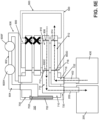
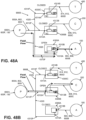
- Fig. 5B shows an operational state in which fluid moves into the fluid distributor 500 from the external environment 150 and is transferred to the foot support bladder 200. Again, the fluid flow in this operational state is shown by the thick, arrowed, broken lines.
- This operational state may be used to increase pressure in the foot support bladder 200, e.g., for a firmer feel and/or more intense activities (such as running).
- incoming fluid from the external environment 150 e.g., air
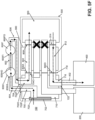
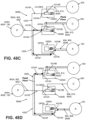
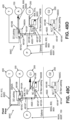
- fluid distributors 500 and foot support systems it may be desired to use the on-board fluid container 400 to adjust (and in this example, increase) fluid pressure in the foot support bladder 200. This may allow more predictable or controlled fluid transfer over time as less influence in fluid flow from pressure spikes due to foot contact with the ground may be experienced.
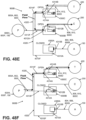
- An example of this operational state is shown in Fig. 5E . In this operational state, fluid leaves the fluid container 400, enters the fluid container fluid line 402, passes into the third connector fluid path 716 via connector port 722 and to the third fluid path connector 718 of the connector 700.
- fluid passes through manifold port 800D into the third manifold fluid flow path 812 defined in the manifold 800, through the third manifold port 814 and into the fluid transfer system 900. From here, in this example system and operational state, the fluid is transferred to the foot support bladder 200. This occurs by the fluid leaving the fluid transfer system 900, passing through the second manifold port 808, through the second manifold fluid flow path 810 defined in the manifold 800, through manifold port 800C to the second fluid path connector 712 of the connector 700, through the second connector fluid path 714 to connector port 720, into foot support fluid line 202, and into the foot support bladder 200.
- Fig. 5F shows an example operational state for adding fluid to the fluid container 400 (e.g., to increase fluid volume and/or pressure in the fluid container 400).
- incoming fluid from the external environment 150 e.g., air
- incoming fluid from the external environment 150 enters the connector 700 via filter 702 and connector inlet 702I.
- fluid travels through the connector body to connector outlet port 702O and to a fluid path 604 that takes the fluid to the pump system (pump(s) 600H, 600F).
- pump(s) 600H, 600F From the pump(s) 600H, 600F, fluid travels down a fluid line 606 back to an inlet port 704 of the connector 700.
- a one-way valve or a check valve along fluid line 606 may be present to prevent fluid from flowing back toward the pump(s) 600H, 600F through connector inlet port 704 and/or fluid line 606.
- fluid flows through the connector 700 via a connector fluid path 704P, to a connector outlet port 704O, and to an incoming fluid port 800A of the manifold 800. Fluid flows from the incoming fluid port 800A, through a fluid inlet path 802 in the manifold 800, through manifold inlet port 800I and to the fluid transfer system 900.
- fluid leaves the fluid transfer system 900 passes through the third manifold port 814, through the third manifold fluid flow path 812 defined in the manifold 800, through manifold port 800D, to the third fluid path connector (or port) 718 of the connector 700, through the third connector fluid path 716, through connector port 722, into the fluid container fluid line 402, and into the fluid container 400.
- Some portions or all of the fluid distributor 500 may be included in or engaged with a housing 502 (e.g., including a frame 504 and a cap 506). See Figs. 2A and 2B .
- the housing 502 may be mounted to the sole structure 104 and/or to the footwear upper 102. When mounted on a side surface of an article of footwear 100, e.g., as shown in Figs.
- the fluid distributor 500 may be located at a lateral, heel area of the upper 102 and/or sole structure 104, e.g., to help prevent undesired contact between the user's feet.
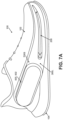
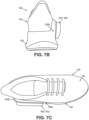
- the example footwear 100 structures of Figs. 6-7E show the sole structure 104 including an upwardly extending base surface 700S that provides a base for attachment of the fluid distributor 500.
- the base surface 700S may form part of lateral cage component 300L described above in conjunction with Fig. 2B .
- Fluid lines e.g., from the foot support bladder 200, from the fluid container 400, from the fluid source (e.g., pump(s) 600H, 600F), and/or from the external environment 150) may extend through this base surface 700S and/or otherwise may be exposed at this base surface 700S for engagement with the fluid distributor 500, as will be described in more detail below.
- the cap 506 of the fluid distributor 500 may include an input system, e.g., one or more switches (506A and 506B shown in Fig. 6 ). These switches 506A and 506B can function as user inputs, e.g., to allow a user to manually increase (switch 506A) or decrease (switch 506B) air pressure in the foot support bladder 200. User interaction with switches 506A and 506B, when present, may activate the fluid distributor 500 and fluid transfer system 900 to move fluid as described with respect to one or more of the operational states above. Fig.
- the fluid distributor 500 may include one or more lights 506L (e.g., one or more LED's (e.g., 12) around a perimeter of its housing 502) within a light guide. These light(s) 506L may be decorative and/or may allow color variations of the displayed light.
- lights 506L e.g., one or more LED's (e.g., 12) around a perimeter of its housing 502
- These light(s) 506L may be decorative and/or may allow color variations of the displayed light.
- the light(s) 506L may provide information, e.g., relating to one or more of: (a) an "on" or “off” status of the fluid distributor 500 (e.g., light(s) 506L on means powered, light(s) 506L off means unpowered); (b) foot support pressure and/or other pressure status information of the footwear 100 (e.g., depending on light color and/or flashing indicating maximum pressure, minimum pressure, intermediate pressure(s), etc.); (c) system reset status; (d) factory reset status; (e) powering on, powering off, and/or reboot status; (f) pressure adjustment in progress; (g) an error condition; (h) battery charging status; (i) remaining battery charge status; (j) successful and/or unsuccessful electronic communication status information with the other shoe and/or a mobile computing device (BTLE confirmation status); (k) data download, upload, and/or software update progress or status information; (l) operational state identifying and/or status information; etc.
- input data may be used to control the lights (e.g., the color(s) of the lights(s) 506L, the number of light(s) 506L lit, change in lighting arrangement, the arrangement of lit light(s) 506L, the sequence of lighting, the animation of the lights, etc.).
- the lights e.g., the color(s) of the lights(s) 506L, the number of light(s) 506L lit, change in lighting arrangement, the arrangement of lit light(s) 506L, the sequence of lighting, the animation of the lights, etc.
- Such data also may enable the lights to provide information, such as foot speed information, distance run information, acceleration information, workout intensity information, battery life status information, decorative features, etc.
- Light colors, animations, styles, and the like may differ, e.g., between different shoe models, different shoe types, different shoe colorways, etc.
- Light “animations” as used herein may include, for example one or more of: displayed light colors; changes in displayed light colors; light blinking or flashing rates; changes in light blinking or flashing rates; the number and/or arrangement of the displayed lights; changes in the number and/or arrangement of the displayed lights; etc. While other options are possible, in the specific example of Fig. 6 , the lights 506L form an annular ring around the housing 502 (although the entire annular ring need not be lit at the same time).
- a locking mechanism e.g., releasable retaining flap 512
- a locking mechanism e.g., releasable retaining flap 512
- Any desired manner of releasably securing the fluid distributor 500 in the receptacle 510 may be used without departing from this technology.
- Fig. 10 provides a block diagram illustrating features of assembly of an example article of footwear 100 (e.g., including a sole structure 104 like that shown in Fig. 2B ), including inclusion of a fluid distributor 500 or fluid flow control system in accordance with some aspects of this technology.
- Fig. 10 provides additional information as to how the components and/or parts may be engaged together. Examples include the use of primers and adhesives, snap fit parts, retention clips, RF welds, and direct tube connections. Any desired manner of engaging the various components and/or parts together may be used without departing from this technology, including connectors, adhesives, and the like as are conventionally known and used in the footwear arts.
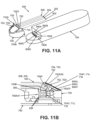
- the fluid distributor 500 may have a configuration like that shown in Figs. 11A and 11B (note also the discussion of Figs. 5A-5F above).
- the connector 700 includes a filter 702 that accepts fluid from the external environment (e.g., via inlet port 702I).
- the connector 700 forms a separate part that is engaged with a housing 750, and the manifold 800 and fluid transfer system 900 are contained within housing 750.
- the connector 700 of this example connects with four external fluid lines (e.g., flexible tubes).
- One fluid line 604 takes incoming fluid from the external environment, via connector inlet port 702I and outlet port 702O, to the pump(s) (600H, 600F).
- a second fluid line 606 takes fluid from the pump(s) (600H, 600F) back to the connector 700 so it can be introduced into the manifold 800 and fluid transfer system 900 under increased pressure from the pump(s) 600H, 600F.
- a third fluid line 202 extends to and is in fluid communication with the foot support bladder 200. This fluid line 202 is used to move fluid into the foot support bladder 200 from the fluid distributor 500 and out of the foot support bladder 200 into the fluid distributor 500.
- a fourth fluid line 402 extends to and is in fluid communication with the fluid container 400. This fluid line 402 is used to move fluid into the fluid container 400 from the fluid distributor 500 and out of the fluid container 400 into the fluid distributor 500. Notably, as shown in Figs.
- the ports 702O, 704, 720, and 722 of connector 700 connecting with external fluid lines 604, 606, 202, and 402, respectively, may be aligned along one surface 704S of the connector 700 (and extend, at least in part, in parallel through the connector 700, if desired).
- Figs. 11A and 11B further illustrate that the housing 750 for the manifold 800 and fluid transfer system 900 of this example includes four ports: 800A, 800B, 800C, and 800D.
- Port 800A of this example connects with port 704O on the connector 700 body in fluid communication with fluid line 704P to accept incoming fluid from fluid line 606 (and thus from the pump(s) (600H, 600F)) and takes the incoming fluid into the manifold 800 and/or fluid transfer system 900.
- Port 800B of this example connects with port 706 on the connector 700 body and exhausts excess or undesired fluid back to the external environment (e.g., through the connector 700 body).
- Port 800C of this example connects with port 712 on the connector 700 body and exchanges fluid (in either direction) between the foot support bladder 200 and the manifold 800.
- Port 800D of this example connects with port 718 on the connector 700 body and exchanges fluid (in either direction) between the fluid container 400 and the manifold 800.
- the ports 800A, 800B, 800C, and 800D of manifold 800 may be aligned along one surface 750A of the housing 750 and/or of the manifold 800 (and may extend, at least in part, in parallel through the housing 750 and/or the manifold 800, if desired).
- Connector 700 ports 704O, 706, 712, and 718 may be aligned along one surface 704S of the connector 700 (and extend, at least in part, in parallel through the connector 700, if desired).
- connector 700 ports 704O, 706, 712, and 718 may be located somewhat below and offset from connector ports 704, 702O, 720, and 722, respectively, on surface 704B of the connector 700.
- Surfaces 704S and 704B may constitute a common surface on the connector 700, may be offset from one another, may be different from one another, may face in different directions, etc.
- the connector 700 of this example includes fluid paths 704P, 714, 716 that pass through the connector body to connect connector ports 704, 720, 722 with manifold ports 800A, 800C, 800D.
- the fluid paths 704P, 714, 716 form a bent or curved path through the connector 700 body in this example. Fluid may enter and exit the connector 700 from the same general side of the connector 700 and/or in the same general direction (e.g., as shown in Fig. 11B ).
- the retainer clip(s) 752 helps hold the fluid lines 202, 402, 604, 606 in place with respect to the housing 750, which can help prevent kinks, disconnections, etc. and/or assist with assembly.
- the retainer clip(s) 752 may be engaged with housing 750 in any desired manner, including via retaining structures 754 and friction fit, releasable engagements, fixed engagements, adhesives, mechanical connectors, etc.
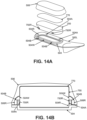
- Figs. 14A and 14B illustrate features of engaging a fluid distributor 500 according to some aspects of this technology with an article of footwear 100 or a component thereof (such as part of a sole structure 104).
- the fluid distributor 500 of that example was engaged with a lateral cage component 300L of a sole structure 104.
- the fluid distributor 500 of this example includes housing 750 that contains at least the manifold 800 and fluid transfer system 900 (optionally engaged with connector 700 as described above).
- the frame 504 may be engaged or integrally formed with the cage component 300L or other sole 104 and/or upper 102 component in any desired manner, e.g., such as adhesives, mechanical connectors, 3D printing, etc.
- the cap 506 may be engaged (permanently or releasably) with sidewalls 504W of the frame 504, e.g., by retaining elements 506R extending and fitting into retaining recesses 504B provided in the exterior of sidewalls 504W of frame 504.
- the retaining element(s) 506R of cap 506, when present, may be made from a polyether based thermoplastic polyurethane material having good low temperature flexibility and damping characteristics (e.g., to reduce rattling of the cap 506 on the frame 504).
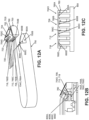
- Figs. 15A-15C further illustrate an example of incorporating a fluid distributor 500 into a footwear structure (e.g., into a footwear sole structure 104) in accordance with some examples of this technology.
- the connection shown in Figs. 15A-15C relates to a system having a housing 750 containing the manifold 800 and fluid transfer system 900 engaged with a separate connector 700 structure, e.g., as shown in Figs. 11A-12C .
- Fig. 15A first the fluid lines from the various footwear component parts are brought to and engaged with connector 700.
- these fluid lines include: (a) fluid line 604 extending from the connector inlet 702I to the pump(s) 600H, 600F, (b) fluid line 606 extending from the pump(s) 600H, 600F back to the connector 700, (c) fluid line 202 extending between the foot support bladder 200 and the connector 700, and (d) fluid line 402 extending between the fluid container 400 and the connector 700.
- Fluid lines 604, 606, 202, 402 may be engaged with their respective connector ports 702O, 704, 720, 722 in any desired manner, including via use of adhesives, mechanical connectors, friction fits, engaged male/female connectors, etc.
- the housing 750 including the manifold 800 and the fluid transfer system 900 may be engaged with the connector 700 (e.g., to form the complete fluid distributor 500 of this example). This may occur, for example, by sliding manifold ports 800A, 800B, 800C, 800D into fluid communication with connector fluid paths 704P, 708, 714, 716, respectively at connector ports 704O, 706, 712, 718, respectively.
- this illustrated example includes the sealing system 760 having channels 760A-760D receiving male ports 800A-800D, respectively, of manifold 800.
- an adhesive may be applied to the manifold ports 800A, 800B, 800C, 800D, the connector 700 ports 704O, 706, 712, 718, and/or (when present) the sealing channels 760A, 760B, 760C, 760D to fix the connecting parts together.
- the housing 750-with engaged connector 700- may be moved into the recess 504R of the frame 504 so that the housing 750 engages frame 504 in the manner described above in conjunction with Figs. 14A and 14B (e.g., snap fit into place, adhesively bonded, mechanical connectors, etc.).
- the cap 506 may be engaged with the housing 750 and/or frame 504, e.g., in the manner described above in conjunction with Figs.
- Fig. 15C shows the final assembled sole component 104 of this example.
- the sole component 104 may be engaged with an upper 102 to form the overall article of footwear 100 (before or after the housing 750 is engaged in the frame 504).
- Figs. 15D-15G illustrate assembly of a connection in which the connector 700 is formed as part of the manifold 800 structure and included in housing 750 prior to assembly.
- the fluid lines from the various footwear component parts are brought to and engaged with connector 700 ports located at the interior side of housing 750.
- these fluid lines include: (a) fluid line 604 extending from the connector inlet 702I to the pump(s) 600H, 600F, (b) fluid line 606 extending from the pump(s) 600H, 600F back to the connector 700, (c) fluid line 202 extending between the foot support bladder 200 and the connector 700, and (d) fluid line 402 extending between the fluid container 400 and the connector 700.
- the fluid lines 604, 606, 202, 402 may be engaged with their respective connector ports 702O, 704, 720, 722 in any desired manner, including via use of adhesives, mechanical connectors, friction fits, etc.
- the ends of fluid lines 604, 606, 202, 402 of this example constitute or include female type connectors that fit over male type individual connectors provided with connector ports 702O, 704, 720, 722.
- the ends of 604, 606, 202, 402 may constitute or include male type connectors and fit within female type individual connectors provided with connector ports 702O, 704, 720, 722. Not all connections on an individual fluid distributor 500 need to be the same type and/or structure.
- the housing 750 may be moved into the recess 504R of the frame 504 so that the housing 750 engages frame 504, e.g., in the manner described above in conjunction with Figs. 14A and 14B (e.g., snap fit into place, adhesively bonded, mechanical connectors, etc.).
- the cap 506 may be engaged with the housing 750 and/or frame 504, e.g., in the manner described above in conjunction with Figs.
- Fig. 15G shows the final assembled sole component 104 of this example.
- the sole component 104 may be engaged with an upper 102 to form the overall article of footwear 100 (before or after the housing 750 is engaged in the frame 504).
- Fluid flow control systems e.g., fluid distributor 500 and/or portions thereof
- foot support systems including such fluid flow control systems, and/or articles of footwear 100 in accordance with aspects of this technology may require a power source, e.g., for powering various components.
- Components that may require power may include, but are not necessarily limited to, one or more of: a user input system; systems for changing pressure within one or both of the foot support bladder 200 and/or the fluid container 400; a system for driving and/or controlling the fluid transfer system 900; the lights 506L (if present); accelerometers and/or other sensors; pumps; compressors; etc.
- the power source may include a rechargeable battery contained in housing 750. Figs.
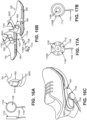
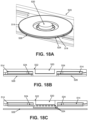
- FIGS. 16A-21C illustrate various examples of systems (e.g., wireless systems) for recharging a battery in accordance with some examples of this technology.
- Figs. 16A-16C show a charge puck 1102 that may be engaged with an AC adapter 1110 (e.g., via power lines 1104 and 1108).
- the charge puck 1102 includes a magnet 1106 that engages with the shoe 100 at a charging station 502C.
- the charging station 502C (which may be included as part of the fluid distributor 500) includes a receiver coil 514 that operatively engages the transmitter coil of the charge puck 1102 to wirelessly recharge the battery in conventional manners (e.g., inductive coupling) as are known and used in the relevant art.
- FIG. 16A shows charge puck 1102 engagable at a rear heel area of the shoe 100.
- Figs. 16B and 16C show charge puck 1102 engaged at a side (e.g., lateral, heel side) of shoe 100.
- Fig. 16B further illustrates a pair of charge pucks 1102 including individual power lines 1104 engaged with a connector 1108A that extends to a single power line 1108 coupled with AC adapter 1110.
- some examples of this technology may use non-rechargeable batteries.
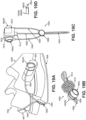
- Figs. 17A and 17B illustrate other examples of charge pucks 1102A and 1102B that may be used in some examples of this technology.
- Charge puck 1102A of Fig. 17A includes plural magnets 1106 arranged around an annular transmitter coil 1112 to magnetically engage charge puck 1102A with the charging station 502C magnet.
- Charge puck 1102B of Fig. 17B includes a central magnet 1106 that has an annular transmitter coil 1112 arranged around it.
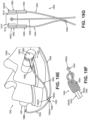
- Figs. 18B and 18C show alternative structures for an inductive charging system in fluid distributor 500 (e.g., beneath cap 506).
- Fig. 18B shows the receiver coil 514 separated from printed circuit board 526 with a thin layer of ferrite 524 (e.g., an annular ring of ferrite 524).
- Fig. 18C shows an additional and/or a thicker layer of ferrite 524, including ferrite 524 extending beneath the magnet 520 and separating the magnet 520 from the printed circuit board 526.
- the additional ferrite 524 of the example of Fig. 18C helps shield the charging system from the printed circuit board 526 and/or helps prevent overheating.
- 18C also may help prevent the magnet(s) 520 from interfering with operation of solenoids, e.g., for fluid transfer systems 900 and/or fluid distributors 500 that include solenoids.
- solenoids e.g., for fluid transfer systems 900 and/or fluid distributors 500 that include solenoids.
- rechargeable batteries that rely on direct electrical contact between the power source and battery may be used (rather than inductive charging systems).
- One or both shoes 100 of a pair may require a power source and thus may include a rechargeable battery for operating various components of the fluid distributor 500.
- Figs. 19A-21C illustrate various examples of charging systems for a pair of shoes 100.
- Figs. 19A-19D illustrate an example system 1900 for simultaneously charging a pair of shoes 100L and 100R using wireless charging.
- the charging system 1900 resembles a pair of wired earbuds, with a charging puck 1902L and 1902R for each shoe 100L, 100R, respectively.
- Wires 1904 from the charging pucks 1902L, 1902R (which may be located within an insulating outer cover as is known in the relevant arts) meet at an intermediate connector 1906, and a wire 1908 extends from the connector 1906 to an AC power adapter 1910.
- the term "wire” as used herein in the context of recharging systems for the footwear 100 means any type of electrical connector, including single wires, multiple wires, cables, conductive tracks or tracings, etc.
- the connector 1906 may distribute power to the two separate wires 1904, one going to each charging puck 1902L, 1902R.
- Fig. 19A shows the charging pucks 1902L, 1902R engaged with the fluid distributor 500 on the lateral sides of each of the left shoe 100L and the right shoe 100R, respectively.
- Figs. 19B and 19C show the charging system 1900 parts for storage or travel, both without the AC power adapter 1910 ( Fig. 19B ) and with the AC power adapter 1910 ( Fig. 19C ). While other options are possible, as shown in these figures, power wire 1908 may terminate at a USB connector component 1912 and the AC power adapter 1910 may include a port for receiving the USB connector component 1912. Further, as shown in Fig. 19D , in this system, the power wire 1904 engages the body of the puck 1902L, 1902R through the side surface 1902S of the puck 1902L, 1902R.
- Figs. 19B and 19C further show that, for storage, the magnets of the charging pucks 1902L, 1902R may engage with a magnet or magnetic attracting material in the connector 1906 and/or the AC power adapter 1910.
- the charging pucks 1902L, 1902R are releasably fixed to the connector 1906 and/or the AC power adapter 1910 by magnetic engagement and forces, e.g., for storage or travel.
- a magnet or magnetic attracting material may be incorporated into the connector 1906 and/or the AC power adapter 1910 (e.g., to internal or external side surfaces of the connector 1906 and/or the AC power adapter 1910) to facilitate this magnetic attractive engagement.
- the charging system 2000 of Figs. 20A-20D may include a magnet or magnetic attracting material 1914 in the AC power adapter 2010, e.g., in the same manner described above with respect to Figs. 19B and 19C .
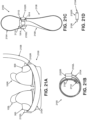
- Figs. 21A-21D illustrate another example system 2100 for simultaneously charging a pair of shoes 100L and 100R using wireless charging, e.g., of the various types described above.
- the charging system 2100 includes a charging puck 2102L and 2102R for each shoe 100L, 100R, respectively.
- a wire 2108 from an AC power adapter 2110 connects to one of the charging pucks (puck 2102R in this illustrated example), and another wire 2104 extends from that charging puck to the other charging puck (2102L in this illustrated example).
- Fig. 21A-21D illustrate another example system 2100 for simultaneously charging a pair of shoes 100L and 100R using wireless charging, e.g., of the various types described above.
- the charging system 2100 includes a charging puck 2102L and 2102R for each shoe 100L, 100R, respectively.
- a wire 2108 from an AC power adapter 2110 connects to one of the charging pucks (puck 2102R in this illustrated example), and another wire 2104 extends from that charging puck to the
- circuitry within charging puck 2102R splits incoming power from wire 2108: (a) to be used for charging at puck 2102R and (b) to pass through puck 2102R to wire 2104 and to puck 2102L.
- the wires 2108 and 2014 connect charging pucks 2102R, 2102L in series.
- Fig. 21A shows the charging puck 2102R engaged with the fluid distributor 500 on the lateral side of right shoe 100R and the connection of charging puck 2102L with the lateral side of left shoe 100L.
- Figs. 21B and 21C show the charging system 2100 parts for storage or travel, both without the AC power adapter 2110 ( Fig. 21B ) and with the AC power adapter 2110 ( Fig. 21C).
- Fig. 21A shows the charging puck 2102R engaged with the fluid distributor 500 on the lateral side of right shoe 100R and the connection of charging puck 2102L with the lateral side of left shoe 100L.
- Figs. 21B and 21C show the charging system 2100 parts for storage or travel
- Figs. 21B and 21C further show a different connector 2112 between wire 2108 and AC power adapter 2110.
- Connector 2112 includes a mechanical connector to make electrical connection with a corresponding connector provided on the power adapter 2110 (e.g., a plug type connection). Any desired type of connection between connector 2112 (as well as the other connectors described above in Figs. 19A-20D ) and its corresponding AC power adapter 2110 can be used without departing from this technology, including fixed electrical connections, releasable electrical connections, USB plug connections, and/or other suitable plugs, sockets, clips, and/or electrical connections as are known and used in the relevant rechargeable electronic and electrical device arts.
- the fluid distributor 500 may include one or more buttons 506A, 506B, e.g., used as user input for changing/controlling pressure in the foot support bladder 200 (and/or other portions of the footwear 100).
- the fluid distributor 500 also may include one or more lights 506L, e.g., as decoration and/or to indicate some status information about the footwear 100 and/or the overall system as described above.
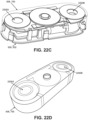
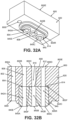
- Figs. 22A-22E provide additional information regarding potential examples of a user interface switch or system 2200 for unlocking the user interface switch or system 2200 and/or changing the pressure in some portion of the foot support system. The "keep-out" zone shown in Fig.
- 22A corresponds with an area of the housing 502 that includes the coil for magnetic charging as described above ("keep-out” meaning that the "real estate" beneath that area already is claimed for the coil or other structures, and thus cannot house circuitry and/or components for user interface switch 2200).
- Fig. 22A provides a chart of various options for unlocking and using user interface switch or system 2200 and its operation.
- Figs. 22B-22E provide views of potential structures for such input systems (with Example 4 from Fig. 22A particularly illustrated).
- the button is a capacitive type button (e.g., detecting a user's finger touch by capacitive coupling of structures as is known and used in relevant arts).
- This example user interface switch or system 2200 is unlocked by a swipe action of the button, and changes in pressure also are input by a swipe action (e.g., swipe right (toward 506B in Fig. 22B ) to decrease pressure by a predetermined amount or step, swipe left (toward 506A in Fig.
- a single swipe could be used to both unlock the user interface switch or system 2200 and introduce pressure change input.
- the initial "touch” and beginning of the swipe could unlock (and if needed, wake up) the user interface switch or system 2200, and the continuing swiping action (left or right) could provide the pressure change input.
- two swipes may be used or required, e.g., the first to unlock and/or wake up the user interface switch or system 2200 and the second to provide the pressure change input.
- the button is a capacitive type button (e.g., including a capacitive sense electrode of structure known and used in art relevant arts).
- This example user interface switch or system 2200 is unlocked by a swipe action of the button, and changes in pressure are input by a touch action on either side of the center (e.g., touch the right side 506B to decrease pressure by a predetermined amount, touch the left side 506A left to increase pressure by a predetermined amount).
- each of Examples 3 and 4 illustrates structure for two potential input options.
- the buttons 2200A, 2200B may be physical buttons (also called “tactile buttons” herein) that require two physical presses-one press to unlock the user interface switch or system 2200 and another press to enter the desired pressure increase or pressure decrease information.
- the buttons 2200A, 2200B may be a combination of a capacitive touch button (used to unlock the user interface switch or system 2200) and a tactile button (used to change pressure setting).
- buttons 2200A, 2200B are adjacent one another on the same side of the button and the same side of the keep-out zone.
- the buttons 2200A, 2200B are separated from one another by the keep-out zone and are on different ends of the button. Buttons having a "button press” or “press” label in Fig. 22A may constitute physical switch type button activators.
- the tactile buttons may have an outer surface providing a distinct tactile feel.
- the exposed pressing surface of one button e.g., pressure increase button 2200A
- the exposed pressing surface of the other button e.g., pressure decrease button 2200B
- one side of the button 506 may be marked with a recessed or raised "plus” sign ("+") and the other side may be marked with a recessed or raised "minus” sign ("-") to provide the distinct tactile feel. In this manner, the user can more easily locate and interact with the correct button, even while wearing the shoes, to make desired pressure changes.
- Figs. 22B-22E provide various views of an example button construction for the "touch/press" option of Example 4 of Fig. 22A.
- Fig. 22B shows flex areas 2202A, 2202B corresponding to the physical tactile button locations 2200A, 2200B overmolded by a rubber or other polymer (e.g., silicone or other elastomer) composition (or formed in a two-shot molding process).
- Grooves 2204A and 2204B extending partially through the overmold material 2210 around the button actuator area create a thinner layer of rubber or other material (e.g., elastomer) to better enable flexion when buttons 2200A, 2200B are pushed.
- These grooves 2204A, 2204B also may provide the tactile feel features described above.
- Flex areas 2202A, 2202B may include a base portion having elastomer overmold material of a first thickness (e.g., 2 mm to 10 mm thick) and the grooves 2204A, 2204B may have a second thickness (e.g., 0.5 mm to 3 mm thick) that is less than the first thickness.
- the first thickness of the overmold material at the base portion may be from 1.5 to 20 times thicker than the second thickness of overmold material in the grooves 2204A, 2204B.
- buttons 2200A, 2200B when buttons 2200A, 2200B are pressed, the overmold material in the grooves 2204A, 2204B stretches somewhat under the applied force. As force from the button push is reduced or removed, the stretched material in grooves 2204A, 2204B returns toward its unstretched configuration, providing return energy. This return energy may provide an interesting tactile feel on the user's finger, somewhat of a "bouncy" or "trampoline” effect.
- the overmold material 2210 also closes the button area to help prevent water, debris, or other undesirable material from entering the interior of housing 502.
- the flex areas 2202A, 2202B may be formed as part of the cap 506 placed over the housing 750 of the fluid distributor 500 and/or as the top surface of the housing 750 of the fluid distributor 500. If desired, however, grooves 2204A and/or 2204B in the flex areas 2202A and/or 2202B may be replaced by through holes. If necessary or desired, in such systems, other sealing components (e.g., elastomer gaskets, O-rings, etc., see Fig. 22E ) may be provided to seal off the button openings and/or provide the bouncy" or "trampoline” effect (if desired).
- other sealing components e.g., elastomer gaskets, O-rings, etc., see Fig. 22E
- the grooves 2204A and 2204B in Fig. 22B may have any desired shape(s) without departing from this technology. They may be located adjacent the button actuator areas (e.g., above and/or around the hardware needed to activate the button). In the illustrated example of Fig. 22B , the grooves 2204A and 2204B are generally U-shaped, having their free or open ends facing one another. The free or open ends could face in other direction(s) as well, including away from one other, toward the other surfaces of the button, etc. In other examples, the grooves 2204A and/or 2204B may form closed paths around the button actuator area.
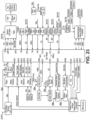
- Fig. 23 provides an electrical block diagram 2300 of components in some example fluid distributors 500, fluid flow control systems, sole structures 104, and/or articles of footwear 100 in accordance with aspects of this technology. While Fig. 23 illustrates several components and systems incorporated into fluid distributors 500, fluid flow control systems, sole structures 104, and/or articles of footwear 100 in accordance with aspects of this technology, any desired subset or combination of these components and systems may be used in some examples of this technology. More of these components and systems identified in Fig. 23 will be described in more detail below.
- IMU's 2406 also may be provided, such as accelerometers (“ACC”), magnetometers (“MAG”), etc., to detect user motion in the article of footwear 100. Data from such inertial measurement units or other available sensors may be used to automatically control and/or change pressure settings in the foot support bladder 200 and/or fluid container 400 in one or both shoes.
- a motor driver 2408 is present in this illustrated example, e.g., to control operation of any motor(s) in the fluid distributor 500 (e.g., as will be described in more detail below).
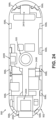
- the seemingly "open space” within the housing 502 may be filled, at least in part, with some or all of a manifold 800 and fluid transfer system 900, the rechargeable battery, and/or other desired components.
- Fig. 25 illustrates several potential avenues of communication between a central controller 2500 and the shoes of a pair (e.g., being worn by a user). These communications may take place via hardware, systems, communication protocols, and the like, as are conventionally known and used in the relevant art. While both shoes of a pair may include all of the hardware and software needed to provide the desired functions (e.g., as described above and/or as described in more detail below), in some examples of this technology, one shoe of a pair may include all of the desired hardware and software ("connected as central" shoe 2502 in Fig. 25 ), and that shoe 2502 may communicate with the other shoe ("connected as peripheral" shoe 2504 in Fig. 25 ), e.g., in a wireless manner, via an antenna 2402.
- the central controller 2500 may be included as part of one shoe (e.g., within housing 502 of fluid distributor 500 for that shoe), and it may communicate with that shoe via a wired or wireless connection.
- the shoe including the central controller 2500 may communicate with the other shoe, e.g., via a wireless connection as mentioned above.
- the central controller 2500 may be provided as part of a computing device, e.g., a mobile computing device, such as an application program operating on a smartphone.
- pressure change information may be provided via an external computing device (e.g., the smartphone) and transmitted to one or both shoes, e.g., via antenna 2402 in housing 502.
- Fig. 25 further illustrates how the various components operate to go into and out of an "asleep” mode 2506.
- the component(s) may go into an "asleep” mode 2506, for example, when no "foot presence sensor” or “FPS" data is received for a predetermined time period for one or both shoes, when the connection is lost from one or both shoes, after a timeout period (e.g., with no foot pressure sensing), etc.
- Foot presence within a shoe 2502, 2504 may be sensed in any desired manner, such as by capacitance sensors, force/pressure sensors, switch type sensors, etc.
- the external computing device may include a user input system, e.g., to receive user input via an application program, and transmit this input (e.g., pressure change input) to the relevant shoe or shoes 2502, 2504.
- a user input system e.g., to receive user input via an application program, and transmit this input (e.g., pressure change input) to the relevant shoe or shoes 2502, 2504.
- either shoe 2502, 2504 and/or an external communication device in communication with the shoes 2502, 2504 may receive data and/or information from and/or transmit data and/or information to one or more electronic devices integrated into apparel 2510 (e.g., motorized fluid containing sports bra (e.g., in which fluid pressure changes alter the support provided, e.g., by a fluid-tight bladder incorporated into the sports bra), motorized fluid containing compression sleeves (e.g., a hollow tubular sleeve comprising a fluid-tight bladder in which fluid pressure in the fluid-tight bladder of the sleeve alters the level of compression provided), apparel having fluid transfer systems (e.g., with fluid-tight bladders) of the types described herein incorporated into them, motorized shoe lacing components, etc.).
- apparel 2510 e.g., motorized fluid containing sports bra (e.g., in which fluid pressure changes alter the support provided, e.g., by a fluid-tight bladder incorporated into the sports bra), motor
- either shoe 2502, 2504 and/or an external communication device in communication with the shoes 2502, 2504 can receive communications from and/or send communications to other components, such as motorized and/or adaptive lacing and support systems in/on the shoe or in/on apparel (e.g., a sports bra, compression sleeve, and the like).
- the apparel 2510 may function as the central communication point with both shoes 2502, 2504 as peripherals, or either shoe 2502, 2504 may function as the central communication point with the apparel 2510 and other shoe functioning as peripherals.
- an external computing device comes into the communication loop, that device may serve as the central device and both shoes 2502 and any devices included in the apparel 2510 may function as peripheral devices.
- wireless connection(s) with shoes 2502, 2504 may allow connections to any one or more of automatic and/or motorized shoe securing mechanisms, such as motorized laces, or the like.
- the apparel 2510 may include any part of or all of the electronics, communications capabilities, and/or fluid transfer capabilities as described herein for similar components in footwear.
- fluid transfer systems 900 Various examples of structures and operations of fluid transfer systems 900 are described in more detail in the sections that follow. Some aspects of fluid transfer systems 900 in accordance with this technology relate to valve stems within a valve housing to open and close various fluid pathways through a manifold 800. Other aspects of fluid transfer systems 900 in accordance with this technology relate to solenoid based systems that selectively open and close to control fluid flow through a manifold 800.
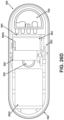
- Figs. 26A-26D provide various views of an example fluid distributor 500 including a movable valve stem type fluid transfer system 900A in accordance with aspects of this technology.
- this example fluid distributor 500 includes a housing 502 in which a manifold 800 and fluid transfer system 900A are housed as well as a connector 700 that engages the components within housing 502 with a fluid source (e.g., the external environment, pump(s) 600H, 600F, a compressor, etc.), the external environment 150, at least one foot support bladder 200, and at least one fluid container 400.
- Figs. 26A-26D further show the locations of fluid transfer system 900A and a rechargeable battery 2602 for powering the various electrical or electronic components.
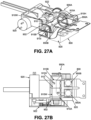
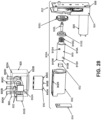
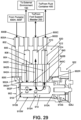
- Figs. 27A-29 provide additional details regarding components of the example manifold 800 and fluid transfer system 900A in accordance with some aspects of this technology.
- the manifold 800 of this example includes a manifold body or housing 820. Referring also to Figs. 5A-5F , one surface 822A or side of manifold body 820 includes ports 800A, 800B, 800C, 800D having fluid communicating connections with corresponding ports 704O, 706, 712, 718, respectively, of connector 700.
- the opposite surface 822B of manifold body 820 (although it could be another surface) includes inlet port 800I, first manifold port 804, second manifold port 808, and third manifold port 814.
- a fluid inlet path 802 extends between port 800A and fluid inlet port 800I, a first fluid flow path 806 extends between port 800B and first manifold port 804, a second fluid flow path 810 extends between port 800C and second manifold port 808, and a third fluid flow path 812 extends between port 800D and third manifold port 814.
- manifold 800 includes four separate fluid pathways extending through it.
- the manifold 800 of this example further includes at least one pressure sensor (two pressure sensors 850A, 850B shown in Figs. 27A-28 ).
- the pressure sensor(s) 850A, 850B may be positioned for determining fluid pressure in at least one of the first fluid flow path 806, the second fluid flow path 810, or the third fluid flow path 812.
- a first pressure sensor 850A may be provided to determine fluid pressure in the third fluid flow path 812 (and thus in fluid container 400)
- a second pressure sensor 850B may be provided for determining fluid pressure in at least one of the first fluid flow path 806 or the second fluid flow path 810 (e.g., the pressure in foot support bladder 200).
- O-rings 852 (or gaskets and/or other appropriate sealing devices) may be provided to sealingly engage the pressure sensor(s) 850A, 850B with the manifold body 820.
- the fluid transfer system 900A of this illustrated example includes a valve housing 902 and a valve stem 910 movably (e.g., rotatably, slidingly, etc.) mounted in the valve housing 902.
- the valve stem 910 of this example includes a first end 910A (e.g., a driven end) and a second end 910B opposite the first end 910A (e.g., a free end).
- a perimeter wall 910W extends between the first end 910A and the second end 910B.
- the first end 910A, the second end 910B, and the perimeter wall 910W define an internal chamber 910I of the valve stem 910.
- the perimeter wall 910W of the valve stem 910 includes a plurality of through holes 910H extending from the internal chamber 910I to an exterior surface of the perimeter wall 910W and valve stem 910.
- this fluid flow control system e.g., fluid distributor 500, fluid transfer system 900A, the combined manifold 800 and fluid transfer system 900A, etc.
- this fluid flow control system e.g., fluid distributor 500, fluid transfer system 900A, the combined manifold 800 and fluid transfer system 900A, etc.
- Figs. 27A-29 further illustrate that this example fluid transfer system 900A includes a drive system (e.g., a motor 920) and a transmission 922 (including output gear, nose pin, cup seal, and other gears, described in more detail below).
- the transmission 922 components transfer power from the motor 920 to the first end 910A of the valve stem 910 to move (rotate in this example) the valve stem 910 with respect to the valve housing 902 (and manifold 800).
- a power source e.g., from rechargeable battery 2602
- a microcontroller e.g., provided with the fluid distributor 500 and not shown in Figs. 27A-29 , selectively drive the motor 920 to position the valve stem 910 in one of the plurality of positions to enable movement of the fluid from the desired starting points to the desired locations.
- the fluid transfer system 900A of this example additionally includes an encoder system (e.g., an on-axis magnetic encoder system, an off-axis magnetic encoder system, etc.), including an encoder magnet 932 and an encoder board 934, for detecting the position (e.g., rotational position) of the valve stem 910 with respect the housing 902 and/or other component parts.
- the encoder system provides data indicating this position to the microcontroller.
- Such encoder systems are commercially available and their operation are known in the relevant arts.
- valve housing 902 is engaged with the manifold body 820 in a sealed manner. While this sealing can be accomplished in a variety of ways, in this illustrated example, one or more sealing connectors 840 are provided between the perimeter wall 910W of the valve stem 910 and one or more of fluid inlet port 800I, first manifold port 804, second manifold port 808, and/or third manifold port 814. Sealing connector 840 extends into recess 902R on one side of valve housing 902. In this illustrated example, a single sealing connector 840 or seal block includes three sealing ports 840A, 840B, 840C.
- sealed channels 842A, 842B, 842C through the sealing connector 840 connect with first manifold port 804, second manifold port 808, and third manifold port 814, respectively.
- sealed channels 842A, 842B, 842C are in fluid communication with first fluid flow path 806, second fluid flow path 810, and third fluid flow path 812, respectively, of the manifold body 820.
- another sealing port and another sealed channel may be provided in sealing connector 840 to connect the manifold 800 fluid inlet port 800I with the valve housing 902.
- fluid inlet path 802 from manifold port 800A to fluid inlet port 800I connects directly with valve housing 902, and a fluid intake path 902A extends through valve housing 902 to admit incoming fluid into the internal chamber 910I of valve stem 910 through the open second end 910B thereof. See fluid pathway 902P shown in dashed line in Fig. 29 .
- the first manifold port 804, the second manifold port 808, and the third manifold port 814 align along an exterior side of the manifold 800.
- manifold ports 800A, 800B, 800C, 800D align along an exterior side of the manifold 800 (and in this illustrated example, on the opposite side of the manifold 800 from ports 804, 808, 814).
- Any two or more of the fluid flow paths 802, 806, 810, and 812 may align and/or extend in parallel through the manifold body 820.
- any two or more of the sealed channels 842A, 842B, 842C of sealing connector 840 may align and/or extend in parallel through the sealing connector 840 body.
- the valve stem 910 may place the fluid transfer system 900A in two or more operational states depending on the position of the valve stem 910 with respect to the housing body 902. Movement of the valve stem 910 changes positioning of the through holes 910H through the perimeter wall 910W of the valve stem 910 and allows different holes 910H to align with the sealing connector 840 ports 840A, 840B, 840C.
- the valve stem 910 may be moved, e.g., rotated, under control of a microprocessor controlling a motor 920.
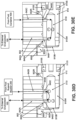
- Figs. 30A-30G provide additional details about various operational states that may be provided and used in fluid distributor 500, foot support systems, sole structures 104, and articles of footwear 100 including fluid transfer system 900A in accordance with aspects of this technology.
- manifold port 800A is in fluid communication with a fluid source, such as pump(s) 600H, 600F (e.g., via connector ports 702I and 704O and the components connecting them or other appropriate fluid lines) to bring fluid into the fluid transfer system 900A;
- manifold port 800B is in fluid communication with the external environment 150 (e.g., via connector port 706 and fluid path 708 and/or other appropriate fluid lines) to exhaust any excess fluid in the fluid transfer system 900A to the external environment 150;
- manifold port 800C is in fluid communication with a foot support bladder 200 (e.g., via connector ports 712 and 720 and fluid line 714 and/or other components connecting them) to increase or decrease fluid pressure in the foot support bladder 200;
- manifold port 800D is in fluid communication with a fluid container 400 (e.g., via connector ports 718 and 722 and fluid line 716 and/or other components connecting them) to increase or
- valve stem 910 is rotated to different positions to place the fluid distributor 500, foot support system, sole structure 104, and/or article of footwear 100 in different operational states. While any number of operational states may be provided, in this illustrated example, valve stem 910 may be rotated to six distinct operational states as shown in Figs. 30A-30G .
- Fig. 30A schematically illustrates various positions of valve stem 910 as it is rotated clockwise (e.g., from operational state 1 to operational state 6) or counter-clockwise (e.g., from operational state 6 to operational state 1).
- the "standby" state may be the typical state during most times (when no pressure changes occur).
- the valve stem 910 rotates the proper amount to go into the desired operational state (e.g., operational states 2-6), waits for the pressure to reach the desired level (as measured by pressure sensor(s) 850A, 850B), and then rotates back to the standby state.
- desired operational state e.g., operational states 2-6
- desired level e.g., measured by pressure sensor(s) 850A, 850B
- Operational state 1 of this example is the "standby" or “idle” state in which fluid pumped with each step simply passes through the system, e.g., from pump(s) 600H, 600F, through manifold 800, through fluid transfer system 900A, back through manifold 800, and to the external environment 150. See Fig. 30B . Operational state 1 prevents any part of the overall foot support system from becoming over pressurized, e.g., when a foot-activated pump is used and activated in each step to move fluid.
- Operational state 4 (e.g., with the valve stem 910 rotated 60 degrees clockwise from operational state 3) also is a "live” state for moving fluid from the fluid container 400 to the external environment 150.
- fluid passes through the system (e.g., from fluid container 400, through manifold 800, through fluid transfer system 900A, back through manifold 800) and to external environment 150. See Fig. 30E .
- This operational state may be used to release fluid and decrease fluid pressure in the fluid container 400 (e.g., a fluid container 400 "deflate” configuration).
- Operational state 5 also is a "live” state for moving fluid from the fluid container 400 to the foot support bladder 200.
- fluid passes through the system (e.g., from fluid container 400, through manifold 800, through fluid transfer system 900A, back through manifold 800) and to the foot support bladder 200. See Fig. 30F .
- This operational state may be used to increase fluid pressure in the foot support bladder 200 by moving fluid from the fluid container 400 into the foot support bladder 200 (e.g., a foot support bladder 200 "inflate" configuration).
- Some pressure sensing algorithms and methods in accordance with aspects of this technology may rely on sensor input in addition to pressure sensing in the foot support bladder 200 and/or fluid container 400 to determine the operational state to use.
- data from an accelerometer, foot force sensor, and/or speed and/or distance monitor may be used to determine whether a pressure increase in the foot support bladder 200 should be accomplished by operational state 2 (with fluid transferred from a foot activated pump system 600H, 600F) or by operational state 5 (with fluid transferred from the fluid container 400).
- operational state 2 with fluid transferred from a foot activated pump system 600H, 600F
- operational state 5 with fluid transferred from the fluid container 400
- Such metrics may include one or more of: (a) contact time per foot per step (e.g., using a foot force signal, such as the time period when vertical force applied by the foot is greater than 50N); (b) swing time period per foot per step (e.g., using a foot force signal, such as the time per foot when vertical force applied by the foot is less than 50N until that foot again creates a force greater than 50N); (c) step cadence (e.g., using a foot force signal, such as the inverse of the sum of the contact and swing time for each foot); (d) step length (e.g., using a foot force signal, such as the sum of contact and swing time x average speed); (e) impact (e.g., using a foot force signal, such as the peak rate of rise of the vertical ground reaction force, the active peak of the vertical ground reaction force, etc.); (f) impulse per foot per step (e.g., using a foot force signal, such as the integral of the ground reaction force magnitude during contact); and (
- a fluid distributor 500, foot support system, sole structure 104, and/or article of footwear 100 may have (or may be placed in) any one or more of (and any combination of) these operational states.
- Some specific examples of this technology may include all six operational states.
- some specific examples of this technology may include operational states 1, 3, 5, and 6 or 1, 3, 4, 5, and 6 (and any desired pressure increases in the foot support bladder 200 are accomplished using fluid supplied from the fluid container 400).
- fluid moves: (a) from the fluid supply (e.g.
- fluid moves: (a) from the fluid supply (e.g. from external environment 150, through connector inlet 702I, through fluid path 702P, through connector outlet 702O, through fluid path 604, through heel pump 600H, through fluid path 602, through forefoot pump 600F, through fluid line 606), (b) through the connector inlet port 704, (c) through connector fluid path 704P, (d) through connector outlet port 704O, (e) through manifold port 800A, (f) through manifold fluid inlet path 802, (g) through manifold fluid inlet port 800I, (h) through fluid intake path 902A, (i) into the open end 910B of valve stem 910, (j) through the internal chamber 910I, (k) through a second through hole 940B, (l) through sealing port 840B, (m) through second sealed channel 842B, (n) through second
- a specific fluid distributor 500, foot support system, sole structure 104, and/or article of footwear 100 does not include all of these parts (e.g., no separate connector 700, no sealing block 840, one or fewer foot activated pumps 600H, 600F, etc.), then the fluid flow through those parts would not be present in the fluid flow path described above.
- fluid moves: (a) from foot support bladder 200, (b) through bladder fluid line 202, (c) through connector port 720, (d) through second connector fluid path 714, (e) through second fluid path connector port 712, (f) through manifold port 800C, (g) through second manifold fluid flow path 810, (h) through second manifold port 808, (i) through second sealed channel 842B, (j) through sealing port 840B, (k) through a third through hole 940C, (l) through the internal chamber 910I, (m) through a fourth through hole 940D, (n) through sealing port 840A, (o) through first sealed channel 842A, (p) through first manifold port 804, (q) through first manifold fluid flow path 806, (r) through manifold port 800B, (s) through first fluid path connector port 706, (t) through first
- a one-way valve somewhere in the fluid pathway from the fluid supply may prevent fluid from flowing out of the second end 910B of valve stem 910 and into channel 902A, through fluid inlet 800I, and/or through fluid inlet path 802. If a specific fluid distributor 500, foot support system, sole structure 104, and/or article of footwear 100 does not include all of the parts identified above (e.g., no separate connector 700, no sealing block 840, one or fewer foot activated pumps 600H, 600F, etc.), then the fluid flow through those parts would not be present in the fluid flow path described above.
- fluid moves: (a) from fluid container 400, (b) through container fluid line 402, (c) through connector port 722, (d) through third connector fluid path 716, (e) through third fluid path connector port 718, (f) through manifold port 800D, (g) through third manifold fluid flow path 812, (h) through third manifold port 814, (i) through third sealed channel 842C, (j) through sealing port 840C, (k) through a fifth through hole 940E, (l) through the internal chamber 910I, (m) through a sixth through hole 940F, (n) through sealing port 840A, (o) through first sealed channel 842A, (p) through first manifold port 804, (q) through first manifold fluid flow path 806, (r) through manifold port 800B, (s) through first fluid path connector port 706, (t) through first connector fluid
- a one-way valve somewhere in the fluid pathway from the fluid supply may prevent fluid from flowing out of the second end 910B of valve stem 910 and into channel 902A, through fluid inlet 800I, and/or through fluid inlet path 802. If a specific fluid distributor 500, foot support system, sole structure 104, and/or article of footwear 100 does not include all of the parts identified above (e.g., no separate connector 700, no sealing block 840, one or fewer foot activated pumps 600H, 600F, etc.), then the fluid flow through those parts would not be present in the fluid flow path described above.
- fluid moves: (a) from fluid container 400, (b) through container fluid line 402, (c) through connector port 722, (d) through third connector fluid path 716, (e) through third fluid path connector port 718, (f) through manifold port 800D, (g) through third manifold fluid flow path 812, (h) through third manifold port 814, (i) through third sealed channel 842C, (j) through sealing port 840C, (k) through a seventh through hole 940G, (l) through the internal chamber 910I, (m) through an eighth through hole 940H, (n) through sealing port 840B, (o) through second sealed channel 842B, (p) through second manifold port 808, (q) through second manifold fluid flow path 810, (r) through manifold port 800C, (s) through second fluid path connector port 712, (t) through second connector
- a one-way valve somewhere in the fluid pathway from the fluid supply may prevent fluid from flowing out of the second end 910B of valve stem 910 and into channel 902A, through fluid inlet 800I, and/or through fluid inlet path 802. If a specific fluid distributor 500, foot support system, sole structure 104, and/or article of footwear 100 does not include all of the parts identified above (e.g., no separate connector 700, no sealing block 840, one or fewer foot activated pumps 600H, 600F, etc.), then the fluid flow through those parts would not be present in the fluid flow path described above.
- fluid moves: (a) from the fluid supply (e.g. from external environment 150, through connector inlet 702I, through fluid path 702P, through connector outlet 702O, through fluid path 604, through heel pump 600H, through fluid path 602, through forefoot pump 600F, through fluid line 606), (b) through the connector inlet port 704, (c) through connector fluid path 704P, (d) through connector outlet port 704O, (e) through manifold port 800A, (f) through manifold fluid inlet path 802, (g) through manifold fluid inlet port 800I, (h) through fluid intake path 902A, (i) into the open end 910B of valve stem 910, (j) through the internal chamber 910I, (j) through the internal chamber 910I, (k) through a ninth through hole 940I, (l) through sealing port 840C, (m) through third sealed channel 842C, (n) through third
- a specific fluid distributor 500, foot support system, sole structure 104, and/or article of footwear 100 does not include all of these parts (e.g., no separate connector 700, no sealing block 840, one or fewer foot activated pumps 600H, 600F, etc.), then the fluid flow through those parts would not be present in the fluid flow path described above.
- valve stem 910 includes a plurality of through holes 910H (and 940A to 940I) defined through its perimeter wall 910W.
- rotation of valve stem 910 aligns various specific holes 910H with ports 840A, 840B, 840C in the sealing connector 840 (and/or with ports 804, 808, 814 in manifold 800, if a separate sealing connector 840 is omitted and/or if the manifold 800 itself functions as a sealing connector).
- the holes 910H that align with the ports 840A, 840B, 840C, 804, 808, 814 in the individual operational states of the valve stem 910 are circumferentially offset from one another so that only the one or more holes needed to make the desired fluid flow connection and pathway align with the correct ports.
- the through holes needed to make the fluid flow connection may: (a) align along the axial length and direction of the valve stem 910, and/or (b) extend in parallel through the perimeter wall 910W.
- Fluid flow rates into and/or out of the fluid transfer system 900A may be controlled in various ways. For example, when the perimeter of a through hole 910H in the valve stem 910 fully aligns with the port to which it is connected (e.g., sealing connector ports 840A, 840B, 840C), the maximum flow rate through the hole 910H and aligned port may be realized (e.g., depending on the pressure differential between the fluid source direction and the fluid destination direction).
- the maximum flow rate through the hole 910H and aligned port may be realized (e.g., depending on the pressure differential between the fluid source direction and the fluid destination direction).
- valve stem 910 may be moved (e.g., rotated) to a position with respect to the corresponding connecting port (e.g., 840A, 840B, 840C, 804, 808, 814) so that the through hole 910H does not completely align with the port to which it is connected.
- Figs. 31A-31D provide various examples of this type of "offset" in the axial directions of a through hole 910H with respect to its connecting port to reduce and control the flow rate through and fluid exchange rate between the components.
- Figs. 33B-33F provide various views of another example combined valve housing 902, valve stem, 910, sealing block 840, and manifold 800 in which two pressure sensors 850A and 850B (e.g., of the types described above) are provided.
- the manifold body 820 and the valve housing 902 are formed as a one-piece construction. Sealing block 840 and valve stem 910 may be inserted into this combined manifold body 820 and the valve housing 902 structure, e.g., at the open end where encoder board or sensor 934 later may be mounted.
- the various parts shown in Figs. 33B-33F use the same reference numbers used above for the same or similar parts (and thus much of the overlapping or redundant description has been omitted).
- the rigid part 840H forms the bottom half of a portion of the sealed channels 842A, 842B, 842C, 842D between the pressure sensors 850A, 850B and the valve housing 902.
- the flexible part 840G and the rigid part 840H cooperate to define the portion of the sealed channels 842A, 842B, 842C, 842D between the pressure sensors 850A, 850B and the valve housing 902.
- the rigid part 840H also defines a portion of the sealed channels 842A, 842B, 842C, 842D immediately opposite the pressure sensor(s) 850A, 850B across the channels 842A-842D.
- This two part sealing connector 840 may provide some flexibility, e.g., for ease of assembly, while still providing a solid overall structure.
- valve housing 902 may be engaged with a rigid manifold 800 component that includes recess 800R into which a sealing connector 840 is inserted.
- the valve housing 902 and the manifold 800 may be joined together using any desired technique(s), such as mechanical connectors, adhesives, ultrasonic welding, laser welding, and/or other fusing techniques, etc.
- Figs. 38A and 38B illustrate one example of such a connection (although similar connections may be used, if desired, to engage a sealing connector 840 with a valve housing 902, e.g., as shown in Figs. 34A-37B ).
- valve housing 902 and the manifold 800 of this example snap together mechanically to hold the parts together.
- flat faces 3800 are provided on each of the valve housing 902 and the manifold 800 (although grooved surfaces could be provided, if desired), e.g., around the various interfacing side surfaces.
- adhesive e.g., a liquid dispensed adhesive
- Small chamfers 3802 may be included in one or both of interfacing surfaces 3800 of valve housing 902 and the manifold 800, e.g., to provide room for any excess adhesive to be squeezed out from the interfacing surfaces 3800.
- Overlapping lips 3804 also may be provided between the parts, e.g., inward from the flat faces 3800.
- Fluid transfer systems 900A in accordance with at least some examples of this technology include one or more sensors for determining a position (e.g., a rotational position) of the valve stem 910 with respect to the valve housing 902 (and/or with respect to any one of more of the sealing connector 840 and/or manifold 800 (when either or both are present)).
- Fig. 39 illustrates an example fluid transfer system 900A in which a position sensor 930 is provided.
- Position sensing may be performed, in at least some examples of this technology, by an encoding system capable of measuring an absolute rotational position, or a relative positioning sensor with an additional index channel that denotes a specific absolute rotational position.
- the position sensor constitutes a magnetic encoder system 930 (e.g., an on-axis magnetic encoder system, an off-axis magnetic encoder system, etc.) including an encoder magnet 932 and a sensor 934.
- This magnetic encoder system 930 is an absolute position sensor.
- the encoder magnet 932 is engaged with the movable (e.g., rotatable) valve stem 910 (e.g., within internal chamber 910I at the second end 910B) and rotates with the valve stem 910. Changes in magnetic field strength measured at the sensor 934 indicate the position of the magnet 932 (and thus the position of the valve stem 910) with respect to the housing 902 or other component.
- the relative position of the magnet 932 (and valve stem 910) with respect to the housing 902 or other component also determines (and/or allows determination of) the operational state of the fluid transfer system 900A as described above.
- Other types of position sensors 930 may be used without departing from at least some aspects of this technology (e.g., optical encoders, other rotational sensors, etc.).
- Magnetic encoder systems 930 provide some advantages in that they do not require physical contact of parts and they typically will be less susceptible to failure due to adhesive, lubricant, debris, or other undesired material that may work its way into internal chamber 910I.
- Optical encoders are more susceptible to failure, e.g., due to undesired material potentially masking or blocking an optical source or optical detector.
- Magnetic encoder systems 930 as well as other positional sensor systems are known and commercially available.
- Figs. 40A-40C (together with Fig. 28 and others) provide various views of a drive system, including a motor 920 and a transmission 922 to transfer power to the first end 910A of the valve stem 910 and to move (rotate in this example) the valve stem 910 with respect to the valve housing 902 (and/or manifold 800 and/or sealing connector 840, etc.).
- a power source e.g., from a battery
- a microcontroller e.g., provided with the fluid distributor 500 (and not shown in Figs. 40A and 40B ), selectively drive the motor 920 to position the valve stem 910 in one of the various plurality of positions and operational states to thereby move fluid between the desired locations as described above.
- the motor 920 may constitute a DC coreless brushed motor (e.g., commercially available from Constar Micromotor Co., Ltd. or other commercial source).
- the small gear 928C of the first intermediate gear cluster 928B engages a large outer gear 928E of a second intermediate gear cluster 928F.
- Large outer gear 928E of second intermediate gear cluster 928F is mounted on a common rotary pin 928G (e.g., a steel pin) with a smaller gear 928H of the second intermediate gear cluster 928F.
- the smaller gear 928H of the second intermediate gear cluster 928F engages an outer geartrain 928I of output gear 928J.
- the central opening 928K of output gear 928J includes an inner geartrain that engages the geared end 910G of valve stem 910.
- cup seals 910S, O-rings, gaskets, or other sealing devices may be provided at the first end 910A of valve stem 910 to prevent fluid from leaking out of the housing 902.
- a nose pin 928L secures the output gear 928J and its associate components with the frame 922.
- axis 920T of motor shaft 920S extends parallel to and spaced apart from the rotational axis 910T of the valve stem 910.
- Figs. 41A and 41B show a fluid transfer system 900D having different arrangements of the motor 920 and valve stem 910 in which axis 920T of motor shaft 920S is aligned and colinear with the rotational axis 910T of the valve stem 910.
- a planetary transmission 922B or planetary gearbox may be used in that situation to transmit power and rotational motion from the motor 920 to the valve stem 910.
- Typical planetary transmissions 922B include a central "sun gear” (e.g., driven by motor 920 shaft 920S) and plural "planet gears” that rotate in a cooperative manner to transmit rotational energy from the motor to a driven shaft (e.g., valve stem 910's gear 910G). Planetary transmissions 922B of this type are known and commercially available.
- foot support systems and fluid distributors 500 described above with respect to fluid transfer system 900A include a single foot support bladder 200 and a single fluid container 400. If desired, however, foot support systems, fluid distributors 500, sole structures 104, and/or articles of footwear 100 in accordance with at least some aspects of this technology may include structures for supporting fluid pressure changes to more than one foot support bladder 200 and/or more than one fluid container 400.
- fluid could be introduced to all bladders simultaneously. This could be accomplished in various ways. For example, all foot support bladders may be filled simultaneously by branching fluid line 202 into individual foot support supply lines running to corresponding individual foot support bladders.
- all foot support bladders in an article of footwear 100 may be filled simultaneously by fluid lines connecting the foot support bladders in series or parallel.
- two or more fluid containers 400 may be filled simultaneously in the same manners, but by branching container fluid line 402 into individual lines and/or connecting the fluid containers in series or parallel.
- valving or switching mechanisms may be provided, e.g., after fluid leaves connector 700 and enters foot support fluid line 202 and/or container fluid line 402.
- a separate fluid pathway through the connector 700, manifold 800, and sealing connector 840 may be provided for each individual foot support bladder 200 and/or fluid container 400; separate through holes 910H for the additional foot support bladder(s) and/or fluid container(s) may be provided in the valve stem 910 (e.g., axially spaced from the other through holes 910H); and additional operational states may be provided.
- an additional set of ports, fluid channels, and the like as shown to move fluid into and out of foot support bladder 200 may be provided for each additional foot support bladder in the shoe 100 and/or an additional set of ports, fluid channels, and the like as shown to move fluid into and out of fluid container 400 may be provided for each additional fluid container in the shoe.
- the input system e.g., on an external computing device, part of the "on-board" switching system 2200, etc.
- the fluid transfer system 900A described above utilizes a movable (e.g., rotatable) valve stem 910 that is movable to various positions to place the fluid distributor 500, fluid flow control system, foot support system, sole structure 104, and/or article of footwear 100 in two or more different operational states.
- Other types of fluid transfer systems 900 may be used to place such systems and components in two or more different operational states, including any two or more of the operational states described above with respect to Figs. 5A to 5F .
- the following discussion relates to solenoid based fluid transfer systems 900B in accordance with at least some aspects of this technology.
- Various types of solenoids and/or combinations of solenoids may be used in fluid transfer systems 900B in accordance with some aspects of this technology.
- Some solenoids that may be used in accordance with this technology are "latching solenoids.”
- Some latching solenoids like latching solenoid 4200 shown in Fig. 42 , include two stable states-an open state and a closed state. Such solenoids can maintain either of these stable states when no power is applied.
- Fig. 42 shows solenoid 4200 in the open state in which plunger 4202 is moved rearward to allow fluid to flow through the solenoid body 4204 between one port 4206 and the other port 4208 (in either direction). See fluid flow arrow 4212.
- spring 4210 or other biasing means forces plunger 4202 forward to close off (seal) either or both of ports 4206, 4208. In that state, fluid does not flow through the solenoid body 4204.
- Latching solenoids For latching solenoids, power is required to initiate movement of the plunger 4204 and change the solenoid 4200 from one state to another state. Typically, a short power pulse is applied to move the plunger 4202 of the solenoid 4200 from one position to another position. Latching solenoids also typically have a "normal state.” The "normal state” is the state the plunger 4200 will default to (e.g., due to biasing force on the plunger 4204) when no "latches" are activated to hold the plunger 4200 in one of the states.
- the solenoid may be "normally open” (or “NO”) in which fluid can flow through the solenoid or "normally closed (or “NC”) in which fluid cannot flow through the solenoid.
- Power may be applied to a normally open solenoid in a relatively short pulse to: (a) move the plunger from the open configuration to the closed configuration and (b) activate the latching mechanism to hold the solenoid in the closed position without continuous use of power.
- a biasing system e.g., spring
- Power may be applied to a normally closed solenoid in a relatively short pulse to: (a) move the plunger from the closed configuration to the open configuration and (b) activate the latching mechanism to hold the solenoid in the open position without continuous use of power.
- a biasing system e.g., spring
- the illustrated solenoid 4200 is a "normally closed” solenoid. If spring 4210 was moved to apply its biasing force between port 4206 and the front surface 4202S of the plunger 4202 (area A), then the solenoid would be a "normally open” solenoid.
- non-latching solenoids also may have one "normal” position (e.g., NO or NC) and one (or more) non-normal positions. Unlike latching solenoids, non-latching solenoids require continued application of power to maintain the valve in one of the two (or more) states. For example, a normally open (“NO") non-latching valve requires continuous application of power to move and maintain the valve in a closed state, but it returns back to the open state when the power is shut down (e.g., under biasing force applied to the plunger).
- NO normally open
- a normally closed (“NC") valve requires continuous application of power to move and maintain the valve in the open state, but it returns back to the closed state when the power is shut down (e.g., under biasing force applied to the plunger).
- NASH normally closed
- fluid distributors 500, fluid flow control systems, foot support systems, sole structures 104, and/or articles of footwear 100 in accordance with some examples of this technology include a fluid transfer system 900 for controlling the fluid flow direction and for opening/closing fluid pathways.
- Solenoid based fluid transfer systems 900B (as will be described in more detail below) may be used as the fluid transfer system 900 shown in Fig. 4A .
- solenoid based fluid transfer systems 900B in accordance with some aspects of this technology may use any of the features of the foot support bladder(s) 200, fluid container(s) 400, housing 502, connector 700, manifold 800, sealing connector 840, etc. described above (e.g., in conjunction with Figs. 1-41 ), except fluid transfer system(s) 900A, 900D is/are replaced with the fluid transfer systems 900B described below.
- Fig. 43 provides a schematic illustration of a solenoid based fluid transfer system 900B that may be used as fluid transfer system 900 in the example of Figs. 4A and 4B (and other figures).
- the fluid transfer system 900B of Fig. 43 includes three 2x2 latching solenoid valves 4300A, 4300B, 4300C. While other options are possible, in this specific example, solenoid valve 4300A is a normally open latching solenoid valve, and solenoid valves 4300B and 4300C are normally closed latching solenoid valves.
- the first solenoid 4900A is independently switchable to: (a) a first configuration in which fluid flows through the first solenoid 4900A between the first port 4910A and the second port 4910B and (b) a second configuration in which fluid flows through the first solenoid 4900A between the first port 4910A and the third port 4910C.
- first port 4910A and first solenoid 4900A always remain open and the plunger 4910P moves between: (a) one position in which second port 4910B is open and third port 4910C is closed and (b) another position in which second port 4910B is closed and third port 4910C is open.
- the first solenoid 4900A in the illustrated example is biased to "normally" be in the first configuration (with the biasing system closing third port 4910C).
- the second solenoid 4900B of this example is independently switchable between an open configuration (in which fluid flows through solenoid 4900B between the first port 4912A and the second port 4912B) and a closed configuration (in which fluid does not flow through solenoid 4900B).
- simultaneous selective placement of: (a) the first solenoid 4900A in one of the first configuration or the second configuration and (b) the second solenoid 4900B in one of the open configuration or the closed configuration selectively places this fluid transfer system 900C in a plurality of (e.g., two or more) operational states. Examples of these operational states are described in more detail below.
- Figs. 49A-49D provide schematic views of the solenoid based fluid transfer system 900C placed in four operational states.
- Fig. 49A (along with Fig. 5A ) shows an operational state in which fluid moves into the fluid distributor 500 from the external environment 150 and is discharged back to the external environment 150. The fluid flow in this operational state is shown by the thick, arrowed, broken lines in Figs. 5A and 49A .
- This operational state may be used as a "standby” or “steady state” operational state to keep the pumped fluid moving through the fluid distributor 500 even when no pressure changes are needed to the foot support bladder 200 and/or the fluid container 400.
- incoming fluid from the external environment 150 moves, e.g., as described above with respect to Fig. 5A , until it goes through the manifold 800 and reaches the fluid transfer system 900C.
- the first solenoid 4900A is in the first configuration and the second solenoid 4900B is in the closed configuration.
- the source e.g., pumps 600H, 600F, a compressor, etc.
- a fluid path could be provided from the pump(s) 600H, 600F directly to the external environment 150.
- pump(s) 600H, 600F could be deactivated to accomplish this operational state.
- Fig. 49B (along with Fig. 5F ) shows an example operational state for adding fluid to the fluid container 400 (e.g., to increase fluid volume and/or pressure in the fluid container 400).
- the first solenoid 4900A is in the second configuration and the second solenoid 4900B is in the closed configuration.
- the source e.g., pumps 600H, 600F, a compressor, etc.
- fluid transfer system 900C the on-board fluid container 400 is used to adjust (and in this example, increase) fluid pressure in the foot support bladder 200.
- An example of this operational state is shown in Fig. 49C (along with Fig. 5E ).
- first solenoid 4900A is in the second configuration and the second solenoid 4900B is in the open configuration.
- Fig. 49D (along with Fig. 5C ) shows an example of this operational state.
- the fluid flow in this operational state is shown by the thick, arrowed, broken lines.
- the first solenoid 4900A is in the first configuration and the second solenoid 4900B is in the open configuration.
- fluid transfer system 900C includes up to four operational states rather than the six operational states described above for fluid transfer system 900B.
- fluid transfer system 900C of Figs. 49A-49D does not have an operational state in which fluid moves into the fluid distributor 500 from the external environment 150 and is transferred directly into the foot support bladder 200 (the states shown in Figs. 5B and 48B ).
- fluid pressure is increased in the foot support bladder 200 only by fluid transfer from the fluid container 400 to the foot support bladder 200 (as shown by the operational state of Fig. 49C ).
- pressure relief valves and/or fluid pathways may be provided at one or more locations in the overall fluid transfer system 900C, fluid distributor 500, fluid flow control system, foot support system, sole structure 104, and/or article of footwear 100 to prevent over-pressurization of any part of the systems (e.g., to relieve pressure from fluid discharged by pump(s) 600H, 600F if there is no other place for the fluid to go).
- Fluid transfer system 900C has some advantages, however, in that it uses only two solenoid as compared to three used in fluid transfer system 900B. Thus, fluid transfer system 900C may be somewhat lighter, smaller, less expensive, and/or more energy efficient (e.g., consume less battery power) as compared to fluid transfer system 900B.
- Fluid transfer systems 900B and 900C described above include a single foot support bladder 200 and a single fluid container 400. If desired, however, fluid transfer systems, foot support systems, fluid distributors 500, sole structures 104, and/or articles of footwear 100 in accordance with at least some aspects of this technology may include structure for supporting fluid pressure changes to more than one foot support bladder 200 and/or more than one fluid container 400.
- fluid could be introduced to all bladders simultaneously. This could be accomplished in various ways. For example, all foot support bladders may be filled simultaneously by branching fluid line 202 into individual foot support supply lines running to corresponding individual foot support bladders.
- all foot support bladders in an article of footwear 100 may be filled simultaneously by fluid lines connecting the foot support bladders in series or parallel.
- two or more fluid containers 400 may be filled simultaneously in the same manners, but by branching container fluid line 402 into individual lines and/or connecting the fluid containers in series or parallel.
- foot support bladders 200 and/or fluid containers 400 are present in a single shoe 100 and it is desired to potentially provide different fluid pressures in the bladders 200 and/or containers 400, appropriate valving or switching mechanisms may be provided, e.g., after fluid leaves connector 700 and enters foot support fluid line 202 and/or container fluid line 402.
- a separate fluid pathway through the connector 700, manifold 800, and sealing connector 840 may be provided for each individual foot support bladder 200 and/or fluid container 400; separate solenoids may be provided for each additional foot support bladder 200 and/or fluid container 400; and additional operational states may be provided.
- an additional set of ports, fluid channels, solenoids, and the like as shown to move fluid into and out of foot support bladder 200 may be provided for each additional foot support bladder and/or an additional set of ports, fluid channels, solenoids, and the like as shown to move fluid into and out of fluid container 400 may be provided for each additional fluid container in the shoe.
- the input system e.g., on an external computing device, part of the "on-board" switching system 2200, etc.
- Figs. 49A-49D schematically illustrate (as "optional") a second foot support bladder 250 in fluid transfer system 900C.
- a third solenoid 4900C is provided to transfer fluid into and out of second foot support bladder 250.
- This third solenoid 4900C includes a first port 4914A and a second port 4914B, and it may be structured as a normally closed non-latching solenoid, e.g., a 2/2 solenoid.
- the first port 4914A of third solenoid 4900C may have a fluid line 4914F in fluid communication with the common fluid line 4920.
- the second port 4914B of the third solenoid 4900C is in fluid communication with the second foot support bladder 250 in any desired manner.
- the fluid pathway from second port 4914B to foot support bladder 250 may have a separate set of ports and fluid paths through manifold 800, sealing connector 840 (if present), connector 700 (if present), etc., that generally correspond in structure and/or function to the fluid pathway between second port 4912B of second solenoid 4900B and foot support bladder 200.
- the fluid transfer system 900C of Figs. 49A-49D may be placed in all the operational states shown in Figs. 49A-49D by placing the first solenoid 4900A and second solenoid 4900B in the configurations shown in Figs. 49A-49D and maintaining third solenoid 4900C in the closed configuration.
- this example fluid transfer system 900C may include two additional operational states to accommodate: (a) increases in fluid pressure in the second foot support bladder 250 and (b) decreases in fluid pressure in the second foot support bladder 250.
- a fifth operational state used to increase fluid pressure in the second foot support bladder 250 utilizes the first solenoid 4900A in the second configuration, the second solenoid 4900B in the closed configuration, and the third solenoid 4900C in the open configuration.
- fluid moves from fluid container 400, through the third manifold port 800D, through the third port 4910C of the first solenoid 4900A, through the first solenoid 4900A, through the first port 4910A of the first solenoid 4900A, through fluid line 4910F, through common fluid line 4920, through fluid line 4914F, through the first port 4914A of the third solenoid 4900C, through the third solenoid 4900C, through second port 4914B of the third solenoid 4900B, and from there to its ultimate destination (the foot support bladder 250 in this example).
- a sixth operational state used to decrease fluid pressure in the second foot support bladder 250 utilizes the first solenoid 4900A in the first configuration, the second solenoid 4900B in the closed configuration, and the third solenoid 4900C in the open configuration.
- fluid moves from the foot support bladder 250 (through whatever fluid pathways are provided) through the second port 4914B of the third solenoid 4900C, through the third solenoid 4900C, through the first port 4914A of the third solenoid 4900C, through fluid line 4914F, through the common fluid line 4920, through fluid line 4910F, through the first port 4910A of the first solenoid 4900A, through the first solenoid 4900A, through the second port 4910B of the first solenoid 4900A, through manifold port 800B, and to its ultimate destination (the external environment 150 in this example).
- An additional solenoid e.g., 2/2 non-latching solenoid
- appropriate structures and operational states may be provided for any additional foot support bladders beyond bladders 200 and 250 discussed above.
- aspects of this technology relate to controlling and changing pressure in various footwear components, such as one or more foot support bladders 200 and/or one or more fluid reservoirs 400 (which also may be fluid filled bladders).
- the pressure sensors e.g., 850A, 850B
- the pressure sensors are not located directly inside or directly engaged with the corresponding foot support bladder 200 and/or fluid container 400.
- Incorporating pressure sensor(s) 850A, 850B directly into or with a foot support bladder 200 and/or fluid container 400 of the types described herein may be practically difficult, e.g., due to the pliable bladder structures, due to their locations within the footwear, due to footwear assembly difficulties, etc.
- systems and methods in accordance with at least some aspects of this technology provide pressure sensor(s) 850A, 850B at locations to measure pressure in fluid lines within manifold 800 or within sealing connector 840. These fluid lines, in turn, are in fluid communication with foot support bladder 200 and/or fluid container 400.
- the pressure sensor(s) 850A, 850B may be provided with external fluid distributor 500 (as described above) and may be more easily and conveniently incorporated into the overall footwear 100 structure as the fluid distributor 500 is connected with the shoe 100.
- those sensors 850A, 850B When no fluid is flowing through the relevant fluid lines equipped with sensors 850A, 850B, those sensors 850A, 850B generally will accurately measure pressure in the foot support bladder 200 and/or fluid container 400 (because the sensors 850A, 850B are mounted at fluid lines in open fluid communication with the foot support bladder 200 and/or fluid container 400). But, because the pressure sensor(s) 850A, 850B are not directly included with the foot support bladder 200 and/or fluid container 400, the pressure measurements made at pressure sensor(s) 850A, 850B within the manifold 800 or sealing connector 840 when fluid is flowing through the relevant fluid lines may not correspond to the actual pressure present within the foot support bladder 200 and/or fluid container 400.
- fluid flowing through the manifold 800 and/or sealing connector 840 there may be significant flow restriction on fluid flowing through the manifold 800 and/or sealing connector 840 because the fluid flows through relatively small sized (e.g., small cross sectional area and/or diameter) fluid lines within the manifold 800 and/or sealing connector 840.
- This flow resistance at the pressure sensor 850A, 850B locations causes corresponding differences in the pressure readings taken at the sensors 850A, 850B (and at the manifold 800 and/or sealing connector 840) as compared to the actual pressures at foot support bladder 200 and/or fluid container 400. This "difference" in sensed pressure v.
- Curve 5008 shows the actual pressure measurements taken by sensor 850A in the manifold/sealing connector fluid line in fluid communication with the fluid container 400
- curve 5010 shows the actual pressure measurements taken by sensor 850B in the manifold/sealing connector fluid line in fluid communication with the foot support bladder 200.
- the actual sensor 850A, 850B measurements jump significantly when flow starts and stops due to flow resistance offset. This flow resistance offset typically becomes even more pronounced as the fluid line cross sectional area decreases.
- Curves 5012 and 5014 show the pressure values predicted/calculated by the model 5000 of Fig. 50A . As shown, these curves 5012, 5014 lack the substantial "jumps" and thus better correspond to the actual fluid pressures within the fluid container 400 and/or foot support bladder 200. From the actual measured pressure readings at pressure sensors 850A and/or 850B, state observer pressure values may be calculated using the model 5000.
Landscapes
- Engineering & Computer Science (AREA)
- General Engineering & Computer Science (AREA)
- Mechanical Engineering (AREA)
- Microelectronics & Electronic Packaging (AREA)
- Footwear And Its Accessory, Manufacturing Method And Apparatuses (AREA)
- Magnetically Actuated Valves (AREA)
- Push-Button Switches (AREA)
- Valve Housings (AREA)
- Textile Engineering (AREA)
- Multiple-Way Valves (AREA)
- Prostheses (AREA)
- Accommodation For Nursing Or Treatment Tables (AREA)
Claims (15)
- Fußstützsystem für einen Fußbekleidungsartikel (100), umfassend:eine Fußstützblase (200);einen Fluidbehälter (400);eine Fluidzufuhr (150, 600H, 600F);ein Ventilgehäuse (902);einen Ventilschaft (910), der in dem Ventilgehäuse (902) bewegbar angebracht ist, wobei der Ventilschaft (910) ein erstes Ende (910A), ein zweites Ende (910B) und eine Umfangswand (910W) einschließt, die sich zwischen dem ersten Ende (910A) und dem zweiten Ende (910B) erstreckt, wobei das erste Ende (910A), das zweite Ende (910B) und die Umfangswand (910W) eine innere Kammer (9101) des Ventilschafts (910) definieren, und wobei die Umfangswand (910W) des Ventilschafts (910) eine Vielzahl von Durchgangslöchern (910H) einschließt, die sich von der inneren Kammer (9101) zu einer außenliegenden Oberfläche der Umfangswand (910W) erstreckt;eine Fluideinlassmündung (800I, 902A), die die Fluidzufuhr (150, 600H, 600F) in Fluidverbindung mit der inneren Kammer (9101) bringt; undeinen Verteiler (800), der einschließt: (a) eine erste Verteilermündung (800B, 804), die in Fluidverbindung mit einer externen Umgebung (150) steht und sich zu einem ersten Fluidströmungsweg (806) öffnet, der sich durch den Verteiler (800) erstreckt, (b) eine zweite Verteilermündung (800C, 808), die in Fluidverbindung mit der Fußstützblase (200) steht und sich zu einem zweiten Fluidströmungsweg (810) öffnet, der sich durch den Verteiler (800) erstreckt, und (c) eine dritte Verteilermündung (800D, 814), die in Fluidverbindung mit dem Fluidbehälter (400) steht und sich zu einem dritten Fluidströmungsweg (812) öffnet, der sich durch den Verteiler (800) erstreckt,wobei eine Bewegung des Ventilschafts (910) in eine Vielzahl von Positionen das Fußstützsystem in eine Vielzahl von Betriebszuständen durch Bringen eines oder mehrere der Vielzahl von Durchgangslöchern (910H) des Ventilschafts (910) in Fluidverbindung mit dem ersten Fluidströmungsweg (806), dem zweiten Fluidströmungsweg (810) oder dem dritten Fluidströmungsweg (812) wahlweise bringt.
- Fußstützsystem nach Anspruch 1, wobei die Vielzahl der Betriebszustände zwei oder mehr einschließt von:(a) einem ersten Betriebszustand in einer ersten Position des Ventilschafts (910), in dem Fluid sich von der Fluidzufuhr (150, 600H, 600F), durch die Fluideinlassmündung (800I, 902A), in die innere Kammer (9101), durch den ersten Fluidströmungsweg (806), durch die erste Verteilermündung (800B, 804) und in die externe Umgebung (150) bewegt,(b) einem zweiten Betriebszustand in einer zweiten Position des Ventilschafts (910), in dem Fluid sich von der Fluidzufuhr (150, 600H, 600F), durch die Fluideinlassmündung (800I, 902A), in die innere Kammer (9101), durch den zweiten Fluidströmungsweg (810), durch die zweite Verteilermündung (800C, 808) und in die Fußstützblase (200) bewegt,(c) einem dritten Betriebszustand in einer dritten Position des Ventilschafts (910), in dem Fluid sich aus der Fußstützblase (200), durch die zweite Verteilermündung (800C, 808), durch den zweiten Fluidströmungsweg (810), in die innere Kammer (9101), durch den ersten Fluidströmungsweg (806), durch die erste Verteilermündung (800B, 804) und in die externe Umgebung (150) bewegt,(d) einem vierten Betriebszustand in einer vierten Position des Ventilschafts (910), in dem Fluid sich aus dem Fluidbehälter (400), durch die dritte Verteilermündung (800D, 814), durch den dritten Fluidströmungsweg (812), in die innere Kammer (9101), durch den ersten Fluidströmungsweg (806), durch die erste Verteilermündung (800B, 804) und in die externe Umgebung (150) bewegt,(e) einem fünften Betriebszustand in einer fünften Position des Ventilschafts (910), in dem Fluid sich aus dem Fluidbehälter (400), durch die dritte Verteilermündung (800D, 814), in die innere Kammer (9101), durch den zweiten Fluidströmungsweg (810), durch die zweite Verteilermündung (800C, 808) und in die Fußstützblase (200) bewegt, und(f) einem sechsten Betriebszustand in einer sechsten Position des Ventilschafts (910), in dem Fluid sich aus der Fluidzufuhr (150, 600H, 600F), durch die Fluideinlassmündung (800I, 902A), in die innere Kammer (9101), durch den dritten Fluidströmungsweg (812), durch die dritte Verteilermündung (800D, 814) und in den Fluidbehälter (400) bewegt.
- Fußstützsystem nach Anspruch 1 oder 2, wobei die erste Verteilermündung (800B, 804), die zweite Verteilermündung (800C, 808) und die dritte Verteilermündung (800D, 814) entlang einer außenliegenden Seite des Verteilers (800) ausgerichtet sind; und/oder
wobei die Fluideinlassmündung (800I, 902A) Fluid in die innere Kammer (910I) an dem zweiten Ende (910B) des Ventilschafts (910) einführt. - Fußstützsystem nach einem der Ansprüche 1 bis 3, ferner umfassend einen Dichtungsverbinder (840), der mit dem Verteiler (800) und dem Ventilgehäuse (902) in Eingriff steht.
- Fußstützsystem nach Anspruch 4, wobei der Dichtungsverbinder (840) einen Dichtungsblockkörper, der einen ersten abgedichteten Kanal (842A) aufweist, der sich von der Umfangswand (910W) zu dem ersten Fluidströmungsweg (806) erstreckt, einen zweiten abgedichteten Kanal (842B), der sich von der Umfangswand (910W) zu dem zweiten Fluidströmungsweg (810) erstreckt, und einen dritten abgedichteten Kanal (842C), der sich von der Umfangswand (910W) zu dem dritten Fluidströmungsweg (812) erstreckt, einschließt,wobei optional der erste abgedichtete Kanal (842A), der zweite abgedichtete Kanal (842B) und der dritte abgedichtete Kanal (842C) sich in parallelen Richtungen durch den Dichtungsblockkörper erstrecken und/oder in dem Dichtungsblockkörper ausgerichtet sind, und/oderwobei optional eine äußere Oberfläche des Dichtungsblockkörpers eine erste Öffnung, die sich zu dem ersten abgedichteten Kanal (842A) öffnet, eine zweite Öffnung, die sich zu dem zweiten abgedichteten Kanal (842B) öffnet, und eine dritte Öffnung, die sich zu dem dritten abgedichteten Kanal (842C) öffnet, einschließt, und wobei in jedem der Vielzahl von Betriebszuständen ein Ausmaß der Ausrichtung der ersten Öffnung, der zweiten Öffnung und/oder der dritten Öffnung mit einem oder mehreren der Vielzahl von Durchgangslöchern (910H) in der Umfangswand (910W) des Ventilschafts (910) anpassbar ist, um eine Kontrolle über eine Fluidströmungsrate durch den Dichtungsverbinder (840) zu ermöglichen.
- Fußstützsystem nach Anspruch 4, wobei der Dichtungsverbinder (840) eine erste Öffnung einschließt, die sich zu einem ersten abgedichteten Kanal (842A) öffnet, und wobei in mindestens einem der Vielzahl von Betriebszuständen ein Ausmaß der Ausrichtung der ersten Öffnung mit einem der Vielzahl von Durchgangslöchern (910H) in der Umfangswand (910W) des Ventilschafts (910) anpassbar ist, um die Kontrolle über eine Fluidströmungsrate durch den Dichtungsverbinder (840) zu ermöglichen.
- Fußstützsystem nach einem der Ansprüche 1 bis 6, ferner umfassend ein Antriebssystem, das mit dem ersten Ende (910A) des Ventilschafts (910) in Eingriff steht, wobei das Antriebssystem den Ventilschaft (910) mindestens in die Vielzahl von Positionen bewegt,
wobei optional das Antriebssystem einen Motor (920) einschließt, und wobei ferner optional das Antriebssystem ein Getriebe (922) einschließt, das zwischen einem Ausgang des Motors (920) und dem ersten Ende (910A) des Ventilschafts (910) wirkgekoppelt ist. - Fußstützsystem nach einem der Ansprüche 1 bis 7, ferner umfassend eine Stromquelle für eine Stromversorgung des Antriebssystems,
wobei optional die Stromquelle eine Batterie (2602) einschließt. - Fußstützsystem nach einem der Ansprüche 1 bis 8, ferner umfassend einen Sensor zum Bestimmen einer Position des Ventilschafts (910) in Bezug auf das Ventilgehäuse (902),
wobei optional der Sensor einen Magnetgeber (932, 934) einschließt. - Fußstützsystem nach einem der Ansprüche 1 bis 9, ferner umfassend einen ersten Drucksensor (850A, 850B), der mit dem Verteiler (800) zum Bestimmen des Fluiddrucks in mindestens einem von dem ersten Fluidströmungsweg (806), dem zweiten Fluidströmungsweg (810) oder dem dritten Fluidströmungsweg (812) in Eingriff steht,
wobei optional der erste Drucksensor (850A, 850B) bereitgestellt ist, um den Fluiddruck in dem dritten Fluidströmungsweg (812) zu bestimmen, und wobei das Fußstützsystem ferner einen zweiten Drucksensor (850A, 850B) umfasst, der mit dem Verteiler (800) zum Bestimmen des Fluiddrucks in dem zweiten Fluidströmungsweg (810) in Eingriff steht. - Fußstützsystem nach einem der Ansprüche 1 bis 10, ferner umfassend ein Gehäuse (750), das mindestens das Ventilgehäuse (902), den Ventilschaft (910) und den Verteiler (800) enthält,
optional ferner umfassend einen Verbinder (700), der mit dem Gehäuse (750) in Eingriff steht und einschließt: (a) einen ersten Verbinderfluidweg (704P), der sich durch den Verbinder (700) erstreckt und dem Verteiler (800) Fluid zuführt, (b) einen zweiten Verbinderfluidweg (714), der sich durch den Verbinder (700) erstreckt und mit der zweiten Verteilermündung (800C, 808) verbunden ist, und (c) einen dritten Verbinderfluidweg (716), der sich durch den Verbinder (700) erstreckt und mit der dritten Verteilermündung (800D, 814) verbunden ist. - Fußstützsystem nach einem der Ansprüche 1 bis 11, ferner umfassend eine Fluidzufuhrleitung (606), die sich von der Fluidzufuhr (150, 600H, 600F) erstreckt und der Fluideinlassmündung (800I, 902A) Fluid zuführt; und/oderferner umfassend eine Fluidleitung, die sich von der ersten Verteilermündung (800B, 804) zu der externen Umgebung (150) erstreckt; und/oderferner umfassend eine Fußstützfluidleitung (202), die sich von der Fußstützblase (200) erstreckt und der zweiten Verteilermündung (800C, 808) Fluid zuführt; und/oderferner umfassend eine Behälterfluidleitung (402), die sich von dem Fluidbehälter (400) erstreckt und der dritten Verteilermündung (800D, 814) Fluid zuführt.
- Fußstützsystem nach einem der Ansprüche 1 bis 12, wobei die Fluidzufuhr (150, 600H, 600F) eine erste Pumpe (600H) einschließt, die in Fluidverbindung mit der Fluideinlassmündung (800I, 902A) steht.
- Fußstützsystem nach Anspruch 13, wobei die Fluidzufuhr (150, 600H, 600F) eine zweite Pumpe (600F) einschließt, die in Fluidverbindung mit der Fluideinlassmündung (800I, 902A) steht,wobei optional ein Auslass (600HO) der ersten Pumpe (600H) in Fluidverbindung mit einem Einlass (600F1) der zweiten Pumpe (600F) steht, und wobei ein Auslass (600FO) der zweiten Pumpe (600F) in Fluidverbindung mit der Fluideinlassmündung (800I, 902A) steht, undwobei optional ein Einlass (600HI) der ersten Pumpe (600H) in Fluidverbindung mit der externen Umgebung (150) steht.
- Fußbekleidungsartikel (100), umfassend:ein Obermaterial (102); undein Fußstützsystem nach einem der Ansprüche 1 bis 14, das mit dem Obermaterial (102) in Eingriff steht.
Applications Claiming Priority (14)
| Application Number | Priority Date | Filing Date | Title |
|---|---|---|---|
| US202063031471P | 2020-05-28 | 2020-05-28 | |
| US202063031460P | 2020-05-28 | 2020-05-28 | |
| US202063031455P | 2020-05-28 | 2020-05-28 | |
| US202063031441P | 2020-05-28 | 2020-05-28 | |
| US202063031395P | 2020-05-28 | 2020-05-28 | |
| US202063031444P | 2020-05-28 | 2020-05-28 | |
| US202063031433P | 2020-05-28 | 2020-05-28 | |
| US202063031429P | 2020-05-28 | 2020-05-28 | |
| US202063031468P | 2020-05-28 | 2020-05-28 | |
| US202063031451P | 2020-05-28 | 2020-05-28 | |
| US202063031413P | 2020-05-28 | 2020-05-28 | |
| US202063031482P | 2020-05-28 | 2020-05-28 | |
| US202063031423P | 2020-05-28 | 2020-05-28 | |
| PCT/US2021/034720 WO2021243128A1 (en) | 2020-05-28 | 2021-05-28 | Foot support systems including fluid movement controllers and adjustable foot support pressure |
Publications (2)
| Publication Number | Publication Date |
|---|---|
| EP4157020A1 EP4157020A1 (de) | 2023-04-05 |
| EP4157020B1 true EP4157020B1 (de) | 2025-07-02 |
Family
ID=76523512
Family Applications (7)
| Application Number | Title | Priority Date | Filing Date |
|---|---|---|---|
| EP21734647.7A Active EP4157020B1 (de) | 2020-05-28 | 2021-05-28 | Fussstützensysteme mit flüssigkeitsbewegungssteuergeräten und einstellbarem fussstützendruck |
| EP21734662.6A Pending EP4157008A1 (de) | 2020-05-28 | 2021-05-28 | Fussstützensysteme mit flüssigkeitsbewegungssteuergeräten und einstellbarem fussstützendruck |
| EP21733676.7A Pending EP4157019A1 (de) | 2020-05-28 | 2021-05-28 | Fussstützensysteme mit flüssigkeitsbewegungssteuergeräten und einstellbarem fussstützendruck |
| EP24175150.2A Active EP4393340B1 (de) | 2020-05-28 | 2021-05-28 | Fussstützensysteme mit flüssigkeitsbewegungssteuergeräten und einstellbarem fussstützendruck |
| EP21734661.8A Pending EP4157011A1 (de) | 2020-05-28 | 2021-05-28 | Verfahren zur steuerung der flüssigkeitsbewegung in einem fussstützsystem |
| EP21734648.5A Active EP4157021B1 (de) | 2020-05-28 | 2021-05-28 | Fussstützensysteme mit flüssigkeitsbewegungssteuergeräten und einstellbarem fussstützendruck |
| EP21734651.9A Active EP4157010B1 (de) | 2020-05-28 | 2021-05-28 | Fussstützensysteme mit flüssigkeitsbewegungssteuergeräten und einstellbarem fussstützendruck |
Family Applications After (6)
| Application Number | Title | Priority Date | Filing Date |
|---|---|---|---|
| EP21734662.6A Pending EP4157008A1 (de) | 2020-05-28 | 2021-05-28 | Fussstützensysteme mit flüssigkeitsbewegungssteuergeräten und einstellbarem fussstützendruck |
| EP21733676.7A Pending EP4157019A1 (de) | 2020-05-28 | 2021-05-28 | Fussstützensysteme mit flüssigkeitsbewegungssteuergeräten und einstellbarem fussstützendruck |
| EP24175150.2A Active EP4393340B1 (de) | 2020-05-28 | 2021-05-28 | Fussstützensysteme mit flüssigkeitsbewegungssteuergeräten und einstellbarem fussstützendruck |
| EP21734661.8A Pending EP4157011A1 (de) | 2020-05-28 | 2021-05-28 | Verfahren zur steuerung der flüssigkeitsbewegung in einem fussstützsystem |
| EP21734648.5A Active EP4157021B1 (de) | 2020-05-28 | 2021-05-28 | Fussstützensysteme mit flüssigkeitsbewegungssteuergeräten und einstellbarem fussstützendruck |
| EP21734651.9A Active EP4157010B1 (de) | 2020-05-28 | 2021-05-28 | Fussstützensysteme mit flüssigkeitsbewegungssteuergeräten und einstellbarem fussstützendruck |
Country Status (7)
| Country | Link |
|---|---|
| US (22) | US12011060B2 (de) |
| EP (7) | EP4157020B1 (de) |
| JP (10) | JP7508595B2 (de) |
| KR (7) | KR102814638B1 (de) |
| CN (6) | CN115776853A (de) |
| TW (6) | TW202532002A (de) |
| WO (13) | WO2021243181A1 (de) |
Families Citing this family (5)
| Publication number | Priority date | Publication date | Assignee | Title |
|---|---|---|---|---|
| CN111200951A (zh) * | 2017-08-21 | 2020-05-26 | 耐克创新有限合伙公司 | 包括流体填充囊腔的可调节的足部支撑系统 |
| USD958507S1 (en) * | 2021-04-29 | 2022-07-26 | Donghui Li | Sole |
| USD988660S1 (en) * | 2021-07-27 | 2023-06-13 | Frampton E. Ellis | Lateral side extension for the midfoot of a shoe sole |
| EP4561393A1 (de) * | 2022-07-28 | 2025-06-04 | NIKE Innovate C.V. | Schuhartikel mit blase an der fussseitigen oberfläche einer schaumstoffmittelsohlenschicht |
| USD1083331S1 (en) * | 2023-04-13 | 2025-07-15 | Nike, Inc. | Shoe |
Family Cites Families (189)
| Publication number | Priority date | Publication date | Assignee | Title |
|---|---|---|---|---|
| DE1287477B (de) | 1961-07-08 | 1969-01-16 | Opel Georg Von | Pneumatische Sohle fuer Schuhe |
| US3721265A (en) * | 1971-04-29 | 1973-03-20 | Fmc Corp | Three-way valve |
| US4358902A (en) * | 1980-04-02 | 1982-11-16 | Cole George S | Thrust producing shoe sole and heel |
| JPS5861931A (ja) * | 1981-10-08 | 1983-04-13 | Komatsu Ltd | トランスフアフイ−ダの素材搬送ストロ−ク切換装置 |
| GB2114425B (en) | 1982-02-05 | 1985-05-30 | Clarks Ltd | Sole units for footwear |
| US4446634A (en) | 1982-09-28 | 1984-05-08 | Johnson Paul H | Footwear having improved shock absorption |
| US4670995A (en) * | 1985-03-13 | 1987-06-09 | Huang Ing Chung | Air cushion shoe sole |
| US4674200A (en) * | 1985-12-12 | 1987-06-23 | Peter Sing | Slip resistant footwear |
| US5025575A (en) | 1989-03-14 | 1991-06-25 | Nikola Lakic | Inflatable sole lining for shoes and boots |
| US4991317A (en) * | 1987-05-26 | 1991-02-12 | Nikola Lakic | Inflatable sole lining for shoes and boots |
| US6014823A (en) * | 1987-05-26 | 2000-01-18 | Lakic; Nikola | Inflatable sole lining for shoes and boots |
| US5846063A (en) | 1987-05-26 | 1998-12-08 | Nikola Lakic | Miniature universal pump and valve for inflatable liners |
| US5199191A (en) | 1987-05-29 | 1993-04-06 | Armenak Moumdjian | Athletic shoe with inflatable mobile inner sole |
| US4936030A (en) * | 1987-06-23 | 1990-06-26 | Rennex Brian G | Energy efficient running shoe |
| US5295314A (en) * | 1987-07-17 | 1994-03-22 | Armenak Moumdjian | Shoe with sole including hollow space inflatable through removable bladder |
| WO1990009115A1 (en) | 1989-02-08 | 1990-08-23 | Reebok International Ltd. | An article of footwear |
| US4999932A (en) | 1989-02-14 | 1991-03-19 | Royce Medical Company | Variable support shoe |
| US5257470A (en) * | 1989-03-17 | 1993-11-02 | Nike, Inc. | Shoe bladder system |
| JPH07112441B2 (ja) | 1990-05-30 | 1995-12-06 | リーボック インターナショナル リミテッド | 膨張可能袋付き運動靴 |
| RU2060020C1 (ru) * | 1990-06-25 | 1996-05-20 | Юргенс Уте | Узел низа обуви |
| US5179792A (en) * | 1991-04-05 | 1993-01-19 | Brantingham Charles R | Shoe sole with randomly varying support pattern |
| US5222312A (en) | 1991-07-02 | 1993-06-29 | Doyle Harold S | Shoe with pneumatic inflating device |
| US5319866A (en) | 1991-08-21 | 1994-06-14 | Reebok International Ltd. | Composite arch member |
| US5406719A (en) | 1991-11-01 | 1995-04-18 | Nike, Inc. | Shoe having adjustable cushioning system |
| US5598645A (en) * | 1992-01-02 | 1997-02-04 | Adidas Ab | Shoe sole, in particular for sports shoes, with inflatable tube elements |
| EP0625013A4 (en) | 1992-01-31 | 1995-12-20 | Reebok Int Ltd | Support system for footwear. |
| DE4213054B4 (de) * | 1992-04-21 | 2005-09-15 | Robert Bosch Gmbh | Tastenanordnung |
| DE9205628U1 (de) * | 1992-04-25 | 1992-06-11 | Blaupunkt-Werke Gmbh, 31139 Hildesheim | Tastenanordnung zur Betätigung von Mikro-Tippschaltern |
| WO1993021790A1 (en) | 1992-04-30 | 1993-11-11 | L.A. Gear, Inc. | Shoe having an air bladder pressure indicator |
| US5335382A (en) * | 1992-11-23 | 1994-08-09 | Huang Yin Jun | Inflatable cushion device |
| JPH0723802A (ja) * | 1993-05-12 | 1995-01-27 | Fukuoka Kagaku Kogyo Kk | 換気靴 |
| US5384977A (en) | 1993-06-25 | 1995-01-31 | Global Sports Technologies Inc. | Sports footwear |
| US5375345A (en) * | 1993-09-29 | 1994-12-27 | Djuric; Zoran | Shoe with integral reversible air pump |
| US6453577B1 (en) * | 1996-02-09 | 2002-09-24 | Reebok International Ltd. | Support and cushioning system for an article of footwear |
| US5771606A (en) | 1994-10-14 | 1998-06-30 | Reebok International Ltd. | Support and cushioning system for an article of footwear |
| KR960016572B1 (ko) | 1994-03-10 | 1996-12-16 | 권중택 | 다기능 신발 |
| US5456027A (en) * | 1994-04-08 | 1995-10-10 | Vincent G. Tecchio | Athletic shoe with a detachable sole having an electronic breakaway system |
| US5860727A (en) * | 1994-04-12 | 1999-01-19 | Chien; Tseng-Lu | Shoe with an electro-luminescent lighting element |
| US6230501B1 (en) * | 1994-04-14 | 2001-05-15 | Promxd Technology, Inc. | Ergonomic systems and methods providing intelligent adaptive surfaces and temperature control |
| US5671552A (en) | 1995-07-18 | 1997-09-30 | Pettibone; Virginia G. | Atheletic shoe |
| JPH0956404A (ja) * | 1995-08-28 | 1997-03-04 | Masashi Noguchi | 履き物 |
| US5918383A (en) * | 1995-10-16 | 1999-07-06 | Fila U.S.A., Inc. | Sports shoe having an elastic insert |
| US5673500A (en) * | 1995-12-11 | 1997-10-07 | Raymond Hwang | Shoe with weighing means |
| US5813142A (en) | 1996-02-09 | 1998-09-29 | Demon; Ronald S. | Shoe sole with an adjustable support pattern |
| US5816290A (en) * | 1996-03-13 | 1998-10-06 | Fleck Controls, Inc. | Rotary control valve for a water conditioning system |
| US5820133A (en) * | 1996-03-15 | 1998-10-13 | Fleck Controls, Inc. | Rotary control valve and seal mechanism |
| TW394675B (en) | 1996-06-17 | 2000-06-21 | Huang Ying Jiun | Automatic inflatable air cushion |
| US6725573B2 (en) * | 1997-06-03 | 2004-04-27 | Harold S. Doyle | Pneumatic inflating device contained entirely within shoe sole |
| US6305102B1 (en) * | 1997-06-03 | 2001-10-23 | Harold S. Doyle | Pneumatic inflating device |
| BR9714773A (pt) * | 1997-06-16 | 2000-07-25 | Chung Ing Huang | Almofada de ar auto-inflável |
| US7107706B1 (en) * | 1997-08-14 | 2006-09-19 | Promdx Technology, Inc. | Ergonomic systems and methods providing intelligent adaptive surfaces and temperature control |
| US6432102B2 (en) | 1999-03-15 | 2002-08-13 | Cryovascular Systems, Inc. | Cryosurgical fluid supply |
| US7219449B1 (en) * | 1999-05-03 | 2007-05-22 | Promdx Technology, Inc. | Adaptively controlled footwear |
| US6290662B1 (en) * | 1999-05-28 | 2001-09-18 | John K. Morris | Portable, self-contained apparatus for deep vein thrombosis (DVT) prophylaxis |
| US6354020B1 (en) | 1999-09-16 | 2002-03-12 | Reebok International Ltd. | Support and cushioning system for an article of footwear |
| US6463679B1 (en) * | 1999-10-21 | 2002-10-15 | Yamamoto Limited | Forced ventilation system inside soles |
| KR20010045104A (ko) | 1999-11-02 | 2001-06-05 | 안갑엽 | 자동조각기의 가공물 고정장치 |
| US6402879B1 (en) | 2000-03-16 | 2002-06-11 | Nike, Inc. | Method of making bladder with inverted edge seam |
| US6571490B2 (en) | 2000-03-16 | 2003-06-03 | Nike, Inc. | Bladder with multi-stage regionalized cushioning |
| US6430843B1 (en) | 2000-04-18 | 2002-08-13 | Nike, Inc. | Dynamically-controlled cushioning system for an article of footwear |
| US20020194747A1 (en) * | 2001-06-21 | 2002-12-26 | Passke Joel L. | Footwear with bladder filter |
| KR100404102B1 (ko) * | 2001-09-04 | 2003-11-03 | 엘지전자 주식회사 | 휴대단말기의 키패드 백라이팅 장치 |
| GB2391110B (en) * | 2002-06-20 | 2005-07-13 | In2Tec Ltd | Switches |
| US7278445B2 (en) * | 2002-07-02 | 2007-10-09 | Reebok International Ltd. | Shoe having an inflatable bladder |
| US6785985B2 (en) * | 2002-07-02 | 2004-09-07 | Reebok International Ltd. | Shoe having an inflatable bladder |
| US6946050B2 (en) * | 2003-01-27 | 2005-09-20 | Nike, Llc | Method for flange bonding |
| US7631382B2 (en) * | 2003-03-10 | 2009-12-15 | Adidas International Marketing B.V. | Intelligent footwear systems |
| US6889451B2 (en) * | 2003-04-23 | 2005-05-10 | Mike, Inc. | Fluid system with internal filter |
| KR100534033B1 (ko) | 2003-07-12 | 2005-12-08 | 주식회사 피스포스 | 신발의 펌핑구조 |
| US7448150B1 (en) | 2004-02-26 | 2008-11-11 | Reebok International Ltd. | Insert with variable cushioning and support and article of footwear containing same |
| US7093818B2 (en) * | 2004-08-03 | 2006-08-22 | Harris Corporation | Embedded control valve using homopolar motor |
| US7013585B2 (en) * | 2004-08-12 | 2006-03-21 | Chie-Fang Lo | Cushion device for shoes |
| WO2006073214A1 (en) | 2005-01-06 | 2006-07-13 | Jong Soo Cho | Footwear with ventilating and shock-absorbing device |
| US7331121B2 (en) * | 2005-01-19 | 2008-02-19 | Chie-Fang Lo | Inflatable shoe sole |
| US20080167580A1 (en) * | 2005-04-05 | 2008-07-10 | Andante Medical Devices Ltd. | Rehabilitation System |
| KR20060114964A (ko) | 2005-05-03 | 2006-11-08 | 삼성전자주식회사 | 냉장고 및 그 제어 방법 |
| US20070006489A1 (en) | 2005-07-11 | 2007-01-11 | Nike, Inc. | Control systems and foot-receiving device products containing such systems |
| US7546696B1 (en) * | 2005-10-17 | 2009-06-16 | Reebok International Ltd. | Inflation mechanism and outlet valve for an article of footwear incorporating an inflatable bladder |
| US7451554B2 (en) | 2005-10-19 | 2008-11-18 | Nike, Inc. | Fluid system having an expandable pump chamber |
| US7478488B1 (en) * | 2005-10-31 | 2009-01-20 | Reebok International Ltd. | Inflatable and ventilating upper for an article of footwear |
| US7404263B2 (en) * | 2006-01-11 | 2008-07-29 | Bbc International, Llc | Footwear with force sensing device |
| FR2898017B1 (fr) * | 2006-03-03 | 2008-05-09 | Philippe Biesse | Semelle universelle. |
| CN201071958Y (zh) * | 2006-10-27 | 2008-06-11 | 傲胜国际股份有限公司 | 阀体、阀机构、流体泵装置及按摩鞋系统 |
| WO2008051164A1 (en) | 2006-10-27 | 2008-05-02 | Osim International Ltd | A valve body and massaging system using the same |
| US20100094184A1 (en) * | 2006-10-27 | 2010-04-15 | Wai Mun James Wong | Air bag and an apparatus and system having the same |
| US7694438B1 (en) * | 2006-12-13 | 2010-04-13 | Reebok International Ltd. | Article of footwear having an adjustable ride |
| US7578077B2 (en) * | 2006-12-18 | 2009-08-25 | Michel Marc | Shoe sole construction |
| US7934521B1 (en) * | 2006-12-20 | 2011-05-03 | Reebok International, Ltd. | Configurable fluid transfer manifold for inflatable footwear |
| US8230874B2 (en) * | 2006-12-20 | 2012-07-31 | Reebok International Limited | Configurable fluid transfer manifold for inflatable footwear |
| US8015730B2 (en) * | 2007-01-08 | 2011-09-13 | Nike, Inc. | Footwear with vertically-arranged pump and pressure chambers |
| US8414275B1 (en) | 2007-01-11 | 2013-04-09 | Reebok International Limited | Pump and valve combination for an article of footwear incorporating an inflatable bladder |
| US20080222769A1 (en) * | 2007-03-15 | 2008-09-18 | Hillary Natonson | Garment-integrated proprioceptive feedback system |
| KR100777252B1 (ko) * | 2007-03-16 | 2007-11-28 | 광 지 진 | 공기 유입 밸브가 결합되고 외부로 표시되는 에어 튜브를형성한 신발의 바닥창 |
| JP2009014971A (ja) * | 2007-07-04 | 2009-01-22 | Nec Electronics Corp | 表示ドライバ回路 |
| US7552717B2 (en) | 2007-08-07 | 2009-06-30 | Delphi Technologies, Inc. | Fuel injector and method for controlling fuel injectors |
| WO2009027941A2 (en) * | 2007-08-28 | 2009-03-05 | Prontopharma-Europe S.R.L. | A sole including a system of blisters and devices for their deflation |
| GB0720706D0 (en) | 2007-10-23 | 2007-12-05 | Shadowfax Medical Ltd | Improvements in or relating to footwear |
| JP5118214B2 (ja) * | 2008-03-13 | 2013-01-16 | ケーシーアイ ライセンシング インコーポレイテッド | 荷重軽減減圧治療システムおよび方法 |
| TW200946152A (en) * | 2008-03-13 | 2009-11-16 | Kci Licensing Inc | System and method for reduced pressure charging |
| US9549585B2 (en) * | 2008-06-13 | 2017-01-24 | Nike, Inc. | Footwear having sensor system |
| US8250782B2 (en) * | 2009-03-26 | 2012-08-28 | Reebok International Limited | Valve for regulating pressure in a fluid system |
| US8307569B2 (en) | 2009-04-01 | 2012-11-13 | Reebok International Limited | Training footwear |
| SE537288C2 (sv) * | 2009-05-18 | 2015-03-24 | Nordhydraulic Ab | Strömbrytaranordning och förfarande för tillverkning av sådan |
| KR101592306B1 (ko) * | 2009-07-31 | 2016-02-05 | 엘지전자 주식회사 | 액체분사모듈이 구비된 의류건조기의 운전방법 |
| US20110047817A1 (en) | 2009-08-25 | 2011-03-03 | Francello Gene A | Sole construction for shoe having self-pumping extendable spikes |
| JP5388150B2 (ja) | 2009-08-26 | 2014-01-15 | エルジー・ケム・リミテッド | 導電性金属インク組成物および導電性パターンの形成方法 |
| US8800167B2 (en) | 2009-09-19 | 2014-08-12 | Harold S. Doyle | Pneumatic inflating device contained entirely within shoe sole |
| US9521877B2 (en) * | 2013-02-21 | 2016-12-20 | Nike, Inc. | Article of footwear with outsole bonded to cushioning component and method of manufacturing an article of footwear |
| US20110131839A1 (en) | 2009-12-03 | 2011-06-09 | C-Boot Ltd. | Pneumatic Alternating Pressure Relief of a Foot |
| KR101008305B1 (ko) | 2010-07-05 | 2011-01-14 | 김성순 | 에어백을 갖는 신발 안창 |
| JP2012016447A (ja) * | 2010-07-07 | 2012-01-26 | Toyota Motor Corp | 足底機構 |
| US20150305436A1 (en) * | 2010-09-24 | 2015-10-29 | Harold S. Doyle | Pneumatically inflatable air bladder devices contained entirely within shoe sole or configured as shoe inserts |
| US20120073161A1 (en) * | 2010-09-24 | 2012-03-29 | Doyle Harold S | Pneumatically inflatable air bladder devices contained entirely within shoe sole or configured as shoe inserts |
| JP2011087946A (ja) | 2010-11-13 | 2011-05-06 | Takeshi Sawakoshi | 歩行推進力発生装置 |
| GB201102637D0 (en) * | 2011-02-15 | 2011-03-30 | Shadowfax Medical Ltd | Improvements in or relating to footwear |
| PE20141322A1 (es) | 2011-03-25 | 2014-10-05 | Glaxosmithkline Intellectual Property (N 2) Limited | Ciclopropilaminas como inhibidores de desmetilasa 1 especifica de lisina |
| US8844165B2 (en) | 2011-04-06 | 2014-09-30 | Nike, Inc. | Adjustable bladder system with external valve for an article of footwear |
| US8857076B2 (en) * | 2011-04-06 | 2014-10-14 | Nike, Inc. | Article of footwear with an adaptive fluid system |
| US9060564B2 (en) * | 2011-04-06 | 2015-06-23 | Nike, Inc. | Adjustable multi-bladder system for an article of footwear |
| US8813389B2 (en) * | 2011-04-06 | 2014-08-26 | Nike, Inc. | Adjustable bladder system for an article of footwear |
| US9770624B2 (en) * | 2011-10-14 | 2017-09-26 | Chris Norcross Bender | Sport-boot pressure monitor and method of use |
| US8935860B2 (en) * | 2011-10-28 | 2015-01-20 | George Torres | Self-tightening shoe |
| US9609913B2 (en) | 2011-12-29 | 2017-04-04 | Reebok International Limited | Sole and article of footwear having a pod assemby |
| US11071344B2 (en) * | 2012-02-22 | 2021-07-27 | Nike, Inc. | Motorized shoe with gesture control |
| US20130213147A1 (en) * | 2012-02-22 | 2013-08-22 | Nike, Inc. | Footwear Having Sensor System |
| US20130213144A1 (en) * | 2012-02-22 | 2013-08-22 | Nike, Inc. | Footwear Having Sensor System |
| US8914994B2 (en) | 2012-03-02 | 2014-12-23 | Nike, Inc. | Guitar-shaped bladder for footwear |
| US20130278436A1 (en) | 2012-04-18 | 2013-10-24 | Frampton E. Ellis | Smartphone-controlled active configuration of footwear including with concavely rounded soles |
| US9030335B2 (en) * | 2012-04-18 | 2015-05-12 | Frampton E. Ellis | Smartphones app-controlled configuration of footwear soles using sensors in the smartphone and the soles |
| US9420847B2 (en) | 2012-04-25 | 2016-08-23 | Nike, Inc. | Article of footwear with bladder and method of manufacturing the same |
| US9510646B2 (en) * | 2012-07-17 | 2016-12-06 | Nike, Inc. | Article of footwear having a flexible fluid-filled chamber |
| EP2887912B1 (de) * | 2012-08-23 | 2021-10-06 | Djo, Llc | Stütze mit einer aufblassteuerung |
| CN103660816A (zh) | 2012-09-11 | 2014-03-26 | 伊顿公司 | 自关闭式过滤器 |
| US9259047B2 (en) | 2012-09-13 | 2016-02-16 | Thomas Nikita Krupenkin | Apparatus for footwear-embedded mechanical energy harvesting system based on dual-loop channel |
| US10849387B2 (en) * | 2012-09-20 | 2020-12-01 | Nike, Inc. | Sole structures and articles of footwear having plate moderated fluid-filled bladders and/or foam type impact force attenuation members |
| US9066558B2 (en) | 2012-12-17 | 2015-06-30 | Nike, Inc. | Electronically controlled bladder assembly |
| US11006690B2 (en) | 2013-02-01 | 2021-05-18 | Nike, Inc. | System and method for analyzing athletic activity |
| US9603414B2 (en) | 2013-03-15 | 2017-03-28 | Nike, Inc. | Fluid-filled chamber with a tensile element |
| US10024740B2 (en) * | 2013-03-15 | 2018-07-17 | Nike, Inc. | System and method for analyzing athletic activity |
| WO2014186112A1 (en) * | 2013-05-17 | 2014-11-20 | Ninepoint Medical, Inc. | Inflation apparatus with pressure relief, related systems, methods and kits |
| WO2015002827A1 (en) * | 2013-07-01 | 2015-01-08 | BUDDIES, Step | System, apparatus, and method for measuring number of user steps |
| JP2015051065A (ja) * | 2013-09-05 | 2015-03-19 | 株式会社安川電機 | 歩行支援情報提示装置 |
| EP3046434B1 (de) * | 2013-09-20 | 2019-05-22 | NIKE Innovate C.V. | Schuhwerk mit abnehmbarem motorisiertem einstellsystem |
| US10433613B2 (en) * | 2014-01-13 | 2019-10-08 | Alexander Litvinov | Ventilation apparatus for footwear |
| EP3174080B1 (de) * | 2014-07-26 | 2018-11-28 | Power Idea Technology (Shenzhen) Co., Ltd. | Wasserdichte struktur für knopf an einem elektronischen produkt und wasserdichtes mobiltelefon damit |
| CN104791522B (zh) * | 2015-04-15 | 2017-05-10 | 华中科技大学 | 一种油路切换装置 |
| EP3135966A1 (de) | 2015-08-31 | 2017-03-01 | bNovate Technologies SA | Drehventil |
| US11103030B2 (en) | 2015-10-07 | 2021-08-31 | Puma SE | Article of footwear having an automatic lacing system |
| US11185130B2 (en) * | 2015-10-07 | 2021-11-30 | Puma SE | Article of footwear having an automatic lacing system |
| US10932523B2 (en) | 2015-11-30 | 2021-03-02 | Nike, Inc. | Electrorheological fluid structure with attached conductor and method of fabrication |
| US10709206B2 (en) * | 2015-11-30 | 2020-07-14 | Nike, Inc. | Method of filling electrorheological fluid structure |
| DE102015225209A1 (de) * | 2015-12-15 | 2017-06-22 | VPAM Holding GmbH | Vorrichtung mit einem veränderlichen Kammersystem |
| CN105394872B (zh) * | 2015-12-17 | 2017-02-22 | 湖南师范大学 | 运动鞋 |
| US10102722B2 (en) * | 2015-12-18 | 2018-10-16 | Immersion Corporation | Wearable article having an actuator that performs non-haptic and haptic operations |
| CA3016423A1 (en) * | 2016-03-09 | 2017-09-14 | Tactile Systems Technology, Inc. | Mitt for compression garments |
| US10390589B2 (en) | 2016-03-15 | 2019-08-27 | Nike, Inc. | Drive mechanism for automated footwear platform |
| US11202484B2 (en) * | 2016-03-15 | 2021-12-21 | Nike, Inc. | Standoff unit for a control device in an article of footwear |
| US20170296096A1 (en) * | 2016-04-13 | 2017-10-19 | Hepta 7291 LLC | Wearable device and method for detecting reflective zones using sensors |
| WO2017190049A1 (en) | 2016-04-29 | 2017-11-02 | Lifelens Technologies, Llc | Monitoring and management of physiologic parameters of a subject |
| TWM530059U (zh) * | 2016-05-10 | 2016-10-11 | Homeway Technology Co Ltd | 穿戴式計步鞋 |
| US20180008005A1 (en) * | 2016-07-06 | 2018-01-11 | Patricia Vandervoort | Footwear with deployable and retractable tractive features |
| WO2018098463A1 (en) | 2016-11-28 | 2018-05-31 | The Board Of Regents Of The University Of Texas System | Dual-layer insole apparatuses for diabetic foot lesion prevention and related methods |
| TWI665973B (zh) * | 2016-12-16 | 2019-07-21 | 欣合信股份有限公司 | Sole air cushion device |
| TWI675641B (zh) * | 2017-02-01 | 2019-11-01 | 世擘股份有限公司 | 電子裝置 |
| WO2018157039A1 (en) * | 2017-02-27 | 2018-08-30 | Nike Innovate C.V. | Adjustable foot support systems including fluid-filled bladder chambers |
| US10258102B2 (en) * | 2017-03-07 | 2019-04-16 | Welter's Co., Ltd. | Airbag device with pressure regulating function |
| KR102805177B1 (ko) * | 2017-03-14 | 2025-05-08 | 나이키 이노베이트 씨.브이. | 신발류 물품 및 조임 디바이스의 설치 방법 |
| JP6908436B2 (ja) | 2017-05-30 | 2021-07-28 | 京セラ株式会社 | 履物およびシステム |
| JP2018201609A (ja) | 2017-05-30 | 2018-12-27 | 京セラ株式会社 | 履物およびシステム |
| US11285778B2 (en) * | 2017-06-14 | 2022-03-29 | Denso Corporation | Valve device |
| US10883619B2 (en) | 2017-06-27 | 2021-01-05 | Hayward Industries, Inc. | Multi-position valve |
| TWI678978B (zh) * | 2017-07-03 | 2019-12-11 | 研能科技股份有限公司 | 動態控壓氣墊裝置 |
| CN111200951A (zh) * | 2017-08-21 | 2020-05-26 | 耐克创新有限合伙公司 | 包括流体填充囊腔的可调节的足部支撑系统 |
| FR3071898B1 (fr) * | 2017-10-04 | 2020-07-10 | Valeo Systemes De Controle Moteur | Actionneur et vanne de circulation de fluide le comprenant |
| KR20190053572A (ko) | 2017-11-10 | 2019-05-20 | 주식회사 씨앤씨네이처 | 알긴산을 유효성분으로 함유하는 운동능력 및 지구력 향상용 조성물 |
| TWM562025U (zh) | 2017-11-24 | 2018-06-21 | 沅聖科技股份有限公司 | 智慧鞋墊模組 |
| CN207855136U (zh) * | 2017-12-20 | 2018-09-14 | 王国义 | 一种气垫鞋底 |
| US10524539B2 (en) * | 2018-01-02 | 2020-01-07 | Chih-Fang Lo | Inflatable air pad of shoe |
| TWM562028U (zh) | 2018-03-19 | 2018-06-21 | 沅聖科技股份有限公司 | 智慧鞋模組 |
| FR3079734B1 (fr) * | 2018-04-06 | 2024-12-20 | Zhor Tech | Systeme pour la detection d'un trouble de la demarche chez un utilisateur et procedes associes. |
| US20190366668A1 (en) * | 2018-05-30 | 2019-12-05 | Nike, Inc. | Manufacturing system for a cushioning footwear |
| WO2019231970A1 (en) | 2018-05-31 | 2019-12-05 | Nike Innovate C.V. | Fluid flow control devices usable in adjustable foot support systems |
| WO2019231968A1 (en) * | 2018-05-31 | 2019-12-05 | Nike Innovate C.V. | Adjustable foot support systems including fluid-filled bladder chambers |
| WO2020113014A1 (en) | 2018-11-29 | 2020-06-04 | Nike Innovate C.V. | Foot support systems including fluid filled bladders with movement of fluid between bladders |
| US11523657B2 (en) * | 2019-05-20 | 2022-12-13 | Nike, Inc. | Foot support systems including fluid movement controllers |
| CN110090362A (zh) * | 2019-06-04 | 2019-08-06 | 天津滨海华医光电技术有限公司 | 一种弱激光糖尿病足理疗鞋垫 |
| JP6968128B2 (ja) | 2019-07-18 | 2021-11-17 | 株式会社日本トリム | 弁装置及び電解水生成装置 |
| US11653712B2 (en) * | 2020-02-10 | 2023-05-23 | Reebok International Limited | Automatic inflation pump bladder system |
| KR20240090918A (ko) * | 2021-11-24 | 2024-06-21 | 나이키 이노베이트 씨.브이. | 유체 이동 제어기 및 조정 가능한 발 지지 압력을 포함하는 발 지지 시스템 |
-
2021
- 2021-05-28 EP EP21734647.7A patent/EP4157020B1/de active Active
- 2021-05-28 TW TW114114580A patent/TW202532002A/zh unknown
- 2021-05-28 CN CN202180049575.0A patent/CN115776853A/zh active Pending
- 2021-05-28 WO PCT/US2021/034803 patent/WO2021243181A1/en not_active Ceased
- 2021-05-28 JP JP2022572682A patent/JP7508595B2/ja active Active
- 2021-05-28 US US17/333,630 patent/US12011060B2/en active Active
- 2021-05-28 CN CN202180048823.XA patent/CN115867162A/zh active Pending
- 2021-05-28 TW TW114114801A patent/TW202532003A/zh unknown
- 2021-05-28 US US17/333,785 patent/US12035779B2/en active Active
- 2021-05-28 CN CN202180048347.1A patent/CN115915992A/zh active Pending
- 2021-05-28 WO PCT/US2021/034749 patent/WO2021243146A1/en not_active Ceased
- 2021-05-28 US US17/334,015 patent/US11957207B2/en active Active
- 2021-05-28 CN CN202180048564.0A patent/CN115867165A/zh active Pending
- 2021-05-28 WO PCT/US2021/034812 patent/WO2021243187A1/en not_active Ceased
- 2021-05-28 EP EP21734662.6A patent/EP4157008A1/de active Pending
- 2021-05-28 US US17/334,049 patent/US11969052B2/en active Active
- 2021-05-28 TW TW110119574A patent/TWI831014B/zh active
- 2021-05-28 JP JP2022572681A patent/JP7512435B2/ja active Active
- 2021-05-28 EP EP21733676.7A patent/EP4157019A1/de active Pending
- 2021-05-28 US US17/333,493 patent/US11825905B2/en active Active
- 2021-05-28 WO PCT/US2021/034737 patent/WO2021243138A1/en not_active Ceased
- 2021-05-28 KR KR1020227045879A patent/KR102814638B1/ko active Active
- 2021-05-28 KR KR1020257016887A patent/KR20250078618A/ko active Pending
- 2021-05-28 KR KR1020227045866A patent/KR102823467B1/ko active Active
- 2021-05-28 US US17/333,333 patent/US11864618B2/en active Active
- 2021-05-28 EP EP24175150.2A patent/EP4393340B1/de active Active
- 2021-05-28 KR KR1020227045856A patent/KR102813947B1/ko active Active
- 2021-05-28 WO PCT/US2021/034716 patent/WO2021243124A1/en not_active Ceased
- 2021-05-28 TW TW112108180A patent/TWI847579B/zh active
- 2021-05-28 US US17/333,867 patent/US12075882B2/en active Active
- 2021-05-28 KR KR1020227045857A patent/KR102814636B1/ko active Active
- 2021-05-28 WO PCT/US2021/034726 patent/WO2021243130A1/en not_active Ceased
- 2021-05-28 JP JP2022572700A patent/JP7512438B2/ja active Active
- 2021-05-28 WO PCT/US2021/034733 patent/WO2021243135A1/en not_active Ceased
- 2021-05-28 KR KR1020227045865A patent/KR102814634B1/ko active Active
- 2021-05-28 TW TW114114579A patent/TW202532001A/zh unknown
- 2021-05-28 EP EP21734661.8A patent/EP4157011A1/de active Pending
- 2021-05-28 WO PCT/US2021/034755 patent/WO2021243150A1/en not_active Ceased
- 2021-05-28 US US17/333,974 patent/US12538960B2/en active Active
- 2021-05-28 EP EP21734648.5A patent/EP4157021B1/de active Active
- 2021-05-28 US US17/333,735 patent/US12075881B2/en active Active
- 2021-05-28 JP JP2022572699A patent/JP7512437B2/ja active Active
- 2021-05-28 WO PCT/US2021/034741 patent/WO2021243140A1/en not_active Ceased
- 2021-05-28 CN CN202180049637.8A patent/CN115835795A/zh active Pending
- 2021-05-28 WO PCT/US2021/034892 patent/WO2021243232A1/en not_active Ceased
- 2021-05-28 CN CN202180048816.XA patent/CN115835797A/zh active Pending
- 2021-05-28 TW TW113120758A patent/TWI883986B/zh active
- 2021-05-28 WO PCT/US2021/034720 patent/WO2021243128A1/en not_active Ceased
- 2021-05-28 EP EP21734651.9A patent/EP4157010B1/de active Active
- 2021-05-28 WO PCT/US2021/034775 patent/WO2021243164A1/en not_active Ceased
- 2021-05-28 WO PCT/US2021/034886 patent/WO2021243228A1/en not_active Ceased
- 2021-05-28 JP JP2022572685A patent/JP7588160B2/ja active Active
- 2021-05-28 KR KR1020227045892A patent/KR102823468B1/ko active Active
- 2021-05-28 JP JP2022572696A patent/JP7512436B2/ja active Active
- 2021-05-28 US US17/333,555 patent/US12089692B2/en active Active
- 2021-05-28 US US17/333,683 patent/US12096819B2/en active Active
- 2021-05-28 US US17/333,919 patent/US12193540B2/en active Active
- 2021-05-28 US US17/333,309 patent/US11832686B2/en active Active
-
2023
- 2023-10-23 US US18/492,089 patent/US12220020B2/en active Active
- 2023-10-25 US US18/493,980 patent/US20240065377A1/en active Pending
- 2023-11-28 US US18/521,239 patent/US12290137B2/en active Active
-
2024
- 2024-03-27 US US18/618,494 patent/US20240251910A1/en active Pending
- 2024-05-03 US US18/654,768 patent/US20240285029A1/en active Pending
- 2024-05-30 US US18/678,305 patent/US20240315393A1/en active Pending
- 2024-06-19 JP JP2024098854A patent/JP7747824B2/ja active Active
- 2024-06-26 JP JP2024102739A patent/JP2024138303A/ja active Pending
- 2024-06-26 JP JP2024102727A patent/JP7692092B2/ja active Active
- 2024-06-26 JP JP2024102761A patent/JP2024147579A/ja active Pending
- 2024-07-08 US US18/766,048 patent/US20240358117A1/en active Pending
- 2024-07-22 US US18/779,364 patent/US20240373981A1/en active Pending
- 2024-12-09 US US18/973,922 patent/US20250098814A1/en active Pending
Also Published As
Similar Documents
| Publication | Publication Date | Title |
|---|---|---|
| EP4157020B1 (de) | Fussstützensysteme mit flüssigkeitsbewegungssteuergeräten und einstellbarem fussstützendruck | |
| WO2023097139A1 (en) | Foot support systems including fluid movement controllers and adjustable foot support pressure |
Legal Events
| Date | Code | Title | Description |
|---|---|---|---|
| STAA | Information on the status of an ep patent application or granted ep patent |
Free format text: STATUS: UNKNOWN |
|
| STAA | Information on the status of an ep patent application or granted ep patent |
Free format text: STATUS: THE INTERNATIONAL PUBLICATION HAS BEEN MADE |
|
| PUAI | Public reference made under article 153(3) epc to a published international application that has entered the european phase |
Free format text: ORIGINAL CODE: 0009012 |
|
| STAA | Information on the status of an ep patent application or granted ep patent |
Free format text: STATUS: REQUEST FOR EXAMINATION WAS MADE |
|
| 17P | Request for examination filed |
Effective date: 20221124 |
|
| AK | Designated contracting states |
Kind code of ref document: A1 Designated state(s): AL AT BE BG CH CY CZ DE DK EE ES FI FR GB GR HR HU IE IS IT LI LT LU LV MC MK MT NL NO PL PT RO RS SE SI SK SM TR |
|
| P01 | Opt-out of the competence of the unified patent court (upc) registered |
Effective date: 20230515 |
|
| DAV | Request for validation of the european patent (deleted) | ||
| DAX | Request for extension of the european patent (deleted) | ||
| STAA | Information on the status of an ep patent application or granted ep patent |
Free format text: STATUS: EXAMINATION IS IN PROGRESS |
|
| 17Q | First examination report despatched |
Effective date: 20240208 |
|
| GRAP | Despatch of communication of intention to grant a patent |
Free format text: ORIGINAL CODE: EPIDOSNIGR1 |
|
| STAA | Information on the status of an ep patent application or granted ep patent |
Free format text: STATUS: GRANT OF PATENT IS INTENDED |
|
| RIC1 | Information provided on ipc code assigned before grant |
Ipc: F16K 27/06 20060101ALI20240911BHEP Ipc: F16K 11/085 20060101ALI20240911BHEP Ipc: A43B 13/18 20060101ALI20240911BHEP Ipc: A43B 3/34 20220101ALI20240911BHEP Ipc: A43B 13/20 20060101AFI20240911BHEP |
|
| INTG | Intention to grant announced |
Effective date: 20240920 |
|
| GRAJ | Information related to disapproval of communication of intention to grant by the applicant or resumption of examination proceedings by the epo deleted |
Free format text: ORIGINAL CODE: EPIDOSDIGR1 |
|
| STAA | Information on the status of an ep patent application or granted ep patent |
Free format text: STATUS: EXAMINATION IS IN PROGRESS |
|
| GRAP | Despatch of communication of intention to grant a patent |
Free format text: ORIGINAL CODE: EPIDOSNIGR1 |
|
| STAA | Information on the status of an ep patent application or granted ep patent |
Free format text: STATUS: GRANT OF PATENT IS INTENDED |
|
| INTG | Intention to grant announced |
Effective date: 20250127 |
|
| GRAS | Grant fee paid |
Free format text: ORIGINAL CODE: EPIDOSNIGR3 |
|
| GRAA | (expected) grant |
Free format text: ORIGINAL CODE: 0009210 |
|
| STAA | Information on the status of an ep patent application or granted ep patent |
Free format text: STATUS: THE PATENT HAS BEEN GRANTED |
|
| AK | Designated contracting states |
Kind code of ref document: B1 Designated state(s): AL AT BE BG CH CY CZ DE DK EE ES FI FR GB GR HR HU IE IS IT LI LT LU LV MC MK MT NL NO PL PT RO RS SE SI SK SM TR |
|
| REG | Reference to a national code |
Ref country code: GB Ref legal event code: FG4D |
|
| REG | Reference to a national code |
Ref country code: CH Ref legal event code: EP |
|
| REG | Reference to a national code |
Ref country code: DE Ref legal event code: R096 Ref document number: 602021033383 Country of ref document: DE |
|
| REG | Reference to a national code |
Ref country code: IE Ref legal event code: FG4D |
|
| REG | Reference to a national code |
Ref country code: NL Ref legal event code: MP Effective date: 20250702 |
|
| PG25 | Lapsed in a contracting state [announced via postgrant information from national office to epo] |
Ref country code: PT Free format text: LAPSE BECAUSE OF FAILURE TO SUBMIT A TRANSLATION OF THE DESCRIPTION OR TO PAY THE FEE WITHIN THE PRESCRIBED TIME-LIMIT Effective date: 20251103 |
|
| PG25 | Lapsed in a contracting state [announced via postgrant information from national office to epo] |
Ref country code: NL Free format text: LAPSE BECAUSE OF FAILURE TO SUBMIT A TRANSLATION OF THE DESCRIPTION OR TO PAY THE FEE WITHIN THE PRESCRIBED TIME-LIMIT Effective date: 20250702 |
|
| REG | Reference to a national code |
Ref country code: AT Ref legal event code: MK05 Ref document number: 1808205 Country of ref document: AT Kind code of ref document: T Effective date: 20250702 |
|
| PG25 | Lapsed in a contracting state [announced via postgrant information from national office to epo] |
Ref country code: IS Free format text: LAPSE BECAUSE OF FAILURE TO SUBMIT A TRANSLATION OF THE DESCRIPTION OR TO PAY THE FEE WITHIN THE PRESCRIBED TIME-LIMIT Effective date: 20251102 |
|
| PG25 | Lapsed in a contracting state [announced via postgrant information from national office to epo] |
Ref country code: NO Free format text: LAPSE BECAUSE OF FAILURE TO SUBMIT A TRANSLATION OF THE DESCRIPTION OR TO PAY THE FEE WITHIN THE PRESCRIBED TIME-LIMIT Effective date: 20251002 |
|
| REG | Reference to a national code |
Ref country code: LT Ref legal event code: MG9D |
|
| PG25 | Lapsed in a contracting state [announced via postgrant information from national office to epo] |
Ref country code: AT Free format text: LAPSE BECAUSE OF FAILURE TO SUBMIT A TRANSLATION OF THE DESCRIPTION OR TO PAY THE FEE WITHIN THE PRESCRIBED TIME-LIMIT Effective date: 20250702 |
|
| PG25 | Lapsed in a contracting state [announced via postgrant information from national office to epo] |
Ref country code: FI Free format text: LAPSE BECAUSE OF FAILURE TO SUBMIT A TRANSLATION OF THE DESCRIPTION OR TO PAY THE FEE WITHIN THE PRESCRIBED TIME-LIMIT Effective date: 20250702 |
|
| PG25 | Lapsed in a contracting state [announced via postgrant information from national office to epo] |
Ref country code: HR Free format text: LAPSE BECAUSE OF FAILURE TO SUBMIT A TRANSLATION OF THE DESCRIPTION OR TO PAY THE FEE WITHIN THE PRESCRIBED TIME-LIMIT Effective date: 20250702 |
|
| PG25 | Lapsed in a contracting state [announced via postgrant information from national office to epo] |
Ref country code: GR Free format text: LAPSE BECAUSE OF FAILURE TO SUBMIT A TRANSLATION OF THE DESCRIPTION OR TO PAY THE FEE WITHIN THE PRESCRIBED TIME-LIMIT Effective date: 20251003 |
|
| PG25 | Lapsed in a contracting state [announced via postgrant information from national office to epo] |
Ref country code: SE Free format text: LAPSE BECAUSE OF FAILURE TO SUBMIT A TRANSLATION OF THE DESCRIPTION OR TO PAY THE FEE WITHIN THE PRESCRIBED TIME-LIMIT Effective date: 20250702 Ref country code: CZ Free format text: LAPSE BECAUSE OF FAILURE TO SUBMIT A TRANSLATION OF THE DESCRIPTION OR TO PAY THE FEE WITHIN THE PRESCRIBED TIME-LIMIT Effective date: 20250702 |
|
| PG25 | Lapsed in a contracting state [announced via postgrant information from national office to epo] |
Ref country code: LV Free format text: LAPSE BECAUSE OF FAILURE TO SUBMIT A TRANSLATION OF THE DESCRIPTION OR TO PAY THE FEE WITHIN THE PRESCRIBED TIME-LIMIT Effective date: 20250702 |
|
| PG25 | Lapsed in a contracting state [announced via postgrant information from national office to epo] |
Ref country code: BG Free format text: LAPSE BECAUSE OF FAILURE TO SUBMIT A TRANSLATION OF THE DESCRIPTION OR TO PAY THE FEE WITHIN THE PRESCRIBED TIME-LIMIT Effective date: 20250702 Ref country code: PL Free format text: LAPSE BECAUSE OF FAILURE TO SUBMIT A TRANSLATION OF THE DESCRIPTION OR TO PAY THE FEE WITHIN THE PRESCRIBED TIME-LIMIT Effective date: 20250702 |
|
| PG25 | Lapsed in a contracting state [announced via postgrant information from national office to epo] |
Ref country code: RS Free format text: LAPSE BECAUSE OF FAILURE TO SUBMIT A TRANSLATION OF THE DESCRIPTION OR TO PAY THE FEE WITHIN THE PRESCRIBED TIME-LIMIT Effective date: 20251002 |
|
| PG25 | Lapsed in a contracting state [announced via postgrant information from national office to epo] |
Ref country code: ES Free format text: LAPSE BECAUSE OF FAILURE TO SUBMIT A TRANSLATION OF THE DESCRIPTION OR TO PAY THE FEE WITHIN THE PRESCRIBED TIME-LIMIT Effective date: 20250702 |