EP4155022B1 - Werkzeugmaschinensystem - Google Patents
Werkzeugmaschinensystem Download PDFInfo
- Publication number
- EP4155022B1 EP4155022B1 EP21808744.3A EP21808744A EP4155022B1 EP 4155022 B1 EP4155022 B1 EP 4155022B1 EP 21808744 A EP21808744 A EP 21808744A EP 4155022 B1 EP4155022 B1 EP 4155022B1
- Authority
- EP
- European Patent Office
- Prior art keywords
- machine tool
- workpiece
- leg
- bed
- tool system
- Prior art date
- Legal status (The legal status is an assumption and is not a legal conclusion. Google has not performed a legal analysis and makes no representation as to the accuracy of the status listed.)
- Active
Links
Images






Classifications
-
- B—PERFORMING OPERATIONS; TRANSPORTING
- B23—MACHINE TOOLS; METAL-WORKING NOT OTHERWISE PROVIDED FOR
- B23Q—DETAILS, COMPONENTS, OR ACCESSORIES FOR MACHINE TOOLS, e.g. ARRANGEMENTS FOR COPYING OR CONTROLLING; MACHINE TOOLS IN GENERAL CHARACTERISED BY THE CONSTRUCTION OF PARTICULAR DETAILS OR COMPONENTS; COMBINATIONS OR ASSOCIATIONS OF METAL-WORKING MACHINES, NOT DIRECTED TO A PARTICULAR RESULT
- B23Q7/00—Arrangements for handling work specially combined with or arranged in, or specially adapted for use in connection with, machine tools, e.g. for conveying, loading, positioning, discharging, sorting
- B23Q7/14—Arrangements for handling work specially combined with or arranged in, or specially adapted for use in connection with, machine tools, e.g. for conveying, loading, positioning, discharging, sorting co-ordinated in production lines
-
- B—PERFORMING OPERATIONS; TRANSPORTING
- B23—MACHINE TOOLS; METAL-WORKING NOT OTHERWISE PROVIDED FOR
- B23B—TURNING; BORING
- B23B3/00—General-purpose turning-machines or devices, e.g. centre lathes with feed rod and lead screw; Sets of turning-machines
- B23B3/16—Turret lathes for turning individually-chucked workpieces
- B23B3/167—Turret lathes for turning individually-chucked workpieces lathe with two or more toolslides carrying turrets
- B23B3/168—Arrangements for performing other machining operations, e.g. milling, drilling
-
- B—PERFORMING OPERATIONS; TRANSPORTING
- B23—MACHINE TOOLS; METAL-WORKING NOT OTHERWISE PROVIDED FOR
- B23Q—DETAILS, COMPONENTS, OR ACCESSORIES FOR MACHINE TOOLS, e.g. ARRANGEMENTS FOR COPYING OR CONTROLLING; MACHINE TOOLS IN GENERAL CHARACTERISED BY THE CONSTRUCTION OF PARTICULAR DETAILS OR COMPONENTS; COMBINATIONS OR ASSOCIATIONS OF METAL-WORKING MACHINES, NOT DIRECTED TO A PARTICULAR RESULT
- B23Q1/00—Members which are comprised in the general build-up of a form of machine, particularly relatively large fixed members
- B23Q1/01—Frames, beds, pillars or like members; Arrangement of ways
- B23Q1/015—Frames, beds, pillars
-
- B—PERFORMING OPERATIONS; TRANSPORTING
- B23—MACHINE TOOLS; METAL-WORKING NOT OTHERWISE PROVIDED FOR
- B23Q—DETAILS, COMPONENTS, OR ACCESSORIES FOR MACHINE TOOLS, e.g. ARRANGEMENTS FOR COPYING OR CONTROLLING; MACHINE TOOLS IN GENERAL CHARACTERISED BY THE CONSTRUCTION OF PARTICULAR DETAILS OR COMPONENTS; COMBINATIONS OR ASSOCIATIONS OF METAL-WORKING MACHINES, NOT DIRECTED TO A PARTICULAR RESULT
- B23Q11/00—Accessories fitted to machine tools for keeping tools or parts of the machine in good working condition or for cooling work; Safety devices specially combined with or arranged in, or specially adapted for use in connection with, machine tools
- B23Q11/0032—Arrangements for preventing or isolating vibrations in parts of the machine
-
- B—PERFORMING OPERATIONS; TRANSPORTING
- B23—MACHINE TOOLS; METAL-WORKING NOT OTHERWISE PROVIDED FOR
- B23Q—DETAILS, COMPONENTS, OR ACCESSORIES FOR MACHINE TOOLS, e.g. ARRANGEMENTS FOR COPYING OR CONTROLLING; MACHINE TOOLS IN GENERAL CHARACTERISED BY THE CONSTRUCTION OF PARTICULAR DETAILS OR COMPONENTS; COMBINATIONS OR ASSOCIATIONS OF METAL-WORKING MACHINES, NOT DIRECTED TO A PARTICULAR RESULT
- B23Q41/00—Combinations or associations of metal-working machines not directed to a particular result according to classes B21, B23, or B24
- B23Q41/02—Features relating to transfer of work between machines
-
- B—PERFORMING OPERATIONS; TRANSPORTING
- B23—MACHINE TOOLS; METAL-WORKING NOT OTHERWISE PROVIDED FOR
- B23Q—DETAILS, COMPONENTS, OR ACCESSORIES FOR MACHINE TOOLS, e.g. ARRANGEMENTS FOR COPYING OR CONTROLLING; MACHINE TOOLS IN GENERAL CHARACTERISED BY THE CONSTRUCTION OF PARTICULAR DETAILS OR COMPONENTS; COMBINATIONS OR ASSOCIATIONS OF METAL-WORKING MACHINES, NOT DIRECTED TO A PARTICULAR RESULT
- B23Q7/00—Arrangements for handling work specially combined with or arranged in, or specially adapted for use in connection with, machine tools, e.g. for conveying, loading, positioning, discharging, sorting
- B23Q7/04—Arrangements for handling work specially combined with or arranged in, or specially adapted for use in connection with, machine tools, e.g. for conveying, loading, positioning, discharging, sorting by means of grippers
-
- B—PERFORMING OPERATIONS; TRANSPORTING
- B23—MACHINE TOOLS; METAL-WORKING NOT OTHERWISE PROVIDED FOR
- B23Q—DETAILS, COMPONENTS, OR ACCESSORIES FOR MACHINE TOOLS, e.g. ARRANGEMENTS FOR COPYING OR CONTROLLING; MACHINE TOOLS IN GENERAL CHARACTERISED BY THE CONSTRUCTION OF PARTICULAR DETAILS OR COMPONENTS; COMBINATIONS OR ASSOCIATIONS OF METAL-WORKING MACHINES, NOT DIRECTED TO A PARTICULAR RESULT
- B23Q7/00—Arrangements for handling work specially combined with or arranged in, or specially adapted for use in connection with, machine tools, e.g. for conveying, loading, positioning, discharging, sorting
- B23Q7/14—Arrangements for handling work specially combined with or arranged in, or specially adapted for use in connection with, machine tools, e.g. for conveying, loading, positioning, discharging, sorting co-ordinated in production lines
- B23Q7/1426—Arrangements for handling work specially combined with or arranged in, or specially adapted for use in connection with, machine tools, e.g. for conveying, loading, positioning, discharging, sorting co-ordinated in production lines with work holders not rigidly fixed to the transport devices
- B23Q7/1494—Arrangements for handling work specially combined with or arranged in, or specially adapted for use in connection with, machine tools, e.g. for conveying, loading, positioning, discharging, sorting co-ordinated in production lines with work holders not rigidly fixed to the transport devices using grippers
-
- B—PERFORMING OPERATIONS; TRANSPORTING
- B23—MACHINE TOOLS; METAL-WORKING NOT OTHERWISE PROVIDED FOR
- B23B—TURNING; BORING
- B23B13/00—Arrangements for automatically conveying or chucking or guiding stock
- B23B13/04—Arrangements for automatically conveying or chucking or guiding stock for turning-machines with a plurality of working-spindles
-
- B—PERFORMING OPERATIONS; TRANSPORTING
- B23—MACHINE TOOLS; METAL-WORKING NOT OTHERWISE PROVIDED FOR
- B23Q—DETAILS, COMPONENTS, OR ACCESSORIES FOR MACHINE TOOLS, e.g. ARRANGEMENTS FOR COPYING OR CONTROLLING; MACHINE TOOLS IN GENERAL CHARACTERISED BY THE CONSTRUCTION OF PARTICULAR DETAILS OR COMPONENTS; COMBINATIONS OR ASSOCIATIONS OF METAL-WORKING MACHINES, NOT DIRECTED TO A PARTICULAR RESULT
- B23Q39/00—Metal-working machines incorporating a plurality of sub-assemblies, each capable of performing a metal-working operation
- B23Q2039/002—Machines with twin spindles
-
- B—PERFORMING OPERATIONS; TRANSPORTING
- B23—MACHINE TOOLS; METAL-WORKING NOT OTHERWISE PROVIDED FOR
- B23Q—DETAILS, COMPONENTS, OR ACCESSORIES FOR MACHINE TOOLS, e.g. ARRANGEMENTS FOR COPYING OR CONTROLLING; MACHINE TOOLS IN GENERAL CHARACTERISED BY THE CONSTRUCTION OF PARTICULAR DETAILS OR COMPONENTS; COMBINATIONS OR ASSOCIATIONS OF METAL-WORKING MACHINES, NOT DIRECTED TO A PARTICULAR RESULT
- B23Q39/00—Metal-working machines incorporating a plurality of sub-assemblies, each capable of performing a metal-working operation
- B23Q2039/004—Machines with tool turrets
-
- B—PERFORMING OPERATIONS; TRANSPORTING
- B23—MACHINE TOOLS; METAL-WORKING NOT OTHERWISE PROVIDED FOR
- B23Q—DETAILS, COMPONENTS, OR ACCESSORIES FOR MACHINE TOOLS, e.g. ARRANGEMENTS FOR COPYING OR CONTROLLING; MACHINE TOOLS IN GENERAL CHARACTERISED BY THE CONSTRUCTION OF PARTICULAR DETAILS OR COMPONENTS; COMBINATIONS OR ASSOCIATIONS OF METAL-WORKING MACHINES, NOT DIRECTED TO A PARTICULAR RESULT
- B23Q39/00—Metal-working machines incorporating a plurality of sub-assemblies, each capable of performing a metal-working operation
- B23Q2039/008—Machines of the lathe type
-
- B—PERFORMING OPERATIONS; TRANSPORTING
- B23—MACHINE TOOLS; METAL-WORKING NOT OTHERWISE PROVIDED FOR
- B23Q—DETAILS, COMPONENTS, OR ACCESSORIES FOR MACHINE TOOLS, e.g. ARRANGEMENTS FOR COPYING OR CONTROLLING; MACHINE TOOLS IN GENERAL CHARACTERISED BY THE CONSTRUCTION OF PARTICULAR DETAILS OR COMPONENTS; COMBINATIONS OR ASSOCIATIONS OF METAL-WORKING MACHINES, NOT DIRECTED TO A PARTICULAR RESULT
- B23Q2701/00—Members which are comprised in the general build-up of a form of the machine
- B23Q2701/01—Frames or slideways for lathes; Frames for boring machines
-
- B—PERFORMING OPERATIONS; TRANSPORTING
- B23—MACHINE TOOLS; METAL-WORKING NOT OTHERWISE PROVIDED FOR
- B23Q—DETAILS, COMPONENTS, OR ACCESSORIES FOR MACHINE TOOLS, e.g. ARRANGEMENTS FOR COPYING OR CONTROLLING; MACHINE TOOLS IN GENERAL CHARACTERISED BY THE CONSTRUCTION OF PARTICULAR DETAILS OR COMPONENTS; COMBINATIONS OR ASSOCIATIONS OF METAL-WORKING MACHINES, NOT DIRECTED TO A PARTICULAR RESULT
- B23Q2707/00—Automatic supply or removal of metal workpieces
- B23Q2707/003—Automatic supply or removal of metal workpieces in a lathe
-
- B—PERFORMING OPERATIONS; TRANSPORTING
- B23—MACHINE TOOLS; METAL-WORKING NOT OTHERWISE PROVIDED FOR
- B23Q—DETAILS, COMPONENTS, OR ACCESSORIES FOR MACHINE TOOLS, e.g. ARRANGEMENTS FOR COPYING OR CONTROLLING; MACHINE TOOLS IN GENERAL CHARACTERISED BY THE CONSTRUCTION OF PARTICULAR DETAILS OR COMPONENTS; COMBINATIONS OR ASSOCIATIONS OF METAL-WORKING MACHINES, NOT DIRECTED TO A PARTICULAR RESULT
- B23Q39/00—Metal-working machines incorporating a plurality of sub-assemblies, each capable of performing a metal-working operation
- B23Q39/04—Metal-working machines incorporating a plurality of sub-assemblies, each capable of performing a metal-working operation the sub-assemblies being arranged to operate simultaneously at different stations, e.g. with an annular work-table moved in steps
-
- Y—GENERAL TAGGING OF NEW TECHNOLOGICAL DEVELOPMENTS; GENERAL TAGGING OF CROSS-SECTIONAL TECHNOLOGIES SPANNING OVER SEVERAL SECTIONS OF THE IPC; TECHNICAL SUBJECTS COVERED BY FORMER USPC CROSS-REFERENCE ART COLLECTIONS [XRACs] AND DIGESTS
- Y10—TECHNICAL SUBJECTS COVERED BY FORMER USPC
- Y10T—TECHNICAL SUBJECTS COVERED BY FORMER US CLASSIFICATION
- Y10T29/00—Metal working
- Y10T29/51—Plural diverse manufacturing apparatus including means for metal shaping or assembling
- Y10T29/5104—Type of machine
- Y10T29/5109—Lathe
-
- Y—GENERAL TAGGING OF NEW TECHNOLOGICAL DEVELOPMENTS; GENERAL TAGGING OF CROSS-SECTIONAL TECHNOLOGIES SPANNING OVER SEVERAL SECTIONS OF THE IPC; TECHNICAL SUBJECTS COVERED BY FORMER USPC CROSS-REFERENCE ART COLLECTIONS [XRACs] AND DIGESTS
- Y10—TECHNICAL SUBJECTS COVERED BY FORMER USPC
- Y10T—TECHNICAL SUBJECTS COVERED BY FORMER US CLASSIFICATION
- Y10T82/00—Turning
- Y10T82/25—Lathe
- Y10T82/2514—Lathe with work feeder or remover
-
- Y—GENERAL TAGGING OF NEW TECHNOLOGICAL DEVELOPMENTS; GENERAL TAGGING OF CROSS-SECTIONAL TECHNOLOGIES SPANNING OVER SEVERAL SECTIONS OF THE IPC; TECHNICAL SUBJECTS COVERED BY FORMER USPC CROSS-REFERENCE ART COLLECTIONS [XRACs] AND DIGESTS
- Y10—TECHNICAL SUBJECTS COVERED BY FORMER USPC
- Y10T—TECHNICAL SUBJECTS COVERED BY FORMER US CLASSIFICATION
- Y10T82/00—Turning
- Y10T82/25—Lathe
- Y10T82/2566—Bed
Definitions
- the present invention relates to a machine tool system.
- Patent Literature 1 discloses a configuration in which the legs of the transport apparatus are installed on the floor surface independently of the bed of the machine tool as shown in Fig. 9 .
- Patent Literature 1 also discloses a configuration in which the legs of the transport apparatus are mounted on the bed of the machine tool as shown in Fig. 8 .
- Patent Literature 1 Japanese Patent No. 5708825
- the legs of the transport apparatus are installed on the bed of the machine tool, and as a result, vibrations occurring at the time of driving the transport apparatus are likely to be transmitted to the bed (processor) and may thus have an increased influence on workpiece processing accuracy, while the transport apparatus and the machine tool are unlikely to be displaced relatively to each other.
- An object of the present invention is to provide a machine tool system capable of suppressing displacement of the relative positions of a transport apparatus and a machine tool while suppressing a reduction in workpiece processing accuracy caused by vibrations of the transport apparatus.
- a machine tool system comprises: a machine tool having a processor to process a workpiece with a tool, and a bed on which the processor is mounted; a transport apparatus that has two, left and right, legs arranged apart from the bed, that transports the workpiece, and that feeds the workpiece to the processor or discharges the workpiece from the processor; and a plate that connects the bed to the leg and is elastically deformable, wherein the plate is arranged upright such that a plate surface is aligned with a front-rear direction, and a connection portion of the plate that connects with the bed and a connection portion of the plate that connects with the leg are displaced in a front-rear direction.
- the machine tool system of the above aspect suppresses transmission of vibrations of the transport apparatus, which occur when a workpiece is transported or discharged, to the bed (processor), so that it is possible to suppress deterioration of workpiece processing accuracy. Since the legs of the transport apparatus are connected to the bed by a plate, relative displacement between the transport apparatus and the machine tool is regulated, and transfer of a workpiece can thus be performed smoothly between the transport apparatus and the machine tool.
- the processor may have a main spindle that holds and rotates a workpiece, and the tool may move in a left-right direction to thereby regulate the depth of cutting in the workpiece being rotated.
- the legs may be arranged in contact with a mounting surface on which the bed is mounted. With this configuration, it is possible to maintain the positional relationship between the legs and the bed in the left-right direction by means of the plate while releasing the load of the transport apparatus to the mounting surface.
- the legs may be arranged apart in the up-down direction from the mounting surface, on which the bed is mounted.
- the plate has a rigidity capable of receiving the load of the transport apparatus in the vertical direction. With this configuration, the plate can reliably support the load of the transport apparatus.
- the bed may have a supporter in contact with the mounting surface, and the leg may be arranged directly above or in the vicinity of a position directly above the supporter and may be apart from the bed.
- a second leg may be arranged at the rear of each of the two, left and right, legs, and the plate may connect the leg and the second leg arranged in the front-rear direction to the bed.
- a connection portion of the plate that connects with the bed may be provided between a connection portion that connects with the leg and a connection portion that connects with the second leg.
- the Y directions indicate up-down directions of the machine tool system 10, with the +Y direction being the upper side and the -Y direction being the lower side.
- the Z directions are directions orthogonal to the X directions and the Y directions and indicate front-rear directions of the machine tool system 10, with the +Z direction being the front side and the -Z direction being the rear side when the machine tool system 10 is viewed from the front side.
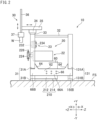
- FIG. 1 is a front elevation view showing an example of the machine tool system 10 according to the first embodiment.
- Fig. 2 is a right-side view of the machine tool system 10 shown in Fig. 1 .
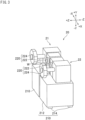
- Fig. 3 is a perspective view showing an example of a machine tool 20 that constitutes the machine tool system 10. It should be noted that illustration of tools 226 described later is omitted in Fig. 3 .
- the machine tool 20 includes a first processing apparatus 21, a second processing apparatus 22, and a reversing apparatus 23.
- the machine tool 20 processes the workpiece W transported by the loader 30.
- the first processing or machining apparatus 21 has a bed 210 and a processor or machining section 220.
- the bed 210 has a main body 212 and a plurality of leveling bolts (supporters) 214.
- the main body 212 is, for example, of a rectangular parallelepiped shape, and is supported by the plurality of leveling bolts 214 and mounted on the floor surface FS.
- the leveling bolts 214 are attached in the vicinity of four corners on the lower face side of the main body 212, and each thereof comes in contact with the floor surface FS. That is to say, the bed 210 is mounted on the floor surface FS.
- the bed 210 has the processor 220 mounted on an upper face side thereof.
- the processor 220 has a main spindle 222, a turret 224 and a plurality of tools 226.
- the main spindle 222 is supported rotatably around an axis parallel to the Z direction (front-rear direction) and is rotated by a rotation driver not shown in the drawings.
- the main spindle 222 includes a chuck not shown in the drawings capable of gripping the workpiece W at a distal end thereof on the +Z side.
- the chuck has a plurality of gripping claws capable of gripping an end of the workpiece W.
- the main spindle 222 rotates the workpiece W gripped by the chuck around an axis parallel to the Z direction.
- the turret 224 is arranged on the -X side of the main spindle 222.
- the turret 224 is supported rotatably around an axis parallel to the Z direction and is rotated by a rotation driver not shown in the drawings.
- the plurality of tools 226 are, for example, cutting tool bits, end mills, or the like, and are attached respectively to the tool holders of the turret 224 in a detachable manner.
- the plurality of tools 226 may be tools of the same type or tools of different types.
- the first processing apparatus 21 rotates the turret 224 to select a tool 226 for use from the plurality of tools 226 and moves the turret 224 in the X direction (and the Z direction) while axially rotating the workpiece W together with the main spindle 222, to thereby process the workpiece W by means of the tool 226.
- the movement of the turret 224 in the X direction is controlled by the controller 70.
- the position to which the turret 224 is moved in the X direction (left-right direction) regulates the depth of cutting in the workpiece W.
- the second processing or machining apparatus 22 is arranged on the +X direction side with respect to the first processing apparatus 21 and has the same components as those of the first processing apparatus 21.
- the second processing apparatus 22 performs the second processing or machining on the workpiece W that has undergone the first processing performed by the first processing apparatus 21, for example.
- the second processing apparatus 22 differs from the first processing apparatus 21 in that the arrangement of the main spindle 222 and the turret 224 is reversed in the X direction.
- the first processing apparatus 21 and the second processing apparatus 22 each have an individual bed 210, however, the invention is not limited to this form.
- the first processing apparatus 21 and the second processing apparatus 22 may be configured to share one bed 210.
- the processing performed on the workpiece W by the second processing apparatus 22 may differ from the processing performed on the workpiece W by the first processing apparatus 21. Therefore, the tool 226 used by the processor 220 of the second processing apparatus 22 may be different from the tool 226 used by the processor 220 of the first processing apparatus 21.
- the reversing apparatus 23 is arranged on the +Y side (above) of the first processing apparatus 21 and the second processing apparatus 22.
- the reversing apparatus 23 is supported on the bed 210, for example, by a frame or the like not shown in the drawings.
- the reversing apparatus 23 reverses the workpiece W that has undergone the first processing performed by the first processing apparatus 21 in the Z direction before transporting the workpiece W to the second processing apparatus 22.
- the reversing apparatus 23 has chucks 231, 232 and a reverser 234.
- the chucks 231, 232 are arranged in a line along the X direction.
- the chucks 231, 232 each have gripping claws not shown in the drawings and can grip the workpiece W.
- the chuck 232 is provided on the reverser 234.
- the reverser 234 moves the chuck 232 so as to face the chuck 231. After having gripped an end of the workpiece W by means of the chuck 231, the reversing apparatus 23 causes the reverser 234 to move the chuck 232 and causes the chuck 232 to grip the opposite end of the workpiece W.
- the reverser 234 returns the chuck 232 to the original position thereof to thereby reverse the workpiece W in the Z direction.
- Such operations of the reversing apparatus 23 are controlled by the controller 70. It should be noted that the reversing apparatus 23 may be of any configuration. In a case where the workpiece W need not be reversed, the machine tool 20 need not include the reversing apparatus 23.
- the configuration including the first processing apparatus 21 and the second processing apparatus 22 has been described as an example of the machine tool 20, however, the invention is not limited to this configuration.
- the machine tool may include only either one of the first processing apparatus 21 and the second processing apparatus 22.
- the machine tool 20 may include another processing apparatus in addition to the first processing apparatus 21 and the second processing apparatus 22, for example.
- the form in which the tools 226 are attached to the turret 224 has been described as an example, however, the invention is not limited to this form.
- the tools 226 may be held by a comb-shaped tool post instead of the turret 224. In such a case also, by moving in the X direction (left-right direction), the comb-shaped tool post regulates the depth of cutting in the workpiece W performed by the tool 226.
- the loader 30 has two, left and right, legs 31, a beam 32 (see Fig. 2 ), an X-guide 33, an X-slider 34, a Z-slider 35, an elevation rod 36, a loader head 37, and two, left and right, second legs (see Fig. 2 ).
- the loader 30 is a portal-type loader or a gantry loader. The loader 30 transports the workpiece W between the workpiece feeder 40, the first processing apparatus 21, the second processing apparatus 22, and the workpiece collector 50.
- the loader 30 transports the workpiece W from the workpiece feeder 40 to feed it to the first processing apparatus 21; transports the workpiece W processed by the first processing apparatus 21 to the reversing apparatus 23; feeds the workpiece W reversed by the reversing apparatus 23 to the second processing apparatus 23 from the reversing apparatus 23; and transports the workpiece W processed by the second processing apparatus 22 to the workpiece collector 50 from the second processing apparatus 22.
- the two, left and right, legs 31 are arranged on both the left and right sides respectively of the machine tool 20 on the +Z side (front side) of the machine tool 20. These legs 31 are arranged apart from the bed 210 of the machine tool 20.
- Each leg 31 has a leg main body 31A and a leveling bolt 31B.
- the leveling bolt 31B is attached to a lower end of the leg main body 31A and is in contact with the floor surface FS.
- the two, left and right, second legs 131 are arranged on both the left and right sides respectively of the machine tool 20 on the -Z side (rear side) of the machine tool 20. Each of the two second legs 131 is arranged on the rear side (-Z side) of the leg 31.
- Each second leg 131 is arranged apart from the bed 210 of the machine tool 20.
- Each second leg 131 has a leg main body 131A and a leveling bolt 131B.
- the leveling bolt 131B is attached to a lower end of the leg main body 131A and is in contact with the floor surface FS. That is to say, in the present embodiment, the two legs 31 and the two second legs 131 are both in contact with the floor surface FS.
- Fig. 4 is a perspective view of a lower right portion of the machine tool system 10.
- Fig. 5 is a plan view showing an example of an arrangement of the bed 210, the leg 31, and the connecting plate 60. As shown in Fig. 4 and Fig. 5 , the leg 31 is arranged near the leveling bolt 214 of the bed 210. A clearance D is formed between the leg 31 and the bed 210 in the X direction (left-right direction).
- the -X side portion is also configured in a similar manner in which the leg 31 is arranged near the leveling bolt 214 of the bed 210, and a clearance D is formed between the leg 31 and the bed 210 in the X direction (left-right direction).
- the two second legs 131 are arranged at the rear (in the -Z direction) of the respective legs 31 and apart from the bed 210 in the -Z direction.
- the beam 32 extends in the Z direction and connects an upper portion of the leg 31 and an upper portion of the second leg 131 to increase the rigidity of the loader 30.
- the X guide 33 extends in the X direction and is fixed to upper ends of the two, left and right, legs 31 (leg main body 31A).
- the X-slider 34 is moved in the X direction (left-right direction) along the X-guide 33 by the driver not shown in the drawings.
- the Z-slider 35 is moved by a driver not shown in the drawings in the Z direction (front-rear direction) along a Z-guide that is included in the X-slider 34 and not shown in the drawings.
- the elevation rod 36 is moved by a driver not shown in the drawings in the Y direction (up-down direction) along an elevation guide that is included in the Z-slider 35 and not shown in the drawings.
- the loader head 37 is provided at a lower end of the elevation rod 36.
- the loader head 37 includes a chuck (gripping claws) not shown in the drawings and is capable of gripping an end of the workpiece W.
- the loader head 37 can switch the orientation of the gripped workpiece W between downward-facing (-Y direction) and side-facing (-Z direction) by means of a swivel joint or the like, for example.
- the workpiece feeder 40 is arranged on the -X side of the machine tool 20. One or more workpieces W that have not been processed by the machine tool 20 are placed on the workpiece feeder 40.
- the workpiece collector 50 is arranged on the +X side of the machine tool 20. One or more workpieces W that have been processed by the machine tool 20 are placed on the workpiece feeder 50.
- the connecting plate 60 connects a lower part of the leg 31 to the bed 210.
- the connecting plate 60 also connects a lower part of the second leg 131 to the bed 210. That is to say, one connecting plate 60 connects the leg 31, the second leg 31, and the bed 210.
- two of the connecting plates 60 are used. Of the two connecting plates 60, one connecting plate 60 is used on the -X side of the first processing apparatus 21 to connect the leg 31, the second leg 131, and the bed 210 of the first processing apparatus 21.
- the other one of the connecting plates 60 is used on the +X side of the second processing apparatus 210 to connect the leg 31, the second leg 131, and the bed 210 of the second processing apparatus 22.
- the two connecting plates 60 are identical or substantially identical, however, may be of different shapes.
- the connecting plate 60 is arranged upright such that a plate surface 62A is aligned with the Z direction (front-rear direction). That is to say, the connecting plate 60 is arranged in a manner such that the plate surface 62A orthogonal to the plate thickness direction (left-right direction, X direction) thereof includes the Y direction (up-down direction) and the Z direction (front-rear direction).
- the connecting plate 60 has a symmetrical shape as viewed in the X direction and has a main body 62 and two projections 64.
- the main body 62 is of a rectangular shape as viewed from the plate thickness direction thereof.
- the projections 64 are provided to increase the strength of connection between the leg 31 and the second leg 131.
- Each of the two projections 64 is of a triangular shape as viewed from the plate thickness direction thereof.
- the two projections 64 project upward from an upper end face of the main body 62 at both ends in the longitudinal direction of the main body 62 (in the front-rear direction or the Z direction), with their inclined faces opposed to each other, and are provided so as to be shifted toward the center from both ends of the main body 62 in the longitudinal direction.
- the plate thickness and the vertical dimension of the connecting plate 60 can be set arbitrarily.
- the connecting plate 60 is connected to a side face of the bed 210 by a plurality of screws 66 arranged in the Z direction and the Y direction, forming a connection portion 66A.
- the connecting plate 60 is connected to the leg main body 31A of the leg 31 by screws or the like not shown in the drawings to form a connection portion 66B.
- the connecting plate 60 is connected to the leg main body 131A of the second leg 131 by screws or the like not shown in the drawings to form a connection portion 166B.
- the connection portion 66A deviates from the lengthwise center thereof toward the +Z side.
- the distance between the connection portion 66A and the connection portion 66B is shorter than the distance between the connection portion 66A and the connection portion 166B.
- the supporting rigidity of the leg 31 in the X direction (left-right direction) and in the Y direction (up-down direction) is higher than the supporting rigidity of the second leg 131 in the X direction and in the Y direction. Since the leg 31 includes the X-guide 33 at an upper end thereof, it receives much of the load of the loader 30 and is likely to vibrate. Since the supporting rigidity of the legs 31 is high as mentioned above, the loader 30 can be operated stably. It should be noted that the two projections 64 are both arranged between the leg 31 and the second leg 131 as shown in Fig. 4 .
- the connecting plate 60 is a plate composed of metal and is elastically deformable in a direction orthogonal to the plate surface 62A (plate thickness direction). As described above, the connecting plate 60 is arranged upright such that the plate surface 62A is aligned with the Z direction (front-rear direction). Therefore, the connecting plate 60 has a rigidity higher in the Y direction (up-down direction) and in the Z direction (front-rear direction) than in the X direction (left-right direction). That is to say, the connecting plate 60 has a rigidity capable of receiving the load of the loader 30 in the Y direction (up-down direction) while being allowed to flex (deform elastically) in the X direction (left-right direction). As a result, while receiving the load of the loader 30, if the leg 31 vibrates (oscillates) in the X direction, the connecting plate 60 flexes to thereby suppress transmission of the vibrations in the X direction to the bed 210.
- the controller 70 controls each component of the machine tool 20 and each component of the loader 30. The control of the operation of each component performed by the controller 70 will be described later.
- Fig. 6 to Fig. 9 are diagrams for describing operations of the processing performed on the workpiece W by the machine tool system 10 of the present embodiment and are front elevation views of the machine tool system 10 showing from the start of the processing to the end of the processing. These figures are numbered in chronological order of the processing operations.
- the controller 70 When a worker inputs processing conditions and so forth for the workpiece W into an operation panel (interface) not shown in the drawings, the controller 70 performs control of the machine tool system 10 in accordance with the input information.
- the loader head 37 of the loader 30 descends from above the workpiece feeder 40, grips the workpiece W, and then lifts it (see Fig. 6 ).
- the leg 31 and the second leg 131 vibrate in the up-down direction (Y direction).
- the X-slider 34 moves in the +X direction along the X-guide 33 and stops above the main spindle 222 of the first processing apparatus 21 (see Fig. 7 ).
- the leg 31 and the second leg 131 vibrate in the left-right direction (X direction).
- the loader head 37 descends to a position opposed to the main spindle 222 (overlapping position in the Z direction) as the elevation rod 36 descends, and after changing the orientation of the workpiece W from downward direction to -Z side-facing, the Z-slider 35 moves in the - Z direction to thereby transfer the workpiece W to the main spindle 222 (see Fig. 8 ).
- the first processing apparatus 21 axially rotates the workpiece W held by the main spindle 222 and performs processing on the workpiece W while moving the tool 226 attached to the turret 224 in the +X direction.
- the workpiece W held by the main spindle 222 is transferred to the loader head 37.
- the workpiece W on the loader head 37 is transferred to the chuck 231 of the reversing apparatus 23 by moving the X-slider 34, the Z-slider 35, and the elevation rod 36 (omitted in the drawings).
- the reversing apparatus 23 reverses the workpiece W by transferring the workpiece W from the chuck 231 to the chuck 232.
- the workpiece W is transferred to the main spindle 222 of the second processing apparatus 22 by moving the X-slider 34, the Z-slider 35, and the elevation rod 36 (omitted in the drawings).
- the second processing apparatus 22 axially rotates the workpiece W held by the main spindle 222 and performs processing on the workpiece W while moving the tool 226 attached to the turret 224 in the -X direction.
- the workpiece W held by the main spindle 222 is transferred to the loader head 37.
- the movement of the X-slider 34 causes the leg 31 and the second leg 131 to vibrate in the left-right direction (X direction)
- the ascent and descent of the elevation rod 36 causes the leg 31 and the second leg 131 to vibrate in the up-down direction (Y direction)
- the movement of the Z-slider 35 causes the leg 31 and the second leg 131 to vibrate in the front-rear direction (Z direction).
- the X-slider 34 moves in the +X direction along the X-guide 33 and stops above the workpiece collector 50.
- the movement of the X-slider 34 performed in this manner causes the leg 31 and the second leg 131 to vibrate in the left-right direction (X direction).
- the loader head 37 gripping the workpiece W, which has already undergone the processing descends as the elevation rod 36 descends, and places the workpiece W on the workpiece collector 50 (see Fig. 9 ).
- the ascent and descent of the elevation rod 36 performed in this manner causes the leg 31 and the second leg 131 to vibrate in the up-down direction (Y direction).
- a plurality of workpieces W are processed, and as such processing is performed on the workpieces W, the leg 31 and the second leg 131 vibrate in the left-right direction (X direction), the up-down direction (Y direction), and the front-rear direction (Z direction).
- the loader 30 continues to operate even during the processing being performed on the workpiece W by the first processing apparatus 21 and the second processing apparatus 22.
- the bed 210 of the machine tool 20 and the leg 31 and the second leg 131 of the loader 30 are connected to each other by the connecting plate 60.
- the connecting plate 60 is an elastic deformable plate, and the connection portion 66A that connects with the bed 210 and the connection portion 66B that connects with the leg 31 are displaced or offset in the Z direction (front-rear direction).
- the connection portion 66A that connects with the bed 210 and the connection portion 166B that connects with the second leg 131 are also displaced in the Z direction (front-rear direction).
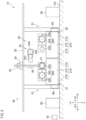
- Fig. 10 is a schematic diagram showing routes over which vibrations generated by the loader 30 are transmitted to the floor surface FS in the machine tool system 10 according to the present embodiment.
- the black arrows denote the propagation direction of vibrations of the legs 31 generated by the loader 30, and the white arrows denote the propagation direction of vibrations generated by the main spindles 222 of the first processing apparatus 21 and the second processing apparatus 22.
- the leg 31 and the bed 210 are connected by the connecting plate 60. Therefore, the relative positions of the machine tool 20 and the loader 30 to each other are unlikely to displace, and thus the workpiece W can be transferred smoothly between the machine tool 20 and the loader 30.
- Some of the vibrations generated by the operation of the loader 30 are transmitted to the bed 210 of the machine tool 20 and transmitted from the leveling bolts 214 of the bed 210 to the floor surface FS. Since the connecting plate 60 has a high rigidity in the up-down direction and the front-rear direction, vibrations of the legs 31 in the up-down direction and the front-rear direction are transmitted from the connecting plate 60 to the floor surface FS through the leveling bolts 214 of the bed 210. The vibrations generated by the main spindle 222 and the tool 226 (turret 224) of the machine tool 20 are transmitted to the floor surface FS through the leveling bolts 214 of the bed 210.
- the connecting plate 60 is elastically deformable in the X direction, and furthermore, the connection portion 66A that connects with the bed 210 and the connection portion 66B that connects with the leg 31 are displaced in the Z direction (front-rear direction). Therefore, even when the leg 31 vibrates in the X direction, the elastic deformation of the connecting plate 60 absorbs some of the vibrations and reduces transmission of the vibrations in the X direction to the bed 210.
- the X direction (left-right direction) is a direction in which the depth of cutting in the workpiece W performed by the tool 226 is regulated in the first processing apparatus 21 and the second processing apparatus 22.
- the vibrations of the loader 30 (legs 31) in the X direction are unlikely to be transmitted to the bed 210, variations in the depth of cutting in the workpiece W are small, and a reduction in the accuracy of the processing performed on the workpiece W can be suppressed.
- the elastic deformation of the connecting plate 60 absorbs some of the vibrations and reduces transmission of the vibrations in the X direction to the bed 210. That is to say, in the present embodiment, it is possible to suppress displacement of the relative positions of the machine tool 20 and the loader 30 while suppressing a reduction in the accuracy of the processing performed on the workpiece W.
- the two legs 31 are in contact with the floor surface FS by means of the leveling bolts 31B.
- the two second legs 131 are also in contact with the floor surface FS by means of the leveling bolts 131B.
- some of the vibrations generated by the loader 30 can be transmitted directly to the floor surface FS. Therefore, vibrations to be absorbed by the connecting plate 60 can be reduced. That is to say, by releasing some of the vibrations generated by loader 30 from the legs 31, it is possible to adjust the magnitude of the vibrations transmitted to bed 210.
- the connecting plate 60 has a rigidity more capable of receiving the load of the loader 30 in the Y direction (up-down direction) and in the Z direction (front-rear direction) than in the X direction (left-right direction). Accordingly, when the connecting plate 60 receives the vibrations of the loader 30, even if it deforms elastically in the X direction, it is unlikely to or does not deform in the Y direction and the Z direction. Therefore, in the machine tool system 10 of the present embodiment, transmission of vibrations of the legs 31 (second legs 131) in the X direction to the bed 210 is suppressed, and vibrations of the legs 31 in the Y direction and the Z direction are transmitted to the bed 210 so as to be dampened together with the bed 210.
- vibrations in the Y direction and the Z direction have limited influence on the accuracy of the processing performed on the workpiece W. Therefore, it is possible by suppressing vibrations in the X direction to suppress a reduction in the accuracy of the processing performed on the workpiece W.
- the legs 31 and the second legs 131 are in contact with the floor surface FS by means of the leveling bolts 31B, 131B. That is to say, a majority of the load of the loader 30 can be released from the legs 31 and the second legs 131 to the floor surface FS through the leveling bolts 31B, 131B.
- the burden on the connecting plate 60 in the up-down direction (Y direction) is reduced, and the rigidity of the connecting plate 60 in the up-down direction can be reduced, which reduces the sourcing cost of the connecting plate 60 and prevents deterioration of the connecting plate 60.
- one connecting plate 60 is connected to the leg 31 and the second leg 131. That is to say, one connecting plate 60 is used for both connecting with the leg 31 and connecting with the second leg 131. Therefore, the number of connecting plates 60 used can be reduced compared to the case where the leg 31 and the second leg 131 are connected by separate connecting plates 60, and as a result, the manufacturing cost of the machine tool system 10 can be reduced.
- the configuration is not limited to using one connecting plate 60 to connect the leg 31 and the second leg 131 to the bed 210.
- the leg 31 and the second leg 131 may each be connected to the bed 210 by a separate connecting plate 60.
- FIG. 11 is a perspective view of a lower right portion of the machine tool system 10A according to the second embodiment.
- configurations similar to those of the machine tool system 10 of the first embodiment are assigned with the same reference signs and descriptions thereof are omitted or simplified.
- portions that differ from those of the machine tool system 10 according to the first embodiment will be described.
- the machine tool system 10A differs from the machine tool system 10 of the first embodiment (see Fig.
- the leg 31 is composed of the leg main body 31A only
- the second leg 131 is composed of the leg main body 131A only
- the leg 31 and the second leg 131 do not have the leveling bolts 31B, 131B.
- the leg 31 (leg main body 31A) is arranged directly above or in the vicinity of a position directly above the leveling bolt 214 of the bed 210 and is apart from the bed 210.
- the term "vicinity" means, for example, a position shifted from a position directly above the leveling bolt 214, and as shown in Fig. 5 , the leg main body 31A and the leveling bolt 214 of the bed 210 are adjacent to each other in the X direction while having a clearance D therebetween in the Y direction.
- the leg main body 31A is arranged in the vicinity of a position directly above the leveling bolt 214, however, the invention is not limited to this form.
- the leg 31 (leg main body 31A) may be arranged directly above the leveling bolt 214.
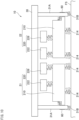
- Fig. 12 is a schematic diagram showing routes over which vibrations generated by the loader 30 are transmitted to the floor surface FS in the machine tool system 10A according to the present embodiment.
- the black arrows denote the propagation direction of vibrations generated by the loader 30, and the white arrows denote the propagation direction of vibrations generated by the main spindles 222 of the first processing apparatus 21 and the second processing apparatus 22.
- Fig. 12 is a schematic diagram showing routes over which vibrations generated by the loader 30 are transmitted to the floor surface FS in the machine tool system 10A according to the present embodiment.
- the black arrows denote the propagation direction of vibrations generated by the loader 30, and the white arrows denote the propagation direction of vibrations generated by the main spindles 222 of the first processing apparatus 21 and the second processing apparatus 22.
- the positions of the machine tool 20 and the loader 30 are unlikely to displace relatively to each other, and the connecting plate 60 reduces transmission of vibrations of the loader 30 (legs 31) in the X direction to the bed 210, which suppresses a reduction in the accuracy of the processing performed on the workpiece W.
- the load of the loader 30 and the vibrations of the leg 31 in the up-down direction and the front-rear direction are transmitted from the connecting plate 60 to the floor surface FS through the leveling bolts 214 of the bed 210. That is to say, in the present embodiment, as with the first embodiment described above, it is possible to suppress displacement of the relative positions of the machine tool 20 and the loader 30 while suppressing a reduction in the accuracy of the processing performed on the workpiece W.
- the distance between the connection portion 66A that connects with the bed 210 and the connection portion 66B that connects with the leg 31 is shorter than the distance between the connection portion 66A and the connection portion 166B that connects with the second leg 131.
- the invention is not limited to this form.
- the distance between the connection portion 66A and the connection portion 66B may be the same as the distance between the connection portion 66A and the connection portion 166B, and for example, the distance between the connection portion 66A and the connection portion 66B may be longer than the distance between the connection portion 66A and the connection portion 166B.
Landscapes
- Engineering & Computer Science (AREA)
- Mechanical Engineering (AREA)
- Machine Tool Units (AREA)
- Auxiliary Devices For Machine Tools (AREA)
- Feeding Of Workpieces (AREA)
- Multi-Process Working Machines And Systems (AREA)
- Turning (AREA)
Claims (8)
- Ein Werkzeugmaschinensystem (10, 10A), das folgende Merkmale aufweist:eine Werkzeugmaschine (20) mit einem Prozessor (21, 22) zum Bearbeiten eines Werkstücks (W) mit einem Werkzeug (226) und einem Bett (210), auf dem der Prozessor (21, 22) montiert ist;eine Transportvorrichtung (30) mit zwei, einem linken und einem rechten, Beinen (31), die getrennt von dem Bett (210) angeordnet sind, wobei die Transportvorrichtung (30) dazu konfiguriert ist, das Werkstück (W) zu transportieren und dem Prozessor (21, 22) das Werkstück (W) zuzuführen oder das Werkstück (W) von dem Prozessor (21, 22) abzuführen; dadurch gekennzeichnet, dass dasselbe Folgendes aufweist:eine Platte (60), die das Bett (210) mit einem Bein (31) verbindet und die elastisch verformbar ist,wobei die Platte (60) aufrecht angeordnet ist, so dass eine Plattenoberfläche (62) mit einer Vorne-Hinten-Richtung ausgerichtet ist, undwobei ein Verbindungsabschnitt (66A) der Platte (60), der mit dem Bett (210) verbunden ist, und ein Verbindungsabschnitt (66B) der Platte (60), der mit dem Bein (31) verbunden ist, in einer Vorne-Hinten-Richtung versetzt sind.
- Das Werkzeugmaschinensystem (10, 10A) gemäß Anspruch 1,wobei der Prozessor (21, 22) eine Hauptspindel (222) aufweist, die dazu konfiguriert ist, ein Werkstück (W) zu halten und zu drehen, undwobei das Werkzeug (226) dazu konfiguriert ist, sich in einer Links-Rechts-Richtung zu bewegen, um dadurch eine Schnitttiefe in dem Werkstück (W), das gedreht wird, zu regulieren.
- Das Werkzeugmaschinensystem (10) gemäß Anspruch 1 oder 2,
wobei die Beine (31) in Kontakt mit einer Montageoberfläche (FS) angeordnet sind, auf der das Bett (210) montiert ist. - Das Werkzeugmaschinensystem (10A) gemäß Anspruch 1 oder 2,
wobei die Beine (31) in einer Oben-Unten-Richtung von einer Montageoberfläche (FS), auf der das Bett (210) montiert ist, getrennt angeordnet sind. - Das Werkzeugmaschinensystem (10A) gemäß Anspruch 4,
wobei die Platte (60) eine Steifigkeit aufweist, die in der Lage ist, eine Last der Transportvorrichtung (30) in einer vertikalen Richtung aufzunehmen. - Das Werkzeugmaschinensystem (10A) gemäß Anspruch 4 oder 5,wobei das Bett (210) einen Träger (214) in Kontakt mit der Montageoberfläche (FS) aufweist, unddas Bein (31) direkt über oder in der Nähe einer Position direkt über dem Träger (214) angeordnet ist und von dem Bett (210) getrennt ist.
- Das Werkzeugmaschinensystem (10, 10A) gemäß einem der Ansprüche 1 bis 6,wobei zwei zweite Beine (131) jeweils an der Rückseite von jedem der zwei, einem linken und einem rechten, Beine (31) angeordnet sind, undwobei die Platte (60) ein Bein (31) und ein zweites Bein (131), die in der Vorne-Hinten-Richtung angeordnet sind, mit dem Bett (210) verbindet.
- Das Werkzeugmaschinensystem (10, 10A) gemäß Anspruch 7,
wobei ein Verbindungsabschnitt (66A) der Platte (60), der mit dem Bett (210) verbunden ist, zwischen einem Verbindungsabschnitt (66B), der mit einem Bein (31) verbunden ist, und einem Verbindungsabschnitt (166B), der mit einem zweiten Bein (131) verbunden ist, vorgesehen ist.
Applications Claiming Priority (2)
| Application Number | Priority Date | Filing Date | Title |
|---|---|---|---|
| JP2020086628 | 2020-05-18 | ||
| PCT/JP2021/015429 WO2021235142A1 (ja) | 2020-05-18 | 2021-04-14 | 工作機械システム |
Publications (3)
| Publication Number | Publication Date |
|---|---|
| EP4155022A1 EP4155022A1 (de) | 2023-03-29 |
| EP4155022A4 EP4155022A4 (de) | 2024-05-22 |
| EP4155022B1 true EP4155022B1 (de) | 2025-03-12 |
Family
ID=78707773
Family Applications (1)
| Application Number | Title | Priority Date | Filing Date |
|---|---|---|---|
| EP21808744.3A Active EP4155022B1 (de) | 2020-05-18 | 2021-04-14 | Werkzeugmaschinensystem |
Country Status (6)
| Country | Link |
|---|---|
| US (1) | US12311490B2 (de) |
| EP (1) | EP4155022B1 (de) |
| JP (1) | JP7371774B2 (de) |
| KR (1) | KR102743825B1 (de) |
| CN (1) | CN115605317B (de) |
| WO (1) | WO2021235142A1 (de) |
Families Citing this family (2)
| Publication number | Priority date | Publication date | Assignee | Title |
|---|---|---|---|---|
| WO2023112136A1 (ja) * | 2021-12-14 | 2023-06-22 | 株式会社Fuji | 工作機械 |
| JP2023161243A (ja) * | 2022-04-25 | 2023-11-07 | 株式会社Fuji | 工作機械 |
Family Cites Families (16)
| Publication number | Priority date | Publication date | Assignee | Title |
|---|---|---|---|---|
| JPH071213Y2 (ja) * | 1988-02-17 | 1995-01-18 | 本田技研工業株式会社 | 工作機械のチャック装置 |
| US5920973A (en) * | 1997-03-09 | 1999-07-13 | Electro Scientific Industries, Inc. | Hole forming system with multiple spindles per station |
| JP4400011B2 (ja) | 2001-07-27 | 2010-01-20 | 村田機械株式会社 | 工作機械 |
| KR100450427B1 (ko) * | 2001-12-31 | 2004-09-30 | 대우종합기계 주식회사 | 절삭가공용 공작기계 |
| CN201002184Y (zh) | 2006-12-08 | 2008-01-09 | 天水星火机床有限责任公司 | 一种机床支持件 |
| JP5161468B2 (ja) * | 2007-03-13 | 2013-03-13 | ホーコス株式会社 | 工作機械 |
| EP2412474B1 (de) * | 2009-03-27 | 2013-05-08 | Murata Machinery, Ltd. | Zweiachsige werkzeugmaschine |
| JP5295855B2 (ja) * | 2009-04-28 | 2013-09-18 | 住友重機械工業株式会社 | 反力処理機構 |
| JP2011245563A (ja) * | 2010-05-24 | 2011-12-08 | Murata Machinery Ltd | 工作機械 |
| EP2689889B1 (de) * | 2011-03-24 | 2015-07-22 | Murata Machinery, Ltd. | Maschinenwerkzeugsystem |
| EP2796239A4 (de) * | 2011-12-22 | 2015-07-29 | Murata Machinery Ltd | Bearbeitungseinrichtung |
| CN203031276U (zh) * | 2013-01-25 | 2013-07-03 | 泉州市科荣机械制造有限公司 | 一种cnc 铣床的增强结构 |
| JP2016043453A (ja) * | 2014-08-25 | 2016-04-04 | 株式会社ディスコ | 加工装置 |
| ES2727783T3 (es) * | 2017-05-03 | 2019-10-18 | Schwaebische Werkzeugmaschinen Gmbh | Máquina-herramienta con celda de carga por robot modular |
| JP7200641B2 (ja) | 2018-12-07 | 2023-01-10 | 日本電信電話株式会社 | 通信制御方法、通信制御装置および通信制御プログラム |
| CN110640482B (zh) * | 2019-10-15 | 2021-06-08 | 台州市东部数控设备有限公司 | 一种机床 |
-
2021
- 2021-04-14 US US17/925,040 patent/US12311490B2/en active Active
- 2021-04-14 JP JP2022524331A patent/JP7371774B2/ja active Active
- 2021-04-14 CN CN202180034775.9A patent/CN115605317B/zh active Active
- 2021-04-14 WO PCT/JP2021/015429 patent/WO2021235142A1/ja not_active Ceased
- 2021-04-14 KR KR1020227040126A patent/KR102743825B1/ko active Active
- 2021-04-14 EP EP21808744.3A patent/EP4155022B1/de active Active
Also Published As
| Publication number | Publication date |
|---|---|
| JPWO2021235142A1 (de) | 2021-11-25 |
| EP4155022A4 (de) | 2024-05-22 |
| US12311490B2 (en) | 2025-05-27 |
| KR102743825B1 (ko) | 2024-12-18 |
| CN115605317A (zh) | 2023-01-13 |
| US20230182251A1 (en) | 2023-06-15 |
| WO2021235142A1 (ja) | 2021-11-25 |
| EP4155022A1 (de) | 2023-03-29 |
| CN115605317B (zh) | 2025-09-23 |
| JP7371774B2 (ja) | 2023-10-31 |
| KR20230002804A (ko) | 2023-01-05 |
Similar Documents
| Publication | Publication Date | Title |
|---|---|---|
| KR101537135B1 (ko) | 워크 가공 장치 및 워크 가공 방법 | |
| EP4155022B1 (de) | Werkzeugmaschinensystem | |
| JP6332466B2 (ja) | 工作機械システム及びワーク搬送方法 | |
| JPH0329536B2 (de) | ||
| US9469005B2 (en) | Workpiece conveyor and machine tool | |
| JP5279013B2 (ja) | 長尺ワーク加工用旋盤 | |
| US20080000072A1 (en) | Flexible Transfer Machine | |
| JPH06238457A (ja) | 溶接装置 | |
| JP4674497B2 (ja) | 加工ラインシステム | |
| JPH1076492A (ja) | 部品挿入装置および部品挿入方法 | |
| US20100089208A1 (en) | Manipulating device for lathes, in particular for vertical turret lathes, and a lathe including said device | |
| EP2117768B1 (de) | Betätigungsvorrichtung für drehmaschine, insbesondere für vertikalrevolverdrehmaschinen und drehmaschine mit dieser vorrichtung | |
| JP7568102B2 (ja) | 対向二軸型旋盤 | |
| JP2016175154A (ja) | ローダ装置及びローダ装置の製造方法 | |
| JP3335386B2 (ja) | パレット供給装置 | |
| KR20050084277A (ko) | 공작 기계에 있어서의 워크 가공 방법 및, 그 방법을실시하기 위한 가공용 지그 및 워크 가공용 지지장치 | |
| JP3924278B2 (ja) | トランスファ装置及びそのワーク保持装置 | |
| JP5355262B2 (ja) | ワーク搬送装置及びその方法 | |
| WO2021070460A1 (ja) | ワーク搬送システム、工作機械システム、及びワーク搬送方法 | |
| JP2000343372A (ja) | 主軸移動型工作機械およびそれを配置した加工システム | |
| JP7160640B2 (ja) | 研削装置 | |
| JP2023041249A (ja) | 加工システム | |
| JPS629485B2 (de) | ||
| JPH11114782A (ja) | トランスファライン | |
| JPH0985364A (ja) | 板材加工機 |
Legal Events
| Date | Code | Title | Description |
|---|---|---|---|
| STAA | Information on the status of an ep patent application or granted ep patent |
Free format text: STATUS: THE INTERNATIONAL PUBLICATION HAS BEEN MADE |
|
| PUAI | Public reference made under article 153(3) epc to a published international application that has entered the european phase |
Free format text: ORIGINAL CODE: 0009012 |
|
| STAA | Information on the status of an ep patent application or granted ep patent |
Free format text: STATUS: REQUEST FOR EXAMINATION WAS MADE |
|
| 17P | Request for examination filed |
Effective date: 20221114 |
|
| AK | Designated contracting states |
Kind code of ref document: A1 Designated state(s): AL AT BE BG CH CY CZ DE DK EE ES FI FR GB GR HR HU IE IS IT LI LT LU LV MC MK MT NL NO PL PT RO RS SE SI SK SM TR |
|
| DAV | Request for validation of the european patent (deleted) | ||
| DAX | Request for extension of the european patent (deleted) | ||
| RAP3 | Party data changed (applicant data changed or rights of an application transferred) |
Owner name: MURATA MACHINERY, LTD. |
|
| A4 | Supplementary search report drawn up and despatched |
Effective date: 20240423 |
|
| RIC1 | Information provided on ipc code assigned before grant |
Ipc: B23Q 41/02 20060101ALI20240417BHEP Ipc: B23Q 11/00 20060101ALI20240417BHEP Ipc: B23Q 7/14 20060101ALI20240417BHEP Ipc: B23Q 1/01 20060101ALI20240417BHEP Ipc: B23B 17/00 20060101ALI20240417BHEP Ipc: B23B 15/00 20060101ALI20240417BHEP Ipc: B23Q 1/00 20060101AFI20240417BHEP |
|
| REG | Reference to a national code |
Ref country code: DE Ref legal event code: R079 Free format text: PREVIOUS MAIN CLASS: B23Q0001000000 Ipc: B23Q0007040000 Ref document number: 602021027593 Country of ref document: DE |
|
| GRAP | Despatch of communication of intention to grant a patent |
Free format text: ORIGINAL CODE: EPIDOSNIGR1 |
|
| STAA | Information on the status of an ep patent application or granted ep patent |
Free format text: STATUS: GRANT OF PATENT IS INTENDED |
|
| RIC1 | Information provided on ipc code assigned before grant |
Ipc: B23Q 11/00 20060101ALI20240919BHEP Ipc: B23Q 1/01 20060101ALI20240919BHEP Ipc: B23Q 7/04 20060101AFI20240919BHEP |
|
| INTG | Intention to grant announced |
Effective date: 20241014 |
|
| GRAS | Grant fee paid |
Free format text: ORIGINAL CODE: EPIDOSNIGR3 |
|
| GRAA | (expected) grant |
Free format text: ORIGINAL CODE: 0009210 |
|
| STAA | Information on the status of an ep patent application or granted ep patent |
Free format text: STATUS: THE PATENT HAS BEEN GRANTED |
|
| AK | Designated contracting states |
Kind code of ref document: B1 Designated state(s): AL AT BE BG CH CY CZ DE DK EE ES FI FR GB GR HR HU IE IS IT LI LT LU LV MC MK MT NL NO PL PT RO RS SE SI SK SM TR |
|
| REG | Reference to a national code |
Ref country code: GB Ref legal event code: FG4D |
|
| REG | Reference to a national code |
Ref country code: CH Ref legal event code: EP |
|
| REG | Reference to a national code |
Ref country code: DE Ref legal event code: R096 Ref document number: 602021027593 Country of ref document: DE |
|
| REG | Reference to a national code |
Ref country code: IE Ref legal event code: FG4D |
|
| PG25 | Lapsed in a contracting state [announced via postgrant information from national office to epo] |
Ref country code: RS Free format text: LAPSE BECAUSE OF FAILURE TO SUBMIT A TRANSLATION OF THE DESCRIPTION OR TO PAY THE FEE WITHIN THE PRESCRIBED TIME-LIMIT Effective date: 20250612 |
|
| PG25 | Lapsed in a contracting state [announced via postgrant information from national office to epo] |
Ref country code: FI Free format text: LAPSE BECAUSE OF FAILURE TO SUBMIT A TRANSLATION OF THE DESCRIPTION OR TO PAY THE FEE WITHIN THE PRESCRIBED TIME-LIMIT Effective date: 20250312 |
|
| PGFP | Annual fee paid to national office [announced via postgrant information from national office to epo] |
Ref country code: DE Payment date: 20250319 Year of fee payment: 5 |
|
| PG25 | Lapsed in a contracting state [announced via postgrant information from national office to epo] |
Ref country code: ES Free format text: LAPSE BECAUSE OF FAILURE TO SUBMIT A TRANSLATION OF THE DESCRIPTION OR TO PAY THE FEE WITHIN THE PRESCRIBED TIME-LIMIT Effective date: 20250312 |
|
| REG | Reference to a national code |
Ref country code: LT Ref legal event code: MG9D |
|
| PG25 | Lapsed in a contracting state [announced via postgrant information from national office to epo] |
Ref country code: NO Free format text: LAPSE BECAUSE OF FAILURE TO SUBMIT A TRANSLATION OF THE DESCRIPTION OR TO PAY THE FEE WITHIN THE PRESCRIBED TIME-LIMIT Effective date: 20250612 |
|
| PGFP | Annual fee paid to national office [announced via postgrant information from national office to epo] |
Ref country code: IT Payment date: 20250530 Year of fee payment: 5 |
|
| PG25 | Lapsed in a contracting state [announced via postgrant information from national office to epo] |
Ref country code: HR Free format text: LAPSE BECAUSE OF FAILURE TO SUBMIT A TRANSLATION OF THE DESCRIPTION OR TO PAY THE FEE WITHIN THE PRESCRIBED TIME-LIMIT Effective date: 20250312 |
|
| REG | Reference to a national code |
Ref country code: NL Ref legal event code: MP Effective date: 20250312 |
|
| PG25 | Lapsed in a contracting state [announced via postgrant information from national office to epo] |
Ref country code: LV Free format text: LAPSE BECAUSE OF FAILURE TO SUBMIT A TRANSLATION OF THE DESCRIPTION OR TO PAY THE FEE WITHIN THE PRESCRIBED TIME-LIMIT Effective date: 20250312 |
|
| PG25 | Lapsed in a contracting state [announced via postgrant information from national office to epo] |
Ref country code: BG Free format text: LAPSE BECAUSE OF FAILURE TO SUBMIT A TRANSLATION OF THE DESCRIPTION OR TO PAY THE FEE WITHIN THE PRESCRIBED TIME-LIMIT Effective date: 20250312 Ref country code: GR Free format text: LAPSE BECAUSE OF FAILURE TO SUBMIT A TRANSLATION OF THE DESCRIPTION OR TO PAY THE FEE WITHIN THE PRESCRIBED TIME-LIMIT Effective date: 20250613 |
|
| REG | Reference to a national code |
Ref country code: AT Ref legal event code: MK05 Ref document number: 1774618 Country of ref document: AT Kind code of ref document: T Effective date: 20250312 |
|
| PG25 | Lapsed in a contracting state [announced via postgrant information from national office to epo] |
Ref country code: NL Free format text: LAPSE BECAUSE OF FAILURE TO SUBMIT A TRANSLATION OF THE DESCRIPTION OR TO PAY THE FEE WITHIN THE PRESCRIBED TIME-LIMIT Effective date: 20250312 |
|
| PG25 | Lapsed in a contracting state [announced via postgrant information from national office to epo] |
Ref country code: SE Free format text: LAPSE BECAUSE OF FAILURE TO SUBMIT A TRANSLATION OF THE DESCRIPTION OR TO PAY THE FEE WITHIN THE PRESCRIBED TIME-LIMIT Effective date: 20250312 |
|
| PG25 | Lapsed in a contracting state [announced via postgrant information from national office to epo] |
Ref country code: SM Free format text: LAPSE BECAUSE OF FAILURE TO SUBMIT A TRANSLATION OF THE DESCRIPTION OR TO PAY THE FEE WITHIN THE PRESCRIBED TIME-LIMIT Effective date: 20250312 |
|
| PG25 | Lapsed in a contracting state [announced via postgrant information from national office to epo] |
Ref country code: PT Free format text: LAPSE BECAUSE OF FAILURE TO SUBMIT A TRANSLATION OF THE DESCRIPTION OR TO PAY THE FEE WITHIN THE PRESCRIBED TIME-LIMIT Effective date: 20250714 |
|
| PG25 | Lapsed in a contracting state [announced via postgrant information from national office to epo] |
Ref country code: PL Free format text: LAPSE BECAUSE OF FAILURE TO SUBMIT A TRANSLATION OF THE DESCRIPTION OR TO PAY THE FEE WITHIN THE PRESCRIBED TIME-LIMIT Effective date: 20250312 |
|
| PG25 | Lapsed in a contracting state [announced via postgrant information from national office to epo] |
Ref country code: AT Free format text: LAPSE BECAUSE OF FAILURE TO SUBMIT A TRANSLATION OF THE DESCRIPTION OR TO PAY THE FEE WITHIN THE PRESCRIBED TIME-LIMIT Effective date: 20250312 |
|
| PG25 | Lapsed in a contracting state [announced via postgrant information from national office to epo] |
Ref country code: CZ Free format text: LAPSE BECAUSE OF FAILURE TO SUBMIT A TRANSLATION OF THE DESCRIPTION OR TO PAY THE FEE WITHIN THE PRESCRIBED TIME-LIMIT Effective date: 20250312 Ref country code: EE Free format text: LAPSE BECAUSE OF FAILURE TO SUBMIT A TRANSLATION OF THE DESCRIPTION OR TO PAY THE FEE WITHIN THE PRESCRIBED TIME-LIMIT Effective date: 20250312 |
|
| PG25 | Lapsed in a contracting state [announced via postgrant information from national office to epo] |
Ref country code: RO Free format text: LAPSE BECAUSE OF FAILURE TO SUBMIT A TRANSLATION OF THE DESCRIPTION OR TO PAY THE FEE WITHIN THE PRESCRIBED TIME-LIMIT Effective date: 20250312 |
|
| PG25 | Lapsed in a contracting state [announced via postgrant information from national office to epo] |
Ref country code: SK Free format text: LAPSE BECAUSE OF FAILURE TO SUBMIT A TRANSLATION OF THE DESCRIPTION OR TO PAY THE FEE WITHIN THE PRESCRIBED TIME-LIMIT Effective date: 20250312 |
|
| PG25 | Lapsed in a contracting state [announced via postgrant information from national office to epo] |
Ref country code: IS Free format text: LAPSE BECAUSE OF FAILURE TO SUBMIT A TRANSLATION OF THE DESCRIPTION OR TO PAY THE FEE WITHIN THE PRESCRIBED TIME-LIMIT Effective date: 20250712 |
|
| REG | Reference to a national code |
Ref country code: CH Ref legal event code: H13 Free format text: ST27 STATUS EVENT CODE: U-0-0-H10-H13 (AS PROVIDED BY THE NATIONAL OFFICE) Effective date: 20251125 |
|
| PG25 | Lapsed in a contracting state [announced via postgrant information from national office to epo] |
Ref country code: LU Free format text: LAPSE BECAUSE OF NON-PAYMENT OF DUE FEES Effective date: 20250414 |
|
| REG | Reference to a national code |
Ref country code: DE Ref legal event code: R097 Ref document number: 602021027593 Country of ref document: DE |
|
| PG25 | Lapsed in a contracting state [announced via postgrant information from national office to epo] |
Ref country code: MC Free format text: LAPSE BECAUSE OF FAILURE TO SUBMIT A TRANSLATION OF THE DESCRIPTION OR TO PAY THE FEE WITHIN THE PRESCRIBED TIME-LIMIT Effective date: 20250312 |
|
| REG | Reference to a national code |
Ref country code: BE Ref legal event code: MM Effective date: 20250430 |
|
| PG25 | Lapsed in a contracting state [announced via postgrant information from national office to epo] |
Ref country code: DK Free format text: LAPSE BECAUSE OF FAILURE TO SUBMIT A TRANSLATION OF THE DESCRIPTION OR TO PAY THE FEE WITHIN THE PRESCRIBED TIME-LIMIT Effective date: 20250312 |
|
| PG25 | Lapsed in a contracting state [announced via postgrant information from national office to epo] |
Ref country code: BE Free format text: LAPSE BECAUSE OF NON-PAYMENT OF DUE FEES Effective date: 20250430 |
|
| PLBE | No opposition filed within time limit |
Free format text: ORIGINAL CODE: 0009261 |
|
| STAA | Information on the status of an ep patent application or granted ep patent |
Free format text: STATUS: NO OPPOSITION FILED WITHIN TIME LIMIT |
|
| PG25 | Lapsed in a contracting state [announced via postgrant information from national office to epo] |
Ref country code: CH Free format text: LAPSE BECAUSE OF NON-PAYMENT OF DUE FEES Effective date: 20250430 |
|
| REG | Reference to a national code |
Ref country code: CH Ref legal event code: L10 Free format text: ST27 STATUS EVENT CODE: U-0-0-L10-L00 (AS PROVIDED BY THE NATIONAL OFFICE) Effective date: 20260121 |