EP4138162A1 - Elektrochemische zellenvorrichtung - Google Patents
Elektrochemische zellenvorrichtung Download PDFInfo
- Publication number
- EP4138162A1 EP4138162A1 EP21787933.7A EP21787933A EP4138162A1 EP 4138162 A1 EP4138162 A1 EP 4138162A1 EP 21787933 A EP21787933 A EP 21787933A EP 4138162 A1 EP4138162 A1 EP 4138162A1
- Authority
- EP
- European Patent Office
- Prior art keywords
- porous body
- metal porous
- body sheet
- main surface
- current collector
- Prior art date
- Legal status (The legal status is an assumption and is not a legal conclusion. Google has not performed a legal analysis and makes no representation as to the accuracy of the status listed.)
- Granted
Links
Images



Classifications
-
- H—ELECTRICITY
- H01—ELECTRIC ELEMENTS
- H01M—PROCESSES OR MEANS, e.g. BATTERIES, FOR THE DIRECT CONVERSION OF CHEMICAL ENERGY INTO ELECTRICAL ENERGY
- H01M8/00—Fuel cells; Manufacture thereof
- H01M8/02—Details
- H01M8/0202—Collectors; Separators, e.g. bipolar separators; Interconnectors
- H01M8/0247—Collectors; Separators, e.g. bipolar separators; Interconnectors characterised by the form
-
- H—ELECTRICITY
- H01—ELECTRIC ELEMENTS
- H01M—PROCESSES OR MEANS, e.g. BATTERIES, FOR THE DIRECT CONVERSION OF CHEMICAL ENERGY INTO ELECTRICAL ENERGY
- H01M4/00—Electrodes
- H01M4/86—Inert electrodes with catalytic activity, e.g. for fuel cells
- H01M4/8605—Porous electrodes
- H01M4/8621—Porous electrodes containing only metallic or ceramic material, e.g. made by sintering or sputtering
-
- C—CHEMISTRY; METALLURGY
- C25—ELECTROLYTIC OR ELECTROPHORETIC PROCESSES; APPARATUS THEREFOR
- C25B—ELECTROLYTIC OR ELECTROPHORETIC PROCESSES FOR THE PRODUCTION OF COMPOUNDS OR NON-METALS; APPARATUS THEREFOR
- C25B1/00—Electrolytic production of inorganic compounds or non-metals
- C25B1/01—Products
- C25B1/02—Hydrogen or oxygen
- C25B1/04—Hydrogen or oxygen by electrolysis of water
- C25B1/042—Hydrogen or oxygen by electrolysis of water by electrolysis of steam
-
- C—CHEMISTRY; METALLURGY
- C25—ELECTROLYTIC OR ELECTROPHORETIC PROCESSES; APPARATUS THEREFOR
- C25B—ELECTROLYTIC OR ELECTROPHORETIC PROCESSES FOR THE PRODUCTION OF COMPOUNDS OR NON-METALS; APPARATUS THEREFOR
- C25B9/00—Cells or assemblies of cells; Constructional parts of cells; Assemblies of constructional parts, e.g. electrode-diaphragm assemblies; Process-related cell features
- C25B9/01—Electrolytic cells characterised by shape or form
-
- C—CHEMISTRY; METALLURGY
- C25—ELECTROLYTIC OR ELECTROPHORETIC PROCESSES; APPARATUS THEREFOR
- C25B—ELECTROLYTIC OR ELECTROPHORETIC PROCESSES FOR THE PRODUCTION OF COMPOUNDS OR NON-METALS; APPARATUS THEREFOR
- C25B9/00—Cells or assemblies of cells; Constructional parts of cells; Assemblies of constructional parts, e.g. electrode-diaphragm assemblies; Process-related cell features
- C25B9/60—Constructional parts of cells
- C25B9/65—Means for supplying current; Electrode connections; Electric inter-cell connections
-
- C—CHEMISTRY; METALLURGY
- C25—ELECTROLYTIC OR ELECTROPHORETIC PROCESSES; APPARATUS THEREFOR
- C25B—ELECTROLYTIC OR ELECTROPHORETIC PROCESSES FOR THE PRODUCTION OF COMPOUNDS OR NON-METALS; APPARATUS THEREFOR
- C25B9/00—Cells or assemblies of cells; Constructional parts of cells; Assemblies of constructional parts, e.g. electrode-diaphragm assemblies; Process-related cell features
- C25B9/70—Assemblies comprising two or more cells
- C25B9/73—Assemblies comprising two or more cells of the filter-press type
- C25B9/77—Assemblies comprising two or more cells of the filter-press type having diaphragms
-
- H—ELECTRICITY
- H01—ELECTRIC ELEMENTS
- H01M—PROCESSES OR MEANS, e.g. BATTERIES, FOR THE DIRECT CONVERSION OF CHEMICAL ENERGY INTO ELECTRICAL ENERGY
- H01M8/00—Fuel cells; Manufacture thereof
- H01M8/02—Details
- H01M8/0202—Collectors; Separators, e.g. bipolar separators; Interconnectors
- H01M8/023—Porous and characterised by the material
- H01M8/0232—Metals or alloys
-
- H—ELECTRICITY
- H01—ELECTRIC ELEMENTS
- H01M—PROCESSES OR MEANS, e.g. BATTERIES, FOR THE DIRECT CONVERSION OF CHEMICAL ENERGY INTO ELECTRICAL ENERGY
- H01M8/00—Fuel cells; Manufacture thereof
- H01M8/02—Details
- H01M8/0202—Collectors; Separators, e.g. bipolar separators; Interconnectors
- H01M8/023—Porous and characterised by the material
- H01M8/0241—Composites
- H01M8/0245—Composites in the form of layered or coated products
-
- H—ELECTRICITY
- H01—ELECTRIC ELEMENTS
- H01M—PROCESSES OR MEANS, e.g. BATTERIES, FOR THE DIRECT CONVERSION OF CHEMICAL ENERGY INTO ELECTRICAL ENERGY
- H01M8/00—Fuel cells; Manufacture thereof
- H01M8/10—Fuel cells with solid electrolytes
- H01M8/12—Fuel cells with solid electrolytes operating at high temperature, e.g. with stabilised ZrO2 electrolyte
- H01M2008/1293—Fuel cells with solid oxide electrolytes
-
- Y—GENERAL TAGGING OF NEW TECHNOLOGICAL DEVELOPMENTS; GENERAL TAGGING OF CROSS-SECTIONAL TECHNOLOGIES SPANNING OVER SEVERAL SECTIONS OF THE IPC; TECHNICAL SUBJECTS COVERED BY FORMER USPC CROSS-REFERENCE ART COLLECTIONS [XRACs] AND DIGESTS
- Y02—TECHNOLOGIES OR APPLICATIONS FOR MITIGATION OR ADAPTATION AGAINST CLIMATE CHANGE
- Y02E—REDUCTION OF GREENHOUSE GAS [GHG] EMISSIONS, RELATED TO ENERGY GENERATION, TRANSMISSION OR DISTRIBUTION
- Y02E60/00—Enabling technologies; Technologies with a potential or indirect contribution to GHG emissions mitigation
- Y02E60/10—Energy storage using batteries
-
- Y—GENERAL TAGGING OF NEW TECHNOLOGICAL DEVELOPMENTS; GENERAL TAGGING OF CROSS-SECTIONAL TECHNOLOGIES SPANNING OVER SEVERAL SECTIONS OF THE IPC; TECHNICAL SUBJECTS COVERED BY FORMER USPC CROSS-REFERENCE ART COLLECTIONS [XRACs] AND DIGESTS
- Y02—TECHNOLOGIES OR APPLICATIONS FOR MITIGATION OR ADAPTATION AGAINST CLIMATE CHANGE
- Y02E—REDUCTION OF GREENHOUSE GAS [GHG] EMISSIONS, RELATED TO ENERGY GENERATION, TRANSMISSION OR DISTRIBUTION
- Y02E60/00—Enabling technologies; Technologies with a potential or indirect contribution to GHG emissions mitigation
- Y02E60/30—Hydrogen technology
- Y02E60/50—Fuel cells
Definitions
- the present disclosure relates to an electrochemical cell device.
- the present application claims a priority based on Japanese Patent Application No. 2020-072919 filed on April 15, 2020 , the entire content of which is incorporated herein by reference.
- PTL 1 ( WO 2019/244480 ) describes a fuel cell.
- the fuel cell described in PTL 1 includes a solid electrolyte layer, an anode, a cathode, an anode side current collector, and a cathode side current collector.
- the anode and the cathode sandwich the solid electrolyte layer (hereinafter, the solid electrolyte layer sandwiched between the anode and the cathode will be referred to as "cell").
- the anode side current collector and the cathode side current collector sandwich the cell.
- Each of the anode side current collector and the cathode side current collector is constituted of a metal porous body sheet composed of a metal porous body having a framework with a three-dimensional network structure.
- An electrochemical cell device includes: a cell having a first main surface and a second main surface opposite to the first main surface; a first current collector having a third main surface facing the first main surface; and a second current collector having a fourth main surface facing the second main surface.
- the cell is warped to protrude from the second main surface toward the first main surface.
- the third main surface is provided with a recess at a position facing a central portion of the first main surface.
- the fourth main surface includes a protrusion at a position facing a central portion of the second main surface.
- Each of the first current collector and the second current collector is constituted of one or more metal porous body sheets each composed of a metal porous body having a framework with a three-dimensional network structure.
- the central portion of the first main surface includes a portion of the first main surface with a longest distance from a flat reference surface when the cell is placed on the reference surface such that the second main surface faces the reference surface.
- the central portion of the second main surface includes a portion of the second main surface with a longest distance from the reference surface when the cell is disposed on the reference surface such that the second main surface faces the reference surface.
- a cell may be warped.
- spaces are formed between the cell and the anode side current collector and between the cell and the cathode side current collector (contact between the cell and each current collector is deteriorated).
- the present disclosure provides an electrochemical cell device to reduce a space between a cell and a current collector.
- the space between the cell and the current collector can be reduced.
- Electrochemical cell device 100 is a solid oxide fuel cell (SOFC). Although electrochemical cell device 100 may be a solid oxide electrolysis cell (SOEC), the SOFC will be described below as an exemplary electrochemical cell device 100.
- SOFC solid oxide fuel cell
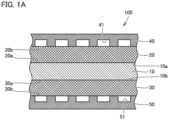
- Fig. 1A is a cross sectional view of electrochemical cell device 100.
- Fig. 1A shows a structure of a single-cell included in electrochemical cell device 100.
- Electrochemical cell device 100 is formed by stacking a plurality of single-cell structures. Further, Fig. 1A does not illustrate warpage of a cell 10, a recess 20c, and a protrusion 30c, which will be described later.
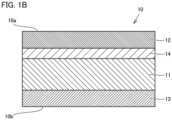
- Fig. 1B is an enlarged cross sectional view of cell 10. As shown in Figs. 1A and 1B , electrochemical cell device 100 includes cell 10, a current collector 20, a current collector 30, an interconnector 40, and an interconnector 50.
- Cell 10 has a main surface 10a and a main surface 10b.
- Main surface 10b is a surface opposite to main surface 10a.
- Cell 10 includes a solid electrolyte layer 11, a cathode 12, an anode 13, and an intermediate layer 14.
- Solid electrolyte layer 11 is a layer composed of a solid electrolyte.
- solid electrolyte layer 11 is composed of an oxide (YSZ) of zirconium (Zr) doped with yttrium (Y).
- Cathode 12 is composed of, for example, LSC (oxide of lanthanum (La) strontium (Sr) cobalt (Co)).
- Anode 13 is composed of, for example, a mixture of YSZ and an oxide of nickel (Ni 2 O).
- Intermediate layer 14 is composed of, for example, an oxide (GDC) of cerium (Ce) doped with gadolinium (Gd).
- Cathode 12 constitutes a main surface 10a of cell 10.
- Anode 13 constitutes a main surface 10b of cell 10.
- Solid electrolyte layer 11 is disposed between cathode 12 and anode 13.
- Intermediate layer 14 is disposed between solid electrolyte layer 11 and cathode 12. Solid electrolyte layer 11 and anode 13 are in contact with each other.
- Fig. 2 is a plan view of cell 10. As shown in Fig. 2 , cell 10 has a circular shape when viewed in a plan view. However, the planar shape of cell 10 is not limited thereto. Cell 10 may have a quadrangular shape when viewed in a plan view.
- Fig. 3 is a schematic cross sectional view showing a shape of warpage of cell 10.
- cell 10 is warped.
- cell 10 is warped to protrude from the main surface 10b side toward the main surface 10a side.
- a warpage amount of cell 10 (hereinafter, referred to as "warpage amount WA") is, for example, 100 ⁇ m or more.
- Warpage amount WA may be 1000 ⁇ m or more.
- Warpage amount WA is measured by the following method.
- Apex P is located at the central portion of cell 10 (the central portion of main surface 10a) when viewed in a plan view.
- Third, the thickness of cell 10 (hereinafter, referred to as "thickness T”) is subtracted from distance L. In this way, warpage amount WA is measured.
- the maximum width of cell 10 when viewed in a plan view is defined as a width W max (see Fig. 2 ).
- a value obtained by dividing warpage amount WA by width W max is, for example, 1/1000 or more.
- the value obtained by dividing warpage amount WA by width W max may be 1/100 or more.
- width W max is equal to the diameter of the circular shape.
- width W max is equal to the length of the diagonal of the quadrangular shape.
- current collector 20 is disposed on main surface 10a, and current collector 30 is disposed on main surface 10b. From another viewpoint, it can be said that cell 10 is sandwiched between current collector 20 and current collector 30.
- Current collector 20 is a cathode side current collector, and current collector 30 is an anode side current collector.
- Current collector 20 has a main surface 20a and a main surface 20b.
- Main surface 20a faces main surface 10a.
- Main surface 20b is a surface opposite to main surface 20a.
- Fig. 4 is a plan view of current collector 20.
- Fig. 5 is a cross sectional view at V-V of Fig. 4 .
- main surface 20a is provided with recess 20c.
- Main surface 20a is depressed toward the main surface 20b side in recess 20c.
- Recess 20c is disposed at a position facing the central portion of main surface 10a.
- Current collector 20 is constituted of a metal porous body sheet 21 and a metal porous body sheet 22.
- Each of metal porous body sheet 21 and metal porous body sheet 22 is composed of a metal porous body having a framework with a three-dimensional network structure.
- the framework of the metal porous body of each of metal porous body sheet 21 and metal porous body sheet 22 contains, for example, nickel (Ni) and cobalt.
- the coating weight of each of metal porous body sheet 21 and metal porous body sheet 22 is preferably 900 g/m 2 or less.
- the coating weight of metal porous body sheet 21 (metal porous body sheet 22) is a value obtained by dividing the weight of metal porous body sheet 21 (metal porous body sheet 22) by the area of the main surface of metal porous body sheet 21 (metal porous body sheet 22).
- Current collector 20 has a circular shape when viewed in a plan view.
- Metal porous body sheet 21 has a circular shape when viewed in a plan view.
- Metal porous body sheet 22 has an annular shape when viewed in a plan view. That is, a through hole 22a is formed in metal porous body sheet 22 so as to extend through metal porous body sheet 22 in the thickness direction of metal porous body sheet 22. Through hole 22a is formed at a position corresponding to recess 20c.
- the thickness (hereinafter, referred to as "thickness T2") of metal porous body sheet 22 is larger than the thickness (hereinafter, referred to as “thickness T1 ”) of metal porous body sheet 21.
- Metal porous body sheet 21 and metal porous body sheet 22 are disposed side by side (disposed not to be stacked on each other) in a plane orthogonal to the thickness direction of current collector 20.
- Metal porous body sheet 21 is disposed in through hole 22a. Therefore, metal porous body sheet 21 and through hole 22a constitute recess 20c.
- Current collector 30 has a main surface 30a and a main surface 30b.
- Main surface 30a faces main surface 10b.
- Main surface 30b is a surface opposite to main surface 30a.
- Fig. 6 is a plan view of current collector 30.
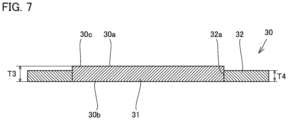
- Fig. 7 is a cross sectional view at VII-VII of Fig. 6 .
- main surface 30a has a protrusion 30c.
- protrusion 30c main surface 30a protrudes opposite to main surface 30b.
- Protrusion 30c is disposed at a position facing the central portion of main surface 10b.
- Current collector 30 is constituted of a metal porous body sheet 31 and a metal porous body sheet 32.
- Each of metal porous body sheet 31 and metal porous body sheet 32 is constituted of a metal porous body having a framework with a three-dimensional network structure.
- the framework of the metal porous body of each of metal porous body sheet 31 and metal porous body sheet 32 contains, for example, nickel.
- the coating weight of each of metal porous body sheet 31 and metal porous body sheet 32 is preferably 1000 g/m 2 or less.
- the coating weight of metal porous body sheet 31 (metal porous body sheet 32) is a value obtained by dividing the weight of metal porous body sheet 31 (metal porous body sheet 32) by the area of the main surface of metal porous body sheet 31 (metal porous body sheet 32).
- Current collector 30 has a circular shape when viewed in a plan view.
- Metal porous body sheet 31 has a circular shape when viewed in a plan view.
- Metal porous body sheet 32 has an annular shape when viewed in a plan view. That is, a through hole 32a is formed in metal porous body sheet 32 so as to extend through metal porous body sheet 32 in the thickness direction of metal porous body sheet 32. Through hole 32a is formed at a position corresponding to protrusion 30c.
- the thickness (hereinafter, referred to as "thickness T3") of metal porous body sheet 31 is larger than the thickness (hereinafter, referred to as "thickness T4") of metal porous body sheet 32.
- Metal porous body sheet 31 and metal porous body sheet 32 are disposed side by side (disposed not to be stacked on each other) in a plane orthogonal to the thickness direction of current collector 30.
- Metal porous body sheet 31 is disposed in through hole 32a. Therefore, metal porous body sheet 31 constitutes protrusion 30c.
- a value obtained by subtracting thickness T1 from thickness T2 is preferably equal to warpage amount WA.
- a value obtained by subtracting thickness T4 from thickness T3 is preferably equal to warpage amount WA. It should be noted that a case where the value obtained by subtracting thickness T1 from thickness T2 falls within a range of 0.95 time or more and 1.05 times or less as large as warpage amount WA is included in the case where "the value obtained by subtracting thickness T1 from thickness T2 is equal to warpage amount WA", and a case where the value obtained by subtracting thickness T4 from thickness T3 falls within a range of 0.95 time or more and 1.05 times or less as large as warpage amount WA is included in the case where "the value obtained by subtracting thickness T4 from thickness T3 is equal to warpage amount WA".
- Metal porous body sheet 22 may be concentrically divided into a plurality of metal porous body sheets. In this case, a metal porous body sheet disposed on an outer side is thicker.
- Metal porous body sheet 32 may be concentrically divided into a plurality of metal porous body sheets. In this case, a metal porous body sheet disposed on an outer side is thinner.
- interconnector 40 is disposed on main surface 20b and interconnector 50 is disposed on main surface 30b. From another viewpoint, it can be said that cell 10, current collector 20, and current collector 30 are sandwiched between interconnector 40 and interconnector 50.
- a groove 41 is formed in the main surface of interconnector 40 on the current collector 20 side, and a groove 51 is formed in the main surface of interconnector 50 on the current collector 30 side.
- Each of interconnector 40 and interconnector 50 is composed of an electrically conductive material.
- electrochemical cell device 100 since cell 10 is warped to protrude from main surface 10b toward main surface 10a, spaces are formed between main surface 10a and main surface 20a and between main surface 10b and main surface 30a when main surface 20a and main surface 30a are flat. This results in an increased contact electrical resistance value between cell 10 and current collector 20, an increased contact electrical resistance value between cell 10 and current collector 30, and a decreased output voltage from electrochemical cell device 100.
- main surface 20a is provided with recess 20c and main surface 30a has protrusion 30c, main surface 20a is facilitated to conform to the shape of main surface 10a and main surface 30a is facilitated to conform to the shape of main surface 10b, thereby reducing the spaces between main surface 10a and main surface 20a and between main surface 10b and main surface 30a.
- the contact electrical resistance value between cell 10 and current collector 20 and the contact electrical resistance value between cell 10 and current collector 30 can be decreased, and the output voltage from electrochemical cell device 100 can be improved.
- electrochemical cell device 100 is an SOEC
- the contact electrical resistance value between cell 10 and current collector 20 and the contact electrical resistance value between cell 10 and current collector 30 are decreased, with the result that the electrolytic voltage in electrochemical cell device 100 can be lowered.
- each of metal porous body sheet 21 and metal porous body sheet 22 contains nickel and cobalt and the coating weight of the metal porous body of each of metal porous body sheet 21 and metal porous body sheet 22 is 900 g/m 2 or less, deformability of each of metal porous body sheet 21 and metal porous body sheet 22 can be ensured, so that main surface 20a is more facilitated to conform to the shape of main surface 10a.
- each of metal porous body sheet 31 and metal porous body sheet 32 contains nickel and the coating weight of the metal porous body of each of metal porous body sheet 31 and metal porous body sheet 32 is 900 g/m 2 or less, deformability of each of metal porous body sheet 31 and metal porous body sheet 32 can be ensured, so that main surface 30a is more facilitated to conform to the shape of main surface 10b.
- Electrochemical cells of samples 1 to 6 were provided for a power generation test.
- the shapes of cell 10, current collector 20, and current collector 30 were as shown in Table 1. It should be noted that although not shown in Table 1, in each of samples 1 to 6, the thickness and diameter of cell 10 were 0.4 mm and 100 mm, respectively.
- warpage amount WA was 100 ⁇ m.
- warpage amount WA was 300 ⁇ m.
- warpage amount WA was 1000 ⁇ m.
- warpage amount WA was 2000 ⁇ m.
- a metal porous body sheet 21 having a thickness of 400 ⁇ m and a metal porous body sheet 22 having a thickness of 500 ⁇ m were used as current collector 20
- a metal porous body sheet 31 having a thickness of 500 ⁇ m and a metal porous body sheet 32 having a thickness of 400 ⁇ m were used as current collector 30.
- a metal porous body sheet 21 having a thickness of 200 ⁇ m and a metal porous body sheet 22 having a thickness of 500 ⁇ m were used as current collector 20
- a metal porous body sheet 31 having a thickness of 500 ⁇ m and a metal porous body sheet 32 having a thickness of 200 ⁇ m were used as current collector 30.
- a metal porous body sheet 21 having a thickness of 100 ⁇ m and a metal porous body sheet 22 having a thickness of 1100 ⁇ m were used as current collector 20
- a metal porous body sheet 31 having a thickness of 1100 ⁇ m and a metal porous body sheet 32 having a thickness of 100 ⁇ m were used as current collector 30.
- a metal porous body sheet 21 having a thickness of 100 ⁇ m and a metal porous body sheet 22 having a thickness of 2100 ⁇ m were used as current collector 20
- a metal porous body sheet 31 having a thickness of 2100 ⁇ m and a metal porous body sheet 32 having a thickness of 100 ⁇ m were used as current collector 30.
- one metal porous body sheet having a thickness of 500 ⁇ m was used as current collector 20
- one metal porous body sheet having a thickness of 500 ⁇ m was used as current collector 30.
- one metal porous body sheet having a thickness of 1100 ⁇ m was used as current collector 20
- one metal porous body sheet having a thickness of 1100 ⁇ m was used as current collector 30.
- Table 2 shows an initial value of an output voltage between the anode and the cathode when a current of 0.5 A/cm 2 flows between the anode and the cathode at 750°C.
- Output Voltage Sample 1 0.85 V Sample 2 0.86 V Sample 3 0.89 V Sample 4 0.90 V Sample 5 0.78 V Sample 6 0.70 V
- the output voltage of sample 1 was more than the output voltage of sample 5.
- the output voltage of sample 3 was more than the output voltage of sample 6.
- warpage amount WA As warpage amount WA is larger, the spaces are more likely to be formed between cell 10 and current collector 20 and between cell 10 and current collector 30, but a surface area of cell 10 contributing to an electrochemical reaction is increased.
- the output voltage of sample 6 was less than the output voltage of sample 5. This is presumably due to the following reason: since warpage amount WA of sample 6 was more than warpage amount WA of sample 5, the space between cell 10 and current collector 20 and the space between cell 10 and current collector 30 were increased, thereby increasing the contact electrical resistance between cell 10 and current collector 20 and the contact electrical resistance between cell 10 and current collector 30.
- electrochemical cell device 200 an electrochemical cell device according to a second embodiment
- Electrochemical cell device 200 includes a cell 10, a current collector 20, a current collector 30, an interconnector 40, and an interconnector 50.
- Cell 10 is warped to protrude from main surface 10b toward main surface 10a.
- Main surface 20a is provided with a recess 20c, and main surface 30a has a protrusion 30c.
- the configuration of electrochemical cell device 200 is the same as the configuration of electrochemical cell device 100.
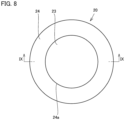
- Fig. 8 is a plan view of current collector 20 of electrochemical cell device 200.
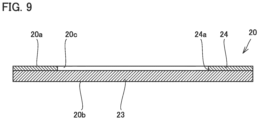
- Fig. 9 is a cross sectional view at IX-IX of Fig. 8 .
- current collector 20 has a metal porous body sheet 23 and a metal porous body sheet 24.
- Metal porous body sheet 23 has a circular shape when viewed in a plan view, for example.
- Metal porous body sheet 24 has an annular shape when viewed in a plan view, for example.
- a through hole 24a is formed in metal porous body sheet 24 so as to extend through metal porous body sheet 24 in the thickness direction of metal porous body sheet 24.
- Through hole 24a is disposed at a position corresponding to recess 20c.
- Metal porous body sheet 23 and metal porous body sheet 24 are disposed to be stacked on each other in the thickness direction of current collector 20.
- Metal porous body sheet 24 is disposed on the main surface 20a side. As a result, through hole 24a and metal porous body sheet 23 constitute recess 20c.
- Fig. 10 is a plan view of current collector 30 of electrochemical cell device 200.
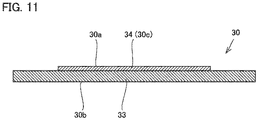
- Fig. 11 is a cross sectional view at XI-XI of Fig. 10 .
- current collector 30 has a metal porous body sheet 33 and a metal porous body sheet 34.
- Each of metal porous body sheet 33 and metal porous body sheet 34 has a circular shape when viewed in a plan view, for example.
- the diameter of metal porous body sheet 33 is larger than the diameter of metal porous body sheet 34.
- Metal porous body sheet 33 and metal porous body sheet 34 are stacked on each other in the thickness direction of current collector 30.
- Metal porous body sheet 34 is disposed on the main surface 30a side so as to correspond to the position of protrusion 30c. As a result, metal porous body sheet 34 constitutes protrusion 30c.
- main surface 20a is provided with recess 20c and main surface 30a has protrusion 30c in electrochemical cell device 200
- main surface 20a is facilitated to conform to the shape of main surface 10a
- main surface 30a is facilitated to conform to the shape of main surface 10b, thereby reducing the spaces between main surface 10a and main surface 20a and between main surface 10b and main surface 30a.
- the contact electrical resistance value between cell 10 and current collector 20 and the contact electrical resistance value between cell 10 and current collector 30 can be decreased, and the output voltage from electrochemical cell device 100 can be improved.
- electrochemical cell device 300 a configuration of an electrochemical cell device (hereinafter, referred to as "electrochemical cell device 300") according to a third embodiment will be described.
- electrochemical cell device 300 a configuration of an electrochemical cell device (hereinafter, referred to as "electrochemical cell device 300") according to a third embodiment will be described.
- electrochemical cell device 300 a configuration of an electrochemical cell device (hereinafter, referred to as "electrochemical cell device 300") according to a third embodiment.
- electrochemical cell device 300 a configuration of an electrochemical cell device (hereinafter, referred to as "electrochemical cell device 300”) according to a third embodiment will be described.
- electrochemical cell device 300 mainly describes differences from the configuration of electrochemical cell device 100, and the same explanation will not be described repeatedly.
- Electrochemical cell device 300 includes a cell 10, a current collector 20, a current collector 30, an interconnector 40, and an interconnector 50.
- Cell 10 is warped to protrude from main surface 10b toward main surface 10a.
- Main surface 20a is provided with a recess 20c, and main surface 30a has a protrusion 30c.
- the configuration of electrochemical cell device 300 is the same as the configuration of electrochemical cell device 100.
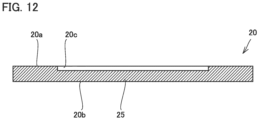
- Fig. 12 is a cross sectional view of current collector 20 of electrochemical cell device 300.
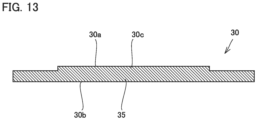
- Fig. 13 is a cross sectional view of current collector 30 of electrochemical cell device 300.
- each of current collector 20 and current collector 30 is constituted of one metal porous body sheet (metal porous body sheet 25 and metal porous body sheet 35).
- each of recess 20c of current collector 20 (metal porous body sheet 25) and protrusion 30c of current collector 30 (metal porous body sheet 35) can be formed by, for example, press working.
- main surface 20a is provided with recess 20c and main surface 30a has protrusion 30c in electrochemical cell device 300
- main surface 20a is facilitated to conform to the shape of main surface 10a
- main surface 30a is facilitated to conform to the shape of main surface 10b, thereby reducing the spaces between main surface 10a and main surface 20a and between main surface 10b and main surface 30a.
- the contact electrical resistance value between cell 10 and current collector 20 and the contact electrical resistance value between cell 10 and current collector 30 are decreased, and the output voltage from electrochemical cell device 100 can be improved.
Landscapes
- Chemical & Material Sciences (AREA)
- Engineering & Computer Science (AREA)
- Chemical Kinetics & Catalysis (AREA)
- Electrochemistry (AREA)
- General Chemical & Material Sciences (AREA)
- Materials Engineering (AREA)
- Metallurgy (AREA)
- Organic Chemistry (AREA)
- Sustainable Energy (AREA)
- Life Sciences & Earth Sciences (AREA)
- Manufacturing & Machinery (AREA)
- Sustainable Development (AREA)
- Ceramic Engineering (AREA)
- Composite Materials (AREA)
- Inorganic Chemistry (AREA)
- Cell Electrode Carriers And Collectors (AREA)
- Fuel Cell (AREA)
Applications Claiming Priority (2)
| Application Number | Priority Date | Filing Date | Title |
|---|---|---|---|
| JP2020072919 | 2020-04-15 | ||
| PCT/JP2021/001578 WO2021210231A1 (ja) | 2020-04-15 | 2021-01-19 | 電気化学セル装置 |
Publications (3)
| Publication Number | Publication Date |
|---|---|
| EP4138162A1 true EP4138162A1 (de) | 2023-02-22 |
| EP4138162A4 EP4138162A4 (de) | 2024-12-25 |
| EP4138162B1 EP4138162B1 (de) | 2026-01-28 |
Family
ID=78084196
Family Applications (1)
| Application Number | Title | Priority Date | Filing Date |
|---|---|---|---|
| EP21787933.7A Active EP4138162B1 (de) | 2020-04-15 | 2021-01-19 | Elektrochemische zellenvorrichtung |
Country Status (5)
| Country | Link |
|---|---|
| US (1) | US20230135982A1 (de) |
| EP (1) | EP4138162B1 (de) |
| JP (1) | JP7552687B2 (de) |
| CN (1) | CN115336052B (de) |
| WO (1) | WO2021210231A1 (de) |
Families Citing this family (1)
| Publication number | Priority date | Publication date | Assignee | Title |
|---|---|---|---|---|
| GB2640063A (en) | 2023-01-10 | 2025-10-08 | Sumitomo Electric Industries | Solid electrochemical device |
Family Cites Families (16)
| Publication number | Priority date | Publication date | Assignee | Title |
|---|---|---|---|---|
| JP4512911B2 (ja) * | 2001-06-21 | 2010-07-28 | 三菱マテリアル株式会社 | 固体電解質型燃料電池 |
| JP2005317241A (ja) * | 2004-04-27 | 2005-11-10 | Tokyo Gas Co Ltd | 支持膜式固体酸化物形燃料電池スタック及びその作製方法 |
| JP2006260994A (ja) * | 2005-03-17 | 2006-09-28 | Toyota Motor Corp | 燃料電池 |
| JP5111869B2 (ja) * | 2007-01-18 | 2013-01-09 | 三菱マテリアル株式会社 | 燃料電池 |
| JP2010015977A (ja) * | 2008-06-03 | 2010-01-21 | Honda Motor Co Ltd | 燃料電池及びその製造方法 |
| JP2013069521A (ja) * | 2011-09-22 | 2013-04-18 | Nissan Motor Co Ltd | 燃料電池、燃料電池スタック、及び燃料電池又は燃料電池スタックの製造方法 |
| JP5198675B1 (ja) * | 2011-10-25 | 2013-05-15 | 日本碍子株式会社 | 燃料電池の構造体 |
| JP6350068B2 (ja) * | 2014-07-22 | 2018-07-04 | 株式会社Soken | 固体酸化物形燃料電池セル |
| CN113089010B (zh) * | 2015-07-16 | 2023-09-12 | 住友电气工业株式会社 | 氢制造装置 |
| JP2017033917A (ja) * | 2015-08-04 | 2017-02-09 | 住友電気工業株式会社 | 金属多孔体、燃料電池、及び金属多孔体の製造方法 |
| JP6578970B2 (ja) * | 2016-01-29 | 2019-09-25 | 住友電気工業株式会社 | 固体酸化物型燃料電池 |
| JPWO2018079811A1 (ja) * | 2016-10-31 | 2019-09-19 | 京セラ株式会社 | 太陽電池モジュール |
| JP7246012B2 (ja) * | 2017-11-16 | 2023-03-27 | パナソニックIpマネジメント株式会社 | 空気電池用正極及び空気電池 |
| EP3812476B1 (de) | 2018-06-21 | 2023-04-12 | Sumitomo Electric Industries, Ltd. | Poröser körper, stromkollektor damit und brennstoffzelle |
| CN109585777B (zh) * | 2018-12-06 | 2022-02-18 | 福建南平南孚电池有限公司 | 一种提高大电流放电容量的锂锰扣式电池正极片的制备方法 |
| JP2020072919A (ja) | 2019-11-08 | 2020-05-14 | 株式会社ユニバーサルエンターテインメント | 遊技機 |
-
2021
- 2021-01-19 JP JP2022515207A patent/JP7552687B2/ja active Active
- 2021-01-19 CN CN202180025442.XA patent/CN115336052B/zh active Active
- 2021-01-19 EP EP21787933.7A patent/EP4138162B1/de active Active
- 2021-01-19 US US17/914,801 patent/US20230135982A1/en active Pending
- 2021-01-19 WO PCT/JP2021/001578 patent/WO2021210231A1/ja not_active Ceased
Also Published As
| Publication number | Publication date |
|---|---|
| CN115336052B (zh) | 2025-12-09 |
| JPWO2021210231A1 (de) | 2021-10-21 |
| JP7552687B2 (ja) | 2024-09-18 |
| WO2021210231A1 (ja) | 2021-10-21 |
| EP4138162A4 (de) | 2024-12-25 |
| CN115336052A (zh) | 2022-11-11 |
| EP4138162B1 (de) | 2026-01-28 |
| US20230135982A1 (en) | 2023-05-04 |
Similar Documents
| Publication | Publication Date | Title |
|---|---|---|
| US10665870B2 (en) | Electrochemical reaction unit and fuel cell stack | |
| US10361440B2 (en) | Electrochemical reaction unit having a single cell including a current collector having a protrusion coated with an electrically conductive coat in contact with a cathode via a bonding layer and fuel cell stack | |
| US20140017597A1 (en) | Fuel cell | |
| KR102239403B1 (ko) | 전기 화학 반응 단셀 및 전기 화학 반응 셀 스택 | |
| KR102169225B1 (ko) | 전기 화학 반응 단셀 및 전기 화학 반응 셀 스택 | |
| EP4138162B1 (de) | Elektrochemische zellenvorrichtung | |
| JP2018206693A (ja) | 導電性部材、電気化学反応単位、および、電気化学反応セルスタック | |
| EP2693545B1 (de) | Brennstoffzelle | |
| US8580453B2 (en) | Electrode-supported ceramic fuel cell containing laminar composite electrode including porous support electrode, patterned structure layer and electrolyte | |
| KR102241562B1 (ko) | 전기 화학 반응 단셀 및 전기 화학 반응 셀 스택 | |
| JP7349846B2 (ja) | 電気化学セル、電気化学反応セルスタック | |
| EP3499616B1 (de) | Einzelzelle mit elektrochemischer reaktion und zellstapel mit elektrochemischer reaktion | |
| US20140017598A1 (en) | Fuel cell | |
| US20240379983A1 (en) | Electrochemical cells with support ribs and manufacturing methods thereof | |
| EP4654303A1 (de) | Elektrochemische vorrichtung | |
| WO2024117450A1 (en) | Solid oxide cell | |
| US20250266468A1 (en) | Electrochemical cell | |
| WO2024257990A1 (en) | Solid oxide cell | |
| EP4534730A2 (de) | Elektrodenstruktur | |
| JP2948441B2 (ja) | 平板型固体電解質燃料電池 | |
| KR20240082127A (ko) | 고체산화물 셀 | |
| KR20240085114A (ko) | 고체 산화물 셀 및 그 제조 방법 | |
| JP2017224524A (ja) | 集電部材−電気化学反応単セル複合体および電気化学反応セルスタック | |
| JP2018174041A (ja) | 電気化学反応単位および電気化学反応セルスタック | |
| JP2017224525A (ja) | 集電部材−電気化学反応単セル複合体および電気化学反応セルスタック |
Legal Events
| Date | Code | Title | Description |
|---|---|---|---|
| STAA | Information on the status of an ep patent application or granted ep patent |
Free format text: STATUS: THE INTERNATIONAL PUBLICATION HAS BEEN MADE |
|
| PUAI | Public reference made under article 153(3) epc to a published international application that has entered the european phase |
Free format text: ORIGINAL CODE: 0009012 |
|
| STAA | Information on the status of an ep patent application or granted ep patent |
Free format text: STATUS: REQUEST FOR EXAMINATION WAS MADE |
|
| 17P | Request for examination filed |
Effective date: 20221007 |
|
| AK | Designated contracting states |
Kind code of ref document: A1 Designated state(s): AL AT BE BG CH CY CZ DE DK EE ES FI FR GB GR HR HU IE IS IT LI LT LU LV MC MK MT NL NO PL PT RO RS SE SI SK SM TR |
|
| DAV | Request for validation of the european patent (deleted) | ||
| DAX | Request for extension of the european patent (deleted) | ||
| A4 | Supplementary search report drawn up and despatched |
Effective date: 20241121 |
|
| RIC1 | Information provided on ipc code assigned before grant |
Ipc: C25B 9/77 20210101ALI20241115BHEP Ipc: C25B 9/65 20210101ALI20241115BHEP Ipc: C25B 9/01 20210101ALI20241115BHEP Ipc: C25B 1/042 20210101ALI20241115BHEP Ipc: H01M 8/1213 20160101ALI20241115BHEP Ipc: H01M 8/12 20160101ALI20241115BHEP Ipc: H01M 8/0247 20160101ALI20241115BHEP Ipc: H01M 8/0245 20160101ALI20241115BHEP Ipc: H01M 8/0232 20160101AFI20241115BHEP |
|
| GRAP | Despatch of communication of intention to grant a patent |
Free format text: ORIGINAL CODE: EPIDOSNIGR1 |
|
| STAA | Information on the status of an ep patent application or granted ep patent |
Free format text: STATUS: GRANT OF PATENT IS INTENDED |
|
| RIC1 | Information provided on ipc code assigned before grant |
Ipc: H01M 8/0232 20160101AFI20250924BHEP Ipc: H01M 8/0245 20160101ALI20250924BHEP Ipc: H01M 8/0247 20160101ALI20250924BHEP Ipc: H01M 8/12 20160101ALI20250924BHEP Ipc: H01M 8/1213 20160101ALI20250924BHEP Ipc: C25B 1/042 20210101ALI20250924BHEP Ipc: C25B 9/01 20210101ALI20250924BHEP Ipc: C25B 9/65 20210101ALI20250924BHEP Ipc: C25B 9/77 20210101ALI20250924BHEP |
|
| INTG | Intention to grant announced |
Effective date: 20251006 |
|
| GRAS | Grant fee paid |
Free format text: ORIGINAL CODE: EPIDOSNIGR3 |
|
| GRAA | (expected) grant |
Free format text: ORIGINAL CODE: 0009210 |
|
| STAA | Information on the status of an ep patent application or granted ep patent |
Free format text: STATUS: THE PATENT HAS BEEN GRANTED |
|
| P01 | Opt-out of the competence of the unified patent court (upc) registered |
Free format text: CASE NUMBER: UPC_APP_0017786_4138162/2025 Effective date: 20251216 |
|
| AK | Designated contracting states |
Kind code of ref document: B1 Designated state(s): AL AT BE BG CH CY CZ DE DK EE ES FI FR GB GR HR HU IE IS IT LI LT LU LV MC MK MT NL NO PL PT RO RS SE SI SK SM TR |
|
| REG | Reference to a national code |
Ref country code: CH Ref legal event code: F10 Free format text: ST27 STATUS EVENT CODE: U-0-0-F10-F00 (AS PROVIDED BY THE NATIONAL OFFICE) Effective date: 20260128 Ref country code: GB Ref legal event code: FG4D |
|
| REG | Reference to a national code |
Ref country code: DE Ref legal event code: R096 Ref document number: 602021047013 Country of ref document: DE |
|
| REG | Reference to a national code |
Ref country code: IE Ref legal event code: FG4D |