EP4112547B1 - Selbsterwärmender gassensor, gasempfindliches material, herstellungsverfahren dafür und anwendungen davon - Google Patents
Selbsterwärmender gassensor, gasempfindliches material, herstellungsverfahren dafür und anwendungen davon Download PDFInfo
- Publication number
- EP4112547B1 EP4112547B1 EP21785231.8A EP21785231A EP4112547B1 EP 4112547 B1 EP4112547 B1 EP 4112547B1 EP 21785231 A EP21785231 A EP 21785231A EP 4112547 B1 EP4112547 B1 EP 4112547B1
- Authority
- EP
- European Patent Office
- Prior art keywords
- carbon material
- oxide
- metal oxides
- gas
- tungsten
- Prior art date
- Legal status (The legal status is an assumption and is not a legal conclusion. Google has not performed a legal analysis and makes no representation as to the accuracy of the status listed.)
- Active
Links
Images

Classifications
-
- G—PHYSICS
- G01—MEASURING; TESTING
- G01N—INVESTIGATING OR ANALYSING MATERIALS BY DETERMINING THEIR CHEMICAL OR PHYSICAL PROPERTIES
- G01N27/00—Investigating or analysing materials by the use of electric, electrochemical, or magnetic means
- G01N27/02—Investigating or analysing materials by the use of electric, electrochemical, or magnetic means by investigating impedance
- G01N27/04—Investigating or analysing materials by the use of electric, electrochemical, or magnetic means by investigating impedance by investigating resistance
- G01N27/12—Investigating or analysing materials by the use of electric, electrochemical, or magnetic means by investigating impedance by investigating resistance of a solid body in dependence upon absorption of a fluid; of a solid body in dependence upon reaction with a fluid, for detecting components in the fluid
- G01N27/125—Composition of the body, e.g. the composition of its sensitive layer
- G01N27/127—Composition of the body, e.g. the composition of its sensitive layer comprising nanoparticles
-
- C—CHEMISTRY; METALLURGY
- C01—INORGANIC CHEMISTRY
- C01B—NON-METALLIC ELEMENTS; COMPOUNDS THEREOF; METALLOIDS OR COMPOUNDS THEREOF NOT COVERED BY SUBCLASS C01C
- C01B32/00—Carbon; Compounds thereof
- C01B32/15—Nano-sized carbon materials
- C01B32/182—Graphene
- C01B32/184—Preparation
-
- C—CHEMISTRY; METALLURGY
- C01—INORGANIC CHEMISTRY
- C01B—NON-METALLIC ELEMENTS; COMPOUNDS THEREOF; METALLOIDS OR COMPOUNDS THEREOF NOT COVERED BY SUBCLASS C01C
- C01B32/00—Carbon; Compounds thereof
- C01B32/15—Nano-sized carbon materials
- C01B32/152—Fullerenes
- C01B32/156—After-treatment
-
- C—CHEMISTRY; METALLURGY
- C01—INORGANIC CHEMISTRY
- C01B—NON-METALLIC ELEMENTS; COMPOUNDS THEREOF; METALLOIDS OR COMPOUNDS THEREOF NOT COVERED BY SUBCLASS C01C
- C01B32/00—Carbon; Compounds thereof
- C01B32/15—Nano-sized carbon materials
- C01B32/158—Carbon nanotubes
- C01B32/168—After-treatment
-
- C—CHEMISTRY; METALLURGY
- C01—INORGANIC CHEMISTRY
- C01B—NON-METALLIC ELEMENTS; COMPOUNDS THEREOF; METALLOIDS OR COMPOUNDS THEREOF NOT COVERED BY SUBCLASS C01C
- C01B32/00—Carbon; Compounds thereof
- C01B32/15—Nano-sized carbon materials
- C01B32/158—Carbon nanotubes
- C01B32/168—After-treatment
- C01B32/174—Derivatisation; Solubilisation; Dispersion in solvents
-
- C—CHEMISTRY; METALLURGY
- C01—INORGANIC CHEMISTRY
- C01B—NON-METALLIC ELEMENTS; COMPOUNDS THEREOF; METALLOIDS OR COMPOUNDS THEREOF NOT COVERED BY SUBCLASS C01C
- C01B32/00—Carbon; Compounds thereof
- C01B32/15—Nano-sized carbon materials
- C01B32/182—Graphene
- C01B32/194—After-treatment
-
- C—CHEMISTRY; METALLURGY
- C01—INORGANIC CHEMISTRY
- C01G—COMPOUNDS CONTAINING METALS NOT COVERED BY SUBCLASSES C01D OR C01F
- C01G15/00—Compounds of gallium, indium or thallium
-
- C—CHEMISTRY; METALLURGY
- C01—INORGANIC CHEMISTRY
- C01G—COMPOUNDS CONTAINING METALS NOT COVERED BY SUBCLASSES C01D OR C01F
- C01G19/00—Compounds of tin
- C01G19/02—Oxides
-
- C—CHEMISTRY; METALLURGY
- C01—INORGANIC CHEMISTRY
- C01G—COMPOUNDS CONTAINING METALS NOT COVERED BY SUBCLASSES C01D OR C01F
- C01G3/00—Compounds of copper
- C01G3/02—Oxides; Hydroxides
-
- C—CHEMISTRY; METALLURGY
- C01—INORGANIC CHEMISTRY
- C01G—COMPOUNDS CONTAINING METALS NOT COVERED BY SUBCLASSES C01D OR C01F
- C01G39/00—Compounds of molybdenum
- C01G39/02—Oxides; Hydroxides
-
- C—CHEMISTRY; METALLURGY
- C01—INORGANIC CHEMISTRY
- C01G—COMPOUNDS CONTAINING METALS NOT COVERED BY SUBCLASSES C01D OR C01F
- C01G41/00—Compounds of tungsten
-
- C—CHEMISTRY; METALLURGY
- C01—INORGANIC CHEMISTRY
- C01G—COMPOUNDS CONTAINING METALS NOT COVERED BY SUBCLASSES C01D OR C01F
- C01G41/00—Compounds of tungsten
- C01G41/02—Oxides; Hydroxides
-
- C—CHEMISTRY; METALLURGY
- C01—INORGANIC CHEMISTRY
- C01G—COMPOUNDS CONTAINING METALS NOT COVERED BY SUBCLASSES C01D OR C01F
- C01G49/00—Compounds of iron
- C01G49/0018—Mixed oxides or hydroxides
-
- C—CHEMISTRY; METALLURGY
- C01—INORGANIC CHEMISTRY
- C01G—COMPOUNDS CONTAINING METALS NOT COVERED BY SUBCLASSES C01D OR C01F
- C01G49/00—Compounds of iron
- C01G49/02—Oxides; Hydroxides
- C01G49/06—Ferric oxide [Fe2O3]
-
- C—CHEMISTRY; METALLURGY
- C01—INORGANIC CHEMISTRY
- C01G—COMPOUNDS CONTAINING METALS NOT COVERED BY SUBCLASSES C01D OR C01F
- C01G9/00—Compounds of zinc
- C01G9/02—Oxides; Hydroxides
-
- G—PHYSICS
- G01—MEASURING; TESTING
- G01N—INVESTIGATING OR ANALYSING MATERIALS BY DETERMINING THEIR CHEMICAL OR PHYSICAL PROPERTIES
- G01N27/00—Investigating or analysing materials by the use of electric, electrochemical, or magnetic means
- G01N27/02—Investigating or analysing materials by the use of electric, electrochemical, or magnetic means by investigating impedance
- G01N27/04—Investigating or analysing materials by the use of electric, electrochemical, or magnetic means by investigating impedance by investigating resistance
- G01N27/12—Investigating or analysing materials by the use of electric, electrochemical, or magnetic means by investigating impedance by investigating resistance of a solid body in dependence upon absorption of a fluid; of a solid body in dependence upon reaction with a fluid, for detecting components in the fluid
- G01N27/125—Composition of the body, e.g. the composition of its sensitive layer
-
- G—PHYSICS
- G01—MEASURING; TESTING
- G01N—INVESTIGATING OR ANALYSING MATERIALS BY DETERMINING THEIR CHEMICAL OR PHYSICAL PROPERTIES
- G01N27/00—Investigating or analysing materials by the use of electric, electrochemical, or magnetic means
- G01N27/02—Investigating or analysing materials by the use of electric, electrochemical, or magnetic means by investigating impedance
- G01N27/04—Investigating or analysing materials by the use of electric, electrochemical, or magnetic means by investigating impedance by investigating resistance
- G01N27/12—Investigating or analysing materials by the use of electric, electrochemical, or magnetic means by investigating impedance by investigating resistance of a solid body in dependence upon absorption of a fluid; of a solid body in dependence upon reaction with a fluid, for detecting components in the fluid
- G01N27/128—Microapparatus
-
- G—PHYSICS
- G01—MEASURING; TESTING
- G01N—INVESTIGATING OR ANALYSING MATERIALS BY DETERMINING THEIR CHEMICAL OR PHYSICAL PROPERTIES
- G01N33/00—Investigating or analysing materials by specific methods not covered by groups G01N1/00 - G01N31/00
- G01N33/0004—Gaseous mixtures, e.g. polluted air
- G01N33/0009—General constructional details of gas analysers, e.g. portable test equipment
- G01N33/0027—General constructional details of gas analysers, e.g. portable test equipment concerning the detector
-
- B—PERFORMING OPERATIONS; TRANSPORTING
- B82—NANOTECHNOLOGY
- B82Y—SPECIFIC USES OR APPLICATIONS OF NANOSTRUCTURES; MEASUREMENT OR ANALYSIS OF NANOSTRUCTURES; MANUFACTURE OR TREATMENT OF NANOSTRUCTURES
- B82Y15/00—Nanotechnology for interacting, sensing or actuating, e.g. quantum dots as markers in protein assays or molecular motors
-
- B—PERFORMING OPERATIONS; TRANSPORTING
- B82—NANOTECHNOLOGY
- B82Y—SPECIFIC USES OR APPLICATIONS OF NANOSTRUCTURES; MEASUREMENT OR ANALYSIS OF NANOSTRUCTURES; MANUFACTURE OR TREATMENT OF NANOSTRUCTURES
- B82Y30/00—Nanotechnology for materials or surface science, e.g. nanocomposites
-
- B—PERFORMING OPERATIONS; TRANSPORTING
- B82—NANOTECHNOLOGY
- B82Y—SPECIFIC USES OR APPLICATIONS OF NANOSTRUCTURES; MEASUREMENT OR ANALYSIS OF NANOSTRUCTURES; MANUFACTURE OR TREATMENT OF NANOSTRUCTURES
- B82Y40/00—Manufacture or treatment of nanostructures
-
- C—CHEMISTRY; METALLURGY
- C01—INORGANIC CHEMISTRY
- C01P—INDEXING SCHEME RELATING TO STRUCTURAL AND PHYSICAL ASPECTS OF SOLID INORGANIC COMPOUNDS
- C01P2002/00—Crystal-structural characteristics
- C01P2002/50—Solid solutions
- C01P2002/52—Solid solutions containing elements as dopants
- C01P2002/54—Solid solutions containing elements as dopants one element only
-
- C—CHEMISTRY; METALLURGY
- C01—INORGANIC CHEMISTRY
- C01P—INDEXING SCHEME RELATING TO STRUCTURAL AND PHYSICAL ASPECTS OF SOLID INORGANIC COMPOUNDS
- C01P2002/00—Crystal-structural characteristics
- C01P2002/70—Crystal-structural characteristics defined by measured X-ray, neutron or electron diffraction data
- C01P2002/77—Crystal-structural characteristics defined by measured X-ray, neutron or electron diffraction data by unit-cell parameters, atom positions or structure diagrams
-
- C—CHEMISTRY; METALLURGY
- C01—INORGANIC CHEMISTRY
- C01P—INDEXING SCHEME RELATING TO STRUCTURAL AND PHYSICAL ASPECTS OF SOLID INORGANIC COMPOUNDS
- C01P2004/00—Particle morphology
- C01P2004/01—Particle morphology depicted by an image
- C01P2004/03—Particle morphology depicted by an image obtained by SEM
-
- C—CHEMISTRY; METALLURGY
- C01—INORGANIC CHEMISTRY
- C01P—INDEXING SCHEME RELATING TO STRUCTURAL AND PHYSICAL ASPECTS OF SOLID INORGANIC COMPOUNDS
- C01P2004/00—Particle morphology
- C01P2004/01—Particle morphology depicted by an image
- C01P2004/04—Particle morphology depicted by an image obtained by TEM, STEM, STM or AFM
-
- C—CHEMISTRY; METALLURGY
- C01—INORGANIC CHEMISTRY
- C01P—INDEXING SCHEME RELATING TO STRUCTURAL AND PHYSICAL ASPECTS OF SOLID INORGANIC COMPOUNDS
- C01P2004/00—Particle morphology
- C01P2004/10—Particle morphology extending in one dimension, e.g. needle-like
- C01P2004/16—Nanowires or nanorods, i.e. solid nanofibres with two nearly equal dimensions between 1-100 nanometer
-
- C—CHEMISTRY; METALLURGY
- C01—INORGANIC CHEMISTRY
- C01P—INDEXING SCHEME RELATING TO STRUCTURAL AND PHYSICAL ASPECTS OF SOLID INORGANIC COMPOUNDS
- C01P2004/00—Particle morphology
- C01P2004/20—Particle morphology extending in two dimensions, e.g. plate-like
-
- C—CHEMISTRY; METALLURGY
- C01—INORGANIC CHEMISTRY
- C01P—INDEXING SCHEME RELATING TO STRUCTURAL AND PHYSICAL ASPECTS OF SOLID INORGANIC COMPOUNDS
- C01P2004/00—Particle morphology
- C01P2004/60—Particles characterised by their size
- C01P2004/61—Micrometer sized, i.e. from 1-100 micrometer
-
- C—CHEMISTRY; METALLURGY
- C01—INORGANIC CHEMISTRY
- C01P—INDEXING SCHEME RELATING TO STRUCTURAL AND PHYSICAL ASPECTS OF SOLID INORGANIC COMPOUNDS
- C01P2004/00—Particle morphology
- C01P2004/60—Particles characterised by their size
- C01P2004/62—Submicrometer sized, i.e. from 0.1-1 micrometer
-
- C—CHEMISTRY; METALLURGY
- C01—INORGANIC CHEMISTRY
- C01P—INDEXING SCHEME RELATING TO STRUCTURAL AND PHYSICAL ASPECTS OF SOLID INORGANIC COMPOUNDS
- C01P2004/00—Particle morphology
- C01P2004/80—Particles consisting of a mixture of two or more inorganic phases
-
- C—CHEMISTRY; METALLURGY
- C01—INORGANIC CHEMISTRY
- C01P—INDEXING SCHEME RELATING TO STRUCTURAL AND PHYSICAL ASPECTS OF SOLID INORGANIC COMPOUNDS
- C01P2006/00—Physical properties of inorganic compounds
- C01P2006/40—Electric properties
Definitions
- the present disclosure relates to the field of materials, in particular to a gas-sensitive material, a preparation method therefor and a use thereof, and a self-heating gas sensor based on Joule principle, which uses the gas-sensitive material.
- Metal oxide nanomaterials not only reduce the consumption of sensing materials and greatly reduce the cost, but also improve the gas sensing performance of the sensors owing to the small size effect of the nanomaterials.
- gas sensors based on metal oxide nanomaterials have to be heated up to 200-400°C to work normally, in view of the disadvantage of extremely low electric conductivity of metal oxides at room temperature. According to statistics, almost 60% of the energy of a sensor is used to heat the sensing material. That fact not only causes increased energy consumption and is adverse to sensor miniaturization and long-time use, but also brings potential safety hazards. Therefore, in recent years, how to prepare sensors with low energy consumption and excellent gas sensing performance has become one of the research hotspots in the field of gas sensors.
- the heating is directly achieved by the gas-sensitive material without any intermediate heat conduction, the heat dissipation can be greatly reduced. In addition, the energy consumption is further reduced because the external heating circuit is removed.
- both of the methods have their respective disadvantages at present. 1. Although graphene, carbon nanotubes and other carbon materials can respond to gases at room temperature, their response recovery rate is very low and can't meet the requirement in actual life, because the gas adsorption/desorption process at room temperature is very slow. 2.
- the gas sensors that utilize the Joule heat principle for self-healing mainly utilize a single or oriented metal or metal oxide nanowire or nanobelt. These sensors are prepared with a complex method and expensive instruments.
- the gas-sensitive materials have high resistance, a high voltage has to be applied to heat up the gas-sensitive materials to an ideal temperature. Consequently, the size of the battery is increased, adverse to the miniaturization and portability of the sensors.
- WO 2018216952 A1 discloses a graphene-tin oxide nanocomposite and its preparing method, comprising the steps of: preparing a dispersion solution by dispersing graphene and tin oxide in an organic solvent; obtaining a powder-type mixture by drying the dispersion solution; and obtaining a graphene-tin oxide nanocomposite by emitting microwaves at the mixture.
- US 5627305 A1 discloses a gas sensing apparatus including a gas sensing device that is self-heated due to an applied voltage.
- CN 101824603 A1 discloses a method for manufacturing a composite film gas sensor, wherein MWCNT, was subjected to acid treatment, then the MWCNT was added and dispersed into an organic solvent, which were then spin-coated onto tin and tungsten targets of a radio-frequency-responsive magnetron sputtering device.
- CN 101439855 A1 discloses a microwave hydrothermal synthesis method of nanometer SnO 2 -MWCNTs.
- the present disclosure provides a gas-sensitive material, a preparation method therefor and a use thereof, and a self-heating gas sensor based on Joule principle, which uses the gas-sensitive material.
- the gas-sensitive material provided by the present disclosure has reduced resistance, is capable of responding to various gases at a reduced working temperature, also obviates the need for external heating, implements self-heating simply by Joule heating of a measuring circuit, and has reduced power consumption and increased sensitivity.
- the present disclosure provides a gas-sensitive material for a self-heating gas sensor based on Joule principle, wherein the gas-sensitive material is a carbon material-metal oxide composite nanomaterial formed by compounding a carbon material and metal oxides, the content of the carbon material is 0.5 ⁇ 20 wt.% and the content of the metal oxide is 80 ⁇ 99.5 wt.% in the carbon material-metal oxide composite nanomaterial; the metal oxides contain tungsten oxide and one or more selected from tin oxide, iron oxide, titanium oxide, copper oxide, molybdenum oxide and zinc oxide, wherein the metal oxides are formed on the carbon material in the form of nanowires, and the nanowires are tungsten oxide-doped nanowires.
- the gas-sensitive material is a carbon material-metal oxide composite nanomaterial formed by compounding a carbon material and metal oxides
- the content of the carbon material is 0.5 ⁇ 20 wt.% and the content of the metal oxide is 80 ⁇ 99.5 wt.% in the carbon material-metal
- the diameter of the nanowires is 10 ⁇ 100 nm, and the length of the nanowires is 500 ⁇ 10,000 nm.
- the metal oxides contain WO 3 and one or more selected from SnO 2 , Fe 2 O 3 , TiO 2 , CuO, MoO 3 and ZnO; more preferably, the metal oxides contain WO 3 and one or more selected from SnO 2 , Fe 2 O 3 , TiO 2 , CuO and MoO 3 .
- the content of WO 3 preferably is 60 ⁇ 99.5 wt.%.
- the nanowires are tungsten trioxide-doped nanowires.
- the content of the carbon material is 0.5 ⁇ 15 wt.% and the content of the metal oxides is 85 ⁇ 99.5 wt.% in the carbon material-metal oxide composite nanomaterial.
- the carbon material is one or more of graphene, carbon nanotube, fullerene and carbon black.
- the present disclosure provides a method for preparing a gas-sensitive material, comprising the steps of carrying out heat treatment on a carbon material, and metal oxides and/or metal oxide precursors under microwaves in the presence of an alcohol solvent, and then carrying out solid-liquid separation, to obtain a carbon material-metal oxide composite nanomaterial, wherein the metal oxides contain tungsten oxide and one or more selected from tin oxide, iron oxide, titanium oxide, copper oxide, molybdenum oxide and zinc oxide; the metal oxide precursors are alcohol-soluble tungsten salt and one or more selected from alcohol-soluble tin salt, alcohol-soluble iron salt, alcohol-soluble titanium salt, alcohol-soluble copper salt, alcohol-soluble molybdenum salt and alcohol-soluble zinc salt.
- the amount of the carbon material is 0.5 ⁇ 20 wt.%, and the amount of the metal oxides is 80 ⁇ 99.5 wt.%; based on the total weight of the carbon material and the metal oxide precursors measured in the metal oxides, the amount of the carbon material is 0.5 ⁇ 20 wt.%, and the amount of the metal oxide precursors measured in the metal oxides is 80 ⁇ 99.5 wt.%.
- the carbon material is one or more of graphene, carbon nanotube, fullerene and carbon black.
- the metal oxides contain WO 3 and one or more selected from SnO 2 , Fe 2 O 3 , TiO 2 , CuO, MoO 3 and ZnO; more preferably, the metal oxides contain WO 3 and one or more selected from SnO 2 , Fe 2 O 3 , TiO 2 , CuO and MoO 3 .
- the metal oxide precursors are tungsten chloride and one or more selected from tin chloride, iron chloride, titanium chloride, copper chloride, molybdenum chloride and zinc chloride; more preferably, the metal oxide precursors are tungsten chloride and at least one selected from tin chloride, iron chloride, titanium chloride, copper chloride and molybdenum chloride.
- the content of the tungsten oxide is 60 ⁇ 99.5 wt.%.
- the amount of the alcohol-soluble tungsten salt in the metal oxide precursors is 60 ⁇ 99.5 wt.%.
- the alcohol solvent is ethanol.
- the amount of the solvent is 500 ⁇ 100,000 pbw.
- the conditions of the heat treatment include: microwave power: 200 ⁇ 1,800 W; heat treatment temperature: 160 ⁇ 220°C; and heat treatment time: 10 ⁇ 240 min.
- the method further comprises a step of drying the carbon material-metal oxide composite nanomaterial obtained through separation.
- the method further comprises a step of reducing the carbon material-metal oxide composite nanomaterial with a reducing agent.
- a mass ratio of the carbon material-metal oxide composite nanomaterial measured in carbon element to the reductant is 1 : (0.1 ⁇ 20).
- the reductant is one or more of sodium borohydride, lithium aluminum hydride, hydrogen iodide, hydrogen bromide, thiourea, ethanethiol, sodium persulfate, hydrazine hydrate, pyrrole, urea, ethanol, ascorbic acid, glucose, aluminum-hydrochloric acid, iron-hydrochloric acid, zinc-sodium hydroxide, zinc-ammonium hydroxide, glycine, lysine and green tea.
- the conditions of the reduction treatment include: reduction treatment temperature: 200 ⁇ 500°C; and reduction treatment time: 0.1 ⁇ 12 h.
- the present disclosure provides a self-heating gas sensor based on Joule principle, comprising a chip carrier and a gas-sensitive material supported on the chip carrier, wherein the gas-sensitive material is the gas-sensitive material for a self-heating gas sensor based on Joule principle as described in the present disclosure.
- the gas-sensitive material is supported on the chip carrier by dripping, gas spraying, micro-spraying, deposition, or coating.
- the chip carrier is a ceramic tube and/or a MEMS chip.
- the present disclosure provides a use of the gas-sensitive material provided by the present disclosure in self-heating gas sensors based on Joule principle.
- the gas-sensitive material provided by the present disclosure has reduced resistance, is capable of responding to various gases at a reduced working temperature (room temperature to 200°C), also obviates the need for external heating, implements self-heating simply by Joule heating of a measuring circuit, and has reduced power consumption.
- the gas-sensitive material provided by the present disclosure requires a low measuring voltage, and can self-heat up to 200°C temperature only at 1 ⁇ 20V.
- the gas-sensitive material provided by the present disclosure has higher sensitivity.
- the response recovery rate of the gas-sensitive material provided by the present disclosure is 20 s or shorter, i.e., the response recovery is very quick.
- the gas-sensitive material provided by the present disclosure is a universal gas-sensitive material, which is capable of responding to various gases such as hydrogen sulfide, toluene, carbon monoxide, etc., and has an excellent response recovery rate especially for hydrogen sulfide.
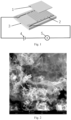
- gas-sensitive material layer 2 metal interdigital electrode 3: silicon substrate 4: power source meter 5: ohmmeter
- the present disclosure provides a gas-sensitive material, wherein the gas-sensitive material is a carbon material-metal oxide composite nanomaterial formed by compounding a carbon material and metal oxides, the content of the carbon material is 0.5 ⁇ 20 wt.% and the content of the metal oxides is 80 ⁇ 99.5 wt.% in the carbon material-metal oxide composite nanomaterial; and the metal oxides contain tungsten oxide and one or more selected from tin oxide, iron oxide, titanium oxide, copper oxide, molybdenum oxide and zinc oxide, wherein the metal oxides are formed on the carbon material in the form of nanowires, and the nanowires are tungsten oxide-doped nanowires.
- the gas-sensitive material is a carbon material-metal oxide composite nanomaterial formed by compounding a carbon material and metal oxides
- the content of the carbon material is 0.5 ⁇ 20 wt.% and the content of the metal oxides is 80 ⁇ 99.5 wt.% in the carbon material-metal oxide composite nanomaterial
- the metal oxides contain tungs
- tungsten oxide-doped nanowire refers to a structure in which one or more selected from tin oxide, iron oxide, titanium oxide, copper oxide, molybdenum oxide and zinc oxide are doped into tungsten oxide nanowires.
- tin oxide examples include: stannous oxide and tin dioxide, etc.; preferably tin dioxide.
- iron oxide examples include: ferric oxide, ferrous oxide, and ferroferric oxide, etc.; preferably ferric oxide.
- titanium oxide examples include: titanium dioxide and titanium suboxide, etc.; preferably titanium dioxide.
- Examples of the copper oxide include: copper oxide and cuprous oxide, etc.; preferably copper oxide.
- molybdenum oxide examples include: molybdenum dioxide and molybdenum trioxide, etc.; preferably molybdenum trioxide.
- Examples of the zinc oxide include: zinc oxide and zinc peroxide, etc.; preferably zinc oxide.
- the inventor has found that the gas sensing performance can be significantly improved if the metal oxides are formed on the carbon material in the form of nanowires and the metal oxides have a structure of tungsten oxide-doped nanowires.
- the diameter of the nanowires is 10 ⁇ 100 nm, more preferably is 15 ⁇ 80 nm, further preferably is 15 ⁇ 50 nm, still further preferably is 18 ⁇ 40 nm.
- the length of the nanowires is 500 ⁇ 10,000 nm, more preferably is 500 ⁇ 8,000 nm, further preferably is 550 ⁇ 7,000 nm, still further preferably is 550 ⁇ 5,000 nm.
- the metal oxides contain WO 3 and one or more selected from SnO 2 , Fe 2 O 3 , TiO 2 , CuO, MoO 3 and ZnO; more preferably, the metal oxides contain WO 3 and one or more selected from SnO 2 , Fe 2 O 3 , TiO 2 , CuO and MoO 3 .
- the gas sensing performance can be further improved by means of the above combinations.
- the content of the tungsten oxide preferably is 60 ⁇ 99.5 wt.%, more preferably is 70 ⁇ 99.5 wt.%.
- the tungsten oxide preferably is tungsten trioxide.
- the gas-sensitive material can self-heat up to 200°C solely at the measuring voltage. Therefore, the measuring voltage is low and the power consumption is low.
- the consumed power is 9,000 ⁇ W or lower; preferably, when the gas-sensitive material self-heats up from 25°C to 200°C solely at the measuring voltage, the consumed power preferably is 8,800 ⁇ W or lower, further preferably is 8,500 ⁇ W or lower, still further preferably is 8,000 ⁇ W or lower, still further preferably is 7,000 ⁇ W or lower, still further preferably is 6,000 ⁇ W or lower, still further preferably is 5,000 ⁇ W or lower, still further preferably is 4,000 ⁇ W or lower, and particularly preferably is 3,000 ⁇ W or lower.
- the consumed power preferably is 1,000 ⁇ W or higher, more preferably is 1,500 ⁇ W or higher, further preferably is 1,800 ⁇ W or higher
- the consumed power preferably is 2,000 ⁇ W or lower, further preferably is 1,800 ⁇ W or lower, still further preferably is 1,600 ⁇ W or lower, still further preferably is 1,400 ⁇ W or lower, still further preferably is 1,200 ⁇ W or lower, still further preferably is 1,000 ⁇ W or lower, and particularly preferably is 800 ⁇ W or lower.
- the consumed power preferably is 180 ⁇ W or higher, more preferably is 200 ⁇ W or higher, further preferably is 250 ⁇ W or higher, and still further preferably is 500 ⁇ W or higher.
- the consumed power preferably is 120 ⁇ W or lower, further preferably is 110 ⁇ W or lower, still further preferably is 90 ⁇ W or lower, still further preferably is 85 ⁇ W or lower, and particularly preferably is 70 ⁇ W or lower.
- the consumed power preferably is 10 ⁇ W or higher, more preferably is 15 ⁇ W or higher, further preferably is 20 ⁇ W or higher, and still further preferably is 50 ⁇ W or higher.
- the measuring voltage may be 1 ⁇ 20V, specifically 1V, 2V, 3V, 4V, 5V, 6V, 7V, 8V, 9V, 10V, 11V, 12V, 13V, 14V, 15V, 16V, 17V, 18V, 19V or 20V, etc..
- the content of the carbon material is 0.5 ⁇ 20 wt.%, and the content of the metal oxides is 80 ⁇ 99.5 wt.% in the carbon material-metal oxide composite nanomaterial; to reduce the working temperature, reduce the energy consumption, and improve the response rate and response recovery rate, preferably the content of the carbon material is 0.5 ⁇ 15 wt.% and the content of the metal oxides is 85 ⁇ 99.5 wt.% in the carbon material-metal oxide composite nanomaterial.
- the content of the carbon material is higher than 20 wt.%, the gas-sensitive material has lowered resistance and lowered gas response rate and response recovery rate.
- the content of the carbon material is lower than 0.5 wt.%, the gas-sensitive material has increased resistance, higher working temperature, increased heating voltage, and increased energy consumption.
- the resistance of the carbon material-metal oxide composite nanomaterial is 0.1 ⁇ 110 kQ, more preferably is 1 ⁇ 100 kQ.
- the carbon material may be any carbon material commonly used in the art; preferably, the carbon material is one or more of graphene, carbon nanotubes, fullerene and carbon black.
- the carbon material-metal oxide composite nanomaterial may be in a flaky shape, granular shape or linear shape, preferably is a flaky shape.
- the thickness may be 0.5 ⁇ 100 nm, and the longest distance between two points may be 0.1 ⁇ 50 ⁇ m; preferably, the thickness may be 1 ⁇ 50 nm, and the longest distance between two points may be 0.1 ⁇ 40 ⁇ m.
- the particle diameter may be 10 ⁇ 800 nm, preferably is 10 ⁇ 700 nm.
- the diameter may be 1 ⁇ 100 nm, and the length may be 0.1 ⁇ 200 ⁇ m; preferably, the diameter is 1 ⁇ 50 nm and the length is 0.1 ⁇ 100 ⁇ m.
- the present disclosure provides a method for preparing a gas-sensitive material, comprising the steps of carrying out heat treatment on a carbon material, and metal oxides and/or metal oxide precursors under microwaves in the presence of an alcohol solvent, and then carrying out solid-liquid separation, to obtain a carbon material-metal oxide composite nanomaterial, wherein the metal oxides contain tungsten oxide and one or more selected from tin oxide, iron oxide, titanium oxide, copper oxide, molybdenum oxide and zinc oxide; the metal oxide precursors are alcohol-soluble tungsten salt and one or more selected from alcohol-soluble tin salt, alcohol-soluble iron salt, alcohol-soluble titanium salt, alcohol-soluble copper salt, alcohol-soluble molybdenum salt and alcohol-soluble zinc salt.
- no surfactant is used in the heat treatment.
- the raw material can be heated up to a target temperature by means of microwaves; in addition, since the heat is generated by molecular vibration, the reaction heat field distribution is more uniform, the morphology of the product is more uniform, and the carbon material has very high microwave absorption performance and can absorb microwaves quickly and convert the microwaves into heat energy. Therefore, by preparing the carbon material-metal oxide nanomaterial through microwave synthesis, less time is consumed, the yield is higher, and the quality is higher.
- the amount of the carbon material is 0.5 ⁇ 20 wt.%, and the amount of the metal oxides is 80 ⁇ 99.5 wt.%; more preferably, based on the total weight of the carbon material and the metal oxides, the amount of the carbon material is 0.5 ⁇ 15 wt.%, and the amount of the metal oxides is 85 ⁇ 99.5 wt.%.
- the amount of the carbon material is 0.5 ⁇ 20 wt.%, and the amount of the metal oxide precursors measured in the metal oxides is 80 ⁇ 99.5 wt.%; more preferably, based on the total weight of the carbon material and the metal oxide precursors measured in the metal oxides, the amount of the carbon material is 0.5 ⁇ 15 wt.%, and the amount of the metal oxide precursors measured in the metal oxides is 85 ⁇ 99.5 wt.%.
- the carbon material may be any carbon material commonly used in the art; preferably, the carbon material is one or more of graphene, carbon nanotubes, fullerene and carbon black.
- the inventor has also found that the gas sensing performance can be further improved if the metal oxides contain WO 3 and one or more selected from SnO 2 , Fe 2 O 3 , TiO 2 , CuO, MoO 3 and ZnO. More preferably, the metal oxides contain WO 3 and one or more selected from SnO 2 , Fe 2 O 3 , TiO 2 , CuO and MoO 3 .
- the alcohol-soluble salts may be various salts that can form the metal oxides after the heat treatment and can be dissolved in an alcohol solvent, or can be dissolved in an alcohol solvent in the presence of a solubilizer.
- the solubilizer is a solubilizer that can be removed in the heat treatment process, thus there is no adverse effect to the preparation of the catalyst and the performance of the product even when the solubilizer is used.
- the alcohol-soluble tungsten salt may be one or more of tungsten chloride, tungsten iodide and hexacarbonyl tungsten.
- the alcohol-soluble tin salt may be one or more of tin chloride, tin bromide and tin iodide.
- the alcohol-soluble iron salt may be one or more of iron chloride, iron bromide, iron nitrate and carbonyl iron.
- the alcohol-soluble titanium salt may be one or more of titanium chloride, titanium bromide and titanium iodide.
- the alcohol-soluble copper salt may be one or more of copper chloride, copper bromide and copper nitrate.
- the alcohol-soluble molybdenum salt may be one or more of molybdenum chloride, molybdenum bromide and molybdenum iodide.
- the alcohol-soluble zinc salt may be one or more of zinc chloride, zinc iodide, zinc bromide and zinc nitrate.
- the content of the tungsten oxide preferably is 60 ⁇ 99.5 wt.%, more preferably is 70 ⁇ 99.5 wt.%. Furthermore, measured in the metal oxides, the amount of the alcohol-soluble tungsten salt in the metal oxide precursors is 60 ⁇ 99.5 wt.%, more preferably is 70 ⁇ 99.5 wt.%.
- the alcohol solvent may be one or more of ethanol, ethylene glycol and glycerin, for example.
- the alcohol solvent is ethanol.
- the amount of the solvent is 500 ⁇ 100,000 pbw.
- the conditions of the heat treatment include: microwave power: 200 ⁇ 1,800 W; heat treatment temperature: 160 ⁇ 220°C; and heat treatment time: 10 ⁇ 240 min.; more preferably, microwave power: 200 ⁇ 1,200 W; heat treatment temperature: 180 ⁇ 220°C; and heat treatment time: 30 ⁇ 150 min.; further preferably, microwave power: 300 ⁇ 1,000 W; heat treatment temperature: 180 ⁇ 190°C; and heat treatment time: 40 ⁇ 140 min.
- solid-liquid separation is carried out after the heat treatment, and the solid-liquid separation method may be any method usually used for separating solid and liquid in the art, such as centrifugation or filtration.
- the method further comprises a step of washing and drying the carbon material-metal oxide composite nanomaterial obtained through separation.
- the washing preferably is carried out with the solvent used in the heat treatment, for example, ethanol.
- the drying may be carried out at 60 ⁇ 100°C for 2 ⁇ 10 hours, for example.
- the method further comprises a step of reducing the carbon material-metal oxide composite nanomaterial with a reducing agent; or the method further comprises a step of thermally reducing the carbon material-metal oxide composite nanomaterial.
- the reduction step the power consumption can be further reduced and the sensitivity can be improved.
- a mass ratio of the carbon material-metal oxide composite nanomaterial measured in carbon element to the reductant is 1 : (0.1 ⁇ 20), more preferably is 1 : (0.1- ⁇ 10).
- the reductant is one or more of sodium borohydride, lithium aluminum hydride, hydrogen iodide, hydrogen bromide, thiourea, ethanethiol, sodium persulfate, hydrazine hydrate, pyrrole, urea, ethanol, ascorbic acid, glucose, aluminum-hydrochloric acid, iron-hydrochloric acid, zinc-sodium hydroxide, zinc-ammonium hydroxide, glycine, lysine and green tea.
- the conditions of the reduction treatment include: reduction treatment temperature: 200 ⁇ 500°C; and reduction treatment time: 0.1 ⁇ 12 h.
- the temperature may be 200 ⁇ 1,000°C.
- the temperature is higher than the melting points of the metal oxides, the morphology will change and the gas sensing performance may be affected.
- the heating temperature is higher than 1,000°C, a carbothermic reaction will happen between the metal oxide and the carbon material, thus affecting the composition of the product.
- the temperature is lower than 200°C, the degree of reduction will be too low, and the resistance will still be high.
- the present disclosure provides a self-heating gas sensor based on Joule principle, comprising a chip carrier and a gas-sensitive material supported on the chip carrier, wherein the gas-sensitive material is the gas-sensitive material for a self-heating gas sensor based on Joule principle in the present disclosure.
- the chip carrier is a ceramic tube and/or a MEMS chip.
- the MEMS chip may be, for example, the chip shown in Fig. 1 , which comprises a silicon substrate 3 and metal interdigital electrodes 2 formed on the silicon substrate 3, wherein the metal interdigital electrodes 2 are used for current transmission; the silicon substrate 3 provides support for the entire MEMS chip, and has functions of electrical insulation and heat insulation as well.
- the gas-sensitive material is supported on the chip carrier by dripping, gas spraying, micro-spraying, deposition, or coating.
- the gas-sensitive material Before the gas-sensitive material is coated with a coating method, it can be dispersed in an appropriate organic solvent (e.g., ethanol, acetone, glycerol, or terpineol, etc.), and then be ground in an agate mortar, so that the gas-sensitive material is dispersed uniformly in the organic solvent.
- the mass ratio of the organic solvent to the gas-sensitive material may be (0.1-10): 1, preferably is 1: 1. If the organic solvent is excessive, the gas-sensitive material dispersion liquid will be too thin to be coated on the substrate. If the amount of the organic solvent is too small, the gas-sensitive material dispersion liquid will be too thick, resulting in unevenly distributed coating on the substrate and compromised gas sensing performance. Different kinds of organic solvents have different boiling points.
- the boiling point is 80 ⁇ 250°C. If the boiling point is too low, the organic solvent will volatilize too quickly in the drying process, which may lead to cracks. If the boiling point is too high, the organic solvent will volatilize too slowly; consequently, it will be difficult to remove the organic solvent.
- the present disclosure provides a use of the gas-sensitive material provided by the present disclosure in self-heating gas sensors based on Joule principle.
- the centrifuged sample was loaded into an oven and dried at 80°C for 6 hours to obtain a carbon material-metal oxide composite nanomaterial A1 (a flaky nanomaterial, the thickness was 1 ⁇ 2 nm, and the longest linear distance between two points was 1 ⁇ 5 ⁇ m), wherein the content of the carbon material was 2.5 wt.%, the content of the metal oxide was 97.5 wt.%, and the resistance was 30 kQ; based on the total weight of the metal oxides, the content of the tungsten trioxide was 80 wt.% and the content of the tin oxide was 20 wt.%.
- Fig. 2 is a SEM image of the flaky nanomaterial obtained in Example 1.
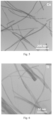
- Fig. 3 is a TEM image of the nanowires formed by the flaky nanomaterial on the surface of the carbon material obtained in Example 1.
- the flaky nanomaterial has a structure in which nanowires are formed on the surface of the carbon material, and the nanowires have 20 ⁇ 30 nm diameter and 600 ⁇ 4,000 nm length.
- the nanowires contain oxygen, tungsten and tin elements; according to the peak positions in the XPS spectrogram, the valence states of tungsten and tin elements are +6 and +4 respectively; through an XRD test, the peak positions of the above nanowires are compared with tungsten trioxide and tin dioxide in a PDF card.
- the centrifuged sample was loaded into an oven and dried at 80°C for 6 hours to obtain a carbon material-metal oxide composite nanomaterial A2 (a linear nanomaterial, the diameter was 5 ⁇ 15 nm, and the length was 10 ⁇ 30 ⁇ m), wherein the content of the carbon material is 2.5 wt.%, the content of the metal oxide is 97.5 wt.%, and the resistance is 56 kQ; based on the total weight of the metal oxides, the content of the tungsten trioxide is 80 wt.% and the content of the tin oxide is 20 wt.%.
- nanowires are formed on the surface of the carbon material, the diameter of the nanowires is 20 ⁇ 30 nm, and the length of the nanowires is 600 ⁇ 4,000 nm.
- the nanowires contain oxygen, tungsten and tin elements; according to the peak positions in the XPS spectrogram, the valence states of tungsten and tin elements are +6 and +4 respectively; through an XRD test, the peak positions of the above nanowires are compared with tungsten trioxide and tin dioxide in a PDF card.
- the centrifuged sample was loaded into an oven and dried at 80°C for 6 hours to obtain a carbon material-metal oxide composite nanomaterial A4 (a flaky nanomaterial, the thickness was 1 ⁇ 2 nm, and the longest linear distance between two points was 1 ⁇ 5 ⁇ m), wherein the content of the carbon material is 2.5 wt.%, the content of the metal oxide is 97.5 wt.%, and the resistance is 33 kQ; based on the total weight of the metal oxides, the content of the tungsten trioxide is 70 wt.% and the content of the ferric oxide is 30 wt.%.
- Fig. 4 is a TEM image of the nanowires formed by the flaky nanomaterial on the surface of the carbon material obtained in Example 3. It is seen from the SEM image and TEM image of the linear nanomaterial obtained in Example 3, in the structure of the flaky nanomaterial, nanowires are formed on the surface of the carbon material, the diameter of the nanowires is 20 ⁇ 30 nm, and the length of the nanowires is 600 ⁇ 4,000 nm.
- the nanowires contain oxygen, tungsten and iron elements; according to the peak positions in the XPS spectrogram, the valence states of tungsten and iron elements are +6 and +3 respectively; through an XRD test, the peak positions of the above nanowires are compared with tungsten trioxide and ferric oxide in a PDF card.
- the centrifuged sample was loaded into an oven and dried at 80°C for 6 hours to obtain a carbon material-metal oxide composite nanomaterial A5 (a flaky nanomaterial, the thickness was 1 ⁇ 2 nm, and the longest linear distance between two points was 1 ⁇ 5 ⁇ m), wherein the content of the carbon material is 2.5 wt.%, the content of the metal oxide is 97.5 wt.%, and the resistance is 61 kQ; based on the total weight of the metal oxides, the content of the tungsten trioxide is 80 wt.% and the content of the copper oxide is 20 wt.%.
- Fig. 5 is a TEM image of the nanowires formed by the flaky nanomaterial on the surface of the carbon material obtained in Example 4. It is seen from the SEM image and TEM image of the linear nanomaterial obtained in Example 4, in the structure of the flaky nanomaterial, nanowires are formed on the surface of the carbon material, the diameter of the nanowires is 20 ⁇ 30 nm, and the length of the nanowires is 600 ⁇ 4,000 nm.
- the nanowires contain oxygen, tungsten and copper elements; according to the peak positions in the XPS spectrogram, the valence states of tungsten and copper elements are +6 and +2 respectively; through an XRD test, the peak positions of the above nanowires are compared with tungsten trioxide and copper oxide in a PDF card.
- the centrifuged sample was loaded into an oven and dried at 80°C for 6 hours to obtain a carbon material-metal oxide composite nanomaterial A6 (a flaky nanomaterial, the thickness was 1 ⁇ 2 nm, and the longest linear distance between two points was 1 ⁇ 5 ⁇ m), wherein the content of the carbon material is 2.5 wt.%, the content of the metal oxide is 97.5 wt.%, and the resistance is 55 kQ; based on the total weight of the metal oxides, the content of the tungsten trioxide is 84.7 wt.% and the content of the titanium dioxide is 15.3 wt.%.
- Fig. 6 is a TEM image of the nanowires formed by the flaky nanomaterial on the surface of the carbon material obtained in Example 5. It is seen from the SEM image and TEM image of the linear nanomaterial obtained in Example 5, in the structure of the flaky nanomaterial, nanowires are formed on the surface of the carbon material, the diameter of the nanowires is 20 ⁇ 30 nm, and the length of the nanowires is 600 ⁇ 4,000 nm.
- the nanowires contain oxygen, tungsten and titanium elements; according to the peak positions in the XPS spectrogram, the valence states of tungsten and titanium elements are +6 and +4 respectively; through an XRD test, the peak positions of the above nanowires are compared with tungsten trioxide and titanium dioxide in a PDF card.
- the centrifuged sample was loaded into an oven and dried at 80°C for 6 hours to obtain a carbon material-metal oxide composite nanomaterial A7 (a flaky nanomaterial, the thickness was 1 ⁇ 2 nm, and the longest linear distance between two points was 1 ⁇ 5 ⁇ m), wherein the content of the carbon material is 2.5 wt.%, the content of the metal oxide is 97.5 wt.%, and the resistance is 50 kQ; based on the total weight of the metal oxides, the content of the tungsten trioxide is 81.6 wt.% and the content of the molybdenum trioxide is 18.4 wt.%.
- nanowires are formed on the surface of the carbon material, the diameter of the nanowires is 20 ⁇ 30 nm, and the length of the nanowires is 600 ⁇ 4,000 nm.
- the nanowires contain oxygen, tungsten and molybdenum elements; according to the peak positions in the XPS spectrogram, the valence states of tungsten and molybdenum elements are +6 and +6 respectively; through an XRD test, the peak positions of the above nanowires are compared with tungsten trioxide and molybdenum trioxide in a PDF card.
- a carbon material-metal oxide composite nanomaterial A1 was prepared with the method in Example 1, then 100 mg carbon material-metal oxide composite nanomaterial A1 was weighed accurately and the sample was added into a 50 mL beaker, 200 ⁇ L hydrazine hydrate was added dropwise, the beaker was sealed with a plastic wrap, placed in water bath, and kept at 90°C constant temperature for 5 hours; thus a carbon material-metal oxide composite nanomaterial A8 in which the degree of reduction of graphene was improved was obtained.
- the preparation was carried out with the method in Example 1, but the tungsten chloride and SnCl 4 were replaced with tungsten chloride, and a reduced graphene WO 3 nanomaterial D1 was obtained, wherein the content of the carbon material was 0.4 wt.%, the content of the metal oxides was 99.6 wt.%, and the resistance was 120 k ⁇ .
- the preparation was carried out with the method in Example 1, but the tungsten chloride and SnCl 4 were replaced with tungsten chloride, and a reduced graphene WO 3 nanomaterial D2 was obtained, wherein the content of the carbon material was 25 wt.%, the content of the metal oxides was 75 wt.%, and the resistance was 500 k ⁇ .
- the centrifuged sample was loaded into an oven and dried at 80°C for 6 hours to obtain a reduced graphene WO 3 nanomaterial D3 (a flaky nanomaterial, the thickness was 1 ⁇ 2 nm, and the longest linear distance between two points was 1 ⁇ 5 ⁇ m), wherein the content of the carbon material was 2.5 wt.%, the content of the metal oxides was 97.5 wt.%, and the resistance was 40 kSZ.
- the centrifuged sample was loaded into an oven and dried at 80°C for 6 hours to obtain a carbon nanotubes WO 3 nanomaterial D4 (a linear nanomaterial, the diameter was 5 ⁇ 15 nm, and the length was 10 ⁇ 30 ⁇ m), wherein the content of the carbon material was 2.5 wt.%, the content of the metal oxides was 97.5 wt.%, and the resistance was 60 kSZ.
- the preparation was carried out with the method in Example 3, but the tungsten chloride was replaced with copper chloride; thus, a reduced graphene copper oxide nanomaterial D6 (a flaky nanomaterial, the thickness was 1 ⁇ 2nm, the longest linear distance between two points was 1 ⁇ 5 ⁇ m) was obtained, wherein the content of the carbon material was 2.5 wt.%, the content of the metal oxides was 97.5 wt.%, and the resistance was 70 kS2.
- the preparation was carried out with the method in Example 3, but the tungsten chloride was replaced with molybdenum chloride; thus, a reduced graphene molybdenum oxide nanomaterial D7 (a flaky nanomaterial, the thickness was 1 ⁇ 2nm, the longest linear distance between two points was 1 ⁇ 5 ⁇ m) was obtained, wherein the content of the carbon material was 2.5 wt.%, the content of the metal oxides was 97.5 wt.%, and the resistance was 80 kSZ.
- planar multilayer electrodes purchased from Beijing Elite Technology Co., Ltd..
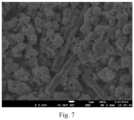
- Fig. 7 is a SEM image of the nanomaterial obtained in Comparative Example 8. It is seen from Fig. 7 that rod-shaped and sphere-shaped nano-WO 3 structures are obtained after ethanol is replaced with water.
- the preparation was carried out with the method in Example 1, but a surfactant urea was added in the microwave synthesis; thus, a carbon material-metal oxide composite nanomaterial D9 was obtained. It is seen from the SEM image that irregular semi-tubular nano-WO 3 structures were obtained.
- Gas sensors were prepared with the nanomaterials A1 ⁇ A7 obtained in Examples 1 ⁇ 7 and the materials D1 ⁇ D6 obtained in Comparative Examples 1 ⁇ 6 respectively.
- the preparation method is as follows: 100 mg nanomaterial was weighed accurately and added into an agate mortar, 100 ⁇ L terpineol was added into the agate mortar, and the mixture was ground for 10 minutes; the ground slurry was coated uniformly with a writing brush on the metal interdigital electrodes 2 of a MEMS chip to form a gas-sensitive material layer 1, then the MEMS chip was heated up to 80°C in an oven and kept at the temperature for 12 hours.
- the MEMS chip was connected to a test base by means of a wire bonding machine, and the base was inserted into an aging tester and aged for 7 days at 400°C; thus, gas sensors B1 ⁇ B7 and DB1 ⁇ DB6 were obtained.
- planar multi-layer electrodes purchased from Beijing Elite Technology Co., Ltd. were used as DB7.
- a power source meter 4 and an ohmmeter 5 were connected to the gas sensors respectively, and the power source meter was used to provide a voltage to heat up the gas sensors B1 ⁇ B9 and DB1 ⁇ DB8 from 25°C respectively; thus, power values under different temperature conditions were obtained.
- the result is shown in Table 1.
Landscapes
- Chemical & Material Sciences (AREA)
- Organic Chemistry (AREA)
- Engineering & Computer Science (AREA)
- Inorganic Chemistry (AREA)
- Nanotechnology (AREA)
- Materials Engineering (AREA)
- General Physics & Mathematics (AREA)
- Physics & Mathematics (AREA)
- Health & Medical Sciences (AREA)
- Life Sciences & Earth Sciences (AREA)
- Biochemistry (AREA)
- General Health & Medical Sciences (AREA)
- Analytical Chemistry (AREA)
- Immunology (AREA)
- Pathology (AREA)
- Chemical Kinetics & Catalysis (AREA)
- Electrochemistry (AREA)
- Condensed Matter Physics & Semiconductors (AREA)
- Crystallography & Structural Chemistry (AREA)
- Medicinal Chemistry (AREA)
- Food Science & Technology (AREA)
- Combustion & Propulsion (AREA)
- Composite Materials (AREA)
- Manufacturing & Machinery (AREA)
- Investigating Or Analyzing Materials By The Use Of Fluid Adsorption Or Reactions (AREA)
- Inorganic Compounds Of Heavy Metals (AREA)
- Carbon And Carbon Compounds (AREA)
- Compounds Of Iron (AREA)
Claims (14)
- Gasempfindliches Material, wobei das gasempfindliche Material ein Kohlenstoffmaterial-Metalloxid-Nanokompositmaterial ist, das durch Compoundieren von einem Kohlenstoffmaterial und Metalloxiden gebildet wird, wobei in dem Kohlenstoffmaterial-Metalloxid-Nanokompositmaterial der Gehalt des Kohlenstoffmaterials 0,5-20 Gew.-% beträgt und der Gehalt der Metalloxide 80-99,5 Gew.-% beträgt; und die Metalloxide Wolframoxid und eines oder mehrere, ausgewählt aus Zinnoxid, Eisenoxid, Titanoxid, Kupferoxid, Molybdänoxid und Zinkoxid, enthalten
wobei die Metalloxide auf dem Kohlenstoffmaterial in Form von Nanodrähten gebildet sind und die Nanodrähte Wolframoxid-dotierte Nanodrähte sind; wobei der Durchmesser der Nanodrähte 10-100 nm beträgt und die Länge der Nanodrähte 500-10.000 nm beträgt. - Gasempfindliches Material gemäß Anspruch 1, wobei die Metalloxide WO3 und eines oder mehrere, ausgewählt aus SnO2, Fe2O3, TiO2, CuO, MoO3 und ZnO, enthalten;die Metalloxide bevorzugt WO3 und eines oder mehrere, ausgewählt aus SnO2, Fe2O3, TiO2, CuO und MoO3, enthalten;der Gehalt des Wolframoxid bevorzugt 60-99,5 Gew.-%, bezogen auf das Gesamtgewicht der Metalloxide, beträgt;die Nanodrähte bevorzugt mit Wolframtrioxid dotierte Nanodrähte sind.
- Gasempfindliches Material gemäß Anspruch 1, wobei in dem Kohlenstoffmaterial-Metalloxid-Nanokompositmaterial der Gehalt des Kohlenstoffmaterials 0,5-15 Gew.-% beträgt und der Gehalt der Metalloxide 85-99,5 Gew.-% beträgt.
- Gasempfindliches Material gemäß einem der Ansprüche 1-3, wobei das Kohlenstoffmaterial eines oder mehrere von Graphen, Kohlenstoff-Nanoröhrchen, Fulleren und Ruß ist.
- Verfahren zur Herstellung eines gasempfindlichen Materials gemäß einem der Ansprüche 1-4, umfassend die Schritte des Durchführens einer Wärmebehandlung an einem Kohlenstoffmaterial und Metalloxiden und/oder Metalloxidvorläufern unter Mikrowellen in Gegenwart eines Alkohol-Lösungsmittels und des anschließenden Durchführens einer Fest-Flüssig-Trennung, um ein Kohlenstoffmaterial-Metalloxid-Nanokompositmaterial zu erhalten,wobei die Metalloxide Wolframoxid und eines oder mehrere, ausgewählt aus Zinnoxid, Eisenoxid, Titanoxid, Kupferoxid, Molybdänoxid und Zinkoxid, enthalten;die Metalloxidvorläufer alkohollösliches Wolframsalz und eines oder mehrere, ausgewählt aus alkohollöslichem Zinnsalz, alkohollöslichem Eisensalz, alkohollöslichem Titansalz, alkohollöslichem Kupfersalz, alkohollöslichem Molybdänsalz und alkohollöslichem Zinksalz, sind.
- Verfahren gemäß Anspruch 5, wobei bei der Wärmebehandlung kein Tensid verwendet wird.
- Verfahren gemäß Anspruch 5, wobei, bezogen auf das Gesamtgewicht des Kohlenstoffmaterials und der Metalloxide, die Menge des Kohlenstoffmaterials 0,5-20 Gew.-% beträgt und die Menge der Metalloxide 80-99,5 Gew.-% beträgt;bezogen auf das Gesamtgewicht des Kohlenstoffmaterials und der Metalloxidvorläufer, gemessen als die Metalloxide, die Menge des Kohlenstoffmaterials bevorzugt 0,5-20 Gew.-% beträgt und die Menge der Metalloxidvorläufer, gemessen als die Metalloxide, bevorzugt 80-99,5 Gew.-% beträgt;das Kohlenstoffmaterial bevorzugt eines oder mehrere von Graphen, Kohlenstoff-Nanoröhrchen, Fulleren und Ruß ist;die Metalloxide bevorzugt WO3 und eines oder mehrere, ausgewählt aus SnO2, Fe2O3, TiO2, CuO, MoO3 und ZnO, enthalten; die Metalloxide mehr bevorzugt WO3 und eines oder mehrere, ausgewählt aus SnO2, Fe2O3, TiO2, CuO und MoO3, enthalten;die Metalloxidvorläufer bevorzugt Wolframchlorid und eines oder mehrere, ausgewählt aus Zinnchlorid, Eisenchlorid, Titanchlorid, Kupferchlorid, Molybdänchlorid und Zinkchlorid, sind; die Metalloxidvorläufer mehr bevorzugt Wolframchlorid und mindestens eines, ausgewählt aus Zinnchlorid, Eisenchlorid, Titanchlorid, Kupferchlorid und Molybdänchlorid, sind.
- Verfahren gemäß Anspruch 7, wobei der Gehalt des Wolframoxids, gemessen im Gesamtgewicht der Metalloxide, 60-99,5 Gew.-% beträgt;
die Menge des alkohollöslichen Wolframsalzes in den Metalloxidvorläufern, gemessen als die Metalloxide, bevorzugt 60-99,5 Gew.-% beträgt. - Verfahren gemäß einem der Ansprüche 6-8, wobei das Alkohol-Lösungsmittel Ethanol ist; die Menge des Lösungsmittels, bezogen auf das Gesamtgewicht des Kohlenstoffmaterials, der Metalloxide und der Metalloxidvorläufer, gemessen als 100 Gewichtsteile, bevorzugt 500 bis 100.000 Gewichtsteile beträgt.
- Verfahren gemäß einem der Ansprüche 6-9, wobei die Bedingungen der Wärmebehandlung beinhalten:Mikrowellenleistung: 200-1.800 W;Wärmebehandlungstemperatur: 160-220°C; undWärmebehandlungszeit: 10-240 min;das Verfahren bevorzugt ferner einen Schritt des Trocknens des durch Trennen erhaltenen Kohlenstoffmaterial-Metalloxid-Nanokompositmaterials umfasst.
- Verfahren gemäß einem der Ansprüche 6-10, ferner umfassend einen Schritt des Reduzierens des Kohlenstoffmaterial-Metalloxid-Nanokompositmaterials mit einem Reduktionsmittel;wobei ein Massenverhältnis des Kohlenstoffmaterial-Metalloxid-Nanokompositmaterials, gemessen als Kohlenstoffelement, zum Reduktionsmittel 1 : (0,1-20) beträgt;das Reduktionsmittel bevorzugt eines oder mehrere von Natriumborhydrid, Lithiumaluminiumhydrid, Iodwasserstoff, Bromwasserstoff, Thioharnstoff, Ethanthiol, Natriumpersulfat, Hydrazinhydrat, Pyrrol, Harnstoff, Ethanol, Ascorbinsäure, Glucose, Aluminium-Chlorwasserstoffsäure, Eisen-Chlorwasserstoffsäure, Zink-Natriumhydroxid, Zink-Ammoniumhydroxid, Glycin, Lysin und grünem Tee ist;die Bedingungen der Reduktionsbehandlung bevorzugt beinhalten: Reduktionsbehandlungstemperatur: 200-500°C; und Reduktionsbehandlungszeit: 0,1-12 h.
- Selbsterwärmender Gassensor, basierend auf dem Joule-Prinzip, umfassend einen Chipträger und ein auf dem Chipträger geträgertes gasempfindliches Material, wobei das gasempfindliche Material das gasempfindliche Material für einen selbsterwärmenden Gassensor, basierend auf dem Joule-Prinzip, gemäß einem der Ansprüche 1-5 ist, wobei der Chipträger ein Keramikrohr und/oder ein MEMS-Chip ist.
- Selbsterwärmender Gassensor gemäß Anspruch 12, wobei das gasempfindliche Material auf dem Chipträger durch Tropfen, Gassprühen, Mikrosprühen, Abscheiden oder Beschichten aufgebracht ist.
- Verwendung des gasempfindlichen Materials gemäß einem der Ansprüche 1-5 in selbsterwärmenden Gassensoren, basierend auf dem Joule-Prinzip.
Applications Claiming Priority (2)
| Application Number | Priority Date | Filing Date | Title |
|---|---|---|---|
| CN202010280974.5A CN113511646A (zh) | 2020-04-10 | 2020-04-10 | 自加热气体传感器、气敏材料及其制备方法和应用 |
| PCT/CN2021/073734 WO2021203804A1 (zh) | 2020-04-10 | 2021-01-26 | 自加热气体传感器、气敏材料及其制备方法和应用 |
Publications (4)
| Publication Number | Publication Date |
|---|---|
| EP4112547A1 EP4112547A1 (de) | 2023-01-04 |
| EP4112547A4 EP4112547A4 (de) | 2023-08-23 |
| EP4112547C0 EP4112547C0 (de) | 2024-07-31 |
| EP4112547B1 true EP4112547B1 (de) | 2024-07-31 |
Family
ID=78022568
Family Applications (1)
| Application Number | Title | Priority Date | Filing Date |
|---|---|---|---|
| EP21785231.8A Active EP4112547B1 (de) | 2020-04-10 | 2021-01-26 | Selbsterwärmender gassensor, gasempfindliches material, herstellungsverfahren dafür und anwendungen davon |
Country Status (5)
| Country | Link |
|---|---|
| US (1) | US12253486B2 (de) |
| EP (1) | EP4112547B1 (de) |
| JP (1) | JP7445016B2 (de) |
| CN (1) | CN113511646A (de) |
| WO (1) | WO2021203804A1 (de) |
Families Citing this family (11)
| Publication number | Priority date | Publication date | Assignee | Title |
|---|---|---|---|---|
| CN114113238A (zh) * | 2021-11-17 | 2022-03-01 | 中国兵器工业集团第二一四研究所苏州研发中心 | 一种基于三维多孔石墨烯@量子点复合材料的气敏传感器及其制备方法 |
| CN114130402B (zh) * | 2021-11-26 | 2024-01-12 | 清华大学深圳国际研究生院 | 一种铁钼负载的藻基碳材料及其制备方法和应用方法 |
| CN114878667B (zh) * | 2022-04-29 | 2024-05-28 | 安徽维纳物联科技有限公司 | 一种一氧化碳传感器及其制备方法 |
| CN114755274B (zh) * | 2022-05-18 | 2025-05-27 | 重庆大学 | 一种WS2/MoO3复合多层次纳米材料的制备方法及应用 |
| CN115259156B (zh) * | 2022-07-18 | 2024-06-25 | 微集电科技(苏州)有限公司 | 能够在室温下检测低浓度no2的气敏元器件及其制备方法 |
| CN115586235B (zh) * | 2022-10-25 | 2025-01-14 | 湖北大学 | 一种气敏传感器及其制备方法和应用 |
| CN116448818A (zh) * | 2023-03-28 | 2023-07-18 | 安徽元琛材料研究设计院有限公司 | 一种ZnO基制冷剂泄漏检测传感器及其制备方法 |
| CN116642928B (zh) * | 2023-05-31 | 2025-08-26 | 安徽大学 | WO3/Al2O3/graphite复合材料及制备与应用 |
| CN116730390A (zh) * | 2023-06-14 | 2023-09-12 | 安徽大学 | 一种钨酸锌/偏锡酸锌复合材料的制备方法及其应用 |
| CN117607219B (zh) * | 2023-11-29 | 2025-04-04 | 中原工学院 | 一种花状MoS2诱导的Fe2O3/Fe2(MoO4)3纳米复合材料及其制备方法和应用 |
| CN118914313B (zh) * | 2024-08-08 | 2025-12-26 | 常州大学 | 一种光辅助增强的自供能电化学传感器的制备方法及应用 |
Family Cites Families (23)
| Publication number | Priority date | Publication date | Assignee | Title |
|---|---|---|---|---|
| KR960031987A (ko) * | 1995-02-24 | 1996-09-17 | 구자홍 | 가스(gas) 센싱소자의 구조 및 제조방법 |
| GB2464516A (en) * | 2008-10-17 | 2010-04-21 | Alireza Salehi | Self heated carbon monoxide sensor |
| CN101439855B (zh) * | 2008-12-24 | 2010-09-08 | 北京科技大学 | 一种纳米SnO2-MWCNTs的微波水热合成方法 |
| CN101824603B (zh) | 2010-06-02 | 2011-11-09 | 福州大学 | 一种复合薄膜气敏传感器的制作方法 |
| CN101913597B (zh) | 2010-09-14 | 2012-03-07 | 武汉理工大学 | 一种氧化钨纳米线与介孔碳纳米复合结构材料 |
| US20120161796A1 (en) | 2010-12-22 | 2012-06-28 | Peter Smith | Co2 sensing materials and sensors incorporating said materials |
| CN102502842B (zh) * | 2011-11-07 | 2014-08-06 | 河北联合大学 | 一种由纳米线组装成辐射状钼酸铜微米球的制备方法 |
| CN102531063A (zh) | 2011-11-20 | 2012-07-04 | 湖南理工学院 | 一种石墨烯负载wo3纳米线复合材料及其制备方法 |
| KR101466310B1 (ko) * | 2013-09-09 | 2014-11-27 | 아주대학교산학협력단 | 금속산화물-그래핀 나노복합체의 제조방법 및 금속산화물-그래핀 나노복합체를 이용한 전극 제조방법 |
| CN104807860B (zh) * | 2014-12-23 | 2017-09-01 | 郑州轻工业学院 | 一种花状纳米wo3/石墨烯复合气敏材料及其制备方法和应用 |
| KR101588169B1 (ko) | 2015-07-28 | 2016-01-25 | 고려대학교 산학협력단 | 나노 기공, 메조 기공 및 마크로 기공이 3차원적으로 상호 연결된 다공성 산화물 반도체, 그 제조방법 및 이를 가스감응물질로 포함하는 가스센서 |
| CN105606659A (zh) * | 2015-08-28 | 2016-05-25 | 天津大学 | 用于低温工作的氧化钨纳米棒结构气敏传感器的制备方法 |
| CN106770476A (zh) * | 2015-11-23 | 2017-05-31 | 天津大学 | 氧化铜/氧化钨一维有序异质包覆结构基气敏元件及其在探测二氧化氮中的应用 |
| CN106596652A (zh) * | 2016-12-06 | 2017-04-26 | 上海第二工业大学 | 一种高灵敏度no2气体传感器的制备方法 |
| CN107298464A (zh) * | 2017-05-24 | 2017-10-27 | 江苏时瑞电子科技有限公司 | 一种碳纳米管气敏材料的制备方法 |
| KR102311971B1 (ko) | 2017-05-24 | 2021-10-12 | 엘지디스플레이 주식회사 | 그래핀-산화주석 나노 복합체의 제조 방법 및 그래핀-산화주석 나노 복합체 |
| CN109839408B (zh) * | 2017-11-24 | 2022-04-12 | 中国科学院大连化学物理研究所 | 一种以纳米复合材料为传感膜的氨气传感器 |
| CN108398408A (zh) * | 2018-02-02 | 2018-08-14 | 上海理工大学 | 一种用于甲醛气体检测的复合气敏材料及其制备方法 |
| CN110161091B (zh) * | 2018-02-13 | 2022-02-15 | 中国石油化工股份有限公司 | 气体传感模块及其制备方法和应用 |
| CN109632895B (zh) * | 2019-01-18 | 2021-04-06 | 重庆大学 | 复合气敏材料及其制备方法与气体传感器及其应用 |
| CN110127671A (zh) * | 2019-06-10 | 2019-08-16 | 中国烟草总公司郑州烟草研究院 | 一种还原氧化石墨烯基复合膜的通用制备方法 |
| CN110498405A (zh) * | 2019-08-21 | 2019-11-26 | 南京倍格电子科技有限公司 | 一种石墨烯/氧化锡复合气敏材料及其制备方法 |
| CN110759376B (zh) * | 2019-09-30 | 2022-02-22 | 南京工业大学 | 一种ZnO掺杂SnO2-石墨烯气凝胶气敏材料的制备方法 |
-
2020
- 2020-04-10 CN CN202010280974.5A patent/CN113511646A/zh active Pending
-
2021
- 2021-01-26 JP JP2022562099A patent/JP7445016B2/ja active Active
- 2021-01-26 WO PCT/CN2021/073734 patent/WO2021203804A1/zh not_active Ceased
- 2021-01-26 US US17/906,232 patent/US12253486B2/en active Active
- 2021-01-26 EP EP21785231.8A patent/EP4112547B1/de active Active
Also Published As
| Publication number | Publication date |
|---|---|
| JP2023520825A (ja) | 2023-05-19 |
| JP7445016B2 (ja) | 2024-03-06 |
| EP4112547A4 (de) | 2023-08-23 |
| EP4112547C0 (de) | 2024-07-31 |
| CN113511646A (zh) | 2021-10-19 |
| US12253486B2 (en) | 2025-03-18 |
| US20230124633A1 (en) | 2023-04-20 |
| WO2021203804A1 (zh) | 2021-10-14 |
| EP4112547A1 (de) | 2023-01-04 |
Similar Documents
| Publication | Publication Date | Title |
|---|---|---|
| US12253486B2 (en) | Self-heating gas sensor, gas-sensitive material, preparation method for same, and applications thereof | |
| Jeevitha et al. | Porous reduced graphene oxide (rGO)/WO 3 nanocomposites for the enhanced detection of NH 3 at room temperature | |
| Sakthivel et al. | Selective ammonia sensor based on copper oxide/reduced graphene oxide nanocomposite | |
| Vaishampayan et al. | Influence of Pd doping on morphology and LPG response of SnO2 | |
| Bonu et al. | Electrochemical supercapacitor performance of SnO2 quantum dots | |
| Han et al. | Coating single-walled carbon nanotubes with tin oxide | |
| Lu et al. | Electrospun ZnO–SnO2 composite nanofibers and enhanced sensing properties to SF6 decomposition byproduct H2S | |
| Yin et al. | Improved gas sensing properties of silver-functionalized ZnSnO 3 hollow nanocubes | |
| Chang et al. | Reduced graphene oxide mediated SnO2 nanocrystals for enhanced gas-sensing properties | |
| Parthibavarman et al. | Effect of copper on structural, optical and electrochemical properties of SnO2 nanoparticles | |
| Kim et al. | H2S gas sensing properties of bare and Pd-functionalized CuO nanorods | |
| Li et al. | Biomass-derived carbon boosted catalytic properties of tungsten-based nanohybrids for accelerating the triiodide reduction in dye-sensitized solar cells | |
| Liu et al. | SnS2 and SnS/SnS2 heterojunction nanosheets prepared by in-situ one-step sulfurization and visible light-assisted electrochemical water splitting properties | |
| Raghu et al. | Nanostructured palladium modified graphitic carbon nitride–high performance room temperature hydrogen sensor | |
| Qiu et al. | Novel polyaniline/titanium nitride nanocomposite: controllable structures and electrical/electrochemical properties | |
| Zou et al. | Pd-doped TiO2@ polypyrrole core-shell composites as hydrogen-sensing materials | |
| CN113511682B (zh) | 掺杂wo3纳米线及其制备方法和气敏传感器 | |
| Kamble et al. | IDE embedded tungsten trioxide gas sensor for sensitive NO2 detection | |
| Adhyapak et al. | Nanostructured WO 3/graphene composites for sensing NO x at room temperature | |
| Singh et al. | Reduced graphene oxide-SnO2 nanocomposite thin film based CNG/PNG sensor | |
| CN101521279A (zh) | 一种锂-二硫化铁电池正极材料、正极片及制备方法 | |
| Cai et al. | Highly sensitive triethylamine sensor with ppb level detection limit based on SnSe nanofibers | |
| Ch et al. | Investigation of hydrogen sensing properties of graphene/Al–SnO2 composite nanotubes derived from electrospinning | |
| Sheng et al. | Sandwich-like porous α-Fe2O3 nanorod arrays/hexagonal boron nitride nanocomposites with improved high-temperature gas sensing | |
| CN115266842A (zh) | WO3/MXene纳米复合薄膜和无线NFC三甲胺传感器及其制备方法和应用 |
Legal Events
| Date | Code | Title | Description |
|---|---|---|---|
| STAA | Information on the status of an ep patent application or granted ep patent |
Free format text: STATUS: THE INTERNATIONAL PUBLICATION HAS BEEN MADE |
|
| PUAI | Public reference made under article 153(3) epc to a published international application that has entered the european phase |
Free format text: ORIGINAL CODE: 0009012 |
|
| STAA | Information on the status of an ep patent application or granted ep patent |
Free format text: STATUS: REQUEST FOR EXAMINATION WAS MADE |
|
| 17P | Request for examination filed |
Effective date: 20220928 |
|
| AK | Designated contracting states |
Kind code of ref document: A1 Designated state(s): AL AT BE BG CH CY CZ DE DK EE ES FI FR GB GR HR HU IE IS IT LI LT LU LV MC MK MT NL NO PL PT RO RS SE SI SK SM TR |
|
| DAV | Request for validation of the european patent (deleted) | ||
| DAX | Request for extension of the european patent (deleted) | ||
| A4 | Supplementary search report drawn up and despatched |
Effective date: 20230726 |
|
| RIC1 | Information provided on ipc code assigned before grant |
Ipc: B82Y 30/00 20110101ALI20230720BHEP Ipc: C01G 49/00 20060101ALI20230720BHEP Ipc: C01G 41/00 20060101ALI20230720BHEP Ipc: C01B 32/194 20170101ALI20230720BHEP Ipc: C01B 32/174 20170101ALI20230720BHEP Ipc: C01B 32/156 20170101ALI20230720BHEP Ipc: G01N 27/12 20060101ALI20230720BHEP Ipc: C01B 32/184 20170101AFI20230720BHEP |
|
| STAA | Information on the status of an ep patent application or granted ep patent |
Free format text: STATUS: EXAMINATION IS IN PROGRESS |
|
| 17Q | First examination report despatched |
Effective date: 20240215 |
|
| GRAP | Despatch of communication of intention to grant a patent |
Free format text: ORIGINAL CODE: EPIDOSNIGR1 |
|
| STAA | Information on the status of an ep patent application or granted ep patent |
Free format text: STATUS: GRANT OF PATENT IS INTENDED |
|
| INTG | Intention to grant announced |
Effective date: 20240508 |
|
| GRAS | Grant fee paid |
Free format text: ORIGINAL CODE: EPIDOSNIGR3 |
|
| GRAA | (expected) grant |
Free format text: ORIGINAL CODE: 0009210 |
|
| STAA | Information on the status of an ep patent application or granted ep patent |
Free format text: STATUS: THE PATENT HAS BEEN GRANTED |
|
| AK | Designated contracting states |
Kind code of ref document: B1 Designated state(s): AL AT BE BG CH CY CZ DE DK EE ES FI FR GB GR HR HU IE IS IT LI LT LU LV MC MK MT NL NO PL PT RO RS SE SI SK SM TR |
|
| REG | Reference to a national code |
Ref country code: CH Ref legal event code: EP Ref country code: GB Ref legal event code: FG4D |
|
| REG | Reference to a national code |
Ref country code: DE Ref legal event code: R096 Ref document number: 602021016555 Country of ref document: DE |
|
| REG | Reference to a national code |
Ref country code: IE Ref legal event code: FG4D |
|
| U01 | Request for unitary effect filed |
Effective date: 20240823 |
|
| U07 | Unitary effect registered |
Designated state(s): AT BE BG DE DK EE FI FR IT LT LU LV MT NL PT RO SE SI Effective date: 20240903 |
|
| PG25 | Lapsed in a contracting state [announced via postgrant information from national office to epo] |
Ref country code: NO Free format text: LAPSE BECAUSE OF FAILURE TO SUBMIT A TRANSLATION OF THE DESCRIPTION OR TO PAY THE FEE WITHIN THE PRESCRIBED TIME-LIMIT Effective date: 20241031 |
|
| PG25 | Lapsed in a contracting state [announced via postgrant information from national office to epo] |
Ref country code: GR Free format text: LAPSE BECAUSE OF FAILURE TO SUBMIT A TRANSLATION OF THE DESCRIPTION OR TO PAY THE FEE WITHIN THE PRESCRIBED TIME-LIMIT Effective date: 20241101 Ref country code: PL Free format text: LAPSE BECAUSE OF FAILURE TO SUBMIT A TRANSLATION OF THE DESCRIPTION OR TO PAY THE FEE WITHIN THE PRESCRIBED TIME-LIMIT Effective date: 20240731 |
|
| PG25 | Lapsed in a contracting state [announced via postgrant information from national office to epo] |
Ref country code: IS Free format text: LAPSE BECAUSE OF FAILURE TO SUBMIT A TRANSLATION OF THE DESCRIPTION OR TO PAY THE FEE WITHIN THE PRESCRIBED TIME-LIMIT Effective date: 20241130 |
|
| PG25 | Lapsed in a contracting state [announced via postgrant information from national office to epo] |
Ref country code: HR Free format text: LAPSE BECAUSE OF FAILURE TO SUBMIT A TRANSLATION OF THE DESCRIPTION OR TO PAY THE FEE WITHIN THE PRESCRIBED TIME-LIMIT Effective date: 20240731 |
|
| PG25 | Lapsed in a contracting state [announced via postgrant information from national office to epo] |
Ref country code: ES Free format text: LAPSE BECAUSE OF FAILURE TO SUBMIT A TRANSLATION OF THE DESCRIPTION OR TO PAY THE FEE WITHIN THE PRESCRIBED TIME-LIMIT Effective date: 20240731 Ref country code: RS Free format text: LAPSE BECAUSE OF FAILURE TO SUBMIT A TRANSLATION OF THE DESCRIPTION OR TO PAY THE FEE WITHIN THE PRESCRIBED TIME-LIMIT Effective date: 20241031 |
|
| PG25 | Lapsed in a contracting state [announced via postgrant information from national office to epo] |
Ref country code: RS Free format text: LAPSE BECAUSE OF FAILURE TO SUBMIT A TRANSLATION OF THE DESCRIPTION OR TO PAY THE FEE WITHIN THE PRESCRIBED TIME-LIMIT Effective date: 20241031 Ref country code: PL Free format text: LAPSE BECAUSE OF FAILURE TO SUBMIT A TRANSLATION OF THE DESCRIPTION OR TO PAY THE FEE WITHIN THE PRESCRIBED TIME-LIMIT Effective date: 20240731 Ref country code: NO Free format text: LAPSE BECAUSE OF FAILURE TO SUBMIT A TRANSLATION OF THE DESCRIPTION OR TO PAY THE FEE WITHIN THE PRESCRIBED TIME-LIMIT Effective date: 20241031 Ref country code: IS Free format text: LAPSE BECAUSE OF FAILURE TO SUBMIT A TRANSLATION OF THE DESCRIPTION OR TO PAY THE FEE WITHIN THE PRESCRIBED TIME-LIMIT Effective date: 20241130 Ref country code: HR Free format text: LAPSE BECAUSE OF FAILURE TO SUBMIT A TRANSLATION OF THE DESCRIPTION OR TO PAY THE FEE WITHIN THE PRESCRIBED TIME-LIMIT Effective date: 20240731 Ref country code: GR Free format text: LAPSE BECAUSE OF FAILURE TO SUBMIT A TRANSLATION OF THE DESCRIPTION OR TO PAY THE FEE WITHIN THE PRESCRIBED TIME-LIMIT Effective date: 20241101 Ref country code: ES Free format text: LAPSE BECAUSE OF FAILURE TO SUBMIT A TRANSLATION OF THE DESCRIPTION OR TO PAY THE FEE WITHIN THE PRESCRIBED TIME-LIMIT Effective date: 20240731 |
|
| U20 | Renewal fee for the european patent with unitary effect paid |
Year of fee payment: 5 Effective date: 20250123 |
|
| PG25 | Lapsed in a contracting state [announced via postgrant information from national office to epo] |
Ref country code: SM Free format text: LAPSE BECAUSE OF FAILURE TO SUBMIT A TRANSLATION OF THE DESCRIPTION OR TO PAY THE FEE WITHIN THE PRESCRIBED TIME-LIMIT Effective date: 20240731 |
|
| PG25 | Lapsed in a contracting state [announced via postgrant information from national office to epo] |
Ref country code: CZ Free format text: LAPSE BECAUSE OF FAILURE TO SUBMIT A TRANSLATION OF THE DESCRIPTION OR TO PAY THE FEE WITHIN THE PRESCRIBED TIME-LIMIT Effective date: 20240731 |
|
| PG25 | Lapsed in a contracting state [announced via postgrant information from national office to epo] |
Ref country code: SK Free format text: LAPSE BECAUSE OF FAILURE TO SUBMIT A TRANSLATION OF THE DESCRIPTION OR TO PAY THE FEE WITHIN THE PRESCRIBED TIME-LIMIT Effective date: 20240731 |
|
| PLBE | No opposition filed within time limit |
Free format text: ORIGINAL CODE: 0009261 |
|
| STAA | Information on the status of an ep patent application or granted ep patent |
Free format text: STATUS: NO OPPOSITION FILED WITHIN TIME LIMIT |
|
| 26N | No opposition filed |
Effective date: 20250501 |
|
| REG | Reference to a national code |
Ref country code: CH Ref legal event code: PL |
|
| PG25 | Lapsed in a contracting state [announced via postgrant information from national office to epo] |
Ref country code: MC Free format text: LAPSE BECAUSE OF FAILURE TO SUBMIT A TRANSLATION OF THE DESCRIPTION OR TO PAY THE FEE WITHIN THE PRESCRIBED TIME-LIMIT Effective date: 20240731 |
|
| GBPC | Gb: european patent ceased through non-payment of renewal fee |
Effective date: 20250126 |
|
| PG25 | Lapsed in a contracting state [announced via postgrant information from national office to epo] |
Ref country code: GB Free format text: LAPSE BECAUSE OF NON-PAYMENT OF DUE FEES Effective date: 20250126 |
|
| PG25 | Lapsed in a contracting state [announced via postgrant information from national office to epo] |
Ref country code: CH Free format text: LAPSE BECAUSE OF NON-PAYMENT OF DUE FEES Effective date: 20250131 |
|
| PG25 | Lapsed in a contracting state [announced via postgrant information from national office to epo] |
Ref country code: IE Free format text: LAPSE BECAUSE OF NON-PAYMENT OF DUE FEES Effective date: 20250126 |
|
| U20 | Renewal fee for the european patent with unitary effect paid |
Year of fee payment: 6 Effective date: 20260130 |